California

A call to do your (jury) duty

0

By Ken Maley

OPINION For decades San Franciscans concerned and interested in the workings — and malfunctions — of city government have turned to the Guardian for insights and possible solutions. Guardian readers have developed a reputation for being community activists, and to those activist-minded readers, I encourage you to apply to serve on the San Francisco civil grand jury.

Few citizens understand that the California Constitution requires all counties to impanel a civil grand jury each year. The San Francisco grand jury has researched and issued many important findings — most recently, pertinent reports on the enormous, and growing, city employee retirement obligations threatening to consume our city’s general fund and possibly bankrupt the city in the next five years if not resolved.

Each year the San Francisco Superior Court accepts applications from citizens who want to serve on the jury. Thirty screened applicants are selected, and from those 30, 19 are impaneled as that year’s civil grand jury. Jurors serve for a one-year term, from June to July.

The full jury discusses various issues of interest, selects issues that gain 12 of the 19 votes, spends a year investigating, then writes and releases reports. The panel can investigate any function of city government — contracts, corruption, spending, tax policy .. the mandate is very broad. And the jury has tremendous power, including the ability to subpoena records and force city officials to testify. No pertinent information may be withheld once the judge approves the request.

But the dilemma confounding the court is the lack of qualified applicants. In 2009, the number of applicants was so low we were nearly unable to impanel a jury at all. What a disgrace, in activist San Francisco.

I find it so disheartening that in a city renowned for community interest and participation in almost every aspect of government activity, we have such a small number of citizens willing to make the time to serve.

So I appeal to Guardian readers to direct your interest in the workings of our city government, to consider putting your knowledge and commitment to better city governance by serving on the San Francisco civil grand jury.

Your contribution of time and energy as a juror will be well spent and personally rewarding.

To learn more about the civil grand jury, how you can do your civic duty and apply, go to www.sfgov.org, click on agencies, scroll down to civil grand jury. Applications are due by April 15 for the 2011-12 jury. 

Ken Maley was a member of the 2008-09 civil grand jury and is media committee chair of the San Francisco Civil Grand Jury Association.


Where were you?

1

marke@sfbg.com

FILM Amid the worshipful bromides that attended the 100th birthday of zombie Ronald Reagan on Feb. 6, gay blogger Joe.My.God. helped bring back to light a transcript of a 1982 press briefing Q&A session between Reagan administration spokesman Larry Speakes and journalist Lester Kinsolving. It’s the first known time that AIDS was brought up at the White House.

Lester Kinsolving: Larry, does the president have any reaction to the announcement — the Centers for Disease Control in Atlanta, that AIDS is now an epidemic and have over 600 cases?

SPEAKES: What’s AIDS?

LK: Over a third of them have died. It’s known as “gay plague.” (Laughter.) No, it is. I mean it’s a pretty serious thing that one in every three people that get this have died. And I wondered if the president is aware of it?

SPEAKES: I don’t have it. Do you? (Laughter.)

LK No, I don’t …

SPEAKES: How do you know? (Laughter.)

LK: In other words, the White House looks on this as a great joke?

The answer, as the briefing spiraled into hysterics, was yes. It’s long been a source of bitterness that Reagan didn’t publicly refer to AIDS until 1987, after the disease had officially killed 20,849 Americans, been identified in 113 countries, and started to be “normalized” by the infection of young white children and closeted Hollywood superstars. But it was the laughter as gays lay dying that brought an angry population together, and that still rings in the ears of those who survived.

Reagan isn’t mentioned in David Weissman’s important and moving new documentary about San Francisco’s early response to the AIDS epidemic, We Were Here — although his communications director Pat Buchanan and Moral Majority leader Jerry Falwell get split-second references, as does the heinous Proposition 64, the heroically defeated 1986 California ballot measure that could have led the way to quarantining gays. We Were Here isn’t a political polemic about the lack of governmental support that greeted the onset of the disease. Nor is the film a kind of cinematic And the Band Played On, exhaustively laying out all the historical and medical minutiae of HIV’s dawn. (See PBS Frontline’s engrossing 2006 The Age of AIDS for that.) There’s no mention of crystal meth, the Internet, the HIV denialist movement, protease inhibitors, depression, or survivor guilt. ACT-UP and the AIDS quilt are discussed only briefly. And you’ll find virtually nothing about the infected world outside the United States or the ongoing fight against the disease.

A satisfying 90-minute documentary couldn’t possibly cover all the aspects of AIDS, of course, even the local ones. Instead, Weissman’s film, codirected with Bill Weber and full of often astonishing tidbits, concentrates mostly on AIDS in the 1980s and tells a more personal and, in its way, more controversial story. What happened in San Francisco when gay people started mysteriously wasting away? And how did the epidemic change the people who lived through it?

The first question provides the narrative framework of the film. In the beginning, we’re introduced to five quintessentially San Franciscan characters, identified only by their first names: Ed, Paul, Daniel, Guy, and Eileen. As they tell their stories about how and why they came to San Francisco, and familiar-yet-still-striking archival photos of an unfettered 1970s Castro District fill the screen, you begin to realize Weissman’s impressive canniness in choosing to focus on these wise and almost preternaturally calm people, who turn out to be major players in the horror that slowly engulfs the film. (And We Were Here is indeed structured like a horror flick, with subtle early notes of discord foreshadowing the graphic images to come. The only thing missing is the screaming.)

Guy, for example, is Guy Clark of the legendary Guy’s Flowers in the Castro. He leads the story from the “San Francisco (Be Sure to Wear Flowers in Your Hair)” era through the flower-bedecked funerals of the stricken — touching for a moment on the reaction in SF’s African American community — before bearing witness to a recent miraculous recovery, a man actually rising from a wheelchair to walk again. Other participants tell the stories of SF General Hospital’s groundbreaking AIDS Ward 5B/5A, the Shanti Project, Visual AIDS, and the “San Francisco model” of multifaceted, compassionate care for people with AIDS* before contemporary treatments became available.

The tales are well told and expertly woven together, as in Weissman’s earlier doc The Cockettes. Most of these people necessarily focused on the daily work of trying to help in order to stay sane. But where We Were Here really hits home is in its foregrounding of many unspoken or buried truths about that specific AIDS period that are in danger of being lost (one of which is that people who lived with HIV back then were often scaldingly candid about what was happening to their bodies.)

AIDS was annoying — it just went on and on. Participant Ed talks honestly about how he had to give up caring for patients out of exhaustion. AIDS got gay people where it really hurt: their vanity. The whole thing really fucked with your look. AIDS was bewildering. Suddenly people who had dropped out and run away to the Gay Mecca had to become medical experts, their recreational chemicals replaced with excruciating concoctions of exotic panic treatments. And women actually existed during AIDS. One of the most touching stories is about how the lesbian community rushed to donate blood.

The biggest act of emotional archeology, however, is the acknowledgement that some good came of AIDS. Not just in the well-known sense that it brought a marginalized community together and showed gay people as humans. It also personally transformed the narrators. Most of them found their calling, maybe lifelong satisfaction, during the AIDS crisis. We Were Here will affect viewers on a deep level, perhaps allowing many to weep openly about what happened for the first time. But it’s no mere sobfest. (My dead friends would have hated that.) It’s a testament to the absolute craziness of life, and the strange places it can take you — if you survive it.

WE WERE HERE OPENING PARTY with Rufus Wainwright Fri/25, 7:30 p.m., $25. Castro Theatre, 429 Castro, SF. Film plays the Castro Theatre through March 3. www.castrotheatre.com, www.wewereherefilm.com

*An earlier version of this article used the term “AIDS victims” to refer to those who had passed away from the disease. That term has a long and derogatory history, and still offended some readers, even when not used to refer to persons living with AIDS (PWAs), so we have replaced it above. It’s good evidence of how this film is re-enlivening debates. 

Hoop dreams

2

culture@sfbg.com

RENEW Christabel Zamor moves like a snake — eyes fixed, lithe body writhing, hips rippling back and forth — which isn’t really surprising, considering the number of times she’s shed her skin.

Zamor is a hoopdancer — one of those sylph-like sirens who show up at parties and raves and on the playa in order to make the men drool and the women vow to do sit-ups. She credits hooping as the secret to her sensuous shape — but if you’re thinking of getting out your snake charmer’s flute, let’s get one thing straight: in this case, it’s the sexy serpent who’s charming you.

Zamor is magnetic and incredibly talented, but what sets her apart from other Bay Area hoopers is her avid following, cultivated by Hooping! The Book!, an array of instructional DVDs and 72-hour teacher training program that has certified 570 instructors in 16 countries. Zamor is HoopGirl® — a persona that not only has allowed her to whittle her waist and tone her tummy but to explode into a fitness franchise.

An erstwhile doctoral student and one-time “heavy-set, shy academic,” Zamor says she transformed her life — and her body — through hooping’s calorie-burning workouts and confidence-building powers. She now travels the world as a fitness trainer and empowerment coach, teaching people that they can do the same thing.

“I wasn’t really looking for hooping,” she says. At 27, Zamor was a UC Santa Barbara PhD student struggling to find academic support for her interest in ethnomusicology and drumming. Frustrated, she dropped out from her program after receiving a master’s degree, traveled to Senegal to study djembe, returned to the States, enrolled in Pacifica Graduate Institute’s master’s program in mythology and depth psychology, and began working as a personal assistant. Amid the confusion, she says she didn’t have the power to envision a life outside her studies. “I wanted to be a healer but didn’t know it,” she says.

But a simple circle changed all that. At a Gathering of the Tribes conference in Los Angeles, Zamor fortuitously picked up her first hoop — and HoopGirl was set in motion.

Zamor claims she never had a hula hoop as a child, but from the first instant she picked up the plastic ring and it clattered uncooperatively to the ground, she was hooked. Despite the initial “experience of not succeeding,” she was captivated by the hoopers around her — “beautiful nymphs undulating gorgeously” — and she was determined to become one.

“I got a hoop and started practicing in the park, in rhythm with high-energy trance or electronic music,” she says, and crowds “just started gathering.” When a newspaper reporter wrote a story on her weekly spin sessions, “100 people showed up wanting to hoop.”

Hooping has provided Zamor with a means of transformation, for her physical body as well as her spiritual self. She describes hooping as the portal that awakened her to underground subcultures like the circus-arts scene and artistic communities like Burning Man.

Zamor found that she could hoop for six hours at a time and that it catalyzed a level of physical and spiritual presence she describes as a “quickening” of the body. She interprets the orbital motion of the hoop as “intrinsically about coming back to your center,” a practice that stills mental chatter.

Hooping also began to fill in for the cultural activity that Zamor had so desperately wanted to study at UCSB. She had sought to understand how tribal rituals played a role in society, but she realized that dissecting a cultural form appropriated from the third world brought up questions of co-optation that she didn’t want to wrestle with. Hooping provided the same rhythmic, percussive, ritualistic aspects and counted as an indigenous rite in California in the early aughts, when its popularity was exploding. Burning Man was where Zamor tapped into hooping as a “sacred, transcendent experience,” one that she ultimately felt empowered to interpret for a national audience.

Now 10 years later, Zamor has performed at events for Warner Bros., Universal Pictures, and Cirque du Soleil. She has been hired to represent fitness brands and health club chains. She is licensing HoopGirl® Workout teachers across Canada, England, Australia, and the United States, where her hoop regimen has been certified by the Aerobics and Fitness Association of America.

At 38, she is a fitness guru and the leader of a profitable exercise business. In her books and DVDs, she maintains a bubbly exuberance in describing her physical transformation. “My unwanted extra fat just disappeared and was replaced by gorgeous muscle,” she crows, describing her journey. But she leaves out transcendence at Burning Man in favor of the elation of calories burned.

Zamor admits that she has had to be a chameleon to market herself and her hooping. Unlike other elite hoopers who began to develop the art form around the same time or even earlier, Zamor hasn’t been content to limit herself to a part of the San Francisco subculture. She hopes to bring legitimacy to hooping, which sometimes means talking abs and aerobics. “To spread hooping, I have to be able to spread the lingo. I gain respect by speaking a language that people respect.”

But when she is training HoopGirl dancers, she says she still refers to hooping as a spiritual practice. Her mantra — hooping is sexy! — is as much about a sense of self-worth as a satisfying session in the sack. The once “introverted loner” has been able to use hooping to help shed her old self, literally — and she’s eager to show us that results are replicable at home.

“The hoop adheres better to bare skin,” she explains, “so I started wearing less clothing. Showing my arms, showing my legs — it’s like the hoop was asking me to take those things off. I started to feel like I didn’t have to hide who I was.”

Flipping through pages of toned hotties in her book, or watching the bootie-shorted babes in her DVDs, it might be difficult to believe that the sexiness of hooping isn’t about, well, sex. But Zamor says there is something deeply and inherently feminine about the hoop — and it’s not just that the ladies look better shakin’ it.

After two surgeries for endometriosis, Zamor is convinced that the “soothing gyrations” of the hoop against her pelvis have helped heal her. “Hooping provided the insight I needed to slow down and focus on my body,” she says, explaining that it’s also a way to strengthen her core and reproductive organs, bringing fresh blood to the pelvic region and awakening her libido. Now, six years since her last surgery, she emphasizes that her doctor was amazed at how quickly she healed by hooping through the ordeal.

Next up, Zamor will be working on bringing that whole-body healing to women who may not be willing to step inside the hoop. She has expanded her business to include empowerment classes that honor the “divine, delicious feminine” and that will help women become a more supple, radiant, and luminous version of themselves, she says.

These classes in “hooping outside the hoop” are geared toward helping others uncover the empowerment and sense of self-worth that Zamor has found through HoopGirl. Of course, unless Zamor is planning on turning out hundreds of successful fitness revolutionaries with profitable book deals of their own, it’s hard to say whether her personal transformation will be replicable. But with one irresistible smile from Zamor, it’s easy to see that the hoop has worked for her — and difficult to resist the urge to run out and buy one for oneself.

Renew yourself

2

culture@sfbg.com

So 2011 is a couple months in, and already your new year’s resolution list reads like so many dreams deferred? Chuck it in the flames — not all rebirths neatly coincide with the Gregorian calendar. This spring, rejuvenate your inner and outer workings with some of these excellent opportunities to renew everything from your chi, to your core strength, to the sweetness of your swagger.


HEAR THE CRY OF THE MIDNIGHT DOWN-DOG

Tripped the light cataclysmic a time too many? The toxic Fernet fumes ooze from your pores, and you’ve left not only your debit, but your credit, library, and frequent bagel-buyer card in various watering holes about time? Time to purge. Take a night off from tippling and toddle to Laughing Lotus, where Friday night’s midnight yoga class (each week from 10 p.m.-midnight) soothes abused chakras — and livers, need be. Each week even features a different live musician: Fri/25’s class will be home to the didgeridoo and sound-healing savasana of Amber Field.

Laughing Lotus, 3271 16th St., SF. (415) 355-1600, www.laughinglotus.com


PARTICIPATE IN A GROUP POKING

What’s community acupuncture, you ask? Small groups of patients are treated in recliners in a quiet, calm room. During the hour-long sessions, those waiting for their pokes receive staggered personalized care (needles are inserted into one’s limbs, face, and head: no disrobing necessary) from a licensed acupuncturist. Learned how to share in kindergarten? Perfect, because the cooperative method means that a single session will only run you $25–$45, including the initial visit’s paperwork fee. Circle Community Acupuncture, 1351 Harrison, SF. (415) 864-1070, www.circleca.com


ALKALINIZE!

Fasting, ugh. It has its place, but not eating anything is a bitter pill in the land of street tacos and gourmet coffee grounds. If you’re asking our opinion, a day of cleanse is best accessorized with Lydia’s raw green soup, a tangy elixir of kale, cucumber, dulse seaweed, avocado, ginger, and other green delicious majicks. Lydia’s sells neatly packaged soup servings, resplendent kale chips, and other yummy raw treats are favorites at the city’s crunchiest festivals, and you can pick them up at health food stores too.

Available at various SF grocery stores, www.lydiaslovinfoods.com


SWEAT IT OUT

Hidden behind hippie-wear emporium P-Kok is a small green garden and a sauna where tired city souls retreat for the store’s patchouli-heavy full moon ceremonies, complete with vibrational sauna singing. Starting in March, the hidden space will go holistic and become Tall Tree Tambo Wholeness Center. Monthly memberships (to encourage the use of the space as a healthy community hub) will be available for $100–$125 including coed and single-sex sauna access, healing events facilitated by other members, and the center’s four on-site healing arts practitioners, small-group classes in spiritual alignment, yoga, and the ever-popular full moon rites.

776 Haight, SF. (415) 430-8285, www.talltreetambo.org


TAKE INSPIRATION FROM A FEMALE FIGHTER

Forget Rocky. For true Bay Area boxing spirit, you couldn’t do better than checking out the super bantamweight championship boxing match of Ana “the Hurricane” Julaton vs. Franchesca “the Chosen One” Alcanter on Fri/25. Julaton, a Daly City and Bayview raised Filipina American, is looking to regain her standing in the pro world after a disappointing loss last year. Regardless of who walks with the belt, the ring’s high-powered punching — and rock hard musculature — is worth checking out if you’re in need of some gym motivation.

Fri/25 6 p.m., $35–$360. Craneway Pavilion, 1414 Harbour, Richmond. www.brownpapertickets.com


SWEAT TO BOLLYWOOD BREAKS

Of course, you could saddle up your most comfortable heels and get your werqout in the club. Should you try this tactic, you could hardly do better than the rum-tum-tum stylings of Non-Stop Bhangra, a night that’s been teaching San Franciscans how to circle wrists and move hips in pure Punjabi mode since 2004. Nights begin with a hour-long class on Bollywood-style dance, continues with ample time to practice to beats by resident DJs and guest scratchers, and now attract a diverse following of races, ages, and ahem, physical aptitudes. Calorie burn and culture learn at the same time, perfect.

Next show: March 19 9 p.m., $10–$20. Rickshaw Stop, 155 Fell, SF. (415) 861-2011, www.nonstopbhangra.com


READ ABOUT OTHER, HEALTHIER PEOPLE

Maria Arellano was gunning for a healthier lifestyle, so she decided to blog about it. “Accountability,” the chipper office manager e-mailed us when we asked her about Oh Healthy Day‘s providence. “Posting your workouts and healthy eating habits with others is a great way to stay motivated.” Her short, addicting posts and sunny photos of her ongoing journey to fitness are also great ways to hold us accountable — how are you going to down that family-sized bag of corn chips after reading Arellano’s upbeat prose about her delicious protein and veggie dinners or inspiring Crossfit workout? Answer: you’re not.

www.ohhealthyday.com


REACH FOR THE SKY

While the spectacularly cool House of Air has added a valuable component to San Francisco’s kid’s-activity-starved landscape (little ones can’t help but explode with glee at the very sight of the humongous “Bounce House”), there’s trampin’ for adults as well. Specifically, the Air Conditioning workout is a 50-minute fly-through that promises to “leave your cheeks just as sore as your quads from smiling so much.” At $16 for a 50-minute session, it’s not a huge leap to “yes.”

926 Mason, SF. (415) 345-9675, www.houseofairsf.com


BUFF YOUR BRAINPOWER

Feel the burn all you want in your thighs, but no fitness program would be complete without a stretching your mind. At vibrantBrains, you’ll exercise that flabby cerebellum in what amounts to a workout for your brain. Improve your memory, tackle abstractions, and fast-track your alertness, literacy, and comprehension skills with programs like “Neurobics,” “Mind Evolve,” “NeoCORTA,” and “Posit Science Cortex with InSight.” Each program concentrates on a different area of mental agility using a combination of cutting edge techniques and personal attention. Even reading about the various vibrantBrains offerings makes us feel smarter.

3235 Sacramento, SF. (415) 775-1138, www.vibrantbrains.com


IMMERSE YOURSELF IN EGGHEAD

Holy smarty-pants, Batman, there’s a ton of intellectually stimulating stuff going down at the Mechanics’ Institute. Any given day you might enjoy a screwball comedy from the 1940s, a talk by a famous fantasist-cartographer, a book club discussion centering on the Harlem Renaissance, a class in beginner Excel, or intensive chess instruction at any level. It’s also a library! The 1854 Mechanics’ Institute building is a mind-blow in itself — but with a wide-ranging and welcoming program of creatively exhilarating (and very inexpensive) events, you may not even notice your intriguing surroundings.

57 Post. # 415, SF. (415) 393-0110, www.milibrary.org


STROKE SOME FUR

Next time you’re about to calculate your checkbook in your head or cry because your (ex-)drummer stole your boyfriend, head over to the Little Farm petting zoo in Berkeley’s Tilden Regional Park. This fully-loaded snuggle gang of cows, goats, rabbits, chickens, and pigs will have you back to your cute self — because petting zoos are restorative for small, whiny children, but they also work for midsized, whiny adults.

Little Farm petting zoo, Tilden Regional Park, Central Park Drive, Berk. (510) 525-2233, www.ebparks.org


MEDITATE STUPA-SIDE

If you want to change your outlook, pay a visit to the Peace Pagoda in Japan Center, an underrated San Francisco landmark. Designed by artist and architect Yoshiro Taniguchi, the pagoda and its subtly Op Art-tinged interpretation of a Buddhist stupa made their debut in the year of the Summer of Love. Walk around and even step inside Taniguchi’s 100-foot-high, five-tiered, many-passaged structure to meditate from an infinite variety of angles. Or better yet, play a quick game of hide and seek with someone you love. 24-7.

1704 Post, SF. (415) 775-1817, www.sfjapantown.org


LET YOUR SPIRIT WANDER

Sometimes the best way to refresh yourself is to get a little lost. When things begin to spiral out of control, let the ancient spiritual meditative paths of the three Bay Area labyrinths lead you to a calmer place. Take a natural journey to the mysterious Eagle Point Labyrinth (Lands End, Sutro Heights Park, SF.). Experience transcendence — and a spectacular quiet zone — with the Labyrinth at Grace Cathedral (1100 California, SF. www.gracecathedral.org). Or amble with playful tots along the colorful circle of the Scott Street Labyrinth near Duboce Park (Scott between Duboce and Waller, SF).


MULTITASK YOUR RETRO BEAUTY FIX

If you want to feel new, sometimes there’s only one thing to do: get a fresh hairdo at Down at Lulu’s. The bass is thumpin’, the clothes are cheap and sexy, and the pop culture treasures and creative energy are abundant at this self-described “hair salon-vintage clothing-record store-junk shop” co-owned by Tina Lucchesi and Seth Bogart, where you can get hot highlights, cuckoo color jobs, and perms with panache.

6603 Telegraph, Oakl. (510) 601-0964, www.downatlulus.com.


PUT CUTE AT YOUR FINGERTIPS

You’ll break your lease in the land of not-so-fresh after an introduction to wonders of kawaii nail art. Let Trang Bui, the manager of Crystal Nail, facilitate your escape from the days of dull French manicures with her signature collage talons of glitter, jewels, and — so popular you should book and specify you want them well in advance — Hello Kitty 3-D art. Don’t be shocked at the price tag — a full acrylic set with designs and tip will run around $65. Worth it for such blingy digits, no? Next challenge: learning to type with horizontal fingers.

2347 Clement, SF. (415) 752-4425


STICK A FEATHER IN YOUR COIF

Still rocking the all-natural look? Shame that — freshen up your do with some feather hair extensions, slim bursts of hue that’ll set you apart from the other land-locked long hairs, but don’t involve the same commitment as a jar of Manic Panic (though they can last for months). You can get a natural or neon-colored bundle of up to four feathers for $30 or single plumes for $10 each at the Mission’s Pretty Parlor. Move fast — once these hit Dolores Park, the trend’s gonna blow up.

Pretty Parlor. 3150 18th St., SF. (415) 556-2883, www.prettyparlorsf.com

Is Adachi’s pension reform a Tea Party initiative?

54

With all eyes on Wisconsin, local labor leaders are suggesting that Public Defender Jeff Adachi’s proposed retirement/health plan reforms are really Tea Party initiatives, even as Adachi threatens to place another Measure B-like initiative on the fall ballot if city leaders can’t agree on a fix for the city’s fiscal problems

Last fall, Adachi started a war with the local labor movement when he placed Measure B on the November ballot. Measure B proposed increasing employee contributions for retirement benefits, decreasing employer contributions for heath benefits for employees, retirees and their dependents, and changing rules for arbitration proceedings about city collective bargaining agreements,

Measure B ultimately failed, but not after both sides spent a ton of cash. And now labor is refusing to have Adachi sit in on their pension reform talks with Mayor Ed Lee, former SEIU President Andy Stern is describing the fight in Wisconsin as a ’15 state GOP Power grab,” and SEIU Local 1021 leader Gabriel Haaland is pointing to Wisconsin as a reason for excluding Adachi from pension reform talks

“Adachi’s obviously scapegoating a group that’s part of a national agenda,” Haaland said, noting that in the states where Republicans gained statehouse control in 2010, there’s talk about eliminating collective bargaining, and ending defined benefit plans and paycheck protection.

“The problem is that pension reform has been blowing on the anti-public sector worker winds that are blowing in Wisconsin and other states, whether progressives want to acknowledge it or not,” Haaland continued. “There is a reason that Adachi got so much money last year, and the corporate interests behind him are part of this effort to bash public sector workers.”

Prop. B’s campaign finance records show the campaign raised $1.125 million in 2010, and that the lion’s share came from wealthy individuals.

Billionaire venture capitalist, former Google board member and Obama supporter Michael Moritz gave $245,000. Author Harrier Heyman, Moritz’ wife, donated $172,500. financial analyst Richard Beleson donated $110,000. George Hume of Basic American Foods donated $50,000. Gov. Schwarzenegger’s former economic policy advisor David Crane gave $37,500. Philanthropist Warren Hellman donated $50,000. Republican investor Howard Leach, who co-hosted a Prop. B fundraiser with former Mayor Willie L. Brown, gave $25,000. Investor Joseph Tobin gave $15,750. Maverick Capital partner David Singer gave $15,000. JGE Capital Partners donated  $15,000; Bechtel owner  Stephen Bechtel Jr gave $10,000: Matthew Cohler, a general partner of Benchmark Capital, donated $10,000; the California Chamber of Commerce donated $5,000 and philanthropist Dede Wilsey gave $1,000.

But records also show that Measure B opponents, which included San Francisco Firefighters, SF Police Officers Association, SF First Responders, the California Nurses Association, United Educators, San Francisco Gardeners, San Francisco Teachers, Library Workers, laguna Honda Workers, donated over $1 million in their successful bid to squash Adachi’s reform. And that just about every elected Democrat, including Assemblymember Tom Ammiano, then mayor Gavin Newsom, Sheriff Mike Hennessey, and Board President David Chiu, came out against Adachi’s original plan.
 
Haaland acknowledged that the argument could be made that the progressives’ version of the hotel tax didn’t pass and less attention was paid to the district elections last fall, because labor focused primarily on defeating Adachi’s Measure B.

“But at the end of the day, we did get the real estate transfer tax and we defeated Measure B,” Haaland observed. “So, we need to keep fighting anti-worker pressure. It’s challenging times, but I feel like the connections need to be made.”

Adachi was swift to refute Haaland’s claim that his Measure B pension reform is and was a Tea Party initiative.
“What’s not been reported is the fact that there are all these people supporting pension reform who are progressive Democrats,” Adachi said, pointing to Moritz, Crane and former Board President and Green Party member Matt Gonzalez, who all supported Measure B last fall.

“You are talking about saving basic services and that’s a progressive cause,” Adachi continued. “You might argue that pension reform isn’t a progressive solution. But then you are saying that the needs of one group of workers are subservient to the needs of other workers. And even if you raised every tax in the city, you’d not be able to keep up with pension and healthcare costs.”

“Even if we could raise parking tickets to $200 a pop, and tax folks who make more than $100,000 a year, that still wouldn’t solve the problem, because the problem is so huge,” Adachi added. “When you look at this crisis, you can’t simply redbait and say, you are a Republican, or Sarah Palin. Matt Gonzales has always spoken for progressive values, but because he supports pension reform, he’s suddenly a member of the Tea Party? At a certain point, it begins to become absurd.”

Haaland countered that he’s  “challenged by the notion that thousands show up in Wisconsin to fight some of the same people behind Measure B, but our discourse has lowered to whether or not Jeff Adachi is a good guy.”

And Adachi expressed doubt that Mayor Ed Lee can come up with a suitable pension reform plan.

“I’ve heard Lee say there has to be a solution involving pension reform and underfunded healthcare benefits that would save $300 million to $400 million in annual savings, and that corresponds with the solution he needs to come up with to close the budget deficit,” Adachi said.

Adachi said that he has met with Lee on his own to discuss pension reform, but the new mayor did not list specifics.
“He didn’t tell me what his plan was,” Adachi said, “The Prop. B supporters have a plan, but Lee did not ask what that was. But he said he sincerely wants to solve that problem, and that his preference would be one ballot initiative that everyone would agree on. And I fully support a solution that is going to truly solve the problem. I’ve always believed it’s important for the public to understand the gravity of the situation. For too long, it’s been the elephant in the room and there hasn’t been enough public information.”

Adachi said he had a beef with the idea of “groups of labor unions holding meetings at City Hall and deciding who can participate.”

“It’s also troubling that there is no information publicly available about what the ideas on the table are, no explanation of how they got there, and no documenting of the extent of the problem,” Adachi continued. “And that’s what got us here in the first place: a lack of transparency, and voters being asked to weigh in without the full information.”

Adachi said he has an upcoming meeting with Lee, the Department of Human Resources and Sup. Sean Elsbernd about pension reform that is separate from the working group that includes labor and philanthropist Warren Hellmann.

And Elsbernd told the Guardian he believes the pension reform process would go smoother if Adachi were at the table.
“I have no problem with Jeff at the table, it makes sense to have him there to avoid two ballot measures,” Elsbernd said.

Elsbernd added that it was too early to cite numbers when it comes to talk of capping pensions.
“It’s a mistake to pick a number right now because you don’t know what it’s worth,” he said, noting that the pension reform working group has sent a bunch of different scenarios to retirement actuaries to crunch the numbers to see how much they would save the city.

“I can see a case being made for asking the highest paid city workers to contribute higher amounts for healthcare benefits,” Elsbernd said. “But I’m not sure that’s equitable on retirement benefits, though I could see a situation where safety pays more, regardless, because they have better pensions.”

Onek to SFPD Chief turned D.A. Gascon: release records of officers cleared in shootings

3

Calitics has a revealing letter from David Onek, a senior fellow at the Berkeley Center for Criminal Justice, a former member of the San Francisco Police Commission and a candidate in the 2011 District Attorney’s race, demanding greater transparency from the D.A.’s office when it comes to explaining why officers have been cleared in officer-related shootings.

“After spending my career working to identify and implement the most effective public safety strategies, I have seen one constant – the community is safest when the police and prosecutors earn and keep the public’s trust,” Onek writes in a letter that is guaranteed to turn up the ante in an already intriguing race. “That’s why I read with real concern that the San Francisco District Attorney’s office would not produce reports related to officer-involved shootings pursuant to a recent public records request from NPR-affiliate KALW.”

(The KALW report shows that the person in the D.A.’s office who penned the letter denying its request for records was Paul Henderson, D.A. Kamala Harris’ chief of staff and her preferred pick as replacement D.A. before Gavin Newsom appointed former SFPD Chief George Gascón as his last act as mayor, shocking just about everyone except Willie Brown, especially when it came out that Gascón used to be a Republican and is not philosophically opposed to the death penalty. And while Gascón, who was registered in recent years as decline-to-state, promptly turned around and registered as a Democrat, he also filed papers in the D.A.’s race that cite the phone number of notorious campaign attorney Jim Sutton.)

In his post on Calitics, Onek notes that as a former Police Commissioner, he was briefed in closed session on the details of officer-involved shootings, and he often heard complaints from community members about how little public information was released about officer-involved shootings.
“This lack of transparency breeds distrust,” Onek observes.

Onek acknowledges that in all officer-involved shootings, the DA’s office conducts an independent review to determine if there is criminal liability, and that if such liability is found, the DA presses charges, which are public. “But when the DA determines that there is no liability, it is equally important that the DA publicly explain the reasons for its decision,” Onek states.

In short, he believes the D.A.’ office should issue a very detailed report on every officer-involved shooting in which it does not file charges and should make the report publicly available on its website. “The report should detail the facts, the law and the reasons for the decision not to file charges,” Onek says, arguing that complete transparency would make the job of police and prosecutors much easier by building trust between law enforcement and the community, making it more likely that community members will work in partnership with police and prosecutors, and that victims and witnesses will come forward to testify.

“Publishing detailed reports that clear officers when they acted within the law can dispel public misconceptions about what actually happened,” Onek concludes. “Of course, officers’ privacy rights need to be respected and investigations cannot be compromised. But once an investigation is complete, and an officer has been cleared, it is imperative that the District Attorney’s office share its findings with the public. “

And as Onek points out, this standard is already in place in communities in California. “The District Attorney’s office in San Diego, hardly a bastion of liberalism, actually lists these cases on its website,” Onek states. “Many other counties – including Los Angeles, Orange and Fresno – also make them matters of public record and available on request. Building trust with the community is the key to enhancing public safety. Let’s not violate that trust by refusing to release documents that the public has the right to see.”

I’ve got a call into D.A. Gascón’s office to learn more about the rationale for denying KALW’s request, and I’ll be sure to post his reply here, so stay tuned.

Mad science

2

Is the Bay Area’s experimental beat scene finally coming together? After a few years of lagging behind the explosion of beat conductor talent in Los Angeles, and suffering a steady exodus of potential down south, the Bay Area’s time for creating a forward leaning psychedelia — composed from the bass-infused backbone of instrumental hip-hop — might have arrived.

This week, San Francisco’s DJ veteran Mophono releases his debut full-length, Cut Form Crush, on his upstart CB Records. It’s a colossal experiment in deconstructed percussive patterns and warped synth keys, washed with distorted textures, panning effects, and field recordings. Since 2006, Mophono has hosted the weekly party Change the Beat, guided by only one principle: blow up the soundsystem with unlikely combinations of sounds.

Last week, Change the Beat resident and SF mainstay Salva also dropped his first full-length effort, Complex Housing (Friends of Friends), an excellent dance record that glides across an array of genres infatuated with the interplay of bass, groove, and melody: hip-hop, house, UK funky, Chicago juke, and ghetto-tech all get equal treatment.

Here’s the rub: Although Salva insists that the Bay is still home, especially through his SF-grounded imprint Frite Nite, which supports bubbling acts like Ana Sia and B.Bravo, he was practically unpacking boxes in his new L.A. crib when I spoke to him on the phone before writing this article. On the other hand, another L.A. force of sonic gravity, Low End Theory — Daddy Kev’s acclaimed weekly, which helped form the social fabric that pushed Flying Lotus, the Gaslamp Killer, and Daedalus, among many others, to international attention — has kicked off a monthly residence in San Francisco. Ultimately, both cities can benefit from creative exchange, so let’s just say that California’s got it going on.

Born Benji Illgen, Mophono has been rocking parties in the Bay Area for nearly 20 years as DJ Centipede. His early obsession with digging for records — one that’s amassed a vinyl vault of around 6,000 records — defied genre and era for a love of percussion in all its forms, including conspicuous absence. “I’m drawn to rhythm, both as a DJ and as this metronome-carrier-guy who maintains turntables,” Illgen tells me over the phone, as raucous noise and strange bangs reverberate in the background.

Cut Form Crush could be called a study of drums: percussive patterns unfold and disappear, giving rise to new formations set on their own uneasy path toward self-dissolution. While the drums, crunchy and multilayered, degenerate, a barrage of synth noise and warped textures dance frenetically around the pockets of space jarred open by the percussive momentum. This record alarms as much it disorients.

In many ways, Cut is the product of all the music Illgen has absorbed over the course of the past two decades. From closely following the development of hip-hop and U.K. electronic genres and digging into psychedelic rock, musique concrète, jazz-funk, Kosmische, and post-punk, Illgen became interested in the way imaginative music is made through improvisation. “Bands in the ’60s would get in these zones, really rhythmic areas, and they would tap into a minimal expression,” says Illgen. “I’m interested in those minimal, odd breakdowns, when these cats just jam out on some craziness.”

Rather than just sampling loops and bits from these sources, Illgen decided to reproduce the creative environments that shaped their genesis. “I’d get groups and musicians together in my little studio who aren’t necessarily band mates but are involved in the same sort of music community,” says Illgen. “Then we’d just vibe out. We’d create these recordings that later I’d access and reconfigure the sounds.”

One of the outcomes of this recording process is the dizzying song “Cut Form Crunch,” extracted from multiple sessions with Flying Lotus and later edited into a condensed can of musical psychosis. Thick-bodied synth keys vibrate over muddled bass thumps and compressed percussive claps as if dubstep’s basic components were thrown together into a washing machine, cycling in rotation. “Electric Kingdom” maneuvers through dubstep’s signature helicopter wobble, curdling an off-kilter rhythm with sequenced claps and blips. In “Cut Form Crush Groove,” Illgen reworks the early disco breaks that established the basic framework of hip-hop in circa-1980s South Bronx. A Vocoder-dissimulated MC channels the cosmic frequency of Afrika Bambaataa, calling us to respect the foundation. But even these more conventional drum patterns and familiar vocal refrains wisp away into static and gurgling fuzz.

What Illgen emphasizes in his recording technique is a preference for textural environment over the clarity and crispness often associated with quality. “I see experimentation as an open-minded direction to making music,” he says. “I don’t know what I’m going to find, but if I open my ears, I’ll find something. And I’ll let that dictate where the music goes.”

Paul Salva takes a similar improvisational approach to music production. “Without all the theory and formal training, I have to relish this time where I’m feeling out the instruments and learning what to do with them,” he says. “As amateurs, and coming from a place of ignorance, kids are doing amazing shit — by accident.”

Despite his Chicago upbringing, Salva initially gravitated to West Coast backpacker hip-hop and the East Coast stylings of the Diggin’ In The Crates (DITC) crew before taking an interest in his hometown-bred house and its ghetto-tech offspring. “Record store culture really helped solidify my eclecticism,” he says. “Through working at Gramaphone Records in Chicago and also in Miami, I got into IDM, drum ‘n’ bass, and whatever else caught my ears.” Recently, as genre allegiances have begun to dissolve among young musicians and listeners, Salva grew comfortable with the idea of consolidating his diverse tastes and producing a record on his own terms. Although Complex Housing takes influences from a flux of emerging ideas and sounds across the spectrum of today’s future bass and beat scene innovators, it finds an enduring coherence in being, very simply, a well-crafted dance record.

“Wake Ups” has Salva showing his chops on the synthesizer and the drum machine, layering lush boogie-funk chords over a skittering rhythmic grind. In “Keys Open Doors,” he anchors dirty disco arpeggios with poly-percussion pilfered from the odd-shuffle of UK funky and grime. In these songs, the gritty underside of club music — recalling its many places of origin and evolution in abandoned warehouses and neon-lit bars, juiced from electric outlets in public parks and now the outer zones of the Internet — emerges from layers of shimmering production. The record reaches toward its apex with “I’ll Be Your Friend,” a future-funk rendition of Robert Owens’ early ’90s house classic of the same title. Salva edits Owens’ longing hook into a repetitive chant, spliced around a minimal rhythmic knock and atmospheric washes of sound that delicately grow and just as softly decay.

What consistently stands out within the record is Salva’s ability for crafting effusive melodies over rolling bass lines. It’s an absolutely seductive combination that hinges on a resilient tension in the music: a mechanistic but unsteady beat underpins the expressive quality of the chord progressions. Salva owes this effect at least in part to his recording technique of combining live instrumentation on the keyboard with laptop robotics. “When I’m making music with live instruments, I have more of an open palette,” he says. “When I’m in the computer, in the sequencer — the options are nearly limitless — anything goes. And because of that, my creativity can be stifled if I don’t place restrictions on myself.”

Salva and Mophono both figure out surprising and compelling ways to tap into the elusive formula of creativity. In the end, the search for the future beat is more of a mad science than an exact one.

FIX UP PRESENTS: SALVA COMPLEX HOUSING RELEASE PARTY

With Shlomo, B.Bravo, Epcot, and more

Thurs./17, 9 p.m.; $8

222 Hyde

222 Hyde, SF

(415) 345-8222

www.222hyde.com


CB RECORDS PRESENTS: MOPHONO CUT FORM CRUSH RELEASE PARTY

With Gaslamp Killer and Citizen Ten

Sat./19, 10 p.m.; call for price

SOM

2925 16th St., SF

(415) 558-8521

www.som-bar.com

Ammiano goes after tax cheats

3

Assemblymember Tom Ammiano is moving to close a huge tax loophole that costs state and local government millons — and while his last attempt failed, this year he has a much better shot. The measure will probably make it out of the Legislature (hard to argue against something that doesn’t raise taxes at all but just makes sure nobody cheats) and I can’t imagine Jerry Brown deciding to veto it.


The bill, AB 448, would force companies that sell or transfer propetry to report it as an ownership change, which triggers a new assessment under Prop. 13. It’s one of the oldest loopholes in the book: I create a corporation or LLC to hold a piece of property, and when I want to sell, I simply transfer stock in the corporation or membership in the LLC to the buyer — and the property deed isn’t changed.


The California Tax Reform Association tracks this stuff, and you can see some examples here.


Ammiano’s been working with San Francisco Assessor Phil Ting, who told me “it’s a simple issue of fairness. Homeowners face reassessment when they buy property; why shouldn’t corporations?”


The stakes are high. It’s impossible to say how much San Francisco would pick up every year, but over time, it could be many millions of dollars (and about 57 percent of property tax revenue goes to the General Fund, the rest to the state, which returns most of it it the public schools).


Perhaps the Democrats should simply include this projected revenue in their budget; that way, Brown would have an even greater incentive to sign it.

Printed matters: A specific glance at the 44th California International Book Fair

0

Do you want the pristine first edition of Bram Stoker’s Dracula for 45 grand, or the slightly worn copy for 25 grand? Such were the questions that presented themselves at the 44th Annual California Antiiquarian Book Fair, which took place at SF’s Concourse Exhibition Center from February 11 through 13. A special shout out to local merchants Serendipity Books and Bolerium Books, both of whom had some of the event’s most interesting and affordable pleasures and treasures on display.

Noise Pop 2011 highlights

0

MUSIC The 2011 edition of Noise Pop finds the festival stretching the definition of noise pop ever further outward in order to swallow excellent sounds. Back in 1993, when Noise Pop originated, muted My Bloody Valentine-derivative bands with lowercase names evocative of junior-high lunch were the norm. This year, the fest taps into the recent, more sharp-edged shoegaze revival and the current California garage rock zeitgeist, while also making room for hip-hop, freak folk, and deep funk. It’s safe to say that, unlike the character assassinated in Steely Dan’s “Hey 19,” Noise Pop at 19 knows about the queen of soul. Here’s our guide to some of the event’s best lineups.

>>Read more of our Noise Pop 2011 picks here


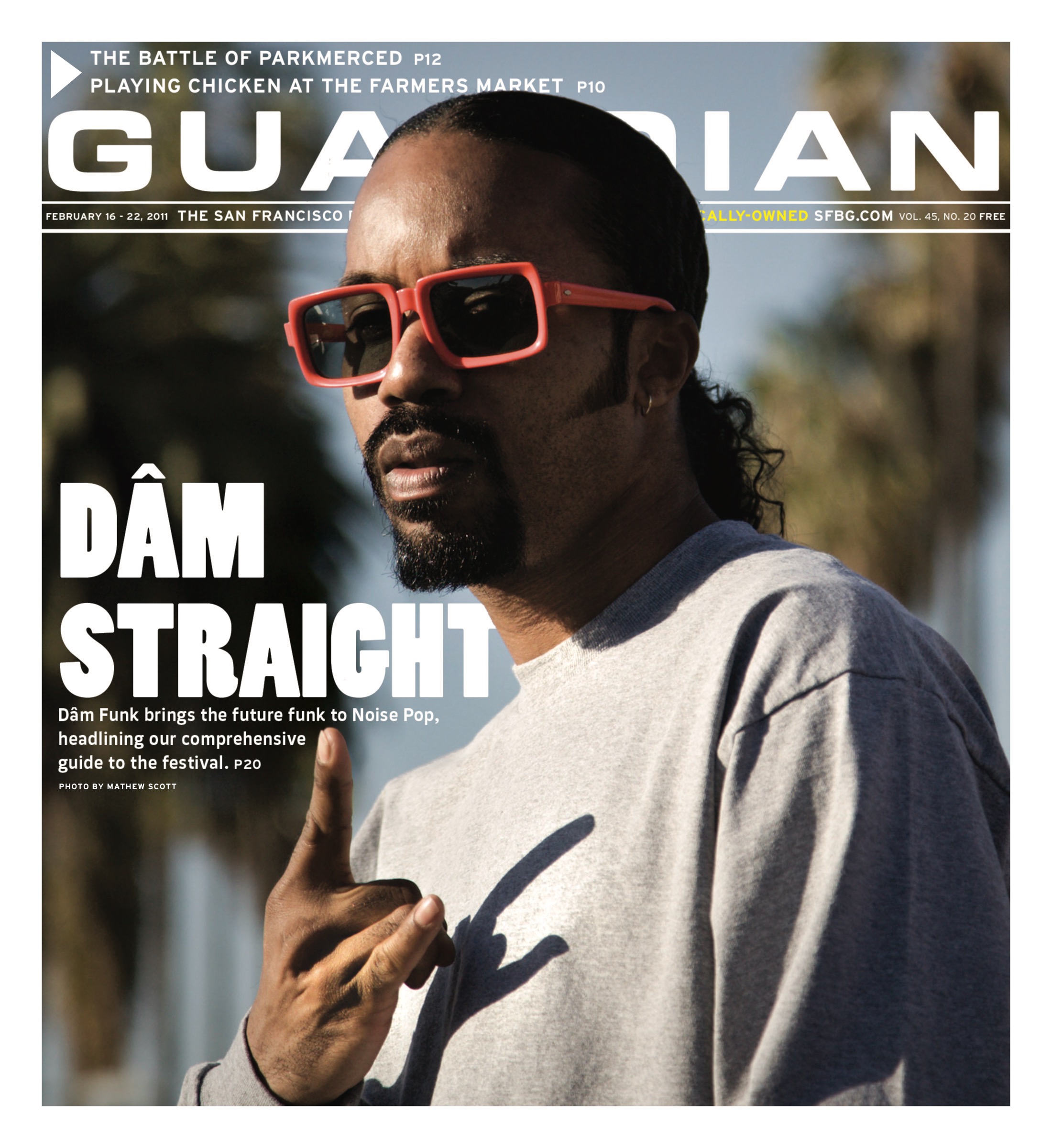
PEANUT BUTTER WOLF AND DÂM-FUNK: THE DISCOVERERS

It’s the midnight hour on Valentine’s Day in Portugal when I reach Dâm-Funk, a.k.a. Damon Riddick, on the phone. He’s just outside of Lisbon, his surroundings are “phenomenal,” and he’s ready to wax enthusiastic about his longtime partner in funk Peanut Butter Wolf. “Me and Chris [Manak, a.k.a. Peanut Butter Wolf] connect on that sound because we remember and we revere,” he says, when I ask about their shared love of soul, hip-hop, and funk. “We knew what it was like before cable television and the Internet existed, we remember everything from those early VHS tapes to the way the sun set.”

As the sun is still rising on Valentine’s Day, in L.A., the man Dâm-Funk calls “Wolf” for short shows similar brotherly love. “When Dâm met me, we had a mutual respect,” says Manak. “He saw my record collection and vice-versa. When we discover songs, we’ll say, ‘Check this out.'” In turn, this shared enthusiasm, and the positive response to Dâm-Funk’s albums Toeachizown and Adolescent Funk — both released on Manak’s label, Stones Throw – has recharged funk sounds in Los Angeles and SF, and led to new discoveries of soulful and funky treasures from the recent past.

One such gem is Jeff Phelps’ 1985 Magnetic Eyes, a Tascam Portastudio 244 bedroom recording with sensational vocals by Antoinette Marie Pugh, who stars in a terrific no-budget video for the album’s “Hear My Heart” currently up on YouTube. “That album is something I’ve known about for a long time,” Dâm-Funk says, when I mention Magnetic Eyes and its hand-drawn yet futuristic cover art. “It’s a great project.”

Another great project is Tony Cook’s Back to Reality (Stones Throw), a collection of mid-1980s recordings by a musician who got his start as James Brown’s drummer. Taking on the role of executive producer, Manak has added some extra pop to the already formidable strut of Cook songs such as “Heartbreaker,” even drafting in Dâm-Funk to contribute new vocals to one track, “What’s On Your Mind.” “You’d think they were 24-track recordings, but he [Cook] only worked on an 8-track,” marvels Manak. “He was a good musician and producer – when you’re bouncing tracks, you have to know what you’re doing. In those days it was hard to achieve a full sound like that.”

These days, both Dâm-Funk and Peanut Butter Wolf know what they’re doing — and that’s a damn lot. Reflecting his Gemini nature, Dâm is planning to explore the dark side on an EP with that title before venturing into the light on his next LP. He’s also remixed Nite Jewel and is collaborating with her on a project, Nite Funk. He’s producing music by Steve Arrington for Stones Throw, and he wants to put out another chapter of his archival venture Adolescent Funk, with him choosing the tracks instead of Manak. As for the man Dâm calls “Wolf,” he’s got Stones Throw’s 15th anniversary on his hands, including a 7-inch box set, and a series of live-to-vinyl performances by the label’s artists in L.A. These guys are busy, but — fortunately for Noise Pop, and for SF — that doesn’t mean they don’t have time to throw a 45 party. (Johnny Ray Huston)

PEANUT BUTTER WOLF, DAM-FUNK

With Guillermo (Sweater Funk), Hakobo (Fresco)

Sat./26, 9 p.m., $15 (21+)

Public Works

161 Erie, SF

(415) 932-0955

www.publicsf.com


DOMINANT LEGS: LOST IN LOVE

Whether he’s raging in the streets alongside fellow Giants maniacs or musically lost between the sheets, Dominant Legs’ Ryan Lynch sounds like he’s sweet to the core—and even more. “I didn’t have anything to do with setting the mattress on fire, but I was there,” says the SF musician of SF’s impromptu World Series throw-downs. “But I wasn’t stopping anybody from celebrating.”

Lynch also rolls with the love when it comes to music. “I don’t really listen to much music that would be characterized as aggressive,” he continues, on one of those sunny Bay afternoons that make it easy to float away on blue skies and daydreams. “I listen to pop music and, honestly, mostly KISS FM.” His favorite song on this crisp, creamy day is R. Kelly’s “Lost in Your Love.” “It’s all about him wanting to bring love songs back to the radio,'” Lynch adds. “And that’s sort of what I also aspire to—not that we get any radio play!”

But, oh, a girl — or a boy who once was a Girl (until recently, Lynch was Girls’ touring guitarist) — can dream. And dreams have been coming true for Lynch, a longtime Giants follower who recently contributed “Finally Champions” to a digital-only benefit comp of Giants tribute songs released by True Panther. Meanwhile Dominant Legs continues to pick up steam—and members.

Once the repository of Ryan’s solo singer-songwriter imaginings away from longtime band Magic Bullets, Dominant Legs found favor when the Redwood City-bred musician was laid off from his job as mail clerk-receptionist at a law firm. He didn’t sink his sparse funds into job retraining classes or the like; instead he bought a cheap Casio keyboard and drum machine. “I shouldn’t have been spending any money,” he recalls now. “But the direction of the music really took off after acquiring those pieces of musical equipment.” Friend Hannah Hunt, who had just graduated from college, offered to help out at a 2009 show at Amnesia and ended up sticking around.

“She brought a softness, and delicacy, which made the songs more delicate since her voice is so different from mine,” he observes. “I think her voice is easier on the ear than mine.” For Noise Pop, the two have acquired a few more legs to help them on their way: drummer Rene Solomon, bassist Andrew Connors, and guitarist Garrett Godard, the latter once the drummer for Girls.

They’ll be filling out the already intoxicating pop bounding off Dominant Legs’ 2010 EP, Young at Love and Life (Lefse), which has inspired music bloggers to go wild, tossing out scattershot, albeit flattering allusions to Orange Juice and Belle and Sebastian, Kelley Polar and Arthur Russell—and even Dave Matthews. Feeling lost again? Just listen to the earnestly lovelorn, gently bopping, synth-popping tunes like the title track and “Clawing Out at the Walls,” with its curious admixture of sweetness and self-doubt. Kindred spirits and modern lovers such as Jeremy Jay and Camera Obscura, also given to such exquisitely anxious reveries, would understand. “The only thing I’ve heard is that [the EP] is too heavily influenced by the ’80s,” says Lynch. “But I don’t see that as a problem.” (Kimberly Chun)

DOMINANT LEGS

With How to Dress Well, Shlohmo, Chelsea Wolfe

Sat./26, 8 p.m., $12–$14

Café Du Nord

2170 Market, SF

(415) 861-5016

www.cafedunord.com


ADMIRAL RADLEY: LIFE AFTER GRANDADDY

Jason Lytle has never been shy in revealing the frustrations leading up to Grandaddy’s demise. Exhaustion from middling success, a love/hate relationship with his lifelong home of Modesto, and a diminished interest in making music with others resulted in a move to Montana to focus on a solo career in 2006. Enter Admiral Radley, a collaboration with members of indie-pop group Earlimart and Grandaddy drummer Aaron Burtch that has him not only playing in a band again, but touring Japan and singing about his former home on songs such as the sarcastic “I Heart California.” Lytle took some time out from a snowy day of magazine shopping at Borders in his new hometown of Bozeman to talk about the project.

SFBG Rumors of a collaboration between you and Earlimart date back to the Grandaddy days. What led to you guys finally working together?

Jason Lytle It was really an excuse to hang out at [Aaron Espinoza’s] studio and just have people coming in and playing parts. We set aside a week as a fun little project. Maybe somebody else had other plans for it, but at the time, I was convinced it was just gonna be a cool opportunity to make a record and be done with it.

SFBG Were you guys surprised by the amount of excitement surrounding the project?

JL Yeah. Then it turned into, alright, we gotta name this record something, and give the band a name, and pretty soon it was this real entity. The Japan thing started off as a joke, and then became more of, “Let’s give this a go, and if it winds up getting us to Japan, we can call it good” — and the whole thing was worth it.

SFBG And how were the Japan shows?

JL They were really scrappy. The places were just dumps. I kept joking with Aaron, saying, “If we weren’t in Japan right now, and if these weren’t exceptional circumstances, there’s no way I’d be putting up with this.”

SFBG You’d expressed some skepticism about playing in bands again after Grandaddy split. Has this experience changed your opinion?

JL My place in Admiral Radley is totally different from what my situation was with Grandaddy. I’m getting off easy. Aaron is a great organizer and knows that a big appeal for me joining the band was not dealing with a lot of the day-to-day crap I used to deal with. I feel like I’m a piece of a puzzle with this band, which after all these years is something I’ve never really experienced. So it’s been kind of neat.

SFBG Both you and Aaron like being hands-on with production in your work. How was the collaborative process on this album?

JL That part was pretty effortless. Aaron and I share a lot of the same philosophies on production and making albums sound a certain way. I definitely sat in on some of the mixing, but there was a lot of it where I was just able to trust what he was going to do, knowing that it probably wouldn’t be too far off from what I’d do myself.

SFBG Was it strange writing lyrics about California now that you’ve been gone for almost five years?

JL I’ve definitely had a renewed perspective. Every time I visit or I’m there doing some work, I’m thrust right into the shit. Like right into L.A. or SF, rather than adjusting or letting it sink in slowly. So, usually it’s pretty jarring for me just because the pace is a lot more relaxed and different here. Having a bit of that outside perspective now allows me to look at things a bit differently. (Landon Moblad)

ADMIRAL RADLEY

With Typhoon, Social Studies, Fake Your own Death

Wed./23, 8 p.m., $12 (21+)

Bottom of the Hill

1233 17th St., SF

(415) 621-4455

www.bottomofthehill.com


GEOGRAPHER: EARTH PEOPLE

The dress code doesn’t include a finely-pressed lab coat, and the toolbox isn’t filled with fragile beakers, but a geographer is indeed a scientist, one who pours himself into the earth and bleeds across its surfaces to observe and categorize its residents. I haven’t asked the members of the San Francisco synth-pop trio Geographer if this occupation has had any inspiration on its sound, but there’s reason to believe the answer may be a humble yes.

Geographer has discovered new ground in the electronic realm. Its unique ménage a trois of music-making contraptions — drums, synth and cello — produces audible scenery that simultaneously calms and energizes the senses. Luscious forests of synth share habitats with rushing bass and guitar. The cello adds a sneaky-smooth layer that easily melts between or melds the more jagged sounds.

Behind the sweet scenery resides a less than pretty picture. Themes of loss and inevitable change creep through their sun-stained melodies, pulling at the roots of the band’s core. In 2005, Michael Deni fled his home in New Jersey, after the unexpected deaths of two family members. He landed in SF, and his instruments became a source of comfort and release while he wandered the new, unfamiliar territory. After a period of searching and surveying, Deni met and began collaborating with Nathan Blaz and Brian Ostreicher. In 2008, Geographer self-released its debut full-length, Innocent Ghosts, a far more relaxed collection that showcases Deni’s round, patient voice.

The landscapes on 2010’s Animal Shapes (Tricycle) are majestic, but far more celebratory. Things are tighter spun, beats kick harder and there’s a cohesive exploratory factor. Specifically fabulous: “Kites,” a track that strikes gold with a lustrous synth party. Deni’s sincere vocals float high above the mountainous bass vibrations, but mingle ever so courteously with the shrill, twinkling electronic additions. Enter the romantic cello and the song is a straight-up gem.

Now is a good time to button up your favorite white jacket and take some notes on the current environment in which you reside. Whether you’re into earth science or not, Geographer is a swell listen that goes well with salty pretzels and an adventure around your own neighborhood. Animal Shapes on repeat will keep you in step with eyes and ears open. And listen carefully: there’s good word on the street about these Geographer guys in the live form. (Amber Schadewald)

GEOGRAPHER

With Butterly Bones, K Flay, Funeral Party

Wed./23, 8 p.m., $13–$15

The Independent

628 Divisadero, SF

(415) 771-1421

www.theindependentsf.com


PSYCHIC FRIEND: PIANO POWER

Will Schwartz and the piano go way back, to when he was nine. “I’ve been attracted to the C chord and to A minor since I was a kid,” he says from L.A., where he’s living in Los Feliz. “I learned to play piano by ear, and it was always based on [starting with] a C major and going from there.”

You could say Schwartz played his first gigs on the instrument. “We had this two-story living room in our house in New Jersey with a little balcony, and the piano was up on the balcony,” he says with a laugh. “I would imagine I was playing for people down below. I would put on shows for the living room furniture.”

In his new band Psychic Friend, Schwartz updates California chamber or piano pop for today’s era, with contributions by Hole drummer Patty Schemel and instrumentalist-producer Bo Boddie. The result is a fresh chapter in Schwartz’s musical story, one that has ranged from the guitar-rock of Imperial Teen to the D.I.Y. choreographed pop of Hey Willpower, which involved contributions from videomaker Justin Kelly, DJ Chelsea Starr, and musician Tomo Yasuda.

Crisp and clean, in a way Psychic Friend sounds like the moment Schwartz has found his voice, or unknown heights or depths of it. The pounding “Once a Servant” revives the spirit of Jobriath. “Water Sign” has a Serge Gainsbourg undercurrent. “Shouldn’t Have Tried Again”‘s rendering of the repeat failure of a relationship matches the plaintive sunshine-y yearning of Harry Nilsson’s sublime covers of Randy Newman.

You could say Psychic Friend is new Californian pop. The piano-based melodic immediacy of the group’s sound has a kinship to Carole King’s solo work, or Burt Bacharach and some of his hits for psychic and other friends, yet both the sound and the lyrical content is very contemporary, not retro. It also isn’t Rufus Wainwright showboating — tracks like “We Do Not Belong” allow Schwartz’s voice a freedom and resonance it hasn’t had before, but he doesn’t run away with himself. “The nature of playing a piano and writing melodic songs, it almost brings you back to ’70s songwriting,” Schwartz observes.

“I just found this place in my voice that feels very connected, actually, that comes from playing the piano, and it feels good,” he adds, simply.

Schemel’s powerful drumming and Boddie’s hit-making skills have a role in this shift. “It’s like an Eddie and the Cruisers feeling,” Schwartz says, “where you start to play something, and by the end it sounds like a finished song.” (Huston)

PSYCHIC FRIEND

With The Concretes, Birds and Batteries, Magic Bullets

Fri./25, 8:30 p.m., $13–$15

Rickshaw Stop

155 Fell, SF

(415) 861-2011

www.rickshawstop.com

Crazy like a Mission homeboy

1

caitlin@sfbg.com

LIT Benjamin Bac Sierra, San Francisco City College English composition and literature professor and author of Barrio Bushido, an ode to Mission District vato locos, picks me up in his cherry red-and-black 1972 Chevy Monte Carlo low rider. As an academic who started selling weed in the Army Street projects when he was 10, Bac Sierra is well aware that he has an attention-getting car. As it turns out, it nicely represents his world view.

“I’m not supposed to be driving a Monte Carlo. I’m not supposed to be talking to you like this,” he tells me, his conversation inflected with casual swear words and a rhythm like that of an evangelist preacher, or maybe just a man who feels what comes out of his mouth. “A lot of people go into education and think they have to choose: am I going to be square or am I going to be how I used to be? But you can be intellectual and homeboy-homegirl at the same time.”

Barrio Bushido, Bac Sierra’s first novel, follows the story of three young men who ricochet from romance to brutal gang beatings, PCP leños, larceny, and neglect. Lobo, Santo, and Toro’s world has made them wild gangsters. Author Maxine Hong Kingston has compared Bac Sierra’s prose to that other chronicler of the underground man in uncertain times, Dostoyevsky. Although it hardly glorifies the protagonists, an honor and a beautiful-crazy logic to their deeds does emerge. Bac Sierra holds that the impulsiveness, that locura, needn’t be forgotten when someone leaves the street hustling lifestyle.

“I want to make a line between being a homeboy and the negativity. Craziness is a power — you can’t learn that in a book,” he reflects. We drive by his brother’s old house on Treat and 21st streets — Bac Sierra hears that a PayPal executive lives there now. After Bac Sierra’s father died, his brother, charismatic and clever, brought him up — until his brother wound up in jail and died young.

When Bac Sierra was 17, years after he had dropped out high school and begun dealing angel dust, he had a choice. He could continue his lifestyle, possibly ending up dead or in jail, or “retreat” into the Marines, which represented an honorable discharge, as it were, from the barrio.

Bac Sierra’s experience in the Marines followed the same lines as Toro’s, his headstrong and loyal Barrio Bushido character — to a point. Both of them cleaned up and were promoted to squad leader because of their sheer “craziness.” And both saw serious front line action during the Gulf War. Bac Sierra manned a machine gun as part of the first wave of Marines to land in Kuwait City in 1991. He also began writing in the military, letters home that he would revise “maybe 10 times — I wanted to be heard.” Although he doesn’t specifically recommend military service to young people, he recognizes the value of the discipline learned in the armed forces. “A lot of homeboys don’t do shit,” he says flatly.

After serving, he retained his strong ties to the Mission and his family there. Before his brother died, he was the one who motivated Bac Sierra to get his college degree, not to stop at his master’s in creative writing from UC Berkeley, but to continue on to law school. “Hood logic,” Bac Sierra calls it, the idea that a degree in a concrete field was far better than one writing. Although he hated every day of law school, he can now appreciate the experience and the knowledge it brought him.

He pulls the Monte Carlo over to speak with an older man on the corner across the street from his brother’s old house. “Yo escribí un libro, señor, en honor de mi hermano,” he calls out the window, inviting the man to his upcoming book release party at Mission Cultural Center. Many of his friends from the old neighborhood (he now lives in Richmond, where he is raising two of his four children, Margarita, nine, and Benny, six) are Barrio Bushido‘s biggest supporters. I ask him if it makes him sad, how much the neighborhood has changed since when he grew up. “This is the world. Economics knows no friends.”

I recognize the last line from Barrio Bushido. Its characters speak with an urgent poetry, moving through scenes influenced by Dostoyevsky and Miguel Ángel Asturias, with Gabriel Garcia Márquez-like magical realism. Bac Sierra wants the book to be taught in schools and has set a goal of having it adopted into 50 class sections by next semester.

Other things he hopes for: first, that readers be taken on a journey. “It doesn’t have to be stuffy. I want them to be amazed with the language.” Second, he wants the book to show that life is full of choices. “Start living here in this world,” as he puts it.

His last hope is for a “homeboy resurgence” in the Mission, the neighborhood that was once the center of Latino culture in Northern California. Thursday’s party at the Mission Cultural Center is a start. Bac Sierra is planning a low-rider show, Aztec dancers, a reading, and live music for the event — the positive parts of homeboy culture, like Bac Sierra himself. “I’m fucking straight homeboy,” he says. “I am very efficient. I am always inventing things.” 

BARRIO BUSHIDO BOOK PARTY

Thurs/17 7 p.m., free

Mission Cultural Center for Latino Arts

2868 Mission, SF

(415) 643-5001

www.missionculturalcenter.org

A jaundiced proposal

0

news@sfbg.com

An ordinance to ban unsolicited print Yellow Pages across San Francisco, proposed Feb. 1 by Board of Supervisors President David Chiu, seeks to reduce waste and save money.

“Phone books are a 20th-century tool that doesn’t meet the business and environmental needs of the 21st century,” Chiu said as he introduced the measure in board chambers.

The ordinance would establish a three-year pilot program starting Oct. 1 in which the city would reduce the mass distribution of phone books, making them available only at distribution centers or to residents or businesses that request them.

A rally in support of the ban before the meeting included Rainforest Action Network’s founder Randall Hayes and California Sen. Leland Yee (D-San Mateo), who proposed legislation that failed to gain steam last year for making it easier for Californians to opt out of receiving phone books.

But the Yellow Pages Association refuses to be thrown out with the rest of yesterday’s trash. YPA Vice President of Public Policy and Sustainability Amy Healy said her group opposes the proposal but that she was encouraged that Chiu and his staff say they are open to working with the association.


BY THE NUMBERS

Chiu introduced the ordinance, which is cosponsored by Sup. Scott Wiener, because of the potential effect it could have on reducing city waste, both in the city’s garbage bins and its treasury.

According to Chiu’s office, San Francisco receives about 1.5 million phone books a year. At an average weight of 4.33 pounds per book, the current distribution system creates about 7 million pounds of waste. If the production were cut in half for the city, it would save nearly 6,180 metric tons of carbon dioxide emissions a year from polluting the air.

But it isn’t just the environmental cost that is wearing on the city.

Phone books are tough to recycle. With plastic inserts, bulky design, and low-grade paper, the books have to be presorted and recycled manually. It costs Recology, the company contracted with the city for waste disposal, $300 per ton to dispose of the city’s unused phone books, which in turn costs taxpayers about $1 million a year for their disposal.


OPT IN VS. OPT OUT

The YPA has been sensitive to the environmental concerns, recently launching a website that allows a person to opt out of receiving a phone book.

But it is also suing the Seattle City Council over its Feb. 1 approval of a plan to charge Yellow Pages a 14-cent publisher’s fee per book and create an opt out system for the city, arguing the Seattle ordinance violates the First Amendment’s free speech protections.

According to a statement by YPA President Neg Norton, the association believes that “if don’t want a phone book, you shouldn’t have to get one.”

But YPA opposes the ban on unsolicited books, citing the jobs it would cost, the business community’s desire to “generate leads and revenue from ready-to-buy consumers,” and claiming the First Amendment “prohibits government from licensing or exercising advance approval of the press and from directing publishers what to publish and to whom they may communicate.”

Wiener has a different take on the matter, a stand he said he has already received lots of criticism for, including from some constituents who compared it to the board vote to ban Happy Meals last year. But he said this issue is very different.

“An enormous number of books dumped all over the city is a bad thing, and we should do something to address the issue,” he told the Guardian, noting that the ability to opt out isn’t good enough. “It’s not like the do-not-call list where it is directly annoying and people are more likely to take action … Stacks sit in apartment lobbies, and people don’t decide to opt-out.”

But YPA is also citing the public’s apathy as a reason the ban is unfair. “People don’t take the time to respond to e-mails,” Healy said. “It’s an unreasonable barrier to have a stranger knock on your door and ask you to take something.” The YPA claims that “seven in 10 adults in California use print Yellow Pages, so we do not believe a system that puts a burden on the majority of people to opt in is the best path for choice.”


ARE THEY USEFUL?

Do people still value the Yellow Pages?

Healy believes they do, stating that advertising with the Yellow Pages gives businesses a “high return on their investment.” We asked some city businesses that still advertise in the Yellow Pages what they thought about the potential ban.

Barbara Barrish, manager of Barrish Bail Bonds, doesn’t see her customers using the Yellow Pages anymore. “We used to swear by the Yellow Pages. Now young people use the computers, or their Blackberries and phones.”

Although she has an ad in the print edition, Barrish said she wouldn’t advertise with the directory again and only did so this time because it slashed its prices. “It used to cost a lot more, but it cut its advertising costs by a third,” she said. “They gave me a good deal.”

When asked if she would request a copy if the ban goes through, she said she probably would. “I might grab a phone book if the computer is down.”

Daniel Richardson, an immigration attorney who advertised in the Yellow Pages until 2008, predicted the business community would kill or water down the ordinance. “You are talking about going up against AT&T and other major businesses,” he told the Guardian with a chuckle.

Richardson said he stopped advertising in the Yellow Pages because he didn’t get enough business. He believes people look to the Yellow Pages for criminal or personal injury lawyers, but not immigration attorneys.

Even pizza places, a staple of advertising in the Yellow Pages, are ho-hum about the usefulness of the Yellow Pages. Junior Reyes, who is in charge of advertising for Go Getter Pizza on Gough Street, believes the restaurant gets most of its customers from online. “We do a lot of advertising with other places and online,” he said. “The Yellow Pages isn’t our main source.”

But what about people who do use the Yellow Pages, particularly groups that are not big Internet users. Would they miss it?

David Bolt is the dean for academic affairs at Expression College for Digital Arts in Emeryville and producer of the PBS series The Digital Divide. He believes that banning the Yellow Pages may be a problem for certain groups, including the elderly, recent immigrants, and the poor — groups with the least access to Internet, particularly in urban centers.

“We should err on the side of giving as much information to the greatest numbers of people, especially to groups that may not be technologically literate,” he said. “Society should think about how groups could be impacted by this decision.”

But Barbara Blong, executive director of the Senior Action Network, said older people are becoming more tech savvy. She said computer classes and other resources have put many of the city’s seniors online. She questioned the concept that seniors are one of the largest groups affected by the digital divide, noting that seniors oppose wastefulness as much as anyone.

“We are against having a lot of Yellow Pages laying around,” she said. Blong also mentioned that seniors who do not use the Internet for contacts can use the public library or senior centers that have phone books on hand. “I don’t see it as a ban, but moving on so we don’t have a great deal of waste,” she said.

The ordinance also exempts foreign language phone directories, further diluting the divide argument. The legislation wouldn’t ban the Chinese Yellow Pages or Momento (Spanish Yellow Pages) because they are distributed through community centers, not residences.

The ordinance is expected to have its first public hearing around the end of the month. The YPA will continue to tout its opt out website to the board in hopes it might be enough to persuade the city to forgo the opt in system. The group also hasn’t ruled out a lawsuit.

But YPA’s Healy said he hopes the coming dialogue will be productive. “We share the same goal — we don’t want to print directories that are unwanted.”

Green Bay Packers’ Desmond Bishop drops in on Lee

3

So, there I was sitting in the Mayor’s Office with fellow Guardian reporter Rebecca Bowe waiting to see Mayor Ed Lee when in walks Green Bay Packers linebacker and D10 native Desmond Lamont Bishop, who helped win the Super Bowl XLV, this month.

Turns out Bishop was there to see Lee, shortly before D10 Sup. Malia Cohen honored Bishop during the Board’s Black History month commendations’ ceremony.

We didn’t get a chance to interview Bishop (he was whisked into Lee’s office super quick), but Bowe and I surfed the web while waiting for our appointment with Lee and soon learned that Bishop was born in San Francisco on July 24, 1984, is 6 feet 2 inches tall, weighs 238 pounds, and was at Cal in 2005/06, before being drafted by the Packers in 2007, where he wears jersey number 55.
 
Cohen later confirmed that Bishop was born in Hunters Point and went to Visitacion Valley Junior High, before going to high school in Fairfield, and then returned to San Francisco to attend City College before heading to the University of California.

“Desmond is also deeply involved in his community,” Cohen said in a press release, which notes that Bishop started the Desmond Bishop Football Camp and participates in programs to help kids to be healthy and learn to read, including the Boys and Girls Club.“The Bishop family moved to San Francisco over 50 years ago, and Desmond’s grandfather still lives in Bayview Hunters Point.”

Too bad we didn’t have a chance to get Bishop’s autograph, but hopefully next time…

Playing chicken

27

news@sfbg.com

The Heart of the City farmers market in U.N. Plaza may not exude the bourgeois foodie reputation of the Ferry Plaza farmers market. It doesn’t sell micro-roasted coffee or artisan cheeses, and its fountain may sometimes double as a public shower, but it does offer one product that no other San Francisco farmers market does: fresh, live poultry.

Raymond Young has sold live chickens here for two decades, showing up at dawn to set up shop and peddle his poultry to an eager throng of customers, mostly Chinese, who happily take home upwards of 600 birds per day.

But a group of animal rights activists is saying that the poultry stand is inhumane, violates health codes, and that Young’s employees have infringed on their civil rights as protestors. Since April 2010, members of LGBT Compassion have been showing up in the wee hours of the morning next to Young’s stand with banners, brochures, and signs promulgating the alleged cruelty of his business and seeking to block the sale of live birds. In January, protesters upped the ante when they slapped Young and the HOC market with a lawsuit alleging continuous abuse and negligence by those who supervise the market.

“For me, it was as simple as seeing the animal cruelty,” said Andrew Zollman, 43, the founder and organizer of LGBT Compassion. “The cages are dilapidated and cramped, there are feces everywhere, and the chickens are shoved in plastic bags, two at a time, while they scream in fear or pain. It was like walking down the street and seeing a dog beaten — and it’s really frustrating to see it happen here in San Francisco.”

Zollman and fellow protester Alex Felsinger, 25, filed the lawsuit with San Francisco attorney Matt Gonzalez after months of attempts to get city officials to intervene.

The allegations have Young and market management squawking, saying that the activists are opposing a practice that is both legal and routine. They claim the protesters are overly sensitive to the treatment of the chickens simply because they can see it, and decry their tactics as an attack on a small business and cultural traditions since almost all of his customers are Asian.

“These people just don’t seem to like other people’s culture of selling live chicken,” Young said. “”I think that what I do is right. I abide by all the health codes and animal care codes. I try to do everything I can to satisfy everyone. These protesters think they can override the law because they don’t like what they see.”


THE PATH TO COURT

Zollman and Felsinger have been encouraging the city to investigate Young’s stall, regularly sending videos and photos taken at Young’s stall to the Department of Public Health and Animal Care and Control. But their quest to protect the chickens has been complicated by the lack of city oversight and an inability to enforce animal cruelty laws due to provisions exempting poultry.

The clash between the vociferous vegans and the poultry purveyors reached its pinnacle in late December 2010, when Felsinger claimed he was punched in the side of the head, wrapped up in a tarp, and had the memory card from his camera stolen by one of Young’s employees. As painful as the altercation was, Felsinger’s scuffle has helped him garner support.

Felsinger doesn’t have footage of the December attack, but he and Zollman have documented several instances of alleged verbal and physical abuse by Young’s employees, including anti gay statements from Young’s daughter, which was the subject of a complaint to the Human Rights Commission.

“There is a long list of things being done to us over the past year,” Felsinger said. “I never expected them to take such a violent act against me. It’s not how I wanted to go about it. But it might have the end result we’re looking for.”

Christine Adams, manager of the HOC market since it first opened in 1981, has consistently defended Young and called the lawsuit “completely outrageous.”

“This is a market, and if they (Young’s crew) were illegal, they would have been booted,” she said. “I have done nothing wrong; Raymond has done nothing wrong. I’m not worried at all about the lawsuit.”

Adams said that while she had not been personally affected by the protesting in the past, she did not approve of Zollman and Felsinger’s actions and attributed a decline in live poultry sales to their presence.

“Their sales have gone down considerably,” Adams said. “They used to sell more than 1,000 birds a day and now it’s more like 600 or 700. I think it’s definitely because of the protesters. People don’t like to be followed through a market and have a camera shoved in their face just because they bought a live chicken.”


GATHERING EVIDENCE

Almost every market day, Zollman and Felsinger would show up to protest and take video and still photography of Young’s stall. They have posted numerous videos and photos to their group’s website (lgbtcompassion.org) — the same ones they say they send to DPH and ACC — documenting the conditions at Young’s stall.

The DPH makes routine inspections twice per year to the market. In November, Zollman, Young, and Adams held a meeting with principal environmental health inspector Lisa O’Malley to address issues of sanitation, handling, and guidelines for bringing live animals near food. The department says the vendor is operating within guidelines.

“There were some problems in the past, but they’ve been fixed,” O’Malley told us, naming a few instances of inadequate removal of chicken feces from the area and improper hand-washing as past problems. She said the challenge was maintaining the guidelines, the most difficult of which is making sure people do not walk through the market after purchasing their birds. Health codes prohibit animals from being within 20 feet of food. The primary concern is contamination from fecal matter, which could cause illnesses such as Salmonella poisoning.

O’Malley walks by the market regularly because of its proximity to her office and says all operations seem compliant. At the same time, official enforcement and inspection is limited to the Public Health Department’s semi-annual visits. This means the only people watching over the operations of the stall and customers are the security guards, who don’t start working until two and half hours after the market opens, long after prime time for buying live chickens.


CULTURE CLASH

Young stands by his actions and said he is not guilty of any wrongdoing. The activists criticize him for practices such as cutting off the tips of the chickens’ beaks, but Young said he only does this to prevent fighting injuries sustained when they are caged for transport and sale, a common practice for any chicken farmer.

In their pamphlets and the lawsuit, the activists claim that the poultry is a “collection of ‘spent’ live chickens (those who are no longer productive egg layers) from large Central Valley farms,” according to the suit. But Young contests that characterization and the activists can’t produce credible evidence of the birds’ age or origins.

“They don’t know how old my birds are. They don’t know how I care for them,” Young said, refusing to tell us how old the chickens are. “They just assume. What’s the difference between Safeway chicken and my chicken? They were all alive at one time, but you see mine.”

Young has three farms listed on his permit — in Modesto, Sacramento, and Manteca — that he runs with the help of his children and a few employees. Adams has visited his Modesto facility and reported that the chickens are free-range, seem to be in good health, and are treated no differently than they would be at any other farm. She also supported the accusation that the protests undermine cultural norms.

“How can it not be cultural? All their customers are Asian!” she said. “And why is it only the chicken man they harass? There is a guy who sells quail and pheasants and they aren’t bothering him.”

Zollman, Felsinger, and Gonzalez call that cultural criticism a diversionary tactic. “I don’t even want to dignify culture and race as an issue in this,” Zollman said. “I understand that people want to buy live chickens. Animal cruelty issues aside, this isn’t a live animal market like they have in most of Asia.”

Young and Adams stressed that Zollman could not possibly know about operations on the farm, and that his suggestion that the operation is extremely profitable is absurd. “Do you know how hard it is to work on a farm?” asked Young, a single father of three. “You don’t make any money except to put food on the table or send your kids to school. And now I have to pay for a lawyer.”


ARE CHICKENS ANIMALS?

Although the activists oppose factory farms and live animals for sale for human consumption in general, they have focused their attention on the HOC market because it is permitted by the city.

Gonzalez said the lawsuit aims to address three different issues. The first is violating his client’s free speech rights by Young and HOC market. The second seeks to compel the city to better identify and enforce alleged health code violations. The third and trickiest aspect deals with animal cruelty laws, which the activists hope will force more humane treatment of the birds.

Penal Code 597 outlines animal cruelty provisions, defining the word “animal” as “frogs, turtles, and birds sold for human consumption, with the exception of poultry.” That law was adopted in the early 1900s. Elsewhere the code defines animals as “every dumb creature.” But in 2000, the Fourth District California Court of Appeals analyzed the section and deemed that the definition should include birds.

But Gonzalez and ACC say city officials have allowed the poultry exemption to stick. “[The law] refers to live animals and makes a specific exemption for poultry,” Rebecca Katz, director of the Department of Animal Care and Control, told us. “I would venture to guess that poultry lobby was very strong at that time.”

The ACC, prompted by the protests, inspected Young’s facilities and cited him for 700 different violations, according to the lawsuit. Katz mentioned a few instances in which they observed chickens suffering to the point where they had to be euthanized. But most of the citations were for inadequate water supply or holding birds improperly.

“A lot of people eat animals for food, and that’s what it is,” Katz said. “I’m not a vegetarian, but the way they are being kept is not the way we would recommend they be cared for. Do we think there is some cruelty? Probably. But there is nothing we can do at this time until the law changes.”

Like his predecessors, newly appointed District Attorney George Gascón seems to believe that chickens are not protected by state law, regardless of perceived cruel treatment.

“To date, our position has been that there is a clear exception under the law for live poultry being sold for human consumption,” said Gascón spokesperson Erica Derryck. “As much as it appears that the treatment of these animals is inhumane, there is nothing we can do to prosecute these allegations under the current laws in California.”

Gonzalez disagrees, and his office referenced similar cases in the state in which poultry was protected from cruelty. “Frankly, it’s kind of embarrassing that they are taking the position they are taking,” Gonzalez told us. “They are trying to avoid a topic that would compel them to do what they need to do. Many in the Asian community and Mexican community see this as an attack on their cultural traditions, and that’s not the issue. We see it as a straight matter of misinterpretation.”


DAILY OPERATIONS

On a recent visit to the market, the stall appeared clean and the chickens were out of view. The stall features prominent signage in English and in Chinese languages of the ban on bringing live animals into the market, with additional signs throughout the plaza, but customers routinely step directly into the market after buying their chickens.

“This is not easy,” security guard Diana Ybarra said while trying to point a man carrying a bag with two chickens in the right direction. “Nobody wants to listen — most of them don’t speak English. Everyone wants to take a shortcut right back through the market.”

Ybarra and her coworker, Washington (who chose to be identified only by his last name), said that their entire day is consumed trying to get customers to abide by this rule. Prior to the November meeting, no signage was posted and customers just “walked all over the place as if it didn’t matter at all,” Ybarra said.

“Chinese New Year was bad,” Washington added.

The guards see enforcing the rule as an unnecessary waste of time that takes their focus off tasks such as preventing theft. Both said shoving birds in sacks was “messed up,” but they were also quick to criticize the protestors.

“Why are they bothering this man? This is a family business and people have to make money,” Washington said. “Those protestors came in and fucked everything up, if you ask me.”

Young said he resents getting caught up in this controversy. “We are so loyal to this city and to this market,” he said. “We have put up with drug dealers and crime just so we can serve the people. Maybe these protesters think differently.”

For now the activists are more focused on the lawsuit than remaining vigilant in their protests, hoping it will accomplish their goal.

“I wasn’t always so adamant about getting rid of them, it was having people notice something that is animal cruelty,” Felsinger said. “It had been good in some ways to have people exposed to this cruelty in San Francisco because it gave us a platform to speak on animal rights. These are egregious offenses and it’s hard to ignore when it is right in your back yard.”

Leno forces GOP hand

5

For whatever tactical reason (or other inexplicable Jerry Brown rationale), the governor has refused to tell Californians what he would cut if he can’t get his tax extensions approved. And the Republicans refuse to say what they would cut instead of letting the taxes continue.


So Sen. Mark Leno did it for them. Leno asked the Legislative Analyst to explain what $13 billion in budget cuts — the “no-new-taxes” budget the GOP wants — might look like.


It’s really, really scary.


For starters, take $4.5 billion away from K-12 education. That means the end to class-size limits for K-3. It’s a huge deal: The Gray Davis measure that limited those classes to 20 students probably did more than anything in decades to save public education in California. You want 40 kids in a kindergarten class with one teacher? You think any of them will be learning to read? Oh, and the state could save $700 million by delaying kindergarten for kids; guess who that impacts? Those kids are going to spend more time in pre-school which either (a) is subsidized by the taxpayers or (b) comes out of the hides of working parents.


Oh, and we’d eliminate food stamps for noncitizens. So people won’t be able to feed their kids. You think crime might become more of a problem? But wait: No room in the prisons.


Then we put college out of the financial reach of middle-class kids and expect to build a 21st century economy. And that’s just the beginning.


Leno deserves thanks for putting this list out; it ought to be in the ballot handbook along with the proposal to continue (not RAISE, just continue) some taxes. And we should all be asking every Republican in Sacramento: Is this what you want? If not, give us an alternative. 


Dad, Millennium. Millennium, Dad

0

San Francisco is composed of many worlds: in one, men and women wear suits and whiz up high-speed elevators to the top of the Transamerica building (until recently, I held to the belief that the uppermost floor is built entirely from Lindor truffles and boasts a wine fountain). In a cross-town galaxy, “Transamerica” might be a documentary on one’s downstairs neighbor.  

But the great thing about the city is that its various worlds frequently overlap – in laundromats, at last call, and in the occasional rare dining experience that leaves everyone happy and full, even in the wallet. Case in point: Millennium, an artful mash-up of hippie and high class.

This weekend, I experienced just such a coalescence when my father, a venerable business-type, flew in for a meeting and informed me that the highest occupiable floor of the Transam Pyramid is just an inconveniently small conference room. After introducing him to my roommate Bella Donna (formerly Donald), I wanted to treat him to a taste of the city that would satisfy his unabashedly carnivorous appetite, impress him with SF’s classy culture, and yet not leave me scrambling to find a menu item that didn’t involve au jus.

I settled on Millennium, a veggie-only venue in the Hotel California, and shuffled my old man out the door before he could ask what kind of cuisine we were headed for. We’d already de-cabbed (traveling in style being one of the many perks of dining with Pop) in front of the restaurant when he finally weaseled it out of me.

“Vegetarian? Vegetarian!” he spluttered, looking genuinely shocked that I, his own flesh and blood, would so betray and deprive him of some other animal’s skin and bone. I almost felt bad as he plopped into his seat, not at all trying not to sulk.

The décor was the first thing to soothe his spirit: rich, heavy woodwork; black-and-white tiled floor á la French bistro, and an ornate, substantial zinc-topped bar may have reassured him that his meal, too, would be a satisfyingly substantial one. Even when I informed him that the restaurant’s interior had been recently redesigned with sustainability in mind (Charles de Lisle of Your Space Interiors chose curtains from recycled plastic bags, chandeliers that started life as paper grocery sacks, and earth-toned interior paints) he seemed at home in the cozy, cruelty-free faux leather booth – or at least sufficiently insulated from SF’s raging counter-culture, viz. a heavy tattooed specimen one table over. 

Conscious, not crunchy – Millennium’s classic décor is father-approved. Photo by Alison Bagby

Our server Justin was polite, just the right amount of chatty, and swift to suggest an array of dishes that would please my flesh-craving father, who at this point was becoming sort of embarrassed by his insistence on animal, given that the restaurant’s staff seemed to be nice folk.  

(“I don’t eat that much meat,” he squirmed. I reminded him that he grew up working in a meat-packing plant, the son of its branch manager. And that his eyes turn red when he goes too long without a steak.)

The first dish to come out was the housemade tortellini ($12.75) with black chanterelle and chestnut filling and an array of accoutrements that risked sounding prissy (“carrot butter, saffron-spring onion-white wine broth, braised sunchoke and spigarello kale”) but that actually rounded the plate out with a delightful and necessary balance of flavors and textures. From the dense, sweet cubes of sunchoke to the delicate crisp breadcrumbs topping the dish, each element melted lusciously into the whole, while somehow holding on to its own identity. Dad took one bite and then made haste to safely locate his portion of the dish to his plate: half, or actually, a fair bit more than half.

Next up was the black bean torte – Justin’s suggestion – stuffed with caramelized plantains ($10.75). In truth, I thought the bean filling was a bit pasty and bland, and that it didn’t do the plantains justice. But the pumpkin-habañero papazul more than supplied the needed kick, and the accompanying cashew “sour cream” was satisfyingly rich, tart, and abundant. Here, Dad broke out with a “this is totally vegetarian?” He scraped his fork across his already-clean plate and licked it. In other words, success.

From there, things just got better. We were surprised when oyster mushrooms ($11 in most circumstances) crusted with chickpea flour and thyme landed on our table, courtesy of the kitchen, simply because we commented that they sounded good. In truth, they were fantastic. Entrees included the seared sweet potato griddle cake ($23.25) with cauliflower, winter greens, and cilantro and lime chutney, which was crowned by an extravagant mound of sweet onion pakora. Resembling nothing so much as a bouffant-like mound of playafied burner-dreadlocks, the elaborate heap had my dad ready to rave. “This,” he said, waving his fork in the air. “This. This is… better than meat.” Whoa.

His awe and appetite carried us right through a Oaxacan green corn arepa ($24.75, billed as hearty fare to sate the meat-eaters among us), the chewiness and density of which was a slight disappointment to only me.  Furthermore, it carried the now-expected array of plays on texture and contrasting tastes: poblano chiles, grapefruit, avocado and roasted butternut squash frolicked in complete harmony.  

Three appetizers and two entrees later, and despite the generous portions, we were so charmed that we committed to a slice of chocolate almond midnight torte ($9.25). By the time it came out, my dad had been converted to a vociferous proponent of vegetarian cuisine and, eager to show his approval he said, “Great! I can’t wait to try this! I can’t believe they even make vegetarian dessert!”

Though I’m pretty sure my father hasn’t imbibed too many authentic mincemeat tarts or lard-and-suet pie crusts, I refrained from pointing out the slackmindedness of his statement. I just smiled into my vegetarian cappuccino, feeling wholly content and victorious.

So deeply entrenched was my father in the afterglow of a great gourmet experience that he didn’t even mind the mingled smells of urine and weed that wafted us along through the Tenderloin. “That was the only meal you could completely gorge on and still want to take a stroll afterwards,” he commented as we wandered, now cab-less, through the San Francisco streets.


Millennium

Sun-Thurs 5:30 p.m. – 9:30 p.m.;  Fri-Sat 5:30 p.m. – 10:30 p.m.

580 Geary, SF

(415) 345-3900

www.millenniumrestaurant.com

Beer, Wine and Full Bar

AE/DC/MC/V

Quiet

Wheelchair accessible


Political activists still oppose Chiu’s handbill regulation

12

Progressive political activists and First Amendment advocates continue to have concerns about how Sup. David Chiu’s legislation to regulate handbill distribution will affect low-budget political campaigns, despite Chiu’s efforts to address the criticism.

Two weeks ago, he delayed deliberation on the measure, saying it wasn’t his intention to curtail political speech. The measure returns to the Board of Supervisors tomorrow (Tues/15), but the activists are asking that it be sent back to committee for more work.

Chiu and the Department of Public Works Menu and Flyer Littering Task Force introduced the legislation in an effort to clean up littering and to effectively penalize handbill distribution that doesn’t meet the new regulations of securing literature and ensuring it does not become litter. The new law would require handbills to be securely fastened on doorways or placed under doormats preventing them from becoming litter on the sidewalks and streets.

“You can’t just throw something on a stoop that can be blown away,” Catherine Rauschuber, one of Chiu’s legislative aides who worked on the measure, told us. Handbills can be anything from a menu for a local restaurant to a flyer promoting a community event to campaign advertising and political information. Newspapers are exempt.

But critics of the measure, including California First Amendment Coalition Director Peter Scheer, say it needs a lot more work to pass constitutional muster and safeguard free speech rights.

“The proposed amendment to the San Francisco ordinance is not a ‘reasonable’ regulation of handbills and leaflets because it leaves the distributor of such constitutionally protected materials in doubt as to how to comply,” he told the Guardian. “Specifically, the materials are required to be ‘secured.’ However, the most efficient means of doing so—using tape or other adhesive—is itself prohibited.”

Littering a neighborhood with unsecured handbills is already a criminal infraction, one that is rarely enforced, and Chiu’s legislation would make it an administrative penalty managed at the discretion of DPW. Rauschuber said the penalty would usually be a fine of around $100.

The DPW requested the authority to administer the penalties because it wasn’t a priority of the District Attorney’s Office to prosecute violators, and DPW officials said it would be more effective in lowering the instances of littering, Rauschuber told us.

Political activists such as Karen Babbitt worry about the effect the new legislation will have on grassroots campaigns. She believes that the language of the ordinance creates a disadvantage to political candidates with low-budget campaigns.

“If you place a piece of literature under a doormat and it still somehow ends up on the sidewalk, the campaign can be fined,” she told the Guardian. “I can’t think of a way that I, as a volunteer, could prove that I’d initially placed the piece of lit securely. I try to place them securely, but the wind sometimes still blows them away—especially in windy neighborhoods like Diamond Heights.”

The board’s Land Use and Economic Development Committee approved the measure on Jan. 24, and while political activists say it needs more work, those concerned about litter welcome the change.

Dawn Trennart, a member of the Middle Polk Neighborhood Association and the Menu and Flyer Littering Task Force, saw the handbills become a litter problem in her neighborhood last spring and brought it to Chiu’s attention.

“It is a litter and security problem,” said Trennart said. “The handbills get stuck in doors and cannot lock properly.”

The law would also allow buildings to post a smaller “no handbills” sign with 30-point font, instead of the current requirement of eight square inches, to prohibit distribution. Babbitt believes the ordinance is superfluous to the efforts political volunteers already make.

“Most folks I’ve volunteered with over the years already try to place pieces of literature in ways that keep them from blowing away. It makes your candidate look bad, after all, to have her or his literature blowing all over the neighborhood,” she said.

But she and other activists complain that the new law would presume the campaigns are guilty without offering proof. Scheer also pointed to a 1943 U.S. Supreme Court ruling in the case of Martin v. City of Struthers, which found that litter is not a compelling enough argument to regulate handbill distribution.

Scheer believes that, in order to satisfy the First Amendment, the ordinance should not only state what handbill distributors cannot do, but also state what they can do to avoid penalties, which is commonly called a “safe harbor” provision.

Still, political activists complain that they were not involved in the drafting of the ordinance. While the Sierra Club, ACLU, SF Labor Council, and other groups that distribute political handbills were not consulted, the activists note that Golden Gate Restaurant Association and other business groups were brought in to help shape the legislation.

By asking for the measure to be sent back to committee, where public testimony is taken, the political activists hope their concerns will finally be addressed.

“Flex” keeps marine scientists guessing

3

I received a call last Friday from Nicole Catalano of Pacific Environment, an environmental nonprofit focusing on marine conservation. An endangered gray whale was headed for California, she told me, and I could follow its movements online. “We expect it to be in California either now, or any day now,” Catalano said.

“Flex,” as researchers have named him, is one of an estimated 120 western Pacific gray whales. The highly endangered species has fared much worse than the related eastern gray whale, which has an estimated population of around 20,000.

The whale was tagged last October as part of a research project geared toward offering the mammoth creatures better safeguards against extinction. “They were going to tag many of them,” Catalano explained, but so far, Flex is the only whale researchers have succeeded in making contact with.

The Marine Mammal Institute at Oregon State University has created a website, updated weekly, to track Flex’s transoceanic journey. So far, he’s gone from Russia, to the Bering Sea, to the Gulf of Alaska, to the coast of Oregon, to the coast of California.

Researchers have been suprised by his progress, and don’t know what to expect next. “Flex’s route may or may not be typical of what western gray whales do — there could be three or four other whales from the western population making this same trip, or Flex could take an entirely different route next year,” said Bruce Mate, director of the Marine Mammal Institute.

The international environmental community’s interest in western Pacific gray whales stems in part from monitoring offshore oil and gas drilling near Russia, Catalano noted. Seismic testing for offshore development is known to impact marine mammals, and some of this activity is occurring nearby the whales’ feeding areas. In 2006, the Western Pacific Gray Whale Advisory Panel was convened by scientists to provide independent recommendations on how oil and gas companies can minimize risks to rare creatures.

Obama’s going to screw California

6

The giant cuts proposed by the Obama Administration (and worse ones suggested by the GOP) will hurt the economic recovery, hurt the poor, hurt the nation’s future — and hurt California. Let’s remember, as Brian Leubitz notes at Calitics, we live in a net donor state — for every dollar Californians send to Washington, the state gets 80 cents back. And now the president wants to make cuts that will further mess up the state budget — and since Gov. Jerry Brown is sending a lot of Sacramento’s work back to the counties, the shit will keep rolling downhill.


It’s true that Obama is also talking about tax hikes, but that’s going to be hard to get through the House. And even if he gets his higher taxes on oil and gas producers and high-income individuals, he still wants to cut spending — that is, non-military spending.


So over the next few months, as Washington politicians try to out-cut each other and talk about “living within our means” (except for wars that nobody wants to pay for but we keep fighting anyway), look for the budget crisis in Sacramento and San Francisco to get worse.


One ray of hope: If Jerry Brown is willing to back up his “local-government-does-it-better” campaign by giving local government the right to raise taxes abit more easily, then he’ll support Sen. Mark Leno’s bill to allow counties to raise the Vehicle License Fee. That might even come close to saving SF what Washington and Sacramento take away.

Editor’s Notes

0

tredmond@sfbg.com

I had fun with the state budget the other day. The Sacramento Bee has a pretty good online simulation that lets you pick programs to cut and revenues to raise to see if you can get rid of a $26.4 billion deficit, and I gave it a shot. It took me exactly seven minutes to turn the red ink into a $2.1 billion surplus.

See, it’s not that hard. Extend the 2009 tax increases, as Gov. Jerry Brown has suggested. Force multistate corporations to pay taxes based on sales in California. Increase the corporate income tax rate to the same level as the personal income tax rate. Eliminate the Prop. 13 loophole for nonresidential property. Pass an oil severance tax. A few more mouse clicks and bingo: I’ve got $28 billion, without cutting much of anything. (Well, I cut prison spending.)

The lesson you get from playing, of course, is that cuts alone will never do the job; there’s not enough left to cut.

When I finished, I called the office of Asemblymember Connie Conway (R-Tulare). She chairs the Republican Caucus gave the formal GOP response to Brown’s State of the State speech and insisted that new taxes were not acceptable.

Her press spokesperson, Sabrina Lockhart, was very friendly and nice. I told her about the Bee game and asked: If you don’t like Brown’s taxes, what specifically should the state cut?

Lockhart’s response: “Our focus has been on creating jobs to bring in new revenue.”

Okay, I’m for that, too, but let’s be real. Even if 1 million new jobs materialized tomorrow, that wouldn’t bring in enough money this year to balance the budget. Brown’s proposing $12 billion in cuts. If that’s not enough, what else do the Republicans think should go?

Lockhart: “The Republicans are engaged in the subcommittee process and will be reviewing the governor’s proposals.”

But your boss said no taxes, I told her. There are really only two options; taxes or more cuts, right? Am I missing something here?

Lockhart hemmed and hawed for a moment. “That’s why we think job creation has to be a part of this,” she finally said.

Well, I do, too, but it’s just not that simple. If the Republicans don’t want taxes, why won’t they tell us what they want to cut instead? Seriously, what Brown is offering is brutal, bloody — what else would the GOP members put on the chopping block?

Answer: They have no proposals. Nothing at all. Just no new taxes. If I were Jerry Brown, I’d be drinking heavily.

More questions about death drug

7

The Food and Drug Administration has finally released some more documents about the state’s procurement of its death drugs. The Guardian and the ACLU requested the material under the Freedom of Information Act. You can see the latest here.


A lot of it is just dry correspondance between agencies; the FDA was apparently a bit slow at releasing the imported drugs from customs. But there’s some interesting details in the mix.


For one thing, California and Arizona aren’t the only states that bought death drugs from England. A U.K. company named Dream Pharma also got orders from South Carolina, Arkansas and Georgia. And that pipeline is now shut off; the U.K. will no longer allow companies to export drugs for executions. (Civilized nation there.)


There’s also the interesting issue of whether the stuff that California bought is up to U.S. standards. The records show that the U.K. company doesn’t know if the Sodium Thiopental it sells meets U.S. standards; the company isn’t approved by the FDA. That means a hospital would have trouble buying and using the stuff for clinical purposes — but apparently it’s okay to use on condemned prisoners.


The issue is more than academic. The thiopental is supposed to render the prisoner unconsious and unable to feel pain before the next two drugs paralyze his breathing and stop his heart. If the stuff doesn’t work, then death could be very painful; imagine being awake as your lungs seized up and your heart stopped beating. In fact, the courts have been very clear on this point: Injecting the two final drugs into a person who is consious amounts to cruel and unusual punishment and is illegal.


So how do we know if the stuff the state bought works as advertised? How do we know what the proper dose is (you can’t exactly test it on someone first)? Is CDCR going to pay for a full chemical analysis to make sure they’re using the right amount of the right stuff?


Man, this is grisly. No wonder most civilized countries reject capital punishment.