Budget

Newsom’s fiscal conservatism undermines his agenda

15

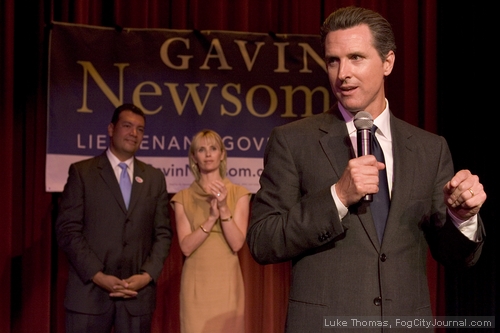
Gavin Newsom’s nomination for lieutenant governor places many San Franciscans in an uncomfortable position, one that was illustrated well by the victory speech that he gave last night just as our story our on his latest budget – in which he proudly rejected taxes in favor of deep spending cuts and future budget deficits — was coming off the presses.

Even though most San Francisco progressives don’t like our fiscally conservative mayor, few of us would rather vote for his Republican challenger, Abel Maldonado, despite the fact that this moderate Latino is actually fairly close to Newsom ideologically. “We don’t want to underestimate the challenge we have. There’s never been a moderate Latino on the statewide ballot,” Newsom pollster Ben Tulchin told me last night.

SF Labor Council President Tim Paulson was at the Newsom event gritting his teeth as he talked about the opportunity progressives now have to work with “a mayor of San Francisco we have issues with,” noting that, “What I find interesting in the easy win for Newsom is how there is going to be a real campaign around this man. It could establish a narrative for what California is about.”

And he’s right, but the danger is if Newsom sticks with his inflexible and longstanding “no new taxes” stance then the narrative could be that neither major political party’s top nominees are willing to tap millionaires, oil companies, and other entities that can afford it in order to fund education, health care, and the development of a green economy, which Newsom said are his top priorities. That and “jobs,” by which he means only private sector jobs, based on his past statements and actions and current failure to support new tax measures.

But Newsom doesn’t seem to see the glaring contradiction in his political philosophy, which he illustrated as he told a story about the potential to achieve strong economic growth while aggressively pursuing solutions to global warming and other environmental challenges, which he and progressives both seem to believe are not just possible, but “the opportunity of a lifetime.”

Newsom noted that the only four wealthy countries that signed the Kyoto Protocols and met their greenhouse gas reduction goals – Sweden, Denmark, United Kingdom, and Germany – have similar economic strategies. “All four of these countries had three things in common vis-a-vis the United States: Lower unemployment, higher growth, and lower income disparities,” he said.

Yet Newsom left out another key commonality that was even more central to their success, and big reason for two of Newsom’s three items: All have far higher tax rates than the U.S. and a more vibrant, respected, and well-funded public sector that was able to guide that economic transformation and ensure a smart, equitable distribution of the country’s wealth – something Newsom has been overtly hostile to as mayor and while campaigning for statewide office.

Nonetheless, he continued, “What’s interesting about these four countries is they dramatically shifted their framework in terms of economic growth and economic development towards a cleaner and greener energy future and they were rewarded with higher growth and lower unemployment. I think that’s suggestive, in the context of this debate.”

So do I, suggestive of the need for Newsom (and Jerry Brown) to finally realize it’s going to take money and a rejuvenated public sector to meet his stated goals for education, health care, and the environment. In San Francisco, his reluctance to challenge the Chamber of Commerce fallacy that taxes kill growth has left a legacy of dangerously diminished social services and increasing budget deficits running indefinitely into the future.

But the four countries that Newsom claims to admire don’t think that way. They don’t boast of cutting social services while proposing even more business tax cuts, and they don’t say things like, “It’ll take an entrepreneurial look at solving problems in this state.” He’s sounds like Meg Whitman and the Republicans.

What we need is the other Gavin Newsom, the one who last night also said, “Now is the time for serious problem solving in California….It is a time for California to fundamentally change.”

But first, Mr. Mayor, you’re going to need to embrace a few fundamental changes of your own.


Cutting from the bottom

7

By Alex Emslie

news@sfbg.com

When Mayor Gavin Newsom unveiled his proposed city budget on June 1, he downplayed the severity of cuts to the city’s Department of Public Health, noting that they amounted to less than 2 percent. But if Newsom’s uneven program chopping becomes a reality, critical social services for some of San Francisco’s poorest and most vulnerable residents will be cut by almost one-third.

The DPH was able to shrink its budget by nearly $31 million, according to a budget proposal currently before the Board of Supervisors, in part by slashing community nonprofit clinics providing outpatient mental health services to some of San Francisco’s most difficult to treat mental health cases.

“It’s very possible you could see more people who are homeless, people who are homeless not getting as much care — they’ll be sicker,” said Dr. Eric Woodard, medical director of psychiatric emergency services at San Francisco General Hospital. “And you could reasonably expect more deaths on the street to occur.”

State and federal matching funding to the DPH dwarfs the amount of money the department receives from the city. What isn’t spelled out in Newsom’s budget is that every dollar cut by the city results in more than another dollar lost in federal funding for social services.

The DPH proposed a nearly 9 percent cut to outpatient community-based health services, and an 11 percent cut to residential inpatient services to meet the mayor’s request that all city departments submit a 30 percent budget reduction to his office. Newsom reversed the proposed cuts to residential services but kept the outpatient cuts.

“I believe in the efficacy of residential [treatment],” Newsom said during his budget unveiling. “I believe there are a lot of question marks around outpatient drug treatment.”

But the cuts affect more than just outpatient drug treatment. While many of the clinics that were cut focus on treating mental illnesses, they are funded through the DPH category that includes substance abuse treatment. Newsom’s office declined to answer our inquiries about the reasons for and implications of his cuts, referring us to DPH.

Walden House CEO Vitka Eisen, whose organization serves people suffering from mental illness and substance abuse in inpatient and outpatient clinics, said she was relieved that residential funding was added back. However, she is concerned about the proposed $4.1 million cut spread across several nonprofit outpatient services.

“There’s a very large cut to outpatient services citywide, and that’s obviously problematic because outpatient services are an important part of our system of care in the city,” she told the Guardian. “You can’t really cut one or the other.”

DPH Community Behavioral Health Services Director Dr. Robert Cabaj is hoping the Board of Supervisors will restore some of the cuts to outpatient clinics. “Unfortunately, they [the Mayor’s Office] left these in,” he told the Guardian. “I’m not sure why — I’m not sure what the mayor was thinking at the time.”

Citywide Case Management and Community Focus, an outpatient clinic serving some of San Francisco’s most severely mentally ill, is one of the hardest hit nonprofit clinics in the mayor’s proposed budget. The agency will lose $1.22 in federal funding for every $1 cut from the city, division director Dr. David Fariello said.

That’s how its 15 percent, $1.3 million cut proposed by the DPH and accepted by the mayor, ballooned into a 33 percent, $2.8 million loss for one of the city’s most comprehensive and best-performing community behavioral health services.

Citywide, at 982 Mission St., boasts the facilities, network, and location to serve one of San Francisco’s most vulnerable populations. The typical Citywide client suffers from schizophrenia, bipolar disorder, borderline personality disorder, or severe depression. They are likely homeless, grappling with substance abuse, and many have posttraumatic stress disorder.

Citywide employees, doctors, and administrators, as well as physicians from outside the clinic, speculate that cutting outpatient mental health services in a city with one of the highest per capita populations of mentally ill homeless people will ultimately cost the city more money than it saves now. Use of expensive city services like psychiatric emergency rooms, jails, police, and ambulance could all rise.

“Frankly, a lot of these budget cuts do not seem to be very well thought out in terms of what the real cost is going to be,” Woodard said. “If you look into the not very distant future, you’re going to incur costs that are probably much greater than your savings were initially by making the cuts.”

Cabaj said that past funding cuts haven’t resulted in higher use of psychiatric emergency services because the DPH prioritizes funding for the most severe cases and screens for those who could possibly be moved into cheaper services. Citywide clients are consistently high users of San Francisco General Hospital acute inpatient psychiatric care, at an average cost to the city of $1,200 per patient, per day, if they don’t have insurance or Medical benefits.

Many end up in costly in-patient psychiatric care facilities or are arrested and land in the city’s Behavioral Health Court, which hears cases in which defendants have been diagnosed with a mental illness that is suspected of being a factor in their crime. More than 70 percent of the Behavioral Health Court’s mandated treatment slots are at Citywide.

“We can manage behaviors that get people thrown out of every other clinic in the city,” Fariello said. “Where is that capacity going to be picked up? These are not clients who, if they don’t get treatment, maybe their doctor will give them some medicine and it’ll be OK. These are clients who are going to continue to be high users unless we intervene.”

Citywide figures show a 40 percent decrease in violent reoffenses for clients referred to their clinic from the Behavioral Health Court. Nearly three-quarters who were homeless are able to maintain housing, and more than 25 percent of clients who were frequent users of inpatient psychiatric services have stayed out of the hospital.

“Citywide really is one of the best,” said Woodard, who works with Citywide’s Linkage Team to stabilize patients from SFGH’s psychiatric emergency room. “They provide excellent care for these really fragile, very ill patients. I would say of the community programs, they’re really at the top of the list.”

Fariello estimates having to reduce the 1,035 clients receiving treatment at his clinic by 400 if the cuts are finalized. He may have to scale back some of his clinic’s innovative and successful categories of service — such as employment support and dialectical behavioral therapy, a highly specialized form of therapy with proven success in treating borderline personality disorder. Citywide has the largest DBT team in San Francisco.

Citywide administrators are baffled by DPH’s decision-making process, given that it serves the city’s sickest, poorest, and homeless — characteristics that should have reduced its cuts, according to the department’s priorities outlined in its budget reduction proposal.

Since founding the agency nearly 30 years ago, Fariello has worked with the city to implement innovative techniques in treating San Francisco’s highest users of expensive psychiatric emergency services. And it has been consistently successful. In a review last year of 15 similar programs conducted by the DPH, Citywide received an average 92.1 out of 100, the highest score. It scored a 4.0 out of 4.0 on another recent program review.

Several divisions within Citywide contribute to its inclusive approach to mental health services. Citywide’s forensics program works exclusively with clients involved in the criminal justice system. Community Focus provides culturally sensitive therapy in several languages. The Linkage Team stabilizes emergency psychiatric patients from SFGH.

Employment support for Citywide clients helps them get and retain jobs, emblematic of the entire agency’s goal of treating clients as complete people, not just mental health patients. “What we’ve found out is that people who have an investment in purposeful activity have an investment in getting better,” Fariello said. “A lot of clients have a notion that their career is being a mental health client. What we’re trying to do is change that.”

Citywide supported employment services supervisor Greg Jarasitis told a story of one client who said she liked her job as a bookkeeper because while she was at work she felt like a “normy,” then added: “These are people who have been marginalized for so long.” *

Get involved: The Board of Supervisors holds a public comment hearing on the deep proposed health cuts, as state law requires, June 15 at 3 p.m. in Board Chambers at City Hall. The board’s Budget and Finance Committee departmental hearings for the DPH are scheduled for June 21 and June 28.

Another bloody budget

6

rebeccab@sfbg.com

In the days since June 1, when Mayor Gavin Newsom unveiled his proposal for San Francisco’s $6.48 billion budget for the next fiscal year, public sector employees and community organizations have been poring over the hefty document to determine how their jobs, services, and programs survived cuts made to close a $483 million shortfall.

For police and firefighters, a key Newsom constituency, the news is good. There were no layoffs to San Francisco firefighters, and while members of the Police Officer’s Association gave up $9.3 million in wage concessions under the lucrative contract Newsom gave them a few years ago, police officers will still receive a 4 percent wage increase on July 1.

For others, the release of the mayor’s budget signified a tough fight looming before the Board of Supervisors, one with high stakes. Cuts to homeless services, mental health care, youth programs, and housing assistance, along with privatization proposals, have raised widespread concern among labor and liberal advocacy organizations. Public input on the budget will continue at the Board of Supervisors Budget and Finance Committee until July 15, when the amended document is considered by the full board.

At a June 1 announcement ceremony, Newsom asserted that the budget was balanced “without draconian cuts,” saying, “We were able to avoid the kind of cataclysmic devastation that some had argued was inevitable in this budget.”

Nearly a week later, Board President David Chiu told the Guardian that sort of cataclysm wouldn’t be staved off for long if the city continues on the course of repeatedly making deep budget cuts without proposing any significant new sources of revenue.

“Now that the smoke has cleared, it is clear that the mayor’s proposed budget is perfect for a mayor who is only going to be around for the short term, but it does not address the long-term fiscal crisis that our city is in,” Chiu said. “Next year, we’re looking at over a $700 million budget deficit. The year after that, we’re looking at almost an $800 million budget deficit. The budget proposal that Newsom put out balances the … deficit on many one-time tricks and assumptions of uncertain revenue.”

Meanwhile, advocates said even the cuts proposed this time would bring serious consequences, especially with unemployment on the rise, state programs being cut in Sacramento, and families feeling the pinch more than ever.

“Poor and working class families, and families of color in San Francisco, are facing kind of an assault on funding and on safety net services on multiple levels,” said Chelsea Boilard, family policy and communications associate for Coleman Advocates for Children and Youth. “I think a lot of it is that families are concerned about their ability to stay in the city and raise their kids here.”


“NO NEW TAXES”

During the budget announcement, Newsom emphasized the positive. He found $12 million in new revenue simply by closing a loophole that had allowed Internet-based companies to avoid paying that amount in hotel taxes. He said 350 currently occupied positions would be cut, but noted that it was less than a cap of 425 that public sector unions had agreed to. Cuts were inevitable since the ailing economy inflicted the city’s General Fund with significant losses, particularly from business and property tax revenues.

Nonetheless, Newsom’s budget is already coming under fire from progressive leaders. For one, there are no new revenue-generating measures in the form of general taxes, which could have averted the worst blows to critical safety-net services and might help remedy the city’s economic woes in the long-term.

“There are no new taxes in this budget,” Newsom declared. “I know some folks just prefer tax increases. I don’t.”

Yet Chiu said many of Newsom’s assumptions for revenue were on shaky ground, prompting City Controller Ben Rosenfield — Newsom’s former budget director — to place $142 million on reserve in case the projected revenues don’t pan out.

“These budget deficits continue as far as the eye can see,” Chiu noted. “Even if those amounts come in, something like 90 percent of them are one-time fixes. So even if the mayor is right, it doesn’t solve next year’s problem, or the year after. Which is why many of us at the board believe that we have to consider additional revenue proposals to think about the long-term fiscal health of the city.”

Sup. John Avalos, chair of the Budget and Finance Committee, described Newsom’s budget as “pretty much an all-cuts budget,” noting that he and Chiu planned to introduce revenue-generating measures. They were expected to introduce proposals — including an increase in the hotel tax and a change in the business tax — at the June 8 board meeting.

Because despite Newsom’s rosy assessment, many of his proposed cuts are deep and painful: the Recreation and Park Department would be cut by 42 percent (with its capital projects budget slashed by 90 percent), Economic and Workforce Development by 34 percent, Ethics Commission by 23 percent (basically eliminating public financing for candidates), Department of the Environment by 14 percent, Emergency Management by 10 percent, and the list goes on.


CUTS TO SOCIAL SERVICES

Progressives say Newsom’s budget reflects skewed priorities. While relatively little is asked of public safety departments, health and human services programs face major staffing and funding losses. “Poor people are being asked to shoulder the burden,” noted Jennifer Friedenbach, director of the Coalition on Homelessness.

Nearly $31 million would be slashed from the Department of Public Health, and more than $22 million would be cut from the Human Services Agency under Newsom’s proposed budget. While this reflects only 2–3 percent of the departmental budgets, there’s widespread concern that the cuts target programs designed to shield the most vulnerable residents.

Proposals that deal with housing are of special concern. “We have more and more families moving into SRO hotel rooms. We have families in garages. We have a really scary situation for many families,” Friedenbach said.

Affordable housing programs within the Mayor’s Office of Housing would get slashed from $16.8 million currently down to just $1.2 million, a 92 percent cut. Other cuts seem small, but will have big impacts of those affected. Newsom’s budget eliminates 42 housing subsidies, which boost rent payments for families on the brink of homelessness, for a savings of $264,000. Meanwhile, a locally funded program that subsidizes housing costs for people with AIDS would be cut, for a savings of $559,000.

Transitional housing would be affected, too, such as 59 beds at a homeless shelter on Otis Street, which Friedenbach says would be lost under Newsom’s budget proposal. “We’ve already lost more than 400 shelter beds since Newsom came to office, so that’d be a huge hit,” she said. Since the recession began, she added, the wait-list at shelters has tripled. The Ark House, a temporary housing facility that serves LGBT youth, would also be closed.

Overall, homeless services delivered by HSA would take a $12 million hit in Newsom’s budget, or about 13 percent, offset slightly by homeless services being increased by $2 million within the Mayor’s Office budget, a 71 percent increase.

Outpatient mental health services, such as Community Behavioral Health Services, would also be affected (See “Cutting from the bottom”), in violation of current city law. Several years ago, then-Sup. Tom Ammiano introduced legislation establishing a “single standard of care” to guarantee access to mental health services for indigent and uninsured residents.

“If timely, effective, and coordinated mental health treatment is not provided to indigent and uninsured residents who are not seriously mentally ill, those residents are at risk of becoming seriously mentally ill and hence requiring more expensive and comprehensive mental health care from San Francisco,” according to the ordinance, which was passed in June of 2005. Newsom’s budget proposes changing this legislation to enable cuts to those services, which would result in 1,600 people losing treatment, according to Friedenbach.

Unfortunately, advocates for the poor has gotten used to this ritual of trying to restore cuts made by Newsom. “There are some sacred cows that seem to survive year after year, and then we’re left fighting over what we can get,” said Randy Shaw, executive director of the Tenderloin Housing Clinic (THC).

The Central City SRO Collaborative, which supports tenants living in single-room occupancy hotels in the mid-Market Street area and is operated through THC, is slated to be cut by 40 percent along with three other similar programs — a replay from last year when the mayor proposed eliminating funding and the Board of Supervisors restored the cut.

“I think you’d see more fires, more people dying from overdoses. You’d see really bad conditions,” Jeff Buckley, director of the program, told us of the potential consequences of eliminating the inspections and resident training that is part of the program.

Funding was also eliminated for THC’s Ellis Eviction Defense Program, the city’s only free legal defense program with capacity to serve 55 low-income tenants facing eviction under the Ellis Act.


THREAT TO RENTERS

One of the most controversial proposals to emerge from Newsom’s budget is a way for property owners and real estate speculators to buy their way out of the city lottery that limits conversion of rental properties and tenants-in-common (TICs) to privately-owned condos if they pay between $4,000 and $20,000 (depending on how long they have waited for conversion), a proposal to raise about $8 million for the city.

“I went back and forth because I know the Board of Supervisors can’t stand this,” Newsom said as he broached the subject at the June 1 announcement. “I still don’t get this argument completely. Except it’s a big-time ideological discussion. It’s so darn ideological that I think it gets in the way of having a real discussion.”

Yet Ted Gullicksen, director of the San Francisco Tenants Union, said the argument is quite clear: making it easier to convert rental units into condos will accelerate the loss of rental housing in a city where two-thirds of residents are tenants, in the process encouraging real estate speculation and evictions.

“It will encourage TIC conversions and evictions because it makes the road to converting TICs to condos that much easier,” Gullicksen said. “It’s going to be a huge gift to real estate speculators.”

Newsom press secretary Tony Winnicker disputes that impact, saying that “these units were going to convert anyway, whether next year or six years. This merely accelerates that conversion without altering the lottery to protect jobs and services.”

But Gullicksen said the proposal obviously undermines the lottery system, which is the only tool tenant advocates have to preserve the finite supply of rent-controlled apartments, noting that even if the condos are later rented out, they will no longer to subject to rent control. That’s one reason why the Board of Supervisors has repeatedly rejected this idea, and why Newsom probably knows they will do so again.

Avalos said he and other progressive supervisors will oppose the proposal, despite the difficulties that will create in balancing the budget. “It’s kind of like putting a gun to our heads,” Avalos said of Newsom’s inclusion of that revenue in his budget.

To offset that revenue loss, Avalos has proposed a tax on alcohol sold in bars and Gullicksen is proposing the city legalize illegal housing units that are in habitable condition for property owners willing to pay an amnesty fee.

Some housing advocates were also struck by the timing of proposing condo conversion fees while also eliminating the Ellis Eviction Defense Program. “We’re really the only ones doing this,” Shaw noted. He said the program is crucial because it serves low-income tenants, many of whom are monolingual Chinese or Spanish speakers who lack the ability to pay for private attorneys to resist aggressive landlords.


PRIVATIZATION PROPOSALS RETURN

The Department of Children, Youth. and Families budget would be reduced by 20 percent under Newsom’s budget, with the greatest cuts affecting after school and youth leadership programs. Roughly a $3 million cut will result in the loss of around 300 subsidized slots for after school programs, said Boilard of Coleman Youth Advocates. Another $3 million is expected to come out of violence-prevention programs for troubled youth; an additional $1 million would affect youth jobs programs.

Patricia Davis, a Child Protective Services employee who lives in the Mission District with her two teenage sons, said she was concerned about the implications for losses to youth programs, particularly during the summer. “You can imagine what’s going to happen this summer,” she said. “I feel that a lot of kids are going to do a lot of things that they have no business doing.”

Davis, who says she’ll have to look for a new job come Sept. 30 because the federal stimulus package funding that supports her position will run out, said she was not happy to hear that police officers would be getting raises just as that summer school programs are being threatened with closure. “Couldn’t the 4 percent [raise] go somewhere else — like to the children?” she wondered.

Meanwhile, privatization proposals are causing anxiety for SEIU Local 1021 members, who recently gave millions in wage concessions and furloughs along with other public employees to help balance the budget. A proposal to contract out for jail health services cropped up last year and was shot down by the board, but it’s back again.

“When you make it a for-profit enterprise, the bottom line is the profit. It’s not about the health care,” SEIU Local 1021 organizer Gabriel Haaland told us. “It isn’t the same quality of care.”

Haaland said he believes the mayor’s assumption that the proposal could save $13 million should be closely examined. Other privatization schemes would contract out for security at city museums and hospitals.

Institutional police in the mental health ward at SF General Hospital and other sensitive facilities are well trained and experienced with difficult situations so, Haaland said, “the workers feel a lot safer” than they would with private contractors.

Regarding Newsom’s privatization proposal, Avalos said the board was “opposed last year and the year before, and we’ll oppose [them] this year.”

In the coming weeks, Avalos and other members of the Budget and Finance Committee will carefully go over Newsom’s proposed budget — which is now being sized up by Budget Analyst Harvey Rose’s office — and solicit input from the public. Chances are, they’ll get an earful.

“People are scared. They are scared to death right now,” Boilard said. “As it is, people’s hours are being reduced. And it’s getting harder and harder to find a job because so many people are out of work that the level of competition has gotten really fierce. This is the time that we need to invest in safety net services for young people and families more than ever — and all those services and programs and relationships that people depend on are disappearing.”

Steven T. Jones and Kaitlyn Paris contributed to this report.

The impact of Prop. 14

5

Proposition 14 was the sleeper on the ballot; it’s only there because Abel Maldonado refused to vote for a state budget unless both parties agreed to put it before the voters. And it’s winning. The impact of open primaries could be dramatic; it could hurt progressive candidates, pretty much wipe out third parties and potentially change the shape of the state Legislature. Maldonado likes it because it shifts the balance of power toward “centrists” — which actually means people who can raise a lot of campaign money. It’s going to take a while to sort out the impacts of Prop. 14, but it doesn’t bode well.

Ethics boss finally ousts Luby, a crusading public advocate

13

Oliver Luby has long been the most public-spirited employee of the San Francisco Ethics Commission, the one person in that office who repeatedly exposed powerful violators of campaign finance rules and blew the whistle on schemes to make the system less transparent and effective, drawing the ire of Director John St. Croix and Deputy Director Mabel Ng in the process.

St. Croix repeatedly tied to silence and punish Luby, who fell back on civil service and whistle-blower protections to save his job as a fines collection officer and continue doing it properly. But it appears St. Croix has finally succeeded in ousting Luby, who this week was notified that his last day will be June 11.

During budget season last year, at a time when St. Croix was trying to punish Luby for sounding the alarm about a new campaign finance database would effectively delete important data (something St. Croix defended but the vendor, NetFile, later corrected), St. Croix quietly removed a special condition for Luby’s job that required at least 12 months campaign finance experience.

So when Mayor Gavin Newsom ordered more than 400 layoffs of city employees to balance the budget, Luby’s job was just another 1840 level position, subjected to being taken by someone from another department with more seniority, which is what happened when Ernestine Braxton, a junior management assistant with the Department of Public Works, took the job.

When I asked St. Croix about why he removed the special condition from Luby’s job and whether it was retaliation for his battles with Luby, St. Croix told me, “You want me to talk about a personnel matter and I’m not going to talk about it.”

Yet Luby says its clear the St. Croix targeted him for removal. “Once that condition was removed, it was only a matter of time before I was bumped by someone in the same civil service job class but with greater seniority,” Luby wrote in a message to supporters, adding that he’s still figuring out what his options are.

Luby first got on the wrong side of Ethics Commission management back in early 2004 when he and fellow employee Kevin DeLiban accidentally were sent a memo from the office of campaign attorney Jim Sutton, treasurer for the Newsom for Mayor campaign, detailing a scheme to illegally pay off campaign debts with money laundered through Newsom’s inauguration committee.

Ng and then-director Ginny Vida ordered them to destroy the document, but they saved a copy and exposed the scheme, which Sutton then backed away from implementing (the pair was publicly honored for their efforts). But Luby continued to have professional differences with Vida’s replacement, St. Croix, often over the favorable treatment given the clients of Sutton, who runs the most expensive and deceptive campaigns on behalf of powerful downtown corporations and organizations (and whose hiding of a late PG&E contribution to defeat a 2002 public power measure resulted in a largest fine Ethics ever ordered).

For example, in 2007, Luby wrote a memo showing how enforcement actions by Ethics disproportionately targeted small campaigns (often by progressive candidates) and ignored serious violations by the most powerful interests in the city (which, if pursued, would have resulted in big fines, money the city desperately needs). We at the Guardian obtained the memo and wrote a story, causing St. Croix to order Luby to not longer write memos recommending way to improve operations at Ethics. And in November 2008, Luby wrote an op-ed in the Chronicle showing how St. Croix had ignored and covered up campaign finance law violations at City College of San Francisco that later led to the criminal indictment of former Chancellor Phil Day (whose trial is expected to begin later this year).

With each of these battles, Luby was threatened by St. Croix and had to seek support from his union, SEIU Local 1021, and the protection of civil service and whistleblower laws. But now, it appears that San Franciscans are losing the only person in the Ethics Commission that could be trusted to act in the interests of the city and the public.

In Mexico, turtles and oil privatization

0

MEXICO CITY (June 3rd) — The turtles of Caribbean Mexico are an ancient race. Their ancestors paddled with dinosaurs and prehistoric fish. Kemp’s Ridley turtles were burying their eggs in Gulf Coast sanctuaries countless millennia before the Olmecs, Mexico’s matrix civilization, installed their mysterious giant heads on the Veracruz plain. The presence of turtles in indigenous iconography is evidenced by artifacts displayed in anthropological museums in Mexico City and Jalapa Veracruz. The 20th Century naturalists recorded “arribos” (“arrivals”) of tens of thousands of Kemp’s Ridley females at Rancho Nuevo beach Tamaulipas; with few exceptions, Kemp’s Ridleys (named for an amateur turtle-ologist and the smallest and rarest of all sea turtles) nest only at Rancho Nuevo and Padre Island, Texas.


But for Gulf waters, turtles are like canaries in the coalmines. The 1979 blowout of Ixtoc 1, a Mexican National Petroleum Company (PEMEX) platform off the southern state of Tabasco, gushed uncontrollably for nine months. Some 3,000,000 barrels spewed into the Gulf of Mexico, fouling beaches and nesting grounds. The Rancho Nuevo arribos shrank below 4,000. Although Mexican Kemp’s Ridleys have staged a modest comeback (the population is now calculated at 8,000), the April 20th explosion of a British Petroleum deep-sea drilling rig on the Macondo Prospect (with apologies to Gabriel Garcia Marquez) 130 miles southeast of New Orleans could spell doomsday for these primordial creatures.


Across the Gulf, Mexican authorities are watching this travesty unfold with furrowed brows. The blow-out of the Deepwater Horizon platform that killed 11 and wounded 17 workers is now the largest oil spill in U.S. history, almost doubling the size of the Exxon Valdez fiasco in Alaskan waters (10,000,000 gallons) and threatening biblical devastation of Caribbean wildlife from Mexico to Cuba. Already, Gulf Coast fishing grounds have been shut down, shrimp and oyster beds contaminated, colonies of marine mammals such as dolphins and manatees are menaced, and bird life, particularly brown pelicans, is at extreme risk. In just the first 20 days of the catastrophe, 156 dead Kemp’s Ridley sea turtles were counted.


The good news — at least for Mexico — is that deep-water oil plumes have been caught up in loop currents that threaten environmental mayhem as far east as the Florida Keys and Communist Cuba, but will not touch home. The bad news is that, come August, when the hurricane season blows in (2010 is being touted as a record year for tropical hurricanes with 15 giant storms headed for the Caribbean and the Gulf of Mexico), those currents will shift dramatically south towards Mexico. Even now, deep water “cyclones” are sweeping gobs of oil towards Veracruz and Tamaulipas turtle breeding grounds, and Mexico’s environmental secretary, Rafael Elvira, is preparing to file suit against BP, whose $325 billion earnings in 2009 is larger than Mexico’s total annual budget.


BP efforts to plug the leak with everything from old tires to tons of mud, robot submarines and never-before-tested “domes” have met with serial failure. A slant drill to relieve pressure on the undersea gusher will not be in place until August, when the currents turn towards Mexico. Kemp’s Ridleys nest from April through August.


President Felipe Calderon’s brow is further corrugated by the prospect that the mammoth BP spill will torpedo his pledge to privatize (he calls it “modernize”) both Mexico’s oil industry and PEMEX, the national petroleum consortium. The explosion of the Deepwater Horizon, a joint venture between BP, Halliburton, and TransOcean (controlled by a Swiss holding company), has certainly slowed, if not slain, Calderon’s plans to contract similar transnationals for deep sea drilling in Mexico’s slice of the Gulf.


According to U.S. Department of Energy evaluations, Mexico has only nine years of proven reserves left before it becomes a net oil importer. Major offshore wells like Cantarell in the Sound of Campeche are played out, and no new land-based deposits have been located. Rummaging through the remains of the old Chicontepec field in Veracruz (Halliburton is an important subcontractor) has yielded meager results.


One joke making the rounds has Calderon delighted by the BP spill, because it will bring more oil to Mexican waters.


In the vision of Big Oil, Mexico’s only hope for economic survival lies in its “aguas profundas,” or deep waters, five miles down in the Gulf. Of course, only Big Oil has the technology to get at these riches. According to the transnationals, PEMEX must be reformed and partner up with them (“an association of capitals”) for a percentage of the take. So-called risk contracts are currently barred by the Mexican Constitution. 


Following orders from his backers (Halliburton, the number one PEMEX subcontractor, was a generous contributor to Calderon’s fraud-tarred 2006 election victory), the Mexican president submitted “energy reform” legislation to Congress in 2008 that laid out a “strategic alliance” with Big Oil and “flexibilization” of PEMEX opening the state company to private investment and risk contracts. The Calderon media machine cranked up an infomercial campaign depicting an azure Caribbean under which Mexico’s true wealth lay buried. “The Treasure of Mexico” was repeatedly shown at prime time on this distant neighbor nation’s two-headed television monopoly, Televisa and TV Azteca.


Mexico is fast running out of oil, the president warned to make his point. Deep sea drilling is the only option. “Energy reform” was put on congressional fast track.


By seeking to privatize Mexico’s petroleum industry, Felipe Calderon is swimming against global currents. World-class producers like Russia and Saudi Arabia are consolidating their state-run oil companies, Glasprom and Aramco, rather than selling them off to the private sector.


Petroleum is a volatile liquid in the Mexican mix. Oil and sovereignty have been joined at the hip ever since depression-era president Lazaro Cardenas expropriated and nationalized the industry in 1938 from Anglo and American owners — the so-called Seven Sisters — when they defied the Mexican Supreme Court during an oil workers’ strike. Those opposed to Calderon’s scheme went into hullabaloo mode to push back his privatization legislation.


Ex-left presidential candidate Andres Manuel Lopez Obrador, from whom many Mexicans believe Calderon stole the 2006 election, organized his social base and the “Adelitas,” women partisans dressed up as “soldaderas” or female fighters in the Mexican revolution, donned sombreros and long skirts, toy carbines and bandaleros of fake bullets crisscrossed across their breasts, and encircled the Mexican Senate. Inside both houses of congress, Lopez Obrador’s colleagues seized the podiums and paralyzed all legislative activity for ten days.


The stand-off resulted in a series of nationally televised debates over the next four months during which energy experts, academics, Big Oil reps, PEMEX honchos, lawyers, leftists, senators, deputies, impresarios, and even a poet or two argued about the privatization proposal. The debates were carried live on a big screen in the great Zocalo plaza, where hundreds of outraged citizens gathered every afternoon to cuss out the privatizers.


By autumn 2008, a compromise was struck between Calderon’s PAN party and the former ruling PRI, which still holds a majority in both houses. Anti-Lopez Obrador elements within the left-center PRD also signed off on the deal, which delineated hundreds of exploration tracts in Mexican deep sea waters, but put a hold on transnational participation and risk contracts. The compromise did not please the transnationals, but Calderon okayed it reluctantly and was preparing fresh legislation to assuage their concerns when the Deepwater Horizon blew out at the bottom of the Gulf, putting the kibosh on Big Oil’s pipedreams.


The struggle to stop the privatization of PEMEX is symbolic and illusory. Thirty one out of the company’s 41 divisions are, in effect, subcontracted out to the likes of BP and Halliburton;  most contracts are concentrated in the PEP or exploration and perforation sector. Ironically, players like BP, the biggest producer in the Gulf of Mexico today, and Shell are reincarnations of British interests that dominated petroleum production in Veracruz before expropriation — Royal Dutch Shell evolved from Lord Cowdry’s (Weetman Pierson) Aguila Oil. Moreover, Exxon is reported to be dickering for BP (which now incorporates Amoco and Atlantic-Richfield), a merger that would restore John D. Rockefeller’s Standard Oil taken down by trustbusters in 1911. Standard Oil’s James Doheny and Pierson ruled Mexican oilfields before 1938, and once threatened to secede and form their own “Republic of The Gulf of Mexico.” 


The U.S. and Mexico dispute a pair of potentially abundant fields in the deep waters of the Gulf. Designated “Donas,” the eastern polygon is triangulated between the Yucatan, New Orleans, and Cuba. The much-larger (16,000 square kilometers) western polygon sits between Tamaulipas and Texas. Mexico’s share of the western “Dona” (62%) purportedly holds up to 34,000,000,000 barrels, twice current reserves.


Preliminary delineation of the Donas was agreed upon by Washington and Mexico City in 2000, and deep-sea drilling is set to begin as early as next year. Chevron and Shell have reportedly already won contracts to work the U.S. sites. But Mexico does not have the technology to get at its “treasure” and Houston oil guru George Baker confirms that it will be another decade before PEMEX comes into possession of the tools to drill baby drill at such depths.


Advocates for continued state control of Mexico’s oil like Professor Fabio Barbosa of the National Autonomous University (UNAM) rebut the claim that PEMEX cannot drill deep, citing development of the Nab platform in mile-deep waters off Yucatan  (the Dona reserves are thought to be three to five miles down in the Gulf.)


In a recent El Universal op-ed, Barbosa recalled then-BP vice president Cris Sladen’s warning to a 2006 oil conference in Veracruz that Mexico would go belly-up if it didn’t dissolve PEMEX and let the latest version of the Seven Sisters handle the deep sea exploration and drilling.


Closer to the bottom of the food chain, the voices of the turtles are not heard in this debate between privatizers and nationalists. Deep sea drilling presages unprecedented carnage for their already exhausted species. BP itself has an unblemished record of species genocide — its Arctic projects threaten protected bowhead whales in the Beaufort Sea and a 900,000 gallon spill in Prudhoe Bay in 2000 plus its plans to trash the Alaska National Wildlife Refuge put dozens of species, from Polar bears and caribou to the Arctic tern, the longest-flying migratory bird on Planet Earth, on the brink of extinction.


In an exhibition of unbridled cynicism, BP greenwashes its tarnished image with full-page New York Times professions of its concern for the environment and by handing out conservation awards and grants. So far as is known, no Kemp’s Ridley sea turtle has ever won one.


The indigenous peoples of the Pacific Northwest liken the American continent to the back of a turtle — humans are allowed to live on it but must do so in harmony with the planet. “Turtle Island” is the translation of the name of the place where we live in several Indian languages, a designation that once lent its name to Gary Snyder’s Pulitzer Prize-winning poems imploring environmental respect and salvation.


But the poet’s metaphors do not carry much weight in the boardroom. BP and its cronies in corporate crime and capitalist greed have put Turtle Island at the top of their hit list.          


John Ross is back in “El Monstruo,” the title of his latest cult classic (“pulsating and gritty” the NY Post) and can be reached at johnross@igc.org

Newsom doesn’t read the Guardian!

13


Gav was on KQED this morning, talking about his run for Lite Guv, and he started right off by saying how he doesn’t ever — ever — read the Bay Guardian


Michael Krasny started off by asking why Newsom refused to appear on the radio in a debate with Janice Hahn. “She agreed, you didn’t.” Krasny asked. “Why?”


Newsom’s comment: Gee, I didn’t have time for a debate. Too busy running the city, and trying to balance a budget– “the most complex budget in city history.” He insisted that he’d solved a $522 million deficit without laying off police or firefighters, while protecting the soc sev safety net and investing in homeless service and universal health care.


Krasny: “So the Guardian can’t beat you up any more?”


Gav: “Honestly, I haven’t read it in years, with all due respect to Tim Redmond and Brugmann and whatever the team is over there.”


Krasny, politely, tried to bring up the idea that a no-new-taxes budget means fewer jobs, but Newsom had none of it: “They seem to have a tax first policy,” he said (although he doesn’t read us, so he doesn’t know. He complained that San Franciscans are already paying 10 percent in sales tax — “a regressive tax,” and that “they (presumably the Guardian) consistently support it, I don’t.”


Read our paper, Mr. Mayor. The Guardian has consistently, for many years, argued that sales taxes are regressive, and we’ve consistently, for years, argued that there are far better options, ways the city can reclaim money from the wealthy. And we’ve argued that Newsom’s no-new-taxes policy is bad for the economy.


Oh, and by the way: You talked over and over about universal health care in San Francisco, and how proud you were of that policy. But if you were reading the Bay Guardian, you might recall that it wasn’t your policy. That initiative came from then-Sup. Tom Ammiano, and you opposed the key employer mandates that fund it. Hey, you could even pick that up by reading the Chron:


Newsom’s budget includes a few ideas “Supervisors can’t stand”

City department heads, members of the San Francisco Board of Supervisors, representatives from major news outlets, and others crowded into the Luggage Store Art Gallery at 6th and Market streets on June 1 to hear Mayor Gavin Newsom discuss his proposed 2010-2011 budget.

Colorful artwork, such as a collage fashioned from cereal boxes, adorned the walls, and Newsom said he’d selected the venue to emphasize his commitment to improving the blighted mid-Market area.

Newsom’s $6.48 billion budget is being put forth in the face of a roughly $480 million deficit, which places the city in a similar financial situation to last year, when the mayor’s budget proposal sparked an outcry from progressive supervisors and a wide array of advocacy organizations for its deep blows to public health programs and critical services.

At first glance, the Department of Public Health seems to have fared better this time around, as a partial result of outside funding through federal programs. However, Newsom proposed slashing $22 million from DPH, compared with a total department budget of approximately $1.4 billion.

Newsom’s budget eliminates a total of 993 positions that are filled and unfilled, though the mayor said he anticipated 350 actual layoffs, bringing the total number of city employees to the lowest level in more than a decade. He thanked those he referred to as “enlightened city employees” for wage concessions that made fewer layoffs possible. There were no layoffs in the San Francisco Police Department or the San Francisco Fire Department, Newsom noted. The mayor also announced that an additional $5.9 million would be allocated to remedy the plagued crime lab.

The most contentious issue to emerge from the budget announcement was a proposal to generate $8 million through condo-conversion fees, under a system that would make it easier for people to turn rental units and tenancy-in-common units into condominiums.

Newsom accounted for funding from this proposal despite a lack of support from the Board of Supervisors. “I know the Board of Supervisors can’t stand this,” he said. “But I can’t stand the alternative. … This is a debate that I want to have, because I think this is principled and right.” He added that he thought supervisors’ resistance to accelerated condo conversions was “so darn ideological that it gets in the way of having a real discussion.”

Sup. John Avalos, who chairs the Budget & Finance Committee, said that he and other supervisors fear this could lead to more owner move-in evictions, a trend that would upend tenants’ lives and ultimately deplete the city’s affordable housing stock. “That’s been a concern of mine for months,” Avalos noted. Newsom’s decision to go forward with including it in the budget means that if the Supes reject it, they’ll have to find an additional $8 million to make up for the gap. “It’s kind of like putting a gun to our heads,” he said.

Newsom asserted that the budget was balanced “Without draconian cuts,” saying, “We were able to avoid the kind of cataclysmic devastation that some had argued … was inevitable in this budget.”

Yet Avalos described it as “pretty much an all-cuts budget,” because it contained no new revenue generating measures. “There are no new taxes in this budget,” Newsom said. “I know some folks prefer tax increases. I don’t.”

Avalos said he and other members of the board were working on a number of revenue-generating measures, including a nickel-per-drink tax on alcoholic beverages that would be aimed at the level of distributors, not small independent businesses.

Expect more on the mayor’s budget in coming weeks.

Green is good

0

FILM How do you make a cult movie? The short answer is, you can’t. Cult movies become what they are not by the efforts of their filmmakers; they must be elevated to second-coming status by fans, superfans who dress in costume and host semi-regular viewing parties, and mega-superfans who get tattoos tributes.

Blessed with the magical combination of terrible acting, zero-budget production values, a laughable script, and directing choices so bizarre they had to be intentional, 1989’s Troll 2 was destined from the start to either wind up in total bargain-bin obscurity or be one of the most backhandedly-praised cult movies of a generation. The documentary Best Worst Movie, helmed by Michael Paul Stephenson (also known as Troll 2‘s freckle-faced kid star), traces the would-be horror flick’s path, from filming in small-town Utah with an amateur cast and a non-English-speaking Italian crew, to straight-to-vid anonymity, to becoming a late-night TV perennial who eventually found a rabidly enthusiastic audience.

Best Worst Movie does a fine job establishing Troll 2‘s cult cred, but it’s also interested in examining what happens to people who are famous only because of their association with one singularly memorable show-biz moment. For Dr. George Hardy — an excitable dentist whose stiff, eminently quotable performance as Troll 2‘s patriarch was his only film gig — his fame, two decades after the larky experience of making a movie he thought nobody would see, is a pleasant surprise (for the most part). For director Claudio Fragasso, who has two dozen non-Troll 2-related credits on his resume, the attention is welcome but also off-putting: he doesn’t seem to grasp that the reason his movie is great is because it’s so bad. Nor is he amused by the fact that his “important film” is considered by many to be a guffaw-inducing joke.

The doc’s worth your time, but Troll 2 is essential viewing no matter what. Screenwriter Rosella Drudi (Fragasso’s wife) penned the script — about a regl’ar family on vacation who realizes they’re under siege by the local goblin population — because she was pissed off at vegetarians. The rest is hard to explain, but gloriously easy to enjoy.

TROLL 2

Fri/4-Sat/5, midnight, $8–$10.50

Lumiere

1572 California, SF

www.landmarktheatres.com

BEST WORST MOVIE opens Fri/4 in Bay Area theaters; Stephenson and Hardy in person at selected opening-weekend shows.

Film listings

0

Film listings are edited by Cheryl Eddy. Reviewers are Kimberly Chun, Michelle Devereaux, Max Goldberg, Dennis Harvey, Johnny Ray Huston, Erik Morse, Louis Peitzman, Lynn Rapoport, Ben Richardson, and Matt Sussman. For rep house showtimes, see Rep Clock. For first-run showtimes, see Movie Guide. Due to the Memorial Day holiday, theater information was incomplete at presstime.

OPENING

*Best Worst Movie See "Green is Good." (1:33)

Get Him to the Greek At this point movie execs can throw producer Judd Apatow’s name on the marquee of a film and it’s a guaranteed blockbuster. It’s hard to say whether this Forgetting Sarah Marshall (2008) spin-off benefits from the Apatow sign of approval or if it would be better off standing on its own, but it definitely doesn’t benefit from comparisons to its predecessor. Russell Brand returns as the British rock star Aldous Snow, and Jonah Hill, playing a different character this time, is given the task of chaperoning the uncooperative Snow from London to LA in 48 hours. Despite a great cast, including a surprisingly animated P. Diddy, the story is pretty bland and can’t match the blend of drama and comedy that Marshall achieved. Of course, none of that matters because the movie execs are right: if you like Apatow’s brand of humor, you’re going to have a good time anyway. (1:49) (Galvin)

Killers Katherine Heigl and Ashton Kutcher star in this comedy about marriage and hired assassins. (1:40)

Living in Emergency Filmmakers follow four volunteers of Médecins Sans Frontiéres (MSF) in Liberia and the Congo, from the initial shock of a first-timer to the overwhelming exhaustion of a veteran. Morally ambiguous decisions have left many of them arrogant and bitter and it’s apparent that these people are not the inflated heroes that we might wish, but normal people who were drawn to test themselves in circumstances of little hope. Some fail. Living in Emergency is an interesting glimpse into a provocative world, and the morally icky stuff is sometimes worse than the blood and death on screen. But a glimpse is all it is. The filmmakers clearly have an agenda that doesn’t include time for exploring the lives of any of the doctors, patients or procedures, and they leave the audience wondering whether there might be more lurking beneath the surface. (1:33) (Galvin)

Marmaduke Big. Talking. Dog. (1:27)

Micmacs See "Cute Is What He Aims For." (1:44) Smith Rafael.

*Ran Akira Kurosawa’s 1985 historical epic Ran brings the old adage that absolute power corrupts absolutely to life with such veracity and ambition, such magnificence and devastation, that its like has never been equaled since. Storyboarded by Kurosawa in paintings a decade prior to filming and equipped with the largest budget for a Japanese film up until that time, Ran is gorgeous to behold (in no small part to Emi Wada’s Oscar-winning costumes and thousands of extras) and harrowing to experience. Kurosawa fuses the premise of Shakespeare’s King Lear with historical accounts of Warring States-era general Mori Motonari to tell the tragedy of Lord Hidetora (Tatsuya Nakadai), the senile patriarch of the once powerful Ichimonji clan who erroneously decides to divide his kingdom among his three sons. Like his Shakespearean counterpart, Hidetora is certainly a fool, but unlike Lear, he’s also a merciless despot who learns firsthand, as his empire crumbles around him and he sinks further into dementia, that bloodshed can only be repaid with further bloodshed. Nakadai, his face made up to resemble the furrowed intensity of a Noh mask, turns out a performance as resplendent as it is terrifying, equaled only by Mieko Harada’s turn as the Lady MacBeth-like Lady Kaede, who welcomes Hidetora’s downfall with vengeful relish.Catch this 35mm restored print while you can, since no home entertainment system, no matter how pimped out, can truly do Kurosawa’s late masterpiece justice. (2:42) (Sussman)

Solitary Man Michael Douglas has a (post?) midlife crisis. (1:30)

*Splice See "In the Cut." (1:45)

*Trash Humpers What is Trash Humpers? Is it filmmaker Harmony Korine’s rage against his experiences making 2007’s Mister Lonely? Despite being characteristically bizarre, with tales of celebrity impersonators and flying nuns, Mister Lonely was Korine’s most technically polished (i.e., expensive-looking) film to date. By contrast, Trash Humpers, shot on the quick and mega-cheap, literally looks like "an old VHS tape that was in some attick [sic] or buried in some ditch," per the film’s charmingly lo-fi press kit. There’s also Trash Humpers’ rather, uh, subversive content. Basically, it’s 78 minutes of shenanigans, starring a trio of ne’er-do-wells who are either wearing elderly-burn-victim masks or are actually supposed to be elderly burn victims. The creepy crew and their pals cavort through an unidentified Nashville, smashing TVs, slipping razor blades into apples, guzzling booze, spanking hookers, setting off firecrackers, cracking racist and/or homophobic jokes, eating pancakes doused in dish soap, and humping trash cans. Lots of trash cans. Primitive video technology (the film was edited on two VCRs) makes everything look even worse, if that’s even possible. Now, if you or I submitted Trash Humpers, the programmers at the Toronto International Film Festival would chuckle condescendingly and fling it into the nearest (humpable) trash bin. But you have to consider the source: Salon recently dubbed Korine "the most hated man in art-house cinema," which if true is probably the director’s most cherished triumph. (1:18) Yerba Buena Center for the Arts. (Eddy)

Women Without Men Potent imagery has always been at the forefront of photographer and installation artist Shirin Neshat’s explorations of gender in Islamic society, and her debut feature Women Without Men certainly has its share. Loosely based on Shahrnush Parsipur’s novel of the same name, the film follows four Iranian women (down from the novel’s original five) — Fakhri, an upper-class military wife who longs to reconnect with an old lover; Zarin, a traumatized prostitute who escapes captivity; Munis, a housebound young woman reborn as a political dissident; and her friend, Faezeh, who longs to marry Munis’ domineering brother — in the days leading up to the 1953 coup d’etat that overturned democracy and restored the Shah to power. From the suicidal leap — filmed so as to suggest flight as much as falling — which opens the film, to the mist-shrouded groves of a rural orchard that becomes a refuge for the women, each shot is as striking for its beauty as it is uneven in conveying the allegorical significance behind all the lushness. The casts’ largely stilted performances don’t help much in this regard either. "All that we wanted to was to find a new form, a new way," says Munis in voiceover. As a creative act of mourning for Iran’s short-lived experiment in democracy — a moment, Neshat acknowledges in the film’s postscript, that clearly resonated with last year’s Green revolution — Women Without Men ambitiously attempts, albeit with mixed success, to envision just that. (1:35) (Sussman)

ONGOING

Alice in Wonderland Tim Burton’s take on the classic children’s tale met my mediocre expectations exactly, given its months of pre-release hype (in the film world, fashion magazines, and even Sephora, for the love of brightly-colored eye shadows). Most folks over a certain age will already know the story, and much of the dialogue, before the lights go down and the 3-D glasses go on; it’s up to Burton and his all-star cast (including numerous big-name actors providing voices for animated characters) to make the tale seem newly enthralling. The visuals are nearly as striking as the CG, with Helena Bonham Carter’s big-headed Red Queen a particularly marvelous human-computer creation. But Wonderland suffers from the style-over-substance dilemma that’s plagued Burton before; all that spooky-pretty whimsy can’t disguise the film’s fairly tepid script. Teenage Alice (Mia Wasikowska) displaying girl-power tendencies is a nice, if not surprising, touch, but Johnny Depp’s grating take on the Mad Hatter will please only those who were able to stomach his interpretation of Willy Wonka. (1:48) (Eddy)

*Babies Thomas Balmes’ camera records the first year in the lives of four infants in vastly different circumstances. They’re respectively born to hip young couple in Tokyo’s high-tech clutter; familiar moderately alterna-types (the father is director Frazer Bradshaw of last year’s excellent indie drama Everything Strange and New) in SF’s Mission District; a yurt-dwelling family isolated in the vast Mongolian tundra; and a Namibian village so maternally focused that adult menfolk seem to have been banished. Yes, on one level this is the cutest li’l documentary you ever saw. But if you were planning to avoid thinking that is all (or most) of what Babies would be like, you will miss out big time. Void of explanatory titles, voice-over narration, or subtitle translations, this is a purely observatory piece that reveals just how fascinating the business of being a baby is. There’s very little predictable pooping, wailing, or coddling. Instead, Balmes’ wonderful eye captures absorbing moments of sussing things out, decision-making, and skill learning. While the First World tykes firstborns both — are hauled off to (way) pre-school classes, the much less day planned Third Worlders have more complex, unmediated dealings with community. Those range from fending off devilish older siblings to Mongol Bayarjargal’s startlingly casual consorting with large furry livestock. (Imagine the horror of parents you know were their baby found surrounded by massive cows — a situation that here causes no concern whatsoever for adults, children, or bovines.) So accustomed to the camera that it doesn’t influence their behavior, the subjects here are viewed with an intimacy that continually surprises. Babies is getting a wider-than-usual release for a documentary, one cannily timed to coincide with Mother’s Day. But don’t be fooled: this movie is actually very cool. (1:19) Smith Rafael. (Harvey)

*Big River Man Some people are just larger than life. Martin Strel is 53-year-old overweight, alcoholic, endurance swimmer from Slovenia who has made it his calling to swim the world’s longest rivers. Borut Strel, his son and primary publicist, might say his father does it to increase awareness about pollution or, in the Amazon’s case, deforestation, but we quickly see that there is a deeper compulsion that goes into Martin’s swims. Big River Man chronicles Martin’s descent down the Amazon river, from Peru to Brazil, as he scoffs at piranhas and alligators, all while drinking two bottles of wine a day. Martin is definitely a funny guy and he helps make Big River Man a funny film, but most impressive is the subtle shift from quirky human interest documentary to Heart of Darkness-style thriller when too many days in the sun cause Martin to lose his grip on reality. (1:34) Roxie. (Peter Galvin)

*City Island The Rizzo family of City Island, N.Y. — a tiny atoll associated historically with fishing and jurisdictionally with the Bronx — have reached a state where their primary interactions consist of sniping, yelling, and storming out of rooms. These storm clouds operate as cover for the secrets they’re all busy keeping from one another. Correctional officer Vince (Andy Garcia) pretends he’s got frequent poker nights so he can skulk off to his true shameful indulgence: a Manhattan acting class. Perpetually fuming spouse Joyce (Julianna Margulies) assumes he’s having an affair. Daughter Vivian (Dominik García-Lorido) has dropped out of school to work at a strip joint, while the world class-sarcasms of teenager Vinnie (Ezra Miller) deflect attention from his own hidden life as an aspiring chubby chaser. All this (plus everyone’s sneaky cigarette habit) is nothing, however, compared to Vince’s really big secret: he conceived and abandoned a "love child" before marrying, and said guilty issue has just turned up as a 24-year-old car thief on his cell block. Writer-director Raymond De Felitta made a couple other features in the last 15 years, none widely seen; if this latest is typical, we need more of him, more often. Perfectly cast, City Island is farcical without being cartoonish, howl-inducing without lowering your brain-cell count. It’s arguably a better, less self-conscious slice of dysfunctional family absurdism than Little Miss Sunshine (2006) — complete with an Alan Arkin more inspired in his one big scene here than in all of that film’s Oscar-winning performance. (1:40) (Harvey)

The City of Your Final Destination In James Ivory’s latest literary adaptation, Omar (Omar Metwally), an Iranian American graduate student of Latin American literature, precipitously descends on a rural estate in Paraguay, hoping to petition the relatives of deceased writer Jules Gund for authorization to write his biography. Numbering among the somewhat complicated ménage are Gund’s widow, Caroline (Laura Linney), his mistress, Arden (Charlotte Gainsbourg), their child, Portia (Ambar Mallman), the author’s brother, Adam (Anthony Hopkins), and Adam’s lover, Pete (Hiroyuki Sanada), a household that the film depicts as caught in a sedative isolation obstructing any progress or flourishing or change. But where Gund’s violent suicide has failed to produce a cataclysmic shift, the somewhat hapless Omar manages to interrupt their idle routines and mobilize them, stirring up sentiment and ambition. The notion of redirected fate is telegraphed by the title, but what the film does best is show the calm before the storm (really more of a heavy downpour) — and showcase the fineness of Hopkins’s and Linney’s dramatic abilities. In the final act, we see the characters being moved about rather than moved, and the sound of screeching brakes applied as the film reaches its conclusion undoes much of the subtlety invested in their performances. (1:58) (Rapoport)

Clash of the Titans The minds behind Clash of the Titans decided their movie should be 3D at the last possible moment before release. Consequently, the 3D is pretty janky. I don’t know what the rest of the film’s excuse is. Clash of the Titans retreads the 1981 cult classic with reasonable faithfulness, though Ray Harryhausen’s stop-motion effects have been (of course) replaced with CG renderings of all the expected monsters, magic, gods, etc. Liam Neeson and Ralph Fiennes — as other reviews have pointed out: Schindler’s List (1993) reunion! — glow and glower as Zeus and Hades, while Sam Worthington (2009’s Avatar) once again fills the role of bland hero, this time as a snooze-worthy Perseus. You might have fun in the moment with Clash of the Titans, but it’s hardly memorable, and certainly nowhere near epic. (1:58) (Eddy)

*Exit Through the Gift Shop Exit Through the Gift Shop is not a film about the elusive graffiti-cum-conceptual artist and merry prankster known as Banksy, even though he takes up a good chunk of this sly and by-no-means impartial documentary and is listed as its director. Rather, as he informs us — voice electronically altered, face hidden in shadow — in the film’s opening minutes, the film’s real subject is one Thierry Guetta, a French expat living in LA whose hangdog eyes, squat stature, and propensity for mutton chops and polyester could pass him off as Ron Jeremy’s long lost twin. Unlike Jeremy, Guetta is not blessed with any prodigious natural talent to propel him to stardom, save for a compulsion to videotape every waking minute of his life (roughly 80 percent of the footage in Exit is Guetta’s) and a knack for being in the right place at the right time. When Guetta is introduced by his tagger cousin to a pre-Obamatized Shepard Fairey in 2007, he realizes his true calling: to make a documentary about the street art scene that was then only starting to get mainstream attention. Enter Banksy, who, at first, is Guetta’s ultimate quarry. Eventually, the two become chummy, with Guetta acting as lookout and documenter for the artist just as the art market starts clambering for its piece of, "the Scarlet Pimpernel of street art," as one headline dubs him. When, at about three quarters of the way in, Guetta, following Banksy’s casual suggestion, drops his camcorder and tries his hand at making street art, Exit becomes a very different beast. Guetta’s flashy debut as Mr. Brainwash is as obscenely successful as his "art" is terribly unimaginative — much to the chagrin of his former documentary subjects. But Guetta is no Eve Harrington and Banksy, who has the last laugh here, gives him plenty of rope with which to truss himself. Is Mr. Brainwash really the ridiculous and inevitable terminus of street art’s runaway mainstream success (which, it must be said, Banksy has handsomely profited from)? That question begs another: with friends like Banksy, who needs enemies? (1:27) (Sussman)

*The Father of My Children Grégoire Canvel (Louis-Do de Lencquesaing) is a perpetual motion machine: a Paris-based veteran film producer of complicated multinational whose every waking moment is spent pleading, finessing, reassuring, and generally putting out fires of the artistic, logistic, or financial kind. But lately the strain has begun to surpass even his Herculean coping abilities. Debtors are closing in; funding might collapse for a brilliant but uncommercial director’s already half-finished latest. After surviving any number of prior crises, Gregoire’s whole production company might finally dissolve into a puddle of red ink and lawsuits. He barely has time to enjoy his perfect family, with Italian wife Sylvia (Chiara Caselli) and three young daughters happily ensconced in a charming country house. Something’s got to give — and when it does, writer-director Mia Hansen-Love’s drama (very loosely based on the life of a late European film producer) drastically shifts its focus midway. Her film’s first half is so arresting — with its whirlwind glimpse at a job so few of us know much about, yet which couldn’t be more important in keeping cinema afloat — that the second half inevitably seems less interesting by comparison. Still, for about 55 minutes The Father of My Children offers something you haven’t quite seen before, an experience well worthwhile even if the subsequent 55 are less memorable. (1:50) (Harvey)

*The Ghost Writer Roman Polanski’s never-ending legal woes have inspired endless debates on the interwebs and elsewhere; they also can’t help but add subtext to the 76-year-old’s new film, which is chock full o’ anti-American vibes anyway. It’s also a pretty nifty political thriller about a disgraced former British Prime Minister (Pierce Brosnan) who’s hanging out in his Martha’s Vineyard mansion with his whip-smart, bitter wife (Olivia Williams) and Joan Holloway-as-ice-queen assistant (Kim Cattrall), plus an eager young biographer (Ewan McGregor) recently hired to ghost-write his memoirs. But as the writer quickly discovers, the politician’s past contains the kinds of secrets that cause strange cars with tinted windows to appear in one’s rearview mirror when driving along deserted country roads. Polanski’s long been an expert when it comes to escalating tension onscreen; he’s also so good at adding offbeat moments that only seem tossed-off (as when the PM’s groundskeeper attempts to rake leaves amid relentless sea breezes) and making the utmost of his top-notch actors (Tom Wilkinson and Eli Wallach have small, memorable roles). Though I found The Ghost Writer‘s ZOMG! third-act revelation to be a bit corny, I still didn’t think it detracted from the finely crafted film that led up to it. (1:49) (Eddy)

*The Girl With the Dragon Tattoo By the time the first of Stieg Larsson’s so-called "Millennium" books had been published anywhere, the series already had an unhappy ending: he died (in 2004). The following year, The Girl With the Dragon Tattoo became a Swedish, then eventually international sensation, its sequels following suit. The books are addicting, to say the least; despite their essential crime-mystery-thriller nature, they don’t require putting your ear for writing of some literary value on sleep mode. Now the first of three adaptive features shot back-to-back has reached U.S. screens. (Sorry to say, yes, a Hollywood remake is already in the works — but let’s hope that’s years away.) Even at two-and-a-half hours, this Girl With the Dragon Tattoo by necessity must do some major truncating to pack in the essentials of a very long, very plotty novel. Still, all but the nitpickingest fans will be fairly satisfied, while virgins will have the benefit of not knowing what’s going to happen and getting scared accordingly. Soon facing jail after losing a libel suit brought against him by a shady corporate tycoon, leftie journalist Mikael Blomkvist (Michael Nyqvist) gets a curious private offer to probe the disappearance 40 years earlier of a teenage girl. This entangles him with an eccentric wealthy family and their many closet skeletons (including Nazi sympathies) — as well as dragon-tattooed Lisbeth Salander (Noomi Rapace), androgynous loner, 24-year-old court ward, investigative researcher, and skillful hacker. Director Niels Arden Oplev and his scenarists do a workmanlike job — one more organizational than interpretive, a faithful transcription without much style or personality all its own. Nonetheless, Larsson’s narrative engine kicks in early and hauls you right along to the depot. (2:32) Smith Rafael. (Harvey)

Harry Brown Shades of Dirty Harry (1971) for the tea cozy and tweed set: elegantly rendered and very nicely played, Harry Brown might be the dark, late-in-the-day elder brother to 1971’s Get Carter, in the hands of eponymous lead Michael Caine. He’s a pensioner mourning the passing of his beloved wife, his mysterious life as a Marine stationed in Northern Ireland firmly behind him. Then his chess-playing pal Leonard (David Bradley) is terrorized and killed by the unsavory gang of heroin dealing hoodlums who lurk near their projects in a tunnel walkway like gun-toting, foul-mouthed, sociopathic trolls. Harry Brown is, er, forced to forsake a vow of peace and go commando on the culprits’ asses, triggering some moments of ultraviolence that are unsettling in their whole-hearted embrace of vigilante justice. Like predecessors similarly fixated on vengeance in their respective urban hells, a la Hardcore (1979) and Taxi Driver (1976) (Harry Brown echoes key moments in the latter, in particular — see, for instance, its keenly tense, eerily humorous gun shopping scene), Harry Brown is essentially an arch-conservative film, if good looking and even likable with Caine meting out the punishment. The overall denouement just might make some seniors feel very, very good about the coiled potential for hurt embedded in their aging frames. (1:42) (Chun)

How to Train Your Dragon (1:38)

The Human Centipede (First Sequence) Director Tom Six had a vision, a glorious dream of surgically connecting three human beings via their gastro-intestinal systems, or as Kevin Smith would say — "ass to mouth." When two girlfriends on a road trip across Europe get a flat tire, they stumble upon the home of a mad doctor (Dieter Laser) with a similar dream, who drugs them and ties them up in his basement laboratory. The Human Centipede is an entry into the torture porn arena, but it feels especially icky because you just know that the girls have zero chance of escaping the "100 percent medically accurate!" surgery. Once hooked up, there’s nowhere for the film to go and two out of three actors can’t talk because they are sewn to someone else’s anus. Still, as one-note as The Human Centipede is, I think we’d do well to encourage more films to be as batshit insane as this one. (1:30) (Galvin)

*Iron Man 2 Tony Stark (Robert Downey Jr.) returns, just as rich and self-involved as before, though his ego his inflated to unimaginable heights due to his superheroic fame. Pretty much, he’s put the whole "with great power comes great responsibility" thing on the back burner, exasperating everyone from Girl Friday Pepper Potts (Gwyneth Paltrow); to BFF military man Rhodey (Don Cheadle, replacing the first installment’s Terrence Howard); to certain mysterious Marvels played by Samuel L. Jackson and Scarlett Johansson; to a doofus-y rival defense contractor (Sam Rockwell); to a sanctimonius Senator (Garry Shandling). Frankly, the fact that a vengeful Russian scientist (Mickey Rourke) is plotting Tony’s imminent death is a secondary threat here — for much of the film, Tony’s biggest enemy is himself. Fortunately, this is conveyed with enjoyable action (props to director Jon Favreau, who also has a small role), a witty script (actor Justin Theroux — who knew? He also co-wrote 2008’s Tropic Thunder, by the way), and gusto-going performances by everyone, from Downey on down. Stay for the whole credits or miss out on the geek-gasm. (2:05) (Eddy)

Just Wright (1:51)

*Kick-Ass Based on a comic book series by Mark Millar, whose work was also the model for 2008’s Wanted, Kick Ass is a similarly over-the-top action flick that plays up its absurdity to even greater comedic effect. High school nerd Dave (Aaron Johnson) decides to become the world’s first real superhero. Donning a green wetsuit he bought on the internet and mustering some unlikely courage, he takes to the streets to avenge wrongdoing. Unsurprisingly, Dave is immediately beaten almost to death because he’s just a kid who has no idea what he’s doing, but Kick-Ass‘ greatest achievement is knowing exactly how to subvert audience expectations. Scenes that marry the film’s innocent story with enormously exaggerated violence enhance the otherwise Superbad-lite high-school comedy unfolding around them, and a parallel plot-line involving Nicolas Cage instructing his 12-year-old daughter to commit grievous murders will probably end up being the most gratifying aspect of the film. Though too much set-up and spinning gears mars the middle act, it’s hard to fault the film for competently setting up one of the most crowd-pleasing endings in recent memory. (1:58) (Galvin)

Kites As randomly exuberant, shamelessly cheesy, and as garishly OTT as an amalgam of Bollywood song-and-dance flash and ’80s Hollywood blockbuster can get, Kites is a lovable mutt through and through — ready for its stateside close-up with by way of a forthcoming Brett Ratner English-language "remix" treatment. But first the two-hour original: J (Hrithik Roshan) is a poor but studly, V-chested dance teacher who hits the jackpot in Vegas with Gina (Kangna), his besotted student and the daughter of a powerful and deadly casino owner. Their dance competition number — jumpily cut like a hybrid of Dancing With the Stars, Saturday Night Fever (1977), and Fame (1980) — lands J in the bosom of Gina’s family, where he meets her sadistic bro, Tony (Nick Brown), and his fiancée, Natasha (Barbara Mori), an illegal immigrant from Mexico. But J and Natasha have met briefly before, when she hired him to marry her for a green card. How can a connected, killer family possibly get in the way of true love — between two leads who resemble a youthful, performance-enhanced, manically happily Nicolas Cage and Megan Fox? Smoothly integrating the dance numbers into the predictable narrative, Kites has polished off any possible edge from its high-energy Bollywood riff on the movies of Michael Bay and Ridley Scott, but that doesn’t mean you can tear your eyes from the screen, or stop the music. (1:30) (Chun)

Letters to Juliet If you can stomach the inevitable Barbara Cartland/Harlequin-romance-style clichés — and believe that Amanda Seyfried as a New Yorker fact-checker — then Letters to Juliet might be the ideal Tuscan-sunlit valentine for you. Seyfried’s Sophie is on a pre-honeymoon trip to Verona with her preoccupied chef-restaurateur intended, Victor (Gael Garcia Bernal), who’s more interested in sampling cheese and purchasing vino than taking in the romantic attractions of Verona with his fiancée. Luckily she finds the perfect diversion for a wannabe scribe: a small clutch of diehard romantics enlisted by the city of Verona to answer the letters to Juliet posted by lovelorn ladies. They’re Juliet’s secretaries — never mind that Juliet never managed to maintain a successful or long-term relationship herself. When Sophie finds a lost, unanswered letter from the ’50s, she sets off sequence of unlikely events, as the letter’s English writer, Claire (Vanessa Redgrave), returns to Verona with her grandson Charlie (Christopher Egan), in search of her missed-connection, Lorenzo. Alas, Lorenzo’s long gone, and the fact-checker decides to help the warm-hearted, hopeful Claire find her lost lover. Unfortunately Sophie’s chemistry with both her matches isn’t as powerful as Redgrave’s with real-life husband Franco Nero — after all he was Lancelot to her Guenevere in 1967’s Camelot and the father of her son. Still, Redgrave’s power as an actress — and her relationship with Nero — adds a resonance that takes this otherwise by-the-numbers romance to another level. (1:46) (Chun)

*Looking for Eric Eric Bishop (Steve Everts) is a single dad, frustrated at his inability to bond with his teenage sons and heartbroken over his failed marriage to Lily (Stephanie Bishop), the woman he walked out on 20 years ago but never managed to get over. Just when things are looking dire, Eric is delivered in surprising, magical fashion by hallucinatory visitations from Eric Cantona, his favorite soccer player, a philosophical Frenchman who was as renowned for his inscrutable press conferences as he was for his scintillating goals. Cantona plays himself, and passes pensive joints with Bishop as they slowly piece his shattered life back together. American viewers might be have trouble deciphering the intricacies of soccer culture or the molasses-thick Mancunian accents, but at its heart the movie (by Brit director Ken Loach) is an amusing, tautly crafted fable of middle-aged alienation giving way to hope and gumption. (1:57) Smith Rafael. (Richardson)

MacGruber Mudflaps, moptops, box-office flippity-flops, such is the sad transition Saturday Night Live skits make to the big screen. Handicapped as such MacGruber also has a very specific demographic in mind: the Gen-Xers who popularized the use of MacGyver as a verb and harbor a picture-tube-deep ironic affection for the lousy ’80s TV action shows of their youth. Does anyone younger — or older — than that population get MacGruber‘s interest in Howard Stern-style transgressive humor, its "Cunth"/dick/poop/butt jokes, and its shameful identification with badly dated hair styles? That said, MacGruber isn’t half bad if one keeps expectations nice ‘n’ low, much like its hero’s brow, and one enjoys a comic antihero who uses his buds as human shields and can’t MacGyver a weapon out of a tennis ball and rubber-band to save his life. Laughs can be had — as long as your bad Gen-X self is still in touch with your inner 13-year-old. MacGruber won’t make the Bay Area-born-and-bred Will Forte a superstar, but at least it gives Kristen Wiig fans another, if somewhat inexplicable, chance to glimpse their heroine in action, with little to do — someone get this smart, likable actress into a Nicole Holofcener comedy ASAP. (1:39) (Chun)

*Mid-August Lunch Gianni Di Gregorio’s loose, engaging comedy is about an aging bachelor still living with his ancient mum in their Rome flat. When his landlord offers to forgive some debts in return for briefly taking in his own elderly ma, Gianni (played by the director himself) soon finds himself in cat-herding charge of no less than five old ladies who delight in one another’s company while running him ragged. Gomorrah (2008) screenwriter Di Gregorio used nonprofessionals to play those parts in this semi improvised miniature, which is as light and flavorful as a first course of prosciutto and mozzarella. It’s a solid addition to the canon of palate-pleasing culinary flicks such as Big Night (1996) and Babette’s Feast (1987), as opposed to the repulsive ones like Super Size Me (2004) or Monty Python’s The Meaning of Life (1983). (1:15) (Harvey)

La Mission A veteran S.F. vato turned responsible — if still muy macho — widower, father, and Muni driver, fortysomething Che (Benjamin Bratt) isn’t the type for mushy displays of sentiment. But it’s clear his pride and joy is son Jess (Jeremy Ray Valdez), a straight-A high school grad bound for UCLA. That filial bond, however, sustains some serious damage when Che discovers Jes has a secret life — with a boyfriend, in the Castro, just a few blocks away from their Mission walkup but might as well be light-years away as far as old-school dad is concerned. This Bratt family project (Benjamin’s brother Peter writes-directs, his wife Talisa Soto Bratt has a supporting role) has a bit of a predictable TV-movie feel, but its warm heart is very much in the right place. (1:57) Roxie. (Harvey)

Mother and Child Adoption advocates who railed against Orphan (2009) should turn their sights on Mother and Child, a ridiculous melodrama with a thoroughly vile message. I’d wager writer-director Rodrigo García didn’t set out to make an anti-adoption film: this is a movie about the relationship between mothers and daughters. But the undertones are impossible to miss. Annette Bening plays Karen, a miserable woman consumed by regret for putting her daughter up for adoption 37 years ago. That biological daughter is Elizabeth (Naomi Watts), who — despite having been adopted at birth — speaks dismissively of her "adoptive" parents as though they were never really hers. She’s cold and manipulative, sleeping with her boss and married neighbor because she can. Mother and Child offers no real explanation for why these women are so unpleasant, so we’re forced to conclude it’s the four decades-old adoption. Despite a stellar cast, which also includes Kerry Washington, Samuel L. Jackson, and S. Epatha Merkerson, the film’s misguided politics are too distracting to ignore. (2:06) (Peitzman)

*OSS 117: Lost in Rio The Cold War heated up a public appetite for spy adventures well before James Bond became a pop phenomenon. In fact, Ian Fleming hadn’t yet created 007 in 1949, when Jean Bruce commenced writing novels about Hubert Bonisseur de La Bath, a.k.a. Agent OSS 117. This French superspy was ready-made to join the ranks of umpteen 007 wannabes, appearing in somewhere between six and 11 films (it’s unclear whether all involved de La Bath, or were just Bruce-based) through 1970, played by at least four actors. The series remained well-known enough to get a new life in 2006 when director Michel Hazanavicius and top French comedy star Jean Dujardin sought to spoof 1960s espionage flicks a la Austin Powers: International Man of Mystery (1997). That was a big hit, so now we’ve got a sequel. OSS 117: Lost in Rio isn’t as fresh or funny as the preceding Cairo, Nest of Spies. But it’s still a whole lot fresher and funnier than Austin Powers Nos. two (1999) and three (2002). Dujardin’s de La Bath is the very model of jet-set masculinity, twisting the night away at a ski chalet with umpteen soon-to-be-machine gunned "Oriental" lovelies in the opening sequence. Of course such pleasure pursuits take place strictly between car chases, shootouts, and karate fights. Agreeably silly, Lost in Rio doesn’t go for Hollywood-style slapstick and gross out yuks. Instead, its biggest laughs are usually droll throwaways, as when 117 explains a shocking sudden costume change with the unlikely declaration "I sew," or during an LSD-dosed hippie orgy proves quite willing to go with the flow — even when that involves another guy’s groovy finger breaching security up the pride of French intelligence’s derriere. (1:37) (Harvey)

*Please Give Manhattan couple Kate (Catherine Keener) and Alex (Oliver Platt) are the proprietors of an up-market vintage furniture store — they troll the apartments of the recently deceased, redistributing the contents at an astonishing markup — and they’ve purchased the entire apartment of their elderly next-door neighbor (Ann Guilbert). As they wait for her to expire so they can knock down a wall, they try not to loom in anticipation in front of her granddaughters, the softly melancholic Rebecca (Rebecca Hall) and the brittle pragmatist Mary (Amanda Peet). Filmmaker Nicole Holofcener has entered this territory before, examining the interpersonal pressures that a sizable income gap can exert in 2006’s Friends with Money. Here she turns to the pangs and blunderings of the liberal existence burdened with the discomforts of being comfortable and the desire to do some good in the world. The film capably explores the unexamined impulses of liberal guilt, though the conclusion it reaches is unsatisfying. Like Holofcener’s other work, Please Give is constructed from the episodic material of mundane, intimate encounters between characters whose complexity forces us to take them seriously, whether or not we like them. Here, though, it offers these private connections as the best one can hope for, a sort of domestic grace accrued by doing right, authentically, instinctively, by the people in your immediate orbit, leaving the larger world to muddle along on its axis as best it can. (1:30) (Rapoport)

Prince of Persia: The Sands of Time It takes serious effort to make a movie with a story dumber than the video game it’s based on. Director Mike Newell somehow accomplishes this feat with Prince of Persia: The Sands of Time, a Disneyfied flop that flails clumsily in the PG-13 demilitarized zone, delivering sanitized violence, chaste romance, and dreary drama. Jake Gyllenhaal plays Dastan, an urchin boy — one jump, ahead of the bread line — adopted by the king and raised to be the wise-cracking black sheep in a family of feuding princes. He’s got Middle East ninja skills — one swing, ahead of the sword — and his infiltration of a sacred city nets him the magical Dagger of Time, a gilded rewind button coveted by his evil uncle Nizam (Ben Kingsley), who wants to use it for, well, evil, and Princess Tamina (Gemma Arterton), who’s sworn to protect it. Pressing a button on the dagger’s hilt allows its wielder to undo past events. If you have the misfortune of seeing this movie, you’ll want one for yourself. (2:10) (Richardson)

Princess Kaiulani Well-meaning and controversial (the independent’s first title, Barbarian Princess, and the tragic events it depicts has distressed some native Hawaiians) in its own inoffensive way, Princess Kaiulani is unfortunately overshadowed by star Q’orianka Kilcher’s first film, 2005’s The New World, in which she portrayed Pocahontas. The Hawaii-raised Kilcher appears to be getting typecast as a tragic, romanticized native royal. Still, if you can get past director Marc Forby’s weak attempts to match New World director Terrence Malick’s searingly poetic montages and the clunky History Channel-by-the-numbers screenplay, you might give a little credit to the makers for bringing to the screen the tale of Hawaii’s last intelligent, beautiful, and accomplished princess — a young woman determined to fight an overthrow of the Hawaiian monarchy and battle its annexation against the white land owners and descendents of missionaries who tried to block the voting rights of native Hawaiians. Kilcher possesses some of the noble charisma claimed by the real Kaiulani, but the obligatory romance superimposed on the narrative and the neglect of some of genuinely promising threads, such as Kaiulani’s friendship with Robert Louis Stevenson, make Princess Kaiulani feel as faux as those who pretended to Hawaii’s rule. (2:10) (Chun)

Robin Hood Like it or not, we live in the age of the origin story. Ridley Scott’s Robin Hood introduces us to the outlaw while he’s still in France, wending his way back to Albion in the service of King Richard III. The Lionheart soon takes an arrow in the neck in order to demonstrate the film’s historical bona fides, and yeoman archer Robin Longstride (Russell Crowe) — surrounded by a nascent band of merry men — accidentally embroils himself in a conspiracy to wrest control of England. The complications of this intrigue hie Robin to Nottingham, where he is thrown together with Maid Marion (Cate Blanchett), a plucky rural aristocrat who likes getting her hands dirty almost as much as she likes a bit of smoldering Crowe seduction. A lot of hollow medieval verisimilitude ensues, along with a good bit of slow-mo swordplay, but the cumulative effect is tepid and rote. (2:20) (Richardson)

The Secret in Their Eyes (2:07)

Sex and the City 2 Sex and the City 2 couldn’t be anymore brazenly shameless, dizzyingly shallow, or patently offensive if it tried. This is aspiration porn, pure and simple, kitted out in the Orientalist trappings of a Vogue spread and with all the emotional intelligence of a 12 year-old brat. As the first SATC film nearly made short work of any shred of nuance or humanity that Carrie, Samantha, Charlotte, and Miranda carried over from their televised selves, SATC 2 fully embraces the bad pun-spewing, couture-clad clichés the girls have hardened into. Sure they have kids, husbands, career changes, and menopause to deal with, but who cares about those tired signposts of middle age when there is more shit to buy, more champagne to swill, private airlines to fly on, $22,000-a-night luxury suites to inhabit, Helen Reddy songs to butcher, and whole other peoples — specifically, the people of Abu Dhabi, who speak funny, dress funnier, and have craaazy notions about what it means to be "one of the girls" — to alternately boss around, offend, and pity? (Fun SATC2 fact: did you know that in the "new Middle East" women secretly wear designer duds underneath their abayas?) Oh, that one tiny pang of sympathy you feel during the tipsy confessional between Charlotte and Miranda in which they bond over how being a mother and giving up one’s life ambition is difficult? A mirage. Because really, the greater concern is flying back to JFK first class or bust. And let’s not even get into the few bones the film tosses to the homos, such as the opening set piece: a gay wedding only a straight man could’ve thought up, replete with a shopworn Liza Minnelli having her Gene Kelly-in-Xanadu moment. But seriously, Michael Patrick King, don’t get it twisted: Stanford may call it such, but it’s not "cheating" if you’re already in an open relationship. Then again, if being a foil for your straight BFF’s insecurities about the luxe confines of monogamy gets you a gift registry at Bergdorf’s, why not? The laughs are cheaper this time around, but SATC 2‘s fuckery is strictly price-upon-request. (2:24) Castro. (Sussman)

Shrek Forever After 3D It’s easy to give Dreamworks a hard time for pumping out a fourth sequel to a film that never really needed a sequel in the first place. But Shrek Forever After isn’t all that bad — it’s mostly just irrelevant. The film does begin on an interesting note, with Shrek discovering the consequences of settling down with a wife and kids: serious ennui. It’s refreshing to see a fairy tale in which "happily ever after" is revealed to be rather mundane. But soon there are wacky magical hijinks that spawn an alternate universe, a cheap way to inject new life into tired old characters. (You like Puss in Boots? Well, he’s fat now.) Luckily, the voice actors are still game and the animation remains top-notch. The 3D effects are well used for once, fleshing out Shrek’s world rather than providing an unnecessary distraction. The end result is a mildly entertaining addition to the franchise, but like the alternate universe in which Shrek finds himself stranded, there’s no real reason it should exist. (1:33) (Peitzman)

Survival of the Dead George A. Romero’s 2007 Diary of the Dead was a surprise hit, and with an eye toward delivering similar results, Survival of the Dead spins off one of its predecessor’s minor characters. Amid a zombie attack that already seems like old news by movie’s start, a disaffected soldier (Alan Van Sprang) goes AWOL with a few comrades and a teenage drifter they meet along the way. A possible refuge from the undead presents itself in the form of Plum Island, which despite being in the United States is populated by two extremely Irish families with a long-standing hillbilly-style feud that simply won’t be mended, zombies be damned. Props to Romero for finding a way to make movies on his own terms; the horror legend is back to working with a small budget and enjoying the kind of creative control that shaped his earliest films. But Survival of the Dead is tonally uneven, and its Western-inspired story veers into the ridiculous (surprise twins?!) End result: there’s more human drama than zombie fun. (1:30) (Eddy)

Touching Home Hometown boys (Logan and Noah Miller) make good in this based-on-a-true-story tale of identical twins who must divide their time at home between training for major league baseball and looking after their alcoholic father. The brothers, who also wrote and directed the film, aim for David Gordon Green by way of Marin, but fall short of mastering that director’s knack for natural dialogue. Ed Harris is, unsurprisingly, compelling as the alcoholic father, but the actors in the film who are not named Ed Harris tend to contribute to the script’s distracting histrionics. Touching Home has some amazing NorCal cinematography, and I could see how family audiences might enjoy its "feel bad, then feel good" style of melodrama. But while it’s awkward to say that someone’s real-life experiences come off as trite, there are moments here that feel as clichéd as a Lifetime movie. (1:48) Smith Rafael. (Galvin)


Newsom’s lousy economics

0

EDITORIAL Every major newspaper in California should have plastered the May 2010 report from the UC Berkeley Center for Labor Research across the front page. The headline: “Governor’s budget will destroy 331,000 jobs.”

It’s a stunning analysis. Ken Jacobs, who heads the center, and two associates used a sophisticated computer program to track exactly how the cuts would play out in the current California economy. If the governor’s proposals are adopted, the job losses would greatly exceed any new job creation, causing the unemployment rate in the state to rise by 1.8 percent.

On the other hand, the study shows, raising taxes on rich people and oil companies would save 244,000 jobs.

So if, as nearly every politician of every party in the state insists, the biggest policy goal in California today is job creation, Gov. Arnold Schwarzenegger is going about it entirely the wrong way.

The good news is that the Democrats in the state Legislature are finally talking seriously about an alternative budget plan that includes about $5 billion in new revenue. The plans by the Assembly and Senate leadership aren’t perfect and will still require significant cuts to cover the budget gap. But after years of cuts-only budgets and a pervasive fear of tax increases in Sacramento, the Democratic proposals are encouraging. (Jerry Brown, the Democratic candidate for governor, shouldn’t worry about associating himself with the plans: two-thirds of Californians favor increased taxes on wealthy people to pay for better public education, according to the most recent Public Policy Institute of California poll.)

So at the very least, the state Capitol — a place not known as a bastion of progressive thought — is going to have an intelligent debate over how to address the budget deficit without further damaging the economy. Yet in San Francisco, Mayor Gavin Newsom continues to cling to a no-new-taxes budget that will devastate community services — and add to the city’s unemployment rate.

That’s just disgraceful.

Every city-employee union has stepped up to the plate and offered concessions. City workers are taking furloughs (actually, pay cuts) and layoffs. They’re giving back scheduled raises. They’re making a good faith effort to be part of the solution — in fact, labor is now pushing for an increase in the hotel tax to help cover the costs of public services.

Newsom isn’t asking any of the wealthy businesses or individuals in town to give anything.

That’s not just bad politics, it’s bad economics.

The Berkeley study acknowledges that raising taxes on the rich and big corporations has an economic impact — an oil severance tax, for example, would raise $1.4 billion a year for the state, reduce economic output by $128 million, and lead to the loss of 400 jobs. A 1.5 percent increase in the top income tax rate for individuals who earn more than $250,000 would bring the state $2.1 billion, and lead to the loss of 13,000 jobs.

But on balance, both of those are a good deal for the state — because cutting that $3.5 billion from the budget would cost the state far, far more than 13,400 jobs. That’s because when you eliminate public sector jobs, particularly lower-paid jobs, there’s a direct, immediate impact on consumer spending. Although a rich person may spend slightly less if he or she has to pay slightly higher taxes, a middle-income worker who gets laid off stops spending much of anything — and the local merchants who relied on that person’s spending see the impact.

In fact, the Berkeley study points out, more than half the jobs that would be lost under Schwarzenegger’s plan would be in the private sector. The same goes for San Francisco: saving jobs requires new revenue solutions. And if Newsom’s budget doesn’t address that, the San Francisco supervisors must.

Newsom’s lousy economics

0

EDITORIAL Every major newspaper in California should have plastered the May 2010 report from the UC Berkeley Center for Labor Research across the front page. The headline: “Governor’s budget will destroy 331,000 jobs.”

It’s a stunning analysis. Ken Jacobs, who heads the center, and two associates used a sophisticated computer program to track exactly how the cuts would play out in the current California economy. If the governor’s proposals are adopted, the job losses would greatly exceed any new job creation, causing the unemployment rate in the state to rise by 1.8 percent.

On the other hand, the study shows, raising taxes on rich people and oil companies would save 244,000 jobs.

So if, as nearly every politician of every party in the state insists, the biggest policy goal in California today is job creation, Gov. Arnold Schwarzenegger is going about it entirely the wrong way.

The good news is that the Democrats in the state Legislature are finally talking seriously about an alternative budget plan that includes about $5 billion in new revenue. The plans by the Assembly and Senate leadership aren’t perfect and will still require significant cuts to cover the budget gap. But after years of cuts-only budgets and a pervasive fear of tax increases in Sacramento, the Democratic proposals are encouraging. (Jerry Brown, the Democratic candidate for governor, shouldn’t worry about associating himself with the plans: two-thirds of Californians favor increased taxes on wealthy people to pay for better public education, according to the most recent Public Policy Institute of California poll.)

So at the very least, the state Capitol — a place not known as a bastion of progressive thought — is going to have an intelligent debate over how to address the budget deficit without further damaging the economy. Yet in San Francisco, Mayor Gavin Newsom continues to cling to a no-new-taxes budget that will devastate community services — and add to the city’s unemployment rate.

That’s just disgraceful.

Every city-employee union has stepped up to the plate and offered concessions. City workers are taking furloughs (actually, pay cuts) and layoffs. They’re giving back scheduled raises. They’re making a good faith effort to be part of the solution — in fact, labor is now pushing for an increase in the hotel tax to help cover the costs of public services.

Newsom isn’t asking any of the wealthy businesses or individuals in town to give anything.

That’s not just bad politics, it’s bad economics.

The Berkeley study acknowledges that raising taxes on the rich and big corporations has an economic impact — an oil severance tax, for example, would raise $1.4 billion a year for the state, reduce economic output by $128 million, and lead to the loss of 400 jobs. A 1.5 percent increase in the top income tax rate for individuals who earn more than $250,000 would bring the state $2.1 billion, and lead to the loss of 13,000 jobs.

But on balance, both of those are a good deal for the state — because cutting that $3.5 billion from the budget would cost the state far, far more than 13,400 jobs. That’s because when you eliminate public sector jobs, particularly lower-paid jobs, there’s a direct, immediate impact on consumer spending. Although a rich person may spend slightly less if he or she has to pay slightly higher taxes, a middle-income worker who gets laid off stops spending much of anything — and the local merchants who relied on that person’s spending see the impact.

In fact, the Berkeley study points out, more than half the jobs that would be lost under Schwarzenegger’s plan would be in the private sector. The same goes for San Francisco: saving jobs requires new revenue solutions. And if Newsom’s budget doesn’t address that, the San Francisco supervisors must.


Psychic Dream Astrology

0

June 2-8

ARIES

March 21-April 19

Put your money where your mouth is, Aries. By taking full responsibility for what you are and are not doing this week, you can make better choices about what comes next. This is a great time for beginnings.

TAURUS

April 20-May 20

We all have to be able to handle distress and upsets sometimes. Drum up inspiration for some good old- fashioned goal-setting, Taurus. Things in your present direction are played out; its time to try something new.

GEMINI

May 21-June 21

You have got to figure out what you really think and stop trying on different theories, already! This week engage in heart to hearts that allow for the truth to be put squarely on the table. Whatever follows is what ya need.

CANCER

June 22-July 22

Be careful not to overwork the things that matter most this week. Now is the time to maintain your foundations, not complete the whole project. Focus on the basics and allow for a healthy learning curve, Moonchild.

LEO

July 23-Aug. 22

Impulsively pushing for changes just transfers your problems around — it doesn’t actually solve anything! Be humble enough to slow your shit down, and tough enough to hold your ground for best results this week.

VIRGO

Aug. 23-Sept. 22

Take time to earn your reputation for being an introspective, analytical type this week, Virgo. The more high quality self-reflection you engage in, the closer you will be to that ever-elusive perfection you are seeking!

LIBRA

Sept. 23-Oct. 22

Don’t alienate your old friends when you feel awesome, Libra. Make sure to share the good vibes and excitement in your life with those you turn to in the rough times, too. Pace yourself though relationships this week.

SCORPIO

Oct. 23-Nov. 21

Make coping with uncertainty and anxiety your No. 1 priority. If you let yourself be in a constant stream of reacting to others, you’ll never be present enough to figure out what works for you! Be here now.

SAGITTARIUS

Nov. 22-Dec. 21

Feeling the sads is unavoidable sometimes; the trick is to not freak yourself out about every bad feeling you have. Be courageous in the face of your inner complexities, Sag. Take tender care of your heart this week.

CAPRICORN

Dec. 22-Jan. 19

No matter how much you feel like you’ve got things under control, avoid adding anything new to your inbox. Emotions have a pesky way of getting in the mix of things and slowing down progress. Budget for it this week.

AQUARIUS

Jan. 20-Feb. 18

Ah, the honeymoon phase, when your brand new shoes have no scuffs and your rent hasn’t been deducted from your paycheck yet! It’s just a phase, Aquarius, so enjoy it without getting too attached.

PISCES

Feb. 19-March 20

Embody the shifts you want to see take shape in your life by finding your center and acting from that place. Yeah, it may be a little hippie-esque, but it’ll help you get (and hold onto!) what you want.

Jessica Lanyadoo has been a psychic dreamer for 15 years. Check out her Web site at www.lovelanyadoo.com or contact her for an astrology or intuitive reading at (415) 336-8354 or dreamyastrology@gmail.com.

Finally, some talk of taxes in Sacramento

0

With the state careening toward another fiscal meltdown, and a new study showing (pdf) that the governor’s proposed budget cuts would cost California 330,000 jobs, increase the unemployment rate by 1.8 percent and deepen the recession, the Democrats in Sacramento are finally talking about serious new revenue sources.


The tax plans proposed by the Senate and Assembly leadership aren’t perfect, but they’re a very good start. The state Senate plan would raise $4.9 billion   by eliminating corporate tax breaks (which generally don’t produce jobs anyway), raising the Vehicle License Fee and keeping a modest income surtax. The Assembly plan, announced by Speaker John Perez, relies on repealing tax loopholes and imposing an oil-severance tax.


Public employees step up; when will Newsom and downtown?

7

With news that Muni union leaders are backing salary givebacks to help close San Francisco’s $483 million budget deficit, all city employees are now making sacrifices to preserve city services that we all rely on. But as we eagerly await the release of the mayor’s budget on June 1 – in which some city departments have been asked to make cuts of up to 30 percent – the question is whether Mayor Gavin Newsom will find the courage to ask other San Francisco entities to help.

For example, will he support the 2 percent increase in the hotel tax that labor is pushing (and which polls show would probably pass muster with voters if Newsom backed it), a real estate transfer tax that would hit the comfortably rich, or a downtown transit assessment district that would make corporations finally help pay for the transit services their employees rely on?

So far, it’s doesn’t look like it (and his Communications Office won’t respond to the question). Instead, Newsom has cynically engaged in deceptive blame games that scapegoat public employees for a problem he created (for example, by approving bloated police and fire contracts to win political support and then blocking efforts to seek new revenue sources), while still pushing gimmicky new spending programs designed to burnish his political image as he runs for state office.

This could be Newsom’s last chance to finally show some leadership, and now is the time when it’s needed most. After offering cuts-only city budgets his entire tenure in office, most city departments are unable to go any further without sacrificing needed services.

The situation has become dire, as workers said Wednesday during a budget rally outside City Hall. Guardian news intern Kaitlyn Paris was there covering the action and offers this report:

Community groups from around San Francisco rallied in front of City Hall on Wednesday to protest the drastic reductions that health and human services face in the Governor’s proposed state budget and Mayor Newsom’s impending city budget.

A graveyard of tombstones representing each of the organizations stuck out of the sand next to the grassy square where participants gathered. Identifiable by their maroon sweatshirts, the largest faction present was the Community Housing Partnership. The proposed budget would cut over $100,000 from the agency and its programs that provide help with employment, substance abuse, and habitation development.

“Supervisors need to be constantly reminded of the merits of these services,” CHP employee Gabriel Haywood told us.

The partnership runs a jobs retention program that Haywood says has exceeded its city-mandated job retention rate by 25 percent, keeping 75 percent of the people it serves employed for longer than three months. Still, Cameron McHenry told the Guardian the city thinks the groups services are duplicative. [Editor’s Note: information in this paragraph has been corrected since his article was posted].

The city’s OneStop employment service is suited to workers displaced by the recession, not the multiple-burdened clients helped by CHP, said McHenry: “We can’t take a 30 percent cut and still do the work we do.”

After speakers from various groups addressed the crowd from a flatbed truck, District 5 Sup. Ross Mirkarimi took to the stage to demand alternative ways of generating revenue. The progressive revenue tactics championed mainly involved increased hotel tax to reduce the budget burden felt by community service groups. Mirkarimi and members of the crowd also criticized the city for its continued funding of Sharp golf course in Pacifica.

“We’re trying to force the Mayor to have a fair budget,” Coalition on Homelessness Director Jennifer Fredenbach told us. “We believe he can do it through alternative revenue like the hotel tax, a more progressive tax base, and a property transfer tax on high end real estate. It has real consequences for poor San Franciscans, not only in quality of life, but in the ability to live.”

Fees rise in SF, but some supervisors prefer taxes

5

By Brittany Baguio

 The Board of Supervisors this week voted to impose non-resident fees for admission into Botanical Gardens in an effort to help alleviate the city’s $483 million budget deficit, as requested by the Mayor’s Office. But even supervisors who supported it say they hope to end the fees if they can find some general revenue sources, a process that will begin next week after Mayor Gavin Newsom releases his budget on June 1.

Sup. John Avalos, who chairs the Budget Committee, began Tuesday’s discussion by stating that he believed that this non-resident fee would stop the layoffs of Botanical Gardens staff and help offset the 30 percent drop in their budget. Despite supporting the fees, Avalos expressed hope that they could be replaced by a 2 percent increase in the hotel tax, something labor and community groups are pushing that would raise $38 million to $45 million per year.

He even amended the item to include a provision that the non-resident fee will be eliminated within 90 days from the effective date of the new tax. Despite Avalos’s amendment, AIDS Grove founder and volunteer community gardener Nancy McNally said she was appalled that Avalos would support a non-resident fee. “He is not committed to preserving significant public park commons that San Franciscan generations before him have paid taxes to preserve,” McNally told the Guardian. “No one wants to brainstorm and come up with creative options to alleviate this crisis that is not really a crisis. Greed is the crisis.”

One thing McNally did appreciate was sober assessments made at the hearing by Sup. Eric Mar, who stated that Botanical Gardens serves as a haven for low-income and immigrant families who can only enjoy the facilities because admission is free. He declared that once fees are attached to Botanical Gardens, it will lose its appeal. He also added that passing this fee will be the first step in initiating fees for all.

San Francisco resident Daniele Erville shared Mar’s concerns. “A fee acts as a deterrent to a place that by its very nature is welcoming,” Erville told us. “The place makes us feel at home, it reminds us that we are a part of nature and reminds us of our common humanity. Spirituality means that you are in touch with what unites us all, and so differentiating on any level just clashes.”

The imposition of fees – $7 for non-resident adults, $5 for seniors, and $2 for children – was approved on a 8-3 vote, with Sups. Mar, Bevan Dufty, and Ross Mirkarimi in dissent.

The Bay Citizen makes a strong debut

2

The Bay Citizen, a well-funded newsroom that is the most anticipated of several new media experiments in San Francisco, officially launched today with some solid, interesting stories that include an investigation of toxic pesticides being illegally applied to local marijuana crops and a look at how Prop. 13 has obscenely benefited the wealthiest San Francisco residents.

The organization also announced today that it has raised an additional $3.5 million in donations to supplement the $5 million in seed money that local investment banker Warren Hellman provided to the start-up. Meanwhile, another new media start-up that we profiled this week, SF Streetsblog – one of The Bay Citizen’s many local partners — has issued a fundraising plea for $50,000 that it needs by July 1 to continue its award-winning coverage of local transportation issues.

But today is a day for The Bay Citizen to bask in its initial success, which it will do tonight starting at 7:30 with a launch party at the Great American Music Hall. And then tomorrow, once the hoopla is over and the stories that have been in development for weeks or months are replaced by fresh content, San Franciscans will begin to learn whether The Bay Citizen represents a new journalistic powerhouse or just a well-funded website with some powerful friends.

I’ve heard some detractors in the local media grumble that their presentation seems “banal” and unworthy of their big budget, but I don’t agree. Personally, I think The Bay Citizen strikes the right tone and balance, emphasizing solid journalism rather than flashy gimmicks, while also drawing on multimedia tools such as the video of yesterday’s protests against President Obama’s visit to SF.

San Francisco needs relevant, well-presented, serious journalism more than the snarky, juvenile stories we see in design-heavy local start-ups such as The Bold Italic, where The Bay Citizen’s culture writer came from, or the often out-of-touch, sneering, or self-important stories that we see in corporate-run papers like SF Weekly, San Francisco Chronicle, and San Francisco Examiner.

Instead, our first peek at The Bay Citizen seems to show that it might just be up to the important task of providing relevant content for the New York Times’ twice-weekly Bay Area section – which has also demonstrated a tin ear for San Francisco values since it launched last year – providing an important new forum for those who believe in speaking truth to power.

King Z

2

FILMMAKER INTERVIEW In the event of an actual zombie outbreak, legendary horror director George A. Romero would no doubt survive. For one thing, he stands an imposing six-feet, five inches, and happens to maintain an anti-zombie stronghold — er, getaway — in Cabo San Lucas, Mexico, where he’d just been vacationing before the press tour for the sixth film in his "Dead" series, Survival of the Dead. Plus, Night of the Living Dead came out in 1968, meaning Romero has more than 40 years of experience wrangling the undead. I asked him about that, and more, on his recent visit to San Francisco.

SFBG Did you ever think in 1968 that you’d still be making zombie movies in 2010?

George A. Romero Never. And I never thought of it as a series — it was a film. I didn’t want to make another one, especially after [Night] got "discovered." I said, I really can’t do another one unless I have a strong idea. Ten years later, I knew the people who were developing the first indoor shopping mall that any of us had ever seen, near Pittsburgh. I went out to visit it before it was even open, and the trucks were bringing in all this stuff, and I said, "Jesus Christ, it’s like this Taj Mahal to consumerism" — and then I said, "Ok, this might serve."

Completely serendipitously, I got a call from [Italian horror filmmaker] Dario Argento, and he said, "George, please, you must make another." He flew me over to Rome, stuck me in a little apartment, and told me to write the script [for 1978’s Dawn of the Dead]. That’s when I first started to think, "Boy, I could have fun with this." I could express myself, express my politics a little bit, poke a finger at society, and bring the zombies out every once in a while. The first four [Dead movies] were more than 10 years or more apart from each other. And I liked the idea that they were snapshots of different decades, stylistically and everything else.

After Land of the Dead (2005) — which was the first sort of big one, and I’m not sure I should have studio’d it up, if you know what I mean — I wanted to do something about emerging media and citizen journalism, so I had this idea to go back to Night [for 2007’s Diary of the Dead], go back to the roots, do it real guerrilla-style. Just like with Night, I thought it would be a one-shot deal: "I’m gonna take this little sidebar now, and try to have fun while I’m at it." [The company that financed the film] gave me final cut, creative control — first time since the very early films that I made — and [since] I stayed within a certain budget range, even though it had a limited distribution, it wound up making a lot of money. That’s why [Survival of the Dead] is here.

SFBG Survival of the Dead spins off a minor character from Diary of the Dead. Did you have that story line in mind while you were making Diary?

GAM When [the financers] said, "Well, we made so much money, we gotta do it again," I said, "OK, what if we do it again, and it makes a lot of money? You’re gonna want to do it again. So why don’t we go in thinking of a plan? I could take these characters from Diary, I had ’em all picked out — we could make three films, and I know exactly where they’re gonna go. And I will interweave the stories and introduce plot elements that recur, and characters that meet each other again." Which is something I always wanted to do, but I couldn’t with the first four films because they’re all owned by different people. So I said, we’ll take a broader topic like war, enmities that don’t die, and do this sort of structured set piece. Small budget but bigger scope. Then I thought, well, let’s play around with style too. So I got the idea for doing it like a Western, which came from an old William Wyler film called The Big Country (1958) — it’s the same two old farts shooting at each other. The next one, if we do it, I’d love to do it noir.

SFBG The zombie attack is already underway when Survival begins. The human survivors are almost jaded by their presence — the undead take a back seat to the human conflict more often than not.

GAM Yes, in this film, more than any of the other ones that I’ve done. In a way, if you think of it, my stories are all about the humans, because the zombies could be almost any disaster — it’s just that zombies are more fun for me and for horror fans. But in this one, they’re almost just an annoyance, like mosquitoes. Also, except for Night and Diary, they’ve always started with the thing well underway. I think there’s also a horror tradition there, too — from the second Godzilla movie on, it’s, "Oh, it’s just Godzilla."

SFBG Zombies seem to be enjoying a particularly high pop culture profile these days. What do you think is the reason behind their neverending popularity?

GAM I think video games really popularized them. There’s only been one real blockbuster zombie film, Zombieland (2009), and that’s very recent. It started with Resident Evil, House of the Dead. Now there’s this huge thing, Left 4 Dead. Zombies are perfect targets for a first-person shooter — they’re like the coyotes of monsterland. It’s fun to see them eat a stick of dynamite. But zombie walks — I’ve had my voice piped into Budapest for a zombie walk. What? Thousands of people coming out and doing this. It’s sort of a happening — go out and get drunk. It’s cheap costuming — smear up your clothes, slap some goop on your face, and go stumbling out. Even if you’re drunk, you can still stumble.

SFBG Do you watch the new zombie movies, like Zombieland?

GAM I don’t like them very much. As I said, I think it all started with video games — they have to move fast in video games to make the game fun. So filmmakers like Zack [Snyder], when he did the remake of Dawn of the Dead (2004), made the zombies run. I thought that was crazy. That whole evolution seems to have just warped it. To me, zombies should be like my guys, kind of stupidly stumbling along, and only have power in numbers or when people make mistakes.

SFBG Final question. Do you ever get tired of talking about zombies?

GAM [Laughs] Yeah! *

SURVIVAL OF THE DEAD opens Fri/28 in Bay Area theaters.

Media experiments

1

news@sfbg.com

With traditional journalism outlets still struggling through the Great Recession and into an uncertain future, some interesting new media experiments have been popping in San Francisco, including much-anticipated The Bay Citizen, an initially well-funded newsroom that launches this week.

It will join a media landscape filled with a wide range of new ventures: general news websites ranging from the nonprofit SF Public Press to the theoretically for-profit SF Appeal; niche sites such as the popular SF Streetsblog; the Spot.us media funding experiment; and the MediaBugs accountability project. And it isn’t all online — McSweeney’s magazine put out the one-time San Francisco Panorama newspaper in December and SF Public Press plans to print a similar demonstration newspaper next month.

But for all the high hopes and talk of using strategic partnerships and new funding models to overcome economic and readership trends that have hobbled the San Francisco Chronicle and other big media companies, those who run The Bay Citizen and other start-ups still need to prove their worth and sustainability.

Whatever The Bay Citizen becomes, it will break new ground — nobody has ever put this level of money into creating a nonprofit, online-only daily newspaper in a major market, or had such significant media partners, ranging from UC Berkeley’s Graduate School of Journalism to The New York Times, which will run the newsroom’s content as its twice-weekly Bay Area section.

Some people think this is the future of journalism; San Francisco-based financier Warren Hellman, who provided the seed money, thinks it’s worth $5 million or more to get the project off the ground. But since there’s no model out there, the crew at The Bay Citizen will be making it up as they go along. And at this point, even with what most Web publications would consider a huge amount of money, it’s clear that The Bay Citizen will not be replacing the Chronicle any time soon.

Jon Weber, the publication’s editor, knows the world of mainstream daily journalism (he was a writer for the Los Angeles Times); the world of high-paced big-money startups (he ran the Industry Standard); and the world of low-budget fledgling operations (he founded the small online magazine New West). And the first thing he had to figure was exactly what this new online daily was going to look like.

With a staff of just six news writers — and a regional focus — The Bay Citizen can’t try to cover breaking news the way the Chronicle, Examiner, or even Bay City News Service do. So the publication will be different from a traditional daily, with more enterprise reporting and less of the types of features dailies typically offer.

There will, for example, be no daily sportswriter. “There won’t be stories on every game, every day,” Weber told me. “We’ll pick our spots with enterprise reporting.” The Bay Citizen won’t try to compete with the Chronicle on national or international stories, either: “It’s a Bay Area focused site,” Weber said. “That doesn’t mean we won’t cover national stories when they impact the Bay Area. But that’s not part of our beats.”

The reporters will cover land use and environmental issues; health and science; education and social issues; business and finance; crime; and government and politics. The politics reporter won’t be able to cover San Francisco City Hall every day, either — he or she (that’s the one slot still open) will have to stay on top of local and statewide issues.

But what could make the Bay Citizen truly unusual is the extent to which Weber plans to partner with existing local bloggers and nontraditional news outlets. “We hope we can be a supporter of the local media ecosystem,” he said.

That could eventually set The Bay Citizen apart — and provide a new model for daily journalism. The publication has pending agreements with a dozen local Web sites and bloggers, some of them well-established and funded, and some more homegrown efforts. It’s also working with New American Media, which for many years has represented and encouraged ethnic news outlets.

Yet this isn’t exactly a new idea. SF Gate, the Chronicle’s Web site, has been running content from local blogs, including SF Streetsblog, for more than a year. But it doesn’t pay for that content and so far there have been few discernible benefits for either side of the equation.

“That’s been an experiment for us, but I’m not sure we see much of a return,” Streetsblog SF Editor Bryan Goebel told us. “The question is how you make these partnerships sustainable.”

That’s a question he’ll continue to explore with his newest partner, The Bay Citizen, which is promising to pay bloggers $25 for each post they run and to partner with them on larger projects. Although he’s still waiting to see a contract from Weber, Goebel said, “The model Bay Citizen is using could potentially work.”

Goebel needs something that will work. After 16 months in business, he said SF Streetsblog has 14,000 weekly readers and a loyal following among those interested in transportation and urbanism, but it’s funding (primarily from two rich individuals) has dried up to the point where he’s worried about the site’s future.

“I was hired to be the editor, but now the onus is on me to also keep it going,” Goebel said. “If the community likes this valuable resource … then the community needs to step up and support it.”

The Bay Citizen is also relying on that community-supported paradigm, using a four-part plan to pay the bills. At first The Bay Citizen will be heavily dependent on big donations. But Weber wants to see the operation transition to a more independent program that will rely on public broadcasting-style memberships (small donations), sponsorships (read: ad sales), and the sale of original content (syndication).

There’s already been some grumbling in the local blogosphere about Bay Citizen, from noting the outsized salary of the project’s president and CEO Lisa Frazier (a media consultant who led the search and then took the job at a reported $400,000 per year) to concerns about this big venture exploiting small local partners.

Frazier answered the salary question by noting that she has been working on the project for 14 months and emphasizing her business development experience. “This is a difficult problem we’re taking on and we need to put together a sustainable business model,” she told us. “It’s about results and our fundraising response has been fantastic.”

Another eyebrow-raiser is the background of The Bay Citizen’s Chief Technology Officer Brian Kelley, founder of the Web site ReputationDefender, which promises to remove negative items from the Internet searches of its paying clients — an antithetical mission for news organizations that expose the misdeeds of powerful figures.

Kelley downplayed his former company’s role in countering good journalism, telling us, “I do intend to take that knowledge here to promote our online content.”

Weber said the new venture won’t use its considerable initial resources to try to steal the show, and they’re bringing something truly valuable to the local media scene: a paid staff of journalists to counter the steep declines in local news-gathering.

“Listen,” Weber told us, “I was there for five years. I was running a little start-up with no resources. The last thing I want to do is hurt the smaller outfits. We think we can work together in ways that benefit everyone.”

SF Public Press has pursued a model like Bay Citizen’s for two years. But without millions of dollars in seed money, it’s still hobbling along as basically a volunteer newsroom despite getting around $35,000 from San Francisco Foundation, another Hellman-funded enterprise. “It’s an uncertain model. It’s a leap of faith for the writers to get involved with this,” said project manager Michael Stoll.

Yet Public Press is still moving forward with a newspaper (due out June 15) featuring content culled from a wide variety of local partners ranging from the Commonwealth Club and World Affairs Council to local public radio stations, local blogs, and The Bay Citizen. “We’re calling it both a pilot and a prototype,” Stoll said. “We want to get people’s reactions.”

Weber says he’s also eager to see how people react to The Bay Citizen when it launches May 26, because it will need to quickly establish itself. At the rate The Bay Citizen is spending, Hellman’s money won’t last more than a couple of years, and the financier told us he may be willing to put in a bit more, but he’s going to want to see a plan for financial stability that doesn’t involve him underwriting operations forever. It’s an experiment, but one most observers say is worth trying.

“We need to keep experimenting,” Goebel said, “because not every experiment is going to work.”

Editor’s Notes

1

Tredmond@sfbg.com

Even the San Francisco Chronicle, which is not know for its fiery progressive editorials, took all of the major candidates for governor to task May 22 for failing to offer any real solutions to the horrific budget problem: “[A]ll three are presenting the types of phantom savings (‘Let’s slash waste, fraud, and abuse! Cut across the board!’) and the panacea of collaboration (‘Everyone to the table! Appoint a blue-ribbon commission!’) that substitute for real leadership on the campaign trail.”

It makes me want to throw up. This is not a game; there are literally people’s lives in the balance. Even Jerry Brown, the Democrat’s best hope, is ducking madly. Jerry says that the folks “with the biggest belts should tighten them.” Sounds good, but what the hell does it mean?

Well, according to his press spokesman, it means nothing at all. I called the Brown for Governor campaign last week, and asked Sterling Clifford, who handles press for Jerry (that’s got to be a tough job) whether his boss was talking about higher taxes. No: “I think he has been very clear that there will be no new taxes unless the people vote on them.” (Actually, since the Public Policy Institute says two-thirds of Californians would support raising taxes on the rich to pay for education, a vote would likely be positive — but the campaign would be expensive and Brown would have to lead it.)

But he’s not willing to commit to any specific cuts in any specific programs. He’s not saying which belts he wants to tighten.

Here’s the hard, cold fact: You can’t solve California’s budget crisis by cuts alone, not unless you want to utterly abandon the state’s commitment to public education and social services (oh, and let about half the people in prison go free). Meg Whitman wants to lay off thousands of state workers (and create more unemployment). But even if you fired every single one of the 238,575 people who work for the state of California, you still wouldn’t cover a $19 billion hole. (The state’s total payroll in April was about $1.4 billion, or $17 billion a year.)

And we’re still stuck with billions in debt from the past few years when the governor couldn’t deal with reality and bumped it off into the future.

Maybe Brown thinks the economy will magically improve when he takes office, and the problem will solve itself. But it won’t. This is a structural issue, and until everyone, including the news media, accepts that, we’re just going to get into deeper and deeper doo-doo.

Alerts

0

Compiled by Paula Connelly

alert@sfbg.com

WEDNESDAY, MAY 26


Court date for March 4 protesters

Show your solidarity with the people who were arrested at the March 4 protests, where thousands of protesters demanded an end to budget cuts, tuition hikes, layoffs, and privatization in public education at this court date, followed by a pre-trial hearing Friday at 9 a.m. in Department 104 at the same location.

9 a.m., free

Wiley Manuel Courthouse

661 Washington, Oakl.

(510) 627-4700

THURSDAY, MAY 27


Human Rights Awards

Join Global Exchange at its eighth annual Human Rights Awards ceremony, where they honor the work of environmental justice trailblazer Van Jones and fair trade pioneer Raúl del Aguilla and celebrate over 20 years of Global Exchange’s human rights activism. Event to feature dinner, dancing, and a silent auction.

6:30 p.m., $150

Bimbo’s 365 Club

1025 Columbus, SF

(415) 575-5537

SATURDAY, MAY 29


Boycott Arizona

Join in this march and civil disobedience action during the Arizona Diamondbacks vs. SF Giants game to protest Arizona’s SB 1070 bill. The Diamondbacks’ organization, led by Ken Kendricks, is one of the primary funders of the Republican Party, which pushed SB1070 through. Demand that the MLB move the 2011 All-Star game out of Phoenix.

4 p.m., free

Meet at Embarcadero and Market, SF

March to AT&T Park

May Day Coalition

(415) 572-4112 (English)

(415) 678-0114 (Spanish)


Sister Cities Cuba Summit

Attend the annual summit conference of the Oakland-Santiago de Cuba Sister City Association, a group formed in 1998 to promote peace and friendship between Oakland and Santiago de Cuba and to exchange culture, education, humanitarian aid, music, and art. The day-long conference includes talks on international policy, current events, education, plans for future involvement, and more.

9:45 a.m.; free, donations accepted

Humanist Hall

390 27th St., Oakl.

www.oakland-santiagodecubasistercities.org

SUNDAY, MAY 30


District 8 Chili for Chile Cook-off

Watch the top four candidates for District 8 supervisor turn up the heat as they compete at this local celebrity-judged chili cook-off featuring MCs Bevan Dufty, current District 8 supervisor; Sister Roma of the Sisters of Perpetual Indulgence; and keynote speaker Alex Geiger, the Chilean consul general. Proceeds go to the Rainbow World Fund to help rebuild an orphanage for at-risk girls that was destroyed in San Vincente de Tagua Tagua.

2 p.m., $10–$20 suggested donation

Most Holy Redeemer Church Hall

100 Diamond, SF

www.rainbowfund.org


Sex Positive Discussion Group

People of all ages, genders, sexual preferences, and experience levels are invited to the East Bay Free Skool to take part in this discussion group about what sex positivity means and how to understand and create free, healthy sexual selves.

8 p.m., free

Nabolom Bakery

2708 Russell, Berk.

eastbayfs@gmail.com 2

Mail items for Alerts to the Guardian Building, 135 Mississippi St., SF, CA 94107; fax to (415) 255-8762; or e-mail alert@sfbg.com. Please include a contact telephone number. Items must be received at least one week prior to the publication date.


The battle over Muni reform

1

Sup. Sean Elsbernd is getting a lot of attention for his plan to change the way Muni drivers are paid, and although he’s going to have a hard time getting 70,000 signatures for a Charter Amendment, the fact that Muni’s unions have given back to the city less than the other major employee unions gives he move a boost. There are arguments in favor of the current salary structure, but as long as it’s set in the Charter this way, it’s hard for the city to get any leverage on work-rul changes, which are really what Elsbernd is after.


But if you want to look at reforming Muni, you have to go beyond this one issue — and that may be the battle that takes place this fall. Sup. David Campos, along with Sups. Ross Mirkarimi and Eric Mar, has put together a comprehesive Muni reform Charter amendment that includes some of the changes Elsbernd is proposing — but addresses Muni governance and funding, too.


The Municipal Transportation Agency, which oversees Muni, is now run by a seven-member board, with all the members appointed by the mayor. That’s hardly created the sort of political independence that the supporters of the system wanted. So under the Campos proposal, three members would be appointed by the mayor, three by the Rules Committee of the Board of Supervisors, and the final member, the potential swing vote, would be appointed jointly by the mayor and board president (boy, that meeting will be fun). All seven would be subject to board confirmation.


The MTA would also be guaranteed a stream of income equivalent to 2.5 cents for every hundred dollars of property tax valuation.


The reform plan creates an Office of Inspector General in the MTA, and gives that person the authority to conduct audits and monitor waste and fraud — something sorely needed in the agency. And it would allow the supervisors to reject the MTA budget by a simply majority vote.


It’s likely that Campos, Mirkarimi and Mar will get the six votes they need to put this on the ballot, so they won’t have to go out and get signatures. Which means that even if Elsbernd’s ambitious grassroots effort is successful, the voters won’t be deciding whether to accept or reject a Muni reform measure; they’ll be choosing between one that only addresses pay for Muni workers and one that changes the pay system — but also seeks to overhaul how the system is run.

Who’s afraid of taxes?

1

Well, the candidates for governor are, but apparently the people of California are not. The latest Public Policy Institute poll makes it pretty clear:


Of the four main spending categories of the state budget, Californians are the most willing to consider a tax increase to spare K–12 education from budget cuts (69%), while just over half would pay higher taxes to maintain current funding levels for higher education (54%) or for health and human services (54%). A large majority (79%) opposes paying higher taxes to spare prisons and corrections from budget cuts.


Californians would consider some other ways to raise revenues: 67 percent favor raising the top rate of the state income tax paid by the wealthiest Californians and 58 percent would favor raising state taxes paid by California corporations. Residents are much less likely to support extending the state sales tax to services that are not currently taxed (35%) or increasing the vehicle license fee (28%).


More than two-thirds of the voters want to raise the top tax rate for the rich. Almost 60 percent want to raise corporate taxes. Why is this not part of anyone’s platform?


I want to throw up

18

I’ve gotten a pretty strong stomach after 25 years of political reporting, but when I read stuff like this, I reall want to throw up. It’s not just pandering or corruption or sleaze — that shit’s common enough, and I can deal. It’s this utter, blatant, mind-boggling lack of reality that makes me start to lose my lunch.


(Pretty good lunch, too — I made myself a nice turkey sandwich with havarti cheese and mayo, on a crispy roll, bag o’ chips, bottle of sparkling Calistoga — hate to see it come back up again.)


But please, folks: Cannot anyone running for governor of California be remotely honest about the budget problem? These people are not fools; Meg Whitman and Steve Poizner have run businesses. Jerry Brown has been governor before, and has been a mayor. They know how budgets work. And they know this:


You cannot — cannot — solve a $19 billion budget deficit by reducing waste and fraud. Even Schwarzenegger admits that:


Shortly after taking office, Schwarzenegger also promised to find billions in fraud through a top-to-bottom review of state government. But after the 2006 review, Schwarzenegger admitted his advisers “did not find the kind of abuse that I thought there is.”


 There’s not $19 billion worth of bureaucratic waste, either. It’s just not there.


There are only two options to make this state fiscally sound again: Fundamentally restructure what the state of California does (that means, for example, eliminating most of the social safety net, giving up on public education and releasing about half the prison population), or raise taxes.


Only two options. Anyone with any sense knows that; as my friend and colleague Johnny Angel Wendell likes to say, it’s just simple math.


And yet nobody’s talking about it. Nobody’s even coming close. And the press isn’t pushing all that hard, either.


I was pleased to see that my old pal Jerry Brown saying that “those with the biggest belts” should tighten them. At least that has a tiny nod to the notion that some people are better off than others and the rich ought to pay more than the poor. But what the hell does it mean?


I called Jerry’s campaign office this afternoon and asked Sterling Clifford, his press person, to help me out a little. Is Brown saying that he thinks the wealthy should pay more taxes?


Actually, no: “I think he has been very clear that there will be no new taxes unless the people vote on them,” Clifford told me.


Okay, so does that mean he’s going to cut the budget of the biggest departments — say, the prison system? Well, no: “He intends to enter the budget negotiations with the Legislature with all options on the table.”


Shit. How about restoring the Vehicle License Fee to what it was before Schwarzenegger rolled it back? That a good Jerry Brown issue, environmentally sound. How about it? “I don’t know,” Clifford said. “I’ve never asked him about it.”


Well, you should, Sterling, and so should every reporter who sees him at every press event and every activist who sees him at every rally. And the same goes for Meg and Steve. These people are acting delusional — and we just have to call them on it.