Budget

Hennessey, Lee and change

8

I’m not surprised that Randy Shaw is defending Ed Lee and arguing that either Lee or Mike Hennessey would be fine as interim mayor:


Ed Lee is not Gavin Newsom. Lee has dedicated his life to public service, spent years as a poverty lawyer, and has proved an outstanding administrator over the past two decades.


Shaw worked with Lee way back in the 1980s, when they were both young, underpaid lawyers doing housing work for some of the poorest San Franciscans. Both of them were doing crucial work that nobody else would handle; both of them were making San Francisco a better place. While I sometimes disagree with Shaw (and he seems to be all about attacking the Guardian these days) we have been close allies over the years on almost all the issues that matter. And I’m not going to attack Ed Lee or suggest that he’s forgotten his roots in immigrant rights and poverty law.


Here’s what I will say: If Ed Lee is interim mayor, you can expect very little change in Room 200. There’s a reason that Newsom wants Lee in office, and it’s not that he was a great progressive lawyer once. Newsom (and Sean Elsbernd, who nominated Lee) don’t want to see the mayor’s staff infrastructure — the people really running the city — dismantled. They don’t want any real changes in how business is done — and how the budget is addressed — from the way things worked the past seven years.


Lee hasn’t survived (and thrived) under so many different mayors by rocking the boat. He would be a cautious administrator who, I suspect, would avoid anything controversial (like tax increases on the wealthy or big cuts in the bloated Fire Department). Ed Lee is not Gavin Newsom — but his staff will be Gavin Newsom’s staff and, through the inertia that is San Francisco bureaucracy, not much will change in the next 11 months.


That’s what the conservatives on the board want, and I understand that. I don’t think Hennessey would make dramatic changes, either — the whole idea of a caretaker mayor is that the person who fills out Newsom’s term won’t try to put his own stamp on city government. (And let’s remember, Hennessey sided with Newsom on privatizing jail health services) But I think Hennessey would bring some new blood into the office and would be more likely to consider an approach to the budget that differs significantly from what Newsom has offered.


Everyone agrees that Lee is a smart, competent manager; that’s why he won unanimous approval as the City Administrator, an office that doesn’t involve major policy initiatives. So if you think things are basically okay in San Francisco, and you don’t want any major policy shifts out of the Mayor’s Office until after the next election, Ed Lee will do a fine job for you. That’s not demonizing him; that’s just explaining the reality here.


Me, I don’t think things are okay in this city at all. I’m looking for dramatic, profound, radical change in the next mayor. I’m not going to get it from either of these interim candidates, but after talking to Hennessey, I think if the supervisors pushed for a better, more progressive budget, he’d go along. I’m not so sure about Lee. And the fact that Newsom and every member of the conservative wing of the board wants Lee over Hennessey says something to me. These people aren’t fools; they don’t want any surprises. That’s why they’re making this move.


I’ve been wrong before. Hope I’m wrong this time. Maybe Mayor Ed Lee will support $250 million worth of new revenue measures, like a city income tax and a business tax overhaul that makes the biggest companies pay more. But if that was part of his agenda, I suspect Elsbernd and Newsom would have a clue — and then he wouldn’t be their choice.


Jerry Brown and local government

1

So Jerry Brown wants to go back to the days before Prop. 13. He wants to do what a lot of people say, in retrospect, he should have done in 1978: Leave local government with the responsibility for all those things that property taxes used to fund.


His idea is being framed as a little more gentle than that:


“We’re going to shift funding to the local level, we’re going to make sure there’s enough responsibility and discretion to use the money in the wisest possible ways,” Brown told reporters after the meeting, adding that he does not believe it will be an easy change. “There will be controversies.”


But the reality is simple: the state doesn’t have the money to fund all the things that cities and counties need to do. And Brown would be solving (some of) Sacramento’s problems by adding to the burdens of local government.


He’s crazy like a fox, though, Jerry is. Back in June, 1978, when the voters approved Prop. 13, local officials said the results would be disastrous — schools closing, fire stations shuttered, police departments devastated by layoffs, bus service collapsing … and at first, none of those things happened. That’s because under Gov. Brown, the state was running a huge budget surplus — and Brown shared it with the cities and counties.


Now more than 70 percent of every dollar of state spending goes directly to local government. When people complain about the state’s budget increasing over the past few decades, they need to understand — not only has population expanded and the federal government cut back on programs that the state now has to pay for, but the state has taken on programs that used to be funded by local property taxes.


And Brown wants the cities and counties to take some of that responsibility again. In the process, he might wind up doing what no politician in the state has managed in in 32 years. He might show Californians how bad Prop. 13 really is.


Because unless the state gives local government significant new power to raise taxes (and I’d love to see that happen), the cuts over the next two years will hit particularly hard on the things that people see around them every day: Local government services.


It is, indeed, shock doctrine. And the only way it can possibly work is if local government is given the authority to raise enough money to pay for the services people want, need and expect — and if people start to realized that there’s nobody in Sacramento or Washington to bail them out, and that if they want good schools, safe streets, nice parks, etc. they’re going to have to pay for it.


It’s going to be a fascinating spring.


The problem with Ed Lee

3

Is not just that he’s the candidate of the conservatives on the board; I don’t even know at this point how to describe his political inclinations, and Eric Mar thinks he’s got progressive credentials (from the past, though, not from anything recent.) The problem is that we don’t have any idea how he would handle any of the central issues facing the city, starting with the budget mess.

Although I’m pissed that the other candidates didn’t show up for a Milk Club forum, at least Art Agnos and Mike Hennessey have been talking to people, meeting with supervisors and activists and giving some indication of how they might handle the job. If Ed Lee has been doing that, it’s been very, very quiet — and if he wants to be mayor of the entire city, he can’t just ignore the progressives.

So at the very least, David Chiu ought to allow the board to recess until tomorrow so a few of the people who will be voting for the next mayor can talk to the guy they may be electing.


Going commando

0

CHEESY, SLEAZY CINEMA Last year found Jack Abramoff a peculiarly hot commodity at the movies, especially if you consider he spent most of the year in federal prison and hadn’t exercised his own Hollywood ambitions in nearly a quarter-century.

But then his recent on-screen exposure was not of an ilk he’d have chosen for himself: as subject of a documentary (2010’s Casino Jack and the United States of Money) and biographical drama (plain Casino Jack, also 2010) both depicting the now-infamous Washington, D.C., lobbyist as personification of that Shrub Era conservative jingoism, corrupt backdoor business deals, egomania, and greed that helped land us in our current economic craphole. And which got him four years, ending last month even as former Republican House Majority leader and BFF Tom DeLay faced the start of his own money-laundering slammer stint.

Abramoff was not likely to have enjoyed either portrait, not even as semi-sympathetically (albeit poorly) portrayed by Academy Award-winning thespian Kevin Spacey in the weaker film. If he’d been able to invent his own starring vehicle, no doubt it would have been more a flatteringly bold cross of 1987’s Wall Street (the Michael Douglas part), 1960’s Exodus (the Paul Newman as he-man crusader for Israel part) and 1980s Rocky-Rambo Stallone (the whole enchilada, from bulging biceps to rippling Old Glory and Commie-wasting weaponry). In the Reagan America of his physical if not yet political prime, he really was a bit of all those things: bodybuilder, Zionist, rabid anti-Red.

Whether he ever harbored dreams of being a celluloid hero, or was always content to become a real-life Supermensch, Abramoff did once make a movie — exactly one — exemplifying his beliefs and self-image in suitably cartoonish fashion, before realizing Hollywood’s corridors of power were puny game for a real man. So he moved on to the more hallowed halls of D.C. and Manhattan. But first, there was Red Scorpion.

This 1988 actioner starred 6-foot, 5-inch Swedish meatball Dolph Lundgren, hot from playing the robo-Russkie villain in Rocky IV (1985) and He-Man in Masters of the Universe (1987), as a “perfect killing machine” sent by evil Soviet commanders to assassinate a resistance leader in a fictive African nation under the thumb of Communist oppressors.

Tending not to play well with others, Lt. Nikolai Rachenko spends his first night here in jail for “disorderly conduct” — after a few drinks he’d kicked open a saloon door, beat up half the patrons, and machine-gunned the joint. Boys will be boys. He shares a cell with a local freedom fighter (Al White) and an American reporter (M. Emmet Walsh at his formidably most-obnoxious). For no obvious reason our steroid miracle of a KGB enforcer decides moments later to switch sides and help them escape. This effort requires killing about a million extras playing Russian and Cuban military occupiers to the tune of Little Richard’s “Good Golly Miss Molly.” (Because nothing says “Democracy rocks!” like the orgasmic trills of an African American queen.)

Slowly-dawning ability to feel empathy for suffering peoples indicated by the heavings of his perpetually oiled torso and completely unintelligible mutterings, Nikolai is recaptured by former masters and made to endure homoerotic torture. He escapes again, staggering through the desert alone, shirtless and shiny. Bushmen rescuers teach this Golden Bwana something or other — like Billy Jack, he sweats, grunts, and hallucinates toward enlightenment — and give him a scorpion tattoo as diploma.

Now armed spiritually as well as abdominally to do good, his reappearance in civilization spurs Walsh to call this juiced Russki “the gutsiest goddamn sonuvabitch I ever met.” (Arne Olsen’s screenplay, from the brothers Jack and Robert Abramoff’s story idea, is seldom even this articulate.)

The climactic triumphant popular uprising at one point hinges on Lundgren lifting a truck out of a sandtrap with his bare bulging guns, a bit included purportedly because Jack Abramoff was an iron-pumping addict himself at the time. (What makes the scene funnier is that it evidently occurred to no one that Nikolai’s load would be lightened if Walsh got his fat ass out of the truck cab for a minute.)

A movie rife with bad dialogue badly spoken — you’ll gulp as White seemingly enthuses “When we arrive there will be a celebration and much fisting!” — ends aptly with the worst pronunciation ever of “Fucken’ A.” Our heroes are then freeze-framed while strolling over another umpteen freshly killed Commies.

Red Scorpion was shrugged off as what it basically was, yet another Rambo ripoff arriving toward the tail end of that subgenre’s lifespan. (A theatrical flop, it did well enough on tape and cable to prompt 1994’s in-name-only sequel Red Scorpion 2, on which the Abramoffs got executive producer credits.) There certainly are more cheap, inept, laughable, senseless, just plain dumb films of its ilk — though this one does excel at dumbness — and unlike many it does have one good joke, involving a grenade and a decapitated hand. Otherwise, if not for its primary motivator’s subsequent antics, Red Scorpion would be just another forgotten B-grade cultural relic.

But the Beverly Hills-raised Abramoff — who spent the earlier part of the 1980s as an aggressive far-right youth activist — intended this first-last cinematic venture as a stealth combo of dynamite popular entertainment and anti-Red Menace propaganda. He modeled the character of “Mombaka’s” resistance savior Sundata (played by Ruben Nthodi) on real-life Angolan anti-Marxist rebel warlord Jonas Savimbi, a darling of later Cold War hawks. (Others would soon call him “a charismatic homicidal maniac.”)

It is still debated whether Red Scorpion‘s $16 million budget was secretly funded primarily by the South African government and/or military. Abramoff denies it — though he had already spearheaded support of the apartheid regime as College Republican National Committee chairman and founder of the dubiously named think tank, International Freedom Foundation. In any case, once protestors got wind of the production shooting in South Africa-controlled Namibia — defying an international boycott — a skittish Warner Bros. pulled out as distributor. (Scorpion was then picked up in the U.S. by Shapiro-Glickenhaus, who later gave us 1990’s Frankenhooker and 1992’s Basket Case 3: The Progeny.)

The shoot was fraught. Some actors and crew complained they were never paid; production was suspended for three months when money ran out; star attraction Lundgren was apparently quite the hulking handful on and off set. Afterward, Abramoff — who’d converted to Orthodox Judaism at age 12 after seeing Fiddler on the Roof (1971) — blamed the film’s potty-mouthed and violent excesses on director Joseph Zito (of future Tea Party fan Chuck Norris’ own 1985 anti-Commie classic Invasion U.S.A.) He founded something called the Committee For Traditional Jewish Values in Entertainment as penance.

That noble latter endeavor was abandoned about five seconds later, however, since by then Abramoff realized he had better things to do than mess around with pansy-ass showbiz. Among his future, better-known achievements — the ones that got him top billing as Inmate 27593-112 — were bilking casino-owning Native American tribes, keeping third world factory sweatshops safe from investigation, pimping Congress to myriad corporations, and otherwise pedaling corruption ’round the globe, all while clutching family values and raving against the Godforsaken liberals. He was ever so righteous about doing wrong.

Today, he’s free, if uncharacteristically silent, having finished both his hoosegow stint and a halfway-house stay during which he worked for below minimum wage at a Baltimore kosher pizzaria. One suspects he will not be flippin’ pie in the future, however. Sibling Robert Abramoff is still in the biz, producing such fascinating-sounding recent projects as 2009’s Pauly Shore and Friends, 2009’s Jesus People: The Movie, and 2010’s Dino Mom.

Lundgren, recently looking fine (if downsized) in 2010’s all-star Expendables, now directs his own direct-to-DVD action vehicles. Still fighting the good fight, alongside Israeli special forces and South African mercenaries, Savimbi died in a hail of machine-gun fire eight years ago. That event helped end Angola’s civil war after nearly three decades. And Red Scorpion lives on, more or less. I found my used VHS copy at Rasputin Music for 50 cents. Fucken’ A!

Jerry Brown wants to eliminate Redevelopment

10

Calitics reveals today that newly sworn-in Gov. Jerry Brown told the Sacramento Bee that he’s proposing to eliminate local redevelopment agencies as part of a set of austerity measures that he is proposing in a purported effort to shock folks into approving new revenues

Brown’s shocking proposal got me calling tenants rights activist Calvin Welch and Arc Ecology executive director Saul Bloom, who both have strong and well- informed views on what’s up with local redevelopment agencies and how they could be improved. And interestingly neither Bloom nor Welch was in favor of eliminating redevelopment.

Welch, who hadn’t yet had time to read the article when I called him, actually laughed when I outlined Brown’s basic idea, which admittedly is big on shock value and thin on explanations, at least at this point.
‘That would be very interesting, but the devil’s in the details.” Welch observed, noting that voters just approved Prop. 22 in Nov. 2010 to prevent the state from taking city redevelopment money to balance the budget in Sacramento. (Unfortunately, Prop. 22’s passage still doesn’t protect San Francisco from having its budget raided by the state, since it’s defined as both a city and a county.)

“That’s an astounding idea,” Welch added, trying to wrap his mind around Brown’s out-of-the-blue proposal. “Because in San Francisco, there are redevelopment areas, including Bayview Hunters Point, Mission Bay and the Transbay Terminal, that have already been authorized for another 25-30 years.”

“Perhaps the language would be ‘no new redevelopment’ but I don’t know how you would do that,” Welch added, noting that Brown has not only been governor before, but was also mayor of Oakland. (During his term as mayor, Brown was credited with starting the revitalization of Oakland but was also accused of being more interested in downtown redevelopment and economic growth than political ideology.)

Welch noted that San Francisco was fortunate in being able to reshape its Redevelopment financing arrangements in 1990 under then mayor Art Agnos.

“It was probably the most progressive and long standing reform of Art Agnos’ administration—and no one understands it,” Welch said. As Welch tells it, when Agnos came into office, he inherited a city that had been bankrupted by a decade of mayor Dianne Feinstein’s business-friendly policies, much like how San Francisco has been milked in the past decade by Newsom’s business-friendly policies.

“Redevelopment doesn’t pay its way in the post Prop. 13 world,” Welch stated. “Under Mayor Gavin Newsom, we’ve had the most market rate housing produced and the biggest deficits in what was a real estate collapse, as part of the collapse of the economic markets. And under Mayor Feinstein’s 10-year rule, we saw massive amounts of commercial office space built that never paid its way, leaving Agnos with a $103 million deficit.”

Welch notes that Agnos also inherited a huge homeless crisis (something Welch says Feinstein was in denial over) and that Agnos sought to reform Redevelopment in large part as a way to address the city’s growing lack of affordable housing. “Art basically said, let’s take a look at tax increment financing,” Welch said, referring to a tax financing arrangement, under which a municipality can a) do an assessed value of an area before redevelopment takes place, b) estimate what that same area’s local taxes would be after redevelopment, and c) borrow money against the incremental difference between a) and b).

“Art said, ‘I want to do that and I want to use the hundreds of millions of dollars available through redevelopment for affordable housing,’” Welch recalled. He noted that Agnos succeeded in his mission by shifting the San Francisco Redevelopment Agency’s mission from ‘urban renewal’ (which had negative connotations following the displacement of African American and other low-income communities from the Fillmore in the 1960s) to ‘community development,’ making Redevelopment subject to the same budgetary process as other departments, and insisting that 20 percent of tax increment financing dollars be devoted to affordable housing.
“But we said, ‘no, 50 percent has to be devoted to affordable housing and Art agreed, and that’s been the case since 1990,” Welch recalled. “And since then our Redevelopment Agency has been the principal source of affordable housing revenue in San Francisco.”

So, in another words, the San Francisco Redevelopment Agency is pretty much alone in the state, in terms of devoting half its tax increment financing revenues to affordable housing. But by the same token, San Francisco’s Redevelopment Agency is pretty much alone in the state in terms of not being governed directly by a city council or a county Board of Supervisors. Instead, it’s governed by a Commission, whose members are appointed solely by the mayor . And therein lies the problem, Welch says.
‘It would only take six votes on the Board of Supervisors, or eight votes to override a mayoral veto, to change that,” Welch observed.

But to date there haven’t been eight votes to do that, even with a progressive Board.
Welch believes the problem is that supervisors, who currently each only have two legislative aides, fear swampage from Redevelopment responsibilities.
“To contemplate taking over a multibillion dollar agencies and taking on the likes of Catellus with only two staffers, well it’s a recipe for disaster,” Welch said, acknowledging that additional reforms, including splitting appointments on the Redevelopment Commission between the mayor and the Board, or allowing the Board to hire additional legislative staff to work on redevelopment issues, could solve the problem.

Bloom, who recently sued after the Redevelopment Commission threw his non-profit under the bus, said his non-profit’s recent experience perfectly illustrates why and how Redevelopment should be reformed, rather than completely eliminated.
“Redevelopment is a process that has been much abused, so it’s easy to say, let’s get rid of it, but I’m not there, ”Bloom said, noting that his beef has been with the way his non-profit was treated by Redevelopment Commissioners, rather than Redevelopment staff.
“But I do believe there needs to be a modification of the process, in which redevelopment is put in the hands of an entity that is answerable to the public.”

Bloom believes this modification could be achieved by making the Board of Supervisors the governing body of the Redevelopment Agency, which is already the case in almost all municipalities in California.
“Give that role to the Board of Supervisors because you can fire your supervisor,” Bloom said, noting that currently there are no limits on how long individuals, who are appointed by the mayor, can serve on the Redevelopment Commission. ‘If you give that role to the supervisors, they will be able to utilize more staff to become better Board members. So, this is an opportunity to increase people’s participation in the process.”

Meanwhile, it’s possible that Brown’s threat to eliminate Redevelopment will be like the time Warren Buffett, who’d just been announced as then newly elected Gov. Arnold Schwarzenegger’s financial adviser, caused a brou-haha when he threatened to reform that even holier of cows, Prop. 13.


How Brown can save California

4

EDITORIAL There are two things Gov. Jerry Brown has to do to get California back on track, and he needs to start right away. He has to restore at least a degree of public faith in state government — and he has to put a series of tax increases on the June ballot.

The first step ought to be right in the Brown playbook. The public is fed up with the secrecy, lies, machinations, and policy failures of the Schwarzenegger administration, and Brown can start off by telling people the truth. The budget situation is frightening; it can’t all be solved by cuts without destroying the state of California as we know it. But it also requires an understanding that the taxpayers don’t want to see their money wasted.

Brown has done the right thing by offering to cut his own staff by 25 percent and by denouncing the demands of the highest-paid University of California staffers who want even larger pensions. He might also take a look at some of the outmoded, expensive commissions in the state (do we really need a 21-member California Film Commission?) None of these are big money-savers, and none address the budget crisis in any meaningful way. But they’ll show that Brown’s cautious with a buck.

Then he needs to tell the voters that the state does, indeed, have a revenue problem, not just a spending problem. And he should start right away with a blue-ribbon panel of tax experts to look at what reforms ought to go on the June ballot.

It’s crazy to say that solving a $28 billion budget shortfall is easy, but a few basic changes could go a very long way to balancing the books. If the voters approve an oil severance tax (something every other oil-producing state in the nation has), an end to the commercial property loophole in Prop. 13, and the restoration of the vehicle license fee that Arnold Schwarzenegger abolished, the state would be about $10 billion richer. A modest increase in the income tax on the very richest Californians would add a few billion more. And suddenly the problem wouldn’t look so insurmountable.

Brown has an advantage: he’s taking over for a terribly unpopular governor. He will be able to work with a Legislature that now has the ability to pass a budget with a simple majority. And while his victory in November was hardly a landslide, it was substantial enough that he’s got a valid mandate for change.

He and the legislative leaders should adopt a budget that includes the expected revenue from a June tax package — and then offer an alternative budget that doesn’t. Give the voters a clear choice. Do they want to eliminate hundreds of public schools, raise elementary school class sizes to 40, shut down a couple of University of California campuses, shutter the state parks, and let 30,000 prisoners go free? Of do they want the oil companies and the richest Californians to pay a little bit more to keep the state functioning?

Brown can make history this spring. The passage of Prop. 13, during his last term as governor, set off a nationwide tax-cutting frenzy that’s damaged the entire country. By pushing back just a little bit, and demanding a little bit of tax fairness, he can demonstrate that California is still a leader in progressive public policy.

He’ll have to put his political capital, his credibility, and all the money he can raise behind the effort. If he doesn’t, his administration, and the state, will be a total failure.

Editorial: How Brown can save California

0

There are two things Gov. Jerry Brown has to do to get California back on track, and he needs to start right away. He has to restore at least a degree of public faith in state government and he has to put a series of tax increases on the June ballot.

The first step ought to be right in the Brown playbook. The public is fed up with the secrecy, lies, machinations, and policy failures of the Schwarzenegger administration, and Brown can start off by telling people the truth. The budget situation is frightening; it can’t all be solved by cuts without destroying the state of California as we know it. But it also requires an understanding that the taxpayers don’t want to see their money wasted.

Brown has done the right thing by offering to cut his own staff by 25 percent and by denouncing the demands of the highest-paid University of California staffers who want even larger pensions. He might also take a look at some of the outmoded, expensive commissions in the state (do we really need a 21-member California Film Commission?) None of these are big money-savers, and none address the budget crisis in any meaningful way. But they’ll show that Brown’s cautious with a buck.

Then he needs to tell the voters that the state does, indeed, have a revenue problem, not just a spending problem. And he should start right away with a blue-ribbon panel of tax experts to look at what reforms ought to go on the June ballot.

It’s crazy to say that solving a $28 billion budget shortfall is easy, but a few basic changes could go a very long way to balancing the books. If the voters approve an oil severance tax (something every other oil-producing state in the nation has), an end to the commercial property loophole in Prop. 13, and the restoration of the vehicle license fee that Arnold Schwarzenegger abolished, the state would be about $10 billion richer. A modest increase in the income tax on the very richest Californians would add a few billion more. And suddenly the problem wouldn’t look so insurmountable.

Brown has an advantage: he’s taking over for a terribly unpopular governor. He will be able to work with a Legislature that now has the ability to pass a budget with a simple majority. And while his victory in November was hardly a landslide, it was substantial enough that he’s got a valid mandate for change.

He and the legislative leaders should adopt a budget that includes the expected revenue from a June tax package and then offer an alternative budget that doesn’t. Give the voters a clear choice. Do they want to eliminate hundreds of public schools, raise elementary school class sizes to 40, shut down a couple of University of California campuses, shutter the state parks, and let 30,000 prisoners go free? Of do they want the oil companies and the richest Californians to pay a little bit more to keep the state functioning?

Brown can make history this spring. The passage of Prop. 13, during his last term as governor, set off a nationwide tax-cutting frenzy that’s damaged the entire country. By pushing back just a little bit, and demanding a little bit of tax fairness, he can demonstrate that California is still a leader in progressive public policy.

He’ll have to put his political capital, his credibility, and all the money he can raise behind the effort. If he doesn’t, his administration, and the state, will be a total failure.  


Editor’s Notes

0

tredmond@sfbg.com

Art Agnos spent six terms in the California Assembly and four years as mayor; he doesn’t need my political advice. But I gave it to him anyway the last time I saw him, when he expressed an interest in serving out the remainder of Gavin Newsom’s term.

Agnos and I were not close when he was running San Francisco; the Guardian supported him strongly for the job, but we were quickly disillusioned, not just by his nearly instant sellout to Pacific Gas and Electric Co., but by his apparent disdain for public process. But now he’s retired, and living on Potrero Hill near the Guardian office, and I see him on the streets when I’m going to buy lunch at Hazel’s and he’s walking his dog, and we have pleasant chats about politics. He’s mellowed. At 72, he seems to have a bit more perspective on what he did right — and wrong.

At any rate, when he told me that he’d be willing to serve as a caretaker mayor — and I got a sense that he’d actually like to do it — I told him this: you can’t just talk to me and a few supervisors. You want to be mayor of San Francisco, even for 11 months, you have to go out and talk to the people who spend their lives trying to make this a better place. The same goes for Ed Harrington, Mike Hennessey, and anyone else who wants the job.

Here’s the odd thing about the next mayor: For better or for worse, the person who takes over whenever Newsom finally decides to go to Sacramento will be directly accountable only six supervisors (or seven or eight, in the unlikely event that anyone gets that kind of majority). If the interim mayor is really a caretaker and never seeks reelection, it’s possible that the voters and the activist groups that define San Francisco won’t be part of the next administration’s political calculus.

And that would be a mistake.

The progressive movement in San Francisco is much stronger and more organized than it was when Agnos first ran for mayor in 1987. And if the progressive majority on the board chooses a mayor, there will be high expectations — not just for policy, but for openness and inclusiveness. After being shut out for seven years, a whole lot of people are going to want to be able to walk into the Mayor’s Office and feel welcome.

And that process starts now.

There are all kinds of arcane state laws that limit the ability of the current or incoming supervisors to campaign for the mayor’s job. But we already know who they are — they’ve been campaigning and meeting with groups and constituents regularly over the past couple of years. Not so with the outside candidates.

What mix of new revenue and cuts would Harrington seek to balance the budget? How would Hennessey address pension reform? Where’s Agnos on implementing community choice aggregation? I’m not the only one who wants to know.

There’s this ethos among these guys that it’s unseemly to be trying too hard to get the job, that it’s better to sit back and be asked — and part of that is the reality that it’s going to suck trying to balance the city’s books, and it won’t be a fun 11 months, and some of them would just as soon not bother. But there’s no shame in wanting to be mayor, or interim mayor. If you want it, say so — and tell us all what you’d do.

I’m moderating a Harvey Milk Club panel discussion Jan. 3 and all the prospective candidates are invited. The least any potential mayor can do is show up and answer questions.

Mayoral dynamics

5

steve@sfbg.com

Despite the best efforts of Sup. Chris Daly and some of his progressive colleagues to create an orderly transfer of authority in the city’s most powerful office, the selection of a successor to Mayor Gavin Newsom will come down to a frantic, unpredictable, last-minute drama starting a few days into the new year.

The board has convened to hear public testimony and consider choosing a new mayor three times, each time delaying the decision with little discussion by any supervisor except Daly, who pleaded with his colleagues on Dec. 14 to “Say something, the people deserve it,” and asking, “Are we going to take our charge?”

The current board will get one more crack at making the decision Jan. 4, a day after the California Constitution calls for Newsom to assume his duties as lieutenant governor — although Newsom has threatened to delay his swearing-in so Daly and company don’t get to the make the decision.

“I can’t just walk away and see everything blow up. And there are a few politicians in this town that want to serve an ideological agenda,” Newsom told KCBS radio reporter Barbara Taylor on Dec. 16, two days after praising the board for its “leadership and stewardship” in revising and unanimously approving the city’s bid to host the America’s Cup.

Newsom and his fiscally conservative political base fear that the board’s progressive majority will nominate one of its own as mayor, whereas Newsom told Taylor, “The board should pick a caretaker and not a politician — that’s my criteria.”

Some board members strongly disagree. “It’s not his to decide. Besides, what’s not ideological? That doesn’t make sense. Everyone’s ideological,” Sup. John Avalos told the Guardian, a point echoed by other progressives on the board and even many political moderates in town, who privately complain that Newsom’s stand is hypocritical, petty, and not in the city’s best interests.

The Guardian has interviewed a majority of members of the Board of Supervisors about the mayoral succession question, and all expect the board to finally start discussing mayoral succession and making nominations on Jan. 4.

But whether the current board, or the newly elected board that is sworn in on Jan. 8, ultimately chooses the new mayor is anyone’s guess. And at Guardian press time, who that new mayor will be (and what conditions that person will agree to) was still a matter of wild speculation, elaborate conspiracy theories, and backroom deal making.


GETTING TO SIX

A majority of supervisors say there’s a simple reason why the board hasn’t seriously discussed mayoral succession since it unanimously approved the procedures for doing so Nov. 23 (see “The process begins,” Nov. 30). Everyone seems to know that nobody has the required six votes.

Avalos said he thinks the current board is better situated to choose the new mayor because of its experience, even though he voted for the delay on Dec. 14 (in an 8-3 vote, with Daly and Sups. Ross Mirkarimi and David Campos in dissent). “I supported the delay because we were not closer to having a real discussion about it than we were the week before,” Avalos told us, noting that those who were pushing for Campos “didn’t do enough to broaden the coalition to support David Campos.”

For his part, Campos agreed that “the progressive majority has not figured out what it wants to do yet,” a point echoed by Mirkarimi: “I don’t think there’s a plan.” Sup. Sophie Maxwell, who made both the successful motions to delay the vote, told us, “There’s a lot more thinking that people need to do.”

“We do not yet have consensus,” Chiu said of his reasons for supporting the delay, noting that state conflict-of-interest and open government laws also make it difficult for the board to have a frank discussion about who the new mayor should be.

For example, Chiu is barred from even declaring publicly that he wants the job and describing how he might lead, although he is widely known to be in the running.

The board can’t officially name a new mayor until the office is vacant. Sup. Bevan Dufty, who is already running for mayor, told us the board should wait for Newsom to act. “I felt the resignation should be in effect before the board makes a move,” Dufty said.

Sups. Sean Elsbernd, Carmen Chu, Michela Alioto-Pier, and Eric Mar did not return the Guardian’s calls for comment.


PIECES OF THE PUZZLE

Adding to the drama of the mayoral succession decision will be the new Board of Supervisors’ inaugural meeting on Jan. 8, when the first order of business will be the vote for a new board president, who will also immediately become acting mayor if the office has been vacated by then and the previous board hasn’t chosen a new mayor.

While Newsom and his downtown allies are clearly banking on the hope that the new board will select a politically moderate caretaker mayor, something that three of the four new supervisors say they want (see “Class of 2010,” Dec. 8), the reality is that the new board will have the same basic ideological breakdown as the current board and some personal relationships that could benefit progressives Chiu and Avalos.

Daly said downtown is probably correct that the current board is more likely than the new one to directly elect a progressive mayor who might run for the office in the fall, such as Campos or former board President Aaron Peskin. But he thinks the new board is likely to elect a progressive as president, probably Campos, Chiu, or Avalos, and that person could end up lingering as acting mayor indefinitely.

“They really haven’t thought through Jan. 8. Downtown doesn’t like to gamble, and I think it’s a gamble,” Daly said. “There’s a decent chance that we’ll get a more progressive mayor out of the leadership vote for board president.”

Avalos said it “would be a disaster” for the board president to linger as acting mayor for a long time, complicating the balance of power at City Hall. But he wouldn’t mind holding the board gavel. “I think I would do a good job as board president, but I’m not going to scratch and claw my way to be board president,” Avalos said. “I’d be just as happy to be chair of the Budget Committee again.”

Avalos said he thinks it’s important to have a mayor who is willing to work closely with board progressives and to support new revenues as part of the budget solution, which is why he would be willing to support Chiu, Campos, or Mirkarimi for mayor, saying “All of them could do a good job.”

Given the progressive majority on the board, it’s also possible that there will be a lingering standoff between supporters for Chiu, a swing vote in budget and other battles who has yet to win the full confidence of all the progressive supervisors, and former Mayor Art Agnos, who has offered to serve as a caretaker. Some see Agnos as more progressive than the other alternatives pushed by moderates, including Sheriff Michael Hennessey and San Francisco Public Utilities Commission head Ed Harrington.

Moderates like Dufty are hopeful that a couple of progressives might break off to support Hennessey (“From the first minute, he knows everything you’d need to know in an emergency situation,” Dufty said) or Harrington (“I could see him stepping in and closing the budget deficit and finding a good compromise on pension reform,” Dufty said) after a few rounds of voting.

Mirkarimi is openly backing Agnos. “He has evolved, as I’ve known him, in the days since being mayor,” Mirkarimi said. “I think we’ve spent too much time on finding the progressive guy to be mayor than on setting up what a progressive caretaker administration would look like.” And then there are the wild cards, like state Sen. Mark Leno and City Attorney Dennis Herrera. Herrera’s a declared candidate and Leno has made it clear that he’d take the job if it were offered to him.

Given the fact that supervisors can’t vote for themselves, it’s difficult for any of them to win. “I don’t think it’s likely that a member of the Board of Supervisors will get enough votes to be mayor,” Avalos told us, although he said that Chiu is the one possible exception.

But to get to six votes, Chiu would have to have most of the progressive supervisors supporting him and some moderates, such as D10 Supervisor-elect Malia Cohen (whom Chiu endorsed), D8’s Scott Wiener, and/or Chu (who might be persuaded to help elect the city’s first Chinese American mayor).

That would be a delicate dance, although it’s as likely as any of the other foreseeable scenarios.

Editor’s Notes

3

tredmond@sfbg.com

When the talk comes around to budget politics these days — and these days, nobody in politics can talk about much else — there’s a pretty consistent line out there, from the mainstream left to the far right, and it goes like this:

Public employees have been riding high on great pay and benefits, and they’re going to have to accept that those days are over. We can do it nicely, and negotiate and all, but the people who work for the city and the state are getting a haircut. Pension reform. Health care premium hikes. Two-tiered wage systems. Sorry, folks — there’s no other choice.

And I understand the feeling. There are plenty of unemployed people out there who aren’t happy that they’re still paying taxes to support generous pay and health benefits for workers who are consistently maligned as lazy. There are small business owners who can barely afford minimally adequate health insurance for themselves and their employees. There are underpaid private-sector workers who get jealous when they hear what you make over at City Hall.

I get it, and in terms of political reality, public-sector pensions, pay, and benefits are going to have to be part of any budget resolution in Sacramento or San Francisco.

But let me say something else.

In the past 30 years, while public-sector unions were getting organized, becoming a political force and negotiating decent pay and benefits, the United States economy was shifting radically, in a way that we hadn’t seen since the turn of the Century. From Reagan on through Bush I, Clinton and Bush II, powerful forces in Washington launched a class war in this country, one that has as many victims as most of the traditional wars we’ve fought in the past century. The winners have been a small number of people and businesses that have grown impossibly rich — by taking money away from everyone else.

And they aren’t getting any cuts. In fact, their pay, pensions, benefits, and wealth aren’t even on the table. Which is profoundly unfair.

Of the 400 richest people in America (according to Forbes), 80 live in California. Their combined new worth is $231.8 billion — about 10 times the size of the state’s budget deficit. If they gave up just a modest amount of the benefits they get from living in this state and this country (and yes, the rich got that way in part because of the benefits they get from living here), we wouldn’t have a budget crisis at all.

The people who declared this war were smart enough to figure out how to divide the opposition, to turn us against each other. That’s why they keep winning.

The next district attorney

34

sarah@sfbg.com

By the time District Attorney Kamala Harris declared victory in the razor-close California attorney general race, two candidates had already filed to replace her. And their candidacies further complicate the delicate process of appointing a new district attorney when Harris gets sworn in Jan. 3 as the first woman and racial minority to become attorney general of California.

David Onek, a senior fellow at the Berkeley Center for Criminal Justice and a former police commissioner, filed in July and has raised $130,000 and collected 1,000 signatures.

Paul Henderson, a veteran prosecutor whom Harris tapped in 2007 as her chief administrator, filed Nov. 22 when his boss’ victory in the attorney general’s race looked assured.

And now Alameda County Assistant D.A. Sharmin Bock, a human trafficking expert, is reportedly mulling a bid.

Mayor Gavin Newsom has said that if Harris resigns before him, he’ll heed her recommendation for her successor. But whoever Newsom, or his successor, appoints will have a major advantage as the incumbent if he or she runs in November 2011.

Unlike the interim mayor, who will have to make unpopular cuts to balance the budget, the person who fills out Harris’ term will have a strong presumption of holding onto the office.

So far Harris has been silent on the topic of a replacement to the post she held since 2003, when she defeated two-term incumbent District Attorney Terence Hallinan.

A possible reason for Harris’ silence is that until recently San Francisco Superior Court Presiding Judge Katherine Feinstein, the only daughter of U.S. Sen. Dianne Feinstein, was thought to be a front-runner for the post. This perception was based on the assumption that Sen. Feinstein wanted her daughter appointed, that Newsom would obey the senator’s wishes, and that no one in Democratic circles would dare to challenge Judge Feinstein in November given her mother’s political influence.

But it turns out that Feinstein, 53, whose peers unanimously elected her to succeed James J. McBride for a two-year term effective Jan. 1, 2011 as the Superior Court’s presiding judge, couldn’t legally accept an appointment anyway and would have to run in the November race.

And Superior Court spokeswoman Ann Donlan told the Guardian that Feinstein does not intend to give up her position as presiding judge. “Judge Feinstein has told court employees and her judicial colleagues that she has no intention of relinquishing her judicial duties in San Francisco,” Donlan stated.


THE HEIR APPARENT

That leaves Henderson as Harris’ presumptive heir; Onek, who is married to the daughter of Michael Dukakis, is a political force to be reckoned with; and former prosecutor Bill Fazio and police commissioner and former prosecutor Jim Hammer are possible appointments.

District Attorney’s Office spokesperson Erica Derryck would say nothing on the record about the appointment other than that it’s the mayor’s decision to make. But former D.A. Office spokesperson Debbie Mesloh noted that Harris has outlined the qualities she is seeking.

“Kamala has mentioned publicly that she is looking for someone with integrity who understands how the office works and will take over in such a way that allows people to continue their work,” Mesloh said. “That may sound like small potatoes, but it’s a big deal given how many folks work in the D.A.’s Office.”

Public Defender Jeff Adachi told us he finds it interesting that neither Harris nor Newsom has issued an endorsement in favor of anyone. “The silence is deafening,” Adachi said, “But what’s absolutely missing is a process to select a new district attorney. The D.A’s job involves major responsibilities in terms of running and managing a large law office, so I think there should be some kind of process.”

Adachi said the most important qualification is an understanding of how the D.A.’s Office operates and the respect of line staff. “That’s where trial experience comes in. You want someone with experience of homicide trials and serious cases. You’re overseeing a staff of trial attorneys, investigators, and their support staff — who are all litigators.”

Adachi warns that having a caretaker in that office for 11 months would create havoc. “The best choice would be someone who would allow for a smooth transition and have the qualifications and interest in running for office,” he said.

Sup. David Chiu, who became the first Chinese-American Board of Supervisors president in January 2008 and previously worked as a criminal prosecutor in the D.A.’s Office, has often been mentioned as a candidate. He told the Guardian that he enjoyed his time as a prosecutor but wants to stay put, for now.

“Kamala Harris did a good job in terms of her prosecutorial approach, and I understand she is anxious to make sure her legacy is not repealed,” Chiu said. “I’m happy to serve wherever to further the public interest, and the board is in a fragile and unstable place.”


IT WON’T BE SUP. ELSBERND

Former D.A. Terence Hallinan, who served two terms as a supervisor before being elected D.A., thinks it’s a big advantage to come from the board. “I knew how to use the budget process to get what I needed,” he said. “I held the key to that door.”

But a city insider who asked to remain anonymous said that if Chiu is thinking D.A., he’d be setting his sights too low. “The brass ring is right there for Chiu as mayor,” the source said.

According to the city charter, the D.A. must be a San Francisco resident who has been licensed to practice law in all California courts for at least five years. Sup. Sean Elsbernd, who qualified for the bar in 2000, has been mentioned in some circles. But Elsbernd told us that the rumors that Newsom would appoint him as D.A. and Newsom’s Chief of Staff Steve Kawa as D7 supervisor are baseless.

“They are just saying that because I’m an attorney,” said Elsbernd, who worked as a law clerk with Nielsen, Merksamer, Parinello, Mueller, & Naylor and with the D.A.’s Office prior to his August 2004 appointment to the board by Newsom and his November 2004 election.

So now the money remains on Newsom to appoint Henderson, who is a gay African American. “It’s important to take the diversity of the city into account,” our City Hall source said. “And Henderson can do the job. He’s extremely capable; the lawyer types like him; he reaches out to all groups and political factions; and his appointment would be a signal to the Democratic Party that whoever appoints him takes diversity seriously.”

Hallinan said he thinks Henderson will get the nod. “I think Kamala wants to keep a hand in that office,” Hallinan said. “And Paul is a nice guy, very competent, a good administrator — though not real experienced at trying cases.”

The D.A. doesn’t have time to try cases because there are administrative matters to deal with every day, Hallinan noted. “But trial experience is good because, although the job is administrative, you are selecting who should try what case,” he said. “So unless you have experience, it’s hard to judge what resources you have to be devoted.”

Fazio, who lost to Hallinan in the D.A.’s race in the 1990s, says he wants Henderson to get the appointment. “Henderson has been a loyal deputy. Onek has never been in a courtroom, and he doesn’t even work in San Francisco,” Fazio said.

Fazio doesn’t think Henderson’s bid will be hampered by ongoing crime lab and prosecutorial scandals in the D.A.’s Office since he wasn’t directly involved in the crime lab and police misconduct cases. “The biggest challenge for Paul will be turning all that around and running for office,” Fazio said. Insiders agreed that unless something highly unusual happens, an incumbent Henderson would get widespread political support in November.

But Onek sounds like he’s in the race for the duration, and he downplayed his lack of trial experience. “The bottom line is that I’m not going to be the chief trial attorney,” Onek said. “The role of the D.A. is to set policy, have a vision for the office, manage the office, work collaboratively with the community and law enforcement agencies, and finally, bring resources in from outside.”

“I’m spending my time building a criminal justice movement and not focusing on the politics of it all,” he added. “It’s speculation and the winds change every day.”

Onek observed that his entire career has been about criminal justice reform. “Kamala Harris did a great job of starting on that reform, and we need someone who can step in and continue the reform.”


The politics of the last great depression

4

The American economy’s worse now than at any time since the Great Depression — and whatever the Republicans say in Congress (and the president signs on to) the private sector alone can’t possible pull us out. The only reason we’re not at 1930s levels of unemployment is that we’ve had some modest federal stimulus money over the past two years.


But we’ve got this dilemma: Although every smart economist agrees that it will take more massive federal spending to turn things around, all we’re getting out of Washington is the worst kind of spending — tax cuts for the rich, which will cost $900 billion and do very little to help the economy.


Part of what’s going on — and Jerry Brown talked about it at his education summit — is that the public doesn’t trust government to spend their money wisely. Brown cited a poll saying that nearly half of Californians still think we can solve most of the budget problems in the state by getting rid of government waste.


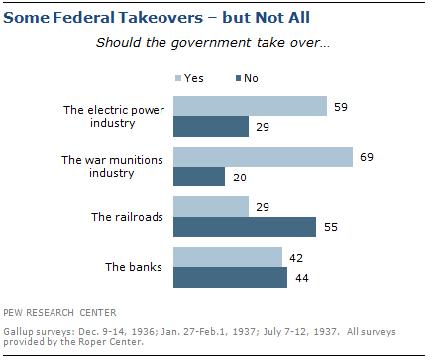
The Pew Research Center has put together a couple of fascinating papers on attitudes toward the public sector, and they’re worth a rad. (Thanks, Gabriel Metcalf at SPUR for tipping me off about this.) The first one is called “How a different America responded to the Great Depression.” Researcher Jodie Allen’s conclusion:


Quite unlike today’s public, what Depression-era Americans wanted from their government was, on many counts, more not less. And despite their far more dire economic straits, they remained more optimistic than today’s public. Nor did average Americans then turn their ire upon their Groton-Harvard-educated president — this despite his failure, over his first term in office, to bring a swift end to their hardship. FDR had his detractors but these tended to be fellow members of the social and economic elite.


More:


The most striking difference between the 1930s and the present day is that, by the standards of today’s political parlance, average Americans of the mid-1930s revealed downright “socialistic” tendencies in many of their views about the proper role of government.


True, when asked to describe their political position, fewer than 2% of those surveyed were ready to describe themselves as “socialist” rather than as Republican, Democratic or independent. But by a lopsided margin of 54% to 34%, they expressed the opinion that if there were another depression (and fears of one were mounting), the government should follow the same spending pattern as FDR’s administration had followed before.


And, those surveyed said they supported Roosevelt, the architect of the New Deal’s expansive programs, over his 1936 Republican opponent, Alfred Landon by more than two-to-one (62%-30%).


The charts are fascinating. A full 73 percent of Americans polled in 1936 thought government should provide free medical care to the poor. Sixty-four percent thought government should regulate and control war-time profits. In fact, 59 percent thought the government should take over the electric power industry and 69 percent favored nationalizing the wartime munitions industry.


And the people who were polled in these early surveys were overwhelmingly white, male and relatively well off. They were also socially conservative — 60 percent favored the death penalty and 67 percent wanted to deport all immigrants who were on public relief. Allen:


Is there a message in this for today’s America? Two possible lessons: First, it’s worth remembering that the social programs and banking controls that the New Deal era produced stood the nation in good stead over many decades of unprecedented prosperity. Second, Depression-era Americans’ faith in the country and its guiding institutions steeled them against the challenges of a double-dip recession and, years later, World War II. They had it worse, but they also expected it to get better, faster.


Compare that to a 1983 poll taken in the depth of the Reagan Recession, when 65 percent said that government had gone too far in regulating business, 62 percent rarely trusted the government in Washington and 78 percent opposed raising income taxes.


Fifty years, two generations, and the entire attitude of the American public toward government was turned on its head. It’s one of the fundamental dilemmas of American life, and one of the central reasons we’re in this mess.

Chiu wins holiday bake-off “most artistic” category

1

The 4th annual Board of Supervisors holiday treat throw down at City Hall today featured elegant trophies, celebrity judges and fierce competition. The desserts were judged in three categories: Most Tasty, Most Festive and Most Artistic. And the judges seemed to be enjoying themselves as they sampled the goodies and decided on the awards, as the rest of us waited hungrily, dessert forks in hand

Sup. Eric Mar’s legislative aide Cassandra Costello won—and lost—the “Most Tasty” category, after the judges (who city insiders say were playing by hardcore Top Chef rules) deemed her apple tart “most tasty” but too late to qualify.

Sup. Bevan Dufty’s former legislative aide Boe Hayward won the “Most Festive” category for his Giants inspired cake. It didn’t hurt that his super cute 51/2 week-old baby Eloise was on hand to help accept the award.

But when it came to the most artistic category, Board President David Chiu’s “Mud Wrestling on the Board” narrowly beat out Sup. Carmen Chu’s legislative aide Katy Tang’s “Board of Chess-Off”. (Oops: as readers will notice if they read the comments on this post, Katy Tang’s entry was actually titled “Board of Chess-Eff,” a subtle play on the Board of SF. Sorry for the error, KT, and thanks for your fabulous bake art.)

Chiu’s mud wrestling confection featured 11 snow people. Each snow person had a numbered clue attached to help cake eaters identify which supervisor they were supposedly eating.  The clues were as follows: 1 Happy Meals. 2 Swans. 3 Gavel. 4 Her Dog Birdie. 5 Plastic Bags. 6 F-Bomb. 7 Throwing the Microphone. 8 Sidney. 9 Progressive Fists in the Air. 10 Stylishly Dressed. 11 Budget Chair. (Scroll down to find answers to Chiu’s quizz).

Chiu’s entry also came with a print out of what the Board President says is his favorite President Roosevelt quote: “The credit belongs to the man in the arena, whose face is marred by dust and sweat and blood.”  A clue, perhaps, as to how Chiu is feeling about his often-embattled position on the Board.

But while Tang’s Chess-Eff didn’t win the “most artistic award,” it was a classic illustration of what Chiu described as “the three-dimensional game of chess” being played around the choice of the next mayor. Featuring marshmallows for interim mayors and/or mayoral candidates, the Board of Chess-Eff came with a warning that the dessert wasn’t actually edible. No kidding. Don’t know about you, but the never-ending speculation about the mayor is giving me major indigestion.

Answers to Chiu’s Mud Wrestling quiz: 1 Eric Mar. 2 Michela Alioto-Pier. 3 David Chiu. 4 Carmen Chu. 5 Ross Mirkarimi. 6 Chris Daly. 7 Sean Elsbernd. 8 Bevan Dufty. 9 David Campos. 10 Sophie Maxwell. 11 John Avalos. (The answers correspond to the numeric district that each supervisor represents. And while this looks a tad too obvious, Chiu said that until he organized it this way, no one could figure out which supervisor he was talking about.)

80 billionaires — and California’s broke?

67

Jerry Brown’s message to educators was framed as bleak — but as I pointed out, there were some bright spots. At least the new gov mentioned that this is a rich state that ought to be able to afford education. Robert Cruickshank at Calitics has a nice post on the point:


A tax increase of about $20 billion would secure our public services for years to come with a very tiny impact on our economic activity. Surely 1% of our GDP can be harnessed to fund the services that we must have for broadly shared prosperity in this state.


Let me take it a step further. I just went through the Forbes 400 list of the richest Americans and started counting, and guess what? A full 80 of the 400 live in California. That’s one out of every five billionaires in America, living right here in a state that can’t afford to educate its kids.


Then I took out my calculator and added up a long row of numbers and got a big one: The total net worth of the billionaires in California is $231.8 billion. Ten percent of that wipes out the budget deficit. And that doesn’t even count the folks worth $900 million or less; they didn’t make the list.


Folks: This is a very, very rich state. A very modest tax increase on a very tiny number of people could solve our budget problems not just today but into the foreseeable future.


This is the message Brown needs to deliver to the people of the state — and if the antitax people (or my trolls) want to argue that all the rich people would leave if we taxed them just a little bit, let me say: That’s ridiculous. David Geffen is going to move out of Malibu because he has to pay a teeny bit more of his income, money he won’t miss, in taxes? Ain’t happening.


That’s it, Jerry. That’s your answer. Now get to work.

Let’s get budget priorities straight

0

OPINION Who will pay for California’s budget woes? For the last three years, Californians have put up with cuts to programs that are critical to our state’s future and our social safety net. Public education, HIV and AIDS programs, state universities, and CalWORKs have all come under the knife. The elephant in the room, as state and federal governments try to balance budgets on the backs of the working and middle class, is the billions of dollars we are wasting on a misguided war in Afghanistan.

Fresh evidence that the war in Afghanistan is failing rolls in on a daily basis. While the administration justifies the cost in lives and dollars as necessary to fight Al Qaeda, it also acknowledges that there are only 50 to 100 Al Qaeda fighters in Afghanistan. Every soldier in Afghanistan costs U.S. taxpayers $1 million per year. With 100,000 soldiers on the ground, that means we’re spending as much as $2 billion a year on each Al Qaeda fighter.

Would we dream of spending $2 billion on every needy child in California? Or even $1 million? As U.S. and Afghan casualties rise along with the dollar amounts, with little success to show for it, we need to get our priorities in check.

At Governor-elect Jerry Brown’s budget forum this week, we were staring down a $28.1 billion budget deficit over the next 18 months. Compare that to the $46.4 billion Californians have already spent on the war in Afghanistan — $1.2 billion of that right out of San Franciscans’ pockets.

The Obama administration is conducting a strategy review this month that is expected to rubber stamp an approach that keeps soldiers in harm’s way — when doing so is not likely to make Americans or Afghans safer. At the same time, the president’s deficit commission chairs are also passing down recommendations to save money by cutting benefits for our most vulnerable citizens.

I would like to tell the taxpayers in my district who are shelling out these dollars that there’s a light at the end of the tunnel, but the president is now proposing ending the “combat mission” in 2014, which could mean there will be tens of thousands of troops on the ground even after four more years have passed.

I will continue to fight for our real needs in Sacramento. But it’s time for our representatives in Washington to put an end to this disastrous war and bring our troops home as quickly and responsibly as possible. Our tax dollars should be making life in California sustainable and safe for all. We can’t afford any other way.

Assemblymember Tom Ammiano represents the 13th District.

Race against the clock

1

rebeccab@sfbg.com

City officials were poised to finalize an offer to host the 34th America’s Cup after amending a sweetheart deal that had city taxpayers heavily subsidizing Oracle billionaire Larry Ellison’s yacht race. But the question now is whether Ellison will accept the new proposal.

The original deal negotiated between representatives for Ellison and Mayor Gavin Newsom called for ceding 35 acres of city-owned waterfront property to Ellison’s America’s Cup Event Authority (ACEA) rent-free, but it was criticized as too expensive for a city facing massive budget deficits (see "The biggest fish," Nov. 30).

So at the Dec. 8 meeting of the Board of Supervisors’ Budget & Finance Committee, that deal was jettisoned in favor of a cheaper alternative that shifted the race venue to the city’s Northern Waterfront and promised long-term leases on commercially reasonable terms. The new agreement appeared on track for approval at the Dec. 14 Board of Supervisors meeting, after Guardian press time.

At the same time, new doubts arose at the last minute when race organizers stated publicly that they were more likely to reject the new option than the original plan because the financial terms were not as attractive. Although expectations have been high all along that San Francisco would be selected to host the next Cup, the team cast doubt on the outcome by publicly criticizing the new plan. According to a source familiar with negotiations, that move came as a jarring surprise to city officials. Nonetheless, supervisors approved the proposal at a Dec. 13 special meeting and sent it on to the full board.

Newsom’s Office of Economic and Workforce Development (OEWD) spent about four months in negotiations with Ellison’s BMW Oracle Racing Team and the ACEA to hash out a host city agreement. The Northern Waterfront scenario emerged in late November after Budget & Legislative Analyst Harvey Rose cautioned in a fiscal impact assessment that the original deal would have cost the city an estimated $128 million, including impacts to the general fund and losses from entering into rent-free leases.

The fundamental shift in the plan at this late stage, less than three weeks before the deadline for a final decision, reflected some deft maneuvering on the part of the board even in the face of intense pressure to approve a binding long-term agreement on an unusually short timeline. Sup. Ross Mirkarimi and Board President David Chiu, who expressed reservations about the original proposal but strongly favored the idea of bringing the race to San Francisco, were able to deflect a deal that would have harmed the city in favor of a wiser alternative by reshaping the proposal at the 11th hour.

"I was a little bit surprised by some of the recent press," Mirkarimi noted at the Dec. 13 meeting, referencing reports that the team was considering rejecting the bid. He asked everyone to keep in mind that "we’re working with public dollars and purse strings."

But the Mayor’s Office supported the modified deal. Press Secretary Tony Winnicker told the Guardian: "The Northern Waterfront bid is good for the city, great for the port, and will provide a spectacular experience for the America’s Cup. Hosting the America’s Cup will bring more than $1 billion in economic activity and thousands of jobs to San Francisco and showcase the city unlike almost any other event."

Speaking at the Dec. 8 committee meeting, Chiu also voiced his support for hosting the Cup. "Obviously this will have enormous benefits," Chiu said. "If this were to come to San Francisco, this will mean $1 billion and likely $1.2 billion in economic activity during the greatest recession since the Great Depression. We cannot ignore this opportunity."

The difference in the two scenarios amounts to tens of millions of dollars in savings. According to a fiscal feasibility analysis released Dec. 13 by the Budget Analyst, the net loss to the city under the Northern Waterfront alternative would be $11.9 million, compared to $57.8 million under the prior agreement (not including costs relating to the rent-free leases proposed earlier). However, that impact doesn’t account for a $32 million contribution that the America’s Cup Organizing Committee is expected to provide to the city to defray municipal costs.

Under the Northern Waterfront plan, Piers 30-32 and Seawall Lot 330 would be leased to race organizers for 66 and 75 years, respectively, on "commercially reasonable terms" with development rights included. The race organizers would receive a rent credit in exchange for investing an estimated $55 million for infrastructure improvements.

Rose’s office also found that the city would realize a net gain by transferring development rights for Piers 30-32 and Seawall Lot 330 with commercially reasonable rents, generating a net $12.3 million in new tax and lease revenues.

"This deal has significantly improved from the prior deal that went before you," Rose noted at the Dec. 13 Budget & Finance Committee meeting. The main reason for the reduction in costs was that under the original plan, ACEA would have been granted rent-free development rights to Pier 50, a 20-acre waterfront parcel needing costly renovations, for 66 years. Removing that costly improvement and shifting dredging costs from the city to race organizers made the prospect more feasible for San Francisco.

Piers 26 and 28 were added to the equation late in the game, too. Under the new plan, ACEA has the option to spend an additional $25 million renovating those piers in exchange for leasing them for 66 years with rent credits. Ted Egan, an economic analyst with the City Controller’s office, noted that the piers were expected to last for only 15 years if they weren’t renovated.

"Without the America’s Cup stepping forward, we lose them, and we lose any potential development that could take place at those piers," he noted. Port Director Monique Moyer also praised the plan at the Dec. 8 meeting, saying piers that would have continued to deteriorate could now be revitalized.

Chiu amended the agreement to secure greater assurance that the city would receive a $32 million contribution from the America’s Cup Organizing Committee (ACOC), the fund-raising arm of the race organizing team, to defray municipal costs. Prior to Chiu’s amendment, there was no guarantee that the city and county would receive that money, Rose pointed out.

Jennifer Matz, director of OEWD, noted that ACOC was "committed to using best efforts" to raise $32 million over the course of three years. Under the agreement, if the committee hasn’t successfully raised $12 million by one week after the environmental review has been completed, the city reserves the right to call off the deal.

The new plan seemed likely to pass muster even with Sup. Chris Daly, the most vocal opponent of the original plan. "One thing that’s clear is that it’s a whole lot better than the previous proposal," Daly said.

Ellison, who captured the 33rd America’s Cup off the coast of Spain and holds exclusive power to choose which city will host the next sailing match, has set Dec. 31 as the deadline for his final decision. But a source familiar with the negotiations told the Guardian an announcement was expected even sooner.

Ironically, there was little doubt that Ellison would select San Francisco until the very end of the process, when the city finally reached an agreement that seemed to satisfy the Mayor’s Office, the Board of Supervisors, and the economic analysts. At press time, it was still an open question whether Ellison will go for it.

"With this latest bit of vetting by us, I think the city has done the utmost it possibly could do in putting forth the best plan it possibly could craft in such a short period of time," Mirkarimi said at the close of the Dec. 13 meeting. "I think that San Francisco stands to be the best contender for hosting America’s Cup, and let that message ring well toward Mr. Ellison, and around the country, and abroad."

Supes OK America’s Cup deal

1

At its meeting today, Dec. 14, the Board of Supervisors unanimously approved a host city agreement for bringing the 34th America’s Cup to San Francisco. However, it’s still unclear whether billionaire yachtsman Larry Ellison and the BMW Oracle Racing Team will select San Francisco as the host city for the next world-famous sailing match.

The agreement solidified a less costly plan and a dramatic improvement over a prior proposal, which the Guardian covered in-depth in a recent cover story. Under the new terms, the America’s Cup Event Authority (ACEA) would be granted long-term leases on commercially reasonable terms for Piers 30-32, Seawall Lot 330, and possibly Piers 26 and 28.

The ACEA would receive rent credits in exchange for investing $55 to $80 million in infrastructure improvements for San Francisco port properties, and San Francisco would benefit from an estimated $20 million boost in revenues from the event. The America’s Cup Organizing Committee would also raise $32 million to help defray municipal costs. The major difference from the prior plan is that Pier 50, a 20-acre waterfront parcel requiring costly renovations that would have been ceded rent-free to the ACEA with development rights for 66 years, was removed from the equation. The America’s Cup is expected to generate more than $1 billion in economic activity, plus create the equivalent of more than 8,000 jobs.

Board president David Chiu called the new plan, which shifts the race venue to the Northern Waterfront instead of the Central Waterfront, “much better, from a business perspective, for the city.”

Sup. Ross Mirkarimi, who supported early efforts to bring the Cup to San Francisco but expressed reservations about the original plan, commended city officials for working around the clock to hammer out a deal on an unusually short timeline.

While doubts arose over the weekend concerning whether or not the BMW Oracle Racing Team and billionaire yachtsman Larry Ellison would accept the latest plan, Port staff member Brad Benson told the Board that he’d met with Stephen Barclay, a representative of the race organizing team, for hours following a Dec. 13 special meeting of the Budget & Finance Committee held to consider the financial impacts of the latest draft.  “They would like to enter into an agreement by the end of this week,” Benson reported.

Sup. Chris Daly, who emerged as the most vocal opponent of the Cup in the early stages of the process, acknowledged that he had used “exciting language” to criticize the initial scheme. “The reason why I amplified the language is because I knew the city just could not afford that kind of financial outlay and cost,” he explained. Daly voted in favor of the revised deal because he said it would grant a “fair return for this city.”

Just before the vote, Daly likely caused representatives from the mayor’s office to groan when he announced that he wanted to propose one last amendment. “I need to borrow the Cup on Jan. 5,” he said. “I need a cup. To drink out of.” His joke elicited laughter. Daly will be the star of a roast scheduled for that date.

For more details on the improved America’s Cup agreement, see tomorrow’s issue of the Guardian.

Brown’s education summit gives me hope

0

Most of what’s going on is just really, really disturbing — Brown is doing a good job of explaining just how bad the economy is, just how awful things are for education — and what that means for students. But he made one comment that struck me as critical (and that might, maybe, make Brown a great governor) came about an hour into the presentation.


Brown was talking about how the nation got into this crisis — about how people were forced to live on borrowing, and when the real estate market collapsed America became de-leveraged — when he took a slight sidetrack to say:


“Income redistribution upward from the middle class is comparable to the 1920s … it’s a societal crisis. We have to exercise discipline, but also fairness.”


A few points on this:


1. The incoming governor of California actually mentioned the words “income redistribution.” That’s a term almost entirely missing from the current debate. And he made it clear that part of the budget problem — part of the reason the state and the nation are in this crisis — is that the rich have gotten a larger and larger share of the pie.


2. Brown seems to think this is actually a problem, a “societal crisis.” Again: Obama doesn’t talk about that. Other than Bernie Sanders, most politicians in Washington are afraid of it. Just talking about wealth and income inequality (particularly in the context of education funding) is a huge step.


3. Brown talked about “fairness and discipline” together. Yes, we have to understand that resources right now are limited; but we also have to understand that part of the budget debate ought to be about the larger social issue of unfair distribution of wealth.


I know none of this seems like such a huge deal — it’s basic reality. But it’s so unusual that it’s refreshing.


SFBG Radio: What will Jerry do?

0

When Jerry Brown goes to UCLA to talk about education, what’s he going to say? How’s he going to promote the UC system when he’s facing a $25 billion budget crisis? Johnny and Tim talk abou that (and the Obama health care law and a few other things) after the jump.

sfbgradio12132010 by endorsements2010

The mayoral roulette

23

At the San Francisco Tomorrow holiday party Dec. 8th, David Chiu, Dennis Herrera, John Rizzo, Jake McGoldrick and a host of others who I’ve seen at these events for at least the past few years were doing their usual schmoozing — when Ross Mirkarimi, a former SFT board member, showed up with …. Art Agnos. I haven’t seen the former mayor at an SFT event since … I don’t know. Since a long long time ago.


Agnos made a short speech and talked about all of the rising stars in the San Francisco progressive movement — Mirkarimi, Chiu, Rizzo, David Campos, Eric Mar, John Avalos … and it was all very nice and low key. But there was a message in his appearance, in his connection with Mirkarimi, and even in the overall tone of his remarks, which amounts to this:


If the supervisors have trouble finding a progressive who can get six votes — and if they want an old hand, someone who has been through a brutal recession as mayor of San Francisco and dealt with awful budgets and nasty politics, someone who will serve for a year and then walk away — Agnos is open to being asked.


Well, maybe a little more than open to being asked. I wouldn’t say he’s actively, publicly campaiging for the job, but he has met with most of the supervisors, and dropped them all a 13-page memo listing all of his accomplishments, and his supporters (maybe his emissaries) are making the rounds and making the case for Agnos. Which amounts to this:


None of the progressives now more-or-less openly in the mix (Campos, Chiu, Mirkarimi, even Aaron Peskin) can realistically take on all the sacred cows (esp. police and fire), make a bunch of other cuts, and push for all sorts of revenue increases — and at the same time try to run for re-election in November (when the tax hikes would be on the ballot). The only way to do “what needs to be done” is to put in a progressive caretaker who can then take the political heat for the tough decisions — and help set up a campaign for another progressive in November.


I’m not sure I entirely agree — the right person, with the right leadership and agenda, could set up a five-year plan for fiscal stability, launch year one immediately and tell the public that he/she needs a full term to finish the job. But it’s true that it will be tough — and it’s also true that none of the obvious alternatives have ever run citywide.


If Tom Ammiano were interested, we wouldn’t be having this discussion. Tom has run citywide numerous times (for School Board, pre-district elections supervisor and mayor), has been elected by half the city (to the Assembly), and has the credibility to deal with the budget crisis and still win in November. But he’s not, and we have to respect that.


Right now, the progressives can’t seem to unite on a candidate. None of the current board members has six votes today. And Campos, Chiu, Mirkarimi and everyone else in the game knows full well how hard it will be to win in November, particularly against State Sen. Leland Yee, who will be a formidable candidate, and possibly City Attorney Dennis Herrera (who has won citywide), State Sen. Mark Leno (who is popular all over town) and others.


So if a couple rounds pass and there’s no winner, the “progressive caretaker” concept will be in play. It’s possible Mirkarimi would give up his seat two years early and take that job; it’s likely Peskin would agree to serve one year and then step down. But it’s also possible that neither scenario works out — at which point Sheriff Mike Hennessey and Agnos will be in play.


(I hear through the grapevine that Willie Brown is nosing around, too — and let’s remember that he became Assembly speaker by cutting a deal with the Republicans.)


Hennessey’s got a strong progressive record, but has never had to deal with anything remotely as awful as what the next mayor will face. So Agnos backers will make the case that their guy has the experience and gravitas to pull it off.


Given all of that, let me say a couple of things about Agnos, since I was around and watching City Hall when he was mayor (and some of the people who will be voting on this weren’t.)


Art’s a mixture. He was a great progressive member of the state Assembly. When he ran for mayor, we backed him strongly; he seemed to be the great progressive hope. Then his long list of wonderful promises ran into the buzz saw of a deep recession — and made things much worse with his arrogant, imperious style. His first major act in office was to sign a set of contracts that gave away the store to PG&E. He never lifted a finger for public power. And it quickly became clear that he wasn’t a fan of open government or public process. We were all supposed to “Trust in Art” and shut up if we didn’t like it.


That’s why — despite what was at the time and is in retrospect a pretty darn progressive record, a lot of solid accomplishments and absolutly no hint of corruption or scandal — the progressives just weren’t all that excited about his re-election. So he lost to Frank Jordan, who was way worse.


The thing is, Agnos these days is a lot more mellow. He’s 72, knows he’s not going anywhere else in politics, and has essentially admitted to me that he made a lot of mistakes, and his arrogance and closed-door attitude were top on the list. A reformed Agnos — willing to serve with a degree of humility and an acceptance that progressive politics in this town demands inclusiveness, and that even though he’s a former mayor, he’s not by definition the most important person in any room he walks into — would present an interesting option.


Of course, we still don’t know exactly where he would be on the issues, since, like Chiu, he hasn’t even publicly called himself a candidate for the job. I still think anyone who is a serious contender ought to be willing to appear before the supervisors and answer questions.


We all know where to start: What’s your plan for raising a quarter billion dollars in new revenue in 2011?    

‘Nutcracker’ and beyond

0

You don’t have to be into winter solstice, Christmas, Hanukkah, or Kwanzaa celebrations to realize that there’s something about December — the end of another decade this time around, the darkest part of the year — that calls out for treats either for yourself or a friend or two. Here are a few dance-related suggestions between now and the end of the year that won’t bust your budget.

Born in Imperial Russia, The Nutcracker has become a peculiarly American institution. Almost against my will, it pulls me in every time. Though bifurcated, the masterful music — no matter its commercialization — pulls together the story of a brave little girl and her adventures. Reasonably priced options exist. San Francisco Ballet’s (through Dec. 27; War Memorial Opera House, SF) starts at $32. Take binoculars, you’ll be fine. The Oakland Ballet Company’s highly acclaimed version by new Artistic Director Graham Lustig (Dec. 23-26; Paramount Theater, Oakl.) starts at $15. Berkeley Ballet Theater’s (Dec. 10-12 and 17-19; Julia Morgan Theater, Berk.) has a one-price ticket for $26. After 20 years, this will be former ODC dancer Brian Fisher’s last Fritz.

If you like your Nutcracker to have sharp edges, the Dance Brigade’s mashup of politics and fun, The Revolutionary Nutcracker Sweetie (Dec. 11-12; Brava Theater, SF; $15–$17), has been reimagined by another generation of grrrl dancers and friends. The Dance Along Nutcracker (Dec. 11-12; Yerba Buena Center for the Arts, SF; $16–$50) was a hoot the first time around and continues to be a splendid mix of circus, dress-up, and community celebration. This year the revelers have invited the Twilight Vixen Revue. The SF Lesbian/Gay Freedom Band does the musical honors — fabulously.

Stepping outside of Nutcracker territory into original holiday fare, Kirstin E. Williams’ all-female Strong Pulse company hooks up with CCSF students for Be Cool, (Dec. 10-11; CCSF Performance Theater, SF; $10–$15) a jazz/ modern dance/hip-hop concert that is guaranteed to resonate all over the Phelan Avenue campus.

If you have never seen ShaSha Higby work her magic with phantasmagoric concoctions of human-made and natural materials, be prepared to being pulled into a world as dreamlike as it is tangible. In Folds of Gold (through Dec. 10-11; Noh Space, SF; $12-20) examines deep winter issues surrounding life, death, and rebirth.

The circus-based Sweet Can Productions newest show, Candid (Dec. 17-Jan. 9; Dance Mission Theater, SF; $15–$60), is sweet but not saccharine-sweet. These performers juggle and subvert cherished concepts as well as objects — brooms, dinner plates, hula hoops — to stretch credulity and the imagination. It’s what happens when life meets art.

With Lo Clásico, (Dec. 17-19; Cowell Theater, SF; $15–$35), Caminos Flamencos — 22 dancers and musicians — are performing Spain’s two major historical dance forms. There is, of course, flamenco, including Yaelisa’s breathtaking Soleares, but also examples of lesser-known Spanish classical dance choreographed to Ravel and de Falla.

WestWave Dance (Dec. 13; Cowell Theater, SF; $22–$68) closes its season with another quintet of new choreography by Pam Gonzales (from L.A.), Alyce Finwall, Christy Funsch, Carolé Acuna, and Ingrid Graham. The festival curates promising work by artists who can’t on their own afford the professional production values WestWave offers.

How about insight into dancers’ thought processes? For free? Chime Live (Dec. 11; Margaret Jenkins Dance Lab, SF; free) offers conversations and showings of work from Margaret Jenkins Dance Lab’s mentoring program. In the monthly program “2nd Sundays” (Dec. 12; CounterPULSE, SF; free), artists show pieces-in-progress and invite feedback. “Dancemaker’s Forum” (Dec. 19; SF Conservatory of Dance, SF; free) workshops new choreography by Manuelito Biag.

Contact improvisation has become a valued tool for choreographers, but it’s also a glorious performance art that redefines the concept of being “in the moment.” One of its originators, the masterful Nancy Stark Smith (Dec. 18; Eighth Street Studios, Berk.; $10–$20) is in town to connect with local and guest practitioners.

The connection between the Odette and Odile characters has puzzled Swan Lake lovers forever; the roles used to be danced by two different performers. SF Ballet’s recent production hinted at one interpretation. For another take, you might want to go to the movies and see Natalie Portman in Darren Aronofsky’s Black Swan (now playing; Bay Area theaters; prices vary).

Class of 2010: Jane Kim

7

steve@sfbg.com

Despite fears that a candidate backed by downtown could replace firebrand progressive leader Sup. Chris Daly in District 6, in the end it was the two progressive candidates — Jane Kim and Debra Walker — who finished far in front of the large pack of candidates, with Kim winning the race. And she thinks that says something about how the progressive movement has matured.

“To have the two leading candidates be progressives says a lot about the progressive political community,” Kim said. “The race was really between Debra and me in end.”

Kim, a 33-year-old attorney and the outgoing president of the San Francisco Board of Education, has been active in progressive politics in San Francisco for many years, from doing community organizing with the Chinatown Community Development Center to running the short-lived San Francisco People’s Organization, which Daly helped create.

Yet part of her campaign strategy, and the message that she’s sending in the wake of an election that divided the progressive community, focuses on issues and themes that are more common to political moderates: job creation, clean streets, public safety, and neighborhood services.

“I think it’s important for progressives to cross over, and I don’t think it should be viewed as selling out,” Kim told us. “Progressives need to do a good job at maintaining voters’ faith in the progressives’ ability to lead.”

In addition to courting progressive groups and voters, Kim’s campaign aggressively targeted residents of the residential condo towers in Rincon Hill and Eastern SoMa, voters who are generally more affluent and newer to San Francisco than the typical progressive constituencies.

“It’s a lot of new residents who don’t feel like they’re a part of any political faction and they’re really open,” Kim said. “People just want to see that things are better. They want the streets to be clean and safe.”

With a new mayor and new blood on the Board of Supervisors, Kim said this is an important political moment for San Francisco, “a huge opportunity” to redefine San Francisco politics in the wake of Mayor Gavin Newsom and progressive supervisors such as Aaron Peskin, Matt Gonzalez, Tom Ammiano, and Daly.

“The Class of 2000 was able to show how progressive we can be with policy. They really pushed the envelope,” Kim said, citing new worker and tenant protections and programs such as Healthy San Francisco. Now, she said, the challenge for progressives in the Classes of 2010 and 2008 is to show that they can provide effective leadership in realms like public safety and economic development. “If we’re able to lead on those two issues, it would really firm up our leadership of the city,” Kim said, noting that it would also affect the dynamics of next year’s mayor’s race.

While Kim didn’t go into detail about how she intends to deal with what she says is the biggest challenge facing the new board — a budget deficit of $700 million over two years, coming at a time when all the easy cuts have already been made in recent years — she said the city needs to be aggressive in boosting the local economy and ensuring San Franciscans get most city contracts.

“We need to figure out how we can partner with small business to create a diversity of jobs in San Francisco,” she said, noting that the average San Franciscan has more faith in the moderates’ ability to create jobs, something that progressives need to address. But how can she help break the grip that the conservative San Francisco Chamber of Commerce has on small businesses?

“Part of the problem is that small businesses aren’t organized,” Kim said, noting how that hurt Sup. David Chiu’s ability to win support this year for his business tax reform measure that would have helped most small businesses and made some large corporations pay more taxes. “They’re busy running their businesses and they don’t have the time to look at the details, so they just read the briefing of the Chamber of Commerce.”

Kim said she respects the leadership role Daly has played in progressive politics and that she’d “like to be part of the moral compass of the Board of Supervisors.” But she also said that Daly’s sometimes abrasive style unnecessarily hardened the opposition of moderates to important progressive issues.

“He made it harder to talk about affordable housing,” Kim said, noting that the city’s dearth of affordable housing should be an issue that’s important to middle class voters, noting that it includes housing for people who earn up to 120 percent of the median income for the region. But after Daly hammered on the issue, “It was like a bad word coming out, and people would turn off to the issue.”

But she thinks it’s a fixable problem if she and her allies do the hard work, an ability they demonstrated this year by defeating Walker, who had been running for the seat for years and lining up all the key endorsements. “Voters do respond to campaigns that work really hard, and that bodes well for progressives,” Kim said, noting that she intends to reach out to Walker’s supporters. “I don’t think I can be successful as a supervisor if I don’t work with all the camps in the progressive community.”