Board of Supervisors

Mexico warns citizens: use extreme caution in Arizona

7

It’s no surprise to anyone who has watched Newsom stubbornly refuse to take responsibility for the consequences of his flawed juvenile immigrant policy that the mayor is playing coy when it comes to the Board of Supervisors’ and the City Attorney’s attempts to institute a boycott of Arizona.


The real surprise in the fallout around Arizona SB 1070 is that the legislation doesn’t include a clause whereby all “aliens” must find a picture of the Arizona state flag, cut out the star in it, and wear it as a “badge,” much like the Nazis required of the Jews.


But Mexico does gets the threat this hateful legislation poses to its citizens. In a new twist on travel advisories, the Ministry of Foreign Affairs of Mexico has warned its citizens in Arizona to exercise extreme caution, whether they are demonstrating against Arizona SB 1070, going about their everyday affairs, attending classes or contemplating accepting work offered from a car on a highway.


“It is important to act with prudence and respect local laws,” the Mexican consulate states. It notes that the new law won’t take effect until 90 days after the end of the current session of the Arizona state legislature, but warns, “however, as was clear during the legislative process, there is a negative political environment for migrant communities and for all Mexican visitors.”


The consulate recommends that Mexican nationals carry available documentation, even before the new law takes place so as to “help avoid needless confrontations.”


“As long as no clear criteria defined for when, where and who the authorities will inspect, it must be assumed that every Mexican citizen may be harassed and questioned without further cause at any time,” the consulate states.


“The new law will also make it illegal to hire or be hired from a motor vehicle stopped on a roadway or highway, regardless of the immigration status of those involved. While these rules are also not yet in force, extreme caution should be used.”


The consulate concludes by reminding folks that “Mexican nationals who are in the United States, regardless of their immigration status, have inalienable human rights and can resort to protection mechanisms under international law, U.S. federal law, and Arizona state law. The functions of the five Mexican consulates in Arizona (Phoenix, Tuscon, Yuma, Nogales and Douglas) include providing legal advice to all Mexicans who consider that they have been subjected to any abuse by the authorities.”


It recommends that Mexicans requiring consular assitance in Arizona use the following toll-free number, available 24 hours a day, seven days a week:1.877.6326.6785 (1.877.63CONSUL).


Nevius makes the case for a progressive DCCC

27

Chronicle columnist C.W. Nevius made an excellent argument for supporting the Guardian’s slate of progressive candidates for the Democratic County Central Committee in Saturday’s paper, even though he was trying to do just the opposite. But I suppose that perspective is everything.

Our perspective at the Guardian is one of great pride in San Francisco and its left-of-center values. Nevius looks at San Francisco from his home in Walnut Creek and sees a scary place where people question authority figures and don’t simply trust developers, big corporations, and the Chamber of Commerce to act in the public interest.

“The next two months will see a battle for the political soul of the city. It will pit the progressives against the moderates in a face-off that will have huge implications in the November elections and, perhaps, the election of the next mayor. The key is control of an obscure but incredibly influential organization called the Democratic County Central Committee,” Nevius writes, and he’s right about that.

But he’s wrong when he assumes most San Franciscans agree with him and others who want to make the city more like the sterile suburbs that they prefer. Nevius values “safe streets,” which is his code for giving police more power through the proposed sit-lie ordinance and other unpopular crackdowns, despite the fact that he sat in the back row and watched the DCCC voted overwhelmingly against sit-lie after nobody presented a credible case for it.

Nevius is so utterly blind to the fact that most San Franciscans want adequate mitigation and community benefits from development projects that he recently ranted and raved about the defeat of the 555 Washington project, even though it was unanimously rejected by the Board of Supervisors for inadequately addressing these requirements.

The “moderate values” that Nevius champions are actually quite extreme: give downtown and developers everything they want, never question the behavior of cops or the Fire Department’s budget, keep cutting taxes until city government becomes incapable of providing services or regulating the private sector, ignore the cultural value of nightclubs and artists, and deport all the undocumented immigrants.

This is the Democratic Party that Nevius and his allies like Sup. Michela Alioto-Pier and supervisorial candidate Scott Wiener (a conservative attorney who would be the best friend that the suburban cowboy cops could ever have on the board) want to promote, and it looks more like the Republican Party than a political party with San Francisco values.

But they aren’t honest about that intention, instead trying to fool people into believing that progressives are the extremists. “But when Mrs. Jones receives her Democratic voter guide in the mail…she’s thinking of the party of Barack Obama, not the party of Aaron Peskin and (Supervisor) Chris Daly,” Wiener said.

But in the Democratic presidential primary election, it was Daly and Peskin who were the strongest early supporters of Barack Obama, while Wiener backed John Edwards and Alioto-Pier, Mayor Gavin Newsom, and the rest of the “moderate” party stalwarts supported Hillary Clinton. That’s not a huge deal, but it’s a sign of how the so-called moderates are willing to distort political reality.

So Nevius is right. This is an important election and it is about the soul of the city. Do you support scared suburban twits who disingenuously try to hide behind the “moderate” label in order to seem more reasonable, or do you support progressive candidates who have integrity and won’t moderate their values in order to appease the cops or the capitalists?

If it’s the latter, support the Guardian’s slate (which is substantially similar to the slates approved by the Harvey Milk LGBT Democratic Club, the San Francisco Tenants Union, the Sierra Club’s SF Bay Chapter, and other progressive groups).

And if you want that slate to have some money to mail out a Guardian slate card, come to a fundraiser this Thursday evening at CELLspace, 2050 Bryant, featuring the candidates and some great exemplars of the culture they support, including amazing singer/songwriter Valerie Orth, the zany dance troupe Fou Fou Ha, and DJs Smoove and Kramer, who regularly rock the best clubs and community-based parties in town.

And by “town,” I mean San Francisco, not Walnut Creek.    

Day laborers link sit-lie to Arizona crackdown

13

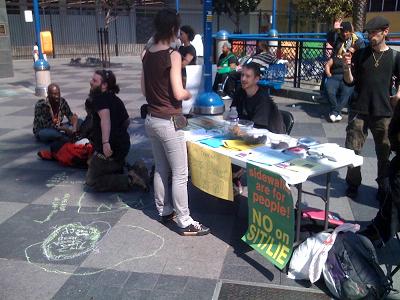
After another overwhelming vote against it last night, the sit-lie ordinance (banning sitting or lying on SF sidewalks) proposed by Mayor Gavin Newsom and Police Chief George Gascon is probably toast. But just to make sure, the activists at Stand Against Sit Lie are holding another day of creative protests on sidewalks around the city this Saturday, 4/24.

Among the 13 events scheduled so far will be immigrant day laborers sitting along Cesar Chavez Street between Mission and San Van Ness streets to protest both sit-lie and another legislative attack on immigrants, the controversial Arizona measure that essentially bans undocumented immigrants and encourages police to arrest them using racial profiling techniques.

The SF Day Labor Program is organizing the protest and today sent out a statement linking the two measures, noting that the sit-lie ordinance criminalizing otherwise lawful behavior and targets marginalized populations. Last night at the DCCC meeting, Sup. David Campos also made the point that day laborers who stand on street corners all day seeking work sometimes need to rest.

“Day laborers in San Francisco have to sit down once in awhile when they’re out on street corners waiting for work,” Jose Ramirez, a day laborer and coordinator of the SF Day Labor Program, said in today’s statement.  “Taking us to jail for sitting down in San Francisco is the same as immigrants being targeted by police for simply being Latino.”

After the Planning Commission early this month voted 6-1 to recommend against the sit-lie ordinance – finding that it violated a number of city goals and policies – the measure is awaiting consideration by the Board of Supervisors Public Safety Committee, possibly on May 3. 

DCCC: Thumbs down on sit / lie

San Francisco’s Democratic County Central Committee voted last night in favor of a resolution opposing San Francisco’s proposed sit / lie ordinance, a law backed by Mayor Gavin Newsom and Police Chief George Gascon that would make it illegal to sit or lie down on city sidewalks. Gabriel Haaland introduced the resolution, and it passed with overwhelming support.

Here’s a YouTube clip of Haaland’s comments during the committee discussion, filmed by Linda Post.

The DCCC is the policy-making body for the Democratic Party in San Francisco, chaired by former Board of Supervisors President Aaron Peskin. The vote followed a lengthy public comment session in which a wide variety of people voiced their opposition to sit / lie, including homeless youth advocates, residents of the Haight, and surprise guest Malia Cohen — formerly an executive staff member for Mayor Gavin Newsom. Some comments provoked laughter (“Sit /lie is like the fungus that won’t go away!” one Tenderloin resident exclaimed), while others framed their arguments in moral terms (“It’s hard to think of it as anything less than criminalizing poverty,” attorney David Waggoner charged). Cohen, for her part, called the ordinance “mean-spirited.”

The central committee members held a meaty discussion too, in which several members shared deeply personal stories to explain their feelings about the ordinance. Haaland described how, after graduating from law school in the mid-1990s, he found it so difficult to find work as a transgendered person that he worried about becoming homeless himself.

Committee member Tom Hsieh, who said he’d lived in the Haight for 10 years, spoke about his young daughter and expressed his discomfort about the “anything goes attitude” he’d seen people on the streets exhibit in her presence. Hsieh was one of a handful of committee members who voted against Haaland’s resolution. The others were Scott Wiener, Meagan Levitan, Mary Jung, and the proxy for Sen. Dianne Feinstein, while Matt Tuchow and the proxy for Assemblymember Fiona Ma abstained.  

Sup. David Campos addressed Hsieh’s concerns directly, saying that he did not believe the proposed ordinance actually addressed the sort of behavior that he found upsetting. “Sit / lie is the wrong focus,” Campos said. “The focus should be, how do we make policing better in San Francisco?” Noting that he had formely served as a police commissioner, he called for more effective community policing.

When he met with the mayor’s office about sit / lie, Campos added, he got the impression that the law was not actually meant to stop people from sitting or lying down on the sidewalk, but to target hostile behavior occurring on the street. “When you pass a law, you have to mean what it says,” he noted. He also pointed out that day laborers who wait on sidewalks for work would essentially be criminalized by the ordinance, since it’s unreasonable to expect that they wouldn’t occasionally sit down while waiting for a job.

Meanwhile, Scott Wiener’s resolution to endorse the Community Justice Center and encourage its expansion into the Haight failed with 14 voting against it and 10 voting to support it, while two abstained. While many committee members voiced general support for the CJC, a few said they resisted the idea of dictating to the Haight that it should install a similar court.

The DCCC also endorsed Linda Colfax and Michael Nava as candidates for Judge.

MTA board approves controversial budget

2

By Adam Lesser

City Hall needed an overflow room to accommodate all the disenchanted Muni riders who showed up to protest the two-year San Francisco Municipal Transportation Agency budget plan yesterday (4/20). The budget locks in a 10 percent service cut through July 1st, 2011, at which point the MTA board is hopeful that the service cut will be lowered to 5 percent. The controversial budget was adopted on a 4-3 vote, and now goes to the Board of Supervisors, where progressive supervisors have already signaled opposition to the service cuts.

“It still seems and feels as I look at it [the budget], that it’s very tenuously put together. In light of the fact that it’s going to impact the least, the lonely, and the lost of us, I had to say, let’s keep looking at it,” said Director James McCray, who was one of three dissenting votes.

McCray, along with Director Malcolm Heincke who voted for the budget, were the two directors to openly express concern about the pay of transit operators and overtime charges. In a $750 million budget, service cuts wound up providing $29 million in savings, a relatively small number compared to the $456 million that will be spent on salaries and benefits, as well as the $59 million in work orders to other agencies like the police department and the city attorney.

Small revenue measures like adding 1,000 metered spaces, eliminating free reserved parking around areas like City Hall, and window advertising wrap on buses are part of the budget.

Heincke questioned MTA Executive Director Nathaniel Ford about the budget which includes $10 million in labor concessions from MTA employees while locking in a $9 million raise in 2011 and a $9.5 million raise in 2012 for transit operators from Transit Workers Union (TWU) Local 250-A. Transit operators’ wages and raises are written into the city charter. 

“The bubble over my head says wow,” said Heincke. Ford’s attempts to negotiate with the union over work rules have been unsuccessful. Sup. Sean Elsbernd is pushing a charter amendment for the November ballot that would remove the TWU’s pay rates from the city charter.

Anger over Muni’s payment of work orders to other city agencies was a constant theme among community groups as diverse as the Chinese Progressive Association and the San Francisco Transit Riders Union. Those work orders have increased from $36 million in 2006 to $66 million in 2010.

“What really happened is the rest of the city had a budget crisis and the mayor went after Muni looking for funds,” said Dave Snyder, coordinator for the San Francisco Transit Riders Union. Newsom appoints the directors who sit on the MTA Board. “Muni is paying for service the public doesn’t want them to pay for at the expense of transit service.”

Members of the Latino and Chinese-American community were out in large numbers, not just to protest service cuts that they felt disproportionately impact the Mission and Chinatown, but to complain about harassment by the police. Enforcement of the Proof of Payment program has increased with Muni agents and police checking the amount of time left on riders’ transfer tickets, and issuing fines.

“You have police asking for ID and issuing $75 fines. There have been a few cases of deportation,” Beatriz Herrera, an organizer for People Organized to Win Employment Rights (POWER). Referring to riders whose transfers expire while riding a bus, Emily Lee of the Chinese Progressive Association said, “They expect folks to get off the bus. That’s an unreasonable expectation. It’s stressful for the community. The police are intimidating.”

The service changes are slated to take effect May 8th.

The good, the bad, and the fence-sitters

1

news@sfbg.com

The Guardian has been periodically producing the Board of Supervisors’ Good Vote Guide for many years, tracking where our elected representatives come down on important issues. And unlike a similar poll recently put out by the San Francisco Chamber of Commerce, which chose 10 votes designed to promote deregulating and subsidizing big businesses, we chose items important to the broad public interest.

The 20 votes we selected this time reflect our concerns for protecting tenants, funding vital public services, safeguarding civil liberties, promoting small businesses and nonprofits, appointing qualified people to commissions, and valuing the environment more than “green” press releases and corporate profits.

To view our guide (PDF), please click here

Rolling forward

7

By Adrian Castañeda

news@sfbg.com

San Francisco’s Potrero del Sol Skatepark is often packed with skaterboarders, a testament to the sport’s popularity and to the dearth of places in the city where it’s legal to skate. But that will soon change with the city’s commitment to build two new skateparks: one in SoMa and the other in the Haight.

Both have been tentatively approved by the Board of Supervisors. But before any concrete is poured, the skaters will have to overcome budget crises, angry homeowners, and their own bad reputations, particularly in the Haight, where the proposed park has gotten caught up in the furor over vagrants and the proposed sit-lie ordinance.

San Francisco has long been a skateboarding hub, yet there’s always been friction with police, businesses, and everyday city life. Even though it’s legal, there just aren’t that many places to do it anymore, partially because the city and property owners routinely attach barriers to any surfaces that might be appealing to skaters.

Skateboarders, long accustomed to being ignored and disenfranchised, have responded in their usual DIY fashion, such as building a few obstacles in an empty parking lot under a freeway overpass. The city took notice of the demand and after three years of planning and meetings, the newest of San Francisco’s skate parks has finally been allotted the necessary funds to begin construction around the end of summer.

The Central Freeway Skate Park will be located in what is now a parking lot at the intersection of Duboce and Stevenson streets in the north Mission District area. With $2 million collected through the Central Freeway Corridor Housing and Transportation Improvement Act of 1999, which provides for the sale and lease of parcels of city land that were under the now-demolished freeway, officials plan to develop the park to eventually include basketball courts and a dog run.

Rich Hillis of the Mayor’s Office of Economic Development said the city is considering a variety of improvements, but confirmed that “we think the skate park is the priority.” He attributes the park’s relatively unopposed approval to the demands of the city’s skaters and to the community as a whole. “They embraced the idea of a skatepark early on,” Hillis said of the forward-thinking residents of the area. He jokingly adds that the park should be named “Hornbeck Park” after Bryan Hornbeck, director of the San Francisco Skateboard Association. Hornbeck and his associates started the SFSA to push the city to build new parks designed with skaters in mind.

“San Francisco has to have a world-class skatepark,” Hornbeck said at one of the many skate events his group organizes. Hornbeck said the city has been receptive, working with skaters on the design of the park, but left SFSA to organize skaters and raise the funds. “It’s bake sale; it’s lemonade stand; it’s the best we can do,” Hornbeck said. “We’re not trying to take anything, we’re trying to make our own thing.”

Plans for the park, drawn up by notable skatepark design firm New Line Skateparks, are currently under review by civil engineers. After the plans are finalized, the project will be bid out to find a contractor. Tentative 3-D renderings have been online for months, sparking heated debate on skateboarding Web sites.

When the acclaimed Potrero del Sol Skatepark opened in 2008, many skaters felt that while it was well-designed and enjoyable, it didn’t have enough terrain that mimicked street riding. New Line has designed a number of skating plazas, most recently in Los Angeles. Its involvement gives many skaters hope that the new park will incorporate obstacles that represent the city’s rich street skating history.

But things are not moving as swiftly for the city’s other planned skate park, just beyond where Waller dead-ends at Stanyan in the Haight, which doesn’t have the same guaranteed funding stream. While bids for a design have been submitted, the Recreation and Park Department needs to get approval for $1 million–$2 million in construction funds before moving forward. The city proposed the 120,000-square-foot cul-de-sac at the end of Waller and next to SFPD’s Park Station after the original site near the Golden Gate Park horseshoe pits was found to be too small and lacking the necessary sight-lines for safety. But according to some residents groups, the parking lot is less safe for youths.

Citing police incident reports, Lena Emmery, president of the Cole Valley Improvement Association, told us the Waller park would be in an area with a high number of reported assaults and drug arrests and would add to noise pollution. “This location puts a skateboard park too close to a dense residential area, as well as some businesses that would be negatively impacted by the noise from the skaters,” she wrote via e-mail.

While the lot is occasionally used for bicycle safety classes and overflow parking at Kezar Stadium, it sits empty most of the year, although a farmers market will hold its grand opening there April 28. Will Keating, a Waller Street resident and skateboarder who works on Haight Street, is excited about the proposed park. He disagrees with claims that the park would be a negative impact on his neighborhood. “I hear homeless mutants going crazy outside my window every night, I would much prefer skateboards,” Keating said of the current noise pollution.

The Haight Ashbury Improvement Association, which is leading the charge for a sit-lie ordinance, conducted a survey on its Web site and found that many of its visitors feel the skatepark would increase noise and safety problems in the Haight. Visitors to the site also said the lot would be better used as a farmers market. Yet city officials say the two are not mutually exclusive, and early designs for the project are said to include a large public plaza adjacent to the park intended for community events.

“We realize this is going to be a multiuse space,” said Nick Kinsey, property manager for the Recreation and Park Department. “Throughout San Francisco there are thousands and thousands of skateboarders but only two places where it is legal to skate.” Kinsey called the park is “a done deal,” citing a 2007 ordinance introduced by Sup. Ross Mirkarimi that mandates the department build a skatepark on the cul-de-sac.

Kent Uyehara, merchant chair for the HAIA and owner of FTC skateshop on Haight, said the community’s fears about pedestrian safety are understandable, but that fears of increased violence and drug use are irrational. “If you can’t have a skate park next to a police station, then basically you are saying you can’t have it.”

If the city enacts the sit-lie ordinance, which Uyehara supports, it would be easy to imagine that a skate park would be a magnet for homeless and others looking to escape police harassment. But Uyehara is adamant that the park would not become a haven for Haight Street refugees. “Skateboarders self-police their own areas,” he said. “We’re not trying to kick the homeless out,” he added. “We’re trying to make the neighborhood attractive for everyone, whether they’re buying something or not.”

Uyehara is no stranger to opposition. When his shop first moved to the Haight in 1994, he had to deal with threats from residents and a neighborhood organization, similar to the one he is now a part of, because of what skateboarding represented to them. Since then skateboarding and his business have prospered, and FTC now has four locations worldwide. “For a city that hosted the X-Games, it’s pathetic how skateboarding has been treated.”

Uyehara says the Waller park, along with the Central Freeway and Potrero del Sol parks, are part of a plan developed by the San Francisco Skate Task Force, created in 2002 by then-Sup. Gavin Newsom to address the growing friction between the city and its skateboard population. The task force envisioned “a series of five parks located in a star pattern, and one in the middle of the city, [that] would make it possible for users to easily get to a park within at least two miles of their home.”

All the meetings and fundraising will be in vain if the park is poorly designed and built, said Jake Phelps, editor-in-chief of Thrasher Magazine. He says locals should design the park “so we have no one to blame but ourselves,” and avoid another flawed park like Crocker Amazon in Sunnydale where, he says, “the fence costs more than the skatepark.” Unimpressed with preliminary designs for the park on Duboce, the notoriously blunt Phelps says, “They’re going to come to our town, drop a turd, and leave.”

The veteran skater is wary of “landscape designers” with grandiose ideas. “There are people who get too involved. They don’t skate. Who are they to tell anybody what it is?” Newer skateparks are too crowded with obstacles trying to please all different kinds of skaters, he said. Instead, he urges a simple design similar to the streets of downtown. “The whole idea of skating is being utilitarian with your environment.” Regardless of the design, he believes it won’t have a dramatic effect on the Haight community: “Homeless people are gonna sleep there,” he said. “People are gonna tag on it and think it’s theirs.”

“The whole city’s a park, but people need somewhere to go when they get kicked out of everywhere,” says pro skater Tony Trujillo, who is able to skate to the Potrero park from his house and thinks others should have the same proximity to hassle-free skating. Julien Stranger, another local pro, feels a park in the Haight would benefit youth in the area by giving them a healthy, creative outlet, something the Haight symbolizes to many. “I don’t think that the neighborhood should be complaining about the energy a skate park will bring,” he said. “Skate parks are pretty positive.”

Earlier this month, an informational meeting hosted by the Haight Ashbury Neighborhood Council, Kinsey, Hornbeck, and other residents raised concerns that noise pollution and property damage would increase because of the skate park. “There’s been no public outreach,” said Martha Hoffman, who lives across from where the park is slated to be built. “If we’d known about it sooner, we would have opposed earlier.”

Thuy Nguyen of the SF Skate Club, an after-school program that promotes skateboarding as a safe and positive activity, urged residents to look beyond their property values and consider the benefits for the city’s youth. “It’s important for kids who feel that traditional sports aren’t for them.” Her partner, Shawn Connolly, added that skateboarding has grown in popularity with children. “It’s right after baseball,” he said.

“If the city doesn’t have a skatepark, the city is the skatepark,” Hornbeck said of the Waller Street lot where he often hosts skate events with donated ramps to ease the community into the idea of skateboarders using the area. But until the city budget can provide for skateboarders, the debate over the park will rage — and the underused parking lot at the end of Waller will remain just that.

The crime-lab mess: Who knew?

2

It’s no secret that the San Francisco crime lab is a godawful mess; in fact, we first pointed out problems in the lab back in 2001. Nobody took it seriously, and things continued to deteriorate.


Now the Examiner is pointing fingers at District Attorney Kamala Harris, saying her office had word that things weren’t exactly hunkey-dorey at the testing facility long before the current mess emerged. And if, indeed, a senior deputy in the D.A.’s office knew that the crime lab was bungling cases, Harris should have been informed, and she should have gone to the police chief and demanded to know what was going on; after all, lots and lots of her cases are now going south because of screw-ups in the lab.


But let me add another element to this, one that the daily newspapers haven’t put much focus on:


Where the hell was the chief of police, the assistant chief in charge of the crime lab, the crime lab director — all the top SFPD brass — whose job it was to monitor the lab and ensure its quality — while a truly nasty, messy situation was developing? Now, much of this pre-dates Chief George Gascon, and the guy he brought in from L.A., Assistant Chief Jeff Godown, who’s now trying to patch things up. But if the D.A.’s office knew there were problems, and a deputy D.A. was able to point to one lab employee who was allegedly calling in sick just to screw up lab operations, it’s almost inconceivable that nobody at the Police Department had a clue what was going on.


Godown appeared April 19 at the Board of Supervisors Public Safety Committee, and Sup. Ross Mirkarimi grilled him about how the situation was allowed to get so bad. Godown’s answer: “We’re still trying to piece together who knew what at the crime lab. Did the commanding officer know? Did the command staff at the Hall of Justice know?”


Good questions, because either somebody knew — and didn’t report it — or nobody knew anything, in which case you wonder why the SFPD is allowed to run a crime lab in the first place.

Editor’s Notes

0

Tredmond@sfbg.com

The San Francisco Chamber of Commerce decided this month to release a scorecard ranking the members of the Board of Supervisors on business-related issues. The idea was pretty clear: make the progressives on the board appear “anti jobs” — although some of the selections (naming rights for Candlestick Park?) weren’t really jobs issues at all. And the scorecard wasn’t about jobs (after all, the biggest employers in San Francisco are public agencies); it was about the downtown agenda.

We typically wait until election time to review how the supes voted over the past two years, but since the Chamber is launching its assault early, we thought we’d add a dose of reality. On page 13, you can find our list of 20 key votes on a broad range of progressive issues and see how the district supervisors did.

There’s another guide in this issue, too — our annual look at the San Francisco International Film Festival. And in honor of the festival, we’ve done something unusual. There are two different versions of the Guardian cover, highlighting two different movies. Go ahead — collect ’em both. 


Nevius’ argument doesn’t fly

Here’s a line from the San Francisco Chronicle’s latest “hard-hitting” science news, penned by columnist C.W. Nevius:

“Birds have been flying around similar buildings for years, but apparently would suddenly lose their bearings and crash into this one.”

The building Nevius refers to, of course, is the proposed 555 Washington tower, the subject of mighty controversy which will go before the Board of Supervisors today, April 20.

The luxury condo tower would be erected beside the Transamerica Pyramid, and it’s drawn no shortage of criticism due to a variety of issues including, yes, the threat it poses to birds.

Nevius seems to be implying that anyone who would worry about the welfare of birds when there’s a recession going on is just plain silly. But is a luxury condo tower that most people can’t afford to live in really going to benefit the average San Franciscan who’s reeling from the recession?

And what about the birds, anyway? While the danger to birds is just one issue critics have pointed to — think increased traffic congestion, public parks darkened by shadows, spot-zoning that doubles the allowable height limit, etc. — Nevius dismisses it as ridiculous without, apparently, so much as glancing at the facts.

So in case anyone cares, here’s is a deeper explanation of the bird issue, derived from information (readily available via Google search) on the Golden Gate Audubon Society Web site. Since birds migrate at night, they can be thrown off course by tall, lighted structures. Scientists aren’t really sure why lit-up skyscrapers are so confusing to the delicate winged creatures, but they think it may have something to do with the fact that they use the stars as navigational cues.

“Once in among the lights, birds seem reluctant to fly out,” the Audubon Society informs us. “Sometimes they strike buildings or rooftop structures outright. Sometimes they continue flying in circles around the lighted buildings until they drop to the rooftop or the ground from exhaustion.”

So, the notion that birds have been flying around similar buildings for years without any problem is pretty much a myth. And the idea that they would lose their bearings seems to be backed by science — not (gasp!) some wild tale crafted by hysterical anti-development lefties who hate progress.

Some of the roughly 250 different kinds of birds that migrate through the Bay Area are threatened species.

The Golden Gate Audubon Society sponsors a voluntary program called Lights Out for Birds (an apt or unfortunate title, depending on how you look at it), in which building owners, managers, and tenants work together to turn off unnecessary lighting between key migration dates.

Now, this isn’t to say that 555 Washington ought to be halted purely because some endangered birds might meet their demise slamming against the fancy new addition to downtown San Francisco (though this prospect doesn’t exactly jive with they city’s green image, does it?). Whether or not the building moves forward is the subject of a rigorous public debate that we can surely look forward to very soon. But we just wanted to set the record straight on the bird bit, lest you feel disoriented and confused by Nevius’ reporting.

P.S. We emailed Nevius a little while ago for a comment. If he responds, we’ll post it as an update.

Chiu talks MTA reform as agency fails to support Muni

3

With the San Francisco Municipal Transportation Agency Board of Directors poised to approve a truly terrible two-year budget today (4/20) – one that locks in Muni service cuts, subsidizes the police and other city departments, and fails to seek new revenue sources – there is talk about reforming an agency run exclusively by appointees of Mayor Gavin Newsom.

The most significant figure sounding that call is Board of Supervisors President David Chiu, who told the Guardian that he plans to hold hearings this year on the MTA board failures to support transit service, with the goal of placing reform measures on the November ballot. Helping that effort will be his newest board aide, Judson True, who comes from a fire-tested stint as the MTA’s spokesperson and before that was a board aide to then-Sup. Gerardo Sandoval.

“We’re going to have a very serious discussion about MTA reform,” Chiu told the Guardian. “I’ve got some real questions and for the next six months, that will be front and center…I expect there to be a very robust discussion about the MTA and balancing that budget on the backs of transit riders.”

Those discussions will be wrapped into city budget season, a realm in which Chiu is also adding firepower right now by hiring Cat Rauschuber as his other new board aide. Rauschuber has her masters in public policy from Harvard’s Kennedy School of Government, most recently worked for city Budget Analyst Harvey Rose, and earlier worked in the city’s Legislative Analyst’s Office.

“It’s important that we hire folks who have experience in city government, particularly solid policy experience,” Chiu said, adding that his third board aide, Victor Lim, came from the Asian Law Caucus and has experience in immigration reform, another valuable asset given the ongoing standoff between the board and Newsom over sanctuary city policies. 

True and Rauschuber are also master networkers with strong and extensive connections in the progressive community, as well as more mainstream arts, culture, and political communities (Full disclosure: They’re also friends of mine). Those connections and social skills could help unite the varied critics of the current MTA budget, which range from the downtown-oriented SPUR to the new San Francisco Transit Riders Union (SFTRU) to the radical ANSWER Coalition, all of whom have areas of policy disagreement over the best way forward.

All are expected to weigh in today (4/20) at 2 p.m. when the SFMTA convenes in City Hall Room 400 to discuss and vote on the agency’s two-year budget. And while the groups may differ over partial solutions like extended parking meter hours, they all agree this a truly terrible budget that disproportionately punishes low-income people who rely on Muni.

“The budget is irresponsible and dishonest,” SFTRU project director Dave Snyder. “It reveals the hypocrisy in the mayor’s stated environmental commitments. This action will cut public transit permanently and that’s irresponsible.”

Mayoral press secretary Tony Winnicker has not yet responded to the accusations or to Chiu’s calls for MTA reform, but I’ll post his response in the comments section if I hear back.

Connecting the dots between Lennar’s vendors

4

Tomorrow (April 20), the Board of Supervisors will decide whether to support Sup. Chris Daly’s resolution to urge the Lennar Corp. to issue a formal, written apology to members of the Stop Lennar Action Movement and the City and County of San Francisco for irresponsible and potentially dangerous behavior.

At issue is a Feb. 18 incident in which a retired SFPD officer took a concealed weapon to a community meeting at the Nation of Islam’s Third Street mosque, where he gave a false name–and ended up handcuffed to a light pole.

If the past is any indication, plenty of allegations will be swirling tomorrow. So, before that drama unfolds, here is what’s in the public record, so far.

After questions arose as to whether the retired SFPD officer was employed by Lennar’s public relations subcontractor Sitrick and Company, or global security giant Andrews International, which swallowed up Lennar’s security subcontractor Verasys LLC, last fall, Lennar Urban’s president Kofi Bonner sought to clarify the Feb. 18 incident.

In an April 15 letter, Bonner tried to reassure Daly, other elected officials and the community, “that we are working to ensure that such an episode will never happen again.”

“You can be assured that no one from Lennar has any wish to escalate the atmosphere of blame and suspicion that led to this incident, which we truly regret happened,” Bonner said.

“As part of this effort the vendor and subcontractor most directly involved have expressed their apologies and clarified the record and facts surrounding this unfortunate occurrence,” Bonner said.

Bonner was referring to an April 14 letter that Verasys’ managing partner D.C. Page sent to San Francisco’s Board of Supervisors.
“Verasys was requested by our client, Lennar, to send a consultant to take notes at the public hearing,” Page wrote. “Lennar did not at any time ask that the consultant carry a firearm to the meeting and was not informed in advance that he had a concealed weapon.”

“Similarly, we had no way of knowing that the retired police officer whom we assigned to attend the meeting was going to a mosque or a house of worship,” Page continued. “Had we known, we would have ensured that the consultant did not bring a firearm to the meeting. We apologize to anyone who was offended by the presence of a weapon at a community meeting.”

Daly also received an April 14 letter from consultant Denise LaPointe, who clarified that Sitrick and Company has worked for Lennar and its subsidiaries since 2007.
“The Miami office originally hired the public relations firm to work on various matters relating to Lennar, which is a publicly traded company,” LaPointe wrote.

“As a result, the Los Angeles office of Sitrick became engaged with Lennar’s efforts in California including, but not limited to, the Hunter’s Point Shipyard project,” LaPointe continued, noting that Sitrick has offices in the Silicon Valley, San Francisco and New York, in addition to its Miami and Los Angeles offices.

(Sitrick’s office in Miami is located at 66 West Flagler Street, in Suite 410, which sounds like just a short stroll from Verasys’s office in Miami, which is located at 66 West Flagler Street, in Suite 401.)

‘In my experience, Sitrick and Company has worked in concert with Singer and Associates, a firm with a contractual agreement with Lennar dating back to 2000,” LaPointe continued, noting that Sitrick and Singer are both “communications firms specializing in large companies with complex public relations needs.”

Finally, LaPointe noted that the retired police officer didn’t have a contract with Andrews International.
“I have been informed that no contract exists,” LaPointe wrote.

Last but not least, an attorney for the retired SFPD officer sent the Board an apology, dated April 15, on behalf of his client.

“I would like to sincerely apologize for taking a concealed and un-displayed firearm to a community meeting held at the Nation of Islam center in Bayview Hunters Point on Feb. 18,” reads the apology, which was submitted by attorney James A. Lassart, who works in the San Francisco offices of Ropers, Majeski, Kohn & Bentley.

“I was assigned by a security firm, Verasys LLC, to attend a public meeting to make a record of a lecture concerning a draft environmental impact report,” Lassart’s client continues. “As a retired police officer in good standing with the San Francisco Police Department after 33 years of service, I routinely carry a concealed firearm and am licensed by the state of California to do so. Neither Verasys nor Lennar was aware that I had a firearm that night, nor did they request that I take one.”

”Notwithstanding my legal right to carry a firearm, I was unaware that the presence of my firearm would result in so much controversy,” Lassart’s client continues. “Had I known the meeting was being held in a house of worship, I would not have brought a weapon.”

“I am hopeful that my own ordeal that night is not forgotten,” the retired SFPD officer’s apology letter concludes. “I am withholding my identity because I was terrified by what happened to me and continue to fear for my safety. I was held against my will for nearly an hour, handcuffed to a light pole and repeatedly threatened with death by members of the Nation of Islam.”

Reached by phone, Daly said the letters don’t do what the resolution asks of Lennar.

“First, they are not addressed to the coalition,” Daly said, referring to the Stop Lennar Action Movement. “And I don’t need an apology.”

Daly said the letters seem to apologize for not knowing the meeting was held at a mosque, but not for sending an armed guy into a community meeting.

“It almost seems as if the letters were constructed in such a way as to avoid taking responsibility,” Daly said.

Calls to Lassart, the attorney for the retired police officer, remained unreturned as of this blog’s posting time.

At tomorrow’s Board meeting, there will be public comment on Daly’s resolution, but not a hearing into what happened Feb. 18, since a Board committee examined that incident at an April 12 meeting. So, in an effort to shine light on the serious issues that were raised on both sides of the equation, here are the main points from the SFPD report on the Feb. 18 incident:

According to the SFPD report, two officers were dispatched to 5048 Third Street, which houses the Nation’s Center for Self Improvement and Community Development, around 11.14 p.m, Feb. 18, regarding a “possible gun call” that involved “an approximately 50-year-old white male with a gun, surrounded by a group of eight black males.”

When the officers arrived, they found “a white male”, who identified himself as Robert “Bob” Tarantino* (the name given on the police report is not the real name of the retired SFPD officer) with his arms handcuffed in front of him around a light pole, and several black males surrounding him,” the report states.

The police asked Bob if he had a gun and he said yes, it was located in his left, rear pants pocket. The police removed the gun. Bob then told them that he was “a retired Q50 (Sergeant)”.
In the man’s wallet, police found a retired SFPD ID card that bore a CCW-approved logo on it, “thus allowing him to legally carry a concealed weapon,” the police report observes.
The retired officer also had a California Guard registration card in his wallet.

The report notes that Nation of Islam member Mark Muhammad told the police that night that he was responsible for handcuffing the retired officer and that he wanted to make a citizen’s arrest.
“However, he did not have the key in his possession and would have to go home to get it,” the report states, adding that Muhammad returned a few minutes later and unlocked the handcuffs on Bob, who willingly agreed to return to the Bayview Station, pending further investigation.

When the police interviewed Mark Muhammad, he said it was brought to his attention that Bob, who arrived at the meeting around 7 p.m. with an associate, was attempting to record what was said in the meeting. Muhammad told the police that The Nation doesn’t allow recordings, “unless they have our permission.”

Muhammad said he asked Bob if he could speak with him outside, where he advised him that he could not record the meeting. After speaking with Bob, Muhammad cross-referenced the man’s alleged name with the sign-in sheet and found a different name.
Two other Nation members informed Mark that they had seen, “the imprint of a firearm in the man’s left rear pants pocket as he went to sit at his seat.”
According to the police report, when the Nation members confronted Bob, he denied having a firearm, at which point they physically escorted him from the building.

Once outside, Muhammad told Bob he was going to make a citizen’s arrest.
Muhammad subsequently told the police that at no point did Bob, “brandish a firearm, gesture as if he had a pistol, nor did he physically assault him, or any other members of the congregation throughout the entire incident.”

Muhammad told police that Bob said to him, “You are making a mistake Mark! You’re going about this the wrong way! You are going about this completely wrong! You’ll see!”

The police report notes that Muhammad told police that he interpreted these words as threats. However, the police told Muhammad that since nothing Bob said was an actual threat, he could not be arrested.

Muhammad then told the police that he wanted to make a citizen’s arrest for trespassing, and the officers accepted the citizen’s arrest “pending further investigation of the allegation.”

At the Bayview station, Bob produced a flyer advertising the meeting.
“The flyer stated that the meeting was open to the public, and anyone in the community was welcome to attend,” the police report states.

Bob told the police that he admitted having a tape recorder to the Nation’s Miles Muhammad, but denied taping the meeting.
Bob said Miles at first demanded the recorder, but eventually requested Bob’s name and contact information, then returned with Mark Muhammad, who questioned the validity of his contact information and then asked him to leave.

Bob told the police that as he got up and walked to the door, Mark Muhammad grabbed his right arm and Miles grabbed his left arm, forcing him out of the building.
Bob said that as he was being forced out, Mark said,” You have a gun,” and “You brought a gun in here.”
Bob told the police that he denied having a gun and said it was his wallet.

Outside the building, Bob said Mark, Miles, Terrance Muhammad, and an unknown person threw him against a wall.

Bob said he asked to leave, but was held against his will for approximately half an hour.

According to the police report, Bob said Mark yelled “You white motherfucker!” and “You come to our place.”
The report states that when Bob asked to leave again, Terrance said, “If you move I’ll break your fucking arm.”

Bob said Mark eventually had him call his supervisor in Florida.

Bob said that conversation “lasted for ten minutes of Mark screaming at [Bob’s] supervisor.”

Bob said he feared the Nation members would take his firearm from him. He said he told them he had a legal right to carry a firearm and had documentation to prove it.
“At that point Mark grabbed his left wrist and handcuffed it and forced him to the light pole and handcuffed him to the light pole,”  the police report states.

Bob said he pleaded with the Nation to call 9-11.
According to the police report, “Mark replied, ‘Don’t tell us what to fucking do,’ and ‘You ain’t going nowhere.’”

Bob said he was handcuffed to the light pole for about ten minutes before police arrived.
He again said he was in fear of his life and his associates’ life and believed Mark, Miles, Terrance and the unknown suspect were going to physically harm him. Bob also said during the entire time he never made any threats towards any one and was fully cooperating with the nation.

SFPD’s Captain Jimenez, who headed the police’s investigation into the incident, “decided that due to the fact that the meeting was open to the public and anyone in the community was invited to attend and the fact that Bob did not refuse to leave the meeting once ordered by Muhammad, he could not be cited for trespassing and he was subsequently released.

“Prior to leaving, Bob gladly provided the SFPD with his personal information however requested it be kept confidential as he was concerned with the possible retaliation by the individuals involved in the incident,” the report concludes, noting that Sgt. Daniels took all evidence and took it into custody at the Bayview Station.


Sit/lie debate takes a strange new turn

Emails are rocketing around San Francisco political circles in anticipation of an April 21 meeting of the Democratic County Central Committee (DCCC), the policy-making body for the Democratic Party in San Francisco. Committee members are slated to discuss the city’s proposed sit/lie ordinance, a controversial measure backed by Mayor Gavin Newsom and Police Chief George Gascon meant to afford police more powers for dealing with hostile youth occupying sidewalk space.

Labor activist Gabriel Haaland, a DCCC committee member, touched off a small firestorm early this week when he submitted a resolution against the sit/lie ordinance. Haaland, who has lived in the Haight for around 15 years, said wayward youth have been flocking to that neighborhood and hurling occasional barbs at passersby (including himself) since he can remember, and recent interest in the issue does not make it a new problem. “What would actually solve the problem?” Haaland asked, and offered that sit/lie is not the answer. According to a post on Fog City Journal, his resolution for the Democratic Party to oppose sit/lie was co-sponsored by Assemblymember Tom Ammiano, Supervisor David Campos, Supervisor Chris Daly, Supervisor Eric Mar, Aaron Peskin, Hene Kelly, Rafael Mandelman, Michael Goldstein, Joe Julian, Jane Morrison, Jake McGoldrick, Michael Bornstein, and Debra Walker.

While some might look at a grungy street kid and see a menace to smooth business functioning or an unruly vagrant not being properly dealt with because the laws are too weak, Haaland said he perceives a kid from a broken home who already feels alienated from society. Incarceration for a nonviolent crime such as lying on the sidewalk would only further alienate these youths, he argued, possibly nudging them toward criminal behavior instead.

“This legislation will not solve longstanding, complex problems,” Haaland’s resolution reads. “City Hall has openly and repeatedly admitted in the press that the criminal justice system is failing to deal with similar issues in the Tenderloin, and has created an alternative known as the Community Justice Court (CJC) that is founded on principles of Restorative Justice.”

Restorative Justice is an alternative approach to dealing with crime that involves bringing together those who are directly affected to understand and address the harm that has been done, with emphasis on personal accountability and transformation. Some models also seek to change the conditions in which harmful actions occurred.

Haaland’s resolution urges the Board of Supervisors and the Mayor to oppose sit/lie, and to explore successful alternatives to incarceration.

The proposal sparked a second resolution, this one from committee member Scott Wiener, who is a candidate for the District 8 seat on the Board of Supervisors. Wiener submitted that the Democratic Party should officially get behind the CJC, and should acknowledge its error in opposing the court, a Newsom pet project, in 2008. “When I saw Gabriel’s resolution … I noticed it contained a positive reference to the [CJC],” Wiener told the Guardian. “I was pleasantly surprised.”

Furthermore, his resolution “encourages the Mayor and Board of Supervisors, budget permitting and based on careful analysis, to consider future expansion of the CJC’s geographic boundaries to include the Haight-Ashbury.”

Wiener is fully behind the sit/lie ordinance. “Right now, the police do not have enough enforcement tools to deal with some of the behavior on the streets,” he said. The measure has been an issue in the District 8 race, since progressive candidate Rafael Mandelman opposes the ordinance.

The resolution contest wasn’t over yet. In response to resolution No. 2, Haaland submitted yet another resolution — along with a personal note that appeared to extend an olive branch — revising Wiener’s proposal by urging support for “the restorative justice model as an alternative to incarceration.” (Haaland wrote an in-depth piece about restorative justice in a recent Guardian editorial.)

“I appreciated him doing that,” Wiener said when asked what he thought about resolution No. 3. “But I’m not convinced that that’s the way to go. That’s why I did not agree to it.”

Perhaps there won’t be any kum-ba-ya moments after all.

Along other email-blast circuits, Haaland’s initial proposal prompted David Villa-Lobos, a strong sit/lie advocate and District-6 contender, to sound his own alarm by urging SFPD officers to attend the April 21 meeting and defend the sit/lie ordinance.

The city Planning Commission recently voted 6-1 against the measure, and a grassroots group that brought opponents of the rule onto city sidewalks last month will hold another Stand Against Sit Lie citywide protest on April 24. The measure is expected to go before the Board of Supervisors near the end of the month.

The DCCC meeting will be held on Wednesday, April 21, at 6 p.m. in the basement auditorium of the California State Building, 455 Golden Gate Ave.

SF smokers kicked to curb, by the cars

9

By Adam Lesser

San Francisco smokers will be hit with the latest in a long lines of restrictions starting April 25, when they’ll be kicked to the curb, out by the cars whose tailpipes are at least as dangerous as secondhand smoke.

But drivers haven’t been as easy to demonize as smokers. Light up within 15 feet of a building entrance and you’ll be breaking the law. Other spots where smokers will be barred include outdoor areas at cafes and restaurants, farmer’s markets, and charity bingo games (grandma can take her wheelchair to the curb if she needs a puff).

But pot smokers need not fear. The new law maintains a provision allowing you to light up in licensed dispensaries. Smoking patios at bars are still okay, though smokers probably shouldn’t get too comfortable.

            The San Francisco Department of Public Health frames the smoking debate in terms of the impacts of secondhand smoke. And there’s some good data there. People tend to think lungs and cancer when they think smoking, but the real problem with second hand smoke is heart attacks.  A 2005 estimate from the California EPA put the number of heart attack deaths from second hand smoke at 3,600 annually. Second hand smoke contains a host of toxins from benzene to arsenic.

But it’s hard to know the incremental benefits of moving smokers to the curb. Almost all of the positive data on public health improvements from smoking bans has come from measures the city has already taken. But Mele Lau-Smith of DPH gave me a preview of the potential next battleground: third hand smoke.

“The new science that’s coming out on third hand smoke is interesting. Third hand smoke is everything that clings to furniture and hair and takes longer to dissipate. They’re smaller particles that get deeper into the lungs,” she says. The term was coined last year in the journal Pediatrics and a 2010 paper showed that nicotine reacts with nitrous acid to form carcinogenic molecules that hang around long after a smoker has left the room.

            So the news gets worse for smokers, and the anti-smoking crusade to completely eliminate smoking gains an inch. The smoking prevalence rate in California is among the lowest in the country at 14.3 percent. Most states are in the 18-20 percent range.

            And while it’s all well and good, one wonders if there are other problems in the air besides second hand smoke. Choosing to live in an urban area like San Francisco lowers one’s life expectancy by two years, and one of the major reasons for that is auto exhaust and illnesses related to poorer air quality.

            Mark Jacobson, Professor of Civil and Environmental Engineering at Stanford University, believes the government should keep regulating until smoking is eliminated. But when comparing deaths from automobile emissions versus second hand smoke, he added, “If you look at the mass of the automobile exhaust, then you’re looking at a much bigger figure than second hand smoke. Vehicle exhaust is still way under regulated for addressing health concerns.” Over 2 million people die globally from air pollution each year. About 500,000 die from second hand smoke.

            In the end, Jacobson says it comes down to combustion. When you start burning, you release toxins that eventually hurt or kill people. It doesn’t matter if it’s diesel fuel, gasoline, or tobacco. Combustible products harm public health, and in the case of oil, the environment.

Smokers have proven ideal targets for taxes. San Francisco smokers pay $2.08 in taxes on every pack of cigarettes. When you’re in the minority and the government needs cash, it’s a political no brainer. A 20 cent cigarette tax was tacked on by the Board of Supervisors last October, done under the argument that the money was needed to clean up cigarette butts. Recent proposals to add a local 10 cent tax on gasoline in order to help various cash strapped public transit agencies haven’t found much traction.

So smokers, enjoy the summer. It’ll be the last summer you can light up after an outdoor sunset meal. The smoking ban at restaurants won’t be implemented for another six months.

But come November you’ll be enjoying that smoke out by the curb, where you’ll also be treated to some car exhaust. But, hey, at this point you’re probably all in anyways.

Inside the squat

1

By Evan DuCharme

news@sfbg.com

Homes Not Jails (HNJ) has fought diligently for two decades to shed light on the economic disparity that exists in San Francisco, where the number of homeless people would fit almost perfectly into the supply of vacant homes.

So on a cold Saturday night, April 3, as I sit shivering in the back of a van waiting for my group’s turn to covertly enter a vacant house, I’m surprised at the calmness on some of the members’ faces. This group of eight is planning to enter and occupy apartments at 572 and 572A San Jose Avenue. And while only a few have been through this before, the rest make up for their lack of experience with a passion for the cause.

Around 2 a.m., the group somehow manages to enter the building without being caught, but it’s not easy. Between the drunken couple arguing on the street, the cops breaking up a bar fight nearby, and a neighboring couple who keep shining flashlights at the units, the group should never have made it in. But it does, and at the moment there’s no time to dwell on luck because there’s food and water to unpack, entrances to secure, and rooms to search, all while remaining perfectly silent and unseen.

Typically HNJ, a project of the San Francisco Tenants Union, conducts weekly searches it calls “urban exploring” in the hopes of finding useable vacant property to set up as a “squat” for people looking for a place to live rent-free. Every so often, its activism goes mainstream in the form of public occupations like this one, when the media is notified.

The immediate goal is to simply enter, secure, and occupy the apartment until noon the next day when a rally starting at 24th and Mission streets will march right in front of the building. Once there, they are supposed to let fly a couple HNJ banners while the rally outside features speeches, chants, and music by the Brass Liberation Orchestra.

But the catch is that the squatters cannot be seen before the rally arrives outside, otherwise their cover will be blown, they could be arrested, and the goal of shedding light on this waste of vacant housing will be ruined.

After attending HNJ meetings and events for a few weeks, I was allowed to follow the group into the apartment and report on their occupation from the inside as long as I protected the anonymity of those who wanted it. With that in mind, the group included Tim, one of the most experienced HNJ members; SFSU grad-student Aaron Buchbinder; Elihu Hernandez, a candidate for the District 6 seat on the Board of Supervisors; Matt, another experienced HNJ member; and local activists Carling, Scott, and a seventh member who asked to remain anonymous.

The building they targeted had strong symbolic value; it was where an elderly man was forced out by the landlord using the Ellis Act, which for the past decade has been the root cause of a large number of what the group sees as unjust and immoral evictions.

The Ellis Act was adopted in 1985 to give landlords the right to clear their rent-controlled buildings of tenants and get out of the rental business, expanding their previous rights to evict tenants through Owner Move-In (OMI) evictions, which allowed landlords and their immediate family members to oust renters.

Once a landlord invokes the Ellis Act, tenants in the building are given 120 days to move out, although seniors and those with disabilities must be given a year’s notice. Tenants are entitled to almost $5,000 each in relocation costs, or a maximum of almost $15,000 per unit. Seniors and those with disabilities get an extra $3,300 each.

After the building is vacated, it is usually taken off of the rental market for at least five years. During that time, the former tenants retain the right to reoccupy their old units at their original rent for 10 years. If the building is re-rented within five years, the landlord can only charge what the previous tenants were paying. These restrictions are attached to the deed and apply to subsequent property owners as well.

Although the restrictions were meant to discourage the eviction of tenants from rent-controlled units, they also have encouraged some property owners to keep buildings vacant while they wait for property values to increase or to re-rent their units at higher prices. If the landlord wants to convert, remodel, or add any additions to the property, they still must seek the city’s approval.

This landlord power is the primary reason HNJ chose to occupy 572 and 572A San Jose Avenue. A few years ago, the property was purchased by Ara Tehlirian, who sought to remodel it and live there himself, evicting 82-year-old Jose Morales in the process. Morales had been legally renting the property since 1965 and challenged his eviction in court.

Morales won when the judge ruled that it was illegal to evict him for the sole purpose of renovating the building for the new landlord. But Morales’ success was short-lived. Tehlirian invoked the Ellis Act, so Morales was no longer legally able to live in his home. When Tehlirian subsequently asked for permission to renovate his house as he had initially planned, the judge denied the request citing that landlords cannot invoke the Ellis Act for an OMI eviction.

One reason the Ellis Act is used so frequently traces back to the passage of Proposition G in 1998, which prevented the type of eviction initially tried on Morales. Prop. G requires landlords invoking an OMI eviction to move into the evicted tenant’s unit within three months of the eviction and to stay for a minimum of three years.

Furthermore, it limited such evictions to one person per building and banned them if a comparable unit was open in the building. Finally, and the reason cited in Morale’s case, it made permanent an existing law that was set to expire in June of that year that prohibited any OMI eviction of senior, disabled, or catastrophically ill tenants.

Tehlirian, like many others before him, decided to use the Ellis Act to bypass these OMI restrictions. Ted Gullicksen, director of the Tenants Union, said Prop. G had the unintended effect of encouraging property owners to clear their buildings of tenants, a requirement of Ellis Act.

“A vacant building is generally worth 20 to 30 percent more than a building occupied with tenants because the landlord can do whatever he wants with the units, including selling them or renting at market rate,” he told us.

So Morales was forced out of what remains a vacant building. This is why HNJ illegally occupied the property, arguing that trying to effect change through legal avenues is at times just as difficult as Morales’ individual struggle against the Ellis Act. It highlighted the human cost of property rights.

“People who keep vacant buildings for profit tend to be the same ones who donate money to political campaigns,” Tim said. Which is why he is resorting to a form of civil disobedience that is very likely to end with him in handcuffs.

Around 1 p.m. Sunday, April 4, the rally met in front of the property and the occupiers frantically rushed to hang banners and secure any entrance the San Francisco police might find. As the first drops of rain fell, the Brass Liberation Orchestra played, speakers including Gullicksen and Morales said a few words, and the Food Not Bombs organization supplied free food to occupiers and members of the rally.

After a few hours, the rally dispersed with much appreciation from those inside the apartment and what started as a group of seven SFPD squad cars dwindled to two. Tim, Elihu, Scott, Aaron, and Matt decided to remain in the building while the rest of us said goodbye and climbed out an open window.

The remaining members spent their second night in the building, but this time they didn’t have to be quiet. Supporters brought the group pizzas and a neighbor offered to supply water to the group as long as they didn’t mind if it came from her tap. They huddled in the same room playing cards and joking until Tehlirian and the SFPD made it through the front door, ending the occupation.

Each member was cited and released on the premises at 1:35 p.m. April 5 under penal code 602m for trespassing. Tehlirian stood by and observed while his lawyer, Zach Andrews, unsuccessfully pressed him to charge the group with breaking and entering. When the group dispersed, Tehlirian and a few members of the SFPD broke through a second door to gain access to the bottom level of the property.

When Tehlirian came out for a break, I tried to speak with him but he refused to answer my questions. Shortly afterward, I met up with the HNJ group at the Tenants Union and asked Tim if he thought they were successful in accomplishing their goals. “Not completely,” he said. “But we made the most with what we had.”

Tenants may not have the law on their side in many cases, but in a city that is two-thirds renters, they have each other. And for a few days, they had one more home. The group’s feelings seemed to be summed up by this quote on a HNJ pamphlet: “We are too valuable to live huddled in the rain, in the parks, in dangerous unhealthy shelters. Freezing, dying so that others can realize profits.”

Momentum shifts against sit-lie

19

Proponents of criminalizing sitting or lying on San Francisco sidewalks have seen their prospects of success steadily dwindle in the last week, starting with the creative and well-covered Stand Against Sit-Lie protests on March 27 and continuing through last week’s Planning Commission vote against the measure to yesterday’s debate on BBC’s The World, in which opponent Andy Blue clearly bested proponent Ted Loewenberg.

In fact, Blue and his grassroots band of progressive allies deserve tremendous credit for flipping the momentum on the issue away from the narrative pushed by Mayor Gavin Newsom, Police Chief George Gascon, and the reactionary Haight area property owners from Loewenberg’s Haight Ashbury Improvement Association.

While Newsom and Loewenberg tried to argue this was about giving police another “tool” to use against violent street ruffians, Blue and the progressives have correctly pointed out that the overblown examples proponents cite (ie hoodlums punching passersby, barricading businesses, and spitting on babies) are already illegal and that the law actually punishes the simple act of lounging in public.

That argument by progressives got strong support from a Planning Department report on how the sit-lie ordinance cuts against a variety of city policies and goals that promote open space and using sidewalks for more than just transportation, a view that the Planning Commission endorsed on a surprisingly lopsided 6-1 vote, with even Newsom’s appointees crossing him on the issue.

Few members of the Board of Supervisors have embraced the push for sit-lie, so it’s likely to be dead-on-arrival when the board considers it later this month, but Blue’s group isn’t taking any chances. Stand Against Sit Lie is planning another day of creative protest – with more sidewalk picnics, games, and maybe a return of Chicken John’s sidewalk hot tub – on April 24.

Newsom wants more authority for party-crashing cops

12

At a time of rising concern about police crackdowns on San Francisco nightlife – including the use of unprovoked brutality, selective harassment, and punitive property seizures – it would seem a strange time to call for abolishing the Entertainment Commission and returning its authority to the San Francisco Police Department. But Mayor Gavin Newsom has now called for doing just that.

Newsom last week refused calls to get involved with mediating a nasty dispute between the SFPD and nightlife workers and advocates, who have filed claims and lawsuits against the city alleging improper police behavior, including a racketeering lawsuit and another lawsuit alleging police retribution against promoter Arash Ghanadan for complaining about mistreatment, for which Police Chief George Gascon is scheduled for a video deposition on April 8 (other depositions involving Gascon and the undercover partners Officer Larry Bertrand and ABC agent Michelle Ott will follow in coming weeks).

The police crackdown, the subject of recent cover stories in both the Guardian and the SF Weekly, has been underway for more than a year and nightlife advocates say it is reminiscent of the arbitrary police enforcement against disfavored clubs and parties in the late 1990s that led to the creation of the Entertainment Commission in the first place.

Making Newsom’s new stance even more puzzling, the commission has been responsive to the overhyped criticism of the commission by nightlife critics, some politicians, and the San Francisco Chronicle and Examimer. The commission voted last night to suspend Suede for shooting out front, a decision that Board of Supervisors President David Chiu (whose North Beach constituents have put pressure on him to rein in problem clubs) cast as a litmus test for the commission, and one it apparently passed. In addition, Commissioner Terrance Alan, who had been criticized for his conflicts of interest, last week announced that he will be stepping down from the commission when his term expires in June. 

“Isn’t anyone paying attention? It’s really got me baffled,” Alan said of the continuing calls to kill the commission. “I don’t know what this is about.”

He isn’t the only one. Commissioner Jim Meko, who had been critical of the commission’s industry-heavy makeup and reluctance to take aggressive action against problem clubs, told the Chronicle that turning permitting and enforcement over to the cops would be much worse.

Sen. Mark Leno, who as a supervisor created the commission back in 2002, agrees. He told us that he opposes the change proposed by Newsom.

“I strongly believe the original reasons for the creation of the commission, an inherent conflict in having the same body that enforces licensing to also issue those licenses, remains,” Leno told us.

Leno also noted that it was only in November that the Board of Supervisors voted to give the commission more authority to suspend the licenses of problem clubs, which they used with Suede, delivering the maximum penalty possible: a 30-day suspension.  

“If they just gave them additional authority, let’s give it a little time to work out before we talk about disbanding them,” Leno said. He also noted that it’s strange to see the mayor and supervisors criticizing the industry-heavy makeup of the commission considering that they’re the one who make those appointments: “That’s in the hands of the board and the mayor.”

Neither Chiu nor Newsom have returned our calls seeking comment, but several Guardian sources with long involvement in the conflict between the SFPD and the nightlife community say the cops – particularly hardasses like Commander James Dudley, who has often made comments critical of nightlife and its promoters — have long sought to have more power over nightclub, private parties, and the citizens who attend them.

But until there is a fair airing of and resolution to the trend of overzealous and belligerent enforcement actions by the SFPD, any move to give that agency more authority to kill the fun in San Francisco is likely to be met with heavy opposition.


UPDATE: David Chiu just got back to me, saying Newsom hadn’t consulted him before taking his stand and telling us, “I don’t agree that we need to abolish the commission.”

But as the supervisor from a sometimes-rowdy district that includes a couple of clubs where violence has occurred, Chiu does want to make some changes in how nightlife is governed in San Francisco, seeing a conflict between the Entertainment Commission’s role promoting nightlife and regulating it: “The Entertainment Commission has conflicting missions.”

Chiu said he would like to see nightclub permitting turned over to a body like the Interdepartmental Staff Committee on Traffic and Transportation (ISCOTT), which handles street closure permits and has representatives from several city agencies. It would exist alongside the Entertainment Commission, whose work Chiu said has become “overly politicized” in recent months.

At the same time, Chiu said, “I generally agree with” the Guardian’s coverage of the War of Fun, and said that he’s helped facilitate meetings with SFPD to deal with issues like the inappropriate police seizures of DJ’s laptops: “From my perspective, I want to make sure people’s civil rights aren’t being violated.”

But Chiu said the problem seems to lie more with the California Department of Alcoholic Beverage Control than the SFPD: “It appears the ABC has been inappropriately cracking down on the mainstream venues that are trying to do the right thing.”

Chiu said there isn’t a pressing need to act quickly on the Entertainment Commission issue and said that he would work with Leno on the solution, something Leno confirmed, telling us, “I have had some conversations with David Chiu and I’m going to get more involved.”

Trash talk

3

Sarah@sfbg.com

The battle to win San Francisco’s lucrative garbage disposal contract turned nasty as city officials tentatively recommended it go to Recology (formerly Norcal Waste Systems), causing its main competitor, Oakland-based Waste Management, to claim the selection process was flawed and bad for the environment.

Recology is proposing to dispose of San Francisco’s nonrecyclable trash at its Ostrom Road landfill in Yuba County, which is double the distance of the city’s current dump. The contract, worth hundreds of millions of dollars, would run until 2025.

For the past three decades, the city has trucked its trash 62 miles to the Altamont landfill near Livermore, under an agreement that relied on the services of the Sanitary Fill Company (now Recology’s SF Recycling and Disposal) and Oakland Scavenger Company (now Waste Management of Alameda County).

That agreement allowed up to 15 million tons of San Francisco’s municipal solid waste to be handled at Altamont or 65 years of disposal, whichever came first. As of Dec. 31, 2007, approximately 11.9 million tons of the capacity had been used, leaving a balance of 3.1 million tons, which the city estimates will be used up by 2015.

Currently Recology collects San Francisco’s curbside trash, hauls it to Pier 96, which is owned by the Port of San Francisco, then sends nonrecyclables to the Altamont landfill operated by Waste Management.

After SF’s Department of the Environment issued a request for qualifications in 2007, Waste Management, Recology, and Republic Services were selected as finalists. The city then sent the three companies a request for proposals, asking for formal bids as well as details of how they would minimize and mitigate impacts to the environment, climate, and host communities, among other criteria.

Republic was dropped after a representative failed to show at a mandatory meeting, and Recology was selected during a July 2009 review by a committee composed of DOE deputy director David Assmann, city administrator Ed Lee and Oakland’s environmental manager Susan Kattchee.

The score sheet suggests that the decision came down to price, which was 25 percent of the total points and made the difference between Recology’s 85 points and Waste Management’s 80 in the average scores of the three reviewers. But the scores revealed wide disparities between Kattchee’s and Lee’s scores, suggesting some subjectivity in the process.

For instance, Kattchee and Lee awarded Recology 15 and 23 points, respectively, for its “approach and adherence to overarching considerations.” Kattchee awarded 13 points to Recology’s “ability to accommodate City’s waste stream,” while Lee gave it 24 points. And Kattchee awarded Waste Management 13 points and Lee gave it 20 for its proposed rates.

When the selections and scores were unveiled in November, Waste Management filed a protest letter; Yuba County citizens coalition YUGAG (Yuba Group against Garbage) threatened to sue; and Matt Tuchow, president of the city’s Commission on Environment, scheduled a hearing to clarify how the city’s proposals was structured, how it scored competing proposals, and why it tentatively awarded Recology the contract.

Emotions ran high during the March 23 hearing, which did little to clarify why Recology was selected. Assmann said that much of the material that supports the city’s selection can’t be made public until the bids are unsealed, which won’t happen until the city completes negotiations with Recology and the proposal heads to the Board of Supervisors for approval.

YUGAG attorney Brigit Barnes said Recology’s proposal could negatively affect air quality in Alameda, Contra Costa, Solano, Yolo, Sacramento, and Yuba counties, and does not attain maximum possible reductions of greenhouse gas emissions. Barnes pointed to a study commissioned by Waste Management showing the company’s biomethane-fueled trucks emit 68 percent fewer greenhouse gases than Recology’s proposed combination of trucks and trains.

Barnes further warned that Recology’s proposal might violate what she called “environmental justice strictures,” noting that “Yuba County has one of the lowest per capita incomes and one of the highest dependent populations in the state.”

She also claimed that awarding the contract to Recology would create a monopoly over the city’s waste stream and could expose the city to litigation. “Every aspect of garbage collection and waste treatment will be handled by Norcal’s companies,” Barnes stated, referring to antitrust laws against such monopolies.

Deputy City Attorney Tom Owen subsequently confirmed that the two main companies that handle San Francisco’s waste are Recology subsidiaries. “But it’s an open system,” Owen told the Guardian. “Recology would be the licensed collectors and would have the contract for disposal of the city’s trash.”

Irene Creps, a retired schoolteacher who lives in San Francisco and Yuba County, suggested at the hearing that the city should better compare the environmental characteristics of Ostrom Road and the Altamont landfill before awarding the contract. She said the Ostrom Road landfill poses groundwater concerns since it lies in a high water table next to a slough and upstream from a cemetery.

“It’s good agricultural land, especially along the creeks, red dirt that is wonderful for growing rice because it holds water,” Creps said of Recology’s site. “I’d hate to see that much garbage dumped on the eastern edge of Sacramento Valley.”

Livermore City Council member Jeff Williams said the Altamont landfill has the space to continue to dispose of San Francisco’s waste and he warned that Livermore will lose millions of dollars in mitigation fees it uses to preserve open space.

“Waste Management has done a spectacular job of managing the landfill and they have a best-in-their-class methane control system,” Williams said, noting that the company runs its power plants on electricity and its trucks on liquid methane derived from the dump.

Williams pointed out that the Altamont landfill is in a dry hilly range that lies out of sight, behind the windmills on the 1,000-foot high Altamont Pass. “It’s many miles from our grapevines, in an area used for cattle grazing because it’s not particularly fertile land,” Williams said. “We are filling valleys, not building mountains.”

Waste Management attorney John Lynn Smith told the commission that the city’s RFP process was flawed because it didn’t request a detailed analysis of transportation to the landfill sites or fully take into account greenhouse gas emissions, posing the question: “So, did you really get the best contract?”

David Gavrich, who runs San Francisco Bay Railroad and Waste Solutions Group, testified that he helped negotiate the city’s contract 35 years ago, saving taxpayers hundreds of millions of dollars, and that the city needs to be smarter about this contract.

Gavrich and port director Monique Moyer wrote to the Department of the Environment in June 2009, stating their belief that shipping trash by rail directly from the port “can not only minimize environmental impacts, but can also provide an anchor of rail business from the port, and a key economic engine for the local Bayview-Hunters Point community, and the city as a whole.” But Gavrich said DOE never replied, even though green rail from San Francisco creates local jobs and further reduces emissions.

“Let the hearings begin so people get more than one minute to speak on a billion-dollar contract,” Gavrich said, citing the time limit imposed on speakers at the commission hearing.

Wheatland resident Dr. Richard A. Paskowitz blamed former Mayor Willie Brown’s close connection to Recology mogul Michael Sangiacomo for the company’s success in pushing through a state-approved 1988 extension of its Ostrom Road Landfill while assuring Yuba County residents that the site would only be used as a local landfill.

“The issue is that Yuba County is becoming the repository of garbage from Northern California,” Paskowitz said, claiming that the site already accepts trash from Nevada.

Members of the commission told Assmann that they wanted an update on the transportation issue, but they appeared to believe the process was fair. “One guy got the better score,” Commissioner Paul Pelosi Jr. said. “The fact that they may or may not have permits or the best location, that’s for the Board of Supervisors to take up.”

Recology spokesperson Adam Alberti told the Guardian that its bid was predominantly about handling the waste stream. “Everybody’s bid included transportation, so you include the cost of getting the trash there. But primarily we were looking at the cost of handing the city’s waste,” Alberti said. “Recology’s Ostrom Road facility has more than enough capacity to hold not only San Francisco’s, but also the surrounding region’s, waste.”

Alberti said Recology is still pursuing a permit for a rail spur to get the waste from Union Pacific’s line, which ends some 100 yards from Ostrom Road site. Still, he said the company is confident it will be awarded, calling this step “a pro forma application with Yuba County.” Alberti also noted that it’s normal for host communities to object to landfills but that Yuba County stands to gain $1.6 million from the deal in annual mitigation fees.

Assmann told the Guardian the selection process took into account issues raised at the hearing. “The important thing in a landfill is to make sure there is no seepage, no matter how much rainfall there is, “Assmann said. “And there are still two hurdles Recology needs to clear: a successful negotiation, and the approval of the board.”

Events listings

0

Events listings are compiled by Paula Connelly. Submit items for the listings at listings@sfbg.com. For further information on how to submit items for the listings, see Picks.

THURSDAY 1

Last Gasp Anniversary Show 111 Minna Gallery, 111 Minna, SF; (415) 974-1719. 6pm, free. Celebrate the 40th anniversary of Last Gasp, publisher of underground books and comics, at this party and art show featuring art by Gary Baseman, Tim Biskup, Glenn Barr, Robert Crumb, and many more, and readings by local writers, including San Francisco Poet Laureate Diane di Prima.

St. Stupid’s Day Begins at Justin Herman Plaza, Embarcadero at Market, SF; www.saintstupid.com. Noon, free. Help bring color, music, and satire to the financial district’s "temples of the Free Market" at this parade featuring a "dead lottery ticket" offering at the Federal Reserve Bank headquarters, a penny toss at the "banker’s heart," a "sock exchange" at the old Pacific Stock Exchange building, and more. Brought to you by the First Church of the Last Laugh.

BAY AREA

"Book Smart" Oakland Public Library, Temescal Branch, 5205 Telegraph, Oak.; (510) 597-5049. Through April 30, free. Peruse the library while taking in a unique art exhibit of mixed-media paintings by Nancy Mizuno Elliott that will be scattered throughout the library to surprise people as they browse the stacks, exploring the interconnectedness of solitude and stimulation.

FRIDAY 2

Al-Mutanabbi Street San Francisco Zen Center, 300 Page, SF; (415) 255-6524. 7:30pm, free. Attend the first U.S. exhibition of the al-Mutanabbi Street Broadside Project, a collection of poetry and art commemorating the 2007 car bombing of Baghdad’s historic book-selling al-Mutanabbi Street, featuring a poetry reading by contributing authors. Donations will be accepted for Doctors Without Borders.

La Mesa Red Poppy Art House, 2698 Folsom, SF; (415) 826-2402. 8pm, free. Take part in this peer-to-peer salon featuring traditional musicians, dancers, and artists from the Alliance for California Traditional Arts (ACTA) Roundtable Series, which aims to strengthen Bay Area intercultural traditional arts networks and leadership.

SATURDAY 3

Big Idea Night Yerba Buena Center for the Arts, 701 Mission, SF; (415) 978-2787. 9pm, free. RSVP recommended: www.ybcafree.org. Celebrate the role we all play in the underground arts community at this event put together by the Oakland based art collective The People featuring DJs, dance demonstrations, live painting, participatory art, live dance videography, a local Caribbean food vendor, extended hours for current exhibits, and more.

"Consumed" Femina Potens Art Gallery, 2199 Market, SF; (415) 864-1558. 7:30pm, free. Sate your artistic hunger at the opening of a month long exhibit titled, "Consumed – Affairs with the edible," featuring artwork by Maria Kretschmann, Malia Schlaefer, Liz Maher, and Francesca Berrini that address women’s complex relationship with food. Meet the artists, rub elbows with fellow foodies, and enjoy refreshments and snacks.

Exploratorium Film Collection Exploratorium, McBean Theater, 3601 Lyon, SF; (415) 561-0360. 2pm; included in the price of admission, $15. Watch contemporary film works alongside classic experimental, documentary, and science films from the Exploratorium’s 16 mm collection as part if their 40th anniversary Cinema Arts Program.

Healthy Saturdays Golden Gate Park, JFK Drive between Tea Garden and Transverse, SF; www.sfbike.org/?ggp. All day every Saturday from April thru September, free. Enjoy the kick off of the season of car-free Saturdays in Golden Gate park weather you’re a skater, bicyclist, pedestrian, or onlooker.

Skate this Art Gallery 28, 1228 Grant, SF; (415) 563-6965. 6pm, free. Learn more about the art of skateboarding at the opening of this annual exhibit while helping to raise money for the North Beach Citizens (NBC) center, an outreach program for the disabled and homeless of North Beach. Reception to feature skateboard art auction, raffles, film screenings, poetry readings, and more.

Starchild on Sit Lie Magnet, 4122 18th St., SF; (415) 581-1600. 7pm, free. Hear Starchild, a bisexual, libertarian, activist, sex worker, and supervisorial candidate, discuss the proposed Sit/Lie law with Jon Sugar. The law proposes to ban sitting and lying on sidewalks in SF and will soon be voted on by the Board of Supervisors. Live music to follow.

West Coast Live San Francisco Ferry Building, Port Commission Room, second floor, 101 Embarcadero, SF; (415) 433-9500. 10am, $18. Attend a live broadcast of West Coast Live hosted by Sedge Thomson with special guests Anchee Min, Walter Mosley, and Olympia Dukakis, and featuring music by Dana Cooper and the Exceptional Mike Greensill. West Coast Live broadcasts from locations that convey the culture and sounds of the West to listeners.

SUNDAY 4

Spring Celebration and Easter Parade Union Street, Gough to Fillmore, SF; www.unionstreetsf.com. 10am-5pm, free. Catch the 2pm Easter parade, enjoy outdoor dining at temporary sidewalk bistros, listen to live music, compete in the Easter bonnet contest, and take part in some of the family oriented activities being offered at this local celebration of Spring.

MONDAY 5

Film Arts Forum Mezzanine, 444 Jessie, SF; (415) 625-8880. 7pm, $8. Join the San Francisco Film Society (SFFS) for an arts forum titled, "Tales from Terror," an appreciation, dissection, and dismantling of the misunderstood horror genre and its ties to the Bay Area.

Deadline looms for San Francisco’s green power program

Negotiations between city government and Power Choice LLC, a contractor selected to implement San Francisco’s Community Choice Aggregation (CCA) program, began Feb. 9. Almost seven weeks later, there’s still no end in sight — but if a deal isn’t secured soon, San Francisco could risk losing an opportunity to implement a cutting-edge green power program that would significantly reduce the city’s reliance on fossil fuels and give customers an alternative electricity provider.

About a half-decade of studies, debate, public meetings, and input from all sides have brought San Francisco’s CCA to the threshold of finally becoming a reality. The program would offer an energy mix comprised of 51 percent renewable power by 2017 for those who opted in.  

Assuming the program can operate successfully without an adverse impact to customers’ wallets, San Francisco could become a shining example of how to transition to a more sustainable energy model. It could represent giant step — rather than an inch-by-inch crawl — toward carbon-free power generation serving the needs of a major U.S. city.

As the negations drag on and a serious deadline looms closer and closer, some observers are growing anxious. No one can tell for sure what’s happening behind closed doors, but one thing is certain: PG&E is spending millions to try and torpedo CCA through a sophisticated public relations campaign, and it would have a much easier time derailing the project if it met with delays. PG&E would lose some of its customer base if the CCA program were a success.

PG&E has, intentionally or not, imposed a critical deadline on San Francisco’s CCA program implementation by introducing Proposition 16 — a ballot initiative that could slam shut this window of opportunity. Prop 16 would require a two-thirds majority vote before any CCA statewide could get off the ground, making it almost impossible to move forward.

If San Francisco’s CCA program hasn’t gotten underway by June, when Californians will vote on Prop 16, years of effort could be rendered futile if the initiative passes.

As SFPUC General Manager Ed Harrington told the Guardian, “We will get a contract as soon as we can possibly get a contract — but I can’t tell you the date.”

Several things would have to happen before the June deadline in order to guarantee that the city’s CCA would not be affected by the outcome of Prop 16. The program contract would have to be approved by the SFPUC, signed off on by the Board of Supervisors, and a 60-day opt-out period would need to be initiated before the start of service.

With so much to do in such little time, some observers are worried that the whole thing could fall apart. “Something seems to be awry,” noted John Rizzo of the Sierra Club, noting, “The PUC has historically fought and delayed CCA.”

The program is the product the joint efforts of two city bodies, the SFPUC and the Local Agency Formation Commission (LAFCo), which is chaired by Sup. Ross Mirkarimi. Historically, LAFCo and the SFPUC have not worked well together, with Mirkarimi trying to prod the power-and-water agency forward, and publicly bemoaning its recalcitrance.

Mayor Gavin Newsom — who has forged partnerships with PG&E in the past, received several campaign contributions from high-ranking PG&E employees, and traveled to Mexico on the utility’s dime — appoints commissioners to the SFPUC. The mayor’s apparent alliance with PG&E combined with his sway over the SFPUC has led program advocates to voice suspicion over the years that its progress was being hampered by something more than ordinary bureaucracy.

Harrington, who heads up the SFPUC, said everyone sitting at the negotiating table is well aware of the Prop 16 deadline.

“The hope is to do it, obviously, as fast as possible,” he said. “I think that we are doing well in terms of rate discussion [and] renewable discussion, they’re very much with us in terms of getting renewables as fast as possible, and meeting the goals that the Board [of Supervisors] and everybody else has set for years now.”

“But the real discussion at this point is risk,” he said. “And trying to figure out how that risk is done in a way that protects our customers and the city is a big deal.” A key program goal since the beginning has been to meet or beat PG&E rates, which will climb by some 30 percent in the next few years if its current rate-hike proposals are approved by state regulatory bodies.

“The other part is just how do you implement this?” Harrington continued. “You’re going to have to contract with people who will in turn contract with generators. What if one of them went under, what if there are price hikes? How do we step in for them?”

At the same time, Harrington acknowledged that in the long-term, this program has the capacity to shift the city’s electric and economic outlook by offering more stability, and minimizing risk.

“In general, the kinds of renewable power that we’re talking about are much, much more stable than natural gas, oil, those kinds of things,” he said. “And so while at the very first day of this we’re not going to own anything … as you start to have ownership interest in power supplies that are sustainable, renewable power, that price fluctuation should be a whole lot less, and our customers should be exposed to a whole lot less price fluctuation and risk than people who still have big things that are in natural gas and those areas.”

Harrington said he believed the CCA program would be attractive to San Franciscans because of its environmental edge. “I think people here want to take care of the world, they want to do things that are right. They probably don’t want to spend a lot of money to do it — and I don’t think they have to,” he said. “That’s the part that makes me crazy: If we can provide greener power for equal to or less than PG&E … why wouldn’t we try to do that for the city?”

Sit, lie, stand and fight

14

A version of the following op-ed by Ben Rosenfeld ran in this week’s Guardian, edited for space reasons, and it’s generating quite a lively discussion here. He has asked us to post this extended dance mix of his piece, which offers more political context and gets into some of the issues raised in this weeks’ cover story, which is also generating heated debate. So here it is:

            This is a call out to creative, fun-loving San Franciscans: The mayor, the police chief, and their downtown cronies have declared war on our grassroots arts culture, and they are coming for your actual and conceptual space next. All that stands between the town you love and their vision of San Francisco as one big mercantile zone is a single vote progressive majority on the Board of Supervisors. But come November, they see the chance to take that away. The future they promise is already manifest in their many recent attacks on public and private gatherings, and their efforts to wrest the commons from the commoners.

            On Halloween 2009, the San Francisco Police, under their new chief, Los Angeles transplant George Gascón, shut down the Take Back Halloween Flashdance in front of the Ferry Building before DJ Amandeep “Deep” Jawa even arrived. Then they shut down several smaller street parties. (SFBG, 11/2/09) Their official reason—that organizers lacked permits—is what Bill Clinton famously termed an explanation, but not an excuse. The SFPD has a long history not only of tolerating unpermitted gatherings, but of re-routing traffic around and even escorting them. They are fully empowered to grant the equivalent of on-the-fly permits, a concept recognized in federal parks regulations. Applying for an actual permit is cumbersome, costly, anti-spontaneous, and reinforces the government’s view of itself as censor.

            Since Halloween, Chief Gascón’s force has been striking a mighty blow against crime by writing scores of open container citations to revelers in Dolores Park; fining or forcing the closure of SOMA clubs and bars for failing to conform to every fickle letter of the law; and sending undercover officers into warehouse and studio parties to bust them from within, sometimes violently, and without warrants. Their alpha party-crasher is a twitchy undercover cop named Larry Bertrand. He reportedly makes a habit of gratuitously attacking partygoers and vandalizing property, especially DJ equipment. One DJ wrote on a confidential email list: “I have been telling every DJ I know to run with their gear when your party gets busted [by Bertrand].” Not only has the chief failed to rein in Bertrand, but he wants to put a Taser in his hand, and in the hands of a rotten core of approximately 100 other officers whom the Chron found in 2006 are responsible for most citizen complaints, but whom the Department and this chief have systematically failed to discipline.

            Perhaps the most un-San Franciscan of all of Gascón’s initiatives is his demand for an anti-sit/lie ordinance, which would literally criminalize the very act of sitting or lying on certain public sidewalks at certain times. Never mind the fact that most violent crime is committed by people standing up and in striking range. Gascón appears to share the mayor’s philosophy that homelessness is just an aesthetic problem the rest of us should hose off our sidewalks. Not only is the idea just plain mean, it is anathema to San Francisco’s culture of compassion and broadmindedness, and its affirmative celebration of vibrant street culture. The danger is not that the police will arrest everyone who dares to take a load off or sit and sip a Snapple against the side of a building, but that they will enforce the law selectively according to their own purity tests, while robbing the rest of us of a diverse street scene that makes us all richer.

            To be sure, essential San Francisco has reasserted itself in the teeth of earlier culture wars, if in ever wealthier iterations. When Willie Brown stood in front of Critical Mass in 1997 and declared it illegal, riders blew by him like he was a grand prix flagman, and ridership surged from one or two thousand to five to seven thousand. What’s different this time are the demographics. San Francisco is richer than ever before, even at the height of the dot.com boom. Rents are through the roof. Everywhere, industrial warehouses and studios are drying up and concept industrial restaurants and bars are sprouting up. A new wave of young, hip residents has arrived seeking Dionysus, but they want no part of the political machinations under his robe. They are liberal, but they are not active. At least not yet. The mayor, the chief, and the norm core they serve are counting on our collective non-engagement. If we don’t band together—hipsters, activists, artists, and fun-loving folk all—we will watch the San Francisco we cherish slip away.

            On March 27, reclaim public space. Sit and lie on the public sidewalk. March and sing in the public street. Picnic on the pavement. Pop open a beer in Dolores Park. Do it without a permit. The Constitution is your permit. San Francisco’s heritage of artistic experimentation is your permit. Hell, the people telling you to get a permit flocked here because people like you marched around them in the first place and made this City a model of art and innovation for the world. Do it for them too. This is a defining moment. They are playing for keeps and so must we. Let’s bask in San Francisco’s ongoing heyday, not in quaint stories of the good times that used to be.

Hank Plante’s exit interview

2

Hank Plante ends a three-decade run as a political journalist with tonight’s (March 24) broadcast of the CBS 5 Eyewitness News, where he has worked since 1986 after starting his career with newspapers in Washington DC. So we took the occasion to talk politics with him, learning that his loyalties lie downtown.

Plante agreed that politics has become ugly these days. “It’s just so much more acrimonious, that’s one thing that’s changed. The other is just the money that’s involved,” Plante told us, marveling at Meg Whitman’s plans to spend $40 million of her own money to run for governor and the $1 million per day that corporations spent lobbying against the health reform bill signed by President Obama.

But the changes haven’t gotten Plante down, as they have many political junkies, who decry the crippling of government’s ability to combat corporate power and address real social and economic problems. “I’ve never become a cynic, and I think that’s one thing that sets me apart from many political journalists,” he said, adding, “I still think politicians can make a difference.”

Yet like many political journalists, when I ask who his favorite politicians have been, he rates them based on whether they’ve made good stories, not whether they good for the people. For journalists, bad is often good, whether it be natural disasters or disgraceful politicians.

“Arnold is a great story. Willie Brown was a great story. Gray Davis was a dull story until he got recalled, then he was a good story,” Plante said.

What about Mayor Gavin Newsom, who has often given Plante exclusive access (including Newsom’s first extended interview after his 2007 sex scandal), but who has also angrily walked out in the middle of an interview with Plante. 

“Personally, I like the mayor. But I have to ask him tough questions, so he can be mercurial. Right now, he’s running for office again, so he’s charming,” Plante said.

In fact, for a journalist, Plante makes clear his preference for Newsom over the progressive majority on the Board of Supervisors, joking, “If I had a month to live, I’d spend it with the Board of Supervisors because it would seem like five years.”

Plante also said that he opposes district elections — which he said have prevented the emergence of big-stature political figures like Dianne Feinstein and Quintin Kopp — and Plante said he doesn’t see the value of district elections in counteracting the political power of downtown corporations. “I’m a capitalist and I have no problem with people making money,” he said.

Yet Plante acknowledges the divide between downtown and progressives is San Francisco’s dominant political dynamic, noting, “You see how afraid downtown is of the Board of Supervisors appointing the new mayor.”

While Plante said he believes in the importance of politics, he does decry how political science and public relations have been manipulated in recent years.

“They’re taken a page out of the Karl Rove playbook to talk over the journalists right at the public,” Plante said, noting how many politicians no longer feel the need to be accessible to journalists or honestly and directly answer their questions. “They really want to control the message, so the accessibility is diminished.”

Nonetheless, Plante said he regularly emphasizes the importance of political engagement: “In a place like the Bay Area, where people are inundated with lots of information sources, you have to keep saying it over and over again.” 

Plante, 63, is retiring and moving to his home in Palm Springs with his partner, Roger. Among the many awards and accolades he earned during his career are several Emmys and a prestigious Peabody Award. His station sent out a press release praising Plante, including this comment by anchor Dana King: “There is an entire population of politicians breathing a sigh of relief at the news of Hank’s retirement. Hank was the consummate professional, never combative but he did his homework and asked tough, pointed questions. Politicians, love him or hate him, respected and answered them, every single time. Our newsroom will suffer a huge intellectual void when he leaves.”

Street view

37

By Skyler Swezy

news@sfbg.com

The Haight-Ashbury is out-of-control, according to some recent news reports and testimony by cops and other backers of the proposed sit-lie ordinance. They report street toughs brazenly smoking crack, blocking sidewalks, spitting on babies, and intimidating citizens with pit bulls.

As this story goes, dangerous thugs have replaced harmless beggars. They’ve gone from annoying to menacing, a change police say they’re helpless to address without legislation banning sitting or lying on sidewalks, which Mayor Gavin Newsom and Police Chief George Gascón introduced March 1.

Proponents and opponents have attended City Hall meetings and voiced their arguments in the media. The police, homeless rights advocates, Haight Street business owners, residents, Newsom, and columnists have spoken their piece. But what do the street kids, who haven’t been heard from in this debate, have to say for themselves?

So on March 19, I spent the day walking the Haight to get the perspective from the street, asking kids what they think is going on?

It’s 3 p.m. and I’m standing on the southwest corner of Central and Haight streets next to a Bob Marley mural painted on the side of a liquor store. A cop car cruises by. With no thugs or panhandlers in sight, I head toward Golden Gate Park along the south side of the street.

On the corner of Masonic and Haight, there are some well-kept teens perched against the wall of X-Generation. Clutching shopping bags, they are not panhandlers, but they sit on the ground because Haight Street doesn’t have benches, except for one on Stanyan facing the park.

These kids clearly aren’t the targets of this ordinance, so I move on to the notorious Haight-Asbury intersection, which is also devoid of vagabonds. An old woman and young boy, both well-dressed, squat in front of Haight Asbury Vintage, watching shoppers pass by.

Almost at the end of the block, outside a closed storefront, a scruffy young man is perched on a back pack holding a battered piece of cardboard that reads “SMILES/HAVE A NICE DAY!? OR NIGHT.”

“You have a beautiful smile,” he croons to passersby. Most stare straight ahead, some smile without making eye contact; a woman in her 30s asks to take his picture. Jay is 18, has a scarce beard and crust in the corners of his sleepy pale blue eyes. He is from Ohio and says he has been bumming on Haight and sleeping in the park for about three months. He hitchhiked to San Francisco because his sister is “a back-stabbing crack head, so I left.”

He doesn’t think panhandling has become more aggressive recently, but that business owners “just want to be asses.” He’s not much of a talker and more interested in smiles, so I leave Jay to his work.

On the next block I meet Kevin Geoppo, 31, cupping a handful of coinage, sitting on the window ledge of a storefront under renovation. Kevin says he’s a heroin addict who grew up in Orlando, Fla., and made his way to San Francisco years ago. He’s obtained an SRO and primary care doctor, but can’t get a job.

He sees both sides of the sit/lie law debate. “Those who sit and lie do cause a lot trouble, stir up energy that isn’t needed to [hurt] tourism, and [threaten] violence, so I can understand why this is being talked about,” he says.

At the same time, he is wary of how the police would use the law and at whom it would be directed. He doesn’t think things are getting worse, but he says the panhandling and menacing attitudes of some kids ebb and flow as different groups pass through the city.

“A lot of these yuppie, rich, bureaucrat people are trying to clean up everything because if you take a left or a right anywhere off Haight Street, it’s rich people living in those houses,” he says. I let him get back to business and proceed down the street.

I decide to drop into Aub Zam Zam cocktail lounge for a veteran bartender’s opinion. Owner Bob Harpe is behind the horseshoe bar, slicing limes and chatting with long-time Haight resident Paul Zmudzinski.

Harpe doesn’t have problems with aggressive or congregating street kids. “If you ask them to move and treat them with a general level of respect, they go on their way.”

He believes the rising number of homeowners in the neighborhood and businesses catering to a more affluent clientele are behind the recent uproar. “The rents on Haight Street have escalated dramatically, so boutique owners have to pump up their prices. Then you get more affluent shoppers who are turned off by the skuzzy-looking street kids coming through,” Harpe says. “The whole thing is kind of disgusting.”

Back outside, I head to the next block and come across Kasper who is “flying a sign” that reads “SEX!!! NOW THAT I HAVE YOUR ATTENTION, SPARE ANY $$$?”

He is a 33-year-old traveler who just landed back on Haight, having spent the last three weeks in Berkeley. He’s headed north to a 420 Rainbow gathering and then to Idaho for work. With combat boots, Army pants, and a neck tattoo, he’s a tough-looking guy with a soft-spoken voice.

“They don’t understand all the money they’ll lose. We panhandle money in the street and then spend it in the stores here,” Kasper says. “Those liquor stores rely on street people.”

He says many tourists come to the Haight to see people playing guitars, banging drums, and selling their hemp trinkets. And when it comes to instances of violence or aggressiveness, those are limited to a few of the community and could happen anywhere, regardless of a sit-lie law.

“These things are heavy,” he says nodding to his backpack. “To have to stand, hold your straps, and fly a sign to get something to eat is just ridiculous.”

McDonalds is the last establishment before Golden Gate Park, which serves as a three-mile squatter haven stretching to the Pacific Ocean. Beneath the golden arches, three guys are singing an improvised McDonalds song, but two busted guitar strings kills their burger ballad hustle.

The three agree to an interview and form a semicircle on the sidewalk. Stoney, 19, the guitar player, is wearing sunglasses, a backwards cap, and is heavily scarred on his arms and neck. “Are you against weed?” he asks, before hitting a pipe carved from a deer antler.

Angelo, 23, is a self-dubbed vagabond originally from Virginia. He just got out of jail for selling weed to a cop in the Tenderloin. Nick, 18, wears a mighty Afro and says almost nothing.

Two bike cops zip up and tell us to move it. “You’re blocking the sidewalk,” one cop says. Everyone stands up. “It’s not illegal yet, dude!” Stoney yells back toward the cops as we cross Stanyan to enter the park.

Stoney and Angelo agree with each other that lawmakers are focusing on the bad actions of a few to push all street kids off Haight. “We have the right to use the sidewalk just like anyone else,” Angelo says. “It’s crazy, man. We’re all just fuckin’ a bunch of cells put together, floating around a ball of fire in space.”

The sit-lie ordinance could be considered by the Board of Supervisors next month. For details on a March 27 citywide protest of the measure, visit www.standagainstsitlie.org.

Developers win, but just this round

16

So the developers won the first round of the 555 Washington battle — and the role of the Recreation and Parks and City Planning Commissions said a lot about the state of local politics today. In both cases, you had the equivalent of a party-line vote: Every commissioner appointed by Mayor Gavin Newsom voted in favor of the project, and every commissioner appointed by the Board of Supervisors voted against it.


And since the Rec-Park commission is entirely made up of mayoral appointees, that vote was unanimous.


The fact that there were dissenting views on the Planning Commission is a clear indication of why it’s so important that the supes and the mayor both get to name members of that panel. And perhaps it’s time to apply the same standard to Rec-Park.


A sign of how bad it was at planning: Toward the end of the discussion on the certification of the environmental impact report, after board-appointed commissioner Christina Olague complained about the threats to the redwood trees on the site, commissioner Bill Lee insisted on taking some expert testimony on the issue. And who did he call up? The landscape architect for the project sponsor. Guess what? She thought the trees would be just fine.


But this shady deal is not done yet. The Planning Commission was set to vote not only on the EIR but on the other various approvals the project needs, but Sue Hestor, a lawyer and project foe, pointed out that the developer had made some last-minute changes to the plans, and by law, the public needed more time to review the new material. And the City Attorney’s Office, to its credit, agreed, and told the commission to continue that part of the vote for two weeks.


Meanwhile, it’s pretty clear that opponents will appeal the EIR certification to the Board of Supervisors — and the board will also have to approve the zoning changes and the sale of a public street that are necessary for the project to go forward.


And interesting twist at the commission meeting: Former Sup. Aaron Peskin pointed out that in 1992, a similar project came before the Recreation and Parks Commission — similar except that it was about half as tall. And the commission rejected it because it would cast shadows on public parkland.


And yet, a much bigger project, which must more extensive shadows, sailed through Newsom’s park panel — with no discussion at all. “This thing was a greased as it gets,” Peskin told me.