Board of Supervisors

The America’s Cup rip-off

10

EDITORIAL Gigantic international sporting events tend to be great fun for the people who attend. They make great promotional videos for the host city. They can generate big revenue and profits for some private businesses.

But when the party’s over and the bills come due, these extravaganzas aren’t always a boon to the municipal treasury. And at a time when San Francisco can’t afford to pay for teachers and nurses and recreation directors, the supervisors ought to be giving much greater scrutiny to the deal that could bring the America’s Cup yacht races to the bay.

In 2009, as the city of Chicago was preparing an unsuccessful bid for the 2016 Olympics, the Chicago Tribune took a look at what the 1996 games had meant to another U.S. city, Atlanta. The Trib’s conclusion: lots of private outfits and big institutions did well — the Atlanta Braves got a new baseball stadium and the Georgia Institute of Techology got a new swimming and diving center — but the city itself didn’t get much money at all.

That’s exactly the way the deal that Mayor Gavin Newsom negotiated with Larry Ellison, the multibillionaire database mogul and yachtsman, is shaping up. A shadowy new corporation controlled by Ellison would get control of more than 30 acres of prime waterfront land worth hundreds of millions of dollars. The city could lose $42 million, and possibly as much as $128 million.

We don’t dispute the huge economic impact of holding an event that could attract more than 1 million visitors to the Bay Area. Those people will spend money in bars, restaurants, shops, and hotels. The waterfront improvements and increased tourism will create, according to economic reports, 8,840 jobs.

But as the Board of Supervisors budget analyst points out, those are not permanent, full-time jobs; much of the increased employment needs would be met by increased productivity (bartenders and waiters handling more customers than usual), overtime, and temporary jobs. And again: Most of the benefits will go to the private businesses in the tourist industry. The city’s increased tax revenue won’t be nearly enough to cover the expenses. Even if the America’s Cup group raises $32 million — and that’s not guaranteed in the deal — the city would still be down $10 million.

So in effect, San Francisco is preparing to spend $42 million of taxpayer money (and to forego as much as $86 million more by giving away waterfront land that could be developed) to benefit the sixth-richest person in the world, a new company he’s going to create and control, and the tourist-related businesses in town.

Oh, and to make it even juicier: the city is promising to seek state approval for Ellison to build condos or a hotel on the waterfront — something nobody else can legally do.

This doesn’t strike us as a terribly good deal.

It looks worse when you consider how the negotiations proceeded: The mayor and other city officials insisted they were scrambling to give Ellison everything he wanted to make sure that San Francisco beat out two other competitors. But as Rebecca Bowe reports on page 12, there were no other formal bids; Ellison’s team, based at the Golden Gate Yacht Club, was only negotiating with one city, San Francisco.

There are alternative proposals. The Telegraph Hill Dwellers Association wants to see the race complex moved from the Central Waterfront to the Northern Waterfront, and there may be ways of saving money. And Sup. Ross Mirkarimi points out that if Ellison wins the races in 2013 and comes back again the next time around, San Francisco could become what Newport, R.I., once was: a repeat host to an event that will bring more and more benefits as time goes on. That, however, involves a number of risks and variables that are far from certain at this point.

We’d like to know a lot more about what Ellison’s development plans are. We’d like to know who, exactly, will be running his new corporation that will get development rights for a couple of nice waterfront parcels.

But before the supervisors sign off on any deal, they need to set a bottom line: this can’t cost the city any net revenue. The San Francisco city treasury and local taxpayers shouldn’t be subsidizing an event created by and for the very wealthy.


The biggest fish

6

rebeccab@sfbg.com

Shortly after Larry Ellison, the billionaire CEO of Oracle Corp. and owner of the BMW Oracle Racing Team, won the 33rd America’s Cup off the coast of Valencia, Spain, in February 2010, a reception was held in his honor in the rotunda at San Francisco City Hall.

The event drew members of Ellison’s sailing crew, business and political heavyweights such as former Secretary of State George Schultz, and other VIPs. Attendees posed for photographs with the tall, glittering silver trophy at the base of the grand staircase.

As part of the celebration, Ellison helped Mayor Gavin Newsom into an official BMW Oracle Racing Team jacket, and Newsom granted Ellison a key to the city, a symbolic honor usually reserved for heads of state and the San Francisco Giants after they won the World Series. Shortly after, the mayor and the guest of honor, whom Forbes magazine ranked as the sixth-richest person in the world, sat down for a face-to-face.

That meeting marked the beginning of the city’s bid to host the 34th America’s Cup in San Francisco in 2013. Since securing the Cup, Ellison has made no secret of his desire to stage the 159-year-old sailing match against the iconic backdrop of the San Francisco Bay, a natural amphitheater that could be ringed with spectators gathered ashore while media images of the stunningly expensive yachts are broadcast internationally.

Newsom and other elected officials have feverishly championed the idea, touting it as an opportunity for a boost to the region’s anemic economy. The city’s Budget & Legislative Analyst projects roughly $1.2 billion in economic activity associated with the event — the real prize, as far as business interests are concerned. It would also create the equivalent of 8,840 jobs, mostly in the form of overtime for city workers and short-term gigs for the private sector.

While the idea has won preliminary support from most members of the Board of Supervisors, serious questions are beginning to arise as the finer details of the agreement emerge and the date for a final decision draws near.

Ellison and the race organizers would be granted control of 35 acres of prime waterfront property in exchange for selecting San Francisco as the venue for the Cup and investing $150 million into Port of San Francisco infrastructure. But the event would result in a negative net impact to city coffers.

Hosting the event and meeting Ellison’s demands for property would cost the city about $128 million, according the Budget & Legislative Analyst, just as city leaders grapple with closing a projected $712 million deficit in the budget cycle spanning 2011 and 2012.

Part of the impact is an estimated $86 million in lost revenue associated with rent-free leases the city would enter into with Ellison’s LLC, the America’s Cup Event Authority (ACEA). In exchange for selecting San Francisco as a venue and investing in port infrastructure, ACEA would win long-term control of Piers 30-32, Pier 50, and Seawall Lot 330 — waterfront real estate owned by the Port of San Francisco, with development rights included. Seawall Lot 330, a 2.5-acre triangular parcel bordered by the Embarcadero at the base of Bryant Street, would either be leased long-term or transferred outright to ACEA.

The most vociferous opponent of the America’s Cup plan is Sup. Chris Daly, who has voiced scathing criticism of the notion that the city would subsidize a billionaire’s yacht race at a time of fiscal instability. “The question is whether or not the package that San Francisco’s putting together is good or bad for the city,” Daly told the Guardian, “and whether or not it’s the best deal the city can get.”


THE CREW

According to a Forbes calculation from September 2010, Ellison’s net worth is $27 billion, making him several times wealthier than the City and County of San Francisco, which has a total annual budget of about $6 billion. Ellison reportedly spent $100 million and a decade pursuing the Cup.

As soon as Ellison expressed interest in bringing the Cup to San Francisco, Newsom began charting a course. Park Merced architect and Newsom campaign contributor Craig Hartman of the firm Skidmore, Owings & Merrill was tapped to reimagine the piers south of the Bay Bridge as the central hub for the event, and soon Hartman’s vision for a viewing area beneath a whimsical sail-like canopy was forwarded to the media.

The mayor also issued letters of invitation to form the America’s Cup Organizing Committee (ACOC), a group that would be tasked with soliciting corporate funding for the event. ACOC was convened as a nonprofit corporation, and it’s a powerhouse of wealthy, politically connected, and influential members.

Hollywood mogul Steve Bing, who’s donated millions to the Democratic Party and funded former President Bill Clinton’s 2009 trip to North Korea to rescue two imprisoned American journalists, is on the committee. So is Tom Perkins, a Silicon Valley venture capitalist, billionaire, and former mega-yacht owner who was once dubbed “the Captain of Capitalism” by 60 Minutes. George Schultz and his wife, Charlotte, are members. Thomas J. Coates, a powerful San Francisco real estate investor who dumped $1 million into a 2008 California ballot initiative to eliminate rent control, also has a seat. Coates resurfaced in the November 2010 election when he poured $200,000 into local anti-progressive ballot measures and the campaigns of economically conservative supervisorial candidates.

Billionaire Warren Hellman, San Francisco socialite Dede Wilsey, and former Newsom press secretary Peter Ragone are also on ACOC. There are representatives from Wells Fargo, AT&T, and United Airlines. One ACOC member directs a real estate firm that generated $2.5 billion in revenue in 2009. Another is Martin Koffel, CEO of URS Corp., an energy industry heavyweight that made $9.2 billion in revenue in 2009. There’s Richard Kramlich, a cofounder of a Menlo Park venture capital firm that controls $11 billion in “committed capital.” And then there’s Mike Latham, CEO of iShares, which traffics in pooled investment funds worth about $509 billion, according to a BusinessWeek article.

There’s also an honorary branch of ACOC composed of elected officials including House Minority Leader Nancy Pelosi, Gov. Arnold Schwarzenegger, Sen. Dianne Feinstein, and others. Their role is to help the Cup interface with various governmental agencies to control air space, secure areas of the bay exclusively for the event, set up international broadcasts, and bring foreign crew members and fancy sailboats into the United States without a hassle from immigration authorities.

ACOC is expected to raise $270 million in corporate sponsorships for the America’s Cup. That money will be funneled into the budget for ACEA. It’s unclear whether the $150 million ACEA is required to invest in city piers will be derived from ACOC’s fund drive.

The city also anticipates that ACOC would raise $32 million to help defray municipal costs. “However,” the Budget & Legislative Analyst report cautions, “there is no guarantee that any of the anticipated $32 million in private contributions will be raised.”

A seven-member board, chaired by sports management executive Richard Worth, will direct the ACEA, according to Newsom’s economic advisors, but the other six seats have yet to be filled. ACEA’s newly minted CEO is Craig Thompson, a native Californian who previously worked with a governing body for the Olympics and has helped coordinate major sporting events internationally. In an interview with sports blog Valencia Sailing, Thompson provided some insight on why major corporations might be inspired to donate to the cause. Basically, the Cup is the holy grail of networking events.

“It’s a very difficult economic situation we are going through, and it’s not the best time to be looking for sponsors for a major event,” Thompson acknowledged. “On the other hand, the America’s Cup is one of the very few activities … that offer access to really top-level individuals in terms of education or economic situation. The America’s Cup is a unique platform for a lot of companies that want access to those individuals that are very difficult to reach under normal circumstances. I can tell you for example that Oracle is very pleased with the marketing opportunity the America’s Cup has presented to them. They invite their best customers and are very successful in turning the America’s Cup into a platform for generating business. The same thing can be true for a lot of different companies that need access to wealthy individuals.”

But should San Francisco taxpayers really be subsidizing a networking event for the some of the business world’s richest and most powerful players?


TRANSFORMING THE WATERFRONT

Over the past four months, Newsom’s Office of Economic and Workforce Development (OEWD) has been negotiating with race organizers to hash out a Host City Agreement outlining the terms of bringing the America’s Cup to San Francisco.

The proposal will go before the Board of Supervisor’s Budget & Finance Committee on Dec. 8, and to the full board Dec. 14. A final decision on whether San Francisco will host the race is expected by Dec. 31. ACEA and ACOC will each sign onto the agreement with the City and County of San Francisco.

From the beginning, the event was envisioned as “the twin transformation,” according to OEWD — the America’s Cup would be transformed by attracting greater crowds and heightened commercial interest while San Francisco’s crumbling piers would be revitalized through ACEA’s $150 million investment in port infrastructure.

The plan paints downtown San Francisco as the “America’s Cup Village” during the sailing events, and a study produced by Beacon Economics estimates that the financial boost would come primarily from hordes of visitors flocking to the event — more than 500,000 are expected to attend. The city expects a minimum of 45 race days, including one pre regatta in 2011 and one in 2012 (or two in 2012 if the one in 2011 doesn’t happen), a challenger series in 2013, and a final match in 2013.

The transformation of the city’s waterfront would be dramatic. In addition to the rent-free leases for Piers 30-32, 50, and Seawall Lot 330, ACEA would be granted exclusive use of much of the central waterfront, water, and piers around Mission Bay, and water and land near Islais Creek during the course of the event. Under the Host City Agreement, race organizers would have use of water space spanning Piers 14 to 22 ½; Piers 28, 38, 40, 48, and 54, a portion of Seawall Lot 337, and Pier 80, where a temporary heliport would be sited.

Seawall Lot 330, a 2.5-acre parcel valued by the Port at $33 million, lies at the base of Bryant Street along the Embarcadero and has a nice unimpeded view of the bay. Piers 30-32 span 12.5 acres, and Pier 50 is 20 acres.

The Budget & Legislative Analyst’s study predicts that the ACEA could opt to build a 250-unit condo high-rise on Seawall Lot 330, deemed the most lucrative use. Under the Host City Agreement, the city would be obligated to remove Tidelands Trust provisions from Seawall Lot 330, which guarantee under state law that waterfront property is used for maritime functions or public benefit. Tweaking the law for a single deal would require approval from the State Lands Commission, but Newsom, in his new capacity as lieutenant governor, would cast one of the three votes on that body.

The combination of construction, demolition, lost rent revenue, police and transit, environmental analysis, and other event costs would hit the city with a bill totaling around $64 million, according to the Budget & Legislative Analyst study. Since city government would recoup around $22 million in revenue from hosting the Cup, the net impact would be around $42 million. That doesn’t include the potential $32 million assistance from ACOC.

At the same time, the city would stand to lose another $86.2 million by granting long-term development rights to 35 acres of Port property for 66 to 75 years without charging rent, bringing the total cost to $128 million. OEWD representatives played down that loss in potential revenue, saying past attempts to redevelop piers hadn’t been successful because none could handle the upfront investment to revitalize the crumbling piers.

The Host City Agreement has raised skepticism among Port staff and the Budget Analyst that tempered initial enthusiasm for the event. “The terms of the Host City Agreement will require significant city capital investment and will result in substantial lost revenue to the Port,” a Port study determined. Faith in that plan seems to be eroding and it may be scrapped for an alternative plan that’s cheaper for the city.

The Northern Waterfront alternative substitutes Piers 19-29 as the primary location for the event and eliminates the Mission Bay piers from the equation. Under this scenario, ACEA would invest an estimated $55 million, instead of $150 million. In exchange, it would receive long-term development rights to Piers 30-32 and Seawall 330 on “commercially reasonable terms,” according to a Port staff report.

Board of Supervisors President David Chiu requested that the Port explore that second option more fully, and the Port report notes that it would reduce the strain on Port revenue. The Northern Waterfront plan would cost the Port a total of $15.8 million, instead of $43 million, the report notes. Port staff recommended in its report that both the original agreement and the alternative be forwarded to the full board for consideration.


PHANTOM BIDS?

Under the competition’s official protocol, Ellison, as defender of the Cup, has unilateral power to decide where the next regatta will be held. Race organizers have said it’s a toss-up between San Francisco and an unnamed port in Italy — though it’s anyone’s guess how seriously a European site is being considered by a team headquartered at the Golden Gate Yacht Club, a stone’s throw from the Golden Gate Bridge.

According to a San Francisco Chronicle article published in early September, Newsom issued a memo stating that San Francisco was competing against Spain and Italy to become the chosen venue. Valencia was said to be offering a “generous financial bid,” and a group in Rome was rumored to have offered some $645 million to bring the Cup to Italian shores, the memo noted. It was a call for the city to present Ellison with the most attractive deal possible to compel him to pick San Francisco.

Speaking at an Oct. 4 Land Use Committee hearing, OEWD director Jennifer Matz told supervisors: “San Francisco was designated the only city under consideration back in July. Now we are competing against the prime minister of Italy and the king of Spain.”

However, the veracity of those claims came into question in mid-November. Daly, incensed that the Mayor’s Office never communicated with him about the Cup despite wanting to hold it in his sixth supervisorial district, launched his own personal investigation. He fired off an e-mail to Team Alinghi, a prior America’s Cup winner, and began communicating with other European contacts until he got in touch with someone in Valencia’s municipal government.

“I got a call back from a representative who basically said I should know something,” Daly recounted. Valencia, his source said, never submitted a bid to host the Cup. At a Nov. 13 press conference, Valencia’s mayor Rita Barbera confirmed this claim, according to a Spanish press report, expressing disappointment that the city had been eliminated from consideration as a host venue. “There was no formal bidding process,” she charged. She also denied reports that any money had been offered.

Meanwhile, the Budget Analyst was unable to find any concrete evidence that other host city bids had been submitted. “We have nothing to confirm that other offers have been made,” Fred Brousseau of the Budget Analyst’s office told the Guardian.

In response to Guardian queries about whether the Mayor’s Office had evidence that Italy had indeed submitted a bid, Project Manager Kyri McClellan of the OEWD forwarded a one-page resolution from the Italian prime minister assuring race organizers that there would be tax breaks, accelerated approvals, and other perks guaranteed if the Cup came to Italy. However, an Italian journalist who looked over the resolution told the Guardian that the document didn’t appear to be a formal bid, merely a response to a query from race organizers.

Daly has his doubts that either Valencia or the Italian port were ever seriously considered. “I think they were phantom bids,” he said, “created by either Larry Ellison or the Newsom administration … to place pressure on the Board of Supervisors.”

A representative from OEWD told the Guardian that officials have no reason to doubt that the European bids, and accompanying offers of money, were real. However, the city wasn’t privy to race organizer’s discussions about possible European venues. A final decision is expected before the end of the year.

Daly hasn’t held back in voicing opposition to the America’s Cup and blasted it at an Oct. 5 Board meeting. “This tacking around Sup. Daly will not get you in calmer waters,” Daly said. “I told myself I was not going to make a yachting reference. But I will bring a white squall onto this race and onto this Cup, and I will do everything in my power starting on Jan. 8 to make sure these boats never see that water.”


WIND IN WHOSE SAILS?

The America’s Cup would undoubtedly bring economic benefit to the area and create work at a time when jobs are scarce. Police officers would get overtime. Restaurant servers would be scrambling to keep up with demand. Construction workers seeking temporary employment would get gigs. Hotels would rake it in. Pier 39 would be booming. However, the Budget Analyst report cautioned: “It is unlikely that any labor benefits would remain in the years after the America’s Cup event is completed.”

Certain small businesses would catch a windfall. John Caine, owner the Hi Dive bar at Pier 28, didn’t hesitate when asked about his opinion on the city hosting the Cup. “Please come fix our piers. It’s a shout-out to Larry Ellison,” he said. Caine said he supports the America’s Cup bid 100 percent, and is excited about the boost it could give his business. The Hi Dive would not be required to relocate under the proposal, he added.

At the same time, other small business would be negatively affected, particularly those among the 87 Port tenants who would be forced to relocate to make way for the America’s Cup. The Budget Analyst’s report also notes that retail businesses in the area whose services had no appeal to race-goers might suffer from reduced access to their stores, since crowding and street closures would shut out their customers.

The sailing community has rallied in support of the Cup, and Newsom has received hundreds of e-mails from yachting enthusiasts from as far away as Hawaii and Florida promising to travel to San Francisco with all their sailing friends to watch the world-famous vessels compete.

Ariane Paul, commodore of a classic wooden boat club called the Master Mariners Benevolent Association, told the Guardian that she was excited about the opportunity for the America’s Cup to showcase sailing on the bay. “In the long term, it’s a win-win,” Paul said. “It would be great to have that boost.” As for the financial terms of the deal, she remained confident, saying, “I don’t think that the city is going to let Larry Ellison walk all over them.”

Sup. Ross Mirkarimi is often politically aligned with Daly, but not when it comes to the issue of the America’s Cup. As a kid growing up on the island of Jamestown, a tiny blue-collar community located off the coast of Rhode Island, Mirkarimi learned to sail and occasionally spent summers working as a deckhand. Every few years, the America’s Cup would come to nearby Newport, transforming the area into a bustling hub and bringing the locals into contact with famous sailors. It left an everlasting impression. When the BMW Oracle Racing Team secured the 33rd Cup off the coast of Valencia, Mirkarimi did a double-take when he saw a photograph of the winning team — his childhood friend from Rhode Island was on the crew.

Mirkarimi told the Guardian he supports bringing the Cup to San Francisco because of the economic boost the area will receive — if the Cup continues to return to San Francisco as it did for 53 years in Newport, he said, the city could look forward to a free gift in improved revenue associated with the event, and that could help quiet the tired annual debates over painful budget cuts.

At the same time, he acknowledged that the Budget Analyst report had prompted what he called healthy skepticism. “I think the onus is on the city and Cup organizers to make sure the benefits far, far outweigh the investment,” Mirkarimi said. “This effort is not just about making one of the wealthiest men in the United States that much more wealthy … That can’t be the case,” he said. “It has to be about what will the Cup do in order to be a win-win for the people of San Francisco.” Mirkarimi said he expected scrutiny of the details of the agreement at the Dec. 8 Budget and Finance Committee hearing: “Naturally, in this time of economic downturn … people want to know, what’s the outlay of cost, and what are we going to get in return?” 

Alerts

0

news@sfbg.com

WEDNESDAY, DEC. 1

Local hiring hearing

Sup. John Avalos’ San Francisco Local Hiring Policy for Construction ordinance, which mandates that construction projects that get city money hire more San Franciscans, has its first hearing and vote before the Board of Supervisors Budget and Finance Committee.

Noon, free

City Hall Room 250

1 Dr. Carlton B. Goodlett Place, SF

554-7723


FRIDAY, DEC. 3

Young Workers art auction

Young Workers United, the SF-based advocacy organization behind mandatory paid sick days and other progressive reforms, is hosting an art auction and fundraiser. This event features speakers, dancing, food and drinks, a raffle, and a silent art auction.

7–11 p.m. $10–$25 suggested donation

Mission Cultural Center for Latino Arts

2868 Mission Street

www.youngworkersunited.org


AK Press Holiday Sale

Buy independent books, zines, and anarchist lit to your heart’s content at this holiday sale, which offers books as low as $1 and a discount on everything. Drop into this warehouse, located minutes away from the 19th Street BART Station.

4–10 p.m., free

AK Press Warehouse

674-A 23rd St., Oakl.

510-208-1700


SATURDAY, DEC. 4

SantaCon

How could thousands of Santas be wrong? Come find out how wrong — oh, so very wrong — this annual flashmob bar crawl can be. In the last several years, SantaCon has grown from dozens to hundreds to thousands of people dressed as Santa Claus, sexy elves, and all manner of XXXmas characters (so many that it’s now broken down into several groups that try to converge a few times during the long, sloppy afternoon).

Noon, free

Throughout SF and the East Bay

Check online for meet-up locations

www.sanfranciscosantarchy.wordpress.com

www.santacon.info/San_Francisco-CA


Sea Watch for Endangered Sea Creatures

Come down and search for sea creatures like the humpback whale, stellar sea lion, and southern sea otters while enjoying the views from Fort Funston. This event is part of the Golden Gate National Parks Endangered Species Big Year, which seeks to help save the parks’ endangered species. 9–11 a.m., free RSVP required Fort Funston Observation Deck

Skyline Blvd., SF

415-349-5787


Wavy Gravy and his movie

Wavy Gravy is known as the emcee of the Woodstock festival, a hippie icon, activist, clown, and even a Ben & Jerry’s ice cream flavor. Wavy Gravy and filmmakers have created a documentary of one man’s quest to make the world a better place. Playing in theaters for one week only with a talk from Wavy Gravy and filmmakers on Dec. 4.

2, 4, 6, 8, and 10 p.m.

$8 (before 6 p.m.) $10 (general admission)

Landmark Shattuck Cinemas

2230 Shattuck, Berk.

(510) 464-5980


SUNDAY, DEC. 5


SFBC’s Winterfest

The San Francisco Bicycle Coalition, the city’s biggest grassroots advocacy organization, holds its annual winter fundraiser and membership party. Come bid on bike-related art and merchandise, hear from leaders of the carfree movement, and party down with more than 1,000 of the tightest butts in town.

6-10:30 p.m.

$15 for members, $40 for nonmembers (includes one-year membership)

SOMArts Gallery

934 Brannan, SF

www.sfbike.org/winterfest 

Mail items for Alerts to the Guardian Building, 135 Mississippi St., SF, CA 94107; fax to (415) 437-3658; or e-mail alert@sfbg.com. Please include a contact telephone number. Items must be received at least one week prior to the publication date.


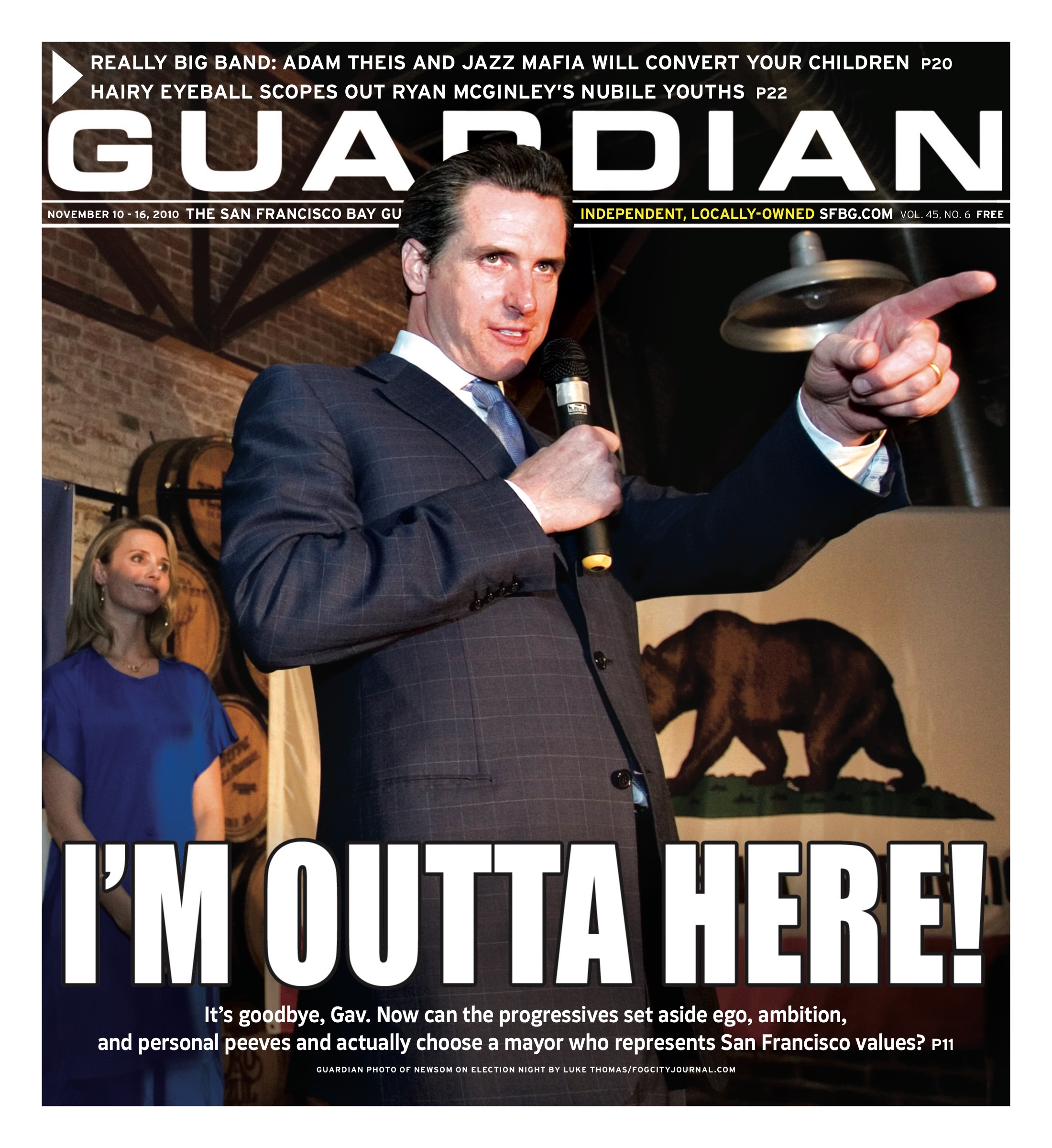
Caretaker mayor concept blasted by Daly

18

There’s been much talk about naming a “caretaker mayor” to replace Mayor Gavin Newsom in January – most of it coming from downtown-oriented politicians, advocates, and publications, who are in the minority on the Board of Supervisors – but Sup. Chris Daly offered a full-throated denunciation of the idea this week.

At the end of Tuesday’s long debate on adopting a procedure for choosing a successor mayor, Daly appealed to his colleagues, “Can we please spend a minute talking about what we’d like to see in the new mayor of San Francisco?” And in his remarks that followed, he focused on shooting down the notion that a caretaker mayor is what this troubled city needs.

The idea behind a caretaker would be to choose a technocrat who would pledge not to run for reelection in the fall, thus keeping any prospective candidate from gaining an advantage from incumbency. Names most frequently cited by moderate politicians and media voices are SFPUC head Ed Harrington, Sheriff Michael Hennessey, and City Administrator Ed Lee. Some more progressive caretaker names that get dropped include former Mayor Art Agnos and SF Democratic Party chair Aaron Peskin.

But Daly – publicly sounding a perspective that’s been widely discussed in progressive circles, who question why the board’s progressive majority would purposefully punt away the chance to lead – said the idea is fundamentally flawed: “You would be putting someone in office who is necessarily weak and hamstrung.”

While Daly acknowledges that he’d like to see a progressive in Room 200 and that “the political divide is real” between progressives and moderates, he said the flaws in installing a caretaker mayor should be apparent to everyone. To deal with a $400 million deficit and other structural budget issues, the new mayor is going to have to show leadership and have a base of support, which a caretaker mayor wouldn’t.

Although the Hearst-owned Chronicle has been promoting the idea of a caretaker mayor now, Daly noted that the Hearst-owned Examiner editorialized against the idea last time the city was in this position, in 1978 after Mayor George Moscone was assassinated and the board picked Dianne Feinstein to become mayor. “The City should not have to accept a “caretaker” mayor invested with only a thin veneer of authority,” editorialized the Examiner.

“It would be a colossal mistake,” Daly said of choosing a caretaker mayor. “We need to do better than just someone who knows the inner workings of city government.”

But the fear that the board’s progressive majority would put a progressive in office – or even a moderate politician with some progressive inclinations and connections – seems to be downtown’s greatest fear right now. The fun begins Dec. 7 when the board resumes its discussion of the issue and could start taking nominations.

Chronicle finally uses the P word: Progressive

41

The San Francisco Chronicle ran a good story yesterday on progressives hopes for appointing one of our own as the next mayor. But beyond being fair to progressives that are often demonized by a newspaper whose political sympathies lie with the downtown crowd, the article was notable for something else: it’s use of the word “progressive.”

For years, Chronicle editors have refused to use the word that is most commonly used to describe the people and ideology that controls a majority of the Board of Supervisors, opting instead to label progressives as “far-left” or “ultra-liberal,” while the economic conservatives in town get the reasonable-sounding label “moderate.”

Sources tell the Guardian that this bit of Orwellian wordsmithing started with former Editor Phil Bronstein and was fueled by Mayor Gavin Newsom complaining to Chronicle editors that calling his political enemies “progressives” made us sound too reasonable, rather than the wild-eyed radicals he considered us to be.

I and others have discussed this with Chronicle Metro Editor Audrey Cooper, and her bewildering argument is that progressive “is a politically loaded term that doesn’t mean much to our readers.” I’ve pointed out that the word is quite descriptive and has deep historical roots in California and its own caucus in Congress – and that labeling us “ultra-liberal” is far more loaded and pejorative – but to no avail.

I ran into the writer of yesterday’s story – Rachel Gordon, a solid reporter and former colleague from the City Desk NewsHour television program – at the Board of Supervisors meeting yesterday afternoon and she said that political reporters at the Chronicle have long been pushing to use “progressive” and the editors finally changed the policy.

I have a message in to Cooper and I’ll follow up in Comments if I learn anything more about how and why the decision was made. But it’s good to know the paper of record is now letting progressives be progressives. Maybe now we can get rid of the “moderate” label. How about SoLibEconoCons (socially liberal economic conservatives)? OK, maybe that still needs some work.

Progressives show unity as board approves mayoral succession process

21

The San Francisco Board of Supervisors unanimously approved a process for replacing Mayor Gavin Newsom last night after the progressive majority stuck together on a pair of key procedural votes and some parliamentary jousting provided a preview of the high-stakes power struggle that will begin Dec. 7.

Sup. Sean Elsbernd led the board moderates (Sups. Carmen Chu, Michela Alioto-Pier, Bevan Dufty, and Sophie Maxwell) in trying to dilute the voting power of the six progressives on the board (Sups. David Chiu, Chis Daly, David Campos, Eric Mar, Ross Mirkarimi, and John Avalos) and ensure they can’t vote as a bloc to choose the new mayor.

State conflict-of-interest rules spelled out by the California Political Reform Act and associated rulings prevent supervisors from voting in their economic interests, as becoming mayor would be. So Board Clerk Angela Calvillo and the Santa Clara County Counsel’s Office (legal counsel in the matter after our own City Attorney’s Office recused itself) created procedures whereby all nominees leave the room while the remaining supervisors vote.

But as Daly noted, clearing several supervisors from the room would make it unlikely that those remaining to come up with six votes for anyone. He also said the system would deny too many San Franciscans of a representative in this important decision and allow sabotage by just a few moderate supervisors, who could vote with a majority of supervisors present to adjourn the meeting in order to push the decision back to the next board that is sworn in on Jan. 11.

“The process before us is flawed,” Daly said.

So Daly sought to have the board vote on every nomination as it comes up, but Elsbernd argued that under Robert’s Rules of Order, nominations don’t automatically close like that and to modify a board rule that contradicts Robert’s Rules requires a supermajority of eight votes. Calvillo, who serves as the parliamentarian, agreed with that interpretation and Chiu (who serves as chair and is the final word on such questions) ruled that a supermajority was required.

Although some of his progressive colleagues privately grumbled about a ruling that ultimately hurt the progressives’ preferred system, Chiu later told the Guardian, “I gotta play umpire as I see the rules…We need to ensure the process and how we arrive at a process is fair and transparent.”

Nonetheless, Chiu voted with the progressives on the rule change, which failed on a 6-5 vote. But Daly noted that supervisors may still refuse nominations and remain voting until they are ready to be considered themselves, which could practically have the same effect as the rejected rule change. “If we think that’s a better way to do it, we can do it, but we don’t need to fall into the trap and subterfuge of our opponents,” Daly told his colleagues.

Elsbernd then moved to approve the process as developed by Calvillo, but Daly instead made a motion to amend the process by incorporating some elements on his plan that don’t require a supermajority. After a short recess to clarify the motion, the next battleground was over the question of how nominees would be voted on.

Calvillo and Elsbernd preferred a system whereby supervisors would vote on the group of nominees all at once, but Daly argued that would dilute the vote and make it difficult to discern which of the nominees could get to six votes (and conversely, which nominees couldn’t and could thereby withdraw their nominations and participate in the process).

“It is not the only way to put together a process that relies on Robert’s Rules and board rules,” Daly noted, a point that was also confirmed at the meeting by Assistant Santa Clara County Counsel Orry Korb under questioning from Campos. “There are different ways to configure the nomination process,” Korb said. “Legally, there is no prohibition against taking single nominations at a time.”

So Daly made a motion to have each nominee in turn voted up or down by the voting board members, which required only a majority vote because it doesn’t contradict Robert’s Rules of Order. That motion was approved by the progressive supervisors on a 6-5 vote.

Both sides at times sought to cast the other as playing procedural games, and both emphasized what an important decision this is. “This is without a question the most important vote that any of us will take as a member of the Board of Supervisors and one that everyone is watching,” Elsbernd said of choosing a new mayor.

So after the divisive procedural votes played out, Chiu stepped down from the podium and appealed for unity around the final set of procedures. He said that San Franciscans need to have confidence that the process is fair and accepted by all, and so, “It would be great if we have more than a 6-5 vote on this.”

As the role call was taken, Carmen Chu was the first moderate to vote “yes,” and her colleagues followed suit on a 11-0 vote to approve the process. At that point, the board could have begun taking nominations, but it was already 7 p.m. and both Daly and Chiu argued to delay that process by couple weeks.

“We owe it to ourselves and this city to have a discussion [of what qualities various supervisors want to see in a new mayor] before we get into names and sequestration,” Daly said.

He and other progressive proposed to continue this discussion to Dec. 7, but Elsbernd – who was visibly agitated by the discussion – suddenly moved to table the item (which would end the discussion without spelling out the next step), a motion rejected on a 4-7 vote, with Maxwell joining the progressives.

The discussion ended with a unanimous vote to continue the item to Dec. 7, when supervisors will discuss what they want in a new mayor and possibly begin the process of making and voting on nominations. Anyone who receives six votes will need to again be confirmed during the board meeting on Jan. 4, a day after Newsom assumes the office of lieutenant governor.

Boring through

2

news@sfbg.com

Despite an official groundbreaking ceremony last February, the Central Subway — an underground Muni connection to Chinatown — still doesn’t have its full $1.5 billion in funding lined up yet, and now the project is facing renewed criticism that the high cost isn’t worth the benefits.

The project was a promise by former Mayor Willie Brown to Chinatown leaders who were upset that the Embarcadero Freeway was torn down after the 1989 Loma Prieta earthquake and never rebuilt, leaving that densely populated part of town difficult to access. But not everyone in Chinatown wants the project.

Wilma Pang, founder and co-chair of A Better Chinatown Tomorrow (ABCT) stands firmly against it, while the Rev. Norman Fong, deputy director of programs for the Chinatown Community Development Center, takes a solid stand for building the project, as does Board of Supervisors President David Chiu, who represents the district.

Fong explains that the majority of Chinatown has united to make sure the subway comes through, and that he himself has never seen the community in Chinatown more set on something. “This is an environmental justice movement,” Fong said. “For me, this was the first time Chinatown had ever fought [for such a major infrastructure project].”

City staff is also focused on moving the project forward. “This project has been supported by our state, local, and federal officials,” Brajah Norris, external affairs manager for the Central Subway Project, told the Guardian.

But the group SaveMuni — formed last year by progressives, transit engineers, transit advocates, and other activists “working to reverse Muni’s death spiral” — recently called for the Central Subway to be shelved and its resources put to more efficient projects. “Now that the analysis has been done, it’s time to rethink the situation,” SaveMuni says in a white paper on the Central Subway.

The group argues that using the subway will take longer than other transit options, threatens many businesses on Stockton Street, and doesn’t even connect effectively with the Muni system. Even worse, they point out that Muni would have to spend an additional $4 million a year in local operating expenditures beyond the existing bus service, an expenditure that seems unnecessary to the organization members.

Although creating a subway for the crowded community seemed like a good idea initially, people like Tom Radulovich soon began to realize that a 1.7 mile subway stretch buried 20 feet underground is not the same as the plan he hoped for when considering an economically efficient transportation system for the people in Chinatown.

“People deserve a whole range of alternatives,” said Radulovich, executive director of Livable City and an elected member of the BART Board of Directors. “You have to be mindful of when the [current] project is not the same project you voted for.”

For those at SaveMuni, the project long ago strayed from its original goal. Although they agree that Chinatown community members deserve their own form of reliable transportation, they believe this is not the right way to be spending federal, state, and local money.

“It’s an important corridor, so funding should go there,” Radulovich said. But he thinks the same money could be better used other ways, such as for a dedicated Bus Rapid Transit (BRT) lane.

Jerry Cauthen, a retired SFMTA transportation engineer who cofounded San Francisco Tomorrow and SaveMuni, explained that he initially liked the concept of a subway but then became “bitterly disappointed” as the project progressed.

The subway line has three stops mapped out: one at Moscone Center, one at Union Square/Market Street, and one in Chinatown. From the Chinatown station, the tunnel will continue under Washington Square and remain there for future extensions to the subway, which is projected to begin service in 2018.

“There’s no reason to wait 10 years for a subway,” Cauthen said. “Because it is not going to do what it says it will do.”

Cauthen explained that the route for the Central Subway misses the most important lines anyway, which would be “serving Chinatown poorly.” Cauthen was not alone in his concern that the three-stop subway system will prove to be more of a hassle than a convenience.

But in a committee meeting held Nov. 16 at City Hall, the San Francisco County Transportation Authority (which oversees capital expenditures, while the SFMTA runs Muni) addressed the issue that the city in fact does not have all the money it needs to complete this project. While federal officials have already handed over $72 million out of $948 million, getting the rest of that federal money requires the city and its affected agencies to come up with local matching funds of between $137 million to $225 million.

Malcolm Yeung, public policy manager for the Chinatown Community Development Center, explained that based on the recent hearing, the SFMTA needs to find a viable source for the remaining $137 million. It has until February to inform the Federal Transportation Administration how it will obtain the rest of this money. The SFCTA meeting was an attempt to request an allocation of about $22 million in Proposition K (sales tax) funds.

Now that the city is having trouble meeting its fiscal goal by February 2011, the new question is, if city officials don’t come up with the money, will San Francisco lose the project and its funding?

“I don’t think it means that we lose the whole project,” Yeung said, but there could be delays. And every time there is a delay, there is also an associated cost to be paid.

According to SFMTA, the project received $948.2 million in federal money, $375 million from the state, and $255.1 million in local contributions. Norris explained that since the federal money was given for this specific New Starts program, then it can only be used for this project. And if the project comes to a halt, the money will go somewhere else. “People don’t realize that $948 million is part of the New Starts program,” Norris said. “If we don’t get it, we actually lose it.”

Fong, Chiu, and other supporters of the project rallied in its support outside City Hall on Nov. 15. As Fong told us, “[People against the project] don’t appreciate the hard work, that it takes a decade to get the federal funds … It cannot be simply shifted or “redirected” as some have said.”

For Fong, ending this project would be “disregarding two decades of hard work.” Although the ideas to improve Muni seem fair to Fong, moving forward with the subway is the only option for him right now.


*This article has been corrected from an original version.

Critical care

5

Sarah@sfbg.com

A complex and controversial project that would involve five San Francisco hospitals — including building a huge showcase facility for the wealthy atop Cathedral Hill — has prompted a debate about what average city residents need from the health care system.

California Pacific Medical Center, an affiliate of Sutter Health, proposes to downsize St. Luke’s Hospital, which primarily serves a low-income population in the Mission District, as part of a $2.5 billion proposal to renovate and retrofit three existing medical campuses, close another one, and build housing and a megahospital on Cathedral Hill that would draw patients from around the country.

CPMC’s grandiose plan was being considered strictly as a land use decision, despite its far-reaching impact on the city’s health care system. So Sup. David Campos created legislation calling for the city to create a citywide health services master plan and to use that as another tool for gauging future medical projects.

Debate over that legislation left some activists on both sides unhappy, with progressives disappointed that it won’t be able to stop a CPMC project they see as neglectful of the poor, and moderates wary of creating a new way to challenge development projects in the face of widespread unemployment in the construction industry.

But it struck a fine enough balance to win 8-3 approval by the board Nov. 16, enough to override a threatened mayoral veto. “I’m really happy and excited about the passage of this legislation,” Campos told the Guardian after the vote.

The legislation has a two-part mandate, with the first part kicking in as soon as it has final approval. It requires the Planning Department, with input from the Department of Public Health, to prepare a health care services master plan to identify current and projected needs for health care services and where they should be provided.

The second part, which begins in 2013, requires Planning to determine whether medical projects are consistent with the findings of this plan. That delay is credited to a last-minute amendment Campos granted during a Nov. 15 committee hearing after the hospital industry complained that the process could jeopardize its ability to meet state-mandated seismic retrofitting deadlines for projects already in the planning pipeline.

The passage of Campos’ legislation comes eight months after President Barack Obama signed the Patient Protection and Affordable Care Act. Hailed by its supporters as the most significant change to the U.S. health care delivery systems in 40 years, the reform package has also been greeted with criticism on both ends of the political spectrum. Progressives complain that it relies too heavily on private insurance companies and medical providers, while Tea Party supporters says that it’s government run amok and they have vowed to “kill the bill.” Senate Minority Leader Mitch McConnell (R-Ky) recently compared so-called Obamacare to “tyranny” in a speech to conservative legal scholars.

But here in San Francisco, the debate over Campos’ legislation — as heated and divisive as it was at times — yielded a surprising amount of consensus around the long-neglected idea that government should play a role in health care planning.


PULLING THE PLUG

The passage of Campos’ legislation marks the first time in 30 years that a government entity has mandated health care services planning in California. That approach West Bay Health Systems Agency, whose creation he opposed as governor of California.

Lucy Johns, a San Francisco-based health care planning consultant who wrote the only health care services master plan California has ever had, recalls what happened in the mid-1970s after President Gerald Ford signed legislation that established health system agencies nationwide.

“California established 14 health systems agencies, including the West Bay Health System Agency, which governed the nine Bay Area counties,” Johns told the Guardian. “The legislation mandated that they be established by every state, with the federal government providing the funding. So every state had to decide how many, how big, and how structured the health system agencies would be.”

Johns notes that state legislators were constrained when it came to the decisions these health service agencies made. “The governing bodies of the health systems agencies had to have a membership that was 51 percent consumer and 49 percent healthcare provider, which included doctors, nurses, and hospital administrators,” she said.

That history served as a backdrop for discussion of the Campos legislation, with the Planning Department staff report noting, “With the elimination of the West Bay Health Systems Agency in 1981, there is no longer a routine or comprehensive analysis of health service resources, needs, trends, and local impacts conducted for changes to or within medical uses.”

“It’s truly a historic moment for San Francisco,” Campos said after his legislation passed its Nov. 16 first reading (the second and final reading is set for Nov. 23, after Guardian press time). “We are the first city in the country to make sure land use decisions are aligned to our health care needs. That’s an unprecedented step that will shape the future of healthcare planning for years to come.”

Campos acknowledged that the passage of Obama’s heath reform package — which includes a mandate to purchase private health insurance beginning in 2014 — was also a catalyst for his legislation, along with the CPMC project.

“But it had more to do with seeing that the city didn’t have the tools it needed to evaluate projects in terms of whether they met the city’s healthcare needs and how they might impact people’s access to healthcare,” Campos said. “The main catalyst came from the community, which felt it was being asked to make decisions that will have long-lasting health care implications, but didn’t have any way to understand those needs. Those concerns were compounded by changes at the national level — and the recognition that these changes offer us an opportunity to engage in planning.”

Campos’ legislative victory came two months after members of the Cathedral Hill Neighbors Association joined nurses, medical workers, patients, and community groups in voicing concerns at a Sept. 23 public hearing about the draft environmental impact report for CPMC’s Cathedral Hill hospital and the other facilities that are part of its proposal.

These groups collectively expressed fear that downsizing St. Luke’s, closing the CPMC California campus, and transforming CPMC Pacific campus to an outpatient-only hospital will force low-income people to travel farther to access health care services while offering better service to the wealthy at Cathedral Hill. And neighbors worried that the proposed complex would increase traffic and require the demolition of rent-controlled apartments.

Formed in 1991 through the merger of Pacific-Presbyterian Medical Center and Children’s Hospital of San Francisco, CPMC has been affiliated with Sutter Health since 1996 and currently has four medical campuses in San Francisco: Pacific in Pacific Heights, California in Presidio Heights, Davies in the Duboce Triangle, and St. Luke’s in the Mission.

But CPMC’s longtime goal was to build a facility intended to be like the Mayo Clinic of the West Coast, a 15-story, 555-bed full-service hospital and specialty care facility at the corner of Van Ness Avenue and Geary Boulevard. Company officials have made approval for that project conditional on keeping St. Luke’s open in the face of the state’s deadline on seismic safety standards that the hospital doesn’t now meet.

“St. Luke’s Hospital was the big issue that got our attention,” Le Tim Ly, lead organizer for the Chinese Progressive Association, told the Guardian. His group has worked with residents in the city’s southeast sector around environmental justice, air quality, and pollution issues when they became aware of the threat to St. Luke’s. “All this, coupled with efforts to downsize Luke’s, left us alarmed by the disproportionate impact on an already impacted area.”

But alarm over CPMC’s plans has now revived the idea of healthcare planning.


MAKING A PLAN

As recently as the beginning of November, representatives for the Hospital Council of Northern and Central California — whose members include CPMC, Chinese Hospital, Jewish Home, Kaiser Permanente, Laguna Honda, St Luke’s, St. Mary’s, San Francisco General Hospital, and Veterans Affairs Medical Center — seemed opposed to any change in the way healthcare planning is done in San Francisco.

At a Nov. 1 hearing on the Campos legislation at the board’s Land Use and Economic Development Committee, Ron Smith, the Hospital Council’s senior vice president for advocacy, said his organization favored maintaining the city’s current procedures. “We would like to propose that the Health Commission does the planning, the Planning Commission does the land use, and that there is a required determination process which is in the current legislation,” Smith said. “We’re proposing that that continue.”

But two weeks later, after Campos amended his legislation so projects now in the planning pipeline are exempt from having to comply with the city’s health care services master plan, some members of the Hospital Council seemed to have a change of heart.

CPMC’s Chief Executive Officer Warren Browner surprised just about everybody when he publicly stated in mid-November that CPMC supports health care planning. “We strongly support the efforts of the city — we are in favor of health planning,” Browner said at a Nov. 15 hearing on the legislation.

“That statement was extraordinary,” said Lucy Johns, recalling CPMC’s history of resisting government control. “The conversation about this legislation has already changed the discourse, at least in public.”

Linda Schumacher, chief executive officer of Chinese Hospital, a community-owned, not-for-profit facility, explained at the same hearing that her organization had been concerned that Campos’ legislation would affect her hospital’s ability to move ahead with a $150 million project that has been in the pipeline since 2003.

“We thank you for that amendment that allows the effective date to be changed,” she said.

“It shows how much progress had been made, even before this legislation goes into effect,” Campos said of the hospital industry’s apparent shift in attitude. “It’s a monumental step, something that was not expected as recently as a few months ago.”

But Ly of the Chinese Progressive Association said he believes the Hospital Council still doesn’t want to see the city getting involved. “As recently as a month ago, their folks were speaking out against any kind of legislation. But I think they started seeing the writing on the wall.”

Ly fretted about the potential negative impact of Campos’ last-minute amendments. Sup. Campos’ plan represents a victory. But we could use that information as soon as possible. The 2013 deadline means the city will be handicapped: it will have information it can’t use yet.”

Ly ventures that the hospital industry’s approach will be to try to lessen the impact of the legislation. “As written, it still provides the Planning Commission and the board with the discretion to approve projects,” Ly said. “Ultimately, the struggle is about values. Just because there are plans and guidance doesn’t mean the healthcare needs of the community will become a top priority — it just provides us with tools to make an assessment.”

Campos counters that his bill will allow the city to create incentives for, and apply pressure on, the hospital industry. “If they truly want their projects to be expedited and approved before state-mandated seismic retrofitting deadlines kick in, they’ll propose plans that work for the community,” Campos explained.

But even as it publicly vows to be supportive, the Hospital Council continues to express concerns about the Campos legislation. “It’s the council’s job is to be supportive now that the board has approved Campos’ plan,” Smith said. “And Sup. Campos was very generous. He started talking to us in June. But we really didn’t get a handle on his proposal until much later. We think the idea of healthcare planning is very good. We still have concerns about the process, but now the board has voted on the legislation, our goal is to do our best to work with the law.”

Concerns that the legislation would be used to mire projects in repeated appeals and give too much weight to critics’ concerns was raised at the Nov. 16 hearing by Sup. Sean Elsbernd.

“Right now, if anyone has concerns, there’s a conditional use process and a CEQA [California Environmental Quality Act] process,” Elsbernd told the Guardian. “But this turns up a brand new appeal. It means the appeals are heard at the same time, but you’ve now created a third route.”

Campos responded to these concerns by amending the legislation to clarify that the board must act on consistency determination appeals at the same time it acts on other related appeals, so projects won’t be delayed.

Evidently this wasn’t enough to appease the San Francisco Chamber of Commerce. “We cannot be supportive of that piece of legislation,” Rob Black, the Chamber’s vice president of public policy, told the Guardian after the legislation was approved. “We believe appeals should be done at the Department of Public Health in conjunction with service providers, since San Francisco provides 20 percent of service, and private organizations provide the remaining 80 percent.”

Black says the Chamber was pleased Campos amended his legislation so as not to slow down projects that are currently in the planning pipeline. But he claimed Campos’ legislation could actually limit access to healthcare services. “The Chamber is concerned that Campos’ legislation will make it harder for doctors to pool together in pods, and if we don’t do that, it won’t make healthcare more available because services will be more expensive,” Black said. “But we absolutely think” the city should analyze gaps in providing health care to San Franciscans.

Campos’ aide Hillary Ronen confirmed that Black is correct in saying that anyone can appeal a hospital project’s consistency determination. “But the final analysis will revolve around asking if the proposed project meets the health care needs of San Francisco,” she said. “If it doesn’t, and the board doesn’t believe there’s a compelling public policy reason to approve the project, [the board] can override the approval.”


PATIENTS VS. PROFITS

Mary Michelucci, a registered nurse for 40 years and a member of the California Nurses Association, is hopeful that Campos’ legislation will rein in the hospital industry.

“I hope that any plan that would favor patient care over profit would be the way to go,” Michelucci said. “Running a hospital is expensive. But with the profits that Sutter and CPMC are making, they can afford this.”

Michelucci says the dispute over St. Luke’s came to a head three years ago, when nurses began to suspect that CPMC was planning to let the facility fail, suspicions that intensified when CPMC closed St. Luke’s neonatal intensive care unit 18 months ago.

“Now the babies who need neonatal special care are transported to CPMC’s California campus, which is in the Richmond,” Michelucci said. “But the moms may be discharged and most of them live in the Mission or Bayview-Hunters Point.”

Michelucchi still fears that CPMC will wage “a horrific campaign” against the California’s Nurses Association as it continues to push the plan for its megahospital. “CPMC wants to be in complete control of the registered nurses,” she said. “We, unfortunately, are their conscience, while they are a business model in the business of healthcare. The decisions they make about healthcare are not in the interests of patients or nurses, and we are the thorn in their side.”

All this is happening against the backdrop of the worst economic recession since the Great Depression, and for construction workers facing high unemployment rates in San Francisco, CPMC’s megaproject clearly represents light at the end of a very dark tunnel.

“CPMC is my future,” William Hestor, a 28-year-old father of two and member of SEIU-United Healthcare Workers, said at the Nov. 15 hearing. “We worked hard on a contract and we just want to make sure our hospital is built on time.”

CPMC media spokesperson Kevin McCormack told the Guardian that the real issue between CPMC and the CNA is union membership at CPMC’s Cathedral Hill facility. “CPMC is reducing beds at St. Luke’s because the beds aren’t in use, but the facility will be able to take care of 90 percent of patients’ needs and if you need specialist care, a shuttle will take you to Cathedral Hill,” McCormack said. “This centralized arrangement is the best way to attract the best staff and equipment.”

McCormack noted that there are union members and 1,200 nonunion nurses working at CPMC facilities in San Francisco. “We are bringing together nonunion and union nurses together at this facility, and we don’t feel we have the right to force our nonunion nurses to join,” he said, adding that since the Teamsters, the Carpenters, and SEIU-United Healthcare Workers (UHW) are already unionized at the Pacific and California campuses, they’ll be allowed to unionize at Cathedral Hill.

CNA member Eileen Prendiville, who has worked in San Francisco as a registered nurse for decades, recalls the negative changes she has already seen at CPMC’s facilities, including eliminating registered nurses and specialty services.

“If you pull services, as they have, of course you’ll have fewer patients. And the physicians start leaving, so it’s a vicious cycle,” she said. “St. Luke’s was a small community hospital but now it’s all about corporate medicine.”

Sup. Eric Mar sided with those seeking to exempt current projects from the city’s health care services master plan. But Sup. Sophie Maxwell noted that the Planning Commission will take a facility’s historical role into account in determining whether projects are consistent with the city’s health care services plan.

“We believe that addressed community concerns,” Maxwell said. “St. Luke’s would never have been targeted for closure had this legislation been on the books in the past.”

Campos insists his legislation is not simply about CPMC. “Ultimately this legislation stems from a number of pleas we have heard in the last couple of years from people throughout the city,” he said. “It takes the institutional master planning process to the next level. We have tried to consolidate the appeal process under existing law. Important as the legislation is, it’s key to make sure we have the right master plan because that’s where the heavy lifting will take place.”

Meanwhile, the final EIR is being completed for the CPMC project, which should go before the Board of Supervisors for approval early next year.

The screwy rules for mayoral succession

0

EDITORIAL The clerk of the Board of Supervisors, at the request of Board President David Chiu, has released a proposal for the selection process for a new mayor, and it’s about as complicated and confusing as everyone expected. That’s in part the result of the vagueness of the City Charter, which simply specifies that a vacancy in the office of mayor shall be filled by a San Francisco registered voter chosen by a majority of the supervisors but offers no procedural clues on how to get there. And the Political Reform Act sets very strict limits on conflicts of interest for elected officials in California; a supervisor, for example, can’t vote for himself or herself or do anything to promote his or her candidacy for an office that comes with a pay raise.

In the end, the proposal leaves limited room for public input — and makes it very difficult for any sitting supervisor, particularly one of the progressives, to wind up winning the job.

The way the rules are laid out, the board would accept nominations — but any sitting supervisor who accepted the nomination would have to leave the room at once, cease all communication with his or her colleagues, and play no role in further deliberations or voting. Since it’s entirely possible that several supervisors — and possibly several progressives — could be nominated, the process would cripple the final outcome since the only ones allowed to vote would be the remaining board members whose names aren’t in the mix.

That skews the outcome heavily toward one of two options: the supervisors appoint someone who isn’t on the board — or Chiu winds up as both acting mayor and board president because nobody else can muster six votes. The only other option: The progressives all stick together, line up in advance behind a candidate who’s currently on the board, and find one more vote for that person.

The whole thing is so screwy that the supervisors ought to make some changes before they adopt it and try, to the extent that it’s legal, to inject some sanity into the process.

For example: Instead of opening the nominations, collecting a long list of names, sending all of the sitting supervisors on that list out of the room and then voting, the board could take the names one at a time. A supervisor gets nominated, leaves the room, and the votes are tallied; if he or she has fewer than six, the process starts again. (The problem: who goes first — because the first person eliminated can’t be nominated again. To be fair, there would have to be some sort of random drawing of which supervisor could make the first nomination — which alone might add too much random chance to the outcome.)

Then there’s the question of when this all takes place. If the process starts now and an interim mayor is chosen, the board will have to reconfirm that person Jan. 4 when Gavin Newsom actually resigns to take over as lieutenant governor. There’s a chance something could go wrong in the meantime and the board would have to change its vote, and there’s a chance that state law would prevent a supervisor who won from acting in any way to influence the final vote. But those are better risks than the option of leaving everything to the last day. And if the board decides that it can’t or shouldn’t act until Jan. 4, special meetings ought to be calendared for Jan. 5, 6, and 7 to give the current board more than one day to make the final decision.

And before anything happens, the board needs to schedule at lest one open hearing to get input from the public on the qualifications for the next mayor and on potential candidates.

The bottom line: any candidate who wants to get progressive support needs to be willing to do more than sign legislation and manage the city. He or she needs to be willing to use political capital and the mayor’s bully pulpit to make the case for progressive change — on taxes, services, the budget, and an overall civic vision. And the six board members on the left need to stick together, or that won’t happen.

Editorial: The screwy process for selecting a mayor

19

The clerk of the Board of Supervisors, at the request of Board President David Chiu, has released a proposal for the selection process for a new mayor, and it’s about as complicated and confusing as everyone expected. That’s in part the result of the vagueness of the City Charter, which simply specifies that a vacancy in the office of mayor shall be filled by a San Francisco registered voter chosen by a majority of the supervisors but offers no procedural clues on how to get there. And the Political Reform Act sets very strict limits on conflicts of interest for elected officials in California; a supervisor, for example, can’t vote for himself or herself or do anything to promote his or her candidacy for an office that comes with a pay raise.


In the end, the proposal leaves limited room for public input — and makes it very difficult for any sitting supervisor, particularly one of the progressives, to wind up winning the job.


The way the rules are laid out, the board would accept nominations — but any sitting supervisor who accepted the nomination would have to leave the room at once, cease all communication with his or her colleagues, and play no role in further deliberations or voting. Since it’s entirely possible that several supervisors — and possibly several progressives — could be nominated, the process would cripple the final outcome since the only ones allowed to vote would be the remaining board members whose names aren’t in the mix.


That skews the outcome heavily toward one of two options: the supervisors appoint someone who isn’t on the board — or Chiu winds up as both acting mayor and board president because nobody else can muster six votes. The only other option: The progressives all stick together, line up in advance behind a candidate who’s currently on the board, and find one more vote for that person.


The whole thing is so screwy that the supervisors ought to make some changes before they adopt it and try, to the extent that it’s legal, to inject some sanity into the process.


For example: Instead of opening the nominations, collecting a long list of names, sending all of the sitting supervisors on that list out of the room and then voting, the board could take the names one at a time. A supervisor gets nominated, leaves the room, and the votes are tallied; if he or she has fewer than six, the process starts again. (The problem: who goes first — because the first person eliminated can’t be nominated again. To be fair, there would have to be some sort of random drawing of which supervisor could make the first nomination — which alone might add too much random chance to the outcome.)


Then there’s the question of when this all takes place. If the process starts now and an interim mayor is chosen, the board will have to reconfirm that person Jan. 4 when Gavin Newsom actually resigns to take over as lieutenant governor. There’s a chance something could go wrong in the meantime and the board would have to change its vote, and there’s a chance that state law would prevent a supervisor who won from acting in any way to influence the final vote. But those are better risks than the option of leaving everything to the last day. And if the board decides that it can’t or shouldn’t act until Jan. 4, special meetings ought to be calendared for Jan. 5, 6, and 7 to give the current board more than one day to make the final decision.


And before anything happens, the board needs to schedule at lest one open hearing to get input from the public on the qualifications for the next mayor and on potential candidates.


The bottom line: any candidate who wants to get progressive support needs to be willing to do more than sign legislation and manage the city. He or she needs to be willing to use political capital and the mayor’s bully pulpit to make the case for progressive change — on taxes, services, the budget, and an overall civic vision. And the six board members on the left need to stick together, or that won’t happen.

The mayoral selection last time

3

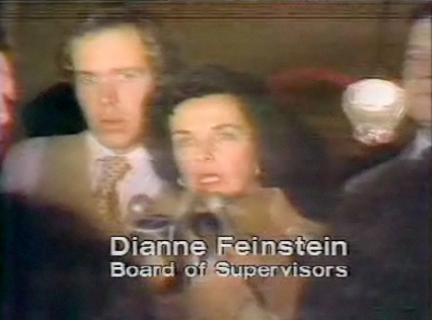
The last time the Board of Supervisors had to pick a mayor, things were very different. Former Sup. Dan White had just murdered Mayor George Moscone and Sup. Harvey Milk. The city was in shock. Board President Dianne Feinstein became acting mayor, and one week later, on Dec. 4, six of her colleagues — the narrowest possible margin — elected her to fill out Moscone’s term.

It’s worth looking back at what happened that week, not only because it’s a fascinating bit of political history, but because it gives some insights into how the current process should and shouldn’t go.
We’ve gone back and pulled not only the minutes of that meeting, but all of the relevant articles and editorials from the San Francisco Chronicle, the old San Francisco Examiner and the Bay Guardian, and while newspaper accounts are only the first, and often imperfect draft of history, the Chron had a good City Hall reporter, Jerry Burns, and you can get a lot from the day-by-day accounts.

For starters, everyone (even the Guardian) agreed that Feinstein did a good, almost uncanny job of keeping it together and managing the city in the week after the horrendous murders. But she was by no means the only, or consensus candidate for the job — Sup. Robert Gonzales announced his candidacy Dec. 1, and others were in the running until the end. The Guardian wrote at the time that Feinstein was fine as acting mayor – but shouldn’t be in office for the final 13 months of Moscone’s term.

Among the interesting elements of the drama:

— The process was riddled with Brown Act violations, and the selection of Feinstein was, in retrospect, almost certainly based on illegal meetings.  “Feinstein spent yesterday at her Pacific Heights home,where she talked with most of the supervisors,” a Dec. 4, 1978 Chronicle article by Burns noted. That would amount to an illegal meeting; under state law, then and now, meeting individually and serially in private with all or most of the members of a public board is a clear violation of the Brown Act.

At the time, however, nobody challenged Feinstein’s actions.

— Then, as now, there was a move to name a “caretaker” mayor who would fill out the remaining 13 months of Moscone’s term — and vow not to run again. But the conservative Examiner said that was a bad idea: In a Dec. 3 editorial, the paper, then owned by Hearst Corp., noted: “The City should not have to accept a “caretaker” mayor invested with only a thin veneer of authority.” The notion went nowhere.

— At least one name that was bandied around back then is in play again today: Then-Assembly Member Willie Brown.

— Feinstein got exactly six votes. Although in most casual historical accounts, she’s described as a clear, almost unanimous choice, that was far from true. In fact, Sup. Ron Gonzalez, who described himself as the board member most in synch with Moscone’s agenda, announced his candidacy Dec. 1, and as of Dec. 3, the day before the final vote, Russ Cone of the Examiner reported that “earnest and secretive negotiations among San Francisco’s nine supervisors to agree upon a mayor to replace the slain George Moscone today entered the final, feverish hours with no candidate ready to claim victory.”

At the Dec. 4th board meeting, Sup. Quentin Kopp moved to continue the decision for a week. Kopp – unlike most of his colleagues – had been avoiding the political furor in the days after the assassinations, saying it was unseemly to be making deals when city leaders ought to be in mourning. Feinstein and the six others who would ultimately elect her voted against the motion.

That would be a clear violation of law today; as a candidate, Feinstein would be unable to vote on anything that could promote her ascension to mayor. But no matter: The motion needed six votes, and only Kopp and Sup. Lee Dolson said Aye.

When the motion was made to name Feinstein as interim mayor, Kopp tried to ask her a few questions – particularly about her plans for various department heads. The city attorney quickly shut him down, saying Feinstein couldn’t legally answer or get involved in any debate.

Then six supervisors voted for Feinstein. Kopp and Dolson dissented. Feinstein by law had to abstain. And there were, of course, two empty seats; Dan White had just resigned and was in jail, and Harvey Milk was dead.

Why did Kopp vote no? There’s a back story, a key part of San Francisco political lore.

Feinstein had run for mayor twice before, in 1971 and 1975, both times finishing well out of the money. After her second defeat, she vowed she’d never do it again. In fact, the day before the assassinations, she had just returned from a trip to Nepal with her then-boyfriend (now husband) Richard Blum, and reporters asked her if she was going to run in 1979. “Not this time,” she said.

She and Kopp, longtime rivals, had cut a deal the year before. Feinstein wanted to be board president; Kopp wanted to be mayor. And Feinstein vowed that if Kopp would support her for board president, she’d stay out of the mayor’s race in 1979 and leave the field open for him.

And of course, immediately after the killings, she changed her mind. Kopp thought what was a bit slimly, and refused to vote for her for mayor. He challenged her in 1979, and narrowly lost, and her political career, so recently in the doldrums, was off and running again.

Breaking down the cost of hosting the America’s Cup

0

San Francisco’s Budget and Legislative Analyst has released a report outlining the costs and benefits of hosting the 34th America’s Cup in San Francisco. Bottom line: If the world-famous yacht race is held here, it will cost the city an estimated $42 million.

The Guardian will publish a more detailed report in coming weeks, but for now, here are a few highlights from the report, which was requested by Sup. Chris Daly and released to the media on Nov. 18.

* The overall cost breaks down like this: The Budget Analyst estimates that the city would receive an estimated $22 million in revenue, and incur new costs of $64 million, resulting in a net loss of $42 million.

* The city would receive an estimated $3.6 million from property tax revenues from new development (probably luxury condos) if the event organizers built on the port properties they’d receive as part of the deal. Billionaire Larry Ellison, who has the ultimate say in selecting the venue for the America’s Cup, would receive several port properties rent-free for 66 to 75 years, under leases which haven’t yet been formally approved. However, if the city obtained a private developer through a competitive process instead, it could receive increased tax revenues of $89.8 million. According to the Budget Analyst, this estimated net loss of $86.2 million “is in addition to the estimated net loss … of $42.1 million.”

* The major benefit to hosting the prestigious yacht race in San Francisco would be an estimated $1.2 billion in new spending in San Francisco’s economy, and the Budget Analyst predicts a range of $928 million to $1.6 billion in economic activity – undoubtedly a good thing for a troubled economy.

* However, the creation of “9,000 jobs” you may have heard about isn’t as simple as it sounds. According to the report: “All ‘jobs’ predicted … are not permanent full time jobs, and therefore would not result in hiring 8,840 employees.” Instead, the Budget Analyst prefers to frame it in terms of work hours, noting that the additional work would be either absorbed by the existing workforce (as in a server waiting on more customers per hour), greater overtime for the existing workforce (think police), or temporary jobs.

The Budget Analyst is careful to state that the report is not meant as a recommendation one way or another for hosting the America’s Cup. “However,” it states, “it is the responsibility of the Budget and Legislative Analyst to report the facts to the Board of Supervisors.”

About that “far left beating…”

61

Our old pal Chuck Nevius is gloating about how the “far left” (I guess that means the people who would have been called mainstream Democrats a generation ago, the ones who believe in the public sector and think economic equality matters) got beaten badly in the supervisors races. And he uses Aaron Peskin as the personification of the far left (amusing, because if you actually talk to Peskin, and look at his record, he’s hardly a crazy leftist. And I say that as someone who is. A crazy leftist, I mean.)

Anyway, here’s what Nevius missed:

Malia Cohen is on the Board of Supervisors because of Aaron Peskin.

Look at what happened in the ranked choice voting. Cohen came from back in the pack because of second-place votes — and a lot of that was because the Democratic County Central Commitee put her as its #2 choice, after DeWitt Lacy, who didn’t run much of an effective campaign.

How did she get the #2? How did a candidate who is bad on tenant issues beat out Tony Kelly, who was by far the most progressive contender, at the supposedly “far left” DCCC? That was the work of Peskin — who, to the chagrin of a lot of progressives (including me) decided to vote for and promote Cohen as the second choice on the slate.

First of all, that was hardly the move of a “far leftist,” since Cohen certainly ran as a more moderate candidate. Second, it showed that the “far left” isn’t some giant organized hippie commie bloc led by Commisar Peskin; it’s a sometimes-united, often-fractious coalition that shares some interests and agendas but doesn’t always have its shit together.

Then there’s this notion the moderates swept into power. Actually, by chance of the way lines are drawn, the even-numbered seats have always been more conservative than the odd-numbered ones. In this case, in many of the races, the progressives were (to quote Calvin Welch) “playing with the house’s money.” Check it out:

D2: Janet Reilly would have been much more reasonable than Michela Alioto-Pier, but Mark Farrell won’t be any worse. Almost by definition, he can’t be any worse than Alioto-Pier. That was a conservative seat, and still is.

D4: No change at all, still Carmen Chu, still a moderate-to-conservative seat.

D6: I supported Debra Walker, but by no stretch of the imagination is Jane Kim anything but a progressive. She’ll be more conciliatory than Chris Daly, but that’s not difficult; Walker would have been more conciliatory, too. Different people, different personalities. But in the end, Kim will be a progressive vote; I mean, she started out as a Green Party leader. The “far left” held that district.

 D8: Definitely the house’s money. Scott Wiener won’t be a whole lot different on the issues than Bevan Dufty. If Rafael Mandelman had won, it would have been a net pickup for the left, but as it is, I’d call it a wash. Sure, the DCCC endorsed Mandelman and he lost, but we all know that was an uphill battle; Wiener has been working that district for years, had plenty of money, was better-known, had the support of Mark Leno, who once held that seat and is immensely popular in the district.   

D10: Sophie Maxwell was never part of the progressive bloc on the board. Sometimes she voted with them; sometimes she didn’t. Tony Kelly would have increased the size of the progressive majority; Malia Cohen doesn’t change it.

In two years, five key progressive seats will be on the ballot — Eric Mar seeking re-election in D1, David Chiu in D3, Ross Mirkarimi termed out and an open race in D5, and David Campos and John Avalos running again in D9 and D11. That’s where the battle to hold the progressive majority will be fought — and those are districts where the DCCC has more influence anyway.

In other words, since the return of district election, the progressives — the “far left” if that’s what you want to call us — have only held one of the five even-numbered seats, and still do. That’s not spin, Chuck; that’s reality.

 PS: Just for fun, I went back four years and checked out our endorsements for supervisor the last time the even-numbered seats were up. W endorsed Sophie Maxwell for re-election in D10 (with reservations, and lacking a credible progressive alternative) and Daly was re-elected with our support in D6. But our candidates lost in D2, D4 and D8.  Nobody talked about the left getting destroyed.

Processing the mayoral transition

5

The question of who will be the next mayor of San Francisco wasn’t any clearer by the end of the Nov. 16 Board of Supervisors meeting, but many expressed a desire for an open and transparent process with accountability to the public. The board approved a motion by Board President David Chiu to have the Clerk of the Board propose an process for selecting a successor mayor, which will come under consideration at the next meeting. But with only a handful of board meetings left before the new board is sworn in on Jan. 8, there is a high level of anticipation.

Clerk of the Board Angela Calvillo confirmed that her office is drafting a proposed process for mayoral selection. Calvillo said the proposal would be submitted for consideration at next week’s meeting, and it will be available to the public on the city website by Friday, Nov. 19.

Essentially, the board could choose from a number of options at its next meeting on how to appoint a successor mayor once Mayor Gavin Newsom vacates office. Whatever the Board decides prior to Jan. 3, when Newsom is sworn in as Lt. Governor, will not have the force of law, since there won’t yet be a vacancy. So a second vote will have to be taken Jan. 4 to make the official appointment. Newsom has said he is “99 percent sure” that he will vacate the Office of the Mayor on Jan. 3.

According to Santa Clara County attorneys — who are filling in for City Attorney Dennis Herrera since he has a conflict-of-interest as a mayoral candidate — neither the Charter nor the Municipal Code dictates a specific process for the Board to use in selecting a successor mayor. So, the board could either follow the regular appointments procedure under the current Board Rules, or it could devise its own process.

The Clerk of Board is now hammering out that unique process, as directed by the board, and the board may vote to modify and adopt that process next week — but since a vote to adopt it would constitute an amendment to the board rules, it would require a super-majority of eight votes.

If there aren’t eight votes, then the board may still opt to set forth an appointment process under the current board rules. “I strongly believe that we do have the ability to effectuate an appointment without amending the board rules,” Sup. Chris Daly said. Daly told the Guardian that he has submitted a motion to take nominations and appoint a successor mayor, which will appear on the adoption without committee reference calendar at next Tuesday’s Board meeting. However, a similar motion put forth by Sup. John Avalos wasn’t able to gain the needed support.

If the board went through the normal appointments process, it would require sending nominees through the Rules Committee for consideration – but since it wouldn’t be practical to have just three members of the board recommend a mayoral appointment to the full board, all 11 supervisors could sit as a Committee of the Whole instead.

The timing is important because if supervisors cannot agree upon a process, or gain enough support for a single nominee, then the task will fall to the new Board of Supervisors, who will be sworn in Jan. 8. If the current board doesn’t reach a decision by Jan. 4, Board President David Chiu will automatically become acting mayor. Once the new board is sworn in, it can continue whatever appointment process has been set in motion or decide to initiate a new process for appointing a successor mayor. If the current board appoints a successor mayor, however, the new board cannot revoke or otherwise affect that appointment.

There are a slew of questions still at play. For example, under conflict-of-interest laws, when some one is nominated as successor mayor, he or she must leave the room and is barred from influencing the process in any way. The idea was bandied about at the Nov. 16 Board meeting to require nominees to respond to questions from the board as part of a public forum, but it’s unclear how a supervisor who has been nominated could respond to questions from his or her colleagues while being sequestered and prohibited from influencing the process.

Although word went out that interested members of the public should show up at City Hall around 4 p.m. Nov. 16 to weigh in on the discussion about appointing a successor mayor, the conversation didn’t get underway till much later.

Sup. John Avalos had submitted a motion to vote on an interim mayor and then vote a second time to ratify that appointment once Mayor Gavin Newsom had vacated office. However, his motion was amended to simply take public input and discuss the process of appointing a successor mayor.

Members of the public waited patiently, and when it was time, they lined up behind the speakers podium wearing neon sunburst stickers that read, “Let the Sun Shine In!” Local writer, artist, and activist Tommi Avicolli Mecca even sang the refrain of the song by that name, before imploring the Supes to “Get this done now, and give us a good, progressive interim mayor.”

Labor activist Gabriel Haaland urged the current board to agree upon an appointment instead of handing the responsibility over to the next board. “People who’ve never held an office hour in their life should not be making this decision,” Haaland said.

Christopher Cook highlighted the challenges that the new mayor would face. “We’re talking about a less-than-average amount of time to prepare for an absolute maelstrom,” with regard to the city budget, Cook noted.

“Let the sun shine in” seemed to be the catchphrase of the evening. Before the public weighed in, Sup. Chris Daly called for an open, transparent process for the appointment of the new mayor. “Conversations about mayoral transition have been happening behind closed doors, not in public session, for the better part of this past year,” Daly charged. “It’s time to hear from the public.”

But just how, exactly, the appointment process will work is anything but clear and sunny – at least for the time being.

Meanwhile, Judge Quentin Kopp, who was a member of the Board of Supervisors when a successor mayor was appointed on Dec. 4, 1978 — one week after the assassinations of Mayor George Moscone and Sup. Harvey Milk — said the process of choosing a new mayor was simpler back then.

In that case, then-Sup. Dianne Feinstein was the only nominee. She was appointed with six votes. Two, including Kopp, voted no, and there were two absences (Harvey Milk had been assassinated one week prior, and Dan White was in jail). Feinstein, who was made to leave the room during the vote, abstained. However, before the vote was called, Feinstein was able to vote against a motion for a continuance — a power she likely would not have had if current political-reform laws were in place.

“It’s simple,” Kopp said. “Why are they complicating it?”

He scoffed at the circuitous discussion happening now, and said some one else had called him with the same inquiry earlier that same day. “Once again, our overpaid supervisors are making work for themselves,” he said. “It’s called busywork.”

And that might be the most insightful statement yet – after all, while the process points are debated over and over again, there is more time for supervisors to determine just who might be able to collect the six votes needed to be elected mayor of San Francisco.

Do San Francisco cyclists need a lift?

10

The abundance of hills in San Francisco may prove to be a formidable obstacle to the city’s goal of increasing the percentage of commuters who use bicycles, particularly for hilltop residents leery ending their days with steep climbs. But motorized lifts could prove to be a potential solution, one now being pondered by public officials and cycling advocates.

Bike lifts are used in several European cities, including Brussels, Belgium and Trondheim, Norway. It consists of a foot plate on a motorized track that pushes riders up the hill at a speed of about three to seven miles per hour.

At a San Francisco Transportation Authority Plans and Programs Committee meeting last month, Sup. David Chiu mentioned seeing the lifts while on his recent trip through the Netherlands, where he went to get ideas for San Francisco to expand bicycle ridership to a full 20 percent of vehicle trips by 2020, a goal set by the Board of Supervisors shortly after that discussion.

“We’re talking about the hilly terrain that can be dealt with in many different ways, but not without investment,” SFTA Director Jose Luis Moscovich said at the meeting. Using the lifts was an idea raised by Renee Rivera, acting Executive Director of the San Francisco Bicycle Coalition. Moscovich responded to the proposal by saying, “We’d probably need to invest in some of those.”

“It’s an idea we’ve shared often and the response is, ‘Hey, I want one of those for my hill,’” Rivera told us. “It’s certainly something that has resonated with some folks, but we think we’ve got some more basic questions to deal with first and that really is improving our network of bike routes here in San Francisco so that they really carry people where they need to go.”

SFBC has had discussions with the Presidio Trust about installing a lift that would take people from the Fort Point parking lot up to the visitor’s center. “It would be in itself a fun attraction for people going to the Golden Gate Bridge because there’s kind of a climb getting up to the bridge,” Rivera said.

While the idea might sound a little far fetched, the flood gates have opened for bicycle-friendly projects in San Francisco. A four-year court injunction that prohibited city engineers from implementing the San Francisco Bicycle Plan was lifted in August and the Board of Supervisors voted in October to approve a resolution to increase the number of trips taken by bicycle to 20 percent of the transportation share by the year 2020. Currently, about 7 percent of the trips within the city are made by bicycle, a figure that has doubled in recent years.

Trampe is the name of the Norwegian lift and the system’s website notes, “In a user survey, 41 percent of the lift users claim they are using the bicycle more often due to the installation of Trampe,” and 72 percent said they would like to see more lifts in Trondheim.

What do you say, San Franciscans, you want one on your hill as well?

From second to first

5

steve@sfbg.com

In Oakland and San Francisco, the big story of this election was ranked-choice voting, a system that allowed Jean Quan to overcome a nearly 10-point election-night deficit to become Oakland’s next mayor and enabled come-from-behind victories in two races for the San Francisco Board of Supervisors.

Those who never liked this system of letting voters rank their top three candidates — a group primarily affiliated with downtown and the moderates who did well under the old system of low-turnout, big-money runoff elections — felt validated by the outcomes. “Ranked-choice voting an undemocratic nightmare” was the headline on Examiner columnist Ken Garcia’s Nov. 11 column.

But for those who understand this system — a product of the progressive movement — and have supported it, this was a watershed election that showcased RCV’s populist possibilities. In Quan’s smart use of an RCV strategy and the huge gap she overcame to topple Don Perata, they see an opportunity for political coalition-building that could influence next year’s San Francisco mayor’s race and beyond.

Besides Perata, if there’s anyone who could justifiably be unhappy with how RCV worked in this election, it would be Tony Kelly. He finished in first place in the D10 supervisorial race on election night only to be defeated by Malia Cohen, who climbed out of fourth place on the strength of those who ranked her second or third. But Kelly is perfectly happy with how RCV worked.

“I supported it before and there’s no reason not to support it now, even though I’m on the edge of this,” Kelly told the Guardian. In fact, he said the only reason he ran for public office in San Francisco was because of progressive electoral reforms such as RCV, district elections and public financing of campaigns. “These are all things that help grassroots candidates.”

Kelly had a ranked-choice strategy; he and Marlene Tran each encouraged their supporters to rank the other second. The alliance might have been a way to overcome the strength of the district’s strong African American voting bloc, which favored Cohen (she got her biggest and most lopsided bumps when Dewitt Lacy and Lynette Sweet were eliminated). But most of Tran’s votes were exhausted when she was eliminated, meaning that many of her voters didn’t list any second and third choices.

“Without RCV, that black vote would have never come together. It would have splintered,” said Steven Hill, a progressive activist who helped design the system.

In Oakland, progressives and other blocs of voters wanted anybody but Perata, a Democratic Party power broker. So Quan reached out to all voters and was particularly helped by a progressive base that she shared with fellow Oakland City Council Member Rebecca Kaplan.

“One thing Jean Quan does consistently at events is say, ‘I would like your first place votes, and if I don’t get that, I would like your second place votes,” Kaplan told the Guardian. “It was striking to me that she consistently asked for No. 2 votes.”

That strategy, along with Quan and Kaplan running mutually supportive races and encouraging their supporters to list the other second, clearly paid off.

“It rewrites the textbook for how to win with ranked-choice voting,” Hill said.

Hill and Kaplan said Oakland voters proved themselves adept at using the ranked-choice system on its debut there. Hill noted how few exhausted ballots there were, showing that voters understood and used their full options — more so than have voters in San Francisco, which has had the system in place since 2004.

“I think what this says is that RCV worked. Voters overwhelmingly filled out their ballots correctly,” Kaplan said. She also noted how the election demonstrated the possibilities of political coalition-building: “It isn’t so much the coattails of the candidates as the coalition of the supporters.”

But many observers also say the situation in Oakland was a perfect storm of opposition to a single candidate, Perata, who professed ignorance about how RCV worked.

“I don’t think we’ll see something like this again, but it adds to what’s possible,” said David Latterman, a political consultant who works primarily with downtown-backed candidates.

Jim Stearns, a consultant who represents more progressive candidates, said moderate candidates with money usually prevail in runoff elections, and that probably would have been the case in Oakland if voters hadn’t switched to RCV: “I think you would have had a very different result if you’d had a runoff.”

Yet most political consultants still don’t like RCV, particularly those who work with downtown candidates. “RCV just probably won two races for me, coming from behind, and I still don’t like it,” said Latterman, who worked with Cohen and D2 winner Mark Farrell. “I like runoffs. I like candidates having to reach out and prove themselves.”

Of course, that system favored candidates who have the resources to reach out and target a voter base that is generally smaller and more conservative than in regular elections. But all the consultants are now trying to figure out how to make RCV work.

“The priority of any candidate in ranked-choice is to build your base,” Stearns, who is now working on Leland Yee’s mayoral campaign, told us. After that, the strategy is about identifying other candidates whose bases would also support your candidate and figuring out how to reach them. “Ranked-choice voting is a labor-intensive thing because you have to talk to everyone within that short window.”

But even Latterman said RCV will be a factor in next year’s San Francisco mayor’s race given what happened in Oakland this year. “For the first time a second place strategy worked and it can’t be ignored anymore,” Latterman said.

Hill said the progressive candidates and political consultants in San Francisco still need to learn how to work together to increase the turnout of their voters, sell swing voters on the progressive message and policies, and seek to win the race without undercutting those first two goals.

“How do you broaden your coalition and can you do that by having other progressives in the race?” Hill said. “These are the sorts of questions that progressives have to ask.”

Unfortunately, Hill hasn’t seen evidence that progressive campaigns in San Francisco have figured this out, noting how progressive supervisorial campaigns have instead criticized each other in the last few election cycles, such as this year’s D6 race between Jane Kim and Debra Walker.

“That’s the kind of behavior we still see from progressives in San Francisco, but that progressives in Oakland have already overcome,” Hill said. “Unfortunately, conservatives may figure this out first.”

Ultimately, Hill said that for progressive candidates to run strong ranked-choice voting campaigns against better-financed moderate candidates in a high-stakes election like the mayor’s race, they need to be a little bit selfless: “The progressive candidates need to care less about whether they win individually than that a progressive wins.”

War on drugs rages on

0

By Pamela A. MacLean

news@sfbg.com

The two Norton brothers thought someone was breaking into their Oakland apartment to kill them one pre-dawn day in October 2007. Instead, a couple dozen well-armed and screaming federal drug agents stormed the place, rousted the pair, and dragged them around the apartment before arresting them.

Winslow and Abraham Norton operated one of the most successful medical marijuana dispensaries in the Bay Area, the Compassionate Patients’ Cooperative of California, in Hayward. In just the first six months of 2007, the operation grossed $26 million.

But if they thought facing a federal indictment on charges of conspiracy to possess and distribute more than 1,000 kilos of marijuana and money laundering was their worst nightmare, the Norton brothers just weren’t dreaming big enough.

The pair — with all-American good looks, close-cropped beards, and infectious smiles — finish each other’s sentences when they describe their run-in with the federal justice system.

“We were 11 and 14 when medical marijuana was legalized, and we grew up in Berkeley,” Abraham said “It may be naïve, but we didn’t understand the legality. Now we know federal law a lot better.”

Abraham, 26, and Winslow, 29, played by the rules in California’s fledgling medical marijuana law. In 2005 they got an Alameda County permit to operate from the former Sheriff Charles Plummer, a seller’s permit from the state, paid taxes, and had random inspections by local police.

They even hired security guards to patrol the place to make sure patients felt safe. After abandoning a couple of security companies as “no good,” they hired a tough bunch that had former Navy SEALS, Marines, and cops in their ranks, SEAL-Mar Security. They rotated a crew of 44 different guards who patrolled outside and carried Glocks, Smith & Wessons, Sig Sauers, and Rugers to make sure no one caused trouble.

“We are very proud we were squeaky clean and examined under a microscope,” Winslow said. “We never did a deal out the back door,” Abraham insisted. They sold so much marijuana to legitimate patients “it never made sense and it would have hurt the company” to do any illegal side deals, Winslow said.

But selling marijuana is still a federal crime, and in negotiations the prosecutor insisted the brothers accept five-year minimum prison terms. They refused, offering to plead guilty to conspiracy and let U.S. District Judge D. Lowell Jensen set the sentence. Assistant U.S. Attorney Steve Corrigan balked. Then, according to the Nortons and their lawyers, Corrigan upped the ante, threatening to indict their mother, who helped out in the co-op by opening up for the early shift.

“We had to tell her over a Thanksgiving,” Winslow said. “It was pretty miserable. We didn’t know what to do.”

Then, in February 2009, the government indicted their father instead, along with a coworker, and added a far more serious charge: aiding in the carrying of a firearm to further a drug crime. That charge alone carries up to life in prison, but no less than five years.

The Nortons had no guns. It was the gun-toting security team that was “aiding” in a drug conspiracy.

“It is plain and simple coercion, nothing less than that,” said Harold Rosenthal, Abraham’s attorney.

“When we heard the charge, we said ‘you must be kidding,'” says Doron Weinberg, the high-profile defense lawyer who defended record producer Phil Spector in his 2007 murder trial. “I have never before heard of a person charged with violation of a gun law because they hired a security guard.”

Although there is a new U.S. attorney, Melinda Haag, she isn’t talking. “It is an ongoing case so we have no comment,” said her spokesman Jack Gillund.

Sheriff Plummer, who retired in 2007 after 50 years in law enforcement, said of the weapons charges: “It’s bullshit.”

“While I don’t favor their type of business, it was legal. I wanted to make damn sure they were protected, people were protected, and the building was protected. I told them to hire a security crew,” he said.

Abraham says Plummer assured them during a county Board of Supervisors meeting that if they did everything he required, the feds would leave them alone. “I could have said that,” Plummer said when asked about that assurance.

Although the new charge is “aiding” use of weapons, the security crew was not charged with a crime. It had no effect on the guards or the company, according to Tom Turner, one of SEAL-Mar’s owners.

The indictment of their father, Michael, was no accident. Michael is a patient of the dispensary, but the brothers and his lawyer, Bill Osterhoudt, say Michael had no ownership interest in the co-op.

What Michael Norton does have is a criminal record. In the 1980s, he went to prison for two years in what was known as the Kona coffee caper. He bought low-cost Guatemalan coffee beans and sold them as pricey Hawaiian Kona coffee.

Piled on to the Norton brothers’ legal problems is a tax bill that went unpaid when the federal agents raided their apartment and the business. When the federal agents swept in three years ago, they seized the brothers’ two cars, a house they just bought, more than 300 pounds of marijuana, and an electronic deposit of nearly $340,000 in sales tax sent to the state Board of Equalization, according to Winslow.

“We thought the wire transfer cleared. We had confirmation, but the government still seized it,” Abraham said. “They stole the money,” Winslow said. That debt, with penalties and interest, is now close to $1 million, according to Abraham.

“The feds snatched the sales tax money and left the Nortons liable for it, and now they have liens against them for the money,” Rosenthal said.

The irony for the brothers is that they believe they were the first dispensary to voluntarily pay sales taxes. “We collected them for six months and took a check for $1 million to the BOE,” Abraham said. “They didn’t want to take money from medical marijuana sales and told us to call it something else,” Winslow said. “We refused. They wanted us to lie and say the bags cost $300 and the contents were free. But that would have screwed up our accounting.”

After accepting the initial payment, within a week the board issued letters to all the dispensaries in the state asking for sales tax, according to the brothers.

Judge Jensen rejected defense efforts to get the gun charges thrown out in September. But Jensen, a Republican former prosecutor, signaled he is not happy and ordered both sides to sit down Dec. 9 for formal talks before a magistrate to see if they can resolve the case.

“It’s not enough to say we want the case dropped,” Abraham said. “Our credit is destroyed. We can’t work.”

“Three years later we are still fighting it,” Winslow said. “We’ve been fighting this almost as long as the dispensary existed.”

As for the brothers’ chances to negotiate a resolution with the feds, Rosenthal said, “I’m somehow hoping the clouds are going to part and sanity is going to set in.”

The perils of unaccountable power

3

By Saul Bloom

OPINION San Francisco has two redevelopment commissions that together have broad, sweeping authority over land use and development in the city. The Redevelopment Agency Commission and the Treasure Island Development Authority (TIDA) have more power in some respects than the Board of Supervisors — people you actually vote for.

There is no way to overstate the importance of the power of these commissions. The Candlestick Shipyard and Treasure Island projects by themselves account for an area the size of the Presidio. Over the next decade, the commissions will oversee the outcome of the Schlage Lock parcel in Visitacion Valley, the Bayview-Hunters Point Project Area, the Hunters Point Shipyard and Candlestick Point, India Basin, Mission Bay, South of Market, and Treasure and Yerba Buena islands.

Two important questions these commissions raise are: 1) Is It healthy for our city and county to vest so much authority into two essentially unaccountable authorities; and 2) Would it be better to vest this responsibility in the Board of Supervisors — considering that it’s the norm around the state for these local legislatures to also act as redevelopment commissions?

In San Francisco, redevelopment commissioners are appointed by the mayor and confirmed by the Board of Supervisors. The board cannot select its own representatives. The commissions wield the power of independent financial authority, multimillion dollar agency contracts, and the ability to destroy a community near you. This is a substantial amount of authority for an unelected body.

The mayor and six members of the Board of Supervisors are all that is required to allow a commissioner to serve for life. There are no term limits for commissioners. There are no meaningful criteria to judge a commissioner’s appointment. There is no yard stick by which to measure a panel member’s worthiness for reappointment every four years. The board’s confirmation and reappointment process is more a popularity party than a Supreme Court nominee review.

Other than the courts, there is no recourse to a commission decision. During the recent Candlestick Point-Hunters Point Shipyard debate members of the Board of Supervisors learned they actually has to seek the approval of these political appointees to modify an environmental impact report.

As a consequence, the appointment of commissioners is highly political. The power of the two commissions makes appointments prime objectives for influential sectors of the city’s political establishment. Those commissioners who disagree with the Mayor’s Office over important issues are not reappointed.

There’s no need to abolish the redevelopment authorities, which have unique legal benefits, particularly in project financing. But we can modify the way the city oversees the agencies.

In most counties in California the Board of Supervisors also serves as the Redevelopment Commission. While that could be a bit unnerving in a city as complicated as San Francisco, it is difficult to see how the process could become more politicized, less accountable, and less democratic.

Having the board oversee redevelopment would at least ensure that agency plans reflect the needs and interests of all 11 districts — and an elected body could be held accountable for those plans.

San Francisco deserves a dialogue about whether this is the best way to chart our course into a very foggy future. 

Saul Bloom is executive director of Arc Ecology.

Questions for the next mayor

4

EDITORIAL The progressives on the Board of Supervisors are a long way from united on a possible mayoral candidate, and if they can’t come together, the person who finishes Gavin Newsom’s term will be a compromise candidate, either a short-term caretaker (not the greatest option) or someone who’s more in the moderate camp but a candidate the left can work with — for 2011 and possibly four years after that.

We’re glad to see the proposal by Sup. John Avalos to begin the mayoral selection process early. Picking a mayor in a mad scramble on the day Newsom steps down is a recipe for chaos — and potentially a bad outcome. And as the process begins, the last thing the city needs is a mayor chosen through a backroom deal.

But it’s entirely appropriate for progressive board members to set some standards and to ask the people who are angling for the job to make clear exactly what their positions would be on key policy issues.

In other words, anyone who wants to be the interim mayor — and possibly mayor for the next five years or longer — should have to answer, directly and without hedging, question like these:

How much new revenue does San Francisco need to solve its budget problems, and where, specifically, should it come from? This is the central issue facing the city, now and for the indefinite future. San Francisco’s budget has a structural deficit of at least $250 million, and it simply can’t be closed by cuts alone. What taxes will you pledge to support — and put political capital and fundraising clout behind when they go on the ballot?

What specific programs ought to be cut? Everyone likes to talk about the city living within its means, but that ends up leading to a series of death-by-1,000-cuts decisions that year after year devastate services to the poor. Don’t tell us you need to look at budget figures and work it out later; the big-ticket items are no secret. What’s on the chopping block — and what isn’t?

Will you work to promote public power? How will you expedite community choice aggregation, and will you support a ballot measure to replace Pacific Gas and Electric Co. with a full-scale municipal electric utility?

What are your law enforcement priorities? If money’s tight, should the San Francisco police be hassling nightclubs, or should more resources go into the homicide division? How important are foot patrols, and which neighborhoods should get them? Will the SFPD and juvenile authorities continue to turn young people over to federal immigration authorities?

Who should pay to fix Muni? Should the burden of paying for the transit system fall primarily on the riders (through fare increases and reduced services) or should big downtown businesses and retailers (the major beneficiaries of the system) pay more? Should car owners pay higher fees (including parking fees and congestion management fees) to subsidize transit? Which specific fees would you be willing to push for?

Who should the city build housing for? Right now, much of the new housing stock is aimed at the very rich — and San Francisco is turning into a bedroom community for Silicon Valley. Would you set housing policy to conform with the city’s General Plan assertion that more than half of all new housing should be below market rate? How would you make that balance happen? Should the city spend a significant amount of money for affordable housing, and who should pay for it?

Do you agree that public sector jobs are as important as private sector jobs in San Francisco? Would you support the tax plan proposed by Sup. David Chiu?

Do you support giving the supervisors appointments to all major commissions?

Do you think the city should be doing more to stop TICs and condo conversions and to preserve existing rental housing?

That’s just the beginning of a long list of questions — but the progressives on the board should make sure they have answers before agreeing to support anyone, as a caretaker or interim mayor.

Questions for the next mayor

19

 The progressives on the Board of Supervisors are a long way from united on a possible mayoral candidate, and if they can’t come together, the person who finishes Gavin Newsom’s term will be a compromise candidate, either a short-term caretaker (not the greatest option) or someone who’s more in the moderate camp but a candidate the left can work with for 2011 and possibly four years after that.

We’re glad to see the proposal by Sup. John Avalos to begin the mayoral selection process early. Picking a mayor in a mad scramble on the day Newsom steps down is a recipe for chaos and potentially a bad outcome. And as the process begins, the last thing the city needs is a mayor chosen through a backroom deal.

But it’s entirely appropriate for progressive board members to set some standards and to ask the people who are angling for the job to make clear exactly what their positions would be on key policy issues.

In other words, anyone who wants to be the interim mayor and possibly mayor for the next five years or longer should have to answer, directly and without hedging, question like these:

How much new revenue does San Francisco need to solve its budget problems, and where, specifically, should it come from? This is the central issue facing the city, now and for the indefinite future. San Francisco’s budget has a structural deficit of at least $250 million, and it simply can’t be closed by cuts alone. What taxes will you pledge to support and put political capital and fundraising clout behind when they go on the ballot?

What specific programs ought to be cut? Everyone likes to talk about the city living within its means, but that ends up leading to a series of death-by-1,000-cuts decisions that year after year devastate services to the poor. Don’t tell us you need to look at budget figures and work it out later; the big-ticket items are no secret. What’s on the chopping block and what isn’t?

Will you work to promote public power? How will you expedite community choice aggregation, and will you support a ballot measure to replace Pacific Gas and Electric Co. with a full-scale municipal electric utility?

What are your law enforcement priorities? If money’s tight, should the San Francisco police be hassling nightclubs, or should more resources go into the homicide division? How important are foot patrols, and which neighborhoods should get them? Will the SFPD and juvenile authorities continue to turn young people over to federal immigration authorities?

Who should pay to fix Muni? Should the burden of paying for the transit system fall primarily on the riders (through fare increases and reduced services) or should big downtown businesses and retailers (the major beneficiaries of the system) pay more? Should car owners pay higher fees (including parking fees and congestion management fees) to subsidize transit? Which specific fees would you be willing to push for?

Who should the city build housing for? Right now, much of the new housing stock is aimed at the very rich and San Francisco is turning into a bedroom community for Silicon Valley. Would you set housing policy to conform with the city’s General Plan assertion that more than half of all new housing should be below market rate? How would you make that balance happen? Should the city spend a significant amount of money for affordable housing, and who should pay for it?

Do you agree that public sector jobs are as important as private sector jobs in San Francisco? Would you support the tax plan proposed by Sup. David Chiu?

Do you support giving the supervisors appointments to all major commissions?

Do you think the city should be doing more to stop TICs and condo conversions and to preserve existing rental housing?

That’s just the beginning of a long list of questions but the progressives and other supervisors  on the board should make sure they have answers before agreeing to support anyone, as a caretaker or interim mayor.


Only a miracle can save Steve Li now

41

Supporters of Shing Ma “Steve” Li, a 20-year-old nursing student, gathered outside the offices of Sen. Barbara Boxer today to urge her to sponsor a private bill in a last ditch effort to halt Li’s deportation to Peru, which is scheduled to take place Monday, November 15—two months after ICE (Immigration and Customs Enforcement) agents arrested Li in San Francisco.

“While we do not introduce private bills, our staff is happy to meet with Mr. Li’s family and his attorneys to discuss his case,” Boxer spokesperson Zachary Coile emailed the Guardian, as protesters delivered stack of letters to Boxer’s office, asking that she intervene in Li’s case.

Unlike Sen. Dianne Feinstein who has sponsored private bills in the past, Boxer has no record of intervening in this way. But advocates were hopeful that now that she has survived the November 2010 election, Boxer will pull off a miracle before Monday.

This afternoon, Li’s attorney Sin Yen Ling texted the Guardian that her request for deferred action had been denied, meaning that Li will be on a plane to Peru on Monday, baring some last minute miracle.

“Our office has been in touch with ICE and is exploring the options,” Gil Duran, media spokesperson for Sen. Dianne Feinstein told the Guardian, half an hour after Li’s request for deferred action was denied.

And Boxer spokesperson Zachary Coile said the senator’s staff met with Li’s mother, his attorney, his City College professor and others, this afternoon.

“While we do not introduce private bills, our staff was happy to meet with Steve Li’s family and his attorney to discuss his case,” Coile stated. “We reiterated Senator Boxer’s strong support for the DREAM Act, which would provide a path to citizenship for tens of thousands of undocumented students who go to college or serve in the military. Senator Boxer will keep working in the Senate until it becomes law.”

And tonight, Drew Hammill, press secretary to Speaker Nancy Pelosi emailed the following statement to the Guardian:

“Speaker Pelosi believes that Steve Li’s case is a textbook example of the pressing need for comprehensive immigration reform and passage of the DREAM Act. Speaker Pelosi is working with other Members to recommend that ICE grant deferred action in this case.”

Boxer, Feinstein and Pelosi, who have both been strong supporters of the DREAM Act, have vowed to keep working until it is passed.

Earlier this fall, on Sept. 14—the day before ICE arrested Li– Senate Majority Leader Harry Reid announced plans to add the DREAM Act as an amendment to the Department of Defense authorization bill.

But that effort was blocked by Senate Republicans. And after the bloodbath that congressional Democrats endured this November, it’s unclear if the DREAM Act has a prayer, though Nancy Pelosi vowed to move it forward during Congress’ upcoming lame-duck session, and it has continued to attract bi-partisan support since it was first introduced in 2001 by Senators Richard Durbin (D-Il) and Richard Lugar (R-IN).

At today’s protest, Li’s legal counsel, Sin Yen Ling, decried the federal government’s decision to deport her client.

“A 20-year-old City College student is not a threat to our national security,” Ling said. “We need to bring Steve Li home as soon as possible.”

According to Ling, Li has not seen his mother Maria, who divorced Li’s dad for years and lives with Li in San Francisco, since his Sept. 15 arrest, when  ICE picked up Li and his mother in Ingleside on Sept. 15 and placed them in separate cars. The car carrying Li then picked up Li’s  father in the Richmond, and all three family members were processed at ICE’s Sansome Street office in downtown San Francisco, before being transferred to Sacramento County Jail. But Li was then involuntarily transferred to an ICE detention facility in Arizona. Meanwhile, Li’s parents were released from detention when ICE determined that China does not want them back because they left China seeking political asylum. But they are now required to wear cumbersome electronic monitoring anklets, because they are deemed a flight risk, and are not allowed to leave San Francisco.

As a result, Li’s parents have been unable to visit their son in Arizona. And should he be deported to Peru, it’s not clear if they will be permitted to follow. And should if they decide to travel to Peru, they will not be allowed to reenter the U.S. for at least ten years, further complicating a complex situation.

At today’s rally, Li’s mother Maria spoke in public for the first time,  breaking down into tears, as she begged Sen. Boxer and the U.S. government to help.

“He has no money, no clean clothes, how will he get by?” she asked, referring to ICE’s plan to put her son on a plane to Lima, Peru, where he reportedly knows no one.  “Sen. Boxer, will you just watch and pretend you didn’t see anything? Today, when you see all of us standing here begging you, will you respond to us? I hope you can understand it from a mother’s perspective and meet with me to discuss how we can help Steve.”

Ling said Li’s mother decided to speak because of the direness of her son’s situation, even though she was wearing a federally-mandated monitoring anklet.
“She felt it was now or never,” Ling said.

Li’s teacher Sang Chi also spoke, praising Li as a model student and a prime example of the kind of person that should be eligible for the DREAM Act. And then the Rev. Norman Fang led Li’s supporters in a prayer.

‘We ask that a miracle take place and that Steve’s mom and San Francisco can be happy again, that the heart and soul of what is morally right can overcome regulations,” Fang said, noting that 100 years, his family members were detained at Angel Island “for no other reason than they were Chinese. ‘There is only one border in our world—the one that separates Heaven and Earth.”

Li’s attorney Sin Yen Ling clarified that she doesn’t believe that ICE singled Li out.
“He’s just been swept up as part of a larger program,” Ling said, noting that actions that split families apart and target folks who came to this country as undocumented children have inspired a movement of DREAMers—folks who support the DREAM Act.

Every year, about 65,000 U.S. raised students, who would qualify for the DREAM Act’s proposed benefits, graduate from high school, according to the National Immigration Law Center (NILC).

“These include honor roll students, star athletes, talented artists, homecoming queens, and aspiring teachers, doctors and U.S. soldiers,” states a NILC press release. “They are young people who have lived in the U.S. for most of their lives and desire only to call this country their home. Even though they were brought to the U.S. years ago as children, they face unique barriers to higher education, are unable to work legally in the U.S. and often live in constant fear of detection by immigration authorities.”

Asked how ICE caught up with Li, who does not have a criminal record, Ling pointed to modern technology
“In this day and age, you can track anyone down,” Ling said.” And it’s a priority for ICE to identify people with final deportation orders,” she continued. Ling was referring to the fact that Li’s parents were denied their request for political asylum from China and issued a removal order, unbeknownst to their son Steve, who was born in Peru, came to the U.S. when he was 12 and was 14, when his parents’ asylum request was denied.

But Ling did not blame President Barack Obama, who promised to bring millions of undocumented residents out of the shadows, when he was running for president in 2008.
“It’s tough to criticize the president when he had five different priorities coming into office, including healthcare. His administration probably miscalculated how long it would take to pass healthcare. And part of the problem is partisan politics around immigration.”

Ling estimates that there are two million young people currently in the U.S. who would benefit from the passage of the DREAM Act, but blamed partisan politics for why the legislation failed to pass by only 3 votes in the Senate in September.

Sup. David Campos showed up at the rally and told Li’s supporters that the Board of Supervisors unanimously approved a resolution Nov. 9 calling for ICE to defer Li’s deportation.

“The Board is not always on the same page, but on this issue we were unanimous,” Campos said. “We get it, we understand the tragedy that this deportation would result in. And we remain hopeful that something will happen. There are millions of young people in the same predicament, and the solution is not deportation. The solution is passing comprehensive immigration reform. Until then, we need an intervention.”

Meanwhile, somewhere in Arizona, Steve Li sits in a jail cell, hoping, praying and dreaming…

Yee launches mayoral bid as supervisors consider their options

0

Amid the jockeying for position on who will be San Francisco’s next mayor, Sen. Leland Yee this morning filed paperwork at the SF Elections Department to form a mayoral exploratory committee before a throng of journalists who were invited yesterday for a big “announcement.”

Yee diligently hit his talking points and did little to divert from a script emphasizing his deep local roots, his belief in being a humble public servant, and how this action was “beginning a conversation with San Franciscans” about “what they want of their city government and their next mayor.” Yee used the word “conversation” so many times that an AP reporter asked him to explain his issues and reasons for running without using the word “conversation,” a word Yee still slipped into his answer.

Meanwhile, members of the Board of Supervisors yesterday introduced competing motions for naming an interim mayor to replace Gavin Newsom while he leaves in January to become lieutenant governor. Sups. John Avalos, David Campos, and Chris Daly are seeking to have the board vote on a replacement mayor as soon as next week, while Board President David Chiu asked the board clerk’s office to develop a framework and process for choosing a new mayor. Asked whether he has the six votes needed to take up the matter next week, Avalos told the Guardian, “That’s my hope, but we’ll see.”

While Yee seems focused on winning the mayoral election next fall, rather than winning six votes on the board now, he told reporters, “I have the highest regard for members of the Board of Supervisors…They have a tremendous challenge in front of them and I wish them well.”

In his prepared statement that listed his contact person as Jim Stearns, a political consultant who usually works for progressive candidates and ballot measures, Yee sought to differentiate himself from Newsom, who has had hostile relations with the board throughout his seven-year tenure. “I want to see the Mayor work with, and not against the Board of Supervisors,” Yee said in that statement.

Asked by the Guardian to elaborate on what appears to be a critique of Newsom, Yee demurred. “I’m not going to judge this mayor. History will do that,” he said.

Playing it safe for now could be a sound strategy for Yee, who would be the city’s first Chinese-American mayor and who has a history of endorsing progressive candidates and positions, but who also just raised and spent more than $1.2 million (much of it in big corporate donations that far exceed limits on local donations that his committee will now allow him to begin collecting) on his uncontested Senate reelection, including giving six-figures to Stearns and spending almost as much on polling.

Stearns tells the Guardian that, consistent with his message today, Yee will run a very positive campaign. “We’re going to run a different kind of campaign, a very collaborative campaign,” he said. “This city deserves a different kind of campaign where people are just firing their guns at each other.”

Dodging bullets

14

steve@sfbg.com

Progressives in San Francisco dodged a few bullets on election night, which was the highest hope that many held in a campaign season dominated by conservative money and messaging. The Board of Supervisors retained a progressive majority, Prop B’s attack on public employees went down, the wealthy will pay more property transfer taxes, and — perhaps the best news of all — Gavin Newsom is leaving for Sacramento a year before his mayoral term ends.

But economically conservative and downtown-backed campaigns and candidates scored the most election-night victories in San Francisco, killing a temporary hotel tax hike pushed hard by labor and several progressive-sponsored ballot measures, and winning approval for the divisive sit-lie ordinance and Prop. G, removing Muni driver pay guarantees, which had the widest margin of the night: 65-35 percent.

“Ultimately, downtown did well,” progressive political consultant Jim Stearns told us on election night, noting how aggressive spending by downtown business and real estate interests ended a string of progressive victories in the last several election cycles. He cited the likely election of Scott Wiener in District 8 and the strong challenge in District 2 by Mark Farrell to perceived frontrunner Janet Reilly, who had progressive and mainstream endorsements.

A preliminary Guardian analysis of reported spending by independent expenditure committees shows that groups affiliated with downtown or supporting more conservative candidates spent about $922,435, the biggest contributions coming from conservative businessman Thomas Coates and the San Francisco Board of Realtors, compared to $635,203 by more progressive organizations, mostly the San Francisco Democratic Party and San Francisco Labor Council.

That spending piggy-backed on national campaigns that were also skewed heavily to conservative and corporate-funded groups and messaging that demonized government and public employee unions, playing on people’s economic insecurities during a stubborn recession and jobless recovery.

Stearns said voters are having a hard time in this economy “and they don’t like to see the government spending.” He said national polls consistently show that people are more scared of “big government” than they are “big corporations,” even if San Francisco progressives tend to hold the opposite view.

And even that narrow defeat came after an almost unprecedented opposition campaign that included every elected official in San Francisco except the measure’s sponsor, Public Defender Jeff Adachi, and both the labor movement and many moderate groups.

“The campaign on this was extraordinary and caught fire at the end,” Alex Clemens, founder of Barbary Coast Consulting, said at SPUR’s Nov. 4 election wrap-up event. In particular, the message about how much Prop B would increase the health care costs on median-income city employees seemed to resonate with voters.

“We are really happy that Prop. B is going down because it was such a misguided measure. It was not well thought through,” Labor Council President Tim Paulson told the Guardian at the election night party labor threw with the San Francisco Democratic Party at Great American Music Hall. “San Francisco voters are the smartest in America.”

Paulson was also happy to see those voters approve taxing the transfer of properties worth more than $5 million, “because San Franciscans know that everyone has to pay their fair share.”

In the Board of Supervisors races, it was basically a status quo election that shouldn’t alter the body’s current politics dynamics much. Sup. Bevan Dufty will be replaced with fellow moderate Scott Wiener in D8 and Sup. Chris Daly by progressive Jane Kim in D6. The outcome of races to replace ideological wobbler Sup. Sophie Maxwell in D10 and conservative Michela Alioto-Pier in D2 may not be conclusively known for at least a few more days (maybe longer if the close races devolve into lawsuits), but neither is a seat that would diminish the board’s progressive majority.

Progressives could have made a gain if Rafael Mandelman had won in D8, but he was seven points behind Wiener on election night and even more after the initial ranked choice tally was run on Nov. 5. And in D6, fears that downtown-backed candidate Theresa Sparks might sneak past dueling progressive candidates Jane Kim and Debra Walker never materialized as Sparks finished far behind the lefty pair.

Consultant David Latterman, who worked for Sparks, told us on election night that he was surprised to see that Kim was the choice of 32 percent of early absentee voters “because we targeted those voters.” By comparison, Walker was at 20 percent and Sparks was at 21 percent in the initial returns, which tend to be more conservative. By the end of the night, Kim had 31.3 percent, Walker 27.7 percent, and Sparks just 16.5 percent.

“If she did that well with absentees, it seems like it was Jane’s race to win. If they choose Jane, they wanted Jane. It’s just that simple,” Latterman told us on election night.

At her election night party, Kim credited her apparent victory to a strong campaign that she said fielded 400 volunteers on Election Day, most wearing the bright red T-shirts that read “See Jane Run” on the back. “I feel good,” Kim told the Guardian. “What I’m really happy about is we ran a really good campaign.”

In the end, Kim’s campaign was put over the top by the second-place votes of Sparks’ supporters, with 769 votes going to Kim and 572 to Walker in the first preliminary run of ranked-choice voter tabulations. But despite the bad blood that developed between progressives in the Kim and Walker campaigns, Board President David Chiu, an early Kim supporter, sounded a conciliatory note, telling the Guardian on election night, “Given where Debra and Jane are, I’m glad that we’re going to keep this a progressive seat.”

The next mayor

108

tredmond@sfbg.com

By the time a beaming Mayor Gavin Newsom took the stage at Tres Agaves, the chic SoMa restaurant, on election night, enough results were in to leave no doubt: the top two places on the California ballot would go to the Democrats. Jerry Brown would defeat Meg Whitman in the most expensive gubernatorial race in American history — and Newsom, who once challenged Brown in the primary and dismissed the office of lieutenant governor, would be Brown’s No. 2.

It might not be a powerful job, but Newsom wasn’t taking it lightly anymore. “We can’t afford to continue to play in the margins,” he proclaimed proudly, advancing a vague but ambitious agenda. “There is absolutely nothing wrong with California that can’t be fixed with what’s right with California.”

But around the city, as results trickled in for the local races, the talk wasn’t about Newsom’s role in the Brown administration, or the change the Democrats might bring to Sacramento. It was about the profound change that could take place in his hometown as he vacates the office of mayor a year early — and opens the door for the progressives who control the Board of Supervisors to appoint a chief executive who agrees with, and is willing to work with, the majority of the district-elected board.

At a time when the Republican takeover of Congress threatens to create gridlock in Washington, there’s a real chance that San Francisco’s government — often paralyzed by friction between Newsom and the board — could take on an entirely new direction. It’s possible that the progressives, long denied the top spot at City Hall, could put a mayor in office who shares their agenda.

This could be a turning point in San Francisco, a chance to put the interests of the neighborhoods, the working class, small businesses, the environmental movement, and economic justice ahead of the demands of downtown and the rich. All the pieces are in place — except one.

To make a progressive vision happen, the fractious (and in some cases, overly ambitious) elected leaders of the progressive movement will have to recognize, just for a little while, that it’s not about any individual. It’s not about David Chiu, or Ross Mirkarimi, or Chris Daly, or John Avalos, or Eric Mar, or David Campos, or Jane Kim, or Aaron Peskin. It’s not about any one person’s career or personal power.

It’s about a progressive movement and the issues and causes that movement represents. And if the folks with the egos and personal gripes and career designs can’t set them aside and do what’s best for the movement as a whole, then the opportunity of a generation will be wasted.

Folks: this is a hard thing for politicians to recognize. But right now it’s not about you. It’s about all of us.

It’s an odd time in San Francisco, fraught with political hazards. And it’s so confusing that no one — not the elected officials, not the pundits, not the lobbyists, not the insiders — has any clear idea who will occupy Room 200 in January.

Here’s the basic scenario, as described by past opinions of the city attorney’s office:

Under the state Constitution, Newsom will take office as lieutenant governor Jan. 3, 2011. The City Charter provides that a vacancy in the Mayor’s Office is filled by the president of the Board of Supervisors until the board can choose someone to fill the job until the end of the term — in this case, for 11 more months.

So if all goes according to the rules (and Newsom doesn’t try to play some legal game and delay his swearing-in), David Chiu will become acting mayor on Jan.3. He’ll also retain his job as board president.

On Jan. 4, the current members of the Board of Supervisors will hold a regularly scheduled Tuesday meeting — and the election of a new mayor will be on the agenda. If six of the current supervisors can agree on a name (and sitting supervisors can’t vote for themselves) then that person will immediately take office and finish Newsom’s term.

If nobody gets six votes — that is, if the board is gridlocked — Chiu remains in both offices until the next regular meeting of the board — a week later, when the newly elected supervisors are sworn in.

The new board will then elect a board president — who will also instantly become acting mayor — and then go about trying to find someone who can get six votes to take the top job. If that doesn’t work — that is, if the new board is also gridlocked — then the new board president remains acting mayor until January 2012.

There are at least three basic approaches being bandied about. Some people, including Newsom and some of the more conservative members of the board, want to see a “caretaker” mayor, someone with no personal ambition for the job, fill out Newsom’s term, allowing the voters to choose the next mayor in November, 2011. That has problems. As Campos told us, “The city has serious budget and policy issues and it’s unlikely a caretaker could handle them effectively.” In other words, a short-termer will have no real power and will just punt hard decisions for another year.

Then there’s the concept of putting in a sacrificial progressive — someone who will push through the tax increases and service cuts necessary to close a $400 million budget gap, approve a series of bills that stalled under Newsom, take the hits from the San Francisco Chronicle, and step out of the way to let someone else run in November.

The downside of that approach? It’s almost impossible for a true progressive to raise the money needed to beat a downtown candidate in a citywide mayor’s race. And it seems foolish to give up the opportunity to someone in the mayor’s office who can run for reelection as an incumbent.

Which is, of course, the third — and most intriguing — scenario.

The press, the pundits, and the mayor have for the past few months been pushing former Sup. Peskin as the foil, trying to spin the situation to suggest that the current chair of the local Democratic Party is angling for a job he wouldn’t win in a normal election. But right now, Peskin is no more a front-runner than anyone else. And although he’s made no secret in the past of wanting the job, he’s been talking of late more about the need for a progressive than about his own ambitions.

“If the board chose [state Assemblymember] Tom Ammiano, I would be thrilled to play a role, however small, in that administration,” Peskin told us.

In fact, Peskin said, the supervisors need to stop thinking about personalities and start looking at the larger picture. “If we as a movement can’t pull this off, then shame on us.”

Or as Sup. Campos put it: “We have to come together here and do what’s right for the progressive movement.”

Two years ago, the San Francisco left was — to the extent that it’s possible — a united electoral movement. In June, an undisputed left slate won a majority on the Democratic County Central Committee. In November 2008, Districts 1, 3, 5, and 11 saw consensus left candidates running against downtown-backed opponents — and won. In D9, three progressives ran a remarkably civil campaign with little or no intramural attacks.

The results were impressive. As labor activist Gabriel Haaland put it, “we ran the table.”

But that unity fell apart quickly, as a faction led by Daly sought to ensure that Sup. Ross Mirkarimi couldn’t get elected board president. Instead that job went to Chiu — the least experienced of the supervisors elected in that class, and a politician who is, by his own account, the most centrist member of the liberal majority.

This fall, the campaign to replace Daly in D6 turned nasty as both Debra Walker and Jane Kim openly attacked each other. Walker sent out anti-Kim mailers, and Kim’s supporters charged that Walker was part of a political machine — a damaging (if silly) allegation that created a completely unnecessary rift on the left.

And let’s face it: those fights were all about personality and ego, not issues or progressive strategy. Mirkarimi and Daly have never had any substantive policy disagreements, and neither did Walker and Kim.

In the wake of that, progressives need to come together if they want to take advantage of the opportunity to change the direction of the city. It’s not going to be easy.

“We’re good at losing,” Daly said. “I’m afraid we’re doing everything we can to blow it.”

The cold political calculus is that none of the current board members can count on six votes, and neither can Peskin or any of the other commonly mentioned candidates. The only person who would almost certainly get six votes today is Ammiano — and so far, he’s not interested.

“I know you never say never in politics, but I’m happy here in Sacramento. Eighty-six percent of the voters sent me back for another term, and I think that says something,” he told us.

It’s hardly surprising that someone like Ammiano, who has a secure job he likes and soaring approval ratings, would demur on taking on what by any account will be a short-term nightmare. The city is still effectively broke, and next year’s budget shortfall is projected at roughly $400 million. There’s no easy way to raise revenue, and after four years of brutal cuts, there’s not much left to pare. The next mayor will be delivering bad news to the voters, making unpleasant and unpopular decisions, infuriating powerful interest groups of one sort or another — and then, should he or she want the job any longer, asking for a vote of confidence in November.

Yet he power of incumbency in San Francisco is significant. The past two mayors, Newsom and Willie Brown, were reelected easily, despite some serious problems. And an incumbent has the ability to raise money that most progressives won’t have on their own.

Chiu thus far is being cautious. He told us his main concern right now is ensuring that the process for choosing the next mayor is open, honest, and legally sound. He won’t even say if he’s officially interested in the job (although board observers say he’s already making the rounds and counting potential votes).

And no matter what happens, he will be acting mayor for at least a day, which gives him an advantage over anyone else in the contest.

But some of the board progressives are unhappy about how Chiu negotiated the last two budget deals with Newsom and don’t see him as a strong leader on the left.

Ross Mirkarimi is the longest-serving progressive (other than Daly, who isn’t remotely a candidate), and he’s made no secret of his political ambitions. Then there’s Campos, an effective and even-tempered supervisor who has friendly relationships with the board’s left flank and with centrists like Bevan Dufty. But even if Dufty (who I suspect would love to be part of electing the first openly gay mayor of San Francisco) does support Campos, he’d still need every other progressive supervisor. Campos also would need Chiu’s vote to go over the top. Which means Chiu — who needs progressive support for whatever his political future holds — would have to set aside his own designs on the job to put a progressive in office.

In other words, some people who want to be mayor are going to have to give that up and support the strongest progressive. “If there’s someone other than me who can get six votes, then I’m going to support that person,” Campos noted.

Then there are the outsiders. City Attorney Dennis Herrera has already announced he plans to run in the fall. If the board’s looking for a respected candidate who can appeal to moderates as well as progressives, his name will come up. So will state Sen. Mark Leno, who has the political gravitas and experience and would be formidable in a re-election campaign in November. Leno doesn’t always side with the left on local races; he supported Supervisor-elect Scott Wiener, and losing D6 candidate Theresa Sparks. But he has always sought to remain on good terms with progressives.

All that assumes that the current board will make the choice — and even that is a matter of strategic and political dispute. If the lame duck supervisors choose a mayor — particularly a strong progressive — you can count on the San Francisco Chronicle, Newsom, and the downtown establishment to call it a “power grab” and cast doubt on the legitimacy of the winner.

“But choosing a mayor is the legal responsibility of this board and they ought to do their jobs,” Peskin said.

The exact makeup of the next board was still unclear at press time. Jane Kim is the likely winner in D6 and has always been a progressive on the School Board. She’s also close to Chiu, who strongly supported her. If Malia Cohen or Lynette Sweet wins D10, it’s unlikely either of them will vote for a progressive mayor.

Newsom also might try to screw things up with a last-minute power play. He could, for example, simply refuse to take the oath of office as lieutenant governor until after the new board is seated.

Chiu’s allies say it makes sense for the progressives to choose a mayor who’s not identified so closely with the left wing of the board, who can appeal to the more moderate voters. That’s a powerful argument, and Herrera and Leno can also make the case. The progressive agenda — and the city — would be far better off with a more moderate mayor who is willing to work with the board than it has been with the arrogant, recalcitrant, and distant Newsom. And if the progressives got 75 percent of what they wanted from the mayor (as opposed to about 10 percent under Newsom), that would be cause to celebrate.

But to accept that as a political approach requires a gigantic assumption. It requires San Franciscans to give up on the idea that this is still, at heart, a progressive city, that the majority of the people who live here still believe in economic and social justice. It means giving up the dream that San Francisco can be a very different place, a city that’s not afraid to defy national trends and conventional wisdom, a place where socioeconomic diversity is a primary goal and the residents are more important than the big companies that try to make money off them. It means accepting that even here, in San Francisco, politics have to be driven by an ever-more conservative “center.”

It may be that a progressive can’t line up six votes, that a more moderate candidate winds up in the Mayor’s Office. But a lot of us aren’t ready yet to give up hope.

Additional reporting by Noah Arroyo.