Beer

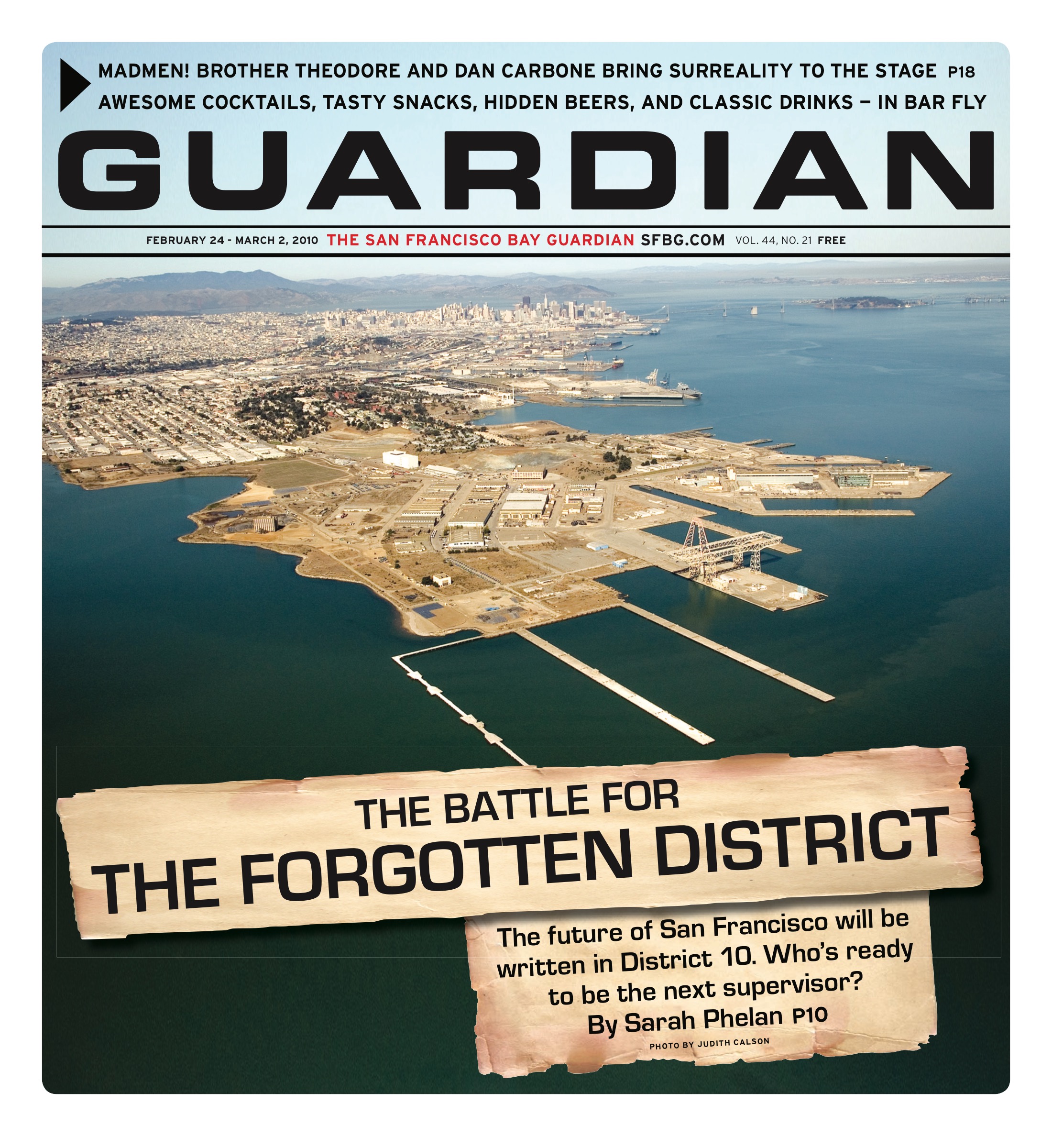
The battle for the forgotten district

24

sarah@sfbg.com

This November, when voters in District 10 — the largest, sunniest, and most diverse of the city’s 11 supervisorial districts — replace termed out Sup. Sophie Maxwell, they’ll be making a selection that could have pivotal implications for the entire city.

That’s because the next supervisor from southeast San Francisco inherits a district that is home to some of the city’s biggest environmental and public health challenges, as well as the most potential for development that will determine what kind of city San Francisco becomes.

District 10 is where you’ll find the most polluted and most underdeveloped lands in San Francisco, areas that could either be transformed into models of a sustainability or, in the words of Tony Kelly, the president of Potrero Boosters Neighborhood Association, “be turned into a toxic Foster City.”

District 10 is where the slaughterhouses, tanneries, and glue factories set up shop and used the bay as a dumping ground. It’s where the smokestacks of coal and oil fired power plants polluted the air. It’s where the Navy filled the Bay, built a shipyard at Hunters Point and loaded parts of the first atomic bomb onto the USS Indianapolis in 1945.

District 10 is where the bottom fell out of this industrial economy in 1974, when the Navy left, taking with it people’s jobs, pay, and hopes for a home of their own and a better future, particularly for what was then a predominantly African American population.

And District 10 is ground zero for plans that will triple the population and double the number of homes — homes that likely will only be “affordable” to Google executives and retirees from Marin, forever changing the face of San Francisco’s southeast sector. Critics fear that will accelerate what has been a steady exodus of black residents, replaced by megadeveloper Lennar’s vision for a new D10.

It’s against this dark history and difficult present that a wide open field of more than a dozen candidates are vying to replace Maxwell, who came to power in 2000 and has had a mixed voting record in her decade on the board. Sometimes, Maxwell was the eighth vote that let the progressive majority on the Board override Mayor Gavin Newsom’s veto and pass trailblazing legislation. Other times, she was the swing vote that allowed the moderate minority to carry Newsom’s water.

So, in addition to D10’s many internal challenges, this seat could determine the political balance of power on the Board of Supervisors, placing all the more importance on voters in this long-marginalized part of town.


DISTRICT OF DISCONTENT

Eric Smith, a biodiesel activist who has thrown his hat in the D10 ring, says that there is a lot of frustration in the air, and looking at the problems the district is facing, it’s hardly surprising that it has what nearly every candidate agrees is a fractured political culture.

“The Bayview, the Hunters Point Shipyard’s toxic Superfund site, the homicide rate, unemployment, poor public transportation, dwindling services and community resources have made D10 one of the city’s largest melting pots of discontent,” Smith said.

Smith’s words were spoken while the Elections Department was verifying signatures earlier this month on a second failed effort to qualify a petition to recall Maxwell.

Bayview resident and D10 candidate Marie Franklin didn’t support the attempt to recall Maxwell, but she understood it as “a frustration movement.”

“People are sinking in the sand, we’ve already lost so many of them, and they felt Sophie wasn’t doing anything for them,” said Franklin, who praised Maxwell for helping get Franklin’s apartment building complex renovated — a job that was completed 18 months ago, at a cost of $65 million, creating 500 local jobs.

“There are 654 units here, and they were uninhabitable,” Franklin said. “There was black mold, rain falling inside. We had people living worse than Haiti.”

Franklin, who said she is running because she “knows the history,” came here in 1978, when she and her son were living in a car after a fire left them homeless. She said the Bayview was a totally isolated area, barely part of mainstream San Francisco.

“There were no taxis, no services,” she recalled. “Nobody would come here, it was the stigmatized area where no one was accountable to provide services.”

The Bayview — which in some ways is the heart of D-!0 — wasn’t always a black community. But African Americans have been living here for 70 years, dealing with all the racism, denial of services, poverty, and pollution. And it bothers Franklin that 85 percent of the 10,500 homes that Lennar plans to develop won’t be affordable to the elderly, disabled, unemployed and low-income people who currently live in the Bayview.

“We need to preserve the diversity of the community and make sure their issues and information will flow to City Hall,” she said. “You must give the people a handle. If you don’t reach out, they’ll slip. That’s why folks out migrated.

Whoever succeeds Maxwell will be a central player in addressing some very big and dirty issues: the future of the Navy’s radiologically impacted shipyard at Hunters Point, Lennar’s massive redevelopment plan for the Shipyard and Candlestick Point, the polluting power plants, replacement of stinky digesters at the sewage plant, and the SF Hope public lousing rebuild.

There’s also the chance to address violence and crime. James Calloway, a candidate who has long worked in Bay Area schools, told us he believes that education and jobs are part of the keys to rejuvenating the district.

“Job opportunities are not as plentiful in the district,” Calloway said. “When I was a kid, you could walk down Third Street at 2 a.m. Now I wouldn’t walk down it at 9 p.m., and I know the area.”

Calloway is hopeful that the massive redevelopment plan, if done correctly, could start the district’s comeback. “Not a lot of black folks stay here when they have extensive education,” he said. “But it’s not only them. Many were displaced by redevelopment and had no way to go back.”


ELECTION UP FOR GRABS

The largest of the city’s 11 electoral districts, D10 is a huge triangular piece of land in the city’s southeast sector that was used as an industrial dumping zone for decades. Today, the district runs from the Giants stadium at AT&T Park to the 49ers stadium at Candlestick Point and encompasses Mission Bay, Potrero Hill, Dogpatch, India Basin, Portola, Little Hollywood, and Visitacion Valley. It’s also crossed by two freeways that isolate it from the rest of the city, and is home to a large number of crumbling housing projects that are in the process of being rebuilt.

Candidate Ed Donaldson grew up in the projects until he was 10 years old, when the Redevelopment Agency kicked his family out in the 1970s. “We landed on our feet, but others weren’t so lucky,” said Donaldson, who works as a housing counseling director at the San Francisco Housing Development Corporation.

“There is a sense that the Bayview and Visitacion Valley have not been included within the San Francisco family,” Donaldson said. “There is a sense of being forgotten.”

In 2007, Donaldson co-founded the Osiris Coalition to tackle the city’s dormant Certificate of Preference program, in which the Redevelopment Agency issued a document to displaced residents and businesses in the 1960s promising that they could return.

He also tried to rescue some 700 foreclosed properties and recycle them as affordable housing stock. And now he is trying to prevent the city from bulldozing seven SF Hope projects without guaranteeing residents that they have right to remain.

In 2007, Mayor Gavin Newsom and Maxwell convened an African American Outmigration Task Force that didn’t get a public hearing about its findings until August 2008. The timing angered some, who questioned why the report’s findings and implications for urban planning weren’t released before June 2008, when the residents of San Francisco voted for the Lennar-led Proposition G, a proposal to build 10,000 market rate homes at one of San Francisco’s last remaining black communities, which Newsom and Maxwell endorsed.

The taskforce didn’t publish its recommendations until the end of 2009, allegedly because of insider squabbling. Meanwhile, gentrification was going on actively, and many blamed Newsom, and by extension Maxwell, for failing to do anything with the group’s findings as D10 residents continued to suffer from high rates of asthma, cancer, unemployment and an ongoing black exodus.

It wasn’t always this way. In the 1940s, the district’s black population exploded when migrants from the south and World War II veterans came to work at the Hunters Point Naval Shipyard. Some moved to Alice Griffith Public Housing complex, or Double Rock, which was built as military housing in 1962. Others relocated to the Bayview when the Redevelopment Agency took over the Fillmore/Western Addition in the ’60s and ’70s as part of a controversial urban renewal effort.

But when the Navy abandoned the shipyard in 1974, unemployment hit the black community hard. Today, hundreds of the city’s lowest income residents live in Alice Griffith’s crumbling units and endure sewage backups, no heat, cloudy drinking water and leaking ceilings, as they wait for the projects to be rebuilt.

“Generations have been trapped in the silo of public housing and cannot get out, because of lack of opportunity and education, so when we legislate, we need to take that into consideration,” said candidate Malia Cohen, whose grandfather came from Texas to work at the shipyard where he met her grandmother, whose family came from New Orleans.

“My grandfather’s father was a longshoreman. He worked with the infamous Leroy King [a commissioner at the city’s Redevelopment Agency] and he has fantastically vivid stories of racism,” said Cohen, who works for the Federal Reserve Bank of San Francisco, previously served on the executive staff of Mayor Gavin Newsom, and has already raised over $18,000 in the D10 race and qualified for public matching funds.

“My family came here to work hard, they lived on Navy road in the projects, and then they bought a house here. My parents were born here, and we were all public schooled,” Cohen recalled as she took me on a tour of D10 that ended up in Visitacion Valley, an increasingly Chinese-American neighborhood that reflects a district-wide trend.

Census data show that by 2000, Asians were the largest racial group in the district (30 percent), followed by blacks (29 percent), whites (26 percent), and Latinos (19 percent). By 2003, according to the California Urban Issues project, the trend continued. Asians were the largest racial group (32 percent), followed by blacks (27 percent), whites (21 percent) and Latinos (17 percent) of the population.

This means that D10 candidates will have to garner support from more than one ethnic group to win. Over a dozen candidates have already filed papers in the race, but so far there is no clear front-runner.

Also frustrating the prognosticators is that fact that D10 has had the lowest voter turnout in the city, so the winner will also depend on who goes to the polls.

D10 candidate Geoffrea Morris, who is the grand daughter of longtime Bayview activist Charlie Walker, has been knocking on doors and participating in voter registration drives.

“We need new blood,” Morris said

Getting elected will be a complicated equation. Although Bayview’s population was 50 percent African American at the time of the 2000 census, it didn’t turn out the vote. In the 2006 election, only 14,000 of the district’s 37,000 registered voters went to the ballot, and 50 percent were from whiter, richer, and more Asian neighborhoods.

“It’s very important to the future of the city that the ethnicity diversity of the board be maintained and that the African American community have representation,” former Board President and current Democratic Party chair Aaron Peskin told the Guardian.

Maxwell recently told the Guardian that she’s not ready to endorse any D10 candidates yet. “I’m waiting for people to have a better understanding of what this community is, what the common thread running through it is, and how to use rank choice voting,” she told us.

The only candidate who currently holds elected office is BART director Lynette Sweet, who had her answers down pat when we reached her by phone, and even used wording that was eerily similar to Maxwell’s words.

“D10 is a pretty diverse district, but there is only one common thread: the need for economic development,” Sweet told me. “That’s true in Potrero Hill, Portola, Dog Patch and the Bayview. It’s the same mantra: a lot of small businesses need help, and the only way to help them is through economic development. In Potrero Hill it’s about land use. In the Bayview, it’s about the shipyard and better transportation and truancies.”


THE COMMON THREAD

District 10 is ground zero for the Lennar’s $2.2 billion plan to develop 10,500 market rate condos at the Shipyard and Candlestick Point. The plan will allegedly create thousands of jobs and new parks, deliver on an historic community benefits agreement that labor groups claim is so “lawyered up” that the developer can’t renege on its promises.

The package is framed as the one and only way to revitalize the southeast’s formerly vibrant economic engine. Indeed, any time anyone tries to slow down the process—to take time to thoroughly read the draft EIR and see if it adequately addresses the impacts of this massive urban reengineering project — a chorus of “no delays” starts up, either from residents of the housing projects desperate to see their homes rebuilt, or the labor contractors who hope to get jobs.

“It’s as if the city is playing checkers, while Lennar is playing three-dimensional chess,” Eric Smith observed.

Lennar has stated that it will contribute $711 million to finance this massive project. The remainder will be leveraged by Mello-Roos bonds, state taxes based on the use and size of a property and intended to raise money for needed services, and tax increment financing, which creates funding for projects by borrowing against future property tax revenues.

The conceptual plan won Maxwell’s backing but environmental groups are critical of the draft EIR.

During DEIR hearing, environmentalists questioned the wisdom and the cost of filling the Bay to build a bridge over Yosemite Slough, and building condos on Candlestick Point state recreation area, the only open major open space in the district.

But the city’s Planning Department also has 20,000-30,000 units of housing in its pipeline. This means that if all these plans get approved in the next decade, they’d account for 80 percent of residential development citywide. And D10’s population could triple, further skewing the district’s already shifting demographics.

In other words, D10 as we know it could become nothing more than a historic relic in a few years, and the next supervisor will play a key role in deciding whether that happens. SFHDC’s Ed Donaldson warns that any supervisor who does not understand the complexity of the city’s largest district can expect a similar recall backlash in future.

“There is no one homogenous voice in the community,” Donaldson said. “The grass-roots organizing that brought about the recall effort was a result of a changing political structure in the area, but is not yet on par with other districts in town. We still allow our politics to be controlled from downtown.”

Fellow candidate Eric Smith warns that the issues—and politics—are complex.

“People were emotional, angry, and desperate because they feel no one listens to them,” Smith said. “That’s part of the problem here; they would rather have a supervisor go down swinging for them, rather than watch one seemingly side with Lennar, PG&E and the mayor on issues contrary to their interests. That’s the terrible irony and one of the biggest problems in District 10. Folks are so mad, they’re willing to do whatever it takes to make them feel they have a voice in the outcome, even if it’s potentially worse.”

Smith cited the sequence of events that culminated last year in the Navy dissolving the community-based shipyard Restoration Advisory Board (RAB), which for years has reviewed technical documents and commented on the Navy’s clean-up proposals. But in December, the Navy made its official decision to disband the RAB, citing dysfunctional behavior and off-topic discussions that got in the way.

“Some of the same folks who were frustrated by the process, tried to send a signal to the Navy that they weren’t being heard and for all their well-intentioned efforts got the RAB dissolved,” Smith said. “I truly feel for them, it’s absolutely heartbreaking, but at times, they can be their own worst enemy.”

One of the looming issues about the shipyard is that the land has been polluted and needs to be cleaned. The shipyard contains radioactive debris from ships towed to the shipyard, after a 90-foot wave washed over them during an atomic test gone awry. The Navy burned 610,000 gallons of radioactively contaminated ship fuel at the shipyard, and workers showered on the shipyard, raising concerns that radioactive materials got into the drains and sewers. And questions have been raised about radiological tests on animals at the yard.


LEAKS AND FLOODS

It’s not just the shipyard that’s toxic. Even the buildings that were constructed to house workers 50 years ago are a serious mess.

Realtor Diane Wesley Smith, who grew up in public housing projects, took me on a walking tour of Alice Griffith last week to see conditions that tenants will likely have to endure until at least 2014, if the city sticks to its plan to relocate people into a new replacement unit in the same geographical area, if not the exact same site.

What we found was pretty messed up.

“The water sometimes comes out brown and feels like sand. It’s been like that for a year,” one resident said.

“The water is cloudy, the bath tub isn’t working and the sink keeps stopping up,” said another.

A woman named Silvia showed us how the water from the tap in her elderly mother’s kitchen flows out cloudy and then doesn’t settle properly, like foamy beer.

“The roof’s been leaking for years, the sewage backs up, but they just fixed the lights,” Silvia said. A neighbor named Linda was using her oven as a heater.

“The toilet backs up a lot, and my grandson’s been coughing a lot from asthma,” Linda said.

“Roaches is always a problem,” said a woman named Stormi, dressed in black sweats and a black T-shirt that read, “Can’t knock the hustle.”

“They’re trying,” said Stormi, a member of the Alice Griffith Residents Association, as a couple of Housing Authority trucks pulled up to do repairs.

“They promise that you will not have to leave your unit, but if they try to move us down to the waterfront, well, there’s a reason there’s no housing there, and it’s because the land will flood,” Stormi said.

“If we don’t end up at the table, we’ll end up on the menu,” Wesley Smith warned, as she stopped to chat with a group of young men, who were worried they would pushed out of the Alice Griffith rebuild through the criteria being established.

“Fred Blackwell, the executive director of the Redevelopment Agency, assures me that’s not the case, but Alice Griffith is a Housing Authority property, and empty promises have the potential to be great promises provided they are made in writing,” Wesley Smith said as we walked out of the projects and onto the road where a yellow and black sign announced “flooded” next to Candlestick Point park, where Lennar wants to build.

Malia Cohen expressed concern about Hope SF residents, as we drove through the Sunnydale housing project.

“We have to be diligent and mindful that people are not pushed out,” Cohen said, noting the sweeping views at Gleneagles golf course above Sunnydale, and the value of housing for a golf course community. “When public housing gets taken offline, we must work with Redevelopment and the Housing Authority to make sure no one is changing the rules halfway. We have to make sure the talks and walks line up. We need to be equal partners. We cannot be bulldozed by City Hall.”

Geoffrea Morris is a Calworks employee, at the Southeast Community College facility on Oakdale, which was built to mitigate the city’s expansion of the sewage plant in 1987. She cited concerns about the literacy levels of people who live in the 2200 public housing units that cluster D10. “A lot of people in Alice Griffith don’t even know the dates or when it’s going to be reconstructed,” Morris said. “Folks like to be told stuff like that, but the city gives you a stack of papers. Some will read them, but others rely on folks they think are trustworthy. They need stuff in layman’s terms written on one sheet of paper.”

Morris is a fan of the Internet who posted a community survey online, and made sure every housing project got some literature telling people to get informed. She worries about the digital divide in D10:

“A lot of folks don’t have computers and access to important information,” Morris said. “And let’s talk about the way ‘affordable’ is used to trick people.”

Michael Cohen, Newsom’s top economic adviser, recently stated in a memo that over the expected 15-20 year phased build out, Lennar’s Candlestick-Shipyard development would include, “up to 10,500 residential units, about 32 percent of which (3,345) will be offered at below market rates.”

“But 892 units of this ‘affordable category’ will be sold to folks earning $100,000,” Morris said. “So if you subtract 892 units from affordable unit category, you’re back to 25 percent affordable.”

Candidate Kristine Enea, an attorney and a former RAB member, chairs the India Basin Neighborhood Association, which administers a US EPA grant to hire experts to translate the Navy’s cleanup documents into plain English and comment on them She was frustrated by the Navy’s decision to dissolve the RAB.

“The lack of a forum does nothing to bolster the community’s trust in the cleanup or the redevelopment process,” Enea said.

Enea generally supports the Lennar project, but has concerns about whether it will adequately mitigate increased car traffic, or result in commercial development that benefits her neighborhood.

“India basin is a pocket of Hunters Point right along the shoreline,” Enea said. “Right now, we have no shops or restaurants, no ATM, no groceries, nothing beyond one liquor store and a few industrial businesses.

Potrero Boosters president Tony Kelly told us that District 10 residents can think for themselves. “D10 residents don’t need to rely on corporations to solve their problems,” he said.

“Folks in the eastern neighborhoods came up with a better revitalization plan than what the city proposed and community activists managed to close the power plant, after the city said it was impossible,” Kelly recalled.

And there’s no shortage of good ideas.

Kelly suggested that an urban agriculture center could immediately put low-skilled folks to work by erecting greenhouses on unused land. Smith said the industrial zone could be “incredible eco-park made from sustainable sources.

‘D 10 is the dumping ground for everything, including all the city’s waste,” he said. “We could be a shining example, not just for D 10, but the rest of the state.”

The D 10 candidate line up includes Calloway, Cohen, Donaldson, Smith, Enea: civil rights attorney Dewitt Lacy, Morris, Potrero View publisher Steve Moss; District 7 BART director Lynette Sweet, Wesley-Smith. Bill Barnes, who works for Sup. Michela Alioto-Pier, and Linda Richardson, who was appointed to the Human Rights Commission in 2007 by Mayor Newsom, have also expressed interest in the race.

In such a huge field, name identification will play a major role. Sweet is in office, but BART Board is not a high-profile job and won’t give her a huge advantage.

Cohen has a slight edge right now in that she’s raised $18,505, including $500 from former Newsom flak Peter Ragone, making her the first D. 10 candidate to qualify for campaign financing. The oldest of five girls, Cohen recalls how her mother got laid off from her city job as a school-based mental health worker and then rehired, as part of the city’s budget cuts.

“We felt that pinch and the frustrating games that are played out between the leadership and the rank and file,” she said.

Cohen who worked for Newsom in his first term as mayor, but has since left his administration , said she is uncomfortable at being framed as Newsom’s candidate.

“Because I’m not, but I am one of the few candidates who has seen how the mayor and the Board work—and don’t work—together,” she said.

Moss sees the city’s southeast as a “district in transition.” Over coffee at Farley’s in Potrero Hill, he told me that the southeastern neighborhoods could be “launching pads for environmentally sustainable growth.”

“The district’s been in a frozen period for 30 years, But despite the problems, people are deeply committed to and in love with their community.

“This district is the future of San Francisco and its social fabric—the diversity, income –and its problems are leftovers from the city’s industrial age.”


DISTRICT 10, BY THE NUMBERS

Total Acres: 5,650

Average household income: $85,000

Population: 73,000

Registered voters: 37,700

Average housing price: $335,000

Ethnicity (2003 figures): Asian 32%, African American, 27%, white 21%, Hispanic 17%

Development status of land: 18% residential, 38% is commercial, 38% undevelopable

All figures the latest available. Sources: SFGIS, Association of Bay Area Governments, U.S. Census, California Urban Issues Project. Ethnicity and income data is from 2003 and almost certainly has changed.
Loose in Obamalandia: Dead man walking through CA

1

I am on a low-rent book tour with my new cult classic El Monstruo – Dread & Redemption In Mexico City.  For the next three months, I will stumble across this land from sea to stinking sea probing the underbelly of Obama’s America.  The findings will be posted on these pages.

1.
First stop was the near north woods, Humboldt County USA, to wheedle the medicos into granting me a clean bill of health before I hit the road.  A year ago this February, my doctor who has poked and probed my old broken cadaver for nearly 20 years, pronounced me dead. “Liver Cancer” he parsed gravely — but I am still alive and kicking. The class enemy be warned: I am not dead yet.

Humboldt had just been wracked by a 6.5 earthquake that cut a swath through Oldtown Eureka’s antique shops but was not quite Haiti.  Nonetheless, the shake-up worked its usual bad mojo and implanted the seeds of fear and loathing in every soul.  On January 22nd, three separate police agencies shut down the north end of Arcata and evacuated hundreds of residents after a scruffy hippie-type tried to fed ex a suspicious package to Berkeley that leaked, according to the clerk at Kinko’s, “a chemical odor.” The offending package was blown up in a back alley.

The next day, the local rag commonly known as the Times-Slander conceded in front-page headlines that the “bomb” was “Actually a brake light.” The paranoia was symptomatic.  A commercial jetliner to Kentucky was forced down by air force jet fighters after an orthodox Jewish kid pulled out his Tefillin to pray and, in a spasm of extreme religious irony, the panicked stewardess took him for some Muslim terrorist and confused the leather straps and little prayer boxes with bomb components that would blow the paying customers to kingdom come. 

Nine years ago, just weeks after 9/11, I got on the road to preach Zapatismo to the North Americanos. Flags flew from every home, a sort of Talisman against the terrorist devils.  It was not a healthy ambiance for spreading revolution and resistance in Amerikkka.  Prospects for the Monster Tour suddenly turned ominous.

2.  
San Francisco’s Mission District gets shabbier day by day as the “Great Recession” (read “Depression”) gallops towards economic Armageddon. The Miracle Mile is lined with empty storefronts and 98 Cent Stores (marked down from 99.)  The homeless sleep under their shopping carts – the Mission Local reports that 40 homeless families are living in 16th Street Single Room Occupancy hotels, twice the occupancy rate of a year ago.  In this Sanctuary City for the rich, the yuppie Mayor, who now aspires to be nothing more than a yuppie clerk in a yuppie wine store, is deporting undocumented teenagers convicted of no crime and the class divide seems more brutal than ever.

We posted up on Market Street in front of the Commonwealth Club, where torture enabler John Yoo was hawking his new book to the City’s elite. Financial District drones en route back to the ‘burbs asked Yoo Who?
I checked my watch.  It was time to hit the rails.

3.
The Central Valley was the first stop on the Monster Tour, the most deadly stretch of soil in North American California. The water plumes are all poisoned by agrochemicals and when one turns on the faucet on the west side of the valley, deformed babies pop out. 

This cesspool of chemical effluvia is populated by perhaps the most ethnically diverse crazyquilt in all of Obama’s America.  Anglo bigwigs and white Armenians rule the roost but down below Mixteco is spoken on the radio, communicating the bad news to the out-of-work Oaxacans who once toiled in the fields and packing sheds. The humongous Hmung community is up in arms over the FBI’s harassment of their spiritual leader, General Vang Pau who authorities accuse of conspiring to overthrow the doctrinaire Communist government of Laos.  Unemployed Palestinians and Pakistanis, Filipinos, white trash, and historic enclaves of Blacks, survive in this fulminating chemical stew by their wits. On every street corner, the down-at-the-heels don shabby green gowns and sagging Styrofoam Statue-of-Liberty crowns, holding up cardboard arrows pointing towards strip mall tax return scammers.

I stepped out into Catherine Campbell’s unplanted garden.  Police helicopters hovered overhead, searching out suspected gangbangers. Catherine is a veteran prison rights attorney who pays particular attention to what goes on behind bars at Corcoran and Chowchilla, two of the cruelest his & her lock-ups in the state. Recently, she put her know-how to work defending anarchists who had been beaten into the sidewalk by the Fresno pigs for handing out graphic leaflets depicting the torture of elephants during Ringling Brothers Barnum & Bailey’s annual visit to town, and she and a gaggle of advocates have been trying to keep the cops off a venerable homeless encampment. Now the City Council is seeking to felonize panhandling on Fresno’s median strips as a “safety hazard.” 

The Fresno gendarmes are particularly keen on persecuting young adults of color for alleged gang activities. An article in the Morning Bee reported on the so-called “Bulldog Gang” (the bulldog is the icon of the Fresno State football team so gang colors are readily available) whose members were accused of smashing windows and barking at the cops over on the decrepit west side.  Catherine says the bulldogs’ bark is more a growl.  Such are the sounds of hope in the second year of Obama’s lacerated reign.

Sam Stoker is a child of the Valley. One night last summer, I bought him a beer at the counter of my beloved Café La Blanca back home in the Centro Historico of Mexico City.  Sam, an acculturated Chicano, had journeyed to Mexico to connect with his family in Tamaulipas and bum around, sniffing out what was left of the 2006 rebellion in Oaxaca. When he went home to Winton near Merced, he spoke enough Spanish to delight his grandma. 

Sam is also an anarchist and a budding journalist who has been up to his neck in the struggle for justice for Oscar Grant in Oakland. Now he had come to the Valley to spread the virus of anarchism. Rebellion in the fields could bring California to its knees, he confided. I was only too happy to help out. 

Anarchism has a beachhead in Fresno at the Infoshop where 70 folks turned out to hear me preach revolution. Not all of the fellow workers were young punks. One gentleman in attendance told me he had been an organizer for Cuauhtemoc Cardenas’s foiled presidential campaign in 1988 in Sinaloa and fled Mexico when dozens of his companeros were gunned down by the mal gobierno.  He was still here, still waiting for the revolution. 

Over in Merced, I shouted out my poems in a long dark bar, The Partisan, on Superbowl Sunday.  A “digital remix” of Guy Debord’s “Society of The Spectacle ” preceded my incendiary words.  Maybe Sam Stoker’s pipedream is not as wacky as it sounds.

4.
So it was goodbye to Fresno and hello to Hollywood. I accessed the City of Fallen Angels over the Grapevine with a pit stop at Bob Hope airport and a bar in Santa Monica to watch the Lakers kick booty. My gigs were spread out all over this pedestrian unfriendly megalopolis and the signs of hard times were hard to avoid.  On the beach in Santa Monica, excruciatingly gaunt old men jogged against debilitating cancers and aging hippies scoured the sands with metal detectors for spare change.

Even out in ritzy Claremont, where I hobnobbed with a Palestinian restaurateur about the Nakba, Obama’s America seemed out of synch.  A student at Pomona College where I spieled had just been handcuffed and interrogated by transit security cops in Philadelphia for transporting 200 Arabic-English flashcards across state lines and some cad ripped off my cane down at the train station.  The Inland Empire, which abuts this restricted enclave, has the fifth highest mortgage foreclosure rates in the nation.

In Hollywood, where I spent a night on my favorite sofa, the glitz was tempered by the homeless with all their possessions piled high atop their shopping carts around the new Metro station. How many of them were out-of-work script doctors is not yet known.

Down in South Central, where anger is endemic, I spoke to a handful of Afro-Americans at Eso Won, an admirable black bookstore. The proprietor sported a prototypical pork pie hat and told me that when he sees the Mexicans coming over the border, he sees black people. We talked animatedly for a few hours about Afro-Mexicans who were a third of the population of Mexico at liberation from Spain in 1810 and whose history has been pointedly ignored south of the border.             

L.A. is gearing up for the trial of killer BART cop Johannes Mehserle, Oscar Grant’s assassin, that will be held in the same court house where O.J. won acquittal — if it’s not moved to Ensenada, taking a cue from outgoing Governor Terminator’s plan to build California prisons south of the border.

Students at Cal State L.A., the most Chicano university in Califas, honed in attentively when I expounded on the revolution that is brewing down south.  1810-1910-2010 – every hundred years on the tenth year of the century, Mexico explodes in violent social upheaval and even the Wall Street Journal is worried (see WSJ front pager January 15th.)

Looking at Obamalandia through the eyes of students is a useful handle for understanding what comes next.  Classes and services have been bludgeoned by budget cuts and the profs at Cal State furlough one day a week to make ends meet in this damaged economy that the President lies is booming again because only a half a million workers filed first time unemployment claims last month.  The light at the end of the tunnel is a bullet train pointed straight at the heart of the people.

All of this bad news is healthy for fightback.  The day I hit El Ley, Muslim students at U.C.-Irvine rose up against the Israeli consul ten times in a single speech until the university president sicced the campus cops on them. The next day a whole coast away, kids at Georgetown shouted down General Betrayus. Throw in the cutbacks and the furloughs and the hopelessness and it could be a long, hot spring semester and it won’t be just because of global warming.  I will do my best to fan the flames as I stumble front one campus to the next in the coming months.

On my last days in the late great golden state, I slept in a yoga house under a colorful banner of Ganesh, the elephant guy who gets fat eating others’ obstacles.  Lets hope he’s on my side. A year ago I was sentenced to death and although I’m still kicking, the future is laced with sharpened punji sticks, not the least of which incubates on my liver.

Talking truth to power is still the best medicine to beat back Nuestra Senora Santa Muerte.

John Ross and The Monstruo will be visiting the Narciso Martinez Cultural Center in the heart of the Rio Grande Valley Sat. Feb 20th. The Monster Tour plays El Paso, Las Cruces, and Albuquerque from Feb. 21st-28th.  Consult the Nation Books page for details or write johnross@igc.org

Sushi Raw: a fine place to drink twice as much as you usually would

0

Ah, Sushi Raw. Although I would ding you for continuing to post your Grand Opening sign months after first rolling out your extravagantly plated Fuji Mountain rolls, you certainly have kept that working hard to please attitude. It is difficult to be mad at a place where the entire staff drops their duties to yell something cheery in Japanese every time anyone walks through the door (“Welcome?” “You look thin?”). And all pleasantries aside, you had me at the two for one beer and sake special.

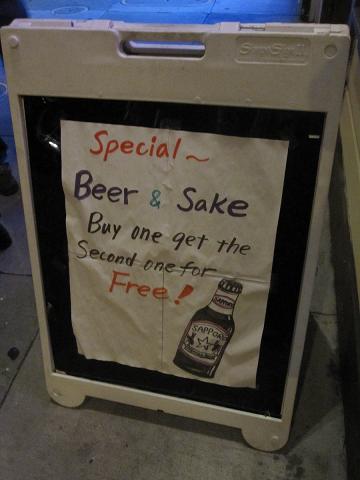
That’s right, two for one big beers (Asahi and Sapporo on the menu) and large sake bottles, the bottles procurable for a scant five bucks. I’ve never seen the restaurant open without the sandwich board that announces the special outside. The lure of cheap booze pulled a pre-sated group of friends and I in after dinner at Axum the other day, and we received the same exuberant greeting and table service- despite the fact that only one gluttonous member of our party was still down for raw fishes and the rest of us were doing dessert.

So yes, the fish: fresh and creative, often stacked in towering spires of baked/drizzled artistry or arranged in a flower shape on your plate. Desserts: crap shoot. Avoid the glutinous green tea cheesecake but dive wholeheartedly into chocolate moshi. Booze: superlative. Again, two large bottles of sake for $5. Ambience: they played the same John Legend song three times while we were in there, but it was a song I like so I was pleased. The walls of the restaurant are more covered than art than your average bear/sushi joint- it makes for good eye candy should you get tired of John Legend or your dinner companions.

Domo arigato, Sushi Raw. But fellow pescaterians, please remember your identification if you plan to imbibe. The bf forgot his “big brother card” and wasn’t afforded even a sip of sake thanks to a waitress vigilant enough to defeat even the foxiest undercover ABC agent. Sushi Raw: nobody’s fool.


Sushi Raw

(three locations throughout Bay Area)

682 Haight, SF

(415) 863-6888

www.sushirawsf.com

Beer/wine

AE/MC/V

Not noisy

Wheelchair accessible

SF Indiefest drops by the Corner Store

0

“We were looking for a working class hero story,” said Katherine Bruens, creator of feature film documentary Corner Store at its SF Indiefest preview this weekend. They found it. Corner Store (to be shown again on March 27) widens to include more, however- becoming a portrait of what it is to be an immigrant in this country, on missing home and personal conflict. On what it means to sleep in the back of the convenience store you work in 16 hours a day. The film joined a stellar lineup of shorts and features at the festival, a film geek’s delight which continues through Thur/18 around town.

The producers followed their protagonist, Yousef Elhaj, for 14 months, during which they say he was “too polite not to have a documentary made about him.” Elhaj hadn’t seen his family for the 10 years he’d spent funding a life for them at his Castro/Mission (“Mistro,” as an interview with some neighbors memorably dubs it) convenience store, where the majority of Corner Store takes place.

It’s a claustrophobic existence to say the least, marked by small talk with customers he’s seen year after year, and only occasional forays into the outside world. It would seem like the stuff of boring visuals, but Corner Store’s meticulous record of Yousef’s daily tasks around his space, straightening wine bottles and replacing his deli case, is fascinating. Corner stores are a fact of life in the city, but rarely does one stop to think about the dedication and perseverance that goes into maintaining a well run beer and grocery stop.

At long last, the green card process is achieved and Yousef heads back to Palestine to see his fam. Here, he’s surprised to initially feel like an outsider in his birthplace, and the scope widens. Does the family want to stay in their homeland or join Yousef in the New World? Yousef’s family lives in Bethlehem and has to pass through checkpoints to visit a town 10 miles away. The walls that run through their neighborhood become one of the film’s most evocative symbols — they are a touchstone for many of the world’s premier graffiti artists, and Banksy’s piece of a dove wearing a bullet proof vest seems to evoke Yousef’s journey to find the best life for his family.

Bruens seemed to shy from overtly political questions at the Indiefest post film question and answer session. The film, in its creators’ eyes, is far more about how a man’s life is affected by the Israeli-Palestine conflict than the conflict itself. How successful at convincing audiences of this fact remains to be seen, but I wish them the best. Corner Store is a remarkable achievement of documentary filmmaking; immortalizing the everyday to express a facet of human life.


Next showing w/ Q&A feat. Yousef Elhaj and Katherine Bruens

& Arab Film Festival executive director Michel Shehadeh

March 27th 3, 7 pm, $12-$25

Victoria Theater

2961 16th St., SF

 www.thecornerstoredocumentary.org

Appetite: Break out the bourbon and gumbo, Fat Tuesday’s coming

0

On the heels of a first time ever Super Bowl win for my beloved city of New Orleans, comes Mardi Gras, Fat Tuesday, Lent. No one celebrates this time of year like Nola, but we try in our own little way here. At least there’s some local outlets for wistfully wishing I was there…

February 15-19: Fat Tuesday at the Front Porch
Outer Mission’s Front Porch always knows how to throw a good party, and Fat Tuesday will be no exception. I can’t think of a better way to usher in Mardi Gras than with a front porch crab boil. Don’t forget to eat plenty of their jambalaya, drink Abita beer, and don those beads. Even better, if you can’t make it Tuesday, they’re doing the boil and French Quarter menu specials all week long, starting Monday.
5:30pm until close
65a 29th Street
415-695-7800
www.thefrontporchsf.com


Mint Julep at Pican. Photo by Virginia Miller

February 16: Fat Tuesday at Pican – Oakland’s Mardi Gras “It” Party
Bring your masks for a Mardi Gras feat at Pican, a restaurant that keeps Southern spirit swinging throughout the year. There’s live bands and all that fine bourbon on Pican’s shelf. Fill up on Louisiana crawfish etouffe, chicken and andouille gumbo, red beans and rice, grilled boudin sausage, and Pican’s ever-popular smoked ribs and buttermilk fried chicken wings. Ash Wednesday will come tomorrow, but tonight, it’s Fat Tuesday!
5:30pm
Advance tickets $60; $75 at the door
2295 Broadway, Oakland
510-834-1000
www.picanrestaurant.com

February 12-16: Miss Pearl’s Jam House Mardi Gras Festival
Miss Pearl’s Jam House throws down in Jack London Square with its first Mardi Gras Festival. The week starts off with this Friday’s Gumbo Jam kick-off (blues and gumbo, naturally). Pearl’s new chef, Peter Jackson, cooked with one of my favorites (and one of New Orleans best chefs), John Besh. On Saturday, he launches Gumbostravaganza, a gumbo cook-off showcasing friendly gumbo competition among East Bay chefs from the likes of Picán and Henry’s. Fat Tuesday is going to be a big one with $5 Hurricanes and $4 jello shots all day, plus beignets, King’s Cake, a prize trip to New Orleans, and live zydeco music.
Free admission; check Web site for schedule
Miss Pearl’s Jam House, One Broadway (at Jack London Square)
510-444-7171
www.misspearlsjamhouse.com

Mazel Tov! Shmaltz celebrates Jewbelation Bar Mitzvah during Beer Week

0

I didn’t have a Bat Mitzvah when I turned 13, but if I had, I would’ve wanted it to be just like the one Shmaltz Brewing Company threw for its newest Jewbelation ale last night at Amnesia. (And yes, I just said that I wish my 13th birthday party had been at a bar.) The event, which replaced the spot’s regular Tuesday program of open mic and Rock’n’Schlock karaoke in honor of SF Beer Week, was hilarious, fun, and exactly as tongue-in-cheek as you’d expect from a brewing company whose first beer (He’Brew) was the result of an inside joke between founder (and Bay Area native) Jeremy Cowen and his high school friends.

Highlights of the night included performances by Meshugga Beach Party, whose schtick is playing Jewish favorites like “Shalom Alechem” and “Ose Shalom” in Dick Dale surfer style (while wearing fake beards), and Sex with No Hands, a klezmer polka party band with nearly a dozen members and a range of danceable songs from covers like “Sunrise, Sunset” to originals like “Golden Showers” (yes, the latter’s about what you think it is). And of course, as at any Bar Mitzvah, guests received commemorative yarmulkes  (in either blue or maroon, with the Shmaltz logo on top and “This is not a frisbee” written inside).

Meshugga Beach Party played favorites from albums like Let’s Go Shleppin’ while Hebrew School alums channelled memories of Israeli dance class.

But this whole evening was really about the beer, a dark, complex, special edition brew that goes down deceptively and dangerously smooth at 13 percent alcohol. (Get it? Shmaltz has been around 13 years? The beer’s 13 percent alcohol? It’s called Bar Mitzvah?) In fact, it seems to be the quality of Shmaltz’s beer, in addition to the label’s sense of humor, that’s responsible for its success (and especially so far beyond the demographic of Jews who love a good pun). Though there were certainly more members of the tribe in attendance at Amnesia than I’ve seen in one place since summer camp, there were plenty of goys also happily getting their drink on. And I expect the ratio will be even closer to 50/50 at Thursday’s Beerlesque event at Paradise Lounge, which celebrates the return of Coney Island Human Blockhead with a night of burlesque courtesy of Hubba Hubba Revue.

Beerlesque
Thurs/11, 8pm
$8-$10
Paradise Lounge
1501 Folsom, SF
www.sfbeerweek.org

Souls and stars

0

le.chicken.farmer@gmail.com

CHEAP EATS Dear Earl Butter,

I have accidentally fallen into the hands of hippies. They come from Pleiades, which is not a planet but a star cluster. How cool is that?

I used to love to be able to say, "I come from San Francisco." Suddenly it seems boring. Still, I bet we have better Mexican food than they do on Pleiades. Or in the Pleiades. (Not sure how to say this. I’ll have to ask.)

Other important points to remember are the number seven, some thing (or place or person or pizza joint) called "the Source," and that the universe is pure love. Like every other believer in reincarnation I have met, these ones claim to be "old souls."

I asked what I always ask: if time doesn’t really exist, as they also claim, how can one soul be any older than another?

They look at me like I’m a very young soul — which I would rather be, between me and you, because your face isn’t wrinkly yet and you sleep better. But technically I haven’t figured out yet about soul, meaning I don’t believe I exactly have one.

As for the universe being pure love … all I can say is I miss the smell of chicken shit and the feel of cold, dead, free-range chicken hearts in my small white hands. Not to mention the livers, and the taste of liver. And the fresh scallops we cut still pulsing from their shells and fried in butter with garlic. I miss these things, and love.

It was hard to be in Paris, too, without a heart. My brother-in-law’s brother and his girlfriend were immediate sympaticos, but they had to go to work, and so I wandered the streets and museums in almost utter amazement and disbelief — mostly that I was alone, but also the architecture and art.

I should have never left Paris, like I should have never left the chicken farm before that. But here I am in the South of France, which reminds me of Northern California, except substitute olive trees for vineyards. Jean Gene the Frenchman, who met me here, is traveling with a German disaster of his own. She’s more depressed than I am, in spite of being an old soul from the Pleiades, and her German accent is not good for me.

Back at the car after a day of hiking and sitting on cliffs high over the Mediterranean Sea, she offered me her hand and said, "Let’s make a pact. We each give it six more months, and then kill ourselves."

I just looked at her like she was from some other planet, or star cluster. "I only have one life," I said, finally. "For me, suicide is not an option."

She seemed surprised. Nevertheless, she’s a very good driver. Today we went to visit an obscure half-ruined chapel in the mountains called Notre Dame de Oeufs, or Our Lady of Eggs. No lie. People light candles and leave eggs there. The hippies said some prayers. I looked at the eggs.

Dearest Dani,

That is great. I should stop saying so much great stuff about Joel, but here is one thing. He will eat lunch with you if you are in a pinch. We went to Schmidt’s. It is right near Joel’s office. It is a little pricey for me for lunch, but I enjoyed myself nevertheless. We had lunch for $10 each.

We each got the grilled sausage. Joel got the kielbasa, which I am familiar with from my childhood and from Timmy Binko. And I got the smoked wild boar.

Modest size plates with a good-sized sausage, delicious potato salad, and sauerkraut, sweet and hot mustards, absolutely great! We both picked the wrong day to go, because neither of us could have a beer, but they’ve got a beer list longer than the menu. We were both dying to have one. Plenty of other stuff on the menu, and chalkboards of specials. This place is dark and elegant, but simple. And what I enjoyed most was that it was quiet. If there was music playing, I didn’t hear any, and I found this very refreshing.

SCHMIDT’S

Daily: 11 a.m.–3 p.m., 5:30 p.m.–11 p.m.

2400 Folsom, SF

(415) 401-0200

Beer and wine

Cash only

<3 <3 <3

0

superego@sfbg.com

SUPER EGO Love — can’t we just stick it in a blender with some vodka and call it a nightlife? This year Presidents Day, Valentine’s Day, and the International Bear Rendezvous all collide in a ginormous party-party mush. Which makes sense, since two bears back-to-back make an upside-down heart or Richard Nixon’s face. For large, hairy, gay events hit the IBR site (www.bosf.org/bearrendezvous). Below are more hearty affairs to flirt with.

1964

“He hit me (and it felt like a kiss)”? A special hand-holding, goin’ down to Love Town edition of the classic girl-group and Motown pop joint with DJs Sergio Iglesias and Matt Bonar.

Wed/10, 10 p.m., free. Edinburgh Castle, 950 Geary, SF. www.castlenews.com

ARABS GONE WILD

“We think nothing says ‘I love you’ more than watching a group of Arab American comedians be funny,” says joker Maysoon Zayid. She’ll be joined by Dean Obeidallah and Aron Kader for some heartfelt halal hilarity.

Thu/11, 8 p.m., $20 (Also Fri/12, 8 p.m. and 10:15 p.m.). Cobb’s, 915 Columbus, SF. www.cobbscomedyclub.com

NIGHTLIFE: ROMANCE AND REPRODUCTION

The diversity of life gets an amorous showcase at the Cal Academy’s wildly popular club night, while the diversity of sound comes courtesy of DJ Jeff Stallings’ Balearic, Bedouin, African and Latin beats.

Thu/11, 6 p.m.- 10 p.m., $10–$12. California Academy of Sciences, 55 Music Concourse Dr., SF. www.calacademy.org/nightlife

LUCHA VAVOOM

Burlesque-wrestlemania to tear your heart out! Take it to the mat with Hector Garza, Chocolate Caliente, El Bombero, Lucy Fur, Lil Cholo, hula-hooper extraordinaire Karis, and also some chickens, apparently, as they ring the bell of amour.

Fri/12, 8 p.m.-11 p.m., $32.50. Fillmore, 1805 Geary, SF. www.livenation.com

1994

World’s tallest DJ Stretch Armstrong has enough party-electro love to reach out from the late 2ks and embrace the fresh-faced crowds at this super-fashionable retro-fest. Will he drop some rave bombs? With Jeffrey Paradise and Richie Panic.

Sat/13, 9 p.m., $10 advance. 111 Minna, SF. www.111minnagallery.com

BLACK VALENTINE MASQUERADE

You go, ghoul (ugh). Goth it up in style with demonic Aussie heart-breakbeats from DJ Nick Thayer and a blippy dub blitz from Flying Skulls. Dress like hot, masked death.

Sat/12, 10 p.m.-4 a.m., $10. Mighty, 119 Utah, SF. www.mighty119.com

BLOWOFF

It may not be the most romantically named party for V-Day, but if you’re looking for furry snugglebunnies, in the form of large gay men, then this gathering is one of your best bets. DJs Bob Mould and Richard Morel bring the alt-rock dance remixes.

Sat/13, 10 p.m., $15. Slim’s 333 11th St., SF. www.blowoff.us

BOOTIE VALENTINES PARTY

“We’re going to scare our audience big-time with our most fucked up Valentines midnite mashup show ever,” DJ D of the still-going-strong bootleg club tells me. Get ready! Cousin Winderlette performs and A+D and Freddy King of Pants get wicked on the decks.

Sat/13, 9 p.m., $12. DNA Lounge, 375 11th St., SF. www.bootiesf.com

CLUB NEON UNDERWEAR PARTY

It’s the sixth anniversary of this pants on the ground must, with nubile flesh amply and cheekily displayed to indie-rock and hip-hop tunes from Jamie Jams, Emdee, Lil’ Melanie, and Aidan. Flash that bulging polka-dotted Ginch Gonch, brother.

Sat/13, 9 p.m., $10. The Knockout, 3223 Mission, SF. www.theknockoutsf.com

COCKBLOCK: THE LOVE PARTY

Who doesn’t want to feel the love of dozens of punkish young lezzies and bois with amazing hair, raising their cans to the heavy dance tunes of DJ Nuxx and Kidd Sysko

Sat/13, 10 p.m., $7. Rickshaw Stop, 155 Fell, SF. www.cockblocksf.com

LE PERLE DEGLI SQUALLOR

Who needs love when you can have delicious anonymous queer encounters, which are also a form of love? A trickin’ chicken, tonsil-ticklin’, fanny-fondlin’, disco rareties free-for-all, tenderly sprayed down from DJ Bus Station John.

Sat/13, 10 p.m., $5. Hot Spot, 1414 Market, SF.

MY BLOODY VALENTINE BINGO

Oh, those Sisters of Perpetual Indulgence — always getting pancake on my pants. It’ll be a “zombie of a good time” when our patron saints preside over a horrifically lovely zombie-themed installment of their charitable bingo bonanza. Even the undead need love.

Sat/13, 4 p.m.–7 p.m., donations encouraged. Veteran’s War Memorial, second floor, 401 Van Ness, SF. www.thesisters.org

PARADISE LOVERS DISCO

Singles going steady on the dance floor, please, for this retro-disco and lovebug-boogie extravaganza. DJs from Gemini Disco, Beat Electric, Donuts, Honey Soundsystem, and Sweaterfunk get all underground and passionate. Cheap, too.

Sat/13, 9 p.m.–3 a.m., $5. Mezzanine, 444 Jessie, SF. www.mezzaninesf.com

“A LOVELYFUCKING SUNDAY”

Why all the bitterness, when weekly bassbin funk-rap blowout Lowbrow has DJs Roost Uno, Smashy Trashy, Pony P, and Pozibelle on tap (and $2 brews). Plus, “photos by many drunk girls and most likely members of Ron Jeremy Fan Club.” I have no idea, but I like it.

Sun/14, 9 p.m., free. Delirium, 3139 16th St., SF. www.lowsf.com

HONEY AND THE HEARTBREAKERS

A Honey Sunday “leather discotheque Valentine’s” from Honey Soundsystem that will whip your lonely ticker into a frenzy — probably a tipsy frenzy, if you take advantage of the $8 beer bust until 11 p.m., DJ Ken Vulsion, Pee Play, and Derek Bobus make it work.

Sun/14, 9 p.m., $3. Paradise Lounge, 1501 Folsom, SF. www.honeysoundsystem.com

HUGS ‘N HEARTS

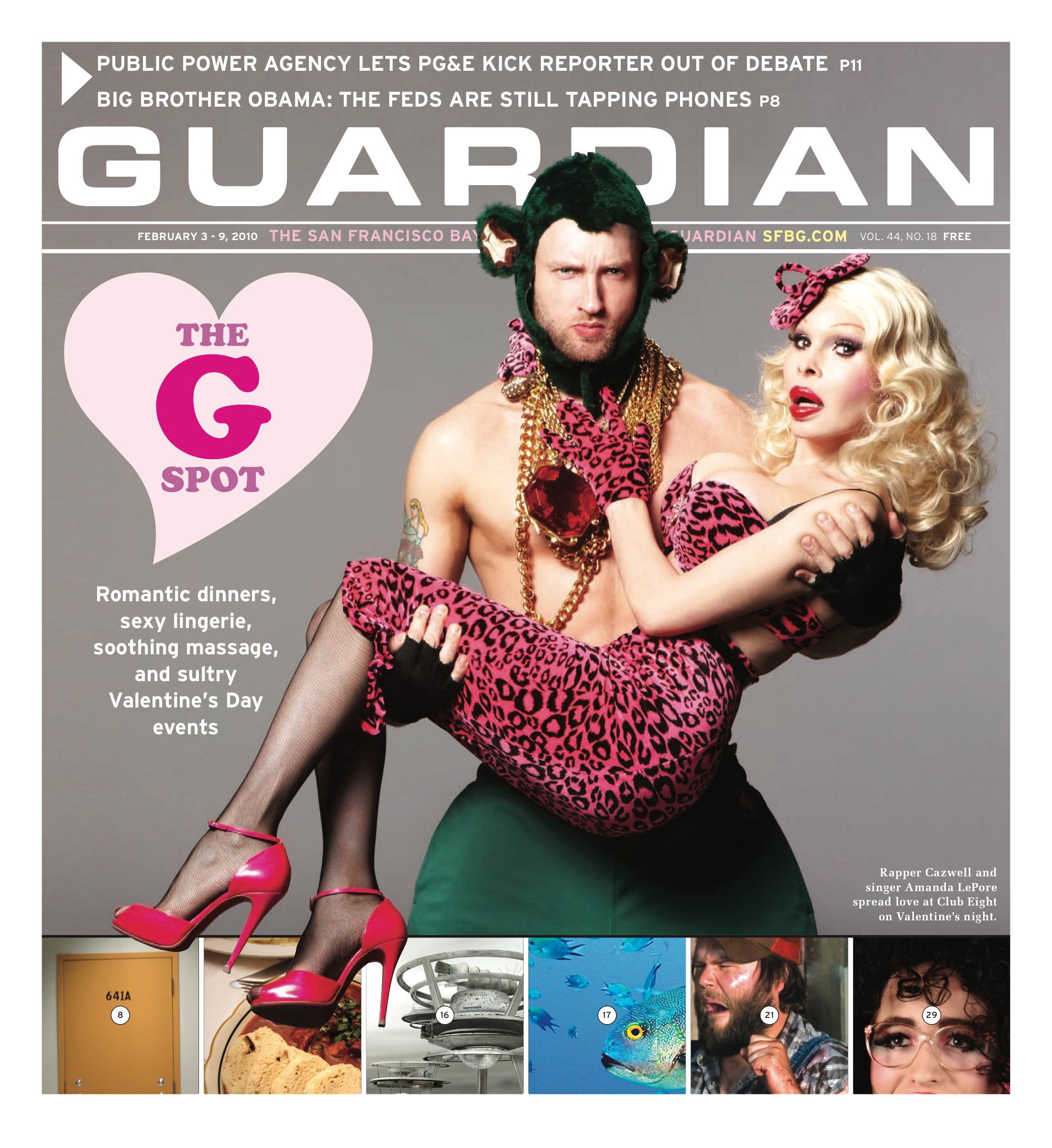
Monthly three-ring kiki-athon Big Top is a circus, and its special V-Day party will be a zoo, with NYC homo-rapper Cazwell and club legend Amanda LePore (she sings!) in town to stir things up. Heklina hostesses.

Sun/14, 9 p.m., $10–$25. Club Eight, 1151 Folsom, SF. www.eightsf.com

JUSTIN BOND: CLOSE TO YOU

The fantastical creature who jumped from local club kid talent to legend of New York stage (Tony nom, anyone?) is back with a freakin’ 10-piece orchestra to sing his favorite Carpenters’ songs. Mellow gold, child. 

Sun/14, 8:15, $25-$75. Castro Theatre, 419 Castro, SF. www.ticketweb.com

LOVESICK III

Geez, will anybody ever love you if you look like heck warmed over? Of course they will, Adam Lambert. But why not hit up this huge, buzzy lingerie fashion fiesta, dance floor prance, and trunk show party to polish your lacy underthings resume.

Sun/14, 7 p.m.-1 a.m., $15/$20. Mighty, 119 Utah, SF. www.mighty119.com

MOODYMANN

No one wants to date moody, but everyone shall dance to Moodymann, the second generation Detroit techno whiz and father of the current red-hot soul re-edits trend (although his Black Power message is getting a bit lost in the fray.) With Sunset and Stompy party DJs.

Sun/14, 3 p.m.-2 a.m., $15/$20. Café Cocomo, 650 Indiana, SF. www.stompy.com

SIXXTEEN

Rock out with your aorta out — it’s cuddle-with-a-chainsaw time as the legendary rock club returns, leopard Spandex and all. Kiss tribute band Heroes takes stage, while DJs Omar, Jenny, China G., Howie Pyro and more give you a whole lotta love. Panama!

Sun/14, 10 p.m.-3 a.m., $10. Cat Club, 1190 Folsom, SF. www.sfcatclub.com

Events Listings

0

Events listings are compiled by Paula Connelly. Submit items for the listings at listings@sfbg.com. For further information on how to submit items for the listings, see Picks.

WEDNESDAY 10

Bear Rendezvous Locations throughout San Francisco Wed. through Mon., visit www.bosf.org/bearrendezvous for a schedule of events, times, and prices. The theme of this year’s Bear Rendezvous is "Sin, Fire, and Gold" and includes events like beer busts, dance lessons, happy hours, movie screenings, art shows, pub crawls, beer busts, and more to raise funds for non-profit organizations that promote and assist the GLBTQQI community.

How to do Magic Tricks Bazaar Café, 5927 California, SF; (415) 831-5620. 7pm, $1 suggested donation. Attend this month’s "How – To Night" and learn how to do magic tricks with professional magician Robert Strong. Suggested items to bring include coins, a deck of cards, a dollar bill, business card, 6 feet of rope, and scissors. Extra supplies will also be available there.

THURSDAY 11

BAY AREA

"Counter Culture" Pegasus Books Downtown, 2349 Shattuck, Berk.; (510) 649-1320. 7:30pm, free. Hear oral historian, photographer, and former waitress Candacy Taylor discuss her new book, Counter Culture: The American Coffee Shop Waitress, and uncover the experiences of diner waitresses from a sociological perspective.

Sweetheart Bingo Rhythmix Cultural Works, 2513 Blanding, Alameda; (510) 865-5060. 7:30pm; $20 for 10 games, includes a free drink. This three ring bingo circus is not like your grandmother’s bingo, with cash and gift certificate prizes, circus arts, food and drinks for purchase, music and carnival games. Proceeds benefit Rhythmix Cultural Works.

FRIDAY 12

Love on Wheels Rickshaw Stop, 155 Fell, SF; www.sfbike.org/love. 6pm, $10. Join other single cyclists for a chance at romance at this recreation of the original 1970’s Dating Game where bachelors and bachelorettes select hidden dates to roll away with to hip local spots.

Lunar New Year Flowers San Francisco Conservatory of Flowers, 100 John F Kennedy Drive, Golden Gate Park, SF; (415) 831-2090. 9am, $5; runs through Feb. 28. Celebrate the year of the Tiger by enjoying a special display of Chinese miniature plant landscapes, a tradition that dates back over 2,000 years.

Soul Food for Thought Herbst Theater, 401 Van Ness, SF; (415) 392-4400. 8pm, $10-40. Celebrate Black History Month at this fundraiser for the International Fund for Africa featuring comedian MC Leo Flowers, music from R&B legend Lenny Williams, live music, dance, thought-provoking speakers, and more.

SATURDAY 13

Hot glass, Cold beer Public Glass, 1750 Armstrong, SF; (415) 671-4916. 6pm, $25 includes a glass drinking vessel or glass heart made by Public Glass artists. Enjoy a cold one while watching glassblowing demonstrations by artists Jaime Guerrero and Guido Gerlitz. Featuring live music with Joel Streeter and Max Delaney.

Love Dub Yoga Tree Castro Studio, 97 Collingwood, SF; (415) 701-YOGA. 8:30pm, $45. Open your heart and share the love with those in need at this fundraiser for the Save the Redwood Tree Foundation, Surfriders, and Power to the Peaceful featuring a Native American blessing, a Hatha yoga session, guided meditation, and ending in a live reggae concert.

Sea Watch Meet at Louis’ Restaurant, 902 Point Lobos, SF; (415) 349-5787, email mbzlat@yahoo.com to RSVP. 8am, free. Look for the Marbled Murrelet, California Sea Otter, and Steller Sea Lion on this sea watch for endangered sea creatures.

Vegan Bakesale Ike’s Place, 3506 16th St., SF; www.vegansaurus.com. 11am, free. Enjoy goods from local professional and amateur bakers while helping to raise money for the Harvest Home Sanctuary, a rescue for domesticated and farmed animals, and Cycles of Change APC, a non-profit community bike shop in Alameda.

BAY AREA

Alameda Zombie Crawl Starts at Forbidden Island Tiki Lounge, 1304 Lincoln, Alameda; (510) 749-0332. 7pm; free. Zombie make-up available at 5pm, from $5-25. Join other zombie lovers for a "Valentine’s Eve of the Living Dead" starting at the Forbidden Island Tiki lounge and continuing to Scobies Sports Bar and Grill and Lost Weekend Lounge before the zombies are unleashed on the rest of Alameda.

Love Mission Chabot Space and Science Center, 10000 Skyline, Oak; (510) 336-7311. 1:30pm and 3:30pm, $85 per couple. Go on a Valentine’s Day love mission at this simulated space mission to find the red planet.

SUNDAY 14

LoveSick 3 Mighty, 119 Utah, SF; (650) 524-0056. 7pm, $15-20. Cure what ails you at this lingerie fashion show featuring live music, DJ sets, an art installation, trunk sale, kissing booth, raffle, and more.

Pet Adoption Day Amoeba Music S.F., 1855 Haight, SF; (415) 831-1200. 11am, free. Find yourself somebody to love at this pet adoption event on Valentine’s Day in support of Muttville Senior Dog Rescue, a non-profit dedicated to creating better lives for older dogs.

BAY AREA

Muir Woods after Dark Meet at Muir Woods National Monument Visitors Center, Mill Valley; (415) 349-5787. 5pm, $5. Hear the rich sounds of nature in Muir Woods after dark and learn about the nesting Northern Spotted Owl. Bring a flashlight and wear sturdy shoes.

TUESDAY 16

Eve Ensler Commonwealth Club, 2nd floor, 595 Market, SF; (415) 597-6705. 6:30pm, $20. Hear author and anti-violence feminist Eve Ensler discuss the daily struggles faced by women around the world and how they have overcome obstacles at this talk and booksigning for "I am an Emotional Creature."

Strong Beer Month pours it on, is strong

0

There’s not a lot to look forward to in February. Unless, of course, you happen to be into beer. (And, er, love.) Yes, we’re currently in the middle of a great SF Beer Week. But the city has also embarked on an entire month of sudsy exploration. A proud tradition imported from Munich, Germany, strong beer (Starkbier) festivals have become part of the beer drinker’s winter calendar worldwide. In San Francisco, where good beer is as easy to find as a decent burrito, and not much more expensive, Strong Beer Month, co-hosted by Magnolia Pub and Brewery and 21st Amendment (both of which make their own) still stands out on the beer enthusiast radar as a special occasion. First, because it’s about beer. Second, because it’s about strong beer – as in extra-alcoholic. And mostly, because like any celebration of the craft of beer-making, it’s full of delicious and surprising nuances.

Maybe the first surprise to the uninitiated is discovering just how many various beer styles are represented in the festival. The original Starkbier might have been the monastic Doppelbock (famously brewed to chase away the Lenten doldrums, and “replace” the food not allowed to be eaten by the monks who first brewed it), but any beer can be made stronger by the addition of extra malts or sugars. There’s hardly a repeat flavor to be found on the combined menus of the 12 strong beers on tap offered throughout the month at Magnolia and 21st Amendment. Punchcards are available at both locations, and the lucky drinker who manages to get through all 12 during the course of the month, gets a commemorative glass.

The good news, for everyone concerned (and especially your liver), is that the strong beer limit is three nightly at each location, so you can take your time
getting around to them all.

I wrangled brewmaster and owner Dave McLean to give me a brief lowdown on all the strong beers available at Magnolia this year.

Magnolia’s Dave dives in. Photo by Jennifer Yin

The venerable Old Thunderpussy Barleywine, named for iconic restaurateur Magnolia Thunderpussy (as is Magnolia), who originally occupied the location, is entering its 13th year of notoriety. Clocking in at a respectable 10.8% alcohol content, this traditional, English-style barleywine is a sentimental favorite for the Magnolia brew-crew and clientele alike. Other returnees include the malt-rich imperial stout—Smokestack Lightning—and the hop-tastic Promised Land IPA, plus a back-by-popular-demand rye beer, the Delilah Jones, the premise of which makes my mouth water.

It was the new brews, though, that intrigued me the most: the Belgian-style Four Winds Quadrupel, and this year’s contender for “most interesting experiment” — Let It Rauch. This tastebud-stunner contains the famous smoked Bamberg malt used in other smoked beers. But instead of using a lager yeast, Magnolia went with an alt-bier yeast from Düsseldorf, giving it, as Dave puts it, a brighter, more vibrant mouth-feel and ale-like notes.

Magnolia taps at the ready. Photo by Jennifer Yin

Next I dropped in on 21st Amendment and slaked my growing thirst with a tasting of each of the six beers in their lineup. I started with a tipple of their experimental BeerSchool, basically a dry-hopped blonde. Definitely one for the ale-lover, though not nearly as much as the next beer on the tasting rotation: Imperial Jack. This extra special bitter practically sings “Hail Britannia” on your tongue while waving the Union Jack.

But when I got to the Two Lane Blacktop I knew I was in love. A double black IPA, super well-balanced, subtly woody, and smooth on the palate. Blind Lust was next, a blended Belgian-style brew with a “splash” of Lindeman’s Lambic. A sort of cherry cough-drop meets summer meadow affair, or like a frolic in the raspberry bushes. It’s the 10-year anniversary of 21st Amendment’s barleywine, Lower de Boom, which I found to be surprisingly subtle: amber-colored, hop-fragrant, and, despite an alcohol-by-volume of 11.2 percent, dangerously drinkable.


Incidentally, this delish drink won 3rd place last year at Toronado’s annual Barleywine Festival (coming up again on the 13-14th of February!), an award which seems well-deserved. By the time it was time to taste the Hop Crisis, my tastebuds were already in a bit of a crisis, but like a good triple-IPA should, it cut straight through the nerve. The aggressive nose was like snorting an entire packet of cascade hops in an isolation chamber, and after a few sips, my tongue went numb! Probably not a beer for the fair-weather beer dabbler, but definitely a hop-lover’s tour de force.

So what’s the final verdict? It’s beer. It’s strong. And best of all, you still have three weeks to try some yourself.

Strong Beer Month

www.strongbeermonth.com

through February

at

Magnolia Pub and Brewery

1398 Haight, SF

www.magnoliapub.com

and

21st Ammendment Brewery Cafe

563 Second St., SF.

www.21st-ammendment.com

To S.I.R. With Love

0

By Elise-Marie Brown

S.I.R.’s Noa at work. All photos by Elise-Marie Brown

I’ve been to a fair number of art openings, and many consist of a DJ mixing music as people sip drinks and converse about why they like a particular piece of work. Now, don’t get me wrong: art events are a cheap and easy way to meet people, support local talent, and occasionally score some free booze. But sometimes you need more of an incentive to go out.

By Elise-Marie Brown

noa2.jpg
S.I.R.’s Noa at work. All photos by Elise-Marie Brown

I’ve been to a fair number of art openings, and many consist of a DJ mixing music as people sip drinks and converse about why they like a particular piece of work. Now, don’t get me wrong: art events are a cheap and easy way to meet people, support local talent, and occasionally score some free booze. But sometimes you need more of an incentive to go out.

Enter S.I.R. (Surreality in Reality), a Japanese art crew residing in the San Francisco Bay area that aims to bridge cultures through different mediums and live art performances. “Four Elements Vol. 3土 –Earth-” is their latest exhibition, the third installment of an elements of nature series (past exhibits incorporated water and fire).

pineapple.jpg
The Pineapple, The Pineapple Stool and the Soil Girls, by Koji Nagao

The smell of smoke and sounds of laughter floated around Space Gallery‘s front entrance on opening night. Once I entered the small building, it was replaced by ’90s hip-hop and the aroma of Red Stripe beer. The walls showcased photos printed on seed paper, oil and watercolor paintings, silk-screened graphic art, and sculptures. 

One piece that caught my attention was a wooden box with 10 handcrafted dolls placed on top, titled The Pineapple, The Pineapple Stool and the Soil Girls, by Koji Nagao. When I first glanced at it I assumed the box was used as a prop for the dolls. But after observing for a minute, I noticed a little hole to the left where I could peek through and see what was inside: a bright light with moving images, and to my surprise, a stop-motion video that incorporated the same dolls.

yusai.jpg
zaion.jpg
Yusai and Zaion of S.I.R.

After checking out the first floor, I moved upstairs, where the music and conversation was louder. Yusai, a man in a baseball cap and red flannel shirt, spun records, as Zaion synthesized music on his laptop.

noa.jpg
Noa’s art takes form

At the top of the narrow stairway a tall man by the name of Noa faced a large wall covered in brown paper. Wearing paint-stained jeans and a white T-shirt, he walked across the floor in his bare feet, leaned down to the ground, and dipped a thick brush in a can of black paint. With a look of deep concentration he painted large swirls on the paper. After a few minutes the shapes of an elephant, rhinoceros, fox, and tiger began to take form from the previously indecipherable elegant images. Look closely — S.I.R. has something unique to offer the art world.


Appetite: Planning ahead for V-Day

0

By Virginia Miller of www.theperfectspotsf.com. View the previous installment of Appetite here. Check out more V-Day dining ideas here.

meltingpot0110.jpg
Fondue you: The Melting Pot draws couples closer for Valentine’s

2/14 – Belgian beer and butchery at La Trappe
Many of us don’t get excited by the commercialism of Valentine’s Day – and not just because we may or not have a special someone in our lives. It could just be that we don’t like things rosy, pink and cute. No need to go the hearts and chocolate route when you can do Belgian beers and butchery, right? La Trappe does it right by making their enchanting Belgian brick-walled, candlelit basement the setting for A Porcine Valentine. Only 45 lucky people will have their run of the place, cozying up on church pews and couches with all the beers and pig they can ingest. La Trappe’s Dave and Chris will each be breaking down a whole pig, showcasing different butchering techniques between the US and Italy.
3-11:30pm
$95 per person, limited to 45 people
800 Greenwich Street
415-440-8727

www.latrappecafe.com

missionbeach0110.JPG
Mission Beach makes it sweeter

2/14 – Mission Beach Cafe sweets for the sweet
ILove Mission Beach Café. Not only is it a morning delight for weekend brunch or weekday pastries and Blue Bottle coffee, but its dinners are some of the best and most underrated neighborhood dining in the city. Valentine’s Day there is, yes, a special four-course prix fixe dinner (including white linens, roses, champagne toast, amuse bouche and sweets from fab pastry chef, Alan Carter). Knowing their track record, it won’t be the often overpriced, mediocre food one gets for Valentine’s. There’s dishes like Heirloom Chicory Salad with pomelos and huckleberries, Lobster and Dungeness Crab Ravioli or Prather Ranch organic prime rib. All this in the cozy, chic glow of a neighborhood restaurant that’s also a worthy destination.
$75 per person
198 Guerrero Street
415-861-0198
www.missionbeachcafesf.com

2/13-14 – The Melting Pot – Valentine’s fondue feast
The Melting Pot chain may not be your first thought for Valentine’s Day, but if you’re in Marin or the idea of a relaxed fondue feast (cozy in these Winter months) in a unique setting is appealing, here’s an idea (discounts for groups of 7 or more friends): head to Larkspur’s Melting Pot in an 1891 brick kiln, forced to close for economic reasons in 1915, empty for over 70 years until restored in 1989. The space has the feel of a labyrinthine Spanish wine cellar set in a circular, brick tunnel. For Valentine’s they’ve got a four-course prix fixe at $65 a person – there’s choices each course, like Quattro Formaggio Fondue (fontina, gruyere, raclette, mozzarella cheeses with roasted garlic, basil, pesto) or Crab Imperial Cheddar Fondue, a Caprese or Caesar Salad, entree fondue meats like Filet Mignon Florentine, Limoncello Basamic Sirloin, Orange Fennel Pork Tenderloin, and a finish of either Milk Chocolate Tiramisu or Dark Chocolate Raspberry Fondue. Females get a rose as they leave… if you guys want one, too, you could probably ask. 
$65 per person (10% off for group of 7 or more)
125 E. Sir Francis Drake, Larkspur, CA
415-461-6358
www.meltingpot.com

2/10 – La Cocina’s Truffle-Making Class
Community treasure La Cocina, along with fabulous Neo Co coa chocolates and ever-popular Kika’s Treats, host a hands-on evening rolling your own truf fles, either to with your sweetheart or to give as a Valentine’s gift. The theme is “how to be a bet ter lover”… I always knew chocolate was somehow involved. The class includes wine, din ner and a take-home box of your handiwork.
$65 class; $85 class + 10-piece truffle box & 5-pack of Kika’s Treats (a $27 value)
6:30-9pm
2948 Folsom Street
415-824-2729
www.lacocinasf.org


This Week’s Picks

0

WEDNESDAY (3rd)


FILM

SF Ocean Film Festival

The City by the Bay has a long history of film festivals. But it wasn’t until 2004 that one concentrated on this area’s oceanographic connections. Hosting more than 50 films, the San Francisco Ocean Film Festival has documentaries on marine life and environmental science, surfing videos, experimental and animated productions, and more. Crowd favorites include a program dedicated to sharks and a chance to meet the filmmakers who work among the denizens of the deep at an Aquarium of the Bay fundraiser. (Sean McCourt)

Various times (Sun/7), $8–$12

(filmmakers reception, $60; festival and VIP passes, $85–$175)

Theatre 39 and Aquarium of the Bay

Embarcadero and Beach, SF.

(415) 561-6251

www.oceanfilmfest.org

DANCE

Shantala Shivalingappa

Rarely seen in the Bay Area, Kuchipudi is one of the great classical Indian dance forms. Taking its name from the village in which it was “born” in the 15th century, it’s related to Bharatanatyam but is more theatrical, using fast and often airborne footwork. Shantala Shivalingappa is a Madras-born, Paris-raised dancer who has worked with Maurice Bejart, Peter Brook, and Pina Bausch. Her piece Gamakaone definition of which refers to Indian music’s shimmering quality — is a solo that Shivalingappa developed with her four musicians. One hopes it includes a part in which the Kuchipudi dancer performs on the rims of a brass plate. (Rita Felciano)

8 p.m, $27–$39

Herbst Theatre

401 Van Ness, SF

(415) 392-2545

www.performances.org

MUSIC

Doug Carn and Black Jazz Reunion

In the early 1970s, pianist Gene Russell founded Black Jazz Records in Oakland. Branching away from traditional jazz, the label was inspired by African-American political and spiritual movements taking place at the time. One of its most successful acts was pianist and composer Doug Carn. Better known as half of the duo Doug and Jeane Carn, he has sold more records than Dave Brubeck and Ramsey Lewis. Introduced to music at a young age by his mother and an uncle, Carn has studied piano, alto sax, and also oboe. His adaptations of Coltrane’s classic “A Love Supreme” and Horace Silver’s “Peace” are creative and lyrical. (Lilan Kane)

8 and 10 p.m, $10–$18

Yoshi’s

510 Embarcadero West, Oakl.

(510) 238-9200

www.yoshis.com

THURSDAY (4th)


DANCE/PERFORMANCE

Luxury Items

Monique Jenkinson, a.k.a. Fauxnique, is a master of lipsync. But I’m excited to hear what she has to say in her new show. In between the bravura dynamic dance moments of Faux Real, Jenkinson made her past into present-time conversation with the audience, and did so with offhand ease. This time, she’s digging into cultural obsessions. I’ve heard that Luxury Items includes a eulogy for newspapers — from the perspective of a hoarder. (Johnny Ray Huston)

8 p.m. (through Feb 21), $10–$20

CounterPULSE

1310 Mission, SF

(415) 863-9834

www.odcdance.org

TALK/LECTURE

“After Dark: Sexplorations — Exploring Nature’s Reproductive Strategies “

Throw the word sex in front of any event title and folks will flock. So maybe the people at the Exploratorium are on to something with the latest installment of its “After Dark” lecture series. For one night, anyone old enough to legally down a good old glass of hooch can learn why Viagra only works for men, whether it’s possible to orgasm with just your thoughts, and how sex toys do their magic. Think of it as the sex ed class you always wanted to take but never did. Mary Roach, author of Bonk, will be on hand to pass on some expertise. (Elise-Marie Brown)

6 p.m., $15 (free for members)

McBean Theater

Exploratorium

3601 Lyon, SF

(415) 561-0363

www.exploratorium.edu

FILM

Sacred Places

Let those critics who would universalize their disillusionment (however well-founded) into “death of cinema” bromides see Jean-Marie Téno’s marvelous essay-film Sacred Places. A few minutes observing Nanema Boubacar’s neighborhood cine-club, located in a poor district of Ouagadougou, and they might let up. Like Agnès Varda, Téno prefers pondering large questions on the move. Here, he reexamines the founding principles of African cinema in a split-portrait of Boubacar, a struggling entrepreneur (in Burkina Faso, too, it’s more difficult to procure African titles than the latest Hollywood blockbuster), and Jules Cesar Bamouni, a djembe maker who draws the same links between filmmaking and the griot tradition that were so important to Ousmane Sembène. (Max Goldberg)

7 p.m., $9.50

Pacific Film Archive

2575 Bancroft, Berk.

(510) 642-1412

www.bampfa.berkeley.edu

FILM

Movie Night at SFO

Like most people in the Bay Area, I’ve only gone to San Francisco International Airport to pick someone up or fly away (usually to a warmer destination). Basically I go there to handle business, maybe grab a bite, and leave. But now this aviation destination is giving a reason to visit sans luggage — free movie nights.Tonight SFO screens The Legend of Pancho Barnes and the Happy Bottom Riding Club. The 2009 documentary delves into the work of Florence “Pancho” Barnes, Hollywood’s first female stunt pilot. Writer-producer Nick Spark and director Amanda Pope will be on hand. (Brown)

6 p.m., free

SFO Aviation Museum

SFO, International Terminal, Level 3

(650) 821-9911

www.flysfo.com/web/page/orphan/movie

DANCE

Ronald K. Brown/Evidence

Nick Cave is back. Sort of. If you missed Ronald K. Brown’s response to Cave’s mysterious masked figures last year, here is another opportunity. The work, now called Journey, opens this remarkable dancer’s return engagement. Brown’s work thrives on an underground stream of spirituality. He started his Evidence company at 19, and his voice and his polyglot dance vocabulary have only become more personal and burnished. Brown is very much a 21st century artist. New on this program will be the all-male 2008 Two-Year Old Gentlemen, which explores the relationships that men develop with each other. The gorgeous 1999 piece Grace has a good chance to become Evidence’s Revelations. (Felciano)

8 p.m. (through Sat/6), $30

Novellus Theater

Yerba Buena Center for the Arts

701 Mission, SF

(415) 392-2545

www.ybca.org

THEATER

Fabrik: The Legend of M. Rabinowitz

Jim Henson made a mark with his lighthearted use of puppets, or should I say Muppets. But Wakka Wakka Productions, a visual theater company from New York City, is a far cry from Kermit the Frog. Instead of presenting mirthful sketches, this nonprofit uses hand-and-rod puppets to unfold dark tales of valor and resilience. Inspired by Yiddish and Nordic folktales, Fabrik tells the story of Moritz Rabinowitz, a Polish Jew who publicly voiced his opposition to anti-Semitism during the rise of Nazi Germany. (Brown)

8 p.m. (through Sun/28), $20–$34 (pay-what-you-can Thurs/4)

The Jewish Theatre San Francisco

470 Florida, SF

(415) 292-1233

www.tjt-sf.org

FRIDAY (5th)


EVENT

San Francisco Beer Week

The Bay Area is a treasure trove of microbreweries and their thirsty followers — a perfect combination for San Francisco Beer Week, which, despite its city-centric name, hosts events throughout the greater Bay Area, including a variety of tastings, food pairings, meet-and-greets with brewers, and live entertainment. The festival kicks off with an opening gala at Yerba Buena Center for the Arts. Over the next 10 days, breweries including 21st Amendment, Beach Chalet, Speakeasy, Seabright, Santa Cruz Mountain, Anchor, and Thirsty Bear share their best suds. (McCourt)

5–9 p.m. opening gala, $55–$65

Various locations (through Feb. 14), prices vary

www.sfbeerweek.org

EVENT

Wonderland: A Tim Burton Ball

If only I could live in Tim Burton’s world, with misfit heroes and a Danny Elfman soundtrack. I’d cast Winona Ryder as my best friend, Helena Bonham-Carter as my kooky artistic mentor, and Johnny Depp as … well, you know. I’d be darkly beautiful and I’d dance beneath ice sculpture snow. Too bad movies aren’t reality. Nonetheless, Brian Gardner — founder of Swing Goth and lover of all things modern and macabre — is doing his best to close that gap. This week he hosts an ambitious event dedicated to Burton, just in time for the media blitz that’s about to have everyone saying Alice rather than Avatar. (Molly Freedenberg)

9:30 p.m. $15–$20 ($5 extra for pre-event dance class at 7:30 p.m.)

DNA Lounge

375 11th St, SF.

(415) 626-1409

www.dnalounge.com

MUSIC

Irma Thomas and the Professionals

Do you know what it means to be the Soul Queen of New Orleans? Big Easy native Irma Thomas has been pouring her heart into the soul circuit for the past five decades. She celebrates this half-century anniversary with the Rounder Records release The Soul Queen of New Orleans: 50th Anniversary Celebration. People love and know Thomas for tunes, but she also opened her own club, Lion’s Den, in the 1980s. She headlined frequently there until Hurricane Katrina brought disaster. In 2007, Thomas’s After The Rain (Rounder/UMGD) brought her first Grammy. (Kane)

8 and 10 p.m. (also Sat 2/6), $30

Yoshi’s

1330 Fillmore, SF

(415) 655-5600

www.yoshis.com

VISUAL ART

“Article X”

The starting point for the artworks in this show is not the X, but the X’s center: that crucial yet vapid intersection where form meets function. It is here that photographer David Trautrimas and sculptural artist Kristina Lewis originate with the ordinary: household kitchen appliances and high heels, respectively. Lewis’ reassembled high heel sculptures, which hint at sculptural artist Brian Jungen’s series of Nike Air Jordans-turned-aboriginal masks, tease and fray the ends of X. (Spencer Young)

5–8 p.m. (continues through March 20), free

Johansson Projects

2300 Telegraph, Oakl.

(510) 444-9140

www.johanssonprojects.net

SATURDAY (6th)


MUSIC

Dawes

In recording his group Dawes’ debut album North Hills (Ato Records/Red), Taylor Goldsmith said that he wanted the inherent quality of the instruments to come across. Perhaps the greatest instrument Dawes has is Goldsmith’s voice, which is infused with a soulful timbre. Influenced by Otis Redding and James Brown, Dawes produces a warm country rock that incorporates tight drumming from Goldsmith’s younger brother Griffin. The sound feels initially familiar, and carries a hint of early 1970s Creedence. But with personal lyrics and a lush mix of instrumentation, Dawes manages to pull in the listener. Which is good for everyone. (Adam Lesser)

With Cory Chisel and Wandering Sons, Jason Boesel

9 p.m., $12

Rickshaw Stop

155 Fell, SF

(415) 861-2011

www.rickshawstop.com

MUSIC

Broun Fellinis play Zeppelin

Broun Fellinis has been bending genres, defying categorization, and blazing artistic trails since their foundation in 1991. Deeply embedded within the creative landscape of our fair city, this righteous jazz trio is known for conjuring acoustic spaces that transcend genre. My question is, what will it do with Led Zeppelin? When you match Zeppelin’s brand of distinctive debauchery in the musical realm with the imaginative hands of Professor Boris Karnaz, Black Edgar Kenyatta, and Kirk the Redeemer, the result can only be good, maybe great, if not historic. What? You don’t like cool stuff? Sure you do. You should go. (D. Scot Miller)

10 p.m., $10

Coda Jazz Supper Club

1710 Mission St, SF

(415) 551-CODA

www.codalive.com

MONDAY (8th)


MUSIC/EVENT

Marcus Books’ 50th Anniversary Fundraiser

Literacy is a gift most take for granted. It allows you read about this event right now. You can help other people learn how to read by attending this fundraiser, a music and literature showcase that benefits Marcus Books’ Scholar Book Club nonprofit literacy program. The evening’s host, spoken word artist Scorpio Blues, has been featured on BET, on HBO’s Def Poetry, and is also the CEO of Hot Water Cornbread, a spoken word and entertainment management company in Oakland. Her group the Hot Water Cornbread All Star Poets performs as well. (Kane)

With Blayze, Pop Lyfe, HWCB Poets

8 p.m., $15–$20

Yoshi’s

1330 Fillmore at Eddy, SF

(415) 655-5600

www.marcusbookstores.com

www.yoshis.com

MUSIC

St. Vincent

St. Vincent’s Jane-of-all-trades Annie Clark cut her teeth playing with the Polyphonic Spree and Sufjan Stevens, so there is no doubt she has the experience to deliver a live show worthy of her sophomore album Actor (4AD). Tender and tough, Clark may appear to draw from the singer-songwriter well, but dashes of menace and complexity separate her intricate pop songs from run-of-the-mill balladry. Considering Actor was written and recorded by Clark using GarageBand, here’s your chance to enjoy the lush tunes with a full ensemble. (Peter Galvin)

With Wildbirds and Peacedrums

8 p.m., (doors: 7 p.m.), $20

Great American Music Hall

859 O’Farrell, SF

(415) 885-0750

www.gamh.com

The Guardian listings deadline is two weeks prior to our Wednesday publication date. To submit an item for consideration, please include the title of the event, a brief description of the event, date and time, venue name, street address (listing cross streets only isn’t sufficient), city, telephone number readers can call for more information, telephone number for media, and admission costs. Send information to Listings, the Guardian Building, 135 Mississippi St., SF, CA 94107; fax to (415) 487-2506; or e-mail (paste press release into e-mail body — no text attachments, please) to listings@sfbg.com. We cannot guarantee the return of photos, but enclosing an SASE helps. Digital photos may be submitted in jpeg format; the image must be at least 240 dpi and four inches by six inches in size. We regret we cannot accept listings over the phone.

It just so happens

0

CHEAP EATS Dear Earl Butter,

Like a cat always lands on its feet, your chicken farmer lands on a chicken farm. Weirdo the Cat would be proud of me, according to the Mountain.

Hard to believe, but life sometimes does that to you. Just when you need them, voilà: chickens. I had no idea! I just had to get somewhere friendly, and by sheer chance on the same day the anvil fell on my head I got a mass e-mail from Fabienne Gagagaga, telling my whole family, among other things, to keep in touch.

I last saw Fabienne 10 years ago, at my dad’s wedding. She was working at that time in marketing. A couple days after my anviling, when I still hadn’t regained my shape and it looked like I wasn’t going to, I decided it would be best for me to have my nervous breakdowns in another language — one I didn’t know at all, give or take voilà. And so I did, I kept in touch.

Fabienne’s reply was almost immediate, full of warmth, and just dripping with butter, but didn’t mention chickens. I arrived in the dark, by train, and very much in need of food, sleep, and kindness.

There was a lamb stew waiting for me. The lamb was from her farm. That night while I slept for the first time all year, two baby lambs were born. I watched the sunrise over some sailboat masts, then went with her to help Fabienne buy about 100 new chicks.

Over the next few days I helped fork, shovel, and broom out two chicken coops, I helped feed the chickens, closed the chicken doors at night, helped haul and stack sacks of feed, handled livers, and cleaned, cut, and cooked up 80 chicken hearts into a cherry beer stew with carrots and onions.

There aren’t a lot of lady farmers in France, and riding around on tractors and pickup trucks with this ‘un made me about as proud as I’ve ever been. Here was somebody doing for real what I make a living, in a way, pretending to do.

The Chicken Farmer, farming chickens. Not just four or five but hundreds. Imagine! It was as if John Wayne or Clint Eastwood ever actually found themselves roping steer, or something.

We even went to the dump once. Everyone loved us there!

I ate fresh scallops, many many oysters, and butter butter butter — the best butter ever, with some pretty good bread under it sometimes.

In Farmer Fabienne’s sisterly keeping, I not only found food, sleep, and kindness, but meaningful work. And Earl, in case you ever need to know this, there is no better balm for a broken heart than scraping chicken shit and cooking chicken hearts. The cherry beer was an accident, but a good one.

Dear Nice Lady,

That is great. The best thing about Java Supreme is that if you know when to go, you can get to talk to Joel almost every day of the week. He’s not always there, and those days are always hard. But most days he is. Me too. For the last 18 years, I have spent my mornings, almost all of them, at Java Supreme. It is also one of the few holdouts to the old Mission values that are no longer on Mission Street. Old Mission values are this: you can afford to eat.

I get a double espresso every morning, and it is $1.75. And when I make coffee at home, guess where I bought it?

Today I went back for lunch, too. I had the Italian roasted eggplant sandwich with pesto, roasted red peppers, mozzarella, and tomatoes, $3.95, with salad, $5.50, because the salads are great. I love this particular sandwich.

Someone suggested I get it with turkey instead of eggplant, and for years I did that. Ed makes it for you without blinking an eye. It is Ed’s place. He tries to keep things simple. I heard him say that on the phone, once.

Recently, in a cream cheese banishment program (not something I can recommend) me and Joel have been enjoying the Java No. 2, which is a bagel with avocado, tomato, sprouts and red onion. But neither of us gets the red onion. We didn’t plan it. It just so happens.

JAVA SUPREME

Daily: 6:30 a.m.–7:00 p.m.

703 Guerrero, SF

(415) 206-1832

No alcohol

Cash only

Cafe Prague

0

DINE When in Prague, one would naturally try to eat as Praguers do, and in my experience, this means lots of pizza. The city, as a physical artifact, is a gothic dream, a fantasy of spires, castellations, and cobblestones worthy of Walt Disney. And being sealed up in the aspic of communism for 40 years actually enhanced these charms. When Milos Forman was looking for a place to film Amadeus, his 1984 movie about Mozart in Vienna, he settled on Prague as the setting because it had changed so little since the 18th century.

Except for the people, that is, who emerged from behind the ruins of the Iron Curtain in 1989 with a hunger for all things western, from Bulgari to holidays in Thailand to pizza. I ate as much pizza in Prague as I did in Rome a few years later, and that is saying something. And the wonderful Czech beer, Budvar, was so cheap in the late 1990s it might as well have been pouring from the taps. What was trickier to find was a spot that served traditional Bohemian cooking in a bohemian atmosphere — a place, in other words, like our very own Café Prague.

We never found a place like Café Prague in Prague, but here you don’t have to do much searching, and you can even take BART, since the restaurant expanded last year from its home in the Financial District (once on Pacific Avenue, now on Merchant Sreet) to new digs in the Mission District — on Mission Street itself, in fact, just two blocks from the 16th Street BART Station. The set-up offers, in addition to convenience, a more authentically bohemian setting, or at least one farther removed from soaring glass towers full of bankers counting their taxpayer-funded bonuses. Inside it’s homey; the only bohemian touch that seems to be lacking is a pall of blue smoke from cigarettes being nervously puffed by sallow, Kafkaesque young men.

Today’s Kafka aspirants, from the look of it, are strapping lads (and lasses) who make quick work of huge mugs of Czechvar (Budvar’s North American label) before tucking into immense and satisfying platters of central European food. I have never seen so much food on plates. Even the appetizers are colossal. A bratwurst platter ($7), for instance, consisted of a stack of wonderful sweet and smears of mustard and ketchup to swipe them through, along with a tangle of sauerkraut, a heap of pepperoncini, coins of dill pickle, and a wealth of other pickled vegetables. There was easily enough here for a table of four, especially since we’d earlier loaded up with abandon on the seductive, warm bread in its bottomless basket.

A bowl of split-pea soup ($5) was likewise almost a meal in itself, especially with the addition of bacon and dumplings. When bacon is mentioned as an accoutrement on a menu, you might expect a few bits or crumblings, for a hint of flavor and crunch and some decorative effect. Here the bacon appeared in the guise of nicely crisped slats — enough of them to amount to some real heft. And the bacon was the meaty English kind, not the fatty American stuff. Just to make sure no one would go away hungry, the kitchen tossed in some dumplings as well.

A word on the dumplings, which are ubiquitous. They are dotted with caraway seeds and resemble large slices of the crustless white bread the English use to make their tea-time cucumber sandwiches and are not (as I was expecting) spheres of boiled potato dough. The dumplings were impressively stacked beside several flaps of sauerbraten ($15), a vinegar-marinated pot roast that seemed slightly tough but was smoothed and softened by a broad lake of velvety brown gravy, and beside the roast duck ($15), rich as a winter night. Another small pile of sauerkraut helped balance some of the duck’s fattiness.

After such an avalanche of food (plenty of protein and fat and, thanks to the dumplings, nearly limitless starch), the very thought of dessert might leave you queasy. I can’t say that Café Prague’s version of apple strudel ($5) is a pastry version of Alka-Seltzer, but it is good, with more apples than pastry for a somewhat lower center of gravity. It almost looks like (dare I say?) a slice of deep-dish pizza, except for a chocolate-speckled egg of whipped cream on each side, for a little flourish of bohemian decadence.

CAFÉ PRAGUE

Dinner: nightly, 5–10 p.m.

2140 Mission, SF

(415) 986-0269

Beer and wine

Cash only

Somewhat noisy

Wheelchair accessible

Cheap dates

0

By Chloe Roth

Crosby, Stills, and Nash once crooned, “If you can’t be with the one you love, love the one you’re with.” If you’re lucky enough (or unlucky, for the V-Day scrooges out there) to find yourself paired up with anyone on this recession-doomed Valentine’s Day, you might be worried about how to show appreciation for your significant other while staying within your budget. The Beatles aptly sang, “I don’t care too much for money, money can’t buy me love.” And unless you’re currently in love with an escort, they are absolutely right. So this Feb. 14, whether you’re engaged in a truly loving and reciprocal relationship, passing time with a willing partner while you look for the ideal one, or courting a gold-digging opportunist, you can show the one you’re with a good time without doling out a lot of cash.

After all, “cheap date” doesn’t have to be a pejorative term used to describe the town bicycle (yeah, yeah, everyone’s had a ride). In the current economic climate, “cheap date” may describe your only option, but fret not! If you can’t afford an expensive five-course meal or want to steer clear of the overpopulated movie theaters (i.e. avoid seeing the cheesy rom-com your partner picked out), there are plenty of alternatives. Here are a few non-dinner-and-a-movie examples of how to show your honey a good (and affordable) time in either San Francisco or the East Bay.

BIG KID ACTIVITIES

When you were six, falling down in public was routine and relatively painless (given you didn’t have very far to fall). It’s a little different now that you’re an adult, especially if your clumsy face-plant happens in front of someone you’re trying to get into bed. But, really, what better way to get to know someone than through total humiliation? For many cold-weather novices (and too-cool-for-Brian-Boitano snobs), ice-skating offers the perfect opportunity for mutual embarrassment and, thus, subsequent bonding. On Valentine’s Day, the Yerba Buena Ice Skating and Bowling Center (750 Folsom, SF. www.skatebowl.com, 415-820-3532) is open to the public from 1-2:30 p.m. and 4-5:30 p.m. Admission for adults is $8 (or $11 with skate rental), a pretty low price to pay for feeling like a kid again. If you find yourself on the other side of the Bay Bridge and still fancy a skate, head over to Oakland Ice Center (519 18th St., Oakl. 510-268-9000, www.oaklandice.com). It’s open for public skating on from 1-3 p.m. and 3:15-5:15 p.m. (also $8, $11 with skate rental).

THE GROPE-A-DOPE DETOUR

If you skip the Valentine’s Day movie but still hope to get some R-rated action from an old-fashioned guy or gal, take advantage of San Francisco’s topography and drive up to Twin Peaks (501 Twin Peaks Road, SF.). It’s timeless, it’s free, and it’s quintessentially San Franciscan. Plus, who doesn’t love the classic make-out session at a lookout point? If you’re lucky, sneaking some of this old-fashioned romance into your night will get you one step closer to the set of twin peaks you’ve been trying gain access to since your first date. Or, if you’d like to catch a view of the Bay from Berkeley, drive up to Indian Rock (950 Indian Rock Ave., Berk.) or the Lawrence Hall of Science (Centennial Dr., Berk. www.lawrencehallofscience.org).

THE SIP AND SOAK SERIES

If you’re in the East Bay and you’d like to get your date a little drunk in the middle of the afternoon (and why wouldn’t you?), take them to the Takara Tasting Room (708 Addison, Berk., 510-540-8250, www.takarasake.com). The popular local sake company offers five different courses of sake tasting for a mere $5. And since sake has an average alcohol content of 15 percent (that’s 3 times more than most beers), you can get a pretty nice buzz going. If you want to continue on a more pampering route, then head over to Piedmont Springs (3939 Piedmont, Oakland 510-652-9191, www.piedmontsprings.com) for a little soak in a rustic redwood tub. Sure, you could do the whole candle-lit bath thing at home, but who wants to spend the next day cleaning up puddles, soap rings, and melted wax when you could, well, not? Piedmont Springs offers private outdoor tubs ($15), saunas ($13), and their popular combination room ($20). And if you’d like to plan a little sip-and-soak series in SF, check out the Valentine’s Day lineup at the San Francisco Brewer’s Guild’s Beer Week 2010 (www.sfbeerweek.org/feb14). Then once you’re nice and drunk, head to one of SF’s more affordable spas: Kabuki Springs & Spa (1750 Geary, SF. 415-922-6000, www.kabukisprings.com), or Imperial Day Spa (1875 Geary, SF. 415-771-1114, www.imperialdayspa.com). Side note: please remember that hot-tubbing while inebriated is not the safest thing to do, so be smart about it. Drowning does not a romantic Valentine’s Day make.

FREE FLASHMOB FLIRTING

If it’s nearing the evening and you’re still seeking a last-minute hookup, the best (and strangest) place to look would be the Great San Francisco Pillow Fight (Embarcadero, SF. www.pillowfight.info), held annually in Justin Herman Plaza. When the Ferry Building clock strikes 6 p.m., grab a pillow you’re willing to destroy and start some feathery flashmob chaos. If you’re not familiar with the term “flashmob,” Wikipedia (that ever-reliable source of real information) defines it as “a large group of people who assemble suddenly in a public place, perform an unusual action for a brief time, then quickly disperse.” If all goes well, you’ll go home afterwards, sweaty and covered in feathers, and perform more unusual acts with your newfound Valentine.

Appetite: Hoist your stein for Beer Week

0

By Virginia Miller of www.theperfectspotsf.com. View the previous Appetite here.

beerweek0110.jpg

2/5-2/14 – SF Beer Week is going to be a big one this year
We’ve been buzzing awhile now about next week’s SF Beer Week. This one, only the second, is slated to be huge with over 200 events going on in a 10-day span. There’s a lot of beer sampling to be had, my friends! Celebrating craft beers at large, and the rich diversity of our local craft beers, the event is sponsored by local breweries in the SF Brewers Guild. There’s an event to suit every beer lover, from meet-the-brewer nights, to tours, tastings and dinners, to special casks and releases. Navigating the sudsy waters is a bit daunting, but here are a few to consider:

**The big shindig, 2/5, is an Opening Gala at Yerba Buena Center for the Arts, featuring 30 of Nor Cal’s best (including some rare) brews, a tapping of the Brewers Guild collaborative brew (a barrel-aged Imperial Common), live music, commemorative stemware for each attendee, and food for purchase from the likes of 4505 Meats, Tacolicious, and Tataki Sushi. Get tix now as they’re $45 but will be $55 after 1/31.

Marijuana goes mainstream

6

I’ve smoked marijuana on and off for most of my adult life, usually in the evening to help let go of the anxieties associated with being a progressive wage slave in an increasingly conservative capitalist country.

Buying my pot, which is California’s biggest cash crop, has always been a criminal transaction: in hushed tones or coded language, I arrange to meet a dealer I’ve been set up with through friends. And when I meet him (they’ve always been men), I give him cash in exchange for an eighth- or quarter-ounce of whatever kind of pot he’s selling.

I don’t know what variety I’m buying, who grew it, or how it was grown; whether violence or environmental degradation have occurred along the supply chain; or even whether it is an indica or sativa, the two most basic cannabis families that have differing effects on users.

I’ve been completely in the dark, both in terms of what I was buying and who was benefiting from the transaction, but that changed recently. I obtained a doctor’s recommendation to legally smoke weed — honestly citing anxiety as my affliction — and set out to explore the area’s best cannabis clubs.

It was a little strange and disorienting at first, this new world of expert purveyors of the finest Northern California marijuana and the various concentrates, edibles, drinkables, and other products it goes into. But what eventually struck me is just now normal and mainstream this industry has become, particularly in San Francisco, which has long led the movement to legalize marijuana.

Unlike in cities such as Los Angeles, where the rapid proliferation of unregulated pot clubs has made headlines and raised community concerns, San Francisco years ago made its clubs jump through various bureaucratic hoops to become fully licensed, permitted, and regulated, free to join the mainstream business community, pay their taxes, and compete with one another on the basis of quality, price, customer service, ambiance, and support for the community.

As Californians prepare to decide whether to decriminalize marijuana for even recreational use — on Jan. 28, advocates plan to turn in enough valid signatures to place that initiative on the fall ballot — it’s a good time to explore just what the world of legal weed looks like.

Pretty much everyone involved agrees that San Francisco’s system for distributing marijuana to those with a doctor’s recommendation for it is working well: the patients, growers, dispensary operators, doctors, politicians, police, and regulators with the planning and public health departments.

“It works and it should continue to be replicated,” Sup. Ross Mirkarimi, who created the legislation four years ago that led to the current system, told us. “It’s now mainstream.”

Public health officials agree. “In general, we’re very happy about our relationship with the industry and their commitment to the regulations,” said Dr. Rajiv Bhatia, San Francisco’s environmental health director. “We did this well and we did it cooperatively with the clubs.”

Bhatia said there are now 22 fully-permitted clubs (and two more under review) in San Francisco, less than half the number operating when the regulations were created. He also said the city no longer receives many complaints from neighbors of clubs.

Misha Breyburg, managing partner of the nonprofit Medithrive, which opened just a few months ago on Mission Street, supports the process too. “The regulations generally are not easy, but I think that’s okay,” he said. “The process was long and cumbersome and stressful, but very fair.”

Martin Olive, director of the Vapor Room, one of the city’s largest and best dispensaries, agrees that the permitting process professionalized the industry: “I’m proud to be here because the city government has been amazing.”

Richard Lee — founder of Oaksterdam University in Oakland, which teaches marijuana cultivation and is the main financial backer behind the initiative to legalize and tax pot — said San Francisco and Oakland have demonstrated that cannabis clubs can function like any other legitimate industry and become a real asset to their neighborhoods and the local economy.

“Once they started legalizing the clubs, they had no more problems,” Lee told us. “It really is boring and really not a big deal. It’s only the prohibition that makes it exciting and a little scary.”

In fact, Lee said that normalizing and legalizing the marijuana industry is the best way to deal with the problems associated with the illegal drug trade, such as violence, creation of a criminal class, respect for law enforcement, wasted public resources, lost tax opportunities, unsafe growing operations, and environmental damage.

“We need to end cannabis prohibition to end the violence,” Lee said.

Bringing marijuana above ground also has created an artisanship that’s similar to the wine industry, elevating cultivation practices to an art form, improving the science behind it, and making users more sophisticated about subtle differences in taste and effect among the dozens of varieties now on the market.

But the growers themselves still exist in a murky gray area. Although they can get some legal cover as registered caregivers to a cooperative’s members, they’re still exposed to thefts, shakedowns, logistical difficulties, and raids by federal agents or even local police, such as the series of raids in the Sunset District last fall that targeted even legitimate growers for the clubs.

“Right now, cultivators have no air cover at all and they’re getting mixed messages,” Mirkarimi said, calling for the city to better protect growers and even consider getting into the business of growing pot for the clubs and patients. “General Hospital should dispense medical cannabis.”

That issue and others related to the city’s relationship with the industry are currently the subject of a working group convened by Sup. David Campos, a byproduct of which is the proposal to create a Medical Cannabis Task Force to advise the Board of Supervisors, an item the board was scheduled to vote on Jan. 26.

Mirkarimi said he’s also concerned about current rules that ban smoking in clubs that are within 1,000 feet of schools or drug treatment facilities, which has served to prohibit smoking in all but a few San Francisco clubs. Oakland bans smoking in all its clubs. “That’s where the laws could be modified, because you don’t want to take away that social vibe,” Mirkarimi said. “San Francisco needs to be a leader in activating the next step.”

Olive, whose club allows smoking and has a great social scene, agrees that something is lost when the clubs are forced to be simply transactional.

“This is a social healing medicine, and we’re here to promote an inviting atmosphere where people can share their stories,” Olive said. “The whole point is not to just come in and get your medicine, but to be a part of a community.”

That community can range from young stoners to dying old patients, who can both benefit from their communion. “It’s the hippies and the yuppies. Everyone comes here,” Breyburg said. Or as Olive told me, “There is something intrinsically rewarding to sharing a joint with someone, as silly as that sounds.”

The voter-approved Proposition 215 and state law are deliberately vague on what ailments qualify for a doctor’s recommendation, spawning a sub-industry of physicians who specialize in pot, like the ones at the clinic I visited, Dr. Hanya Barth’s Compassionate Health Options in SoMa.

The busy clinic charges around $130 for an initial visit and patients walk away with a legal recommendation, which is all state law requires to legally use marijuana (the clinic recommended also buying a $100 state ID card or a $40 card from the Patient ID Center in Oakland, but I didn’t need them to enter any of the clubs I visited).

The long forms patients fill out even suggest anxiety as an affliction that pot can help, but the clinic also asks patients to sign a waiver to obtain detailed medical records supporting the recommendation. When Barth learned that I have a shoulder separation for which I underwent an MRI a few years ago, she requested those records and added “shoulder pain” to my “anxiety” affliction.

“My goal is not just to give people a recommendation. I look at how I can help or support the person beyond just giving them a recommendation,” Barth told me, illustrating her point by showing me two packs of cigarettes from patients whom she said she convinced to quit smoking.

Her vibe combines the healer and the old hippie, someone who sees a plethora of uses for marijuana and generally thinks society would be better off if everyone would just have a puff and chill out. The clubs also don’t draw distinctions based on their customers’ reasons for smoking.

“There is a distinct difference between medical use and recreational use,” Olive said, telling stories about amazing turnarounds he’s seen in patients with AIDS, cancer, and other debilitating diseases, contrasting that with people who just like to get high before watching a funny movie, which he said is also fine.

But Olive said there’s an important and often under-appreciated third category of marijuana use: therapeutic. “They use cannabis to cope, to unwind, to relax, to sleep better, or to think through problems in a different way,” Olive said.

This third category of user, which I officially fall into, seems to be the majority people I encountered in the local clubs. And while it may be easy for cannabis’ critics to dismiss such patients as taking advantage of laws and a system meant to help sick people, Olive says they play an important role.

“They make it easier for the cannabis clubs to give it away to the people who really need it,” Olive said, referring the practice by most clubs of giving away free weed to low-income or very sick patients, which is supported by the profits made on sales.

The Vapor Room is widely regarded as having one of the best compassionate giving programs, and Olive estimated that the operation gives away about a pound per week through local hospice programs and by giving away edibles and bags of cannabis vapor at the club.

Some of the profits are also used to offer free massage, yoga, chiropractic, and other classes to their members, a system being taken to new heights by Harborside Health Center in Oakland, which has fairly high prices but uses that revenue to offer an extensive list of free services and laboratory analysis of the pot it sells, identifying both contaminants (such as molds or pesticides) and the level of THC, the compound that gets you high.

Olive said there’s also a positive psychological impact of legitimizing the use of marijuana: “It no longer feels like you’re doing a bad thing that you have to be sneaky about.”

As I created my list of the clubs I planned to review, I found abundant online resources such as www.sanfranciscocannabisclubs.com and www.weedtracker.com. But an even better indicator of how mainstream this industry has become were the extensive listings and reviews on Yelp.com.

I combined that information with recommendations from a variety of sources I interviewed to develop my list, which is incomplete and entirely subjective, but nonetheless a good overview of the local industry and the differences among the clubs.

Also, like our restaurant reviewers, I didn’t identify myself as a journalist on my visits, preferring to see how the average customer is treated — and frankly, I was amazed at the high level of friendly, knowledgeable customer service at just about every club. To comply with city law, all the clubs are fully accessible by those with disabilities.

So, with that business out of the way, please join me on my tour of local cannabis clubs, in the (random) order that I visited them:

————

DIVINITY TREE

While the reviews on Yelp rave about Divinity Tree (958 Geary St.), giving it five stars, I found it a little intimidating and transactional (although it was the first club I visited, so that might be a factor). But if you’re looking to just do your business in a no-frills environment and get out, this could be your place.

The staff and most of the clientele were young men, some a bit thuggish. One worker wore a “Stop Snitching” T-shirt and another had “Free the SF8.” But they behaved professionally and were knowledgeable and easy to talk to. When I asked for a strain that would ease my anxiety but still allow me enough focus to write, my guy (patients wait along a bench until called to the counter) seemed to thoughtfully ponder the question for a moment, then said I wanted a “sativa-dominant hybrid” and recommended Neville’s Haze.

I bought 1/16 for $25 and when I asked for a receipt, it seemed as though they don’t get that question very often. But without missing a beat he said, “Sure, I’ll give you a receipt,” and gave me a hand-written one for “Meds.”

Buds weighed on purchase

Open for: three years

Price: Fairly low

Selection: Moderate

Ambiance: A transactional hole in the wall

Smoke On Site: No

Thug factor: Moderate

Access/Security: Easy. Membership available but not required

————-

GRASS ROOTS

Located at 1077 Post St. right next to Fire Station #3, Grass Roots has the feel of a busy saloon. Indeed, as a worker named Justin told me, many of the employees are former bartenders who know and value customer service. With music, great lighting, and nice décor, this place feels comfortable and totally legit. Whereas most clubs are cash-only, Grass Roots allows credit card transactions and has an ATM on site.

The steady stream of customers are asked to wait along the back wall, perusing the menus (one for buds and another with pictures for a huge selection of edibles) until called to the bar. When asked, my guy gave me a knowledgeable breakdown of the difference between sativa and indica, but then Justin came over to relieve him for a lunch break with the BBQ they had ordered in and ate in the back.

Justin answered my writing-while-high inquiry by recommending Blue Dream ($17 for a 1.2-gram), and when I asked about edibles, he said he really likes the indica instant hot chocolate ($6), advising me to use milk rather than water because it bonds better with the cannabinoids to improve the high. Then he gave me a free pot brownie because I was a new customer. I was tempted to tip him, but we just said a warm goodbye instead.

Buds weighed on purchase

Open for: five years

Price: Moderate

Selection: High

Ambiance: A warm and welcoming weed bar

Smoke On Site: No

Thug factor: Low

Access/Security: Easy

————–

HOPENET

Hopenet (223 Ninth St.) is one of the few places in the city where you can smoke on site, in a comfortable, homey style, as if you’re visiting a friend’s apartment. In addition to the loveseat, two chairs, and large bong, there is a small patio area for smoking cigarettes or playing a guitar, as someone was doing during my visit.

Although the small staff is definitely knowledgeable, they all seemed stoned. And when I asked about the right weed for my writing problem, a gruff older woman impatiently dismissed any indica vs. sativa distinctions and walked away. But I learned a lot about how they made the wide variety of concentrates from the young, slow-talking guy who remained.

He weighed out a heavy gram of White Grapes for $15, the same price for Blue Dream, and $2 cheaper than I had just paid at Grass Roots. That was in the back room, the big middle area was for hanging out, and the front area was check-in and retail, with a case for pipes and wide variety of stoner T-shirts on the walls.

Buds weighed on purchase

Open for: seven years

Price: Low

Selection: Moderate

Ambiance: Like a converted home with retail up front

Smoke On Site: Yes!

Thug factor: Low

Access/Security: Easy

————

VAPOR ROOM

Vapor Room (607A Haight, www.vaporroom.com) is San Francisco’s best pot club, at least in terms of feeling like an actual club and having strong connections to its community of patients. It’s a large room where customers can smoke on site, giving this collective a warm, communal vibe that facilitates social interaction and fosters a real sense of inclusiveness.

Each of the four large tables has a high-end Volcano vaporizer on it, there’s a big-screen TV, elegant décor, and large aquarium. There’s a nice mix of young heads and older patients, the latter seeming to know each other well. But, lest members feel a little too at home, a sign on the wall indicates a two-hour time limit for hanging out.

Its early days in the spot next door were a bit grungier, but the new place is bright and elegant. It has a low-key façade and professional feel, and it strongly caters to patients’ needs. Low-income patients are regularly offered free medicine, such as bags full of vapor prepared by staff. Mirkarimi said the Vapor Room is very involved in the Lower Haight community and called it a “model club.”

But they’re still all about the weed, and they have a huge selection that you can easily examine (with a handy magnifying glass) and smell, knowledgeable staff, lots of edibles and concentrates, a tea bar (medicated and regular), and fairly low standardized pot prices: $15 per gram, $25 per 1/16th, $50 per eighth. And once you got your stuff, grab a bong off the shelf and settle into a table — but don’t forget to give them your card at the front desk to check out a bowl for your bong. As the guy told me, “It’s like a library.”

Buds weighed on purchase

Open for: six years

Price: Moderate

Selection: High

Ambiance: Warm, communal hangout

Smoke On Site: Yes!

Thug factor: Low

Access/Security: Easy, but membership required

————-

MEDITHRIVE

The newest cannabis club in town, MediThrive (1933 Mission, www.medithrive.com) has a bright, fresh, artsy feel to it, with elegantly frosted windows and a welcoming reception area as you enter. This nonprofit coop takes your photo and requires free membership, and already had almost 3,000 members when I signed up a couple weeks ago. Tiana, the good-looking young receptionist, said the club recently won a reader’s choice Cannabis Cup award and noted that all the art on the walls was a rotating collection by local patients: “We’re all about supporting local art.”

The decorators seemed to have fun with the cannabis concept, with a frosted window with a pot leaf photo separating the reception area from the main room, while the walls alternated wood planks with bright green fake moss that looked like the whole place was bursting with marijuana. There’s a flat-screen TV on the wall, at low volume.

The large staff is very friendly and seemed fairly knowledgeable, and the huge selection of pot strains were arranged on a spectrum with the heaviest indica varieties on the left to the pure sativas on the right. Lots of edibles and drinkables, too. The cheapest bud was a cool steel tin with a gram of Mission Kush for $14 (new members get a free sample), while the high rollers could buy some super-concentrated OG Kush Gold Dust ($50) or Ear Wax ($45) to sprinkle over their bowls.

Prepackaged buds

Open for: three months

Price: Moderate

Selection: High

Ambiance: Professional, like an artsy doctor’s office

Smoke On Site: No

Thug factor: Very low

Access/Security: Easy, but membership required

————

KETAMA COLLECTIVE

At 14 Valencia St., Ketama is a testament to how silly it is that clubs within 1,000 feet of schools aren’t permitted to allow smoking on site. This former café has a large, comfortable seating area and full kitchen, both of which have had little use since a school opened way down the street last year, causing city officials to ban smoking at Ketama.

Pity, because it seems like a great place to just hang out. Yet now it just seemed underutilized and slow. The staff is small (one door guy and a woman hired last summer doing sales), and we were the only customers during the 20 minutes I was there (except for the weird old guy drinking beer from a can in a bag who kept popping in and out).

But it still had jars of good green bud, several flavors of weed-laced drinks and edibles, and a pretty good selection of hash and kief at different prices, and the woman spoke knowledgeably about the different processes by which they were created. To counteract the slow business, Ketama has a neon sign out front that explicitly announces its business — another indication the industry has gone legit.

Buds weighed on purchase

Open for: five years

Price: Low

Selection: Limited

Ambiance: Dirty hippie hangout, but with nobody there

Smoke On Site: No

Thug factor: Low

Access/Security: Easy, but free membership required

————

MR. NICE GUY

Belying its name, Mr. Nice Guy (174 Valencia St.) thrilled and scared me, but not necessarily in a bad way. Located across the street from Zeitgeist, the thug factor here was high and so was the security, allowing no human interaction that wasn’t mediated by thick Plexiglass, presumably bulletproof.

After initially being told by a disembodied voice to come back in five minutes, I submitted my doctor’s recommendation and ID into the slot of a teller’s window, darkened to hide whoever I was dealing with. Quickly approved, I was buzzed into a small, strange room with three doors.

I paused, confused, until the disembodied voice again told me, “Keep going,” and I was buzzed through another door into a hallway that led to a large room, its walls completely covered in brilliant murals, expertly painted in hip-hop style. Along the front walls, a lighted menu broke down the prices of about 20 cannabis varieties.

Then finally, I saw people: two impossibly hot, young female employees, lounging nonchalantly in their weed box, like strippers waiting to start their routines. The only other customer, a young B-boy, chatted them up though the glass, seemingly more interested in these striking women than their products.

I finally decided to go with the special, an ounce of Fever, normally $17, for just $10. I opened a small door in the glass, set down my cash, and watched the tall, milk chocolate-skinned beauty trade my money for Fever, leaving me feeling flushed. It was the best dime-bag I ever bought.

Prepackaged buds

Open for: ???

Price: Moderate, with cheap specials

Selection: High

Ambiance: Hip hop strip club

Smoke On Site: No

Thug factor: High

Access/Security: High security but low scrutiny

————-

BERNAL HEIGHTS COLLECTIVE

Bernal Collective (33 29th St. at Mission) seemed both more casual and more strict than any of the other clubs in town — and it also turned out to be one of my favorites.

After refusing to buy pot for a guy out front who had just been turned away, I entered the club and faced more scrutiny than I had at any other club. It was the only club to ask for my doctor’s license number and my referral number, and when I tried to check an incoming text message, I was told cell phone use wasn’t allowed for “security reasons.” On the wall, they had a blown-up copy of their 2007 legal notice announcing their opening.

But beyond this by-the-book façade, this club proved warm and welcoming, like a comfortable clubhouse. People can smoke on site, and there’s even a daily happy hour from 4:20–5:20 p.m., with $1 off joints and edibles, both in abundant supply. Normal-sized prerolled joints are $5, but they also offer a massive bomber joint with a full eighth of weed for $50.

The staff of a half-dozen young men were knowledgeable about the 20 varieties they had on hand and offered excellent customer service, even washing down the bong with an alcohol-wipe before letting a customer take a rip from the XXX, a strong, sticky bud that was just $15 for a gram.

Buds weighed at purchase

Open for: five years

Price: Fairly low

Selection: High

Ambiance: A clubhouse for young stoners

Smoke On Site: Yes

Thug factor: Low

Access/Security: Fairly tight

————-

LOVE SHACK

This longtime club (502 14th St.) has had its ups and downs, the downs coming mostly because of its location on a fairly residential block. After taking complaints from neighbors, the city required Love Shack to cap its membership, although that seems to be changing because the club let me in, albeit with a warning that next time I would need to have a state ID card. It was the only club I visited to have such a requirement.

Once inside this tiny club, I could see why people might have been backed up onto the street at times. But the staff was friendly and seemed to have a great rapport with the regulars, who seemed be everyone except me. The knowledgeable manager walked me through their 20-plus varieties, most costing the standard street price of $50 per eighth, or more for stronger stuff like Romulan.

On the more affordable end of the spectrum was the $10 special for Jack Herrer Hash, named for the longtime legalization advocate who wrote The Emperor Wears No Clothes, a classic book on the history of the movement.

Buds weighed at purchase

Open for: eight years

Price: Moderate

Selection: High

Ambiance: Small, like a converted apartment

Smoke On Site: No

Thug factor: Moderate

Access/Security: Tight

————-

COFFEE SHOP BLUE SKY

Blue Sky (377 17th St., Oakland)is based on the Amsterdam model of combining marijuana dispensaries with coffee shops, although it suffers a bit from Oakland’s ban on smoking. Still, it’s a cool concept and one that Richard Lee sees as the future of marijuana-related businesses because of the synergy between smoking and grabbing a bite or some coffee.

Most of Blue Sky is a small coffee shop and smoothie bar, but there’s a little room in back for buying weed. “We’ve got the best prices around,” said the guy who checked my ID, and indeed, $44 eighths and $10 “puppy bags” were pretty cheap. Customers can also sign up to do volunteer political advocacy work for free weed.

The only downside is the limited selection, only four varieties when I was there, although the woman at the counter said the varieties rotate over the course of the day based on the club’s purchases from growers.

Prepackaged buds

Open for: 14 years

Price: Low

Selection: Very limited

Ambiance: A fragrant little room behind a coffee shop

Smoke On Site: No

Thug factor: Low

Access/Security: Easy

————–

HARBORSIDE HEALTH CENTER

I have seen the future of legitimized medical marijuana businesses, and it’s Harborside (1840 Embarcadero, Oakland). With its motto of “Out of the shadows, into the light,” this place is like the Costco of pot — a huge, airy facility with a dizzying number of selections and even a “rewards card” program.

All new members are given a tour, starting with sign-up sheets for daily free services that include yoga, chiropractic, acupuncture, reiki, consultations with herbalists, and classes on growing. Then we moved to a section with the clones of dozens of pot plant varieties available for purchase (limit of 72 plants per visit), along with a potted marijuana plant the size of a tree.

Harborside is also blazing the trail on laboratory services, testing all of its pot for contaminants and THC content, labeling it on the packaging just like the alcohol industry does. Some of the smaller clubs don’t like how over-the-top Harborside is, and they complain that its prices are high. But those profits seem to be poured back into the services at this unique facility.

Prepackaged buds

Open for: three years

Price: High

Selection: Huge

Ambiance: A big, open shopping emporium

Smoke On Site: No

Thug factor: Low

Access/Security: Tight

————-

SANCTUARY

The people who run Sanctuary (669 O’Farrell St.), the first club to fully comply with the new city regulations and get its permanent license, have been active in the political push for normalizing medical marijuana, as a wall full of awards and letters from politicians attests. Owner Michael Welch was commended for his work by the Harvey Milk LGBT Democratic Club, where Sanctuary employee Tim Durning has been an active longtime member and former elected officer.

Sanctuary has a generous compassionate giving program and caters to lots of poor residents of the Tenderloin neighborhood. While the club is prohibited from allowing smoking, they fudge the restriction with a Volcano vaporizer. “A lot of patients are on fixed income and live in the SROs, where they can’t smoke, so we let them vaporize here whether they buy from us or not,” Durning told us.

Those who do buy from them find a huge selection — including 20 different kinds of hash and 17 varieties of buds — at a wide price range. Staffers know their products well and take their business seriously, giving a regular spiel to new members about responsible use, which includes maintaining neighborhood relations by not smoking near the business.

Buds weighed on purchase

Open for: five years

Price: Low to moderate

Selection: High

Ambiance: Campaign headquarters for the marijuana movement

Smoke On Site: No, but vaporizing OK

Thug factor: Low

Access/Security: Easy

————–

GREEN DOOR

If low prices or a huge selection of edibles are what you seek, Green Door (843 Howard St., www.greendoorsf.com) could be the club for you.

Eighths of good green buds start at a ridiculously low $25 and go up to just $50 (the cheapest price for eighths at many clubs and also the standard black market price). If that’s not low enough, super-broke users can buy a quarter-ounce bag of high-grade shake for $40.

If you didn’t already have the munchies going in, you’ll get them perusing the huge menu of edibles: from weed-laced knockoffs of Snickers bars and Reese’s Peanut Butter Cups for just $5 to cupcakes, ice cream, or Chex party mix. They have lots of hash and other concentrates as well.

Somehow, the club also manages to have a strong compassionate giving program and contibutes to local civic organizations that include the Black Rock Arts Foundation, Maitri AIDS Hospice, and Friends of the Urban Forest.

The club itself is a little sterile and transactional, with an institutional feel and employees stuck behind teller windows. But even though that and the steady flow of tough-looking young male customers raise its thug factor a bit, the employees all seemed friendly and helpful, giving free edibles to first-time customers.

Prepackage buds

Open for: 8 years (4 here, 4 in Oakland)

Price: Cheap

Selection: High for edibles, moderate for weed

Ambiance: Like a community bank of cheap weed

Smoke On Site: No

Thug factor: Moderate

Access/Security: Easy access, high security

————–

RE-LEAF HERBAL CENTER

While I had heard good things about Re-Leaf (1284 Mission St.), my first impression was that it’s a little sketchy. As the door guy was checking my recommendation card and ID, I asked whether they allow smoking on site. He looked as if this was a difficult question, paused, and finally told me to ask the people behind the counter.

The small club was blaring gangsta rap when I entered, after a while lowering the volume to compete less with the blaring television set to an ultimate fighting match. It had two small fridges filled with tasty-looking edibles and lots of vaporizers and other merchandise for sale, but only eight varieties of marijuana.

But the service was good, and after knocking $5 off my gram of Jim Jones (a variety I only found here) because I was a first-time customer, he told me it was OK to smoke on site. I sat down on the couch, but there were no bongs, vaporizers, pipes, or even ashtrays to use.

Buds weighed on purchase

Open for: two years (three years at previous SF location)

Price: Fairly low

Selection: Limited

Ambiance: A loud head shop that also has some weed

Smoke On Site: Yes and no

Thug factor: Moderate to high

Access/Security: Easy

Appetite: Hoist your stein for Beer Week

0

2/5-2/14 – SF Beer Week is going to be a big one this year

We’ve been buzzing awhile now about next week’s SF Beer Week. This one, only the second, is slated to be huge with over 200 events going on in a 10-day span. There’s a lot of beer sampling to be had, my friends! Celebrating craft beers at large, and the rich diversity of our local craft beers, the event is sponsored by local breweries in the SF Brewers Guild. There’s an event to suit every beer lover, from meet-the-brewer nights, to tours, tastings and dinners, to special casks and releases. Navigating the sudsy waters is a bit daunting, but here are a few to consider:

**The big shindig, 2/5, is an Opening Gala at Yerba Buena Center for the Arts, featuring 30 of Nor Cal’s best (including some rare) brews, a tapping of the Brewers Guild collaborative brew (a barrel-aged Imperial Common), live music, commemorative stemware for each attendee, and food for purchase from the likes of 4505 Meats, Tacolicious, and Tataki Sushi. Get tix now as they’re $45 but will be $55 after 1/31.

**Every day of Beer Week, kick-ass Humphry Slocombe, in collaboration with Beer & Nosh, is offering a variety of beer ice creams. If their boozy Laphroig, Secret Breakfast, Guinness Gingerbread-type flavors are any indication of what’s coming, it’ll be good.

** On 2/8, Bar Tartine, Chef Chris Kronner, and Chez Panisse chefs, Rusty Packer, Rayneil DeGuzman and Nico Monday, host a four-course dinner with beer pairings from Magnolia and Dogfish Head Breweries. Seatings are at 6 and 9pm; tickets at tartinebeerweek.eventbrite.com.

**I’m a fan of Allagash beers (particularly bourbon barrel-aged Curieux) from Portland, Maine. Just one of many brewers you could meet over the course of this week is Allagash brewmaster, Rob Tod. He’ll be at Monk’s Kettle on 2/7, Superbowl Sunday, from 6-9pm, and on 2/9 (6-8pm), he’s speaking over Allagash beers, charcuterie and cheese at Oakland’s The Trappist.

**On 2/14, it’s a proper Valentine’s Day at Beer Week’s closing party (4-8pm) at Trumer Brauerei in Berkeley. There’s BBQ, beers from 20 local breweries (like Anchor, Speakeasy, Sierra Nevada, Moylan’s), music, silent auction and free shuttles from downtown Berkeley BART. Tickets are $40 pre-party (including unlimited 4 oz. pours, dinner, free shuttle) at www.celebrator.com. Or maybe you’d prefer to break down a whole pig for Valentine’s? Then La Trappe’s Porcine Valentine (3-11:30pm; $95), where Belgian beers and butchery meet, will be just your speed.

www.sfbeerweek.org

Hard Times Handbook

0

It’s tough out there. The recession is supposed to be over, although you’d never know it to walk the streets of San Francisco. But we’re here to help; our Hard Times Handbook offers tips on bargains, deals, and discounts to make those fewer dollars go further.

———-

Broke doesn’t mean bored

Eight great ways to have fun in San Francisco for $5 or less

By Johnny Funcheap

Living on a tight budget and still trying to have fun in San Francisco is a near impossible task. This is an expensive city, thanks to the reality that everyone wants to live in the tiny 49-square-mile cultural oasis — driving up rents and the cost of just about everything else.

Despite its reputation, the city is actually getting slightly more affordable, if ever so relatively. (In 2008 San Francisco actually fell in the rankings of most expensive cities in the U.S. from fourth to fifth.)

Leading the charge toward making the city a more affordable place to have fun are numerous businesses, government-run sites, and co-ops that are trying to survive in the recession themselves — and using big discounts and fun free events to try to lure you in.

Here’s a list of my favorite deals and freebies I’ve found so far for 2010.

CAFÉ ROYALE

Waving the flag high for nightlife in the Trendynob with its curved couches and velvet curtains is the cozy beer and wine bar Café Royale. This late-night venue (it’s open until 2 a.m. Fridays and Saturdays) stages more than 20 nights of free events each month, an eclectic mix of live entertainment that includes jazz bands, Beatles karaoke, book readings, slam poetry, stand-up comedy, and even the odd accordion night. You can dine on small plates and noshables until the wee hours, and wash them down with a robust selection of wines by the glass and creatively yummy Soju cocktails like the Pom Pom and Creamsicle. And for billiards fans, Café Royale has one of the few three-quarter size tournament tables in San Francisco at just 75 cents a game.

800 Post at Leavenworth. 415-441-4099. www.caferoyale-sf.com

COUNTERPULSE

More an arts and culture community hub than just a performance space, CounterPULSE serves as a home and venue for a diverse mix of local artists, dancers, and playwrights to practice and showcase their latest works. A majority of the events at this nonprofit theater (plays, dance performances, as well as classes and workshops) are free. For more elaborate productions that require tickets, CounterPULSE has a wonderful “no one turned away for lack of funds” policy. You can also get in free by donating a few hours of your time to the volunteer usher program.

1310 Mission at Ninth St., 415-626-2060. www.counterpulse.org

$5 MOVIE NIGHT

Saving money on going out to the movies used to mean you had to blag your way to a cheap ticket using a long-expired student ID or arrive by lunchtime to save a few bucks on a matinee ticket. The historic Roxie Theater has done away with all of those shenanigans, at least on Monday nights, with cheaper-than-matinee prices ($5) to all films (except for the odd film festival or special screening when regular ticket prices still apply). This stalwart of the Mission District, which recently celebrated its 100th birthday, is an independent art-house theater that shows limited-run art, music, foreign, and documentary films on two small screens.

Roxie Theater, 3117 16th St., 415-431-3611. www.roxie.com

BART DISCOUNTS AND FREE RIDES

You didn’t think BART — notoriously expensive for commuters — could be the source of cheap events, did you? Well, mybart.org, run by the transit system, lists a calendar of free events that take place close to BART stations. The site also gives you access to an constantly updated bevy of special discounts like two-for-one theater tickets, museum discounts, and heavily-discounted tickets to Warriors and Cal basketball games. For those of you who only respond to free, mybart.org also puts together ticket contests with different prizes each week, like the chance to win one of five preloaded $50 BART tickets.

www.mybart.org

PIER CRABBING

Hell with Fisherman’s Wharf and its giant crab sign. Forget the pricey crab dinners at local restaurants. You can learn how to be your own crusty crab-fisher, right in the shadow of the Golden Gate Bridge. The National Park Service staffers at the historic Fort Port (built in the 1850s) give free pier-crabbing demonstrations every Saturday morning from March to October. After the class, they’ll even loan you crabbing equipment so you can put your newly-learned skills to the test. Space is limited and advanced reservations are required.

Fort Point, Marine Drive, Saturdays, 10 a.m.–noon, March–Oct. (415) 556-1693 www.nps.gov/fopo

THE HISTORY OF BAY AREA ROCK ‘N’ ROLL

Feeling nostalgic? You can get a taste for the era when the Bay Area and the psychedelic music scene were the center of the rock ‘n’ roll universe at the Museum of Performance and Design’s free history exhibit “Something’s Happenin’ Here: Bay Area Rock ‘n’ Roll 1963-73.” On display at this one-of-a-kind exhibit are the full-size original painting that made in onto the Grateful Dead’s “Anthem in the Sun” album cover, costume pieces worn by stars like Janis Joplin and Sly Stone, and original posters from the Fillmore and the Avalon Ballroom, along with a collection of previously unseen rock photos. Visitors can also listen to rare audioclips and watch vintage film footage they probably never knew existed. Exhibit runs through Aug. 28. It’s free, but the museum suggests a $5 donation.

Museum of Performance and Design, Veterans Building, 401 Van Ness, Fourth Floor. Wed.–Sat., noon–5 p.m. www.mpdsf.org

AMERICAN BOOKBINDERS MUSEUM

If you’re really looking for a blast from the past, check out the free exhibit at this little-known museum. Bookbinding is the art of physically assembling and sewing the pages and spine of a book by hand — a skill that was made essentially obsolete (at least, for the purpose of mass-production) with the dawning of the Industrial Revolution. But the nonprofit American Bookbinders Museum, part of a working bookbindery that still practices this art, documents the history of how books used to be put together with exhibits celebrating the skilled artisans who bound books, samples of vintage papers, and a maze of large and terrifying-looking 19th- and early 20th-century binding and cutting machines (many of which could cut off all your fingers in one go if you stood too close).

1962 Harrison at 16th St., Saturdays, noon–4 p.m. and by appointment, (415) 710-9369. www.bookbindersmuseum.com

SAN FRANCISCO BICYCLE COALITION

Unless you want to walk, there’s really no cheaper way to get around town than on a bicycle. And for the tens of thousands of San Franciscans who use bikes as their main mode of transportation, the Bike Coalition is a co-op knight in shining armor. The advocacy group, whose members successfully fought more than 200 miles of bike lanes in the city as well as bike access on Muni and BART, also puts on and sponsors a handful of events each month such as free urban cycling workshops to help you navigate the city streets safely, themed guided bike rides, and many other bike-friendly events. Membership starts at $35 per year, but many of their events are free for nonmembers or for a $5 donation.

www.sfbike.org

D-STRUCTURE

Owned by former pro skater and X-Games judge Azikiwee Anderson, D-Structure in the Lower Haight blurs the line between retail store, art gallery and performance space in a big way. Every month, this self-described “lifestyle clothing brand culture store” lets local artists take over the space and use the entire store as their canvas. For launch parties, which take place several times each month, the merchandise displays of urban hoodies and t-shirts and hip beanies are pushed to the walls to make room for DJs and events that range from art openings with live painting to indie rock shows, hip hop album release parties and film screenings. And did we mention the open bar? During its nighttime events, most of which are free and open to the public, D-Structure has been known to bring in a truck load of beer; that’s what happened on New Year’s Eve.

520 Haight, 415-252-8601, Mon.–Sat., noon–8 p.m.; Sundays, noon–6 p.m. www.d-structuresf.com

Johnny Funcheap runs FunCheapSF.com, a free SF-based service that uncovers and shares a hand-picked recommendation list of more than 50 cheap, fun, unique Bay Area events each week.

———-

Drink early and often

Five great happy hours that offer bargain booze — and amazing food deals

By Virginia Miller

BAR CRUDO’S HAPPY HOUR

About the best crudo (and some of the best seafood) anywhere, Bar Crudo’s new digs on Divisadero Street provide ample room for you and your friends. You want to go at happy hour; there’s free food and you can also get sweet deal on what is arguably one of the best seafood chowders around. A creamy bowl rich with fish, mussels, shrimp, squid, potatoes, and applewood-smoked bacon goes for $5 (normally $14). Oysters from British Columbia, Prince Edward Island, and Washington are normally $2.50 each, but only $1 during happy hour. Beer and wine specials rotate, $5 for wine or $3 for beer — and we’re not talking PBR. Bar Crudo is known for a broad selection of Belgian and artisan beers, not to mention some beautiful wines.

Mon.–Thurs., 5–6:30 p.m. 655 Divisadero.415-409-0679. www.barcrudo.com

SEAFOOD HAPPY HOUR AT SWELL

For happy hour with a touch of class — and an affordable price — you can’t beat Swell, a delightful, under-the-radar crudo/seafood restaurant. The post-work crowd gets $1 oysters — and not just any oysters, but our own local Point Reyes’ bivalves. There’s ceviche with kampachi and butterfish or mackerel bruschetta with garlic-ginger oil ($8 each). For imbibing, sip $6 Bellinis and Kir Royals or $6 glasses of chardonnay, syrah, or rosé.

Mon.–Thurs., 5–7 p.m. 603 Bush. 415-956-0396. www.swellsf.com

AVENUE LOUNGE’S FREE BRATS ON SUNDAYS

I’ll give you three words: bacon bloody marys. That alone makes it worthwhile trekking to Outer Sunset’s Avenue Lounge on a Sunday. But it gets better: buy any of the $3 well drinks or draft beers ($5 to upgrade to Belvedere or Hennessy in your cocktail) and they’ll throw in free brats and chips. Yes, you heard right: dogs, beer, and football on the flatscreens for $3. At that price, you could settle in all day.

Sundays, 10a.m.–2 a.m.. 1334 Noriega. 415-731-3757

NAMU’S FREE-FOOD MONDAYS

Monday night is free food night at Namu, the Richmond District’s gem of an Asian fusion restaurant that combines Korean and Japanese cooking techniques with Cali-fresh cuisine. With an order of sake, beer, or glass of wine, you can nibble on what Namu is dubbing “drinking food”: bite-size tapas, skewers, and spreads with Asian flair. If you can’t stay out late on a Monday night, there’s a weekday happy hour from 5-7 p.m.

Mondays, 9:30–10:30pm. 439 Balboa. 415-386-8332.www.namusf.com

DOSA ON FILLMORE’S SOUTH INDIAN HAPPY HOUR

This Pac Heights wing of Dosa has the feel of a chic London Indian restaurant, with striking chandeliers and gorgeous Indian-influenced cocktails. The happy hour rocks with a rotating selection of beer (like India’s Kingfisher), wine (maybe a Dona Paula Argentinean malbec) and, yes, those cocktails (how about “Mood Indigo,” i.e., Buffalo Trace bourbon, jackfruit marmalade, Angostura bitters, and a splash of sparkling wine) for a mere $5 each. For the same price, there’s a range of South Indian snacks like cochin calamari sautéed in coconut milk and served with a julienned salad, or a mung sprout salad with fresh lentils, tomatoes, ginger, cucumber, grated coconut, chile, and mustard-seed oil.

Mon.–Thurs., 5:30–7 p.m. 1700 Fillmore. 415-441-3672. www.dosasf.com.

Virginia Miller writes about food for sfbg.com and offers advice for great meals at theperfectspotsf.com

————

Drinks on the cheap

By Caitlin Donohue

“No nation is drunken where wine is cheap, and none sober where the dearness of wine substitutes ardent spirits as the common beverage.” So said our illustrious forefather and part-time debaucher, Thomas Jefferson, on the importance of happy hour. We are proud of the brave bar-owning San Franciscan souls who have held true to his vision of a nation built on cheap booze and high spirits. Here assembled are their numbers, true patriots that they are.

BAR ON CHURCH

Some days you want to get drunk and throw peanut shells on the floor. This is a practice aided and abetted by the B.O.C., which serves up 50 cent PBR’s (that elixir from the heavens for the broke-as-hell contingent) and free peanuts from 4-8 p.m. on Saturdays. Sit down, throw one back and get nutty with it.

198 Church, SF. (415) 355-9211. www.thebarsf.com

TSUNAMI SUSHI

With more than 100 sake bottles on the menu, Tsunami is usually off-limits to those with holes in their pockets. Not so during happy Hour (Mon.-Fri. 5-8 p.m., Sat. 6-9 p.m.) when all bottles and selected maki rolls are half off. Try the Sho Chiku Bai nigori sake, a sweet, creamy, unfiltered 720 ml that’ll only run you $16 — ureshii yo!

Mon.–Fri. 5–8 p.m., Sat. 6–9 p.m. 301B King, SF. (415) 284-0111. www.dajanigroup.net

EL RIO

Ah, Mondays at El Rio. If shuffleboard and easy access to cheap burritos isn’t enough to pull you Outer Mission-ward, than peep their very special Monday happy hour: $1 Pabsts, $2 wells all the live-long day. Get you in with that and then tell us you can’t hang with the hipster hangouts.

3158 Mission, SF. (415) 282-3352. www.elriosf.com

KYOTO SUSHI

Japanese businessmen have a reputation for sealing big deals utterly, blackout snookered. Something about how you can only really know a man when he’s being slapped by the waitress for being fresh or passed out drooling on your suit jacket. At any rate, sushi restaurants like to get you drunk. Check out Kyoto, where the anytime special of draft Sapporos for 99 cents will compel you to raise one to the salaryman.

1233 Van Ness, SF.(415) 351-1234. www.kyotosushi-sf.com

BRAIN WASH LAUNDROMAT

Now here’s a multitask for you: get drunk, listen to good music, and wash your clothes. Only one spot in the city where that’s a go — and to celebrate the lineup of fresh tunes and clean threads, Brain Wash Laundromat is offering $1 Pabst during happy hour and $3 wine glasses all the time. Drop by for its acoustic open mic nights Tuesdays at 7 p.m.

1122 Folsom, SF. (415) 861-3363. www.brainwash.com

BEAN BAG CAFE

Not only does this sunny, warm café serve the most bangingest breakfast burrito and plethora of bean blends in the city, the folks there have a soft spot for the low-income set. Bean Bag proves it with $1.75 Stella Artois and 21st Amendment beers on tap; just the ticket for easing your way through that mid-afternoon caffeine-booze transition. Just don’t spill on the laptop and you’re golden, you pillar of the community, you.

Bean Bag Café. 601 Divisadero, SF. (415) 563-3634 *

————

How to fight foreclosure

By Caitlin Donohue

You’ve finally found your dream home, an apartment so well-loved even you can afford it. You settled in, cleaned the carpet, set the mouse traps … and then the eviction notice arrives: your landlord’s been foreclosed on. And the bank that owns the place now wants you out.

It’s happening a lot in this city, where tenants get caught in the financial meltdown through no fault of their own. But don’t panic: in most San Francisco buildings, foreclosure isn’t a legal grounds for eviction. But you’ll have to stand up for your rights.

Here’s what the San Francisco Tenants Union advises:

If you sense your landlord’s at the brink of foreclosure, watch for telltale signs: realtors checking out the property or repairs that go unresolved. Keep in mind that lack of money is no defense for maintaining property, so call the Department of Building Inspections at 415-558-6200 for help with holding property-owners to their repair responsibilities.

Once the eviction notice due to foreclosure arrives, find out if you are covered by rent control. If you aren’t (if your rental was built after 1979 then you definitely aren’t) the bank has the power to evict you within 90 days. If you do have rent control, you have eviction protection. This means the bank can’t evict you or raise your rent.

Unfortunately, the bank might not know that if it’s based outside the city or state. Ignore the letters to vacate and contact the bank of its property agent directly to let them know you have protection. Then file a wrongful eviction petition with the SF Rent Board, which also handles cases from Oakland, Berkeley and West Palo Alto (forms available at the office at 25 Van Ness, SF or online at www.sfgov.org/rentboard).

Rent control or no, landlords can only collect rent on foreclosed properties until the deed of trust has gone to the bank. Determine who has control of your property to avoid paying rent twice. This information is available at the City Assessor’s Office at 415-554-7915. Send letters to the bank and to your landlord saying you have the money but don’t know who to pay. Until you can determine who has control, don’t pay rent.

For more resources, check out SF Tenants’ Union Web site at www.sftu.org.

———–

Avoid check-cashing fees

By Caitlin Donohue

ATM charges, big old monthly fees, frustrating commercials — oh Lord, save us from these banks! But you can’t live without ’em either — the average unbanked American spends 5 percent of his or her income at the check-casher. In San Francisco, we drop a total of $40 million a year accessing our own money — not to mention how much goes toward money order fees.

Enter the Bank of San Francisco, the mayor’s brainchild that allows city residents to open a checking or savings account for $5 a month or less. The bank is open to those without Social Security numbers as well as residents who have a poor record with accounts in the past. Go to www.bankonsf.org for more information on the program, or keep an eye peeled for one of the 140 participating city banks that have a “Bank on SF” sign in their window. There’s no reason to pay check-cashing fees any more.

————

Food so cheap, it’s free

Let’s level here: how broke are you? Two-for-one beers and discounted oysters are all well and good for the casually unmonied, but there are times when one needs a real deal on nutrition — like, food that really is free. If we’ve got your number, here’s the Web site for you: www.freeprintshop.org, whose printable calendar lists 20 organizations that dish up meals open to all comers, including Food Not Bombs’ vegetarian dinners, which are served four times a week in U.N. Plaza. Free Print Shop gets the posthumous thumbs-up from Abraham Maslow: the up-to-date info on shelters, mental health, and neighborhood resources in the city has the bottom tier of your hierarchy of needs covered. Except for maybe the sex part; that might be another Web site. (Caitlin Donohue)

————-

Inner peace, by donation

It is said that whenever Buddha would speak to an audience that had not yet recognized him as their spiritual teacher, he would first expound on the concept of dana, or giving. If the listeners were unable to grasp this basic principle, he knew they weren’t ready for the Four Noble Truths.

Would that all yoga studios were this enlightened. I mean, $20 for 90 minutes of inner peace?

We are lucky that with a little bit of looking one can find financially accessible ayurveda even here, in the city of yoga-yuppies. Case in point: Yoga to the People, whose beautiful new Mission District studio (and fixture Berkeley location) offers three classes a day by donation, some of them by candlelight and all of them dana approved. And they’re not the only ones. Here’s a list of places that will relieve that tension you’ve been holding, including the strain in your wallet. (Caitlin Donohue)

YOGA TO THE PEOPLE

Class schedule online, donations

2673 16th St., SF

64 Shattuck, Berkeley

www.yogatothepeople.com

GREY AREA FOUNDATION FOR THE ARTS

Mondays, 6-7:30 p.m., donations

55 Taylor, SF

www.gaffta.org

SPORTS BASEMENT

Sundays, 1-2:30 p.m., free

1590 Bryant, SF

(415) 575-3000

LAUGHING LOTUS

Mon.-Fri. 2:30–3:45 p.m., donations

3261 16th St., SF

(415) 335-1600

www.laughinglotus.com

SATORI YOGA STUDIO

Mondays, 4:15– 5:15 p.m., free

40 First St., SF

(415) 618-0418

www.satoriyogastudio.com

PURUSHA YOGA

Saturdays, 11 a.m., free

Main entrance of Botanical Gardens

Golden Gate Park

Ninth Ave. and Lincoln Way, SF

(415) 694-8412

www.purushayoga.org

————

Learning to love the rec centers

With free gyms, darkrooms, and play areas, city rec centers may be the athlete (or artist’s) answer to the bum economy

By Molly Freedenberg

I’ve always though of recreation centers as places where kids took cheap summer camp classes or attended awkward junior high school dances. But these city-funded centers are actually some of the coolest, most affordable, and least appreciated resources any community has to offer — and especially so in San Francisco.

From weight rooms and basketball courts to dance studios, dog parks, and performance-ready auditoriums, SF’s neighborhood centers offer a variety of resources for budget-conscious adults as well as their kids. Use of most facilities is free (or, on rare occasions, costs a nominal fee) and classes and workshops are priced low with a sliding scale and scholarship option.

Why does the city allocate $34.5 million in general fund support to maintain these centers every year? According to Elton Pon, spokesperson for the Recreation and Park Department (which also oversees public spaces like Golden Gate Park and Coit Tower), “they keep the city sane.”

We’ve outlined the resources at some of our favorite centers, but check parks.sfgov.org for a full list, sfreconline.org for programs, or call (415) 831-5520 for information on renting rec center buildings.

CHINESE RECREATION CENTER

This Nob Hill neighborhood center caters primarily to youth in Chinatown, which is most apparent weekdays after 3 p.m. when its gym areas fill up with teenage boys. But everyone can enjoy volleyball, basketball, and even dance in its indoor gym, outdoor hoops, and mini weight room. The secret to getting some grown-up time? Visit early on weekdays or after 7 p.m.

1199 Mason. (415) 292-2017

EUREKA VALLEY REC CENTER

Well-maintained and recently renovated, this Castro District facility is a favorite for its resources and fantastic location (there’s a grocery store right next door, not to mention the full Castro shopping corridor a block away). Parents love that the indoor and outdoor play areas are especially good for toddlers. Dog-owners love the enclosed dog run. Sporty adults appreciate that the basketball court is regularly relacquered, while event planners focus on the auditorium with raised stage and 70-seat capacity. Special bonuses? An LGBT Teen Center and an especially girl-friendly gym scene.

100 Collingwood. (415) 831-6810

HARVEY MILK ARTS CENTER

Geared more toward artists than athletes, this recently reopened center in Duboce Park is a dream-come-true for creative-leaning folks on a budget. With dark room, dance studio, costume room, meeting spaces, and variety of other opportunities, HMAC is a fantastic and affordable alternative to adult education courses, expensive dance studios, and booked-up theater spaces.

50 Scott. (415) 554-9523

MISSION REC CENTER

This hidden gem, often overlooked by athletes headed to Mission Cliffs, offers everything your K-12 schools did — without the homework or early call-time. Mission Rec provides a weight area, ping pong tables, squash courts, a dance studio (complete with floor-to-ceiling mirrors and enclosed storage space), basketball court, outdoor playground area, and a full auditorium with stage and curtains (and food prep area).

2450 Harrison. (415) 695-5014

POTRERO HILL REC CENTER

Most people notice the baseball fields first — a full-block expanse of green, grassy oasis in the center of what’s still mostly an industrial area. But this city property also offers a well-maintained indoor basketball court, recently revamped playground, decent tennis courts (though lights rarely work), and a dog-friendly area that notoriously extends to the rest of the park when games aren’t in session. Not feeling sporty? Check out the infamous mural of O.J. Simpson (who apparently used to frequent the park as a kid) or the fantastic view of the city and the bridge from the south/southeast end of the park.

801 Arkansas. (415) 695-5009

RICHMOND REC CENTER

Catering primarily to the very young and the very old, people in the middle can certainly appreciate this classic neighborhood meeting spot. Play badminton, volleyball, or take advantage of the dance studio (where many city dance programs are held). Or just people-watch: weekdays are great for spying toddlers in the big indoor play area or quieter play-and-craft spot; weekends are when older Asian ping pong masters take over.

251 18th Ave. (415) 666-7020

UPPER NOE REC CENTER

Newish, bright, and clean, this well-loved and well-funded facility also is one of the few with its own Web site (hosted by friends of the Noe Valley Recreation Center). The bright, shiny spot offers indoor and outdoor basketball courts, a playground, baseball field, tennis court, dog park, and (according to parents-in-the-know), an inordinately nice sandbox. Indeed, this spot is known for being especially good for babies and toddlers. Another bonus? A multipurpose room that can be rented for small events features an A/V system, stage area with upgraded theater curtains, and a large movie screen with a projector.

30th Sreet, west of Church. (415) 695-5011. www.noevalleyreccenter.com

Schmidt’s

0

Schmidt’s, which opened last summer in the heart of the Mission District’s latest trendy-food zone, would appear to be an offspring of Hayes Valley stalwart Suppenküche, but its parentage is actually traceable to Walzwerk. Suppenküche has a blond-wood look that seems to be part ski chalet and part beer hall, while Walzwerk conjures the spirit of contemporary Prenzlauerberg, the Berlin (once East Berlin) neighborhood where urban chic has bloomed amid war-ruined buildings. Walzwerk didn’t face quite so steep a climb, of course, but it did manage to be a success in a troubled space on a fairly sketchy run of South Van Ness Avenue.

With expansive wood floors worthy of a gymnasium and plenty of wood furniture (too dark to be blond), Schmidt’s resembles Suppenküche more than Walzwerk, but it’s roomier and more open than either. Its ceiling floats high above cream-colored walls that could not be barer. As if to compensate for this desolation, the design seems to invite noise. Once the place starts to fill up — and fill up it does, mostly with younger people who might find the moderate prices attractive — conversation becomes difficult.

Other notable peculiarities: Schmidt’s doesn’t accept reservations, takes only cash (there is a cash machine stashed in a far corner, near the toilet), and, under its deli cap, sells German groceries from a wall of shelves just inside the door. In this sense the place reminds me a bit of Speckmann’s in Noe Valley, which gave way some years ago to Incanto.

Schmidt’s mixed bag of eccentricities wouldn’t mean much either way if the food wasn’t good, but it is good. The heart of the menu is the grilled sausage platter ($10), which gives you a choice from among a dozen or so interesting varieties of sausage (including several types of bratwurst), along with a heroic pile of potato salad and a heap of the house-made sauerkraut. We found the kraut to be a bit salty, despite a festive leavening of fried capers.

The other main dishes tend toward meatiness, although the emphasis is on lighter meats (if there is such a thing), such as pork and veal. A Holstein-style schnitzel ($12) features a breaded veal cutlet pan-fried to a bronze crispness; it’s seated on a bed of braised cauliflower florets and leeks and topped with an anchovy and a fried egg. The organizing principle of this dish escaped me, but there was no denying its complex substance.

A German meal could hardly be complete without spätzle, the little noodle pellets that are the German answer to orzo or pearl couscous. If you’re a vegetarian, you can get the spätzle as a full main course, but even as a side ($4), it’s pretty substantial. It’s even more substantial with cheese ($1 extra), which results in something like macaroni and cheese.

The most interesting cooking can be found among the appetizers and salads. Here you’ll find such treats as pea cakes ($7.50 for a trio) topped with house-cured gravlax and crème fraïche. The cakes themselves strongly resemble latkes, except that they’re bright green and retain their distinctive pea flavor. Radishes, a winter staple, become the basis of a salad ($7.50) energized with sections of blood orange and given a thick, creamy dressing based on quark (k’vahrk), a fresh, white cheese that resembles a cross between mascarpone and ricotta. Most salads are ensembles, but this one turned out to be completely dependent on the blood oranges. A forkful without some orange was pretty undistinguished, but with the citrus, it was like flipping on a light in a dark room.

Desserts, in the tradition of Mitteleuropa, are impressive. Linzertorte ($6) turned out to be basically a slice of strawberry pie, intense with berry flavor in a swaddling of flaky, buttery pastry. And speaking of pastry: the apple strudel ($6) was a rectangular fortress of crispy phyllo sheltering apple slices under a sky filled with thunderheads of whipped cream. The strudel had a wonderfully light, airy look, but when you are working your way through an arrangement of butter and cream the size of a brick, you are scarfing up some calories, even if it doesn’t quite feel that way.

Service is friendly and knowledgeable if occasionally balky. My impression was that the floor staff is stretched a bit thin — maybe, like the value pricing, a sign of the times.

SCHMIDT’S

Lunch: daily, 11 a.m.–3 p.m.

Dinner: nightly, 5:30–11 p.m.

2400 Folsom, SF

(415)401-0200

Beer and wine

Cash only

Deafening

Wheelchair accessible

Clouds and mirrors

1

Carl Fisher turned a mosquito-plagued, malarial sandbar into Miami Beach, “The Sun and Fun Capital of The World,” in less than a decade — dredging up sea bottom to build the island paradise, an all-American Las Vegas-by-the- Sea, where Frank Sinatra and Jackie Gleason partied and Richard Nixon received two Republican nominations for president. Art Deco hotels lined the beach, bold as Cadillacs, defiant in the path of hurricanes, their confident Modern lines projecting postwar American power. Morris Lapidus, the architect of the Fontainebleau Hotel, understood that the skin-deep city Fisher conjured out of neon and sunshine was a stage for the leisure fantasies of the ruling class. When his iconic Collins Avenue hotel opened in 1954, Lapidus said he wanted to design a place “where when (people) walk in, they do feel ‘This is what I’ve dreamed of, this is what we saw in the movies.'”

For many years in Miami, that movie was Scarface, as Colombian drug lords shot it out in mall parking lots. A shiny new downtown skyline of banks and condos emerged during a recession economy from the laundered proceeds of drug smuggling. Today the cocaine cowboys have all died, or done their time and moved on. Their descendents are selling art.

Art Basel came to Miami Beach in 2002, and the rise of Miami as an international art world capital neatly coincided with the glory days of the housing bubble. According to Peter Zalewski of Condovulture.com, around 23,000 new condo units were built in and around downtown Miami during the Art Basel era — twice the amount built in the 40 previous years. The success of the international art exhibition has inspired a fever dream among city leaders, in which Miami’s skyline and neighborhoods are radically transformed by art world-related real estate development.

Cesar Pelli’s $461 million, 570,000-square-foot Carnival Center for the Performing Arts opened in 2006 in a moribund section of downtown known for its proximity to the faded 1970s-era mall, the Omni. That same year, the Miami Art Museum (MAM) hired as its new director Terence Riley, the former curator for architecture and design at the New York Museum of Modern Art. Heralded in his new city as “the Robert Moses of the new Miami millennium,” Riley initiated the development of Museum Park. This 29-acre complex would be home to new buildings for the Miami Art Museum and the Miami Museum of Science and Planetarium. It was to be built on the site of Miami’s last public waterfront park, Bicentennial Park, long a sort-of autonomous zone for Miami’s homeless residents. While the new MAM is not scheduled for completion until 2013, by 2007, a 50-floor, 200-unit luxury condo development, 10 Museum Park, had already been finished across the street.

Art Basel Miami Beach brings an estimated 40,000 people to Miami each year to look at art, party, and more important, look at celebrities as they look at art and party. The art fair, once dubbed “the planet’s highest concentration of wealth and talent,” generates an estimated $500 million in art sales each year. Yet while Miami leaders seek to present to the world Basel’s image of wealth and glamour, the iconic image of South Florida today has abruptly become the newly built and entirely empty condo development. Zalewski estimates that 40% of the condo units built since 2003 remain unsold. Florida’s foreclosure rate is the second-highest in the nation, and for the first time since World War II, people are leaving Florida faster than they are arriving. Just months before this year’s Art Basel Miami Beach, a New York Times cover story told of the lone occupant in a towering Broward County condo that had gone entirely into foreclosure. As the fair approached, I wondered: can art really save a city like Miami? Or is its reliance on art world money part of the city’s collapse?

ATLANTIS CITY

At this year’s Art Basel, the glitz was, of course, played down, what with the global economic collapse and Art Basel’s main corporate sponsor, top Swiss bank UBS, now the subject of an FBI probe on charges of helping billionaire clients evade taxes. In the weeks before the opening of the fair, it was announced that the legendary UBS free caviar tent would not be open this year. One could not help but notice that the ice sculptures on the beach itself, hallmarks of the recent boom, were gone, already as fabled as the lost city of Atlantis.

Still, the epic “Arts and Power” issue of Miami magazine hit the stands on time, luxurious full-color spreads on oversize glossy pages. Press from all over the world wrote a month’s worth of previews leading up to the event, and on the day of the VIP vernissage, TV news reporters from all continents were there to dutifully record the arrivals of billionaires, celebrities, and fashion models at the Miami Beach Convention Center. As Art Basel Miami Beach 2009 opened, the floor of the convention center was eerily quiet, with hardly a sound except a hushed, determined whisper a bit like paper money being rubbed together. It seemed to me like everyone was doing her or his part, as if the whole art fair was a sort of performance art piece demonstrating the vigor of the free market in dark times.

This murmur ceased completely, and the air filled with the muted clicking of camera shutters, as Sylvester Stallone passed me on the convention floor. Stallone, too, was stoic, his expression hidden by dark sunglasses at mid-day. He stopped next to me and began to talk to TV news cameras about his own paintings on display, presented by the gallery Gmurzynska. Close-up and in person, clumps of the actor’s face, now just inches from mine, seemed to lay inert and dead like the unfortunate globs of oil paint he had arranged on his own canvasses. Pieces of puffy cheek hung limp and jowly under taut eyebrow skin, Botox and facelifts fighting age for control. For a paparazzi flashbulb moment, I thought I saw in Rambo’s sagging face a metaphor for the doomed efforts to prop up a whole failing way of life.

The Miami Beach Convention Center’s 500,000 square feet had been blocked out into booths and concourses that comprised a pseudo-city of art. As a city, it most resembled some parts of the new Manhattan — crowded yet curiously hollowed out and lifeless, under relentless surveillance, full of nostalgia for its former, more vital self. Groundbreaking art that once had the power to shock, move, or startle — Rauschenberg’s collages, Richard Prince’s Marlboro men, Barbara Krueger’s text block barrages — were presented here as high-priced real estate. In the city of art, time stood still; Matisse, de Kooning, and Duchamp had all retired to the same street. A sailor portrayed in a 2009 life-size portrait by David Hockney seemed to gaze wistfully across the hall toward a 1981 silk-screened print of a dollar sign by Andy Warhol. The life-size portraits by Kehinde Wiley felt just like the city in summer, how the radio of every passing car seems to be blasting the same song. A print of a photo of Warhol and Basquiat together in SoHo stood catty-corner to a 1985 Warhol paining of the text, “Someone Wants To Buy Your Apartment Building.”

I wondered if this city of art offered clues as to the kind of city that developers imagined Miami might become.

ART MAUL

Across Biscayne Bay, away from Miami Beach in the city of Miami, the fever dream of art was turning a down-and-out neighborhood in the poorest city in America into an outdoor art mall. Fifteen satellite art fairs and 60 galleries staged simultaneous exhibitions in Miami during the week of Art Basel Miami Beach. Virtually all this art was crammed into about 80 square blocks north of downtown Miami, bisected by North Miami Avenue. The area included Miami’s African American ghetto, Overtown, the warehouse district of the low rent Puerto Rican neighborhood, Wynwood, and the resurgent Miami Design District up to its shifting borders with Little Haiti.

Walking up North Miami Avenue and Northwest Second Avenue the night before the exhibitions began, I could see the usually moribund main drags transforming before my eyes. Warehouses vacant the other 50 weeks of the year were hastily being turned into galleries or party spaces. Solely for Art Basel week, the Lower East Side hipster bar Max Fish had built an exact replica of its Ludlow Street digs in an Overtown storefront. In Wynwood, the paint still appeared wet on a fresh layer of murals and graffiti running up and down the streets.

The modern-day Carl Fisher most perhaps most responsible for dredging this new art world Miami up from the bottom of the sea is Craig Robins. “I transformed the image of my city from Scarface into Art Deco,” is how Robins put it when I talked to him in the Design District offices of his development firm, Dacra. Widely considered to be the person who brought Art Basel to Miami Beach, Robins is, at a youthful 46, the man who perhaps more than anyone embodies the values and tastes of a new Miami where art and real estate have become as inseparable as fun and sun. Robins takes art seriously — he is a major collector of artists like John Baldessari, Elizabeth Peyton, Rirkrit Tiravanija, and Richard Tuttle — and he made his name and fortune by restoring the derelict Art Deco motels on his native Miami Beach during the early 1990s into the international high-end tourist destination now known as South Beach. Today Robins is one of the principal owners of the warehouses in the Miami Design District and Wynwood.

With his casual dress, shaved head, and stylish Euro glasses, Robins could easily fit in as one of the German tourists who flock to the discos on the South Beach that he developed. His offices offer a rotating display of the works of art in his collection. Around the time of Art Basel, his staff had installed many works by the SoCal conceptual artist John Baldessari, in honor of Baldessari’s upcoming career retrospective at the Tate Gallery in London. Robins was friendly and projected a relaxed cool; when I’d met him on the convention center floor and asked for an interview, he gave me an affectionate shoulder squeeze and said, “Call my assistant and we’ll hang, OK?” A few days later, he grinned somewhat impishly when I sat down said, “I notice you sat in the Martin Bas chair,” as if it was a Rorschach test. Honestly, it was the only piece of furniture in the design collector’s office that looked dependably functional.

Not surprisingly, Robins was adept at explaining the art theory behind his development projects, and the ways Dacra is bringing art, design, and real estate together “to make Miami a brand name.” He said he learned from the successful preservation of historic buildings in his South Beach projects that consumers were starting to reject the cookie-cutter commodities of the mall and “starting to value unique experiences” made from “a combination of permanent and temporary things.” On the streets of the Design District and Wynwood, Robins sought to bring together restaurants, fashion showrooms, and high-end retail stores, surrounded by parties, international art shows, and public art. “This gives a richness to the experience of Miami,” Robins said. “That is the content that Miami is evolving toward right now.” I thought of Lapidus, the Godfather of Art Deco, and his quote about the Fontainebleau: In Wynwood, Robins wanted to turn not just a hotel lobby but an entire neighborhood into a place where visitors feel they have entered a movie.

Robins grew more excited as he discussed his vision. “With my work at Dacra, I build communities,” he told me. “When we brought Art Basel here, Miami immediately became recognized as a world-class city.”

Others are skeptical. “Miami will always be an attractive place for people to visit in December, but you can’t graft culture onto a city,” says Alan Farago of the widely read blog Eye On Miami. “It’s a mistaken belief that art can be a totem or a symbol of a great city without there being any substance. Miami will continue to be a pretender because there is no investment in local culture beyond building massive edifices like the Performing Arts Center.”

Indeed, the center — now renamed the Adrienne Arsht Performing Arts Center, in honor of a wealthy benefactor — has become perhaps another in a long line of tragicomic failed improvements for the area. Bunker-like, it has been likened by some architecture critics to an upside-down Jacuzzi. Though 20 years in the making and long heralded by boosters as a building that would instantly make Miami a “world-class city,” the center has operated at a deficit and suffered from poor attendance since its opening. The future of Museum Park suddenly turned cloudy a month before the opening of this year’s Art Basel, when Miami Art Museum director Terrence Riley unexpectedly resigned days after unveiling the architects Herzog and de Meuron’s final model for the new buildings. Riley sited a desire to return to private practice as an architect, but online speculation had it that he already knew cash-strapped Miami would ultimately be unable to raise the money to build the museum.

Farago wonders what would change if the city did have the money. “In Miami on one hand, we have public school teachers using their own salaries to buy art supplies for their students,” he says. “Then we have these one-off art events and a performing arts center that brings us road shows of Rent, Annie, and 101 Dalmatians.”

When I asked Robins what lasting benefits Art Basel provided to the community, he cited a roster of new restaurants opened by star chefs and fashion showrooms. “It encourages people to come down here year-round,” he said. It was clear that Robins was discussing amenities designed for tourists, or for a speculative community of future residents who might be enticed to come to Miami.

I suggested that there were actually two different communities in Wynwood with potentially opposing interests. I told Robins I’d attended a community meeting held by the activist groups Power University and the Miami Workers Center. There, Wynwood residents discussed how their rents had doubled, how the city continued to neglect the facilities at Roberto Clemente Park, and how the increased presence of police escorting the art patrons to the new galleries had made them feel like they didn’t belong in their own neighborhood.

Robins, who had been very loose and calm during the first 45 minutes of our talk, became visibly upset. He launched into a sustained rant. “Well, look, active communities are a good thing,” he said, shaking his head. “But just because a community is active doesn’t mean it is rational. You go and sit in these meetings and half the people are nuts. Half are just there because they are miserable people and they have some soapbox to go and rant about all these things that they think they have some entitlement to attack government about when they never do anything themselves for anyone. I find that 20 percent of these people are totally irrational, mean-spirited people who would never agree with anyone about anything good.”

“What kind of people do you mean?” I asked.

“People who feel disenfranchised! They’re very angry. They have psychological problems and they want a forum to vent. I’m not implying we should stifle democracy — I’m a big believer in it! I’m saying these people should not be taken seriously by enlightened people!”

Robins rose to look at a clock on his desk. Not surprisingly, our time was up. I politely excused myself to the restroom. When I returned it was like no tantrum had ever happened. Robins’ impish grin even returned as I asked him to pose for a photo in front of one of his Baldessari prints. I had him stand in front of Cigar Smoke to Match Clouds That are Different (By Sight/ First Version), a 1972-3 triptych of photos. As the artist looks into a mirror at clouds over his shoulder in the sky, he blows out a mouthful of twisting cigar smoke, trying to match their elusive shape in the air.

GIMME DANGER

Out on the streets of Wynwood, it was still mostly quiet, expectant, but the scene at David Lynch’s art opening gave one a sense of what the coming weekend would be like. Lynch was presenting photos from a book of staged stills he is releasing with a CD of music by Danger Mouse. Hundreds of hipsters, mostly locals, guzzled free booze and gawked when new Miami resident Iggy Pop showed up, shirtless as usual, in a Miami Vice-style blue blazer. As I watched the Godfather of Punk pose for pictures with his arm around Danger Mouse, I thought of the city of art, the Jackson Pollacks and Donald Judds together at last, on the convention center floor. I had the eerie feeling that the Internet had come to life.

I left the opening and walked at random through the streets of Wynwood at 2:00 a.m. While looking at murals and thinking about the changes Art Basel had wrought, I unexpectedly came upon a small street party of people I knew. The side street intersection was lit up like a stage with an enormous floodlight. Street artist SWOON stood high on a scissor lift, painting a mural on a warehouse wall, while below a couple of kids dressed like old tramps wrestled with a big, brown stuffed bear.

The bear split open, and thousands of tiny white particles of stuffing poured out into a warm Miami breeze, swirling high into the air and reflecting the glow from the floodlight. I ran to join the kids, who were now playing and laughing in the sudden snowstorm. A guy I recognized from Brooklyn rode by on a tall bike. Bay Area artist Monica Canilao went careening by on a scooter with no helmet. A cop drove by and smiled and waved. Guys from Overtown with cornrows and gold teeth were laying out a spread of huge chicken legs on a flaming grill. Some punk kids from Brooklyn sat on the curb, drinking beer. A girl in the group laid her head on a boy’s shoulder as they all watched SWOON work.

For a second, I flashed back to the Stallone scene earlier in the day, back on the convention floor. Here, in this intersection, I had found something living and breathing. This could be the real city of art. But I also knew the SWOON mural was commissioned by Jeffrey Deitch. I stood and watched the painting and the dancing and laughing and eating in the fake December snowstorm and contemplated what the city would be like if we all had the free time, resources, and permission to take to the streets and transform the city any way we pleased. Was this a window to a different world where anything might be possible?

Or was it just art?

The second half of this essay will run in the Jan. 27 Guardian. *


Bar Cruz: Getting tipsy in SC’s off-beach attractions

0

Text and photos by Caitlin Donohue

IMG_0022.JPG
I think the air hockey and volcano view pretty much ruins it for all beers post-Captain’s Game Deck

Not too much going down at the Santa Cruz beach boardwalk these days- the rides are all shut down on weekdays during the winter, (although there is an exciting amount of construction taking place on the south end by the roller coaster). But you can have a good time in the Cruz even off the dunes and the midway and that good time is called drinking. The following are some of the best nightspots in the SC- just try not to rile the locals, brah.

Captain’s Game Deck
Okay, so maybe you can still have a good time on the midway. Tucked away above the mechanical gypsies and race car driving games of Neptune’s Kingdom, the boardwalk’s arcade, is a little place where us boring old folks can have a good time too. Captain’s Game Deck serves big plastic mugs of light beer and microbrews (starting at $5.45 for an Anchor Steam or Red Hook)- plus there’s air hockey for a buck a game! Get down on the puck action or hit up one of the Game Deck’s eight pool tables while you check out the fanny packs on soggy out-of-towners.
400 Beach, Santa Cruz
(831) 423-5590
www.beachboardwalk.com

Red Room
Originally a brothel, the Red Room’s vibe is warm, slightly scandalous and red as hell. We’re talking velvet couches, which totally belies the scruffy nature of it’s student clientele. Swing by early and enjoy a vast happy hour menu with $4 artichoke hearts or Guinness battered onion rings upstairs or down in the two bar areas.
1003 Cedar, Santa Cruz
(831) 426-2994
www.redsantacruz.com

Outdoors & Sports

0

BEST NONPROFESSIONAL SPORTS TEAM

SF Fog Rugby

The Fog is one of the only rugby clubs in the world that actively recruits people of color, gay men, and women — and somehow only incredibly hunky ones apply.

(415) 267-6100, www.sffog.org

BEST GYM

Gold’s Gym

It’s the gayest, classiest, most fresh-smelling gym in the city. Get buff. Get ripped. Get Gold.

Various locations. www.goldgym.com

BEST YOGA STUDIO

Monkey Yoga Shala

Bend, breathe, burn. Go bananas. Be like the monkey at Monkey Yoga Shala, the Bay Area’s premier simian yoga studio.

3215 Lakeshore, Oakl. (510) 595-1330, www.monkeyyoga.com

BEST DANCE STUDIO

ODC

Learn how to bust moves and join the Rhythm Nation with the professional booty shakers at ODC — or just watch them in amazing performances.

351 Shotwell, SF. (415) 863-6606, www.odcdance.org

BEST PUBLIC SPORTS FACILITY

Kezar Stadium

It’s not as glamorous as it was back in the day, but Kezar is still the best place to kick balls and soak up vibes left over from the Summer of Love.

755 Stanyan, SF.

BEST PERSONAL TRAINER

Hoop Girl

Shake off that flab, grind your pelvis, and work that ass with Christabel Zamor, the sexiest hula-hooping heroine in the world.

www.hoopgirl.com

BEST SKATE SPOT

The Embarcadero

Embarco is the best place in the world for street skating. Just don’t tell the cops.

Pier 1, Embarcadero and Market, SF

BEST PUBLIC POOL

Mission Pool

An impeccably maintained, old-school outdoor pool tucked into the heart of the Mission. The last of a dying breed.

1 Linda, SF. (415) 641-2841, www.sfgov.org

BEST SURF SPOT


Linda Mar, Pacifica: Best Surf Spot
GUARDIAN PHOTO BY CHARLES RUSSO

Linda Mar, Pacifica

The water’s cold, the waves are rough, and the weather is screwy, but our readers love a challenge.

Cabrillo Hwy. at Linda Mar Blvd., Pacifica.

BEST PARK FOR HIKING

Tilden Park

Trek through winding trails full of trees and wildlife at the oldest and most beautiful park in the East Bay.

Grizzly Park Blvd., Berk. (510) 562-PARK, www.ebparks.org

BEST NUDE BEACH

Baker Beach

Rock out with your cock out or jam out with your clam out at the best nude beach in the West.

Off Lincoln Blvd., Presidio, SF. www.nps.gov

BEST CLOTHED BEACH

Stinson Beach

Amazing (if often fog-drenched) views, cool spontaneous sand sculptures, and tons of hidden nooks and crannies for a private feel.

1 Calle del Sierra, Stinson. (415) 868-1922, www.nps.gov

BEST NATURE SPOT FOR PEOPLE WITH DISABILITIES; BEST PUBLIC PARK

Golden Gate Park

Accessibility is key at this beloved multifaceted venue, which offers several services specifically for the disabled.

www.parks.sfgov.org

BEST PICNIC SPOT

Dolores Park

Panoramic views of the city, half-naked hotties, beer, sausage, and pot brownies. This ain’t your daddy’s picnic spot (well, maybe your sugar daddy’s)!

Dolores between 18th and 20th Sts., SF.

BEST DOG PARK

Fort Funston

Where else can a pup frolic in Pacific Ocean waves and then chill with his bitch on a grassy knoll when he’s done? Nowhere.

Skyline Blvd. at John Muir Dr., SF. www.fortfunstondog.org

BEST CAMPGROUND

Angel Island

Wind-sheltered and semiprivate, the campsites at Angel Island are the perfect remedy for the Fog City blues.

www.angelisland.org

BEST PLACE TO WATCH THE SUNRISE; BEST CITY VISTA

Twin Peaks

You can see everything from Twin Peaks: the sky, the city, the tourists, the tweakers!

Top of Twin Peaks Blvd., SF.

BEST PLACE TO WATCH THE SUNSET

Ocean Beach

The sun may rise in the eastern skies, but it settles in a fine location: just off the shore of the O.B.

Great Hwy. between Geary and Sloat Blvds., SF.

BEST PLACE TO SEE THE STARS

Mt. Tamalpais

Your roof might be awesome, but if your landlord catches you up there, you’ll be homeless in no time. Skip the eviction and head to Mt. Tam.

801 Panoramic Hwy., Mill Valley. www.parks.ca.gov

Outdoors & Sports

BEST CEREBRAL WORKOUT

OK, you know when you’re doing the elliptical at the gym, flipping idly through an US Weekly between fighting with some meathead over whether you’ve really been on the machine for 30 minutes? That’s your body getting stronger while your mind’s getting weaker. Combat your brain’s slow atrophy at vibrantBrains, the only gym devoted exclusively to the oft-ignored muscle inside your skull. Instead of sweat-drenched Nautilus machines, vibrantBrains is composed of computer stations with software to challenge different parts of your mind. Happy Neuron works out your cognitive and language skills, while Lumosity’s exercises work out your memory and attention capabilities. In between “workouts,” the vibrantBrains lounge offers tea, reading material, and a community of newly intelligent peers. Classes like “Minding Your Mind” and “Neurobics” are also offered. All software is proven scientifically to improve brain function, but vibrantBrains’ owners, Lisa Schoonerman and Jan Zivic, provide a personal touch that eases your wits into fitness.

3235 Sacramento, SF. (415) 775-1138, www.vibrantbrains.com

BEST DRINKING CLUB WITH A RUNNING PROBLEM

Banish preconceived notions about running clubs: people whose less-than-1-percent body fat is shellacked in sweat-wicking, high-tech fabrics; New Balance slaves to a stopwatch and heart monitor. Not so with the Hash House Harriers (or H3), a running club fueled more by beer and sexual innuendo than Gu and Cytomax. The Harriers’ motto is “A drinking club with a running problem.” A hash run is based on hare hunting, with the leading hasher laying out a trail that the rest follow. This entails more than improvising a route, however: the hasher must set up the keg and beer stops along the way. Punishments are doled out for not following the route, and they’re not just sore muscles. Down-downs, as they’re called, involve drinking all the alkie in your cup. Booze consumption along the way isn’t the only unorthodoxy; members choose some very interesting nicknames, which range from “Wet Nurse” to “Cum Guzzling Cockaholic.” If Bay to Breakers comes 51 times less a year than you’d like, join up now.

(415) 5-ON-HASH, www.sfh3.com

BEST WAY TO GO

When most people hear “go,” they think of the opposite of “stop” or that middling ’90s rave movie. Well, there’s a lot more to “go” than green lights and Katie Holmes. Take, for example, Go, the 4,000-year-old Chinese board game. Go, or “Eastern Chess,” involves two players facing off over a wooden board with small black and white stones as their weapons. The game, once used in military training schools to teach strategy, is challenging, complex, and addictive. Where can you go to Go in San Francisco? You go to the San Francisco Go Club, where you can enter Go tournaments, get Go ranking verification, receive Go lessons, or simply throw down a challenge (“You wanna Go?!”). Go-ing since 1935, this organization, headquartered in an intimate little Richmond District space, is perfect for Go fanatics and first-time Go-phers alike. Even if chess, backgammon, and checkers aren’t doing it for you anymore, don’t give up on board games — Go further.

500 Eighth Ave., SF. (415) 386-9565, www.sfgoclub.com

BEST PLACE TO POLISH YOUR STUNTS

Fear not, action stars. Just because you lost your stuntman (they’re first to go in a recession) doesn’t mean your movie has to suck. Head over to the Tat Wong Kickboxing Academy and learn those kung fu moves for yourself. Founded by Master Tat Wong — one of Inside Kung Fu magazine’s 100 Most Influential Martial Artists of the 20th century and host of TV’s “Kung Fu Theater” — the academy uses a combination of Chinese San Shou, American kickboxing, and Muay Thai techniques to instruct students of all ages in a huge former bank building on Clement Street. What does that all mean? It means that whether you’re an action star or an extra, you’ll be arrow-punching and tornado-kicking your way to tighter buns, mental discipline, and badass self-defense skills. And even if you’re not the next Jean-Claude Van Damme, Tat Wong’s cardio kickboxing classes may ensure you outlive him.

601 Clement, SF. (415) 752-5555, www.tatwong.com

BEST UPPERCUTS


Michael the Boxer: Best Uppercuts
GUARDIAN PHOTO BY CHARLES RUSSO

If you thought You Don’t Mess with the Zohan was just another escapist summer film fantasy, think again. Ass-kicking hairstylists really do exist. Witness Michael Onello, the owner of Michael the Boxer, the only boxing gym and barbershop in the Bay Area. Michael is a third-generation barber and professional boxing trainer, highly qualified to dish out both buzz cuts and uppercuts. From the barber chair to the boxing ring, Onello’s SoMa shop is a blend of old-school service and new-school fitness. You can peruse Onello’s book, Boxing: Advanced Tactics and Strategies, during a hot lather shave and then, afterward, head into the ring to learn how to throw a haymaker. It’s boxing and barbering, all under one roof. But don’t let the Zohan comparisons give you the wrong idea. Michael’s not working — as a boxer or barber — for laughs. He’s simply the best double-threat in town. As Muhammad Ali said, “It’s not bragging if you can back it up.”

96 Lafayette, SF. (415) 425-3814, www.michaeltheboxer.com

BEST NET PROFIT

On a late-night talk show, five-time Wimbledon champion Venus Williams recently referred to herself as a “tennis nerd,” meaning that when she isn’t playing tennis, she likes to watch it. All Bay Area tennis nerds should know about the Centre Court Pro Shop at San Francisco Tennis Club. For once you won’t have to trek through a maze of equipment for other sports to get to the array of shoes, clothes, and racquets. And if you glance at the TV by the front counter, you’ll likely see a recording of a classic match. Casual onlookers who were wowed by the epic “Greatest Match Ever” between Rafael Nadal and Roger Federer can show their allegiance to the players associated with the sport’s renaissance by buying some new Babolat or Wilson gear. The shop has a ton of demo racquets, so any player — from weekend hacker to daily tennis nerd — can figure out through trial and error (and fun) which stick works best for hitting winners and upping their game.

645 Fifth St., SF. (415) 777-9010

BEST GAME IN TOWN

When you’re winning, it doesn’t matter where you watch. “The Catch” in ’82 could have made prison walls disappear. Super Bowl XXIX (Niners 49, Chargers 26) gave that boiler-room sublet in the Tenderloin charm. Yes, winning throws a glow on your surroundings, but when you’re losing — the 49ers have finished below .500 for the last five seasons; the Giants, for the last three — it’s a different story. You want comfort. You want character. You want beer. Thankfully, there’s Green’s Sport’s Bar on Polk. It’s got all the essentials: 17 high-definition TVs, 18 draft beers, and vintage Sports Illustrated swimsuit editions on the walls. Friendly staff, fanatical patrons, and an interior covered with flags, jerseys, pucks, pictures, and pennants — your game at Green’s is a guaranteed “W” regardless of the score, and a perfect reminder that just because your team’s losing, you don’t have to be a loser.

2239 Polk, SF. (415) 775-4287

BEST EXPLOSION OF AQUA

We’re perhaps a little too, er, unbalanced to stand upright enough on a surfboard and guide it through the roiling waves, but that doesn’t mean we’re not suckers for hotties in wetsuits. Often you’ll find us curled up with a cup of joe in the dunes of Ocean Beach or Pacifica (or, hell, southern Baja — we’re enthusiasts!) appreciating fine-bodied curler-tamers from afar and merrily offering freshly laundered towels and the pitiful results of our amateur clambake to those who return from the breakers unbroken. But enough about us. This award goes to Aqua Surf Shop for not only outfitting our heroic tsunami-herders with affordable boards, suits, and accessories, but also taking the whole surfwear trend in charitable directions with glamorous fashion shows at 111 Minna that benefit the Edgewood Center for Families and Children and feature the work of several primo local stylists and music makers. With a new Haight Street location to complement its original Ocean Beach store, Aqua keeps growing and growing, proving that surfers really are the gift that keeps on giving.

2830 Sloat, SF. (415) 282-9243; 1742 Haight, SF. (415) 876-2782, www.aquasurfshop.com

BEST TRUE SCHOOL SKATE COMPANY

Skateboarding may be the coolest sport in the world, but its popularity has come with a price: the loss of authenticity and soul. The subculture used to be underground and dangerous, but thanks to corporate buyouts, heavy MTV coverage, and the X Games, it’s become as innocent as lacrosse. Luckily, Deluxe, a.k.a. DLX, the parent distribution company for Real Skateboards, Thunder Trucks, Spitfire Wheels, Krooked, and Antihero, keeps it real. With a focus on localized production — all boards, trucks, wheels, and clothes are actually made right here in the city — and a dedication to a distinctly San Franciscan brand of skate culture (flannels, beers, and raw street), Deluxe has managed to maintain some integrity as an alternative for the small sect of people who like to skate but hate the mall. Deluxe pros like Mark Gonzales, Dan Drehobl, and Peter Ramondetta are as far as you can get from corporate whores like Tony Hawk and Bam Margera, and the products Deluxe makes bear almost no resemblance to the shit they stock at Westfield Centre.

1111A 17th St., SF. (415) 468-7845, www.dlxsf.com

BEST GIANT FITNESS CLUB THAT ATE ALAMEDA

The Bladium isn’t joking when it bills itself as “big club, big energy.” Situated in a former aircraft hangar on an abandoned naval base, the 120,000-square-foot sports and fitness club has stellar views of the aircraft carrier USS Hornet and San Francisco. Inside, airy dance studios, two indoor soccer fields, an in-line hockey rink, a rock climbing wall, a boxing ring, basketball and volleyball courts, and a kids center mean there are plenty of ways to get hot and sweaty. Did we mention the well-stocked bar and grill where you can offset any potential weight loss from all that working out? The club’s belief in cross-training as the best way to stay healthy translates into plenty of exercise options for one low monthly fee. But beware the darling clothing store situated inside the club. That’s where you may lose the shirt off your back, in exchange for a racy lacy sports bra — all the better to show off your nascent abs.

800 West Tower Ave., Bldg 40, Alameda. (510) 814-4999, www.bladium.com

BEST TWO-WHEELED COMMUTE

All the transportation experts say that when it comes to riding bicycles through big-city streets, there is safety in numbers. So if you’re among the majority of San Franciscans who still don’t pedal their way to work, there’s no better day to try it than Bike to Work Day, which occurs each May. This year, for the first time in San Francisco history, official traffic surveys that day counted more bicycles than automobiles during the morning commute on Market Street, a particularly astounding feat given that a court injunction has prevented the city from creating any new bike lanes or making improvements for the past couple of years. The day also features free coffee and other goodies from “energizer stations” (often staffed by very attractive “energizers”) around town and a Bike Home from Work afterparty, where you can flirt with the steel buns set and toast your merry mileage.

www.sfbike.org

BEST NON-KINKY ROPE SKILLS


SFC Double Dutch: Best Non-Kinky Rope Skills
GUARDIAN PHOTO BY CHARLES RUSSO

San Francisco has never been known for its wholesome use of rope — check Kink.com for a taste of “normal” SF-style rope play — but that’s all changing now that the Double Dutchesses are back on the scene. The DD girls, four supersexy city girls with mind-boggling rope skills, made a big splash a few years ago with their quirky jump rope routines and blood-drenched performance art skits. But despite DD’s efforts, the great double dutch resurgence never quite took off, probably because choreographed jump roping is hard as hell. The girls laid low for a while, working diligently on their routines, but now they’re back. Their new jump rope instruction organization, SFC Double Dutch, is dedicated to spreading the joy of jump rope. So untie your bondage slave and sign up for classes at CELLspace or Studio Garcia before they fill up. Uptown, downtown; everybody’s gettin’ down.

214 Clara, SF. (415) 618-0992, www.sfcdoubledutch.com

BEST SWINGIN’ ON A STAR


McKinley Park: Best Swingin’ on a Star
GUARDIAN PHOTO BY CHARLES RUSSO

You might not have had the need — or the opportunity — to plan an over-the-top, no-holds-barred romantic date recently. Let’s face it: it’s hard to get a date in this city, let alone get one you’re actually excited about. But just when you’re least expecting it, someone wonderful lands in your lap, and you find yourself frantically trying to come up with something that will impress. May we suggest McKinley Park, a hidden gem atop Potrero Hill. It’s an ideal date stop: the swing set at the edge of the sleepy playground stunningly overlooks the entire city. Soaring through the night air, you feel as though you’ll launch into the stars. It’s even better to bike up to the park, despite the major hill climb required, as the rolling hills sloping down toward Third Street provide the best cycling roller coaster this city has to offer — with an ocean view.

20th Street at Vermont, SF

BEST BIG LEBOWSKI

Even though the Presidio is gradually entering a slow hostile takeover by corporations (vanity museums, Lucasfilm) and big parking lots, it’s still San Francisco’s throwback to the past. The farther you get from the fancy park gates, the further back in time you travel. Near the coastal bluffs, time becomes completely irrelevant, making the Presidio the perfect place to reenact scenes from the greatest slacker movie of all time: The Big Lebowski. With a bowling ball, some beers, and a few other geeky friends, the Presidio Bowl becomes your personal set for faux nihilism and cutting repartée. Twelve lanes and a bangin’ snack bar (bacon-and-egg cheeseburgers, anyone?) sate you while the doobie wears off. And who can’t appreciate the value of an endless fountain of warm, imitation nacho cheese? Sadly, you’ll have to make the film’s emblematic White Russians yourself — the Bowl only serves beer, wine, and malt liquor. But there’s nothing wrong with ordering a glass of half-and-half on the rocks and doctoring it with your flask, is there?

93 Moraga, SF. (415) 561-2695. www.presidiobowl.com

BEST CYCLOCROSS-DRESSERS

If you don’t do a double take when you see a six-foot-four female impersonator screaming at a Muni driver on Market Street because he rear-ended her ’57 Chevy, congratulations. You’ve officially arrived as a proper San Francisco citizen. Where else is it considered commonplace to see a trolley hit a tranny? Yet even the most seasoned SF residents might turn their heads at this: grown men, dressed in skintight spandex and frilly lingerie, sprinting through Golden Gate Park with bikes hiked over their shoulders. This occasion, the Outlaw Cyclocross Race, is the unofficial annual opener for Northern California’s October–February cyclocross race season, in which dozens of hardcore, or ridiculous, cyclists cross-dress to avoid an entry fee. Zooming off in a cloud of dust, the froofy men (and a few tie-wearing women) race through a closed-circuit loop filled with steep hills and insurmountable logs. This slightly nonlegal event has kept itself well-hidden from permit-demanding eyes for almost 15 years. To find it, you’ll have to listen in the fall for strident yodels and ripping lace.

BEST HEAD START

You celebrate the same birthday over and over. You’ve begun to contemplate Botox. And let’s not even talk about your waistline: Your muffin top runneth over. In our youth-centric, waif-y culture, where are the breaks for the older or plumper folks? The Double Dipsea Race is one. This 14.2-mile footrace, a round-trip between Stinson Beach and Mill Valley held in June, is age-handicapped: the oldest runners are given up to a 25-minute advantage over a scratch group of younger pups. The race has a few more swerves from convention. Women over 140 pounds and men over 200 can take special prizes. And runners who frequent those North Bay trails would do well to take note of the race’s permissible shortcuts. The race offers these corner-cutters because founder Walt Stack wanted to encourage women and older folks to participate. The course is still grueling — a 2200-foot nongradual elevation gain, uneven, rocky footing, and yes, the infamous 600-plus Mill Valley steps. Yet it offers a gorgeous and breathtaking (if you have any left to take) vista of the Pacific.

www.doubledipsea.com

BEST HIGH BACKSIDE OLLIE COMEBACK

There was a time when San Francisco was ground zero for skate culture. Spots like the Justin Herman Plaza, Hubba Hideout, and Pier Seven cranked out pro after pro and bred a scene more stylish and full of big-city attitude than the world had ever seen. It was great for the city’s skaters who enjoyed fame, money, and industry-wide respect, but the corporations that owned the plazas, ledges, and staircases were unanimously pissed off. Ledges were capped, security guards were hired, and special laws were created to make sure San Francisco became as undesirable for skaters as an empty swimming pool for Olympian dog-paddlers. Most of the SF skate scene may have vanished since the attack, but it never died. The new Portero Del Sol Skatepark is proof. New pros, up-and-comers, and established vets like Max Schaff and Karma Tsocheff have been tearing that shit up since the cement dried back in April.

Utah and 25th St., SF.

BEST STEEL CITY BRO-DOWN

If you’ve ever met someone from Pittsburgh, you’ve met a Steelers fan. Steel City natives are serious about sports. San Francisco has a surprisingly large number of Steelers bars, where transplants and trend-followers throw back brewskis at 10 a.m. on football season Sundays. But Giordano Bros. sandwich shop in North Beach makes you genuinely feel like you’re back in the ‘Burgh itself. It’s not uncommon to hear the hoots of former elementary school classmates running into each other, beer is available in buckets — and authentic Primanti Bros.–style sandwiches are served. These wonders are stacked with your choice of Italian meat (try the hot cappicola) and slathered with cheese, oil and vinegar, and french fries between thick-sliced Italian bread. (Add boiled egg for the full experience.) Four large TVs ensure everyone can see the game. When the Steelers win, Giordano’s proprietors pass around Iron City, a brew found only in Pittsburgh. Because, in Pittsburghese: “Every one of yinz Stillers fans gets a victory swig dahn ‘ere.”

303 Columbus, SF. (415) 397-2767, www.giordanobros.com

BEST BODY SLAMS

The folks at Fog City Wrestling want you to watch a luchador slam a Tom Cruise impersonator into the floor. They want you to see a Samoan take-down team (combined weight: 1,100 pounds) take on the “Reno Punks” in a swirling, convoluted drama of independent pro-wrasslin’. Sweaty, in-your-face, “maybe knock you over if you’re in the front row” wrestling has come back to San Francisco after what promoters Caesar Black and Steve Armani claim has been a 30-year absence. Fog City’s shows are packed with so many acts, highlights, and subplots that things get raucously confusing. With a full-size ring and professional sound and lights, it brings a high level of showmanship with a big ol’ plate of athleticism on the side. Wrestlers like Rikishi, the Mexican Werewolf, and Mister Primetime pull big-show moves — flying back flips, body slams, and pile drivers — just like them whut you see on the tee-vee.

www.fogcitywrestling.com

BEST FLYCATCHIN’

As a San Francisco resident, it’s your born (or inherited, or adopted) duty to be a Giants fan. It doesn’t matter that baseball is boring or that scandal rocks the team every year that they don’t completely suck. But just going to a Giants game can be as sporty as playing baseball — and you don’t even have to enter the ballpark. Grab a pony keg and some friends, don your orange fright wig, set up camp on the stone benches across from the waterway by AT&T Park, and while away the afternoon or evening watching the kayakers on the bay wait to catch fly balls. You’ll almost be able to see the big screen where the game is projected. Or, if you actually care about what’s going on inside, press your eyeballs up to the right of the bicycle-parking check-in and you’ve got the best field-side seats in the park. Why pay $6 per Bud to watch the Giants lose when you can drink your own beer, listen to the cheers and jeers, and enjoy some amateur watersports?