Bars

The commons and commoners

48

By Ben Rosenfeld


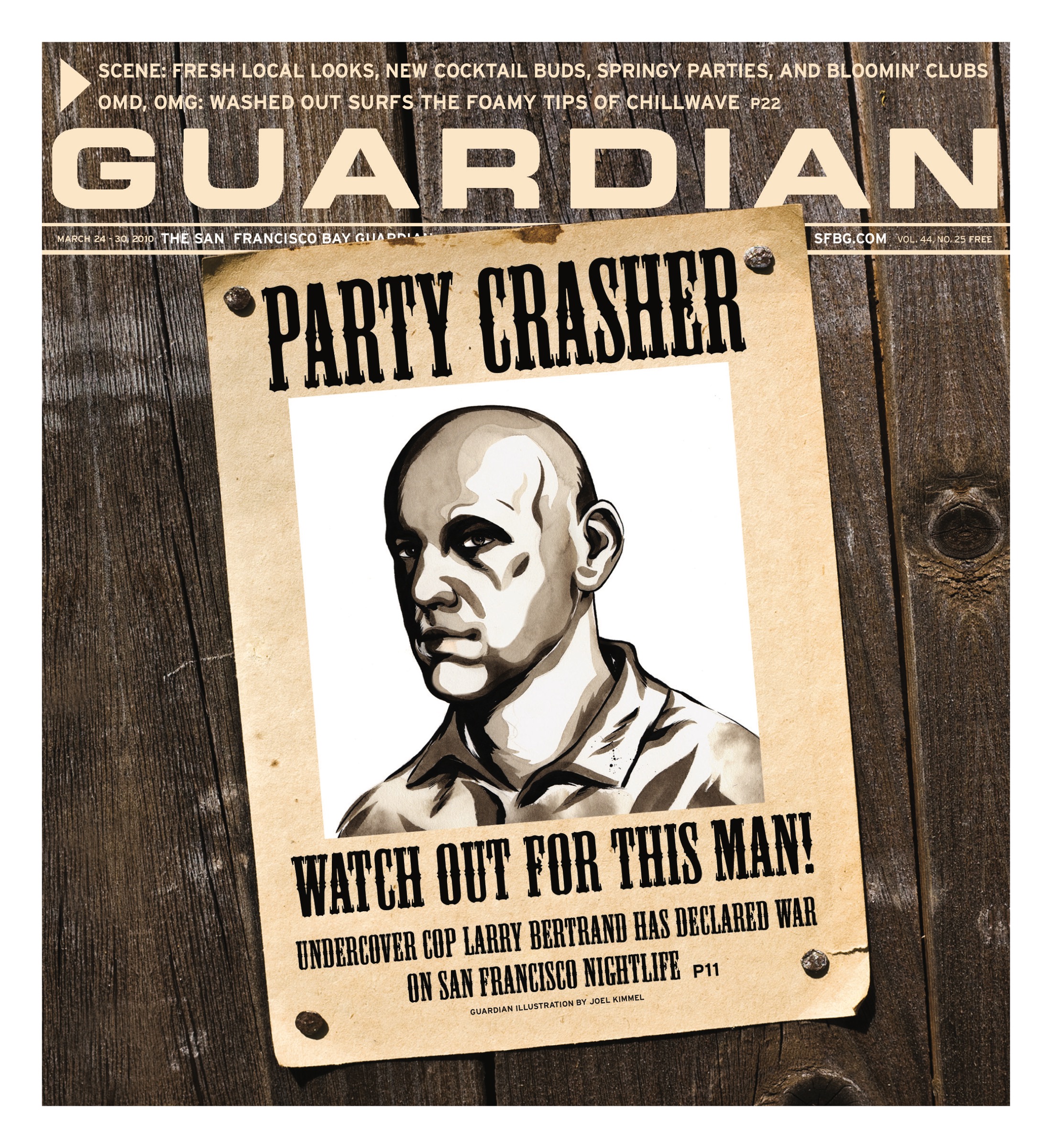
OPINION This is a call out to creative, fun-loving San Franciscans: the mayor, the police chief, and their downtown cronies have declared war on our grassroots arts culture, and they are coming for your actual and conceptual space next. The future they promise is manifest in their many recent attacks on public and private gatherings, and their efforts to wrest the commons from the commoners.

On Halloween 2009, the San Francisco Police, under their new chief, Los Angeles transplant George Gascón, shut down the Take Back Halloween Flashdance in front of the Ferry Building before DJ Amandeep "Deep" Jawa even arrived. Then they shut down several smaller street parties. Their official reason — that organizers lacked permits — is what Bill Clinton famously termed an explanation, but not an excuse.

The SFPD has a long history of not only tolerating unpermitted gatherings, but of rerouting traffic around and even escorting them. The cops are fully empowered to grant the equivalent of on-the-fly permits. Applying for an actual permit is cumbersome, costly, anti-spontaneous — and reinforces the SFPD’s view of itself as censor.

Since Halloween, Chief Gascón’s force has been striking a mighty blow against crime by writing scores of open container citations to revelers in Dolores Park; fining or forcing the closure of SoMa clubs and bars for failing to conform to every fickle letter of the law; and sending undercover officers into warehouse and studio parties to bust them from within, sometimes violently, and without warrants.

Perhaps the most un-San Franciscan of all Gascón’s initiatives is his demand for an ordinance that would literally criminalize the very act of sitting or lying on certain public sidewalks at certain times. Never mind the fact that most violent crime is committed by people standing up and in striking range.

Not only is the idea just plain mean, it is anathema to San Francisco’s culture of compassion and broadmindedness, and its affirmative celebration of vibrant street culture. The danger is not that the police will arrest everyone who dares to take a load off or sit and sip a Snapple against the side of a building, but that they will enforce the law selectively according to their own purity tests, while robbing the rest of us of the diversity and ferment which make us richer.

On March 27, reclaim space for art and innovation. Sit and lie on the public sidewalk! March and sing in the public street! Picnic on the pavement. Pop open a beer in Dolores Park. Do it without a permit. The Constitution is your permit. San Francisco’s heritage of artistic experimentation is your permit. Hell, the people telling you to get a permit flocked here because people like you marched around them in the first place and made this city inspiring. Do it for them too. This is a defining moment. They are playing for keeps, and so must we. Let’s bask in San Francisco’s ongoing heyday, not in quaint stories of what used to be.

Ben Rosenfeld is a lawyer in San Francisco.

SXSW: See me! Hear me!

0

The days tend to blur here at SXSW. The festival’s sponsors and participants are pouring information and alcohol in you everywhere you go. You forget that you are an autonomous being, not just a receptacle for emails and fliers and Sobe in small plastic cups and little goo bars that taste like chocolate stuck in carpet that are thrown — literally thrown — at you on every street corner.

Yesterday (Wed/17), however, was met with a distinct shift: awkward blue jeans and collared short sleeves were exchanged for tight black jeans and tattoo sleeves. Yes, music has come to town, which sends home the silicon boys (and a few girls), and officially ends the “interactive” portion of the festival. Austin’s Convention Center is no longer busy with necks stretched over tech, but with eyes scanning fashion and badges in order to discern the music artists from the look-a-likes. No longer am I getting stares for having an outdated laptop; rather, quick judgement looks assessing my dress and doppelgänger effect.

But this all comes with the territory of a major tech/film/music festival; everyone is trying to be seen and heard. Some more than others.


Peace-out

0

kimberly@sfbg.com

SONIC REDUCER Who would have thunk that Sonic Reducer would rattle on for so long — unreduced, unredacted, Sonic even while covering Mr. Winkle or Mundane Journeys. It’s been more than seven years since Cheetah Chrome gave me the casual A-OK to borrow the name of his song, and now the end is nigh: this is the final SR in the Guardian, but what a deliciously lengthy, rich, overwhelming run it has had.

Scanning the first Jan. 7, 2003, column — chock-full of New Year’s Eve tidbits concerning one of Dengue Fever’s first shows in SF, Bud E. Luv’s turn as the Ozzy and Sharon Osbourne’s NYE attraction (playing big band versions of “Iron Man,” natch, amid strippers and absurdly outsized sex toys), and an evening out to the Coachwhips/Pink and Brown-reunion house party in a South Van Ness basement, trapped by a moat of mud, buffeted by revelers, and besieged by circuit-breaking blackouts. Lo, there was also scandalous news of rumored onstage fellatio at a Tigerbeat6 showcase and an update on Kimo’s efforts to halt the sonic seepage at its ear-bleed noise shows.

The early ’00s in SF were a giddy, madly experimental, and hyperfertile period for local music — a delirious convergence of imaginations cocked and loaded by the dot-com gold rush, exploded with the blizzard of pink slips and the onset of plentiful time and energy, and the excitement of so many ripe minds coming together — oof — at once, if from widely divergent corners of the cultural landscape: how else to explain the peaceful coexistence of Joanna Newsom and Caroliner, Deerhoof and Comets on Fire, Soft Pink Truth and Hunx and His Punx, Vetiver and Turf Talk, the Morning Benders and the Lovemakers, the Oh Sees and every other band John Dwyer has been involved in, in this fair citay?

Perhaps one day I’ll boil down these 350-plus columns — snipes, jests, always-in-good-fun jabs, and all — and come up with a rough sketch of this equally rough and rewarding zero-hour decade’s blurry contours. In the meantime, glancing hazily back over past columns, I unearthed a few highlights — from lowlifes or bright lights:

Mark Pauline of Survival Research Laboratories on not performing in Europe, 2003: “We were good enough to cause national alerts and bad international events, so we never got asked back. Again, good work.”

eXtreme Elvis on SF, 2003: “Too much of culture that surrounds San Francisco has to do with that idea of no spectators. No spectators means everyone’s a DJ, everyone plays didgeridoo, everyone has a band, everyone is a spoken-word artist. There’s a kind of culture of narcissism — guilty as charged, right?”

Inca Ore’s Eva Saelens on touring, 2006: “When you break through, it’s like being in another world. Sometimes I’ll try to push an explosion or try to lose my mind, and if you do that on a nightly basis, it’s unreliable and it’s also abusive. You’re pushing your emotions in an athletic way, almost.”

Nick Cave on Grinderman, 2007: “An overriding theme of mine is, I guess, a man and a woman against the world. But for this record, the woman seems to be down in the street, engaged in life, and the man is kind of left on his own, with, um, y’know, a tube of complimentary shampoo and a sock.”

The Cure’s Robert Smith on dumb pop, 2007: “I’m saying that most good pop singles are stupid — otherwise they’re not good pop singles. I’m from an age when disposable wasn’t necessarily a bad thing.”

Joe Boyd on music book signings, 2007: “I can tell you what the queue looks like. There’s a lot of beards. There’s a lot of bald pates. There’s a lot of gray hair, and every once in a while there’s a 20-something woman in the queue, and then you kind of make sure your hair is combed straight. Then she comes up to the head of the queue and says, ‘Will you please sign it “To Peter”? It’s for my father for his 60th birthday.'”

Lady Gaga on pop perfection, 2008: ” If it isn’t flawless, I gotta work myself up to where it is — otherwise I’m just another pop chick with blonde hair.”

Will Oldham on music, 2008: “You can find in music just about any ideal emotional landscape you crave, whether it’s angst or rebellion or celebration or union or dissolution. It’s all there, and none of it’s going to call you back or text you at four o’clock in the morning or blame you for anything you did or didn’t do or slap you with a paternity suit.”

Six Organs of Admittance’s Ben Chasny on “Ewok Song,” 2009: “I know it by heart, and it’s the precursor to all these kids with wizard hats. It all comes down to the Ewoks singing around the fire. Akron/Family ain’t got nothing on the Ewoks, man.”

Laurent Brancowitz of Phoenix on his old Daft Punk bandmates, 2009: “They decided to go to a lot of rave parties, and I didn’t, because I didn’t like the nightclub life. I’m a bit of a snob about it — I find it very vulgar.”

Jarvis Cocker on his song “Caucasian Blues,” 2009: “I was interested in how blues music has gone from the music of protest, of the oppressed, to the blandest, safest music for white people to listen to in bars.”

Oh, but that was then — and I loathe nostalgia, if that isn’t already clear from the past seven years of cranky natterings and screams at the sky against boring, snorey Sha Na Na-style regurgitations. And this is now. Look for more from me in these and other pages, but never look back in regret.

Film listings

0

Film listings are edited by Cheryl Eddy. Reviewers are Kimberly Chun, Michelle Devereaux, Max Goldberg, Dennis Harvey, Johnny Ray Huston, Erik Morse, Louis Peitzman, Lynn Rapoport, Ben Richardson, and Matt Sussman. The film intern is Peter Galvin. For rep house showtimes, see Rep Clock. For first-run showtimes, see Movie Guide.

SF INTERNATIONAL ASIAN AMERICAN FILM FESTIVAL

The 28th San Francisco International Asian American Film Festival runs through Sun/21 at the Sundance Kabuki, 1881 Post, SF; Viz Cinema, 1746 Post, SF; Clay, 2261 Fillmore, SF; Pacific Film Archive, 2575 Bancroft, Berk; and Camera 12 Cinemas, 201 South Second St, San Jose. Tickets (most shows $12) available at www.asianamericanmedia.org. All times pm.

WED/17

PFA Agrarian Utopia 7. Mundane History 9:20.

Sundance Kabuki "Classic Filipino American Shorts" (shorts program) 4:15. God is D_ad 4:30. "FutureStates" (shorts program) 6:45. Wo Ai Ni Mommy 7. You Have Been Weighed and Found Wanting 9:15. Aoki 9:30.

Viz "Memory Vessels and Phantom Traces" (shorts program) 4:45. Ninoy Aquin and the Rise of People Power 7. Dear Doctor 9:15.

THURS/18

PFA Hana, Dul, Sed… 7. Bayan Ko: My Own Country 9.

Sundance Kabuki Mundane History 5. "Wandering, Wondering" (shorts program) 5. "Blueprints for a Generation" (shorts program) 5. Au Revoir Taipei 7. "FutureStates" (shorts program) 7:15.

Viz "Sweet Dreams and Beautiful Nightmare" (shorts program) 5. Tehran Without Borders 7:30.

FRI/19

Camera Au Revoir Taipei 7.

PFA What We Talk About When We… 7. The Forbidden Door 9:10.

SAT/20

Camera Dear Doctor noon. "3rd I South Asian International Shorts" (shorts program) 2:45. Aoki 3. The People I’ve Slept With 4:45. A Village Called Versailles 5:30. Make Yourself at Home 7:15. Like You Know it All 7:45. Prince of Tears 9:15.

PFA Manila in the Claws of Neon 6. About Elly 8:30.

SUN/21

Camera "Wandering, Wondering" (shorts program) noon. Talentime 2. State of Aloha 2:15. Cooking With Stella 4:30. Fog 4:45. In the Matter of Cha Jung Hee 6:45. The Forbidden Door 7. The Message 9.

OPENING

The Bounty Hunter Gerard Butler and Jennifer Aniston play a formerly married couple who … zzzzz. Huh? Oh, whatever. (1:50)

Diary of a Wimpy Kid The agonies of middle school come to life in this kid-friendly comedy. (2:00)

The Girl on the Train André Téchiné’s beautifully photographed, ripped-from-the-headlines film explores the events that led a young Parisian girl to lie about being the victim of an anti-semitic attack. Téchiné’s dramatization fails as an account of the incident, but the film manages to evoke a powerfully mysterious tone due largely to two stellar performances, by Émilie Dequenne as the 20-something Jeanne and Catherine Deneuve as her persistent mother. Much of the running time follows Jeanne’s experiences before the fabrication, as she falls for (and moves in with) a young wrestler named Franck, before a tragic event causes Jeanne to invent the famous lie. An arty exploration into the psychology of victimization that happens to be anchored by a real-life event, The Girl on the Train may disappoint those looking for easy answers but is undeniable as a showcase for some outstanding acting. (1:42) Embarcadero, Shattuck. (Galvin)

*The Girl With the Dragon Tattoo See "Life After Death." (2:32) Albany, Embarcadero.

Mother Bong Joon-ho’s latest is a crime drama about a mentally challenged murder suspect and his formidable mother. See review at www.sfbg.com. (2:09) Clay, Shattuck.

*Neil Young Trunk Show As loose as Jonathan Demme’s prior Neil doc Heart of Gold (2006) was tidy, with a taste for rave-ups where that film emphasized the mellower country-rock side, this neck-deep wade into Young’s four-decade-plus songbook is pretty dang nirvanic. Shot at the Tower Theater in Upper Darby, PA —exactly the kind of funky old midsized venue you’d want to see him at — it’s assembled via camera and editorial choices as seemingly random yet astute as Young’s grab bag of tunes. The latter range from historic hits ("Cinnamon Girl," "Harvest," "Cowgirl in the Sand") to more recent compositions ("The Believer," "No Hidden Path") and some real obscurities from the bottom of that trunk, including a few acoustic heartbreakers. Even shown out of concert order — there’s never any sense just where we are in the audience’s evening — they meld seamlessly, the epic half-hour oceanics of "Path" just as well as something small and plaintive like "Sad Movies." Never in better voice (qualify that as you will) at age 65, surrounded by an assured band of five plus scattered oddball props and one live canvas painter, Young is the eye of this particular hurricane — even if "Like a Hurricane" is the one performance that feels a tad uninspired. If you’re a fan, this will be pretty close to sheer ecstasy. If not … well, frankly, I have absolutely no idea whether
you’ll be converted, mildly entertained, or bored to death. (1:22) Lumiere, Shattuck. (Harvey)

Repo Men Nope, not a sequel to the 1984 cult classic. Jude Law and Forest Whitaker will, however, relieve you of your futuristic mechanical organs if you can’t pay for them post-transplant. (1:53) Shattuck.

The Runaways In Floria Sigismondi’s tale of the rise and fall of a 1970s all-girl band, LA producer Kim Fowley (Michael Shannon) proclaims that the Runaways are going to save rock and roll. It’s hard to gauge the sincerity of this pronouncement, but you can certainly hear, in songs like "Cherry Bomb" and "Queens of Noise," how the band must have brightened a landscape overrun by kings of prog rock. Unfortunately, a handful of teenagers micromanaged by a sleazy, abusive nutcase proved not quite up to the task, though the band did launch the careers of metal guitarist Lita Ford (Scout Taylor-Compton) and, more famously, Joan Jett (Kristen Stewart). Sigismondi’s film entertainingly sketches the Runaways’ beginnings in glam rock fandom and gradual attainment of their own rabid fan base. We get Currie lip-synching Bowie to catcalls at the high school assembly, Jett composing "Cherry Bomb" with Fowley, glamtastic hair-and-wardrobe eye candy, pills-and-Stooges-fueled intra-band fooling around, and five teenage girls sent off sans chaperone on an international tour with substantial quantities of hard drugs in their carry-on luggage. What follows is less pretty: a capsule version of the band’s disintegration after the departure of bottoming-out 16-year-old lead singer Cherie Currie (Dakota Fanning). In a film darkened by Currie’s trajectory, Jett’s subsequent success is a feel-good coda, but it’s awkwardly attached and emblematizes one of The Runaways‘ main problems. When the band begins to fall apart, the film doesn’t know which way to turn and ends up telling no one’s story well. (1:42) Bridge. (Rapoport)

ONGOING

Ajami You may recognize the title of Yaron Shoni and Scandar Copti’s debut collaboration as one of five films nominated for a 2010 Academy Award in the Foreign Category. Though it didn’t bring home the grand prize, Ajami remains a complex and affecting story about desperation and its consequences in a religiously-mixed town in Israel. As we follow the lives of four of Ajami’s residents the narrative shifts perspective almost maddeningly, switching characters seemingly at the height of each story’s action. But once all of the stories fully intersect, the final product has the distinction of feeling both meticulously calculated and completely natural. I was most impressed to learn that Shani and Copti prepared their actors with improvised role-playing rather than scripts. By withholding what was going to happen in a scene before shooting, we are treated to looks of surprise and emotion on actor’s faces that never feel unnatural. Attaining such a level of realism may be Ajami‘s crowning achievement; it can’t have been easy to make a foreign world feel so familiar. (2:00) Embarcadero, Shattuck. (Galvin)

Alice in Wonderland Tim Burton’s take on the classic children’s tale met my mediocre expectations exactly, given its months of pre-release hype (in the film world, fashion magazines, and even Sephora, for the love of brightly-colored eyeshadows). Most folks over a certain age will already know the story, and much of the dialogue, before the lights go down and the 3-D glasses go on; it’s up to Burton and his all-star cast (including numerous big-name actors providing voices for animated characters) to make the tale seem newly enthralling. The visuals are nearly as striking as the CG, with Helena Bonham Carter’s big-headed Red Queen a particularly marvelous human-computer creation. But Wonderland suffers from the style-over-substance dilemma that’s plagued Burton before; all that spooky-pretty whimsy can’t disguise the film’s fairly tepid script. Teenage Alice (Mia Wasikowska) displaying girl-power tendencies is a nice, if not surprising, touch, but Johnny Depp’s grating take on the Mad Hatter will please only those who were able to stomach his interpretation of Willy Wonka. (1:48) Castro, Cerrito, Empire, 1000 Van Ness, SF Center, Sundance Kabuki. (Eddy)

*The Art of the Steal How do you put a price on something that’s literally priceless? The Art of the Steal takes an absorbing look at the Barnes Collection, a privately-amassed array of Post-Impressionist paintings (including 181 Renoirs) worth billions — and the many people and corporate interests who schemed to control it. Founder Albert C. Barnes was an singular character who took pride in his outsider status; he housed his art in a specially-constructed gallery far from downtown Philadelphia’s museum scene, and he emphasized education and art appreciation first and foremost. But he had no heirs, and after his death in 1951, opportunists began circling his massive collection; the slippery political and legal dealings that have unfolded since then are nearly as jaw-dropping as Barnes’ prize paintings. Philly documentarian Don Argott has a doozy of a subject here, and his skillful, even suspenseful film does it justice. (1:41) Elmwood, Opera Plaza, Smith Rafael. (Eddy)

Avatar James Cameron’s Avatar takes place on planet Pandora, where human capitalists are prospecting for precious unobtainium, hampered only by the toxic atmosphere and a profusion of unfriendly wildlife, including the Na’vi, a nine-foot tall race of poorly disguised cliches. When Jake Sully (Sam Worthington), a paraplegic ex-marine, arrives on the planet, he is recruited into the "Avatar" program, which enables him to cybernetically link with a part-human, part-Na’vi body and go traipsing through Pandora’s psychedelic underbrush. Initially designed for botanical research, these avatars become the only means of diplomatic contact with the bright-blue natives, who live smack on top of all the bling. The special effects are revolutionary, but the story that ensues blends hollow "noble savage" dreck with events borrowed from Dances With Wolves (1990) and FernGully: The Last Rainforest (1992). When Sully falls in love with a Na’vi princess and undergoes a spirit journey so he can be inducted into the tribe and fight the evil miners, all I could think of was Kevin Bacon getting his belly sliced in The Air Up There (1994). (2:42) 1000 Van Ness. (Richardson)

The Blind Side When the New York Times Magazine published Michael Lewis’ article "The Ballad of Big Mike" — which he expanded into the 2006 book The Blind Side: Evolution of a Game — nobody could have predicated the cultural windfall it would spawn. Lewis told the incredible story of Michael Oher — a 6’4, 350-pound 16-year-old, who grew up functionally parentless, splitting time between friends’ couches and the streets of one of Memphis’ poorest neighborhoods. As a sophomore with a 0.4 GPA, Oher serendipitously hitched a ride with a friend’s father to a ritzy private school across town and embarked on an unbelievable journey that led him into a upper-class, white family; the Dean’s List at Ole Miss; and, finally, the NFL. The film itself effectively focuses on Oher’s indomitable spirit and big heart, and the fearless devotion of Leigh Anne Tuohy, the matriarch of the family who adopted him (masterfully played by Sandra Bullock). While the movie will delight and touch moviegoers, its greatest success is that it will likely spur its viewers on to read Lewis’ brilliant book. (2:06) Elmwood, Oaks. (Daniel Alvarez)

Brooklyn’s Finest "Really? I mean, really?" asked the moviegoer beside me as the final freeze-frame of Brooklyn’s Finest slapped our eyeballs. Yes, that’s the sound of letdown, despite the fact that Brooklyn’s Finest initially resembled a promisingly gritty juggling act in the mode of The Wire and Cop Land (1997), Taxi Driver (1976) and Training Day (2001). Bitter irony flows from the title — and from the lives, loves, bad habits, pressure-cooker stress, and unavoidable moral dilemmas of three would-be everyday cops, all occupying several different rungs on a food chain where right and wrong have an unpleasant way of switching sides. Eddie (Richard Gere) is the veteran officer just biding his time till he gets his pension, all while comforting himself with the meager sensuous attentions of hooker Chantel (Shannon Kane). Sal (Ethan Hawke) is the bad detective, stealing from the dealers to fund a dream home for his growing family with Angela (Lili Taylor). Tango (Don Cheadle) is the undercover detective who has cultivated friendships with dealers like Caz (Wesley Snipes) and sacrificed his marriage for a long-promised promotion from his lieutenant (Will Patton) and his superior (Ellen Barkin, in likely the most misogynist portrayal of a lady with a badge to date). You spend most of Brooklyn’s Finest waiting for these cops to collide in the most unfortunate, messiest way possible, but instead the denouement leaves will leave one wondering about unresolved threads and feeling vaguely unsatisfied. In any case, director Antoine Fuqua and company seem to pride themselves on their tough-minded if at times cartoonish take on law enforcement, with Hawke in particular turning in a memorably OTT and anguished performance. (2:13) 1000 Van Ness, Shattuck. (Chun)

The Crazies Disease and anti-government paranoia dovetail in this competent yet overwhelmingly non-essential remake of one of George A. Romero’s second-tier spook shows. In a small Iowa hamlet overseen by a benevolent sheriff (Timothy Olyphant) and his pregnant wife (Radha Mitchell), who’s also the town doctor, a few odd incidents snowball into all-out chaos when a mysterious, unmarked plane crashes into the local water supply. Before long, the few residents who aren’t acting like homicidal maniacs are rounded up by an uber-aggressive military invasion. Though our heroes convey frantic panic as they try to figure out what the hell is going on, The Crazies never achieves full terror mode. It’s certainly watchable, and even enjoyable at times. But memorable? Not in the slightest. (1:41) 1000 Van Ness. (Eddy)

Crazy Heart "Oh, I love Jeff Bridges!" is the usual response when his name comes up every few years for Best Actor consideration, usually via some underdog movie no one saw, and the realization occurs that he’s never won an Oscar. The oversight is painful because it could be argued that no leading American actor has been more versatile, consistently good, and true to that elusive concept "artistic integrity" than Bridges over the last 40 years. It’s rumored Crazy Heart was slotted for cable or DVD premiere, then thrust into late-year theater release in hopes of attracting Best Actor momentum within a crowded field. Lucky for us, this performance shouldn’t be overlooked. Bridges plays "Bad" Blake, a veteran country star reduced to playing bars with local pickup bands. His slide from grace hasn’t been helped by lingering tastes for smoke and drink, let alone five defunct marriages. He meets Jean (Maggie Gyllenhaal), freelance journalist, fan, and single mother. They spark; though burnt by prior relationships, she’s reluctant to take seriously a famous drunk twice her age. Can Bad handle even this much responsibility? Meanwhile, he gets his "comeback" break in the semi-humiliating form of opening for Tommy Sweet (Colin Farrell) — a contemporary country superstar who was once Bad’s backup boy. Tommy offers a belated shot at commercial redemption; Jean offers redemption of the strictly personal kind. There’s nothing too surprising about the ways in which Crazy Heart both follows and finesses formula. You’ve seen this preordained road from wreckage to redemption before. But actor turned first-time director Scott Cooper’s screenplay honors the flies in the windshield inherited from Thomas Cobb’s novel — as does Bridges, needless to say. (1:51) Lumiere, Piedmont, 1000 Van Ness, Shattuck, Sundance Kabuki. (Harvey)

*An Education The pursuit of knowledge — both carnal and cultural — are at the tender core of this end-of-innocence valentine by Danish filmmaker Lone Scherfig (who first made her well-tempered voice heard with her 2000 Dogme entry, Italian for Beginners), based on journalist Lynn Barber’s memoir. Screenwriter Nick Hornby breaks further with his Peter Pan protagonists with this adaptation: no man-boy mopers or misfits here. Rather, 16-year-old schoolgirl Jenny (Carey Mulligan) is a good girl and ace student. It’s 1961, and England is only starting to stir from its somber, all-too-sober post-war slumber. The carefully cloistered Jenny is on track for Oxford, though swinging London and its high-style freedoms beckon just around the corner. Ushering in those freedoms — a new, more class-free world disorder — is the charming David (Peter Sarsgaard), stopping to give Jenny and her cello a ride in the rain and soon proffering concerts and late-night suppers in the city. He’s a sweet-faced, feline outsider: cultured, Jewish, and given to playing fast and loose in the margins of society. David can see Jenny for the gem she is and appreciate her innocence with the knowing pleasure of a decadent playing all the angles. The stakes are believably high, thanks to An Education‘s careful attention to time and place and its gently glamored performances. Scherfig revels in the smart, easy-on-eye curb appeal of David and his friends while giving a nod to the college-educated empowerment Jenny risks by skipping class to jet to Paris. And Mulligan lends it all credence by letting all those seduced, abandoned, conflicted, rebellious feelings flicker unbridled across her face. (1:35) Oaks, Smith Rafael. (Chun)

*The Ghost Writer Roman Polanski’s never-ending legal woes have inspired endless debates on the interwebs and elsewhere; they also can’t help but add subtext to the 76-year-old’s new film, which is chock full o’ anti-American vibes anyway. It’s also a pretty nifty political thriller about a disgraced former British Prime Minister (Pierce Brosnan) who’s hanging out in his Martha’s Vineyard mansion with his whip-smart, bitter wife (Olivia Williams) and Joan Holloway-as-ice-queen assistant (Kim Cattrall), plus an eager young biographer (Ewan McGregor) recently hired to ghost-write his memoirs. But as the writer quickly discovers, the politician’s past contains the kinds of secrets that cause strange cars with tinted windows to appear in one’s rearview mirror when driving along deserted country roads. Polanski’s long been an expert when it comes to escalating tension onscreen; he’s also so good at adding offbeat moments that only seem tossed-off (as when the PM’s groundskeeper attempts to rake leaves amid relentless sea breezes) and making the utmost of his top-notch actors (Tom Wilkinson and Eli Wallach have small, memorable roles). Though I found The Ghost Writer‘s ZOMG! third-act revelation to be a bit corny, I still didn’t think it detracted from the finely crafted film that led up to it. (1:49) California, Embarcadero, Piedmont, Sundance Kabuki. (Eddy)

Green Zone Titled for the heavily-guarded headquarters of international occupation in Baghdad, Green Zone reunites director Paul "Shaky-Cam" Greengrass with star Matt Damon, the two having previously collaborated on the last two Bourne films. Instead of a super-soldier, this time around Damon just plays a supremely insubordinate one as he attempts to uncover the reason why his military unit can’t find any of Saddam’s WMDs. With the aid of the CIA, a Wall Street Journal reporter and a friendly Iraqi, Damon goes rogue in order to suss out the source of the misinformation. The Iraq War action is decent if scarce, but an overindulgence in (you guessed it) shaky-cam and political jargon cannot hide the fact that Green Zone‘s plot is simplistic and probably light on actual facts. Damon makes a fine cowboy-cum-hero, but the effectiveness of the mix of patriotism and Pentagon paranoia will vary based on your penchant for such things. Still, Green Zone moves fast enough that it remains worth a matinee for conspiracy thriller aficionados. (1:55) California, Empire, 1000 Van Ness, Piedmont, Sundance Kabuki. (Galvin)

The Hurt Locker When the leader of a close-knit U.S. Army Explosive Ordnance Disposal squad is killed in action, his subordinates have barely recovered from the shock when they’re introduced to his replacement. In contrast to his predecessor, Sgt. James (Jeremy Renner) is no standard-procedure-following team player, but a cocky adrenaline junkie who puts himself and others at risk making gonzo gut-instinct decisions in the face of live bombs and insurgent gunfire. This is particularly galling to next-in-command Sanborn (Anthony Mackie). An apolitical war-in-Iraq movie that’s won considerable praise for accuracy so far from vets (scenarist Mark Boal was "embedded" with an EOD unit there for several 2004 weeks), Kathryn Bigelow’s film is arguably you-are-there purist to a fault. While we eventually get to know in the principals, The Hurt Locker is so dominated by its seven lengthy squad-mission setpieces that there’s almost no time or attention left for building character development or a narrative arc. The result is often viscerally intense, yet less impactful than it would have been if we were more emotionally invested. Assured as her technique remains, don’t expect familiar stylistic dazzle from action cult figure Bigelow (1987’s Near Dark, 1989’s Blue Steel, 1991’s Point Break) — this vidcam-era war movie very much hews to the favored current genre approach of pseudo-documentary grainy handheld shaky-cam imagery. (2:11) Cerrito, Opera Plaza, Shattuck. (Harvey)

*The Last Station Most of the buzz around The Last Station has focused on Helen Mirren, who takes the lead as the Countess Sofya, wife of Leo Tolstoy (Christopher Plummer). Mirren is indeed impressive — when is she not? — but there’s more to the film than Sofya’s Oscar-worthy outbursts. The Last Station follows Valentin Bulgakov (James McAvoy), hired as Tolstoy’s personal secretary at the end of the writer’s life. Valentin struggles to reconcile his faith in the anarchist Christian Tolstoyan movement with his sympathy for Sofya and his budding feelings for fellow Tolstoyan Masha (Kerry Condon). For the first hour, The Last Station is charming and very funny. Once Tolstoy and Sofya’s relationship reaches its most volatile, however, the tone shifts toward the serious — a trend that continues as Tolstoy falls ill. After all the lighthearted levity, it’s a bit jarring, but the solid script and accomplished cast pull The Last Station together. Paul Giamatti is especially good as Vladimir Chertkov, who battles against Sofya for control of Tolstoy’s will. You’ll never feel guiltier for putting off War and Peace. (1:52) Albany, Opera Plaza. (Peitzman)

*The Most Dangerous Man in America: Daniel Ellsberg and the Pentagon Papers For many, Daniel Ellsberg is a hero — a savior of American First Amendment rights and one of the most outspoken opponents of the Vietnam war. But as this documentary (recently nominated for an Academy Award) shows, it’s never an an easy decision to take on the U.S. government. Ellsberg himself narrates the film and details his sleepless nights leading up to the leak of the Pentagon Papers — the top secret government study on the Vietnam war — to the public. Though there are few new developments in understanding the particulars of the war or the impact the release of the Papers had on ending the conflict, the film allows audiences to experience the famous case from Ellsberg’s point of view, adding a fresh and poignantly human element to the events; it’s a political documentary that plays more like a character drama. Whether you were there when it happened or new to the story, there is something to be appreciated from this tale of a man who fell out of love with his country and decided to do something about it. (1:34) Shattuck, Smith Rafael. (Galvin)

*North Face You’ll never think of outerwear the same way again — and in fact you might be reaching for your fleece and shivering through the more harrowing climbing scenes of this riveting historical adventure based on a true tale. Even those who consider themselves less than avid fans of outdoor survival drama will find their eyes frozen, if you will, on the screen when it comes to this retelling/re-envisioning of this story, legendary among mountaineers, of climbers, urged on by Nazi propaganda, to tackle the last "Alpine problem." At issue: the unclimbed north face of Switzerland’s Eiger, a highly dangerous and unpredictable zone aptly nicknamed "Murder Wall." Two working-class friends, Toni Kurz (Benno Fürmann of 2008’s Jerichow) and Andi Hinterstoisser (Florian Lukas) — here portrayed as climbing fiends driven to reach summits rather than fight for the Nazis — take the challenge. There to document their achievement, or certain death, is childhood friend and Kurz’s onetime sweetheart Luise (Johanna Wokalek, memorable in 2008’s The Baader Meinhof Complex), eager to make her name as a photojournalist while fending off the advances of an editor (Ulrich Tukur) seeking to craft a narrative that positions the contestants as model Aryans. But the climb — and the Eiger, looming like a mythical ogre — is the main attraction here. Filmmaker Philipp Stölzl brings home the sheer heart-pumping exhilaration and terror associated with the sport — and this specific, legendarily tragic climb — by shooting in the mountains with his actors and crew, and the result goes a way in redeeming an adventure long-tainted by its fascist associations. (2:01) Smith Rafael. (Chun)

Our Family Wedding America Ferrera and Lance Gross play a couple of lovebirds who must jump through some serious family hoops before they get married in the mostly serviceable Our Family Wedding. What begins as a dual Guess Who’s Coming to Dinner, with the differences in each family’s traditions forcing complications and compromises, soon loses sight of its matrimonial plot as the focus steers towards a childish rivalry between the fathers. While it’s being marketed as a goofy comedy, the final product seeks a relatively sentimental tone, which makes the few slapstick moments — like a goat trying to rape Academy Award-winning actor Forest Whitaker — seem pretty inappropriate. Still, for some audiences the well-tread plot will act as comfort food: they fight, they make up, and it all ends in a big wedding where we watch the characters dance for damn near ten minutes. (1:41) 1000 Van Ness. (Galvin)

*Percy Jackson and the Olympians: The Lightning Thief It would be easy to dismiss Percy Jackson and the Olympians: The Lightning Thief as an unabashed Harry Potter knock-off. Trio of kids with magic powers goes on a quest to save the world in a Chris Columbus adaptation of a popular young adult series — sound familiar? But The Lightning Thief is sharp, witty, and a far cry from Columbus’ joyless adaptation of Harry Potter and the Sorcerer’s Stone (2001). Logan Lerman stars as Percy Jackson, the illegitimate son of Poseidon and Catherine Keener. Once he learns his true identity at Camp Half-Blood, he sets off on a quest with his protector, a satyr named Grover, and potential love interest Annabeth, daughter of Athena. Along the way, they bump into gods and monsters from Greek mythology — with a twist. Think Percy using his iPhone to fight Medusa (Uma Thurman), or a land of the Lotus-Eaters disguised as a Lady Gaga-blasting casino. A worthy successor to Harry Potter? Too soon to say, but The Lightning Thief is at least a well-made diversion. (1:59) 1000 Van Ness. (Peitzman)

*A Prophet Filmmaker Jacques Audiard has described his new film, A Prophet, as "the anti-Scarface." Yet much like Scarface (1983), A Prophet bottles the heady euphoria that chases the empowerment of the powerless and the rise of the long-shot loner on the margins. In its almost-Dickensian attention to detail, devotion to its own narrative complexity, and passion for cinematic poetry, A Prophet rises above the ordinary and, through the prism of genre, finds its own power. The supremely opportunistic, pragmatically Machiavellian intellectual and spiritual education of a felon is the chief concern of here. Played by Tahar Rahim with guileless, open-faced charisma, Malik is half-Arab and half-Corsican — and distrusted or despised by both camps in the pen. When he lands in jail for his six-year sentence, he’s 19, illiterate, friendless, and vulnerable. His deal with the devil — and means of survival — arrives with Reyeb (Hichem Yacoubi), temporarily locked up before his testifies against the mob. Corsican boss Cesar Luciani (Niels Arestrup) wants him dead, and Malik is tagged to penetrate Reyeb’s cell with a blade hidden in mouth. After Malik’s gory rebirth, it turns out that the teenager’s a seer in more ways than one. From his low-dog position, he can eyeball the connections linking the drugs entering the prison to those circulating outside, as well as the machinations intertwining the Arab and Corsican syndicates. It’s no shock that when Cesar finds his power eroding and arranges prison leaves for his multilingual crossover star that Malik serves not only his Corsican master, but also his own interests, and begins to build a drug empire rivaling his teacher’s. Throughout his pupil’s progress, Audiard demonstrates a way with Henri Cartier-Bresson’s decisive moment, and when Malik finally breaks with his Falstaffian patriarch, it makes your heart skip a beat in a move akin to the title of the director’s last film. This Eurozone/Obama-age prophet is all about the profit — but he’s imbued with grace, even while gaming for ill-gotten gain. (2:29) Embarcadero, Shattuck, Smith Rafael. (Chun)

Remember Me Ominously set in New York City during the summer of 2001, Remember Me, starring Robert Pattinson (of the Twilight series) and Emilie de Ravin (of TV’s Lost), pretty much answers the question of whether it’s still too soon to make the events of September 11 the subject of a date movie. Or rather, not the subject so much as the specter waiting just off-camera for its walk-on while brooding 21-year-old Tyler Hawkins (Pattinson) quotes Gandhi, gets into brawls, gets drunk, writes letters to his dead brother, and otherwise channels despondency and rage into various salubrious outlets. One of these is romancing (under circumstances severely testing the viewer’s credulity) de Ravin’s Ally Craig, grappling somewhat more constructively with her own familial tragedy. Ally is the sort of self-possessed, strong-willed young woman whose instincts, shortly after she’s been backhanded by her drunk father (Chris Cooper), tell her to placate and have sex with her drunk boyfriend when he comes home enraged after battling his own father (Pierce Brosnan). She is there to teach Tyler, through quirky habits like eating dessert first, what director Allen Coulter (2006’s Hollywoodland) wishes to teach us: that time is short and one must fill one’s life with meaningful actions — like throwing a fire extinguisher through a window to convince a classroom of tweens to stop bullying one’s little sister. The film is seeded with allusions to an impending catastrophe that feels less integrated than exploited. And it’s uncomfortable seeing the fall of the towers used to make the ground shake under a sweet, fairly depthless depiction of love and grief. (2:08) Empire, 1000 Van Ness, Sundance Kabuki. (Rapoport)

She’s Out of My League From the co-writers of the abysmal Sex Drive (2008), She’s Out of My League could be another 90-minute assemblage of gross-out humor, dick jokes, and unabashed homophobia. As it turns out, the latest offering from Sean Anders and John Morris is legitimately funny — far better than the trailer (and that half-assed title) would have you believe. The adorkable Jay Baruchel stars as Kirk, a hapless loser who finds himself dating bonafide hottie Molly (Alice Eve). Once you get past the film’s silly conceit — Kirk’s only "movie ugly," and personality goes a long way — you’re left with a surprisingly charming comedy. The characters are amusing and the wit is sharp. Not to mention the fact that She’s Out of My League offers a downright heartfelt message. There’s a sincerity here that feels genuine instead of just tacked-on: yeah, yeah, it’s about what’s inside that counts, but there’s more to it than that. Ignore the dreadful "jizz in my pants" scene, and the movie’s almost an old-fashioned romcom. (1:44) Elmwood, Oaks, 1000 Van Ness, SF Center. (Peitzman)

Shutter Island Director Martin Scorsese and muse du jour Leonardo DiCaprio draw from oft-filmed novelist Dennis Lehane (2003’s Mystic River, 2007’s Gone Baby Gone) for this B-movie thriller that, sadly, offers few thrills. DiCaprio’s a 1950s U.S. marshal summoned to a misty island that houses a hospital for the criminally insane, overseen by a doctor (Ben Kingsley) who believes in humane, if experimental, therapy techniques. From the get-go we suspect something’s not right with the G-man’s own mind; as he investigates the case of a missing patient, he experiences frequent flashbacks to his World War II service (during which he helped liberate a concentration camp), and has recurring visions of his spooky dead wife (Michelle Williams). Whether or not you fall for Shutter Island‘s twisty game depends on the gullibility of your own mind. Despite high-quality performances and an effective, if overwrought, tone of certain doom, Shutter Island stumbles into a third act that exposes its inherently flawed and frustrating storytelling structure. If only David Lynch had directed Shutter Island — it could’ve been a classic of mindfuckery run amok. Instead, Scorsese’s psychological drama is sapped of any mystery whatsoever by its stubbornly literal conclusion. (2:18) California, 1000 Van Ness, Sundance Kabuki. (Eddy)

A Single Man In this adaptation of Christopher Isherwood’s 1964 novel, Colin Firth plays George, a middle-aged gay expat Brit and college professor in 1962 Los Angeles. Months after the accidental death of Jim (Matthew Goode), his lover for 16 years, George still feels worse than bereft; simply waking each morning is agony. So on this particular day he has decided to end it all, first going through a series of meticulous preparations and discreet leave-takings that include teaching one last class and having supper with the onetime paramour (Julianne Moore) turned best friend who’s still stuck on him. The main problem with fashion designer turned film director Tom Ford’s first feature is that he directs it like a fashion designer, fussing over surface style and irrelevant detail in a story whose tight focus on one hard, real-world thing — grief — cries for simplicity. Not pretentious overpackaging, which encompasses the way his camera slavers over the excessively pretty likes of Nicholas Hoult as a student and Jon Kortajarena as a hustler, as if they were models selling product rather than characters, or even actors. (In fact Kortajarena is a male supermodel; the shocker is that Hoult is not, though Hugh Grant’s erstwhile About a Boy co-star is so preening here you’d never guess.) Eventually Ford stops showing off so much, and A Single Man is effective to the precise degree it lets good work by Goode, Moore and especially the reliably excellent Firth unfold without too much of his terribly artistic interference. (1:39) 1000 Van Ness, Opera Plaza. (Harvey)

*Sweetgrass Recorded between 2001-03 by Lucien Castaing-Taylor and Ilisa Barbash, Sweetgrass immerses us in sheep farming before taking off after a pair of latter-day cowboys on a 150-mile drive through Montana’s Absaroka-Beartooth range — a journey with deep historical roots and no practical future. As its rugged scenery beggars (but ultimately unseats) projections of the pastoral, so too do its mild sheep trigger myriad symbolic associations. Sweetgrass is finally about the relationship between farmhands and their flocks, and in this, it is notably unsentimental. During long takes of shearing and birthing, the correspondent displays of violence and tenderness, much of it erotic and seemingly reflexive, speaks to the human-animal encounter Berger eulogized in 1977. The lonesome cowboys whisper sweet nothings to the dogs and hurl fantastically mismatched streams of curses at the sheep (the absence of women being the common link). Through it all, Castaing-Taylor’s camera is an embodied presence, and hard work at that. Compared with Planet Earth‘s impossible views and spectacular displacements, Sweetgrass has its feet planted on the ground. (1:41) Lumiere, Shattuck. (Goldberg)

REP PICKS

The Female Bunch Al Adamson was the Ed Wood Jr. of the late 60s and 1970s, albeit a version without any delusions of grandeur — in it for the money, he knew his ultra-cheap films were crap. This one, titled to cash in on The Wild Bunch and made the same year (though there were no distribution takers until 1971, two years later), is closer to an unacknowledged, soporific remake of Herschell Gordon Lewis’ great ’68 She-Devils on Wheels, with the deadly dames on horseback rather than motorcycles. When Sandy (Nesa Renet) is dumped by her faithless Vegas lounge singer boyfriend — and no wonder, since she behaves like a Velcro doormat — her showgirl friend Libby (peroxide-blonde perennial Adamson star and subsequent spouse Regina Carroll) recommends she join a "club" of women on a secret ranch. They smuggle drugs, have soft-core orgies (with Mexican men and each other), abuse the local "wetbacks," and enforce a strict "no men" rule on ranch property whose violation can lead to the poor sod getting branded, dragged to death, or worse. One such unfortunate is Russ Tamblyn, who sure fell hard and fast from being third-billed in Best Picture winner West Side Story just eight years prior; another is pathetic ranch hand Lon Chaney, Jr. in one of his last roles, seeming even more pathetic than called for because he was undergoing debilitating cancer treatments at the time. The "she-devil" here is serious man-hater Grace, whose thespian Jennifer Bishop also appeared in such greats as 1970’s Bigfoot (as one of the pretty girls it keeps chained in its cave), 1974’s Impulse (imperiled by William Shatner), 1969’s The Maltese Bippy, and two Hee Haw episodes. The Female Bunch was advertised with slogans including "Hot Pants — and a Fast Draw! They Treat Their Horses Better Than Their Men!" It was partially shot at the Spahn Ranch, also home at the time to Charlie Manson and company. This grade-Z opus is preceded at the Vortex Room by the very big-budget Candy (1968), an abysmal stab at Terry Southern’s porn satire whose all-star cast included everyone from Brando and Burton to Ringo Starr, Sugar Ray Robinson, John Huston, and Anita Pallenberg. Thurs/18, 9 p.m., $5, Vortex Room, 1082 Howard, SF; www.myspace.com/thevortexroom. (Harvey)

Sit-lie gets skeptical reception

35

By Skyler Swezy

On Wednesday, the Coalition on Homelessness held a press conference on City Hall’s front steps to denounce the proposed sit-lie ordinance shortly before the Police Commission convened to discuss the topic. Symbolically choosing to sit, more than 35 members of various San Francisco rights and neighborhood organizations. Speakers passed the microphone before a sparse group of journalists.

Joey Cain, representing the Haight-Ashbury Neighborhood Council, told the gathering, “There’s a lot of people from the Haight who oppose this law and we’re going to show up at every meeting to fight this thing.”

Inside City Hall, Assistant Chief Kevin Cashman gave a power point presentation before the Police Commission, explaining the sit-lie ordinance would prohibit sitting or lying on a public sidewalk between 7 a.m. and 11 p.m. and emphasized a warning would be issued before a citation.

“Our goal with this ordinance is not to cite everyone. Our goal is to change behavior,” Cashman said.

He said the police receive constant complaints from business owners in the Haight about people lying in front of their stores, however these owners rarely file an official complaint because they say they fear retaliation. He said that under current law, willful intent to obstruct must be proven in court and a third party must testify, thus the law is ineffectual.

Commissioner Petra DeJesus was the most skeptical of the proposal and thorough in her questioning of the police. “So under this new law, just the act of sitting would be a criminal act?” she asked, drawing laughter from the audience.

“Do you have any examples of how many people are blocking the sidewalks and what their status is?” she asked.

The police could not provide related statistics.

Police Capt. Teresa Barrett, whose jurisdiction includes the Haight, said local business owner and resident complaints at community meetings prompted the push for a new ordinance.

“In November, we were starting to see a trend they [community members] had not seen in many years in the Haight,” she said. However, when pressed by Commissioner Dejesus, Capt. Barret could not produce statistics or numbers that would indicate a rise in thuggish behavior or community complaints.

“Let’s do our homework and gather statistics, and see whether or not we are really having serious problems,” said Commissioner Dejesus. She remained doubtful that proper enforcement of current laws would be unable to solve aggressive or criminal behavior in the Haight.

During public commentary, anti sit-lie speakers far outnumbered those in support of a new ordinance. The creation of a “forced march”, further marginalization of troubled youth and an open-ended law that could be abused in the future, were among the fears voiced.

One long-time resident in favor of the ordinance said 20-somethings she knew avoided the bars and restaurants of Haight because of the panhandlers. “Our economy is failing because of these aggressive thugs,” she said.


Ultimately, it is the Board of Supervisors who will vote on the issue, which was filed by the Mayor’s office on March 1 and is currently under 30 day rule.


Supes pass resolution protecting SF Patrol Special Police Officers

Jane Warner, or “Officer Jane” as she’s known throughout the Castro, had a rough Christmas Eve. It started when Warner, a San Francisco Patrol Special Police officer who was out walking the foot beat, was alerted that a fight had broken out at Trigger, a bar on Market Street. When she arrived, she says she encountered a drunk and belligerent man. “He got more excited and charged the doormen, he pushed me, I pushed him back, and I said, ‘You’re under arrest,’” Warner told the Guardian shortly after the incident occurred. “He started to walk away from me, I drew my baton, I hit him twice, and he turned around and he hit me and I went to block his punch and he broke my arm,” at which point she fell to the ground in pain. “It cracked the bone right between the elbow and the shoulder,” she said.

According to a police report, several San Francisco police officers arrived on the scene shortly after and arrested the man, James Crayton McCullough. But when they arrived at the police station and tried to get him out of the police car, according to the report, he wedged his body onto the floor of the vehicle and allegedly shouted at one of them, “I’m going to shoot you in the fucking head!” Later, he was transported to San Francisco General Hospital because he had a laceration on his head, where he allegedly threatened a nurse.

Before he was through that night, he’d amassed six felony charges and three misdemeanor charges, District Attorney spokesperson Brian Buckelew told us shortly after the incident. He somehow managed to make $250,000 bail. But he was issued orders to stay 150 yards away from Warner, as well as Castro bars Trigger and Badlands. McCullough also received an order to stay out of the entire Castro neighborhood — a move Buckelew says is highly unusual.

The incident prompted Sup. Bevan Dufty to introduce a resolution to encourage San Francisco Police Chief George Gascon to consider imposing an increase in penalties for an assault on a Patrol Special Police Officer. This past Tuesday, at the Board of Supervisors meeting, that resolution was approved.

Since Warner was assaulted, other incidents have occurred in which Patrol Special Officers were placed in harm’s way, according to a press release sent out yesterday by the organization.

San Francisco’s Patrol Special Police, roughly 40 strong, is a private force dating back to the days of the Gold Rush. In a rare arrangement, they’re authorized under the City Charter to patrol different neighborhoods, hired by private clients such as merchant associations, and they adhere to regulations set by the Police Commission. While they aren’t sworn officers, they undergo a training process similar to that of SFPD officers and they make arrests. Warner describes the patrol specials’ model as a form of “community policing” which she says emphasizes crime prevention.

When asked about Dufty’s resolution in an interview with the Guardian last week, Gascon was somewhat resistant to the idea. He said he had a problem with private policing in general. “This is more of a private police model,” he said. “Their uniforms are very similar to the San Francisco Police Department. So, quite frankly to the majority of the public, it is very hard to distinguish between one and the other.”

“I understand where Supervisor Dufty’s coming from,” Gascon added. “These are people that are certainly out there providing public safety services and they sometimes become the target of people that, for whatever reason or another, they don’t want to be subject to their authority. The problem that I have again is that it continues to blur the line of a very unusual process. … There’s no question that in some places there are people who certainly are in favor of having patrol specials. This is not to take away from the quality of service that patrol special officers provide because I think some of them are very professional and they are very courteous and very effective in what they do. ”

While it’s a felony to assault a San Francisco Police Officer, there are no special charges in the penal code for an individual who commits an assault on a patrol special officer. Dufty’s resolution asks the Police Commission and Gascon to provide Patrol Specials with “the same protections that San Francisco Police Department officers and a number of others who are protected under state code from being assaulted in the line of duty.”

Appetite: Fill your Irish self to the gills at the Liberties

0

St. Patty’s Day draws near — for more wild Irish events, check out our rundown in the current Guardian.

The Liberties Bar & Restaurant has always been a welcome respite from some Irish bars: a place where you can kick it up with friends but not so rowdy that you can’t have conversation or a reflective pint. (I particularly like the room tucked to the side with quotes painted on the walls.) It celebrates St. Patty’s all week long with a special Irish menu and long pours of Guinness, Kilkenny, Smithwick’s and Harp. Oh, there’s also plenty of Irish whiskey, like Midleton Rare 21 year, Red Breast 12 year and Black Bush. Irish brunch, beer and whiskey flights round out the week, along with live music on St. Patrick’s Day.

The menu offers crowd-pleasing corned beef and cabbage ($14), cottage pie ($10 – with grass-fed beef, naturally), and bangers and mash ($15). Or go straight to fish and chips ($15) or an Irish potato pancake ($11) sporting smoked salmon. Irish whiskey flights explore various parts of the island, from Fightin’ Irish ($12), a flight highlighting family-owned distilleries, to King of the Emerald Isle ($8), an affordable jaunt through three Irish powerhouses: John Powers, Old Bushmills, Jamesons.

There’s no need to be fighting Irish when St. Patty’s is this raucously delectable.

March 13-19
998 Guerrero Street
415-282-6789
www.theliberties.com

Check out Virginia Miller’s personal dining itinerary site www.theperfectspotsf.com for more food deals and news.

Film listings

0

Film listings are edited by Cheryl Eddy. Reviewers are Kimberly Chun, Michelle Devereaux, Max Goldberg, Dennis Harvey, Johnny Ray Huston, Erik Morse, Louis Peitzman, Lynn Rapoport, Ben Richardson, and Matt Sussman. The film intern is Peter Galvin. For rep house showtimes, see Rep Clock. For first-run showtimes, see Movie Guide.

SF INTERNATIONAL ASIAN AMERICAN FILM FESTIVAL

The 28th San Francisco International Asian American Film Festival runs March 11-21 at the Castro, 429 Castro, SF; Sundance Kabuki, 1881 Post, SF; Viz Cinema, 1746 Post, SF; Clay, 2261 Fillmore, SF; Pacific Film Archive, 2575 Bancroft, Berk; and Camera 12 Cinemas, 201 South Second St, San Jose. Tickets (most shows $12) available at www.asianamericanmedia.org. All times pm.

THURS/11

Castro Today’s Special 7.

FRI/12

Clay In the Manner of Cha Jung Hee 6:45. Raspberry Magic 9. The Forbidden Door 11:59.

Pacific Film Archive Independencia 7. The Message 8:40.

Sundance Kabuki Agrarian Utopia 3:45. Talentime 4:30. City of Life and Death 6:30. Fog 7. "Scene/Unseen" (shorts program) 9:15. "Sweet Dreams and Beautiful Nightmares" (shorts program) 9:30.

SAT/13

Clay China Sings! 1:30. "An Afternoon with Aasif Madvi" (on-stage interview) 4. Dear Lemon Lima 6:15. Prince of Tears 8:45.

Pacific Film Archive In the Matter of Cha Jung Hee 3:30. Like You Know it All 5:30. City of Life and Death 8.

Sundance Kabuki "3rd I South Asian International Shorts" (shorts program) noon. State of Aloha 1. A Village Called Versailles 2:15. Insiang 3:15. Ninoy Aquino and the Rise of People Power 4:30. God is D-ad 6. A Moment in Time 7. Agrarian Utopia 8:30. "Wandering, Wondering" (shorts program) 9:15.

Viz "Up Close and Personal with the Asian American Film Industry" (workshop) 1. Aoki 3:30. "Classic Filipino American Shorts" (shorts program) 6. Make Yourself at Home 8:30.

SUN/14

Castro The Housemaid noon. The Message 2:45. The People I’ve Slept With 6. Love Aaj Kal 9.

Clay What We Talk About When We… 1. Lt. Watanda and conversation with director Freida Lee Mock 3:15. Cooking with Stella 6. Like You Know It All 8:45.

Pacific Film Archive Lessons of the Blood 3. Dear Doctor 5:30. Prince of Darkness 8.

Sundance Kabuki "Blueprints for a Generation" (shorts program) 1. Manilatown is in the Heart 2. Wo Ai Ni Mommy 3:30. Independencia 4:30. Take Me Anywhere 6. Tehran Without Permission 6:30. Mundane History 8:15. Talentime 8:30.

Viz Hold the Sun 1:15. The Mountain Thief 6. Seven Intellectuals in a Bamboo Forest: Part 4 8:15.

MON/15

Sundance Kabuki Take Me Anywhere 4. Raspberry Magic 4:30. "Memory Vessels and Phantom Traces" (shorts program) 6:45. Manilatown is in the Heart 7. About Elly 9. Dear Lemon Lima 9:15.

Viz Fog 4:30. Hold the Sun 6:45. Seven Intellectuals in a Bamboo Forest: Part 5 9.

TUES/16

Pacific Film Archive Tehran Without Permission 7. The People I’ve Slept With 8:45.

Sundance Kabuki "Scene/Unseen" (shorts program) 4:15. A Moment in Time 5. State of Aloha 6:45. Lessons of the Blood 7. The Mountain Theif 9. Hana, Dul, Sed… 9:30.

Viz Make Yourself at Home 4:15. The Bonesetter’s Daughter (work-in-progress) 6:40. A Village Called Versailles 9.

OPENING

Ajami You may recognize the title of Yaron Shoni and Scandar Copti’s debut collaboration as one of five films nominated for a 2010 Academy Award in the Foreign Category. Though it didn’t bring home the grand prize, Ajami remains a complex and affecting story about desperation and its consequences in a religiously-mixed town in Israel. As we follow the lives of four of Ajami’s residents the narrative shifts perspective almost maddeningly, switching characters seemingly at the height of each story’s action. But once all of the stories fully intersect, the final product has the distinction of feeling both meticulously calculated and completely natural. I was most impressed to learn that Shani and Copti prepared their actors with improvised role-playing rather than scripts. By withholding what was going to happen in a scene before shooting, we are treated to looks of surprise and emotion on actor’s faces that never feel unnatural. Attaining such a level of realism may be Ajami‘s crowning achievement; it can’t have been easy to make a foreign world feel so familiar. (2:00) Embarcadero. (Galvin)

*The Art of the Steal How do you put a price on something that’s literally priceless? The Art of the Steal takes an absorbing look at the Barnes Collection, a privately-amassed array of Post-Impressionist paintings (including 181 Renoirs) worth billions — and the many people and corporate interests who schemed to control it. Founder Albert C. Barnes was an singular character who took pride in his outsider status; he housed his art in a specially-constructed gallery far from downtown Philadelphia’s museum scene, and he emphasized education and art appreciation first and foremost. But he had no heirs, and after his death in 1951, opportunists began circling his massive collection; the slippery political and legal dealings that have unfolded since then are nearly as jaw-dropping as Barnes’ prize paintings. Philly documentarian Don Argott has a doozy of a subject here, and his skillful, even suspenseful film does it justice. (1:41) Embarcadero, Shattuck, Smith Rafael. (Eddy)

*The Good Guy Romantic comedies often have very simple premises predicated on familiarity — you know why you go to see them, and they make sure to deliver. Much of the early goings of The Good Guy feel clichéd, but as it turns out, that’s kind of the point. Tommy (Scott Porter), a charming Wall Street investment banker, has been dating Beth (Alexis Bledel), and they’re taking things slow and sweet. When he loses one of his top sellers to another firm, Tommy decides to be a nice guy and give bumbling temp Daniel (Bryan Greenberg) a chance to shine; he also takes the time to teach him how to dress and pick up girls. But when Daniel decides to use his newfound skills on Beth &ldots; well, you see the triangle coming a mile away. How it all unfolds, however, proves far less obvious. In his writing-directing debut, Julio Depietro delivers what is very much a writer’s film, an experiment in form and expectation. Attempts to capture the culture of a Wall Street investment firm fare less well, but as a skewing of movie archetypes and presumptions, The Good Guy is surprisingly satisfying. It won’t change the rom-com game, but it’s something a little different in a genre that could use a kick in the pants. (1:31) Opera Plaza. (Galvin)

Green Zone Nope, it’s not a new Jason Bourne movie, but it is an action thriller directed by Paul Greengrass and starring Matt Damon. (1:55) California, Piedmont.

Our Family Wedding This multi-culti comedy boasts an all-star cast, including Forest Whitaker, America Ferrara, Regina King, Taye Diggs, and Carlos Mencia. (1:41) tk.

Remember Me Robert Pattinson attempts to prove his range beyond suckin’ blood. (2:08) tk.

She’s Out of My League Tale as old as time: beauty and the geek. (1:44) Oaks.

*Sweetgrass See "Wild Yonder." (1:41) Lumiere, Shattuck.

ONGOING

*"Academy Award-Nominated Short Films: Animated" Just because it’s animation doesn’t mean it’s just for kids. Like the live-action Oscar-nominated shorts, this year’s animated selections have got range, from the traditionally child-friendly to downright vulgar. Skewing heavily towards CG fare, the shorts vary from a Looney Tunes-style chase for an elderly woman’s soul (The Lady and the Reaper) to the Wallace and Gromit BBC special, A Matter of Loaf and Death. Most entertaining by far is Logorama, an action-packed tale set in a world populated by familiar trademarked logos. Any film that casts the Michelin man as a garbage-mouthed cop on the case of a renegade Ronald McDonald deserves to win all the awards in the universe. (1:35) Shattuck. (Galvin)

*"Academy Award-Nominated Short Films: Live Action" Aren’t you tired of wondering what all the fuss is about when the Academy awards their Oscar for Best Short? In an effort to give audiences a chance to play along, Shorts International is screening these less-seen works together. Though one or two of the five nominated films threaten to adhere to the Academy’s penchant for either heartbreaking or heartwarming, the majority are surprisingly oddball picks. Perhaps most odd of all is Denmark/U.S. submission The New Tenants. Feeling a tad forced but no less funny for it, Tenants draws on celebrities like Vincent D’Onofrio and comedian Kevin Corrigan to bring life to this surreal adaptation by Anders Thomas Jensen (2006’s After the Wedding). My pick would be Sweden’s gloriously goofy Instead of Abracadabra, which stars a stay-at-home slacker as he puts on a magic show for his father’s birthday. Obviously, some selections are going to be better than others, but hey, they’re shorts. If you don’t like one, just wait 10 minutes and you’ll find yourself somewhere completely different. (1:35) Shattuck. (Galvin)

Alice in Wonderland Tim Burton’s take on the classic children’s tale met my mediocre expectations exactly, given its months of pre-release hype (in the film world, fashion magazines, and even Sephora, for the love of brightly-colored eyeshadows). Most folks over a certain age will already know the story, and much of the dialogue, before the lights go down and the 3-D glasses go on; it’s up to Burton and his all-star cast (including numerous big-name actors providing voices for animated characters) to make the tale seem newly enthralling. The visuals are nearly as striking as the CG, with Helena Bonham Carter’s big-headed Red Queen a particularly marvelous human-computer creation. But Wonderland suffers from the style-over-substance dilemma that’s plagued Burton before; all that spooky-pretty whimsy can’t disguise the film’s fairly tepid script. Teenage Alice (Mia Wasikowska) displaying girl-power tendencies is a nice, if not surprising, touch, but Johnny Depp’s grating take on the Mad Hatter will please only those who were able to stomach his interpretation of Willy Wonka. (1:48) Castro, Empire, 1000 Van Ness, SF Center, Sundance Kabuki. (Eddy)

Avatar James Cameron’s Avatar takes place on planet Pandora, where human capitalists are prospecting for precious unobtainium, hampered only by the toxic atmosphere and a profusion of unfriendly wildlife, including the Na’vi, a nine-foot tall race of poorly disguised cliches. When Jake Sully (Sam Worthington), a paraplegic ex-marine, arrives on the planet, he is recruited into the "Avatar" program, which enables him to cybernetically link with a part-human, part-Na’vi body and go traipsing through Pandora’s psychedelic underbrush. Initially designed for botanical research, these avatars become the only means of diplomatic contact with the bright-blue natives, who live smack on top of all the bling. The special effects are revolutionary, but the story that ensues blends hollow "noble savage" dreck with events borrowed from Dances With Wolves (1990) and FernGully: The Last Rainforest (1992). When Sully falls in love with a Na’vi princess and undergoes a spirit journey so he can be inducted into the tribe and fight the evil miners, all I could think of was Kevin Bacon getting his belly sliced in The Air Up There (1994). (2:42) 1000 Van Ness, Sundance Kabuki. (Richardson)

The Blind Side When the New York Times Magazine published Michael Lewis’ article "The Ballad of Big Mike" — which he expanded into the 2006 book The Blind Side: Evolution of a Game — nobody could have predicated the cultural windfall it would spawn. Lewis told the incredible story of Michael Oher — a 6’4, 350-pound 16-year-old, who grew up functionally parentless, splitting time between friends’ couches and the streets of one of Memphis’ poorest neighborhoods. As a sophomore with a 0.4 GPA, Oher serendipitously hitched a ride with a friend’s father to a ritzy private school across town and embarked on an unbelievable journey that led him into a upper-class, white family; the Dean’s List at Ole Miss; and, finally, the NFL. The film itself effectively focuses on Oher’s indomitable spirit and big heart, and the fearless devotion of Leigh Anne Tuohy, the matriarch of the family who adopted him (masterfully played by Sandra Bullock). While the movie will delight and touch moviegoers, its greatest success is that it will likely spur its viewers on to read Lewis’ brilliant book. (2:06) Oaks. (Daniel Alvarez)

Brooklyn’s Finest "Really? I mean, really?" asked the moviegoer beside me as the final freeze-frame of Brooklyn’s Finest slapped our eyeballs. Yes, that’s the sound of letdown, despite the fact that Brooklyn’s Finest initially resembled a promisingly gritty juggling act in the mode of The Wire and Cop Land (1997), Taxi Driver (1976) and Training Day (2001). Bitter irony flows from the title — and from the lives, loves, bad habits, pressure-cooker stress, and unavoidable moral dilemmas of three would-be everyday cops, all occupying several different rungs on a food chain where right and wrong have an unpleasant way of switching sides. Eddie (Richard Gere) is the veteran officer just biding his time till he gets his pension, all while comforting himself with the meager sensuous attentions of hooker Chantel (Shannon Kane). Sal (Ethan Hawke) is the bad detective, stealing from the dealers to fund a dream home for his growing family with Angela (Lili Taylor). Tango (Don Cheadle) is the undercover detective who has cultivated friendships with dealers like Caz (Wesley Snipes) and sacrificed his marriage for a long-promised promotion from his lieutenant (Will Patton) and his superior (Ellen Barkin, in likely the most misogynist portrayal of a lady with a badge to date). You spend most of Brooklyn’s Finest waiting for these cops to collide in the most unfortunate, messiest way possible, but instead the denouement leaves will leave one wondering about unresolved threads and feeling vaguely unsatisfied. In any case, director Antoine Fuqua and company seem to pride themselves on their tough-minded if at times cartoonish take on law enforcement, with Hawke in particular turning in a memorably OTT and anguished performance. (2:13) 1000 Van Ness, Shattuck. (Chun)

Cop Out I think there was a plot to Cop Out — something involving a stolen baseball card and a drug ring and Jimmy (Bruce Willis) trying to pay for his daughter’s wedding. Frankly, it’s irrelevant. Kevin Smith’s take on the buddy cop genre, which partners Willis with Tracy Morgan, is more a string of dick jokes and toilet humor than anything else. Not that there’s anything wrong with that. Sometimes it’s nice to sit back and turn off your brain, as Morgan’s Paul describes his bowel movements or when hapless thief Dave (Seann William Scott) begins imitating everything our heroes say. At the same time, Cop Out is easily forgettable: Smith directed the film, but writing duties went to the Cullen Brothers of TV’s Las Vegas. All judgments about that series aside, the script lacks Smith’s trademark blend of heart and vulgarity. Even Mallrats (1995) had a beginning, a middle, and a satisfying end. Without Smith as auteur, Cop Out is worth a few laughs but destined for the bargain bin. (1:50) 1000 Van Ness. (Peitzman)

The Crazies Disease and anti-government paranoia dovetail in this competent yet overwhelmingly non-essential remake of one of George A. Romero’s second-tier spook shows. In a small Iowa hamlet overseen by a benevolent sheriff (Timothy Olyphant) and his pregnant wife (Radha Mitchell), who’s also the town doctor, a few odd incidents snowball into all-out chaos when a mysterious, unmarked plane crashes into the local water supply. Before long, the few residents who aren’t acting like homicidal maniacs are rounded up by an uber-aggressive military invasion. Though our heroes convey frantic panic as they try to figure out what the hell is going on, The Crazies never achieves full terror mode. It’s certainly watchable, and even enjoyable at times. But memorable? Not in the slightest. (1:41) 1000 Van Ness. (Eddy)

Crazy Heart "Oh, I love Jeff Bridges!" is the usual response when his name comes up every few years for Best Actor consideration, usually via some underdog movie no one saw, and the realization occurs that he’s never won an Oscar. The oversight is painful because it could be argued that no leading American actor has been more versatile, consistently good, and true to that elusive concept "artistic integrity" than Bridges over the last 40 years. It’s rumored Crazy Heart was slotted for cable or DVD premiere, then thrust into late-year theater release in hopes of attracting Best Actor momentum within a crowded field. Lucky for us, this performance shouldn’t be overlooked. Bridges plays "Bad" Blake, a veteran country star reduced to playing bars with local pickup bands. His slide from grace hasn’t been helped by lingering tastes for smoke and drink, let alone five defunct marriages. He meets Jean (Maggie Gyllenhaal), freelance journalist, fan, and single mother. They spark; though burnt by prior relationships, she’s reluctant to take seriously a famous drunk twice her age. Can Bad handle even this much responsibility? Meanwhile, he gets his "comeback" break in the semi-humiliating form of opening for Tommy Sweet (Colin Farrell) — a contemporary country superstar who was once Bad’s backup boy. Tommy offers a belated shot at commercial redemption; Jean offers redemption of the strictly personal kind. There’s nothing too surprising about the ways in which Crazy Heart both follows and finesses formula. You’ve seen this preordained road from wreckage to redemption before. But actor turned first-time director Scott Cooper’s screenplay honors the flies in the windshield inherited from Thomas Cobb’s novel — as does Bridges, needless to say. (1:51) Embarcadero, Empire, Piedmont, 1000 Van Ness, Shattuck, Sundance Kabuki. (Harvey)

*An Education The pursuit of knowledge — both carnal and cultural — are at the tender core of this end-of-innocence valentine by Danish filmmaker Lone Scherfig (who first made her well-tempered voice heard with her 2000 Dogme entry, Italian for Beginners), based on journalist Lynn Barber’s memoir. Screenwriter Nick Hornby breaks further with his Peter Pan protagonists with this adaptation: no man-boy mopers or misfits here. Rather, 16-year-old schoolgirl Jenny (Carey Mulligan) is a good girl and ace student. It’s 1961, and England is only starting to stir from its somber, all-too-sober post-war slumber. The carefully cloistered Jenny is on track for Oxford, though swinging London and its high-style freedoms beckon just around the corner. Ushering in those freedoms — a new, more class-free world disorder — is the charming David (Peter Sarsgaard), stopping to give Jenny and her cello a ride in the rain and soon proffering concerts and late-night suppers in the city. He’s a sweet-faced, feline outsider: cultured, Jewish, and given to playing fast and loose in the margins of society. David can see Jenny for the gem she is and appreciate her innocence with the knowing pleasure of a decadent playing all the angles. The stakes are believably high, thanks to An Education‘s careful attention to time and place and its gently glamored performances. Scherfig revels in the smart, easy-on-eye curb appeal of David and his friends while giving a nod to the college-educated empowerment Jenny risks by skipping class to jet to Paris. And Mulligan lends it all credence by letting all those seduced, abandoned, conflicted, rebellious feelings flicker unbridled across her face. (1:35) SF Center, Shattuck, Smith Rafael. (Chun)

Formosa Betrayed The turbulent modern history of Taiwan is certainly deserving of increased international attention, but writer-producer Will Tao’s strategy of structuring Formosa Betrayed as a political thriller is too often at odds with imparting facts and information. Set in the early 80s, the film thrusts viewers into an unraveling government conspiracy that has FBI agent Jake Kelly (James Van Der Beek) trailing the suspected murderers of a Chicago professor to Taipei. Initially, selling Dawson’s Creek alum Van Der Beek as an FBI agent seems a strange choice, but undoubtedly his name will fill seats, and Formosa Betrayed is shooting for maximum awareness. There are some scenes of real tension, but just when you are beginning to get wrapped up in the inherent drama of conspiracy and murder, the suspense is interrupted by a long-winded bout of soapboxing. Formosa Betrayed might enlighten some audiences about Taiwan’s controversial history, but it too often does so at the expense of its own watchability. You start to wonder why Tao didn’t just make a documentary. (1:43) SF Center. (Galvin)

*The Ghost Writer Roman Polanski’s never-ending legal woes have inspired endless debates on the interwebs and elsewhere; they also can’t help but add subtext to the 76-year-old’s new film, which is chock full o’ anti-American vibes anyway. It’s also a pretty nifty political thriller about a disgraced former British Prime Minister (Pierce Brosnan) who’s hanging out in his Martha’s Vineyard mansion with his whip-smart, bitter wife (Olivia Williams) and Joan Holloway-as-ice-queen assistant (Kim Cattrall), plus an eager young biographer (Ewan McGregor) recently hired to ghost-write his memoirs. But as the writer quickly discovers, the politician’s past contains the kinds of secrets that cause strange cars with tinted windows to appear in one’s rearview mirror when driving along deserted country roads. Polanski’s long been an expert when it comes to escalating tension onscreen; he’s also so good at adding offbeat moments that only seem tossed-off (as when the PM’s groundskeeper attempts to rake leaves amid relentless sea breezes) and making the utmost of his top-notch actors (Tom Wilkinson and Eli Wallach have small, memorable roles). Though I found The Ghost Writer‘s ZOMG! third-act revelation to be a bit corny, I still didn’t think it detracted from the finely crafted film that led up to it. (1:49) California, Embarcadero, Piedmont, Sundance Kabuki. (Eddy)

The Hurt Locker When the leader of a close-knit U.S. Army Explosive Ordnance Disposal squad is killed in action, his subordinates have barely recovered from the shock when they’re introduced to his replacement. In contrast to his predecessor, Sgt. James (Jeremy Renner) is no standard-procedure-following team player, but a cocky adrenaline junkie who puts himself and others at risk making gonzo gut-instinct decisions in the face of live bombs and insurgent gunfire. This is particularly galling to next-in-command Sanborn (Anthony Mackie). An apolitical war-in-Iraq movie that’s won considerable praise for accuracy so far from vets (scenarist Mark Boal was "embedded" with an EOD unit there for several 2004 weeks), Kathryn Bigelow’s film is arguably you-are-there purist to a fault. While we eventually get to know in the principals, The Hurt Locker is so dominated by its seven lengthy squad-mission setpieces that there’s almost no time or attention left for building character development or a narrative arc. The result is often viscerally intense, yet less impactful than it would have been if we were more emotionally invested. Assured as her technique remains, don’t expect familiar stylistic dazzle from action cult figure Bigelow (1987’s Near Dark, 1989’s Blue Steel, 1991’s Point Break) — this vidcam-era war movie very much hews to the favored current genre approach of pseudo-documentary grainy handheld shaky-cam imagery. (2:11) Opera Plaza, Shattuck. (Harvey)

*The Last Station Most of the buzz around The Last Station has focused on Helen Mirren, who takes the lead as the Countess Sofya, wife of Leo Tolstoy (Christopher Plummer). Mirren is indeed impressive — when is she not? — but there’s more to the film than Sofya’s Oscar-worthy outbursts. The Last Station follows Valentin Bulgakov (James McAvoy), hired as Tolstoy’s personal secretary at the end of the writer’s life. Valentin struggles to reconcile his faith in the anarchist Christian Tolstoyan movement with his sympathy for Sofya and his budding feelings for fellow Tolstoyan Masha (Kerry Condon). For the first hour, The Last Station is charming and very funny. Once Tolstoy and Sofya’s relationship reaches its most volatile, however, the tone shifts toward the serious — a trend that continues as Tolstoy falls ill. After all the lighthearted levity, it’s a bit jarring, but the solid script and accomplished cast pull The Last Station together. Paul Giamatti is especially good as Vladimir Chertkov, who battles against Sofya for control of Tolstoy’s will. You’ll never feel guiltier for putting off War and Peace. (1:52) Albany, Empire, Sundance Kabuki. (Peitzman)

*Leonard Cohen: Live at the Isle of Wight 1970 The dawn of the Me Decade saw the largest-ever music festival to that date —albeit one that was such a logistical, fiscal and hygenic disaster that it basically killed the development of similar events for years. This was the height of "music should be free" sentiments in the counterculture, with the result that many among the estimated six to eight hundred thousand attendees who overwhelmed this small U.K. island showed up without tickets, refused to pay, and protested in ways that included tearing down barrier walls and setting fires. It was a bummer, man. But after five days of starry acts often jeered by an antsy crowd — including everyone from Joni, Hendrix, Dylan, Sly Stone, the Who and the Doors to such odd bedfellows as Miles Davis, Tiny Tim, Voices of East Harlem, Supertramp, and Gilberto Gil — Canadian troubador Cohen appeared at 4 a.m. on a Monday to offer balm. Like director Murray Lerner’s 1995 Message to Love, about the festival as a whole, this footage has been shelved for decades, but it bounces right back from the dead — albeit soothingly. Cohen seems blissed out, pupils like black marbles, his between-song musings are as poetical as those fascinating lyrics, and his voice is suppler than the rasp it would soon become. Kris Kristofferson, Judy Collins, Joan Baez, and bandmate Bob Johnson offer reflections 40 years later. But the main attraction is obviously Cohen, who is magnetic even if an hour of (almost) nothing but ballads reveals how stylistically monotone his songwriting could be. (1:04) Roxie. (Harvey)

*The Most Dangerous Man in America: Daniel Ellsberg and the Pentagon Papers For many, Daniel Ellsberg is a hero — a savior of American First Amendment rights and one of the most outspoken opponents of the Vietnam war. But as this documentary (recently nominated for an Academy Award) shows, it’s never an an easy decision to take on the U.S. government. Ellsberg himself narrates the film and details his sleepless nights leading up to the leak of the Pentagon Papers — the top secret government study on the Vietnam war — to the public. Though there are few new developments in understanding the particulars of the war or the impact the release of the Papers had on ending the conflict, the film allows audiences to experience the famous case from Ellsberg’s point of view, adding a fresh and poignantly human element to the events; it’s a political documentary that plays more like a character drama. Whether you were there when it happened or new to the story, there is something to be appreciated from this tale of a man who fell out of love with his country and decided to do something about it. (1:34) Lumiere, Shattuck, Smith Rafael. (Galvin)

*North Face You’ll never think of outerwear the same way again — and in fact you might be reaching for your fleece and shivering through the more harrowing climbing scenes of this riveting historical adventure based on a true tale. Even those who consider themselves less than avid fans of outdoor survival drama will find their eyes frozen, if you will, on the screen when it comes to this retelling/re-envisioning of this story, legendary among mountaineers, of climbers, urged on by Nazi propaganda, to tackle the last "Alpine problem." At issue: the unclimbed north face of Switzerland’s Eiger, a highly dangerous and unpredictable zone aptly nicknamed "Murder Wall." Two working-class friends, Toni Kurz (Benno Fürmann of 2008’s Jerichow) and Andi Hinterstoisser (Florian Lukas) — here portrayed as climbing fiends driven to reach summits rather than fight for the Nazis — take the challenge. There to document their achievement, or certain death, is childhood friend and Kurz’s onetime sweetheart Luise (Johanna Wokalek, memorable in 2008’s The Baader Meinhof Complex), eager to make her name as a photojournalist while fending off the advances of an editor (Ulrich Tukur) seeking to craft a narrative that positions the contestants as model Aryans. But the climb — and the Eiger, looming like a mythical ogre — is the main attraction here. Filmmaker Philipp Stölzl brings home the sheer heart-pumping exhilaration and terror associated with the sport — and this specific, legendarily tragic climb — by shooting in the mountains with his actors and crew, and the result goes a way in redeeming an adventure long-tainted by its fascist associations. (2:01) Smith Rafael. (Chun)

*Percy Jackson and the Olympians: The Lightning Thief It would be easy to dismiss Percy Jackson and the Olympians: The Lightning Thief as an unabashed Harry Potter knock-off. Trio of kids with magic powers goes on a quest to save the world in a Chris Columbus adaptation of a popular young adult series — sound familiar? But The Lightning Thief is sharp, witty, and a far cry from Columbus’ joyless adaptation of Harry Potter and the Sorcerer’s Stone (2001). Logan Lerman stars as Percy Jackson, the illegitimate son of Poseidon and Catherine Keener. Once he learns his true identity at Camp Half-Blood, he sets off on a quest with his protector, a satyr named Grover, and potential love interest Annabeth, daughter of Athena. Along the way, they bump into gods and monsters from Greek mythology — with a twist. Think Percy using his iPhone to fight Medusa (Uma Thurman), or a land of the Lotus-Eaters disguised as a Lady Gaga-blasting casino. A worthy successor to Harry Potter? Too soon to say, but The Lightning Thief is at least a well-made diversion. (1:59) 1000 Van Ness. (Peitzman)

*Precious: Based on the Novel Push By Sapphire This gut-wrenching, little-engine-that-could of a film shows the struggles of Precious, an overweight, illiterate 16-year-old girl from Harlem. Newcomer Gabourey Sidibe is so believably vigilant that her performance alone could bring together the art-house viewers as well as take the Oscars by storm. But people need to actually go and experience this film. While Precious did win Sundance’s Grand Jury and Audience Award awards this year, there is a sad possibility that filmgoers will follow the current trend of "discussing" films that they’ve actually never seen. The daring casting choices of comedian Mo’Nique (as Precious’ all-too-realistically abusive mother) and Mariah Carey (brilliantly understated as an undaunted and dedicated social counselor) are attempts to attract a wider audience, but cynics can hurdle just about anything these days. What’s most significant about this Dancer in the Dark-esque chronicle is how Damien Paul’s screenplay and director Lee Daniels have taken their time to confront the most difficult moments in Precious’ story –- and if that sounds heavy-handed, so be it. Stop blahging for a moment and let this movie move you. (1:49) Roxie, Shattuck. (Jesse Hawthorne Ficks)

*Prodigal Sons Some of the best documentaries in recent years have been hijacked by their subject — or even by another subject the filmmaker wasn’t planning on. Prodigal Sons was supposed to be Kimberly Reed’s story about a high-school quarterback, basketball captain, class president, and valedictorian born to a family of Montana farmers, returning for a reunion 20 years later — albeit as a fully transitioned male-to-female transgender person attending with her female lover. That would have made for an interesting movie. What makes Sons a fascinating one is that Reed finds the camera focus stolen almost right away by a crisis in progress. Its name is Marc, adopted "problem child" of the McKerrow family (Kimberly changed her surname post-op). It’s not so much that Marc grabs the spotlight out of a jealous need for attention, though that may be a factor. It’s that he’s still trapped in a sibling relationship that for her ceased to exist — at least in its original form — decades ago. Running a gamut from harrowing to miraculous, the remarkable Prodigal Sons grows stranger than fiction when abandoned-at-birth Marc discovers something jaw-dropping about his ancestry. Suffice it to say, this results in a trip to Croatia and biological link to some of Hollywood’s starriest legends. If Kimberly’s story is about repression forcing a mentally healthy transformation, Marc wrests us away from that inspirational self-portrait. He renders Sons a challenging, head-on glimpse of mental illness with no easy answers in sight. (1:26) Lumiere, Shattuck. (Harvey)

*A Prophet Filmmaker Jacques Audiard has described his new film, A Prophet, as "the anti-Scarface." Yet much like Scarface (1983), A Prophet bottles the heady euphoria that chases the empowerment of the powerless and the rise of the long-shot loner on the margins. In its almost-Dickensian attention to detail, devotion to its own narrative complexity, and passion for cinematic poetry, A Prophet rises above the ordinary and, through the prism of genre, finds its own power. The supremely opportunistic, pragmatically Machiavellian intellectual and spiritual education of a felon is the chief concern of here. Played by Tahar Rahim with guileless, open-faced charisma, Malik is half-Arab and half-Corsican — and distrusted or despised by both camps in the pen. When he lands in jail for his six-year sentence, he’s 19, illiterate, friendless, and vulnerable. His deal with the devil — and means of survival — arrives with Reyeb (Hichem Yacoubi), temporarily locked up before his testifies against the mob. Corsican boss Cesar Luciani (Niels Arestrup) wants him dead, and Malik is tagged to penetrate Reyeb’s cell with a blade hidden in mouth. After Malik’s gory rebirth, it turns out that the teenager’s a seer in more ways than one. From his low-dog position, he can eyeball the connections linking the drugs entering the prison to those circulating outside, as well as the machinations intertwining the Arab and Corsican syndicates. It’s no shock that when Cesar finds his power eroding and arranges prison leaves for his multilingual crossover star that Malik serves not only his Corsican master, but also his own interests, and begins to build a drug empire rivaling his teacher’s. Throughout his pupil’s progress, Audiard demonstrates a way with Henri Cartier-Bresson’s decisive moment, and when Malik finally breaks with his Falstaffian patriarch, it makes your heart skip a beat in a move akin to the title of the director’s last film. This Eurozone/Obama-age prophet is all about the profit — but he’s imbued with grace, even while gaming for ill-gotten gain. (2:29) Embarcadero, Shattuck, Smith Rafael. (Chun)

Shutter Island Director Martin Scorsese and muse du jour Leonardo DiCaprio draw from oft-filmed novelist Dennis Lehane (2003’s Mystic River, 2007’s Gone Baby Gone) for this B-movie thriller that, sadly, offers few thrills. DiCaprio’s a 1950s U.S. marshal summoned to a misty island that houses a hospital for the criminally insane, overseen by a doctor (Ben Kingsley) who believes in humane, if experimental, therapy techniques. From the get-go we suspect something’s not right with the G-man’s own mind; as he investigates the case of a missing patient, he experiences frequent flashbacks to his World War II service (during which he helped liberate a concentration camp), and has recurring visions of his spooky dead wife (Michelle Williams). Whether or not you fall for Shutter Island‘s twisty game depends on the gullibility of your own mind. Despite high-quality performances and an effective, if overwrought, tone of certain doom, Shutter Island stumbles into a third act that exposes its inherently flawed and frustrating storytelling structure. If only David Lynch had directed Shutter Island — it could’ve been a classic of mindfuckery run amok. Instead, Scorsese’s psychological drama is sapped of any mystery whatsoever by its stubbornly literal conclusion. (2:18) California, 1000 Van Ness, Sundance Kabuki. (Eddy)

A Single Man In this adaptation of Christopher Isherwood’s 1964 novel, Colin Firth plays George, a middle-aged gay expat Brit and college professor in 1962 Los Angeles. Months after the accidental death of Jim (Matthew Goode), his lover for 16 years, George still feels worse than bereft; simply waking each morning is agony. So on this particular day he has decided to end it all, first going through a series of meticulous preparations and discreet leave-takings that include teaching one last class and having supper with the onetime paramour (Julianne Moore) turned best friend who’s still stuck on him. The main problem with fashion designer turned film director Tom Ford’s first feature is that he directs it like a fashion designer, fussing over surface style and irrelevant detail in a story whose tight focus on one hard, real-world thing — grief — cries for simplicity. Not pretentious overpackaging, which encompasses the way his camera slavers over the excessively pretty likes of Nicholas Hoult as a student and Jon Kortajarena as a hustler, as if they were models selling product rather than characters, or even actors. (In fact Kortajarena is a male supermodel; the shocker is that Hoult is not, though Hugh Grant’s erstwhile About a Boy co-star is so preening here you’d never guess.) Eventually Ford stops showing off so much, and A Single Man is effective to the precise degree it lets good work by Goode, Moore and especially the reliably excellent Firth unfold without too much of his terribly artistic interference. (1:39) Bridge, 1000 Van Ness, Shattuck. (Harvey)

Up in the Air After all the soldiers’ stories and the cannibalism canards of late, Up in the Air‘s focus on a corporate ax-man — an everyday everyman sniper in full-throttle downsizing mode — is more than timely; it’s downright eerie. But George Clooney does his best to inject likeable, if not quite soulful, humanity into Ryan Bingham, an all-pro mileage collector who prides himself in laying off employees en masse with as few tears, tantrums, and murder-suicide rages as possible. This terminator’s smooth ride from airport terminal to terminal is interrupted not only by a possible soul mate, fellow smoothie and corporate traveler Alex (Vera Farmiga), but a young tech-savvy upstart, Natalie (Anna Kendrick), who threatens to take the process to new reductionist lows (layoff via Web cam) and downsize Ryan along the way. With Up in the Air, director Jason Reitman, who oversaw Thank You for Smoking (2005) as well as Juno (2007), is threatening to become the bard of office parks, Casual Fridays, khaki-clad happy hours, and fly-over zones. But Up in the Air is no Death of a Salesman, and despite some memorable moments that capture the pain of downsizing and the flatness of real life, instances of snappily screwball dialogue, and some more than solid performances by all (and in particular, Kendrick), he never manages to quite sell us on the existence of Ryan’s soul. (1:49) Oaks, 1000 Van Ness, SF Center, Sundance Kabuki. (Chun)

Valentine’s Day Genre moviemaking loves it a gimmick — and nothing gets more greeting-card gimmicky or sell-by-date corny than the technique of linking holidays and those mandatory date nights out. You’re shocked that nobody thought of this chick flick notion sooner. Valentine’s Day is no My Bloody Valentine (1981, 2009) — it aspires to an older, more yupscale lady’s choice-crowd than the screaming teens that are ordinarily sought out by horror flicks. And its A-list-studded cast — including Oscar winners Julia Roberts, Jamie Foxx, and Kathy Bates as well as seemingly half of That ’70s Show‘s players — is a cut above TV tween starlets’ coming-out slasher slumber parties. It partly succeeds: bringing Valentine’s haters into the game as well as lovers is a smart ploy (although who believes that the chic-cheekbones-and-fulsome-lips crew of Jessica Biel and Jennifer Garner would be dateless on V-Day?), and the first half is obviously structured around the punchlines that punctuate each scene — a winning if contrived device. Juggling multiple storylines with such a whopping cast lends an It’s a Mad Mad Mad Mad World (1963) quality to the Jessica- and Taylor-heavy shenanigans. And some tales get a wee bit more weight than others (the charisma-laden scenes with Bradley Cooper and Roberts cry out for added screentime), creating a strangely lopsided effect that adds unwanted tedium to an affair that should be as here-today-gone-tomorrow as a Whitman’s Sampler. (1:57) 1000 Van Ness, Sundance Kabuki. (Chun)

*The White Ribbon In Michael Haneke’s The White Ribbon, his first German-language film in ten years, violence descends on a small northern German village mired in an atmosphere of feudalism and protestant repression. When, over the course of a year, a spate of unaccountable tragedies strikes almost every prominent figure as well as a powerless family of tenant farmers, the village becomes a crucible for aspersion and unease. Meanwhile, a gang of preternaturally calm village children, led by the eerily intense daughter of the authoritarian pastor, keep appearing coincidentally near the sites of the mysterious crimes, lending this Teutonic morality play an unsettling Children of the Corn undertone. Only the schoolteacher, perhaps by virtue of his outsider status, seems capable of discerning the truth, but his low rank on the social pecking order prevent his suspicions from being made public. A protracted examination on the nature of evil — and the troubling moral absolutism from which it stems. (2:24) Opera Plaza. (Nicole Gluckstern)

The Wolfman Remember 2000’s Hollow Man, an update of 1933’s The Invisible Man so over-the-top that it could only have been brought to you by a post-Starship Troopers (1997) Paul Verhoeven? Fear not, Lon Chaney, Jr. fanclub members — The Wolfman sticks fairly true to its 1941 predecessor, setting its tale of a reluctant lycanthrope in Victorian England, where there are plenty of gypsies, foggy moors, silver bullets, angry villagers, and the like. Benicia Del Toro plays Lawrence Talbot, who’s given an American childhood backstory to explain his out-of-place stateside accent (and a Mediterranean-looking mother to make up for the fact that he’s supposed to be the son of Anthony Hopkins). Soon after returning to his estranged father’s crumbling manor, Lawrence is chomped by a you-know-what. Next full moon, Lawrence realizes what he’s become; murderous rampages and much angst ensue. (He’s kind of like the Incredible Hulk, except much hairier). Director Joe Johnston (a tech whiz who worked on the original Star Wars movies, and helmed 2001’s Jurassic Park III), doesn’t offer much innovation on the werewolf legend (or any scares, for that matter). But the effects, including transformation scenes and claw-tastic gore, are predictably top-notch. (2:05) 1000 Van Ness, SF Center. (Eddy)

The Yellow Handkerchief The Yellow Handkerchief is one of those quiet, character-driven dramas that get mistaken for subtle classics. It’s not bad, just bland. In fact, there’s something pleasant about the way the film’s three unlikely friends forge a lasting bond, but the movie as a whole is never quite that cohesive. William Hurt stars as Brett Hanson, an ex-con with a dark past. (The Yellow Handkerchief tries to make this mysterious by way of vague flashbacks, but the audience gets there faster than the film does.) His inadvertent sidekicks are the troubled Martine (Kristen Stewart) and the awkward Gordy (Eddie Redmayne). The talented cast, rounded out by Maria Bello as the wife Brett left behind, does solid work with the material, but no one really stands out enough to elevate The Yellow Handkerchief to greatness. Redmayne is perhaps the most impressive, ditching his British accent to play a character so quirky, he’s almost Rain Man. But after taking a step back, the big picture is muddled. People are fascinating, but what does it all mean? (1:36) Shattuck, Sundance Kabuki. (Peitzman)

REP PICKS

*"Ben Russell: Let Each One Go Where He May" See "Wild Yonder." San Francisco Cinematheque.<\!s>

Film listings

0

Film listings are edited by Cheryl Eddy. Reviewers are Kimberly Chun, Michelle Devereaux, Max Goldberg, Dennis Harvey, Johnny Ray Huston, Erik Morse, Louis Peitzman, Lynn Rapoport, Ben Richardson, and Matt Sussman. The film intern is Peter Galvin. For rep house showtimes, see Rep Clock. For first-run showtimes, see Movie Guide.

OPENING

Alice in Wonderland Tim Burton and Johnny Depp go down the 3D rabbit hole. (1:48)

Brooklyn’s Finest "Really? I mean, really?" asked the moviegoer beside me as the final freeze-frame of Brooklyn’s Finest slapped our eyeballs. Yes, that’s the sound of letdown, despite the fact that Brooklyn’s Finest initially resembled a promisingly gritty juggling act in the mode of The Wire and Cop Land (1997), Taxi Driver (1976) and Training Day (2001). Bitter irony flows from the title — and from the lives, loves, bad habits, pressure-cooker stress, and unavoidable moral dilemmas of three would-be everyday cops, all occupying several different rungs on a food chain where right and wrong have an unpleasant way of switching sides. Eddie (Richard Gere) is the veteran officer just biding his time till he gets his pension, all while comforting himself with the meager sensuous attentions of hooker Chantel (Shannon Kane). Sal (Ethan Hawke) is the bad detective, stealing from the dealers to fund a dream home for his growing family with Angela (Lili Taylor). Tango (Don Cheadle) is the undercover detective who has cultivated friendships with dealers like Caz (Wesley Snipes) and sacrificed his marriage for a long-promised promotion from his lieutenant (Will Patton) and his superior (Ellen Barkin, in likely the most misogynist portrayal of a lady with a badge to date). You spend most of Brooklyn’s Finest waiting for these cops to collide in the most unfortunate, messiest way possible, but instead the denouement leaves will leave one wondering about unresolved threads and feeling vaguely unsatisfied. In any case, director Antoine Fuqua and company seem to pride themselves on their tough-minded if at times cartoonish take on law enforcement, with Hawke in particular turning in a memorably OTT and anguished performance. (2:13) Shattuck. (Chun)

*Prodigal Sons See "My Son, My Son." (1:26) Lumiere, Shattuck.

*A Prophet See "Education of a Felon." (2:29) Embarcadero, Shattuck.

The Yellow Handkerchief The Yellow Handkerchief is one of those quiet, character-driven dramas that get mistaken for subtle classics. It’s not bad, just bland. In fact, there’s something pleasant about the way the film’s three unlikely friends forge a lasting bond, but the movie as a whole is never quite that cohesive. William Hurt stars as Brett Hanson, an ex-con with a dark past. (The Yellow Handkerchief tries to make this mysterious by way of vague flashbacks, but the audience gets there faster than the film does.) His inadvertent sidekicks are the troubled Martine (Kristen Stewart) and the awkward Gordy (Eddie Redmayne). The talented cast, rounded out by Maria Bello as the wife Brett left behind, does solid work with the material, but no one really stands out enough to elevate The Yellow Handkerchief to greatness. Redmayne is perhaps the most impressive, ditching his British accent to play a character so quirky, he’s almost Rain Man. But after taking a step back, the big picture is muddled. People are fascinating, but what does it all mean? (1:36) Albany. (Peitzman)

ONGOING

*"Academy Award-Nominated Short Films: Animated" Just because it’s animation doesn’t mean it’s just for kids. Like the live-action Oscar-nominated shorts, this year’s animated selections have got range, from the traditionally child-friendly to downright vulgar. Skewing heavily towards CG fare, the shorts vary from a Looney Tunes-style chase for an elderly woman’s soul (The Lady and the Reaper) to the Wallace and Gromit BBC special, A Matter of Loaf and Death. Most entertaining by far is Logorama, an action-packed tale set in a world populated by familiar trademarked logos. Any film that casts the Michelin man as a garbage-mouthed cop on the case of a renegade Ronald McDonald deserves to win all the awards in the universe. (1:35) Opera Plaza, Shattuck. (Galvin)

*"Academy Award-Nominated Short Films: Live Action" Aren’t you tired of wondering what all the fuss is about when the Academy awards their Oscar for Best Short? In an effort to give audiences a chance to play along, Shorts International is screening these less-seen works together. Though one or two of the five nominated films threaten to adhere to the Academy’s penchant for either heartbreaking or heartwarming, the majority are surprisingly oddball picks. Perhaps most odd of all is Denmark/U.S. submission The New Tenants. Feeling a tad forced but no less funny for it, Tenants draws on celebrities like Vincent D’Onofrio and comedian Kevin Corrigan to bring life to this surreal adaptation by Anders Thomas Jensen (2006’s After the Wedding). My pick would be Sweden’s gloriously goofy Instead of Abracadabra, which stars a stay-at-home slacker as he puts on a magic show for his father’s birthday. Obviously, some selections are going to be better than others, but hey, they’re shorts. If you don’t like one, just wait 10 minutes and you’ll find yourself somewhere completely different. (1:35) Opera Plaza, Shattuck. (Galvin)

Avatar James Cameron’s Avatar takes place on planet Pandora, where human capitalists are prospecting for precious unobtainium, hampered only by the toxic atmosphere and a profusion of unfriendly wildlife, including the Na’vi, a nine-foot tall race of poorly disguised cliches. When Jake Sully (Sam Worthington), a paraplegic ex-marine, arrives on the planet, he is recruited into the "Avatar" program, which enables him to cybernetically link with a part-human, part-Na’vi body and go traipsing through Pandora’s psychedelic underbrush. Initially designed for botanical research, these avatars become the only means of diplomatic contact with the bright-blue natives, who live smack on top of all the bling. The special effects are revolutionary, but the story that ensues blends hollow "noble savage" dreck with events borrowed from Dances With Wolves (1990) and FernGully: The Last Rainforest (1992). When Sully falls in love with a Na’vi princess and undergoes a spirit journey so he can be inducted into the tribe and fight the evil miners, all I could think of was Kevin Bacon getting his belly sliced in The Air Up There (1994). (2:42) 1000 Van Ness, Sundance Kabuki. (Richardson)

The Blind Side When the New York Times Magazine published Michael Lewis’ article "The Ballad of Big Mike" — which he expanded into the 2006 book The Blind Side: Evolution of a Game — nobody could have predicated the cultural windfall it would spawn. Lewis told the incredible story of Michael Oher — a 6’4, 350-pound 16-year-old, who grew up functionally parentless, splitting time between friends’ couches and the streets of one of Memphis’ poorest neighborhoods. As a sophomore with a 0.4 GPA, Oher serendipitously hitched a ride with a friend’s father to a ritzy private school across town and embarked on an unbelievable journey that led him into a upper-class, white family; the Dean’s List at Ole Miss; and, finally, the NFL. The film itself effectively focuses on Oher’s indomitable spirit and big heart, and the fearless devotion of Leigh Anne Tuohy, the matriarch of the family who adopted him (masterfully played by Sandra Bullock). While the movie will delight and touch moviegoers, its greatest success is that it will likely spur its viewers on to read Lewis’ brilliant book. (2:06) Oaks. (Daniel Alvarez)

Broken Embraces Pedro Almodóvar has always dabbled in the Hitchcockian tropes of uxoricide, betrayal, and double-identity, but with Broken Embraces he has attained a polyglot, if slightly mimicking, fluency with the language of Hollywood noir. A story within a story and a movie within a movie, Embraces begins in the present day with middle-aged Catalan Harry Caine (Lluís Homar), a blind screenwriter who takes time between his successful writing career to seduce and bed young women sympathetic to his disability. "Everything’s already happened to me," he explains to his manager, Judit (Blanca Portillo). "All that’s left is to enjoy life." But this life of empty pleasures is brought to a sudden halt when local business magnate Ernesto Martel (José Luis Gómez) has died; soon after, Ernesto Jr. (Rubén Ochandiano), who has renamed himself Ray X, visits Caine with an unusual request. The action retreats 14 years when Caine was a young (and visually abled) director named Mateo Blanco; he encounters a breathtaking femme fatale, Lena (Penelope Cruz) — an actress-turned-prostitute named Severine, turned secretary-turned-trophy wife of Ernesto Martel — when she appears to audition for his latest movie. If all of the narrative intricacies and multiplicitous identities in Broken Embraces appear a bit intimidating at first glance, it is because this is the cinema of Almodóvar taken to a kind of generic extreme. As with all of the director’s post-’00 films, which are often referred to as Almodóvar’s "mature" pictures, there is a microscopic attention to narrative development combined with a frenzied sub-plotting of nearly soap-operatic proportions. But, in Embraces, formalism attains such prominence that one might speculate the director is simply going through the motions. The effect is a purposely loquacious and overly-dramatized performance that pleasures itself as much by setting up the plot as unraveling it. (2:08) Opera Plaza, Smith Rafael. (Morse)

Cop Out I think there was a plot to Cop Out — something involving a stolen baseball card and a drug ring and Jimmy (Bruce Willis) trying to pay for his daughter’s wedding. Frankly, it’s irrelevant. Kevin Smith’s take on the buddy cop genre, which partners Willis with Tracy Morgan, is more a string of dick jokes and toilet humor than anything else. Not that there’s anything wrong with that. Sometimes it’s nice to sit back and turn off your brain, as Morgan’s Paul describes his bowel movements or when hapless thief Dave (Seann William Scott) begins imitating everything our heroes say. At the same time, Cop Out is easily forgettable: Smith directed the film, but writing duties went to the Cullen Brothers of TV’s Las Vegas. All judgments about that series aside, the script lacks Smith’s trademark blend of heart and vulgarity. Even Mallrats (1995) had a beginning, a middle, and a satisfying end. Without Smith as auteur, Cop Out is worth a few laughs but destined for the bargain bin. (1:50) Oaks, 1000 Van Ness. (Peitzman)

The Crazies Disease and anti-government paranoia dovetail in this competent yet overwhelmingly non-essential remake of one of George A. Romero’s second-tier spook shows. In a small Iowa hamlet overseen by a benevolent sheriff (Timothy Olyphant) and his pregnant wife (Radha Mitchell), who’s also the town doctor, a few odd incidents snowball into all-out chaos when a mysterious, unmarked plane crashes into the local water supply. Before long, the few residents who aren’t acting like homicidal maniacs are rounded up by an uber-aggressive military invasion. Though our heroes convey frantic panic as they try to figure out what the hell is going on, The Crazies never achieves full terror mode. It’s certainly watchable, and even enjoyable at times. But memorable? Not in the slightest. (1:41) 1000 Van Ness. (Eddy)

Crazy Heart "Oh, I love Jeff Bridges!" is the usual response when his name comes up every few years for Best Actor consideration, usually via some underdog movie no one saw, and the realization occurs that he’s never won an Oscar. The oversight is painful because it could be argued that no leading American actor has been more versatile, consistently good, and true to that elusive concept "artistic integrity" than Bridges over the last 40 years. It’s rumored Crazy Heart was slotted for cable or DVD premiere, then thrust into late-year theater release in hopes of attracting Best Actor momentum within a crowded field. Lucky for us, this performance shouldn’t be overlooked. Bridges plays "Bad" Blake, a veteran country star reduced to playing bars with local pickup bands. His slide from grace hasn’t been helped by lingering tastes for smoke and drink, let alone five defunct marriages. He meets Jean (Maggie Gyllenhaal), freelance journalist, fan, and single mother. They spark; though burnt by prior relationships, she’s reluctant to take seriously a famous drunk twice her age. Can Bad handle even this much responsibility? Meanwhile, he gets his "comeback" break in the semi-humiliating form of opening for Tommy Sweet (Colin Farrell) — a contemporary country superstar who was once Bad’s backup boy. Tommy offers a belated shot at commercial redemption; Jean offers redemption of the strictly personal kind. There’s nothing too surprising about the ways in which Crazy Heart both follows and finesses formula. You’ve seen this preordained road from wreckage to redemption before. But actor turned first-time director Scott Cooper’s screenplay honors the flies in the windshield inherited from Thomas Cobb’s novel — as does Bridges, needless to say. (1:51) California, Embarcadero, Empire, Piedmont, Presidio, 1000 Van Ness, Sundance Kabuki. (Harvey)

Dear John As long as you know what you’re getting yourself into, Dear John is a solid effort. Not extraordinary by any means, it’s your standard Nicholas Sparks book-turned-film: boy meets girl — drama, angst, and untimely death ensue. Here, Channing Tatum stars at the titular John, a soldier on leave who falls in love with the seemingly perfect Savannah (Amanda Seyfried). Both actors are likable enough that their romance is charming, if not always believable. And Dear John‘s plot turns, while not quite surprising, are at least dynamic enough to keep the audience engaged. But at the end of the day, this is still a Nicholas Sparks movie — even with the accomplished Lasse Hallström taking over directorial responsibilities. There are still plenty of eye-roll moments and, more often than not, Dear John employs the most predictable tearjerking techniques. By the time you realize why the film is set in 2001, it’s September 11. Sad? Surely. Cheap? You betcha. (1:48) 1000 Van Ness, SF Center. (Peitzman)

Edge of Darkness (1:57) SF Center.

*An Education The pursuit of knowledge — both carnal and cultural — are at the tender core of this end-of-innocence valentine by Danish filmmaker Lone Scherfig (who first made her well-tempered voice heard with her 2000 Dogme entry, Italian for Beginners), based on journalist Lynn Barber’s memoir. Screenwriter Nick Hornby breaks further with his Peter Pan protagonists with this adaptation: no man-boy mopers or misfits here. Rather, 16-year-old schoolgirl Jenny (Carey Mulligan) is a good girl and ace student. It’s 1961, and England is only starting to stir from its somber, all-too-sober post-war slumber. The carefully cloistered Jenny is on track for Oxford, though swinging London and its high-style freedoms beckon just around the corner. Ushering in those freedoms — a new, more class-free world disorder — is the charming David (Peter Sarsgaard), stopping to give Jenny and her cello a ride in the rain and soon proffering concerts and late-night suppers in the city. He’s a sweet-faced, feline outsider: cultured, Jewish, and given to playing fast and loose in the margins of society. David can see Jenny for the gem she is and appreciate her innocence with the knowing pleasure of a decadent playing all the angles. The stakes are believably high, thanks to An Education‘s careful attention to time and place and its gently glamored performances. Scherfig revels in the smart, easy-on-eye curb appeal of David and his friends while giving a nod to the college-educated empowerment Jenny risks by skipping class to jet to Paris. And Mulligan lends it all credence by letting all those seduced, abandoned, conflicted, rebellious feelings flicker unbridled across her face. (1:35) Opera Plaza, Presidio, SF Center, Shattuck, Smith Rafael. (Chun)

*Fish Tank There’s been a string of movies lately pondering what Britney once called the not-a-girl, not-yet-a-woman syndrome, including 2009’s An Education and Precious: Based on the Novel Push By Sapphire. Enter Fish Tank, the gritty new drama from British filmmaker Andrea Arnold. Her films (including 2006’s Red Road) are heartbreaking, but in an unforced way that never feels manipulative; her characters, often portrayed by nonactors, feel completely organic. Fish Tank‘s 15-year-old heroine, Mia (played by first-time actor Katie Jarvis), lives with her party-gal single mom and tweenage sister in a public-housing high-rise; all three enjoy drinking, swearing, and shouting. But Mia has a secret passion: hip-hop dancing, which she practices with track-suited determination. When mom’s foxy new boyfriend, Connor (Michael Fassbender, from 2008’s Hunger) encourages her talent, it’s initially unclear what Connor’s intentions are. Is he trying to be a cool father figure, or something far more inappropriate? Without giving away too much, it’s hard to fear too much for a girl who headbutts a teenage rival within the film’s first few minutes — though it soon becomes apparent Mia’s hard façade masks a vulnerable core. Her desire to make human connections causes her to drop her guard when she needs it the most. In a movie about coming of age, a young girl’s bumpy emotional journey is expected turf. But Fish Tank earns its poignant moments honestly — most coming courtesy of Jarvis, who has soulfullness to spare. Whether she’s acting out in tough-girl mode or revealing a glimpse of her fragile inner life, Arnold’s camera relays it all, with unglossy matter-of-factness. (2:02) Smith Rafael. (Eddy)

Formosa Betrayed The turbulent modern history of Taiwan is certainly deserving of increased international attention, but writer-producer Will Tao’s strategy of structuring Formosa Betrayed as a political thriller is too often at odds with imparting facts and information. Set in the early 80s, the film thrusts viewers into an unraveling government conspiracy that has FBI agent Jake Kelly (James Van Der Beek) trailing the suspected murderers of a Chicago professor to Taipei. Initially, selling Dawson’s Creek alum Van Der Beek as an FBI agent seems a strange choice, but undoubtedly his name will fill seats, and Formosa Betrayed is shooting for maximum awareness. There are some scenes of real tension, but just when you are beginning to get wrapped up in the inherent drama of conspiracy and murder, the suspense is interrupted by a long-winded bout of soapboxing. Formosa Betrayed might enlighten some audiences about Taiwan’s controversial history, but it too often does so at the expense of its own watchability. You start to wonder why Tao didn’t just make a documentary. (1:43) SF Center, Shattuck. (Galvin)

From Paris with Love Every so often, I walk out of a film feeling like I’ve been repeatedly buffeted by blows to the face. Transformers 2: Revenge of the Fallen (2009) had this effect, and it is now joined by From Paris With Love, a movie so aggressively stupid that the mistaken assumption that it was adapted from a video game could be construed as an insult to video games. John Travolta shows up chrome-domed as Charlie Wax, a loose-cannon CIA operative with a lot of transparently screenwritten machismo and an endless appetite for violence. He is joined by Jonathan Rhys Meyers, sporting a risible American accent, and the two embark on a frantic journey across the French capital that is almost as racist as it is misogynistic. I could fill an entire issue of this newspaper eviscerating this movie —suffice to say, don’t see it. (1:35) SF Center. (Richardson)

*The Ghost Writer Roman Polanski’s never-ending legal woes have inspired endless debates on the interwebs and elsewhere; they also can’t help but add subtext to the 76-year-old’s new film, which is chock full o’ anti-American vibes anyway. It’s also a pretty nifty political thriller about a disgraced former British Prime Minister (Pierce Brosnan) who’s hanging out in his Martha’s Vineyard mansion with his whip-smart, bitter wife (Olivia Williams) and Joan Holloway-as-ice-queen assistant (Kim Cattrall), plus an eager young biographer (Ewan McGregor) recently hired to ghost-write his memoirs. But as the writer quickly discovers, the politician’s past contains the kinds of secrets that cause strange cars with tinted windows to appear in one’s rearview mirror when driving along deserted country roads. Polanski’s long been an expert when it comes to escalating tension onscreen; he’s also so good at adding offbeat moments that only seem tossed-off (as when the PM’s groundskeeper attempts to rake leaves amid relentless sea breezes) and making the utmost of his top-notch actors (Tom Wilkinson and Eli Wallach have small, memorable roles). Though I found The Ghost Writer‘s ZOMG! third-act revelation to be a bit corny, I still didn’t think it detracted from the finely crafted film that led up to it. (1:49) California, Embarcadero, Sundance Kabuki. (Eddy)

The Hurt Locker When the leader of a close-knit U.S. Army Explosive Ordnance Disposal squad is killed in action, his subordinates have barely recovered from the shock when they’re introduced to his replacement. In contrast to his predecessor, Sgt. James (Jeremy Renner) is no standard-procedure-following team player, but a cocky adrenaline junkie who puts himself and others at risk making gonzo gut-instinct decisions in the face of live bombs and insurgent gunfire. This is particularly galling to next-in-command Sanborn (Anthony Mackie). An apolitical war-in-Iraq movie that’s won considerable praise for accuracy so far from vets (scenarist Mark Boal was "embedded" with an EOD unit there for several 2004 weeks), Kathryn Bigelow’s film is arguably you-are-there purist to a fault. While we eventually get to know in the principals, The Hurt Locker is so dominated by its seven lengthy squad-mission setpieces that there’s almost no time or attention left for building character development or a narrative arc. The result is often viscerally intense, yet less impactful than it would have been if we were more emotionally invested. Assured as her technique remains, don’t expect familiar stylistic dazzle from action cult figure Bigelow (1987’s Near Dark, 1989’s Blue Steel, 1991’s Point Break) — this vidcam-era war movie very much hews to the favored current genre approach of pseudo-documentary grainy handheld shaky-cam imagery. (2:11) Opera Plaza, Shattuck. (Harvey)

Invictus Elected President of South Africa in 1995 — just five years after his release from nearly three decades’ imprisonment — Nelson Mandela (Morgan Freeman) perceives a chance to forward his message of reconciliation and forgiveness by throwing support behind the low-ranked national rugby team. Trouble is, the Springboks are currently low-ranked, with the World Cup a very faint hope just one year away. Not to mention the fact that despite having one black member, they represent the all-too-recent Apartheid past for the country’s non-white majority. Based on John Carlin’s nonfiction tome, this latest Oscar bait by the indefatigable Clint Eastwood sports his usual plusses and minuses: An impressive scale, solid performances (Matt Damon co-stars as the team’s Afrikaaner captain), deft handling of subplots, and solid craftsmanship on the one hand. A certain dull literal-minded earnestness, lack of style and excitement on the other. Anthony Peckham’s screenplay hits the requisite inspirational notes (sometimes pretty bluntly), but even in the attenuated finals match, Eastwood’s direction is steady as she goes — no peaks, no valleys, no faults but not much inspiration, either. It doesn’t help that Kyle Eastwood and Michael Stevens contribute a score that’s as rousing as a warm milk bath. This is an entertaining history lesson, but it should have been an exhilarating one. (2:14) Oaks. (Harvey)

*The Last Station Most of the buzz around The Last Station has focused on Helen Mirren, who takes the lead as the Countess Sofya, wife of Leo Tolstoy (Christopher Plummer). Mirren is indeed impressive — when is she not? — but there’s more to the film than Sofya’s Oscar-worthy outbursts. The Last Station follows Valentin Bulgakov (James McAvoy), hired as Tolstoy’s personal secretary at the end of the writer’s life. Valentin struggles to reconcile his faith in the anarchist Christian Tolstoyan movement with his sympathy for Sofya and his budding feelings for fellow Tolstoyan Masha (Kerry Condon). For the first hour, The Last Station is charming and very funny. Once Tolstoy and Sofya’s relationship reaches its most volatile, however, the tone shifts toward the serious — a trend that continues as Tolstoy falls ill. After all the lighthearted levity, it’s a bit jarring, but the solid script and accomplished cast pull The Last Station together. Paul Giamatti is especially good as Vladimir Chertkov, who battles against Sofya for control of Tolstoy’s will. You’ll never feel guiltier for putting off War and Peace. (1:52) Albany, Embarcadero, Empire, Piedmont, Sundance Kabuki. (Peitzman)

*Leonard Cohen: Live at the Isle of Wight 1970 The dawn of the Me Decade saw the largest-ever music festival to that date —albeit one that was such a logistical, fiscal and hygenic disaster that it basically killed the development of similar events for years. This was the height of "music should be free" sentiments in the counterculture, with the result that many among the estimated six to eight hundred thousand attendees who overwhelmed this small U.K. island showed up without tickets, refused to pay, and protested in ways that included tearing down barrier walls and setting fires. It was a bummer, man. But after five days of starry acts often jeered by an antsy crowd — including everyone from Joni, Hendrix, Dylan, Sly Stone, the Who and the Doors to such odd bedfellows as Miles Davis, Tiny Tim, Voices of East Harlem, Supertramp, and Gilberto Gil — Canadian troubador Cohen appeared at 4 a.m. on a Monday to offer balm. Like director Murray Lerner’s 1995 Message to Love, about the festival as a whole, this footage has been shelved for decades, but it bounces right back from the dead — albeit soothingly. Cohen seems blissed out, pupils like black marbles, his between-song musings are as poetical as those fascinating lyrics, and his voice is suppler than the rasp it would soon become. Kris Kristofferson, Judy Collins, Joan Baez, and bandmate Bob Johnson offer reflections 40 years later. But the main attraction is obviously Cohen, who is magnetic even if an hour of (almost) nothing but ballads reveals how stylistically monotone his songwriting could be. (1:04) Roxie. (Harvey)

*The Most Dangerous Man in America: Daniel Ellsberg and the Pentagon Papers For many, Daniel Ellsberg is a hero — a savior of American First Amendment rights and one of the most outspoken opponents of the Vietnam war. But as this documentary (recently nominated for an Academy Award) shows, it’s never an an easy decision to take on the U.S. government. Ellsberg himself narrates the film and details his sleepless nights leading up to the leak of the Pentagon Papers — the top secret government study on the Vietnam war — to the public. Though there are few new developments in understanding the particulars of the war or the impact the release of the Papers had on ending the conflict, the film allows audiences to experience the famous case from Ellsberg’s point of view, adding a fresh and poignantly human element to the events; it’s a political documentary that plays more like a character drama. Whether you were there when it happened or new to the story, there is something to be appreciated from this tale of a man who fell out of love with his country and decided to do something about it. (1:34) Bridge, Shattuck. (Galvin)

*North Face You’ll never think of outerwear the same way again — and in fact you might be reaching for your fleece and shivering through the more harrowing climbing scenes of this riveting historical adventure based on a true tale. Even those who consider themselves less than avid fans of outdoor survival drama will find their eyes frozen, if you will, on the screen when it comes to this retelling/re-envisioning of this story, legendary among mountaineers, of climbers, urged on by Nazi propaganda, to tackle the last "Alpine problem." At issue: the unclimbed north face of Switzerland’s Eiger, a highly dangerous and unpredictable zone aptly nicknamed "Murder Wall." Two working-class friends, Toni Kurz (Benno Fürmann of 2008’s Jerichow) and Andi Hinterstoisser (Florian Lukas) — here portrayed as climbing fiends driven to reach summits rather than fight for the Nazis — take the challenge. There to document their achievement, or certain death, is childhood friend and Kurz’s onetime sweetheart Luise (Johanna Wokalek, memorable in 2008’s The Baader Meinhof Complex), eager to make her name as a photojournalist while fending off the advances of an editor (Ulrich Tukur) seeking to craft a narrative that positions the contestants as model Aryans. But the climb — and the Eiger, looming like a mythical ogre — is the main attraction here. Filmmaker Philipp Stölzl brings home the sheer heart-pumping exhilaration and terror associated with the sport — and this specific, legendarily tragic climb — by shooting in the mountains with his actors and crew, and the result goes a way in redeeming an adventure long-tainted by its fascist associations. (2:01) Lumiere, Shattuck, Smith Rafael. (Chun)

*Percy Jackson and the Olympians: The Lightning Thief It would be easy to dismiss Percy Jackson and the Olympians: The Lightning Thief as an unabashed Harry Potter knock-off. Trio of kids with magic powers goes on a quest to save the world in a Chris Columbus adaptation of a popular young adult series — sound familiar? But The Lightning Thief is sharp, witty, and a far cry from Columbus’ joyless adaptation of Harry Potter and the Sorcerer’s Stone (2001). Logan Lerman stars as Percy Jackson, the illegitimate son of Poseidon and Catherine Keener. Once he learns his true identity at Camp Half-Blood, he sets off on a quest with his protector, a satyr named Grover, and potential love interest Annabeth, daughter of Athena. Along the way, they bump into gods and monsters from Greek mythology — with a twist. Think Percy using his iPhone to fight Medusa (Uma Thurman), or a land of the Lotus-Eaters disguised as a Lady Gaga-blasting casino. A worthy successor to Harry Potter? Too soon to say, but The Lightning Thief is at least a well-made diversion. (1:59) 1000 Van Ness. (Peitzman)

*Precious: Based on the Novel Push By Sapphire This gut-wrenching, little-engine-that-could of a film shows the struggles of Precious, an overweight, illiterate 16-year-old girl from Harlem. Newcomer Gabourey Sidibe is so believably vigilant that her performance alone could bring together the art-house viewers as well as take the Oscars by storm. But people need to actually go and experience this film. While Precious did win Sundance’s Grand Jury and Audience Award awards this year, there is a sad possibility that filmgoers will follow the current trend of "discussing" films that they’ve actually never seen. The daring casting choices of comedian Mo’Nique (as Precious’ all-too-realistically abusive mother) and Mariah Carey (brilliantly understated as an undaunted and dedicated social counselor) are attempts to attract a wider audience, but cynics can hurdle just about anything these days. What’s most significant about this Dancer in the Dark-esque chronicle is how Damien Paul’s screenplay and director Lee Daniels have taken their time to confront the most difficult moments in Precious’ story –- and if that sounds heavy-handed, so be it. Stop blahging for a moment and let this movie move you. (1:49) Presidio, Roxie, Shattuck. (Jesse Hawthorne Ficks)

*"Red Riding Trilogy" There’s a "wolf" of sorts and several unfortunate little girls, but no fairy tale whimsy whatsoever in this trilogy of features originally made for U.K. broadcast. Based on David Pearce’s literary mystery quartet (the second volume goes unadapted here), it’s a complicated dive into conspiracy, cover-up, and murder in England’s North Country. Directed by Julian Jarrold (2008’s Brideshead Revisited), first installment Red Riding: 1974 centers on ambitious young journalist Eddie (Andrew Garfield), who at first sees a string of abducted, then grotesquely mutilated children as a career-making opportunity. The deeper in he gets, though, the more troubling are the case’s murky connections to police and private-sector corruption. 1980, directed by James Marsh (2008’s Man on Wire), finds a new protagonist in Hunter (Paddy Considine). Now local fears are focused on the "Yorkshire Ripper" a savage (real-life) killer of at least 13 women between 1975 and 1981 whose so-far hapless police investigation Hunter has been assigned to audit. Finally, 1983 (directed by Anand Tucker of 2005’s Shopgirl) divides its attention between Yorkshire chief detective Jobson (David Morrissey) and low-rent lawyer Piggot (Mark Addy). After the first copycat child slaying in years occurs, both become convinced a mentally challenged man (Daniel Mays) was framed for the original murders. The nearly six hours this serpentine tale takes can’t help but impress as a weighty experience (at least on your posterior), and it’s duly won some sky-high critical acclaim ("better than the Godfather trilogy", etc.) Certainly Red Riding is rich in period detail, fine characterizations, and bleak atmospherics. But the cumulative satisfaction expected of a true epic is broken up by the sole ongoing characters being supporting ones — heroes who eventually "know too much" don’t survive long. In each segment (Marsh’s Super-16-shot one being most stylistically distinctive), women deployed as romantic interests seem largely superfluous. The whole fussy, cipherous narrative points toward a heart of jet-black darkness its climactic revelations are at once too banal and implausible to deliver. So, worthwhile? Yes, if you’ve got the time to spare. A hype-justifying masterpiece? No. (1974, 1:45; 1980, 1:36; 1983, 1:44) Lumiere. (Harvey)

Shutter Island Director Martin Scorsese and muse du jour Leonardo DiCaprio draw from oft-filmed novelist Dennis Lehane (2003’s Mystic River, 2007’s Gone Baby Gone) for this B-movie thriller that, sadly, offers few thrills. DiCaprio’s a 1950s U.S. marshal summoned to a misty island that houses a hospital for the criminally insane, overseen by a doctor (Ben Kingsley) who believes in humane, if experimental, therapy techniques. From the get-go we suspect something’s not right with the G-man’s own mind; as he investigates the case of a missing patient, he experiences frequent flashbacks to his World War II service (during which he helped liberate a concentration camp), and has recurring visions of his spooky dead wife (Michelle Williams). Whether or not you fall for Shutter Island‘s twisty game depends on the gullibility of your own mind. Despite high-quality performances and an effective, if overwrought, tone of certain doom, Shutter Island stumbles into a third act that exposes its inherently flawed and frustrating storytelling structure. If only David Lynch had directed Shutter Island — it could’ve been a classic of mindfuckery run amok. Instead, Scorsese’s psychological drama is sapped of any mystery whatsoever by its stubbornly literal conclusion. (2:18) California, Four Star, 1000 Van Ness, Presidio. (Eddy)

A Single Man In this adaptation of Christopher Isherwood’s 1964 novel, Colin Firth plays George, a middle-aged gay expat Brit and college professor in 1962 Los Angeles. Months after the accidental death of Jim (Matthew Goode), his lover for 16 years, George still feels worse than bereft; simply waking each morning is agony. So on this particular day he has decided to end it all, first going through a series of meticulous preparations and discreet leave-takings that include teaching one last class and having supper with the onetime paramour (Julianne Moore) turned best friend who’s still stuck on him. The main problem with fashion designer turned film director Tom Ford’s first feature is that he directs it like a fashion designer, fussing over surface style and irrelevant detail in a story whose tight focus on one hard, real-world thing — grief — cries for simplicity. Not pretentious overpackaging, which encompasses the way his camera slavers over the excessively pretty likes of Nicholas Hoult as a student and Jon Kortajarena as a hustler, as if they were models selling product rather than characters, or even actors. (In fact Kortajarena is a male supermodel; the shocker is that Hoult is not, though Hugh Grant’s erstwhile About a Boy co-star is so preening here you’d never guess.) Eventually Ford stops showing off so much, and A Single Man is effective to the precise degree it lets good work by Goode, Moore and especially the reliably excellent Firth unfold without too much of his terribly artistic interference. (1:39) Embarcadero, 1000 Van Ness, Piedmont, Shattuck. (Harvey)

*Terribly Happy The Coen Brothers’ Blood Simple (1984) is the obvious corollary for this coolly humorous Danish import, though director/co-writer Henrik Ruben Genz’s firmly dampened-down thriller of sorts is also touched by David Lynch’s parochial surrealism and Aki Kaurismäki’s backwater puckishness. Happy isn’t quite the word for handsome, seemingly upstanding cop Jakob (Robert Hansen), reassigned from the big city of Copenhagen to a tiny village in South Jutland. There he slowly learns that the insular and self-sufficient locals are accustomed to fixing problems on their own and that cows, trucks, and other troubles have a way of conveniently disappearing into the bog. When buxom blonde Ingerlise (Lene Maria Christensen) whispers to him that her husband Jørgen (Kim Bodnia) beats her, Jakob begins to find his moral ground slipping away from him — while his own dark secrets turn out to be not so secret after all. More of a winkingly paranoid, black-hearted comedy about the quicksand nature of provincial community and small-town complicity than a genuine murder mystery, Terribly Happy wears its inspirations on its sleeve, but that doesn’t stop this attractively-shot production from amusing from start to finish, never tarrying too long to make a point that it gets mired in the bog that swallows all else. (1:42) Opera Plaza. (Chun)

Up in the Air After all the soldiers’ stories and the cannibalism canards of late, Up in the Air‘s focus on a corporate ax-man — an everyday everyman sniper in full-throttle downsizing mode — is more than timely; it’s downright eerie. But George Clooney does his best to inject likeable, if not quite soulful, humanity into Ryan Bingham, an all-pro mileage collector who prides himself in laying off employees en masse with as few tears, tantrums, and murder-suicide rages as possible. This terminator’s smooth ride from airport terminal to terminal is interrupted not only by a possible soul mate, fellow smoothie and corporate traveler Alex (Vera Farmiga), but a young tech-savvy upstart, Natalie (Anna Kendrick), who threatens to take the process to new reductionist lows (layoff via Web cam) and downsize Ryan along the way. With Up in the Air, director Jason Reitman, who oversaw Thank You for Smoking (2005) as well as Juno (2007), is threatening to become the bard of office parks, Casual Fridays, khaki-clad happy hours, and fly-over zones. But Up in the Air is no Death of a Salesman, and despite some memorable moments that capture the pain of downsizing and the flatness of real life, instances of snappily screwball dialogue, and some more than solid performances by all (and in particular, Kendrick), he never manages to quite sell us on the existence of Ryan’s soul. (1:49) 1000 Van Ness, Piedmont, SF Center, Shattuck, Sundance Kabuki. (Chun)

Valentine’s Day Genre moviemaking loves it a gimmick — and nothing gets more greeting-card gimmicky or sell-by-date corny than the technique of linking holidays and those mandatory date nights out. You’re shocked that nobody thought of this chick flick notion sooner. Valentine’s Day is no My Bloody Valentine (1981, 2009) — it aspires to an older, more yupscale lady’s choice-crowd than the screaming teens that are ordinarily sought out by horror flicks. And its A-list-studded cast — including Oscar winners Julia Roberts, Jamie Foxx, and Kathy Bates as well as seemingly half of That ’70s Show‘s players — is a cut above TV tween starlets’ coming-out slasher slumber parties. It partly succeeds: bringing Valentine’s haters into the game as well as lovers is a smart ploy (although who believes that the chic-cheekbones-and-fulsome-lips crew of Jessica Biel and Jennifer Garner would be dateless on V-Day?), and the first half is obviously structured around the punchlines that punctuate each scene — a winning if contrived device. Juggling multiple storylines with such a whopping cast lends an It’s a Mad Mad Mad Mad World (1963) quality to the Jessica- and Taylor-heavy shenanigans. And some tales get a wee bit more weight than others (the charisma-laden scenes with Bradley Cooper and Roberts cry out for added screentime), creating a strangely lopsided effect that adds unwanted tedium to an affair that should be as here-today-gone-tomorrow as a Whitman’s Sampler. (1:57) Empire, 1000 Van Ness, Shattuck, Sundance Kabuki. (Chun)

*The White Ribbon In Michael Haneke’s The White Ribbon, his first German-language film in ten years, violence descends on a small northern German village mired in an atmosphere of feudalism and protestant repression. When, over the course of a year, a spate of unaccountable tragedies strikes almost every prominent figure as well as a powerless family of tenant farmers, the village becomes a crucible for aspersion and unease. Meanwhile, a gang of preternaturally calm village children, led by the eerily intense daughter of the authoritarian pastor, keep appearing coincidentally near the sites of the mysterious crimes, lending this Teutonic morality play an unsettling Children of the Corn undertone. Only the schoolteacher, perhaps by virtue of his outsider status, seems capable of discerning the truth, but his low rank on the social pecking order prevent his suspicions from being made public. A protracted examination on the nature of evil — and the troubling moral absolutism from which it stems. (2:24) Clay, Shattuck. (Nicole Gluckstern)

The Wolfman Remember 2000’s Hollow Man, an update of 1933’s The Invisible Man so over-the-top that it could only have been brought to you by a post-Starship Troopers (1997) Paul Verhoeven? Fear not, Lon Chaney, Jr. fanclub members — The Wolfman sticks fairly true to its 1941 predecessor, setting its tale of a reluctant lycanthrope in Victorian England, where there are plenty of gypsies, foggy moors, silver bullets, angry villagers, and the like. Benicia Del Toro plays Lawrence Talbot, who’s given an American childhood backstory to explain his out-of-place stateside accent (and a Mediterranean-looking mother to make up for the fact that he’s supposed to be the son of Anthony Hopkins). Soon after returning to his estranged father’s crumbling manor, Lawrence is chomped by a you-know-what. Next full moon, Lawrence realizes what he’s become; murderous rampages and much angst ensue. (He’s kind of like the Incredible Hulk, except much hairier). Director Joe Johnston (a tech whiz who worked on the original Star Wars movies, and helmed 2001’s Jurassic Park III), doesn’t offer much innovation on the werewolf legend (or any scares, for that matter). But the effects, including transformation scenes and claw-tastic gore, are predictably top-notch. (2:05) 1000 Van Ness, SF Center, Sundance Kabuki. (Eddy)

REP PICKS

*The Hellcats The problem with most old biker movies is that there’s waaaaay too much aimless hog riding occasionally interrupted by repetitious fist and/or chain-fighting. This obscure 1967 entry, however, gets its priorities right: the characters are pretty seldom on the road, for that would leach precious time away from the hilarious quasi-hipster dialogue, fascinating personalities (with names like "Six Pack," "Heinie" and "Zombie"), and complex intrigue. Ross Hagen and Dee Duffy play the military-officer brother and fianceé, respectively, of a freshly assassinated police detective. To investigate they go undercover as the new biker couple in town, infiltrating the Hellcats’ clubhouse where booze, acid ("You ran into a bad cube, man!"), drug-running, and chick-swapping are the usual entertainment. These are hippie bikers, though they talk like Hollywood "beatniks" circa 1959 — which is to say, like no one who ever actually lived. They call each other Mamma, Daddy, and Baby a lot, and it’s presumably this familial spirit that leads both motorcycle gang and undercover pigs to finally join forces in defeating the real bad guys, some big-league mobster types. You know this movie is going to rock from the start, as blobular psychedelic paintings background opening credits to the sound of the lamest Farfisa organ-driven theme song ever. This was the first narrative feature by director Robert F. Slatzer, who for years claimed he was married to Marilyn Monroe for three days in 1952 (and subsequently milked two books out of that tall tale). His second (and last) was the even more ludicrous 1970 Bigfoot, in which bikers rescue pretty girls kidnapped and kept chained in a cave by horny sasquatches. A past Mystery Science Theater fave that requires no snarky commentary to entertain, Hellcats is presented as a double-feature with a better-known wanton-youth nugget, 1964’s Kitten With a Whip, starring a very naughty Ann-Margret. Thurs/4, 9 p.m., $5, Vortex Room, 1082 Howard, SF; www.myspace.com/thevortexroom. (Harvey)

Education of a felon

0

arts@sfbg.com

FILM Filmmaker Jacques Audiard has described his new film, A Prophet, as “the anti-Scarface.” Yet why do this gripping, gritty feat of moviemaking — tutored though not neutered by the schools of grim social realism and grimy magical realism — that disservice? Why deny this heartfelt yet tough-minded entry into the prisonsploitation ranks of Cool Hand Luke (1967), Papillon (1973), and HBO’s Oz?

A Prophet‘s forebears are couched in the lyrics of Dylan’s “Gotta Serve Somebody” and Bertolt Brecht’s “Mack the Knife” (Jimmie Dale Gilmore’s version wheezes warmly over the final credits) and lurk in the memoirs of Edward Bunker and Jean Genet, rather than in the Grand Guignol fantasy of a snow-blind Al Pacino introducing us to his little friend. Yet much like Scarface (1983), A Prophet bottles the heady euphoria that chases the empowerment of the powerless and the rise of the long-shot loner on the margins — permutations of the capitalist success story and odes to hard-working individualism familiar to, say, Michael Mann fans. Still, that swirl of programmatic referents shouldn’t discount the inspired rigor of A Prophet, which — in its almost-Dickensian attention to detail, devotion to its own narrative complexity, and passion for cinematic poetry — rises above the ordinary and, through the prism of genre, finds its own power.

The supremely opportunistic, pragmatically Machiavellian intellectual and spiritual education of a felon is the chief concern of A Prophet. Played by Tahar Rahim with the guileless open-faced charisma reminiscent of River’s Edge-era Keanu Reeves (though Rahim is more agile and pliable than the reserved Reeves), Malik is half-Arab and half-Corsican — and distrusted or despised by both camps in the pen. When he lands in jail for his six-year sentence, he’s 19, illiterate, friendless, and vulnerable enough to get his shoes snatched straight off his feet his first day in the yard. His deal with the devil — and means of survival — arrives with Reyeb (Hichem Yacoubi), temporarily locked up before his testifies against the mob. Corsican boss Cesar Luciani (Niels Arestrup, who resembles a scary, sketchy Father Christmas) wants him dead, and Malik, loudly propositioned by the would-be stoolie in the showers, is tagged to penetrate Reyeb’s defenses, namely his cell, with a blade hidden in mouth.

The bittersweet irony is that the man Malik must kill, at the risk of being killed himself, seemingly turns out to be the first to show him any kindness. During their brief, bloody tryst, the cultured Reyeb advises his assassin to educate himself behind bars, offering him gifts of books. And after Malik’s gory rebirth, as first a protected, contemptible serf serving the Corsicans, it turns out that the teenager’s a seer in more ways than one. From his low-dog position, he can eyeball the connections linking the drugs entering the prison to those circulating outside, as well as the machinations intertwining the Arab and Corsican syndicates — just as he happens to see, and confide in, the dead Reyeb, too. It’s no shock that when Cesar finds his power eroding and arranges prison leaves for his down-low, multilingual crossover star that Malik serves not only his Corsican master, but also his own interests, and begins to build a drug empire rivaling his teacher’s.

Throughout his pupil’s progress, Audiard demonstrates a way with Henri Cartier-Bresson’s decisive moment, and when Malik finally breaks with his Falstaffian, castrating patriarch, it makes your heart skip a beat in a move akin to the title of the director’s last film. It’s like several other exquisitely imperishable scenes in A Prophet: a sequence that aims for the chaotic, sensuous intercourse of a close-range shoot-out; the image of a sacrificial deer arcing through the air; the sight of Malik, awkward in a business suit, taking his first plane ride; a vision of a fragile rainbow coalition of crime. This Eurozone/Obama-age prophet is all about the profit — Malik is a biracial, border-crossing player who has translated his survival skills into power-grabbing opportunity — but here he’s imbued with grace, even while gaming for ill-gotten gain.

A PROPHET opens Fri/5 in Bay Area theaters.

Behind every good neighborhood…

0

“Like a wild garden full of it’s own offerings” says Mission Muralismo editor Annice Jacoby of the neighborhood that gave birth to Balmy Alley, Carlos Santana and countless rolls in Dolores Park’s grassy knolls. The Mission’s street art really does bear fruit, and this Friday will be an excellent chance to check out the women behind all the flowering at the de Young’s “Muralistas: the Mission and the World,” a continuation of the museum’s tribute to the neighborhood’s art that began last year.

In a recent KQED interview, Jacoby told the story of a mural of a motorcycle riding “chiquita” mural that was painted off of 16th Street and Mission. With her “derriere” in the air, the skimply clad painting had offended some of the neighbors that lived by the display. The artist’s solution? Merely to plump up those panties “with a few strokes of the brush.” Chiquita covered, community’s calm restored.

The neighborhood’s community-art feedback loop will be the subject of Jacoby’s talk on Friday, as well as other artists’, like Juana Alicia, painter of the much loved La Llorona on the corner of 24th and York. The beloved, building sized piece used to evoke the dangers of pesticide use for the farming women and families of Latin America, but when water damage threatened the mural, Alicia chose to paint a new scene in the area. Instead of “redefining my own existence,” as the artist called the process of doing spot touch-ups on La Llorona, Alicia painted over the old piece with one that was more relevant to her today- La Lechugeras: Sacred Waters, which focuses on water security issues on a global scale.

Just in time for International Woman’s Day, Friday’s event at the de Young will highlight just these kinds of human ties to art. Also featured will be a talk by Mona Caron (of the stunning Duboce Bikeway Mural), live Pakistani music by Riffat Sultana, an all female live-painting mural collaboration, and a projection show on Wilsey Court of work by various female artists featured in Mission Muralismo. All this, coupled with the regular Friday nights at the de Young lineup of cash bars and free admission to the show, a masterpiece if we do say so. 

And the street art/high art love doesn’t stop here! Check out the de Young’s continuing tribute to Mission art. Next up: What’s So Funny: Mission Comix Style (April 2).


Friday Nights at the de Young presents “Muralistas: the Mission and the world”

Fri/5 5- 8:45 p.m., free

de Young museum

Golden Gate Park

50 Hagiwara Tea Garden, SF

www.famsf.org

The clue master takes it down to Chinatown

2

It was a casual question to end a brief interview with SF Treasure Hunts clue master Jayson Wechter. “What’s something about San Francisco’s history that most people who live in the city don’t know about?” “Hmm, let’s see,” Wechter begins, whose Chinese New Year hunt this weekend (Sat/27) is his mostly highly attended event of the year. Before I can apologize for putting him on the spot, he starts reeling off the following:

1. The CIA used a house on Telegraph Hill in the 1950s to perform unauthorized LSD trials on men they hired prostitutes to bring home from bars.

2. The bay used to come all the way up to Montgomery Street on the east side of the city before it was filled in. Land being in such short supply back then, dud ships were converted to hotels, saloons and warehouse space.

3. William Tecumseh Sherman was a banker in SF before the Civil War.

4. In 1845, newspaper man and devote Mormon, Sam Brannan chartered a boat to take him and his Latter Day Saint brethren from the east coast to San Francisco (still part of Mexico when their journey began). They eventually migrated away from the city, but not before good old Sam had a street downtown named after him. “Had they stayed,” concluded Wechter solemnly “the SF sound would not have been Jefferson Airplane or the Grateful Dead but the Mormon Tabernacle Choir.”

Clearly, this man trivias.

Gleening post-collegiate inspiration from Keroauc’s On the Road, Wechter moved to San Francisco to work as a freelance journalist, taxi driver and eventually, private investigator. But a quick mind and a knack for knowing “a little bit about everything” had led Wechter to creating treasure hunts for his friends from the time he was 11 years old. He began in earnest with the SF hunts 20 years ago, to the delight of history/culture knick-knackery aficionados. Nowadays, the games attract clue hunters from all over the country, none more so than for the annual Chinese New Year hunt.

“There’s a great sense of joy in discovering something new… It’s a team activity for people that don’t have any athletic prowess,” he says of the events’ popularity today. Just make sure you’re ready to take the ‘me’ out of ‘team.’ Many of the groups at the fast paced, high pressure event are made of friends and couples- at least, before the competition starts. “Let’s just say the treasure hunts accentuate the ‘dynamics’ of a relationship,” chuckles Wechter.

Saturday’s Chinese New Year hunt will involve participants in a sort of noir mystery of their own making, racing in and out of parade routes, answering questions on the city’s landmarks, cultural history and general knowledge to win the competition’s big pay-off. “People have the ability to see things they normally wouldn’t [during Chinese New Year celebrations], says Wechter. “It’s a pedestrian focused event and has a festival, carnival like atmosphere- like Mardi Gras without the alcohol!”

The competition is broken into four levels of play; beginner, regular, master’s and “thinks faster than runs” for the competition’s less mobile participants. Already, 1,500 players are signed up for this weekend’s event.

So pop quiz: do you have what it takes to match wits with Jayson Wechter?

Sat/27 4:30 p.m., $35 pre order, $40 at event

Justin Herman Plaza

1 Market, SF

(925) 866-9599

www.sftreasurehunts.com

Changes/chances

0

superego@sfbg.com

SUPER EGO Sorry to put a slight damper on the socks-knocking, thrillingly complex, and exuberant nightlife decade we’re just rafting into. (Listen to Tensnake, Move D, Matías Aguayo, Minimal Wave, Zombie Disco Squad, and recently reinvigorated legends Jeff Mills, Greg Wilson, and Todd Edwards for clues to the new.) But I’ve got to launch some shout-outs to some Bay club people and places no longer with us. Clubwise, the consistently excellent techno-plus happy hour Qoöl (www.qoolsf.com) ended its 15-year run at 111 Minna last month, so founders Spesh and Jondi et al could concentrate on their label, Loöq, and larger affairs. And high-voltage, bare-fleshed electro blackout BlowUp (www.blowupsf.com) quit after five years due to capacity overflow at the Rickshaw Stop.

On sadder notes, promoter Chantal Salkey, who revolutionized the womens club scene with her summer Mango tea-dances, upping the party power of lesbians of color into global sounds, passed away, as did David Kapp, the former manager of Deco (and several pre-gentrification Polk Street bars), who brought conceptual disco and wet alternaqueers to the Tenderloin. Let’s dedicate an extra twirl this week to the pioneers.


BASS GAMES: MARIJUANA CHANCES

Light one up and get pixilated with the true-electro kids of Party Effects (www.partyeffects.biz), as they skunk out swank palace Otis with unthinkable low-end roll and passionate blips. Live P.A.s from Adeptus, Dade Elderon, Marnacle, and Tarythyas dust it, while glamourpuss hostesses Domonique and Alexis pinch it tight. With $10 bottomless drafts, it’ll be slow-motion anarchy.

Thu/25 and last Thursdays, 10 p.m., free. Otis, 25 Maiden Lane, SF. www.otissf.com


KISS MY BLACK ASS

New York City’s great and kiki classic-house KMBA party, helmed by Quentin Harris — my vote for house producer of the ’00s — is landing at Triple Crown with Harris and SF’s David Harness. Expect energetic cuts with generous dollops of sass: at the last KMBA I attended, Quentin dropped all eight minutes of his slinky edit of DJ DeMarko’s “Drop a House.” The red lights flashed.

Fri/26, 10 p.m.–4 a.m., $10. Triple Crown, 1760 Market, SF. www.triplecrownsf.com


REBEL RAVE

This party, put on by the Crosstown Rebels label, confuses yet delights me. The intriguing featured players — Damian Lazarus, Deniz Kurtel, Jamie Jones, and Seth Troxler — possess unassuming demeanors and ravaging musical intellects that span the neo-edit, house revival, minimal, and techno-pop genres. Yet the joint’s being marketed harder than a Steve Aoki appearance in 2k7. TV cameras! Hookah room! Wear your “Rebel Rave” gear! Fortunately, the potential greatness and actual fun of the music should cut through the hype static.

Fri/26, 10 p.m.–4 a.m., $20. Mighty, 119 Utah, SF. www.mighty119.com


CUTE FANG

Possibly no one has done more to sustain the classic SF techno sound — chunky, funky, sample-heavy, breaks-laced, and often unabashedly rave-y — than homegirl Forest Green. Her recent, bass-blasting productions on Daly City Records and her own Cute Fang recordings have bravely updated the groove, prepping it for its inevitable third or fourth comeback. She’ll be celebrating her birthday with a roiling lineup, including Clairity, Ethan Miller, Dragn’fly, Triple D, Raydeus, and more.

Sat/27, 8 p.m., $5. Shine, 1337 Mission, SF. www.forestgreen.org


MARTIN KEMP

Is UK Funky a trap? One of the most exciting sounds of the past couple years, the British genre revived two-step beats, added dubstep atmospherics, and incorporated R&B, tribal, and Latin flourishes. But the organic sheen of the music — bongos, vibes, strings — soon rubbed off, leaving UK Funky in a strange electro No Man’s Land (full of men, of course). Future-eared brothers Martin Kemp and Brackles are the best current candidates to move the movement forward, infusing their DJ sets with enough experiment to keep it fresh while playing with UK Funky’s natural air of loveliness that grabbed ears and asses in the first place. Kemp will turn up the gas at the banging new Icee Hot party.

Sat/27, 10 p.m., $5. 222 Hyde, SF. www.222hyde.com

Film listings

0

Film listings are edited by Cheryl Eddy. Reviewers are Kimberly Chun, Michelle Devereaux, Max Goldberg, Dennis Harvey, Johnny Ray Huston, Erik Morse, Louis Peitzman, Lynn Rapoport, Ben Richardson, and Matt Sussman. The film intern is Peter Galvin. For rep house showtimes, see Rep Clock. For first-run showtimes, see Movie Guide.

OPENING

Cop Out Kevin Smith directs Tracy Morgan and Bruce Willis in this buddy-cop comedy. (1:50) Oaks.

The Crazies Remake alert! This time, it’s a revisiting of George A. Romero’s 1973 cult flick about a town whose residents suddenly start going insane. (1:41)

Formosa Betrayed The turbulent modern history of Taiwan is certainly deserving of increased international attention, but writer-producer Will Tao’s strategy of structuring Formosa Betrayed as a political thriller is too often at odds with imparting facts and information. Set in the early 80s, the film thrusts viewers into an unraveling government conspiracy that has FBI agent Jake Kelly (James Van Der Beek) trailing the suspected murderers of a Chicago professor to Taipei. Initially, selling Dawson’s Creek alum Van Der Beek as an FBI agent seems a strange choice, but undoubtedly his name will fill seats, and Formosa Betrayed is shooting for maximum awareness. There are some scenes of real tension, but just when you are beginning to get wrapped up in the inherent drama of conspiracy and murder, the suspense is interrupted by a long-winded bout of soapboxing. Formosa Betrayed might enlighten some audiences about Taiwan’s controversial history, but it too often does so at the expense of its own watchability. You start to wonder why Tao didn’t just make a documentary. (1:43) Shattuck. (Galvin)

*"German Gems" Berlin and Beyond film festival founder Ingrid Eggers programmed this slate of 2009 German-language releases, which range in content and tone from a quirky documentary of a female-helmed, around-the-world adventure by automobile in 1927, Miss Stimmes, to the not-quite-dark-nor-funny enough "noir comedy" about extortion, cannibalism, and revenge, The Bone Man. But it’s the two featured dramas that will likely garner the most attention: Being Mr. Kotschie, by Norbert Baumgarten, and Vision, by Margarethe von Trotta. As Jürgen Kotschie wearily anticipates his fiftieth birthday, his rather bland, suburban life begins to fracture almost imperceptibly; imperceptibly, at least, to others. But from Kotschie’s point of view, the tenuous line between reality and dreams begins to blur, and he becomes increasingly alienated from his uneventful existence. A fevered, hallucinogenic road-trip to an equally uneventful village in search of an old flame ensues, and, somewhat remarkably for a modern German film, he learns to gratefully accept the simple pleasure of being alive. Being Mr. Kotschie offers a dose of existential-crisis-lite, neurotically embodied by a thoroughly likeable lead (Stefan Kurt), whose minor resemblance to Basil Fawlty adds a sense of physical playfulness to the role. In Vision, the remarkable life of Hildegard von Bingen is given the biopic treatment by von Trotta with mixed results. On the one hand, the subject matter of a multi-talented, visionary "renaissance woman" who lived 300 years before the Renaissance even began, is truly compelling. But von Trotta can’t help but throw a little Sapphic mystery into the mix, and the powerful bond between Hildegard (Barbara Sukowa) and the spirited Richardis (Hannah Herzsprung) plays out like a not entirely convincing hot-for-teacher melodrama. Fortunately, Sukowa plays the headstrong Hildegard with just the right amount of compassion and self-importance, and Heino Ferch is rock-solid as her confidante, scribe, and confessor, Brother Volmar. Castro. (Nicole Gluckstern)

The Ghost Writer Embattled filmmaker Roman Polanski’s latest is a thriller starring Ewan McGregor, Pierce Brosnan, and Olivia Williams. (1:49) Embarcadero.

*"Red Riding Trilogy" There’s a "wolf" of sorts and several unfortunate little girls, but no fairy tale whimsy whatsoever in this trilogy of features originally made for U.K. broadcast. Based on David Pearce’s literary mystery quartet (the second volume goes unadapted here), it’s a complicated dive into conspiracy, cover-up, and murder in England’s North Country. Directed by Julian Jarrold (2008’s Brideshead Revisited), first installment Red Riding: 1974 centers on ambitious young journalist Eddie (Andrew Garfield), who at first sees a string of abducted, then grotesquely mutilated children as a career-making opportunity. The deeper in he gets, though, the more troubling are the case’s murky connections to police and private-sector corruption. 1980, directed by James Marsh (2008’s Man on Wire), finds a new protagonist in Hunter (Paddy Considine). Now local fears are focused on the "Yorkshire Ripper" a savage (real-life) killer of at least 13 women between 1975 and 1981 whose so-far hapless police investigation Hunter has been assigned to audit. Finally, 1983 (directed by Anand Tucker of 2005’s Shopgirl) divides its attention between Yorkshire chief detective Jobson (David Morrissey) and low-rent lawyer Piggot (Mark Addy). After the first copycat child slaying in years occurs, both become convinced a mentally challenged man (Daniel Mays) was framed for the original murders. The nearly six hours this serpentine tale takes can’t help but impress as a weighty experience (at least on your posterior), and it’s duly won some sky-high critical acclaim ("better than the Godfather trilogy", etc.) Certainly Red Riding is rich in period detail, fine characterizations, and bleak atmospherics. But the cumulative satisfaction expected of a true epic is broken up by the sole ongoing characters being supporting ones — heroes who eventually "know too much" don’t survive long. In each segment (Marsh’s Super-16-shot one being most stylistically distinctive), women deployed as romantic interests seem largely superfluous. The whole fussy, cipherous narrative points toward a heart of jet-black darkness its climactic revelations are at once too banal and implausible to deliver. So, worthwhile? Yes, if you’ve got the time to spare. A hype-justifying masterpiece? No. (1974, 1:45; 1980, 1:36; 1983, 1:44) Lumiere, Shattuck. (Harvey)

ONGOING

*"Academy Award-Nominated Short Films: Animated" Just because it’s animation doesn’t mean it’s just for kids. Like the live-action Oscar-nominated shorts, this year’s animated selections have got range, from the traditionally child-friendly to downright vulgar. Skewing heavily towards CG fare, the shorts vary from a Looney Tunes-style chase for an elderly woman’s soul (The Lady and the Reaper) to the Wallace and Gromit BBC special, A Matter of Loaf and Death. Most entertaining by far is Logorama, an action-packed tale set in a world populated by familiar trademarked logos. Any film that casts the Michelin man as a garbage-mouthed cop on the case of a renegade Ronald McDonald deserves to win all the awards in the universe. (1:35) Lumiere, Opera Plaza, Shattuck. (Galvin)

*"Academy Award-Nominated Short Films: Live Action" Aren’t you tired of wondering what all the fuss is about when the Academy awards their Oscar for Best Short? In an effort to give audiences a chance to play along, Shorts International is screening these less-seen works together. Though one or two of the five nominated films threaten to adhere to the Academy’s penchant for either heartbreaking or heartwarming, the majority are surprisingly oddball picks. Perhaps most odd of all is Denmark/U.S. submission The New Tenants. Feeling a tad forced but no less funny for it, Tenants draws on celebrities like Vincent D’Onofrio and comedian Kevin Corrigan to bring life to this surreal adaptation by Anders Thomas Jensen (2006’s After the Wedding). My pick would be Sweden’s gloriously goofy Instead of Abracadabra, which stars a stay-at-home slacker as he puts on a magic show for his father’s birthday. Obviously, some selections are going to be better than others, but hey, they’re shorts. If you don’t like one, just wait 10 minutes and you’ll find yourself somewhere completely different. (1:35) Lumiere, Opera Plaza, Shattuck. (Galvin)

Avatar James Cameron’s Avatar takes place on planet Pandora, where human capitalists are prospecting for precious unobtainium, hampered only by the toxic atmosphere and a profusion of unfriendly wildlife, including the Na’vi, a nine-foot tall race of poorly disguised cliches. When Jake Sully (Sam Worthington), a paraplegic ex-marine, arrives on the planet, he is recruited into the "Avatar" program, which enables him to cybernetically link with a part-human, part-Na’vi body and go traipsing through Pandora’s psychedelic underbrush. Initially designed for botanical research, these avatars become the only means of diplomatic contact with the bright-blue natives, who live smack on top of all the bling. The special effects are revolutionary, but the story that ensues blends hollow "noble savage" dreck with events borrowed from Dances With Wolves (1990) and FernGully: The Last Rainforest (1992). When Sully falls in love with a Na’vi princess and undergoes a spirit journey so he can be inducted into the tribe and fight the evil miners, all I could think of was Kevin Bacon getting his belly sliced in The Air Up There (1994). (2:42) 1000 Van Ness, Sundance Kabuki. (Richardson)

The Blind Side When the New York Times Magazine published Michael Lewis’ article "The Ballad of Big Mike" — which he expanded into the 2006 book The Blind Side: Evolution of a Game — nobody could have predicated the cultural windfall it would spawn. Lewis told the incredible story of Michael Oher — a 6’4, 350-pound 16-year-old, who grew up functionally parentless, splitting time between friends’ couches and the streets of one of Memphis’ poorest neighborhoods. As a sophomore with a 0.4 GPA, Oher serendipitously hitched a ride with a friend’s father to a ritzy private school across town and embarked on an unbelievable journey that led him into a upper-class, white family; the Dean’s List at Ole Miss; and, finally, the NFL. The film itself effectively focuses on Oher’s indomitable spirit and big heart, and the fearless devotion of Leigh Anne Tuohy, the matriarch of the family who adopted him (masterfully played by Sandra Bullock). While the movie will delight and touch moviegoers, its greatest success is that it will likely spur its viewers on to read Lewis’ brilliant book. (2:06) Marina, Oaks. (Daniel Alvarez)

The Book of Eli The Book of Eli isn’t likely to win many prizes, but it could eventually be up for a lifetime achievement award in the "most sentimental movie to ever feature multiple decapitations by machete" category. Denzel Washington plays the titular hero, displaying scant charisma as a post-apocalyptic drifter with a beatific personality and talent for dismemberment. Eli squares off against an evil but urbane kleptocrat named Carnegie (Gary Oldman phoning in a familiar "loathsome reptile" performance). Convinced that possession of Eli’s book will place humanity’s few survivors in his thrall, Carnegie will do anything to get it, even pimping out the daughter (Mila Kunis, utterly unconvincing) of his blind girlfriend (Jennifer Beals, who should stick to playing people who can see). The two slumming lead actors chase each other down the highway, pausing for some spiritual hogwash and an exchange of gunfire before limping towards an execrable twist ending. At least there’s a Tom Waits cameo. (1:58) 1000 Van Ness. (Richardson)

Broken Embraces Pedro Almodóvar has always dabbled in the Hitchcockian tropes of uxoricide, betrayal, and double-identity, but with Broken Embraces he has attained a polyglot, if slightly mimicking, fluency with the language of Hollywood noir. A story within a story and a movie within a movie, Embraces begins in the present day with middle-aged Catalan Harry Caine (Lluís Homar), a blind screenwriter who takes time between his successful writing career to seduce and bed young women sympathetic to his disability. "Everything’s already happened to me," he explains to his manager, Judit (Blanca Portillo). "All that’s left is to enjoy life." But this life of empty pleasures is brought to a sudden halt when local business magnate Ernesto Martel (José Luis Gómez) has died; soon after, Ernesto Jr. (Rubén Ochandiano), who has renamed himself Ray X, visits Caine with an unusual request. The action retreats 14 years when Caine was a young (and visually abled) director named Mateo Blanco; he encounters a breathtaking femme fatale, Lena (Penelope Cruz) — an actress-turned-prostitute named Severine, turned secretary-turned-trophy wife of Ernesto Martel — when she appears to audition for his latest movie. If all of the narrative intricacies and multiplicitous identities in Broken Embraces appear a bit intimidating at first glance, it is because this is the cinema of Almodóvar taken to a kind of generic extreme. As with all of the director’s post-’00 films, which are often referred to as Almodóvar’s "mature" pictures, there is a microscopic attention to narrative development combined with a frenzied sub-plotting of nearly soap-operatic proportions. But, in Embraces, formalism attains such prominence that one might speculate the director is simply going through the motions. The effect is a purposely loquacious and overly-dramatized performance that pleasures itself as much by setting up the plot as unraveling it. (2:08) Shattuck, Smith Rafael. (Morse)

Crazy Heart "Oh, I love Jeff Bridges!" is the usual response when his name comes up every few years for Best Actor consideration, usually via some underdog movie no one saw, and the realization occurs that he’s never won an Oscar. The oversight is painful because it could be argued that no leading American actor has been more versatile, consistently good, and true to that elusive concept "artistic integrity" than Bridges over the last 40 years. It’s rumored Crazy Heart was slotted for cable or DVD premiere, then thrust into late-year theater release in hopes of attracting Best Actor momentum within a crowded field. Lucky for us, this performance shouldn’t be overlooked. Bridges plays "Bad" Blake, a veteran country star reduced to playing bars with local pickup bands. His slide from grace hasn’t been helped by lingering tastes for smoke and drink, let alone five defunct marriages. He meets Jean (Maggie Gyllenhaal), freelance journalist, fan, and single mother. They spark; though burnt by prior relationships, she’s reluctant to take seriously a famous drunk twice her age. Can Bad handle even this much responsibility? Meanwhile, he gets his "comeback" break in the semi-humiliating form of opening for Tommy Sweet (Colin Farrell) — a contemporary country superstar who was once Bad’s backup boy. Tommy offers a belated shot at commercial redemption; Jean offers redemption of the strictly personal kind. There’s nothing too surprising about the ways in which Crazy Heart both follows and finesses formula. You’ve seen this preordained road from wreckage to redemption before. But actor turned first-time director Scott Cooper’s screenplay honors the flies in the windshield inherited from Thomas Cobb’s novel — as does Bridges, needless to say. (1:51) California, Embarcadero, Empire, Piedmont, Presidio, 1000 Van Ness, Sundance Kabuki. (Harvey)

Dear John As long as you know what you’re getting yourself into, Dear John is a solid effort. Not extraordinary by any means, it’s your standard Nicholas Sparks book-turned-film: boy meets girl — drama, angst, and untimely death ensue. Here, Channing Tatum stars at the titular John, a soldier on leave who falls in love with the seemingly perfect Savannah (Amanda Seyfried). Both actors are likable enough that their romance is charming, if not always believable. And Dear John‘s plot turns, while not quite surprising, are at least dynamic enough to keep the audience engaged. But at the end of the day, this is still a Nicholas Sparks movie — even with the accomplished Lasse Hallström taking over directorial responsibilities. There are still plenty of eye-roll moments and, more often than not, Dear John employs the most predictable tearjerking techniques. By the time you realize why the film is set in 2001, it’s September 11. Sad? Surely. Cheap? You betcha. (1:48) 1000 Van Ness, SF Center. (Peitzman)

Edge of Darkness (1:57) 1000 Van Ness, SF Center.

*An Education The pursuit of knowledge — both carnal and cultural — are at the tender core of this end-of-innocence valentine by Danish filmmaker Lone Scherfig (who first made her well-tempered voice heard with her 2000 Dogme entry, Italian for Beginners), based on journalist Lynn Barber’s memoir. Screenwriter Nick Hornby breaks further with his Peter Pan protagonists with this adaptation: no man-boy mopers or misfits here. Rather, 16-year-old schoolgirl Jenny (Carey Mulligan) is a good girl and ace student. It’s 1961, and England is only starting to stir from its somber, all-too-sober post-war slumber. The carefully cloistered Jenny is on track for Oxford, though swinging London and its high-style freedoms beckon just around the corner. Ushering in those freedoms — a new, more class-free world disorder — is the charming David (Peter Sarsgaard), stopping to give Jenny and her cello a ride in the rain and soon proffering concerts and late-night suppers in the city. He’s a sweet-faced, feline outsider: cultured, Jewish, and given to playing fast and loose in the margins of society. David can see Jenny for the gem she is and appreciate her innocence with the knowing pleasure of a decadent playing all the angles. The stakes are believably high, thanks to An Education‘s careful attention to time and place and its gently glamored performances. Scherfig revels in the smart, easy-on-eye curb appeal of David and his friends while giving a nod to the college-educated empowerment Jenny risks by skipping class to jet to Paris. And Mulligan lends it all credence by letting all those seduced, abandoned, conflicted, rebellious feelings flicker unbridled across her face. (1:35) Opera Plaza, Presidio, Shattuck, Smith Rafael. (Chun)

*Fish Tank There’s been a string of movies lately pondering what Britney once called the not-a-girl, not-yet-a-woman syndrome, including 2009’s An Education and Precious: Based on the Novel Push By Sapphire. Enter Fish Tank, the gritty new drama from British filmmaker Andrea Arnold. Her films (including 2006’s Red Road) are heartbreaking, but in an unforced way that never feels manipulative; her characters, often portrayed by nonactors, feel completely organic. Fish Tank‘s 15-year-old heroine, Mia (played by first-time actor Katie Jarvis), lives with her party-gal single mom and tweenage sister in a public-housing high-rise; all three enjoy drinking, swearing, and shouting. But Mia has a secret passion: hip-hop dancing, which she practices with track-suited determination. When mom’s foxy new boyfriend, Connor (Michael Fassbender, from 2008’s Hunger) encourages her talent, it’s initially unclear what Connor’s intentions are. Is he trying to be a cool father figure, or something far more inappropriate? Without giving away too much, it’s hard to fear too much for a girl who headbutts a teenage rival within the film’s first few minutes — though it soon becomes apparent Mia’s hard façade masks a vulnerable core. Her desire to make human connections causes her to drop her guard when she needs it the most. In a movie about coming of age, a young girl’s bumpy emotional journey is expected turf. But Fish Tank earns its poignant moments honestly — most coming courtesy of Jarvis, who has soulfullness to spare. Whether she’s acting out in tough-girl mode or revealing a glimpse of her fragile inner life, Arnold’s camera relays it all, with unglossy matter-of-factness. (2:02) Smith Rafael. (Eddy)

From Paris with Love Every so often, I walk out of a film feeling like I’ve been repeatedly buffeted by blows to the face. Transformers 2: Revenge of the Fallen (2009) had this effect, and it is now joined by From Paris With Love, a movie so aggressively stupid that the mistaken assumption that it was adapted from a video game could be construed as an insult to video games. John Travolta shows up chrome-domed as Charlie Wax, a loose-cannon CIA operative with a lot of transparently screenwritten machismo and an endless appetite for violence. He is joined by Jonathan Rhys Meyers, sporting a risible American accent, and the two embark on a frantic journey across the French capital that is almost as racist as it is misogynistic. I could fill an entire issue of this newspaper eviscerating this movie —suffice to say, don’t see it. (1:35) 1000 Van Ness, SF Center. (Richardson)

The Hurt Locker When the leader of a close-knit U.S. Army Explosive Ordnance Disposal squad is killed in action, his subordinates have barely recovered from the shock when they’re introduced to his replacement. In contrast to his predecessor, Sgt. James (Jeremy Renner) is no standard-procedure-following team player, but a cocky adrenaline junkie who puts himself and others at risk making gonzo gut-instinct decisions in the face of live bombs and insurgent gunfire. This is particularly galling to next-in-command Sanborn (Anthony Mackie). An apolitical war-in-Iraq movie that’s won considerable praise for accuracy so far from vets (scenarist Mark Boal was "embedded" with an EOD unit there for several 2004 weeks), Kathryn Bigelow’s film is arguably you-are-there purist to a fault. While we eventually get to know in the principals, The Hurt Locker is so dominated by its seven lengthy squad-mission setpieces that there’s almost no time or attention left for building character development or a narrative arc. The result is often viscerally intense, yet less impactful than it would have been if we were more emotionally invested. Assured as her technique remains, don’t expect familiar stylistic dazzle from action cult figure Bigelow (1987’s Near Dark, 1989’s Blue Steel, 1991’s Point Break) — this vidcam-era war movie very much hews to the favored current genre approach of pseudo-documentary grainy handheld shaky-cam imagery. (2:11) Opera Plaza, Shattuck. (Harvey)

*The Imaginarium of Doctor Parnassus From the title to the plot to the execution, The Imaginarium of Doctor Parnassus is the kind of movie you’re told not to see sober. This is a film in which Tom Waits plays the Devil, in which characters’ faces change repeatedly, in which Austin Powers‘ Verne Troyer makes his triumphant big-screen return. The story is your basic battle between good and evil, with Doctor Parnassus (Christopher Plummer) struggling to save souls from Mr. Nick (Waits) in order to protect his daughter Valentina (Lily Cole). Meanwhile, Valentina is wooed by the mysterious Tony, played by Heath Ledger in his final film role — along with Johnny Depp, Jude Law, and Colin Farrell. There are plenty of big important themes to be analyzed here, but it’s honestly more fun to simply get lost in Doctor Parnassus’ Imaginarium. Director and co-writer Terry Gilliam has created a world and a mythology that probably takes more than one viewing to fully comprehend. Might as well let yourself get distracted by all the shiny colors instead. (2:02) Shattuck. (Peitzman)

Invictus Elected President of South Africa in 1995 — just five years after his release from nearly three decades’ imprisonment — Nelson Mandela (Morgan Freeman) perceives a chance to forward his message of reconciliation and forgiveness by throwing support behind the low-ranked national rugby team. Trouble is, the Springboks are currently low-ranked, with the World Cup a very faint hope just one year away. Not to mention the fact that despite having one black member, they represent the all-too-recent Apartheid past for the country’s non-white majority. Based on John Carlin’s nonfiction tome, this latest Oscar bait by the indefatigable Clint Eastwood sports his usual plusses and minuses: An impressive scale, solid performances (Matt Damon co-stars as the team’s Afrikaaner captain), deft handling of subplots, and solid craftsmanship on the one hand. A certain dull literal-minded earnestness, lack of style and excitement on the other. Anthony Peckham’s screenplay hits the requisite inspirational notes (sometimes pretty bluntly), but even in the attenuated finals match, Eastwood’s direction is steady as she goes — no peaks, no valleys, no faults but not much inspiration, either. It doesn’t help that Kyle Eastwood and Michael Stevens contribute a score that’s as rousing as a warm milk bath. This is an entertaining history lesson, but it should have been an exhilarating one. (2:14) Oaks. (Harvey)

*The Last Station Most of the buzz around The Last Station has focused on Helen Mirren, who takes the lead as the Countess Sofya, wife of Leo Tolstoy (Christopher Plummer). Mirren is indeed impressive — when is she not? — but there’s more to the film than Sofya’s Oscar-worthy outbursts. The Last Station follows Valentin Bulgakov (James McAvoy), hired as Tolstoy’s personal secretary at the end of the writer’s life. Valentin struggles to reconcile his faith in the anarchist Christian Tolstoyan movement with his sympathy for Sofya and his budding feelings for fellow Tolstoyan Masha (Kerry Condon). For the first hour, The Last Station is charming and very funny. Once Tolstoy and Sofya’s relationship reaches its most volatile, however, the tone shifts toward the serious — a trend that continues as Tolstoy falls ill. After all the lighthearted levity, it’s a bit jarring, but the solid script and accomplished cast pull The Last Station together. Paul Giamatti is especially good as Vladimir Chertkov, who battles against Sofya for control of Tolstoy’s will. You’ll never feel guiltier for putting off War and Peace. (1:52) Albany, Embarcadero, Piedmont, Sundance Kabuki. (Peitzman)

*Leonard Cohen: Live at the Isle of Wight 1970 The dawn of the Me Decade saw the largest-ever music festival to that date —albeit one that was such a logistical, fiscal and hygenic disaster that it basically killed the development of similar events for years. This was the height of "music should be free" sentiments in the counterculture, with the result that many among the estimated six to eight hundred thousand attendees who overwhelmed this small U.K. island showed up without tickets, refused to pay, and protested in ways that included tearing down barrier walls and setting fires. It was a bummer, man. But after five days of starry acts often jeered by an antsy crowd — including everyone from Joni, Hendrix, Dylan, Sly Stone, the Who and the Doors to such odd bedfellows as Miles Davis, Tiny Tim, Voices of East Harlem, Supertramp, and Gilberto Gil — Canadian troubador Cohen appeared at 4 a.m. on a Monday to offer balm. Like director Murray Lerner’s 1995 Message to Love, about the festival as a whole, this footage has been shelved for decades, but it bounces right back from the dead — albeit soothingly. Cohen seems blissed out, pupils like black marbles, his between-song musings are as poetical as those fascinating lyrics, and his voice is suppler than the rasp it would soon become. Kris Kristofferson, Judy Collins, Joan Baez, and bandmate Bob Johnson offer reflections 40 years later. But the main attraction is obviously Cohen, who is magnetic even if an hour of (almost) nothing but ballads reveals how stylistically monotone his songwriting could be. (1:04) Roxie. (Harvey)

*The Most Dangerous Man in America: Daniel Ellsberg and the Pentagon Papers For many, Daniel Ellsberg is a hero — a savior of American First Amendment rights and one of the most outspoken opponents of the Vietnam war. But as this documentary (recently nominated for an Academy Award) shows, it’s never an an easy decision to take on the U.S. government. Ellsberg himself narrates the film and details his sleepless nights leading up to the leak of the Pentagon Papers — the top secret government study on the Vietnam war — to the public. Though there are few new developments in understanding the particulars of the war or the impact the release of the Papers had on ending the conflict, the film allows audiences to experience the famous case from Ellsberg’s point of view, adding a fresh and poignantly human element to the events; it’s a political documentary that plays more like a character drama. Whether you were there when it happened or new to the story, there is something to be appreciated from this tale of a man who fell out of love with his country and decided to do something about it. (1:34) Embarcadero, Shattuck. (Galvin)

My Son, My Son, What Have Ye Done "David Lynch presents a Werner Herzog film" — there’s a phrase guaranteed to titillate a certain percentage of the filmgoing public. Anyone still reeling from last year’s The Bad Lieutenant: Port of Call New Orleans may not be ready for My Son, My Son, What Have Ye Done, a less accessible tale imprinted with trademark quirks from both its producer and director. Loosely based on a true case of matricide in San Diego, My Son begins as Brad McCullum (Michael Shannon of 2008’s Revolutionary Road) has just used a sword to slay his mother (Grace Zabriskie). As police, led by Detective Hank Havenhurt (Willem Dafoe), gather ’round Mark’s pink, flamingo-festooned home — where he’s barricaded himself, apparently with hostages — the tale of a son’s bizarre downfall is pieced together via flashbacks courtesy of his fiancée, Ingrid (Chloë Sevigny), and ascot-wearing theater director Lee (Udo Kier). The whole thing, as Brad might say, is a "cosmic melodrama" imbued with just enough surreal and off-putting stylistic choices to alienate general audiences. Ernst Reijseger’s score is haunting, often to the point of distraction. A tuxedo-wearing little person appears, maybe as a shout-out to Lynch fans. A dinner scene involving Jell-O is capped by a frozen tableau, actors motionless even as the dessert jiggles. Ostriches, only slightly more integrated into the plot than Bad Lieutenant‘s iguanas, stalk across the screen. Herzog, ever the outsider auteur, may win no new fans with My Son. One senses he’s just fine with that. (1:31) Castro. (Eddy)

*North Face You’ll never think of outerwear the same way again — and in fact you might be reaching for your fleece and shivering through the more harrowing climbing scenes of this riveting historical adventure based on a true tale. Even those who consider themselves less than avid fans of outdoor survival drama will find their eyes frozen, if you will, on the screen when it comes to this retelling/re-envisioning of this story, legendary among mountaineers, of climbers, urged on by Nazi propaganda, to tackle the last "Alpine problem." At issue: the unclimbed north face of Switzerland’s Eiger, a highly dangerous and unpredictable zone aptly nicknamed "Murder Wall." Two working-class friends, Toni Kurz (Benno Fürmann of 2008’s Jerichow) and Andi Hinterstoisser (Florian Lukas) — here portrayed as climbing fiends driven to reach summits rather than fight for the Nazis — take the challenge. There to document their achievement, or certain death, is childhood friend and Kurz’s onetime sweetheart Luise (Johanna Wokalek, memorable in 2008’s The Baader Meinhof Complex), eager to make her name as a photojournalist while fending off the advances of an editor (Ulrich Tukur) seeking to craft a narrative that positions the contestants as model Aryans. But the climb — and the Eiger, looming like a mythical ogre — is the main attraction here. Filmmaker Philipp Stölzl brings home the sheer heart-pumping exhilaration and terror associated with the sport — and this specific, legendarily tragic climb — by shooting in the mountains with his actors and crew, and the result goes a way in redeeming an adventure long-tainted by its fascist associations. (2:01) Bridge, Shattuck, Smith Rafael. (Chun)

*Percy Jackson and the Olympians: The Lightning Thief It would be easy to dismiss Percy Jackson and the Olympians: The Lightning Thief as an unabashed Harry Potter knock-off. Trio of kids with magic powers goes on a quest to save the world in a Chris Columbus adaptation of a popular young adult series — sound familiar? But The Lightning Thief is sharp, witty, and a far cry from Columbus’ joyless adaptation of Harry Potter and the Sorcerer’s Stone (2001). Logan Lerman stars as Percy Jackson, the illegitimate son of Poseidon and Catherine Keener. Once he learns his true identity at Camp Half-Blood, he sets off on a quest with his protector, a satyr named Grover, and potential love interest Annabeth, daughter of Athena. Along the way, they bump into gods and monsters from Greek mythology — with a twist. Think Percy using his iPhone to fight Medusa (Uma Thurman), or a land of the Lotus-Eaters disguised as a Lady Gaga-blasting casino. A worthy successor to Harry Potter? Too soon to say, but The Lightning Thief is at least a well-made diversion. (1:59) 1000 Van Ness. (Peitzman)

*Precious: Based on the Novel Push By Sapphire This gut-wrenching, little-engine-that-could of a film shows the struggles of Precious, an overweight, illiterate 16-year-old girl from Harlem. Newcomer Gabourey Sidibe is so believably vigilant that her performance alone could bring together the art-house viewers as well as take the Oscars by storm. But people need to actually go and experience this film. While Precious did win Sundance’s Grand Jury and Audience Award awards this year, there is a sad possibility that filmgoers will follow the current trend of "discussing" films that they’ve actually never seen. The daring casting choices of comedian Mo’Nique (as Precious’ all-too-realistically abusive mother) and Mariah Carey (brilliantly understated as an undaunted and dedicated social counselor) are attempts to attract a wider audience, but cynics can hurdle just about anything these days. What’s most significant about this Dancer in the Dark-esque chronicle is how Damien Paul’s screenplay and director Lee Daniels have taken their time to confront the most difficult moments in Precious’ story –- and if that sounds heavy-handed, so be it. Stop blahging for a moment and let this movie move you. (1:49) Presidio, Roxie, Shattuck. (Jesse Hawthorne Ficks)

*Sherlock Holmes There is some perfunctory ass-kicking in director Guy Ritchie’s big-ticket adaptation of the venerable franchise, but old-school Holmes fans will be pleased to learn that the fisticuffs soon give way to a more traditional detective adventure. For all his foibles, Ritchie is well-versed in the art of free-wheeling, entertaining, London-based crime capers. And though Sir Arthur Conan Doyle’s legendary characters have been freshened up for a contemporary audience, the film has a comfortingly traditional feel to it. The director is lucky to have an actor as talented as Robert Downey Jr. in the title role, and the pair make good use of the American’s talents to create a Holmes resplendent in diffident, pipe-smoking, idiosyncratic glory. Though the film takes liberal creative license with the literary character’s offhand reference to martial prowess, it’s all very English, very Victorian (flying bowler hats, walking sticks, and bare-knuckle boxing), and more or less grounded in the century or so of lore that has sprung up around the world’s greatest detective. Jude Law’s John Watson is a more charismatic character this time around, defying the franchise’s tradition, and the byzantine dynamics of the pair’s close friendship are perfectly calibrated. The script, by Michael Robert Johnson, Anthony Peckham, and Simon Kinberg, suffers a little by borrowing from other Victorian crime fictions better left untouched, but they get the title character’s inimitable "science of deduction" down pat, and the plot is rife with twists, turns, and inscrutable skullduggery. (2:20) SF Center. (Richardson)

Shutter Island Director Martin Scorsese and muse du jour Leonardo DiCaprio draw from oft-filmed novelist Dennis Lehane (2003’s Mystic River, 2007’s Gone Baby Gone) for this B-movie thriller that, sadly, offers few thrills. DiCaprio’s a 1950s U.S. marshal summoned to a misty island that houses a hospital for the criminally insane, overseen by a doctor (Ben Kingsley) who believes in humane, if experimental, therapy techniques. From the get-go we suspect something’s not right with the G-man’s own mind; as he investigates the case of a missing patient, he experiences frequent flashbacks to his World War II service (during which he helped liberate a concentration camp), and has recurring visions of his spooky dead wife (Michelle Williams). Whether or not you fall for Shutter Island‘s twisty game depends on the gullibility of your own mind. Despite high-quality performances and an effective, if overwrought, tone of certain doom, Shutter Island stumbles into a third act that exposes its inherently flawed and frustrating storytelling structure. If only David Lynch had directed Shutter Island — it could’ve been a classic of mindfuckery run amok. Instead, Scorsese’s psychological drama is sapped of any mystery whatsoever by its stubbornly literal conclusion. (2:18) California, Four Star, 1000 Van Ness, Presidio, Sundance Kabuki. (Eddy)

A Single Man In this adaptation of Christopher Isherwood’s 1964 novel, Colin Firth plays George, a middle-aged gay expat Brit and college professor in 1962 Los Angeles. Months after the accidental death of Jim (Matthew Goode), his lover for 16 years, George still feels worse than bereft; simply waking each morning is agony. So on this particular day he has decided to end it all, first going through a series of meticulous preparations and discreet leave-takings that include teaching one last class and having supper with the onetime paramour (Julianne Moore) turned best friend who’s still stuck on him. The main problem with fashion designer turned film director Tom Ford’s first feature is that he directs it like a fashion designer, fussing over surface style and irrelevant detail in a story whose tight focus on one hard, real-world thing — grief — cries for simplicity. Not pretentious overpackaging, which encompasses the way his camera slavers over the excessively pretty likes of Nicholas Hoult as a student and Jon Kortajarena as a hustler, as if they were models selling product rather than characters, or even actors. (In fact Kortajarena is a male supermodel; the shocker is that Hoult is not, though Hugh Grant’s erstwhile About a Boy co-star is so preening here you’d never guess.) Eventually Ford stops showing off so much, and A Single Man is effective to the precise degree it lets good work by Goode, Moore and especially the reliably excellent Firth unfold without too much of his terribly artistic interference. (1:39) Embarcadero, 1000 Van Ness, Piedmont, Shattuck. (Harvey)

*Terribly Happy The Coen Brothers’ Blood Simple (1984) is the obvious corollary for this coolly humorous Danish import, though director/co-writer Henrik Ruben Genz’s firmly dampened-down thriller of sorts is also touched by David Lynch’s parochial surrealism and Aki Kaurismäki’s backwater puckishness. Happy isn’t quite the word for handsome, seemingly upstanding cop Jakob (Robert Hansen), reassigned from the big city of Copenhagen to a tiny village in South Jutland. There he slowly learns that the insular and self-sufficient locals are accustomed to fixing problems on their own and that cows, trucks, and other troubles have a way of conveniently disappearing into the bog. When buxom blonde Ingerlise (Lene Maria Christensen) whispers to him that her husband Jørgen (Kim Bodnia) beats her, Jakob begins to find his moral ground slipping away from him — while his own dark secrets turn out to be not so secret after all. More of a winkingly paranoid, black-hearted comedy about the quicksand nature of provincial community and small-town complicity than a genuine murder mystery, Terribly Happy wears its inspirations on its sleeve, but that doesn’t stop this attractively-shot production from amusing from start to finish, never tarrying too long to make a point that it gets mired in the bog that swallows all else. (1:42) Opera Plaza. (Chun)

Up in the Air After all the soldiers’ stories and the cannibalism canards of late, Up in the Air‘s focus on a corporate ax-man — an everyday everyman sniper in full-throttle downsizing mode — is more than timely; it’s downright eerie. But George Clooney does his best to inject likeable, if not quite soulful, humanity into Ryan Bingham, an all-pro mileage collector who prides himself in laying off employees en masse with as few tears, tantrums, and murder-suicide rages as possible. This terminator’s smooth ride from airport terminal to terminal is interrupted not only by a possible soul mate, fellow smoothie and corporate traveler Alex (Vera Farmiga), but a young tech-savvy upstart, Natalie (Anna Kendrick), who threatens to take the process to new reductionist lows (layoff via Web cam) and downsize Ryan along the way. With Up in the Air, director Jason Reitman, who oversaw Thank You for Smoking (2005) as well as Juno (2007), is threatening to become the bard of office parks, Casual Fridays, khaki-clad happy hours, and fly-over zones. But Up in the Air is no Death of a Salesman, and despite some memorable moments that capture the pain of downsizing and the flatness of real life, instances of snappily screwball dialogue, and some more than solid performances by all (and in particular, Kendrick), he never manages to quite sell us on the existence of Ryan’s soul. (1:49) Marina, 1000 Van Ness, Piedmont, SF Center, Shattuck, Sundance Kabuki. (Chun)

Valentine’s Day Genre moviemaking loves it a gimmick — and nothing gets more greeting-card gimmicky or sell-by-date corny than the technique of linking holidays and those mandatory date nights out. You’re shocked that nobody thought of this chick flick notion sooner. Valentine’s Day is no My Bloody Valentine (1981, 2009) — it aspires to an older, more yupscale lady’s choice-crowd than the screaming teens that are ordinarily sought out by horror flicks. And its A-list-studded cast — including Oscar winners Julia Roberts, Jamie Foxx, and Kathy Bates as well as seemingly half of That ’70s Show‘s players — is a cut above TV tween starlets’ coming-out slasher slumber parties. It partly succeeds: bringing Valentine’s haters into the game as well as lovers is a smart ploy (although who believes that the chic-cheekbones-and-fulsome-lips crew of Jessica Biel and Jennifer Garner would be dateless on V-Day?), and the first half is obviously structured around the punchlines that punctuate each scene — a winning if contrived device. Juggling multiple storylines with such a whopping cast lends an It’s a Mad Mad Mad Mad World (1963) quality to the Jessica- and Taylor-heavy shenanigans. And some tales get a wee bit more weight than others (the charisma-laden scenes with Bradley Cooper and Roberts cry out for added screentime), creating a strangely lopsided effect that adds unwanted tedium to an affair that should be as here-today-gone-tomorrow as a Whitman’s Sampler. (1:57) Empire, Marina, 1000 Van Ness, SF Center, Shattuck. (Chun)

*The White Ribbon In Michael Haneke’s The White Ribbon, his first German-language film in ten years, violence descends on a small northern German village mired in an atmosphere of feudalism and protestant repression. When, over the course of a year, a spate of unaccountable tragedies strikes almost every prominent figure as well as a powerless family of tenant farmers, the village becomes a crucible for aspersion and unease. Meanwhile, a gang of preternaturally calm village children, led by the eerily intense daughter of the authoritarian pastor, keep appearing coincidentally near the sites of the mysterious crimes, lending this Teutonic morality play an unsettling Children of the Corn undertone. Only the schoolteacher, perhaps by virtue of his outsider status, seems capable of discerning the truth, but his low rank on the social pecking order prevent his suspicions from being made public. A protracted examination on the nature of evil — and the troubling moral absolutism from which it stems. (2:24) Albany, Clay. (Nicole Gluckstern)

The Wolfman Remember 2000’s Hollow Man, an update of 1933’s The Invisible Man so over-the-top that it could only have been brought to you by a post-Starship Troopers (1997) Paul Verhoeven? Fear not, Lon Chaney, Jr. fanclub members — The Wolfman sticks fairly true to its 1941 predecessor, setting its tale of a reluctant lycanthrope in Victorian England, where there are plenty of gypsies, foggy moors, silver bullets, angry villagers, and the like. Benicia Del Toro plays Lawrence Talbot, who’s given an American childhood backstory to explain his out-of-place stateside accent (and a Mediterranean-looking mother to make up for the fact that he’s supposed to be the son of Anthony Hopkins). Soon after returning to his estranged father’s crumbling manor, Lawrence is chomped by a you-know-what. Next full moon, Lawrence realizes what he’s become; murderous rampages and much angst ensue. (He’s kind of like the Incredible Hulk, except much hairier). Director Joe Johnston (a tech whiz who worked on the original Star Wars movies, and helmed 2001’s Jurassic Park III), doesn’t offer much innovation on the werewolf legend (or any scares, for that matter). But the effects, including transformation scenes and claw-tastic gore, are predictably top-notch. (2:05) Empire, 1000 Van Ness, SF Center, Sundance Kabuki. (Eddy)

REP PICKS

*"Darkest Americana and Elsewhere: Films, Video, and Words of James Benning" See "Siteseeing." McBean Theater, Presentation Theater, Yerba Buena Center for the Arts.

*To My Great Chagrin: The Unbelievable Story of Brother Theodore See "tk feature." (1:10) Yerba Buena Center for the Arts.

Loose in Obamalandia: Dead man walking through CA

1

I am on a low-rent book tour with my new cult classic El Monstruo – Dread & Redemption In Mexico City.  For the next three months, I will stumble across this land from sea to stinking sea probing the underbelly of Obama’s America.  The findings will be posted on these pages.

1.
First stop was the near north woods, Humboldt County USA, to wheedle the medicos into granting me a clean bill of health before I hit the road.  A year ago this February, my doctor who has poked and probed my old broken cadaver for nearly 20 years, pronounced me dead. “Liver Cancer” he parsed gravely — but I am still alive and kicking. The class enemy be warned: I am not dead yet.

Humboldt had just been wracked by a 6.5 earthquake that cut a swath through Oldtown Eureka’s antique shops but was not quite Haiti.  Nonetheless, the shake-up worked its usual bad mojo and implanted the seeds of fear and loathing in every soul.  On January 22nd, three separate police agencies shut down the north end of Arcata and evacuated hundreds of residents after a scruffy hippie-type tried to fed ex a suspicious package to Berkeley that leaked, according to the clerk at Kinko’s, “a chemical odor.” The offending package was blown up in a back alley.

The next day, the local rag commonly known as the Times-Slander conceded in front-page headlines that the “bomb” was “Actually a brake light.” The paranoia was symptomatic.  A commercial jetliner to Kentucky was forced down by air force jet fighters after an orthodox Jewish kid pulled out his Tefillin to pray and, in a spasm of extreme religious irony, the panicked stewardess took him for some Muslim terrorist and confused the leather straps and little prayer boxes with bomb components that would blow the paying customers to kingdom come. 

Nine years ago, just weeks after 9/11, I got on the road to preach Zapatismo to the North Americanos. Flags flew from every home, a sort of Talisman against the terrorist devils.  It was not a healthy ambiance for spreading revolution and resistance in Amerikkka.  Prospects for the Monster Tour suddenly turned ominous.

2.  
San Francisco’s Mission District gets shabbier day by day as the “Great Recession” (read “Depression”) gallops towards economic Armageddon. The Miracle Mile is lined with empty storefronts and 98 Cent Stores (marked down from 99.)  The homeless sleep under their shopping carts – the Mission Local reports that 40 homeless families are living in 16th Street Single Room Occupancy hotels, twice the occupancy rate of a year ago.  In this Sanctuary City for the rich, the yuppie Mayor, who now aspires to be nothing more than a yuppie clerk in a yuppie wine store, is deporting undocumented teenagers convicted of no crime and the class divide seems more brutal than ever.

We posted up on Market Street in front of the Commonwealth Club, where torture enabler John Yoo was hawking his new book to the City’s elite. Financial District drones en route back to the ‘burbs asked Yoo Who?
I checked my watch.  It was time to hit the rails.

3.
The Central Valley was the first stop on the Monster Tour, the most deadly stretch of soil in North American California. The water plumes are all poisoned by agrochemicals and when one turns on the faucet on the west side of the valley, deformed babies pop out. 

This cesspool of chemical effluvia is populated by perhaps the most ethnically diverse crazyquilt in all of Obama’s America.  Anglo bigwigs and white Armenians rule the roost but down below Mixteco is spoken on the radio, communicating the bad news to the out-of-work Oaxacans who once toiled in the fields and packing sheds. The humongous Hmung community is up in arms over the FBI’s harassment of their spiritual leader, General Vang Pau who authorities accuse of conspiring to overthrow the doctrinaire Communist government of Laos.  Unemployed Palestinians and Pakistanis, Filipinos, white trash, and historic enclaves of Blacks, survive in this fulminating chemical stew by their wits. On every street corner, the down-at-the-heels don shabby green gowns and sagging Styrofoam Statue-of-Liberty crowns, holding up cardboard arrows pointing towards strip mall tax return scammers.

I stepped out into Catherine Campbell’s unplanted garden.  Police helicopters hovered overhead, searching out suspected gangbangers. Catherine is a veteran prison rights attorney who pays particular attention to what goes on behind bars at Corcoran and Chowchilla, two of the cruelest his & her lock-ups in the state. Recently, she put her know-how to work defending anarchists who had been beaten into the sidewalk by the Fresno pigs for handing out graphic leaflets depicting the torture of elephants during Ringling Brothers Barnum & Bailey’s annual visit to town, and she and a gaggle of advocates have been trying to keep the cops off a venerable homeless encampment. Now the City Council is seeking to felonize panhandling on Fresno’s median strips as a “safety hazard.” 

The Fresno gendarmes are particularly keen on persecuting young adults of color for alleged gang activities. An article in the Morning Bee reported on the so-called “Bulldog Gang” (the bulldog is the icon of the Fresno State football team so gang colors are readily available) whose members were accused of smashing windows and barking at the cops over on the decrepit west side.  Catherine says the bulldogs’ bark is more a growl.  Such are the sounds of hope in the second year of Obama’s lacerated reign.

Sam Stoker is a child of the Valley. One night last summer, I bought him a beer at the counter of my beloved Café La Blanca back home in the Centro Historico of Mexico City.  Sam, an acculturated Chicano, had journeyed to Mexico to connect with his family in Tamaulipas and bum around, sniffing out what was left of the 2006 rebellion in Oaxaca. When he went home to Winton near Merced, he spoke enough Spanish to delight his grandma. 

Sam is also an anarchist and a budding journalist who has been up to his neck in the struggle for justice for Oscar Grant in Oakland. Now he had come to the Valley to spread the virus of anarchism. Rebellion in the fields could bring California to its knees, he confided. I was only too happy to help out. 

Anarchism has a beachhead in Fresno at the Infoshop where 70 folks turned out to hear me preach revolution. Not all of the fellow workers were young punks. One gentleman in attendance told me he had been an organizer for Cuauhtemoc Cardenas’s foiled presidential campaign in 1988 in Sinaloa and fled Mexico when dozens of his companeros were gunned down by the mal gobierno.  He was still here, still waiting for the revolution. 

Over in Merced, I shouted out my poems in a long dark bar, The Partisan, on Superbowl Sunday.  A “digital remix” of Guy Debord’s “Society of The Spectacle ” preceded my incendiary words.  Maybe Sam Stoker’s pipedream is not as wacky as it sounds.

4.
So it was goodbye to Fresno and hello to Hollywood. I accessed the City of Fallen Angels over the Grapevine with a pit stop at Bob Hope airport and a bar in Santa Monica to watch the Lakers kick booty. My gigs were spread out all over this pedestrian unfriendly megalopolis and the signs of hard times were hard to avoid.  On the beach in Santa Monica, excruciatingly gaunt old men jogged against debilitating cancers and aging hippies scoured the sands with metal detectors for spare change.

Even out in ritzy Claremont, where I hobnobbed with a Palestinian restaurateur about the Nakba, Obama’s America seemed out of synch.  A student at Pomona College where I spieled had just been handcuffed and interrogated by transit security cops in Philadelphia for transporting 200 Arabic-English flashcards across state lines and some cad ripped off my cane down at the train station.  The Inland Empire, which abuts this restricted enclave, has the fifth highest mortgage foreclosure rates in the nation.

In Hollywood, where I spent a night on my favorite sofa, the glitz was tempered by the homeless with all their possessions piled high atop their shopping carts around the new Metro station. How many of them were out-of-work script doctors is not yet known.

Down in South Central, where anger is endemic, I spoke to a handful of Afro-Americans at Eso Won, an admirable black bookstore. The proprietor sported a prototypical pork pie hat and told me that when he sees the Mexicans coming over the border, he sees black people. We talked animatedly for a few hours about Afro-Mexicans who were a third of the population of Mexico at liberation from Spain in 1810 and whose history has been pointedly ignored south of the border.             

L.A. is gearing up for the trial of killer BART cop Johannes Mehserle, Oscar Grant’s assassin, that will be held in the same court house where O.J. won acquittal — if it’s not moved to Ensenada, taking a cue from outgoing Governor Terminator’s plan to build California prisons south of the border.

Students at Cal State L.A., the most Chicano university in Califas, honed in attentively when I expounded on the revolution that is brewing down south.  1810-1910-2010 – every hundred years on the tenth year of the century, Mexico explodes in violent social upheaval and even the Wall Street Journal is worried (see WSJ front pager January 15th.)

Looking at Obamalandia through the eyes of students is a useful handle for understanding what comes next.  Classes and services have been bludgeoned by budget cuts and the profs at Cal State furlough one day a week to make ends meet in this damaged economy that the President lies is booming again because only a half a million workers filed first time unemployment claims last month.  The light at the end of the tunnel is a bullet train pointed straight at the heart of the people.

All of this bad news is healthy for fightback.  The day I hit El Ley, Muslim students at U.C.-Irvine rose up against the Israeli consul ten times in a single speech until the university president sicced the campus cops on them. The next day a whole coast away, kids at Georgetown shouted down General Betrayus. Throw in the cutbacks and the furloughs and the hopelessness and it could be a long, hot spring semester and it won’t be just because of global warming.  I will do my best to fan the flames as I stumble front one campus to the next in the coming months.

On my last days in the late great golden state, I slept in a yoga house under a colorful banner of Ganesh, the elephant guy who gets fat eating others’ obstacles.  Lets hope he’s on my side. A year ago I was sentenced to death and although I’m still kicking, the future is laced with sharpened punji sticks, not the least of which incubates on my liver.

Talking truth to power is still the best medicine to beat back Nuestra Senora Santa Muerte.

John Ross and The Monstruo will be visiting the Narciso Martinez Cultural Center in the heart of the Rio Grande Valley Sat. Feb 20th. The Monster Tour plays El Paso, Las Cruces, and Albuquerque from Feb. 21st-28th.  Consult the Nation Books page for details or write johnross@igc.org

Film Listings

0

Film listings are edited by Cheryl Eddy. Reviewers are Kimberly Chun, Michelle Devereaux, Max Goldberg, Dennis Harvey, Johnny Ray Huston, Erik Morse, Louis Peitzman, Lynn Rapoport, Ben Richardson, and Matt Sussman. The film intern is Peter Galvin. For rep house showtimes, see Rep Clock. For first-run showtimes, see Movie Guide. Due to the Presidents’ Day holiday, theater information was incomplete at presstime.

SF INDIEFEST

The 12th San Francisco Independent Film Festival runs through Thurs/18 at the Roxie, 3117 16th St, SF. For tickets (most shows $11), visit www.sfindie.com. All times pm.

WED/17

Down Terrace 7:15. No One Knows About Persian Cats 7:15. Godspeed 9:30. At the Foot of a Tree 9:30.

THURS/18

Art of the Steal 7:15. TBA 7:15. Harmony and Me 9:30. TBA 9:30.

OPENING

*”Academy Award-Nominated Short Films: Animated” Just because it’s animation doesn’t mean it’s just for kids. Like the live-action Oscar-nominated shorts, this year’s animated selections have got range, from the traditionally child-friendly to downright vulgar. Skewing heavily towards CG fare, the shorts vary from a Looney Tunes-style chase for an elderly woman’s soul (The Lady and the Reaper) to the Wallace and Gromit BBC special, A Matter of Loaf and Death. Most entertaining by far is Logorama, an action-packed tale set in a world populated by familiar trademarked logos. Any film that casts the Michelin man as a garbage-mouthed cop on the case of a renegade Ronald McDonald deserves to win all the awards in the universe. (1:35) (Galvin)

*”Academy Award-Nominated Short Films: Live Action” Aren’t you tired of wondering what all the fuss is about when the Academy awards their Oscar for Best Short? In an effort to give audiences a chance to play along, Shorts International is screening these less-seen works together. Though one or two of the five nominated films threaten to adhere to the Academy’s penchant for either heartbreaking or heartwarming, the majority are surprisingly oddball picks. Perhaps most odd of all is Denmark/U.S. submission The New Tenants. Feeling a tad forced but no less funny for it, Tenants draws on celebrities like Vincent D’Onofrio and comedian Kevin Corrigan to bring life to this surreal adaptation by Anders Thomas Jensen (2006’s After the Wedding). My pick would be Sweden’s gloriously goofy Instead of Abracadabra, which stars a stay-at-home slacker as he puts on a magic show for his father’s birthday. Obviously, some selections are going to be better than others, but hey, they’re shorts. If you don’t like one, just wait 10 minutes and you’ll find yourself somewhere completely different. (1:35) (Galvin)

Happy Tears Director Mitchell Litchenstein’s second film attempts to take on the family drama in the similarly warped fashion that his 2007 debut Teeth skewed the horror genre. Unfortunately, his thoroughly offbeat humor continues to be as much of a liability as a asset, and in this case the genre isn’t nearly as forgiving of clumsiness. Parker Posey and Demi Moore star as dissimilar sisters tasked with caring for their father (Rip Torn), who copes with dementia. Posey turns in an animated performance that will gain her as many fans as it alienates, and Moore is surprisingly pleasant as a level-headed hippie. As the sisters interrogate a flighty nurse (Ellen Barkin) who may or may not be a crackhead, clean up after their incontinent father, and dig for treasure in the backyard, the restless plot creates a murky mix of flat humor, heavy drama and conventional whimsy. A subplot involving Posey’s fiance dealing with the legacy of his famous father’s art feels tangential, but may provide the most autobiographical moments in the film. The title Happy Tears is borrowed from the record-selling 1964 painting and Lichtenstein is indeed the son of legendary pop-art painter Roy Lichtenstein. Perhaps these moments function as catharsis for the director, but until he learns to better manage his impulses, his films will continue to be more awkward than funny. (1:36) (Galvin)

*Leonard Cohen: Live at the Isle of Wight 1970 The dawn of the Me Decade saw the largest-ever music festival to that date —albeit one that was such a logistical, fiscal and hygenic disaster that it basically killed the development of similar events for years. This was the height of “music should be free” sentiments in the counterculture, with the result that many among the estimated six to eight hundred thousand attendees who overwhelmed this small U.K. island showed up without tickets, refused to pay, and protested in ways that included tearing down barrier walls and setting fires. It was a bummer, man. But after five days of starry acts often jeered by an antsy crowd — including everyone from Joni, Hendrix, Dylan, Sly Stone, the Who and the Doors to such odd bedfellows as Miles Davis, Tiny Tim, Voices of East Harlem, Supertramp, and Gilberto Gil — Canadian troubador Cohen appeared at 4 a.m. on a Monday to offer balm. Like director Murray Lerner’s 1995 Message to Love, about the festival as a whole, this footage has been shelved for decades, but it bounces right back from the dead — albeit soothingly. Cohen seems blissed out, pupils like black marbles, his between-song musings are as poetical as those fascinating lyrics, and his voice is suppler than the rasp it would soon become. Kris Kristofferson, Judy Collins, Joan Baez, and bandmate Bob Johnson offer reflections 40 years later. But the main attraction is obviously Cohen, who is magnetic even if an hour of (almost) nothing but ballads reveals how stylistically monotone his songwriting could be. (1:04) Roxie. (Harvey)

*The Most Dangerous Man in America: Daniel Ellsberg and the Pentagon

Papers For many, Daniel Ellsberg is a hero — a savior of American First Amendment rights and one of the most outspoken opponents of the Vietnam war. But as this documentary (recently nominated for an Academy Award) shows, it’s never an an easy decision to take on the U.S. government. Ellsberg himself narrates the film and details his sleepless nights leading up to the leak of the Pentagon Papers — the top secret government study on the Vietnam war — to the public. Though there are few new developments in understanding the particulars of the war or the impact the release of the Papers had on ending the conflict, the film allows audiences to experience the famous case from Ellsberg’s point of view, adding a fresh and poignantly human element to the events; it’s a political documentary that plays more like a character drama. Whether you were there when it happened or new to the story, there is something to be appreciated from this tale of a man who fell out of love with his country and decided to do something about it. (1:34) (Galvin)

My Son, My Son, What Have Ye Done See “Ain’t No Iguana.” (1:31) Castro.

*North Face You’ll never think of outerwear the same way again — and in fact you might be reaching for your fleece and shivering through the more harrowing climbing scenes of this riveting historical adventure based on a true tale. Even those who consider themselves less than avid fans of outdoor survival drama will find their eyes frozen, if you will, on the screen when it comes to this retelling/re-envisioning of this story, legendary among mountaineers, of climbers, urged on by Nazi propaganda, to tackle the last “Alpine problem.” At issue: the unclimbed north face of Switzerland’s Eiger, a highly dangerous and unpredictable zone aptly nicknamed “Murder Wall.” Two working-class friends, Toni Kurz (Benno Fürmann of 2008’s Jerichow) and Andi Hinterstoisser (Florian Lukas) — here portrayed as climbing fiends driven to reach summits rather than fight for the Nazis — take the challenge. There to document their achievement, or certain death, is childhood friend and Kurz’s onetime sweetheart Luise (Johanna Wokalek, memorable in 2008’s The Baader Meinhof Complex), eager to make her name as a photojournalist while fending off the advances of an editor (Ulrich Tukur) seeking to craft a narrative that positions the contestants as model Aryans. But the climb — and the Eiger, looming like a mythical ogre — is the main attraction here. Filmmaker Philipp Stölzl brings home the sheer heart-pumping exhilaration and terror associated with the sport — and this specific, legendarily tragic climb — by shooting in the mountains with his actors and crew, and the result goes a way in redeeming an adventure long-tainted by its fascist associations. (2:01) Smith Rafael. (Chun)

Shutter Island Martin Scorsese directs Leonardo DiCaprio in this adaptation of the Dennis Lehane novel, a mystery set at an isolated 1950s insane asylum. (2:18)

ONGOING

Avatar James Cameron’s Avatar takes place on planet Pandora, where human capitalists are prospecting for precious unobtainium, hampered only by the toxic atmosphere and a profusion of unfriendly wildlife, including the Na’vi, a nine-foot tall race of poorly disguised cliches. When Jake Sully (Sam Worthington), a paraplegic ex-marine, arrives on the planet, he is recruited into the “Avatar” program, which enables him to cybernetically link with a part-human, part-Na’vi body and go traipsing through Pandora’s psychedelic underbrush. Initially designed for botanical research, these avatars become the only means of diplomatic contact with the bright-blue natives, who live smack on top of all the bling. The special effects are revolutionary, but the story that ensues blends hollow “noble savage” dreck with events borrowed from Dances With Wolves (1990) and FernGully: The Last Rainforest (1992). When Sully falls in love with a Na’vi princess and undergoes a spirit journey so he can be inducted into the tribe and fight the evil miners, all I could think of was Kevin Bacon getting his belly sliced in The Air Up There (1994). (2:42) (Richardson)

The Blind Side When the New York Times Magazine published Michael Lewis’ article “The Ballad of Big Mike” — which he expanded into the 2006 book The Blind Side: Evolution of a Game — nobody could have predicated the cultural windfall it would spawn. Lewis told the incredible story of Michael Oher — a 6’4, 350-pound 16-year-old, who grew up functionally parentless, splitting time between friends’ couches and the streets of one of Memphis’ poorest neighborhoods. As a sophomore with a 0.4 GPA, Oher serendipitously hitched a ride with a friend’s father to a ritzy private school across town and embarked on an unbelievable journey that led him into a upper-class, white family; the Dean’s List at Ole Miss; and, finally, the NFL. The film itself effectively focuses on Oher’s indomitable spirit and big heart, and the fearless devotion of Leigh Anne Tuohy, the matriarch of the family who adopted him (masterfully played by Sandra Bullock). While the movie will delight and touch moviegoers, its greatest success is that it will likely spur its viewers on to read Lewis’ brilliant book. (2:06) (Daniel Alvarez)

The Book of Eli The Book of Eli isn’t likely to win many prizes, but it could eventually be up for a lifetime achievement award in the “most sentimental movie to ever feature multiple decapitations by machete” category. Denzel Washington plays the titular hero, displaying scant charisma as a post-apocalyptic drifter with a beatific personality and talent for dismemberment. Eli squares off against an evil but urbane kleptocrat named Carnegie (Gary Oldman phoning in a familiar “loathsome reptile” performance). Convinced that possession of Eli’s book will place humanity’s few survivors in his thrall, Carnegie will do anything to get it, even pimping out the daughter (Mila Kunis, utterly unconvincing) of his blind girlfriend (Jennifer Beals, who should stick to playing people who can see). The two slumming lead actors chase each other down the highway, pausing for some spiritual hogwash and an exchange of gunfire before limping towards an execrable twist ending. At least there’s a Tom Waits cameo. (1:58) (Richardson)

Broken Embraces Pedro Almodóvar has always dabbled in the Hitchcockian tropes of uxoricide, betrayal, and double-identity, but with Broken Embraces he has attained a polyglot, if slightly mimicking, fluency with the language of Hollywood noir. A story within a story and a movie within a movie, Embraces begins in the present day with middle-aged Catalan Harry Caine (Lluís Homar), a blind screenwriter who takes time between his successful writing career to seduce and bed young women sympathetic to his disability. “Everything’s already happened to me,” he explains to his manager, Judit (Blanca Portillo). “All that’s left is to enjoy life.” But this life of empty pleasures is brought to a sudden halt when local business magnate Ernesto Martel (José Luis Gómez) has died; soon after, Ernesto Jr. (Rubén Ochandiano), who has renamed himself Ray X, visits Caine with an unusual request. The action retreats 14 years when Caine was a young (and visually abled) director named Mateo Blanco; he encounters a breathtaking femme fatale, Lena (Penelope Cruz) — an actress-turned-prostitute named Severine, turned secretary-turned-trophy wife of Ernesto Martel — when she appears to audition for his latest movie. If all of the narrative intricacies and multiplicitous identities in Broken Embraces appear a bit intimidating at first glance, it is because this is the cinema of Almodóvar taken to a kind of generic extreme. As with all of the director’s post-’00 films, which are often referred to as Almodóvar’s “mature” pictures, there is a microscopic attention to narrative development combined with a frenzied sub-plotting of nearly soap-operatic proportions. But, in Embraces, formalism attains such prominence that one might speculate the director is simply going through the motions. The effect is a purposely loquacious and overly-dramatized performance that pleasures itself as much by setting up the plot as unraveling it. (2:08) Smith Rafael. (Morse)

Crazy Heart “Oh, I love Jeff Bridges!” is the usual response when his name comes up every few years for Best Actor consideration, usually via some underdog movie no one saw, and the realization occurs that he’s never won an Oscar. The oversight is painful because it could be argued that no leading American actor has been more versatile, consistently good, and true to that elusive concept “artistic integrity” than Bridges over the last 40 years. It’s rumored Crazy Heart was slotted for cable or DVD premiere, then thrust into late-year theater release in hopes of attracting Best Actor momentum within a crowded field. Lucky for us, this performance shouldn’t be overlooked. Bridges plays “Bad” Blake, a veteran country star reduced to playing bars with local pickup bands. His slide from grace hasn’t been helped by lingering tastes for smoke and drink, let alone five defunct marriages. He meets Jean (Maggie Gyllenhaal), freelance journalist, fan, and single mother. They spark; though burnt by prior relationships, she’s reluctant to take seriously a famous drunk twice her age. Can Bad handle even this much responsibility? Meanwhile, he gets his “comeback” break in the semi-humiliating form of opening for Tommy Sweet (Colin Farrell) — a contemporary country superstar who was once Bad’s backup boy. Tommy offers a belated shot at commercial redemption; Jean offers redemption of the strictly personal kind. There’s nothing too surprising about the ways in which Crazy Heart both follows and finesses formula. You’ve seen this preordained road from wreckage to redemption before. But actor turned first-time director Scott Cooper’s screenplay honors the flies in the windshield inherited from Thomas Cobb’s novel — as does Bridges, needless to say. (1:51) (Harvey)

Creation Critically drubbed in its high-profile slot as the 2009 Toronto International Film Festival’s opening-night film, this handsome costume drama isn’t all that bad — but neither is it very good. Offscreen married couple Paul Bettany and Jennifer Connelly play Mr. and Mrs. Darwin in the mid-1850s, just as he’s about to incite a still-active public firestorm with The Origin of the Species. Charles is hardly in any shape to face such controversy, as the death of favorite daughter Annie (Martha West) has had a grave impact on both his psychological and physical health. That event has only strengthened wife Emma’s Christian faith, while destroying his own. Also arguing against the evolutionary tract’s publication is their close friend Reverend Innes (Jeremy Northam); contrarily urging Darwin to go ahead and “kill God” are fellow scientitific enthusiasts played by Toby Jones and Benedict Cumberbatch. Director Jon Amiel lends considerable visual panache, but Creation ultimately misses the rare chance to meaningfully scrutinize rationalism vs. religious belief perhaps the industrial era’s most importantly divisive issue — in favor of conventional dramatic dwelling on grief over a child’s loss. The appealing Bettany is somewhat straitjacketed by a character that verges on being a sickly bore, while Connolly is, as usual, a humorless one. (1:58) (Harvey)

Dear John As long as you know what you’re getting yourself into, Dear John is a solid effort. Not extraordinary by any means, it’s your standard Nicholas Sparks book-turned-film: boy meets girl — drama, angst, and untimely death ensue. Here, Channing Tatum stars at the titular John, a soldier on leave who falls in love with the seemingly perfect Savannah (Amanda Seyfried). Both actors are likable enough that their romance is charming, if not always believable. And Dear John‘s plot turns, while not quite surprising, are at least dynamic enough to keep the audience engaged. But at the end of the day, this is still a Nicholas Sparks movie — even with the accomplished Lasse Hallström taking over directorial responsibilities. There are still plenty of eye-roll moments and, more often than not, Dear John employs the most predictable tearjerking techniques. By the time you realize why the film is set in 2001, it’s September 11. Sad? Surely. Cheap? You betcha. (1:48) (Peitzman)

District 13: Ultimatum Often cited by the uninformed as a wellspring of all that is artsy and pretentious about film, France is also home to some quality action movies. District 13: Ultimatum is the second in a series of breezy, adrenalized crime capers about a Parisian housing project and the politicians that secretly crave its destruction, and it succeeds as a satisfying reprise of the original’s inventive stunt-work and good-natured self-mockery. Cyril Raffaeli (a sort of Frenchified Bruce Willis) returns as Captain Damien Tomasso, a principled super-cop whose friendship with hunky petty criminal Leito (David Belle) carries over from the first film. Belle is widely acknowledged as the inventor of parkour, the French martial art of death-defying urban gymnastics, and an avalanche of clever fight choreography ensues as the pair karate kick their way toward the bottom of the conspiracy and a showdown with the forces of evil: an American conglomerate called “Harriburton.” (1:41) (Richardson)

Edge of Darkness (1:57)

*An Education The pursuit of knowledge — both carnal and cultural — are at the tender core of this end-of-innocence valentine by Danish filmmaker Lone Scherfig (who first made her well-tempered voice heard with her 2000 Dogme entry, Italian for Beginners), based on journalist Lynn Barber’s memoir. Screenwriter Nick Hornby breaks further with his Peter Pan protagonists with this adaptation: no man-boy mopers or misfits here. Rather, 16-year-old schoolgirl Jenny (Carey Mulligan) is a good girl and ace student. It’s 1961, and England is only starting to stir from its somber, all-too-sober post-war slumber. The carefully cloistered Jenny is on track for Oxford, though swinging London and its high-style freedoms beckon just around the corner. Ushering in those freedoms — a new, more class-free world disorder — is the charming David (Peter Sarsgaard), stopping to give Jenny and her cello a ride in the rain and soon proffering concerts and late-night suppers in the city. He’s a sweet-faced, feline outsider: cultured, Jewish, and given to playing fast and loose in the margins of society. David can see Jenny for the gem she is and appreciate her innocence with the knowing pleasure of a decadent playing all the angles. The stakes are believably high, thanks to An Education‘s careful attention to time and place and its gently glamored performances. Scherfig revels in the smart, easy-on-eye curb appeal of David and his friends while giving a nod to the college-educated empowerment Jenny risks by skipping class to jet to Paris. And Mulligan lends it all credence by letting all those seduced, abandoned, conflicted, rebellious feelings flicker unbridled across her face. (1:35) Smith Rafael. (Chun)

*Fantastic Mr. Fox A lot of people have been busting filmmaker Wes Anderson’s proverbial chops lately, lambasting him for recent cinematic self-indulgences hewing dangerously close to self-parody (and in the case of 2007’s Darjeeling Limited, I’m one of them). Maybe he’s been listening. Either way, his new animated film, Fantastic Mr. Fox, should keep the naysayer wolves at bay for a while — it’s nothing short of a rollicking, deadpan-hilarious case study in artistic renewal. A kind of man-imal inversion of Anderson’s other heist movie, his debut feature Bottle Rocket (1996), his latest revels in ramshackle spontaneity and childlike charm without sacrificing his adult preoccupations. Based on Roald Dahl’s beloved 1970 book, Mr. Fox captures the essence of the source material but is still full of Anderson trademarks: meticulously staged mise en scène, bisected dollhouse-like sets, eccentric dysfunctional families coming to grips with their talent and success (or lack thereof).(1:27) (Devereaux)

*Fish Tank There’s been a string of movies lately pondering what Britney once called the not-a-girl, not-yet-a-woman syndrome, including 2009’s An Education and Precious: Based on the Novel Push By Sapphire. Enter Fish Tank, the gritty new drama from British filmmaker Andrea Arnold. Her films (including 2006’s Red Road) are heartbreaking, but in an unforced way that never feels manipulative; her characters, often portrayed by nonactors, feel completely organic. Fish Tank‘s 15-year-old heroine, Mia (played by first-time actor Katie Jarvis), lives with her party-gal single mom and tweenage sister in a public-housing high-rise; all three enjoy drinking, swearing, and shouting. But Mia has a secret passion: hip-hop dancing, which she practices with track-suited determination. When mom’s foxy new boyfriend, Connor (Michael Fassbender, from 2008’s Hunger) encourages her talent, it’s initially unclear what Connor’s intentions are. Is he trying to be a cool father figure, or something far more inappropriate? Without giving away too much, it’s hard to fear too much for a girl who headbutts a teenage rival within the film’s first few minutes — though it soon becomes apparent Mia’s hard façade masks a vulnerable core. Her desire to make human connections causes her to drop her guard when she needs it the most. In a movie about coming of age, a young girl’s bumpy emotional journey is expected turf. But Fish Tank earns its poignant moments honestly — most coming courtesy of Jarvis, who has soulfullness to spare. Whether she’s acting out in tough-girl mode or revealing a glimpse of her fragile inner life, Arnold’s camera relays it all, with unglossy matter-of-factness. (2:02) Smith Rafael. (Eddy)

44 Inch Chest You couldn’t ask for a much better cast than the one 44 Inch Chest offers. The film’s a veritable who’s who of veteran British actors: Tom Wilkinson, Ray Winstone, John Hurt, Ian McShane. The story’s a bit less exceptional, though kudos to director Malcolm Venville and co-writers Louis Mellis and David Scinto for subverting expectations. While the movie’s poster suggests a gritty crime thriller, 44 Inch Chest is actually a somewhat subtle character drama. Winstone stars as Colin, a man devastated after his wife Liz (Joanna Whalley) leaves him for a younger man. His mobster friends encourage him to kidnap her new squeeze, nicknamed Loverboy (Melvil Poupaud), as revenge. But don’t expect any Tarantino-esque torture scenes: 44 Inch Chest spends most of its time revealing what’s going on in Colin’s head while he struggles to make sense of his friends’ conflicting philosophies. Hurt’s Old Man Peanut is the obvious standout, but McShane should also be commended for playing a character who is suave and confident, despite being a gay man named Meredith. (1:34) (Peitzman)

From Paris with Love Every so often, I walk out of a film feeling like I’ve been repeatedly buffeted by blows to the face. Transformers 2: Revenge of the Fallen (2009) had this effect, and it is now joined by From Paris With Love, a movie so aggressively stupid that the mistaken assumption that it was adapted from a video game could be construed as an insult to video games. John Travolta shows up chrome-domed as Charlie Wax, a loose-cannon CIA operative with a lot of transparently screenwritten machismo and an endless appetite for violence. He is joined by Jonathan Rhys Meyers, sporting a risible American accent, and the two embark on a frantic journey across the French capital that is almost as racist as it is misogynistic. I could fill an entire issue of this newspaper eviscerating this movie —suffice to say, don’t see it. (1:35) (Richardson)

The Hurt Locker When the leader of a close-knit U.S. Army Explosive Ordnance Disposal squad is killed in action, his subordinates have barely recovered from the shock when they’re introduced to his replacement. In contrast to his predecessor, Sgt. James (Jeremy Renner) is no standard-procedure-following team player, but a cocky adrenaline junkie who puts himself and others at risk making gonzo gut-instinct decisions in the face of live bombs and insurgent gunfire. This is particularly galling to next-in-command Sanborn (Anthony Mackie). An apolitical war-in-Iraq movie that’s won considerable praise for accuracy so far from vets (scenarist Mark Boal was “embedded” with an EOD unit there for several 2004 weeks), Kathryn Bigelow’s film is arguably you-are-there purist to a fault. While we eventually get to know in the principals, The Hurt Locker is so dominated by its seven lengthy squad-mission setpieces that there’s almost no time or attention left for building character development or a narrative arc. The result is often viscerally intense, yet less impactful than it would have been if we were more emotionally invested. Assured as her technique remains, don’t expect familiar stylistic dazzle from action cult figure Bigelow (1987’s Near Dark, 1989’s Blue Steel, 1991’s Point Break) — this vidcam-era war movie very much hews to the favored current genre approach of pseudo-documentary grainy handheld shaky-cam imagery. (2:11) (Harvey)

*The Imaginarium of Doctor Parnassus From the title to the plot to the execution, The Imaginarium of Doctor Parnassus is the kind of movie you’re told not to see sober. This is a film in which Tom Waits plays the Devil, in which characters’ faces change repeatedly, in which Austin Powers‘ Verne Troyer makes his triumphant big-screen return. The story is your basic battle between good and evil, with Doctor Parnassus (Christopher Plummer) struggling to save souls from Mr. Nick (Waits) in order to protect his daughter Valentina (Lily Cole). Meanwhile, Valentina is wooed by the mysterious Tony, played by Heath Ledger in his final film role — along with Johnny Depp, Jude Law, and Colin Farrell. There are plenty of big important themes to be analyzed here, but it’s honestly more fun to simply get lost in Doctor Parnassus’ Imaginarium. Director and co-writer Terry Gilliam has created a world and a mythology that probably takes more than one viewing to fully comprehend. Might as well let yourself get distracted by all the shiny colors instead. (2:02) (Peitzman)

Invictus Elected President of South Africa in 1995 — just five years after his release from nearly three decades’ imprisonment — Nelson Mandela (Morgan Freeman) perceives a chance to forward his message of reconciliation and forgiveness by throwing support behind the low-ranked national rugby team. Trouble is, the Springboks are currently low-ranked, with the World Cup a very faint hope just one year away. Not to mention the fact that despite having one black member, they represent the all-too-recent Apartheid past for the country’s non-white majority. Based on John Carlin’s nonfiction tome, this latest Oscar bait by the indefatigable Clint Eastwood sports his usual plusses and minuses: An impressive scale, solid performances (Matt Damon co-stars as the team’s Afrikaaner captain), deft handling of subplots, and solid craftsmanship on the one hand. A certain dull literal-minded earnestness, lack of style and excitement on the other. Anthony Peckham’s screenplay hits the requisite inspirational notes (sometimes pretty bluntly), but even in the attenuated finals match, Eastwood’s direction is steady as she goes — no peaks, no valleys, no faults but not much inspiration, either. It doesn’t help that Kyle Eastwood and Michael Stevens contribute a score that’s as rousing as a warm milk bath. This is an entertaining history lesson, but it should have been an exhilarating one. (2:14) (Harvey)

It’s Complicated Allow me to spoil one line in It’s Complicated, because I believe it sums up — better than I ever could — everything right and wrong with this movie: “I prefer a lot of semen.” Bet you never thought you’d hear Meryl Streep say that. The thrill of movies like It’s Complicated (see also: Nancy Meyer’s 2003 senior romance Something’s Gotta Give) is in seeing actors of a certain age get down and dirty. There is something fascinating (and for audiences of that same age, encouraging) about watching Alec Baldwin inadvertently flash a webcam or Streep and Steve Martin making croissants while stoned. Once the novelty wears off, however, It’s Complicated is a fairly run-of-the-mill romcom. Sure, the story’s a bit more unusual: 10 years after their divorce, Jane (Streep) and Jake (Baldwin) begin having an affair. But the execution is full of the same clichés you’ve come to expect from the genre, including plenty of slapstick, miscommunication, and raunchy humor. It’s delightful to see such talented actors in a film together. Less delightful when they’re shotgunning weed and saying “oh em gee.” (2:00) (Peitzman)

*The Last Station Most of the buzz around The Last Station has focused on Helen Mirren, who takes the lead as the Countess Sofya, wife of Leo Tolstoy (Christopher Plummer). Mirren is indeed impressive — when is she not? — but there’s more to the film than Sofya’s Oscar-worthy outbursts. The Last Station follows Valentin Bulgakov (James McAvoy), hired as Tolstoy’s personal secretary at the end of the writer’s life. Valentin struggles to reconcile his faith in the anarchist Christian Tolstoyan movement with his sympathy for Sofya and his budding feelings for fellow Tolstoyan Masha (Kerry Condon). For the first hour, The Last Station is charming and very funny. Once Tolstoy and Sofya’s relationship reaches its most volatile, however, the tone shifts toward the serious — a trend that continues as Tolstoy falls ill. After all the lighthearted levity, it’s a bit jarring, but the solid script and accomplished cast pull The Last Station together. Paul Giamatti is especially good as Vladimir Chertkov, who battles against Sofya for control of Tolstoy’s will. You’ll never feel guiltier for putting off War and Peace. (1:52) (Peitzman)

Legion (1:40)

The Lovely Bones There comes a point when the boy with every toy should have some taken away, in order to improve focusing skills. Ergo, it seemed like a good idea when Peter Jackson became attached to The Lovely Bones. A (relatively) “small” story mixing real-world emotions with the otherworldly à la 1994’s Heavenly Creatures? Perfect. His taste for the grotesque would surely toughen up the hugely popular novel’s more gelatinous aspects. But no: these Bones heighten every mush-headed weakness in the book, sprinkling CGI sugar on top. Alice Sebold’s tale of a 1970s suburban teenager murdered by a neighbor is one of those occasional books that becomes a sensation by wrapping real-world horror (i.e. the brutal, unsolved loss of a child) in the warm gingerbread odor of spiritual comfort food. Susie Salmon (Saoirse Ronan of 2007’s Atonement) narrates from a soft-focus wish-fulfillment afterlife in which she can watch (and occasionally be seen by) those left behind. Bones is sentimentally exploitative in an ingenious way: it uses the protagonist’s violent victimization to stir a vague New Age narcissism in the reader. Susie is, yes, an “ordinary” girl, but she (and we) are of course so loved and special that all heavenly rules must be suspended just for her. Ultimately, divine justice is wrought upon her killer (Stanley Tucci, whose appropriately creepy scenes are the film’s best) — but why didn’t it intervene in time to save his prior victims? Guess they weren’t special enough. This is specious material — powerful in outline, woozy in specifics — that needed a grounding touch. But Jackson directs as if his inspirations were the worst of coproducer Steven Spielberg (i.e., those mawkish last reels) and Baz Luhrmann (in empty kitsch pictorialism). Seriously, after a while I was surprised no unicorns jumped o’er rainbows. (2:15) (Harvey)

Me and Orson Welles It’s 1937, and New York City, like the rest of the nation, presumably remains in the grip of the Great Depression. That trifling historical detail, however, is upstaged in Richard Linklater’s Me and Orson Welles (adapted from the novel by Robert Kaplow) by the doings at the newly founded Mercury Theatre. There, in the equally tight grip of actor, director, and company cofounder Orson Welles — who makes more pointed use of the historical present, of Italian fascism — a groundbreaking production of Shakespeare’s Julius Caesar hovers on the brink of premiere and possible disaster. Luckily for swaggering young aspirant Richard (High School Musical series star Zac Efron), Welles (Christian McKay), already infamously tyrannical at 22, is not a man to shrink from firing an actor a week before opening night and replacing him with a 17-year-old kid from New Jersey. Finding himself working in perilous proximity to the master, his unharnessed ego, and his winsome, dishearteningly pragmatic assistant, Sonja (Claire Danes), our callow hero is destined, predictably, to be handed some valuable life experience. McKay makes a credible, enjoyable Welles, presented as the kind of engaging sociopath who handles people like props and hails ambulances like taxicabs. Efron projects a shallow interior life, an instinct for survival, and the charm of someone who has had charming lines written for him. Still, he and Welles and the rest are all in service to the play, and so is the film, which offers an absorbing account of the company’s final days of rehearsal. (1:54) (Rapoport)

Nine Though it has a terrific concept — translating Fellini’s 1963 autobiographical fantasia 8 1/2 into musical terms — this Broadway entity owed its success to celebrity, not artistry. The 1982 edition starred Raul Julia and a host of stage-famed glamazons; the 2003 revival featured Antonio Banderas and ditto. Why did Rob Marshall choose it to follow up his celebrated-if-overrated film of 2002’s Chicago (overlooking his underwhelming 2005 Memoirs of a Geisha)? Perhaps because it provided even greater opportunity for lingerie-clad post-Fosse gyrations, starry casting, and production numbers framed as mind’s-eye fantasies just like his Chicago. (Today’s audiences purportedly don’t like characters simply bursting into song — though doesn’t the High School Musical series disprove that?) Daniel Day-Lewis plays Guido, an internationally famed, scandalous Italian film director who in 1965 is commencing production on his latest fantastical epic. But with crew and financiers breathing down his neck, he’s creatively blocked — haunted by prior successes, recent flops, and a gallery of past and present muses. They include Marion Cotillard (long-suffering wife), Penélope Cruz (mercurial mistress), Nicole Kidman (his usual star), Judi Dench (costume designer-mother figure), Sophia Loren (his actual mamma), Fergie (his first putana), and Kate Hudson (a Vogue reporter). All can sing, pretty much, though Nine‘s trouble has always been Maury Weston’s generic songs. This is splashy entertainment, intelligently conceived (not least by Michael Tolkin and the late Anthony Minghella’s screenplay, which heightens the structural complexity of Arthur Kopit’s original book) and staged. But despite taking place almost entirely in its protagonist’s head, psychological depth is strictly two-dimensional. One longs for the suggestive intellectual nuance Marcello Mastroianni originally brought to Fellini’s non-singing Guido — something Nine doesn’t permit the estimable Day-Lewis. (2:00) (Harvey)

*Percy Jackson and the Olympians: The Lightning Thief It would be easy to dismiss Percy Jackson and the Olympians: The Lightning Thief as an unabashed Harry Potter knock-off. Trio of kids with magic powers goes on a quest to save the world in a Chris Columbus adaptation of a popular young adult series — sound familiar? But The Lightning Thief is sharp, witty, and a far cry from Columbus’ joyless adaptation of Harry Potter and the Sorcerer’s Stone (2001). Logan Lerman stars as Percy Jackson, the illegitimate son of Poseidon and Catherine Keener. Once he learns his true identity at Camp Half-Blood, he sets off on a quest with his protector, a satyr named Grover, and potential love interest Annabeth, daughter of Athena. Along the way, they bump into gods and monsters from Greek mythology — with a twist. Think Percy using his iPhone to fight Medusa (Uma Thurman), or a land of the Lotus-Eaters disguised as a Lady Gaga-blasting casino. A worthy successor to Harry Potter? Too soon to say, but The Lightning Thief is at least a well-made diversion. (1:59) (Peitzman)

*Precious: Based on the Novel Push By Sapphire This gut-wrenching, little-engine-that-could of a film shows the struggles of Precious, an overweight, illiterate 16-year-old girl from Harlem. Newcomer Gabourey Sidibe is so believably vigilant that her performance alone could bring together the art-house viewers as well as take the Oscars by storm. But people need to actually go and experience this film. While Precious did win Sundance’s Grand Jury and Audience Award awards this year, there is a sad possibility that filmgoers will follow the current trend of “discussing” films that they’ve actually never seen. The daring casting choices of comedian Mo’Nique (as Precious’ all-too-realistically abusive mother) and Mariah Carey (brilliantly understated as an undaunted and dedicated social counselor) are attempts to attract a wider audience, but cynics can hurdle just about anything these days. What’s most significant about this Dancer in the Dark-esque chronicle is how Damien Paul’s screenplay and director Lee Daniels have taken their time to confront the most difficult moments in Precious’ story –- and if that sounds heavy-handed, so be it. Stop blahging for a moment and let this movie move you. (1:49) (Jesse Hawthorne Ficks)

*Saint John of Las Vegas Saint John of Las Vegas gives Steve Buscemi-philes a good long, yummy drink of our nerd overlord. His goofy Mr. Pink anti-cool has weathered nicely into a finely wrinkled facsimile of those nicotine-stained, pompadoured and comb-overed casino codgers you can find dug in on Vegas’ Fremont Street. Here, his John’s a gambler fed up with the long odds and late nights, running from a vaguely sketchy past, so he has decided to consciously choose the straight path. Read: a solid cubicle job at an auto insurance company. After summoning the courage to make a play for a raise (and sexy coworker Jill, played by Sarah Silverman), John is enlisted by his tough little man of a boss (Peter Dinklage) to become a fraud inspector. He’s placed under the tutelage of Virgil (Romany Malco of Weeds) — this is, after all, very, very loosely based a certain Divine Comedy. Off our would-be pals go on John’s tryout case, Virgil aloof and knowing and John empathizing with the many quirky characters they encounter. When their journey ends, you can’t help but be disappointed because you really don’t want this sweet-natured first film by director-writer and onetime Silicon Valley hotshot Hue Rhodes to end. It’s such a treat to watch Buscemi work, pulling the spooky-tooth tics and rattled nerves out of his bag of mannerisms. And it’s fitting that he has arrived here, because from its star to its bit players, Saint John offers a gentle Hail Mary to the usually less-than-visible guys and gals in the cameos. (1:25) (Chun)

*A Serious Man You don’t have to be Jewish to like A Serious Man — or to identify with beleaguered physics professor Larry Gopnik (the grandly aggrieved Michael Stuhlbarg), the well-meaning nebbishly center unable to hold onto a world quickly falling apart and looking for spiritual answers. It’s a coming of age for father and son, spurred by the small loss of a radio and a 20-dollar bill. Larry’s about-to-be-bar-mitzvahed son is listening to Jefferson Airplane instead of his Hebrew school teachers and beginning to chafe against authority. His daughter has commandeered the family bathroom for epic hair-washing sessions. His wife is leaving him for a silkily presumptuous family friend and has exiled Larry to the Jolly Roger Motel. His failure-to-launch brother is a closeted mathematical genius and has set up housekeeping on his couch. Larry’s chances of tenure could be spoiled by either an anonymous poison-pen writer or a disgruntled student intent on bribing him into a passing grade. One gun-toting neighbor vaguely menaces the borders of his property; the other sultry nude sunbather tempts with “new freedoms” and high times. What’s a mild-mannered prof to do, except envy Schrodinger’s Cat and approach three rungs of rabbis in his quest for answers to life’s most befuddling proofs? Reaching for a heightened, touched-by-advertising style that recalls Mad Men in look and Barton Fink (1991) in narrative — and stooping for the subtle jokes as well as the ones branded “wide load” — the Coen Brothers seem to be turning over, examining, and flirting with personally meaningful, serious narrative, though their Looney Tunes sense of humor can’t help but throw a surrealistic wrench into the works. (1:45) (Chun)

*Sherlock Holmes There is some perfunctory ass-kicking in director Guy Ritchie’s big-ticket adaptation of the venerable franchise, but old-school Holmes fans will be pleased to learn that the fisticuffs soon give way to a more traditional detective adventure. For all his foibles, Ritchie is well-versed in the art of free-wheeling, entertaining, London-based crime capers. And though Sir Arthur Conan Doyle’s legendary characters have been freshened up for a contemporary audience, the film has a comfortingly traditional feel to it. The director is lucky to have an actor as talented as Robert Downey Jr. in the title role, and the pair make good use of the American’s talents to create a Holmes resplendent in diffident, pipe-smoking, idiosyncratic glory. Though the film takes liberal creative license with the literary character’s offhand reference to martial prowess, it’s all very English, very Victorian (flying bowler hats, walking sticks, and bare-knuckle boxing), and more or less grounded in the century or so of lore that has sprung up around the world’s greatest detective. Jude Law’s John Watson is a more charismatic character this time around, defying the franchise’s tradition, and the byzantine dynamics of the pair’s close friendship are perfectly calibrated. The script, by Michael Robert Johnson, Anthony Peckham, and Simon Kinberg, suffers a little by borrowing from other Victorian crime fictions better left untouched, but they get the title character’s inimitable “science of deduction” down pat, and the plot is rife with twists, turns, and inscrutable skullduggery. (2:20) (Richardson)

A Single Man In this adaptation of Christopher Isherwood’s 1964 novel, Colin Firth plays George, a middle-aged gay expat Brit and college professor in 1962 Los Angeles. Months after the accidental death of Jim (Matthew Goode), his lover for 16 years, George still feels worse than bereft; simply waking each morning is agony. So on this particular day he has decided to end it all, first going through a series of meticulous preparations and discreet leave-takings that include teaching one last class and having supper with the onetime paramour (Julianne Moore) turned best friend who’s still stuck on him. The main problem with fashion designer turned film director Tom Ford’s first feature is that he directs it like a fashion designer, fussing over surface style and irrelevant detail in a story whose tight focus on one hard, real-world thing–grief–cries for simplicity. Not pretentious overpackaging, which encompasses the way his camera slavers over the excessively pretty likes of Nicholas Hoult as a student and Jon Kortajarena as a hustler, as if they were models selling product rather than characters, or even actors. (In fact Kortajarena is a male supermodel; the shocker is that Hoult is not, though Hugh Grant’s erstwhile About a Boy co-star is so preening here you’d never guess.) Eventually Ford stops showing off so much, and A Single Man is effective to the precise degree it lets good work by Goode, Moore and especially the reliably excellent Firth unfold without too much of his terribly artistic interference. (1:39) (Harvey)

*Terribly Happy The Coen Brothers’ Blood Simple (1984) is the obvious corollary for this coolly humorous Danish import, though director/co-writer Henrik Ruben Genz’s firmly dampened-down thriller of sorts is also touched by David Lynch’s parochial surrealism and Aki Kaurismäki’s backwater puckishness. Happy isn’t quite the word for handsome, seemingly upstanding cop Jakob (Robert Hansen), reassigned from the big city of Copenhagen to a tiny village in South Jutland. There he slowly learns that the insular and self-sufficient locals are accustomed to fixing problems on their own and that cows, trucks, and other troubles have a way of conveniently disappearing into the bog. When buxom blonde Ingerlise (Lene Maria Christensen) whispers to him that her husband Jørgen (Kim Bodnia) beats her, Jakob begins to find his moral ground slipping away from him — while his own dark secrets turn out to be not so secret after all. More of a winkingly paranoid, black-hearted comedy about the quicksand nature of provincial community and small-town complicity than a genuine murder mystery, Terribly Happy wears its inspirations on its sleeve, but that doesn’t stop this attractively-shot production from amusing from start to finish, never tarrying too long to make a point that it gets mired in the bog that swallows all else. (1:42) (Chun)

Up in the Air After all the soldiers’ stories and the cannibalism canards of late, Up in the Air‘s focus on a corporate ax-man — an everyday everyman sniper in full-throttle downsizing mode — is more than timely; it’s downright eerie. But George Clooney does his best to inject likeable, if not quite soulful, humanity into Ryan Bingham, an all-pro mileage collector who prides himself in laying off employees en masse with as few tears, tantrums, and murder-suicide rages as possible. This terminator’s smooth ride from airport terminal to terminal is interrupted not only by a possible soul mate, fellow smoothie and corporate traveler Alex (Vera Farmiga), but a young tech-savvy upstart, Natalie (Anna Kendrick), who threatens to take the process to new reductionist lows (layoff via Web cam) and downsize Ryan along the way. With Up in the Air, director Jason Reitman, who oversaw Thank You for Smoking (2005) as well as Juno (2007), is threatening to become the bard of office parks, Casual Fridays, khaki-clad happy hours, and fly-over zones. But Up in the Air is no Death of a Salesman, and despite some memorable moments that capture the pain of downsizing and the flatness of real life, instances of snappily screwball dialogue, and some more than solid performances by all (and in particular, Kendrick), he never manages to quite sell us on the existence of Ryan’s soul. (1:49) (Chun)

Valentine’s Day Genre moviemaking loves it a gimmick — and nothing gets more greeting-card gimmicky or sell-by-date corny than the technique of linking holidays and those mandatory date nights out. You’re shocked that nobody thought of this chick flick notion sooner. Valentine’s Day is no My Bloody Valentine (1981, 2009) — it aspires to an older, more yupscale lady’s choice-crowd than the screaming teens that are ordinarily sought out by horror flicks. And its A-list-studded cast — including Oscar winners Julia Roberts, Jamie Foxx, and Kathy Bates as well as seemingly half of That ’70s Show‘s players — is a cut above TV tween starlets’ coming-out slasher slumber parties. It partly succeeds: bringing Valentine’s haters into the game as well as lovers is a smart ploy (although who believes that the chic-cheekbones-and-fulsome-lips crew of Jessica Biel and Jennifer Garner would be dateless on V-Day?), and the first half is obviously structured around the punchlines that punctuate each scene — a winning if contrived device. Juggling multiple storylines with such a whopping cast lends an It’s a Mad Mad Mad Mad World (1963) quality to the Jessica- and Taylor-heavy shenanigans. And some tales get a wee bit more weight than others (the charisma-laden scenes with Bradley Cooper and Roberts cry out for added screentime), creating a strangely lopsided effect that adds unwanted tedium to an affair that should be as here-today-gone-tomorrow as a Whitman’s Sampler. (1:57) (Chun)

When in Rome From the esteemed director of Ghost Rider (2007) and Daredevil (2003) comes a romantic comedy about a New York workaholic (Kristen Bell) who drunkenly takes magic coins from a fountain of love while on a trip to Rome. She soon finds herself pursued by a gaggle of goons keen on winning her affection, incited by the ancient Roman magic. With a supporting cast that includes Danny DeVito, Will Arnett, and That Guy From Napoleon Dynamite, there’s way too much going on for anyone to get a decent amount of screen time to strut their stuff. The budding relationship between Bell and charming sports reporter Nick (Josh Duhamel) is largely predictable fluff but pleasant enough for those of you who like that sort of thing. However, if you’re looking for a romantic pre-Valentine’s Day date movie, be warned that When in Rome is generally more interested in slapstick than sweetness. (1:31) (Galvin)

*The White Ribbon In Michael Haneke’s The White Ribbon, his first German-language film in ten years, violence descends on a small northern German village mired in an atmosphere of feudalism and protestant repression. When, over the course of a year, a spate of unaccountable tragedies strikes almost every prominent figure as well as a powerless family of tenant farmers, the village becomes a crucible for aspersion and unease. Meanwhile, a gang of preternaturally calm village children, led by the eerily intense daughter of the authoritarian pastor, keep appearing coincidentally near the sites of the mysterious crimes, lending this Teutonic morality play an unsettling Children of the Corn undertone. Only the schoolteacher, perhaps by virtue of his outsider status, seems capable of discerning the truth, but his low rank on the social pecking order prevent his suspicions from being made public. A protracted examination on the nature of evil — and the troubling moral absolutism from which it stems. (2:24) (Nicole Gluckstern)

The Wolfman Remember 2000’s Hollow Man, an update of 1933’s The Invisible Man so over-the-top that it could only have been brought to you by a post-Starship Troopers (1997) Paul Verhoeven? Fear not, Lon Chaney, Jr. fanclub members — The Wolfman sticks fairly true to its 1941 predecessor, setting its tale of a reluctant lycanthrope in Victorian England, where there are plenty of gypsies, foggy moors, silver bullets, angry villagers, and the like. Benicia Del Toro plays Lawrence Talbot, who’s given an American childhood backstory to explain his out-of-place stateside accent (and a Mediterranean-looking mother to make up for the fact that he’s supposed to be the son of Anthony Hopkins). Soon after returning to his estranged father’s crumbling manor, Lawrence is chomped by a you-know-what. Next full moon, Lawrence realizes what he’s become; murderous rampages and much angst ensue. (He’s kind of like the Incredible Hulk, except much hairier). Director Joe Johnston (a tech whiz who worked on the original Star Wars movies, and helmed 2001’s Jurassic Park III), doesn’t offer much innovation on the werewolf legend (or any scares, for that matter). But the effects, including transformation scenes and claw-tastic gore, are predictably top-notch. (2:05) (Eddy)

The Young Victoria Those who envision the Victorian Age as one of restraint and repression will likely be surprised by The Young Victoria, which places a vibrant Emily Blunt in the title role. Her Queen Victoria is headstrong and romantic — driven not only by her desire to stand tall against the men who would control her, but also by her love for the dashing Prince Albert (Rupert Friend). To be honest, the story itself is nothing spectacular, even for those who have imagined a different portrait of the queen. But The Young Victoria is still a spectacle to behold: the opulent palaces, the stunning gowns, and the flawless Blunt going regal. Her performance is rich and nuanced — and her chemistry with Prince Albert makes the film. No, it doesn’t leave quite the impression that 1998’s Elizabeth did, but it’s a memorable costume drama and romance, worthy of at least a moderate reign in theaters. (1:40) (Peitzman)

Youth in Revolt At first glance, Youth in Revolt‘s tragically misunderstood teenage protagonist Nick Twisp is typical of actor Michael Cera’s repertoire of lovesick, dryly funny, impossibly sensitive and meek characters, although his particularly miserable family life does ratchet up the pathos. The Sinatra-worshipping Nick spends his time being shuttled between his bitter, oversexed divorced parents (Jean Smart and Steve Buscemi), who generally view him as an afterthought. When Nick meets Sheeni Saunders (newcomer Portia Doubleday), a Francophile femme fatale in training, she instructs him to “be bad.” Desperately in lust, he readily complies, developing a malevolent, supremely confident alter ego, François Dillinger. With his bad teenage moustache, crisp white yachting ensemble, and slow-burn swagger, François conjures notions of a pubescent Patricia Highsmith villain crossed with a dose of James Spader circa Pretty in Pink. While the film itself is tonally wobbly (whimsical Juno-esque animated sequences don’t really mesh with a guy surreptitiously drugging his girlfriend), Cera’s startlingly self-assured, deadpan-funny performance saves it from devolving into smarmy camp. In an added bonus, his split-personality character plays like an ironic commentary on Cera’s career so far — imagine Arrested Development‘s George-Michael Bluth setting fire to a large swath of downtown Berkeley instead of the family banana stand. (1:30) (Devereaux)

REP PICKS

*”For the Love of It: Seventh Annual Festival of Amateur Filmmaking” See “Playtime.” Pacific Film Archive.

La Maison de Himiko The second of two Isshin Inudou films screening at Viz Cinema, this 2005 entry is more assured and professional than previous offering Josee, the Tiger, and the Fish (2003). It carries similar trademarks — being prone to wandering and dilly-dallying — but at least it’s willing to make bold statements. A struggling receptionist follows the promise of money to a part-time position in a gay nursing home, forcing a confrontation with her estranged father who founded it. The characters that inhabit the home are exceedingly colorful, each with his own air of mystery, and none more than the head caretaker, played skillfully by Jô Odagiri. At once affecting and obvious, celebratory and critical, La Maison de Himiko plays a hard game and hits more than it misses. Moments of quirky comedy are reminiscent of the work or Katsuhito Ishii (2004’s The Taste of Tea) and Inudou’s past experience as a director of Japanese commercials has a pleasant effect on the crisp cinematography. (2:11) Viz Cinema. (Galvin)

Approximately infinite, still

0

kimberly@sfbg.com

MUSIC The simplest, most singular words and images have always been Yoko Ono’s most potent artistic tools — depth charges designed for maximum impact, unexpected wit, and subtly change-inducing effect. And though words like “empowerment” feel too tapped-out to draw from the same power source as Ono-connected words like “yes” (the title of the retrospective that opened a new generation’s eyes to the woman too long associated with her late husband John Lennon), it’s outright empowering to see the septuagenarian Ono continuing to harness the same intuitive courage that led her to create 1960s performance art works like Cut Piece (1964).

Exhibit one: A Hole (2009) — a plate of glass pierced with a bullet hole, beneath which are the instructions “A HOLE GO TO THE OTHER SIDE OF THE GLASS AND SEE THROUGH THE HOLE” — on display in December at Gallery 360 in Tokyo. Playing off the image of holes that recurs in her work — and nodding to the title phrase’s femme-y glory and, er, half-assed curse — Ono entreats us to look at gun violence from both the shooter’s and the victim’s perspectives, while clearly harking to Lennon’s shooting death.

It’s a startling window — or portal, much like the tunnel to the Dakota where Lennon was killed — leading back to one of the darkest periods of Ono’s life. “There are so many windows like that in the world now,” Ono says by phone, surprisingly girlish-sounding on the edge of 77 and her Feb. 18 birthday, and off-the-cuff (“We can wing it — come on!” she urges, when I bring up that her people asked to see my questions). “One is the shot, one is the hole that you see when you’re shooting, and the other is the hole that you see when you’re shot!”

Ono’s mind is clearly on her February NYC Plastic Ono Band shows, which will include original members and big-wiggies like Eric Clapton and Klaus Voormann, as well as wildly disparate successors such as Scissor Sisters and Kim Gordon. (Plastic Ono Band’s plastic lineup includes son Sean Lennon, Cornelius, and Yuka Honda when it tops Noise Pop on Feb. 23.) But the thought of A Hole is obviously still charged for her.

At first she didn’t recognize it as a piece triggered by Lennon’s killing. “At the time there were four shots — that was for my husband. Then, I think — I don’t know if it was intentional or not — but the idea was to first get John and then get me, too. So when I was going around the door [at the Dakota at the time of Lennon’s shooting], I saw the glass made a hole, and a hole toward me. But luckily, the angle of the bullet didn’t come at me.

“It’s amazing, you know,” she continues with a sigh. “For the longest time I was creating canvases with a hole to see the sky. Then suddenly I didn’t want to do another hole to see the sky. I thought, ‘OK, why don’t I do a glass with a hole-way — and I didn’t connect it with John’s death at all. I was just thinking about all the holes that are made by shooting people in the world now. There are so many wars. Then I realized it might be coming from that experience.”

Few can face their most horrific moments and darkest fears and make art from them — and amid a decade-shift of such uncertainty, the time is now to look to Ono’s bravery under the burn of the spotlight. In response to the sexism, violence, and hatred she’s encountered, she continues to ply her own unique, unabashed voice, influenced by Kabuki and traditional Japanese music. Her page-size ads announcing “War Is Over! / If You Want It” appear even now in weeklies like this one. She still makes music and art in the face of the boos and hisses she’s caught from backward Beatles fans who think of her as the “ugly Jap” who broke up the band of lovable mop-tops.

Exhibit two: Ono’s latest album, Between My Head and the Sky (Chimera, 2009), her first release working with the name Plastic Ono Band since 1975’s Shaved Fish (Apple). Plastic Ono Band is a name Lennon dreamed up when told about an Ono performance utilizing four plastic stands with tape recorders in them. The loose gathering of rock cohorts — encompassing not only Clapton and Voormann but also the Who’s Keith Moon, Billy Preston, Yes’ Alan White, and Phil Spector — is a precursor to that utopian, gang-of-like-minded-friends quality embedded in so many experimental rock ensembles today.

Lennon and Ono’s son — and Ono’s current music director — Sean Lennon suggested resurrecting the project. “Sean said, ‘Mommy, would you mind if we record as Yoko Ono Plastic Ono Band? Bring up Plastic Ono Band again!” Ono recalls. “<0x2009>’Why do we do that? You want to do that?’ I said, and I thought about it and thought the reason why I was blocking that name was because John and I used it and, I mean, John thought of it, and for me. And when John passed away, I just blocked it, you know.”

“The thing is, many people are, like, ‘Are you kidding? You don’t do it with your son! You just don’t do it — it’s just the most difficult thing to do,'” Ono continued. “And I got a bit scared. I said, ‘Oh, dear, did I say anything I shouldn’t have?’ But my position was right. I didn’t have any problem about it, and it just worked out very well.” The album does stand out among Ono’s shockingly deep discography. It embraces elegiac acoustic beauty and poetry (“Memory of Footsteps”), playful and still-surprisingly sexy funk (“Ask the Elephant”), and ambient experiments (“CALLING”) that recall her most brilliant avant rock recordings, à la Fly (Apple, 1971), in addition to her call-outs to the dance-floor (“Walking on Thin Ice”).

The key, Ono believes, is that Sean listened to everything by his mother and father, as well as the Beatles. “He knows all of them, but not in the way that most fans just listen to something. Because he’s a musician, he knows the intro, the bars, the what-comes-next kind of thing musically, very well. So if I say, ‘Why don’t we do it something between “Why” and “Mind Train”? He’s, like, ‘OK.’ So it’s very, very good that way. Our creative conversation didn’t start from scratch. It started from all the knowledge that he had of my music, you know.”

Sean’s studies take on an air less of filial obedience than newfound respect when one considers the last time he collaborated with his mother, on Rising (Capital, 1995). “He was 17 and he was a very different animal then,” Ono says chuckling. “Luckily, he’s grown up to be a very unique and talented musician. But in those days … I went with him and his band — and it was a bit difficult. You know, just 17, and they were very cocky. They really felt like they were doing a favor for me! Of course, I just wanted to give Sean a musical experience.”

As gratifying as it is to see Sean and younger generations finally appreciating her work, Ono continues to be propelled by other forces. Despite her well-documented activities, including seeing to the licensing of Lennon’s music for products like last year’s The Beatles: Rock Band game, she still jots down ideas for new artwork and song lyrics. “It’s my security blanket” she explains matter-of-factly. “In a sense, without art or music or being able to express myself that way, I would have died a long time ago, I’m sure.

“You see, I think music is a very important thing for the world, and I just want to cover the world with music and art,” she continued. “I think art — meaning art with a capital A, is the thing that can really bring change in the world,” Ono muses. “Politicians don’t have much respect for art — that’s why they just ignore it — and we can just do whatever we want in a way, through that kind of situation where there’s a big hole. They think we’re not powerful, so they just ignore us — that’s where we can do all sorts of things and change the world.” 

YOKO ONO PLASTIC ONO BAND

With Deerhoof

Feb. 23, 8 p.m., $39.50

Fox Theater

1807 Telegraph, Oakl.

www.apeconcerts.com

Labor’s love lost

4

Note: This file has been corrected from an earlier version.

rebeccab@sfbg.com

Two recent events could have major implications for Service Employees International Union Local 1021 — San Francisco’s largest public-sector union and an important ally for progressives — for better or for worse. And this union’s fate seems closely tied to that of the progressive movement in San Francisco.

The first event was likened to a “nuclear bomb in the morning paper” by one observer, and might be interpreted as the kickoff to a fierce budget battle. Mayor Gavin Newsom announced that he is considering a plan to help solve next year’s budget deficit by laying off 10,000 full-time city workers and rehiring them at 37.5 hours, which would amount to a sweeping 6.25 percent pay cut for workers and an estimated $50 million in savings for a fiscally impaired city.

Though it was framed by Newsom spokesperson Tony Winnicker as one preliminary cost-saving option among many, the proposal received prominent front-page coverage in the San Francisco Chronicle, even before official discussions were called between the mayor and public sector unions. Since SEIU Local 1021 represents 17,000 members in San Francisco and a majority of the city’s 26,000 total employees, it would likely absorb the greatest impact if such a plan went through.

At the same time the mayor’s startling announcement hit newsstands, SEIU was in the midst of mailing out ballots to its membership for union elections. “I don’t know whether it’s a coincidence, or if the city is taking advantage of the fact that SEIU is absorbed in its elections,” Sin Yee Poon, an SEIU chapter president for Human Services Agency workers, told us while pointing out that the events happened simultaneously.

With three separate slates of candidates vying for control of SEIU Local 1021, grudges between warring internal factions have intensified into bitter sparring matches. The timing is unfortunate — just as SEIU’s internal turmoil is coming to a head, one of its greatest battles is pending over an unprecedented $522 million budget shortfall that looms like a dark cloud over the city. The deficit will surely result in job losses, and the public sector union’s ability to mount resistance even as it wrestles with internal strife is shaping up to be a key question.

This pivotal moment carries wider political implications considering that the progressive organization has in the past helped seal an alliance between San Francisco’s left-leaning leaders and organized labor through the San Francisco Labor Council.

With SEIU besieged by infighting and soon to be hurting from wage slashes and layoffs, more conservative factions of the labor community, such as the San Francisco Firefighters Union and the Building and Construction Trades Council, have recently been butting heads with progressive members of the Board of Supervisors.

At the same time, forces on all sides are beginning to eye the coveted seats up for election in June at the Democratic County Central Committee, a Democratic Party hub that is a cornerstone of local political influence, as well as the seats that will open up on the Board of Supervisors in November. Negotiations between unions and the mayor are ongoing, and mayoral spokesperson Tony Winnicker was quick to note that Newsom is open to options, other than reconfiguring 10,000 city jobs, that organized labor brings to the table. At the same time, the Guardian heard from numerous sources that city workers felt outraged and blindsided by Newsom’s decision to air the plan in the Chronicle instead of bringing stakeholders to the table.

SEIU Local 1021 President Damita Davis-Howard told us she thinks the idea of taking $50 million out of the pockets of working people in a rocky economy is wrong-headed.

“This was devastating,” said Davis-Howard, who is running for a newly created union position called chief elected officer, which is different from the union president, and similar to an executive-director post. “The mayor might as well have raised their taxes, because if you decrease their pay by 6.25 percent, they will still have the same amount of work, they will still have to pay the same mortgage, they will still have to buy the same food, the same PG&E, and they’ll be doing it with a lot less money. If any idea like this were to go through, it would actually remove the very fabric or fiber of San Francisco. It would really cut to the core of the very being of San Francisco. … I don’t see how anybody could believe that we could continue being the city that we love being with this kind of action.”

Winnicker, the mayoral spokesperson, cast it as a plan that could avert hundreds or even thousands of layoffs. “This year the easy decisions are behind us,” he noted in a recent discussion with the Guardian.

Solving last year’s fiscal shortfall was far from easy — budget tussles between frontline city workers and the mayor got ugly, and even then, the city received millions in federal stimulus dollars to cushion the blow. A similar plan of sweeping hourly cuts was floated then too, but it didn’t gain enough traction to move forward.

“The mayor is facing a huge budget deficit, there’s no question about it — but he has not lifted one finger to raise a dime in revenue,” charged SEIU member Ed Kinchley, who works at San Francisco General Hospital. As for how the union might respond if such a proposal went through, he speculated, “I think it’s the kind of thing that could lead to a strike. A big fight.”

While the city charter bars strikes by public employees, Kinchley’s comment indicates the level of frustration among SEIU’s rank-and-file.


The proposal could present a common enemy and a rallying point for a union in disarray. Internal jockeying for elected positions can be fierce in any organization, but for San Francisco’s service-workers union, the rifts are particularly deep.

The elections, which will be decided Feb. 28, mark the first time since a radical restructuring in 2007 that members will collectively decide who should lead. In 2007, the face of SEIU was changed across California when the international president, Andy Stern, began consolidating dozens of far-flung locals into centralized, beefier entities in a bid to maximize political effectiveness (California comprises roughly one-third of the entire union’s membership).

Local 1021 came into existence when 10 locals were conglomerated into one 54,000-member giant — hence the “10-to-one” label — representing health care and frontline service workers from the Bay Area to the Oregon border. 

In San Francisco, where a large segment of its members are based, the shift was interpreted by some as a power grab, and it triggered a period of ongoing strife between those allied with Stern and the international wing on one side, and those dissatisfied with changes they saw as antithetical to the democratic ideals championed by Local 790, its predecessor, on the other.

In the years following the reorganization, Stern began trying to aggregate members by raiding other unions to consolidate power. But campaigns to bring in members from United Healthcare Workers (UHW) and fend off membership losses to the newly created National Union of Healthcare Workers (NUHW) have consumed money and resources that some members told the Guardian would’ve been better spent bolstering national support for health-care reform and the Employee Free Choice Act. According to one source, SEIU spent $10 million on a Fresno battle against NUHW.*

A fight waged between SEIU Local 1021 and UNITE HERE Local 2, a hotel-workers union that was historically allied with Local 1021’s predecessor, left some members especially stung because it marred a longstanding relationship between two groups of frontline workers.

“Andy Stern has concentrated more and more power into the hands of a group of so-called elite members of the union,” Kinchley told the Guardian. Stern’s top-down leadership style and growth-oriented objectives “run pretty harshly against what many of us believe is in the best interest of our workers locally,” he added.

In recent weeks, divisions have deepened further. A staff person who preferred not to be identified for fear of retribution filed charges with the U.S. Department of Labor against a supervisor, who is aligned with the international faction, for alleged harassment and bullying. Another complaint was filed with union leadership alleging that union bylaws were violated when membership money was authorized, but not spent, to conduct a poll without proper approval.*

“There’s a fiscal rogue-ness about it. [Davis-Howard] does whatever she wants, and she spends our dues money without authorization from anybody,” Kinchley charged.

Stern appointed Davis-Howard, and now she is running for election on a slate aligned with the international wing. When the Guardian tried to reach her to discuss union elections, spokesperson Carlos Rivera told us that Davis-Howard found it inappropriate to publicly discuss internal divisions.

Sin Yee Poon is running as her opponent on a reform slate, formed by members disaffected by the international’s modus operandi. “For the whole reform group, we’re disappointed with the general direction of corporate unionism,” Poon told the Guardian. Stressing that she believes grassroots, democratic ideals have eroded since the restructuring, she said members in her camp are agitated when they see resources siphoned into raids on other unions such as UNITE HERE and UHW. “We want it to be member-driven,” she said. “The raiding of other unions is absolutely not OK.”


The internal strife could have a wider ripple effect. SEIU Local 1021 has historically been influential in securing an alliance between the city’s labor community and San Francisco’s progressive leadership. During the last round of elections for San Francisco’s Board of Supervisors, Sups. John Avalos and Eric Mar campaigned and ultimately were elected with strong fundraising support from the labor council.

Yet in recent weeks, several skirmishes pitted certain factions of the labor community against progressive members of the Board of Supervisors. Outrage bubbled up from the firefighters — and ultimately the labor council as a whole — against a charter amendment proposed by Sup. John Avalos that would have extended the minimum number of work hours for firefighters.

Billed as a cost-saving measure, the proposal might have ultimately resulted in fewer firefighter jobs, but it was designed to spread the pain of budget cuts more equitably by grazing public safety departments instead of just inflicting blows on frontline and healthcare workers.

After Labor Council Executive Director Tim Paulson came out strongly against it, Avalos abandoned the idea. A source from within the labor council, who spoke on background only, described it as an opportunity for the labor council to come together and unite on class interests.

The political posturing that came out of that fight shook even Sup. David Campos, who vocally called for equitably sharing the pain during last year’s budget debacle. “This isn’t the way to do it,” Campos said when asked about Avalos’ failed charter amendment. “And I worry about the negative impact on labor and the progressive board. There are larger issues at play here. The entire progressive agenda is at stake. We need to think long-term about the specific issues plus the future of the progressive movement.”

Sup. Sean Elsbernd’s bid to reform the pension system to save money has provoked yet another fight with SEIU Local 1021. Union members argue that if they are asked to contribute to their own retirement funds, which would become mandatory under this proposal, then they should be given the same wage increase that other unions were granted when they agreed to similar terms.

But when Sup. Eric Mar tried to amend Elsbernd’s proposal by inserting language guaranteeing that pay increase, Elsbernd said it would cost the city millions more. If Mar’s amended version goes forward, “you’ll be going to the voters by yourself,” Elsbernd told the progressive-leaning supervisor at a Feb. 9 board meeting.


Another fight has erupted over 555 Washington, a tower proposed to go up beside the TransAmerica Pyramid, which was debated at a joint hearing Feb. 11 between the Planning Commission and the Recreation and Park Commission. For members of the Building & Construction Trades Council, which represents unionized carpenters, plumbers, and other workers in development-related trades, the project represented jobs — the screaming priority in an economy where funding for new construction has trickled to almost nil.

“There is, in general in San Francisco progressive politicians, a knee-jerk reaction to development projects,” Building & Trades Council Secretary Treasurer Michael Theriault told us. As a council representing people whose livelihoods depend on private sector construction, “We have a particular quandary,” he said. “We need politicians who at the same time are friendly to labor and understand that development is an economic tool that can help the city.”

The arm of labor representing Theriault’s council has been slammed with job losses due to the economic downturn, and he’s publicly expressed frustration when projects of this scale are shot down.

“What the mayor did, what Elsbernd did, and what Avalos did are all the same thing: They all staked out a position, put a provocative idea on the table, and forced unions to have a discussion with a gun to their head in a non-constructive way,” Mike Casey, president of UNITE HERE Local 2 and a member of the labor council’s Executive Committee.

A source familiar with the inner workings of the labor council said the tension between building trades and firefighters versus more left-leaning members of the labor community has been in existence for decades, and it isn’t anything new — particularly in the months preceding election season.

Casey challenged the very notion that there is a subculture of the labor council that isn’t progressive, pointing out that labor came together as whole to support Sups. Avalos, Mar, and David Chiu — “and I personally would do it again in a heartbeat,” he added. Internal catfights and struggles for control come with the territory in a democratic, diverse organization, he said. “As a group of working people, I have great regard for the membership [of SEIU Local 1021],” he said. “Occasionally there’s a dustup. In my experience, after the dust settles, more often that not, unions come out stronger for it.”.

*Corrections made to the original file.

Film Listings

0

Film listings are edited by Cheryl Eddy. Reviewers are Kimberly Chun, Michelle Devereaux, Max Goldberg, Dennis Harvey, Johnny Ray Huston, Erik Morse, Louis Peitzman, Lynn Rapoport, Ben Richardson, and Matt Sussman. The film intern is Peter Galvin. For rep house showtimes, see Rep Clock. For first-run showtimes, see Movie Guide.

SF INDIEFEST

The 12th San Francisco Independent Film Festival runs through Feb. 18 at the Roxie, 3117 16th St, SF. For tickets (most shows $11), visit www.sfindie.com. All times pm.

WED/10

City Island 7:15. Oh My God! It’s Harrod Blank! 7:15. Limbo Lounge 9:30. "Games of Telephone" (shorts program) 9:30.

THURS/11

Blood of Rebirth 7:15. West of Pluto 7:15. My Movie Girl 9:30. "None of the Above" (shorts program) 9:30.

FRI/12

Double Take 7:15. High on Hope 7:15. Down Terrace 9:30. Last Son 9:30.

SAT/13

"Access Denied" (shorts program) 2:45. Last Son 2:45. No One Knows About Persian Cats 5. René 5. Harmony and Me 7:15. Zooey and Adam 7:15. Easier With Practice 9:30. Godspeed 9:30.

SUN/14

Art of the Steal 2:45. Double Take 2:45. "An Animated World" (shorts program) 5. TBA 5. Corner Store 7:15. TBA 7:15. At the Foot of a Tree 9:30. TBA 9:30.

MON/15

"An Animated World" (shorts program) 7:15. Easier with Practice 7:15. "Access Denied" (shorts program) 9:30. High on Hope 9:30.

TUES/16

René 7:15. TBA 7:15. Zooey and Adam 9:30. Corner Store 9:30.

OPENING

Percy Jackson and the Olympians: The Lightning Thief Chris Columbus directs this adaptation of the popular children’s fantasy novel. (1:59) Elmwood.

*Saint John of Las Vegas See "Even Steven." (1:25) Embarcadero, California.

*Terribly Happy The Coen Brothers’ Blood Simple (1984) is the obvious corollary for this coolly humorous Danish import, though director/co-writer Henrik Ruben Genz’s firmly dampened-down thriller of sorts is also touched by David Lynch’s parochial surrealism and Aki Kaurismäki’s backwater puckishness. Happy isn’t quite the word for handsome, seemingly upstanding cop Jakob (Robert Hansen), reassigned from the big city of Copenhagen to a tiny village in South Jutland. There he slowly learns that the insular and self-sufficient locals are accustomed to fixing problems on their own and that cows, trucks, and other troubles have a way of conveniently disappearing into the bog. When buxom blonde Ingerlise (Lene Maria Christensen) whispers to him that her husband Jørgen (Kim Bodnia) beats her, Jakob begins to find his moral ground slipping away from him — while his own dark secrets turn out to be not so secret after all. More of a winkingly paranoid, black-hearted comedy about the quicksand nature of provincial community and small-town complicity than a genuine murder mystery, Terribly Happy wears its inspirations on its sleeve, but that doesn’t stop this attractively-shot production from amusing from start to finish, never tarrying too long to make a point that it gets mired in the bog that swallows all else. (1:42) Lumiere, Shattuck. (Chun)

Valentine’s Day Romantic comedy or horror flick? (1:57) Cerrito, Shattuck, Sundance Kabuki.

The Wolfman Benicio Del Toro stars as the hairy antihero. (2:05) Sundance Kabuki.

ONGOING

Avatar James Cameron’s Avatar takes place on planet Pandora, where human capitalists are prospecting for precious unobtainium, hampered only by the toxic atmosphere and a profusion of unfriendly wildlife, including the Na’vi, a nine-foot tall race of poorly disguised cliches. When Jake Sully (Sam Worthington), a paraplegic ex-marine, arrives on the planet, he is recruited into the "Avatar" program, which enables him to cybernetically link with a part-human, part-Na’vi body and go traipsing through Pandora’s psychedelic underbrush. Initially designed for botanical research, these avatars become the only means of diplomatic contact with the bright-blue natives, who live smack on top of all the bling. The special effects are revolutionary, but the story that ensues blends hollow "noble savage" dreck with events borrowed from Dances With Wolves (1990) and FernGully: The Last Rainforest (1992). When Sully falls in love with a Na’vi princess and undergoes a spirit journey so he can be inducted into the tribe and fight the evil miners, all I could think of was Kevin Bacon getting his belly sliced in The Air Up There (1994). (2:42) 1000 Van Ness, Sundance Kabuki. (Richardson)

The Blind Side When the New York Times Magazine published Michael Lewis’ article "The Ballad of Big Mike" — which he expanded into the 2006 book The Blind Side: Evolution of a Game —nobody could have predicated the cultural windfall it would spawn. Lewis told the incredible story of Michael Oher — a 6’4, 350-pound 16-year-old, who grew up functionally parentless, splitting time between friends’ couches and the streets of one of Memphis’ poorest neighborhoods. As a sophomore with a 0.4 GPA, Oher serendipitously hitched a ride with a friend’s father to a ritzy private school across town and embarked on an unbelievable journey that led him into a upper-class, white family; the Dean’s List at Ole Miss; and, finally, the NFL. The film itself effectively focuses on Oher’s indomitable spirit and big heart, and the fearless devotion of Leigh Anne Tuohy, the matriarch of the family who adopted him (masterfully played by Sandra Bullock). While the movie will delight and touch moviegoers, its greatest success is that it will likely spur its viewers on to read Lewis’ brilliant book. (2:06) Elmwood, Oaks. (Daniel Alvarez)

The Book of Eli The Book of Eli isn’t likely to win many prizes, but it could eventually be up for a lifetime achievement award in the "most sentimental movie to ever feature multiple decapitations by machete" category. Denzel Washington plays the titular hero, displaying scant charisma as a post-apocalyptic drifter with a beatific personality and talent for dismemberment. Eli squares off against an evil but urbane kleptocrat named Carnegie (Gary Oldman phoning in a familiar "loathsome reptile" performance). Convinced that possession of Eli’s book will place humanity’s few survivors in his thrall, Carnegie will do anything to get it, even pimping out the daughter (Mila Kunis, utterly unconvincing) of his blind girlfriend (Jennifer Beals, who should stick to playing people who can see). The two slumming lead actors chase each other down the highway, pausing for some spiritual hogwash and an exchange of gunfire before limping towards an execrable twist ending. At least there’s a Tom Waits cameo. (1:58) 1000 Van Ness. (Richardson)

Broken Embraces Pedro Almodóvar has always dabbled in the Hitchcockian tropes of uxoricide, betrayal, and double-identity, but with Broken Embraces he has attained a polyglot, if slightly mimicking, fluency with the language of Hollywood noir. A story within a story and a movie within a movie, Embraces begins in the present day with middle-aged Catalan Harry Caine (Lluís Homar), a blind screenwriter who takes time between his successful writing career to seduce and bed young women sympathetic to his disability. "Everything’s already happened to me," he explains to his manager, Judit (Blanca Portillo). "All that’s left is to enjoy life." But this life of empty pleasures is brought to a sudden halt when local business magnate Ernesto Martel (José Luis Gómez) has died; soon after, Ernesto Jr. (Rubén Ochandiano), who has renamed himself Ray X, visits Caine with an unusual request. The action retreats 14 years when Caine was a young (and visually abled) director named Mateo Blanco; he encounters a breathtaking femme fatale, Lena (Penelope Cruz) — an actress-turned-prostitute named Severine, turned secretary-turned-trophy wife of Ernesto Martel — when she appears to audition for his latest movie. If all of the narrative intricacies and multiplicitous identities in Broken Embraces appear a bit intimidating at first glance, it is because this is the cinema of Almodóvar taken to a kind of generic extreme. As with all of the director’s post-’00 films, which are often referred to as Almodóvar’s "mature" pictures, there is a microscopic attention to narrative development combined with a frenzied sub-plotting of nearly soap-operatic proportions. But, in Embraces, formalism attains such prominence that one might speculate the director is simply going through the motions. The effect is a purposely loquacious and overly-dramatized performance that pleasures itself as much by setting up the plot as unraveling it. (2:08) Clay, Smith Rafael. (Morse)

Crazy Heart "Oh, I love Jeff Bridges!" is the usual response when his name comes up every few years for Best Actor consideration, usually via some underdog movie no one saw, and the realization occurs that he’s never won an Oscar. The oversight is painful because it could be argued that no leading American actor has been more versatile, consistently good, and true to that elusive concept "artistic integrity" than Bridges over the last 40 years. It’s rumored Crazy Heart was slotted for cable or DVD premiere, then thrust into late-year theater release in hopes of attracting Best Actor momentum within a crowded field. Lucky for us, this performance shouldn’t be overlooked. Bridges plays "Bad" Blake, a veteran country star reduced to playing bars with local pickup bands. His slide from grace hasn’t been helped by lingering tastes for smoke and drink, let alone five defunct marriages. He meets Jean (Maggie Gyllenhaal), freelance journalist, fan, and single mother. They spark; though burnt by prior relationships, she’s reluctant to take seriously a famous drunk twice her age. Can Bad handle even this much responsibility? Meanwhile, he gets his "comeback" break in the semi-humiliating form of opening for Tommy Sweet (Colin Farrell) — a contemporary country superstar who was once Bad’s backup boy. Tommy offers a belated shot at commercial redemption; Jean offers redemption of the strictly personal kind. There’s nothing too surprising about the ways in which Crazy Heart both follows and finesses formula. You’ve seen this preordained road from wreckage to redemption before. But actor turned first-time director Scott Cooper’s screenplay honors the flies in the windshield inherited from Thomas Cobb’s novel — as does Bridges, needless to say. (1:51) California, Embarcadero, Empire, 1000 Van Ness, Piedmont, Sundance Kabuki. (Harvey)

Creation Critically drubbed in its high-profile slot as the 2009 Toronto International Film Festival’s opening-night film, this handsome costume drama isn’t all that bad — but neither is it very good. Offscreen married couple Paul Bettany and Jennifer Connelly play Mr. and Mrs. Darwin in the mid-1850s, just as he’s about to incite a still-active public firestorm with The Origin of the Species. Charles is hardly in any shape to face such controversy, as the death of favorite daughter Annie (Martha West) has had a grave impact on both his psychological and physical health. That event has only strengthened wife Emma’s Christian faith, while destroying his own. Also arguing against the evolutionary tract’s publication is their close friend Reverend Innes (Jeremy Northam); contrarily urging Darwin to go ahead and "kill God" are fellow scientitific enthusiasts played by Toby Jones and Benedict Cumberbatch. Director Jon Amiel lends considerable visual panache, but Creation ultimately misses the rare chance to meaningfully scrutinize rationalism vs. religious belief perhaps the industrial era’s most importantly divisive issue — in favor of conventional dramatic dwelling on grief over a child’s loss. The appealing Bettany is somewhat straitjacketed by a character that verges on being a sickly bore, while Connolly is, as usual, a humorless one. (1:58) Opera Plaza. (Harvey)

Dear John As long as you know what you’re getting yourself into, Dear John is a solid effort. Not extraordinary by any means, it’s your standard Nicholas Sparks book-turned-film: boy meets girl — drama, angst, and untimely death ensue. Here, Channing Tatum stars at the titular John, a soldier on leave who falls in love with the seemingly perfect Savannah (Amanda Seyfried). Both actors are likable enough that their romance is charming, if not always believable. And Dear John‘s plot turns, while not quite surprising, are at least dynamic enough to keep the audience engaged. But at the end of the day, this is still a Nicholas Sparks movie — even with the accomplished Lasse Hallström taking over directorial responsibilities. There are still plenty of eye-roll moments and, more often than not, Dear John employs the most predictable tearjerking techniques. By the time you realize why the film is set in 2001, it’s September 11. Sad? Surely. Cheap? You betcha. (1:48) 1000 Van Ness, Shattuck, Sundance Kabuki. (Peitzman)

District 13: Ultimatum Often cited by the uninformed as a wellspring of all that is artsy and pretentious about film, France is also home to some quality action movies. District 13: Ultimatum is the second in a series of breezy, adrenalized crime capers about a Parisian housing project and the politicians that secretly crave its destruction, and it succeeds as a satisfying reprise of the original’s inventive stunt-work and good-natured self-mockery. Cyril Raffaeli (a sort of Frenchified Bruce Willis) returns as Captain Damien Tomasso, a principled super-cop whose friendship with hunky petty criminal Leito (David Belle) carries over from the first film. Belle is widely acknowledged as the inventor of parkour, the French martial art of death-defying urban gymnastics, and an avalanche of clever fight choreography ensues as the pair karate kick their way toward the bottom of the conspiracy and a showdown with the forces of evil: an American conglomerate called "Harriburton." (1:41) Lumiere. (Richardson)

Edge of Darkness (1:57) Empire, 1000 Van Ness, SF Center.

*An Education The pursuit of knowledge — both carnal and cultural — are at the tender core of this end-of-innocence valentine by Danish filmmaker Lone Scherfig (who first made her well-tempered voice heard with her 2000 Dogme entry, Italian for Beginners), based on journalist Lynn Barber’s memoir. Screenwriter Nick Hornby breaks further with his Peter Pan protagonists with this adaptation: no man-boy mopers or misfits here. Rather, 16-year-old schoolgirl Jenny (Carey Mulligan) is a good girl and ace student. It’s 1961, and England is only starting to stir from its somber, all-too-sober post-war slumber. The carefully cloistered Jenny is on track for Oxford, though swinging London and its high-style freedoms beckon just around the corner. Ushering in those freedoms — a new, more class-free world disorder — is the charming David (Peter Sarsgaard), stopping to give Jenny and her cello a ride in the rain and soon proffering concerts and late-night suppers in the city. He’s a sweet-faced, feline outsider: cultured, Jewish, and given to playing fast and loose in the margins of society. David can see Jenny for the gem she is and appreciate her innocence with the knowing pleasure of a decadent playing all the angles. The stakes are believably high, thanks to An Education‘s careful attention to time and place and its gently glamored performances. Scherfig revels in the smart, easy-on-eye curb appeal of David and his friends while giving a nod to the college-educated empowerment Jenny risks by skipping class to jet to Paris. And Mulligan lends it all credence by letting all those seduced, abandoned, conflicted, rebellious feelings flicker unbridled across her face. (1:35) Bridge, Shattuck, Smith Rafael. (Chun)

*Fantastic Mr. Fox A lot of people have been busting filmmaker Wes Anderson’s proverbial chops lately, lambasting him for recent cinematic self-indulgences hewing dangerously close to self-parody (and in the case of 2007’s Darjeeling Limited, I’m one of them). Maybe he’s been listening. Either way, his new animated film, Fantastic Mr. Fox, should keep the naysayer wolves at bay for a while — it’s nothing short of a rollicking, deadpan-hilarious case study in artistic renewal. A kind of man-imal inversion of Anderson’s other heist movie, his debut feature Bottle Rocket (1996), his latest revels in ramshackle spontaneity and childlike charm without sacrificing his adult preoccupations. Based on Roald Dahl’s beloved 1970 book, Mr. Fox captures the essence of the source material but is still full of Anderson trademarks: meticulously staged mise en scène, bisected dollhouse-like sets, eccentric dysfunctional families coming to grips with their talent and success (or lack thereof).(1:27) Elmwood, SF Center. (Devereaux)

*Fish Tank There’s been a string of movies lately pondering what Britney once called the not-a-girl, not-yet-a-woman syndrome, including 2009’s An Education and Precious: Based on the Novel Push By Sapphire. Enter Fish Tank, the gritty new drama from British filmmaker Andrea Arnold. Her films (including 2006’s Red Road) are heartbreaking, but in an unforced way that never feels manipulative; her characters, often portrayed by nonactors, feel completely organic. Fish Tank‘s 15-year-old heroine, Mia (played by first-time actor Katie Jarvis), lives with her party-gal single mom and tweenage sister in a public-housing high-rise; all three enjoy drinking, swearing, and shouting. But Mia has a secret passion: hip-hop dancing, which she practices with track-suited determination. When mom’s foxy new boyfriend, Connor (Michael Fassbender, from 2008’s Hunger) encourages her talent, it’s initially unclear what Connor’s intentions are. Is he trying to be a cool father figure, or something far more inappropriate? Without giving away too much, it’s hard to fear too much for a girl who headbutts a teenage rival within the film’s first few minutes — though it soon becomes apparent Mia’s hard façade masks a vulnerable core. Her desire to make human connections causes her to drop her guard when she needs it the most. In a movie about coming of age, a young girl’s bumpy emotional journey is expected turf. But Fish Tank earns its poignant moments honestly — most coming courtesy of Jarvis, who has soulfullness to spare. Whether she’s acting out in tough-girl mode or revealing a glimpse of her fragile inner life, Arnold’s camera relays it all, with unglossy matter-of-factness. (2:02) Lumiere, Smith Rafael. (Eddy)

44 Inch Chest You couldn’t ask for a much better cast than the one 44 Inch Chest offers. The film’s a veritable who’s who of veteran British actors: Tom Wilkinson, Ray Winstone, John Hurt, Ian McShane. The story’s a bit less exceptional, though kudos to director Malcolm Venville and co-writers Louis Mellis and David Scinto for subverting expectations. While the movie’s poster suggests a gritty crime thriller, 44 Inch Chest is actually a somewhat subtle character drama. Winstone stars as Colin, a man devastated after his wife Liz (Joanna Whalley) leaves him for a younger man. His mobster friends encourage him to kidnap her new squeeze, nicknamed Loverboy (Melvil Poupaud), as revenge. But don’t expect any Tarantino-esque torture scenes: 44 Inch Chest spends most of its time revealing what’s going on in Colin’s head while he struggles to make sense of his friends’ conflicting philosophies. Hurt’s Old Man Peanut is the obvious standout, but McShane should also be commended for playing a character who is suave and confident, despite being a gay man named Meredith. (1:34) Lumiere. (Peitzman)

From Paris with Love Every so often, I walk out of a film feeling like I’ve been repeatedly buffeted by blows to the face. Transformers 2: Revenge of the Fallen (2009) had this effect, and it is now joined by From Paris With Love, a movie so aggressively stupid that the mistaken assumption that it was adapted from a video game could be construed as an insult to video games. John Travolta shows up chrome-domed as Charlie Wax, a loose-cannon CIA operative with a lot of transparently screenwritten machismo and an endless appetite for violence. He is joined by Jonathan Rhys Meyers, sporting a risible American accent, and the two embark on a frantic journey across the French capital that is almost as racist as it is misogynistic. I could fill an entire issue of this newspaper eviscerating this movie —suffice to say, don’t see it. (1:35) 1000 Van Ness. (Richardson)

The Hurt Locker When the leader of a close-knit U.S. Army Explosive Ordnance Disposal squad is killed in action, his subordinates have barely recovered from the shock when they’re introduced to his replacement. In contrast to his predecessor, Sgt. James (Jeremy Renner) is no standard-procedure-following team player, but a cocky adrenaline junkie who puts himself and others at risk making gonzo gut-instinct decisions in the face of live bombs and insurgent gunfire. This is particularly galling to next-in-command Sanborn (Anthony Mackie). An apolitical war-in-Iraq movie that’s won considerable praise for accuracy so far from vets (scenarist Mark Boal was "embedded" with an EOD unit there for several 2004 weeks), Kathryn Bigelow’s film is arguably you-are-there purist to a fault. While we eventually get to know in the principals, The Hurt Locker is so dominated by its seven lengthy squad-mission setpieces that there’s almost no time or attention left for building character development or a narrative arc. The result is often viscerally intense, yet less impactful than it would have been if we were more emotionally invested. Assured as her technique remains, don’t expect familiar stylistic dazzle from action cult figure Bigelow (1987’s Near Dark, 1989’s Blue Steel, 1991’s Point Break) — this vidcam-era war movie very much hews to the favored current genre approach of pseudo-documentary grainy handheld shaky-cam imagery. (2:11) Opera Plaza, Shattuck.. (Harvey)

*The Imaginarium of Doctor Parnassus From the title to the plot to the execution, The Imaginarium of Doctor Parnassus is the kind of movie you’re told not to see sober. This is a film in which Tom Waits plays the Devil, in which characters’ faces change repeatedly, in which Austin Powers‘ Verne Troyer makes his triumphant big-screen return. The story is your basic battle between good and evil, with Doctor Parnassus (Christopher Plummer) struggling to save souls from Mr. Nick (Waits) in order to protect his daughter Valentina (Lily Cole). Meanwhile, Valentina is wooed by the mysterious Tony, played by Heath Ledger in his final film role — along with Johnny Depp, Jude Law, and Colin Farrell. There are plenty of big important themes to be analyzed here, but it’s honestly more fun to simply get lost in Doctor Parnassus’ Imaginarium. Director and co-writer Terry Gilliam has created a world and a mythology that probably takes more than one viewing to fully comprehend. Might as well let yourself get distracted by all the shiny colors instead. (2:02) Shattuck, Sundance Kabuki. (Peitzman)

Invictus Elected President of South Africa in 1995 — just five years after his release from nearly three decades’ imprisonment — Nelson Mandela (Morgan Freeman) perceives a chance to forward his message of reconciliation and forgiveness by throwing support behind the low-ranked national rugby team. Trouble is, the Springboks are currently low-ranked, with the World Cup a very faint hope just one year away. Not to mention the fact that despite having one black member, they represent the all-too-recent Apartheid past for the country’s non-white majority. Based on John Carlin’s nonfiction tome, this latest Oscar bait by the indefatigable Clint Eastwood sports his usual plusses and minuses: An impressive scale, solid performances (Matt Damon co-stars as the team’s Afrikaaner captain), deft handling of subplots, and solid craftsmanship on the one hand. A certain dull literal-minded earnestness, lack of style and excitement on the other. Anthony Peckham’s screenplay hits the requisite inspirational notes (sometimes pretty bluntly), but even in the attenuated finals match, Eastwood’s direction is steady as she goes — no peaks, no valleys, no faults but not much inspiration, either. It doesn’t help that Kyle Eastwood and Michael Stevens contribute a score that’s as rousing as a warm milk bath. This is an entertaining history lesson, but it should have been an exhilarating one. (2:14) Oaks, SF Center. (Harvey)

It’s Complicated Allow me to spoil one line in It’s Complicated, because I believe it sums up — better than I ever could — everything right and wrong with this movie: "I prefer a lot of semen." Bet you never thought you’d hear Meryl Streep say that. The thrill of movies like It’s Complicated (see also: Nancy Meyer’s 2003 senior romance Something’s Gotta Give) is in seeing actors of a certain age get down and dirty. There is something fascinating (and for audiences of that same age, encouraging) about watching Alec Baldwin inadvertently flash a webcam or Streep and Steve Martin making croissants while stoned. Once the novelty wears off, however, It’s Complicated is a fairly run-of-the-mill romcom. Sure, the story’s a bit more unusual: 10 years after their divorce, Jane (Streep) and Jake (Baldwin) begin having an affair. But the execution is full of the same clichés you’ve come to expect from the genre, including plenty of slapstick, miscommunication, and raunchy humor. It’s delightful to see such talented actors in a film together. Less delightful when they’re shotgunning weed and saying "oh em gee." (2:00) Empire, Sundance Kabuki. (Peitzman)

*The Last Station Most of the buzz around The Last Station has focused on Helen Mirren, who takes the lead as the Countess Sofya, wife of Leo Tolstoy (Christopher Plummer). Mirren is indeed impressive — when is she not? — but there’s more to the film than Sofya’s Oscar-worthy outbursts. The Last Station follows Valentin Bulgakov (James McAvoy), hired as Tolstoy’s personal secretary at the end of the writer’s life. Valentin struggles to reconcile his faith in the anarchist Christian Tolstoyan movement with his sympathy for Sofya and his budding feelings for fellow Tolstoyan Masha (Kerry Condon). For the first hour, The Last Station is charming and very funny. Once Tolstoy and Sofya’s relationship reaches its most volatile, however, the tone shifts toward the serious — a trend that continues as Tolstoy falls ill. After all the lighthearted levity, it’s a bit jarring, but the solid script and accomplished cast pull The Last Station together. Paul Giamatti is especially good as Vladimir Chertkov, who battles against Sofya for control of Tolstoy’s will. You’ll never feel guiltier for putting off War and Peace. (1:52) Albany, Embarcadero. (Peitzman)

Legion (1:40) 1000 Van Ness.

The Lovely Bones There comes a point when the boy with every toy should have some taken away, in order to improve focusing skills. Ergo, it seemed like a good idea when Peter Jackson became attached to The Lovely Bones. A (relatively) "small" story mixing real-world emotions with the otherworldly à la 1994’s Heavenly Creatures? Perfect. His taste for the grotesque would surely toughen up the hugely popular novel’s more gelatinous aspects. But no: these Bones heighten every mush-headed weakness in the book, sprinkling CGI sugar on top. Alice Sebold’s tale of a 1970s suburban teenager murdered by a neighbor is one of those occasional books that becomes a sensation by wrapping real-world horror (i.e. the brutal, unsolved loss of a child) in the warm gingerbread odor of spiritual comfort food. Susie Salmon (Saoirse Ronan of 2007’s Atonement) narrates from a soft-focus wish-fulfillment afterlife in which she can watch (and occasionally be seen by) those left behind. Bones is sentimentally exploitative in an ingenious way: it uses the protagonist’s violent victimization to stir a vague New Age narcissism in the reader. Susie is, yes, an "ordinary" girl, but she (and we) are of course so loved and special that all heavenly rules must be suspended just for her. Ultimately, divine justice is wrought upon her killer (Stanley Tucci, whose appropriately creepy scenes are the film’s best) — but why didn’t it intervene in time to save his prior victims? Guess they weren’t special enough. This is specious material — powerful in outline, woozy in specifics — that needed a grounding touch. But Jackson directs as if his inspirations were the worst of coproducer Steven Spielberg (i.e., those mawkish last reels) and Baz Luhrmann (in empty kitsch pictorialism). Seriously, after a while I was surprised no unicorns jumped o’er rainbows. (2:15) 1000 Van Ness. (Harvey)

Me and Orson Welles It’s 1937, and New York City, like the rest of the nation, presumably remains in the grip of the Great Depression. That trifling historical detail, however, is upstaged in Richard Linklater’s Me and Orson Welles (adapted from the novel by Robert Kaplow) by the doings at the newly founded Mercury Theatre. There, in the equally tight grip of actor, director, and company cofounder Orson Welles — who makes more pointed use of the historical present, of Italian fascism — a groundbreaking production of Shakespeare’s Julius Caesar hovers on the brink of premiere and possible disaster. Luckily for swaggering young aspirant Richard (High School Musical series star Zac Efron), Welles (Christian McKay), already infamously tyrannical at 22, is not a man to shrink from firing an actor a week before opening night and replacing him with a 17-year-old kid from New Jersey. Finding himself working in perilous proximity to the master, his unharnessed ego, and his winsome, dishearteningly pragmatic assistant, Sonja (Claire Danes), our callow hero is destined, predictably, to be handed some valuable life experience. McKay makes a credible, enjoyable Welles, presented as the kind of engaging sociopath who handles people like props and hails ambulances like taxicabs. Efron projects a shallow interior life, an instinct for survival, and the charm of someone who has had charming lines written for him. Still, he and Welles and the rest are all in service to the play, and so is the film, which offers an absorbing account of the company’s final days of rehearsal. (1:54) Opera Plaza. (Rapoport)

Nine Though it has a terrific concept — translating Fellini’s 1963 autobiographical fantasia 8 1/2 into musical terms — this Broadway entity owed its success to celebrity, not artistry. The 1982 edition starred Raul Julia and a host of stage-famed glamazons; the 2003 revival featured Antonio Banderas and ditto. Why did Rob Marshall choose it to follow up his celebrated-if-overrated film of 2002’s Chicago (overlooking his underwhelming 2005 Memoirs of a Geisha)? Perhaps because it provided even greater opportunity for lingerie-clad post-Fosse gyrations, starry casting, and production numbers framed as mind’s-eye fantasies just like his Chicago. (Today’s audiences purportedly don’t like characters simply bursting
into song — though doesn’t the High School Musical series disprove that?) Daniel Day-Lewis plays Guido, an internationally famed, scandalous Italian film director who in 1965 is commencing production on his latest fantastical epic. But with crew and financiers breathing down his neck, he’s creatively blocked — haunted by prior successes, recent flops, and a gallery of past and present muses. They include Marion Cotillard (long-suffering wife), Penélope Cruz (mercurial mistress), Nicole Kidman (his usual star), Judi Dench (costume designer-mother figure), Sophia Loren (his actual mamma), Fergie (his first putana), and Kate Hudson (a Vogue reporter). All can sing, pretty much, though Nine‘s trouble has always been Maury
Weston’s generic songs. This is splashy entertainment, intelligently conceived (not least by Michael Tolkin and the late Anthony Minghella’s screenplay, which heightens the structural complexity of Arthur Kopit’s original book) and staged. But despite taking place almost entirely in its protagonist’s head, psychological depth is strictly two-dimensional. One longs for the suggestive intellectual nuance Marcello Mastroianni originally brought to Fellini’s non-singing Guido — something Nine doesn’t permit the estimable Day-Lewis. (2:00) Opera Plaza. (Harvey)

*Precious: Based on the Novel Push By Sapphire This gut-wrenching, little-engine-that-could of a film shows the struggles of Precious, an overweight, illiterate 16-year-old girl from Harlem. Newcomer Gabourey Sidibe is so believably vigilant that her performance alone could bring together the art-house viewers as well as take the Oscars by storm. But people need to actually go and experience this film. While Precious did win Sundance’s Grand Jury and Audience Award awards this year, there is a sad possibility that filmgoers will follow the current trend of "discussing" films that they’ve actually never seen. The daring casting choices of comedian Mo’Nique (as Precious’ all-too-realistically abusive mother) and Mariah Carey (brilliantly understated as an undaunted and dedicated social counselor) are attempts to attract a wider audience, but cynics can hurdle just about anything these days. What’s most significant about this Dancer in the Dark-esque chronicle is how Damien Paul’s screenplay and director Lee Daniels have taken their time to confront the most difficult moments in Precious’ story –- and if that sounds heavy-handed, so be it. Stop blahging for a moment and let this movie move you. (1:49) Cerrito, Shattuck. (Jesse Hawthorne Ficks)

*A Serious Man You don’t have to be Jewish to like A Serious Man — or to identify with beleaguered physics professor Larry Gopnik (the grandly aggrieved Michael Stuhlbarg), the well-meaning nebbishly center unable to hold onto a world quickly falling apart and looking for spiritual answers. It’s a coming of age for father and son, spurred by the small loss of a radio and a 20-dollar bill. Larry’s about-to-be-bar-mitzvahed son is listening to Jefferson Airplane instead of his Hebrew school teachers and beginning to chafe against authority. His daughter has commandeered the family bathroom for epic hair-washing sessions. His wife is leaving him for a silkily presumptuous family friend and has exiled Larry to the Jolly Roger Motel. His failure-to-launch brother is a closeted mathematical genius and has set up housekeeping on his couch. Larry’s chances of tenure could be spoiled by either an anonymous poison-pen writer or a disgruntled student intent on bribing him into a passing grade. One gun-toting neighbor vaguely menaces the borders of his property; the other sultry nude sunbather tempts with "new freedoms" and high times. What’s a mild-mannered prof to do, except envy Schrodinger’s Cat and approach three rungs of rabbis in his quest for answers to life’s most befuddling proofs? Reaching for a heightened, touched-by-advertising style that recalls Mad Men in look and Barton Fink (1991) in narrative — and stooping for the subtle jokes as well as the ones branded "wide load" — the Coen Brothers seem to be turning over, examining, and flirting with personally meaningful, serious narrative, though their Looney Tunes sense of humor can’t help but throw a surrealistic wrench into the works. (1:45) Oaks, Opera Plaza. (Chun)

*Sherlock Holmes There is some perfunctory ass-kicking in director Guy Ritchie’s big-ticket adaptation of the venerable franchise, but old-school Holmes fans will be pleased to learn that the fisticuffs soon give way to a more traditional detective adventure. For all his foibles, Ritchie is well-versed in the art of free-wheeling, entertaining, London-based crime capers. And though Sir Arthur Conan Doyle’s legendary characters have been freshened up for a contemporary audience, the film has a comfortingly traditional feel to it. The director is lucky to have an actor as talented as Robert Downey Jr. in the title role, and the pair make good use of the American’s talents to create a Holmes resplendent in diffident, pipe-smoking, idiosyncratic glory. Though the film takes liberal creative license with the literary character’s offhand reference to martial prowess, it’s all very English, very Victorian (flying bowler hats, walking sticks, and bare-knuckle boxing), and more or less grounded in the century or so of lore that has sprung up around the world’s greatest detective. Jude Law’s John Watson is a more charismatic character this time around, defying the franchise’s tradition, and the byzantine dynamics of the pair’s close friendship are perfectly calibrated. The script, by Michael Robert Johnson, Anthony Peckham, and Simon Kinberg, suffers a little by borrowing from other Victorian crime fictions better left untouched, but they get the title character’s inimitable "science of deduction" down pat, and the plot is rife with twists, turns, and inscrutable skullduggery. (2:20) 1000 Van Ness, SF Center, Shattuck. (Richardson)

A Single Man In this adaptation of Christopher Isherwood’s 1964 novel, Colin Firth plays George, a middle-aged gay expat Brit and college professor in 1962 Los Angeles. Months after the accidental death of Jim (Matthew Goode), his lover for 16 years, George still feels worse than bereft; simply waking each morning is agony. So on this particular day he has decided to end it all, first going through a series of meticulous preparations and discreet leave-takings that include teaching one last class and having supper with the onetime paramour (Julianne Moore) turned best friend who’s still stuck on him. The main problem with fashion designer turned film director Tom Ford’s first feature is that he directs it like a fashion designer, fussing over surface style and irrelevant detail in a story whose tight focus on one hard, real-world thing–grief–cries for simplicity. Not pretentious overpackaging, which encompasses the way his camera slavers over the excessively pretty likes of Nicholas Hoult as a student and Jon Kortajarena as a hustler, as if they were models selling product rather than characters, or even actors. (In fact Kortajarena is a male supermodel; the shocker is that Hoult is not, though Hugh Grant’s erstwhile About a Boy co-star is so preening here you’d never guess.) Eventually Ford stops showing off so much, and A Single Man is effective to the precise degree it lets good work by Goode, Moore and especially the reliably excellent Firth unfold without too much of his terribly artistic interference. (1:39) Embarcadero, 1000 Van Ness, Piedmont, Shattuck. (Harvey)

Up in the Air After all the soldiers’ stories and the cannibalism canards of late, Up in the Air‘s focus on a corporate ax-man — an everyday everyman sniper in full-throttle downsizing mode — is more than timely; it’s downright eerie. But George Clooney does his best to inject likeable, if not quite soulful, humanity into Ryan Bingham, an all-pro mileage collector who prides himself in laying off employees en masse with as few tears, tantrums, and murder-suicide rages as possible. This terminator’s smooth ride from airport terminal to terminal is interrupted not only by a possible soul mate, fellow smoothie and corporate traveler Alex (Vera Farmiga), but a young tech-savvy upstart, Natalie (Anna Kendrick), who threatens to take the process to new reductionist lows (layoff via Web cam) and downsize Ryan along the way. With Up in the Air, director Jason Reitman, who oversaw Thank You for Smoking (2005) as well as Juno (2007), is threatening to become the bard of office parks, Casual Fridays, khaki-clad happy hours, and fly-over zones. But Up in the Air is no Death of a Salesman, and despite some memorable moments that capture the pain of downsizing and the flatness of real life, instances of snappily screwball dialogue, and some more than solid performances by all (and in particular, Kendrick), he never manages to quite sell us on the existence of Ryan’s soul. (1:49) California, Cerrito, 1000 Van Ness, Piedmont, SF Center, Sundance Kabuki. (Chun)

When in Rome From the esteemed director of Ghost Rider (2007) and Daredevil (2003) comes a romantic comedy about a New York workaholic (Kristen Bell) who drunkenly takes magic coins from a fountain of love while on a trip to Rome. She soon finds herself pursued by a gaggle of goons keen on winning her affection, incited by the ancient Roman magic. With a supporting cast that includes Danny DeVito, Will Arnett, and That Guy From Napoleon Dynamite, there’s way too much going on for anyone to get a decent amount of screen time to strut their stuff. The budding relationship between Bell and charming sports reporter Nick (Josh Duhamel) is largely predictable fluff but pleasant enough for those of you who like that sort of thing. However, if you’re looking for a romantic pre-Valentine’s Day date movie, be warned that When in Rome is generally more interested in slapstick than sweetness. (1:31) 1000 Van Ness. (Galvin)

*The White Ribbon In Michael Haneke’s The White Ribbon, his first German-language film in ten years, violence descends on a small northern German village mired in an atmosphere of feudalism and protestant repression. When, over the course of a year, a spate of unaccountable tragedies strikes almost every prominent figure as well as a powerless family of tenant farmers, the village becomes a crucible for aspersion and unease. Meanwhile, a gang of preternaturally calm village children, led by the eerily intense daughter of the authoritarian pastor, keep appearing coincidentally near the sites of the mysterious crimes, lending this Teutonic morality play an unsettling Children of the Corn undertone. Only the schoolteacher, perhaps by virtue of his outsider status, seems capable of discerning the truth, but his low rank on the social pecking order prevent his suspicions from being made public. A protracted examination on the nature of evil — and the troubling moral absolutism from which it stems. (2:24) Albany, Embarcadero. (Nicole Gluckstern)

The Young Victoria Those who envision the Victorian Age as one of restraint and repression will likely be surprised by The Young Victoria, which places a vibrant Emily Blunt in the title role. Her Queen Victoria is headstrong and romantic — driven not only by her desire to stand tall against the men who would control her, but also by her love for the dashing Prince Albert (Rupert Friend). To be honest, the story itself is nothing spectacular, even for those who have imagined a different portrait of the queen. But The Young Victoria is still a spectacle to behold: the opulent palaces, the stunning gowns, and the flawless Blunt going regal. Her performance is rich and nuanced — and her chemistry with Prince Albert makes the film. No, it doesn’t leave quite the impression that 1998’s Elizabeth did, but it’s a memorable costume drama and romance, worthy of at least a moderate reign in theaters. (1:40) Oaks. (Peitzman)

Youth in Revolt At first glance, Youth in Revolt‘s tragically misunderstood teenage protagonist Nick Twisp is typical of actor Michael Cera’s repertoire of lovesick, dryly funny, impossibly sensitive and meek characters, although his particularly miserable family life does ratchet up the pathos. The Sinatra-worshipping Nick spends his time being shuttled between his bitter, oversexed divorced parents (Jean Smart and Steve Buscemi), who generally view him as an afterthought. When Nick meets Sheeni Saunders (newcomer Portia Doubleday), a Francophile femme fatale in training, she instructs him to "be bad." Desperately in lust, he readily complies, developing a malevolent, supremely confident alter ego, François Dillinger. With his bad teenage moustache, crisp white yachting ensemble, and slow-burn swagger, François conjures notions of a pubescent Patricia Highsmith villain crossed with a dose of James Spader circa Pretty in Pink. While the film itself is tonally wobbly (whimsical Juno-esque animated sequences don’t really mesh with a guy surreptitiously drugging his girlfriend), Cera’s startlingly self-assured, deadpan-funny performance saves it from devolving into smarmy camp. In an added bonus, his split-personality character plays like an ironic commentary on Cera’s career so far — imagine Arrested Development‘s George-Michael Bluth setting fire to a large swath of downtown Berkeley instead of the family banana stand. (1:30) 1000 Van Ness. (Devereaux)

REP PICKS

Josee, The Tiger and The Fish A breakout hit in Japan, Isshin Inudou’s 2003 indie romance begins as a typically mannered Japanese melodrama, but proceeds to flirt with something deeper beneath the surface. Tsuneo is an average Osakan college student, chasing girls and working part-time at a mahjong parlor, until he stumbles upon Josee, a young girl with cerebral palsy. As Tsuneo begins to spend more time with Josee, it becomes unclear whether he is falling in love with her or merely cultivating another conquest. While toeing the line between giddy romance and darker drama can cause certain emotional scenes to ring false, it also delivers moments of brilliance that elevate an otherwise muddled storyline. Less affecting and exhaustive than Korea’s Oasis (2002), also a cerebral palsy love story, Josee feels comparatively slight. Though he often suggests a deeper meaning, Inudou never outright makes a statement. Whether such open-endedness is enough for you will be a matter of personal taste. (1:56) Viz Cinema. (Galvin)

Work for the Guardian

0

ADVERTISING ACCOUNT EXECUTIVE

Anxious to stay connected with the food and beverage industry without spending all your time waiting tables or hunched over a bar? Then come work as a San Francisco Bay Guardian account executive and help us grow our Food + Drink section.

The ideal candidate is a hard-working, energetic individual who wants to help local restaurants, bars, clubs and merchants of all types develop successful advertising and marketing campaigns. We are looking for someone whose customer service skills have made them successful in hospitality but who is now interested in reclaiming their evenings and weekends.

As a media account executive at the San Francisco Print Media Co., you will also be able to sell into the SF Examiner and SF Weekly. Compensation potential is $50,000-60,000 in your first year with San Francisco’s leading media company.

But you should be motivated not only by personal success, but also by a desire to help clients grow their businesses. Advertising account executives can deploy a wide array of tools to assist their clients, from conventional print advertising to web banners, mobile ads, email blasts, social media and other promotional opportunities.

We offer a competitive base salary, plus commission incentives, with opportunities for career advancement and a full benefits program that includes Medical, Dental, Vision, 401(k), and a company sponsored Life/AD&D/Disability program. Applicants must be eligible to work in the United States for any employer. The Examiner is an EEO Employer.

Between our three publications, the Guardian, Weekly and Examiner reach more readers than any other media outlet and have their finger on the pulse of Bay Area culture, dining, drinking and nightlife. If this opportunity appeals to you, please e-mail us a resume and a passionate cover letter explaining why you’re the right person for the job. 


PROMOTIONS TEAM MEMBER PART-TIME

The San Francisco Print Media Co. is looking for motivated, energetic and outgoing individuals to join our Street Team. This is a part-time, entry level position that does require some early mornings, nights and weekends. The ideal candidate will be organized, hard-working, responsible and capable of multitasking in a fast paced environment. Individuals who excel as Street Team members may be asked to stay on in other capacities.

The Street Team members will act as San Francisco Examiner, The SF Bay Guardian and The SF Weekly brand ambassadors at on-site promotions, in addition to other in-office duties as needed within the San Francisco Print Media Co.’s Marketing Department. On-site responsibilities include but are not limited to assisting with events, set-up/tear-down of equipment, distributing promotional material, interface with clients, readers and the general public. Duties within the Promotions Department will include but are not limited to assisting with event preparation (packing event materials, gassing and loading car), and other general office duties as needed.

The ideal candidate will be a team player who possesses excellent written, verbal, computer and communications skills, with an interest in marketing and promotions. Street Team members must demonstrate a positive attitude, be cheerful and cooperative at all times in order to maintain a productive work environment.

Other requirements:
– Must be 21 or older with a High School Degree or GED
– College students preferred but not required
– Must maintain a flexible schedule and be able to work days/evenings/weekends/holidays
– Valid driver license and a clean driving record is required
– Proficient in Microsoft Office
– Social Media Savvy
– Maintain a professional appearance

Applicants should be able to work evenings, weekends and holidays, and be eligible to work in the United States for any employer. The San Francisco Print Media Co. is an EEO employer that supports diversity in the workplace.

To apply for this position, please email your resume and a cover letter to advjobs@sfexaminer.com. No phone calls, please.

Film Listings

0

Film listings are edited by Cheryl Eddy. Reviewers are Kimberly Chun, Michelle Devereaux, Max Goldberg, Dennis Harvey, Johnny Ray Huston, Erik Morse, Louis Peitzman, Lynn Rapoport, Ben Richardson, and Matt Sussman. The film intern is Peter Galvin. For rep house showtimes, see Rep Clock. For first-run showtimes, see Movie Guide.

SF INDIEFEST

The 12th San Francisco Independent Film Festival runs Feb. 4-18 at the Roxie, 3117 16th St, SF. For tickets (most shows $11), visit www.sfindie.com. For commentary, see “Hollywouldn’t” and “Double Vision.” All times pm.

THURS/4

Wah Do Dem 7:15, 9:30.

FRI/5

Limbo Lounge 7:15. Less Adolescent 7:15. Rosencrantz and Guildenstern Are Undead 9:30. Beyond the Pole 9:30.

SAT/6

“Games of Telephone” (shorts program) 2:45. Less Adolescent 2:45. West of Pluto 5. “The End is Not the End” (shorts program) 5. City Island 7:15. A + D 7:15. My Movie Girl 9:30. Lilli and Secure Space 9:30.

SUN/7

“Life NorCal-Style” (shorts program) 2:45. Beyond the Pole 2:45. “None of the Above” (shorts program) 5. Bonecrusher 5. Oh My God! It’s Harrod Blank! 7:15. “You’re Not the Only, Lonely” (shorts program) 7:15. The Blood of Rebirth 9:30. Point Traverse 9:30.

MON/8

“You’re Not the Only, Lonely” (shorts program) 7:15. Bonecrusher 7:15. Point Traverse 9:30. “Life NorCal-Style” (shorts program) 9:30.

TUES/9

Rosencrantz and Guildenstern Are Undead 7:15. Lilli and Secure Space 7:15. A + D 9:30. “The End is Not the End” (shorts program) 9:30.

OPENING

Dear John As long as you know what you’re getting yourself into, Dear John is a solid effort. Not extraordinary by any means, it’s your standard Nicholas Sparks book-turned-film: boy meets girl — drama, angst, and untimely death ensue. Here, Channing Tatum stars at the titular John, a soldier on leave who falls in love with the seemingly perfect Savannah (Amanda Seyfried). Both actors are likable enough that their romance is charming, if not always believable. And Dear John‘s plot turns, while not quite surprising, are at least dynamic enough to keep the audience engaged. But at the end of the day, this is still a Nicholas Sparks movie — even with the accomplished Lasse Hallström taking over directorial responsibilities. There are still plenty of eye-roll moments and, more often than not, Dear John employs the most predictable tearjerking techniques. By the time you realize why the film is set in 2001, it’s September 11. Sad? Surely. Cheap? You betcha. (1:48) Presidio, Shattuck. (Peitzman)

District 13: Ultimatum The sequel to 2004’s French action hit District 13 promises even more insane fights and high-flying stunts. (1:41) Lumiere, Shattuck.

44 Inch Chest You couldn’t ask for a much better cast than the one 44 Inch Chest offers. The film’s a veritable who’s who of veteran British actors: Tom Wilkinson, Ray Winstone, John Hurt, Ian McShane. The story’s a bit less exceptional, though kudos to director Malcolm Venville and co-writers Louis Mellis and David Scinto for subverting expectations. While the movie’s poster suggests a gritty crime thriller, 44 Inch Chest is actually a somewhat subtle character drama. Winstone stars as Colin, a man devastated after his wife Liz (Joanna Whalley) leaves him for a younger man. His mobster friends encourage him to kidnap her new squeeze, nicknamed Loverboy (Melvil Poupaud), as revenge. But don’t expect any Tarantino-esque torture scenes: 44 Inch Chest spends most of its time revealing what’s going on in Colin’s head while he struggles to make sense of his friends’ conflicting philosophies. Hurt’s Old Man Peanut is the obvious standout, but McShane should also be commended for playing a character who is suave and confident, despite being a gay man named Meredith. (1:34) Lumiere, Shattuck. (Peitzman)

From Paris with Love John Travolta and Jonathan Rhys-Meyers star as secret agents in this Luc Besson-produced thriller. (1:35)

*The Last Station Most of the buzz around The Last Station has focused on Helen Mirren, who takes the lead as the Countess Sofya, wife of Leo Tolstoy (Christopher Plummer). Mirren is indeed impressive — when is she not? — but there’s more to the film than Sofya’s Oscar-worthy outbursts. The Last Station follows Valentin Bulgakov (James McAvoy), hired as Tolstoy’s personal secretary at the end of the writer’s life. Valentin struggles to reconcile his faith in the anarchist Christian Tolstoyan movement with his sympathy for Sofya and his budding feelings for fellow Tolstoyan Masha (Kerry Condon). For the first hour, The Last Station is charming and very funny. Once Tolstoy and Sofya’s relationship reaches its most volatile, however, the tone shifts toward the serious — a trend that continues as Tolstoy falls ill. After all the lighthearted levity, it’s a bit jarring, but the solid script and accomplished cast pull The Last Station together. Paul Giamatti is especially good as Vladimir Chertkov, who battles against Sofya for control of Tolstoy’s will. You’ll never feel guiltier for putting off War and Peace. (1:52) Albany, Embarcadero. (Peitzman)

ONGOING

Avatar James Cameron’s Avatar takes place on planet Pandora, where human capitalists are prospecting for precious unobtainium, hampered only by the toxic atmosphere and a profusion of unfriendly wildlife, including the Na’vi, a nine-foot tall race of poorly disguised cliches. When Jake Sully (Sam Worthington), a paraplegic ex-marine, arrives on the planet, he is recruited into the “Avatar” program, which enables him to cybernetically link with a part-human, part-Na’vi body and go traipsing through Pandora’s psychedelic underbrush. Initially designed for botanical research, these avatars become the only means of diplomatic contact with the bright-blue natives, who live smack on top of all the bling. The special effects are revolutionary, but the story that ensues blends hollow “noble savage” dreck with events borrowed from Dances With Wolves (1990) and FernGully: The Last Rainforest (1992). When Sully falls in love with a Na’vi princess and undergoes a spirit journey so he can be inducted into the tribe and fight the evil miners, all I could think of was Kevin Bacon getting his belly sliced in The Air Up There (1994). (2:42) 1000 Van Ness, Sundance Kabuki. (Richardson)

The Blind Side When the New York Times Magazine published Michael Lewis’ article “The Ballad of Big Mike” — which he expanded into the 2006 book The Blind Side: Evolution of a Game —nobody could have predicated the cultural windfall it would spawn. Lewis told the incredible story of Michael Oher — a 6’4, 350-pound 16-year-old, who grew up functionally parentless, splitting time between friends’ couches and the streets of one of Memphis’ poorest neighborhoods. As a sophomore with a 0.4 GPA, Oher serendipitously hitched a ride with a friend’s father to a ritzy private school across town and embarked on an unbelievable journey that led him into a upper-class, white family; the Dean’s List at Ole Miss; and, finally, the NFL. The film itself effectively focuses on Oher’s indomitable spirit and big heart, and the fearless devotion of Leigh Anne Tuohy, the matriarch of the family who adopted him (masterfully played by Sandra Bullock). While the movie will delight and touch moviegoers, its greatest success is that it will likely spur its viewers on to read Lewis’ brilliant book. (2:06) Four Star, Marina, Oaks. (Daniel Alvarez)

The Book of Eli The Book of Eli isn’t likely to win many prizes, but it could eventually be up for a lifetime achievement award in the “most sentimental movie to ever feature multiple decapitations by machete” category. Denzel Washington plays the titular hero, displaying scant charisma as a post-apocalyptic drifter with a beatific personality and talent for dismemberment. Eli squares off against an evil but urbane kleptocrat named Carnegie (Gary Oldman phoning in a familiar “loathsome reptile” performance). Convinced that possession of Eli’s book will place humanity’s few survivors in his thrall, Carnegie will do anything to get it, even pimping out the daughter (Mila Kunis, utterly unconvincing) of his blind girlfriend (Jennifer Beals, who should stick to playing people who can see). The two slumming lead actors chase each other down the highway, pausing for some spiritual hogwash and an exchange of gunfire before limping towards an execrable twist ending. At least there’s a Tom Waits cameo. (1:58) Empire, 1000 Van Ness, Sundance Kabuki. (Richardson)

Broken Embraces Pedro Almodóvar has always dabbled in the Hitchcockian tropes of uxoricide, betrayal, and double-identity, but with Broken Embraces he has attained a polyglot, if slightly mimicking, fluency with the language of Hollywood noir. A story within a story and a movie within a movie, Embraces begins in the present day with middle-aged Catalan Harry Caine (Lluís Homar), a blind screenwriter who takes time between his successful writing career to seduce and bed young women sympathetic to his disability. “Everything’s already happened to me,” he explains to his manager, Judit (Blanca Portillo). “All that’s left is to enjoy life.” But this life of empty pleasures is brought to a sudden halt when local business magnate Ernesto Martel (José Luis Gómez) has died; soon after, Ernesto Jr. (Rubén Ochandiano), who has renamed himself Ray X, visits Caine with an unusual request. The action retreats 14 years when Caine was a young (and visually abled) director named Mateo Blanco; he encounters a breathtaking femme fatale, Lena (Penelope Cruz) — an actress-turned-prostitute named Severine, turned secretary-turned-trophy wife of Ernesto Martel — when she appears to audition for his latest movie. If all of the narrative intricacies and multiplicitous identities in Broken Embraces appear a bit intimidating at first glance, it is because this is the cinema of Almodóvar taken to a kind of generic extreme. As with all of the director’s post-’00 films, which are often referred to as Almodóvar’s “mature” pictures, there is a microscopic attention to narrative development combined with a frenzied sub-plotting of nearly soap-operatic proportions. But, in Embraces, formalism attains such prominence that one might speculate the director is simply going through the motions. The effect is a purposely loquacious and overly-dramatized performance that pleasures itself as much by setting up the plot as unraveling it. (2:08) Clay, Shattuck, Smith Rafael. (Morse)

Crazy Heart “Oh, I love Jeff Bridges!” is the usual response when his name comes up every few years for Best Actor consideration, usually via some underdog movie no one saw, and the realization occurs that he’s never won an Oscar. The oversight is painful because it could be argued that no leading American actor has been more versatile, consistently good, and true to that elusive concept “artistic integrity” than Bridges over the last 40 years. It’s rumored Crazy Heart was slotted for cable or DVD premiere, then thrust into late-year theater release in hopes of attracting Best Actor momentum within a crowded field. Lucky for us, this performance shouldn’t be overlooked. Bridges plays “Bad” Blake, a veteran country star reduced to playing bars with local pickup bands. His slide from grace hasn’t been helped by lingering tastes for smoke and drink, let alone five defunct marriages. He meets Jean (Maggie Gyllenhaal), freelance journalist, fan, and single mother. They spark; though burnt by prior relationships, she’s reluctant to take seriously a famous drunk twice her age. Can Bad handle even this much responsibility? Meanwhile, he gets his “comeback” break in the semi-humiliating form of opening for Tommy Sweet (Colin Farrell) — a contemporary country superstar who was once Bad’s backup boy. Tommy offers a belated shot at commercial redemption; Jean offers redemption of the strictly personal kind. There’s nothing too surprising about the ways in which Crazy Heart both follows and finesses formula. You’ve seen this preordained road from wreckage to redemption before. But actor turned first-time director Scott Cooper’s screenplay honors the flies in the windshield inherited from Thomas Cobb’s novel — as does Bridges, needless to say. (1:51) California, Embarcadero, Piedmont, Sundance Kabuki. (Harvey)

Creation Critically drubbed in its high-profile slot as the 2009 Toronto International Film Festival’s opening-night film, this handsome costume drama isn’t all that bad — but neither is it very good. Offscreen married couple Paul Bettany and Jennifer Connelly play Mr. and Mrs. Darwin in the mid-1850s, just as he’s about to incite a still-active public firestorm with The Origin of the Species. Charles is hardly in any shape to face such controversy, as the death of favorite daughter Annie (Martha West) has had a grave impact on both his psychological and physical health. That event has only strengthened wife Emma’s Christian faith, while destroying his own. Also arguing against the evolutionary tract’s publication is their close friend Reverend Innes (Jeremy Northam); contrarily urging Darwin to go ahead and “kill God” are fellow scientitific enthusiasts played by Toby Jones and Benedict Cumberbatch. Director Jon Amiel lends considerable visual panache, but Creation ultimately misses the rare chance to meaningfully scrutinize rationalism vs. religious belief perhaps the industrial era’s most importantly divisive issue — in favor of conventional dramatic dwelling on grief over a child’s loss. The appealing Bettany is somewhat straitjacketed by a character that verges on being a sickly bore, while Connolly is, as usual, a humorless one. (1:58) Embarcadero, Shattuck. (Harvey)

Edge of Darkness (1:57) California, Empire, Marina, 1000 Van Ness, SF Center.

*An Education The pursuit of knowledge — both carnal and cultural — are at the tender core of this end-of-innocence valentine by Danish filmmaker Lone Scherfig (who first made her well-tempered voice heard with her 2000 Dogme entry, Italian for Beginners), based on journalist Lynn Barber’s memoir. Screenwriter Nick Hornby breaks further with his Peter Pan protagonists with this adaptation: no man-boy mopers or misfits here. Rather, 16-year-old schoolgirl Jenny (Carey Mulligan) is a good girl and ace student. It’s 1961, and England is only starting to stir from its somber, all-too-sober post-war slumber. The carefully cloistered Jenny is on track for Oxford, though swinging London and its high-style freedoms beckon just around the corner. Ushering in those freedoms — a new, more class-free world disorder — is the charming David (Peter Sarsgaard), stopping to give Jenny and her cello a ride in the rain and soon proffering concerts and late-night suppers in the city. He’s a sweet-faced, feline outsider: cultured, Jewish, and given to playing fast and loose in the margins of society. David can see Jenny for the gem she is and appreciate her innocence with the knowing pleasure of a decadent playing all the angles. The stakes are believably high, thanks to An Education‘s careful attention to time and place and its gently glamored performances. Scherfig revels in the smart, easy-on-eye curb appeal of David and his friends while giving a nod to the college-educated empowerment Jenny risks by skipping class to jet to Paris. And Mulligan lends it all credence by letting all those seduced, abandoned, conflicted, rebellious feelings flicker unbridled across her face. (1:35) Bridge, Shattuck, Smith Rafael. (Chun)

Extraordinary Measures It’s probably to early to name the worst movie of 2010, but Extraordinary Measures is surely the first serious contender. This would-be inspirational semi-true story focuses on John Crowley (a puffy Brendan Fraser), who employs Dr. Robert Stonehill (Harrison Ford) to find a cure for his ailing children. The script is flat from start to finish, reducing this potentially powerful tearjerker to Lifetime Movie of the Week. The acting is just as misguided, which given the talent of the performers likely speaks to Tom Vaughan’s directorial choices. While Fraser blubbers endlessly, Ford spends the entire film yelling. The only difference between Extraordinary Measures and Ford’s other missteps is that here he’s shouting on behalf of someone else’s kids. It’s hard to say how this film got made: it doesn’t even look all that appealing on paper. There may have been potential at some point, but the finished product is downright unendurable — even with its heart in the right place. (1:52) 1000 Van Ness, SF Center. (Peitzman)

*Fantastic Mr. Fox A lot of people have been busting filmmaker Wes Anderson’s proverbial chops lately, lambasting him for recent cinematic self-indulgences hewing dangerously close to self-parody (and in the case of 2007’s Darjeeling Limited, I’m one of them). Maybe he’s been listening. Either way, his new animated film, Fantastic Mr. Fox, should keep the naysayer wolves at bay for a while — it’s nothing short of a rollicking, deadpan-hilarious case study in artistic renewal. A kind of man-imal inversion of Anderson’s other heist movie, his debut feature Bottle Rocket (1996), his latest revels in ramshackle spontaneity and childlike charm without sacrificing his adult preoccupations. Based on Roald Dahl’s beloved 1970 book, Mr. Fox captures the essence of the source material but is still full of Anderson trademarks: meticulously staged mise en scène, bisected dollhouse-like sets, eccentric dysfunctional families coming to grips with their talent and success (or lack thereof).(1:27) SF Center. (Devereaux)

*Fish Tank There’s been a string of movies lately pondering what Britney once called the not-a-girl, not-yet-a-woman syndrome, including 2009’s An Education and Precious: Based on the Novel Push By Sapphire. Enter Fish Tank, the gritty new drama from British filmmaker Andrea Arnold. Her films (including 2006’s Red Road) are heartbreaking, but in an unforced way that never feels manipulative; her characters, often portrayed by nonactors, feel completely organic. Fish Tank‘s 15-year-old heroine, Mia (played by first-time actor Katie Jarvis), lives with her party-gal single mom and tweenage sister in a public-housing high-rise; all three enjoy drinking, swearing, and shouting. But Mia has a secret passion: hip-hop dancing, which she practices with track-suited determination. When mom’s foxy new boyfriend, Connor (Michael Fassbender, from 2008’s Hunger) encourages her talent, it’s initially unclear what Connor’s intentions are. Is he trying to be a cool father figure, or something far more inappropriate? Without giving away too much, it’s hard to fear too much for a girl who headbutts a teenage rival within the film’s first few minutes — though it soon becomes apparent Mia’s hard façade masks a vulnerable core. Her desire to make human connections causes her to drop her guard when she needs it the most. In a movie about coming of age, a young girl’s bumpy emotional journey is expected turf. But Fish Tank earns its poignant moments honestly — most coming courtesy of Jarvis, who has soulfullness to spare. Whether she’s acting out in tough-girl mode or revealing a glimpse of her fragile inner life, Arnold’s camera relays it all, with unglossy matter-of-factness. (2:02) Lumiere, Shattuck, Smith Rafael. (Eddy)

The Hurt Locker When the leader of a close-knit U.S. Army Explosive Ordnance Disposal squad is killed in action, his subordinates have barely recovered from the shock when they’re introduced to his replacement. In contrast to his predecessor, Sgt. James (Jeremy Renner) is no standard-procedure-following team player, but a cocky adrenaline junkie who puts himself and others at risk making gonzo gut-instinct decisions in the face of live bombs and insurgent gunfire. This is particularly galling to next-in-command Sanborn (Anthony Mackie). An apolitical war-in-Iraq movie that’s won considerable praise for accuracy so far from vets (scenarist Mark Boal was “embedded” with an EOD unit there for several 2004 weeks), Kathryn Bigelow’s film is arguably you-are-there purist to a fault. While we eventually get to know in the principals, The Hurt Locker is so dominated by its seven lengthy squad-mission setpieces that there’s almost no time or attention left for building character development or a narrative arc. The result is often viscerally intense, yet less impactful than it would have been if we were more emotionally invested. Assured as her technique remains, don’t expect familiar stylistic dazzle from action cult figure Bigelow (1987’s Near Dark, 1989’s Blue Steel, 1991’s Point Break) — this vidcam-era war movie very much hews to the favored current genre approach of pseudo-documentary grainy handheld shaky-cam imagery. (2:11) Shattuck.. (Harvey)

*The Imaginarium of Doctor Parnassus From the title to the plot to the execution, The Imaginarium of Doctor Parnassus is the kind of movie you’re told not to see sober. This is a film in which Tom Waits plays the Devil, in which characters’ faces change repeatedly, in which Austin Powers‘ Verne Troyer makes his triumphant big-screen return. The story is your basic battle between good and evil, with Doctor Parnassus (Christopher Plummer) struggling to save souls from Mr. Nick (Waits) in order to protect his daughter Valentina (Lily Cole). Meanwhile, Valentina is wooed by the mysterious Tony, played by Heath Ledger in his final film role — along with Johnny Depp, Jude Law, and Colin Farrell. There are plenty of big important themes to be analyzed here, but it’s honestly more fun to simply get lost in Doctor Parnassus’ Imaginarium. Director and co-writer Terry Gilliam has created a world and a mythology that probably takes more than one viewing to fully comprehend. Might as well let yourself get distracted by all the shiny colors instead. (2:02) Shattuck, Sundance Kabuki. (Peitzman)

Inglourious Basterds With Inglourious Basterds Quentin Tarantino pulls off something that seemed not only impossible, but undesirable, and surely unnecessary: making yet another of his in-jokey movies about other movies, albeit one that also happens to be kinda about the Holocaust — or at least Jews getting their own back on the Nazis during World War II — and (the kicker) is not inherently repulsive. As Rube Goldbergian achievements go, this is up there. Nonetheless, Basterds is more fun, with less guilt, than it has any right to be. The “basterds” are Tennessee moonshiner Pvt. Brad Pitt’s unit of Jewish soldiers committed to infuriating Der Fuhrer by literally scalping all the uniformed Nazis they can bag. Meanwhile a survivor (Mélanie Laurent) of one of insidious SS “Jew Hunter” Christoph Waltz’s raids, now passing as racially “pure” and operating a Paris cinema (imagine the cineaste name-dropping possibilities!) finds her venue hosting a Third Reich hoedown that provides an opportunity to nuke Hitler, Himmler, Goebbels, and Goering in one swoop. Tactically, Tarantino’s movies have always been about the ventriloquizing of that yadadada-yadadada whose self-consciousness is bearable because the cleverness is actual; brief eruptions of lasciviously enjoyed violence aside, Basterds too almost entirely consists of lengthy dialogues or near-monologues in which characters pitch and receive tasty palaver amid lethal danger. Still, even if he’s practically writing theatre now, Tarantino does understand the language of cinema. There isn’t a pin-sharp edit, actor’s raised eyebrow, artful design excess, or musical incongruity here that isn’t just the business. (2:30) Oaks. (Harvey)

Invictus Elected President of South Africa in 1995 — just five years after his release from nearly three decades’ imprisonment — Nelson Mandela (Morgan Freeman) perceives a chance to forward his message of reconciliation and forgiveness by throwing support behind the low-ranked national rugby team. Trouble is, the Springboks are currently low-ranked, with the World Cup a very faint hope just one year away. Not to mention the fact that despite having one black member, they represent the all-too-recent Apartheid past for the country’s non-white majority. Based on John Carlin’s nonfiction tome, this latest Oscar bait by the indefatigable Clint Eastwood sports his usual plusses and minuses: An impressive scale, solid performances (Matt Damon co-stars as the team’s Afrikaaner captain), deft handling of subplots, and solid craftsmanship on the one hand. A certain dull literal-minded earnestness, lack of style and excitement on the other. Anthony Peckham’s screenplay hits the requisite inspirational notes (sometimes pretty bluntly), but even in the attenuated finals match, Eastwood’s direction is steady as she goes — no peaks, no valleys, no faults but not much inspiration, either. It doesn’t help that Kyle Eastwood and Michael Stevens contribute a score that’s as rousing as a warm milk bath. This is an entertaining history lesson, but it should have been an exhilarating one. (2:14) Oaks, SF Center. (Harvey)

It’s Complicated Allow me to spoil one line in It’s Complicated, because I believe it sums up — better than I ever could — everything right and wrong with this movie: “I prefer a lot of semen.” Bet you never thought you’d hear Meryl Streep say that. The thrill of movies like It’s Complicated (see also: Nancy Meyer’s 2003 senior romance Something’s Gotta Give) is in seeing actors of a certain age get down and dirty. There is something fascinating (and for audiences of that same age, encouraging) about watching Alec Baldwin inadvertently flash a webcam or Streep and Steve Martin making croissants while stoned. Once the novelty wears off, however, It’s Complicated is a fairly run-of-the-mill romcom. Sure, the story’s a bit more unusual: 10 years after their divorce, Jane (Streep) and Jake (Baldwin) begin having an affair. But the execution is full of the same clichés you’ve come to expect from the genre, including plenty of slapstick, miscommunication, and raunchy humor. It’s delightful to see such talented actors in a film together. Less delightful when they’re shotgunning weed and saying “oh em gee.” (2:00) Castro, Empire, Four Star, Presidio, Sundance Kabuki. (Peitzman)

Legion (1:40) 1000 Van Ness.

The Lovely Bones There comes a point when the boy with every toy should have some taken away, in order to improve focusing skills. Ergo, it seemed like a good idea when Peter Jackson became attached to The Lovely Bones. A (relatively) “small” story mixing real-world emotions with the otherworldly à la 1994’s Heavenly Creatures? Perfect. His taste for the grotesque would surely toughen up the hugely popular novel’s more gelatinous aspects. But no: these Bones heighten every mush-headed weakness in the book, sprinkling CGI sugar on top. Alice Sebold’s tale of a 1970s suburban teenager murdered by a neighbor is one of those occasional books that becomes a sensation by wrapping real-world horror (i.e. the brutal, unsolved loss of a child) in the warm gingerbread odor of spiritual comfort food. Susie Salmon (Saoirse Ronan of 2007’s Atonement) narrates from a soft-focus wish-fulfillment afterlife in which she can watch (and occasionally be seen by) those left behind. Bones is sentimentally exploitative in an ingenious way: it uses the protagonist’s violent victimization to stir a vague New Age narcissism in the reader. Susie is, yes, an “ordinary” girl, but she (and we) are of course so loved and special that all heavenly rules must be suspended just for her. Ultimately, divine justice is wrought upon her killer (Stanley Tucci, whose appropriately creepy scenes are the film’s best) — but why didn’t it intervene in time to save his prior victims? Guess they weren’t special enough. This is specious material — powerful in outline, woozy in specifics — that needed a grounding touch. But Jackson directs as if his inspirations were the worst of coproducer Steven Spielberg (i.e., those mawkish last reels) and Baz Luhrmann (in empty kitsch pictorialism). Seriously, after a while I was surprised no unicorns jumped o’er rainbows. (2:15) 1000 Van Ness, Sundance Kabuki. (Harvey)

Misconceptions This indie comedy starts out shrilly, relying overmuch on easy stereotyping of both born-agains and guppies. Small-town Georgia evangelicals Miranda (A.J. Cook) and Parker (David Sutcliffe) maintain a facade of nuclear-family-values perfection. But she’s desperate for a child and he seems strangely evasive of the act which usually leads to one. She experiences an epiphany watching a TV program in which Boston gay couple Terry (Orlando Jones) and Sandy (David Moscow) express their own so-far-frustrated desire to raise a child. She abruptly decides it’s God’s will for her to play surrogate to the sperm-donating duo, even though their status as “godless atheistic Sodomites” would seem to contract her beliefs in a pretty big way. Annoyingly broad at first, the film’s decent performances, good heart, and a few effective plot developments eventually make a pleasing impression. (1:35) Roxie. (Harvey)

Nine Though it has a terrific concept — translating Fellini’s 1963 autobiographical fantasia 8 1/2 into musical terms — this Broadway entity owed its success to celebrity, not artistry. The 1982 edition starred Raul Julia and a host of stage-famed glamazons; the 2003 revival featured Antonio Banderas and ditto. Why did Rob Marshall choose it to follow up his celebrated-if-overrated film of 2002’s Chicago (overlooking his underwhelming 2005 Memoirs of a Geisha)? Perhaps because it provided even greater opportunity for lingerie-clad post-Fosse gyrations, starry casting, and production numbers framed as mind’s-eye fantasies just like his Chicago. (Today’s audiences purportedly don’t like characters simply bursting

into song — though doesn’t the High School Musical series disprove that?) Daniel Day-Lewis plays Guido, an internationally famed, scandalous Italian film director who in 1965 is commencing production on his latest fantastical epic. But with crew and financiers breathing down his neck, he’s creatively blocked — haunted by prior successes, recent flops, and a gallery of past and present muses. They include Marion Cotillard (long-suffering wife), Penélope Cruz (mercurial mistress), Nicole Kidman (his usual star), Judi Dench (costume designer-mother figure), Sophia Loren (his actual mamma), Fergie (his first putana), and Kate Hudson (a Vogue reporter). All can sing, pretty much, though Nine‘s trouble has always been Maury

Weston’s generic songs. This is splashy entertainment, intelligently conceived (not least by Michael Tolkin and the late Anthony Minghella’s screenplay, which heightens the structural complexity of Arthur Kopit’s original book) and staged. But despite taking place almost entirely in its protagonist’s head, psychological depth is strictly two-dimensional. One longs for the suggestive intellectual nuance Marcello Mastroianni originally brought to Fellini’s non-singing Guido — something Nine doesn’t permit the estimable Day-Lewis. (2:00) Oaks. (Harvey)

*Precious: Based on the Novel Push By Sapphire This gut-wrenching, little-engine-that-could of a film shows the struggles of Precious, an overweight, illiterate 16-year-old girl from Harlem. Newcomer Gabourey Sidibe is so believably vigilant that her performance alone could bring together the art-house viewers as well as take the Oscars by storm. But people need to actually go and experience this film. While Precious did win Sundance’s Grand Jury and Audience Award awards this year, there is a sad possibility that filmgoers will follow the current trend of “discussing” films that they’ve actually never seen. The daring casting choices of comedian Mo’Nique (as Precious’ all-too-realistically abusive mother) and Mariah Carey (brilliantly understated as an undaunted and dedicated social counselor) are attempts to attract a wider audience, but cynics can hurdle just about anything these days. What’s most significant about this Dancer in the Dark-esque chronicle is how Damien Paul’s screenplay and director Lee Daniels have taken their time to confront the most difficult moments in Precious’ story –- and if that sounds heavy-handed, so be it. Stop blahging for a moment and let this movie move you. (1:49) Four Star, Shattuck. (Jesse Hawthorne Ficks)

*Sherlock Holmes There is some perfunctory ass-kicking in director Guy Ritchie’s big-ticket adaptation of the venerable franchise, but old-school Holmes fans will be pleased to learn that the fisticuffs soon give way to a more traditional detective adventure. For all his foibles, Ritchie is well-versed in the art of free-wheeling, entertaining, London-based crime capers. And though Sir Arthur Conan Doyle’s legendary characters have been freshened up for a contemporary audience, the film has a comfortingly traditional feel to it. The director is lucky to have an actor as talented as Robert Downey Jr. in the title role, and the pair make good use of the American’s talents to create a Holmes resplendent in diffident, pipe-smoking, idiosyncratic glory. Though the film takes liberal creative license with the literary character’s offhand reference to martial prowess, it’s all very English, very Victorian (flying bowler hats, walking sticks, and bare-knuckle boxing), and more or less grounded in the century or so of lore that has sprung up around the world’s greatest detective. Jude Law’s John Watson is a more charismatic character this time around, defying the franchise’s tradition, and the byzantine dynamics of the pair’s close friendship are perfectly calibrated. The script, by Michael Robert Johnson, Anthony Peckham, and Simon Kinberg, suffers a little by borrowing from other Victorian crime fictions better left untouched, but they get the title character’s inimitable “science of deduction” down pat, and the plot is rife with twists, turns, and inscrutable skullduggery. (2:20) 1000 Van Ness, SF Center, Shattuck, Sundance Kabuki. (Richardson)

A Single Man In this adaptation of Christopher Isherwood’s 1964 novel, Colin Firth plays George, a middle-aged gay expat Brit and college professor in 1962 Los Angeles. Months after the accidental death of Jim (Matthew Goode), his lover for 16 years, George still feels worse than bereft; simply waking each morning is agony. So on this particular day he has decided to end it all, first going through a series of meticulous preparations and discreet leave-takings that include teaching one last class and having supper with the onetime paramour (Julianne Moore) turned best friend who’s still stuck on him. The main problem with fashion designer turned film director Tom Ford’s first feature is that he directs it like a fashion designer, fussing over surface style and irrelevant detail in a story whose tight focus on one hard, real-world thing–grief–cries for simplicity. Not pretentious overpackaging, which encompasses the way his camera slavers over the excessively pretty likes of Nicholas Hoult as a student and Jon Kortajarena as a hustler, as if they were models selling product rather than characters, or even actors. (In fact Kortajarena is a male supermodel; the shocker is that Hoult is not, though Hugh Grant’s erstwhile About a Boy co-star is so preening here you’d never guess.) Eventually Ford stops showing off so much, and A Single Man is effective to the precise degree it lets good work by Goode, Moore and especially the reliably excellent Firth unfold without too much of his terribly artistic interference. (1:39) Embarcadero, 1000 Van Ness, Piedmont, Presidio, Shattuck. (Harvey)

The Spy Next Door (1:32) 1000 Van Ness.

Tooth Fairy (1:41) 1000 Van Ness, SF Center.

*Trimpin: The Sound of Invention The titular German-raised composer/inventor, who goes by just his last name, is a Seattle-based innovator whose mixings of avant-garde art and hands-on technology re-awaken a sense of the marvelous in both pricey concert and family museum-goers. He emigrated because he “couldn’t believe what high junk you had here.” Since then (1979) he’s made rusty old machine parts and other detritus into original instruments and spectacular sculptural installations (which also play music in a combination of digital/acoustic design). The through-line to Peter Esmonde’s documentary is Trimpin’s collaboration with the Kronos Quartet on a multimedia performance that stretches even those veteran avant-gardists’ ability to roll with idiosyncratic minds. Like the treasured Rivers and Tides (2001) about equally unclassifiable artist Andy Goldsworthy, this lovely documentary manages to capture the intoxicating excitement and originality of an artist whose work by any rights should/could be best appreciated live. (1:19) Smith Rafael. (Harvey)

*A Town Called Panic A Town Called Panic is that rare movie for everybody — or at least those old enough to read subtitles and not too wrong-headedly “grown-up” to snub a cartoon. It’s a feature expansion of a Belgian “puppetoon” series originating in a film-school project in 1991; a decade later, fellow graduates Stéphane Aubier and Vincent Patar decided to turn it into a series of five-minute shorts that wound up on TV networks worldwide. The titular town is an idyllic patch of cartoon countryside whose primary stop-motion residents are a couple of households on adjacent hills. On one abides tantrum-prone Farmer Stephen, his wife Jeanine, and their livestock. The other houses our real protagonists, Cheval (a.k.a. Horse), Indian, and Cowboy. All look like the kinds of not-so-high-action figures kids possessed in the first half of the 20th century, before TV commercials made the toy market explode. Of course they’re animate, albeit in the most endearingly klutzy fashion imaginable — though A Town Called Panic the movie is, like 1999’s South Park: Bigger, Longer and Uncut, a significant visual upgrade from the broadcast version that nonetheless retains the air of cheerful crudity on which the concept’s charm largely rests. (1:15) Smith Rafael. (Harvey)

Up in the Air After all the soldiers’ stories and the cannibalism canards of late, Up in the Air‘s focus on a corporate ax-man — an everyday everyman sniper in full-throttle downsizing mode — is more than timely; it’s downright eerie. But George Clooney does his best to inject likeable, if not quite soulful, humanity into Ryan Bingham, an all-pro mileage collector who prides himself in laying off employees en masse with as few tears, tantrums, and murder-suicide rages as possible. This terminator’s smooth ride from airport terminal to terminal is interrupted not only by a possible soul mate, fellow smoothie and corporate traveler Alex (Vera Farmiga), but a young tech-savvy upstart, Natalie (Anna Kendrick), who threatens to take the process to new reductionist lows (layoff via Web cam) and downsize Ryan along the way. With Up in the Air, director Jason Reitman, who oversaw Thank You for Smoking (2005) as well as Juno (2007), is threatening to become the bard of office parks, Casual Fridays, khaki-clad happy hours, and fly-over zones. But Up in the Air is no Death of a Salesman, and despite some memorable moments that capture the pain of downsizing and the flatness of real life, instances of snappily screwball dialogue, and some more than solid performances by all (and in particular, Kendrick), he never manages to quite sell us on the existence of Ryan’s soul. (1:49) California, Four Star, 1000 Van Ness, Piedmont, Presidio, SF Center, Sundance Kabuki. (Chun)

Watercolors Picked-on, arty gayboy Danny (Tye Olson), who comes complete with fag-hag friend, finds his domestic horizons suddenly changed when mom’s AA-met new boyfriend introduces her own teen son. Rebellious, broody Carter (Kyle Clare) proves willing to indulge Danny’s ill-hidden desires to a surprising degree, but not be his friend at school, as he’s a champion swimmer already at odds with his homophobic teammates. The sensitive lad’s formative crush on dreamboat jock is pretty hoary gay-cinema stuff, and writer-director David Oliveras’ feature recycles all the expected clichés without any originality, irony, or lightness of touch. Despite Greg Louganis and Karen Black in support roles, plus a few unintentional laughs, Watercolors is too ponderous even to be so-bad-it’s-good. (1:54) Roxie. (Harvey)

When in Rome From the esteemed director of Ghost Rider (2007) and Daredevil (2003) comes a romantic comedy about a New York workaholic (Kristen Bell) who drunkenly takes magic coins from a fountain of love while on a trip to Rome. She soon finds herself pursued by a gaggle of goons keen on winning her affection, incited by the ancient Roman magic. With a supporting cast that includes Danny DeVito, Will Arnett, and That Guy From Napoleon Dynamite, there’s way too much going on for anyone to get a decent amount of screen time to strut their stuff. The budding relationship between Bell and charming sports reporter Nick (Josh Duhamel) is largely predictable fluff but pleasant enough for those of you who like that sort of thing. However, if you’re looking for a romantic pre-Valentine’s Day date movie, be warned that When in Rome is generally more interested in slapstick than sweetness. (1:31) 1000 Van Ness, Shattuck. (Galvin)

*The White Ribbon In Michael Haneke’s The White Ribbon, his first German-language film in ten years, violence descends on a small northern German village mired in an atmosphere of feudalism and protestant repression. When, over the course of a year, a spate of unaccountable tragedies strikes almost every prominent figure as well as a powerless family of tenant farmers, the village becomes a crucible for aspersion and unease. Meanwhile, a gang of preternaturally calm village children, led by the eerily intense daughter of the authoritarian pastor, keep appearing coincidentally near the sites of the mysterious crimes, lending this Teutonic morality play an unsettling Children of the Corn undertone. Only the schoolteacher, perhaps by virtue of his outsider status, seems capable of discerning the truth, but his low rank on the social pecking order prevent his suspicions from being made public. A protracted examination on the nature of evil — and the troubling moral absolutism from which it stems. (2:24) Albany, Embarcadero. (Nicole Gluckstern)

The Young Victoria Those who envision the Victorian Age as one of restraint and repression will likely be surprised by The Young Victoria, which places a vibrant Emily Blunt in the title role. Her Queen Victoria is headstrong and romantic — driven not only by her desire to stand tall against the men who would control her, but also by her love for the dashing Prince Albert (Rupert Friend). To be honest, the story itself is nothing spectacular, even for those who have imagined a different portrait of the queen. But The Young Victoria is still a spectacle to behold: the opulent palaces, the stunning gowns, and the flawless Blunt going regal. Her performance is rich and nuanced — and her chemistry with Prince Albert makes the film. No, it doesn’t leave quite the impression that 1998’s Elizabeth did, but it’s a memorable costume drama and romance, worthy of at least a moderate reign in theaters. (1:40) Shattuck. (Peitzman)

Youth in Revolt At first glance, Youth in Revolt‘s tragically misunderstood teenage protagonist Nick Twisp is typical of actor Michael Cera’s repertoire of lovesick, dryly funny, impossibly sensitive and meek characters, although his particularly miserable family life does ratchet up the pathos. The Sinatra-worshipping Nick spends his time being shuttled between his bitter, oversexed divorced parents (Jean Smart and Steve Buscemi), who generally view him as an afterthought. When Nick meets Sheeni Saunders (newcomer Portia Doubleday), a Francophile femme fatale in training, she instructs him to “be bad.” Desperately in lust, he readily complies, developing a malevolent, supremely confident alter ego, François Dillinger. With his bad teenage moustache, crisp white yachting ensemble, and slow-burn swagger, François conjures notions of a pubescent Patricia Highsmith villain crossed with a dose of James Spader circa Pretty in Pink. While the film itself is tonally wobbly (whimsical Juno-esque animated sequences don’t really mesh with a guy surreptitiously drugging his girlfriend), Cera’s startlingly self-assured, deadpan-funny performance saves it from devolving into smarmy camp. In an added bonus, his split-personality character plays like an ironic commentary on Cera’s career so far — imagine Arrested Development‘s George-Michael Bluth setting fire to a large swath of downtown Berkeley instead of the family banana stand. (1:30) 1000 Van Ness, SF Center. (Devereaux)

Atlanta beats the pants off SF — again

0


atlanta0110.jpg
Hot guys mostly not in their underwear at Atlanta’s 2009 Pride Parade

In general, San Franciscans deal with an existential crisis in one of two ways: binge drinking or making idle threats to move to New York. Usually, it’s a combination of both. Concerning the latter, we frequently cite the Big Apple’s better nightlife, for which we are prepared to sacrifice amazing food, outrageously mild weather, and overall happiness and sense of well-being.

Our behavior needs to stop. Listen, whatever problems you may have, New York isn’t going to solve them for you. I learned this lesson the hard way. Once upon a time, I turned threat into reality. I packed up all my things, threw myself a teary goodbye party, and got an apartment in Williamsburg. Several months later, I was happily back in San Francisco. It was embarrassing.

Here’s a piece of advice. Next time you hate your life, instead of threatening to move to New York City, why don’t you threaten to move to Atlanta?


I’m serious. Last year, a Trojan sex study revealed that Atlantans are “most sexually satisfied” out of 10 cities surveyed. San Francisco ranked dead last. 73% of Atlantans participating in the survey professed to have satisfying sex. That’s pretty good.

I know what you’re thinking. Back then, I was skeptical too. Now, I’m prepared to suspend some of my disbelief. The Advocate just published an article on the 15 gayest cities in America, based on the number, per capita, of gay couples, gay bars, cruising spots, and gay films on Netflix queues, among other criteria. The gayest city, of course, was revealed to be… Atlanta?

What is it with this place?

San Francisco wasn’t even on the list. Mike Albo writes, “This admittedly subjective search reveals spots that are much more pink than you might think. Determined by a completely unscientific but accurate statistical equation, these gayest cities may surprise you. Iowa City, Austin, and Asheville have more gays per capita than the biggies.” On Atlanta, he says, “Atlanta guys are hunky… And who doesn’t love the sweet lilt of a Georgia accent on a knockout guy or gal?”

Admittedly, the Southern accent is cute. Next time you are sexually or otherwise frustrated enough to utter that old “I’m moving to New York” platitude, why not replace “New York” with “Atlanta”? Atlanta has better weather, a lower cost of living, and good-looking people, and the stats show that, whether straight or gay, Atlantans are having a lot of great sex. Repeat after me: “I’m moving to Atlanta!”

Before I get labeled a disgraceful turncoat, I’ll admit I’m arguing Atlanta’s case on the basis of reverse psychology. Those temporarily dissatisfied with the Bay Area might finally have a cure for their existential malaise! Imagine waking up tomorrow to find yourself living in Atlanta. Let that thought marinate for a while. You live in Atlanta. Suddenly, things don’t seem so bad here, do they.


Marijuana goes mainstream

6

I’ve smoked marijuana on and off for most of my adult life, usually in the evening to help let go of the anxieties associated with being a progressive wage slave in an increasingly conservative capitalist country.

Buying my pot, which is California’s biggest cash crop, has always been a criminal transaction: in hushed tones or coded language, I arrange to meet a dealer I’ve been set up with through friends. And when I meet him (they’ve always been men), I give him cash in exchange for an eighth- or quarter-ounce of whatever kind of pot he’s selling.

I don’t know what variety I’m buying, who grew it, or how it was grown; whether violence or environmental degradation have occurred along the supply chain; or even whether it is an indica or sativa, the two most basic cannabis families that have differing effects on users.

I’ve been completely in the dark, both in terms of what I was buying and who was benefiting from the transaction, but that changed recently. I obtained a doctor’s recommendation to legally smoke weed — honestly citing anxiety as my affliction — and set out to explore the area’s best cannabis clubs.

It was a little strange and disorienting at first, this new world of expert purveyors of the finest Northern California marijuana and the various concentrates, edibles, drinkables, and other products it goes into. But what eventually struck me is just now normal and mainstream this industry has become, particularly in San Francisco, which has long led the movement to legalize marijuana.

Unlike in cities such as Los Angeles, where the rapid proliferation of unregulated pot clubs has made headlines and raised community concerns, San Francisco years ago made its clubs jump through various bureaucratic hoops to become fully licensed, permitted, and regulated, free to join the mainstream business community, pay their taxes, and compete with one another on the basis of quality, price, customer service, ambiance, and support for the community.

As Californians prepare to decide whether to decriminalize marijuana for even recreational use — on Jan. 28, advocates plan to turn in enough valid signatures to place that initiative on the fall ballot — it’s a good time to explore just what the world of legal weed looks like.

Pretty much everyone involved agrees that San Francisco’s system for distributing marijuana to those with a doctor’s recommendation for it is working well: the patients, growers, dispensary operators, doctors, politicians, police, and regulators with the planning and public health departments.

“It works and it should continue to be replicated,” Sup. Ross Mirkarimi, who created the legislation four years ago that led to the current system, told us. “It’s now mainstream.”

Public health officials agree. “In general, we’re very happy about our relationship with the industry and their commitment to the regulations,” said Dr. Rajiv Bhatia, San Francisco’s environmental health director. “We did this well and we did it cooperatively with the clubs.”

Bhatia said there are now 22 fully-permitted clubs (and two more under review) in San Francisco, less than half the number operating when the regulations were created. He also said the city no longer receives many complaints from neighbors of clubs.

Misha Breyburg, managing partner of the nonprofit Medithrive, which opened just a few months ago on Mission Street, supports the process too. “The regulations generally are not easy, but I think that’s okay,” he said. “The process was long and cumbersome and stressful, but very fair.”

Martin Olive, director of the Vapor Room, one of the city’s largest and best dispensaries, agrees that the permitting process professionalized the industry: “I’m proud to be here because the city government has been amazing.”

Richard Lee — founder of Oaksterdam University in Oakland, which teaches marijuana cultivation and is the main financial backer behind the initiative to legalize and tax pot — said San Francisco and Oakland have demonstrated that cannabis clubs can function like any other legitimate industry and become a real asset to their neighborhoods and the local economy.

“Once they started legalizing the clubs, they had no more problems,” Lee told us. “It really is boring and really not a big deal. It’s only the prohibition that makes it exciting and a little scary.”

In fact, Lee said that normalizing and legalizing the marijuana industry is the best way to deal with the problems associated with the illegal drug trade, such as violence, creation of a criminal class, respect for law enforcement, wasted public resources, lost tax opportunities, unsafe growing operations, and environmental damage.

“We need to end cannabis prohibition to end the violence,” Lee said.

Bringing marijuana above ground also has created an artisanship that’s similar to the wine industry, elevating cultivation practices to an art form, improving the science behind it, and making users more sophisticated about subtle differences in taste and effect among the dozens of varieties now on the market.

But the growers themselves still exist in a murky gray area. Although they can get some legal cover as registered caregivers to a cooperative’s members, they’re still exposed to thefts, shakedowns, logistical difficulties, and raids by federal agents or even local police, such as the series of raids in the Sunset District last fall that targeted even legitimate growers for the clubs.

“Right now, cultivators have no air cover at all and they’re getting mixed messages,” Mirkarimi said, calling for the city to better protect growers and even consider getting into the business of growing pot for the clubs and patients. “General Hospital should dispense medical cannabis.”

That issue and others related to the city’s relationship with the industry are currently the subject of a working group convened by Sup. David Campos, a byproduct of which is the proposal to create a Medical Cannabis Task Force to advise the Board of Supervisors, an item the board was scheduled to vote on Jan. 26.

Mirkarimi said he’s also concerned about current rules that ban smoking in clubs that are within 1,000 feet of schools or drug treatment facilities, which has served to prohibit smoking in all but a few San Francisco clubs. Oakland bans smoking in all its clubs. “That’s where the laws could be modified, because you don’t want to take away that social vibe,” Mirkarimi said. “San Francisco needs to be a leader in activating the next step.”

Olive, whose club allows smoking and has a great social scene, agrees that something is lost when the clubs are forced to be simply transactional.

“This is a social healing medicine, and we’re here to promote an inviting atmosphere where people can share their stories,” Olive said. “The whole point is not to just come in and get your medicine, but to be a part of a community.”

That community can range from young stoners to dying old patients, who can both benefit from their communion. “It’s the hippies and the yuppies. Everyone comes here,” Breyburg said. Or as Olive told me, “There is something intrinsically rewarding to sharing a joint with someone, as silly as that sounds.”

The voter-approved Proposition 215 and state law are deliberately vague on what ailments qualify for a doctor’s recommendation, spawning a sub-industry of physicians who specialize in pot, like the ones at the clinic I visited, Dr. Hanya Barth’s Compassionate Health Options in SoMa.

The busy clinic charges around $130 for an initial visit and patients walk away with a legal recommendation, which is all state law requires to legally use marijuana (the clinic recommended also buying a $100 state ID card or a $40 card from the Patient ID Center in Oakland, but I didn’t need them to enter any of the clubs I visited).

The long forms patients fill out even suggest anxiety as an affliction that pot can help, but the clinic also asks patients to sign a waiver to obtain detailed medical records supporting the recommendation. When Barth learned that I have a shoulder separation for which I underwent an MRI a few years ago, she requested those records and added “shoulder pain” to my “anxiety” affliction.

“My goal is not just to give people a recommendation. I look at how I can help or support the person beyond just giving them a recommendation,” Barth told me, illustrating her point by showing me two packs of cigarettes from patients whom she said she convinced to quit smoking.

Her vibe combines the healer and the old hippie, someone who sees a plethora of uses for marijuana and generally thinks society would be better off if everyone would just have a puff and chill out. The clubs also don’t draw distinctions based on their customers’ reasons for smoking.

“There is a distinct difference between medical use and recreational use,” Olive said, telling stories about amazing turnarounds he’s seen in patients with AIDS, cancer, and other debilitating diseases, contrasting that with people who just like to get high before watching a funny movie, which he said is also fine.

But Olive said there’s an important and often under-appreciated third category of marijuana use: therapeutic. “They use cannabis to cope, to unwind, to relax, to sleep better, or to think through problems in a different way,” Olive said.

This third category of user, which I officially fall into, seems to be the majority people I encountered in the local clubs. And while it may be easy for cannabis’ critics to dismiss such patients as taking advantage of laws and a system meant to help sick people, Olive says they play an important role.

“They make it easier for the cannabis clubs to give it away to the people who really need it,” Olive said, referring the practice by most clubs of giving away free weed to low-income or very sick patients, which is supported by the profits made on sales.

The Vapor Room is widely regarded as having one of the best compassionate giving programs, and Olive estimated that the operation gives away about a pound per week through local hospice programs and by giving away edibles and bags of cannabis vapor at the club.

Some of the profits are also used to offer free massage, yoga, chiropractic, and other classes to their members, a system being taken to new heights by Harborside Health Center in Oakland, which has fairly high prices but uses that revenue to offer an extensive list of free services and laboratory analysis of the pot it sells, identifying both contaminants (such as molds or pesticides) and the level of THC, the compound that gets you high.

Olive said there’s also a positive psychological impact of legitimizing the use of marijuana: “It no longer feels like you’re doing a bad thing that you have to be sneaky about.”

As I created my list of the clubs I planned to review, I found abundant online resources such as www.sanfranciscocannabisclubs.com and www.weedtracker.com. But an even better indicator of how mainstream this industry has become were the extensive listings and reviews on Yelp.com.

I combined that information with recommendations from a variety of sources I interviewed to develop my list, which is incomplete and entirely subjective, but nonetheless a good overview of the local industry and the differences among the clubs.

Also, like our restaurant reviewers, I didn’t identify myself as a journalist on my visits, preferring to see how the average customer is treated — and frankly, I was amazed at the high level of friendly, knowledgeable customer service at just about every club. To comply with city law, all the clubs are fully accessible by those with disabilities.

So, with that business out of the way, please join me on my tour of local cannabis clubs, in the (random) order that I visited them:

————

DIVINITY TREE

While the reviews on Yelp rave about Divinity Tree (958 Geary St.), giving it five stars, I found it a little intimidating and transactional (although it was the first club I visited, so that might be a factor). But if you’re looking to just do your business in a no-frills environment and get out, this could be your place.

The staff and most of the clientele were young men, some a bit thuggish. One worker wore a “Stop Snitching” T-shirt and another had “Free the SF8.” But they behaved professionally and were knowledgeable and easy to talk to. When I asked for a strain that would ease my anxiety but still allow me enough focus to write, my guy (patients wait along a bench until called to the counter) seemed to thoughtfully ponder the question for a moment, then said I wanted a “sativa-dominant hybrid” and recommended Neville’s Haze.

I bought 1/16 for $25 and when I asked for a receipt, it seemed as though they don’t get that question very often. But without missing a beat he said, “Sure, I’ll give you a receipt,” and gave me a hand-written one for “Meds.”

Buds weighed on purchase

Open for: three years

Price: Fairly low

Selection: Moderate

Ambiance: A transactional hole in the wall

Smoke On Site: No

Thug factor: Moderate

Access/Security: Easy. Membership available but not required

————-

GRASS ROOTS

Located at 1077 Post St. right next to Fire Station #3, Grass Roots has the feel of a busy saloon. Indeed, as a worker named Justin told me, many of the employees are former bartenders who know and value customer service. With music, great lighting, and nice décor, this place feels comfortable and totally legit. Whereas most clubs are cash-only, Grass Roots allows credit card transactions and has an ATM on site.

The steady stream of customers are asked to wait along the back wall, perusing the menus (one for buds and another with pictures for a huge selection of edibles) until called to the bar. When asked, my guy gave me a knowledgeable breakdown of the difference between sativa and indica, but then Justin came over to relieve him for a lunch break with the BBQ they had ordered in and ate in the back.

Justin answered my writing-while-high inquiry by recommending Blue Dream ($17 for a 1.2-gram), and when I asked about edibles, he said he really likes the indica instant hot chocolate ($6), advising me to use milk rather than water because it bonds better with the cannabinoids to improve the high. Then he gave me a free pot brownie because I was a new customer. I was tempted to tip him, but we just said a warm goodbye instead.

Buds weighed on purchase

Open for: five years

Price: Moderate

Selection: High

Ambiance: A warm and welcoming weed bar

Smoke On Site: No

Thug factor: Low

Access/Security: Easy

————–

HOPENET

Hopenet (223 Ninth St.) is one of the few places in the city where you can smoke on site, in a comfortable, homey style, as if you’re visiting a friend’s apartment. In addition to the loveseat, two chairs, and large bong, there is a small patio area for smoking cigarettes or playing a guitar, as someone was doing during my visit.

Although the small staff is definitely knowledgeable, they all seemed stoned. And when I asked about the right weed for my writing problem, a gruff older woman impatiently dismissed any indica vs. sativa distinctions and walked away. But I learned a lot about how they made the wide variety of concentrates from the young, slow-talking guy who remained.

He weighed out a heavy gram of White Grapes for $15, the same price for Blue Dream, and $2 cheaper than I had just paid at Grass Roots. That was in the back room, the big middle area was for hanging out, and the front area was check-in and retail, with a case for pipes and wide variety of stoner T-shirts on the walls.

Buds weighed on purchase

Open for: seven years

Price: Low

Selection: Moderate

Ambiance: Like a converted home with retail up front

Smoke On Site: Yes!

Thug factor: Low

Access/Security: Easy

————

VAPOR ROOM

Vapor Room (607A Haight, www.vaporroom.com) is San Francisco’s best pot club, at least in terms of feeling like an actual club and having strong connections to its community of patients. It’s a large room where customers can smoke on site, giving this collective a warm, communal vibe that facilitates social interaction and fosters a real sense of inclusiveness.

Each of the four large tables has a high-end Volcano vaporizer on it, there’s a big-screen TV, elegant décor, and large aquarium. There’s a nice mix of young heads and older patients, the latter seeming to know each other well. But, lest members feel a little too at home, a sign on the wall indicates a two-hour time limit for hanging out.

Its early days in the spot next door were a bit grungier, but the new place is bright and elegant. It has a low-key façade and professional feel, and it strongly caters to patients’ needs. Low-income patients are regularly offered free medicine, such as bags full of vapor prepared by staff. Mirkarimi said the Vapor Room is very involved in the Lower Haight community and called it a “model club.”

But they’re still all about the weed, and they have a huge selection that you can easily examine (with a handy magnifying glass) and smell, knowledgeable staff, lots of edibles and concentrates, a tea bar (medicated and regular), and fairly low standardized pot prices: $15 per gram, $25 per 1/16th, $50 per eighth. And once you got your stuff, grab a bong off the shelf and settle into a table — but don’t forget to give them your card at the front desk to check out a bowl for your bong. As the guy told me, “It’s like a library.”

Buds weighed on purchase

Open for: six years

Price: Moderate

Selection: High

Ambiance: Warm, communal hangout

Smoke On Site: Yes!

Thug factor: Low

Access/Security: Easy, but membership required

————-

MEDITHRIVE

The newest cannabis club in town, MediThrive (1933 Mission, www.medithrive.com) has a bright, fresh, artsy feel to it, with elegantly frosted windows and a welcoming reception area as you enter. This nonprofit coop takes your photo and requires free membership, and already had almost 3,000 members when I signed up a couple weeks ago. Tiana, the good-looking young receptionist, said the club recently won a reader’s choice Cannabis Cup award and noted that all the art on the walls was a rotating collection by local patients: “We’re all about supporting local art.”

The decorators seemed to have fun with the cannabis concept, with a frosted window with a pot leaf photo separating the reception area from the main room, while the walls alternated wood planks with bright green fake moss that looked like the whole place was bursting with marijuana. There’s a flat-screen TV on the wall, at low volume.

The large staff is very friendly and seemed fairly knowledgeable, and the huge selection of pot strains were arranged on a spectrum with the heaviest indica varieties on the left to the pure sativas on the right. Lots of edibles and drinkables, too. The cheapest bud was a cool steel tin with a gram of Mission Kush for $14 (new members get a free sample), while the high rollers could buy some super-concentrated OG Kush Gold Dust ($50) or Ear Wax ($45) to sprinkle over their bowls.

Prepackaged buds

Open for: three months

Price: Moderate

Selection: High

Ambiance: Professional, like an artsy doctor’s office

Smoke On Site: No

Thug factor: Very low

Access/Security: Easy, but membership required

————

KETAMA COLLECTIVE

At 14 Valencia St., Ketama is a testament to how silly it is that clubs within 1,000 feet of schools aren’t permitted to allow smoking on site. This former café has a large, comfortable seating area and full kitchen, both of which have had little use since a school opened way down the street last year, causing city officials to ban smoking at Ketama.

Pity, because it seems like a great place to just hang out. Yet now it just seemed underutilized and slow. The staff is small (one door guy and a woman hired last summer doing sales), and we were the only customers during the 20 minutes I was there (except for the weird old guy drinking beer from a can in a bag who kept popping in and out).

But it still had jars of good green bud, several flavors of weed-laced drinks and edibles, and a pretty good selection of hash and kief at different prices, and the woman spoke knowledgeably about the different processes by which they were created. To counteract the slow business, Ketama has a neon sign out front that explicitly announces its business — another indication the industry has gone legit.

Buds weighed on purchase

Open for: five years

Price: Low

Selection: Limited

Ambiance: Dirty hippie hangout, but with nobody there

Smoke On Site: No

Thug factor: Low

Access/Security: Easy, but free membership required

————

MR. NICE GUY

Belying its name, Mr. Nice Guy (174 Valencia St.) thrilled and scared me, but not necessarily in a bad way. Located across the street from Zeitgeist, the thug factor here was high and so was the security, allowing no human interaction that wasn’t mediated by thick Plexiglass, presumably bulletproof.

After initially being told by a disembodied voice to come back in five minutes, I submitted my doctor’s recommendation and ID into the slot of a teller’s window, darkened to hide whoever I was dealing with. Quickly approved, I was buzzed into a small, strange room with three doors.

I paused, confused, until the disembodied voice again told me, “Keep going,” and I was buzzed through another door into a hallway that led to a large room, its walls completely covered in brilliant murals, expertly painted in hip-hop style. Along the front walls, a lighted menu broke down the prices of about 20 cannabis varieties.

Then finally, I saw people: two impossibly hot, young female employees, lounging nonchalantly in their weed box, like strippers waiting to start their routines. The only other customer, a young B-boy, chatted them up though the glass, seemingly more interested in these striking women than their products.

I finally decided to go with the special, an ounce of Fever, normally $17, for just $10. I opened a small door in the glass, set down my cash, and watched the tall, milk chocolate-skinned beauty trade my money for Fever, leaving me feeling flushed. It was the best dime-bag I ever bought.

Prepackaged buds

Open for: ???

Price: Moderate, with cheap specials

Selection: High

Ambiance: Hip hop strip club

Smoke On Site: No

Thug factor: High

Access/Security: High security but low scrutiny

————-

BERNAL HEIGHTS COLLECTIVE

Bernal Collective (33 29th St. at Mission) seemed both more casual and more strict than any of the other clubs in town — and it also turned out to be one of my favorites.

After refusing to buy pot for a guy out front who had just been turned away, I entered the club and faced more scrutiny than I had at any other club. It was the only club to ask for my doctor’s license number and my referral number, and when I tried to check an incoming text message, I was told cell phone use wasn’t allowed for “security reasons.” On the wall, they had a blown-up copy of their 2007 legal notice announcing their opening.

But beyond this by-the-book façade, this club proved warm and welcoming, like a comfortable clubhouse. People can smoke on site, and there’s even a daily happy hour from 4:20–5:20 p.m., with $1 off joints and edibles, both in abundant supply. Normal-sized prerolled joints are $5, but they also offer a massive bomber joint with a full eighth of weed for $50.

The staff of a half-dozen young men were knowledgeable about the 20 varieties they had on hand and offered excellent customer service, even washing down the bong with an alcohol-wipe before letting a customer take a rip from the XXX, a strong, sticky bud that was just $15 for a gram.

Buds weighed at purchase

Open for: five years

Price: Fairly low

Selection: High

Ambiance: A clubhouse for young stoners

Smoke On Site: Yes

Thug factor: Low

Access/Security: Fairly tight

————-

LOVE SHACK

This longtime club (502 14th St.) has had its ups and downs, the downs coming mostly because of its location on a fairly residential block. After taking complaints from neighbors, the city required Love Shack to cap its membership, although that seems to be changing because the club let me in, albeit with a warning that next time I would need to have a state ID card. It was the only club I visited to have such a requirement.

Once inside this tiny club, I could see why people might have been backed up onto the street at times. But the staff was friendly and seemed to have a great rapport with the regulars, who seemed be everyone except me. The knowledgeable manager walked me through their 20-plus varieties, most costing the standard street price of $50 per eighth, or more for stronger stuff like Romulan.

On the more affordable end of the spectrum was the $10 special for Jack Herrer Hash, named for the longtime legalization advocate who wrote The Emperor Wears No Clothes, a classic book on the history of the movement.

Buds weighed at purchase

Open for: eight years

Price: Moderate

Selection: High

Ambiance: Small, like a converted apartment

Smoke On Site: No

Thug factor: Moderate

Access/Security: Tight

————-

COFFEE SHOP BLUE SKY

Blue Sky (377 17th St., Oakland)is based on the Amsterdam model of combining marijuana dispensaries with coffee shops, although it suffers a bit from Oakland’s ban on smoking. Still, it’s a cool concept and one that Richard Lee sees as the future of marijuana-related businesses because of the synergy between smoking and grabbing a bite or some coffee.

Most of Blue Sky is a small coffee shop and smoothie bar, but there’s a little room in back for buying weed. “We’ve got the best prices around,” said the guy who checked my ID, and indeed, $44 eighths and $10 “puppy bags” were pretty cheap. Customers can also sign up to do volunteer political advocacy work for free weed.

The only downside is the limited selection, only four varieties when I was there, although the woman at the counter said the varieties rotate over the course of the day based on the club’s purchases from growers.

Prepackaged buds

Open for: 14 years

Price: Low

Selection: Very limited

Ambiance: A fragrant little room behind a coffee shop

Smoke On Site: No

Thug factor: Low

Access/Security: Easy

————–

HARBORSIDE HEALTH CENTER

I have seen the future of legitimized medical marijuana businesses, and it’s Harborside (1840 Embarcadero, Oakland). With its motto of “Out of the shadows, into the light,” this place is like the Costco of pot — a huge, airy facility with a dizzying number of selections and even a “rewards card” program.

All new members are given a tour, starting with sign-up sheets for daily free services that include yoga, chiropractic, acupuncture, reiki, consultations with herbalists, and classes on growing. Then we moved to a section with the clones of dozens of pot plant varieties available for purchase (limit of 72 plants per visit), along with a potted marijuana plant the size of a tree.

Harborside is also blazing the trail on laboratory services, testing all of its pot for contaminants and THC content, labeling it on the packaging just like the alcohol industry does. Some of the smaller clubs don’t like how over-the-top Harborside is, and they complain that its prices are high. But those profits seem to be poured back into the services at this unique facility.

Prepackaged buds

Open for: three years

Price: High

Selection: Huge

Ambiance: A big, open shopping emporium

Smoke On Site: No

Thug factor: Low

Access/Security: Tight

————-

SANCTUARY

The people who run Sanctuary (669 O’Farrell St.), the first club to fully comply with the new city regulations and get its permanent license, have been active in the political push for normalizing medical marijuana, as a wall full of awards and letters from politicians attests. Owner Michael Welch was commended for his work by the Harvey Milk LGBT Democratic Club, where Sanctuary employee Tim Durning has been an active longtime member and former elected officer.

Sanctuary has a generous compassionate giving program and caters to lots of poor residents of the Tenderloin neighborhood. While the club is prohibited from allowing smoking, they fudge the restriction with a Volcano vaporizer. “A lot of patients are on fixed income and live in the SROs, where they can’t smoke, so we let them vaporize here whether they buy from us or not,” Durning told us.

Those who do buy from them find a huge selection — including 20 different kinds of hash and 17 varieties of buds — at a wide price range. Staffers know their products well and take their business seriously, giving a regular spiel to new members about responsible use, which includes maintaining neighborhood relations by not smoking near the business.

Buds weighed on purchase

Open for: five years

Price: Low to moderate

Selection: High

Ambiance: Campaign headquarters for the marijuana movement

Smoke On Site: No, but vaporizing OK

Thug factor: Low

Access/Security: Easy

————–

GREEN DOOR

If low prices or a huge selection of edibles are what you seek, Green Door (843 Howard St., www.greendoorsf.com) could be the club for you.

Eighths of good green buds start at a ridiculously low $25 and go up to just $50 (the cheapest price for eighths at many clubs and also the standard black market price). If that’s not low enough, super-broke users can buy a quarter-ounce bag of high-grade shake for $40.

If you didn’t already have the munchies going in, you’ll get them perusing the huge menu of edibles: from weed-laced knockoffs of Snickers bars and Reese’s Peanut Butter Cups for just $5 to cupcakes, ice cream, or Chex party mix. They have lots of hash and other concentrates as well.

Somehow, the club also manages to have a strong compassionate giving program and contibutes to local civic organizations that include the Black Rock Arts Foundation, Maitri AIDS Hospice, and Friends of the Urban Forest.

The club itself is a little sterile and transactional, with an institutional feel and employees stuck behind teller windows. But even though that and the steady flow of tough-looking young male customers raise its thug factor a bit, the employees all seemed friendly and helpful, giving free edibles to first-time customers.

Prepackage buds

Open for: 8 years (4 here, 4 in Oakland)

Price: Cheap

Selection: High for edibles, moderate for weed

Ambiance: Like a community bank of cheap weed

Smoke On Site: No

Thug factor: Moderate

Access/Security: Easy access, high security

————–

RE-LEAF HERBAL CENTER

While I had heard good things about Re-Leaf (1284 Mission St.), my first impression was that it’s a little sketchy. As the door guy was checking my recommendation card and ID, I asked whether they allow smoking on site. He looked as if this was a difficult question, paused, and finally told me to ask the people behind the counter.

The small club was blaring gangsta rap when I entered, after a while lowering the volume to compete less with the blaring television set to an ultimate fighting match. It had two small fridges filled with tasty-looking edibles and lots of vaporizers and other merchandise for sale, but only eight varieties of marijuana.

But the service was good, and after knocking $5 off my gram of Jim Jones (a variety I only found here) because I was a first-time customer, he told me it was OK to smoke on site. I sat down on the couch, but there were no bongs, vaporizers, pipes, or even ashtrays to use.

Buds weighed on purchase

Open for: two years (three years at previous SF location)

Price: Fairly low

Selection: Limited

Ambiance: A loud head shop that also has some weed

Smoke On Site: Yes and no

Thug factor: Moderate to high

Access/Security: Easy