Art

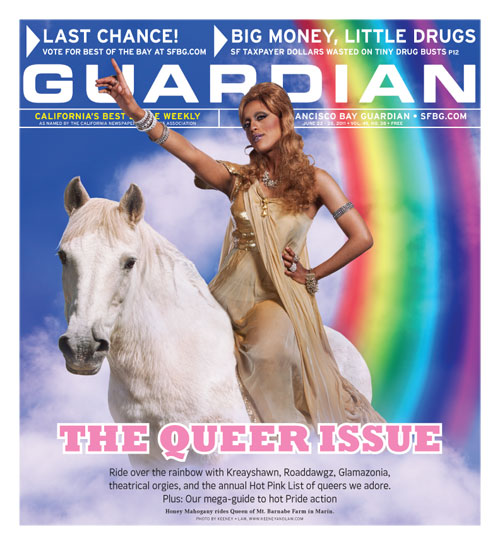
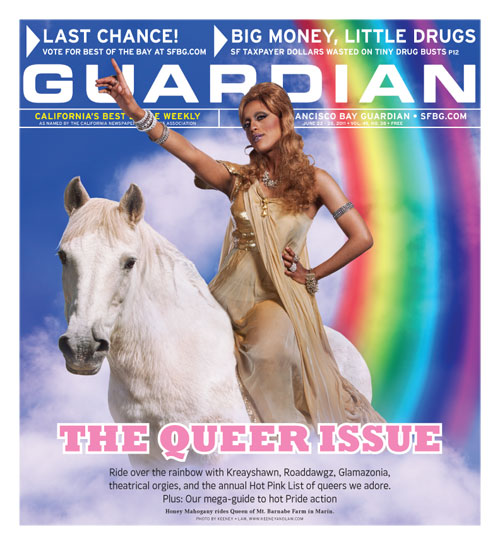
The Queer Issue 2011

5

Every year we bring it for Pride — attempting to represent the incredibly varied and creative community we call queer. This is an impossible task, of course, but that doesn’t mean we don’t try! We really try. So strap on those rainbow knickers, hop on a unicorn, and let’s dive in. 

>>EDITOR’S NOTES

Queer youth and you

By Marke B.


>>THE GUARDIAN HOT PINK LIST 2011


>>OUR MEGA-GUIDE TO PRIDE

Events, parties, art, action and more


>>GO WITH THE FLOW

Oakland rap phenom Kreayshawn reps a casual Bay sexuality

By Amber Schadewald


>>BRIGHT ON

Dyke porn pioneer Susie Bright opens up with Big Sex, Little Death

By Mattilda Sycamore Bernstein


>>YEARBOOK OF HEARTBREAK AND OUTRAGE

A 40-year retrospective highlights the Bay Area Reporter’s heroic AIDS coverage

By Oscar Raymundo


>>SHE’S GOT THE LOOK

Cat Perez’s Lesbians in San Francisco blog captures queer hotness

By Amber Schadewald


>>GETTING WHAT YOU WANT

Second annual This Is What I Want performance extravaganza plumbs the nature of desire

By Robert Avila


>>SCENES FROM THE ROAD

Queer youth art from the Roaddawgz homeless youth program

The Guardian Hot Pink List 2011

3

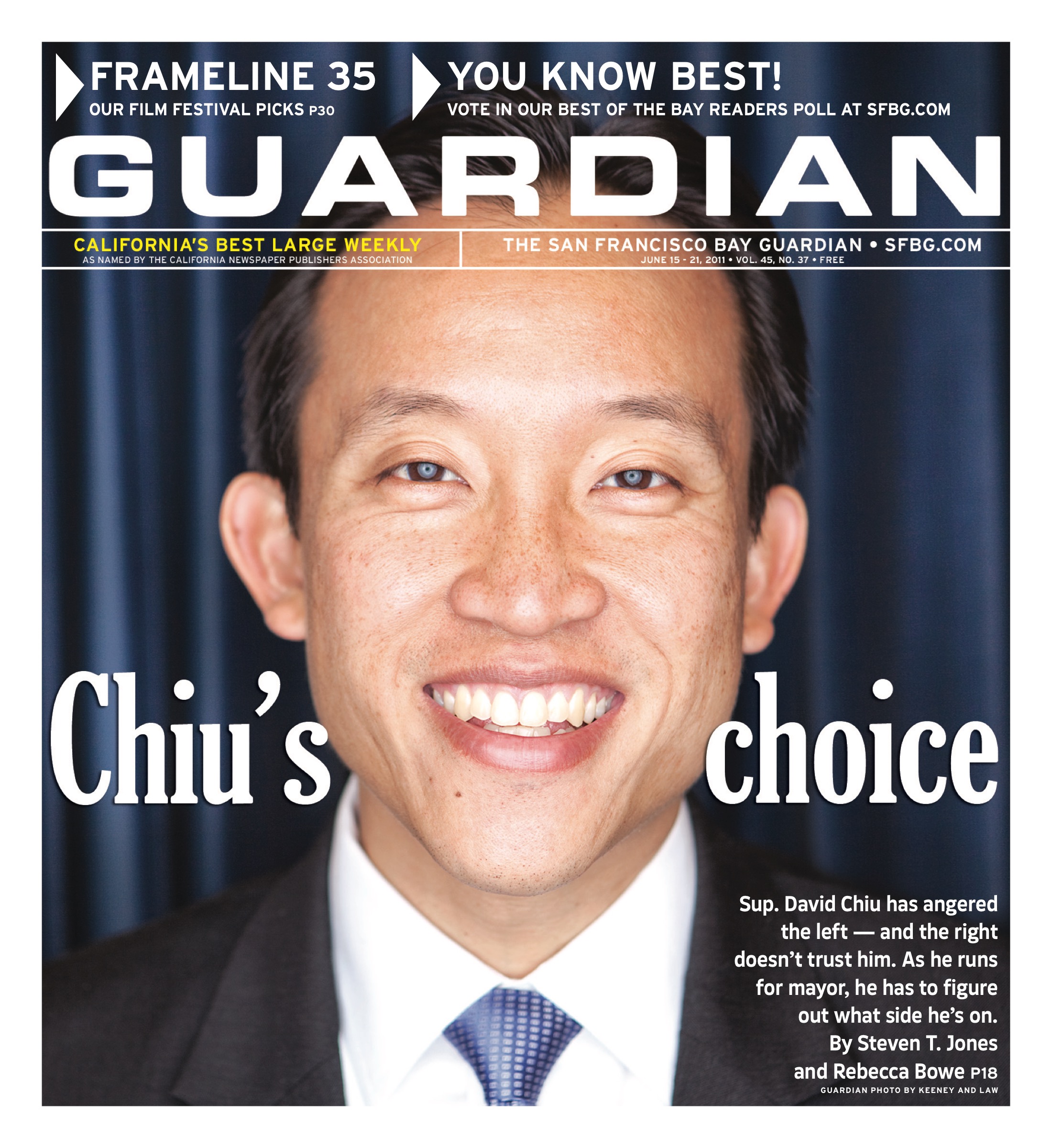
For the past few years, as part of our annual Queer Issue, we’ve rounded up a few of the people who have inspired us with their unique approaches to queer life. Whether they’re activists, artists, performers, or just plain hot-to-trot rabble-rousers, they’ve made our queer hearts beat a little faster (and reminded us of the fantastic diversity and dedication of the community). This year, we’ve gathered together another Hot Pink bunch, and asked them. “What inspires you right now — and what could the queer community use more of?” This year’s Hot Pink List was photographed by Keeney + Law


HONEY MAHOGANY

Singer, performer, social worker, photographer, glamour girl — Miss Honey Mahogany (www.itshoney.com) does it all and leaves you breathless. Catch up with her on the SFMOMA Pride Parade float (a drag salute to Paris, 1928) on Sunday, June 26, and look for her forthcoming EP this summer. “I feel really lucky to be coming of age as a performer at a time when there seem to be more and more queers out there in the public eye. Whether it be in popular media, politics, art, advocacy work, research … we are everywhere! One thing I would really like to see in the next few years is the rise of new, massively popular gay icons … and I mean ICONS, not celebrities. I think the world is ready for that. In fact, I think the world needs it.”


ROSE SLAM! JOHNSON

Have fun or make a difference? Bike-food-community activist Rose Slam! Johnson has found the two can make hot partners. She helped plan SF Bike Coalition’s Bike to School Day, and merrily oversees the Western Addition’s Urban Eating League, Apothocurious (a bike-powered organic food subscription service, www.apothocurious.com), and her own queer adult outdoors camp. This summer, she’s embarking on an multimonth bike ride and camping with Northwest queer youth. “Fear and defensiveness often distract us. By bringing people together around things we are passionate about — food, bikes, community, fun — we are able to move towards love, acceptance, and healing.”


KB BOYCE AND CELESTE CHAN

The masterminds behind Queer Rebels (www.queerrebels.com), an organization that showcases queer artists of color, KB and Celeste are involved in everything from Community United Against Violence (www.cuav.org) to “TuffNStuff: The Last Delta Drag King,” KB’s musical act. Upcoming “Queer Rebels of the Harlem Renaissance” (Friday, July 1 and Saturday, July 2), part of the national Queer Arts Festival (www.queerculturalcenter.org) is a stage extravaganza celebrating that great period. And TuffNStuff performs at the Trans March Rally (www.transmarch.org) Friday, June 24 from 3:30 p.m.-6:30 p.m. “We are inspired by new queer work that creates our own myths, reveals hidden histories, and is unapologetically, riotously gay!”


ALIX P. SHEDD

“It’s very rare to find an aesthetically dedicated queer space that isn’t centered around alcohol, includes queer youth, and is right for all different kinds of performers and performances. Somewhere you can scream, dance, and love everything that’s gay.” So Alix (with help from Lorin Murphy and a ton of volunteers) found a space, painted it pink, and launched the Big Gay Warehouse (www.biggaywarehouse.org). For the past year, the bGw has hosted many of the city’s most intriguing queercentric events, from punk concerts and video nights to sensory derangements and environmental makeovers. Alas, bGw’s days are numbered due to rising rents, but Alix — who’s also involved in trans-women-empowering nonprofit thrift store the Junque Shoppe and designs a clothing line called Apocalypse Vintage — already has the next move in mind.


MICAH TRON (WITH DJ JEANINE DA FEEN)

Super-sharp MC Micah Tron has been rising through the Bay’s hip-hop ranks with a deep electric sound and sexy come-ons. Check her out at www.soundcloud.com/Micahtron and peep her forthcoming EP “Jungle Music,” produced by the HOTTUB crew. She’ll be performing at the Crooked party at the Showdown on Friday, June 24 and on the Pride celebration main stage (www.sfpride.org) on Sunday, June 26 at 11:50 a.m. with her DJ Jeanine Da Feen. “Walking the streets of San Francisco inspire me, there’s nothing like being surrounded by people who aren’t afraid to be themselves. Our community could use more self-acceptance — we’re beautiful people!”


JOCQUESE “JOQ” WHITFIELD

Work! Voguer extraordinaire, Jocquese teaches the wonderful Tuesday night Vogue and Tone class — “a dance class with a party feel” — at Dance Mission Theatre (www.dancemission.com). He’s also part of the raucous Miss Honey nightlife crew and is a collaborator, with Shireen Rahimi, on the West Coast Dopest Outsiders youth life skills program, encouraging “movement through movement.” He’ll be performing at Crooked and Pride with Micah Tron. “I think we live in a society where we place sexuality on everything. I want to strip that away and tell people to just be themselves and dance.”


DIEGO GOMEZ/ TRANGELA LANSBURY

George Washington was due for a kick-ass sex change — so artist and illustrator Diego Gomez (designnurd.blogspot.com) started painting colorful characters like Storm from X-Men, She-Ra, and Jem on dollar bills, a.k.a. “Diego Dollars.” As the designer for Tweaker.org, he gets out valuable information from the San Francisco AIDS Foundation. He’s currently illustrating an “all-Latin porn-graphic novel” called Spicey and a comic book called “CuntBricks,” making clothes and accessories for Barney’s New York and local boutique Sui Generis, crafting with his “Needle X Change” knitting group, performing as his alter ego Trangela Landsbury, and a ton of other neon-bright activities. “I’d like to see more glitter and gold in the future and ‘happy’ surprises (not to mention endings).”


CHRISTOPHER REYNOLDS AND ALYSIA SEBASTIANI

Sustainability was all the queer conceptual rage this past year — but Christopher and Alysia, the powerhouses behind landscape design firm Reynolds-Sebastiani (www.reynolds-sebastiani.com) have been setting the principles in motion by designing and maintaining spaces throughout the city that morph norms to create alternative environments that adapt to change. Recent projects include a redesign of the Phoenix Hotel grounds, to be unveiled at Juanita More’s Pride Party on Sunday, June 26 and a show of amazing terrariums using vintage bottles they unearthed at St. Francis Fountain in the Mission’s new event space, Candy Kitchen, opening Thursday, June 23, 6 p.m.-10 p.m., and continuing for two weeks. “Like any cultural paradigm shift, sustainable practices must reach and change the popular vernacular in order to become truly sustainable — in this way they’re like queer culture,” says Christopher.

Queer Issue 2011: Scenes from the road

6

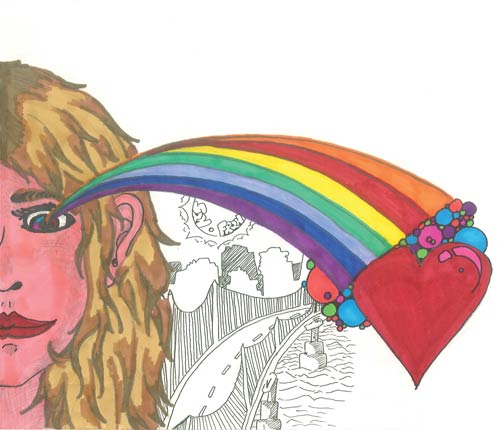
Eager to include the voices of queer youth in our 2011 Queer Issue, we asked the artists at Roaddawgz, a Tenderloin homeless youth creative drop-in center, to submit art that addressed the realities of being young and queer today. Here’s some selections from the amazing works they sent in:


Corner Skills

By Levi

Not all queers are queens… not that anything is wrong with it

I am the dude on the corna,

doin what I wanna.

Learnin to hone my skills.


A faggot such as me must learn to be an anomaly

moving through the crowds with no heads turnin

don’t need some angry motha-fuckah burnin

want’n to teach me what a man should do when a bitch brother is in your presence


Gotta learn to blend and defend;

haftah strengthen my core and my soul

because nobody cares if ah gay boy goes. 


“Battle To Love” by King Virgo


Meat Market

By Levi

  I am a piece of meat and every man wants some.


  I walk to the grocery store in the heart of the Gayborhood and men look at me like I am a steak, posturing as if they can take a grab at me, put me in their shopping cart, whisk me away to their abode and after they have their dinner throw away the leftovers.


  I am the dark meat, the black meat, men shun in daylight but troll after at night. Wanting the swwweeeeettttt cream in the center. I am the boy they still wish to be, the youth they envy, the looks they wish they could hate… but don’t. I am the homeless person that is hidden, who passes off as the moneyed and do my best not to look helpless because nothing is hotter for some men than sexploitation.


  I am a series of images, a composite. It’s much easier to see me as an object, a sex toy, a piece of ass or dick. If they were faced with who I was, the juxtaposition would make them re-evaluate their whole view of me and make them wonder “Maybe he is a human?” 

“Bleeding Heart” by Lisa Myaf

“The View From Here” by Insomnia

Yearbook of heartbreak and outrage

0

news@sfbg.com

The giant commemorative AIDS ribbon that was up on Twin Peaks during the first half of June has been taken down, but the 30th anniversary of the epidemic, and how it changed San Francisco, is still reverberating throughout the city.

“It was like paradise,” Mark Ottman said as he guided me through the high-ceiling lobby, quiet as a library, of Union Bank on 400 California St. “For a few years. Then things got really scary.”

Ottman, the vice president of personal trust and estate services at the bank, recalled arriving in the city in 1981 as a 22-year-old Montana transplant. That year, the gay newspaper the Bay Area Reporter published the word AIDS for the very first time.

Although the paper has been at the forefront of reporting gay news for its 40 years — from White Night Riots of the 1970s through the Lavender Sweep of the 1990s, the Bowers vs. Hardwick decision through the “don’t ask, don’t tell” repeal — the way it straightforwardly handled the heartbreak of AIDS and the outrage that followed has become its lasting legacy.

“This was not stuff that was shown on the nightly news,” Ottman continued. “The B.A.R. was three or four months ahead in covering AIDS. In that sense, it was really the leader.”

This month, those with a thirst for history will need to look no further than newsprint. Union Bank’s LGBT Alliance has commissioned a retrospective exhibit highlighting the Bay Area Reporter’s coverage of the gay and lesbian community.

When the B.A.R. started in 1971, founders and friends Paul Bentley and Bob Ross had the intention of making it more than just a gossipy guide to bars and bathhouses. The newspaper focused on serious local news — even recruiting Harvey Milk as a political columnist.

“The founders weren’t journalists,” said Rick Gerharter, the longtime freelance photographer who curated the photo- and front page-filled exhibit at Union Bank. “But as the paper grew, it certainly became more professional.”

In 1981, when AIDS first appeared, the B.A.R. had no choice but to undergo a journalistic coming of age as it struggled to be first and be fair covering the mysterious disease that had begun to mow down gay men.


UNEASY EARLY AIDS COVERAGE

Yet the newspaper was not immune to the confusion and uneasiness that enveloped the community during the early days of the “gay cancer.”

“Me and my boyfriend both laughed — it must be another Anita Bryant plot against homosexuals,” said Robert Julian, recalling his first response to talk of the “gay-related immunodeficiency” or GRID.

“Gay people are united by sexual orientation, not genetics,” said Julian. Initially, the former B.A.R. entertainment editor and author of But the Show Went On: San Francisco 1987-1988 had his suspicions, thinking that a “physical ailment confined solely to gay people was a practical impossibility.”

It didn’t take long before the B.A.R. began reporting on the latest research, medical resources, and information about financial services available to the hundreds of gay men in San Francisco who had contracted the HIV virus.

Once researchers discovered that AIDS was being transmitted sexually, public opinion divided. Then-Mayor Diane Feinstein and Director of Public Health Mervyn Silverman wanted to close the bathhouses, but some members of the gay community considered this a violation of personal rights.

“There was this repression around gay people and sex, this hysteria around bathhouses,” said Gerharter. And the B.A.R. was hesitant to feed into that frenzy at first. “When it was clear what was really happening, how this thing was being spread around, then it clicked — and the paper really jumped to the forefront of covering what had tuned into an epidemic.”


STEAMY BATHHOUSE DEBATE

The paper not only began to cover the AIDS crisis extensively, but did it with an editorial slant that fostered debate in the community. Paul Lorch, then-managing editor, became a prominent voice arguing to keep the bathhouses open. Bathhouses don’t give you AIDS; unprotected sex gives you AIDS, Lorch expressed in strongly-penned editorials. Sometimes he even answered back to Letters to the Editor.

“Lorch and the publishers didn’t believe closing the bathhouses would solve it,” said Wayne Friday, who took over the paper’s political column after Harvey Milk was assassinated and continued it for 27 years. “But no one had an alternative. Diane [Feinstein] would call me at 5 a.m. asking me what we should do about this thing.”

The community was split. Some, including Friday, believed that the bathhouses were a public health hazard while others accused Feinstein of scapegoating. “Those people were being selfish and foolish,” Friday said. “Closing the bathhouses saved lives.”

In 1984 the San Francisco Health Department asked for a court order forbidding renting out private rooms in bathhouses. Without the luxury of privacy, most closed within months. “San Francisco became a blueprint of how to handle AIDS on the city level for the rest of the country,” Friday said.


OBITUARIES KEPT SAD TALLY

During this time, the B.A.R. was also keeping a more morbid type of tally: the obituaries. Each week the paper published two pages — 30 to 50 obituaries — until 1998.

“When you picked it up, it was the first thing you turned to,” Gerharter said. “It was just a name and a face. Maybe you recognized the person. Maybe someone you tricked with.”

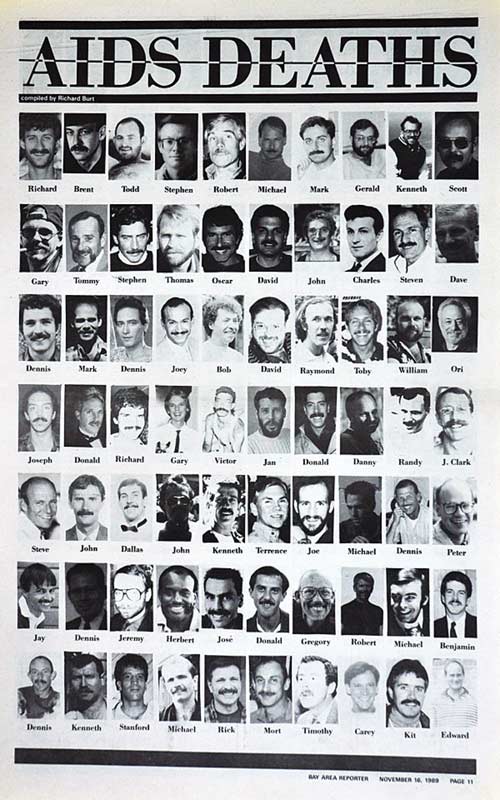
In 1989, art director Richard Burt became so overwhelmed by the number of obituaries that had been turned in to the B.A.R. within the first 10 months that he wanted to convey the sinking feeling in the pages of the paper. The Nov. 16 issue included a four-page collage of everyone who had passed away due to AIDS that year. Just a name and a face.

“It was heartbreaking,” Julian said, “to see my friends and lovers pictured there.”

Through the efforts of Tom Burtch and the San Francisco GLBT Historical Society, a massive searchable online database of B.A.R. obituaries since 1979 was launched in 2009 (www.leifkerdesigns.com/olo/index.jsp).

During his tenure at the paper, Julian chose not to cover AIDS, feeling that the point of entertainment news was to distract away “from the soul-crushing presence of the grim reaper stalking our neighborhoods.”

Though AIDS was a heavily political newsbeat, Friday removed himself from covering it for different reasons. “I knew every elected official. I sat in on all the City Hall meetings about the bathhouses,” Friday said. “But I just couldn’t do it every week. It was too damned personal.”

“Thinking about turning the page to those obituaries even now is making me shiver,” Ottman said. “It’s like a high school reunion, except you don’t know which half made it.”


COVERING THE RISE OF ACTIVISM

The B.A.R. was also instrumental in covering the various political and protest actions that accompanied the disease, including the bloody police sweep of ACT-UP protesters the Castro and the Stop AIDS Now or Else blockade of the Golden Gate Bridge, both in 1989.

Gerharter remembers the blockade. “They arranged it for the morning commute. And thank God it was foggy or else the surveillance cameras would have stopped us.”

Gerharter would often be trusted with information about an upcoming demonstration and be the only photographer allowed to tag along. “You can document history better when you become a part of it. You get closer to the people — they’re not posing,” he said. “It was our job to be advocates and watchdogs.”

After consistently seeing the tragedy of AIDS on the front page for almost a decade, the B.A.R. became more active itself, inciting its readers to action. “We’d read the B.A.R. to find out about the rallies were happening so we could skip work and take a road trip to Sacramento,” Ottman said. “The Chronicle would never cover that.”

When the fight against AIDS became a war, the B.A.R.’s writers often felt like they had become war correspondents, complete with all the outsize personality conflict and drama of the classic stereotype.

“[Bob] Ross was a nightmare boss, a pain in the ass, and complete rageaholic,” Julian said of B.A.R.’s often conservative cofounder, who died in 2003. “But he was committed to keeping the paper and us running.”

THE BAY AREA REPORTER 40TH ANNIVERSARY EXHIBIT

Through June 30, 9 a.m.–5 p.m.

Union Bank Main Branch

400 California, SF


Lust for Life: The true meaning of Gay Christmas

22

Yeah, Pride’s got its problems – but that doesn’t mean it can’t be epic

Every year without fail, my friends and I talk about how June is Gay Christmas in San Francisco. We pronounce it like it has to be capitalized and ends with an exclamation point. Sometimes I even sing the words a little — “Gaaay Christmas! La-la!” — like the holiday comes complete with its own carols. 

Sometimes I say “Gay Christmas” with a hint of irony and sarcasm. I bitch every year about how the Pride parade in San Francisco has become a big corporate conglomeration (not unlike Actual Christmas, right?). I bitch about how Pride has become an expensive and boozy festival celebrating the worst, most consumerist, most assimilationist parts of queer culture. I bitch about how Pride is a festival that has amazing roots and history and import, but at least in San Francisco, it has lost its way. That Pride has morphed from being a glittering and debauched radical celebration of queer love and life into a hokey tourist trap designed to sell rainbow key chains and pink triangle tea towels. 

The disgusting thing is that it is dangerous to hold a Pride festival in most parts of the world, even in other parts of the U.S. (have you seen what’s been happening in Texas lately, let alone in Uganda or Russia?). I’d like to think that when our brethren in other places are seriously RISKING MURDER to march down a city block and declare their queerness and gender variance, those of us in the privileged position of living in the queer Oz would be doing more to help them out. I’ve dedicated my life to queer activism, but I’m implicating myself here, too: not knowing how to help in situations that are so desperate and scary can feel hopeless and overwhelming, and the whole mess just ends up making me cynical about Pride in the Bay Area. 

I will probably always be cynical about the big corporate festival on Sunday, but the rest of June in San Francisco is a privilege to experience, a wonder to behold if you chill out and count your blessings and get some perspective. So in that spirit, I wanna tell you about my best Pride – what Pride can be like when you’re inspired and enthused, when everything feels alive and shimmering. 

Pride 2008 was my best Pride. I was 25 and newly, deeply, madly, stupidly in love. The kind of love that pumped my heart up so big I thought it was going to expand like a balloon and fill my entire ribcage. The kind of love where I threw all responsibility and caution to the wind. 

I took the week off work to stay home and fuck my new long-distance girlfriend. I didn’t say that to my job, of course, I said “my girlfriend is visiting from Oregon for Pride,” but I’m fairly sure my supervisor knew what I’d be doing when I asked for the vacation time (it was a queer non-profit). Me and this girlfriend have since broken up (in classic dyke fashion, we’re friends and artistic collaborators now). But the memory of the Pride week we spent together still makes me grin.

We had eight days together, and we made the most of it. We rolled around in my bed, in alleyways, in parks. One night she threw me up against a fence by the UC Extension school at the bottom of Hayes Valley, slipped her hand up my skirt in full view of all those cars and pedestrians. 

But eventually the San Francisco summer evening fog won out, and we made our way back to my apartment to warm up. Aside from public sex, we ventured out of my bed for the following: Take-out Thai food on my couch, pancakes at It’s Tops (the preciously tiny 1930s art-deco diner), a movie at Frameline, the last Queer Open Mic hosted by Cindy Emch, the Trans March, the Dyke March, and a porn shoot. 

I’m amazed that she and I managed to get so much done, fucking as much as we did. For queer people in love during the gayest week of the year, we were extremely productive. Our productivity was probably bolstered by the fact that we didn’t sleep much. We’d crash out at five a.m. after having sex for hours, and then we were up again at 10, but we wouldn’t manage to actually remove ourselves from each other or my room till two in the afternoon. We’d roll out of my bed hungry and bleary-eyed, covered in the salt of each other’s come and sweat, utterly and deliriously fuck drunk. 

So we’d shower together, lather up our hair and skin with her rose castile soap. Sometimes the smell of rosewater still makes me think of her. Then it would be time to put on sexy outfits and go off on another adventure.

It was a magic and manic way to spend Pride, getting lost in my best girl, my sweetest butch, the smartest kindest hottest person I’d ever met. (Falling in love makes me prone to hyperbole.) It makes me feel radiant, brilliant, witty, and drop-dead gorgeous, it makes me feel like I can change the world in one fell swoop. 

And me and my girl, we were gonna start a revolution together. We shot a scene for her porn movie that week, the movie that would become Doing It Ourselves: The Trans Women Porn Project – which is actually a revolutionary project, the first and only film of it’s kind: a porn movie made by, for, and about trans women and their partners. I was fucking a total genius, and I was thrilled and proud to have her on my arm. “Yeah, that’s right!” I felt like shouting to every single passer-by, “My girlfriend is BAD ASS, and so am I!”

My girl bought me bondage rope the exact color of the magenta streaks in my hair. She’d picked it out for me before she came to San Francisco, carefully looking for just the right the color for me. That week was like waking up every morning and opening up a present. It was like Christmas, goddammit! Every day was an adventure! There was a hot girl in my bed! There were awesome friends to hang out with who told us what a cute couple we were! There was pad thai and French toast with nutella & bananas to eat! Fences to get thrown up against! Movies to see! Marches to march in! Porn to shoot! Spin the Bottle to be played in Dolores Park! Could life get more amazing?! I felt Crazy With Love!, like all my emotions had to be capitalized and end with an exclamation point. Suddenly Gay Christmas made a lot of sense.

That Saturday we marched in the first ever Femme Sharks and Sea Creature Allies contingent in the San Francisco Dyke March. Forty femmes paraded down 18th Street wearing hot pink fake-satin fins on their heads and backs, fins that were cobbled together with cotton balls and staples, precariously taped to us with Scotch tape or tied to us with yarn. People carried signs: “THE IMF CAN KISS MY DORSAL FIN!” “FEMME SHARKS CAN FUCK YOUR ASS AND CHANGE YOUR OIL!” We chanted: “FEMME SHARKS WANT JUSTICE – AND WE WANNA GET BANGED!” And when she and I got home, she tied me up with the magenta rope she’d bought just for me. Afterwards, we spooned and moped about the fact that she was leaving the next day.

Falling in love over Gay Christmas made the original intent of Pride feel real to me – the glitter, the fun, the exhausted exhilaration, and that feeling of being absolutely enthralled with how brilliant and awesome we are, how much we can accomplish as a community when we put our big, pumped-up, loved-up hearts to it. 

So, reader, for this Gay Christmas, I wish that for you. I hope that you fall in love, and I don’t just mean with a sweetheart. I mean I hope that you feel love with your whole body and heart. Love a political movement, an art piece, yourself. Put on your best duds. Treat your lover or yourself to some rope, a cockring, a strap-on that matches your hair or your signature eyeshadow. Eat some chocolate-chip pancakes at an art deco diner and make sure to ask for extra whipped cream. Stay up till 5 in the morning having sex or masturbating. Above all, remember how fabulous and brave and bad-ass you are, and celebrate it.

Gina de Vries is a queer writer, performer, activist, writing instructor, cultural worker, and native San Franciscan. She has a long history doing political organizing and arts work within queer, trans and gender-variant, and sex worker communities, and has performed, taught, and lectured everywhere from chapels to leatherbar backrooms to the Ivy League. She’s currently pursuing her master in fiction writing at SF State, where she’s working on a book. Find out more at www.ginadevries.com and queershoulder.tumblr.com.

Saving Oakland libraries

When I went to Oakland’s Art Murmur a couple weeks ago, a funeral procession organized to call attention to the possible loss of Oakland public libraries wound its way through the streets.

It wasn’t the only creative mobilization launched in Oakland in response to the possible closure of 14 branch libraries, including the Tool Lending Library, African-American Museum and Library at Oakland, and Second Start Adult Literacy program, to make up for steep revenue shortfalls. Under the painful budget scenario to be discussed by Oakland City Council at its June 21 meeting, just four library branches would stay open, with services just three days a week.

On June 20, a coalition called Save Oakland Libraries organized a 14-hour read-in, featuring local authors reading out loud in front of Oakland City Hall to vocalize support for keeping the libraries open.

Meanwhile, this is what happened last week when anti-capitalist protesters associated with Bay of Rage took to the streets as a “book block” to protest library closures:

http://www.youtube.com/watch?v=1UMo3prDOLw&feature=channel_video_title

While anarchist bookworms tangle with the cops on the streets, the Coalition to Save Oakland Libraries is asking people to send “polite” letters to the Oakland Police Officers Association to “ask them to make their Fair Share contribution to their retirement to keep the libraries open.” Oakland City Hall will likely be packed tonight.

Video by David Martinez.

Our Weekly Picks: June 22-28, 2011

0

WEDNESDAY 22

DANCE

Hard Core: Getting Raw

Finding your identity is tough unless you are a vegetable. Asserting your identity — going against mom and dad — can be tough. However, if who you are and who you want to be goes against societal norms, be prepared to fight for your life. People have died doing it. It’s what the Queer Arts Festival is all about: paying tribute to and celebrating being “out there.” It’s most appropriate that hip-hop — street-born, street-nourished — is part of this yearly event. Hard Core: Getting Raw is a multimedia show put together by Josh Klipp and members of the Freeplay Dance Crew in which each artist (Klipp, Liz Angoff, Kevan Arrington, Hana Azman, and Molly Tsongas) tells a story about a journey undertaken. (Rita Felciano)

Wed/22–Thurs/23, 8 p.m., $15

Garage

975 Howard, SF

(415) 518-1517

www.brownpapertickets.com


THURSDAY 23

EVENT

Manic D Press showcase

In concert with this month’s Pride festivities, the recently relocated Modern Times Bookstore hosts a reading to spotlight luminaries from the queer independent scene. Many affiliated artists stop by, none of whom are exclusively tied to the literary scene but many of whom are pursuing a more experimental approach instead The night features poet Daphne Gottlieb (author of nine books), zinester Larry-Bob Roberts (he’s been called “the Stephen Colbert of queer culture”), badass trans musician-performer Lynn Breedlove, and performance artist extraordinaire Alvin Orloff. With such an eclectic collection of artists of the queer community gathered in one space, the night looks to be a classy, entertaining classy bookend to the flashier parties and parades to come. (David Getman)

7 p.m., free

Modern Times Bookstore

2919 24th St., SF

(415) 282-9246

www.mtbs.com


EVENT

Mara Hvistendahl

On glimpsing the title of Science magazine correspondent Mara Hvistendahl’s new book Unnatural Selection: Choosing Boys Over Girls, and the Consequences of a World Full of Men, I immediately thought what any reasonable boy-crazy person would: yeeeeesssss! Because in the meat-marketplace of a society burdened by a capitalistic priapism, the more infinite the choices, the better. But as usual, first impressions are incomplete. Join Hvistendahl as she explains the repercussions of selective sex abortion and the resulting 160 million women missing from Asia. How is this imbalance tweaking entire nations, and what does the West have to do with it (aside from having invented the ultrasound)? Can I get some ladies here? (Kat Renz)

6 p.m., $5–$15

World Affairs Council Auditorium

312 Sutter, Suite 200, SF

(415) 293-4600

www.itsyourworld.org


FRIDAY 24

PERFORMANCE

I Love Being Me, Don’t You?

A cherished comedian, singer, actress, gay deity, and recent Sarah Palin pummeler, Sandra Bernhard comes to town with a new show and new songs from a new album (both show and album are called I Love Being Me, Don’t You?) as well as dependably cutting observations about the world as such — all in time for Pride. Judging by reports from New York City’s sold-out Town Hall appearance, Bernhard — also working on a new musical with Justin Vivian Bond titled Arts and Crafts — flourishes trademark comedic and vocal chops while keeping outspoken, outrageous, and just plain out. (Robert Avila)

Fri/24–Sat/25, 7 p.m., $45–$75

Marines’ Memorial Theatre

609 Sutter, Second Floor., SF

(415) 771-6900

www.marinesmemorialtheatre.com


MUSIC

Brainfeeder Records Showcase

Started in 2008, the Brainfeeder label has essentially the same musical genetics as its founder, Flying Lotus: bass, hip-hop, electronic, things that go bleep-bloop, and jazz (all with a distinctively experimental bent). Following performances in New York City and L.A., Flying Lotus and a collection of labelmates will be bringing a showcase to 103 Harriet. Of particular interest will be 20-year-old Austin Peralta, a composer and jazz keyboardist who has drawn comparisons to McCoy Tyner and Chick Corea. His album, Endless Planets, has a sense of continuity with the forward elements of the genre (that seemed in part to stall outside of Japan in the ’70s) modernized for the 21st century. (Ryan Prendiville)

With Flying Lotus, Thundercat, Austin Peralta, Teebs, and Strangeloop

9 p.m., $22.50

103 Harriet, SF.

(415) 431-1200

www.1015.com


EVENT

“World’s Ugliest Dog Contest”

Festival season has arrived, and if the tie-dye at the Haight Ashbury Street Fair and the impending smolder of the Queer Tango Fest (June 29-July 3) hasn’t yet reminded you of the all-consuming special-ness of the Bay Area, I hereby announce the entrance of the ugly dogs. Yes, the Sonoma-Marin Fair was the birthplace of the snaggle-toothed, wonky-tailed trend of funky puppy adulation that has since made its way from The Tonight Show with Jay Leno show to Europe and back again. The day culminates in the crowning of another freaky furry friend (the 23rd annual!), but get to the fair early to enjoy dog training lessons, treat demonstrations, and, oh yes, the rest of the pig-and-pie county fair action. (Caitlin Donohue)

6 p.m. (fair hours, noon–midnight), $8–$15

Sonoma-Marin Fairgrounds

175 Fairgrounds, Petaluma

www.sonoma-marinfair.org


FILM

San Francisco United Film Festival

As per its mission statement, the San Francisco United Film Festival draws from an impressively varied pool of films for its third year in the city. From Bhopali, a somber look at the 1984 Union Carbide disaster in Bhopal, India, to The Dead Inside, a zombie-centric musical (the first?), there are strong indicators that the oft-used mantra “something for everyone” is apropos. Documentaries are the meat of this year’s selection and provide some of the more outstanding picks. Eat the Sun examines the practice of sun-gazing, or staring directly into the sun for prolonged periods of time in the belief that this will provide miraculous sustenance, and Superheroes dives mask-first into the world of real-life costumed vigilantes. Superheroes particularly holds promise as a crowd favorite as director Michael Barnett follows avengers Mr. Extreme on patrol and in their daily lives. Super! (Cooper Berkmoyer)

June 24–30, $10.75 (all-film pass, $25–$50)

Roxie Theater

3117 16th St., SF

(415) 863-1087

www.theunitedfest.com/sanfrancisco


SATURDAY 25

MUSIC

San Francisco Free Folk Festival

What better place than a middle school to host a wholesome folk festival? San Francisco’s 35th annual Free Folk Festival features music, dance, and art performances, workshops, and jam sessions for toddlers, teens, 20-somethings, and tried and true folks of any age. The festival provides a great opportunity to fine-tune your Gypsy jazz guitar, pennywhistle, left-handed mandolin, and countless other highly specialized instruments in hour-long workshops throughout the day. If listening and dancing are more your thing, there’ll be storytelling, Moroccan dance, jug band swing, and Bohemian national polka sessions galore. It seems no pocket of culture around the world will go untapped. On the off chance that you think something’s been overlooked, there’s a plain old open mic, too. (Getman)

Sat/25–Sun/26, noon–10 p.m., free

Presidio Middle School

450 30th Ave., SF

www.sffolkfest.org


MUSIC

“Rites of Massive”

Opulent Temple, the SF-based Burning Man camp that has been rocking the playa since 2003, is going big again on Treasure Island, drawing in a wide variety of Burning Man DJs, sculptures, performers, art cars, and music lovers. After filling Building 180 two years ago for its Massive Cox party featuring DJ Carl Cox, OT is moving to the larger Hangar 3 space for Rites of Massive (playing off this year’s Burning Man art theme “Rites of Passage”). Internationally acclaimed headliners DJ Dan, Christopher Lawrence, and Elite Force join notable local DJs on six stages, with burner sound collectives Distrikt, Symbiosis, and others joining the Opulent Temple hosts. Get ready to go big. (Steven T. Jones)

9 p.m.–4 a.m., $30–$50

Hangar 3, 600 California

Treasure Island, SF

www.opulenttemple.org


MUSIC

Cibo Matto

They’ve become hyperactive again. Prior to Cibo Matto’s split in 2001, the duo of instrumentalist Yuka Honda and singer Miho Hatori were responsible for some of the most infectious and bizarre sweet, sweet music of the 1990s. Based in New York City, Cibo Matto had a tendency to be mistaken for a J-Pop band at first listen, in part because of a consistent, aforementioned energy level, but in truth it skipped across the musical spectrum with a complete disregard for genres. The trip-hopping of “Sugar Water.” The ray-gun blap rap of “Working for Vacation.” The tropicalia version of “About a Girl.” Reunited for a Japanese benefit and now a small tour, the band is reportedly working on a new album. (Prendiville) With Chain Gang of 1974

9 p.m., $25

1025 Columbus, SF

(415) 474-0365

www.bimbos365club.com


SUNDAY 26

FILM

“Sand Up Your Vortex”

Since beach dreams rarely come true ’round these foggy, windy parts, why not ditch the S.P.F. and stuff your wild bikini at the Vortex Room instead? Tonight’s quadruple feature kicks off with Roger Corman’s 1957 Attack of the Crab Monsters (nukes made ’em giant; human flesh makes ’em hungry); Jack Curtis’ 1964 The Flesh Eaters (contains Nazis, beatniks, and — again — gruesomely gourmet human flesh); Monster from the Surf (1965), perhaps best explained by its alternate title, The Beach Girls and the Monster; and Nate Watt’s 1961 The Fiend of Dope Island (“He took everything and everyone he wanted!”), which is firmly ensconced on my list (along with 1976’s Shriek of the Mutilated and 1981’s Make Them Die Slowly) of all-time best movie titles. (Cheryl Eddy)

7 p.m., $5

Vortex Room

1082 Howard, SF

www.myspace.com/thevortexroom 


The Guardian listings deadline is two weeks prior to our Wednesday publication date. To submit an item for consideration, please include the title of the event, a brief description of the event, date and time, venue name, street address (listing cross streets only isn’t sufficient), city, telephone number readers can call for more information, telephone number for media, and admission costs. Send information to Listings, the Guardian Building, 135 Mississippi St., SF, CA 94107; fax to (415) 487-2506; or e-mail (paste press release into e-mail body — no text attachments, please) to listings@sfbg.com. Digital photos may be submitted in jpeg format; the image must be at least 240 dpi and four inches by six inches in size. We regret we cannot accept listings over the phone.


Film Listings

0

Film listings are edited by Cheryl Eddy. Reviewers are Kimberly Chun, Michelle Devereaux, Peter Galvin, Max Goldberg, Dennis Harvey, Johnny Ray Huston, Louis Peitzman, Lynn Rapoport, Ben Richardson, and Matt Sussman. For rep house showtimes, see Rep Clock. For first-run showtimes, see Movie Guide.

FRAMELINE

The 35th San Francisco International LGBT Film Festival runs through Sun/26 at the Castro, 429 Castro, SF; Rialto Cinemas Elmwood, 2966 College, Berk; Roxie, 3117 16th St., SF; and Victoria, 2961 16th St., SF. For tickets (most films $9-$15) and complete schedule, visit www.frameline.org.

OPENING

Bad Teacher Cameron Diaz don’t need no education. (1:29) Shattuck.

Buck This documentary paints a portrait of horse trainer Buck Brannaman as a sort of modern-day sage, a sentimental cowboy who helps “horses with people problems.” Brannaman has transcended a background of hardship and abuse to become a happy family man who makes a difference for horses and their owners all over the country with his unconventional, humane colt-starting clinics. Though he doesn’t actually whisper to horses, he served as an advisor and inspiration for Robert Redford’s The Horse Whisperer (1998). Director Cindy Meehl focuses generously on her saintly subject’s bits of wisdom in and out of a horse-training setting — e.g. “Everything you do with a horse is a dance” — as well as heartfelt commentary from friends and colleagues. In the harrowing final act of the film, Brannaman deals with a particularly unruly horse and his troubled owner, highlighting the dire and disturbing consequences of improper horse rearing. (1:28) Embarcadero, Shattuck, Smith Rafael. (Sam Stander)

Cars 2 Owen Wilson, Larry the Cable Guy, Michael Caine, and others give voice to the autos in this spy-themed Pixar sequel. (1:52) Balboa, Shattuck.

Conan O’Brien Can’t Stop Conan O’Brien Can’t Stop seems less of a movie title and more like a hushed comment shared between one of the many hangers-on during the filming of the “Legally Prohibited From Being Funny On Television Tour.” Throughout 23 cities’ worth of footage, O’Brien seethes, paces, sweats, yells and beats dead jokes so hard that they spring back to life, as he is wont to do.

At this point, the Leno/Coco drama is a bit stale — at least in internet time — but the documentary is a fascinating comedian character study nonetheless. It may be hard to sympathize with a man nursing a bruised ego as he cashes a $45 million dollar check, but it’s easy to see that he’s one of the best late night hosts (temporarily off) the air. Split primarily between clips of O’Brien performing songs on stage with a myriad of celebrity guests and bemoaning how exhausted and frustrated he is, Can’t Stop derives most of its hilarity from the off-the-cuff comments that pepper Conan’s everyday conversations. (1:29) Lumiere, Shattuck. (David Getman)

Oki’s Movie See review at www.sfbg.com. (1:20) Yerba Buena Center for the Arts.

*Viva Riva! Gritty, riveting, and even heartbreaking, Viva Riva!, the first Congolese feature film to get distribution in the states, is much like its small-time crook of an anti-hero, Riva (Patsha Bay Mukuna) — in love with life and prepared to laugh in the face of death when it comes knocking. Director Djo Tunda Wa Munga’s African Movie Academy Award winner tumbles with the grimy details of its Kinshasa, Congo, backdrop, and rarely stumbles. A mere foot soldier in a sprawling crime world, Riva has seized his chance at breaking into the big time, with a score of stolen gasoline, and has returned home. His eyes are on an unlikely prize, Nora (Marie Malone), the well-guarded moll of a Kinshasa gangster. As Riva stalks his lithe prey, he’s tailed by the ruthless Angolan crime boss he’s crossed (Hoji Fortuna) and a local military commander under the thug’s thumb (Marlene Longage). As sexy and violent as a contemporary noir, and as familiar as a folk tale unraveled round a campfire, Viva Riva! holds your attention with all the bruised bravado of its Stagger Lee-like protagonist, catching you in with the way the gorgeous Nora undulates at an outdoor gathering at one moment, then squats in the dirt to take a piss at the next. (1:36) Lumiere, Shattuck. (Chun)

ONGOING

*L’Amour Fou Pierre Thoretton’s documentary L’amour fou opens with two clips of men bidding farewell. The first, from 2002, is of the French-Algerian couturier Yves Saint Laurent announcing his retirement in a moving and emotional speech worthy of his favorite writer Marcel Proust. The second is of Pierre Bergé, Saint Laurent’s longtime business partner and former lover, eulogizing his departed friend at the designer’s memorial service six years later. Thoretton’s film is suffused with goodbyes, many tender and candid, some portentous and rehearsed. To be sure, L’amour fou is a touching portrait of the powerful and tempestuous bond between Saint Laurent and Bergé, a bond that lasted close to five decades and resulted in one of the great empires of 20th century fashion. But it is also, alongside David Teboud’s two 2002 YSL documentaries, another entry in the hagiography of Saint Laurent, one cannily steered by Bergé as much as by Thoretton. Well-spoken and charming, Bergé still comes off as the punchy entrepreneurial foil to Saint Laurent’s dazzling but fragile genius. He can be both hyperbolic (praising Saint Laurent’s gifts) but also forthcoming (discussing the designer’s demons). Former muses Loulou de la Falaise and Betty Catroux are also interviewed, but this is clearly Bergé’s show. (1:43) Opera Plaza. (Sussman)

The Art of Getting By The Art of Getting By is all about those confusing, mixed-up and apparently sexually frustrating months before high school graduation. George (Freddie Highmore) is a trench coat-wearing misanthrope — an old soul, as they say — whose parents and teachers are always trying to put him inside a box and tell him how to think. He finds a kindred sprit in Sally (Emma Roberts) who smokes and watches Louis Malle films. Hot. Heavily scored by the now-ancient songs of early ’00s blog bands, it may all sound like indie bullshit but this one has charm and wit despite its post-trend package. Like a sad little crayon, Highmore is a competent Michael Cera surrogate du jour. Writer-director Gavin Wiesen embraces hell of clichés, but he suitably sums up a generational angst along the way. The film may not always feel real, but it does have real feeling. Look out for great performances from Blair Underwood and Alicia Silverstone. (1:24) 1000 Van Ness, Sundance Kabuki. (Ryan Lattanzio)

*Beautiful Boy Save the children, but pity the parents. Director-cowriter Shawn Ku’s Beautiful Boy is one of two recent films concerning parents of kids who go on school killing sprees, and it’ll get potentially shortchanged due to the forthcoming We Need to Talk About Kevin‘s head-turning cast and its Hitchcockian literary source material. Still, Beautiful Boy shines in its own humble way, by dint of its quiet sense of integrity and refusal to pander. The bone-deep unhappiness suffusing the family concerned was present long before 18-year-old college student Sammy (Kyle Gallner) picked up a gun, killed more than a dozen people, then took his own life. Surviving parents Kate (Maria Bello) and Bill (Michael Sheen) already kept separate bedrooms under the same roof and led separate lives, with Bill pasting an unsettling grin on for work and Maria relentlessly pushing to make everything all right, neither noticing the barely perceptible warning signs that their only son was succumbing to despair. Belying its title, Beautiful Boy is less focused on the desperate youngster than on the adults attempting to cope with the horror he’s wrought — not necessarily cleaning up after him or picking up the pieces, but somehow finding their way through their own explosive responses. Bolstered by fine performances by Bello and Sheen, it’s yet another installment in the post-9/11 cinema of trauma — this time, attempting to imagine the unimaginable and to comprehend a kind of healing. (1:40) SF Center. (Chun)

*Beginners There is nothing conventional about Beginners, a film that starts off with the funeral arrangements for one of its central characters. That man is Hal (Christopher Plummer), who came out to his son Oliver (Ewan McGregor) at the ripe age of 75. Through flashbacks, we see the relationship play out — Oliver’s inability to commit tempered by his father’s tremendous late-stage passion for life. Hal himself is a rare character: an elderly gay man, secure in his sexuality and, by his own admission, horny. He even has a much younger boyfriend, played by the handsome Goran Visnjic. While the father-son bond is the heart of Beginners, we also see the charming development of a relationship between Oliver and French actor Anna (Mélanie Laurent). It all comes together beautifully in a film that is bittersweet but ultimately satisfying. Beginners deserves praise not only for telling a story too often left untold, but for doing so with grace and a refreshing sense of whimsy. (1:44) Embarcadero, Piedmont, Sundance Kabuki. (Peitzman)

*Bill Cunningham New York To say that Bill Cunningham, the 82-year old New York Times photographer, has made documenting how New Yorkers dress his life’s work would be an understatement. To be sure, Cunningham’s two decades-old Sunday Times columns — “On the Street,” which tracks street-fashion, and “Evening Hours,” which covers the charity gala circuit — are about the clothes. And, my, what clothes they are. But Cunningham is a sartorial anthropologist, and his pictures always tell the bigger story behind the changing hemlines, which socialite wore what designer, or the latest trend in footwear. Whether tracking the near-infinite variations of a particular hue, a sudden bumper-crop of cropped blazers, or the fanciful leaps of well-heeled pedestrians dodging February slush puddles, Cunningham’s talent lies in his ability to recognize fleeting moments of beauty, creativity, humor, and joy. That last quality courses through Bill Cunningham New York, Richard Press’ captivating and moving portrait of a man whose reticence and personal asceticism are proportional to his total devotion to documenting what Harold Koda, chief curator at the Costume Institute at the Metropolitan Museum of Art, describes in the film as “ordinary people going about their lives, dressed in fascinating ways.” (1:24) Opera Plaza. (Sussman)

Bride Flight Who doesn’t love a sweeping Dutch period piece? Ben Sombogaart’s Bride Flight is pure melodrama soup, enough to give even the most devout arthouse-goer the bloats. Emigrating from post-World War II Holland to New Zealand with two gal pals, the sweetly staid Ada (Karina Smulders) falls for smarm-ball Frank (Waldemar Torenstra, the Dutchman’s James Franco) and kind of joins the mile high club to the behest of her conscience. The women arrive with emotional baggage and carry-ons of the uterine kind. As the harem adjusts to the country mores of the Highlands, Frank tries a poke at all of them in a series of sex scenes more moldy than smoldery. This Flight, set to a plodding score and stuffy mise-en-scene, never quite leaves the runway. Not to mention the whole picture, pale as a corpse, resembles one of those old-timey photographs of your great grandma’s wedding. These kinds of pastoral romances ought to be put out to, well, pasture. (2:10) Opera Plaza. (Lattanzio)

*Bridesmaids For anyone burned out on bad romantic comedies, Bridesmaids can teach you how to love again. This film is an answer to those who have lamented the lack of strong female roles in comedy, of good vehicles for Saturday Night Live cast members, of an appropriate showcase for Melissa McCarthy. The hilarious but grounded Kristen Wiig stars as Annie, whose best friend Lillian (Maya Rudolph) is getting hitched. Financially and romantically unstable, Annie tries to throw herself into her maid of honor duties — all while competing with the far more refined Helen (Rose Byrne). Bridesmaids is one of the best comedies in recent memory, treating its relatable female characters with sympathy. It’s also damn funny from start to finish, which is more than can be said for most of the comedies Hollywood continues to churn out. Here’s your choice: let Bridesmaids work its charm on you, or never allow yourself to complain about an Adam Sandler flick again. (2:04) Empire, 1000 Van Ness, Shattuck, Sundance Kabuki. (Peitzman)

*Cave of Forgotten Dreams The latest documentary from Werner Herzog once again goes where no filmmaker — or many human beings, for that matter — has gone before: the Chauvet-Pont-d’Arc Cave, a heavily-guarded cavern in Southern France containing the oldest prehistoric artwork on record. Access is highly restricted, but Herzog’s 3D study is surely the next best thing to an in-person visit. The eerie beauty of the works leads to a typically Herzog-ian quest to learn more about the primitive culture that produced the paintings; as usual, Herzog’s experts have their own quirks (like a circus performer-turned-scientist), and the director’s own wry narration is peppered with random pop culture references and existential ponderings. It’s all interwoven with footage of crude yet beautiful renderings of horses and rhinos, calcified cave-bear skulls, and other time-capsule peeks at life tens of thousands of years ago. The end result is awe-inspiring. (1:35) SF Center, Shattuck. (Eddy)

*The Double Hour Slovenian hotel maid Sonia (Ksenia Rappoport) and security guard Guido (Filippo Timi) are two lonely people in the Italian city of Turin. They find one another (via a speed-dating service) and things are seriously looking up for the fledgling couple when calamity strikes. This first feature by music video director Giuseppe Capotondi takes a spare, somber approach to a screenplay (by Alessandro Fabbri, Ludovica Rampoldi, and Stefano Sardo) that strikingly keeps raising, then resisting genre categorization. Suffice it to say their story goes from lonely-hearts romance to violent thriller, ghost story, criminal intrigue, and yet more. It doesn’t all work seamlessly, but such narrative unpredictability is so rare at the movies these days that The Double Hour is worth seeing simply for the satisfying feeling of never being sure where it’s headed. (1:35) Opera Plaza. (Harvey)

Green Lantern This latest DC Comics-to-film adaptation fails to recognize the line between awesome fantasy-action and cheeseball absurdity, often resembling the worst excesses of the Christopher Reeve Superman movies. A surprisingly palatable Ryan Reynolds stars as Hal Jordan, the cocky test pilot who is chosen to wield a power ring as a member of an intergalactic police force called the Green Lantern Corps. He must face down Parallax, an alien embodiment of fear, who appears here as a chuckle-inducing floating head surrounded by tentacles. Peter Sarsgaard is effectively nauseating as Hector Hammond, who becomes Parallax’s crony after he is transformed by a transfusion of fear energy. The acting is all over the map, with Blake Lively’s blank-faced love interest caricature as the weakest link, and the effects are hit-or-miss, but scenes featuring alien Green Lanterns should please fans, and you could probably do worse if you’re looking for an entertaining popcorn flick. (1:45) 1000 Van Ness, Sundance Kabuki. (Stander)

The Hangover Part II What do you do with a problematic mess like Hangover Part II? I was a fan of The Hangover (2009), as well as director-cowriter Todd Phillips’ 1994 GG Allin doc, Hated, so I was rooting for II, this time set in the East’s Sin City of Bangkok, while simultaneously dreading the inevitable Asian/”ching-chang-chong” jokes. Would this would-be hit sequel be funnier if they packed in more of those? Doubtful. The problem is that most of II‘s so-called humor, Asian or no, falls completely flat — and any gross-out yuks regarding wicked, wicked Bangkok are fairly old hat at this point, long after Shocking Asia (1976) and innumerable episodes of No Reservations and other extreme travel offerings. This Hangover around, mild-ish dentist Stu (Ed Helms) is heading to the altar with Lauren (The Real World: San Diego‘s Jamie Chung), with buds Phil (Bradley Cooper) and Doug (Justin Bartha) in tow. Alan (Zach Galifianakis) has completely broken with reality — he’s the pity invite who somehow ropes in the gangster wild-card Mr. Chow (Ken Jeong). Blackouts, natch, and not-very-funny high jinks ensue, with Jeong, surprisingly, pulling small sections of II out of the crapper. Phillips obviously specializes in men-behaving-badly, but II‘s most recent character tweaks, turning Phil into an arrogant, delusional creep and Alan into an arrogant, delusional kook, seem beside the point. Because almost none of the jokes work, and that includes the tired jabs at tranny strippers because we all know how supposedly straight white guys get hella grossed out by brown chicks with dicks. Lame. (1:42) 1000 Van Ness, SF Center, Shattuck, Sundance Kabuki. (Chun)

Judy Moody and the Not Bummer Summer Try not trying so hard, Judy Moody. The tween paperback fave gets an OTT makeover for the cineplex, as director John Schultz and company throw as many bells, whistles, silly new slang, kooky gruesome colors, CGI twinkles, sing-along subtitles, and zany hijinks into the mix as possible, in vain hope of keeping kiddie eyeballs from drifting. Bright-eyed redhead Judy Moody (Jordana Beatty) — think Pippi Longstocking, only way more annoying — is stuck at home for the season, sans most of her pals and parentals, scuttling her plans for a Not Bummer Summer filled with weirdly competitive thrill points (her very own invention) and pointless faux adventures (ditto). Her cute, arty, wack-eee Aunt Opal (Heather Graham) offers some diverting solace, but the summer seems to find its groove only after Judy slimily co-opts younger bro Stink’s (Parris Mosteller) obsession with Bigfoot. Lovers of visceral kid stuff will appreciate Judy and mob’s affection for pee and puke references — too bad the entire enterprise just reeks of very bummer desperation. (1:31) 1000 Van Ness. (Chun)

Kung Fu Panda 2 The affable affirmations of 2008’s Kung Fu Panda take a back seat to relentlessly elaborate, gag-filled action sequences in this DreamWorks Animation sequel, which ought to satisfy kids but not entertain their parents as much as its predecessor. Po (voiced by Jack Black), the overeating panda and ordained Dragon Warrior of the title, joins forces with a cavalcade of other sparring wildlife to battle Lord Shen (Gary Oldman), a petulant peacock whose arsenal of cannons threatens to overwhelm kung fu. But Shen is also part of Po’s hazy past, so the panda’s quest to save China is also a quest for self-fulfillment and “inner peace.” There’s less character development in this installment, though the growing friendship between Po and the “hardcore” Tigress (Angelina Jolie) is occasionally touching. The 3-D visuals are rarely more than a gimmick, save for a series of eye-catching flashbacks in the style of cel-shaded animation. (1:30) 1000 Van Ness, SF Center. (Stander)

*Making the Boys In 1968 The Boys in the Band revolutionized Broadway and opened a lot of minds by being a hit play (and film) about NYC homosexuals. Yet on the cusp of “Gay Liberation” and for many years thereafter, much of the actual gay community hugely objected to author Mart Crowley’s fictive portrait of its ‘mos as insular, shallow, classist, bitchy, and guilt-ridden. It was (as interviewee Edward Albee notes here) a picture ideally suited to straight Broadway audiences who lined up to see queers rendered pitiful if still identifiably human. Crayton Robey’s absorbing documentary chronicles the bumpy road of Boys and its creators — Crowley never had another hit, floundering until he moved into TV series scripting. The cast of the 1970 movie version, directed by William Friedkin (one year before The French Connection, followed by The Exorcist), saw their big break turn into a virtual industry blacklisting. Exceptions were unimpeachably heterosexual thespians Laurence Luckinbill and Cliff Gorman, who only “played” gay. This engrossing document recalls a work that trailblazed, was rejected as politically correct, then re embraced as an important touchstone in gay visibility and self-empowerment. (1:33) Roxie. (Harvey)

Midnight in Paris Owen Wilson plays Gil, a self-confessed “Hollywood hack” visiting the City of Light with his conservative future in-laws and crassly materialistic fiancée Inez (Rachel McAdams). A romantic obviously at odds with their selfish pragmatism (somehow he hasn’t realized that yet), he’s in love with Paris and particularly its fabled artistic past. Walking back to his hotel alone one night, he’s beckoned into an antique vehicle and finds himself transported to the 1920s, at every turn meeting the Fitzgeralds, Gertrude Stein (Kathy Bates), Dali (Adrien Brody), etc. He also meets Adriana (Marion Cotillard), a woman alluring enough to be fought over by Hemingway (Corey Stoll) and Picasso (Marcial di Fonzo Bo) — though she fancies aspiring literary novelist Gil. Woody Allen’s latest is a pleasant trifle, no more, no less. Its toying with a form of magical escapism from the dreary present recalls The Purple Rose of Cairo (1985), albeit without that film’s greater structural ingeniousness and considerable heart. None of the actors are at their best, though Cotillard is indeed beguiling and Wilson dithers charmingly as usual. Still — it’s pleasant. (1:34) Albany, Balboa, Embarcadero, 1000 Van Ness, Piedmont, Sundance Kabuki. (Harvey)

Mr. Popper’s Penguins (1:35) 1000 Van Ness.

*My Perestroika Robin Hessman’s very engaging documentary takes one very relatable look at how changes since glasnost have affected some average Russians. The subjects here are five thirtysomethings who, growing up in Moscow in the 70s and 80s, were the last generation to experience full-on Communist Party indoctrination. But just as they reached adulthood, the whole system dissolved, confusing long-held beliefs and variably impacting their futures. Andrei has ridden the capitalist choo-choo to considerable enrichment as the proprietor of luxury Western menswear shops. But single mother Olga, unlucky in love, just scrapes by, while married schoolteachers Lyuba and Boris are lucky to have inherited an apartment (cramped as it is) they could otherwise ill afford. Meanwhile Ruslan, once member of a famous punk band (which he abandoned on principal because it was getting “too commercial”), both disdains and resents the new order just as he did the old one. Home movies and old footage of pageantry celebrating Soviet socialist glory make a whole ‘nother era come to life in this intimate, unexpectedly charming portrait of its long-term aftermath. (1:27) Balboa. (Harvey)

Submarine (1:37) Opera Plaza, SF Center.

*Super 8 The latest from J.J. Abrams is very conspicuously produced by Steven Spielberg; it evokes 1982’s E.T.: The Extra-Terrestrial as well as 1985’s The Goonies and 1982’s Poltergeist (so Spielbergian in nature you’d be forgiven for assuming he directed, rather than simply produced, the pair). But having Grandpa Stevie blessing your flick is surely a good thing, especially when you’re already as capable as Abrams. Super 8 is set in 1979, high time for its titular medium, used by a group of horror movie-loving kids to film their backyard zombie epic; later in the film, old-school celluloid reveals the mystery behind exactly what escaped following a spectacular train wreck on the edge of their small Ohio town. The PG-13 Super 8 aims to frighten, albeit gently; there’s a lot of nostalgia afoot, and things do veer into sappiness at the end (that, plus the band of kids at its center, evoke the trademarks of another Grandpa Stevie: Stephen King). But the kid actors (especially the much-vaunted Elle Fanning) are great, and there’s palpable imagination and atmosphere afoot, rare qualities in blockbusters today. Super 8 tries, and mostly succeeds, in progressing the fears and themes addressed by E.T. (divorce, loneliness, growing up) into century 21, making the unknowns darker and the consequences more dire. (1:52) California, Empire, 1000 Van Ness. (Eddy)

*13 Assassins 13 Assassins is clearly destined to be prolific director Takashi Miike’s greatest success outside Japan yet. It’s another departure for the multi-genre-conquering Miike, doubtless one of the most conventional movies he’s made in theme and execution. That’s key to its appeal — rigorously traditional, taking its sweet time getting to samurai action that is pointedly not heightened by wire work or CGI, it arrives at the kind of slam-dunk prolonged battle climax that only a measured buildup can let you properly appreciate. In the 1840s, samurai are in decline but feudalism is still hale. It’s a time of peace, though not for the unfortunates who live under regional tyrant Lord Naritsugu (Goro Inagaki), a li’l Nippon Caligula who taxes and oppresses his people to the point of starvation. Alas, the current Shogun is his sibling, and plans to make little bro his chief adviser — so a concerned Shogun official secretly hires veteran samurai Shinzaemon (Koji Yakusho) to assassinate the Lord. Fully an hour is spent on our hero doing “assembling the team” stuff, recruiting other unemployed, retired, or wannabe samurai. When the protagonists finally commence their mission, their target is already aware he’s being pursued, and he’s surrounded by some 200 soldiers by the time Miike arrives at the film’s sustained, spectacular climax: a small village which Shinzaemon and co. have turned into a giant boobytrap so that 13 men can divide and destroy an ogre-guarding army. A major reason why mainstream Hollywood fantasy and straight action movies have gotten so depressingly interchangeable is that digital FX and stunt work can (and does) visualize any stupid idea — heroes who get thrown 200 feet into walls by monsters then getting up to fight some more, etc. 13 Assassins is thrilling because its action, while sporting against-the-odds ingeniousness and sheer luck by our heroes as in any trad genre film, is still vividly, bloodily, credibly physical. (2:06) Bridge, Shattuck. (Harvey)

The Tree of Life Mainstream American films are so rarely adventuresome that overreactive gratitude frequently greets those rare, self-conscious, usually Oscar-baiting stabs at profundity. Terrence Malick has made those gestures so sparingly over four decades that his scarcity is widely taken for genius. Now there’s The Tree of Life, at once astonishingly ambitious — insofar as general addressing the origin/meaning of life goes — and a small domestic narrative artificially inflated to a maximally pretentious pressure-point. The thesis here is a conflict between “nature” (the way of striving, dissatisfied, angry humanity) and “grace” (the way of love, femininity, and God). After a while Tree settles into a fairly conventional narrative groove, dissecting — albeit in meandering fashion — the travails of a middle-class Texas household whose patriarch (a solid Brad Pitt) is sternly demanding of his three young sons. As a modern-day survivor of that household, Malick’s career-reviving ally Sean Penn has little to do but look angst-ridden while wandering about various alien landscapes. Set in Waco but also shot in Rome, at Versailles, and in Saturn’s orbit (trust me), The Tree of Life is so astonishingly self-important while so undernourished on some basic levels that it would be easy to dismiss as lofty bullshit. Its Cannes premiere audience booed and cheered — both factions right, to an extent. (2:18) California, Embarcadero, Smith Rafael, Sundance Kabuki. (Harvey)

*The Trip Eclectic British director Michael Winterbottom rebounds from sexually humiliating Jessica Alba in last year’s flop The Killer Inside Me to humiliating Steve Coogan in all number of ways (this time to positive effect) in this largely improvised comic romp through England’s Lake District. Well, romp might be the wrong descriptive — dubbed a “foodie Sideways” but more plaintive and less formulaic than that sun-dappled California affair, this TV-to-film adaptation displays a characteristic English glumness to surprisingly keen emotional effect. Playing himself, Coogan displays all the carefree joie de vivre of a colonoscopy patient with hemorrhoids as he sloshes through the gray northern landscape trying to get cell reception when not dining on haute cuisine or being wracked with self-doubt over his stalled movie career and love life. Throw in a happily married, happy-go-lucky frenemy (comic actor Rob Brydon) and Coogan (TV’s I’m Alan Partridge), can’t help but seem like a pathetic middle-aged prick in a puffy coat. Somehow, though, his confused narcissism is a perverse panacea. Come for the dueling Michael Caine impressions and snot martinis, stay for the scallops and Brydon’s “small man in a box” routine. (1:52) Albany, Clay, Smith Rafael. (Devereaux)

*Trollhunter Yes, The Troll Hunter riffs off The Blair Witch Project (1999) with both whimsy and, um, rabidity. Yes, you may gawk at its humongoid, anatomically correct, three-headed trolls, never to be mistaken for grotesquely cute rubber dolls, Orcs, or garden gnomes again. Yes, you may not believe, but you will find this lampoon of reality TV-style journalism, and an affectionate jab at Norway’s favorite mythical creature, very entertaining. Told that a series of strange attacks could be chalked up to marauding bears, three college students (Glenn Erland Tosterud, Tomas Alf Larsen, and Johanna Morck) strap on their gumshoes and choose instead to pursue a mysterious poacher Hans (Otto Jespersen) who repeatedly rebuffs their interview attempts. Little did the young folk realize that their late-night excursions following the hunter into the woods would lead at least one of them to rue his or her christening day. Ornamenting his yarn with beauty shots of majestic mountains, fjords, and waterfalls, Norwegian director-writer André Ovredal takes the viewer beyond horror-fantasy — handheld camera at the ready — and into a semi-goofy wilderness of dark comedy, populated by rock-eating, fart-blowing trolls and overshadowed by a Scandinavian government cover-up sorta-worthy of The Girl with the Dragon Tattoo (2009). (1:30) Lumiere. (Chun)

*X-Men: First Class Cynics might see this prequel as pandering to a more tweeny demographic, and certainly there are so many ways it could have gone terribly wrong, in an infantile, way-too-cute X-Babies kinda way. But despite some overly choppy edits that shortchange brief moments of narrative clarity, X-Men: First Class gets high marks for its fairly first-class, compelling acting — specifically from Michael Fassbender as the enraged, angst-ridden Magneto and James McAvoy as the idealistic, humanist Charles Xavier. Of course, the celebrated X-Men tale itself plays a major part: the origin story of Magneto, a.k.a. Erik Lehnsherr, a Holocaust survivor, is given added heft with a few tweaks: here, in an echo of Fassbender’s turn in Inglourious Basterds (2009), his master of metal draws on his bottomless rage to ruthlessly destroy the Nazis who used him as a lab rat in experiments to build a master race. The last on his list is the energy-wrangling Sebastian Shaw (Kevin Bacon), who’s set up a sweet Bond-like scenario, protected by super-serious bikini-vixen Emma Frost (January Jones). The complications are that Erik doesn’t ultimately differ from his Frankensteins — he pushes mutant power to the detriment of those puny, bigoted humans — and his unexpected collaborator and friend is Xavier, the privileged, highly psychic scion who hopes to broker an understanding between mutants and human and use mutant talent to peaceful ends. Together, they can move mountains—or at least satellite dishes and submarines. Jennifer Lawrence as Raven/Mystique and Nicholas Hoult as Hank McCoy/Beast fill out the cast, voicing those eternal X-Men dualities — preserving difference vs. conformity, intoxicating power vs. reasoned discipline. All core superhero concerns, as well as teen identity issues — given a fresh charge. (2:20) Empire, 1000 Van Ness, Sundance Kabuki. (Chun)


Tribes author burrows into the Big Apple

0

Thanks to the help of burners from at least five different tribes that I’ve covered or camped with at Burning Man, my New York City book tour was a successful adventure in art and community, from the Figment festival on scenic Governors Island to exotic eating and drinking in the East Village and Queens to a great underground party at an old Catholic school in Brooklyn to getting canonized by Rev. Billy and his 25-person choir into the Church of Earthalujah along with SF-based performance artist Guillermo Gómez-Peña.

The June 7-13 trip was in support of The Tribes of Burning Man: How an Experimental City in the Desert is Shaping the New American Counterculture, my book chronicling how an event born in San Francisco has spawned a vast, well-developed culture and ethos that is affecting life in cities around the world, even seemingly impervious megalopolises like the Big Apple.

I arrived on the red eye Wednesday morning just as a heat wave was peaking in New York, showing up mid-morning at the Upper East Side apartment of Jax, a recent transplant from SF who I worked with on last year’s Temple of Flux project. Her air conditioner hadn’t arrived yet, so I sweated through a needed nap before surrendering myself to exploring the city.

That night was my Tribes launch party in a great spot called Casa Mezcal on Orchard Street on the Lower East Side. Fellow Shadyvil campmate Wylie Stecklow had not only arranged the venue, which is owned by one of his law clients, but he moved the weekly Big Apple Burners happy hour and the final planning meeting for Figment (an event he co-founded four years ago) to the venue, giving me a built-in audience of interested burners who seemed to really appreciate my reading and discussion.

Also joining the party were two NYC figures who appear in my book: Not That Dave, Burning Man’s NYC regional contact and a Figment director, and Billy Talen, the former San Francisco performance artist who transformed himself into NYC’s Reverend Billy, pastor of the Church of Stop Shopping, which evolved into the Church of Life After Shopping before becoming the Church of Earthalujah to reflect a mission that expanded from economic justice and anti-consumerism to environmentalism and a holistic way of looking at the perils of our economic system.

As I’ve been doing at some of my Bay Area book events, I read chapters that introduced them and then let them speak, and they each had lively, weird, heart-warming things to say. Several other New Yorkers who I know through Burning Man showed up at the event to join the discussion, wish me well, and buy books. The most surprising guest was Mike Farrah, former Mayor Gavin Newsom’s old right-hand man who did more to facilitate the temporary placement of burner artworks in SF than anyone in City Hall. He now lives in NYC and showed up late, so after talking SF politics and BRC art over beers, we wandered past some of the oldest tenement buildings in the city together as we headed toward the subway.

The city was sweltering the next day (although Jax’s air conditioner had blessedly arrived), so I spent over three hours in the Metropolitan Museum of Art, which makes SF’s museums seem like mere gallery spaces. I walked through Central Park between the reservoir and the Great Lawn, which was being set up for that evening’s Black Eyed Peas concert, all the way to the Upper East Side and my reading at the Columbia University Bookstore (which nobody showed up for, a combination of school being out, the heat, and a freak thunderstorm that was just rolling in as my event began – my first flop after more than a dozen bookstore events).

But New York is a city for nightowls, as I was just beginning to appreciate, particularly after I made my way down to the East Village that night to meet a Garage Mahal campmate who I’ve known for years simply as Manhattan. He’s been living in his apartment for 15 years and the city for 25, developing a detailed knowledge of the best places to eat, drink, and otherwise indulge.

Manhattan won’t go to the Upper East Side, preferring to remain in “civilization,” as he calls the East Village, which earned its storied reputation as the center of the nightlife universe. We ate Japanese curry at Curry Ya, drank hard-to-find German Kolsch beer at Wechsler’s Currywurst, danced with saucy Armenian women on Avenue C, drank cold sake underground at Decibel, indulged in the most decadent fried pork sandwiches at Porchetta, mingled with beautiful young people in the Penny Farthing, and then drank cocktails on his stoop until dawn, the streets never going to sleep in this lively neighborhood.

On Friday in the early afternoon, I met Wylie at The Cube, a public art piece near the 8th Street subway stop, and we hopped a train down to the southern tip of Manhattan to catch the free ferry to Governors Island for the opening day of Figment, an art festival started there by burners in 2007 that has since expanded to Detroit, Boston, and Jackson.

Mayor Michael Bloomberg and other city officials have embraced and facilitated the popular three-day event, which now includes art projects such as a treehouse built of old doors, massive steel sculptures, and an elaborate miniature golf course that will remain on the island through the summer. Most of the projects featured the interactivity that is the hallmark of burner art, such as a sound project in an enclosed courtyard in which passerby had to figure out how they were controlling the sounds they heard.

Wylie and I pedaled on borrowed rental bikes to cover all the projects on a large island that is a decommissioned military base with gorgeous views of the Manhattan and New Jersey skylines. Out on the Picnic Point lawn, with the Statue of Liberty looking on from the bay, the venerable NYC-based Burning Man sound camp Disorient hosted a rocking set of DJs under a massive wooden sculpture that they built for Figment and the playa this year.

Unfortunately, Figment is permitted only as a daytime event that ends at 6 pm, because the energy of the 100-plus organizers and volunteers could have driven this party well into the wee hours. Instead, they all gathered after the event at the 340-year-old White Horse Tavern to discuss the day, celebrate, and share endless ideas for new art projects and ways of measuring and directing all the creative energy that flows through their event and city.

After partying until dawn again, Manhattan and I climbed into his car (yes, a car, in Manhattan, the better to cover more ground, he says) Saturday mid-afternoon, picked up a friend near Wall Street, and crossed the Brooklyn Bridge headed toward Astoria, Queens. There, we drank pitchers of rich Czech beer at the 100-year-old Bohemian Hall and Beer Garden, run by the nonprofit Bohemian Citizens’ Benevolent Society, a fraternal order open only to those with Czech blood. With an outdoor capacity of almost 1,000 people, this place was like my beloved Zeitgeist on steroids.

On the way back to the East Village that night, Manhattan did a sudden U-turn and parked in a bus zone in front of a crowded outdoor eatery called Tavern Kyclades, muttering something about needing octopus and telling us he’d just be a minute. The wait for tables at this amazing Greek seafood spot was 90 minutes, but after less than 10 he was back with a to-go container with three long octopus legs, grilled, tender, and just insanely good.

That night, the plan was to hit an underground party in Brooklyn, thrown in a former Catholic school by Rubulad, a venerable party crew. It was after 1 am when we finally left Manhattan’s apartment for the party, catching the subway at Union Square and arriving to find the party in full swing, with more than a dozen rooms with different offerings: DJ dance parties, avante garde films, a piano bar, live music from a trio that had the beautiful crowd dancing hard and smiling. As the party wound down, I headed to Queens with a new friend and we watched a new day dawn on the Empire State building standing tall in the distance.

Sunday might be a day of rest for some, but not for me, not with the kind of roll I was on. So I caught the last ferry to Governors Island at 3 pm and spent the afternoon at Figment with some other burner friends, Shanthi and Patty, who came back to the East Village with me afterward for my third and final Tribes event: being canonized by Reverend Billy during the Church of Earthalujah’s regular Sunday evening performance at Theatre 80 on St. Marks Place.

I’ve been covering Billy and his crew for years, from their performances in San Francisco’s Castro Theater and other local venues to their film “What Would Jesus Buy?” to their work at Burning Man, including their touching sendoff of burner work crews to the Gulf Coast in 2005 to do cleanup and rebuilding work after Hurricane Katrina, an effort that became Burners Without Borders.

As I write in my book, Billy and his choir of several dozen were transformed by Burning Man, and they have returned that embrace of a culture that magnifies and perpetuates their values. And after being called from the audience and walking toward the stage during a rousing rendition of the “When the Saints Go Marching In,” I was warmly embraced by the entire 25-member chorus – actually, it was probably closer to a group grope – and I became Saint Scribe.

And after that, it’s all a bit of a blur, and a vibrant, decadent, Big Apple blur. Thanks, everyone, for a truly memorable trip.

Crying in public

0

arts@sfbg.com

HAIRY EYEBALL Weaving my way through the groups of slower moving shoppers and tourists ambling out of the Powell Street BART Station, I realized I was already too late.

I had wanted to be present for the June 11 noon kickoff of Market Day — the large-scale public art event tied to Allison Smith’s current Southern Exposure exhibit “The Cries of San Francisco” — but when I reached Mint Plaza and had been handed a schedule I saw that my timing had been off by an hour.

Oh well. The point of Market Day wasn’t to necessarily be at a certain place at a certain hour to see a certain something. The “something” was supposedly happening all around me. The nearly 70 Bay Area artists, performers, and craftspeople Smith had gathered for this ambitious public art project had dispersed throughout Mint Plaza, and up and down Market Street between Fifth and Third streets, to peddle their wares (many homemade), offer more ineffable “services” (such as owning the expletive of your choice or telling you a story), or to simply “perform” in “character.”

The criers were to be like tiny pebbles subtly altering the fast-moving watercourse of weekend foot traffic. Granted, participation is hard to measure for something like “The Cries of San Francisco,” but wherever I turned, people seemed engaged even if the number of folks documenting a given artist seemed to greatly outnumber the members of the public they were interacting with.

I decided I needed a little more intimacy if I was to get my feet wet. I started back toward Market and ran into a woman dressed in steampunk-ish attire. Her name was Jamie Venci, a.k.a. the Questing Choreographer (each participating artist conveniently had a large nametag). She offered me an informative pamphlet about one of three historic buildings in the vicinity that had survived the 1906 earthquake if I promised to carry out the site-specific choreography contained within.

I agreed, and for convenience’s sake, I went with the Mint Building. Not five minutes later, I was on the steps of “the Granite Lady” attempting to convey the shape of its crenellated outline with my arms — per a step in Venci’s cutely drawn instructions — in what must have looked like a particularly inept approximation of tai chi.

Conceptual art requires a suspension of disbelief on the part of its audience. I was not merely being ridiculous in public, but was publicly enacting a new relationship to a space I had not really considered too closely before. I, as much as Venci, was the Questing Choreographer, and together we had collaborated on a piece.

The satisfaction I took in my demonstration of good faith was fleeting, as questions took over. What had passersby thought about what I was doing? And how could they really have anything to think about without some context for my undertaking? If a person dresses up in a colorful manner in San Francisco and carries on in public does anyone raise an eyebrow, let alone pause to consider the host of artistic and economic concerns that “The Cries of San Francisco” aimed to bring to the streets?

Materials for the event cited Mohamed Bouazizi, the Tunisian street vendor who set himself on fire to protest police harassment, as well as Carol Reed’s 1968 film version of the musical Oliver! as representational precedents. But despite the presence of Art for a Democratic Society’s Class War Store cart full o’ Marxism, the tenor of many of the criers was more playful than revolutionary. Whimsy was the order of the day.

Ha Ha La (Nathaniel Parsons) pushed around an “amusement park,” a steep ladder that participants would gingerly climb up and down while Parsons bellowed a New Age-y chant affirming their bravery and blessedness through a conch shell. After I took my turn on the rickety structure, I chose a souvenir badge that read, “You don’t have to behave you just gotta be brave.”

Also hard to miss was Maria de los Angeles Burr, who, as the Unsellable, had transformed herself into a walking pile of paper bags. “I have become burdened by too many possessions,” she muttered to me, as confused shoppers exiting from the Westfield Centre stopped to take pictures or gawked while hurrying on their way.

I wondered if they got the visual pun, or would simply move on and tune out the other criers much in the same way many of us avoid other solicitors like petitioners or canvassers.

I also wondered what the Market Street regulars — the men who sell cheap earrings, bootleg Giants merchandise, and faux-cashmere scarves from tables or the young hip-hop dancers who busk near the Powell Street cable car turnaround — thought about the criers. Did they view them as competition? As a friendly change-of-scene? Or did they see them at all?

By 4:30 p.m., all the criers had reconvened at Mint Plaza. They seemed tired from their day of art-making and being “on.” Continuing at a full clip, however, were tweens Colin Cooper and Cole Simon, by far the loudest and youngest hawkers, who had set up shop as the Masters of Disguise (one of their parents informed me that their after-school art teacher, a California College of the Arts student, had encouraged them to get involved with the project).

I walked away from our genial encounter $1 poorer but with a pair of plastic pink sunglasses and an orange mustache to my name. I felt braver with them on.

The carnival continues: the gallery installation component of “The Cries of San Francisco” is up until early next month and will host a series of performance events. Future Saturday marketplaces are scheduled for two Saturdays, June 18 and July 2 (noon to 6 p.m.). And on Wednesday, June 15 at 7 p.m., various criers will present a showcase of musical storytelling, speeches, and other forms of public address.

THE CRIES OF SAN FRANCISCO

Through July 2

Southern Exposure

3030 20th St., SF

(415) 893-1841

www.soex.org


The ballad of Peter and Raymond

0

arts@sfbg.com

Once upon a time (1987 to be exact), two young men who were old friends moved to San Francisco from the Midwest to take in all the big city had to offer. Like many 20-somethings, Eddie Lee “Sausage” and Mitchell “Mitch D” Deprey didn’t have a lot of money and wound up living in a somewhat derelict apartment in the Lower Haight with a bright pink exterior they dubbed “the Pepto Bismol Palace.” The paint was peeling and the walls were thin but the rent was cheap.

What Eddie and Mitch didn’t count on was having Peter J. Haskett and Raymond Huffman as their neighbors. “You blind cocksucker. You wanna fuck with me? You try to touch me, and I will kill you in a fucking minute.” “Shut up! Shut up! Shut up! Shut up, little man!”

The insults, tantrum-throwing, and threats of violence (which sometimes crossed over into actual fisticuffs) coming from next door were constant. When they weren’t drinking like fishes, Peter — acid-tongued, gay — and Ray — the more hotheaded of the two and an unrepentant homophobe — seemingly devoted their every waking hour to mercilessly tearing each other apart.

Weeks went by. Eddie and Mitch started to lose sleep. And after one failed attempt at complaining to Raymond’s face (he threatened death), they started tape-recording Peter and Ray’s endless geyser of vitriol — first, as possible future evidence — but also out of a growing voyeuristic fascination with these two seniors who had to be the world’s oddest and angriest odd couple.

The rest is history. Mitch and Eddie started including snippets of Peter and Ray’s bickering on mixtapes for friends. Somehow, the editor of the now-defunct SF noise music zine Bananafish heard a snippet and approached Mitch and Eddie about distributing compilations of the recordings to a large network of found sound fans. Gradually “Peter and Raymond” became known and much-beloved characters. Their warped repartee — frequently referred to using Raymond’s favorite rejoinder, “Shut up, little man!,” as shorthand — inspired several theatrical adaptations, short animated films, pages of comic book panels by artists such as Daniel Clowes, and even a one-off single from Devo side project the Wipeouters. SF Weekly did a cover story and there were reams of additional press. Hollywood types called wanting to know who owned the rights to Peter and Raymond. Things had gotten big.

“Shut Up Little Man has been an enchanted, messy cultural accident,” reflects Sausage (he’s kept the moniker) over a Skype conference call. “It was a personal obsession and a private joke that in a very curious way became an underground cultural phenomena.” Sausage, a visual artist and musician who supports himself as a rare-book seller, remains, in his words, “the official custodian” of Shut Up Little Man’s (SULM) legacy, which is copiously detailed on its website.

Deprey — who now works as an insurance agent in Wisconsin where he lives with his wife and teenage children — is also on the line. Although Sausage is doing most of the talking, he interjects from time to time to provide clarification. We are discussing Matthew Bate’s documentary Shut Up Little Man! An Audio Misadventure — perhaps the squarest peg in Frameline 35’s lineup. As much an attempt to comprehensively recount the above long, strange trip from start to finish, the film is also the newest chapter in the now 20-year saga of Peter, Raymond, Mitch, and Eddie.

Bate is a clever filmmaker who is able to translate a story that has primarily been told through sound into something visually compelling. Goofy animated interludes are woven between interviews with Clowes, Devo’s Mark Mothersbaugh, and the many other SULM fans who have created art inspired by Peter and Raymond. Sausage and Deprey also get plenty of screen time, and Bate goes so far as to have them play their 20-something selves in dramatized reenactments of their early days of interacting with and recording Peter and Raymond, who are played by actors. (Huffman died in 1992 of a heart attack brought on by colon cancer, pancreatitis, and alcoholism; Haskett died four years later of liver problems also due to alcoholism.)

Bate’s film is less successful in presenting a clear account of Sausage and Deprey’s 1994 controversial decision to copyright their recordings — which up to that point had been accompanied only by a note encouraging creative liberties and humbly asking for credit — going so far as to imply that this was an ideological about-face. As Sausage and Deprey tell it, they were simply doing the responsible, professional thing in the face of mounting disputes over who could or couldn’t sell the rights (the current disclaimer on the SULM website notes that “permission and licensing is usually granted, but please ask first”).

“Because this stuff was so viral and so innocuous, it wasn’t clear who owned any of this, ” explains Deprey, “We just didn’t want people wrongfully charging other people to use it. And the truth is, we’ve never gotten a penny from any of the artists [featured in the film].”

Still, Deprey and Sausage have now become the semiofficial executors of Peter and Raymond’s estate, even if it’s a legacy composed of hours and hours of blue streaks captured on tape. No surviving relatives of either Huffman or Haskett have come forward in the time that their infamy has grown, underscoring the fact that these two men — despite the venom they constantly spewed at back and forth — really only had each other.

“In a very real way, I think it’s a nontraditional love story,” says Sausage. “There’s a lot of passion and a lot of intimacy there. I mean, arguing is one of the most intimate things we can do as human beings.”

Indeed, Peter and Raymond’s highly dysfunctional Boston marriage might be the queerest onscreen relationship in the whole festival.

SHUT UP LITTLE MAN! AN AUDIO MISADVENTURE

June 22, 9:30 p.m., $11

Victoria Theatre

2961 16th St., SF

www.frameline.org

P.S. Shut Up Little Man! An Audio Misadventure was recently picked up by a distributor and will be released theatrically Aug. 26.


Quickies: Short Frameline reviews

0

Below are some reviews of films that intrigued us from the upcoming Frameline Film Festival. Check out more of our coverage here.

Codependent Lesbian Space Alien Seeks Same (Madeleine Olnek, U.S., 2011) Who can’t identify with that title? Metaphorically speaking, that is. Although Madeleine Olnek’s B&W feature insists on etaking it quite literally, to pretty hilarious results. Lonely stationery-store clerk Jane (Lisa Haas) tells her shrink she dreamed a close encounter in which a space ship dropped a note her way that read “What are you doing later?” Shortly thereafter, she finds herself the object of amorous pursuit by Zoinx (Susan Ziegler), one of several bald-pated, high Peter Pan-collared exiles from planet Zotz who’ve been dumped in Manhattan to seek “hot Earthling action” and get their hearts broken — because it is believed back home that “big feelings” of love are destroying the ozone. Ergo, guilty citizens must be rendered “numb and apathetic” by off-shore interspecies romance before safely returning. Meanwhile two badly mismatched government operatives (Dennis Davis, Alex Karpovsky) are spying upon the intergalactic love intrigue. Go Fish (1994) meets Plan 9 From Outer Space (1959), at last! June 25, 3:30 p.m., Castro. (Dennis Harvey)

The Evening Dress (Myriam Aziza, France, 2009) Everybody’s crushed on a teacher at some point, and indeed everybody in Helene Solenska’s (Lio) sixth grade French grammar class seems to have a crush on her. Why not: she’s attractive, wears sexy clothing (by classroom standards at least), and addresses the occasional sass with challenging provocation rather than simple discipline. But shy, studious Juliette (Alba Gaia Bellugi) has a crush bordering on obsession, particularly once she misinterprets teach’s attentions toward outgoing male student Antoine (Léo Legrand). You’re never too young to have a nervous breakdown, and our heroine’s increasingly reckless actions threaten to make her a pariah. Myriam Aziza’s feature is in that My Life as a Dog (1985) realm of movies about unpleasant childhoods that aren’t exploitative but at times grow truly discomfiting — it’s a worst case-scenario of pubescent imagination run amuck amid the usual teasing and bullying of peers. It’s a very good film if not an especially pleasant one. June 22, 4 p.m., Castro. (Harvey)

A Few Days of Respite (Amor Hakkar, Algeria and France, 2010) Quiet, bespectacled Moshen and his younger lover Hassan have fled Iran in the hopes of starting a new life together in Paris. They have only each other, and yet, because they lack visas, they must keep their distance while traveling to avoid arousing suspicion. While on a train in southern France, Moshen befriends Yolande, an older widow hungry for companionship who offers him a quick job painting her flat in a nearby small town. He agrees, forcing Hassan to continue hiding out, first in plain sight, and later, unknown to Yolande, in her attic, until tragedy drags everything out into the open. Algerian writer-director Amor Hakkar, who also plays Moshen, has crafted a sparse, intimate drama — emotionally enriched by its muted performances and minimal dialogue — about the lengths we are willing to go for love and the price we must pay in the process. Mon/20, 9:30 p.m., Elmwood; June 22, 9:30 p.m., Castro. (Matt Sussman)

How Are You? (Jannik Splidboel, Denmark, 2011) In the past few years Michael Elmgreen and Ingar Dragset, a Berlin-based artistic duo and romantic couple, have become international art world darlings known for their ambitious, playful, and critical large-scale installations, such as turning an exhibition space into a life-size replica of a New York City subway station or building a Prada pop-up shop in the Southwestern art mecca Marfa, Texas. At only 70 minutes, How Are You? can’t help but be a whirlwind tour, air kissing the bigger issues (commodity fetishism, identity politics, commercialism, and the vexed relationship the art world has to all three) Elmgreen and Dragset’s projects touch on while tracing the duo’s career trajectory all the way to their victory lap at the 2009 Venice Biennale. Brief but solid. Sun/19, 6:30 p.m., Roxie. (Sussman)

L.A. Zombie (Bruce LaBruce, Germany/U.S./France, 2010) If you’re going to see one Bruce LaBruce gay zombie erotic film, don’t make it L.A. Zombie. Alas, the latest from the queer Canadian auteur doesn’t hold up alongside its thematic predecessor, 2008’s Otto; or Up With Dead People. Lacking any of Otto‘s subtlety, L.A. Zombie is all sex, no substance. Sometimes that works: LaBruce’s The Raspberry Reich (2004) doesn’t go light on the porn, and that’s surely one of his best. But L.A. Zombie is lacking on all fronts. It stars noted gay porn actor Francois Sagat as a possible zombie (as in Otto, this is never made clear) who makes it his mission to fuck dead men back to life. Insert endless scenes of the zombie sticking his weird alien cock into gaping wounds and ejaculating blood onto corpses. If you can stomach that sentence, you can handle the film, but what’s the point? LaBruce’s past efforts have all the full-frontal male nudity without sacrificing the humor or cultural commentary. June 23, 9:30 p.m., Victoria. (Louis Peitzman)

Miwa: A Japanese Icon (Pascal-Alex Vincent, France, 2011) Chanteuse, star of stage and screen, outspoken champion of gay rights, drag queen: Akihiro Miwa has worn these many titles on her taxi-yellow, hair-like tiaras since she first rose to prominence as an androgynous torch singer at Tokyo jazz clubs in the 1950s. But it wasn’t until her dazzling star turn as the titular jewel thief in the camp classic Black Lizard (1968) that Miwa became a household name throughout Japan. Despite its clear admiration of its subject, Pascal Alex-Vincent’s documentary gives Miwa the Wikipedia treatment, resulting in a film that shares the unfortunate distinction of being both heartfelt and dull. Even his interviews with the lady herself come off as lusterless. Do yourself a favor, and track down a copy of Black Lizard instead. Mon/20, 1:30 p.m., Castro. (Sussman)

The Mouth of the Wolf (Pietro Marcello, Italy, 2009) This experimental narrative is a mix of archival footage and dramatic vignettes depicting the great love between two unlikely entwined souls who met in prison: ex-hood/longtime jailbird Enzo, a.k.a. Vincenzo Motta), and sometimes drug-addicted transsexual Mary Monaco (who died last year after filming). It’s also a lyrical appreciation of Genoa, the fabled northern Italian seaport that’s experienced tumultuous changes for over two millennia. Pietro Marcello’s unpinnable “docu-fiction” — Motta and Monaco apparently play themselves, a highlight being a 12-minute, nearly unbroken-shot dual interview — is frequently gorgeous cinematic poetry. If you seek the more conventional rewards of prose, you’ll probably be bored. However: anybody looking for Daddy should be informed that Enzo is pretty much the last word in unreconstructed macho-manliness. June 22, 9:30 p.m., Elmwood; June 24, 11 a.m., Castro. (Harvey)

Smut Capital of America (Michael Stabile, U.S., 2010) San Francisco. It’s smutty! You already know that, but do you know how deep-down and dirty it really is, in a historical sense? Basically we invented hardcore pornography in the 1960s (OMG, pubic hair!) and this lively local short, soon to expand to full-length, tells that story through fascinating archival footage, no-punch-pulled interviews with folks like John Waters and pornologist John Karr, and titillating naughty bits. Throughout there’s a feeling that a vital part of the story of sexual liberation, gay and straight, is being unearthed. And the raunchy tales of Polk Street hustlers, sticky-floored cinemas, and buck-wild hippie girls throwing open their golden gates will flood you with San Francisco pride. The short plays as part of the “Only in San Francisco” program with Running in Heels: The Glendon ‘Anna Conda’ Hyde Story and Making Christmas: The View From the Tom and Jerry Christmas Tree. Sun/19, 11 a.m., Victoria. (Marke B.)

Weekend (Andrew Haigh, U.K., 2011) The mumblecore-y movie many of us who lived through the 1990s wish was made back then: all that’s missing is the purposefully retro Cure soundtrack. Two scruffy, hipsterish, actually attractive Brit boys enjoy an ideal weekend fling. There is a fixie involved. Commitment-phobes each — one because he isn’t quite into the gay scene, one because he’s too full-on liberated for relationship gibberish — they gradually and adorably deal with their emotional attraction. By no means is this My Beautiful Launderette, and the melancholy self-regard might come a bit thick (Weekend was a big hit at the SXSW film fest, so … ), but it’s a well-acted, lovely film that examines the state of cute white skinny young bearded gay blokes today. Fri/17, 4:15, Castro. (Marke B.)

Without (Mark Jackson, U.S., 2011) This first feature by Seattle’s Mark Jackson (not to be confused with the Bay Area theater talent) is a stark reading of the psyche of 19-year-old Joslyn (Joslyn Jensen), newly arrived as temporarily caretaker to nearly-vegetative, wheelchair-bound Frank (Ron Carrier) while his kids and grandkids are on vacation. Left with this almost completely helpless charge — requiring butt-wiping, wheelchair-to-bed lifting, and regular transfusions of the Fishing Channel as stimulant — Joslyn seems to wallow in rather than escape her problems. Which appear to consist largely of a lesbian relationship whose gasping breaths we witness in occasional flashback. Isolated by no Internet or cellphone reception, not to mention her own powers of repression, Joslyn gradually looses grip as Jackson’s narrative grows more disturbing and ambiguous. Sat/18, 6:30 p.m., Victoria. (Harvey)

Frameline 35: San Francisco International LGBT Film Festival

June 16–26, most films $9–$15

Castro Theatre, 429 Castro, SF

Rialto Cinemas Elmwood, 2966 College, Berk.

Roxie Theater, 3117 16th St., SF

Victoria Theatre, 2961 16th St., SF

www.frameline.org


3348 with a bullet

3

arts@sfbg.com

A name like writer James Boice’s no doubt washes up waves of adulation. His partner-in-assonance is a certain modernist master whom Boice, at 29, surely knows something about. The Good and the Ghastly (Scribner, 288 pages, $25), a wicked new novel, is the kind of towering bildungsroman-cum-crime fiction carnival that is both entertaining and well-crafted — something we’ve come to expect from writers like Chuck Palahniuk, but don’t usually get these days.

For all its explosions, the book isn’t mere spectacle for spectacle’s sake. Often contemporary imaginations of literary violence sink into the page-filling, glittery sands of ersatz — but James Boice, quite the contrarian, has conjured a brutal, sharp diamond in the literary rough. The Good feels fresh and urgent while culling themes as old as the Bible and as zeitgeist-y as The Sopranos: the neo-noir crime epic. Boice has certainly eaten his cultural vegetables; at the same time, he isn’t afraid to spew them up to create a pulpy piece of work that is contemporary and allusive. It’s enough to satisfy readers in need of instant gratification as well as those less ravenous who prefer to sip and savor.

The Good and the Ghastly is a mad picaresque, the story of antihero Junior Alvarez’s rise and fall as criminal overlord. It is the 34th century. Seminal cultural artifacts were lost in some kind of nuclear devastation centuries before, so Sarah Palin and Oprah are among this world’s spiritual and intellectual pundits. Someone called Kevin Lithis is the new Jesus Christ. Everybody believes Stephen King wrote the works of Shakespeare. Ikea tables are considered antiques. But down in the underbelly, an implacable race to power wages between the Italians and the Irish as Josefina, a good mother turned hardened revenge-seeker, sets out to avenge the death of her son — one of Junior’s victims — by assassinating Junior and his unctuous underlings. And how far she goes I won’t say, but it does involve, in one scene, a bazooka, a baby, and a priest’s garb. Yeah.

A peak at the epigraphs inaugurating The Good and the Ghastly give a real sense of Boice’s literary antecedents. There are quotes from Faulkner, Shakespeare, Stephen King, and the OJ Simpson trial. With this mixed bag of chestnuts as synecdoche, Boice traverses the furrows of the high- and lowbrow in his novel. At once, The Good deserves the literary fiction crown and yet, it is also, in its own right, a piece of glorious trash. It is ugly and sensational, yet Boice is an evocative writer who knows what he’s up to.

With no degree to speak of, he has made himself something of a literary wunderkind. When Boice began writing, he “purposefully wanted no formal education,” he explained to me in an e-mail. “I did not want to be a proficient and well-executed writer. I wanted to be a writer who writes in blood. I wanted to live on the margins of decency and write things that were dangerous and true.” After dropping out of college, he moved to San Francisco and holed up in a room at the Halcyon Hotel on Jones Street, writing, drinking coffee, listening to Blood on the Tracks. Now, he lives in New York City and “life is good. I’m happy as a pig in shit.” And he should be. He already has two novels — MVP and NoVA — under his belt. This third entry is set in northern Virginia, where Boice is from. “I feel it is a microcosm of America, the quintessential American place,” he said. But here, NoVA is run by gangsters.

“Part of the impetus for the book was to sort of acknowledge our culture’s twisted relationship to gangsters,” Boice said. “We glorify them. We do. We love Scarface and Goodfellas and The Godfather. It’s fucked up that we do, because gangsters are evil motherfuckers.” Boice says the best writing is “the work of the subconscious.” Guy’s got a sick subconscious.

Like The Godfather, Boice creates a kind of ensemble piece, oscillating between a few different characters and third- and first-person while also generating a universe peppered with striking verisimilitude. Pop cultural references abound, and Boice’s prose contains an arsenal of neologisms — “smuck” is the new “fuck,” Visa rules the world, and Bar With Pool Table is Junior’s haunt. Boice’s invocation of particular brand names and coinages — reminiscent of Anthony Burgess, Bret Easton Ellis, or more recently, Junot Díaz — underscores the kind of fully imagined, multifaceted literary universe that would sate science fiction or fantasy nerds. And like those contemporaries, Boice is doing satire here, although it never feels heavy-handed because the mores of this literary world mirror ours. The year 3348 isn’t looking so glamorous after all.

The novel’s balls-to-the-walls violence, in scenes that glide as giddily as Scorsese’s camera, has a point: “Violence is not fun to think about, but it exists and has a way of interrupting your peace and penetrating your isolation out of the blue whether you want it to or not,” Boice said. “I believe in describing violence in a violent way. Otherwise you’re not telling the truth.”

Great works of art are always something of a mystery, and Boice leads us unflinchingly into the dark while cutting believable characters out of cardboard archetypes, right down to their flesh and bone (literally). Boice saves his most packed punches for last, where he rains down a reckoning upon Junior and Josefina. But all the while, Boice sidesteps easy moral punctuations in favor of ambiguity and open questions. In the end, it’s like a brick through a windshield.

Our Weekly Picks: June 15-21, 2011

0

WEDNESDAY 15

EVENT

“Snakes and Lizards: The Summer of Slither”

“It is I; be not afraid.” Such were the comforting words, according to the Gospel of John, spoketh by Jesus C. unto his disciples after he reportedly walked across the sea. Now imagine another creature — right here, right now — capable of sprinting across the water: the neon-emerald mini-pterodactyl “green basilisk lizard,” expressing the same sentiment through its namesake stare. Need you be afraid of the 60 snakes and lizards — collectively known as “squamates” — visiting the California Academy of Sciences till September? Maybe. But these scaly species, along with their academy interpreters, have an important role this summer as live ambassadors from the reptilian realm. You just might find God, the devil, Darwin, or all three. (Kat Renz) Through Sept. 5

Mon.–Sat., 9:30 a.m.–5 p.m.;

Sun., 11 a.m.–-5 p.m., $19.95–$29.95

California Academy of Sciences

55 Music Concourse, Golden Gate Park, SF

(415) 379-8000

www.calacademy.org


THURSDAY 16

PERFORMANCE

Fresh Meat Festival

Fresh Meat, the transgender and queer performance festival, is 10 years fresh this year. And to celebrate, the festival offers its most ambitious program to date, four full nights’ worth of work, including Vogue Evolution, the New York City LGBT street dance group featured on the reality competition America’s Best Dance Crew. Also fleshing out this year’s roster: Los Angeles–based Robbie Tristan and Willem DeVries (same-sex ballroom world champions), New Mexico’s Cohdi Harrell (world-class trapeze artist), Sean Dorsey Dance, Na Lei Hulu I Ka Wekiu (an all-male hula company), the Gay Asian Pacific Alliance Men’s Chorus, glamourpuss singer-songwriter Shawna Virago, and comedian Natasha Muse. (Robert Avila)

Thurs/16–Sat/18, 8 p.m.;

Sun/19, 7 p.m., $15–$20

Z Space at Theater Artaud

450 Florida, SF

www.freshmeatproductions.org


FRIDAY 17

DANCE

Epiphany Productions Sonic Dance Theater

Recently returned from Mexicali, Mexico, the globetrotting choreographer Kim Epifano brings her art and travels back to SF with a home season work at the ODC Theater. Solo Lo Que Fue, a dance film shot at Cantina El Norteño, a historic bar in Mexicali, features a site-specific dance with performers from the region. The program also includes Heelomali, a multimedia piece created with composer and didgeridoo master Stephen Kent and Burmese harp player Su Wai, as well as Alonesome/Twosome, a duet inspired by an airmail drawing sent to Epifano by acclaimed artist Remy Charlip with live music by Epifano and Kent. Enjoy this armchair travel from the theater. (Julie Potter)

Fri/17–Sun/19, 8 p.m.; Sun/19, 7 p.m., $16–$20

ODC Theater

3153 17th St., SF

(415) 863-9834

www.odcdance.org


MUSIC

Horrid Red

Imagine an almost ludicrously compact car of obscure design speeding through the Teutonic countryside. It’s the early to mid-1980s. Driver and passenger, both with shaved heads and dressed entirely in black, are leaving their usual neon-soaked haunts in Berlin for a weekend in the mountains. They are very much in love, and Horrid Red is the soundtrack to their affections. Featuring three-fourths of shitgaze pioneers Teenage Panzerkorps, Horrid Red eschews the aggression of this other incarnation and opts instead for a near-perfect and haunting blend of krautrock, new wave, and early minimalist punk. Split between two continents (vocalist Bunker Wolf lives in Germany while the rest of the band resides right here in San Francisco), Horrid Red is a collaborative effort that only rarely allows for live performance. In other words, don’t miss them. (Cooper Berkmoyer)

With Burial Hex and Brute Heart

9:30 p.m., $8

Hemlock

1131 Polk, SF

(415) 923-0923

www.hemlocktavern.com


SATURDAY 18

DANCE

Patricia Bulitt

Patricia Bulitt is for the birds. Literally. She has been making dances about them for more than 30 years, first in Alaska, most recently in New Zealand and Japan. To her they are harbingers of peace and beauty, qualities she finds woefully absent in our humdrum existence, and her dances honor them. One piece was dedicated to the native birds of Lake Merritt in an Oakland refuge, another to a blackbird residing in grove on the UC Berkeley campus. But her biggest love is the majestic egret. Her Egretfully, performed on the lawn below the nesting couples at the Audubon Canyon Ranch, has become an annual event. (Rita Felciano)

2–4 p.m., free (contributions requested)

Audubon Canyon Ranch

4900 Shoreline Hwy., Stinson Beach

415-868-9244

www.egret.org


MUSIC

Pete Rock

Pete Rock recently tweeted about “dat Montel Williams blender, the fucking truth. Watch ur fingers, dat shit will blend ur joints up nicely lol.” A mainstay of classic 1990s hip-hop, Pete Rock isn’t new to blending, plucking from the depths of R&B, funk, and jazz records for his signature fusion of music styles. With his kitchen blender, Rock concocted an “apple, celery, parsley drink” and declared that “man dis shit is good.” Tonight is the chance to see what he’ll cook up outside the kitchen, as the legendary producer performs a two-hour set. In the spirit of remixes, Yoshi’s offers Japanese delicacies to sample alongside the music. (David Getman)

10:30 p.m., $25

Yoshi’s San Francisco

1330 Fillmore, SF

(415) 655-5600

www.yoshis.com


EVENT

Northern California Pirate Festival

Arrr! Forget about all other expeditions ye may have plotted for this here comin’ weekend, ya lousy bilge rats! Ye best be settin’ sail for swashbuckling adventures of all manner at the fifth annual Northern California Pirate Festival, a true buccaneer’s dream come true. Costumed revelry, sword-fighting, sailing ships, canon firings, music, food, grog, wenches, treasure, and more be in store, whether ye be a seasoned deck hand or a curious landlubber. What better way to spend Father’s Day weekend than to take Dad to see the new Pirates of the Caribbean flick — be warned, ye may want to bring along a healthy ration of rum — and then make way for a festival where you may actually walk away with $5,000 in gold coins and treasure? (Sean McCourt)

10 a.m.–6 p.m., free

Vallejo Waterfront Park

Adjacent to Vallejo Ferry Terminal

298 Mare Island Way, Vallejo

1-800-921-YARR

www.norcalpiratefestival.com


MUSIC

Bill Callahan

Apocalypse, Bill Callahan’s follow-up to 2009’s beautiful Sometimes I Wish We Were an Eagle, is a striking left turn from the lush production and personal reflection that populated much of that album. Instead, with his deeply rich baritone always front and center in the mix, Callahan has created a song cycle more in line with the fractured folk and wry humor of Smog, the alias he worked under for nearly 20 years. Apocalypse stretches eight songs over the course of 40 minutes, each full of stark takes on American roots music and wrapped in simple, haunting arrangements. It’s another example of Callahan’s slow, steady climb to the upper echelon of modern American songwriters. (Landon Moblad)

With Michael Chapman

9 p.m., $20

Independent

628 Divisadero, SF

(415) 771-1421

www.theindependentsf.com


SUNDAY 19

MUSIC

Sharon Jones and the Dap Kings

To ring in its 74th season of free summer performances, organizers of the Stern Grove Festival enlist Motown-revivalist masters Sharon Jones and the Dap Kings. With a massive voice in the lead and instruments authentic to the period, the band is tailor-made for the festival circuit and outdoor arenas. Today’s concert is the first of many to come this summer, including performances by Neko Case, Aaron Neville, and the trifecta that is the SF Symphony, Ballet, and Opera. Nothing beats listening to Sharon Jones and Co. jam — other than listening to Sharon Jones while picnicking on rolling hills.Beer and wine welcome. (Getman)

With Ben L’Oncle Soul

2 p.m., free

Sigmund Stern Grove

19th Ave. at Sloat, SF

(415) 252-6252

www.sterngrove.org


FILM

Wings of Desire

Before there was City of Angels (1998), and before there was “Stillness Is the Move,” there was 1987’s Wings of Desire. Three years after Paris, Texas, German New Wave director Wim Wenders made this art film that went on to inspire that insipid remake, as well as the Dirty Projectors’ pop song. An angel falls for a mortal trapeze artist amid the graffitied wasteland of West Berlin and sheds his wings in exchange for love, mortality, and coffee. With music from Nick Cave and Crime and the City Solution, it’s essential viewing for all the hopeless romantics hopelessly trapped in the ’80s, before being so was hip or ironic. Wenders just knows. (Ryan Lattanzio)

Sun/19–Mon/20, 7:30 p.m.

Also Sun/19, 2 and 4:45 p.m., $6–$9

Red Vic Movie House

1727 Haight, SF

(415) 668-3994

www.redvicmoviehouse.com


PERFORMANCE

“Hubba Hubba Revue: Flying Saucer Beach Party”

In the vein of classic B-movies from the 1950s and ’60s like Horror of Party Beach (1964), Hubba Hubba Revue’s Flying Saucer Beach Party promises to be a sci-fi summer kick off that will deliver a ghoulishly good time. In addition to a bevy of burlesque beauties from the Bay Area and the greater known universe, the afternoon will feature live surf rock from the Deadlies and Pollo Del Mar, special guests Balrok and the Cave Girls from Creepy KOFY Movie Time, a “Martians, Maidens, and Monsters” swimsuit and costume contest, and much more monstrous fun! (Sean McCourt)

2–8 p.m., $10–$12

DNA Lounge

375 11th St., SF

(415) 626-1409

www.dnalounge.com


TUESDAY 21

MUSIC

Martyrdod

When you describe a band as blackened crustcore from Sweden, you’re bound to raise a few eyebrows. Blackened crustcore? Why not just crustcore? Wait … what the hell is crustcore? Martyrdod has been around since 2001 and has consistently carried the banner high for heaviness in punk. What sets it apart from contemporaries, besides how utterly crushing it is, is the subtle way a black metal influence has worked itself into Martyrdod’s records; it’s punk and it’s heavy, but its also gloomy and terse. It’s filled with despair and anger and totally without hope. Think Motorhead if Lemmy was really into Crass and Darkthrone. The atmospheric considerations don’t diminish the intensity of the assault, and Martyrdod emerges on this, its West Coast tour, as a punishing force in punk. (Berkmoyer)

With No Statik and Yadokai

9:30 p.m., $7

Knockout

3223 Mission, SF

(415) 550-6994

www.theknockoutsf.com 


The Guardian listings deadline is two weeks prior to our Wednesday publication date. To submit an item for consideration, please include the title of the event, a brief description of the event, date and time, venue name, street address (listing cross streets only isn’t sufficient), city, telephone number readers can call for more information, telephone number for media, and admission costs. Send information to Listings, the Guardian Building, 135 Mississippi St., SF, CA 94107; fax to (415) 487-2506; or e-mail (paste press release into e-mail body — no text attachments, please) to listings@sfbg.com. Digital photos may be submitted in jpeg format; the image must be at least 240 dpi and four inches by six inches in size. We regret we cannot accept listings over the phone.


Film Listings

0

Film listings are edited by Cheryl Eddy. Reviewers are Kimberly Chun, Michelle Devereaux, Peter Galvin, Max Goldberg, Dennis Harvey, Johnny Ray Huston, Louis Peitzman, Lynn Rapoport, Ben Richardson, and Matt Sussman. For rep house showtimes, see Rep Clock. For first-run showtimes, see Movie Guide.

FRAMELINE

The 35th San Francisco International LGBT Film Festival runs June 16-26 at the Castro, 429 Castro, SF; Rialto Cinemas Elmwood, 2966 College, Berk; Roxie, 3117 16th St., SF; and Victoria, 2961 16th St., SF. For tickets (most films $9-$15) and complete schedule, visit www.frameline.org.

OPENING

The Art of Getting By The Art of Getting By is all about those confusing, mixed-up and apparently sexually frustrating months before high school graduation. George (Freddie Highmore) is a trench coat-wearing misanthrope — an old soul, as they say — whose parents and teachers are always trying to put him inside a box and tell him how to think. He finds a kindred sprit in Sally (Emma Roberts) who smokes and watches Louis Malle films. Hot. Heavily scored by the now-ancient songs of early ’00s blog bands, it may all sound like indie bullshit but this one has charm and wit despite its post-trend package. Like a sad little crayon, Highmore is a competent Michael Cera surrogate du jour. Writer-director Gavin Wiesen embraces hell of clichés, but he suitably sums up a generational angst along the way. The film may not always feel real, but it does have real feeling. Look out for great performances from Blair Underwood and Alicia Silverstone. (1:24) Shattuck, Sundance Kabuki. (Ryan Lattanzio)

*Beautiful Boy Save the children, but pity the parents. Director-cowriter Shawn Ku’s Beautiful Boy is one of two recent films concerning parents of kids who go on school killing sprees, and it’ll get potentially shortchanged due to the forthcoming We Need to Talk About Kevin‘s head-turning cast and its Hitchcockian literary source material. Still, Beautiful Boy shines in its own humble way, by dint of its quiet sense of integrity and refusal to pander. The bone-deep unhappiness suffusing the family concerned was present long before 18-year-old college student Sammy (Kyle Gallner) picked up a gun, killed more than a dozen people, then took his own life. Surviving parents Kate (Maria Bello) and Bill (Michael Sheen) already kept separate bedrooms under the same roof and led separate lives, with Bill pasting an unsettling grin on for work and Maria relentlessly pushing to make everything all right, neither noticing the barely perceptible warning signs that their only son was succumbing to despair. Belying its title, Beautiful Boy is less focused on the desperate youngster than on the adults attempting to cope with the horror he’s wrought — not necessarily cleaning up after him or picking up the pieces, but somehow finding their way through their own explosive responses. Bolstered by fine performances by Bello and Sheen, it’s yet another installment in the post-9/11 cinema of trauma — this time, attempting to imagine the unimaginable and to comprehend a kind of healing. (1:40) SF Center. (Chun)

Green Lantern Ryan Reynolds stars as the green-suited hero. (1:45) Four Star, Presidio, Sundance Kabuki.

Just Like Us You want to like Just Like Us, Egyptian American director-comedian Ahmed Ahmed’s documentary charting his tour of the Middle East. The comic gets credit for touching on potentially thought-provoking material while fishing for laughs amid a potential minefield of religious and cultural taboos and pushing audience boundaries in countries where national borders are hard-fought and loaded with controversy. Journeying from Dubai to Beirut to Ahmed’s ancestral homeland, the friendly band of merrymakers, including female comic Whitney Cummings, deals with self-censorship, sight-sees, and learns what kind of jokes fly with an audience unaccustomed to the conventions of standup comedy. Unfortunately the doc feels self-interested and suffers from the fact we hear so little from the ordinary people in the cheap seats. The hope is that Ahmed and his crew would break it all down and crack it open, but just as its title and its comedians’ jokes go, Just Like Us prefers to play it safe, underlining a good-natured message of inclusion and unity, never quite hitting the smart, sharp commentary that the best comedy aspires to. (1:12) Lumiere. (Chun)

*Last Mountain Appalachia remains a gorgeous natural refuge — at least those parts not razored by coal-mining corporations who dynamite the tops off hills in order to access mineral deposits. Flooding, deforestation, chemical contamination, and human ailments including brain tumors are among the significant accusations levied against greedy privatizations by Bill Haney’s documentary. On the other hand, a huge amount of the nation’s electricity hies from the region’s coal. Gorgeously photographed, Last Mountain is a stark portrait of political corruption rolling back all environmental regulation. Who’s the major reactionary villain here? Duh: W. At times the movie seems overmuch a promotion for Robert F. Kennedy, Jr., a croak-voiced environmental activist who objects to the spoilage of his privileged childhood vacation playground. But he’s right — at least ideologically. (To his credit, he calls out corporations as the dominating players in “our campaign finance system, which is just a system of legalized bribery.”) For locals who’ve both profited and suffered from strip-mining (the area’s cancer rate is sky-high, sometimes-fatal workplace violations ditto), as well as imported civil disobedience protestors, the reality is much harsher. (1:35) Embarcadero, Shattuck. (Harvey)

*Making the Boys In 1968 The Boys in the Band revolutionized Broadway and opened a lot of minds by being a hit play (and film) about NYC homosexuals. Yet on the cusp of “Gay Liberation” and for many years thereafter, much of the actual gay community hugely objected to author Mart Crowley’s fictive portrait of its ‘mos as insular, shallow, classist, bitchy, and guilt-ridden. It was (as interviewee Edward Albee notes here) a picture ideally suited to straight Broadway audiences who lined up to see queers rendered pitiful if still identifiably human. Crayton Robey’s absorbing documentary chronicles the bumpy road of Boys and its creators — Crowley never had another hit, floundering until he moved into TV series scripting. The cast of the 1970 movie version, directed by William Friedkin (one year before The French Connection, followed by The Exorcist), saw their big break turn into a virtual industry blacklisting. Exceptions were unimpeachably heterosexual thespians Laurence Luckinbill and Cliff Gorman, who only “played” gay. This engrossing document recalls a work that trailblazed, was rejected as politically correct, then re embraced as an important touchstone in gay visibility and self-empowerment. (1:33) Roxie. (Harvey)

Mr. Popper’s Penguins Jim Carrey plays a New Yorker who suddenly finds himself taking care of six penguins. Wackiness ensues. (1:35) Presidio.

*The Trip See “In Spite of Himself.” (1:52) Clay, Smith Rafael.

*Trollhunter Yes, The Troll Hunter riffs off The Blair Witch Project (1999) with both whimsy and, um, rabidity. Yes, you may gawk at its humongoid, anatomically correct, three-headed trolls, never to be mistaken for grotesquely cute rubber dolls, Orcs, or garden gnomes again. Yes, you may not believe, but you will find this lampoon of reality TV-style journalism, and an affectionate jab at Norway’s favorite mythical creature, very entertaining. Told that a series of strange attacks could be chalked up to marauding bears, three college students (Glenn Erland Tosterud, Tomas Alf Larsen, and Johanna Morck) strap on their gumshoes and choose instead to pursue a mysterious poacher Hans (Otto Jespersen) who repeatedly rebuffs their interview attempts. Little did the young folk realize that their late-night excursions following the hunter into the woods would lead at least one of them to rue his or her christening day. Ornamenting his yarn with beauty shots of majestic mountains, fjords, and waterfalls, Norwegian director-writer André Ovredal takes the viewer beyond horror-fantasy — handheld camera at the ready — and into a semi-goofy wilderness of dark comedy, populated by rock-eating, fart-blowing trolls and overshadowed by a Scandinavian government cover-up sorta-worthy of The Girl with the Dragon Tattoo (2009). (1:30) Lumiere, Shattuck. (Chun)

ONGOING

*L’Amour Fou Pierre Thoretton’s documentary L’amour fou opens with two clips of men bidding farewell. The first, from 2002, is of the French-Algerian couturier Yves Saint Laurent announcing his retirement in a moving and emotional speech worthy of his favorite writer Marcel Proust. The second is of Pierre Bergé, Saint Laurent’s longtime business partner and former lover, eulogizing his departed friend at the designer’s memorial service six years later. Thoretton’s film is suffused with goodbyes, many tender and candid, some portentous and rehearsed. To be sure, L’amour fou is a touching portrait of the powerful and tempestuous bond between Saint Laurent and Bergé, a bond that lasted close to five decades and resulted in one of the great empires of 20th century fashion. But it is also, alongside David Teboud’s two 2002 YSL documentaries, another entry in the hagiography of Saint Laurent, one cannily steered by Bergé as much as by Thoretton. Well-spoken and charming, Bergé still comes off as the punchy entrepreneurial foil to Saint Laurent’s dazzling but fragile genius. He can be both hyperbolic (praising Saint Laurent’s gifts) but also forthcoming (discussing the designer’s demons). Former muses Loulou de la Falaise and Betty Catroux are also interviewed, but this is clearly Bergé’s show. (1:43) Opera Plaza. (Sussman)

*Beginners There is nothing conventional about Beginners, a film that starts off with the funeral arrangements for one of its central characters. That man is Hal (Christopher Plummer), who came out to his son Oliver (Ewan McGregor) at the ripe age of 75. Through flashbacks, we see the relationship play out — Oliver’s inability to commit tempered by his father’s tremendous late-stage passion for life. Hal himself is a rare character: an elderly gay man, secure in his sexuality and, by his own admission, horny. He even has a much younger boyfriend, played by the handsome Goran Visnjic. While the father-son bond is the heart of Beginners, we also see the charming development of a relationship between Oliver and French actor Anna (Mélanie Laurent). It all comes together beautifully in a film that is bittersweet but ultimately satisfying. Beginners deserves praise not only for telling a story too often left untold, but for doing so with grace and a refreshing sense of whimsy. (1:44) Embarcadero, Piedmont, Sundance Kabuki. (Peitzman)

*Bill Cunningham New York To say that Bill Cunningham, the 82-year old New York Times photographer, has made documenting how New Yorkers dress his life’s work would be an understatement. To be sure, Cunningham’s two decades-old Sunday Times columns — “On the Street,” which tracks street-fashion, and “Evening Hours,” which covers the charity gala circuit — are about the clothes. And, my, what clothes they are. But Cunningham is a sartorial anthropologist, and his pictures always tell the bigger story behind the changing hemlines, which socialite wore what designer, or the latest trend in footwear. Whether tracking the near-infinite variations of a particular hue, a sudden bumper-crop of cropped blazers, or the fanciful leaps of well-heeled pedestrians dodging February slush puddles, Cunningham’s talent lies in his ability to recognize fleeting moments of beauty, creativity, humor, and joy. That last quality courses through Bill Cunningham New York, Richard Press’ captivating and moving portrait of a man whose reticence and personal asceticism are proportional to his total devotion to documenting what Harold Koda, chief curator at the Costume Institute at the Metropolitan Museum of Art, describes in the film as “ordinary people going about their lives, dressed in fascinating ways.” (1:24) Balboa, Opera Plaza. (Sussman)

Bride Flight Who doesn’t love a sweeping Dutch period piece? Ben Sombogaart’s Bride Flight is pure melodrama soup, enough to give even the most devout arthouse-goer the bloats. Emigrating from post-World War II Holland to New Zealand with two gal pals, the sweetly staid Ada (Karina Smulders) falls for smarm-ball Frank (Waldemar Torenstra, the Dutchman’s James Franco) and kind of joins the mile high club to the behest of her conscience. The women arrive with emotional baggage and carry-ons of the uterine kind. As the harem adjusts to the country mores of the Highlands, Frank tries a poke at all of them in a series of sex scenes more moldy than smoldery. This Flight, set to a plodding score and stuffy mise-en-scene, never quite leaves the runway. Not to mention the whole picture, pale as a corpse, resembles one of those old-timey photographs of your great grandma’s wedding. These kinds of pastoral romances ought to be put out to, well, pasture. (2:10) Opera Plaza, Shattuck. (Lattanzio)

*Bridesmaids For anyone burned out on bad romantic comedies, Bridesmaids can teach you how to love again. This film is an answer to those who have lamented the lack of strong female roles in comedy, of good vehicles for Saturday Night Live cast members, of an appropriate showcase for Melissa McCarthy. The hilarious but grounded Kristen Wiig stars as Annie, whose best friend Lillian (Maya Rudolph) is getting hitched. Financially and romantically unstable, Annie tries to throw herself into her maid of honor duties — all while competing with the far more refined Helen (Rose Byrne). Bridesmaids is one of the best comedies in recent memory, treating its relatable female characters with sympathy. It’s also damn funny from start to finish, which is more than can be said for most of the comedies Hollywood continues to churn out. Here’s your choice: let Bridesmaids work its charm on you, or never allow yourself to complain about an Adam Sandler flick again. (2:04) Empire, Marina, 1000 Van Ness, Shattuck, Sundance Kabuki. (Peitzman)

*Cave of Forgotten Dreams The latest documentary from Werner Herzog once again goes where no filmmaker — or many human beings, for that matter — has gone before: the Chauvet-Pont-d’Arc Cave, a heavily-guarded cavern in Southern France containing the oldest prehistoric artwork on record. Access is highly restricted, but Herzog’s 3D study is surely the next best thing to an in-person visit. The eerie beauty of the works leads to a typically Herzog-ian quest to learn more about the primitive culture that produced the paintings; as usual, Herzog’s experts have their own quirks (like a circus performer-turned-scientist), and the director’s own wry narration is peppered with random pop culture references and existential ponderings. It’s all interwoven with footage of crude yet beautiful renderings of horses and rhinos, calcified cave-bear skulls, and other time-capsule peeks at life tens of thousands of years ago. The end result is awe-inspiring. (1:35) Balboa, SF Center, Shattuck. (Eddy)

*The Double Hour Slovenian hotel maid Sonia (Ksenia Rappoport) and security guard Guido (Filippo Timi) are two lonely people in the Italian city of Turin. They find one another (via a speed-dating service) and things are seriously looking up for the fledgling couple when calamity strikes. This first feature by music video director Giuseppe Capotondi takes a spare, somber approach to a screenplay (by Alessandro Fabbri, Ludovica Rampoldi, and Stefano Sardo) that strikingly keeps raising, then resisting genre categorization. Suffice it to say their story goes from lonely-hearts romance to violent thriller, ghost story, criminal intrigue, and yet more. It doesn’t all work seamlessly, but such narrative unpredictability is so rare at the movies these days that The Double Hour is worth seeing simply for the satisfying feeling of never being sure where it’s headed. (1:35) Opera Plaza. (Harvey)

*Everything Must Go Just skirting the edge of sentimentality and banality, Everything Must Go aims to do justice by its source material: Raymond Carver’s rueful, characteristically spare short story, “Why Don’t You Dance?,” from the 1988 collection Where I’m Calling From. And it mostly succeeds with some restraint from its director-writer Dan Rush, who mainly helmed commercials in the past. Everything Must Go gropes toward a cinematic search for meaning for the Willy Lomans on both sides of the camera — it’s been a while since Will Ferrell attempted to stretch beyond selling a joke, albeit often extended ones about masculinity, and go further as an actor than 2006’s Stranger Than Fiction. The focus here turns to the despairing, voyeuristic whiskey drinker of Carver’s highly-charged short story, fills in the blanks that the writer always carefully threaded into his work, and essentially pushes him down a crevasse into the worst day of his life: Ferrell’s Nick has been fired and his wife has left him, changing the locks, putting a hold on all his bank accounts, and depositing his worldly possessions on the lawn of their house. Nick’s car has been reclaimed, his neighbors are miffed that he’s sleeping on his lawn, the cops are doing drive-bys, and he’s fallen off the wagon. His only reprieve, says his sponsor Frank (Michael Pena), is to pretend to hold a yard sale; his only help, a neighborhood boy Kenny who’s searching for a father figure (Christopher Jordan Wallace, who played his dad Notorious B.I.G. as a child in 2009’s Notorious) and the new neighbor across the street (Rebecca Hall). Though Rush expands the characters way beyond the narrow, brilliant scope of Carver’s original narrative, the urge to stay with those fallible people — as well as the details of their life and the way suburban detritus defines them, even as those possessions are forcibly stripped away — remains. It makes for an interesting animal of a dramedy, though in Everything Must Go‘s search for bright spots and moments of hope, it’s nowhere near as raw, uncompromising, and tautly loaded as Carver’s work can be. (1:36) SF Center. (Chun)

The Hangover Part II What do you do with a problematic mess like Hangover Part II? I was a fan of The Hangover (2009), as well as director-cowriter Todd Phillips’ 1994 GG Allin doc, Hated, so I was rooting for II, this time set in the East’s Sin City of Bangkok, while simultaneously dreading the inevitable Asian/”ching-chang-chong” jokes. Would this would-be hit sequel be funnier if they packed in more of those? Doubtful. The problem is that most of II‘s so-called humor, Asian or no, falls completely flat — and any gross-out yuks regarding wicked, wicked Bangkok are fairly old hat at this point, long after Shocking Asia (1976) and innumerable episodes of No Reservations and other extreme travel offerings. This Hangover around, mild-ish dentist Stu (Ed Helms) is heading to the altar with Lauren (The Real World: San Diego‘s Jamie Chung), with buds Phil (Bradley Cooper) and Doug (Justin Bartha) in tow. Alan (Zach Galifianakis) has completely broken with reality — he’s the pity invite who somehow ropes in the gangster wild-card Mr. Chow (Ken Jeong). Blackouts, natch, and not-very-funny high jinks ensue, with Jeong, surprisingly, pulling small sections of II out of the crapper. Phillips obviously specializes in men-behaving-badly, but II‘s most recent character tweaks, turning Phil into an arrogant, delusional creep and Alan into an arrogant, delusional kook, seem beside the point. Because almost none of the jokes work, and that includes the tired jabs at tranny strippers because we all know how supposedly straight white guys get hella grossed out by brown chicks with dicks. Lame. (1:42) Marina, 1000 Van Ness, SF Center, Shattuck, Sundance Kabuki. (Chun)

*Incendies When tightly wound émigré Nawal (Luba Azabal) dies, she leaves behind adult twins Jeanne (Mélissa Désormeaux-Poulin) and Simon (Maxim Gaudette) — and leaves them documents that only compound their feelings of grief and anger, suggesting that what little they thought they knew about their background might have been a lie. While resentful Simon at first stays home in Montreal, Jeanne travels to fictive “Fuad” (a stand-in for source-material playwright Wajdi Mouawad’s native Lebanon), playing detective to piece together decades later the truth of why their mother fled her homeland at the height of its long, brutal civil war. Alternating between present-day and flashback sequences, this latest by Canadian director Denis Villeneuve (2000’s Maelstrom) achieves an urgent sweep punctuated by moments of shocking violence. Resembling The Kite Runner in some respects as a portrait of the civilian victimization excused by war, it also resembles that work in arguably piling on more traumatic incidences and revelations than one story can bear — though so much here has great impact that a sense of over-contrivance toward the very end only slightly mars the whole. (2:10) Shattuck. (Harvey)

Judy Moody and the Not Bummer Summer Try not trying so hard, Judy Moody. The tween paperback fave gets an OTT makeover for the cineplex, as director John Schultz and company throw as many bells, whistles, silly new slang, kooky gruesome colors, CGI twinkles, sing-along subtitles, and zany hijinks into the mix as possible, in vain hope of keeping kiddie eyeballs from drifting. Bright-eyed redhead Judy Moody (Jordana Beatty) — think Pippi Longstocking, only way more annoying — is stuck at home for the season, sans most of her pals and parentals, scuttling her plans for a Not Bummer Summer filled with weirdly competitive thrill points (her very own invention) and pointless faux adventures (ditto). Her cute, arty, wack-eee Aunt Opal (Heather Graham) offers some diverting solace, but the summer seems to find its groove only after Judy slimily co-opts younger bro Stink’s (Parris Mosteller) obsession with Bigfoot. Lovers of visceral kid stuff will appreciate Judy and mob’s affection for pee and puke references — too bad the entire enterprise just reeks of very bummer desperation. (1:31) 1000 Van Ness, Shattuck. (Chun)

Kung Fu Panda 2 The affable affirmations of 2008’s Kung Fu Panda take a back seat to relentlessly elaborate, gag-filled action sequences in this DreamWorks Animation sequel, which ought to satisfy kids but not entertain their parents as much as its predecessor. Po (voiced by Jack Black), the overeating panda and ordained Dragon Warrior of the title, joins forces with a cavalcade of other sparring wildlife to battle Lord Shen (Gary Oldman), a petulant peacock whose arsenal of cannons threatens to overwhelm kung fu. But Shen is also part of Po’s hazy past, so the panda’s quest to save China is also a quest for self-fulfillment and “inner peace.” There’s less character development in this installment, though the growing friendship between Po and the “hardcore” Tigress (Angelina Jolie) is occasionally touching. The 3-D visuals are rarely more than a gimmick, save for a series of eye-catching flashbacks in the style of cel-shaded animation. (1:30) 1000 Van Ness, SF Center. (Sam Stander)

Midnight in Paris Owen Wilson plays Gil, a self-confessed “Hollywood hack” visiting the City of Light with his conservative future in-laws and crassly materialistic fiancée Inez (Rachel McAdams). A romantic obviously at odds with their selfish pragmatism (somehow he hasn’t realized that yet), he’s in love with Paris and particularly its fabled artistic past. Walking back to his hotel alone one night, he’s beckoned into an antique vehicle and finds himself transported to the 1920s, at every turn meeting the Fitzgeralds, Gertrude Stein (Kathy Bates), Dali (Adrien Brody), etc. He also meets Adriana (Marion Cotillard), a woman alluring enough to be fought over by Hemingway (Corey Stoll) and Picasso (Marcial di Fonzo Bo) — though she fancies aspiring literary novelist Gil. Woody Allen’s latest is a pleasant trifle, no more, no less. Its toying with a form of magical escapism from the dreary present recalls The Purple Rose of Cairo (1985), albeit without that film’s greater structural ingeniousness and considerable heart. None of the actors are at their best, though Cotillard is indeed beguiling and Wilson dithers charmingly as usual. Still — it’s pleasant. (1:34) Albany, Balboa, Embarcadero, 1000 Van Ness, Piedmont, Sundance Kabuki. (Harvey)

*My Perestroika Robin Hessman’s very engaging documentary takes one very relatable look at how changes since glasnost have affected some average Russians. The subjects here are five thirtysomethings who, growing up in Moscow in the 70s and 80s, were the last generation to experience full-on Communist Party indoctrination. But just as they reached adulthood, the whole system dissolved, confusing long-held beliefs and variably impacting their futures. Andrei has ridden the capitalist choo-choo to considerable enrichment as the proprietor of luxury Western menswear shops. But single mother Olga, unlucky in love, just scrapes by, while married schoolteachers Lyuba and Boris are lucky to have inherited an apartment (cramped as it is) they could otherwise ill afford. Meanwhile Ruslan, once member of a famous punk band (which he abandoned on principal because it was getting “too commercial”), both disdains and resents the new order just as he did the old one. Home movies and old footage of pageantry celebrating Soviet socialist glory make a whole ‘nother era come to life in this intimate, unexpectedly charming portrait of its long-term aftermath. (1:27) Balboa. (Harvey)

Pirates of the Caribbean: On Stranger Tides The last time we saw rascally Captain Jack Sparrow (Johnny Depp), he was fighting his most formidable enemy yet: the potentially franchise-ending Pirates of the Caribbean: At World’s End (2007). The first Pirates movie (2003) was a surprise critical success, earning Depp his first-ever Oscar nomination; subsequent entries, though no less moneymaking, suffered from a detectable case of sequel-itis. Overseeing this reboot of sorts is director Rob Marshall (2002’s Chicago), who keeps the World’s End notion of sending Jack to find the Fountain of Youth, but adds in a raft of new faces, including Deadwood‘s Ian McShane (as Blackbeard) and lady pirate Penélope Cruz. The story is predictably over-the-top, with the expected supernatural elements mingling with sparring both sword-driven and verbal — as well as an underlying theme about faith that’s nowhere near as fun as the film’s lesser motifs (revenge, for one). It’s basically a big swirl of silly swashbuckling, nothing more or less. And speaking of Depp, the fact that the oft-ridiculous Sparrow is still an amusing character can only be chalked up to the actor’s own brand of untouchable cool. If it was anyone else, Sparrow’d be in Austin Powers territory by now. (2:05) 1000 Van Ness. (Eddy)

*Le Quattro Volte There are “documentaries” that use staged or fictive elements to fib, and others toward some greater truth. Michelangelo Frammartino’s Le Quattro Volte is of the second type. You might well question just how much of this “docu-essay” simply occurred on camera, or occurred when/how it did for the camera. But that really doesn’t matter, because the results have their own enigmatic, lyrical truth, one that might not have been arrived at by pure observation. In some ways, this is a better movie about life, existence, and the possibility of God than The Tree of Life. At the very least, it’s shorter. It might help to know — though the film itself won’t tell you — that Frammartino drew inspiration from the purported theories of ancient Greek philosopher, mathematician, and mystic Pythagoras. (Purported because his sect was highly secretive and no writings survive.) He believed in transmigration of the soul, a.k.a. metempsychosis — souls reincarnating from human to animal to various elements, endlessly replenishing nature. There, now you have some CliffsNotes on a movie that itself chooses to wash over the viewer almost as neutrally as the stationary landscape studies of James Benning. Void of recorded music and nearly all speech (the few overheard bits go untranslated), Frammartino’s film — shot in and around the medieval Calabrian village of Serra San Bruno — is part neorealist nod and part metaphysical rapture. It is gorgeous, and occasionally goofy, just like the deity one might pick to be Up There. (1:28) Lumiere, Shattuck. (Harvey)

Submarine (1:37) SF Center.

*Super 8 The latest from J.J. Abrams is very conspicuously produced by Steven Spielberg; it evokes 1982’s E.T.: The Extra-Terrestrial as well as 1985’s The Goonies and 1982’s Poltergeist (so Spielbergian in nature you’d be forgiven for assuming he directed, rather than simply produced, the pair). But having Grandpa Stevie blessing your flick is surely a good thing, especially when you’re already as capable as Abrams. Super 8 is set in 1979, high time for its titular medium, used by a group of horror movie-loving kids to film their backyard zombie epic; later in the film, old-school celluloid reveals the mystery behind exactly what escaped following a spectacular train wreck on the edge of their small Ohio town. The PG-13 Super 8 aims to frighten, albeit gently; there’s a lot of nostalgia afoot, and things do veer into sappiness at the end (that, plus the band of kids at its center, evoke the trademarks of another Grandpa Stevie: Stephen King). But the kid actors (especially the much-vaunted Elle Fanning) are great, and there’s palpable imagination and atmosphere afoot, rare qualities in blockbusters today. Super 8 tries, and mostly succeeds, in progressing the fears and themes addressed by E.T. (divorce, loneliness, growing up) into century 21, making the unknowns darker and the consequences more dire. (1:52) California, Empire, Four Star, 1000 Van Ness, Presidio. (Eddy)

*13 Assassins 13 Assassins is clearly destined to be prolific director Takashi Miike’s greatest success outside Japan yet. It’s another departure for the multi-genre-conquering Miike, doubtless one of the most conventional movies he’s made in theme and execution. That’s key to its appeal — rigorously traditional, taking its sweet time getting to samurai action that is pointedly not heightened by wire work or CGI, it arrives at the kind of slam-dunk prolonged battle climax that only a measured buildup can let you properly appreciate. In the 1840s, samurai are in decline but feudalism is still hale. It’s a time of peace, though not for the unfortunates who live under regional tyrant Lord Naritsugu (Goro Inagaki), a li’l Nippon Caligula who taxes and oppresses his people to the point of starvation. Alas, the current Shogun is his sibling, and plans to make little bro his chief adviser — so a concerned Shogun official secretly hires veteran samurai Shinzaemon (Koji Yakusho) to assassinate the Lord. Fully an hour is spent on our hero doing “assembling the team” stuff, recruiting other unemployed, retired, or wannabe samurai. When the protagonists finally commence their mission, their target is already aware he’s being pursued, and he’s surrounded by some 200 soldiers by the time Miike arrives at the film’s sustained, spectacular climax: a small village which Shinzaemon and co. have turned into a giant boobytrap so that 13 men can divide and destroy an ogre-guarding army. A major reason why mainstream Hollywood fantasy and straight action movies have gotten so depressingly interchangeable is that digital FX and stunt work can (and does) visualize any stupid idea — heroes who get thrown 200 feet into walls by monsters then getting up to fight some more, etc. 13 Assassins is thrilling because its action, while sporting against-the-odds ingeniousness and sheer luck by our heroes as in any trad genre film, is still vividly, bloodily, credibly physical. (2:06) Bridge, Shattuck. (Harvey)

The Topp Twins: Untouchable Girls It’s hard to name an American equivalent of New Zealand’s Topp Twins — a folk-singing, comedy-slinging, cross-dressing duo who’re the biggest Kiwi stars you’ve never heard of (but may be just as beloved as, say, Peter Jackson in their homeland). Recent inductees in the New Zealand Music Hall of Fame, the fiftysomething Jools and Lynda, both lesbians, sing country-tinged tunes that slide easily from broad and goofy (with an array of costumed personas) to extremely political, sounding off on LGBT and Maori rights, among other topics. Even if you’re not a fan of their musical style, it’s undeniable that their identical voices make for some stirring harmonies, and their optimism, even when a serious illness strikes, is inspiring. This doc — which combines interviews, home movies, and performance footage — will surely earn them scores of new stateside fans. (1:24) Roxie. (Eddy)

The Tree of Life Mainstream American films are so rarely adventuresome that overreactive gratitude frequently greets those rare, self-conscious, usually Oscar-baiting stabs at profundity. Terrence Malick has made those gestures so sparingly over four decades that his scarcity is widely taken for genius. Now there’s The Tree of Life, at once astonishingly ambitious — insofar as general addressing the origin/meaning of life goes — and a small domestic narrative artificially inflated to a maximally pretentious pressure-point. The thesis here is a conflict between “nature” (the way of striving, dissatisfied, angry humanity) and “grace” (the way of love, femininity, and God). After a while Tree settles into a fairly conventional narrative groove, dissecting — albeit in meandering fashion — the travails of a middle-class Texas household whose patriarch (a solid Brad Pitt) is sternly demanding of his three young sons. As a modern-day survivor of that household, Malick’s career-reviving ally Sean Penn has little to do but look angst-ridden while wandering about various alien landscapes. Set in Waco but also shot in Rome, at Versailles, and in Saturn’s orbit (trust me), The Tree of Life is so astonishingly self-important while so undernourished on some basic levels that it would be easy to dismiss as lofty bullshit. Its Cannes premiere audience booed and cheered — both factions right, to an extent. (2:18) California, Embarcadero, Smith Rafael, Sundance Kabuki. (Harvey)

*X-Men: First Class Cynics might see this prequel as pandering to a more tweeny demographic, and certainly there are so many ways it could have gone terribly wrong, in an infantile, way-too-cute X-Babies kinda way. But despite some overly choppy edits that shortchange brief moments of narrative clarity, X-Men: First Class gets high marks for its fairly first-class, compelling acting — specifically from Michael Fassbender as the enraged, angst-ridden Magneto and James McAvoy as the idealistic, humanist Charles Xavier. Of course, the celebrated X-Men tale itself plays a major part: the origin story of Magneto, a.k.a. Erik Lehnsherr, a Holocaust survivor, is given added heft with a few tweaks: here, in an echo of Fassbender’s turn in Inglourious Basterds (2009), his master of metal draws on his bottomless rage to ruthlessly destroy the Nazis who used him as a lab rat in experiments to build a master race. The last on his list is the energy-wrangling Sebastian Shaw (Kevin Bacon), who’s set up a sweet Bond-like scenario, protected by super-serious bikini-vixen Emma Frost (January Jones). The complications are that Erik doesn’t ultimately differ from his Frankensteins — he pushes mutant power to the detriment of those puny, bigoted humans — and his unexpected collaborator and friend is Xavier, the privileged, highly psychic scion who hopes to broker an understanding between mutants and human and use mutant talent to peaceful ends. Together, they can move mountains—or at least satellite dishes and submarines. Jennifer Lawrence as Raven/Mystique and Nicholas Hoult as Hank McCoy/Beast fill out the cast, voicing those eternal X-Men dualities — preserving difference vs. conformity, intoxicating power vs. reasoned discipline. All core superhero concerns, as well as teen identity issues — given a fresh charge. (2:20) Empire, 1000 Van Ness, Presidio, Sundance Kabuki. (Chun)


Chor Boogie’s curatorial vision… officially

0

The San Francisco spray art community loves a good collaboration. From the “Four Squared” aerosol collage, to our superlative mural alley collectives, to Otter’s 2010 tagfest over Banksy – creations can gain dimension with the addition of new cooks to the kitchen.

Maybe that’s the inspiration behind Chor Boogie’s first curatorial role in SF: “Art Official Truth,” which opens at Project One gallery on Fri/17. The SF muralist, whose stencil-defying spray-only pieces loop hypnotically across many of the city’s most photographed wall spaces, has selected over 25 artists in a variety of mediums whose works fit his vision of creativity.

Without getting hung up on the method to the madness, Friday’s reception is a chance to snag a sangria from Project One’s beautiful people-bartenders, shake around to DJ sets by Sake, and occupy a room filled with visuals pertaining to what one of the city’s most influential street artists thinks truly, officially, constitutes art these days. When you consider the midway that Boogie currently occupies between ecstatic street art love and major art world kudos, it’s interesting stuff indeed. 

You know how we love to get hung up on the analytics, and to make matters worse, we’re having a hard time waiting for the weekend, so in the pursuit of being nosy and over-literal, we hit Boogie up today for an email interview on what to expect from “Art Official Truth…” You’ll find the results below: a true-to-form blast of information-metaphor mix. Serves us right for trying to quantify so damn much.


San Francisco Bay Guardian: Is this the first show you’ve curated? 

Chor Boogie: Not really – I curated a show for the Museum of Contemporary Art of San Diego about street-spray paint art back in 2005 called “WriterzBlok on the Wall.” But it’s officially my first [time involving] many different mediums under one roof. 


SFBG: How did that concept come to be?

CB: The concept of curating basically came about [so I could] explore new avenues of the art world. The show is at Project One gallery, [and owner] Brooke Waterhouse asked me to do a solo show again. I felt I had [already done a] few shows of my own there, so why not give some other artists [whose] work I appreciate some shine? So I decided to curate. [It] has been a long journey to produce this show…

Faces of “Art Official Truth…”: works by Akira Beard, Chor Boogie, Aaron Nagel

SFBG: Once you decided you were going to give it a shot, how’d you make sense of the curating process? What’s the “Art Official” message — did it come from your grey matter, or was it inspired by a general zeitgeist?

CB: It took some time a few months to really decide on what I wanted to do. At first I was going to collaborate with each and every artist, but due to my schedule it could not possibly work out – but [it was] still a good idea, so during my artistic voyages across the great planes I compiled artists I met or was introduced to by others [whose work I was] really feeling. I asked all of them if they would like to do this show called the “Art Official Truth…” Originally it came from the concept of whether art is official, if it’s the truth. The title itself is an artistic creation, same with the flier for which I painted the snails, lol. There is significance with that as well: the snails represent artists and the long road on this “Art Official Truth…” to where we can live comfortably. Bringing all these truths-mediums under one roof is, officially, “art.” 


SFBG: How’d you select the artists that would be in the show with you?

CB: I was really connected to a lot of people whose work is in the show. I also had some help from some close art friends who told me ‘you need to see these artists work, they may be a good fit for your show.’ Once I saw those people, there was nothing but good feelings about their work. The main factor here was trusting what the artists create, rather than giving them a direction. Basically giving them their creative freedom. 

Mexico’s Alfredo “Libre” Guitierrez lends his party oxen to the affair

SFBG: Choose one piece from the show and tell me how it reflects your vision.

CB: That’s impossible. Every piece in the show reflects its own purpose and its own vision ..it’s ART, it’s OFFICIAL…it’s TRUTH.


SFBG: Can we get an update on the Berlin Wall piece? Are you totally sick of talking about that?

CB: Yes I am. Let’s just say a lot of balanced things happened in Berlin.  


SFBG: Are you looking for interns? I know some people who’d be interested…

CB: Possibly… soon enough. Building a dynasty is hard work, lots of dedication and discipline. 


“Art Official Truth…”

Through Aug. 6

Opening reception: Fri/17 7 p.m.-late, free

Project One gallery

251 Rhode Island, SF

(415) 938-7173

www.p1sf.com


The Performant: A pox upon’t

0


The Coen Brothers meet The Bard in Much Ado About Lebrowski

The best parodies are born from admiration for the targeted subject, be they the tortured plot twists of Spaceballs, the foppish mop-tops of The Rutles, or the beleaguered hero’s quest of Monty Python’s The Holy Grail. In a swoop guaranteed to appeal to worshippers of high and low culture alike, the Primitive Screwheads’ remount of last year’s hit mash-up Much Ado About Lebrowski manages to pay homage to one of the most-produced playwrights in the English language (ye olde Billy Shakespeare) and a pair of our most intriguing modern filmmakers (the Coen Brothers) in one borderline-blasphemous production, with enough in jokes and innuendo from both to keep aficionados of either on their toes. 

Lines from plays such as The Taming of the Shrew and Macbeth pepper the tortured syntax of the SoCal-meets-soliloquy text while characters from Raising Arizona and songs from Oh Brother, Where Art Thou mix effortlessly in with the endless “drinks of Russia White” and nihilist antics. 

Admittedly more closely calibrated to the many ludicrous tropes of the Coen Brothers’ film than those of Much Ado About Nothing, the Screwheads’ version begins with the appearance of three minstrels (John Carr, Paul Trask, and Sam Chase) who lead the room in a rousing rendition of “Ring of Fire” before launching into “Tumbling Tumbleweeds”, straight from the movie soundtrack. A fetching chorus line (Tara Navarro, Sarah Leight, Audra Wolfmann, and Suzanne Taylor) briefly set the scene before the Dude, henceforth dubbed “the Knave,” Geoffrey Lebowski (Alfred Muller) is hauled to the stage by two thugs (Karl Schackne and Omeid Far) who dunk his head in the commode — strategically located in the lap of a guy in the front row. From that point, no-one in the oddience is safe, the invasion of “space personal” a tried-and-true Primitive Screwheads tradition. 

Without a budget for much in the way of special effects (or props, or set…) the show very much relies on the merits of its actors, most of whom ably play multiple roles in the confused comedy of errors that transpires. Muller portrays “the Knave” with just the right blend of apathy and outrage, and his bowling buddies Sir Walter and Sir Daniel are hilariously inhabited by Steve Bologna and Omied Far (“Shut the firk up, Daniel!”). 

Inflatable beach balls rolled down the center aisle serving as the makeshift bowling lane, and a gigantic wooden sword as Sir Willaim’s weapon of choice. Dream sequences of giant bowling pins, Viking helmets, and an inexplicable pink unicorn are perhaps less visually psychedelic but no less hilarious than the ones from the movie, and the obvious willingness of the oddience to suspend disbelief and play along, partly assisted by rounds from the inexpensive bar, makes The Big Lebrowski as much a participatory event as spectator sport. And while “a knave by any other name would abide just as well,” you’d be hard-pressed to find any as up to the challenge as those who call the Primitive Screwheads family. Of course that’s just, forsooth, my opinion, man. 


Through June 25

 Fri-Sun 8 p.m., $20-25

Cellspace

2050 Bryant, SF

(415) 648-7562

www.primitivescrewheads.com/2011


New album review! EMA!

0

EMA

Past Life Martyred Saints

(Souterrain Transmissions)

 In a recent post on her blog – “lookit that came outta nowhere”, still humbly hosted on WordPress – Erika M. Anderson shares a letter she received from a soldier. “I want to live but i don’t mind dying at the same time / I feel like you and me are the same in that way / Two misfits like two submarines in the sky.” The lines possess some of the quiet force of Anderson’s music, though her lyrics are more firmly rooted in the body: mishaps with men, throw up, a butterfly knife. Anderson wears her initials on a big gold chain for the album art of Past Life Martyred Saints, and as an artist she goes by EMA.

That “misfit extending a hand” vibe is one that Anderson nurtures throughout her solo-debut and Internet presence. Online, she describes growing up “in the dive bars and rotten graveyards of South Dakota” and then fleeing to the West Coast. One song in, and she’s ready to proclaim: “Fuck California, you made me boring.” It’s the most memorable line on the album and one that introduces Anderson’s steady, chanting voice and droning electric guitar.

Listening to Past Life Martyred Saints is like taking that cross-country road trip with Anderson. Though most of the album’s songs run less than four minutes long, they roll with slow shifts in tone as a lamenting Anderson bumps into another stray voice, instrument, or clamoring industrial sound. Odd turns of phrase crop up like eerie landmarks among long stretches of repetition (“Mama’s in the bedroom, don’t you stop” eight times, followed by seven rounds of “you feel just like a breeze to me…”).

Anderson said she “wanted to make a piece that changes fidelity in the middle of the song, from lo-fi to hi-fi,” specifically on opener “Grey Ship.” These cycling crescendos and transitions yield the album’s best moments as she gracefully molds expanses of white space. It’s as if someone threw the xx off a cliff, and Erika M. Anderson got up, dusted herself off and picked up a guitar. (David Getman)