Art

You are free

0

kimberly@sfbg.com

SONIC REDUCER Afraid to leave home? Worried about breaking away from the pack? Terrified of alarming the animals? Don’t be baaah’d.

Now that the few days of spring heat have descended on the Bay, baking our brains and filling our tenderized minds with thoughts of possibility, freedom, and escape, we begin to contemplate new adventures, new paths, a new life without you.

Yes, you. I’m speaking to the you perched morosely on that porcelain throne, lined up at the bus stop ready and unsteady with workaday abuse, desperately reaching for yet another Advil, another sutra, a 12th step.

What makes you make that leap from the everyday, the norm? What makes you go from belonging — being a part of the gang, a member of the band — to stepping out and up on your own: solo, al dente, au jus?

Sprinkle as much cheap restaurant Latinate on the idea as you like, but you too can break rank and make it, meaning art, on your own. You too can be free.

"If you’re sincere about being an artist, you have to follow your heart, trite as it sounds," Victor Krummenacher recently wrote me in an e-mail. The ex–Guardian art director now flies freelance — he’s still playing with his groundbreaking teen band Camper Van Beethoven and has just released his fourth solo album, The Cock Crows at Sunrise (Magnetic), a proudly "grown-up" disc of full-blown, handmade, blues-based rock songs rooted in his St. Louis family lore. But back to the solo question: "Camper is a joy because I grew up playing with those guys, and we’re very powerful together. But it is a very hard relationship and not always easy or fun. Playing solo is hard work but seldom a chore."

It can be more than OK, judging from, say, the solo debut by Strokes guitarist Albert Hammond Jr., Yours to Keep (Rough Trade/New Line), released here this spring after trying its wings overseas. It’s a fun recording, full of sweetness and light, pop hooks and happy storybook critters — and cavity-inducing ’80s rewrites such as synth pop charmer "In Transit" and the "Love Vigilantes"–cribbing "101." Those two — coupled with buoyant rhythms that sound infinitely more innocent and heartfelt in Hammond’s hands than on the Strokes’ recent albums — will make ex-cheerleaders and frustrated go-go dancers twirl around the room on the balls of their feet, bouncing to the beat and frightening the cat.

In his Manhattan digs, Hammond sounded loogey but resigned to the fate of his songs as he girded himself for his US tour, kicking off in San Francisco this week. Yours to Keep began as an attempt for Hammond to get out of his, well, home (read: his comfort zone). "It started out with me just wanting to leave my apartment and go somewhere else," he explained. He began with the album’s opening track, "Cartoon Music for Superheroes" (a lullaby, as Hammond described it, though he knows no kids to sing it to; "I’m my own child," he claimed, citing Bugs Bunny as a favorite cartoon character). Then he ventured out from there, he added: "We basically built up our confidence. You don’t just walk into Electric Lady Studios and do good work."

Still, Hammond went from almost no input on the Strokes’ songs — "I did find my own guitar tone," he confessed — to putting himself out there in a disarmingly artful, if not artless, way. As Krummenacher wrote, "You better be resolved. On a good night, I get maybe 10 to 20 percent of the crowd that Camper would get, and you have to have a certain kind of ego to try to rock out in front of 50 people when you’re used to much more."

But you listen to the songs, the spring, and you know you gotta start all over again, whether you’re 27, like Hammond, or 42, like Krummenacher, who has been playing for almost as long as the former has been alive. The fear is, of course, that you won’t find anything out there worth keeping or hanging on to and you won’t succeed in "creating your own world," as Hammond repeatedly said. All told, everything from Yours to Keep‘s title, coined from the words Hammond would write on demos, to the solid songwriting sounds like a tentative baby step from buzz-band-dom toward longevity. "Only time will tell about that," Hammond said. "And time will be able to tell about me as well, whether I create something that lasts." *

ALBERT HAMMOND JR.

Sun/20, 9 p.m., $18

Independent

628 Divisadero, SF

(415) 771-1421

www.theindependentsf.com

VICTOR KRUMMENACHER

With the Knitters

Sat/19, 9 p.m., $25

Great American Music Hall

859 O’Farrell, SF

(415) 885-0750

www.musichallsf.com

GET A LOAD OFF

MODEST MOUSE


Who’d’a thunk that 14 years along, the band that seemed to be busy aping Built to Spill would produce its most musically intriguing recording, We Were Dead before the Ship Even Sank (Epic)? With Man Man and Love as Laughter. Wed/16, 8 p.m., $35. San Jose State University Event Center Arena, S. Seventh St. and San Carlos, San Jose. www.ticketmaster.com

PETRACOVICH


Local electronics-dappled dream poppers turned out a lovely disc, We Are Wyoming (Redbuttons), a few years back. With Snowblink and the Spires. Thurs/17, 9 p.m., $8. Make-Out Room, 3225 22nd St., SF. (415) 647-2888, www.makeoutroom.com

SIGHTINGS


The NYC neg heads ice up our drinks, then threaten to rape our ear holes. Mon/21, 8 p.m., call for price. Hemlock Tavern, 1131 Polk, SF. (415) 923-0923, www.hemlocktavern.com. May 23, 9 p.m., $7. Uptown, 1928 Telegraph, Oakl. (510) 451-8100

Going to town

0

Would you consider remixing Thelonious Monk? Pianist Jason Moran would, and he has.

He’s not playing those remixes, though, when he comes to town this week to re-create the famed pianist-composer’s Town Hall concert of 1959. This time through, Moran, along with Monk’s son, drummer T.S. Monk, will play the large-band concert relatively straight. But the performance is a primer for Moran’s newest musical exploration: a Monk-based multimedia performance titled In My Mind.

Moran says the idea stems from an SFJAZZ request that he replicate the Town Hall show. The notion wasn’t tremendously exciting to Moran until he thought about bringing in some nonjazz elements.

"I wondered what would happen if I didn’t think about this musically and only thought about it conceptually," Moran says from New York City.

That’s how young pianists think when they are influenced by visual artists such as Jean-Michel Basquiat and Robert Rauschenberg. Moran’s interests recently led him into collaboration with video artist Joan Jonas on The Shape, the Scent, the Feel of Things, a multimedia performance inspired by the writing of the German art historian Aby Warburg.

So conceptual Monk? Why not? "What I’m seeing is a way to look at Monk and this concert as an artifact. Not as music," Moran says.

Moran likes the way artist Fred Wilson recontextualizes images and objects, giving them a new meaning. "Once you start to experience objects like that, you have a different sensibility about what it means to you, its relationship to you," he explains. "That’s how I wanted to think about Monk and this concert — what is its relationship to me?"

Monk is the reason Moran started playing piano, and the young player has a deep understanding of the often misunderstood and misrepresented sphinx of the keyboard.

"The hard part is actually trying to unlearn what learned me," Moran explains with a laugh. "I want to reconnect with Monk, not with people talking about his ‘quirky rhythms’ or ‘off-centered humor.’ I wanted to get past all that and say this was a real human being who shaped the world of jazz and the world of music, partially because of what he did at the instrument but mostly because of the way he thought."

This first show May 19 won’t encompass the multimedia audio-mix aspects Moran will bring to another San Francisco performance this fall, but he thinks people should see both shows, saying, "I want them to understand how jazz performance can change." (Marcus Crowder)

JASON MORAN AND ORCHESTRA FEATURING T.S. MONK

Sat/19, 8 p.m., $25–$64

Palace of Fine Arts Theatre

3301 Lyon, SF

1-800-850-SFJF

www.sfjazz.org

Family values

0

› a&eletters@sfbg.com

Forty years ago Rufus Wanta sent lyrics to one of the song-poem studios that were popular at the time. The record he eventually received from the company was, with its tacky torch-song treatment, a big disappointment. Call it poetic justice, then, that keyboardist Nathan Wanta uses words penned by his grandfather in a song written by his band, Last of the Blacksmiths. "And Then Some" is the A-side to the band’s recently minted 7-inch, which also features another intergenerational collaboration — the cover artwork was drawn by vocalist-guitarist Nigel Pavao’s father.

A sense of history — the past as pretext — figures heavily in the musical vision of Last of the Blacksmiths, a group whose extraordinary camaraderie is immediately clear. "There’s family involved," drummer Bert Garibay explained as the band gathered for rehearsal in their modest studio, near the end of the J Church line. "We played Rufus Wanta’s 80th birthday party. It’s more important than playing big shows — it’s real."

Bassist Jake Bunch, whose father played bass professionally in the 1960s, added, "There are no egos in this band. It’s one of the reasons we have been able to stay together as long as we have."

Indeed, after four years Last of the Blacksmiths may be hitting their creative stride. The new single and an as-yet-unreleased LP were put to tape by Desmond Shea, whose talent for crafting Americana gothic is evidenced in records he has made with Jeffrey Luck Lucas and the Court and Spark. "We trusted Desmond because of his body of work," Garibay said. "It was the beginning of a new understanding as a band." Pavao, who recorded the band’s self-titled debut along with Garibay, further explained, "It didn’t take Desmond long to get what we wanted to do. He pushed us and showed us where we needed to focus."

The result, recorded live in the Studio That Time Forgot, is a wide canvas on which patience and space are valued over punctuation and bombast. Each instrument — whether Wanta’s loping Rhodes piano or the cherubic mandolin of Pavao’s confessional B-side, "You Think I’m OK" — is allowed to settle into a graceful groove and assert itself without force. Wanta channels his elder over a loamy soundscape decidedly more appropriate than the old song-poem cut: "I gave until the hurt was real / I suffered today for tomorrow’s meal."

Last of the Blacksmiths haven’t yet set a release date for their full-length, which is being mixed, but the disc, like the 7-inch, will bear the mark of their new label home, the Vanguard Squad, which also offers "logical disputation and investigation of truth, art, musings, manifestos, and general fuckery" through its Proletariat Press. "It wasn’t a big stretch," Wanta confessed. "[Label owner] Bambouche is a dear friend who likes our music." But the compelling question for Last of the Blacksmiths is not "who do we know?" but "where have we been?" And in the end, one of their greatest strengths is the ability to embrace their craft as they have their heritage — as an unbroken line forward and back. *

LAST OF THE BLACKSMITHS

With Or, the Whale and the Finches

Sun/20, 8 p.m., $10

Cafe du Nord

2170 Market, SF

(415) 861-5016

www.cafedunord.com

Rhymes with work

0

johnny@sfbg.com

I have some Björk memories stowed on shelves and in crates. There’s the signed copy of the Sugarcubes’ "Birthday" 12-inch from the days of the group’s English-language interview with Melody Maker, when Björk showed up late and apologized with the immortal first words "I was shitting" (a moment that all who mistook her for a cute elf should have noted). And I’ve got a great teenage Kodak shot of a friend who helped start riot grrrl long before she picked up a guitar, sitting on Björk’s lap.

But whither Björk? Has she indeed withered to nothing but old soulless art zombie bones because Matthew Barney took a flensing knife to her whale of a voice and cut away her personality? Those were the questions a semilapsed Björk maniac and I leaped to the minute her new album, Volta (Atlantic), blasted from his car speakers with its brash yet mannered call to arms, "Earth Intruders." Here it was, a track that united Björk and Timbaland! Ten years ago, swept up by my love for Post and Homogenic (both Elektra; 1995 and 1997) and the late Aaliyah’s even greater One in a Million (Blackground, 1996), I’d have been rapt. Now we both shrugged and wished we could wish ourselves into truly enjoying what we were hearing.

The good news about Volta is that it gets much better as it goes along. The bad news is that it takes a while to get someplace vital or unconventional by Björk’s standards. The arrival occurs when the heavily processed guitar riff and seesawing volume levels of "Declare Independence" kick in and Björk begins issuing commands like a less moldy and more melodic Peaches, a Chick on Speed with pagan fire in her blood, or a Cobra Killer without a sense of the ridiculous. Here, at least and at last, her flag-raising and megaphone-crackling shouts are matched by musical momentum, so that by the end of the track you’d have to be dead not to want to join her cheerleading squad.

She’s spelling out F-E-M-I-N-I-S-M, but in a manner much different from that of the riot grrrl schools with whom she once swam upstream, against dull dude rock currents, though sporting savvier raver gear. Volta‘s glossy color cover art and some of Björk’s comments about the album suggest she’s made a collection of wise party anthems for girls of the next generation. Her dedication to the feminine is there, no doubt, yet her mood and the music surrounding it are — until "Declare Independence" hits — often morose. The Henryk Górecki–influenced horn symphonics of a track such as "The Dull Flame of Desire" were mined a decade ago by Björk’s lesser contemporaries of the time, Lamb, and her duet partner on it, Antony (Hegarty, of Antony and the Johnsons), engages her in a maddening war of affectations. She has more range and emotion; he should be fined for grievous vibrato abuse. In the end, they’re both stampeded by the drumroll cameo of Lightning Bolt’s Brian Chippendale. It’s epic, all right.

Elsewhere, Björk occasionally dips into the orientalist waters near where her husband’s recent ship of a movie, Drawing Restraint 9, sank much too slowly. Built around Min Xiao-Fen’s skittering pipa sounds, "I See Who You Are" gives that film’s anatomy lessons a less violent and possibly lesbian twist, staying chilly, while "Hope," another underwhelming collabo with Timbaland, further proves his ego is bigger than his imagination these days. So what’s to love? Before the anarchic blast of "Declare Independence," Volta‘s highlight is "Vertebrae by Vertebrae"; the sinister symphonic dissonance that was Björk’s métier during parts of Homogenic and most of her Dancer in the Dark numbers comes back, and she’s more than ready for it, unleashing her wildest howls. Instead of Górecki, the deathly cloud formations of Alban Berg come to mind during the song’s interludes. But Björk is no naive Lulu — she uses such a scene to try out some primal vocal and back-stretching calisthenics.

Such signs of life are a step in the right direction, away from the nadir of 2004’s Medúlla (Elektra), which was doomed from its conception as an all-vocal album. Björk has a tendency to overestimate her singing range, as any Ella Fitzgerald fan who has heard the Icelandic one try to get through "Like Someone in Love" on sheer winking cuteness can attest to. Fortunately, this same belief in her power has made for some thrilling songs. Volta only has a couple, but a couple are better than none. *

BJÖRK

With Joanna Newsom and Ghost Digital

Sat/19, 7:30 p.m., $26.50–$70.50

Shoreline Amphitheatre

1 Amphitheatre Pkwy., Mountain View

(415) 421-TIXS

www.tickets.com

The mark of Zidane

0

› johnny@sfbg.com

Z marks the spot, whether that spot is the television, cinema screen, museum installation, or the memories of millions of people who’ve borne even cursory witness to the career of Zinedine Zidane, especially its instantly mythic — as opposed to merely controversial — final athletic moments. All of the above spots are touched on by the masterful Zidane: A 21st Century Portrait, a multiformat work at the crest of a current fascination with athletic documentary. Shadowed by Verónica Chen’s undersung swimmer drama Agua (2006), Douglas Gordon and Philippe Parreno’s project reveals sports’ potential as a source for pure cinematic dynamism. Moreover, it taps into a famous athlete’s tremendous resonance as a subject of artistic portraiture.

The presence of the word Portrait in Zidane‘s English title is an important one. The film’s codirectors (the latter of whose recent installation The Boy from Mars is a favorite of filmmaker Apichatpong Weerasethakul) shot only one match, from Real Madrid’s 2005 season. But they are portraying both Zidane and this century. If ever there was a solitary — if team-playing — figure up to the task of embodying or at least evoking a universe, Gordon and Parreno have chosen him. To use the vintage words of ABC’s Wide World of Sports, Zidane’s actions have transcended the thrill of victory and agony of defeat.

Zidane makes its public SF debut at the Yerba Buena Center for the Arts, thanks to film curator Joel Shepard. (One can always dream of a future screening at the Metreon, where its Kevin Shields– and Bay Area–influenced sound design, Mogwai score, and panoramic scope would be ideally realized.) Because I’ve only seen it on DVD, in lieu of writing a review, I recently spoke with Gordon. The Turner Prize–winning native of Glasgow, Scotland, began our talk while looking at a Neil Young record in a bookstore, before grabbing a cup of tea, and maintained his casual good humor whatever the topic.

GUARDIAN What led you to choose Zidane as the film’s subject? Were you a fan?

DOUGLAS GORDON Yeah. The first time we met Zidane, it was difficult to try and behave like adults. I can speak French OK, but I tried to introduce myself and sounded like a girl meeting John Lennon in 1960. I fell to pieces.

SFBG The George Best movie Football as Never Before (1971; directed by Hellmuth Costard) has been cited in relation to Zidane. But it comes from a different era, and Best is a different kind of subject or icon, and you’re using different equipment.

DG We developed our idea in blissful ignorance of Costard’s movie. But when we were having trouble figuring out how to deal with portraying the halftime period, someone mentioned [it] to us. At that point it wasn’t available on DVD, so Philippe actually flew from Paris to Berlin to go to the National Film Archive in Germany.

Later, we watched it together and looked into Costard’s practice. Obviously, he didn’t want to engage with the industry of cinema or the vocabulary of cinema — it was almost antithetical to his practice — whereas we wanted to play with the idea of a star and how a star is mediated, to see if we could get under the skin rather than stay on the surface.

SFBG Can you tell me about your tactics in using 17 cameras within one game to capture Zidane? To me, television hasn’t figured out how to present soccer. Some sports translate intimately to television, but soccer is often held at a distance.

DG Most televisual representations of football are based on a kind of theatrical convention of only shooting from one side — you have an entrance-left-exit-right type of motion. By breaking that down, you actually break up the architecture of the stadium. It’s no longer rectangular; it’s become circular in a way.

We wanted to make a portrait of a man: a working man who happens to be Zinedine Zidane, and the work happens to be football. It wasn’t a particularly good day at the office for him — he didn’t score any goals, and he got red-carded. But we wanted what we did to be along the lines of a Robert Bresson picture; to capture the honesty of the everyday.

Kon Ichikawa’s 1965 Tokyo Olympiad was a reference, and — more for me than for Philippe — the NFL. I wasted my youth watching 16mm, fantastically well-photographed NFL [footage]. Beautiful stuff, [shot by] cameramen who’d just come back from the war [in Vietnam]. Seagulls might flap by in front of them, and it wouldn’t be edited out. There was something rough about the NFL stuff that we wanted. There’s a couple of scenes in Zidane where the camera drifts up. That was deliberate, but it’s a reference to the sort of accidental beauty that can happen in that type of footage.

SFBG One thing that the film brings across is that there are long periods of the game when Zidane is meditative and literally just standing. Then when he does move, it’s incredibly sudden and really focused.

DG Some people have said that it’s a little reminiscent of nature programming. He’s definitely on the hunting side of things rather than the hunted.

It’s an exercise in one man’s solitude, though. There happen to be 80,000 people in the stadium, and he’s part of a team of 11, but there are huge periods where he’s completely alone.

Before shooting, we went to about 15 or 16 games and sat on the pitch. One of the big differences about the way we shot the film is that, apart from one camera, everything was on his level. There’s only one aerial camera that we used very sparingly as a backup. We knew the way he would walk around and that he’d pace himself during the game, so when we talked to the [project’s] producers, another reference we used was the corrida. You just don’t know if he’s the bull or the bullfighter.

If you were inside the head of Zinedine Zidane, you wouldn’t see him at all, which would sort of defeat the purpose of the film. But we did want to give his point of view, and there are specific passages where you see him move his head as if he’s a little disoriented. At points like those you don’t really know if you’re looking at the world through his eyes or looking at him.

SFBG What was his response to your portrait?

DG He’s not a man of many words, but he got pretty animated [when he saw it].

We kept him informed. We knew it was going to be a fairly hardcore exercise and that it was better to tell him how we were approaching it step-by-step rather than just turn up after a year’s worth of editing and hit him with [the finished work].

There were a couple of times [during the process] where he was really surprised and said, "That doesn’t look like me, this is not how I look on TV, this is not how I look in a newspaper — this is how my brother looks late at night talking to my mother."

We were nervous about how he felt he was portrayed because of the red card and the violence [in the match]. But he said, "I would do it again. The guy was an asshole."

SFBG That brings me to an inevitable question: what was it like to see things play out somewhat similarly in the final match of the 2006 World Cup?

DG I was in the stadium, and I couldn’t believe it. Of course, you couldn’t see what was going on because as usual there were another couple of Italians lying down feigning injury.

I knew we’d obviously stumbled upon something when, even before I’d seen the incident, people in the English press were quoting our film to make Zidane out to be a baddie.

SFBG Was that frustrating?

DG I think [Zidane]’s been sent out [of matches] more times than anyone else who wore the number 5 in the history of football. He’s a real person; he’s volatile.

It doesn’t really matter what [Italian player Marco] Materazzi said to him; what matters is that he said something to one of the greatest footballers of this generation. There’s five minutes left to go in [Zidane]’s career, and you want to taunt him about his wife?

SFBG How did you come to collaborate with Parreno?

DG Philippe and I have had mutual friends since the early ’90s. We’d pop up in the same group exhibitions around 1990 and 1991. He made a film with Rirkrit Tiravanija and Carsten Höller in 1994 called Vicinato, and then I got involved — along with Liam Gillick and Pierre Huyghe — in [1996’s] Vicinato 2. We’d spent a long time together talking about the script, and we shot it together down in Monaco. We watched a lot of football during that period as well.

But the genesis for the project really happened in Jerusalem, of all places. Philippe and I happened to be in a group exhibition ["Hide and Seek," curated by Ami Barak] there in 1996, and it just so happened the exhibition was under a football stadium, the Teddy Kollek Stadium. We finished our installations very early, and since Jerusalem isn’t a place to go idly wandering, we bought a football and played Keepy Uppy for about a week. During that time we spoke of what we remembered about being kids playing football, watching football, and what we aspired to [achieve]. Then we spoke about cinema and the fact that people had been waiting for us both to make a movie.

We chose Zidane partly because — and I think it’s the same after our film — he’s an incredibly enigmatic character. He has this absolutely impenetrable facade. He’s Zinedine Zidane.

Every time we met him, there was some other family member with him, and they’re all bigger than him. When he’s off the pitch, he’s not as big as he seems when he’s on the field. It’s incredible what happens to his physiognomy and physicality when he’s playing.

He was won over because during the first meeting we had with him, we said, "We want to work with you because, looking back over the past few generations, you represent something more than just another football star, something deeper than [Diego] Maradona or more complex than [David] Beckham." We had reedited some footage of [Manuel dos Santos] Garrincha, the old South American player, from a beautiful film [Garrincha, Joy of the People, directed by cinema novo pioneer Joaquim Pedro de Andrade] shot in the early ’60s. I think the fact that we’d chosen Garrincha and not Pele or Maradona, for example, really struck a chord with [Zidane].

SFBG What you’re saying goes back to the fact that Zidane both triggers and reframes issues of race and nationalism because he’s so powerful as an athlete and individual.

DG Someone told me that in France during the recent election there was a lot of graffiti over campaign billboards for [Nicolas] Sarkozy and Ségolène Royale saying, "Zidane, Zidane." I wish someone had taken a fucking photograph for me, but I could probably restage it somewhere.

Sometimes I think it even comes down to the Z. There’s something about it, like the mark of Zorro.

SFBG What have you thought about the art world response to Zidane?

DG We’ve spoken to a lot of people about sports, and about cinema. People have had a tendency to forget that Philippe and I used to say that we’re trying to drag people from the white cube [of art spaces] to the black box and from the black box to the white cube.

We didn’t lose sight of this, but it got lost along the way that Philippe and I knew [that] by choosing a subject or model like Zidane, we had the opportunity to really mix things up in terms of the audience. Kids could, in years to come, in turn take their kids to see it at the National Gallery in Scotland or the National Museum of Modern Art in Paris. For kids who have the DVD, that can work the same way that it does when kids who maybe have a postcard of a painting can see the real thing — they’ll have an affiliation with it.

SFBG How does the installation version of Zidane differ from the cinematic presentation?

DG It’s two projections — the cinematic one, plus one of the cameras. It seems like a glib deconstruction, but when you see it, it’s a different experience, much more demanding. It’s almost a forensic detail of how we made [it]; if you troll around to 17 different museums all over the world, you’ll see there are 17 different points of view.

Of course, when the one camera is the camera used in the cinematic version, you get this bifocal effect.

SFBG For you to have mentioned Bresson earlier while discussing Zidane is interesting, because the setting and subject matter are not what one would connect to Bresson. Usually when film directors mention him, their work is stylistically aping or imitating him.

DG The cinematography of [1966’s Au Hasard] Balthazar was influential. But more so, there’s a book Philippe sent to me [Bresson’s Notes on the Cinematographer, most recently published in English by Green Integer] that had an impact, in the way he talks about the difference between the model and the actor. This was really clear to us when we were trying to speak about Zidane. People would say he’s an actor, and we’d say, "No, he’s not, he’s a model." He’s not playing a role. He’s doing his job, but with the awareness of being looked at, and that’s very different from the way the actor performs. Some of what Bresson says in his notes almost could have been written specifically for the Zidane film. It’s nice to quote Bresson, because he’s so unfashionable.

SFBG And so great! Some of the best current movie directors also produce work for art spaces. You’ve given a lot of thought to the specificity of DVDs and cinemas and gallery or museum installations, so I wanted to ask you about those distinctions.

DG One of the things that Philippe and I were constantly asked [at Zidane‘s film premiere] was "Were you excited to be working in the cinema?" We weren’t more excited than we would be [working] anywhere else. If there’s anything that would identify a certain practice of our generation of artists, it is that most of us are working with the exhibition as a format, and the context informs the format while the format interferes with the context. A lot of people don’t get that at all. I’m not trying to blow an intellectual trumpet here, but there is a certain amount of practice necessary to understand that. This is why when someone like David Lynch tries to move out of the cinema or TV screen into the gallery, it doesn’t work sometimes. The filmmaker might not do enough with the gallery or the museum. *

ZIDANE: A 21ST CENTURY PORTRAIT

Thurs/17–Sun/19, 7 p.m.; Sun/20, 2 and 7 p.m. (all screenings sold out except for Sun/20, 2 p.m.)

Yerba Buena Center for the Arts Screening Room

701 Mission, SF

(415) 978-2787

www.zidane-themovie.com

Out of downtown

0

› steve@sfbg.com

It wasn’t going well for Ted Strawser, predictably. The alternative transportation activist faced an uphill battle March 14 trying to convince a San Francisco Chamber of Commerce committee to endorse Healthy Saturdays, a plan to ban cars from part of Golden Gate Park.

Representatives of the park’s museums and Richmond District homeowners had just argued their case against the measure. “Visitors want access to our front door, and we want to give it to them,” Pat Kilduff, communications director for the Fine Arts Museums of San Francisco, indignantly told the group of two dozen business leaders gathered around a large conference table.

Strawser gave it his best shot: he talked about following the lead of other great cities to create car-free spaces; he said, “Golden Gate Park is one of the best parks in the nation, if not the world”; and he made a detailed case for closure. But around the table there were scowls, eye rolls, and other obvious signs that Strawser was being tolerated, not welcomed. Some — including chamber vice president Jim Lazarus — even started to interrupt and argue with him.

Then the man sitting next to Strawser spoke up. “I don’t think this is fair,” he said. And suddenly, everyone in the room shaped up. Strawser’s ally — his only supporter in the room — was somebody no chamber member could or would dismiss. Warren Hellman doesn’t shout or bang the table — but when he speaks, downtown pays attention.

Hellman, a prominent investment banker, told the committee members that he expected them to show the same respect for Strawser that they had for the previous two speakers. The nonsense ended, immediately.

And by the time Strawser turned the floor over to Hellman, the mood had changed. The group listened raptly, smiled, and nodded as Hellman spoke in his usual folksy, familiar, disarming style.

“It’s not a lot of fun when friends fall out,” he began, “because the previous speakers and many of you all agreed on the necessity of the garage [that was built in Golden Gate Park], and we worked together.”

He pointed out that many in the group had promised during the fall 2000 election to support Healthy Saturdays once the garage was built, although Hellman was now the only member of the coalition honoring that commitment. But he didn’t chide or shame his colleagues. That isn’t Hellman’s style.

Instead, he spoke their language. The garage has never been full and needs the money it can charge for parking to repay the bonds. This isn’t a fight that’s going away, since “part of the conflict is because this park is everybody’s park.” But there are “about 100 compromises not acceptable to either side that would move this forward.” And if a solution can’t be found, there will probably be an expensive ballot fight that nobody wants.

“My conclusion is we should attempt this test,” Hellman told the group. Ultimately, when the vote was later taken in secret, the chamber didn’t agree, although it did vote to back a trial closure after the California Academy of Sciences reopens next year.

At the meeting, Hellman openly called for Mayor Gavin Newsom to get involved in seeking a compromise, something Hellman said he had also just requested of the mayor at a one-on-one breakfast meeting. A couple of weeks later Newsom — who had already indicated his intention of vetoing the measure — did broker a compromise that was then approved by the Board of Supervisors.

As usual, Hellman didn’t take credit, content to quietly play a role in making San Francisco a better place.

Healthy Saturdays isn’t the most important issue in local history — but the significance of Hellman’s involvement can’t be underestimated. His alliance with the environmentalists and park advocates might even signal a sea change in San Francisco politics.

Warren Hellman represents San Francisco’s political and economic past. And maybe — as his intriguing actions of recent years suggest — its future.

This guy is a rich (in all senses of the word) and compelling figure who stands alone in this town. And even though his leadership role in downtown political circles has often placed him at odds with the Guardian, Hellman consented to a series of in-depth interviews over the past six months.

“Our family has been here since early in the 19th century, so we had real roots here,” Hellman told us. His great-grandfather founded Wells Fargo and survived an assassination attempt on California Street by a man who yelled, “Mr. Hellman, you’ve ruined my life,” before shooting a pistol and barely missing.

The Hellman family has been solidly ruling class ever since, rich and Republican, producing a long line of investment bankers like Warren.

Yet the 72-year-old comes off as more iconoclast than patrician, at least partly because of the influence of his irreverent parents, particularly his mother, Ruth, who died in 1971 in a scuba-diving accident in Cozumel, Mexico, at the age of 59. “She was entirely nuts,” Hellman said, going on to describe her World War II stint as a military flier in the Women’s Auxiliary Service Pilots and other colorful pursuits. “She just loved people, a little like I do. She collected people.”

Hellman grew up wealthy and cultured, but he also attended public schools, including Grant Grammar School and Lowell High School. In between, the young troublemaker did a stint at San Rafael Military Academy — “reform school for the rich,” as he called it — for stunts such as riding his horse to Sacramento on a whim.

After doing his undergraduate work at UC Berkeley, Hellman got his MBA from Harvard and went on to become, at the age of 26, the youngest partner ever at the prestigious Manhattan investment firm Lehman Bros. He developed into an übercapitalist in his own right and eventually returned home from New York and founded Hellman and Friedman LLC in San Francisco in 1984, establishing himself as the go-to financier for troubled corporations.

“He is really one of the pioneers of private equity,” said Mark Mosher, a longtime downtown political consultant and the executive director of Gov. Arnold Schwarzenegger’s California Commission on Jobs and Economic Growth, on which Hellman sits.

Hellman became what Business Week called “the Warren Buffett of the West Coast,” a man of extraordinary wealth and power. Among other accomplishments, Hellman took Levi Strauss private, recently made billions of dollars in profits selling DoubleClick to Google, and manages the assets of the California public employee retirement funds (CalPERS and CalSTRS), which are among the largest in the world.

Like many financial titans, Hellman has always been a generous philanthropist, giving to the arts, supporting schools in myriad ways, and funding the San Francisco Foundation and the San Francisco Free Clinic (which his children run). He vigorously competes in marathons and endurance equestrian events, often winning in his age bracket. And he has his humanizing passions, such as playing the five-string banjo and creating the popular Hardly Strictly Bluegrass festival.

But he’s also been a prime facilitator of downtown’s political power, which regularly flexes its muscle against progressive causes and still holds sway in the Mayor’s Office and other city hall power centers.

Hellman founded, funds, and is a board member of the Committee on Jobs, which is perhaps the city’s most influential downtown advocacy organization. Hellman and his friends Don Fisher, the founder of the Gap, and Sen. Dianne Feinstein also started SFSOS, which now wages the most vicious attacks on left-of-center candidates and causes.

When the de Young Museum and other cultural institutions were threatening to leave Golden Gate Park, Hellman almost single-handedly had an underground parking garage built for them, in the process destroying 100-year-old pedestrian tunnels and drawing scorn from the left. The Guardian called it “Hellman’s Hole.”

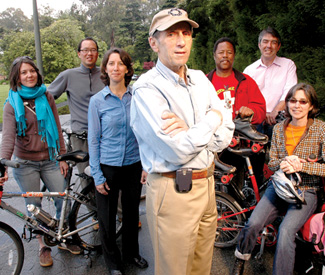
“We at the Bike Coalition very much started out on the opposite side of Warren Hellman,” San Francisco Bicycle Coalition executive director Leah Shahum told us. “We couldn’t have been more like oil and water on the garage issue.”

But over the past two years or so, Hellman’s profile has started to change. He went on to become an essential ally of the SFBC and other environmentalists and alternative transportation advocates who want to kick cars off JFK Drive in Golden Gate Park on weekends, crossing the downtown crowd in the process. He has shared his wealth with progressive groups such as Livable City, which often fights downtown, and has stuck up for edgy fun seekers over more conservative NIMBY types. He has also publicly repudiated the attacks of SFSOS and its spokesperson, Wade Randlett, and withdrawn his support from the group.

Hellman is still a Republican, but a thoughtful and liberal-minded one who opposed the Iraq War and wrote an article for Salon.com in February titled “If the United States Were a Company, Would George Bush Be Our CEO?” (His answer: hell no.) And to top it all off, Hellman sports a few tattoos and even attended 2006’s Burning Man Festival and plans to return this year.

Unguarded and reflective, Hellman’s comments to the Guardian foreshadow the possible future of capitalism and influence in San Francisco and point to potential political pathways that are just now beginning to emerge.

Our first conversation took place at the Guardian office two weeks before the November 2006 election, when it was starting to look like Nancy Pelosi had a good shot at becoming speaker of the House of Representatives.

“I think this election in two weeks is going to be really interesting,” Hellman told us.

This Republican was cheering for the Democrats to win. “They aren’t my kind of Republicans,” he said of the people in power. Hellman didn’t support the war or approve of how the Bush administration sold it, and he wanted Pelosi and the Democrats to hold someone accountable.

“What I’d like her to do is admit that we can’t get out [of Iraq immediately], but start to talk about what the fallout has been. Discuss the enormous cost in human life as well as money, and how it’s possible the war united the Middle East against us,” Hellman said.

The one thing he can’t abide is disingenuousness. Hellman speaks plainly and honestly, and he asked us to keep particularly caustic comments off the record only a few times during almost six hours’ worth of interviews. He was self-effacing about his political knowledge and seemed most interested in working through the problems of the day with people of goodwill.

Asked what he values most in the people he deals with, Hellman said, “It’s authenticity. Do they believe things because they believe in them, or do they believe in things because they’re cynical or they’re just trying to gain something?”

Locally, Hellman has reached out to people with varying worldviews and come to count many friends among those who regularly battle against downtown.

“I love to know people,” he said. “That’s probably the single thing that motivates me. When someone says to me, ‘How can you be friends with [then–head of SEIU Local 790] Josie Mooney?’ I say, ‘Look, I want to know Josie Mooney. And if she’s awful, then we won’t be friends.’ I’m just fascinated by getting to know people. And virtually always, they’re a little like Wagner operas: they’re better than they sound.”

Hellman was the chair of the Committee on Jobs when he got to know Mooney, who chaired the San Francisco Labor Council and was a natural political adversary for the pro-business group, particularly when Hellman was leading the fight to do away with the city’s gross receipts tax, which has proved to be costly for the city and a boon for downtown.

But after that victory, Hellman turned around and cochaired a campaign with Mooney to retool and reinstate the gross receipts tax in a way that he believed was more fair and helped restore the lost revenue to the city.

“We lost, but he put $100,000 of his own money into that campaign,” Mooney told us, noting that the proposed tax would have cost Hellman and Friedman around $70,000 a year. “I think he just thought the city needed the money. It was a substantive point of view, not a political point of view.”

Mooney considers Hellman both a friend and “an extraordinary human being…. He has made a huge contribution to San Franciscans that doesn’t relate to ideological issues. A tremendous thing about Warren is he’s not ideological, even in his political point of view…. On politics, I’d say he is becoming more progressive as he understands the issues that confront ordinary people.”

Mooney is one of the people who have helped bring him that awareness. When they first met, Mooney said, Hellman told her, “You’re the first union boss I ever met.” That might have been an epithet coming from some CEOs, but Hellman had a genuine interest in understanding her perspective and working with her.

“In a sense, I think that was a very good era in terms of cooperation between the Committee on Jobs and other elements of the city,” Hellman said. “Josie and I had already met, and we’d established this kind of logic where 80 percent of what we both want for the city we agree on, and 20 percent [of the time, we agree to disagree].”

Committee on Jobs executive director Nathan Nayman — who called Hellman “one of my favorite people in the world” — told us that Hellman feels more free than many executives to be his own person.

“He’s not with a publicly held company, and he doesn’t have to answer to shareholders,” Nayman said. “He takes a position and lives by his word. You don’t see many people like him in his income bracket.”

Hellman has become a trusted hub for San Franciscans of all political persuasions, Nayman said, “because he’s very genuine. He’s fully transparent in a city that likes to praise itself for transparency. What you see is what you get.”

Hellman expects the same from others, which is why he walked away from SFSOS (and convinced Feinstein to bolt as well) in disgust over Randlett’s scorched-earth style. Among other efforts, SFSOS was responsible for below-the-belt attacks on Sups. Chris Daly, Jake McGoldrick, and Gerardo Sandoval (whom a mailer inaccurately accused of anti-Semitism).

“If all things were equal, I’d just as soon that SFSOS went away,” Hellman said. “SFSOS started doing the opposite of what I thought they would be doing, so it was fairly easy for me to part company with them. What I thought we were doing is trying to figure out ways to make the city better, not just being an antagonistic, nay-saying attack organization. I’m not a huge fan of Gerardo Sandoval, but I thought the attacks on him were beyond anything I could imagine ever being in favor of myself. And it was a series of things like that, and I said I don’t want anything more to do with this.”

Downtown, they’re not always quite sure what to make of Hellman.

“Every once in a while, he does things that irritate people who are ideologically conservative,” Mosher said. “He took an immense amount of heat for supporting the Reiner initiative [which would have taxed the rich to fund universal preschool].”

He’s given countless hours and untold riches to public schools, doing everything from endowing programs to knocking on doors in support of bond measures and often pushing his colleagues to do the same.

“My connection to him has been through the school district, and he’s really been a prince,” Sup. Tom Ammiano said. “He has even stopped calling me antibusiness. He put a lot of his energy into improving public education, and so he shows it can be done.”

Progressives don’t always agree with Hellman, but they feel like they can trust him and even sometimes win him over. “If you get a relationship with him and you’re always honest about the facts and your own interests, he will listen, and that’s pretty remarkable,” Mooney said. “He shows a remarkable openness to people who have good ideas.”

His appreciation for people of all stripes often causes him to reject the conventional wisdom of his downtown allies, who viciously attacked the Green Party members of the Board of Education a few years ago.

“Everybody said, ‘Oh my god, Sarah Lipson, you know, she’s a Green Party member, she’s the furthest left-wing person on the board,’ blah, blah, blah,” he said. “And I phoned her up one day and said, ‘I’d really like to meet you.’ And she’s — leave aside the fact that I think she’s a very good person as a human being, but she’s a very thoughtful, analytic person. Listening to her opinions about things that are happening in the school district, I really respect that. I mean, what do I know about what’s going on in the school district? I know more now than I did then. But just getting to know people, and maybe get them to understand my point of view, which isn’t that penetrating.”

Many of his efforts have received little publicity, as when he saved the Great American Music Hall from closure by investing with Slim’s owner Boz Scaggs and helping him buy the troubled musical venue. “There are things that you and I don’t even have a clue that he has done,” Nayman said.

“He’s an interesting guy,” Mosher said. “He’s one of a dying breed, a liberal Republican. He has a social conscience and wants to use his money to do good.”

Actually, calling Hellman liberal might be going too far. In the end, he’s still very much a fiscal conservative. He doesn’t support rent control, district elections for the Board of Supervisors, taxing businesses to address social problems such as the lack of affordable health care, or limits on condo conversions.

He also opposes the requirement that employers provide health care coverage, which downtown entities are now suing the city to overturn, telling us, “In general, I don’t think it’s a good idea, because I’m still, even in my aging years, a believer that the marketplace works better than other things…. Universal health care I do believe in, but what I worry is that it’s going to be another damned bureaucracy and that it’s not going to work.”

Yet he doesn’t believe wealth is an indicator of worth, saying of his fortune, “It is luck. Most of what you do you aren’t better at than everyone.”

He doesn’t believe in the law of the jungle, in which the poor and weak must be sacrificed in the name of progress. In fact, he feels a strong obligation to the masses.

As he told us, “My mantra for capitalism — and I didn’t invent this, but I think it’s pretty good — is that capitalism won, and now we need to save the world from capitalism.”

Hellman looms large over downtown San Francisco. His Financial District office offers a panoramic view of the Bay Bridge, Treasure Island, the Ferry Building, and the rest of the city’s waterfront. He likes to be personally involved with his city and the companies in which Hellman and Friedman invests.

“Usually I’m directly involved,” he told us in an interview earlier this year. “I’ve always said that I don’t like to go to the racetrack to just look at the horses. The fun of being a principal is that you’re standing at the track and not saying, ‘Gee, that’s a beautiful gray horse.’ You’re saying, ‘Come on, he’s got to win!’ So I’m almost always invariably invested in the companies that we work with, either individually or through the firm.”

Unlike many Wall Street barons who strive to control a company and bring in new executives, flip it for a quick profit, or liquidate it, Hellman said his firm tries to identify solid companies and help facilitate what they do. “We don’t usually take over companies. I always think that we provide a service to help the businesses,” he said. “Our job is kind of the opposite of owning a factory. Our job is to be sure the people who run the business feel like it’s their business.”

Similarly, he thinks capitalists need to feel a sense of ownership over society’s problems, something he thinks is taking root in San Francisco and other economic centers, particularly among the younger generations. “It’s about understanding how much suffering there is on the other side and trying to figure out how that suffering can be alleviated,” he said. “I think it’s partly good economics that as you bring people up, they’re able to do more for society. If nothing else, they’re able to buy more and shop at a Wal-Mart or something — probably someplace you would wildly disapprove of — and buy goods and services. But I don’t think it’s that narrow.”

Rather, he believes that everyone has a little progressive in them, a little desire to cooperatively solve our collective problems rather than pass them off to future generations. He sees a marked change from his days at Lehman Bros.

“Everybody was into making it,” he said, noting that many capitalists then did charity work as a means of attaining social status but focused mostly on the accumulation of wealth. But, he said, the new generation of capitalists seems genuinely interested in improving the world.

“The feeling for giving back in the next generation, in the now 25- to 35-year-olds, it’s just an order-of-magnitude difference than it was for people who are now in their 40s and early 50s,” Hellman said. “I’m very encouraged.”

Yet the flip side is that, in Hellman’s view, downtown doesn’t wield as much power as it once did. Low political contribution limits have made politicians less dependent on downtown money, creating fewer shot callers, while democratizing tools such as the Internet have broadened the political dialogue.

“For the last 30 years we have become an increasingly tolerant city, and that’s great,” he said. “In the old days, [the Guardian] complained about downtown, and yeah, no shit, downtown really did control the city. The benefit was as that slipped away, the city became fairer and more open to argument. So now downtown hardly has any power at all anymore. In a sense, that’s a good thing. Tolerance grew tremendously when the city wasn’t dictated to.”

That tolerance caused street fairs to pop up all over town and festivals such as Hellman’s Hardly Strictly Bluegrass to blossom in Golden Gate Park. Bike lanes have taken space from cars, events such as Halloween in the Castro have gotten crazier, street protests have gotten bigger and more frequent, and people have felt more free to fly their freak flags. And all that freedom eventually triggered a backlash from groups of isolated NIMBYs who complain and often find sympathetic ears at city hall.

“Sometimes you get the feeling in this city that in the land of the tolerant, the intolerant are king,” said Hellman, whose festival has endured noise complaints even though the music is shut off by 7 p.m. “There is a continuing pressure to do away with fun, because fun is objectionable to someone, [but] we need to think about not creating a new dictatorship of a tiny group of people whose views are not in line with the opinion of most of the people of San Francisco…. You should try to balance the good of a lot of people versus the temporary annoyance of a few people.”

Preserving fun and a lively urban culture is a personal issue for Hellman, who plays the five-string banjo and calls his festival “the most enjoyable two days of the year for me.” He helps draw the biggest names in bluegrass music and acts like a kid in a candy shop during the event.

“I feel very strongly that an important part of our culture is built on the type of music and type of performance that goes on at Hardly Strictly Bluegrass,” Hellman said. From parables set to music to songs of struggle and the old union standards, “that kind of music is the conscience of our country.”

He considers bluegrass a vital and historically important form of political communication, more so than many of the upscale art forms that the rich tend to sponsor. “I’m glad that we have first-rate opera, but it’s equally important that we foster the kind of music, lyrics, etc., that support all this,” he said. “Somebody once said that most of the great Western philosophy is buried in the words of country songs. And that’s closer to the truth than most people think. A big passion of mine is to try to help — and people have defined it too narrowly — the kinds of music that I think have a hell of a lot to do with the good parts of our society.”

Perhaps surprisingly for a Republican venture capitalist from the older generation, Hellman also considers the countercultural freaks of San Francisco to be some of the “good parts of our society.” That’s why he attended Burning Man for the first time last year and why, he said, he loved it, as much for the culture and community as for the art.

“I went to Burning Man because as much as possible I want to experience everything,” he said. “I want to just see directly what it’s like. I knew I’d enjoy it. I never doubted that. But what really overwhelmed me is it was 40,000 people getting along with each other. I mean, it’s pretty intense. There were dust storms and the world’s most repulsive sight: nude men over 70 just dangling along. But I never saw an argument. It was 40,000 people just enjoying each other.”

It was most striking to Hellman because of the contrast with the rest of society. As he said, “I’ve never seen this country so divided.”

While Hellman supports Schwarzenegger — calling him “a good advertisement to California” — he has nothing good to say about his fellow Republican in the Oval Office. He calls Bush’s tenure “an absolute four-star disaster.” The invasion of Iraq is the most obvious problem, he said. “Our war policy has slowly veered from being ‘Don’t tread on me’ to we’re going to jump on your neck.”

But his antipathy to certain aspects of the Republican Party began even earlier, when the religious right began to take over.

“I thought we were not that polarized during the Clinton administration. I was somewhat encouraged,” Hellman said. “Maybe there was an undercurrent of strident religious behavior or strident conservatism, but not the conservatism that I think the Republican Party used to stand for, which was fiscal conservatism instead of social conservatism. Somehow, there was this angst in this country on the part of religious people who I guess felt this country was being taken away from them, and they were the kind of stalwart or underpinnings of society. And they took it back.”

But in the wake of that disaster, Hellman thinks, there is an opportunity for reasonable people of goodwill to set the future political course. As Nayman said of Hellman, “He does believe there is a middle way pretty much all the time.”

Politically, that’s why Hellman gravitates toward the moderates of both major parties, such as Schwarzenegger and Newsom. He looks for people who will marry his economic conservatism with a regard for things such as environmentalism and social justice.

“It’s very tough to be a big-city mayor,” Hellman said. “[Newsom is] probably the best mayor we’re entitled to. He’s got this fantastic balancing act.”

Hellman said downtown hasn’t been terribly happy with Newsom for supporting striking hotel workers, getting behind Ammiano’s health insurance mandate, supporting tax measures, and generally letting the Board of Supervisors set the city’s agenda for the past two years.

“Their measure is he has 80-percent-plus popularity, and he ought to spend some of it. Well, they might not agree with what he would spend it on. And he’s been unwilling to spend very much of it. In some parts of the business community there is disappointment with him, but I don’t think that’s right. He didn’t hide what he would be like.”

What Newsom said he would be — a big reason for his popularity — is a mayor for the new San Francisco, a place where the city’s traditional economic conservatism has been tempered by a greater democratization of power and an ascendant progressive movement that expects its issues to be addressed.

“I don’t like people who are intolerant,” Hellman said. “I don’t like people that are telling you something to get some outcome that, if you understood it, you probably wouldn’t want. I like people that are passionate.”

Asked, then, about Sup. Chris Daly, the nemesis of downtown and most definitely a man of strong political passions, he said, “I admire Chris Daly. I disagree with Chris on a lot of things he believes, but there are also probably a lot of things I would agree with Chris on. And I respect him.”

Hellman is the rare downtown power broker who wants to bridge the gap between Newsom — whom he calls a “moderate to conservative establishment person” — and progressives such as Daly, Mooney, and the Bicycle Coalition. The middle ground, he said, is often a very attractive place, as it was with Healthy Saturdays.

“I’m sure you spend time in the park on Sunday, and it’s a hell of a lot nicer in there on Sundays than Saturdays,” Hellman said. But even more important to him, this is about integrity and being true to what Golden Gate Park garage supporters promised back in 2000.

“They were proposing Saturday closing at that time, which I’ve always thought was a good idea,” he said. “And we made a commitment to them, or I thought we made a commitment to them, that let’s not have Saturday closure now, but as soon as the garage was done, we’d experiment with Saturday closure.”

We brought up what Fine Arts Museums board president Dede Wilsey has said of that pledge, that it was under different circumstances and that she never actually promised to support Saturday closure after the garage was completed.

“There’s a letter. She put it in writing,” he said of Wilsey. “She signed a letter on behalf of the museums saying that when the de Young is done, we should experiment with Saturday closings.”

The Bike Coalition’s Shahum said that even when Hellman was an enemy, he was a reasonable guy. But it’s in the past couple of years that she’s really come to appreciate the unique role he plays in San Francisco.

“He showed decency and respect toward us,” she said. “We never saw him as a villain, even though we disagreed completely. Later he really stepped up and has been a leader on Healthy Saturdays. And what I was most impressed with is that he was true to his word.”

Supervisor McGoldrick, who sponsored the measure, echoed the sentiment: “Hellman was certainly a man of his word who acted in a highly principled way.”

So why does Hellman now stand apart from the downtown crowd? Has he parted ways with the economic and cultural power brokers who were once his allies?

No, he said, “I think they parted ways with me.” *


Istanbul May 11, 2007

0

By Bruce B. Brugmann

CNN today was drumming on with news of Tony Blair going and Gordon Brown coming in as prime minister of Great Britain. The Turkish Press was reporting that the national elections here had been moved up three months to July 22, and this surprised the political parties, who were alarmed and said they were forced to bring in the professionals to help them carry on effective campaigns during the short period left before the election. The Turkish Daily News, Turkey’s English daily, reported that there was no space left on the TV stations or on the billboards and that campaign ads would be competing with ice cream manufacturers.
On the plane coming in, Spiro Vryonis sat next to associate pubublisher Jean Dibble and filled her in on the elections from his perspective as a Byzantine scholar. Vryonis, retired director of the center for the study of Hellenism in Sacramento, told her that Prime Minister Recep Tayyip Erdogan supported his Foreign Minister Abdullah Gul for president. “They get along like two dogs until someone throws a bone between them,” he said.
Meanwhile, I found good advice in Time Out Istanbul, the city-living guide in English. It wrote about the art of Keyif, which translates as “a pleasurable state of idle relaxation.” The article said that Keyif has been honed down to an art form by the Trurks and laid out 10 ways of experiencing Keyif the Turkish way. My favorite was the idea of walking aimlessly along the Bosthorus, the body of water seperating Asia from Europe. It said that “you’ll be surprised how relaxing the Oriental art of walking around with no destination is.” The 58th International Press Institute world congress and general assembly starts tomorrow. So I think I’ll spend the rest of the afternoon doing Keyif. B3

Berkeley shutting down art and alt-energy center

0

By Steven T. Jones
Just as I was writing about wanting to get back into covering the fantastic alternative energy creations now being developed by Burning Man artists, Berkeley officials were in the process of shutting down an important hub for this work. The Shipyard is a live-work industrial arts space just off Ashby Avenue built from steel shipping containers, which city officials apparently don’t think is safe, so they’ve ordered the artists out and the place shut down immediately, with owner Jim Mason risking $2500 per day fines until he can get out. “It’s a major blow to the underground arts community,” Burning Man’s environmental director Tom Price told me this morning. Even worse, it’s a blow to Mason’s main project for the year, Mechabolic, a gasification system that turns garbage into usable energy without producing carbon or greenhouse gases, the very thing that Berkeley officials claim to support. We’re just diving into this developing story now, so check back for the complete story next week. Or if you want to help them break down many years of funky hard work, stop by the shop at 1010 Murray Street this weekend.

Magic stars

0

› a&eletters@sfbg.com

"When we use magical in a positive sense," filmmaker Lawrence Jordan explains, parsing an adjective that is frequently brought up in discussions of his work, "it really means my eye is fresh at this moment and what I’m seeing is a discovery." Jordan’s films — in particular, the animated collages composed of Victorian magazine illustrations, Gustave Doré engravings, and flashing stars and orbs for which he is most famous — are the visual records of such moments of discovery.

The more than 40 experimental short (as well as three feature-length) films Jordan has made over his 40 years in the Bay Area are as much documents of the fanciful flight paths of his free associations — what he calls his "inner world" — as they are fleeting glimpses of a precinematic visual culture that has long since vanished. Thanks to an upcoming program put on by the San Francisco Cinematheque as part of its Bay Area Roots series, audiences will get the chance to discover — or perhaps rediscover with fresh eyes — the work of a filmmaker and advocate (Jordan helped found Canyon Cinema) who truly deserves to be called a Fog City maverick.

Like the cryptically beautiful boxes of Joseph Cornell, Jordan’s films exude a certain innocent surrealism. His poetic assemblages of fantastic fauna, romantic vistas, and hermetic symbols seem aimed at enchanting rather than disturbing the viewer through the kind of sexual shock tactics that were more the métier of Max Ernst. "That part of surrealism we don’t qualify for," Jordan says, referring to himself and Cornell, for whom he worked as an assistant in 1965, filming over the course of his stay at Utopia Parkway in Queens the only extant footage we have of the notoriously reclusive artist and his fabled workspace.

Jordan’s choice of the inclusive pronoun reveals both the slight reserve and matter-of-factness with which he speaks of his work and the strong sense of kinship he projects when talking about the artists — such as Cornell and collagist Jess Collins, who worked under his first name only — who became colleagues, served as inspiration, and, more often the case in a career filled with notable collaborators (Watts Tower sculptor Simon Rodia and Orson Welles), functioned in both capacities.

Following his high school friend and early collaborator Stan Brakhage to San Francisco from New York, Jordan moved into a basement flat below the poet Robert Duncan and his partner, Jess, whose baroque collages of finely crosshatched renderings of his source material shared affinities with Jordan’s then-still-developing aesthetic of assemblage. "[Jess] was the high priest of art magic in the time that I knew him," Jordan says.

Magic, as it turns out, keeps coming up in our conversation, whether in a passing reference to The Wizard of Oz (Jordan owns a complete set of the Oz books) or when Jordan cites that magician of silent cinema, Georges Méliès, as a major influence. Blue Skies beyond the Looking Glass, completed last year and one of the highlights of the cinematheque’s program, is very much an homage to the evocative power of early cinema.

A jubilant séance, Blue Skies resurrects silent-era stars such as Lon Chaney Sr., Lillian Gish, and Mary Pickford via some amazing screen test footage and invites them to tango with intercut animated segments. The film offers a nice summary of Jordan’s cinema of attractions, in which old signs are transmuted into wonders once more, restoring some of their mystery. "I don’t know about alchemy academically," Jordan reflects, "but I am a practicing alchemist in my own way." *

WORKS OF LAWRENCE JORDAN

Sun/13, 7:30 p.m., $6–$8

Yerba Buena Center for the Arts

701 Mission, SF

(415) 978-2787

www.sfcinematheque.org

Not Coachillin’

0


SONIC REDUCER “I can’t believe you slept through the police helicopter above the tent at 3 a.m. and the megaphone going, ‘Disperse immediately or you’ll all be arrested,'” tentmate Fluffy marveled the day after another ear-busting night of the Coachella Valley Music and Arts Festival’s unofficial after-party scene in the campgrounds. It was only 8 a.m., though the sun was already beating down relentlessly like our heedless neighborhood drum circle.

I’ve snoozed through my share of lousy plays, bad bands, and crappy circuses, but I never thought I’d slumber through the 24-7 thrills at the Empire Polo Fields. And the chopper was just the chaser to April 28 trance headliner Tiesto, who began his loud set, pompously booming out over our not-so-fair tent city of spring breakers and Euro tourists, with “In the beginning there was the earth….”

We’re gonna have to sleep through the history of the planet, was my last thought as I drifted off.

O Coachella, don’t you cry for me, ’cause I’ve come from Alabama Street with a heat rash on my knee — and doubts about making the scene at the festival despite the fact that about 160,000 brave music fans were expected to face down the desert swelter as the event swelled to three days.

At this juncture, Coachella might be described as a music festival on steroids: it’s a carnival for 18 and overs with rides, art installations, dancers, and completely insane people wearing full-body chicken costumes in the 110-degree heat, though still boasting a comprehensive bill of today’s so-called hot bands. It’s your one-stop smorgasbord for music lovers, who will happily chat you up about the performer they deemed the most mind-blowing the previous night or the last Rage Against the Machine show they caught.

And they got what they came for: the Björk shroom headdress; the crazed buzz rising from such festival circuiteers as Amy Winehouse and Klaxons; solid pop from Jarvis Cocker and Peter Bjorn and John; show-stopping performances by DJ Shadow, CSS, Arcade Fire, and Konono No. 1; and the rattle of reunion bones by an amped and antic Rage Against the Machine, glowering and balding Jesus and Mary Chain, and, er, Crowded House. You couldn’t go amiss if you stuck to the desert to-do’s rave roots and entrenched yourself beneath the mirror ball, video screens, and pink and blue lights of the Sahara tent: the performances there by Justice and LCD Soundsystem connected with the crowd with a screw-it-all exuberance.

But the untold story lay far away from the press tent and Palm Springs love nests — in the crowded, brutal heat of the campgrounds next to the performance area. Is it possible to review a camping trip? In what seemed like a dusty, straw-strewn football field with thousands of other wake ‘n’ bakers? I spent far too much time taking refuge from the nonstop heat at the campground’s cybercafé, where hundreds of shirtless boys and bikinied girls would miserably crouch, recharging their cells at a bank of outlets, sit stunned watching the Coachella film on a loop, or lie on the ground like clammy, comatose dead fish, waiting out the morning before the acts began in early afternoon.

The southerly discomfort led most campers on a lengthy hike from the tent city, past the obscenely grassy country clubs surrounding the polo grounds, to find refrigerated refuge and 40s at Ralph’s, the nearest supermarket, where people were literally chillin’ on store lawn furniture. Coachella: the fest that inspired global warming — and a post–<\d>Earth Day longing for air-con.

Organizers Golden Voice had a clue: they gave away free water sporadically and provided campers with free Internet use and showers. But there were too few laptops, the wi-fi was too erratic, and the showers were locked down too early — and you knew there was too little shade in general when audience members broiled in the sparse shadows of lemonade stands.

The crowd — weighted with Rage Against the Machine fans eager to see the band’s first concert in more than five years — was also heavy on the testosterone. But maybe that’s just the state of Rage love: the band never really seemed too underground to me but has historically worked to surface activist subversion via modern rock radio. And their audience was still boiling — and amazingly good-natured despite the sleepless nights. As for myself, I finally woke up hours after the helicopter early April 29 to the sound of a random dude shouting, “Whoo!” and yammering loudly in Portuguese to the tentizens the next flap over. Later I was tempted to put my own spin on Zack de la Rocha’s onstage suggestion that Bush and Cheney be “tried for war crimes and shot.” I know the 12-hour roller coaster ride of quality hallucinogens can be a bitch — but then, so can I: is it so wrong to want the early morning shouters and the dude with the air horn to be tried for crimes against humanity’s sleep schedule and shot? I’d settle for finding out where they were dozing it off and delivering a special whoo-gram of my own.

BOB DYLAN STUDIED HERE That’s the rumor, anyway, at the Blue Bear School of Music, which has seen Tracy Chapman and more than 20,000 other musicians come through its doors in the past 36 years. Executive director Kevin Marlatt told me the nonprofit’s second annual fundraiser — showcasing 2007 Grammy Lifetime Achievement winner Booker T. Jones as well as Blue Bear staffer Bonnie Hayes and Sista Monica — will include an appearance by the James Lick Middle School Band, the result of the organization’s efforts in the last year to get more involved in public school music education. Since it took over the James Lick music program and brought in 30 guitars, he says, more than a dozen bands have popped up at just that school. So Stax around for a good cause. *

BOOKER T. JONES

Sat/12, 8 p.m., $45–$125

Great American Music Hall

859 O’Farrell, SF

www.bluebearmusic.org


May day

0

› a&eletters@sfbg.com

The May Day rampage of the Los Angeles Police Department over peaceful protesters and journalists at an immigrants’ rights march lends an undeniable immediacy to America Tropical, a new and at times poignant chamber opera by composer David Conte and librettist Oliver Mayer that addresses the legacy of racial and class exploitation built into the very fabric of the City of Angels.

The compact 60-minute work, which premiered April 27 at the Thick House under the auspices of San Francisco’s Thick Description, takes its cue from América Tropical, a 1932 Olvera Street mural painted by the great Mexican social realist artist David Alfaro Siqueiros (sung with appropriately formidable presence by a swaggering, tempestuous Mark Hernandez). Meant as a mirror held up to the past and future of Los Angeles, Siqueiros’s wall pointed back to the city’s 18th-century Mexican founders in a group of pobladores (played here by six capable singers led by an impressive Antoine Garth) and ahead to the grim strife of an ethnically and racially stratified class system.

That strife culminates in America Tropical as the conflagration of the 1992 riots sparked by the police beating of Rodney King (played by Garth), famously witnessed and transmitted to the world by private citizen George Holliday (Chad Runyon), whose videotape thus becomes something of the equivalent of Siqueiros’s politically charged mural.

In an apt, indeed concrete metaphor for an increasingly divided and dividing age, walls as sites of division, reclamation, toil, and creative resistance pervade the poetic libretto provided by playwright Mayer (Blade to the Heat, Joe Louis Blues), which effectively brings Sisqueiros’s social realist language into 3-D relief. "Tell me what a wall can do," Siqueiros sings. "I’ll show you what a wall can be."

Meanwhile, Conte (whose beautiful, ghostly desert opera Firebird Motel was commissioned and produced by Thick Description) has fashioned a score featuring serrated melody lines and lush choral harmonies to augment the work’s three centuries, succinctly blended in Mayer’s libretto. The music moves determinedly forward through alternately agitated, wistful, angelic, and angry passages provided by an excellent sextet of piano, strings, and woodwinds conducted by John Kendall Bailey.

At the same time, Siqueiros’s emotionally powerful and provocative visual allegory can translate awkwardly to the stage. Those walking in cold without any knowledge of the opera’s deeply rooted relationship to Siqueiros’s mural may find some of the mise-en-scène (such as the crucifixion) a trifle hokey, despite graceful staging by director Tony Kelly, not to mention the excellent singing, generally decent performances, and arresting music. Some preparation for the audience — a description of the mural on a lobby poster or somewhere in the program — might have been in order.

Siqueiros’s Olvera Street mural was one of the earliest examples of the Mexican urban art movement that publicly portrays the local narratives of ethnic and indigenous people. But in 1932 the police arm of the ruling class had a brush of its own, and soon after the mural’s unveiling the LAPD whitewashed it into what turned out to be temporary oblivion. (It was partially uncovered and rediscovered in the 1960s and has recently been undergoing restoration.)

It’s more than merely ironic that the mural’s images of workers and an indigenous American woman, named the India (sung by Sepideh Moafi), crucified on a double cross of American imperialism, were staging a second return in Conte and Mayer’s America Tropical even as LAPD clubs and rubber bullets rained down on workers and families at MacArthur Park. The redemptive force of the opera’s historical ghosts rises on a wave of events that gives distressing currency to the libretto’s emphatic assertion, "There is no present / There is no future / Only the past, happening over and over again." *

AMERICA TROPICAL

Through May 20

Thurs.–Sun., 8 p.m., $15–$25

Thick House

1695 18th St., SF

www.thickhouse.org

Prints charming

0

› a&eletters@sfbg.com

PREVIEW If only it were prix fixe. The lamb curry wrapped in crystallized mint leaves sounds delectable, but the butternut squash ravioli catch your eye first. Then you notice that one of the items on the menu is made entirely with ingredients from the chef’s garden. The choice is obvious. As you munch on homegrown multicolored heirloom tomatoes, conversation turns to how much is in our own backyards. Electric Works isn’t a restaurant, but if artists’ creative moods are seasons and we the adventurous diners, then this new incarnation of formerly Brisbane-based Trillium Press is the most seasonal print studio around.

Sitting in a brick-lined meeting room in the historic Buzzell Electric Works building on Eighth Street at Mission, Noah Lang recalls an article on the differences between cooking in New York and California. "In many ways, we’re closer to Chez Panisse than we are to Paulson or Crown Point Press," he says. "We’re more concerned with what we come up with at the end of the day than how we came up with it."

Noah’s father, the visionary printer Richard Lang, who serves as the president of Electric Works, invokes Adam Gopnik’s statement that the last artists in the world who really care about their patrons are the chefs. "I was trained in the art world, where the whole thing is ‘it’s my vision — you’re a loser if you don’t get it.’ That always struck me as dumb, because people have willing hearts if you’ll just step forward," Richard explains, imagining Electric Works as a chef saying, "Taste this! It’s a little funny at first, but it’s really good!"

In 1980, when Proposition 13 lost him his teaching job, Richard started doing lithographs with David Salgado, who had founded Trillium the year before. They eventually forged a 10-year formal partnership that dissolved in 2006. "We were in a boxer relationship, punching and counterpunching, and we really learned a lot about collaboration — that you really push hard and expect somebody to push back," Richard says of those early projects.

Deep collaboration became Trillium’s theme. After originally only doing contract work, the press started running a publishing program around 2000. "It’s a traditional system, headed by the artist, who comes in to collaborate. What we make, however, is totally untraditional," says Noah, who joined the studio in 1996 to spearhead the digital printmaking program. Electric Works’ high-tech scanning and printing devices allow the shop to scan anything, and it’s always eager to explore technology in order to realize and often expand an artist’s vision. Electric Works partner and art collector Anthony Luzi calls this an entrepreneurial practice because the creative process always trumps protocol.

Marcel Dzama’s The Cabin of Count Dracula and Stephanie Syjuco’s Future Shock Nesting Boxes (both 2005) show why the print shop has become known as the Land of Yes. Dzama started by imagining Count Dracula in the artist’s hometown, Winnipeg. His whimsical, bestial lithographs seemed to scream for appropriate housing, so Trillium, with considerable research, helped create a miniature log cabin complete with faux-beaver-fur rugs. The cabin simulates both hypersensitive isolation — remember Richard Barnes’s Unabomber photos? — and a playful sense of rapture. Syjuco’s boxes, slightly blurry folded replicas of stereo equipment, made of archival inks on laminated board, trigger similarly quirky states of mind: Is this touching me? How do you read it? Is it real? Yes.

Or nay? Working in the Land of Yes seems to tap into artists’ capacity for answering questions with questions, allowing them to ask "yes" in their own way. William T. Wiley’s illustrious postmodern hieroglyphics gain new life. Sandow Birk, in his Inferno projects, morphs Dante’s rich anxieties into our own, using urban überconsumer environments. Though those who don’t like these sorts of inquiries might freak out at the inaugural exhibition, which features new work from Tucker Nichols and Katherine Sherwood, their absence will just mean more room for those who want reality’s unreal underpinnings to open their wide eyes wider.

Electric Works weds the powers of curatorship and accessibility. As part of the print shop’s "venture philanthropy" program, artists develop unique editions to support nonprofits, and the new digs will include an alternative museum store with affordable art items, a natural art-for-the-people progression from a successful scholarship program offered through the California College of the Arts.

"The gatekeepers of the art world really want the world to be pyramidal," Richard says. "But the truth is that the world is spherical and everything is talking to everything else."

Is that true? Are you reading this as if it weren’t a dream? I’ll offer one hint: the answer isn’t no. *

TUCKER NICHOLS
AND KATHERINE SHERWOOD

May 11–June 23

Opens Fri/11, 5:30–7:30 p.m., free

Runs Tues.–Fri., 10 a.m.–6 p.m.;
Sat., 10:30 a.m.–4:30 p.m.

Electric Works

130 Eighth St., SF

(415) 626-5496

www.sfelectricworks.com

Myth of the universal library

0

› annalee@techsploitation.com

TECHSPLOITATION A lot of Web geeks believe that one day everything ever created by humans will be available online. Call it the myth of the universal library. Here’s how the myth goes: because there is unlimited real estate in cyberspace and because media can be digitized, we can fill cyberspace with all human knowledge and give everyone access to it. Without further ado, I present to you three arguments for the elimination of the myth of the universal library.

1. Cyberspace does not exist. The term cyberspace was invented in the late 1970s by a science fiction writer named William Gibson, who used it to describe a "consensual hallucination" experienced by people who were neurologically linked to computer networks. Even within Gibson’s novels, the author is careful to explain that the illuminated buildings, glowing roads, and avatars that his heroes meet in cyberspace are simply convenient representations of abstract data structures.

My point is that computer networks are not space and they are not real estate. They are data storage and manipulation devices connected together by wires and radio waves. They cost money and require massive amounts of power. They take up real-world space. And they break. In other words: no computer network is infinite. Storing all of human knowledge on a computer network would be expensive and intensely difficult to maintain. There is no infinite cyberspace — only finite computer networks subject to wear and tear.

2. Your human knowledge sucks. I was recently in a very interesting conversation with several smart librarians, all of whom are keen to use computers for preserving and disseminating information. Somebody pointed out that a good example of publicly accessible universal knowledge is the French Gaumont Pathé Archives, which makes hundreds of hours of searchable historic newsreel footage available online for free. The problem, as film archivist Rick Prelinger pointed out, is that the Gaumont Pathé project, like many of its kind, has had to pick and choose which films it can afford to archive. So the group focused heavily on politics and left the fashion and pop culture reels undigitized and therefore less accessible. The guy who’d brought up the archive thought this was just fine.

"No, it’s not," Prelinger replied. "If you want to know what everyday people cared about historically, fashion is going to tell you a lot more than newsreels about famous politicians."

The point is, people don’t agree on what "all of human knowledge" means. Is it great art and political history? Or is it xeroxed zines and fashion history? Who decides what gets digitized and what gets tossed in the ashtray of the unsearchable, the unnetworked? Do commercials go into our mythical universal library? What about hate speech and instruction manuals for hair dryers? Are those documents not also part of human knowledge? We will never reach an agreement on what all of human knowledge really is, and therefore we will never be able to preserve all of it.

3. Digitizing everything is impossible. Consumers can buy terabyte-size disk storage. The glorious Internet Archive buys petabyte storage devices by the bushel. You can fit your entire music collection in your pocket, and your book collection too. But even if we agreed on what all of human knowledge really is — which we never will — you couldn’t digitize all of it. Turning books into e-books takes time, as does turning film and television into digital video files. And what about rare scrolls, artworks, and machines? How do you put them online? Some medieval manuscripts and textiles are so delicate they can’t be exposed to light. Making something digital isn’t like waving a wand over it — poof, you’re digital! No matter how hard we work and no matter how much money we throw at this problem, there is simply no way to turn all physical media into digital formats.

The myth of the universal library is not only widespread, it’s also dangerous. Believing in the myth makes us forget that we need to be working hard right this second to preserve information in multiple formats and to make it available to the public any way that we can. *

Annalee Newitz is a surly media nerd who has a very large collection of nondigital books.

Deleting accountability

0

› amanda@sfbg.com

Public records are coming in pretty handy these days. Congress is using them to investigate the relationship between the Republican National Committee and the firing of eight attorneys general, and as with many investigations that use documents to uncover malfeasance, some key documents are missing — in this case Karl Rove e-mails.

It seems Mayor Gavin Newsom’s office also has a penchant for the delete key, according to findings of the city’s Sunshine Ordinance Task Force. Two complaints brought by citizens have been heard by the task force regarding how the mayor’s daily calendar is kept — or isn’t kept — and what happened to e-mails that disappeared after they were requested by a member of the public.

"We found there was willful and ongoing violations and destruction of records," task force chair Doug Comstock told the Guardian.

Staff in the Mayor’s Office say they didn’t do anything wrong and no willful destruction of public records has occurred. According to Joe Arellano of the Mayor’s Office of Communications, the e-mails — invitations sent out for the mayor’s Jan. 13 District 1 community policy forum — were purged because they were temporary.

"We have such a huge e-mail system, we have to delete e-mails that are transitory. These, to us, were the same kind of e-mails," Arellano said.

The case is on hold awaiting further information regarding the city’s capability to retrieve purged electronic documents and will be heard again by the task force. But the larger issue is whether Newsom is intentionally keeping his calendar a secret, in violation of city law.

The Mayor’s Office only makes public Newsom’s so-called Prop. G calendar, named for a 1999 ballot measure expanding the Sunshine Ordinance and explicitly making the mayor’s schedule a public record. It’s a stripped-down version of his list of appointments, often with only a couple events per day.

The Mayor’s Office has argued that Newsom’s complete calendar can’t be made public, citing security and privacy concerns. The task force disagrees and contends it’s a document that should be public, with redactions of security and privacy information as needed.

The Mayor’s Office disagrees. "The sunshine task force is wrong, and we are right," Newsom press secretary Nathan Ballard said. "The calendar we give to the public and press exceeds Prop. G."

Arellano, in a letter to the task force, described the other document as a "working calendar that is extremely detailed and accounts for his time from departure from home until his return in the evening. The working calendar contains not only the Mayor’s meeting schedule, but also confidential information such as the officers assigned to protect him, security contact numbers, the Mayor’s private schedule, details of his travel," and everything else that he’s doing.

"What they refuse to realize is they’re both public documents," Comstock said about the dual calendars.

Peter Scheer, executive director of the California First Amendment Coalition (CFAC), agrees that both calendars are public if they contain information about what the mayor’s doing with his city time.

"If they have security concerns, they can withhold particular items that would jeopardize the mayor’s security. There are certain things we can all agree on that can be withheld, certain driving routes and evasive strategies for emergency planning. But when the vehicle stops and he gets out for a meeting at an office, home, or place of business, that item has to be revealed," Scheer said. "If we’re talking about a calendar, there may be thousands of items, and only a handful may be subject to redaction. They can’t use the few to justify nondisclosure of the many."

But that’s precisely what the Mayor’s Office is doing.

The mayor, city attorney, and all department heads are required by Prop. G to reveal "the time and place of each meeting or event attended." The only exclusions may be "of purely personal or social events at which no city business is discussed and that do not take place at City Offices or at the offices or residences of people who do substantial business with or are otherwise substantially financially affected by actions of the city."

Therefore, a Prop. G calendar should contain everything a city official does every day in the course of working for the public. When asked if all the blank spaces on the Prop. G calendar represent personal time, Ballard said, "It could be personal. It could be other. It’s not anything we’re required to divulge under Prop. G."

But just because it should be there doesn’t mean it is. For example, the mayor’s calendar for the afternoon of April 19 shows him attending a library luncheon at 12:30 p.m., a phone interview at 2:30 p.m., and a 4 p.m. meeting with his chief of staff, followed by a Port Commission swearing in.

But we ran into Newsom coming out of a 2 p.m. Recreation and Park Commission meeting, where he spoke in support of more public art in the city. This event is not listed on his calendar. Ballard said the Prop. G calendar is sometimes amended to reflect changes. "I don’t have an android following him at all times. We’re just human beings working here."

"If he indeed was there, I will try to remedy that," Ballard added.

This scenario suggests other public business is also not being adequately tracked and Newsom’s real calendar could fill in the gaps, but the mayor’s computer software is set to automatically delete the working calendar after five days, destroying a record of what the mayor actually did.

Aside from any prurient interest in what the mayor is up to, an accurate record of events is a part of public accountability. Newsom’s calendar for the week of April 16 lists 31 meetings and events amounting to 25 1/2 hours at work. The city attorney’s Prop. G calendar is even more paltry. Between April 23 and 27, Dennis Herrera apparently attended 13 meetings and spent 11 1/2 hours working for the city.

Calendars are important public documents, Scheer says. "Most importantly, they give an insight into who has access to that public official." But, he says, "it’s only as revealing as it is complete."

Scheer and the CFAC are currently involved in a court case with San Bernardino County. The San Bernardino Sun sued the county for access to supervisors’ e-mails, memos, and calendars for a period of time last summer during a large fire that destroyed houses. Bill Postmus, the chair of the board of supervisors, appeared to be AWOL during the emergency, and reporters at the Sun sought relevant documents that might support Postmus’s claim that he was in contact with his staff at the time.

A judge ordered the records released, with redactions, and most officials have complied, except Postmus, who has convinced the county to hire outside counsel and appeal.

Back in San Francisco, the Mayor’s Office doesn’t seem to be sweating much about the next legal action regarding its records management. The task force does not have the power to levy fines or punishment, so the calendar case has been referred to the Ethics Commission, the district attorney, and the attorney general.

"We will be vindicated by the Ethics Commission," Ballard said. "The Ethics Commission will side with us." *

Summer trippin’

0

› marke@sfbg.com

After circling the same late-night block in the Tenderloin for any number of years, I recently donned my fabulous ’50s air hostess uniform with matching kicky white pumps, splashed on a dash of Wind Song, and decided to experience the magic of travel. Why, there’s a whole world knocking at my back door — and no length I won’t go for a taste of adventure. Local Web sites such as 71miles.com, which explores nearby Northern California, and the fantastically rough-and-ready newsletter from WeekendSherpa.com are chock-full of neato getaway ideas, but I also did some wide-ranging research of my own, as evidenced below. Remember, travel can be harsh on the environment, so plan your trips well, pack light, and try to hoof it as much as possible (sans stilettos, of course) — that way you won’t miss a thing.

MARVELOUS MENDOCINO


Five or so hours up the coast and through the gorgeous wine country of Anderson Valley lies Mendocino, an achingly quaint city on a peninsular cliff, full of retired ex-hippies, impromptu music festivals, hilarious whale art, and delectable bursts of natural wonder. Stay at the incredible Inn at Schoolhouse Creek (www.schoolhousecreek.com), a collection of renovated century-old cottages run by the very friendly Steve Musser and Maureen Gilbert, complete with hot tubs, hearty breakfasts, ocean views, and a pair of cute-as-heck Sicilian pygmy donkeys (really!). Chow down with elegance at gourmet vegetarian legend the Ravens’ Restaurant at Stanford Inn (www.stanfordinn.com), and spend a day or two drifting lazily down the Big River, past harbor seals and exotic ducks, in a flotation device from nearby hunkily staffed Catch a Canoe (www.catchacanoe.com).

WET ‘N’ WILD SONOMA


Turtles, ospreys, three kinds of heron, deer, eagles, and maybe even a winery or two — such are the Russian River delights that await if you hit up River’s Edge Kayak and Canoe Trips (www.riversedgekayakandcanoe.com), in the ever-so-sunny boutique town of Healdsburg in Sonoma County. Whether you’re an experienced water rat or a casual paddler (watch that French manicure!), there are several nature-filled routes and levels of difficulty to choose from. Especially scenic is the 11-mile course via Rio Lindo, snaking around mountain bases through heavily wooded areas, with plenty of picnic spots and — I love this phrase — secluded swimming holes.

DOIN’ THE DELTA


About three hours northeast of San Francisco, right before you hit Sacramento, lies the fertile, humid, natural wonder of the Sacramento Delta (www.sacdelta.com). Consisting of numerous islands and inlets along the Sacramento River and its tributaries, the Delta is an environmental marvel, full of roadside levees, quirky small towns, and abundant agricultural land reclaimed from meandering waters. Islands are traversed by constantly running car ferries, mostly piloted by sweet, sun-seasoned lesbians (dykes and levees — how can you miss?), and visitors often come away with bushels of farm-fresh asparagus, cherries, strawberries, pomelos, and other juicy produce. The eerie jewel of the Delta, however, is Locke (www.locketown.com) — a full-on Chinatown in the middle of a grassy nowhere, founded in 1915 by Chinese farmworkers after a fire in nearby Walnut Grove destroyed their homes. Locke’s Dai Loy Museum is an authentic ghostly gambling house replete with Asian gaming tables, displays of early 20th-century pictures and artifacts of the town, and oodles of fascinating historical tidbits. (Example: in the 1920s the white police force used to raid the town dressed as "Hindus.")

KINETIC EUREKA


If you’re reading this in time, you may want to take a jaunt up to the city of Eureka, near the Oregon border — not just because the downtown area has been retooled into a quaint historical shopping district, but also because of Memorial Day Weekend’s famed and amazingly wacky Kinetic Sculpture Race (www.kineticsculpturerace.org). It’s kind of a miniature Burning Man on wheels — folks of all stripes build unique human-powered contraptions and engage in a wild three-day race over land and water, in a scramble around the city and nearby countryside. A couple years back, I rooted for the tandem bicycle contraption with a disco ball on top that shot out actual flames, but it got held up by a herd of cows blocking the road and lost. *

Summer 2007 fairs and festivals guide

0

ONGOING

ArtSFest Various venues; www.artsfestsf.org. For its fourth year, ArtSFest presents a showcase of theater, dance, visual art, film, music, spoken word, and more. Through May 28.

Night Market Ferry Bldg Marketplace, along the Embarcadero at the foot of Market; 693-0996, www.ferrybuildingmarketplace.com. Thurs, 4-8pm, through Oct 26. Marketplace merchants and farmers offer their freshest artisan foods and produce at this weekly sunset event.

United States of Asian America Arts Festival Various venues; 864-4120, www.apiculturalcenter.org. Through June 30. This festival, presented by the Asian Pacific Islander Cultural Center, showcases Asian Pacific Islander dance, music, visual art, theater, and multidisciplinary performance ensembles at many San Francisco venues.

Yerba Buena Gardens Festival Yerba Buena Gardens, Third St at Mission; 543-1718, www.ybgf.org. Through Oct, free. Nearly 100 artistic and cultural events for all ages takes place at the gardens this summer including Moroccan percussionists, Hawaiian ukulele players, Yiddish klezmer violinists, Balinese dancers, Shakespearean actors, Cuban musicians, and Japanese shakuhachi players.

BAY AREA

Silicon Valley Open Studios www.svos.org. Sat-Sun, 11am-5pm, through May 20. Check out Silicon Valley artists’ works and the spaces they use to create them at this community art program.

MAY 8–20

The Hip-Hop Theater Festival: Bay Area 2007 Various venues; www.youthspeaks.org. Youth Speaks, La Peña Cultural Center, the Hip-Hop Theater Festival, and San Francisco International Arts Festival present this showcase of new theater works that feature break dancing, MCing, graffiti, spoken word, and DJ sampling.

MAY 10-20

Mission Creek Music and Arts Festival Various venues; www.mcmf.org. The Mission Creek Music and Arts Festival features the best and brightest independent musicians and artists, including music by Vincent Gallo, Acid Mothers Temple, Edith Frost, and Gary Higgins. Literary and film events are also planned.

MAY 12

KFOG KaBoom! Piers 30-32; 817-KFOG, www.kfog.com. 4-10pm, free. Kick off the summer with this popular event featuring music, a spectacular fireworks show, food and drinks, and activities for kids. Kenny Wayne Shepherd, Guster, and Ozomatli perform.

BAY AREA

Arlen Ness Motorcycles Anniversary Party Arlen Ness, 6050 Dublin, Dublin; (925) 479-6300, www.arlenness.com. 10am-4:30pm, free. Celebrate the company’s fourth year in Dublin and 37th year in business with a display of the largest selection of Ness, Victory, American Iron Horse, and Big Dog Motorcycles in California, a walk through the museum, and a live music from Journey tribute band Evolution.

Beltane Pagan Festival Civic Center Park, 2151 MLK Jr. Way, Berk; www.thepaganalliance.org.10am-5:30pm, free. This year’s festival focuses on children and young adults and features a procession, performances, vendors, storytelling, an authors’ circle, and information booths.

Peralta in Bloom Spring Festival Carter Middle School, 4521 Webster, Oakl; (510) 655-1502, www.peraltaschool.org. Due to a fire, Peralta’s spring festival will be held at a temporary home this year. Expect the same great live entertainment, carnival games, old-fashioned high-steppin’ cakewalk, free arts and crafts, and delicious barbecue as always.

MAY 13

Hood Games VI "Tender Love" Turk between Mason and Taylor; 11am-4pm. This celebration of youth culture features live skating and music, art, a fashion show, contests, and a raffle. Bonus: every mom who shows up for this Mother’s Day event gets a free skateboard.

BAY AREA

Russian-American Fair Terman Middle School, 655 Arastradero, Palo Alto; (650) 852-3509, paloaltojcc.org. 10am-5pm, $3-5. The Palo Alto Jewish Community Center puts on this huge, colorful cultural extravaganza featuring ethnic food, entertainment, crafts and gift items, art exhibits, carnival games, and vodka tasting.

MAY 16–27

San Francisco International Arts Festival Various venues; (415) 439-2456, www.sfiaf.org. The theme for this year’s multidisciplinary festival is the Truth in Knowing/Now, a Conversation across the African Diaspora.

MAY 17–20

Carmel Art Festival Devendorf Park, Carmel; (831) 642-2503, www.carmelartfestival.org. Call for times, free. Enjoy viewing works by more than 60 visual artists at this four-day festival. In addition to the Plein Air and Sculpture-in-the-Park events, the CAF is host to the Carmel Youth Art Show, Quick Draw, and Kids Art Day.

MAY 18–20

Festival of Greece 4700 Lincoln, Oakl; (510) 531-3400, www.oaklandgreekfestival.com. Fri-Sat, 10am-11pm; Sun, 11am-9pm, $6. Free on Fri 10-4 and Sun 6-9. Let’s hear an "opa!" for Greek music, dance, food, and a stunning view at the Greek Orthodox Cathedral of the Ascension’s three-day festival.

MAY 19

A La Carte and Art Castro St, Mountain View; (650) 964-3395, www.miramarevents.com. 10am-6pm, free. A moveable feast of people and colorful tents offering two days of attractions, music, art, a farmers’ market, and a special appearance by TV star Delta Burke.

Asian Heritage Street Celebration Howard between Fifth and Seventh streets; 321-5865, www.asianfairsf.com. 11am-6pm, free. More than 200 organizations participate in this festival, which features Asian cooking demonstrations, beer and sake, arts and crafts, a variety of food, and live entertainment.

Family Fun Festival and Silent Auction 165 Grattan; 759-2815. 11am-5pm, free. Enjoy this second annual family event in Cole Valley, featuring a kids’ carnival with prizes, street theater, live music, refreshments, and a silent auction.

Oyster and Beer Fest Great Meadows, Fort Mason, Laguna at Bay; www.oreillysoysterfestival.com. 12-7pm, $15-19 ($50 reserved seating). O’Reilly’s Productions presents the 8th annual festival celebrating oysters and beer, featuring cooking demos, competitions, and live performance from Flogging Molly, Shantytown, The Hooks, and more.

Saints Kiril and Metody Bulgarian Cultural Festival Croatian American Cultural Center, 60 Onondaga; (510) 649-0941, www.slavonicweb.org. 3pm-midnight, $15. Enjoy live music, dance, and traditional food and wine in celebration of Bulgarian culture. A concert features Nestinari, Zaedno, Brass Punks, and many more.

Taiwanese American Cultural Festival Union Square; (408) 268-5637, www.tafnc.org. 10am-7pm, free. Explore Taiwan by tasting delicious Taiwanese delicacies, viewing a puppet show and other performances, and browsing arts and crafts exhibits.

Uncorked! Public Wine Festival Ghirardelli Square, 900 N Point; 775-5500, www.ghirardellisq.com. 1-6pm, event free, wine tasting $40-100. This second annual wine festival features wine tasting, five-star chef demonstrations, wine seminars, and a chocolate and wine pairing event.

BAY AREA

Cupertino Special Festival in the Park Cupertino Civic Center, 10300 Torre, Cupertino; (408) 996-0850, www.osfamilies.org. 10am-6pm, free. The Organization of Special Needs Families hosts its third annual festival for people of all walks or wheels of life. Featuring live music, food and beer, bouncy houses, arts and crafts, and other activities.

Pixie Park Spring Fair Marin Art and Garden Center, Sir Francis Drake Blvd at Lagunitas, Ross; www.pixiepark.org. 9am-4pm, free. This fair for preschoolers and kindergarteners features bathtub races, pony rides, a petting zoo, a puppet show, and much more.

MAY 19-20

Bay Area Storytelling Festival Kennedy Grove Regional Recreation Area, San Pablo Dam Road near Castro Ranch, El Sobrante; (510) 644-2593, www.bayareastorytelling.org.

Sat, 9:30am-8pm; Sun, 9:30am-5:15pm, $8-65. Gather around and listen to stories told by storytellers from around the world at this outdoor festival. Sheila Kay Adams, Charlotte Blake Alston, Bill Harley and others are featured.

Castroville Artichoke Festival 10100 Merritt, Castroville; (831) 633-2465, www.artichoke-festival.org. Sat, 10am-6pm; Sun, 10am-5pm, $3-6. Have a heart — eat an artichoke. This festival cooks up the vegetable in every way imaginable and features tons of fun activities for kids, music, a parade, a farmers’ market, and much more.

Day of Decadence Women’s Expo Sedusa Studios, 1300 Dell, Campbell; (408) 826-9087, www.sedusastudios.com. 1-4pm, $5. Twenty-five women-owned businesses exhibit their products and pamper their customers at this decadent event. Includes free services, champagne, refreshments, and a chocolate fountain.

French Flea Market Chateau Sonoma, 153 West Napa, Sonoma; (707) 935-8553, www.chateausonoma.com. 10:30am-5:30pm, call for price. Attention, Francophiles: this flea market is for you! Shop for antiques, garden furniture, and accessories from French importers.

Himalayan Fair Live Oak Park, 1300 Shattuck, Berk; (510) 869-3995, www.himalayanfair.net. Sat, 10am-7pm; Sun, 10am-5:30pm, call for price. This benefit for humanitarian grassroots projects in the Himalayas features award-winning dancers and musicians representing Nepal, Tibet, Bhutan, India, Afghanistan, Pakistan and Mongolia. Check out the art and taste the delicious food.

Maker Faire San Mateo Fairgrounds, San Mateo; (415) 318-9067, www.makerfaire.com. Sat, 10am-6pm; Sun, 10am-5pm, $5-15. A two-day, family-friendly event established by the creators of Make and Create magazines that celebrates arts, crafts, engineering, science projects, and the do-it-yourself mindset.

Muscle Car, Hot Rods, and Art Fair Bollinger Canyon Rd and Camino Ramon, San Ramon; (925) 855-1950, www.hatsoffamerica.us. 10am-5pm, free. Hats Off America presents this family event featuring muscle cars, classics and hot rods, art exhibits, children’s activities, live entertainment, and beer and wine.

Passport to Sonoma Valley Various venues; (707) 935-0803, www.sonomavalleywine.com. 11am-4pm, $55 (weekend, $65). This first of its kind, valleywide event will provide visitors rare access to the many hidden gems of California’s oldest wine region. More than 40 Sonoma wineries are participating, and the cost includes unlimited tasting.

Sunset Celebration Weekend Sunset headquarters, 80 Willow Road, Menlo Park; 1-800-786-7375, www.sunset.com. 10am-5pm, $10-12, kids free. Sunset magazine presents a two-day outdoor festival featuring beer, wine, and food tasting; test-kitchen tours, celebrity chef demonstrations, live music, seminars, and more.

Spring Fling Open House Rosenblum Cellars, 2900 Main, Alameda; (510) 995-4100, www.rosenblumcellars.com. Noon-5pm, $30. Try new and current releases at Rosenblum’s Alameda winery while enjoying wine-friendly hors d’oeuvres and music from local musicians.

MAY 20

ING Bay to Breakers Begins at Howard and Spear, ends at the Great Highway along Ocean Beach, SF; www.baytobreakers.com. 8am, $33-40. See a gang of Elvis impersonators in running shorts and a gigantic balloon shaped like a tube of Crest floating above a crowd of scantily clad, and unclad, joggers at this annual race from the Embarcadero to the Pacific Ocean.

BAY AREA

Jazz on Fourth Street Festival Fourth St, between Hearst and Virginia, Berk; (510) 526-6294, www.4thstreetshop.com. 11am-5pm, free. Local merchants present this annual outdoor music festival featuring Marcus Shelby Quartet, Sugar Pie DeSanto, Wayne Wallace Latin Jazz Group, two Berkeley High combos, and the award-winning Berkeley High Jazz ensemble.

Niles Wildflower Art and Garden Show Niles Blvd at Main, Fremont; www.niles.org. 10am-3pm, event free, garden tour $12-15. Take a self-guided tour of beautiful home gardens and enjoy the creative works of local artists.

MAY 24–27

Sonoma Jazz Plus Festival Field of Dreams, 179 First St W, Sonoma; 1-866-527-8499, www.sonomajazz.org. $45-95. Thurs-Sat, 6:30 and 9pm; Sun, 8:30pm, $45-110. Head on up to California’s wine country for Memorial Day weekend and soak in the sounds of LeAnn Rimes, Tony Bennett, Smokey Robinson, and Harry Connick Jr.

MAY 25–28

Memorial Day Folk Music Camp Out Waterman Creek Camp, Santa Cruz County; (510) 523-6533. www.sffmc.org. $7/night. Preregistration required. Camp and sing along with the San Francisco Folk Music Club. Everybody’s goin’!

MAY 26

Soul Jazz Festival Crown Canyon Park, 8000 Crow Canyon, Castro Valley; www.souljazzfestival.com. 12-8pm, $45-49. A one-day music event celebrating the worlds of jazz, funk, and soul. This year pays tribute to Ella Fitzgerald and features Johnny Holiday, Ladybug Mecca of Digable Planets, and Ella Fitzgerald’s son, Ray Brown Jr.

MAY 26–27

Carnaval San Francisco Harrison between 16th and 24th streets; (415) 920-0122, www.carnavalsf.com. 10am-6pm, free. The vibrant Mission District plays host to the best of Latin and Caribbean cultures and traditions with an array of food, music, dance, and art. The theme for this year’s carnaval is Love Happens, and it features speed dating at the Love Nest, a performance by Los Lonely Boys, and a parade on Sunday.

North American Cycle Courier Championship Speakeasy Brewery, 1195 Evans; 748-2941. Sat, 9am-2pm; Sun, 10am-1pm, free. This weekend-long celebration of bike culture features a race on a closed course that tests all areas of bike messenger skill.

BAY AREA

Santa Cruz Blues Festival 100 Aptos Creek, Aptos; (831) 479-9814, www.santacruzbluesfestival.com. 10am-7pm, $20-100. Rhythm and blues buffs beware. This annual festival, in its 15th year, showcases some of the most renowned acts of new and vintage R&B, soul, and blues rock, including Los Lonely Boys, Etta James and the Roots Band, and Little Feat. International food booths, juice bars, and beer make this event add to the appeal.

MAY 26–28

The San Francisco Cup International Youth Soccer Tournament and Festival Golden Gate Park’s Polo Field, SF; (415) 337-6630, www.sfcup.com. 8:30am. This 20th annual premier event brings together 128 national and international teams of both genders for great soccer excitement.

MAY 26–JUNE 30

Bay Area Summer Poetry Marathon Lab, 2948 16th St, SF; (415) 864-8855, www.thelab.org. 7-10pm,. $3-15 sliding scale. Various Bay Area and national poets read their work at this event held throughout the summer.

MAY 27

Antique Street Faire Main St, Pleasanton; (760) 724-9400, www.pleasantondowntown.net. 8am-4pm, free. This semiannual event sponsored by the Pleasanton Downtown Association provides more than a mile of antiques and collectibles displayed by about 300 professional dealers.

Art in the Vineyard Wente Vineyards Estate Winery, 5565 Tesla, Livermore; (925) 456-2305, www.livermoreartassociation.com. 11am-5pm, admission free, wine tasting $15. Mark your calendars for the 35th anniversary of this popular event, featuring 40 talented multimedia artists in addition to music by Vested Interest.

Asian Pacific Heritage Festival Bay Area Discovery Museum, 557 McReynolds, Sausalito; (415) 339-3900, www.baykidsmuseum.org.10am-5pm, free. Experience taiko drumming, the Marin Chinese Cultural Association’s Lion Dance Team, and other Polynesian and Pacific Islander arts groups, as well as traditional Chinese, Vietnamese, and Filipino cuisine in honor of Asian Pacific Islander Month.

Caledonia Street Fair Caledonia St, Sausalito; (415) 289-4152, www.ci.sausalito.ca.us.10:30am-6pm, free. This fest boasts multicultural food, dance, music, and more than 120 arts and crafts vendors. Don’t miss out on the Taste of Sausalito luncheon and wine-tasting event featuring food and wine prepared by select Napa and Sonoma wineries and restaurants.

MAY 28

Stone Soul Picnic Cal State East Bay’s Pioneer Amphitheatre, 25800 Carlos Bee, Hayward; 1-800-225-2277, www.kblx.com. Doors at 10am, show at noon, $56-81.50 includes parking. KBLX Radio 102.9 FM presents its 10th annual R&B and soul music event, featuring performances by Isaac Hayes, the Whispers, the Dells, and Tower of Power.

MAY 29–30

BALLE Film Fest Wheeler Auditorium, UC Berkeley, Berk; (415) 255-1108, ext 112, livingeconomies.org. 6 and 8:30pm, $10 for screening, $15 for night. Business Alliance for Local Living Economies presents a two-night film festival reutf8g to BALLE principles, including Everything’s Cool, a film about global warming, and Manufactured Landscapes, a documentary about China’s industrial revolution.

MAY 31–JUNE 3

Contra Costa County Fair Contra Costa County Fairgrounds,10th and L streets, Antioch; (925) 757-4400, www.ccfair.org. Thurs-Fri, noon-11pm.; Sat-Sun, 11am-11pm, $4-7, parking $3. Now 70 years old, this county fair has a little of everything. Daily sea lion shows, a man dressed as a giant tree, and, of course, clown acts, are just some of the events presented to fairgoers this year.

JUNE 1–10

East Bay Open Studios Various venues; (510) 763-4361, www.proartsgallery.org. Open studios: June 2-3, 9-10, 11am-6pm; formal artists’ reception May 31, 6-10pm, free. For more than 25 years, the East Bay Open Studios have drawn more than 50,000 visitors to Pro Arts Gallery and various artist workspaces to support the work of local artists. The public can view exhibits, purchase artwork, attend workshops, and go on an art bus tour.

Healdsburg Jazz Festival Check Web site for ticket prices and venues in and around Healdsburg; (707) 433-4644, www.healdsburgjazzfestival.com. This ninth annual week-and-a-half-long jazz festival will feature a range of artists, from the George Cables Project and Roy Hargrove Quintet to the funky Louisiana-style Rebirth Brass Band and first-rate vocalist Rhiannon.

JUNE 2

Berkeley Farmers Market’s Strawberry Family Fun Festival Civic Center Park, Center at MLK Jr, Berk; (510) 548-3333, www.ecologycenter.org. 10am-3pm, free. Living up to its name, this festival is a guaranteed good time for the whole family. Highlights include environmental information booths, hands-on activities, delectable strawberry shortcake, and live performances by Nigerian Brothers, EarthCapades Environmental Vaudeville, Big Tadoo Puppet Crew, and Young Fiddlers.

Heartland Festival Riverdance Farms, Livingston; (831) 763-2111, www.eco-farm.org. 10am-7pm, $10 advance, $12 at gate. Celebrate a summer weekend by picking berries, taking farm and garden workshops, buying fresh produce from a farmers’ market, and enjoying live music at this family event.

Sonoma Valley Vintage Race Car Festival Sonoma Plaza, Sonoma; (707) 996-1090, www.sonomavalleyvisitors.com. 5pm, free entrance. Wine and food $30 in advance, $35 at the door. A gigantic taste explosion filled with more than 30 vintage dragsters, gourmet food, and wine samples.

Springfest 2007 Osher Marin Jewish Community Center, 200 North San Pedro, San Rafael; (415) 499-8891, www.mdt.org. 1 and 5pm, $14-22. Marin Dance Theatre presents this spring program featuring various performances directed by Margaret Swarthout.

JUNE 2–3

Art Deco and Modernism Sale Concourse Exhibition Center, 635 Eighth St; (650) 599-DECO, www.artdecosale.com. Sat, 10am-6pm; Sun, 11am-5pm, $7-9. An extravagant art sale featuring pottery, books, art, vintage clothing, glass, furniture, and other accessories dating from 1900 to 1980.

Art in the Avenues Hall of Flowers, Golden Gate Park, Ninth Ave and Lincoln; www.sunsetartists.com. 10am-5pm. This annual exhibition and sale presented by the Sunset Artists Society brings together artists and art lovers from all over the Bay Area.

Great San Francisco Crystal Fair Fort Mason Center, Marina at Laguna; 383-7837, www.crystalfair.com. Sat, 10am-6pm; Sun, 10am-4pm, $5. This year’s fair is sure to please anyone interested in mystical and healing arts. Check out the more than 40 vendors catering to all of your crystal, mineral, bead, and jewelry needs.

Union Street Festival Union between Gough and Steiner; 1-800-310-6563, www.unionstreetfestival.com. 10am-6pm, free. This year marks the 31st anniversary of one of San Francisco’s largest free art festivals. In addition to more than 200 artists and 20 gourmet food booths, the event features activities that represent the history of the Union Street Festival, including a special photographic exhibit that shows Union Street as it was 100 years ago.

BAY AREA

Marin Home Show and Benefit Jazz Fest Marin Center Exhibit Hall and Fairgrounds, San Rafael; (415) 499-6900, www.marinhomeshow.com. Sat, 10am-7pm; Sun, 10am-6pm, $8 (Sat tix include free return on Sun). Not only will there be hundreds of experts in everything from renovation to landscaping on hand to answer all of your home and garden questions, but there will also be live jazz acts to entertain you throughout the weekend. Proceeds benefit Marin County public schools.

JUNE 3

Santa Cruz LGBT Pride March and Rally Starts at Pacific, ends at Lorenzo Park, Santa Cruz; (831) 427-4009, www.santacruzpride.org. 11am-5pm, free. Join the largest gathering of queers and allies in Santa Cruz County. Stage lineup includes Frootie Flavors, Nedra Johnson, Twilight Vixen Revue, Horizontes, and Assemblymember John Laird. Valet bike parking provided.

JUNE 6

Strollin’ on Main Street Party Main between St John and Old Bernal, Pleasanton; (925) 484-2199, ext 4, www.pleasantondowntown.net. 6-9pm, free. Stroll down Main Street and visit vendor booths, a beer and wine garden, and a stage where featured band Drive will play.

JUNE 6–AUG 29

Summer Sounds Oakland City Center, adjacent to 12th St/City Center BART Station, Oakl; www.oaklandcitycenter.com. Wed, noon-1pm, free. The Oakland City Center presents a weekly spotlight on an array of diverse musical artists.

JUNE 7–17

San Francisco Black Film Festival Various venues; (415) 771-9271, www.sfbff.org. The festival celebrates African American cinema and the African cultural diaspora by showcasing films by black filmmakers and emphasizing the power of film to foster cultural understanding and initiate progressive social change.

JUNE 8–10

Harmony Festival Sonoma County Fairgrounds,1350 Bennett Valley, Santa Rosa; www.harmonyfestival.com. Fri, 12pm-9pm; Sat, 10am-10pm; Sun, 10am-9pm, $20-149. This year’s theme is "promoting global cooling" boasts an ecovillage offering tips for living and consuming, a well-being pavilion featuring natural remedies, and a culinary showcase of dishes using natural ingredients. Festival-goers can camp onsite and musical highlights include Brian Wilson, Erykah Badu, the Roots, moe., and Rickie Lee Jones.

JUNE 9

Dia de Portugal Festival Kelley Park, San Jose; www.diadeportugal.com. 10am, free. The Portuguese Heritage Society of California presents this annual festival featuring a parade, live music, food and wine, a book and art sale, and more.

Temescal Street Fair Telegraph between 48th and 51st streets, Oakl; (510) 654-6346, ext 2, www.temescalmerchants.com. Noon-5pm, free. This fair will feature live music, crafts, martial arts demonstrations and food samplings from local restaurants, including an Italian beer and wine garden, a tribute to days when the district once flourished with beer gardens and canteens.

JUNE 9–10

Italian Street Painting Festival Fifth Ave at A St, San Rafael; (415) 457-4878, ext 15, www.youthinarts.org. 9am-7pm, free. Street painters paint beautiful and awe-inspiring chalk artwork on the streets of San Rafael.

Live Oak Park Fair Live Oak Park, 1301 Shattuck, Berk; (510) 898-3282, www.liveoakparkfair.com.10am-6pm, free. Is there a better way to revel in the summertime than to enjoy original arts and crafts, delicious fresh food, and live jazz by Berkeley’s Jazzschool all weekend long in beautiful Live Oak Park? Didn’t think so.

San Jose Gay Pride Festival Discovery Meadow, Guadalupe River Park, San Jose; (408) 278-5563, www.sjgaypride.org. Sat, 10am-6pm, free; Sun, 10:30am, $15. This year’s San Jose pride celebration is two days’ worth of events, speakers, and music, including performances by the Cheeseballs, Average Dyke Band, and Smash-Up Derby. After the parade on Sunday, cruise vendor booths peddling their LGBT-friendly goods and services.

JUNE 9–24

San Francisco Ethnic Dance Festival Palace of Fine Arts, 3301 Lyon, SF; (415) 392-4400, www.worldartswest.org. Sat, 2 and 8pm; Sun, 2pm, $22-36. Performers from around the world converge at the Palace of Fine Arts to bring San Francisco a diverse selection of the world’s most talented dancers, including North Indian Kathak, Cantonese style Chinese lion dance, flamenco, and Middle Eastern belly dance.

JUNE 14–16

Transgender and Queer Performance Festival ODC Theater, 3153 17th St, SF; (415) 863-9834, www.freshmeatproductions.org. Thurs-Fri, 8pm; Sat, 7 and 10pm, $15. Fresh Meat Productions celebrates its sixth annual festival. This year’s artists perform traditional forms and path-blazing ones: hula, taiko, traditional Colombian dance, aerial dance, spoken word, rock ‘n’ roll, theater, hip-hop, and modern dance.

JUNE 14–17

CBA 32nd Annual Father’s Day Bluegrass Festival Nevada County Fairgrounds, McCourtney, Grass Valley; www.cbaontheweb.org. Ticket prices vary. Rhonda Vincent and the Rage, Cherryholmes, the Del McCoury Band, Dan Paisley and the Southern Grass, Country Current, the US Navy Band, the Dale Ann Bradley Band, and John Reischman and the Jay Birds perform at this California Bluegrass Association bluegrass jamboree.

JUNE 14–24

Frameline31: San Francisco International LGBT Film Festival Various venues; (415) 703-8650. www.frameline.org. The 31st annual film festival by and about the LGBT community continues with a whole new program of innovative queer cinema.

JUNE 15–17

International Robogames Fort Mason Festival Pavilion, SF; www.RoboGames.net. Noon-10pm, $15-20. Engineers from around the world return for the fourth annual event listed in the Guinness Book of World Records as the world’s largest robot competition. Featuring 83 different competitions, including 18 just for walking humanoids.

JUNE 16–17

North Beach Festival Washington Square Park, 1200-1500 blocks of Grant and adjacent streets; 989-2220, www.sfnorthbeach.org. 10am-6pm, free. Touted as the country’s original outdoor arts and crafts festival, the North Beach Festival celebrates its 53rd anniversary with juried arts and crafts exhibitions and sales, a celebrity pizza toss, live entertainment stages, a cooking stage with celebrity chefs, Assisi animal blessings (Vallejo/Columbus), Arte di Gesso (Italian street chalk art competition, 1500 block Stockton), indoor classical concerts (4 pm, at National Shrine of St Francis), a poetry stage, and more.

San Francisco Free Folk Festival San Francisco City College, North Gym, 50 Phelan, SF; www.sffreefolkfest.org. Noon-10pm, free. Folkies unite for the 31st anniversary of this festival that features local and national artists, dances, open mics, family events, and workshops.

San Francisco Juneteenth Celebration Art of the Fillmore Jazz Presentation District, Fillmore from Geary Blvd to Fulton; 931-2729, www.sfjuneteenth.org. 10am-7pm, free. This Bay Area-wide celebration celebrates African American freedom while encouraging self-development and respect for all cultures. Promoted through a community festival that celebrates and shares African American history and culture through music, the performing arts, living history, and other cultural activities. Seven full blocks of food, arts and crafts, and community and corporate information booths. Three stages of entertainment, educational speakers, and health and job fairs. All neighborhoods welcomed.

BAY AREA

Marin Art Festival Lagoon Park, Marin Center, Ave of the Flags at Civic Center, San Rafael; (415) 388-0151, www.marinartfestival.com. 10am-6pm, $8. More than 250 fine artists join in at the Frank Lloyd Wright designed Marin Center. Look out for the stilt walkers!

Russian River Blues Festival Johnson’s Beach, Guerneville; (952) 866-9599, www.russianriverbluesfest.com. 10am-6pm, $45-180. Head on down to the river for this annual affair featuring Buddy Guy, Little Richard, Koko Taylor, Roy Rogers and the Delta Kings, Lowrider Band, Elvin Bishop, and many others. Festival organizers also invite attendees to indulge in wine tasting for a nominal fee.

JUNE 17

Native Contemporary Arts Festival Esplanade at Yerba Buena Gardens, Fourth St and Mission, SF; (415) 543-1718, www.ybgf.org. 12pm-3pm, free. This fest features amazing performances, plus kids can make their own dream catchers, baskets, and bracelets.

JUNE 17–AUG 19

Stern Grove Music Festival Stern Grove, 19th Ave and Sloat, SF; www.sterngrove.org. Sun 2pm, free. This beloved San Francisco festival celebrating community, nature, and the arts is in its 70th season.

JUNE 20–24

Sonoma-Marin Fair Petaluma Fairgrounds, Petaluma; www.sonoma-marinfair.org. $8-14. This fair promotes and showcases agriculture, while displaying the diverse talents, interests, and accomplishments of the citizens of California, especially the youth of Sonoma and Marin counties. Catch acts such as Cheap Trick, SHe DAISY, and Bowling for Soup on the main stage.

JUNE 22–24

Sierra Nevada World Music Festival Mendocino County Fairgrounds, 14480 Hwy 128, Boonville; www.snwmf.com. Three-day pass, $125; camping, $50-100. Camp for three days and listen to the international sounds of Bunny Wailer, Toots and the Maytals, Luciano, Ojos de Brujo, Les Nubian, Sierra Leone’s Refugee All-Stars, Junior Kelly, Sugar Minot, and many others.

JUNE 22–JULY 8

Alameda County Fair Alameda County Fairgrounds, 4501 Pleasanton, Pleasanton; (925) 426-7559, www.alamedacountyfair.com. $4-9. Enjoy opening night fireworks, carnival attractions, a wine competition, a karaoke contest, an interactive sports and fitness expo, concerts, and oh so much more.

JUNE 23

Dyke March Dolores Park between 18th and 20th streets, SF; (415) 241-8882, www.dykemarch.org. Rally at 3pm; march at 7pm, free. Head on out to march with the San Francisco chapter of this now internationally coordinated rally. A Dolores Park celebration and rally precedes the march.

JUNE 23–24

San Francisco Pride 2006 Civic Center, Larkin between Grove and McAllister; 864-FREE, www.sfpride.org. Celebration Sat-Sun, noon-6pm; parade Sun, 10:30am, free. A month of queer-empowering events culminates in this weekend celebration, a massive party with two days of music, food, dancing that continues to boost San Francisco’s rep as a gay mecca. Do not under any circumstances miss the parade!

BAY AREA

Danville Fine Arts Fair Hartz Ave, Danville; (831) 438-4751, www.danvillecachamber.com. 10am-6pm, free. The quintessential arts and crafts fair descends upon Danville each year, bringing with it fine food and drink, Italian-style street painting, and more.

JUNE 23–25

King of the Bay Third Ave, Foster City; www.kingofthebay.com. 1pm, free. See the world’s top kiteboarders and windsurfers compete at this event.

JUNE 23–30

Jazz Camp West 2006 (510) 287-8880, www.jazzcampwest.com. This eight-day jazz program for adults and older teens features more than 100 classes taught by more than 45 nationally and internationally known artists.

JUNE 23–AUG 4

Stanford Jazz Festival Various venues. (650) 736-0324, www.stanfordjazz.org. This acclaimed festival has been injecting Northern California with a healthy dose of both classic and modern jazz for more than three decades.

JUNE 23–SEPT 8

Concert in the Hills Series Cal State East Bay, Concord Campus, 4700 Ygnacio Valley Rd, Concord; (925) 602-8654, www.concord.csueastbay.edu/concertinthehills.htm. Free. This series celebrates its eighth season with performances by acts such as Dr. Loco and His Rockin’ Jalapeño Band, Aja Vu, Joni Morris, and Native Elements.

JUNE 29–JULY 1

Kate Wolf Memorial Music Festival Black Oak Ranch, Laytonville; (707) 829-7067, www.katewolf.com/festival. Fri, 1pm-midnight; Sat, 10am-11:30pm; Sun, 11am-10pm, $55-160. This annual tribute to Northern California singer-songwriter Kate Wolf, who is credited with repopularizing folk music in the 1970s, features performances by Utah Phillips, Joe Craven and Sam Bevan, the Bills, and many others. Don’t miss the "Hobo Jungle Campfire," a nightly campfire on the creek shore with story swappin’ and song jammin’ aplenty.

JUNE 30–JULY 1

23rd Annual Fillmore Jazz Festival Fillmore between Jackson and Eddy, 1-800-310-6563, www.sresproductions.com. 10am-6pm, free. Three stages of nonstop entertainment featuring top and emerging artists. Ten blocks of art booths and gourmet food.

JUNE 30–JULY 4

Marin County Fair Marin Center, Ave of the Flags at Civic Center, San Rafael; (415) 499-6400, www.marinfair.org. 11am-11pm, $11-13. This county fair stands above the rest with its promise of nightly fireworks, There will be many fun, new competitions to enter this year, including the Dancing Stars Competition, in which contestants may perform any style of dance — from tap to ballroom, salsa to boogie. Also not to be missed is the 18th annual "Creatures and Models" exhibit and the 37th annual "National Short Film and Video Festival," plus food and rides and other fun fair stuff.

JULY 1

Vans Warped Tour 2006 Shoreline Amphitheatre, 1 Amphitheatre Pkwy, Mountain View; (650) 967-3000. www.warpedtour.com. 11am, $29.99. As Cities Burn, Bad Religion, Boys Like Girls, Coheed and Cambria, Escape the Fate, Pennywise, the Used, Funeral for a Friend, Revolution Mother, the Matches, and others perform at this annual punk music and culture event.

JULY 3–4

WorldOne Festival Cerrito Vista Park, El Cerrito; www.worldoneradio.org. Mon 5pm, Tue 10:30am, free. Worldoneradio hosts a world music and culture stage in the park. The eighth annual event is produced as a public service and fundraiser for area nonprofits.

JULY 4

City of San Francisco Fourth of July Waterfront Celebration Pier 39, Embarcadero at Beach, SF; (415) 705-5500, www.pier39.com. 1-9:30pm, free. SF’s waterfront Independence Day celebration features live music, kids’ activities, and an exciting fireworks show.

JULY 5–8

International Working Class Film and Video Festival New College Roxie Media Center, 3117 16th St; www.laborfest.net. Held annually to commemorate the San Francisco general strike of 1934 brings together filmmakers and labor artists from around the United States and internationally.

BAY AREA

High Sierra Music Festival Plumas Fairgrounds, 204 Fairground Rd, Quincy; (510) 595-1115, www.highsierramusic.org. 11am-11pm, $35-156. Enjoy your favorite jam bands on five different stages and at five different late-night venues, a kid zone, arts and crafts, food and drinks, beer, yoga, dancing, camping, and more. The lineup features performances by Xavier Rudd, the Disco Biscuits, Yonder Mountain String Band, Martin Sexton, and Les Claypool.

JULY 6–SEPT 29

Marin Shakespeare Company Festival Forest Meadows Amphitheatre, Dominican University of California, Grand Ave, San Rafael; (415) 499-4488, www.marinshakespeare.org. Fri-Sun, varying times, $7-30. The Marin Shakespeare Company presents its outdoor festival featuring performances of The Complete Works of William Shakespeare (Abridged), Henry IV, Part 1, and Henry IV, Part 2.

JULY 10–21

Mendocino Music Festival Various venues; (707) 937-2044, www.mendocinomusic.com. $15-45. David Lindley, Mollie O’Brien, the Chris Cain Quartet, and others celebrate the 21st anniversary of this classical and contemporary music festival.

JULY 12–15

World California Fest Nevada County Fairgrounds, Grass Valley; (530) 891-4098. www.worldfest.net. $30-140. The 11th annual festival features eight stages and four days of music, with performances by everyone from Ani DiFranco to the Venezuelan Music Project. Camping is encouraged.

JULY 13–15

San Francisco Silent Film Festival Castro Theatre, 429 Castro, SF; (415) 777-4908, www.silentfilm.org. Call for times and prices. The Golden Age of the silver screen comes to life, complete with a swelling Wurlitzer.

JULY 14-15

San Francisco International Chocolate Salon Fort Mason Conference Center; www.SFChocolateSalon.com. Sat, 11am-6pm; Sun, 10am-4pm, $20. The first major chocolate show on the West Coast in two decades takes place this summer with the theme Chocolat, in honor of Bastille Day. Experience the finest in artisan, gourmet, and premium chocolate with tastings, demonstrations, chef and author talks, and wine pairings.

BAY AREA

Los Altos Arts and Wine Festival Main and State, Los Altos; (650) 917-9799. www.losaltos-downtown.org. Sat, 10am-6pm; Sun, 10am-6pm, free. Enjoy original art and free entertainment while indulging in gourmet food and fine wine.

San Anselmo Art and Design Festival San Anselmo between Tamalpais and Bolinas, San Anselmo; 1-800-310-6563, www.artanddesignfestival.com. 10am-6pm, free. The San Anselmo Chamber of Commerce brings this buffet of cooking, home, and landscape design to the masses.

JULY 19–29

Midsummer Mozart Festival Various venues; (415) 627-9141, www.midsummermozart.org. $30-60. The Mozart-only music concert series features pianist Janina Fialkowska, the Haffner Serenades, and the Coronation Mass.

JULY 19–AUG 6

San Francisco Jewish Film Festival Various venues; (415) 621-0556, www.sfjff.org. The world’s first and largest Jewish film festival has toured the Bay Area for 27 years.

JULY 21–22

Connoisseur’s Marketplace Santa Cruz Ave, Menlo Park; (650) 325-2818, www.miramarevents.com. 10am-6pm, free. This annual midsummer festival hosts live jazz, R&B, and rock ‘n’ roll as well as arts and crafts, chef demonstrations, international cuisine, and lots of fun for the kids.

JULY 27–29

Gilroy Garlic Festival Christmas Hill Park, Hwy 101, Gilroy; (408) 842-1625, www.gilroygarlicfestival.com. 10am-7pm, $6-12. If 17,000 pounds of garlic bread isn’t enough of a reason to go, then all the other manifestations of this flavorful food are. Gourmet food and cook-offs, as well as free music and children’s activities, entertain you as you munch.

JULY 29

San Francisco Marathon Begins and ends at the Ferry Bldg, Embarcadero, SF; www.runsfm.com. $110 to compete. Tighten your laces for 26.2 miles around the Bay. The less enthusiastic can run a half marathon, 5K, or "progressive marathon," instead.

Up Your Alley Dore Alley between Folsom and Howard, Folsom between Ninth and 10th streets, SF; www.folsomstreetfair.com. 11am-6pm. Hundreds of naughty and nice leather lovers sport their stuff in SoMa at this precursor to the Folsom Street Fair.

AUG 3–5

Reggae on the River Dimmick Ranch, French’s Camp, Hwy 101, Piercy, Humboldt County; (707) 923-4583, www.reggaeontheriver.com. $165-225. Further details pending. This year’s riverside roots and reggae fest features the Roots, Shaggy, Angelique Kidjo, Lee "Scratch" Perry, Mad Professor, the Itals, Eek-A-Mouse, Sierre Leone’s Refugee Allstars, and many others.

Reggae Rising Dimmick Ranch, French’s Camp, Hwy 101, Piercy, Humboldt County; www.reggaerising.com. $175 for a 3 day pass. Further details pending. This new summer festival will benefit various nonprofit groups in this southern Humboldt community and features Damian Marley, Sly and Robbie, Tanya Stephens, Fantan Mojah, and more.

AUG 4–5

Aloha Festival San Francisco Presidio Parade Grounds, near Lincoln at Graham, SF; www.pica-org.org/AlohaFest/index.html. 10am-5pm, free. The Pacific Islanders’ Cultural Association presents its annual Polynesian cultural festival featuring music, dance, arts, crafts, island cuisine, exhibits, and more.

AUG 9–12

Redwood Empire Fair Redwood Empire Fairgrounds, 1055 N State, Ukiah; (707) 462-3884, www.redwoodempirefair.com. Noon-11pm, $3-6. Bring the family to this old-timey fair, complete with rides, food, and fun.

AUG 10–12

Comcast San Jose Jazz Festival Various venues; (408) 288-7557, www.sanjosejazz.org. $5. This three-day music festival hosts dozens of acclaimed musicians playing all flavors of jazz.

AUG 11

SEEN Festival 2006 People’s Park, Telegraph and Dwight, Berk; (510) 938-2463, www.maxpages.com/seen2000. 11:30am-5pm, $5 suggested donation. This year marks the 12th anniversary of this world music, reggae, and soul festival.

AUG 11–12

Nihonmachi Street Fair Japantown Center, Post and Webster, SF; (415) 771-9861, www.nihonmachistreetfair.org. 11am-6pm, free. Japantown’s 34th annual celebration of the Bay Area’s Asian and Pacific Islander communities continues this year with educational booths and programs, local musicians and entertainers, exhibits, and artisans.

Pistahan Yerba Buena Gardens, 700 Howard, SF; www.ybgf.org. 11am-5pm, free. The Bay Area Filipino festival of culture and cuisine features arts and crafts, live entertainment, food, and more.

Vintage Paper Fair Hall of Flowers, Golden Gate Park, Ninth Ave at Lincoln, SF; (323) 883-1702, www.vintagepaperfair.com. Sat, 10am-6pm; Sun, 10am-4pm, free. Craft lovers will enjoy this fair, which presents works made from all kinds of paper — from photographs, postcards, and memorabilia to brochures and trade cards.

AUG 18–19

Solfest Solar Living Institute,13771 S Hwy 101, Hopland; (707)744-2017, www.solfest.org. "The greenest show on earth" is back for another year featuring exhibits about renewable energy, green building, ecodesign tools, organic agriculture, and much more.

SEPT 1–2

Millbrae Art and Wine Festival Broadway between Victoria and Meadow Glen, Millbrae; (650) 697-7324, www.miramarevents.com. 10am-5pm, free. More than 100,000 visitors will gather for this festive Mardi Gras-style celebration featuring R&B, rock ‘n’ roll, jazz, and soul music, as well as arts and crafts, food and beverages, live performance, and activities for kids.


SEPT 8–9

Mountain View Art and Wine Festival Castro between El Camino Real and Evelyn Ave, Mountain View; (650) 968-8378, www.miramarevents.com. 10am-6pm, free. Known as one of America’s finest art festivals, this vibrant celebration featuring art, music, and a kids’ park draws more than 200,000 arts lovers to Silicon Valley’s epicenter.

SEPT 9

Solano Stroll Solano Ave, Berk and Albany; (510) 527-5358, www.SolanoStroll.org. 10am-6pm, free. The vibes are always mellow and the air filled with rhythm at the Solano Ave Stroll. In its 33rd year, the milelong block party will feature a pancake breakfast, booths, entertainers, a parade, and more, this year with the Going Green — It’s Easy! theme.

SEPT 15

Expo for the Artist and Musician SomArts, 934 Brannan, SF; (415) 861-5302; artsandmedia.net. 11am-6pm. This eighth annual event, sponsored by Independent Arts and Media, is the Bay Area’s only grassroots connection fair for independent arts, music, and culture, featuring workshops, performances, and networking.

SEPT 22

California Poets Festival History Park San Jose, 1650 Center, San Jose; californiapoetsfestival.org. 10am-4:30pm, free. Celebrate California’s distinctive heritage of poets, poetry, and presses at this all-day outdoor festival. *

Compiled by Nathan Baker, Angela Bass, Sam Devine, Molly Freedenberg, and Chris Jasmin

Editor’s Notes

0

› tredmond@sfbg.com

San Francisco district attorneys have never been known for fighting political corruption. You don’t see politicians or corporate CEOs doing the perp walk around here — and trust me, it’s not because there’s a lack of criminal activity. Over the past 20 years, I’ve personally written or edited at least two dozen stories that involved clear evidence of lawbreaking by prominent San Francisco citizens, and not one of them has ever been held to account in a court of law.

(OK, I’ll give Terence Hallinan credit for Fajitagate; at least he tried. But it turned out to be an embarrassment when the highest-ranking cops walked away free and clear. And even Hallinan couldn’t — or wouldn’t — lay a glove on Willie Brown.)

Kamala Harris, who will be up for reelection next year, clearly has higher political ambitions. When I saw her take the stage with Sen. Barack Obama at the state Democratic convention in San Diego and he introduced her as one of his most prominent supporters, I could almost see the wheels turning: Federal Judge Kamala Harris. White House counsel Kamala Harris. Even Attorney General Kamala Harris. If Obama doesn’t win, she’s still on a lot of short lists for higher office.

But if she wants to be another Eliot Spitzer, she’s got to, well, be Eliot Spitzer. She’s got to be willing to take a firm hand on political crimes, pursuing and investigating violations of public trust as if that were the most important part of her job.

And she can start right now with the San Francisco Community College District.

It’s been more than a month since the news broke that an associate vice chancellor at City College diverted $10,000 in public money to a private campaign fund set up to pass a college bond act. Nobody’s been charged with any crime, but it seems to me there are some real questions not just about propriety but about legality here. And it seems to me, as someone who has watched that snake pit over there for a long time now, that it’s highly — highly — unlikely that a junior-level college official acting entirely on his own would have shifted 10 grand into a campaign committee that had close ties to elected members of the community college board.

Nobody in the DA’s Office will confirm or deny any investigation, which is standard practice. But I bet an aggressive district attorney who started digging out there on Phelan Avenue might shovel up some serious dirt. Just a thought, Kamala.

I’m beginning to think that our candidate for mayor ought to be Sup. Ross Mirkarimi.

Part of that is, frankly, political reality: Matt Gonzalez shows no sign of wanting to run at this point, and it’s getting late. Sup. Aaron Peskin doesn’t want to do it. There’s talk about former mayor Art Agnos, but I don’t buy it: Agnos would have a lot of fences to mend from his administration, and he’s not the type to apologize.

I hate to say that "leaves" Mirkarimi, because he’s actually a good candidate. He’s smart and full of energy and can take on the mayor on street crime: Newsom is going after panhandlers while Mirkarimi is trying to do something about the appalling murder rate. He’s only been in elected office a couple years, but then, Obama (who is Mirkarimi’s age, to the day) has been in the US Senate a couple years, and he could be the next president. Worth thinking about.

Eyes on the prize

0

The recent news that a food writer from Los Angeles won a Pulitzer Prize for criticism puts us on notice that food writing at its best is an art form – also that LA is a serious food town, loath though we may be to admit it. The southland has access to all sorts of local agricultural bounty, a nearby wine country (in Santa Barbara County), and a polyglot population that represents much of the world. It also has something we don’t have – an international border just miles away, with a genuinely different culture on the other side. This must be massively stimuutf8g.

Criticism is a minor art, secondary and derivative – there must be some larger, primary subject at hand to examine and consider – but its subordinate position doesn’t make it less worthy. Authentic food criticism tends to overcome this limitation anyway, since, handled in a certain way, it becomes a species of social or cultural criticism, a meditation on how people live their lives. As anyone who’s traveled abroad will know, one’s first and indelible experiences of other cultures often have to do with food: what it is, how it is grown or gathered, how it is prepared and presented. If it is true that one feels most American when outside of America, then perhaps it is also true that our industrial-food folly becomes most apparent to us when we are sitting in some cafe in a faraway land, awash in local food habits and practices that are hundreds or thousands of years old, and no one has heard of Velveeta.

The difference between criticism and reviewing is a segment of the border between art and craft, with the former more keenly attentive to wider and deeper meanings. Many of our food-involved locals abide by a credo of living to eat, but because this is true to some extent of every animal on the planet, its meaning seems a little watery to me and appears to involve mainly the hunt for the "best" version of this or that. I have no particular complaint with this, just as I have no quarrel with gearheads or fanciers of pedigreed dogs. But, as with other forms of monomania, it does have a flattening effect, reducing the world to a single dimension. LA is flat, but it isn’t just flat.

Paul Reidinger

> paulr@sfbg.com

MCMAF: Renewable source

0

Van Halen may have made it into the music record books for Most Ridiculous Tour Rider for their demand for M&Ms picked free of the turdlike brown numbers. But musician-director Vincent Gallo might make the rock hitmakers jump with his own Mission Creek Music and Arts Festival must-have. "I’m not going to show you his rider," festival founder Jeff Ray says wryly. "It’s a little crazy."

"Oh, c’mon," I say, perched on a couch in the red and yellow office in Ray’s Mission flat. Stringed instruments, an organ, books, artwork, and the other tools and artifacts of an active musician and artist compete with the stuff of the festival – a paper schedule that winds around one wall, MCMAF posters with artwork by Jo Jackson, Andrew Schoultz, and Cliff Hengst (Leslie Shows offered a collage for this year’s), and beer bottles and empties marking many busy, late nights – that has threatened to swallow Ray’s creative energies since it began 11 years ago. Ray’s cat Panther, which he describes as bipolar, dozes drooling on my jacket – if that feline can give it up, surely he can.

"You can say I’m trying to track down a coin-operated arcade horse," he admits.

Attempting to please and showcase the many, radically varied, wild, and woolly musicians and artists who participate in the festival is part of the MCMAF mission – along with presenting a lineup that’s made of 80 percent local emerging creators. And the creek runs uphill: this year’s event includes Nevada City artists such as Mariee Sioux and Cafe Beautierre, as well as a "folky-centric" slant focusing on solo artists such as Gary Higgins, who was initially discovered by Ben Chasny of Six Organs of Admittance and Comets on Fire and is coming to California for the first time. Energized by volunteer and guest curators such as the Plug Research label, Ray and John Fellman, the festival’s main programmers, continue to compel ex-San Francisco music scenesters such as, say, Devendra Banhart, who will judge the music video awards, and introduce new streams: a dance mavericks program and a brass band parade through the Mission that will end with a festival celebrating sustainable energy and installation art in Dolores Park.

The faces of the volunteers may change, the groups may wander off or move on, but a few things remain. "It’s the same every year," Ray says. "Chaos, spontaneity, intuition, inspiration, mixed with pragmatic people who have stronger organizing skills than I do." And after more than a decade, he knows how he might define a successful event at this most grassroots of local music gatherings – with bands as varied as Comets on Fire and Kid 606, Lemonade and Petracovich, Acid Mothers Temple and Bran Pos, David Copperfuck and Subtle: a solid show has to have "mostly good vibes. And no one gets killed. No club catches on fire. And if we don’t go too much in debt, that’s a good thing." (Kimberly Chun)

For a complete schedule of the 11th annual Mission Creek Music and Arts Festival (May 10-20), go to www.mcmf.org. Check www.sfbg.com/blogs/music for more Mission Creek festival coverage.

Full of Zizek

0

Despite Sigmund Freud’s strong distrust of cinema ("I do not consider it possible to represent our abstractions graphically in any respectable manner," he firmly wrote in a letter to an inquiring film producer), Freudian psychoanalytic theory – primarily as reread by the French analyst Jacques Lacan – has come to form the bedrock of much academic film criticism and theory since the 1960s. Anyone who has had a brush with a film class in college has probably gotten an earful of 50-cent concepts such as scopohilia, suture, fantasy, and everyone’s favorite chew toy of power, the phallus.

If you didn’t take notes the first time around, you might want to while watching Sophie Fiennes’s The Pervert’s Guide to Cinema, a veritable crash course on what film can tell us about psychoanalysis and what psychoanalysis can (and sometimes can’t) tell us about film. Fiennes may be listed as the director and producer, but this monster of a clip reel is really the baby of its host and our tour guide, the Slovenian philosopher and psychoanalyst Slavoj Zizek.

Ursine in stature and always slightly disheveled, Zizek is no stranger to the camera. In Astra Taylor’s somewhat worshipful documentary, Zizek! (2005), he delivered his mile-a-minute thought trains, encompassing everything from ethnic jokes to Hegel, with a brusqueness befitting a football coach and the on-the-fly reflexes of a standup comic. Zizek is in similar form in Pervert’s Guide, which isn’t so much a guide as a meandering recapitulation of some of his major talking points, first laid down in books such as Looking Awry and Enjoy Your Sinthome!

Zizek’s central thesis is that film is our most perverted art form, since it doesn’t really tell us what to desire but rather how to desire. Using an array of snippets from The Exorcist to Andrei Tarkovsky’s Solaris, Charlie Chaplin films to vintage Disney cartoons – Zizek illustrates how cinema is the ultimate fantasy machine (which sometimes produces films about fantasy machines. See: Tarkovsky). We project our desires onto the events and characters we watch, Zizek explains, inasmuch as those desires are already psychically inscribed long before they are played out onscreen. Film often literalizes these psychic structures or, at the very least, sets them into relief.

As in his books, here Zizek will often take a basic question or proposition (such as "Why is the only good woman a dead woman?" – when discussing Alfred Hitchcock’s Vertigo), and turn it inside out, revealing the hidden issue that was actually being addressed or occluded all along ("Because men contain the threat of desire by mortifying their objects of desire: women").

Hitchcock and Lacan make many appearances, being that they are two of Zizek’s favorite bedfellows – the man wrote a book about both. (Zizek has a go at David Lynch now and then, but his readings of Lynch’s "primal scenes" and "terrorizing, clownish father figures" are a little pat.) It is not surprising, then, that some of his most brilliant insights and close readings are delivered on his many return trips to Bodega Bay, the decrepit Bates’s manse, and Judy Barton’s neon-illuminated room at the York Hotel in Vertigo.

Fiennes’s one trick (and granted, it’s an effective one) is to do this literally, casually placing Zizek within mock-ups of the scenes that he has discussed. We see Zizek in Melanie Daniels’s skiff puttering across Bodega Bay; next he’s alongside Regan’s bed from The Exorcist; later he’s speaking from the fruit cellar of Norman Bates’s house, or Dorothy Vallens’s apartment in Blue Velvet, or the dimensionless white field where Neo instantaneously summons weapons in The Matrix. This playful technique helps cut through some of the density of Zizek’s more arcane points, and occasionally, we catch the man off guard, cracking cheesy Freudian one-liners about the inherent obscenity of tulips (while watering a garden a la the opening scene of Blue Velvet).

It is not just that Zizek is as well-versed in Lacan as he is in Hitchcock – or that he casts his critical eye toward topics both high and low – that has made him such a popular figure, even with nonacademics. (Zizek is, as far as I know, the only intellectual to be interviewed for Abercrombie and Fitch’s now-defunct Quarterly). This intellectually challenging, often entertaining, and at times draining lecture-posing-as-a-documentary proves at least one thing: Zizek’s combination of disarming charisma and utter seriousness makes him as entrancing as his arguments are compelling.

THE PERVERT’S GUIDE TO CINEMA

Thurs/3-Fri/4, 7 p.m.; Sat/5, 2 and 7 p.m.; Sun/6, 2 p.m.; $6-$8

Yerba Buena Center for the Arts Screening Room

701 Mission, SF

(415) 978-2787

MCMAF: This magic moment

0

> a&eletters@sfbg.com

YACHT has cancelled his May 11 appearance with Kid606, Trackademicks, Lazer Sword and Luke’s Anger.

Enthusiastic and optimistic – Jona Bechtolt would have to be both to schedule back-to-back shows in Bloomington, Ind., and Big Sur, as he did on his most recent tour.

"I’m pretty much into playing wherever there is a desire for me to do so," Bechtolt e-mails en route to Seattle. "Once I played in a bathroom in the basement/rec-room of some kid’s grandparents’ house in St. Louis because he really wanted me to."

Infectious enough to rock the wood paneling of any suburban pad, conceptual enough to win over the crowd at New York’s premier performance-art space, the Kitchen, Bechtolt’s YACHT is a one-man dance-party extravaganza. Tourmate and fellow genre-masher Dave Longstreth of the Dirty Projectors describes Bechtolt’s jams as "positive energy rainbowe dome musick from a next-generation West Coast healer," while pal Devendra Banhart terms it "megaphysical" music: the kind of thing that makes you want to slam and shimmy, which is just what Bechtolt does in his workout-pace performances.

A couple months ago I interviewed BARR’s Brendan Fowler and was wowed by his hyperproductivity as a performer, an artist, and a magazine maker. Bechtolt, against all odds, seems to up the ante. Drawing from Portland, Ore.’s collaborative creative spirit ("Everyone I know that’s making music or videos or whatever is fully supportive in a way I haven’t really seen anywhere else"), Bechtolt is the resident connector, beat maker, blogger, and shaker. In between programming the Blow’s electronica, maintaining a killer video-text blog (www.teamyacht.com), and spitting out remixes (States Rights recently released a collection of these sides called Our Friends in Hell), Bechtolt’s found time to help create the Portland-centric Urban Honking blog collective, play drums with Banhart and Little Wings, and embark on several tours in recent years (he spent this past New Year’s Eve at Oakland’s 21 Grand). Oh, and he’s produced a new full-length YACHT album, I Believe in You. Your Magic Is Real (Marriage), to send the dance party home with you.

"It’s definitely important to me for YACHT to be all mine," Bechtolt muses. "I love collaborating, and it totally keeps me on my toes." Still, he explains, "I love making stuff on my own even more because I don’t have to worry about making anyone happy other than myself." The sense of liberation shows: I Believe in You is a freewheeling record replete with cameos (Bobby Birdman, Eats Tapes), shout-outs, and hooks galore. "See a Penny (Pick It Up)" sets the tone with a simple, sunny vocal line layered over crushing synths, snuffed-out beats, and nervous guitar notes. And Bechtolt brings a remixing sensibility to his work: each song piles up tracks before a deconstructive juncture – call it a break or a bridge – reasserts the crucial elements of rhythm and melody. The album gets increasingly eclectic – and identifiably Northwestern – as it moves past its early run of hardcore dance anthems. "I Believe in You" in particular sounds like tricked-out K Records pop, and "Women of the World" is unabashed Nirvana-love (Bechtolt publishes his songs under the motto "I learned it from watching grunge").

The ultimate magic act would be for YACHT to actually score a crossover with any one of these pop romances. Bechtolt’s clearly got the production chops to do some commercial damage, but his sound is probably a little too goofy to have Timbaland worried. No matter: the stage is where YACHT comes into full bloom. (Fittingly, the actual recording seems like almost an afterthought to the gonzo release party Bechtolt has planned for Portland: YACHT on a yacht, rocking the Willamette River.)

"Performance is totally something I think about a lot," the artist confesses. "Sometimes I write songs with big speakers, call-and-responses, and specific dance moves in mind, and other times songs just happen, and I hope that the same energy that comes out at shows comes out on the document of the song." It only takes a quick spin through YouTube – one especially compelling clip pictures Bechtolt in silhouette, pulling off pop-and-lock dance moves to the beat of album opener "So Post All ‘Em" – to know that with YACHT, seeing is believing. *

YACHT

With Kid606, Trackademicks, Lazer Sword, and Luke’s Anger

May 11, 9 p.m., call for price

Rickshaw Stop

155 Fell, SF

(415) 861-2011

www.rickshawstop.com

MCMAF: Runoff to run after

0

MAY 10

SO SO MANY WHITE WHITE TIGERS


Guitarist Ned flies back from New York City for the return of the art-punk trio that roared. (Kimberly Chun)

With Triangle, Bookworms, and the Tufffetttes. 12 Galaxies, 2565 Mission, SF. Call for time and price. (415) 970-9777

MAY 13

FREDDY MCGUIRE


I’m not sure about this here Freddy McGuire, other than that he might have some Wobbly accompaniment and he is related to a certain Anne McGuire who can sing a song that’ll pierce you straight through the heart – not to mention warble you into a zone of glorious discomfort, as evidenced by her performances in self-directed movies such as Joe DiMaggio 1,2,3 (in which she stalk-serenades the actual slugger as he takes a senior citizen stroll along the Marina piers) and the classic black-and-white Judy Garland reincarnation I Am Crazy and You’re Not Wrong. (Johnny Ray Huston)

With Connie Fucking Francis and Fierce Antler. 12 Galaxies, 2565 Mission, SF. Call for time and price. (415) 970-9777

SONNY SMITH


Mr. Smith has gone to more than Washington – well, I’m not sure if he’s gone there, but he says he’s been everywhere from Europe to Colorado to Central America since he was born in San Francisco in 1972. His songs, well, they travel from Ireland to Idaho, to name just a couple of places. But lately, the handsome guy with "the heartache of the sea" (and a sense of humor about as big) draws inspiration from home – as well as the motel rooms with massage beds down the road. It’s all there in the title of his latest song collection, Fruitvale, issued by Belle Sound. Even a troubadour can stay fixed in one neighborhood for a while. I haven’t been to Fruitvale lately, but I know Smith’s "Mario" all too well. (Huston)

With Virgil Shaw and Kelley Stoltz. Make-Out Room, 3225 22nd St., SF. Call for time and price. (415) 647-2888

MAY 15

EDITH FROST


Maybe Leslie Feist is our new chanteuse, our true post-lounge swooner. But every chanteuse needs a secret twin, and at this year’s fest – while the warm, dusty, music-fests-picnic-mats-and-straw-hats winds of Northern California’s summer blow in from the future – I’d like to nominate Edith Frost to play that other-half role, and not only because her recent work with the Zincs for their killer new disc, Black Pompadour (Thrill Jockey), makes that project even better. Frost is a thoroughly original songmaker in her own right. The crooning Texan has become a core part of the hip and humbling Drag City scene, and her most recent effort, 2005’s It’s a Game, thrives with ripe twang and raw elegance. She has a talent for writing melodies that sound improvised until they get into your head and take up residence. (Ari Messer)

With Spider and Cafe Beautierre, and Willard Grant Conspiracy. Cafe du Nord, 2170 Market, SF. Call for time and price. (415) 861-5016

MAY 16

HALLFLOWERS


Cole Porter’s "You’d Be So Nice to Come Home To" has never sounded quite so alluringly sinister as when sung by the Halls – namely, sisters Jennifer and Laurie (the latter from the noisy SF duo Ovarian Trolley) and mom Phyllis. Along with guitarist Doug Hilsinger, they make up the Hallflowers, an SF treat that has just released a second full-length, Hide and Seek (self-issued), which includes a version of "Autumn Leaves" that’ll have you thinking it’s late August in early May. They’re a perfect match for Alela Diane. (Huston)

With King City, the Dodos, Alela Diane, and Two Sheds. Elbo Room, 647 Valencia, SF. Call for time and price. (415) 552-7788

MAY 19

EBB AND FLOW


Many rock bands adopt hep lingo when attempting to describe themselves, as if clever nomenclature could replace substance. Not so with the Ebb and Flow, whose absurdist rhetoric is no jive pitch. A stroll through their Web site could cause one to believe this trio bunks down in Captain Beefheart’s in-law apartment, but when it comes to kicking out the jams, there is much more at stake. Their rock collage is at once poised and disheveled, like a Crazy Horse-Stereolab tea party or a Stevie Nicks-Augustus Pablo blind date. (Nathan Baker)

With Music for Animals, Elephone, Scrabbel, DW Holiday, Solar Powered People, Form and Fate, Tom Thumb, and the Parties. Rockit Room, 406 Clement, SF. Call for time and price. (415) 387-6343

KING KONG


Ex-Slint bassist Ethan Buck utters a comeback bellow. (Chun)

With Andy Tisdall. Hemlock Tavern, 1131 Polk, SF. Call for time and price. (415) 923-0923

LAVENDER DIAMOND


The epic quirk-pop combo slayed at ArthurFest a few years back – and its lovely EP is finally out on Matador. (Chun)

Independent, 628 Divisadero, SF. Call for time and price. (415) 771-1421

MAY 20

MIA DOI TODD


A persimmon tree isn’t such a strange thing. Thick, dry branches twisting like untold stories, orange fruit hanging off its tips like ornamental paper lanterns, it’s certainly eerie, changing form every day while other plants rest dormant in the dead of winter – but its eeriness is light-giving and never unordinary. Well, literary folk haunter Mia Doi Todd is as complicated, and her musical fruits are as alternately sweet and astringent. I’ve heard more than one misguided listener comment dishearteningly on the LA native’s faux-British accent, and listening to some of her early voice-and-guitar work requires an even better mood than cocking an ear to Marissa Nadler’s music. But, like Nadler, when she’s really on – with Manzanita and the latest reinvention of that album, La Ninja: Amor and Other Dreams of Manzanita (both Plug Research), for example – she pulses somewhere between Roald Dahl and PJ Harvey, and her lattice of lyrical branches and darkly lilting guitar patterns yields a sweet, rare fruit. (Messer)

With Daedelus, Roommate, Flying Lotus, and Ola Podrina. Mezzanine, 444 Jessie, SF. Call for time and price. (415) 625-8880

For more, go to www.sfbg.com/blogs/music.

MCMAF: Collective hip noises

0

> a&eletters@sfbg.com

Should you take this life seriously enough to listen to it, I would suggest you head to local electro-organic thinkers I Am Spoonbender’s Web site right now, before you read this story, and download the trailer for their latest self-released album, Buy Hidden Persuaders (IAS, 2006), another three-sided disc (their gorgeous Teletwin 12-inch had concurrent grooves on one side, allowing for a randomly asserted listening experience) from the wizards of esoteric musical realism. Sure, the aesthetically thorough trailer’s bricolage of images and texts deals with everything from hypnosis to Illuminati-style dollar-bill machinations and just happens to act as a manifesto, art show, music preview, and persuasive cinematic display all at once.

But don’t fret. Dutifully check the "I Agree" button when the site lets you know that "IASBHP [I Am Spoonbender’s Buy Hidden Persuaders] is a subliminal advertisement for itself … produced by control, and is an album of ‘engineered outcomes.’ " Grin and download, watch and get ready to strangely rock, because you will surely make use of the free album download in WAV format and proceed to share these pulsing soundscapes with everyone you encounter, whether you intend to or not. William S. Burroughs’s notion that language is a virus was tied to his ideas about time as a sort of viral petri dish, and that makes sense here, in reverse. Persuaders is a soundtrack to its own propagation.

"I firmly believe that after spending three and a half years working on this album, there’s no way to hear it all in less than that time," Dustin Donaldson said recently on the phone from his San Francisco home. The mastermind behind IAS’s infectious, rhythmic stylings knows sound inside and out. "It’s designed to be encountered repeatedly and to reveal itself over time," he continued. "The longer you listen to it, the more you’re going to hear recurring musical themes, say, in different registers on different sounds, lyrical themes reflecting on themselves."

The entire Persuaders project – which includes the album, their first performance in three years, the succulent Web site, the Shown Actual Size EP (Gold Standard Laboratories), the book that will soon accompany the new album, and even the band’s dreams as they go to bed at dawn in San Francisco after nights of channeling and creating – is aimed at balancing out and exposing as a fraud the harm done by advertising and the like to our very beings. If we envision corruption and mind control as diseases, then Persuaders is an equally potent and uniquely celebratory vaccine – a careful dosage bordering the illuminating and the lethal. It’s celebratory because it co-opts subliminal and similar techniques in order to start a conversation, rather than to sell or speak about any one thing in particular. It’s potent because it refuses to double back on itself without adding more meaning. The three sides, or collages – "You Have Been Suggested," "Penetrate to Deeper Levels," and "Slowly Replaced in Mirrors" – seldom ring the same bells twice. And yes, there are hidden messages: don’t be afraid to slow things down, speed them up, listen from afar …

The thing is, you’ve already heard Persuaders, sizzling through your mind just before or after media stimulation. When Cup, the other core half of IAS, sings, "We all need mirrors to know / Who we are now," over surprisingly guttural organ sounds, her expressive vocals and multi-instrumental prowess, here as throughout, lend a sense of flight to Donaldson’s Middle Earthy rhythms and organic mechanics. Imagine Laurie Anderson playing tag with Robert Ashley.

The material for Persuaders came from everywhere and nowhere. After years watching "thousands of films" but no television, Donaldson was shocked when a friend moved in and they got cable. "I just was absolutely unprepared for … the aggression in marketing tactics," he said. "Drug company television ads became a big source of, well, I guess it’s inspiration in some sense, something to create a mirror-state protest record around. We attempt, through this record, to send the same amount of energy back toward these sources. For every action there’s a reaction, and at some level there’s a neutralization, hopefully – in audio terms, phase cancellation.

"For me, specifically, there was about a year of experiments in sensory deprivation," Donaldson continued. "Sleep deprivation … also, going into the studio often late at night and turning off all the lights and turning on huge, 750-watt strobes … setting them at different tempos and playing drums to that and just getting out – open to receive." There was even a resulting side project, yet to be released, where nothing could be recorded until the entire group had been up for 30 hours. Of course, the results were carefully edited for clarity.

Excited, you should now flock to the Mezzanine prepared to buy whatever IAS chooses to sell. If you print your own money, make sure the paper sparkles, and don’t forget to record the sounds the bills make when they leap, calmly, into flames. *

I AM SPOONBENDER

With Steven Stapleton, Ariel Pink, and Phase Chancellor

May 11, 9 p.m., $15 advance

Mezzanine

444 Jessie, SF

(415) 625-8880

MCMAF: Ich bin Kevin Blechdom

0

It’s customary to crave road travel when your summer bummer declines into a case of cubicle claustrophobia at the ol’ air-conditioned nightmare. Some of us just need to go on hiatus for a while. But take it from electronic-experimental musician Kevin Blechdom: her 2002 move from San Francisco to Berlin has been a fruitful experience.

"For the last four years, I was able to support myself through playing music," she writes via e-mail. "That’s nearly impossible to do in America with the style of music I’m making, but totally possible in Europe. I remember someone asking me what I did for a living, and I shyly said that I was a musician. They consider it a ‘real’ career, and I remember being surprised by that. In America you say, ‘I’m a musician,’ and then the other person asks, ‘But what’s your real job?’ "

Born Kristin Erickson, the 28-year-old artist was first drawn to music as a child growing up in Stuart, Fla. Initially trained as a classical pianist, Blechdom was also influenced by musical theater and pop music, and she started writing songs with her brother during high school. She went on to study piano at Florida State University but became disenchanted with its "conservative and eventually depressing" program and transferred in 1997 to Mills College in Oakland to study electronic music composition.

"I spent a lot of hours in the music library listening to avant-garde electronic music from the ’60s and ’70s, and I kept seeing ‘recorded at Mills College’ on the back of my favorite recordings," she writes. "When I got to Mills, it was the perfect environment for a young musician wanting to find her own way to compose and listen and think about music."

While at Mills, Blechdom struck up a friendship with Bevin Kelley, a.k.a. Blevin Blectum. The pair soon started performing as an electronic duo and releasing albums under the moniker Blectum from Blechdom. But after an intense four-year partnership, the twosome’s relations soured, and Blechdom shortly afterward fled to Berlin.

"I think a lot of the trouble was dealing with a public growth spurt and having to grow up a bit," she notes of her spilt with Blectum. "We have an amazing collaborative intuition that I treasure. In the last year we have started to work together again, and it’s gratifying to start where we left off."

As a solo artist, Blechdom has gravitated toward musical theater and performance art, while retaining Blectum from Blechdom’s noise ethic. Her Chicks on Speed-released full-lengths – Bitches Without Britches (2003) and Eat My Heart Out (2005) – channel artists such as Kate Bush and Magnetic Fields with dizzying synth pop allure and barnyard banjos. Upon the latter album’s release, Blechdom began performing topless and draping herself in dripping, raw meat during her live sets.

"It was a very basic symbolism mixed with a salute to female performance art. The symbolism was about turning inside out or trying to find those ‘inside’ feelings to express," she writes, adding that it was fun until she got nauseated and had to stop.

Blechdom is in the process of relocating to the Bay Area so she can attend school this fall. In addition to her solo work and Blectum from Blechdom, she’s also collaborating with Evans Hankey in the Reality Club and with Christopher Fleeger in an Evanescence and Rammstein cover band called Barn Wave. Her third solo album – a collection of "acoustic theater songs" – is in the can, but she has yet to find a label to release it.

"I think," she ventures, "this might be the first record I’ve made that my grandparents will be able to appreciate." (Chris Sabbath)

BLECTUM FROM BLECHDOM

With Kevin Blechdom, Christopher Fleeger and Charles Engstrom, Ching Chong Song, Kevanescence, and Reality Club

May 15, 8 p.m., $7-$15, sliding scale

With Blevin Blectum, Hans Grusel’s Krankenkabinet, and James Goode

May 16, 8 p.m., $7-$15, sliding scale

Lab

2948 16th St., SF

(415) 864-8855

www.thelab.org