Art

How to repeal Prop. 8

0

EDITORIAL When the late Sup. Harvey Milk was fighting to defeat the Briggs Initiative, a statewide ballot measure that would have barred gay people from teaching in public schools, he repeatedly made the point that the more Californians met and interacted with openly gay and lesbian people, the less likely the voters would be to sanction discrimination. Mayor Gavin Newsom made the same basic point in his statement following the horrifying Supreme Court decision that legalized discrimination in this state.

"I know many of my fellow Californians may initially agree with this ruling," he said, "but I ask them to reserve final judgment until they have discussed this decision with someone who will be affected by it.

"Please talk to a lesbian or gay family member, neighbor, or coworker and ask them why equality in the eyes of the law is important to every Californian."

That ought to be the theme of the November 2010 ballot measure that seeks to overturn Proposition 8.

It’s going to be a tough, uphill battle — after all, the voters just passed Prop. 8 last fall. But the campaign against it was, almost everyone now agrees, fatally flawed — the TV ads spoke in platitudes, there was almost no use of the words "gay" or "lesbian," and, perhaps most important, no coherent, grassroots effort to convince swing voters by making connections between them and the queer community. And there was far too little outreach to black and Latino voters.

And the tide of national sentiment is turning, far faster than anyone expected. Maine and Iowa recently legalized same-sex marriage. The New York Assembly has passed a marriage equality bill and, if it clears the state Senate, the governor has promised to sign it. By the time the 2010 election rolls around, gay marriage will be sweeping the country, and California will be way behind. And, of course, every year a new group of 18-year-olds gets the right to vote — and that demographic is heavily in favor of marriage equality.

So there’s no question that Prop. 8 can be overturned — and placing the issue on the same ballot as the governor’s race will sharpen the issue, force the candidates to take a stand, and generate additional voter turnout.

This time, though, the campaign has to be much more inclusive. The soft-pedal-homosexuality-and-pretend-queers-don’t-exist approach didn’t work. The write-off-the-black-community-and-religious-voters gambit backfired. Harvey Milk was right: Gay people and their allies need to be everywhere in this next fight, and need to take the message directly to those moderate voters who are going to think differently about someone they have met and talked to than about some image the right-wing nuts have conjured up.

Straight supporters of same-sex marriage need to be deployed properly. Newsom spent much of his time during the No on 8 campaign appearing before adoring crowds in places like the Castro District, which was a waste of time; he needs to be in Walnut Creek. African American ministers like the Rev. Amos Brown ought to be visiting churches in conservative areas and trying to make inroads. Art Torres, the former chair of the state Democratic Party, came out this spring and is popular among Latino voters.

We agree with Newsom. It’s time to start this campaign, now. But this time, let’s get it right. *

June: Sexiest sexy festival month ever

0

By Juliette Tang

NQAFsex0609a.jpg
Queer Arts Fest

sexworkerfest0609a.jpg
The Sex Worker Fest

This is definitely a good month for worthwhile local festivals. The 6th San Francisco Sex Worker Film, Art, & Music Festival officially kicked off this past weekend and promises to be a thrill for both the intellect and the libido. Smart, kinky, and fun, the Sex Worker Fest is a positive and educational week-long extravaganza that occurs in tandem with the ongoing 12th Annual Queer Arts Festival, a whopping month-long festival featuring over 400 artists in over 100 performances taking place in 18 venues all over San Francisco. The only question at this point is how you’re possibly going to fit everything into your schedule.


Michelle Tea

On Saturday, the Sex Worker Fest launched with a benefit at a. Muse Gallery (614 Alabama St) to support Radar Lab, a free queer writers retreat looking to accommodate 12 outstanding queer artists by this summer. Hosted by Ali Liebegott, whose IHOP Papers performs the feat of being at once witty and charming and a poignant lesbian coming-of-age novel, and Michelle Tea, prolific author and Guardian contributor whose novel Valencia joins rank with Michael Ondaatje’s Divisadero in being good books named after famous San Francisco streets, the benefit featured appearances by literary luminaries Dorothy Allison, ZZ Packer, and Eileen Myles.

Now you see him

0

It takes a lot to get your head around William Kentridge. His nebulous existence in the world of modern art makes him a slippery figure, able to exist between things we can name. Though he is an internationally known South African artist who works in etches, collages, sculptures, and performance (SFMOMA recently presented his rendition of Monteverdi’s opera The Return of Ulysses), he is best known for his "cartoons."

As on view in the current exhibition "William Kentridge: Five Themes," Kentridge’s animated drawings are sublime, provocative, and mesmerizing. He films a charcoal drawing, and by making slight changes using erasures for light and depth and then repeating the process, he tells profound stories about oppression, deterioration, and social justice — in less than 10 minutes. He later shows the drawings with the films as finished pieces. His mastery of drawing is magical. It can cloud judgment. We see William Kentridge; we do to not see William Kentridge.

William Kentridge: Five Themes (Yale University Press, 264 pages, $50), the monograph accompanying the current SFMOMA exhibit, suggests the breadth of Kentridge’s contributions — from opera set design to printmaking — and the depth of his explorations. Versed in opera, Kentridge centers much of his work on the form’s classic themes but updates, twists, and transforms them to speak of his native South Africa and current social conditions. Editor Mark Rosenthal mixes Kentridge’s commentary, plates, sketches, and photos with writers’ explorations of his process and purpose. Not quite a microscope, the result is more like a pair of tweezers, bringing the reader-viewer closer to someone who loves the word erasure.
WILLIAM KENTRIDGE: FIVE THEMES

Through Sun/31, $7–$12.50

San Francisco Museum of Modern Art

151 Third, SF

(415) 357-4000

www.sfmoma.org

Hot sex events this week: May 27-June 2

0

Compiled by Molly Freedenberg

missindigoblue_0509.jpg
Take home some of your very own after attending Miss Indigo Blue’s class. (I mean pasties, you pervert.)

>> Book Signing and Discussion with Deborah Sundahl
The international sex educator specializing in the G-spot and female ejaculation meets and greets readers and discusses her favorite topics.

Wed/27, 6-7pm. Free.
Good Vibrations
603 Valencia, SF
(415) 522-5460
events.goodvibes.com

————-

>> Bellydance Moves for the Burlesque Stage
Join Fuchsia FoXXX for this sexy 1.5-hour dance class for all levels, where you’ll learn core movements, basic posture, articulation, and isolations perfect for use in a sultry strip-tease.

Sat/30, 1-2:30pm. $15 with pre-registration.
Click for info and registration

————-

>> Headdresses, Fascinators, and YOU
It’s more burlesque-themed fun in this class with Shanghai Pearl. You’ll learn to work with feathers, sequins, buckram, flowers, clips, and more. Bring your accoutrements and a glue gun.

Sat/30, 2:30-4pm. $20 with pre-registration.
Optional $20 materials fee to be paid in class.
Click for info and registration

————-

>> How to Make Pasties!
Miss Indigo Blue of TwirlyGirl Pasties teaches the basics of pastie construction and tassel twirling. You’ll leave class with a completed pair of your very own.

Sat/30, 4-5:30pm. $20 with pre-registration.
$20 materials fee to be paid in class.
Click for info and registration

————-

>> Opening the Deep Heart Through Tantra
Tantra: It’s not just for New Agers and hippies anymore. Let Evalena Rose guide you through learning to release your mind and enjoy being cherished, to experience the power and presence that this ancient art makes possible. Or, in short, to have even better sex.

Tues/2, 6-7pm. Free.
Good Vibrations
603 Valencia, SF
events.goodvibes.com

————-

>> Poly Living West Conference
In a polyamorous situation and wanting some support? Check out this three-day conference with seminars on topics such as creating intimacy, rebuilding broken trust, legal issues, jealousy, and creative flirting.

Fri/29-Sun/31. $220 (excluding hotel stay)
Double Tree Hotel SFO
835 Airport Blvd., Burlingame
www.polyliving.org

Night moves: Banging ‘Glorious Gongs’

0

harappian night recordings.jpg

HARAPPIAN NIGHT RECORDINGS
The Glorious Gongs of Hainuwele
(Bo Weavil)

By Kimberly Chun

Who is this mysterion going by the name of Dr. Syed Kamran Ali and generating generous swathes of sample-dappled, diseased-transmission psychedelia behind the shadowy guise of Harappian Night Recordings? A mild-mannered, 20-something Chicago software engineer? A UK folk-art chop-shop collagist with a gentle hand and restless mind, digitally futzing with field recordings culled at mythic South Asian rice paddies and fictitious North African marketplaces?

Though it sounds like an inspired, ragtag mélange of random aural documents, The Glorious Gongs of Hainuwele was instead fashioned by this single night-shrouded figure in northern England, supposedly linked to experimentalists Hunter Gracchus of Sheffield, England, and Part Wild Horses Mane on Both Sides in Lyon, France. “Recorded in the center of the Kadamba Forest, green and red, with a crescent moon as a diadem,” as the liner notes go, Glorious Gongs weaves Mbira pluck with bamboo percussion rattle, collides teams of ouds with whining ehru. The global instrumental crash-ups and roughed-out shit-fi aesthetic almost evoke raucous sonic junk collectors like Captain Beefheart and Tom Waits – without the residual pop hooks – when the faraway, broken-down gamelan bellies up to the sudden foghorn bleat and hissing blues on “Bully Kutta” and “The Ire of Konda Mangali.” I can’t make out the allusions to William Morris’ fantasy writing, but it’s comforting to imagine that they might be there, along with prickly, flowered tributes to lady pirates, Sublime Frequencies, and surrealistic mules. Haunted? Like a house.

B.B. King charms the Fillmore

1

By Ariel Soto

When someone is a master of their art, it means they can make the simplest things genius. Think of Alice Waters: she’s one of the most famous chefs in the world and her dishes are based on totally minimal ingredients. B.B. King (http://www.bbking.com/) is the master of blues guitar. On May 21, King played to an ecstatic audience at the Fillmore Theater. King plays like no other musician I’ve ever seen, lingering on the silences, or playing only one exquisite note that lasts for over a minute and sounds like an orchestra of complexity. King is also an incredible storyteller, relating tales about his life as an 83 year old guitarist traveling the world to play music and even about discovering Viagra, with constant accompaniment from his band to gives his stories even more umph. He also has quite an appreciation for all the ladies and had everyone sing “You are my sunshine” followed by a required kiss between any lovers in the audience. The artist made sure the house lights were raised … he just loved watching the ladies get smooched! King is beyond comfortable and charismatic on stage, and with over 15,000 concerts under his belt, I’m sure this master has quite a few more tunes to share with many more audiences around the world.

bbking1_0509.jpg

Well-suited

0

a&eletters@sfbg.com

AFRO-SURREAL Why would you commission a choreographer for a work featuring performers stuck into costumes that hide their bodies? This anomaly didn’t deter the 69 dancers who, in late April, auditioned at ODC Commons for a world premiere by Ronald K. Brown. Yerba Buena Center for the Arts wanted a site-specific piece to go with its current exhibition of Nick Cave’s wearable sculptures, "Meet Me at the Center of the Earth" — and Bay Area dancers jumped at the chance to work with one of today’s most thoughtfully intriguing choreographers.

Brown, who initially had wanted to become a journalist, found his way into dance almost serendipitously. Though he’d been fascinated with researching and writing articles on the way people lived their lives, dance allowed him to do that more indirectly, and also more deeply. He called his company Evidence because of his belief that we are products of the things that have shaped us — our culture, our roots, our families. The dry legal term "evidence" poorly suggests the physically and emotionally rich dances that have earned such a wide following for this modern dance artist, whose choreography is influenced by West African cultures. (Brown brings his company to YBCA Feb. 18-21, 2010)

Amara Tabor-Smith, a former 10-year member of Urban Bush Women, will perform in the Cave project. She doesn’t think of Brown as a fusion artist. "The way I see him is that he modernized West African dance," she explained a few days after the tryouts. But her depth of admiration comes from a recognition that Brown’s work is "infused with spirit." She made it as one of 13 dancers although she auditioned primarily to "soak up his energy and give energy in return."

Brown, who knew and admired Cave’s evocative sculptures from afar, became interested in this project partly because of an experience at the Seattle Art Museum, where he encountered a diorama of African costumes and masks displayed on life-size figures.

"I would talk to the person with me, then slightly turn my head, and there were [the figures]. After a while I almost couldn’t tell who was who," he explained. Being aware of a mask’s mysterious power to hide as well as to reveal, he nonetheless also told the dancers he wasn’t going to turn them into witch doctors or shamans because "we live in America, in a contemporary society."

Brown also insists he did not want to "collaborate" with Cave but wanted to have "his own dream." Since the suits in the actual exhibit are too delicate for performance, he chose a set made from raffia, the natural fiber prevalent in West African dance. Though visually different, they also allow one to sense rather than see the body. Being quite heavy, they may restrict a dancer’s movement. During the audition, the choreographer worked with shuffling steps and close-to-the-body arms. He also worked on phrases from Orisha dances and Sabar steps from Senegal ("a kind of social street dance," according to Tabor-Smith.) There may be little or no music, perhaps only the sound of the dancers’ feet and the whoosh-whoosh of raffia.

Speaking from Ireland last week, where he was setting work, Brown wouldn’t commit himself to the length of the piece but revealed that, though it was originally planned for the galleries only, it would encompass YBCA’s lobby area as well. "There will be a guide to take the dancers and the audience on a journey, so that whatever feelings we have, you also have — or it hasn’t happened."

RONALD K. BROWN/NICK CAVE

May 28, 7 p.m.; May 30–31, 3 p.m.,

free with gallery admission ($5–$7)

Yerba Buena Center for the Arts, 701 Mission, SF

(415) 978-2787

www.ybca.org

Born to be wildly visionary

0

AFRO-SURREAL Living in black America means you’re already living "science fiction" — already born to be wildly visionary and future- bent in form, function, context, and appearance. No choice, really.

History cast your ancestors in the real-world version of the genre’s defining, overarching anxiety-ridden trope — the Earthly-and-Earthy- Beings-Overcoming-Enslavement-and-Genocide-by-Evil-Aliens story.

Black America is clearly the result of Africans surviving an evil alien abduction to an evil alien slave planet where our ancestors, nearly transformed into automatons, came to develop sonically-induced counteracting powers of telekinesis, time travel, teleportation, telepathy, and "trickster-knowlogy" to combat invading alien armies who had us beat when it came to more bluntly ballistic technology. To those African spirit combatants we owe the advent of such dark avatars of symbolic, sonic, and psychic African weaponry as Scott Joplin, Duke Ellington, Billie Holiday, John Coltrane, Sun Ra, Romare Bearden, Aretha Franklin, James Brown, Nina Simone, Jimi Hendrix, De La Soul, Ramm El Zee, Jean Michel Basquiat, and the Art Ensemble of Chicago, whose battle cry "Great Black Music Ancient and to the Future" is as succinct a manifesto for the black SF movement as has ever been written.

But now let’s get really real up in this piece: the terms black science fiction, Afro-Futurism, Afro-Punk, post-blackness, Black Surrealism, Black Dada Nihilismus, etc., are all born of attempts to accommodate and simulate the strange reality of being black (and "black being and nothingness") in the not-so New World in ways not seen on BET. Yet all these terms are actually redundant — black in America by itself already signifying the ultimate in Weird Tales.

They’re also just a tad elitist and academic — at times intended to suggest that some blacks, usually college miseducated, are more modern, avant-garde, and outside the black box than others. The world that most black working-class people live in here in these United States is already as freaking strange twisted and bizarre as any space opera. The self-taught artists that have come from African American working class communities — Ra, Thornton Dial, Bessie Smith, Thelonious Monk, Simone, Hendrix, David Hammons, George Clinton, Wu-Tang Clan to name a few — are all more "out of this world" than their merely grad school-sanctioned brethren and sistren. No surprise.

After all, who needs to dream bigger than folk trying to escape from America’s urban behavioral modification concentration camps? Furthermore, anybody who thinks the extraterrestrial African imagination needs anything but a daily reality check to get fired up needs to come spend a day in Harlem.

From my bedroom window nested high up on uptown’s Sugar Hill — blocks from the old cribs of Ellington, Robeson, Hughes, and Basie — I can see a shimmering forest of spring green trees being stalked and hovered over by a four-building complex of high-rise public housing projects known as the Polo Grounds towers. Each is 30 stories; the combined 1,616 units hold an estimated 4,200 residents of primarily African descent on a 15-acre property that defines Harlem’s eastern edge. At night these towers are illuminated by an artificial, man-made double moon: one brand new, one still to be demolished — the side-by-side circular monstrosities known to us natives as Yankee Stadiums I and II.

If that’s not odd enough, check this out: If you call up Harlem’s 155th Street corridor on Google maps, you will not find any evidence of these gargantuan buildings when you zoom in. What you will see instead is a huge empty white space marked "Polo Grounds." The online information readily available about the Polo Grounds says nothing about those four Tolkienesque towers, or the folk who live there.

Instead, it blathers on about the forgotten baseball stadiums, long demolished, that once stood there for the New York Giants, the Yankees, and the Mets. Think about it — 4,200 folk of color vertically stacked in their own Babel but erased from human consideration on the virtual map of the world and replaced by fanboy baseball lore. If that’s not black science fiction, I don’t know what qualifies.

Natural light

0

REVIEW The abundant drama of natural light is reason enough to see Summer Hours, a family drama by Olivier Assayas aspiring to Proustian profundity and Chekhovian chambering. I prefer Les Destinées Sentimentales (2000) for Assayas’ novelistic mode, but the new film still has plenty to like. This will be especially true for Antiques Roadshow fans, who will have a field day with all the Musée D’Orsay-approved furnishings, even if the characters themselves don’t seem quite so sturdy. The film opens with an annual reunion at the beautiful country estate where matriarch Hélène (Edith Scob, the daughter in Georges Franju’s 1960 classic Eyes Without a Face) has tended the reputation and archive of a long-dead artist relation. When Hélène dies, the question of the house and all those beautiful objects falls to the three adult children. Being an Oliver Assayas film, this a globalization issue. Frédéric (Charles Berling) is the only one who remains in Paris (an economist who doesn’t believe in economics, he’s more susceptible to sentimentality than the other two). Adrienne (Juliette Binoche) has gone after the art market in New York, while brother Jérémie (Jérémie Renier) covers the financial sector in China. A clear opposition — perhaps too clear — is erected between the memory of provincial France and the dislocated pulse of the contemporary, but to Assayas’ credit, Summer Hours doesn’t feel like it has its mind made up between the two: the darting camera courts the promise of speed and movement, while the luxurious play of light nurses what’s been lost. The characters are never more than their scenes, but there are a few breathtaking ones, including two bookending portraits of footloose youth that recoup Summer Hours‘ air of inconsequence.

SUMMER HOURS opens Fri/22 in Bay Area theaters.

Rock, B.C.

0

PREVIEW I have yet to touch down upon the streets of Vancouver, B.C., but was advised recently by Jexxe Taylarr of Twin Crystals that if I ever do make the pilgrimage, I should stop by the Emergency Room — a hole-in-the-wall performance space where in addition to Taylarr’s band, the likes of Shearing Pinx, Sex Negatives, White Lung, and Gang Violence tear shit up on a regular basis.

"The music scene is unbelievable," Taylarr says via e-mail. "There was a lack of places to play, so a bunch of our friends opened this DIY warehouse space and it instantly seemed to take off," he continues. "Never have we seen shows with so many rad bands."

Count Twin Crystals as one such band. With synthist Jeremiah Heywood and drummer Jordan Alexander in tow, Taylarr and company wreak serious havoc. "Punk Heart" is a tried-and-true anthem that nods back to the blown-out alt of the Screamers and Wipers. Brimming with harsh, electric current and buzzsaw electronics, the song has a J. Mascis-like lead that’ll wrap around your face and scorch you. "Witness" is one helluva of an afterburner: as Taylarr unloads into the mic with unchecked rabidity, its raw primitive roots and sludgy demeanor rattle the speaker cones.

A few years after inception, Twin Crystals has stocked its vault with a collection of self-made vinyl, cassette, and CD-R releases on banners like Needs More Ram and SLU. The trio plans to issue more classics on the Gilgongo and Split Tapes imprints in the coming months. Taylarr credits the group’s bulky catalog in part to his trusty record lathe. "I have a bunch of black 10-inch acetates from 1940 that we release little jams and ideas on," he explains. "The digital format will die and all these great jams we have will be lost forever, so we just make these lathe-cut records to preserve the audio. It’s a great art project."

TWIN CRYSTALS With Long Legged Woman, Modern Creatures. Thurs/21, 9 p.m. $6. Hemlock Tavern, 1131 Polk, SF. (415) 923-0923. www.hemlocktavern.com

Black man in the cosmos

0

a&eletters@sfbg.com

AFRO-SURREAL "The Black Man in the Cosmos" wasn’t among the course offerings when I attended the University of California-Berkeley. The class was taught once, in 1971, by musician/composer Sun Ra (1914-93), whose lectures might include topics like the outer space origins of ancient Egypt, conceptualized as a black African culture. This cosmic tradition has a long history, particularly in Chicago, where Ra lived from the late 1940s through the early 1960s, and where Elijah Muhammad used it as the founding mythos of the Nation of Islam. Ra claimed to have influenced the NOI, though he rejected its conclusions, much as he would later criticize the Black Power movement he helped foster as too materialist.

Ra’s "Black Man" lectures — one of which recently surfaced on The Creator of the Universe (Transparency, 2007) — epitomize why he wasn’t taken seriously for so long. Critics who appreciated the severity of Ornette Coleman or the ferocity of Albert Ayler couldn’t accommodate the mischievous mysticism of a man who claimed to come from Saturn. Instead of playing the role of brooding artiste, Ra favored extravagant showmanship, cloaking ultimately stern spiritual messages in language as absurd as the science-fictional garb worn by his Arkestra. His strategies included Joycean deformations of words based on false etymologies and sound play. "Arkestra" itself characteristically mixes the spiritual (Ark of the Covenant) with the quotidian. According to John Szwed’s definitive 1998 biography, Space is the Place, this was how "orchestra" was pronounced in Ra’s native Birmingham, Ala.

Yet the strangeness of Ra’s music may have been the biggest stumbling block. His prodigious output is extremely diverse, continually vioutf8g unquestioned dichotomies. A product of the 1930s big band scene, when he led an orchestra under his terrestrial name Herman "Sonny" Blount, Ra was at the forefront of free jazz, yet he shocked fans and foes alike when, at its height, he began incorporating tight arrangements of swing classics by Fletcher Henderson, Ellington, and others into his sound.

Ra’s lifelong interest in synthesizers — there’s a photo of him with a primitive one in 1941(!) — developed into a command of pure sound. He adapted his style to the nuances of a particular keyboard. The 1970 recording Night of the Purple Moon (Atavistic, 2007), for instance, is a quartet disc on which he plays baroque runs on the Rocksichord, a 1960s electric harpsichord. The 1978 recording Disco 3000 (Art Yard, 2008), a live quartet performance, features Ra’s organ-like drones on the obscure, loop-enabled Crumar Mainman. Unlike some synth wizards, Ra was a virtuoso pianist, with a lightning-fast right hand and a left hand that seemingly bounced around of its own volition. While unafraid to mash the keys with his forearm, Ra’s ambidextrous precision and unorthodox chord voicings — he was unafraid to mash the keys with his forearm — place him among the top players of his time. If he’d worn a suit and stuck to piano, he’d be ranked with the likes of Art Tatum, as is evident from his previously-unreleased recital Solo Piano: Teatro la Fenice Venizia (Golden Years, 2003), possibly the best such recording.

Big bands remained Ra’s ideal, though they were giving way to smaller bop combos by the time he formed the Arkestra in the mid-’50s. Yet his insularity resulted in some of his most original works, discs that defy generic categories, like 1963’s reverb-drenched, proto-psychedelic Cosmic Tones for Mental Therapy (Evidence, 1992), 1965’s percussive, minimalist Heliocentric Worlds of Sun Ra, v. 1 (Esp, 2006), or 1967’s Strange Strings (Atavistic, 2007), on which the Arkestra, with no prior experience, plays various non-Western stringed instruments, accompanied by bells, tympani, sheet-metal lightning.

While the atonal Strings may be Ra’s least typical album, it embodies two of his main concerns. On the one hand, he was a tone colorist in the Romantic tradition, seeking unusual instrumentation to produce unique shades. But as that album’s untutored string section suggests, he was a highly conceptual composer — garnering attention from John Cage and others — known for arranging and conducting collective improvisation. Traditional/avant-garde, inside/outside: such oppositions didn’t exist for Ra, who even explored a "low" genre like disco on 1980’s tongue-in-cheek On Jupiter (Art Yard, 2008).

The bewildering amount of Sun Ra reissues stems from his habit of self-recording, which also dates from the 1940s. Had he not done so, albums like Strings and Cosmic Tones wouldn’t have been recorded. Nor would they have been released without his forming El Saturn Records, among the earliest artist-run labels. Given that his technological futurism seemed to stem from his preoccupation with outer space, Ra’s artistic achievements are perhaps inextricably bound to his cosmic consciousness. As with Prince, artistic activity was driven by extramusical concerns, which, if they result in an occasional lapse in "good taste," nonetheless are the ingredients that elevate Ra from artistic excellence to genius. This genius may not have given him more than a subsistence living, but it has made him immortal. Unless, of course, as an inhabitant of Saturn, he already was.

Call it Afro-Surreal

0

I’m not a surrealist. I just paint what I see. — Frida Kahlo

THE PAST AND THE PRELUDE


In his introduction to the classic novel Invisible Man (1952), ambiguous black and literary icon Ralph Ellison says the process of creation was "far more disjointed than [it] sounds … such was the inner-outer subjective-objective process, pied rind and surreal heart."

Ellison’s allusion is to his book’s most perplexing character, Rinehart the Runner, a dandy, pimp, numbers runner, drug dealer, prophet, and preacher. The protagonist of Invisible Man takes on the persona of Rinehart so that "I may not see myself as others see me not." Wearing a mask of dark shades and large-brimmed hat, he is warned by a man known as the fellow with the gun, "Listen Jack, don’t let nobody make you act like Rinehart. You got to have a smooth tongue, a heartless heart, and be ready to do anything."

And Ellison’s lead man enters a world of prostitutes, hopheads, cops on the take, and masochistic parishioners. He says of Rinehart, "He was years ahead of me, and I was a fool. The world in which we live is fluidity, and Rine the Rascal was at home." The marquee of Rinehart’s store-front church declares:

Behold the Invisible!

Thy will be done O Lord!

I See all, Know all, Tell all, Cure all.

You shall see the unknown wonders.

Ellison and Rinehart had seen it, but had no name for it.

In an introduction to prophet Henry Dumas’ 1974 book Ark Of Bones and Other Stories, Amiri Baraka puts forth a term for what he describes as Dumas’ "skill at creating an entirely different world organically connected to this one … the Black aesthetic in its actual contemporary and lived life." The term he puts forth is Afro-Surreal Expressionism.

Dumas had seen it. Baraka had named it.

This is Afro-Surreal!

THIS IS NOT AFRO-SURREAL


A) Surrealism:

Leopold Senghor, poet, first president of Senegal, and African Surrealist, made this distinction: "European Surrealism is empirical. African Surrealism is mystical and metaphorical." Jean-Paul Sartre said that the art of Senghor and the African Surrealist (or Negritude) movement "is revolutionary because it is surrealist, but itself is surrealist because it is black." Afro-Surrealism sees that all "others" who create from their actual, lived experience are surrealist, per Frida Kahlo. The root for "Afro-" can be found in "Afro-Asiatic", meaning a shared language between black, brown and Asian peoples of the world. What was once called the "third world," until the other two collapsed.

B) Afro-Futurism:

Afro-Futurism is a diaspora intellectual and artistic movement that turns to science, technology, and science fiction to speculate on black possibilities in the future. Afro-Surrealism is about the present. There is no need for tomorrow’s-tongue speculation about the future. Concentration camps, bombed-out cities, famines, and enforced sterilization have already happened. To the Afro-Surrealist, the Tasers are here. The Four Horsemen rode through too long ago to recall. What is the future? The future has been around so long it is now the past.

Afro-Surrealists expose this from a "future-past" called RIGHT NOW.

RIGHT NOW, Barack Hussein Obama is America’s first black president.

RIGHT NOW, Afro-Surreal is the best description to the reactions, the genuflections, the twists, and the unexpected turns this "browning" of White-Straight-Male-Western-Civilization has produced.

THE PRESENT, OR RIGHT NOW


San Francisco, the most liberal and artistic city in the nation, has one of the nation’s most rapidly declining black urban populations. This is a sign of a greater illness that is chasing out all artists, renegades, daredevils, and outcasts. No black people means no black artists, and all you yet-untouched freaks are next. Only freaky black art — Afro-Surreal art — in the museums, galleries, concert venues, and streets of this (slightly) fair city can save us!

San Francisco, the land of Afro-Surreal poet laureate Bob Kaufman, can be at the forefront in creating an emerging aesthetic. In this land of buzzwords and catch phrases, Afro-Surreal is necessary to transform how we see things now, how we look at what happened then, and what we can expect to see in the future.

It’s no more coincidence that Kool Keith (as Dr. Octagon) recorded the 1996 Afro-Surreal anthem "Blue Flowers" on Hyde Street, or that Samuel R. Delany based much of his 1974 Afro-Surreal urtext Dhalgren on experiences in San Francisco.

An Afro-Surreal aesthetic addresses these lost legacies and reclaims the souls of our cities, from Kehinde Wiley painting the invisible men (and their invisible motives) in NYC to Yinka Shonibare beheading 17th (and 21st) century sexual tourists of Europe. From Nick Cave’s soundsuits at Yerba Buena Center for the Arts to the words you are reading right now, the message is clear: San Francisco, the world is ready for an Afro-Surreal art movement.

Afro-Surrealism is drifting into contemporary culture on a rowboat with no oars, entering the city to hunt down clues for the cure to this ancient, incurable disease called "western civilization." Or, as Ishmael Reed states, "We are mystical detectives about to make an arrest."

A MANIFESTO OF AFRO-SURREAL


Behold the invisible! You shall see unknown wonders!

1. We have seen these unknown worlds emerging in the works of Wifredo Lam, whose Afro-Cuban origins inspire works that speak of old gods with new faces, and in the works of Jean-Michel Basquiat, who gives us new gods with old faces. We have heard this world in the ebo-horn of Roscoe Mitchell and the lyrics of DOOM. We’ve read it through the words of Henry Dumas, Victor Lavalle, and Darius James. This emerging mosaic of radical influence ranges from Frantz Fanon to Jean Genet. Supernatural undertones of Reed and Zora Neale Hurston mix with the hardscrabble stylings of Chester Himes and William S. Burroughs.

2. Afro-Surreal presupposes that beyond this visible world, there is an invisible world striving to manifest, and it is our job to uncover it. Like the African Surrealists, Afro-Surrealists recognize that nature (including human nature) generates more surreal experiences than any other process could hope to produce.

3. Afro-Surrealists restore the cult of the past. We revisit old ways with new eyes. We appropriate 19th century slavery symbols like Kara Walker, and 18th century colonial ones like Yinka Shonibare. We re-introduce "madness" as visitations from the gods, and acknowledge the possibility of magic. We take up the obsessions of the ancients and kindle the dis-ease, clearing the murk of the collective unconsciousness as it manifests in these dreams called culture.

4. Afro-Surrealists use excess as the only legitimate means of subversion, and hybridization as a form of disobedience. The collages of Romare Bearden and Wangechi Mutu, the prose of Reed, and the music of the Art Ensemble of Chicago and Antipop Consortium express this overflow.

Afro-Surrealists distort reality for emotional impact. 50 Cent and his cold monotone and Walter Benjamin and his chilly shock tactics can kiss our ass. Enough! We want to feel something! We want to weep on record.

5. Afro-Surrealists strive for rococo: the beautiful, the sensuous, and the whimsical. We turn to Sun Ra, Toni Morrison, and Ghostface Killa. We look to Kehinde Wiley, whose observation about the black male body applies to all art and culture: "There is no objective image. And there is no way to objectively view the image itself."

6. The Afro-Surrealist life is fluid, filled with aliases and census- defying classifications. It has no address or phone number, no single discipline or calling. Afro-Surrealists are highly-paid short-term commodities (as opposed to poorly-paid long term ones, a.k.a. slaves).

Afro-Surrealists are ambiguous. "Am I black or white? Am I straight, or gay? Controversy!"

Afro-Surrealism rejects the quiet servitude that characterizes existing roles for African Americans, Asian Americans, Latinos, women and queer folk. Only through the mixing, melding, and cross-conversion of these supposed classifications can there be hope for liberation. Afro-Surrealism is intersexed, Afro-Asiatic, Afro-Cuban, mystic, silly, and profound.

7. The Afro-Surrealist wears a mask while reading Leopold Senghor.

8. Ambiguous as Prince, black as Fanon, literary as Reed, dandy as André Leon Tally, the Afro-Surrealist seeks definition in the absurdity of a "post-racial" world.

9. In fashion (John Galliano; Yohji Yamamoto) and the theater (Suzan Lori-Parks), Afro-Surreal excavates the remnants of this post-apocalypse with dandified flair, a smooth tongue and a heartless heart.

10. Afro-Surrealists create sensuous gods to hunt down beautiful collapsed icons.

AFRO-SURREALISM IN ACTION


San Francisco Museum of Modern Art and the Museum of the African Diaspora present the works of Mutu, William Pope L., Trenton Doyle Hancock, Glenn Ligon, Wiley, Shonibare, and Walker en masse, with Lam’s Jungle as a center piece. Lorraine Hansbury Theater stages Genet’s The Blacks and Baraka’s The Dutchman, while San Francisco Opera adapts Aimé Césaire’s Caliban and the Fillmore has an Afro-punk retrospective. Afro-Surreal adaptations of Reed’s Mumbo Jumbo (1972), Hurston’s Tell My Horse (1937), and Marvel’s Black Panther will grace the silver-screen.

These are the first steps in an illustrious and fantastic journey. When we finally reach those unknown shores, we will say, with blood beneath our nails and mud on our boots:

This is Afro-Surreal!

Crash landings

0

news@sfbg.com

As the U.S. military wrestles with President Barack Obama’s plan to expand the war in Afghanistan while reducing its presence in Iraq, there’s a mounting cost on the home front for the 1.9 million soldiers who have been deployed to those conflicts and are now beginning the often difficult transition back to civilian life.

Inadequate stateside mental health and other veterans’ services has been serious problem for years (see "Soldier’s heart, 12/22/04). A report in January 2008 by the RAND Corp. titled "Invisible Wounds of War" found that nearly 20 percent of Iraq and Afghanistan veterans report symptoms of posttraumatic stress disorder (PTSD) or major depression, and that an additional 19 percent experienced a possible traumatic brain injury while deployed. But only slightly more than half of these returning veterans seek treatment that RAND called "minimally adequate."

The report estimated that PTSD and depression will cost the nation $6.2 billion in the two years following deployment, but also estimated that investing in more high-quality treatment — and thus lowering the rates of suicide and lost productivity among veterans — could reduce those costs by $2 billion within two years. Modern life-saving and protective technologies and repeated deployments appear to be making the problem worse now than in previous wars.

"Early evidence suggests the psychological toll of the deployments may be disproportionately high compared with physical injuries," the report stated, concluding that a national effort is needed to expand and improve the capacity of the health care system and to encourage veterans to seek this care.

That national picture is reflected in San Francisco. Judi Cheary of San Francisco’s Department of Veteran Affairs medical clinic said that 25 percent of the service members they see returning from Afghanistan and Iraq receive a mental health diagnosis.

Keith Armstrong, the clinic’s PTSD counselor and a professor of psychiatry at University of California-San Francisco, noted that veterans often have a diagnosis that includes depression and PTSD, or substance abuse and PTSD. "So they may be struggling with many problems," said Armstrong, who wrote Courage After Fire: Coping Strategies for Troops Returning from Iraq and Afghanistan and Their Families (Ulysses Press, 2005). "Others simply have adjustment challenges from being in combat."

For instance, traffic can be difficult for returning service members who drove in combat conditions, where explosives were a constant concern. "They are scanning the environment because that’s what kept them safe in combat, or pushing the steering wheel when a friend is driving, trying to move from one lane to another," he explained.

According to V.A. data, California has the third-highest number of veterans in the nation. In Northern California, most live in the Central Valley, leaving some San Francisco vets feeling isolated. "There’s a lot of talk about supporting the troops, which is nice, but it’s intellectual," Armstrong said. "Here people may not disclose that a family member is in war, not because they’re afraid people will spit on him, but because they are afraid that people will say dumb things."

His clinic has seen an increase in these veterans in the past year. Armstrong typically sees three clusters of PTSD symptoms: intrusive symptoms (vets can’t get particular images and experiences out of their head); avoidance symptoms (vets believe they don’t have a great future ahead; they feel numb, it’s hard to get close to them); and arousal symptoms (vets are often irritable and angry).

Anger often causes the most problems. "We see more self-destructive and reckless behavior in younger folks," he added. "They have anger, revenge-based fantasies. They know what it’s like to blow someone’s head off or to see it being blown off, so when they get angry, that crosses their mind." But he said that couples and families often talk more about "the numbing" and "the inability to connect."

Armstrong also pointed out that many vets worry about the effect on their career of getting help, and how it looks to others if they do. "That’s due to both their training and age group," he said, noting that 50 percent of soldiers are 17-to-24-year-olds, and 89 percent are male.

"So it’s not just about war, but about the developmental stage of the troops," he said. "It’s an appropriate age to be independent and not get any help. But that, combined with the stigma of asking for help — and if they have PTSD avoidance symptoms — can keep them from going in."

As a result of recent studies showing that PTSD can develop up to five years after discharge, the V.A. extended what was previously a two-year limit in which veterans could get help to a five-year window. They also now have a suicide prevention hotline number for vets: 1-800-273-8255.

"The V.A. overall has made some mistakes, but it has really taken suicide prevention seriously," Armstrong said.

There are nonprofit options as well. Founded in 1974, Swords to Plowshares provides counseling and case management, employment, training, housing, and legal assistance to homeless and low-income veterans.

Equally important, it’s staffed by veterans like Walter Williams, who served in Iraq and Afghanistan and has combat-related PTSD, and Tia Christopher, a survivor of military sexual trauma. "The experience of being in a war zone as well, or being sexually assaulted by some one in your own unit, that’s profound," Armstrong said.

As Christopher explained, she and Williams have similar symptoms and attend weekly V.A. appointments to deal with their own mental health issues, between providing services to other veterans at the group’s Howard Street office.

"Pretty much everyone coming back has combat stress and everyone I know has been buying rifles," Christopher said, noting that cleaning guns can be a meditative therapeutic activity for veterans. "Combat stress becomes clinical PTSD when those symptoms don’t go away."

Christopher said women who were in combat and survived military sexual trauma face "a double whammy." Out of the military for more than seven years, Christopher observed that "things get better, but the memories don’t go away."

In 2007 there were more than 2,000 reported military sexual assaults, but only 181 were court-martialed, she said. "So basically survivors are dealing with injustice of nothing happening.

"I used to wish that PTSD gave you purple spots," she added. "That way people would know you had it. Instead, you are left dealing with getting panic attacks all of a sudden and being on edge."

"I call it a flare-up," Williams said. "It’s different each time. Sometimes, when I have to focus and get my mind around something, I’m blank. I feel like I want to cry, but I can’t."

Unlike past generations who openly identified as vets, "this new wave of vets is "more intent on blending in," Williams said. "They’re trying to suppress their symptoms. They don’t want to be seen as weirdos."

Deployed to Iraq and then Afghanistan as a communications specialist in 2004, Williams recalled having to give up his weapon twice and being put on suicide watch. "For a week, they watched me, then they gave me my weapon back."

He’s convinced that the best solutions to the challenges facing this latest wave of PTSD-afflicted vets lie in "listening to stories from the mouths of people with it," he said.

Bobbi Rosenthal, regional coordinator for V.A.’s homeless program, said that an estimated 20 percent of the 6,514 people recorded in San Francisco’s 2009 homeless count are veterans.

Anita Yoskowitz, administrative site manager for the V.A.’s homeless services center on Third Street, said 90 percent of the vets who use the clinic’ showers, laundry facilities, and computer lab have PTSD.

And while many of the center’s clients are still from the Vietnam and Desert Storm era, the average age is starting to come down, she said, as veterans from Iraq and Afghanistan begin to trickle in.

Veterans can come to the clinic every day, but those who are not clean and sober are limited to three times a week. When folks come for medical care, Yoskowitz said, "the clinic is on the look out for mental health problems."

Jacob Hoff, who volunteers at the center’s computer lab, said that from conversations he overhears, it’s clear that coming back is hard. "There’s a lot of survivor’s guilt. I can really tell the young kids who are coming in and learning how to be homeless. The older guys tell them where to go for food."

Donald Fontenot, who enlisted in 1980, was on the computer looking for housing when he shared his story. He enlisted when he was 18 and then messed up his knees jumping out of a C-141 jet, so he understands the stress of no longer being able to perform.

"You are young and strong and then all of a sudden, you can’t do these things," said Fontenot, who was living in his car behind the clinic until it got towed by the police. "So I wound up more homeless."

Currently staying with a friend, Fontenot recalled meeting a Vietnam vet who likes to walk around Golden Gate Park at night with a pistol. "It gives him the feeling of walking around in the jungle," said Fontenot, who is searching for suitable Section 8 housing — another unique challenge for PTSD-afflicted veterans in San Francisco.

For some, the road to recovery leads them from the streets of San Francisco back into the arms of their family. One such local family shared their story with the Guardian and we decided to shield their identities for privacy. Mike recalled the dramatic change he saw in his brother, Joe, who joined the Marines directly after 9/11, after he tore up his shoulder in Iraq.

"His whole mentality, even if he didn’t support the war in Iraq, was of a to-die-for-it Marine," said Mike, recalling the hurt and disappointment in Joe’s voice after he had two surgeries, and couldn’t return with his unit to combat.

Mike said his brother’s state of mind worsen after he had been out of active duty for three years, and that the first signs that his brother might have PTSD were night sweats and an inability to pay attention.

"But how can you expect soldiers to pay attention to isolated thoughts, words, and action, when they are or have been immersed in culture that teaches you to ‘walk, talk, shoot, shit’?" Mike asked.

Joe was homeless in San Francisco for stints in 2007, but never longer than a week. Mike recalled how things came to a head when the two brothers got into a fight one night after Mike closed the bar where he worked.

"Here we are, I’m 30 and he is 28, in a fist fight, and I told [Joe], ‘I think you’re losing your mind.’ And he said, ‘then save me,’ lying on my kitchen floor at four in the morning. But then that was it, no more conversation."

Joe soon checked himself into a couple of private facilities where he berated psychiatrists for not knowing about military combat zones and could always check himself out. "Then he went over to the East Bay, went into a 24-hour Fitness Center to use the shower, got into it with a security guard for trespassing and disorderly conduct, got arrested, and was brought to the V.A.’s PTSD center in Palo Alto," Mike said.

It was at this state-of-the art facility that Joe began to get help, and this year he returned to Chicago, where he is living with family until he returns to school to pursue his master’s degree. Joe’s mother, Betty, said dealing with all this has been minor compared to the prospect of losing her middle son permanently. But she resisted labeling behavior she believes was connected to his imploding marriage and financial problems when he moved to California, as well as to fallout from his injuries in Iraq.

She recalls getting an e-mail from their now former daughter-in law saying, "Joe has been living in the park, camping." Betty said the first year after Joe came back was pretty tough. "We knew the marriage was over. And a couple of times I called two of his real close friends who are Marines, to tough-talk to him. For a period of time, he was acting out, a different person. You could tell something wasn’t right, and yeah, some blamed it on the service."

Asked what she thought of giving vets with PTSD a Purple Heart, an idea the military floated earlier this year, Betty said, "I don’t know. They all have to go through it in some respects. My feelings about why he ended up totally collapsing is that he was trying to do too much on too little. They are over there, building cities and lives for people. Then they get back and find they can’t support their families or themselves. But at least it’s not like when folks came back from Vietnam and were labeled as bums."

Guardian staff writer Sarah Phelan’s son deployed to Iraq in 2007 and returned in April 2008.

Bicycle Art: Committing Cyclecide, part 1

0

In honor of Bike to Work week, we’re featuring one aspect of bicycle art per day. Yesterday we featured the Derailleurs, a local all-female bicycle dance troupe. Today, we post Part 1 of an interview with Jarico Reesce, founder of the Cyclecide Bike Rodeo. By Molly Freedenberg

cyclecideportrait.jpg

Part club, part social group, part roving band of merry misfits, has been delighting audiences – and certainly themselves – with their “Heavy Pedal Cyclecide Bike Rodeo” since 1996. Bound by a love of bikes, beer, and building stuff, the crew has grown from its humble origin as merely the idea of Jarico Reesce into what is now a cohesive, extensive network of rowdy goodness. Now, Cyclecide builds pedal-powered rides and mutant bikes, assembles mini carnivals at events nationwide, hosts contests like barrel racing and bike jousting, and even provides a musical backdrop with a mariachi-country-punk band “Los Banos.”

SFBG: So what is it about the bicycle that’s so inspiring to you?

Reesce: In my opinion, it’s a very versatile machine. It’s something that’s kind of common. And it’s democratic in the sense that it doesn’t have a certain set of people who ride them or do things with them. I also like the geometry of bike frames and the mechanics of the bicycle. I find both very inspiring.

SFBG: And how do you understand what Cyclecide does with the bike?

Reesce: We try to take this common machine and alter it into something that’s different or fun. It’s funny; Some peoples’ mediums of art are painting or sculpting. We’re kind of sculptors of the bicycle — the bicycle is our canvas.

Bicycle Art: Bike dance with the Derailleurs

2

In honor of Bike to Work week, we’re featuring one aspect of bicycle art per day. Check back regularly for homages to Cyclecide, Bicycle Porn, the Bicycle Film Festival, and more. By Molly Freedenberg

de rail leur [di-rey-ler]. noun:

1. a gear shifting mechanism on a bicycle that shifts the drive chain from one sprocket wheel to another

2. a Bay Area-based group of badass girls who dance on, with, and about bikes

derailleursgroupshot_0509.jpg
The Derailleurs. Clockwise from left: Agents Contrary, Flux, Chaos (Eliza Strack), Joke Star, Agitator, Verve (Hollis Hawthorne), Take the Lane, DoubleOO, and Edge. Photo by Alicia Sangiuliano.

Perhaps my favorite development in the world of bicycle art is bike dance, the strange and beautiful hybrid between high school drill team and BMX bike crew.

It all started – in its current form, at least – with the Sprockettes, who formed almost six years ago in Portland. A group of bold, fun-loving ladies donned pink and black outfits and performed synchronized dance and bike tricks at the Multnomah Bike Fair, a one-time show that was so popular, it not only grew into a regularly-performing dance troupe, but spawned a bona fide movement.

Inspired by the Sprockettes, bike enthusiasts in other cities began to form their own troupes, each choosing their own “power colors” and establishing unique identities with their own combination of synchronized moves, bike tricks, acrobatics, and fire. (Check out a full description of the history of bike dance here.)

Artist David Wilson’s “Open Endless” swims with vintage tactics

0

By Johnny Ray Huston

339-artbox.jpg

Not every art show allows you a chance to swim in the Pacific Ocean on a Sunday afternoon and experience the bracing cold of the water and the pull of the tide. But David Wilson’s "Open Endless" isn’t your average show, even if it is characteristic of Wilson’s community explorations of art and landscape under the Ribbons Publications rubric. Last year, he instigated a sleep-over happening at Angel Island that included live music. This month, as an extension of a show of drawings, he organized a casually beautiful mapped day and night of art in the Headlands.

No two people had the same experience. Besides a dip in the Pacific, mine included a trek up the paved trails of the North Cliff to a white diamond hung on the cliff’s face by Battery Townsley, where the duo Pale Horse sang songs in a tunnel, and then a walk back down to the beach where the duo known as Coconut played music in a little cove as two, three, four, five, six surfers took on the waves during sunset. I don’t have much to say about that latter experience beyond that it was the kind of moment that makes me completely glad to be alive. I left sated and went home and slept and dreamt deeply. Those who stayed ambled on through Rodeo Canyon to another Battery, where Canyon Cinema shared some cave cinema.

Wilson’s drawings, on display at Tartine, are a shifting sequence of meditations on the landscape and coastlines of the Headlands. His deployment of color and line is understated. The brashest aspect of the show is its use of material: the largest piece, a 22-foot watercolor of the ocean and shore, uses the blank-but-aged paper of record sleeves and the cardboard insides of albums covers as a backdrop. It’s a great tactic. Earlier this year at the de Young Museum, Ajit Chauhan performed a different but similarly large-scale trick with album covers, painting over their exteriors so that only eyes peeked from the original artwork. Wilson’s use of vintage music matter hints at the merging of art and that which is codified "nature" at the core of his events. I’m already looking forward to his next one.

OPEN ENDLESS Through May 28. Mon., 8 a.m.–7 p.m. Tues.–Wed., 7:30 a.m.–7 p.m.; Thurs.–Fri., 7:30 a.m.–8 p.m.; Sat., 8 a.m.–8 p.m.; Sun., 9 a.m.-–8 p.m. (415) 487-2600. Tartine, 600 Guerrero, SF. www.ribbonspublications.blogpost.com

Aspect gallery goes there Friday night

0

By Juliette Tang

“All art is erotic,” Adolf Loos famously said in 1908. We say, ok maybe, but not all art is equally erotic. All you need to do in order to test that hypothesis is look at American Gothic by Grant Wood and compare it to anything Edouard-Henri Avril has ever done.


Photo by Craig Scoffone

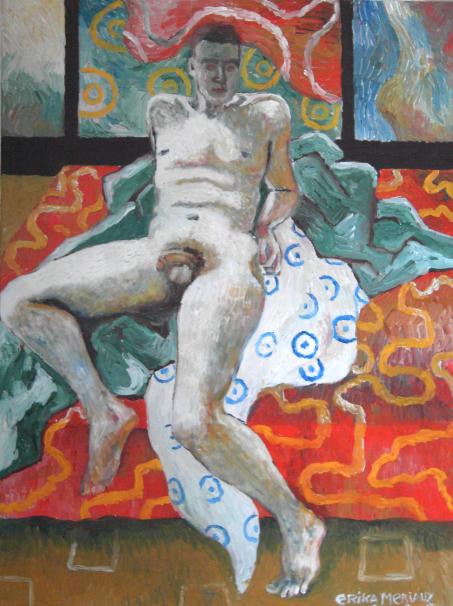
Those who like your art on the more (i.e. blatantly) erotic side will be happy to know that, this Friday, March 15, at the Aspect Gallery (731 Polk Street), there will be a nude and erotic art show from 6:00-9:30PM. Enjoy food and refreshments (you can BYOB) while perusing a titillating selection of erotic paintings and photographs from 12 local San Francisco artists who are making the art scene sexier for us all.


Man on Bed, by Erika Meriaux.

The Aspect Gallery is injecting a much needed shot of Viagra into the San Francisco art scene.

Velo-mutations

0

P>I’ve been aware of the intersection between alternative culture and bicycles since 1996, when I saw my first tall bike at Reed College in Portland, Ore. Since then, I’ve seen bikes at Burning Man tricked out with paint, fun fur, and EL wire. Bikes at Critical Mass made to look like animals or disco balls. Bike-powered carnival rides at Coachella. And punk girls, dressed in pink, dancing on minibikes at Tour de Fat.

But it wasn’t until "The Art of the Bicycle," an underground multimedia art show and party held in a warehouse in the Mission District last May, that I came to understand how these were each parts of a greater whole — spokes in the wheel of a bicycle culture that centers around creativity, empowerment, and, above all, fun. It also became clear, as I sipped cheap beer and listened to live punk rock in an unpermitted space, that this culture was very different from the road bike culture my dad (and his Spandex shorts) was a part of in the 1980s — or even the activist culture my friends in the San Francisco Bicycle Coalition are in now.

No, this bike culture is something else. Rooted in DIY principles, punk and anarchist values, a good dose of geekiness, and rejection of the mainstream, the alternative bike culture that exists in San Francisco and beyond is an entirely different animal — and it’s growing up fast.

In the Bay Area alone, there’s Cyclecide, a bicycle club known for mutating found and rejected bikes into new forms and pedal-powered rides, as well as for their carnie aesthetic and rodeo-inspired antics; the Derailleurs, a group of women who dance on, with, and about bicycles; and the Trunk Boiz, an Oakland-based community of kids who pimp out their bicycles the way their older brothers might’ve pimped out their low-riders; and many others — all of whom operate outside the realm of traditional bike culture or politics.

And each of these are connected to a greater network of bicycle artists across the country and the world. The past decade has seen the birth of the Portland-based Bicycle Porn festival, which screened films showing the sexiness of (or near) bikes at Victoria Theater last November; as well as the New York City-based Bicycle Film Festival, which had its first West Coast showing in San Francisco several years ago and now visits 39 cities per year. There are now more than 120 bicycle clubs all over the world, with originals like Black Label growing so big it has 40 chapters of its own. And only five years after the first bicycle dance troupe, the Sprockettes, was formed in Portland, there are 11 bicycle dance troupes worldwide.

But who are these people? Why are they so inspired by bikes? And why make art with or about them, rather than just ride them? The answer is complex. For some, the bike is simply a beautiful machine, an engineering problem whose solution hasn’t changed much since the 1600s but whose application is infinite. For others, it’s the bike’s democracy that’s so appealing: cheap, accessible, and available to all kinds of riders. Some see the bike as a vehicle for change, undermining car culture and the politics involved in non-people-powered transportation.

But what seems to tie all these people together is a counterculture instinct. These are artists, musicians, and math geeks. They’re the same people who may have been drawn to skateboarding or surfing (before both became commercial and mainstream), punk shows, Dumpster diving, or even Stitch ‘n’ Bitch parties. It’s a community of people dissatisfied with the status quo and filled with the imagination and ambition to work outside it — if not against it.

"We wanted to have fun," said Jarico Reesce, about founding Cyclecide in 1997. "And we wanted to break every rule we could." (Molly Freedenberg)

Reels and (two) wheels

0

What’s a "bike movie?" If you immediately thought of Breaking Away (1979), two upcoming events suggest that your definition is li’l old-fashioned. First up: the Disposable Film Festival is hosting a "Bike-In" outdoor screening. Pedal over and enjoy a selection of films (with an emphasis on bike themes) culled from DFFs past; an after-party celebrates the release of the Guardian‘s Bike to Work issue.

San Franciscans Eric Slatkin and Carlton Evans founded the fest in 2007 to highlight so-called disposable films — "any film made on these alternative devices we’ve seen cropping up in the past few years: cell phones, web cams, point-and-shoot cameras, one-time use video cameras, pocket cams," Slatkin said. "They really democratize the idea of not just filmmaking, but of a filmmaker."

The spirit of the festival lends itself to a bike-in screening. "The core of the DFF is a real DIY aesthetic," Evans said. "I think there’s a similar kind of aesthetic in the biking community in San Francisco. I bike all over the city, and I’m always navigating the city in a way where I’m having to overcome obstacles. You just sort of take on these challenges and come up with your own solutions."

Brendt Barbur, director of the New York City-based Bicycle Film Festival (now in its ninth year, it travels to San Francisco this summer), would likely agree with this comparison. The BFF showcases experimental films, music videos, documentaries, and more, with tie-in art exhibits and live music shows, but it’s powered by the creative energy of everyday cyclists.

"Technology has given the bike movement a tool to express themselves," he said from BFF headquarters in NYC. "That DIY spirit runs through the festival. A lot of people — maybe they’re graphic designers or bike messengers — have something to say, and cameras are now accessible to a lot of folks. Those little gems they produce are, a lot of times, the most popular movies at the festival."

DISPOSABLE FILM FESTIVAL: BIKE-IN

Wed/13, 8 p.m., free

Outside the Good Hotel, 112 Seventh St., SF

www.disposablefilmfest.com

BICYCLE FILM FESTIVAL

July 14-19

www.bicyclefilmfestival.com

House of Horrors

0

› kimberly@sfbg.com

SONIC REDUCER Thrills and chills and disco ball spills — that’s what the Horrors are made of? After Shih Tzu-banged frontman Faris Badwan brattily ripped the mirror ball off the ceiling of 330 Ritch a scant two years ago, who knew the U.K. band would show its true, formative, and fundamentally curious colors? The hues and cries streaming off the Horrors’ second album, Primary Colours (XL) read as a limpid, moonlit pop-sonnet to true-school proto-goth-rockers and morbidly fixated post-punk upsetters like Siouxsie and the Banshees and Killing Joke.

Just don’t flash that dance-floor orb in front of Badwan again. "Mmm, Faris never really liked mirror balls," mumbles guitarist Joshua Third, né Hayward. It’s frozen in Boston, where the group is performing that night, and the chill that drops momentarily over the conversation is brief yet bracing. "Luckily we haven’t played anywhere with a mirror ball for ages."

Despite the menace — or maybe because of it — the goth-punk movement has always seemed fundamentally conservative. But the Horrors don’t peddle the shockabilly moves so common among goth-identified SoCalis. In contrast to the easy-sleazy comic-book corn of today’s prominent goth-punk purveyors — pass the Horrorpops and just keep walking — the group now draws from exploratory originators Joy Division and ornery rabble-rousers the Birthday Party. Primary Colours boasts driving tunes carved from silvery synth textures ("Three Decades") and Jesus and Mary Chain-like buzz-saw pop that thumps with creative negativity ("Who Can Say").

The group capers on the same frosty darkling plain as Interpol, judging from tunes like the Velvet-y, string-strewn "I Only Think of You," which may turn off those with a low tolerance for pop pomposity. Still, the opening track, "Mirror’s Image," sets the tone for pleasing surprise with its initial lush, plangent soundscape — more akin to Lindstrøm than Sisters of Mercy — before gently plunging into spiraling reverb, effects-gristled guitar, and a nodding keyboard fragment that will have some recalling Echo and the Bunnymen and others Kraftwerk.

Third says Primary Colours was "the first chance we had as a band to shut ourselves away and work on the record on our own. We’d retreat into a rehearsal space and get completely lost in it. Yeah, I think that really comes through."

The Horrors titled the first song they ever wrote "Sheena is a Parasite," so yes, this is throwback rock, It gazes directly into the eyes of the more serious Anglo art-rock makers of the ’80s with self-conscious affection, especially on haunted, haunting songs such as "Do You Remember." And what’s wrong with that?

"We actually made a record that’s a complete trip, from start to finish — it takes you through different moods," Third explains. "Also, you can listen to it on repeat, because the last track plays into the first track. I’ve always been quite into the idea because I like to sit down and listen to things over and over again." It’s a quality he misses in many new albums. "Yeah, partly the Internet’s to blame. Partly labels are to blame. Partly bands are to blame — because they don’t seem to care anymore," he says, capping the remark with a small grim chuckle.

In the Horrors’ hands — the ensemble coproduced along with longtime collaborator Craig Silvey, Portishead’s Geoff Barrow, and video artist Chris Cunningham — Primary Colours sounds astonishingly unmusty, stirring with tangible signs of life. The group has managed to find a pulse — while maturing into, yikes, artists. "We were all 19 when we wrote the first record — now we’re in our early twenties!" Third exclaims. "I think it’s the typical growing-up … malarkey." *

THE HORRORS

With the Kills

Tues/19, 8 p.m., $22.50

Fillmore

1805 Geary, SF

www.livenation.com

————

MORE LIVE:

COMEDIANS OF ROCK II

Musical funny folk Tara Jepsen of Lesbians, Chris Portfolio of Hank IV, and Matt Hartman of Sic Alps pit wits and carve out snarfs at this comedy two-fer. Wed/13, 9 p.m., free. Hemlock Tavern, 1131 Polk, SF. www.hemlocktavern.com

BLACK JOE LEWIS AND THE HONEYBEARS

And what a long, sweet name it is: the Austin, Texas, soul-stirrers cook up hot ones from Tell ‘Em What Your Name Is! (Lost Highway). Sat/16, 9 p.m. $17. Slim’s, 333 11th St., SF. www.slims-sf.com

JOHN VANDERSLICE

The Tiny Telephone operator’s new Romanian Names (Dead Oceans) rolls out Moog moods and Byzantine yarns. Mon/18, 6 p.m., free. Amoeba Music, 1855 Haight, SF. www.amoeba.com. Tues/19, 7:30 p.m., $16. Rickshaw Stop, 155 Fell, SF. www.rickshawstop.com

Beyond weird

0

Tobacco doesn’t like the Beatles, or the Who. And Pink Floyd is "okay." This makes sense for the man whose prolific mind fuels Black Moth Super Rainbow. The Pittsburgh analog synth sorcerers specialize in prismatic albums that swing seamlessly between sunlit repose and hallucinatory freak-outs. They use an array of vintage beat makers, keyboards, and guitars. Those who pin BMSR’s mercurial sound with the "psychedelia" label aren’t peering deep enough into the looking glass.

"Maybe subconsciously all that garbage is in there and I don’t realize it," Tobacco consents. "I definitely don’t try to make it sound like Pink Floyd or the Beatles, but maybe that stuff’s just stuck in my head and I just can’t get it out."

He’s happier to cite the Beastie Boys’ 1992 mutative alt-rap disc Check Your Head (Capitol) as an influence, one that’s especially evident on his 2008 solo effort Fucked Up Friends (Anticon). He also credits one of the Beasties’ hip-hop cohorts: "I hated music when I was a kid. The first song I ever liked was "Just a Friend" by Biz Markie."

From Biz Markie to prog rock, nothing about BMSR’s sound is straightforward. The group cultivates a mystique that blends the anachronistic with the futuristic. Some surrealistic soundscapes are steeped in bongwater, while others teeter on the glittery edge of acid-trip oblivion. The resulting deconstructed melodies and beats elude most genre epithets. With Eating Us (Graveface) about to drop on May 26, Tobacco, né Tom Fec, is hoping that people will finally stop calling BMSR weird.

"I’ve never thought an album like [2007’s] Dandelion Gum (Graveface) was weird, but a lot of people did, even people who liked it," says Tobacco. Not so with Eating Us: "Everyone’s either understanding what I was going for or they’re just repeating what we’re telling them,"

Tobacco wrote and recorded Eating Us on his own, before enlisting the help of producer David Fridmann, who he says "just sort of pull(s) the gunk out of" BMSR’s sound. In the process, the wonderland of sonic bits and pieces found on albums such as 2003’s Falling Through A Field (Graveface) gives way to an expansive landscape of heady incantations for the electronic age.

If Dandelion Gum saw Black Moth spreading its wings for flight, Eating Us is the sound of the band going airborne. Drums replace beat machines. Layered dream-dipped hums and purrs play hand-in-hand the spooky minor-key trills that are one of the band’s signatures. The melodies are more cogent but no less rainbow-hued. Tobacco’s Vocoder-drenched voice is inhumanly-human on tracks such as the regal "Iron Lemonade."

For bands that continue to put out albums the traditional way, these are trying times. "When I was one of those young whippersnappers in high school, I used to read magazines and that’s how I found out about stuff," Tobacco says when asked about the shifting frameworks for music and music writing. "Now it’s all blogging, [and] no one would have heard of us without it.

"What sucks is that our album leaked a month ago and everyone started reviewing it," he continues. "I’ve been reading things by people who weren’t even done listening to it — they were reviewing as they were listening. That just changes perceptions. It’s not about the album anymore, it’s about the hype that leads up it. When I was a kid, it was all about finding the album when it came out — that’s when its life began. Now, once the album comes out, it’s dead. Who knows, May 26 may be the last time you hear about [Eating Us]."

That isn’t likely. BMSR’s albums are like musical toys, catering to nostalgists who still seek out music in its physical form. Their 2008 EP Drippers (Graveface) was packaged with five scratch-and-sniff scents, and Eating Us includes a 16-page booklet that can be refolded to create different images. Oh, and the cover art has hair.

The best bands constantly change, metamorphosing against sameness, labels, and the death of ideas. BMSR continues to evolve from the dimmest corners of the mind into transcendent swaths of weirdo-pop sensibility. It’s almost like the Beatles, if they got behind synthesizers, went underground, and never emerged from 1967. Almost.

“Open Endless”

0

REVIEW Not every art show allows you a chance to swim in the Pacific Ocean on a Sunday afternoon and experience the bracing cold of the water and the pull of the tide. But David Wilson’s "Open Endless" isn’t your average show, even if it is characteristic of Wilson’s community explorations of art and landscape under the Ribbons Publications rubric. Last year, he instigated a sleep-over happening at Angel Island that included live music. This month, as an extension of a show of drawings, he organized a casually beautiful mapped day and night of art in the Headlands.

No two people had the same experience. Besides a dip in the Pacific, mine included a trek up the paved trails of the North Cliff to a white diamond hung on the cliff’s face by Battery Townsley, where the duo Pale Horse sang songs in a tunnel, and then a walk back down to the beach where the duo known as Coconut played music in a little cove as two, three, four, five, six surfers took on the waves during sunset. I don’t have much to say about that latter experience beyond that it was the kind of moment that makes me completely glad to be alive. I left sated and went home and slept and dreamt deeply. Those who stayed ambled on through Rodeo Canyon to another Battery, where Canyon Cinema shared some cave cinema.

Wilson’s drawings, on display at Tartine, are a shifting sequence of meditations on the landscape and coastlines of the Headlands. His deployment of color and line is understated. The brashest aspect of the show is its use of material: the largest piece, a 22-foot watercolor of the ocean and shore, uses the blank-but-aged paper of record sleeves and the cardboard insides of albums covers as a backdrop. It’s a great tactic. Earlier this year at the de Young Museum, Ajit Chauhan performed a different but similarly large-scale trick with album covers, painting over their exteriors so that only eyes peeked from the original artwork. Wilson’s use of vintage music matter hints at the merging of art and that which is codified "nature" at the core of his events. I’m already looking forward to his next one.

OPEN ENDLESS Through May 28. Mon., 8 a.m.–7 p.m. Tues.–Wed., 7:30 a.m.–7 p.m.; Thurs.–Fri., 7:30 a.m.–8 p.m.; Sat., 8 a.m.–8 p.m.; Sun., 9 a.m.-–8 p.m. (415) 487-2600. Tartine, 600 Guerrero, SF. www.ribbonspublications.blogpost.com

Hot sex events this week: May 13-19

0

Compiled by Molly Freedenberg

PortmanCloser22_0509.jpg
Learn to lap dance like Natalie Portman in Closer (without the lying, cheating, and heartbreak, of course) at Wednesday’s class with Catherine Rose.

————-

>> Sizzling Couples Lapdance Class
Catherine Rose of Slinky Productions presents a rare opportunity to learn the art of sensual teasing and erotic fun with a partner or friend of any sex. In just over two hours, you’ll learn about setting the right dynamic, giving a cleavage show, classic cuddle massage gyration, and more. Chocolate and bubbly will be served.

Wed/13, 7:30-9:45pm. $99/couple (10 percent off if it’s your first class).
Center for Sex and Culture
1519 Mission, SF
www.slinkyproductions.com

————-

>> Art House Screening
Walk the red carpet at this Warhol-themed premiere party for Femina Potens curator and suspension goddess Madison Young’s newest film release, a work of queer porn inspired by The Factory.

Thurs/14, 7pm. $10-15.
Femina Potens
2199 Market, SF
(415) 864-1558
www.feminapotens.org

————-

>> Quodoushka Preview
Enjoy a fun, educational, inspirational introduction to this shamanic approach to spiritual sexuality, with Mukee Okan.

Thurs/14, 7:30-10pm. Free.
Call (510) 482-4239 for info and location.

————-

>> Monogamy? Non Monogamy? What’s For You?
UCSF’s AIDS Health Project presents this workshop for gay and bisexual men regardless of HIV status, during which you’ll explore the joys and challenges of both types of relationships.

Fri/15, 6-9:30pm. Free. Pre-registration required.
AHP Services Center
1930 Market, SF
(415) 476-6448
www.ucsf-ahp.org

————-
>> Electrify and Deepen Your Sexual Connection for Couples
Ignite the fire of passion, deepen your intimacy, and experience the heights of desire that a deep sexual connection can bring during this seminar with Danielle Harel and Celeste Hirschman.

Tue/19, 8-10pm. $45/pair if pre-registered.
Good Vibrations
1620 Polk, SF
(415) 345-0400
www.goodvibes.com

————-