Affordable Housing

Housing and highrise offices

0

EDITORIAL It's something of a civic shame that the only way San Francisco can build a new transit terminal is to sell a private developer the rights to stick a 1,070-foot highrise office tower on public land. In fact, it's a sad statement on the city, state, and local government: Once upon a time — and it wasn't the long ago — tax dollars collected through a progressive system paid for major infrastructure projects.

But there's no easy way to raise $4 billion in tax money for the Transbay Terminal — even though it ought to be seen as part of the high-speed rail project, and the federal and state government ought to be picking up the tab. So San Francisco ambles forward, selling land and lease rights to the highest bidder.

In this case, Gerald Hines of Houston won the right to build the largest highrise west of the Mississippi on property owned by the Transbay Joint Powers Authority. There are all sorts of drawbacks to the deal — among other things, it will cast shadows on a number of city parks, all the way to Portsmouth Square in Chinatown. Like any massive office complex, it will put pressure on Muni, on city streets, on police and fire and other city services — and no commercial office building ever pays its fair share of that burden. And since in this case the major recipient of the money from the project will be the TJPA, the city's General Fund will suffer.

Oh, and the building is ugly.

Meanwhile, city planners want to increase height limits all around the Transbay Terminal and allow hundreds of units of new (luxury) housing and more commercial office space. It's going to be a new highrise neighborhood, complete with a rooftop park and a few little patches of ground-level open space, which won't get a whole lot of sun, particularly in the morning and evening.

And at this point, there's been very little focus on what ought to be the defining issue of this and the other major developments on the city's planning horizon, and that's affordable housing.

This city has a terrible jobs-housing mix. The vast majority of the people who currently work in San Francisco can't afford to buy a house here, and many of them can only rent if they pay for more than the federal standard of one-third of their income for housing. So people who work in hotels and restaurants and city, state and federal offices and hospitals and even financial district companies wind up living far from the city and commuting. Nobody thinks that's a sound environmental policy.

And this kind of full-scale rezoning and development will only make it worse. According to the City Planning Department, the Hines project will pay about $27 million into the city's affordable housing fund, enough to pay for maybe 60 or 70 housing units. That won't even begin to cover the need created by the thousands of employees who will fill that tower. The market-rate housing on the site will almost certainly be beyond the reach of most San Franciscans, and probably many of the office workers who fill the Hines building. And only 35 percent of the new housing — at maximum — will be affordable.

San Francisco has to get a grip. The city can't keep allowing more high-end housing and highrise office space without a plan to meet its housing needs. We're glad to see the mayor talking about a $50 million a year fund, but that will barely meet existing needs; it can't possible keep pace with new development.

So before the supervisors rush ahead to approve this ambitious new downtown district, they need to ask Hines, and the TJPA, and any other developer who comes along, how it intends to meet the demonstrated need for affordable housing that these projects will create — and demand a much higher level of payment that what's currently on the city's books.

The battle of 8 Washington

tredmond@sfbg.com

More than 100 people showed up May 15 to testify on a condominium development that involves only 134 units, but has become a symbol of the failure of San Francisco’s housing policy.

I didn’t count every single speaker, but it’s fair to say sentiment was about 2-1 against the 8 Washington project. Seniors, tenant advocates, and neighbors spoke of the excessive size and bulk of the complex, the precedent of upzoning the waterfront for the first time in half a century, the loss of the Golden Gateway Swim and Tennis Club — and, more important, the principle of using public land to build the most expensive condos in San Francisco history.

Ted Gullicksen, director of the San Francisco Tenants Union, calls it housing for the 1 percent, but it’s worse than that — it’s actually housing for the top half of the top half of the 1 percent, for the ultra-rich.

It is, even supervisors who voted in favor agreed, housing the city doesn’t need, catering to a population that doesn’t lack housing opportunities — and a project that puts the city even further out of compliance with its own affordable-housing goals.

And in the end, after more than seven hours of testimony, the board voted 8-3 in favor of the developer.

It was a defeat for progressive housing advocates and for Board President David Chiu — and it showed a schism on the board’s left flank that would have been unthinkable a few years ago. And it could also have significant implications for the fall supervisorial elections.

Sup. Jane Kim, usually an ally of Chiu, voted in favor of the project. Sup. Eric Mar, who almost always votes with the board’s left flank, supported it, too, as did Sup. Christina Olague, who is running for re-election in one of the city’s most progressive districts.

At the end of the night, only Sups. David Campos and John Avalos joined Chiu in attempting to derail 8 Washington.

The battle of 8 Washington isn’t over — the vote last week was to approve the environmental impact report and the conditional use permit, but the actual development agreement and rezoning of the site still requires board approval next month.

Both Mar and Olague said they were going to work with the developer to try to get the height and bulk of the 134-unit building reduced.

But a vote against the EIR or the CU would have killed the project, and the thumbs-up is a signal that opponents will have an upward struggle to change the minds of Olague, Kim, and Mar.


DEFINING VOTES

The 8 Washington project is one of a handful of defining votes that will happen over the next few months. The mayor’s proposal for a business tax reform that raises no new revenue, the budget, and the massive California Pacific Medical Center hospital project will force board members to take sides on controversial issues with heavy lobbying on both sides.

In fact, by some accounts, 8 Washington was a beneficiary of the much larger, more complicated — and frankly, more significant — CPMC development.

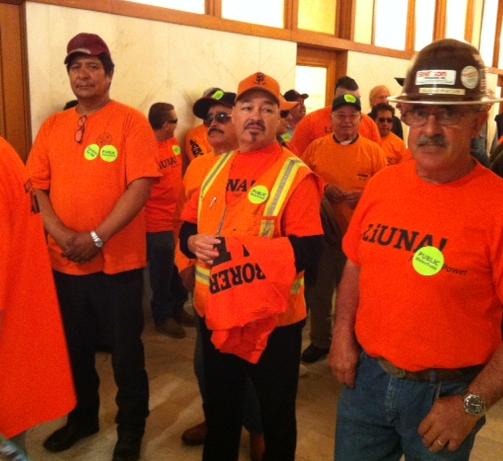
The building trades unions pushed furiously for 8 Washington, which isn’t surprising — the building trades tend to support almost anything that means jobs for their members and have often been in conflict with progressives over development. But the Hotel and Restaurant Employees Union joined the building trades and lined up the San Francisco Labor Council behind the deal.

And for progressive supervisors who are up for re-election and need union support — Olague and Mar, for example — defying the Labor Council on this one was tough. “Labor came out strong for this, and I respect that,” Olague told me. “That was a huge factor for me.”

She also said she’s not thrilled with the deal — “nobody’s jumping up and down. This was a hard one” — but she thinks she can get the developer to pay more fees, particularly for parking.

Kim isn’t facing re-election for another two years, and she told me her vote was all about the $11 million in affordable housing money that the developer will provide to the city. “I looked at the alternatives and I didn’t see anything that would provide any housing money at all,” she said. The money is enough to build perhaps 25 units of low- and moderate-income housing, and that’s a larger percentage than any other developer has offered, she said.

Which is true — although the available figures suggest that Simon Snellgrove, the lead project sponsor, could pay a lot more and still make a whopping profit. And the Council of Community Housing Organizations, which represents the city’s nonprofit affordable housing developers, didn’t support the deal and expressed serious reservations about it.

Several sources close to the lobbying effort told me that the message for the swing-vote supervisors was that labor wanted them to approve at least one of the two construction-job-creating developments. Opposing both CPMC and 8 Washington would have infuriated the unions, but by signing off on this one, the vulnerable supervisors might get a pass on turning down CMPC.

That’s an odd deal for labor, since CPMC is 10 times the size of 8 Washington and will involve far more jobs. But the nurses and operating engineers have been fighting with the health-care giant and there’s little chance that labor will close ranks behind the current hospital deal.

Labor excepted, the hearing was a classic of grassroots against astroturf. Some of the people who showed up and sat in the front row with pro-8 Washington stickers on later told us they had been paid $100 each to attend. Members of the San Francisco Planning and Urban Research Association, to which Snellgrove has donated substantial amounts of money in the past, showed up to promote the project.


BEHIND THE SCENES

But the real action was behind the scenes.

Among those pushing hard for the project were Chinese Chamber of Commerce consultant Rose Pak and community organizer David Ho.

Pak’s support comes after Snellgrove spent years courting the increasingly powerful Chinatown activist, who played a leading role in the effort that got Ed Lee into the Mayor’s Office. Snellgrove has traveled to China with her — and will no doubt be coughing up some money for Pak’s efforts to rebuild Chinese Hospital.

Ho was all over City Hall and was taking the point on the lobbying efforts. Right around midnight, when the final vote was approaching, he entered the board chamber and followed one of Kim’s aides, Matthias Mormino, to the rail where Mormino delivered some documents to the supervisor. Several people who observed the incident told us Ho appeared to be talking Kim in an animated fashion.

Kim told me she didn’t actually speak to Ho at that point, although she’d talked to him at other times about the project, and that “nothing he could have said would have changed anything I did at that point anyway.” Matier and Ross in the San Francisco Chronicle reported that Ho was heard outside afterward saying “don’t worry, she’s fine.”

Matier and Ross have twice mentioned that the project will benefit “Chinatown nonprofits,” but there’s nothing in any public development document to support that assertion.

Chiu told me that no Chinese community leaders called him to urge support for 8 Washington. The money that goes into the affordable housing fund could go to the Chinatown Community Development Corp., where Ho works, but it’s hardly automatic — that money will go into a city fund and can’t be earmarked for any neighborhood or organization.

CCDC director Norman Fong confirmed to me that CCDC wasn’t supporting the project. In fact, Cindy Wu, a CCDC staffer who serves on the city Planning Commission, voted against 8 Washington.

I couldn’t reach Ho to ask why he was working so hard on this deal. But one longtime political insider had a suggestion: “Sometimes it’s not about money, it’s about power. And if you want to have power, you need to win and prove you can win.”

Snellgrove will be sitting pretty if 8 Washington breaks ground. Since it’s a private deal (albeit in part on Port of San Francisco land) there’s no public record of how much money the developer stands to make. But Chiu pointed out during the meeting, and confirmed to me later by phone, that “there are only two data points we know.” One is that Snellgrow informed the Port that he expects to gross $470 million in revenue from selling the condos. The other is that construction costs are expected to come in at about $177 million. Even assuming $25 million in legal and other soft costs, that’s a huge profit margin.

And it suggests the he can well afford either to lower the heights — or, more important, to give the city a much sweeter benefits package. The affordable housing component could be tripled or quadrupled and Snellgrove’s development group would still realize far more return that even the most aggressive lenders demand.

Chiu said he’s disappointed but will continue working to improve the project. “While I was disappointed in the votes,” he said, “many of my colleagues expressed concerns about height, parking, and affordable housing fees that they can address in the upcoming project approvals.”

So what does this mean for the fall elections? It may not be a huge deal — the symbolism of 8 Washington is powerful, but if it’s built, it won’t, by itself, directly change the lives of people in Olague’s District 5 or Mar’s District 1. Certainly the vote on CPMC will have a larger, more lasting impact on the city. Labor’s support for Mar could be a huge factor, and his willingness to break with other progressives to give the building trades a favor could help him with money and organizing efforts. On the other hand, some of Olague’s opponents will use this to differentiate themselves from the incumbent. John Rizzo, who has been running in D5 for almost a year now, told me he strongly opposed 8 Washington. “It’s a clear-cut issue for me, the wrong project and a bad deal for the city.” London Breed, a challenger who is more conservative, told us: “I would not have supported this project,” she said, arguing that the zoning changes set a bad precedent for the waterfront. “There are so many reasons why it shouldn’t have happened,” she said. And while Mar is in a more centrist district, support from the left was critical in his last grassroots campaign. This won’t cost him votes against a more conservative opponent — but if it costs him enthusiasm, that could be just as bad.

Housing for the super rich approved, 8-3

111

The progressive movement and the battle for housing balance and economic justice in San Francisco got walloped May 15 when eight supervisors sided with a developer who wants to build condos for the massively rich on the waterfront.

I watched it all, minus a few minutes while I was putting the kids to bed, all seven and a half hours of testimony and discussion, winding up with a series of pro-developer voters a little after midnight. It was stunning: Opponents of the project came out in droves, many of them seniors, others tenant activists and neighbors. Former City Attorney Louise Renne, who is by no means an anti-development type or any sort of economic radical, led off the arguments in favor of scrapping the environmental impact report and denying the conditional use permit that are needed for 8 Washington to move forward. They brought up so many points that by the end there was nothing more to say: This meets no housing need in San Francisco, further screws up the city’s own mandates for a mix of affordable and market-rate housing, caters to the top half of the top half of the 1 percent, is too tall and bulky for the site, offers the city too little in community benefits and is one of the great development scams of our time.

Then the other side spoke — the city planners who defended the EIR and, briefly, developer Simon Snellgrove. His supporters lined up — and almost all of them talked about the same thing: Construction jobs. I get it, we need construction jobs — but is that a justification for such a bad project? As Sup. David Chiu pointed out, “apartment construction is booming.  There are 22,000 units under construction and 50,000 more in the pipeline.”

Both sides were organized, but only one paid people to show up: At least five people seated in the front row, wearing pro-8 Washington stickers, confirmed that they’d been paid $100 each — in cash — to show up. They didn’t even speak, leaving once they realized that they were misled about the project. One source heard a construction worker say he knew nothing about the project and had been bused in from Sacramento.

And after hearing all of that, the supervisors did what they clearly had decided to do long before a word of testimony was uttered.

The vote to overturn the EIR went like this: favoring the developer were Supervisors Mark Farrell, Jane Kim, Eric Mar, Christina Olague, Malia Cohen, Carmen Chu, Sean Elsbernd and Scott Wiener. Opposing the project were Chiu, John Avalos and David Campos.

Approving the conditional use went along the same voting lines. Chiu couldn’t even get a continuance after arguing that there was no report from the budget analyst and no financial information about whether this is a good deal for the city.

That’s the lineup: Eight votes for the 1 percent. Three votes for the rest of us. I haven’t seen anything this bad in years.

Some fascinating information came out of the discussion. Chiu made clear that the developer doesn’t need the height-limit increase to make a profit off the deal. He estimated that the total sales revenue from the project would be around $470 million and construction costs about $177 million. That’s a huge profit margin, even if you add in another $25 million for upfront soft costs.

Snellgrove’s lawyer, Mary Murphy, tried to duck the financial issues, talking around in circles. Evenutally Chiu got Snellgrove to respond, and he said the costs would be higher and his profit would only be about $80 million. “The capital markets require a high return on these projects,” he said.
Still: $80 million is a lot of money. And while Snellgrove and his allies love to talk about the $11 million in affordable housing money for the city, that’s about 2.3 percent of his total revenue. Which doesn’t sound quite as juicy.

Chiu raised another good question: “Should a condo that sells for $5 million pay the same affordable housing fees as one that sells for $500,000?”
Mar, who is usually a strong progressive, was the big surprise of the night, not only voting the wrong way but teeing up softball questions for the city planners to make the project sound better. It was as if he was reading from the developer’s talking points.

In the end, he said he saw “a lot of benefits from this project,” but promised to work with the developer to advocate for “less bulk and less height.” Olague said the same thing.

But even if it’s a little smaller, this will still be a completely misalignment of housing priorities, a project entirely for the very rich. That’s not going to change.

If anything, they should push for more affordable housing money — a whole lot more. Because what we’re getting is enough for maybe 25 or 30 units, which means 80 percent of the new housing related to this project will be for multimillionaires and 20 percent for everyone else. Keep that pattern going — and there are few signs that it’s about to change — and imagine what this city will be like in 20 years.

It’s not over, not yet: The actual development agreement and the height-limit changes still have to come to the board early in June. And if the mayor signs off on it, opponents are talking serious about a ballot referendum that would be before the voters in November — just when Olague, Mar, Avalos, Campos, and Chiu will be up for re-election.

SF needs healthy housing

My greatest frustration as a tenants’ rights and affordable-housing advocate in San Francisco is that, despite all the good efforts by a lot of good people, we never address the root cause of our housing crisis. We routinely enact laws and ballot initiatives, organize endless demonstrations and elect progressive politicians, but in the final analysis, these efforts are just a Band Aid on a bad system that leaves a lot of people without a roof over their heads.

A few years ago, Brian Basinger of the AIDS Housing Alliance and I pushed “no fast pass to eviction” legislation to stop the eviction of seniors and people with AIDS and other disabilities through the state Ellis Act.

Ellis allows a landlord to override just-cause eviction protections and evict all of the tenants in a building. It’s often used by speculators to flip properties — that is, buy them, evict the tenants, and create a tenancy-in-common (where there’s the same number of owners as there are apartments). The new owners apply for condo conversion so that, instead of sharing a percentage in the building, they actually own their own units.

No Fast Pass says that if someone uses Ellis to evict tenants, then the building can’t convert to condos for ten years. If any of those tenants are seniors or disabled, it can never be converted. The legislation helped. There was a drop in Ellis evictions. Unfortunately, landlords and speculators now employ intimidation, harassment and buy-outs to get rid of tenants, so that they don’t have to Ellis.

It’s time to get beyond Band-Aids. Housing should be a human right, guaranteed for all, as healthcare is in other nations.

When former Supervisor Tom Ammiano realized that 65,000 San Franciscans (15% of the population) were without health coverage, he (not former Mayor Gavin Newsom, who takes credit for it) introduced legislation to create what is now “Healthy San Francisco,” our city’s version of universal healthcare. It’s not perfect, but it tackles the problem the way it should be tackled: by making healthcare a human right and not a luxury.

The same needs to be done for housing.

As long as housing is a commodity, affordable only to those who have the dough, there will always be people left out in the cold — literally. Our city has more than 10,000 homeless people, not to mention scores of others living (through no choice of their own) in deplorable conditions. The city builds more market-rate housing than it needs, while units for those below 50 percent of the city’s median income fall far short of the demand.

A mandate to house everyone in the city has never been tried. I don’t have an exact plan, but a “Housing SF” (like Healthy SF) might be created by pooling together all of our housing resources and aggressively working to pull in more. If the proposed Housing Trust Fund happens, it should be initially used only for those who need it most — the homeless and the poor, remembering that shelters are not housing, even if they’re considered such under Care Not Cash.

Put a moratorium on market-rate housing. Turn all abandoned properties (both city and privately owned) into affordable units. Raise money by letting the big businesses (including the tech companies) cough up some dough. Use land trusts as much as possible to keep the new places affordable into perpetuity.

It’s time to dream big.

Tommi Avicolli Mecca, editor of Smash the Church, Smash the State: The Early Years of Gay Liberation, is a longtime affordable housing advocate.

What the preservation vote says about the 2012 supervisors

64

UPDATE: Important update at the end of this story

What does it mean that a historic preservation law favored by developers and promoted by Sup. Scott Wiener passed the Board of Supervisors 8-3? Maybe nothing. Historic preservation is a strange poliltical issue, favored by some of the wealthy white homeowner types who love pretty buildings (and aren’t so good on other issues), and this thing was sold as a way to help low-income people and affordable housing. But the reality is that the Wiener measure will make it harder to declare historic districts, and thus will take away a tool that the left can use to stop uncontrolled commercial development. And remember: The affordable housing community wasn’t pushing this bill, and, for the most part, hasn’t had problems with historic preservation. The most progressive political club in the city, the Harvey Milk LGBT Democratic Club, came out strongly against the measure and urged Sup. Christina Olague, a co-sponsor, to oppose it:

We are extremely troubled that you appear to be buying into the flawed, bogus and self-serving arguments by SPUR and other supporters of this legislation that historic preservation is classist and leads to gentrification, interferes with the production of affordable housing and is a tool of San Francisco’s elite.  Nothing could be further from the truth.

There was a way to address the issues of low-income people in historic districts without making it harder to block inappropropriate development, but Wiener’s bill went much further. And while I respect Scott Wiener and find him accessible and straightforward, and I agree with him on some issues, he isn’t someone whose basic agenda promotes the interests of tenants or low-income people. His supporters are much more among the landlord class and the downtown folks. The San Francisco Chronicle, which is a conservative paper on economic and development issues, loved the legislation.

So what happened when this got to the Board? Only three people — the ones the Chron calls “the stalwart left flank of the Board” — voted no.

John Avalos, David Campos and Eric Mar. They are now the solid left flank, the ones who can be counted on to do the right thing on almost every issue. Once upon a time, there were six solid left votes. Now there are three.

What does this mean for the other key issues coming up, including CPMC, 8 Washington, and the city budget? Maybe nothing. As I say, this issue is complicated. Olague told me, for example, that she’s really worried about working-class people who can’t afford to comply with the increased regulations that come with historic districts. Her vote doesn’t mean she’s dropped out of the progressive camp, or that she (or Sups. Jane Kim and David Chiu) can’t be counted on in the future. I really want to believe that this was just an aberration, a vote where I’ll look back in the fall and say: Okay, we disagreed on that one, but nobody’s perfect

Still, it’s kind of depressing: The dependable progressive vote is down to three.

UPDATE/CORRECTION: I didn’t know when I posted this that Olague had spoken to the Milk Club leadership after the club’s statement went out and the club has since issued a correction:

Due to a misunderstanding, Supervisor Christine Olague’s position on the Historic Preservation Commission’s critical role in the life of San Franicsco was misrepresented in our weekly newsletter. Supervisor Olague is looking into ways to help continue Historic District status for the Queer community, the Filipino community in the South of Market area, and the Japantown area. She is specifically looking for wording that would help these plans remain viable and welcomes any questions on her position and on her plan. Our apologies to the Supervisor for this unfortunate mistake.

20 percent by 2020

52

steve@sfbg.com

There’s no doubt that San Francisco is one of the best cities in the United States for bicyclists, a place where near universal support in City Hall has translated into regular cycling infrastructure improvements and pro-cyclist legislation, as a slew of activists and politicians will attest to on May 10 after dismounting from their Bike to Work Day morning rides.

But even the most bike-friendly U.S. cities — including Portland, Ore., Davis, Chicago, and New York City — are still on training wheels compared to our European counterparts, such as Amsterdam and Copenhagen, where around 30 percent of all vehicle trips are by bike. By comparison, even the best U.S. cities are still in the low single digits. [Correction: Davis, which stands alone among U.S. cities, is actually at about 15 percent bike mode share]

Board President David Chiu and other city officials proposed to aggressively address that gap two years ago after returning from a fact-finding trip to Europe that also included Ed Reiskin, executive director of the San Francisco Municipal Transportation Agency (SFMTA), the agency charged with implementing city policies that favor transit riders, cyclists, and pedestrians over motorists.

Chiu sponsored legislation setting the goal of having 20 percent of all vehicle trips in San Francisco be by bike by the year 2020 and calling for the SFMTA to do a study on how to meet that goal. It was overwhelmingly approved by the Board of Supervisors and signed by Mayor Ed Lee, who has regularly cited it and proclaimed his support for what it now official city policy.

But the city will fail to meet that goal, probably by a significant amount, unless there is a radical change on our roadways.

The latest SFMTA traffic survey, released in February, showed that bikes represent about 3.5 percent of vehicle trips, a 71 percent increase in five years. While the San Francisco Bicycle Coalition (SFBC) lauded that gain as “impressive,” it would mean a 571 percent increase in the next seven years to meet the 2020 goal.

The SFMTA study on how to meet the goal is long overdue, with sources telling us its potentially controversial conclusions have it mired by internal concerns and divisions. SFMTA spokesperson Paul Rose told us in March that it was coming out in April, and now he won’t say when to expect it and he won’t even make its authors available to answer our questions.

“We want to make sure everything is addressed before the plan is finalized,” he told us, acknowledging that it’s been a difficult process. “The challenge of reaching the goal is ambitious.”

Chiu acknowledges that the goal he set probably won’t be met and expressed frustration with the SFMTA. “I’m disappointed that two years after we set that goal, there is still no plan,” he told us, adding that to make major gains “will take leadership at the top” and a greater funding commitment to this cost-effective transportation option: “We’re spending budget dust on something that we say is a priority for the city.”

Reiskin also seemed to acknowledge the difficulty in meeting the goal when we asked him about it and he told us, “To get to 20 percent would be a quantum leap, no question, but the good news is there’s strong momentum in the right direction.”

Yet on Bike to Work Day, it’s worth exploring why we’re failing to meet our goal and how we might achieve it. What would have to happen, and what would it look like, to have 20 percent of traffic be people on bikes?


CLOSING THE GAP

SFBC Executive Director Leah Shahum said that all the group’s studies show safety concerns are by far the biggest barrier to getting more people on bikes. Most people are simply scared to share space with automobiles, so SFBC’s top priority has been creating more bikes lanes, particularly lanes that are physically separated from traffic, known as cycletracks, like those on a portion of Market Street.

“We’ve seen it time and again, when you build, they will come,” Shahum said. “People want to feel safe. They want dedicated space on the roadways.”

SFBC’s Connecting the City proposal calls for the creation of four crosstown colored cycletracks totaling 100 miles. Other bike activists emphasize the importance of projects that close key gaps in the current bike network, such as the dangerous section along Oak and Fell streets that separates the Panhandle from the Wiggle, scary spots that deter people from cycling.

That safety concern — and the possibilities for making cycling a more attractive option to more people — extends to neighborhood streets that don’t have bike lanes, where Shahum said measures to slow down automobile traffic and increase motorist awareness of cyclists would help. “What we’re talking about is a calmer, safer, greener, neighborhood-focused street,” she said.

Bike advocates say the goal is to make cycling a safe and attractive option for those 8 to 80 years old, a goal that will require extensive new bike infrastructure — not just new bike lanes, but also more dedicated bike parking — as well as education programs for all road users.

“What I hope is on the drawing board is infrastructure that will make more people feel safe riding, particularly women,” SFMTA board member Cheryl Brinkman, a regular cyclist, told us.

Shahum also praised the Bay Area Rapid Transit District’s new Bike Plan, which seeks to double the percentage of passengers who bike to stations (from 4 percent now up to 8 percent in 10 years), saying Muni should also take steps to better accommodate cyclists. And she praised the city’s bike-sharing program that will debut in August, making 1,000 bikes available to visitors.

But to realize the really big gains San Francisco would need to hit 20 percent by 2020 would take more than just steadily increasing the mileage of bike lanes, says Jason Henderson, a San Francisco State University geography professor who is writing a book on transportation politics. It would take a systemic, fundamental shift, one either deliberately chosen or forced on the city by dire circumstances.

“If gasoline goes to $10 per gallon, sure, we’ll get to 20 percent just because of austerity,” Henderson said. But unless energy prices experience that kind of sudden shock, which would idle cars and overwhelm public transit, thus forcing people onto bikes, getting to 20 percent would take smart planning and political will. In fact, it will require the city to stop catering to drivers and accommodating cars.

Henderson noted that bicycle mode share is as high as 10 percent in some eastern neighborhoods, such as the Mission District, Lower Haight, and in some neighborhoods near Civic Center. “In this part of the city, Muni is crowded and young people get tired of Muni being such a slow option,” Henderson said. “If you live within a certain radius of downtown, it’s easier to bike.”

To build on that, he said the city needs to limit the number of parking spaces built in residential projects in the city core even more than it does now, as well as adding substantially more affordable units. “The most bikeable parts of the city have massive rent increases,” he said. “We have to make sure affordable housing is wrapped around downtown.”

Henderson said city leaders need to show more courage in converting car lanes and street parking spaces into bike lanes, creating bike corridors that parallel those focused on cars or transit, and exempting most bike projects from the detailed environment review that slow their implementation. At the same time, he said the city needs to drastically expand Muni’s capacity to give people more options and compensate for bike improvements that may make driving slower.

“If you want 20 percent bike mode share, you need 30 percent on transit,” he said, noting that public transit ridership in San Francisco is now about 17 percent, far less than in the great bike cities of Amsterdam and Copenhagen, which made a commitment to reducing reliance on the automobile starting in the 1970s. “It’s like a puzzle.”


BARRIERS AND BACKLASH

The kind of active urban planning that Henderson advocates would be anathema to many San Franciscans, particularly people like Rob Anderson, the blogger and activist who sued San Francisco over the lack of studies supporting its Bike Plan and created a four-year court injunction against bike projects that just ended two years ago.

“The only way you could get to 20 percent is creating gridlock in San Francisco. I don’t think it’s going to happen. City Hall is adopting a slogan as transportation policy,” he told us. “It’s a statement of pro-bike, anti-car principle, but it’s not a realistic transportation policy.”

Anderson considers bicycles to be dangerous toys that will never be used by more than a small minority of city residents, believing the majority will always rely on automobiles and there will be a huge political backlash if the city continues to take space from cars for bikes or open space.

Many city officials and cycling advocates say making big gains means convincing people like Anderson that bicycles are not just a viable transportation option, but an important one to facilitate given global warming, oil wars, public health issues, and traffic congestion that will only worsen as the population increases.

“We need to help all San Franciscans see cycling as a legitimate transportation option,” Chiu said. Or as Shahum put it, “It’s prioritizing space for biking, walking, and transit over driving.”

Shahum said the city’s political leaders seem to get it, but she doesn’t feel the same sense of urgency from the city’s planners.

“I feel like the bureaucracy needs to get on board. We have strong political support and the public support is growing,” Shahum said. “We’ve set ambitious, worthwhile, and I think achievable goals, yet nobody is holding the city accountable….It can’t just be a political platitude, it needs to be an actual plan with measureables and people held accountable.”

She cited studies showing that the most bike-friendly cities in the U.S. are spending between $8 million and $40 million a year on bike infrastructure and education programs, “but San Francisco is spending more like $2-3 million, which is peanuts…San Francisco has got to start putting its money where its mouth is to improve biking numbers.”

It’s cheap and easy to stripe new bike lanes. “It’s one of the best investments we can make in terms of mode share,” Reiskin said. That makes cycling advocates question the city’s true commitment to goals like the 2020 policy. “We will need more investment,” Chiu said, “but compared to other modes of transportation, it is far cheaper per mile.”


POLITICAL WILL

So why then has San Francisco slipped back into a slow pace for doing bike projects following a year of rapid improvements after the bike injunction was lifted? And why does the city set arbitrary goals that it doesn’t know how to meet? The answer seems to lie at the intersection of the political and the practical.

“We need a more detailed and comprehensive strategy that says this is where we need to be in five years and this is how we get there,” Sup. David Campos, who chairs the San Francisco Transportation Authority, told us. “I feel like the commitment is there, but it’s a question of what resources you have to devote to that goal.”

But it’s also a question of how those resources are being used, and whether political leaders are grabbing at low-hanging fruit rather than making the tough choices to complete the city’s bike network and weather criticisms like those offered by Anderson.

It often seems as if SFMTA is still prioritizing political projects or experimenting in ways that waste time and money. For example, the most visible improvement to the bike network in the last year, and the one most often cited by Mayor Lee, is the new cycletracks on JFK Drive in Golden Gate Park. But they do little to make cycling more attractive and they may even exacerbate tensions between cyclists and drivers.

It was one of two major bike projects that Mayor Lee announced on Bike to Work Day last year, and it seemed to have more to do with politicians announcing more bike lane mileage that with actually improving the bike network.

The other project Lee announced, just a few blocks of bike lanes on Fell and Oak streets, really was a significant bike safety advance that SFBC has been seeking for several years. But Lee failed to live up to his pledge to install them by the end of 2011 after neighbors complained about the lost parking spots, and the project was pushed back to next year at the earliest.

“We’re talking about three blocks. It’s relatively small in scope but huge in impacts,” Shahum said of the project. “If the pace of change on these three blocks is replicated through the city, it’ll take hundreds of years to meet the [20 percent] goal.” But Lee Press Secretary Christine Falvey said: “The mayor is very much committed to the aggressive goals set to get to 20 percent by 2020 and the city is moving in the right direction. He has also always supported the Oak Fell project and we’re seeing progress.” Yes, but not the kind of progress the city would need to make to meet its own goal. “Chicago is really the leader right now,” Shahum said, noting Chicago Mayor Rahm Emanuel’s commitment to building 25 miles a year of new cycletracks and the city’s advocacy for getting more federal transportation money devoted to urban cycling improvements. “Where does San Francisco fit in this? Do we want to be at that level or not?”


Wiener goes after historic preservation

40


Sup. Scott Wiener is pushing a bill that would make it more difficult to create historic districts in San Francisco, and it’s already cleared the Land Use and Economic Development Committee.

UPDATE: Milk Club calls on Sup. Olague to drop her support for the bill.

The measure hasn’t received a lot of news media attention, but it could have a far-reaching effect on development in San Francisco.

In essence, the Wiener bill amends two parts of the city planning code to tighten the requirements for designating a part of the city as a protected historic area — a designation that makes it harder to demolish or substantially alter buildings.
Developers and some property owners dislike the historic designation. Perservationists see it as a way to prevent the destruction of buildings and neigbhorhoods that are a part of the city’s heritage.

Classic example: In the 1980s, members of the Residential Builders Association were tearing down vintage Victorians in the Richmond district and replacing them with boxy, multi-unit apartments that were worth more money than a single-family home. The builders made a lot of quick cash; the city lost some elegant old houses that can never be replaced.

They couldn’t do that as easily in Alamo Square, which is a historic district.

On the other hand, the owners of those stately well-protected houses in these special districts have to go through increased Planning Department scrutiny any time they want to make any substantial alteration in the structure.

Context: Less than 1 percent of the developed part of San Francisco is currently in a historic district. It’s not a huge deal, and most people don’t pay any attention to this stuff.

But it’s important, and here’s why: One, this city doesn’t care enough about its past — but more important, preservation is a tool that can be used to prevent very bad things from happening.

If we’d had good historic preservation laws in the 1970s, the International Hotel could have been designated an historic structure and wouldn’t have been demolished. Same, possibly, for the Goodman Building. Preservation laws could have been used to fight some of the horrors of redevelopment, which mowed down African American and Filipino neighborhoods in the 1960s and 1970s.

Some of Wiener’s suggestions are relatively benign. He wants to exempt affordable housing units from the laws that apply to historic districts, and Sup. Christina Olague, his co-sponsor, wants an economic hardship exemption so that the owners of buildings, particularly in communities of color, can avoid expensive battles over minor repairs and alterations.

I’m fine with all of that. I’m all for it. Good idea. Although it’s not fair to say that this process was driven by a concern for affordable housing; I spoke to Peter Cohen, at the Council of Community Housing Organizations, and he told me that the idea didn’t come from his crew. Not one affordable housing activist showed up at the Land Use hearing to support the Wiener bill.

But the measure also adds more burdens to the process of designating an historic district. It mandates a written survey of all property owners and occupants in an area proposed for historic designation — an expensive and cumbersome thing that isn’t required for commercial development, demolitions, zoning changes, massive market-rate housing projects, full-on gentrification, or anything else that screws up neighborhoods.
It requires the Planning Commission to consider whether historic preservation conflicts with “the provision of housing to meet the city’s regional housing needs allocation,” which is odd because the commission didn’t consider that when it approved 8 Washington, which directly conflicts with the city’s housing needs allocation, or when it’s allowed 20,000 units of mostly high-end housing over the past decade without any provision for the proper corresponding amount of affordable housing.

In short, it gives opponents of historic preservation more ways to stop new protections. That’s going to make developers very happy.

I asked Wiener why he decided to do this, what the problem was that this law is meant to solve. His answer: There are lots of potential new historic districts (including where he lives, in the Duboce Park and Dolores Street areas) and he wants to be sure that there’s a “robust community process.” Excuse me, Supervisor: There’s a robust community process every time anyone does anything in this town, and designating a historic district is no different.

Also: “A lot of people believe that in some situations, historic preservation can be taken to the extremes. This is a real hot topic for the city.”

Now here’s where it gets interesting (and even more complicated). There’s a neighborhood group called the Mission Dolores Neighborhood Association that’s been trying for almost seven years to get the area between Market and 20, Valencia and Sanchez designated a historic district. Peter Lewis, a musician who has been leading the battle, told me that he got involved because developers were tearing down some important old buildings (a Willis Polk building on Dolores and 15th came down a few years ago) and he wanted to halt it.
The group’s got sophistication and resources — MDNA has raised $80,000 for the necessary studies and has been working the the Planning Department and the Historic Preservation Commission.

Wiener is opposed to the idea — particularly the concept of including the Dolores Street median (designed by John Mclaren, he of Golden Gate Park fame) and Dolores Park in the district. The median’s already a state landmark.

“He’s been very polite to us, but he’s made it clear he doesn’t want to see streets or parks included in any historic designation,” Lewis told me.
Why? Well, for one thing, the Planning Department is talking about building bulb-outs on Dolores as a traffic-calming measure. Historic designation for the median might make that more difficult. And Lewis opposes the bulb-outs for all the wrong reasons: “They just want to get people out of their cars,” he said, dismissively.

But really: Is this all worth pushing a measure that could undermine preservation and encourage demolitions and bad development all over the city? Is the current system really all that bad? Didn’t a measure to strengthen historic preservation (placed on the ballot with an 11-0 vote on the Board of Supervisors) just pass overwhelmingly two years ago?

Because it seems to me that this is a solution in search of a problem.


The two defining votes of 2012

38

The Board of Supervisors will be facing two votes in the next couple of months that will define this board, establish the extent of the mayor’s political clout — and potentially play a decisive role in the political futures of several board members.

Oh: They’ll also have a lasting impact on the future of this city.

I’m talking about 8 Washington and CPMC — one of them the most important vote on housing policy to come along in years, the other a profound decision that will change the face of the city and alter the health-care infrastructure for decades to come.

Both projects have cleared the Planning Commission, as expected. Neither can go forward without approval from a majority of the supervisors. And there will be intense downtown lobbying on both of them.

The 8 Washington project would create what developer Simon Snellgrove calls the most expensive condos ever built in San Francisco. A piece of waterfront property would become a gated community for the very, very rich, many of whom won’t even live here most of the time. If it’s approved, the economy won’t collapse, neighborhoods won’t be destroyed — but it will make a powerful statement about the city’s housing policy. The message: We build housing for the 1 percent. We are a city that caters only to one very tiny group of people. We are willing to let the needs of the few drive our policy over the needs of the many.

Face it: There is no shortage of housing for the people who will buy Snellgrove’s condos. There’s a severe shortage of housing for most of the people who actually work in San Francisco. And the city’s housing policy is so scewed up that it’s making things worse. That’s the message of 8 Washington.

Then there’s CPMC. California Pacific Medical Center wants to put a snazzy state-of-the art new medical center on Van Ness, which is all well and good. But the giant nonprofit Sutter Health, which operates CPMC, has been openly hostile to some of the city’s demands (for housing, transit and other environmental mitigiation) and the proposal that Mayor Ed Lee has signed off on is way out of balance. There’s not anything even close to a reasonable link between jobs and housing — which will impact the entire city. You bring in a lot of new workers and don’t help build enough housing for them and everyone’s rent goes up.

CPMC also wants to radically downsize St. Luke’s Hospital, the only full-service facility on the south side of town except for the overcrowded and overloaded SF General. Health care for a sizable part of the city will suffer.

This is a very big deal, and the Chamber of Commerce is pushing hard for the supes to approve it. A lot of labor and the entire affordable housing community is against it.

So put those two votes in front of a board where the progressive majority has been very shaky of late — and where Lee will be working hard to line up six votes — and you’ve got potential political dynamite. Supervisor John Avalos told me he has serious concerns about both projects. Sup. David Campos told me he feels the same way. Sup Eric Mar is unlikely to vote for 8 Washington and unlikely to oppose the health-care workers and the progressive leaders who want to block the CPMC deal and make Sutter come back with a better offer, but some elements of labor are pushing hard for 8 Washington and Mar is up for re-election in one of the city’s swing districts.

Sup. David Chiu is against 8 Washington. I’ve called Sups. Jane Kim and Christina Olague (who was not a fan of the project when she was on the Planning Commission) but they haven’t gotten back to me. Olague is running for re-election this fall in the city’s most progressive district, one that’s right on the edge of the CPMC project site; Kim’s district is on the other edge.

You can’t really count to six on either of these projects without getting Chiu and/or Kim and/or Olague. Chiu has no progressive opposition, but if he supports the CPMC deal, someone may decide to challenge him. If Olague supports either project, it will give her opponents plenty of fodder for the fall campaign (John Rizzo, who is running against her, told me he opposes both). If Olague opposes the two projects, it’s going to be much harder for anyone to run against her from the left since she will have demonstrated that she can stand up the mayor on tough issues.

I’ll let you know if I hear more.


In city workers’ shoes

6

We both work under City Hall’s iconic dome as civil servants. While I often work late into the evening hours as a supervisor, Robert’s back-breaking work as a janitor is often done past the midnight hour, five nights a week.

I had the opportunity to meet Robert last week, as part of the “Walk A Day In Our Shoes” program of Service Employees International Union, Local 1021.

Robert is 52 years old. He’s worked for the city since 1999. Before that, he worked for San Francisco Unified School District. He sweeps and mops the floors and stairs of the famous rotunda and cleans 150 cubicles.

Last week, Robert had me take off my jacket and tie, roll up my sleeves and do his job for a while. I swept the marble floors, which are truly unending. I mopped the grand marble staircase behind happy couples exchanging wedding vows. He let me attempt to push a gigantic whirring machine that felt more like a Zamboni than a vacuum.

When I was younger, I had a summer job as a janitor at a public high school, so I know how truly strenuous Robert’s job is.

Robert injured his spine as a result of pushing that heavy vacuum for years. When he was in the hospital treating his spinal injury, the doctors discovered cancer. While in chemotherapy, he didn’t miss a day of work. He lives cancer-free today.

Robert is also a green pioneer at City Hall — he started a recycling program here before it was popular to do so. After that, the rest of the city caught on. He has photos of himself and the past four mayors in his home. He offers directions to visitors. He has a son, and they both live in his sister’s home. He speaks lovingly of his wife, who he lost to diabetes several years ago.

As our economy evolves, we can’t leave people like Robert — those who support our world-class city —behind. While we court businesses who create new jobs in our city, we also need to reinvest in the people who do the important work that often goes unnoticed.

Hospital workers are up at 4am, preparing meals for patients. Library technicians provide bilingual translation for our children. Others, like Robert, are up until 1am, making sure we have a clean and safe environment to work every day.

After years of concessions to balance deep budget deficits, city workers experienced ongoing cuts to their wages and benefits. In current contract negotiations, they are being asked to give hundreds more each month in healthcare costs to insure their children.

We appreciate all they have done to help our city in times of need. As our city recovers economically, it’s time to thank them, to ask others to help shoulder the costs for affordable housing, parks and recreation facilities and schools, and to reform our local business tax — which is paid by only 10% of our city’s companies.

Last week, I got to know a fellow civil servant whose work we need to remember to value. Which is why I will stand alongside Robert, labor unions, nonprofits, community members and neighbors on Wednesday, April 18, in front of City Hall from 4pm to 7pm. Please join us in supporting the workforce that supports us all, 24 hours a day. 

David Chiu is president of the Board of Supervisors.Thousands of community allies, elected officials, and SEIU 1021 members will rally on Wednesday, April 18 to close tax loopholes on mega banks and corporations from 4pm to 7pm at City Hall.

San Francisco’s loss

116

news@sfbg.com

San Francisco is increasingly losing its working and creative classes to the East Bay and other jurisdictions — and with them, much of the city’s diversity — largely because of policy decisions that favor expensive, market-rate housing over the city’s own affordable housing goals.

“It’s definitely changing the character of the city,” said James Tracy, an activist with Community Housing Partnership. “It drains a big part of the creative energy of the city, which is why folks came here in the first place.”

>>Is Oakland cooler than San Francisco? Oaklanders respond.

Now, as San Francisco officials consider creating an affordable housing trust fund and other legislative changes, it’s fair to ask: Does City Hall have the political will to reverse the trend?

Census data tells a big part of the story. In 2000, the median owner-occupied home in San Francisco cost $369,400, and by 2010 it had more than doubled to $785,200. Census figures also show median rents have gone from $928 in 2000 up to $1,385 in 2010 — and even a cursory glance at apartment listings show that rents have been steadily rising since then.

Tracy and other affordable housing activists testified at an April 9 hearing before the Board of Supervisors Land Use and Economic Development Committee on a new study by the Budget and Legislative Analyst, commissioned last July by Sup. David Campos, entitled “Performance Audit of San Francisco’s Affordable Housing Policies and Programs.”

“There’s a hearing right now at City Hall about our housing stock and how it’s been skewing upward toward those with higher incomes,” Board President David Chiu told us, noting that it is sounding an alarm that, “Creative individuals that make this place so special are being driven out of the city.”

Oakland City Council member Rebecca Kaplan said that San Francisco’s loss has been a gain for Oakland and other East Bay cities, which are enjoying a new cultural vibrancy that has so far been largely free of the gentrifying impacts that can hurt a city’s diversity.

“You can add more people without getting rid of anybody if you do it right. Most of development is looking at places that are now completely empty like the Lake Merritt BART station parking lot, empty land around the Coliseum, and the West Oakland BART station,” Kaplan told us. “We have to commit to revitalization without displacement.”

Yet the fear among some San Franciscans is that we’ll have just the opposite: displacement that actually hinders the city’s attempts at economic revitalization. “What’s at stake is the economic recovery of the city,” Tracy said. “You can’t have such a large portion of the workforce commuting into the city.”

TOO MANY CONDOS

A big part of the problem is that San Francisco is building plenty of market-rate (read: really expensive) housing, but not nearly enough affordable housing. The report Campos commissioned looked at how well the city did at meeting various housing construction goals it set for itself from 1999 to 2006 in its state-mandated Housing Element, which requires cities to plan for the housing needs of its population and absorb a fair share of the state’s affordable housing needs.

The plan called for 7,363 market-rate units, or 36 percent of the total housing construction, with the balance being housing for those with moderate, low, or very low incomes. Developers built 11,293 market rate units during that time, 154 percent of what was needed and 65 percent of the total housing construction. There were only 725 units built for those with moderate incomes (just 13 percent the goal) and just over half the number of low-income units needed and 83 percent of the very low-income goal met.

“We have to do a better job of monitoring and evaluating each project,” Chiu said. “Every incremental decision we make determines whether this will be a city for just the wealthy.”

The situation for renters is even worse. From 2001-2011, the report showed there were only 1,351 rental units built for people in the low to moderate income range, people who make 50-120 percent of the area median income, which includes a sizable chunk of the working class living in a city where about two-thirds of residents rent.

“The Planning Commission does not receive a sufficiently comprehensive evaluation of the City’s achievement of its housing goals,” the report concluded, calling for the planners and policymakers to evaluate new housing proposals by the benchmark of what kind of housing the city actually needs. Likewise, it concluded that the Board of Supervisors isn’t being regularly given information it needs to correct the imbalance or meet affordable housing needs.

Policy changes made under former Mayor Gavin Newsom also made this bad situation even worse. Developers used to build affordable housing required by the city’s inclusionary housing law rather than pay in-lieu fees to the city by a 3-1 ratio, but since the formulas in that law changed in 2010, 55 percent of developers have opted to pay the fee rather than building housing.

Also in 2010, Newsom instituted a policy that allowed developers to defer payment of about 85 percent of their affordable housing fees, resulting in an additional year-long delay in building affordable housing, from 48 months after the market rate project got permitted to 60 months now.

Tracy and the affordable housing activists say the city needs to reverse these trends if it is to remain diverse. “It’s not even debatable that the majority housing built in the city needs to be affordable,” Tracy said.

Mayor Ed Lee has called for an affordable housing trust fund, the details of which are still being worked out as he prepares to submit it for the November ballot. Chiu said that would help: “I will require a lot of different public policies, but a lot of it will be an affordable housing trust fund.”

GROWTH AND DIVERSITY

San Francisco’s problems have been a boon for Oakland.

“With much love and affection to my dear SF friends, I must say that Oakland is more fun,” Kaplan told us. “Also I think a lot of people are choosing to live in Oakland now for a variety of reasons that aren’t just about price. We have a huge resurgent art scene, an interconnected food, restaurant, and club scene, a place where multicultural community of grassroots artists is thriving, best known from Art Murmur.”

There is fear that Oakland could devolve into the same situation plaguing San Francisco, with rising housing prices that displace its diverse current population, but so far that isn’t happening much. Oakland remains much more racially and economically diverse than San Francisco, particularly as it attracts San Francisco’s ethnically diverse residents.

“We’re not looking at a situation where the people moving into town are necessarily predominantly white,” Kaplan said. “We’re having large growth in quite a range of communities, including growing Ethiopian and Eritrean and Vietnamese populations…If you don’t want to live in a multicultural community, maybe Oakland’s not your cup of tea.”

According to the 2010 census, a language other than English is spoken at home in 40.2 percent of Oakland households, compared to 25.4 percent in San Francisco. “Almost every language in the world spoken in Oakland,” Kaplan said.

African Americans make up 28 percent of Oakland’s population, compared to only 6.1 percent in San Francisco, and 6.2 percent of the population of California. In San Francisco, the number of black-owned businesses is dismal at 2.7 percent, compared to 4 percent statewide and 13.7 percent in Oakland. The census also finds that 25.4 percent Oaklanders are people of Latino origin, compared to San Francisco at 15.1 percent and 37.6 percent statewide. San Francisco is 33.3 percent Asian, compared to Oakland at 16.8 percent and all of California at 13 percent.

Both cities are less white than California as a whole; the state’s white population is 57.6 percent, compared to 34 percent in Oakland and 48.5 percent in San Francisco.

Gentrification shows its face differently depending on the neighborhood. Some say Rockridge, a trendy Oakland neighborhood where prices have recently increased, has gone too far down the path.

“Rockridge has been ‘in’ for a long time, but the prices are staggering and it isn’t as interesting any more,” Barbara Hendrickson, an East Bay real estate agent, told us.

The nationwide foreclosure crisis didn’t spare Oakland and may have sped up its gentrification process. “The neighborhoods are being gentrified by people who buy foreclosures and turn them into sweet remolded homes,” observed Hendrickson.

Yet Kaplan said many of these houses simply remain vacant, driving down values for surrounding properties and destabilizing the community. “I think we need a policy where the county doesn’t process a foreclosure until the bank has proven that they own the note,” said Kaplan, who mentioned that the city has had some success using blight ordinances to hold banks accountable for the empty buildings.

And as if San Francisco didn’t have enough challenges, Kaplan also noted another undeniable advantage: the weather. “The weather is really quite something,” she said. “I have days with a meeting in San Francisco and I always have to remember to bring completely different clothing. Part of why I wanted to live in California was to be able to spend more time outdoors, be healthy, bicycle, things like that. So that’s pretty easy to do over here in Oakland.”

Heading East: The flight from San Francisco

13

EDITORIAL There is no simple free-market solution to gentrification and displacement. There’s no way a crowded city like San Francisco can simply rely on the forces of supply and demand to protect vulnerable populations. And there’s no way the city’s flawed housing policy can prevent the loss of thousands of San Franciscans — particularly young, creative people who help keep a city lively — from fleeing to a town where they can actually afford the rent.

Richard Florida, the famous social and economic theorist who coined the term “creative class” argues that artists and writers and geeks and musicians are the forces that drive modern economies. His pioneering 2002 essay in the Washington Monthly was titled “Why cities without gays and rock bands are losing the economic development race.”

Florida’s something of an elitist and he ignores the contributions that tens of thousands of others (including retired people, union members and nonprofit workers) make a community. He idolizes tech culture and often ignores issues like class and race.

But he’s got a point: Nobody who’s doing anything cool wants to live in a city where everyone is rich and everything is clean and boring. And that’s the danger San Francisco faces.

Just go over to Oakland for a few days and talk to all the people who were once part of this city’s cultural scene. They’ll tell you what anyone with any sense knows: You don’t attract creative people to a city by giving out tax breaks for corporations and building fancy office space. The rock bands that Florida talks about aren’t going to stay in a city because it has high-end jobs for people with advanced degrees. Artists need a place where they can afford the rent.

San Francisco is still a great urban center, by any possible standard, and has all the qualities of diversity, openness, energy, politics and fun that have made generations of immigrants from all over the world want to make it their home. But at a certain point, housing becomes more important than all of the other development issues that local government can address.

Take Andy Duvall, a musician we interviewed who was part of San Francisco for 15 years before he was literally priced out of town. For half of what he was paying in the Mission, Duvall has more than twice the space in Oakland — and the situation is just getting worse. While most of the country is still mired in a deep housing slump (and parts of San Francisco are facing a foreclosure crisis), rents in this town are soaring, beyond the affordability of almost anyone who currently lives here. According to the city’s own statistics, only about 10 percent of San Franciscans can afford the rent on a median market-rate apartment. That means if they’re evicted or lose their homes, they have to leave town.

The supervisors held a hearing April 9 on affordable housing, and the message was profound: “Affordable housing preserves the neighborhood in more ways than one; residents are the foundation on which the economy is built. From any angle, if we can’t afford to live here, there is no city,” observed Val Sinckler, a Western Addition resident.

But while the mayor is working to attract companies that will pay high-end salaries to people who can afford to pay far more rent than the average San Franciscan, he’s a long way from coming up with the money to even begin to mitigate the problem.

An effective policy to preserve San Francisco requires strict regulation (to prevent evictions and displacement), a mandate that commercial developers build housing for their workforce and that residential developers meet the needs of low- and moderate-income residents — and a large investment of public money in affordable housing. If Lee isn’t willing to talk serious about those three crucial elements, then he’s presiding over the decline of one of the world’s coolest cities.

Editorial: The flight from San Francisco

23

EDITORIAL There is no simple free-market solution to gentrification and displacement. There’s no way a crowded city like San Francisco can simply rely on the forces of supply and demand to protect vulnerable populations. And there’s no way the city’s flawed housing policy can prevent the loss of thousands of San Franciscans — particularly young, creative people who help keep a city lively — from fleeing to a town where they can actually afford the rent.

Richard Florida, the famous social and economic theorist who coined the term “creative class” argues that artists and writers and geeks and musicians are the forces that drive modern economies. His pioneering 2002 essay in the Washington Monthly was titled “Why cities without gays and rock bands are losing the economic development race.”

Florida’s something of an elitist and he ignores the contributions that tens of thousands of others (including retired people, union members and nonprofit workers) make a community. He idolizes tech culture and often ignores issues like class and race.

But he’s got a point: Nobody who’s doing anything cool wants to live in a city where everyone is rich and everything is clean and boring. And that’s the danger San Francisco faces.

Just go over to Oakland for a few days and talk to all the people who were once part of this city’s cultural scene. They’ll tell you what anyone with any sense knows: You don’t attract creative people to a city by giving out tax breaks for corporations and building fancy office space. The rock bands that Florida talks about aren’t going to stay in a city because it has high-end jobs for people with advanced degrees. Artists need a place where they can afford the rent.

San Francisco is still a great urban center, by any possible standard, and has all the qualities of diversity, openness, energy, politics and fun that have made generations of immigrants from all over the world want to make it their home. But at a certain point, housing becomes more important than all of the other development issues that local government can address.

Take Andy Duvall, a musician we interviewed who was part of San Francisco for 15 years before he was literally priced out of town. For half of what he was paying in the Mission, Duvall has more than twice the space in Oakland — and the situation is just getting worse. While most of the country is still mired in a deep housing slump (and parts of San Francisco are facing a foreclosure crisis), rents in this town are soaring, beyond the affordability of almost anyone who currently lives here. According to the city’s own statistics, only about 10 percent of San Franciscans can afford the rent on a median market-rate apartment. That means if they’re evicted or lose their homes, they have to leave town.

The supervisors held a hearing April 9 on affordable housing, and the message was profound: “Affordable housing preserves the neighborhood in more ways than one; residents are the foundation on which the economy is built. From any angle, if we can’t afford to live here, there is no city,” observed Val Sinckler, a Western Addition resident.

But while the mayor is working to attract companies that will pay high-end salaries to people who can afford to pay far more rent than the average San Franciscan, he’s a long way from coming up with the money to even begin to mitigate the problem.

An effective policy to preserve San Francisco requires strict regulation (to prevent evictions and displacement), a mandate that commercial developers build housing for their workforce and that residential developers meet the needs of low- and moderate-income residents — and a large investment of public money in affordable housing. If Lee isn’t willing to talk serious about those three crucial elements, then he’s presiding over the decline of one of the world’s coolest cities.


Why Wall Street loves the War on Drugs

46

The raid on Oaksterdam has just about everyone in local politics engaging in a little head-scratching: What possible reason would the Obama administration have to crack down on medical marijuana in an election year? How does it help the president, who will be facing an unsettled and angry electorate in a still-tough economy, to alienate the pot smoking liberals of the world, who were at one point among his most loyal constituents?

What a fucking idiot.

Here’s what make it worse: I don’t think anyone at Goldman Sachs talked to the White House about this, but the 1 percent clearly have a lot to gain from the drug war.

And it has nothing to do with drugs.

Let’s be logical here. There’s only one possible way to increase economic equality in this country, and it involves government intervention. With union membership at a fraction of what it once was, government is the only institution with the power these days to enforce income redistribution. The wealthy have to be forced to pay higher taxes, and that money has to be spent on public education, affordable housing, economic development, public-sector-driven job creation and other programs that are proven to narrow the wealth gap.

But that’s tricky, since the Right has done such an effective job (with the help of corrupt politicians of every stripe, including liberals) of making Americans mistrust government. How do you get people to vote for higher taxes when they think the money’s going to be wasted on pointless wars and crony contracts — and on sending federal agents to roust pot clubs?

The two factors that most accounted for the fall of economic liberalism in the 1960s were Vietnam and pot. My parents generation saw the government as the nation’s leaders who got us out of the Great Depression and won World War II. My generation saw government as the assholes who were sending us to die in Southeast Asia and putting us in jail for smoking weed. That’s why when Ronald Reagan announced that “government is not the solution, it’s the problem,” so many of my peers nodded (through the haze) and said: Right on.

There are more progressives in the Bay Area today who distrust and dislike the federal government than there were before the raids began. We’re going back to the days when “the feds” became a dirty word. And it’s undermining everything that Obama is tyring to do with the economy.

Yeah, Wall Street, which is trying to get rid of pesky regulations, loves this — if you hate the feds in Oaksterdam, it’s hard to love them at the IRS and Securities and Exchange Commission. That’s what the 1 percent relies on. And it’s working.


Reject the CPMC deal

0

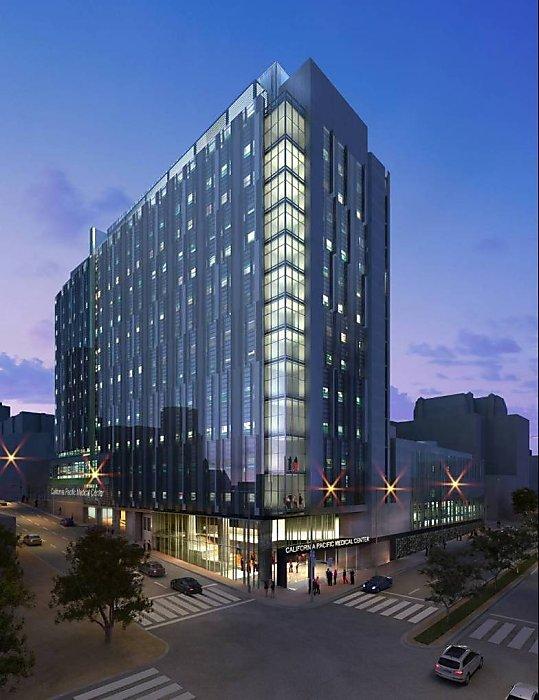
EDITORIAL For most of the past year, Mayor Ed Lee had been taking a tough line with California Pacific Medical Center, the health-care giant that wants to build a state-of-the-art 555-bed hospital on Cathedral Hill. The mayor had been telling a stunningly recalcitrant CMPC management that the outfit would have to put upwards of $70 million into affordable housing and spent millions more on transit, neighborhood and charity-care programs to mitigate the impacts of the massive project.

But late in March, something happened. Under immense pressure from the Chamber of Commerce and other big business groups, the mayor buckled and agreed to a deal with woefully inadequate mitigation measures. The supervisors should reject the plan and force CPMC to do better.

The biggest problem with a project this size is the mix of jobs and housing. Lee is properly concerned about creating jobs in a city where unemployment in some neighborhoods is stubbornly high. But the proposed deal only guarantees a tiny fraction of the 1,500 permanent new jobs for San Francisco residents.

That means a city that has almost zero vacancy in affordable housing is going to have to absorb a workforce much of which won’t be able to buy or rent anything at current market rates. That means more competition for scarcer housing and higher rents and home costs for everyone.

By any basic planning logic, CPMC should be on the hook for providing enough affordable housing for at least some reasonable percentage of its workforce. Instead, the hospital chain is offering about $33 million, only $3 million of which will be paid up front. That won’t even address half of the housing impact. Besides, the jobs will be there when construction starts, and more when the hospital opens; the limited affordable housing money will come much later. The highest-paid doctors and administrators may be able to afford the pricey new market-rate condos the city is madly approving — but where, exactly, are the nurses, orderlies, clerks, janitors and other health-care workers going to live?

CPMC has agreed to provide charity care at the same level is currently does — which is abysmally low, among the lowest of all nonprofit hospital chains in California. So that’s not an advantage.

And it has promised to keep open St. Luke’s Hospital in the Mission — the only full-service hospital other than SF General in the southeast part of town. But the proposal calls for cutting the number of beds by nearly two-thirds, from 229 to 80. And it allows for the closure of that hospital if CPMC’s system-wide operating margin falls below 1 percent (something that will be hard for the city to challenge, since CPMC handles the books).

It’s cynical how CPMC is using this critical medical facility in an underserved area as a bargaining chip. Already, hospital lobbyists are warning that St. Luke’s will be shut down if they don’t get what they want on Cathedral Hill.

Meanwhile, CPMC has labor trouble and is refusing to guarantee that existing employees at facilities that will be demolished will be able to keep their jobs and seniority at the new hospital.

We realize that CPMC needs to build a new facility to replace aging and seismically unsafe structures elsewhere in town. But the hospital chain also has a responsibility to address the impacts this project will have on San Francisco. And right now, it’s not a good deal.

Editorial: Reject the CPMC deal!

17

EDITORIAL For most of the past year, Mayor Ed Lee had been taking a tough line with California Pacific Medical Center, the health-care giant that wants to build a state-of-the-art 555-bed hospital on Cathedral Hill. The mayor had been telling a stunningly recalcitrant CMPC management that the outfit would have to put upwards of $70 million into affordable housing and spent millions more on transit, neighborhood and charity-care programs to mitigate the impacts of the massive project.

But late in March, something happened. Under immense pressure from the Chamber of Commerce and other big business groups, the mayor buckled and agreed to a deal with woefully inadequate mitigation measures. The supervisors should reject the plan and force CPMC to do better.

The biggest problem with a project this size is the mix of jobs and housing. Lee is properly concerned about creating jobs in a city where unemployment in some neighborhoods is stubbornly high. But the proposed deal only guarantees a tiny fraction of the 1,500 permanent new jobs for San Francisco residents.

That means a city that has almost zero vacancy in affordable housing is going to have to absorb a workforce much of which won’t be able to buy or rent anything at current market rates. That means more competition for scarcer housing and higher rents and home costs for everyone.

By any basic planning logic, CPMC should be on the hook for providing enough affordable housing for at least some reasonable percentage of its workforce. Instead, the hospital chain is offering about $33 million, only $3 million of which will be paid up front. That won’t even address half of the housing impact. Besides, the jobs will be there when construction starts, and more when the hospital opens; the limited affordable housing money will come much later. The highest-paid doctors and administrators may be able to afford the pricey new market-rate condos the city is madly approving — but where, exactly, are the nurses, orderlies, clerks, janitors and other health-care workers going to live?

CPMC has agreed to provide charity care at the same level is currently does — which is abysmally low, among the lowest of all nonprofit hospital chains in California. So that’s not an advantage.

And it has promised to keep open St. Luke’s Hospital in the Mission — the only full-service hospital other than SF General in the southeast part of town. But the proposal calls for cutting the number of beds by nearly two-thirds, from 229 to 80. And it allows for the closure of that hospital if CPMC’s system-wide operating margin falls below 1 percent (something that will be hard for the city to challenge, since CPMC handles the books).

It’s cynical how CPMC is using this critical medical facility in an underserved area as a bargaining chip. Already, hospital lobbyists are warning that St. Luke’s will be shut down if they don’t get what they want on Cathedral Hill.

Meanwhile, CPMC has labor trouble and is refusing to guarantee that existing employees at facilities that will be demolished will be able to keep their jobs and seniority at the new hospital.

We realize that CPMC needs to build a new facility to replace aging and seismically unsafe structures elsewhere in town. But the hospital chain also has a responsibility to address the impacts this project will have on San Francisco. And right now, it’s not a good deal.


Guest opinion: Free Muni for all youth

20

On Tuesday, April 3, the Municipal Transportation Agency board faces a decision between providing free Muni passes for all San Francisco youth or providing free passes to only low-income youth. ComMunity advocates and Sup. David Campos have identified the funding. We are calling on the MTA board to take this opportunity to invest in a new generation of transit riders by establishing free Muni for ALL youth.

The movement to win free Muni passes for youth originated from cuts of between 40 percent and 100 percent to yellow school busses over the next two years.  As a society, we have responsibility to make sure youth can access free public education — and as a city we have a responsibility to get kids to school even as state funding is eliminated.

Right now 60 percent of all trips in San Francisco are taken by car, and for years we have not seen a huge change in transit mode share. If San Francisco wants to meet our climate objectives, we need to take steps now to encourage young people to get out of their cars.  In New York City, a program of free transit passes for youth has created generations of loyal transit riders. In order to truly become a transit-first city, we need to do the same here.

While the struggle to afford bus fare is obviously a larger challenge for very low-income families, due to the high cost of living in the city, there are many working-class and middle-income families who also struggle with the costs of transit for their children. The costs of housing, food, healthcare, and transit add up quickly for San Francisco families and have all contributed to a crisis of family flight out of San Francisco.

San Francisco currently has the smallest child population of any major U.S. city. While this is complex problem, requiring a huge investment in affordable housing and a strategy to bring more working-class jobs to the city, by establishing free Muni for all youth the city can take a very concrete step forward towards making the city more family friendly. Thousands of families would benefit from an extremely modest investment of $8.7 million a year.

The low-income youth and parents who have been at the forefront of this movement advocating for the free youth passes are nervous about their own ability to access a low-income-only pass because of the bureaucratic challenges they experience trying to apply to other government programs. The Muni Lifeline pass for low-income adults is very hard to access, requiring applicants to wait for hours during a weekday at the Human Service Agency headquarters.

The Federal Free School Lunch Program requires parents to provide documentation of income level. Using a means test would be difficult and costly to administer and could exclude some low-income young people — especially those from undocumented families and the children of parents who work in the informal economy. San Francisco should not create paperwork barriers that will prevent our young people from getting to school.

The documentation required now to get youth clipper cards prevents many families from getting them. Immigrant families who do not have copies of all their birth certificates are prevented from getting youth passes when they encounter difficulties getting birth records from their native countries.

With all of those factors, it just makes sense to make Muni free for all youth.

Jane Martin is an organizer with People Organized to Win Employment Rights (POWER).

Families leaving SF: It’s housing costs, stupid

34

City officials continue to wring their hands over why families are leaving the city, and I’m sure there are a number of factors, but I can tell you that from the people I know — families who live in the city or want to live in the city — it’s all about the cost of housing.C

Critics of the SFUSD like to say that families are leaving for better schools, but those families haven’t been paying attention to the tremendous strides the district has made in recent years. Yes, middle schools are still a challenge in some areas, and yes, not all the public schools are great, but overall, most families that make the effort to find a quality school for their kids can do it.

The folks I know who work in the city hate the idea of living in the burbs. Nobody wants to commute across that bridge or through the BART tunnels every day; more important, nobody wants to be on the other side of the Bay from their house and their kids when the Big Earthquake hits. The problem is the money.

You want to keep families in San Francisco? Building housing for multimillionaires isn’t going to do it. If it were up to me, I’d float about a $5 billion revenue bond, buy up all the housing on the private market, put it all in a land trust and resell it — with the provision that the buyers had every right of ownership except the right to sell for a profit. That’s not likely to happen — but the city has to get serious about both building new affordable housing and (even more important) preserving what’s already there.

Yes, a lot of families want to buy a house, but a lot of families would be happy with a decent, affordable place to rent. Particularly if they knew that they wouldn’t be evicted so a richer person can buy or rent the place. What most families want is stability — they want to know where they’re going to live not just this year but when their kids are older. So many renters in this town live in such fear of eviction that it’s a huge incentive to move somewhere else.

You can talk about parks and playgrounds and youth programs, but San Francisco’s never going to be as family-friendly as we’d all like unless we can do something about housing costs and rental stability.


The case for a study of the economic impact of market rate housing

88

“SF’s rush toward the ultimate highrise” read the headline on the Guardian front page of Sept. 27, 1971. The headline and the graphics by Art Director Louis Dunn illustrated the central point of our bombshell study: that despite the rhapsodies of  the Chamber of Commerce and the big developers, highrise commercial buildings don’t produce gushing revenues and they don’t pay for themselves.In fact, our exclusive study of the downtown highrise district  found that “for every $10 the district yields to the city treasury, the city has to provide $11 in services.

“Put another way: the highrise district contributes $62.9 million, or 25.2% of all locally generated municipal revenue.  But it costs $67.7 million, or 25.2% of all locally financed expenditures (figures from fiscal 1970.

“This means taxpayers subsidize–35 cents or so on the tax rate in fiscal 1970–the construction and maintenance of our civic monuments–the Bank of America building, the Transamerica building, the Hilton Hotel–and soon, another 23 skyscrapers that will be taller and bulkier and more  expensive than ever for residents and taxpayers.”

Project Director Tom Lehner, a San Francisco resident and expert on urban policy from UC-Berkeley’s School of Public Policy, made the crucial point: :”This report overturns once and ffor  all, emphatically and conclusively, the conventional wisdom that downtown skyscrapers somehow provide the municipal treasury with its lifeblood.

“Anyone who thinks for a moment about what’s happening in New York,” Lehner added, “will come to the same conclusion as our study did.  But the air’s been so full of propaganda from the Chamber of Commerce and other downtown interests like the Examiner and Chronicle that it’s difficult to have a clear thought about the subject.”  The economic  fact that taxpayers subsidize highrise development has become gospel and helped provide the ammunition for the slow growth movement on commercial highrises that ultimately won on the Proposition M  initiative in 1986.

Below is the  PDF that shows our study with the Louis Dunn drawings: scroll  through.

http://test.sfbg.com/PDFs/highrise.pdf

Today, the burning issue is the luxury building at 8 Washington and the host of market rate developments already built or in the works and their impact on neighborhoods. And today the city needs a study that can provide the facts on the economic impact of market rate development and how neighborhoods can cope with the impacts in an era of “now new taxes.”

Tony Kelly is the president of the Potrero Hill Boosters and one of the most knowledgeable neighborhood activists on the market rate housing front.  He and the Boosters are dealing with the Mission Bay Landrush and the city’s plan to flood the Eastern Neighborhoods with market rate housing. His take is most instructive on why a study is needed:

‘”During the Eastern Neighborhoods re-zoning in 2008, I saw neighbors who supported development turn into NIMBYs overnight as soon as they realized that building market-rate housing in San Francisco doesn’tpay for itself, or much of anything else.  On Potrero Hill, we spent an entire decade working on neighborhood planning that was supposed to  
give us new parks, new transit lines, and better schools in a part of town that desperately needs all of that.  And then, when the new zoning was finally approved … … we found out that none of those improvements made it over the finish line. 


“The impact fees for the new development won’t even come close to providing the transit, parks, schools or infrastructure that the new residents need, let alone those of us who are already here in a very underserved part of town.  I shouldn’t really have to remind you that the new housing isn’t affordable for City residents.  And the Planning  
Department’s own study from 2008 confirms that when you build market-rate housing, you create a bigger need for affordable housing – more than you are getting in affordable housing fees or inclusionary units.

” So, with every new market rate housing unit, we are falling further behind on everything the City needs to do to support neighborhoods.  And the increased property taxes are all going to the General Fund, to support services elsewhere in the City.  Who in their right minds, in any neighborhood, would sign up for such a deal?

“Now, on this side of town, we are stuck with development plans that are designed to double the populations of district 10 and district 6 in the next 20 years.  In my neighborhood, Potrero Hill, the population will triple. And now we have to figure out how to support this booming population without much help from City Hall.

“The new condominium projects that the Potrero Boosters Neighborhood Association has already seen in the past few months reveal the consequences of the Eastern Neighborhoods rezoning—thousands of condos and apartments (and thousands more residents) coming to the neighborhood, with very few opportunities for children or families, and not much planning from the City for alternatives to automobiles.  

“We cannot have urban density in our part of this City with suburban ways of living and getting around, and yet, that is what we have, now and in the future.  So in the neighborhoods, we have to plan (and takeaction) to create our own infrastructure, and not simply rely on what the City manages to give us.”

Kelly’s arguments against pellmell market rate housing is particularly strong for the city’s new frontier of Mission Bay and the Eastern Neighborhoods, but it applies to every neighborhood and the entire city.  This is why for starters the supervisors need to direct the budget analyst or the city’s economist to do a detailed study to help Tony Kelly and the rest of the neighborhoods deal properly with the onslaught of market rate housing.  b3

Editorial on the case against 8 Washington:
>
http://www.sfbg.com/bruce/2012/03/06/editorial-case-ag

The struggle for housing money at City Hall

24

It’s barely March, and the next election isn’t until June and that’s just primaries and the Democratic County Central Committee, but we just started getting political mail anyway. It’s a piece from the Board of Realtors, denouncing plans for an increase in the real-estate transfer tax “to provide subsidized housing to people who want to live in San Francisco but don’t have the means to do so.” Mayor Ed Lee, the flier says, is backing this “outrageous” plan.

What, exactly, is going on here?

Well, for starters, the mayor is distinctly NOT pushing for an increase in the transfer tax, not right now, anyway. What he is doing is meeting with housing advocates and legislators and trying to come up with a stable source of funding for affordable housing — yes, for families and low-income people, many of them longtime residents who are being forced out by Ellis Act evictions, others of them people who work in the city and would rather live here than commute from Pinole, which everyone with any sense agrees is a good idea.

The problem: For years, San Francisco used Redevelopment Agency tax-increment money for affordable housing. Now that money’s gone, since the governor abolished redevelopment agencies. Actually, the money’s not gone, technically — the increased tax revenue from redevelopment project areas still exists. It’s just that the state is now taking a bunch of it, and other taxing entities like BART and the school district get some of it, and now it’s impossible to send bonds and borrow money against it. So what was once tens of millions for affordable housing is now a few million.

“We might have $20 million a year in the general fund,” said housing activist Peter Cohen. “But that’s compared to the $40 million or $50 million we had in the past, and it still leaves housing short.”

Lee has promised repeatedly to fix that problem, to find a way to make sure that there’s enough money that the nonprofits who build housing can plan and develop for the long term. Right now, it’s being called a Housing Trust Fund, but nobody knows exactly how it will actually work.

Remember: The city’s own General Plan states that 60 percent of all new housing should be available at below market rate. All of the regional growth projections say that San Francisco needs to build more housing — for its own workforce, not just for the rich. (And the local workforce, for all the tech jobs the mayor keeps hyping, is still mostly public-sector workers and service employees, most of whom can’t possibly afford the soaring rents and housing prices in this city.)

A lot of the existing affordable housing money comes from the city’s inclusionary housing law, which mandates that market-rate developers set aside a percentage of their new units (usually 20 percent) for lower-income people. Most developers eschew allowing poor people into their condo enclaves, so they pay a fee into a city fund instead.
But if we’re aiming for 60 percent, and we’re getting (at most) 20 percent, we’re a long ways off. Oh, and the developers are starting to argue that the 20 percent rule is too onerous and they can’t build enough condos for the rich if they have to throw scraps to the poor and middle-class, too.

And some supervisors are squawking about building more housing for the middle class, and right now in a zero-sum game, that means less for low-income people.
This all adds up to a mess for the mayor, and it’s no wonder some advocates are talking about raising the transfer tax — which, after all, is paid by the seller of a residential or commercial building, and while there are absolutely some houses underwater in San Francisco (and there should probably be an exemption in the tax for that situation), overall home prices are rising again, and many, probably most home sales these days involve substantial profit. It’s not a perfect tax, but it’s a tax on a class that is (generally) better off to support a class that is typically not so well off.

Here’s the problem: If the mayor supports a transfer tax, and that’s part of the final package, the realtors and the commericial building owners will no doubt put huge amounts of money into defeating it. That would mean Lee would have to raise a bucket of money and campaign really hard to pass it. But Lee’s demonstrated that he’s not the fighting type; he wants something that nobody serious will oppose. Which is why my sources at City Hall say that he wants the transfer tax off the table.

That could mean that the Housing Trust Fund will be a basic set-aside, a budgetary mandate that a certain amount of money go into a reliable fund for housing. That’s one of the city’s most pressing needs (really, if this becomes a city of just the rich, even those of us who own houses or have rent-controlled apartments won’t want to live here any more. Mayor Larry Ellison? Eeew.) So I’m okay with that. I’m not a big fan of set-asides, but this is the whole future of San Francisco we’re talking about.

So the realtors can take a chill pill — the mayor doesn’t want to get in a fight with you. Sigh.

The case against 8 Washington

35

tredmond@sfbg.com

In city planning terms, it’s a fairly modest project: 134 condos, no buildings more than 12 stories tall, on a 27,000-square-foot site. It’s projected to meet the highest environmental building standards and offers new open space and pedestrian walkways. It’s near Muni, BART, and ferry lines. And the city will collect millions of dollars in new taxes from it.

But the 8 Washington project, which will come before the Planning Commission March 8, has become a flashpoint in city politics, one of the defining battles of Mayor Ed Lee’s administration — and a symbol of how the city’s housing policy has failed to keep pace with the needs of the local workforce.

Put simply, it will create the most expensive condos in city history, housing for the richest of the 1 percent on the edge of the waterfront — and will further push San Francisco toward becoming a city that caters almost entirely to the very wealthy.

So in a city where the growing divide between the 1 percent and the rest of us has become a central issue and where the lack of affordable housing is one of the top civic concerns, 8 Washington is an important test. By any rational standard, this sort of development is the last thing San Francisco needs.

But some of the best-connected lobbyists in the city are pushing it. One of the mayor’s closest allies, Chinatown powerbroker Rose Pak, is a leading advocate — and the final outcome will say a lot about city politics in the Lee administration.

There are all sorts of half-truths and misleading statements by supporters of 8 Washington. Here are the five main reasons the project shouldn’t be approved.

1. It fills no housing need. San Francisco has no shortage of housing for the very rich; the dramatic need, outlined in both regional planning documents and the city’s own General Plan, is for low- and moderate-income housing for the people who actually work in this city (see “Dollars or sense?” 9/28/10). While San Francisco is getting richer by the day, the core workforce — public employees, workers in the hotel and restaurant industry, service workers, construction and trade workers, and a majority of the people in the lower levels of the finance and tech sector — are being priced out of the city. That means more people working here and living far out of town, often commuting by car, in what everyone agrees is an unsustainable situation. Meanwhile, more and more high-paid workers from Silicon Valley are living in San Francisco — again, commuting to distant jobs, either by car or by corporate bus.

The city’s General Plan states that some 60 percent of all new housing built in the city should be below market rate. San Francisco desperately needs housing for its workforce. This type of project simply puts the city deeper in the hole and further from its housing goals.

2. It’s a reward for bad actors. The main developer of this project is Simon Snellgrove, but one of his partners is, by necessity, Golden Gateway, which owns a significant part of the land — and which has been flouting at least the spirit if not the letter of city and state law and costing San Francisco tens of millions of dollars.

As project opponent Brad Paul has noted in written testimony, when Timothy Foo, the current owner, bought the complex from Perini Corp. about 20 years ago, he used a loophole in state law that allowed him to avoid a formal transfer of ownership. That means the property wasn’t re-assessed, costing the city about $1.5 million a year. According to the Assessor’s Office, the deal wasn’t illegal (and these tricks to avoid reassessment are relatively common) but still: He’s costing the city millions by using a loophole not available to most people.

Golden Gateway, which was built in a redevelopment area as middle-class housing, is now renting out apartments as short-term tourist or corporate rentals. There are dozens of examples right now on Craigslist. City law bars the owners of rental housing from converting it to hotel rooms, but a loophole in that law makes what Foo’s outfit is doing technically legal. But he’s clearly violating the spirit of the city ordinance that seeks to protect rental housing from hotel conversions.

One of the main aesthetic complaints about the area — something Snellgrove’s lobbyists have tried to use to support the project — is the ugly fence that now surrounds the Golden Gateway Tennis and Swim Club. But who do you suppose put that fence there?

Do we as a city want to be giving special zoning benefits to companies that try to circumvent tax and housing laws?

3. It’s an environmental disaster. Snellgrove and his architects, Skidmore Owning and Merrill, are seeking LEED platinum certification for the project, saying that its energy-efficiency, water use, and green building materials will make it one of the most sustainable structures in San Francisco. It is, the project website notes, close to all types of public transit.

But LEED doesn’t take into account what the building is used for (see “Is LEED really green,” 7/5/11) — and in this case, the use makes a huge amount of difference.

People who buy multi-million-dollar condos don’t tend to take Muni or BART when they go places. That’s not conjecture, it’s a proven fact. A 2008 study by the American Public Transportation Association notes, bluntly, that wealthier people are more likely to drive cars. When you move into the stratospheric regions of the ultra-rich, that’s even more true. A 2011 report on the Charting Transport website notes: “The very rich tend to shun public transport.”

The current zoning in the area allows for one parking space for every four residential units. Snellgrove is asking for one space per unit — in other words, he figures every single buyer will have a car.

Many of the people who buy these condos won’t be working or even living most of the time in San Francisco. These are condos for world travelers, second and third homes for people who want to spend a few weeks a year in San Francisco. “They aren’t going to be living here all year,” Christina Olague, a former Planning Commission member who is now the District 5 supervisor, told us last July.

If five of the 165 residents of 8 Washington fly in a private or corporate jet from, say, New York to their SF pad once a month, the project will cause the use of jet fuel equivalent to what a normal family would use driving a car for 330 years, Paul noted.

“How many solar panels are needed compensate for burning 396,000 gallons of jet fuel a year?” he asked.

Then there’s the construction issue. If the developer’s projections are correct, as many as 20,000 dump truck runs will be trundling along the Embarcadero for several months, one every two minutes — and it could be happening right as the traffic nightmare called the America’s Cup is hitting the waterfront.

It also goes against some 40 years of waterfront planning policy, all of which as focused on downzoning and creating open space. This would be the first upzoning of San Francisco waterfront property in decades.

4. It will wipe out what is mostly a middle-class recreation facility. The Golden Gateway Tennis and Swim Club will be closed for three years, then (possibly) reopened later as a smaller facility. The club — with two outdoor pools and six tennis courts — sounds like something for the elite, and it’s managed by the upscale Bay Club, but a lot of the users are longtime Golden Gateway residents and seniors. “I would say 30 or 35 percent of the users are seniors,” Lee Radner, chair of Friends of Golden Gateway, told me. Most, he said, are middle-class people, and the expense isn’t that high. “My wife and I pay $3 a day to use the pool,” he said. “I swim every day, and it would cost more than that to use the public pools in the city.” He added: “There are some wealthier people, of course, but many of us are retired and on fixed incomes.”

We’re talking about 90,000 total square feet of outdoor recreation space — which dwarfs the 20,000 square feet of open space the developer promised to provide.

5. The city doesn’t get much out of the deal. In exchange for upzoning the waterfront, creating a big all of buildings and screwing up the city’s housing balance, what does the San Francisco general fund get? Not a lot. The estimates for new tax revenue run about $1.5 million a year of the next 60 years — and when you translate that to what economist call “net present value,” the cash equivalent today of that revenue stream, it’s about $30 million. The Port of San Francisco is talking about creating a special infrastructure financing district — sort of the equivalent of a redevelopment area — to pull that money out in advance, which may not even be legal (since part of the land is a former redevelopment area, the state law that allows these special finance districts may not apply). But even so, a Jan. 14 Port memo suggests that the agency has plans to spend all that money on its own infrastructure — setting up a potential battle between the supervisors and the Port Commission over where the money, if it actually can be collected up front, will go.

Like any developer, Snellgrove will pay into the city’s affordable housing fund — in this case, about $9 million to pay for the equivalent of 27 units. No affordable units will be on site, of course; that would detract from the uber-wealthy ambience of the place. And it’s not clear when those units would be built. “Nobody builds 27-unit buildings any more,” Paul, a former deputy mayor for housing, said. “We’ll have to wait until there’s enough money for a bigger project, somewhere, sometime down the road. That’s what we’re getting here.”

Either way, it’s not a huge benefit for allowing this disaster of a project — and it’s a terrible statement for San Francisco to make. At a time when the mayor has cleared the Occupy protesters — who are talking about how little the rich pay in taxes — off the waterfront, the city is preparing to move in the exceptionally rich, who aren’t paying anywhere near their fair share in tax revenue to local government.

(Nobody knows for sure whether the costs of servicing high-end residential exceed the revenue the city gets from property taxes. In 1971, the Guardian put together the first-ever cost-benefit study for highrise office development, which showed that commercial buildings cost the city more than they paid; that’s been confirmed and demonstrated over the years to the point where it’s hardly even an argument any more. The supervisors ought to ask the city economist or the budget analyst to do the same sort of analysis for luxury condos.)

There’s another element here: Mayor Lee made a point during his campaign to say over and over again that he was an independent thinker, that powerful and influential allies like Rose Pak would not be calling the shots at City Hall. This will be his first major test: Pak and lobbyist Marcia Smolens are working hard to promote 8 Washington. And we’re already getting some disturbing signals out of the mayor’s office.

Lee told us that he has “no thoughts” about the project and hasn’t been paying any attention to it. That’s an odd stance, considering that his own Port Commission is pushing it and staffers in his office are working with the developer. This is a big priority for Pak, and the notion that she has never mentioned it to the mayor defies reason. Board President David Chiu, who talks to the mayor regularly, opposes the project, which is in Chiu’s district.

It’s hard to imagine that anyone who pays attention to local politics could be missing what will be one of the landmark votes this spring on the Planning Commission — which will take up the project March 8 — and the Board of Supervisors.

The mayor, may, indeed, be ignoring everything that supporters and opponents of 8 Washington have said and may be waiting until the Planning Commission vote to take a position. But if he’s just ducking questions because he’s planning to support it, he’s making a big mistake.

This is a chance for San Francisco to go beyond the platitudes about building housing, go beyond the hype about “green” buildings, see through the fraud about community benefits and consider what this really is: A special favor for a developer who wants to cater to the top 1 percent of the 1 percent and move San Francisco even closer to being a city of, by, and for the elite. The only reasonable vote on 8 Washington is No.