

CULTURE
Diishan Imira grew up in Oakland, attended school in Virginia, studied in Paris, learned to speak Mandarin in China, and briefly worked in Ethiopia. Throughout his travels, he taught himself to pick up on phrases and cues that would help him break through cultural barriers. Oddly enough, those skills proved most valuable after he returned to the Bay Area — and became one of a very small number of African American entrepreneurs to try and break into Silicon Valley’s tech sector.
Silicon Valley insiders might insist that they inhabit a “meritocracy” offering opportunity to anyone with a viable idea for a tech company. But it’s not as if just anyone can walk through that door — funders are only interested in meeting with people their peers can vouch for.
And by the time an entrepreneur gets to the stage of courting venture capitalists, they’ve entered a world predominantly controlled by a single narrow demographic. “The majority are old white men,” Imira says.
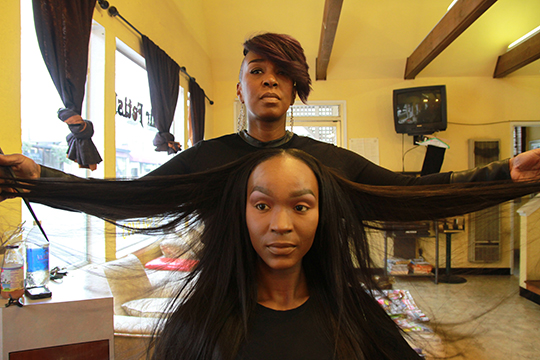
Conveying his idea to them was all the more difficult given the basis of his idea for a tech company: hair extensions.
“It’s like, hair extensions? Black people? Black hair extensions? There’s a disconnect of people relating,” Imira says. “I had someone say: ‘I don’t know any black women.'” Another admitted he had never once set foot in Oakland.
Turns out, hair extensions aren’t cheap — yet women who style their hair with them might shell out for the products three or four times a year, and African Americans are estimated to spend a total of $10 billion annually on hair products, three times as much as other demographics.

Imira told the Bay Guardian that his company, called Mayvenn, seeks to tap into that market while solving a problem that he says has long been contentious in the African American community.
Ever notice those corner beauty supply stores that sell hair extensions? “They’re in every black neighborhood pretty much in the country,” Imira says. “There are over 10,000 beauty supply stores. Less than eight percent of them are owned by any African Americans.”
At the same time, “less than five percent of any black hair salons have any retail component of their business,” Imira adds.
The idea behind his tech company is to give stylists the option of selling hair extensions to their customers directly, allowing them to earn a commission and boost their earnings. Nationwide, the average salary of a hair stylist hovers around $24,000 a year. Hairdressers are predominantly women, who earn less than men on average across all demographics.
“Each hair stylist gets an e-commerce website,” explains Imira, noting that he has hair stylists in his family. “Usually the stylist would say, go to the beauty supply store, buy this, and bring it to me. Instead of sending her customer somewhere else to buy the product, she sends the customer to her website.” The commission runs on a scale of somewhere around 15 to 30 percent (the typical price is $50 to $100, he says).
Mayvenn buys the extensions directly from China, and ships them to stylists when they place orders. The hair itself is predominantly from India, he says. “People cut off their hair for religious ceremonies at Hindu temples,” he explains. “They make a pilgrimage and then shave off their hair.” Factories also purchase “fallen hair,” the leftover cuttings from beauty salons.
To get funding, Imira attended tech events, participated in pitch contests, and tried to learn all the right things to say. “To me, Silicon Valley is a culture,” he says. “Trying to raise money there and get traction with investors is a cultural thing. There are unsaid cultural rules of what’s going on.”
Investors tend to have “a herd mentality. It was far more of an emotional thing than it was logic and numbers.”
Monique Woodard created a network called Black Founders to try and lend support to African American entrepreneurs wanting to break into tech. “A lot of startups by black entrepreneurs just don’t get funded,” she says. “As someone who’s been in technology, and came to San Francisco, and didn’t see a real community around black entrepreneurs, I really wanted to start something that would address that.”
Woodard’s organization has hosted hackathons in Atlanta, and routinely holds workshops for African American entrepreneurs in the Bay Area. “You can be a great entrepreneur without having gone to Stanford, MIT, or Harvard,” she says. But “even black entrepreneurs who have gone to those schools often don’t have the network that a white Stanford graduate has.”
Despite this cultural disconnect, studies show that African Americans are major users of social media, giving rise to things like the growing virtual community Black Twitter.
Imira managed to get funding after partnering with a co-founder who had the right connections, and Mayvenn was even accepted into a prestigious accelerator. Now, the company has stylists “everywhere African Americans are densely populated,” Imira says.
But breaking into the insular tech sector as a black entrepreneur with a company targeting black customers is a rare feat in Silicon Valley, land of rich white guys.
“I think there’s just sort of like a cultural blind spot,” Imira says. “People say they want to solve problems. But there are different problems that relate to different types of cultures.”