SFBG Blogs

Public employees feel blindsided by Newsom’s layoff scheme

39

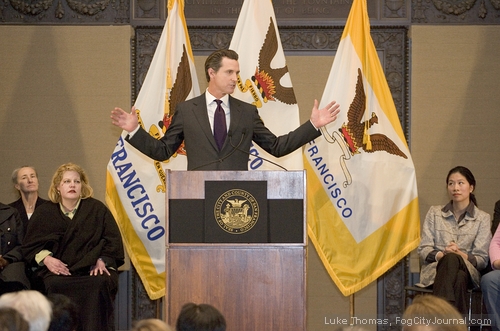
Mayor Gavin Newsom’s proposal to lay off 10,000 city employees and rehire them at lower pay is being met with outrage by some public-sector workers. The plan, crafted as a way of saving money to balance the city budget, would amount to sweeping pay cuts across the board for a significant number of city workers.

Formal discussions about it are in the earliest stages, and Tony Winnicker, the mayor’s press secretary, described it as “just one alternative that we’re investigating.” Nonetheless, some members of Service Employees International Union Local 1021 are furious that the mayor unveiled this plan in the San Francisco Chronicle instead of at a meeting with the city’s labor leaders.

“As far as we can tell, an idea he has ended up on the front page of the Chronicle that’s had a devastating ripple affect among the people who work for the city and county,” SEIU Local 1021 President Damita Davis-Howard told the Guardian. “We feel like we got a sucker-punch. … We really wish he had talked to us before he governed by press conference.”


Davis-Howard said she’s been inundated with phone calls from angry union members who read the article. “This is the same proposal he floated last year,” Davis-Howard said. “Most of our members believed that they gave up their holiday pay in order to avoid this very thing.”

The proposal, which was briefly considered last year but never moved forward, serves to illustrate just how hard financial woes are hitting San Francisco. The city is staring down a $522 million deficit, and Newsom’s proposal would make up for a mere $50 million in savings.

Winnicker declined to comment on Davis-Howard’s concerns about being blindsided by news of the layoff plan, brushing it off by saying the mayor did discuss it with “some folks in labor.” Instead, he suggested that Newsom is getting serious about solving the budget crisis while the Guardian is just focusing on irrelevant gripes.

“It is an unprecedented budget shortfall, and it is real,” Winnicker said, stressing that the gaping budget gap will have to be bridged without the infusion of federal stimulus dollars that cushioned the blow last year. “The easy choices are behind us.” This layoff plan could prevent “hundreds, if not thousands, of layoffs,” but the mayor is open to other ideas that labor brings to the table, he said.

“That logic is just flawed,” Davis-Howard said when asked about the assertion that the plan could prevent layoffs. “That’s not the way you re-stimulate the economy, by taking more dollars out of the economy. We can’t continue to balance the budget on cuts, because pretty soon the actual fiber of the city and county of San Francisco will be reeling because of the number of cuts that we sustained.”

When asked how SEIU Local 1021 would respond, she said, “I do believe we need to be open-minded, imaginative, and creative in coming up with some revenue-generating measures here.”

No doubt the mayor will receive plenty of suggestions as negotiations continue in the coming weeks.

Hip-hop and chaotic beauty, Minneapolis-style: Eyedea & Abilities with Dosh

0

Five years was far too long a break for most fans, but thankfully the Minneapolis hip-hop duo Eyedea & Abilities pulled things together just the way we like for 2009’s By The Throat (Rhymesayers Entertainment), the follow-up to the beloved sophomore album E&A released way back in 2004. They play Wed/10 at Bottom of the Hill, promising to spit their rude, ripping guitars, iron heavy bass beats, and surprisingly melodic choruses in your face.

Eyedea is among the best when it comes to freestylin’ in rush of the gun battles and these skills definitely transferred to his recorded performances. The Throat tracks are raw and scratchy, with lyrics like “Empathy is the poor man’s cocaine,” all spun between clawing riffs and smashing cymbals. DJ Abilities shows off in-between vocal streams, mixing and scratching like his hands are machines themselves.

Straying off the rap road, Dosh is all about multi-tasking and master-mixing.  Another Minnesota native, Dosh will open the evening’s show with his crazy, diverse skills on the drums, piano, xylophone and a host of sounds concocted from mallets, buttons and keys, all operated by himself and then looped, reversed or modified via live recording devices.

Dosh: don’t forget the xylophone

He’s like a musically inclined octopus; eight limbs outstretched to produce beautifully complicated melodies that blink on and off. His fifth album, Tommy (anticon), is set for release on April 13, meaning his show will be filled with all kinds of new tricks and treats. Dosh is a one-man show filled with mysterious illusions and while at times things may at first seem chaotic, satisfaction is only a loop away.

http://www.youtube.com/watch?v=ZMMAI6UKWcA

Eyedea & Abilities

w/ Dosh and Cubik and Origami

Wed/10, 9pm, $12

Bottom of the Hill

1233 17th St., SF

www.bottomofthehill.com


alt.sex.column: Ars longa

0

andrea@altsexcolumn.com

Dear Andrea:

I’m 43, good-looking, and reputedly sexy, funny, and easy to hang out with. I got laid almost daily in my 20s. But my last steady relationship was in 2007. My confidence is at an all-time low. I masturbate way too much to movies with Asian women and men who are hung to the floor, which makes me feel very small. I’m in a bad place right now and I don’t see the point of approaching women since I won’t be able to satisfy them like in the movies.

I’m a little under five inches. I’ve never felt comfortable with my size, although I did become very imaginative, creative, and kinky to give women pleasure. But I have never made a woman shake or moan with my penis. I miss female companionship, but I don’t feel man enough to try anymore. I just don’t have the confidence. Now I just fantasize about the kind of women I used to get.

Love,

Feeling Small

Dear Small:

Back when I used to answer questions at San Francisco Sex Information, we used to hear from a lot of guys who assumed that intercourse ought to go on for 90 minutes, penises ought to be at least 8 inches long, and all women achieve dramatic and very noisy orgasms from straight-ahead pounding and enjoy nothing more than a nice refreshing facial. What these guys had in common, was over-exposure to (mainstream) porn and little or no real-life experience from which to develop the kind of bullshit-o-meter one needs to protect one’s fragile sense of self-worth from most artifacts of popular culture, including Hollywood movies and all those songs about doing it all night till the morning light.

Those guys were virgins or recently devirginated, though, and were dismayed when real life failed, as it so often does, to match its own hype. You have no such excuse. You have actually done it with a real girl. Lots and lots of real girls, to hear you tell it. So buck up and back away from the giant-dick porn. Maybe try some amateur stuff, which, while still porn and still rife with porny conventions, may at least be more realistically scaled.

You do know that porn, like advertising, is aspirational and relies on a viewer’s ability to project himself into the imagined scenario, right? And it probably doesn’t work so well on people who already feel as rich, thin, powerful, well-dressed, and sexually satisfied as the people portrayed. Messages designed to make you feel unsatisfied with your own lot can be especially persuasive when you’re feeling vulnerable. So I assume that you also know that porn, however powerful, does not possess secret witch-doctor superpowers and cannot reach through the screen and SHRINK YOUR PENIS. So what the hell, dude? You were the same (admittedly smallish but hardly pathologically so) size back when you were in like Flynn. And all those women were not complaining then. Something has changed but it’s not the equipment.

I stopped making art when I stopped having the time and space (I hear these two are related somehow) to really spread out and do stuff, and I lost some confidence in my skills along the way, but a few weeks ago, sick of being a person who doesn’t do art, I dragged all my supplies out of storage and made something. If I can make art, you can … screw (despite the set-up I just could not, in the end, bring myself to say "make love").

I usually tell the unhung that they’ll have to develop mad skillz instead of relying on brute size to do the work for them. And then I add that everybody else would do well to do the same, since brute size is never a replacement for the skill that you, reportedly, already possess. And I usually throw in the fact that, speaking of not much penis, the people who report the most satisfying sex lives in all those surveys tend to be … lesbians.

To shake bad habits of thought and bad habits, period, find a cognitive-behavioral therapist. And to combat the blues from not getting laid, take a deep breath and find a date. Just don’t get the two things confused, and don’t put "has small penis" in the personals ad. Many women don’t care (and some prefer what you’ve got to offer) but it just doesn’t sound nice. You don’t have to marry this date. You don’t have to do her. Just prove to yourself that you can go.

And yes, I do know it’s not that easy. Neither is getting imaginative and kinky and giving women pleasure, and you used to do all that just fine. I would caution you, though, that thinking of women as something you (used to) "get" may have flown in 2007, but it won’t work now, bub. It’s a new decade.

Love,

Andrea

See Andrea’s other column at carnalnation.com.

Style Lines: Bianca Starr fulfills your heart’s desire

0

By Chhavi Nandi

Music and fashion are often so intrinsically connected, it’s hard to tell where one starts and the other stops. Which came first? Fall Out Boy or the emo haircut? So it should be no surprise that the impeccable taste that Bianca Starr brought to operating the former nightlife wonderland Club 222, now techno hotspot  222 Hyde, also carries over into the world of clothing with her new vintage boutique. The concept is providing carefully edited and cleaned pieces that appeal to Bianca herself (the store motto is “If we wouldn’t wear it, we wouldn’t sell it”), all in a fun, collaborative, friendly setting that includes rotating DJs playing every weekend.

And just as you might expect, she’s kicking off the store’s opening with a party worthy of a nightclub . Beats will be provided by Rebecca Vandersteen, Sybil Johnson of Heartbaker, DJ Irene Hernandez-Feiks of Chillin’ Productions, and DJ Miss Watkins, while shoppers enjoy baked goods, champagne, and special deals like 25 percent off all dresses and discounts on jewelry (it is the day before Valentine’s Day, after all).

4 R Hearts Desire

Sat/13, 1-7pm

Bianca Starr

3552 20th St, SF

(between San Carlos and Lexington)

www.biancastarr.com

Editorial: The attack on district elections

0

Nobody can honestly say that the district supervisors have ignored citywide issues or that they don’t have a citywide perspective.

The Chamber of Commerce, the Mayor’s Office, and the San Francisco Chronicle have created, apparently out of whole cloth, a new attack on district elections of supervisors. And although there’s no campaign or formal proposal on the table, the new move needs to be taken seriously.

And it’s important to understand from the start what this is really about.

The Chamber and the Chron are talking about the need for more “citywide perspective,” trying to spin the notion that supervisors elected by district care only about micro-local, parochial issues. But after 10 years of district elections, the record is exactly the opposite. District-elected supervisors have devoted themselves to a long string of exceptional citywide reform measures and have been guilty of very little district pandering.

Consider a few examples:

Healthy San Francisco, the local effort at universal health care that has drawn national attention and plaudits from President Obama, was a product of the district board, led by then-Sup. Tom Ammiano. So was the rainy day fund, which has provided millions to the public schools and prevented widespread teacher layoffs.

The district board reformed the makeup of the Planning Commission, Police Commission, and Board of Appeals.

District-elected Sup. Ross Mirkarimi’s legislation restricting the use of plastic bags has been hailed by environmental groups all over the country.

The district board passed the city’s minimum wage and sick day laws.

The district board created a citywide infrastructure plan and bond program.

Community choice aggregation, a direct challenge to Pacific Gas and Electric Co. that will bring San Francisco clean energy and lower electricity rates, is entirely a product of the district board. So is campaign finance reform, sanctuary city protecting for immigrants, a long list of tenant-protecting laws … the list goes on and on. What significant policy initiatives came out of the previous 10 years of at-large supervisors? Very little — except the promotion of hyper-expensive live-work lofts; the displacement of thousands of tenants, artists, and low-income people; and the economic cleansing of San Francisco, all on behalf of the dot-com boom, real estate speculators, and developers.

People can agree or disagree with what the board has done in the past decade, but nobody can honestly say that the district supervisors have ignored citywide issues or that they don’t have a citywide perspective.

No, this has nothing to do with citywide issues vs. district issues. It’s entirely about policy — about the fact that district supervisors are more progressive. About the fact that downtown can’t possibly get a majority under a district system — because with small districts, big money can’t carry the day.

Under an at-large system, nobody can seriously run for supervisor without at lest $250,000, and candidates who start off without high name recognition need twice that. There’s only one way to get that kind of money — and it’s not from protecting tenants and immigrants and fighting developers and PG&E.

In a district system, grassroots organizing — the stuff that labor and nonprofits and progressive groups are good at — is more important than raising money. So district supes are accountable to a different constituency.

Polls consistently show that people like having district supervisors — and for good reason. With at-large elections, the only people who have regular, direct access to the supervisors are big donors and lobbyists who can deliver money. District supervisors are out in the neighborhoods, take phone calls from community activists, and are far more accessible to their constituents.

So instead of trying to repeal the district system, the Chamber has come up with this “hybrid” effort. The idea would be to reduce the number of districts to seven and elect four supervisors citywide.

What that means, of course, is that a third of the board, elected on a pile of money, will be pretty much call-up votes for downtown. With two more from the more conservative districts, you’ve got a majority.

So this is about money and political control, and about the political direction the city is going, and about who’s going to set that direction. That’s the message progressive leaders need to start putting out, now. And every incumbent supervisor, and every candidate for supervisor, needs to make preservation of district elections a public priority


DJ Similak Chyld dances to an unfamiliar beat

1

DJ Similak Chyld doesn’t mess with inspiration. When asked how she came up with the idea for Afro Chico Electro, her dance party that hits the floor at Triple Crown on Wed/10, she’s narrowed the concept down to a single visual. It’s a purple pencil drawing by graffitist Mode 2 that shows a swath of party people intertwined, their arms thrown in the air, eyes closed, smiles open. There’s a bald girl, a blonde girl, some b-boys, a cool guy in a hat- but they’re all dancing to the same beat. Quote the pint sized Similak, “the idea is basically merging all the genres that I love, to bridge the gap between different crews, djs, artists, etcetera. I figure it makes sense to me- why not throw a party that represents who I am at the core?”

This kind of inclusiveness drove Similak’s musical programming for an evening that breaks down a lot of the genre boundaries that can run the SF dance scene. The DJ lineup includes Chico Mann, who assembles afrobeat/afro Cuban sounds on the drum machine, synthesizer and guitar for sets that have been described as “instant vintage”- early 80s Fela Kuti meets the music melding of today’s technology.

He’ll be joined by the sexy, dub heavy sounds of local hip hop mixer J Boogie, DJ Sake 1 (whose group Local 1200 has snagged our Goldie Award in the past for best Bay DJ crew), DJ Apollo, Similak herself, and a whole passel of afrobeat, hip hop and latin dance crews. “There’s no reason why we can’t dance to a beat because it’s not familiar. An afro dance troupe can appreciate disco or hip hop breaks, just like b-boys can up-rock to an afro or latin breakdown,” says Similak, who was raised between California and Taiwan, and whose own sets have been known to include old school soul, roots music, pop tracks.

Her concept of musical universality is being put to the test at Afro Chico Electro- she’s partnering the dance crews with music they might not typically get down to and encouraging the djs to branch out with their beats as well.

Will it come off? Will it be crazy? Smart money is on yes and yes. Even the wallflowers will have something to look at- neighborhood gallery Lower Hater is curating the whole damn thing with their arsenal of works from smart local artists. All told, an evening that just may encapsulate a lady with layers. “People used to- and still do- get really confused about what I play,” says Similak. “I’ve stopped trying to argue, defend or explain myself and I think folks are slowly starting to get that you can’t really put me in a box.” Unless it’s got nice headphones and is somehow hooked up to some speakers, the woman just might be right about that one.


Afro Chico Electro Wed/10 10 p.m., $5 (before 11 p.m., $10 after)

Triple Crown

1760 Market, SF

(415) 863-3516

www.triplecrownsf.com

www.similakchyld.com

Join the Orchid and Hound fan club

0

I hate to be objectifying, but journalistic integrity be damned- Orchid and Hound are damn good looking. The queer pop duo, comprised of satyr-esque John Constantine and the coyly shaggy Lawrence Alarcon, were also charming and beautifully turned out when I met them for drinks the other night- and, of course, they are brilliant onstage. Their upcoming show at The Blue Macaw (Thur/11) promises to look a lot like what would happen if High School Musical came out of the closet, hired a better stylist and started partying. So you’re going to have to excuse me if the following article starts to sound like Tiger Beat at times. I’m a little smitten, so shoot me.

This is what you will see at an Orchid and Hound show. Lawrence Alarcon will bang out lovely up and down tunes on his piano, while John Constantine provides jazzy vocals that ease over here to a sound reminiscent of Broadway, then smooth down there to recall a smoky lounge somewhere in Vegas. They’ve dubbed it “queer pop”- a highly listenable, intimate little cabaret. “We like to think of ‘queer’ as ‘different,’ like melodrama,” says Constantine of their sound.

But you’re not going to hear the typical “where ya from” one liners and “waitress, get me another drink” admonitions at O & H shows- you know, the typical lounge standards. “I suck at banter,” says Constantine. “He rambles,” offers Alarcon. Perhaps it’s for the best- the pared down nature of Orchid and Hound makes it a little easier to focus on, you know, the music. “It’s just a show where you shut up and listen,” Constantine says (“ideally,” adds Alcarcon).

The sound the two put out is lighthearted, the piano rhythms and Constantine’s voice bouncy, even. But their lyrics are expressions of a life as a pretty 23 year old in the Castro- a life can prove more complicated upon closer inspection. “I find inspiration in the dialogues I have with the people around me,” says Alarcon, who penned one song for O & H born of a conversation he had with his boyfriend about nothing less than the end of the world. “We were talking about the Mayan prophecies for 2012, but my boyfriend’s a scientist. He was more concerned about 2013, when the oil crisis is set to hit.” Alarcon turns to Constantine, pondering the difference between their songwriting styles, finally hitting on the pith of the issue. “John’s more angsty, more metaphorical.” Ooo… angsty!

“I like to sing about the human condition,” says Constantine, picking up Alaron’s musings. One of John’s songs, ‘Sabotage,’ is a catchy dirge that hinges on a theme familiar to most dashing rock stars; self destruction. “[‘Sabotage’] is about that daily battle you have with the destructive side of yourself, that you live with but must control,” says Constantine, toying earnestly with the stem of his cocktail. To date, their audience favorite is “The Drinking Song”, a depraved little interactive ditty whose success amuses Alarcon. “Who knew our most disturbing song would turn out to be our most popular?” 

“Who knew our most disturbing song would turn out to be our most popular?” Photo by Erik Anderson

So back to our bar date (because that’s what I’m calling it, so there!) The two have a knack for finishing each other’s sentences, and where Lawrence can be artistically reticent, John is more than happy to tell me about the origin of O&H. Herein lies the duo’s sychronicity; they’ve known each other “since forever,” growing up best friends at an arts high school in Los Angeles. John and Lawrence even dated each other for three years, during which they moved up to SF into a shared apartment- where they live to this day, despite having subsequently broken up, moved on… and formed a band. When asked how this is earthly possible, they smile sweetly at each other as though nothing could have been easier. “It was rough, but we’re much more productive now- minus the sex,” says Constantine. “We would have killed each other if we’d kept dating.”

Though the two first collaborated on musical compositions for an installation artist in LA, John and Lawrence only just formed their current act last year. They can still tell you how many live shows they’ve had; a sprightly “twelve!”- blurted out in unison, of course. “We don’t fuck up that much though,” says Constantine with a winning smile. “The one time we noticeably fucked up, someone told me ‘it was cute when you fucked up,’ so I guess that’s good.” 

So what does 2010 hold for these darlings, who are still unsigned to a label as of press time? Well, besides the trail of broken hearts and rehearsal hours they’re working on a studio album and recently announced their gig at this year’s South by Southwest festival. And then? Says Constantine “We’ve planted a lot of seeds, we just have to water them all.” Somebody hand these boys a hose- the world hearts Orchid and Hound.


Orchid and Hound w/ Audrey Ryan & Il Gato

Thur/11 8 p.m., $5

The Blue Macaw

2565 Mission, SF

(415) 920-0577

www.thebluemacawsf.com

iPod voyeur: Vivian Girls

0

Brooklyn lady trio The Vivian Girls, are back in town for an evening of girl-studded surf guitar, opening for Best Coast tonight at Bottom of the Hill. The Girls have been buzzing since their first album two years ago, a lo-fi garage rock favorite offering friendly reminders of surf and turf, skipping through town in high-waisted shorts, and being honest about the small things. Since the Guardian has interviewed them in the past, it was time for the Vivian Girls to spill some real secrets — their iPod’s top 10 most-played lists. Guitarist Cassie Ramone and drummer Ali Koehler agreed to give up the goods. (Bassist Kickball Katy doesn’t have an iPod. She just kicks ass). 


Ali’s top 10:

1. Meneguar, “House of Cats”

Also used to be Cassie’s most played song before she got a new computer, so you know it’s Vivian Girls approved.

2. Woods, “Be Still”

I think this song has the absolute perfect fidelity. Woods is my favorite band making music today and take up most of my top played songs on iTunes.

3. Lemuria, “Origamists Too”

This song is so sexy. For fans of Leatherface, Lemonheads, Superchunk.

4. Yellow Fever, “Culver City”

Our label, Wild World, just released a full length by this band. I haven’t been this excited about a new band in ages.

5. The Babies, “Meet me in the City”

This song is such a fucking HIT. The Babies are Cassie’s side project with Kevin Morby of Woods. They wound up sounding like the Pixies in the best way possible.

6. Happy Birthday, “Girls FM”

If Pitchfork doesn’t give this band Best New Music they are fools.

7. Daniel Johnston, “Some things last a long time”

I defy anyone to write a more sincerely heart-wrenching breakup song. I’m not even heartbroken and I want to cry listening to this.

 8. Best Coast, “When I’m With You”

I think Bethany (of Best Coast) described this song as sounding like Miley Cyrus, produced by Leslie Gore or something, which is exactly what I want to hear.

9. Hefner, “The Hymn for the Cigarettes”

I’ve always wanted to cover this song. It’s by Hefner, a John Peel-approved sloppy British pop band from the late 90s, and romanticizes smoking. I don’t smoke but this song sort of makes me wish I did. It also has the best line ever, “How can she love me when she doesn’t even love the cinema that I love?”

10. Cub, “My Chinchilla”

My now boyfriend put this song on a mixtape for me when we first started hanging out and it was insta-love.


Cassie’s top 10:

(Keep in mind that I got a new computer 3 months ago, so my top 10 list is pretty weird because of that).

1. Cassie Ramone, “Dance If You Wanna”

This is a song I demoed for Vivian Girls. It’s pretty embarrassing that it’s at the top of my list, but that’s life. It’s a weird song about dancing and crying that sounds kind of like the early Beatles to me.

2. Washed Out, “Belong”

I’ve always had a strange relationship with conformity, and this song perfectly encapsulates my struggle with it.

3. Ariel Pink, “So Glad”

I love that it’s called “So Glad” yet the chords make it feel so dismal and hopeless.

4. Heavy Hawaii, “Sleeping Bag”

These guys make perfect music that sounds like the Beach Boys on acid, or a soundtrack to you being stoned on the beach all day.

5. Pearl Harbor, “California Shakedown”

This song is really beautiful and sad. Pearl Harbor is one of the raddest new bands.

6. The Chantels, “The Plea”

My favorite Chantels song other than “He’s Gone.” It has one of my favorite bass lines ever, also used in “Oooh Baby Baby” by the Miracles and “It’s Gonna Take a Miracle” by the Royalettes and Deneice Williams.

7. Happy Birthday, “I Wanna Stay (I Runaway)”

Kyle Thomas from Happy Birthday told me that the melody for the verse of this song was inspired by Vivian Girls, which I consider one of the highest compliments I’d ever been paid.

8. The Bitters, “Can You Keep A Secret?”

When we were on tour with Fucked Up, I discovered that Ben Cook is as big a fan of Burt Bacharach as I am. That might be the reason the Bitters have some of the best-written songs of any of the “lo-fi” (I quote because I don’t approve of the term but I don’t see an alternative name for it) scene today.

9. The Chantels, “He’s Gone”

Self-explanatory. We’ve been covering this song, because it’s the best song ever.

10. Yellow Fever, “If I Never Find My Way”

This song has an amazing jam part in the middle, reminiscent of Steely Dan or Neil Young.

Why Newsom drives me nuts

2

This is the kind of thing that drive me nuts about the Newsom administration.


A few days ago, SF Appeal ran an item on a speech Newsom gave about condo conversions. The mayor wants to let more people turn rental units and tenancy-in-common units into condominiums; that, Newsom argues, will bring more revenue into the city treasury (those conversion permits are expensive).


But there’s a reason why the city limits to 200 the number of units that can be converted in any one year. Turning a rental unit into a condo reduces the number of rentals available, and turning a rent-controlled unit into a condo (or into a TIC and then a condo) cuts into the affordable housing stock.


And a majority of the supervisors, who recognize the impact the mayor’s plan would have on tenants (by making it easier to take rental units off the market), are dubious.


Okay, that’s a difference of opinion. You don’t have to make it personal. And yet, at his press conference, the mayor insisted that


“Half of the members of the board have been beneficiaries of condo conversions, and yet they deny it to other people.”


As the Appeal pointed out, that’s simply untrue.


A majority of Board members own their homes, according to a check of property records: mayoral allies Michela Alioto-Pier, Sean Elsbernd and Carmen Chu all enjoy the benefits of owning and equity, as do Sophie Maxwell and progressive Budget chairman John Avalos.


Eric Mar and David Chiu rent, according to a City Hall source. Chris Daly lives in a condo, but “my condo has always been a condo,” according to the supervisor (and according to the Assessor-Recorder’s Office, Daly at least bought his condo as a condo and not a tenancy-in-common or conversion).


By all accounts, progressive Ross Mirkarimi is on the condominium-conversion waitlist (an older news report says Ross owns a TIC and is on the conversion list; we’ll check in with him to confirm, he is at this moment still in committee). Mirkarimi and Bevan Dufty would be the two Board members conflicted-out of any votes on condo-conversions; Dufty went from a condo to a TIC after his daughter was born.


“And nobody was evicted,” the Bev told us today.


Okay, as I see it only one supervisor is even in a position to benefit from the condo conversion law. So I asked Tony Winnicker, the mayor’s press secretary, whether Newsom had been misquoted. Apparently not. So why did ne make an innacurate statement that insulted half the members of the board?


Winnicker:


His comments came in the context of the polarized politics of San Francisco which pit tenants vs homeowners to the benefit of no one. He was speaking that many Boardmembers enjoy the benefits of homeownership and that opposing the condo conversion proposal denies those benefits to others who are already living in TICs and displacing no one through condo conversion.


But there’s a big distinction between what Winnicker is talking about and what Newsom actually said. It’s entirely possible to be a homeowner in this city without evicting anyone and without taking a rental unit off the market. That’s what most of the homeowning board members have done.


As for TICs “displacing no one,” that’s wrong, too. The number one cause of no-fault evictions in this city is the use of the Ellis Act to clear the tenants out of a building to create a TIC. The only thing holding the TIC epidemic in check is the fact that the TIC ownership model is complex and a bit tricky. The minute you can convert those TICs into condos, you open the floodgates for a lot more of them — and that means a lot more evictions.


Newsom can make the case for condo conversions just fine without making factually inaccurate statements that insult the supervisors. Instead he pulls this shit. And then he complains about the supervisors not wanting to work with him


Drives me nuts.


Newsom’s perplexing attack on San Francisco’s economy

4

There’s a crazy disconnect in City Hall these days over how to help the local economy. Mayor Gavin Newsom has spent much of the last month focusing on “jobs” and “local economic stimulus,” proposing to give a few million dollars in tax breaks to local companies while refusing to discuss new tax measures to help close the city’s $522 million budget deficit.

As we explain in detail in tomorrow’s Guardian, economists just don’t think the tax cuts will help the economy much at all – particularly if the city is reducing its spending and payroll to do so — but even some progressive supervisors are playing along to appease the anxious business community. For example, Board of Supervisors President David Chiu supports an extension of the biotech tax, denying city coffers the benefit of efforts by the city and UCSF to become an important hub for the industry.

Then, in today’s Chronicle, Newsom floats the idea of unilaterally shortening the workweek for city employees in order to save $50 million in payroll costs, firing 10,000 workers and then rehiring most of them to do so. But let’s be clear about this: that means removing $50 million from San Francisco’s economy, or even more once you figure in the multiplier effect that would more than double that loss.

As much as Newsom and his Chamber of Commerce allies love to bash government, the city is one of San Francisco’s largest employers, a clean industry with good-paying jobs. And it just makes no sense why they prefer to inflict mass layoffs on that employer – not to mention the reduced city services that will hurt even private sector productivity — rather than increase taxes on large corporations that ship their profits out of the city and therefore offer minimal benefits to this city’s economy.   


Strong Beer Month pours it on, is strong

0

There’s not a lot to look forward to in February. Unless, of course, you happen to be into beer. (And, er, love.) Yes, we’re currently in the middle of a great SF Beer Week. But the city has also embarked on an entire month of sudsy exploration. A proud tradition imported from Munich, Germany, strong beer (Starkbier) festivals have become part of the beer drinker’s winter calendar worldwide. In San Francisco, where good beer is as easy to find as a decent burrito, and not much more expensive, Strong Beer Month, co-hosted by Magnolia Pub and Brewery and 21st Amendment (both of which make their own) still stands out on the beer enthusiast radar as a special occasion. First, because it’s about beer. Second, because it’s about strong beer – as in extra-alcoholic. And mostly, because like any celebration of the craft of beer-making, it’s full of delicious and surprising nuances.

Maybe the first surprise to the uninitiated is discovering just how many various beer styles are represented in the festival. The original Starkbier might have been the monastic Doppelbock (famously brewed to chase away the Lenten doldrums, and “replace” the food not allowed to be eaten by the monks who first brewed it), but any beer can be made stronger by the addition of extra malts or sugars. There’s hardly a repeat flavor to be found on the combined menus of the 12 strong beers on tap offered throughout the month at Magnolia and 21st Amendment. Punchcards are available at both locations, and the lucky drinker who manages to get through all 12 during the course of the month, gets a commemorative glass.

The good news, for everyone concerned (and especially your liver), is that the strong beer limit is three nightly at each location, so you can take your time
getting around to them all.

I wrangled brewmaster and owner Dave McLean to give me a brief lowdown on all the strong beers available at Magnolia this year.

Magnolia’s Dave dives in. Photo by Jennifer Yin

The venerable Old Thunderpussy Barleywine, named for iconic restaurateur Magnolia Thunderpussy (as is Magnolia), who originally occupied the location, is entering its 13th year of notoriety. Clocking in at a respectable 10.8% alcohol content, this traditional, English-style barleywine is a sentimental favorite for the Magnolia brew-crew and clientele alike. Other returnees include the malt-rich imperial stout—Smokestack Lightning—and the hop-tastic Promised Land IPA, plus a back-by-popular-demand rye beer, the Delilah Jones, the premise of which makes my mouth water.

It was the new brews, though, that intrigued me the most: the Belgian-style Four Winds Quadrupel, and this year’s contender for “most interesting experiment” — Let It Rauch. This tastebud-stunner contains the famous smoked Bamberg malt used in other smoked beers. But instead of using a lager yeast, Magnolia went with an alt-bier yeast from Düsseldorf, giving it, as Dave puts it, a brighter, more vibrant mouth-feel and ale-like notes.

Magnolia taps at the ready. Photo by Jennifer Yin

Next I dropped in on 21st Amendment and slaked my growing thirst with a tasting of each of the six beers in their lineup. I started with a tipple of their experimental BeerSchool, basically a dry-hopped blonde. Definitely one for the ale-lover, though not nearly as much as the next beer on the tasting rotation: Imperial Jack. This extra special bitter practically sings “Hail Britannia” on your tongue while waving the Union Jack.

But when I got to the Two Lane Blacktop I knew I was in love. A double black IPA, super well-balanced, subtly woody, and smooth on the palate. Blind Lust was next, a blended Belgian-style brew with a “splash” of Lindeman’s Lambic. A sort of cherry cough-drop meets summer meadow affair, or like a frolic in the raspberry bushes. It’s the 10-year anniversary of 21st Amendment’s barleywine, Lower de Boom, which I found to be surprisingly subtle: amber-colored, hop-fragrant, and, despite an alcohol-by-volume of 11.2 percent, dangerously drinkable.


Incidentally, this delish drink won 3rd place last year at Toronado’s annual Barleywine Festival (coming up again on the 13-14th of February!), an award which seems well-deserved. By the time it was time to taste the Hop Crisis, my tastebuds were already in a bit of a crisis, but like a good triple-IPA should, it cut straight through the nerve. The aggressive nose was like snorting an entire packet of cascade hops in an isolation chamber, and after a few sips, my tongue went numb! Probably not a beer for the fair-weather beer dabbler, but definitely a hop-lover’s tour de force.

So what’s the final verdict? It’s beer. It’s strong. And best of all, you still have three weeks to try some yourself.

Strong Beer Month

www.strongbeermonth.com

through February

at

Magnolia Pub and Brewery

1398 Haight, SF

www.magnoliapub.com

and

21st Ammendment Brewery Cafe

563 Second St., SF.

www.21st-ammendment.com

The Sexy Professor speaks at City Lights

0

Literary critic, Stanford professor, and sexy-brainy scholar Terry Castle will be speaking at City Lights Books on Tuesday, Feb. 9, about The Professor and Other Writings, a series of meditations on topics ranging from Art Pepper to the Polermo catacombs to Susan Sontag. When read together, the essays coalesce into a singular, fearless new memoir.

Castle has produced an incredible body of literary criticism and, in her work, she often explores the complicated relationship between literature and sex. Books like The Apparitional Lesbian and The Literature of Lesbianism examine depictions of love between women in the Western literatary canon. Boss Ladies, Watch Out: Essays on Women, Sex, and Writing investigates female sexuality in works by famous women writers.

But don’t let the lit theory put you off. Even those allegedly allergic to theory will enjoy the candid, intelligent essays in Castle’s latest work. Her intellectual gifts are obvious — even her informal pieces have the pleasing effect of making their reader feel smarter — but Castle remains accessible to a wide audience. In fact, her writing seems targeted at those who exist on the outskirts, or even outside, of the literary cognoscenti. Castle makes no secret of her distaste for the “preening and plumage display” of current day literary criticism, or what she calls “jargon-ridden pseudo-writing,” and her informal pepperings of middle- and low-brow references throughout The Professor add to Castle’s likableness. None of my college professors would ever (admittedly) discuss the “hotitude” of famous Hollywood stars; neither would they (admittedly) jam out to bass-bomping hip hop on their iPods.

The Professor is marketed as a memoir, but it reads more like a collection of prose pieces, each distinguished by their own specific ideas and themes. Though a touch gossipy, “Desperately Seeking Susan,” about Castle’s prickly friendship with Susan Sontag, is a delightful read. Near the essay’s end, the two women attend a dinner party at Marina Abromovic’s apartment also attended by (if this tells you anything) Lou Reed, Laurie Anderson, and the “freaking-looking” singer from Fischerspooner. The disaster that ensues is a finely-rendered comedy of manners, equal parts hilarious and grim.

Castle’s “Que Modo Deum,” a collage posted on her blog

Castle touches on the work of jazz saxophonist Art Pepper, whose underrated genius is vaunted by jazz enthusiasts, in “My Heroin Christmas”. In “Travels With My Mom“, a short travelogue which can be read online, the author’s relationship with her mother is illuminated in a series of seemingly innocuous glimpses. The title-essay, “The Professor,” which was my favorite, is a searing reflection on sexual discovery, and details the romantic entanglements of Castle’s own college days, the most significant one being her relationship with a troubled female professor that arrives full circle, many years later, in a chance meeting that I refuse to spoil for you here.

The essays in this fine collection are personal to their author, but their focus is outwardly directed. They observe and describe, in rich personal detail, other things and other people. They are not a periscope view into Castle’s human psyche, lesbian psyche, or any psyche for that matter. Castle is far too tasteful to go there. In The Professor there is no hint of the solipsistic introspection or blubbering confessionalism that has gives bad name to the memoir form. Castle is generous with personal anecdotes, opinions, and history, but her subjective experiences are used to shed light on ideas that remain, while important to the author, wholly independent of any one person’s life. I enjoyed this collection immensely. 

Terry Castle
Tue/9, 7:30pm, free

City Lights Book Store

261 Columbus Ave. (at Broadway)

(415) 362-8193

www.citylights.com

The Professor and Other Writings
By Terry Castle
352 pages. HarperCollins.
$25.95

Memorial for Charles Lee Smith (1925-2010), passionate pamphleteer

1

Memorial services for Charles Lee Smith, a classic liberal activist whose hero was Tom Paine and whose passion was pamphleteering, will be held at 3 p.m. on Friday, Feb. 12, at the Friends Meeting House, Walnut and Vine, in Berkeley. He died at his Berkeley home on Jan. 7 at 84.

His wife Anne said that Charlie, as we all called him, fell in December and never fully recovered. She brought him home under hospice care on Jan. 5 and she and his two sons Greg and Jay were with him his last three days.

Charlie first contacted me in the early days of the Guardian in the late l960s. I soon realized that he was my kind of liberal, always working tirelessly, cheerfully, and quietly to make things better for people and their communities. He was a remarkable man with a remarkable range of interests and causes that he pursued his entire life.

He campaigned endlessly for causes ranging from the successful fight to stop Pacific Gas and Electric Co. from building a nuclear power plant on Bodega Bay to integrating the Berkeley schools to third brake lights for cars to one-way tolls on bridges to disaster preparedness to traffic safety and circles to public power and keep tabs on PG@E and big business shenanigans.


When he first began sending tips our way, he was working with, among many others, UC Berkeley Professor Paul Taylor with his battles with the agribusiness interests. He was helping UC Berkeley professor Joe Neilands on his public power campaigns. I remember a key public power meeting that Joe and Charlie put together in a Berkeley restaurant. It brought together the sturdy public power advocates of that era. Charlie did much of the staff work and was seated at the speaker’s table next to the sign that read, Public Power Users Association.

I credit that event and its assemblage of public power activists as inspiring the Guardian to make public power and kicking PG@E out of City Halls a major crusade that continues to this day. Charlie and Joe rounded up, among others, then CPUC commissioner Bill Bennett, consumer writer Jennifer Cross, William Domhoff, the UC Santa Cruz political science professor who was the main speaker, and Peter Petrakis, a student of Neilands’ in biochemistry who researched and wrote the Guardian’s early pioneering stories on the PG@E/Raker Act scandal. (See Guardian stories and editorials since l969.) The room was also full of veteran public power warriors from PG@E battles in Berkeley, San Francisco, and around the bay.

Charlie was a lifelong volunteer for the Quakers and pamphleteered on many of their projects.

My favorite story was how he was helping Dr. Ben Yellen, a feisty liberal pamphleteer in Brawley. Yellen and Charlie were political and pamphleteering soulmates, but Charlie was operating in liberal Berkeley and Yellen was in very conservative Imperial County.

Yellen was blasting away at the absentee land owners who were cheating migrant laborers on health care, on high private power costs of city dwellers, and the misuse of government water subsidies. And so he had trouble getting his leaflets printed in Brawley. He would send leaflets up to Charlie and Charlie would get them duplicated and then send the copies back to Yellen. Yellen would distribute them, mimeographed material on legal-sized yellow construction paper, under windshield wipers during the early morning hours and into open car windows on hot afternoons.

Charlie relished promoting Yellen as a classic in the world of pamphleteering and loved to talk about how Yellen followed up his pamphleteering with several pro per lawsuits, an appearance on CBS’ 60 Minutes television show, and a case that went to the U.S. Supreme Court.

Charlie liked to talk about his triple play of information distribution. He pamphleteered on street corners, prepared more than 50 bibliographies of undiscussed issues (including the best bibliography ever done on San Francisco’s Raker Act Scandal), and circulated his personal essays and cut and pasted newspaper articles. Almost every day, he would take the newspapers from the sidewalk near his house and put them on the front porches of his neighbors. He got some exercise, since his house was on a Berkeley hill, and he endeared himself to his neighbors. He was given the title of “Mayor of San Mateo Road.”

Charlie pamphleteered on more than l50 “undiscussed subjects,” as he called them, in Berkeley, Oakland and San Francisco. He sometimes went out to Palo Alto, Santa Rosa, and Napa, with occasional excursions to Boston and London. His subjects were practical and straightforward but breathtaking in their range: humanizing bureaucracy, employee suggestions, penal reform, illiteracy, migant labor, water, energy, land reform, ombudsmen, coop issues, library use, land value taxation, transportation, disaster recovery planning. He handed out KPFA folios and an occasional Bay Guardian.

He often combined pamphleteering with doing bibliographies to spread the word about the undiscussed subjects.  On the first Earth Day in l970 at California State University, Hayward, Charlie spoke about the evils of automoblies. Then he distributed his bibliography of the Automobile Bureaucracy. In recognizable Charliese, he produced a blizzard of numbered citations on a summary of his speech so the audience could read further on his issues.

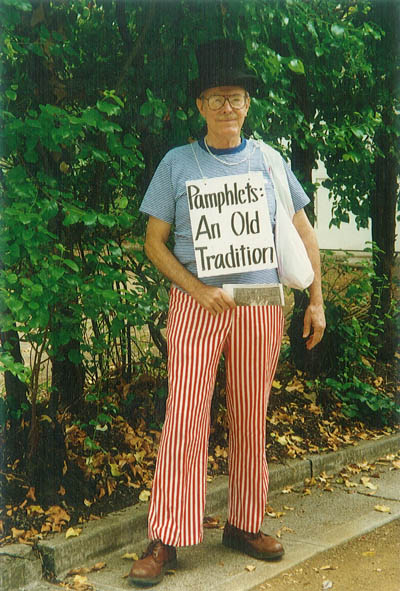
He considered pamphleteering as a noble form of communication that “went on during the colonial Period for a l00 years before the revolution and the arrival of Tom Paine in l775,” as he put it in his own pamphlet, “Pamphleteering: an old tradition.” He wrote that his main contribution “is the novel use of sandwich boards to screen out the disinterested while reaching the already-interested and open-minded persons with leaflets on the street, but not invading anyone’s privacy.”

Sometimes, Charlie had news close to home.

He said that giving out pamphlets to one or two people at a time was like holding a meeting with those persons and thus it was possible to have a “meeting” with several hundred people nearly anywhere within reasonable limits. He concluded that pamphleteering was “basic to building support for worthwhile projects” and claimes that it “may even be more effective than other forms of expensive communication.”

Charlie knew how to work the streets, but he also knew how to work inside the bowels of the bureaucracy. He worked for the California Division of Highways (now Caltrans) from l953 to 1987, mostly in an Oak Street office in San Francisco. I admit when Charlie talked to me about fighting bureaucracy, as he often did, I had trouble understanding how he was going about it. But Charlie had his ways.

Executive Editor Tim Redmond recalls that Charlie worked for Caltrans back in the days when the very thought there might be transportation modes other than highways was heresy.

He was an advocate of bicycles, carpools and public transit and Redmond thought that, when he first met Charlie in l984, “he must be like the monks in the middle ages, huddled in a corner trying to preserve knowledge. Nobody else at Caltrans wanted to talk about getting cars off the roads. Nobody wanted to shift spending priorities. Nobody wanted to point out that highrise development in San Francisco was causing traffic problems all over the Bay Area–and that the answer was slower development, not more highways.

“But Charlie said all those things. He told me where the secrets of Caltrans were hidden, what those dense environmental impact reports really showed, and how the agency was failing the public. I had a special card in my old l980s Rolodex labeled ‘Caltrans: Inside Source.’ The number went directly to Smith’s desk.” Charlie usually carpooled from Berkeley to his San Francisco office.

Charlie wrote a leaflet about the “Work Improvement Program” that then Gov. Pat Brown instituted in l960. It was, he wrote, a “novel program to get all state employees to submit ideas to improve their work.” Charlie labeled it “corrupt” and laid out the damning evidence. No appeal procedure. No protection for the employee making suggestions that the supervisor or organization didn’t want to use. No requirement for giving the employee credit for the idea or for following up the idea.

Charlie noted that he was a generalist with lots of ideas, read lots of publications, and was “sensitive to the problems that bother people.” He noted that there were l,500 employees in his Caltrans district who submitted 236 suggestions. Charlie submitted 35 of them.  But, he noted wryly, “my supervisor, Charles Nordfelt, did not respond at all to any of my suggestions.” And then, to make neatly make his point, Charlie listed a few of his suggestions, all of them practical and useful.

Many were adopted without Charlie ever getting credit. Others were adopted decades later. For example, he pushed the then-heretical idea of collecting tolls on a one-way basis only, instead of collecting them two ways. He noted that the tolls are now  being collected on the wrong side of the bridge. They should, he argued,  be collected coming from  the San Francisco side, where the few lanes of the bridge open up to many lanes. This would reduce or eliminate congestion. .

He listed other suggestions that showed his firm and creative grasp of the useful idea. Putting the third stop light on vehicles (which was finally put into effect in 1985). Numbering interchanges. Installing flashing red and yellow lights at different rates. (He  explained that his wife’s grandfather was color blind and drove through a flashing red light when she was with him.) Getting vehicle owners to have reflective white strips on the front bumpers of their cars, helping police spot stolen vehicles. Some of his suggestions are still percolating deep in the bureaucracies and may yet go into effect.

Charlie never got the hang of the internet but he covered more territory and reached more people in his personal face-to-face way than anybody ever did on the internet.

Charlie was born on a homestead farm eight miles from Weldona, Colorado. He attended a one-room school house and then moved on to a middle and high school in Ft. Morgan, Colorado. He got “ink in his blood,” as he liked to say, by working on the school paper called the Megaphone and then as a printer’s devil at the weekly Morgan Herald.

He was drafted into the army in l943 and served as an infantryman with the 343rd regiment, 86th Infantry Division. He was severely sounded in 1945 in the Ruhr Pocket battle near Cologne, Germany, the last major battle of the war. He suffered leg and hip injuries and had a l6 inch gouge  out of his right hip that cut within a quarter inch of the bone. He spent six months in the hospital. He was recommended for sergeant but he refused the promotion and ended the war as a private first class.

After his recovery, Charlie came to the Bay Area and took his undergraduate work at Napa Community College and San Francisco State, then did graduate work in sociology at the University of Washington, and in city and regional planning at the University of California-Berkeley.

In 1949, Charlie joined the American Friends Service Committee and became a lifelong volunteer, working on a host of projects. He did everything from helping with a clothing drive in Napa to being part of the crew that built the original Neighborhood House in Richmond.

Charlie met Anne Read in l954, a college student in Oregon, when she was on an AFSC summer project in Berkeley. Charlie visited the project, spotted Anne, and double dated with her. When she returned to Oregon State for her senior year, Charlie wrote her every single day. The two were married the following summer in June of l955.

Charlie is survived by Anne, two sons Greg and Jay, daughter-in-laws Karen Vartarian and Andrea Paulos, and granddaughter Mabel.

The family asks that, in lieu of flowers, please send a donation in Charlie’s name to the American Friends Service Committee, 65 9th St., San Francisco, Calif. 94l03.

I asked Anne why Charlie, the inveterate communicator, had not taken to the internet. Charlie, she replied, was a print guy and simply could not understand the internet. “He never ever used email,” she said. “He still thought he had to go to a library to make up a bibliography. I think Charlie was so sure that making a bibliography meant a lot of hard work, he couldn’t possibly do it on the internet.”

Well, Charlie, you may have missed the internet but you covered more territory and reached more people in your direct personal way with good ideas than anybody ever did on the internet.

Here are some of Charlie’s favorite pamphlets:
Governor Pat Brown’s Work Improvement Program
Pamphleteering: An Old Tradition
Short Statement on Plamphleteering


Gavin for Lite Guv?

1

Willie Brown thinks it’s a good idea. And you can tell Newsom wants to consider it, since he knows there’s nothing else obvious for him to do once his term as mayor is up — and there are going to be a lot of options not too far down the road. Sen. Dianne Feinstein isn’t getting any younger, and at some point she’ll retire. If Jerry Brown doesn’t get elected governor, the Democrats will be looking for someone very different in four years. But once a politician like Newsom is out of office and out of the spotlight, he’ll have a hard time coming back.

So he could sit up there in the Lite Gov’s office, doing what John Garamendi did — taking on issues like cuts to the University of California (the Lt. Gov. sits on the Board of Regents) and making speeches about reform, and maybe he could get out in front of this constitutional convention stuff, and keep his name in the news, without having to make a single difficult or unpleasant decision that he can be blamed for later.

You know he wants to do it ….

But there’s this problem, and for Newsom, it’s very real.

As people close to the mayor have told me repeatedly, the money people who helped put the mayor in office — and who would have to be around to help him run for any other office — are not at all pleased with the prospect of Newsom leaving San Francisco a year early. See, that would give the district-elected supervisors the chance to fill the mayor’s job for the last year of Newsom’s term, and the person they appointed would be able to run as an incumbent.

And while it’s not clear who could get six votes (David Chiu? David Campos? Ross Mirkarimi? Aaron Peskin?) it’s pretty clear that the new mayor would not be an ally of Newsom’s pals.

Sure, when he was running for governor, it seemed fine — having their guy in charge of the state was worth the loss of the San Francisco mayor’s office. But for a relatively powerless job? I think they’d crucify him.

Roll over, Beethoven: Real Vocal String Quartet takes the classics for a ride

0

“The classical composers we know so well, Beethoven and Bach and Vivaldi, they were improvisers. So really, we’re carrying on that legacy,” says Real Vocal String Quartet founder Irene Sazer. I’d love to know what the old masters would think of a RVSQ gig- would they throw down their powdered wig and get down when the women launch their cellos into “Fontana Abandonada-Passatempo,” their Afro-Brazilian jam? Get their britches in a twist over “Kothbiro,” a nyatiti song by Kenyan artist Ayub Ogada?

I reckon they’d have dug the tunes. After all, RVSQ, performing this Thursday at Freight and Salvage, attributes their freedom to perform such divergent genres to their traditional classical training. The band members- Dina Maccabee and Sazer on the violin, Alisa Rose on the violin and fiddle and cellist Jessica Ivry- were all band kids, many raised in families of classical musicians and most recipients of college degrees in their respective axes.

Some started careers in orchestras and the like. But there was always something beyond the Bach that beckoned.

“For me growing up, I had two musical lives,” says the enthusiastic Sazer, who is given to excited exclamations and breathless descriptions of the energy she gleans from her RVSQ bandmembers. “One as a ‘serious’ violin player… but on the other side, my mom was into folk music from all over the world- she sang in Yiddish. I heard world music from an early age and always loved it. I heard the Beatles, Carol King, Joni Mitchell- the really great pop music informed my life as well.”

“Because of the pedagogy of being a classical musician,” she continues “it seemed so separate- but I never liked that. What I hoped for when I became a young adult was to explore lots of different styles of music- I hoped for my own individual musical language. I’m even luckier than that because I’ve found a group of people on similar musical paths.”

But RSVQ takes the path that’s not taken as much.

Their alternate path has led to a loosening for RVSQ. The group’s repertoire includes “Now,” an improvisational song they play at every show. It’s a chance to create a different sound for each new audience, a little klezmer here, maybe a smattering of bluegrass or trance rock of northern Mali origin, there.

rvsq 1 0210.jpg
Gotta love a classical quartet that chills barefoot in the dirt

Though Sazer says she was “really afraid” of improvisation in the early days of her classical training, “it’s such a pleasure when you have people who are accomplished on their instruments and love to jump in and take the risk. It’s a thrill that we have such a vehicle for exploration. And if you’re skilled you can do it mo’ better.”

Mo’ better indeed- the women are seeing their vision resonate with a growing audience, the demographic of whom Sazer confesses is a bit of a enigma. “We have to take polls! The finding of our people is kind of a mystery.” Difficult to pigeonhole themselves, RVSQ is now working on making their name in the world music arena, even landing a gig at 2010’s South by Southwest.

Locally, you can catch them at their album release party at Berkeley’s Freight & Salvage next week- but try to maintain your composure at the show. “People are going to want to come and be somewhat quiet and listen,” says Sazer, laughing somewhat at her exhortation. “There’s a lot of intimacy in our ensemble and musical product.” So keep a lid on it, Handel.

Real Vocal String Quartet
Thur/11 8 p.m., $18.50-19.50
Freight & Salvage Coffeehouse
2020 Addison, Berkeley
www.thefreight.org

Street Threads: Ian

2

SFBG photog Ariel Soto scoops SF street fashion

Today’s Look: Ian, 30th Street and Church

Tell us about your look: “Vintage”

(Bonus handlebar closeup — for all you mustachafarians — after the jump)

Snap Sounds: The Album Leaf

0

By Amber Schadewald


THE ALBUM LEAF

A Chorus of Storytellers

(Sub Pop)

 
Be lured into a deep daze with the frosty, sublime sounds of The Album Leaf’s new release, A Chorus of Storytellers. The San Diego band — which will be performing Fri/12 at Great American Music Hall — is ambient to its core. Only four of the 11 well-crafted tracks incorporate vocals. (Ironic, considering its the album’s title.)

The rest are purely poetic and offer obvious insight into their Icelandic influences and production by Birgir Jon Birgisson, an engineer who has worked with Sigur Ros. A Chorus of Storytellers was recorded as a whole band, contrary to the previous four albums, on which primary songwriter and multi-instrumentalist Jimmy LaValle played nearly everything himself.

THE ALBUM LEAF

w/ Magik*Magik Orchestra and Sea Wolf

Fri/12, 8pm, $15

Great American Music Hall

859 O’Farrell, SF

www.gamh.com


Dick Meister: Combating workplace violence

0

Organized labor and its allies are rightly alarmed over the high incidence of on-the-job accidents that have killed or maimed many thousands of workers. But they haven’t forgotten – nor should we forget – the on-the-job violence that also afflicts many thousands.

Consider this: Every year, almost two million American men and women are the victims of violent crime at their workplaces. That often forces the victims to stay off work for a week or more and costs their employers more than $60 billion a year in lost productivity.

The crimes are the tenth leading cause of all workplace injuries. They range from murder to verbal or written abuse and threatening behavior and harassment, including bullying by employers and supervisors.

Women have been particularly victimized. At least 30,000 a year are raped or otherwise sexually assaulted while on the job. The actual total is undoubtedly much higher, since it’s estimated that only about one-fourth of such crimes are reported to the police.

Estimates are that more than 900,000 of all on-the-job crimes go unreported yearly, including a large percentage of what’s thought to be some 13,000 cases annually that involve boyfriends or husbands attacking women at their workplaces.

The Retail, Wholesale & Department Store Union (RWDSU), which represents many of the victimized workers, cites that as an example of the job violence problem that is often distorted by media coverage that “would lead us to believe that most workplace violence involves worker against worker situations.”

The union says that has focused many employers “on identifying troubled employees or disgruntled workers who might turn into violent predators at a moment’s notice. But in fact, 62 percent of all violence at worksites is caused by outsiders.”

As you might expect, those most vulnerable to the violence are workers who exchange money with the public, deliver passengers, goods or services, work alone or in small groups during late night or early morning hours in high-crime areas or wherever they have extensive contact with the public.

That includes police, security guards, water meter readers and other utility workers, telephone and cable TV installers, letter carriers, taxi drivers, flight attendants, probation officers and teachers. Convenience store clerks and other retail workers account for fully one-fifth of the victims.

The American Federation of Teachers is so concerned that it has provided each of its 1.4 million members a $100,000 life insurance policy payable if the teacher dies as the result of workplace violence.

The major violence victims also include health care and social service workers such as visiting nurses, and employees of nursing homes, psychiatric facilities and prisons. They suffer two-thirds of all physical assaults. Many of the victims regularly deal with volatile, abusive and dangerous clients, often alone because of the understaffing that’s become all too common.

It could get even worse, at least for some workers. The RWDSU warns that today’s troubled economic times create additional threats. The danger is especially great for retail workers whose stores are likely to face increased incidents of theft, some involving gun-wielding robbers.

The RWDSU and other unions have been pushing for recognition of workplace violence as an occupational as well as criminal justice issue. That would put it under the purview of the federal Occupational Safety and Health Administration (OSHA) and state job safety agencies.

The federal and state agencies could then issue enforceable regulations designed to lessen the on-the-job dangers of violence, as they do for other hazardous working conditions. A few states do that already, but only for a very limited number of industries.

OSHA has issued guidelines for workers in late-night retail jobs, cab drivers and some healthcare workers, but the guidelines are strictly voluntary. Although the unions’ top priority is for legally binding regulations, they also are pressing employers to meanwhile voluntarily implement violence prevention programs.

Currently, only about one-fourth of them have such programs or any guidelines at all. The RWDSU ‘s Health and Safety Department is offering to help the other employers develop programs.

We have federal and state standards, laws and regulations designed to protect working Americans from many of the serious on-the-job hazards they face daily. Yet we have generally failed to lay down firm guidelines for protecting workers from the workplace violence that’s one of the most dangerous hazards of all.

Dick Meister, former labor editor of the SF Chronicle and KQED-TV Newsroom, has covered labor and politics for a half-century. Contact him through his website, www.dickmeister.com, which includes more than 250 of his recent columns.

Progressives control City College board

0

By Anna Widdowson

The reelection of Milton Marks III as President of the City College of San Francisco’s Board of Trustees ruffled some feathers during last week’s board meeting, but it signals a real shift in the balance of power in the governance of this troubled district.

Dissent came primarily from longtime board member Natalie Berg, a fairly conservative and consistent (and crabby) supporter of former City College Chancellor Philip Day, who was indicted last July on eight felony charges for misappropriating public funds. Other longtime board members (and Day enablers) Lawrence Wong and Anita Grier also voted against Marks, who was a fairly isolated public interest advocate until two years ago, when he began to accumulate some allies.

One of those allies, progressive activist John Rizzo, last year replaced Berg as the board’s vice president, a post we was reelected to last week on the same 4-3 vote that Marks got. But while Berg opposes the pair on ideological grounds, she couched her criticism in the “long-standing tradition” of Board presidents’ declining to serve two terms in a row. She called Marks’s reelection “unprecedented” and a blow to the Board’s democracy.

Marks attributed the controversy over his reelection to a shift in the culture and ideology within the board. “(Berg) and other people used to have a real lock on the board and how it was run,” Marks told us. “Now there is a solid four votes on our side and I think they are feeling really unhappy that their time has come and gone.”

Marks noted that last year was the Board’s single most productive year in memory, which is probably a commentary on how abysmally this board has traditionally done its job as much as anything.

Berg has sat on the Board since 1996, and has served as president three times, though not in succession. Despite her quibbling, Berg didn’t offer to take the reigns herself, even after one concerned citizen audibly whispered from the audience, “If you’re so upset, why don’t you run?”

In fact, no one but Marks and Rizzo was nominated for either position. According to Marks, despite attempts to strong-arm the newest board members, Chris Jackson and Steve Ngo, the trio of dissenters knew they couldn’t win the election.

“They kind of scared Chris,” Marks said. “But he is such an honorable guy he never went back on his commitment to me or his ideology. And without his and Ngo’s vote, they knew they would lose the election and they didn’t want to be embarrassed.”

Jackson expressed distaste for the squabbling, and wondered aloud if perhaps students’ needs were a more pressing issue than elections. After all, if Berg keeps hogging air-time at meetings, the Board is likely to be largely stale-mated by petty internal power struggles.


Joseph Stiglitz: Muddling Out of Freefall

0

Here is our monthly installment of Joseph E. Stiglitz’s Unconventional Economic Wisdom column from the Project Syndicate news series. Stiglitz is University Professor at Columbia University and the winner of the 2001 Nobel Prize in economics. His new book is Freefall.

NEW YORK – Defeat in the Massachusetts senatorial election has deprived America’s Democrats of the 60 votes needed to pass health-care reform and other legislation, and it has changed American politics – at least for the moment. But what does that vote say about American voters and the economy?

It does not herald a shift to the right, as some pundits suggest. Rather, the message it sends is the same as that sent by voters to President Bill Clinton 17 years ago: “It’s the economy, stupid!” and “Jobs, jobs, jobs.” Indeed, on the other side of the United States from Massachusetts, voters in Oregon passed a referendum supporting a tax increase.

The US economy is in a mess – even if growth has resumed, and bankers are once again receiving huge bonuses. More than one out of six Americans who would like a full-time job cannot get one; and 40% of the unemployed have been out of a job for more than six months.

As Europe learned long ago, hardship increases with the length of unemployment, as job skills and prospects deteriorate and savings gets wiped out. The 2.5-3.5 million foreclosures expected this year will exceed those of 2009, and the year began with what is expected to be the first of many large commercial real-estate bankruptcies. Even the Congressional Budget Office is predicting that it will be the middle of the decade before unemployment returns to more normal levels, as America experiences its own version of “Japanese malaise.” 

As I wrote in my new book Freefall, President Barack Obama took a big gamble at the start of his administration. Instead of the marked change that his campaign had promised, he kept many of the same officials and maintained the same “trickle down” strategy to confront the financial crisis. Providing enough money to the banks was, his team seemed to say, the best way to help ordinary homeowners and workers.

When America reformed its welfare programs for the poor under Clinton, it put conditions on recipients: they had to look for a job or enroll in training programs. But when the banks received welfare benefits, no conditions were imposed on them. Had Obama’s attempt at muddling through worked, it would have avoided some big philosophical battles. But it didn’t work, and it has been a long time since popular antipathy to banks has been so great.

Obama wanted to bridge the divides among Americans that George W. Bush had opened. But now those divides are wider. His attempts to please everyone, so evident in the last few weeks, are likely to mollify no one.

Deficit hawks – especially among the bankers who laid low during the government bailout of their institutions, but who have now come back with a vengeance – use worries about the growing deficit to justify cutbacks in spending. But these views on how to run the economy are no better than the bankers’ approach to running their own institutions.

Cutting spending now will weaken the economy. So long as spending goes to investments yielding a modest return of 6%, the long-term debt will be reduced, even as the short-term deficit increases, owing to the higher tax revenues generated by the larger output in the short run and the more rapid growth in the long run.

Trying to “square the circle” between the need to stimulate the economy and please the deficit hawks, Obama has proposed deficit reductions that, while alienating liberal democrats, were too small to please the hawks. Other gestures to help struggling middle-class Americans may show where his heart is, but are too small to make a meaningful difference.

Three things can make a difference: a second stimulus, stemming the tide of housing foreclosures by addressing the roughly 25% of mortgages that are worth more than the value the house, and reshaping our financial system to rein in the banks.

There was a moment a year ago when Obama, with his enormous political capital, might have been able to achieve this ambitious agenda, and, building on these successes, go on to deal with America’s other problems. But anger about the bailout, confusion between the bailout (which didn’t restart lending, as it was supposed to do) and the stimulus (which did what it was supposed to do, but was too small), and disappointment about mounting job losses, has vastly circumscribed his room for maneuver.

Indeed, there is even skepticism about whether Obama will be able to push through his welcome and long overdue efforts to curtail the too-big-to-fail banks and their reckless risk-taking. And, without that, more likely than not, the economy will face another crisis in the not-too-distant future.

Most Americans, however, are focused on today’s downturn, not tomorrow’s. Growth over the next two years is expected to be so anemic that it will barely be able to create enough jobs for new entrants to the labor force, let alone to return unemployment to an acceptable level.

Unfettered markets may have caused this calamity, and markets by themselves won’t get us out, at least any time soon. Government action is needed, and that will require effective and forceful political leadership.

Joseph E. Stiglitz, winner of the 2001 Nobel Prize in economics, served as Chairman of the Council of Economic Advisers from 1995 to 1997. He is the author of the recently published bestseller, Freefall: America, Free Markets, and the Sinking of the World Economy.

Copyright: Project Syndicate, 2010.
www.project-syndicate.org
For a podcast of this commentary in English, please use this link: http://media.blubrry.com/ps/media.libsyn.com/media/ps/stiglitz122.mp3


Drinking the tea, ignoring the facts

3

Listening to members of the Tea Party movement on KQED’s Forum this morning, I and many callers to the show were struck by the basic inaccuracy of their core beliefs, these revanchist delusions about what’s in the U.S. Constitution and how this country really operates.

There’s a lot of justifiable anxiety out there over the state of the country, and the Tea Party movement has tapped into that with bumper sticker slogans that are just broad enough to capture alienated Americans from across the political spectrum. One recent poll shows that 41 percent of respondents are sympathize with the movement, stronger support than either major political party now enjoys.

But facts should matter, and they just don’t to many teabaggers or their high priestess, Sarah Palin, who is headlining the current national Tea Party convention in Nashville. For example, the two self-described “patriots” on this morning’s show railed against all the unconstitutional actions of the runaway federal government in ways that reveal an astonishing ignorance about the document they claim to prize so highly.

An East Bay woman from Bay Area Patriots, Heather Gaas, complained that the “government takeover” of the health care system is specifically prohibited by the constitution, seemingly unaware that there is no takeover, and even if there was, the federal government is specifically empowered to “regulate commerce” and see to the country’s “general welfare.”

North Bay teabagger Gary Hahn claimed that a free market system with minimal government is enshrined in the Constitution, another false claim. The words “capitalism” or “free market” aren’t in the Constitution, which doesn’t prescribe an economic system for the country and would even allow socialism to exist if we had to votes to approve it.

Luckily, while host Dave Iverson did little to correct the teabaggers’ inaccuracies on the first half of the show, a series of callers did that work on the second half. One caller, who was a self-described Tea Party member and Ron Paul supporter, criticized the hypocrisy of the guests’ for criticizing “big government” while supporting its wars and imperial overreach, sounding the anti-war position that is also an element of this broad and unfocused movement.

And that’s really why we shouldn’t read too much into this movement’s power and its implications (check out this interview for an insightful take on why conservatism no longer contributes anything useful to American politics). The Tea Party is best understood as a primal scream rather than a political movement. I’m a big government progressive, yet I share the teabaggers’ outrage over the Wall Street bailouts and the corruption and unresponsiveness of the two major political parties.

We may even share a few revanchist impulses, concerns that powerful forces have steered this country away from what it once was. But my concern is with Big Corporations that have eroded basic egalitarian principles expressed from the Declaration of Independence (the right to “life, liberty and the pursuit of happiness,” talk about radical!) to the New Deal, not with Big Government (except for its biggest and most wasteful element, the bloated military budget).

But the revanchist fantasies of most tea baggers long for a time that is no longer possible, when there was still a frontier on which rugged individualists could stake their claim, for that “shining city on the hill” that their god, Ronald Reagan, once conjured up in the national mind’s eye. They want to smite their liberal enemies and restore this country to a position of deserved greatness, an attitude that frankly scares the crap out of me, with its echoes of 20th Century fascism.

The realities of today are much more complex than the teabaggers’ simplistic beliefs. They want to deeply cut government spending, despite the damage that would do to the fragile economy. They want us to get tough with the terrorists, unaware that every bomb we drop has the potential to create new enemies. They want more power for the “real Americans,” however racist and divisive that judgment is made.

Yet their primal scream shouldn’t be ignored because it is the manifestation of frustration that cuts across a wide swath of the country that is fed up with politics as usual. But in the teabaggers’ ignorance of the Constitution and the basic social contract on which any country or government is based, we can see just how much work there is to do before we have an educated and engaged citizenry that is even capable of participating in a democracy. So this is still a party worthy of our attention.


The attack on district elections begins

2

I knew it was coming. After ten years of district-elected supervisors promoting progressive policies (minimum wage and sick day laws, universal health care, tenant protections, public power, development limits, affordable housing etc.) downtown has finally figured out how to launch a counter-attack. It was announced this morning in the pages of the Chronicle

I knew it was coming. After ten years of district-elected supervisors promoting progressive policies (minimum wage and sick day laws, universal health care, tenant protections, public power, development limits, affordable housing etc.) downtown has finally figured out how to launch a counter-attack. It was announced this morning in the pages of the Chronicle

The idea is to replace some of the district supes with at-large representatives – say, four of the 11. That Chamber of Commerce is doing a poll on the issue. Expect a November ballot initiative.

C.W. Nevius chimed in, too, arguing in favor of the “hybrid” (sounds so much like an eco-friendly car) system.

The line is going to be this: District supervisors don’t pay attention to citywide issues.

“People like the idea of being able to talk to a district supervisor about neighborhood problems, but also feel that they want someone they can go to with broader, citywide concerns,” said Steve Falk, president and CEO of the San Francisco Chamber of Commerce.

Or as Nevius puts it:

The truth is that San Francisco has more supervisors than any county in California. Is it too much to ask that a few of them have the entire city’s best interest in mind?

Let’s consider for a moment what this is really about.

For starters, get rid of the nonsense about a “citywide perspective.” Even Nevius didn’t try to push that too hard when I emailed him with the facts, to wit: Over the past ten years, district-elected supervisors have devoted themselves to a long string of exceptional citywide reform measures and have been guilty of very little district pandering.

Consider a few examples:

Healthy San Francisco
The Rainy-Day Fund
Reforming the makeup of the Planning Commission, Police Commission and Board of Appeals
Restricting the use of plastic bags
Minimum wage and sick day laws
A citywide infrastructure plan and bond program
Community choice aggregation and green energy
Campaign finance reform
Sanctuary city protecting for immigrants

The list goes on and on.

You may agree or disagree with what this board has done, but nobody can honestly say that the district supervisors have ignored citywide issues or that they don’t have a citywide persoective. No: This has nothing to do with citywide issues vs. district issues. It’s entirely about policy – about the fact that district supervisors are more progressive. About the fact that downtown can’t possibly get a majority under a district system – because with those small districts that Nevius complains about, big money can’t carry the day.

In a district system, grassroots organizing – the stuff that labor and nonprofits and progressive groups are good at – is more important than raising money. So district supes are accountable to a different constituency.

I watched an at-large board for almost 20 years, and it was, by and large, a collection of sold-out hacks who did exactly what the mayor and the downtown donors said. It was really pathetic.

The polls have consistently shown that people like have district supes, so now there’s this “hybrid” effort.

Here’s what it means:

Right now, there are three districts that will generally elect a more conservative representative – D 2 (Michela Alioto-Pier) D- 4 (Carmen Chu) and D-7 (Sean Elsbernd). Districts 8, 10, 11 and 1 are swing districts, and the rest are going to go generally progressive.

So the odds are under this system that the left-leaning constituencies will have at least six votes, and in good times, as many as eight.

Now take four of those votes away, pretty much forever. Set it up so that four supervisors, elected citywide, will be guaranteed downtown call-up votes. Then add in one or two more from the more conservative districts, and you’ve got a majority.

That, my friends, is exactly what this is about, and any effort to frame it as anything else is just spin.

I asked Nevius what the hell he was doing buying the bogus argument that we need citywide perspective – since the district board has already demonstrated that, consistently. Here’s his response:

First, I’d envision the city-wide supes as made to order swing votes. When a district supervisor had a good idea, let’s say Healthy San Francisco, it might not be an issue of critical interest for a district supervisor. But it would be right in the wheelhouse for a city-wide official, who is looking for broad stroke issues to back. And, although you didn’t advance the idea, I’d reject the notion that whomever it was that was elected city-wide would be incredibly conservative and obstructionist. The most moderate politician we’ve elected in this city is Gavin Newsom. Although the Guardian doesn’t agree with him much of the time, he’s still advanced some very progressive ideas. Everyone jumps on the Chris Daly example as why district elections are a problem, but I think we can look beyond that. I think he’s been an aberration. District supes like David Campos and David Chiu have proved they can compromise and govern so I think that’s a good thing. I would never advocate that we get rid of representation in the neighborhoods. But c’mon, 11 little districts in a very small city? As Jim Stearns said, some of the districts are no more than a mile square. Combining some of them would still let residents have someone they could call to get the potholes fixed, but also spread out the areas.

Okay, I didn’t say citywide supes would be conservative. Sean Elsbernd is (relatively) conservative. He’s also independent of any big-money interest and does what he thinks is right. He doesn’t need half a million dollars to get elected in his district.

What I say is that citywide supes would be in hock to big money. I’ve seen it, lived with it. Suffered from it.

And guess what: Healthy San Francisco didn’t need any citywide supes; it passed just fine with the district board.

So what this is about is money and political control, and it’s about the political direction the city is going and who’s going to set that direction. Let’s get that straight and be honest about, and then we can have this discussion.