SFBG Blogs

Newsom’s (unbelievably short) resignation letter

10

When I clicked on the link to “Mayor resignation” on the Board of Supervisor’s website, I expected a video of Newsom making an incredibly gushy and long-winded resignation speech to pop up.

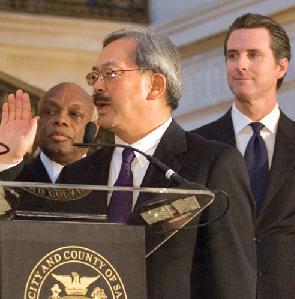
Instead, I found a one-sentence resignation letter that Starr Terrell faxed to Clerk of the Board Angela Calvillo at an unspecified time on Jan. 10, 2011.

“I am resigning my position as Mayor of the City and County of San Francisco, effective this date, so as to assume the role of Lieutenant Governor of the State of California,” Newsom wrote.

The brevity of Newsom’s letter—and the seemingly endless time it took him to vacate the post–reminded me of something Newsom said the Friday before he resigned.

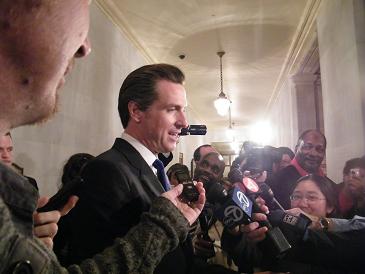
We were all standing outside Room 200, listening to Newsom go on about how great it was that the outgoing Board had nominated Ed Lee to be the new mayor, especially since Lee reportedly didn’t even want the job—an attitude that apparently impressed Newsom when reviewing potential candidates for both the mayor’s and D.A.’s post.

Anyways, some brave reporter asked Newsom something about his swearing-in ceremony as Lt. Governor, which was slated to take place at 1:30 p.m. Monday, Jan. 10.

At which point Newsom said, “Willie Brown said it best, when he told me, don’t worry, I’ll be at your funeral Monday.”


SFBG Radio: The economics of pearl handled dildos

2

In today’s episode, we discuss the economics of pearl-handled dildoes — and how supply, demand and income inequality impact the unemployment rate. Just in time for the State of the Union speech. You can check it out after the jump.

sfbgradio1/24/2010 by endorsements2010

Ting’s “knee-jerk car populism”

31

By Asaf Shalev

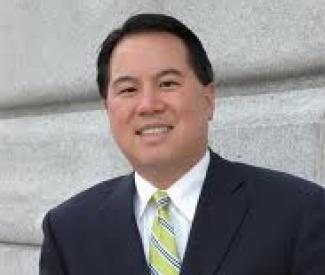
Assessor-Recorder Phil Ting’s campaign for mayor is trying to rile up San Francisco’s car drivers with a new petition called “San Francisco Parking Ticket Overload,” but it seems to be misrepresenting the situation to score election season points.

In the recent email launching the petition, Ting provoked drivers to help “tear up the unfair ticket plan” in order to prevent “turning the whole city into a ‘parking trap.’” Ting said he opposes the MTA’s plan to jack up the enforcement of parking restriction by dolling out more tickets, which was reported in C.W. Nevius’s column. But Ting’s email also made it sound as if parking fines were going up and the MTA was launching a new initiative targeting drivers.

MTA spokesperson Kristin Holland told us that it isn’t true the agency has any intention to increase the cost of parking fines. In response, Ting spokesperson Eric Jaye (who ran Gavin Newsom’s two mayoral campaign) told us, “We are taking [the MTA] at their word and we are very happy to hear that,” insisting the campaign honestly thought that rates were going up.

Tom Radulovich, a transportation policy expert who founded Livable City, called Ting’s messaging and the stance behind it “knee-jerk car populism” and a “saber-rattling election stunt.” He said Ting’s campaign is playing to the fears of drivers who are the more privileged commuters of the city, with most studies showing motorists don’t pay the full costs of their impact to society.

“Even if [Ting’s claim] was true, the premise that motorists have an undue burden is untrue,” Radulovich said. Even with increased enforcement, drivers can still avoid fines by obeying the laws whereas all Muni passengers have had to bear the brunt of higher fares, which doubled under Newsom’s tenure. “I’d like to see someone saying how transit passengers have an unfair deal,” Radulovich said.

Jaye takes a different tone than some of the campaign missives. According to Jaye, what Ting opposes is that the increase in tickets is not the result of policy or enforcement considerations but specifically meant to increase revenue for the city. “We are just trying to pursue a revenue generating policy that is a little more progressive,” Jaye said. Guardian Executive Editor Tim Redmond also recently made the point that parking tickets were meant primarily to keep cars flowing in urban areas and not as a revenue source, but he also noted that motorists don’t pay for their impacts and should pay far higher car taxes.

But Radulovich’s question is left unanswered: “Are any of the candidates going to talk about the plight of transit passengers?”

Tell us how you met your snugglebunny — and win a $160 date!

0

Maybe your hands brushed while browsing the vinyl jazz bins at Amoeba. Maybe she caught up with you on the new Valencia bike lanes to compliment your ride. Or perhaps your kite strings got entangled on Marina Green one windy afternoon …

If you found your special someone in a very special way, enter our first annual SFBG Meet-Cute Contest! No matter how improbable, mystifying, funny, weird, or, yes, mushy, we want to know how you met your sweetie (or sweeties) for the Guardian’s Valentines Issue.

Tell us in 100 words or less your personal meet-cute story by Thursday, February 3. We’ll pick our 10 favorites and publish them in our Valentine’s Issue, coming out Feb. 9. One lucky participant, drawn at random, will win a date at Yoshi’s San Francisco worth $160! (Dinner and a live show with your honey — how can you beat that?)

CLICK HERE to enter and tell us your story!


*Entrants will be automatically added to our Guardian G-List newsletter


MUNI gets beastly, in a nice way

0

A horde of salt marsh mice scurry down Market Street. Salmon leap across Divisadero traffic. Blue Mission butterflies cover your #22 Fillmore. If you haven’t been doing any wildlife-spotting recently, keep those binoculars close by. A new MUNI art program seeks to bring endangered species to the forefront of our transit consciousness — making our much-maligned buses prettier to look at, and bringing Bay nature back into our daily lives all in one fell swoop.

Visual artist Todd Gilens and an installation team wrapped four city buses with large-scale images of local endangered wildlife in their natural abodes as part of a project called “Endangered Species.” In a space normally reserved for advertisements for bail bondsmen or the new season of Real Housewives, you can now peep aforementioned mice broods and threatened fish and bugs. Gilens came up with the idea after the publication of a municipal transportation agency’s transit effectiveness project. The report used stats to measure the efficacy of SF public transit, but the visual artist felt that something was missing from the survey’s findings: namely, the community presence of our modes of public transportation. 

“I’m a ‘thing’ guy,” says Gilens. “Objects have lives and tell interesting stories. I wanted to think more about what buses are, beyond their technical character.” In the case of buses, Gilens thought it possible that they could be more than just people containers from here to there. “Endangered Species,” a project that took years for him to research and secure funding for, is his aesthetic reclamation of public space.

He eventually found a partner in The Bay Nature Institute, a Berkeley-based publication and project dedicated to celebrating and conserving nature and wildlife in the Bay Area. The group’s website is now the online home for  “Endangered Species,” and houses a bus tracker application that give fauna fans the current locations of all four Endanger buses.

It would stand to reason that the Endanger buses would have some direct conservationist agenda. But for Gilens, the moving art is only about calling attention to the natural beauty in and around the Bay Area. When asked if the project was meant to engage with the public on an ethical level, he said the Endanger buses purpose was really in the eyes of the beholder. “Art helps us to refine our noticing, and from there we can respond according to our capacities.” 

MUNI gets mousey. Photo by Todd Gilens

But Gilens choice to focus on the Bay’s circumscribed members of the animal kingdom might have another reading, one that strikes close to home for creative types being priced out of the city’s stubbornly sky-high rent prices. He made an interesting connection between art and endangered species: “Art is also not very ‘useful,’ perhaps in a similar way that a unique butterfly species or a marsh mouse is superfluous in their environment — But without them we have a flatter, duller, and certainly less robust world.”

Gilens hopes that seeing Endanger buses amongst the city hustle and bustle, will promote new ways of assessing personal experience – and one’s morning commute. “I hope that the beauty and unexpectedness of the images in different situations will invite playful associations. Perhaps the project will encourage a more connected and creative approach to everyday life,” he says. “Whether it’s allowing oneself to be moved by something beautiful, making room for another stranger on a bus, or becoming curious about even stranger life forms beyond urbanization.” Endangered artist or domesticated office rat, at least San Franciscans can agree that Endanger buses will be a refreshing sight to see amongst the city’s urban forest.

The Endanger buses will be out and about until April on different city lines each day. For more information on them – and how you can participate in MUNI’s bus-spotting game for prizes — go to www.baynature.org/endangerbus


Street Threads: Look of the Day

0

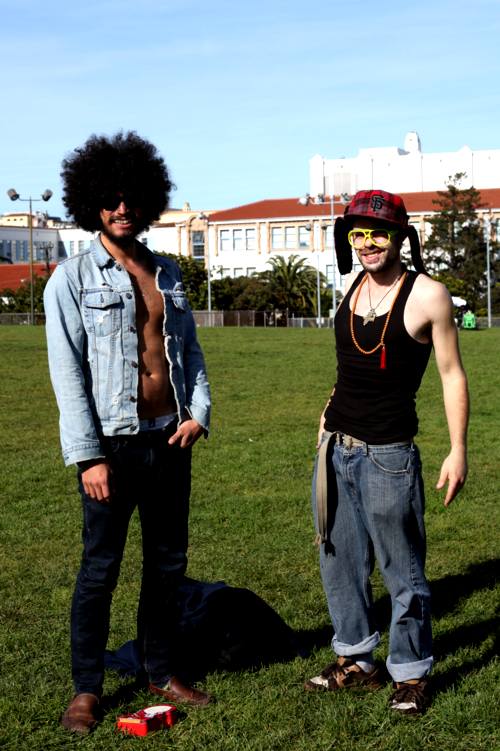
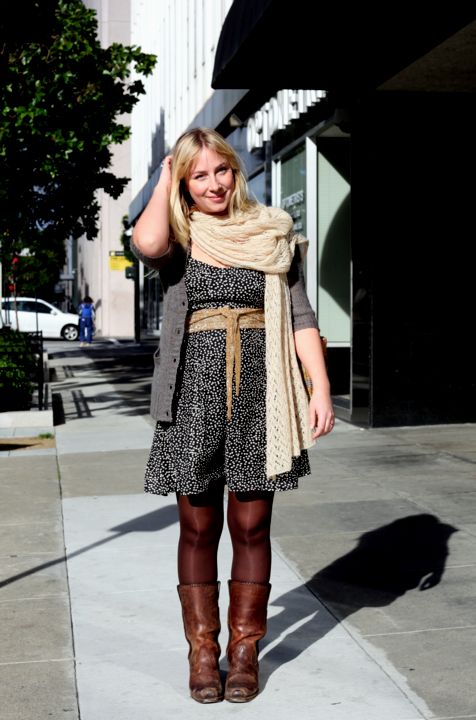
Today’s Look: Herald and Biko, Dolores Park

Tell us about your look:

Herald: “Free”

Biko: “Pimpalicious”

Calling all John Ross fans

0

I’m compiling some of John’s best poetry for the next issue of the Guardian, and I’m thinking we might try to collect them all in some sort of anthology. But I only have a few of his chapbooks, and I don’t know if anyone has all of them. If you have any of the books on this list, can you give me a call (487-2554)?

  • Jam (Mercury Litho-Bug Press: 1976)
  • 12 Songs of Love and Ecocide (1977)
  • The Psoriasis of Heartbreak (1979)
  • The Daily Planet (1981)
  • Running Out of Coastlines (1983)
  • Heading South (1986)
  • Whose Bones (1990)
  • Jazzmexico (Calaca de Pelón: 1996)
  • Against Amnesia (Calaca de Pelón: 2002)
  • Bomba (Calaca de Pelón: 2007)

SFBG Radio: Why is Reagan still an icon?

4

In Republican land, Ronald Reagan is still such an icon that when his son’s book raises questions about whether he was mentally competant to be president, the GOP squawk machine goes into overdrive. But as Johnny and Tim discuss on today’s show, Reagan wouldn’t get elected to anything in today’s Republican Party — he raised taxes. 

HipsterRickshawReagan by endorsements2010

CA Labor stats: Bay Area schools shed jobs, department stores hire

A new set of labor market data released Jan. 21 by California’s Employment Development Department reveals that unemployment in San Francisco was 9.2 percent in December 2010, compared with 12.3 percent for California and 9.1 percent for the nation during the same period.

Marin County had the lowest unemployment rate of all California counties in that month, and San Francisco had the fifth lowest. Worst off was Imperial County, with an unemployment rate of 28.3 percent.

In San Francisco, Marin, and San Mateo counties, there were 800 more jobs than in the previous month, according to the data. Yet while some sectors actually hired new employees, others continued to let people go.

Government in the three counties cut back by 2,200 jobs — mostly in local public schools. Around 700 jobs in construction were slashed. Some 200 jobs in arts, entertainment, and recreation were lost.

Retail, especially clothing and department stores, added 1,700 jobs — but that fell short of the average gain of 3,000 new retail jobs during the holiday season. Leisure and hospitality gained 500 jobs, restaurants and bars added another 500, and hotels added 200 jobs.

The big picture for the three-county area from December 2009 to December 2010 is sobering, with a total loss of 12,800 jobs, or 1.4 percent. The greatest losses occurred in finance, construction, transportation and utilities, government (especially schools), and health services. 

On a positive note, manufacturing recorded its first net gain — 100 jobs — since 2007.

On the whole, the Bay Area’s employment situation continues to look pretty grim. To all the job seekers out there: Good luck.

The Performant: A dance named desire

0

Exploring personal myth with EmSpace Dance and Porchlight

Descending the wooden staircase into the basement performance space at Viracocha, one leaves the surface world behind and enters a parallel underworld of theatricality and allusion. Warm hardwood panels and golden lights, a distinct contrast to the concrete and glass-filled streets above, soothe the spirit — and unintentionally convey the crux of one Blanche DuBois’ obsession with creating a more beautiful reality from the one she’s been sentenced to. Prone to artifice and artfulness, Ms. DuBois is the central catalyst of the action in Tennessee William’s A Streetcar Named Desire and its ultimate sacrifice. In EmSpace Dance’s adaptation (A Hand in Desire) however, the focus is spread more evenly among the five-person cast, both their stage personae and their “real” selves.


The likable cast, which includes a very present manifestation of Blanche’s (Rowena Richie) deceased husband Allan (Kegan Marling), jump from scene to scene guided by the chance provided in a custom deck of cards and an ongoing game of hearts. Some jumps make better sense than others and some scenes, especially the dance sequences, flow more smoothly, but the sheer gutsiness of the production makes it a compelling ride. Scenes in which the cast inhabited their everyday selves included a pair of interviews between Peter Griggs and Kegan Marling on the topic of repressed homosexuality, both Allan Grey’s and Williams’ own, and a pair of scenes in which one actor stood on a chair surrounded by the others and attempted to tell a great lie. Scenes straight out of the original play, set to dance, include Mitch’s (Christopher White) awkward courtship of Blanche, and Stella and Stanley’s (Natalie Greene and Peter Griggs) blowout fight and passionate reconciliation.

Any work, no matter how experimental, usually has at least one thread to bind the piece together, and the moody improvisational soundscape provided by musicians Josh Pollock and Chris Broderick did just that. With a few subtle effects, Pollock made his ukelele throb like a serious double bass and other instruments, while Broderick provided the flute, woodwinds, and the eerie tingle of a jaw harp.

Meanwhile at the special SF Sketchfest edition of the Porchlight story-telling series, local comics and writers also explored the themes of artifice vs. reality, and desire vs., well, reality, to a full house at the Purple Onion. Ali Liebegott told the story of a sequence of on-the-job lies she has told to keep sane (at a crappy waitressing gig: “Why aren’t you smiling?” “Because my mother has cancer”.) Matt Besser waxed un-nostalgic for his college obsession with losing his virginity. W. Kamau Bell dissected the myth/reality of “the big black dick”. Suzanne Kleid told a Snopes-worthy anecdote about her grandfather, a torn lottery ticket, and a tragically misapplied do-gooder’s instinct. Bucky Sinister examined his youthful naïveté and ambition to move to LA to be a screenwriter. At the heart of each story lay the wistfully human desire to believe in (or create) an artful truth, no matter how far removed from actual reality it might prove. Blanche DuBois, you are not alone.

Huge demand as Burning Man tickets go on sale

3

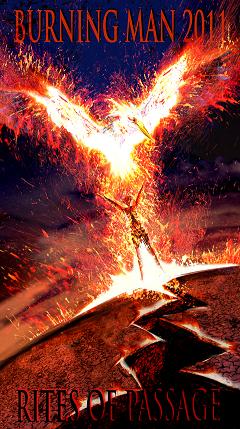
Burning Man 2011 got off to a big start yesterday as tickets went on sale, demonstrating that the 25-year-old event is more popular than ever. The demand for tickets at 10 a.m. was so strong that it crashed the servers for almost two hours, overcoming efforts to beef up a ticketing system that has functioned pretty well the last two years after being a frustrating hassle in previous years.

“People were happy with [the event] last year or they wouldn’t have pounded the servers trying to get a ticket,” Marian Goodell, the event’s communications director, told us. “The ticketing system had been tested pretty extensively, but the sudden demand for service was high that the ticket vendor had ever heard of before.”

More than 20,000 people snapped up tickets in the first 24 hours, outpacing last year and selling out the 9,000 tickets each at the first two tiers of $210 and $240. Goodell said that as many as 40,000 users appeared to be trying to log on yesterday, with many apparently not willing to endure a wait time of about six hours in some cases. Once the current tier of $280 tickets is gone, the price will be $320 until the event.

Last year, the population of Black Rock City – the temporary city that Burning Man attendees build in rural Nevada every August – peaked at more than 51,000 people on Friday night. Goodell wouldn’t make a prediction about this year’s population, noting that spring ticket sales are hard to predict, but she noted that many of the event’s marquee artists, such as Peter Hudson and Sean Orlando, are planning ambitious projects for this year that are already generating excitement.

“We’re very excited about this year,” she said.

For more on Burning Man and its myriad subcultures, you can find my past Guardian articles on the culture here or look for my upcoming book, The Tribes of Burning Man: How an Experimental City in the Desert is Shaping the New American Counterculture, being released next month by CCC Publishing.

What you can do for your country

31

The radio’s been full of stories about the Kennedy inauguration, about that cold, snowy day in 1961 when a young president inspired the nation and the world with a call to civic engagement and sacrifice. Kennedy spoke of the torch being passed to a new generation, and in some ways, he was the first real post-War president. But his most stirring line — “Ask not what your country can do for you; ask what you can do for your country” — was very much a WWII-era sentiment, a notion that everything wasn’t about getting rich and demanding things, but that America stood for public service.


Not surprisingly, the taxes on rich people back then were much higher, and the income and wealth gap much smaller, and the middle class much larger. There was, of course, terrible poverty, but Kennedy and his successor, Lyndon Johnson, talked about using government resources to end it. The idea of a “war on poverty” wasn’t even that radical.


It’s stunning to me how quickly that spirit vanished.


The Vietnam War, the Nixon-era crackdown on protesters, COINTELPRO, the war on drugs … by the 20th anniversary of that famous speech, it was all over. And the anthem of the late 1970s, in the leftist circles where I hung out, went like this:


Ask not what you can do for your country


What’s your country been doin’ to you?


And when Ronald Reagan said government is not the solution, it’s the problem, lots of those Avengers fans cheered, too.


Now it’s almost impossible to get anyone to support even modest taxes to pay for basic government services, and the public sector is under constant attack.


Man, if I were into conspiracies, I could go a long way with this one.


Is Ed Lee a caretaker?

36

It’s not a moot question. Already, the Chron’s C.W. Nevius, in an otherwise innocuous column on Question Time, tossed out this nugget:


Lee may be the interim, but don’t kid yourself. There are people right now who are asking him if he’d like to make a run for the office in November.


This, of course, is the problem with the concept of a “caretakler” mayor. There’s no law, no rule that says Ed Lee can’t decide round about mid-summer, shortly before the filing deadline, that he’s changed his mind, loves the job, and can’t resist the siren song of his supporters urging him to seek a full term.


And hey: maybe he does do a great job in the next few months. Why shouldn’t San Franciscans have the right to elect him in November?


Of course, he promised that wasn’t going to be part of the deal. And if he had given any signals that he might want a full term, Sup. Sean Elsbern, who was adamant that he wanted a caretaker, wouldn’t have nominated Lee. David Chiu, who might want to run for mayor himself, would have been a lot less likely to vote for a potential rival. Lee the candidate wouldn’t have gotten the job.


So when he should up for Question Time, one of the supes ought to ask him: Right now, in public, for the record, will you tell us — is there any possibility that you will consider running in November?


I’m not saying the guy should be forced to give up his civic and Constitutional right to seek public office; as I said, that’s why I never liked the caretaker thing. But if he’s thinking of running, the city needs to know that, now, so we can work with him on an honest basis. And if he’s not, he needs to tell Nevius’ sources to quit spinning rumors.


Net neutrality: “The American Way”

Media Alliance, an Oakland-based organization advocating for press freedom and media access, has teamed up with San Francisco-based Bad Monkey Studios to produce a quirky cartoon about net neutrality called “The Internet You Need.”

The short film follows a December vote by the Federal Communications Commission approving a set of net neutrality rules.

Critics say those regulations fall short of what’s truly needed to maintain an even playing field for all internet users, and Media Alliance is encouraging people to write to their congressional representatives to push for stronger rules.

(There’s a broad array of opinion as to whether the FCC vote resulted in protecting an open internet, or whether it sold consumers short in favor of internet service providers.)

The Media Alliance and Bad Monkey cartoon and website seem like an attempt to make the issue accessible to those of us who aren’t technology wizards. The emphasis on soda pop and BBQ strikes us as a little weird, but sparking dialogue about net neutrality seems like a worthy goal.

Here’s the pitch from Media Alliance: “Net Neutrality really means ‘Internet Freedom.’ The freedom for you to put up what you want when you want to and have it seen equally by everyone in the world. It means what you put up has as much chance of being seen as something created by a major corporation. It’s innovation from the ground up in the truest sense. It’s the American Way.”

Snap Sounds: Wovenhand

0

WOVENHAND
The Threshingfloor
(Sounds Familyre)

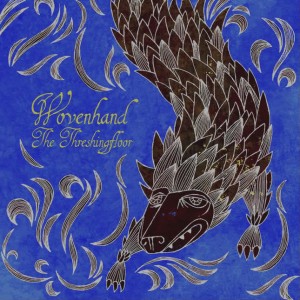
Whether it be the western plains or the Appalachian highlands, David Eugene Edwards of Wovenhand has long looked to the American landscape for inspiration, crafting songs which weave these diverse geographies together into a bold tapestry of richly textured sound. And yet, dating all the way back to the early days of 16 Horsepower, Edwards has never shied away from sifting a few foreign elements into his bold Americana. With The Threshingfloor (Sounds Familyre, 2010), he sets his gaze eastward, blending elements of Eastern European, Middle Eastern, and Romani gypsy music into his stark melodies and faith-layered lyrics.

From the driving oud of the title track, to the celestial Hungarian flute of “Terre Haute,” from the singing grass to the orchard gate, The Threshingfloor is the musical incarnation of the toil and bonebreak of a late-summer harvest: a passionate reverberation of hard physical labor and a harder metaphysical reward.

Wovenhand, “The Threshingfloor”:

Conjuring sheaves of wheat from desert drone, and scorched earth from fertile finger-picking, Wovenhand continues to establish itself as the thinking fan’s indie band, constantly morphing musically yet never losing touch of its essential intention or intonation. As always there are a couple of songs that poke into the nether edges of its versatility: in this case “The Truth” plays like one of Edward’s early new wave-styled tracks from his Bloodflower days, and the straight-up cow-town rockabilly of “Denver City” serves up war whoops and vocal distortions. But the tracks that linger long after the CD ends definitely rank among the most rooted in devotion, particularly “A Holy Measure,” “Behind Your Breath,” and “Terre Haute.”
 
WOVENHAND
With Git Some and Common Eider, King Eider
Tues/25, 9 p.m.; $13
Bottom of the Hill
1233 17th St., SF
(415) 621-4455
www.bottomofthehill.com
www.soundsfamilyre.com

Dick Meister: Ronald Reagan’s Law of the Jungle

11

Dick Meister, formerly labor editor of the SF Chronicle and KQED-TV Newsroom, has covered labor, politics and other matters for a half-century.

The 100th anniversary of Ronald Reagan’ s birth is coming up in February, and before the inevitable gushing over what a wonderful leader he was begins, let me get in a few words about what sort of a leader he really was.

Ronald Reagan was, above all, one of the most viciously anti-labor presidents in American history, one of the worst enemies the country’s working people ever faced.

Republican presidents never have had much regard for unions. But until Reagan, no Republican president had dared challenge labor’s firm legal standing, gained through Democratic President Franklin D. Roosevelt in the mid-1930s.

Reagan’s Republican predecessors treated union leaders much as they treated Democratic members of Congress – as adversaries to be fought with at times, but also as people to be bargained with at other times. Reagan, however, engaged in precious little bargaining. He waged almost continuous war against organized labor and the country’s workers from the time he assumed office in 1980 until leaving the presidency in 1988.

Reagan had little apparent reason to fear labor politically. Opinion polls at the time showed that unions were opposed by nearly half of all Americans, and that nearly half of those who belonged to unions had voted for Reagan in both his presidential campaigns.

Reagan, at any rate, was a true ideologue of the anti-labor political right. Yes, he had been president of the Screen Actors Guild, but he was notoriously pro-management in that position. He led the way to a strike-ending agreement in 1959 that greatly weakened the union and finally resigned as union president under heavy membership pressure before his term ended.

Reagan’s war on labor as U.S. president began in the summer of 1981, when he fired 13,000 striking air traffic controllers and destroyed their union.

As Washington post columnist Harold Meyerson noted, that was “an unambiguous signal that employers need feel little or no obligation to their workers. Employers got that message loud and clear, illegally firing workers who sought to unionize, replacing  permanent employees  who could collect benefits with temps who could not, and shipping factories and jobs abroad.”

Reagan gave dedicated union foes direct control of the federal agencies that were originally designed to protect and further the rights of workers and their unions. Most important was Reagan’s appointment of three management representatives to the five- member National Labor Relations Board.

The appointees included NLRB Chairman Donald Dotson, who declared that “unionized labor relations have been the major contributors to the decline and failure of once healthy industries” and have caused “destruction of individual freedom.”

A House committee found that under Dotson, the NLRB abandoned its legal obligation to promote collective bargaining, in what amounted to “a betrayal of American workers.”

The NLRB settled only about half as many complaints about employers’ illegal actions as did the board during the previous administration of Democrat Jimmy Carter. Most of the complaints were against employers who responded to organizing drives by illegally firing union supporters. The employers were well aware that, under Reagan, the NLRB was taking an average of three years to rule on complaints, and the board did no more than order that the discharged unionists be reinstated with back pay – which was much cheaper than if the employers had been operating under a union contract.

The board stalled as long before acting on petitions from workers seeking union representation elections, and generally stalled for another year or two after such votes before certifying winning unions as the workers’ bargaining agents. Also under Reagan, employers were allowed to permanently replace workers who dared exercise their legal right to strike.

Reagan’s Labor Department was as one-sided as the NLRB. It became an anti-Labor Department, virtually ignoring, for example, the union-busting consultants that many employers hired to help them fend off unionization.

Very few consultants and very few of those who hired them were asked for the financial disclosure statements that the law demands, Yet all unions were required to file the statements that the law required of them – and that could be used to the advantage of their opponents. Although the department cut its overall budget by more than 10 percent, it increased the budget for such union-busting activities by almost 40 percent.

Among Reagan’s many other outrages, there were his attempts to lower the minimum wage for younger workers, weaken the child labor and anti-sweatshop laws, tax fringe benefits, and cut back programs to train unemployed workers for available jobs. He also tried to replace thousands of federal employees with temporary workers who would not have civil service or union protection.

Reagan all but dismantled programs that required affirmative action and other steps against discrimination by federal contractors. And he seriously undermined job safety programs.  He closed one-third of the Occupational Safety and Health Administration’s field offices, trimmed the agency’s staff by more than one-fourth and decreased the number of penalties assessed against offending employers by almost three-fourths.

Rather than enforce the laws, Reagan appointees sought “voluntary compliance” from employers on safety matters – and generally didn’t get or expect it. Reagan had so tilted the safety laws in favor of employers that safety experts declared them virtually useless.

The same could have been said of all other labor laws in the Reagan era. A statement issued at the time by the leaders of several major unions concluded that it would have been more advantageous for those who worked for a living to ignore the laws and return to “the law of the jungle” that prevailed a half-century before.

The suggestion came a little late. Ronald Reagan had already plunged the nation’s labor-management relations deep into the jungle.

Yet Reagan will nevertheless be honored in centennial celebrations throughout the United States, in Europe and elsewhere in coming days.  He’s become a much beloved mythical figure, and nothing will change that, certainly not the unheard or unacknowledged facts of his presidency and its disastrous effects on America’s working people, many of whom ironically will be among the celebrants.

Dick Meister, former labor editor of the SF Chronicle and KQED-TV Newsroom, has covered labor and politics for a half-century. Contact him through his website, www.dickmeister.com, which includes more than 250 of his columns.

DJ Jazzy Jeff brings the “Summertime” to SF

0

Jeffery Allan Townes has never been a man of many words. Big Will was the one given to the neon pyrotechnic dancing on the show and in videos, after all. So it’s not surprising that now, over 20 years deep into his DJing career (which brings him to Mighty on Fri/21), Townes – a.k.a. DJ Jazzy Jeff – is not given to overexplaining his steez.

Hey Jazz, what’s up with your set these days? You’ve been reaching past the early ’90s hip-hop classics to diversify your time in the booth as of late, what are some of your favorite tracks to spin these days? You dig jazz (obviously), what’s up with that?

“I have a love of all music. Classics may be my fave though, just because there are so many to choose from,” was Jazz’s taciturn reply. DJs love music! Fantastic. But what’s snark ever done for us — Jazz has a decades-long reputation of being a high quality beat-bringer that started in Philly house parties, trucked through the Fresh Prince of Bel-Air days, and continued to thrive even when Will Smith moved on to summer blockbuster ass kicking. In 1990 (right as the TV show was taking off), Jazz started his own production company, A Touch of Jazz, that was responsible for a slew of platinum careers, including that of R&B poet Jill Scott and funkster Musiq Soulchild.  

And he’s still scratching. Jazz was famous for pioneering DJ moves like the transform scratch, a tricksy manuever involving repeated movement of the crossfader. In 2009, he joined the ranks of scratch legends Grandmaster Flash and DJ Shadow on the X-Box hit DJ Hero. Jazz tries to use his powers on the ones and twos for good: “I want to make people forget all of there problems and have a great  time. I want to take them on some sort of musical journey,” he wrote.

Multi-dimensional career aside, we were still gonna ask him about the Will Smith brood. Rumors are that Jazz will be producing a “Parents Just Don’t Understand” remix with none other than “Whip Your Hair” 10-year old “good as her dad” Willow Smith. He was coy about their collaboration, only saying that he hasn’t started working with her – yet – but he did sound impressed about Willow and brother “Karate Kid” Jaden’s genetic mastery of show biz. “I tease Will that they’re “The Incredibles” with all the talent they have,” Jazz lol’s.

There’s always gonna be that “Parents Don’t Understand”- “Summertime” laurel hanging over Jazz’s headphones – which, unlike a lot of celebrities who continue to be known for the glory days way back when doesn’t seem to bother him. “I’m not mad at the association. I don’t care why people know me or like me — as long as I can grab them through music it’s all good.”

Which makes sense – when you’re a DJ famous for making music that makes people get loose, wear their baseball hats rakishly askew, and dance around to, you’re not exactly trying to escape your reputation. Or get overmuch concerned with talking about it, it would seem. 


DJ Jazzy Jeff 

Fri/21 10 p.m.- late, $20

The Mighty

119 Utah, SF

www.119utah.com


Street Threads: Look of the Day

0

Today’s Look: Kate, Market and Van Ness

Tell us about your look: “I got this whole outfit in San Francisco. I’m visiting from Brighton in the UK.”

KUSF meeting venue changed

0

By Carly Nairn

In an effort to accommodate more participants, tonight’s informational meeting and rally in support of KUSF – which was suddenly shut down this week – has changed venues from Fromm Hall on USF’s campus to Presentation Theater on Turk and Masonic.

The meeting with discuss KUSF’s recent boot from the 90.3 signal to make way for USC’s Classical Public Radio Network (CPRN) nonprofit takeover of commercial classical music outlet KDFC. Following secret negotiations, CPRN purchased the rights from USF to broadcast on the signal last week.

Both the CPRN and the university did not inform KUSF’s staff about the purchase until yesterday morning. USF President Rev. Stephen A. Privett will be in attendance to answer questions about the future of KUSF and its changed format to an online-only radio station. The meeting is still scheduled at 7pm.  

Enjoy tonight’s Full Wolf Moon

2

I thought the moon was full last night when I woke up in the wee hours (thanks to allegies possibly induced by the yellow flowers on the acacia trees) and saw its silvery light streaming through the window. And my cat seemed to think it was a full moon, too, judging by the way she was racing through the yard, tail erect, pouncing on moonlit leaves

But according to my Old Farmer’s 2011 Almanac, the moon hits fullness today, Wednesday. And it is classified as a Full Wolf.

“Full Moon names date back to Native Americans, of what is now the northern and eastern United States,” the almanac explains, noting that “tribes kept track of the seasons by giving distinctive names to each recurring full Moon.”

The Farmer’s Almanac also notes that January’s full moon was named a Full Wolf,  because “Amid the cold and deep snows of midwinter, the wolf packs howled hungrily outside Indian villages.” And it lists the origins of names for all the other month’s full moons. These include March’s Full Worm Moon (“As the temperature begins to warm and the ground begins to thaw, earthworm casts appear, heralding the return of the robins”), July’s Full Buck Moon  (“July is normally the month when the new antlers of buck deer push out of their foreheads in coatings of velvety fur”) and November’s Full Beaver Moon (“This was the time to set beaver traps before the swamps froze, to ensure a supply of warm winter furs.”)

Obviously, life in San Francisco under a full moon is a little more hospitable, with folks known to go surfing, bicycling and kayaking by its silvery light.
And for those of you into gardening, the day after a full moon to the day before it is new again, is supposedly the best time to plant flowering bulbs and vegetables that bear crops below ground, according to my almanac. (Though January still isn’t a good month for planting, even in California, because of the possibility of frosts.)

Likewise, supposedly, it’s best to plant flowers and vegetables that bear crops above the ground during the light, or waxing, of the Moon, which is from the day the Moon is new to the day it is full.

“Plant flowers and vegetables that bear crops above ground during the light, or waxing, of the Moon: from the day the Moon is new to the day it is full,” my almanac states.

The idea is that with no or little moonlight, a plant’s root system strengthens, and with full or increasing moonlight, a plant’s stem and leaf system strengthens. I haven’t tested out this theory yet, so if you have any moon planting stories, please feel free to share. And if you want to read more about full moons, check out the Farmer’s Almanac’s treasure trove of information here. And if you have any theories on whether nocturnal birds like night herons tend to be more active hunters on full moons, also feel free to share. I’ve been watching a colony in the East Bay for some months now, and it seems that they come inland to hunt in a grassy field near where I live on new moons and high tides, and hunt in the mudflats along the Bay on full moons and low tides (like the conditions we’ll see tonight). But above all, enjoy the free moonshine.

Hot sexy events January 19-25

1

We’re normally asses up here at the weekly sex events column, but for the purpose of January 19-26, we’re asking you to lift another body part altogether: your pinky. That’s because tonight (Weds/19) you’ll get the chance to learn about an entirely refined BDSM social function, that being the tea party. Ms. Margaret, who used to coordinate educational services for the smOdyssey website as well as the  Folsom Fringe conference, runs the classy “Tea With a Twist” affair with long-time slave Erich. Rumor has it she never takes her tea the same way twice, for which you will learn the reason at this lace tablecloth-leather dress how-to affair.


Tea With a Twist

Why must all BDSM parties take place in a dungeon? What of the mistress that requires some amount of refinement and grace – not to mention finger food? These classy souls are invited to this primer on dom-sub tea time, sculpted by Ms. Margaret’s “velvet glove over steel hand” mentality. 

Weds/19 8 – 10 p.m., $15

Center for Sex and Culture

1519 Mission, SF

(415) 552-7399

www.sexandculture.org


Pits

Raise your hand if you’re an armpit man. (See how that works?) Chaps has got the jock-tastic bash for you this week. Pits is part of their fetish night series, so no longer will you be wondering if that hottie with the body holding the Jager bomb will mind if you want to grab him by the under-bicep. He’s here too, ya know – just be prepared to give as you get, gentlemen.

Weds/19 

Chaps 

1225 Folsom, SF

(415) 255-2427

www.chapsbarsanfrancisco.com


Radical Love Workshop

At some point in our lives, we’ve all wished we had this line on our resume: “revolutionary activist of the heart.” Sure you deserve it, sweets – but Wendy-O-Matic can say it with a straight face. Ms. O-Matic has spent years standing strong and educating on behalf of the polyamorous community, and now she’s presenting this workshop at Mission Control on the ins-and-outs of loving whoever you damn well please, and sharing them with whomsoever you see fit — with a basis on love and intimacy, not picking the right music for the orgy.

Thurs/20 7-9 p.m., $25 members only

Mission Control 

2519 Mission, SF

www.missioncontrolsf.org


Community Porn Forum

Skin flick performers get together to discuss the upcoming Cal OSHA meeting (the next is Feb/8) regarding occupational safety measures in the industry. The perfect chance, you XXXers, to learn about how you can tell the regulating body what you need to feel safe on the job – particularly regarding condom usage, a hot topic at recent meetings on the subject. MSM (male on male) performers especially encouraged to attend.

Fri/21 3 – 5 p.m., free

St. James’ Infirmary

1372 Mission, SF

(415) 554-8494

www.stjamesinfirmary.org


10th Annual Butch-Femme Holiday Party

Get all festive and feisty at this sexy winter ball. Of course, this being an all-lesbo affair, all manners of dress are welcome for the dancing and drinking – festive wear would be appropriate, but so too would be whatever ‘fits you wanna rock for the evening. Event organizers would be thrilled to death if volunteers want to bring finger food, refreshments, ice, or wood for the outdoor fire. Outdoor fire? Now we’re talking.

Sat/22 6 p.m. – midnight

Humanist Hall

411 28th St., Oakl.

www.erobay.com

email: butchfemmesocials@yahoogroups.com


Lip Service

Smack, suck, caress – and that’s just before the tongue gets activated. Kissing is one of those arts that can get passed over in pursuit of the all-powerful O, but it’s one of the most important (and public spaces friendly) weapon in your arsenal of sexual equanimity. Let sex educator Tracy Bartlett show you the ropes course to a good make-out sesh – grab your partner and get to mashin’.

Mon/24 6 – 8 p.m., $40-45/pair

Good Vibrations

1620 Polk, SF

(415) 345-0400

www.goodvibes.com


Blue Shield: pay up or die

0

A Blue Shield customer from San Diego emailed Consumer Watchdog recently to complain about a 59 percent rate hike. his comment, according to Consumer Watchdog’s Jamie Court:


There is no market for health insurance. You have two choices: 1. Pay whatever they say. 2. Die.


That’s about it, right there.


You know why nobody in Sacramento can do anything about health insurance rates? It’s because by law our state Insurance Commissioner is really just a car-insurance and home-insurance commissioner with little authority over health insurers. That goes back to Prop. 103, the landmark ballot measure that created an elected insurance commissioner and dramatically restricted unfair practices by liability insurers. But Prop. 103 (thanks to the one-subject rules for initiatives) couldn’t take on health insurance.


Now there’s a bill in Sacramento, AB 52, that would give the insurance commissioner the ability to regulate health insurance rates — and the lobbyists are going nuts. But as Court says, Blue Shield made a big mistake — not only by radically raising rates but by refusing a request by Insurance Commissioner Dave Jones for a 60-day delay. “They have become the poster child for rate regulation,” Court told me. And if the Legislature doesn’t pass the bill (a similar effort failed last year) Court and Consumer Watchdog are looking at a major mesure for the 2012 ballot that would be the health-insurance equivalent of Prop. 103, a measure to control rates — and mandate a public option for Californians.


“We will have the same conditions in 2014 that we had with car insurance in 1984,” he said. “The government says you have to buy it, but there’s no regulations on cost.”


There’s more info about it here and you can contact your legislator here.


Not your guru’s asana

1

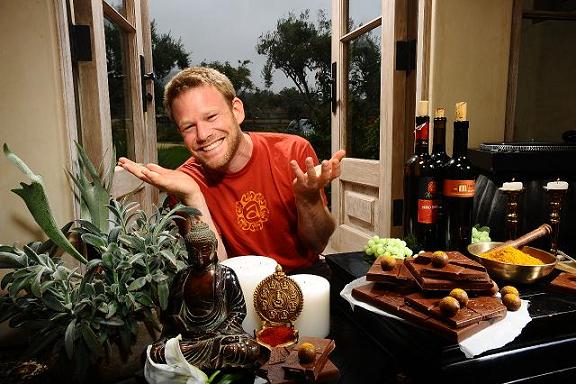
Why put 12 year-old aged balsamic vinegar from Modena, Italy into a chocolate truffle?  Well, because it tastes surprisingly great, for one thing. But also, according to Dave Romanelli, one of the presenters at last weekend’s flexibly diverse San Francisco Yoga Journal Conference, because it can heighten your yoga practice. Enlightenment through chocolate? We’ll take it.

New York-based Romanelli taught a class called “Yoga  and Chocolate,” and like many of the conference’s fifty presenters, he brought a yogic flavor to the conference influenced as much by his personal path to the mat as ancient teachings. In other words, fundamentalist ayurveda this was not.

Referred to as “Yeah Dave” by his friends (as in, “yeah, Dave, whatever…”), Romanelli has penchant for stoner-esque musings that eventually left him with the radical idea that to flourish in today’s fast-paced society, yoga should be made accessible to a broad audience. 

In the ’90s, Romanelli and a partner started At One, a chain of trendy yoga studios in Phoenix that Romanelli says in an interview with SFBG were meant to “bust through the stereotypes” that yoga is pretentious and unconnected to daily life. In 2009 he published a book called Yeah Dave’s Guide to Livin’ in the Moment, an irreverent manual to enjoying life in the here and now. These days, he travels the country leading workshops that seek to initiate people into a yogic lifestyle through careful attention to the senses – which he engages with the help of wine and exotically-flavored chocolate provided by Yoga and Chocolate co-founder and master chocolatier Katrina Markoff.  

“Yoga and Chocolate” was one of over a hundred classes, guest lectures, all-day intensive workshops, and special events that filled the San Francisco Hyatt over the MLK Day weekend, ranging from fiery asana practices to contemplative journeys through yogic philosophy.  The scads of famous yogis in attendance included teachers like Ana Forrest, creator of the healing-based Forrest Yoga approach, Seane Corn, an internationally celebrated yoga teacher, activist and humanitarian, and San Francisco’s own Baron Baptiste, whose parents opened the city’s first yoga center in 1955 and who has shared his empowering vinyasa yoga with classes around the world.

With so many presenters — and with nearly half of conference attendees yoga teachers in their own right — the expo left the downtown hotel rife with pairs of groovy tie-dyed pants and hundreds of bare feet riding up and down the Hyatt’s escalators. In a city like San Francisco, it’s not surprising that the traditional Indian practice could draw such a huge audience – but the sight of so many modernized classes begged the question: Patanjali compiled the yoga sutras no later than 150 BC, and we’ve been mulling them over ever since. How much is really left to learn?

The answer is “a lot” if this year’s offerings were to be believed. Joining “Yoga and Chocolate” was MC Yogi’s “Ganesh is Fresh,” a hip-hop inspired retelling of the story of the elephant-headed deity Ganesh, remover of obstacles. (Fyi, if you’re a harmonious hip-hop head, it’s also the name of a track on MC Yogi’s 2008 album “Elephant Power.”) Another high-energy choice was “Bollywood Vinyasa,” a cardio-heavy yogic workout set to bright rhythms of bhangra and Bollywood music. 

“I never intended to be a yoga teacher,” said Hemalayaa, the class’ teacher and the Canadian-born daughter of Indian parents. “I started practicing as a way to guide myself, be a leader for myself,” she announced to the students before her. The seed of “Bollywood Vinyasa” was planted during darker days in Hemalayaa’s 20s, when she would come home and blast Bollywood music as a way of shaking out her troubles. After having grown to the lively beats, she was able to incorporate them into her study of yoga. “Now I teach as a way to continue my study. Being a leader to others helps me stay true to myself.”

Romanelli agrees on the importance of applying traditional yogic teachings in a way that’s applicable to our own life stories. He has no problem using his own life experiences – like having man-boobs and wearing too much cologne on prom night in pursuit of after-party action – to draw laughs and convince his students that self-reflection can be fun.  

His style is a definite departure from traditional yogic teaching (ashtanga yogis advocate pratyahara, withdrawal of the senses from external objects, as a means of attending to the inner self). But, in Yeah Dave’s opinion, sensual experience can be the first step toward getting people to pay attention and eventually journey inward.  

“In today’s society, how realistic is closing off the senses?” he asks. “People are afraid to be alone with themselves on a three by six mat.” He admits that people often need help to make the first step. “And if it has to be chocolate, then so be it,” he grins.

For information on next year’s Yoga Journal Conference stretch out to www.yjevents.com/sf