SFBG Blogs

Newsom’s fancy gift, trip to China

The Chronicle’s got a story today about how Lt. Gov. Gavin Newsom’s personal investments and earnings, documented in an economic disclosure form released by the Fair Political Practices Commission (FPPC), make him a lot richer than his boss, Gov. Jerry Brown.

The form also discloses travel payments and gifts Newsom received in 2010, which makes for some interesting reading. For one, San Francisco’s former mayor evidently received a very expensive pen (made by Louis Vuitton and valued at $398) last year from this guy.

The most significant item in the travel and gifts category, of course, was Newsom’s trip to Shanghai last June, valued at $9,082 and paid for by the San Francisco-Shanghai Sister City Committee. He traveled there with former Mayor Willie Brown and some others for San Francisco week at Expo 2010 Shanghai China.

Evidently, it was a week filled with dancing, singing, and celebration. (And dressing to impress. Check out the creamy, eco-friendly suit Brown wore at this “dazzling” event.)

http://www.youtube.com/watch?v=NZ8rKho15dw

Since becoming lieutenant governor of California, Newsom has continued his efforts to improve business relations between China and San Francisco. Just have a look at his recent article in China Brief, a magazine published by the American Chamber of Commerce in the People’s Republic of China (AmCham-China).

In the article, penned in late January of 2011, Newsom wrote:

“China’s central government stresses the importance of developing their innovation industry sectors–including clean-tech, biotech and information technology (IT)—and is projected to commit over $600 million of government funds to support this development. This overlaps with San Francisco’s core industry sectors. With over 500 tech and new media companies (including leaders such as Salesforce.com, Zynga and Twitter), more than 225 clean-tech companies and a worldclass biotech hub (anchored by the University of California San Francisco), San Francisco brings together internationally-recognized leadership in each of these sectors.”

Meanwhile, a few items on that economic disclosure form suggest that what’s good for business in China is also good for Newsom. His wife’s investment portfolio, the Jennifer Siebel Newsom Trust, includes stocks ranging from $10,001 to $100,000 each in China Valves Technology, a for-profit, “e-learning services provider” called  Chinacast, and a Chinese motor manufacturer called Harbin Electric.

5 Things: March 4, 2011

0

Each day, our staff picks five (or so) things we think might interest you

>>MONKEY MAN We can count on one hand the email newsletters we get that are an actual thrill to see sitting unopened in our inbox, and Kirk Lombard‘s is one of them. Lombard knows every. Thing. There is to know about Bay Area fishes (he’s a world champion monkeyface eel fisherman and runs urban angling classes outta ForageSF that are an absolute gas to attend): identifying them, catching them sustainably, eating them, respecting their majesty. He’s got a dope blog, but his recent March newsletter clued us into these aquatic happenings: the spirinchus starski is jumpin’, California halibut season is starting (rent a kayak, Lombard says, for optimal fishing of these guys), and a list of items you might not guess would make servicible monkeyface eel fishing poles: a paint-roller extender or golf course flag.

Guanajuato: let the tequila take you

>>DEJA THAT AGAVE If you’ve harbored a mad hankering for Guanajuatan food — washed down with well over 150 tequilas — then head to Tres, formerly known as Tres Agaves, which reopened March 3. The joint’s been redone to make it a little cozier for diners, who used to jostle with drinkers. The menu’s getting a remodel, too — chef Kelvin Ott is expanding beyond Jalisco, to explore the cuisines of Michoacan, Guanajuato, Nayarit and Tamaulipas. Bonus: Happy hour prices are running at all hours of operation through Tues/8: $5 fresh lime margaritas, $3 Mexican draft beers, and $2 chicken, pork al pastor, or rajas tacos. Did we mention tequila?

>>PILLOW TALK Last chance to snuggle up to needlepoint pillows depicting JFK’s assassination and convenience store holdups, on view at Jack Fischer Gallery through Sat/5. Are they more inappropriate than the dirty pillows by Kevin L. Muth or Ethan Maxx  — “The extra X means fun!” — in the window of Chi Chi LaRue’s West Hollywood vanity shop? You decide.

>>HELLA BOOKS, HELLA CHEAP That’s what they’re calling it, and it says it all. Get hella books hella cheap at the Adobe Books sidewalk sale, Sat/5, 11am-2pm. There will be snacks, and records will be played. Score some fresh spring reading — hopefully fresher than “hella.”

>>NO BONES ABOUT IT Back in 2007, we talked about contemporary art and pop culture’s love of skulls, and the cranial passion has carried on, thanks to the likes of Technicolor Skull, Kenneth Anger’s band (!) with Brian Butler, featuring the octogenarian filmmaker on theremin. Instead of a Technicolor skull, the cover art for the debut album by Swedish noise attackers Black Bug — created by San Francisco musician and designer Nathan Berlinguette  — presents a Necco-tinted one. Sweet!

The Mutaytor’s latest album burns bright and deep

0

A year ago, I got the opportunity to watch The Mutaytor record its latest album, “Unconditional Love: The Westerfeld Sessions,” in the William Westerfeld House, a mansion on Alamo Square with a rich history. Instruments filled the beautifully restored home, and the music seemed to resonate with the 120-year-old walls – as well as with the book that I was completing at the time: The Tribes of Burning Man: How an Experimental City in the Desert is Shaping the New American Counterculture.

As I wrote for the Guardian at the time and in my book, The Mutaytor is Burning Man’s most iconic musical spawn, a band that started on the playa as a pickup group of musicians, dancers, acrobats, and dusty freaks, developing into an enduring of collection musical ambassadors for this burgeoning counterculture. Mutaytor and its music has a special place in the hearts of most burners.

Now that the album has been released and logged several plays through my speakers, I have to say that it’s more than just a sentimental favorite. This is just a great fucking album! Most of the songs draw from the group’s extensive existing playlist, and tunes like “Give a Little Mo’” and “The Family Business” will be as familiar to veteran burners as the well-worn early tracks from Burning Man’s other big iconic act, the Berkeley-based beatfreak Bassnectar.

But Mutaytor is a band of serious-minded musicians and sound engineers, so this album still feels fresh and big. With a full horn section and multiple drummers banging away on sprawling drum kits, the sound just explodes at times, driven steadily along by former Oingo Boingo bassist John Avila. And the album is filled with fun little surprises, like when “Give a Little Mo’” veers off into a rift from Ozzy Osbourne’s “Crazy Train.”

Although the band is based in Southern California, it has a special connection to San Francisco and the Westerfeld House, a sprawling mansion owned by longtime burner Jim Siegel, where the band’s members – which can number as many as two dozen for its spectacular shows – stay when they’re here performing. It’s like sacred ground to them, which is why they recorded here and miked the whole house up for sound.

“We’re getting the best tones,” singer/guitarist/arranger Buck Down told me at the time. And maybe I’m projecting, but I can almost feel that rich setting as I listen to this album, in which big rocking moments give way to haunting melodies, like the strings in “Tung Jen III” that seem to carry with them ancient memories from this storied mansion.

So, on a personal note, I’m excited to return to the Westerfeld House for a book reading and discussion next Friday the 11th starting at 7 pm, where I half-expect the walls to still carry a faint vibration from this epic recording session. Come on by and tell me if you can hear it too.

Or as The Mutaytor says in “How to Convert Civilians into Rock Stars”: “We are nymphs, we are figments of your imagination, and then we are gone, gone, gone, gone…”

The Performant: Pop up the jam

0

Appear and disappear at Noise Pop with Nobunny and Battlehooch

There’s a pop-up explosion going on out there, and it’s insidiously cornering the market on all our fun. It’s become well nigh impossible to stumble down the street without coming across a pop-up “gallery boutique ramen restaurant poodle salon performance space” and even more impossible to not want to avail oneself immediately of its fleeting charms. It’s the precarious ephemerality of pop-up ventures that makes them so enticing—the knowledge that at any moment the ability to tap into this particular experience will be gone forever. Granted, if you examine any particular moment in time closely, you’ll come to a similar conclusion, but sometimes it’s best to just go with the spontaneous flow, even if it’s a little bit manufactured.


How appropriately ingenious it was for Noise Pop to insert some pop-up action on the side of purveying the other kind of pop, as in music, as in the full-on winter blues-buster the festival has become, joining Indiefest as the other best reason to bundle up and brave the frosty February chill. There was the month long operation of the “Noise Pop Pop-up Shop” (say that five times fast) with Upper Playground as well as the weekend pop-up-culture extravaganza that was the “Culture Club” at Public Works. A genial mish-mash of all the popular arts—to gawk at, to buy, to make, and to listen to—Noise Pop’s pop-up experiments definitely ratcheted up their cool quotient and added a new dimension to their overall poppiness.

Of course it wouldn’t be Noise Pop without the noise, plenty of which was to be had at the venerable Bottom of the Hill, a festival mainstay. A double-header bill of Nobunny and Battlehooch (with the Exrays and The Downer Party) brought the werewolf-masked, face-painted bunny-hoppers out in force, freak flags flying proudly. And while it always inspires a certain awe to watch a man in furry dishabille pogo wildly and exhort the crowd to “Do the Fuck” themselves, the boys of Battlehooch closed the show with a satisfying bang. Less swashbuckling and more math rock than their moniker might suggest, Battlehooch’s sound bounces gleefully between influences, part Mother’s of Invention, part Devo: a solid guitar foundation swooping into psychedelic dissonance (AJ McKinley), a completely non-ironic synth (Ben Judovalkis), vocal modulations set on a channel somewhere between “Peter Murphy” and “Ivan Doroschuk “ (Pat Smith), a kickass one-man woodwind section (Thomas Hurlbut), and lyrics featuring baby sharks. Plus facepaint and a video montage of urban decay. Honesty, at this point, any band that gets hipsters to mosh like it’s 1989 gets my vote, and on that score alone, Battlehooch delivers the goods, and brings the noise. Pop.

Beth Ditto, “I Wrote the Book”

1

One of our favorite Katy Perry-shredders, Beth Ditto serves a “Justify My Love”-era Madonna look and the kind of sound Madonna lost touch with after her first album. Guardian Video Issue cover star Justin Kelly made a fab recent Gossip video, but this teaser from an upcoming solo EP hints that it might deliver the dancepop Rick Rubin didn’t for Ditto’s group.

5 Things: March 3, 2011

0

Each day, our staff picks five (or so) things we think might interest you

>>1. SUSHI FROM SPACE “U. F. T Ume Fried Tai: fried red snapper in u.f.o shaped sushi served with balsamic raspberry sauce

>>2. HOP TO IT Bahama Kangaroo. That’s the ace sometime-moniker of Yukako Ezoe, along with her husband, Naoki Onodera. It’s also the title of Ezoe’s new art show, opening tonight at Kokoro Studio at 682 Geary St, SF. The fact that two of Ezoe’s main influences are John Audobon and animation and color master Yokoo Tadanori is enough to convey her uniqueness, but it only hints at her playful deployment of fabric, paint, and even metal (she also makes jewelry). Ezoe is one of those rare people who can party hearty in the most fun ways at night, help the likes of Larkin Street Youth Services and Precita Eyes during the day, and still find time to do her own work. She’s a wonder, and her opening — for a series of self-portraits that are a definite change in terms of in subject matter — should be a blast.

Yukako Ezoe at work on a children’s mural in 2006

>>3. ZION I LOVE YOU Oh Zion I, dreamiest hip hop group in the Bay Area: you’ve already organized your fans into mass meditation sessions, released seven albums of beats so good you almost forget the lyrics laid over them are uplifting as well, and you’re really hot. Now you’re donating ticketing fees to a community circus arts program? The group’s upcoming Fillmore show with the Grouch (Sat/19) benefits the Inner Sunset’s Acrosports  program, teaching 18-monthers through adults how to tumble with grace. Word on the street is the school’s capoeira squad will take the stage at the Fillmore between songs from the crew’s dope new album, Heroes in the Healing of the Nation. We’re listening to our press copy right now, and “I Used to be a Vegan,” plus the tracks featuring Los Rakas, Brother Ali, and Silk E … ah, sogood. (Check the new sound with the Grouch here.)

>>4. HOMESTEAD SWEET HOMESTEAD Did you know that that the phrase Urban Homesteading™ has been copyrighted? (It’s kind of a big scandal). Ploughing those trademarks aside, why not indulge in the spit-and-polish DIY ethics of How-to Homestead’s “11 in 11 Tour”? Each month, the resourceful website is visiting one of SF’s neighborhoods — there are apparently 11! — and thrwing a gaggle of workshops in handicrafts, mending, urban agriculture, and more — plus potlucks and occasional squaredancing! On Sat/5 they’ll be near the Castro at the Harvey Milk recreation Center in Duboce Park, where surely we hope there’s a live demo of this important Castro-related information:

>>5. LES VAGUES BLANCHES Bay Area producer extraordinaire Jason Quever trades slackness for varied arrangements and sings expressively on this lovely moment from the new Papercuts LP:

A game of GOP chicken in Sacto

2

Will any Republicans crack and allow a vote on taxes in June? That’s what everyone in Sacramento is wondering, and the insiders I’ve talked to say they think it’s an even bet. Without a couple of GOP votes, Gov. Brown and the Legislature won’t have the two-thirds majority they need to put a measure before the voters that would stave of horrifying cuts.


But there’s plenty of backroom intrigue: Calitics points out that


The Republicans understand that there have to be some additional revenues.  They know that even they couldn’t come up with the full $25 Billion in cuts in any way that could possibly help them politically. But, on the other side, they are terrified of their own base.


So what they’re trying to do is force the Democrats to do it without a two-thirds majority. There are some tricky legal ways to maybe make that happen — to place the measure on the ballot with a simply majority vote — and it now looks as if the GOP is actually pushing that alternative. The idea: Accept taxes that they know the state needs — but blame the Democrats for it and keep the no-new-taxes types happy.


And the Assembly speaker isn’t going for it. From the Sacramento Bee:


“I know that Senator Dutton has suggested that there’s a way for us to do this as a simple majority effort. Had I proposed it, the Republicans would have been up in arms, saying that I was trying to thwart the will of the public,” Pérez said.


The Assembly speaker accused Republicans of “trying to abdicate their responsibility as elected officials” by suggesting that Democrats could decide the issue without Republican support.


Yep: That’s exactly what they’re doing.


The problem, of course, is that the Dems need the tax vote, too (and I think some of them actually care about the future of the state, which no Republicans do). Who’s going to blink first?


American Idol: The women struggled a bit

0

Not as great a night for the women, I have to say. The guys pretty much blew everyone away, but I only saw one Idol-class performance from the women, and I saw a lot of pretty weak stuff. The good news: Pia Toscano. The last one on stage, after the final commercial, just when I was trying to hustle the kids off to bed, and we just had to sit down and shut up and listen. Amazing; no props, no horrible background (those floating clouds just have to go), just a woman with an amazing voice hitting all the notes and holding the audience spellbound.

The bad news: Rachel Zevita. What was that? The maybe: Michael, my son who plays bass and loves heavy metal, and my daughter, who plays piano and loves Rhianna and Taylor Swift, both were into Kendra Chantelle. Me? Not so much. Okay, but nothing special.

Overall, bad song selection, too much hype and not enough delivery — and damn! Randy’s starting to channel his inner Simon. Harsh, Dawg. But you were right.

Tonight: I predict more pathos, more drawn-out drama about everyone’s childhood, lots of tears and very little singing.

The future of the San Francisco left

72

That, at least, was the title of the Milk Club forum March 1. Quite a panel, too: Sups. Avalos, Campos, Chiu, Kim and Mar. Tim Paulson from the Labor Council. Former Milk Club Prez Jef Sheehy. Tiny from Poor Magazine. And me.


I told the assembled that it was worth reminding ourselves how far we’ve come — when I started in this business, in 1982, Dianne Feinstein was mayor, there was exactly one reliable progressive on the Board of Supervisors (Harry Britt) and it was impossible for grassroots types without big gobs of money to get elected to high office. I’ve lived through Feinstein, Agnos, Jordan and Brown, all (until the end of the Brown Era) with at-large boards. It was awful trying to get anything good done; all we could do was fight to prevent the truly horrible from happening. Under Brown, as Sheehy noted, San Francisco politics was locked down, tight; the machine ruled, the Democratic Party was not a force for progressive issues and only a few exceptional leaders, like Tom Ammiano, kept the spirit alive.


Today, the very fact that five supervisors showed up at a Milk Club event to talk about progressive politics shows how district elections has transformed the city and how far we’ve come.


That said, we’ve still failed to make much progress on the most important issue of the day — the gap between the rich and the poor, the fact that this city has great povery and great wealth and the utterly unsustainable economic and tax system that has made us the most socially unequal society in the industrialized world.


Sheehy talked about the schools (both he and are are parents of kids in the public schools). Good schools, he said, are one of the most important socialequalizers; with a good education, poor kids have a chance. But while our local billionaires enjoy nice tax breaks, we’re starving the schools.


Kim talked abou the need for summer school and longer school years (I would add longer school days). These are things San Francisco can do — if we’re willing. “We’re talking about taxes,” Sheehy said, and he’s right.


In the past five years, I think we’ve cut about a billion dollars out of the General Fund, labor has given back more than $300 million — and we’ve raised $90 million in new taxes. Not good enough, not even close.


Yes, the bad economy is to blame for our fiscal problems, but so is the fact that we have a tax structure that systematically underfunds the public sector. (And yes, my conservative friends, cops shouldn’t retire with $250,000 a year pensions. Got it.)


Tiny made a strong statement about the essential problem facing the city when she asked, “who isn’t here?” She didn’t just mean that there were too many white people in the room (althought that was true); she meant that there were were too many working-class and poor people who can no longer live in San Francisco.


Sheehy was even more blunt: “In five years,” he said, looking out at the room, “none of us are going to be here.”
And my essential message to the crowd (and the elected officials on the panel) was: We don’t have to accept that. These are problmes we can address, right here in San Francisco. If we want to, we can shift the burden of paying the costs of society at least a little bit off the backs of the poor and middle class and onto the rich.


Nobody directly disagreed with me. In fact, Chiu announced that “income inequality is something all of us care about.”
How agressively he and others try to turn that concern into legislation will tell us something.


Two other interesting moments:


1. Every single person on the panel talked about how important Tom Ammiano was to the modern progressive movement. One by one, every panelists described the 1999 Ammiano for Mayor campaign as a defining moment in their lives and in the emergence of today’s progressive politics. Good to see the guy get the recognition he so richly deserves.


2. Campos, who was sitting next to Chiu, made a point of saying that there’s no longer a progressive majority on the board, and he pointed to the committee assignments that gave conservatives control of some key panels. Chiu responded: “At the end of the day, we have a progressive majority on the board that will serve as a backstop” to anything bad that comes out of committees.


It was curious; it sounded almost as if Chiu was disappointed in his own assignments. Why would you need a “backstop” if the committees were good in the first place?


So I called him the next day and asked him about it. First he said he thought the commitees were balanced and it was all going to be fine. But when I asked him directly — why not appoint progressive majorities on the key committees? — he responded:


“I wish the board presidency vote hadn’t turned out the way it did.”


In other words: If the progressives had all voted for Chiu, he wouldn’t have appointed conservatives to key posts of power. Instead, some progressives voted for Avalos, and Chiu won with the votes of Carmen Chu, Scott Wiener, Sean Elsbernd and Mark Farrell (along with Kim and Mar). The payback, the deal, the whatever you want to call it, means that bad decisions will be made at Land Use and Rules and maybe in the Budget Committee, and Chiu as much as admitted that the progressive majority will have to go to unusual lengths to undo them.


I know how politics works; I know you have to dance with the ones that brung you and all that. But it would be nice if every now and then someone would do something just because it was the right thing to do, and to hell with the political consequences.


I suppose that’s too much to ask.


As close to the lens as possible: A (too brief) Q&A with David Weissman

0

One of the strongest aspects of the film We Were Here is the intimacy and depth of its interviews (read our review here), so it’s with embarrassment and regret that I’m presenting this relatively casual Q&A with director David Weissman with the caveat that it’s been marred by a snafu. While transcribing, I discovered that the ‘Rec’ button on my ancient tape recorder had been triggered when it was in my carrying bag, and a sizable portion of the talk – including passages about archives, filmmaking, community, San Francisco, the cultural influence of The Cockettes, and a younger generation’s view of AIDS – had been replaced by the muffled sound of footsteps and traffic. The conversation is lost, but the story isn’t: We We Here is screening at the Castro Theatre through Thurs/3. Here’s some of what Weissman and I discussed.

SFBG What was the response to We Were Here like at Sundance?
David Weissman Sundance was great. We’d had a sneak preview at the Castro, and an even earlier one in Portland at the festival [the Portland Gay and Lesbian Film Festival] that I curate with Russ Gage up there, but Sundance was the first really mixed audience. The Salt Lake City screening was particularly fantastic.

SFBG How so?
DW You can feel the energy in the room, and people cry a lot at this movie. But I think that people cry in a way that by the end of the movie they feel good. That was one of the most important things to me – I didn’t want to make a movie that would just be devastating. It was important to me that it be inspiring. In almost every review and every response, people talk about it being uplifting.

Trailer for We Were Here:

SFBG In some ways We Were Here continues a tradition in San Francisco of oral history in documentary. I wanted to ask about your methodology in terms of doing interviews, because spoken interview accounts are a fundamental, powerful part of the film. You really devote time to the people whose stories you tell, or to flip it, those who tell their stories.
DW The only person I knew I was going to interview at the beginning was Ed [Wolf] and that’s because we’d known each other through doing HIV work, and I knew he had a passion about this story being told, and there was enough existing personal trust between us that I knew he would be an easy person to experiment with.
Right before I interviewed him, I woke up in the middle of the night with a start and thought, “Oh my god, I’ve done no research and have no notes. What am I thinking?” On The Cockettes [2002] we’d done tremendous research before each interview. Then I quickly calmed down and realized, “This is my story. This is my history. I lived through this entire thing.”
The interviews were totally unplanned and they went where they went. Rather than being conventional subject-object interviews, they were deep, mutually therapeutic conversations between people who shared a painful history.

SFBG How did you find and choose the film’s subjects?
DW It was completely intuitive. Other than Ed, the only way any of these people wound up in the film is that I bumped into them somewhere. In the course of conversation, I’d think, “Oh, you’d be good,” and [from] their unambiguous [affirmative] response, I’d decide to go with it. To some degree, their willingness to be interviewed is reflective of their generosity during the years of the epidemic. They clearly got a lot out of being interviewed personally. Having that kind of focus on such an intense part of one’s life for the first time is a powerful experience. But each of them really did it for the community and for the world.

SFBG Some of the answers are obvious, but how was making this film different from making The Cockettes, as an experience?
DW In many ways, the two films are very similar. The experience was different emotionally simply because there was so much pain involved in revisiting [We Were Here‘s] history. But both ultimately wound up being films in which a very large historical moment is evoked by a very small number of people, without a lot of extenuating materials to contextualize the times. The idea was to have the times emerge from the storytellers. There’s a great similarity in that choice.
The intention of the two films is also similar. In describing my intention with The Cockettes over the years, I’d say it had a twofold purpose, in validating the complexity and beauty of a period of time for the people who lived through it, and illuminating it in a rich and complex way for people who didn’t know anything about it. I’d use the exact same language for We Were Here.
The emotional aspect was much different. This film was much less celebratory and more wrenching. But there was something gratifying about being strong enough to engage with the material. The working experience with [co-director] Bill [Weber], the shared quality, was profoundly beautiful and extraordinary.

SFBG In making this film, I’d think any tasks or parts of the process you did on your own would be difficult.
DW When I see other documentaries and look at the credits, there’s name after name, but basically, it’s me and Bill. Each of us wears multiple hats. There’s also the production crew, Marsha [Kahm] and Loretta [Mollitor], who were incredible, and we had some archival help, too. But the big tasks of the movie belonged to me and Bill.

SFBG How did the film structure and approach of the film develop? Was it an intuitive process, as you suggested earlier?
DW The Cockettes had a clear narrative arc that Bill and I [as co-directors] agreed on from the beginning, and it didn’t have the burden of an entire community of people who had a stake in the story being told. The burden of how people would respond to We Were Here was a huge one that I worried about every day.
I don’t think Bill initially trusted that we could do [We Were Here] with this few people. From my vantage point, it was the fewer the better. And the less music the better. I came into it at the beginning saying, “No music at all.” Bill said, “You’re insane, we’re going to need some,” and I decided, “When we get there, let’s deal with it, but I want to start from zero.”

We evolved together, and Bill’s an enormously sensitive editor, both visually and with music. We were a good team. Bill said he kept having to unlearn his normal way of doing things, because some of what we were doing was so contrary – people are on screen for a long time, and they breathe, and they pause, and they make mistakes, and there is no augmentation of sentiment through music.

Sundance Film Festival: David Weissman:

SFBG Did you both do the film’s interviews?
DW I did all the interviews. With The Cockettes, we were co-directors. With We Were Here, I’m the producer and director, and Bill is the editor, and he got a co-director credit because his editorial role was so important.

SFBG Were there points while looking at archival material or doing interviews where you encountered anything that changed your ideas about what you were making?
DW Yes. One of the more conventional beliefs when making a film about recent events is that filmmakers generally prefer to use moving images instead of archival and still images. At a certain point, we shifted away from that, particularly when covering the pre-epidemic period in San Francisco. We focused on faces, and almost all of  the faces are looking directly into the lens. That sense of personal intimacy is central to how the whole film works.

SFBG There’s a counterbalance that works well in direct relation to that decision – you move from those still images to the footage of people in clinics.
DW Some of that footage came from Tina Di Feliciantonio’s Living With AIDS [1987], and from Marc Huestis’s Chuck Solomon film [Chuck Solomon: Coming of Age, 1987]. I don’t know if we got any clinic footage from Ellen Seidler’s Fighting For Our Lives [1987], but we got a lot of footage from it. All of those films were made between 1985 and 1986. And there’s the footage from Silverlake Life [1993]. I still can’t bring myself to watch Silverlake Life all the way through. Bill did, and he chose the footage.
When I’m interviewing – and this is also true with The Cockettes – I sit with my ear literally on the camera. I want people looking as close to the lens as possible.


Redevelopment debate full of bum choices

3

At the Potrero Hill Democratic Club’s debate about Gov. Jerry Brown’s proposal to ax local redevelopment agencies to balance the state’s $26 billion deficit, folks attempted to evaluate if redevelopment agencies are essential for job creation and community revitalization, if reform, not total destruction, is possible, and if bum choices are all we have to look forward to.

The Chronicle’s Marisa Lagos, who moderated the debate, noted that redevelopment agencies were created over 60 years ago to create economic development opportunities by borrowing against future tax increases that agencies think they can create.

 “That’s a fancy way to say ‘borrow against future taxes,’” Lagos joked, pointing to the Candlestick Point/Hunters Point Shipyard project as an example of an ongoing project, and the Yerba Buena project as an example of a completed success.

 “The Governor is arguing that when the state is cutting schools and other essential services, this is not the best use of tax dollars,” Lagos stated.

 Panelist Olson Lee, deputy executive director of San Francisco’s Redevelopment Agency, pointed to affordable housing as evidence of the agency’s positive impact.

 “I think Redevelopment is important because of the good things it has done,” Lee said, pointing to 11,000 units of affordable housing that the agency helped build in the city.

 Panelist Carroll Wills, the communications director for the California Professional Firefighters, said “many wonderful projects” have occurred under Redevelopment. But he pointed to what he called “a decade of tricks and games,” on the part of Redevelopment agencies as one reason why the state is in a fiscal crisis that threatens firefighters’ jobs.

 “Concrete does not trump core services,” Wills said, arguing that it’s not clear that many affordable housing projects would not have been built without redevelopment aid

Arc Ecology’s Saul Bloom accused Gov. Brown of “short-circuiting” what could have been an important statewide discussion about redevelopment reform, with his bombshell suggestion in January to eliminate redevelopment agencies entirely

 “I’m sympathetic to the argument that Redevelopment takes money away from core services,” Bloom said. “But what do we do to replace it? And is economic development versus core services a false choice?”

Lee pointed to Mission Bay as further evidence of Redevelopment’s success.

“It was considered a brown field, and through development, it’s much different,” Lee said, noting that 20 percent of tax increment financing goes to the General Fund to pay for redevelopment infrastructure. “Clearly the university would not have been there. It was an opportunity to place UC there and generate economic opportunities.”

 Wills argued that Redevelopment Agencies are a luxury we can no longer afford, even as he acknowledged being unfamiliar with local redevelopment projects.

“At best, redevelopment moves around the pieces,” Wills said. “It doesn’t increase economic development and it doesn’t necessarily pay for itself.”

Bloom noted that developments like Mission Bay are dependent on large institutions, like the University of California, which can’t be forced to implement city laws like local hire.

And he said he found it “disappointing” that there wasn’t much more of a dialogue around the plans to redevelop Candlestick Point and the Shipyard, despite the fact that the city held hundreds of meetings over the past decade.

“It was more a case of, Here’s our idea, tell us what you think of it,’” Bloom said. “Perhaps if we had invited the nation’s largest industrial developer, instead of the nation’s second largest home developer, we would have had a different dialogue.”

 Lee replied that the Shipyard has been under discussion for 15 years.

“It’s a very large project, the largest in the Western United States,” Lee said. “It’s a brownfield, though I know Espanola will say it’s a Superfund site,” he continued, as Bayview elder Espanola Jackson bristled under her hat, and the audience wondered if Lee meant that the US E.P.A. somehow got it all wrong.

Lee further shocked audience members by saying Treasure Island was not a redevelopment project (leading Bloom to clarify that Treasure Island is under the jurisdiction of the local Treasure Island Development Authority, if not the SF Agency).

“People felt they wanted economic development at the shipyard,” Lee continued, noting that the neighborhood suffered after the Navy withdrew from the shipyard in the 1970s. But he did not mention that major bones of contention around the redevelopment proposal, centered on plans to build 10,000 mostly market-rate condos, a bridge over an environmentally sensitive slough, the taking of a chunk of the community’s only major park, and no proof that thousands of promised jobs will materialize.

Wills noted that most local redevelopment commissions are peopled by the members of each municipality’s city council, a situation he believes leads to a lack of accountability. But members of the audience, including this reporter, noted that San Francisco’s Redevelopment Agency consists entirely of mayoral appointees, who, unlike elected officials, can’t easily be voted off the proverbial island.

It was at this point that panelist Calvin Welch, a longtime housing activist, showed up at the debate, apologizing for being late, but blaming his tardiness on being on a phone call with Sen. Mark Leno to discuss Brown’s redevelopment proposal.

And from there, the conversation veered towards discussions of what could happen to existing redevelopment projects if Brown goes through with his elimination threat.

 Lee noted that if projects simply had a disposition and development Aagreement (DDA), but Redevelopment was no longer there, there would be no project financing. “The devil’s in the details,” Lee said. “Because if you don’t have bonds, what’s the point of having an agreement.”

 Wills opined that Gov. Brown’s proposal has “a vehicle to roll back the bum’s rush” of projects that local municipalities have been trying to push across the finish line, ever since Brown dropped his Redevelopment elimination bomb in January.

 Welch went off on a historical riff about how the San Francisco Redevelopment Agency (SFRA) was met with controversy and outrage until 1988, when Art Agnos was elected mayor, and brokered a deal under which SFRA could do tax increment financing, provided the majority of funds were used for affordable housing.

“It became a finance agency to build infrastructure and affordable housing,” Welch said, noting that attempts to build out Mission Bay around commercial offices and high rises failed, until the Agency used tif to redevelop the site.

 “But mark my words, Lennar is going to come out of this just fine,” Welch added, reminding me of a recent comment that former Lennar executive Emile Haddad reportedly made that suggests Haddad believes the California housing market is poised for a rebound.

(The article outlined how Haddad sold 12,000 acres in California for a $277 million profit at the housing market’s peak four years ago, reacquired it at half the price in 2009, and is now saying it’s time to build in his new role as CEO of FivePoint Communities Inc., which is developing four new master-planned communities with a combined 45,000 residences at Newhall Ranch north of L.A., the El Toro Marine Corps Air Station in Orange County, the Candlestick Point/Hunters Point shipyard and Treasure Island  in San Francisco, with investors including Lennar, Michael S. Dell’s MSD Capital LP, Ross Perot Jr.’s Hillwood Development Co. and Rockpoint Group LLC. “I don’t want the party to show up and I’m not dressed,” Haddad, 52, reportedly said in a recent interview. “When the market says ‘I’m here,’ we’ll be one of the few that can deliver inventory.” 

(The Haddad article, which appears to be a non-bylined reprint from Bloomberg News, also claimed that Hunters Point sales are set to begin by late 2012 with prices starting at $525,000, as the Navy continues its cleanup of the 700-acre site. And that the plan now calls for as many as 12,000 homes, 3 million square feet (of commercial space and a new stadium for the 49ers. And that 7,000 homes may eventually be built on Treasure Island and adjoining Yerba Buena Island, under terms of a final development agreement that may go before the San Francisco Board of Supervisors for approval in May, with units averaging  $800,000 and reaching up to $2 million, according to Lennar V.P Kofi Bonner.)

And during the Potrero Hill Dems debate, Bloom noted that the Treasure Island plan is being “sped up” and that the Board is expected to vote on the plan as soon as possible. “But since these plans were not bonded before January [when Gov. Brown took office], what’s the point of speeding up the process?” Bloom asked.

“We’re basically seeing a brick wall,” Welch interjected. “There are virtually no funds for permanent affordable housing in San Francisco.But Jerry Brown is not going to commit financial hari kari. Every major developer of market rate housing will come out just fine, because of state actions, not because of a local vote. Deals are going to be made. It’s the question of affordable housing that’s our challenge. You’re gonna be stuck with public housing, as it is, unless there’s affordable housing financing.”

 Wills claimed that Prop. 22, which voters approved last November, “created a mechanism so rigid,” that the state’s only option was to eliminate redevelopment. “Basic services are dying on the vine,” he said. “We can’t afford to give developers subsidies.”

 Lee noted that SFRA built thousands of affordable units over the years that saved the city thousands in terms of core services it would otherwise have to provide. “Affordable housing is so basic, you can’t do things we take for granted if you are living under a freeway,” he said.

 Bloom suggested Redevelopment could do a better job of economic development, including the creation of permanent and sustainable jobs, like his proposal to create maritime uses at the Shipyard—something not entertained under the city’s Shipyard plan.

 Welch connected the dots between the taxpayer revolt that led to Prop. 13’s passage and the current fiscal woes of municipalities unable to raise taxes on commercial development. “That’s a killer,” he said, noting that housing costs more to build and maintain than it generates property taxes, especially if it’s family housing. ‘It’s those damn kids,” he joked.

Welch noted that Gov. Brown used redevelopment money to enable market rate development in downtown Oakland when he was mayor of Oakland—and claimed that Brown equated affordable housing with crime, at the time.

“We love Brown better than Meg Whitman, but it’s 2011 and we face bum choices.”

Community advocate Sharen Hewitt, who heads the C.L.A.E.R. project, asked if the panel thought San Francisco could be a “demonstration model” for using Redevelopment funds to build 50 percent affordable housing.

Welch said conversations have “already happened” between Mayor Ed Lee and Gov. Jerry Brown that have led him to believe that, “all of San Francisco’s redevelopment projects will be made whole, affordable housing will be protected and Brown will be committed to a San Francisco model.”

“It’s like the film Casablanca, when people are shocked to find out that gambling is going on in a casino,” Welch said. “People are shocked to find out that capital talks in a capitalist system.”

 Espanola Jackson asked Welch what will happen to the shipyard development, in face of a lawsuit that POWER brought that’s due to be heard March 24.

“The shipyard plan has a political function,” Welch said, noting that it was the result of a citywide vote in 2008. ‘We opposed it, but we lost. The structure of that deal flows from the vote.”

 City College Board member Chris Jackson expressed frustration that the Redevelopment conversation had devolved into a housing conversation.

“Mission Bay is all about biotech, but who works at UCSF?” Jackson said, noting that Redevelopment, as a state-funded agency, does not have to agree to the city’s newly approved local hire law.

Welch acknowledged that there has never been a study to determine the tipping point required to lift the Bayview out of poverty.

Lee admitted that Redevelopment’s focus has been housing, “because San Francisco is such an unaffordable city.” But he claimed that SFRA had a “much more aggressive program on local hire than the city, for many years.” Noting that SFRA has tried to attract restaurants and food establishments to Third Street, over the years, Lee said, “It hasn’t been something we’ve been particularly successful at.”

Welch opined that the “skills and abilities of the San Francisco community are far greater at stopping projects and protecting neighborhood character, but we can’t figure out how community-based organizations can employ their own people.”

 And then it was time to go back out into the cold March wind and try to wrap our minds about the true meaning of “bum choices” in 2011.


Sorry, Chuck, it’s not over yet

A Saturday editorial by the Chronicle’s C.W. (Chuck) Nevius suggested that the Haight Ashbury Neighborhood Council (HANC) Recycling Center would face final closure this coming Friday, March 4, because the Recreation & Park Department had issued a notice stating that the lease would be terminated on that date.

“There are rumors that recycling director Ed Dunn might channel his spirit of the Haight in the ’60s and chain himself to the fence in protest,” Nevius wrote in a derisive column which ended with the phrase: “But this is over.” These fighting words inspired HANC to issue a press release of its own, announcing it was in need of thousands of feet of chain for a possible March 4 showdown. But that, apparently, was meant to be tongue-in-cheek. It’s now sounding as if there won’t be much happening at the recycling center that day at all, except maybe some recycling, native plant sales, and compost turning.

There will be more to report on this subject soon, including new legal questions surrounding the eviction. But for now, the Guardian has received word from the San Francisco Sheriff’s Department that the Sheriff has no plans to carry out a HANC eviction on March 4.

“We will not be involved in any way until we get a valid court order,” explained Sheriff spokesperson Eileen Hirst. “We’ve heard nothing ordering us to carry out an eviction,” she said.

Generally, Hirst added, the Sheriff’s department only carries out evictions on Wednesdays, covering half the city’s territory at a time. The department typically posts a notice before going through with an eviction.

SFBG Radio: The right’s agenda failed

15

Today Johnny has a profound revelation at the gym: For 30 years, the right wing in this country has had its way. Almost every part of the right’s economic and foreign-policy agenda — tax cuts for the rich, cuts in welfare, deregulation of financial institutions, dramatic increases in the military budget — has come to pass. We’ve seen, and we see today, the results of that agenda. It doesn’t work. So why does anyone still take it seriously? Listen after the jump.

IFoughtTheRightAndTheRightWon by endorsements2010

Hot sexy events: March 2-8

0

Those bedazzled emissaries of SF morals, the Sisters of Perpetual Indulgence, are once again emerging from their pancake makeup-encrusted cloisters to spread the good word. Indeed, on Sun/6 they’ll be hosting not one, but two benefits involving liberal doses of alcohol and private part-focused celebrations.

In SoMa, the sisters invite you to take a sacrament of all-you-can-drink Bud Lite at Chaps to benefit the group’s anti-hate crime “Stop the Violence” campaign. Of course, pants are optional – the event is entitled, after all, Jock Off. Eee! Pacifism is sexy! Pull your trousers halfway up to trek across town for the concurrent Quadroboob, whose ra-ma-tazz lineup (including the spectacular Lady Monster) guarantees that even as you are raising funds for the Breast Cancer Emergency Fund, you will be simultaneously putting your knockers to good use. That means shake ’em, ladies (and gents).


Leather Alliance Weekend

A whirling dervish of chaps and kicky hide hats descends on SF this week, as the Leather Alliance and its entourage gear up for the Mr. Leather Contest on Sat/5 at the Hotel Whitcomb – oh, and the SF Citadel meet and greet (Thurs/3) and assorted beer busts and cigar celebrations in honor of the chosen one. Last year was New Mexican transman wheelchair-user Tyler McCormick‘s time to shine, who will wear the leather crown this year?

Thurs/3-Sun/6 $15-35 for weekend’s events

Various locations, SF

www.leatheralliance.org


International Sex Workers’ Rights Day Art XXX-hibition

Not to be confused with the International Day to End Violence Against Sex Workers (that’s December 17), International Sex Workers’ Rights Day brings a whole bunch of creative works by and of those that supply society with a much-needed dose of climax-for-hire. Annie Sprinkle will be selling her prints, and St. James’ Infirmary workers Rachel Schreiber and Barbara DeGenevieve will share their photographs of sex workers at the center. 

Fri/4 6-9 p.m., free

Million Fishes Art Gallery

2501 Bryant, SF

www.millionfishes.com


Kinky Dating

How does the dating game change when the night of your dreams ends with you in shackles and him holding a whip and a plan? Edukink’s one-off workshop explores the etiquette of courting in the BDSM world, lessons that all you kinksters can get down on regardless of sexual orientation. The class is part of the program’s monthly “Newcomer’s Series,” so feel free to stop by even (especially) if you’re new to the dungeon scene. 

Fri/4 7:30-10:30 p.m., $15-25 sliding scale

SF Citadel

1277 Mission, SF

(415) 626-2746

www.sfcitadel.org


Quadroboob

Over 12 performers will prance about Bernal Heights’ superlative dyke bar to raise funds for breast cancer. Bonus round: the Sisters of Perpetual Indulgence’s Sister Sara Femme Fatale is emceeing, implying that more of her otherworldly siblings may well be in attendance.

Sun/6 5-9 p.m., $10-20 suggested donation

Wildside West

424 Cortland, SF

(415) 647-3099

www.thesisters.org


Jock Off

An anti-hate crime benefit with unlimited booze and jock contests to boot? Where else would you spend the end of your weekend, one might well ask.

Sun/6 5-9 p.m., $8

Chaps

1225 Folsom, SF

(415) 255-2427

www.chapsbarsanfrancisco.com


Asking for What you Want in the Bedroom and Beyond

You’ll never know what will make you feel slutty, shameless, and satiated if you can’t ask for it! Which is why your perpetual best friend in the bedroom, Good Vibrations, has contracted a one Marcia Baczynski, sex educator, to elaborate on the intricacies of sexual proposition. How to make asks in a way that is inspired, assertive, and sensitive will be covered, as will be handling rejection and the best course of action to take if what you asked for turns out to suck. 

Tues/8 6-8 p.m., $20-25

Good Vibrations

1620 Polk, SF

(415) 345-0500

www.goodvibes.com 


Yee plans to block Crane’s UC Regents confirmation

11

Citing UC Regent David Crane’s op-ed in the Chronicle, in which Crane questioned if public sector workers should have collective bargaining rights, Sen. Leland Yee says he wants to stop Crane’s UC Regents confirmation and protect the vital services provided in our communities by public employees.”

In his op-ed, Crane argues that “collective bargaining for public employees in California changed the balance of power and – most importantly – gave public employees power over their compensation and benefits.”

But Yee, who is running in the San Francisco mayor’s race this fall, counters that the only public employees at the UC that have any real power over their compensation are the top executives.

“The Regents consistently cater to the elite and ignore their unionized workers – nurses, janitors, technicians, bus drivers, teaching assistants, and others,” Yee stated. “Collective bargaining is vital in addressing this disparity and fighting the unconscionable acts of UC administrators.”

Crane, who identifies as a Democrat, was an adviser to Republican Gov. Arnold Schwarzenegger, who appointed him to the Board of Regents during his final days as governor. And Crane awaits final confirmation to the Board of Regents by the Senate.

But Sen. Yee and a bunch of community members and public employees hope to block Crane’s confirmation, starting with a noontime rally in San Francisco on Friday, March 4, at UC’s Medical Center at 513 Parnassus Avenue.

“UC Regent David Crane recently took his cue from Republican Wisconsin Governor Scott Walker and called for an end to collective bargaining rights for California’s teachers, nurses, firefighters, university employees, and other public sector workers,” Yee stated in a press release. “While the Regents approve million dollar contracts for their top administrators, David Crane wants to take away the rights of working class families. It is time for Regent Crane to put away his Wisconsin playbook and come down from his ivory tower.”
 
“While the Regents have approved million dollar contracts for their top administrators, they allow many UC workers and their families to live in poverty,” Yee continued. “Now, Regent Crane wants to take away their only avenue to earning a livable wage and a respectable retirement – their collective bargaining rights.”

Yee notes that UC service workers wages’ can be as low as $13 an hour. That 96 percent of these workers are income eligible for at least one of the following public assistance programs: food stamps, WIC (women, infants, and children), public housing subsidies, and reduced lunch. That many work two or three jobs to meet their families’ basic needs.  And that all this is happening against a backdrop in which the UC Board of Regents has consistently provided double-figure raises to their top administrators. 

Yee cites the “retention salary adjustment” for UCLA Medical Center CEO David Feinberg, whose salary was recently increased by an additional $160,300 per year to $900,000.  The Regents also voted to award Feinberg an additional $250,000 annual retention bonus. And if you add in his annual Medical Center incentive payment, Feinberg’s annual compensation is more than $1. 3 million. UC President Mark Yudof also pulls in over a million annually, when salary, housing, and benefits are factored in.


Hasan Elahi’s surveillance protest art

0

Hasan Elahi seems awfully jocular for a guy who is under constant surveillance. We’re standing in a room lined with 64 monitors, on which flash photos of his personal life from over the past seven years. “There’s gas stations, all the beds I’ve slept in,” the artist narrates as the slideshows progress. Rutgers, Brooklyn, Santa Fe, Philly, an unidentified toilet. “All the toilets I’ve ever done anything in,” he grins, checking to see if we get the joke.

Nowadays, Elahi is the one instigating his own surveillance. But the Bangladeshi American, an associate professor at the University of Maryland, was once detained at the Detroit airport by INS, who then turned him over to the FBI for six months of “interviews” regarding his international travel habits. His project of comprehensive self-documentation, now on display for an exhibition at the Intersection of the Arts (and opens today, Weds/2), grew out of this “terrifying” experience.

But the terror of the interrogation room seems far away at the moment as Elahi and I sit amidst gallery staff sawing wood and arranging wiring in preparation for the opening of “Hiding in Plain Sight.”

“After it was all over,” Elahi remembers of his detainment and subsequent investigation, as he lounges in a dark windbreaker, broken-in black pants, and neon green flip-flops “I asked the agents, can I get a memo saying I’m okay? But not ever having been formally charged, it’s a little bit of a problem to get formally exonerated. See, it’s all extra-judicial, there’s no law. But they did give me some numbers to call for when I was going to leave the country, and I called them! And pretty soon the phone calls got longer, you know, ‘there’s a really nice beach where I am right now, you should check it out.’ And then they turned into emails. I’m a very sharing guy.”

He smiles widely at his subversion of the process, shrugging his shoulders and raising his hands up like an overgrown Dennis the Menace. It’s hard to imagine anyone suspecting the man of terrorist activity.

“But it was such an unbalanced relationship! All I ever got back from the agent was ‘thank you, be safe.’ And I thought, why is he the only one who gets to know all this?”

So it started as a prank. Elahi wrote some “really clunky code” for his phone that tracked his geographical whereabouts, and started taking endless photos of the meals he ate, the view out of his condo window, the police van in his brother’s backyard, and posted them all to an “intentionally user-unfriendly” website – simultaneously pinging the FBI agent all the while. His website, Tracking Transience, now houses over 40,000 images, give or take.

Which seems like it helped him heal — he’s certainly stoked to talk about it now. In fact, so stoked I can barely get a word in edgewise over Professor Elahi’s lectures on the notion of camoflauge (“do you know why soldiers these days wear that pixelated camo? We don’t fight in nature anymore, it’s so that they appear to blend in with the machinery through night vision goggles!”) and externalized memory. 

So he’s gotta be doing something right.

Finally I interrupt. “But wasn’t it, you know, scary to be getting interrogated by the FBI? Does all this–” I swung my arm around at an image of a dinner from Elahi’s past at an East Bay hot plate restaurant. “Help to deal with that violation?”

Elahi pauses, but for just a moment. “It was truly terrifying. I knew who had the upper hand, the power – you know right away. You go into survival mode. In my case, that meant cooperate. Tell them every detail of everything.” He says he felt the proximity of incarceration, the planned ambivalence of interrogation questions intended to trip up incautious suspects. “The last thing on my mind was an art project.”

But being an artist, he eventually concocted a creative work to better understand what he went through. He says the deluge of information (you can’t, for example, use Elahi’s website to see where he was yesterday or right now, you have to sift through thousands of randomly-generated images at once) creates a role reversal, throwing the viewer into the role of intelligence officers grasping for clues of wrongdoing from a lifetime worth of information.

The irony is that in the endless self-documentation that qualified as bizarre in 2004 is now a part of everyday second life. That “clunky code,” Elahi tried to sell it to cell phone companies, but they laughed at him and asked who on earth would ever want to track their own every movement. But nowadays, I have a dozen friends who track themselves far more comprehensively for the world’s enjoyment than Elahi ever did. Not to mention New York artist Wafaa Bilal, who took surveillance protest art to a new level when he had a camera surgically implanted in his head last month. 

“Yeah, the project’s obsolete,” Elahi chuckles, back to the easy assurance of a man far removed from the dangers of the Patriot Act. He reminds me that the information share goes beyond, even, what we put in our status updates and foursquare check-ins. “Even times when you think you’re not being monitored — PG&E knows when you’re home when your utilities usage goes up.”

Which throws “Hiding in Plain Sight” into a different sort of light: from the prank on the FBI that it seems at first blush to that of a man accepting that he’s — that we’re all — being watched, and attempting to control what of the information is seen. After all, Elahi’s photos are taken from his perspective – his face and those of his companions never appear.

“The information that the FBI has on me has no value because you already have it,” he says. “I actually live a very anonymous life.”


Hasan Elahi: “Hiding in Plain Sight”

Through April 23

Opening reception: Weds/2 7-9 p.m., free

Intersection for the Arts

925 Mission, SF

(415) 626-2787

www.theintersection.org


5 Things: March 2, 2011

0

Each day, our staff picks five (or so) things that may interest you

>>1. FAREWELL, FUDDLED FERNER True local character Henry Africa, the inventor of the fern bar, has died. Long live the fern bar!

Barhopping locals of a certain vintage would know him from the legendary, fern-filled Henry Africa’s bar in the ’60s Polk area, yuppies would know him as the owner of one of the storied “Bermuda Triangle” bars in the Marina, Dartmouth Social Club, in the ’80s. And young bucks would recognize him as the guy in the easy chair with oxygen tubes in the window of hanging-motorcycle bar Eddie Rickenbacker’s near downtown. A life planted in bars, one might say…

>>2. OSCAR IN HER MOCKET Now that the mobs stoning James Franco (if he could be any more stoned) and perma-giddy Anne Hathaway have dispersed, let’s turn our attention to a bright spot in this year’s Academy Award ceremony. The Bay Area’s Audrey Marrs had an Oscar for Best Documentary Feature bequeathed to her by none other than the almighty force known as Oprah, and she was one of the evening’s best-dressed attendees and most well-spoken winners. Marrs (whose sister Stella pioneered indie crafts long before they became a commercial juggernaut) has frequently been written about by the Bay Guardian as a member of the rock groups Mocket and Bratmobile, and she struck Oscar gold with only her second venture as a feature producer. Congrats Audrey!

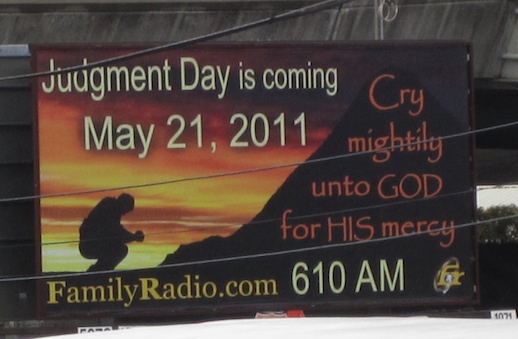
>>3. PEOPLE GET READY We were already getting all futsy about the looming 2012 presidential elections (Newt? Really?) when we caught sight of this new, impending apocalypse billboard from the windows of the heathen SFBG offices. No way, May 21st, 2011 is Judgement Day? This 4/20 we can cheef like there’s no tomorrow — and mean it! P.S., proceed with caution to the website indicated by billboard ‘o doom, unless you have a mind for a good old-fashioned San Francisco: Sodom screed. 

Oh, and for all you faux-Mayan maniacs (and disaster flick addicts) who though 2012 was our expiration date? Um, suck it

>>4. STRATEGIZE WITH ME Here’s a smooth new clip from up-and-coming local rapper DaVinci:

>>5. GUSTON IN THE WIND The publication of local poet and rascal Patrick James Dunagan’s first book There Are People Who Say That Writers Shouldn’t Talk: A GUSTONBOOK is proving to be timely. It can function as a discursive counterpoint to University of California Press’s expansive and just-issued Philip Guston: Collected Writings, Lectures, and Conversations. Also, on March 14, Dunagan is joining Guston’s friends and collaborators Bill Berkson and Clark Coolidge for “Philip Guston: A Life Lived + Discussed,” a program at the Balboa Theatre that includes discussion and a screening of Michael Blackwood’s 1981 documentary Philip Guston: A Life Lived, which is narrated by the artist himself. 

(Poetic trivia alert: the evening’s bookstore-record store sponsor,Bird & Beckett, has a little thing in common – namely, the initials BB – with 2008 Goldie winner Berkson.)

American Idol: The boys bring it

1

I’m not taking it all back (yet) cuz I still think all the tears and drama are stupid, but Ihave to say: the guys brought it last night. Not a single contestant truly sucked (except Jordan, who almost truly sucked, but he’s a jerk anyway). Some were absolutely spectacular. Doing Screamin’ Jay Hawkins on Idol is nuts, so much could go wrong — but Casey Abrams pulled of “I Put A Spell On You” in a way that seemed almost impossibly brilliant. I thought Steven Tyler was going to melt into a puddle, he was so blown away. Jennifer Lopez said he was sexy, which should pretty much leave him set for life. I loved Paul McDonald singing Maggie May. Good song selections everywhere. Tonight: The girls.    

Noise Pop Live Shots: robbinschilds at SF MOMA, 02/24/2011

0

The fact that there was a dance performance going on as part of the annual music festival Noise Pop, was unique in and of itself, but then it was happening at the SF MOMA, and I knew I had to go check it out.

The dance group robbinschilds is a pop-color-clad duo who mix video, dance, live music, and even a little sumo-wrestling, to create experimental performances that also use the specific space where they’re happening, in this case, the SF MOMA. So at one point, there were just videos up on three walls, then the dancers were passing a huge rainbow tassel between levels of galleries, and then they were right in front of us, stripping off their clothes and gyrating uncontrollably. They were backed by a live Seattle noise band called Kinski, that was well, very noisy.

There was a second dance show at the MOMA that was a presentation by Russian artist Anna Parkina, who is also having a collage show upstairs in the galleries. Her piece was a mixture of paper cutting and movement, using projections of the collages she has made and moving human sculptures to create a living art piece.

Both dance shows were completely unique, and I like that Noise Pop is venturing beyond music and collaborating with a variety of artists to bring us odd and wonderful shows, like these two.

Editorial: The mayor’s race: beyond compromise

0


The litmus test issue: Either you’re for public power and against Pacific Gas and Electric Co., or you’re opposed, weak, or ducking — all of which put you in PG&E’s camp.

The race for mayor is now fully underway, with eight candidates declared — and at least four are fighting for the progressive vote. It’s a remarkably open field — and the fact that there’s no clear frontrunner, no candidate whose money is dominating the election, no Willie Brown or Gavin Newsom, is the result of two critical progressive reforms: public financing and ranked-choice voting.

In fact, those two measures — promoted by the progressive, district-elected supervisors — have transformed the electoral process in San Francisco and undermined, if only somewhat, downtown’s control.

As Steven T. Jones points out on page 11, the leading candidates are all sounding similar, vague themes. They all say the city can work better when we all work together. That’s a nice platitude, but it reminds us too much of President Obama’s promise to seek bipartisan consensus, and it’s likely to lead to the same result.

On the big issues, the Republicans don’t want to work with the president, and big downtown businesses, developers, and landlords don’t want to work with the progressives. In the end, on some key issues, there’s going to be a battle, and candidates for mayor need to let us know, soon, which side they’re going to be on.

Sup. David Chiu, who entered the race Feb. 28, may have the hardest job: he actually has to help balance the city budget. As board president, he’ll be involved in the negotiations with the Mayor’s Office and the final product will almost certainly carry his imprimatur. It’s unlikely the progressives on the board will agree with the mayor on cuts; it’s much more likely that some will seek revenue enhancements as an alternative. Whatever Chiu does, he’ll be on the record with a visible statement of his budget priorities.

We’d like to hear those priorities now, instead of waiting until June. But either way, the remaining candidates, particularly those who want progressive and neighborhood support, need to start taking positions, now. What in the city budget should be cut? What new revenue should be part of the solution? What, specifically, do you support in terms of pension reform? How would you, as mayor, deal with the budget crisis?

Every major candidate in the race has enough familiarity with city finance to answer those questions. None should be allowed to duck or resort to empty rhetoric about everyone working together.

The same goes for community choice aggregation and public power. There is no consensus here, and will never be. Either you’re for public power and against Pacific Gas and Electric Co., or you’re opposed, weak, or ducking — all of which put you in PG&E’s camp.

There are many more issues (condo conversions, tax breaks for big corporations, housing development, help for small business, etc.) on which there has never been, and likely never will be, agreement. The people who make money building new condos will never accept a law mandating that 50 percent of all new housing be affordable (although the city’s own Master Plan sets that as a goal). The landlords will never accept more limits on evictions and condo conversions.

We’re all for working together and seeking shared solutions, but the next mayor needs to be able to go beyond that. When the powerful interests refuse to bend, are you ready to fight them?


Messages to the next police chief

While researching Tasers in the wake of last week’s police commission hearing, I came upon an online series published while the city of San Jose was considering candidates for police chief. Created by Silicon Valley De-Bug as part of an effort with San Jose’s Coalition for Justice and Accountability, the project featured the messages of people who wished to share their personal stories with the next top cop. Each week leading up to the selection of the new chief, the group posted another “Message to the Next Police Chief.”

One video featured Art Calderon, whose 68-year old father was beaten by San Jose police, addressing how officers could improve their relationship with the Latino community. A young homeless person weighed in on their interactions with the police. Another contributor wrote that he was bipolar and wanted the next chief to train officers to be sensitive to people with mental-health issues, since he was slammed against a squad car once while delusional.

Raj Jayadev, director of Silicon Valley De-Bug, told the Guardian that the project also included surveying 3,000 community members in three different languages, and organizing seven community forums to generate input from communities of color on what qualities and characteristics they hoped to see in the next chief. When the former chief retired, “We knew for sure that we were standing at this really historic moment,” Jayadev said. “We wanted to get as much community input as possible.” The coalition was motivated to improve relations between police and communities of color in San Jose amid a history of fatal officer-involved shootings, accidental deaths following deployment of Tasers, and disturbing accounts of excessive use of force, particularly against young people of color.

The group focused their questions on three “hot-button issues,” Jayadev said, including use of force, racial profiling, and concern surrounding police cooperation with federal immigration authorities. Based on a review of the survey responses, the coalition generated a list of six tenets they hoped would guide the selection process for the new police chief.

San Jose Police Chief Chris Moore, who was sworn in last week, wasn’t DeBug’s first choice, Jayadev said. However, Moore has met with the Coalition for Justice and Accountability and plans to sit down with them a second time. Although the community lacked decision-making power, Jayadev noted, thanks to De-Bug’s project “there’s going to be clarity on what the community wants.”

Meanwhile, San Francisco is undergoing its own process of selecting a new police chief, and the San Francisco Police Commission is expected to submit the names of up to three applicants to Mayor Ed Lee by March 15. The process is overshadowed by the mayor’s race, since a newly elected mayor could opt to initiate a new candidate search if he or she isn’t satisfied with Lee’s pick.

That uncertainty hasn’t discouraged the 75 hopefuls who reportedly submitted applications. Police Commission Secretary Lt. Tim Falvey told the Guardian that the number of candidates under consideration was recently whittled down to 25, but he declined to say how many candidates were to be interviewed by commissioners. Nor would he say when the interviews were taking place, or where they were being held.

Meanwhile, the San Francisco Police Commission held three community meetings in February to garner community input on the selection of the next chief, with three commissioners present at each forum. Asked if there were any notes, recordings, or other documentation of those meetings available, Falvey said nothing like that was required since they weren’t official commission meetings. “I don’t know if [commissioners] just took mental notes, or maybe they took notes for themselves, but that’s not something I have here,” he said.

Falvey said the turnout ranged from 25 to 45 people at the three meetings, which were held at the United Irish Cultural Center on 45th Avenue, the Southeast Community Facility in the Bayview, and the San Francisco LGBT Center in the Castro. “A lot of people wanted a track record in community policing,” Falvey noted when asked what points came up repeatedly during the community forums. Another common issue was improved relations with the nightlife and entertainment industry, he said.

At the end of the day, the choice lies with the police commissioners — four of whom were appointees of former Mayor Gavin Newsom — and of course, Mayor Lee.

Falvey said that candidates had expressed concern that they did not want their names publicized, and that every effort was being made to keep the applicants’ identities secret until Mayor Lee makes his final announcement.

What do San Francisco community members want in a new police chief? And in the end, how much will their opinions matter?

Why does anyone still trust PG&E?

31

The Bay Citizen’s got a good report on how PG&E cobbled together the San Bruno gas pipe out of bits and pieces of whatever was around, and a nice liveblog of the NTSB hearing on the explosion. The message is pretty clear: PG&E is utterly unreliable, can’t keep track of its own records, doesn’t know what’s in its own system, can’t figure out why it doesn’t know what’s where and is still stumbling over the next steps:


11:59 a.m. PG&E’s Fassett: PG&E realizes it must “look further” into the manufacturing processes of “vintage” pipelines, such as the 1940s and 1950s segments of pipeline that ruptured beneath San Bruno


Um, and why hasn’t that process started already?


Look: This is a company that delivers natural gas through pipes that officials there must have known were old, of dubious quality (esp. the ones from the immediate post-War era) and dangerous. Yet nothing’s been done about it. There are more San Bruno’s out there — and even PG&E doesn’t know where.


This isn’t just corporate self-interest and greed. It’s utter, obvious, blatant incompetence. 


I remember an old joke that former Sup. Bill Maher — and avid PG&E ally — once told about public power. If the city runs the electrical system, he said, “when I hit the light switch my toilet will flush.” Ho ho ho. How about: Next time you turn on your stove, the entire street will blow up, killing 8 of your neighbors? Because that’s the level of buffoonery we’re talking about here.


It’s worth noting the Palo Alto — a city, a government agency — runs its own gas and electric utility, and not only do the pipes not explode, the system wins awards for safety and replaces its pipes well before the end of their projected lifespan. Palo Alto — a city, a government agency — knows what’s under its streets. The efficient private-sector company called PG&E can’t find its own files.


So you have to wonder why Mayor Ed Lee is still saying that it’s a bad idea to get rid of PG&E. Why, at this point, would anyone trust this bunch of idiots? How could any public power agency possibly be worse run? It’s not even an argument any more; PG&E has demonstrated that the private sector can be both greedy, corrupt AND an operational failure. The sooner they’re out of San Francisco, the better.