SFBG Blogs

American Idol: Carole King edition

4

I wasn’t sure about this one. I’m not a big Carole King fan — too much pop, not enough edge — and I didn’t see how my favorites, Scotty and James, were going to pull it off. I expected schmaltz and ’70s-teenybopper drooling (and trust me, the ’70s teenyboppers are getting plenty old enough to drool.)

It started out just as I feared: Jacob did “Oh No, Not My Baby,” and while he gets points for his spankin’ bow tie, and the judges liked it, I got bored halfway through. Ugh. Sap. Time for another drink; this is going to be a long night.

And just to make things worse, out comes (yep!) Miley Cyrus, the queen of teen sugar pop, to help “coach” Lauren through “Where You Lead.” A good song for her, not a good song for me, probably enough to keep her alive one more week. That’s about it, though.

And then a break for a Haley and Casey duet of “I Feel the Earth Move.” It’s a little tricky doing these songs when both of the two remaining girls are 16 years old; I think even Casey was a bit unnerved singing about orgasms with a high-school kid. But they did fine, I guess.

Then Scotty. “You Got A Friend.” He’s still a country guy and it’s hard for him to get out of his element, but he’s so far above most of the rest of the class that he shines at almost anything. He did that song as well as it can be done.

And at last, James. Didn’t know you could turn “Will You Still Love Me Tomorrow” into an awesome rock anthem. Amazing. (Steven Tyler: “That was the first song I ever made out with a girl to. In a bowling alley. And no, Jennifer, I didn’t strike out.”) The only really stunning performance of the night. I’m starting to think we’ve found our finalist; nobody else right now is even close.

Scotty and Lauren did a duet of “Up On the Roof,” kind of a snooze. Casey hit it hard with “Hi-De-Ho” and the jazzy blues thing suits him well. Very cool, good entertainment. (Steven: “That made my scalp itch, it was so good.”)  Haley closed out with “Beautiful,” and yeah, she’s got a great voice, but she’s just not ready for the big time. Not yet.

We’re down to the end here, and the final three are going to be James, Casey, and Scotty. Jacob goes home tonight. Nice guy, nice run, he’s given it all he has. But it’s over. James Durbin is the next American Idol. You read it here first.  

You, too, can run the Rec-Park department

1

At least, this Craigslist ad suggests you can. It doesn’t sound like Mayor Ed Lee wrote it himself:


For the past several years the Department of Recreation and Parks has been recognized as leader in the development of innovative programs to prevent the public from enjoying either recreation or parks. However, in a time of increasing budget shortfalls and political uncertainty, new directions must be found to preserve our civic treasures from our civic body.

Several recent initiatives, including privatization of parks, closing recreation centers, and placing advertising on every available public surface, have failed to keep people from going outdoors for free. We need bold ideas.

The qualified candidate will:

· Own a stun gun
· Possess strong ties to the business community
· Exhibit rudimentary math skills


And I can’t imagine who would have posted an ad like that. Certainly not some guy who threatened to barf in Dolores Park.


Blast rocks Marrakech tourist restaurant: live report

4

Chaos here on the giant, tourist-packed Djemaa El Fna square in Marrakech, Morocco as an explosion has just rocked the Argana terrace restaurant two stories above the square at around noon local time.

We’ve seen apparent evidence of casualities being pulled from the wreckage of the dining room. A Reuters photographer has found out from the police that the source was gas, specifically reserve cannisters stored along the staircase (also, everyone here smokes a lot). Al Jazeera is reporting this now — as well as 10 dead. If we learn more we will update this post.

A previous large explosion at a Moroccan tourist cafe occurred in Casablanca in 2003, part of a series of Islamist suicide bombings that left 45 people dead.

UPDATE 1:56 p.m. local time: AP is now reporting 14 dead and word is still going around that the cause was a gas canister explosion, although AP is also reporting that the explosion resulted from a “concentration of gas in the basement” and that the state news agency MAP quotes an Moroccan interior ministry statement calling the explosion a “criminal act.” This raises concern among some observants, because two weeks ago in response to public demonstrations, King Mohammed VI “pardoned or reduced the sentences of 190, mainly Salafi jihadist, prisoners — roughly one in 10 of the 2,000 or so people tried, sentenced and jailed after the Casablanca bombings” according to the New York Times.

Our own observation of the damage suggests that a basement explosion is questionable. Damage appears to be concentrated on the second level (and the third floor windows were blown out), yet hawkers’ stalls on the square near the first floor seemed undamaged, although we were unable to get too close to the building. Also, the building itself is still standing.

Whatever the cause, after the concussive blast the scene itself was incredibly grisly, with injured staff and patrons, some visibly dismembered, being removed on yellow tablecloths or curtains, bodies strewn over railings, and members of the public frantically gesturing from the blackened terrace for assistance. Beams and sections of roofing were dangling from above the terrace, and crowds below watched helplessly until a fleet of ambulances tore through the packed square. Locals attempted to assure foreigners who had made their way to Cyber Parc Arsat Moulay Abdeselam — the city’s public wi-fi hotspot and rare green space — of their nation’s safety for tourism and lack of terrorist violence. 

UPDATE 7:15 p.m. local time: A tense and eventful day here in Marrakesh, as much of the Djemaa el Fna — usually writhing with snake charmers, storytellers, Berber musicians, and juice vendors — has been cordoned off by police for the blast investigation. A largely Moroccan crowd gathered to watch in silence; the tourists (a group of Welsh charity hitchhikers at our hotel, for example) mostly seemed to hole up in their hotels and share stories of near-misses and might-have-beens.

The word on the “Arab street” — literally, as we ate shwarma on Rue Bab Agnaou — veered from gas canisters as a cause to a basement water heater to a bomb. The Moroccan government is now officially investigating it as a bomb attack, but is stopping short from calling it terrorism. The death toll is now at 15, and the square is lined with police anti-riot vehicles. Shops remain open in the souks but the mood is somber, and even the more aggressive street vendors have dialed back their hustle, offering supportive words and plentiful information.

Both Al Qaeda in the Islamic Maghreb and the Polisario Front, which seeks to drive Morocco out of Western Sahara, are on the list of initial suspects in the explosion. Should the blast prove to be a terrorist bombing, it would be “the largest in Morocco since 2003, when 12 suicide bombers attacked five targets in Casablanca, killing 33 people,” the New York Times says in an article on the explosion. The King has promised a full investigation, as well as to pay for burial of the dead, according to the official Moroccan MAP news agency.

UPDATE AND WRAP-UP, May 1, Madrid, SpainWith the bombing now being blamed on Al Qaeda in the Maghreb, and the victims of this heinous attack all identified, I wanted to answer some readers’ questions. David and I were about 200 meters from the Argana Cafe, at a locutorio (cyber cafe), when we heard the blast. We finished up quickly and walked out onto the square, where we saw the immediate aftermath. We had spent the previous nine days traveling all over Morocco (it’s huge and incredibly diverse) and talking to people. Although we sensed much frustration with the country’s economic situation, and even a little with its politics, we never felt threatened in any way. Even after the explosion, Moroccan life proved especially resilient — there’s just too many people, including tourists, and too much going on to stop everything in its tracks for long.  Below is my original report.

And the next chief is…yes, Suhr!

3

Mayor Ed Lee appointed a deeply emotional Captain Greg Suhr as Chief of the San Francisco Police Department during a swearing-in ceremony where the majority of folks were either elected officials, running for election, running each other’s electoral campaigns—or wearing SFPD uniforms.

And in the end it seemed that the choice may have been influenced by pressure from the powerful San Francisco Police Officers Association, judging from the comment Lee jokingly directed at SFPOA leader Gary Delagnes, saying, “Gary, it’s time to get quiet and go to work.”

Lee told a standing-room only crowd that when he returned from Hong Kong to San Francisco four months ago finding a new police chief was his top priority. And that initially it was suggested (Lee did not say by whom) that he leave the SFPD situation alone and allow an elected mayor to appoint the next Chief.

‘While I am an interim mayor, this is not an interim decision,” Lee told the crowd, signaling that while he may be out of office in January, Suhr may be here to stay as the city’s top cop.

“Today, I’ve chosen the best candidate,” Lee continued, thanking Acting Chief Jeff Godown for his work leading the SFPD since former Mayor Gavin Newsom made the shocking decision to appoint former Chief George Gascón as District Attorney.

But while Newsom’s move may have upset the apple cart in the D.A.’s race, it sure seems to be working out well for Suhr.

Describing Suhr as “a police and people’s Chief: and “a reformer from the inside out,” Lee ran through a long list of the new Chief’s contributions to the SFPD. These included Suhr’s 30 years of service, his climb through the ranks to become Captain of the Mission station, his gig as Captain of the San Francisco Public Utilities Commission in a Homeland Security capacity, and, since 2009, as Captain of the Bayview station.

Suhr began by saying he was “speechless.” Donning glasses to read a speech that he had prepared the night before, Suhr choked up when he talked of being “fourth-generation, born and raised in San Francisco.” Recovering his composure, Suhr smoothly changed gears, as he joked how his appointment therefore makes him “a local hire,”—an insider reference to Sup. John Avalos’ recently approved local hire legislation that Mayor Lee is helping enact citywide.

Suhr recalled how he started out as a rookie on the midnight shift in the Tenderloin in 1981. He thanked his family, his friends and his girlfriend Wendy. And then he asked for a moment of silence “ to honor the memory of all the brave officers who have given their lives in the line of duty.”

Lee reclaimed the podium long enough to jokingly ask Suhr  “to investigate the whereabouts of my birth certificate” as his first assignment as the new chief.

Then it was Board President David Chiu’s turn. Chiu described Suhr as someone, ”who knows our streets, walked the walk, and knows the beats, someone who we all feel confident will be able to bring the SFPD the reform that former Chief Godown, Chief Gascón and Chief Heather Fong initiated. “

San Francisco Superior Court Judge Katherine Feinstein, who is the daughter of Sen. Dianne Feinstein and the presiding judge of the Superior Court, recalled how she has known Suhr since the mid 1980s. “I have watched him as each of our careers have moved forward,” Feinstein said, noting how there were some “steps forward and some steps backward” and how, “there were those who thought this day would never come.” (Feinstein’s words were the only reference to some of the less sunny moments in Suhr’s long and distinguished career. These included his 2003 indictment as part of Fajitagate, an incident that involved off-duty officers, a bag of take-out food, a beer bottle and injuries sustained by two local residents. Suhr was cleared of wrongdoing the next year, but was reassigned by then Chief Heather Fong to the PUC position after an incident in 2005, in which a police officer was seriously injured at an anarchist protest, and videographer Josh Wolf was held in federal prison for 226 days after he refused to release unedited footage of the protest.)

Next up was D.A Gascón and his rooster-like shock of silver hair. Gascón noted that when he first came to San Francisco, in the summer of 2009, he had no allegiances to, and no prior knowledge of, people inside the SFPD.

“I looked at Greg Suhr and one of the things that impressed me is how he worked with and related to people,” Gascón said, explaining why he appointed Suhr as Bayview Captain “Not only has he exceeded all expectations he did an incredible job,” he said.

 Police Commission President Thomas Mazzucco said that in the 100 days since the Commission announced it was looking for a new chief, it became clear that Suhr has the support of SFPD’s rank-and-file.

Mazzuco noted that he met Suhr in high school. “I knew he could hold a ball,” Mazzuco added, noting that he subsequently became Suhr’s football coach, even though he is younger than Suhr. “What the Police Commission has brought to us is not only a native son but also a cop’s cop. It’s an honor to have him as his chief.”

And after the swearing-in, the sentiment among officers in blue appeared to be strongly in Suhr’s favor. Lt. Ken Lee of Central Station recalled how he and Suhr went through the police academy together about 30 years ago.

“We went to different assignments but we’ve maintained a friendship,” Lee said. “The moment I met him I liked him. He was a very stand-up person, and as a native San Franciscan like myself, you could tell he had strong ties to the city. He’s a hard worker, he’s very dedicated to what he does.”

Lt. Mario Delgadillo, also of Central Station, said Suhr hasn’t lost his connection to the street. “That also means a lot, when you have a boss who’s walking with you,” Delgadillo said.

Suhr takes over the SFPD as it’s grappling with the fallout from a recent spate of scandals, including videos that Public Defender Jeff Adachi released that appear to show police misconduct at residential hotels and that forced DA Gascón to hand over his investigation of this alleged police misconduct to the FBI. Asked during a media roundtable what his appointment means for Acting Chief Godown, Suhr said Godown has returned to being Assistant Chief of Operations, which was the post he held before Gascón, who recruited Godown from LAPD, was appointed DA.

In response to a question about his top priorities as police chief, Suhr noted, “When I sit down with the mayor this afternoon, the mayor’s going to tell me what his priorities are. My first priority will be blocking the door open on the 5th floor so that if you wanna come see me you can, like it used to be. Then I have to meet with the command staff and captains and get their take on where they think we are, where they think we’re moving forward best, and match that up against how I’ve seen from a position of Bayview, how that matches up. And then see if I can’t meet with different community groups, the different police employee groups and the command staff.”

He didn’t mince words when it came to indicating that SFPD officers are going to be asked to give back during upcoming budget negotiations
“I’m sure that there’s going to have to be adjustments and I look forward to working with a collaborative effort with the mayor and the board and the unions and the rank and file,” Suhr said. “When the economy’s been good we’ve benefited by it, and now that the economy has … gone the other way, to some extent I think that the officers are willing to give back to do whatever needs to be done to keep the city safe.”

So, how does Suhr think he differs from former Chief Gascón? 

”He has a gorgeous head of hair,” Suhr joked. “To put it in a sports analogy, he’s a quarterback shortstop guy, and I’m more of a catcher, lineman, linebacker kind of guy. But I admire him, I think he moved a lot of issues forward for the police department, and I look forward to continuing those initiatives and giving a few of them a shot in the arm that I think were beginning to wane a bit.”

Suhr also talked about how he has always wanted to become a police officer (a comment that suggests he’s not planning to use the Chief’s post as a stepping stone to the District Attorney’s Office).

”When I went into the police department. on Silver Avenue which is now Willie Brown Academy — that was the police academy back in 1991 when I came in — man, we looked at just the regular uniformed police officers with just stars in our eyes, because they were just the sharpest, classiest folks that we were aspiring to be,” Suhr said.

And he indicated that as Chief, he won’t tolerate dishonesty in the face of ongoing investigations into alleged police misconduct. ”The character of a police officer must be above reproach,” Suhr said. “And I think that the investigation will show what it ends up showing, but I don’t think that there’s a police officer in San Francisco that would want to have a dishonest cop and I’d be at the top of that list. So I want all my officers to be of character that is above reproach.

Asked if he welcome clarification around the duties of SFPD officers assigned to the FBI’s Joint Terrorism Taskforce, Suhr said he believed an examination of the wording of the FBI’s most recent memorandum of understanding (MOU) with the department was already under way.

“I believe that the MOU is being revisited,” Suhr said. “I have not been a part of that, but again I think we have a real good policy with regard to our intelligence gathering and that does supercede any ask of any other agency. The officers are bound by policies and procedures. And that policy was well thought out with tremendous community and group input years and years ago, from situations that have not since repeated themselves. I think a lot of people back then couldn’t believe they happened in the first place, but I think measures were well thought out and put in place to make sure we don’t have a problem again.”

And at the end of the day, Suhr expressed the hope that his tenure as Chief would endure long after the interim mayor is replaced by an elected mayor.

”I’m a native San Franciscan, and this is a dream come true,” he said. “It’s my first day. However this story ends, with a little bit of luck (raps on the wood tabletop) it’s not going to end today.”


SFBG Radio: Why are gas prices really so high?

2

What’s the real reason gas prices are so high? Our distinguished guests discuss after the jump.

HighGasPricesWhy by endorsements2010

Vote today for the next mayor

0

If elections were held today, who would be your top choice? Weigh in here at the Bay Guardian’s poll for the mayor’s race.

Hot sexy events: April 27-May 3

0

Hey there sexy, how’s life on the other side of the Intertubes? I wanna get real with some real questions in this week’s sexy events column. Don’t worry, it’s about you. Namely, we here at the SF of BG would like to know just what you feel is missing from sex coverage in this age of Aquarius (ha!) in which we live. Are you feeling like you have pressing sex ed questions that need answering? Are you wishing that there was more event coverage of the parties and perv-a-thons in our fair Sodom By the Bay?

See, we’re going through an evolution with our sex coverage, and though we’ve got some pretty hot and wild ideas up in our noggins, youse the readers are just that, and maybe you’re thinking something we missed. So how bout it – new voices, dildo reviews, heavy breathing monolouges? The Guardian’s mission is to be a voice for the community of San Francisco, so have at us. Um, our safe word is spelt. 


Erotic Reading Circle

Share your thoughts, air out those tired old insecurities – get real pervy with, whatever. The monthly Erotic Reading Circle at the Center for Sex and Culture provides a safe space for writers to share their bedroom-related materials. Carol Queen and Jen Cross of Writing Ourselves Whole facilitate the gathering, pretty much a must-do for any aspiring sex scribe. 

Weds/27 7:30 p.m., $5 suggested donation

Center for Sex and Culture 

1349 Mission, SF

www.sexandculture.org


Hot Draw

Unleash your wild, artistic side at these live drawing sessions – one need only peep the galleries on Mark I. Chester’s website to see that he doesn’t play when it comes to drawing dirty players. Kinky leathermen strut about for a crowd of strictly sketchy, strictly gay male artist scribblers.

Thurs/28 6:30-9:30 p.m., free

Mark I. Chester Studio

1229 Folsom, SF

(415) 621-6294

www.markichester.com


Art of Restraint

How would you like to be situated right in the center of a high-art, surround sound bondage performance? It’s all within your grasp, baby – this week’s Femina Potens event at Mission Control will string up local lovelies Fivestar and Madison Young, while adult film performers and submissives offering up chocolate-covered strawberries romp about. Does it sound too good to be true? Believe, child, believe. 

Sat/30 8 p.m.-3 a.m., $50-75

Mission Control 

www.missioncontrolsf.org


How Weird Street Faire

While not sexy per se, this fair sure is freaky: How Weird takes over a good portion of SoMa for stage upon stage of electronic ass-shaking, and community bonding. What community, you say? Bonding how, you ask? Well maybe just maybe that’s up to you, sailor. Head over in whatever state of disarray you like and get funky. 

Sun/1 noon- 8 p.m., $10 suggested donation

Howard and Second St., SF

www.howweird.org 


Kentucky Fried Woman’s Guilty Pleasures

You need this bucket of crispy, greasy, lip-smackin’ queers stripping down to their burlesque bundles like you need to watch your cholesterol intake. For reals, put down the trans fat. Instead, pop on over to Oakland’s Bench and Bar bar, and feast your eyes on the talents of Alotta Boutté, Scotty the Blue Bunny, and oh! So much more. Heart-stopping, in a good way. 

Sun/1 7:30-10:30 p.m., $10

Bench and Bar

510 17th St., Oakl.

(415) 374-1924

Facebook: Kentucky Fried Woman’s Guilty Pleasures 


“Finding and Maintaining a Happily Ever After: A Relationship Workshop for Lesbian Couples”

How do you make relationships last past the original courting period? Davina and Molly have married each other countless times in protest of unequal civil rights, and so they’re uniquely qualified (maybe) to talk about how to make matrimony mutually awesome (in and out of the bedroom).

Tues/3 6:30-8:30 p.m. $20-25 for singles $35-45 for pairs

Center for Sex and Culture 

1349 Mission, SF

www.sexandculture.org


Who’s your candidate for mayor? Vote today

188

If the mayor’s race were held today, who would be your top choice?


Free polls from Go2poll.com

Muni strike vote stems from “gigantic mistrust” of the MTA

7

At a time when public employee unions are being demonized, downsized, and degraded by conservatives and much of the general public, it was a bold gesture for Muni drivers to recently authorize their Transportation Workers Union Local 250A to defy city law and go on strike anyway. But following through on that threat and shutting down Muni may only turn the public even more strongly against that union.

Board of Supervisors President David Chiu said a Muni strike would be “a significant mistake” that he’s trying to avert, and City Attorney Dennis Herrera has issued a statement reminding the public and Muni workers that strikes are banned in the union contact and the City Charter and “we will take appropriate legal recourse.”

But the union’s Secretary-Treasurer Walter Scott told us the strike authorization vote was a result of the “gigantic mistrust” by Muni workers of their Municipal Transportation Agency bosses. “They wanted a strike authorization vote,” he said, which “shows that the membership is behind us” as union leaders negotiate a new contract in the wake of November’s Prop. G, which ended the union’s pay guarantees.

Among the recent factors that Scott said have led Muni workers to doubt that the agency is negotiating in good faith were the MTA’s unilateral decisions to withhold Health Care Trust Fund money that had gone to drivers in previous years and the new requirement that drivers bring in doctors’ notes if they call in sick, as well as the agency’s decision to hire public relations specialist Charlie Goodyear to publicize developments in the ongoing negotiations.

But Goodyear said those issues are diversions that haven’t been raised in the current negotiations, that the MTA was acting under authority it has under the charter, and that “we hope that the good work that’s been going on for five or six weeks continues” and the two sides reach an agreement on a new contract.

Scott also expressed hope that the two sides will reach a deal. “Nobody wants to strike, and we’re trying our damnedest to find a happy median in these negotiations,” he said.

As for the right of the drivers to strike, Scott agrees that the current contract prohibits it, but he noted that the contract expires on June 30 and that “on July 1, we have no contract. That’s went the legality [of a strike] comes into question.”

Herrera has noted that the City Charter also declares that “strikes by City employees are not in the public interest,” going on to note that “said employees shall be dismissed.” But Scott says Muni employees have already been so vilified by city officials and the local press that calling a strike wouldn’t hurt their standing with the public much more: “If I’m shot dead and someone stabs me, it doesn’t make that much of a difference.”

A new brand of fixie competition ramps up for Saturday

0

“We’re just trying to make it look pretty.” N8 Van Dyke, an SF illustrator, is posted up in the Marine Westar Services Bayview warehouse, unrolling wheatpaste designs on the concrete floor. In other corners of the building, burly men hustle about towing heavy boxes, performing mysterious, industrial functions. But we’re (I didn’t do any of the work, per se, but having watched the process for the better part of a half hour I feel entitled) involved in a different sort of badassery – creating ramps for what might be the biggest fixed gear competition like, ever: Saturday’s Red Bull Ride + Style.

“When the guys are riding their bikes on them,” Van Dyke tells me. “I want it to look Honey I Shrunk the Kids.” The artist, who has a penchant for drawing dark, somewhat tormented-looking chimps, was assigned to decorate a stacked freestyle structure that resembles a game of 52 card pick-up. Fresh from a trip to Kinko’s, he’s now plotting to paste his me-sized playing card designs all over the structure’s flat surfaces. 

N8 Van Dyke plays with his monkey

Also scattered throughout the warehouse is Aaron De La Cruz, swirling his signature black designs over another ramp, plus a brightly-colored monster spider by Arlo Eisenberg. There’s also a cooler full of beer and I guess other liquids, thoughtfully provided by Red Bull, which is sponsoring this boy’s club of extreme athleticism and creativity as part of the brand’s ongoing mission to promote heart-racing, energy drink-necessitating feats of daring, like downhill bike races through Brazilian favelas.

It would appear that this weekend’s competition is somewhat of a first. Jeremy Witek and Ryan Corrigan (the only one drinking a beer, what the hell guys), two BMX riders and ramp builders that are in charge of constructing the designs that the artists are decorating for Ride + Style, tell me that they’ve never heard of a fixie competition like this one. 

Van Dyke and Aaron De La Cruz talk shop behind the De La Cruz ramp-creation

Generally, fixie freestyle competitions, Witek and Corrigan tell me, are held at skate parks – but the ramps they’re building for Saturday are made specifically for fixed gears, an unusual specialization that provided them with an extra challenge — no one’s done these before. “It’s a learning process for us – it’s hard trying to figure out what they want,” Witek told me of the people at Red Bull that contracted them to build the pieces. “They don’t really know what they want.”

The contest is going down at Justin Herman Plaza, just across the street from Harry Bridges Plaza, where SF fixie riders can be seen practicing their endos and bunnyhops on most days. It’ll feature two categories of competition: track (a more common type of fixie contest) and freestyle. This is one of the two cities, after all (New York is the other one), where the bike messenger culture really took root, giving rise to the sport of fixed gear in the first place. 

Tools of the trade

To advise on the construction process, a bunch of fixie riders came out to Bayview to test out what the team was cooking up. Witek says they liked what they saw. “They’re extremely pumped,” he says. “They’re always stuck riding out at stranded skate parks. This is more than just a sport, you know – it’s a culture.”

“This is going to be a real eye-opener for the public, they’ll be able to see what fixed gears can really do,” he sums up. To get a sense before Saturday so you’re not all gawky, you could do worse than going here.


Red Bull Ride + Style

Sat/30 noon-4 p.m., free

Justin Herman Plaza

1 Market, SF

Facebook: Red Bull Ride + Style


Snap Sounds: PJ Harvey

0

PJ HARVEY
Let England Shake
(Vagrant)

It’s not really a subtle couplet, “Weighted down with silent dead/ I fear our blood won’t rise again,” but with it the title track for PJ Harvey’s newest offering Let England Shake sets the stage for the songs to come. A surprisingly melodic exploration of the still reverberating effects of World War I on England’s shores and English mores, Let England Shake is both a call to arms and a plea to lay them down again. And despite its deliberate focus on atrocities past, the album can’t help but to implicate all current and future wars within its narrow rifle scope.

At the core of every song in the collection lies a degraded yet determined Britannia, plowed with “tanks and feet,” shot down, blown apart, bitter, bloodied, and bowed. Yet despite the ignominy, it’s a land that inspires almost absurd loyalty -— in the singer as well as the soldier. “I live and die through England,” Harevey confesses on the song “England,” as if she can’t quite believe it herself, “to you…I cling.” It’s hard to imagine an American rock star pledging allegiance to any state on that soul-baring level, and it’s part of what makes Let England Shake a fascination for an American listener. Its uniquely British nationalism, built on a foundation of grief, defies direct translation.

The instrumentation is a melancholic mélange of spare, driving percussion with plenty of cymbals, reined-in, jangling guitar riffs, an autoharp, subtle layers of piano, occasionally awkward brass, and a cornucopia of extras: a xylophone here, a zither there. On the album’s third song, “The Glorious Land,” the clarion call of a war bugle insinuates itself into the otherwise stripped-down drum and guitar track while Harvey’s clear voice swoops through, a flock of startled birds surrounded by the muck of war.

Harvey stretches her register to its upper limit on track six, “On Battleship Hill,” leaving all traces of her trademark low gravel behind with a clarion call of her own. On songs such as “The Last Living Rose” and “In the Dark Places,” Harvey drapes herself not only in her flag but in soldier’s drag, evoking the hopeless trenches and “damned mountains” as if observing them first-hand. The album is not without flaws, a seemingly random sampling of Niney the Observer’s roots-reggae jam “Blood and Fire” on “Written on the Forehead” does the original no justice, and the sing-song quality of “England” jars somewhat after the considerably more powerful “On Battleship Hill,” but overall, Let England Shake stands out as a cohesive ode to a complicated love.

PJ Harvey, “Let England Shake” (from Let England Shake):

Earth Day in City Hall … on Wells Fargo’s dime

Who was lucky enough to get treated to Mayor Ed Lee’s Earth Day Breakfast in City Hall, with the city’s top politicos and a smattering of high-profile San Franciscans? After noticing that the Board of Supervisors had approved a grant of $12,000 from Wells Fargo a few weeks ago to sponsor the event, the Guardian contacted the Mayor’s Office to ask for the guest list. The response came from the city’s Department of the Environment, which accepted the donation and organized the affair.

The 472-person invite list (we don’t know how many actually attended) included prominent figures such as Sens. Barbara Boxer and Dianne Feinstein, Rep. Nancy Pelosi, billionaire investor Warren Hellman, and former San Francisco Mayor Willie Brown. All 11 members of the Board of Supervisors were invited, too, as were mayoral hopefuls City Attorney Dennis Herrera, Assessor-Recorder Phil Ting, and state Sen. Leland Yee.
 
Invitations were extended to some truly green organizations, too, such as Green for All, Save the Bay, Rainforest Action Network, the Ella Baker Center for Human Rights, the Sierra Club, the Apollo Alliance, Greenaction, and others.

And many seats were reserved for the corporate sector. A total of nine representatives of Pacific Gas & Electric Co. were on the list. There were seven from Cisco, several from consulting and design firm CH2MHill, and a couple representatives from Skidmore, Owings & Merrill — the firm that’s doing the Parkmerced overhaul and which was tapped to envision waterfront venues for the America’s Cup. 

Seven representatives — including the CEO — were invited from Recology, which is in the midst of a debate over its high-stakes, $275 million no-bid garbage contract with the city.

According to Mark Westlund of the Department of the Environment, only half of the Wells Fargo grant went toward the mayor’s Earth Day Breakfast, “the remainder to a series of community events held in the Department’s EcoCenter lobby.” The other sponsors included Blue Shield of California ($2,000); CH2MHill; Skidmore, Owings & Merrill; United Airlines; Environmental Science Associates ($4,000); Levi Strauss & Co.; Cisco ($6,000) and Starbucks — which provided BPA-free travel mugs (double green points!).

It’s nice that San Francisco taxpayers didn’t have to shell out the $18,000 for all these people to celebrate Earth Day together. But at an event such as this, with so many millions of dollars in city contracts and major development projects flying around (not to mention the half a dozen or so people in need of campaign contributions), you can bet they weren’t all talking to one another about saving the planet.

In the gutter with King Baldwin: Bowling with Alexander Eccles and Gabe Turow

0

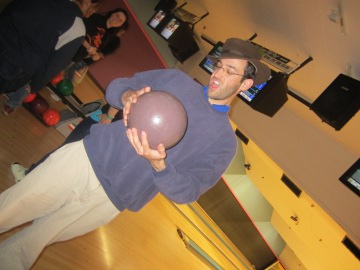
“It’s $40 for one game with shoes. Or, $38 for one hour and shoes,” says the Serra Bowl cashier with mild frustration while he Lysols a pair of freshly-worn bowling shoes at the counter. Gabe Turow, percussion, keys, and back-up vocals for the chamber pop-turned-funk duo King Baldwin, turns to me, perplexed. Which is the better deal? Off to the side, Alexander Eccles, lead vocalist of the San Francisco-based duo, sits comfortably in a plastic chair, wearing his brown “bowling hat” slightly askew. Turow and I deliberate. We opt for the hourly rate.

As I tie the frayed green laces of my black-and-red, slightly damp rented bowling shoes, I begin to wish that King Baldwin and I had chit-chatted about the self-released LP Music For Unsafe Sex over coffee.

It’s off to lane five. I’m the first to bowl. My pink eight-pound bowling ball ricochets off the lane’s side rail and knocks down one pin. Eccles is next up, so I turn to Turow to ask how King Baldwin got its moniker.

“Alex is King Baldwin. The persona is captured in many, many YouTube videos at this point. Some of them of which, I mean, he takes his shirt off in some of them,” says Turow, laughing. “Each track [on Music for Unsafe Sex] is written from a different person’s point of view, but it’s all clearly King Baldwin fantasizing about what it would be like to actually have a life.”

Music With Unsafe Sex begins with “Ron Jeremy,” named after the iconic porn star. On this track, Eccles sings, “When I come to town/ All the horses scream/ With envy/ I don’t care baby I just do/ I’m Ron Jeremy,” against a sleazy funk groove.

“Every song on the album is encouraging sex in some way or another. It’s either foreplay or, like, decent doing it,” Turow explains as he approaches the lane.

It’s the end of the second frame. The score: Jen, 14; Alex, 9; Gabe, 11.

Completely written, recorded, and produced by Turow and Eccles, Music For Unsafe Sex is a departure from King Baldwin’s five-song 2009 debut, and its six-song 2010 release, Castle of Love. In the group’s previous recordings, Eccles, a classically trained pianist, took more of a Talking Heads/David Bowie approach to the songs he composed. “Musically, there were a couple of things I had written that had come off as romantic or more feminine. Let’s just put it this way — not very cool in any kind of rock way. So [Turow] sort of helped get a sense of groove in there,” he says.

After five frames, the score is: Jen, 34; Alex, 24; Gabe, 24.

“[Music for Unsafe Sex] was the first time I’d ever revised lyrics and done so with anyone else,“ Eccles recalls, bending his knees as he readies himself to bowl.

“These songs are like narratives, which is nice, because before they were about nothing,” he adds with sarcasm.

As the ’80s hit “Forever Young” by one-hit-wonder Alphaville blares in the background, Eccles gets a running start while he approaches the lane. Turow and I notice he’s using his left hand. He assures us that he is ambidextrous. The ball travels down the lane at roughly 8 mph. Gutter ball.

Before Turow takes his turn, he talks about Music for Unsafe Sex’s funk influence. “There are a lot of grooves. When they are grooves, they put you in a certain place and then try to hold you there.” As is the case with “Secretary,” where Eccles sings, “You don’t need protection cuz the market’s up/ And we know what happens next/ Oh my secretary! Get away from it all/ I have a wife and family/ I also have my secretary.”

In between turns, Turow finds a magenta-colored ball with five finger holes, seemingly engineered for an alien species with seven digits.”There’s something wrong with this ball! There is something really wrong with this ball,” he blurts out.

By the ninth frame, none of us have broken 100.

Music for Unsafe Sex‘s last track, “Muse,” is a melancholic slow jam of disillusionment — far different from the preceding songs of male hypersexuality. “All of that masculinity and sexuality that we were sort of playing with in the first eight [songs] is basically tongue-in-cheek, and at the end of the day I am not the most masculine or sexy person. I’m just not,” Eccles says with seriousness. “Gabe and I both knew that, so we figured it’s sort of a reveal at the end.”

By the tenth frame, Eccles, who is a part-time golf coach, knocks down nine pins with one ball. “I know how to do it now. You stand there. You roll your arm back and forth like a golf swing, then you make the golf swing. No running. No running.” 

Appetite: Island bites, part three

0

After a dreamy week in Hawaii, I have a slew of recommendations to share with you in a multi-part series. In part one, I covered farmers market street food in Oahu. In part two, Honolulu’s cocktail scene. Now we dine in Honolulu, on the hunt for the best. (Next up, Kauai.)


THE SPENDY

Sushi Sasabune:

Starting off with a bang, the first course was Canadian albacore sashimi in miso. All photos by Virginia Miller

Though Honolulu’s Sasabune is related to the restaurant by the same name in LA, I had a superior experience here in Hawaii – probably due to the fact that I went whole hog here and ordered the 13 course omakase menu. It’s around $120 per person at lunch and costs over $200 for the same menu at dinner.

Lunch is peaceful – only the hardcore patronize Sasbune during the daytime hours. The restaurant’s decor is humble and pleasant with classic jazz playing.

13 courses really means over 20 varied bites as many courses include two different pieces of nigiri. You can spend less by stopping before your 13 courses have been brought out – just give the sushi chefs a few minutes’ warning, they prep a course or two ahead. 

Though I was stuffed around course nine, I couldn’t bring myself to tell them to stop, such was my desire to see what they would serve me next. Everything was impeccably fresh and expertly prepared — one of the best sushi meals of my life.


The Royal Hawaiian Hotel’s Azure:

Azure’s butter-poached filet of Wagyu beef

Island spirit and urban sophistication reign at Azure, one of the newer, hotter restaurants in Waikiki. It’s dinner companion is the magical Mai Tai Bar, which sits just outside its front door. 

I sat at a cabana-covered area on the sand amid ocean breezes, sipping from the well-chosen wine list. The a la carte menu is pricey ($12-29 for appetizers, $35-60 for entrees), making the ‘steal’ the five-course, $69 tasting menu – it only costs an additional $20 for wine pairings.

My tasting menu included a sashimi starter of Hawaiian yellowtail ahi and Japanese hamachi over an avocado and watermelon radish salad. Ginger syrup and a hint of lemongrass enhance the dish’s Asian spirit. A 2009 Crios de Susana Balbo malbec rose made for a refreshing pairing.

The second course was the strongest: the ocean cappuccino, a creamy bouillabaisse with chunks of Dungeness crab, black tiger shrimp, and potato, accented by Thai basil. Another highlight was an intermezzo between third and fourth courses, a lemon basil sorbet infused with pop rocks.

Third course was the Kona lobster tail risotto. Though I adore lobster tail, the risotto was not on par with the silky texture I expect from a Italian risotto.

Fourth course was butter-poached filet of Wagyu beef. The sweetness of Madeira and brandy played off the earthiness of taro and black truffle in the sauces. The presentation of the dish was striking: crowned with a fried duck egg, it came out under glass cover, smoke swirling inside.

For dessert we had local Kula strawberries and fior di latte cheese ice cream drizzled in balsamic and cinnamon syrup. A clean, straightforward finish.


Hiroshi:

Luxurious miso butterfish at Hiroshi

Our experience turned out to be a mixed bag at Hiroshi: despite the sweetest hosts at the door, our waiter was lackluster and disinterested. No explanation of dishes were offered until we asked for them. The other downside? A corporate, bland decor that lacks warmth or even casual sophistication. 

I’m keeping it on my recommendation list for one reason alone: chef Hiroshi Fukui’s creative food. A fish fanatic, he catches some of the menu’s offerings himself.

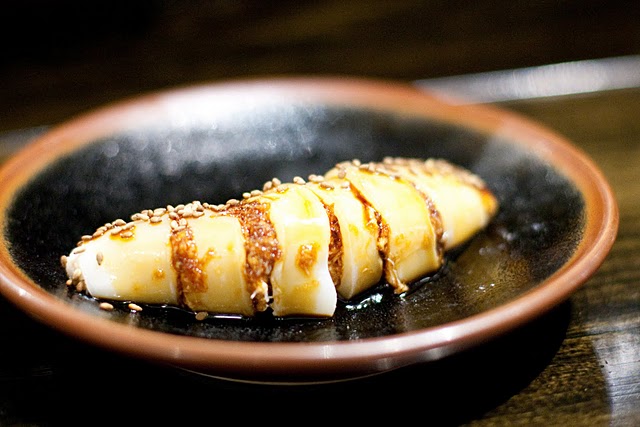
Fukui’s foie gras sushi ($10.50) was as decadent as it sounds: two nigiri pieces topped with lush foie gras and drizzled with a teriyaki-shiso glaze. Portuguese sausage potstickers ($9) came surrounded by sweet corn and tatsoi (rosette bok choy) with a kimchee foam that I wish had tasted more like kimchee.

Another stand-out was the miso yaki butterfish ($14.50). The small serving of butterfish melts and lingers like a luxurious dream, brightened with lemon ume gelee. Chef Hiroshi shows off his deft hand with a crispy skin New Zealand snapper ($24.95). The fish flakes beautifully in a tomato-hijiki (brown sea vegetable) broth. Tofu, fennel, edamame, and local Kahuku corn round out the platter. Try to ignore the service as you savor some of the more imaginative dishes and impeccable fish preparation in Honolulu.


THE MID-RANGE

Side Street Inn:

Prepare ye for gigantic plates of family-style Hawaiian food. Side Street Inn has two locations and both are packed with locals gorging on mountains of meat. Given the size of the plates ($11-15 for your average dish, $17-26 for steak/beef and pork entrees), eating here can be a steal. Beware of over-ordering. 

You’ll leave happy after traditional dishes like fresh ahi poke tossed with Maui onions, signature pan-fried island pork chops ($22), or lilikoi-glazed baby back ribs ($17). 

The two most satisfying dishes out of the eight I tried? One was the straightforward, utterly comforting kim chee fried rice ($13), a mountain of rice laced with everything from Portuguese sausage to peas. Number two was the catch of the day, the opakapaka (Hawaiian pink snapper), a giant whole fish grilled in citrus and oil. Flaky and delicious, this was the more elegant of the otherwise hearty platters, and a fine example of local fish specialties. It’s easy to see why this is a local classic. But whatever you do, come starving.


Alan Wong’s Pineapple Room: 

The Pineapple Room’s superb Loco Moco

As my schedule sadly did not afford time for dinner at Alan Wong‘s signature restaurant, I made do with what I would knew would be a distant second, lunch at his more casual Pineapple Room inside the Macy’s at the Ala Moana Center.

The Pineapple Room threw me off with its mall setting and Denny’s-style diner place settings. They would have been fine if they fit the decor, but it was a discordant mix of vintage Hawaiian plantation with dated 70’s tableware. But casual is great as long as the food is good, and here the food is playful and generously-portioned, one dish often enough for two.

$15.75 is a lot for a rueben, but Wong’s is a big one. Too bad the reuben didn’t hold up to exemplary versions elsewhere, although the addition of kimchee is conceptually brilliant. The sandwich was dry and the pastrami decent but lackluster — a side of wasabi potato salad fared much better.

The popular stir-fried soybeans ($8.50) were likewise disappointing: a pile of beans soaked in sesame oil, garlic, and chilies. They sounded better than they tasted, missing the crisp snap and heat that could have made the dish addictive.

The dish that got me, however, was Wong’s updated version of classic Loco Moco ($18.50). Using quality Kuahiwi Ranch natural beef for the hamburger patty, it rested on fried rice in a veal jus, topped with two Peterson Farm fried eggs. This was a blue collar dish elevated to culinary heights.

Skip the cocktails – the passionfruit “mojito” ($12) sounded good, made with cachaca, basil, tarragon, and mint, but I could not taste any cachaca. Better to go with Wong’s house-made fountain sodas. At $6 a pop, they hold a lot more flavor. I loved the intense tart of the yuzu soda.


THE CHEAP

Char Hung Sut: 

Making manapua at Char Hung Sut

Dingy Char Hung Sut was among the best food of my entire Hawaiian trip. Chinese women and men rolled dough for pork buns and formed dumplings as friendly staff chatted me up while I ordered just about everything on the menu. For less than $5, I walked out with a bag full of dim sum from this humble, take-out only storefront. 

The sticky sweet half moon dumpling contrasted nicely with the savory manapua (local term for pork bun): among THE best pork buns I’ve ever tasted. Completely unique to traditional Chinese versions, these are Hawaiian-style pork buns. The filling’s dark pink color comes from marinating the pork with just a bit of saltpeter (stone salt) prior to slow roasting. Dumplings were equally exemplary. Order everything. You’ll leave happy.


Liliha Bakery:

Liliha Bakery is a dated bakeshop serving what is now legendary in Honolulu: Liliha Bakery’s Coco Puffs. I can’t say I get the craze exactly. Chocolate pudding filled mini-cream puffs aren’t exactly melt-in-your-mouth. The pastry is a little dry and thick pudding filling is decidedly old school. But more power to ’em.

Where they got me was with lilikoi (passion fruit) or haupia (coconut cream)-filled malasadas. These sugar-crusted, Portuguese donut-like pastries are perfection filled with either. I have been craving them ever since I left the islands.

–Subscribe to Virgina’s twice monthly newsletter, The Perfect Spot


Editorial: Reject the Treasure Island plan

1

After a long, long hearing April 21, as the San Francisco Planning Commission prepared to vote on an ambitious development plan for Treasure Island, Commissioner Gwyneth Borden acknowledged that the plan wasn’t perfect. But, she said, on balance it ought to be approved: “Twenty five percent affordable housing is better than zero percent.”

That’s not necessarily true.

Treasure Island is an usual piece of real estate, 403 acres of artificial land created in 1937 by dumping sand and dirt on a shallow part of the bay. It’s less than two miles from downtown San Francisco — but there’s no rail service, no BART station. The only way off the island is by boat — or by driving onto a Bay Bridge that’s already jammed way beyond capacity every morning and afternoon.

The soil is unstable, prone to liquefying in an earthquake — and if sea levels rise as high as some predictions suggest, the whole place could be underwater in a few decades.

A strange hybrid agency called the Treasure Island Development Authority, created by former Mayor Willie Brown, cut a deal with Lennar Urban (the same outfit that has the redevelopment deal for Bayview Hunters Point) and several partners to construct a neighborhood of some 19,000 people on the island. Among the features: a 450-foot condominium tower and 6,000 units of high-end housing. The developers brag that a fleet of new ferries will offer a 13-minute ride to the city and that some streets will be designed for pedestrians and bicycles.

But the fact remains that the developers want to add 19,000 new residents — almost all of whom will work off the island somewhere — to a place that has no credible transportation system. City studies show that even with an extensive (and costly) ferry service, at least half the new residents would drive cars to work (and, presumably, to shop, and go to movies, and eat and drink), joining the mob of vehicles heading east or west on the bridge. That’s almost 10,000 new cars each day trying to jam onto a roadway that can’t handle the existing traffic. The backups would stretch well onto San Francisco surface streets and as far back as Berkeley.

A rail line on the Bay Bridge would solve part of the problem. So would bike lanes. Neither option is even remotely possible in the foreseeable future. Free, or heavily subsidized ferries could, indeed, be a positive alternative — but who is going to pay for that service? Nonsubsidized ferries would be far more expensive than current Muni or BART service, a particular burden on the residents of the below-market housing.) And does anybody really think there’s going to be enough ferry capacity to carry 10,000 people a day to downtown SF, the East Bay, and the Peninsula?

The bottom line: this isn’t a good deal for San Francisco. The affordable housing level is too low. The transportation problems are nightmarish. The last thing Treasure Island needs is a 450-foot tower.

There’s no rush to approve this — and no immediate downside to waiting for a better deal. The supervisors should tell Lennar to come back with a project that has fewer residents, better transit options, and more affordable housing. Because zero is looking a lot better than what’s on the table.

PS: The 4-3 Planning Commission vote demonstrated exactly why it’s important to have key commission appointments split between the mayor and the Board of Supervisors. The mayoral appointees all rolled over — but at least the board-appointed members made strong points, forced real debate, and gave the supervisors plenty of ammunition to demand a better deal. *


Deadlock over Ma’s trash bill

0

A State Assembly committee deadlocked Monday over Assemblymember Fiona Ma’s AB 1178, which opponents say would make it easier for Recology to send San Francisco trash by train to Yuba County.

The bill seeks to ban local governments from restricting or limiting importation of garbage from outside the area, apart from enacting special fees.
“I don’t believe this is a special-interest bill,” Ma reportedly said before the vote. “I have 11 different counties in front of me that export waste to other areas.”

Assemblyman Jared Huffman, D-San Rafael, who voted against the bill, indicated that he was open to changing his vote, even as he said he didn’t like the idea of not allowing local governments to ban garbage from elsewhere.
“I’m a ‘no’ vote who’s open to becoming a ‘yes’ vote if the language is better,” Huffman said.

Yuba County Supervisor Roger Abe said Ma’s bill fails to protect current processes surrounding the use and oversight of landfills.
“AB 1178 makes me unsure whether planning notions will stand up in future with court actions,” Abe said.

Richard Paskowitz, who leads YUGAG (Yuba Group Against Gargage) went further. “It defines environmental injustice,” Paskowitz said, as he argued that Ma’s bill would makes it easier for wealthier areas to send trash to poorer areas.

The Performant: Sing like everyone’s listening

0

Electric Party Songs and The Darker Side of Broadway

However you feel (or don’t) about the Beat Generation, you have to give Allen Ginsberg credit for his ability to transcend the limitations of that motley crew, always pushing forward and outward in his beatific search for the sublime. Perhaps no other modern poet has better exemplified the endless fluctuations of the underground, and how to eternally roll along with them. Our own Holy Fool: queer Buddhist Jew, vagabond truth-seeker, and the King of May. In all the ways that count, Allen Ginsberg was, and will always be, America.

And America, like it or not, will always have an influence on the global arts arena, so it is perhaps not surprising that the small band of multinational artists who comprise the “open program” of the Italy-based Workcenter of Jerzy Growtowski and Thomas Richards have embraced America, and Ginsberg in particular, in their touring productions I am America and Electric Party Songs.

Using Ginsberg’s poetry as a catalyst, Electric Party Songs was developed with social gatherings in mind, mashed ecstatic texts with Southern spirituals, “Capitol Air” with call-and-response. 

Displaying a chummy familiarity despite the less-than-intimate setting of the SFMOMA lobby, the performers began by praising the creative energy of excess, first as a duet between Alejandro Rodriguez from Argentina, and Lloyd Bricken from Alabama, then quickly incorporating the eleven-person cast. Bursting with exuberance like Kerouac’s “fabulous yellow Roman candles,” they may have been dressed liked a runaway chorus line from a revival of Hair, but their intuitive chemistry was pure Digger. 

Eventually, in a manner that Ginsberg would undoubtedly have approved of, the gleeful club abandoned word-for-word renditions of his poetry, and moved into a set of African-American spirituals, a focal point of much of Workcenter’s current research. A moving rendition of “Adam in the Garden” found several performers mixed into the oddience, keeping time and murmuring response, while in the center of the polite circle, the song leader Alejandro romped and wriggled with Davide Curzio (Italy), giggling, entangled, pulsing outwards, pushing forward: all innocence. By the end of the set it was impossible to believe they haven’t been here with us all along, hovering genially at the edges of our consciousness, just like the spirituals and the venerable poet that gave their electric party its juice.

Belters, babes, and consummate showmen – and that’s just the production crew! If Boxcar Theatre’s tongue-in-cheek tour of The Darker Side of Broadway, a dizzying slew of doomed ditties sung by most of the cast and crew, was an indicator, their upcoming production of Little Shop of Horrors (which opens May 20) should be a rip-snorter.

Highlights included a heartfelt West Side Story duet between ensemble member Amy Lizardo and “Ronnette” Nikki Arias (“A Boy Like That”), a tense, downtempo “Pimp’s Tango” from Threepenny Opera, between John Lewis (who will play Seymour) and Bryn Laux (who will play Audrey), and a hilariously bawdy “Glitter and Gay” from Candide performed by assistant director Lauren Doucette. After a terrifically evil rendition of a Shockheaded Peter song from artistic director Nick Olivero, a smashing performance of “The Cell Block Tango” from Chicago brought down the house, leaving us with appetites whetted like Audrey II’s for fresh blood, with a side of campy cheese.


Challenging the “rogue cell” theory of cancer

0

The GuardianUK has an interesting piece about a new theory on cancer:
”Rather than cancers being rogue cells degenerating randomly into genetic chaos, they are better regarded as organized footsoldiers marching to the beat of an ancient drum, recapitulating a billion-year-old lifestyle,” writes Paul Davies, who runs the cancer research center at Arizona State University. “As cancer progresses in the body, so more and more of the ancestral core within the genetic toolkit is activated, replaying evolution’s story in reverse sequence. And each step confers a more malignant trait, making the oncologist’s job harder.”

SFBG Radio: Why privatization doesn’t work

1

Today, Johnny A. and Johnny V. talk about why privatization and outsourcing don’t work for local government. Tune in and check it out after the jump.

OutsourcingBlows by endorsements2010

Follow the pension reform money to Wisconsin

3

For those tracking pension reform, here’s a handy way to follow the money in Wisconsin, which arguably birthed a heated nationwide discussion about public workers’ collective bargaining rights: MapLight.org, a nonpartisan organization that tracks the influence of money in politics, has launched a new website that provides what it calls “transparency tools that show a simple dashboard view of money’s role in the Wisconsin State Legislature.”

“The goal of our Wisconsin site is to provide quick and easy access to information about campaign contributions, the interests of the groups that make them, and how the lawmakers that receive them vote, drawing back the curtain on how money influences legislation around the issues that people care most about,” said Daniel Newman, MapLight.org’s executive director.

This isn’t the first time that MapLight has tracked the money in key issues, but it is the first occasion that its engineers have combined three crucial databases—campaign contributions, legislative votes, and interest group support and opposition—to reveal the intersection between money and votes in the Wisconsin State Legislature.

“By centralizing data on contributions and votes, and combining that information with research on interest group bill support and opposition, MapLight.org will provide Wisconsin’s watchdogs with insights critical to the functioning of our democracy, in a fraction of the time it would take to otherwise assemble these facts from disparate sources,” said Andy Hall, executive director of the Wisconsin Center for Investigative Journalism.

Under an agreement with MapLight.org, the Wisconsin Center For Investigative Journalism will investigate money and politics issues and serve as a resource to news organizations in Wisconsin, supported with a grant from the Open Society Institute, which philanthropist George Soros founded in 1984.

MapLight.org’s data partner for campaign contributions is the Wisconsin Democracy Campaign. Mike McCabe, WDC’s executive director, said “This collaboration creates new opportunities for investigative journalism and citizen exploration of the impact of special interest money in Wisconsin politics”

One of the new website’s legislative data tools shows detailed records of bills, votes, legislators and interest group support and opposition. And the first example it provides is an analysis of, you guessed it,  JR1AB 11—“an act relating to state finances, collective bargaining for public employees, compensation and fringe benefits of public employees, the state civil service system, the medical assistance program, etc.
:
And so far, the analysis reveals that opponents of the bill, which include major unions, have spent $280,000, or 6.7 times as much as supporters, who spent $42,000 and include residential construction, general business advocates, Conservative/Republican groups and Chambers of Commerce.

Your world, in toothpicks

0

I rolled underneath the Rice A Roni cable car, dodged security at the Transamerica Pyramid, ricocheted down the curves of Lombard. Passing the Cliff House, I waved at the ocean, but all too soon I’m back by the dragons of Chinatown, still spinning. Oh hey, there’s the Palace of Fine Arts, enclosing the heart Tony Bennett left behind (there it is!). My tour ricocheted me by the windmills near Ocean Beach, and then I’m somersaulting (rapidly! picking up speed!) til I hit the Golden Gate Bridge, where Humphrey the Whale flipped me an appreciative hey-ho with his tail. Nearing the end of the journey, I hit Alcatraz en route to my resting place in Fleishhacker Pool. 

Oh, to be a ping pong ball in the thrall of Scott Weaver‘s universe.

Weaver is the father of “Rolling Through the Bay,” a towering testament to the romance of San Francisco now on view at the Exploratorium that has taken Weaver approximately 3,000 hours to complete. The epic video in which Weaver — a long time Bay resident whose great-grandpappy owned a vineyard a block from where the Transamerican Pyramid now stands — genially describes his work of art has scored the discovery museum big points with media outlets throughout the city (seriously, this video — this video is blog GOLD). 

The video proved so popular, in fact, that it spawned a follow-up focusing on the charismatic Weaver and the tricks of his trade themselves. Spoiler: his preferred toothpick brand to work with is Diamond.

The sculpture, Weaver estimates, is the third or fourth largest in the world, but the other guys don’t have the finely tuned kinetic features of his creation. Or, one imagines, the intricately worked personal references to the artist himself: Tony Bennett’s heart is made from toothpicks thrown at Weaver’s wedding. Golden Gate Park’s shubbery is partially composed of toothpicks Weaver has collected from around the world, including some bizarro ones from Morocco. Weaver’s built sculptures of his face into the wooden, pointy metropolis, and the toll booth on the Golden Gate Bridge proudly displays the time his son was born.

Anyways, major claps to the Exploratorium for putting the whole shebang on display. Kudos also to toothpicks for impeling me to revisit the Exploratorium website, which is totally chockful of ridiculously scientifical content like this

Click here to see a large-size image of the sculpture and revel in its majesty.

Scott Weaver’s “Rolling Through the Bay”

Through June 18

Exploratorium

3601 Lyon, SF

(415) 561-0363

www.exploratorium.edu


5 Things: April 25, 2011

0

>>TAKE BACK THE STREETS In Chiapas, small Zapatista towns will build DIY speed bumps on the freeways cutting through their community. Here in SF, we make our own bike lanes. Nicely done, Kingston and Guerrero, nicely done.

Look and listen

>>TRIANGULA The Alps’ next album after last year’s acclaimed Le Voyage includes striking design work by Tauba Auerbach — namely, a sleeve that can be folded out to form a sky-sided pyramid atop a landscape. Released by Mexican Summer, Easy Action finds core trio Jefre Cantu-Ledesma, Alexis Georgopolous, and Scott Hewicker collaborating in different ways from song to song, using collage techniques to reframe sounds from past recordings, including Le Voyage. The overall textures are more dissonant, with fuzzy-needle effects and distortion present on more than one track. 

>>MOMMY, HE’S SCARING US San Francisco’s latest YouTube sensation isn’t one of our outrageous performance artists or curbside curiosities. It’s Dr. Robert Lustig, a UCSF pediatric endocrinologist who wants to take away our candy. The opening salvo in Lustig’s journey to viral status was “Sugar: The Bitter Truth,” a dense, learned, 90-minute lecture dissecting the harmful effects of sugar on everything from our triceratops to our hermaphrodites — or was it our trigyclerides and hematocrits? The YouTube lecture was followed by a New York Times Magazine cover story by Gary Taubes on April 17 and an appearance on Forum with Michael Krasney on April 21. As of April 22, more than 1 million people have viewed the lecture, presumably after they polished off the cookies in their secret office drawer.

>>G.A.W.K. AND RAWK The Gay Artists and Writers Kollective is celebrating its 25th anniversary this Saturday at Magnet in the Castro. G.A.W.K. still rocks thanks to the efforts of Jon Sugar, who in addition to music and drag endeavors has helped assemble and emcee the gathering for queer rock performers, songwriters, actors, writers, and more. The bill for Saturday’s free anniversary celebration includes Bambi Lake, Jerry the Faerie, Xavier, Khalil Sullivan, the band Era Escape, and violinist Kippy Marks.

>>GUTS ‘N’ GLORY Having emerged on the other side of its first decade, the BYOBW (Bring Your Own Big Wheel) races yesterday on Sunday, April 17 seemed to be gathering speed, and swinging a can of Miller High Life about as they one-handedly swerved down the backside of Potrero Hill. The capacity crowd on Vermont street was well-pleased with their careening crusaders – even spectators inconvenienced by an airborne Michael Jackson on turn number two gave a lusty cheer when the King of Pop spun about nimbly and re-boarded. The Internet has nothing else on it today but video footage of the event, but here’s our fave shots from the day.

The glory:

And the fall (sorry buddy):