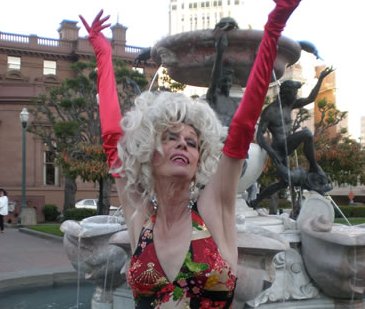
San Francisco lost true drag royalty today when Ms Vicki Marlane, “the Girl with the Liquid Spine” who performed with the weekend Hot Boxxx Girls revue at Aunt Charlie’s Lounge, passed away at 7:04 a.m. at San Francisco General Hospital. No official cause of death was immediately available, but her co-entertainer Gina la Divina said she “had been down for a while,” presumable meaning she had been ill. (This information was passed on to me this morning by Matt Slusarenko of Queerty.com, and he’s just posted his tribute.) From circus sideshow act in the 50s to drag road warrior in the swinging 70s — she lived a life, honey. That life was documented in a fantastic film released last year, “Forever’s Gonna Start Tonight.”
Besides enjoying her performances countless times, I had the pleasure of interviewing her for the Winter 2008 edition of our nightlife guide SCENE.
Vicki Marlane, seated third from left next to Gina La Divina. Photo by Matthew Reamer.
Everyone knows I’m a fan of taxing the rich and that I think most of the economic problems in our country have their roots in the growing inequality of the past few decades, so it should come as no surprise that I enjoyed the Cruickshank piece on Calitics. He’s got exactly the right idea: Tax reform that benefits the wealthy (or, in fact, tax reform that doesn’t force the wealthy to pay more) isn’t tax reform at all.
I was on a houseboat at Lake Shasta over the 4th of July, arguing with some very smart people about why the economy is so fucked up (yeah, for relaxation I go someplace beautiful — then sit around and talk about economic policy), and we covered a lot of ground. My friend the investment banker and corporate executive said that out-of-control CEO pay — and bonus payments for failure, and lack of corporate accountability — were a bit part of the problem. “If corporations succeed, then everyone — all the people who work there, at every level — ought to benefit,” he pointed out. True: In the early post-War era, labor union clout in major industries (automotive, for example) forced corporations to pay a decent middle-class wage — that is, to share the fruits of success with the workers. That’s all gone now. “Corporations don’t pay enough taxes,” my friend the corporate salesman said — and he’s right, too.
And all of us agreed that higher taxes won’t drive corporations out of the country or out of states or even out of cities; the actual numbers of businesses that pick and and move because of taxes (as opposed to labor-force issues, rents, land availablity, access to transportation etc.) is so minor it’s not even worth talking about.
But those are just pieces of the puzzle. Here’s what I always come back to: Over the past couple of decades, the size of the U.S. economy has doubled — and real wages have been essentially flat. All that new money has gone to the very, very top. Robert Reich explain this brilliantly in exactly two minutes — and I don’t care how busy you are, you have two minutes to watch this video.
That, really, is the root of everything, the reason we’re still in a recession, that people are losing their homes, that government debt is soaring … it’s all because this country, as a matter of public policy, has allowed the very, very rich to take almost all of our wealth. We have become a banana republic, a corporate kleptocracy, a place so badly managed that it we weren’t the United States, the news media would be reporting on our utter lack of economic democracy. And they’d be saying that the system is so unsustainable that one way or the other, it’s going to collapse.
Jerry Brown must know this. He’s not going to run for another term. There’s no excuse at all for not at least proposing a modest tax increase on the highest earners and the most profitable big businesses. Come on, guv: What are you waiting for?
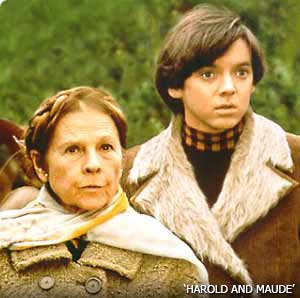
The first bit of news is that it’s official, according to collective member Claudia Lehan: beloved Haight Street landmark the Red Vic Movie House will officially be closing its doors July 25, the theater’s 31st birthday (read my story about the Red Vic’s 30th birthday year here.) The last film to grace its screen will be perennial Red Vic favorite (and annual Red Vic birthday flick), Harold and Maude (1971). Stay tuned for more on this story.
And sad news from the San Francisco Film Society: charismatic executive director Graham Leggat will be stepping down from the post he’s held since 2005 due to health issues, according to a SFFS press release. (Chronicle columnist Leah Garchik has more on the story here.) Leggat wasn’t just a figurehead for the organization. He oversaw a huge expansion of SFFS’ programs — per the release: “Historic developments under Leggat’s direction include the launch of the country’s only daily independent regional online film magazine, SF360.org, in 2006; integration of the filmmaker services programs of Film Arts Foundation in 2008, which have since grown into a rich array of grants, residencies and project development services; the creation and expansion of SFFS’s annual Fall Season slate of festivals and events, which this year includes seven themed film series between September and November; and the recent announcement of the creation of the San Francisco Film Society New People Cinema, which provides a year-round theatrical home for the organization’s myriad activities for the first time in its 54-year history.” Best of luck to Leggat — a man whose charming, witty presence is familiar to all regular attendees of the San Francisco International Film Festival.
Here are two new places that just opened, showing a lot of promise… and one that keeps getting better.
Sexy ’70s foodie lounge : CHAMBERS EAT+DRINK
The Phoenix Hotel has long exuded rock star hipness. Its prior restaurant was more bar than food destination… and it really wasn’t memorable on the drink front, though the mid-century motel poolside setting is special. The pool remains, now with cactus wall and bright orange chairs. Drinks, though decent, still aren’t worth a special trip, but the food is.
With chef Trevor Ogden behind brand new Chambers Eat+Drink inside the Phoenix, I had no doubt it would be good. Young and ambitious, he has impressed me from his days at Mission Beach Cafe. With a complete decor revamp, I am delighted to say there’s no atmosphere like it in SF. A sleek 1970s den lined with hundreds of records (yes, LPs), the place is outfitted in leather, plaid couches, quirky lamps, knick-knacks, themes varying between restaurant, lounge and pool.
The food keeps up. Shaved Spring Salad ($8) is a knock-out of asparagus, wild arugula, and sheep’s milk ricotta topped with shaved Summer squash and lightly fried mushrooms. In a saffron tarragon vinaigrette, it nods to the long days of Summer. Smoking Salmon ($12) arrives wrapped like a rose blossom over a mini-hearth, emitting smoke from roasting coals. A bowl of yuzu sake creme fraiche, chive oil and salmon caviar/roe complete the playful presentation.
In a city with no shortage of fine burgers, Ogden makes an utterly satisfying one ($12): Prather Ranch beef is pink and juicy topped with whole grain aioli, butter lettuce, heirloom tomato, and red onion so smoky it feels as if the burger was grilled by campfire. It comes with thyme-dusted Kennebec fries, while add-ons include crispy-braised pork belly ($3) or avocado ($2.50). There are a handful of entrees ranging $18-26, or one could go with a mix of small plates. PB & L.T. ($10) is essentially pork belly in rice paper wrap, layered with butter lettuce, heirloom tomato, house sambal (chili sauce), and champagne aioli. A fun way to eat belly, almost light yet satisfying. Cauliflower soubise soup ($7) was the only misstep for me – too salty: basil, dried olives, and pink peppercorn added nuance, but over-salting left the impression of being one note.
Ogden is also handling the desserts. They read better than they tasted in opening weeks… but there is promise here. A giant Manhattan creme brulee ($8) is rye bourbon creme brulee doused in macerated cherries and blood orange reduction with candied orange peel. To be fair, I’m not a big creme brulee fan so overall it came off too pudding-like, but high marks for the drink-as-dessert concept. Carrot Caraway Cake ($7) hit blessedly savory with caraway, Kaffir lime nectar and candied carrot tops. Dots of creme fraiche frosting didn’t seem enough to balance out the slight dryness of the cake.
I’m pleased to see a new addition with dramatic, unusual environs that is also for the gourmet. We don’t always do it up in the setting department in SF, preferring to (rightly) focus on the food first. But it doesn’t hurt to do both.
CHAMBERS EAT+DRINK 601 Eddy Street at Polk, 415-829-2316, www.chambers-sf.com
Louisiana Authenticity : BOXING ROOM , Hayes Valley (549 Irving Street, between 6th & 7th, 415-592-8174)
The new Boxing Room may not immediately recall Louisiana: exposed wood, modern chandeliers and an open space look like any typical current-day restaurant. But the food coming out of the kitchen from the hands of Chef Justin Simoneaux, a Southern Louisiana native, just begins to assuage my constant hunger for New Orleans.
First off, I can’t tell you how thrilled I was to see Creole cream cheese on his menu. I fill up on that silky, gently sweet goodness whenever I’m in Nola but had yet to see it here. Seems he couldn’t find it either so Simoneaux made his own. He’s currently serving it with a salad ($8) of mixed greens, strawberries, and spiced pecans.
Deep fried alligator with a Creole remoulade ($11) is about the freshest alligator I’ve tasted – even better than what I’ve had in Nola or Florida. He’s taken painstaking efforts to source the best possible ingredients and it shows: this alligator is more tender and flavorful than its fried status would suggest. Crawfish Étouffée ($13 small, $20 large) is a beloved dish served in varying styles, but often reminiscent of gumbo. Simoneaux’s roux base for the Étouffée is subtly sweet and savory. A beauty… but I could have used a little more crawfish.
Stuffed mirliton and eggplant ($17) is a superb vegetarian dish and maybe the most creative entree. Over a sweet, stewed tomato ratatouille, Grana Padano cheese accents a small, stuffed eggplant and larger mirliton, Southern Lousiana’s beloved vegetable (also known as chayote). Crispy Boudin Balls ($5) is delicious Cajun boudin sausage fried into breaded balls. Don’t miss the free starter of crackers with pimento cheese spread. I’ll take more pimento cheese, thanks. Bananas foster cake ($7) is a moist, dense take on one of Nola’s greatest desserts, served with a subtle bourbon ice cream.
There’s also oysters, fried chicken and red beans, beers on draft (a nice list ranging from Belgians to Louisiana beers), wines on tap, and plenty of bottles. Zydeco plays in the background. At least two waiters are from Louisiana – we sure enjoyed chatting ours up about the glories of food from that state. The only thing missing is a Mint Julep.
BOXING ROOM, Hayes Valley 549 Irving Street, between 6th & 7th streets, 415-592-8174, www.boxingroomsf.com
Daily-changing freshness: OUTERLANDS
Outerlands keeps getting better. Since chef Brett Cooper came on board and their liquor license came through, allowing for seasonal cocktails, it’s more of a destination than it was. I always liked the woodsy, narrow interior but found waits at brunch chaotic and the food all-around solid, if not noteworthy. There is now amped-up artistry, particularly in vegetarian dishes, distantly reminiscent of what one might see at Napa’s Ubuntu.
There are roughly only two $10 cocktails a night. Recently, I liked a Smash in a mason jar: Buffalo Trace bourbon, fresh peaches, lemon and rosemary. More refreshing than unforgettable, it was as garden-fresh as dinner was. Co-owner David Muller’s bartending background at places like Slanted Door clearly informs house-made ingredients and knowledgeable mix of ingredients, like an aperitif of Junipero gin, absinthe, Campari, fennel, sparkling wine.
Dinner highlights included baby carrots and leeks ($9) dotted with fennel, nettles and toasted almond breadcrumbs, and a plate of Mixed Beets ($8), juicy in red frill mustard and sherry, accented by dollops of the most divine, creamy house ricotta. Savory bread pudding ($9) is a puffy dream of their house bread baked with caramelized onions, chard, rosemary, crusted with Gruyere cheese.
Dessert ($7 each) was a mason jar filled with strawberry rhubarb parfait, creamy and fresh, but with barely a taste of rhubarb or fennel. More of both would have made for a superior dessert. More exciting, despite its straightforward sound, was a chocolate budino: lush dark chocolate, hazelnuts, graham cracker, toasted meringue, and thankfully plenty of salt to keep it savory.
Outerlands has evolved into something special by the beach, and a win for anyone who lives out that way. OUTERLANDS, 4001 Judah Street at 45th Ave., 415-661-6140, www.outerlandssf.com
Subscribe to Virgina’s twice monthly newsletter, The Perfect Spot
Wow, they still drink Rolling Rock in 2032. And they still use military laptops and handhelds and complain about bad TV reception. The web doesn’t seem to have advanced much, and people still rely on the Al Jazeera video feed to see what’s going on in the Middle East.
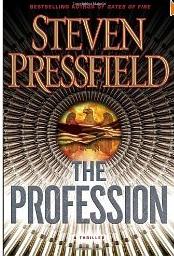
There’s a lot that’s jarring in The Profession, a military thriller set in the Middle East 20 years in the future. For one thing, the future looks a lot like today, except that there’s been a dirty bomb attack on Long Beach and the Chinese are starting to cash in their U.S. debt, putting the world economy into turmoil. (It takes China 20 years to figure that out? Damn.) So it’s pretty bad sci-fi. But it’s not a bad adaptation of the Heart of Darkness/Apaocalypse Now myth of the powerful general who goes rogue with his loyal troops and tries to take over part of the world.
In this case, it’s the Middle East, where (again, bad sci-fi) they’ve just found some more really rich oil fields. And much of the military work of the major nations is done by mercenaries.
One of them is General James Salter, who got cashiered out of the Marine Corps for defying the president’s orders, but who has a MacArthur-like following in both the military and the civilian worlds. He’s a private soldier now, and he’s got this plan to take control of much of the world’s oil, and then return in triumph to Washington, where he can become president (oh, and marry the widow of the prez who cashiered him, who is also involved in this plot.
Our hero, Gilbert Gentilhomme (and what kind of name is that for an action hero?) is one of Salter’s best friends and loyalists, one of the few who can get close to the great man. And he knows he can’t let the general get away with his plan.
Lots of desert battles. Random brutality. International intrigue, of sorts. A bleak and dusty vision of the future — but one where there’s no climate change or peak oil. No sex (and how come none of this summer’s thrillers have any sex?). But not bad for a quick beach read.
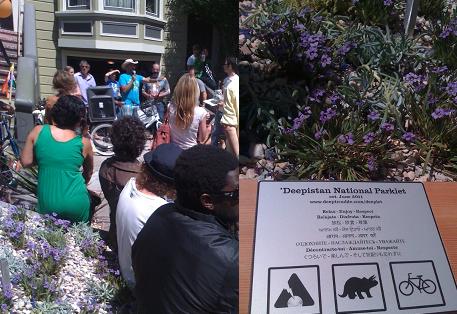
The Chronicle’s urban design writer John King, consistently one of the paper’s best writers, today took a celebratory look at the parklets that have been springing up around town, calling them, “the most intriguing urban design innovation in today’s San Francisco.” I agree with that sentiment, and so does the crowd that showed up on Sunday to dedicate “the Deeplet,” the first such parklet in front of a residential property.
It was a collaboration between homeowner Amandeep “Deep” Jawa, his girlfriend Kimberly Conley, and designer Jane Martin, who King quotes in his piece (which only Chron subscribers and read until Sunday when it goes public). The idea is to take underutilized space from automobiles and give it back to people.
Livable City director Tom Radulovich also spoke at the event, talking about how the streets were traditionally the gathering and social spaces in cities, until transportation planners started to value the efficient movement and storage of automobiles over a more inclusive view of streets. But the parklets – along with temporary street seizures like the Sunday Streets events – are part of a movement back to a more holistic view of city spaces.
We at the Guardian have been sympathetically covering this trend for years, and it is notably one of the few areas of agreement that we’ve had with the Chronicle and former Mayor Gavin Newsom, whose administration cleared the way for the permitted creation of parklet. And on this beautiful summer day, agreeing on the importance of having places to lounge and to just be seems like a great starting point for more discussions on the future of this great city.
(Note: In July of l972, when the Guardian was short a Fourth of July story, I sat down and cranked out this one for the front page on my trusty Royal Typewriter. I now reprint it each year on the Bruce blog (by popular demand, of course), with some San Francisco updates and postscripts. My update for this year’s Fourth is the story on today’s Chronicle front page that reports sadly, “Leaner budgets douse fireworks shows.” But, if you read to the end of this piece, I will point you to a little known spot in town where the amateurs and semi-pros and parents with children will go to fire off their cherry bombs and Roman candles.
Back where I come from, a small town beneath a tall standpipe in northwestern Iowa, the Fourth of July was the best day of a long, hot summer.
The Fourth came after YMCA camp and Scout camp and church camp, but before the older boys had to worry about getting into shape for football. It was welcome relief from the scalding, 100-degree heat in a town without a swimming pool and whose swimming holes at Scout Island were usually dried up by early July. But best of all, it had the kind of excitement that began building weeks in advance. The calm of the summer dawn and the cooing of the mourning doves on the telephone wires would be broken early on July Fourth: The Creglow boys would be up by 7 a.m. and out on the lawn shooting off their arsenal of firecrackers. They were older and had somehow sent their agents by car across the state line and into South Dakota where, not far above the highway curves of Larchwood, you could legally buy fireworks at roadside stands.
Ted Fisch, Jim Ramsey, Wiener Winters, the Cook boys, Hermie Casjens, Jerry Prahl, and the rest of the neighborhood would race out of their houses to catch the action. Some of them had cajoled firecrackers from their parents or bartered from the older boys in the neighborhood: some torpedoes (the kind you smashed against the sidewalk); lots of 2 and 3-inchers, occasionally the granddaddy of them all, the cherry bomb (the really explosive firecracker, stubby, cherry red, with a wick sticking up menacingly from its middle; the kind of firecracker you’d gladly trade away your best set of Submariner comics for).
Ah, the cherry bomb. It was a microcosm of excitement and mischief and good fun. Bob Creglow, the most resourceful of the Creglow boys who lived next door, would take a cherry bomb, set it beneath a tin can on a porch, light the fuse, then head for the lilac bushes behind the barn.
“The trick,” he would say, imparting wisdom of the highest order, “is to place the can on a wood porch with a wood roof. Then it will hit the top of the porch, bang, then the bottom of the porch, bang. That’s how you get the biggest clatter.”
So I trudged off to the Linkenheil house, the nearest front porch suitable for cherry bombing, to try my hand at small-town demolition. Bang went the firecracker. Bang went the can on the roof. Bang went the can on the floor. Bang went the screen door as Karl Linkenheil roared out in a sweat, and I lit out for the lilacs behind the barn with my dog, Oscar.
It was glorious stuff – not to be outdone for years, I found out later, until the Halloween eve in high school when Dave Dietz, Ted Fisch, Ken Roach, Bob Babl, and rest of the Hermie Casjens gang and I made the big time and twice pushed a boxcar loaded with lumber across Main Street and blocked it for hours. But that’s another story in my annual Halloween blog.
Shooting off fireworks was, of course, illegal in Rock Rapids, but Chief of Police Del Woodburn and later Elmer “Shinny” Sheneberger used to lay low on the Fourth. I don’t recall ever seeing them about in our neighborhood and I don’t think they ever arrested anybody, although each year the Rock Rapids Reporter would carry vague warnings about everybody cooperating to have “a safe and sane Fourth of July.” My father, a bit of a law and order sort, would take Jimmy DeYoung and me five miles north of town and across the state line to Minnesota where it was legal to shoot off fireworks.
Perhaps it was just too dangerous for them to start making firecracker arrests on the Fourth – on the same principle, I guess, that it was dangerous to do too much about the swashbuckling on Halloween or start running down dogs without leashes (Mayor Earl Fisher used to run on the platform that, as long as he was in office, no dog in town would have to be leashed. The neighborhood consensus was that Fisher’s dog, a big, boisterous boxer, was one of the few that ought to be leashed).
We handled the cherry bombs and other fireworks in our possession with extreme care and cultivation; I can’t remember a single mishap. Yet, even then, the handwriting was on the wall. There was talk of cutting off the fireworks supply in South Dakota because it was dangerous for young boys. Pretty soon, they did cut off the cherry bomb traffic and about all that was left, when I came back from college and the Roger boys had replaced the Creglow boys next door, was little stuff appropriately called ladyfingers.
Fireworks are dangerous, our parents would say, and each year they would dust off the old chestnut about the drugstore in Spencer that had a big stock of fireworks and they caught fire one night and much of the downtown went up in a spectacular shower of roman candles and sparkling fountains.
The story was hard to pin down, and seemed to get more gruesome every year – but, we were told, this was why Iowa banned fireworks years before, why they were so dangerous and why little boys shouldn’t be setting them off. The story, of course, never made quite the intended impression; we just wished we’d been on the scene. My grandfather was the town druggist (Brugmann’s Drugstore, “where drugs and gold are fairly sold,” since 1902) and he said he knew the Spencer druggist personally. Fireworks put him out of business and into the poorhouse, he’d say, and walk away shaking his head.
In any event, firecrackers weren’t much of an issue past noon – the Fourth celebration at the fairgrounds was getting underway and there was too much else to do. Appropriately, the celebration was sponsored by the Rex Strait post of the American Legion (Strait, so the story went, was the first boy from Rock Rapids to die on foreign soil during World War I); the legionnaires were a bunch of good guys from the cleaners and the feed store and the bank who sponsored the American Legion baseball team each summer.
There was always a big carnival, with a ferris wheel somewhere in the center for the kids, a bingo stand for the elders, a booth where the ladies from the Methodist Church sold homemade baked goods, sometimes a hootchy dancer or two, and a couple of dank watering holes beneath the grandstand where the VFW and the Legion sold Grainbelt and Hamms beer at 30¢ a bottle to anybody who looked of age.
Later on, when the farmboys came in from George and Alvord, there was lots of pushing and shoving, and a fist fight or two.
In front of the grandstand, out in the dust and the sun, would come a succession of shows that made the summer rounds of the little towns. One year it would be Joey Chitwood and his daredevil drivers. (The announcer always fascinated me: “Here he comes, folks, rounding the far turn…he is doing a great job out there tonight…let’s give him a big, big hand as he pulls up in front on the grandstand…”)
Another year it would be harness racing and Mr. Hardy, our local horse trainer from nearby Doon, would be in his moment of glory. Another year it was tag team wrestling and a couple of barrel-chested goons from Omaha, playing the mean heavies and rabbit-punching their opponents from the back, would provoke roars of disgust from the grandstand. ( The biggest barrel-chest would lean back on the ropes, looking menacingly at the crowd and yell, “ Aw, you dumb farmers. What the hell do you know anyway?” And the grandstand would roar back in glee.)
One year, Cedric Adams, the Herb Caen of Minneapolis and the Star-Tribune, would tour the provinces as the emcee of a variety show. “It’s great to be in Rock Rapids,” he would say expansively, “because it’s always been known as the ‘Gateway to Magnolia.” (Magnolia, he didn’t need to say, was a little town just over the state line in Minnesota which was known throughout the territory for its liquor-by-the-drink roadhouses. It was also Cedric Adams’ hometown: his “Sackamenna.”) Adams kissed each girl (soundly) who came on the platform to perform and, at the end, hushed the crowd for his radio broadcast to the big city “direct from the stage of the Lyon County Fairgrounds in Rock Rapids, Iowa.”
For a couple of years, when Rock Rapids had a “town team,” and a couple of imported left-handed pitchers named Peewee Wenger and Karl Kletschke, we would have some rousing baseball games with the best semi-pro team around, Larchwood and its gang of Snyder brothers: Barney the eldest at shortstop, Jimmy the youngest at third base, John in center field, Paul in left field, another Snyder behind the plate and a couple on the bench. They were as tough as they came in Iowa baseball.
I can remember it as if it were yesterday at Candlestick, the 1948 game with the Snyders of Larchwood. Peewee Wenger, a gawky, 17-year-old kid right off a high school team, was pitching for Rock Rapids and holding down the Snyder artillery in splendid fashion. Inning after inning he went on, nursing a small lead, mastering one tough Larchwood batter after another, with a blistering fastball and a curve that sliced wickedly into the bat handles of the right-handed Larchwood line-up.
Then the cagey Barney Snyder laid a slow bunt down the third base line. Wenger stumbled, lurched, almost fell getting to the ball, then toppled off balance again, stood helplessly holding the ball. He couldn’t make the throw to first. Barney was safe, cocky and firing insults like machine gun bullets at Peewee from first base.
Peewee, visibly shaken, went back to the mound. He pitched, the next Larchwood batter bunted, this time down the first base line. Peewee lurched for the ball, but couldn’t come up with it. A couple more bunts, a shot through the pitcher’s mound, more bunts and Peewee was out. He could pitch, but, alas, he was too clumsy to field. In came Bill Jammer, now in his late 30’s, but in his day the man who beat the University of Iowa while pitching at a small college called Simpson.
Now he was pitching on guts and beer, a combination good enough for many teams and on good days even to take on the Snyders. Jammer did well for a couple of innings, then he let two men on base, then came a close call at the plate. Jammer got mad. Both teams were off the bench and onto the field and, as Fred Roach wrote in the Rock Rapids Reporter, “fisticuffs erupted at home plate.” When the dust cleared, Jammer has a broken jaw, and for the next two weeks had to drink his soup through a straw at the Joy Lunch. John Snyder, it was said later, came all the way in from center field to throw the punch, but nobody knew for sure and he stayed in the game. I can’t remember the score or who won the game, but I remember it as the best Fourth ever.
At dusk, the people moved out on their porches or put up folding chairs on the lawn. Those who didn’t have a good view drove out to the New Addition or parked out near Mark Curtis’ place or along the river roads that snaked out to the five-mile bridge and Virgil Hasche’s place.
A hush came over the town. Fireflies started flickering in the river bottom and, along about 8:30, the first puff of smoke rose above the fairgrounds and an aerial bomb whistled into the heavens. BOOM! And the town shook as if hit by a clap of thunder.
Then the three-tiered sky bombs – pink, yellow, white, puff, puff, puff. The Niagara Falls and a gush of white sparks.
Then, in sudden fury, a dazzling display of sizzling comets and aerial bombs and star clusters that arched high, hung for a full breath and descended in a cascade of sparks that floated harmlessly over the meadows and cornfields. At the end, the flag – red, white and blue – would burst forth on the ground as the All-American finale in the darkest of the dark summer nights. On cue, the cheers rolled out from the grandstand and the cars honked from the high ground and the people trundled up their lawn chairs and everybody headed for home.
Well, I live in San Francisco now, and I drive to Daly City with my son, Danny, to buy some anemic stuff in gaudy yellow and blue wrapping and I try unsuccessfully each year to get through the fog or the traffic to see the fireworks at Candlestick. But I feel better knowing that, back where I come from, everybody in town will be on their porches and on the backroads on the evening of the Fourth to watch the fireworks and that, somewhere in town, a little boy will put a big firecracker under a tin can on a wood porch, then light out for the lilacs behind the barn.
P.S. Our family moved in l965 from Daly City to a house in the West Portal area of San Francisco. There are, I assure you, few visible fireworks in that neighborhood. However, down where we work at the Guardian building at the bottom of Potrero Hill, the professional and amateur action is spectacular.
From the roof of the Guardian building at 135 Mississippi, and from any Potrero Hill height, you can see the fireworks in several directions: the waterfront fireworks in the city, fireworks on the Marin side of the Golden Gate bridge, fireworks at several points in the East Bay, fireworks along the Peninsula coast line.
And for the amateur action, parents with kids, kids of all ages, spectators in cars and on foot, congregate after dusk along Terry Francois Boulevard in San Francisco along the shoreline between the Giants ballpark and Kellys Mission Rock restaurant.
The action is informal but fiery and furious: cherry bombs, clusters, spinning wheels, high flying arcs, whizzers of all shapes and sizes. The cops are quite civilized and patrol the perimeter but don’t bother anybody. I go every year. I think it’s the best show in town. B3.
There’s some fascinating back and forth in media circles about the Village Voice, its chain (which includes SF Weekly), Ashton Kutcher, Demi Moore, prostitution, and layoffs and budget cuts as the nation’s oldest alternative weekly.
It’s all so juicy I don’t know where to begin. Perhaps with the SF Weekly’s cover story this week, which also ran in the Voice and most of the chain’s other papers.
The story takes Kutcher and Moore to task for launching a campaign against child prostitution using bogus numbers. For the record: I have no reason to doubt the Voice’s conclusions here. I have no problem with adult ads (which the Guardian also takes). And frankly, I have no problem with prostitution, which, like gambling and drugs, ought to be legalized, regulated and taxed.
And the Voice was scrupulous about disclosing that it has a financial interest in this issue. How much of an interest? Well, a lot. In fact, according to the New York Observer, the prostitution ads could well be floating the financially troubled chain:
Backpage, which is a fraction of the size of Craigslist, is the only popular classifieds site left willing to host the paid escort and body-rub ads that are often thinly veiled fronts for prostitution. In the month after Craigslist closed its erotic services sections under pressure from Congress and state attorneys general, Backpage enjoyed a half-million-visitor bump in traffic, according to Quantcast, and became the No. 1 publisher of escort ads on the Internet. The Aim Group, a media consulting firm, estimated that in January, Backpage brought in $2.1 million in revenue from erotic services ads alone.
That would be about $24 million a year — and the Observer notes that VVM desperately needed the cash:
For more than two decades, Village Voice Media executive editor Mike Lacey employed a simple, often devastatingly successful strategy for gaining control of the country’s alternative weekly business: acquire the local paper, cut editorial costs (lay off critics, reporters and, reportedly, entire fact-checking departments), pump the paper full of nationally syndicated content and splash an occasional local investigative piece on the cover. It was working like a charm until 2004, when the San Francisco Bay-Guardian sued VVM’s SF Weekly for manipulating ad prices in an attempt to drive the rival paper out of business. According to court transcripts, Mr. Lacey told the staff on his first day as owner of SF Weekly that this was precisely his intention.
Despite facing legendary antitrust lawyers in a state notorious for its aversion to monopolistic practices, Mr. Lacey spent years appealing the court’s award of $16 million, which grew to $21 million with interest, until the California Supreme Court threw out VVM’s petition. During the proceedings, the company revealed that it owed creditors $80 million and claimed it could not afford to pay the award. Lawyers for the Bay-Guardian threatened to force bankruptcy.
In January 2011, VVM and SF Weekly settled the issue privately. Though the terms of the agreement were not disclosed, between the settlement and what one attorney familiar with the case said were legal fees of at least $5 million to fight the case, VVM was likely left with an eight-figure hole burned in its pocket.
Since last spring, the company’s efforts to patch that hole up have included the unthinkable (laying off legendary Village Voice investigative reporter Wayne Barrett in January); the surprising (selling off Kansas City Pitch to Tennessee publisher South Comm, Inc., in mid-March); and the long overdue: shutting down an experiment with a pair of sex blogs that were never publicly launched despite being published for nearly a year.
(For the record: The Guardian and VVM have agreed not to discuss the terms of the settlement.)
Mike Lacey, the executive editor of Village Voice Media, shot back with a letter to the Observer featuring his typical wild-ass metaphors and flowery prose:
In fact, in just the past few months Backpage.com has spent millions of dollars policing content to attempt, for example, to keep underage kids out of adult listings. Despite Trench’s professed lack of knowledge, which we do not doubt for a second, anyone looking at Backpage will notice the absence of nudity-merely one of thousands of changes over the past year.
Damn — no more nudity on Backpage. Then Lacey goes on to describe what he found at the Voice when he took it over:
We found a Voice “library” where an individual sat with scissors and clipped out articles from other publications for filing. The age of the Internet stopped at the library’s doors. Town cars arrived to ferry one late working chap to Westchester County. While we kept critics at Cannes, Toronto, and Sundance, we equivocated on sending them to Rotterdam. The Voice was the only alternative newspaper in the country that thought its reporters needed to have their facts checked in addition to being edited, copyedited, and proofread. I disagreed. (Though I do not wish to presume that the Observer might not benefit from such staffing.)
Actually, it was a little more than that. There were a number of longtime Voice staffers — mostly with politically left views — who earned, by alternative press standards, fairly high salaries. They’ve been shoved out the door. Nat Hentoff, James Ridgeway, Wayne Barrett … all gone. They were, in some ways, the soul of the old Voice — scrappy, unafraid to be progressives (and to care about political causes) and interested in social change. That didn’t fit with Lacey’s world view.
But it gets better: The Voice and Kutcher are now in a tweet war — and all of this is going to bring more attention to Backpage and the sex ads — which, again, don’t bother me, but do bother a lot of stuck-up law-enforcement types, who will now have even more reason to go after VVM. At the Observer notes:
As Backpage grows in popularity, more news stories have emerged suggesting that the kinds of abuses that led lawmakers to demand Craigslist shutter its erotic-services section are increasingly occurring on the site. In September a former child prostitute sued VVM for knowingly publishing advertisements of her, and later that month 21 attorneys general called on the company to follow Craigslist’s lead and ban escort ads. VVM declined, but offered to continue cooperating with law enforcement officials on cases originating on the site.
I’m not sure all this publicity is exactly what Lacey had in mind.
Attention, pre-adults: thereis a place for you, a place where a laissez faire attitude and zero musical talent will not only get you by, but get you laid. Ladies and gentleman, welcome to San Francisco, the American hotbed of would-be air guitar heroes.
No, champions. No, gods. In fact, such is the level of air guitar talent in the Bay Area that the organizers of the U.S. Air Guitar Championships decided to hold not one, but two regional competitions last weekend at the Independent.
Authentic nerds (minus the “ironically cool” schtick) took the opportunity to trade their tighty-whities for more creative duds and rise to the heavens.They came, they shredded — they melted the ears off a boozed-up crowd that heartily welcomed beer, candy, rubber animals, and body parts thrown at their heads, not to mention catapaulting, oversized bodies. What would a rock show be without stage diving?
On night one (Fri/24), the “master of airimonies” was Bjorn Turoque, the dark horse 2003 winner of the World Air Guitar Championships in Finland (a victory documented in the film Air Guitar Nation). Judges were Hot Lixx Hulihan — two time SF winner and one time national winner — as well as Onion A.V. Club’s Mark Hawthorne and some other dude that everyone hated. In true rock and roll spirit, the crowd expressed their disgust for any unfair scoring by hurling random objects at the judges.
On night two (Sat/25), Hot Lixx mastered the airimonies, while judge Turoque was joined by nemesis and legend C Diddy (co-star in the aforementioned documentary, first ever U.S. champion, and a world champion himself) and Dr. Frank of Mr. T Experience, who is also the author of King Dork.The crowd showed much more love and respect for this bunch and kept their fist-pumping hands to themselves.
Participants on each night’s lineup battled imaginary axes in two rounds: air noodling to a minute-long song of one’s own choosing, and a surprise song from the judges. The judges scored the performances on a scale from four to six, looking for technical skill, stage presence, and something called “airiness” — the unexplainable something that “you’ll know when you see.” In the end, the winners with the highest combined score on each night — Shred Nugent and seasoned champ Cold Steel Renegade — represented San Francisco in Chicago’s national throwdown.
The winner from night one, Shred Nugent (a.k.a. Airy and the Hendersons, get it?), shows excitement for his high score. All photos by Jackie Andrews
Cold Steel Renegade, now a two-time SF champ, emerged victorious on the following night to join Nugent in Chicago
While more performance art than concert, the night involved all of the elements of a good rock show: a rowdy crowd, lights, fog, and energetic “musicians.” Along with rock ‘n’ roll comes baggage — sex, drugs, booze, hurling television sets out windows, trashing hotel rooms. And while none of the contestants got super creative, a few did pulled out some of those stops.
Toward the end of his performance, this contestant pulled tall boys out of his pockets and sprayed onlookers with the froth. His score was dinged for playing something other than air guitar.
Creepy fake cocaine moment No. 1: Singar the Goat Demon and his “groupie” snort lines of the faux blow and then prance around the bag in a strange pagan-like ritual.
Creepy fake cocaine moment No. 2: The Six String General snorted lines of the spurious nose-candy off this young ladies bum before whacking her from behind.
An otherwise unmemorable performance became noteworthy with a freakishly high jump into the crowd to a perfectly timed confetti explosion.
Opting for Marilyn Manson shock, posing pretty for the camera.
And so it was — the San Francisco leg of the U.S. Air Guitar Championships came and went, blowing minds and leaving a huge mess. We hear that our SF contenders did well in Chicago, but unfortunately neither are going to Finland for the World Air Guitar Championships. Next year!
The Bay’s east side can seem a little prudish, especially when compared to its slutty sister city. Until February, Oakland’s only retail resources for sex were a couple of trashy adult “superstores.” Those places can be fun and functional, but it’s safe to bet the cashier probably isn’t too concerned about answering a list of questions and making you feel comfortable with your purchase. Nenna Joiner, the owner of Oakland’s new sex-positive shop, Feelmore510, is quite the opposite and simply can’t wait to start friendly conversations about sex with everyone in her community.
Joiner, a sex educator and adult film director, has been dreaming about opening an Oakland shop for years, but her ideas go far beyond retail. From terminology to etiquette, Joiner says her community needs to start at the beginning, birds and bees style. “I love talking to people. People teach me new things everyday. I’m open and not judgmental. I’ll talk about anything,” she says after ushering a couple ladies out the door who had spent their lunch break browsing.
From basic questions to the personal, Joiner is educating from the inside out. “A guy came by the other day asking if it was gay for him to want to play with his girlfriend’s butt,” she says. “San Francisco takes its sexual openness for granted — the community there is so exposed, probably overexposed,” she laughs, a playful swipe at the close-knit kink communities and accessible sex-positive resources she loves.
Joiner says Oakland residents may attend erotic events like Folsom or shop for dildos west of the bridge, but when they return home, the conversation goes flaccid. She puts partial blame on years of serious bedroom talk: preventative health and safe sex practices have been a priority due to the high number of HIV cases in the area. No one is contesting the importance of these topics, but in terms of fast, slutty fun they can be total Debbie Downers. Joiner wants to put the spunk back into conversations about sexuality.
Before the shop opened, the surrounding neighborhood seemed nervous about the addition of a sex shop on the block, but Joiner has been extra careful to make sure people understand that her intentions are purely rooted in the revitalization of Oakland. She keeps up on local politics, attends city meetings, directs tourists to other neighborhood businesses, and even watches high school band concerts. She waves at people from across the street and welcomes anyone inside to chat and enjoy the space. Joiner feels supported by the city around her, which she thinks is happy to recognize her role as a successful business owner. She regularly gets friendly calls from the Alameda Small Business Association, casual check-ins to make sure she’s doing well.
“They know I’m a young woman of color, working my ass off. Maybe they don’t watch porn or have interest in the products I sell, but they support me because they know how hard I’m working.”
Nestled between downtown office buildings on Telegraph Avenue, Feelmore510 lures in its share of curious customers during the day with a modest store front that looks more art gallery than porn hub. Inside the store, Joiner loves to play her late grandmother’s vinyl collection, including Sinatra and Perry Como, which perfectly compliment the space’s glowing chandeliers and velvet curtains. The shop stays open until midnight, way past the bedtime of most of her neighbors’, but with the Fox Theater nearby and a collection of bars and clubs in walking distance, Joiner likes providing the night owls some after-party options.
“I stay open late because I want to help more people have great sex.” Getting people off the streets and under the sheets with body-safe, pleasurable accessories– now that’s community activism!
The Dark Room’s suckling at the boob tube is a mass cultural sub-phenomenon of questionable taste and, yes, abnormal staying power. Remember 2005’s Batman the TV Show: The Play? I still wake up screaming from that one. But the persistence of this peculiar fetish is perhaps best measured by the yardstick of one series in particular, to wit, Dark Room’s annual live staging of Twilight Zone episodes.
It continues this weekend, and every subsequent weekend in July, in the eighth installment of Twilight Zone Live, actual episodes from the hoary small screen perennial recreated with wry comic aplomb and mainlined nostalgia by a variety of guest directors and comedy-ready cast members. Better than TV in that it is slightly bigger. Need more enticement? Check out Sam Shaw and Dan Foley in this spiffy pitch-perfect video teaser from Crisis Hopkins, an (almost) faithful recreation of the 1983 teaser for The Twilight Zone: The Movie…
As politicians push to maximize their campaign contributions before the semi-annual reporting deadline of tonight (Thu/30) at midnight – a big measure of the strength of their campaigns and sure-fire way to keep the money flowing in – our e-mail in-boxes at the Guardian have been flooded with urgent pleas for cash.
There’s a real art to these appeals, which generally rely on some combination of fear, humor, “we’re so close” appeals to “put us over the top,” and earnest calls for support in order to get people to open their wallets. We won’t find out how the campaigns really did for another month when the forms are due, but we thought we’d offer a sampling of our favorite pitches of the season.
President Barack Obama is offering to join you for dinner if you give his presidential campaign even a few bucks: “ I wanted to say thank you before the midnight deadline passes. And I’m looking forward to thanking four of you in person over dinner sometime soon. If you haven’t thrown your name in the hat yet, make a donation of $5 or more before midnight tonight — you’ll be automatically entered for a chance to be one of our guests.”
Democratic Party consultant James Carville sent out a funny one entitled “Backwards tattoo” on behalf of the Democratic Senatorial Campaign Committee: “FEC deadline is midnight, and here’s a number to ponder: 90%. It’s so important, you should tattoo it backwards on your forehead so you read it every time you brush your teeth:
90% of donations to Karl Rove’s American Crossroads this year came from 3 billionaire donors bent on destroying President Obama.
90% of donations to the DSCC come from grassroots supporters.”
Comedian and U.S. Sen. Al Franken always writes great appeals. I liked his previous one, “Oatmeal,” better than his current one, “Cake,” but it’s still pretty good: “Remember Election Night 2010? Remember watching Democrats you admired—progressive champions—giving concession speeches? Remember shaking your head as radical right-wingers were declared winners? Remember the first moment you realized that John Boehner was going to become Speaker of the House? Not fun memories. But here’s the thing: In a lot of states, the cake was baked a long time before the polls closed—not in 2010, but in 2009. Every cycle, races are won and lost—months before anyone votes—because one side builds an early advantage that proves to be insurmountable.”
On the other side other aisle, the National Republican Senatorial Committee is offering signed lithographs of the U.S. Capitol (huh?) for donations of $125 or more, or you can give just $4 to help elect four more GOP senators because, “Even with the support of all 47 Republican Senators for a Balanced Budget Amendment, Harry Reid blocking its progress every step of the way will be nearly impossible to overcome.”
GOP presidential candidate Mitt Romney writes that, “Your donation will build the campaign needed to defeat the Obama juggernaut in 2012.”
Rep. Dennis Kucinich (D-Ohio) issued a national appeal for his efforts to stand “up to leaders of both parties” and the scheming capitalist forces: “Across the country, corporate forces have been pushing for draconian cuts to the social safety net, making it harder for all Americans to have a better quality of life.”
SF District Attorney candidate David Onek used his wife – Kara Dukakis, daughter of former Democratic presidential nominee Michael Dukakis – to make his fundraising plea today: “I’m writing today to ask for your help. As you already know, my husband, David Onek, is running to be San Francisco’s next District Attorney to reform our broken criminal justice system. The deadline for our fundraising period is midnight tonight and it is crucial that we make a strong showing.”
U.S. Sen. Barbara Boxer even acknowledged the barrage of funding appeals as she sought money for her PAC for Change: “I know you may be getting a flurry of these June 30 fundraising emails today, so let me get right to the point: We’ve already raised more than $44,000 toward our $50,000 end-of-quarter grassroots goal — but if we’re going to make it, and fight back against the millions that Karl Rove and our opponents are already spending against us, I need your support before midnight tonight.”
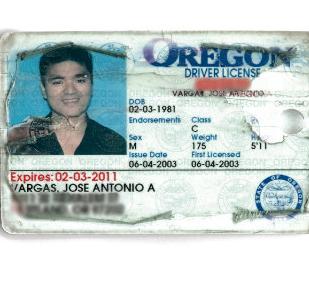
The ol’ Chron commissioned its former reader representative, Dick Rogers, to do a piece on the Jose Antonio Vargas story, and he concludes that Vargas was a liar whose failure to turn himself in to immigration authorities (and thus accept deportation to a country he hardly knew) undermined his journalistic work. Rogers quotes editor Ward Bushee:
“While he deserves sympathy for his efforts to become a citizen, Vargas’ lack of forthrightness in some of his reporting cannot be defended,” Bushee said. “He practiced a pattern of deception that was not only dishonest, but disrespectful of his readers and fellow journalists at The Chronicle.”
Pardon me while I puke.
I’ve already written about Vargas and about former Chron editor Phil Bronstein’s (far more nuanced) handwringing over the situation. But the conclusions the Chron reached in the Rogers article are just bizarre and reflect a creaky, ancient attitude towards journalism that makes no sense in the modern world.
I called Rogers, who is a nice guy with a long history in journalism, and we had a long talk about the situation. I asked him what the young man should have done when he found out at 16 that his parents had sent him to the Unites States illegally. Rogers, to his credit, said he didn’t know, that it was a tricky moral and legal dilmemma. “But that’s not what I was asked to write about,” he said.
The issue for him: Vargas lied when he filled out his employment application and failed to disclose to his editors that he was in the country illegally. That damaged the Chronicle. “You can’t put yourself above your newspaper,” he told me. Okay, once again: What should Vagas have done? What should a person who is forced by stupid and inconsistent federal laws to lie about his immigration status do if he wants to be a journalist? Well, Rogers said, that’s the dilemma: “I don’t think he should have been working in mainstream journalism.”
Of course, he’s have to lie to get a job as a lawyer, or doctor, or CPA. And all of those professions also have ethical codes that discourage lying. So perhaps he should have been a bricklayer.
To be fair, Rogers doesn’t go that far — he suggested that there were other types of journalism Vargas could have done. He could, for example, have worked for the Bay Guardian. (I wish.) After we talked for a while, Rogers said that if Vargas was going to work for the Chron, he should have recused himself from any stories involving immigration.
But let’s be real here: The Chron allowed a reporter who took money from a nativist group to keep writing about immigration. Bushee, who is so outraged about Vargas, has no problem allowing an (illegally) unregistered lobbyist who gets paid to advocate for wealthy interests in the city to write a political column without ever disclosing his clients or conflicts. (Rogers told me that was a legitimate point. “Conflicts are conflicts,” he said.)
Look: All of us have conflicts. As the great Larry Bensky once told me, “People who have no conflicts have no interests.” Can a person who drives a car write about transportation policy? Can a person who smokes pot write about medical marijuana (or should she tell her editor, sorry boss — I’m illegally ingesting a controlled substance at night, better fire me or report me to the cops because I can’t cover this story)? Can a person with children write about whether San Francisco is a good city to raise children? Can a person with kids in the public schools write about the school board? Can a divorced person cover a wedding? Can a person who had an affair write about a politician who’s caught fooling around? Can a person who drinks beer write about the city’s alcohol tax?
I mean, let’s not be ridiculous here.
Let me tell a perhaps hypothetical story. Suppose that, when I was working for a (socially conservative) daily newspaper in a (socially conservative) New England city in the mid-1970s, I had a colleague who was gay. And suppose she decided — correctly — that her career would be damaged (at that time, at that institution) if she was out of the closet. (For all I know, she was a criminal, too — I’m not sure when this particular state repealed its sodomy laws.) So suppose she lied — to her boss, to her coworkers, to everyone around. Did that mean she was a bad reporter? Not at all. My hypothethical friend did what she thought she had to do, at a time when the professional and political world she lived in was unwilling to accept who she was. (In fact, there were no laws back then about firing people because of their sexual orientation.) She hated it, we all hated it, and we worked to change things. But I’m not going to condemn her — or call into question the credibility of her work — because of it.
(By the way: I lied, too. I told my boss at this particular institution that I didn’t smoke marijuana. It was a job requirement. I wanted the job. I was a lawbreaker, and I still covered the cops. In fact, I wrote about pot busts. Thank god they didn’t test my pee.)
Let’s face it: Everyone at the Chron, and at every daily newspaper, has personal issues that prevents him or her from being completely objective. Jose Antonia Vargas was no different. The fact that the United States government forced him to lie is no grounds for saying he couldn’t be, and isn’t, a good, honest reporter.
You can’t miss the acrobatic stylings of Orion, Alex, and Meisje Griffiths — also known as the Sardine Family — on a sunny day on the corner of Jefferson and Powell Streets. If the bold, baggy, crimson-colored pants don’t catch your eye, there’s something about the energetic English accents pumping out of the subwoofer that have a way of pulling you in.
Pier 39 rarely disappoints when it comes to street performers at this time of year. Cloudy days be damned, if it’s technically summer, a big heart with any kind of creative curiosity won’t be able to pass through tourist town without being reeled in by one of the different acts along the congested sidewalks. But who are these performers? How’d they wind up performing on city street corners? Who did I just give my money to?
Three second generation acrobats, along with longtime friend Kevin, make up the Sardine Family, a traditional circus act which weaves in plenty of comedic punch lines, showmanship, and charisma. And they deliver one hell of a street show. I was able to sit down with Orion Griffiths and get the story of how the Sardine Family set their clown shoes on the streets of San Francisco.
Orion, Alex, and Meisje are the three youngest of eight children. “We’re a circus family,” says Griffiths. “My mom and dad did street shows in Europe. My dad started doing street shows 34 years ago. I actually started real street shows when I was thirteen. I’ve been doing this for 17 years.” The 23 year old’s voice carries evidence of his parents’ home in the United Kingdom. “I’ve done [street shows] all around the world. I’ve done street shows like this in 46 countries.”
Originally from Europe, the three Griffiths emigrated from England to Massachusetts in 2004. They moved to San Francisco last year to attend acrobatics school and perform their street show at Pier 39 as a means to pay for their school’s tuition costs.
Both Orion and Alex have been working on their current street performance, “for the past 10 years,” says Orion. “If you’ve got circus skills and you come out here, you probably will just flop, because it’s more about the talking, it’s got nothing to do with the skills you are doing. Even if you are doing double back flips on the street, nobody cares.”
One of the highlights of the Sardine Family act is the moment each performer showcases their trick specialty. They perform stomach-wrenching rag doll backbends and dancing handstands. They juggle on top of a nearly ten foot tall unicycle and reel off aerial backflips. It’s amusing to see a family of tourists about to pass by suddenly do a double take, looping back to join the crowd that has already assembled around the Sardine Family. The act is flawless and the family’s chemistry creates an environment so natural and comfortable that everyone wants to hang out for the next trick.
How do they do it? Orion and Alex, the two emcees of the performance, are constantly feeding off the audience and vibing off of each other, making sure the audience is entertained in between tricks. And even after the 10 years of hard work that the Griffiths have put into the act, Orion is neither fazed nor offended when the typical passer-by — well, passes by. “That’s part of street performing. They’ve got their own thing to do — they don’t need to care about a street show.” Griffiths went on to say, “I don’t even get upset when somebody watches the whole show and doesn’t put money in the hat.”
But if you want to give them something, that’s great too. Towards the end of one show both Orion and Alex jokingly say, “If you’ve got a dollar to donate, great. Five dollars, even better. If all you’ve got is a quarter…keep it. You need it more than we do.”
As far as making a living off street performing? “It’s very, very hard,” Orion answers. “You can’t always make a living, you have to have a side job. We’ve made it out alright because we’re pretty good at it, but a lot of these [other street performers] have to get a side job. They do it for the love of it.”
When asked about the people who criticize and continue to question the credibility of street performers like the Sardine Family, Griffiths responds “I love it.” However for the most part, he says that the Sardine Family has been well received by the people of San Francisco. “They love us, we’re English. San Francisco is a great place”
But let’s be clear: all those lifts, juggling balls, and tumbles — the Sardine Family performs in hopes of getting closer to a dream.
“Our dream is to start a circus, and that’s why we’re here in circus school. We’re looking for a group or an organization that would fund our show to start a circus. Once more people meet us and see what our story is and here about our background, hopefully they’ll be on board with it,” Griffiths says.
“We’ve been doing this our whole lives, all for the same dream. We’ve been training for years. We’ll probably train another year to get our act right before we try and start a circus.”
But at the end of their flips and tricks on the day I stopped to watch, the Sardine Family says something that makes their godly acrobatic routine a little more grounded – maybe even a little more relatable, in this town of artists.
“We’re not hustlers, we’re performers. We do this because we love it.”
The time is probably coming when humans will be able to adapt animalian traits, ala “Transmetropolitan,” either as a weekend whim or on a permanent basis. The whole notion is too tempting to remain a fiction forever. Imagine possessing the smooth, insulating skin of a dolphin, the soaring wings of a peregrine falcon, the keen night vision of a bobcat. The desire for such transmogrification is as ancient as recorded history: from Centaurs to Satyrs, Mermaids to Manticores, Mami Wata to the Minotaur, there’s hardly a mythology around without some reference to human-animal hybrids, whether monsters or gods. Years from now, the very notion of “transitioning” might well have to be expanded to include folks shifting between all kinds of bodies and capabilities. Until then, we’ll have to make do with costumery, flaunting temporary feathers and furs like so much wishful thinking.
You probably won’t find a denser concentration of fantasy animal drag outside a furry convention than at a “Tranimal” contest — particularly one hosted in the California Academy of Sciences, where accurately portraying animal characteristics is serious business.
At last week’s Pride-themed NightLife (and adult-themed, cocktail-hour weekly event that draws a huge crowd with ever-changing themes), an eager crowd eschewed the planetarium and rain forest sphere to gather in the glass-walled piazza for a mini-Trannyshack show followed by the surprisingly competitive Tranimal contest. “We were afraid no one was going to want to compete,” pageant organizer Heklina marveled as close to 40 contestants jumped on and off the makeshift stage for their 15 seconds of fame. Each costume more elaborate and exotic than the last, all manner of fauna was well-represented. A mysterious, stiletto-heeled figure in a spotted jaguar mask named Latrina (“Oh, how punk,” remarked Heklina); a flame-haired, fur-armed creature of the night called Envy; a surprise appearance from touring circuit star, Scotty the Blue Bunny (“We should just hand you the grand prize now and get it over with”). For the most part though, more faithfully-rendered animals swept the awards: a shy, lighted jellyfish, a spunky, slithery reptile “the Sex Raptor,” and the delicately-finned, giant-toothed “Lady Angler Fish”.
“That’s every gay man’s nightmare of a vagina,” joked Heklina about the lady’s enormous jaws ringed with gigantic, dagger-like teeth that obscured her entire abdomen. Some of the best costumes didn’t even compete. My personal faves, husbands Roger and Joel, looked ready for action as intrepid naturalists covered in giant insects and normal-sized birds, nets at the ready.
Down in the aquarium, costuming was scarce, but thanks to the pulsing sounds provided by Honey Soundsystem, and the disco-worthy lights illuminating the fishtanks, a purely psychedelic experience was still available. Drawn especially to the languid varieties of jellyfish, “ballerinas of the sea,” I found the Soundsystem soundtrack extremely well-suited to the mysterious perambulations of the colorfully-illuminated Medusozoa. In general, all the fish seemed appreciative of the shindig, even Claude, the albino alligator was moved to leap off his usual perch and splash around his swamp domain. True, he might have just been trying to get away, but the possibility that he might have been fantasizing about donning a more human skin in order to join the party was an irresistible notion.
Annual fireworks extravaganzas: What a gorgeous waste — celebrating America! Johnny Funcheap has his huge, annual guide to sky-high Bay Area gunpowder-showers up, if you’re looking for some good ol’ patriotic shock and awe. Courtesy of China via Italy. Like Spaghetti-Os. And Katy Perry.
So let’s type it again! The Guardian spoke on the phone with Rinaldi – whose partner Eileen Hassi owns Ritual — this morning after rumors that he had been behind the early removal of Varese Layzer’s “Making Room” photography exhibition, and had engineered the space’s replacement. On the phone, he said he’d never met Layzer, but that “we were promised work and she gave us different work. No one’s writing about that, or that she yelled at the baristas.”
Here’s what happened, in a nutshell: a photography exhibit was removed from Ritual Roasters. Hassi sent an email telling artist Layzer her art was “too serious,” but that hey, she’s got some gallerist friends, here’s their phone numbers. Chicken John announced on Facebook that the subsequent replacement of the work with friend Julian Cash’s Burning Man photography was “just that simple.” We are intrigued.
“I don’t really see the need to go into this anymore. We’re too busy, we’re too smart, we’re too good looking. I’m having a nice day, I hope you are too.”
Not very surprisingly Layzer, who discovered her artist statement missing from the wall of Ritual on Sunday before the whole shebang came tumbling down, says she doesn’t understand why the art was removed. “I suspect the owner didn’t like a statement being on the wall and it made her dislike me,” the artist wrote in an email to the Guardian. Layzer tells us that she expressly asked permission to post a statement and that the coffeeshop told her “’It’s your show. Go for it.’”
The art in question was photo documentation of Layzer’s deceased parents’ rent-controlled apartment before it was “bought and demolished,” according to the offensively depressing artist’s statement that was putting people off their americanos. Though she was “devastated. I screamed and wept,” when she heard the work had been de-walled, Layzer says “it means a lot to me that they were public in a physical form, however briefly.”
The photos now on the wall are from Julian Cash’s book The People of Burning Man. They’re not exactly the “pictures of telephone poles, birds sitting on the wires, tapestries of heavy metal lyrics,” that Hassi wrote to Layzer as being more appropriate to decorate a cafe – though they certainly qualify as her other descriptor: “whimsical stuff.”
His are portraits from the playa of freaky, body-painted and well-adorned Burners. Cash sets up an improbably-white studio at Black Rock City and encourages subjects to express themselves as they see fit. Ironically, some of the expressions that made their way to Ritual touch upon strife in the Middle East, a man literally drowning in his suit-bound life, a man protesting credit card debt by faux-inserting them into his bald scalp, faux (?) blood dripping everywhere.
In a recent statement published on his website, Cash seems happy that his newly-released book has been thrust into the spotlight. “I am almost delighted to be told that my work is “fluffy” but I’m uncertain as to why. I think I have a reputation as someone who is respectful to his subjects and thrives on collaboration. I certainly believe in the value of fun, and that if you live a life where you are not regularly feeling joy, you are doing it wrong.” (You can read Cash’s complete take on the matter here)
So maybe Layzer was just a jerk to someone’s employees, and maybe she switched up the content of her show and exacerbated relationships. Maybe the folks at Ritual Roasters just wanted another artist. The event as a sign that Valencia Street continues to be Valencia-ized – well that’s too obvious to write a blog post about these days. Maybe it’s indicative of the hippie-punk back and forth that seems to drive this city culturally.
Or maybe we just need to grab our coffee and head outside. Look, sunshine!
Update: In response to the yelling allegations, Varese had this to say:
No way! It’s very possible that some loyal friends of mine came in and yelled at the baristas. People were very upset for me. But I bet I wasn’t even in SF when this yelling of mine occurred. The last time I talked to a barista at Ritual I had work on the walls and were asking if my business cards were still on the counter or some such relatively unimportant matter – and also I asked did anyone know where the statement had gone. Then I stormed out, phoning the curator on the way and crying on the phone. I guess the whole story is about an artist and a cafe hating each other? I’d be sorry to see that but I suppose it doesn’t really matter.
Love the mommy bloggers. Such a feel good moment when a harried parent gets to sit down and share (even electronically, even through a screen) just what they’ve been feeling about their day with the kids. Y’know, how to talk to a youngster about adoption, wise words from grandma, the best new G-spot stimulator.
Oh yes, there’s a new kind of mommy in town. Or at least, pervy parents are finally getting their due. Dirty mommies now have their very own local blog, and meet-up.
To compliment personal online screeds that are already being penned by Shar Rednour of How Good Sex Made Me a Great Mom, of the example above, and sex toy shop mommies Moms In Babeland, Madison Young organized Sexy Mamas Social Club (she’s also held workshops on motherhood and sexuality at Good Vibes, and ate breast milk icecream as performance art this year). It’s open to moms in the sex trade, moms who have sex on screen, moms in alternative sexuality communities, and moms who support all of the above. The group meets for brunch at one in the afternoon on Fridays, which is another reason to like it.
Sex With Emily livecast
Today, Emily Morse told me all about the new semen cookbook (there’s something weird in the air about cooking with cum). She’s got this squeaky little voice, she’s broadcasts outta San Francisco, she has very little qualms about talking about her decidedly heterosexual, but fairly entertaining love life. And she’s there for you everyday so that you can snicker through the afternoon, especially when your boss asks you what you’re listening to and you say “making Jello shots with male ejaculate.” Now I wish that would happen.
There’s nothing worse than being in the middle of a good grind and looking up to see the scantily clad go-gos with looks of boredom on their Adonis-like faces. Well hell, how hard do you have to work it to get a rise out of them? KOK feels your pain, so they’ve assembled a line-up of faces so fresh they’ve had no time to weary of your (adorable) flailing. Sexxy.
Because sexy thangs shouldn’t be barred from having kids – or from continuing to be hella sexy. New mamí Madison Young has apparently organized a get-together for mommas from the sex industry. Be you a sex worker, a sex writer, polyamorous, an adult film actress, or just supportive, roll through this brunch (the group’s third) to be part of a new old girl’s club.
Fri/11-4 p.m.
Email Madison Young at feminapotens@gmail.com for details
In addition to hosting a frequently-updated site of HIV/AIDS research news, Project Inform throws a good party. We think – Powerhouse‘s Nasty will now go to benefit the HIV/AIDS advocacy organization, which is promising for many reasons. The party’s raised over $30,000 for the AIDS Emergency Fund in the past, and it’s kind of your dirty, dirty duty to make sure that it gets off (ha) on the right food with Project Inform. All for charity!
Why wait til the Fourth for the fireworks? Rumor has it this power couple of SF BDSM learned their fireplay skills in a sub-zero Minnesota dungeon – that’s one way to figure out how to be sensual with flame, but getting taught by the experts, with super hot models, in one of the city’s best-known dungeons – you’ve upped them on comfort factor, at least. Learn skills in tools, safety, and the psychology of properly lighting your lover aflame.
In a state that’s still floundering for ways to comply with court orders to drastically reduce the number of inmates in a prison system that has long been severely overcrowded, people in prison face unconstitutionally inhumane and degrading treatment on a daily basis. And now a group of inmates is highlighting the problem with a hunger strike that begins this Friday, July 1.
Lawyers for and supporters of the group of inmates from the Secure Housing Unit at the notorious Pelican Bay prison will hold a press conference tomorrow (Thu/30) at 11 am outside the state building at 1515 Clay Street in Oakland to announce the hunger strike to back up a list of demands they have submitted to the warden and Gov. Jerry Brown. Their demands include an end to long-term solitary confinement, collective punishment, and forced interrogation on gang affiliation, and they say they will continue their hunger strike until their demands are met.
“The prisoners inside the SHU at Pelican Bay know the risk that they are taking going on hunger strike,” Manuel LaFontaine of All of Us or None said in a prepared statement. “The CDCR must recognize that the SHU produces conditions of grave violence, such that people lose their lives in there all the time.”
The anti-war group World Can’t Wait is also supporting the hunger strike and calling for a supportive demonstration on Friday at 11 am outside the state building in San Francisco at Van Ness and McAllister streets. California officials have for years defied judges’ orders to reduce the prison population, which is at 180 percent of capacity, and the Supreme Court this year upheld the order and is requiring the state to reduce the prison population to 109,000 inmates, of 137.5 percent of the levels the prisons were designed to house. The Brown Administration is seeking an extension of the deadline as it wrestles with political gridlock and a budget debacle that has stymied the governor’s efforts to transfer more prison inmates to county jails. But that plan avoids the reality that the U.S. has by far the highest incarceration rate in the world, a situation that is both inhumane and fiscally unsustainable.
Ever a fan of a civilized (and delicious) respite for afternoon tea, here I present to you two divergent ways to raise your pinky in the city.
Kettle Whistle at Burritt Room: A gourmand’s pop-up tea
Currently scheduled to take place on the last Saturday of every month through October, Kettle Whistle launched its inaugural tea this past week in the spacious back room of Burritt Room’s turn-of-the-century-style bar, tucked upstairs in the Crescent Hotel.
The brainchild of pastry chef par excellence William Werner of Tell Tale Preserve Co. and tea mavens Lawrence Lai and Ann Lee of Naivetea, Kettle Whistle is essentially a pop-up high tea, one where ladies (and men) meet over crumpets and scones. But this is no typical tea.
At a pricey $55 per head, it’s even more costly than high tea at the stunning Palace Hotel — but Kettle Whistle has vastly superior food and drinks. Though dishes and tea pairings will rotate, you can be assured of three themed courses: savory bites, followed by scones and crumpets (the passion fruit olive oil curd on this tray will blow your mind — regular old lemon curd might never seem the same), ending with dessert. There’s even a take home bag of tea and a snack (mine came labeled “damn good granola,” a savory-sweet mix).
You’ll be full after three courses because the savory and dessert courses offer four to five different bites, each from Werner’s creative hand. An heirloom tomato sable on a homemade cracker with lemon and a strip of lardo iberico de Bellota was revelatory. Spheres of tomato and pig fat dissolved in my mouth like a dream I wish I could have over and over again. On the dessert platter, a chocolate and salted caramel fondant was silky save for a crispy strip of chocolate on top, enlivened with avocado and lime layers. I’d go back just to see what Werner will serve next.
Naivetea’s Taiwanese teas (a local Bay Area company run by Taiwan natives) are elegant, worthy companions — not overpowering nor overshadowed by any of the courses. My favorite was their award-winning (it recently took home first place at the North American Tea Championship) Dong Ding Oolong, a gentle beauty with backbone, whose toasted rice and caramel notes shine.
Kettle Whistle’s two July 23 seatings are already filling up, so I’d look into reserving a spot now. Dress up, wear a hat, and come hungry.
Through October. 417 Stockton, SF. (415) 400-0500, www.naivetea.com
Rose Tea: Casual tea cafe
Rose Tea, an open, airy new shop, is a peaceful respite off Irving Street that doubles as take-out cafe and flower shop. It’s only been open a few weeks, but my two visits there have been rewarded with herbal teas (I like the Fire on Ice: ginger and lime steeped with fresh mint leaves) served in a bottomless pot with a mini-French almond cake and jam for $6.50.
Sandwiches ($5.95-7.50) are made with care on rye bread with sides of fruit and nuts. I liked the chicken, apple, cream cheese, and raisins version, and the feta, avocado, and walnut with tomato and basil. Plates come finished with house macarons or baklava. With what appears to be Armenian and Greek roots (if the jams for sale are any indication), the cafe also offers Turkish coffee, an espresso bar, and spiced rose chai. It’s a welcome neighborhood spot for a pot of tea and a bite.
The latest figures show that some 44 million workers in private employment – more than 40 percent of the private sector workforce – do not have paid sick days that they could use to recover from illnesses, including contagious illnesses such as the flu, or worse.
It should be of particular concern that those occupations which are currently least likely to provide paid sick days include occupations most likely to have regular contact with the public – most importantly and most disturbingly, food service and food preparation.
That raises serious health problems – especially in these tight economic times, when workers need to stay on the job as much as they can, no matter how ill they are, to earn as much money as they can. Which, of course, endangers the health of those who come in contact with them, as well as delaying their recovery from their illness.
Public health experts note that the fewer the number of workers who are able to stay at home when sick, the more likely it is that diseases will spread. In addition to the increased suffering of the public and other workers which that causes, it also causes significant economic losses.
Laws have been proposed in several states and in Congress that would require employers to grant paid sick leaves to their employees, but it seems unlikely that the measures, however much they are needed, will pass any time soon – if at all.
But there has at least been a start, however slight, toward what’s broadly needed. That’s a paid sick leave law that was adopted by the city of San Francisco five years ago – the first citywide such law in the country. If nothing else, the San Francisco ordinance proves that such laws are quite feasible, and not the “job killers” that anti-labor forces contend they would be.
San Francisco business groups fought fiercely against adoption of the ordinance and thankfully lost big time. The ordinance was approved by 61 percent of the voters in a citywide election in 2006.
Under the ordinance, workers in businesses with fewer than 10 workers can earn up to five paid sick days a year, while workers in larger businesses can earn up to nine paid sick days. Workers accrue one hour of paid sick leave for every 30 hours they work. They may use the sick time to recover from their own illnesses, care for a sick family member, or seek routine medical care.
A recent independent survey of nearly 1,200 San Francisco workers and nearly 700 employers by the Institute for Women’s Policy Research came up with findings that the city ordinance was, in the words of the California AFL-CIO, “overwhelmingly positive for workers, businesses and the public.”
The labor federation called the study “further evidence policies that help working families meet their responsibilities at work and at home are good for everyone.”
The study shows, in short, that the San Francisco ordinance has had a great impact on workers’ lives but little or no impact on the city’s businesses. They overwhelmingly report that the law has not cut into their profits. Two-thirds of them reported no problems implementing the law.
It seems likely that the reason for the slight impact on businesses business can be attributed to the fact that most workers take sick leave days only when they need them. Even though the law allows workers five to nine sick days a year, San Francisco workers used a median of just three days a year. And one-quarter of the workers didn’t take a single sick day.
Even the major opponent of the law prior to its passage, the local, politically powerful restaurant association that led the political fight against the city ordinance, now concedes it hasn’t led to employee abuses or hurt restaurants or other business.
Most important, as the state AFL-CIO noted, the survey proved that having paid sick days makes a substantial difference for working families. More than half the workers surveyed said they’ve benefitted from the law. Among other important things, the law has given workers who need paid sick days the most, including parent and workers with chronic health conditions, the time they need to care for their health and that of their children.
The labor federation reports that it hears regularly “the stories of parents who are forced to choose between their children’s health and the financial well-being of their family . . . who have put off visits to the doctor and sacrifice their health to avoid losing their jobs.
Washington, D.C. and Milwaukee have followed San Francisco’s lead and adopted ordinances providing paid sick leave for workers. And some states, California, New Jersey and Connecticut among them, have adopted similar though less extensive laws.
But what’s most needed is a federal law – a law that, if properly enforced, would grant sick leave pay to all workers, helping them, their families and anyone else who might be exposed to their illness.
It’s obviously the sensible thing to do.
Dick Meister, former labor editor of the SF Chronicle and KQED-TV Newsroom, has covered labor and politics for more than a half-century as a reporter, editor, author and commentator. Contact him through his website, www.dickmeister.com, which includes more than 300 of his columns.
Just beyond the scope of the perpetual debate of revitalizing Mid-Market — defined as the stretch from Fifth Street to Van Ness Avenue — an extraordinary project is quietly closing its doors on an oblique, no-man’s-land corner of Market near Franklin. There, for one hundred days and nights, an empty glass storefront opened up to spill a swath of light and music onto the cigarette-studded sidewalk — without funding, a business model, or (as founders Will Greene and Sam Haynor are the first to say) much of anything else.
“We don’t have one,” Greene, his creative partner, cuts in.
“Well, yes we do,” says Haynor.
“Yeah, that not doing it seemed like a cop-out,” the pair concludes.
“It” was creating more than three months of free and donation-based events, classes, and recorded stories representing a variegated slice of the local population: hipster kids in art collectives, professionals on their Market Street commutes, and low income neighborhood residents, including many who bed down each night on the block.
As part of Central Market Partnership’s ongoing efforts to inject arts and culture into revitalization plans for mid-Market, the San Francisco Office of Economic and Workforce Development is joining with the Arts Commission to hold a series of focus groups exploring ways to engage artists, small businesses and cultural organizations in the making of a thriving creative district.
Five focus groups have already met, according to OEWD’s Jordan Klein, and over the coming weeks, more gatherings — of community residents, transportation advocates, historical preservation advocates, and nonprofit leaders — will provide insight for the Central Market Economic Strategy, to be released in the late summer or early fall.
One Hundred Days of Spring wasn’t on the agenda of any of these meetings. A former boutique clothing store sandwiched between SROs and auto body shops on a strip shadowed by the sheer, block-long face of a Honda dealership, the space’s previous tenants didn’t last long. But transformed into a gypsy-tent-circus-wagon-theater-gallery-cum-classroom, the storefront, reborn as the Schoolhouse, rooted itself in the neighborhood in just a few months.
The hundred days are now over. But if the packed closing ceremony was any indication, Haynor and Greene’s model is one that the community is keen to reproduce. Mark Singer, a research librarian and freelance writer who found the project in what the two founders call the “analog way” — by stumbling across the threshold — told supporters, “I challenge everyone in this room to replicate what we’ve seen here, seen in the last hundred days.”
“The ultimate goal,” Haynor said, “is not only to share and to educate, but at the end of one hundred days, to have created one hundred new ideas for people to carry out into the world.”
Nothing to it
One Hundred Days of Spring was an experiment in community-supported programming. Rather than relying on or waiting for grant money, Haynor and Greene hoped to show that a community space can be self-sustaining — for the benefit of those who can contribute more and those who must contribute less.
“San Francisco is grant rich,” Haynor explains, “but it’s also full of people waiting for grants. They have a bunch of awesome ideas, but by the time the grant cycle comes around, the initial spark is gone. For us, going after a grant would just eat up time, and we wouldn’t end up doing what we wanted.”
Instead, the two 25-year-olds pooled their savings and paid $2,000 a month for rent from March to June, $200 for utilities, plus a few hundred extra for renovations and insurance. Within three weeks of the initial idea, they had moved into the space and populated a calendar of events through friends, friends of friends, and tools like SF Chalkboard. They were running full tilt by day six.
In just over three months, the team offered more than 250 classes, shows, and tutorials — sometimes five in a day — covering everything from truffle-making and fermentation to bike repairs, aerial silks, and open mics. By collecting donations on a pay-what-you-can basis, Haynor and Greene were able to recover a large portion of their initial output, and also garner an extra $4,000 to reinvest into the project.
Greene on the value of 100 days of events: “If you try to put a value on what we have now, that we didn’t have then, you couldn’t buy it for $4,000.”
Though the Schoolhouse founders ended up $4,000 short, Greene says they “could have broken even” if they had focused more on the project’s revenue-generating components, like filming videos for musicians who performed in the space.
Even so, for Greene the worth of One Hundred Days of Spring was indisputable. “If you try to put a value on what we have now, that we didn’t have then, you couldn’t buy it for $4,000,” he says.
When Judy Nemzoff, community arts and education program director for the Arts Commission, stopped by the Schoolhouse and asked how Haynor and Greene did what they did, the two replied, “Well, we just signed a lease.”
It takes two
Inside the Schoolhouse, the laid-back attitude seemed to likewise shrug “nothing to it but to do it.” But the warm, easy atmosphere belied the late nights and hard work it took to get ‘er done.
Understanding how One Hundred Days of Spring came to be — and why it worked so well — means understanding a bit about its creators
Greene and Haynor, hanging at the Schoolhouse
Haynor and Greene have the kind of friendship people make movies about. Besides the sort-of charming things like finishing each other’s sentences and bragging about accomplishments each knows the other would never mention for himself, there’s the sense that somehow, these two unassuming fellows are going to change the world.
“We’re a good balance,” Greene says. With the air of someone showing how two-plus-two equals four, he explains, “Sam’s a bit spastic, and I can plunge a toilet.”
“We have different skill sets, but we share goals,” he continues. “We keep each other in check. We’re both very often wrong, but we’re rarely both wrong at the same time.”
Coco Spencer, who joined One Hundred Days of Spring as an intern partway through and become an indispensible team member, says she was willing to dedicate so many hours to the Schoolhouse because, “Basically, Sam and Will are the most inspiring people I’ve ever met.”
Haynor and Greene were campers and later counselors together at the Bar 717 Ranch in Trinity County. There, they found each other, and also a passion for teaching — or, as they put it, “helping people to be good versions of themselves.”
Though each has traveled and embarked on sundry individual projects — Greene as a musician and videographer, Haynor as a chess champion and conflict-area journalist — they continue to connect over their drive to educate in unique new ways.
Bathroom, beats, and big ideas
At the Schoolhouse, that meant engaging community members through a service-based approach. “Our main goal is to provide resources to people who need resources,” Greene says. “We’re not interested in providing resources to people who have resources.”
Given the diversity of The Schoolhouse’s participants, “resources” could mean different things.
Haynor explains, “For some people, we’re a bathroom. For some we’re a place to stop in and say ‘hi.’ For some, we’re a place to do events.”
“We’re successful because we’re always doing something fun, and everyone feels invited,” Greene says. “It’s the loose nature of our project. There’s no doorman, no guy with a cash box.”
There were challenges (“Sam’s been trying to put together homeless poetry readings, but he’s scheduled them for the first of the month. That’s when everyone gets their checks, so everyone gets drunk,” Greene says at one point), but there were also many moments — like when a woman from the block walked up and started giving Haynor a massage, or when Greene calmly negotiated with a rowdy, intoxicated visitor, encouraging her to pipe down and eventually leave — that pointed to a deft interface with the surrounding community.
“They respect our storefront more than they do the others,” Greene says. Some locals worked shifts at the Schoolhouse in return for resources. Others stopped in for music, for food and nutrition classes, or to look at the art. Some simply came by to talk about living in the area.
During an “Un-Talent Show”, a performer named SofT humorously described a street-dweller’s perpetual problem: carrying belongings. He showed an in-stitches audience how to bundle objects in an old sweater — a wholly relatable rap on wrapping. Another visit came from Benny, one of SF’s famous itinerant tamale sellers, who lives in an SRO across the street and makes what partakers described as “possibly the world’s best tamales” across town in his girlfriend’s kitchen.
Haynor describes a woman who walked into a sewing workshop — run by SF Social Fabric, a volunteer-staffed bike maintenance and sewing skills collective — with “some trepidation.”
“She was in a room with a bunch of people who were nothing like her,” he says, “but we got to know each other over the fact that we all wear clothes. And they all fall apart.”
Neighborhood connections at the Schoolhouse
“There’s a duality to this corner,” Haynor says. “From doctors to the people who live on the block to all the people in the middle who travel Market Street. Before us, some wouldn’t even cross the street.”
“At our best,” he continues, “we’re a place people from another demographic can discover the old-fashioned way — with their eyes and their feet. They cross the threshold, ask what we’re doing, decide to stay, and learn something. Now, I can’t go five minutes without seeing someone I know, or someone who I recognize, or someone who just popped in.”
Singer, a perfect example of the phenomenon, started stopping by between two and five times a week after his initial discovery. He framed the project’s importance in simpler terms: “This is where we need these things to happen. Where it smells like urine on a hot day.”
Let’s put on a show!
Singer believes that projects like the Schoolhouse can “transform parts of San Francisco” by providing services that are more than “just artists and gallery-talk.” The Schoolhouse, he says, “was something visceral.”
“One Hundred Days of Spring created an infinite possibility for community that can’t be replicated on a screen or keyboard. We’re not talking Internet cafés with white earbuds, but humans breathing in the same space — collaborating, communicating in one room, and that room changing every darn day.”
Indeed, the walls of the Schoolhouse were repainted so many times over the course of the hundred days — with layers of murals, street art, installations, white space for projecting films — that Spencer, who took charge of many of the events’ logistics, joked she was hoping to reduce the interior square footage, and thus, the rent.
The zealous energy required to transform the space again and again was reminiscent — Singer pointed out — of Babes-in-Arms-era Mickey Rooney and Judy Garland exclaiming Hey, kids! Let’s put on a show in this old barn! That down-home, DIY energy may be just what efforts like the Mid-Market revitalization require.
Greene, who attended one of the Central Market Partnership’s focus groups, says the consensus was that knowledge about and access to space were the biggest obstacles to creating and executing programs of any kind.
“People are looking for answers,” he says, “looking for some larger entity to hand them space, or looking tax breaks. There’s the feeling that you can’t just do what you want to do.”
“Rather than saying ‘if you give us space, we’ll fill it with beautiful things,’ you can say ‘I’m just going to do it.’ If you’re willing to make it happen, if you work really hard, if you work with the people you’re trying to reach, then you don’t have to worry about anything else.”
Despite the waiting, wanting, hoping attitudes Greene says he encountered, he points out that plenty of others are “just doing it.” The Schoolhouse helped along a few such visionaries by sponsoring two “Grant Prix Dinners.” During the informal roundtables, entrepreneurs presented project ideas between courses. Participants paid a fee for dinner and a ballot on which to elect their favorite projects – to whom the entry frees were turned over as seed money at the end of the night.
Bringing together the neighborhood
At times, especially in San Francisco and other urban areas where real estate is costly, amping up a neighborhood’s arts and cultural amenities has acted as a roundabout measure to invite the type of gentrification that sweeps streets clean. That kind of programming is not intended to serve current residents so much as to usher in new ones.
By contrast, the Schoolhouse made a conscious decision to serve the neighborhood’s existing population — with safer-feeling streets resulting, and much more quickly, at that.
One Hundred Days of Spring was a bold, direct move to engage the local community. As such, it was highly effective not only at providing needed resources, but at tempering the less-desirable qualities of the neighborhood by creating a sense of community and responsibility among residents and passers-through.
“Coming out of Muni, walking home on Market Street,” Singer had said, “can frankly be pretty scary. There’s substance abuse, drug deals, and people who may or may not be harmless.” The Schoolhouse, he said, helped diffuse that lack of ownership and feeling of “anything goes.” For Singer – and Schoolhouse denizens of all backgrounds — the space managed to help tie a few new knots.
“The Schoolhouse brought me closer to a world that’s very marginal,” Singer said. “the homeless world.”
Whether or not Mid-Market planners will look to the Schoolhouse for a lesson in effective community building, the project’s two masterminds have undoubtedly developed a model they can draw on in the future.
Haynor and Greene plan to continue working together on community education projects. With One Hundred Days of Spring under their belts, they will be able to approach supporters “not just with an idea, but with a proven concept.”
“We are both in this together to see what we’re both capable of,” Haynor said. “To see if we’re any good at this thing.”
In the style of banter so typical of the pair, Greene added, “So we can figure out the rest of what we’re going to do with our whole darn lives.”
I’ve been covering Burning Man for many years, both for the Guardian and my book, so it’s easy to feel a little jaded about another year of preparing for that annual pilgrimage to the playa. But then I plug into the innovative projects that people are pursuing – as I did last week for the annual Desert Arts Preview – and I find myself as amazed and wide-eyed as a Burning Man virgin. And when the weekend came, I watched my old camps go bigger than ever – with Opulent Temple throwing a rocking Rites of Massive six-stage dance party on Treasure Island, and the Flux Foundation lighting up the Electric Daisy Carnival in Las Vegas with its newest installation, BrollyFlock – demonstrating the ambitious scale at which veteran burners are now operating. Increasingly, burners are putting their energies into real world projects not bound for Burning Man, often with the help of Black Rock Arts Foundation, the nonprofit spinoff of Black Rock City LLC that funds and facilitates public art projects. BRAF’s latest, a project that is also receiving a grant from the National Endowment for the Arts, is The Bike Bridge, which pairs noted burner artist Michael Christian with 12 young women from Oakland to turn old bicycles and bike parts into sculptures that will be built at The Crucible and placed throughout Oakland. “The Bike Bridge is the next evolution of our community-focused public art projects,” BRAF Executive Director Tomas McCabe said in a June 23 press release. “This educational and creative project is designed specifically to engage Oakland’s youth.” Later that evening, McCabe and other burners gathered on the waterfront in Kelly’s Mission Cafe for the Desert Arts Preview, where he ticked off a long list of projects that BRAF was working on around the world, from the conversion of a bridge in Portland, Ore. into an elaborate artwork to a sculpture made of sails for next year’s Figment festival in New York City to a bus opera (written about bus culture and performed aboard buses) in Santa Fe to a cool interactive floating eyeball artwork that will tour Paris, London, Barcelona, and San Francisco to the BOOM Parade (combining bicycles and boom boxes) that will roll through Bayview Hunters Point in October. But the most ambitious artworks are still being planned for that limitless canvas of the Black Rock Desert, where Burning Man will be staged in late August. This year’s temple, The Temple of Transition, is being built out of Reno by a huge international crew from 20 countries headed by a pair of artists known simply by their nationalities, Irish and Kiwi, who built Megatropolis at last year’s event. “We built a city block of buildings and burned it to the ground,” Kiwi told the gathering, noting how impressed he’s been by a number of recent projects he’s watched. “When you start doing that, you feel challenged and wonder what you can do next.” Irish said they were particularly inspired by watching the Temple of Flux go up last year, a project involving more than 200 volunteers that I worked on and chronicled for the Guardian, and said it made them want to bid to build this year’s temple. “That’s what inspired us,” Irish said. The project includes a series of towers and altars, the tallest one in the center reaching about 120-feet into the air, a phenomenal height against the vast flatness of the playa. They said volunteers have been plentiful and the city of Reno has actively facilitated their work, “but our main concern is having enough finances,” Kiwi said. The project got a grant from the company that stages Burning Man, Black Rock City LLC, which gave almost $500,000 to 44 different projects this year, but most didn’t come anywhere close to covering the full project costs. The Temple of Transition bridged its gap by raising almost $25,000 in a campaign on Kickstarter, which many projects are now using. “It’s a great way to cut out the middle man. You guys are funding art directly,” longtime artist Jon Sarriugarte, who got a BRC art grant this year to build the Serpent Twins (with his partner, Kyrsten Mate), said of Kickstarter, where he was about three-quarters of the way to meeting his goal of the $10,000 he needs to cover his remaining project costs. Serpent Twins is a pair of Nordic serpents crafted from a train of 55-gallon containers and illuminated with fire and LED effects that will snake their way around the playa this year, one of many mobile artworks that have been getting ever more ambitious each year. “I love the playa. It’s a beautiful canvas, but it’s also a beautiful road,” Sarriugarte told the group, conveying his excitement at driving his art into groups of desert wanderers: “I can’t wait to split the crowds and then contain them.” Another cool project that is in the final days of a much-needed Kickstarter campaign is Otic Oasis, whose artists (including longtime Burning Man attorney Lightning Clearwater) brought a scale model to the event. It’s a slotted wood structure made up of comfy lounging pods stacked into a 35-foot pyramid design that will be placed in the quietest corner of the playa: deep in the walk-in camping area, inaccessible to art cars and other distractions. That and other projects that are doing Kickstarter campaign are listed on the Burning Man website, where visitors can get a nice overview of what’s in store. One project that didn’t meet its ambitious Kickstarter goal was Truth & Beauty, artist Marco Cochrane’s follow-up to last year’s amazing Blissdance, a 40-sculpture of a dancing nude woman that has temporarily been placed on Treasure Island. But the crew has already made significant progress on the new project, a 55-foot sculpture of the same model in a different pose (stretching her arms skyward), and Cochrane told me they will be bringing a section of her from her knees to shoulders as a climbable artwork.
The Flux crew has been working for months on BrollyFrock, a renegade flock of flaming, illuminated, and shade-producing umbrellas that was commissioned by Imsomniac for its Nocturnal and Electric Daily Carnival music festivals, and it was placed at the latter festival near Wish, large dandelions that were built near the Temple of Flux at Burning Man last year, as well as new artworks by Michael Christian. Flux’s Jessica Hobbs said burners artists have become much sought-after by the large festivals that have begun to proliferate.
“I really think a lot of these music festivals are looking at how our pieces make an experience,” Hobbs said, citing both the spectacularity and interactivity that are the hallmarks of Burning Man artworks of the modern era. The Flux crew was pushed to meet a tight deadline for the project, preventing them from doing a big project for Burning Man this year, but that’s just part of the diversification being experienced by burner artists these days. “We challenged ourselves and we came away with another great project.”
It’s gonna be a gloomy night after a rainy day in San Francisco. I guess I’ll sit on the couch, get my popcorn ready — and catch a live concert with one of conscious hip-hop’s greats. Tonight (Tues/21) at 10:30 p.m. you can catch NorCal hip-hop duo Blackalicious for a live 30 minute concert for just three dollars.
Have you ever gotten mad at the fact that your favorite boy band or heavy metal group never plays in the Bay Area? Now these artists can come to you – er, on your laptop. That’s the concept of StageIt.com, a website that brings live shows and performances to your computer screen – at really, really affordable prices.
One of tonight’s headliners is Blackalicious, a group whose 2005 release The Craft continues to define feel-good hip-hop acrobatics. Founded in 1992 by rapper Gift of Gab and San Francisco native DJ and producer Chief Xcel, the group is representative of the DJ-rapper combo favored during the days of old school hip hop.
And not only are the duo’s tiny figures going to be rhyming and scratching in pixelated form across your stream – if you need to hear “Feel That Way,” touch a button and send in your request – there’s even an opportunity to chat with the artists. And if at the end of the show, you were impressed with how the two were able to overcome the weirdness of watching an “intimate” show online, you can even tip.
The site highly touts its ability to give fans the “behind the scenes” experience – in fact, as the StageIt website says, it’s not “about broadcasting concerts online. It’s about sharing the amazing moments that happen in between.”
For only three to five dollars per show — many of the artists allow fans to pay what they can – that’d be a real good bargain.