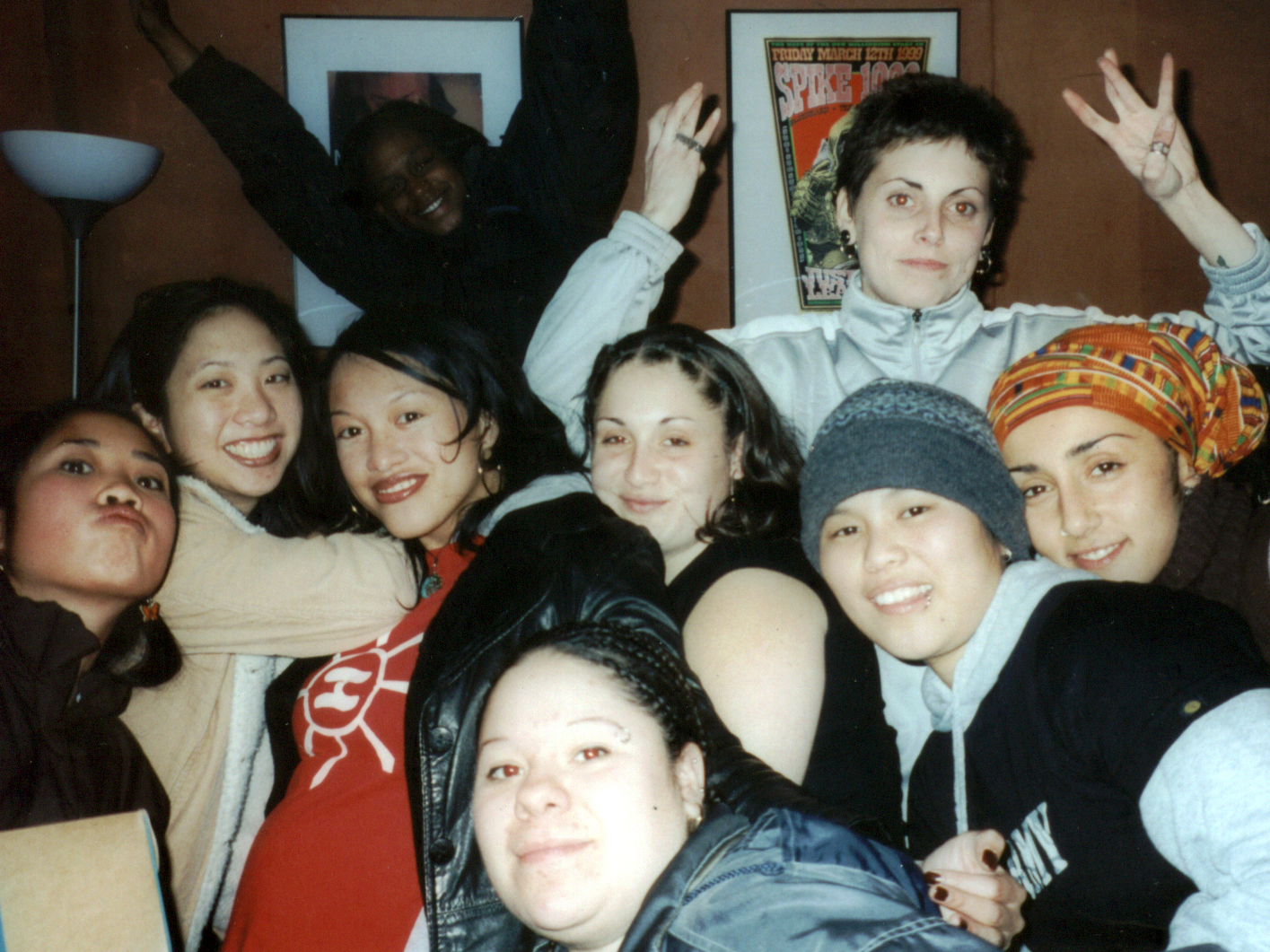
“Make sure to get a spot towards the back of the room,” I told Sam Love as we made our way to Dana Street Theater on Berkeley. “Philip’s shows often involve things and sometimes liquids flying.” And I was right. There was some definite yam peeling, neti-pot-pouring, and chair-flying moments sprinkled throughout the show. Did I mention that we were in Philip’s bedroom?
“That’s the whole point, honey!” Philip told me.
The Home Theater Festival is an opportunity for actors and artists to perform and showcase their work, including GOLDIE winner Philip Huang’s “Fart of Gold” — and it’s all done from the comfort of their own home. Now in its third year, the Home Theater Festival concept has taken off as an alternative for performers who can’t afford a professional venue, and is happening all over the world.
The evening started with some seriously hilarious story telling by Cassandra Gorgeous (the topic was really too intimate to talk about… go see her perform yourself!), followed by Philip and his director, Theo Knox, taking us through an evening of mini-shows, ranging from alien-butoh to a dance performance by a character with limited arm movement, at which point the dude sitting next to me exclaimed, “Boy, this is soo uncomfortable to watch,” as tears of joy streamed down his face.
The Home Theater Festival runs until June 3rd, and “Fart of Gold” runs Friday and Saturday night. Don’t miss the weirdness. It’s good for you.
Josh Stearns of Free Press has been tracking arrests of journalists covering Occupy protests since September. He tracks using news outlets, social media, and tips, and always reaches out to confirm the details with each journalist. He did this for me when I was arrested Jan. 28 coveringOccupyOakland.
According to Stearns, 70 journalists have been arrested while covering Occupy protests in 12 cities around the country.
In an annual survey of worldwide freedom of the press released Jan. 23 by Reporters without Borders, the United States ranks 47th, a fall from last year’s 20th place ranking. According to the group, the US “owed its fall of 27 places to the many arrests of journalist covering Occupy Wall Street protests.”
These arrests can be much more difficult for freelance and independent journalists who lack institutional backing.
Such is the case, for example, with Bradley Stuart Allen, a freelance photographer who was arrested while documenting a building occupation by what a police report called “a group acting in solidarity with Occupy Santa Cruz.” Allen is charged with felony conspiracy and two counts of misdemeanor trespass; his case will go to trial May 20.
Journalism, of course, is in a state of transition, and as traditional media outlets are losing ground, independent and citizen journalists have stepped up to provide in-depth and accurate coverage. Groups like the Society of Professional Journalists, the Reporters Committee for Freedom of the Press, and Free Press, in turn, have provided that crucial institutional support.
The Free Press has organized thousands to call city governments demanding detained journalists’ release. Stearns maintains a storify page with updates on what has become known on twitter as “#journarrests.” (And if see any happening, remember to tweet him at @jcstearns!)
They also made a call for notices of gratitude to arrested journalists, and got sixteen thousand responses.
But there’s a lot — a whole lot — wrong with this deal, and the San Francisco supervisors need to give it a very hard look before they just roll over and do what the mayor wants.
The centerpiece of this goes to one of the biggest issues in this crowded city: Jobs and housing costs.
The mayor talks about jobs all the time — he’s the “jobs mayor, jobs jobs jobs.” Which is popular when unemployment remains stubbornly high. But there’s a flip side: If you create a lot of jobs that attract new residents to the city, and you don’t build housing that’s affordable to those workers, you put additional pressure on the existing housing stock, driving up costs for everyone.
The big winners are the landlords and speculators.
In this case, CPMC says that the project will create 1,500 permanent jobs in San Francisco. But the deal only guarantees a tiny portion — about 5 percent — of the new jobs will go to existing San Francisco residents. Not many jobs for Lee’s unemployed consitituents.
And there’s nowhere near enough housing money in the deal to handle a workforce that won’t be primarily existing residents.
For most of the long negotiations, CPMC took the position that it wasn’t responsible for any housing at all, and the mayor was demanding more than $70 million. In the end, Lee accepted a promise for $33 million — but only about $3 million will be up front and the rest will be paid out as the project is built. That’s if nobody sues; if any organization goes to court to block the deal, the housing money goes away.
At least half of the workforce at the new hospital will be people who make less than astronomical salaries — nurses, orderlies, cooks, janitors, clerical staff, support staff etc. Based on the city’s existing figures, only about 10 percent of them will be able to afford market rent in San Francisco. And the money CPMC is promising will account for less than half of the affordable housing need it’s creating with this project.
Oh, but it gets better: CPMC is counting as part of its affordable housing contribution a $29 million fund to help its employees make down payments on houses. What does that do? It drives up the cost of a house in San Francisco by adding a pool of bidders who have down-payment assistance. And most of them probably won’t be buying million-dollar condos — which seems to be what the city is building these days. So the average San Franciscan who wants to buy a house will be up against not only the Facebook millionaires but the CPMC employees who — in the absurd name of affordable housing — will have a subsidized down payment.
“So the new CPMC employees can outbid existing residents,” Calvin Welch, a critic of the project, told me. “At the very best, we might have a deal that might possibly meet half of the housing impact.”
Oh, and the delayed payments on the housing money will mean that affordable housing won’t be built until well after the new jobs begin.
That really helps the housing crisis.
Then there’s the commitment to treatment for the medically indigent. What CPMC has agreed to do, in essence, is to provide the same level of charity care the big Sutter Health chain does today — and that’s laughably, shockingly low. The commuity health advocates wanted CPMC to agree to a charity care level that’s the average of what other big hospital groups provide; no go, says CPMC.
A key provision of any deal has to involve the future of St. Luke’s, the only full-service hospital (outisde of SF General) on the south side of town. It’s a crucial part of the city’s health infrastructure, and for years, Sutter has been looking for a way to close it down.
The deal preserves St. Luke’s — but cuts it down from 200 beds to 80. The hospital will remain open for 20 years — as long as CPMC’s system-wide operating margin doesn’t drop below 1 percent. That’s actually a significant way out — particularly since CMPC/Sutter controls its own books and could potentially do all sorts of things to change the reported operating margin.
Emily Lee, who has been working on the health-care part of this deal for the Chinese Progressive Association, told me that she’s glad St. Luke’s will be preserved. “But we have to ask, will it be sustainable as an 80-bed hospital?”
The neighborhood hospital is also a key bargaining chip — and the CPMC folks, I am told, are using it to pressure supervisors and community groups to accept the deal. “I’m hearing, ‘you better support this or St. Luke’s will die,'” one source told me.
Then there’s the labor problem.
CPMC is having serious problems with its unionized workforce, particularly because the health-care outfit won’t guarantee that people who currently work in the hospitals that will be demolished will get jobs at the new site. “Nobody’s guaranteed a job,” said California Nurses Association representative Joanne Jung. “We’re talking about some people with 30 years seniority. And if they do get jobs at the new hospital, they will very likely lose that seniority. It’s a lightening-rod issue.”
The draft development agreement says nothing about ensuring workplace protections for union members. “They’re trying to pit the building trades unions against us,” Jung said. “This is the deep, dark secret of this deal.”
Now: By law, city officials say they can’t tie a land-use decision to the resolution of a labor dispute. But there’s no way this is going forward if the construction jobs aren’t fully unionized. And so far, the nurses say, Mayor Lee isn’t even addressing the concern.
Could the mayor say to CPMC: Look, you solve your labor issues — not my business, but you and the unions work it out — then come to me and we’ll talk about a deal? It’s certainly happened in the past, with previous mayors and previous projects. Not here.
Of course, the biggest problem is that all of this was done in secret, without any input from the wide range of community groups involved in and watching this project. “The community has no role in the development agreement,” Emily Lee told me. “It’s unfortunate that the Mayor’s Office did this without community involvement.”
Why did Mayor Lee — the consensus builder — craft a deal that so many people are going to oppose and that will set off a pitched battle at the Board of Supervisors and pass, if it passes, by a very narrow margin? I can’t read his mind, but let me speculate for a moment.
Over the past few months, Lee has been taking a fairly tough line with CPMC, and by some accounts, was unwilling to settle for the type of limited housing mitigation the hospital chain is offering. But Salesforce just abandoned a major construction project in the city, the America’s Cup is being downsized — and the Chamber of Commerce types really, really want this hospital. You add it up.
The voters are stupid. They elected George W. Bush (sort of) and now they’ve dissed the Best American Idol Perfomer Ever, wno also happens to be the only Korean to make it anywhere near this point in the show and (I think) the only Asian male.
Heejun Han is funny, has a sense of perspective, and as we saw when he made a last-ditch attempt to save his spot, can really, really sing.
But he’s not a nice white boy who talks about God and sings about small white towns in the midwest, and he’s not a nice white girl who sings pop songs, and he’s not deferential to Bill Fucking Joel, so he gets voted off.
Viv and I are boycotting. Actually, I’m boycotting and she’s girl-cotting. We’re never watching again, at least until next week. Heejun was, I think, the only boy she ever liked on AI, and now a bunch of lame-ass losers who sound like everyone else are heading for the final.
Okay, not Joshua, who is the best true singer in the lot, and not Elise, who kicked ass with “Whole Lotta Love” (NOBODY can sing Led Zeppelin, and somehow she did). Oh, and Jessica. Viv likes Jessica.
But the rest of them? Blech.
Let’s have Heejun Han day in San Francisco; he sings better than most of the folks who croon at the Board of Supervisors. And he’s a lot more funny.
San Francisco Municipal Transportation Agency staff and Director Ed Reiskin today unveiled a two-year budget proposal that avoids Muni fare increases or service cuts and directs more money to address the transit system’s deferred maintenance needs, but it relies on substantially increasing parking meter revenues in ways that have been tough sells before.
In addition, the budget proposal – which will be considered by the SFMTA Board of Directors on Tuesday – is seeking labor concessions to lop off another $7 million, which will still need to be negotiated with the militant Transport Workers Union Local 250A. That won’t be easy, but Reiskin made a good first move by recently canning 10 of the agency’s top-paid executives en route to saving $2 million per year just in management salaries.
But the parking meter proposals are likely to stir a hornet’s nest of angry motorists who have come to expect free street parking. Reiskin is proposing to eliminate the free parking on Sundays, making drivers pay for parking between noon and 6 pm. And he wants to add another 500 parking meters.
Both are good ideas for an agency that desperately needs the money, and it has done studies showing that businesses and motorists would benefit from the charges making parking spots more readily available. But each time the SFMTA has tried to implement these proposals – trying to do Sunday meter hours in 2009 and trying to add hundreds of new meters in the Mission and Potrero Hill earlier this year – the torches and pitchforks came out and agency officials sulked off to lick it wounds.
But Reiskin says this is what the city needs to do. An SFMTA press release labels the proposals “modernizing antiquated parking policies, and Reiskin says, “While we’ve made tough decisions in order to develop a responsible, balanced budget, we are doing everything we can to avoid fare increases and service cuts. These proposals reflect our commitment to the city’s Transit First policy and allows for improvement in all modes of transportation.”
“I’m so excited for that hill!” I shouted. And I was on a bike.
I’ve never been excited for a hill on a bike before. But last week I tooled around on an electric bicycle with Karen and Brett Thurber, the husband-wife owners of Bernal Hieghts’ sweet-swanky new shop New Wheel. We did about half of a 49-mile scenic drive (the one created in 1939 for the Golden Gate International Exposition that was meant to showcase the city’s then-new neighborhoods), went up Twin Peaks, and I felt like a million bucks at the end of it.
I tell you this at the risk of sounding soft to pretty much every biker I know, but: “e-bikes” are fun. You can decide yourself — New Wheel’s always open for test rides, and it has a weekend of festivities planned Sat/31-Sun/1 to introduce the metal steeds to your loins. If you’re open.
Electric bikes have a PR problem in the states. I think that’s because the wrong set of people are the ones aware of them. E-bikes have little allure for the urban warrior, those of us with quads of steel powering up the Wiggle, trackstanding, flinging our back wheels all around at stop lights. Or they do — but it’s reserved for that novel day when we just want to cruise and have the magnitude of our pedaling amplified two, three times. I’m telling you, it was a blast cruising up Twin Peaks without getting winded.
I won’t be trading in my vintage Motobecane for one of these bad boys. There’s the fitness factor — although you can turn off the motor, I probably wouldn’t if I had the option to hit those hills on Dolores Street with that amount of ease — the environmental factor — even though it only takes three cents worth of electricity to charge up the bike enough to ride it up to 65 miles, that’s still more than the zero electricity I’m using currently — and oh god yes, the price factor. One of New Wheel’s retrofit kits, which allows you to turn a non-motorized bike into an electric one, starts at $1699. A bike that was built to be electric starts at $2549, with most models between $2999 and $3999. Brett and Karen Thurber compare these prices with what you’d spend on public transportation on that same amount of time, or — gasp! — what you’d spend on a car. Maybe they’re right, but that’s a big nut to handle even with the shop’s 12-month no interest payment plans.
My personal preference aside, don’t discount the electric bike. There are certain neighborhoods in San Francisco that are (not) flat-out daunting to tackle on two wheels. A lot of folks just won’t do it — and that’s where the utility of these bikes come in. See, they’re not environmentally friendly when compared to regular old rides. But they are vastly better than a mo-ped, a motorcycle, a car. For an elderly person, these bikes are the perfect excuse to keep riding. One wonders how much easier e-bikes would make bike commuting for city families, one of the demographics the bike movement has had the most trouble with fitting into our current system.
Relatively speaking, the United States is way behind on the electric bike curve. In China, the things vastly outnumber cars. They are also popular in Europe, and on our ridiculously fun ride around the city Brett Thurber told me that some European brands were so eager to get into the SF market, where they see an optimal city for electric bike use, that they sent him models to sell on consignment. A splashy Outdoor Magazine feature last year (that posits Thurber as a could-be revolution-starter) quoted a green tech analyst firm that predicted the sale of e-bikes would double in the next five years.
New Wheel’s promo posters are designed on the diagonal, so that an e-bike rider cruising on an up-slant past a row of Victorians is suddenly on level ground when the images are hung as intended. Their Twitter campaign #flattensf speaks to this aspirational desire to iron the adverse inclines out of city riding.
Is SF going to fall in on this one? We’ll see — at the moment the trend is so new that many logistics in regards to the bikes’ place in the city’s network of bike lanes have yet to be worked out. Currently, New Wheel is the only bike store to focus more or less exclusively on electric models, dealing primarily in Ohm, Kahlkoff, and Kettler brands, with Bionx retrofit systems available. Locally, you can also check the bikes out at Noe Valley Cyclery.
E-bikes are definitely worth a look-see, if only for the novelty of quick, easeful spurts up Bernal Hill. This weekend, New Wheel’s making a big push to get their bikes underneath San Francisco. On Sat/31 there will be a 11am to 6pm tour of the 49 Mile Scenic ride is planned. You can win a spot by participating in New Wheel’s daily Twitter and Facebook discussions. (Normally, a 24-hour rental of one of the bikes costs $85.) There will also be chances for shorter test rides, an SF cartography exhibit at 6pm that evening by Schein and Schein Antique Maps and Prints, and an open house at 6pm Sun/1.
If you were the kind of kid who, when introduced to the concept of abstract art, would grab the fingerpaints and try to top Jackson Pollock’s “No. 11,” then chances are at some point you’ve harbored a desire to take on the movie industry with your own resources. After all, the tools are out there, within grasp of anyone with access to equipment as modest as a camera-phone or a web-cam. And just as the advent of the analog camcorder was hailed as a democratization of the cinematic art-form, so too can the current craze for digital gear be read not just as consumerist one-upmanship, but an earnest bid for creative parity.
Well, if it’s artistic inspiration you crave, and fingerpaints aren’t cutting it anymore, you need look no further than the Disposable Film Festival, which took place this past weekend, dedicated to screening the best of the no-budget brigade, for motivation. Lest the term “disposable” put you off, festival co-founder Carlton Evans is quick to amend: the technology is what’s considered disposable here, not the creative output.
Just five years old, the Disposable Film Festival emerged at just the right time to catch a wave of enthusiasm for ephemeral cinema that just keeps gaining momentum. Gone from selling out ATA to selling out the Castro Theatre, the festival attracts films and makers from all over the world, whose works span a wide range of genres and aesthetics. This year’s shorts program, gleaned from approximately 2000 submissions, included entries from seven countries, recorded on a variety of non-pro equipment: iphones, web-cams, DSLR’s. A seven-minute long French horror film. An animated short of Hunter S. Thompson. A cautionary tale about web-cam hacking. A love letter hitched to the trajectory of the Voyager spacecrafts. Another love story in the form of a mesmerizing short filmed with a split screen technique.
My favorites mostly turn out to be the one’s created with screen capture technology. There’s Elise The’s “Synchronize,” an expressionistic mash-up of clips from action films and rough animation comprising the colorful fantasy-world of a late night video clerk, and Fabrice Mathieu’s “Dans l’ombre,” a noir pastiche about a self-liberated shadow using images sampled from a long list of classic films including The City of Lost Children, Casablanca, Shadow of a Doubt, The Black Dahlia, and Ed Wood.
Also making use of screen captures, Andre Chocron’s music video “Time is of the Essence,” featuring Norwegian shoegazers Cold Mailman, unreels through a cityscape of apartment towers and after-hours office buildings. Darkened windows light up in time to the music in synchronized patterns of chord progressions, a pulsating graphic of a heartbeat, and giant “text messages” of the lyrics, as rushed timelapse footage of billowing night clouds, hovering UFO’s, and the setting moon keep the mood mysterious. This four-minute video took about four months to edit, and Chocron’s meticulous attention to detail shows. And on one hand, it does pose the question of what Chocron could do with a bigger budget and better equipment, but on the other hand, offers the answer that Chocron and his like-minded cohorts may never need to find out.
The other day I saw this woman was walking down the street, spitting image of Rose from the Golden Girls. Excuse?! Lady, I know you didn’t get the glimmer for those high-waisted purple pants all by yourself. Leave it to LA electro pop duo Hi Fashion to debut a video (featuring luks crafted entirely by the group itself) today that speaks to this exact situation. So that I don’t have to. Because no one wants that mess. If you wanna get Hi live and in person, check out the group’s May 11 gig at Rickshaw Stop when it opens for JD Samson.
Dick Meister, former labor editor of the SF Chronicle and KQED-TV Newsroom, has covered labor and politics for more than a half-century. He’s the co-author of “A Long Time Coming: The Struggle To Unionize American’s Farm Workers” (Macmillan). Contact him through his website, www.dickmeister.com
I hope we can all pause and reflect on the extraordinary life of a true American hero on Saturday (March 31). It’s Cesar Chavez Day, proclaimed by President Obama and observed throughout the country on the 85th birth date of the late founder of the United Farm Workers union. In California, it’s an official state holiday.
As President Obama noted, Chavez was a leader in launching “one of our nation’s most inspiring movements.” He taught us, Obama added, “that social justice takes action, selflessness and commitment. As we face the challenges of the day, let us do so with the hope and determination of Cesar Chavez.”
Like another American hero, Martin Luther King Jr., Chavez inspired and energized millions of people worldwide to seek and win basic human rights that had long been denied them, and inspired millions of others to join the struggle.
Certainly there are few people in any field more deserving of special attention, certainly no one I’ve met in more than a half-century of labor reporting.
I first met Cesar Chavez when I was covering labor for the SF Chronicle. It was on a hot summer night in 1965 in the little San Joaquin Valley town of Delano, California. Chavez, shining black hair trailing across his forehead, wearing a green plaid shirt that had become almost a uniform, sat behind a makeshift desk topped with bright red Formica.
“Si se puede,” he said repeatedly to me, a highly skeptical reporter, as we talked deep into the early morning hours there in the cluttered shack that served as headquarters for him and the others who were trying to create an effective farm workers union.
“Si se puede! – it can be done!”
But I would not be swayed. Too many others, over too many years, had tried and failed to win for farm workers the union rights they absolutely had to have if they were to escape the severe economic and social deprivation inflicted on them by their grower employers.
The Industrial Workers of the World who stormed across western fields early in the 20th century, the Communists who followed, the socialists, the AFL and CIO organizers – all their efforts had collapsed under the relentless pressure of growers and their powerful political allies.
I was certain this effort would be no different. I was wrong. I had not accounted for the tactical brilliance, creativity, courage and just plain stubbornness of Cesar Chavez, a sad-eyed, disarmingly soft-spoken man who talked of militancy in calm, measured tones, a gentle and incredibly patient man who hid great strategic talent behind shy smiles and an attitude of utter candor.
Chavez grasped the essential fact that farm workers had to organize themselves. Outside organizers, however well intentioned, could not do it. Chavez, a farm worker himself, carefully put together a grass-roots organization that enabled the workers to form their own union, which then sought out – and won – widespread support from influential outsiders.
The key weapon of the organization, newly proclaimed the United Farm Workers, or UFW, was the boycott. It was so effective between 1968 and 1975 that 12 percent of the country’s adult population – that’s 17 million people – quit buying table grapes.
The UFW’s grape boycott and others against wineries and lettuce growers won the first farm union contracts in history in 1970. That led to enactment five years later of the California law – also a first – that requires growers to bargain collectively with workers who vote for unionization. And that led to substantial improvements in the pay, benefits, working conditions and general status of the state’s farm workers. Similar laws, with similar results, have now been enacted elsewhere.
The struggle that finally led to victory was extremely difficult for the impoverished workers, and Chavez risked his health – if not his life – to provide them extreme examples of the sacrifices necessary for victory. Most notably, he engaged in lengthy, highly publicized fasts that helped rally the public to the farm workers’ cause and that may very well have contributed to his untimely death in 1993 at age 66.
Fasts, boycotts. It’s no coincidence that those were the principal tools of Mohandas Gandhi, for Chavez drew much of his inspiration from the Hindu leader. Like Gandhi and another of his models, Martin Luther King Jr., Chavez fervently believed in the tactics of non-violence. Like them, he showed the world how profoundly effective they can be in seeking justice from even the most powerful opponents.
“We have our bodies and spirits and the justice of our cause as our weapons,” Chavez explained.
His iconic position has been questioned recently by outsiders claiming Chavez acted as a dictator in his last years as head of the UFW. But what the UFW accomplished under his leadership, and how the union accomplished it, will never be forgotten – not by the millions of social activists who have been inspired and energized by the farm workers’ struggle, nor by the workers themselves.
Chavez deservedly remains, and undoubtedly will always remain, an American icon who led the way to winning important legal rights for farm workers. But more than union contracts, and more than laws, farm workers now have what Cesar Chavez insisted was needed above all else. That, as he told me so many years ago, “is to have the workers truly believe and understand and know that they are free, that they are free men and women, that they are free to stand up and fight for their rights.”
Freedom. No leader has ever left a greater legacy. But the struggle continues. Despite the UFW victories, farm workers are in great need of fully exercising the rights won under Chavez’ leadership. They need to reverse what has been a decline in the UFW’s fortunes in recent years, caused in part by lax enforcement of the laws that granted farm workers union rights.
Many farm workers are still mired in poverty, their pay and working and living conditions a national disgrace. They average less than $10,000 a year and have few – if any – fringe benefits. They suffer seasonal unemployment.
Job security is rare, as many of the workers are desperately poor immigrants from Mexico or Central America who must take whatever is offered or be replaced by other desperately poor workers from the endless stream of immigrants. Child labor is rampant.
Most hiring and firing is done at the whim of employers, many of them wealthy corporate growers or labor contractors who unilaterally set pay and working conditions and otherwise act arbitrarily.
Workers are often exposed to dangerous pesticides and other serious health and safety hazards that make farm work one of the country’s most dangerous occupations. They often even lack such on-the-job amenities as fresh drinking water and field toilets, and almost invariably are forced to live in overcrowded, seriously substandard housing.
Cesar Chavez Day should remind us of the continuing need to take forceful legal steps and other action in behalf of farm workers – to help them overcome their wretched conditions and finally provide a decent life for all those who do the hard, dirty and dangerous work that puts fruit and vegetables on our tables.
We need, in short, to carry on what Cesar Chavez began. We could pay no greater homage to his memory.
Dick Meister, former labor editor of the SF Chronicle and KQED-TV Newsroom, has covered labor and politics for more than a half-century. He’s the co-author of “A Long Time Coming: The Struggle To Unionize American’s Farm Workers” (Macmillan). Contact him through his website, www.dickmeister.com
This one will bring together most of the city’s most colorful nightlife characters — its presented by the infamous Peaches Christ, and includes music by Hard French and Stay Gold DJs (also Bunnystyle and davO) and appearances by Some Thing queens VivvyAnne ForeverMore and Glamamore. Double Duchess nuts!
Sometimes being a nightlife writer feels like getting stranded on Techno Dude Island. Not always cuuute. So when I got wind that the classic Sisterz of the Underground hip-hop party crew was hitting the Bay for a huge 10-year anniversary celebration Sat/31 including a party at Public Works and a day of tech workshops and empowerment talks at CellSpace, I jumped on the chance for a breath of fresh female airand an indepth talk with folks who inspired me back in the day to try a few dance floor moves I probably shouldn’t have.
SOTU founder Sarah “Smalls” McCann, creative director Traci P, and organizer Crykit moved away from the Bay a little while ago (and the groundbreaking in-school hip-hop education program they started, Def Ed, is currently in hibernation mode), but the international Sisterz of the Underground network they helped establish is still thriving and inspiring women to discover and transmit the roots of hip-hop dance, art, music, creativity, and culture. The 10th anniversary party reflects that all-encompassing approach with live music from Kid Sister, DJ Shortee, Green B, Jeanine da Feen, and tons more, plus a 1-on-1 dance battle, art and vendor fair, live painting, nail booth… It’ll be a much-needed femme attack in this age of War on Women, hip-hop style acrimony, and the mainstreaming of street spirit.
I communicated with the trio over email in anticipation of their return, and got not only the trademark Sisterz blend of energy, outspokenness, and positivity, but some juicy tidbits about Bay hip-hop history, the current state of rap and dance, and the ladies’ current doings as well. Check it.
SISTERZ OF THE UNDERGROUND 10-YEAR ANNIVERSARY CELEBRATION
SFBGIt’s been a minute since you’ve been on my radar. Can you introduce yourself and tell us what’s going on with y’all now?
TRACI P I moved to Las Vegas a little over a year and a half ago after an almost decade stint in San Francisco throwing events and creative directing the Sisterz of the Underground. Currently I am the managing partner of RAW Entertainment (www.raw-e.com) which is both a booking agency and event production company based here in Sin City. I book for a variety of artists, like BReal of Cypress Hill, two-time DMC champ DJ SHIFTEE, and NYC club and fashion DJ Roxy Cottontail. Aside from artist bookings I continue to produce local events here in Vegas as well as a monthly in San Francisco called Femme Fatale at John Colins, every second Thursday — it features an all-female lineup and highlights music, fashion, and art. The next one is Thu., April 12, and will feature live painting, a guest performer and a dubstep DJ line-up including Lotus Drops, Sculltrain and Smashletooth. I also write music interviews for Thrasher Magazine, mostly about hip-hop and rap artists.
SARAH “SMALLS” MCCANN I’m the founder of SOTU and also a B-girl in the Extra Credit Kru. After years of being in the Bay and running SOTU and Def Ed, our hip-hop education program, I moved down to Los Angeles at the end of 2006. Since then, most of my experience has been selling events at various venues including House of Blues Hollywood and Jillian’s Universal. Currently, I’m the marketing sales manager at Pacific Park, the amusement park at the Santa Monica pier while also being a partner in Clique Events Society and a board member for the tour and travel marketing association of Southern California.
On the side of all of that, I also run an entertainment company with my husband, B-boy Machine, called Hit the Floor Productions (www.hitthefloorproductions.com), help direct our in-house dance company, West Bound, and manage Bboy Machine as an artist. When I’m not busy being the business guru that I am, I’m still just a hip-hop head and a die-hard B-girl with Extra Credit Kru! However at this present moment, I’m not breaking as i’m almost 8 months pregnant with my first child!
CRYKIT Hey hey! I’m Michelle, aka Crykit, aka Miss Crix 🙂 I grew up on a farm in Wisconsin, moved to the Bay Area in 2000, LA in 2010, and currently in Las Vegas since 2011. I started DJing, popping, and breaking in 2002. The rave scene of 98-02 is really where it all began for me. For the last eight years B-girling has been my main focus. I’ve been a member of Extra Credit Kru since day one and with this crew of amazing talented inspiring ladies we’ve taught in schools and studios, entered hundreds of battles, performed at some pretty epic events, been featured in music videos and short films, traveled nationally and internationally
When I moved to LA I manifested what originally was an idea for a hip fashion line with the perfect balance of masculine and feminine HAPPY MEDIUM, into a dancy DJ duo that encompasses everything from dance to art to fashion to music. My partner in crime is a funky stylin’ B-girl I met back in the Bay: Faye aka 13 Moons. (She is DJing the 1-on-1 female dance battle at our Public Works party.)
SFBGYou must have a lot of memories of SOTU — how did it all come together and what stands out for you most from the past decade?
TRACI P Sarah’s the founder, but I can tell you a bit about how I started with the collective. I moved to San Francisco when I was 19 after leaving UC Davis. Having decided to take an alternate educational path towards my ultimate goal of working in the music industry, I decided to intern at as many record companies and entertainment-oriented entities I could. This included Bomb Hip Hop, Look Records, Live Up Records, and Quannum Records. A boyfriend of mine at the time introduced me to Sarah. I loved the idea of women in the music industry and hip-hop, and felt an overwhelming sense of welcome and support in the collective. I pushed Sarah to let me do whatever she needed and learn more about how she produced events and operated. I started coming in everyday. I had such a respect for her vision, dedication, and the energy she put into making this collective so visible and tangible for women all around the globe. From then on she became a mentor to me. Both she and the Sisterz of the Underground changed my life forever.
SMALLS Well, this is always a long answer for me, as even though I’m pregnant with my first child, I always saw SOTU as my real first child. This all started back in 2000 when I was approached by the owner of the Justice League (now the Independent) about doing a hip-hop event at the venue. I was super inspired by two females in my life at that time: Arouz, a female graff artist, and Inchant, a female MC. i thought it would be super dope to produce an all-female hip-hop event that included all elements of hip-hop (MCing, breaking, graffiti, DJing, beatboxing, etc.). I spent about a month scouting talent from all over and found B-girls from UC Berkeley, Syndel from old dominion, and many more. I asked Medusa to be the headliner and threw a show on January 18, 2001 called Sisterz of the Underground. The show had over 600 attendees and was a huge success! After the show, everyone was asking me who is Sisterz of the Underground… Well, I was in college at the time and didn’t really have any plans for who or what was SOTU. I decided to ask the girls involved if they were interested in forming a collective where women could comfortably express themselves, come together to share, and put on shows.
After a few more successful shows in the Bay, I decided to organize a group of us to teach at a young women’s conference. At this time, we really didn’t know what we were doing, but we knew we had something to share. From that conference, we were contacted by two all girl groups to come and teach at their center. Well, the year was filled with many shows and many workshops and soon we were voted “Best Hip-Hop Monthly of the Year” in the Guardian and we created a hip-hop education program called Def Ed. Def Ed became such a success and grew into a program that was eventually serving over 3,000 youth a year and existing in 6 counties of the Bay Area.
It’s hard to pinpoint my favorite point of SOTU, but I have to say that my life wouldn’t be the same without it and i would not be the woman that I am without all of my Sisterz that I have met along the way.
CRYKIT I first found out about SOTU at an all girl weekly dance practice at Dance Mission around 2002. There I felt supported in learning all about the culture and its elements. I would sketch in a black book, create stencils, DJ parties, pop, break, freestyle in the car on battle road trips, hahaha. It just sort of became a part of me, a lifestyle. I’m so grateful to have had a collective of such eclectic, empowering, talented women to grow as an artist with, to jump in a cypher with, to create a mix tape with… And most of these women are like super hero goddesses LOL.. Nurses, firefighters, neuroscientists, designers, massage therapists, business owners… the list goes on and on.
My favorite story I guess would be connecting with and building friendships with girls from other countries like Sweden, Germany, and India through SOTU! It’s so cool the network and community has spread globally.
SFBG The lineup for this party at Public Works is absolutely insane! It really brings together some true female talent. With female MCs like Nicki, Azealia Banks, and Iggy Azalea all over, do you have any thoughts about the state of females in hip-hop right now? TRACI P Thank you first off for the compliment, that’s endearing! As far as the state of females in hip-hop, I would like to start by saying that hip-hop in general is in a state of transition as is the music industry as a whole. As the landscape of popular music shifts more and more to being influenced by electronic music, I think that hip-hop as well is starting to play into this trend. Nicki Minaj is a great rapper but some of her songs are SO far from rap or even hip hop. “Starships,” enough said. Iggy Azalea has got a lot of style and I am interested to see where she goes but I am not so confident in her skills as a lyricist.
Then there are one hitters like Kreayshawn whose success can be attributed to the beat of ‘Gucci Gucci’ being along a electronic-dubstep style as well as her look being right for the time. There is less and less attention paid to substance and more to image and look. Half of these girls can’t even perform live and are in a sense disposable because they have no stage presence. Just a pretty face with flashly clothes and jewelry. Then you have these record labels and agencies making it worse because the industry is so in the toilet that the SECOND they smell a lick of talent, they come along, swoop them up, charge ridiculous amounts of money to promoters, the artist never fully develops before being fed to the sharks, and ultimately fails!
But then you have girls like KID SISTER and MIA who steady hold it down. They have their own style and do a good job of incorporating current trends as well as keeping true to themselves and having a voice instead of being a puppet. I’m forever a student, however, and am interested in what’s to come in the music industry.
And the female DJ should also not be forgotten. As is evident in our line-up we respect all elements of hip-hop and the DJ is no exception. I feel as though the past few years have given rise to a great window of opportunity for female DJs and we’ve seen more and more emerge and tear it up! Living in Vegas I see a lot of plastic behind the decks but there are truly real women who can throw it down and rock a party and/or battle just as good as men, La Femme Deadly Venom for one, Pam the Funkstress, Spinderella, we have our own Crykit in Vegas killing clubs with style. It makes me happy to see this. SMALLS To be honest, I think hip-hop overall is ever changing and growing with different niches and styles that come through. As for females in hip-hop, we’ve definitely come a long way and are continuing to get out there and do our thing. If you look at the different eras of hip-hop, you’ll see how many female MCs were legends in their own right: MC Lyte, Roxanne Shante, Lil Kim, Raw Digga, Bahamadia, Nicki Minaj, the list goes on and on. I also think that female DJs have come along way and are continuing to show that they can rock just as hard or even harder than some male DJs. The thing that’s always been an issue for us women, or at least for me as a B-girl, was not wanting to be viewed as “just dope for a girl.” We want to be viewed as dope overall for our skill and not having anything to do with the fact that we may be a different sex.
CRYKIT I would like to hear better lyrical content in hip hop overall right now. I’m not really moved by too many female MCs at the moment. Wishing Missy Elliot did more, I feel like she can be true to herself but also bring it in at a commercial level. One thing I love about her is she always had real dancers in her videos.. she understands hip-hop as a whole and a community with all elements on display. I’m excited to bring Kid Sister to Public Works, I love her versatility, she sounds fresh on electro house tracks as well as hip-hop.
http://www.youtube.com/watch?v=zOgLK4t-Rts
SFBGI feel like hip-hop in general in the Bay Area, while still lively, is slipping below the radar, on the down swing of a cycle — any thoughts about that?
TRACI P Hip-hop in the Bay is most def on a decline. It was once a mecca but is no longer a hub for new and exciting artists, unfortunately. I have a lot of friends in the rap and hip-hop industry here in the Bay Area whom I would NEVER discredit or whose music I would never put down but as a whole, but I haven’t seen much that’s exceptionally great coming from this sector of California as far as hip-hop is concerned. I would say that the RAP is still there but the hip hop is falling off. I would also like to take this time to say RIP to Special One of Conscious Daughters who hip-hop lost late last year.
SMALLS Unfortunately I don’t live up there anymore, but I have heard that the hip-hop scene has sort of died. Well, i can tell you that it’s not only in the Bay… it’s the same thing in LA. I remember places like the Justice League where you knew you were always going to find a sick hip-hop show whether it was Black Star or Wu-Tang and in LA going to Project Blowed every week. Now, you’re lucky if you can find a club that doesn’t have a dress code and won’t yell at the B-boys and B-girls for starting a cypher. I think this is one of the many reasons that we’ve tried to keep SOTU alive and always try to incorporate the true meaning of hip hop behind our events!
CRYKIT I would say the hip hop dance scene is still thriving in the Bay Area! There’s a lot of talented dancers from the Bay in videos, TV, movies. And currently there’s classes offered at studios like City Dance taught by dancers who have been in the scene for a long time and have learned from the OGs and originators. There are battles almost every weekend filled with high schoolers and up… So in that arena it is still thriving and is a genuine mecca for dancers.
http://www.youtube.com/watch?v=lBjcW9rnjoE
SFBG I love that you’re having workshops during the day at CellSpace that cover both female empowerment and technical skills. Can you tell me a bit about what inspired you to turn the reunion into a true community event?
TRACI P Community is very important to us and key to the idea of empowerment. Obviously the nighttime events are geared toward adults, but we recognize the importance the youth has in shaping the world as a whole — and it’s always been important for us to reach out to the youth through hip-hop. We also founded a hip-hop education program called Def Ed years back, it is unfortunately no longer active, but we taught at many sites around the Bay and still have strong access to many of the kids around the area, it’s important that we maintain that connection.
Also, there is a lot more to the culture of hip-hop than just what you see on a stage or in a music video, the aspects of art, dance, production, and fashion are equally important. At a time when everything seems so fabricated it’s essential that people be exposed to the roots of music and the culture. It is our mission to teach and empower in any way possible. By having females host these workshops, you never know who might be inspired, because it’s not every day women are so praised in such a male dominated arena such as hip hop.
SMALLS This is easy: SOTU has always been about community, education, growth, expression, and hip-hop. This event marks more than 10 years strong as a female hip-hop collective and tying in all of these aspects was truly important to us. There’s no point in just putting on an event to make money (at least for us)….we wanted to produce an event that included the youth and our amazing sisterz sharing their knowledge along with a night time event to remember. We figured having workshops, battles, showcases, vendors, art galleries and all of the various things we are including in this event would show was SOTU has always been about — true hip-hop expression in an open environment that welcomes anyone and everyone!
Crykit SOTU events have always been community-based, that’s where we all began. I love that a part of the celebration is at Cellspace because that’s where we established our breaking practice eight years ago actually, almost a decade we’ve been working with them. It’s a piece of Bay Area dance history, and our practice is the longest-running established regular practice in the city of San Francisco. It’s always important to include the youth. We love the spirit, freedom, and creativity they bring!
SFBGCan I get a current top 5 from each of you?
http://www.youtube.com/watch?v=lDo8Z-eoBiI
Traci P
MIA, “Bad Girls”
Slaughterhouse, “Hammer Dance”
Schoolboy Q, “Hands on the Wheel”
Joey Bada$$, “Survival Tactics”
J. Cole, “can’t get enough’’
Crykit
1. B.Bravo “Swing My Way” remix
2. Flying Lotus/ Thundercat “$200 TB”
3. Trina “Red Bottoms”
4. Mark Ronson “Animal” remix
5. Rye Rye & M.I.A “Sunshine”
Smalls
If I can twist this and get you my current top 5 reasons for still being a true hip hop head: 1. The feeling I get at a live show when everyone has their hands pumping in the air 2. The feeling I get jumping into a hot cypher where the DJ is killin’ it and everyone wants to get in 3. The feeling i get seeing the little girls of Extra Credit Kru enter a battle with us OGs 4. The feeling I get watching my hubby, B-boy machine, smoke someone on the dance floor 5. The feeling I get knowing that no matter how commercial hip-hop has become, that there’s still so many folks doing it right in the community
This is the thing, is that pastel is not supposed to be sexy and it’s definitely not supposed to be San Francisco.
But here it is, and nowhere is it more apparent than in this week’s lineup of sex events. It’s not just Mission Control’s pajama bash, but also the parade of parties that will be hitting the decks throughout the next seven days. Actually, maybe it’s just Sat/31 that’s putting forth the highest wattage of lightly-hued light. The 15th anniversary of the Lex? Well sure, it’s hardly pastel in everyone’s favorite dykve bar, but best believe that the world of the Lexington churns based on the wattage that pink provides. And the Clitoris Celebration at La Pena Cultural Center? Rosy shades of powerful. So don’t worry if your dye job’s starting to look a little tie-dye-red — just tell ’em you’re in My Little Pony land and they’ll understand. Hey, maybe even take you home.
In Burning, In Bashing Back, In Blooming
Alexander Alvina Chamberland is a SF native gone Swede — but though they’ve toured their spoken word performance piece all about Europe (try Berlin, London, Stockholm, Manchester, Göteborg, Malmö, Lund, Amsterdam, Copehagen, Norberg, and Uppsala, and don’t ask me what country the last one of those is in) eventually one always must return home. So let’s give the queer performer a big attending-your-soul-baring hug, because In Burning deals in two of the most personal topics there are: sexual assault and gender identity. Plus, Chamberland is an emotive whiz. See the clip of an early performance of a scene from the show for proof:
Thu/29 7:30pm-9:30pm, $5-$15 sliding scale, no one turned away for lack of funds
No one’s going to tell you to stay on your side of the pillow tonight — just make sure you dress your frilly, fierce best because Mission Control’s playspace is all about polyamory permission tonight. Dress code is sleepwear, sweetie, and don’t forget your bedfellow. The buddy system won’t be enforced at the door of the event, but you’ll need a pal for getting into any of the fun zones.
Sat/31 9pm-3am, $20 Mission Control and Love Triangle members only
Sayeth Marke B. in this week’s Super Ego nightlife column: Time flies when you’re a flaming hot lesbian! Can it be 15 years already since the proudly dive-y Lex threw open its doors to the gorgeously rough-and-tumble dykes of the Mission and their humble admirers (like yours truly)? Oh hell yes. Congratulate owner Lila and crew on keeping one of the few lesbars in homocity open, with filthy music, smokin’ go-gos, kinky quinceanera shenanigans, and lipstick-obliterating drink specials.
Not enough lip service is paid to the hood beneath your hood, no? Perhaps it we don’t celebrate it appropriately — which is why this benefit for Global Women Intact, the grassroots nonprofit that raises awareness about African female genital mutilation is so important. An evening of music from the mother continent has been planned, so go to support our right to keep that oh-so-important swatch at the forefront of our lives.
Mr. Sexsmith has recently edited two tomes of stories to get you in trouble — Best Lesbian Erotica 2012 and Say Please: A Lesbian Erotica Anthology. She’ll be reading from the latter today, so if you need a nice little treat for this weekend’s hookup, you can drop by Good Vibes to get a copy sexily signed by its author herself.
Editor’s Note: California is transferring many prison inmates to jails in their counties of origin, a process known as Realignment that will impact the San Francisco Sheriff’s Department. Mayor Ed Lee removed the elected head of that department last week, and the process for determining whether Lee acted appropriately could take months. With that context in mind, we present this inside look at Realignment by Eugene Alexander Day, a third strike inmate at Soledad Prison who will be writing occasional articles about prison life for the Guardian.
A perfect storm is brewing. An unparalleled crisis in corrections is exacerbated by an even worse economy. As a reform-minded inmate buried under a life sentence, it feels like hope is on the horizon. Judicial oversight is the cornerstone.
Due to a murderous and unconstitutional medical department, the Supreme Court implemented a population cap on the California Department of Corrections and Rehabilitation (CDCR). December marked the first of four benchmarks. By mid-2013, the prison population must be brought down by 33,000 inmates.
In response, the Legislature passed Prison Realignment (AB 109), which started in October. Once the dust of Realignment settles, state facilities will become the sole domain of real criminals. Serious and violent offenders, called “strikers,” must serve 80 to 85 percent of their sentences. The rest of us are serving life sentences for third strikes, murders, or other violent crimes.
Under Realignment, the counties will maintain custody of those eligible for day-for-day time credits, called “half-timers,” which includes parole violators. For years, experts have been calling for such a shift. Stemming the flow of parole violators and nonviolent, non-serious, and non-sexual offenders, called the three “nons,” is the first real attempt by the state to do the right thing.
By ignoring the evidence for so long, austerity measures and public safety are extremely difficult to reconcile due to judicial oversight. In 2007, Gov. Schwarzenegger convened an expert panel that crafted a road map of rehabilitative recommendations to address overcrowding. The state’s other expert panel, the socially irresponsible Legislature, instead chose to double-down on a bad bet.
Under the banner of building more prisons, underscored by sending inmates out-of-state, some of Schwarzenegger’s panel’s rehabilitative recommendations were codified as unfunded mandates. When the economy took a dive in 2008, the state lawyered up – and got its ass kicked in court.
It took some of the sting off my life sentence when the Supreme Court smashed the CDCR in 2011. Systemic mismanagement corrupted a generation of salvageable prisoners. As someone who lives, breathes, and sleeps the politics of justice, the Legislature didn’t simply kick the can down the road – it pushed the state closer to the precipice. State leaders have set a poor example. By failing to follow the evidence in 2007, all 58 counties had Realignment shoved down their throats in 2011.
This lens through which I see the world is depicted as “synchronized drowning” by Attorney General Kamala Harris. For the last 13 years, I’ve struggled to keep my wits in this sea of despair. Deviants need structured treatment, not more of the same. Shifting the responsibility of tens of thousands of offenders away from CDCR is an idea of brilliant simplicity.
Local law enforcement, prosecutors, and the courts are better suited to solve local problems. These offenders are members of your community. The next time the task force stomps through the ghetto snatching up people of color, they must think about how to house all of these people of imperfection. Good. Most need help, not a jackboot.
To continually be considered part of this particular problem is unacceptable. In her book Monster Factory, Sunny Schwartz opined that everyone from civilians to officers to prisoners “were collaborators in a system that accepted and invested in failure.” No one is exempt. Everyone is to blame. Lives are at stake.
Both Schwartz and Harris describe jails and prisons as crime colleges. I feel like I received tenure in the worst-performing school district in the nation. Untreated criminogenic factors give serious offenders the artistic license to develop unholy subsocietal norms. We sow the seeds of recidivism when low-risk offenders are subjected to our gangbanger, dope-fiend bullshit. Parole violators and the three “nons” are low-hanging fruit: easy to treat and even easier to corrupt.
The counties might hate Realignment, but I hate the fact it took so long. Marking a happy day in this collaborator’s miserable life, a whole class of offenders have been diverted away from the Monster Factory. Excellent. Realignment is not some hug-a-thug program. It’s basic math. So used to being treated like shit, I will die before I advocate for mollycoddling prisoners. Using offenders as earmarks to maintain an unsustainable status quo is a feeling worse than death. Fix the problem.
My dreams are skewed. In my way of thinking, prisons should become factories that turn monsters into advocates for social justice. Offenders need to learn the difference between pro-social and antisocial behavior, not how to shove dope up their asses or participate in a riot.
Don’t believe everything you read, especially when it comes out of the District Attorney’s office. D.A. George Gascon’s press representative Stephanie Ong Stillman says a memo covered in this week’s Herbwise column circulated earlier this month outlining the “continued illegality of selling marijuana” — even in state regulated cannabis dispensaries — was sent out without Gascon’s knowledge and “does not represent his views on medical marijuana.”
“He unequivocally supports medical marijuana,” Stillman told the Guardian on the phone this afternoon. “Prosecuting illegal marijuana sales is not a priority.”
This is — unequivocally — good news for San Francisco’s medical cannabis patients. The memo (signed by assistant district attorney John Ullom) stated that cannabis dispensaries were acting under protection of state law were perpetrating “a marijuana mega-myth.” According to the East Bay Express, it was released in response to indignation expressed by an unnamed dispensary’s deliveryperson was apprehended by law enforcement.
But Stillman says the brief was written over three years ago, before Gascon was elected to office. Calling it “a template brief,” she says it’s not the first time the memo has been circulated in response to legal questions about cannabis — but that it has not been since Gascon has been in office, and will not be used again under his administration.
But what of today’s headline of the SF Examiner, a quote presumably attributed to Gascon reading “all sales of marijuana are illegal”?
“It’s a misquote,” says Stillman. “They’re going to print a correction.”
UPDATE: The Guardian just recieved a call from Gascon himself, who confirmed Stillman’s comments, saying “I’ve already taken steps to make sure that this will not happen again.” Can we just say we’re pleased as punch that he’s upholding the values that he shared with us in his Guardian endorsement interview last September?
UPDATE: Although felony charges against the deliveryperson who was initially apprehended have not been dropped, Gascon’s office has filed for a two-week continuance.
The truth is, The Hunger Games will still be raking in mad dough this weekend. (Even Julia Roberts can’t step to Katniss Everdeen, and if John Carter is any indication of moviegoers’ fatigue of CG uber-spectacle, Wrath of the Titans is doomed. Though, to be fair, if anyone can step to Katniss Everdeen, it’s Liam Neeson.)
So. Your weekend options include: The Hunger Games, round two; re-watching last week’s zooby-zooby-zoo-tastic Mad Men season premiere over and over until episode two airs; or binging on all of Game of Thrones, season one, to prep for that show’s return to HBO (praise to R’hllor!) Also: Sat/31 and Sun/1 screenings remain of 1927 masterpiece/cinema event of the season Napoleon at Oakland’s Paramount. (Ain’t cheap, but worth it.)
If you really, really want to take in a new movie, the rep and art houses are the place to be Fri/30. Tom “Loki” Hiddleston squeezes in some acting cred ahead of The Avengers‘ May 4 release, starring opposite Oscar winner Rachel Weisz in the new one from Terence Davies (2000’s The House of Mirth):
The Deep Blue SeaCaught between the devil and the deep blue sea, filmmaker Terence Davies, much like his heroine, chooses a mutable, fluid sensuality, turning his source material, Terence Rattigan’s acclaimed mid-century play, into a melodrama that catches you in its tide and refuses to let go. At the opening of this sumptuous portrait of a privileged English woman who gives up everything for love, Hester (Rachel Weisz) goes through the methodical motions of ending it all: she writes a suicide note, carefully stuffs towels beneath the door, takes a dozen pills, turns on the gas, and lies down to wait for death to overtake her. Via memories drifting through her fading consciousness, Davies lets us in on scattered, salient details in her back story: her severely damped-down, staid marriage to a high court judge, Sir William (Simon Russel Beale), her attraction and erotic awakening in the hands of charming former RF pilot Freddie Page (Tom Hiddleston), her separation, and her ultimate discovery that her love can never be matched, as she hazards class inequities and ironclad gender roles. “This is a tragedy,” Sir William says, at one point. But, as Hester, a model of integrity, corrects him, “Tragedy is too big a word. Sad, perhaps.” Similarly, Sea is a beautiful downer, but Davies never loses sight of a larger post-war picture, even while he pauses for his archetypal interludes of song, near-still images, and luxuriously slow tracking shots. With cinematographer Florian Hoffmeister, he does a remarkable job of washing post-war London with spots of golden light and creating claustrophobic interiors — creating an emotionally resonant space reminiscent of the work of Wong Kar-wai and Christopher Doyle. At the center, providing the necessary gravitas (much like Julianne Moore in 2002’s Far From Heaven), is Weisz, giving the viewer a reason to believe in this small but reverberant story, and offering yet another reason for attention during the next awards season. (1:38) Embarcadero, Piedmont, Shattuck,Smith Rafael. (Kimberly Chun)
Liked A Separation, recent Oscar winner for Best Foreign Language Film? Here’s another standout Iranian film, The Hunter, not to be confused with the upcoming Australian film of the same title starring Willem Dafoe:
http://www.youtube.com/watch?v=K__lXagtZsQ
The HunterShot and set during Iran’s contentious 2009 Presidential campaign, The Hunter starts as a Kafka-esque portrait of quiet desperation in a cold, empty Tehran, then turns into a sort of existential thriller. The precise message may be ambiguous, but it’s no surprise this two-year-old feature has so far played nearly everywhere but Iran itself. Ali (filmmaker Rafi Pitts) is released from prison after some years, his precise crime never revealed. Told that with his record he can’t expect to get a day shift on his job as security guard at an automotive plant, he keeps hours at odds with his working wife Sara (Mitra Haijar) and six-year-old daughter Saba (Saba Yaghoobi). Still, they try to spend as much time together as possible, until one day Ali returns to find them uncharacteristically gone all day. After getting the bureaucratic runaround he’s finally informed by police that something tragic has occurred; one loved one is dead, the other missing. When his thin remaining hope is dashed, with police notably useless in preventing that grim additional news, Ali snaps — think Peter Bogdanovich’s 1968 Targets. He’s soon in custody, albeit in that of two bickering officers who get them all lost in the countryside. Pitts, a long-ago child performer cast here only when the actor originally hired had to be replaced, makes Ali seem pinched from the inside out, as if in permanent recoil from past and anticipated abuse. This thin, hunched frame, vulnerable big ears, and hooded eyes — the goofily oversized cap he wears at work seems a deliberate affront — seems so fixed an expression of unhappiness that when he flashes a great smile, for a moment you might think it must be someone else. He’s an everyman who only grows more shrunken once the film physically opens up into a natural world no less hostile for being beautiful. (1:32) Roxie. (Dennis Harvey)
Finally, a timely doc about the recently forced-to-resign-under-shady-circumstances prez of the Republic of Maldives, an island nation imperiled by the planet’s changing climate:
The Island PresidentThe titular figure is Mohamed Nasheed, recently ousted (by allies of the decades long dictator he’d replaced) chief executive of the Republic of Maldives — a nation of 26 small islands in the Indian Ocean. Jon Shenk’s engaging documentary chronicles his efforts up to and through the 2009 Copenhagen Climate Summit to gather greater international commitment to curbing greenhouse gas emissions. This is hardly do-gooderism, a bid for eco-tourism, or politics as usual: scarcely above sea level, with nary a hill, the Maldives will simply cease to exist soon if waters continue to rise at global warming’s current pace. (“It won’t be any good to have a democracy if we don’t have a country,” he half-jokes at one point.) Nasheed is tireless, unjaded, delightful, and willing to do anything, at one point hosting “the world’s first underwater cabinet meeting” (with oxygen tanks, natch) as a publicity stunt. A cash-strapped nation despite its surfeit of wealthy vacationers, it’s spending money that could go to education and health services on the pathetic stalling device of sandwalls instead. But do bigger powers — notably China, India and the U.S. — care enough about this bit-part player on the world stage to change their energy-use and economic habits accordingly? (A hint: If you’ve been mulling a Maldivian holiday, take it now.) Somewhat incongruous, but an additional sales point nonetheless: practically all the film’s incidental music consists of pre-existing tracks by Radiohead. (1:51) Embarcadero. (Harvey)
P.S. In honor of next Wed/4’s re-release of James Cameron’s Titanicin 3D … the immortal Titanic II (not coming to an IMAX near you anytime soon.)
Minneapolis’s Howler paused midway between playing songs from its debut album, America Give Up, to take requests from the audience at the Hemlock Tavern Saturday night. There were a few out of nowhere shout-outs, like “White Rabbit,” but the majority of the suggestions were titles by the Strokes.
On hearing the two bands it’s an obvious comparison, although for Howler perhaps an increasingly tiresome one, especially since singer Jordan Gatesmith seemed bored with the selections and quickly returned to the regularly scheduled program, saying “We’ll just play it safe tonight.”
The irony, though, was that if someone wanted to hear the Strokes’ “The Modern Age,” Howler’s opening track of the night, “Wailing (Making Out)”, already came pretty damn close. These comparisons should be taken as complimentary, for as much as the band seems to be borrowing at this still early in its career — and I also pick up heavy touches of the Replacements* — its doing it well, whether in the restrained guitar work or Gatesmith’s deeply droll, resonant voice, that carries each song with crystal clear lyrics, even during a live performance.
Which wasn’t the case with New Jersey’s the Static Jacks, which, despite actually being the most energetic band of the night, seemed to have it directed in strange directions. I’d been a little puzzled watching the band set-up, spending as much time getting its gear in order as arranging some cardboard art with female caricatures, only to knock the pieces down and step on them once the performance began.
It was only later on that I found out the posters had some actual function, as the singer would occasionally pick up a board — with the word “Follow”, coinciding with the song “Into the Sun,” for instance — to apparently subtitle and highlight some generally muddled and indistinct vocals. *My request for “Bastards of Young” was also ignored.
Dum Dum Girls have released a new video for “Coming Down” off last year’s stunning ’60s girl group-meets-Mazzy Star full-length, Only In Dreams (Sub Pop). In the music video, singer Dee Dee, clad in her signature black lace, sings directly to the camera as a crowd of people casually cuts pieces of cloth from her body, reminiscent of Yoko Ono’s “Cut Piece.” It’s directed by the group’s new bassist Malia James. Hint: Dum Dum Girls return to San Francisco May 22 at Slim’s.
Everyone stops what they were doing and ducks behind the plastic tables set up on the sidewalk. Flyers and packaging rustle in the wind. There’s no yelling or chaos, but three police cars speed onto the scene from three different directions.
I had been at Feed the People Day all of thirty seconds before gunshots were fired.
Feed the People Day, an international effort in which people get together to share food in black and poor communities from Australia to South Africa, was on its fourth year, and organizers from Bayview were joining in.
A few minutes after the gunshots, we all get up from behind the table. “God is good,” one volunteer says. “That could have been us.”
The volunteers get back to serving food.
“It’s a typical day in the life,” says Jameel Patterson, one of the volunteers serving food. “Not every day. But every so often.”
They chose to set up at Mendell Plaza. It’s full of people, a common place to spend free time. It’s next to the Bayview Opera House, which holds frequent events, as well as a complex that includes a gym, elementary schools, a playground, and a 300-person auditorium. Those buildings don’t hold many events, though—they’re mainly used for storage by the school district.
Mendell Plaza is directly off the T train, whose installation was supposed to bring prosperity and foot traffic to Bayview. But most of the businesses on the few blocks surrounding the plaza are still boarded up. And this T stop has become well known for a different reason: it was here that Kenneth Harding, Jr, exited the train July 16, ran away after police asked for his transfer, got shot in the back and died.
And it was in Mendell Plaza that police stood around the bleeding Harding for 30 minutes, allegedly denying him medical care, before he died.
Tracey Bell-Borden, one of the organizers of Bayview’s Feed the People Day, wants to rename the spot Kenneth Harding Jr. Plaza.
Fly Benzo, a musician and college student who has become well known after speaking out for Harding and a subsequent arrest–again at Mendell Plaza– while filming police, was a block away when the shots were fired. He was trying to take a young girl that he was looking after inside the gym to play. It was, inexplicably for a Sunday afternoon, locked.
“It’s never open,” said Benzo. “Where are we supposed to take our kids so they can be inside?”
The police, whose lightning-quick response time implies that they had a tip—according Patterson, it generally takes them 15 to 17 minutes to respond to gunshots– haven’t found a gun yet. Most of them are standing around three teenagers who, bystanders insist, were on the sidewalk doing nothing when the gunshots went off. The police run their IDs and take them to jail; probably on a gang injunction.
20 minutes have gone by before a cop drives up to the tables. “What organization are you with?” he asks.
Bell-Borden replies, “the Kenneth Harding Foundation.” Denika Chatman, Harding’s mother who moved to San Francisco after his death to try and find out more details surrounding its circumstances, asks “do you have a contribution?” the cop gets back in his car and speeds off.
“They didn’t want to know, is anyone here hurt? Are you guys OK?” says Patterson.
One man says he saw the smoke when the shots went off, directly behind him. The police rolled right past.
Patterson tells a story of the past Friday night, when lots of people had been out in Mendell Plaza. When one teenager who was playing with a remote control car accidentally steered it onto the street, a police officer pulled up and ran his ID.
Despite some dangers, neighbors continue to congregate in Mendell Plaza, and Bell-Borden says she is planning on turning Feed the People Day into a monthly event; the next date will be April 15.
Dewayne Isaacs, a community organizer who grew up in the Fillmore and Haight-Ashbury and had several Black Panther relatives killed in the 70s, says he, for one, will keep coming back for it.
“It’s us Bay Area natives,” says Isaacs. “We always fight back.”
We have an interesting opinon piece in this week’s paper by a close friend of Eliana Lopez, the wife of Sheriff Ross Mirkarimi. It gives a very different perspective on the situation than we’ve seen in the media so far. You can read it here.
The Center for Investigative Reporting (CIR) and the Bay Citizen today approved a merger that would consolidate the media organizations into a single newsroom, eliminating its breaking news coverage of San Francisco but seeking to generate local news stories from the data-heavy reporting of CIR’s California Watch and figure out what’s next for the journalism industry.
The merger requires approval from the California Attorney General’s Office because of potential anti-trust issues, with approval becoming final if AG Kamala Harris doesn’t object within 20 days. Although it was announced as a merger by both organizations, the Bay Citizen reported that it’s really an acquisition given that CIR will run the combined organizations under the leadership of Phil Bronstein, the CIR Board President who served as editor of the Examiner and the Chronicle before spearheading this merger.
CIR Executive Director Robert Rosenthal, who will oversee the combined newsrooms, confirmed to us that CIR will play the lead role, but he emphasized the complimentary aspects of the two organizations. “They have strengths we don’t have in terms of membership and local brand,” he told us, noting the Bay Citizen’s website will be a local portal and “a way to send people to other stories that we’re doing.”
Membership-based fundraising has been Bay Citizen’s strong suit since the late financier Warren Hellman launched it as the Bay Area News Project in late 2009 with $5 million in seed money, raising more than $17 million since then. The Hellman family and Bay Citizen Board Chairman Jeff Ubben have also reportedly committed to give another $4 million as part of the merger.
Bay Citizen has broken some important stories since going live in 2010, although it has recently suffered from a leadership crisis after resignations from two consecutive editors and then its CEO, who had clashed with the journalists there. While welcoming the leadership of a respected editor like Rosenthal, one Bay Citizen source told us that many in the newsroom are disappointed that they’ll no longer be covering breaking news.
“We’re not going to be a breaking news organization,” Rosenthal told me, confirming the report. “But it does not mean we’re not going to be a lively site.”
So while the Bay Citizen may stop doing stories on City Hall meetings, developments in political scandals, and spot news stories likes fires and crimes, Rosenthal said the intention is still to do “accountability reporting” that would provide strong local coverage. “I would hope that what we’re doing as for as covering City Hall would be more in-depth,” he told us.
Jonathan Weber, Bay Citizen’s first editor who now serves as West Coast Bureau chief for Reuters, said it’s not clear how the new approach will work but he thinks strong local news coverage is important. “It was my view when we started the Bay Citizen that if you’re going to be a news site that it be very vibrant and give a sense of what’s happening around the Bay Area on a timely basis,” he told us.
But he doesn’t want to second-guess the decisions CIR is making, telling us, “The Bay Citizen has a bigger mission than it had resources to accomplish it, so making a decision about what you’re going to do and not do is appropriate.” Yet he believes the Bay Area is underserved with strong local news coverage, “so to the extent that goes away, it will be a loss.”
Still to be determined is whether Bay Citizen will continue providing semi-weekly content for the New York Times, an agreement that immediately elevated the stature of the media startup. Some local journalists say they fear the merger will mean less local journalism, which has already been hit hard by corporate media consolidations and layoffs.
Bay Citizen reports that Tom Goldstein, interim dean of UC Berkeley’s School of Journalism and the only journalist on Bay Citizen’s board, resigned in the last couple weeks after being the only board member resisting the merger. Calls and emails to Goldstein were not immediately returned, but I’ll update this post with his comments if and when I hear back.
The other aspect of this merger that may be troubling to some is the leadership by Bronstein, a controversial figure who led the Examiner and then the Chronicle through a era of major downsizing by Hearst Corp. Bronstein wasn’t available today, but when I asked him about the issue in February, he defended his local record and blamed cuts to local journalism on corporate decisions and general industry trends.
He also said, “I don’t know that I’m the best person to take it over. That’s something other people should determine, not me.” Yet the Bay Citizen’s coverage of merger indicates its board asked Bronstein to be its president – he was already president of the CIR board – and that he declined but suggested the merger as an alternative and has been working to make it happen.
Rosenthal, a longtime journalist who worked under Bronstein for years at the Chronicle, said they work well together and that Rosenthal has always felt supported in doing good journalism. Under the merged entity, Bronstein and Rosenthal will reportedly get the same salary, a little more than $200,000, and Rosenthal will focus on the newsroom while Bronstein focuses on the donor base.
As we reported in February, Rosenthal has had to expand on his journalism skill sets in recent years as he successfully sought foundation funding to beef up CIR’s news-gathering operations and launch California Watch, which partners CIR with media outlets around the state to do investigative reporting and statehouse coverage.
“Our merger with The Bay Citizen announced today puts us in a unique position as journalists, innovators, technologists and, yes, entrepreneurs. I worked in newspapers for decades, starting as a copy boy and ending up as the top editor. No one ever strung those four words together to describe what we were as an organization,” Rosenthal wrote today in blog post describing the merger. “But to survive, thrive and evolve, the journalism, the innovation, the technology and the entrepreneurial vision all have to be intertwined in the new model.”
That sense of trying to create a new model for the journalism industry – which has been decimated in recent years, hindering its ability to play a watchdog role in a country founded on the importance of a free press – seems to dominate in the comments coming out of each news organization, emphasizing new ways of funding, covering, and delivering the news.
“We are bringing together two Bay Area enterprises with very complementary strengths,” Bronstein said in the press release. “They are both devoted to protecting justice and democracy through great, engaging journalism.”
But what that looks like, whether it’s sustainable, and how it is going embraced by Bay Area residents remain open questions as the merged newsrooms struggle to work together and resolve outstanding issues. Or as Rosenthal told me, “This is going to evolve.”
After years of hunting, the day finally came when I could find proper cocktails in LA, even if the scene itselfwas years behind NYC or SF. I’ve covered LA cocktail bars in recent years as the quality has rapidly grown, with my latest visit yielding the most consistent drinks yet. The LA cocktail renaissance is indeed coming into its own.
There have still been a few hyped-up letdowns, like Next Door Lounge in Hollywood, which is a fantastic space: roomy, mellow, old world, with comfy leather couches, friendly service, and classic Powell and Loy movies playing on a big screen. I absolutely loved the environment which it made it even more disappointing in sampling four expensive drinks ($12-14) to find them unbalanced and generally unappetizing.
Perhaps Next Door’s execution will improve to match the interior. In the meantime, here are some spots worth checking out down south.
Italian and Peruvian pleasures: SOTTO, Culver City
My favorite drinks this visit were served by my favorite bartender Kate Grutman at Sotto restaurant. She exudes style and panache, while keeping customer service and comfort foremost. In a spacious building housing Picca Peruvian Cantina upstairs, Sotto’s low ceilings and buzzy vibe are the backdrop for Neapolitan pizzas and Italian pleasures like sardines or house lardo on toast.
Both restaurants opened just under a year ago with menus created and bars managed by Julian Cox, well known for his cocktail menu at Rivera in downtown LA. He poured rare Italian amari from Sotto’s vibrant collection, while Kate served cocktails exhibiting restraint, balance, and sheer drinkability. At Sotto, amaro is king and in cocktails is given a range of interpretations.
I particularly adored Kate’s off-menu creation of Junipero gin, Suze, house sage and parsley bitters, Angostura bitters, and vermouth infused with pineapple and thyme. The drink hit all the right herbaceous, bitter, aromatic notes, shining as an aperitif or dinner accompaniment.
More amaro fun was had with a Carroll Gardens, typically made with rye, amaro, and maraschino liqueur. Instead, Kate used Averna, maraschino liqueur, and Cocchi for a bitter brightness. Menu stand-outs include a spiced Amaro Daiquiri: Fall Redux (rhum agricole, lime, Averna, allspice dram), a subtle, soft Smart & Fennel (London dry gin, lemon, house bitter orange marmalade, fennel-scented egg, fennel frond), a boozy but elegant Bicycle Thief (Scotch, Holland gin, vermouth, West Indian orange bitters), and a vivid Il Cavallo Bianco (reposado tequila, pineapple/thyme-infused dry vermouth, Cocchi, grapefruit peel).
PICCA, Culver City
Upstairs from Sotto is the aforementioned bustling Picca. While impeccable Peruvian food is reason to visit, the bar is a destination on its own for South of the Border spirits. Mezcal, tequila, pisco and cachaca are showcased here. There are infusion shots ($6), like pisco with coconut, pineapple or Concord grapes, or mezcal with rocoto pepper.
Cocktails are once again by Julian Cox, while the friendly bartending crew exhibit a love for the spirits they work with. After two visits, my top drink is Zarate’s Tomahawk # 15 ($12). It utilizes my beloved mezcal, infusing it with rocoto peppers, shaken with lemon juice, agave, and huacatay (Peruvian black mint), topping it with a soft cucumber foam. Heat, citrus tart, pepper, smoke and silky sweet weave into a balanced whole.
Boots with Fur ($12) shows off Italia-varietal pisco in a Tiki-inspired drink. Brightly spiced with bonded apple brandy, lime, and ginger, orgeat and falernum offer texture and nuttiness. It’s served over crushed ice in a copper mug, the most playful presentation on the menu. Texture rules in Avocado Project ($12), blending fresh avocado with the excellent Banks 5 Island white rum, lime, agave, ascorbic acid for balance, and a bit of salt for a sweet, salty, vegetal imbibement.
A bartender said actress Frida Pinto (Slumdog Millionaire) was just in days before and they served her their Slumdog Chamomillionaire ($11). Subtle Quebranta pisco earthiness marries well with red grape cardamom black pepper coulis, balanced by lemon and evaporated cane sugar. Picca’s bar menu is as lively and vivid as its food.
Rum and cigar havens: CANA RUM BAR, Downtown
Cana Rum Bar transports. Yes, you need a membership to enter, but it’s merely $20 for a whole year. I find this seemingly pretentious charge at the door actually keeps out “riff raff” (allow me to digress for a moment and explain my apparent snobbery. By riff raff, I mean vodka tonic partiers who ruin the setting at some of the more craft cocktail bars. There’s nothing more frustrating for those of us who really care about quality and a relaxed space to imbibe than to have that space overrun by those uninterested in craft and there to get drunk – they can do so at any of the hundreds of bars and clubs around that cater to exactly that crowd. There’s far less quality cocktail havens than party dens, so even more reason we pine for a few civilized spots in which to savor a well-made drink and conversation.)
Don’t worry: the place is sans attitude. Mellow on my visit with roaring patio fireplace, embracing glow, and cozy booths, Cana makes many a night a party with funky DJs and celebrations like Bob Marley’s birthday.
General Manager Allan Katz knows his rum… and his cocktails. Though not as encyclopedic as our own Smuggler’s Cove menu, rum geeks will delight in a well-curated menu grouped by island and continent. There are also tasting flights and cigar pairings.
I’m delighted with cocktails like Tennessee Isle ($12) made with Prichard’s Fine Rum, overripe mango-infused absinthe (subtle), and coconut Peychaud’s bitters. The menu describes it best: “This is what a sazerac would taste like if the wicked witch of the west overtook Kansas and sent Tennessee to the Caribbean via flying monkey.”
On the low alcohol front is a Trader Vic recipe adapted by bartender Danielle, an Angostura Fizz ($13): a full shot of bitters with house pomegranate reduction, lemon, cream. It’s a bitter, frothy, elegant beauty. An Actual Apple Martini ($12) changes the game for a typically dreadful drink using apple-infused Plymouth and Death’s Door gins, Pommeau de Normandie (a marriage of Calvados and fresh apple juice), Dolin Dry Vermouth, and Bitter Truth Creole Bitters. No fake green apple pucker here.
In keeping with Cana’s vibe, the drinks are refined yet entirely approachable. LA DESCARGA, Hollywood
La Descarga is mobbed when live burlesque and Cuban jazz are scheduled, while bartenders in the main bar seemed disinterested and “too cool” to engage. But in an open air back room (appears to be closed but is vented around the ceiling), I encountered two delightful bartenders who knew their rum. Only a couple basic cocktails are served in this room, otherwise, it’s straight rum and cigars. I truly appreciate that you can bring your own cigar or purchase one from their selection. In the main bar, I made my usual off-menu request and was served a Mr. Boston classic, the Chet Baker cocktail (named after the swoony musician), using Zacapa 23 rum, Punt e Mes, Angostura bitters, honey.
Though I slipped away for live jazz in the body-to-body main room, Renaissance Man and I were more than content to linger in the smooking room over rum and a cigars, savoring La Descarga’s musty, Old World ambiance.
I was delighted with each rum pour selected by back room bartenders:
– A light brown Martinique agricole (French West Indies rhum made from sugar cane juice vs. molasses): lovely Clement Rhum Vieux http://www.ministryofrum.com/rumdetails.php?r=755 exudes minerality with apple brandy and fig notes. – Vascaya 21yr Cuban-style rum http://www.vizcayarum.com/ from Dominican Republic has whispers of vanilla cream soda. – Pot-stilled beauty Plantation 1990 https://www.klwines.com/detail.asp?sku=1058663 from Guyana is earthy, even slightly smoky, alongside vanilla and soft spice.
La Descarga evokes Old World Havana: divey, dim, a little run down. Despite the beautiful Hollywood crowd, this is not merely a hipster haven but a true rum bar.
Returning to Library Bar in the Hollywood Roosevelt Hotel confirms thoughts in my review last year: creative, farmers market cocktails remain impeccable, some of the best LA has to offer, but I missed the higher level of service given by Matt Biancaniello in prior visits. Clientele was as frustrating as before, asking for basic, vodka tonic-type cocktails or coffee, packing out the intimate, chic bar the longer we were there, turning it into a pick-up scene.
Despite these downsides, a full farmers market spread and bartender creations (be aware: there is no menu) resulted in more winning drinks. Simple and sweet, Barsol Pisco was perky with mint, agave, lime, and grapefruit.
Mezcal mixed happily with jalapeno heat, herbaceous thyme, and agave for gentle sweetness. Another creation of Basil Hayden bourbon with plump cherry tomatoes, fresh basil, and lemon, defined “garden fresh.”
The best cocktail of the night was bartender Chris Hughes’ Controlada (he also provided best service of the night). Hughes blends five chiles with two of my top agave spirits: Del Maguey’s Chichicapa mezcal and Fortaleza Blanco tequila. Additionally, he adds ginger lemon honey, arbol chile-infused St. Germain elderflower liqueur, red and yellow peppers. It may sound like too many ingredients but balance is spot on. Spice, color and brightness shine, while the overall effect is vivacious and refreshing.
Just be ready for a NYC-priced bill of about $16 per cocktail at the end.
WOOD & VINE, Hollywood
Packed crowds mar the scene at Wood & Vine – I wouldn’t recommend going out of your way for it. But if you’re in the area and on a mild LA night, Wood & Vine’s back patio and laid back staff are inviting.
Late night happy hours keep prices low and though there are only a few cocktails, there’s a solid spirits and beer selection and classic drinks like a Bee’s Knees or classic Daiquiri.
Their own creations vary in quality, from a Millennium, surprisingly delightful with softly bitter Cocchi, gin, and white creme de cacao, to a Kentucky Cashmere, with dominant spice from chai vanilla-infused bourbon, Jelinek Fernet, and chocolate chili bitters, which ultimately felt off balance.
Drinks with a view: HOTEL WILSHIRE ROOFTOP BAR, Mid-City West
Staying at the new boutique Hotel Wilshire was a welcome respite from busy LA streets. Spending each sunset on their rooftop bar by the pool was a pleasure. Surrounded by LA hills and high rises, it’s a gorgeous urban view and peaceful place from which to take in rosy-pink LA sunsets.
The drinks menu is fairly basic but there is care in the details. They make their own ginger beer, which is delicious on its own or makes a vivid Dark & Stormy, garnished with candied ginger. Also of note, the hotel’s restaurant chef is Eric Greenspan of Next Iron Chef fame.
And you can’t beat that view. Subscribe to Virgina’s twice-monthly newsletter, The Perfect Spot, www.theperfectspotsf.com
Myrna Melgar is a Latina survivor of childhood domestic violence, a feminist, and the mother of three girls. She is a former legislative aide to Sup. Eric Mar.
Eliana Lopez is my friend. I have asked for her permission to put into words, in English, some observations, thoughts and insights reached during our many conversations these past few weeks about her experience with San Francisco’s response to the allegation of domestic violence by her husband, Sheriff Ross Mirkarimi. We hope this will lead to a teachable moment for law enforcement and anti-domestic-violence advocates about cultural sensitivity — and will lead to honest discussions about the meaning of empowerment of women.
We hope that Eliana’s experience, and our shared perspective, will prompt some analysis among feminists, advocates, and the progressive community in general about the impact of the criminalization of low-level, first offenses of domestic violence on this one immigrant woman — and the implications for all immigrant women and other women of color.
Eliana Lopez came to San Francisco from Venezuela with hope in her head and love in her heart. She decided to leave behind her beautiful city of Caracas, a successful career as an actress, and her family and friends, following the dream of creating a family and a life with a man she had fallen in love with but barely knew, Ross Mirkarimi.
Well-educated, progressive, charismatic, and artistic, she made friends easily. She and Ross seemed like a great match. Both were committed environmentalists, articulate and successful. They had a son, Theo. As they settled into domestic life, however, problems began to surface. The notoriously workaholic politician did not find his family role an easy fit. A bachelor into his late forties, Ross had trouble with the quiet demands of playing a puzzle on the floor with his toddler or having an agenda-less breakfast with his wife. Ross would not make time for Eliana’s request for marriage counseling, blaming the demands of job and campaign.
On December 31, figuring that the election campaign was over and Ross would have a little breathing room, Eliana broached the subject of traveling to Venezuela with Theo. Ross’s emotional reaction to her request led to the argument that has now been repeatedly documented in the press — and for which he was eventually charged.
According to Eliana, the context of what happened between them on December 31 actually started much earlier. Ross grew up as the only son of a single teenage mother of Russian Jewish descent and an absent Iranian immigrant father. Pressured by the opposition of her family to her relationship with an Iranian Muslim, Ross’s mother divorced his father by the time he was five. Ross was raised on a small, nearly all-white island in New England, with no connection to his father. When he had the opportunity, Ross traveled to Chicago, where his father had remarried and built a new family with two sons. Ross’s father turned him away. In Eliana’s analysis, Ross’s greatest fear is that his painful story with his father will be replayed again with Theo.
Eliana’s version of what happened next has never wavered. She went to her neighbor Ivory Madison, as opposed to anyone else, because she thought Ivory was a lawyer and could advise her if her troubles with her husband resulted in divorce. Documenting Ross’s reaction to her request to take Theo abroad would be ammunition — targeting his greatest fear. Making the video was Madison’s idea, and Eliana agreed to it, thinking that it would be useful to her if a custody dispute ensued. But in Eliana’s mind, the video was her property, her story.
Eliana insisted that Ivory did not have her permission to share the video or the story with anyone, that she was not in any danger, and that she was working on her marriage with Ross. Unbeknownst to Eliana, by the time Ivory called the police, she had already shared the story with Phil Bronstein, then the editor at large of Hearst Newspapers, the publisher of the San Francisco Chronicle.
Let’s stop for a moment to consider the question of the empowerment of women. The disempowerment of Eliana began on a very small level when her husband grabbed her by the arm during an argument. It was exponentially magnified by the neighbor in whom she confided, who decided that Eliana’s strongly held desire to handle her problems with her husband herself was inconsequential. The disempowerment of Eliana was then magnified again and again, by the police, the press, the district attorney, and finally even anti-domestic-violence advocates.
How did it come to be that a system that was intended to empower women has evolved into a system that disempowers them so completely?
Unquestionably, there are women in deeply abusive relationships who need assistance getting out, who may not be able to initiate an escape on their own. Eliana’s relationship with Ross did not even come close to that standard. Yet in the eyes of Ivory Madison, Phil Bronstein, District Attorney George Gascon, and even the Director of La Casa de las Madres, once her husband had grabbed her arm, Eliana was simply no longer competent and her wishes were irrelevant.
In other words, an action done by a man, over which a woman has no control whatsoever, renders the woman incompetent and irrelevant, and empowers a long list of people — most of whom are male — to make decisions on this woman’s behalf, against her consistent and fervently expressed wishes. No one in the entire chain of people who made decisions on Eliana’s behalf offered her any help — besides prosecuting her husband.
Eliana was only consulted by the district attorney in the context of seeking her cooperation in relation to the criminal charges against her husband. Eliana never gave her input or assessment in the situation, was never consulted about the plea agreement.
Now the disempowerment of Eliana has taken an even more sinister twist. In an opinion piece published in the Chronicle, Ivory Madison’s husband, Abraham Mertens, charged Eliana with intimidation for allegedly pressuring his wife and himself to destroy the video that Ivory conceived and recorded of Eliana’s moment of distress. The same day, Mayor Ed Lee announced that he was suspending Ross as sheriff, and the charges, as written up by the City Attorney, included the Mertens accusation. This had the effect of silencing and disempowering Eliana — but this time, she is being threatened with criminal prosecution. The victim has somehow become the criminal.
Mertens, the mayor, the D.A., the city attorney, and the newspaper editor are all men. All men acting on behalf of a very educated and articulate woman who has repeatedly, passionately, asked them to give her her voice back. And for that they are threatening to criminally prosecute her.
Kathy Black, the director of La Casa de las Madres, called Eliana twice. At the same time, Black and other domestic violence advocates were calling on Ross to step down, raising money to put up billboards, and mobilizing for the anti-Ross campaign, trying him in the press. Seeing all this, Eliana never trusted Black’s motives and never took the call. Had Eliana thought assistance would be available her and to Ross without a threat to her family and livelihood, this all would have been a very different story.
During Ross’s initial preliminary hearing, Eliana Lopez famously told judge Susan Breall “this idea that I am this poor little immigrant is insulting, it’s a little racist.” And yet, what middle class, successful, educated Eliana was exposed to is exactly what we as a city have forced victims of domestic violence to face by our emphasis on criminal prosecution.
In San Francisco, we concentrate on saving victims from domestic violence situations. Our efforts in communities of color, immigrant communities, and teens is geared to make sure that victims get away from their abusers.
It’s inarguable that women in dangerous situations need to be provided options to get out. But concentrating on these alone — rather than on the array of options that are needed in less severe cases — is the equivalent of treating disease at the emergency room. In fact, this approach undermines prevention efforts because it puts women in the position of choosing between seeking help through counseling and therapy to modify the behavior of their partners — or exposing them to criminal prosecution. It has the unfortunate outcome of disempowering women, particularly low-income immigrant women and women of color, whose economic realities, position in society, and relationship to law enforcement both real and perceived is very different than for white middle-class women.
It’s not hard to see that, for immigrant women and women of color, exposure to law enforcement is perceived as dangerous. Many immigrants fear law enforcement based on their experiences with repressive regimes in their own countries. In the past couple of years, the mandatory referral to federal immigration authorities has created panic and fear of police in immigrant communities across America. Immigrant women, already on the edge economically, face the real threat of the loss of their partner’s income if the partner is accused of a crime and the boss finds out. Many black women understandably doubt the criminal justice system’s capacity to treat black men charged with any crime.
So here is the challenge to domestic violence advocates and progressive folks who care about women: A more progressive approach to Eliana and Ross’s particular situation, and to domestic violence in general, would be to work on emphasizing early, non-law enforcement intervention and the prevention of violence against women in addition to the necessary work of extricating women from dangerous situations.
Professor Laureen Snider at Queens University in Ontario has argued that criminalization is a flawed strategy for dealing with violence against women. Snider argues that feminists and progressives have misidentified social control with police/governmental control. In other words, we are substituting one oppressor for another — and glossing over the fact that in the judicial system, poor people of color fare worse than white middle-class people. We have punted on the hard work education, and of shaping and reshaping men’s definitions of masculinity and violence, of the social acceptance of the subjugation of women, of violence against children. We have chosen to define success in the fight against domestic violence by women saved from horrible situations and incarceration rates for their abusers — rather than doing the difficult work of community and individual change necessary to prevent violence from happening in the first place.
Putting up billboards in Spanish telling women that domestic violence is never a private matter might make people feel like they are doing something useful, but it will do nothing to help Eliana, and it will do very little to prevent domestic violence against women in the Spanish-speaking community.
My own experience with the community’s response to domestic violence was very different from Eliana’s. My father was physically abusive. The most violent period of my life was during high school in the 1980’s, shortly after we had immigrated to the United States from war-torn El Salvador. Our economic realities and shaky legal situation placed a level of stress on our family that made violence an almost daily occurrence.
I ran away from home, and eventually got connected with the services offered through the Redwood City YMCA. We entered family counseling, and the intervention was successful — my father was able to stop his violent behavior and our family survived. Had the police intervened, my father would have likely been charged, very possibly deported, and the whole family would have been sent back to El Salvador — back to the civil war.
In the case of my family, in which violence was a severe, everyday occurrence, there was a successful intervention. In Eliana’s case, which was limited to her husband too forcefully grabbing her arm, the family was destroyed and it will take years before the victim and her child will be able to (maybe) put their lives back together.
I challenge the progressive community and anti-violence advocates to reexamine this criminalization-heavy approach and its impact on my friend Eliana’s family, but also to examine how it affects all victims of domestic violence in San Francisco, particularly women in immigrant communities and women of color who rightfully have a distrustful relationship with law enforcement. Although it might make some feel better, all of this energy and effort spent demanding Ross Mirkarimi’s resignation only serves to reinforce the dominant model of criminalization — to make an example out of him. It won’t help Eliana, and it won’t help people suffering from violence in their intimate relationships.
Myrna Melgar is Latina survivor of childhood domestic violence, a feminist, and a mother of three girls. She is a former legislative aide to Sup. Eric Mar.
The FBI has been sending agents to mosques in California and filing intelligence reports without any suspicion of criminal activity, records obtained by the ACLU, the Asian Law Caucus and the Bay Guardian show.
The records, obtained under the federal Freedom of Information Act, show agents engaged in what the FBI calls its “mosque outreach” program gathering intelligence on the content of sermons, mosque finances and such mundane things as the sale of date fruit.
The agents apparently weren’t working undercover — in fact, in one instance, an FBI agent met with worshippers after a service and “handed out FBI pens.”
But the information collected — none of which has anything to do with any criminal activity or threat of criminal activity — was filed as “positive intelligence,” meaning the data would be maintained in the FBI’s intel files. Some of it was marked “secret” and distributed outside the agency.
Among other things, the records show that federal agents collected the names of congregants, the names of religious leaders, and the level of financial support individuals were giving to various mosques.
In one instance, FBI agents used a worshipper’s cell phone to run electronic checks on him.
As the ACLU notes:
Categorizing information about religious beliefs, practices, and otherwise innocent activities as “positive intelligence” could have very serious negative consequences for Muslim groups and their congregants. FBI agents accessing this information in intelligence files would assume it was relevant to the FBI’s investigative and intelligence mission, casting a cloud of suspicion over the group or individual mentioned and potentially leading to more intensive scrutiny or investigation. The dissemination of this “positive intelligence” outside the FBI would only increase the likelihood that other law enforcement or intelligence agencies would investigate innocent groups or individuals based solely on their religion.
You can download the ACLU report and the records here (pdf), and an earlier report on “mosque outreach” here. I’ll be updating this information as I go through the individual files.
Localized Appreesh is our weekly thank-you column to the musicians that make the Bay. To be considered, contact emilysavage@sfbg.com.
The duo behind Bang Data has long been moving and shaking in the Bay Area music scene: MC Deuce Eclipse has worked with Oakland hip-hop act Zion I, while musician-producer Juan Manuel Caipo is engulfed in the local Latin alternative music scene.
So then it comes as a surprise to find that newest release, La Sopa, is actually Bang Data’s debut full-length. The album – which blends a hyper, thrilling mix of samba, hip-hop, and ska with Latin beats – was released digitally March 13, and the hard copy dropped today.
Perhaps even more thrilling – and totally fitting – the single “Bang Data” (also the band’s EP, Maldito Carnaval) was featured on pulse-quickening meth drama, Breaking Bad. To celebrate all this, after years of hard work, the band will play an album release party at Elbo Room this week. Get shaking.
http://www.youtube.com/watch?v=YIuXmgesbUg
Year and location of origin: 2008 Bay Area.
Band name origin: It came from describing our sound: hard hitting music with a message. Band motto: Think out of the box. Description of sound in 10 words or less: Like a soup of styles – Latin, Alternative, Hip Hop, Afro Electro.
Instrumentation: Drums, Beats, Guitar, Synths, Trumpet, Bass, Vocals – it could be anything.
Most recent release:La Sopa.
Best part about life as a Bay Area band: Living in the Bay Area.
Worst part about life as a Bay Area band: Not enough spots for live music. First album ever purchased: Deuce: Fat Boys; Caipo: Cheap Trick at Budokan. Most recent album purchased/downloaded: Black Keys: El Camino & Canteca de Macao (Spain)
Favorite local eatery and dish: Deuce: Los Toros in the East Bay (Soup); Caipo: El Perol/Limon Rotisserrie (Lomo Saltado, Chicken).
Bang Data With Non Stop Bhangra Fri/30, 10pm, $10 Elbo Room 647 Valencia, SF (415) 552-7788 www.elbo.com