andrea@mail.altsexcolumn.com
Dear Andrea:
I initially missed the hot-for-friend’s-mother definition of MILF, and was introduced to the phrase, sweetly, by a former lover. He wasn’t trying to separate the fuckable mothers from the nonfuckable, or fetishizing fecundity. Since we were both middle-aged, he wasn’t designating me a MILF based on the understanding of it that you and the writer of “Still Hot” hold [“Milfbone,” 11/18/09]. He simply meant that my being a mother was one of the things he found attractive about me — he is a devoted father — and that he wanted to fuck me. When you are covered with spit-up or finger paint, when most of your social events involve the PTA, it’s nice to know you’re still hot — maybe even hot because, rather than in spite of, your momitude.
His use of MILF made me feel attractive and desirable. It told me I was still sexy. Indeed, it implied that part of my appeal was my maturity: not the maternal qualities in an icky, “I want to suckle your milk-filled breasts” way, but that he preferred me to young ’uns and to the big-boobed brainless bimbos. “I think Stacy’s mom is way hotter than her teenage daughter; I’d rather F her, because, while society says I should de facto be more attracted to the young girl, I’m more into the woman my own age.” I doubt very much that I’m hot to a 14-year-old. But I might want to be to his dad.
So although I understand your discomfort with the acronym and the letter- writer’s outrage, I have a fondness for the term. When you are a mother, you’re different from when you weren’t a mother — not better or worse, but changed. If someone wants to F you, for whatever reason, you are by definition, a M he-or-she would L to F.
Finally, I don’t dismiss the power of words or names. I instruct young people not to use terms like “wife-beater.” I find it incredibly offensive to equate a still-libidinous woman over 40 with a predator, especially since she is simultaneously the object of contempt and ridicule. I get how insulting it is to be objectified and demeaned through language. And I am aware of the implicit sexism and cultural disregard for — -if not downright fear of — women’s sexuality. But.
Does everything have to be so complicated? Can we stop looking for reasons to be outraged?
Love,
Glad 2B
Dear B:
Certainly! But I don’t think “Still Hot” was outraged as much as she was puzzled and maybe made a little irritable by trying to figure out if she still rated as an attractive woman or only, now that she had a kid, as one of the scarce-enough-to-be-worth-a-special-coinage exceptions to a perceived rule (moms are not sexy). For myself, I at least hope I don’t go around wasting my outrage on silly examples of what I’m going to term “folk demographics,” terms spawned by popular culture to describe human phenomena of current cultural interest. Children dying for lack of health care? Outrage. New(ish) and offensive ways to categorize women by perceived attractiveness, not too different from the old ways? Annoyance. And by the way, I pretty much ceded you the column this week and think highly of you, but I was reading along, nodding happily, when I stumbled over “big-boobed brainless bimbo” and landed — thud — wondering how “B-B B B” is any less misogynist than “cougar.” It isn’t, of course. That sort of casual disparagement of other women is so pervasive it’s invisible, and so unquestioned we (all) do it ourselves without even noticing. But we could put “quit that” on our New Year’s resolution lists.
This whole subject reminds me of the time the first friend of ours to get pregnant (we are late bloomers) found herself wailing, hormonally, something like “I don’t want to be attractive just to the sort of people who would want you to know that they find pregnant women attractive!” Likewise, many an older woman could find herself lamenting being attractive only to the sort of men who would want you to know that they find older women attractive. One wants to be found attractive. One does not wish to be exoticized or, God forbid, humored.
I appreciate your spin on the phrase, and am glad you had the enviable experience of being found sexy for being exactly who you are. I don’t think MILF can be redeemed, though.
I recently read on one of the feminist blogs a post attempting to reframe the misogynist use of “douche” as invective (“Ew! It’s for vaginas!”). “Douches are bad for your ladybits,” reasoned the writer (more or less), “so it’s not anti-woman to call a smarmy, self-satisfied jerk a ‘douche.’ It’s pro-woman! Because douches are bad!”
Nice try, I thought. But calling a dude a douche is still pretty sexist. As for the fact that I also think it’s hilarious, well, please don’t be outraged!
Love,
Andrea
Print sections as they appeared in the early 2010s
To find articles by keyword or author, you may want to use our Search function.
Print Sections
Attack of the 50-foot MILF
Attention cultural mutants
arts@sfbg.com
“Jacob Ciocci is,” as Wikipedia attests, “an American [Pittsburgh] visual artist, performance artist and musician … he is one of the three remaining founding members of Paper Rad, an artist collective … He also performs and tours regularly … in the band ‘Extreme Animals’…” Ciocci’s work, especially with his recent video collection release, 2 Blessed 2B Stressed (Audio Dregs), is almost entirely not his own. His videos recycle pop cultural detritus as fast and furiously as his band freaks beats. I spoke with Jacob in person, via e-mail, and through Transcendental Meditation to collage the meaning, authenticity, and artifice of collage.
SFBG What questions are you most frequently asked?
JACOB CIOCCI Questions about appropriation, sampling.
SFBG These are obviously huge aspects of your work. What’s your relationship with these forms?
JC Whenever I have used or “sampled” something from some cultural source I really feel like there is always an equal amount of change or recontextualization happening. I strive for a 50/50 yin-yang balance between me/the world, or culture’s voice/my voice. Of course I recognize this is sort of absurd, since you can never separate yourself from the yin-yang wheel — you can never fully know when you are being “you” and when you are being a puppet for culture.
SFBG Any questions you’re sick of hearing?
JC I guess the questions that bug me the most imply that all I do is regurgitate culture from the ’80s. My interests really are much wider than just approaching 8-bit video games like Mario Brothers or sampling cartoons from the ’80s. My art, has always been interested in a much more ambiguous and wider set of concerns. It’s not about any specific period of pop culture and cannot be reduced to any kind of term like “appropriation.”
SFBG It could be argued that ’80s culture is also the one you grew up with and thus are most familiar with.
JC I think that when I was doing work that was referencing certain time periods, it was more an investigation of how certain technologies or cultural tropes affected my consciousness. I was using my current consciousness, or my subconsciousness as a way to talk about the shaping of my brain — but not ’80s culture, all culture: the vacuum of past, present, and future. It’s not interesting if it just regurgitates the past. It’s best if the work deals with the past via your perspective in the present.
SFBG So rather than simply reviving and representing these old cultural tropes, you try to give them new meaning by reflecting on them via a cultural mirror — albeit a fractured, holographic one of your own design? Does this transcendence then create a new aesthetic?
JC I think that if you hold up a mirror to society in the right way — if you have constructed the mirror good enough (and the definition of what works as a good mirror is constantly changing based on context), then it does take the viewer and society as a whole to a new place, and thus probably will create some sort of “new aesthetic” or cultural direction. When you interpret the past (even the past meaning one minute ago on YouTube) with clarity in the present, you create the future. This seems to be a neverending cycle. Some would say that through technology it is happening at a faster and faster rate. But I really can’t say because time seems so relative.
SFBG Speaking of technology, your work is explicitly couched in the crude pixel aesthetics of outmoded technologies, like Geocities and Angelfire Web sites. Why is that?
JC When I started working with computer technology in college with some other friends, we realized computers were becoming too advanced. It was impossible to learn every new tool and actually understand not only it’s technological but cultural implications — to master it.
The model instead was to just focus on something a bit older, that had a fixed architecture, so that even if it’s outdated, if you just stuck with it and really investigated that interface, then you would be able to get something interesting and “contemporary” out of that tool. Otherwise you just end up being a superficial user of every piece of software that comes out.
But I think the big light bulb that went off when I started to work with Paper Rad was that there is something just as interesting happening when you are a superficial user of technology. A recreational Geocities user isn’t interesting because he or she is a hardcore DIY “master HTML programmer” computer hacker wizard, but because of what he or she exposes about the Internet. I like the cultural mutant model: Geocities users were mutants who unconsciously stumbled on an interesting representation of how the Internet was affecting culture.
SFBG What is it that usually catches your eye culturally?
JC The relationship between ideas of authenticity and artifice. The version of celebrity that Paramore [a contemporary pop punk band] or Miley Cyrus represent is really interesting because it’s wrapped up in a kind of conservatism, but it’s also about being young and rebellious.
SFBG And you’re attempting to exfoliate that gap between authenticity and artifice?
JC I’m interested in the possibly pointless task of trying to separate artifice from authenticity. I feel that a lot of times what I try to do is to help people who are cynical be a little more open-minded about what’s happening around them culturally, so that they can possibly see that other people are struggling as much as they are to define themselves within this very limiting cultural soup. Or that these ideas of politics and constructions that we have in our head about who we are and what our beliefs are, are really, really rigid, and then by reevaluating culture that we deem as foreign or outside that we can rethink ourselves. I’m not trying to say that “we can all get along and we can all be friends.” But there’s something to that process of expanding your mind that is important.
This can be really hard to make work about because it can seem disrespectful sometimes. People, including myself, make art using images of people they have never met, and that becomes highly questionable — which in my opinion is a good thing. I think that questionable aspect of art can be productive if handled correctly.
Tony’s Pizza Napoletana
paulr@sfbg.com
Carrying coals to Newcastle is hard work, so when we’ve finished up, how about some pizza to refresh ourselves? And where would we begin the search — North Beach, the Newcastle of pizza? No, too obvious. Chic pizza these days is found practically everywhere in the city except North Beach — in Dogpatch, in Glen Park, in the Mistro, and the Marina. Why would anyone go to North Beach?
Well, one good reason would be Tony’s Pizza Napoletana, which has an air of Neapolitan or Roman authenticity that goes far beyond the pies themselves and is really unmatched in this respect by any of the newer places, despite their commendable pizzas. While I am not a huge fan of trying to recreate the foods and styles of other places — restaurants are not zoo exhibits, and the best way to have authentic food experiences is to travel to the places where those experiences are indigenous — Tony’s is relaxed enough in look and atmosphere, and intense enough about the food, to become an authentic experience in its own right. It feels unforced and right, like a place that’s been there forever yet is as fresh as if it opened yesterday. (It actually opened early in the summer in the longtime home of La Felce.)
One of the underrated joys of North Beach is the display of fabulous, oversized culinary apparatus — the kind of implements you could never have in your own home, unless you’re Pat Kuleto. One example is the coffee roaster in the window of Caffe Roma, and another is the pizza oven — I should say, one of the pizza ovens, since there are three — at Tony’s, which isn’t in a window, but you can get a booth quite nearby and watch the action.
The oven of which I speak is gas-fired (no, not coal-fired, this isn’t Newcastle) and has an attractive dome covered in a mosaic of red tiles. The oven’s heat is steady and fierce, and as the clad-in-white pizzaioli — led by owner Tony Gemignani — wield their long-handled peels, you have a brief sense of men working in a foundry, except that what emerges from the heat isn’t a sequence of gold ingots but of pizzas, and pizzas in a surprising variety of shapes and forms.
At most of the newfangled places, pizza takes its familiar form, as a yeast-leavened wheat dough rolled into a thin disk and topped with various combinations of sauces, cheese, vegetables, and meat before being baked. You might luck out and spot a calzone, in which the disk is folded over on itself to form a mezzaluna-shaped pocket. But nowhere else are you likely to find stromboli, a sort of pizza roulard in which the pie is rolled up into a log, baked, then sliced into rounds like a büche de Noel. Tony’s Romanos Original 1950 version ($11) is stuffed with ham, pepperoni, sliced Italian sausage, sweet peppers, and mozzarella and American cheeses — and if that isn’t rich enough, the crust acquires a pastry-like flakiness, perhaps from the rolling.
Also plenty rich-looking are the Sicilian-style pies, which are baked in square pans, like focaccia, and heavily laden with toppings. They look like party platters as they emerge from the oven and are rushed to large, clamorous tables of partiers. Smaller parties, though, can probably make do with the more svelte, conventional pies, among them the margherita ($18), which is probably the signature Italian pizza, and also Tony’s, and is baked in a 900-degree wood-fired oven.
The margherita also is so simple that there isn’t much maneuvering room. You have your crust, your tomato sauce, a few blobs of mozzarella, and some basil leaves. Not much to go wrong; not much to stand out, either. Tony’s tomato sauce is tangy, the basil leaves lightly blistered but still basically fresh and fragrant, the coins of melted mozzarella like reflections of a full moon on the still surface of a pond. One’s attention, then, is drawn to the crust, and it is gorgeous: a thin but not too thin mat, soft but not droopy and blistered just enough on the bottom to lend character. I would hesitate to say Tony’s is the best margherita pizza I’ve ever eaten only because I’ve eaten so many good ones, and in part this must say something about the soundness of the recipe. I’ve never had a better one than Tony’s, can I put it that way?
Since humans do not live by pizza alone — or bread (and the bread is excellent, with pesto, EVOO, and chopped garlic for dipping) — there is also a host of unleavened items on the menu, including pastas, small plates, and salads. An antipasto-style plate of white Italian anchovies ($10) couldn’t be plumper, nestled on their bed of fresh arugula leaves like middle-aged, bleached-out snowbirds surrounded by palm fronds on a Florida beach in February while, nearby, lurks a clutch of Calabrese peppers — sort of like blood-red pepperoncini, sweet with a bit of bite. They could be snowbirds who’ve been in the sun way too long.
For a salad, how about spinach ($10) with pine nuts, goat cheese, slivers of red onion, a balsamic reduction, and EVOO? All immaculately fresh and nicely balanced, though the sweet-tooth found the balsamic a bit too sweet, and I thought the price was a little dear for what was, in the end, ordinary.
The sweet-tooth did like the chocolate truffle cake ($7 for a massive, ship’s-prow slice), which was refreshingly not all that sweet. Sometimes it’s best to carry fewer coals to Newcastle, particularly if the coals are sugary.
TONY’S PIZZA NAPOLETANA
Wed.-Sun., noon–11 p.m.
1570 Stockton, SF
(415) 835-9888
www.tonyspizzanapoletana.com
AE/DS/MC/V
Beer and wine
Noisy
Wheelchair accessible
Editor’s Notes
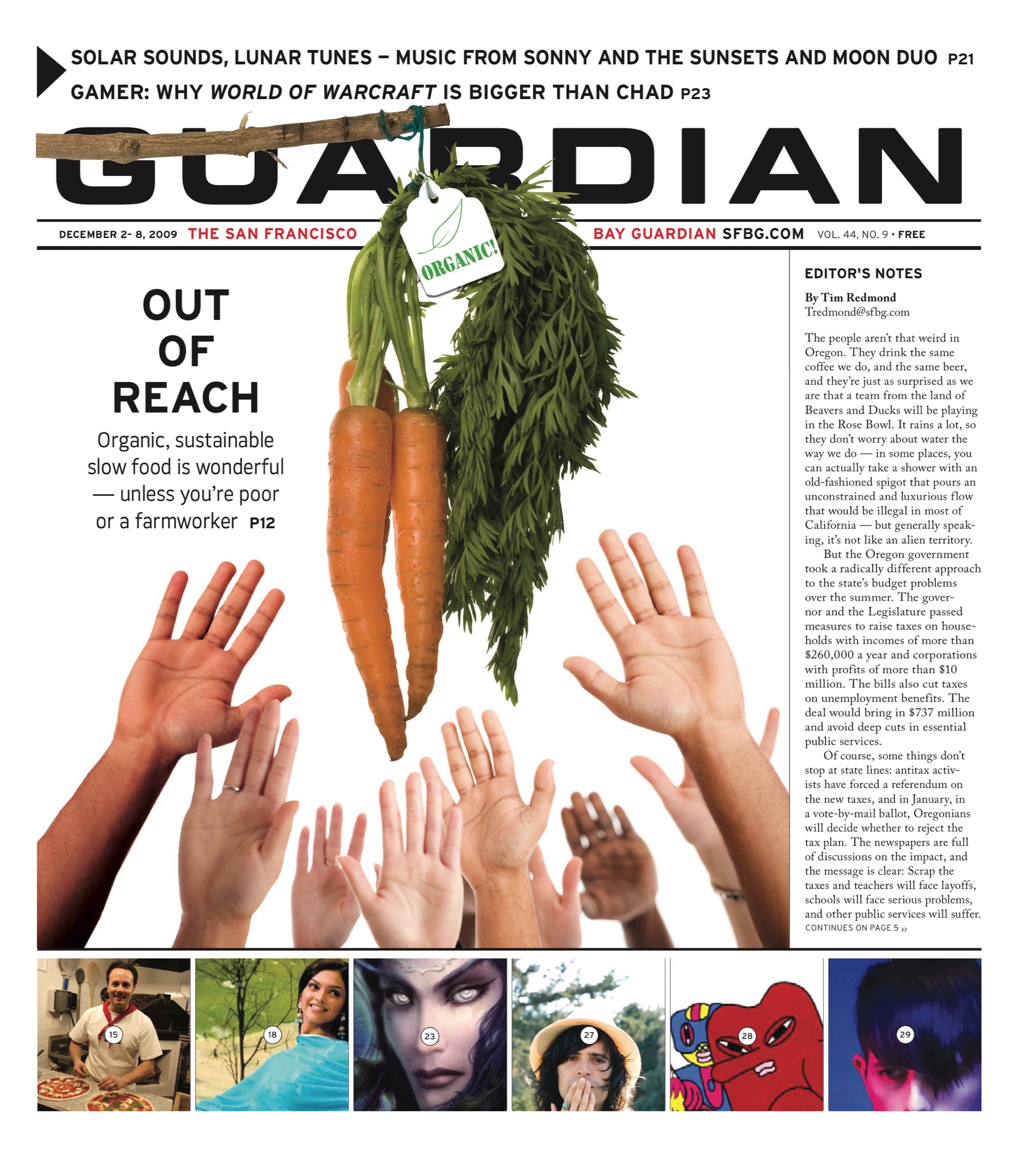
The people aren’t that weird in Oregon. They drink the same coffee we do, and the same beer, and they’re just as surprised as we are that a team from the land of Beavers and Ducks will be playing in the Rose Bowl. It rains a lot, so they don’t worry about water the way we do — in some places, you can actually take a shower with an old-fashioned spigot that pours an unconstrained and luxurious flow that would be illegal in most of California — but generally speaking, it’s not like an alien territory.
But the Oregon government took a radically different approach to the state’s budget problems over the summer. The governor and the Legislature passed measures to raise taxes on households with incomes of more than $260,000 a year and corporations with profits of more than $10 million. The bills also cut taxes on unemployment benefits. The deal would bring in $737 million and avoid deep cuts in essential public services.
Of course, some things don’t stop at state lines: antitax activists have forced a referendum on the new taxes, and in January, in a vote-by-mail ballot, Oregonians will decide whether to reject the tax plan. The newspapers are full of discussions on the impact, and the message is clear: Scrap the taxes and teachers will face layoffs, schools will face serious problems, and other public services will suffer.
I was up visiting over Thanksgiving, and I asked a friend what he thought would happen. He was pretty confident that the taxes would be retained: “I don’t know anyone who makes more than $260,000 a year.”
Of course, they don’t have a two-thirds majority requirement to raise taxes — and while Republicans all over have become little more than obstructionist troglodytes, Oregon Republicans haven’t all signed the “no-new-taxes” pledge required of every GOP legislator in California.
Even so, you have to wonder: Why can’t we do that here?
The answer, I think, is that we can — not necessarily on a statewide level (where anything progressive seems almost impossible today) but right here at home in San Francisco.
A poll commissioned by SEIU Local 1021, which came out while I was away, showed that a majority of San Francisco voters would support a broad range of new taxes, from a five-cent-a-drink tax on alcoholic beverages to a $10 a car tax on motor vehicles to an increase in the hotel tax. The poll didn’t ask about a tax on incomes of more than $260,000, but I bet the results would be about the same.
So what’s headed for the June ballot? Well, at this point all I hear is that the mayor wants to fund the expansion of Moscone Center with $140 million in revenue bonds — and might want to designate a hike in the hotel tax to pay for it. That’s a great way to set priorities — the health care system is in total collapse, Muni lines are getting shut down … and we’re going to use new tax revenue for a convention center expansion.
This comes just after the mayor announced he wasn’t going to spend the money to save critical public health services. Perhaps he’ll find some spiritual guidance on his trip to India.
US out of Afghanistan
We knew President Obama wasn’t going to be perfect. We knew he was a lot more of a political moderate than the left — which was about getting rid of George W. Bush and voting for a candidate who was against the war in Iraq — always wanted to acknowledge. And we knew that the key to a progressive national agenda was keeping the pressure on the new president, who won on the basis of massive grassroots support and would be, we hoped, swayed be the mobilization of that same coalition on key political issues.
And now, after the biggest disappointment yet of his young presidency, it’s more important than ever for the movement that swept Obama into office to get back into the streets. Because the president’s decision to put 30,000 more troops into Afghanistan — to escalate, at great expense, a war the United States can’t win — is a disaster for the nation.
Obama was, to some extent, trapped by his own political rhetoric. Reportedly during the campaign, he chided the Republicans and their candidate, John McCain, for the morass of Iraq and argued that the real fight was in Afghanistan, where Osama Bin Laden and his terrorists were holed up. That was probably untrue back then, and it’s almost certainly untrue now: ss Harvard professor and Afghanistan expert Rory Stewart noted on Bill Moyers’ TV show Journal show Sept. 25th, al Qaeda is in Pakistan now. It’s true that the Taliban — a brutal and repressive fundamentalist sect — is gaining ground in Afghanistan, but the people under the sway of that religious movement aren’t a serious threat to U.S. national security. As Stewart noted:
“One of the things that’s a little misleading about people who say, ‘If we don’t fight the Taliban in Afghanistan, we’re going to have to fight them in the streets of the United States’ is that most of these people we’re dealing with can barely read or write…. They’re often three hours’ walk from the nearest village. The idea that they’re somehow going to turn up on the streets of the United States with a train of goats behind them in order to conduct war here is a bit misleading.”
And the president didn’t make things any better by asking the generals on the ground to tell him how many more troops they needed — without spelling out exactly what the mission was or how success would be measured. Now that the Pentagon — as usual — has asked for more troops, Obama was in a bind, and was unable to show the courage to reject that proposal and completely rethink the U.S. role in Afghanistan.
Then there’s the fact — and it’s a cold, hard fact, borne out by centuries of history — that invasions and nation-building efforts by outside military forces never succeed in Afghanistan. Everyone who’s ever tried to conquer Afghanistan — from the Mongols to the British to the Russians — has failed. It’s a rough country with little civilian infrastructure. There’s no effective national leadership — the government of Hamid Karzai is monumentally corrupt and incompetent — and most civil authority rests with tribal councils and warlords. In fact, it’s probably misleading to call Afghanistan a country; it’s never had much national government. For the past 40 years, the place has been ravaged by war. “To rebuild a country like that would take 30 or 40 years of patient, tolerant investment,” Stewart notes — and even then the result would probably be closer to a state like Pakistan, which is hardly a shining example of democracy (and is, in fact, more of a threat to our security).
So why, exactly, is the United States still there — and what possible reason could Obama have for expanding the war effort, at a cost of hundreds of billions of dollars that are badly needed back home to create jobs and stabilize the economy? It’s the worst mistake of his presidency and the worst threat to his legacy and the U.S. national security and any hope of brining the U.S. back into a leadership role in creating a more peaceful and stable world.
As Simon Jenkins, a columnist for the U.K. Guardian noted Nov. 17, “If militarism wins and Obama commences a 10-year battle over the mountains and plains of Afghanistan, it will spell the end of America’s status as cold war victor and putative world policeman. The complex will have him trapped. The Taliban will have him cornered, as will bin Laden. America’s democratic leadership will have been pitted against American militarism — an informal component of the republic since the founding fathers — and will have capitulated.”
The antiwar movement needs to come back to life, quickly, on every level and every front, to demand a reversal of this misguided policy, a quick withdrawl of troops from both Iraq and Afghanistan and an end to decades of failed military and foreign policy. And that movement can and should start in San Francisco, bringing pressure on Rep. Nancy Pelosi not to fund the Afghanistan war and giving support to the antiwar Democrats who will have trouble opposing the Democratic president.
This city, and this newspaper, have opposed foolish military adventures in Vietnam, Central America, and Iraq. It’s time to start beating the drums again: U.S. out of Afghanistan!
PS: The Nation has a stunning report in its Nov. 30 edition on how U.S. contractors are paying off the Taliban to protect military shipments through the country. That’s a major source of income to the fundamentalists. In other words, U.S. tax dollars are funding the U.S. enemy. That’s how screwed up this war is.
Alerts
Battle for Whiteclay
Attend a screening and discussion of this documentary, which follows Native American activists to Nebraska’s state capitol to end alcohol sales to residents of the Pine Ridge Indian Reservation by stores in the neighboring town of Whiteclay. The film serves as an inside look at the conflict between Native Americans’ rights and state and local governments’.
7:30 p.m., $6 suggested donation
Artists’ Television Access
992 Valencia, SF
(415) 821-6545
Die-in for Bhopal
Join a die-in to commemorate the 25th anniversary of Union Carbide’s (now Dow Chemical) gas tragedy in Bhopal, India. Honor the thousands who died in the tragedy and protest the abandoned chemicals that continue to pollute the groundwater.
Noon, free
Union Square
Powell at Geary, SF
Bhopal.net
Prison Reduction Plan
Michael Bien, lead counsel in Coleman vs. Schwarzenegger, answers questions about the implementation of the California Prison Population Reduction plan. Judges in the case ordered the state to reduce its inmate population because of prison overcrowding. Sponsored by the Californians United for a Responsible Budget (CURB) Coalition.
6 p.m., free
CURB Office
1904 Franklin, # 504, Oakl.
(510) 444-0484
Oaktown on wheels
Participate in a community bike ride through Oakland to display, promote, and celebrate healthy transportation. Ride ends at the Art Murmur community street party
6 p.m., free
Meet at Frank Ogawa Plaza
14th and Broadway BART station, Oakl.
Celebrate free clinic opening
Attend opening day of the Mabuhay Health Clinic and its services, a free, student-run community health clinic that aims to reduce health disparities in the SoMa district. The clinic is in partnership with the South of Market Health Center, the Bayanihan Community Center, and UCSF. Sup. Chris Daly and staff from Mayor Gavin Newsom’s office will be present. Also features food and entertainment.
2 p.m., free
Mabuhay Health Clinic
1010 Mission, SF
(415) 336-5277
Backpacks for the people
Help assemble "warm wishes" packs filled with gloves, socks, scarves, and more to be distributed to 4,000 homeless men, women, and children in the Bay Area.
8 a.m., free
Unity in Marin
600 Palm Drive, Novato
(415) 472-0211
Help class-war prisoners
Attend this fundraiser for the Partisan Defense Committee’s Class-War Prisoners Stipend Fund, which helps victims of racist prison and death sentences. Featuring a buffet, door prizes, silent art auction, and more.
3 p.m., $10
Women’s Building
3543 18th St., SF
(510) 839-0852
Fast for our climate
Send a message to the U.N. Conference on Climate Change in Copenhagen that the world needs to make a strong commitment to reduce emissions at this afternoon of fun sans food. Show solidarity with 21 other countries staging hunger strikes.
1 p.m., free
U.N. Plaza
Market at Hyde, SF
(484) 319-1115<0x00A0><cs:5>2<cs:>
Mail items for Alerts to the Guardian Building, 135 Mississippi St., SF, CA 94107; fax to (415) 255-8762; or e-mail alerts@sfbg.com. Please include a contact telephone number. Items must be received at least one week prior to the publication date.