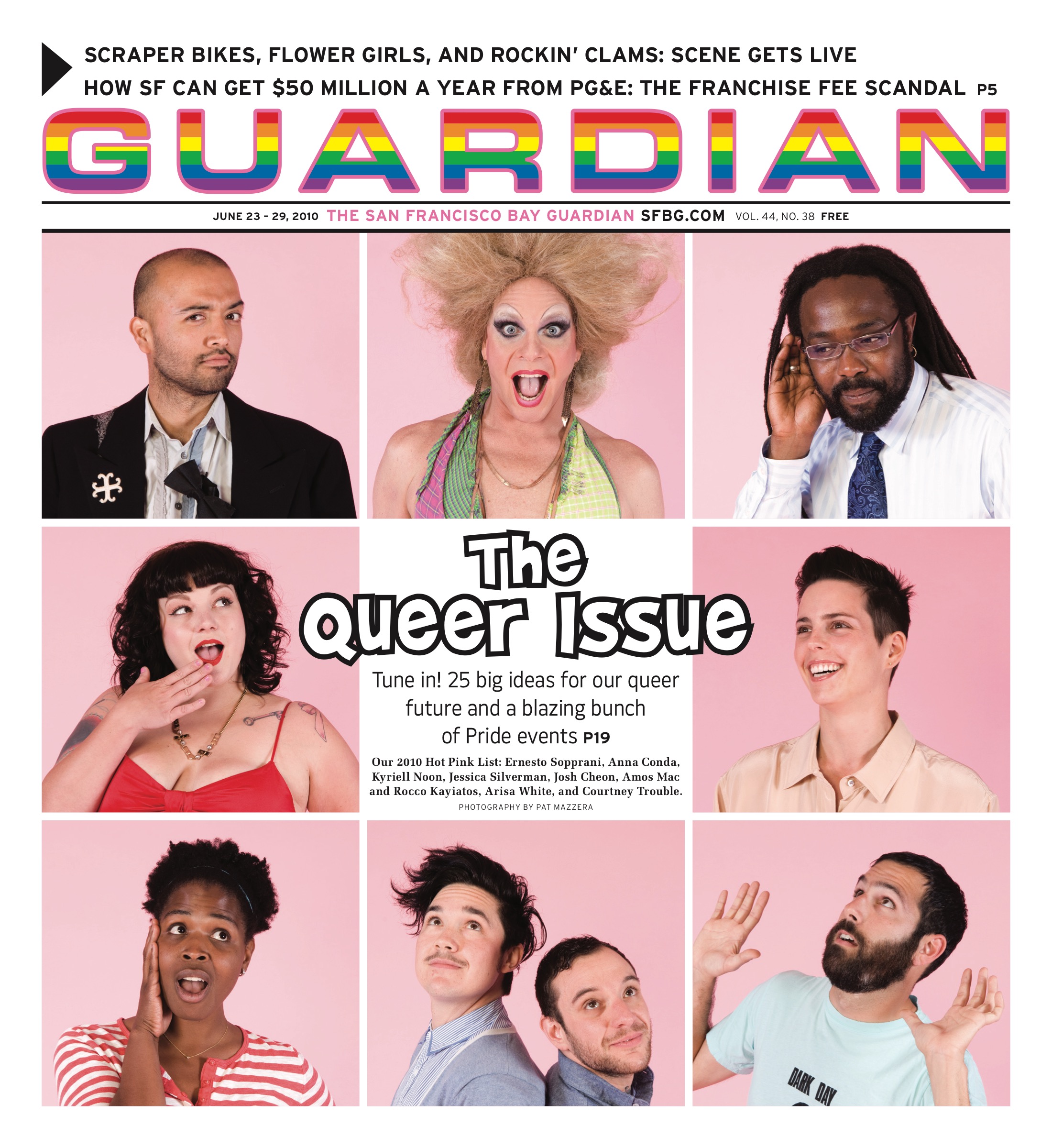
Print sections as they appeared in the early 2010s

To find articles by keyword or author, you may want to use our Search function.

Print Sections

In defense of Bay to Breakers

32

By Conor Johnston

OPINION An op-ed piece in the June 9 issue of Guardian (“When the rich can sit on the sidewalks“) was the latest in a rash of negative media stories about Bay to Breakers. I am not going to respond to that article specifically, except to thank the Guardian for giving us equal time.

For 99 years, Bay to Breakers has been lifting the city’s spirits, bringing fun, tax revenue, millions of tourism dollars, and nationwide attention to San Francisco. If ever we needed those things, it’s now, when we have record deficits, 47,000 people out of work, and may lose the football team that is named after us.

So let’s set the record straight.

Bay to Breakers does not cost taxpayers a dime. The event pays for all costs, including cleanup. And the permit fees and tourism generate tax revenue. ING probably dropped its sponsorship for reasons unrelated to B2B. Sponsors come and go. B2B will find another. Bay to Breakers is a financial boon for San Francisco. The event attracts thousands of people to the city; 49 of 50 states were represented by participants in 2008. The average tourist spends $505 in the local economy. Bay to Breakers is and always has been peaceful. There were fewer than five arrests reported this year. I have never seen a fight at B2B, not once, in seven years. Bay to Breakers remains enormously popular. There are about 100,000 participants and spectators, including many world-class runners.

This said, there are problems at B2B, namely public urination and the overall impact on the neighborhoods. We absolutely acknowledge that. But unlike the critics, we still believe in this city’s ability to solve problems.

How do we do it? Not with prohibitions — they are a retreat, not a policy. Sound policy takes effort, collaboration, and commitment. Let’s get the stakeholders together — neighborhood groups, race organizers, race supporters, SFPD, and city officials — and create a plan to protect the neighborhoods while preserving the race’s spirit.

Our group, Citizens for the Preservation of Bay2Breakers, is committing to raise money for 100 additional multiperson urinals and to leading the cultural campaign for more responsibility among participants. And we have other ideas:

Ticket people who urinate on or disturb private property.

Rent more toilets.

Implement multiperson urinals, which are six times more efficient and are one-third of the cost per user.

Improve the barricades to keep participants on course.

Increase revenue with a tiered registration for non-runners.

Host an event in the park that attracts participants out of the neighborhoods sooner.

I see in Bay to Breakers a celebration of what it means to be San Francisco, to be capable, to be unafraid of free expression and unapologetic of diversity.

I see world-class runners lined up next to 30-somethings in Elvis costumes. I see convalescent patients lining the sidewalk, smiling and taking pictures with Rambo and Cinderella. I see mothers pushing costumed babies. I see 100,000 happy faces. But most of all, I see a century-old civic institution that is worth fighting for. *

Conor Johnston is co-chair of Citizens for the Preservation of Bay2Breakers and a resident of District 5.

Editor’s Notes

1

marke@sfbg.com

The official theme for Pride this year is “40 and Fabulous.” So let’s all grab an organic cocktail and strap ourselves in for a good ol’-fashioned midlife crisis!

Some of us have already had some practice. Many gays long ago traded in cracked and hectoring first wife Madonna for trophy floozy Lady Gaga, raced around town in those sleek Miata MX-5 convertibles, and reached for the HyperGain. (Don’t get me started on lesbians and Justin Bieber here.)

But for queers of a more radical bent, it’s an opportunity to take stock of the past and wonder about the future — despite the fact that 40 is the new 20, at least in online marketing campaigns. Branding, darling, branding.

Or maybe that’s boring. Yes, we could lament the commercialization of Pride and kvetch that all our resources have been poured into trying to secure property rights through state-sanctioned social contracts and the chance to invade the wrong country, causing the unnecessary deaths of thousands. We could be awestruck by the amazing power and inspiration of our queer youth, despite the fact that hundreds of them become homeless every year. We could honor and celebrate the heroism of our elders, even while they’re pushed to the margins and out of their apartments.

But doing all that means sitting on our collective asses. Isn’t the whole point of a midlife crisis to change everything before it’s too late? Maybe, due to political expediency and because it makes us more acceptable to society, we’ve allowed queerness to become defined as something we are, rather than something we do. I’m not saying many of us aren’t born “that way” (or denying the social legitimacy that fact, apparently, confers). But what the hell are we doing? Fine. We’re fabulous. Now let’s fix things.


Psychic Dream Astrology

0

June 23-29

Happy Pride, Bay Area! You are so gay!

ARIES

March 21-April 19

If you make decisions purely to avoid drama, you won’t actually bypass it — all you end up doing is putting it off. Deal proactively with what’s in front of you or your self-esteem will crap out on you.

TAURUS

April 20-May 20

It’s far better for you to make new mistakes than to keep repeating the old ones, Taurus. Take a chance! Make some much-needed changes and know that success is worth the risk of failure this week.

GEMINI

May 21-June 21

It’s time for Ego Watch 2010, ’cause your opinion of yourself is wrecking havoc on your thinking. Thinking you’re the worst is just as egotistical as thinking you’re the best. Slow down and try to see things more clearly.

CANCER

June 22-July 22

Focus on the steps you can take instead of the ones you can’t. This is not the time to get hung up on negatives. Frame your wants and needs in positive terms to create the circumstances you want.

LEO

July 23-Aug. 22

Instead of overdoing it, take a step away from your frustrations and get a different perspective. Your problems hold within them the very solutions you are looking for. Take a deep breath and then go.

VIRGO

Aug. 23-Sept. 22

You can’t do it all at once and maintain your high standards of excellence, Virgo. Look at the load you are carrying and put some of that burden down before you fumble it all up. You’re on your way, pal.

LIBRA

Sept. 23-Oct. 22

If you stop trying so hard to fix your problems, you’ll get ahead of the game a lot quicker. You have situations that are real, and whether or not they suck, they are opportunities for you to be a bigger and better person. Rise up.

SCORPIO

Oct. 23-Nov. 21

The best way to deal with a whirling, twirling mind is to hold onto something steady. All signs point to simplifying and slowing down, Scorpio. It may feel more vulnerable, but your anxieties will thank you for it.

SAGITTARIUS

Nov. 22-Dec. 21

Try to notice how many times a day you focus your energy on what you hope will come or has already happened. Start affixing your attention on the present. You will strengthen your gut instincts if you do.

CAPRICORN

Dec. 22-Jan. 19

You need courage and self-preservation to get at your inner wisdom — no small feat for a wiseass like yourself. Trust in your impulses this week, and make sure to call on the lessons of your past.

AQUARIUS

Jan. 20-Feb. 18

Focus on securing a solid foundation in your relationships, or in your relationship to your sweet self! The sturdier your base is, the more wear and tear and changes you can take. Gradual progress yields results.

PISCES

Feb. 19-March 20

Being a sensitive soul isn’t easy, but that doesn’t entitle you to being a moody mope! Don’t let your moods cloud your vision this week as you endeavor to make your life a richer place.

Jessica Lanyadoo has been a psychic dreamer for 15 years. Check out her website at www.lovelanyadoo.com or contact her for an astrology or intuitive reading at (415) 336-8354 or dreamyastrology@gmail.com.

Appetite: NYC food cheat sheet, part one

0

During my latest visit to my beloved New York for the Manhattan Cocktail Classic, I spent eight days gleefully eating my way around the city, as I have done on countless trips past. I am continually asked for NY recommends as many of us in the Bay Area are either East Coast transplants, do business in both cities, or are savvy frequent travelers to the Big Apple. Check out my Perfect Spot newsletter archives for much more NY food and drink, but this week, I give you a mini-list of recommends in varying categories:

PIZZA THAT FEELS LIKE HOME Roberta’s, in the Bushwick area, has the spirit of both Brooklyn and classic Neopolitan-style pizza, the likes of which we see almost to the point of overkill here in SF. At Roberta’s, every aspect of the place dares you not to be crazy about it: a sketchy, off-the-beaten path location in Brooklyn reveals a warm dining room with wood-fired pizza oven and rustic, eclectic decor. Eat at picnic tables indoors or head out back to the tiki bar (alas, no cocktails, but wine and quality beers on draft, like NY’s Ommegang), where there are more picnic tables, thatched roofs, smoking area off to one side, expansive garden and nursery growing herbs you’ll find in your meal. The menu offers charcuterie, cheeses, sweetbreads, cuttle fish, tripe and killer, blistered pizzas, like Millennium Falco, with tomato, Parmigiano, pork sausage, garlic, onions, bread crumbs and basil. You’ll feel like you never left SF.
www.robertaspizza.com

OLD SCHOOL NY BAGEL EXPERIENCE Russ & Daughters, a fourth generation, family-owned, Lower East Side deli has been around for over a century… and is quintessential New York. With amicably crusty staff, this pristine shop is efficiently doles out Bagel & Lox, the salmon cut fresh before you. Put it on an “everything” bagel with horseradish cream cheese and you have perfection. There’s a wide array of joys here, such as pickled herring, caviar, and a lovely whitefish salad.
www.russanddaughters.com

CHEAP, DELICIOUS AREPAS Caracas Arepa Bar is a cheap, utterly satisfying NY meal: Venezuelan homemade arepas stuffed with all kinds of goodness. The tiny, charming East Village spot became so popular, there’s a to-go side and now a Brooklyn location. Everything is under $7.50 and waits are long unless you arrive early, but you can order Camburada (banana cinnamon milkshake) and Guasacaca & Chips (Venezuelan-style guacamole with plaintain and sweet potato chips) while you wait outside. I love the La de Pernil Arepa stuffed with tender pork shoulder, tomato and spicy mango sauce.
www.caracasarepabar.com

Deep red bells

0

A few months ago, Impact Theater premiered Enrique Urueta’s Learn to Be Latina, a raucous satire of market-driven multiculturalism that pivoted on the ethnic dos-and-don’ts of the music industry. That production only partly prepares one for Crowded Fire’s premiere of the Bay Area playwright’s latest effort, Forever Never Comes. There’s a notable strain here of the effervescent humor that propelled Latina (beginning with Forever ‘s blithe subtitle, A Psycho-Southern Queer Country Dance Tragedy), as well as a similar concern with the trials of cultural and sexual identity, familial roots, and the will to be oneself. But Forever is a darker, more complex story, a working-class gothic that draws inspiration from Urueta’s own background as a gay Latino growing up in a small Virginia town. But if the play’s reach is admirably wider, its focus is disappointingly fuzzier.

Its central character is Sandra (Marilet Martinez), a young Latina burdened with guilt after the suicide of her gay brother Ricardo (Shoresh Alaudini), and living again in semirural South Boston, Va., with her sad, widowed mother (Carla Pantoja) whose first language is somewhat ominously slipping away from her like her disintegrating family.

Sandra, stalked by a mysterious demon named the Fox Confessor (Lawrence Radecker), “has a debt to pay” associated with feelings of culpability for her brother’s death, and Fox Confessor is keen to collect it, haunting her dreams (including in several ghostly folk dance sequences) and menacing her small circle of friends and loved ones. Although the other characters do not see him, we witness this mischievous, brooding underworld figure alternately pacing the stage or revealed, courtesy of Marilee Talkington’s eerie video design, in isolated “snapshots” of the action that appear projected onto a screen at the back.

While running from what seems like the mythological incarnation of her grief-stricken conscience, Sandra reconnects hesitantly with ex-girlfriend Deborah, now called Dylan (a compelling Kathryn Zdan). A transgender preop bent on escape to San Francisco, Dylan is back in town to visit her pregnant unwed sis, Beth Ann (Marissa Keltie), on the eve of their parents’ 25th wedding anniversary. Dylan remains smitten with Sandra. Sandra, however, seems almost as uncomfortable with Dylan’s physical transformation as Dylan’s mother (Michele Levy), a compulsively chatty, addled woman stunned into a rare moment of silence by the unexpected arrival of her one-time daughter.

Beth Ann, meanwhile, negotiates life with her oddball family; haunted best friend Sandra; and abusive, domineering boyfriend Hunter (a solid Daniel Petzold) while confining herself to soda pop at the local watering hole and doing her best not to smoke another Virginia Slim. Soon a tragic accident — if it is an accident and not the handiwork of the increasingly impatient Fox Confessor — throws everyone off-balance, and Dylan and Sandra back into each other’s arms, while setting up a parallel between two grief-stricken households and their contrasting crises of identity and unity. As Fox Confessor stirs up more and more trouble, the way forward remains unclear, multiple possible endings hovering over the action thanks to an out-of-sequence scene in which Sandra and Dylan flee for the West Coast in a blood-stained car.

Sandra and Dylan’s relationship adds momentum to the story, which otherwise tends to dissipate among its various subplots. Ironically, the central issue of Sandra’s guilt and her debt to Fox Confessor lacks the requisite poignancy and urgency, at least partly because there’s little sense of a relationship between Sandra and her deceased brother (who has only a flickering afterworld presence here, despite a key intervention near the end). The only hint of a tangible sibling connection comes when Sandra, in one of the more comical moments, repeats Ricardo’s detailed impressions of San Francisco to Dylan, at length and seemingly verbatim.

Director Mary Guzmán (who also helmed Learn to Be Latina) gets some nice performances across a generally strong cast. But the staging — around Emily Greene’s elegantly elemental thrust stage, complete with intermittent sheets of rain heralding Fox Confessor’s serious mischief — can be lackluster. The dose of underworld dosey doe, for example, proves sluggish and repetitive, despite sound designer Colin Trevor’s steady injections of the gorgeously moody songs of Neko Case. In the end, the play’s defiantly romantic spirit has charm, but Forever Never Comes leaves too much hanging.

FOREVER NEVER COMES

Wed-Sat, 8 p.m. (through June 26), $10–$30

Boxcar Playhouse

505 Natoma, SF

(800) 838-3006

www.boxcartheatre.org


Dear John

1

arts@sfbg.com

HAIRY EYEBALL What does it mean to call John Waters’ art “bad”? The question is hard to shake while surveying “Rush,” the filmmaker and part-time San Francisco resident’s fourth show at Rena Bransten Gallery. It’s tricky with Waters, whose creative practice has always exulted in its bad taste. He would probably respond to my query with a knowing smile.

Time has certainly been on his side. What was once reviled someday becomes celebrated, and so even Waters’ most extreme examples of cinematic filth are now part of the cultural canon. In his post-Hairspray crossover years, Waters has settled into the role of practiced raconteur, having whittled his biographical anecdotes and wry observations into a recombinant set of talking points.

This stand-up-like approach has informed his visual art as well. Waters’ early stabs at photography — horizontally grouped freeze-frames from Hollywood classics, obscure gems, and gay porn, all shot from the television screen — riffed on the innate humor of their subjects, further underscoring the awkwardness of each pause through canny juxtaposition.

The photo-collages in “Rush” are more aggressively puerile. Less documents of the chance encounter between a TV set and a camera, they offer up a series of crudely Photoshopped one-liners: a bevy of Hollywood royalty are given hairlips; Charlton Heston as Moses holds a can of soda; Audrey Hepburn’s swan-like neck is covered in monstrous hickeys.

The sharper collages — like the series of characters lying in state — elicit a chuckle. The dumber ones recall in their approach Boulevard of Broken Dreams, Gottfried Helnwein’s frequently copied, cheesy Hollywood riff on Edward Hopper’s Nighthawks. Again, I sense Waters would be just as proud having his work compared to Helnwein’s as he would to his more obvious precedents in business and in art: Koons and Warhol.

Instead of cardboard Brillo boxes, Waters — or, one presumes, a workshop — has fabricated bigger-than-life versions of an ant trap, a spilled bottle of Rush-brand “liquid incense” (from which the show takes its name), and a tub of the exorbitantly priced facial cream La Mer. There’s also an Ike Turner doll, posed on bended knee, holding a smaller marionette of Tina Turner, called “Control.”.

The sculptures are by far the smartest works in the show — gaudy, oversized lawn ornaments to hucksterism, the fleeting nature of pleasure, and the futile postponement of time’s onward creep through conspicuous consumption. In short, they are monuments to the follies and vanities of the art world itself, which, judging by the show’s price list, is willing to pay top dollar for a spanking from John Waters.

For those of us who are simply content with our dog-eared copies of Shock Value and our Pink Flamingos and Desperate Living DVDs, “Rush” is too often like that overturned bottle of poppers: all flash but no high.


TRASH HUMPING

While in 77 Geary, head over to Marx & Zavattero for a different but no less trashy example of queer sensibility. James Gobel’s yarn, felt, and acrylic paintings construct a rock ‘n’ roll fantasy camp for bears in which hirsute and chubby fanboys do their best Jem impressions in truly outrageous color combinations. More interesting are Gobel’s “couture beanbags,” whose doughy amorphousness and “designer” plaid covers evoke the physicality and dress of his painted subjects in a far more tactile manner that’s as inviting as it is unsettling. Gobel understands that with subcultures, as with lovers, snuggling can sometimes turn to smothering.

RUSH

Through July 10, free

Rena Bransten

77 Geary, SF

(415) 982-3292

www.renabranstengallery.com

I GET WHAT I WANT, & ALWAYS GET IT AGAIN!

Through July 17, free

Marx & Zavattero

77 Geary, SF

(415) 627-9111

www.marxzav.com

Now voyager

0

arts@sfbg.com

MUSIC What might Jefre Cantu-Ledesma’s status be? Casual but committed, relaxed yet extremely productive sounds about right for the Alps music-maker, Root Strata label head, On Land festival organizer, and now the third leg of the recently formed Moholy-Nagy.

Not another reunion band-cum-supergroup — Cantu-Ledesma, Danny Paul Grody (the Drift), and Trevor Montgomery (Lazarus) were founding members of Tarentel — the new SF project shares a moniker with the Bauhaus movement mover-and-shaker, although the trio is much more unassuming than all that.

“I think Danny and Trevor had been playing for a couple months, and they called and asked if they could borrow one of my synthesizers,” recalls Cantu-Ledesma on the phone, taking a break from his day job in operations at the San Francisco Museum of Modern Art. “I said, ‘No, but I’ll come down and play it’ — an asshole move on my part, but that’s typical of me.” You can practically hear his tongue being firmly thrust in cheek.

Very casually, but consistently, in the spirit of a “nerding-out recording project” with the members switching instruments and utilizing a “junky analog” ’70s drum machine Montgomery found on eBay, the threesome hunkered down in its longtime Hunters Point practice space, making what Cantu-Ledesma describes as the “most synthesized thing any of us has ever done before. It’s largely improvised around bass lines or drum parts, so things weigh it down and other things can have freedom around it.”

“It’s more like hanging out with friends having some lunch and getting some coffee and making music,” he adds. “It’s not like, ‘Dude! We’re in a band!'<0x2009>”

Easy-going but quick to step back and see the folly or humor in whatever’s before him, often issuing a loud, bright laugh, Cantu-Ledesma seems less than impressed with self-important “band dudes,” even after years spent in an influential combo like Tarentel.

“Oh, gosh, are you picking up on that?” he replies, dryly ironic, when asked about it. “Well, even with the Alps, when you look at it on the surface, it looks like we’re writing songs, but we’re not writing songs. We just want to create stuff and not so much worry about the fidelity of recreating things.”

But what things Cantu-Ledesma makes, judging from the haunting watercolor tone poems of Moholy-Nagy — music that could easily slip into a cinematic mood piece like Zabriskie Point (1970) or Paris, Texas (1984) — and the alternately motorik-beatific and insinuatingly delicate experiments of the Alps’ new Le Voyage (Type). For Cantu-Ledesma’s forthcoming solo album, due this fall, he’ll dig into his more shoegaze-ish background, but for Moholy-Nagy, he gets to “exercise another side. I’m a total knob-tweaker kind of guy, but we get to move around a lot more than we get to on other projects. Things are tending to sound more quirky or funky than other things we’ve done.”

In a way this project is an extension of the San Francisco Art Institute painting and sculpture graduate’s interior, rather than audibly exterior, work. “I’m going to say this, and I’m not trying to be new age,” he confesses. “But honestly, I used to be really intense about stuff happening a certain way. But I worked on my own development and became more secure with my own personality. and that really helped in terms of — without sounding too Californian — just letting it flow.”

That goes for his collaborations with filmmaker and kindred SFMOMA staffer Paul Clipson: a DVD of their Super-8 films and sound pieces since 2007 comes out this summer and coincides with an August performance at Yerba Buena Center for the Arts. “We love what we do, but there’s no plan behind any of it,” Cantu-Ledesma ponders. “I know this probably sounds facetious, but I’m not really motivated to make things happen — though obviously with things like On Land, you’re booking and buying plane tickets and stuff.”

On Land is firmly grounded in Cantu-Ledesma’s Root Strata imprint, which materialized in 2004, inspired by SF collectives like Jeweled Antler and then-Bay Area-based performers like Yellow Swans, Axolotl, and Skaters. It’s a way to present artists that Cantu-Ledesma and co-organizer and label cohort Maxwell Croy like and have worked with in the last year, in a “nice venue,” otherwise known as Cafe Du Nord. In early September, label musicians and friends like Charalambides, Grouper, Oneohtrix Point Never, Zelienople, Dan Higgs, White Rainbow, Barn Owl, and Bill Orcutt will appear, with video collaborations by Clipson and Nate Boyce, at the second annual gathering.

“Does the Bay Area need another music festival? Probably not,” Cantu-Ledesma quips wryly. “But you’re not going to see Bonnie ‘Prince’ Billy or Vampire Weekend. We’re trying to show a different strata of stuff from California or Oregon, kind of a West Coast underground, or people who just fit into our tastes, which are idiosyncratic and weird.”

MOHOLY-NAGY

With Brother Raven and Golden Retriever

Wed/16, 9 p.m., $7

Hemlock Tavern

1131 Polk, SF

(415) 923-0923

www.hemlocktavern.com

rootstrata.com

www.onlandfestival.com

The devil vs. Miss Jones

0

By Lilan Kane

arts@sfbg.com

MUSIC A contemporary throwback, Sharon Jones & the Dap-Kings sound like they stepped right out of Curtis Mayfield’s 1972 soundtrack for Super Fly (Rhino/WEA). Authentic soul music is hard to come by these days, but recording on 8-track reel-to-reel with some of the funkiest live musicians and one of the baddest soul singers on the planet, the group has successfully recreated and updated a late 1960s to early ’70s soul sound. In the process, it has captured a devoted fan base, selling out shows worldwide and gigging everywhere from the North Sea Jazz Festival to The Colbert Report. This journey has been no easy task, as made clear by the title of a new album: I Learned The Hard Way (Daptone).

The super soul sister with the magnetic je ne sais quoi has had some strong trailblazers to look to along the way. Asked over the phone who she would most like to perform with, Jones answers without hesitation: “I always wanted to sing with Mr. Brown.” Indeed, her favorite memory is meeting the Godfather of Soul in April of 2006. She’s also covered his track “I Got The Feelin’.” James Brown “changed my life,” Jones says. A longtime lover of soul music, she had difficulty finding her place in the industry. Breaking the mold of Disney tween sensations and autotuned pop stars, she faced rejection and prejudice. Music industry image and its underlying injustices allowed record execs and DJs to tell her she was too black. Her response? “Damn right. I’m black and I’m proud.”

Brown hasn’t just been a key influence for Jones — he also helped inspire the music and the sound of the Dap-Kings. In 1996, the group’s bandleader and bassist Gabriel Roth (a.k.a. Bosco Mann) invited Jones to sing backing vocals on a Lee Fields session, an experience that prompted a friendship and musical relationship between the two. An avid Brown fan, Bosco has collected every obscure JB record he could get his hands on since college. Over the years he’s brought together some of the best musicians in the New York area to form the Dap- Kings. The band is highly sought after for session work, especially after its contributions to Amy Winehouse’s Back To Black (Republic, 2007).

Jones fans know and love her brilliant remake of Janet Jackson’s 1986 hit “What Have You Done For Me Lately?” Interviewing Jones, I had to ask who had the genius idea of covering the song. Turns out it was a family affair — Bosco’s sister brought the song to the table, and Bosco made a killer arrangement, resulting in one highlight of the 2002 debut, Dap Dippin’ with Sharon Jones & The Dap-Kings (Daptone). People can’t be blamed for thinking that Jackson had covered a Jones song, and this time-tripping is characteristic of Sharon Jones & The Dap-Kings’ sound. The group’s first 45s were undated, and even soul music collectors often were fooled into thinking they had somehow missed them while on crate-digging missions to discover the most underground soul recordings.

I Learned the Hard Way is, of course, soulful. But beyond that, it’s socially and politically aware. Jones’ favorite track, “She Ain’t A Child No More,” is about an abusive mother and the painful yet newfound triumph experienced by her grown child. The subject matter is heavy indeed, but the song is written and performed in a way that exudes strength and courage. Another song, “Money,” is a clever twist on unrequited love. Recorded five years ago, it has finally made it onto a record — with perfect timing. “Money, where have you gone?” Jones wails. “Money, why don’t you like me?” Many people will find themselves singing along, mad that the money has up and left. With 10 other wrenching songs, the whole record packs some serious heat.

SHARON JONES & THE DAP-KINGS

With the Heavy and DJ Harry Duncan

Fri/25, 9 p.m., $22.25

The Warfield

982 Market, SF

(415) 775-7722

www.thewarfieldtheatre.com

Imported cheese

0

CINE DE CULTO It’s impossible to undersell the extent to which everyone was space travel crazy from the 1950s through the early ’70s. Even nations not actively involved in the Cold War race for space “supremacy” shared the giddy thrill as U.S.S.R., then U.S. efforts successfully launched projectiles toward the cosmos. Those technological leaps and Cold War-fueled fears that the bomb could end life as we know it turned science fiction from an infrequent cinematic genre into a popular, prolific one.

Different nations put their own spin on this celluloid space race, the Soviets for instance treating it as territory of soberly scientific national pride. On the other end of the spectrum, Mexico did sci-fi wackier, cheaper, and often with more inspiration than its neighbor up north. These movies often ended up cut, retitled, and badly dubbed for U.S. consumption at kiddie matinees and on late-night creature feature shows, where they inevitably provoked howls of laughter.

Some camp value definitely remains, but next week’s Pacific Film Archive series “El Futuro Está Aqui: Sci-Fi Classics From Mexico” offers a rare chance to see several choice nuggets in their original-language form and in pristine prints. As a result, they seem more conspicuously well-crafted (on par with major studio Hollywood B movies of the ’50s), even — dare we say — dignified, than you’d expect. Which is not to say they aren’t frequently nuts as well.

Nothing says Mexploitation more succinctly than Santo vs. the Martian Invasion, a 1966 adventure that was one of the immortal masked wrestling hero’s last in B&W. Aliens in flying hubcaps — I mean flying saucers — seek to invade Earth by making people disappear with their ray-guns and interfering with TV transmissions. They also wear silver Mylar pants without shirts (dudes) or low-cut onesies (chicks). These Martians are hot. But they insist on world peace, so of course they must be stopped.

What could be more terrifying? Civilizations ruled by women, of course! In the prior year’s Planet of the Female Invaders, abducted Earthlings find themselves on Sibila, where that terrible reversal of the natural order has come to pass. But fear not: as lost visitors from the normal world soon discover, the women secretly long to be fussed over and told what to do by he-men.

Also in the PFA series are 1959’s lunatic The Ship of Monsters, which manages to encompass singing cowboys, Venusians in taped-on J-Lo dresses, vampires, and more. As for 1957’s The Aztec Mummy vs. the Human Robot, it involves … well, you figure it out. (Dennis Harvey)

EL FUTURO ESTÁ AQUI: SCI-FI CLASSICS FROM MEXICO

June 24–27, $5.50–$9.50

Pacific Film Archive

2575 Bancroft, Berk.

(510) 642-5249

www.bampfa.berkeley.edu


Reel groundbreaking

0

FRAMELINE Appropriately enough, Kathy Wolfe — founder and CEO of this year’s Frameline Award winner, Wolfe Video — realized her calling while attending a Frameline screening.

“Somewhere around 1979, I went to a Frameline screening of [pioneering 1977 doc] Word is Out. Within the body of that film, there’s a challenge to make a difference,” she remembers, speaking from her San Jose office. “I started working in my local public access television station, and for four years I studied and worked in every aspect of video production. At the end of that, I actually had a few documentary-style pieces and some women’s music videos I wanted to sell. In order to get more serious, I took out a business license, and that was in 1985. But I very much was inspired by the challenge in the movie. Our mission today is very similar to the mission we had at that time: to make these images more available to the world at large so that people would feel empowered to come out.”

Today, Wolfe Video is the leading exclusive distributor of LGBT films, which they do via film festivals, video stores, video on demand, and the Internet, including their website, Wolfevideo.com. Their catalog includes hits like Big Eden (2000) and Claire of the Moon (1992), as well as the entire performance catalog of Lily Tomlin — whose early support helped the company make key contacts with distribution networks and retail outlets. According to president Maria Lynn, who joined in 1993, the fact that Wolfe Video is celebrating its 25th anniversary is a testament to the increasing popularity of LGBT films.

“[In 1985] the gay genre, as it were, was considered small and unknown. Now it’s a very significant genre in independent film. Between Wolfe distributing them, and filmmakers making them, and festivals like Frameline screening them, it has created its own category within independent film,” she says. “We have a lot of movies now that have a more mainstream appeal, for example Undertow, which is going to be a centerpiece at Frameline, is a beautiful film from Peru. And the way people talked about Brokeback Mountain as being about love — people will talk about this one similarly. It touches people very deeply and it is not limited to a gay and lesbian audience as well. That’s one of the biggest things that’s changed: the filmmakers have really been able to branch out, whether it’s with casting, or better stories, or bigger budgets.” 

FRAMELINE AWARD: WOLFE VIDEO

With Undertow Tues/22, 7 p.m., Castro

Super stories

0

arts@sfbg.com

FILM It’s film festival season, which means one thing: stories. Lots of them. And not just the ones that happen on film, but all the ones that happen before, during, and after the tapes get mastered and the crowds go home. While this is certainly true of all films, it’s especially true for the Queer Women of Color Film Festival, held annually at Brava Theater Center in the Mission.

Each year the festival premieres 25 short films made by and for women of color, who travel from across the Bay Area, and sometimes the state, to a small workshop in the Sunset District and learn the ins and outs of video production. The end results are nuanced, gripping, and often hilarious stories of how amazing, awkward, and complex love can be. So even though the festival’s yearly themes may be heavy — last year’s focused on immigration, this year’s celebrates queer indigenous communities — crowds pack the theatre, enjoy free food, and see that there’s more than enough to smile about.

This year’s festival brought a variety of movies. In Ferment Me My Heart, one Korean Canadian woman used animation to explore her love-hate relationship with kimchi and what it tastes like to be an outsider. Home is Where My Mother Is showed that all ain’t pretty in the world of queer families, as one woman confronted her lesbian mother over a traumatic interracial relationship. Bulldagger Women and Sissy Men paid homage to the Harlem Renaissance’s queer characters. A mother and daughter bonded over basketball in Hoops, and Passing Through Like Water followed three generations of Iranian women as they navigated how to deal with change and one another.

The festival also included a sacred ceremony for indigenous queer communities, and related films that unearthed the lessons of Cherokee elders and explored what Proposition 8 means to native women. If you missed out, you still have a chance to see some highlights when “F**king Traditional Values: Queer Women of Color Shorts” screens at Frameline.

F**KING TRADITIONAL VALUES: QUEER WOMEN OF COLOR SHORTS

Sun/20, 4:15 p.m., $8

Victoria Theatre

2961 16th St.

(415) 863-7576

www.frameline.org

www.qwocmap.org 


Star on the rise

0

FRAMELINE I’ve had a bit of a crush on the young Argentine actress Inés Efron since Frameline31, when she played one corner of the teen love triangle in Alexis Dos Santos’ Glue (2006). There was something in the way Efron used her gangly build and heavy-lidded eyes to telegraph her character’s mix of trembling desire and adolescent ungainliness that brought to mind Kids-era Chloë Sevigny.

Efron’s ability to allow her physicality to articulate what her characters can’t would be even more fiercely on display when she returned to Frameline the following year, front and center, as the conflicted, intersexed youth Alex in another equally strong Argentine debut, Lucía Puenzo’s XXY (2007). Efron is back at Frameline this year, as is Puenzo, in the director’s sophomore effort, The Fish Child. The film actually made its festival debut last year, in one of the last-minute TBA slots, but fans of the duo’s previous collaboration would do well to catch its proper run this time around.

Part cross-class lesbian love story, part crime telenovella (with a touch of magical realism), The Fish Child is a flashy departure from XXY‘s brooding coming-of-age character study. Puenzo displays a tight grasp of the film’s various narrative strands as it jumps back and forth across time and geographic borders (she did adapt the script from her own novel, after all), but much of the film’s emotional impact comes from the performances of its leads.

Looking ever more the gamine, Efron plays Lala, the teen daughter of a wealthy Buenos Aires judge (Pep Munné), who is as in love with the household’s 20-year-old Paraguayan maid Ailin (Mariela Vitale) as her father is. Lala and Ailin’s dream of escaping to Lake Ypoa in Paraguay, Ailin’s childhood home, becomes complicated when Ailin winds up in jail and Lala flees to Ypoa alone, where she discovers more about her lover’s damaged past. Efron’s Lala lets us be sympathetic to her love for Ailin even as we see the ways in which her star-eyed optimism about their future life is as enabled by the privilege she refuses to acknowledge as it is by raw passion. She’s a rebel with a cause, but she just can’t ‘fess up to it yet.

As Efron grows older, it’s going to become harder for her to keep convincingly playing the hormonally-charged and dissolute (see also her supporting role in another recent Argie art house hit, Lucrecia Martel’s 2008 The Headless Woman). Clearly, though, she has a good agent and even better instincts. I’m excited to see what she does next.

THE FISH CHILD

Thurs/22, 9:30 p.m., Elmwood

Fri/25, 9:30 p.m., Roxie

Get thee to the gym

2

arts@sfbg.com

FRAMELINE It’s a little-noted fact that the gay community is absolutely thick with twins. Not biological, but the kind that grow more identical when they take their shirts off.

Whoever said opposites attract clearly never went to the Folsom Street Fair, where every body type runs in packs of two (or several). Sure, mom said looks aren’t everything. But was she a gay man? It’s brutal out there. Combine a sophisticated, compartmentalized urban gay scene like San Francisco’s own with the Internet’s heightened judging-book-by-cover — no actual book reading implied — and you’ve got a recipe for looks obsessiveness that can snare even the safely off-market.

An older friend who said at 40 he’d eventually retire from gym habituation because “I don’t want to be a 50-year-old face on a 25-year-old body” is now a 60-year-old with a 35-year-old bodybuilder’s torso — plus the blown-out knees and other ailments decades of body-sculpting punishment have wrought. What for? Not for his committed partner, one assumes, but for the accustomed thrill of feeling the breeze shift from swiveling heads.

A number of films in Frameline’s 34th edition (Skinnyfat, BearCity, The Adonis Factor, Bear Nation) address the complicated landscape of gay male body image issues. They’re not always pretty — at least emotionally. Although it is generally also the business of people in movies to be pretty. It is also the business of these particular movies to question just what pretty is, and why the hell it has to be so important.

The topic is taken head-on — if also superficially, which is ironically apt — by The Adonis Factor. Its interviewees from various gay terrariums (SF, Palm Springs, West Hollywood) say things like “Gay men tend to have more of an appreciation for beauty in all aspects, whether it is other male bodies or just antiques.”

Leafing through relevant issues magazine-style, from circuit parties to surgery to eating disorders, Christopher Hines’ documentary ponders endemic, sometimes compulsive shallowness while providing a lot of eye candy. “If you’re gonna be gay, you’re just gonna have to experience the wrath of the A crowd,” one perfect 10 in search of an 11 attests. Some of us are just too allergic to house music to hazard that.

A mutable “culture of desire” has spawned myriad subdivisions based on body type, the greatest latest boom being bear-ish. But Malcolm Ingram’s documentary Bear Nation finds fissure in a movement supposedly all about including the excluded. One specialty magazine publisher bluntly insists “bear” means hairy, not big (save musculature), and who asked these fat fucks to the party anyway? If there was a fetish mag focused on the proudly obnoxious, he’d rate the cover.

Frameline34 — so old! who’d sleep with that?! — features a lot of films that in one way or another uphold a beauty standard. Among them are conventional gay romcoms like Is It Just Me?, whose John Cusack-y protagonist — torso more rectangle than triangle — is appalled by the looks-ist superficiality of the L.A. gay scene he’s just moved into. But of course there’s a selfless hunk who, amid Cyrano de Bergerac-inspired contrivances, is eager to love him for his mind.

Foreign films — like such excellent Frameline entries as Undertow, Children of God, or Francois Ozon’s Hideaway — tend to be less rigidly codified in terms of physical casting. Their protagonists are attractive but natural, not conspicuously pumped by hours of gym devotion. Still, their soft-pedaled sexy glamour seems contrite alongside the futurist masculinity line-blurring of Frameline flicks like tranny-band survey Riot Acts: Flaunting Gender Deviance in Music Performance. Or Jake Yerra’s Open, whose ethereal dramatic panoply encompasses a femmy boi in love with a pregnant FTM as well as an intersex couple undergoing surgery to become identical. “Being average in a world of physical perfection is the worst kind of gay purgatory,” a character says in Is It Just Me? Maybe worse: being slave to that sensibility.

FRAMELINE34: SAN FRANCISCO INTERNATIONAL LGBT FILM FESTIVAL

June 17–27, most shows $8–$15

Castro, 429 Castro, SF; Roxie, 3117 16th St., SF; Victoria, 2961 16th St, SF; Rialto Cinemas Elmwood, 2966 College, Berk.

Frameline short takes

0

The Secret Diaries of Miss Anne Lister (James Kent, UK, 2010) A BBC production set in the northern English countryside of the early 19th century, James Kent’s The Secret Diaries of Miss Anne Lister depicts the amatory adventures of a gentlewoman landowner (Maxine Peake) in search of a “female companion” with whom to live out her days. The narrative is somewhat breathless, the seductions equally so and yet a bit anemic, and our strong-willed, fearless heroine is admirable without being entirely engaging. Still, besides tapping into the Jane Austen slash fiction demographic, this tale of pre-Victorian bodice ripping and skirt lifting among the female gentry offers the considerable thrill of being adapted from the actual secret diaries of the titular Miss Lister, decoded by a biographer 150 years after her death. A documentary in the festival, Matthew Hill’s The Real Anne Lister, offers a complementary version of her story. Thurs/17, 7 p.m., Castro. (Lynn Rapoport)

The Owls (Cheryl Dunye, USA, 2010) Expectations are high for The Owls: writer-director Cheryl Dunye again collaborates with Guinevere Turner, V.S. Brodie, and other notable queer performers —compels you to think of classics like Go Fish (1994) and The Watermelon Woman (1996). The Owls isn’t quite at that level, but it’s a fairly thought-provoking piece. Four middle-aged lesbians — played by Dunye, Turner, Brodie, and Lisa Gornick — accidentally kill a younger lesbian and try to cover up the murder. Their ages are central: the fear of getting older is a major thematic concern. So, too, ideas of gender identity, with the introduction of androgynous Skye (Skyler Cooper). But Dunye breaks the fourth wall, staging her film as a pseudo-mockumentary with both the characters and the actors offering commentary. At just over an hour, The Owls can’t sustain all the back-and-forth, and too many intriguing ideas are left unfinished. Fri/18, 7 p.m., Castro. (Louis Peitzman)

Dzi Croquettes (Tatiana Issa and Raphael Alvarez, Brazil, 2009) Whatever magic fairy dust fuelled The Cockettes’ glitter-covered hippy drag must’ve drifted down south to Brazil to inspire the similarly named Dzi Croquettes. Of course, that’s not the real origin of the equally colorful cabaret troupe, whose fantastic story is told in Raphael Alvarez and Tatiana Issa’s riveting and rollicking documentary. Blending Ziegfeld Follies-style glamour with agitprop, Dzi Croquettes were more polished and more overtly political than their North American sisters; something which frequently landed the group in hot water with José Sarney’s dictatorship. Finding an unlikely and unexpected advocate in Liza Minnelli, Dzi Croquettes fled their homeland in the mid 1970s, becoming the unexpected toast of Europe until AIDS began to take its toll. Filled with delightful archival footage and insightful interviews with alumni, Dzi Croquettes is a joyful affirmation of the power of art (and a feathered boa or two) to effect positive change. Mon/21, 11 a.m., Castro. (Matt Sussman)

Undertow (Javier Fuentes-León, Peru, 2009) This sexy and delicate drama is a bisexual triangle that continues beyond the grave. In a Peruvian coastal hamlet, fisherman Miguel (Cristian Mercado) loves his pregnant wife and fellow church leader Mariela (Tatiana Astengo). But he’s also having a secret passionate affair with Santiago (Manolo Cardona), an urbanite who moved there to paint the land and seascapes, and who chafes at the restrictions Miguel places on their relationship. At a certain point, one character dies and writer-director Javier Fuentes-León seamlessly handles Undertow‘s transition to magical realism. The leisurely story doesn’t go where one expects, ending on a perfect grace note of bittersweet acceptance. Tues/22, 7 p.m., Castro. (Dennis Harvey)

Howl (Rob Epstein and Jeffrey Friedman, USA, 2010) Beatniks get the Mad Men treatment — with a cast that includes that AMC hit’s Jon Hamm, playing the lawyer who defended the publisher of Allen Ginsberg’s quintessential rebel yell, Lawrence Ferlinghetti, against obscenity charges in San Francisco’s most celebrated trial of the 1950s. It’s fun to see that anally nostalgic aesthetic translated to ramshackle North Beach apartments and sophomoric, filthy-mouthed literary heroes. Not so much fun: the overly literal animation chosen by the directors (famed documentarians Rob Epstein and Jeffrey Friedman). Yes, parts of “Howl,” the poem, are animated — unfortunately in a style that calls to mind bad 1980s French Canadian pseudospiritual arthouse schlock. Still, this brief slice of beats is juicy, confined to the trial and the tale of Ginsberg’s poetic and sexual awakening. James Franco is wonderful as the young, self-obsessed, epically needy yet still irresistible crank. It was the first time I found myself wishing to see more of Ginsberg naked. June 27, 7:30 p.m., Castro. (Marke B.)

FRAMELINE34: SAN FRANCISCO INTERNATIONAL LGBT FILM FESTIVAL

June 17–27, most shows $8–$15

Castro, 429 Castro, SF; Roxie, 3117 16th St., SF; Victoria, 2961 16th St, SF; Rialto Cinemas Elmwood, 2966 College, Berk.

www.frameline.org

Can the ban

3

superego@sfbg.com

SUPER EGO Don’t blame it on the rave. You may have heard about the tragic deaths of two men, ages 23 and 25, who overdosed on ecstasy during the humongous Etd.POP 2010 party at the Cow Palace over Memorial Day weekend. (Eight other people were hospitalized.) Now state Sen. Leland Yee and San Mateo County Supervisor Adrienne Tissier are calling for a ban on raves at the Cow Palace. Must this tired anti-rave misguidedness pop up again?

Here are the facts. The Etd.POP thing is an annual affair, drawing up to 16,000 people, ages 16-plus. Two people died at a similar party in 2003. According to CBS 5, 73 people, mostly from out of town, were arrested this year on drug-related charges. The promoters, Skills DJs, enforced a strict no-drug policy and even, somewhat creepily but understandably, welcomed undercover cops into the venue. They immediately made a sympathetic statement after the hospitalizations and are cooperating fully with authorities.

There’s no evidence that the adults who died took tainted drugs. According to the Chronicle, a spokesperson for SF General, where the injured were treated, said those affected “were suffering injuries consistent with someone taking drugs, dancing, and not getting enough water and of being in a hot, closed environment.” I’ve been to the Cow Palace during megaraves, and it gets hot as blazes. This year several people complained about the heat online, and even headline trance DJ Armin Van Buuren tweeted that it was “really warm.” As for water, it needed to be much more available. Skills sent me the venue map they handed out at the entrance, and it gives directions to two water fountains and two beverage vendors, all outside the main arena. Not enough, folks. The three most important words when throwing parties of any size: Free. Water. Everywhere. Yes, there’s also a danger of overhydration, but even the non-Eing can collapse in a “hot, closed environment.” If you can’t afford to give out water, then why are you flying some DJ in from Amsterdam?

Look, as a matter of personal musical taste, I’m all in favor of banning raves at the Cow Palace. And please bust dealers who target kids. But beyond that, hysterical rave-banning is bullpucky. Newsflash from 1968: some people take drugs at (more likely before) parties. These adults are responsible for their own choice. Force the Cow Palace to get better ventilation. Require promoters to hand out free water on the dance floor. But don’t deny the thousands of drug-free young kids getting together to dance — rather than, say, ethnically cleanse Uzbekistan — their opportunity to have some electronically fueled, and by now old-fashioned, fun. You can blame rave for a lot of things, but it doesn’t kill people.


THE LEAK

Tired of disco? Unphased by wave? At last, the backlash against our dance-floor obsession with the past has begun. The LOWSF crew is dedicating this monthly to recently released bangers and jams only. Get fresh at the weekend.

Fri/18, 10 p.m., $3. Showdown, 10 Sixth St., SF. www.lowsf.com


1994

OK, but here’s more of the past — in an irresistibly goofy vein. The delirious 1994 party returns, with revisionist fashion shows, questionable tunes, and tipsy sing-alongs aimed at a new generation of beer-goggled nostalgists. Slap bracelets!

Sat/19, 9 p.m., $10. Paradise Lounge, 1501 Folsom, SF. www.club1994.com


MEGA-TETRIS

How can you resist? Multimedia artist Bryan Von Reuter is turning the Lab into a giant game of Tetris, projecting that old-school video game — the key to the world, really — onto the walls and letting you play, mega-style. Tunes by DJ Middle D stack the blocks.

Sat/19, 8 p.m., $5–$15. The Lab, 2948 16th Street, SF. www.thelab.org


LARRY HEARD

It’s been a long time since Larry Heard, a.k.a. Mr. Fingers, helped invent the quintessential Chicago house sound — heck, he’s even based in Tennessee these days — but the soul shivers still rain down when he lets his decks do the walking.

Sat/19, 9 p.m.-4 a.m., $25. SOM, 2925 16th St., SF. www.som-bar.com

Ironside

1

paulr@sfbg.com

DINE When the Giants opened their new baseball stadium on China Basin 10 years ago, an improvement in ballpark food was immediately noted. You could have ahi tuna while watching Barry Bonds, and this was — at least for some, at least for a time — an ethereal combination. The ballpark even had a fancy restaurant attached, Acme Chophouse, but the shift in food culture rippled beyond the stadium proper into the surrounding blocks, which were rapidly becoming residential.

Because baseball is the core of all-Americana, it isn’t surprising that baseball-influenced food has a definite American flavor. Yes, in many ways San Francisco is the least American of American cities, and we love our ahi tuna, but we like mac ‘n’ cheese too. And no place I’ve been to lately in the environs of the baseball park more nicely captures in food this complex sense of city and country than Ironside.

The restaurant opened last autumn on Second Street, just a half-block or so from the ballpark. And if you sit at a window table on a mild evening, watching the crowd either assembling or dispersing, you have the pleasant sense of peeking in on a Fellini film: faces, body shapes, clothes, shoes, conversations, emotional fields, all drifting past like fish in a huge aquarium.

Not that the inside is hard on the eyes. It’s a handsome confection of wood, brick, glass, and stainless steel, the blending of rustic-industrial and über-urban that at its best, as here, is simultaneously minimal and warm. The look is a cozier version of nearby Zuppa’s. The food, though, is another story — a lovable hodgepodge executed with verve and presented with exuberance.

In the American grain we have the mac ‘n’ cheese ($9), made with Gruyère and (for aromatic effect) smoked cheddar cheese — just enough style to be distinctive but not so much as to become an overwrought mess. Also: meatballs ($8), in a spicy tomato sauce and presented with elegant but semi-useless points of toasted baguette. Incidentally, are meatballs American, Italian-American, Italian, or Swedish?

Salads (for me) seldom command much interest, but Ironside’s arugula salad ($10) is a modest masterpiece: a green carpet of baby leaves dotted with chunks of crispy prosciutto, ribbons of shaved fennel, spicy pecans, and sections of blood orange. The binding agent is nominally a white balsamic vinaigrette, but really it’s the lovely balance of salty, tart, sharp, and crunchy. To get the full reaction you have to be sure to get a bit of each constituent in every bite, which can be tricky.

Flammenkuchen ($10) is the German word for the Alsatian flatbread known in French as tarte flambée. I haven’t seen one of these on a local menu since the demise of mc2 in the dot-com crash of nine years ago. Ironside’s toppings — of bacon, beer-braised scallions, and crème fraïche — are pretty much the traditional ones. We liked the light, crispy crust but found that the pie as a whole needed a bit of salt, maybe because crème fraïche isn’t as salty as cheese.

Bigger plates are at greater risk for becoming dull than are their smaller siblings, probably because a main dish in our culture is usually a big chunk of flesh that tends to overwhelm everything around it. A seared filet of bluenose sea bass ($19) the size of a bar of soap is a sizable piece of protein, but at Ironside it isn’t permitted to take over the dish. In fact, it could almost be seen as an accompaniment or condiment to the large, colorful heap of shelling beans on one side of the plate and the berm of crispy kasha on the other, with a cordon of luminous carrot beurre blanc — a wonderful, simple idea — to sew things up.

Such a final saucing flourish would have helped at least one of the desserts, the brownie and banana sundae ($7), which was really more of a big — and chewy and moist — brownie flanked by banana halves and topped with a scoop of vanilla ice cream and some whipped cream, than a sundae, which, strictly speaking, would be ice-cream-centric. The drizzling of chocolate sauce seemed unequal to the task of holding all this together.

Our handsome young server could have been an extra from Milk. I hadn’t seen such evocative facial hair since those long-ago days when actual clones roamed the earth. He thanked us profusely for everything. As Joan Crawford might have put it, just whom is thanking whom here?

IRONSIDE

Lunch: Mon.–Fri., 11 a.m.–2:30 p.m.

Dinner: Tues.–Sat., 5:30–10 p.m.

680A Second St., SF

(415) 896-1127

www.ironsidesf.com

Beer and wine

Mc/V

Noisy

Wheelchair accessible

Love streams

0

arts@sfbg.com

DANCE Dance Continuum SF’s artistic directors José Ivan Ibarra and Peter Litwinowicz danced and studied with Bay Area José Limón disciples Gary Masters and Cheryl Chaddick. Though they are their own men, the lineage shows. Limón’s weighted yet luminously airy style and his taking on of momentous topics without a whiff of irony is not much in fashion these days. So the old man would have approved when the four year-old company called its June 11-13 concert “Life, Love and Rituals.”

To a contemporary viewer, the ability to translate emotionally resonant material into movement language that communicates clearly and simply is refreshing. No wonder Continuum has attracted a group of beautifully trained dancers who seem to thrive in this capacious environment. They are, in addition to the choreographers: Blane Ashby, Kyla Farrow, Heather Glabe, Lindsay Shapiro, and Jennifer Wright.

The ambitious program featured five world premieres. Of the two choreographers, Ibarra has the more theatrical bent. Sometimes his movement language can look a little facile, but it doesn’t unduly undermine his expressive intent; Ibarra creates solid dramatic structures. With the dark Picasso Blue, he turns commedia dell’arte inside out. Starting out lightheartedly, he tightens the screws until Harlequin’s (Ibarra) heart is broken; Columbina has gone mad; and Pantalone (Ashby), the old fool, turns out to be a devilish manipulator. The puppetry’s mechanism is awkwardly conceived and the double duets looked unbalanced. Still, despite the oddly chosen Brahms quartet, my heart wound up in my throat.

In the trio Love Shirley, Ibarra’s lover/pimp character gets his comeuppance from Farrow and Glabe’s entertainers/hookers. The piece’s ambivalent relationships strike a note of disease. But even as you root for the women, it’s disconcerting to watch how Ibarra evokes the insidiousness of shifts in power. It makes you sit up.

Perhaps the lyrics in the finely crafted Café o Canela anchor its three sections too literally, but the piece plausibly portrays a disintegrating relationship. Listening to Ashby’s icy self involvement, after having watched Farrow’s plangently but strongly danced solo about marital loneliness, is chilling. The two call up the memory of a perfect love (Ibarra and Glabe in Mexican costumes) observed on their honeymoon. The lovey-dovey duet looks charming, but also like a saccharine projection of “native” life. In the climactic tango-inspired duet, Ashby and Farrow elastically drift and float until they finally cut the thread.

Litwinowicz’ two premieres, Rituals and Lonely, but not always alone make their own statements about what it means to be alive. In the simple but pristine Rituals (Farrow, Glabe, and Shapiro) different-colored scarves suggest the time passing of time and changed circumstances. Their fluid usage also evoke continuity within familiarity. Making excellent use of stage space, the dancers’ dissolving and reconfigured unisons, gentle canons and the periodic solos flow on top of a bed of constancy of, at the very least, purpose.

Lonely is one of the best dance/video works I can remember. The two media interlock tightly yet with flourish. Dancers on stage lusciously express — and sometimes shape — the thoughts and dreams of their video counterparts until Glabe reverses direction. Individually, in its distinct episodes and as an accumulation, Lonely convinces because it is smart, funny, and poignant.

True grit

0

cheryl@sfbg.com

FILM Winter’s Bone has already won awards at the Berlin International Film Festival and the Sundance Film Festival, but it’s the kind of downbeat, low-key, quiet film that may elude larger audiences (and, as these things go, Oscar voters). Like Andrea Arnold’s recent Fish Tank, it tells the story of a teenage girl who draws on unlikely reserves of toughness to navigate an unstable family life amid less-than-ideal economic circumstances. And it’s also directed by a woman: Debra Granik, whose previous feature, 2004’s Down to the Bone, starred Vera Farmiga (2009’s Up in the Air) as a checkout clerk trying to balance two kids and a secret coke habit.

Drugs also figure into the plot of the harrowing Winter’s Bone, though its protagonist, Ree Dolly (Jennifer Lawrence), is faced with a different set of circumstances: her meth head father has jumped bail, leaving the family’s humble mountain home as collateral; the two kids at stake are her younger siblings. With no resources other than her own tenacity, Ree strikes out into her rural Missouri community, seeking information from relatives who clearly know where her father is — but ain’t sayin’ a word.

It’s a journey fraught with menace, shot with an eye for near-documentary realism and an appreciation for slow-burn suspense. Who says American independent film is dead? I spoke with Granik and Lawrence when they were in San Francisco before the local premiere of Winter’s Bone at the San Francisco International Film Festival.

SFBG How did you two come together?

Jennifer Lawrence I read the script, and it was the best female role I’d ever seen, and such a good movie. I basically wouldn’t let them not hire me. I was in L.A. — that’s where I auditioned — and then when I heard they were auditioning girls in New York, I flew to New York like a psycho.

Debra Granik She didn’t act like a psycho, but she did have one thing going for her: she came off a red-eye.

JL I did not look glamorous!

DG In my mind I was like, “That’s so right on.” In American filmmaking, the expectations of physical perfection can sometimes be almost a jail cell, if you will. And it can be the one thing that makes a character not believable. Everything about them is shouting, “This couldn’t be your life experience!” So it’s something actors really have to make a commitment to, and be open to that. And not everybody is.

SFBG Winter’s Bone depicts the Ozarks as an extremely closed-off world, even for a character who is born into it. How did you get access?

DG It took a lot of brick-building to get there, and a lot of repeat visits. It took having people read the novel [by Daniel Woodrell]. We had certain proposals: “This is what we’d like to do. Your property has these houses on it. It could really populate Ree’s world, but please read this book and know what it’s about.” Over time, and with the help of a man from the local community, that dialogue continued — we needed someone local, absolutely, to make the discussion meaningful and honest between everybody.

SFBG The supporting cast includes known faces like Deadwood‘s John Hawkes, who plays Ree’s unstable uncle, but also several amateur actors. How was it working with them?

JL I love it. They’re very natural. They’re not straining to think, “What should I say next?” I thought they were terrific. I thought they were better than I was.

SFBG Popular culture loves to portray backwoods folks as banjo-picking hicks, but Winter’s Bone avoids stereotypes. What was your approach?

DG The first thing that comes to mind — the overarching concept — is the word “and.” Ree Dolly can have a chemically dependent uncle who’s a big problem, and he has some very intense loyalties to the family in his own gnarly, difficult, convoluted, tragic way. [The film isn’t trying to] make an ethical or puritanical judgment on drug taking or anything. This has left her in a very raw and difficult position, and she’s got really intense family values of her own. She cares about her two siblings. So I think people recognize the and. That’s our hope — that audiences will vibe off the and of the whole thing.

WINTER’S BONE opens Fri/18 in Bay Area theaters.

Voters are pissed

0

By Guardian News Staff

news@sfbg.com

After spending more than $70 million, two big corporations failed to convince Californians to vote their way. After spending nearly $70 million, the former head of a big corporation easily convinced Californians to vote her way. And that outcome is not as schizophrenic as it sounds.

On one level, the outcome of the June 8 election was a sign of the anti-corporate anger seething through the California electorate. “BP, Goldman Sachs, PG&E — anything that seems connected to a big corporation is in serious trouble right now,” one political insider, who asked not to be named, told us.

Yet two candidates who were very much corporate icons — Meg Whitman and Carly Fiorina — won handily in the Republican primaries and now have a real chance to become the state’s next governor and junior senator. What’s happening? It’s fascinating. The voters in the nation’s most populous state are pissed off — at big business, at government, at the oil spill, at 10 percent unemployment, at Washington, at Sacramento, at Wall Street. It’s an unsettled electorate, uncertain about its future and looking for something new, and definitely despising power.

There’s a populist fervor out there, and it’s going to define this fall’s expensive, dirty, and high-stakes battle for California’s future.


THE MAYOR GOES STATEWIDE

Addressing a crowd of supporters gathered at Yoshi’s San Francisco on election night, San Francisco Mayor Gavin Newsom — who easily beat opponent Janice Hahn to claim the Democratic nomination for lieutenant governor — said he was excited to be part of a crucial political year for the Golden State.

“We’re very proud to be in a position to be the Democratic nominee and to work with the other Democratic nominees,” Newsom told supporters. He lavished praise on the Democratic nominee for governor, Jerry Brown — the man who just last year he was trying to beat in a primary — telling stories about his father’s long relationship with the former governor and expressing his admiration. “I couldn’t be more proud to quasi- be on a ticket with Jerry Brown,” he said.

The race for lieutenant governor may prove one of the most interesting this election season — and not just because a victory for Newsom would transform San Francisco politics. Newsom’s opponent is Abel Maldonado, a moderate Republican who enjoys popularity among the growing, influential Latino community, and who Newsom’s team said will be a formidable challenge.

The campaign could revolve around an intriguing question. At a time when the Republican Party has been taken over by virulent anti-immigrant politicians — Whitman and Fiorina have both made harsh statements about illegal immigrants and vowed never to support “amnesty” (that is, immigration reform) — will Latino voters go for a white Democrat over a Latino Republican?

“You talk to them about all the same issues you talk to all voters about: jobs, education, and health care,” Newsom political strategist Dan Newman said when asked whether Newsom could win over Latino voters. “Latinos, like all voters, will appreciate someone with a proven record of success.”

Pollster Ben Tulchin also downplayed the trouble Newsom could encounter in winning the Latino vote. “With what’s going on in Arizona, they are very wary of Republicans,” Tulchin said, but then added: “We don’t want to underestimate the challenge we have. There’s never been a moderate Latino on the statewide ballot.”

Newsom sounded another alarm. If Whitman decides to help Maldonado, the race will get even tougher. “We’re running against Meg Whitman’s checkbook,” the mayor said.

“Expect to see Meg and Abel together a whole lot in the next few months,” one consultant predicted.

If Newsom wins, San Francisco will get a new mayor a year early — and the district-elected Board of Supervisors will choose the person to fill out the last year of Newsom’s term. Technically, the current board will still be in office then, but the task may well fall to the next board — which makes the local November elections even more important.

“Everyone is gaming this out and trying to figure out what happens,” political consultant Alex Clemens said during a post-election wrap-up at the San Francisco Planning and Urban Research Association office. “There will be a lot of dominoes to fall and deals to be cut.”

Meanwhile, Newsom’s nomination for lieutenant governor places many San Franciscans in an uncomfortable position, one that was illustrated well by Newsom’s victory speech, in which he proudly rejected taxes. Although most San Francisco progressives are disenchanted with their fiscally conservative mayor, few would rather vote for Maldonado.

Tim Paulson, the SF Labor Council president, was at the Newsom event gritting his teeth as he talked about the opportunity progressives now have to work with “a mayor of San Francisco we have issues with.” Now, he noted, “There is going to be a real campaign around this man. It could establish a narrative for what California is about.”


POWERFUL WOMEN

At Delancey Street on election night, San Francisco District Attorney Kamala Harris talked about getting “tough and smart on crime,” addressing gang-related criminal activity but also focusing on corporate criminals. She talked about cracking down on predatory lenders, supporting health care reform, and protecting California’s environment. And she made a point of dragging in BP.

“It must be the work of the next attorney general to ensure that the disaster and tragedy that happened in the Gulf of Mexico never happens in California,” she said, warning of attacks on AB 32, which set California’s 2020 greenhouse gas emissions reduction goal into law in 2006.

Of course, Harris now has to take on her southern counterpart, Los Angeles DA Steve Cooley, who is a moderate but comes in with much stronger law enforcement support. If Harris wins, it will go a long way to prove that opposition to the death penalty isn’t fatal in California politics, and that voters are finally ready for a women of color as the top law enforcement official — a first in state history.

But she and Newsom will both have to overcome likely attacks for the San Francisco’s crime lab scandal, one of many hits to be magnified by the size of Whitman’s war chest.

Whitman, who trounced opponent Steve Poizner in the primary, is riding the crest of a new wave of Republican-style “feminism,” starring her, Fiorina, and Fox news pundit Sarah Palin as female champions of the right-wing agenda. A few short months ago, it looked as if Brown was in serious trouble. But that was before Whitman and Insurance Commissioner Steve Poizner got into an $85 million bloodbath that left the winner of the GOP primary badly wounded. Whitman wants to play off the populist uprising by portraying herself as an outsider running against a career politician; Poizner gave her a huge scare by hammering her ties to Goldman Sachs.

That Wall Street narrative is one Democrats will push against Whitman and Fiorina. “I think it is stunningly politically tone deaf to nominate two Wall Street CEOs to the top of the ticket,” Newman said. Voters will decide whether they are fresh voices with new ideas or corporate hacks who laid off Californians and made fortunes with dubious stock market deals.

Brown leads in the polls — narrowly — but he’s vulnerable. He’s taken so many stands over so many years and Whitman’s fortune will hammer any openings they see. Brown is only slowly getting into campaign mode, but it’s no secret what he has to do. If the campaign is about Jerry Brown, unconventional politician, against Meg Whitman, Wall Street darling, then he wins.

But to take advantage of that, Brown has to offer some concrete solutions to the state’s problems — and he has to start acting like the progressive he once was. “If I were him, I’d run hard to the left,” a consultant who isn’t involved in any of the gubernatorial campaigns said.

The conventional wisdom had Barbara Boxer in trouble, too — but she’s a savvy campaigner who has beaten the odds before. And while the senator appears ripe for attack — almost 30 years in Washington, a voting record perhaps a bit more liberal than the state as a whole — her opponent, Fiorina, has baggage too.

For starters, Fiorina’s entire pitch is that she — like Whitman — would bring business-world savvy to politics. But as CEO of HP, “she was about perks and pink slips,” Newman said. “She laid off Californians and shipped those jobs overseas while enriching herself.”

Her own primary pushed her far to the right (at one point, in an embarrassing sop to the National Rifle Association, she actually argued that suspected terrorists on the federal no-fly list should be able to buy handguns). And speaking of feminist values, her anti-abortion positions won’t help her in a decidedly pro-choice state.


PROP. 16 GOES DOWN

The defeat of Proposition 16 will go down in history as one of the most remarkable campaigns ever. It was, Sup. Ross Mirkarimi noted, “a righteous win:” The No on 16 campaign spent less than $100,000 and still captured 52 percent of the vote. Another narrow corporate-interest measure, Mercury Insurance’s Prop. 17, faced a similar fate.

One reason: PG&E’s $50 million campaign backfired, making voters suspicious of the company’s propaganda. Another: it lost overwhelmingly in its own service area, the company rejected by those who know it best.

Now PG&E CEO Peter Darbee, who pushed to mount the expensive campaign, must return to his shareholders empty-handed — and that’s going to cause problems. “I assume the leadership of PG&E will be called to task,” Clemens said. “They truly rolled the dice.”

The day after the election, PG&E shares dropped 2.2 percent, a possible sign of shaken investor confidence. Mindy Spatt of the Utility Reform Network (TURN), a nonprofit that worked on the No on 16 effort, described the situation succinctly. “Peter Darbee’s got egg on his face,” she said. “Big-time.”

Mirkarimi has witnessed other battles with PG&E, and said this probably wouldn’t be the last. “PG&E, every time we want to have a seat at the table, tries to take us out, like assassins,” he said. “If they were smart, they would take us up on what we asked many years ago, and that is to abide by peaceful coexistence.”

On the statewide level, the bold and expensive deceptions pushed by PG&E and Mercury Insurance were countered by only a handful of super-committed activists and a broad cross-section of newspaper editorials, a reminder that newspapers — battered by the economy and technological changes — are neither dead nor irrelevant.

One of the wild cards of the election was Prop. 14, which will eliminate party primaries for state offices — and potentially shake up the state’s entire political structure. “This is a big deal even if we don’t know how it’s going to play out,” consultant David Latterman said at the SPUR event.

Interestingly, the only two counties that voted No on 14 were the most progressive — San Francisco — and the most conservative, Orange.

Progressives did well in San Francisco, expanding their majority on the Democratic County Central Committee. “In an environment where it was about hundreds of millions of dollars from PG&E and Meg Whitman and Chris Kelly outspending us, we showed that San Francisco is San Francisco and we support San Francisco values,” DCCC chair Aaron Peskin told us.

Money used to define the debates in San Francisco, but the dominant narratives are now being written by the coalition of tenants, environmentalists, workers, social justice advocates, and others who backed a progressive slate of DCCC candidates, which took 18 of the 24 seats on a body that makes policy and funding decisions for the local Democratic Party.

“This time it was the coalition that really made the difference,” DCCC winner Michael Bornstein said on election night. “Frankly, our people worked harder.”

Board of Supervisors President David Chiu agreed, telling us, “For the Central Committee, the message is people power wins.”

The lesson from this election is that people are starting to get wise to corporate deceptions. And they’re realizing that with hard work and smart coalition-building, the people can still prevail.

Steven T. Jones, Rebecca Bowe, Sarah Phelan, and Tim Redmond contributed to this report.


Us vs. SF Weekly: the next step

0

tredmond@sfbg.com

The California Court of Appeal heard oral arguments on the Guardian’s lawsuit against SF Weekly and its chain parent June 11, and the discussion focused almost entirely on the Weekly’s assertion that it’s too easy to prove predatory pricing under California’s Unfair Practices Act.

Justices James J. Marchiano, Sandra L. Margulies, and Robert L. Dondero peppered the Weekly’s lawyer, Dennis Maio, with questions as he attempted to argue that state law needed to be brought in line with federal standards.

The Unfair Practices Act bars companies from selling products below costs with the aim of harming a competitor. The Guardian sued the Weekly and its parent company, New Times, under that statute, claiming that the chain had deliberately sold ads below cost with the aim of driving a smaller, locally-owned competitor out of business.

In March 2008, a San Francisco jury found in favor of the Guardian and awarded more than $6 million in damages. Judge Marla Miller trebled some of the damages, and with attorney’s fees and interest, the judgment is now close to $23 million.

Maio argued that the intent of the law was to protect consumers, and that below-cost sales are often beneficial. “Low prices are good,” he said. “Below-cost prices are even better, because they’re cheaper.” He compared the Village Voice Media chain, which owns SF Weekly, to Costco, suggesting that the justices might shop there for better prices.

The thrust of Maio’s claim — and the heart of the Weekly’s appeal — is the argument that the Weekly shouldn’t have been held liable for predatory pricing unless the Guardian could prove that the chain would be able to recoup its losses after its competitor was gone. The federal courts have adopted that approach — and the result has been the effective end of predatory pricing suits in federal court.

But there’s nothing in California law that requires so-called “recoupment” proof, and the justices focused on that in their questions to Maio.

Maio argued that antitrust law was all about protecting consumers, and that the only danger of below-cost sales is if they lead to higher prices later, when a monopoly company has driven away competitors. “Causing a competitor to lose money isn’t a violation,” he said. “The purpose of the statute is to protect the public.”

Under questioning, Milo admitted that there’s no mention of recoupment in the Unfair Practices Act, and no discussion of it in the legislative history.

In a somewhat bizarre diversion, Maio tried to argue that the UPA had anti-Semitic roots because it could have been devised to hurt Jewish-owned chain stores. Then he compared below-cost pricing to pro bono legal work — although it’s hard to make any rational argument that SF Weekly owners were attempting to do a charitable act by putting the Guardian out of business.

Ralph Alldredge argued the Guardian’s case. “This is,” he said, “a plain and simple matter of statutory interpretation.

“This is black-letter law,” Alldredge continued. “You can’t take the preamble to a law and use it to add things that aren’t there — especially to add things that are completely inconsistent with the terms of the statute.”

When Dondero asked why there are so few cases under the California Unfair Practices Act, Alldredge explained that until 1987, federal antitrust law took the same approach as the state, so most cases went to federal court. The federal judges added the recoupment standard — “and essentially closed the door to these cases,” Alldredge said.

“And that’s what they’re asking this court to do.”

Alldredge pointed to a number of cases where state antitrust law goes beyond federal law. He also said that the standard or proving below-cost sales and intent to harm a competitor has been tested in other cases “and the Unfair Practices Act has sailed through all those tests.”

Maio then tried to bring up the issue of whether New Times, now part of Village Voice Media, could be held liable for the actions of the Weekly, but the justices cut him off, saying they’d already read all the relevant briefs and testimony.

A ruling is expected in several weeks.

VVM’s Executive Associate Editor Andy Van De Voorde, whose coverage of the trial has been nasty, bitter, and personal, took a remarkably muted approach to the Court of Appeal hearing. The Chronicle’s Bob Egelko turned in a typically clean, accurate account of the proceedings.

Stage listings

0

Stage listings are compiled by Guardian staff. Performance times may change; call venues to confirm. Reviewers are Robert Avila, Rita Felciano, and Nicole Gluckstern. Submit items for the listings at listings@sfbg.com.

THEATER

OPENING

BAY AREA

Les Liasons Dangereuses Redwood Ampitheatre, 30 Sir Francis Drake, Ross; (415) 251-1027, www.porchlight.net. $15-30. Previews Thurs/17-Fri/18, 7pm. Opens Sat/19, 7:30pm. Runs Thurs-Sun, 7:30pm; also June 28, July 7, 7:30pm. Through July 10. Porchlight Theatre Company presents a production of Christopher Hampton’s adaptation of the 1782 novel.

ONGOING

Abigail: The Salem Witch Trials Temple SF, 540 Howard; www.templesf.com. $10. July 8, 29, Aug 5, 12, 19, 26, 9pm. Through Aug 26. Buzz Productions, with Skycastle Music and Lunar Eclipse Records, presents an original rock opera based on the Salem witch trials.

All My Sons Actors Theatre of San Francisco, 855 Bush; 345-1287, www.ticketweb.com. $26-38. Wed-Sat, 8pm. Through June 26. Actors Theatre performs Arthur Miller’s masterwork.

Andy Warhol: Good For the Jews? Jewish Theatre, 470 Florida; 292-1233, www.tjt-sf.org. $15-45. Thurs-Sat, 8pm; Sun, 2 and 7pm. Through Sun/20. Renowned monologist Josh Kornbluth is ready to admit his niche is a narrow one: he talks about himself, and more than that, he talks about his relationship to his beloved late father, the larger-than-life old-guard communist of Kornbluth’s breakthrough Red Diaper Baby. So it will not be surprising that in his current (and still evolving) work, created with director David Dower, the performer-playwright’s attempt to “enter” Warhol’s controversial ten portraits of famous 20th-century Jews (neatly illuminated at the back of the stage) stirs up memories of his father, along with a close family friend — an erudite bachelor and closeted homosexual who impressed the boyhood Josh with bedtime stories culled from his dissertation. The scenes in which Kornbluth recreates these childhood memories are among the show’s most effective, although throughout the narrative Kornbluth, never more confident in his capacities, remains a knowing charmer. (Avila)

Bone to Pick and Diadem Cutting Ball Theater, Exit on Taylor, 277 Taylor; 1-800-838-3006, www.cuttingball.com. $15-30. Thurs-Sat, 8pm; Sun, 5pm. Through Sun/20. Cutting Ball Theater closes its tenth season with a pair of plays by Eugenie Chan.

Boys Will Be Boys New Conservatory Theatre Center, 25 Van Ness; 861-8972, www.nctcsf.org. $22-40. Wed-Sat, 8pm; Sun, 2pm. Through June 26. What happens when you realize you have Gay Attention Deficit Disorder? This comedic musical aims to find out.

Die Walküre War Memorial Opera House, 301 Van Ness, SF; www.sfopera.com. $15-360. Sat/19, Tues/22, June 25, 30, 7pm. Through June 30. San Francisco Opera presents the second installment of Wagner’s Ring cycle, directed by Francesca Zambello.

“Durang Me!” Next Stage, 1620 Gough; 1-800-838-3006, www.custommade.org. $10-28. Thurs-Sat, 8pm; Sun, 7pm (no show July 4). Through July 10. Custom Made performs two comedies by Christopher Durang: Sister Mary Ignatius Explains It All For You, and The Actor’s Nightmare.

La Fanciulla Del West War Memorial Opera House, 301 Van Ness, SF; www.sfopera.com. $15-360. Opens Wed/9, 7:30pm. Fri/18, July 2, 8pm; June 24, June 29, 7:30pm; June 27, 2pm. Through June 17. San Francisco Opera presents Puccini’s opera, with Deborah Voigt as Minnie.

Forever Never Comes Boxcar Playhouse, 505 Natoma; www.crowdedfire.org. $10-25. Wed-Sat, 8pm. Through June 26. Crowded Fire performs Enrique Urueta’s world premiere “psycho-Southern queer country dance tragedy.”

Giant Bones Exit Theatre, 156 Eddy; (650) 728-8098, www.brownpapertickets.com. $15-50. Thurs-Sat, 8pm. Through Sat/19. Cobbled from the stories of Peter S. Beagle, author of The Last Unicorn, this frolic into the fantasy genre is a multi-corn misstep from writer-director Stuart Bousel. The only good thing about the convoluted plot—which, in addition to the requisite assortment of wizards, dragons, and whatnot has a play-within-a-play dimension featuring a band of caviling actors—is that it is so convoluted you can safely stop paying attention to it almost immediately. For the rest, you will have to endure two hefty acts’ worth of amateurish theatrics, whose look and tone suggest an Interstate mishap between giddy vanloads of Renaissance Fairegoers and Star Trek conventioneers. (Avila)

Gutenberg! The Musical! Exit Stage Left, 156 Eddy, SF; www.beardsbeardsbeards.com. $20. Thurs-Sat, 8pm. Through June 26. A Theatre Company presents a musical about two writers who scheme to create a Broadway musical about Johann Gutenberg.

*Hot Greeks Hypnodrome Theatre, 575 Tenth St; 1-800-838-3006, www.thrillpeddlers.com. $30-69. Thurs, 8pm; Sun, 7pm. Through June 27. On the principle that when you’ve got it you should really flaunt it, San Francisco’s Thrillpeddlers essay their second revival of a musical by the storied Cockettes. Hot Greeks, which premiered in midnight performances at the old Palace Theater in 1972, was the gleefully crazed cross-dressing troupe’s only other fully scripted musical besides, of course, Pearls Over Shanghai.

While not the Oresteia or anything, Hot Greeks is more than an excuse for a lot of louche, libidinous hilarity. Okay, not much more. But it is a knowing little romp — supported by some infectious songs courtesy of Martin Worman and Richard “Scrumbly” Koldewyn — wedding trashy high school romance with the trashy ancient Greece of Aristophanes and the Peloponnesian War. (Avila)

*How I Learned to Stop Worrying and Lost My Virginity SF Playhouse, 533 Sutter; www.sfplayhouse.org. $20. Sun, 7pm. Through June 27. A natural born charmer and a comedic actor with hard-won training behind her, Aileen Clark wins over an audience within about ten seconds. But her stories (co-scripted by John Caldon and ably directed by Claire Rice) turn out to be just as solid: all of them loving, irreverent, and unfailingly hilarious autobiographical accounts of coming of age across three cultures. Born to a Nicaraguan mother and a Scottish father and raised principally in Brazil, Managua and San Francisco, Clark’s perfectly pitched monologue comes liberally spiced with Spanish and Portuguese, sweetened by an affecting but never maudlin honesty, and stirred with a feisty humor clearly a lifetime in the making. As well paced and energetic as this Guerilla Rep and Ann Marie co-production is, it could probably be tightened further by shaving some 10 minutes off the 90-minute run time. Nonetheless, you are not likely to regret a minute of this frank and funny, wise and sassy visit to Aileen’s world. (Avila)

KML Goes Undercover Zeum Theater, 221 4th St, SF; www.killingmylobster.com. $10-20. Thurs-Fri, 8pm; Sat, 7pm, 10pm; Sun, 7pm. Through June 27. Killing My Lobster returns with a series of comedic vignettes based on the theme of espionage.

Krapp’s Last Tape Exit on Taylor, 277 Taylor; 1-800-838-3006, www.cuttingball.com. $15-30. Thurs-Sat, 8pm; Sun, 5pm. Through July 3. Cutting Ball Theater remounts its strong recent production of Samuel Beckett’s hour-long solo play, featuring a full-fledged and satisfying turn by a hearty, slyly comic Paul Gerrior as the titular Krapp, reflecting on the fleeting sense of self recorded on reel-to-reel tapes over the course of a long life. Artistic director Rob Melrose approaches the material with supreme assurance and passionate but never stifling fidelity. David Sinaiko provides the recorded voice of the younger Krapp, expertly balancing a passion and unselfconscious pomposity that has Gerrior’s Krapp alternately bemused, euphoric, and wincing through one of Beckett’s most autobiographical and surprisingly affirming pieces. Melrose’s choice use of scenic elements, meanwhile, including the palpably solid 1950s-era tape machine, places Gerrior (suitably odd and natty in costumer Maggie Whitaker’s dapper vest, high-water trousers and white shoes) in a kind of communion with the reel and the real—an affecting and quietly unsettling relationship, pitched against an infinite blackness all around, that has Krapp at one point resting his head gently on the machine as he and the insubstantial voice of his younger self relive a moment of intimacy with a long-gone lover. (Avila)

Marga Gomez is Proud and Bothered New Conservatory Theater Center, 25 Van Ness; 861-8972, www.nctcsf.org. $18-40. Thurs-Sat, 8pm (no show June 25); Sun, 2pm. Through June 26. Gomez performs her GLAAD Media award-winning comedy.

The New Century New Conservatory Theatre Center, 25 Van Ness, SF; 861-8972, www.nctcsf.org. $22-40. Wed-Sat, 8pm; Sun/20, July 11, 2pm. Through July 11. New Conservatory Theatre Center performs Paul Rudnick’s bill of short comedies.

*Pearls Over Shanghai Hypnodrome, 575 Tenth St.; 1-800-838-3006, www.thrillpeddlers.com. $30-69. Fri-Sat, 8pm. Through June 26. Starting July 10, runs Sat, 8pm and Sun, 7pm. Through August 1. Thrillpeddlers presents this revival of the legendary Cockettes’ 1970 musical extravaganza.

Peter Pan Threesixty Theater, Ferry Park (on Embarcadero across from the Ferry Bldg); www.peterpantheshow.com. $30-125. Tues and Thurs, 7pm; Fri-Sat, 7:30pm (also Sat, 2pm); Wed, 2pm; Sun, 1 and 5pm. Through August 29. JM Barrie’s tale is performed in a specially-built 360-degree CGI theater.

Sandy Hackett’s Rat Pack Show Marines’ Memorial Theater, 609 Sutter; 771-6900. $30-89. Fri-Sat, 8pm (also Sat, 2pm); Sun, 2pm. Through June 27. From somewhere before the Beatles and after Broadway “Beatlemania” comes this big band cigarettes-and-high-ball nightclub act, recreating the storied Vegas stage shenanigans of iconic actor-crooners Frank Sinatra (David DeCosta), Dean Martin (Tony Basile), and Sammy Davis Jr. (Doug Starks), and sidekick comedian Joey Bishop (Sandy Hackett). The band is all-pro and the songs sound great — DeCosta’s singing as Sinatra is uncanny, but all do very presentable renditions of signature songs and standards. Meanwhile, a lot of mincing about the stage and the drink cart meets with more mixed success, and I don’t just mean scotch and soda. The Rat Pack is pre-PC, of course, but the off-color humor, while no doubt historically sound, can be dully moronic. (Avila)

“Something C.O.O.L.: The Summer Cabaret Festival” Eureka Theatre, 215 Jackson; www.brownpapertickets.com. Free-$10. Mon-Tues, 7:30pm; Wed, 8pm. Through June 27. Cabaret singer Carly Ozard presents six diverse showcases (Mon-Tues nights) and hosts open mics (Wed nights) with professional performers.

Speed the Plow Royce Gallery, 2910 Mariposa; 1-866-811-4111, www.speedtheplowsf.com. $28. Thurs-Sat, 8pm. Through Sat/19. Expression Productions performs David Mamet’s black comedy.

*The Tosca Project American Conservatory Theater, 415 Geary; 749-2ACT, www.act-sf.org. $15-87. Wed-Sat, 8pm; Wed, Sun, 2pm. Through June 27. Four years in the making, this ACT–SF Ballet collaboration unfurls a lushly romantic, whimsical pageant of San Francisco history through movement, character, mise en scène, and an irresistible cultural lens: the famed North Beach bar lending the project its setting and name. Co-created by ACT’s Carey Perloff and SFB choreographer Val Caniparoli, the storyline traipses over every iconic period since Prohibition—sometimes too cursorily but generally with vigor and a quietly gathering intoxication—meanwhile centering on three characters: the tragically lovelorn Italian bartender-owner (Jack Willis); a Russian émigrée and regular (Rachel Ticotin) who eventually inherits the establishment; and an African American musician (Gregory Wallace) arriving on the lamb, who becomes another permanent fixture of the place. Never far away either is the incarnation of the Bartender’s lost love, played by SFB’s enchanting Sabina Allemann. Although the story is conveyed without dialogue, there are moments when words take the stage too—how could they not in Beat-era SF, especially with a neighbor in poet-publisher Lawrence Ferlinghetti (played here by the consistently winning Peter Anderson). The truly rare treat, of course, is watching the dancers of SF Ballet—not least the radiant and commanding Allemann (who retired from SFB in 1999), with added power and charisma in key scenes from Pascal Molat—relatively up-close and personal, mingling persuasively with their formidable actor colleagues, enveloped in an exquisite stage design (courtesy of Douglas W. Schmidt, gorgeously lit by Robert Wierzel) and a moody soundscape (by Darron L West) featuring choice period songs. (Avila)

What Mama Said About Down There Our Little Theater, 287 Ellis; 820-3250, www.theatrebayarea.org. $15-25. Thurs-Sun, 8pm. Through July 30. Writer-performer-activist Sia Amma presents this largely political, a bit clinical, inherently sexual, and utterly unforgettable performance piece.

BAY AREA

The Drawer Boy Marion E. Greene Black Box Theatre, 531 19th St, Oakl. www.brownpapertickets.com. $10. Thurs-Sat, 8pm; Sun, 2pm. Through July 4. TheatreFIRST presents Michael Healey’s comedy about two aging farmers with a family secret.

*East 14th: True Tales of a Reluctant Player Marsh Berkeley, 2120 Allston, Berk; www.themarsh.org. $20-50. Fri/18, 9pm; Sun/20, 7pm. Through June 20. Don Reed’s solo play, making its Oakland debut after an acclaimed New York run, is truly a welcome homecoming twice over. (Avila)

“Fireworks Festival” Berkeley Repertory Theatre, Thrust Stage, 2025 Addison, Berk; (510) 647-2949, www.berkeleyrep.org. $25-35. Through July 3, showtimes vary. This performance festival includes work by John Leguizamo, David Sedaris (whose show is already sold out), Dan Hoyle, and Wes “Scoop” Nisker.

God’s Ear Ashby Stage, 1901 Ashby, Berk; www.shotgunplayers.org. $15-28. Wed, 7pm; Thurs-Sat, 8pm; and Sun, 5pm. Through Sat/20. Against a frozen, deceptively empty-looking landscape of perpetual winter, an anguished married couple stagnates in grief over the accidental death of their young son. Estranged by the sorrow and guilt they feel, they spend most of the time apart but not alone: Mel (Beth Wilmurt) stays at home, where she loses herself in obsessive domestic projects while fielding questions from their surviving daughter — the equally traumatized but far more resilient Lanie (Nika Ezell Pappas) — with assists from the Tooth Fairy (Melinda Meeng) and G.I. Joe (Keith Pinto); meanwhile, Ted (Ryan O’Donnell) wanders in his business suit through a string of airports and airport bars commiserating with other lost souls (Joe Estlack and Zehra Berkman). New York-based playwright Jenny Schwartz’s whimsical meditation on the process of grieving is something like The Rabbit Hole as written by Ionesco, fueled by dialogue that makes an overly showy and eventually tedious hysterical poetry of the banalities, clichés, and platitudes spoken by her stricken characters as a kind of prefab linguistic armor — everything and anything to avoid saying something. Director-choreographer Erika Chong Shuch stages the action in this Shotgun Players production with warm energy and imagination, however — and a handful of tuneful, clever songs from composer Daveen Digiacomo — compensating somewhat for the motionless plot. Moreover, Shuch undercuts the play’s maudlin tendencies by moving her able actors and even the stage properties around in swift, comical, aptly dreamlike fashion, as the stunned couple continue their largely separate meanderings, meaningfully spouting “meaningless” lines about bucking up, or settling in, or riding off, etc. The problem is there is not much beneath this frozen surface of clichés beyond more cliché. (Avila)

*In the Wake Berkeley Repertory Theatre, Roda Theatre, 2015 Addison, Berk; (510) 647-2949, www.berkeleyrep.org. $13.50-71. Tues and Thurs-Sat, 8pm (also Thurs and Sat, 2pm; no matinee Thurs/17; no show June 25); Wed and Sun, 7pm (also Sun, 2pm). Through June 27. Brilliantly weaving the political and the personal, New York playwright Lisa Kron takes on the myth and mayhem of American exceptionalism through the prism of a compelling lefty smarty-pants named Ellen (Heidi Schreck) and her “alternative” family circle, as it slowly unravels during the first decade of the 21st century. From her modest Manhattan perch — shared with adoring, wise-cracking longtime boyfriend Danny (Carson Elrod) — Ellen rails against the ineptitude of the Democrats in the face of the rising Right and its season of havoc. But she’s already told the audience she has a problem with “blind spots,” much like the country. Projections of headlines and sound bites, intermittently splayed across the fortified proscenium arch, locate the action at precise moments in the dreary political timeline of the last decade, beginning with the 2000 election coup that has put a damper on Thanksgiving festivities (despite inclusion of Pilgrim smocks). Her sister (Andrea Frankle) and sister’s wife (Danielle Skraastad) are there too, along with Ellen’s older friend Judy (Deidre O’Connell), a cranky, deceptively oblivious relief worker just back from a refugee camp in Africa. As time goes by, and Ellen turns to an open relationship with a woman filmmaker (Emily Donahoe), our protagonist’s bedrock assumptions about the natural order of things get sorely tested. Leigh Silverman directs a top-notch cast in a remarkably engaging mix of political dialogue and personal entanglements, written for the most part with stirring intelligence and incisive humor. If the play loses focus and momentum by the second act — despite a wonderfully charged scene between Ellen and Judy that is the play’s most memorable — its wit, real anger and constructive irreverence still make it too good to miss. (Avila)

John Steinbeck’s The Pastures of Heaven Bruns Amphitheater, 100 California Shakespeare Theater Wy, Orinda; (510) 548-9666, www.calshakes.org. $34-70. Tues-Thurs, 7:30pm; Fri-Sat, 8pm (also June 26, 2pm); Sun, 4pm. Through June 27. Cal Shakes leads off its season with an original staging of John Steinbeck’s early story cycle, a collaboration with Word for Word theater company gracefully adapted by acclaimed San Francisco playwright Octavio Solis (Lydia, Ghosts of the River). Artistic director Jonathan Moscone directs a fine 11-actor cast in lively performances across a smoothly intertwining set of ten tales, all revolving around two specific households—one, the Munroe family, settled upon a notoriously “cursed” patch of land—in the central California valley that a Spanish explorer once dubbed “the pastures of heaven.” Irony anyone? Steinbeck went for broke in the themes and taboos he touches upon here, from incest, madness, infanticide—he misses one or two, but not many. It’s sometimes somber yet rarely heavy going, however, with many lighter stories and situations in the mix, and director Moscone’s staging missing few opportunities for added humor along the way. At the same time, the stories are not equally compelling—the overly crowd-pleasing “song” story of two Mexican American sisters (Catherine Castellanos and Joanne Winter) who segue almost unconsciously from a failed restaurant venture into prostitution, for instance, is cute but surprisingly ho-hum. But if you lie back and let the play’s frontier landscape unfurl (as you do literally anyway in the hill-saddled Bruns Amphitheater), the evening has a dependable charm and several dramatic highlights—not the least of which features the powerful Rod Gnapp in the role of a man desperate to appear prosperous before his family and neighbors. (Avila)

Loveland The Marsh Berkeley, 2120 Allston, Berk; (800) 838-3006, www.themarsh.org. $25-50. Fri/18, June 25, July 2, 9, 7pm; July 3, 5pm; Sun/20, July 11, 2pm. Ann Randolph’s comic solo show about an irreverent woman’s trip back to her childhood home in Ohio.

1001 Berkeley City Club, 2315 Durant, Berk; (510) 488-4116, www.justtheater.org. $15-30. Thurs-Sat, 8pm; Sun, 5pm. Through Sun/20. Just Theater performs Jason Groete’s Arabian Nights-inspired tale of post-9/11 life.

Opus Mountain View Center for the Performing Arts, 500 Castro, Mtn View; (650) 463-1960, www.theatreworks.org. $27-62. Tues-Wed, 7:30pm; Thurs-Sat, 8pm (also Sat, 2pm); Sun, 2 and 7pm. Through June 27. TheatreWorks performs Michael Hollinger’s drama, set in the world of chamber music.

Speech & Debate Aurora Theatre, 2081 Addison, Berk; www.auroratheatre.org. $34-55. Wed-Sat, 8pm; Sun, 2pm, 7pm; Tues, 7pm. Through July 18. Aurora Theatre closes its 18th season with Stephen Karam’s comedy about three teen misfits connected to a small town sex scandal.

*Woody Guthrie’s American Song Marin Theatre Company, 397 Miller, Mill Valley; (415) 388-5208, www.marintheatre.org. $34-54. Tues, Thurs-Sat, 8pm; Wed, 7:30pm; Sun, 2 and 7pm. Through June 27. Marin Theater Company presents director-adapter Peter Glazer’s graceful, dynamic staging of the life and times of Woody Guthrie using the famed folk singer’s own enduring words and music (impressively, rousingly orchestrated and arranged by Jeff Waxman). Traveling alternately hard, light, and stirringly through the 1930s and 1940s before leaping ahead to alight briefly on the present (which is never far, in fact, from any of the concerns of the much abused but resilient working people channeled so brilliantly in Guthrie’s social poetry), five charismatic cast members (Lisa Asher, Berwick Haynes, Sam Misner, Matt Mueller, Megan Pearl Smith) sing, act, and play their own instruments beautifully, backed by a smooth and irresistible band under multi-instrumentalist and musical director Tony Marcus. You don’t have to know a lick of Guthrie’s material to immediately understand its relevance and beauty in these cleverly staged set pieces, which are as humorous and crowd-pleasing as they are unapologetically damming and defiant of the rule of capital. For Guthrie fans, of course, this is a must. (Avila)

The World’s Funniest Bubble Show Marsh Berkeley, 2120 Allston, Berk; (415) 826-5750, www.themarsh.org. $10-50. Sun, 11am. Through June 27. The Amazing Bubble Man, a.k.a. Louis Pearl, performs his family-friendly show.

PERFORMANCE/DANCE

Ball-ist-ic CounterPULSE, 1310 Mission; 626-2060, www.counterpulse.org. Fri/18-Sat/19, 8pm and 9:30pm. $18-22. Scott Wells & Dancers present a performance with seven dancers and a lot of balls.

Fauxgirls! Kimo’s Penthouse Lounge, 1351 Polk; 885-4535, www.fauxgirls.com. Sat/19, 10pm. Free. The female impersonation revue’s ninth anniversary show.

Liss Fain Dance Novellus Theater, Yerba Buena Center for the Arts, 701 Mission; 978-2787, www.ybca.org. Thurs/17-Sat/19, 8pm. $15-30. The company presents its home season, with two premieres, How It Ends and Speak of Familiar Things.

Marsh’s 20th Anniversary Performance Marathon The Marsh, 1062 Valencia; (800) 838-3006, www.themarsh.org. Sat/19, noon-midnight. A full-day of performances, including appearances by Charlie Varon and David Ford, and a late-night party.

Mortified SF Make-Out Room, 3225 22nd St; 647-2888, www.makeoutroom.com. Fri/18-Sat/19, 8pm. $12-15. Share the shame with firsthand stories of embarrassment.

“San Francisco Ethnic Dance Festival” Palace of Fine Arts, 3301 Lyon; 474-3914, www.worldartswest.org. Sat-Sun, 2pm (also Sat, 8pm). Through June 27. $22-44. Nearly 600 Bay Area performers representing 20 cultures participate in this 32nd annual festival.

Sherri aka Cherchez La Femme Club Six, 60 6th St; 863-1221, www.cherchezlafemme.eventbrite.com. Fri/18, 9pm. $10-15. Performing along with Ariellah and Deshret Dance Company, Freyja, Auberon, Calamity Sam, Mirtara, blackhoodygrrrl and Superkate.


On the Cheap listings

0

On the Cheap listings are compiled by Paula Connelly. Submit items for the listings at listings@sfbg.com.

THURSDAY 17

Another Science Fiction Get Lost Travel Books, 1885 Market, SF; (415) 437-0529. 7pm, free. San Francisco author and archivist Megan Prelinger will discuss and show images from her new book, Another Science Fiction: Advertising the space race 1957-1962, where she presents 100s of advertisement images from a time that marked the beginning of space research as well as the golden age of science fiction writing.

FRIDAY 18

FINKTOONS Element Lounge, 1028 Geary, SF; (415) 440-0111. 10pm, free if you say "FINKTOONS" at the door. What do you get when you cross sketch comedy, horror movies, cartoons, and bizarre short films? FINKTOONS, of course. Enjoy a night of never before seen sketches and cartoons, including a live performance by the project’s co-creators Brandon Fink and Tyler Moazed.

Giants County Fair McCovey Cove, Giants Lot A, behind AT&T Park, SF; www.sfgiants.com/fair. Fri./11-Sun/20, free. This old-fashioned county fair with a San Francisco spin features games, fair food, music, a CUESA urban farming tent dedicated to cooking and gardening, and over 20 carnival rides, including a Ferris wheel, bumper cars, super-swings, and more. $5 per ride or $20 for unlimited rides. The fair will overlap with six Giants games, including the Bay Bridge Series against the A’s.

SATURDAY 19

Breaking Ground San Francisco County Fair Building, 9th Ave. at Lincoln, Golden Gate Park, SF; (415) 750-5110. 9am-1pm, free. This urban gardening youth conference is open to all Bay Area high school students featuring youth led, hands on workshops, information about jobs and paid internship opportunities, food and entertainment, tours of some of San Francisco’s coolest gardens, and more.

Mission Community Market 22nd St. between Mission and Bartlett, SF; http://missioncommunitymarket.blogspot.com. 4pm-8pm, free. Attend the kick off to this weekly summer outdoor market that celebrates the Mission by promoting healthy eating, locally owned businesses, community programs, public space, and live music in the street. Proceeds from all food bought at Lolo’s, Café Revolution, and Escape from New York Pizza will be donated to the MCM Fund. All market profits will be reinvested into public space improvements. Featuring live music by Seth Augustus, Diana Gameros, Santos Perdidos, and King City and live performances from Abada Capoeira, Danza Azteca, and Sirron Norris.

"Obviously You’re Not a Golfer" Kokoro Studio, 682 Geary, SF; (415) 400-4110. 7pm, free.

The Flat Earth Collective presents this literary event featuring readings by Tom Andes, David Holler, Erica Lewis, and Sara Mumolo and dramatic performances of new work by Sarah Ciston and Tavia Stewart-Streit.

StreetSmARTS African American Art and Culture Complex, 762 Fulton, SF; www.sfartscommission.org/streetsmarts. 6pm, free. Celebrate StreetSmARTS pilot-program murals, a program that connects established muralists with San Francisco private property owners to create vibrant art based on visual concepts reflecting the fabric of the neighborhood and make property less likely to be vandalized. Festivities to feature live muraling, film screenings, speakers, DJs, and a break-dance contest. A StreetSmARTS art exhibition will be unveiled at midnight.

Tetris Tournament II The Lab, 2948 16th St., SF; (415) 864-8855. 8pm, $5-$15 sliding scale. Test your skills with the world’s most popular puzzle game at this karaoke-style arcade competition. Musician, media artist, and performer Bryan Von Reuter rigged it so the highest scoring players will reap all the glory on a jumbo-tron projected screen and score board with DJ Middle D spinning records all night.

SUNDAY 20

Cardboard Tube Fighting League Hayes Valley Farm, 450 Laguna, SF; www.tubeduel.com. 3pm, free. Come in your best cardboard armor attire, bring food to participate in the picnic potluck, and vie for a chance to win a legendary cardboard sword. Prizes also awarded for best cardboard costume. If you need a costume go to the free Cardboard Amor Building Workshop Sat/19 3pm at Hayes Valley Farm. Bring scissors, glue, twine, and anything you think you might need to build righteous armor.

Rock the Bike Valencia and 24th St., SF; www.projectsoundwave.com. The ongoing green sound festival, Project Soundwave, teamed up with Rock the Bike to bring you this unique free environmental music event at the Mission District Sunday Streets program featuring the acoustic punk sounds of Kemo Sabe brought to you by pedal powered mics, amps, and instruments.

MONDAY 21

BAY AREA

Summer Solstice Celebration Muir Beach, Golden Gate National Recreation Area, Route 1, Marin; (415) 388-2596. 6pm, free. Celebrate the longest day of the year at this bonfire solstice party featuring storytelling and songs. Dress warmly and bring a mug for hot drinks. No reservations required.

Ubiquity Anniversary Exhibit Guerilla Art Café, 1620 Shattuck, Berk.; (510) 845-CAFÉ. 6pm, free. Attend the opening of this art exhibit celebrating the 20th anniversary of Bay Area funk and soul from Ubiquity Records with paints of, and inspired by, Darondo, Eugene Blacknell, Sugarpie Desanto, and Twilight. The opening will feature Guerilla Café art collective and Ubiquity artists live painting and creating a video montage. Throughout the show, Guerilla will host guest appearances by the musicians and DJ sets playing their music.

For Lit, Talks, and Benefits listings, visit the Pixel Vision blog at

Rep Clock

0

Schedules are for Wed/16–Tues/22 except where noted. Director and year are given when available. Double and triple features are marked with a •. All times are p.m. unless otherwise specified.

ARTISTS’ TELEVISION ACCESS 992 Valencia, SF; www.atasite.org. $5-6. “OpenScreening,” Thurs, 8. For participation information, email ataopenscreening@atasite.org. Top of the Food Chain (Paisz), Fri, 8.

CAFÉ OF THE DEAD 3208 Grand, Oakl; (510) 931-7945. Free. “Independent Filmmakers Screening Nite,” Wed, 6:30.

CASTRO 429 Castro, SF; (415) 621-6120, www.castrotheatre.com. $8-13. Sex and the City 2 (King, 2010), Wed, call for times. San Francisco International LGBT Film Festival, June 17-27. See film listings.

CHRISTOPHER B. SMITH RAFAEL FILM CENTER 1118 Fourth St, San Rafael; (415) 454-1222, www.cafilm.org. $6.50-10.25. Babies (Balmès, 2010), call for dates and times. The Girl With the Dragon Tattoo (Oplev, 2009), call for dates and times. Looking for Eric (Loach, 2010), call for dates and times. Micmacs (Jeunet, 2010), call for dates and times. Touching Home (Miller and Miller, 2009), call for dates and times.

CONTEMPORARY JEWISH MUSEUM 736 Mission, SF; (415) 655-7800, info@thecjm.org. Free with museum admission ($8-10). Sixty Six (Weiland, 2006), Sun, 2.

DE YOUNG MUSEUM Piazzoni Mural Room, 50 Hagiwara Tea Garden Dr, Golden Gate Park, SF; (415) 488-1211, www.marinmindscapes.com. Free. Marin Mind/Scapes (2010), Sat, 2.

DECO LOUNGE 510 Larkin, SF; (415) 346-2025, www.decosf.com. Free. “Queer Cinema 101,” Mon, 10. Holly DeVille hosts this weekly show highlighting films that have had an impact on queer culture.

EXPLORATORIUM McBean Theater, 3601 Lyon, SF; http://asifa.net. Free. “A Tribute to the International Festival of Animation and to Prescott Wright: The Early Years,” Fri, 7:30.

FILM NIGHT IN THE PARK This week: Old Mill Park, 300 block of Throckmorton, Mill Valley; (415) 272-2756, www.filmnight.org. Donations accepted. Star Trek (Abrams, 2009), Fri, 8. Dolores Park, Dolores and 19th St, SF; same contact info and price. Grease (Kleiser, 1978), Sat, 8.

FORBIDDEN ISLAND TIKI LOUNGE 1304 Lincoln, Alameda; www.forbiddenislandalameda.com. Free. “Forbidden Thrills: Freaky Filipino Flix!”: •Mad Doctor of Blood Island (de Leon and Romero, 1968), Mon, 7:30, and For Your Height Only (Nicart, 1981), Mon, 9:15.

HUMANIST HALL 390 27th St, Oakl; www.humanisthall.org. $5. Processed People (Nelson and Nelson), Wed, 7:30.

JACK LONDON SQUARE PAVILION THEATER 98 Broadway, Oakl; www.oakuff.org. Free. “Oakland Underground Film Festival: Leading Local Talent Local Shorts Showcase,” Fri, 7:30.

ODDBALL FILMS 275 Capp, SF; (415) 558-8117, info@oddballfilms.com (RSVP required as space is limited). $5-10. “Oddball Wants Children: A Matinee of Accidental Edutainment for Kids and their Adults,” Sat, 3 (kid-friendly matinee), 8.

PACIFIC FILM ARCHIVE 2575 Bancroft, Berk; (510) 642-5249, www.bampfa.berkeley.edu. $5.50-9.50. Gravity Was Everywhere Back Then (Green, 2010), Wed, 7:30. “Akira Kurosawa Centennial:” The Lower Depths (1957), Thurs, 7; The Bad Sleep Well (1960), Sat, 6:30; Ikiru (1952), Sun, 7:15. “Tales from the Golden Age: Recent Romanian Cinema:” Police, Adjective (Porumboiu, 2009), Fri, 7 and Sun, 5. “Brought to Light: Recent Acquisitions to the PFA Collection:” The Host (Bong, 2006), Fri, 9:15; Payday (Duke, 1972), Sat, 9:15.

RED POPPY ART HOUSE 2698 Folsom, SF; www.redpoppyarthouse.org. $10-15. “Mission Ear and Eye,” live film music by Lisa Mezzacappa and Nightshade, plus music by Katy Stephan, Adam Shulman, and the Holly Martins, and live film projection by Alfonso Alvarez, Fri, 9.

RED VIC 1727 Haight, SF; (415) 668-3994. $6-10. Mother (Bong, 2010), Wed-Thurs, 7, 9:35 (also Wed, 2). The Runaways (Sigismondi, 2010), Fri-Sat, 7:15, 9:30 (also Sat, 2). Smoked (The Movie), Sat, 4:20. Oceans (Perrin and Cluzand, 2010), Sun-Mon, 7:15, 9:25 (also Sun, 2). No One Knows About Persian Cats (Ghobadi, 2009), June 22-23, 7:15, 9:25 (also June 23, 2).

ROXIE 3117 and 3125 16th St, SF; (415) 863-1087, www.roxie.com. Free-$10.75. The Full Picture (Bowden, 2008), Wed-Thurs, 7, 8:45. “San Francisco United Film Festival,” narrative and documentary films, Wed-Thurs.

“TEMESCAL STREET CINEMA” 49th St at Telegraph, Oakl; www.temescalstreetcinema.com. Free. Pelada (Fergusson, Boughen, Oxenham, and White, 2010), Thurs, 8. With free popcorn and live music.

YERBA BUENA CENTER FOR THE ARTS 701 Mission, SF; (415) 978-2787, www.ybca.org. $6-8. Bluebeard (Breillat, 2009), Thurs-Sat, 7:30; Sun, 2.

Film listings

0

Film listings are edited by Cheryl Eddy. Reviewers are Kimberly Chun, Michelle Devereaux, Max Goldberg, Dennis Harvey, Johnny Ray Huston, Erik Morse, Louis Peitzman, Lynn Rapoport, Ben Richardson, and Matt Sussman. For rep house showtimes, see Rep Clock. For first-run showtimes, see Movie Guide.

FRAMELINE34

The 34th San Francisco International LGBT Film Festival runs June 17-27 at the Castro, 429 Castro, SF; Roxie, 3117 16th St, SF; Victoria, 2961 16th St, SF; and Rialto Cinemas Elmwood, 2966 College, Berk. Tickets (most shows $8-15) can be purchased at www.frameline.org. All times pm unless otherwise noted.

THURS/17

Castro The Secret Diaries of Miss Anne Lister 7. Off World 10.

FRI/18

Castro The Real Anne Lister noon. "Curious Thing" (shorts program) 1:45. Sasha 4:30. The Owls 7. Grown Up Movie Star 9:30.

Roxie "Hustlers and Exhibitionists: Andy Warhol Retrospective" 7. "Bi Request" (shorts program) 9:30.

Victoria 8: The Mormon Proposition 7. Open 9:30.

SAT/19

Castro "Fun in Boys’ Shorts" (shorts program) 11am. "Fun in Girls’ Shorts" (shorts program) 1:30. Elvis and Madona 4. I Killed My Mother 6:45. A Marine Story 9:30.

Roxie Mississippi Queen 11am. On These Shoulders We Stand 1:30. Postcard to Daddy 4. Hooters 6:30. "Sex, Leather Jackets, and Hustlers: Andy Warhol Retrospective" 9:30.

Victoria "Trans Francisco" (shorts program) 11am. The Adonis Factor 2. "Gay Aesthetics and Iconography in the Films of Andy Warhol" (illustrated talk) 4:15. Arias With a Twist 6:30. The Man Who Loved Yngve 9:30.

SUN/20

Castro "Dottie’s Magic Pockets Live!" 11am. We Were Here: Voices From the AIDS Years in San Francisco 1. The Topp Twins: Untouchable Girls 3:45. The Four Faced Liar 6:30. The Consul of Sodom 9:30.

Roxie Mountains That Take Wing 11am. "Skinnyfat" (shorts program) 1:45. "Generations: Youth and Elders Making Movies" (shorts program) 4:15. Bear Nation 6:45. Out of the Blue 9:30.

Victoria Beyond Gay: The Politics of Pride 11am. Paulista 1:30. "F**king Traditional Values: Queer Women of Color Shorts" (shorts program) 4:15. William S. Burroughs: The Man Within 7. The Queer X Show 9:30.

MON/21

Castro Dzi Croquettes 11am. Swimming with Lesbians 2. Off World 4. The Last Summer of La Boyita 7. Brotherhood 9:30.

Roxie New York Memories 7. "Are You Krazy?" (shorts program) 9:30.

Victoria Riot Acts: Flaunting Gender Deviance in Music Performance 7. My Normal 9:30.

Elmwood The Sea Purple 7. Plan B 9:30.

TUES/22

Castro The Motionless 11am. Sex in an Epidemic 1:15. Is It Just Me? 3:45. Undertow 7. Baby Jane? 9:45.

Roxie Gayby 7. One Night 9:30.

Victoria The Sisters 7. Eyes Wide Open 9:30.

Elmwood William S. Burroughs: The Man Within 7. The Fish Child 9:30.

OPENING

Bluebeard Writer-director Catherine Breillat returns to her 2001 Fat Girl‘s motifs of troubled sisterhood and the adolescent female imagination in this stealthy adaptation of Charles Perrault’s pathological fairy tale. Bluebeard‘s parable of murder coiled around marriage resonates rather obviously with Breillat’s own signature themes, but she avoids obviousness by serving the punishing logic of Perrault’s story chilled. That Breillat is concerned with how the fairy tale is experienced, and specifically the adolescent desires it awakens, is clear from the frame narrative in which two sisters (named autobiographically) ritualistically read "Bluebeard," both of them knowing it (and each other’s reactions) by heart. Their dualities mirror those of the sisters trapped inside the story, the younger of whom, prone to romantic fantasies of castles and marooned by her father’s death, joins Bluebeard in unholy matrimony. Marie-Catherine (Lola Créton) may be a sprite next to the titular ogre (Dominique Thomas), but never underestimate the appetite of a younger sibling. Breillat’s visual style is unassuming in its tableaus, but her mastery of point-of-view and restricted narration brings great insight to the mechanisms of the fairy tale. Créton conjures the younger girl’s familiar mix of confidence and innocence with something like joy, while Thomas plays Bluebeard as a tender foil. He appears nearly forlorn when he uncovers his young wife’s fateful act of disobedience and realizes he will now and forever carry out the terrible deed we expect of him. A sharp turn provides a different moral than we might expect, and while it’s not so self-consciously shocking an ending as Fat Girl‘s, it inscribes the birth of a storyteller named Catherine with far greater piquancy.(1:20) Yerba Buena Center for the Arts. (Goldberg)

*Coco Chanel and Igor Stravinsky Revered for the innovative fashion house that set the bar for style and was always knocked off but never cut prices for the real deal (and still sniffs at online clothing sales), Gabrielle "Coco" Chanel gets her second biopic, as an artist on par with composer Igor Stravinsky in this rhapsodically sensuous love letter to an unlikely romance. It opens with the designer and future branding legend (depicted with burning eyes and pantherine mystery by Anna Mouglalis) attending the controversial, riot-starting 1913 premiere of Stravinsky’s The Rite of Spring in Paris. Recognizing Stravinsky (a viral avant-garde stud-muffin in the hands of Mads Mikkelsen, last in deadlocks and warrior face in Clash of the Titans) as a simpatico radical spirit, Chanel lends her house to the composer. He comes with considerable baggage: a slew of children and a consumptive wife, Katarina (Elena Morozova). Morozova’s performance as the angel-faced earth mother scorned, so blatantly disrespected by the rad lovers madly getting down on the music-room carpet, almost steals the show, but then the house-porn fabulosity of the recreated Chanel villa in Garches — a symbol of their hermetic attraction and shot like a seductive, claustrophobic, black-and-white deco womb — takes over, and we’re back in the thick of CoGor’s somewhat inexplicable affair once again. (1:55) Shattuck. (Chun)

Gravity Was Everywhere Back Then Before it was torn down by a new landowner, multimedia artist Brent Green went to visit the house built by late Kentucky hardware store clerk Leonard Wood — a poor man’s Winchester Mystery House, endlessly elaborated with newly knocked-down walls and weird handmade detailing. This obsessive one-man construction effort was commenced as a hopeful "healing machine" for its other resident, his beloved wife Mary, and continued after her death from cancer. Green built his own backyard replica of the house for this experimental first feature, a sort of live-action stop motion movie whose characters like move like puppets in stuttering frame jumps, with animation, dubbed occasional dialogue, crude intertitles, and some gently fantastical imagery adding to its dreamlike aura. Mary (played by Donna K.) makes a curious living breeding and selling wild bird eggs; Leonard (Michael McGinley), among his other callings, composes and records droning minimalist "church music." They met, purportedly, in a car crash. Green’s strangle-voiced blank verse narration and filmic folk-art affectations can sometimes make Gravity just sit there — certainly it feels longer than its 75 minutes. But it also has an off-center lyricism that in the end serves honorably this story of profound love between two very odd people. The director (who currently has an installation across the street at the Berkeley Art Museum) will appear at this one-night Pacific Film Archive screening. (1:20) Pacific Film Archive. (Harvey)

Jonah Hex Josh Brolin and Megan Fox star in this Wild West-set graphic novel adaptation. (1:81) Elmwood.

Lovers of Hate Living out of his car after being dumped by Diana (Heather Kafka), perpetually dour Rudy (Chris Doubek) can hardly find a place to take a shower. In stark contrast to his desperate situation, Rudy’s brother Paul (Alex Karpovsky) is a successful children’s fantasy writer, holed up in a borrowed mansion in Utah to work on his next book. Rudy decides to pay his bro an unwelcome surprise visit, but he arrives just behind Diana, who has come to have a serious chat (and also some sex) with Paul. Still in love with Diana, Rudy skulks unnoticed through the tremendous house, playing vengeful voyeur to the new couple’s already rather weird relationship. Lovers of Hate‘s central trinity are not especially nice people, but neither are any of them evil; writer-director Bryan Poyser balances pity and disgust at their painfully human actions, without necessarily making a case for why we care. (1:33) Roxie. (Sam Stander)

*The Oath Laura Poitras’ disturbing documentary is a portrait of two men closely bound to al Qaeda, though only one is interviewed. That would be Abu Jandal, a husband, father, current Yemen taxi driver, erstwhile jihadist operating from Bosnia to Afghanistan, and former chief bodyguard to Osama bin Laden. The off-camera one is his brother-in-law Salim Hamdan, a Guantanamo Bay prisoner from late 2001 whom he’d recruited as bin Laden’s driver-mechanic. Was Salim merely a for-hire worker with no knowledge of the 9/11 conspiracy or other terrorist actions? Was his lengthy imprisonment an example of the War on Terror’s flaunting of legal conventions? (After Hamdan won a Supreme Court victory, Congress invented a whole new kind of charge — "material support to terrorism" — to keep him in custody.) These are questions more pondered than answered here. We do, however, get a big close-up dose of Jandal, who laments the harm he might have done his bro-in-law while still counseling young Muslim Yemenites and his own barely-past-toddler son in jihadist righteousness, not excluding justification of killing Western civilians. He comes off as dangerous and charming, a hustler and braggart. Offering further insight into what makes up (or sculpts) a terrorist mindset is a pre-9/11 clip of an elegant, prissy bin Laden — a salt pillar of airless judgment
sure he’s channeling the intentions of Allah. (1:36) Lumiere, Shattuck. (Harvey)

The Sun Behind the Clouds In this doc, the Dalai Lama comments on the 2008 Tibetan demonstrations against Chinese rule. (1:19) Opera Plaza, Shattuck.

Toy Story 3 Somehow, it’s terrifying that in this installment, the toy-owning kid is heading off to college. (1:49) Cerrito, Marina.

*Winter’s Bone See "True Grit." (1:40) California, Embarcadero.

ONGOING

The A-Team Why was the original A-Team the most popular band of mercenaries on TV? The estimable chemistry and comedic skills of Mr. T; legit Breakfast at Tiffany‘s star George Peppard; conservative commentator Dwight Schultz; and Dirk Benedict, fresh from his role as the original Starbuck on Battlestar Galactica, played a major part, as did the quasi-anti-authoritarian, boyish, blow-’em-up-real-good tone, making it more of a cartoonishly violent kin to MASH than First Blood (1982). The cheeky humor and snappy writing were the real key to The A-Team‘s popularity — the reason impressionable protein units like yours truly tuned in. Director Joe Carnahan (2006’s Smokin’ Aces) and cast seem to have sussed out a bit of that magic, especially when the sun-roasted Bradley Cooper as Faceman and Sharlto Copley as Murdock roll with the what-the-hell non-sequiturs (less sure is the star of last year’s District 9‘s grip on exactly what accent he’s been charged with). But the cinematic version won’t be rehabbing the public’s view of guns-for-hire like Blackwater anytime soon. Liam Neeson lacks the cigar-chomping paternal bravado of Peppard, Quinton "Rampage" Jackson is tasked with the unenviable job of following T time, and the script, complete with the ludicrously elaborate plans and a spark-challenged romance between Cooper and Jessica Biel, is just a rough excuse to watch boys and their toys. (1:57) Cerrito, 1000 Van Ness, Presidio, SF Center. (Chun)

*Babies Thomas Balmes’ camera records the first year in the lives of four infants in vastly different circumstances. They’re respectively born to hip young couple in Tokyo’s high-tech clutter; familiar moderately alterna-types (the father is director Frazer Bradshaw of last year’s excellent indie drama Everything Strange and New) in SF’s Mission District; a yurt-dwelling family isolated in the vast Mongolian tundra; and a Namibian village so maternally focused that adult menfolk seem to have been banished. Yes, on one level this is the cutest li’l documentary you ever saw. But if you were planning to avoid thinking that is all (or most) of what Babies would be like, you will miss out big time. Void of explanatory titles, voice-over narration, or subtitle translations, this is a purely observatory piece that reveals just how fascinating the business of being a baby is. There’s very little predictable pooping, wailing, or coddling. Instead, Balmes’ wonderful eye captures absorbing moments of sussing things out, decision-making, and skill learning. While the First World tykes firstborns both — are hauled off to (way) pre-school classes, the much less day planned Third Worlders have more complex, unmediated dealings with community. Those range from fending off devilish older siblings to Mongol Bayarjargal’s startlingly casual consorting with large furry livestock. (Imagine the horror of parents you know were their baby found surrounded by massive cows — a situation that here causes no concern whatsoever for adults, children, or bovines.) So accustomed to the camera that it doesn’t influence their behavior, the subjects here are viewed with an intimacy that continually surprises. Babies is getting a wider-than-usual release for a documentary, one cannily timed to coincide with Mother’s Day. But don’t be fooled: this movie is actually very cool. (1:19) Presidio, Shattuck, Smith Rafael, Sundance Kabuki. (Harvey)

*City Island The Rizzo family of City Island, N.Y. — a tiny atoll associated historically with fishing and jurisdictionally with the Bronx — have reached a state where their primary interactions consist of sniping, yelling, and storming out of rooms. These storm clouds operate as cover for the secrets they’re all busy keeping from one another. Correctional officer Vince (Andy Garcia) pretends he’s got frequent poker nights so he can skulk off to his true shameful indulgence: a Manhattan acting class. Perpetually fuming spouse Joyce (Julianna Margulies) assumes he’s having an affair. Daughter Vivian (Dominik García-Lorido) has dropped out of school to work at a strip joint, while the world class-sarcasms of teenager Vinnie (Ezra Miller) deflect attention from his own hidden life as an aspiring chubby chaser. All this (plus everyone’s sneaky cigarette habit) is nothing, however, compared to Vince’s really big secret: he conceived and abandoned a "love child" before marrying, and said guilty issue has just turned up as a 24-year-old car thief on his cell block. Writer-director Raymond De Felitta made a couple other features in the last 15 years, none widely seen; if this latest is typical, we need more of him, more often. Perfectly cast, City Island is farcical without being cartoonish, howl-inducing without lowering your brain-cell count. It’s arguably a better, less self-conscious slice of dysfunctional family absurdism than Little Miss Sunshine (2006) — complete with an Alan Arkin more inspired in his one big scene here than in all of that film’s Oscar-winning performance. (1:40) Shattuck. (Harvey)

*Exit Through the Gift Shop Exit Through the Gift Shop is not a film about the elusive graffiti-cum-conceptual artist and merry prankster known as Banksy, even though he takes up a good chunk of this sly and by-no-means impartial documentary and is listed as its director. Rather, as he informs us — voice electronically altered, face hidden in shadow — in the film’s opening minutes, the film’s real subject is one Thierry Guetta, a French expat living in LA whose hangdog eyes, squat stature, and propensity for mutton chops and polyester could pass him off as Ron Jeremy’s long lost twin. Unlike Jeremy, Guetta is not blessed with any prodigious natural talent to propel him to stardom, save for a compulsion to videotape every waking minute of his life (roughly 80 percent of the footage in Exit is Guetta’s) and a knack for being in the right place at the right time. When Guetta is introduced by his tagger cousin to a pre-Obamatized Shepard Fairey in 2007, he realizes his true calling: to make a documentary about the street art scene that was then only starting to get mainstream attention. Enter Banksy, who, at first, is Guetta’s ultimate quarry. Eventually, the two become chummy, with Guetta acting as lookout and documenter for the artist just as the art market starts clambering for its piece of, "the Scarlet Pimpernel of street art," as one headline dubs him. When, at about three quarters of the way in, Guetta, following Banksy’s casual suggestion, drops his camcorder and tries his hand at making street art, Exit becomes a very different beast. Guetta’s flashy debut as Mr. Brainwash is as obscenely successful as his "art" is terribly unimaginative — much to the chagrin of his former documentary subjects. But Guetta is no Eve Harrington and Banksy, who has the last laugh here, gives him plenty of rope with which to truss himself. Is Mr. Brainwash really the ridiculous and inevitable terminus of street art’s runaway mainstream success (which, it must be said, Banksy has handsomely profited from)? That question begs another: with friends like Banksy, who needs enemies? (1:27) Lumiere, Shattuck, Sundance Kabuki. (Sussman)

*The Father of My Children Grégoire Canvel (Louis-Do de Lencquesaing) is a perpetual motion machine: a Paris-based veteran film producer of complicated multinational whose every waking moment is spent pleading, finessing, reassuring, and generally putting out fires of the artistic, logistic, or financial kind. But lately the strain has begun to surpass even his Herculean coping abilities. Debtors are closing in; funding might collapse for a brilliant but uncommercial director’s already half-finished latest. After surviving any number of prior crises, Gregoire’s whole production company might finally dissolve into a puddle of red ink and lawsuits. He barely has time to enjoy his perfect family, with Italian wife Sylvia (Chiara Caselli) and three young daughters happily ensconced in a charming country house. Something’s got to give — and when it does, writer-director Mia Hansen-Love’s drama (very loosely based on the life of a late European film producer) drastically shifts its focus midway. Her film’s first half is so arresting — with its whirlwind glimpse at a job so few of us know much about, yet which couldn’t be more important in keeping cinema afloat — that the second half inevitably seems less interesting by comparison. Still, for about 55 minutes The Father of My Children offers something you haven’t quite seen before, an experience well worthwhile even if the subsequent 55 are less memorable. (1:50) Opera Plaza. (Harvey)

*The Full Picture The unusually high proportion of non-native San Franciscans not only underlines our living in a "destination" city, but also suggests that many of us were eager to leave something behind. Certainly it’s no accident The Full Picture’s fraternal protagonists both chose to live here. Yes, it’s a lovely place. It also happens to be 3,000 insulating miles from where they were raised, and where the dragon still dwells. Unfortunately, she can fly: sensible heels clacking militaristically across airport tarmac first clue us to the personality of monster-mother Gretchen Foster (Bettina Devin), who sweetly announces she’s off to visit "my boys" in SF, then breathes fire when that charm fails to secure a first class upgrade. Clearly it’s going to be a bumpy ride. Jon Bowden’s first feature is based on his original play, and this screen incarnation doesn’t entirely leave the whiff of stagecraft behind. It’s smart, fluid, funny, and biting, as well as a nice addition to the roster of movies that really do convey something about living here. (1:20) Roxie. (Harvey)

Get Him to the Greek At this point movie execs can throw producer Judd Apatow’s name on the marquee of a film and it’s a guaranteed blockbuster. It’s hard to say whether this Forgetting Sarah Marshall (2008) spin-off benefits from the Apatow sign of approval or if it would be better off standing on its own, but it definitely doesn’t benefit from comparisons to its predecessor. Russell Brand returns as the British rock star Aldous Snow, and Jonah Hill, playing a different character this time, is given the task of chaperoning the uncooperative Snow from London to LA in 48 hours. Despite a great cast, including a surprisingly animated P. Diddy, the story is pretty bland and can’t match the blend of drama and comedy that Marshall achieved. Of course, none of that matters because the movie execs are right: if you like Apatow’s brand of humor, you’re going to have a good time anyway. (1:49) Empire, Four Star, 1000 Van Ness, Presidio, SF Center, Shattuck, Sundance Kabuki. (Peter Galvin)

*The Girl With the Dragon Tattoo By the time the first of Stieg Larsson’s so-called "Millennium" books had been published anywhere, the series already had an unhappy ending: he died (in 2004). The following year, The Girl With the Dragon Tattoo became a Swedish, then eventually international sensation, its sequels following suit. The books are addicting, to say the least; despite their essential crime-mystery-thriller nature, they don’t require putting your ear for writing of some literary value on sleep mode. Now the first of three adaptive features shot back-to-back has reached U.S. screens. (Sorry to say, yes, a Hollywood remake is already in the works — but let’s hope that’s years away.) Even at two-and-a-half hours, this Girl With the Dragon Tattoo by necessity must do some major truncating to pack in the essentials of a very long, very plotty novel. Still, all but the nitpickingest fans will be fairly satisfied, while virgins will have the benefit of not knowing what’s going to happen and getting scared accordingly. Soon facing jail after losing a libel suit brought against him by a shady corporate tycoon, leftie journalist Mikael Blomkvist (Michael Nyqvist) gets a curious private offer to probe the disappearance 40 years earlier of a teenage girl. This entangles him with an eccentric wealthy family and their many closet skeletons (including Nazi sympathies) — as well as dragon-tattooed Lisbeth Salander (Noomi Rapace), androgynous loner, 24-year-old court ward, investigative researcher, and skillful hacker. Director Niels Arden Oplev and his scenarists do a workmanlike job — one more organizational than interpretive, a faithful transcription without much style or personality all its own. Nonetheless, Larsson’s narrative engine kicks in early and hauls you right along to the depot. (2:32) Clay, Piedmont, Shattuck, Smith Rafael. (Harvey)

Harry Brown Shades of Dirty Harry (1971) for the tea cozy and tweed set: elegantly rendered and very nicely played, Harry Brown might be the dark, late-in-the-day elder brother to 1971’s Get Carter, in the hands of eponymous lead Michael Caine. He’s a pensioner mourning the passing of his beloved wife, his mysterious life as a Marine stationed in Northern Ireland firmly behind him. Then his chess-playing pal Leonard (David Bradley) is terrorized and killed by the unsavory gang of heroin dealing hoodlums who lurk near their projects in a tunnel walkway like gun-toting, foul-mouthed, sociopathic trolls. Harry Brown is, er, forced to forsake a vow of peace and go commando on the culprits’ asses, triggering some moments of ultraviolence that are unsettling in their whole-hearted embrace of vigilante justice. Like predecessors similarly fixated on vengeance in their respective urban hells, a la Hardcore (1979) and Taxi Driver (1976) (Harry Brown echoes key moments in the latter, in particular — see, for instance, its keenly tense, eerily humorous gun shopping scene), Harry Brown is essentially an arch-conservative film, if good looking and even likable with Caine meting out the punishment. The overall denouement just might make some seniors feel very, very good about the coiled potential for hurt embedded in their aging frames. (1:42) Four Star. (Chun)

Holy Rollers Holy Rollers isn’t a movie — it’s a headline stretched out to 90 minutes. Yes, the set-up is worthy of adaptation: Hassidic Jewish kid begins importing ecstasy from Amsterdam. And it’s based on a true story! But the film is far too matter-of-fact, never delving into the important questions that might elevate it past a glorified reenactment. That’s not to say the performances aren’t good. Jesse Eisenberg continues to prove he can do well in leading roles, while supporting actors Justin Bartha and Ari Graynor are both charming, in their own ways. The problem is the material. What is Holy Rollers saying about the war on drugs, or organized religion, or the desire to live above one’s means? Nothing, really. The tone is equally problematic, as it repeatedly fails to find the right blend of comedy and drama. The movie’s major selling point is that it will make you want to visit Amsterdam — you know, if you didn’t already. (1:29) Lumiere, Shattuck. (Peitzman)

*Iron Man 2 Tony Stark (Robert Downey Jr.) returns, just as rich and self-involved as before, though his ego his inflated to unimaginable heights due to his superheroic fame. Pretty much, he’s put the whole "with great power comes great responsibility" thing on the back burner, exasperating everyone from Girl Friday Pepper Potts (Gwyneth Paltrow); to BFF military man Rhodey (Don Cheadle, replacing the first installment’s Terrence Howard); to certain mysterious Marvels played by Samuel L. Jackson and Scarlett Johansson; to a doofus-y rival defense contractor (Sam Rockwell); to a sanctimonius Senator (Garry Shandling). Frankly, the fact that a vengeful Russian scientist (Mickey Rourke) is plotting Tony’s imminent death is a secondary threat here — for much of the film, Tony’s biggest enemy is himself. Fortunately, this is conveyed with enjoyable action (props to director Jon Favreau, who also has a small role), a witty script (actor Justin Theroux — who knew? He also co-wrote 2008’s Tropic Thunder, by the way), and gusto-going performances by everyone, from Downey on down. Stay for the whole credits or miss out on the geek-gasm. (2:05) California, 1000 Van Ness, Sundance Kabuki. (Eddy)

*Joan Rivers: A Piece of Work Whether you’re a fan of its subject or not, Ricki Stern and Annie Sundberg’s documentary is an absorbing look at the business of entertainment, a demanding treadmill that fame doesn’t really make any easier. At 75, comedian Rivers has four decades in the spotlight behind her. Yet despite a high Q rating she finds it difficult to get the top-ranked gigs, no matter that as a workaholic who’ll take anything she could scarcely be more available. Funny onstage (and a lot ruder than on TV), she’s very, very focused off-, dismissive of being called a "trailblazer" when she’s still actively competing with those whose women comics trail she blazed for today’s hot TV guest spot or whatever. Anyone seeking a thorough career overview will have to look elsewhere; this vérité year-in-the-life portrait is, like the lady herself, entertainingly and quite fiercely focused on the here-and-now. (1:24) Bridge, Embarcadero. (Harvey)

The Karate Kid The most baffling thing about The Karate Kid is its title: little Dre Parker (Jaden Smith) never actually learns karate. He practices kung-fu, an entirely different form of martial arts — you know, from a different country. There’s something obnoxious and absurd about the misnomer: the film seems to suggest that if you’ve seen one Asian culture, you’ve seen them all. That aside, it’s not a bad movie. Smith is mostly pretty likeable, and there’s a definite satisfaction to seeing him grow from bullied weakling to kung-fu star. And Jackie Chan gets to exercise his dramatic chops — he even gets a crying scene! But Karate Kid is a "reboot," the preferred term for the endless stream of unnecessary remakes Hollywood keeps churning out. You can’t help but think about the superior 1984 version. Jaden Smith is no Ralph Macchio, Jackie Chan is no Pat Morita, and kung-fu is no karate. Don’t even get me started on the "jacket on, jacket off" crap. Which, if you say it quickly, sounds a little adult for a PG movie. (2:20) SF Center, Sundance Kabuki. (Peitzman)

Killers (1:40) 1000 Van Ness.

Letters to Juliet If you can stomach the inevitable Barbara Cartland/Harlequin-romance-style clichés — and believe that Amanda Seyfried as a New Yorker fact-checker — then Letters to Juliet might be the ideal Tuscan-sunlit valentine for you. Seyfried’s Sophie is on a pre-honeymoon trip to Verona with her preoccupied chef-restaurateur intended, Victor (Gael Garcia Bernal), who’s more interested in sampling cheese and purchasing vino than taking in the romantic attractions of Verona with his fiancée. Luckily she finds the perfect diversion for a wannabe scribe: a small clutch of diehard romantics enlisted by the city of Verona to answer the letters to Juliet posted by lovelorn ladies. They’re Juliet’s secretaries — never mind that Juliet never managed to maintain a successful or long-term relationship herself. When Sophie finds a lost, unanswered letter from the ’50s, she sets off sequence of unlikely events, as the letter’s English writer, Claire (Vanessa Redgrave), returns to Verona with her grandson Charlie (Christopher Egan), in search of her missed-connection, Lorenzo. Alas, Lorenzo’s long gone, and the fact-checker decides to help the warm-hearted, hopeful Claire find her lost lover. Unfortunately Sophie’s chemistry with both her matches isn’t as powerful as Redgrave’s with real-life husband Franco Nero — after all he was Lancelot to her Guenevere in 1967’s Camelot and the father of her son. Still, Redgrave’s power as an actress — and her relationship with Nero — adds a resonance that takes this otherwise by-the-numbers romance to another level. (1:46) SF Center. (Chun)

*Looking for Eric Eric Bishop (Steve Everts) is a single dad, frustrated at his inability to bond with his teenage sons and heartbroken over his failed marriage to Lily (Stephanie Bishop), the woman he walked out on 20 years ago but never managed to get over. Just when things are looking dire, Eric is delivered in surprising, magical fashion by hallucinatory visitations from Eric Cantona, his favorite soccer player, a philosophical Frenchman who was as renowned for his inscrutable press conferences as he was for his scintillating goals. Cantona plays himself, and passes pensive joints with Bishop as they slowly piece his shattered life back together. American viewers might be have trouble deciphering the intricacies of soccer culture or the molasses-thick Mancunian accents, but at its heart the movie (by Brit director Ken Loach) is an amusing, tautly crafted fable of middle-aged alienation giving way to hope and gumption. (1:57) Smith Rafael. (Richardson)

Marmaduke (1:27) 1000 Van Ness.

Micmacs An urge to baby-talk at the screen underlines what is wrong with Jean-Pierre Jeunet’s new film: it is like a precocious child all too aware how to work a room, reprising adorable past behaviors with pushy determination and no remaining spontaneity whatsoever. There will be cooing. There will be clucking. But there will also a few viewers rolling their eyes, thinking "This kid rides my last nerve." It’s easy to understand why Jeunet’s movies (including 2001’s Amélie) are so beloved, doubtless by many previously allergic to subtitles. (Of course, few filmmakers need dialogue less.) They are eye-candy, and brain-candy too: fantastical, hyper, exotic, appealing to the child within but with dark streaks, byzantine of plot yet requiring no close narrative attention at all. The artistry and craftsmanship are unmissable, no ingenious design or whimsical detail left unemphasized. In Micmacs, hero Bazil (Dany Boon) is a lovable misfit who lost his father to an Algerian landmine, then loses his own job and home when he’s brain-injured by a stray bullet. He falls in with a crazy coterie of lovable misfits who live underground, make wacky contraptions from junk, and each have their own special, not-quite-super "power." They help him wreak elaborate, fanciful revenge on the greedy arms manufacturers (André Dussollier, Nicolas Marié) behind his misfortunes, as well as various human rights-y global ones. So there’s a message here, couched in fun. But the effect is rather like a birthday clown begging funds for Darfur — or Robert Benigni’s dreaded Life is Beautiful (1997), good intentions coming off a bit hubristic, even distasteful. (1:44) Embarcadero, Shattuck, Smith Rafael. (Harvey)

La Mission A veteran S.F. vato turned responsible — if still muy macho — widower, father, and Muni driver, fortysomething Che (Benjamin Bratt) isn’t the type for mushy displays of sentiment. But it’s clear his pride and joy is son Jess (Jeremy Ray Valdez), a straight-A high school grad bound for UCLA. That filial bond, however, sustains some serious damage when Che discovers Jes has a secret life — with a boyfriend, in the Castro, just a few blocks away from their Mission walkup but might as well be light-years away as far as old-school dad is concerned. This Bratt family project (Benjamin’s brother Peter writes-directs, his wife Talisa Soto Bratt has a supporting role) has a bit of a predictable TV-movie feel, but its warm heart is very much in the right place. (1:57) Four Star, Opera Plaza. (Harvey)

*Ondine You want to believe in mermaids, leprechauns, tooth fairies, and Father Christmas — and director Neil Jordan plays with those hopes, and fears, in this unabashedly romantic fable set in a Irish fishing village. Mullet-ed fisherman Syracuse (Colin Farrell), dubbed "Circus," thanks to his days as a drinking fool, is the butt of everyone’s jokes till he happens to catch a mysterious girl (Alicja Bachleda) in his net. She calls herself Ondine, shies away from people, and sings in an unknown tongue to the sea, drawing salmon, lobster, and fortune to the fisherman otherwise down on his luck. His precocious daughter, Annie (Alison Barry), is in need of a kidney transplant — and a measure of hope — and she grows convinced that her father’s hidden-away water baby is a selkie, a mythical Celtic sea creature that can shed its seal skin, bond with humans, and make wishes come true. Unfortunately believing in magic doesn’t always make it so, though Ondine gracefully limns that space between belief and reality, squeezing small moments of pleasure and humor from its rough, albeit attractive, characters and absolutely stunning landscapes in scenes beautifully lensed by onetime Wong Kar Wai cinematographer Christopher Doyle. (1:43) Albany, Piedmont, Opera Plaza. (Chun)

*Please Give Manhattan couple Kate (Catherine Keener) and Alex (Oliver Platt) are the proprietors of an up-market vintage furniture store — they troll the apartments of the recently deceased, redistributing the contents at an astonishing markup — and they’ve purchased the entire apartment of their elderly next-door neighbor (Ann Guilbert). As they wait for her to expire so they can knock down a wall, they try not to loom in anticipation in front of her granddaughters, the softly melancholic Rebecca (Rebecca Hall) and the brittle pragmatist Mary (Amanda Peet). Filmmaker Nicole Holofcener has entered this territory before, examining the interpersonal pressures that a sizable income gap can exert in 2006’s Friends with Money. Here she turns to the pangs and blunderings of the liberal existence burdened with the discomforts of being comfortable and the desire to do some good in the world. The film capably explores the unexamined impulses of liberal guilt, though the conclusion it reaches is unsatisfying. Like Holofcener’s other work, Please Give is constructed from the episodic material of mundane, intimate encounters between characters whose complexity forces us to take them seriously, whether or not we like them. Here, though, it offers these private connections as the best one can hope for, a sort of domestic grace accrued by doing right, authentically, instinctively, by the people in your immediate orbit, leaving the larger world to muddle along on its axis as best it can. (1:30) Elmwood, Lumiere, Piedmont. (Rapoport)

Prince of Persia: The Sands of Time It takes serious effort to make a movie with a story dumber than the video game it’s based on. Director Mike Newell somehow accomplishes this feat with Prince of Persia: The Sands of Time, a Disneyfied flop that flails clumsily in the PG-13 demilitarized zone, delivering sanitized violence, chaste romance, and dreary drama. Jake Gyllenhaal plays Dastan, an urchin boy — one jump, ahead of the bread line — adopted by the king and raised to be the wise-cracking black sheep in a family of feuding princes. He’s got Middle East ninja skills — one swing, ahead of the sword — and his infiltration of a sacred city nets him the magical Dagger of Time, a gilded rewind button coveted by his evil uncle Nizam (Ben Kingsley), who wants to use it for, well, evil, and Princess Tamina (Gemma Arterton), who’s sworn to protect it. Pressing a button on the dagger’s hilt allows its wielder to undo past events. If you have the misfortune of seeing this movie, you’ll want one for yourself. (2:10) California, 1000 Van Ness, Sundance Kabuki. (Richardson)

Robin Hood Like it or not, we live in the age of the origin story. Ridley Scott’s Robin Hood introduces us to the outlaw while he’s still in France, wending his way back to Albion in the service of King Richard III. The Lionheart soon takes an arrow in the neck in order to demonstrate the film’s historical bona fides, and yeoman archer Robin Longstride (Russell Crowe) — surrounded by a nascent band of merry men — accidentally embroils himself in a conspiracy to wrest control of England. The complications of this intrigue hie Robin to Nottingham, where he is thrown together with Maid Marion (Cate Blanchett), a plucky rural aristocrat who likes getting her hands dirty almost as much as she likes a bit of smoldering Crowe seduction. A lot of hollow medieval verisimilitude ensues, along with a good bit of slow-mo swordplay, but the cumulative effect is tepid and rote. (2:20) 1000 Van Ness. (Richardson)

The Secret in Their Eyes (2:07) Albany, Embarcadero.

Sex and the City 2 Sex and the City 2 couldn’t be anymore brazenly shameless, dizzyingly shallow, or patently offensive if it tried. This is aspiration porn, pure and simple, kitted out in the Orientalist trappings of a Vogue spread and with all the emotional intelligence of a 12 year-old brat. As the first SATC film nearly made short work of any shred of nuance or humanity that Carrie, Samantha, Charlotte, and Miranda carried over from their televised selves, SATC 2 fully embraces the bad pun-spewing, couture-clad clichés the girls have hardened into. Sure they have kids, husbands, career changes, and menopause to deal with, but who cares about those tired signposts of middle age when there is more shit to buy, more champagne to swill, private airlines to fly on, $22,000-a-night luxury suites to inhabit, Helen Reddy songs to butcher, and whole other peoples — specifically, the people of Abu Dhabi, who speak funny, dress funnier, and have craaazy notions about what it means to be "one of the girls" — to alternately boss around, offend, and pity? (Fun SATC2 fact: did you know that in the "new Middle East" women secretly wear designer duds underneath their abayas?) Oh, that one tiny pang of sympathy you feel during the tipsy confessional between Charlotte and Miranda in which they bond over how being a mother and giving up one’s life ambition is difficult? A mirage. Because really, the greater concern is flying back to JFK first class or bust. And let’s not even get into the few bones the film tosses to the homos, such as the opening set piece: a gay wedding only a straight man could’ve thought up, replete with a shopworn Liza Minnelli having her Gene Kelly-in-Xanadu moment. But seriously, Michael Patrick King, don’t get it twisted: Stanford may call it such, but it’s not "cheating" if you’re already in an open relationship. Then again, if being a foil for your straight BFF’s insecurities about the luxe confines of monogamy gets you a gift registry at Bergdorf’s, why not? The laughs are cheaper this time around, but SATC 2‘s fuckery is strictly price-upon-request. (2:24) Castro, Empire, Marina, 1000 Van Ness, Presidio, SF Center, Shattuck, Sundance Kabuki. (Sussman)

Shrek Forever After 3D It’s easy to give Dreamworks a hard time for pumping out a fourth sequel to a film that never really needed a sequel in the first place. But Shrek Forever After isn’t all that bad — it’s mostly just irrelevant. The film does begin on an interesting note, with Shrek discovering the consequences of settling down with a wife and kids: serious ennui. It’s refreshing to see a fairy tale in which "happily ever after" is revealed to be rather mundane. But soon there are wacky magical hijinks that spawn an alternate universe, a cheap way to inject new life into tired old characters. (You like Puss in Boots? Well, he’s fat now.) Luckily, the voice actors are still game and the animation remains top-notch. The 3D effects are well used for once, fleshing out Shrek’s world rather than providing an unnecessary distraction. The end result is a mildly entertaining addition to the franchise, but like the alternate universe in which Shrek finds himself stranded, there’s no real reason it should exist. (1:33) 1000 Van Ness. (Peitzman)

Solitary Man Consider this another chapter in a larger recession-era cinematic narrative: a kind of corollary to Up in the Air and another dispatch from the flip side of the American dream — namely, American failure. Wheeling, dealing, disgusting, and charming in turns, Michael Douglas manages the dubious achievement of making a hungry and lecherous BMW dealership honcho compelling, even as we roll our eyeballs in disgust. His Ben Kalmen was once at the top of the world, a fairy-tale self-made star whose luxury auto commercials were all over TV, a sharp-tongued wife (Susan Sarandon) and tenderly tolerant daughter (Jenna Fischer) by his side. After his career lands in the crapper, Ben begins a long climb up, trading favors with his girlfriend Jordan (Mary-Louise Parker) and taking her daughter Allyson (Imogen Poots) to his alma mater for her college interview. During this trip down memory lane he renews his ties with old pal Jimmy (Danny DeVito) and befriends budding schlub Daniel (Jesse Eisenberg), all while making some very bad, reflexively womanizing choices. If you can stomach its morally bereft, perpetually backsliding yet endearingly honest protagonist, you’ll be rewarded with on-point dialogue and a clear-eyed yet empathetic character study concerning the free fall of a self-sabotaging, old-enough-to-know-better prick, individualistic to the core and even more. Is Ben as worthy of a bailout, or a second chance, as the American auto industry? The answer remains up in the air. (1:30) Empire, Piedmont, Shattuck, Sundance Kabuki. (Chun)

*Splice "If we don’t use human DNA now, someone else will," declares Elsa (Sarah Polley), the brash young genetic scientist bent on defying the orders of her benign corporate benefactors in Vincenzo Natali’s pseudo-cautionary hybrid love child, Splice. From that moment on, it’s pretty clear that any ethical conundrums the movie raises aren’t really worthy of debate: what Elsa wants to do in the name of scientific progress — splice human DNA into gooey muscle masses to provide said corporation with proteins for gene therapy — is, you know, deranged. Elsa bucks both corporate policy and sound moral judgment and does it anyway, much to the horror of her husband and fellow hotshot research scientist, Clive (Adrien Brody). Her genetic tinkering soon results in the dramatic birth of something akin to a homicidal fetal chick crossed with a skinned bunny. It grows at an alarming rate, and when human characteristics become apparent, Elsa clings to it with the instinctual vigor of a tigress protecting her cub. When Elsa and Clive are forced to hide their creation at Elsa’s abandoned family farmhouse to escape detection from prying corporate eyes, Splice evolves into another kind of hybrid: a genetically engineered Scenes from a Marriage (1973) crossed with the DNA of The Omen (1976) and grafted onto the most very special My So-Called Life episode ever. Not that there’s anything wrong with that. Splice may be a ludicrous, cut-rate exercise in Brood-era David Cronenberg — but it’s a damned entertaining one. (1:45) 1000 Van Ness, Sundance Kabuki. (Devereaux)

Touching Home Hometown boys (Logan and Noah Miller) make good in this based-on-a-true-story tale of identical twins who must divide their time at home between training for major league baseball and looking after their alcoholic father. The brothers, who also wrote and directed the film, aim for David Gordon Green by way of Marin, but fall short of mastering that director’s knack for natural dialogue. Ed Harris is, unsurprisingly, compelling as the alcoholic father, but the actors in the film who are not named Ed Harris tend to contribute to the script’s distracting histrionics. Touching Home has some amazing NorCal cinematography, and I could see how family audiences might enjoy its "feel bad, then feel good" style of melodrama. But while it’s awkward to say that someone’s real-life experiences come off as trite, there are moments here that feel as clichéd as a Lifetime movie. (1:48) Smith Rafael. (Galvin)

Women Without Men Potent imagery has always been at the forefront of photographer and installation artist Shirin Neshat’s explorations of gender in Islamic society, and her debut feature Women Without Men certainly has its share. Loosely based on Shahrnush Parsipur’s novel of the same name, the film follows four Iranian women (down from the novel’s original five) — Fakhri, an upper-class military wife who longs to reconnect with an old lover; Zarin, a traumatized prostitute who escapes captivity; Munis, a housebound young woman reborn as a political dissident; and her friend, Faezeh, who longs to marry Munis’ domineering brother — in the days leading up to the 1953 coup d’etat that overturned democracy and restored the Shah to power. From the suicidal leap — filmed so as to suggest flight as much as falling — which opens the film, to the mist-shrouded groves of a rural orchard that becomes a refuge for the women, each shot is as striking for its beauty as it is uneven in conveying the allegorical significance behind all the lushness. The casts’ largely stilted performances don’t help much in this regard either. "All that we wanted to was to find a new form, a new way," says Munis in voiceover. As a creative act of mourning for Iran’s short-lived experiment in democracy — a moment, Neshat acknowledges in the film’s postscript, that clearly resonated with last year’s Green revolution — Women Without Men ambitiously attempts, albeit with mixed success, to envision just that. (1:35) Elmwood. (Sussman)