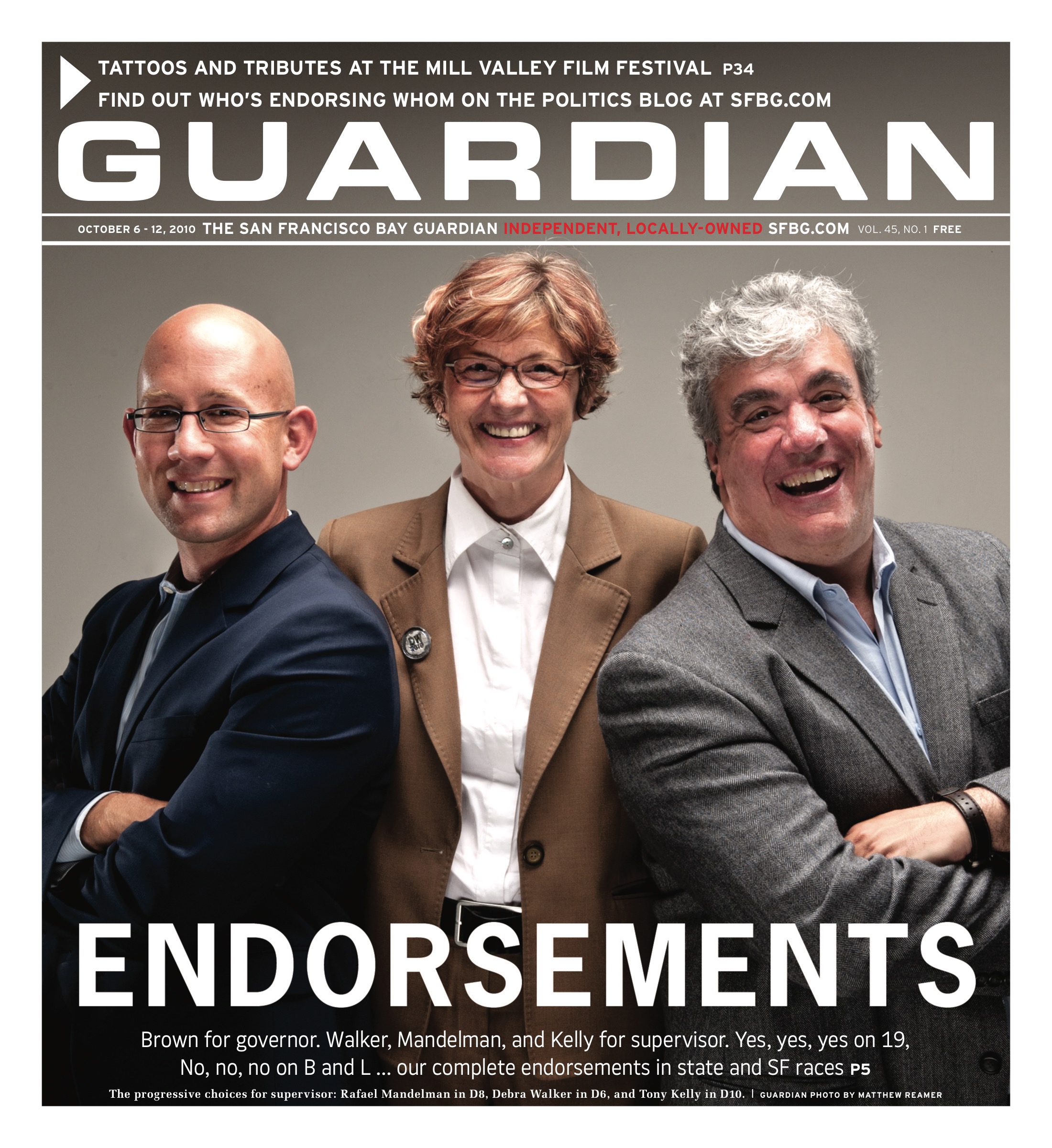
Print sections as they appeared in the early 2010s

To find articles by keyword or author, you may want to use our Search function.

Print Sections

Capp’s Corner

0

paulr@sfbg.com

My first experience of Capp’s Corner was long ago, in college, a melancholy dinner on a damp winter night with my first love. By “long ago,” I mean so long ago that I decline to say how long. By “first love” I mean unrequited love; is there any other kind of first love? I suppose the possibility exists. But for the moony-eyed young, the most real sort of love is the hopeless, thwarted kind, the impossible dream. In that sense, I had won the love lottery at age 20. Lucky me.

It does seem odd, lo these decades later, to associate Capp’s Corner with any form of melancholy. Now, as then, the restaurant is not only a North Beach institution but the very picture of cheerfulness. Its checkertop tablecloths are just like the kind you see in Moonstruck, a not-bad movie about lovelornness, with wonderful glimpses of New York’s Little Italy. There is also a certain saloon feel at Capp’s, lent by the large bar near the entrance; unlike many so-called bars in many of our newer, fancier, and more effete places that seem to have been installed largely for show, this one is the real deal, a working bar where people actually sit and drink.

Elsewhere in the large dining room, people are eating as well as drinking, sometimes in groups of two, often in larger arrays. The restaurant is just down the block from Club Fugazi, longtime home of Beach Blanket Babylon. That’s a show people often attend in sizable groups, and often after having eaten dinner. Capp’s Corner is just the (meal) ticket for these folks; it’s convenient, spacious, practiced in dealing with bigger parties, and it serves many dishes family-style, no matter what kind of family you’re a part of.

The main twist in the family-style service is that the minestrone is presented in a big white earthenware tureen, so you get to serve yourself. This does raise the slop factor, particularly if I happen to be sitting at your table, but it also contributes to festivity. The soup itself was rich in cabbage and cannellini beans, a little lighter on tomato than is usual, and had a savory-sweetness I associate with slow-cooked onion. Our tureen produced eight or nine servings — not a bad yield for a table of six.

Throw in a continually replenished basket of bread and butter, and you have the makings of a small feast. Beyond that was a salad of chopped, chilled lettuces scattered with chickpeas and kidney beans and dressed with what the menu calls a “creamy vinaigrette” — I might call it Thousand Island, Russian, or something similar on the ground that its pinkish-red color implied the presence of tomato in some form.

The family-style dinners are offered at two prices: $18 (for pastas) and $20.50 (for pretty much everything else, including veal and petrale sole). You can get a pair of fleshier dinners (steak and osso buco) for $25.50, and if you don’t want family-style, $15.50 buys you pasta, soup, and salad.

If you like your pasta served in gargantuan portions, you will be happy here — and you’ll be even happier if you like tomato sauces. These, whether marinara or bolognese, are hard to avoid, although a white-wine sauce does pop up here and there. The spaghetti with meatballs was probably typical, though: a huge clump of pasta (cooked a bit past al dente but not mushy) finished with a heavy ladling of bolognese sauce and two orbs of chopped meat the size of a baby’s fist. The meat seemed a bit dry to me, but given all that sauce, it didn’t much matter.

The veal tortellini were better: less daunting in scale, nicely bite-sized, and given a sun-dried tomato cream sauce that was finer than the bolognese. Also satisfying: slices of breaded eggplant baked with mozzarella and marinara and béchamel (or, in Italian, besciamella) sauces. The bitterness of the eggplant had been expertly leached out, and the dish as a whole had a faux-meatiness that might have convinced an omnivore — or at least an omnivore distracted, perhaps, by a value-priced glass, or three, of Chianti ($3.50). I wouldn’t call Chianti my first love, wine-wise, but it tends to be solid. Anyway, it’s the only sort of wine you could drink with a clear conscience in a place like this, with a lovers’ moon peeking through the windows and BBB — the greatest hat show on earth — just a few steps away.

CAPP’S CORNER

Dinner: Mon.-Fri., 4:30–10:30 p.m.;

Sat.–Sun., 4-11 p.m.

Lunch: daily, 11:30 a.m.–2:30 p.m.

1600 Powell, SF

(415) 989-2589

www.cappscorner.com

Full bar

AE/CB/DC/MC/V

Noisy but bearable

Wheelchair accessible


Past presence

0

arts@sfbg.com

LIT/MUSIC/VISUAL ART A present from the past — the paradox within that phrase is as close as one might get to pithily describing hauntology. The term was coined in 1993 by the French philosopher Jacques Derrida to describe utopian specters within capitalist society. But more recently, the music writer Simon Reynolds has specifically applied hauntology — literally, ghost logic — to music, using the term to describe the playfully eerie studio-as-séance-site releases on the British label Ghost Box, and similar recordings.

Since his early days as a journalist for Melody Maker, Reynolds has cannily related French theory to musical phenoms in practical and illustrative ways, whether applying the feminism of Hélène Cixous to Throwing Muses, ideas about jouissance to the sonic innovations of My Bloody Valentine, or Deleuze and Guattari to the jones for acceleration in rave culture. With the release of Reynolds’ most recent book, Totally Wired: Postpunk Interviews and Overviews (Soft Skull Press, 464 pages, $16.95), I thought the time was right to turn the tables and interview him about hauntology and the related library music genre — especially since the current Berkeley Art Museum exhibition “Hauntology” cites him while putting forth a hauntological theory of visual art.

SFBG What do you think about the current interest in library music as culture grows ever more digitized? To me it seems there’s an intrinsic push-pull between searches for rare objects in far reaches, and then their incorporation into digital or online spheres.

Simon Reynolds Certainly there are some music bloggers who specialize in library [music] and go about it in an extremely systematic manner — they aim to upload or share or post every single Bruton or Peer International Library or Chappell release. They work their way through the entire catalog, number by number. These are super-obscure records, and there doesn’t seem to be any kind of discography for a lot of the labels — I guess they weren’t precious about their own output. That must be both attractive and maddening (attractively maddening?) for a certain kind of obsessive-compulsive collector.

People are building a body of knowledge about library music, in the same way that reggae collectors did with the similarly chaotic and massive output of record labels in the ’70s. But it still has the aspect of an unmapped zone, a zone of discovery, which you can’t say about many other areas of music.

SFBG What aspects of library music appeal to you, and what aspects don’t?

SR I like the electronic stuff done by people moonlighting from the BBC Radiophonic Workshop, or by oddball figures like Ron Geesin. Or Eric Peters and Frederick G, who did stuff — electronic weirdness, or effects-laden goofy production-type tracks — for Studio G among other library labels. The Studio G stuff on the Trunk compilation G-Spots is just so luxuriant sounding.

In library music, the weird combination of anything-goes experimentation and un-precious functionalism creates good results, especially when you factor in brevity. Most library tunes are really short. So you get the same alien buzz as from experimental music, but without being detained for 20 minutes to an hour.

I also like the whole mythos and vibe around library music, the idea of all these studios in Wardour Street and thereabouts in central London churning stuff out, with top session players or underemployed composers earning a bit of dough on the side. And of course the packaging, with its uniform artwork for different series and wonderfully distilled evocative track descriptions (“pathetic, grotesque”; “relaxed swing-along”).

The downside is that some library music is just anodyne. A large proportion is sub-music, just splinters of mood or feeling that aren’t developed because they’re meant to underscore or mood-tint brief moments in a movie or TV show. I’m also less interested in the breaks end of library music, the “groovy scene in swinging discotheque” redolent tunes favored by some beat headz.

SFBG How would you characterize or define the relationship between library music and hauntology?

SR What people would consider the classic era of library music — the ’60s and ’70s, when there were groups of musicians in the studio, as opposed to the ’80s and thereafter, when it increasingly became one composer using a digital synthesizer to play all the parts — has heavy associations with the popular culture of that period. Especially TV programs and radio, and particularly children’s TV. Library music was used when there wasn’t a budget to get a soundtrack made, so you got this off-the-peg stuff.

If you’re a child of the ’60s or ’70s, this music has a potent memory-stirring effect, but in a nonspecific way. You hear certain kinds of lite-jazz chords, or melancholic orchestrations, or certain analog synth sounds, and it sets off reverberations inside you, but you can’t place them. (A later generation will probably have the same relationship with digital-era music — we’re maybe getting that with the vogue for video game sounds in a lot of dance music now.)

When hauntologist artists use this material, they can trigger all these emotions. They can also mess with the “science of mood” in library music by making emotions clash and mingle in strange combinations.

The formality and institutional vibe of library releases has a similar appeal to the “benevolent state” stuff that the hauntologist artists are into (like polytechnics, new towns, the BBC when it believed in elevating and educating the common man, etc.). Even though the library labels were commercial ventures, the aura of them is oddly similar to government or educational institutions: kind of stuffy and prim. The artwork relates to the way Penguin and Pelican books looked. It has that “lost Britain” quality.

SFBG Have you heard responses from theorists about your application of Derrida’s concept of hauntology to music?

SR No. I really just stole the word off Jacques because I liked the feel of it. It’s Mark Fisher of k-punk who’s done the more serious mapping of hauntology as a theory onto the music. I think there are definitely some parallels and connections, but Derrida’s thing seems very much bound up with Marxism and philosophy.

SFBG What is particularly hauntological about the Ghost Box label’s recordings, and what are some notable hauntological recordings over time?

SR The “haunty” aspect to the Ghost Box stuff relates to the reverberations I just described. They use samples from the era’s library or incidental music and TV or Radiophonic Workshop scores. Or (in the case of more composed-and-played recordings by Belbury Poly or The Advisory Circle) they write new melodies and motifs that are evocative of that era or in the style of that music.

I think there’s an intrinsic musical appeal and value to this stuff that works on people who don’t have the nostalgic connection. For instance, I know some quite young Americans who really like Ghost Box’s stuff. But if you are of the demographic, it has this extra layer of meaning and effect. It can be bound to a generation, and also to nationality. (Interestingly, it appeals to Australians, who get a lot of the TV from the U.K., and thus have a similar pop cultural matrix of memory).

The Ghost Box artists have a “haunty” aspect in the sense that they’re interested — in a simultaneously playful and serious way — in all kinds of pop culture to do with the supernatural and horror, from the Algernon Blackwood/Arthur Machen tales of cosmic horror, to the Hammer House of Horror movies, to Doctor Who, to ghost stories. Again, there’s a nostalgic aspect in the sense that these things, first encountered as a child, have a profound effect. British children’s TV had some really creepy and macabre stuff on it. In retrospect, you wonder, “What were they thinking broadcasting this stuff to under-10-year-olds?”

Ghost Box has fun with the cultural associations of all this stuff. There is a really pleasing clash of the campy and the genuinely disquieting in the way they handle it. It’s not some goth/industrial scary thing, which I think is where people get confused — they put on the Ghost Box records and discover they’re quite pleasant and enjoyable.

I like the main three Ghost Box groups very much — The Focus Group, Belbury Poly, and The Advisory Circle. And Roj made a cool album, The Transactional Dharma of Roj. The label’s most fully realized, brilliant record is Advisory Circle’s Other Channels. But in terms of individual peaks, I’d say certain tracks on Focus Group’s Hey Let Loose Your Love and Belbury Poly’s The Willows are among the most remarkable music of the past decade. For me they find this place between idyllic and eerie that just presses all my buttons, especially when you add the overall framework — the design and the concepts have this dry, poker-faced humor to them.

A similar vibe is going on in the records by Moon Wiring Club and Mordant Music, who are the other two central hauntologists for me. The Caretaker, a.k.a. Leyland James Kirby, has also done some really great stuff, but it’s more amorphous and drone-y.

SFBG Inside and outside of a deployment of library music, does hauntology appeal to you more than “retrofuturism” as an idea and a practice?

SR They are similar, or they overlap. The Ghost Box guys and Mordant Music are into the whole nostalgia for the future trip. Part of the appeal of something like the BBC Radiophonic Workshop is the futurism of it, the alien impact it had on impressionable ears, now inevitably filtered through a scrim of bygone charm and quaintness.

SFBG What future forms might hauntology take?

SR It may well be that every generation will come up with some kind of working-through of its recent past, the stuff that affected it most intensely as children. If you look at Ariel Pink and all the people he’s influenced who’ve come through recently, it’s bound up with a different memory-set: ’80s pop, MTV, and radio.

HAUNTOLOGY

Through Dec. 5

(Oct 29, 6-9pm “Hauntology at L@te Event with Interdisciplinary Intro Panel and musical performances Indignant Senility, Barn Owl, and Jim Haynes)

Berkeley Art Museum

2626 Bancroft Way, Berk.

(510) 642-0808

www.bampfa.berkeley.edu


Her band

0

arts@sfbg.com

MUSIC Mention the name Corin Tucker, and for many people, what comes to mind is a voice: the charged vibrato that was one of the signature elements of the sound of Sleater-Kinney. But before Tucker formed Sleater-Kinney, she’d sung differently in other bands, such as riot grrrl pioneers Heavens to Betsy, where her guitar was tuned lower in a manner that made it possible to tap into submerged feelings and experiences.

The new album by Corin Tucker Band, 1,000 Years (Kill Rock Stars), makes it clear that Tucker is more than just the tell-tale voice of Sleater-Kinney — she’s a songwriter who can add another wrinkle of emotion to a song with a change in tone, as on “It’s Always Summer,” where the annoyance that briefly grips her voice on the line “It’s always something” makes the hope in the chorus of the song that much sweeter. Working with producer-arranger-instrumentalist Seth Lorinczi and drummer Sara Lund, Tucker has fashioned a record that moves through different themes and sounds, evoking everything from Carole King piano ballads to acoustic Led Zep to Nuggets-worthy guitar riffage.

To a degree, the heart of 1,000 Years can be found just before the halfway mark with the one-two punch of “Handed Love” and “Doubt.” According to Tucker, the first song is the sort of just-divorced scenario Tracey Thorn explores in different ways on her recent solo album Love and Its Opposite (Merge). There’s something a little wilder and darker to Tucker’s approach to the subject, with the past’s failed pleasures as alluring as a drug, and a sense of menace in the spaces and silent moments around her voice’s quiet, minimalist dance with a keyboard. The same tension between restraint and abandon tells a different story in “Doubt,” a love song to rock ‘n’ roll that affirms that no worthy responsibility can fully kill off a love of the boogie and the beat. I recently talked with Tucker about the new album.

SFBG You’ve been based in Portland for around 15 years now. How has it changed?

CORIN TUCKER It’s so different. If you went down the street where I used to live, Alberta, it’s completely different. It’s unrecognizably built up. Sometime I wonder, how do people make their money here? The recession has been brutal in Portland and Oregon because we don’t make something concrete. The timber industry was our industry and that’s gone now. I guess we make Nike and Adidas.

But in terms of culture and film and arts, Portland is growing. The music scene has totally grown.

SFBG One thing the Sara Marcus book Girls to the Front (Harper Perennial, 384 pages, $14.99) re-reminded me of is the fact your lyrics with Heavens to Betsy had more of a storyline than a lot of riot grrrl recordings. While your new album doesn’t sound like Heavens to Betsy, it also feels rich in narrative.

CT That’s something I enjoyed about making this record. I relate to storytelling in songs and working on the lyrics to paint a little picture. That’s is sort of my natural songwriting style, and it’s something I return to easily.

SFBG Was it difficult to choose the sequencing of the songs? I wonder because the album moves through different terrain and different sounds, including your voice — you sing differently from song to song.

CT The record wound up having more variety than I expected when we began. I expected it to be quieter and acoustic — a straightforward solo album. But as Seth [Lorinczi] and I worked on it, we naturally drew on our different musical backgrounds.

SFBG In a way, the way the guitars were tuned in Sleater-Kinney seemed to place your voice in a certain elevated spot. On 1,000 Years you might have a wider ground to stand on as a singer.

CT I wanted to use different voices on the record. Not necessarily different characters, but different sides of my voice that I didn’t think people had heard before — or if they had, in Heavens to Betsy, that was so long ago. Part of the challenge and opportunity of making a solo record is figuring out how to give it enough variety so that you can take people through a journey.

SFBG One song I want to ask about is “Handed Love.” I like that it’s elliptical, and I get a dark feeling from it.

CT I think that might be one of my favorite songs. It has an interesting evolution. I started writing it on guitar and vocals, and it was pretty flat and straightforward. It was a mid-tempo rocker.

The song is sort of looking at relationships from the point of being a little bit older and being a female. I have a couple of friends who are newly divorced and I just kinda put myself in their shoes. It seemed like a difficult thing to navigate, when you have your heart broken and have to keep it together.

Seth had this idea [laughs], ‘What if we do this song with only ‘ooo’ vocals in the background?’ There’s this really beautiful choir part that comes in at the end, and that’s where we began recording it. He stripped away all the guitar and we had this vocal chorus and a drum machine. Then it kept evolving. Finally, he tried a Wurlitzer organ and I loved it.

SFBG That song and the follow-up track, “Doubt,” both have great moments where the sound is sort of stripped away. I get the sense that you had fun working with Seth.

CT It was a really enjoyable process. We just set it up as this project we were working on, and there was a lot of tinkering. The door was wide open in terms of what we could do and how we would look at things. He’s talented as a musician and as a producer and arranger.

SFBG Because it was a solo project and because you were working with him, was there a sense that songs could change as you worked on them?

CT Definitely. When I wrote “Half a World Away,” it was a ballad on guitar — very quiet and super slow. Seth had this idea that we should rock out. We started working on it, and he had this idea of taking the guitar parts and making them sparse and prickly and fast. Then when we started playing with Sara Lund, she brought a whole new dynamic to the song with the percussion. She brought in these African bells, because the song is about Lance [Bangs, Tucker’s husband] going away to Africa, and she had all these ideas about illustrating angst with percussion. That song became something I really love that is completely different from the original demo.

SFBG One other song I wanted to ask about is “Riley” because it has such a classic rock riff. Do you know a Riley?

CT No. He’s more of a fictional character.

SFBG I know a Riley.

CT You do? Is he down and out?

SFBG No, he’s a funny Filipino queen.

CT [Laughs] In 2007 and 2008, it just felt like such a dark time — so many friends had lost their jobs, or were getting divorced. Seth and I talked about Patti Smith literally every day while we were recording. Just Kids (Ecco, 320 pages, $16) came out while we were making the record, and she’s such a great inspiration. She’s one of those people who can write songs that are about friendship and helping your friends through something difficult. That song is really inspired by her and Lenny Kaye.

SFBG “Thrift Store Coats” starts out a lot like most people’s idea of what a solo recording would sound like — a voice and a pretty piano arrangement. But then suddenly it turns loud and powerful.

CT I have to give credit to Seth. He thought we could draw people into the story and the lyric and then have the whole band come to the stage and add power and a sense of protest.

SFBG I know your son is named Marshall in part because of Marshall Tucker Band — is Corin Tucker Band a nod to Marshall Tucker Band?

CT Yes, it is. The funny thing is that my daughter Glory thinks that every mom has her own band. At soccer practice the other day she started a band with her friend — who is one — called Glory Tucker Band.

CORIN TUCKER BAND

With the Golden Bears

Mon/11, 8 p.m., $17

859 O’Farrell, SF

(888) 233-0449

www.gamh.com

Endorsements 2010: San Francisco ballot measures

26

PROP. AA

VEHICLE REGISTRATION FEE

YES

Proposition AA would add $10 to the existing annual fee for vehicles registered in San Francisco, which would bring in about $5 million a year in desperately needed funds for public transit and other environmentally friendly modes of transportation. Proceeds would help to fund new bike infrastructure, pedestrian crosswalks, and transit reliability projects. Some would also be spent on street repairs — with top priority given to streets with bikeways and public transit routes. Unless Muni and bike infrastructure improves, it’s hard to persuade drivers to leave their cars at home and choose greener ways of getting around. Prop. AA is in line with the city’s transit-first goals, and it will be a step toward reducing traffic congestion and helping public transit. Vote yes.


PROP. A

EARTHQUAKE RETROFIT BOND

YES

This $46.15 million general obligation bond to support seismic upgrades for wood-framed buildings is an important means of protecting San Franciscans in an earthquake and preserving affordable housing. A 2009 report by the Department of Building Inspection found that 151 buildings that received government affordable housing support — 8,247 units in all — could be destroyed in the next big earthquake.

Unfortunately, most of these buildings are break-even ventures for their owners, who have no incentive to put the money into needed seismic upgrades. This measure would fund those improvements with grants and deferred loans, which would accrue interest but would only need to be paid back if the owner makes a profit or tries to convert the building to another use, providing further guarantees that the housing will remain affordable even after an owner’s obligation to the state or federal governments ends. Vote yes on Prop. A.


PROP. B

CITY RETIREMENT AND HEALTH PLANS

NO, NO, NO

Back when the great national health care reform debate was raging, the Guardian advocated for a single-payer system, which would have cut out health insurance companies altogether. What we got instead was a bill that requires everyone to buy health insurance. Now endlessly rising health insurance costs pose a problem for the city — in years of financial stress, it must make ever-larger payments to cover public employees’ health benefits. The blame for this dysfunctional system should be pinned on health insurance companies, not public employees. After all, the industry spent millions lobbying federal lawmakers to preserve a system in which they are solidly guaranteed to make millions off the backs of taxpayers.

But Prop. B, introduced by Public Defender Jeff Adachi, asks public employees to bear the brunt of these ballooning costs. It would also require them to contribute up to 10 percent of their pay to fund retirement benefits. One of the most compelling arguments against Prop. B was articulated by Assemblymember Tom Ammiano in a recent Guardian editorial: “A single mother will be forced to pay up to $5,600 per year for her child’s health care — in addition to the $8,154 she already pays.” That cost would be the same whether the employee earns $40,000 or $100,000 annually — and that’s just unfair. Prop. B would deal the greatest blow to the people who have the least. But there’s a broader consequence, too — take this kind of money out of the pockets of working people and you’ve done just the opposite of stimulating the economy.

Adachi wrote and circulated his measure without negotiating with city employee unions or seeking a solution that would be less harsh and regressive. We’re all for reviewing the city’s pension and health care costs. But making the lowest-paid city workers take the same hit as the overpaid managers is no answer. Vote no on B.


PROP. C

MAYOR APPEARANCES AT BOARD

YES

If you feel like you’ve seen this measure before, that’s because you have — an advisory measure asking the mayor to show up once a month and answer questions at the Board of Supervisors passed overwhelmingly in 2006. But Mayor Gavin Newsom ignored it, and a tougher measure failed the next year after Newsom raised $250,000 to defeat it.

Now the problem is worse than ever. In a year in which back room negotiations and underhanded political tactics marred the city budget approval process and other legislative initiatives, progressive supervisors are again trying to get Newsom and future mayors to engage in a political dialogue, in public, to determine what’s best for the city. This is precisely how the people’s business should be done, in an open and transparent way that respects the role that these two branches of government are supposed to play in running the city. Besides, won’t it be fun to watch? Vote yes.


PROP. D

NONCITIZEN VOTING IN SCHOOL BOARD ELECTIONS

YES

Sponsored by Board President David Chiu and Sups. David Campos, Eric Mar, John Avalos, Ross Mirkarimi, Sophie Maxwell, Chris Daly, and Bevan Dufty, this charter amendment would extend the right to vote in local school board elections to San Francisco residents who are parents, guardians, and caregivers of children who attend school in San Francisco, regardless of whether these residents are U.S. citizens.

One-third of San Francisco residents are foreign-born. Parental involvement has been determined as a critical factor in children’s education — and this measure only applies to elections for the Board of Education. Vote yes.


PROP. E

ELECTION DAY VOTER REGISTRATION

YES

In an era of growing political apathy and cynicism, anything that draws more people into the electoral process is a good thing. So this common sense measure by Sup. Ross Mirkarimi to remove one more barrier to participation in elections is a positive step.

Current state law requires eligible voters to register at least 15 days before an election. Prop. E would allow any city resident to simply show up at a polling place on Election Day, register to vote, and participate in a municipal election. Eight other states currently offer same-day voter registration. Vote yes.


PROP. F

HEALTH SERVICE BOARD ELECTIONS

NO

Sup. Sean Elsbernd, who sponsored this measure, says it will save the city money be consolidating elections for the board that oversees the city employee health care fund. But it won’t save much — $30,000 a year, at most — and the unions that represent the people who are served by this board say risks turning board elections into more expensive and complex political contests. Vote no.


PROP. G

TRANSIT OPERATOR WAGES

NO

We understand the motivations behind this measure — Muni drivers are the only city employees who don’t have to engage in collective bargaining for wages and work rules. Instead, the City Charter guarantees them the second-highest salary level of all comparable transit systems in the nation. Although that’s not an unreasonable salary level given that Muni is perhaps the country’s most challenging transit system and San Francisco has one of the highest cost of living price tags in the country, no city workers should have their salaries set this way.

We also agree that many of Muni’s work rules need to be changed and that removal of the salary guarantees would give the city more leverage to make those changes. We even agree that Transport Workers Union Local 250 hasn’t done itself any favors and should have been a better partner in this year’s difficult city budget process.

But we oppose Prop. G, which inappropriately seeks to blame Muni’s problems on its drivers and would set a new standard for collective bargaining that could hurt workers and perhaps make Muni more dangerous to pedestrians and others.

Like all city employees, Muni drivers are banned from going on strike. In exchange, the city agrees to binding arbitration if contract talks reach an impasse. But this measure adds a factor that exists in no other city union contract: the arbitrator would have to consider whether a proposed contract could negatively affect service.

While that might seem benign or even appropriate, the reality is that everything from driver rest breaks to assisting those with disabilities to the expectations of how fast drivers can complete a route all potentially affect service, forcing the arbitrator into positions of agreeing with city officials who have been choosing the politically expedient path of trying to squeeze more out of Muni without trying to give it the resources it needs to operate safely, efficiently, and reliably.

Earlier this year, progressive supervisors tried to craft an omnibus Muni reform measure that removed driver pay guarantees from the charter while also trying to get it more money and make critical changes in how the system is governed, an effort the TWU supported but that the supervisors ultimately abandoned. That’s the kind of balanced approach the system needs and it ought to be revived. In the meantime, vote no on G.


PROP. H

LOCAL ELECTED OFFICIALS ON POLITICAL PARTY COMMITTEES

NO

This one’s a pure political vengeance act by Mayor Newsom, who is unhappy that the local Democratic Party is controlled by progressives who oppose his initiatives. The measure would bar elected officials in San Francisco from serving on the Democratic or Republican County Central Committee. It’s almost certainly unconstitutional — the parties get to decide their own membership rules — and has no rationale at all except the mayor’s personal sour grapes. Vote no.


PROP. I

SATURDAY VOTING

YES

Okay, we’re suspicious of Prop I. The sponsor is Alex Tourke, a political consultant whose client list isn’t exactly a roster of progressive San Francisco. And it’s a little funky — it calls for an experiment in opening the polls the Saturday before the next mayoral election, with the costs covered by private donations. And the idea of private interests paying for an election strikes us as bad policy.

But at its base, the idea is sound. Tuesday voting is a very old idea that makes no sense in the modern age. We’d much rather see Election Day held at a time when most people aren’t working. In fact, we’d rather see the polls open for a week, not just one day. And this is a one-time test to see if weekend voting might increase turnout. Vote yes.

PROP. J

HOTEL TAX CLARIFICATION AND TEMPORARY INCREASE

YES

There are two competing hotel taxes on the November ballot: Prop. J and Prop K. Prop. K contains a poison pill: if both measures pass, whichever gets the most votes take effect. Both J and K try to address legal insufficiencies in San Francisco’s existing hotel tax, but Prop. J also asks visitors to pay a slightly higher tax — about $3 a night (the cost of a latte) — for the next three years.

Currently the way hotel taxes are assessed allows some online customers to avoid part of the tax. When a customer books a hotel room through an online booking service like Expedia or Orbitz, the hotel tax is only assessed on the amount that a hotel receives, not the amount that the website charges the customer. In other words, if a website sells a room to an online customer for $150 a night, but only $120 of that goes to the hotel, the customer is charged hotel tax on the lower amount. If Prop. J passes, the customer will have to pay a hotel tax on the full amount paid to the online booking service. The measure would also eliminate a loophole that allows airlines to book rooms for flight crews without paying any tax. Those changes are expected to generate at least $12 million a year. The $3 increase in the hotel tax will generate another $26 million.

The Chamber of Commerce and Convention and Visitors Bureau say the measure could hurt tourism — but it’s hard to imagine how somebody will decide not to visit San Francisco because of a $3 a night fee. Vote yes.


PROP. K

HOTEL TAX CLARIFICATION

NO

Put on the ballot by Mayor Newson at the behest of large hotel corporations, Prop. K also seeks to close loopholes in the hotel tax. But Prop. K doesn’t include a tax increase, meaning that it will contribute millions less to the city’s General Fund at a time when San Francisco is having trouble balancing its budget, leading to ongoing cuts in city staff and services.

Prop. K’s a direct attempt to undermine Prop. J. Vote no.


PROP. L

SITTING OR LYING ON SIDEWALKS

NO, NO, NO

What kind of a city is San Francisco? If proponents of Prop. L, the Civil Sidewalks Ordinance, were to be believed, it’s a city where nothing is done when uncivil people harass pedestrians, drink on the sidewalk, or pee in public. Even though Prop. L purports to address this kind of behavior, all it really does is outlaw sitting or lying on public sidewalks.

We think San Francisco is the kind of city that is smart enough to reject this dumb idea. The Prop. L proponents like to say it’s about public safety, but there is nothing inherently unsafe about sitting or lying down on the sidewalk. Street poets sit at their typewriters to sell sonnets to tourists. The tamale lady sometimes sits while selling her tasty Mexican treats. Day laborers sit when they get tired of standing around waiting for work. Many people who live on the streets lie down to sleep beside their shopping carts. If Prop. L passes, there is nothing to guarantee that buskers, day laborers, homeless people, partygoers, people with bad knees, or anyone else would not be harassed by police for the simple act of sitting.

But even if there are people squatting on the sidewalk harassing passersby, how is this law going to change that? All they have to do is stand up — which would still be legal. If they persist, and the police arrest them, the city will be on the hook for millions of dollars in costs for prosecution, defense, and incarceration.

The notion that the ordinance would only be used against troublemakers is problematic too, since a law that is selectively enforced could open the door to legal headaches. Prop. L is misguided, draconian, unnecessary, and the wrong direction for San Francisco. Vote no.


PROP. M

COMMUNITY POLICING AND FOOT PATROLS

YES

Prop. M offers an enlightened alternative to Prop. L. Introduced by Sup. Ross Mirkarimi, it would require the chief of police to establish a comprehensive beat patrol program, with cops on the beat, to deal with the safety and civility issues Prop. L seeks to address. It would also direct the Police Commission to adopt a written community policing policy, involving police interactions with the community, focusing police resources on high crime areas, and encouraging citizen involvement in combating crime. Prop. M also has a poison pill: if the voters adopt both M and L and M gets more votes, then the law against sitting or lying down on the sidewalk would not take effect. So a yes vote for Prop. M is kind of like another no vote against Prop. L. Vote yes.


PROP. N

REAL PROPERTY TRANSFER TAX

YES

With the city facing a massive structural budget deficit, it’s hard to argue against a measure that would bring in an average of $36 million without hurting anyone except the buyers and sellers of very high-end property — that is, big corporations and exceptionally wealthy individuals. Prop. N would slightly increase the tax charged by the city on the sale of property worth more than $5 million. Vote yes.


>>BACK TO ENDORSEMENTS 2010

Endorsements 2010: San Francisco candidates

53

SUPERVISOR, DISTRICT 2


JANET REILLY


Frankly, we were a little surprised by the Janet Reilly who came in to give us her pitch as a District 2 supervisorial candidate. The last time we met with her, she was a strong progressive running for state Assembly as an advocate of single-payer health care. She was challenging Fiona Ma from the left, and easily won our endorsement.


Now she’s become a fiscal conservative — somewhat more in synch with her district, perhaps, but not an encouraging sign. Reilly seems to realize that there’s a $500 million budget deficit looming, but she won’t support any of the tax measures on the ballot. She’s against the hotel tax. She’s against the real estate transfer tax on high-end properties. She’s against the local car tax. She opposed Sup. David Chiu’s business tax plan that would have shifted the burden from small to larger businesses (even though it was clear from our interview that she didn’t understand it).


She talked about merging some of the nonprofits that get city money, about consolidating departments, and better management — solutions that might stem a tiny fraction of the red ink. But she wouldn’t even admit that the limited tax burden on the very rich was part of San Francisco’s budget problem.


Her main proposal for creating jobs is more tax credits for biotech, life sciences, and digital media and more public-private partnerships.


It’s too bad, because Reilly’s smart, and she’s far, far better than Mark Farrell, the candidate that the current incumbent, Michela Alioto-Pier, is backing. We wish she’d be realistic about the fiscal nightmare she would inherit as a supervisor.


On the positive side, she’s a strong supporter of public power and she has good connections to the progressive community. Unlike Alioto-Pier, she’d be accessible, open-minded, and willing to work with the progressive majority on the board. That would be a dramatic change, so we’ll give her the nod.


We were also impressed with Abraham Simmons, a federal prosecutor who has spent time researching city finance on the Civil Grand Jury. But he supports sit-lie, Prop. B and Prop. S, and opposes most new tax proposals and needs more political seasoning.


DISTRICT 4


NO ENDORSEMENT


We’ve always wanted to like Carmen Chu. She’s friendly, personable, intelligent, and well-spoken. But on the issues, she’s just awful. Indeed, we can’t think of a single significant vote on which she’s been anything but a call-up loyalist for Mayor Newsom. She even opposed the public power measure, Prop. H, that had the support of just about everyone in town except hardcore PG&E allies.


She’s running unopposed, and will be reelected. But we can’t endorse her.


DISTRICT 6


1. DEBRA WALKER


2. JANE KIM


3. GLENDON “ANNA CONDA” HYDE


CORRECTION: In our original version of this endorsement, we said that Jim Meko supports the sit-lie ordinance. That was an error, and it’s corrected below.


A year ago, this race was artist and activist Debra Walker’s to lose. Most of the progressive community was united behind her candidacy; she’d been working on district issues for a couple of decades, fighting the loft developers during the dot-com boom years and serving on the Building Inspection Commission. Then School Board member Jane Kim decided to enter the race, leaving the left divided, splitting resources that might have gone to other critical district races — and potentially helping to put the most pro-business downtown candidate, Theresa Sparks, in a better position to win.


Now we’ve got something of a mess — a fragmented and sometimes needlessly divisive progressive base in a district that’s key to holding progressive control of the board. And while neither of the two top progressive candidates is actively pursuing a credible ranked-choice voting strategy (Kim has, unbelievably, endorsed James Keys instead of Walker, and Walker has declined to endorse anyone else), we’re setting aside our concern over Kim’s ill-advised move and suggesting a strategy that is most likely to keep the seat Chris Daly has held for the past 10 years from falling to downtown control.


Walker is far and away our first choice. She understands land use and housing — the clear central issues in the district — and has well thought-out positions and proposals. She says that the current system of inclusionary housing — pressing market-rate developers to include a few units of below-market-rate housing with their high-end condos — simply doesn’t work. She supports an immediate affordable housing bond act and a long-term real estate transfer tax high enough to fund a steady supply of housing for the city’s workforce. She told us the city ought to be looking at planning issues from the perspective of what San Francisco needs, not what developers want to build. She’s in favor of progressive taxes and a push for local hiring. We’re happy to give her our first-place ranking.


Jane Kim has been a great SF School Board member and has always been part of the progressive community. But she only moved into District 6 a year and a half ago — about when she started talking about running for supervisor (and she told us in her endorsement interview that “D6 is a district you can run in without having lived there a long time.”) She still hasn’t been able to explain why she parachuted in to challenge an experienced progressive leader she has no substantive policy disagreements with.


That said, on the issues, Kim is consistently good. She is in favor of indexing affordable housing to market-rate housing and halting new condo development if the mix gets out of line. She’s for an affordable housing bond. She supports all the tax measures on this ballot. She’s a little softer on congestion pricing and extending parking-meter hours, but she’s open to the ideas. She supports police foot patrols not just as a law-enforcement strategy, but to encourage small businesses. She’d be a fine vote on the board. And while we’re sympathetic to the Walker supporters who would prefer that we not give Kim the credibility and exposure of an endorsement, the reality is that she’s one of two leading progressives and would be better on the board than the remaining candidates.


Hyde, a dynamic young drag queen performer, isn’t going to win. But he’s offered some great ideas and injected some fun and energy into the race. Hyde talks about creating safe injection sites for IV drug users to reduce the risk of overdoses and the spread of disease. He points out that a lot of young people age out of the foster-care system and wind up on the streets, and he’s for continuum housing that would let these young people transition to jobs or higher education. He talks about starting a co-op grocery in the Tenderloin. He proposes bus-only lanes throughout the district and wants to charge large vehicles a fee to come into the city. He’s a big advocate of nightlife and the arts. He lacks experience and needs more political seasoning, but we’re giving him the third-place nod to encourage his future involvement.


Progressives are concerned about Theresa Sparks, a transgender activist and former business executive who now runs the city’s Human Rights Commission. She did a (mostly) good job on the Police Commission. She’s experienced in city government and has good financial sense. But she’s just too conservative for what remains a very progressive district. Sparks isn’t a big fan of seeking new revenue for the city telling us that “I disagree that we’ve made all the cuts that we can” — even after four years of brutal, bloody, all-cuts budgets. She doesn’t support the hotel tax and said she couldn’t support Sup. David Chiu’s progressive business tax because it would lead to “replacing private sector jobs with public sector jobs” — even though the city’s own economic analysis shows that’s just not true. She supports Newsom’s sit-lie law.


Sparks is the candidate of the mayor and downtown, and would substantially shift the balance of power on the board. She’s also going to have huge amounts of money behind her. It’s important she be defeated.


Jim Meko, a longtime neighborhood and community activist, has good credentials and some solid ideas. He was a key player in the western SoMa planning project and helped come up with a truly progressive land-use program for the neighborhood. But he supports Prop. B and is awfully cranky about local bars and nightlife.


James Keys, who has the support of Sup. Chris Daly and was an intern in Daly’s office, has some intriguing (if not terribly practical) ideas, like combining the Sheriff’s Department and the Police Department and making Muni free). But in his interview, he demonstrated a lack of understanding of the issues facing the district and the city.


So we’re going with a ranked-choice strategy: Walker first, Kim second, Hyde third. And we hope Kim’s supporters ignore their candidate’s endorsement of Keys, put Walker as their second choice, and ensure that they don’t help elect Sparks.


DISTRICT 8


RAFAEL MANDELMAN


This is by far the clearest and most obvious choice on the local ballot. And it’s a critical one, a chance for progressives to reclaim the seat that once belonged to Harvey Milk and Harry Britt.


Mandelman, a former president of the Milk Club, is running as more than a queer candidate. He’s a supporter of tenants rights, immigrants’ rights, and economic and social justice. He also told us he believes “local government matters” — and that there are a lot of problems San Francisco can (and has to) solve on its own, without simply ducking and blaming Sacramento and Washington.


Mandelman argues that the public sector has been starved for years and needs more money. He agrees that there’s still a fair amount of bloat in the city budget — particularly management positions — but that even after cleaning out the waste, the city will still be far short of the money it needs to continue providing pubic services. He’s calling for a top-to-bottom review of how the city gets revenue, with the idea of creating a more progressive tax structure.


He’s an opponent of sit-lie and a supporter of the sanctuary city ordinance. He supports tenants rights and eviction protection. He’s had considerable experience (as a member of the Building Inspection Commission and Board of Appeals and as a lawyer who advises local government agencies) and would make an excellent supervisor.


Neither of the other two contenders make our endorsement cut. Rebecca Prozan is a deputy city attorney who told us she would be able to bring the warring factions on the board together. She has some interesting ideas — she’d like to see the city take over foreclosed properties and turn them into housing for teachers, cops, and firefighters — and she’s opposed to sit-lie. But she’s weak on tenant issues (she told us there’s nothing anyone can do to stop the conversion of rental housing into tenancies-in-common), doesn’t seem to grasp the need for substantial new revenues to prevent service cuts, and doesn’t support splitting the appointments to key commissions between the mayor and the supervisors.


Scott Wiener, a deputy city attorney, is a personable guy who always takes our phone calls and is honest and responsive. He’s done a lot of good work in the district. But he’s on the wrong side of many issues, and on some things would be to the right of the incumbent, Sup. Bevan Dufty.


He doesn’t support public power (which Dufty does). He says that a lot of the city’s budget problems can’t be solved until the state gets its own house in order (“we can’t tax our way out of this”) and favors a budget balanced largely by further cuts. In direct contrast to Mandelman, Wiener said San Franciscans “need to lower our expectations for government.” He wants broad-based reductions in almost all city agencies except Muni, “core” public health services, and public safety. He doesn’t support any further restrictions on condo conversions or TICs. And he has the support of the Small Property Owners Association — perhaps the most virulently anti-tenant and anti-rent control group in town.


This district once gave rise to queer political leaders who saw themselves and their struggles as part of a larger progressive movement. That’s drifted away of late — and with Mandelman, there’s a chance to bring it back.


DISTRICT 10


1. TONY KELLY


2. DEWITT LACY


3. CHRIS JACKSON


District 10 is the epicenter of new development in San Francisco, the place where city planners want to site as many as 40,000 new housing units, most of them high-end condos, at a cost of thousands of blue-collar jobs. The developers are salivating at the land-rush opportunities here — and the next supervisor not only needs to be an expert in land-use and development politics, but someone with the background and experience to thwart the bad ideas and direct and encourage the good ones.


There’s no shortage of candidates — 22 people are on the ballot, and at least half a dozen are serious contenders. Two — Steve Moss and Lynette Sweet — are very bad news. And one of the key priorities for progressives is defeating the big-money effort that downtown, the police, and the forces behind the Van Ness Avenue megahospital proposal are dumping into the district to elect Moss.


Our first choice is Tony Kelly, who operates Thick Description Theater and who for more than a decade has been directly involved in all the major neighborhood issues. He has a deep understanding of what the district is facing: 4,100 of the 5,300 acres in D10 have been rezoned or put under the Redevelopment Agency in the past 10 years. Planners envision as many as 100,000 new residents in the next 10 years. And the fees paid by developers will not even begin to cover the cost of the infrastructure and services needed to handle that growth.


And Kelly has solutions: The public sector will have to play a huge role in affordable housing and infrastructure, and that money should come from higher development fees — and from places like the University of California, which has a huge operation in the district and pays no property taxes. Kelly wants to set up a trigger so that if goals for affordable housing aren’t met by a set date, the market-rate development stops. He supports the revenue measures on the ballot but thinks we should go further. He opposes the pension-reform measure, Prop. B, but notes that 75 percent of the city’s pension problems come from police, fire, and management employees. He wants the supervisors to take over the Redevelopment Agency. He’s calling for a major expansion of open space and parkland in the district. And he thinks the city should direct some of the $3 billion in short-term accounts (now all with the Bank of America) to local credit unions or new municipal bank that could invest in affordable housing and small business. He’s a perfect fit for the job.


DeWitt Lacy is a civil-rights lawyer and a relative newcomer to neighborhood politics. He speaks passionately about the need for D10 to get its fair share of the city’s services and about a commitment to working-class people.


Lacy is calling for an immediate pilot program with police foot patrols in the high-crime areas of the district. He’s for increasing the requirements for developers to build affordable housing and wants to cut the payroll tax for local businesses that hire district residents.


Lacy’s vision for the future includes development that has mixed-use commuter hubs with shopping and grocery stores as well as housing. He supports the tax measures on the ballot and would be willing to extend parking meter hours — but not parking fines, which he calls an undue burden on low-income people.


He’s an outspoken foe of sit-lie and of gang injunctions, and with his background handling police abuse lawsuits, he would have a clear understanding of how to approach better law-enforcement without intimidating the community. He lacks Kelly’s history, experience, and knowledge in neighborhood issues, but he’s eminently qualified and would make a fine supervisor.


Chris Jackson, who worked at the San Francisco Labor Council and serves on the Community College Board, is our third choice. While it’s a bit unfortunate that Jackson is running for higher office only two years after getting elected to the college board, he’s got a track record and good positions on the issues. He talks of making sure that blue-collar jobs don’t get pushed out by housing, and suggested that the shipyard be used for ship repair. He wants to see the city mandate that landlords rent to people with Section 8 housing vouchers. He supports the tax measures on the ballot, but also argues that the city has 60 percent more managers than it had in 2000 and wants to bring that number down. He thinks the supervisors should take over Redevelopment, which should become “just a financing agency for affordable housing.” He wants to relocate the stinky sewage treatment plant near Third Street and Evans Avenue onto one of the piers and use the area for a transit hub. He’s still relatively unseasoned, but he has a bright political future.


Eric Smith, a biodiesel activist, is an impressive candidate too. But while his environmental credentials are good, he lacks the breadth of knowledge that our top three choices offer. But we’re glad he’s in the race and hope he stays active in community politics.


Malia Cohen has raised a lot of money and (to our astonishment) was endorsed No. 2 by the Democratic Party, but she’s by no means a progressive, particularly on tenant issues — she told us that limiting condo conversions is an infringement of property rights. And she’s way too vague on other issues.


Moss is the candidate of the big developers and the landlords, and the Chamber of Commerce is dumping tens of thousands of dollars into getting him elected. He’s got some good environmental and energy ideas — he argues that all major new developments should have their own energy distribution systems — but on the major issues, he’s either on the wrong side or (more often) can’t seem to take a stand. He said he is “still mulling over” his stand on sit-lie. He supports Sanctuary City in theory, but not the actual measure Sup. David Campos was pushing to make the policy work. He’s not sure if he likes gang injunctions or not. He only moved back to the district when he decided to run for supervisor. He’s way too conservative for the district and would be terrible on the board.


Lynette Sweet, a BART Board member, has tax problems (and problems explaining them) and wouldn’t even come to our office for an endorsement interview. The last thing D10 needs is a supervisor who’s not accountable and unwilling to talk to constituents and the press.


So we’re going with Kelly, Lacy, and Jackson as the best hope to keep D10 from becoming a district represented by a downtown landlord candidate.


SAN FRANCISCO BOARD OF EDUCATION


MARGARET BRODKIN


KIM-SHREE MAUFAS


HYDRA MENDOZA


Three seats are up on the School Board, and three people will get elected. And it’s a contested race, and in situations like that, we always try to endorse a full slate.


This fall, it was, to put it mildly, a challenge.


It’s disturbing that we don’t have three strong progressive candidates with experience and qualifications to oversee the San Francisco Unified School District. But it seems to be increasingly difficult to find people who want to — and can afford to — devote the time to what’s really a 40-hour-a-week position that pays $500 a month. The part-time school board is an anachronism, a creature of a very different economic and social era. With the future of the next generation of San Franciscans at stake, it’s time to make the School Board a full-time job and pay the members a decent salary so that more parents and progressive education advocates can get involved in one of the most important political jobs in the city.


That said, we’ve chosen the best of the available candidates. It’s a mixed group, made up of people who don’t support each other and aren’t part of anyone’s slate. But on balance, they offer the best choices for the job.


This is not a time when the board needs radical change. Under Superintendent Carlos Garcia, the local public schools are making huge strides. Test scores are up, enrollment is increasing, and San Francisco is, by any rational measure, the best big-city public school district in California. We give considerable credit for that to the progressives on the board who got rid of the irascible, secretive, and hostile former Superintendent Arlene Ackerman and replaced her with Garcia. He’s brought stability and improvement to the district, and is implementing a long-term plan to bring all the schools up to the highest levels and go after the stubborn achievement gap.


Yet any superintendent and any public agency needs effective oversight. One of the problems with the district under Ackerman was the blind support she got from school board members who hired her; it was almost as if her allies on the board were unable to see the damage she was doing and unable to hold her accountable.


Our choices reflect the need for stability — and independence. We are under no illusions — none of our candidates are perfect. But as a group, we believe they can work to preserve what the district is doing right and improve on policies that aren’t working.


Kim-Shree Maufas has been a staunch progressive on the board. She got into a little trouble last year when the San Francisco Chronicle reported that she’d been using a school district credit card for personal expenses. That’s not a great move, but she never actually took public money since she paid back the district. Maufas said she thought she could use the card as long as she reimbursed the district for her own expenses; the rules are now clear and she’s had no problems since. We don’t consider this a significant enough failure in judgment to prevent her from continuing to do what she’s been doing: serving as an advocate on the board for low-income kids and teachers.


Maufas is a big supporter of restorative justice and is working for ways to reduce suspensions and expulsions. She wants to make sure advanced placement and honors classes are open to anyone who can handle the coursework. She supports the new school assignment process (as do all the major candidates), although she acknowledges that there are some potential problems. She told us she thinks the district should go back to the voters for a parcel tax to supplement existing funding for the schools.


Margaret Brodkin is a lightening rod. In fact, much of the discussion around this election seems to focus on Brodkin. Since she entered the race, she’s eclipsed all the other issues, and there’s been a nasty whisper campaign designed to keep her off the board.


We’ve had our issues with Brodkin. When she worked for Mayor Newsom, she was part of a project that brought private nonprofits into city recreation centers to provide services — at a time when unionized public employees of the Recreation and Parks Department were losing their jobs. It struck us as a clear privatization effort by the Newsom administration, and it raised a flag that’s going to become increasingly important in the school district: there’s a coming clash between people who think private nonprofits can provide more services to the schools and union leaders who fear that low-paid nonprofit workers will wind up doing jobs now performed by unionized district staff. And Brodkin’s role in the Newsom administration — and her background in the nonprofit world — is certainly ground for some concern.


But Brodkin is also by far the most qualified person to run for San Francisco school board in years, maybe decades. She’s a political legend in the city, the person who is most responsible for making issues of children and youth a centerpiece of the progressive agenda. In her years as director of Coleman Advocates for Children and Youth, she tirelessly worked to make sure children weren’t overlooked in the budget process and was one of the authors of the initiative that created the Children’s Fund. She’s run a nonprofit, run a city department, and is now working on education issues.


She’s a feisty person who can be brusque and isn’t always conciliatory — but those characteristics aren’t always bad. Sup. Chris Daly used his anger and passion to push for social justice on the Board of Supervisors and, despite some drawbacks, he’s been an effective public official.


And Brodkin is full of good ideas. She talks about framing what a 21st century education looks like, about creating community schools, about aligning after-school and summer programs with the academic curriculum. She wants the next school bond act to include a central kitchen, so local kids can get locally produced meals (the current lunch fare is shipped in frozen from out of state).


Brodkin needs to remember that there’s a difference between being a bare-knuckles advocate and a member of a functioning school board. But given her skills, experience, and lifetime in progressive causes, we’re willing to give her a chance.


We also struggled over endorsing Hydra Mendoza. She works for Mayor Newsom as an education advisor — and that’s an out-front conflict of interest. She’s a fan of Obama’s Education Secretary, Arne Duncan, whose policies are regressive and dangerous.


On the other hand, she cares deeply about kids and public education. She’s not a big supporter of charter schools (“I’ve yet to see a charter school that offers anything we can’t do ourselves,” she told us) and while she was on the wrong side of a lot of issues (like JROTC) early in her tenure, over the past two years she’s been a good School Board member.


There are several other candidates worth mentioning. Bill Barnes, an aide to Michela Alioto-Pier, is a good guy, a decent progressive — but has no experience in or direct connection to the public schools. Natasha Hoehn is in the education nonprofit world and speaks with all the jargon of the educrat, but her proposals and her stands on issues are vague. Emily Murase is a strong parent advocate with some good ideas, but she struck us as a bit too conservative (particularly on JROTC and charter schools.) Jamie Wolfe teaches at a private school but lacks any real constituency or experience in local politics and the education community.


So given a weak field with limited alternatives, we’re going with Maufas, Brodkin and Mendoza.


SAN FRANCISCO COMMUNITY COLLEGE BOARD


JOHN RIZZO


The San Francisco Community College District has been a mess for years, and it’s only now starting to get back on track. That’s the result of the election of a few progressive reformers — Milton Marks, Chris Jackson, and John Rizzo, who now have enough clout on the seven-member board to drag along a fourth vote when they need it.


But the litany of disasters they’ve had to clean up is almost endless. A chancellor (who other incumbent board members supported until the end) is now under indictment. Public money that was supposed to go to the district wound up in a political campaign. An out-of-control semiprivate college foundation has been hiding its finances from the public. The college shifted bond money earmarked for an arts center into a gigantic, expensive gym with a pool that the college can’t even pay to operate, so it’s leased out to a private high school across the street.


And the tragedy is that all three incumbents — two of whom should have stepped down years ago — are running unopposed.


With all the attention on the School Board and district elections, not one progressive — in fact, not one candidate of any sort — has stepped forward to challenge Anita Grier and Lawrence Wong. So they’ll get another term, and the reformers will have to continue to struggle.


We’re endorsing only Rizzo, a Sierra Club staffer who has been in the lead in the reform bloc. He needs to end up as the top vote-getter, which would put him in position to be the board president. Rizzo has worked to get the district’s finances and foundation under control and he richly deserves reelection.


BART BOARD OF DIRECTORS, DISTRICT 8


BERT HILL


It’s about time somebody mounted a serious challenge to James Fang, the only elected Republican in San Francisco and a member of one of the most dysfunctional public agencies in California. The BART Board is a mess, spending a fortune on lines that are hardly ever used and unable to work effectively with other transit agencies or control a police force that has a history of brutality and senseless killing.


Fang supports the suburban extensions and Oakland Airport connector, which make no fiscal or transportation sense. He’s ignored problems with the BART Police for 20 years. It’s time for him to leave office.


Bert Hill is a strong challenger. A professional cost-management executive, he understands that BART is operating on an old paradigm of carrying people from the suburbs into the city. “Before we go on building any more extensions,” he told us, “we should take care of San Francisco.” He wants the agency to work closely with Muni and agrees there’s a need for a BART sunshine policy to make the notoriously secretive agency more open to public scrutiny. We strongly endorse him.


ASSESSOR-RECORDER


PHIL TING


San Francisco needs an aggressive assessor who looks for every last penny that big corporations are trying to duck paying — but this is also a job that presents an opportunity for challenging the current property tax laws. Phil Ting’s doing pretty well with the first part — and unlike past assessors, is actually stepping up to the plate on the second. He’s been pushing a statewide coalition to reform Prop. 13 — and while it’s an uphill battle, it’s good to see a tax assessor taking it on. Ting has little opposition and will be reelected easily.


PUBLIC DEFENDER


JEFF ADACHI


Adachi’s done a great job of running the office that represents indigent criminal defendants. He’s been outspoken on criminal justice issues. Until this year, he was often mentioned as a potential progressive candidate for mayor.


That’s over now. Because Adachi decided (for reasons we still can’t comprehend) to join the national attack on public employees and put Prop. B on the ballot, he’s lost any hope of getting support for higher office from the left. And since the moderate and conservative forces will never be comfortable with a public defender moving up in the political world, Adachi’s not going anywhere anytime soon.


Which is fine. He’s doing well at his day job. We wish he’d stuck to it and not taken on a divisive, expensive, and ill-conceived crusade to cut health care benefits for city employees.


SAN FRANCISCO SUPERIOR COURT


SEAT 15


MICHAEL NAVA


To hear some of the brahmins of the local bench and bar tell it, the stakes in this election are immense — the independence of the judiciary hangs in the balance. If a sitting judge who is considered eminently qualified for the job and has committed no ethical or legal breaches can be challenged by an outsider who is seeking more diversity on the bench, it will open the floodgates to partisan hacks taking on good judges — and force judicial candidates to raise money from lawyers and special interests, thus undermining the credibility of the judiciary.


We are well aware of the problems of judicial elections around the country. In some states, big corporations that want to influence judges raise and spend vast sums on trial and appellate court races — and typically get their way. In Iowa, three judges who were willing to stand on principle and Constitutional law and declare same-sex marriage legal are facing what amounts to a well-funded recall effort. California is not immune — in more conservative counties, liberal judges face getting knocked off the bench by law-and-order types.


It’s a serious issue. It’s worth a series of hearings in the state Legislature, and it might be worth Constitutional change. Maybe trial-court elections should be eliminated. Maybe all judicial elections should have public campaign financing. But right now, it’s an elected office — at least in theory.


In practice, the vast majority of the judicial slots in California are filled by appointment. Judges serve for four-year terms but tend to retire or step down in midterm, allowing the governor to fill the vacancy. Unless someone files specifically to challenge an incumbent, typically appointed judge, that race never even appears on the ballot.


The electoral process is messy and political, and raising money is unseemly for a judicial officer. But the appointment process is hardly pure, either — and governors in California have, over the past 30 years, appointed the vast majority of the judges from the ranks of big corporate law firms and district attorney’s offices.


There are, of course, exceptions, and Gov. Arnold Schwarzenegger has been better than his predecessor, Democrat Gray Davis. But overall, public interest lawyers, public defenders, and people with small community practices (and, of course, people who have no political strings to pull in Sacramento) have been frustrated. And it’s no surprise that some have sought to run against incumbents.


That’s what’s happening here. Michael Nava, a gay Latino who has been working as a research attorney for California Supreme Court Justice Carlos Moreno, was going to run for a rare open seat this year, but the field quickly got crowded. So Nava challenged Richard Ulmer, a corporate lawyer appointed by Schwarzenegger who has been on the bench a little more than a year.


We will stipulate, as the lawyers say: Ulmer has done nothing wrong. From all accounts, he’s a fine judge (and before taking the bench, he did some stellar pro bono work fighting for reforms in the juvenile detention system). So there are two questions here: Should Nava have even filed to run against Ulmer? And since he did, who is the better candidate?


It’s important to understand this isn’t a case of special interests and that big money wanting to oust a judge because of his politics or rulings. Nava isn’t backed by any wealthy interest. There’s no clear parallel to the situations in other areas and other states where the judiciary is being compromised by electoral politics. Nava had every right to run — and has mounted an honest campaign that discusses the need for diversity on the bench.


Ulmer’s supporters note — correctly — that the San Francisco courts have more ethnic and gender diversity than any county in the state. And we’re not going to try to come to a conclusion here about how much diversity is enough.


But we will say that life experience matters, and judges bring to the bench what they’ve lived. Nava, who is the grandson of Mexican immigrants and the first person in his family to go to college, may have a different perspective on how low-income people of color are treated in the courts than a former Republican who spent his professional career in big law firms.


We were impressed by Nava’s background and knowledge — and by his interest in opening up the courts. He supports cameras in the courtrooms and allowing reporters to record court proceedings. He told us the meetings judges hold on court administration should be open to the public.


We’re willing to discuss whether judicial elections make sense. Meanwhile, judges who don’t like the idea of challenges should encourage their colleagues not to retire in midterm. If all the judges left at the end of a four-year term, there would be plenty of open seats and fewer challenges. But for now, there’s nothing in this particular election that makes us fear for the independence of the courts. Vote for Nava.


>>BACK TO ENDORSEMENTS 2010

Endorsements 2010: State ballot measures

25

PROP. 19

LEGALIZE MARIJUANA

YES, YES, YES

The most surprising thing about Prop. 19 is how it has divided those who say they support the legalization of marijuana. Critics within the cannabis community say decriminalization should occur at the federal level or with uniform statewide standards rather that letting cities and counties set their own regulations, as the measure does. Sure, fully legalizing marijuana on a large scale and regulating its use like tobacco and alcohol would be better — but that’s just not going to happen anytime soon. As we learned with the legalization of marijuana for medical uses through Prop. 215 in 1996, there are still regional differences in the acceptance of marijuana, so cities and counties should be allowed to treat its use differently based on local values. Maybe San Francisco wants full-blown Amsterdam-style hash bars while Fresno would prefer far more limited distribution options — and that’s fine.

Other opponents from within marijuana movement are simply worried about losing market share or triggering federal scrutiny of a system that seems to be working well for many. But those are selfish reasons to oppose the long-overdue next step in legalizing adult use of cannabis, a step we need to take even if there is some uncertainty about what comes next. By continuing with prohibition Californians and their demand for pot are empowering the Mexican drug cartels and their violence and political corruption; perpetuating a drug war mentality that is ruining lives, wasting resources, and corrupting police agencies that share in the take from drug-related property seizures; and depriving state and local governments of tax revenue from the California’s number one cash crop.

Bottom line: if there are small problems with this measure, they can be corrected with state legislation that Assemblymember Tom Ammiano has already pledged to carry and that Prop. 19 explicitly allows. But this is the moment and the measure we need to seize to continue making progress in our approach to marijuana in California. Vote yes on Prop. 19.


PROP. 20

CONGRESSIONAL DISTRICT REAPPORTIONMENT

NO

Prop. 20 seeks to transfer the power to draw congressional districts from elected officials to the 14-member California Citizens Redistricting Commission, the state agency created in 2008 to draw boundary lines for California state legislative districts and Board of Equalization districts.

Supporters argue that Prop. 20, (which is backed by Charles Munger Jr., the heir to an investment fortune) would create more competitive elections and holds politicians accountable. And indeed, there’s been some funky gerrymandering going on the the state for decades.

But the commission is hardly a fair body — it has the same number of Republicans as Democrats in a state where there are far more Democrats than Republicans. And most states still draw lines the old-fashioned way, so Prop. 20 could give the GOP an advantage in a Democratic state. States like Texas and Florida, notorious for pro-Republican gerrymandering, aren’t planning to change how they do their districts.

That’s why former state Assemblymember John Laird (D-Santa Cruz), who lost his recent bid for the State Senate thanks to gerrymandering and an August special election, calls Prop. 20 “the unilateral disarmament of California.”

It could also create a political mess in San Francisco, Laird said. “An independent commission could end up dividing the city north/south, not east/west. Or it could throw Sen. Mark Leno and Leland Yee into the same district.” Vote no.


PROP. 21

VEHICLE LICENSE FEE FOR PARKS

YES

Part of the reason California is in the fiscal crisis it is now facing — underfunding schools, slashing services, and considering selling off state parks — is because Gov. Arnold Schwarzenegger ran for office on a pandering pledge to deeply cut the vehicle license fee, costing the state tens of billions of dollars since then. It was the opposite of what this state should have been doing if it was serious about addressing global warming and other environmental imperatives, not to mention encouraging car drivers to come closer to paying for their full societal impacts, which study after study shows they don’t now do. This measure doesn’t fully correct that mistake, but it’s a start.

Prop. 21 would charge an $18 annual fee on vehicle license registrations and reserve at least half of the $500 million it would generate for state park maintenance and wildlife conservation programs. As an added incentive, the measure would also give cars free entrance to the state parks, a $50 million perk. Of the remaining $450 million, $200 million could be used to back-fill state general fund revenue now going to these functions, which means most of this money would go to parks and wildlife.

We’d rather see funds derived from private car use go to mass transit and other alternatives to the automobile, but we’re not going to quibble with the details on this one. California desperately needs the money, and it’s time for drivers to start giving back some of the money they shouldn’t have been given in the first place.


PROP. 22

LOCAL REDEVELOPMENT FUNDS

NO

This one sounds good, on the surface: Prop. 22 would prevent the state from taking money from city redevelopment agencies to balance the budget in Sacramento. But it’s not so simple: Sometimes it actually makes sense to use redevelopment money to fund, say, education — and only the state can do that. Besides, this particular bill only protects cities, not counties — so San Francisco will take even more of a hit in tough times. Vote no.


PROP. 23

SUSPENDING AIR POLLUTION CONTROL LAWS

NO, NO, NO

Think of Prop. 23 as a band of right-wing extremists orchestrating a sneak attack on the one hope this country has for removing its head from the tarball-sticky sand and actually doing something, for real this time, about global warming. Assembly Bill 32, California’s Global Warming Solutions Act, imposes enforceable limits on greenhouse gas emissions by 2012 — and now, Big Oil is drilling deep into its pockets in an effort to blow up those limits.

Funded by Texas oil companies Tesoro Corporation and Valero Energy Corporation in conjunction with the Koch brothers, billionaires who have been called the financial backbone of the Tea Party, Prop. 23 would reverse a hard-fought victory by suspending AB32 until unemployment drops to 5.5 percent for four consecutive quarters — not likely to happen anytime soon. In truly sleazy fashion, proponents have dubbed Prop. 23 the “California jobs initiative.”

The environmental arguments for rejecting Prop. 23 are obvious, but this time there’s a twist — even the business community doesn’t like it. Take it from Rob Black of the San Francisco Chamber of Commerce, which is actively opposing Prop. 23. “There is a fear that clean energy policy is a communist plot,” Black explained. “We actually think it’s a good capitalist strategy.” To most business leaders, AB32 is like the goose that laid the golden egg — it encourages investment in green technology, which is probably California’s best future economic hope. Vote no on 23.


PROP. 24

BUSINESS TAXES

YES

Prop. 24 repeals some special-interest tax breaks that the Legislature had to accept as part of the latest budget deal. In essence, it restores about $1.7 billion worth of taxes on corporations, particularly larger ones that hide income among various affiliates. Vote yes.


PROP. 25

SIMPLE MAJORITY BUDGET PASSAGE

YES, YES, YES

Prop. 25 would be a step toward ending the budget madness that defines California politics every year. It would allow the state Legislature to pass a budget and budget-related legislation can be passed with a simple majority vote.

It’s not a full solution — a two-thirds vote would still be required to pass taxes. But at least it would allow the majority party to approve a blueprint for state spending and help end the gridlock caused by a small number of Republicans. Vote yes.


PROP. 26

TWO-THIRDS VOTE FOR FEES

NO, NO, NO.

Prop. 26 would require a two-thirds supermajority vote in the Legislature and at the ballot box in local communities to pass fees, levies, charges and tax revenue allocations that under existing rules can be enacted by a simple majority vote

It’s supported by the Chamber of Commerce, Chevron, Occidental Petroleum, the Wine Institute, and Aera Energy.

Opponents argue that Prop. 26 should be called the “Polluter Protection Act” because it would make it harder to impose fees on corporations that cause environmental or public health problems. For example, it would be harder to impose so-called “pollution fees” on corporations that discharge toxics into the air or water. It would also make it nearly impossible for San Francisco to impose revenue measures like the Alcohol Fee sponsored by Sup. John Avalos. It’s another in a long line of attempts at the state level to block local government from raising money. Vote no.


PROP. 27

ELIMINATING REDISTRICTING COMMISSION

YES

We opposed the 2008 ballot measure creating the redistricting commission, arguing that, while allowing the state Legislature to draw its own seats is a problem, the solution would make things worse. The panel isn’t at all representative of the state (it has an equal number of Republicans and Democrats) and could be insensitive to the political demographics of California cities (it makes sense, for example, to have Senate and Assembly lines in San Francisco divide the city into east and west sides because that’s how the politics of the city tend to break).

This measure abolishes that panel and would allow the Legislature to draw new lines for both state and federal offices after the 2010 census. We don’t love having the Legislature handle that task — but we like the existing, unaccountable, unrepresentative agency even less. Vote yes.


>>BACK TO ENDORSEMENTS 2010

Endorsements 2010: State races

24

GOVERNOR

EDMUND G. BROWN

We have issues with Jerry Brown. The one-time environmental leader who left an admirable progressive legacy his first time in the governor’s office (including the Agricultural Labor Relations Board, the California Conservation Corps, and the liberal Rose Bird Supreme Court) and who is willing to stand up and oppose the Diablo Canyon nuclear power plant has become a centrist, tough-on-crime, no-new-taxes candidate. And his only solution to the state budget problems is to bring all the players together early and start talking.

But at least since he’s started to debate Republican Meg Whitman face to face, he’s showing some signs of life — and flashes of the old Jerry. He’s strongly denouncing Whitman’s proposal to wipe out capital gains taxes, reminding voters of the huge hole that would blow in the state budget — and the $5 billion windfall it would give to the rich. He’s talking about suing Wall Street financial firms that cheated Californians. He’s promoting green jobs and standing firm in support of the state’s greenhouse-gas emissions limits.

For all his drawbacks (his insistence, for example, that the Legislature shouldn’t raise any taxes without a statewide vote of the people), Brown is at least part of the reality-based community. He understands that further tax cuts for the rich won’t solve California’s problems. He knows that climate change is real. He’s not great on immigration issues, but at least he’s cognizant that 2 million undocumented immigrants live in California — and the state can’t just arrest and deport them all.

Whitman is more than a conservative Republican. She’s scary. The centerpiece of her economic platform calls for laying off 40,000 state employees — thereby greatly increasing the state’s unemployment rate. Her tax plan would increase the state’s deficit by another $5 billion just so that a tiny number of the richest taxpayers (including her) can keep more of their money. She’s part of the nativist movement that wants to close the borders.

She’s also one of the growing number of candidates who think personal wealth and private-sector business success translate to an ability to run a complex state government. That’s a dangerous trend — Whitman has no political experience or background (until recently she didn’t even vote) and will be overcome by the lobbyists in Sacramento.

This is a critically important election for California. Vote for Jerry Brown.


LIEUTENANT GOVERNOR


GAVIN NEWSOM

Why is the mayor of San Francisco running for a job he once dismissed as worthless? Simple: he couldn’t get elected governor, and he wants a place to perch for a while until he figures out what higher office he can seek. It’s almost embarrassing in its cold political calculus, but that’s something we’ve come to expect from Newsom.

We endorsed Newsom’s opponent, Janice Hahn, in the Democratic primary. It was hard to make a case for advancing the political career of someone who has taken what amounts to a Republican approach to running the city’s finances — he’s addressed every budget problem entirely with cuts, pushed a “no-new-taxes” line, and given the wealthy everything they wanted. His immigration policies have broken up families and promoted deporting kids. He’s done Pacific Gas and Electric Co. a nice favor by doing nothing to help the community choice aggregation program move forward.

Nevertheless, we’re endorsing Newsom over his Republican opponent, Abel Maldonado, because there really isn’t any choice. Maldonado is a big supporter of the death penalty (which Newsom opposes). He’s pledged never to raise taxes (and Newsom is at least open to discussion on the issue). He used budget blackmail to force the awful open-primaries law onto the ballot. He’s a supporter of big water projects like the peripheral canal. In the Legislature, he earned a 100 percent rating from the California Chamber of Commerce.

Newsom’s a supporter of more funding for higher education (and the lieutenant governor sits on the University of California Board of Regents). He’d be at least a moderate environmentalist on the state Lands Commission. And he, like Brown, is devoting a lot of attention to improving the state’s economy with green jobs.

We could do much worse than Newsom in the lieutenant governor’s office. We could have Maldonado. Vote for Newsom.


SECRETARY OF STATE


DEBRA BOWEN

California has had some problems with the office that runs elections and keeps corporate filings. Kevin Shelley had to resign from the job in 2005 in the face of allegations that a state grant of $125,000 was illegally diverted into his campaign account. But Bowen, by all accounts, has run a clean office. Her Republican opponent, Damon Dunn, a former professional football player and real estate agent, doesn’t even have much support within his own party and is calling for mandatory ID checks at the ballot. This one’s easy; vote for Bowen.


CONTROLLER


JOHN CHIANG

Chiang’s been a perfectly decent controller, and at times has shown some political courage: When Gov. Arnold Schwarzenegger tried to cut the pay of state employees to minimum-wage level, Chiang refused to go along — and forced the governor to back down. His opponent, state Sen. Tony Strickland (R-Los Angeles), wants to use to office to promote cuts in government spending. Vote for Chiang.


TREASURER


BILL LOCKYER

Lockyer’s almost certain to win reelection as treasurer against a weak Republican, Mimi Walters. He’s done an adequate job and pushed a few progressive things like using state bonds to promote alternative energy. Mostly, though, he seems to be waiting for his chance to run for governor — and if Jerry Brown loses, or wins and decides not to seek a second term, look for Lockyer to step up.


ATTORNEY GENERAL


KAMALA HARRIS

This is going to be close, and it’s another clear choice. We’ve had our differences with Harris — she’s trying too hard to be a tough-on-crime type, pushing some really dumb bills in Sacramento (like a measure that would bar sex offenders from ever using social networking sites on the Internet). And while she shouldn’t take all the blame for the problems in the San Francisco crime lab, she should have known about the situation earlier and made more of a fuss. She’s also been slow to respond to serious problem of prosecutors and the cops hiding information about police misconduct from defense lawyers that could be relevant to a case.

But her opponent, Los Angeles D.A. Steve Cooley, is bad news. He’s a big proponent of the death penalty, and the ACLU last year described L.A. as the leading “killer county in the country.” Cooley has proudly sent 50 people to death row since he became district attorney in 2001, and he vows to make it easier and more efficient for the state to kill people.

He’s also a friend of big business who has vowed, even as attorney general, to make the state more friendly to employers — presumably by slowing prosecutions of corporate wrongdoing.

Harris, to her credit, has refused to seek the death penalty in San Francisco, and would bring the perspective of a woman of color to the AG’s office. For all her flaws, she would be far better in the AG’s office than Cooley. Vote for Harris.


INSURANCE COMMISSIONER


DAVE JONES

Jones, currently a state Assemblymember from Sacramento, won a contested primary against his Los Angeles colleague Hector de la Torre and is now fighting Republican Mike Villines of Fresno, also a member of the Assembly. Jones is widely known as a consumer advocate and was a foe of Prop. 17, the insurance industry scam on the June ballot. A former Legal Aid lawyer, he has extensive experience in health-care reform, supports single-payer health coverage, and would make an excellent insurance commissioner.

Villines pretty much follows right-wing orthodoxy down the line. He wants to replace employer-based insurance with health savings accounts. He argues that the solution to the cost of health insurance is to limit malpractice lawsuits. He wants to limit workers compensation claims. And he supports “alternatives to litigation,” which means eliminating the rights of consumers to sue insurance companies.

Not much question here. Vote for Jones.


BOARD OF EQUALIZATION, DISTRICT 1


BETTY YEE

The Board of Equalization isn’t well known, but it plays a sizable role in setting and enforcing California tax policy. Yee’s a strong progressive who has done well in the office, supporting progressive financial measures. She’s spoken out — as a top tax official — in favor of legalizing and taxing marijuana. We’re happy to endorse her for another term.


SUPERINTENDENT OF PUBLIC INSTRUCTION


TOM TORLAKSON

We fully expected a November runoff between Torlakson and state Sen. Gloria Romero. Both Democrats had strong fundraising and political bases — and very different philosophies. Romero’s a big charter school and privatization fan; Torlakson has the support of the teachers unions. But to the surprise of nearly everyone, a wild-card candidate, retired Los Angeles educator Larry Aceves, came in first, with Torlakson second and Romero third. Now Aceves and Torlakson are in the runoff for this nonpartisan post.

Aceves is an interesting candidate, a former principal and school superintendent who has the endorsement of the San Francisco Chronicle and the San Francisco Green Party. But he’s too quick to take the easy line that the teachers’ unions are the biggest problem in public education, and he wants the unilateral right to suspend labor contracts.

Torlakson wants more charter-school accountability and more funding for primary education. He’s the far better candidate.


STATE SENATE


DISTRICT 8

Leland Yee

Yee’s got no opposition to speak of, and will easily be re-elected. So why is he spending money on a series of slick television ads that have been airing all over San Francisco, talking about education and sending people to his website? It’s pretty obvious: The Yee for state Senate campaign is the opening act of the Yee for San Francisco mayor campaign, which should kick into high gear sometime next spring. In other words, if Yee has his way, he’ll serve only a year of his next four-year term.

Yee infuriates his colleagues at times, particularly when he refuses to vote for a budget that nobody likes but everyone knows is necessary to keep the state afloat. He’s done some ridiculous things, like pushing to sell the Cow Palace as surplus state property and turn the land over to private real estate developers. But he’s always good on open-government issues, is pushing for greater accountability for companies that take tax breaks and then send jobs out of state, has pushed for accountability at the University of California, and made great progress in opening the records at semiprivate university foundations when he busted Stanislaus State University for its secret speaking-fees deal with Sarah Palin.

With a few strong reservations, we’ll endorse Yee for another term.


STATE ASSEMBLY, DISTRICT 12


FIONA MA

A clear hold-your-nose endorsement. Ma has done some truly bad things in Sacramento, like pushing a bill that would force the San Francisco Unified School District to allow military recruiters in the high schools and fronting for landlords on a bill to limit rent control in trailer parks. But she’s good on public power and highly critical of PG&E, and she has no opposition to speak of.


STATE ASSEMBLY, DISTRICT 13


TOM AMMIANO

Ammiano’s a part of San Francisco history, and without his leadership as a supervisor, we might not have a progressive majority on the Board of Supervisors. Ammiano was one of the architects of the return to district elections, and his 1999 mayoral campaign (against Willie Brown) marked a turning point in the organization, sophistication, and ultimate success of the city’s left. He was the author of the rainy day fund (which has kept the public schools from massive layoffs over the past couple of years) and the Healthy San Francisco plan.

In Sacramento, he’s been a leader in the effort to legalize (and tax) marijuana and to demand accountability for the BART Police. He’s taken on the unpleasant but critical task of chairing the Public Safety Committee and killing the worst of the right-wing crime bills before they get to the floor. He has four more years in Sacramento, and we expect to see a lot more solid progressive legislation coming out of his office. We enthusiastically endorse him for reelection.


STATE ASSEMBLY, DISTRICT 14


NANCY SKINNER

Skinner’s a good progressive, a good ally for Ammiano on the Public Safety Committee, and a friend of small business and fair taxation. Her efforts to make out-of-state companies that sell products in California pay state sales tax would not only bring millions into the state coffers but protect local merchants from the likes of Amazon. We don’t get why she’s joined with Berkeley Mayor Tom Bates to try to get rid of Kriss Worthington, the most progressive member of the Berkeley City Council, but we’ll endorse her for re-election.


STATE ASSEMBLY, DISTRICT 16


SANDRE SWANSON

Swanson’s a good vote most of the time in Sacramento, but he’s not yet the leader he could be — particularly on police accountability. The BART Police murdered Oscar Grant in Swanson’s district, yet it fell to a San Franciscan, Tom Ammiano, to introduce strong state legislation to force BART to have civilian oversight of the transit cops. Still, he’s done some positive things (like protecting state workers who blow the whistle on fraud) and deserves another term.


>>BACK TO ENDORSEMENTS 2010

Endorsements 2010: National races

10

 U.S. SENATE

BARBARA BOXER

The San Francisco Chronicle made a stunning — and utterly irresponsible — statement when it refused to endorse either candidate in this race, saying that neither Boxer, the three-term incumbent, nor challenger Carly Fiornia, was qualified for the job. That’s insane — this one’s as clear and obvious a choice as you could ask for in American politics.

Boxer’s one of the leading voices for the progressives in the U.S. Senate. She was an early and stalwart foe of the war in Iraq; she’s been good on immigration (even when other Democrats have been ducking); and she’s a leading voice for accountability in financial companies. She’s finally come around on same-sex marriage and has a perfect record on reproductive rights and labor issues.

Fiornia’s chief claim to fame is that she ran one of the nation’s top companies, screwed up its history of excellent labor relations, outsourced 30,000 jobs, orchestrated a train wreck of a merger, and was fired. She left with enough of a golden parachute to help finance her campaign for Senate.

Fiorina’s anti-choice. She strongly supported Prop. 8 and opposes marriage equality. She’s so rabidly seeking the support of the gun nuts that she actually said that people on the federal “no-fly” list should be able to buy handguns. She supports the Arizona anti-immigration law. She’s for tax cuts for the rich and can’t even figure out if she’s supporting or opposing Prop. 23.

This one is a no-brainer. Vote for Boxer.


CONGRESS, 6TH DISTRICT

LYNN WOOLSEY

Woolsey was against the war when her colleague to the south, Nancy Pelosi, was still waffling. She’s a consistent voice against cuts in the safety net (and has the distinction of being the only member of Congress who was once on welfare). We’re happy to endorse her for another term.


CONGRESS, 7TH DISTRICT

GEORGE MILLER

Miller’s an East Bay institution, now seeking his 18th term. He’s been good and bad on issues — weak at first on the war, bad on education (he supported No Child Left Behind), but generally sound on environmental issues. And this spring, he was willing to publicly challenge Sen. Dianne Feinstein (D-Calif.) on a terrible water bill.


CONGRESS, 8TH DISTRICT

NANCY PELOSI

It’s odd that Pelosi’s become such a symbol of liberal Democrats and fodder for the right-wing attack machine. When you look at her record, she’s hardly a San Francisco liberal and certainly no progressive. She’s not even a strong supporter of same-sex marriage. She was bad on the war for too long and seems far more interested in raising money than representing her constituents. But she did salvage the health care bill, and she’s held up as Obama’s chief Capitol Hill ally under enormous pressure, and if the Democrats survive with control of the House, she’ll stay speaker. If not, she should think about retiring.


CONGRESS, 9TH DISTRICT

BARBARA LEE

Lee became a hero to the peace movement worldwide when she refused after 9/11 to vote to authorize then-President Bush to go to war. She was the only member of either house willing to stand up against what would become the costly and bloody invasions of Iraq and Afghanistan. But she’s also been a strong supporter of HIV funding, is one of the few members of Congress to show much leadership on poverty issues, and has been elected to chair the Progressive Caucus. We’re happy to endorse her for another term.


CONGRESS, 13TH DISTRICT

PETE STARK

Stark is the Sup. Chris Daly of Congress, a fearless progressive who’s not afraid to ruffle feathers — or even insult the president — when he thinks it’s necessary. At 78, he’s an outspoken atheist (the only one in Congress), a staunch foe of the wars in Iraq and Afghanistan, and a progressive on all the major issues. He’s not terribly popular among his colleagues, who allowed him to serve for only one day as chair of the Ways and Means Committee before dethroning him for his inflammatory statements. But on balance, we’re glad he’s around.


>>BACK TO ENDORSEMENTS 2010

Rep Clock

0

Schedules are for Wed/6–Tues/12 except where noted. Director and year are given when available. Double and triple features are marked with a •. All times are p.m. unless otherwise specified.

ARK 221 221 11th St, SF; www.cinemaorgy.com. $3. "BYOF Cinema Orgy!," Wed, 8.

ARTISTS’ TELEVISION ACCESS 992 Valencia, SF; www.atasite.org. $6. San Francisco Cinematheque presents: "Recent Documentary (Light Captured/Divisions Recorded)," Wed, 7:30. "Other Cinema:" So Wrong They’re Right (Forster and Sutherland), Sat, 8:30.

CASTRO 429 Castro, SF; (415) 621-6120, www.castrotheatre.com. $7.50-10. •Psycho (Hitchcock, 1960), Wed, 2:45, 7, and Dressed to Kill (De Palma, 1980), Wed, 4:50, 9:05. Inception (Nolan, 2010), Thurs, 2, 5, 8. •Let the Right One In (Alfredson, 2008), Fri, 7, and Antichrist (von Trier, 2009), Fri, 9:15. "Out Loud Comedy and Arts Festival," Sat. Visit www.outloudcomedy.com for information and tickets ($25-45). "Scary Cow Indie Film Co-Op’s 12th Film Festival," Sun, 3. Program information at www.scarycow.com.

CHRISTOPHER B. SMITH RAFAEL FILM CENTER 1118 Fourth St, San Rafael; (415) 454-1222, www.cafilm.org. $6.50-10.25. Fresh (Joanes, 2010), Wed-Thurs, call for times. Film Portraits By Christopher Felver: Cecil Taylor (Felver, 2006), Wed, 7. "Mill Valley Film Festival," Oct 7-17. Program information at www.mvff.com.

EMBARCADERO One Embarcadero Center, promenade level, SF; www.sffs.org. $12.50. Earth Made of Glass (Scranton, 2010), Thurs, 7. Screening followed by a panel discussion about documentary film as a form of investigative journalism.

EXPLORATORIUM McBean Theatre, 3601 Lyon, SF; www.sfcinema.org. Free with admission ($12-15). "Charles and Ray Eames: A Selection of Short Films," Sat, 2. "Charles and Ray Eames: A Powers of Ten Cinema Celebration," Sun, 10am and 4pm.

HUMANIST HALL 390 27th St, Oakl; www.humanisthall.org. $5. The End of the Line, Wed, 7:30.

MECHANICS’ INSTITUTE 57 Post, SF; (415) 393-0100 (reservations required). $10. "CinemaLit: Apocalypse Noir:" The Day the Earth Caught Fire (Guest, 1962), Fri, 6.

ODDBALL FILMS 275 Capp, SF; (415) 558-8117, info@oddballfilm.com. $10 (RSVP required as seating is limited). "The Sensitive 70s: Empathetic Self-Help and Social-Problem Films from the Disco Decade," Sat, 8:30.

PACIFIC FILM ARCHIVE 2575 Bancroft, Berk; (510) 642-5249, www.bampfa.berkeley.edu. $5.50-9.50. "Radical Light: Alternative Film and Video in the San Francisco Bay Area:" "1953-60," short films, Wed, 7:30. "Elegant Perversions: The Cinema of João César Monteiro:" Hovering over Water (1986), Thurs, 7; God’s Wedding (1999), Sat, 8:10; Snow White (2000), Sun, 6:10. "Days of Glory: Revisiting Italian Neorealism:" Shoeshine (De Sica, 1946), Fri, 7; Days of Glory (Various directors, 1945), Fri, 8:50; Under the Sun of Rome (Castellani, 1947), Sun, 4. "Shakespeare on Screen:" Throne of Blood (Kurosawa, 1957), Sat, 6.

RED VIC 1727 Haight, SF; (415) 668-3994. $6-10. Fresh (Joanes, 2010), Wed-Thurs, 7:15, 9:15 (also Wed, 2). Donnie Darko (Kelly, 2001), Fri-Sat, 7, 9:40 (also Sat, 2, 4:30). Toy Story 3 (Unkrich, 2010), Sun-Tues, 7;15, 9:15 (also Sun, 2, 4).

ROXIE 3117 and 3125 16th St, SF; (415) 863-1087, www.roxie.com. $5-9.75. Exit Through the Gift Shop (Banksy, 2010), Wed-Thurs, 9:15. Who Is Harry Nilsson (And Why Is Everybody Talkin’ About Him?) (Scheinfeld, 2010), Wed-Thurs, 7, call for times. "Art Institute of California-SF Student Film Festival," Thurs, 6. Grant Morrison: Talking With Gods (Meaney, 2010), Oct 8-14, call for times.

SAN FRANCISCO BUDDHIST CENTER 37 Bartlett, SF; www.sfbuddhistcenter.org. $5. Aparajito (Ray, 1955), Fri, 8:30.

SAN FRANCISCO MUSEUM OF MODERN ART 151 Third St, SF; www.sfmoma.org. Free. "City Symphonies," Tues, noon.

SAN FRANCISCO PUBLIC LIBRARY Koret Auditorium, 100 Larkin, SF; www.sfpl.org. Free. "Bioneers Moving Image Festival," Sat, 11am-5pm.
VIZ CINEMA New People, 1746 Post, SF; www.vizcinema.com. $10. Redline (Koike, 2010), Oct 8-14, check website for times.
YERBA BUENA CENTER FOR THE ARTS 701 Mission, SF; (415) 978-2787, www.ybca.org. $6-8. "San Francisco Jewish Film Festival Presents: Tough Guys: Images of Jewish Gangsters in Film:" Murder, Inc. (Balaban and Rosenberg, 1960), Sun, 2. Solaris (Tarkovsky, 1972), Sun, 4:30.

Music listings

0

Music listings are compiled by Paula Connelly and Cheryl Eddy. Since club life is unpredictable, it’s a good idea to call ahead to confirm bookings and hours. Prices are listed when provided to us. Submit items for the listings at listings@sfbg.com. 

WEDNESDAY 6

ROCK/BLUES/HIP-HOP

Aces Biscuits and Blues. 8 and 10pm, $15.

Caribou, Emeralds Regency Ballroom. 9:30pm, $22.

Child Abuse, Burmese, Death Sentence: Panda Elbo Room. 10pm, $7.

Continues, Felt Drawings, Bloody Snowman, Ssleeping DesiresS DNA Lounge. 9pm, $11.

Fences, Head and the Heart, Winter’s Fall Rickshaw Stop. 8pm, $10.

Fortune 500, Gem Tops, Barrel Riders Rock-It Room. 9pm, $8.

Lissie, Dylan LeBlanc Great American Music Hall. 8pm, $15.

Plastic Fantastic Lover, Jugtown Pirates, 21st Century Bottom of the Hill. 9pm, $8.

Raw Power, Irritones, Neon Maniacs, Corruptors Knockout. 9:30pm, $8.

Angus and Julia Stone, Bhi Bhiman Independent. 8pm, $16.

Hawksley Workman, Connie Lim, Sonia Rao Hotel Utah. 8pm, $10.

FOLK/WORLD/COUNTRY

Moh Alileche Yoshi’s San Francisco. 9pm, $7. With dance artist Rasa Vitalia.

DANCE CLUBS

Booty Call Q-Bar, 456 Castro, SF; www.bootycallwednesdays.com. 9pm. Juanita Moore hosts this dance party, featuring DJ Robot Hustle.

Hands Down! Bar on Church. 9pm, free. With DJs Claksaarb, Mykill, and guests spinning indie, electro, house, and bangers.

Jam Fresh Wednesdays Vessel, 85 Campton, SF; (415) 433-8585. 9:30pm, free. With DJs Slick D, Chris Clouse, Rich Era, Don Lynch, and more spinning top40, mashups, hip hop, and remixes.

Mary-Go-Round Lookout, 3600 16th St, SF; (415) 431-0306. 10pm, $5. A weekly drag show with hosts Cookie Dough, Pollo Del Mar, and Suppositori Spelling.

RedWine Social Dalva. 9pm-2am, free. DJ TophOne and guests spin outernational funk and get drunk.

Respect Wednesdays End Up. 10pm, $5. Rotating DJs Daddy Rolo, Young Fyah, Irie Dole, I-Vier, Sake One, Serg, and more spinning reggae, dancehall, roots, lovers rock, and mash ups.

Synchronize Il Pirata, 2007 16th St, SF; (415) 626-2626. 10pm, free. Psychedelic dance music with DJs Helios, Gatto Matto, Psy Lotus, Intergalactoid, and guests.

VG Plus Hemlock Tavern. 9pm, free. With DJ Skips N Pops and DJ Jessica B.

THURSDAY 7

ROCK/BLUES/HIP-HOP

Devotionals, Honeycombs Amnesia. 9pm, $3.

Ferocious Few, Oona Café Du Nord. 10pm, $10.

Flood, Cuzo, Glitter Wizard Eagle Tavern. 9:30pm, $6.

Glass Candy, Chromatics, DJ Mike Simonetti, Soft Metals, DJ Omar Rickshaw Stop. 9pm, $15.

Klaxons, Baby Monster Great American Music Hall. 9pm, $18.

Land of Talk, Besnard Lakes, Suuns Independent. 8pm, $15.

Aimee Mann Yoshi’s San Francisco. 8pm, $35.

Night Horse, Hot Lunch, Lecherous Gaze Hemlock Tavern. 9pm, $7.

Curtis Salgado Biscuits and Blues. 8 and 10pm, $18.

Tera Melos, Skinwalker, Glaciers Bottom of the Hill. 9pm, $10.

FOLK/WORLD/COUNTRY

Heather Combs, Ryan Auffenberg, Mike Gibbons, Walty Hotel Utah. 8pm, $8.

Dark Hollow Band Atlas Café. 8pm, free.

*Devotionals, David and Joanna Amnesia. 9pm, $8.

Grupo Fantasma Yoshi’s San Francisco. 10:30pm, $20.

Leni Stern Coda. 10pm, $10.

DANCE CLUBS

Afrolicious Elbo Room. 9:30pm, $10. DJs Pleasuremaker and Señor Oz spin Afrobeat, tropicália, electro, samba, and funk.

Caribbean Connection Little Baobab, 3388 19th St, SF; (415) 643-3558. 10pm, $3. DJ Stevie B and guests spin reggae, soca, zouk, reggaetón, and more.

Club Jammies Edinburgh Castle. 10pm, free. DJs EBERrad and White Mice spinning reggae, punk, dub, and post punk.

Drop the Pressure Underground SF. 6-10pm, free. Electro, house, and datafunk highlight this weekly happy hour.

Electric Feel Lookout, 3600 16th St, SF; (415) 431-0306. 9pm, $2. With DJs subOctave and Blondie K spinning indie music videos.

Good Foot Som., 2925 16th St, SF; (415) 558-8521. 10pm, free. With DJs spinning R&B, Hip hop, classics, and soul.

Holy Thursday Underground SF. 10pm, $5. Bay Area electronic hip hop producers showcase their cutting edge styles monthly.

Jivin’ Dirty Disco Butter, 354 11th St., SF; (415) 863-5964. 8pm, free. With DJs spinning disco, funk, and classics.

Koko Puffs Koko Cocktails, 1060 Geary, SF; (415) 885-4788. 10pm, free. Dubby roots reggae and Jamaican funk from rotating DJs.

Lacquer Beauty Bar. 10pm-2am, free. DJs Mario Muse and Miss Margo bring the electro.

Mestiza Bollywood Café, 3376 19th St, SF; (415) 970-0362. 10pm, free. Showcasing progressive Latin and global beats with DJ Juan Data.

Peaches Skylark, 10pm, free. With an all female DJ line up featuring Deeandroid, Lady Fingaz, That Girl, and Umami spinning hip hop.

Popscene 330 Rich. 10pm, $10. Rotating DJs spinning indie, Britpop, electro, new wave, and post-punk.

Solid Thursdays Club Six. 9pm, free. With DJs Daddy Rolo and Tesfa spinning roots, reggae, dancehall, soca, and mashups.

Studio SF Triple Crown. 9pm, $5. Keeping the Disco vibe alive with authentic 70’s, 80’s, and current disco with DJs White Girl Lust, Ken Vulsion, and Sergio.

FRIDAY 8

ROCK/BLUES/HIP-HOP

Abney Park, Vernian Process, Unextraordinary Gentlemen DNA Lounge. 9pm, $23.

Birdmonster, Nervous Wreckords, Kid Mud Café Du Nord. 9:30pm, $12.

Blank Tapes, Rad Cloud, Tall Tales and the Silver Lining, Ryan Parks Amnesia. 9pm, $5.

Bobby Joe Ebola and the Children McNuggits, Angel and Robot Show, Emily’s Army, Secretions Thee Parkside. 9:30pm, $8.

Dainty, Le Verita, Jon Bennett Brainwash Café, 1122 Folsom, SF; www.brainwash.com. 8pm, free.

Greg Dale, Stefan Grant, These Are Not My Ancestors Hotel Utah. 9pm, $10.

East Bay Grease, Switchbacks Hemlock Tavern. 10pm, $5.

*Fool’s Gold, Bitter Honeys, Soft White Sixties Rickshaw Stop. 8:30pm, $12.

Matt Hires, Drew Holcomb and the Neighbors, Cloud Nothings Bottom of the Hill. 10pm, $10.

Aimee Mann Yoshi’s San Francisco. 8pm, $35.

McCabe and Mrs. Miller, Bye Bye Blackbirds Make-Out Room. 7:30pm, $7.

Nighthawks Biscuits and Blues. 8 and 10pm, $20.

Sea Wolf, Sera Cahoone, Patrick Park Independent. 9pm, $15.

Tom Tom Club, Paul Ryder, Motion Potion Great American Music Hall. 9pm, $26.

JAZZ/NEW MUSIC

Amick Byram CEBC, 801 Silver, SF; www.eventbee.com/view/amickbyramsf. 8pm, free.

Marcus Shelby Orchestra’s MLK Jewish Community Center of San Francisco, 3200 California, SF; www.sfjazz.org. 8pm, $20-30.

Mike Dillon’s Go-Go Jungle, Earl and Mike Duo Coda. 10pm, $12.

Paula West with George Mesterhazy Quartet Herbst Theater, 401 Van Ness; www.sfperformances.org. 8pm, $30-50.

FOLK/WORLD/COUNTRY

Heather Ambler and Jim Goodkind Mercury Café, 201 Octavia, SF; (415) 252-7855. 7:30pm, free.

“Americana Jukebox” Slim’s. 8:30pm, $14. With Misisipi Rider, Whisky Richards, Belle Monroe and Her Brewglass Boys, and Bluegrass Revolution.

Meredith Axelrod and Craig Ventresco Amnesia. 7pm, free.

Grupo Fantasma Yoshi’s San Francisco. 10:30pm, $20.

World Percussion Arts Festival Dance Mission Theater, 3316 24th St., SF; (415) 826-4441. 8pm, $25.

DANCE CLUBS

Club Dragon Club Eight, 1151 Folsom, SF; www.eightsf.com. 9pm, $8. A gay Asian paradise. Featuring two dance floors playing dance and hip hop, smoking patio, and 2 for 1 drinks before 10pm.

Exhale, Fridays Project One Gallery, 251 Rhode Island, SF; (415) 465-2129. 5pm, $5. Happy hour with art, fine food, and music with Vin Sol, King Most, DJ Centipede, and Shane King.

Fat Stack Fridays Koko Cocktails, 1060 Geary, SF; (415) 885-4788. 10pm, free. With rotating DJs B-Cause, Vinnie Esparza, Mr. Robinson, Toph One, and Slopoke.

Fo’ Sho! Fridays Madrone Art Bar. 10pm, $5. DJs Kung Fu Chris and Makossa spin rare grooves, soul, funk, and hip-hop classics.

Fubar Fridays Butter, 354 11th St., SF; (415) 863-5964. 6pm, $5. With DJs spinning retro mashup remixes.

Garden Triple Crown. 9pm, $8. With DJs Inland Knights, M3, and Deron Delgado.

Good Life Fridays Apartment 24, 440 Broadway, SF; (415) 989-3434. 10pm, $10. With DJ Brian spinning hip hop, mashups, and top 40.

Heartical Roots Bollywood Café. 9pm, $5. Recession friendly reggae.

Hot Chocolate Milk. 9pm, $5. With DJs Big Fat Frog, Chardmo, DuseRock, and more spinning old and new school funk.

Rockabilly Fridays Jay N Bee Club, 2736 20th St, SF; (415) 824-4190. 9pm, free. With DJs Rockin’ Raul, Oakie Oran, Sergio Iglesias, and Tanoa “Samoa Boy” spinning 50s and 60s Doo Wop, Rockabilly, Bop, Jive, and more.

Singapore 60’s The Knockout. 5:30pm, free. DJ Sid Presley spinning rare pop, garage, and freakbeat from Singapore and SE Asia.

Some Thing The Stud. 10pm, $7. VivvyAnne Forevermore, Glamamore, and DJ Down-E give you fierce drag shows and afterhours dancing.

Strictly Video 111 Minna. 9pm, $10. With VDJs Shortkut, Swift Rock, GoldenChyld, and Satva spinning rap, 80s, R&B, and Dancehall.

Treat Em Right Elbo Room. 10pm, $5. Hip-hop, funk, reggae, and more with DJs B. Cause, Vinnie Esparza, and guest Goldmyne.

SATURDAY 9

ROCK/BLUES/HIP-HOP

Awesome Party, Serpent Crown, Evil Survives, Spellcaster Hemlock Tavern. 9:30pm, $6.

Cowboy Junkies, Watson Twins Bimbo’s 365 Club. 9pm, $35.

Ruth Gerson Hotel Utah. 8pm, $10.

Griffin House, Tyler James Swedish American Hall (upstairs from Café Du Nord). 8pm, $15.

Hard Girls, Ivy and Erick Amnesia. 7pm. Part of LitQuake, with readings by Blag Dahlia, Eric Lyle, and more.

Bruce Katz Biscuits and Blues. 8 and 10pm, $15.

LoCura, Manicato, DJ Funk-C Slim’s. 9pm, $16.

Moon Duo, Lilac Amnesia. 10pm, $8.

Particle Great American Music Hall. 9pm, $20.

Proj, Psychology of Genocide, Beet, MC Lynn Breedlove Thee Parkside. 9pm, $6.

Scene of Action, Felsen, Bird By Bird, Kindness and Lies Bottom of the Hill. 8:30pm, $12.

Bob Schneider, Bascom Hill, Smile Smile Independent. 9pm, $20.

Toro Ramire, Ideomeneo, Flash Bastards Thee Parkside. 3pm, free.

Wires in the Walls, Tenderloins Hotel Utah. 9:30pm, $8.

Zoo Station Blackthorn Tavern, 834 Irving, SF; www.blackthornsf.com. 9pm, $10.

JAZZ/NEW MUSIC

Amick Byram CEBC, 801 Silver, SF; www.eventbee.com/view/amickbyramsf. 8pm, free.

Anat Cohen and Avishai Cohen Congregation Sherith Israel, 2266 California, SF; www.sfjazz.org. 8pm, $25-50.

Dead Kenny Gs, Black Frames, Earl and Mike Duo Coda. 10pm, $12.

“On the Edge of Dark” Simm Series, Musicians Union Hall, 116 Ninth St, Sf; www.outsound.org. 8pm, $8-10. With Vinny Golia, Rent Romus, and the Lords of Outland.

Lavay Smith and Her Red Hot Skillet Lickers Café Du Nord. 9pm, $15. Performing the music of Duke Ellington.

Nikki Yanofsky Florence Gould Theatre, Legion of Honor, 100 Legion of Honor Dr, SF; www.sfjazz.org. 2pm, $25.

FOLK/WORLD/COUNTRY

World Percussion Arts Festival Dance Mission Theater, 3316 24th St., SF; (415) 826-4441. 8pm, $25.

DANCE CLUBS

Bar on Church 9pm. Rotating DJs Foxxee, Joseph Lee, Zhaldee, Mark Andrus, and Nuxx. Bootie vs. Booty Call DNA Lounge. 9pm, $6-12. Mash-ups with VJ Brewski, Smash-Up Derby, Adrian and Mysterious D, and Dada.

Cockblock Rickshaw Stop. 10pm, $5-7. Queer dance party with DJ Nuxx and friends.

Frolic Stud. 9pm, $3-7. DJs Dragn’Fly, NeonBunny, and Ikkuma spin at this celebration of anthropomorphic costume and dance. Animal outfits encouraged.

HYP Club Eight, 1151 Folsom, SF; www.eightsf.com. 10pm, free. Gay and lesbian hip hop party, featuring DJs spinning the newest in the top 40s hip hop and hyphy.

Industry Mighty. 10pm, $25. With DJ Dave Aude and Jamie J Sanchez celebrating Fleet Week.

Lacquer! Milk Bar. 10pm, $5. With DJ Mario Muse vs. DJs Blondie K and subOctave spinning indie dance, electro, new wave, and disco.

Rock City Butter, 354 11th St., SF; (415) 863-5964. 6pm, $5 after 10pm. With DJs spinning party rock.

Same Sex Salsa and Swing Magnet, 4122 18th St, SF; (415) 305-8242. 7pm, free.

Spirit Fingers Sessions 330 Ritch. 9pm, free. With DJ Morse Code and live guest performances.

Spotlight Siberia, 314 11th St, SF; (415) 552-2100. 10pm. With DJs Slowpoke, Double Impact, and Moe1.

Tormenta Tropical Elbo Room. 10pm, $15. Electro-cumbia with DJs El Guincho, El Hijo de la Cumbia, and DJs Disco Shawn and Oro 11.

SUNDAY 10

ROCK/BLUES/HIP-HOP

Anberlin, Crash Kings, Civil Twilight Regency Ballroom. 8pm, $20.

Frightened Rabbit, Plants and Animals, Bad Veins Fillmore. 8pm, $22.50.

Terry Hanck Biscuits and Blues. 8 and 10pm, $15.

Liz Phair Independent. 8pm, $25.

Rangers, Universal Studios Florida, Radiant Husk Hemlock Tavern. 8pm, $6.

“SF Bike Coalition Presents: Kestral Sound Review, Volume 2: Battle of the One-Man Bands” Café Du Nord. 8pm, $10. With A Magic Whistle, Mallard, Ricky Lee Robinson, Hanalei.

Slow Motion Cowboys, Virgil Shaw and the New Mid-City Band, Domestic Electrics Make-Out Room. 8pm, $7.

*Mark Sultan, Hunx and His Punx, Shannon and the Clams Rickshaw Stop. 8pm, $12.

Wannabe Texans, Mae McCoy and the Neon Stars Bottom of the Hill. 3pm, $10.

JAZZ/NEW MUSIC

Frank Jackson, Larry Vuckovich Bliss Bar, 4026 24th St, SF; (415) 826-6200. 4:30pm, $10.

“3rd Annual San Francisco Filipino American Jazz Festival” Yoshi’s San Francisco. 6pm, $45.

“On the Edge of Dark” Simm Series, Musicians Union Hall, 116 Ninth St, Sf; www.outsound.org. 7:30pm, $8-10. With Vinny Golia, Rent Romus, and the Lords of Outland.

FOLK/WORLD/COUNTRY

Meredith Axelrod and Craig Ventresco Atlas Café. 4pm, free.

Garett Brennan Bazaar Café, 5927 California, SF; (415) 831-5620. 6pm.

Calliope Amnesia. 7pm, free.

Quinn Deveaux Amnesia. 9pm, $7-$10.

Silver Threads, Merle Jagger Thee Parkside. 4pm, free.

World Percussion Arts Festival Dance Mission Theater, 3316 24th St., SF; (415) 826-4441. 6pm, $25.

DANCE CLUBS

Autobahn Koko Cocktails, 1060 Geary, SF; (415) 885-4788. 9pm, free. With DJs Shawn Ryan and Pat Les Stache and host Tristes Tropiques.

DiscoFunk Mashups Cat Club. 10pm, free. House and 70’s music.

Dub Mission Elbo Room. 9pm, $6. International dub summit with Subatomic Sound System vs. Dubblestandart, featuring Emch and Paul Zasky, plus Devon D and DJ Sep.

Gloss Sundays Trigger, 2344 Market, SF; (415) 551-CLUB. 7pm. With DJ Hawthorne spinning house, funk, soul, retro, and disco.

Fresh Ruby Skye. 6pm, $25. A Columbus Day weekend T-dance with DJ Paul Goodyear.

Honey Soundsystem Paradise Lounge. 8pm-2am. “Dance floor for dancers – sound system for lovers.” Got that?

Jock! Lookout, 3600 16th St, SF; (415) 431-0306. 3pm, $2. This high-energy party raises money for LGBT sports teams.

Kick It Bar on Church. 9pm. Hip-hop with DJ Zax.

Lowbrow Sunday Delirium. 1pm, free. DJ Roost Uno and guests spinning club hip hop, indie, and top 40s.

Mini Non Stop Bhangra Rickshaw Stop. Noon-3pm, $5-10. Kid-friendly world music dance party.

Out Loud Festival Wrap Party Thee Parkside. 12:30pm, $6. With DJs Brown Amy and Carnita.

Pachanga Coda. 5pm, $10. Salsa dance party with DJs Fab Fred and Antonio and Orquestra La Moderna Tradición.

Religion Bar on Church. 3pm. With DJ Nikita.

Remember the White Party Disco Glas Kat, 520 4th St., SF; (415) 495-6620. 6pm, $25. With DJ Jerry Bonham spinning Trocadero Transfer classics.

Stag AsiaSF. 6pm, $5. Gay bachelor parties are the target demo of this weekly erotic tea dance.

Swing Out Sundays Rock-It Room. 7pm, free (dance lessons $15). DJ BeBop Burnie spins 20s through 50s swing, jive, and more.

MONDAY 11

ROCK/BLUES/HIP-HOP

Capsula, Blammos Elbo Room. 9pm, $6.

Corin Tucker Band Great American Music Hall. 8pm, $17.

Eels Fillmore. 8pm, $27.50.

James, Ed Harcourt Regency Ballroom. 8pm, $28.

Remy Zero, Sanders Bohlke Café Du Nord. 8pm, $15.

*Valient Thorr, Red Fang, FlexXBronco Bottom of the Hill. 9pm, $12.

Brad Wilson and Rhythm Drivers Biscuits and Blues. 8pm, $12.

FOLK/WORLD/COUNTRY

Toshio Hirano Amnesia. 8:30pm, free.

DANCE CLUBS

Black Gold Koko Cocktails, 1060 Geary, SF; (415) 885-4788. 10pm-2am, free. Senator Soul spins Detroit soul, Motown, New Orleans R&B, and more — all on 45!

Death Guild DNA Lounge. 9:30pm, $3-5. Gothic, industrial, and synthpop with DJs Decay, Joe Radio, and Melting Girl.

Krazy Mondays Beauty Bar. 10pm, free. With DJs Ant-1, $ir-Tipp, Ruby Red I, Lo, and Gelo spinning hip hop.

M.O.M. Madrone Art Bar. 6pm, free. With DJ Gordo Cabeza and guests playing all Motown every Monday.

Manic Mondays Bar on Church. 9pm. Drink 80-cent cosmos with Djs Mark Andrus and Dangerous Dan.

Musik for Your Teeth Revolution Café, 3248 22nd St., SF; (415) 642-0474. 5pm, free. Soul cookin’ happy hour tunes with DJ Antonino Musco.

Network Mondays Azul Lounge, One Tillman Pl, SF; www.inhousetalent.com. 9pm, $5. Hip-hop, R&B, and spoken word open mic, plus featured performers.

Skylarking Skylark. 10pm, free. With resident DJs I & I Vibration, Beatnok, and Mr. Lucky and weekly guest DJs.

TUESDAY 12

ROCK/BLUES/HIP-HOP

All That Remains, Asking Alexandria, Unearth, And She Whispered Regency Ballroom. 7:30pm, $24.

Bettie Serveert, Foxtail Somersault Café Du Nord. 9:30pm, $15.

El Ten Eleven, Baths, Sister Crayon Bottom of the Hill. 9pm, $12.

Fat Tuesday Band Biscuits and Blues. 8 and 10pm, $15.

Audrey Howard, Kate Kilbane, Meredith Axelrod Club Waziema, 543 Divisadero, SF; (415) 346-6641. 8pm.

Passenger and Pilot, Drew Victor, Pirate Radio Viracocha, 998 Valencia, SF; (415) 374-7048. 8pm.

Platinum Live SF Coda. 9pm, $10.

PS I Love You, Gold Medalists, Downer Party Hemlock Tavern. 9pm, $7.

Teenage Fanclub, Radar Brothers Fillmore. 8pm, $26.50.

Devin Townsend, Project Tesseract Slim’s. 8pm, $16.

DANCE CLUBS

Eclectic Company Skylark, 9pm, free. DJs Tones and Jaybee spin old school hip hop, bass, dub, glitch, and electro.

Rock Out Karaoke! Amnesia. 7:30pm. With Glenny Kravitz.

Share the Love Trigger, 2344 Market, SF; (415) 551-CLUB. 5pm, free. With DJ Pam Hubbuck spinning house.

Womanizer Bar on Church. 9pm. With DJ Nuxx.

 

On the Cheap listings

0

On the Cheap listings are compiled by Paula Connelly. Submit items for the listings at listings@sfbg.com.

WEDNESDAY 6

Bawdy Storytelling Blue Macaw, 2565 Mission, SF; www.litquake.org. 7pm, $10. Hear real people sharing their bona fide sexual exploits in ten minutes or less. Storytellers are an eclectic mix of authors, poets, comedians, actors, and regular people, including Tim Barsky, Stephen Elliot, Johnny Funcheap, Jow Klocek, Joe Kukura, and Morgan.

THURSDAY 7

"Fierce" Visual Aid Gallery, Suite 905, 57 Post, SF; (415) 777-8242. 5:30pm, free. This exhibition comments on the horror of the AIDS pandemic by showing work by two artists whose lives were cut short by AIDS. Featuring John B. Davis’ (1964-1992) photographs based on images of his own body titled, "Fearless Gaze," and two Sylvain Klaus’ (1959-1996) mixed media paintings from the series titled, "Mourning Wall." Hosted by Visual Aid, a non-profit that helps support artists living with life-threatening diseases.

National Cemetery Walk San Francisco National Cemetery, 1 Lincoln, SF; (415) 561-4323. 10am, free. Learn about the interesting lives of the people buried in the San Francisco National Cemetery, including a Union spy, an Indian scout, Buffalo Soldiers, and 28,000 U.S. Servicemen and Servicewomen, 35 of whom received the Congressional Medal of Honor. Call to make a reservation.

FRIDAY 8

Day of the Dead Exhibition SOMArts, 934 Brannan, SF; (415) 552-1770. 6pm, free. The father and son curatorial team of Rene Yañez and Rio Yañez, with assistance from architect Nick Gomez, challenge artists to use their creative visions to look at personal loss, as well as local and global issues. This year, over 70 artists will create installations about contemporary issues. Through November 2, the Day of the Dead.

SATURDAY 9

"Art Publishing Now" Southern Exposure, 3030 20th St., SF; (415) 863-2141. Sat. 11am-10pm, Sun. 11am-6pm; free. This two-day event is dedicated to the investigation and showcasing of art publishing practices in the Bay Area including a summit on Saturday featuring a panel discussion with leading creators of print, online, and experimental publications, and an art publishing fair on Sunday that will showcase upcoming projects.

Four Short Docs San Francisco Main Library, 100 Larkin, SF; (415) 557-4400. 11am, free. Attend this screening of four short documentaries from the National Geographic All Roads Film Festival, including Owners of the Water: Conflict and Collaboration over Rivers, Daughters of the Revolution, Earth Day in Attawapiskat, and Weaving the Wisdom.

Lit Crawl Various venues along the Valencia Street Corridor in the Mission District, SF; www.litquake.org. Phase I 6pm-7pm, Phase II 7:15pm-8:15pm, Phase III 8:30pm-9:30pm; free. Get your fill of literary entertainment at galleries and bars across the Mission, where each phase offers crawlers a choice of attending readings happening simultaneously at over a dozen venues. With best-selling authors, poets, professors, bawdy story-tellers, amateurs, and professionals, it’ll be tough to choose three.

"Loneliest Species on Earth" Presidio Native Plant Nursery, 1244 Appleton, SF; www.wildequity.org. 10am; free, RSVP required. Hear the story of the last wild Presidio Manzanita plant, learn how the last one was discovered, and learn about the efforts biologists are taking to germinate the Manzanita’s seeds in order to continue the lineage. Part of the Golden Gate National Park Endangered Species Big Year series.

Nude Peace Day East side of Baker Beach, Presidio, SF; www.fkkfreebodyculture.com. Noon, free. Following the 2010 Nude Beach Olympics, join other Free Body Culture enthusiasts for a day of body paint, no tan lines, and community in the name of freedom and peace. Adults of all genders and orientations welcome.

BAY AREA

Oaktoberfest Fruitvale at MacArthur, Oakl.; (510) 839-3100. 11am-6pm, free. Walk around the sunny East Bay and try beer from over 20 local craft breweries, including Pyramid, Lagunitas, 21st Amendment, Triple Rock, Pacific Coast, Drake’s Brewing Company, and more. Featuring live music bringing the traditional sounds of Munich to Oakland, street food, including traditional German dishes, an eco fair, and more.

SUNDAY 10

Social Justice with Claudette Colvin San Francisco Main Library, 100 Larkin, SF; (415) 557-4400. 1:30pm, free. Attend this social justice event featuring a conversation between Enid Lee and Civil Rights legend Claudette Colvin, who refused to give up her seat to a white person on a Montgomery bus in 1955 and was the star witness in the federal case Browder v. Gayle, which desegregated the Montgomery buses. Also featuring a performance piece by Awele Makeba and a performance by poet, activist, and spoken word artist Bryonn Bain.

BAY AREA

Say No to Torture Revolution Books, 2425 Channing, Berk.; (510) 848-1196. 7 p.m., $5-$10 sliding scale. In honor of anti-torture week hear authors discuss their work and findings on the topic of torture. Featuring investigative journalist Justine Sharrock, author of Tortured: When Good Soldiers Do Bad Things, and journalist and historian Andy Worthington, author of The Guantánamo Files.

TUESDAY 12

Left in the Dark City Lights Bookstore, 261 Columbus, SF; (415) 362-8193. 7pm, free. Authors R.A. McBride and Julie Lindow celebrate twentieth century movie theatres and movie going in this book titled, Left in the Dark: Portraits of San Francisco Movie Theatres, a collection of personal essays and fine art photographs that casts the theatres as characters within the city’s cultural landscape.

Stage listings

0

Stage listings are compiled by Guardian staff. Performance times may change; call venues to confirm. Reviewers are Robert Avila, Rita Felciano, and Nicole Gluckstern. Submit items for the listings at listings@sfbg.com.

THEATER

OPENING

Christian Cagigal’s Obscura: A Magic Show EXIT Cafe, 156 Eddy; (800) 838-3006, www.brownpapertickets.com. $15-25. Opens Thurs/7, 8pm. Runs Thurs-Sat, 8pm. Through Dec 18. Magician Christian Cagigal presents a mix of magic, fairy tales, and dark fables.

A Funny Thing Happened on the Way to the Forum Eureka Theatre, 215 Jackson; 255-8207, www.42ndstmoon.org. Previews Wed/6, 7pm; Thurs/7-Fri/8, 8pm. Opens Sat/9, 6pm. Runs Wed, 7pm; Thurs-Fri, 8pm; Sat, 6pm; Sun, 3pm (also Oct 16, 1pm). Through Oct 24. 42nd Street Moon presents the Sondheim musical farce, starring Megan Cavanagh.

Love Song Exit Theatre, 156 Eddy; (800) 838-3006, www.brownpapertickets.com. $20. Opens Fri/8, 8pm. Runs Thurs-Fri, 8pm; Sat, 3 and 8pm. Through Oct 23. An offbeat comedy by John Kolvenbach, directed by Loretta Janca.

Zombie Town Stage Werx Theatre, 533 Sutter; www.stagewerx.org. $24. (800) 838-3006, www.brownpapertickets.com. Opens Thurs/7, 8pm. Runs Thurs-Sat, 8pm (also Oct 31, 5pm). Through Oct 31. Catharsis Theatre Collective presents a documentary play about zombie attacks in Texas.

BAY AREA

Mary Stuart The Ashby Stage, 1901 Ashby, Berk; (510) 841-6500, www.shotgunplayers.org. $15-30. Previews Wed/6-Thurs/7, 8pm. Opens Fri/8, 8pm. Runs Thurs-Sat, 8pm; Sun, 5pm. (also Oct 20, Oct 27, Nov 3; 7pm). Through Nov 7. Shotgun Players presents Friedrich Schiller’s historical drama, directed by Mark Jackson.

Superior Donuts TheatreWorks at the Mountain View Center for the Performing Arts, 500 Castro; (650) 463-1960, www.theatreworks.org. $19-67. Previews Wed/6-Fri/8, 8pm. Opens Sat/9, 8pm. Runs Tues-Wed, 7:30pm; Thurs-Fri, 8pm; Sat, 2 and 8pm; Sun, 2 and 7pm. TheatreWorks presents Tracy Letts’ tale of friendship and redemption in a Chicago donut dispensary.


ONGOING

Absolutely San Francisco Phoenix Theatre, Stage 2, 414 Mason; 433-1235, www.absolutelysanfrancisco.com. $20-25. Fri-Sat, 8pm. Through Oct 23. A one-woman musical starring Karen Hirst, with book and music by Anne Doherty.

Aida War Memorial Opera House, 301 Van Ness, 864-1330, www.sfopera.com. $25-320. Wed/6, 7:30pm. San Francisco Opera presents Verdi’s classic, a co-production with English National Opera and Houston Grand Opera.

And Then They Came for Me: Remembering the World of Anne Frank New Conservatory Theatre Center, 25 Van Ness; 861-8972, www.nctcsf.org. Call for reservations. Mon-Thurs, 10 and 11:45am.; Sun, 2pm. Through Sun/10. YouthAware Educational Theatre presents a multimedia play by James Still, directed by Sara Staley.

Anita Bryant Died For Your Sins New Conservatory Theatre Center, 25 Van Ness; 861-8972, www.nctcsf.org. $24-40. Wed-Sat, 8pm; Sun, 2pm. Through Oct 24. New Conservatory Theatre Center presents a show by Brian Christopher Williams.

*The Brothers Size Magic Theatre, Bldg D, Fort Mason Center; 441-8822, www.magictheatre.org. $20-60. Dates and times vary. Through Oct 17. Magic Theatre presents the West Coast premiere of Tarell Alvin McCraney’s play, directed by Octavio Solis.

Cat on a Hot Tin Roof Actors Theatre, 855 Bush; 345-1287, www.actorstheatresf.org. $26-38. Wed-Sat, 8pm. Through Oct 22. Actors Theatre presents Tennessee Williams’ sultry, sweltering tale of a Mississippi family, directed by Keith Phillips.

Disoriented Off-Market Theater, 960 Mission; (800) 838-3006, www.brownpapertickets.com. $20. Sun/10 and Oct 17, 7pm (also Wed/6 at CounterPULSE). Through Oct 17. A trio of solo performances by Asian-American women.

*Faux Real Climate Theater at TJT, 470 Florida; (800) 838-3006, www.brownpapertickets.com. $15-20. Wed-Sat, 8pm (also Sat/9, 10pm). Through Sat/9. A drag queen stripped bare? Not on your life. But in baring some soul and some truth ("two lies" per), Fauxnique (aka Monique Jenkinson; aka a woman as a man as a woman&ldots;) does some productive and fascinating (re)working of this sly semi-confessional form. In a show that begins by asking, via David Bowie, "whatchya gonna say to the real me?", Fauxnique undresses drag by singing (very ably) as often as syncing and otherwise playing knowingly with the "reveals" inherent in the drag tradition, taking audiences back with her to high school in Denver in the 1980s for a herstory lesson like few others. Questions about identity and art mingle with hip, hilarious, wonderfully "haute," and seriously hardworking solo cabaret (assisted by transgresser-dresser and prop boy Kegan Marling). Originally unveiled in 2009, and fresh from a London debut, Faux Real returns for an extended but still too-brief run courtesy of the mighty little Climate Theater, currently ensconced in the Jewish Theatre’s luxurious little space. (Avila)

Futurestyle ’79 Off-Market Theater, Studio 250, 965 Mission; (800) 838-3006, www.brownpapertickets.com. $15-20. Wed, 8pm. Through Oct 27. A fully improvised episodic comedy played against the backdrop of SF in 1979.

Hamlet Alcatraz Island; 547-0189, www.weplayers.org. By donation. Sat-Sun, times vary. Through Nov 21. As part of an artistic residency, We Players presents an island-wide interactive performance of the Shakespeare play.

IPH… Brava Theater, 2781 24th St, 647-2822, www.brava.org. $15-35. Thurs-Sat, 8pm; Sun, 3pm. Through Oct 16. Brava Theatre and African-American Shakespeare Company present the US premiere of an adaptation of Iphigenia at Aulis.

*Jerry Springer the Opera Victoria Theatre, 2961 16th; www.jerrysf.com. $20-36. Wed-Sat, 8pm. Through Oct 16. Highbrow meets low in one big, boisterous mono-brow middle as one of the baser of daytime talk-show hosts meets his audience and maker—or anyway Jesus and Satan—in a TV show purgatory that really is purgatory. The form is operatic, the subject matter the stuff of soap, and the resulting tawdry spectacle all but irresistible in Ray of Light Theatre’s production of the 2003 British musical by Richard Thomas (music, book and lyrics) and Stewart Lee (book and lyrics). If the conceit feels a bit one-note, it’s a note taken very cleverly and ably for all its worth. A smart, smarmy and dyspeptic Patrick Michael Dukeman excels in the title role, as the chorus, meanwhile, comprised of Jerry’s rabid studio audience, puts the unbridled hooligan glee in glee club, lending Wagnerian weight to such key phrases as "step-dad" or "chick with a dick." The grand and just slightly sleazy Victoria Theatre makes the perfect venue for this fine irreverence, filling it charmingly with rafter-shaking vulgarity and mayhem.

Kiss of Blood Hypnodrome Theatre, 575 10th; (800) 838-3006, www.brownpapertickets.com. $25-35. Thurs-Fri, 8pm. Through Nov 19. Thrillpeddlers presents its signature Halloween show, with three one-act Grand Guignol terror plays.

Last Days of Judas Iscariot Gough Street Playhouse, 1620 Gough; (510) 207-5774, www.CustomMade.org. $10-30. Thurs-Sat, 8pm; Sun, 7pm. Through Oct 30. Custom Made Theatre presents Stephen Adly Guirgis’ meditation on the meaning of forgiveness.

Olive Kitteridge Z Space at Theater Artaud, 450 Florida; (800) 838-3006, www.zspace.org. $20-40. Wed-Thurs, 7pm; Fri-Sat, 8pm; Sun, 5pm. Through Sun/10. Page-to-stage company Word for Word takes on two chapters’ worth of Elizabeth Strout’s celebrated 2008 novel, comprised of a loosely connected set of stories surrounding the title character (played with cunning subtlety by Patricia Silver) and her immediate circle in a coastal town in Maine. In "Tulips," we find the thorny but shrewd Olive, a former math teacher, and her patient husband Henry (Paul Finocchiaro), the town’s longtime pharmacist, transitioning not so smoothly into their retirement years. Olive—itchy, cantankerous and vaguely at a loss despite her sharp wit—resents her grown son’s (Patrick Alparone) happily distant life in New York and battles with the neighbors until her husband’s stroke leaves her at sea, unexpectedly vulnerable and open to the kindness of neighbors and strangers alike (played by an ensemble that includes Jeri Lynn Cohen, Nancy Shelby, and Michelle Belaver). In "River," Olive, now a widow, begins a gradual, unlikely and bumpy romance with a recently widowed former academic (Warren David Keith). Director Joel Mullennix grabs hold of colorful details along the way—like the summer influx of rollerbladers and bicyclists—to further enliven the verbatim staging of these stories, but the effort can feel a little forced at times, as if betraying a sense that these well-acted, gently poetical and thoughtful stories and their complex protagonist do not always make for the most stimulating drama. (Avila)

A Picasso Royce Gallery, 2901 Mariposa; (866) 811-4111, www.apicassoonstage.com. $12-28. Thurs-Sat, 8pm. Through Sat/9. Expression Productions presents Jeffery Hatcher’s drama about the authenticity of three Picasso paintings.

Pinocchio Young Performers Theatre, Fort Mason Center, Bldg C, Third Floor, Room 300; 346-5550, www.ypt.org. $7-10. Sat-Sun, 1 and 3:30pm. Through Sun/10. Young Performers Theatre presents a new production of Carlo Collodi’s puppet tale.

*The Real Americans The Marsh MainStage, 1062 Valencia; (800) 838-3006; www.themarsh.org. $20-50. Wed-Fri, 8pm; Sun, 5pm. Through Nov 6. The fifth extension of Dan Hoyle’s acclaimed show, directed by Charlie Varon.

*Scapin American Conservatory Theatre, 415 Geary; 749-2228, www.act-sf.org. $10-90. Tues-Sun, times vary. Through Oct 23. Bill Irwin, the innovative former Pickle Family clown and neo-vaudevillian turned Broadway star, makes a San Francisco return at the helm—and in the title role—of American Conservatory Theater’s production of Moliere’s classic farce. It’s an excuse for some arch meta-theatrical high jinx as well as expert clowning, a love fest really, with many fine moments amid a general font of fun whose heady purity seems like it should fall under some FDA regulation or other—clearly, somebody has paid someone to look the other way, and for once the corruption is unreservedly welcome. Joining the fun is Irwin’s old comrade-in-arms and, here, sacks, Geoff Hoyle, as miserly and dyspeptic daddy Geronte. Other ACT regulars and veterans flesh out a winning cast, among them the ever versatile and inimitable Gregory Wallace as Octave, a flouncing Steven Anthony Jones as put-out patriarch Argante, René Augesen as boisterously unlikely "virgin" Zerbinette, and a wonderfully adept and scene-stealing Judd Williford in the role of Scapin sidekick Sylvestre. As for Irwin, his comedic sensibility shows itself scrupulously apt and timeless at once, and his sure, lithesome performance intoxicating and age-defying. As a director, moreover, he gives as generously to each of his fellow performers as he does to his adoring, lovingly tousled audience. (Avila)

The Secretaries Boxcar Playhouse, 505 Natoma; 255-7846, www.crowdedfire.org. $15-25 (pay what you can previews). Wed-Sat, 8pm. Through Sat/9. Crowded Fire revives the 1994 black comedy by New York’s Five Lesbian Brothers, a gleefully inappropriate bit of feminist satire that feels like the love child of John Waters and Valerie Solanas. Set in the front offices of the Cooney Lumber Mill in Big Bone, Oregon (delightfully rendered in Nick A. Olivero’s scenic design with New Yorker-like illustrations of the surrounding environs), the story follows narrator Patty (Elissa Beth Stebbins) as she recounts her initiation into a snappy coven of office ladies who not-so-secretly fell (rather than fall for) the town’s lumberjacks as if they were so much old growth forest. The mayhem and humor amuse, but probably seemed a lot fresher 16 years ago, making the simple plot seem thinly stretched. Nevertheless, the play’s details are nicely taken care of in artistic director Marissa Wolf’s fluid staging, featuring lots of play with fluids and a robust ensemble. In addition to Stebbins’s well-wrought and raunchy innocent, Leticia Duarte rocks her power-suit commandingly as no-nonsense supervisor and pack/pact-leader Susan; Eleanor Mason Reinholdt proves scarily endearing as the deceptively mincing, food-obsessed Peaches; Khamara Pettus has Norma Desmond eyes as Susan’s jealous onetime favorite Ashley; and Marilee Talkington approaches comic perfection in lovingly crafted twin roles: the boundingly predatory butch Dawn; and Patty’s hetero love interest and sexual-harassment-workshop–graduate, Buzz. (Avila)

The Shining: Live The Dark Room, 2263 Mission; 401-77891, www.darkroomsf.com. $7-10. Fri-Sat, 8pm. Through Oct 23. The Dark Room becomes the Overlook Hotel in this stage production of the horror classic.

BAY AREA

Angels in America, Part One Pear Avenue Theatre, 1220 Pear, Mtn View; (650) 254-1148, www.thepear.org. $15-30. Thurs-Fri, 8pm; Sat, 2 and 8pm; Sun, 2pm. Through Oct 16. Pear Avenue Theatre kicks off its fall "Americana" program with the Tony Kushner play.

*Compulsion Berkeley Repertory Theatre, Thrust Stage, 2025 Addison; (510) 647-2949, www.berkeleyrep.org. $29-85. Dates and times vary. Through Oct 31. Director Oscar Eustis of New York’s Public Theater marks a Bay Area return with an imaginatively layered staging of Rinne Groff’s stimulating new play. Compulsion locates the momentous yet dauntingly complex cultural-political outcomes of the Holocaust in the career of a provocative Jewish American character, Sid Silver, driven by real horror, sometimes-specious paranoia, and unbounded ego in his battle for control over the staging of Anne Frank’s Diary. A commandingly intense and fascinatingly nuanced Mandy Patinkin plays the brash, litigious Silver, based on real-life writer Meyer Levin, a best-selling author who obsessively pursued rights to stage his own version of Anne Frank’s story. The forces competing for ownership of, and identification with, Anne Frank and her hugely influential diary extend far beyond her father Otto, Silver, or the diary’s publishers at Doubleday (represented here by a smooth Matte Osian in a variety of parts; and a vital Hannah Cabell, who doubles as Silver’s increasingly alarmed and alienated French wife). But the power of Groff’s play lies in grounding the deeply convoluted and compromised history of that text and, by extension, the memory and meanings of the Holocaust itself, in a small set of forceful characters—augmented by astute use of marionettes (designed by Matt Acheson) and the words of Anne Frank herself (partially projected in Jeff Sugg’s impressive video design). The productive dramatic tension doesn’t let up, even after the seeming grace of the last-line, which relieves Silver of worldly burdens but leaves us brooding on their shifting meanings and ends. (Avila)

*East 14th: True Tales of a Reluctant Player Marsh Berkeley, 2120 Allston, Berk; www.themarsh.org. $20-50. Dates and times vary. Through Nov 21. Don Reed’s solo play, making its Oakland debut after an acclaimed New York run, is truly a welcome homecoming twice over. (Avila)

In the Red and Brown Water Marin Theatre Company, 397 Miller, Mill Valley; 388-5208, www.marintheatre.org. $32-53. Tues, 8pm; Thurs-Sat, 8pm; Wed, 7:30pm, Sun, 7pm. Through Oct 10. Marin Theatre Company presents the West Coast premiere of Tarell Alvin McCraney’s play.

*Loveland The Marsh Berkeley, 2120 Allston Way; (800) 838-3006, www.brownpapertickets.com. $20-50. Fri, 7pm; Sat, 5pm. Through Nov 13. Ann Randolph’s acclaimed one-woman comic show about grief returns for its sixth sold-out extension.

She Loves Me Lesher Center for the Arts, 1601 Civic Drive, Walnut Creek; (825) 943-7469, www.CenterREP.org. $36-45. Wed, 7:30pm; Thurs-Fri, 8pm; Sat, 2:30 and 8pm; Sun, 2:30pm. Through Sun/10. Center REPertory company presents a musical choreographed and directed by Robert Barry fleming.

PERFORMANCE/DANCE

Bijou Martuni’s, 4 Valencia; 241-0205, www.dragatmartunis.com. $5. Sun/10, 7pm. The live cabaret showcase celebrates Oktoberfest.

"Blue Room Comedy" Club 93, 93 9th St; 264-5489. Free. Tues/12, 10pm. A weekly series that takes comedy to new lows.

Dancing on Glass CounterPULSE, 1310 Mission. 626-2060, www.counterpulse.org. $20-25. Fri/8-Sat/9, 8pm; Sun/10, 7pm. A dark comedy about outsourcing, by Ram Ganesh Kamathan.

Drag Queens of Comedy Castro Theatre, 429 Castro. 254-3362, www.comedyinthecastro.com. $35-45. Sat/9, 10:30pm. A riotous extravaganza with performances by Miss Coco Peru, Jackie Beat, Lady Bunny, Heklina, and others.

Echo: A Poetic Journey Into Justice City of Refuge United Church of Christ, 1025 Howard; (800) 838-3006, www.brownpapertickets.com. $15. Sat/9, 7pm (also Oct 16, 7pm). Progeny Theater Project presents a drama about sex trafficking by Regina Y. Evans.

Fifi and Fanny Live at the Texas Whorehouse The Garage, 975 Howard; 518-1517, www.brownpapertickets.com. $15-20. Fri/8-Sat/9, 8pm. Fifi and Fanny take on the queers of Texas with music and comedy.

Filipino Comedy Improv The Garage, 975 Howard; 518-1517, www.brownpapertickets.com. $10. Wed/6, 8pm. The Garage and Bindlestiff Studio present sketch comedy.

A Funny Night for Comedy Actors Theatre, 855 Bush; (800) 838-3006, www.brownpapertickets.com. $10. Sun/10, 7pm. Natasha Muse and Ryan Cronin host a standup program with interviews.

How Can You Stay in the House All Day and Not Go Anywhere? Yerba Buena Center for the Arts, 701 Mission; 978-2787, www.ybca.org. $25-30. Thurs/7-Sat/9, 8pm. A new interdisciplinary performance work by Ralph Lemon.

Margaret Jenkins Dance Comedy Kanbar Hall, Jewish Community Center, 3200 California; 292-1233, www.jccsf.org. $18-26. Thurs/7, 8pm. The company celebrates its 37th anniversary with a preview of its latest work.

Standup Comedy Cafe Royale, 800 Post; 641-6033, www.caferoyale-sf.com. Free. Mon/11, 7pm. Cara Tramontano hosts a night of comedy.

Zaccho Dance Theatre Market Street (between Powell and First); 252-4638, www.sfartscommission.org. Free. Thurs/7-Sun/10, 1-5pm. The company presents a site-specific performance devoted to African-American contributions to SF.

BAY AREA

Circus Oz Zellerbach Hall, UC campus; (510) 642-9988, www.calperformances.com. $22-52. Thurs/7-Fri/8, 8pm; Sat/9, 2 and 8pm; Sun/10, 3pm. A new production by the Aussie steampunk group.

Drumline Live Marin Center, 10 Avenue of the Flags, San Rafael; www.marincenter.org. $25-45. Fri/8, 8pm. A 40-member stage performance created by the team behind the movie of the same name.

Freeland Berkeley Repertory Theatre, Roda Stage, Berk; (510) 601-0182, www.speakoutnow.org. Call for price. Fri/8, 8pm. A hip-hop journey from the streets of Oakland to the wild west, written and performed by Ariel Luckey and directed by Margo Hall.

Pilobolus Dance Company Marin Center, 10 Avenue of the flags, San Rafael; www.marincenter.org. $20-75. Sat/9, 8pm. A performance by the 40-year-old dance and performance company.

Ducking a lull

1

le.chicken.farmer@gmail.com

CHEAP EATS He wouldn’t be ready for “a good 30 minutes,” my brother said.

This left me with time to kill. To be precise, it left me with 30 minutes. And not just any minutes — good ones.

But how does one differentiate? How can you be sure that the minutes you are fixing to kill are good, quality, law-abiding minutes? And then, once convinced, how do you do the dirty deed cleanly? How do you kill those minutes? Not to mention: in Glen Park.

On a heat wavy day.

A Sunday. Everyone else is at the beach, or out of town, on one last camping trip. I could, I suppose, have walked for 14.5 minutes into Glen Park Canyon, stood behind a rock and yipped like a coyote, then turned around. I love Glen Park Canyon and have never spent nonquality time there; but my right knee was the size of a pomelo and the color of a Concord grape. It had been this way for a week, and honestly, I didn’t know why.

The day before I had attended me a wedding, one of the funnest ones ever, and since it was way too hot for tights, I found myself for the first and hopefully last time ever putting makeup on my legs.

It’s not that they are exactly grotesque, or even necessarily hideous. In fact, I might have the prettiest legs in the Bay Area, just for all the wrong reasons. Instead of sexy, they are breathtaking. Like the Painted Hills region of John Day Fossil Beds National Monument at sunset, I achieve colors nobody ever knew were possible.

But excepting my National Monumentous knee, all the other disfigurements of both of my legs can be named, catalogued by type, and attributed. The scabbed over scratches and little red dots are Stoplight’s. (Kittens climb you if you stop moving. Who knew?) That yellow-centered black-and-blue supernova on my right shin is from a pliers mishap, taking apart my old bed at my ex shack. All the other-colored bruises are soccer specific.

I’m not sure what I’m driving at. I just know that I’m driving, because for the moment my knee won’t let me walk or ride a bike. Problem: I don’t have a car. Well, I did, but it was on loan from my brother, and he was back from Ohio, and in half an hour I was going to see him, and then we would be together for a couple days, and then his van would be his again. But I couldn’t, in good conscience, kill that time by just driving around. Could I?

No, and this is where Hong Ling Restaurant comes in, or, technically I guess, I come in to Hong Ling Restaurant. In spite of the heat wave, I ordered my favorite thing in the world, duck soup, because, like I said, I wanted these minutes to be the best possible minutes, so that afterward my brother would for sure be ready.

While I was killing my duck soup, which was very good, I thought about how I would thenceforth be a pedestrian. Not just in my writing, thenceforth, but in the world. So tomorrow a sports medicine cat is checking out my grape-colored pomelo, because I want to be good. I want to walk well, and get back on my bike, and the soccer field, and probably hopefully pain killers.

This duck soup, it had wontons in it, a lot of wontons. And roast duck, a lot of bones. And everything was juicy besides for being soup.

And cheap. Only $6 for duck soup! That’s good, and you can get it with noodles too, but the wontons have pork and shrimp in them, so that’s duck plus pork plus shrimp. In a desperate attempt to balance out all that meat, they also placed four sprigs of bok choy in the deep-dark broth, so in the end I felt not only happy, but healthy.

So now I have officially been to all the restaurants in Glen Park, except maybe some of them. This one is my favorite, because not just every Chinese restaurant makes a roast duck soup. In fact, very few. And it was cool and very basic in there.

But I think most people get it to go, crazy them. There’s a steam table near the door, with all the ready-mades. Me, I’d rather sit.

And wait. *

HONG LING

Sun.-Thu. 11:30 a.m.–9 p.m.;

Fri.–Sat. 11:30 a.m.–9:30 p.m.

2794 Diamond, S.F

(415) 333-1331

MC,V

Beer and wine

Alerts

0

alert@sfbg.com

WEDNESDAY, OCT. 6

District 8 Candidate Forum


Four candidates running for D8 supervisor — Bill Hemenger, Rafael Mandelman, Rebecca Prozan, and Scott Wiener — discuss the issues and concerns facing the district. Audience members will have an opportunity to ask the candidates questions. Hosted by Friends of Noe Valley and the League of Women Voters.

6:30 p.m., free

Randall Museum

199 Museum Way, SF

(415) 554-9600

Nine Years Later


Hear speakers with different political viewpoints unite in their opposition to the war in Afghanistan at this event to commemorate our nine-year war there and the loss of thousands of lives. Featuring Karel from Green 960; John Dennis, Republican candidate from the 8th Congressional District; Daniel Ellsberg, and others.

6 p.m., free

First Unitarian Universalist Society

1187 Franklin, SF

(415) 776-4580

THURSDAY, OCT. 7

District 6 Candidate Forum


Hear the candidates for D6 supervisor answer questions and discuss issues related to parks, open space, and land use in the district and general issues relating to the city as a whole. Jane Kim, Matt Drake, Glendon "Anna Conda" Hyde, James Keys, Jim Meko, Theresa Sparks, Debra Walker, and Elaine Zamora will be on board. Hosted by the League of Women Voters and San Francisco Neighborhood Parks Council.

6 p.m., free

Genentech Hall

UCSF Mission Bay Campus

600 16th St., SF

415-989-VOTE

Grandmothers against the War


Join antiwar grannies for an hour of leafleting and discussion with passersby about the need to bring our tax money back home for education and other basic services. This is an ongoing weekly protest.

Noon, free

Corner of Powell and Geary, SF

(510) 845-3815

FRIDAY, OCT. 8

District 8 Candidates on Milk


Hear D8 candidates Bill Hemenger, Rafael Mandelman, Rebecca Prozan, and Scott Wiener debate the issues vital to the district and as well as the values inspired by the life and work of former D8 Sup. Harvey Milk. The debate will be moderated by Cynthia Lard, editor of Bay Area Reporter, and Christina Velasco, principal of the Harvey Milk Civil Rights Academy. Forum includes questions from Harvey Milk Civil Rights Academy students.
7 p.m., free
Auditorium
Harvey Milk Civil Rights Academy
4235 19th St., SF
(415) 608-7414

SUNDAY, OCT. 10

Protest live chicken sales


Every Wednesday and Sunday morning, hundreds of live chickens are sold for food at the Heart of the City Farmers Market to people who lack butchering skills and don’t know what they’re buying. The animals are a product of industrial farming and often arrive sick, wounded, and dehydrated. Help advocate for the lives of these animals and educate the public on veganism and animal rights. Protest the city’s inaction, the market management’s complacency, and the cruelty of poultry vendors.

9 a.m., free

Heart of the City Farmers Market

U.N. Plaza

Market at Leavenworth, SF

www.lgbtcompassion.org

Mail items for Alerts to the Guardian Building, 135 Mississippi St., SF, CA 94107; fax to (415) 255-8762; or e-mail alerts@sfbg.com. Please include a contact telephone number. Items must be received at least one week prior to the publication date.

Psychic Dream Astrology

0

October 6-12

ARIES

March 21-April 19

Even if things are not as you wish, don’t despair! You’re in the middle of your story, not at the end, Aries, and there is time for much to develop and change. Don’t rush your life’s enfoldment.

TAURUS

April 20-May 20

You’re not in total control of your emotional life, and the lesson is to go with the flow for now. Don’t try to push the Universe around! Learn from the conditions of your life where you need to focus your energies.

GEMINI

May 21-June 21

You are on this path, see, and whether you have a good attitude or not, you’re taking the same steps at pretty much the same pace. Why not improve your approach instead of steeling yourself for the worst, Gem?

CANCER

June 22-July 22

Make wise, measured changes, Moonchild, and leave impulsive reactions to the other signs. You may have to wrestle with the urge to panic and fly off the handle this week. Stay centered and try to improve your life.

LEO

July 23-Aug. 22

Its so hard to figure out what’s right in relationships when you don’t take the time to see what’s right for you. Take care of things by investing in knowing yourself better this week.

VIRGO

Aug. 23-Sept. 22

It’s in your best interest to combat fear in favor of hope, Virgo. Orson Card once wrote that when you chip away at ice, all you get are rough edges — but if you bring it someplace warm, it melts away. Get warm and soft.

LIBRA

Sept. 23-Oct. 22

Your thinking may get flattened by bad vibes this week, so try to overcome them with a brave heart and open mind. Anxiety is a state of stress that leads you to creating more stress. Don’t give in, Libra!

SCORPIO

Oct. 23-Nov. 21

Patient and passionate investment in what you love is on your agenda, Scorpio. Passion without reason will crash and burn, and all the processing in the world won’t sustain you without a little sugar in your bowl.

SAGITTARIUS

Nov. 22-Dec. 21

If you can’t decide whether to focus on the trees or the forest, you’d better take your time so you can take it all in! There are no quick fix, easy answers for you. Just the high road and then every other path.

CAPRICORN

Dec. 22-Jan. 19

True success is having so much that you share your bounty with others freely. Spread around the good vibes you’ve got this week, Cap, and see how they multiply. The rich keep getting richer thing is real.

AQUARIUS

Jan. 20-Feb. 18

Freedom is a beautiful thing. It’s how you use it that gets messy. Don’t alienate yourself by hiding out alone in your room or staying in a crowd but not sharing what’s going on with you for reals.

PISCES

Feb. 19-March 20

There’s some major emotional work you’re doing right now that is likely challenge your self-esteem. Don’t avoid growing and changing for fear of what comes next! Take on the risk of internal crises this week.


Jessica Lanyadoo has been a Psychic Dreamer for 16 years. Check out her website at www.lovelanyadoo.com or contact her for an astrology or intuitive reading at (415) 336-8354 or dreamyastrology@gmail.com.

Appetite: Dinner and cocktails with a view

0

Wednesday  through Saturday nights there’s a ready-made date if you want romance without having to think too hard. At $80 a person, it’s a package deal between Luce Restaurant (which I’ve written about more than once) in the Intercontinental Hotel and Top of the Mark. Choose the order – three course dinner or cocktails first – with a cab ride included to the second location.

I’ve always loved the old world class (not to mention in-the-thick-of-it San Francisco views) of Top of the Mark and live jazz with dancing, but cover charges and mediocre cocktails priced in the mid-teens make it unrealistic too often. With this package, the cost of a drink, cover charge and the cab ride alone would make up half of the $80 and that’s not counting three courses and sparkling wine at Luce.

On one of our mild September nights, I took in an offer to try the package  with The Renaissance Man – we opted for dinner first. It started with a glass of champagne (we added in a Rustic Grappa Flight – $14, see Imbiber for more on grappa at Luce/Bar 888) and an amuse bouche of Chicken Confit with diced Granny Smith apples and vanilla cream. The chicken was tender with a crispy confit layer. Contrasted by sweet, creamy accents, I almost wished it was my main course.

Chef Dominique Crenn, who’s cooking earned Luce a Michelin star and is getting ready to launch her Atelier Crenn restaurant this winter, could have crafted a throwaway prix fixe menu, yet it does not feel so except for a basic salad with nothing but vinaigrette as a first course option. Instead, I chose Chilled Corn Soup with mussels and a speck chip on top. Redolent of Summer with fresh corn sweetness, it is refreshing and generously portioned.

Though there was a Vegetarian Risotto, The Renaissance Man and I stuck with fish and meat. I had “Poisson du Jour” (catch of the day): Seared Branzino with Black Mission figs, corn, trumpet mushrooms and Bloomdale spinach. He had Niman Ranch Flat Iron Steak cooked medium-rare, with romano beans, baby carrots, potatoes, drizzled with beef consumme. Again, good-sized portions, from three juicy cuts of steak to the crispy, buttery Branzino.

While there were two dessert options in the prix fixe (Chocolate Custard with cocoa crumbs & Pear Williams or Earl Grey Tea Panna Cotta with lemon zest and shortbread), we opted for two desserts on the regular menu. The first, called “Peaches”, resembled a wild, mossy garden with pistachio sponge cake growing over pistachio sorbet, crispy sesame and white peach mousse. Subtle and Spring-like, it looks like a fairyland dessert, even if flavors aren’t overwhelming. More exciting flavor-wise is “Chocolate”, which, despite the straightforward name has a lot going on: chocolate ganache, dehydrated chocolate and cacao nib sorbet are covered in a crumbled, Oreo-reminiscent chocolate ‘soil’, with dots of passion fruit puree, basil oil and micro mint contrasting with dark, earthy goodness. One of the more creative desserts I’ve had in awhile.

We then took our ride up the hill to Top of the Mark, mentioned we had the dinner with a view package (to be exempt from the usual cover charge), then enjoyed the cheesy fun of cocktails like a Grasshopper and other sweeter-than-I-normally-prefer choices (one cocktail each is included), while we spent the rest of the night swing dancing to the live band surrounded by a sea of San Francisco lights.

–Subscribe to Virgina’s twice monthly newsletter, The Perfect Spot

Appetite: The green fairy transforms

0

Absinthe is on the move from its initial novelty phase once finally legalized in the US in 2007 into an era where appreciators of fine drink are gaining greater education and refinement on the subject. No, it is not a hallucinogen (more on that in a minute), and no, it’s not the artificially sweetened and colored liqueurs flooding the market (but labeled as absinthe). When made as it has been historically, it’s a natural, herbal spirit with a rich culture surrounding it. 

We owe increasing knowledge to artisan producers of absinthe near and far. Some are local guys, like Lance Winters of St. George Spirits, the first producer in the US when the ban was lifted, or more recently, Davorin Kuchan of Old World Spirits, producing green (verte) and bleue (white) absinthes. Then there’s absinthe historians and experts like Peter Schaf and John Troia of Tempus Fugit Spirits who import some of the best absinthes from France and Switzerland, such as Duplais’ brilliant verte and blanche (white) versions. Schaf also created Vieux Pontarlier, a classic-style absinthe made in Pontarlier, France, from local wormwood, long considered the finest grown in the world (where most wormwood was sourced over 100 years ago). Schaf, Winters and Ted Breaux of Lucid, formed a recent panel during SF Cocktail Week, a two hour session (and tasting) on the green fairy (read about it here).

Another source for absinthe education is books, the latest being A Taste for Absinthe, by R. Winston Guthrie with James F. Thompson. Though predominantly a cocktail recipe source, this elegant new book, with photography by Liza Gershman, offers an encompassing summary of the history and culture surrounding absinthe, from its poster art, to the spoons, glasses, fountains and accouterments used to serve it. It’s an artful drink requiring leisure and attention, not a hallucinogen, a myth still falsely promoted around the world (thujone is the fragrant chemical found in wormwood and other plants, such as sage, believed to be a neurotoxoin in extremely high doses – governments have strict regulations on the levels of thujone allowed in the making of absinthe so it is not remotely dangerous yet qualifies as actual absinthe). Kudos for film anecdotes throughout the book on movies where absinthe is imbibed, classic films I grew up watching that are rare to run across now like Lust for Life and Madame X. 

On the recipe side, the book is broken down into five sections: classics, fruit and citrus, whiskey and gin, liqueurs and bitters, and modern classics. The recipes are compiled from some of our country’s best bartenders, including many SF locals. While straightforward classics like Death in the Afternoon (absinthe and champagne) and a bright Brunelle (lemon, absinthe, citrus) are all here, there are also modern takes such as Neyah White’s Green Goddess: absinthe, Square One cucumber vodka, simple syrup, lime fresh basil and thyme. There’s even dessert-like recipes… try an Absinthe & Old Lace: gin, absinthe, creme de menthe, cream, egg white and chocolate mole bitters. 

A Taste for Absinthe is clearly well-researched, with many of the sources above tapped to bring together a comprehensive book worthy of a place on the shelves of absinthe aficionados as well as novices. This Monday at Book Passage (6pm) is a book release event with the author, photographer, and an all-star line-up of bartenders at neighboring Slanted Door serving four cocktails from the book: 

The event is free… well, purchased drinks and the book are on your own dime, but that’s a small price to pay for a little education.
 

Monday, 10/4 – 6pm

 Book Passage

1 Ferry Building # 42


www.atasteforabsinthe.com


Appetite: Highlights of SF Cocktail Week, part 2

0

That fizzy, magical week during which cocktails take over our fair city has just washed over us. Here are more highlights — check out part 1 here.

9/26 – Cocktail Cookout on the Island  

 Though it’s a toss-up between the Cocktail Carnival and the St. George/Hangar One cookout for best event of the week, sheer fun and beauty was unrivaled on the stunning Sunday boat cruise to and from Alameda (entire boat for Cocktail Week attendees only). None other than Scott Beattie served cocktails for the scenic boat ride. It was a hot, over 80 degree day so Beattie’s creations topped with Thai coconut foam and apple chip or dotted with edible flowers cooled us off in the most gourmet of ways. Massive navy ships in Alameda’s port made for a dramatic unloading point.

At the ever festive St. George/Hangar One distillery, there was BBQ (pulled pork from Fatted Calf), East Bay bartenders shaking up ice-cold cocktails, umbrellas and wading pools in the massive lot with views of the city across the Bay. Claire of Claire’s Squares served seductively lush dark chocolate squares which she hand-filled with St. George brandy in a caramel sauce and topped with sea salt. Damn. Tours of the distillery, a DJ spinning reggae and hip hop and bright sun made for a cookout to trump all cookouts.

But nothing could top that ferry ride home… pristine horizons, a rosy orange sunset illuminating our fair San Francisco with a gentle glow, warm air and rounds of Firelit Coffee liqueur. Amidst much laughter with friends, I leaned over the side of the boat letting the spray of the waves caress my face as city lights begin to ignite before me. I knew, once again, the grateful wonder and privilege of living in a place so magically stunning. 

9/25 – The Return of Absinthe at Comstock 

 Absinthe distillers Peter Schaf of Vieux Pontarlier, Lance Winters of St. George, and Ted Breaux of Lucid, formed the panel for two hours of all things absinthe. Their expertise and knowledge is dizzying. It was a crucial intro for those who dabble in the green fairy, clarifying the difference between real absinthe distilled from herbs and the unnaturally colored and flavored “absinthes” that flood the market.  Absinthe’s history, art and paraphernalia, as well as “terroir” and sourcing of herbs, were all discussed… with occasionally rowdy laughter from comments such as the one about syphilis (don’t ask).Comstock Saloon was the perfect setting, serving us three impeccably-prepared (and in gorgeous classic glassware) absinthe cocktails, including a Sazerac and Brunelle, as well as savory snacks from their kitchen.

9/26 – I-talian I-ranian Spaghetti Feed

Negronis, Sangiovese, antipasti, spaghetti and meatballs (traditional Italian from Long Bar chef Erik Hopfinger, as well as Hoss Zaré of Zaré at Fly Trap‘s – famed Iranian meatballs), ending with tiramisu and grappa. This was Sunday night (plus red-checkered tablecloths) at Reza Esmaili’s Long Bar for the I-talian I-ranian American Spaghetti Feed. Some took the tip, wearing velour tracksuits or elastic-waisted trousers: trashy and tacky, ready to fill up after a long day in the sun at St. George. It was all delicious – a special kudos to Hoss’ decadent surprise meatball stuffing of foie gras, duck, fig and date.


Expansive roles

0

arts@sfbg.com

STAGE Ogun Size has shaped up into a complex, intriguing character across the first two plays staged so far in the Bay Area debut of Terrell Alvin McCraney’s The Brother/Sister Plays. The Magic Theater last week opened The Brothers Size, the second play in the celebrated trilogy, in an electric production sharply directed by Octavio Solis. Its choice minimalism (including a spare but evocative car garage set from scenic designer James Faerron and scenic/lighting designer Sarah Sidman) gives just the right lift to three fine, exuberant performances and full rein to the 20-something playwright’s delicate, volatile drama set in and around a Louisiana bayou housing project.

Ogun is an important but secondary character in the first play, In the Red and Brown Water (now up at Marin Theater Company, as part of an unprecedented three-company production that includes an offering by ACT in late October). That play focuses instead on his onetime love, Oya. Her dire fate gets alluded to in passing here, with understated pain, as Ogun (played by the impressively dynamic Joshua Elijah Reese) recounts neighborhood news to brother Oshoosi (a vital and wry Tobie Windham). Recently paroled, the excitable, silver-voiced, and perennially irresponsible Oshoosi is very reluctantly working alongside (and under the wary eye of) his older brother in the latter’s automotive repair shop.

Ogun’s wary eye soon also falls on Elegba (played with a magnetic, mercurial charm by a terrific Alex Ubokudom), the third and final character in a coiled little story of love, loyalty, jealousy, and desire that teases meaning from notions of brotherhood while brooding on the inevitable singularity and alienation at the heart of life. Elegba was already deemed complex by Oya in the first play, but here he is both more lifelike and ethereal, grounded in an almost preternatural obsession to have and control his former prison mate, Oshoosi. The jealous battle for Oshoosi that ensues is alternately boisterous, eerie, and wrenching. In the end, we watch Ogun Size grow larger — an expanse of feeling that increases the capacity of a heart bereft but open — as he finds himself, per force, alone again. Expanding like the universe itself, Ogun’s fate makes the infinity of his love still larger.

GOING OUT TO PLAY


A friend and I went to a restaurant the other day, and while it’s always a little like being in a play, this was ridiculous — also stimulating, and even quietly ecstatic. I won’t give you the intimate, somewhat bizarre details of our half-hour interaction. Not because it’s private, but because it’s up for grabs: you can have it yourself if you want, exactly as we did.

True, it was never going to be an ordinary lunch. We expected something unusual since, although we entered a real San Francisco eatery, it wasn’t a meal we were after but a performance, designed by the London-based experimental troupe Rotozaza. Etiquette, which runs through this weekend courtesy of Yerba Buena Center for the Arts, is participatory theater approaching some sort of outer limit: the audience goes Ark-like by twos (you can be paired up with another bewildered stranger or go with a friend) and performs the piece for one another. This takes place amid a roomful of unwitting patrons there strictly for the usual, namely a meal.

The first thing you notice is that this table doesn’t come with a menu, not even a bar list. There’s a glass of water, but you’ll hesitate to touch it. Instructions come via headsets. There are other intricacies best not revealed here, but as the encounter unfolds you find the lines between theater and "real life" dissolving, and your identity softening at the edges like a once-crusty crouton atop a bowl of soup. Meanwhile, the headphones, the concentration of your partner, the voice in your ear, the world of the tabletop, the knowledge that you are in a play, watching a play, and that, hell, you are the play — all this makes it surprisingly easy to shrug off any inhibition you might otherwise feel about making a "scene" in a restaurant.

The scene is your own in that you inhabit it, but then it is also dictated to you, bound by certain constraints. This tension is part of the delight generated by the piece. The audience-member-as-performer accepts, just as any actor does, the work of the playwright and instructions of the director. Within that there is room for individual choice and interpretation, but any action or decision comes circumscribed by the larger form. Day-to-day we all play our parts, of course, more or less self-consciously. But I never realized what a relief it might be to have your everyday encounters literally scripted for you. I suddenly thought I knew why pirates have parrots on their shoulders. I’d naively assumed it was the man feeding lines to the bird.

While Etiquette‘s parts are gender-specific, the participants might be of any sex, no matter the role. In fact, the idea of liberation from ascribed roles comes woven, in subtly layered fashion, into the very narratives unfolding and overlapping across the table. If the foundation of identity relies on the cultural and social forms we inherit, how liberating it is, even momentarily, to sit down in public and embrace play in all its forms.

THE BROTHERS SIZE

Through Oct. 17, $20–$60

Magic Theatre

Fort Mason Center, Bldg D, SF

(415) 441-8822

www.magictheatre.org

ETIQUETTE

Through Oct. 3, $8–$10

Yerba Buena Center for the Arts

701 Mission, SF

(415) 978-2787

www.ybca.org

SKI-thal weapon

4

arts@sfbg.com

MUSIC E-A-SKI has been in the game nearly 20 years, producing tracks with then-partner CMT for Spice 1’s eponymous 1992 debut on Jive Records and subsequently working with the likes of Master P, Ice Cube, and even Dr. Dre. He’s also maintained a career as a rapper. Yet despite several local radio hits and four major-label deals — Priority, Relativity, Dreamworks, Columbia — he’s never released an album. The deals have always soured, yet the astute businessman has always made money on them, as his professional-grade studio in the middle of a huge house hidden beyond the Oakland Hills attests.

I’ve come by for a private screening of SKI’s new video, "No Problems," the first single from The Fifth of Skithoven, an album he plans to release next year through his own label, IMGMI. If "private screening" sounds highfalutin’, "No Problems" is no ordinary clip. It’s a six-minute film, directed by Wayans Brothers associate Michael Tiddes, that recently won an award for best music video at the 13th Okanagan International Film Festival in Kelowna, British Columbia.

"I didn’t just want to keep putting videos out there," SKI explains. "I wanted to do something more cinematic to express the music."

A John Woo-like allegory of rap integrity, "No Problems" finds SKI battling to reclaim his soul from the Devil, wagering the contents of a mysterious Pulp Fictionesque briefcase that he can do it. The "x-factor," as SKI puts it, is the actor playing the gravel-voiced, gangsta Devil: Danny Glover. After meeting years ago in activist circles — SKI frequently mentors inner-city youth — the two recently reconnected when they found themselves members of the same gym. Despite the demands of Glover’s schedule (seven films currently in post-production, according to imdb.com), the Lethal Weapon star made time for the shoot.

"I did it ’cause SKI kept bugging me," Glover laughs during a quick phone call. "No, seriously. I respect what he does with Oakland and the community, and I thought it’d be fun." Judging by his over-the-top supervillain meltdown as SKI emerges triumphant, Glover had plenty of fun with the role.

"It was an honor for him to even want to be in a hip-hop project," SKI says. "I did my first line with him and just froze, like, ‘This is Danny Glover!’ I ain’t gonna lie, I got star-struck! And I’ve done a lot of stuff."

It’s hard to imagine a tongue-tied E-A-SKI, but then again, even Frank Sinatra looks intimidated alongside Marlon Brando in Guys and Dolls (1955). Getting Glover in his video is exactly the type of rabbit SKI consistently pulls out of his hat to keep himself relevant in a genre in which artists usually have short self-lives. Even on his own independent label, SKI routinely places videos on MTV, most recently 2009’s "Rare Form" by IMGMI-signee and Frontline-member Locksmith. Although there’s a trailer for "No Problems" on MTV’s movie blog, and SKI plans more film festival screenings, the video remains unreleased.

"I want to make its debut a big thing," SKI says. "Like MTV showing the trailer, having a build up, then boom! — a Jam of the Week. We have a relationship, so they’re open to it. But it’s still in the works because I’m trying to see what’s best for my album."

Like a rap Paul Masson, SKI will serve no wine before its time, and Skithoven is no exception, though he’s already lined up tracks with the likes of Tech 9ine, Freeway, and Ice Cube (whose upcoming I Am the West [Lench Mob] includes a bonus track produced by SKI). "It’s like a puzzle," he says. "I like to get the pieces and now I’m structuring it." But will we finally see an album from the man known as "The Bay’s Dre," or will there be more of the Detox-like delays that have led him to shelve previous discs like Earthquake and Apply Pressure? SKI’s patience is unwavering.

"I never let people dictate to me," he says. "I’m gonna do what I wanna do. I’ve always been a firm believer in, if I can’t do what I want to do at that time and then too much time goes by, it’s time to reinvent."

www.myspace.com/mreaski

High on arrival

0

arts@sfbg.com

MUSIC If hip-hop is jazz, then Curren$y can be described as a traditionalist. His debut album, Pilot Talk (DD172/Def Jam), is pure braggadocio, with rhymes about fancy cars and free-flowing liquor and free-loving women. The music, lovingly produced and arranged by Ski Beatz, sounds like an update of Dr. Dre’s The Chronic, all the way down to the New York session musicians recruited to crank out mellow grooves. It’s as if Curren$y has reinterpreted the Sugar Hill Gang’s “Rapper’s Delight” for the new millennium.

In the world of jazz, the traditionalists famously waged war against the free jazz nuts who wanted to strip the form of tonality, and then against the fusionists who sought to infect it with slovenly rock and roll. With help from Dixieland revivalists and Ken Burns’s Jazz documentary, they succeeded. In contrast, rap nerds have always viewed avant-garde experimentation with suspicion at best, and complete ignorance at worst. The furthest we’ll go, it seems, is the high-tech funk of Big Boi’s Sir Lucious Left Foot: Son of Chico Dusty, or Madlib’s Medicine Show of gutbucket blues and crusty soul-jazz loops.

If fitted with John Coltrane’s sheets of sound or Ornette Coleman’s harmolodics, Pilot Talk would be a strangely awesome experience. As is, it’s soothing yet enlightening, like an animated chop session after smoking a joint or two with a friend. Curren$y clearly made it on blunted terms: the album artwork depicts a lone airplane flying over a landscape of lush green marijuana foliage.

So Pilot Talk is like weed talk, with several narratives hidden underneath the stoner blather. On “Example,” Curren$y claims “reimbursement for paid dues,” then states, “I am an example of what can happen when you quit being afraid to gamble.” On “Seat Change,” he mocks a girl who wants to “ride with a G,” concluding that “somewhere along the line she fucked up and realized she lost her seat.” His lines are pimp slick but thankfully shorn of delusion. When he flips a bevy of yeyo metaphors for “Audio Dope,” he clearly does it in service of the concept, not to build a farcical image of himself as a drug kingpin. The image is of a neighborhood (or, more accurately, Internet) baller.

Curren$y’s persistence comes from years spent toiling for various rap crews, hip-hop’s version of the mailroom. As a young scrapper from New Orleans’s Uptown neighborhood, he rolled with C-Murder’s TRU family before C-Murder infamously caught a life bid for murder, then transferred to Master P’s No Limit label. Then he landed at Lil Wayne’s fledgling Young Money Entertainment, dropping burner verses for Weezy’s The Carter II and Dedication mixtapes, before landing under the aegis of reformed hip-hop mandarin Damon Dash, whose DD172 label released Pilot Talk in July. It’s ironic that since Curren$y’s departure, Weezy has decided to transform Young Money into an overpublicized pop star boot camp for teen idols like Nicki Minaj and Drake. Then again, the fact that even Curren$y sounds alternative when posited against mainstream rap’s scions demonstrates how rigid the culture has truly become.

However, Curren$y also benefits from marketing, albeit of a viral nature. Pilot Talk boasts the cream of the blog rap crop, including Mikey Rocks from the Cool Kids, Big K.R.I.T., and Jay Electronica (who sharply compares Flavor Flav’s signature bow tie to the Nation of Islam’s attire). Even much-beloved weed rapper Devin the Dude drops a verse for “Chilled Coughphee.” A writer friend of mine, Christopher Weingarten, remarked to me that when Devin the Dude jumps in with sly wit like “I can fuck a bum up quick / But that’s some tenth grade shit,” it only underscores Curren$y’s relative lack of vocal presence.

Other critics have theorized that Pilot Talk‘s artistic triumph is largely due to Ski Beatz’s memorable accompaniment. An NY vet whose catalog ranges from membership in early-’90s woulda-beens Original Flavor to credits on Jay-Z’s 1996 classic Reasonable Doubt and Camp Lo’s “Luchini AKA (This Is It),” Ski Beatz initially produced Pilot Talk‘s tracks himself and then hired talented unknowns like bassist Brady Watt to transform them into instrumental gems. True, any rapper would sound incredible against the majestic sunshine funk of “Address.” But give Curren$y credit for lodging its hook in your brain — “Still nothing changed but the address.”

CURREN$Y

With C-Plus and NPire Da Great, J-Billion and P-Funk, DJ ANT-1

Wed/29, 9 p.m., $16–$20

330 Ritch

330 Ritch, SF

(415) 541-9574

www.330ritch.com


Do it Clean

0

arts@sfbg.com

MUSIC For over 30 years now, the Clean have been at the forefront of the New Zealand rock scene. Despite some early lineup changes and temporary breakups, the core of the band — Robert Scott and brothers Hamish and David Kilgour — continue to tour together, work on solo or side projects, and occasionally release a new album. For special insight into Kiwi rock and all things Clean, I decided to get in touch with San Francisco expat Barbara Manning, who will be opening for the group at the Independent with her new band, the Rocket 69.

Welcoming me into her house in Chico, Manning pointed to a stack of vinyl and a couple dozen CDs she’d pulled out in a living room stocked full of records. She fancies herself as having one of the most thorough personal collections of New Zealand music around, and after just a quick glance it was easy to see why.

“We probably don’t have time for New Zealand Rock Music 101,” Manning said. “So I’ll just put some Clean stuff on.”

In Manning’s opinion, despite a well-developed and underrated rock music scene that has thrived since the late ’70s, New Zealand rock and roll can really be narrowed down to three essential contributors — the Bats, the Chills, and the Clean. While all three groups have enjoyed various degrees of success, the Clean’s appeal has extended far beyond the borders of their native home to impact everything from ’80s power pop to ’90s indie rock to contemporary garage sounds.

“People incorrectly think that the Clean started rock music in New Zealand,” Manning said. “But they were the first ones to make America notice.”

From the bouncy keyboard melody and chugging bass line of the 1981 hit “Tally Ho” to the more exploratory and expansive feel of some of their later work, the Clean have always excelled at combining a good pop song with a rough-around-the-edges “hypnotic groove,” as Manning put it. Pavement and Yo La Tengo have gone on record singing the group’s praises, and more recently, artists such as Kurt Vile and the late Jay Reatard have made Clean-like recordings.

“The Clean have an edge to them that was especially fresh in the ’80s, when there was a ton of crap out there,” said Manning. “It was great hearing good, urgent, jangly pop songs that cut away the fat.”

Despite loving their music for decades and recording songs for one of David Kilgour’s solo albums, Manning — who lived in San Francisco from 1986 to 1998 — has never seen the Clean perform live. When bassist Robert Scott called to make sure she was coming to the group’s Bay Area show, she jumped at the opportunity to get involved.

“I said, ‘I’ll be there,'<0x2009>” Manning remembered, “<0x2009>’and how ’bout I open for you?'<0x2009>”

Manning’s new project includes Maurice Spencer on guitar, Jonathan Stoyanoff on bass, and Marcel Deguerre on drums. She said that those in attendance can expect a “power pop-heavy” set made up of material from her songbook and a handful of covers. Both her band and the Clean inject a sinister irreverence into the sometimes cookie-cutter world of guitar-driven pop. As Manning put it, “It’s always nice to hear jangly pop music that’s not all paisley and flowery.”

THE CLEAN

With the Rocket 69

Mon/4, 8 p.m., $18–$20

The Independent

628 Divisadero, SF

(415) 771-1421

www.theindependentsf.com