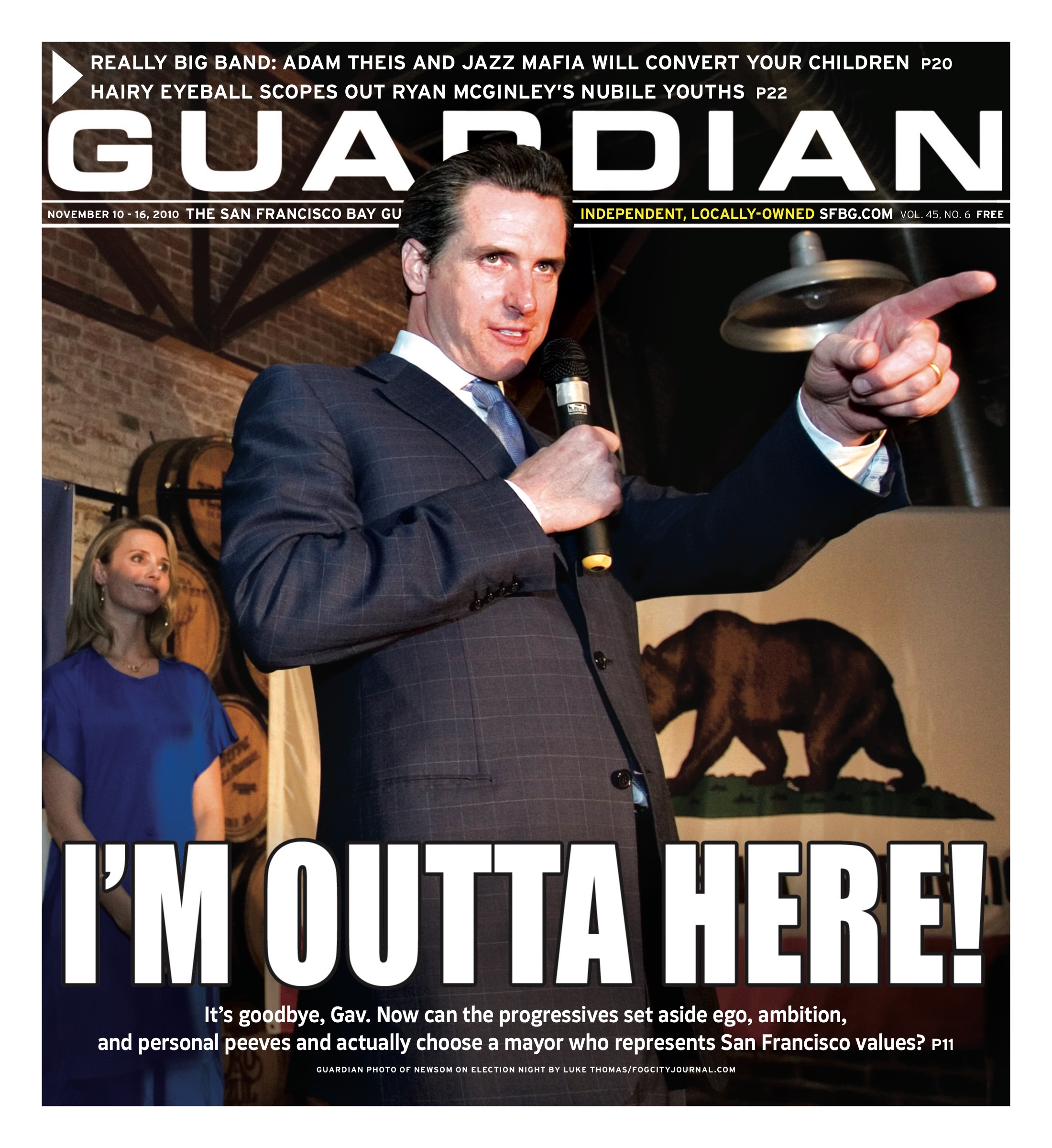
Print sections as they appeared in the early 2010s

To find articles by keyword or author, you may want to use our Search function.

Print Sections

Reel around the practice space

0

arts@sfbg.com

MUSIC It’s easy enough for Corey Cunningham, guitar player for Magic Bullets, to tell that I’m there to interview the band. Although 2200 César Chávez St. is bustling for 8:14 on a Wednesday night, I’m the only one around without an instrument. Magic Bullets practices in Secret Studios, a warehouse full of closets for bands to rehearse. “Lots of bands practice here,” Cunningham said. Through the walls I can hear the muffled sounds of different groups putting work in on something between a hobby and a dream.

We find the rest of the band crammed into its rented space, surrounded by broken amplifiers. Magic Bullets is rehearsing for a show at the Rickshaw Stop, as well as for a trip to the CMJ Music Marathon, a result of songs from its 2010 self-titled album on Mon Amie having received considerable college airplay. The trip is a new opportunity — despite making music for six years, the band had to start over after the recent departures of its drummer, keyboardist, and second guitarist.

According to Cunningham, who founded the band along with singer and lyricist Phil Benson, bringing in a new drummer was the hardest part. “There are no two drummers who sound the same,” he says. “Even if they’re playing the exact same drum beat, their drum sets sound different, the way they play sounds different. It changes your sound drastically.” Once the group decided to leave out a second guitarist, Magic Bullets’ sound, evocative of U.K. guitar pop, has become clearer. In tandem, the rhythm section is less prone to stuttering and has become more propulsive.

Some bands don’t make that transition at all, observes drummer Alex Kaiser. “If everyone leaves except you — like what happened with my old band — and you’re the only person living within 500 miles, [breaking up is] a pretty easy choice,” he said. Kaiser’s last band, Tempo No Tempo, dissolved earlier this year, with one member making the popular musician move to Brooklyn and the other deciding to pursue higher education.

“There was a month or two when we weren’t really doing Magic Bullets,” Cunningham says. The remaining members started a side project, called Terry Malts, “because we didn’t have a drummer.”

“We were like, ‘Let’s just have fun,'<0x2009>” said Benson. Nathan Sweatt, Magic Bullets’ bassist and third surviving member, qualifies Benson’s optimism: “We thought, we’re paying for this practice space, we may as well get some use out of it.” The group rents the rehearsal space monthly, out of pocket, for about the price of a room in West Oakland. And it’s not necessarily cheap.

“We’re day-jobbers,” Cunningham says. Earlier I ask (in a clichéd fashion) Magic Bullets to describe its image, and the answers veer jokingly between “regular Joes” and “cage fighters.” The former is suggested by keyboardist Sean “Shony Collins” McDonnell, the other recent addition, who splits his time away from the band studying animation and kung fu. With a tendency to quip in cartoon voices, it can be hard to take him seriously. But Benson does.

“I knew Sean from being in bands in the Peninsula,” Benson says. “He actually was the lead singer of this punk band Nathan [Sweatt], and I used to go see when I was 15 years old, Jacob Ham — the local heroes. We all kind of looked up to him, and I’ve actually taken cues from his performances. I’ve told him that before, and he’s always like ‘Aww, you.’ But it’s true.”

If the band has any claim to being working class, it comes from Benson and Cunningham (Sweatt is in education; Kaiser is an “engineer for a big-ass government lab.”) Both work retail jobs for a company that will go unnamed. Cunningham: “We try not to give them too much advertising.” Benson: “Let’s just say you can buy stuff there.”

We talk about CMJ. “[It’s] one of the only things on our bucket list we haven’t done,” Cunningham deadpans, “along with a bungee jump show.” They seem excited — the closest thing they can compare it to at this point is South by Southwest, which they played in a previous incarnation. Remembering how one blog described the group as “a noticeably drunk Magic Bullets,” they begin to theorize on the relationship between alcohol and performance. Cunningham looks embarrassed and says, “Maybe we shouldn’t be talking about this.”

While the whole band is quick to be self-effacing, Cunningham appears to be the most self-critical. On Magic Bullets’ MySpace page, a link to the Pitchfork review of its recent album is accompanied by the mood “weird” and an eye-rolling smiley. When I bring it up, Cunningham is eager to talk about it. “That was a weird one, right?” he says. “Did you notice that they gave us a good number? But you wouldn’t think they liked us at all if you read what they wrote.” He has a point. The number is decent (7.2) and the reviewer doesn’t really say a whole lot. Yet the reviewer accuses the band of ripping a riff within its song “Pretend & Descend” straight from the Smiths’ “Bigmouth Strikes Again.”

Cunningham denies this. Even going back to listen to the song, he says he can’t hear the resemblance, and I don’t press it because, personally, I don’t either. What’s likely worse than the accusation of plagiarism (which puts Magic Bullets in the fine company of the Flaming Lips, Elastica, and Joe Meek), is accusing the band of sounding like the Smiths, a familiar reference in writing about the band.

“I don’t think its a bad comparison,” Cunningham says. “I think it’s just sort of a shallow comparison because there are so many other influences that are a little more noticeable. You know that song “Lying Around”? We were listening to this song called “My Old Piano” that Chic played on. It’s a Diana Ross song. If you listen, it has a rhythmic sensibility. That sounds closer [to “Pretend & Descend”] to me than any Smiths song.”

These points of reference have their use, but they also have their limits. During a Magic Bullets show at the Knockout earlier in the year, a girl mentioned to me that they sounded like, surprise, the Smiths, only to immediately begin discussing Robert Smith. The band was on point, working the crowd into a frenzy that mirrored Benson’s ecstatic dancing as he circled around the crowded stage, singing longing lyrics about relationships that had gone awry for no good reason. Right then, surface similarities didn’t matter and the costs of a practice space seemed worth it. The most important thing with a band like Magic Bullets is that they keep giving it a shot.

MAGIC BULLETS

Dec. 10, 9 p.m.; call for price

Knockout

3223 Mission, SF

(415) 550-6994

www.myspace.com/magicbullets

www.theknockoutsf

30-minute ride

0

arts@sfbg.com

MUSIC Imagine being an artist-musician type and juggling all your favorite things just to stay afloat. Considering the Guardian’s demographic, it’s probably not too hard to imagine. This could be you. I’m not saying I feel sorry for you; it actually sounds fun if you can make it work. But at the same time, it’s got to be a constant hustle. That’s exactly how it goes for KIT, a band that — with members based out of Los Angeles and Oakland — has the California coast on lockdown.

KIT’s new album Invocation is out on Upset the Rhythm. Admittedly, sometimes I judge albums by their covers, and on this one, the colorful heap of junk, outdated toys, and discarded household items by Jessalyn Aaland could certainly read as foreshadowing to the dissonance of the sounds inside. Guitarist George Chen’s clashing and self-described “burly” sound is apparent throughout the collection, a follow-up to 2007’s Broken Voyage (also on Upset the Rhythm). In its entirety, the record clocks in at about 30 minutes.

Producer Phil Elverum, fresh from working with Mirah, gave the album a more “linear and organic” approach, according to Chen, helping them shift away from the digital tinkering and overdubs of their first effort. “I really liked how he did heavy guitar rock on [Mount Eerie’s] Black Wooden Ceiling and got it into my head that he would be an interesting choice to work with,” says Chen.

The band agreed on its new Pacific Northwest producer, known for his unorthodox recordings with Mount Eerie and the Microphones. Previously KIT had employed its drummer, Vice Cooler, as producer, while bringing in an engineer or two. This time around, the band goes analog. Bassist Steve Touchton says the album was recorded in less than one week.

Comparisons between KIT and bands such as Erase Errata and Deerhoof (who they shared a split 7-inch single with) do make sense. The chanting repetition of the word destiny on “Golden” is pretty infectious. Overall, that track stands out as a winner. “Sharks” is for extended listening and will make you stagger with its penetrating, drone-like, single-note guitar lick. The mood to hear the cacophony near the end may not always strike you, but the song conveys a sense of urgency.

“Cloud Chaser” is about creating your own sunshine on a cloudy day. I’m not joking. Kristy Gesch, KIT’s vocalist, sings about seeing someone, who I can only imagine is her boo, during a dreary day, and how when they’re happy, she’s happy. The song’s chief strength is its haiku-like simplicity — the lyric is four lines long.

At times, the album’s drenched-in-sunshine sound is juxtaposed with darker lyrical content. “Broke Heart” sounds more like the death of a loved one than the kind of heartbreak you experience from a breakup. Gesch wails about a nightmare that is both unfortunate and permanent. Perhaps this is one of the reasons Invocation finds KIT in a more reflective and inward state. I can’t confirm what exactly went down in the band’s personal lives.

I have a feeling KIT is one of those bands that sounds even better live. I don’t mean this in an insulting way and am not saying they don’t translate well to record. Given the sheer energy of its sound and knowing the types of places it plays, KIT’s all-inclusive philosophy is a stance that says nay to the ageist outlook that only 21-and-ups should enjoy this kind of music.

“It does turn out that all-ages shows by their nature are more fun than bar shows,” says Chen. “The younger kids are more amped on hearing music and not just having it as a soundtrack to drinking.”

KIT

With No Babies, Black Widow, Forked

Sat/20, 3–5 p.m.;

all ages, $5

Artists’ Television Access

992 Valencia, SF

(415) 824-3890

Hungary for more

0

arts@sfbg.com

FILM In recent years, on the film festival circuit at least, it seems like everything Romania puts out is gold — not that it puts out more than a handful of features per year. This vogue has overshadowed trends elsewhere in the region, notably neighbor Hungary, whose more richly historied, prolific film industry has produced some very interesting work of late. (On a less personalized level, its relatively pristine period architecture and low overhead draw a lot of foreign film shoots — Budapest subbing for Victorian
London, etc. — while different factors make it one of the world’s leading production hubs for porn.)

A few features have broken out commercially in the last decade, like Kontroll (2003), Hukkle (2002), and Fateless (2005) — disparate films united in creating spectral, macabre worlds on the border of horror, whether set in a subway system, quaint village, or Auschwitz. But several emerging directors, far more influenced by such native auteurs as Miklós Jancsó and Béla Tarr than the borderless film education DVD and cable can afford, have so far proved too idiosyncratic to travel much beyond the festival circuit.

A rare chance to see some of that work outside those confines can be had this week at the Roxie, which is hosting a short-run double bill under the umbrella "Magyar Tales of Kornél Mundruczó." Protégé of epic-enigma engineer Tarr — whose exasperatingly slow creative process was one alleged factor behind the suicide of the producer fictionalized in this year’s French drama The Father of My Children — sometime actor Mundruczó has written and directed several shorts and four features to date.

His 2002 debut Pleasant Dreams was a miserabilist frieze of dead-end rural youth. His newest, Tender Son: The Frankenstein Project, mixes similar elements with some taken directly from Mary Shelley. Its "monster" is a teenager exacting revenge for a life defined by abandonment, the director playing himself as … a director, one intrigued by our sociopathic antihero even after he commits several meaningless murders. Son was loathed by many
at Cannes and Toronto, but that’s not really discouraging — Mundruczó’s films are of stubbornly minority appeal, either meditative or watching-paint dry in pace, pretentious or perfect in their narrative simplicity.

The Roxie is playing the two features between. Delta (2008) was originally planned as a revenge saga. But when lead actor Lajos Bertók abruptly died mid-production, Mundruczó replaced him with composer Félix Lajkó and overhauled the script to suit his more reticent personality. Lank-haired, scruffily bearded Mihail (Lajkó) returns to his native Danube village after 25 years’ absence. No one is happy to see him save sister Fauna (Orsolya Tóth) — and she isn’t the effusive type, either.

Diffidently rising above the pervasive culture of loutishness, this somber duo attracts resentment (toward the roll of cash Mihail has to bankroll constructing a well-isolated house upriver), gossip (over their imagined, then real, incestuousness), and eventual violent hostility. Delta is a parable of intolerance as poetically primitive as early Herzog (there’s even some Popol Vuh on the soundtrack); its utter affectlessness will strike you as hypnotic or maddening.

On another note entirely — well, almost — the director’s prior Johanna (2005) is all interior tracking shots to Delta‘s stock-still rural pictures, stillness, and sonic sparseness replaced by the sound of a whole lotta music. At the start, survivors from a large-scale accident are hauled into a subterranean hospital, moaning and bleeding. Then suddenly a tenor doctor trills "The rehearsal is over! Let the dead and injured get up and walk," which they do. All but Johanna (Tóth again), a junkie who’s snuck in to steal pharmaceuticals. Caught, she falls down stairs, lapsing into a coma. On awakening, a smitten medic (Zsolt Trill) trains her as nurse. Her healing prowess proves unconventional, however, even miraculous — both sacred and profane, leading to a martyrdom that (like Joan of Arc’s) cements her sainthood.

A 86-minute opera created for the screen, Johanna is musically rich — who is composer Zsófia Tallér and why isn’t she getting major commissions abroad? — but also wholly cinematic. While seeming an anomaly, its cryptic characterization and suspicious view of society are of a piece with Mundruczó’s other work to date.

MAGYAR TALES OF KORNÉL MUNDRUCZÓ

Nov. 22–24, $5–$9.75

Roxie

3117 16th St., SF

(415) 863-1087

www.roxie.com

Ode to a N-Owl

0

Honest to Tyra, one of my absolute favorite things in the world is the N-Judah Night Owl bus at 3 a.m. Where else can you encounter such a juicy cross-section of the city’s nightlife players — at least the ones too broke or too cheap (or too hot, like me) to snag a cab home?

The guilt-eyed bridesmaid lured away from her bachelorette for a quickie in the bushes; electro kids still fidgety from that tragic final snort; full-throated bro-skis trying tipsily to locate the end of their sentences; post-concert hipsters screaming over their own blown eardrums, ankles swollen and bright blue from asphyxiating jeggings (still!); drooling newbie Googlers who tried so very hard to be “cool,” succumbing to drowsy numbness as their $300 steampunk sunglasses slip, one lens cracked, from their acne-scarred foreheads; botched pot deals, stunned French teens, cruisy bears, fresh tweakers, gothic Lolitas, country line-dancers, really aspiring rappers, several actual hotties … Amazing. Especially when someone busts out a boombox. All aboard our homegrown diesel-driven party train, woot woot!


NERD NITE

“It’s like the Discovery Channel … with beer!” I’m not sure if there’s going to be intentional dancing at this hot monthly snarf-a-thon, but feisty cerebella should be jumpin’ for these presentations: “Mars’s Lumpy Bumpy Neato Magneto(sphero),” “Penguins, the True Chickens of the Sea,” and “The Perilous Infirmity of Burning: The History of Neisseria Gonorrhea.” OK!

Wed/17, doors 7:30 p.m., show at 8 p.m., $8. Rickshaw Stop, 155 Fell, SF. sf.nerdnite.com


PACO OSUNA

They say that minimal is dead — but it actually just got hijacked by hot Spaniards. They added some much-needed swing and even humor (not to mention a little color) to the pale-faced genre, keeping the intellectual rigor but expanding its rhythmic template. Beardy Barcelonan Paco Osuna still likes it dark and heady in a Plus8 Records vein, but he knows how to thump the floor as well.

Thu/18, 9:30 p.m., $10. Vessel, 85 Campton Pl., SF. www.vesselsf.com


RADIOACTIVITY

The monthly happy hour celebrating “the sound of low budget synthesizers, Eastern European Cold War dance parties, and the more experimental, dubby, and danceable side of post-punk” turns one year colder with special guests Dominique Leone, one of SF’s best hoarders of vinyl plutonium, and Wobbly, plus residents Robots.In.Heat and Tristes Tropique.

Fri/19, 6 p.m.–9 p.m., free. 222 Hyde, SF. www.222hyde.com


SIMIAN MOBILE DISCO

Yes, the Brit duo is still here, and yes, they are still your friends. I never use the word “eargasm,” because ew, but if your rocks pop for anthemic electro bombast and fuzzy blasts of bass tempered ever so slightly by devilishly insistent samples, then yes, you will have a bananas one of those.

Fri/19, 9 p.m., $18 advance. Mezzanine, 444 Jessie, SF. www.mezzaninesf.com


DUBSTEP BEAT BATTLE

Little recognized fact: the Bay has a shit-ton of excellent beats-production talent. (The recent Red Bull Big Tune and BART Series Big Battle were explosions of creativity.) Promoters Phillip Drummond and Ro Knew are unleashing the future wobble with this multiplayer rumble. Plus, it’s a canned food drive for Glide — bring a tin, leave with tinnitus?

Sat/20, 9 p.m., $10/$7 with can of food. Club Six, 66 Sixth St., SF. www.clubsix1.com


ILL-ESHA

Breakbeat specialist turned harmonic dubstep heroine (with occasional acid crunk overtones), the Daly City Records artist brings a decade of experience and some spicy live vocals to the tables. This special release party for her new EP includes Brit glitch-hoppers Glitchy and Scratchy, B. Bravo, Slayers Club DJs, and everybody’s favorite cuddly purple noise-monster, Mochipet.

Sat/20, 10 p.m.–3 a.m., $10. Public Works, 161 Erie, SF. www.publicsf.com


SEAN PRICE

The adventurous-eared monthly Frequency party brings in this super-talented, kicked-back, bearish Brooklyn rapper — as one-half of the classic Heltah Skeltah, Price rocked and rucked the ’00s, on his own he’s rolling over tasty Lee Mason “Shady Blues” samples. With Danny Brown, Moe Green, Quelle, and DJ Joe Quixx of Oakland Faders.

Sat/20, 10 p.m.–3 a.m., $10 advance. Mighty. 119 Utah, SF. www.mighty119.com 

Skool

1

paulr@sfbg.com

DINE When, in the course of human events, you come across a wood-fired pizza oven in a seafood house — in a seafood house tending in the direction of a sushi bar, no less — you probably blink twice, wondering if you’ve somehow mixed up your meds. But no: step into Skool and there it is, flickering on your left. There is a small catch (!) to stepping into Skool, and that’s finding it in the first place. The restaurant, which opened early in July, lies in a nameless border country surrounded by Mission Bay, Potrero Hill, and the gallery district.

Fifteen or 20 years ago this bricky warehouse neighborhood was deserted at night, and even today, you’d never think you were at the corner of 16th and Valencia streets. Compounding the mystery is the reticence of Skool itself; the restaurant’s street face is a row of tall steel posts, like some kind of barrier to keep tanks from rolling through, marked only by a graphic of an orange fish.

From a checkpoint-like gate you trek steadily uphill, around three sides of an open-air patio, until you finally step inside and find yourself under a firmament of halogen-spot stars, on a loft-like concrete planet forested with gorgeous wood furniture, some pieces of which (I am thinking in particular of the long communal table) look as though they could have come from the workshop of Gustav Stickley himself. It’s sleek, elegant, open, and warm, and the wood makes all the difference.

The restaurant’s style of cooking both does and doesn’t belong in such a setting. It, too, is sophisticated and urban, but — unlike the interior design — it too often goes too far and seems complex for the sake of being complex. The servers are well-drilled in explaining the nuances of the menu and the ingredients that grace the various specials, but the recitations, in their extensive and ruthless precision, made me feel as if I were watching one of those pharmaceutical ads on television, with their windy warnings about side effects that can include drowsiness, dizziness, and sudden death, not to mention certain phenomena lasting more than four hours.

The kitchen’s tendency seems to be not to let high-quality ingredients speak in their own voice without being interrupted — a kind of culinary version of SPIRD (smartest person in the room disorder). We were assured, for instance, that the cubed halibut in the ceviche ($11) was “sashimi grade,” yet it was inflamed with serrano chili and cilantro — two items I love, but they can overwhelm the delicacy of pale-fleshed fish. House-cured sardines ($10) held up a little better, with their oiliness and firmness of flesh not disappearing in the presence of raspberried onion, herb oil, and pillows of ripe avocado. But still, it was a struggle.

A straightforward bowl of squid-ink spaghettini ($17) turned out to be a treasure trove of complexity, with Monterey Bay squid and local white shrimp bathed in a broth of lemongrass, red curry, seaweed butter, and diced tomatoes. These flavors were harmoniously blended, and the look of the dish was striking — a mass of writhing purple-black filaments, like a wig from a character in a Pixar movie — but it did seem to lack a clear direction. A lot of voices, skillfully directed, can become a choir, but they can also turn into a tower of Babel.

Spiced panko salmon ($18) — a thick, shapely filet crusted on one side with bread crumbs — was served atop a sauté of green and yellow wax beans. It was moist and flavorful, but so rich I felt as if I was eating a stick of butter. The fish had been “pan grilled” — in butter?

Some of the best dishes had nothing to do with the sea. The mushroom risotto ($20) was beautifully cooked al dente, and its troupe of wild fungi (among them enoki, buna shimeji, and eryngii) was enhanced by a strong charge of truffle oil, along with plenty of grated Parmesan cheese for that final nutty-salty touch. And (from the pizza oven!) a wonderful flatbread, or coca ($15), like a slimmed-down focaccia, with Laura Chenel goat cheese, sun-dried tomatoes, tapenade, and greens.

The dessert menu, of all places, was an oasis of calm amid the frenzy. A rich slice of chocolate tart ($6) was subtly enhanced with cardamom, while a pear tart ($6) was a disciplined reimagining of that old autumn classic from France, tarte tatin — flaky housemade pastry, fruit in its prime, some whipped cream, not much too it, really. And yet: from less, more.

SKOOL

Dinner: nightly, 5–10 p.m.

Lunch: Mon.-Fri., 11:30 a.m.–2:30 p.m.

Brunch: Sat.–Sun., noon–4 p.m.

1725 Alameda, SF

(415) 255-8800

www.skoolsf.com

Full bar

AE/DC/DS/MC/V

On the noisy side

Wheelchair accessible

Jail bait

0

le.chicken.farmer@gmail.com

CHEAP EATS On a day when I felt really very much like oiling a countertop with my elbows, I oiled a countertop with my elbows! This proves that such a thing as free will exists, I think.

Proving that I’m not a very great thinker, because maybe I was predetermined to want what I wanted, or maybe we all want the same thing: barbecued pork ramen.

Other evidence of my not-greatness, brainwise, includes knocking over the popcorn, letting my bike basket get moldy, and locking myself out of my apartment seven or eight times a day. I’m exaggerating.

The good news is, I have managed to live my life so far entirely in and occasionally locked out of apartments. Or at least vans. I have never been homeless, or, worse, incarcerated against my will. Every time I see a mental institution I think: there, but for the grace of God, go I. Same with jails.

My poor mom, who has been in both of those places, kicking and screaming, is also in me. See? I believe in genetics. I don’t believe in God, but I do believe in “the grace of God,” I guess, because so far I have managed to pass as merely kooky. And in this people tend to humor me and keep spare keys to my apartment.

Still, there’s a certain moodiness with which one walks or bicycles past the Hall of Justice, if one is me. I mean, if I’m driving a car I’m okay, because the sight of all those police just scares me into closing my eyes, thinking about ponies, and stepping on the gas.

Pedically speaking, I stick to the other side of the street, basking in the barrage of bail bondage. It’s San Francisco’s most alliterative block of businesses, you know: Bail Bonds, Bail Bonds, Bail Bonds, Bail Bonds, Sushi, Bail Bonds, Bail Bonds, Bail —

What the? Did I just say sushi?

Yep. Believe it, jurors and judges. Oh, and bad guys, you no longer have to go to jail without first having one last California roll, or meet with your friendly neighborhood bail bondsmanperson over McDonalds. God damn, what a great city this is! What a wonderful and humane criminal justice system we have here, now that Live Sushi is on the block.

Good luck finding the entrance.

I took the trouble because a) they had a counter, although it wasn’t exactly what my elbows had had in mind. On the other hand, there was a cooking show on TV, and b) they had ramen. And soba and udon. For like, $8 or $9 at lunch time. Which it was.

I wished I could afford some sushi too, but, nah. This is not no criminal justice system sushi, pricewise. It’s Potrero Hill, only crammed between a bunch of bail bonds boutiques. So alls I could afford was a bowl of barbecue pork ramen and a glass of ice water.

Gotta say: the water was very very good, and cold, and came with free refills, and the soup was excellent. The pork could have been a bit less cooked, but the broth was delicious, and I loved the little curly pickles and the ginger. And the ramen. Great bowl of soup, new favorite restaurant. And I think I learned something from watching TV, but I forget what it was. Something about chicken bones.

Anyway, I stopped at Trader Joe’s and bought me their cheapest chicken on the way home, because Mr. Wong was coming over for his own private, personal cooking show, his first, and I wanted to show him how to make five meals from one chicken … a trick I learned by listening to Spot 1019 in the old days.

I didn’t want to start cooking dinner without him, although that’s usually what I do as soon as I’m done with lunch. So, to kill time, I decided to clean the mold off of my super cool Toto Too bike basket.

I went upstairs to borrow some bleach off Earl Butter and, of course, locked myself out of my apartment. There’s a couch in the lobby. And a magazine rack. For the rest of the afternoon, I didn’t get anything done.

LIVE SUSHI BISTRO

Mon.–Fri.: 11 a.m.–10 p.m.;

Sat.–Sun.: 4:30 p.m.–10 p.m.

1 Gilbert, SF

(415) 558-8778

D,MC,V

Beer and wine

alt.sex.column: Wham bam

0

Dear Andrea,

I’m almost 40 and a newlywed. I was a virgin! Unfortunately, sex has not been good for me. His heart races, he sweats. Me? Nothing. No pleasure, no excitement, nothing! I WANT SOME TOO!!! I tried talking to him and we have tried several positions, unfortunately, his favorite missionary position usually hurts. I tend to just give in and pretend I’m enjoying it. I’m hoping you can help or at least lead me to someone who can!

Love,

Desperate Not-A-Housewife

Dear Wife:

I see several different issues here, at least, starting with: Why were you still a virgin at 40? This is rare enough to merit mention, especially under the circumstances.

2) Does he have a lot of experience to your none, or were you both late bloomers?

3) Pain with missionary position? No good, and not normal.

4) Faking it. A classic example of “seems like a good idea at the time.” Isn’t.

OK, so. I’m going to assume that there was something unappealing about either sex, intimacy, or both, for you to leave it so long. There is nothing inherently wrong with not having sex, but it’s a better fit for those who simply aren’t interested. You manifestly are interested, so that is something to look at.

I’d really like to know if he is having fun while you’re not. It’s kind of hilariously awful to think of you both having ungratifying sex night after night and nobody ever mentioning it, but I’m thinking that’s not what’s going on. He is having OK sex while you are not. Also awful, less funny, and a little harder to broach, what with your having to burst his bubble, but burst it you must. Bring it up as a mutual thing, let’s make it better all around, and so on. But you are going to have to admit that you are not, shall we say, fully engaged. Not talking about it about it is guaranteed to eventually break everything not yet broken. I wouldn’t rule out some counseling with a sex-positive counselor, either.

Finally, you are going to have to figure out what you do want if this is ever to improve. If you masturbate, you fantasize. How can you get real life better aligned with fantasy life? If you’re thinking it would be nice if he started slower, paid more attention to your clitoris, and made sure you were responding before he kept doing something, we’ve got something to work with.

As far as how-tos go, I doubt you need a tutorial in hip-moving. But if you do, there is a world of instructional material out there. It is called porn. If that sounds icky, you can try the amateur stuff or any of the seemingly dozens of series with names like “Better Sex” or “Loving Couples.” Bonus: watching any of these things together is going to at least start you on the way to the sweating and elevated heart-rate you so justly deserve to experience.

I think your libido is fine. You’re not getting excited because who gets excited anticipating something dull and a little painful? Get that looked at.

Love,

Andrea

Got a question? Email Andrea at <!– /* Font Definitions */ @font-face {font-family:”MS Mincho”; panose-1:2 2 6 9 4 2 5 8 3 4; mso-font-alt:”MS 明朝”; mso-font-charset:128; mso-generic-font-family:modern; mso-font-pitch:fixed; mso-font-signature:-1610612033 1757936891 16 0 131231 0;} @font-face {font-family:”\@MS Mincho”; panose-1:2 2 6 9 4 2 5 8 3 4; mso-font-charset:128; mso-generic-font-family:modern; mso-font-pitch:fixed; mso-font-signature:-1610612033 1757936891 16 0 131231 0;} /* Style Definitions */ p.MsoNormal, li.MsoNormal, div.MsoNormal {mso-style-parent:””; margin:0in; margin-bottom:.0001pt; mso-pagination:widow-orphan; font-size:12.0pt; font-family:”Times New Roman”; mso-fareast-font-family:”Times New Roman”;} p.MsoPlainText, li.MsoPlainText, div.MsoPlainText {margin:0in; margin-bottom:.0001pt; mso-pagination:widow-orphan; font-size:10.0pt; font-family:”Courier New”; mso-fareast-font-family:”Times New Roman”;} @page Section1 {size:8.5in 11.0in; margin:1.0in 1.25in 1.0in 1.25in; mso-header-margin:.5in; mso-footer-margin:.5in; mso-paper-source:0;} div.Section1 {page:Section1;} –> andrea@mail.altsexcolumn.com

America’s original sin

1

arts@sfbg.com

VISUAL ART Going into “Huckleberry Finn,” the final installment in the Wattis Institute’s trilogy of group shows organized around canonical American novels, it is perhaps best to heed the notice Mark Twain places at the outset of the text from which this exhibit takes its name and inspiration: “Persons attempting to find a motive in this narrative will be prosecuted; persons attempting to find a moral in it will be banished; persons attempting to find a plot in it will be shot.”

The only punishment one risks incurring with “Finn” is self-inflicted fatigue from trying to take it in all at once. As befits Twain’s Adventures of Huckleberry Finn — a book that is, among many things, a satiric portrait of the post-Reconstruction South, a vernacular bildungsroman, an exploration of the cross-racial politics of friendship, and a fictionalized travelogue — curator and Wattis director Jens Hoffmann sets a bold course across American geography, social and literary history, and visual art that is as expansive and winding as the Mississippi.

Much as he did with “The Wizard of Oz” in 2008 and “Moby Dick” last year, Hoffmann — firing on all cylinders here — has assembled a visual dossier that takes an open source approach to its primary text. In the spirit of Twain’s warning shot to plot-seekers and would-be moralists, the exhibit’s pamphlet calls its presentation “fragmented and inconclusive.” This description, like Twain’s, is only partially true. Individually, the pieces (including 15 new commissions) vary in terms of how directly and from what direction they engage with Twain’s novel. But Hoffmann’s talent as a curator lies in grouping together works, artists, and eras that, under the broad umbrella of “Huckleberry Finn,” have something new to say to each other — and to us.

Book-ended by two screening rooms, the first floor galleries examine Adventures of Huckleberry Finn from a largely historical perspective, treating the text and its author as historical objects (in addition to some handsomely bound first editions of the book, there’s even a reproduction of Twain’s trademark white suit, hung casually on a coat rack) and exploring in more depth the cultural geography of the Mississippi (see James T. Loyd’s long survey of the river’s lower half), and in particular, the social inequalities wrought by King Cotton’s reign.

Some of the works, such as Horace Pippin’s two 1944 oils of antebellum life, Harlem Renaissance painter Claude Clarke’s harrowing depiction of a slave lynching, or Alec Soth’s 2002 photographic series documenting the beauty and strangeness of the riverside, are, each in their own ways, remarkable forms of reportage. Other pieces are pointed interventions. Betye Saar’s The Liberation of Aunt Jemima (1972) is a mixed media sculpture that arms a mammy doll, set against a background of Aunt Jemima syrup labels, with a rifle and a broom.

The same could be said of the works on the exhibit’s second floor, as well as their arrangement, which more explicitly addresses the ugly legacy of what historian George M. Fredrickson has called “America’s original sin,” slavery. Right out of the elevator, one is confronted with a powerful triptych: Warhol’s screenprint Birmingham Race Riot (1964) is displayed beside a reproduction of a segregation-era sign that reads “BLACKS ONLY,” and both hang above Felix Gonzalez-Torres’ The End (1990), a stack of free-to-take posters placed against the wall, each one containing a white space framed by a black border.

Whereas pieces in the lower galleries are arranged with greater room between them, Hoffmann fills the second floor chockablock with representations of degradation and defiance: Kara Walker’s massive and monstrous shadow-play of rape and violence covers one wall; Ruth Marion-Baruch’s stoic photographs of Black Panther leaders hang on another. It’s as if Hoffmann felt that the only means of adequately depicting “Jim’s turbulent quest for freedom,” to again quote the program notes’ gloss on things, was actual disorder.

Appropriate to a show inspired by Twain, some works also exhibit a sense of humor as they engage with larger issues. Simon Fujiwara’s video piece — in which the artist dons a kind of cultural drag, playing an exaggerated caricature of himself being interviewed about his relationship to the character Jim — becomes funnier as his interlocutor’s questions become more ridiculous. It is a tall tale — aimed at both critics and artists — about misreading artistic practice as identity formation, and it is worthy of Huck himself.

HUCKLEBERRY FINN

Through Dec. 11

CCA Wattis Institute for Contemporary Arts

1111 Eighth St., SF

(415) 551-9210

www.wattis.org

Free parking

0

arts@sfbg.com

THEATER/DANCE In the world of performing arts, it often feels like there is a dearth of resources. The race for funding, rehearsal space, performance space, and audience attention can easily create disillusion. Lucky for San Francisco, there is a light in all this resource madness: the Garage, a small theater run by Joe Landini.

“There is a danger in believing in limited resources,” Landini recently said. He believes in abundance, that there is actually plenty of room for everyone who wants to create work, and that perpetuating this kind of thinking is essential to the mission of the Garage.

An unassuming building, the Garage’s little red door at 975 Howard St. leads into a modest foyer and black box theater. The basement houses a green room, dressing room, and prop closet in one. A lighting board allowing for tech support and sound can be found directly off the stage to the right of the audience seating. A single bathroom and sink are behind the stage’s back curtain. Yet despite its meager facilities, the Garage is home to a surprisingly large number of artists. Approximately 120 performers from diverse disciplines enjoy residencies at the Garage every year, culminating in more than 200 shows annually.

The Garage offers two kinds of residencies for performing artists: AIRspace (artist in residence), which is geared toward queer artists, and RAW (Resident Artist Workshop), the general program. Both are 12-week residencies culminating in a two-night performance run. Artists receive four hours a week of rehearsal space, totaling 48 hours, plus publicity and technical support. Resident artists may also have the opportunity to present their works-in-progress at the informal Raw and Uncut performance series. But perhaps the pièce de résistance of all this is that it comes at no cost to the artist: the Garage provides free rehearsal space, performance space, tech support, and press.

The Garage’s humble facility might be a clue to how this generosity is achieved. Another clue lies in the number of theater personnel; a friend who recently attended a Garage show commented on Landini’s presence, asking who the guy was who ushered, bartended, ran tech, and was basically the Garage’s ringmaster. In other words, there’s no staff and no expensive facility to run either. The Garage is funded entirely by grants and ticket sales, which goes to supporting the artists.

Angela Mazziotta moved to San Francisco earlier this year after completing her BFA in dance at the University of South Florida. Although she had choreographed within her BFA program, she had little experience creating work outside the college environment. Interested in further exploring her choreographic voice, she took up a residency at the Garage in August and will be presenting her new work, SMACKdab — a piece dissecting themes of belonging — Dec. 1-2 as part of the RAW performance series. While researching the dance community before moving to San Francisco, she stumbled across the Garage’s webpage and recalls feeling like the Garage sounded like a place she could start establishing herself. Mazziotta is an example of a newcomer to the SF dance scene who has been able to pursue her choreographic interests through the Garage’s magnanimity.

“The Garage is a place for anyone who wants to get their dance out there,” Mazziotta mused. More likely, the Garage is a place for anyone who wants to put anything out there. From traditional to classical to contemporary to avant-garde to downright insane, the breadth of the work presented at the Garage is staggering. Sometimes the Garage is sold out; other times there’s a sympathetic handful — but the work goes on.

Although the majority of resident artists come from dance backgrounds — due in part to Landini’s strong ties within the dance community — the Garage is by no means limited to dance. Anything performance-related — thespians, circus groups, musicians, poets, and artists of all walks have enjoyed time on the Garage’s stage — can ostensibly find a home there. The basic screening process includes a short write-up of the proposed work and a YouTube video of prior work, and the majority of applicants are granted residencies. This egalitarian mentality manifests the Garage’s guiding principle that anyone who is willing to give their time and energy in the name of art should have a place to do so.

Thus, a new dancer to the city who needs a place to start choreographing can begin at the Garage. A more established artist with limited funds who wants a theater to present work in is welcome there as well. A multidisciplinary artist interested in combining poetry and film would fit in. An eccentric group of performers who stand on their heads and juggle eggs with their feet could probably be accommodated as well. Imagination is the limit. Whatever the inclination or area of interest, the black box theater at 975 Howard will continue to house and assist performing artists through its generous programming and services. Everyone has a voice, and everyone who wants to should have a forum in which to express that voice. The Garage is a perfect example of an institution that supports and promotes the expression of all voices.

www.975howard.com

Down on the farm

0

rebeccab@sfbg.com

Sherman Island may barely register for motorists traveling over the Antioch Bridge and through the delta on Highway 160. Almost wholly owned by the Department of Water Resources, the roughly 10,000-acre patch of Sacramento-San Joaquin Delta flatland is barely developed, and probably home to more cows than people. It lies at the confluence of the Sacramento and San Joaquin rivers, where freshwater mixes with the salty seawater of the San Francisco Bay.

What isn’t obvious at first glance is that Sherman Island was once host to highly productive agriculture — but as delta water quality diminished, farmers saw their crop yields plummet. Larry Del Chiaro, who formerly headed the Sherman Island Landowners Association, used to grow asparagus, wheat, barley, safflower, milo, hay, and other crops on the island. But today, like nearly all the others who previously raised crops there, he no longer has property there and has moved on. His story illustrates how California water policies have benefited one group while affecting the livelihoods of the people who live in the state’s central water hub, the delta.

“I was a third-generation farmer on the island,” Del Chiaro told the Guardian on a hot August day in the city of Pittsburg. “My grandfather started it. My father, his brothers, my cousins were all on the island farming.” Del Chiaro majored in soil science in the 1970s and was interested in increasing crop yields, so he set up test plots and was closely monitoring their progress.

But by 1987, the yields were plummeting dramatically — a drought had hit the state, and Sherman Island farmers weren’t getting enough fresh water to sustain their crops. Instead of going to irrigate farmland in the delta, much of the scarce freshwater was being pumped south through the State Water Project to agricultural lands in the arid San Joaquin Valley, causing the delta water to get saltier and saltier.

It presented a problem that was particularly acute in that location. “Sherman Island, to use a cliché, is the plug for the Sacramento Delta,” Del Chiaro said. “We’re the last one to get the freshwater, and the first one to get the saltwater intrusion.”

The North Delta Water Agency, a regional water body, had a contract on behalf of the island’s landowners with the Department of Water Resources (DWR) that guaranteed a certain level of water quality. But DWR’s contractual obligations weren’t met that year. “As the drought continued, our water quality diminished, and diminished, and diminished, till it got to the point where we had to rely on Mother Nature for rainfall,” Del Chiaro said. “And when we didn’t get rainfall, our crops suffered.”

Under state water law, Sherman Island landowners had riparian water rights, which allowed them use of the freshwater that flowed past their land. The overarching problem, he said, was that DWR couldn’t meet contractual obligations to both the delta farmers and the San Joaquin Valley farmers in a dry year because it had over-promised water deliveries through the State Water Project. “We have no control over what Mother Nature gives us in terms of rainfall and the snow pack,” he said. “So they were being overly optimistic in terms of all those contracts.”

With the help of consultant Patrick Porgans and a San Francisco attorney, Del Chiaro and the 26 other Sherman Island landowners sued DWR for damages. In 1991, the state settled for $3.6 million, and the farmers were paid for not drawing water out of the delta. Soon after, DWR bought up the island. Once the water agency took control, it eliminated the need for DWR to satisfy contractual obligations to provide freshwater to the Sherman Island farmers. The farmers had cleared out, and the agency’s problem was solved.

“Compared to the San Joaquin Valley, the vast amount of acreage out there, the people that they employ, and the business compared to the delta, we’re kind of a drop in the bucket,” Del Chiaro noted. “Still, there are the businesses in the delta that basically survive off of our farming operation.”

Sherman Island is more well-known to recreational boaters and travelers, and Chris and Dawn Gulick provide a place for delta vacationers at Eddo’s Harbor & RV Park, located on Gallagher Slough on the east side of the island. Eddo’s wasn’t always a harbor and RV park — when Chris Gulick’s father started the business in 1967, fishing was the primary attraction and the small harbor maintained a fleet of fishing boats for rent. The State Water Project came online around the same time, marking the beginning of freshwater pumping out of the delta.

As delta water quality worsened over the years, there were fewer fish to be caught, so over the decades it became less practical to maintain the fishing vessels. Today, the fishing boats have been sold, and Eddo’s primarily gets its business from recreational boaters looking for guest slips or travelers who find their way to the quiet waterfront park to stay in their RVs.

Chris Gulick emphasized the larger picture during an interview about water issues in the delta, but he acknowledged that his business had been affected by what he saw as the state’s misguided water policies. “When we got here, the striped bass fishery was robust,” he said, “and it slowly has declined, and it steadily has declined.”

Gulick said countless experts and researchers had been in and out of the delta over the years, but he felt that the core problem had to do with governance of the system and the fact that water agencies had over-promised the water.

“The problem with the delta, or the water situation, is that the people that are in policy and are writing these guidelines don’t have a vested interest,” he said. “A lot of them don’t know a whole lot about this, but they’re the experts. They’re the ones who are supposed to be writing the plans. They don’t have a clue — and that is a prevalent attitude to the experts who come out and talk to us.”

How California exports water

0

By Patrick Porgans

In 2009, the last year of the so-called great California drought, a strange thing happened: Sacramento Valley growers produced a near record amount of rice, and down south, the Metropolitan Water District of Southern California (Met), the largest urban water supplier in the nation, experienced record-breaking water sales. All this despite repeated mainstream media accounts in 2009 of an economy-wrecking dust bowl water shortage.

According to the U.S. Department of Agriculture, the California rice harvest in 2009 was up 9 percent from the previous year and approached the record crop of 2004.

Rice consumes a great deal of water for its dollar value and produces little net income. According to a report by the University of California, Davis, the minimum amount of water required to grow a crop of rice is about 42 inches per acre. Unavoidable losses can add to this amount — so that the amount of water consumed (or evaporated) can be as much as 100 inches per acre, depending on the soil. That appears to be enough water to drown the tallest person on earth.

The California Rice Commission, a trade group representing 2,500 rice farmers, estimates that rice uses 2.2 million acre-feet of irrigation water yearly, about 2.6 percent of the state’s total water supply. According to records obtained from Met, that’s equal to the annual average water it supplied to all of its 19 million customers.

UC Davis data from 2008 show that California exported 52 percent of its rice production, much of it to Japan. For every pound of rice exported, about 250 gallons of embedded water used in growing and processing that rice leaves along with it, according to “Water Footprints of Nations,” a 2004 UNESCO study. (The report spawned the Web site www.waterfootprint.com.)

The rice harvest should be of great consolation to the chairman of the California State Water Resources Control Board, Charles Hoppin, who is also a rice grower, vice-chairman of the Rice Growers Cooperative, and immediate past chairman of the California Rice Industry Association. Chairman Hoppin, in a March 2010 speech in Yuma, Ariz., complained that the regulatory community, including much of his staff, doesn’t know or understand the issues facing agriculture and “doesn’t give a rat’s ass.”

According to the Environmental Working Group, rice subsidies in California totaled $2.4 billion from 1995-2009. In that period, the single largest recipient of subsidies was the Farmers’ Rice Cooperative of Sacramento, California, totaling more than $146 million.

Farm recipients of USDA subsidies in California totaled $9.1 billion from 1995-2009.According to EWG, “Washington paid out a quarter of a trillion dollars in federal farm subsidies between 1995 and 2009. But to characterize the programs as either a big government bailout or another form of welfare would be manifestly unfair — to bailouts and welfare.” Then there’s hay — another water-gulping product that’s getting exported, with much of it going to Japan.

Writer Melinda Burns, in a June 10, 2009 story on Miller-McCune.com, notes: “In the Imperial Valley of California, a region drier than part of the Sahara Desert, farmers have found a lucrative market abroad for a crop they grow with Colorado River water: They export bales of hay to land-poor Japan. Since the mid-1980s, this arid border region of California has been supplying hay and feed for Japan’s dairy cows and black-haired cattle, the kind that get daily massages, are fed beer, and produce the most tender Kobe beef.”

She quotes Patrick Woodall, research director at Food and Water Watch, an international consumer advocacy group with headquarters in Washington, D.C.: “There is a kind of insanity about this,” Woodall said. “Exporting water in the form of crops is giving water away from thirsty communities and infringing on their ability to deal with water scarcity.”

From second to first

5

steve@sfbg.com

In Oakland and San Francisco, the big story of this election was ranked-choice voting, a system that allowed Jean Quan to overcome a nearly 10-point election-night deficit to become Oakland’s next mayor and enabled come-from-behind victories in two races for the San Francisco Board of Supervisors.

Those who never liked this system of letting voters rank their top three candidates — a group primarily affiliated with downtown and the moderates who did well under the old system of low-turnout, big-money runoff elections — felt validated by the outcomes. “Ranked-choice voting an undemocratic nightmare” was the headline on Examiner columnist Ken Garcia’s Nov. 11 column.

But for those who understand this system — a product of the progressive movement — and have supported it, this was a watershed election that showcased RCV’s populist possibilities. In Quan’s smart use of an RCV strategy and the huge gap she overcame to topple Don Perata, they see an opportunity for political coalition-building that could influence next year’s San Francisco mayor’s race and beyond.

Besides Perata, if there’s anyone who could justifiably be unhappy with how RCV worked in this election, it would be Tony Kelly. He finished in first place in the D10 supervisorial race on election night only to be defeated by Malia Cohen, who climbed out of fourth place on the strength of those who ranked her second or third. But Kelly is perfectly happy with how RCV worked.

“I supported it before and there’s no reason not to support it now, even though I’m on the edge of this,” Kelly told the Guardian. In fact, he said the only reason he ran for public office in San Francisco was because of progressive electoral reforms such as RCV, district elections and public financing of campaigns. “These are all things that help grassroots candidates.”

Kelly had a ranked-choice strategy; he and Marlene Tran each encouraged their supporters to rank the other second. The alliance might have been a way to overcome the strength of the district’s strong African American voting bloc, which favored Cohen (she got her biggest and most lopsided bumps when Dewitt Lacy and Lynette Sweet were eliminated). But most of Tran’s votes were exhausted when she was eliminated, meaning that many of her voters didn’t list any second and third choices.

“Without RCV, that black vote would have never come together. It would have splintered,” said Steven Hill, a progressive activist who helped design the system.

In Oakland, progressives and other blocs of voters wanted anybody but Perata, a Democratic Party power broker. So Quan reached out to all voters and was particularly helped by a progressive base that she shared with fellow Oakland City Council Member Rebecca Kaplan.

“One thing Jean Quan does consistently at events is say, ‘I would like your first place votes, and if I don’t get that, I would like your second place votes,” Kaplan told the Guardian. “It was striking to me that she consistently asked for No. 2 votes.”

That strategy, along with Quan and Kaplan running mutually supportive races and encouraging their supporters to list the other second, clearly paid off.

“It rewrites the textbook for how to win with ranked-choice voting,” Hill said.

Hill and Kaplan said Oakland voters proved themselves adept at using the ranked-choice system on its debut there. Hill noted how few exhausted ballots there were, showing that voters understood and used their full options — more so than have voters in San Francisco, which has had the system in place since 2004.

“I think what this says is that RCV worked. Voters overwhelmingly filled out their ballots correctly,” Kaplan said. She also noted how the election demonstrated the possibilities of political coalition-building: “It isn’t so much the coattails of the candidates as the coalition of the supporters.”

But many observers also say the situation in Oakland was a perfect storm of opposition to a single candidate, Perata, who professed ignorance about how RCV worked.

“I don’t think we’ll see something like this again, but it adds to what’s possible,” said David Latterman, a political consultant who works primarily with downtown-backed candidates.

Jim Stearns, a consultant who represents more progressive candidates, said moderate candidates with money usually prevail in runoff elections, and that probably would have been the case in Oakland if voters hadn’t switched to RCV: “I think you would have had a very different result if you’d had a runoff.”

Yet most political consultants still don’t like RCV, particularly those who work with downtown candidates. “RCV just probably won two races for me, coming from behind, and I still don’t like it,” said Latterman, who worked with Cohen and D2 winner Mark Farrell. “I like runoffs. I like candidates having to reach out and prove themselves.”

Of course, that system favored candidates who have the resources to reach out and target a voter base that is generally smaller and more conservative than in regular elections. But all the consultants are now trying to figure out how to make RCV work.

“The priority of any candidate in ranked-choice is to build your base,” Stearns, who is now working on Leland Yee’s mayoral campaign, told us. After that, the strategy is about identifying other candidates whose bases would also support your candidate and figuring out how to reach them. “Ranked-choice voting is a labor-intensive thing because you have to talk to everyone within that short window.”

But even Latterman said RCV will be a factor in next year’s San Francisco mayor’s race given what happened in Oakland this year. “For the first time a second place strategy worked and it can’t be ignored anymore,” Latterman said.

Hill said the progressive candidates and political consultants in San Francisco still need to learn how to work together to increase the turnout of their voters, sell swing voters on the progressive message and policies, and seek to win the race without undercutting those first two goals.

“How do you broaden your coalition and can you do that by having other progressives in the race?” Hill said. “These are the sorts of questions that progressives have to ask.”

Unfortunately, Hill hasn’t seen evidence that progressive campaigns in San Francisco have figured this out, noting how progressive supervisorial campaigns have instead criticized each other in the last few election cycles, such as this year’s D6 race between Jane Kim and Debra Walker.

“That’s the kind of behavior we still see from progressives in San Francisco, but that progressives in Oakland have already overcome,” Hill said. “Unfortunately, conservatives may figure this out first.”

Ultimately, Hill said that for progressive candidates to run strong ranked-choice voting campaigns against better-financed moderate candidates in a high-stakes election like the mayor’s race, they need to be a little bit selfless: “The progressive candidates need to care less about whether they win individually than that a progressive wins.”

War on drugs rages on

0

By Pamela A. MacLean

news@sfbg.com

The two Norton brothers thought someone was breaking into their Oakland apartment to kill them one pre-dawn day in October 2007. Instead, a couple dozen well-armed and screaming federal drug agents stormed the place, rousted the pair, and dragged them around the apartment before arresting them.

Winslow and Abraham Norton operated one of the most successful medical marijuana dispensaries in the Bay Area, the Compassionate Patients’ Cooperative of California, in Hayward. In just the first six months of 2007, the operation grossed $26 million.

But if they thought facing a federal indictment on charges of conspiracy to possess and distribute more than 1,000 kilos of marijuana and money laundering was their worst nightmare, the Norton brothers just weren’t dreaming big enough.

The pair — with all-American good looks, close-cropped beards, and infectious smiles — finish each other’s sentences when they describe their run-in with the federal justice system.

“We were 11 and 14 when medical marijuana was legalized, and we grew up in Berkeley,” Abraham said “It may be naïve, but we didn’t understand the legality. Now we know federal law a lot better.”

Abraham, 26, and Winslow, 29, played by the rules in California’s fledgling medical marijuana law. In 2005 they got an Alameda County permit to operate from the former Sheriff Charles Plummer, a seller’s permit from the state, paid taxes, and had random inspections by local police.

They even hired security guards to patrol the place to make sure patients felt safe. After abandoning a couple of security companies as “no good,” they hired a tough bunch that had former Navy SEALS, Marines, and cops in their ranks, SEAL-Mar Security. They rotated a crew of 44 different guards who patrolled outside and carried Glocks, Smith & Wessons, Sig Sauers, and Rugers to make sure no one caused trouble.

“We are very proud we were squeaky clean and examined under a microscope,” Winslow said. “We never did a deal out the back door,” Abraham insisted. They sold so much marijuana to legitimate patients “it never made sense and it would have hurt the company” to do any illegal side deals, Winslow said.

But selling marijuana is still a federal crime, and in negotiations the prosecutor insisted the brothers accept five-year minimum prison terms. They refused, offering to plead guilty to conspiracy and let U.S. District Judge D. Lowell Jensen set the sentence. Assistant U.S. Attorney Steve Corrigan balked. Then, according to the Nortons and their lawyers, Corrigan upped the ante, threatening to indict their mother, who helped out in the co-op by opening up for the early shift.

“We had to tell her over a Thanksgiving,” Winslow said. “It was pretty miserable. We didn’t know what to do.”

Then, in February 2009, the government indicted their father instead, along with a coworker, and added a far more serious charge: aiding in the carrying of a firearm to further a drug crime. That charge alone carries up to life in prison, but no less than five years.

The Nortons had no guns. It was the gun-toting security team that was “aiding” in a drug conspiracy.

“It is plain and simple coercion, nothing less than that,” said Harold Rosenthal, Abraham’s attorney.

“When we heard the charge, we said ‘you must be kidding,'” says Doron Weinberg, the high-profile defense lawyer who defended record producer Phil Spector in his 2007 murder trial. “I have never before heard of a person charged with violation of a gun law because they hired a security guard.”

Although there is a new U.S. attorney, Melinda Haag, she isn’t talking. “It is an ongoing case so we have no comment,” said her spokesman Jack Gillund.

Sheriff Plummer, who retired in 2007 after 50 years in law enforcement, said of the weapons charges: “It’s bullshit.”

“While I don’t favor their type of business, it was legal. I wanted to make damn sure they were protected, people were protected, and the building was protected. I told them to hire a security crew,” he said.

Abraham says Plummer assured them during a county Board of Supervisors meeting that if they did everything he required, the feds would leave them alone. “I could have said that,” Plummer said when asked about that assurance.

Although the new charge is “aiding” use of weapons, the security crew was not charged with a crime. It had no effect on the guards or the company, according to Tom Turner, one of SEAL-Mar’s owners.

The indictment of their father, Michael, was no accident. Michael is a patient of the dispensary, but the brothers and his lawyer, Bill Osterhoudt, say Michael had no ownership interest in the co-op.

What Michael Norton does have is a criminal record. In the 1980s, he went to prison for two years in what was known as the Kona coffee caper. He bought low-cost Guatemalan coffee beans and sold them as pricey Hawaiian Kona coffee.

Piled on to the Norton brothers’ legal problems is a tax bill that went unpaid when the federal agents raided their apartment and the business. When the federal agents swept in three years ago, they seized the brothers’ two cars, a house they just bought, more than 300 pounds of marijuana, and an electronic deposit of nearly $340,000 in sales tax sent to the state Board of Equalization, according to Winslow.

“We thought the wire transfer cleared. We had confirmation, but the government still seized it,” Abraham said. “They stole the money,” Winslow said. That debt, with penalties and interest, is now close to $1 million, according to Abraham.

“The feds snatched the sales tax money and left the Nortons liable for it, and now they have liens against them for the money,” Rosenthal said.

The irony for the brothers is that they believe they were the first dispensary to voluntarily pay sales taxes. “We collected them for six months and took a check for $1 million to the BOE,” Abraham said. “They didn’t want to take money from medical marijuana sales and told us to call it something else,” Winslow said. “We refused. They wanted us to lie and say the bags cost $300 and the contents were free. But that would have screwed up our accounting.”

After accepting the initial payment, within a week the board issued letters to all the dispensaries in the state asking for sales tax, according to the brothers.

Judge Jensen rejected defense efforts to get the gun charges thrown out in September. But Jensen, a Republican former prosecutor, signaled he is not happy and ordered both sides to sit down Dec. 9 for formal talks before a magistrate to see if they can resolve the case.

“It’s not enough to say we want the case dropped,” Abraham said. “Our credit is destroyed. We can’t work.”

“Three years later we are still fighting it,” Winslow said. “We’ve been fighting this almost as long as the dispensary existed.”

As for the brothers’ chances to negotiate a resolution with the feds, Rosenthal said, “I’m somehow hoping the clouds are going to part and sanity is going to set in.”

Fighting dirty

1

rebeccab@sfbg.com

One by one, representatives from California local governments who had gone toe-to-toe with Pacific Gas & Electric Co. recounted their war stories. They were weary, fatigued, and uncertain of the future. Their resources had been depleted by hefty legal expenses, and they were forever caught up in the game of trying to undo the damage of misinformation campaigns whipped up against them by PG&E. None had ever suspected that following state law would be so arduous.

At a Nov. 8 hearing of the California Senate Select Committee on Renewable Energy, held in San Rafael, officials from the San Joaquin Valley, Marin County, and San Francisco spoke about challenges they faced trying to initiate community choice aggregation (CCA) programs, which would create alternative electricity providers to PG&E.

In accordance with Assembly Bill 117, which allows local governments to purchase power in bulk and distribute it to a customer base using the infrastructure and billing systems operated by investor-owned utilities, representatives from local government agencies said they pursued CCAs to bolster local economies and benefit the environment — but quickly fell prey to fierce marketing campaigns.

So far, PG&E hasn’t faced any real consequences for trying to derail its competitors using unethical and sometimes illegal tactics, and the director of the California Public Utilities Commission, Paul Clanon, did not commit to imposing fines or sanctions against the company.


COOPERATING FULLY

Despite a requirement under AB117 that utilities must “cooperate fully” with CCA implementation, agency representatives testified that PG&E consistently tried to obstruct their success. The San Joaquin Valley Joint Power Authority’s CCA effort was suspended after a protracted legal battle, and has yet to be revisited.

At the hearing, Sen. Mark Leno listened attentively and offered sympathetic words of encouragement. “It is a superhuman accomplishment that you are even here with us today,” he jested after Dawn Weisz, interim director of the Marin Energy Authority (MEA), finished describing a litany of tactics the monolithic utility employed against Marin’s CCA.

Marin’s experience may foreshadow what’s in store for San Francisco. CleanPower SF, the city’s CCA program, is picking up steam again after an initial attempt to hire a contractor failed to yield an acceptable agreement. On Nov. 5, the San Francisco Public Utilities Commission (SFPUC) announced it had received four responses to a second RFP for an electricity service provider to administer the city’s CCA.

Already San Francisco has weathered some attacks. Sup. Ross Mirkarimi, who chairs the Local Agency Formation Commission (LAFCo) and has been a key figure in moving CCA forward, characterized Marin and San Francisco as “brothers and sisters in arms,” saying, “We would share what we knew of what we could expect, because we were no strangers to these tactics.”

Weisz noted that early on, PG&E sent lobbyists to meet privately with local elected officials. Soon after, the company upped the ante with a negative marketing campaign, distributing mailers that contained misleading information about the program. Their activity prompted a rebuke — but no fines — from the CPUC. “I sent PG&E a letter to say knock it off,” Clanon said at the hearing.

PG&E also set up a phone-banking operation to dial up every prospective CCA customer in Marin County and encourage them to opt out of the program and used false information to persuade customers to stick with PG&E service, Weisz charged. “Many were led to believe that their lights wouldn’t go on if they didn’t opt out,” she said.

Once the CCA was in operation, PG&E imposed a delay on the billing process that made one month’s bill artificially low and the subsequent bill abnormally high, making it appear that CCA rates were higher than PG&E rates. This gaffe, which the company chalked up as a technical error, amounted to a sleight-of-hand: “Our rates were set to match PG&E rates,” Weisz explained.

PG&E did not return calls seeking comment.

Against all odds, Marin County is forging ahead with a power program that offers a 26.5 percent renewable energy mix, with 78 percent of its power generated without greenhouse gas emissions. State records show that only 14 percent of PG&E’s energy comes for renewable sources, failing to meet a state requirement that utilities get at least 20 percent of their power from such sources.

Charles McGlashan, a Marin County supervisor who chairs the Marin Energy Authority, noted that implementing a CCA was the most effective method the county could have employed to reduce greenhouse gas emissions, yielding an estimated 500,000-ton reduction of greenhouse gas emissions annually.

While the potential exists for other municipalities to follow suit, PG&E smear campaigns will likely discourage similar projects. “This is a powerful opportunity that has been virtually destroyed by the antics of PG&E,” McGlashan said. “It has had an extraordinary chilling effect on the political leaders to even embark on such an enterprise.” Later he added, “I’m only doing it because I’m so hell-bent on answering the children’s questions about climate change.”


STORM COMING

Meanwhile, in San Francisco, CCA advocates are getting ready to batten down the hatches. “We’re under no illusion — PG&E will compete fiercely,” San Francisco Public Utilities Commission spokesperson Charles Sheehan told the Guardian. He said the city was taking a proactive approach by conducting early outreach to residents and holding public informational meetings about CleanPower SF.

The SFPUC has received four bids from prospective electricity service providers. The respondents are Constellation Energy Commodities Group, Shell Energy North America, Power Choice Inc. (which was selected during the last RFP process but was unable to secure a binding agreement with the city), and Noble Americas Energy Solutions, formerly known as Sempra Energy Solutions. During the Senate hearing, San Francisco CCA director Mike Campbell noted that the city expected to complete a scoring process and select one of the four by the end of the year. The goal is to be fully operational by 2011, he added.

Leno predicted resistance from PG&E. “It’s like a storm coming in,” he said. “We have no doubt of its arrival. They have endless opportunities for nefarious creativity.” He queried Clanon on why the PUC wouldn’t levy fines or sanctions against the utility for the negative campaigns it waged in Marin, as a way to signal that such activity wouldn’t be tolerated in San Francisco.

Clanon did not commit to taking such an action. “That’s a choice about how you get the right behavior,” he said. He noted that the CPUC issued a decision last May preventing the utility from distributing false or misleading information about CCAs or illegally soliciting opt-outs. Clanon warned that PG&E might not be deterred by “fines and sanctions and specific rules.” Pressed on this point later, Clanon told the Guardian that imposing fines or sanctions “would take a lot of resources by us” at a time when the state agency is consumed with other pressing issues, such as the aftermath of the San Bruno explosion caused by a PG&E gas pipeline rupture. “If you set a rule, more people get around the rule,” he said.

Even if the state regulatory body doesn’t hold PG&E’s feet to the fire, Mirkarimi won’t hold back. “We’re tired of the thuggery. We’re tired of the bullying,” he said. He alluded to the Raker Act, a 1913 act of Congress that allowed San Francisco to build the O’Shaughnessy Dam and draw water from the Hetch Hetchy Reservoir under the condition that no private profit was derived from the development, saying the arrangement had been subverted by PG&E. “We should be able to chart our own energy destiny,” Mirkarimi said.

The perils of unaccountable power

3

By Saul Bloom

OPINION San Francisco has two redevelopment commissions that together have broad, sweeping authority over land use and development in the city. The Redevelopment Agency Commission and the Treasure Island Development Authority (TIDA) have more power in some respects than the Board of Supervisors — people you actually vote for.

There is no way to overstate the importance of the power of these commissions. The Candlestick Shipyard and Treasure Island projects by themselves account for an area the size of the Presidio. Over the next decade, the commissions will oversee the outcome of the Schlage Lock parcel in Visitacion Valley, the Bayview-Hunters Point Project Area, the Hunters Point Shipyard and Candlestick Point, India Basin, Mission Bay, South of Market, and Treasure and Yerba Buena islands.

Two important questions these commissions raise are: 1) Is It healthy for our city and county to vest so much authority into two essentially unaccountable authorities; and 2) Would it be better to vest this responsibility in the Board of Supervisors — considering that it’s the norm around the state for these local legislatures to also act as redevelopment commissions?

In San Francisco, redevelopment commissioners are appointed by the mayor and confirmed by the Board of Supervisors. The board cannot select its own representatives. The commissions wield the power of independent financial authority, multimillion dollar agency contracts, and the ability to destroy a community near you. This is a substantial amount of authority for an unelected body.

The mayor and six members of the Board of Supervisors are all that is required to allow a commissioner to serve for life. There are no term limits for commissioners. There are no meaningful criteria to judge a commissioner’s appointment. There is no yard stick by which to measure a panel member’s worthiness for reappointment every four years. The board’s confirmation and reappointment process is more a popularity party than a Supreme Court nominee review.

Other than the courts, there is no recourse to a commission decision. During the recent Candlestick Point-Hunters Point Shipyard debate members of the Board of Supervisors learned they actually has to seek the approval of these political appointees to modify an environmental impact report.

As a consequence, the appointment of commissioners is highly political. The power of the two commissions makes appointments prime objectives for influential sectors of the city’s political establishment. Those commissioners who disagree with the Mayor’s Office over important issues are not reappointed.

There’s no need to abolish the redevelopment authorities, which have unique legal benefits, particularly in project financing. But we can modify the way the city oversees the agencies.

In most counties in California the Board of Supervisors also serves as the Redevelopment Commission. While that could be a bit unnerving in a city as complicated as San Francisco, it is difficult to see how the process could become more politicized, less accountable, and less democratic.

Having the board oversee redevelopment would at least ensure that agency plans reflect the needs and interests of all 11 districts — and an elected body could be held accountable for those plans.

San Francisco deserves a dialogue about whether this is the best way to chart our course into a very foggy future. 

Saul Bloom is executive director of Arc Ecology.

Editor’s Notes

0

tredmond@sfbg.com

Imagine if the next mayor of San Francisco was chosen in public. I don’t mean the supervisors voting in public — they’ll have to do that at some point anyway. I mean the various possible candidates going through a process that allows the public to see who’s on the short list — and where those candidates are on the issues.

Sup. John Avalos, with the backing of his colleagues Chris Daly and David Campos, have started the process by suggesting that the board nominate candidates, soon. The idea, Avalos says, is to get a new mayor chosen early so that person can start on the transition process and get up to speed on leading the city.

But there are further steps here. When the supervisors nominate candidates for less significant offices, the Rules Committee holds a hearing and discusses the nominees. What if the supervisors, meeting as a Committee of the Whole, nominated, say, a half-dozen people for the job of interim mayor — then asked each candidate to appear before the group and answer questions?

The voters just overwhelmingly approved a charter amendment that will require the next mayor to appear at a board meeting once a month. There’s no reason the candidates shouldn’t do the same.

The supervisors have every right to ask someone who wants to be mayor what his or her position is on a long list of policy issues. And the pubic has every right to hear the responses.

I know, I know — the candidates would hate it. Standing in front of 11 people, from Chris Daly to Sean Elsbernd, and submitting to the mother of all job interviews would be unpleasant, perhaps unsettling. Some of the top contenders might bow out at the prospect.

But let’s be serious: In a normal campaign, the voters get to see candidates for mayor speak, take stands on issues, and engage in debates. I can’t see the supervisors choosing a new mayor on good faith alone (well, I’d take Tom Ammiano on good faith, but he doesn’t want the job). And if there aren’t any public discussions or interviews, then the only screening process is going to happen privately, with individual board members contacting individual candidates and (most likely) cutting deals.

I think it’s perfectly fair to say to the potential candidates: You want to be mayor of San Francisco? Spend an hour making the case for yourself and fielding questions from the people who are about to hire you. And let the rest of us watch.

Questions for the next mayor

4

EDITORIAL The progressives on the Board of Supervisors are a long way from united on a possible mayoral candidate, and if they can’t come together, the person who finishes Gavin Newsom’s term will be a compromise candidate, either a short-term caretaker (not the greatest option) or someone who’s more in the moderate camp but a candidate the left can work with — for 2011 and possibly four years after that.

We’re glad to see the proposal by Sup. John Avalos to begin the mayoral selection process early. Picking a mayor in a mad scramble on the day Newsom steps down is a recipe for chaos — and potentially a bad outcome. And as the process begins, the last thing the city needs is a mayor chosen through a backroom deal.

But it’s entirely appropriate for progressive board members to set some standards and to ask the people who are angling for the job to make clear exactly what their positions would be on key policy issues.

In other words, anyone who wants to be the interim mayor — and possibly mayor for the next five years or longer — should have to answer, directly and without hedging, question like these:

How much new revenue does San Francisco need to solve its budget problems, and where, specifically, should it come from? This is the central issue facing the city, now and for the indefinite future. San Francisco’s budget has a structural deficit of at least $250 million, and it simply can’t be closed by cuts alone. What taxes will you pledge to support — and put political capital and fundraising clout behind when they go on the ballot?

What specific programs ought to be cut? Everyone likes to talk about the city living within its means, but that ends up leading to a series of death-by-1,000-cuts decisions that year after year devastate services to the poor. Don’t tell us you need to look at budget figures and work it out later; the big-ticket items are no secret. What’s on the chopping block — and what isn’t?

Will you work to promote public power? How will you expedite community choice aggregation, and will you support a ballot measure to replace Pacific Gas and Electric Co. with a full-scale municipal electric utility?

What are your law enforcement priorities? If money’s tight, should the San Francisco police be hassling nightclubs, or should more resources go into the homicide division? How important are foot patrols, and which neighborhoods should get them? Will the SFPD and juvenile authorities continue to turn young people over to federal immigration authorities?

Who should pay to fix Muni? Should the burden of paying for the transit system fall primarily on the riders (through fare increases and reduced services) or should big downtown businesses and retailers (the major beneficiaries of the system) pay more? Should car owners pay higher fees (including parking fees and congestion management fees) to subsidize transit? Which specific fees would you be willing to push for?

Who should the city build housing for? Right now, much of the new housing stock is aimed at the very rich — and San Francisco is turning into a bedroom community for Silicon Valley. Would you set housing policy to conform with the city’s General Plan assertion that more than half of all new housing should be below market rate? How would you make that balance happen? Should the city spend a significant amount of money for affordable housing, and who should pay for it?

Do you agree that public sector jobs are as important as private sector jobs in San Francisco? Would you support the tax plan proposed by Sup. David Chiu?

Do you support giving the supervisors appointments to all major commissions?

Do you think the city should be doing more to stop TICs and condo conversions and to preserve existing rental housing?

That’s just the beginning of a long list of questions — but the progressives on the board should make sure they have answers before agreeing to support anyone, as a caretaker or interim mayor.

Stage Listings

0

Stage listings are compiled by Guardian staff. Performance times may change; call venues to confirm. Reviewers are Robert Avila, Rita Felciano, and Nicole Gluckstern. Submit items for the listings at listings@sfbg.com. For further information on how to submit items for the listings, see Picks. For complete listings, see www.sfbg.com.

THEATER

OPENING

Caligari Studio 385, 385A Eighth St; www.brownpapertickets.com. $10-30. Opens Thurs/18, 8pm. Runs Fri/19-Sat/20 and Dec 2-3 and 9-10, 8pm. Through Dec 10. HurLyBurLy performs an original adaptation of the 1920 silent film, The Cabinet of Dr. Caligari.

The Tender King Phoenix Theatre, 414 Mason, Sixth Flr; www.secondwindtheatre.com. $20-25. Opens Fri/19, 8pm. Runs Fri-Sat, 8pm; Sun, 2pm. Through Dec 11. Second Wind Productions presents Ian Walker’s noir-tinged World War II drama.

ONGOING

Cavalia: A Magical Encounter Between Horse and Man White Big Top, adjacent to AT&T Park; www.cavalia.net. $39.50-239.50. Check website for shows and times. Through Dec 12. Over 100 performers, including 50 horses, take the stage in this circus-like show from Montreal.

Christian Cagigal’s Obscura: A Magic Show EXIT Cafe, 156 Eddy; 1-800-838-3006, www.brownpapertickets.com. $15-25. Thurs-Sat, 8pm. Through Dec 18. Magician Christian Cagigal presents a mix of magic, fairy tales, and dark fables.

Comedy Ballet Exit Stage Left, 156 Eddy; 1-800-838-3006, www.brownpapetickets.com. $10-20. Thurs/18-Sat/20, 8pm. Dark Porch Theatre’s latest (a reworked version of the piece it premiered at the Garage in July) is a fractured meta-theatrical tale about death. Not to put too fine a point on it, writer-director Martin Schwartz approaches the subject with what you might call deliberate absurdity, basking in whimsical inspiration with serious intent. Roxelana (a compellingly earnest Molly Benson) pursues an affair with the confident but completely in-over-his-head KC (Brandon Wiley), the handsome young employee of her husband (Scott Ragle), who goes tellingly by the moniker Baby Death God. Her three vaguely psychotic neighbors, meanwhile, known as The Intrepid Gentlemen (the amusingly anarchic trio of Natalie Koski-Karell, Bernard Norris, Matthew Von MeeZee), invite her to the wake for their dead dog, over whom they are unnaturally bereft. Between scenes an interviewer (Rachel Maize) queries members of the cast on a variety of subjects, including attitudes toward human sacrifice. (The actors feign indignation at the idea.) It all gradually comes to make some kind of sense, but letting go the effort to make any sense of it helps in the appreciation. Smoothing the way are likeable performances, not least Nathan Tucker’s wonderfully controlled hyperbole in the part of consummate thespian Foreplay. Integral and pleasingly unexpected passages of movement (choreographed by producer Margery Fairchild), as well as a permeating spirit of morbid fancy, further contribute to an intentionally jagged work that may be difficult to define but not hard to enjoy. (Avila)

*Equus Boxcar Theatre Playhouse, 505 Natoma; 776-1747, www.boxcartheatre.org. $10-25. Wed/17-Sat/20, 8pm. In the last year, it seems like there’s been more full-frontal nudity in Bay Area theatre than in the preceding ten years combined. One certainly hopes it’s not due to the economy. Of course, nudity isn’t the only reason you should go and see Boxcar Theatre’s Equus—but its presence is indicative of the overall bravery of the production. Minutely updated and Americanized by director Erin

Gilley, the tale of a troubled teen who mutilates a stable of horses without apparent provocation seems disconcertingly as plausible as when it first debuted in 1973. The uncomfortable parental dynamics as enacted by Laura Jane Bailey and Jeff Garret, the dogged pedantry of Michael Shipley’s Dysart, a man measuring out his desperation not with teaspoons but with tomes of Doric architecture. Most especially, rivaling the single-minded intensity of child crusaders, teenage suicide bombers, and accidental martyrs, 18-year-old Bobby Conte Thornton’s unflinching portrayal of Alan Stang ably taps into the extremist

impulses of adolescence. “Extremity,” Shipley reminds us, “is the point”, and it’s exactly what Thornton delivers, from his nervous misdirections, to the ferocious abandon of his midnight rituals. Artistic Director Nick a. Olivero’s skills as a set designer are suitably showcased by a convincingly stable-like thrust of rough planks and second story “loft” seating, while Krista Smith’s lighting subtly adds texture and depth. (Gluckstern)

*Hamlet Alcatraz Island; 547-0189, www.weplayers.org. By donation. Sat/20-Sun/21, times vary. Outside of an actual castle, it would hard to say what could serve as a more appropriate stand-in for Kronborg castle of Helsingør—also known as Elsinore—than the isolated fortress of Alcatraz Island, where WE Players are presenting Hamlet in all its tragic majesty. As audience members tramp along

stony paths and through prison corridors from one scene to the next, the brooding tension the site alone creates is palpable, and the very walls impart a sense of character, as opposed to window-dressing. Deftly leaping around rubble and rock, a hardy troupe of thespians and musicians execute the three-hour

production with neat precision, guiding the audience to parts of the island and prison edifice that aren’t usually part of the standard Alcatraz tour package. Incorporating movement, mime, live music, and carefully-engineered use of space, the Players turn Alcatraz into Denmark, as their physical bodies meld into Alcatraz. Casting actress Andrus Nichols as the discontent prince of Denmark is an incongruity that works, her passions’ sharp as her swordplay, the close-knit family unit of Laertes, Ophelia, and Polonius are emphatically human (Benjamin Stowe, Misti Boettiger, Jack Halton), and Scott D. Phillips plays the

appropriately militaristic and ego-driven Claudius with a cold steel edge. (Gluckstern)

It’s All the Rage The Marsh, 1062 Valencia; (800) 838-3006, www.brownpapertickets.com. $20-50. Sat, 8:30pm; Sun, 7pm. Through Dec 5. The Marsh presents a new solo show by Marilyn Pittman.

Marcus, or the Secret of Sweet American Conservatory Theater, 415 Geary; 749-2228, www.act-sf.org. $22-82. Call for dates and times. Through Sun/21. American Conservatory Theater presents its contribution to the three-theater Bay Area debut of Tarell Alvin McCraney’s Brother/Sister Plays , completing the young African American playwright’s much-touted but generally underwhelming trilogy with a coming-of-age story about a gay 16-year-old (a sharp and likeable Richard Prioleau) in a small black community of the Louisiana bayou. A recurring dream haunts the still-closeted Marcus, while the man in it, the long-gone Oshoosi Size (a vital Tobie L. Windham), stalks the stage with an ominous-sounding message for his older brother, Ogun (played with listless, gathering despair by Gregory Wallace). But the action unfolding against Alexander V. Nichols’ gorgeously moody, shape-shifting backdrop (a video-based evocation of land, sky and built environment) has only a perfunctory urgency to it. The play, smoothly directed for maximum laughs by Mark Rucker, is more inclined toward amiable scenes of tentative concern by all (including three key female characters played brilliantly by Margo Hall), Marcus’s sexual initiation by a visitor from the Bronx (Windham), or the fraught but whimsical camaraderie between Marcus and childhood friends Osha (Shinelle Azoroh) and Shaunta (Omozé Idehenre). Last-minute intimations of Katrina, meanwhile, come as arbitrary and less than powerful. “Sweet” is the sexually knowing, ambiguous term attaching to Marcus—whom all seem to already know and more or less accept as gay—but it’s also a too apt description for this well-acted but overblown and forgettable play. (Avila)

Match Royce Gallery, 2901 Mariposa; 1-866-811-4111, www.matchonstage.com. $12-28. Thurs-Sun, 8pm. Through Dec 18. Expression Productions presents Stephen Belber’s new suspense drama.

Ménage-À-Plot: A Surf-N-Turf Adventure Off-Market Theater, 965 Mission; www.pianofight.com. $20. Thurs/18-Sat/20, 8pm. PianoFight presents three separate one-act comedies.

Murder for Two: A Killer Musical Eureka Theatre, 215 Jackson; 255-8207, www.42ndstmoon.org. Wed/17, 7pm; Thurs/18-Fri/19, 8pm, Sat/20, 6pm, Sun/21, 3pm. 42nd Street Moon presents a mix of Agatha Christie and musical comedy, by Kellen Blair and Joe Kinosian.

Or, Magic Theatre, Fort Mason Center, Marina at Laguna; 441-8822, www.magictheatre.org. $20-60. Wed-Sat, 8pm (also Sat, 2:30pm); Sun, 2:30pm; Tues, 7pm. Through Dec 5. Magic Theatre performs Liz Duffy Adams’ latest, inspired by pioneering playwright Aphra Behn.

*Pearls Over Shanghai Thrillpeddlers’ Hypnodrome, 575 Tenth St; 1-800-838-3006, www.brownpapertickets.com. $30-69. Sat, 8pm. Through Dec 19. Thrillpeddlers’ acclaimed production of the Cockettes musical continues its successful run.

A Perfect Ganesh New Conservatory Theatre Center, 25 Van Ness; 861-8972, www.nctcsf.org. $22-40. Wed-Sat, 8pm; Sun, 2pm. Through Dec 19. New Conservatory Theatre Center presents the Terrence McNally play, directed by Arturo Catricala.

Shocktoberfest!! 2010: Kiss of Blood Hypnodrome Theatre, 575 Tenth St; 1-800-838-3006, www.brownpapertickets.com. $25-35. Thurs/18-Fri/19, 8pm. Thrillpeddlers’ seasonal slice of eyeball is comprised of three playlets variously splattered with platelets, all directed by Russell Blackwood and bridged by a rousing burst of bawdy song from the full cast. Rob Keefe’s Lips of the Damned (after La Veuve by Eugene Heros and Leon Abric) takes place in a rat-infested museum of atrocities just before the fumigating starts, as an adulterous couple—comprised of a kinky married lady (a vivacious Kara Emry) and a naïve hunk from the loading dock (Daniel Bakken)—get their kicks around the guillotine display, and their comeuppance from the jilted proprietor (Flynn DeMarco). Keefe’s delightfully off-the-wall if also somewhat off-kilter Empress of Colma posits three druggy queens in grandma’s basement, where they practice and primp for their chance at drag greatness, and where newly crowned Crystal (a gloriously beaming Blackwood) lords it over resentful and suspicious first-runner-up Patty Himst (Eric Tyson Wertz) and obliviously cheerful, non-sequiturial Sunny (Birdie-Bob Watt). When fag hag Marcie (Emry) arrives with a little sodium pentothal snatched from dental school, the truth will out every tiny closeted secret, and at least one big hairy one. Kiss of Blood, the 1929 Grand Guignol classic, wraps things up with botched brain surgery and a nicely mysterious tale of a haunted and agonized man (Wertz) desperate to have Paris’s preeminent surgeon (DeMarco) cut off the seemingly normal finger driving him into paroxysms of pain and panic. Well-acted in the preposterously melodramatic style of the gory genre, the play (among one or two other things) comes off in a most satisfying fashion. (Avila)

Susie Butler Sings the Sarah Vaughan Songbook Exit Theater Cafe, 156 Eddy; (510) 860-0997, www.brownpapertickets.com. $15-20. Sat/20, 8:30pm. Local actress and singer Susie Butler takes on the Sassy songbook.

A Tale of Two Genres SF Playhouse, Stage Two, 533 Sutter; www.un-scripted.com. $10-20. Thurs-Sat, 8pm (also Sat, 3pm; no shows Sat/20, Thurs/25; additional shows Dec 20-23). Through Dec 23. Un-Scripted Theater Company performs an improvised musical in the style of Charles Dickens.

The Tempest Exit on Taylor, 277 Taylor; 1-800-838-3006, www.cuttingball.com. $15-20. Thurs-Sat, 8pm; Sun, 5pm (no show Nov 25). Through Nov 28. In Cutting Ball’s latest foray into Shakespearean realms, three entangled subplots and eleven characters are enacted by just three actors, in order to explore the relationships between the principle characters by representing their internal characteristics through the actions of the more minor roles. Set on an enchanted island (or, in Cutting Ball’s interpretation, at the bottom of a swimming pool) The Tempest begins with stormy weather, but quickly grows into a full-blown hurricane of shipwrecked nobles, nymphs, and drunks, plus the turbulent awakenings of a teenage daughter’s libido, and the rumblings of her over-protective papa. The most effective dual-character is Caitlyn Louchard’s Miranda-Ariel, as both characters are quite under the stern control of Prospero (David Sinaiko) and equally deserving of release. Less affecting yet somehow equally congruous is Sinaiko’s comic turn as the buffoonish Stephano, who stumbles through the forest in his boxer shorts, yet somehow maintains an air of mock dignity that does parallel Prospero’s. Donell Hill’s Caliban-Ferdinand endures his lust-love for Miranda and servitude to Prospero alternating between raw physicality and social ineptness. But since “The Tempest” is littered with characters even more minor, the game cast is stretched too thinly to fully inhabit each, and the entire subplot involving King Alonzo, Gonzalo, and Antonio in particular suffers from this ambitious over-extension. (Gluckstern)

*West Side Story Orpheum Theatre, 1192 Market; www.orpheum-theater.com. $88-378. Check website for dates and times. Through Nov 28. Opening night of the touring Broadway revival coincided with game two of the World Series, and giddy Giants fans were loath to put away their smart phones until the final plea from the house managers. But then the curtain rose on perhaps the finest and most moving display of athleticism, professionalism, and grace to be found outside of AT&T Park. The 1957 musical, which updated Romeo and Juliet with a cross-cultural romance between Tony (Kyle Harris) and Maria (Ali Ewoldt) amid immigrant gangland New York, came instantly alive with all its storied potency—revved up for new millennium audiences with less reserved violence and the addition of a smattering of real Spanish throughout. David Saint’s excellent cast—including standout Michelle Aravena as Anita—and a nicely dynamic orchestra under conductor John O’Neill do satisfying justice to the jagged, jazzy modernism of Leonard Bernstein’s score, Stephen Sondheim’s soaring lyrics, Arthur Laurents’ smart book, and Jerome Robbins’ mesmerizing choreography (here re-created by Joey McKneely). At intermission, the house manager graciously announced the final winning score from the ballpark, and everyone cheered. It was a win-win situation. (Avila)

BAY AREA

Cinderella, Enchanted Julia Morgan Center for the Arts, 2640 College, Berk; (510) 665-5565, www.berkeleyplayhouse.org. $15-33. Call for run times. Through Dec 5. Frenchie Davis is plays the Fairy Godmother in this production of the Rogers and Hammerstein musical.

CTRL-ALT-DELETE Pear Avenue Theatre, 1220 Pear, Mountain View; (650) 254-1148, www.thepear.org. $15-30. Thurs/18-Sat/20, 8pm; Sun/21, 2pm. Pear Avenue Theatre presents the comedy by Anthony Clarvoe.

Deviations Durham Studio Theater, Dwinelle Hall, UC Berkeley, Berk; (510) 642-8827, www.ticketturtle.com. $10. Fri/19-Sat/20, 8pm; Sun/21, 2pm. Choreographer Joe Goode collaborates with UC Berkeley’s Theater, Dance, and Performance Studies students on this new theatrical work.

Dracula Center REPertory Company, 1601 Civic, Walnut Creek; (925) 943-SHOW, www.centerrep.org. $36-42. Wed/17, 7:30pm; Thurs/18-Sat/20, 8pm. Eugene Brancoveanu stars as the Count in a production directed by Michael Butler.

*East 14th: True Tales of a Reluctant Player Marsh Berkeley, 2120 Allston, Berk; www.themarsh.org. $20-50. Dates and times vary. Through Sun/21. Don Reed’s solo play, making its Oakland debut after an acclaimed New York run, is truly a welcome homecoming twice over. (Avila)

Happy Now? Marin Theatre Company, 397 Miller, Mill Valley; (415) 388-5208, www.marintheatre.org. $32-53. Tues and Thurs-Sat, 8pm; Wed, 7:30pm; Sun, 7pm. Through Dec 5. Marin Theatre Company performs Lucinda Coxon’s stinging comedy about contemporary marriage.

Palomino Aurora Theatre, 2081 Addison, Berk; (510) 843-4822, www.auroratheatre.org. $10-55. Wed-Sat, 8pm; Sun, 2 and 7pm; Tues, 7pm. Through Dec 5. David Cale brings his new solo play about a gigolo to Aurora Theatre for its Bay Area premiere.

Pirates of Penzance Novato Theatre Company Playhouse, 484 Ignacio, Novato; 883-4498, www.novatotheatercompany.org. $12-22. Thurs/18-Sat/20, 8pm; Sun/21, 3pm. Novato Theatre Company revives the popular Gilbert and Sullivan swashbuckling tale.

*The Play About the Naked Guy La Val’s Subterranean, 1834 Euclid, Berk; (800) 838-3006, www.brownpapertickets.com. $10-20. Thurs-Sat, 8pm (no show Nov 25). Through Dec 11. Impact Theatre presents an off-Broadway hit, written by David Bell and directed by Evren Odcikin.

Winter’s Tale Live Oak Theatre, 1301 Shattuck, Berk; (510) 649-5999, www.aeofberkeley.org. $12-15. Thurs/18-Sat/20, 8pm. Actor’s Ensemble of Berkeley presents the rarely-performed Shakespeare play.

Music Listings

0

Music listings are compiled by Cheryl Eddy. Since club life is unpredictable, it’s a good idea to call ahead to confirm bookings and hours. Prices are listed when provided to us. Submit items for the listings at listings@sfbg.com. For further information on how to submit items for the listings, see Picks.

WEDNESDAY 17

ROCK/BLUES/HIP-HOP

Birthday Massacre, Black Veil Brides, Dommin, Aural Vampire Slim’s. 7:30pm, $16.

Fabulous Diamonds, Pigeons, Donovan Quinn and the 13th Month Bottom of the Hill. 9pm, $10.

Hey Monday, Cartel, Ready Set, This Century Great American Music Hall. 7:30pm, $16.

Hobo Nephews of Uncle Frank, Sour Mash Hug Band, Crux Thee Parkside. 8pm, $7.

Intimate Stranger, Evan Bailey, Guverment Elbo Room. 9pm, $8.

Jason King Band Biscuits and Blues. 8pm, $15.

Kyle Eastwood Band Yoshi’s San Francisco. 8pm, $15.

One F, Giant Value, Cash Pony Café Du Nord. 9pm, $10.

Or the Whale, Chris Pureka Independent. 8pm, $15.

A Perfect Circle Fillmore. 8pm, $40.

Sleepwalkers Hemlock Tavern. 9pm, $5.

*Watain, Goatwhore, Black Anvil, Necrite, Pale Chalice DNA Lounge. 7:30pm, $20.

DANCE CLUBS

Booty Call Q-Bar, 456 Castro, SF; www.bootycallwednesdays.com. 9pm. Juanita Moore hosts this dance party, featuring DJ Robot Hustle.

Breezin Koko Cocktails, 1060 Geary, SF; (415) 885-4788. 9:30pm, free. With DJs Amy A and Brynnie Mac spinning yacht rock od smooth 70s.

Cannonball Beauty Bar. 10pm, free. Rock, indie, and nu-disco with DJ White Mike.

Hands Down! Bar on Church. 9pm, free. With DJs Claksaarb, Mykill, and guests spinning indie, electro, house, and bangers.

Jam Fresh Wednesdays Vessel, 85 Campton, SF; (415) 433-8585. 9:30pm, free. With DJs Slick D, Chris Clouse, Rich Era, Don Lynch, and more spinning top40, mashups, hip hop, and remixes. Mary-Go-Round Lookout, 3600 16th St, SF; (415) 431-0306. 10pm, $5. A weekly drag show with hosts Cookie Dough, Pollo Del Mar, and Suppositori Spelling.

Red Wine Social Triple Crown. 5:30-9:30pm, free. DJ TophOne and guests spin outernational funk and get drunk.

Respect Wednesdays End Up. 10pm, $5. Rotating DJs Daddy Rolo, Young Fyah, Irie Dole, I-Vier, Sake One, Serg, and more spinning reggae, dancehall, roots, lovers rock, and mash ups.

Synchronize Il Pirata, 2007 16th St, SF; (415) 626-2626. 10pm, free. Psychedelic dance music with DJs Helios, Gatto Matto, Psy Lotus, Intergalactoid, and guests.

THURSDAY 18

ROCK/BLUES/HIP-HOP

Bear Hands, LoveLikeFire, Safe Rickshaw Stop. 8pm, $12.

Shane Dwight Biscuits and Blues. 8pm, $16.

Eisley, Christie Dupree Swedish American Hall (upstairs from Café Du Nord). 8pm, $15.

Eux Autres, Writer, Sporting Life El Rio. 8pm, $7.

Idlewild, Happy Hollows Independent. 8pm, $15.

Tift Merrit, Elizabeth and the Catapult Great American Music Hall. 8pm, $18.

A Perfect Circle Fillmore. 8pm, $40.

Razor Skyline, Conspiracy of Venus, Fuzzpod Café Du Nord. 8:30pm, $10.

3OH!3, Hellogoodbye, Down With Webster, K. Flay Slim’s. 7:30pm, $21.

Stiletto Ghetto Grant and Green. 9:30pm, free.

*Toxic Holocaust, Black Cobra, Dopecharge, Earslaughter Thee Parkside. 9:30pm, $10.

Why Because, Midday Veil, Moonbell Hemlock Tavern. 9pm, $6.

DANCE CLUBS

Afrolicious Elbo Room. 9:30pm, $10. DJs Pleasuremaker and Señor Oz spin Afrobeat, tropicália, electro, samba, and funk.

Caribbean Connection Little Baobab, 3388 19th St, SF; (415) 643-3558. 10pm, $3. DJ Stevie B and guests spin reggae, soca, zouk, reggaetón, and more.

Club Jammies Edinburgh Castle. 10pm, free. DJs EBERrad and White Mice spinning reggae, punk, dub, and post punk.

Drop the Pressure Underground SF. 6-10pm, free. Electro, house, and datafunk highlight this weekly happy hour.

Electric Feel Lookout, 3600 16th St, SF; (415) 431-0306. 9pm, $2. With DJs subOctave and Blondie K spinning indie music videos.

Good Foot Som., 2925 16th St, SF; (415) 558-8521. 10pm, free. With DJs spinning R&B, Hip hop, classics, and soul.

Guilty Pleasures Gestalt, 3159 16th St, SF; (415) 560-0137. 9:30pm, free. DJ TophZilla, Rob Metal, DJ Stef, and Disco-D spin punk, metal, electro-funk, and 80s.

Jivin’ Dirty Disco Butter, 354 11th St., SF; (415) 863-5964. 8pm, free. With DJs spinning disco, funk, and classics.

Koko Puffs Koko Cocktails, 1060 Geary, SF; (415) 885-4788. 10pm, free. Dubby roots reggae and Jamaican funk from rotating DJs.

Nightvision Harlot, 46 Minna, SF; (415) 777-1077. 9:30pm, $10. DJs Danny Daze, Franky Boissy, and more spinning house, electro, hip hop, funk, and more.

FRIDAY 19

ROCK/BLUES/HIP-HOP

Agnostic Electric Gospel Socha Café, 3235 Mission, SF; www.sochacafe.com. 8:30pm, free.

Bad Religion, Off With Their Heads, Bouncing Souls Regency Ballroom. 8:30pm, $27.

Battlehooch, Corpus Callosum, Sun Hop Fat, DJ Mashi Mashi Bottom of the Hill. 9:40pm, $12.

Blonde Redhead, Olof Arnalds Warfield. 9pm, $28.

Clinic, Fresh and Onlys, Loons Independent. 9pm, $17.

Freelance Whales, Miniature Tigers Rickshaw Stop. 8:30pm, $15.

Lauren Jordan Vin Club, 515 Broadway, SF; www.thevinclub.com. 8pm, free.

Kings Go Forth, Myron and E with Hot Pocket, Selector DJ Kirk Elbo Room. 10pm, $13.

Legendary Pink Dots, Big City Orchestra Café Du Nord. 9:30pm, $20.

Love Dimension, Parties, Trevor Childs and the Beholders Hemlock Tavern. 9:30pm, $7.

*Marduk, Withered, Bosse De Nage, Deafheaven Thee Parkside. 9pm, $20.

Mike and Ruthy, Miller Carr and the Shalants Make-Out Room. 7:30pm, $8.

Bob Mould Swedish American Hall (upstairs from Café Du Nord). 8pm, $22.

Rykarda Parasol, Tamaryn, Hot Toddies, Sioux City Kid and the Revolutionary Ramblers Slim’s. 8:30pm, $13.

Sadies, Possum and Lester Great American Music Hall. 9pm, $16.

Shaimus, Ayurveda, Brooks Was Here, Our Vinyl Vows Kimo’s. 9pm.

Eddie Turner Biscuits and Blues. 8pm, $20.

JAZZ/NEW MUSIC

Basia Bimbo’s 365 Club. 9pm, $32.

FOLK/WORLD/COUNTRY

Toshio Hirano Mercury Café, 201 Octavia, SF; www.mercurycafe.com. 7:30pm, free.

“San Francisco First Annual Pancake Festival” Coda. 10pm, $10. Doctors Without Borders benefit.

“San Francisco World Music Festival: The Ritual Project: Offering” Jewish Community Center of San Francisco, 3200 California, SF; (415) 292-1233, www.sfworldmusicfestival.org. 8pm, $15.

DANCE CLUBS

Alcoholocaust Presents Riptide Tavern. 9pm, free. DJ What’s His Fuck spins old-school punk rock and other gems.

Dirty Rotten Dance Party Madrone Art Bar. 9pm, $5. With DJs Morale, Kap10 Harris, and Shane King spinning electro, bootybass, crunk, swampy breaks, hyphy, rap, and party classics. Exhale, Fridays Project One Gallery, 251 Rhode Island, SF; (415) 465-2129. 5pm, $5. Happy hour with art, fine food, and music with Vin Sol, King Most, DJ Centipede, and Shane King.

Fat Stack Fridays Koko Cocktails, 1060 Geary, SF; (415) 885-4788. 10pm, free. With rotating DJs B-Cause, Vinnie Esparza, Mr. Robinson, Toph One, and Slopoke.

Fubar Fridays Butter, 354 11th St., SF; (415) 863-5964. 6pm, $5. With DJs spinning retro mashup remixes.

Good Life Fridays Apartment 24, 440 Broadway, SF; (415) 989-3434. 10pm, $10. With DJ Brian spinning hip hop, mashups, and top 40.

Hot Chocolate Milk. 9pm, $5. With DJs Big Fat Frog, Chardmo, DuseRock, and more spinning old and new school funk.

Hubba Hubba Revue: Secret Agents DNA Lounge. 9pm, $10-15. Burlesque and comedy plus live music by Thee Swank Bastards.

Radioactivity 222 Hyde, SF; (415) 440-0222. 6pm. Synth sounds of the cold war era.

Rockabilly Fridays Jay N Bee Club, 2736 20th St, SF; (415) 824-4190. 9pm, free. With DJs Rockin’ Raul, Oakie Oran, Sergio Iglesias, and Tanoa “Samoa Boy” spinning 50s and 60s Doo Wop, Rockabilly, Bop, Jive, and more.

Simian Mobile Disco, Worthy, Solar Mezzanine. 9pm, $18.

Some Thing The Stud. 10pm, $7. VivvyAnne Forevermore, Glamamore, and DJ Down-E give you fierce drag shows and afterhours dancing.

Vintage Orson, 508 Fourth St, SF; (415) 777-1508. 5:30-11pm, free. DJ TophOne and guest spin jazzy beats for cocktalians.

SATURDAY 20

ROCK/BLUES/HIP-HOP

Bad Religion, Off With Their Heads Regency Ballroom. 8:30pm, $27.

Bar Feeders, Complaints, Kicker El Rio. 10pm, $7.

Barrel Riders, Space Vacation, Cobretti Li Po Lounge. 8pm, $5. Benefit for San Francisco Bay shark research and conservation.

Black Label Society, Clutch, Children of Bodom, 2 Cents Warfield. 7:30pm, $42.

Dawes, Moondoggies, Romany Rye Independent. 9pm, $15.

DSM-5 Knockout. 3pm.

Slim Jenkins, B Stars, Hi-Rhythm Hustlers Verdi Club, 2424 Mariposa, SF; www.slimjenkins.com. 9pm, $10.

Legendary Pink Dots, Big City Orchestra Café Du Nord. 9:30pm, $20.

Point of View Thee Parkside. 3pm, free.

“SFX Music Festival” Mission Rock Café, 817 Terry Francois, SF; (415) 626-5355. 4pm, $15. With Music for Animals, Hundred Days, Ferocious Few, Mister Loveless, and more.

Sonny Rhodes Biscuits and Blues. 8pm, $20.

Snailface, Atomic Bomb Audition, Cartographer Hemlock Tavern. 9:30pm, $6.

Tunng, White Cloud, Carta Bottom of the Hill. 10pm, $10.

Turbonegra, Ancient Mariner, Five Magics, Rock School Band Thee Parkside. 9pm, $8.

Keller Williams Great American Music Hall. 9pm, $23.

Zion I, Locksmith, Hold Up, Bayliens, DJ Kevvy Kev Slim’s. 8:30pm, $23.

JAZZ/NEW MUSIC

Sheilani Alix Coda. 7pm, $5.

“San Francisco World Music Festival: The Ritual Project: Entering the Fire” Jewish Community Center of San Francisco, 3200 California, SF; (415) 292-1233, www.sfworldmusicfestival.org. 8pm, $15.

FOLK/WORLD/COUNTRY

Mary Black, Roisin O Bimbo’s 365 Club. 9pm, $37.50.

Jimmy Crowley and Marla Fibish Aboard Balclutha, Hyde Street Pier, SF; www.maritime.org. 8pm, $14.

DANCE CLUBS

Bootie: The Monster Show DNA Lounge. 9pm, $6-12. Mash-ups and drag with Cookie Dough.

Cock Fight Underground SF. 9pm, $7. Gay locker room antics galore with electro-spinning DJ Earworm, MyKill, and Dcnstrct.

Fire Corner Koko Cocktails, 1060 Geary, SF; (415) 885-4788. 9:30pm, free. Rare and outrageous ska, rocksteady, and reggae vinyl with Revival Sound System and guests.

Fringe Madrone Art Bar. 9pm, $5. Indie music video dance party with DJs Blondie K and subOctave.

Full House Gravity, 3505 Scott, SF; (415) 776-1928. 9pm, $10. With DJs Roost Uno and Pony P spinning dirty hip hop.

HYP Club Eight, 1151 Folsom, SF; www.eightsf.com. 10pm, free. Gay and lesbian hip hop party, featuring DJs spinning the newest in the top 40s hip hop and hyphy.

Non Stop Bhangra Rickshaw Stop. 9pm, $15. Desi-driven beats of Bhangra with the Dholrhythms Dance Troupe.

Prince vs. Michael Madrone Art Bar. 8pm, $5. With DJs Dave Paul and Jeff Harris battling it out on the turntables with album cuts, remixes, rare tracks, and classics.

Rock City Butter, 354 11th St., SF; (415) 863-5964. 6pm, $5 after 10pm. With DJs spinning party rock.

Saturday Night Soul Party Elbo Room. 10pm, $10. Soul on 45s with DJs Lucky, Phengren Oswald, and Paul Paul.

Spirit Fingers Sessions 330 Ritch. 9pm, free. With DJ Morse Code and live guest performances.

SUNDAY 21

ROCK/BLUES/HIP-HOP

“Battle of the Bands” DNA Lounge. 5:30pm, $12. With Swindlefish, Exit 27, City Psychology, and more.

*Gwar, Casualties, Infernaeon, Mobile Death Camp Regency Ballroom. 7:30pm, $25.

Hallflowers, Kackala Hemlock Tavern. 8pm, $5.

Dave Mason Yoshi’s San Francisco. 8pm, $36.

April Smith and the Great Picture Show, Yukon Blonde, Le Switch Hotel Utah. 8pm, $6.

Sonos, Ira Marlowe Café Du Nord. 8pm, $12.

Pat Travers Great American Music Hall. 8pm, $21.

Zion I, Eligh, Scarub, Bang Date, Hold Up, Oakland Faders Slim’s. 8pm, $23.

FOLK/WORLD/COUNTRY

Calafia Thee Parkside. 4pm, free.

“San Francisco World Music Festival: The Ritual Project: Feasting” Jewish Community Center of San Francisco, 3200 California, SF; (415) 292-1233, www.sfworldmusicfestival.org. 8pm, $15.

Andre Thierry and Zydeco Magic Knockout. 2pm, $7.

DANCE CLUBS

Call In Sick Skylark. 9pm, free. DJs Animal and I Will spin danceable hip-hop.

Dub Mission Elbo Room. 9pm, $6. Dub, dubstep, roots, and dancehall with DJ Sep, Ludichris, and guests Stronghold Sound featuring Dub Snakkr, Bongo, and Iggy Mon.

DiscoFunk Mashups Cat Club. 10pm, free. House and 70’s music.

Gloss Sundays Trigger, 2344 Market, SF; (415) 551-CLUB. 7pm. With DJ Hawthorne spinning house, funk, soul, retro, and disco.

Honey Soundsystem Paradise Lounge. 8pm-2am. “Dance floor for dancers – sound system for lovers.” Got that?

Kick It Bar on Church. 9pm. Hip-hop with DJ Zax.

Pachanga Coda. 7pm, $10. Salsa dance party with DJs Fab Fred and Antonio with Louie Romero y Mazacote.

Religion Bar on Church. 3pm. With DJ Nikita.

Swing Out Sundays Rock-It Room. 7pm, free (dance lessons $15). DJ BeBop Burnie spins 20s through 50s swing, jive, and more.

MONDAY 22

ROCK/BLUES/HIP-HOP

Midnight Juggernauts Independent. 8pm, $15.

Red Light Go, Trouble Horse, Pie Crust Promises El Rio. 7pm, $5.

RRIICCEE featuring Vincent Gallo Café Du Nord. 9pm, $20.

Summer Set, Stereo Skyline, Mod Sun, Downtown Fiction Bottom of the Hill. 7pm, $12.

Wild Flag Hemlock Tavern. 6:30pm, $12.

DANCE CLUBS

Black Gold Koko Cocktails, 1060 Geary, SF; (415) 885-4788. 10pm-2am, free. Senator Soul spins Detroit soul, Motown, New Orleans R&B, and more — all on 45!

Death Guild DNA Lounge. 9:30pm, $3-5. Gothic, industrial, and synthpop with Decay, Joe Radio, and Melting Girl.

Krazy Mondays Beauty Bar. 10pm, free. With DJs Ant-1, $ir-Tipp, Ruby Red I, Lo, and Gelo spinning hip hop.

M.O.M. Madrone Art Bar. 6pm, free. With DJ Gordo Cabeza and guests playing all Motown every Monday.

Manic Mondays Bar on Church. 9pm. Drink 80-cent cosmos with Djs Mark Andrus and Dangerous Dan.

Musik for Your Teeth Revolution Café, 3248 22nd St., SF; (415) 642-0474. 5pm, free. Soul cookin’ happy hour tunes with DJ Antonino Musco.

Network Mondays Azul Lounge, One Tillman Pl, SF; www.inhousetalent.com. 9pm, $5. Hip-hop, R&B, and spoken word open mic, plus featured performers.

Skylarking Skylark. 10pm, free. With resident DJs I & I Vibration, Beatnok, and Mr. Lucky and weekly guest DJs.

TUESDAY 23

ROCK/BLUES/HIP-HOP

Attack Attack!, Emmure, Pierce the Veil, Of Mice and Men, In Fear and Faith Regency Ballroom. 7pm, $20.

Karmen Buttler, Caitlin Canty, Lauren O’Connell Hotel Utah. 8pm, $6.

Moore Brothers, Them Hills, Twinks Hemlock Tavern. 9pm, $7.

Mr. Gnome, Weapons of the Future, Whirl Elbo Room. 9pm, $7.

Robyn, Maluca, Natalia Kills Warfield. 7:30pm, $27-35.

Silver Threads, Ladyfinger El Rio. 7pm, free.

DANCE CLUBS

Alcoholocaust Presents Argus Lounge. 9pm, free. With DJs Avi and What’s His Fuck.

Eclectic Company Skylark, 9pm, free. DJs Tones and Jaybee spin old school hip hop, bass, dub, glitch, and electro.

Rock Out Karaoke! Amnesia. 7:30pm. With Glenny Kravitz.

Share the Love Trigger, 2344 Market, SF; (415) 551-CLUB. 5pm, free. With DJ Pam Hubbuck spinning house.

Womanizer Bar on Church. 9pm. With DJ Nuxx.

Psychic Dream Astrology

0

Nov.17-23

ARIES

March 21-April 19

If you’re doing all the right things for the wrong reasons, you’ll end up screwing yourself this week. Be honest with your insides about why you’re doing whatever you’re doing so you can set things right.

TAURUS

April 20-May 20

Sad vibes can easily turn to bad vibes when escapism is your go-to strategy. Make sure you don’t create anxiety when you should shower yourself with TLC. Don’t overthink — nurture, and you won’t be making mountains out of molehills.

GEMINI

May 21-June 21

Just because it feels good doesn’t make it actually good for you. Make choices that support your well- being, not just your moods. You are responsible for loving the crap out of yourself, so get to it.

CANCER

June 22-July 22

Remember the point of what you’re trying to accomplish in your personal life, Moonchild. If you miss what’s relevant you may be “right,” but it won’t be worth much. Stay grounded and on target.

LEO

July 23-Aug. 22

Turn your worries on their heads by taking positive actions this week. Pursue adventure and passion in a way that fits into your life. This is just one of those times that doing trumps thinking.

VIRGO

Aug. 23-Sept. 22

Love is in the air, but no matter what’s going on in your romantic life, you’d better be falling in love with who you’re becoming first. Practice being the Virgo you want to be as an individual this week, and fall love with that.

LIBRA

Sept. 23-Oct. 22

The best part of having Saturn travel through your sign is that you can actualize all that stuff you’ve been processing over the last two-and-a-half years. Stay grounded and work hard for best results.

SCORPIO

Oct. 23-Nov. 21

Things are right where they should be — but that’s not a solid place, Scorp. Everything may be up in the air, so the best you can bring to the table is more clarity. Don’t rush to figure things out, but do make it priority No. 1.

SAGITTARIUS

Nov. 22-Dec. 21

Avoiding practical concerns has a funny way of backfiring. Start envisioning your best-case scenarios, but don’t stop dealing with whatever unpleasant situations need your attention. Prepare for winter.

CAPRICORN

Dec. 22-Jan. 19

If you don’t know the answer, you’ve got to slow down and get present enough to figure it out. Gather your energy instead of spreading it around this week; you may need to hide out to clear your muddled insides.

AQUARIUS

Jan. 20-Feb. 18

You need courage now to get to the other side of the changes taking place deep within you. Pursue more play and experience more living, Aquarius! By engaging directly with your fears, you’ll start to change their shape.

PISCES

Feb. 19-March 20

Watch out for unrealistic expectations that lead to disappointments, my Fishy Friend. Slow your roll enough to make sure you have a clear-headed view of your situation. Healthy boundaries lead to a happy heart.

Jessica Lanyadoo has been a Psychic Dreamer for 16 years. Check out her website at www.lovelanyadoo.com or contact her for an astrology or intuitive reading at (415) 336-8354 or dreamyastrology@gmail.com.

Rep Clock

0

Schedules are for Wed/17–Tues/23 except where noted. Director and year are given when available. Double and triple features are marked with a •. All times are p.m. unless otherwise specified.

ARTISTS’ TELEVISION ACCESS 992 Valencia, SF; www.atasite.org. $6. Cine Barrio presents: Los Bastardos (Escalante, 2008), Fri, 8. “Other Cinema:” Future So Bright (McCormick), plus other “psycho geography” films, Sat, 8:30. Calvin and Sweetpea (Fletcher, 2007), Sun, 8.

CALIFORNIA INSTITUTE OF INTEGRAL STUDIES 1453 Mission, SF; www.ciis.edu. Free. “Queers, Gringos, and Other Deviants,” films from Mexico’s School of Arts of the State University of Morelos, Wed, 6:30.

CASTRO 429 Castro, SF; (415) 621-6120, www.castrotheatre.com. $10-15. Grease (Kleiser, 1978), Wed-Tues, 7:30 (also Sat-Sun, 2:30). Presented sing-along style.

CHRISTOPHER B. SMITH RAFAEL FILM CENTER 1118 Fourth St, San Rafael; (415) 454-1222, www.cafilm.org. $6.50-10.25. The Girl Who Kicked the Hornet’s Nest (Alfredson, 2009), call for dates and times. Inside Job (Ferguson, 2010), call for dates and times. Leaving (Corsini, 2009), call for dates and times. Vision: From the Life of Hildegard Von Bingen (von Trotta, 2009), call for dates and times. “San Francisco Grand Opera Cinema Series:” La Boheme (2008-2009), Thurs, 7; Sat, 10am. Today’s Special (Kaplan, 2009), Nov 19-25, call for times. Breath Made Visible (Gerber, 2009), Sun, 4:15.

FOUR STAR 2200 Clement, SF; (415) 666-3488; www.lntsf.com/2010_chinese_american_film_festival. $7-9. “Fourth Chinese American Film Festival 2010,” Wed-Tues.

HUMANIST HALL 390 27th St, Oakl; www.humanisthall.org. $5. Sicko (Moore, 2007), Wed, 7:30.

MAGNET 4122 18th St, SF; www.tolerance.org/bullied. Bullied: A Student, a School, and a Case That Made History, Sat, 7.

MECHANICS’ INSTITUTE 57 Post, SF; (415) 393-0100 (reservations required). $10. “CinemaLit: Lights! Camera! Action!”: Day for Night (Truffaut, 1973), Fri, 6.

PACIFIC FILM ARCHIVE 2575 Bancroft, Berk; (510) 642-5249, www.bampfa.berkeley.edu. $5.50-9.50. “Alternative Visions:” “Surface Tension: Short Films by Morgan Fisher, Hollis Frampton, Owen Land, and Robert Nelson,” Wed, 7:30. “Carl Theodor Dreyer:” Michael (Dreyer, 1924), Fri, 7; Medea (von Trier, 1987), Fri, 9; The Master of the House (Dreyer, 1925), Sat, 6:30; Leaves from Satan’s Book (Dreyer, 1921), Sun, 2. “Radical Light: Alternative Film and Video in the San Francisco Bay Area:” “1990-1999,” Sun, 5:15.

PIEDMONT 4186 Piedmont, Oakl; www.landmarktheatres.coom. $8. The Room (Wiseau, 2003), Sat, midnight.

RED VIC 1727 Haight, SF; (415) 668-3994. $6-10. Life During Wartime (Solondz, 2010), Wed, 2, 7:15, 9:15. Bold Native (Hennelly and Suchan, 2010), Thurs, 7, 9:30. Inception (Nolan, 2010), Fri-Mon, 8 (also Sat-Sun, 2, 5). ID (The Film), Fri, 4. Soul Kitchen (Akin, 2009), Nov 23-24, 7:15, 9:25 (also Nov 24, 2).

ROXIE 3117 and 3125 16th St, SF; (415) 863-1087, www.roxie.com. $5-9.75. Carlos (Assayas, 2010), Wed-Thurs, 6:45. Exit Through the Gift Shop (Banksy, 2010), Wed-Thurs, 10:15. Strange Powers: Stephin Merritt and the Magnetic Fields (Fix and O’Hara, 2010), Wed-Thurs, 6:45, 8:30. “Destroy All Movies!!! Punk-Sploitation Double Feature:” •Times Square (Moyle, 1980), Fri, 6, 9:45, and Surf II (Badat, 1984), Fri, 8. “Nine Nation Animation,” Nov 19-25, call for times. “Midnites for Maniacs: Back to After School Specials Triple Bill:” •A Movie Star’s Daughter (Fuest, 1979), Sat, 7; Rich Kids (Young, 1979), Sat, 8:15; Stoned (Herzfeld, 1980), Sat, 10:30. “Animals Are Absurd!,” co-presented with McSweeney’s, Sat-Sun, call for times. “Magyar Tales of Kornél Mundruczó:” Delta (2008), Nov 22-24, call for times; Johanna (2005), Nov 22-24, call for times.

SAN FRANCISCO LGBT CENTER 1800 Market, SF; www.queerculturalcenter.org. $10. “Between Sizes: An Evening with Skinnyfat,” films about body image, Sat, 7.

VICTORIA 2961 16th St, SF; www.sfcinema.org. $10. San Francisco Cinematheque presents: “New Landscapes for the New World: Contemporary Spanish Experimental Cinema,” Wed, 7:30.

VIZ CINEMA New People, 1746 Post, SF; www.vizcinema.com. $10. Electric Button (Moon and Cherry) (Tanada, 2004), Wed-Thurs, 5, 7:15. Kamu Gaidan (Sai, 2009), Nov 19-Dec 1, check website for times. YERBA BUENA CENTER FOR THE ARTS 701 Mission, SF; (415) 978-2787, www.ybca.org. $6-8. “Remembering Kazuo Ohno:” An Offering to Heaven (2002), Thurs, 7:30; •O, Kind God!, and Flower (2001), Sat, 7:30; •Kazuo Ohno (Schmid), with “Admiring La Argentina” (1994), Sun, 2.

Alerts

0

alert@sfbg.com

WEDNESDAY, NOV. 17


“The Master Switch: The Rise and Fall of Information Empires”

Will corporations consolidate power over the Internet the way they have with television — or will it remain a source of free-flowing information? The Commonwealth Club presents a conversation on the possibilities with Tim Wu, author; policy advocate, and professor at Columbia University.

5:30 p.m., $8 members, $20 nonmembers

Commonwealth Club

595 Market, 2nd floor, SF

(415) 597-6700

THURSDAY, NOV. 18


Halt, thief!

To draw attention to the National Day of Action Against Wage Theft, the San Francisco Progressive Workers Alliance holds a rally and press conference highlighting how low-wage workers can have their wages withheld from them.. National surveys show that 68 percent of low-wage workers report minimum-wage violations, illegal pay deductions, denied overtime pay, and other forms of economic exploitation.

11 a.m., free

SF City Hall,

Polk Street steps

1 Dr. Carlton B. Goodlett, SF

crain100@gmail.com, shawsan@cpasf.org.


Fight the right

The International Socialist Organization presents Alan Maass, editor of the SocialistWorker.org and author of The Case for Socialism, giving a lecture entitled “The Right Turn in U.S. Politics: How It Happened … and What We Can Do To Stop It.”

1 p.m., free

CCSF Ocean Campus,

Statler Wing Room 14

Phelan and Juson, SF

iso@norcalsocialism.org

(415) 452-5481

SATURDAY, NOV. 20


A Progressive platform

The West Coast Regional Congress hosts plenary sessions and workshops on living-wage jobs, universal health care, affordable housing, Social Security, high-quality education, progressive taxation of corporations and the wealthy, and peace and self-determination.

9 a.m., free

Horace Mann Middle School

3351 23rd St. SF

(415) 863-1225


Be the change

Aimee Allison moderates a free talk on “Weaving through Change: Identifying Intersections Between Education, Health and Economics.” In the organizers’ words, “the event aspires to provide a safe space for discourse and structure to improve the quality of our thoughts, our actions, and most important, our results as change agents.”

9 a.m.–2 p.m., free

Laney College

900 Fallon, Oakl.

(510) 464-3424

SUNDAY, NOV. 21


The Legacy of Thanksgiving

This Free Land Project event brings together artists, activists, and communities to explore the complex history of Thanksgiving and acknowledge the legacy of US colonialism and genocide against Native Americans. Featuring Audiopharmacy, Jeremy Goodfeather, Mohawk , Yvonne Swan, Sinixt Arrow Lakes Nation Raw-G.

7 p.m., $10–$25 sliding scale

La Peña Cultural Center

3105 Shattuck, Berk.

(510) 849-2568 2

Mail items for Alerts to the Guardian Building, 135 Mississippi St., SF, CA 94107; fax to (415) 437-3658; or e-mail alert@sfbg.com. Please include a contact telephone number. Items must be received at least one week prior to the publication date.

Appetite: Rare tequilas I sampled in Mexico

3

In my travels last week through the magical land of Tequila, Mexico, I tasted, yes, a ridiculous amount of tequila from a wide range of distillers. After watching it being made and sampling it its homeland, I gained a deeper appreciation than I already had for the agave spirit. Here are three superb but uncommon tequilas only found in Mexico or here in the states with some investigative cunning. Of course, the incomparable Tommy’s Mexican Restaurant often stocks all of these by the pour if you wish to sample.

San Matias Gran Reserva Anejo
San Matias’ Gran Reserva Anejo is distilled in Ojode Agua, Jalisco, aged three years in French oak barrels, and is a shocking value in Mexico at less than $20 a bottle. Recommended to me by a restaurant owner on the outskirts of Guadalajara, I was pleased by its gentle amber color and subtle notes of orange peel, roasted apples and smoke playing off the herbaceousness it thankfully retains despite age (a fault I sometimes find with anejos). When asking locals why it’s so cheap compared to other anejos, they said it’s because it’s about 80% agave vs. a high quality 100%. Their website says otherwise, claiming to be 100%. I may never know the truth, but I can say this was a favorite find during my time in Mexico and certainly the best deal.

Arette Unique Reposado
Arette was one of the distilleries I visited in Tequila and has become a favorite, specifically for their fabulous, reasonable — around $60 a bottle in US, $30 in Mexico — Reposado Artesanal. (They also have a basic reposado). But the one everyone claims can only be purchased in Mexico is their Unique Reposado (there’s a Unique Blanco and Extra Anejo as well). Though I see K&L Wines can special order it and even if I actually prefer the Artesanal repo, the Unique impresses with its refined balance, aged 11 months in white oak bourbon barrels. Nuanced and subtle, it’s a fine reposado intro for the uninitiated.

I was more excited by the rare, small production Gran Clase Extra Anejo, aged over three years with woody mellowness yet herbaceous, agave properties… and the extra anejo El Gran Viejo with its artistic, unusual bottle. It’s warm with vanilla, almond richness, rested six years in bourbon barrels.

Reserva de los Gonzalez Blanco
Another sip recommended by a Mexican local, Reserva de los Gonazalez has Don Julio ties. Its directors are Eduardo and Francisco González, sons of none other than Don Julio González. Produced in Los Altos, Jalisco, and made from the Tequilana Weber blue agave plant, the Reserva Blanco is 100% pure agave, clean, reminiscent of Don Julio’s blanco with a gentle sweetness, floral, grassy notes, and plenty of agave.

 –Subscribe to Virgina’s twice monthly newsletter, The Perfect Spot