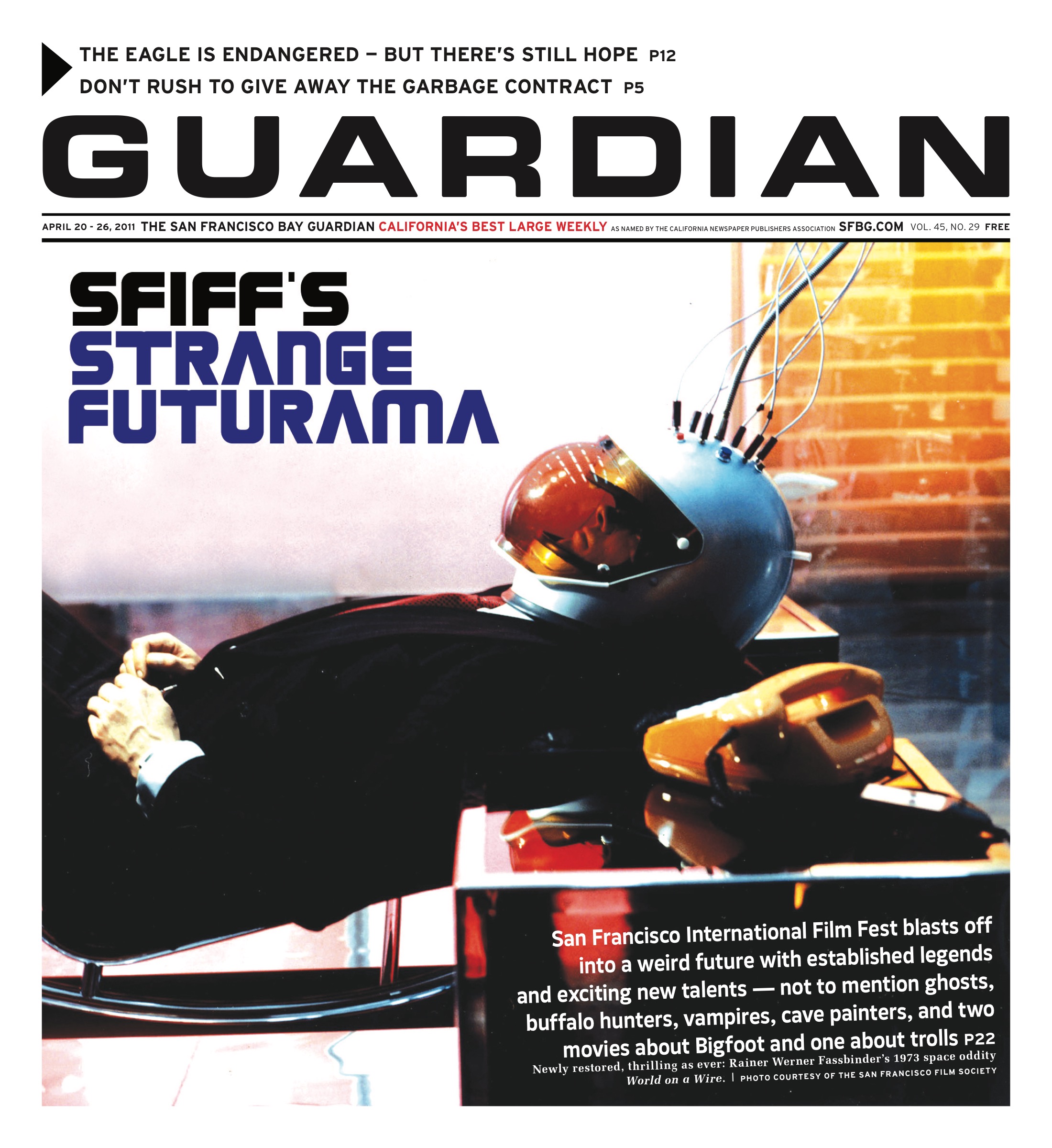
Print sections as they appeared in the early 2010s

To find articles by keyword or author, you may want to use our Search function.

Print Sections

Going back

0

arts@sfbg.com

DANCE Speaking from her home in New York, choreographer Lucinda Childs recalls the unfavorable reception to her 1979 piece Dance. “People walked out saying that I didn’t have a vocabulary and that anybody could do that kind of dancing.” Fortunately, perceptions and concepts of dance have evolved.

Childs’ one-hour pure dance piece, set to music by Philip Glass and accompanied by Sol LeWitt’s film, is presented this weekend by San Francisco Performances in association with Yerba Buena Center for the Arts. It is a rare opportunity to see a work by one of the seminal artists from the Judson Church movement, named after the New York City location that hosted the revolution.

In the early 1960s, choreographers tried to wipe the slate clean of what dance was, could, should, or need be. Technique, virtuosity, a codified vocabulary, and style — whether Balanchine’s, Martha Graham’s, or Merce Cunningham’s — were out. Everyday movement, improvisation, matter-of-factness and wysiwyg’s were the “cool” of the day. These at one time radical ideas were largely responsible for democratizing dance.

Today the movement has run its course. Its practitioners — with a few exceptions, such as Trisha Brown and David Gordon, who have continued onto international careers — are part of history. Childs is one of them — a legend in her own time whose choreography is almost never seen, in part because she works primarily in Europe. After the end of this tour, she is heading to Nice in France, then returning to the Ballet du Rhin, where she has been in residence for the last decade. “I am looking forward to going back,” says Childs, “It’s nice to work with dancers you know.”

So why Dance, and why now?

Even though her recent rigorous choreography is more conventionally theatrical, Childs is at heart a classicist. A piece like Dance transcends time and place even as it changes. Childs takes pedestrian movements — walking, skipping, running, hopping — and strips them of whatever context the steps might imply. They are performed with utmost clarity, without personal inflexion, giving the illusion that they are pure designs in space. But they are not. Repetition, accumulation, retrograde, overlaps, and mirroring are the formal devices that create incremental change, similar to the way it happens in Glass’ music. The whole dance becomes a shimmering unit and you begin to recognize differences among dancers. Geometry comes alive.

No surprise, therefore, that LeWitt was drawn to Childs. His work is as conceptually exacting as hers. His paintings and wall drawings are as meticulously planned and “impersonally” realized as her choreography. It probably also helped that Childs has a highly developed visual sense; she once took a section from a Seurat painting and danced its dots — backward.

For Dance‘s film element, shot by Lisa Rinsler, LeWitt superimposed a grid on the floor and captured sections of the choreography. He used split screens, odd angles, and close-ups. The film is synchronized with the live dance, initially making the performers dance with themselves. In 1979, video wasn’t as pervasive, so the effect of seeing the same dancers simultaneously on screen and on the stage was startling.

In the contemporary version of Dance, a gap has opened between the live and virtual performers. “The dancers today, are very different from what they were,” Childs explains. “They are much more technically trained, they also are different people.”

But the biggest change will be in the solo, which, when I saw the work a decade ago, Childs still danced herself. While it was fascinating to see contemporary and earlier dancers cohabiting the same universe, to see Childs dance against her younger self was breathtaking. Time collapsed into an eternal present.

At 70, Childs no longer performs the solo, yet she believes it’s in good hands. “I told Caitlin [Scranton] not to dance it like I did — to make it her own.”

LUCINDA CHILDS: DANCE

Thurs/28–Sat/30, 8 p.m.; $35–$60

Yerba Buena Center for the Arts, Novellus Theater

701 Mission, SF

(415) 978-2787

www.ybca.org


It’s 6 a.m. somewhere

1

ruggy@yelp.com

RUGGY’S YELP On my 21st birthday, I wanted to suck every single ounce of inebriated enjoyment out of the milestone occasion and tipped back my first airplane bottle of 99 Bananas schnapps at 5:45 a.m. outside one of San Diego’s premiere 20-hour bars, the Silver Fox. Before arriving, I was convinced I’d be the only patron crazy enough to enter when its doors opened at 6 a.m., but I found myself among 10 to 15 others queued up, awaiting an 80-proof wake-me-up with trembling hands.

It was an eclectic bunch I was rubbing elbows with: one gentleman wore military fatigues and downed a quick pint before reporting for duty at 0700 hours. Two others were just getting off the graveyard shift — at a local graveyard. Another middle-aged man with hints of gray at the temples, who sported a midnight blue three-piece wool suit, was there to whet his whistle before entering court to act as a fiduciary in a public defense case.

As a wide-eyed and bushy-tailed souse-in-training, this heterogeneous bunch was exactly the cluster of oddballs I’d been hoping to share my first alcoholic beverage with as an adult. Now, many years later with weakened internal organs, I still occasionally find myself atop a bar stool before the crack of daylight. For you, I’ve highlighted a few early morning standouts on the front lines of cock’s crow intoxication.


VESUVIO CAFE

Consider a pre-work stop at Vesuvio as less of a giant leap toward self-diagnosed alcoholism, and more of an “only in San Francisco” moment. As you probably know, the great Jack Kerouac spent many a day and night throwing back hooch at this notorious North Beach watering hole. Things turned out pretty well for him — they even named the street outside after the guy! Maybe that won’t happen in your case, but the connection between boozing at Vesuvio and success is duly noted. Staff know how to pour fantastically stiff drinks, there’s a robust array of beers on tap, and the deep-red, second-story mezzanine interior is just the thing to offset the lights of Broadway’s sinful adult institutions staring you in the face as night turns to day, or vice versa.

Opens at 6 a.m. 255 Columbus, SF. (415) 362-3370, www.vesuvio.com


SUTTER STATION

Judging from the denizens entering through this bar’s rear door, there’s a reason regulars refer to that particular point of entry as the “Sutter gutter.” However, we’re talking FiDi here — it’s not uncommon to observe dedicated drunks doing 12-ounce curls alongside well-groomed day traders en route to the office. Cocktails aren’t much to write home about, but the daring can pair their glass of firewater with a bowl of Orville Redenbacher’s from the popcorn machine that rests idly near the north end of the bar. There’s no telling when that popcorn was made, but it’s there for you if you’re hankering for a complimentary continental breakfast.

Opens at 7 a.m. 554 Market, SF. (415) 434-4768


GOLD DUST LOUNGE

Sadly, Gold Dust’s camp-tastic cover crew Johnny Z and the Camaros aren’t firing away on the encumbered bandstand at this aboriginal hour — even the hardest working men in local showbiz deserve some distance from the oldest bar in Union Square from time to time. Irish coffees are the name of the game at this mature rathskeller, and they’ll only set you back $3.50. You’d drop more cash on a venti caramel macchiato (extra whip!) at the Starbucks across the street, but until the ‘Bucks starts subbing the sugar for plastic bottle bourbon, guess where I’d rather spend my hard-earned dollars.

Opens at 7 a.m. 247 Powell, SF. (415) 397-1695


La vida vegan

5

caitlin@sfbg.com

DINE It’s a wild, woolly world when you won’t eat its cheeseburgers. Or so I discovered last autumn when I read Jonathan Safran Foer’s Eating Animals and found that my inner logician could no longer justify consuming products from the loins (and udders, and uteri) of animals that spent their lives experiencing the systematic abuse of factory farms.

But the most shocking tiding from Foer? A University of Chicago study, he writes, found that omnivores contribute seven times the volume of greenhouse gas of vegans. My bicycle eyed me from its perch on the storage hook in our apartment’s foyer. Environmentalists, are we?

So we traipse along the hippie-liberal continuum — just one more step to independence from fossil fuels, I suppose. But though I’ve been riding the pescatarian train for years, going animal product-free was harder than a piquant wedge of manchego (Jesus, even my metaphors have dairy products in them).

I was surprised how many places I would go — even here, in the befigged plate of the Bay Area! — where wearing my vegan hat meant going underfed and, by extension, becoming a whiny envelope-full of social anthrax addressed to my dining companions. Some restaurants even ghettoize our kind with separate menus, as if vegan food holds no interest for the general dining public.

Surely, though, this is nothing compared to the brave, ice cream-rejecting, pizza cheese-peeling pioneers of the vegan world! Even if it’s still hard to break society’s “five food groups” programming, as a whole our country is well out of the “what’s a vegan?” stage of cultural development.

It was high time for a pulse check. So one rainy spring day, I met with some of the Bay’s best and brightest vegans for a potluck and chat on where living animal-free is at these days. Food activists, chefs, moms, a boyfriend, a blogger. We ate like kings and bitched about steaks. We called it the Summit of the Vegans. I’ll tell you more — but first, a word on our vegans …


TAMEARRA DYSON

Vegan cred: Owner of Souley Vegan and self-taught chef

Comes natural: “When someone asks me what I use instead of milk or butter, I don’t even know how to answer that. What do you use? You just don’t use it!”


MARK BENEDETTO AND CARMEN VAZQUEZ

Vegan cred: Chefs. Started the now-defunct vegan Brassica Supperclub. Now the manager of Frog Hollow Farm’s Ferry Building store and kitchen supervisor at Gracias Madre, with a restaurant of their own on the horizon.

Vegans on the lam: The couple’s underground supper club was shut down by the fuzz in 2009 for lacking required permits.

A love that knows no animal products: “There are a ton of factions, splinter cells,” Benedetto says, “but all vegans secretly, quietly love other vegans.”


NANCY LOEWEN

Vegan cred: Nurse and vice president of the SF Vegetarian Society

Don’t even try to win that argument: “The Vegetarian Society has been around for 40 years. We continue to be a small group, but the number of vegetarians continue to grow. I love animals; I don’t like to go to the doctor; there are the environmental reasons; and I love the food. You just can’t win that argument!”


BILL EVANS

Vegan cred: Guardian production manager. Has been animal product-free for years. Our Joe Vegan.

Breaking down the meat lines: “The things that crack me up and annoy me at the same time: my girlfriend is the opposite of vegan and she’ll order a steak and invariably the waiter will come back and give me the steak and her my salad. There are some societal expectations about what’s a manly food.”


LAURA BECK

Vegan cred: Founding blogger of vegansaurus.com

Loves her job because: “The vast majority of my commenter are so rad. They’re smart, awesome activists, not preachy dicks, which is what a lot of people think vegans are.”

When’s she’s not blogging: Beck’s favorite Bay Area vegan eats include Encuentro, Golden Era, the flan at Gracias Madre, schwarmas from Herbivore, Saha, Jay’s Cheesesteaks, and Souley Vegan.

Note: Beck was sick for our summit but I hollered at her afterward so she could still join the conversation.

Elbow-deep as we were in the toothsome culinary contributions my summit attendees had whipped up for the occasion, it was perhaps no surprise to learn that food cravings were the least of the challenges to their vegan lifestyles. Indeed, to a (wo)man, our panel participants — many of whom had been vegans for the better part of a decade — found their eats superior to more omnivorous spreads.

“There are only five or six animals that people eat for meat,” said Loewen, who works at a senior citizen center by day and spends her free time organizing events like the Vegetarian Society’s annual Meat Out. “But we’ve got so many options in terms of grains and vegetables.”

One of the upsides to being vegan — in addition to the animal treatment and health and well-being issues that panelists cited as their salient motivations to make their lifestyle switch — is that it compels a certain amount of creativity in the kitchen. When you’re operating largely outside the parameters of what your family considers a standard meal, you tend to think outside the prepackaged box.

Dyson runs my favorite reason to cross the Bay Bridge — Souley Vegan’s crispy tofu burger and mac ‘n’ cheese have magical properties. She came to veganism when she had a visceral reaction as a teenager to a chicken bone, and now can’t imagine life any other way. She started her cooking career at a farmers market booth and now brings Souley Vegan’s cuisine to African American expos and public schools, where it teaches people about life, post-pork flavoring.

We talked about living vegan in the Bay Area, where my panelists agreed the vegan community had yet to come together the way in has in places like Austin. They pinned this lack of cohesion on the dearth of a central cultural hub, and Beck affirmed that a need for just such a meeting space was one of her motivations behind Vegansaurus.

Evans bemoaned the “ideological chasm” that separates omnivores and vegans and makes it difficult to share information and understanding between the two. The group debated over whether the “vegan movement” could truly be said to exist — and yeah, we talked shit too.

“I think it’s bullshit!” Loewen opined suddenly when I asked the group how they felt about Michael Pollan’s assertion that eating sustainably is more important than eating animal-product-free. “[That view] takes out the ethical aspect. That animal is going to die — free range animals want to live even more than other animals.”

Benedetto and Vazquez attended the California Culinary Academy (where they met and Vazquez became vegan) and were the summit’s official “vegans on the front lines” because of it. The school, they said, accommodated their desire not to work with meat — to a point. They still had to cook a steak for a final exam and take a two-week butchery course. “It smelled like death,” grimaced Benedetto. “Postgrad, I decided I would rather work retail than have to cook meat.”

Bottom line? There are challenges to being a Bay Area vegan. But there are victories as well: feeling “lighter,” minimizing your impact on the environment, being your own person, and delicious meals, to name a few. After hearing everyone’s stories, I realized that becoming a vegan in the Bay is a lot like being a human in the Bay: endlessly frustrating, completely crazy, but also a chance to be a part of an earnest try for a more sustainable world.


Victory, victorious

0

le.chicken.farmer@gmail.com

CHEAP EATS He’s only in high school so far, but Coach’s little brother Coach is a football genius of Bill Walshian proportion. Here’s how I know: He came, he coached, we won.

Us. Yes. 12-0. He practiced us twice the day before the game, put people in their proper places, and called all the plays on offense. He’s 17. His even younger brother, Coachy, 14, taught the “cover four” to our defense, which includes me. I’m 47. And … well, 12-0! Compared to the 54-12 combined trouncing we received in our first three games, this was quite the minor miracle, this li’l shutout win. Four interceptions, two by me, one of which I returned for a touchdown. It was so unprecedentedly monumental that afterward I dumped about an eighth of a bottle of Gatorade over Coach’s brother Coach’s head.

And then, grinning, blushing, and just generally dripping electrolytes, he and his fold-away traveling coaching staff, which included their dad, folded into their car and drove back to San Diego. But not before Papa Coach thanked me again for taking care of that rooster back on New Year’s.

Which is important because no matter how much of a sexy celebrity hot shit football star I may become (with proper coaching) in my old age, I will always still be a chicken farmer at heart. Not to mention that offing this here rooster really gave me good luck this year.

For example: Boston. For example: New Orleans. For example: Hedgehog. For example: 12-0.

So the coaches left, except for Coach, and we were just us again, our ragtag women’s football team, basking on a plastic tarp on the sidelines, no longer winless, and no longer even I don’t think in last place. At least for one week. I wonder what happens next.

Next, I hug and high-five my teammates, and leave them sucking orange wedges to go eat something substantial with our fan, Kayday. That means Red Café on Mission and 25th streets, because Toast has a line, and we can’t find the Ebb Tide on account of existential crisis. Not ours; we’re still here. Well, I’m still here. By the time you read this, however, Kayday will have moved back to Seattle, which is kind of like ceasing to exist, except you can fly back on weekends. And she still wants to be in my band, so … There’s that.

As for Red, why haven’t I eaten here before this?

It’s good, it’s basic, it’s great, and most important, no line! If you don’t mind sitting at the counter, which of course we don’t.

Kayday was just getting over some stomach bug, so she ordered something bland and not worth talking about. I, on the other hand, had just won the first football game of my new career. So I ordered beans, tortillas, fried plantains, and a plastic bag with ice in it.

My knee was sore.

Actually, I’d thought I was ordering eggs too, and one of those balls of rice and beans, but I must have messed up.

Well, the plantains were good, although I couldn’t finish them because there were way too many. The beans were great, and my favorite part of everything was the tortillas, which were fresh and warm and I melted butter in them, rolled them up, and used them to scoop the beans.

My only real criticism of Red’s Café has to do with the ice course. They must have Ziplock bags, right? Or something strong enough to contain your drip when the ice starts to melt. No?

No, my ice was served in a small, handled shopping bag like the drug store might put your tube of toothpaste and hair pins in. No way is that gonna hold water.

Drip.

I’ll be OK. I’ll be back out there next weekend for more football, soccer, and maybe even baseball just by way of being a complete lunatic about it. I’ll also be back to Red’s Café for the nopales omelet, which I had meant to order before the thought of plantains foiled my plan. Drip. Drip.

Drip …

RED CAFÉ

Daily: 7 a.m.–9 p.m.

2894 Mission, SF

(415) 282-1515

No alcohol

D/MC/V


Ghosts in the machine

0

LIT According to the Bureau of Invented Statistics, 99.9 percent of all poetry disappears into the void. This rate remains steady throughout history, though at certain times and places the figure undergoes radical fluctuations, plummeting to as low as 99 percent. Such periods are eventually given names like the San Francisco Renaissance, or the Elizabethan Renaissance. I mention this because I think Bay Area poetry has quietly entered one of those periods. Currently on my desk are four local debuts — Palm to Pine by Sunnylyn Thibodeaux; A GUSTONBOOK by Patrick James Dunagan; El Golpe Chileño by Julien Poirier; and gowanus atropolis by now-New Yorker Julien Brolaski — each of which appeared in the past six months, and each of which is ass-kicking and assured. In the 15 years I’ve been a poet here, I can’t recall a similarly fertile time.

The situation’s gotten so out of hand, a book I edited, Stranger in Town by Cedar Sigo, was nominated for an NCIBA award, and I actually knew the work of all the other nominees. The list was so good it didn’t matter who won, so I was pleased to see former and newly-returned SF resident Matthew Zapruder snag the award for his third full-length collection, Come On All You Ghosts (Copper Canyon Press, 96 pages, $16).

I haven’t checked, but I imagine most reviews of this book are compelled to describe it as “haunted” since it has Ghosts in the title and deals in part with the death of the poet’s father. It’s not a Kaddish-like outpouring of grief, in other words, but it’s haunted by death in a more oblique, post-New York School fashion. “This book you are holding/ is about dying,” Zapruder writes, yet too, it is about love (a relationship, it appears, inspired his return to SF). Such topics are strongly emotional, and Zapruder grapples with them through a self-conscious distance: “let us live/ here in this apartment and make/ sounds of love,” he writes, rather than simply “make love.” Or, in a characteristic locution, where a sentence becomes a unit within itself: “It doesn’t spoil my time is what/ spoils my time.” You could call this “emotion recollected in tranquility” — Wordsworth even appears — only there’s little tranquility. It deals more with the long run; when someone close to you dies, they’re dead for the rest of your life, long after grief has passed, and Ghosts wrestles with this haunted aspect of the human condition throughout.

As a fellow poet, I’m not without prejudices. I feel ambition is the enemy, and most long poems are baggy, misguided affairs. While Zapruder hasn’t shaken this belief, he has provided a mighty exception in the title poem, which may in fact be the greatest piece in the book. As a long poem, it’s taut and disciplined, only 15 pages entirely in tercets. Indeed, my one criticism of the book is that Zapruder is preeminently a poet of the single verse column, but my favorite poems in Ghosts — “After Reading Tu Fu,” say, or the one prose poem, “April Snow” — are those that break with this form. “Ghosts” rips along without being hemmed in by the three-line form, using it instead for gymnastics:

I myself am suspicious

and cruel. Sometimes

when I close my eyes


I hear a billion workers

in my skull

hammering nails from which


all the things I see

get hung. But poems

are not museums,


they are machines

made of words

I like this because Zapruder entirely flouts the formal constraint even as his lines retain status as individual units. The way the second stanza seems to well up to an image that disintegrates with the third stanza’s interestingly unseeable “all the things I see” and the midline off-rhyme of “skull” and “hung” reveal considerable technical chops concealed in the single verse form. They exert themselves there, but discreetly, shifting the sense of lines through intricate syntactic ruses like a modern-day Basil Bunting, whereas here they assert themselves more forcibly. The theme of the poem as a machine — that “anyone with a mind/ who cares can enter” — returns to close “Ghosts,” and this is not a bad way to think about poetry. As Zapruder’s book attests, the poetry that endures is built to last.


Return of the skronk

0

arts@sfbg.com

MUSIC There’s a point at the start of Bill Orcutt’s recently reissued, acclaimed 2009 album, A New Way to Pay Old Debts (Editions Mego), during the violent, staccato blues of “Lip Rich,” when a telephone rings. Slight pause. And then the San Francisco musician picks up where he left off, with shattered, crashing runs of proudly broken-ass guitar notes, the occasional shout and cry. Pummeling his old Kay acoustic until it reverberates like a piano, Orcutt sounds as if he’s busy ripping apart blues guitar lines at the end of a long metal-clad tunnel — and exorcising a few demons while he’s at it. There, at Orcutt’s end, semis, motorcycles, and homegirls rumble past and Mississippi blues players still wander, stumbling into pale-faced strangers deconstructing Delta drone with their bare hands, nails, and bones.

The reality is that the police sirens, roaring buses, and streetside groans on New Way — all of which lend the music the beautifully devolved faux-authenticity of an old field recording — are the same sounds you can hear any day at 24th and York streets in the Mission. Orcutt and family moved to that spot when they relocated to San Francisco after the 1997 breakup of his old band Harry Pussy, the noise-experimental band he founded in Miami along with fearsome vocalist-drummer Adris Hoyos. New Way — a document of a new solo approach in an old room perched above an even older Mission thoroughfare—was recorded during the spring of ’09 in a window-lined spot within their corner apartment.

“It was just insanely loud,” Orcutt recalls now from his current home in Sunnyside. It’s late, but it’s one of the few times Orcutt, who holds down a job as a software engineer, can talk. “There were constantly trucks and people going by outside, so there was no way to record and keep the background out. I realized I should just go with whatever happened — and the phone rang in the middle of the take.”

As chance would have it, one of Orcutt’s favorite guitarists, English experimentalist Derek Bailey, also had a recording released, posthumously, that was punctuated by a disruptive phone call (“Wrong Number” on More 74 [Incus]).

At least it wasn’t simply a noisy trendoid bellowing in the brunch queue outside St. Francis Fountain.

“When we moved there, St. Francis was closed — it was weird when it first reopened,” says a dryly amused Orcutt. “Suddenly there were people waiting for tofu scramble, and we were like, ‘Why?'”

“Why?” also comes to mind as one listens to New Way: why hasn’t Orcutt played and recorded since the dissolution of Harry Pussy? Perhaps it was the move or work demands — more important, Orcutt got reinterested in playing music when he began to assemble a retrospective of Harry Pussy’s music for Load Records, You’ll Never Play This Town Again: Live, Etc 1997 (2008), and began to listen the furious skronk his band generated and the remarkably damaged, thick, and grotty guitar sound he developed.

“I hadn’t heard that music in 10 years. It was pretty extreme, and I forgot what it sounded like,” he says. “I was like, ‘Whoa, that is weird.’ I was listening to a lot of it because I had to, and it naturally made me want to pick up a guitar and start playing again.”

It was a slight case of being inspired by yourself — though the modest Orcutt immediately disavows this (“That sounds weird — don’t say that!”) — and remembering your roots, be they buried in the same hot soil as Mississippi Fred McDowell, or the same swampy morass as kindred noisy Floridian Rat Bastard. “Honestly, there were like two or three people that were doing strange stuff in Miami at that time,” Orcutt remembers. “It wasn’t much of a scene. It was just isolated weirdos going off on their own tangents — that pretty much described us.”

Orcutt’s incredible, atonal guitar playing is the uncommon element connecting Hoyos’ formidable shrieks and 24th Street grind. These days Orcutt prefers to play acoustic rather than electric, though it’s rigged as a four-string, with the A and D strings removed, much the same way his electric once was. The modification predates Harry Pussy: “It just stuck,” he notes. “At this point, there’s no rational reason for doing it. It’s just what I sound like in my own head.”

The acoustic was also an intuitive choice, and as Orcutt started listening to guitarists such as McDowell, Bailey, and Carlos Montoya, “just to see what had been done before and to get the lay of the land and an understanding of what the perimeters were,” its sound and mobility started to appeal. “It’s a nice way to be self-contained and self-reliant. As long as you can get it on the plane, you’re good. And in a really small venue, you can even get away without having a PA,” he explains. “If I have to, I could wind up at the BART Station and I’m good to go.”

And it exposed Orcutt as a musician, apart from the protective mob of a band. “Honestly, once I got into it, I really wanted to play solo,” he observes. “When I started playing in front of people, it was scary, but I have this weird compulsion to play solo.” That urge is still a puzzle — in Harry Pussy, he adds, “Adris [Hoyos] definitely led the way and it was easy to hang back. I don’t know …” Slight pause. “There’s some kind of process I’m working through by playing solo, and I’m definitely still working on whatever it is.”

Approve affordable housing — for youth

1

OPINION Booker T. Washington, born as a slave, risked his life to learn to read and write and went on to found Tuskegee University. At his core, he believed that economic independence and access to education were the keys to equality. He put it best when he said: “There are two ways of exerting one’s strength: one is pushing down, the other is pulling up.”

Since 1919, the Booker T. Washington Community Service Center has worked to lift up San Franciscans of every background, with a particular focus on the African American community. To continue that vision, the center is embarking on a capital project that will provide 50 units of affordable housing to youth and families, along with new athletic and educational space.

The most critical part of the project is providing housing for transitional-age youth. Many of these young people age out of foster care with no family support, few job skills, and no chance to rent a market-rate apartment in this expensive city. The project represents a real commitment to these youth, who are overwhelmingly people of color. With affordable housing funding under threat at the federal and state levels, it’s essential that shovel-ready projects get the green light from City Hall.

That is why we were thrilled when Sups. Ross Mirkarimi, Eric Mar, and Mark Farrell introduced the necessary legislation to allow this project to move forward. Joining hundreds of community leaders, countless families, and prominent African Americans, these supervisors lent their support for a project that continues the ongoing fight for economic justice.

It’s also why we are concerned that a few neighbors are using their influence to push down on the hopes of San Francisco’s youth. Some neighbors have asked that we add additional parking, even though the site is just a few blocks from Geary Boulevard and most low-income youth don’t have cars. Others have suggested that we cut nine units to make the building shorter, even though San Francisco’s housing needs are so acute. As is often the case in San Francisco, those who support progressive values need to speak up to ensure that we can overcome this campaign of misinformation and fear.

On April 28, the Planning Commission will consider whether to certify the environmental impact report for this project, and whether to approve it. We are hopeful that progressive voices speak out so we can provide hope and a future to youth in our community. As Booker T. often said: “Success is to be measured not so much by the position one has reached in life as by the obstacles one has overcome.” 

Julian Davis is president of the board and Patricia Scott is executive director of the Booker T. Washington Community Service Center, located at 800 Presidio Ave. The Planning Commission hearing is Thursday, April 28 at City Hall, Room 400.


Pete Petrakis, PG&E fighter, dies at 82

1

bruce@sfbg.com

Peter L. “Pete” Petrakis, the Guardian investigative reporter who developed the stories in the mid 1970s that became known to Guardian readers as the PG&E/Raker Act scandal, died Feb. 28 in Everett, Wash.

In story after story, Pete laid out the scandal that the local media had buried for generations: how Pacific Gas and Electric Co. had in effect stolen San Francisco’s electrical power supply from the Hetch Hetchy dam in violation of the public power mandate of the federal Raker Act of 1913.

The act allowed the city an unprecedented concession, to build a dam in a national park (Yosemite) on the condition that the city have a public water and public power system. Pete detailed how PG&E used its corporate and political muscle to keep the cheap, green, hydropower from city residents and businesses and instead forced them to buy PG&E’s expensive private power, at a cost of billions of dollars through the years.

Pete learned of the scandal in the mid-1960s as a student of J. B. Neilands, a biochemistry professor and citizen activist at UC Berkeley.

Neilands had in the late 1950s started the campaign in his living room in the Berkeley Hills that ended up stopping PG&E from building a nuclear power plant upwind of San Francisco at Bodega Bay.

In the process of researching the Bodega Bay story, Neilands came upon an even bigger scandal: the PG&E/Raker Act scandal. After winning at Bodega Bay, Neilands did the research into the scandal and then brought it to me shortly after the Guardian began publication in 1966.

This was a huge story and I remember saying, “Joe, why are you bringing a big story like this to me?” He replied, “Nobody else will print it because of PG&E. You’re my only hope. If you don’t print the story, nobody will.”

But the story needed much more research and development on several levels.

A few weeks after Neilands’ story appeared, Pete came to me at the Guardian with the big new angle. He had figured out that the city’s charter revision committee was about to quietly gut the provision in the 1932 charter that updated the Raker Act and mandated the city to “gradually acquire” and “ultimately own” its own power system. Pete swung into action with a three-page story on Sept. 30, 1969 that detailed the capitulation to PG&E under the headline: “The Charter Board — afraid to enforce the Raker Act and bring cheap public power to San Francisco.”

He added a timeline: “How to Hetch Hetchy the City Charter.” And he explained that “to Hetch Hetchy” meant to “confuse and confound the public by adroit acts and deceptive words in order to turn to private corporate profit a trust set up for the people”

In short, Pete dug into the scandal with gusto and research skill and wicked wit. He produced several major stories over a five-year period with shocking new information on how PG&E was systematically screwing the city by stealing its Hetch Hetchy power. Each year, we would turn Pete’s stories over to the civil grand jury, with his documentation, and formally ask the grand jury to investigate the Hetch Hetchy scandal and make a report and recommendation.

Finally, in 1974, the grand jury, to our great surprise, came out with a report that corroborated Pete’s reporting. As our editorial put it in our Jan. 17, 1974 edition: “In short, the grand jury has corroborated almost everything the Guardian has been saying about the Hetch Hetchy scandal for the past five years.”

At Pete’s request, a Celebration of Life service was held privately at the family home on March 13. Pete requested that memorial contributions be made to the American Red Cross. Condolences can be sent to Julia Petrakis at petrakisjw@yahoo.com.

So long, Pete, you left the Guardian and San Francisco with one helluva story.


Last stand against Lennar

2

news@sfbg.com

Hunters Point, the last major swath of usable land in San Francisco, appears at first glance to be a developer’s dream — a prime piece of real estate with sweeping views of the bay, ample space, and a city government eager to capitalize on its potential.

But community groups have filed lawsuits challenging the project’s many uncertainties, such as the fate of the toxic stew beneath the former U.S. Navy base in the heart of the project area, and both sides are now awaiting a court ruling on whether more studies are needed.

As an EPA-designated Superfund site, the 500-acre plot is home to an abundance of buried chemical contaminants, radioactive waste, and other unknown toxins, and the Navy has been slow to clean it up. Concerned that development plans have been premature in the face of this lingering mess, opponents filed lawsuits against developer Lennar Corp. and the city last year.

The project, approved July 2010 by the Board of Supervisors, includes plans for a new stadium for the 49ers, 10,500 housing units, parks, and commercial retail space. It has received praise from city and state government agencies as an economic and cultural boon to the community. But activist groups say the cleanup should happen before development occurs.

The Sierra Club settled its lawsuit over the project after the developer made some design changes (see “Uncertain developments,” Jan. 18), so the lawsuit filed by People Organized to Win Employment Rights (POWER) and Greenaction is the last piece of litigation holding up the project. At the core of the legal challenge is whether the environmental impact report (EIR) properly analyzed the health impacts from toxic contamination at the site. After an April 18 hearing on the case, both sides are awaiting a ruling on whether the claims have merit and should be the subject of further study.

Activists claim the EIR violates California Environmental Quality Act protocols because it contains too much uncertainty, including the unknown fate of a large parcel of land slated for a stadium that is contingent on whether the 49ers decide to stay in San Francisco. POWER wants more details about the possible threats to human health before the 20-year project gets the final green light. But since the Navy is responsible for the cleanup, Lennar and the city have repeatedly countered that a full analysis is not their responsibility.

“The main issue that Greenaction and POWER have been concerned about throughout lawsuit is that it’s very unclear from the EIR what exactly is going to happen and what level of contamination will be left,” said attorney George Torgun with EarthJustice, which is representing the community groups. “What are the impacts of building on a federal Superfund site? There is a real lack of knowledge in the EIR.”

April 18 was the second of two recent hearings held on the case. On March 24, Judge Ernest H. Goldsmith listened to a full day of testimony before a packed courtroom. Subsequent settlement discussions weren’t successful, so both sides returned to court to seek a ruling that is expected sometime in the next two months.

Lennar attorneys offered to relinquish the possibility of a pre-cleanup early transfer of the property, which has been a major concern for POWER. Under this proposal, no development on any of the six parcels slated for transfer from the Navy could proceed until the federally mandated cleanup process was finished and certified. However, POWER does not believe this offer reduces the scope of the issues because final approval would still ultimately award control of the land to the developer based on what they believe is a flawed EIR.

“Severing any discussion of early transfer from this EIR would only serve to worsen the defects that petitioners have identified and would be contrary to the requirements of CEQA,” Torgun wrote in the April 13 letter to the court.

POWER’s counterproposal would allow large portions of the project to go through — rebuilding the Alice Griffith housing project and development on Candlestick Point — but Lennar considers it economically unfeasible. These portions of the project are not located on the shipyard but are included in overall plan.

“We want to see the project move forward with Alice Griffith and Candlestick Point,” said POWER organizer Jaron Browne. “They’ve rebuilt housing projects at Cesar Chavez and other areas in the city — why can they only rebuild this one if they can redevelop the shipyard? It’s a political game that Lennar has tied the rebuilding of it to this mammoth 770-acre development.”

Lennar representatives wouldn’t comment for this story. Community members have clashed with the megadeveloper over health issues in recent years. In 2008, Lennar was fined more than $500,000 by the Bay Area Air Quality Management District for allowing dust containing asbestos to settle on the surrounding neighborhoods. Then, in March, community organizations released a report showing e-mails from 2006 to 2009 between the EPA, the San Francisco Department of Public Health, and Lennar revealing a possible cover-up of the asbestos exposure.

“They underestimated our understanding of what is happening here,” Browne said. “The whole heart of this issue is that this is a Superfund site. Even if you remove the possibility of early transfer, they are still planning on doing work while remediation is still years to go on other parcels.”

Longtime Bayview resident and Greenaction member Marie Harrison said that not only is the EIR too fraught with uncertainty, it’s incomplete. “There are over 600 blank pages in that document,” she said. “How can you approve an EIR that is supposed to tell you what is there, what the effects will be, and what the project will be? We kept asking the supervisors: How do you convince the community that they are doing something that is good and safe when the history shows otherwise?

During both court hearings, it was evident no clear definition of the project exists since it contains many variables to account for unknowns. Attorneys for Lennar and the city argue that the EIR effectively addresses each potential use and demonstrates a full knowledge of possible contaminants.

Wilma Subra, an environmental scientist for New Orleans-based Environmental Health Advocates, has worked with POWER and Greenaction to understand the breadth of contamination and the typical process of cleanup of a Superfund site. She pointed out that the Navy’s cleanup plan is completely separate from the EIR submitted for the project.

“Those two documents don’t agree with what development will be,” Subra said. “Usually you wait much longer in the process to really know that the land is safe. In a normal Superfund process, you would first do an implementation of the remediation process, find out if it worked, then — years down the line — you would start thinking about development.”

If the EIR is deemed inadequate, Lennar and the city will be required to further analyze the contaminants, outline cleanup strategies, and resubmit a new EIR. If the judge rules the EIR satisfies CEQA, the project can move forward.

“CEQA is one of the few really democratic processes,” Browne said. “If you just have this one moment in 2011 when people are able to comment and weigh in, and then have 20 years where they are building within that, it’s not really fair.”

Editor’s notes

6

tredmond@sfbg.com

The candidates for mayor of San Francisco are already lining up endorsements — the Sierra Club held its interviews April 23, which seems awfully early to me, since some of the most interesting contenders in this town (Tom Ammiano, Matt Gonzalez) have a tendency to jump in at the last minute. And the filing deadline isn’t until August.

But the sooner the big names and organizations are lined up and the money is locked in, the harder it will be for anyone to pull off an August surprise. So unless the redistricting commission seriously messes with Mark Leno’s state Senate seat or Ed Lee bows to the pressure from Willie Brown, Rose Pak, and their allies and decides to go back on his promise and seek a full term, we’re probably looking at a rough approximation of what the voters will face in November.

With John Avalos in the race, the ballot’s become a lot more attractive to progressives. It’s not as if the other major candidates don’t have a lot to offer, and in some cases, they have a lot to offer to the left. There are smart, experienced, qualified people running.

But let’s be honest here: David Chiu, Dennis Herrera, Phil Ting, Leland Yee, and Bevan Dufty all operate somewhere in the squishy political center, a place where tax breaks for corporations are okay, where “homeownership opportunities” tend to trump the needs of tenants, where deals with big private developers are sculpted around the edges but never rejected outright, and where cuts in services are a larger part of the budget solution than taxes on the rich.

Michela Alioto-Pier is off on the far right of the San Francisco political world, and if she looks at all credible and gets any significant traction (and that’s a big if) she’ll be downtown’s favorite candidate. But until now, there was nobody holding the solid progressive banner.

I don’t think that means Avalos’ appeal is limited to the left; he’s in a swing district, and he’s very popular there, and he can talk about small business and community development and open, honest government. He doesn’t sound like a crazy radical; he’s polite and respectful and listens to people.

But I’m glad we have a candidate who won’t try to argue that 25 percent affordable housing at Treasure Island is something to be proud of, or that the Twitter tax break will create jobs, or that social inequality can’t be addressed through local policy. I’m glad there’s someone who can push the discussion and debate out of the middle, can force some of the others who want progressive support to take strong stands, and can liven things up a bit. Because without him, all of the candidates were sounding a lot alike — and I really don’t want to be bored this fall.

Reject the Treasure Island plan

18

EDITORIAL After a long, long hearing April 21, as the San Francisco Planning Commission prepared to vote on an ambitious development plan for Treasure Island, Commissioner Gwyneth Borden acknowledged that the plan wasn’t perfect. But, she said, on balance it ought to be approved: “Twenty five percent affordable housing is better than zero percent.”

That’s not necessarily true.

Treasure Island is an usual piece of real estate, 403 acres of artificial land created in 1937 by dumping sand and dirt on a shallow part of the bay. It’s less than two miles from downtown San Francisco — but there’s no rail service, no BART station. The only way off the island is by boat — or by driving onto a Bay Bridge that’s already jammed way beyond capacity every morning and afternoon.

The soil is unstable, prone to liquefying in an earthquake — and if sea levels rise as high as some predictions suggest, the whole place could be underwater in a few decades.

A strange hybrid agency called the Treasure Island Development Authority, created by former Mayor Willie Brown, cut a deal with Lennar Urban (the same outfit that has the redevelopment deal for Bayview Hunters Point) and several partners to construct a neighborhood of some 19,000 people on the island. Among the features: a 450-foot condominium tower and 6,000 units of high-end housing. The developers brag that a fleet of new ferries will offer a 13-minute ride to the city and that some streets will be designed for pedestrians and bicycles.

But the fact remains that the developers want to add 19,000 new residents — almost all of whom will work off the island somewhere — to a place that has no credible transportation system. City studies show that even with an extensive (and costly) ferry service, at least half the new residents would drive cars to work (and, presumably, to shop, and go to movies, and eat and drink), joining the mob of vehicles heading east or west on the bridge. That’s almost 10,000 new cars each day trying to jam onto a roadway that can’t handle the existing traffic. The backups would stretch well onto San Francisco surface streets and as far back as Berkeley.

A rail line on the Bay Bridge would solve part of the problem. So would bike lanes. Neither option is even remotely possible in the foreseeable future. Free, or heavily subsidized ferries could, indeed, be a positive alternative — but who is going to pay for that service? Nonsubsidized ferries would be far more expensive than current Muni or BART service, a particular burden on the residents of the below-market housing.) And does anybody really think there’s going to be enough ferry capacity to carry 10,000 people a day to downtown SF, the East Bay, and the Peninsula?

The bottom line: this isn’t a good deal for San Francisco. The affordable housing level is too low. The transportation problems are nightmarish. The last thing Treasure Island needs is a 450-foot tower.

There’s no rush to approve this — and no immediate downside to waiting for a better deal. The supervisors should tell Lennar to come back with a project that has fewer residents, better transit options, and more affordable housing. Because zero is looking a lot better than what’s on the table.

PS: The 4-3 Planning Commission vote demonstrated exactly why it’s important to have key commission appointments split between the mayor and the Board of Supervisors. The mayoral appointees all rolled over — but at least the board-appointed members made strong points, forced real debate, and gave the supervisors plenty of ammunition to demand a better deal.

Spies in blue

19

sarah@sfbg.com

San Francisco cops assigned to the FBI’s terrorism task force can ignore local police orders and California privacy laws to spy on people without any evidence of a crime.

That’s what a recently released memo appears to say — and it has sent shockwaves through the civil liberties community.

It also has members of the S.F. Police Commission asking why a carefully crafted set of rules on intelligence gathering, approved in the wake of police spy scandals in the 1990s, were bypassed without the knowledge or consent of the commission.

“It’s a bombshell,” said John Crew, a long-time police practices expert with the American Civil Liberties Union of Northern California.

The ACLU obtained the document April 4 under the California Public Records Act after a long battle. It’s a 2007 memorandum of understanding outlining the terms of an agreement between the city and the FBI for San Francisco’s participation in the Joint Terrorism Task Force.

And, according to Crew, it effectively puts local officers under the control of the FBI. “That means Police Commission policies do not apply,” Crew said. “It allows San Francisco police to circumvent local intelligence-gathering policies and follow more permissive federal rules.”

Veena Dubal, a staff attorney at the Asian Law Caucus, agreed: “This MOU confirms our worst fears,” she said.

Dubal noted that in the waning months of the Bush administration, the FBI changed its policies to allow federal authorities to collect intelligence on a person even if the subject is not suspected of a crime. The FBI is now allowed to spy on Americans who have done nothing wrong — and who may be engaged in activities protected by the First Amendment.

FBI activity under this new “assessment” category has since come under fire, and a recent report in The New York Times showed that the FBI has conducted thousands of assessments each month, and that these guidelines continue under Obama.

And if the feds do control San Francisco police policy, then the San Francisco cops could be spying on innocent people — a dramatic change from longstanding city policy. “The MOU is disturbing,” Police Commission member Petra DeJesus told the Guardian. “The department is assuring us that local policies are not being violated — but it looks as if it’s subject to interpretation.”

It’s the latest sign of a dangerous trend: San Francisco cops are working closely with the feds, often in ways that run counter to city policy.

And it raises a far-reaching question: With a district attorney who used to be police chief, a civilian commission that isn’t getting a straight story from the cops, and a climate of secrecy over San Francisco’s intimate relations with outside agencies, who is watching the cops?


SPIES LIKE US

San Francisco has a long — and ugly — history of police surveillance on political groups. SFPD officers spied on law-abiding organizations during the 1984 Democratic National Convention; kept files in the 1980s on 100 Bay Area civil, labor, and special interest groups; and carried out undercover surveillance of political groups focused on El Salvador and Central America.

Those abuses led the Police Commission to develop a departmental general order in 1990 known as DGO 8.10. The local intelligence guidelines require “articulable and reasonable suspicion” before SFPD officers are allowed to collect information on anyone.

Even those rules weren’t enough to halt the spies in blue. In 1993, police inspector Tom Gerard was caught spying on political groups — particularly Arab American and anti-apartheid organizations and groups Gerard described as “pinko” — and selling that information to agents for the Anti-Defamation League.

As the ACLU and Asian Law Caucus noted in a December 2010 letter to Cdr. Daniel Mahoney: “That scandal was not just about the fact that peaceful organizations and individuals were being unlawfully spied upon and their private information sold to foreign governments, but that the guidelines adopted in 1990 had never been fully implemented by SFPD. No officers had been trained on the new guidelines and no meaningful audit had ever been implemented.”

Over the years, the commission has tried to keep tabs on police intelligence and prevent more spy scandals. The general order mandates that local police officials have to request general authority from a commanding officer and the chief to investigate any activity that comes under First Amendment protections — and must specify in the request what the facts are that give rise to this suspicion of criminal activity. The order also states that the chief can’t approve any request that doesn’t include evidence of possible criminal activity.

Those requests are reviewed monthly by the Police Commission and there are annual audits of the SFPD files to monitor compliance — so the notion that the local cops are joining the FBI spy squad without commission oversight is more than a little disturbing.

Officials with the FBI and SFPD are doing their best to reassure the local community that there’s nothing to worry about. But so far their replies seem to duck questions about whether FBI guidelines trump local policies. For example, the MOU states that “when there is a conflict, [task force members] are held to the standard that provides the greatest organizational benefit.”

We asked Mahoney to clarify: does that mean the local cops could be held to the FBI’s standards?

“The San Francisco Police Officer(s) who are assigned to the Joint Terrorism Task Force always have and continue to be required to follow all SFPD’s policies and procedures,” Mahoney replied in a statement.

That’s confusing; do they follow SFPD policies, or obey the MOU?

We asked FBI special agent-in-charge Stephanie Douglas whether SFPD officers are involved in surveillance and “assessments” (that FBI code word for creating spy files on individuals and groups) and whether they are identifying as SFPD or FBI officers.

“The FBI only initiates investigations on allegations of criminal wrongdoing or threats to our national security,” Douglas replied April 21. “Our investigations are conducted in compliance with the Constitution, the laws of the United States, the Attorney General Guidelines, the Domestic Investigation and Operations Guide, and all other FBI policies.”

Okay, that’s typical FBI-speak. Here’s more: “The JTTF is a task force comprised of FBI special agents, agents from other federal agencies, and local police officers who have been officially deputized as federal task force officers (TFOs) who have the power and authority of a federal agent. Because all JTTF TFOs are actually de facto federal agents, they are required to operate under federal laws and policies when involved in a JTTF case.”

So the cops are actually feds. But wait: “Our standard JTTF MOU recognizes, however, that the JTTF TFOs do wear two hats, as it were, and directs JTTF TFOs to follow his or her own agency’s policy when it is stricter than the FBI policy under certain circumstances,” Douglas concluded.

Again: not exactly clear, and not exactly reassuring.

“At some point they need to say whether SFPD officers are engaged in assessments,” Crew said.

These questions have spurred the Police Commission and Human Rights Commission to schedule a joint hearing in May to discuss what the document means, why SFPD never alerted the civilian oversight authorities, and whether a clarifying addendum can be tacked onto the agreement.


SPY FOR US OR LEAVE

The concerns are likely to be intensified by recent developments in Portland, Ore.

Portland dropped out of the Joint Terrorism Task Force in 2005 over concerns that local cops would be violating privacy laws. But in November 2010, the FBI thwarted a bomb plot allegedly linked to terrorists, and city officials came under pressure to rejoin the JTTF.

But Mayor Sam Adams has insisted on language that would bar local cops from doing surveillance and assessments, which, apparently, won’t fly with the feds.

On April 20, Willamette Week, the Portland alternative paper, wrote that Adams “effectively scuttled” Portland’s reentry into its local JTTF because of his anti-spying language.

In an April 19 letter to Adams, U.S. Attorney for Oregon Dwight Holton stated that Adams’ proposal of only allowing officers with the Portland Police Bureau to be involved in investigations and not in FBI assessments was a deal-breaker.

“Unfortunately, as currently drafted, the proposed resolution does not provide a way in which the PPB can rejoin the team,” Holton wrote. “There is a single provision that stands as a roadblock to participation — specifically the provision that seeks to have the City Council delineate only certain investigative steps a task force officer can take part in. Specifically, the resolution seeks to dictate for the JTTF which stages of an investigation task force officers from the [Portland police] can work on.”

“Investigation and prevention of complex crimes and terrorism are typically fluid and fast-moving,” he added. “It makes no sense to ask [Portland police] officers to be in for one part of a conversation, but out for another part of the same conversation as investigators discuss findings from assessments, investigations, etc. in evaluating and addressing terrorist threats in Portland and beyond.”

The message isn’t lost on San Francisco civil liberties activists. If you don’t let your cops join the spy squad, they can’t be a part of the task force.

“It was one thing to join the JTTF 10 years ago when they were operating under guidelines that, while not to the ALCU’s taste, were at least tied to some level of suspicion,” Adams said. “But they have taken their procedures and guidelines and moved them to the far right. It’s one thing to say that it’s necessary for the FBI to do that, and quite another to say that local agencies have to forfeit their own policies — and with no public debate or decision-making.”


ASK THE FEDS FIRST

Further complicating the question of police oversight is the fact that George Gascón, who was police chief when civil liberties groups started asking for a copy of the MOU last fall, refused to turn over the document without asking the feds first.

In a Jan. 4 letter to the ACLU and ALC, Gascón and Mahoney stated that the SFPD could not speak to information about the duties, functions, and numbers of officers assigned to the Joint Terrorism Task Force “without conferring with our partners in the Federal Bureau of Investigation.”

“I am sure you can appreciate the delicate balance we hold in crafting policy that not only supports our mission in the ultimate protection of life, but also in advancing democratic values through collaboration with the communities we serve,” Gascón and Mahoney wrote.

And Gascón is now district attorney.

“It raises the question of accountability,” said Public Defender Jeff Adachi “We want to make sure that police officers working in the city, regardless of whether it be for the feds or the SFPD, are complying with general orders and policies established by the department. But when officers go on an assignment with the feds, we don’t know if they are operating under parameters set by local law.”

Unearthing the FBI’s hitherto clandestine MOU with the SFPD appears to be yet another sign that local police are increasingly being subjected to federal policies not in keeping with local procedures.

As the Guardian previously reported, the 2008 decimation of San Francisco’s sanctuary city legislation and the 2010 activation of the federal government’s controversial Secure Communities program, which both happened during former Mayor Gavin Newsom’s tenure, means that the city of St. Francis now ranks among the top 38 counties nationwide that are deporting “noncriminal aliens.”

Dubal also noted that the FBI came to the SFPD in 1996 asking for help with the task force, but also sought a waiver from the Police Commission so officers could participate without having to follow local rules. “And within two weeks, then Mayor Willie Brown said, not in our town,” Dubal said. “So in 1997, the SFPD said we are not going to join unless we can follow our own rules. And in 2001, when the SFPD joined, it was under an MOU that required them to comply with SFPD rules and was signed in 2002 by then-SFPD Chief [Earl] Saunders.”

Dubal said that after local law enforcement agencies sign an MOU with the FBI, they designate and assign officers to work from FBI headquarters. “In the past, two SFPD officers, paid with San Francisco tax dollars, physically worked in the FBI’s office in a secure room where you can only go if you have security clearance. But they still can’t spy without reasonable suspicion, and they also need audits.”

Crew and Dubal said that in a recent meeting, SFPD officials assured them that local police were following General Order 8.10, but that they are open to creating an MOU addendum to clarify this.

Crew and Dubal remain unsure if the FBI would be agreeable to signing off on that. They note that the FBI has previously stated that its JTTF has sensitive investigations going on so it can’t give the public all the information. “Fine, but the issue is, Are these investigations based on suspicion, or are they based on religious background, associations, ethnicity, and travel patterns?” Dubal said.

They also doubt that the MOU would even have surfaced if not for comments that then SFPD Chief Gascón made, first in October 2009, then in March 2010, that triggered an uproar in the local Muslim, Arab, and Pakistani and Afghani communities.

At the time, Gascón, who has a law degree and graduated from the FBI Academy, had just landed in San Francisco fresh from a stint as police chief for Meza, Ariz., where he drew praise for speaking out against Maricopa County Sheriff Joe Arpaio’s inhumane treatment of undocumented immigrants Given this seemingly progressive stance, Gascón shocked civil libertarians in San Francisco when he said he wanted to unearth SFPD’s intelligence unit, which was disbanded amid scandal in the early 1990s.

“We have to realize that in the post-9/11 world, San Francisco is an iconic city, like New York, Washington. and Los Angeles,” Gascón said. “If somebody wanted to make a big statement about something they disliked about America, doing it here would definitely get attention. We need to know what is going on under the surface of the city.”

But Gascón did not say how a revived police spy unit, which had been shut down in large part due to Crew’s work, would operate. And six months later, he upset Bay Area Muslims during a March 2010 breakfast by reportedly saying that the Hall of Justice building was not just susceptible to earthquakes, but also to an attack by members of the city’s Middle Eastern community who could park a van in front of it and blow it up.

Gascón subsequently claimed that he “never referred to Middle Easterners or Arab Americans,” but that he had instead singled out the Afghanistan and Yemen communities because they pose “potential terrorism risks”

“In light of Gascón’s comments and his desire to resurrect the intelligence unit, people were asking, ‘Is it possible that the SFPD is also doing the same thing?'” Dubal asked, noting that she started getting complaints in 2009 and throughout 2010 about the FBI.

“Folks were saying that the FBI was asking about their religious identity, their family situation, and their political activities,” she recalled. “I certainly saw an upswing in innocent people being contacted. People were saying, ‘What the hell? — the FBI knocked on my door at 5 a.m.'”


COMMUNITIES UNDER SIEGE

A 2011 Human Rights Commission report documents frequent complaints from Arab, Muslim, and South Asian communities facing racial and religious profiling while traveling and unwaraanted interrogation, surveillance, and infiltration by local and federal law enforcement personnel at their homes, places of worship, and workplaces.

The report recommended asking the supervisors and the Police Commission to “ensure that all SFPD officers, including those deputized to the Joint Terrorism Task Force, follow and comply with local and state privacy laws, including DGO 8.10.”

On April 5, the Board of Supervisors voted 10-0 to approve a resolution, sponsored by Sup. Ross Mirkarimi and cosponsored by Sups David Chiu, Eric Mar, David Campos, and John Avalos, to endorse the HRC report.

All this is happening against the backdrop of FBI guidelines that have been loosened twice since September 2011, first by U.S. Attorney General John Ashcroft in the wake of the 9/11 terrorist attacks, then by Attorney General Michael Mukasey in the dying days of the Bush administration, and now by the Obama administration.

And as The New York Times reported in March, records obtained through a Freedom of Information Act request show that between Dec. 2008 and March 2009, the FBI began 11,667 assessments of people and groups for criminal/terror links, completed 8,605 assessments, and launched more than 400 intensive investigations based on the assessments. The FBI also told the Times that agents continue to open assessments at about the same pace

Crew noted that Mukasey’s guidelines marked the first time since 1976 that the FBI has been allowed to do assessments and collect files without a suspicion that a crime has occurred.

Dubal observed that the most relevant documents to emerge from a recent FOIA request to determine if the FBI has engaged in disturbing intelligence gathering activities are those related to “geomapping.”

“The materials are not particular to Northern California, but they show how FBI maps communities based in ethnic concentrations,” Dubal said.

Dubal also pointed to the case of Yasir Afifi, an Egyptian American student from Santa Clara, who found an FBI tracking device on his car when he took it in for an oil change. In March 2011, CAIR filed suit in Washington, D.C., alleging that the FBI violated Afifi’s First, Fourth, and Fifth Amendment rights by failing to obtain a warrant.

DeJesus recently told the Guardian that the Police Commission was never made aware of the MOU’s existence. “The chief should have checked in with the commission president, at the very least,” she said. “The idea that they were not reporting this to anyone is disconcerting.”

“The SFPD does not have the authority to enter into a secret agreement with the FBI whereby some of its officers are allowed to conduct intelligence operations in violation of the Police Commission’s General Order 8.10,” Crew added.

In a Jan. 25 letter to Mahoney, representatives from the ACLU and the ALC noted that “in the past, the SFPD had not previously deferred to the FBI on whether or how to openly address how San Francisco police officers will be supervised and held to well-established and painstakingly and collaboratively crafted San Francisco general orders.”

“These are low-level investigations that require no criminal predicate, meaning that when initiating an assessment, FBI agents can conduct intrusive forms of investigation without any criminal suspicion,” Dubal said. “These include interviewing innocent Americans, infiltrating organizations, using open source data to spy and surveil, going into religious centers such as mosques to spy and surveil, and recruiting and using informants.”


Stage Listings

0

Stage listings are compiled by Guardian staff. Performance times may change; call venues to confirm. Reviewers are Robert Avila, Rita Felciano, and Nicole Gluckstern. Submit items for the listings at listings@sfbg.com. For further information on how to submit items for the listings, see Picks. For complete listings, see www.sfbg.com.

THEATER

OPENING

Vice Palace: The Last Cockettes Musical Thrillpeddlers’ Hypnodrome, 575 10th St; (800) 838-3006, www.brownpapertickets.com. $30-35. Opens Fri/29, 8pm. Runs Fri-Sat, 8pm; Sun, 7pm. Through July 31. Thrillpeddlers presents composer Scrumbly Koldewyn’s revival of the 1972 musical revue.


ONGOING

The Busy World is Hushed New Conservatory Theatre Center, 25 Van Ness; 861-8972, www.nctcsf,org. $24-40. Wed-Sat, 8pm; Sun, 2pm. Through May 1. New Conservatory Theatre Center presents the world premiere of a play by Keith Bunin.

*Caliente Pier 29, The Embarcadero; 438-2668, www.love.zinzanni.org. $117-145. Wed-Sat, 6pm; Sun, 5pm. Open-ended. Ricardo Salinas, cofounder of famed Mission-born radical Latino comedy trio Culture Clash, penetrates the velvet enclave of Teatro ZinZanni, taking the helm for its latest Euro-style dinner-cirque cabaret show. Under Salinas’ inspired direction, the evening plays as a revolt by brown-hued kitchen and wait staff against a ruthless takeover by, what else, a Chinese conglomerate. Multiculti clashes ensue, with the underdogs led by a brother-sister team played charmingly by ZinZanni regulars Christine Deaver and Robert Lopez, and with much expert repartee and physical humor neatly enveloping characteristically stunning feats of acrobatics and circus arts that leave forkfuls of grub hovering before slack-jawed mouths. I don’t know how many actual kitchen staffers out there can afford the ticket price (though it does come with a tasty five-course meal in addition to a first-class show), but the blend of Salinas and company’s shrewd if subdued social commentary and big-heated Latin-fueled humor—not to mention the exquisite musical numbers featuring guest star Rebekah Del Rio—lead to something altogether harmonious. (Avila)

Collected Stories Stage Werx, 533 Sutter; Z(800) 838-3006, www.brownpapertickets.com. $20-25. Fri-Sat, 8pm (alos April 24 2pm). Through May 7. Stage Werx presents David Margulies’ drama about art, ethics, and betrayal.

Cordelia NOHspace, 2840 Mariposa; (800) 838-3006, www.brownpapertickets.com. $18-20. Wed-Thurs, 7pm; Fri-Sat, 8pm. Through May 7. Theatre of Yugen presents world premiere of an abstraction of Shakespeare’s King Lear.

*40 Pounds in 12 Weeks The Marsh, Studio Theater, 1074 Valencia; (800) 838-3006, www.themarsh.org. $15-35. Call for dates and times. Through Sat/30. Pidge Meade’s one-woman show extends its successful run.

*Geezer Marsh, 1062 Valencia; (800) 838-3006, www.themarsh.org. $20-50. Thurs, 8pm; Sat, 5pm; Sun, 3pm. Through July 10. The Marsh presents a new solo show about aging and mortality by Geoff Hoyle.

*Into the Clear Blue Sky Phoenix Theater, 414 Mason; 913-7272, www.sleepwalkerstheatre.com. $15-17. Thurs-Sat, 8pm. Through Sat/30. In our post-apocalyptic future as imagined by J.C. Lee, New Jersey is a pitched battleground of mythic proportions, and the moon is open for business. Against a spare backdrop of torn, crumpled fragments of letters and skillfully understated lighting (designed respectively by Ben Randle, Christian Mejia, and Alexander C. Senchak), a nuclear family of four experiences a severe meltdown. We meet a deadbeat dad who disappears into space (Christopher Nelson), a runaway daughter whose hands are disfigured by chemical burns (Dina Percia), a slightly unhinged, Neruda-quoting mother (Pamela Smith), and a banished son, Kale (Eric Kerr), who sets out on a hero’s quest to bring his sister home. The second part of the “This World and After” trilogy, being staged this season in its entirety by Sleepwalkers Theatre, Into the Clear Blue Sky may be set in a futuristic world beset by cannibals and sea monsters, but its primary concerns are those close to the heart. In fact, the most sympathetic character by far is the lovelorn neighbor boy, Cody (Adrian Anchondo), who would wear his heart on his sleeve if he had sleeves to wear it on; a bare-chested, face-painted, poetry-spouting Sancho Panza to Kale’s Quixote. Under Ben Randle’s direction, the actors morph easily from their characters into parts of the set and even the lighting team, making the most of a small budget with their large collaborative effort. (Gluckstern)

Loveland The Marsh, 1062 Valencia; (800) 838-3006, www.themarsh.org. $20-35. Fri, 8pm; Sat, 8:30pm (also Sun/1 and 8, 7pm). Through May 8. Ann Rudolph’s one-woman show continues its successful run.

M. Butterfly Gough Street Playhouse, 1620 Gough; (510) 207-5774, www.custommade.org. $20-28. Thurs-Sat, 8pm. Through Sat/30. Custom Made Theatre presents David Henry Hwang’s award-winning play.

No Exit A.C.T., 415 Geary; (415) 749-2228, www.act-sf.org. $10-85. Wed-Sat, 8pm; Sun, 2pm. Through Sun/1. Canada’s Virtual Stage and Electric Company Theatre’s production of Jean-Paul Sartre’s 1944 hell-in-a-three–hander conceives it, rather, as a four-hander in something less than three dimensions. After director Kim Collier’s concept, the production (originally staged in a warehouse but presented here on ACT’s massive Geary stage) expands the duties and significance of the Valet (Jonathan Young) into a wandering, whistling comic lackey whose winking acquaintance with the audience reveals a desperation to escape his own portion of hell’s (and humanity’s) eternal psychological dungeon. Meanwhile, and further distractingly, Collier casts the traditional principals—three unwitting mutual torturers made up of a craven journalist (Andy Thompson), a butch home-wrecker (Laara Sadiq), and a spoiled trophy bride (Lucia Frangione)—off the stage entirely, projecting their images to us in three flat video panels. This two-dimensional realm is perhaps as claustrophobic a set-up as imaginable in so large a space as the Geary, which is part of the point, although the effect as staged rarely rises above gimmickry, especially with the monkey business concerning the Valet. Moreover, the acting as projected, with mugs in the camera lens and voices relayed over speakers, feels overly broad. All it brings anew out of the play (or Paul Bowles’ crystalline adaptation) is a suspicion that Sartre’s brainy but artificial and familiar composition is too dated for us without some cat toys to grab our attention. If that’s the case, then the nip should have been stronger. (Avila)

Party of 2 — The New Mating Musical Shelton Theater, 533 Sutter; 1-800-838-3006, www.partyof2themusical.com. $27-29. Fri, 9pm. Open-ended. A musical about relationships by Shopping! The Musical author Morris Bobrow.

The Real Americans The Marsh MainStage, 1062 Valencia; 282-3055, www.themarsh.org. $25-35. Fri, 8pm; Sat, 8:30pm. Through Sat/30. Dan Hoyle’s hit show returns for another engagement.

Sea Turtles Exit Theater, 156 Eddy; www.generationtheatre.com. $15-25. Fri-Sat, 8pm; Sun, 3pm (also April 28, 8pm). Through Sat/30. GenerationTheatre presents an original play by David Valayre.

Secret Identity Crisis SF Playhouse, Stage 2, 533 Sutter; 869-5384, www.un-scripted.com. $10-20. Thurs-Sat, 8pm (no show May 7). Through May 14. Un-Scripted Theater Company presents a story about unmasked heroes.

Shopping! The Musical Shelton Theater, 533 Sutter; (800) 838-3006, www.shoppingthemusical.com. $27-29. Sat, 8pm. Open-ended. A musical comedy revue about shopping by Morris Bobrow.

A Streetcar Named Desire Actors Theatre, 855 Bush; 345-1287, www.actorstheatresf.org. $26-38. Wed-Sat, 8pm. Through June 4. Actors Theatre of San Francisco presents the Tennessee Williams tale.

Talking With Angels Royce Gallery, 2901 Mariposa; (800) 838-3006, www.brownpapertickets.com. $21-35. Thurs-Sat, 8pm. Through May 21. A play by Shelley Mitchell set in Nazi-occupied Hungary.

Twelfth Night African American Art & Culture Complex, 762 Fulton; (800) 838-3006, www.African-AmericanShakes.org. $15-35. Sat, 8pm; Sun, 3pm. Through Sun/1. African-American Shakespeare Company presents a jazzy interpretation of the Bard.

BAY AREA

East 14th – True Tale of a Reluctant Player The Marsh Berkeley, 2120 Allston Way, Berk; (800) 838-3006, www.themarsh.org. $20-50. Sat, 8pm; Sun, 7pm. Through May 8. Don Reed’s one-man show continues.

*Eccentricities of a Nightingale Aurora Theatre, 2081 Addison; (510) 843-4822, www.auroratheatre.org. $10-55. Tues, 7pm; Wed-Sat, 8pm; Sun, 2 and 7pm. Through May 8. Bracketed literally from beginning to end by fireworks, Aurora Theatre’s production of Tennesee Williams’ The Eccentricities of a Nightingale offers some serious bang. On the surface, a tragic-comic tale of unrequited love in small-town Mississippi, Eccentricities plunges into deeper waters, exploring the ever-waged war between societal norms and its misfits — and the struggle to remain true to oneself — with a subtly layered approach. Protagonist Alma (Beth Wilmurt), the titular Nightingale, isolated by her complicated family circumstances and her own mild eccentricities, carries a long-burning torch for the boy-next-door, a rather callow young doctor (Thomas Gorrebeeck) with a terrifyingly overprotective mother (Marcia Pizzo). But Alma’s yearning, as much habit as attraction, has less to do with a dream of settling down with a nice doctor husband, but rather of freeing herself from the conventions that threaten to crush her spirit. Alma’s nervous artistic temperament hides a solidly pragmatic core, and when she has her young doctor alone in a hotel room at last, her plea for him to “give me an hour and I’ll make a lifetime of it,” rings not of desperation but of the adventure she craves. Director Tom Ross deftly brings out the gentle humor and bittersweet victory in the text via a strong cast and stellar design team. (Gluckstern)

Lolita Roadtrip San Jose Stage, 490 S. 1st St, San Jose; (408) 283-7142, www.thestage.org. $20-40. Wed-Thurs, 7:30pm; Fri-Sat, 8pm; Sun, 2pm. Through Sun/1. An emotionally scarred graduate student (Chloë Bronzan) writing her thesis on Vladimir Nabokov’s Lolita heads from New York back to Stanford to confront her own personal Humbert Humbert of a thesis adviser (Julian López-Morillas). Accompanying her is a handsome underage hustler (Patrick Alparone) who finagles a ride as far as Santa Monica with hopes of making her his first female conquest. Meanwhile, the Stanford literature prof attends to his dying wife (Stacy Ross) between final touches on the last chapter of a secretly predacious book and dull lectures on “sex and death” to his undergraduate class. As co-presented by San Jose Stage and PlayGround, Bay Area playwright Trevor Allen’s latest has a high-powered director, cast, and crew behind it but nevertheless limps along as a flatfooted cross-country trek into a traumatic past, its narrative meagerly fueled by reference to a real-life road trip undertaken by Nabokov and family in 1941 (during which the writer and butterfly enthusiast discovered a new subspecies of Lepidoptera) and thin fumes drawn from a still great if long since controversial novel. It feels like an empty exercise and unfortunately abounds in corny humor as “corny humor,” joyless crosscutting of multiple monologues, a thematically leaden butterfly lecture by Nabokov (López-Morillas), forced repartee (delivered at a tediously breathless pace), and far-fetched situations. There was the pupa of an idea here at one point, but it was neither new (even as a subspecies) nor sensibly developed before being asked to fly. (Avila)

Not a Genuine Black Man The Marsh Berkeley, TheaterStage, 2120 Allston Way, Berk; (800) 838-3006, www.themarsh.org. $20-50. Thurs, 7:30pm. Through May 5. Brian Copeland’s one-man show continues.

Out of Sight The Marsh Berkeley, Theaterstage, 2120 Allston Way, Berk; (800) 838-3006, www.themarsh.org. $20-50. Sat, 5pm (no show Sat/9); Sun, 3pm. Through May 8. Sara Felder’s one-woman show returns.

Passion Play Live Oak Theatre, 1301 Shattuck, Berk; (510) 649-5999, www.aeofberkeley.org. $10-15. Fri-Sat, 7pm (also May 1, 18, and 15, 2pm). Through May 21. Actors Ensemble of Berkeley presents the West Coast premiere of a time-travel play by Sarah Ruhl.

Three Sisters Berkeley Repertory Theatre, Thrust Stage, 2025 Addison, Berk; (510) 647-2949, www.berkeleyrep.org. $29-73. Dates and times vary. Through May 22. The creators of In the Next Room present a new take on Chekhov. The World’s Funniest Bubble Show The Marsh Berkeley, Cabaret, 2120 Allston Way, Berk; (800) 838-3006, www.themarsh.org. $8-50. Through July 10. The Amazing Bubble Man returns. *

Rep Clock

0

Schedules are for Wed/27–Tues/3 except where noted. Director and year are given when available. Double and quadruple features are marked with a •. All times are p.m. unless otherwise specified.

ARTISTS’ TELEVISION ACCESS 992 Valencia, SF; www.atasite.org. $4-6. “Free Form Film Festival: Elementals of Media Uncaged,” Thurs, 8. “À La Node: An Evening of Electronic Performance,” Fri, 8. Presented by SFAI’s “Signal to Noise” class. “Other Cinema:” Waste Land (Walker, 2010), Sat, 8:30.

BALBOA 3620 Balboa, SF; www.balboamovies.com. $10. Bruce Springsteen: The Promise — The Making of “Darkness on the Edge of Town” (Zimny), Thurs, 7:30. Benefit for Bread and Roses.

CASTRO 429 Castro, SF; (415) 621-6120, www.castrotheatre.com. Regular programming $7.50-10. The King’s Speech (Hooper, 2010), Wed, 3, 5:30, 8. Black Swan (Aronofsky, 2010), Thurs, 2, 4:30, 7, 9:05. “San Francisco International Film Festival: Peter J. Owens Acting Award,” Fri, 7:30; La Dolce Vita (Fellini, 1960), Sun, 12:30; “Mel Novikoff Award: Serge Bromberg and Retour de Flamme: Rare and Restored Films in 3D,” Sun, 5; 13 Assassins (Miike, 2010), Sun, 8:30; “Tindersticks: Claire Denis Film Scores, 1996-2009,” Mon, 8:30. For tickets and info, visit www.sffs.org. •Jaws (Spielberg, 1975), Sat, 2, 7, and Close Encounters of the Third Kind (Spielberg, 1977), Sat, 4:20, 9:20.

CHRISTOPHER B. SMITH RAFAEL FILM CENTER 1118 Fourth St, San Rafael; (415) 454-1222, www.cafilm.org. $6.50-15. Certified Copy (Kiarostami, 2010), call for dates and times. Poetry (Yun, 2010), call for dates and times. Potiche (Ozon, 2010), call for dates and times. American Graffiti (Lucas, 1973), Thurs, 7:30. This event, $15-50; benefits Marin Charitable. The Princess of Montpensier (Tavernier, 2010), April 29-Mau 5, call for times. “New Documentaries on Ingmar Bergman:” …But Film Is My Mistress (Björkman, 2010) with “Images From the Playground” (Björkman, 2009), Sun, 7.

EMBARCADERO One Embarcadero Center, Promenade Level, SF; www.scion.com/filmscreening. Free. New Garage Explosion: In Love With These Times (Brown and Patel, 2010), Wed, 7.

MECHANICS’ INSTITUTE 57 Post, SF; (415) 393-0100, rsvp@milibrary.org. $10. “CinemaLit Film Series: French Twist:” Time Out (Cantet, 2001), Fri, 6.

PACIFIC FILM ARCHIVE 2575 Bancroft, Berk; (510) 642-5249, www.bampfa.berkeley.edu. $5.50-9.50. “Film 50: History of Cinema: Fantasy Films and Realms of Enchantment:” Splice (Natali, 2009), Wed, 3:10. “San Francisco International Film Festival,” April 22-May 5. For schedule, see film listings; for tickets and additional info, visit www.sffs.org.

RED VIC 1727 Haight, SF; (415) 668-3994; www.redvicmoviehouse.com. $6-10. Valley Girl (Coolidge, 1983), Wed, 2, 7:15, 9:25. Manhattan (Allen, 1979), Thurs-Fri, 7:15, 9:20. The Room (Wiseau, 2003), Fri-Sat, midnight. “Red Vic Benefit:” “Poster Sale,” 1-6; “Midnites for Maniacs: Calling All Maniacs, Come Save the Red Vic:” “Ficks’ Picks: My 35 Favorite 35mm Trailers,” Sat, 7:30; “My Movie Memorabilia Auction,” Sat, 9; “Secret 35mm Screening of a Brilliant and Obscure 1970s Film Not Available on VHS or DVD,” Sat, 9:45. Suggested donation $10-20 to benefit the Red Vic. Moulin Rouge (Luhrmann, 2001), Sun-Mon, 7, 9:25 (also Sun, 2, 4:30). William S. Burroughs: A Man Within (Leyser, 2010), May 3-4, 7:15, 9:15 (also May 4, 2). ROXIE 3117 and 3125 16th St, SF; (415) 863-1087, www.roxie.com. $5-9.75. Red, White and Blue (Rumley, 2010), Wed-Thurs, 7:15, 9:15. Stake Land (Mickle, 2010), April 29-May 5, 7:15, 9:30 (also Sat-Sun, 2:55, 5).

Music Listings

0

Music listings are compiled by Cheryl Eddy. Since club life is unpredictable, it’s a good idea to call ahead to confirm bookings and hours. Prices are listed when provided to us. Submit items for the listings at listings@sfbg.com. For further information on how to submit items for the listings, see Picks.

WEDNESDAY 27

ROCK/BLUES/HIP-HOP

Chen Santa Maria, This Invitation, Pink Canoes Hemlock Tavern. 9pm, $6.

Dominant Legs, Superhumanoids, Dirty Ghosts Rickshaw Stop. 8pm, $12.

Head and the Heart, Devil Whale, Laura Jansen Bottom of the Hill. 9pm, $14.

Brandon Lee Revolution Café, 3248 22nd St, SF; (415) 642-0474. 8:30pm, free.

Brian McPherson, Jason White, James Leste Hotel Utah. 8pm, $7.

Paul Simon Fillmore. 8pm, $52.50.

Mindy Smith, Sunny War Independent. 8pm, $18.

“Steve Ignorant presents Crass songs 1977-82, Last Supper” Slim’s. 9pm, $21. With Goldblade.

Undertaker and His Pals, Orgres, Angel and Robot Knockout. 10pm, $6.

Whiskerman, Dum Spiro Spero, American Nomad El Rio. 8pm, $5-10.

JAZZ/NEW MUSIC

Cosmo Alleycats Le Colonial, 20 Cosmo, SF; www.lecolonialsf.com. 7pm.

Dink Dink Dink, Gaucho, Michael Abraham Amnesia. 7pm, free.

Ben Marcato and the Mondo Combo Top of the Mark. 7:30pm, $10.

Tom Shaw Trio Martuni’s, 4 Valencia, SF; www.dragatmartunis.com. 7pm, $5.

FOLK/WORLD/COUNTRY

Beauty Operators 50 Mason Social House, 50 Mason, SF; www.50masonsocialhouse.com. 9pm, free.

DANCE CLUBS

Booty Call Q-Bar, 456 Castro, SF; www.bootycallwednesdays.com. 9pm. Juanita Moore hosts this dance party, featuring DJ Robot Hustle.

Cannonball Beauty Bar. 10pm, free. Rock, indie, and nu-disco with DJ White Mike.

Club Shutter Elbo Room. 10pm, $5. Goth with DJs Nako, Omar, and Justin.

Full-Step! Tunnel Top. 10pm, free. Hip-hop, reggae, soul, and funk with DJs Kung Fu Chris and Bizzi Wonda.

Jam Fresh Wednesdays Vessel, 85 Campton, SF; (415) 433-8585. 9:30pm, free. With DJs Slick D, Chris Clouse, Rich Era, Don Lynch, and more spinning top40, mashups, hip hop, and remixes.

Mary-Go-Round Lookout, 3600 16th St, SF; (415) 431-0306. 10pm, $5. A weekly drag show with hosts Cookie Dough, Pollo Del Mar, and Suppositori Spelling.

No Room For Squares Som., 2925 16th St, SF; (415) 558-8521. 6-10pm, free. DJ Afrodite Shake spins jazz for happy hour.

Respect Wednesdays End Up. 10pm, $5. Rotating DJs Daddy Rolo, Young Fyah, Irie Dole, I-Vier, Sake One, Serg, and more spinning reggae, dancehall, roots, lovers rock, and mash ups.

Synchronize Il Pirata, 2007 16th St, SF; (415) 626-2626. 10pm, free. Psychedelic dance music with DJs Helios, Gatto Matto, Psy Lotus, Intergalactoid, and guests.

THURSDAY 28

ROCK/BLUES/HIP-HOP

Accept, Sabaton Regency Ballroom. 8pm, $32-65.

City Tribe, Maheetah, Subtle Trace, Reggie Ginn Kimo’s. 8pm, $6.

Devil Makes Three, Brown Bird Slim’s. 9pm, $18.

Felice Brothers, You Are Plural Great American Music Hall. 9pm, $21.

Fox and Women, Sioux City Kid and the Revolutionary Ramblers Amnesia. 9pm, $7.

Donald Glover + Childish Gambino Fillmore. 9pm, $20.

Lunarchy, Animal Prufrock, DJ Durt El Rio. 8pm, $5-10.

Oxbow, Hellenes, Liar Script Eagle Tavern. 9pm.

Phosphorescent, Little Wings, Family Band, DJ Britt Govea Independent. 8pm, $15.

Red Light Mind 50 Mason Social House, 50 Mason, SF; www.50masonsocialhouse.com. 9pm, free.

Sekta Core, La Plebe, DJ Chaos Bottom of the Hill. 9pm, $15.

Sean Smith, Singleman Affair Hemlock Tavern. 9pm, $5.

Thee Oh Sees, Charlie Tweddle, George Cloud, Miles Rizotti Café Du Nord. 9pm, $12.

JAZZ/NEW MUSIC

Organsm featuring Jim Gunderson and “Tender” Tim Shea Bollyhood Café. 6:30-9pm, free.

Swing With Stan Rite Spot, 2099 Folsom, SF; www.ritespotcafe.net. 9pm, free.

Stompy Jones Top of the Mark. 7:30pm, $10.

FOLK/WORLD/COUNTRY

Pato Banton and the Now Generation Band Rock-it Room. 9:30pm, $20.

Bluegrass and old-time jam Atlas Café. 8-10pm, free.

Creatures Revolution Café, 3248 22nd St, SF; (415) 642-0474. 8:30pm, free.

Mischka Hard Rock Café, Pier 39, SF; www.hardrock.com. 9:30pm.

“Twang! Honky Tonk” Fiddler’s Green, 1330 Columbus, SF; www.twanghonkytonk.com. 5pm.

DANCE CLUBS

Afrolicious Four-Year Anniversary Elbo Room. 9:30pm, $10. DJs Pleasuremaker and Señor Oz spin Afrobeat, tropicália, electro, samba, and funk with guests DJ Smash, Nappy G, and more.

Caribbean Connection Little Baobab, 3388 19th St, SF; (415) 643-3558. 10pm, $3. DJ Stevie B and guests spin reggae, soca, zouk, reggaetón, and more.

Culture Corner Koko Cocktails, 1060 Geary, SF; www.kokococktails.com. 10pm, free. Roots reggae, dub, rocksteady, and classic dancehall with DJ Tomas, Yusuke, Vinnie Esparza, and Basshaka and ILWF.

Drop the Pressure Underground SF. 6-10pm, free. Electro, house, and datafunk highlight this weekly happy hour.

80s Night Cat Club. 9pm, $6 (free before 9:30pm). Two dance floors bumpin’ with the best of 80s mainstream and underground with Dangerous Dan, Skip, Low Life, and guests. This week is “Monsters of Rock Nite.”

Gigantic Beauty Bar. 9pm, free. With DJs Eli Glad, Greg J, and White Mike spinning indie, rock, disco, and soul.

Guilty Pleasures Gestalt, 3159 16th St, SF; (415) 560-0137. 9:30pm, free. DJ TophZilla, Rob Metal, DJ Stef, and Disco-D spin punk, metal, electro-funk, and 80s.

Jivin’ Dirty Disco Butter, 354 11th St., SF; (415) 863-5964. 8pm, free. With DJs spinning disco, funk, and classics.

Lacquer Beauty Bar. 10pm-2am, free. DJs Mario Muse and Miss Margo bring the electro.

Mestiza Bollywood Café, 3376 19th St, SF; (415) 970-0362. 10pm, free. Showcasing progressive Latin and global beats with DJ Juan Data.

1984 Mighty. 9pm, $2. The long-running New Wave and 80s party has a new venue, featuring video DJs Mark Andrus, Don Lynch, and celebrity guests.

Peaches Skylark, 10pm, free. With an all female DJ line up featuring Deeandroid, Lady Fingaz, That Girl, and Umami spinning hip hop.

Thursday Special Tralala Revolution Café, 3248 22nd St, SF; (415) 642-0474. 5pm, free. Downtempo, hip-hop, and freestyle beats by Dr. Musco and Unbroken Circle MCs.

FRIDAY 29

ROCK/BLUES/HIP-HOP

A B and the Sea, Soft White Sixties, She’s Rickshaw Stop. 8:30pm, $10.

Beehavers, FpodBpod Amnesia. 9pm, $7.

Blame Sally, Ellis Great American Music Hall. 8:30pm, $36.

Boxer Rebellion, We Are Augustines, Polaris at Noon Slim’s. 9pm, $16.

Jenny Hoyston, Lovers, Kaia Wilson El Rio. 9pm, $6.

Kowloon Walled City, Fight Amp, Tigon Thee Parkside. 9pm, $7.

“M.O.M.’s Two-Year Anniversary: A Motown Revue” Café Du Nord. 9pm, $15. With Martin Luther, Sarah Jane, Bleached Palms, M.O.M. DJs, and more.

Pikachu-Makoto, Mugu Guymen, Tone Volt Hemlock Tavern. 9:30pm, $10.

Mike Watt, Electric Chair Repair Co., Liquid Indian Bottom of the Hill. 10pm, $12.

JAZZ/NEW MUSIC

Black Market Jazz Orchestra Top of the Mark. 9pm, $10.

“Cartoon Jazz Swing Dance” Wellness Center Performance Space, City College of San Francisco, Ocean Campus, 50 Phelan, SF; (415) 239-3580. 7pm, free.

Patrick Cress, Tbird Tallflame Luv Kaleidoscope, 3109 24th St, SF; www.kaleidoscopefreespeechzone.com. 9pm, $7.

Doug Martin Avatar Ensemble Red Poppy Art House. 8pm, $12-15.

John Scofield Grace Cathedral, 1100 California, SF; www.sfjazz.org. 8pm, $30-50.

Soraya Trio Rite Spot, 2099 Folsom, SF; www.ritespotcafe.net. 9pm, free.

Swing Goth 50 Mason Social House, 50 Mason, SF; www.50masonsocialhouse.com. 9pm, free.

FOLK/WORLD/COUNTRY

Radio Istanbul Revolution Café, 3248 22nd St, SF; (415) 642-0474. 9pm, free.

DANCE CLUBS

Afro Bao Little Baobab, 3388 19th St, SF; (415) 643-3558. 10pm, $5. Afro and world music with rotating DJs including Stepwise, Steve, Claude, Santero, and Elembe.

Afrolicious Four-Year Anniversary Elbo Room. 9:30pm, $10. DJs Pleasuremaker and Señor Oz spin Afrobeat, tropicália, electro, samba, and funk with guests DJ Smash, Nappy G, Jeremy Sole, and more.

DJ Chaos, DJ Dion Riptide Tavern. 9pm, free. Punk rock on vinyl.

DJ Duserock Medjool, 2522 Mission, SF; www.medjoolsf.com. 10:30pm, free.

Exhale, Fridays Project One Gallery, 251 Rhode Island, SF; (415) 465-2129. 5pm, $5. Happy hour with art, fine food, and music with Vin Sol, King Most, DJ Centipede, and Shane King.

Fubar Fridays Butter, 354 11th St., SF; (415) 863-5964. 6pm, $5. With DJs spinning retro mashup remixes.

Good Life Fridays Apartment 24, 440 Broadway, SF; (415) 989-3434. 10pm, $10. With DJ Brian spinning hip hop, mashups, and top 40.

Hot Chocolate Milk. 9pm, $5. With DJs Big Fat Frog, Chardmo, DuseRock, and more spinning old and new school funk.

It’s Not Easy Being Green Mighty. 8:30pm, $15. Dubstep, hio-hop, house, and more with DJ Swamp, Shotgun Radio, Forest Green, and Syd Gris.

Rockabilly Fridays Jay N Bee Club, 2736 20th St, SF; (415) 824-4190. 9pm, free. With DJs Rockin’ Raul, Oakie Oran, Sergio Iglesias, and Tanoa “Samoa Boy” spinning 50s and 60s Doo Wop, Rockabilly, Bop, Jive, and more.

Some Thing Stud. 10pm, $7. VivvyAnne Forevermore, Glamamore, and DJ Down-E give you fierce drag shows and afterhours dancing.

Trannyshack: Ladies of the 80s DNA Lounge. 9:30pm, $20. With Heklina, Rusty Hips, Syphillis Diller, and more.

Vintage Orson, 508 Fourth St, SF; (415) 777-1508. 5:30-11pm, free. DJ TophOne and guest spin jazzy beats for cocktalians.

SATURDAY 30

ROCK/BLUES/HIP-HOP

Blame Sally Great American Music Hall. 8:30pm, $36.

Cavalera Conspiracy Fillmore. 9pm, $25.

Discontinued Models, Lighter Thieves Thee Parkside. 3pm, free.

Jean Marie, Magic Leaves, Kapowski Amnesia. 9pm, $7.

Jessica Lea Mayfield, Nathaniel Rateliff, Echo Twin Bottom of the Hill. 9:30pm, $12.

Meat Sluts, Thee Headliners, Bugs Hemlock Tavern. 9:30pm, $7.

Midnight Bombers, Dirty Power, Texas Thieves, Sassy Thee Parkside. 9:30pm, $7.

Andre Nickatina, Ali AKA Smoove-E, Roach Gigz, Mumbls Slim’s. 9pm, $29.

Solwave, Resurrection Men, Goodness Gracious Me El Rio. 9pm, $5.

Weapons of the Future, MedievalKnieval, Johnny Manal and the Depressives Café Du Nord. 9:30pm, $12.

Viddy V and the Aquababes 50 Mason Social House, 50 Mason, SF; www.50masonsocialhouse.com. 9pm, free.

JAZZ/NEW MUSIC

Philip Glass Yerba Buena Center for the Arts, 701 Mission, SF; www.sfperformances.org. 3pm, $30-50.

Nick McFarling Revolution Café, 3248 22nd St, SF; (415) 642-0474. 8:30pm, free.

Mills Brothers Rrazz Room. 3pm, $40.

FOLK/WORLD/COUNTRY

Fito Reinoso Quartet Red Poppy Art House. 8pm, $10-15.

Robbie Fitzsimmons, Annie Lynch, Katherine Day Hotel Utah. 8pm, $8.

Toshio Hirano Rite Spot, 2099 Folsom, SF; www.ritespotcafe.net. 9pm, free.

“Lavay Smith’s Patsy Cline Tribute” Yerba Buena Center for the Arts, 701 Mission, SF; www.sfjazz.org. 8pm, $20-35.

Chico Mann, Toy Selectah, DJ Shawn Reynaldo Rickshaw Stop. 9pm, $12.

Craig Ventresco and Meredith Axelrod Atlas Café. 4pm, free.

DANCE CLUBS

Afro Bao Little Baobab, 3388 19th St, SF; (415) 643-3558. 10pm, $5. Afro and world music with rotating DJs including Stepwise, Steve, Claude, Santero, and Elembe.

Blondes, Wav Dwgs, Ghosts on Tape Public Works, 161 Erie, SF; www.publicsf.com. 9:30pm, $5-10.

DJ Chris Nguyen Medjool, 2522 Mission, SF; www.medjoolsf.com. 10:30pm, free.

Family Vibes Elbo Room. 10pm, $10. DJs from Non Stop Bhangra, J Boogie’s Dubtronic Science, and DJ Wisdom.

Full House Gravity, 3505 Scott, SF; (415) 776-1928. 9pm, $10. With DJs Roost Uno and Pony P spinning dirty hip hop.

HYP Club Eight, 1151 Folsom, SF; www.eightsf.com. 10pm, free. Gay and lesbian hip-hop party, featuring DJs spinning the newest in the top 40s hip hop and hyphy.

LoveTech Il Pirata, 2007 16th St, SF; www.lovetechsf.com. 9pm, $8. With Evolution Control Committee, Janaka Selekta, Edison, and more.

Pearson Sound, Maddslinky Public Works, 161 Erie, SF; www.publicsf.com. 10pm, $12.

Rock City Butter, 354 11th St., SF; (415) 863-5964. 6pm, $5 after 10pm. With DJs spinning party rock.

Spirit Fingers Sessions 330 Ritch. 9pm, free. With DJ Morse Code and live guest performances.

SUNDAY 1

ROCK/BLUES/HIP-HOP

Builders and the Butchers, Damion Suomi and the Minor Prophets, T.V. Mike and the Scarecrowes Bottom of the Hill. 9pm, $10.

Lloyd Gregory Biscuits and Blues. 8 and 10pm, $15.

Hollywood Undead, 10 Years, Drive A, New Medicine Fillmore. 7pm, $25.

Jugtown Pirates, Sioux City Kid, Mark Matos Café Du Nord. 8:30pm, $10.

Necrite, Aseethe, Sutekh Hexen Hemlock Tavern. 9pm, $6.

JAZZ/NEW MUSIC

Kally Price Old Blues and Jazz Band, Emperor Norton’s Jazz Band Amnesia. 9pm, $5.

Mills Brothers Rrazz Room. 3 and 7pm, $40.

Gabriela Montero Florence Gould Theatre, Legion of Honor, 100 Legion of Honor Dr., SF; www.sfjazz.org. 2pm, $25-40.

Tom Lander Duo Medjool, 2522 Mission, SF; www.medjoolsf.com. 6-9pm, free.

FOLK/WORLD/COUNTRY

Coburns, Judea Eden Band Thee Parkside. 4pm, free.

DANCE CLUBS

Batcave Cat Club. 10pm, $5. Death rock, goth, and post-punk with Steeplerot Necromos and c_death.

Dub Mission Elbo Room. 9pm, $6. Dub, roots, and classic dancehall with DJ Sep, Vinnie Esparza, and guest Maneesh the Twister.

Gloss Sundays Trigger, 2344 Market, SF; (415) 551-CLUB. 7pm. With DJ Hawthorne spinning house, funk, soul, retro, and disco.

Honey Soundsystem Paradise Lounge. 8pm-2am. “Dance floor for dancers – sound system for lovers.” Got that?

La Pachanga Blue Macaw, 2565 Mission, SF; www.thebluemacawsf.com. 6pm, $10. Salsa dance party with live Afro-Cuban salsa bands.

MONDAY 2

ROCK/BLUES/HIP-HOP

Here We Go Magic, AroarA Rickshaw Stop. 8pm, $12-14.

DANCE CLUBS

Death Guild DNA Lounge. 9:30pm, $3-5. Gothic, industrial, and synthpop with Joe Radio, Decay, and Melting Girl.

Krazy Mondays Beauty Bar. 10pm, free. With DJs Ant-1, $ir-Tipp, Ruby Red I, Lo, and Gelo spinning hip hop.

M.O.M. Madrone Art Bar. 6pm, free. With DJ Gordo Cabeza and guests playing all Motown every Monday.

Network Mondays Azul Lounge, One Tillman Pl, SF; www.inhousetalent.com. 9pm, $5. Hip-hop, R&B, and spoken word open mic, plus featured performers.

Sausage Party Rosamunde Sausage Grill, 2832 Mission, SF; (415) 970-9015. 6:30-9:30pm, free. DJ Dandy Dixon spins vintage rock, R&B, global beats, funk, and disco at this happy hour sausage-shack gig.

Skylarking Skylark. 10pm, free. With resident DJs I & I Vibration, Beatnok, and Mr. Lucky and weekly guest DJs.

TUESDAY 3

ROCK/BLUES/HIP-HOP

Battles Bottom of the Hill. 9pm, $15.

Chris Brokaw, Mark McGuire, Allen Karpinski, Matthew Mullane, Joshua Blatchely Hemlock Tavern. 8pm, $7.

Cannons and Clouds, Silian Rail, Lambs Café Du Nord. 9pm, $10.

Chris Cornell, William Elliott Whitmore Fillmore. 8pm, $39.50.

Johnny Clegg Band Great American Music Hall. 8pm, $25.

Pipettes, Agent Ribbons, Bitter Honeys Rickshaw Stop. 8pm, $12.

Joe Purdy, Milk Carton Kids Independent. 8pm, $15.

Psychedelic Furs Slim’s. 8pm, $31.

Xavier Rudd, Honey Honey Regency Ballroom. 8pm, $25.

FOLK/WORLD/COUNTRY

Mucho Axe, Palavra Elbo Room. 9pm, $7.

DANCE CLUBS

Eclectic Company Skylark, 9pm, free. DJs Tones and Jaybee spin old school hip hop, bass, dub, glitch, and electro.

Share the Love Trigger, 2344 Market, SF; (415) 551-CLUB. 5pm, free. With DJ Pam Hubbuck spinning house.


 

Film Listings

0

Film listings are edited by Cheryl Eddy. Reviewers are Kimberly Chun, Michelle Devereaux, Peter Galvin, Max Goldberg, Dennis Harvey, Johnny Ray Huston, Louis Peitzman, Lynn Rapoport, Ben Richardson, and Matt Sussman. For rep house showtimes, see Rep Clock. For first-run showtimes, see Movie Guide.

SAN FRANCISCO INTERNATIONAL FILM FESTIVAL

The 54th annual San Francisco International Film Festival runs through May 5. Venues are the Sundance Kabuki, 1881 Post, SF; Castro, 429 Castro, SF; New People, 1746 Post, SF; San Francisco Museum of Modern Art, 151 Third, SF; and Pacific Film Archive, 2575 Bancroft, SF. For tickets (most shows $13) and complete schedule visit www.sffs.org.

OPENING

*…But Film is My Mistress and Images from the Playground Swedish critic Stig Bjorkman will visit the Rafael with two recent documentaries he’s made about

his country’s–and one of the last century’s–greatest filmmakers, Ingmar Bergman. The feature-length Mistress adds commentary from admiring colleagues Olivier Assayas, John Sayles, Arnaud Desplechin, Bertolucci, Scorcese, Lars von Trier and Woody Allen to a scrutiny of Bergman’s working methods, as glimpsed in eight features from 1966’s Persona to 2003’s Saraband. It’s fascinating to watch Liv Ullmann and Ingrid Bergman endlessly questioning their scenes on 1978’s Autumn Sonata, charming to watch the director walk arm-in-arm down a street with his invaluable cinematographer Sven Nykvist. Bjorkman’s half-hour Images from the Playground is comprised of home movies and behind-the-scenes footage mostly shot by Bergman himself from the early 1950s onward, accompanied by audio reflections from him and major collaborators. In contrast to the filmmaker’s rep for doom and gloom, these clips show everybody having a pretty good time on the job, goofing for the camera, while his unbridled enthusiasm for his actresses suggests something was swinging in Sweden well before the Sixties. Dennis (1:35) Smith Rafael. (Harvey)

Dylan Dog: Dead of Night Brandon Routh stars as the titular supernatural investigator in this adaptation of the Italian comic-book series. (1:47)

Fast Five Vin Diesel and Paul Walker: still furious after all these years. (1:41)

Hoodwinked Too! Hood vs. Evil Hayden Panettiere, Glenn Close, and Joan Cusack lend their voices to this 3D animated sequel. (run time not available) Legend of the Fist: The Return of Chen Zhen Donnie Yen stars in Andrew Lau’s period martial arts actioner. (1:46) Four Star.

*My Perestroika Robin Hessman’s very engaging documentary takes one very relatable look at how changes since glasnost have affected some average Russians. The subjects here are five thirtysomethings who, growing up in Moscow in the 70s and 80s, were the last generation to experience full-on Communist Party indoctrination. But just as they reached adulthood, the whole system dissolved, confusing long-held beliefs and variably impacting their futures. Andrei has ridden the capitalist choo-choo to considerable enrichment as the proprietor of luxury Western menswear shops. But single mother Olga, unlucky in love, just scrapes by, while married schoolteachers Lyuba and Boris are lucky to have inherited an apartment (cramped as it is) they could otherwise ill afford. Meanwhile Ruslan, once member of a famous punk band (which he abandoned on principal because it was getting “too commercial”), both disdains and resents the new order just as he did the old one. Home movies and old footage of pageantry celebrating Soviet socialist glory make a whole ‘nother era come to life in this intimate, unexpectedly charming portrait of its long-term aftermath. (1:27) Balboa. (Harvey)

*The Princess of Montpensier Marie (Mélanie Thierry), the titular figure in French director Bertrand Tavernier’s latest, is a young 16th century noblewoman married off to a Prince (Grégoire Leprince-Ringuet) of great wealth and property. But they’ve barely met when he’s called off to war — leaving her alone on his enormous estate, vulnerable to myriad suitors who seem to be forever throwing themselves at her nubile, neglected body. Lambert Wilson (2010’s Of Gods and Men) is touching as the older soldier appointed her protector; he comes to love her, yet is the one man upstanding enough to resist compromising her. If you’ve been jonesing for the kind of lush arthouse period epic that feels like a big fat classic novel, this engrossing saga from a 70-year-old Gallic cinema veteran in top form will scratch that itch for nearly two and a half satisfyingly tragic-romantic hours. (2:19) Smith Rafael. (Harvey)

Prom Every teen movie has a prom scene; this ensemble movie’s just cutting to the chase is all. (1:44)

The Robber A bank robber uses his marathoning skills to escape crime scenes in this Austrian thriller based on a true story. (1:37)

Stake Land See “Land of the Undead.” (1:38) Roxie.

Too Perfect Five 14-year-old boys come of age in this Bay Area-made film. (1:15) Orinda.

ONGOING

The Adjustment Bureau As far as sci-fi romantic thrillers go, The Adjustment Bureau is pretty standard. But since that’s not an altogether common genre mash-up, I guess the film deserves some points for creativity. Based on a short story by Philip K. Dick, The Adjustment Bureau takes place in a world where all of our fates are predetermined. Political hotshot David Norris (Matt Damon) is destined for greatness — but not if he lets a romantic dalliance with dancer Elise (Emily Blunt) take precedence. And in order to make sure he stays on track, the titular Adjustment Bureau (including Anthony Mackie and Mad Men‘s John Slattery) are there to push him in the right direction. While the film’s concept is intriguing, the execution is sloppy. The Adjustment Bureau suffers from flaws in internal logic, allowing the story to skip over crucial plot points with heavy exposition and a deus ex machina you’ve got to see to believe. Couldn’t the screenwriter have planned ahead? (1:39) (Peitzman)

African Cats (1:40)

Arthur (1:45)

Atlas Shrugged (1:57)

*Bill Cunningham New York To say that Bill Cunningham, the 82-year old New York Times photographer, has made documenting how New Yorkers dress his life’s work would be an understatement. To be sure, Cunningham’s two decades-old Sunday Times columns — “On the Street,” which tracks street-fashion, and “Evening Hours,” which covers the charity gala circuit — are about the clothes. And, my, what clothes they are. But Cunningham is a sartorial anthropologist, and his pictures always tell the bigger story behind the changing hemlines, which socialite wore what designer, or the latest trend in footwear. Whether tracking the near-infinite variations of a particular hue, a sudden bumper-crop of cropped blazers, or the fanciful leaps of well-heeled pedestrians dodging February slush puddles, Cunningham’s talent lies in his ability to recognize fleeting moments of beauty, creativity, humor, and joy. That last quality courses through Bill Cunningham New York, Richard Press’ captivating and moving portrait of a man whose reticence and personal asceticism are proportional to his total devotion to documenting what Harold Koda, chief curator at the Costume Institute at the Metropolitan Museum of Art, describes in the film as “ordinary people going about their lives, dressed in fascinating ways.” (1:24) (Sussman)

Ceremony It’s easy to dismiss Ceremony as derivative. The plot isn’t exactly original. But recycled material aside, it’s an entertaining indie diversion and a promising feature-length debut from writer-director Max Winkler. The underrated Michael Angarano stars as Sam Davis, a pretentious shit who owes a lot to Holden Caulfield by way of Rushmore‘s Max Fischer. Sam tricks his best friend Marshall (Reece Thompson) into accompanying him on a weekend getaway, with the real objective of winning back his lost love Zoe (Uma Thurman). But Zoe is all set to marry blowhard Whit Coutell (Lee Pace) and is not too keen on blowing off her wedding. None of the characters are all that likable — a quirky indie comedy must — and there are few surprises. But Winkler’s script is cute, and his cast is charming enough to carry the material along. The scenes between Angarano and Thompson are the film’s best. Here’s hoping they stand out enough to earn these young actors the recognition they deserve. (1:40) (Peitzman)

Certified Copy Abbas Kiarostami’s beguiling new feature signals “relationship movie” with every cobblestone step, but it’s manifestly a film of ideas — one in which disillusionment is as much a formal concern as a dramatic one. Typical of Kiarostami’s dialogic narratives, Certified Copy is both the name of the film and an entity within the film: a book written against the ideal of originality in art by James Miller (William Shimell), an English pedant fond of dissembling. After a lecture in Tuscany, he meets an apparent admirer (Juliette Binoche) in her antique shop. We watch them talk for several minutes in an unbroken two-shot. They gauge each other’s values using her sister as a test case — a woman who, according to the Binoche character, is the living embodiment of James’ book. Do their relative opinions of this off-screen cipher constitute characterization? Or are they themselves ciphers of the film’s recursive structure? Kiarostami makes us wonder. They begin to act as if they were married midway through the film, though the switch is not so out of the blue: Kiarostami’s narrative has already turned a few figure-eights. Several critics have already deemed Certified Copy derivative of many other elliptical romances; the strongest case for an “original” comes of Roberto Rossellini’s Voyage to Italy (1954). The real difference is that while Rossellini’s masterpiece realizes first-person feelings in a third-person approach, Kiarostami stays in the shadow of doubt to the end. (1:46) Smith Rafael. (Goldberg)

*Circo The old notion of “running away with the circus” seldom seemed appealing — conjuring images of following an elephant around with a shovel — and it grows even less so after watching Aaron Schock’s warm, touching documentary. The kids here might one day run away from the circus. They’re born into Grand Circo Mexico, one of four circuses run by the Ponce family, which has been in this business for generations; if they’re old enough to walk, they’re old enough to perform, and help with the endless setup and breakdown chores. (Presumably child labor laws are an innovation still waiting to happen here.) Touring Mexico’s small towns in trucks with a variety of exotic animals, it’s a life of labor, with on-the-job training in place of school — arguably not much of a life for child, as current company leader Tino’s wife Ivonne (who really did run away with the circus, or rather him, at age 15) increasingly insists. Other family members have split for a normal life, and Tino is caught between loyalty to his parents’ ever-struggling business and not wanting to lose the family he’s raised himself. This beautifully shot document, scored by Calexico and edited by Mark Becker (of 2005’s marvelous Romantico), is a disarming look at a lifestyle that feels almost 19th century, and is barely hobbling into the 21st one. (1:15) (Harvey)

The Conspirator It may not be your standard legal drama, but The Conspirator is a lot more enjoyable when you think of it as an extended episode of Law & Order. The film chronicles the trial of Mary Surratt (Robin Wright), the lone woman charged in the conspiracy to assassinate Abraham Lincoln. It’s a fascinating story, especially for those who don’t know much of the history past John Wilkes Booth. But while the subject matter is compelling, the execution is hit-or-miss. Wright is sympathetic as Surratt, but the usually great James McAvoy is somewhat forgettable in the pivotal role of Frederick Aiken, Surratt’s conflicted lawyer. It’s hard to say what it is that’s missing from The Conspirator: the cast — which also includes Evan Rachel Wood and Tom Wilkinson — is great, and this is a story that’s long overdue to be told. Still, something is lacking. Could it be the presence of everyone’s favorite detective, the late Lennie Briscoe? (2:02) (Peitzman)

*Hanna The title character of Hanna falls perfectly into the lately very popular Hit-Girl mold. Add a dash of The Boys from Brazil-style genetic engineering — Hanna has the unfair advantage, you see, when it comes to squashing other kids on the soccer field or maiming thugs with her bare hands — and you have an ethereal killing/survival machine, played with impassive confidence by Atonement (2007) shit-starter Saoirse Ronan. She’s been fine-tuned by her father, Erik (Eric Bana), a spy who went out into the cold and off the grid, disappearing into the wilds of Scandinavia where he home-schooled his charge with an encyclopedia and brutal self-defense and hunting tests. Atonement director Joe Wright plays with a snowy palette associated with innocence, purity, and death — this could be any time or place, though far from the touch of modern childhood stresses: that other Hannah (Montana), consumerism, suburban blight, and academic competition. The 16-year-old Hanna, however, isn’t immune from that desire to succeed. Her game mission: go from a feral, lonely existence into the modern world, run for her life, and avenge the death of her mother by killing Erik’s CIA handler, Marissa (Cate Blanchett). The nagging doubt: was she born free, or Bourne to be a killer? Much like the illustrated Brothers Grimm storybook that she studies, Hanna is caught in an evil death trap of fairytale allegories. One wonders if the super-soldier apple didn’t fall far from the tree, since evil stepmonster Marissa oversaw the program that produced Hanna — the older woman and the young girl have the same cold-blooded talent for destruction and the same steely determination. Yet there’s hope for the young ‘un. After learning that even her beloved father hid some basic truths from her, this natural-born killer seems less likely to go along with the predetermined ending, happy or no, further along in her storybook life. (1:51) (Chun)

Henry’s Crime Keanu Reeves is one of those actors who’s spectacularly franchise-wealthy — due to those Matrix movies wherein his usual baffled solemnity was ideal — yet whom the public otherwise feels scant evident loyalty toward, and producers don’t know what to do with. Now that he’s aging out of his looks, can he transform into a character actor? Maybe. Reeves played charming suitors in Something’s Gotta Give (2003) and The Private Lives of Pippa Lee (2009), both very much supporting roles. He seems increasingly interested in indie films, which he surely doesn’t need to pay the rent, and he’s certainly the best reason to see Henry’s Crime, a pleasant, middling, retro crime caper costarring frequently better actors at dimmer wattage than usual. The film is an old hat out of the Damon Runyon trunk, in which lovable crooks mix it up with hoity theatrical types and nobody gets hurt except (barely) the really bad guys. James Caan — who starred in similar enterprises during their post-The Sting heyday plays the veteran convict-conman who schools Reeves’ hapless Buffalo, N.Y., toll-taker Henry after our hero is slammer-thrown for an armed robbery he didn’t know he was embroiled in until it was over. Upon release, Henry discovers the targeted bank and nearby theater had a Prohibition-era secret tunnel between them. Having already done the time, he figures he might as well do the crime by finishing the aborted bank job for real. He enlists local stage diva Julie (Vera Farmiga) as well as Caan’s parole-coaxed Max. Resulting wacky hijinks render Max a theater “volunteer” and Henry as Julie’s Cherry Orchard costar, all so they can access the walled-up passageway to the bank vault. Much of this is ridiculous, of course, and not intentionally so. The climax is classic movies-getting-how-theater-works-wrong. But its contrivance functions to some extent because the lead actor convinces us it should. (1:48) (Harvey)

Hop (1:30)

*In a Better World Winner of this year’s Best Foreign Language Film Oscar, this latest from Danish director Susanne Bier (2004’s Brothers, 2006’s After the Wedding) and her usual co-scenarist Anders Thomas Jensen (2005’s Adam’s Apples, 2003’s The Green Butchers) is a typically engrossing, complex drama that deals with the kind of rage for “personal justice” that can lead to school and workplace shootings, among other things (like terrorism). Shy, nervous ten-year-old Elias (Markus Rygaard) needs a confidence boost, but things are worrying both at home and elsewhere. His parents are estranged, and his doting father (Mikael Persbrandt) is mostly away as a field hospital in Kenya tending victims of local militias. At school, he’s an easy mark for bullies, a fact which gets the attention of charismatic, self-assured new kid Christian (William Jøhnk Nielsen), who appoints himself Elias’ new (and only) friend — then when his slightly awed pal is picked on again, intervenes with such alarming intensity that the police are called. Christian appears a little too prone to violence and harsh judgment in teaching “lessons” to those he considers in the wrong; his own domestic situation is another source of anger, as he simplistically blames his earnest, distracted executive father (Ulrich Thomsen) for his mother’s recent cancer death. Is Christian a budding little psychopath, or just a kid haplessly channeling his profound loss? Regardless, when an adult bully (Kim Bodnia as a loutish mechanic) humiliates Elias’ father in front of the two boys, Christian pulls his reluctant friend into a pursuit of vengeance that surely isn’t going to end well. With their nuanced yet head-on treatment of hot button social and ethical issues, Bier and Jensen’s work can sometimes border on overly-schematic melodrama, meting out its own secular-humanist justice a bit too handily, like 21st-century cinematic Dickenses. But like Dickens, they also have a true mastery of the creating striking characters and intricately propulsive plotlines that illustrate the points at hand in riveting, hugely satisfying fashion. This isn’t their best. But it’s still pretty excellent, and one of those universally accessible movies you can safely recommend even to people who think they don’t like foreign or art house films. (1:53) (Harvey)

*Jane Eyre Do we really need another adaptation of Jane Eyre? As long as they’re all as good as Cary Fukunaga’s stirring take on the gothic romance, keep ’em coming. Mia Wasikowska stars in the titular role, with the dreamy Michael Fassbender stepping into the high pants of Edward Rochester. The cast is rounded out by familiar faces like Judi Dench, Jamie Bell, and Sally Hawkins — all of whom breathe new life into the material. It helps that Fukunaga’s sensibilities are perfectly suited to the story: he stays true to the novel while maintaining an aesthetic certain to appeal to a modern audience. Even if you know Jane Eyre’s story — Mr. Rochester’s dark secret, the fate of their romance, etc. — there are still surprises to be had. Everyone tells the classics differently, and this adaptation is a thoroughly unique experience. And here’s hoping it pushes the engaging Wasikowska further in her ascent to stardom. (2:00) (Peitzman)

Kill the Irishman If you enjoy 1970s-set Mafia movies featuring characters with luxurious facial hair zooming around in Cadillacs, flossing leather blazers, and outwitting cops and each other — you could do a lot worse than Kill the Irishman, which busts no genre boundaries but delivers enjoyable retro-gangsta cool nonetheless. Adapted from the acclaimed true crime book by a former Cleveland police lieutenant, the film details the rise and fall of Danny Greene, a colorful and notorious Irish-American mobster who both served and ran afoul of the big bosses in his Ohio hometown. During one particularly conflict-ridden period, the city weathered nearly 40 bombings — buildings, mailboxes, and mostly cars, to the point where the number of automobiles going sky-high is almost comical (you’d think these guys would’ve considered taking the bus). The director of the 2004 Punisher, Jonathan Hensleigh, teams up with the star of 2008’s Punisher: War Zone, Ray Stevenson, who turns in a magnetic performance as Greene; it’s easy to see how his combination of book- and street smarts (with a healthy dash of ruthlessness) buoyed him nearly to the top of the underworld. The rest of the cast is equally impressive, with Vincent D’Onofrio, Val Kilmer, Christopher Walken, and Linda Cardellini turning in supporting roles, plus a host of dudes who look freshly defrosted from post-Sopranos storage. (1:46) (Eddy)

The King’s Speech Films like The King’s Speech have filled a certain notion of “prestige” cinema since the 1910s: historical themes, fully-clothed romance, high dramatics, star turns, a little political intrigue, sumptuous dress, and a vicarious taste of how the fabulously rich, famous, and powerful once lived. At its best, this so-called Masterpiece Theatre moviemaking can transcend formula — at its less-than-best, however, these movies sell complacency, in both style and content. In The King’s Speech, Colin Firth plays King George VI, forced onto the throne his favored older brother Edward abandoned. This was especially traumatic because George’s severe stammer made public address tortuous. Enter matey Australian émigré Lionel Logue (Geoffrey Rush, mercifully controlled), a speech therapist whose unconventional methods include insisting his royal client treat him as an equal. This ultimately frees not only the king’s tongue, but his heart — you see, he’s never had anyone before to confide in that daddy (Michael Gambon as George V) didn’t love him enough. Aww. David Seidler’s conventionally inspirational script and BBC miniseries veteran Tom Hooper’s direction deliver the expected goods — dignity on wry, wee orgasms of aesthetic tastefulness, much stiff-upper-lippage — at a stately promenade pace. Firth, so good in the uneven A Single Man last year, is perfect in this rock-steadier vehicle. Yet he never surprises us; role, actor, and movie are on a leash tight enough to limit airflow. (1:58) Castro. (Harvey)

*Limitless An open letter to the makers of Limitless: please fire your marketing team because they are making your movie look terrible. The story of a deadbeat writer (Bradley Cooper) who acquires an unregulated drug that allows him to take advantage of 100 percent of his previously under-utilized brain, Limitless is silly, improbable and features a number of distracting comic-book-esque stylistic tics. But consumed with the comic book in mind, Limitless is also unpredictable, thrilling, and darkly funny. The aforementioned style, which includes many instances of the infinite regression effect that you get when you point two mirrors at each other, and a heavy blur to distort depth-of-field, only solidifies the film’s cartoonish intentions. Cooper learns foreign languages in hours, impresses women with his keen attention to detail, and sets his sights on Wall Street, a move that gets him noticed by businessman Carl Van Loon (Robert DeNiro in a glorified cameo) as well as some rather nasty drug dealers and hired guns looking to cash in on the drug. Limitless is regrettably titled and masquerades in TV spots as a Wall Street series spin-off, but in truth it sports the speedy pacing and tongue-in-cheek humor required of a good popcorn flick. (1:37) (Galvin)

*The Lincoln Lawyer Outfitted with gym’d-tanned-and-laundered manly blonde bombshells like Matthew McConaughey, Josh Lucas, and Ryan Phillippe, this adaptation of Michael Connelly’s LA crime novel almost cries out for an appearance by the Limitless Bradley Cooper — only then will our cabal of flaxen-haired bros-from-other-‘hos be complete. That said, Lincoln Lawyer‘s blast of morally challenged golden boys nearly detracts from the pleasingly gritty mise-en-scène and the snappy, almost-screwball dialogue that makes this movie a genre pleasure akin to a solid Elmore Leonard read. McConaughey’s criminal defense attorney Mickey Haller is accustomed to working all the angles — hence the title, a reference to a client who’s working off his debt by chauffeuring Haller around in his de-facto office: a Lincoln Town Car. Haller’s playa gets truly played when he becomes entangled with Louis Roulet (Phillippe), a pretty-boy old-money realtor accused of brutally attacking a call girl. Loved ones such as Haller’s ex Maggie (Marisa Tomei) and his investigator Frank (William H. Macy) are in jeopardy — and in danger of turning in some delightfully textured cameos — in this enjoyable walk on the sleazy side of the law, the contemporary courtroom counterpart to quick-witted potboilers like Sweet Smell of Success (1957). (1:59) (Chun)

Miral (1:42)

*Of Gods and Men It’s the mid-1990s, and we’re in Tibhirine, a small Algerian village based around a Trappist monastery. There, eight French-born monks pray and work alongside their Muslim neighbors, tending to the sick and tilling the land. An emboldened Islamist rebel movement threatens this delicate peace, and the monks must decide whether to risk the danger of becoming pawns in the Algerian Civil War. On paper, Of Gods and Men sounds like the sort of high-minded exploitation picture the Academy swoons over: based on a true story, with high marks for timeliness and authenticity. What a pleasant surprise then that Xavier Beauvois’s Cannes Grand Prix winner turns out to be such a tightly focused moral drama. Significantly, the film is more concerned with the power vacuum left by colonialism than a “clash of civilizations.” When Brother Christian (Lambert Wilson) turns away an Islamist commander by appealing to their overlapping scriptures, it’s at the cost of the Algerian army’s suspicion. Etienne Comar’s perceptive script does not rush to assign meaning to the monks’ decision to stay in Tibhirine, but rather works to imagine the foundation and struggle for their eventual consensus. Beauvois occasionally lapses into telegraphing the monks’ grave dilemma — there are far too many shots of Christian looking up to the heavens — but at other points he’s brilliant in staging the living complexity of Tibrihine’s collective structure of responsibility. The actors do a fine job too: it’s primarily thanks to them that by the end of the film each of the monks seems a sharply defined conscience. (2:00) (Goldberg)

*Poetry Sixtysomething Mija (legendary South Korean actor Yun Jung-hee) impulsively crashes a poetry class, a welcome shake-up in a life shaped by unfulfilling routines. In order to write compelling verse, her instructor says, it is important to open up and really see the world. But Mija’s world holds little beauty beyond her cheerful outfits and beloved flowers; most pressingly, her teenage grandson, a mouth-breathing lump who lives with her, is completely remorseless about his participation in a hideous crime. In addition, she’s just been disgnosed with the early stages of Alzheimer’s, and the elderly stroke victim she housekeeps for has started making inappropriate advances. Somehow writer-director Lee Chang-dong (2007’s Secret Sunshine) manages not to deliver a totally depressing film with all this loaded material; it’s worth noting Poetry won the Best Screenplay Award at the 2010 Cannes Film Festival. Yun is unforgettable as a woman trying to find herself after a lifetime of obeying the wishes of everyone around her. Though Poetry is completely different in tone than 2009’s Mother, it shares certain elements — including the impression that South Korean filmmakers have recognized the considerable rewards of showcasing aging (yet still formidable) female performers. (2:19) Smith Rafael. (Eddy)

Pom Wonderful Presents: The Greatest Movie Ever Sold Don’t even think about shortening the title: Morgan Spurlock’s new documentary POM Wonderful Presents: The Greatest Story Ever Sold is ingenious, bitingly funny, and made possible by corporate sponsorship. POM paid good money to earn a spot about the title, so damned if I’m going to leave them out. Instead of keeping product placement subliminal — or at least trying — Spurlock shows exactly what goes into the popular marketing practice. His film isn’t so much critical as it is honest: he doesn’t fight product placement, but rather embraces it to his own advantage. It’s win-win. Spurlock gets to make his movie without losing any cash, and the audience gets a hilarious insider look into a mostly hidden facet of advertising. As he says, it’s about transparency, and no one can claim Spurlock is trying to go behind our backs. And what of the advertising that pops up throughout the film? I can only speak to my own experience, but yes, I’m drinking POM as I write this. (1:26) (Peitzman)

Potiche When we first meet Catherine Deneuve’s Suzanne — the titular trophy wife (or potiche) of Francois Ozon’s new airspun comedy — she is on her morning jog, barely breaking a sweat as she huffs and puffs in her maroon Adidas tracksuit, her hair still in curlers. It’s 1977 and Suzanne’s life as a bourgeois homemaker in a small provincial French town has played out as smoothly as one of her many poly-blend skirt suits: a devoted mother to two grown children and loving wife who turns a blind eye to the philandering of husband Robert (Fabrice Luchini), Suzanne is on the fast track to comfortable irrelevance. All that changes when the workers at Robert’s umbrella factory strike and take him hostage. Suzanne, with the help of union leader and old flame Babin (Gerard Depardieu, as big as a house), negotiates a peace, and soon turns around the company’s fortunes with her new-found confidence and business savvy. But when Robert wrests back control with the help of a duped Babin, Suzanne does an Elle Woods and takes them both on in a surprise run for political office. True to the film’s light théâtre de boulevard source material, Ozon keeps things brisk and cheeky (Suzanne sings with as much ease as she spouts off Women’s Lib boilerplate) to the point where his cast’s hammy performances start blending into the cheery production design. Satire needs an edge that Potiche, for all its charm, never provides. (1:43) Smith Rafael. (Sussman)

Red, White and Blue (1:42) Roxie.

Rio (1:32)

Scre4m Back in 1996, Wes Craven’s Scream revitalized the slasher genre with a script (by Kevin Williamson) that poked fun at horror clichés while still delivering genuine scares. The sequels offered diminishing returns on this once-clever formula; Scream 4 arrives 11 years past Scream 3, presumably hoping to work that old self-referential yet gory magic on a new crop of filmgoers. But Craven and Williamson’s hall-of-mirrors creation (more self-satisfied than self-referential, scrambling to anticipate a cynical audience member’s every second-guess) is barely more than than a continuation of something that was already tired in 2000, albeit with iPhone and web cam gags pasted in for currency’s sake. Eternal Ghostface target Sidney Prescott (Neve Campbell) returns to her hometown to promote what’s apparently a woo-woo self-help book (Mad Men‘s Alison Brie, as Sidney’s bitchy-perky publicist, steals every scene she’s in); still haunting Woodsboro are Dewey (David Arquette), now the sheriff, and Gale (Courteney Cox), a crime author with writer’s block. When the Munch-faced one starts offing high school kids, local movie nerds (Rory Culkin, Hayden Panettiere) and nubile types (Emma Roberts, Hayden Panettiere) react by screening all seven Stab films, inspired by the “real-life” Woodsboro murders, and spouting off about the rules, or lack thereof in the 21st century, of horror sequels. If that sounds mega-meta exhausting, it is. And, truth be told, not very scary. (1:51) (Eddy)

Soul Surfer (1:46)

*Source Code A post-9/11 Groundhog Day (1993) with explosions, Inception (2010) with a heart, or Avatar (2009) taken down a notch or dozen in Chicago —whatever you choose to call it, Source Code manages to stand up on its own wobbly Philip K. Dick-inspired legs, damn the science, and take off on the wings of wish fulfillment. ‘Cause who hasn’t yearned for a do-over — and then a do-over of that do-over, etc. We could all be as lucky — or as cursed — as soldier Colter Stevens (Jake Gyllenhaal), who gets to tumble down that time-space rabbit hole again and again, his consciousness hitching a ride in another man’s body, while in search of the bomber of a Chicago commuter train. On the upside, he gets to meet the girl of his dreams (Michelle Monaghan) — and see her getting blown to smithereens again and again, all in the service of his country, his commander-cum-link to the outside world (Vera Farmiga), and the scientist masterminding this secret military project (Jeffrey Wright). On the downside, well, he gets to do it over and over again, like a good little test bunny in pinball purgatory. Fortunately, director Duncan Jones (2009’s Moon) makes compelling work out of the potentially ludicrous material, while his cast lends the tale a glossed yet likable humanity, the kind that was all too absent in Inception. (1:33) (Chun)

Trust Outta-hand sexting and predatory online pedophilia gets Schwimmerized with Trust, which creeps into the theaters with all the sudden stealth of a—surprise!—predatory online pedophile. Nevertheless, like any relevant drama torn from the headlines, Trust starts off with promise, as director David Schwimmer attempts to replicate the budding chat-room romance of Annie (Liana Liberato) and her supposed male tween counterpart with playful onscreen text. The constant, increasingly intimate chatting takes a sexy turn while the crush confesses that he’s actually in college, then older still, and finally instigates a meet-up. Few can accuse Annie’s ad-man father Will (Clive Owen) and quirky mom Lynn (Catherine Keener) of being uncaring—but the consequences of Annie’s relationship quickly upend the family in ways that have the frustrated, guilt-ridden Owen rampaging with the barely capped rage that he does so well (a skill that threatens to typecast him). Liberato, who flips from fresh-faced hope to utter desperation, and Keener, who can make drinking a glass of water compelling, do much better, though Trust never truly grabs even the most wired social networker. Must be all that annoying texting. (1:55) (Chun)

Tyler Perry’s Madea’s Big Happy Family (2:00)

Water for Elephants A young man named Jacob Jankowski (Robert Pattinson) turns his back on catastrophe and runs off to join the circus. It sounds like a fantasy, but this was never Jacob’s dream, and the circus world of Water for Elephants isn’t all death-defying feats and pretty women on horses. Or rather, the pretty woman also rides an elephant named Rosie and the casualties tend to occur outside the big top, after the rubes have gone home. Stumbling onto a train and into this world by chance, Jacob manages to charm the sadistic sociopath who runs the show, August (Christophe Waltz), and is charmed in turn by August’s wife, Marlena (Reese Witherspoon), a star performer and the object of August’s abusive, obsessive affections. Director Francis Lawrence’s film, an adaptation of Sarah Gruen’s 2006 novel, depicts a harsh Depression-era landscape in which troupes founder in small towns across America, waiting to be scavenged for parts — performers and animals — by other circuses passing through. Waltz’s August is a frightening man who defines a layoff as throwing workers off a moving train, and the anxiety of anticipating his moods and moves supplies most of the movie’s dramatic tension; Jacob and Marlena’s pallid love story feeds off it rather than adding its own. The film also suffers from a frame tale that feels awkward and forced, though Hal Holbrook makes heroic efforts as the elderly Jacob, surfacing on the grounds of – what else? – a modern-day circus to recount his tale of tragedy and romance. (2:00) (Rapoport)

White Irish Drinkers What is 20-year TV veteran John Gray (of series The Ghost Whisperer) doing writing-directing yet another indie Mean Streets (1973) knockoff? That’s fresh-outta-film-school business. Why is anyone doing one of those so long after the expiration date for that second (or by now third) generation shit? This trip down some very familiar roads — 1997’s Good Will Hunting and 1977’s Saturday Night Fever being others — stars SF native Nick Thurston as a 1975 Brooklyn youth with a violent alcoholic father (Stephen Lang), long-suffering mother (Karen Allen), and an older brother drifting into criminality (Geoffrey Wigdor). As outside influences this talented closet artist has the requisite upscaling girl (Leslie Murphy) urging him to dream big, and a wistfully downtrodden employer (Peter Riegert) providing the plot gimmick as a failing movie-palace owner who hopes to turn around his fortunes with a one-night-stand by the Rolling Stones. Everything about White Irish Drinkers feels recycled from other movies. Though the performers work hard and the progress is entertaining enough, there’s way too much déjà vu here for one film to bear and still stand on its own punch-drunk legs. (1:49) (Harvey)

*Win Win Is Tom McCarthy the most versatile guy in Hollywood? He’s a successful character actor (in big-budget movies like 2009’s 2012; smaller-scale pictures like 2005’s Good Night, and Good Luck; and the final season of The Wire). He’s an Oscar-nominated screenwriter (2009’s Up). And he’s the writer-director of two highly acclaimed indie dramas, The Station Agent (2003) and The Visitor (2007). Clearly, McCarthy must not sleep much. His latest, Win Win, is a comedy set in his hometown of New Providence, N.J. Paul Giamatti stars as Mike Flaherty, a lawyer who’s feeling the economic pinch. Betraying his own basic good-guy-ness, he takes advantage of a senile client, Leo (Burt Young), when he spots the opportunity to pull in some badly-needed extra cash. Matters complicate with the appearance of Leo’s grandson, Kyle (newcomer Alex Shaffer), a runaway from Ohio. Though Mike’s wife, Jackie (Amy Ryan), is suspicious of the taciturn teen, she allows Kyle to crash with the Flaherty family. As luck would have it, Kyle is a superstar wrestler — and Mike happens to coach the local high school team. Things are going well until Kyle’s greedy mother (Melanie Lynskey) turns up and starts sniffing around her father’s finances. Lessons are learned, sure, and there are no big plot twists beyond typical indie-comedy turf. But the script delivers more genuine laughs than you’d expect from a movie that’s essentially about the recession. (1:46) (Eddy)

Your Highness One of the dangers of reviewing a film like Your Highness is that stoner comedies have a very specific intended audience. A particular altered state is recommended to maximize one’s enjoyment. I tend not to show up for professional gigs with Mary Jane as my plus-one, so I had to view the latest from Pineapple Express (2008) director David Gordon Green through un-bloodshot eyes. While Express was more explicitly ganja-themed, Your Highness is instead a comedy that approximates the experience of getting as high as possible, then going directly to Medieval Times. Never gut-bustingly funny, Your Highness still reaps chuckles from its hard-R dialogue and plenty of CG-assisted sight gags involving genetalia. James Franco and Danny McBride star as princes, one heroic and one ne’er-do-well, who quest to save a maiden kidnapped by an evil wizard (Justin Theroux). Natalie Portman turns up as a thong-wearing warrior, just ’cause it’s that kind of movie. Forget the box office; only time and the tastes of late-night movie watchers will dictate whether Your Highness is a success or a bust. Case in point: nobody thought much of Half Baked (1998) when it was released, but in certain circles, it’s become a bona fide classic. Say it with me now: “Fuck you, fuck you, fuck you, you’re cool, and fuck you. I’m out!” (1:42) (Eddy)


Psychic Dream Astrology

0

Look for integrity in your actions, not easy social outcomes. Be willing to deal openly with conflicts.


May 4-11


ARIES

March 21-April 19

Your thoughts are important because they lay the foundations for how you act. But having the right attitude or being healthy doesn’t mean that others will behave as you want them to. Only strive to perfect you this week.

TAURUS

April 20-May 20

This is an excellent time to work through any miscommunications of the recent past. Clarify your intentions and be honest with yourself and those around you. Put yourself on the line in the name of what’s right.

GEMINI

May 21-June 21

Pay attention to whether your problems are real, tangible things or simply projections, Twin Star. You run the risk of believing the stories you’re telling yourself, even if they’re not based in reality. Focus on material concerns for best results.

CANCER

June 22-July 22

Sometimes doing the right thing for yourself creates conflicts with others. Look for integrity in your actions, not easy social outcomes. Be willing to deal openly with conflicts this week. You can stay humble and hold your ground.

LEO

July 23-Aug. 22

This is not the best time to act first and think later (though that may just be what you do, my impulsive friend!). Don’t allow your drive to move things forward get confused with wisdom this week.

VIRGO

Aug. 23-Sept. 22

Things may not be where you’d like them to be, Virgo, but this is only an opportunity to use your superbrain investigate your own needs better. Seek balance between your needs and the needs of your environment this week.

LIBRA

Sept. 23-Oct. 22

You have to make the kind of decision that requires making many smaller choices in order to properly execute it. Be willing to delve deep within your psyche — but remember that at the end of the day, actions speak louder than words.

SCORPIO

Oct. 23-Nov. 21

Your primary objective this week should be finding a piece of happy in this crazy world and making it your own. Say yes to something that not only feels good but also nurtures your insides, Scorpio.

SAGITTARIUS

Nov. 22-Dec. 21

Overthinking and general future-tripping will turn your mind into a place no one wants to be, Sweet Sag. Embody fierceness in the face of uncertainties and let troubles happen (or not) before you worry over them.

CAPRICORN

Dec. 22-Jan. 19

You are moving through deep emotional terrain and need to remember to bring compassion in your emergency supply bag. Without it, you will slip into old judgments and insecurities that hurt. Be open to openness.

AQUARIUS

Jan. 20-Feb. 18

Asserting yourself too much will work out to be overwhelming for you this week, Aquarius. Plant seeds that will take time to grow instead of pushing things forward for quick results. Ease shouldn’t trump quality.

PISCES

Feb. 19-March 20

The best thing to do right now is to evaluate your progress by taking a step back and recharging. Pay close attention to the needs of your body and what it’s communicating to you. If you can’t be decisive, slow down. *

Jessica Lanyadoo has been a psychic dreamer for 16 years. Check out her website at www.lovelanyadoo.com or contact her for an astrology or intuitive reading at (415) 336-8354 or dreamyastrology@gmail.com

Alerts

0

ALERTS


By Jackie Andrews

alert@sfbg.com

WEDNESDAY, APRIL 27


Benefit for Afrikanation Artists Organization

Support the mission of this Hargeysa-based NGO, which is to restore and support Somali art and culture through education and community outreach, with a delicious Senegalese dinner. The restaurant will donate part of the proceeds for much-needed art supplies in Somalia.

6–10 p.m., cost of dinner

Bissap Baobab

2323 Mission, SF

(415) 826-9287

THURSDAY, APRIL 28


Book discussion

Jeffrey Webber presents his book, From Rebellion to Reform in Bolivia: Class Struggle, Indigenous Liberation, and the Politics of Evo Morales, and will bring you up to speed on contemporary social movements in Bolivia and across the planet.

7 p.m., free

The Green Arcade

1680 Market, SF

(415) 431-6800

FRIDAY, APRIL 29


Rally to restore Sharp Park

Protest wasteful spending and environmental destruction caused by the Sharp Park Golf Course in Pacifica, which is owned by San Francisco. The city drains Sharp Park year-round so people can play golf, but at the expense of the wildlife that lives there. Demand that the golf course be transformed to a public park that is open to all and restore the wetland and lagoon habitats that have been compromised.

12–1 p.m., free

Outside City Hall

1 Dr. Carlton B. Goodlett Place, SF

www.wildequity.org

SATURDAY, APRIL 30


“Walk Against Rape”

Join San Francisco Women against Rape (SFWAR) in their annual Walk Against Rape and help raise awareness of sexual assault and violence toward women. This 5K walk culminates in a festival at Potrero del Sol Park with food, drink, and performances.

10 a.m., free

Meet at the Women’s Building

3543 18th St., SF

www.sfwar.org

SUNDAY, MAY 1


May Day march

Honor the remarkable struggles and sacrifices of workers around the world by marching to Civic Center in support of collective bargaining, equal rights, and equal pay — at a time that couldn’t be more appropriate given the current assault on workers’ rights around the country.

11:30 a.m.–2:30 p.m., free

Meet at 24th St. BART

Mission and 24th St., SF

www.maydayunited.org

MONDAY, MAY 2


Climate action workshop

Put the gloom and doom of climate change aside and focus on how to reverse the problem by learning how to minimize your carbon footprint and maximize your sense of community at this informative workshop. The workshop is free, however there will be a $10 fee for the Low Carbon Diet workbook if you don’t already have one.

7–9 p.m., free

Ecology Center

2530 San Pablo, Berk.

www.ecologycenter.org

TUESDAY, MAY 3


What your boss doesn’t want you to know

At this ongoing Free University course, students will learn about some of the basic protections afforded to California workers. Tonight’s topic covers your right to take time off from work, including family and medical leaves .

8–10 p.m., free

Free University of San Francisco

Five Points Arthouse

72 Tehama, SF

www.freeuniversitysf.org 

Mail items for Alerts to the Guardian Building, 135 Mississippi St., SF, CA 94107; fax to (415) 437-3658; or e-mail alert@sfbg.com. Please include a contact telephone number. Items must be received at least one week prior to the publication date.

Speak easy of the theme bar

0

virginia@sfbg.com

THE DRINKING LIFE Born as it was into a speakeasy family, Bourbon & Branch’s newest younger sibling is characteristically confusing to locate. Trek to the same scruffy block of Jones Street that B&B calls home, find the barred window labeled “Wilson and Wilson Private Detective Agency.” (Hint: it’s next to a wooden door sporting a peep hole.) Do not enter here. Potential tipplers must detour through Bourbon & Branch be granted audience to The Wilson.

From here, any avid libation fan will know the drill. Yes, this bar is reservation-only. Yes, the host will whisk you through a secret back door after you reveal the password gleaned from your reservation. What’s different about The Wilson compared with its speakeasy kinfolk, you ask?

Compared with B&B, the new bar is even quieter, more mellow — despite being consistently busy — and not as dim due to that large, covered window you see from the sidewalk. And even as The Wilson’s black and white Prohibition-era decor are in keeping with its neighbor’s design scheme, its logo and retro office conceit give it a decidedly noir bent. The spirit of local legend Sam Spade resides here.

Early buzz was all about the $30, three-course cocktail menu, which includes an aperitif, main, and digestif of choice. That’s a lot of cocktail drinking. Ordering the three-course menu would make for a unique date night, particularly if the liquor isn’t enough to severely handicap your conversational abilities. Of course, you can always order à la carte from the inventive, well-crafted menu for $12 a drink.

In the month that the bar has been open, I have yet to be disappointed by a drink, although one stood out above the rest. I shock even myself by saying this winner was the sole vodka cocktail I ventured to order: the Charlie Chan, made from black tea-infused Karlsson’s (as good as vodka can get), heightened by ginger syrup, lemon juice, black pepper and clove tinctures, and coconut marmalade. Yes, coconut marmalade. The last three ingredients are made in-house, making this an atypical cocktail. What delights me about Charlie, besides his peppery-sweet layers, is that I’ve never had a drink like him — which believe me, doesn’t happen very often.

The Wilson’s Phantom is subtle compared to the bold punch of Charlie, but its layers reveal themselves as you sip: clove-infused cognac melding with Glenrothes Alba Reserve, the gentle bitter of Cocchi, plus lemon, cacao, and vanilla syrups, and orange bitters.

A tall, crushed iced Black Mask aperitif is deceptively light, made with Lillet Blanc, grapefruit juice, lime, ginger beer, vanilla angostura bitters, and a Ron Zacapa rum float. Watch out: this generously-portioned drink sneaks up on you. The Pinkerton is a digestif with a smoky bang, but not from scotch (the base spirit is Knob Creek), but from a house tobacco-bourbon tincture. Coffee syrup enriches the drink, and cranberry-infused Angostura orange bitters round it out.

Unlike at Bourbon & Branch, where bartenders are constantly slammed concocting labor-intensive cocktails for double rooms of guests, at The Wilson you get face time with the person making your drinks. Ask questions. The staff sincerely wants to tell you about housemade ingredients and to explain the menu, sharing recipe details as they make your drink. Each time I visited, my bartender was attitude-free, friendly, and eager to talk drink.

Though many claim to be weary of themed speakeasies, I can’t help but fall in love with a place this relaxed and transporting — and one that serves impeccable cocktails from friendly bartenders at that. I’ve found The Wilson to be all of the above, and I won’t be losing directions to its whereabouts anytime soon.

505 Jones, SF. www.thewilsonbar.com


Beyond 420

0

steve@sfbg.com

GREEN CITY When the clock or the calendar hits 420 — and particularly at that magical moment of 4:20 p.m. on April 20 — the air of Northern California fills with the fragrant smell of green buds being set ablaze. But this year, some longtime cannabis advocates are trying to focus the public’s attention on images other than stoners getting high.

“I hope the house of hemp will replace the six-foot-long burning joint as the symbol of 420,” says Steve DeAngelo, executive director of Harborside Health Center, an Oakland cannabis collective, and one of the organizers of an April 23 festival in Richmond dubbed Deep Green that offers an expanded view of cannabis culture.

In addition to big musical acts, guest speakers, and vendors covering just about every aspect of the cannabis industry, the event will feature a house made almost entirely of industrial hemp. That exhibit and many others will highlight the myriad environmental and economic benefits of legalizing hemp, as California Sen. Mark Leno has been trying to do for years, with his latest effort, SB676, The California Industrial Hemp Farming Act, clearing the Senate Agriculture Committee on a 5–1 vote April 5.

Public opinion polls show overwhelming support for ending the war on drugs, particularly as it pertains to socially benign substances like industrial hemp, a strain of cannabis that doesn’t share the psychoactive qualities of its intoxicating sister plants. Yet DeAngelo said that after 40 years of advocating for legalization, he’s learned to be patient because “unfortunately, our politicians are lagging behind public opinion.”

In San Francisco and many other cities, marijuana dispensaries have become a legitimate and important part of the business community (see “Marijuana goes mainstream,” 1/27/10), spawning offshoots like the edibles industry that provide more safe and effective ways of ingesting marijuana (see “Haute pot,” 1/25/11).

But the proof that the medical marijuana is about more than just getting people high also continues to grow, from the endless touching tales of cancer, AIDS, and other patients who have been saved from suffering by this wonder weed to the lengths that the industry is going to cultivate cannabidiol (CBD), a compound found in marijuana that doesn’t get people high but offers many other benefits, including acting as an antidepressant and antiinflammatory medicine.

CBD and tetrahydrocannabinol (THC), the main psychoactive compound in marijuana, generally have an inverse relationship in cannabis plants, so the efforts by generations’ worth of pot cultivators to breed strains with higher THC content have almost completely bred the CBD out of the plants. “In the underground markets, it didn’t have any value,” DeAngelo said.

When Harborside Health Center first started laboratory-testing marijuana many years ago, DeAngelo said that of 2,000 strains tested, only nine had “appreciable quantities of CBD.” In addition to efforts by Harborside and the San Francisco Patient and Resource Center (SPARC) to work with growers on bringing back CBD-heavy strains, modern scientific techniques are allowing CBD to be extracted from the strains that do exist.

“It’s not psychoactive, but let me tell you, it is mood-altering,” says Albert Coles, founder of CBD Sciences in Stinson Beach. “A lot of people, when they smoke pot go inward, but that often isn’t good for social interactions.”

His company makes laboratory-tested cannabis tinctures called Alta California that have been increasingly popular in San Francisco, offering three different varieties: high THC/low CBD, low THC/high CBD, and a 50-50 mix. “It’s good for creative thinking because it just clears out all the noise,” Coles said of CBD.

But even when talking about THC, many in the industry dispute the criticism that most marijuana use is merely recreational drug use. Vapor Room founder Martin Olive has said most pot use isn’t strictly medical or recreational, but a third category he calls “therapeutic,” people who smoke pot to help cope with the stress of modern life.

DeAngelo agrees, although he puts it slightly differently: “The vast majority of cannabis users use it for the purpose of wellness.” 

DEEP GREEN FESTIVAL Saturday, April 23. Performances by The Coup, Heavyweight Dub Champion, and more; speakers include pot cultivation columnist Ed Rosenthal, Steve DeAngelo, and business owner David Bronner. $20 advance/$30 door ($20 for bicyclists and carpoolers, $100 VIP).

Craneway Pavilion, 1414 Harbour Way South, Richmond. www.deepgreenfest.com


Why the Eagle is home

4

Some people don’t fit in. Anybody who has walked in the margins for any period of time gets this. And anybody who gets this, honestly, understands that within the margins of the outsider, there are narrower margins to inhabit. If you came to San Francisco, or the Bay Area, as an outsider’s outsider, you may have found a home of sorts at the Eagle Tavern.

I came to San Francisco a long time ago. I came out, I did my time in the Castro. I migrated out of there as I migrated out of my 20s and wound up hanging in the SoMa bars, where I felt more comfortable and had more in common with the men who frequented them. The scene down there was edgier for sure, maybe outright crazy at times, but at least it seemed a little more down to earth. The people were interesting and fun. Artists, musicians, addicts, hustlers, drag queens. Home.

Beyond my identity as a queer man, I’ve also worked as a musician for the last three or so decades. I’ve had a reasonable amount of mainstream success. But I also do a lot of smaller projects, which don’t always make me money but are in many ways what I live and breathe for.

About 10 years ago, one of my musical brothers in arms, Doug Hilsinger, who is the talent booker at the Eagle, asked my to play with the Cinnamon Girls, his Neil Young tribute … The catch, well you gotta wear a dress. In fact, well, you get to have a couple of drinks and rock out LOUD (really loud) and play Neil songs … and we do, and if you’ve heard us, you know we do it right, and we do it well. It’s shambolic, drunken, and artful. Awesome fun, the art of the bar band, a stage to play on and an audience to listen.

Do a little cultural deconstruction here: a band of straight and gay musicians get together and play Neil Young songs at a leather bar in San Francisco, simply for fun, to a mixed audience (the Eagle is notoriously mixed straight and gay on music nights). I believe you call this cultural cross-pollination, when groups of people who might not anticipate socializing do so by accident and create some unanticipated unity. It’s not at a scripted event, but it is part of the day-to-day workings of the Eagle Tavern in San Francisco. Could you please tell me, if you happen to know, if there is any other place on the planet (seriously) where something like this happens? People throw around phrases like “unique San Francisco institution” a little to easily sometimes. THIS is the real deal.

And this is, by the way, one of about 100 plus events that may happen at the Eagle in any given year. What else may happen? AIDS fundraisers, political rallies (I’ve seen no fewer than five city supervisors and two state senators plying the crowd at the Sunday beer bust). Hilsinger’s regular Thursday night indie music night has seen a host of great and notable artists for a decade, offering a venue to people who might otherwise have a hard time finding a stage. I’ve been to memorials and wakes there. My partner Troy and I had our reception for our illegal San Francisco gay marriage at the Eagle back in 2004.

The Eagle isn’t really as much a bar as it is an oddball equivalent of the old school public house, the bar that also has become a community center. Add to all of this a history of more than 30 years, far enough back to when leather was really the outsider community within the community, old enough to have lost a lot of clientele and fought hard to stay in business during the AIDS crisis. Old enough to have weathered the shifting demographic of SoMa during the dot-com and Web 2.0 economic tidal shifts. That’s called institutional endurance, and its rare. You can ask any bar owner or restaurant owner about this.

The Eagle Tavern, for all of these reasons and many more, is culturally significant in this town. Should it close so that an owner (who doesn’t live in town and who has shown callously that he doesn’t give a damn about the community) can “clean it up” and make, presumably, a straight bar that caters to the bridge-and-tunnel scene (or even a new, trendy gay bar focused on younger clientele), we as a city are going to lose something that simply cannot be replaced.

Victor Krummenacher is a musician and designer.


We who are not as others

0

arts@sfbg.com

SAN FRANCISCO INTERNATIONAL FILM FESTIVAL By coincidence there were two Bigfoot movies at the Sundance Film Festival this year, and both are also playing this year’s SFIFF. One was long and serious: Christopher Munch’s Letters from the Big Man, a fantasy drama eco-parable in which a Forest Service water analyst scouting remote parklands acquires a very hairy stalker — though he means well. The other was only five minutes and not remotely serious: Sasquatch Birth Journal 2 (it’s unclear whether there was ever a first), which provided hidden-camera proof of the species’ existence, caught in a state of universal discomfort.

That was the latest dose of absurdism from Zellner Bros., who weren’t strangers to Sundance (they’ve had other shorts and the 2008 feature Goliath premiere there), but remain little-known to all but a small coterie of fans outside their home base of Austin, Texas. That situation will be somewhat rectified with “From A to Zellner,” which brings the brothers to SF for a program of short works.

Considering that they’ve been making films for at least 15 years (and home movies before that), Nathan and David Zellner are something of a mystery pair. Their website bio reveals that “they were born in Greely, Colorado” — and nothing else. (It does, however, provide photographic evidence of them wearing matching, flared-pant crimson jumpsuits somewhere around third grade, and a video where they sing the theme to 1984’s The Neverending Story with tone-deaf bravado.)

Elsewhere David has said he “typically tackles more of the writing-directing, and Nathan more of the editing and producing. That said, it all overlaps.” They’ve occasionally acted in friends’ movies, including ones by mumblecore biggies Andrew Bujalski and the Duplass brothers, plus 2000’s epically great, virtually unknown underground Road WarriorSmokey and the Bandit collision Radio Free Steve. That aside, far be it from us to further spoil the enigma by requesting an interview.

At their best, the Zellners are like Beckett meets Upright Citizens Brigade, or something like that. Existential rudderlessness almost invariably slaps already hapless protagonists in the face like a wet trout, amid distressed circumstances of deadpan ridiculousness.

Sometimes the humor is overly juvenile or the joke just doesn’t stretch far enough. But their commitment to strange ideas — abetted by considerable flexibility as comic actors inhabiting different characters, accents, mustaches — is more often refreshing, distinctive, and delightful.

Shorts that might show up Sunday, April 24 include Redemptitude (2006), a Australian priest-vs.-angry-wheelchair-bound paintballer confrontation that upends sagas of inspirational forgiveness; the next year’s Aftermath on Meadowlark Lane, a hilariously inappropriate debate (just after a possibly fatal car crash) on the circumcision question; 2004’s The Virile Man, in which husband and father Gary (David) literally calls from the closet to whisper sexual-identity fears to an astrology hotline. Then there’s 2005’s Foxy and the Weight of the World, in which David’s Irish ne’er-do-well Hamish, poisoned by a “vengeful rival,” pours out bitterly self-pitying wisdoms to a beloved pet that would clearly rather be anywhere else than clutched in his dying arms.

The Zellners have made three features to date, all relatively obscure but fairly easy to find on Amazon and such. The aforementioned Goliath is about a rather pathetic recent divorcee (David) distraught when his beloved cat vanishes — something he irrationally blames on the way more pathetic local registered sex offender (Nathan). The brothers are excellent but their material just doesn’t have the weight to float its darker tonal shifts.

Better sustained is 2001’s Frontier, based on an alleged surrealist novel (by “Mulnar Typeschtat”), in which military personnel from civil war-torn Bubovia (David with Wiley Wiggins) canoe to a remote island where they try to enslave the locals (Nathan) and fit in with the Sasquatch-y creature populace. The entire script is spoken in subtitled “Bubovian,” delivered with surprising naturalism.

But the Zellners’ best feature might still be their first. Plastic Utopia (1997) — dust off your old VCR if you want to see it — is an uneven but sometimes deliriously inspired alternative-universe purgatory as viewed by failed mime James (David), whose whining at unappreciative spectators has him in trouble with the Mime Union. His utter inability to succeed (a would-be romance with a novice nun being another obvious dead-end) contrasts with the rebel yell of housemate Frank (Nathan), who drinks, drugs, fucks, lies, steals, and even murders sans consequence. Subsidiary characters like Corduroy Boy, Golden White Boy (both highly memorable), Buster Tuffstuff, and Jogger Joe (Wiggins again) add to the surreal hilarity.

Someday the Zellners are going to hit (fairly) big. But for now it’s obvious they enjoy hitting small, for their own amusement as well as any outsiders who’ve peeked into the tent. It’s indulgently weekend-camping musky in there, but private-joke-funny, too.

FROM A TO ZELLNER

Sun/24, 9:45 p.m., $13

Sundance Kabuki

1881 Post, SF

www.sffs.org