• No categories

Politics Blog

Police Commission shoots down Tasers

4

The San Francisco Police Commission came to its senses last night, and — after an immense amount of work by community activists and Commissioner Petra DeJesus — voted 4-3 not to move forward with a plan for giving the cops Tasers.


A lot of the discussion revolved around the safety of the stun guns; zapping someone with 50,000 volts can cause injury and sometimes death. But there’s another issue here, and the pres coverage only touched on it.


When, exactly, would Tasers be used?


From the Chron:


After becoming chief in July, Gascón commissioned a study of officer-involved shootings in San Francisco over five years that found that as many as one-third could have been avoided had police been able to use Tasers.


But 38-year SFPD veteran Vince Repetto, who joined a contingent of officers waiting to speak in favor of Tasers, said before the meeting that the Taser proposal is literally “a life-or-death decision.”
“It’s not if, but when, a Taser is used to stop a knife-wielding suspect and a life is saved,” he said. “Then you will see the results of your decision. Let us hope that same suspect is not shot dead because an officer lacked a valuable option to deadly force.”
Okay, so the idea here is that a Taser is a replacement for lethal force? That cops should use Tasers instead of their service pistol in an instance when a shooting would otherwise be justified?


Remember: Under police general orders, it’s only okay to draw and fire a gun when an officer’s life of the life of another person is in imminent danger. That means a suspect has a lethal weapon of his or her own, and is directly threatening someone with it.


Gascon says that there were five instances where a police shooting could have been prevented if the cops had Tasers. As he told my colleague Rebecca Bowe in an interview:


We just did a study of San Francisco police shootings in the last five years. We looked at 15 or 16 shootings, and of those we have determined at least five that, if the officer would’ve had a Taser available, they would have been able to control the situation without having to unload their firearm. And some of those shootings, by the way, resulted in the death of the other individuals. So we believe that even within the deadly force universe if you will, the Tasers sometimes have a very useful place in reducing violence.


What this says to me — since a Taser isn’t considered a substitute for a gun in a case where there’s a real threat — is that there were five cases where the cops shouldn’t have shot someone. Somehow, I can’t see the SF cops using Tasers on people they think are about to kill another person. 


What I do see is officers using their Tasers on people who are just a pain in the ass; it’s way easier to cuff a difficult suspect if you zap him immobile first.


The chief acknowledged to Bowe that Tasers could be misused:


Any time that you have human beings involved  there will be sometimes when they will be involved in aberrant behavior.


Do we have officers that overdrive? We do.


One of the deadliest weapons we have is an automobile, but I don’t hear people saying we should take their cars away and make them walk. It’s a tool, and it it’s a tool that has the potential for being misused. How do you reduce that misuse? Training, discipline and supervision.


The problem is that people in San Francisco — particularly people of color, low-income people and people in some neighborhoods — have had such a bad experience with the SFPD in the past that they aren’t going to trust the department to properly train, discipline and supervise its armed force. I think Gascon needs to rebuild that trust first — and one way to start is by demonstrating that the department is serious about internal discipline. Then we can talk about adding more firepower.


(Oh, and by the way: This entire episode demonstrates the value of having appointments to the Police Commission split between the mayor and the supervisors. The differing perspectives and opinions allowed for some real debate.

Day of Action field reports

3

We’re starting to get some field reports from today’s big Strike and Day of Action — which culminates in a 5 p.m. rally in Civic Center Plaza — from some Guardianistas who we have covering various marches. And it sounds like the turnout is big and lively.

Over at SF State, hundreds of protesting students blocked 19th Avenue before being cleared by police. Then, for those students who hadn’t walked out in protest of rising fees and declining class offerings, someone pulled a fire alarm and shut down classes that way.

Meanwhile, in the East Bay, intern Jobert Poblete is with a march that he estimates to be a couple thousand people that has taken Telegraph Avenue and is trying to go all the way from the UC Berkeley campus to downtown Oakland, where they’ll rally in the Frank Ogawa Plaza outside Oakland City Hall this afternoon. So far, they’ve met with little resistance or police activity.

Currently, there are already hundreds of protesters outside Oakland City Hall, which has been locked down, and the crowd is expected to swell to several thousand once the Telegraph protest and other East Bay events converge there. It’s the same story outside San Francisco City Hall, where a rally is now underway with several satellite protests making their way there now.

See Alerts for more on the various marches and check back to this post later for updates and photos.  

2:15 update: Brady Welch reports that around 100 Mission High students have walked off campus together and are now marching up Valencia Streets, banging drums and chanting slogans, with some SFPD squad cars providing an escort. We’ve also heard from various sources through SF and the East Bay that there’s been more than a dozen smaller protests, many of them involving grade school children carrying protest signs. SF Public Press has an interesting report by a former Guardian intern on that phenomenon.

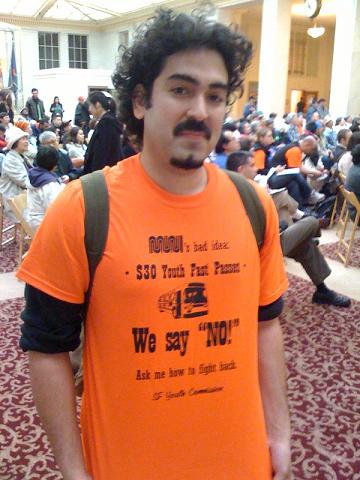
Shot of crowd at East Bay march.

And a couple photos from Brady Welch:


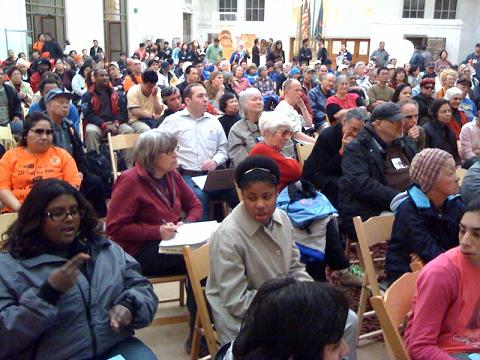
This photo (taken from inside Oakland City Hall by my friend, Deputy City Attorney Alix Rosenthal, less than an hour ago) shows a smaller than expected turnout:

Meanwhile, San Francisco Mayor Gavin Newsom has issued a statement of support for the Day of Action that begins, ““I join the thousands of students, parents and teachers across California and here in San Francisco today calling for adequate, equitable education funding for our public schools and universities.”

Newsom also opposed the Iraq War but never took part in any of the peace marches (unlike progressive members of the Board of Supervisors, who marched and gave speeches at the events), but I’m headed to the Civic Center rally soon, so I’ll let you know if he makes an appearance. We’ll have more extensive coverage of today’s events and what they mean tomorrow.

UPDATE: Guardian intern Jobert Poblete was among 150-200 people arrested in the East Bay during the Day of Action protests this evening, a group that he says including several journalists. Details are sketchy in the brief messages that we’ve had from him, but most of the arrests reportedly occurred when the protesters briefly blocked Interstate 880. They’ve been taken to Alameda County Jail in Dublin where jail personnel tell us most of those arrested are likely to be cited and released sometime tonight. Meanwhile, a 5 p.m. rally at Civic Center Plaza in San Francisco was packed with an exhuberant crowd of several thousand, the largest demonstration there in years. We’ll have a full report of the day’s events tomorrow.

Homeowners for Prop. 13 reform

32

The Chron’s headline says “most want cuts, not taxes, to fix state budget.” The story cites a new Field poll, and the Chron’s not the only paper to spin it that way. The Sacramento Bee also claims that the poll shows widespread support for cuts instead of taxes.


But the folks at Calitics drew a different, more encouraging conclusion:


The responses, of statewide registered voters:
Cuts only: 31%
Mostly cuts: 19%
Equal mix of cuts and taxes: 29%
Mostly taxes: 9%
Taxes only: 4%
No opinion: 8%
So the way this is being reported in the media strikes me as being pretty flawed. The way I read this says 61% of voters want taxes to be some element of the solution to the budget mess, and only 31% want cuts-only.


And as people take to the streets March 4th to protest cuts to education and public services, I think that message will get reinforced. I certainly hope so — and I hope when protesters are interviewed, they don’t make the mistake of saying that “there’s plenty of waste in the budget” or that resources need to be better deployed.


The truth is that we need to raise taxes, particularly on the wealthy, to close this budget gap without destroying the state. I’m a homeowner who wants higher property taxes and better schools; anyone want to join me in Homeowners For Prop. 13 Reform?

ICE postpones deporting SF MUNI worker’s family

2

I just got a call from US Immigration and Customs Enforcement advising me that ICE has decided to postpone deporting the wife and son of MUNI bus driver Charles Washington for 60 days.

“We’re hoping that postponing their removal will afford them the opportunity to get their affairs in order and address outstanding legal issues,” ICE spokesperson VIrginia Kice told me. Kice said this extension should give the family time to deal with their “pending adjustment application,” and determine “whether they have the opportunity to gain legal status.”

That’s great news for the Washingtons and another sign that may be hope, after all. (Angela Chan, staff attorney for the Asian Law Caucus, is now trying to get ICE to give the family 6 months, since this is how long US Citizenship and Immigration Service (US CIS) has told her it would take for them to process the Washingtons’ green card applications, and hopefully all the federal agencies involved are going to coordinate their efforts on this case.)

Meanwhile, Sup. David Campos is still trying to get the Juvenile Probation Department to implement his amendment to the sanctuary ordinance to stop nightmares like this from happening. Campos has scheduled a hearing at 10 a.m., Thursday March 4. So, stay tuned.

MTA board ponders bad options

2

By Adam Lesser

If Friday’s San Francisco Municipal Transportation Agency decision to cut Muni service by 10 percent was met with a backlash, it didn’t get much better this afternoon as MTA Chief Financial Officer Sonali Bose laid out further options for closing next fiscal year’s $56.4 million projected budget deficit.

One option that was very unpopular but potentially lucrative is the possibility of eliminating transfers. That’s right. Going from the Sunset to North Beach, and need to transfer from the N to the 8X? You’ll be paying twice if the MTA Board of directors goes with this option. It would generate $20.4 million to help close the budget gap.

Other proposed changes included a consolidation of transit stops in the system, charging for metered street parking on Sundays, extending meter hours into the evenings, a reduction in work orders requiring payments to other city departments, window wrapping advertising on MTA buses, and dedicated tax measures that would raise additional funding for Muni.

A further 5 percent service reduction was also not ruled out, though CEO Nathaniel Ford suggested that Bose remove it as part of the list of solutions to the budget crunch. For every 5 percent reduction in service, the MTA saves $7.2 million.

Ford tried to strike a conciliatory tone. “Last Friday was a very difficult day. People were understandably upset,” he said. “We must recognize we can only deliver the services we can afford. Going forward our choices are going to get that much more difficult.”

The criticism of the MTA Board was diverse. Tom Radulovich, Executive Director of Livable City, questioned the future of the board. “I think there’s a very good chance the MTA in it current form won’t see its 11th anniversary because it isn’t doing what voters want it to do.” Radulovich said the MTA had failed to live up to its charter mandate by not seeking new funding for the agency.

Many pro-transit groups argued that the Board should extend meter hours and eliminate free parking on Sunday. They felt the best way to promote public transportation and deal with the budget is to increase costs on drivers in San Francisco.

“There is some easily implementable low hanging fruit,” said Marc Caswell, program manager for the San Francisco Bicycle Coalition. “By increasing parking meters, you will help make transit affordable. You must extend meter hours.” Caswell suggested the board was receiving “political pressure” from the mayor’s office not to extend meter hours or eliminate free Sunday parking.

Two issues from Friday’s meeting were continued this afternoon. One was the proposal to exclude the 8X bus lines from the premium pass. Eric Williams from Transport Workers Union Local 250-A was vocal. “You’re putting these raises on the less fortunate. The 8X are coming from the Sunnydale neighborhood. They’re going to get on the local 9 and pack buses. These people are coming off housing projects to get to work.”

The second continued item surrounded the proposed elimination of free parking for employees who work at city garages, effectively charging them to park in the garage where they work. The irony of the proposal was not lost on Mission and Fifth Garage Supervisor Jorge Carrillo who showed up at the hearing to explain to the MTA board that one of his security guards will have to work 30 hours just to pay the monthly 300 dollar parking fee. “It’s outrageous. I live 50 miles away from the garage. That’s two to three hours to get home on public transportation.”

In line with projected budge deficits was a request to extend the current state of fiscal emergency through 2012. Declaring a fiscal emergency allows the MTA to avoid the California Environment Quality Act (CEQA) requirements should it decide to cut service or increase fares over the next two years.

Bose concluded her presentation with a reminder that there will be a town hall meeting on the proposals next Wednesday, March 10th at 6:00pm at 1 South Van Ness on the second floor. The SFMTA Board meets again March 30th.

Family’s deportation illustrates why Campos’ amendment is needed

7

The case of MUNI bus driver Charles Washington, whose wife Tracey and her 13-year old son face deportation on Friday after the boy tried to take 46 cents from another kid, helps illustrate why Sup. David Campos spent over a year working with local immigration experts to figure out a way to amend the city’s sanctuary policy. Under the Campos amendment, which Mayor Gavin Newsom has refused to implement, kids like Charles Washington’s 13-year-old stepson would only be referred to US immigration and Customs Enforcement after a juvenile justice determined that they were actually guilty of a felony.

Unfortunately, the city’s juvenile probation department, under Mayor Gavin Newsom’s orders, and running scared of rightwing nuts who have unsuccesfully tried to sue the city, has refused to implement Campos amendment. Campos, who spent over a year working with immigration experts to develop a measured and legally defensible amendment, has called a hearing to determine why juvenile probation is refusing to implement his amendment, which a super majority of the Board supported last year,thereby overriding Newsom’s mayoral veto.

And now, with the face of the Washingtons all over the local media, city officials are either rushing to clarify their positions, or avoiding reporters altogether, as the Washingtons fight to keep their family intact–and in San Francisco.

Sgt Tomioka of the San Francisco police Department left me a message this morning to clarify that the SFPD doesn’t refer immigrant youth to US Immigration and Customs Enforcement (ICE).

“That is not a function of the SFPD,” Tomioka said in a voice message.
And she’s right. That job is left to the city’s probation officers. But the city’s probation officers are required, under Newsom’s policy, to refer kids to ICE if the arresting SFPD officer charges them with a felony. So, in that sense the SFPD is involved in the ICE referral process, albeit indirectly.

As the SFPD’s Sgt. Wilfred Williams explained, SFPD officers make the arrests, write up the charges and transport suspected juvenile felons to the Juvenile Justice Center.

And it’s at the Juvenile Justice Center that members of the city’s Juvenile Probation Department are required, under Newsom’s orders, to pick up the phone and refer kids to US Immigration and Customs Enforcement (ICE) when kids they suspect of being undocumented are booked with felony charges.

In the case of Charles Washington’s skinny 13-year-old stepson, the kid was arrested by the SFPD on Jan. 25 and charged with felony assault, extortion and robbery. I haven’t seen a police report of the incident, yet. But Washington said it was based on what the other kid’s family told the police, and that there were no witnesses to the incident. And felony charges are all that’s needed, under Newsom’s current policy to require a probation officer to refer a kid to ICE.

And once juveniles are in the hands of ICE, a nightmarish Catch 22 kicks in, in which local protections no longer apply, and ICE’s deportation orders can trump any legal immigration application, including green card applications.

In the case of the Washingtons, the family was applying for green cards–applications that cost thousands of dollars. And US Citizenship and Immigration Services had agreed to review their case. But then came their son’s arrest by the SFPD who charged him with three felonies and transported him to Juvenile Probation, whose officers were required to refer him to ICE. And ICE, according to Washington, then used his son “as bait” to get his wife to show up at their office, where they slapped an electronic monitoring device on her ankle and gave her and her son their deportation marching orders.

Angela Chan, staff attorney at the Asian Law Caucus, and the lawyer helping the Washingtons’ negogiate their way through this immigration nightmare, clarified that USCIS isn’t refusing to consider their case, because of the stepson’s referral.
Instead, the problem is that USCIS  won’t be able to finish that process before Friday, when the Washingtons are due to be deported.

“Unfortunately, the mother and her child will be deported by ICE well before their greencard application can be processed by USCIS, which can take months,” Chan said.

Further compounding the Washingtons’ legal problems is the fact that their 13-year-old is supposed to appear before a juvenile justice on Monday (March 8) to review the charges against him.Chan said it’s likely that a juvenile justice would review the boy’s case and reduce the charges, probably requiring him to do six months informal probation. In other words, the felony charges that led to his referral to ICE likely wouldn’t be upheld in court.

Now, under the amendment that Sup. Campos authored and the Board approved last fall, but Newsom is refusing to implement, the boy’s probation oficer would not be required to refer him to ICE if the felony charges aren’t upheld. In which case, the boy would go free, his parents could continue applying for green cards, and the family could remain intact

But since ICE want to deport Washington’s stepson before his March 8 hearing, the boy won’t have his day in court. Even worse, he will likely be slapped with a bench warrant by the juvenile justice department–the kind of Catch 22 detail that will play havoc with future attempts to apply for green cards from outside the US.

I asked Lori Haley of US ICE what’s the big hurry to deport the Washingtons by Friday.
“They overstayed their visas,” was all Haley would say, along with the comment that “We don’t confirm when someone is going to be deported.”

Asked who was responsible for telling the Washingtons that they needn’t rush to apply for green cards, which is what Charles Washington said happened, Haley referred me to UC CIS, whose spokesperson Sharon Rummery said it was impossible to ascertain if a contractor with the US government misinformed the family.

‘I can’t say that it’s true or not, because it was a private conversation between one of the operators who works on our customer service line,” Rummery said. “Our operators are highly trained and are backed up by our trained officers,” Rummery continued, confirming that the operators are contractors, not US CIS staff.

Rummery offered that folks who are deported to their native country can file for a waiver of deportation and also a waiver of a ban on reentering the country.

“They have to demonstrate that an immediate relative, who has legal status, in this case the husband, will suffer severe hardship,” Rummery said. “When they are sent away, then they can apply for a waiver and return with a green card.”

But Rummery said she could not provide a reliable time estimate as to how long all this would take, nor did she know how the stepson’s felony charges and possible bench warrant would impact the family’s chances of getting a green card through this process.

So, I called Sens. Barbara Boxer, Dianne Feinstein, Speaker of the House Nancy Pelosi, and President Barack Obama’s press office to see if any of them are aware of this case and whether they would consider a private bill. As the Asian Law Caucus’ Chan explained to me, earlier today, “A private bill is when a bill is passed to grant immigration relief for an individual.  It doesn’t change SF’s policy or the way the feds are bullying us, but it may help this family.
  
No one in Boxer, Feinstein, Pelosi or Obama’s press offices was aware of this case when I called, but they all said they’d look into it,and the folks in Feinstein’s office sounded horrified that a kid could be deported thanks to a schoolyard fight over 46 cents. So, maybe there is hope after all.

To date, Mayor Gavin Newsom’s new media spokesperson Tony Winnicker hasn’t returned my calls.

But I did read that Winnicker had told the Chronicle that it was “‘an unfortunate situation for the family, and we’re sympathetic to it.”

“But [Winnicker] said the mayor is actually protecting ‘hard-working, law-abiding residents of this city, including undocumented residents’ by reporting youths after felony arrests,” the Chronicle continued.

Somehow, I don’t think that Charles Washington, a hard-working law-abiding resident of San Francisco, would agree that anybody is protecting him by deporting his wife and her two kids. Especially since the 13-year old hasn’t even had his day in court to determine if he is even guilty as charged.

And while the Chron wrote that Washington “hopes to visit them in Australia,” the Chron’s reporter must have left the press conference by the time Washington explained  how often he is likely to get to visit Australia. As Washington noted,  if you are deported, you typically have to wait 3-10 years to visit the US again.
“So, if it’s a 10-year ban, I’ll get to visit them 3 times, and if it’s a 3-year ban, I’ll get to visit them once,” Washington, who drives a MUNI bus, said.

“I refer to them as my sons, because I’m still going to be their dad,” continued Washington, who is praying for a miracle.

In the meantime, Sup. David Campos is holding a March 4 hearing before the Board’s rules committee to explore why the City’s Juvenile Probation Department has refused to implement Campos’ amendment to Newsom’s sanctuary policy. Up unitl now, Newsom’s office has claimed that taking this extra precaution would violate the US Constitution. I wonder how many families like the Washingtons are going to have to be destroyed before someone in the Mayor’s Office decides that it’s time to revaluate their position and prevent local families from get ripped apart, simply because their kids, green cards or not, insist on acting like kids.


SF leaders condemn SEIU tactics

104

San Franciscans seem to be turning against Service Employee International Union and its national President Andy Stern this week, first with the vote by SEIU Local 1021 members to oust Stern’s leadership team, and now with a letter signed by a broad array of top political officials condemning SEIU tactics against the National Union of Healthcare Workers.

As the Guardian reported last year, NUHW President Sal Rosselli and his management team broke away from SEIU’s United Healthcare Workers after a protracted conflict that culminated in a hostile SEIU takeover of the local, placing it under a Stern-controlled trusteeship. NUHW had criticized Stern’s autocratic leadership style and undemocratic methods while SEIU accused Rosselli of using union funds to undermine Stern’s decisions.

Since then, a majority of SEIU-UHW workers statewide has filed petitions asking to decertify with SEIU-UHW and affiliate with NUHW, which has won seven of the nine elections that have been held so far. So SEIU filed various complaints with the National Labor Relations Board to try to block those elections, while NUHW has complained of worker harassment and ballot meddling by SEIU.

Earlier today, SEIU-UHW sent out a press release touting an NLRB ruling that clears the way for elections at 51 facilities around the state covering 6,845 voters, blaming NUHW for “violating members’ democratic rights” in opposing those elections.

But NUHW leaders say SEIU-UHW has been “cherry-picking” selected sites where they think their chances of winning are good and keeping their NLRB complaints in place to block other sites, often dividing up bargaining units in the process to raise fears in workers that they might lose bargaining clout if they switch unions. NUHW is a relatively small organization compared to the massive SEIU.

NUHW leaders say they want a fair, up-or-down vote among all of the SEIU-UHW members statewide who have asked for elections, and they’ve asked SEIU to sign a Fair Election Agreement to prevent harassment and intimidation, something that SEIU often asks employers to sign.

Supporting that request is an open letter signed by 116 San Francisco political leaders from across the spectrum, including every member of the Board of Supervisors except Sup. Carmen Chu, Assembly members Tom Ammiano and Fiona Ma, Sen. Mark Leno, Democrat Party chair Aaron Peskin and nine other members of the DCCC, all four major candidates for the Dist. 8 Board of Supervisors seat, United Educators of San Francisco President Dennis Kelly, and representatives from a board array of unions and grassroots organizations, including UNITE-HERE, POWER, Young Workers United, Chinese Progressive Association, Coleman Advocates, and many others.

Interestingly, in addition to his critics on the left within the labor movement, Stern is also being criticized by conservatives right now after President Barack Obama appointed him to his National Commission on Fiscal Responsibility and Reform.

The Guardian has forwarded the letter and allegations to SEIU-UHW officials and is awaiting a response, which I’ll post in the comments section when I hear back.


The letter reads:

WE, THE UNDERSIGNED community leaders of San Francisco, are deeply troubled by allegations that the Service Employees International Union (SEIU) committed multiple, serious violations of state labor law during the union representation election between SEIU United Healthcare Workers – West (SEIU-UHW) and the National Union of Healthcare Workers (NUHW) for 10,000 Fresno County homecare workers this June.

These allegations, made in sworn testimony before the California Public Employment Relations Board, include that SEIU officials directed staff to open, mark, and alter workers’ ballots; threaten the deportation of immigrants; and tell workers they would suffer the loss of wages, benefits and hours to scare them into voting for SEIU. The complaint alleges further that SEIU organizers physically removed ballots from workers’ mailboxes and homes.

Caregivers in San Francisco have complained of similar intimidation and harassment at the hands of SEIU officials trying to block union representation elections requested by them and tens of thousands of other California healthcare workers who have petitioned to join NUHW.

Over the next year, as thousands of San Francisco homecare workers, private sector nursing home workers, and private sector hospital workers make their choice for union representation between SEIUUHW and NUHW, we are committed to see that these workers can make their decision democratically, without intimidation, harassment, threats or coercion of any kind, from any party.

NUHW officials have communicated to us their willingness to enter into Fair Election Agreements, which are common in California’s healthcare industry, and which SEIU officials have long championed throughout the nation, to govern their campaign conduct and protect caregivers’ freedom of choice in their upcoming union representation elections.

Therefore, we are asking that you and San Francisco’s healthcare employers join NUHW in negotiating Fair Election Agreements to establish ground rules for these elections and guarantee that workers can choose their representatives for themselves. Please know that regardless of your decision, we will stand united to ensure that San Francisco’s healthcare workers have the fair elections they deserve.

Hollis Update: Coma be gone!

0

It’s been awhile since we’ve posted news about Hollis Hawthorne, the Bay Area dancer, artist, and activist who was suffered brain injury in a motorcycle accident last year and was stranded in India until the generosity of friends, family, and strangers brought her home. Though her condition has been steadily improving since she landed at Stanford, then at St. Luke’s, and finally, at a rehab center near her family in Tennessee, progress has been painfully slow and difficult to quantify. The word from her family’s blog was all about incremental progress: slight movement in her right leg, for example, or the progression from ingesting only liquids to taking several bites of applesauce. For those close to her, and others who don’t know her but have been following her story, it’s been hard to tell exactly what this incremental progress means – and especially, now that she’s halfway across the country, what this looks like.

But the Interwebs shuddered with happy news this week as friends shared reports from Harrison, the beau who saved her life in India, who visited Hollis and her family on the anniversary of the accident:

“I am sitting here in a chair in Nashville in complete shock and amazement. Today is the one year anniversary of Diane’s arrival in India. Wednesday was the one year anniversary of the accident. I just returned from Hollis’ rehabilitation center where upon leaving I shed tears of joy.

HOLLIS IS NOT AT ALL IN A COMA ANYMORE!!!

Yes! You read that correctly! Scream, shout, jump up and down! Have a shot! Dance! Kiss somebody! It’s the real deal, seen it with mine own two eyes! She is awake and talking and present and brilliant and amazing!”

[Read more here.]

Not only is Harrison’s account particularly touching, considering the trauma he and Hollis shared, but hearing his perspective on the contrast between the Hollis of today and the Hollis he saw more than five months ago has been helpful and encouraging.

What’s next? As Harrison points out, Hollis still has a long road ahead of her. Her family hopes to get her accepted into an excellent (and expensive) rehabilitation center in Atlanta. And there’s no telling how long full recovery will take, or what that’ll look like. But those surrounding Hollis are talking hope and miracles and the strength of community, and the fact that if anyone can pull out of this, smart, sassy, stubborn Hollis can.

Jerry Brown and the Rose Bird factor

16

Jerry Brown hadn’t even formally announced that he was running for governor when the San Francisco Chronicle brought up the name of Rose Bird.


It’s fine to talk about where Brown is vulnerable, and there’s no shortage of material. The guy has a long public record; anyone who served two terms as governor in the 1970s and early 1980s, and two terms as mayor of Oakland, and one term as chair of the state Democratic Party, and did a couple of years as a KPFA talk show host, is going to have baggage. He’s also got a wealth of experience.


But the Rose Bird stuff is a cheap shot.


Here’s how the Chron describes it:


Rose Bird: As governor, Brown appointed Bird to be chief justice of the state Supreme Court. After she invalidated the death sentence of every case she reviewed, voters in 1986 made her and two others the first judges unseated from the court. To voters older than 45, Bird’s name is shorthand for “liberal judges.”


Actually, voters ousted her after a savage campaign funded by big business interests who were mad at her pro-labor and pro-free speech rulings. The death penalty was their weapon, and even then it was pretty bogus: The Bird Court consistently upheld the constitutionality of the death penalty.


But in the early 1980s, death-penalty law was unsettled in the United States; the U.S. Supreme Court had in 1977 ruled that executions were legal in America, but set strict standards for states to follow. Most states were struggling to sort out what the ruling meant and to figure out how to comply. By 1986, when Bird was under assault, 38 states had adopted death-penalty laws, but only 13 had actually executed anyone. In conservative states like Arkansas, Kentucky, Mississippi and Tennessee, judges were trying to determine if the laws fit the Supreme Court’s standards — essentially what the Bird Court was doing in California.


And in California, the death-penalty statute had been written by John Briggs, the guy who wanted to keep gay people from teaching in the schools. The Briggs law was, by all accounts, poorly drafted, unclear and convoluted, and applying it under the federal standard was a challenge.


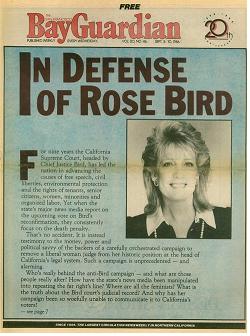
In other words, as we wrote at the time (In Defense of Rose Bird, Sept. 3, 1986):


The charge that the Bird court has refused to enforce the death penalty is simply inaccurate … the California Supreme Court has simply been doing what most state and federal courts have done over the past ten years: carefully scrutinizing death sentences to ensure that they are valid under the federal and state constitutions and complex and ever-changing standards of the U.S. Supreme Court.


The real issue didn’t make the press. Again, from our cover story at the time:


For nine years, the California Supreme Court, headed by Chief Justice Bird, has led the nation in advancing the causes of free speech, civil liberties, environmental protection and the rights of tenants, senior citizens, women, minorities and organized labor.


 Big-business interests organized and funded a massive campaign to get rid of Bird — not because of the death penalty but for purely economic reasons.


The Chronicle got it wrong back then, and is getting it wrong again today.

Jerry Brown releases forceful announcement speech

6

Jerry Brown announced his candidacy for governor by posting a three-minute speech on You Tube that was forceful and direct, making the case that California is in crisis and needs experienced, knowledgeable leadership, not an anti-government outsider who’s new to politics.

“We tried that and it doesn’t work. We found out that not knowing is not good,” Brown said in a veiled swipe at both Gov. Arnold Schwarzenegger and likely Republican nominee Meg Whitman, a former CEO with no political experience who has rarely even voted.

This speech was right on the money, and a sharp contrast to his recent Sierra Club speech, which I criticized here – demonstrating that when Brown gets his game face on, he’s still a formidable political pro.

“It’s no secret that Sacramento isn’t working today. Partisanship has become poisonous, political posturing has replaced leadership, and the budget: it’s always late, it’s always in the red, and it’s always wrong,” he said.

It was short on specifics, but that’s probably understandable at this stage. He talked about created a “leaner” state government, but also decried the cuts in education spending, and ended up staking out an interesting position on the critical issue of taxes, pledging, “No new taxes unless you the people vote for them.”

Perhaps Brown is just the guy to begin to persuade Californians that we can’t have it all, and that we’ll have to raise taxes on rich individuals and corporations if we want to do something about our underfunded infrastructure and declining public services. After all, he described our current situation as “a crisis” and said, “You deserve the truth and that’s what you’ll get from me.”

If he wins, this will likely be this septuagenarian’s last job in politics, one in which he’ll hopefully be willing to push for what needs to be done, even if that hurts his popularity. “At this stage in my life, I’m prepared to focus on nothing else but fixing the state I love.”   


Newsom’s sanctuary policy destroys MUNI worker’s family

12

“They used our son as bait, just to get the mother to come in,” Washington said.

When San Francisco native and MUNI bus driver Charles Washington married Tracey, his Australian girlfriend in Reno last April, he never imagined that she and her sons would be deported after her 13-year-old bullied another kid at school for 46 cents.

But that’s what will happen Friday, March 5, almost a year after their wedding, unless a miracle happens. And this travesty is happening thanks to Mayor Gavin Newsom’s overreaching juvenile sanctuary policy, a broken federal immigration system, and a couple who tried to do the right thing, but were told they didn’t need to apply for a green card in a hurry, when they called an immigration number for information last year.

‘What more could we have done other than call the number?” Washington asked, noting that once they were told it wasn’t urgent, they began saving up, so they could afford the several thousand dollars a green card for his wife and two kids was going to cost.


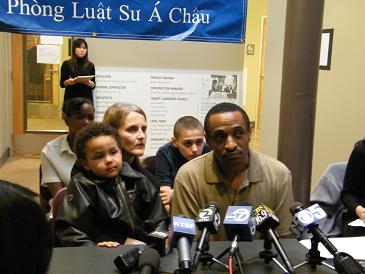
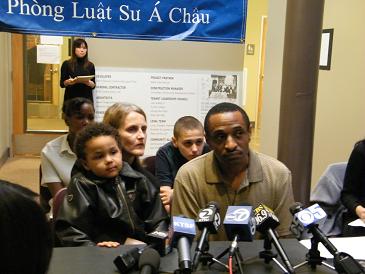
But now, thanks to a bullying incident at school, and the city’s overly draconian policy towards immigrant youth, Washington’s wife and her 13-year-old son will be deported to Australia on Friday, and her 5-year-old boy will accompany them, while Washington  stays in San Francisco to look after his 12-year old daughter (pictured in a photograph taken at the March 1 press conference at Asian Law Caucus).

“There are no laws that prevent me from going to Australia, but I have joint custody of my daughter from a previous marriage and her mother is not going to authorize the child to move, so I’m hoping for a miracle,” Washington explained.

His wife Tracey, who has been forced to wear a federal electronic monitoring bracelet since February, looked on in silence, flanked by her sons and step-daughter.

Washington, who grew up on Mt. Davidson Terrace, and was formerly in the military, had been driving a MUNI bus for a year and a half, when he woke one morning after he got home from his late-night MUNI shift, to hear the phone ringing with a call from his stepson’s school to say there where problems between him and a sixth grader.

“The school told me it was their policy to call the parents any time the police are going to talk to a child,” Washington said. Twenty minutes later, he and his wife were at the school, talking to an SFPD officer, who said a report had been filed by another parent about the incident and the police now wanted to talk to their kid.

After the interview with the police, Washington thought the worst thing that could happen was that the officer would write a citation to say his son needed to appear at juvenile court. Instead, the police arrested his stepson, putting him in handcuffs and saying that they were going to take him to the Juvenile Justice center.

“I think my son was in shock, as I was, “ Washington said. “What he actually did, and what the actual charges are, they are universes apart. Back when I was in school, at worst, a bully was sent home for the day, creating problems for them at home, when they explain to their parents why they’ve been sent home.”

Instead, Washington’s stepson was charged with felony robbery, extortion and assault after the parents of a sixth-grader at his school called the police, but his case has yet to be adjudicated by a juvenile justice, –and a bench warrant will be issued if he fails to attend a March 8 hearing in San Francisco—3 days after he and his mother are deported.

According to Washington, (pictured here (left) with Angela Chan, (right) staff attorney for the Asian Law Caucus) no weapons, no injuries and no witnesses were involved in his stepson’s incident. “And it was strictly one kids’ words against the other,” Washington said.

So, why did the police decide to refer his stepson to the federal immigration authorities?

“I think the officer picked up on the fact that he had an accent,” Washington said. “And when asked where he was born, my stepson said, ‘Australia.’ He is 13 years old. He doesn’t know if he is undocumented or not. As far as he is concerned, he was born in Australia, moved to San Francisco, and this is his family, his new family.”

Washington said his stepson was held for a week at Juvenile Hall for a week, during which the atmosphere at home became tense and stressful.

“We did not understand why this was happening,” Washington said. “Kids on my bus get on and do way worse things than he actually did, and the police usually make their presence known, but there is no worry about going to Juvenile Hall.”

But the worst was yet to come.
After his stepson had been at Juvenile Hall for about a week, Washington got a call from his stepson’s probation officer, saying that he was going to have to contact federal Immigration and Customs Enforcement (ICE).

“He said he had to contact ICE, that he was just doing his job, that it’s what’s required under his job title,” Washington said.

Under a new policy that Mayor Gavin Newsom ordered in the summer of 2008, the city’s juvenile probation officers are required to contact the feds when a juvenile is booked on suspected felony charges. This means, the probation officers are required to contact ICE before immigrant kids have even had a hearing before a juvenile judge to determine if they are in fact, guilty, as charged.

‘They didn’t say, ‘he might be deported,’” Washington said.” I was just told that there might be a ‘ICE hold put on him,’ but at this point I was still not understanding the importance of ICE.”

Once ICE picked up his stepson and transferred him to ICE’s facility on Sansome Street, Washington got a call from his stepson, who said he was OK.

“At this point, we were aware of the immigration issue, so I told my wife to stay at home and I went down there with a lawyer, and I was able to meet with my son,” Washington recalled.

But when he got back home, he received a call from his lawyer who notified him that if his wife was willing to go in and put on an electronic monitoring ankle bracelet, the feds would release their son.

“So, I drove my wife to Sansome Street, and that’s when we were informed that she was being handed her deportation orders, along with our 13-year-old son,” he said

His wife has been wearing the electronic monitoring ankle bracelet ever since.

“She wore pants today because it makes her feel ashamed, and she cries nightly over the fact that she feels like she’s being treated like an animal,” Washington said. “She says, ‘I feel like they think I’m a murderer, but I’m not, I haven’t done anything wrong.’”

According to Washington, his wife arrived in the country along with her kids on a 90-day visa-waiver, and the couple got married about 45 days into that visa.

“We had known each other for seven years, and we looked into getting a green card, two days after we were married, and we were told, not once, but twice, that if you enter on a visa-waiver, there is no deadline to apply for your green card. We were misinformed.”

But while Washington notes that the office that he spoke to was a contractor for the federal government and had its information wrong, he still can’t get over the fact that the federal government would treat him and his wife this way, using their son as bait.

‘This is all shocking to me,” Washington said. “I never dreamed America would treat not only someone from America, but someone not from America, this way. All we want is for our application to be reviewed based upon the facts. We are being told it’s too late.”

Equally upsetting for Washington was the experience of seeing his stepson used as bait.

‘They used our son as bait, just to get the mother to come in,” he said. “ Our son wasn’t there for more than 4 or 5 hours ,and we had no clue that the deportation papers would be served until we walked in. They hadn’t even put the monitoring bracelet on her. She could easily have run, but we still don’t want to break the law, regardless of the outcome. Even though we did something wrong according to ICE, it wasn’t intentionally. If we had been given the correct information, we wouldn’t be here. Yes, we couldn’t afford the money at that time, but we’d have made sacrifices.”

Washington said he is reaching out to the media in a last ditch effort to save his family.

“I don’t know any other way but to network, maybe someone might know someone else who can save my family,” he said. ‘My stepson, he’s just a nerd, he’s not a violent person, he’s not aggressive at all, he’s just being a boy, and he really hasn’t had a father figure in his life, until he moved here.”

Angela Chan, staff attorney for the Asian Law Caucus, which has been helping the Washington family try to get their green cards, said that if the son had never been reported to ICE, then the family likely would have received green cards.

“But now they are refusing to consider it, because of the ICE referral,” Chan said.

Chan also explained that if the boy was able to appear before a juvenile justice, he’d likely get informal probation for a first-time minor offense.

“He only had a hearing, but the juvenile proceedings were halted, when he got handed off to ICE,” Chan said. “The District Attorney had filed charges, but they had not yet been adjudicated, and a judge had not yet reduced the charges.”

Jane Kim, President of the San Francisco United School District said the School Board unanimously supported the amendment to Newsom’s policy that Sup. David Campos introduced last year and which a supermajority of the Board of Supervisors supports.

“We have seen how changes in the Juvenile Probation Department as of August 2008 have been used as a blunt tool to separate family members, regardless of whether the juvenile is convicted of the charges, and regardless of the family’s circumstances. And we don’t believe that the Campos amendment violates the US Constitution.”

“Newsom’s policy has put a lot of burden on our staff,’ Kim said, explaining how schools are now worried about calling the police, lest students end up being deported because the police referred them to ICE, based merely on accusations, 

“For those worried about public safety, I think this type of situation encourages under reporting,” Kim said.

Washington for his worries that his wife and her kids will be homeless in Australia.

‘My wife sold her furniture and gave up her apartment in Melbourne to come here, and her mother and father have a one-bedroom apartment, so there is no space for her and two kids,” he said

He also worries that if they ever manage to come back, his stepson will have a warrant out for his arrests:
 ‘Today we were notified that if my stepson doesn’t show up for his March 8 pre-hearing (in the juvenile justice system where the DA’s office is pressing charges), we’ll have to worry about a warrant for his arrest, which will make it even more difficult for him to move back” Washington said.

If a person is deported, they are barred from reentering the country for 3-10 years.

The Washingtons’ federal deportation will occur the day after the Board of Supervisors holds a hearing into why the city’s Juvenile Probation Department has failed to implement the city’s new policy towards immigrant youth: under the new policy, which the Board passed in 2009, a teenager like Tracey Washington’s son would get his day in court before being referred to federal immigration.

Since July 2008, when Newsom first began requiring probation officers to report all suspected undocumented youth for deportation right after arrest – before the youth  receives an attorney or a hearing on the alleged charges, over 160 children have been reported to ICE without regard to their innocence or how minor the offense.

In November 2009, a community-based based campaign resulted in the passage of a new policy that restores due process to immigrant youth. The new policy gives youth an opportunity to have a hearing and requires a finding that the youth committed a felony before any referral to ICE. If implemented, the new policy would boost public safety for all residents because it would put an end to the Mayor’s policy, which has caused immigrant residents to be afraid to have contact with city employees.

 “Until Mayor Newsom restores due process to all youth in San Francisco, many more hard-working families like the Washingtons will be torn apart,” said Chan.
On Thursday, March 4, the Board’s’ Rules Committee will hold a 10.30 am hearing at City Hall regarding Juvenile Probation Department’s refusal to implement the Campos amendment which would restore due process to youth.


Pressure builds to save Muni

5

Widespread frustration with Muni service cuts and fare hikes – passionately expressed by the public on Friday at a San Francisco Municipal Transportation Agency meeting that continues tomorrow (Tuesday, March 2, starting at noon in City Hall Room 400) – has prompted a surprisingly diverse backlash.

From angry, street-level progressive activists to the downtown-friendly San Francisco Planning and Urban Research Association (SPUR), San Franciscans are criticizing the SFMTA’s budget plan (including the 10 percent service cuts approved on Friday, which could be revisited tomorrow) as short-sighted and unnecessarily divisive, prompting the biggest and most diffuse progressive organizing effort in years.

“I’ve never seen anything like this,” SFMTA spokesperson Judson True told me as he surveyed the huge, passionate crowd assembled for Friday’s meeting, adding, “It’s clear grassroots organizing is alive and well in San Francisco.”

It’s true that grassroots organizing helped with Friday’s massive turnout, with hundreds of people lined up to give almost five hours worth of public testimony, much of it expressing frustration with poor city leadership (particularly by Mayor Gavin Newsom and his appointed SFMTA board and director) and declining public services.

But these weren’t the talking points of a centrally organized effort, which is what’s so remarkable about this movement. While many progressive groups joined forces under the Transit Not Traffic banner (coordinated by MTA Citizens Advisory Board member Sue Vaughn and others), and there’s a new San Francisco transit riders union (coordinated by transportation activist Dave Synder), the huge turnout on Friday came also from disability rights groups, ethnically identified groups from the Mission and Chinatown, the Senior Action Network, San Francisco Tomorrow, the social justice group POWER, the antiwar ANSWER Coalition, and several other groups, with very little coordination among them.

“We are really seeing a diverse group of people arguing for transit justice,” said Marc Caswell of the San Francisco Bicycle Coalition, which was part of the Transit Not Traffic coalition.

In fact, with Muni fares increasing and services declining since Newsom became mayor, a wide variety of groups seems to have figured out independently that there’s something seriously wrong with Newsom’s no-new-taxes approach to running the city, particularly given declining transit funding from the state and feds.

“These aren’t solutions. They’re just pitting one group against another,” said Frank Lara of the ANSWER Coalition, which opposes a proposal for extended parking meter hours, much to the chagrin of progressive groups who want motorists to help close the budget gap by giving up their free parking on Sundays.

One SPUR proposal also seeks to eliminate this pitting of groups against each other, listing as its biggest dollar proposal the elimination of work orders from the San Francisco Police Department, which would save $12.2 million per year, which the SFPD charges SFMTA for unspecified services that it has yet to document, despite agreeing to as part of last year’s budget deal.

When asked about the work order proposal, Newsom press secretary Tony Winnicker said doing so would make Muni less safe by discouraging officers from riding buses, saying such work orders were a “good accounting practice” rather than the budgetary shell game that progressive supervisors and SPUR director Gabriel Metcalf have called it.

“The gamesmanship with work orders has got to stop,” Metcalf told the Guardian, criticizing the SFMTA for cutting service across the board and raising fares for express bus service and cable cars. “They don’t have to do that and they shouldn’t do that. They just need some political courage right now.”

The next largest SPUR proposals are to charge $300 per year for disabled placards that allow drivers to park for free (which would raise $10 million per year) and to enforce existing city codes that require garages to charge by the hour rather than all day (which would raise $6.85 million), followed by Muni work rule changes that would need union approval.

Winnicker said Newsom was aware of the big turnout on Friday and the anger voiced by the crowd, telling us, “He understands people are concerned and he shares those concerns.” But rather than accepting that many people blame Newsom, Winnicker blamed Muni’s Transportation Workers Union for voting down about $5 million worth of wage concessions and work rule changes. Yet many speakers criticized Newsom’s finger-pointing on Friday, saying he and the SFMTA were too focused on targeting workers rather than the downtown corporations that Newsom has refused to adequately tax.

“There was already a fare increase last year, so for the low-income popular, this is major,” Wing Hoo Leung, vice president of the Community Tenants Association, told me in Mandarin, translated by Tan Chow, an organizer with Chinatown Community Development Center. “In a bad economy, the low-income people can’t get hit again and again. We need to cut from the top.”

Tax measures will be a big part of tomorrow’s SFMTA discussion of the $100 million budget deficit looming for the next two years – such as a parcel tax, downtown transit assessment district, parking tax increase, or local vehicle license fee — and several SFMTA board members agreed with the statement made Friday by Trustee Malcolm Heinicke that, “We need to look for other sources of revenue.”

Even Winnicker said Newsom acknowledges the need to discuss tax measures, even though he philosophically opposes them: “He understands that many things have to be on the table to close next year’s budget gap.”

But he’s far from advocating for any revenue-side solutions.

“The mayor doesn’t think the tax measures will have much public support,” Winnicker said. Yet progressive groups say that’s because Newsom has undermined people’s faith in local government and actively opposed tax increases rather than trying to make the case to the public that they’re needed to present public transit and other vital services.

“Newsom has to be out there fighting, one at the state level, and he needs to show some leadership here,” said Bob Allen of the group Urban Habitat. “I don’t want to hear Gavin Newsom say again that this is a transit-first city if he’s not going to do anything to support it.”

But Allen said that if Newsom and other city leaders made the case for new taxes to support transit and ran a strong campaign, “This city will support a ballot measure to protect Muni and expand it.”

Yet right now, he said one of the things frustrating low-income San Franciscans is there is a basic inequity between motorists and Muni riders: “If parking is going to be free on Sunday, transit should be free on Sunday. If parking is going to be free in the evenings, transit should be free in the evenings.”  

Newsom has long voiced opposition to extended meter hours, only recently softening that position slightly to possibly allow for a small pilot program for Sundays. But his appointed trustees might be willing to go even further, with Bruce Oka saying on Friday, “I know the mayor doesn’t like it, but it has to be tried.”

It’s so easy to go after public employees

4

The always-insightful Robert Cruickshank has a fascinating piece on Calitics today talking about the investigative reports showing that some state employees save up all their vacation time and get big payouts when they retire. It’s true that some state workers walk away with upwards of $100,000, and it’s true that it pisses people off, and it’s true that there probably ought to be some reforms that limit the amount of vacation time you can save and cash in.


But as Cruickshank notes, the payouts have cost the state $486 million since 2006, and:


$486 million sounds like a lot of money. But that is just 2.43% of the current $20 billion deficit. In other words, if we had eliminated that practice in 2006, or capped it, the budget deficit would not be meaningfully impacted. In fact, given that we’ve had about $60 billion in budget shortfalls since 2007, these vacation payouts are 0.81% of the overall deficit.


He explains:


Of course, these kinds of articles help build a larger narrative that the budget problem is in large part caused by greedy public sector workers who are paid too much. The actual numbers here indicate that the vacation payouts are not a meaningful part of the budget problem at all. Similarly, Meg Whitman’s desire to layoff 40,000 state workers would probably save about $2.5 billion (assuming those workers make the state average). That’s a bigger chunk of the projected $20 billion deficit, but it’s still only 12.5%. Whitman and other critics of public employees need to come up with solutions for the other 87.5% of the deficit.


Maybe one place to start is by looking at how the rich evade their tax obligations. Last week the LA Times’s Michael Hiltzik showed that Frank and Jamie McCourt paid no federal or state income tax between 2004 and 2009. Many wealthy Californians and large corporations have similarly evaded taxes.


So why do the relatively minor excesses by state employees get much more press attention that the vast cheating and looting of the public treasury by the rich and by big businness? Well, after 30 years in journalism, I can tell you one reason:


It’s easy.


State employee payrolls are public record. It’s easy to find out how much overtime Muni drivers make, or how many city workers earn more than $100,000 a year, or what the firefighters contract allows. Editors love these kinds of stories, because they always stir up populist indignation and outrage.


I’ve done it myself. We all do.


On the other hand, try to figure out how a big commercial property owner is using complicated stock transfers to hide a change in ownership and avoid tens of millions of dollars in property-tax liability. It’s a bitch. That kind of work takes weeks, months of investigation and requires some sophisticated legal and financial knowledge. See, the private sector — particularly the folks who are hiding behind tax shelters and scams — is big on secrecy, and the laws don’t help reporters.


Investigative reporting on the private sector is expensive. And in these days of diminished news budgets, not that much of it happens any more.


So the message you get in the press is that public employees are busting the budgets, and if we could just quit paying them so much money all would be fine. And the real budget busters, the real scam artists, the real crooks who are sucking the public treasury dry … they just keep right one going. And nobody’s paying attention.

SEIU members oust the old guard

0

In a stunning repudiation of the union leadership installed by Service Employees International Union President Andy Stern – whose autocratic style, aggressive expansion, and friendly relationships with big employers has caused a rift in the national labor movement – members of SEIU Local 1021 have voted overwhelmingly for a reform slate of new leaders.

As we wrote recently, the stakes were high here in San Francisco, where the old guard leaders threatened to undermine the union’s progressive tendencies just as Mayor Gavin Newsom is threatening mass layoffs and pay cuts for city employees, and the San Francisco Labor Council’s ideological balance was being tipped by the pro-development push of the building trades.

But the results couldn’t have been more clear in the first local election since Stern installed the Local 1021 after merging 10 union locals together, including the former Local 790, which represents most city employees. Stern’s whole slate was voted out by a substantial margin, including current President Damita Davis-Howard, who had 1445 votes to the 2141 votes garnered by Sin Yee Poon, who now takes over the top spot after having led SF Human Services Agency workers.

Also pushed out was James Bryant, a political ally of Newsom and enabler of Pacific Gas & Electric and other downtown power brokers, who was defeated in his run for Political Action Committee Chair. Alysabeth Alexander, who is in her 20s, beat him by a vote of 2552-1506.

The vote will certainly strengthen the hand of progressives in San Francisco going into what’s expected to be a tough budget fight with Newsom, as well as helping progressive supervisorial candidates in the November election against what is expected to be a strong push by downtown to break the progressive majority on the Board of Supervisors.

In addition, it could roil SEIU’s internal politics after a turbulent year, in which Stern created divisive clashes with his own local health care workers (causing Sal Rosselli to create the rival National Union of Healthcare Workers), UNITE-HERE, and the California Nurses Association.


The press release from the winning reform slate follows: 

Reformers Sweep in SEIU 1021 Election; Members Vote for Transparency and Democracy for Northern California’s Largest Public Sector Union 

On Friday, thousands of public sector votes were counted to determine the future leadership of one of the largest unions in Northern California.  This is the first election for SEIU 1021, formed only three years ago after the merging of 10 locals.

The reform slate, Change 1021, swept the elections taking a clear majority of the executive leadership seats. This all-member slate easily defeated the former administration-appointees by the International SEIU.  Some candidates won by a 3 to 1 margin while others enjoyed a comfortable 2 to 1 lead on their opponents. See attached list of election results.

“We are excited about the opportunity to give the leadership of this Union back to the membership,” stated Karen Bishop, the San Francisco County Area Representative Elect.  Former San Francisco Board of Supervisors President and current Chair of the San Francisco Democratic Party  Aaron Peskin agreed, affirming, “It is very heartening to see that real democracy has prevailed.”

Change 1021 campaigned on a platform for reform, seeking a stronger union that would prioritize member representation at work sites; fiscal transparency; and an internal democratic structure. “Members spoke with their votes, sending a clear message about priorities,” said Roxanne Sanchez, President Elect.

The challenges for the new board are daunting-they must reunite and reinvigorate a membership hit hard by the economic downturn, with thousands to receive lay-off notices this week.  The Board Elect is ready to make the budget fight a priority to fight layoffs and preserve important public and non-profit services for our communities.

 “Our members have spoken, loudly and clearly, that business as usual is absolutely no longer tolerable and that a fundamental change in the focus of our union towards the needs and priorities of our members are in prompt order,” says Sin Yee Poon, Chief Elected Officer Elect. For now, there is cause for celebration as the congratulatory calls have been flooding across California from members, elected officials, labor leaders, and community partners.

Newly  elected members will assume office at the next Executive Board meeting, March 9th.   International Union leaders are expected to be in attendance.           

Change 1021 Candidates who were elected are: Chief Elected Officer, Sin Yee Poon; President, Roxanne Sanchez; First Vice President, Gary Jimenez; Second Vice President, Crawford Johnson; Third Vice President, Larry Bradshaw; Secretary, Pamela Morton; Treasurer, Kathy O’Neil; Political Action Comm. Chair, Alysabeth Alexander; Social & Economic Justice Comm. Chair, Gladys Gray; Capital Stewardship Comm. Chair, Harry Baker; Cities Industry Chair, Renita Terry; Counties Industry Chair, Ken Tam; Special Districts Industry Chair, Saul Almanza; Schools Industry Chair, Mynette Theard; Sacramento County Rep, Ken Bloomberg; Registered Nurses Industry Chair, David Fleming; City & County of SF Industry Chair, Kathy Basconcillo; San Francisco Area Reps- Karen Bishop, David Turner, Jacqueline Sowers; Alameda County Area Reps,- Amy Dooha, Eric Stern, Gregory Correa; Sonoma County Area Rep, Nancy Atwell; Budget & Finance Comm Region 3, Michael Tong; and Budget & Finance Comm. Region 4, Mary Jane Logan.

The Chronicle’s dishonest hit on district elections

8

The move to get rid of district elections – which is based entirely on the fact that big business and more conservative voices (including the Chron) don’t like the progressive policy positions of the current board – is now well under way. The Chron devoted its Insight section to the issue Feb. 28, leading with a long editorial that wandered back and forth between points and never really made the case.


An example of the Chron’s logic:


But sitting atop the decision-making tree [in San Francisco] are small-time politicos, some elected with fewer than 10,000 votes in a city with a population of 808,976.


Horrifying! It’s as if the United States Congress – which has to decide issues like war and peace — was made up of local politicos who were elected with as few as 100,000 votes in a nation of 350 million.


Or as if the California Assembly – which has to deal with a $28 billion budget deficit – was made up of local politicos who were elected with as few as 50,000 votes in a state of more than 35 million.


A district supes votes could represent about 1.2 percent of the entire city. A state Assembly member could represent only 0.1 percent of the population of the state. And yet, I don’t hear the Chron calling for the state Assembly to be replaced with an at-large body.


More:


A town with sweeping plans to develop two empty Navy bases at Hunters Point and Treasure Island, fill vacant offices with new jobs, and cut its budget by more than a half billion dollars isn’t getting the thought, expertise – and citywide vision – it needs for these challenges.
This lack of broad leadership obstructs the city’s future. A major cause is the district election system that magnifies neighborhood and tight-knit interest groups to produce officeholders with little stake in citywide questions. If all politics is local, as former House Speaker Tip O’Neill famously declared, then San Francisco has pushed this dictum to the max. It’s all about me and my neighborhood.


That’s absolutely, factually untrue – the district elected board has done more to advance citywide issues – from minimum wage to health care to the rainy day fund to infrastructure planning – than any at-large board in the previous 20 years.


And the Chron’s own editorial contradicts that argument:


Supervisor David Campos (a winner with 9,440 votes) led a move to keep illegal immigrants who are juveniles accused of felonies from being turned over to federal authorities, despite a city legal opinion that the idea wouldn’t fly. Supervisor John Avalos (6,918 votes) dreamed up the “must spend” order directing the mayor to maintain expenditures in a record deficit year. Thankfully, he dropped the idea at the 11th hour


Okay, I get that the Chronicle editorial board doesn’t like the Campos sanctuary bill or the Avalos must-spend legislation – but that are both citywide issues. They have nothing to do with “me and my neighborhood.”


Which is really the entire point here. The Chron doesn’t like the outcome of district elections – because over the past ten years, the progressives have shown they can win district races. There’s a good reason for that; in district races, you don’t need to raise huge amounts of money.


As Assemblymember Tom Ammiano and Supervisor David Chiu point out in an opposing editorial:


Part of that increased accessibility to government is the result of the decrease in the cost of running a district versus a citywide election. In the 1994 citywide elections, the average winning candidate spent $456,000 in today’s dollars. That’s 225 percent greater than the amount spent today: In 2008, the winning candidates spent an average of $204,000. Candidates needing to raise money for a citywide race will inevitably turn to special interests for contributions. If you believe elected representatives should speak up for people, not just the special interests that donated to their campaigns, today’s district system serves you better.


They also note:


Before district elections were passed, under a citywide election system, many neighborhoods – the Excelsior, the Sunset, the Mission and Bayview-Hunters Point – had no supervisor of their own. Today, all residents can pick up the phone and reach an office responsible for their neighborhood and responsive to their concerns – a broken streetlight, a dangerous pothole or a consistently tardy Muni line.


A lot of people don’t like Chris Daly’s personality, and some don’t like his politics, but if you’re a person living on SSI in a grubby little hotel room in the Tenderloin and you need help, you can walk into his office and get a welcome reception and assistance with your needs. You won’t get that from the mayor.


On the other hand, do you think, Don Fisher ever needed to stand in line and try to make a 15-minute appointment to talk to Gavin Newsom? Seriously?


And while we’re on the personality stuff: Yeah, some of Daly’s antics have been over the top. But he’s no worse than some of the others who have served on citywide boards. Former Sup. Bill Maher once accused one of his opponents of having a small penis, and waved around two fingers spread about an inch apart to the press and public.


More important, we had supervisors who did nothing. We had supervisors who did exactly what the mayor said without any question. We had supervisors who were wholly-owned subsidiaries of major local corporations. I’ll take Chris Daly over those folks any day.


By any rational standard, the district board over the past ten years has been more productive, more accountable, more representative and more accessible than any at-large board I’ve seen in my almost 30 years of covering this city.


So the Chron needs to shut up about “citywide perspective”’ and personalities. If the paper wants to oppose district elections, it needs to drop the poll-tested downtown talking points and tell the truth:


The current board is too liberal for the Chron. The moderate candidates the paper prefers can’t win in districts. So they want to change the rules.


That’s the story, beginning, middle and end.


Marching on Sacramento

15

Angry parents, hundreds of them, met in Marina Middle School to demand an end to cuts in education.

Angry Muni riders, hundreds of them, jammed City Hall to oppose Muni fare hikes and service cuts.

Angry students from the University of California — thousands of them — will hold a huge event March 4th to push for better education funding and lower fees.

There’s something going on here — because in every case, grassroots activists in huge numbers (numbers that dwarf the so-called Tea Party events) want to force the state of California to change its budget priorities. And they are starting to talk seriously about taxes.

The Republicans are pretty intransigent up in Sacramento. But if these groups — the public school parents, the UC students, the transit users and the wide range of other middle-class folks who are sick to death of California’s budget mess and how it’s screwing them — could start working together, we could see a powerful coalition emerging.

And what that coalition needs to do, among other things, is push for Assemblyman Tom Ammiano’s legislation to change Prop. 13 and Sen. Mark Leno’s efforts to allow a local vehicle license fee, and a Constitutional amendment to get rid of the two-thirds majority for budget approval and tax hikes.

The Republicans have all signed this no-new-taxes pledge and it’s going to be hard to move them. Any attempt to change Prop. 13 will be met with huge opposition from big business. I used to think that it was hopeless even to talk about that … but maybe it’s not. Maybe if everyone who’s angry about government cuts understood that the only way to solve the problem in the end is to allow local government to raise money for the schools through property taxes, and allow state government to raise income taxes on the rich and impose taxes on big businesses, we’d be able to build a movement that could make some progress.

It’s worth thinking about.


PG&E’s laughable Prop 16: Who needs friends when you’ve got $35 million?

Last month, when the Guardian sent an intern to cover a debate between Pacific Gas & Electric Co. spokesperson David Townsend and California Sen. Mark Leno, the reporter was ejected from the event at Townsend’s request.

I figured I’d be immune from such nonsense when I ventured to the state capitol yesterday for a joint informational hearing about Proposition 16, the ballot initiative that PG&E has bankrolled for the June ballot for the purpose of extinguishing competition in its service territory. The initiative would establish a two-thirds majority vote before any municipal electricity program could get up and running, and its sole sponsor is PG&E.

But just after I snapped a photo of Sen. Mark Leno and Assemblyman Tom Ammiano chuckling sardonically at a PG&E executive who had mistakenly referred to the ballot initiative as “Prop 13,” a guard swooped in and ordered me to stop photographing and turn off my voice recorder.

I shot him a dirty look at first, but then realized that I could wind up meeting the same fate as our unfortunate intern if I didn’t cooperate. He informed me that it’s protocol to provide advance notification before photographing or recording a public meeting at the capitol (despite the fact that the hearing is televised and open to the public). Then he asked for my name and affiliation, and said he would have to ask committee members for permission before he could allow me to do any more recording or photographing. Presumably, the decision would be based on who was asking. He vanished and, a few minutes later, returned to say that the answer was “no.”

Thus, I was reduced to frantically scribbling down notes, which means the exchanges transcribed below aren’t as complete as they could be. (Anyone know of an acupuncturist who can soothe muscle stiffness in the forearm?)

Yesterday’s hearing made it clear that PG&E has little support for the ballot initiative other than its own war chest of funding, and it’s royally pissed off the Legislature besides. PG&E Senior Director Ed Bedwell blushed a bright red hue more than once when he was assailed with statements such as, “Alienating those who are usually in your camp is not a good sign,” an admonishment delivered by Assembly Member Tom Ammiano when pointing out that not even California’s other investor-owned utilities are behind the initiative.

Apparently, not even the Republican members of the Senate Energy, Utilities and Communications Committee and the Assembly Utilities and Commerce Committee could stand the smell of the PG&E’s bullshit, as every one of them had walked out of the room by the end. Not a single member of either legislative committee had a positive word for the proposition, but Assembly Member Jared Huffman plainly stated his opinion: “I think this is a terrible initiative.”

Nor was there any evidence of the “coalition” supporting Prop 16 that the PG&E-funded public relations firm that orchestrated this campaign claims exists. Every single member of the public who commented voiced strong opposition, and most had traveled there on their own dime.

Even the conservative-leaning Agricultural Energy Consumers Association, which represents 40,000 growers, is against it. “It would have a chilling effect on the farming community,” Michael Boccadoro of the Agricultural Energy Consumers testified. A representative from the California Chamber of Commerce spoke in favor, but local Chambers of Commerce are not unified in their support.

Paul Hauser, of Redding Electric Utility, testified that if customers in his territory —  which has been slammed with high unemployment — were paying PG&E prices instead of the municipal electricity rates, every single man, woman, and child would have to fork over an extra $440 per year.

The Pacific Gas & Electric Corporation, which is the parent company of the regulated Pacific Gas & Electric Company, has vowed to spend $35 million on Prop 16. Since the corporation derives all of its funding from the company, which is regulated by the California Public Utilities Commission and earns its money through customer billing, this means that every PG&E ratepayer is pitching in. Speaking of bills, PG&E rates will increase 30 percent by 2013 if PG&E is granted its requested hikes, according to The Utility Reform Network.

“Maybe it’s time the Legislature took a very hard look at whether that parent corporation needs to exist,” Boccadoro, of the agricultural group, commented. “Maybe it’s time for a vote on rate increases as well.”

One point that came up over and over again during questioning was the fact that instead of proposing changes to legislation, PG&E sought to use the initiative process to get its way, a move that Leno argues is flouting the democratic process. A second point was that its move is inconsistent with a statute that requires utilities to “cooperate fully” with community-choice aggregation programs. Below are some exchanges between members of the Legislature and Bedwell, the PG&E executive.

Leno: Can you describe to us how Prop 16 exemplifies your abiding by the statute of AB 117 in “cooperating fully?”
Bedwell: Can you repeat that?
Leno: (repeats language of statute)
Bedwell: … “I don’t see how that’s necessarily inconsistent. The cooperation aspect is in the implementation…”
(Leno takes issue with this, saying that they could have proposed that such language be included in the bill at the time it was being drafted. He points out that Prop 16 would present a “hurdle” to municipal power programs, and asks Bedwell if he agrees.)
Bedwell: Says he thinks it would create “a high bar.”
Leno: “A high bar. How is a high bar in any way consistent with ‘cooperate fully?’”
Bedwell: … “I don’t see it’s a matter of cooperation or lack of cooperation. …”

Bedwell: “We value our customers. I think you know through the last six or seven years in San Francisco, you know that we’re very committed to retaining our customers.”
Leno: (Explains that he is a PG&E customer in San Francisco, and a Sacramento Municipal Utility District [SMUD] customer in Sacramento.) “I pay PG&E 25 percent more, and I get more green power here in Sacramento. [In PG&E’s San Francisco territory] my business suffers regularly from blackouts. I’ve never had a blackout here in Sacramento.”

Concerns raised about City College-Foundation pact

0

By Jobert Poblete

At its meeting yesterday, the City College of San Francisco Board of Trustees discussed a new draft agreement with its fundraising arm, the Foundation of City College of San Francisco. As reported in this week’s Guardian, the foundation is seeking greater autonomy from the college. The CCSF trustees limited their discussion to proposed changes to the draft agreement, but a final decision may be reached as early as next month in advance of the foundation board’s March 16 meeting.

City College trustee John Rizzo, who was part of the task force that drafted the agreement, explained that the new deal would give the foundation control of all funds except for $3 million raised by CCSF departments and faculty. Rizzo also said that the CCSF task force pushed the foundation to shift its focus from scholarships to saving classes and to operate with a level of transparency beyond the minimum required from nonprofit organizations.

Budget deficits have led to the cancellation or elimination of 1500 sections, including all 2010 summer classes, at CCSF. The draft agreement would require the foundation to consider sources and new fundraising that could be used to fund classes and programs, but trustee Steve Ngo called for a stronger commitment from the foundation to tap existing resources, including investment gains and restricted funds.

Hal Huntsman, president of the CCSF Academic Senate, presented the trustees with a resolution from the Senate’s executive council recommending that the new agreement not be approved without shared governance review and approval. Huntsman also raised concerns about changes to the foundation’s bylaws that would give representatives from CCSF’s academic and classified senates seats on the foundation board, but with one-year terms instead of the customary three years.

Trustee Lawrence Wong raised the possibility of asking the foundation for more time to discuss the issues raised at the meeting and to allow the shared governance bodies to weigh in. Chancellor Don Griffin reiterated the need to solicit buy-in from the college’s constituent bodies but called on the board to stay on schedule. “The board has spent a lot of time on these negotiations,” Griffin said. “And I think we’re 99 percent of the way there.”

A committee made up of representatives from the college and the foundation will meet again this month or early March. The CCSF board may then call a special meeting to vote on the agreement in advance of the foundation board’s quarterly meeting on March 16.

Who cares about SF’s (black and brown) prisoners? Part 2

2

Eileen Hirst of the San Francisco County Sheriff’s Office just sent me statistics that prove that the majority of folks sitting in our county jails are black men awaiting trial — statistics that underscore the extent to which the “let’s not rebuild the prison” debate really is racially tinged:

“On any given day, we have about 2000 to 2100 people in custody,” Hirst said, noting that the two jails at the center of the debate only house male prisoners.

The biggest group in custody, Hirst said, are African American (58 percent). Next come Caucasians (18 percent), Latinos/Hispanics (15 percent), Asians (4 percent) and others (4 percent).

The overwhelming majority are male (87 percent).

And the vast majority (80 percent) are simply awaiting trial.
”Only 20 percent of the jail population is sentenced,” Hirst said.

So, does this mean that the nine supervisors who voted this week for a $412 million seismic safety bond that won’t upgrade these jails are racist?

No, but it does suggest that they believe that voters won’t support a bond that uses money to help build safe facilities to house black men in custody. Instead, the $412 million bond they voted to place on the June ballot will be used to build a new police command center, and retrofit firehouses and secure their water supply.

“No one is saying that we’re not going to rebuild the jails, but they are going to do the project in phases, and this bond represents the first phase,” Hirst said.

She noted that two previous attempts to pass bonds to rebuild prisons failed to get the required two-thirds of voter approval.

(In 1992, 57 percent of voters approved a $158  million general obligation bond, ten percent short of the needed 67 percent. Two years later, in 1994, only 54 percent of voters approved a similar bond, only know the same project’s costs had expanded to $195 million.)

‘And at that point we were under a federal court order to rebuild the jails,” Hirst said. She recalled how hot water had to be pumped in from a flatbed truck parked on the front lawn in front of those facilities that lay just two football fields away from the San Andreas fault, and that they have since been rebuilt.

Hirst said community groups went out with huge photos of those poor conditions, but the public still didn’t vote to support the bond, and the jails eventually got  rebuilt through a “certificate of participation” financing mechanism that Monique Moyer (who was then mayor Willie Brown’s director of public finance) came up with.

“So. I don’t think we are not going to rebuild,” Hirst said. “But we do operate in a landscape of competing priorities.”

Transit activists swarm City Hall

0

Hundreds of transit supporters, angrily opposed to the package of Muni fare hikes and service cuts proposed to close a $16.9 million mid-year budget deficit, are now packed into City Hall demanding equity and justice.

“I’ve never seen anything like this,” Judson True, spokesperson for the SF Municipal Transportation Agency, told me as he surveyed the huge overflow crowd packed into South Light Court, watching the upstairs budget meeting on closed circuit television. “We should all get on buses and go to Sacramento. It’s clear that grassroots organizing is alive and well in San Francisco.”

It may be true that budget cuts and lack of political will to raise taxes in Sacramento helped cause this problem, but this crowd was angry and they directed most of that ire at the MTA board and the man who appointed them, Mayor Gavin Newsom.

Even True wasn’t spared, as college student Glo Pereira laid into him as we spoke: “I’m a person who doesn’t appreciate this,” she glowered.
That was the dominant mood among the wide coalition of groups represented here today, including a strong presence by communities of color, those with disabilities, and social justice groups.

MTA spokesperson Judson True is confronted by activist Glo Pereira

“You folks should resign! You aren’t doing your job and you haven’t done your job,” activist Bob Planthold told the board. “This is an agency run by one man, Gavin Newsom, in the interests of one man, Gavin Newsom.”

That’s a common theme, one of complete exasperperation, with regular calls to tax the rich and lay off the poor, and for more engaged leadership from the Mayor’s Office.

As I write, there’s still lots of public testimony to go before the board deliberates and votes, so check back to this blog post, which I’ll update periodically.

Update: The MTA board seems to have heeded much the public input, voting 6-1 (with Trustee Cameron Beach in dissent) to remove the increases in Fast Pass fares for youth, senior, and the disabled and to approve the rest of the fare increases, which will increase prices for express buses and cable cars. That package was then approved on a 4-3 (with McCray, Lee, and Beach in dissent, although they didn’t make clear the reason for their votes).

Similarly, another 4-3 vote by the same trustees approved a package of service reductions that total about a 10 percent overall cut, although there was a consensus direction for the board to try to spare cuts on the busiest lines, including 14, 49, 30, 38, M, and the Owl, as well as ensuring nightime cuts are minimized. Overall, the results of the vote weren’t entirely clear and the meeting wasn’t formally adjourned, but instead will be recessed until Tuesday when the board will discuss the larger budget picture going into the next fiscal year.

At that time, the board will consider placing a parcel tax or other new revenues measures on the November ballot, something that seemed to have the support of most board members. In addition, Director Malcom Heinicke today outlined his support for a extended parking meter hours, which he would like to see done as a pilot program along five or six selected commercial corridors on Sundays and on a single commercial corridor on weeknights until 10 p.m. Several board members voiced support for the idea.

While today’s vote didn’t close the $16.9 million deficit that was the purpose of this meeting and the public testimony that went for nearly five hours, MTA executive director Nat Ford noted that “there is some softness” in the revenue picture, including the possibility of getting a $7 million from the Board of Supervisors and using a greater portion of the $17 million windfall that the MTA received after the feds decided to discontinue the Oakland airport connector service on operations rather than maintenance, as staff had proposed. In addition, the MTA board is currently discussing a privatization plan for taxi medallions, which could affect the revenue picture.

I’ll try to help sort this out with another post before day’s end, including more testimony from the occassionally raucous meeting, but it appears that this meeting essentially ended with a “To Be Continued,” and the board will pick up where it left off on Tuesday, when the big new revenue proposals (which Mayor Gavin Newsom has resisted supporting) could be at the very center of the debate.


How the UC regents avoided a PR mess with Bill Clinton

0

Things were calm and peaceful outside San Francisco’s Fairmont Hotel, perched high atop a windy hill on Mason Street, as dark shiny vehicles rolled up to the stately entrance and well-dressed patrons filed in on the evening of Feb. 24. They were there to hear former President Bill Clinton deliver a speech titled “Don’t Stop Thinking About Tomorrow: Building a Better World,” as a benefit for the American Himalayan Foundation. The AHF is chaired by Richard Blum, a member of the University of California Board of Regents who is married to Sen. Diane Feinstein.

As guests arrived, a small group of workers tried to thrust neon green fliers into their hands. The fliers were headlined, “Tell Richard Blum to Stop Poverty at UC!” and charged that the UC Regents had approved a package of raises for UC executives on Jan. 21 even as front-line UC workers faced layoffs and cuts. The stack of Xeroxed fliers was a mere blip compared with what AFSCME Local 3299, the union that represents workers throughout the University of California system, had originally planned.

The union had organized a picket against Blum’s AHF event, which would have forced Clinton to cross a picket line in order to go in. Not only would this have created an unwanted spectacle, it could have marred the entire event. As AFSCME Local 3299 member Tim Thrush put it, “Bill Clinton is a friend of labor. AFSCME has worked with him a lot in the past … And Clinton will not cross the picket line.”

UC workers have been reeling in the face of massive layoffs and budget cuts. While the university administration contends that there is little it can do in the face of a decimated state budget, union workers point to examples of privatization on the UC campus as an alarming trend that is supplanting public-sector jobs and eroding California’s renowned public-education system.

AFSCME Local 3299 laid out three demands, according to organizer Danielle DiSilverio. While two — involving benefits for custodians at the Irvine campus and concerns about “reductions in time” at the Santa Cruz and San Diego campuses — have not been met, they did secure an agreement to abandon a plan to contract out jobs for shuttle drivers at UC Berkeley. Since the UC Berkeley shuttle drivers would be able to keep their jobs, Local 3299 called off the picket.

“We would prefer to not have to do this kind of stuff,” Thrush told the Guardian. “But unfortunately, in the world that Dick Blum operates in, we can’t get his attention unless we do stuff like this. As he works hard on poverty issues and gives money and time to poverty issues, he also makes decisions at UC that further the poverty problem of our lowest-paid workers. We want to keep reminding him that it’s not OK to do that.”

Who cares about San Francisco’s (black and brown) prisoners?

0

I knew Sup. Chris Daly was going to get slammed for his Feb. 23 vote against placing a $412 million earthquake-safety bond measure on the June ballot. I knew it when I heard him say the following: ”I care more about the people at the jail, the people who are there involuntarily, if we have a seismic incident, then I do about the rest of the people at 850 Bryant.”

Daly noted that he would have supported the bond package if it included money for new lockups, as was originally proposed.

‘What about the people in the jails?” Daly asked. “These are San Franciscans, my constituents, folks who are disproportionately people of color, folks who are disproportionately low-income and have been caught up in the criminal justice system.”

What I later discovered  was that several key figures in the local prison reform movement, including Dorsey Nunn of Legal Services for Prisoners with Children and Rhodessa Jones of the Medea Project, a visionary theater model for incarcerated women, were sitting in the Chambers, awaiting commendations as part of the city’s ongoing Black History Month celebrations.

Later that same afternoon, Sup Ross Mirkarimi honored Jones (left) and Idris Ackamoor (right) for their work with Cultural Oddysey. And afterwards, I caught up with Jones by phone to see what she thought of the plan not to rebuild the jails on Bryant Street , a decision apparently made to reduce the price of the city’s proposed seismic safety charter amendment by $250 million.

Jones, who conducted a residency at San Francisco county jail that resulted in the Medea Project, told me that these kind of inequitable decisions illustrate why she got motivated to do work inside jail, in the first place.

“When we walk into the jail, we try to educated the prisoners that they have no rights and no safety,” Jones said. “We are trying to find ways to infuse their lives with the political reality and end recidivism.”

She also noted that she has not been able to take the Medea Project inside the local jail because it’s gotten so crowded.

But last time she was there, the women were primarily black and brown and, according to Jones, “they are the fastest growing number inside.”

Jones, who is currently working on the issue of reparations and “how the prison-industrial complex looks so much like slavery,”  told me that in the 20 years since she began the Medea project, she’s learned that figuring out the questions around any issue is central to understanding it.

“So, are these folks not human beings as well? How do we transform the humanity? And what would Christ do? A lot of people don’t have any connection with an issue until it’s sitting at their dinner table,” Jones said.

Meanwhile, the Board also honored a dozen other local African American leaders,

These honorees included Brian Gadsden (at the podium) and Herve Ernes

Sup. Carmen Chu recognized Kenyatta Scott of Abraham Lincoln High School (in red at the podium.


Sup. Ross Mirkarimi recognized Don Lacey (KPOO FM) and Marcus Books.

Sup. Daly recognized Bobby Bogan (at the podium below) of Seniors Organizing Seniors.

Sup. Sean Elsbernd recognized Courtney Johnson Clenendin, and Sup. Bevan Dufty recognized John Weber (see below); emperor of the Imperial Court

Sup. David Campos recognized Karen Huggins (at the podium) for her work with residents of San Francisco Housing Authority properties, describing her as a “force of nature.”

Sup. Sophie Maxwell, whose district is the subject of our cover story recognized Emily Wade-Thompson (at podium below), George Wahington Elementary School principal.

Supervisor Avalos recognized Joseph Lambert and Elba Clemente-Lambert, (both at podium below) who run the Creative Music Emporium.

“We are the last remaining African American owned store in San Francisco, and the only independent music store south of Cesar Chavez,” the Lamberts said.

On the way out of the press box, I couldn’t help photographing  this cutting in a file compiled by local African American videographer and blogger Ace Washington, who is passionately concerned about the ongoing exodus of San Francisco’s already dwindling black population. 

Anyone want to hazard a guess what the 2010 census is going to reveal? (Here’s a clue: it’s doubtless less than it was ten years ago).

Meanwhile, I’ll leave you with this video clip of Bobby Bogan talking about how he used to be in a gang and recruit for the gang, but is now working for and with seniors, one of other most vulnerable populations in town besides blacks, children, folks with disabilities and, you guessed it, prisoners of color. 


Ethics for political consultants?

1

I got an email from Garry South today. He’s the guy who used to run Gavin Newsom’s campaign for governor. Now he’s turned on his previous client. And he’s sent out a message to political reporters explaining why Newsom — the guy he was pushing for governor of California — is actually a worthless hack.


Here’s the mail:


STATEMENT BY GARRY SOUTH


CHIEF STRATEGIST, JANICE HAHN FOR LT. GOVERNOR


FORMER SENIOR ADVISOR, GAVIN NEWSOM FOR GOVERNOR


I am surprised and perplexed that my friend and former client Mayor Gavin Newsom apparently has decided to jump into the lieutenant governor’s race at the last minute – especially against an already-announced candidate who would be the first woman lieutenant governor in California history.


In every one of several conversations we had about the job while he was running for governor, the Mayor expressed nothing but disinterest in and disdain for the office of lieutenant governor. In fact, he was derisively dismissive of Gray Davis’s decision to run for and serve as lieutenant governor prior to running for governor (“I’m not a Gray Davis,” he said). On a couple of occasions, he directed me to repudiate publicly in the strongest terms that he had any interest in ever running for lieutenant governor.


The Mayor himself told the Chronicle in October that rumors he may run for lieutenant governor were “absurd” and “a complete lie,” and angrily accused Jerry Brown of personally spreading false information to that effect. As recently as December, he himself said flatly “no” when asked directly on a San Francisco radio show whether he intended to run for lieutenant governor.


In addition, when he precipitously pulled out of the governor’s race in late October – against my advice – he said he couldn’t continue as a statewide candidate because he was a husband, a new father and the mayor of San Francisco. So far as I know, he’s still a husband, a new father and the mayor of San Francisco. So it’s pretty hard to see what’s changed over the last four months that would now allow him to run for another statewide office.


If the Mayor does run, it is his responsibility to explain why he now claims to want an elected office he summarily dismissed publicly numerous times over the last several months, and which just earlier this year he called “a largely ceremonial post” … “with no real authority and no real portfolio.”


Now, if Garry South were an attorney, I think he could be disbarred for that statement. Lawyers can’t discuss anything that transpired between them and their ckients.And it sounds to me like he’s taking confidential conversations between himself and his client — talks that occured during campaign strategy sessions — and passing them along to the world.


But since political consultants have no regulations, nothing will happen to him.


Now, there is a code of ethics of the American Association of Political Consultants, which you can read here. It says, in part:


  • I will treat my colleagues and clients with respect and never intentionally injure their professional or personal reputations.

  • I will respect the confidence of my clients and not reveal confidential or privileged information obtained during our professional relationship.

  • Of course, the AAPC is just a trade group, with no enforcement. (Just as journalism codes of ethics are not enforceable by anyone.) But if you ask me, it’s a little slimy.


    Muni cuts spark popular backlash

    2

    Tomorrow’s big showdown over the latest round of Muni service cuts and fare hikes seems to be galvanizing transit supporters and giving birth to a rejuvenated progressive advocacy effort, including a new transit riders union led by noted alternative transportation advocate Dave Snyder. And that hearing is just a prelude to a taxi medallion privatization plan that will be heard in the afternoon and another big Muni budget blowout on Tuesday.

    “We are asking everyone to show up and complain about the mayor and the MTA board’s failure to prepare for this and find alternatives to the drastic cuts they’re proposing,” Snyder told us, referring to the San Francisco Municipal Transportation Agency’s plans to close a $16.9 million mid-year budget deficit (which is what’s left after the $11 million from the taxi permit selloff, which the MTA has already figured into the budget) almost entirely on the backs of Muni riders, who have already seen their fares double since Gavin Newsom became mayor in 2004.

    The hearing is Friday at 9 a.m. in City Hall Room 400. That afternoon, Snyder will meet with a broad-based advisory board that he’s assembled to lead (and to name) the new transit riders union that he’s been working on for months, and his tentative plan is to formally launch it on Monday.

    For now, those interested in being part of this fledgling organization can sign up here. The new organization is being launched as the MTA board moves from tomorrow’s controversial meeting into another one on Tuesday, that one to start grappling with the huge budget deficit the agency will still face in the next fiscal year that begins in June, even if it’s successful in closing this year’s.  

    Snyder is probably just the right person to lead this effort, having directed the San Francisco Bicycle Coalition in its formative years before founding Transportation for a Livable City (now known as Livable City) and then becoming the transportation policy director for the San Francisco Planning and Urban Research Association (SPUR), a post he left last year during a controversy surrounding Snyder’s appointment to the Golden Gate Bridge, Highway, and Transportation District Board of Directors. 

    Snyder said Newsom and the MTA board have failed to plan for this foreseeable funding shortfall, saying they should have accelerated plans for extended parking meter hours (particularly ending the free parking on Sundays), a congestion pricing program, a local vehicle license fee, or measures like a gas tax, transit assessment fee, or a parcel tax – all of which the MTA board and mayor could have placed on the ballot for voter approval. Instead, they did nothing and are now pursuing a 10 percent reduction in Muni service, which could start a disastrous downward spiral.

    “They need a stable, long-term funding source,” Snyder told us. “The charter actually says they’re supposed to aggressively seek new sources of funding.”

    MTA spokesperson Judson True said that neither tax increases nor extended parking meter hours among the proposed solutions for Friday’s discussion, but they’re likely to be raised as part of a longer term strategy during the meeting on Tuesday: “It’s likely that the various tax measures will be part of that discussion.”

    That could include reviving the extended parking meter hours proposal, which the MTA board heard last year during a rancorous public meeting, directing staff to do more community outreach on it. As True said, “We did a fair amount of outreach on it so we’ll see where the discussion goes on the two-year budget.”

    Snyder is hardly alone in his local advocacy for budget solutions that spare Muni from deep cuts. In fact, the Transit Not Traffic coalition that successfully pushed the 2007 MTA reform measure Prop. A – which includes the Bike Coalition, Livable City, Walk SF, and other progressive groups – has revived itself in advance of tomorrow’s meeting and will be flying outside City Hall starting at 8:30 a.m.

    There is broad support on the left for seeking more funding from drivers and the general public, but it’s not unanimous. The anti-war ANSWER Coalition frustrated many of its usual progressive allies last year by organizing against extended meter hours, claiming it was a hidden tax of low-income motorists. And Newsom has stubbornly resisted supporting new revenue measures, even in the face of unprecedented budget shortfalls, which makes the quest to win the support of two-thirds of voters difficult.

    But the popular outrage that’s been expressed in recent weeks about how much Muni has been cut, year after year since Newsom became mayor, will likely put pressure on him and the MTA board (all of whom Newsom appointed) to pursue new revenue options.

    True sounded weary as we spoke, noting how much anger has been expressed at the recent series of town hall meetings. “We know where people stand on these proposals,” True said. “The board is going to have some tough decisions to make, clearly.”