• No categories

Politics Blog

Immigrant advocates accuse ICE of “pattern of dishonesty”

13

A coalition of national civil rights organizations held a August 10 press conference to discuss recently released internal government documents that they say reveal “a pattern of dishonesty” regarding Immigration and Customs Enforcement (ICE)  “Secure Communities” (S-Comm) program.

Representatives with the National Day Laborer Organization Network (NDLON), the Center for Constitutional Rights (CCR), and the Kathryn O. Greenberg Immigration Justice Clinic of the Benjamin N. Cardozo School of Law noted that though ICE officials have declared their intention to expand S-Comm into every jurisdiction in the country by 2013, information about the program has been scarce, and development of its operational details has been shrouded in secrecy.

The coalition also pointed to a July 27 letter that U.S. Congresswoman Zoe Lofgren recently wrote to Secretary Janet Napolitano and Attorney General Eric Holder as evidence that ICE led Congress to believe that SecureComm is a voluntary, and not a mandatory, program.

In her letter, Lofgren, who is chair of the House of Representatives’ subcommittee on Immigration, Citizenship, Refugees, Border Security and International Law,  asks for “a clear opt-out procedure for municipalities that do not wish to participate in the S-Comm program.”

“As we discussed, Secure Communities is a voluntary program that relies upon the resources of both of your agencies [referring to DHS and DOJ] in order to provide State, local, and federal law enforcement agencies with information related to the immigration status of persons booked into our nation’s jails and prisons,” Lofgren wrote.

“I am aware that some local law enforcement agencies have expressed concern that participating in Secure Communities will present a barrier to their community policing efforts and will make it more difficult for them to implement a law enforcement strategy that meets their community’s public safety needs,” Lofgren observed.

“There appears to be significant confusion about how local law enforcement agencies may ‘opt out’ of participating in Secure Communities,” Lofgren continued.

Lofgren notes that staff from her House subcommittee were briefed on this program by ICE and were informed that localities could opt out simply by making such a request to ICE, while subsequent conversations with ICE and FBI CJIS added  to the confusion by suggesting that this might not be so.

“Please provide me with a clear explanation of how local law enforcement agencies may pot out of Secure Communities by having the fingerprints they collect and submit to the SIBs checked against criminal, not immigration, databases,” Lofgren concludes.

To date, Lofgren has not received a reply, a press spokesperson in her office confirmed.

Immigration rights advocates charge that S-Comm, which is operative in 544 jurisdictions in 27 states, functions like the controversial 287(g) program and Arizona’s SB1070, making state and local police central to the enforcement of federal immigration law.

They say the program, which automatically runs fingerprints through immigration databases for all people arrested, targets them for detention and deportation even if their criminal charges are minor, eventually dismissed, or the result of an unlawful arrest.

After reviewing the recently released ICE documents and other information, advocates for NDLON said they found evidence supporting their claim that ICE has been dishonest with the public and with local law enforcement regarding S-Comm’s true mission and impact.

“While ICE markets S-Comm as an efficient, narrowly tailored tool that targets ‘high threat’ immigrants, it actually functions as a dragnet for funneling people into the mismanaged ICE detention and removal system,” stated a NDLON press release. “ICE’s own records show that the vast majority (79 percent) of people deported due to S-Comm are not criminals or were picked up for lower level offenses.”

They also charge that the program serves as a smokescreen for racial profiling, allowing police officers to stop people based solely on their appearance and arrest non-citizens, knowing that they will be deported, even if they were wrongfully arrested and are never convicted.

“Preliminary data confirms that some jurisdictions, such as Maricopa County Arizona, have abnormally high rates of non-criminal S-Comm deportations,” NDLON continued.

 “Lastly, the impression ICE fosters that S-Comm is not mandatory and jurisdictions can opt out is riddled with questions,” they conclude.

 “These records reveal a dangerous trend,” said NDLON Executive Director Pablo Alvarado. “This program creates an explosion of Arizona-like enforcement at a time when the results have proven disastrous. Thanks to S-Comm, we face the potential proliferation of racial profiling, distrust of local police, fear, and xenophobia to every zip code in America.”

 “S-Comm co-opts local police departments to do ICE’s dirty work at significant cost to community relations and police objectives,” said CCR attorney Sunita Patel. “Without full and truthful information about the program’s actual mission and impact, police are operating in the dark. The bottom line is that thrusting police into the business of federal immigration enforcement isn’t good for anyone.”

 “ICE is racing forward imposing its S-Comm program on new states and localities every day, without any meaningful dialog or public debate,” warned Bridget Kessler, a teaching fellow at the Immigration Justice Clinic of the Benjamin N. Cardozo School of Law.

The three organizations vow to litigate for the release of more data and records “to uncover the truth behind S-Comm and other ICE efforts to draft local police into immigration enforcement.”

Also speaking at the Aug. 10 press conference was San Francisco Sheriff Mike Hennessey. Earlier this summer, Hennessey blew the whistle on S-COmm, after attending a meeting in May at which ICE revealed it was going to switch the program on in San Francisco in June.

But despite Hennessey’s efforts to opt San Francisco out of the program, S-Comm went live June 8 in San Francisco.

“We were told we could opt out through the State Attorney General’s Office,” Hennessey said, recalling how AG Jerry Brown’s office told him that San Francisco could only opt out through the feds.

“We were given the run around,” Hennessey said.“It’s a program forced upon individual local law enforcement agencies, no matter what the local community wants,” Hennessey said.

Henessey worries that the program is having a chilling effect on community policy efforts.

“Witnesses and victims of crime won’t come forward for fear they will be deported,” he said.

Henessey notes that ICE has detained folks who were arrested for minor traffic violations, and whose charges were subsequently dropped, as well as folks with no criminal records.

“My Board of Supervisors, my Police Commission and my mayor have said they would rather not participate in deportations at that level,” Hennessey noted.

He worries that the program could be expanded to include employment record checks.

“They say the program won’t be used for civil purposes, but it’s already being used for federal employment checks,” Hennessey said. “This further isolates minority communities from the mainstream.”

Unions sue to block Adachi measure

53

Five city-employee labor unions have filed suit to stop  Public Defender Jeff Adachi‘s “Sustainable City Employees Benefits Reform Act” (or Prop. B) from making it onto  the November ballot.

The San Francisco Fire Fighters Local 798, International Federation of Professional & Technical Engineers Local 21, Service Employees International Union Local 1021, the San Francisco Municipal Executives’ Association, and the San Francisco Police Officers Association filed suit August 10.

In a press release, Adachi said the suit attempts to discredit the Civil Grand Jury, the Department of Elections, the City Attorney and the rights of over 77,000 San Franciscan’s who signed the petition and, of course, Adachi himself..  

“The law has very specific requirements that must be followed in order to receive the approval from the Department of Elections for a measure to qualify for the ballot,” Adachi observed. 
“The democratic process by which the Sustainable City Employees Benefits Reform Act was approved both by the City Attorney through granting title and summary to the petition and by the Department of Elections when the signatures of 49,178 San Francisco voters were verified and accepted,” Adachi continued. “We as Americans have the freedom afforded to us by the Constitution to have our choices heard at the ballot box and the taxpayers have the right to address how their tax dollars are spent in San Francisco without interference from special interest groups.”

Representatives from the unions filing suit have yet to return my calls, but I’ll update this post, when they get back to me on the Adachi amendment, which is shaping up to be the hottest political potato on the November ballot.

D. 10 candidate Malia Cohen opposes death penalty

0

It’s relief to discover that D. 10 candidate Malia Cohen does not support the death penalty.  Confusion over her stance arose yesterday, thanks to an answer on her DCCC questionnaire that was posted at the SF Democratic Party’s website. (I noted in an earlier post that I was surprised by Cohen’s position and would include an update once I had a chance to ask Cohen about her position on this issue.)

“Sometimes it’s tricky,” Cohen told me today, making her yet another candidate to confide that they were confused by the DCCC questionnaire’s formatting.


Cohen assures me that the DCCC questionnaire now posted at the Dem Party’s site accurately reflects her opposition to the death penalty. And she’s focussing on moving forward with communicating her vision for D. 10 , following a debate that the SF Young Dems hosted at the Southeast Community Facility last night. 

“It was an excellent turnout, but you can never get your ideas out in 30 seconds,” Cohen said, noting that things got contentious when some D. 10 candidates showed up to complain that they had not been invited to participate in the debate.

“We have out migration and a shrinking African American community, so I do believe a minute could have been extended to allow folks to introduce themselves,” Cohen said, observing that D. 10 candidates Marlene Tran, Nyese Joshua, Diane Wesley Smith,  Espanola Jackson and Ed Donaldson (to name a few) were omitted from the debate table last night.

Sorry to hear that not everyone got to sit at the table. Especially, since being left out of the conversation is a recurring and historical theme in the Bayview. The truth is that there are a ton of interesting candidates in this race. And with D. 10 shaping up to be one of the most pivotal battles this fall, getting to hear the myriad of candidate viewpoints is critical for those wanting to make informed decisions when it comes to voting in November.

PayPal releases Burning Man Temple funds

32

After Guardian readers posted dozens of comments expressing outrage that PayPal froze the account of Burning Man’s Temple of Flux crew, the company today agreed to release the funds, according to PayPal spokesperson Anuj Nayar, who just responded to a Guardian inquiry from yesterday.

“It seems the power of the Interwebs still works,” Catie Magee, one of the Temple project managers, told us, saying the company contacted the crew this morning. “They agreed to release our funds and said they were doing us a big favor.”

“I’m happy we were able to get this addressed,” Nayar told us, although he says he can’t explain why the Flux Foundation’s funds were frozen or released: “Because of PayPal’s privacy policies, we can’t go into more detail on that.” But speaking generally about their policies toward groups with pending nonprofit status, he said, “We encourage nonprofits to get 501c3 certification because we are under certain regulations and we have to report that back, but I can’t go into more details than that.”

Magee said the group submitted nonprofit paperwork to the necessary state and federal agencies back in April and heard back from state officials on July 22 asking for revisions to their articles of incorporation, which they promptly returned. The Internal Revenue Service won’t grant 501c3 status until the state approves those articles, and even then it can take months longer, according sources in the nonprofit world.

Despite releasing the funds, Magee said PayPal won’t let the group continue using the account, so the Temple crew has set up alternative ways to donate to the project, which has so far fallen short of its ambitious fundraising goals. Details for donating are on the Temple’s website.

I’ve been journalistically embedded with the Temple project since its inception for a Guardian cover story that comes out Sept. 1, as well as for my upcoming book: “The Tribes of Burning Man: How an Experimental City in the Desert is Shaping the New American Counterculture,” due out in December from CCC Publishing.

Daly endorses James Keys in D.6.

7

Termed out D. 6 Sup. Chris Daly announced last night via Fog City Journal that he has endorsed community organizer James Keys. Keys was Daly’s re-election campaign manager in 2006.

“James was by my side through my toughest battles,” Daly told FCJ. “While there are many good candidates in this race, James Keys best represents what I’m about – social and economic justice for our City’s most vulnerable. His campaign may not have the most money or endorsements, but he does have a special connection with the constituents that I love and the will to overcome great odds.”

Daly’s endorsement vaults Keys into the front line of candidates vying to replace Daly. 

“I am humbled to be receiving the endorsement of Supervisor Chris Daly, who has done so much for our District,” Keys told FCJ. ” It’s going to be helpful to have him with me as I work to continue his legacy.”

Daly said he will formally endorse Keys during a campaign barbecue this  Saturday at 11am in Boeddeker Park. And as FCJ founder, editor and photographer extraordinaire Luke Thomas put it, in an email about his scoop, “An interesting development, n’est ce pas?”.


What DCCC questionnaires reveal about Adachi reform, sit-lie and marijuana

20

The DCCC makes its endorsements for the November election on August 11. And in preparation for that crucial endorsement, candidates filled out questionnaires that are posted online, providing fodder for those interested in Jeff Adachi’s pension reform, Mayor Gavin Newsom’s sit-lie ordinance, and the legalization of marijuana, amongst other measures.

But before we get to those issues, I have to admit I was a bit surprised to see that D. 10 candidate Malia Cohen, who has already secured the endorsements of Sally Lieber, Fiona Ma and Aaron Peskin, says on her DCCC questionnaire that she supports the death penalty.

Now, to be fair, advocating for or against the death penalty isn’t the duty of the Board of Supervisors. And I haven’t yet caught up with Cohen yet to clarify why she holds this stance, (or whether it was one big typo, though I somehow doubt it). So, I’ll be sure to update this post, once I have a chance to talk to Cohen, who was busy at yet another candidate forum, when I was writing this entry. UPDATE: Cohen says she does not support the death penalty, and that she inadvertently misanswered the question. (Thanks for clearing up the mystery, Malia, and being gracious about it in the process.)

I should mention that Peskin also endorsed D. 10 candidate Tony Kelly.

And I should also note that while D. 10 candidate Lynette Sweet’s questionnaire says she supports Jeff Adachi’s pension and healthcare reform, Sweet’s campaign says that’s not the case, pointing to how Sweet said at the Potrero Hill Democratic Club’s August 2 D. 10 forum that what Adachi did wasn’t a bad thing, but the way he went about it was.

I quoted Sweet saying those very words in a previous post, and Sweet’s campaign manager Shane Mayer told me that he forwarded what I wrote about that meeting to the DCCC to clarify Sweet’s position. But Mayer got testy when I asked him about the rent, or rather the lack of rent, that Sweet, who Mayor Gavin Newsom has already endorsed, appears to be paying for her campaign headquarters at 25 Division Street (at Rhode Island).

As Beyond Chron tells it, the deal looks more than a bit fishy, and appears to be bankrolled by the Visovichs, a family with Republican leanings that supported Mayors Willie Brown and Newsom in past election campaigns.

 Mayer tried to dismiss the Beyond Chron article as a “hit piece”.

“The article focuses on only one candidate,” Mayer said. “We’re paying fair market rate, and using only a small portion of a warehouse. When we moved in, we didn’t have lights.”

But Sweet isn’t the only D. 10 candidate to come under Beyond Chron’s fire in recent days: fellow D. 10 candidate Steve Moss also took flak for receiving $500 from Andrew Zacks, the landlord attorney famous for doing Ellis Act evictions.

While on the phone with Moss recently, I asked what he thought about Newsom’s sit-lie ordinance, Moss said he hadn’t made up his mind yet.

And in his DCCC questionnaire, Moss also waxes ambiguous on sit-lie. “There’s clearly a lack of civility in certain areas of the city,” Moss wrote. “And in Bayview-Hunters Point, youth loitering can create conditions that create violence. However, it’s not clear to me that sit-lie is an appropriate response to this issue, and that it won’t result in unintended consequences. For example, sidewalks in Bayview-Hunters Point are also often used for peaceful gathering of neighbors, which is community-building and non-threatening.”

Makes me wonder what Moss and the rest of the candidates think about City Attorney Dennis Herrera’s recent gang injunction in Viz Valley…

UPDATE: I should add here that termed-out D.6 Sup. Chris Daly has just endorsed legislative aide and D.6 candidate James Keys, whose DCCC answers I’ve included in my round up of some of the candidate responses to this year’s DCCC questionnaire. UPDATE: And for all the Glen “Anna Conda” Hyde supporters, my humble apologies for omitting your candidate’s positions in my first post on this issue:

Chiu’s non-citizen voting in School Board elections
Supportive of non-citizen voting:  Adachi, Sup. Michela Alioto-Pier and D. 2 challenger Janet Reilly, D. 6 candidates Glen “Anna Conda” Hyde, James Keys, Jane Kim, Jim Meko, Debra Walker and Theresa Sparks. D. 8 candidates Rafael Mandelman, Rebecca Prozan and Scott Wiener. D. 10 candidates Isaac Bowers, Cohen, Chris Jackson, Tony Kelly, Dewitt Lacy and Eric Smith.
Opposed: D.2 candidates Farrell and Berwick, D. 4 incumbent Carmen Chu, and D. 10 candidates Kristine Enea and Lynette Sweet.

Newsom’s ban on dual office holding

Supportive: Berwick, Farrell, Glen “Anna Conda” Hyde, Meko, Enea.

“Yes. Better distribution of power,” Anna Conda said.

Opposed: Adachi, Alioto-Pier, Reilly, Keys, Kim, Walker, Sparks, Mandelman, Sweet, Lacy, Kelly, Cohen, Wiener, Jackson, Smith and Prozan.
“This measure is the result of petty politics between the mayor and the Board,” Prozan, who contributed S100 to Newsom’s Lt. Governor campaign, famously wrote on her DCCC questionnaire.

Newsom’s Sit-Lie Ordinance
Supportive: Farrell, Alioto-Pier, Reilly, Chu, Sparks, Wiener and Sweet.
Opposed: Adachi, Berwick, Glen “Anna Conda” Hyde, Keys, Kim, and Walker. Mandelman and Prozan. Cohen, Jackson, Kelly, Lacy and Smith.

Adachi’s Pension Reform
Supportive: Adachi, Berwick, Meko, and Sweet
Opposed: Chu, Farrell and Reilly. Glen “Anna Conda” Hyde, Keys, Kim, Walker and Sparks. Mandelman, Prozan and Wiener. Cohen, Jackson, Kelly, Lacy and Smith.
No position, yet: Alioto-Pier.

Legalization of pot (Prop. 19)
Supportive: Adachi, Berwick. Glen “Anna Conda” Hyde, Keys, Kim, Meko, Sparks, and Walker. Mandelman, Prozan and Wiener. Cohen, Jackson, Kelly, Lacy, Smith and Sweet.
Opposed: Chu and Farrell

No position, yet: Alioto-Pier, Janet Reilly.

Hard to tell: Moss.

“I philosophically support this measure but am concerned that its economic and social implications haven’t been carefully considered, nor its interaction with federal law,” Moss wrote on his DCCC questionnaire.

Sparks for her part just clarified that she mistakenly answered “No” on two DCCC questionnaire items: “Do you opposeprivatization of essential government services,” and “Will you oppose anti-worker initiatives that seek to undermine the ability of union leaders to carry out will of members and engage in political activities.”

“I meant to answer yes, as I explained at my DCCC interview,” Sparks said. “I was confused by the double negatives.”

While she was on the phone, Sparks also admitted that the pace on the campaign trail is getting intense with forums and meetings every night.

“David Campos, who has been a good friend since we were both on the Police Commission, recently told me, ‘win or lose, you need to schedule a few weeks off in November when the election is over,’” Sparks said.

Campos is right. To all the candidates on the campaign trial, here’s wishing you lots of energy and calm in the weeks to come. And see you at the DCCC forum.

<!–[endif]–>

PayPal freezes the finances of Burning Man’s Temple crew (UPDATED)

117

PayPal has frozen the account of the Flux Foundation – a large crew of Bay Area artists and burners that is headed to the Black Rock Desert this week to build the most ambitious Temple in Burning Man‘s 25-year history – claiming the right to profit from the money until the group formally attains its nonprofit status from a backlogged federal government.

“All that money is just sitting there and we can’t touch it,” says artist Jess Hobbs, referring to the tens of thousands of dollars that the crew has raised this summer through events and other fundraising drives to supplement an art grant from Black Rock City LLC that didn’t come close to meeting the project’s $180,000 budget.

PayPal — which has been criticized for its secrecy, financial manipulation, and other corporate misbehavior — was founded in San Jose in 1998 to facilitate online financial transactions and in 2002 was taken over by eBay, the company from which billionaire California gubernatorial candidate Meg Whitman acquired her wealth.

The company has not returned inquires from the Guardian made this morning. Hobbs and a crew that includes more than 200 other artists and burners have voluntarily worked almost every day this summer to build the Temple of Flux, a series of massive dunes that replicate peaks, canyons, caves, and other natural land forms – a project that I’ve been embedded with for a Guardian cover story that comes out Sept. 1.

“They will take the donations and their fees, but they won’t give us our money until we get our nonprofit status,” Hobbs told a meeting of the crew last night at the American Steel warehouse in West Oakland, where they’ve been working on the project since early June, before she and other principle artists PK Kimelman and Rebecca Anders left for the playa today. “And the IRS is so backed up they’re taking at least six months to give out nonprofit status.”

Hobbs and other Temple crew members are now scrambling for ways to support a difficult on-site build that will take more than two weeks to complete, including asking crew members for loans and encouraging everyone to put the word out to the community, hoping to find generous benefactors who can at least extend a bridge loan.

Burning Man crews and camps are traditionally informal groups, but given the scale of this project, the Temple of Flux crew this year tried to create a new model for fundraising and sustaining the organization beyond this year’s Burning Man event by filing the voluminous paperwork required to create the nonprofit Flux Foundation.

But now, PayPal has thrown the effort into a real state of financial flux, taking its cut of nearly 3 percent but refusing to even explain why the corporation has deemed it necessary to freeze the group’s finances.

UPDATE: PayPal has released the fund due to reader outcry. Read more here.

DCCC endorsements will test progressive unity

2

When the San Francisco Democratic County Central Committee convenes tomorrow (Aug. 11) evening to vote on its endorsements for the November races and ballot measures, the clout and unity of its slim progressive majority will be tested in a few high profile contests where the outcome isn’t entirely clear.

As I reported last week, progressives occupy only about 17 of the 33 seats, so any defectors from the slate that won in June could create some squirrely politics or backroom deals. Progressive supervisorial candidates Rafael Mandelman from District 8 and Debra Walker from District 6 are widely expected to get the top endorsements in their races, but Rebecca Prozan in D8 and Jane Kim (and possibly Jim Meko) in D6 each have some progressive supporters on the committee and could make a play for the second slot in the ranked-choice voting election. D8 candidate Scott Wiener, the former DCCC chair, will probably also try to get some kind of spot on the slate but is likely to be met with fairly unified progressive opposition.

The District 10 endorsement will be a free-for-all with no clear progressive consensus alternative to downtown-backed candidate Lynette Sweet yet emerging from the crowded field. Party chair Aaron Peskin has endorsed Malia Cohen and Tony Kelly in that race, but Chris Jackson, Dewitt Lacy, Kristine Enea, and other candidates also have progressive backing, so it could be tough for any of them to get to 17 votes at this point. But in District 2, Janet Reilly appears to have the endorsement locked down, despite a judge allowing incumbent Sup. Michela Alioto-Pier to run for a third term.

On the local ballot measures, the progressive majority is likely to endorse the revenue measures (a hotel tax increase pushed by labor, a transfer tax on properties worth over $5 million, and a small local vehicle license fee surcharge) and reject Public Defender Jeff Adachi’s measure to increase how much city employees pay for health care and into their pensions and Sup. Sean Elsbernd’s measure to end pay guarantees for Muni drivers (although not even progressives are feeling much love for the recalcitrant Transportation Workers Union these days).

The aggressive effort by the legal community to overturn the DCCC endorsement of Michael Nava for judge – waged on behalf of Judge Richard Ulmer, a recent appointee of Gov. Arnold Schwarzenegger, ostensibly over judicial independence but also as a way of sucking up to judges that lawyers want to curry favor with – is expected to fail, mostly because it requires a two-thirds vote. An ordinance to ban sitting or lying on sidewalks that is being pushed by Mayor Gavin Newsom, Police Chief George Gascon, and San Francisco Chronicle columnist CW Nevius is also likely to be soundly rejected by the party.

DCCC endorsements usually carry quite a bit of weight in heavily Democratic San Francisco, getting the candidates on party slate cards and entitling them to other party resources. Any races that don’t yield a majority endorsement this week would get pushed back to the September meeting, when the DCCC will consider school board endorsements.

The fun starts at 6 p.m. at the Unite-Here Local 2 office at 209 Golden Gate Avenue.

D. 10 candidates split on Lennar’s plan

3

One of the key questions at the Potrero Hill Democratic Club’s forum for D. 10 candidates revolved around Lennar’s Candlestick Point-Hunter’s Point Shipyard redevelopment plan.

The current Board of Supervisors recently approved Lennar’s plan by a 10-1 vote (D.6 Sup. Chris Daly dissented). Following that vote, Mayor Gavin Newsom rushed to sign twelve pieces of legislation that approve and enable what could shape up to be the largest redevelopment project in San Francisco´s history.

“Today is a historic day for San Francisco and a testament to so many who have worked for more than a decade to secure this critical engine for our City´s economic future,” Newsom said in a press statement, after he signed off on the Lennar deal. “I want to thank Sup. Sophie Maxwell for spearheading this effort throughout her entire tenure on the Board of Supervisors and our State and Federal representatives including Speaker Pelosi and Senator Feinstein as we take a giant leap forward towards our shared vision of jobs, housing, and hope for the Bayview-Hunters Point community.”

But with Maxwell termed out in January, the successful candidate in the D. 10 race stands to inherit a plan that has been approved, but apparently isn’t funded yet. And by my accounting, the majority of the candidates who spoke at the D. 10 forum expressed reservations with Lennar’s proposal, with only a few firmly against it, and only a few firmly in favor of it. But read their comments, decide for yourself–and keep tracking this fascinating race!

 
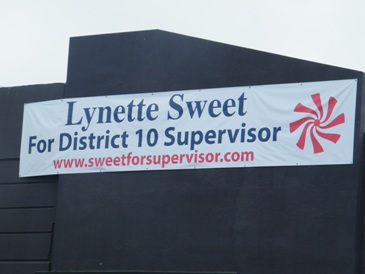
Asked how she would have voted on Lennar’s plan, Lynette Sweet, who voted to make Lennar the shipyard’s master developer when she was a member of the Redevelopment Commission in 1999, said she would have approved it.
“I voted for it then, and I would have voted for it now,” Sweet said. “And I want to be the person who shepherds it through in the next eight years.” But Sweet also sought to reduce the many ongoing questions about the plan–including housing affordability levels, local job creation, air quality impacts, and the  Navy’s related shipyard clean-up–to one simplistic issue: the bridge over Yosemite Slough.

“There’s been a lot of controversy over a bridge,” Sweet said. “But we don’t give up on people for a bridge. We just can’t.”

Eric Smith said he was supportive of the plan and the community benefits agreement, but he voiced criticism of the project’s environmental Impact report (EIR).
“The project’s EIR wasn’t perfect,” Smith noted. “And I wasn’t a huge fan of the bridge, but I’ve walked around Alice Griffith [a dilapidated public housing project in the Bayview] and when you see folks with moldy pipes, broken ceilings, and rats, it moves you. So, I’m supportive of it, and I’m supportive of the community benefits agreement [that the SF Labor Council negotiated with Lennar] and the jobs it can bring.”

Nyese Joshua said she would have voted against the plan, starting years ago.
“I would have voted to stop that project in 2006, when the dust issue was going on,” Joshua said. “And it’s a misnomer to claim the Board voted 10-1 for Lennar,” Joshua contined, as she pointed out that five progressive supervisors on the Board voted against the bridge and for air quality analysis, greater affordability and greater workforce protections. But ultimately, this progressive core was unable to pass those amendments, because Sups. Maxwell, Bevan Dufty, Sean Elsbernd, Carmen Chu, Michela Alioto-Pier and Board President David Chiu did not support them.
“That 10-1 vote is being called a pyrrhic victory,” Joshua added.


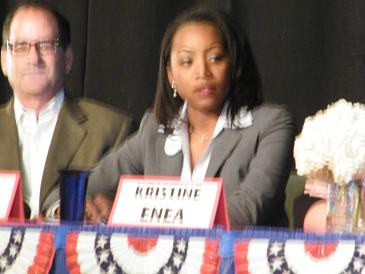
Kristine Enea indicated that she would have voted yes, but with reservations.
“I would have consistently voted yes to amendments, but there was no comprehensive transportation analysis,” Enea said.
Enea, who has served on the now disbanded Navy’s Hunter’s Point Shipyard Restoration Advisory Board, noted that she is “intimately familiar with the technical data,” surrounding the Navy’s shipyard clean-up plans.
“And I live a stone’s throw from the shipyard, and I believe we are safe,” Enea added.
“There is hope soon to be a restored public process on the Navy’s clean up,” Enea continued, referring to the Navy’s 2009 decision to dissolve the RAB.“But we need to be very vigilant that cleanup of Parcel E2.”

Malia Cohen said she would have supported Lennar’s plan,
“Lennar has dominated the lion’s share of our conversations,” Cohen said, noting that there are a bunch of redevelopment projects in the southeast. “So, we can’t be singular in our vision of what we want our community to look like. We can’t let Lennar dominate. But I’d have supported the project because I believe what Lennar represents is an extraordinary opportunity for us to pick ourselves up, organize and collectively voice what we’d like our community to look like. It’s imperative that Lennar’s plan moves forward, but it has to be environmentally sound.”

Steve Moss said he probably would have voted for the project’s EIR, but voiced concern about the lack of affordability within the project’s 10,500 units of housing.
“But nothing is more toxic than the shipyard than the conversation about the shipyard,” Moss added, noting that the Navy and US EPA have collectively committed to spend millions and millions on shipyard cleanup, but the community doesn’t trust the process.
“So, what went wrong with the conversation in a community that is clearly wounded?” Moss said. “We need to start having honest conversations. And we’re programming a lot of housing [within the Lennar development,] but not enough jobs.”

Stephen Weber said he would have voted for it.
“ I believe that we need it, that we can’t wait any longer,” Weber said. “But it goes back to oversight. It’s the responsibility of the city to make sure the developer and everyone connected to the development is held accountable and is made to follow through on procedures, and make sure affordable housing is mixed into the plan. It has to be a neighborhood built on diversity.”

Isaac Bowers said he’d have been in favor of sending the plan back to Redevelopment to be amended.
“This is a very difficult decision,” Bowers observed. “We all know that the area has suffered from many decades of neglect. But when I looked closely at the plan’s environmental impact report and the process, I didn’t think the range of alternatives for the bridge were sufficient. The demands for [greater oversight] of the shipyard clean-up were legitimate. The analysis of how many jobs in research and development was insufficient. There was no analysis of displacement. There were inadequate levels of truly affordable housing. We need to look at real jobs when we look at development. And the Redevelopment Agency has to be put back under the control of the Board. It can’t be allowed to put out fake projects that don’t benefit the community.”

Diane Wesley Smith suggested she’d have voted no when she pointed to Lennar’s “trail of broken promises.”
“And talk about collusion,” Wesley Smith said. “ I understand this was a done deal, five years ago.”

Geoffrea Morris said she would have voted no.
“There was a lot of money, a lot of power pushing the shipyard project,” Morris said.
“If this happened in any other community [in the city], it wouldn’t have happened,” Morris continued. And they wouldn’t have got rid of the [Navy’s community-based] restoration advisory board,” Morris added.”But ours is a poor community of minority people and a majority are African Americans.”

Chris Jackson said he would have voted yes, but with amendments.
“I would have supported the plan, but with amendments to ensure the full clean-up of the shipyard to residential standards, and to work towards on agreement on the bridge,” Jackson said.
 “We are a better city than just saying no,” Jackson continued, as he outlined ways to ensure that local workers get decent paying jobs, the community gets an expanded health clinic, the city includes a cooperative housing and land trust element to provide affordable housing, and the city is required to provide a supplemental environmental impact report.

Tony Kelly said he would have voted no–and noted that he was the only candidate to publicly testify against the certification of project’s EIR.
“I was the only candidate to testify against the environmental impact report and in support of the appeal [that three separate groups brought after the Redevelopment and Planning Commissions voted to certify the city’s EIR for Lennar’s plan],” Kelly said.
‘Michael Cohen, the Mayor of San Francisco,” Kelly half-jokingly continued, “has said the project is not going to be started to be built for at least 4 to 5 years. So, how can the city say, you must support the plan now, when it’s not going to happen for a long time?”

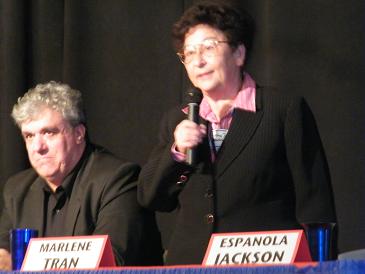
Marlene Tran said she can’t support the plan until the shipyard’s cleaned up.
Tran explained that initially, when Arc Ecology’s Saul Bloom gave the community a presentation about the plan, she was intrigued.
“It seemed to bring a lot of promises, but then Bloom presented ten of the deficiencies with the plan,” Tran said, referring to heavy metals and other toxins on the shipyard.
“I will make sure they will do the clean-up first,” Tran said. “If we go for it, and then construction workers and residents, get sick…well, there’s no way I can condone the project, until it’s absolutely clean. And what if the developer goes bankrupt?”

Espanola Jackson gave folks a history lesson
“When I learned that the shipyard was a Superfund site was not until 1990, because we was illiterate about environmental justice in a black community,” Jackson recalled. “I thought environmental justice was white kids chasing whales. But then I went to Monterey and learned about restoration advisory boards [RABs].”

Noting that the local community got its own RAB in 1994, Jackson recalled how former Mayor Willie Brown appointed Lynette Sweet to the Redevelopment Commission, before the Commission voted 4-3 in 1999 to select Lennar as master developer for the shipyard.
“Willie Brown brought in Lynette Sweet to be the swing vote to bring Lennar into the community,” Jackson said.

DeWitt Lacy said he wouldn’t have supported the plan, as it was, and given the Board’s limited ability to amend it under the city charter.
“I’d have supported the plan, if I’d had the power to amend the project’s environmental impact report and get it done right,” Lacy explained.
Lacy faulted the plan for carving up a state park, building a bridge over an environmentally sensitive slough, and not doing enough to ensure local jobs or guarantee benefits.
“Folks didn’t believe it was important for black folks to have state park land, but it’s important for our kids to have this,” Lacy said. “The state has spent $5 million to rehabilitate Yosemite Slough… And a ‘good faith’ agreement [around local hiring quotas] doesn’t get it for me. We have to have absolute certainties to make sure our people get the benefits.”


You can watch video of both the D. 10 forums, which were moderated by Keith Goldstein, here. And stay tuned for coverage of the endorsements and financing behind each candidates’ campaign. D. 10 is already shaping up to be one of the most fascinating and pivotal races in the fall.


SFBG Radio: Net neutrality

0


In today’s epidsode, Johnny and Johnny talk about the most crucial under-reported issue of the day–net neutrality–plus Hurd’s fall at HP and Jerry’s Green jobs.


HPNetBrownPower by jwangell

SFBG Radio: Deflation

0


In today’s episode, Johnny W and Johnny V talk the good and bad on the unemployment numbers and the really big bad wolf we call deflation


Deflation by jwangell

Adachi’s pension reform and the D. 10 candidates

37

As pretty much everyone knows by now, Jeff Adachi collected enough signatures to place a charter amendment on the November ballot that would reform the city’s retirement and health benefits plan. His amendment has become such a hot political topic that the Potrero Hill Democractic Club asked the 15 candidates who spoke at the club’s  August 2 and 3 District 10 forums what they thought of Adachi’s “smart reform.”

By my understanding of what the candidates said, four seemed unsure what the Adachi amendment would do, or were open to the idea, while the other eleven were opposed. But read for yourself what the D. 10 candidates said and decide where they stand on this issue:

Kristine Enea: “Certainly something needs to be done. I did sign [Adachi’s] petition. Adjusting for new employees has an inherent fairness. The path we are on is not sustainable.”

Nyese Joshua: (After admitting that she didn’t know much about Adachi’s amendment), “In terms of bringing it to the ballot, I agree.”

Lynette Sweet: “What Jeff Adachi did was not a bad thing, but the way he went about it was.”

Stephen Weber: “I don’t believe it was done right way, but I like the idea. The labor leaders are willing to sit down and discuss the pension plan. They just want to discuss it with the Board that is sitting there now.”

Eric Smith. “I love Jeff Adachi. And initially it looked great. But Beyond Chron [for which Smith sometimes writes] has an interesting story: When I read it, it says the measure goes after people’s health benefits. That’s troubling. I can’t really get behind this. We need to do reform from the bottom up, not from the top down.”

Malia Cohen: “Adachi’s a great public defender, but he’s taken an approach that’s disrespectful of public policy. Instead, he’s created a policy. I’m not in favor of it, if it unfairly taxes those at the bottom.”

Steve Moss: “The labor unions are rightfully furious. Pensions need reform. Things are out of whack. But this could lead to folks losing healthcare because they have to pay more to cover their dependants.”

Geoffrea Morris: “He had a point. The unions are very powerful in the city, he didn’t want to go through the red tape. Something needs to be done to reform healthcare and pensions.”

Isaac Bowers: “I thoroughly reviewed the San Francisco civil grand jury’s ‘Pension Tsunami’ report. I don’t think his initiative is the right way to go. I fear copayments for healthcare will throw people back on the city.”

Tony Kelly: “Great guy, stupid idea.”

Espanola Jackson: “You should talk to Adachi. Don’t shoot him down.”

Chris Jackson: “The measure is popular, it’s polling in the 60 percent range. But Adachi never talked to the nurses and the workers who make $35,000. And then there is the fact that this in an attack on healthcare. So a large percentage of the ‘savings’ is what workers will have to contribute. It’s a move away from supporting working class individuals.”

DeWitt Lacy: “We need pension reform. But no one likes change rammed down their throats without any negotation with, or input from, the workers. It addresses an important issue, but it’s too divisive.”

Diane Wesley Smith: “It’s ridiculous. Some reform has to happen, but this isn’t it.”

Marlene Tran: “Jeff Adachi took a lot of risks in this pro-labor town. He claims a $170 million savings. I would support it, because everyone should pay into the pension fund.”

Chiu left out of Gascon’s Community Ambassadors loop

2

SFPD Chief George Gascon kicked off today’s press conference about a Community Ambassadors program on the Third Street corridor by saying that it’s a grassroots pilot.

“This is not a police program, it’s a community program,” Gascon said, as he introduced Adrienne Pon from the Mayor’s Office to speak about what is being framed as a trailblazing effort to address violence on public transit at a time when money is tight all around.

Board President David Chiu, Sups. Carmen Chu, Sophie Maxwell and Eric Mar, and Chinese Chamber of Commerce consultant Rose Pak were also in attendance and everyone was all smiles and put on an apparent show of solidarity for what appears to be a desperately needed program

But Chiu did not know that the press conference was happening, when I called him last night for details. I’d assumed that he would be in the loop as the Board President and the most visible of the city’s top Asian American political leaders. But as Chiu confirmed today, he only was briefed a few hours before it took place.

Asked what was going on, Chiu waxed diplomatic.
“As you know, I didn’t know about it yesterday when you called,” Chiu said. “So, when I heard about it, I called the Chief and he sent the information. I’m happy this is happening.”

Oddly, when I called the SFPD this morning to confirm that today’s press conference was happening, I was asked who had told me about it. By then, I also knew that D. 10 candidate Marlene Tran was going to be speaking at the press conference. And while it’s great that Tran is an advocate for public safety programs, it’s weird that a candidate on the November ballot was in Gascon’s press conference loop, when Board President Chiu was not.

“We are in a neighborhood with serious public safety concerns,” Chiu told reporters today. “The issues that come from one of our ethnic communities are of concern for us all.

“We are working with the Mayor’s Office and the Chief,” Chiu continued, noting that the Board has been working hard to restore funding for violence prevention programs and to ensure there is funding for a new program for translation services.

“A multi-ethnic program is the type of program we need to move the healing process forward,” Chiu said, thanking the SFPD and the District Attorney’s Office for working to help victims of violence get help and translation services.

Sup. Maxwell talked about how the Ambassadors Program will be good for seniors, young people and very very young people.
“We need to make sure we continue these kinds of programs,” Maxwell said.

Sup. Eric Mar thanked AT& T for providing cell phones to the 12 outreach workers who have been trained as Community Ambassadors.
And Pon of the Mayor’s Office promised that this would be the first of many efforts to address public safety concerns.
‘There is no place for violence in the community,” Pon said. “Any time anyone gets hurt, it rips a hole in the fabric of society. It’s not just the recent acts of physical violence and threats against some of our residents. No one should have to contend with being spit upon and name-calling and threats.”

Thanking Sharen Hewitt, Rose Pak and “the courageous community members who came forward,” Pon said the pilot program will last until mid-September and will focus on the Number 9-San Bruno bus and the T-Third line. Funding is coming from the city’s general fund and federal job stimulus funds.

“Unfortunately, those funds are going to end in September, so we’re looking for funding from the corporate community,” Pon said, referring to AT&T.

She described the Community Ambassadors program as a “non-law enforcement presence.”
“People can get along regardless of their cultural and linguistic differences,” Pon said.

AT& T California President Ken McNeely talked about his company’s “long and storied history”, noting that the first transcontinental call happened over 100 years ago and involved a call from San Francisco’s Chinatown to New York City.

“We’re in the business of really connecting people,” McNeely said.

Sup. Carmen Chu said the pilot program is the beginning of efforts to build community across ethnic lines.
“It starts to sends a message about what we want to accomplish,” Chu said.
“Crime is not something we want to see tolerated,” Chu continued.

On August 3, the Board considered legislation that Chu authored to implement higher penalties for crimes on and around Muni. Like the Community Ambassadors program, Chu’s legislation came in response to recent attacks on Asian Americans by African-American teens. In one case, a group beat a 57-year-old woman then pushed her onto the tracks. In another, an 83-year-old man died in the hospital after he was assaulted.

If passed, Chu’s legislation would increase the penalties for aggressive pursuit and loitering while carrying a concealed weapon to $1,000 if the crime occurred on or around MUNI (as opposed to $500 for the same crime committed elsewhere.) The Board also recommended that juveniles convicted of these crimes be given community service or in-home sentences instead of probation or juvenile hall.

Police Commission President Dr. Joe Marshall was also on hand today to voice his enthusiasm for the Community Ambassadors pilot.
“This is pretty cool,” Marshall said. “We got a model. I don’t know if any other cities are doing this, but they should be. I commend the ambassadors for being involved.”

And D. 10 candidate Marlene Tran said the program represented an opportunity to work “for peace and harmony.”
“This is an auspicious occasion,” Tran said, noting that there would be “double happiness” in the Asian American community over two community hubs, one in Viz Valley, the other in the Bayview.
“We encourage more collaboration amongst our community,” she said.

Rose Pak, consultant to the Chinese Chamber of Commerce, hinted that she would be squeezing more money out of AT&T.
“I knew we had a problem, and I knew who to go to,” Pak said, noting that she wasn’t not going to let AT&T “get away with pilot support.”
“I expect them to write a big check,” she said.

Pon told reporters that the Community Ambassadors speak a total of seven languages: English, Cantonese, Mandarin, Vietnamese, Spanish, Samoan and Hawaiian.

But when reporters asked how City Attorney Dennis Herrera’s newly announced gang injunction against two warring street gangs, the Down Below Gangsters and Towerside Gang, in Viz Valley, might be compromised by the Community Ambassadors program, Gascon stepped forward.
“If thoughtfully implemented, gang injunctions can be a powerful tool,” Gascon said, noting he believes the Community Ambassadors will be a model that “we’d like to take to other neighborhoods.”

But how can 12 people armed solely with AT&T cell phones and fluorescent yellow jackets tackle what seems primarily to be youth violence against Asians? And what will happen in six weeks when the pilot program’s funding dries up?
“For the past two weeks, and continuously until mid-September, they are going through training at the SFPD and the MTA,” Pon said, noting that some of this training involved cultural and linguistic competency training.

“We’re building a pilot,” Pon continued. “The phones are preprogrammed to speed dial the SFPD, and we recruited these 12 ambassadors from over a hundred candidates in the Jobs Now program’s census outreach team. So, they are used to working in public and are comfortable with working with individuals of diverse backgrounds and ethnicities.

Pon acknowledged that the pilot has a shoestring budget.
“We are seeking private and foundation funding, so I’ll be doing lots of grant writing,” Pon continued, noting that a permanent program would need “at least half a million dollar budget.”

Asked if the Mayor’s Office was kept in the loop about today’s event more than Chiu, Pon smiled.

“SFPD called the conference and we are all making sure that we are working together,” Pon said.

But AT&T’s Ken McNeely was happy to talk about his company’s efforts to provide cell phones for connecting with first responders.
“Public-private partnerships are critically important,” McNeely told the Guardian.
“We’ve made education one of our key pillars for giving back,” he said. “ For us all to do well, it’s going to take public private partnerships.”

Gascon rolls out program to address violence against Asians on Third Street

0

SFPD Chief George Gascon will roll out a pilot program today in an effort to address  violence against Asians seniors on public transit.

A press release notes that the SFPD in conjunction with AT&T and the Office of Civic Engagement & Immigrant Affairs, which is a division of the City Administrator’s Office, has developed the San Francisco Community Ambassadors program.

“This is a pilot program, designed to enhance community awareness and safety,” the release states. “The pilot program will consist of community safety teams assigned to public transit locations in Visitation Valley and Bayview to provide a safe, visible and supportive presence for residents. This program will consist of 12 ambassadors who are from various cultural backgrounds. Many of the ambassadors are bilingual as well.”

D. 10 candidate Marlene Tran, who speaks Cantonese, Mandarin, understands Vietnamese and has taught English as a Second Language for 37 years, told the Guardian she has been working on community safety issues for 20 years. Tran also said that she recently did a bilingual survey in light of a wave of violence against seniors on the Third St. corridor.

“I have daily contact with students and residents, so I have my finger on the pulse of the community as a whole,” Tran said. “It’s a battleground out there, but for a long time no one knew about it, because many of the victims are not English speaking.”

“We want to be an integrated community,” Tran continued, “and seniors should have the flexibility to move around, but many of them don’t dare go out after 4 p.m., unless they are escorted, so having this program is a step in the right direction. Some of these cases are never reported. We need to encourage residents to be more proactive.”

Details of how the program will be funded and how long it will last remain sketchy at this point. Sharen Hewitt, founder of the Community Leadership Academy and Emergency Response Project (CLEAR), told the Guardian that she pitched the concept of having monitors on the bus some months ago, during her last meeting with Board President David Chiu and Sup. Carmen Chu.

“I suggested we take money from Trent Rohrer’s Jobs Now program to pay for it,” Hewitt said. “I also suggested we go to developers in the Bayview and engage them in a constructive conversation about donating dollars to help with translation services.”

Gascon and 12 ambassador staff will be present to speak about the program at today’s press conference, which takes place at 2:45 p.m. at 2574 San Bruno Ave.


Hidden health care costs of Adachi’s pension reform measure

New information about the health care costs associated with a pension reform measure backed by Public Defender Jeff Adachi suggests that the highest cost burden would fall to parents at the lowest end of the pay scale.

An analysis of the Adachi measure estimates that city employees with two or more dependents could face monthly healthcare cost increases of $220 a month, which would bring their total monthly contributions to $448, $765, or $1,630, depending on the health care plan. Dental care would bring those costs up an additional $82 per month.


Rael & Letson, an actuary firm hired to calculate premium contributions, completed the analysis on behalf of the Public Employees Committee of the San Francisco Labor Council. The city has not done a formal analysis of employee contribution increases to date.

Rael & Letson’s report estimates that for employees with a single dependent, the monthly employee contribution would go up an additional $240 under Kaiser, $352 under Blue Shield, and $419 under the city plan — bringing the total monthly contributions to $249, $473, and $1,098, respectively. Dental benefits would bring each of those costs up another $50 per month. That’s compared with current contribution levels of $8.84, $120, and $679 for employees in that category.

The analysis found that if approved, the policy change would result in “a relatively modest monthly out-of-pocket increase for Kaiser participants without dependents, but a significant shift in … costs paid by employees enrolled in other plans … especially those with employee + 1 dependent coverage. These increases could make covering dependents unaffordable for lower income employees.”
According to StateHealthFacts.org, a website run by the Kaiser Family Foundation, the average employee contribution to a family health insurance premium in the state of California amounted to about $290 per month in 2009.

Whether or not these proposed increases are manageable depends of course on an employee’s salary, whether or not they have assistance from a spouse or family members, and other personal circumstances. In the case of a single mother with two or more children at the lower end of the pay scale, the spike in health care costs could force some very difficult choices.

Meanwhile, an analysis of the pension reform measure written by the director of San Francisco’s Health Service System (HSS) at the request of the city’s Department of Elections suggests that the measure could jeopardize an estimated $23 million in federal funding that is expected to be awarded annually for the next four years under the new federal healthcare reform bill. HSS administers healthcare benefits to city employees.

A new program created under federal healthcare reform — the Early Retiree Reinsurance Program (ERRP) — is designed to ease employers’ financial burden of healthcare costs for retirees not eligible for Medicare. ERRP funds can be used reimburse 80 percent of claims between $15,000 and $90,000 for each retiree over 55 who isn’t eligible for Medicare. In San Francisco, this new federal subsidy amounts to an estimated $23 million annually over the next four years, which would be deposited into the city’s HSS trust fund and used to lower premium requirements.

The HSS memo warns that since Adachi’s measure proposes increasing employee healthcare contributions, “This proposed Charter amendment will therefore eliminate this anticipated subsidy of premium contributions not only for the City and County but also for City College and the Unified School District who are also employers within the San Francisco Health Service System.”

The memo also points out that just $53 million out of the $83 million in savings that the Adachi measure is expected to generate will go into the city’s General Fund, because more than a third of employees work for non-General Fund supported departments.

“If this Charter amendment becomes law, the balance of the contributions required to fully fund the HSS benefits will ultimately have to shift to the employees,” according to the HSS memo. “This Charter amendment does not address the underlying factors that will continue to drive increases in the cost of providing healthcare benefits.”

The recession has brought a recent spate of finger pointing at public-sector workers, and some might consider sharp healthcare cost increases to be a worthwhile tradeoff when it comes to the anticipated savings. Yet the decision to take more money out of the pockets of working people comes with its own set of consequences, which might be felt most acutely at the individual level but will also have a ripple effect on a broader economic scale.

Gabriel Haaland, an organizer with SEIU Local 1021, told the Guardian he believes that Adachi’s measure has been misrepresented as a pension-reform measure and ought to be discussed in the context of health care. “It’s a wolf in sheep’s clothing,” he said. Haaland added that he thought the sharp contribution increases would lead to more people opting out of healthcare benefits altogether, which could in turn place more of a strain on the city’s public healthcare system.

We contacted Adachi for comments, and we’ll be sure to post his response if and when we receive it.

Judge rules that says same-sex marriage ban is unconstitutional

0

Judge Vaughn Walker’s ruling that California’s Prop. 8 is unconstitutional got Assemblymember Tom Ammiano, Mayor Gavin Newsom and City Attorney Dennis Herrera issuing praise-filled statements today. And Herrera’s statement included comments that reaffirmed the pivotal role that the City Attorney’s Office played in this landmark case.

“U.S. District Court Judge Vaughn Walker has issued a powerful, thoughtful, and well-reasoned decision,” Ammiano said. “In overturning Proposition 8, this court fulfilled its legacy as a champion for equality.  The court recognized that it is unconstitutional to put a minority’s rights up for a popular vote.  Today’s decision reaffirmed our U.S. Constitution’s promise of equality for all.”

Newsom, who stuck out his neck in 2004 when he decided to issue marriage licenses to same-sex couples, said Walker’s decision, “is a victory for the fundamental American idea enshrined in our Constitution that separate is not equal and that all people deserve equal rights and treatment under the law. It is a victory for the thousands of California couples, their families and friends whose lives and loving, committed relationships have once again been affirmed in the eyes of the law.

“As Judge Walker states in his ruling,” Newsom continued, “Proposition 8 fails to advance any rational basis in singling out gay men and lesbians for denial of a marriage license. Indeed, the evidence shows Proposition 8 does nothing more than enshrine in the California Constitution the notion that opposite-sex couples are superior to same-sex couples. Because California has no interest in discriminating against gay men and lesbians, and because Proposition 8 prevents California from fulfilling its constitutional obligation to provide marriages on an equal basis, the court concludes that Proposition 8 is unconstitutional.’

“In the words of Dr. King, ‘the arc of history is long, but it bends towards justice.’” Newsom commented. “Today in California, history took another great step for all Americans towards fully realizing the principals of equality and fairness on the long march to justice. I salute the team of Ted Olsen, David Boies and City Attorney Dennis Herrera for so clearly and eloquently presenting the case against Prop 8. We will look to their commitment and wisdom again as the fight for marriage equality moves through appeal and, one day, to the Supreme Court of the United States.”

Herrera, for his part, said the ruling, “strikes a resonant chord against discrimination that should not only withstand appeal, but change hearts and minds.”

“I’m extremely grateful to Judge Walker for a thorough and well reasoned decision that powerfully affirms the U.S. Constitution’s promise of equal protection,” Herrera said. He noted that today’s federal court decision relied on key arguments and evidence presented by his office about the adverse governmental consequences of Prop. 8, the 2008 ballot measure, which eliminated fundamental marriage rights for same-sex partners in California. 

Nearly a year ago, Walker granted Herrera’s motion to intervene in the case, which the American Foundation for Equal Rights orginally filed on behalf of two California couples. Today, Herrera noted that San Francisco was the first government in U.S. history to sue to strike down marriage laws that discriminate against same-sex partners.

“And the San Francisco City Attorney’s Office is the only party to have played a role in virtually every iteration of the legal battle for marriage equality in California,” Herrera continued, noting that his office entered the fight for equal marriage rights in defense of Newsom’s decision to issue marriage licenses to same-sex couples in 2004. 

“Later, the office sued to strike down the anti-same sex marriage exclusion in state courts, a legal endeavor that ultimately succeeded with the California Supreme Court’s landmark ruling in 2008,” Herrera continued.  “Later that year, after California voters narrowly passed Proposition 8, the City was among the co-plaintiffs to challenge the amendment in the California Supreme Court; that effort was unsuccessful.” 

But while today’s news is a hopeful sign, same-sex couples are urged not to rush to get a license from City Hall, at least not just yet: Shortly after issuing the ruling, Judge Walker issued a temporary stay, and an appeal is expected.

Prop 8 struck down by federal judge

0

US District judge Vaughan Walker has struck down California’s ban on same-sex marriage. Turns out the 18,000 same-sex marriages left intact from before the proposition was passed were key. Dang, I just planned my wedding in Connecticut.  

SFBG Radio: New Venom

1

In today’s episode, Johnny Wendell’s guest, Johnny Venom, urges we use a ton of caution when considering Lennar’s Development plan-their track record in Chicago is dismal.

NewVenom by endorse


Is a serial killer with a knife on the loose in SF?

6

That’s the question Melissa Nix, ex-girlfriend of Hugues de la Plaza posed, on reading in the Examiner that Philp DiMartino, 36, had been found dead from multiple stab wounds inside an apartment in San Francisco.
It’s definitely a scary thought—one that Nix kept raising when she was fighting with the San Francisco Police Department over de la Plaza’s cause of death. The San Francisco Medical Examiner initially ruled that de la Plaza’s cause of death was “undetermined.”
But Nix, who challenged the notion that de la Plaza would ever have killed himself, kept worrying that de la Plaza had been murdered—and that his killer was still on the loose, and possibly walking the streets of San Francisco.
In February, de la Plaza’s father announced that the SFPD was now considering the case as a murder. And Nix uncovered another forensic report that supported her belief that her ex had been stabbed by someone else.

Either way, the two men certainly died in close proximity to one another: de la Plaza’s apartment was on Linden Street, Martino’s was at 138 Hermann Street.

Filing fees and public financing as clues to 2010 supervisor races

5

For months now–and in a few cases, over a year- a bunch of dedicated residents have been campaigning in the hopes of becoming the next supervisor in districts 2,4,6,8 and 10. But now comes the moment of truth:

Between July 12 and August 6, all these potential candidates must file all necessary paperwork and pay all necessary fees to qualify for the November ballot.

And, provided they get enough signatures, they can submit a petition in which each signature represents 50 cents towards offsetting their $500 candidate-filing fee.

These signatures are called signatures-in-lieu (or SIL) and they provide an interesting data point if you are trying to figure out who has community support and/or money.

A spokesperson for the San Francisco Elections Department recently told me that the point of the signature-in-lieu petition is to allow anyone to get on the ballot, regardless of their financial circumstances—provided they have valid support.

“If they were to collect, let’s say, 1,000 valid signatures, then that totally offsets their candidate filing fee,” the Elections spokesperson said. “But if they go over 1,000 signatures, they don’t get extra money back.”

And, as of July 26, Elections started to look at candidates’ SIL petitions to get an idea of who will owe what come Friday, when the filing fees are due. This is done by figuring out of the signatures are valid or not. To be valid, a signature must come from a person who resides in the geographical area that is covered by the race.

So, D. 2 candidates must gather signatures from D2 residents, and so on.

“Let’s say the candidates didn’t want to do all that, they just file and write a check,” the Elections spokesperson said. “But they must collect at least 20 valid nominating signatures.”

These signatures can be the same as those on the SIL petition, but they must be re-submitted on a nominating petition. And these signatures must come from folks residing in the district covered by each race. So, D 10 nominators must also be D. 10 residents.

“We expect a long line on Friday, which is when we’ll see a lot of people,” the Elections Department representative added. “And we will be working through the weekend to create an ‘unofficial’ official list of candidates by Monday [August 9]. A list we call “unofficial’ because we may need to check out some of the signatures.”

So, what do the candidates’ signature-in-lieu submissions reveal, so far?

Leading the pack in terms of candidates who submitted the least amount of valid signatures-in-lieu is D. 6 supervisor candidate Theresa Sparks.
As of July 27, Sparks had submitted 20 signatures, but only 19 were valid.

Sparks is closely followed, in terms of low SIL numbers, by D.6 candidate Jim Meko: Meko submitted 33 signatures, and only 28 were valid.

Now, this paucity of signatures-in-lieu could suggest that Sparks and Meko do not have massive grassroots support in D. 6. It could also mean that Meko and Sparks are focusing their campaign energies elsewhere. And, to be fair, both could submit more signatures by Friday.

Meko admitted that his campaign did not spend time gathering signatures-in-lieu.

‘We did not devote a whole lot of energy on that,” Meko told me today.”You can only spread yourself so far.”

To date, Sparks’ signatures only count towards $19.50 of her $500 filing fee. This suggests Sparks will pay for the filing fee herself. (Or from the $10,000 public financing that she had qualified for, as of July 14, with a possible increase coming soon, as Elections examines her filings.).

Likewise for Meko: His 28 signatures-in-lieu means $14 off his $500 filing fee. Meko has already qualified for $10,000 in public funds and has an application for another $22,000 in publid funds in the works. This combined with the $7,000 Meko raised in 2009, and the $6,000 he has raised in the first half of 2010, means Meko will have $45,000 in hand to run his campaign.

“That’s no small potatoes to run a campaign in little old District 6,” Meko observed.

Unlike signatures-in-lieu, which must be from within the geographical boundaries of the race, candidates can qualify for public financing based on their ability to raise $5,000 in contributions of less than $100 each, with no requirement that those contributions come from within their electoral district. If the candidates raise $5,000 in this way, the city will double it, meaning that the candidates will receive  $10,000 in public funds. And if candidates raise another $10,000, the city will match those funds by a 1:4 ratio.

But unlike Meko, Sparks still appears to need another valid nominating signature from a D. 6 resident to qualify, since 20 sigs is the nominating minimum. So, someone do her a favor and sign the petition, why don’t you.

Sparks’ and Meko’s numbers stand in stark contrast to D6 candidates Jane Kim and Debra Walker.
Kim has already submitted 1,732 signatures-in-lieu, and 1,281 are valid. This means Kim qualifies to have her filing fee waived and to complete her nominating petition.

The same holds for Walker. She submitted 1,107 signatures, and 1,041 are valid.

Kim also leads the pack with $71,148 in public funds, followed by Walker ($57,344) and Elaine Zamora (S50, 999) with Sparks a distant fourth ($10,00). So, again, it looks like Kim and Walker are running strategic grassroots campaigns, compared to Sparks and Meko. (I left a message with Sparks campaign manager Chris Lee today, and if there are any updates that shed more light on these numbers, I’ll be sure to post them here. Same for Meko.)
Combined, D.6 candidates have seen $199,491 in public funds disbursed.

Over in  D. 4, incumbent Carmen Chu has submitted 401 signatures, and only 282 are valid. But judging from the megabucks that Chu raised from wealthy contributors in 2008, including $11,500 from PG&E, a $500 filing fee is probably the least of her worries.

In D. 8, Rebecca Prozan submitted 1,147 sigs, and 1,056 were valid, so she cleared the waiver and nominating petition requirements, as did Scott Weiner (1,479 sigs submitted, 1,264 valid) and Rafael Mandelman (1,036  sigs submitted, 1,011 are valid.)

In D. 10, none of the candidates has so far succeeded in qualifying for a complete waiver, which is an interesting statistic in a race that remains wide open at this point.
But Steve Moss came close (1097 sigs submitted, 955 are valid). Chris Jackson came fairly close (904 submitted, 802 valid), Marlene Tran got half way (718 submitted, 574 valid) as did Lynette Sweet (509 submitted, 479 valid), and Malia Cohen secured a third of needed sigs to waive the fee (504 submitted, 338 valid).

Fellow D. 10 candidate Tony Kelly told me that he decided not to concentrate his energies on signature-in-lieu gathering, based on on-the-ground intel that Jackson and Moss had already done a thorough job of knocking on doors and asking for folks’ sigs.

Kelly said he’s focusing his efforts on qualifying for increasing levels of public financing. And so far, Kelly is one of eight candidates in D. 10, who have either qualified or are under review for public financing, making D. 10 the top public financing district, citywide, with $233,065 distributed, as of July 30.

Leading the D. 10 public financing pack is Malia Cohen with $53,671 in public funds disbursed. She is followed by Moss ($53,284) and Jackson ($50,220). Kelly is in fourth place ($39,548), Kristine Enea is in fifth ($26,342), DeWitt Lacy is sixth—and Lynette Sweet and Eric Smith’s public funds applications are still under review.

In D. 8, Rafael Mandelman is one of only two candidates to qualify for public financing. Mandelman has received $62,153, placing him ahead of Scott Weiner ($10,000.)

And in D. 2, Kat Anderson has received $40,480, followed by Abraham Simmons ($36,160) but neither made inroads on the signatures-in-lieu front: Anderson submitted 99 and 82 were valid, while Simmons appears not to have submitted any. Of course, everything in D. 2 is up in the air, now that a judge has ruled that incumbent Michela Alioto-Pier can run again this fall, and D. 2 candidate Janet Reilly has not yet decided whether to run. With the latest campaign finance disclosure reports due this week, stay tuned…

Celebrate popped 16

Pacific Gas & Electric Co. invested some $45 million into a June ballot initiative known as Proposition 16, a change to the state constitution that would have impeded the creation of green municipal electricity programs by requiring a two-thirds majority vote at the ballot. Widely viewed as a bid to secure its lucrative monopoly by snuffing out competitors before they could get on their feet, the utility’s bubble went pop when voters — especially those from PG&E service territory — rejected it.
 
Despite the utility’s deep pockets, a small cadre of public-power advocates and consumer watchdogs across the state worked tirelessly to defeat Prop. 16, employing creativity and volunteer efforts to counter PG&E’s slick, well-funded marketing campaign.

On Thursday, Aug. 5, the No on 16 Campaign Committee and a host of other individuals and organizations who helped defeat PG&E’s ballot initiative will hold a victory workshop and celebration at The Merchants Exchange Building in San Francisco.

The event is two-fold: From 1 p.m. to 5 p.m., a workshop will be held to examine California’s grassroots response to Prop. 16, and to discuss strategies for building a renewable, clean-energy infrastructure throughout the state. At 5:30 p.m., a celebration will get under way with food, music, and a campaign awards ceremony. For more information and to RSVP, attendees should visit www.celebrateno16.org

Sup. Ross Mirkarimi, Marin County Sup. Charles McGlashan, former California Energy Commissioner John Geesman, and others will lead a panel discussion during the workshop. In San Francisco, Mirkarimi was a key opponent of Prop. 16, bringing the Board of Supervisors on board in opposing the initiative, and traveling to Sacramento to speak out against it. He chairs a local commission working to implement CleanPower SF, an ambitious citywide clean-energy program.

No on 16 Victory Workshop and Celebration (free)
Thursday, August 5, 2010; Workshop 1:00-5:00 p.m., Celebration 5:30 p.m. 
The Merchants Exchange Building, Julia Morgan Ballroom, 465 California St, San Francisco

SFBG Radio: Why Meg isn’t Ike

0

In today’s episode, Johnny and Tim talk about why Meg Whitman isn’t Dwight Eisenhower (or Nelson Rockefeller), and lots of other fun and related topics. You can listen and join the fun after the jump

sfbgradio7302010 by jwangell

Legal Brahmins organize against Nava

19

Some of the most prominent lawyers in San Francisco, including two high-ranking judges, have launched a full-scale political campaign to protect Judge Richard Ulmer, a straight white former Republican and Schwarzenegger appointee, against a challenge by a gay Latino Democrat.


Among the Ulmer supporters, who have vowed to raise a substantial amount of money for the fall judicial election, are J. Anthony Kline, presiding justice of the state Court of Appeal in San Francisco and James McBride, presiding judge of the San Francisco Superior Court. They’re joined by a surprising number of leading liberal lawyers, including James Brosnahan, senior partner at Morrison and Foerster, Joe Cotchett, the widely known trial lawyer, and Sid Wolinsky, a founder of Disability Rights Advocates and a lifelong public interest attorney.


And John Burton, the chair of the California Democratic Party, is contacting members of the San Francisco County Central Committee to try to get that panel to rescind its endorsement of Ulmer’s opponent, Michael Nava.


It is, by any standard, an astonishing amount of political firepower for a local judicial race – and it’s all being done in the name of avoiding politicizing the judiciary.


Nava, a former prosecutor who now works as a staff attorney for state Supreme Court Justice Carlos Moreno, finished first among three candidates in the June primary election, and will face Ulmer in a November runoff. Nava finished with 45 percent of the vote, Ulmer with 42. Dan Deal, also a gay man, won 11 percent of the vote, and most observers agree that if he hadn’t been in the race, Nava would have exceeded 50 percent of the vote and won the seat outright.


So Ulmer heads into the fall with a significant disadvantage — Nava needs only another five percent to put him over the top, and has the endorsement of the local Democratic Party, a major factor in a race that typically doesn’t attract much public attention.


That, by all accounts, has given the local judiciary a bit of a scare. Judges by law serve six-year terms, and can face a challenge when they come up for election, but it doesn’t happen often. And there aren’t many elections for open seats. That’s because the vast majority of Superior Court judges retire or step down in mid-term, giving the governor the opportunity to appoint somenone to the post.


And judges typically don’t like running for re-election; it forces them to raise money from people who might appear in their courtroom and makes them get out and about and glad hand in the community — something that isn’t a normal part of a judge’s life.


Ulmer’s only been on the bench a little more than a year, and hasn’t done anything unprofessional or inappropriate; most attorneys who’ve appeared before him consider him an honest, competent judge. But he was appointed by a Republican governor to a bench that critics say is not reflective of the diversity of San Francisco, and if a local Democrat can unseat him, a lot of other judges could be vulnerable.


That’s what drove McBride, who told me he normally avoids politics, into the fray. Early in July, McBride sent an email to every past president of the Bar Association of San Francisco, inviting (some would say summoning) them to a July 7th meeting at the law office of Pillsbury, Madison and Sutro. The tagline talked about the “independence of the judiciary,” but the event turned out to be something of a pep talk and rally for Ulmer.


According to several accounts, Kline made the main pitch: He called this a “game-changing judicial election,” and made the arguments he would publish two days later in an opinion piece in the Recorder, a legal newspaper.


“The unseating of Judge Ulmer, widely considered an outstanding judge, would have a far greater politicizing effect than many realize,” his piece stated.


He added:


“If challenges to sitting judges without regard to their competence and character become acceptable in California, the consequences for our judiciary will be transformative. Exceptionally able but politically inexperienced lawyers will be less likely to seek judicial appointment. Lawyers who do seek appointment might feel it necessary to seek and obtain the political support of well-financed or influential groups, which may want to know where they stand on issues courts decide. Governors will favor judicial candidates possessing the political skills and financial resources necessary to defend themselves. Some judges may think twice about ruling against politically influential parties, lawyers, or interest groups. Judges may establish campaign funds to discourage potential challengers, and lawyers who appear before such judges may feel compelled to contribute.”


And in a move that disturbed some of those present, Kline argued, in essence, that the local court already has considerable diversity, and that the fact that Ulmer is a straight white male shouldn’t be an overriding factor in the race.


“With the election of Linda Colfax,” his Recorder article states, “25 of the court’s 51 members will be women, 10 gay men or lesbians, 9 Asian-Americans; 3 Latinos; and 3 African-Americans. The court must already be the most diverse in the United States.”


McBride told the group that Ulmer would need money — substantial sums of money — to compete against Nava, and made it clear that he needed help raising it. According to some accounts, there was discussion of seeking a war chest of $350,000. The presiding judge also asked the former bar presidents to sign a letter asserting that the election of Nava would be an attack on the judiciary.


Peter Keane, dean emeritus of the Golden Gate University Law School, was among those invited, and the meeting left him deeply disturbed. “It was something disgraceful, the tone of opposition from people like Kline,” he told me. “It felt like a Dick Cheney weapons of mass destruction speech, this fear about the independence of the judiciary. I raised my hand and said I disagree.”


Keane said that “to frame this as an independence of the judicary question cheapens that argument.” Nava, he said, has every legal right to run and make the case that he’d be a better judge than Ulmer. “Ulmer’s been endorsed by the Republicans,” Keane said. “So what’s wrong if Nava is endorsed by the Democrats?”


Keane said he’d voted for Ulmer in June, but was switching to supporting Nava this fall, in part because he sees a powerful attack coming down against the challenger. “A lot of Brahmins in the legal society have gotten stampeded into the lynch mob against Michael,” he said.


In the end, the bar presidents agreed to what Keane called a mild statement saying that party affiliation shouldn’t be the sole basis for making judicial election decisions.


Kline, a former judicial appointments secretary for Gov. Jerry Brown who is widely considered one of the most liberal judges in the state, told me that he barely knows Ulmer, but knows of his pro bono work cleaning up the California Youth Authority. But he said he will continue to speak out for the incumbent because he fears the election of Nava would open the floodgates to challenges against judges on purely political grounds.


McBride confirmed that he called the July 7th meeting and was happy to discuss what happened and his perspective. He told me that it’s difficult and often inappropriate for judges to raise money for campaigns, since the people most likely to be interested in those races — lawyers — often have business before the courts. And he argued that the fear of a challenge could make judges hesitant to rule against powerful interest groups.


“One of the things that came up at the meeting,” he said, “is that judges are the only public officials who are required by the Constitution and their oath of office to act against their constituents.”


But Nava points out that state law provides for judges to face the voters — and potential opponents — once every six years. “This is simply the judges trying to establish standards for the voters to decide when and under what circumstances a judge can be challenged,” he told me. “They want to decide what qualifies someone to be a judge and what doesn’t.”


He said that the argument that the court is already diverse is “offensive.” The court’s own statistics, he noted, show that 70 percent of the judges are white and “most have been appointed by governors of a particular partisan and ideological bent.”


That, of course, is one reason Nava is running against an incumbent: He thinks (probably correctly) that Gov. Schwarzenegger would never appoint him to the bench, and unless Jerry Brown wins this fall, he’ll be essentially unable to become a local judge for years. Of course, if more judges retired at the end of their terms, and create more openings, there’d be less of a problem; lawyers who want to ascend to the bench would have a fair shot at running without taking on any incumbents.


Nava agreed that it was unpleasant and unseemly for judges, or judicial candidates, to go around raising money — but he thinks there’s another solution. “Why don’t they work to make all judicial campaigns fully publicly financed?” he asked. “If Justice Kline wants to do that, I’ll be happy to join him.”


Although McBride said he hopes the Ulmer campaign will be able to raise enough money to reach the voters directly this fall, the focus right now is on the DCCC. “Since the Democratic Party is so dominant in this town, having the endorsement of the party shifts the balance way towards Nava,” McBride told me. Everybody knows the party won’t endorse Ulmer, who was a Republican until he was appointed to the bench, at which point he switched his registration to decline to state. But McBride hopes enough DCCC members will agree to reverse the Nava endorsement to leave the local party neutral in the race.


That’s going to be difficult – it takes a two-thirds vote to change an endorsement. But Ulmer supporters are pulling out all the stops – Burton has written a letter, prominent local lawyers who support Ulmer are calling DCCC members,  and in some cases, cornering them in person.


“I was at an event the other day, and Joe Cotchett comes up and tells me he needs to talk to me,” DCCC member Alix Rosenthal told me. “He corners me and starts talking about how I need to reverse the endorsement of Nava.”


And the power of the Brahmins seems to be having at least some impact – a few of the members who supported Nava in the spring appear to be wavering, and some newly elected progressives are still undecided.


Reversing an endorsement would be highly unusual. “I’ve never seen anything like this done in my eight years on the committee,” member Gabriel Haaland told me.


But no matter what happens at the DCCC in August, when the issue will come up, the relatively low-profile race for Superior Court judge is going to get heated this fall – and Nava will be in the crosshairs.

Congestion pricing plan headed to board this fall

10

San Francisco is now one step closer to becoming the first American city to implement a congestion pricing plan as the San Francisco County Transportation Authority staff prepares to present their final study findings to the Board of Supervisors this fall.

Dubbed the San Francisco Mobility and Access Pricing Study, the investigation considered the costs and benefits of charging drivers a fee to enter or leave the most traffic-burdened areas of the city. The million-dollar study was funded through the Federal Highway Administration’s Value Pricing Pilot program.

“We’ve been looking at how we improve transportation options and conditions today and also how our city can grow in a sustainable and competitive way in the future,” SFCTA deputy director for planning Tilly Chang said Tuesday in the first in a series of public meetings.

According to the Transportation Authority, congestion pricing generally tends to “pick off people on the margin,” prompting drivers who don’t really need a car to ride the bus, walk or bike instead. If the system runs according to plan, commuters would see a 21 percent reduction in time spent on roadways and cause a 5 percent reduction in local greenhouse gas emissions.

“We also want to solve very real and current congestion problems, particularly for our surface transportation,” Chang said. “Our buses are operating on our city streets at rather low speeds.”

What’s more, the system is projected to bolster city revenue by more than $60 million annually. Zabe Bent, SFCTA principal transportation planner, said that extra revenue would be a necessity considering the enormous boom predicted for the city.

“Over the next 20 years, the region expects to add 150,000 residents and 230,000 more jobs,” Bent said. “This is essentially the population of Santa Rosa and all the jobs in Oakland today. So that’s pretty significant growth by 2030.”

Congestion pricing, Bent said, is an option that will both remedy the population increase and lighten the load of an underfunded public transportation system.

“We need to have solutions that are both managing demand and also generating revenue so that we can fund much needed improvement projects,” Bent said. “Some of that, we want to spend on capital improvements that could be provided up front or over the course of the program as well as Muni operating improvements on an annual basis.”

The toll zone has yet to be determined and the exact amount to charge drivers remains subject to change. Bent said that the model evaluated fees between 50 cents and $5. “A $3 fee in peak periods seems like the most viable option,” she said. “We’ve found that cost to be the most balanced. It encourages a substantial number of people to reduce congestion but yet doesn’t overwhelm the system.”

The most likely candidate for paid use is the area east of Laguna and Guerrero streets and north of 18th Street, a section the group is calling the Northeast cordon. A similar program was implemented in London more than five years ago, with drivers subject to fees upon entering central parts of the city. Stockholm, Singapore, and Rome also have congestion charges in place. Most recently, the city of New York supported charging drivers $8 upon entering the highly congested streets of Manhattan. However, the fledgling plan died after reaching the State Assembly last year.

Although the program was modeled after pricing plans in other countries, transportation officials said that the plan intends to account for the uniqueness of San Francisco, perhaps even using current electronic collection technology such as FasTrak.

“We want to preserve the urban design of the city,” Bent said. “We’ve heard ideas of mounting camera-based detectors on our existing mast arms or, potentially, new signs on the streets. Essentially, it would look very much like a red light running camera.”

The Transportation Authority held two informational meetings this week and has plans for two lunchtime webinars in August. Transportation officials said that the meetings were arranged with public feedback in mind, with each session containing an electronic polling segment and ample time for dissenters to ask questions.

To ease the minds of skeptics, Chang was careful to note that the congestion pricing plan would not be approved or finalized immediately.

“By no means would we be looking at doing anything tomorrow,” Chang said. “We understand that now is not any time to be adding to existing burdens and costs, but what we are trying to do is anticipate the city’s growth and development needs.”

Despite the lengthy timeline, the plan has come under attack by business owners and regional commuters. Hut Landon, executive director of San Francisco Locally Owned Merchants Alliance, worried that a $3 fee might deter customers from visiting shops within the cordon, thereby slashing profit.

“Any policy that will have a negative affect on businesses is misguided,” he said. “Local businesses are revenue and job generators and doing something that gives people less incentive to shop in certain areas is, I would argue, bad for San Francisco.”