News and Politics | San Francisco Bay Guardian

News & Opinion

Court to Chevron: consider climate change

0

By Adam Lesser

news@sfbg.com

GREEN CITY When a California appellate court rejected Chevron Corporation’s attempt to expand its Richmond refinery without clarifying whether it intends to process heavier, more polluting crude oil two weeks ago, planetary concerns loomed even larger than local impacts.

Environmental and local groups celebrated a ruling against a project that would have fouled Bay Area air, but legal experts have pointed out that the long-term impact of the ruling may have less to do with crude oil refining and more to do with global warming.

Justice Ignacio John Ruvolo took nine pages of the 35-page decision specifically to address the fact that the environmental impact report (EIR) failed to outline how Chevron was going to mitigate the approximately 898,000 metric tons of carbon dioxide emissions the refinery expansion would create. The Richmond refinery is already the largest emitter of CO2 in California, clocking in at just under 4.8 million metric tons annually.

The appellate court’s ruling is the first to state that it is illegal under the California Environmental Quality Act (CEQA) to defer to a later date the mitigation of greenhouse gases. Ruvolo, representing the 3-0 ruling, wrote “incremental increases in greenhouse gases would result in significant adverse impacts to global warming, the EIR was now legally required to describe, evaluate, and ultimately adopt feasible mitigation measures that would ‘mitigate or avoid’ those impacts.”

Ruvolo goes on to point out that if the greenhouse gas mitigation is worked out later, the public wouldn’t have a chance to comment on how best to offset those emissions. Or worse: maybe adequate mitigation isn’t even possible. An amicus brief filed by the Center for Biological Diversity pointed out that mitigating 898,000 tons of greenhouse gases is equivalent to taking 160,000 cars off the road. That’s a tall order, and the appellate court wants a better EIR that lays out adequate measures to offset the added emissions.

“There was absolutely no specificity on whether the mitigation could be accomplished,” said Matt Vespa, who wrote the amicus brief. “There needs to be a clear road map of what will happen.”

Possible mitigation measures include internal efficiencies at the refinery, ranging from improved heat exchangers to carbon sequestration. But Vespa and Earthjustice attorney Will Rostov, who argued the case, are hopeful that a plan could include measures that would aid the Richmond community, such as retrofitting low income homes or installing clean sources of energy like solar panels.

The issue of mitigating greenhouse gases comes as Democrats in the U.S. Senate prepare to introduce a cap-and-trade bill. Rostov expressed concern that mitigation could occur far away from Richmond, where residents could suffer environmental harm and receive no benefits from Chevron.

Chevron has not yet said what its plans are, only that it is reviewing its options. They include cooperating with a new EIR, halting the expansion, or appealing the ruling to the California Supreme Court. On the possibility of appealing, Vespa commented, “I certainly don’t think the decision was a stretch in terms of the law.”

For now, the community waits. Richmond has a 19 percent unemployment rate and there have been mixed reactions to the project ever since a Contra Costa Superior Court halted the expansion last summer. The project had support from trade unions in need of jobs, although many residents are fearful of more pollution from a corporation it views as a bad and untrustworthy neighbor.

The political fight between the city and Chevron got worse this year as a battle over how much utility tax Chevron should pay became irresolvable. The situation is heading for a showdown in November, with both sides authoring competing ballot measures and the potential for the city to lose $10 million in revenue. A proposed 15-year agreement recently has been outlined.

The conflict over taxes is another milestone in a difficult relationship between Chevron and the citizens of Richmond. The near-term victory for those living in Richmond is a legal framework for holding Chevron responsible for pollutants it puts in the air Richmond citizens breathe.

“CEQA has been around for 40 years and it’s been protecting air and water,” Rostov told the Guardian. “This case shows that CEQA is going to protect the public health from greenhouse gases.”

Immigrant rights – in Arizona and at home

0

By Angela Chan


Mayor Gavin Newsom and City Attorney Dennis Herrera have publicly opposed the anti-immigrant bill, SB 1070, in Arizona. A diverse coalition of civil rights organizations — including the Arab Resource and Organizing Center, Asian Law Caucus, Bernal Heights Neighborhood Center, Central American Resource Center, Community United Against Violence, Equal Justice Society, La Raza Centro Legal, National Lawyers Guild San Francisco Bay Area Chapter, POWER, and Pride at Work SF — applauds both city officials for taking a strong stand against the Arizona bill. At the same time, we urge Newsom and Herrera to firmly and unequivocally support the implementation of a local policy that protects the due process rights of immigrant youths in San Francisco.

As with SB 1070 in Arizona, the mayor’s policy of requiring juvenile probation officers to report young people to federal Immigration and Customs Enforcement (ICE) before they receive due process has opened the door to racial profiling and torn many innocent youth from their families.

Since July 2008, pursuant to Newsom’s draconian reporting policy, more than 160 youth have been reported to ICE right after arrest, before they even have had a chance to be heard in juvenile court. That means that youth who are completely innocent of any crimes and youth who are overcharged have been reported to ICE.

Despite the veto-proof passage of a policy by the Board of Supervisors last fall that moves the point of reporting from the arrest stage to after a youth is found to have committed a felony, Newsom has insisted on ignoring the new city law. Herrera, in turn, has yet to advise implementation of the new law.

Like the Arizona bill, Newsom’s policy requires reporting to ICE when local officials — in this case juvenile probation officers — merely have "reasonable suspicion" that an individual is undocumented. The factors that probation officers are required to use to determine reasonable suspicion have come under fire for codifying racial profiling into law.

In March, a year and a half after the mayor’s policy went into effect, Chief Probation Officer William Siffermann admitted before the Rules Committee of the Board of Supervisors that the latter factor could lead to racial profiling. A few days later, Herrera stated that this factor had been removed from the policy. However, if any changes have been made to the written policy, they have not been made available to the public.

Another similarity with the Arizona bill: probation officers in San Francisco have not been properly trained and do not have the expertise in immigration law to accurately determine which youth are actually undocumented. Rather, these officers rely on race, ethnicity, language ability, surnames, and accent as a basis for assuming immigration status.
Much like the Arizona bill, Newsom’s policy goes well beyond any obligations under federal law by requiring that probation officers report suspected undocumented youth to ICE. Finally, as with the Arizona bill, the mayor’s draconian policy only compounds the harm to immigrant families caused by an already flawed federal immigration system, which is in drastic need of comprehensive reform. We need humane reform at the federal level. But in the meantime, Newsom and Herrera need to take swift action to restore due process and protect family unity by ending San Francisco’s draconian policy. *

Angela Chan is a staff attorney with the Juvenile Justice and Education Project at the Asian Law Caucus.

Alerts

0

alert@sfbg.com

WEDNESDAY, MAY 12

Fix California’s budget


Ever wonder if you could do a better job balancing the California budget than the professionals? Now’s your chance to take part in a simulated Budget Challenge that mirrors the decisions the Legislature will make in the next few weeks, accounting for all revenue and expenditures, the governor’s cuts, and more. Share your responses with the Legislature.

6 p.m., free

Richmond City Hall

450 Civic Center Plaza, Richmond

(510) 286-1400

THURSDAY, MAY 13

Ride ’em, city slickers


Join thousands of SF commuters in cycling solidarity at this year’s Bike to Work Day. Slip into the commuter convoy, which provides cool company and the safety of riding in a group; stop by an energizer station, where you can fuel up with free coffee, snacks, and goodies; and use the complimentary downtown bike parking station located at Market and Battery streets.

All day, free

Everywhere SF

www.sfbike.org/btwd

FRIDAY, MAY 14

Berkeley Critical Mass


Live in the carfree world you dream of for an evening at this monthly critical mass ride promoting self-powered commuting and community. Fill the streets with human interaction and DIY transportation!

6 p.m., free

Meet at Berkeley BART Station

Center and Shattuck, Berk.

www.berkeleycriticalmass.org

SATURDAY, MAY 15

Mourning Mothers’ March


Help raise awareness for ongoing homicide violence in Oakland and the impact it has on victims, survivors of victims, and the community at large. Mourn the senseless loss of life and spread hope for the future at this march around Lake Merritt.

Noon, free

Meet at Lake Merritt bandstand

Grand and Bellevue, Oak.

(510) 581-0100

Peace Flag-raising Ceremony


Celebrate International Conscientious Objector’s Day at this raising of a second Peace flag with war resisters from World War II, the Korean War, the Vietnam War, the Gulf War, and the Iraq and Afghanistan wars.

11 a.m., free

Civic Center Park, flagpole

2180 Milvia, Berk.

www.couragetoresist.org

Stop the Tea Party


Attend "Tea Party: Corporate and Racist Politics in Disguise," a public forum on how to fight back against extremist Tea Party politics. The event features Marsha Feinland from the Peace and Freedom Party, Don Belcher from Single-Payer Now, and Mark Ostapiak from Socialist Action.

7 p.m., $3–$5 donation

Center for Political Education

522 Valencia, SF

(415) 401-7471

TUESDAY, MAY 18

"Oakland’s Health Disparities in Black and White"


According to a report produced by the Alameda County Public Health Department, "compared to a white child in the Oakland Hills, African American children born in West Oakland can expect to die almost 15 years earlier." Hear Dr. Muntu Davis, one of the authors of the report, and representatives from the African People’s Education and Defense Fund (APEDF) discuss how the African American community can control of health care as part of the solution to the current community health crisis in Oakland.

7 p.m., free

Humanist Hall

390 27th St., Oakl.

(510) 763-3342 2

Mail items for Alerts to the Guardian Building, 135 Mississippi St., SF, CA 94107; fax to (415) 255-8762; or e-mail alert@sfbg.com. Please include a contact telephone number. Items must be received at least one week prior to the publication date.

Editor’s Notes

1

Tredmond@sfbg.com

San Francisco has a lot of streets. Take a look at an aerial picture, or just look at the land-use statistics. More of this city is devoted to paved roads — pathways used largely and designed primarily for private automobiles — than any other single use. Parks, for example, don’t even come close.

That’s partially a matter of urban density. In more suburban-type cities like Berkeley or Portland or Seattle, the lots are bigger, yards are bigger, houses are bigger, and there’s more space between the strips of pavement.

But that density gives us a choice other cities don’t have. Maybe we don’t really need that much pavement.

I know it’s kind of a crazy thought, but imagine what some San Francisco neighborhoods would look like if we closed down, let’s say, one out of every four streets. I don’t mean open that land up for development, either — leave it as a passageway, a thoroughfare — but not for cars. Tear up the concrete, plant grass, make pathways for walking and biking … make the streets places where people can gather, kids can play, stores can enjoy the kind of traffic that only comes with a pedestrian mall, and restaurants can have outdoor seating in what would amount to a strip of mixed-use urban parkland.

Closing streets to cars creates plenty of problems, but I don’t think they’re insurmountable. Seniors and disabled people might have trouble with eliminating bus routes and parking in front of their houses, and that’s a legit concern. (Of course, the number of pedestrian seniors and disabled people killed or maimed by cars might go down too.) So maybe some streets could be turned into one-lane strips, and only people with disabled placards could use them. And ambulances and police and fire vehicles can already drive on car-free pathways in parks. And Muni could run a fleet of electric golf carts to ferry people with mobility issues up and down the grassy lanes.

Those of us who have cars would give up a certain amount of convenience; people without cars would get more of the benefits. That might discourage car use, which is good.

But even for drivers, I wonder. Would I be willing to give up the relative ease of parking near my house in exchange for letting my kids just open the front door of the house and run out and play in a safe, vehicle-free park that used to be a street? Would you?

The world is changing; the days of car culture driven by cheap oil are almost over. More and more people are going to be living in cities (that particular demographic trend is one of the most consistent in modern history). When we talk about the Streets of San Francisco, let’s stop for a moment and ask: does it all have to be about cars?

Muni reform that might actually work

0

EDITORIAL The 2007 ballot measure that was supposed to give Muni more political independence and more money has failed to provide either. It’s time to say that Proposition A, which we supported, hasn’t worked — in significant part because the administration of Mayor Gavin Newsom hasn’t allowed it to work. It’s time for a new reform effort, one that looks at Muni’s governance structure, funding, and the way it spends money.

There are several proposals in the works. Sup. David Campos has asked for a management audit of the Municipal Transportation Agency, which runs Muni, and that’s likely to show some shoddy oversight practices and hugely wasteful overtime spending. Sup. Sean Elsbernd wants to change the way Muni workers get paid, and Sups. Ross Mirkarimi and David Chiu are talking about changing the way the MTA board is appointed. There are merits to all the reform plans, but in the end, none of them will work if they don’t address the fundamental fact that Muni doesn’t have enough money to provide the level of transit service San Francisco needs.

The basic outlines of what a progressive Muni reform measure would look like are pretty obvious. It ought to include three basic principles: work-rule and overtime reform; a change in the way other departments, particularly the police, charge Muni for work orders — and a sizable new source of revenue.

The work orders are, in many ways, the easiest issue. Last year, the San Francisco Police Department charged Muni more than $12 million in work orders. For what? Well, for doing what the Police Department gets paid to do anyway: patrolling Muni garages, putting cops on the buses, and dealing with Muni-related traffic issues. And a lot of that $12 million is police overtime.

The labor and revenue issues are trickier — mostly because they’re being addressed separately. Elsbernd, for example, wants to Muni workers to engage in the same collective bargaining that other city unions do, which makes a certain amount of sense. But he’s wrong to make it appear that the union and the workers are the major source of Muni’s financial problems — and that approach won’t get far. The bus drivers and mechanics didn’t make millions on large commercial developments that put a huge strain on the transit system — and the developers who profit from having bus service for the occupants of their buildings have never paid their fair share. Nor is it the fault of the union that car traffic downtown clogs the streets and makes it hard for buses to run on time.

We agree that the transit union needs to come to the table and talk, seriously, about work-rule changes. Every other city union, particularly SEIU Local 1021, whose members are among the lowest-paid workers in the city, has given something up to help the city’s budget problems.

But any attempt to change Muni’s labor contract needs to be paired with a serious new revenue program aimed at putting the transit system on a stronger financial footing — and traffic management plans that give buses an advantage over cars. The city can add a modest fee on car owners now, and if a Democratic governor wins in November, it’s likely that state Sen. Mark Leno’s bill to allow a local car tax will become law. That’s part of the solution, as is expanded parking meter hours. (And someone needs to talk about charging churchgoers for parking in the middle of the streets on Sundays.) But Muni also needs a regular stream of income from fees on developers.

And a seven-member MTA appointed entirely by the mayor does nothing for political independence; at the very least, the supervisors should get three of the appointments.

The city badly needs Muni reform — and the elements are all in place. But it can’t be a piecemeal approach.

Dude, where’s my car share?

2

By Brady Welch


news@sfbg.com

GREEN CITY Owning and storing a car in San Francisco is neither cheap nor efficient, so car-sharing companies have become increasingly popular in recent years. So why can’t individual car owners share or rent their vehicles? Right now, insurance law makes that difficult, but new legislation could make it easier for people to share their cars.

California Assembly Member Dave Jones (D-Sacramento), a candidate for Insurance Commissioner, unveiled the legislation during an April 28 press conference in San Francisco. Flanked by City CarShare CEO Rick Hutchinson and Sunil Paul, chief of a car-sharing start-up called Spride, Jones outlined legislation that would allow car owners to rent their vehicles to car-sharing organizations without risk of losing their individual auto insurance. Think of the idea as a more decentralized — but not quite DIY, at least not yet — version of other successful car-sharing organizations.

Hutchinson said there would likely be little difference between current City CarShare members’ experience and these new ventures. The change would be most significant in less dense areas where economic and logistical conditions prevent companies like City CarShare from expanding. By contracting with individual car owners, Spride is proposing to cut out much of the financial and logistical overhead, bringing the benefits of car sharing to a wider array of people. Folks would still reserve vehicles online or over the phone, and the cars would be maintained and tracked using City CarShare’s technology.

Vehicle owners could potentially earn "hundreds of dollars" per month through Spride, Paul said. Although owners wouldn’t be able to set their own rates under Spride’s pilot program, Paul did mention the possibility of pricing "flexibility" if the model proves successful. Owners would set the hours for the vehicle’s availability.

California law is unclear about the insurance ramifications of individual car sharing. The snags concern commercial use of the vehicle and insurance liability. Currently, if you charge people to borrow your car, insurance companies can technically revoke your insurance. This, in turn, leads to the issue of whose insurance policy covers the person who is driving at any given time.

Jones’ bill would clarify that. "Participating in car sharing is something we want to encourage," he said. The legislation would specifically define personal vehicle sharing in car sharing organizations as noncommercial usage. This is significant because commercial insurance is more expensive than personal insurance. By "expanding what City CarShare has pioneered" with the company’s technology and network of members, Jones said that California can "take it to the next level" by promoting and expanding the practice to new markets and individuals.

Even so, the bill still doesn’t address the ramifications of person-to-person car sharing, so don’t rush off to Craigslist in hopes of renting out your Pinto for some extra scratch. It’s still legal to lend your car to friends and family for free, but if donations are offered, you might want to keep that secret from your insurer.

The Association of California Insurance Companies opposes Jones’ legislation. But according to ACIC vice president Mark Sektnan, amending it could bring the group’s members on board. "We want to make sure that people who put their cars into these operations are protected. And we want to make sure the car sharing organization fixes" the vehicle if it’s involved in a crash. As currently written, the bill only provides the car owner with liability insurance. Sektnan wants something more comprehensive. "The car sharing club has to provide appropriate insurance to the people who lend the cars," he said.

Sarah Moussa, a field representative in Jones’ office, said it’s an issue Jones is working on. "The bill only addresses liability, but they want to see more comprehensive coverage," she said. "Right now, we’re working closely with the insurance industry to make sure those amendments are addressed."

Jones noted that the legislation would play a big role in promoting clean air and mitigating traffic congestion. If this change passes and works well, it could be the first step toward getting the most efficiency out of the least green transportation option.

The voice of fun

0

steve@sfbg.com

In the midst of a crackdown on San Francisco nightlife, club operators, promoters, entertainers, and supporters of a vibrant urban scene have formed a new lobbying group that seeks to offer a united voice in favor of fun.

The California Music And Culture Association (CMAC), a nonprofit advocacy and education group, launches its first chapter in San Francisco this week.

Discussions about the need to organize have been going on for years among the owners of local nightclubs such as Bottom of the Hill, Mighty, DNA Lounge, and Café Du Nord. They were initially triggered by arbitrary enforcement actions by the California Alcoholic Beverage Control (ABC) and persistent noise complaints by a handful of NIMBY neighbors (see “Death of fun,” 5/24/06 and “Death of fun, the sequel,” 4/24/07).

But in recent months, conflicts between the culture-creators and enforcement agencies have come to head, driven by an aggressive crackdown on parties and clubs led by ABC agent Michelle Ott and San Francisco cop Larry Bertrand (see “The new war on fun,” March 23) and efforts by Mayor Gavin Newsom and other officials to blame youth violence on the entertainment industry.

“This is certainly as bad as it’s ever been,” said Guy Carson, owner of Café Du Nord and a CMAC board member who has run San Francisco nightclubs for 26 years. “We needed an organization that can speak for us.”

So dozens of nightlife advocates have pooled their resources to create CMAC. The organization is supported by membership dues and aims to follow a model similar to the San Francisco Bicycle Coalition, which has more than 11,000 members and has been effective at advocating for their interests.

What’s at stake, Carson said, is San Francisco’s reputation as a vibrant, world-class city that nurtures its artists and welcomes those who come into town for parties and events.

“Do we want to look like Walnut Creek?” Carson asked rhetorically. “I came here because I like a vibrant arts scene, and that requires an infrastructure. It doesn’t happen in a void.”

He said City Hall and the enforcement agencies have lost sight of the important role nightlife plays in creating the city’s culture, and how aggressive enforcement efforts can push club owners — many who are “struggling to survive,” Carson said — over the edge.

“There is a void in the political and public perception of nightlife,” said Frieda Edgette, an employee of the politically connected firm Barbary Coast Consulting, which helped launch CMAC. Edgette added that the group’s goal is “to empower and provide a voice for a constituency that hasn’t had a voice.”

Beyond advocating for the interests of members at city and state levels, CMAC will serve as an information clearinghouse on best practices for maintaining good neighborhood relations and research into the importance of the industry to the economy.

“I’m not sure club owners do all they can to foster good relationship with their neighbors,” said Tim Benetti, owner of Bottom of the Hill, a former deputy city attorney, and current CMAC board member. “So we can play a big role in educating our members.”

Yet he said that a far bigger problem has been the polarization between the nightlife community and entities that try to demonize and scapegoat it for problems ranging from noise to drugs to violence. “There is an antagonism that has developed between nightclubs and enforcement agencies, and we want to end that antagonism,” Benetti said. “Right now, there’s no dialogue.”

Or as Edgette said, “We want to bring all the parties to the table to have a holistic discussion about nightlife.”

So far, efforts to open up that dialogue have gone nowhere. Attorney Mark Webb, who represents some of the victims of harassment and brutality by Bertrand and Ott, publicly called on Newsom to mediate the dispute in March. But he was rebuffed, so last month he filed a racketeering case against the city, arguing that police shakedowns of legal activities amount to a criminal enterprise.

“I was quite disappointed at the reaction to this case,” Webb said. “It’s fallen on deaf ears in terms of trying to get Newsom or others in power to deal with it. Now it’s just in the pile of lawsuits.”

Last week the City Attorney’s Office had the case bumped up to federal court, and Webb said he has subpoenaed police records and sought depositions from Bertrand and his supervisors. Another lawsuit, brought by promoter Arash Ghanadan after he was arrested and, he charges, brutalized by Bertrand in retaliation for filing an earlier complaint, is also being contested by the city.

“We are in a battle for Bertrand’s personnel file,” said Ghanadan’s attorney, Steve Sommers, who is also seeking to depose Police Chief George Gascón about the matter.

State Sen. Mark Leno has helped to mediate the disputes and has been in touch with ABC chief Steve Hardy. “I think we’re going to see some improvement,” Leno said. “I don’t know how aware he was of the activities at the local level.”

Those activities include citing nightclubs for not serving enough food, repeatedly harassing customers at certain disfavored clubs, pursuing noise complaints on behalf of particularly sensitive neighbors, and announcing a crackdown on bars serving infused liquors.

Leno welcomed the creation of CMAC and said that it will be an important voice for a vital and under-appreciated industry, both in San Francisco and in Sacramento, where Leno unsuccessfully pushed legislation to extend the operating hours of nightclubs a few years ago.

“I applaud this effort,” Leno said of CMAC. “There is great wisdom to advocating for this on a statewide basis.” 

CMAC LAUNCH PARTY

With DJs J Boogie, Motion Potion, and more

Thu/May 6

7–11 p.m., $10

Mezzanine

444 Jessie, SF

Pension reform: don’t blame workers

8


By Larry Bradshaw and Roxanne Sanchez

OPINION Members of Service Employees International Union Local 1021, who make up about half of all San Francisco city employees — the lowest-paid half — are currently at the negotiating table with the Mayor’s Office working out a deal to give back $100 million toward the city’s deficit over the next two years. Last year our members gave back $48 million.

Now San Francisco Public Defender Jeff Adachi is proposing a new charter amendment to make city workers pay huge increases in their pensions and health care coverage. Never mind that he draws no distinction between the highly paid managers and the lower paid workers, between those feeding at the trough and those who toil to make and fill the trough. It’s all the rage these days to blame the economy’s woes on public workers, whatever the facts are, no matter who the culprit really is.

Wall Street speculators crashed the stock market, causing workers’ pension funds to lose billions and wiping out their other retirement savings. The losses require local and state governments to spend more to keep the funds solvent. So who do Gov. Arnold Schwarzenegger, Republican gubernatorial candidate Meg Whitman — and Adachi — blame? The victims: the workers.

Insurance companies continue to raise premiums on health care coverage, making money hand over fist. They use those funds to lobby against reforms, from single-payer to the public option. When they win, the costs of continuing to cover workers and their families continue to escalate. Who do Schwarzenegger, Whitman — and Adachi — blame? The victims: the workers.

In an op-ed piece published last week in the right-wing Republican blog FlashReport, Schwarzenegger came out in support of a SB 919, a measure that would significantly increase employees’ contribution to the pension fund and decrease their pension payments upon retirement.

Whitman, who is spending millions of dollars of the money she made at Goldman Sachs in quasi-legal transactions, is proposing to not only double employees’ contributions to their pension fund and reduce the benefit, but to increase the retirement age and eliminate the defined pension benefit for new hires.

Into this company comes Adachi. He is concerned with the deficit since budget cuts have meant that his office has been unable to cover all the cases it is mandated to defend, and now some of those are being contracted out. Welcome to our world, Jeff.

Adachi has only two months to gather at least 70,000 valid signatures to get the required number to qualify for the ballot. It’s highly unlikely that can be accomplished without hiring signature-gatherers.

Herein lies the irony. Adachi is going to have to turn to downtown interests, the very financial and corporate interests that tanked the stock market, and the pension funds, for the money to penalize workers for Wall Street’s crimes.

Certainly San Francisco is facing financial problems. But instead of attacking workers, perhaps Adachi and his friends should join us in attacking the real problem. We are working on ideas for ballot measures that can raise new revenue for the city. Now that the city’s unions have stepped up and given back together $200 million, it’s time for downtown financial interests to contribute. *

Larry Bradshaw is a paramedic and Local 1021 vice president. Roxanne Sanchez is president of Local 1021.

A bit of fairness for Prop. 13

1

EDITORIAL Behind the crisis in the San Francisco schools, behind the city’s fiscal nightmare, behind the state’s intractable budget deficit is one gigantic policy mistake that dates back to 1978. It’s almost impossible to talk, even today, about repealing Proposition 13, the measure that limits property taxes. Millions of homeowners love their low taxes, and even the liberals among them are dubious about giving up their cherished perk.

But it’s entirely possible — and absolutely necessary — to look at amending the measure to end the most blatant inequalities and make the state’s property tax system a little more fair. AB 2492, a bill by Assembly Member Tom Ammiano, would do just that — and it deserves the support of every elected official, every community leader, and every voter who wants to save the state’s basic services and prevent the once-vaunted California education system from falling into irreparable collapse.

Ammiano’s bill starts with the basic premise that commercial and residential property should be taxed differently. There’s a good reason for that: Prop. 13 allows tax reassessments only when property changes hands, and residential property turns over far more often than commercial property. So over the past 32 years, homeowners have been taking on more and more of the property-tax burden.

Then there’s the popular scam big companies use to avoid higher assessments. The legal details are complicated, but the basic deal goes like this. A real estate investor or investment group sets up a corporation called, say, Big Building Inc. and buys a commercial office building. A few years later, when the property has doubled in value, the investors sell to a new group — by transferring 51 percent of the stock in Big Building Inc. There’s a new owner of the property, of course — but on the assessment roles, it still reads "Big Building Inc." — and the owners say that means no ownership transfer and no new assessment.

San Francisco Assessor-Recorder Phil Ting has been complaining about this for years, and a few of these investors have been busted and forced to pay the proper taxes. But it’s hard to keep track of every deal — and expensive to fight the legal battles every time some corporation sets up a convoluted structure to hide an ownership transfer.

Ammiano’s bill would put an end to that. AB 2492 would make state law clear: Any time 50 percent or more of the ownership interest in a company changed hands, all of the real property that company owned would be deemed to have changed hands and could be reassessed.

In fact, the bill would create a rebuttable presumption that all property owned by any publicly-traded corporation would be assumed to have changed hands every Jan. 1. If the company wanted to prove that its stock holdings were substantially unchanged in the past 12 months, it could make that case; otherwise, the buildings get reassessed.

The impact on the state’s finances would be massive, in the multiples of billions of dollars. Local governments would see their budget problems diminish; schools would get more money. And the property tax burden would start to shift back off of homeowners, who now pay far more than their fair share.

Ammiano told us that Speaker of the Assembly John Perez is supportive. Even so, passing even such an obvious, fair amendment to Prop. 13 will be a massive struggle. Mayor Gavin Newsom needs to make a strong public statement of support; so do the mayors of every other Bay Area city. School boards, city councils, county supervisors — this is going to be a battle royal, and they all need to be on board. With this reform, an oil severance tax and reinstating the vehicle license fee, California’s budget problems could be nearly solved. What are we waiting for?

Editor’s Notes

0

Tredmond@sfbg.com

I’m glad to see Mayor Gavin Newsom finally opposing the anti-immigrant bill in Arizona, and maybe, kinda, sorta, being willing to support some sort of boycott. He’s right that the Arizona law practically mandates racial profiling; he’s also right that it’s an utterly inappropriate way to address immigration and crime issues.

The problem is that the Arizona policy is awfully close to what Newsom has implemented in his own city.

As Angela Chan, staff attorney at the Asian Law Caucus, points out in an opinion piece at sfbg.com, the mayor’s policy — which mandates that juvenile probation officers report young people to federal immigration authorities if they suspect the youth may not be in the country legally — also pretty much mandates racial profiling. It also tears apart families. And makes no sense.

It’s easy to criticize a state like Arizona, run by right-wing nuts who follow the lead of nativist bigots. And that’s fine; I’m on board. But let’s not forget what’s happening right here in San Francisco, where the Democratic mayor is taking the same essential policy approach as the Republican governor of the Grand Canyon State.

Alerts

0

alert@sfbg.com

FRIDAY, MAY 7

Sacco and Vanzetti


In the wake of May Day, the international working class holiday, watch a screening of this documentary about two Italian immigrant anarchists who were executed in 1927 during a federal crackdown on political dissent. Featuring interviews with Howard Zinn, Studs Terkel, and Arlo Guthrie. Discussion to follow.

7:30 p.m., $2 donation

New Valencia Hall

625 Larkin, Suite 202, SF

(415) 864-1278

SATURDAY, MAY 8

Remember the WPA


Join the Bail Out the People Movement in remembering the Work Projects Administration (WPA), created in the 1930s as part of the New Deal to employ millions of people to carry out public works projects. Demand a real jobs program now, when joblessness levels are the highest they’ve been since the Great Depression.

Noon, free

New Federal Building

Seventh St. at Mission, SF

(415) 738-4739

Tear Down the Walls


Attend this fundraiser for the Prison Activist Resource Center, an all-volunteer, grassroots prison abolitionist collective. Featuring live music, dance performances, spoken word, a silent auction of art by Death Row artists Kevin Cooper and James Anderson, and more.

7 p.m., $10+ suggested donation

Uptown Body and Fender Shop

401 26th St., Oakl.

(510) 893-4648

SUNDAY, MAY 9

Reclaim Mother’s Day


Join other mothers for this march across the Golden Gate Bridge to answer the call Julia Ward made 140 years ago "to feel tender towards women of other nations and not allow our sons to injure their sons." Mother’s Day is not just a day to take your mother to brunch!

11:45 a.m., free

Golden Gate Bridge

Gather in either north or south parking lots along Highway 101, SF

(510) 540-7007

MONDAY, MAY 10

No Drones Bus Caravan


Hop on the bus for two days of action against war profiteers. The bus goes from the Bay Area to Indian Springs, Nev., stopping along the way at the headquarters of at least seven major corporations that profit from war by making mass-killing devices.

7 a.m., $100

Call for meet up location

(510) 540-7007

bayareacodepink.org

Spring clothing drive


Clean your closet for a good cause — donate to St. Anthony’s Free Clothing Program and help provide dignity and essentials to low-income families. St. Anthony’s offers free clothing in a store-like environment to help those in need move toward self-sufficiency.

Mon.–Fri., 8 a.m.–4:15 p.m.; free

St. Anthony’s Foundation

1179 Mission, SF

(415) 241-2600

www.stanthonysf.org

TUESDAY, MAY 11

"A Right to Home"


Find out how people in the Bay Area and in Africa, Asia, and Latin America are organizing to confront the injustice, inequality, and discrimination that create conditions for homelessness, forced migration, and displacement. Featuring panelists from Priority Africa Network, National Network on Immigrant and Refugee Rights, International Accountability Project, and Just Cause.

5:30 p.m., $10 suggested donation

World Affairs Council

312 Sutter, SF

(415) 824-8384

Mail items for Alerts to the Guardian Building, 135 Mississippi St., SF, CA 94107; fax to (415) 255-8762; or e-mail alert@sfbg.com. Please include a contact telephone number. Items must be received at least one week prior to the publication date.

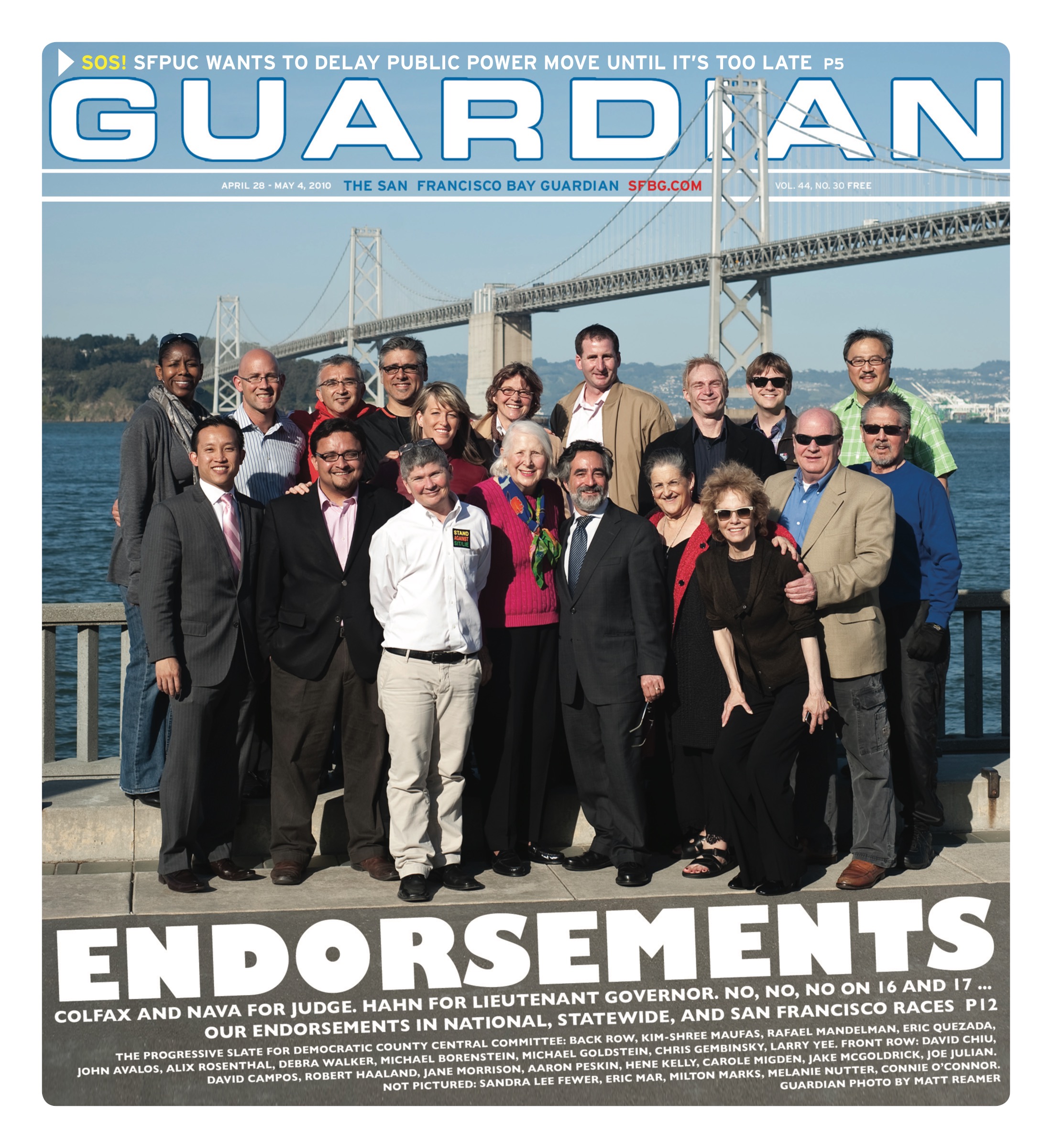
ENDORSEMENTS: Judicial races

2

SUPERIOR COURT JUDGE, SEAT 6


LINDA COLFAX


It’s rare to see an open seat on the Superior Court; judges typically retire midterm and allow the governor to appoint their replacement. And with a Republican governor, the more progressive Democrats have had a hard time getting even close to judicial appointments. Four highly qualified candidates are seeking this seat, and all of them make good cases for election.


Since judicial candidates can’t take stands on most political issues or indicate how they might rule on cases, it’s hard to get a sense of where the candidates stand. But they can talk about their backgrounds and experience — and about how the local courts are run. For example, the Superior Court is managed on a day-to-day basis by a presiding judge, elected by the sitting judges on the San Francisco bench. But those elections are secret; nobody except the judges know who the candidates were; who voted for which one; or what the final tally was. Court administration is done in closed meetings. Most of what happens in the courts is public — but there’s no presumption of cameras in the courtrooms to give the public access to the justice system.


Our choices for judge reflect our interest in a diverse judiciary, judges who have both professional and personal experience that will shape fair decisions — and jurists who believe in open government, including open courts.


Our choice for Seat 6 is Linda Colfax, a deputy public defender with a background in community service (she’s been an ACLU board member) and progressive politics. Like all four candidates, she has impressive legal credentials and trial experience. She also strongly supports sunshine in the courts and told us she would allow the press and public into judges’ meetings when appropriate, supports cameras in the courtrooms (except for cases where a witness or crime victim has to be protected), and efforts to make the courts work more efficiently.


Robert Retana, who grew up in East Los Angeles, has worked in both civil and criminal law, as a prosecutor and a civil litigator. He also has extensive community service with La Raza Centro Legal and the Lawyer’s Committee for Civil Rights. He was awfully vague on cameras in the courtroom and didn’t seem well-informed on open-government issues, but he’s certainly qualified for the job.


Rod Mcleod, a former San Francisco School Board member, told us he won’t raise any money for this race since he thinks judges shouldn’t be captive to special interests. That’s noble, but it also makes it unlikely he’ll be a factor in the end.


Harry Dorfman, a career prosecutor with the District Attorney’s Office, has extensive trial experience but was the least willing of all the candidates we interviewed to expand public access to the courts.


Colfax has the endorsements of Assembly Member Tom Ammiano, Sen. Mark Leno, and Sups. David Campos, John Avalos, and Eric Mar, among others. She would also diversify the bench in a significant way, not just because she’s a lesbian but because she spent her career in the Public Defender’s Office. And since Democratic and Republican governors alike tend not to appoint public defenders to the bench, that background and perspective is rare. Vote for Colfax.


SUPERIOR COURT JUDGE, SEAT 15


MICHAEL NAVA


Another rarity here: a contested race where challengers are taking on a sitting judge. Richard Ulmer, the incumbent, was a Republican living in Hillsborough when Gov. Schwarzenegger appointed him to the bench last year; he quickly changed his registration to independent and took up residence in Park Merced. But two gay men, Michael Nava and Daniel Dean, saw him as potentially vulnerable and, noting the lack of LGBT appointments coming out of the current administration, filed to challenge Ulmer.


Ulmer’s a smart and appealing person with an impressive legal resume, and we see no scandal that would mandate his removal from office. But we also recognize that this is an elected office, and that it’s perfectly acceptable for candidates who think they would better serve the public and the bench to run against an incumbent. In this case, we’re endorsing Michael Nava.


Nava, the grandson of Mexican immigrants, makes the case that judicial appointments can be just as political as elections: out of some 500 judicial appointments, Schwarzenegger has named perhaps five openly LGBT candidates. Nava also would bring a different perspective to the courts. His career has been in the public sector and he currently works as a staff attorney drafting decisions for Superior Court Justice Carlos Moreno. More than anyone else running for judge this year, Nava is an advocate of openness in the judiciary. He told us the courts are the third branch of government and should be held to most of the same sunshine standards at the executive and legislature.


Daniel Dean also makes a compelling case and has extensive courtroom experience as a litigator and judge pro tem. His accessibility and sense of humor would serve him well on the bench, and we hope he continues to seek a judicial slot. But in this race, we’re endorsing Nava.

ENDORSEMENTS: San Francisco ballot measures

0

 PROPOSITION A

SCHOOL FACILITIES SPECIAL TAX

YES

This measure would extend a 1990 parcel tax that expires in 2010 by another 20 years, keeping it at its current rate ($32 a year for single family homes and commercial enterprises, $16 a year per dwelling unit for mixed use buildings). The tax brings in $7 million a year for San Francisco school facilities and would finance seismic upgrades, structural strengthening and related improvements of its facilities, and child care centers. Vote yes.


PROPOSITION B

EARTHQUAKE SAFETY AND EMERGENCY RESPONSE BONDS

YES

It’s hard to argue against a $430 million bond act to upgrade police, fire, and water facilities to prevent a catastrophic collapse of the city’s most basic public safety infrastructure in the event of an inevitable earthquake. Hard — but not impossible: Sup. Chris Daly, the lone vote against Prop. B, points out that the bond money would be used to upgrade police stations but that the old County Jail at 850 Bryant St. wouldn’t get any help. Prisoners, it seems (even those who are awaiting trial and have been convicted of nothing) aren’t worth protecting. And the Fire Department has been very hazy about where it’s going to spend the cash. So we’ve got some concerns here — but on balance, we’re endorsing Yes on B.


PROPOSITION C

FILM COMMISSION

YES

By some accounts, this measure was put together in retaliation for Mayor Gavin Newsom’s November 2009 demand that Film Commission executive director Stefanie Coyote resign — shortly after her husband, actor Peter Coyote, supported Attorney General Jerry Brown over Newsom for governor. But Bill Barnes, who works as a legislative aide for Newsom ally Sup. Michela Alioto-Pier, the author of Prop. C, says Alioto-Pier was working on this measure even before Coyote got ousted.

Either way, it’s a positive step. Prop. C would streamline a convoluted permitting process for shooting films in San Francisco — a process that can involve multiple departments — and would create a one-stop shop. It would also split the power to appoint the film commissioners between the mayor and the board (6-5, respectively), and require that all 11 commissioners have specific qualifications or experience. Vote yes.


PROPOSITION D

RETIREMENT BENEFITS

YES

Prop. D is a compromise. Sup. Sean Elsbernd wanted to reform the city’s pension system by mandating higher employee contributions and an end to what’s known as “spiking” — giving some employees a big raise just before they retire. Under current law, that worker would get a pension based on the inflated salary.

Elsbernd wanted to change the calculation and base pensions on an average of the final three years of salary an employee earned. Labor countered that some lower-paid workers only reach their top pay at the end of their careers. The final deal would base pensions on a two-year average. Prop. D would also require future employees to contribute and extra 2 percent to their pensions and require the city to set aside some money every year for the pension and retiree health care systems. In the end, progressive Sups. David Campos and Eric Mar signed on, and the city employee unions aren’t opposed. Vote yes.


PROPOSITION E

BUDGET LINE ITEM FOR POLICE SECURITY

YES

Prop. E would make one simple tweak to the reporting requirements for San Francisco’s annual city budget: a line-item on how much is spent on security for city officials and visiting dignitaries. As things stand, the amount the police department spends to protect people like, oh, say Mayor Gavin Newsom while he is crisscrossing the state campaigning for (lieutenant) governor is kept secret. That’s information the public has a right to know. Vote yes.


PROPOSITION F

RENTERS’ FINANCIAL HARDSHIP APPLICATIONS

YES

Prop. F would allow a tenant facing a rent increase to file a petition with the Rent Board claiming financial hardship. If the tenant was unemployed, or had his or her wages cut by 20 percent or more, or didn’t get a cost of living increase in government benefits and was paying at least 33 percent of his or her income as rent, the rent hike would be delayed for 60 days pending a hearing. If the renter can establish hardship, the landlord would have to hold off on the increase until the tenant’s employment or benefit situation improved. Few San Francisco landlords would be hurt by the delay in what are typically modest rent hikes — but a lot of tenants could avoid eviction. Vote yes.


PROPOSITION G

TRANSBAY TRANSIT CENTER

YES

Prop. G, a policy statement, became a moot point earlier this year, but it’s still good for San Franciscans to affirm the city’s support for bringing high-speed rail service downtown. The California High-Speed Rail Project is moving to create bullet train service from SF to downtown Los Angeles using bond money approved by voters in 2008. Even though that bond measure named the Transbay Terminal as the northern terminus of the first phase, some officials raised doubts about whether the downtown location was the best choice. That rail service was integral to plans for the transit center, which is currently being rebuilt, so the Board of Supervisors placed this measure on the ballot to support that choice. Earlier this month, the California High-Speed Rail Authority considered other alternatives and voted to stay with the Transbay Terminal. That’s the right way to go; vote yes.

ENDORSEMENTS: State ballot measures

8

PROPOSITION 13

LIMITS ON PROPERTY TAX ASSESSMENT FOR SEISMIC RETROFITS

YES

The primary sponsor of Prop. 13 is Republican Sen. Roy Ashburn, who dominated the news for several days after he was arrested for drunk driving on his way home from a Sacramento gay bar. Needless to say, Ashburn’s dramatic coming out has whipped up far more attention than his noncontroversial ballot initiative.

We’re generally opposed to anything that gives tax cuts or tax deferrals to property owners; thanks to a 1978 measure also called Prop. 13, much of the commercial and residential property in California is badly under assessed. And Prop. 13, 2010 style, is indeed a tax break. But it’s probably justified.

Buildings in this state are typically reassessed for property taxes after they’ve been modified with new construction, except in cases where the modifications are made to comply with earthquake-safety standards. While most buildings that undergo seismic retrofitting are exempt from reassessment until the property is transferred to a new owner, the exemption for unreinforced masonry buildings is limited to 15 years. Prop 13 would remove that 15-year cap.

The fiscal impact on cities is likely to be pretty minor, and the measure might encourage both commercial and residential landlords to bring their buildings up to standard. Vote yes.


PROPOSITION 14

OPEN PRIMARIES

NO

At the height of a royal mess last year when the state budget was long overdue and the two-thirds majority needed to pass it was still out of reach by one vote, Republican Sen. Abel Maldonado struck a deal with Democrats. He said he’d support the budget — if the majority party would meet a few of his demands. One thing he insisted on was Prop. 14 — a ballot measure that would effectively remove political parties from the primary elections process, allowing all voters to cast ballots for any candidate regardless of party affiliation.

Under Maldonado’s plan, all candidates would run on a single primary ballot, and the top two vote-getters would face off in the general election. Heavily funded by the California Chamber of Commerce and marketed by the same spin doctors and corporate lawyers who are rolling in Yes on 16 campaign money, Prop. 14’s backers say it will result in more centrist elected officials.

There are plenty of pitfalls here, the most worrisome being that it would drive up the cost of elections and give more moneyed (and corporate-allied) candidates a sharper competitive edge while elbowing out progressives. It would allow Republicans to play a role in what would normally be Democratic primaries (and vice versa.) The measure would also make it nearly impossible for smaller parties — the Green Party, for example — to offer candidates in the November elections.

Bad idea, bad process, Vote no.


PROPOSITION 15

FAIR ELECTIONS ACT

YES

California desperately needs electoral reform. Corporate campaign spending and lobbyists have poisoned the decision-making process and muzzled the voice of the people. Something radical needs to be done — and while this measure is only a small, measured step in the right direction, it’s an important and promising experiment.

Prop. 15 would create a pilot public financing program for the 2014 and 2018 races for California Secretary of State — and the program would be funded by a tax on lobbyists. Right now lobbyists pay only $12.50 per year to register with the state. This measure would increase that fee to $350 annually and use the money to create a fund of about $6 million that candidates for the crucial office overseeing elections in the state could tap after demonstrating their popular support by gathering a number of small contributions. All candidates who qualify would be given the same amount of money and left to compete on the issues. Ideally this public financing program would prove successful and eventually be expanded to other offices. Public financing of election campaigns, which is currently working well in Arizona and Maine, is certainly worth a try in California. Vote yes.


PROPOSITION 16

MONOPOLY PROTECTION FOR PG&E

NO! NO! NO!

The deceptively titled “Taxpayer’s Right to Vote Act” was dreamed up and funded entirely by Pacific Gas and Electric Co., the monopolistic utility that is worried it could face actual competition here in San Francisco (and elsewhere) from municipal electricity programs that would offer customers a greener energy mix and more accountability than PG&E executives will ever demonstrate.

Rather than accept some healthy competition, this sleazy corporation has opted to spend some $35 million to exterminate all possibilities of municipal electricity programs cropping up anywhere in the state in a bid to preserve its octopus-like grip on the energy market in Northern California. Prop. 16 would require a two-thirds majority vote at the ballot before any community choice aggregation (CCA) program — or any attempt at creating or expanding a public-power system — could move forward. That’s an extreme hurdle — -and PG&E knows it.

In effect, PG&E is trying to buy public policy here, trying to pass a law that will protect its own monopoly interests.

In San Francisco, the CCA being proposed would offer customers 51 percent renewable power by 2017, which means it would blow PG&E out of the water in the green arena and mark S.F. as taking greater strides toward combating climate change than any other major U.S. city. This example could set a precedent for others, which, in turn, could create favorable market conditions for green energy startups that want to harness wind, solar, biomass, geothermal, tidal, and energy efficiency alternatives.

The very existence of Prop. 16 is already threatening the San Francisco CCA; the city’s Public Utilities Commission is trying to delay a final contract until after the June 8 vote on the measure (see editorial, page 5)

Vote no on Prop 16. Not just because it’s an example of a big business single-handedly trying to alter the state constitution for its own economic benefit by pouring millions of dollars into a deceptive advertising campaign. Not just because a two-thirds majority vote requirement is anti-democratic. Not just because there were reports that the signature gatherers who got people to sign on in support of placing Prop. 16 on the ballot were telling people that its purpose was to limit PG&E expansion or encourage solar power. Not just because Senate Pro Tem Darrell Steinberg and a half dozen members of the Legislature sent a letter rebuking PG&E CEO Peter Darbee for disrespecting the democratic process by going straight to the ballot to undermine legislation it initially supported that enabled the creation of CCA programs. Not just because PG&E is using $35 million of ratepayer dollars (that’s the check you wrote them for your electricity bill!) to put out slick TV ads for this campaign when it should have been repairing the pipelines under those manholes that keep exploding and messing up your morning commute. Not even just because with CCA, you already have the right to vote whether or not you want to be part of it, a choice PG&E will never give you. And not just because PG&E keeps trying to raise rates, which is much more difficult for municipal energy agencies to do.

If for no other reason, vote no because Prop. 16 flies in the face of everything environmentalists stand for. It’s a measure that will thwart progress on fighting climate change, brought to you by the company that practically invented green-washing. PG&E is a huge nuclear power player; it purchases coal from mountaintop-removal coal mines in West Virginia that are completely devastating biodiverse landscapes in Southern Appalachia and screwing over poor people by tainting their drinking water; and it’s in the process of building fossil fuel-fired power plants in poor communities of color in California. The CCA programs at least represent a glimmer of hope for an alternative model; Prop. 16 kills off that possibility with one fell swoop motivated by pure greed. For the love of justice, democracy, and the planet, vote no on Prop 16.


PROPOSITION 17

CAR INSURANCE SCHEME

NO, NO, NO!

Mercury Insurance sponsored this measure and is campaigning for it with tens of millions of dollars, betting it can fool voters and make hundreds of millions of dollars in profits by doing so. And if the company is right, insurance rates will skyrocket for new drivers and those who haven’t had continuous insurance coverage, which experts say will increase the number of uninsured drivers on the roadways and end up increasing insurance rates for everyone.

Mercury and its founder George Joseph have been truly malevolent players in California, exploiting their customers to make billions of dollars in profits, attacking California’s landmark insurance reform measure Prop. 103 with lawsuits and corrupting campaign contributions over more than 20 years, and flouting insurance regulators in such brazen fashion that even Insurance Commissioner Steve Poizner, a conservative Republican, recently chastised the company for its “lengthy history of serious misconduct” (see “Buying power,” March 17).

Now, however, the company is hoping its promise to cut the insurance premiums of drivers who have maintained continuous coverage by “as much as $250 per year” will buy their votes and that they’ll overlook the myriad negative impacts of increasing everyone else’s premiums by $1,000 per year or more, based on Mercury’s own estimates.

Think about that. If you’re a driver who missed an insurance payment by even one day, or a soldier returning from boot camp, or someone with a low-income getting insurance for the first time or after ditching your car for a while, what are you going to do when you discover already-expensive car insurance comes with a $1,000 annual surcharge?

Many Californians, those who share our roads, will choose to drive without insurance. Then they’ll be more likely to leave the scene of accidents or declare bankruptcy rather than paying out-of-pocket for their accidents, both of which increase the cost of insurance for everyone else.

That’s how insurance works. If someone pays less, someone else pays more; and the only entity guaranteed to really make money over the long term is the insurance company. Don’t fall for this scam. Vote no on 17.

ENDORSEMENTS: National and state races

15

Editor’s note: the file below contains a correction, updated May 5 2010. 


National races


U.S. SENATE, DEMOCRAT


BARBARA BOXER


The Republican Party is targeting this race as one of its top national priorities, and if the GOP can dislodge a three-term senator from California, it will be a major blow for the party (and agenda) of President Obama. The pundits are happily talking about how much danger Barbara Boxer faces, how the country’s mood is swinging against big-government liberals.


But it’s always a mistake to count out Boxer. In 1982, as a Marin County supervisor with little name recognition in San Francisco, she trounced then-SF Sup. Louise Renne for an open Congressional seat. Ten years later, she beat the odds and won a hotly contested primary and tough general election to move into the Senate. She’s a fierce campaigner, and with no primary opposition, will have a united party behind her.


Boxer is one of the most progressive members of the not-terribly progressive U.S. Senate. She’s been one of the strongest, most consistent supporters of reproductive rights in Washington and a friend of labor (with 100 percent ratings from the AFL-CIO and National Education Association). We’ve had our disagreements: Boxer supported No Child Left Behind, wrote the law allowing airline pilots to carry guns in the cockpit, and was weak on same-sex marriage when San Francisco sought to legalize it (although she’s come around). But she was an early and stalwart foe of the war in Iraq, split with her own party to oppose a crackdown on illegal immigration, and is leading the way on accountability for Wall Street. She richly deserves reelection, and we’re happy to endorse her.


CONGRESS, 6TH DISTRICT, DEMOCRAT


LYNN WOOLSEY


It’s odd that the representative from Marin and Sonoma counties is more progressive by far than her colleague to the south, San Francisco’s Nancy Pelosi. But over the years, Lynn Woolsey has been one of the strongest opponents of the war, a voice against bailouts for the big Wall Street banks, and a foe of cuts in the social safety net. We’re proud to endorse her for another term.


CONGRESS, 7TH DISTRICT, DEMOCRAT


GEORGE MILLER


George Miller has been representing this East Bay district since 1974, and is now the chair of the Education and Labor Committee and a powerhouse in Congress. He’s too prone to compromise (with George W. Bush on education policy) but is taking the right line on California water (while Sen. Dianne Feinstein is on the wrong side). We’ll endorse him for another term.


CONGRESS, 8TH DISTRICT, DEMOCRAT


NANCY PELOSI


We’ve never been terribly pleased with San Francisco’s most prominent Congressional representative. Nancy Pelosi was the author of the bill that created the first privatized national park at the Presidio, setting a horrible standard that parks ought to be about making money. She was weak on opposing the war, ducked same-sex marriage, and has used her clout locally for all the wrong candidates and issues. But we have to give her credit for resurrecting and pushing through the health care bill (bad as it was — and it’s pretty bad — it’s better than doing nothing). And, at a time when the Republicans are trying to derail the Obama presidency, she’s become a pretty effective partner for the president.


Her fate as speaker (and her future in this seat) probably depends on how the Democrats fare in the midterm Congressional elections this fall. But if she and the party survive in decent shape, she needs to take the opportunity to undo the damage she did at the Presidio.


CONGRESS, 9TH DISTRICT, DEMOCRAT


BARBARA LEE


Barbara Lee, who represents Berkeley and Oakland, is co-chair of the Progressive Caucus in the House, one of the most consistent liberal votes in Congress, and a hero to the antiwar movement. In 2001, she was the only member of either house to oppose the Bush administration’s Use of Force resolution following the 9/11 attacks, and she’s never let up on her opposition to foolish military entanglements. We’re glad she’s doing what Nancy Pelosi won’t — represent the progressive politics of her district in Washington.


CONGRESS, 13TH DISTRICT, DEMOCRAT


PETE STARK


Most politicians mellow and get more moderate as they age; Stark is the opposite. He announced a couple of years ago that he’s an atheist (the only one in Congress), opposed the Iraq war early, called one of his colleagues a whore for the insurance industry, and insulted President Bush and refused to apologize, saying: “I may have dishonored the commander-in-chief, but I think he’s done pretty well to dishonor himself without any help from me.” He served as chair of the House Ways and Means Committee for exactly one day — March 3 — before the Democratic membership overruled Speaker Pelosi and chucked him out on the grounds that he was too inflammatory. The 78-year-old may not be in office much longer, but he’s good on all the major issues. He’s also fearless. If he wants another term, he deserves one.


State races


GOVERNOR, DEMOCRAT


EDMUND G. BROWN


Jerry Brown? Which Jerry Brown? The small-is-beautiful environmentalist from the 1970s who opposed Pacific Gas and Electric Co.’s Diablo Canyon nuke and created the California Conservation Corps, the Office of Appropriate Technology, and the Farm Labor Relations Board (all while running a huge budget surplus in Sacramento)? The angry populist who lashed out at corporate power on a KPFA radio talk show and ran against Bill Clinton for president? The pro-development mayor of Oakland who sided with the cops on crime issues and opened a military academy? Or the tough-on-crime attorney general who refuses to even talk about tax increases to solve the state’s gargantuan budget problems?


We don’t know. That’s the problem with Brown — you never know what he’ll do or say next. For now, he’s been a terribly disappointing candidate, running to the right, rambling on about preserving Proposition 13, making awful statements about immigration and sanctuary laws, and even sounding soft on environmental issues. He’s started to hit his stride lately, though, attacking likely GOP contender Meg Whitman over her ties to Wall Street and we’re seeing a few flashes of the populist Brown. But he’s got to step it up if he wants to win — and he’s got to get serious about taxes and show some budget leadership, if he wants to make a difference as governor.


LIEUTENANT GOVERNOR, DEMOCRAT


JANICE HAHN


Not an easy choice, by any means.


Mayor Gavin Newsom jumped into this race only after it became clear that he wouldn’t get elected governor. He sees it as a temporary perch, someplace to park his political ambitions until a better office opens up. He’s got the money, the statewide name recognition, and the endorsement of some of the state’s major power players, including both U.S. Senators and House Speaker Nancy Pelosi. He’s also been a terrible mayor of San Francisco — and some progressives (like Sup. Chris Daly) argue, persuasively, that the best way to get a better person in Room 200 is to ship Newsom off to an office in Sacramento where he can’t do much harm and let the supervisors pick the next mayor.


But it’s hard to endorse Newsom for any higher office. He’s ducked on public power, allowing PG&E to come very close to blocking the city’s community choice aggregation program (See editorial, page 5). His policies have promoted deporting kids and breaking up families. He’s taken an approach to the city budget — no new revenue, just cuts — that’s similar to what the Republican governor has done. He didn’t even bother to come down and talk to us about this race. There’s really no good argument for supporting the advancement of his political career.


Then there’s Janice Hahn. She’s a Los Angeles City Council member, the daughter of a former county supervisor, and the sister of a former mayor. She got in this race way before Newsom, and her nightmare campaign consultant, Garry South, acts as if she has some divine right to be the only Democrat running.


Hahn in not overly impressive as a candidate. When we met her, she seemed confused about some issues and scrambled to duck others. She told us she’s not sure she’s in favor of legalizing pot, but she isn’t sure why she’s not sure since she has no arguments against it. She won’t take a position on a new peripheral canal, although she can’t defend building one and says that protecting San Francisco Bay has to be a priority. She won’t rule out offshore oil drilling, although she said she has yet to see a proposal she can support. Her main economic development proposal was to bring more film industry work to California, even if that means cutting taxes for the studios or locating the shoots on Indian land where there are fewer regulations.


On the other hand, she told us she wants to get rid of the two-thirds threshold in the state Legislature for passing a budget or raising taxes. She supports reinstating the car tax at pre-Gov. Arnold Schwarzenegger levels. She supports a split-roll measure to reform Prop. 13. She wants to see an oil-severance tax to fund education. She’s one of the few statewide candidates who openly advocates higher taxes on the wealthy as part of the solution to the budget crisis.


We are under no illusions that Hahn will be able to use the weak office of lieutenant governor to move on any of these issues, and we’re not at all sure she’s ready to take over the top spot. But on the issues, she’s clearly better than Newsom, so she gets our endorsements.


SECRETARY OF STATE, DEMOCRAT


DEBRA BOWEN


Debra Bowen is the only Democrat running, a sign that pretty much everyone in the party thinks she’s doing a fine job as Secretary of State. She’s run a clean office and we see no reason to replace her.


CONTROLLER, DEMOCRAT


JOHN CHIANG


Like Bowen, John Chiang has no opposition in the primary, and he’s been a perfectly adequate controller. In fact, when Gov. Schwarzenegger tried two years ago to cut the pay of thousands of state employees to the minimum wage level, Chiang defied him and refused to change the paychecks — a move that forced the governor to back down. We just wish he’d play a more visible role in talking about the need for more tax revenue to balance the state’s books.


TREASURER, DEMOCRAT


BILL LOCKYER


Bill Lockyer keeps bouncing around Sacramento, waiting, perhaps, for his chance to be governor. He was attorney general. Now he’s treasurer seeking a second term, which he will almost certainly win. He’s done some good things, including trying to use state bonds to promote alternative energy, and has spoken out forcefully about the governor’s efforts to defer deficit problems through dubious borrowing. He hasn’t, however, come out in favor of higher taxes for the rich or a change in Prop. 13.


ATTORNEY GENERAL, DEMOCRAT


KAMALA HARRIS


There are really only two serious candidates in this race, Kamala Harris, the San Francisco district attorney, and Rocky Delgadillo, the former Los Angeles city attorney. Harris has a comfortable lead, with Delgadillo in second and the others far behind.


Delgadillo is on his second try for this office. He ran against Jerry Brown four years ago and got nowhere. And in the meantime, he’s come under fire for, among other things, using city employees to run personal errands for him (picking up his dry-cleaning, babysitting his kids) and driving his car without insurance. On a more significant level, he made his reputation with gang injunctions that smacked of ethnic profiling and infuriated Latino and civil liberties groups. It’s amazing he’s still a factor in this race; he can’t possibly win the general election with all his baggage.


Harris has a lot going for her. She was among the first California elected officials to endorse Barack Obama for president, and remains close to the administration. She’s a smart, articulate prosecutor and could be one of the few women atop the Democratic ticket this year. We were never comfortable with her ties to Willie Brown, but he’s no longer a factor in state or local politics. These days, she’s more closely allied with the likes of State Sen. Mark Leno.


That said, we have some serious problems with Harris. She’s been up in Sacramento pushing Republican-style tough-on-crime bills (like a measure that would bar registered sex offenders from ever using social networking sites on the Internet) and forcing sane Democrats like Assembly Member and Public Safety Committee Chair Tom Ammiano to try to tone down or kill them (and then take the political heat). If she didn’t know about the problems in the SFPD crime lab, she should have, and should have made a bigger fuss, earlier.


But Harris has kept her principled position against the death penalty, even when it meant taking immense flak from the cops for refusing to seek capital punishment for the killer of a San Francisco police officer. She’s clearly the best choice for the Democrats.


INSURANCE COMMISSIONER, DEMOCRAT


DAVE JONES


Two credible progressives are vying to run for this powerful and important position regulating the massive — and massively corrupt — California insurance industry. Dave Jones and Hector De La Torre are both in the state Assembly, with Jones representing Sacramento and De La Torre hailing from Los Angeles. Both have a record opposing insurance industry initiatives; both are outspoken foes of Prop. 17; and either would do a fine job as insurance commissioner. But Jones has more experience on consumer issues and health care reform, and we prefer his background as a Legal Aid lawyer to De La Torre’s history as a Southern California Edison executive. So we’ll give Jones the nod.


BOARD OF EQUALIZATION, DISTRICT 1, DEMOCRAT


BETTY T. YEE


Betty Yee has taken over a job that’s been a stronghold of progressive tax policy since the days of the late Bill Bennett. She’s done well in the position, supporting progressive financial measures and even coming down, as a top tax official, in favor of legalizing (and taxing) marijuana. We’re happy to endorse her for another term.


SUPERINTENDENT OF PUBLIC INSTRUCTION


TOM TORLAKSON


Two prominent Democratic legislators are running for this nonpartisan post, state Sen. Gloria Romero of Los Angeles and Assembly Member Tom Torlakson of Martinez. It’s a pretty clear choice: Romero is a big supporter of charter schools who thinks parents should be able to move their kids out of one school district and into another (allowing wealthier white parents, for example, to abandon Los Angeles or San Francisco for the suburban districts). She’s been supported in the past by Don and Doris Fisher, who put a chunk of their GAP Inc. fortune into school privatization efforts. Torlakson wants more accountability for charters, opposes the Romero district-option bill, and has the support of every major teachers union in the state. Vote for Torlakson.


STATE SENATE, DISTRICT 8, DEMOCRAT


LELAND YEE


Sen. Leland Yee can be infuriating. Two years ago, he was hell-bent on selling the Cow Palace as surplus state property and allowing private developers to take it over. In the recent budget crisis, he pissed off his Democratic colleagues by refusing to vote for cuts that everyone else knew were inevitable (while never making a strong stand in favor of, say, repealing Prop. 13 or raising other taxes). But he’s always been good on open-government issues and has made headlines lately for busting California State University, Stanislaus over a secret contract to bring Sarah Palin in for a fundraiser — and has raised the larger point that public universities shouldn’t hide their finances behind private foundations.


Yee will have no serious opposition for reelection, and his campaign for a second term in Sacramento is really the start of the Leland Yee for Mayor effort. With reservations over the Cow Palace deal and a few other issues, we’ll endorse him for reelection.


 Correction update: Yee’s office informs us that the senator suports an oil-severance tax and a tax on high-income earners and “believes that Prop. 13 should be reformed,” although he hasn’t taken a position on Assemblymember Tom Ammiano’s reform bill. 


STATE ASSEMBLY, DISTRICT 12, DEMOCRAT


FIONA MA


Fiona Ma’s a mixed bag (at best). She doesn’t like Pacific Gas and Electric Co. and supports public power, but comes up with strange bills that make no sense, like a 2009 measure to limit rent control in trailer parks. Why does Ma, who has no trailer parks in her district, care? Maybe because the landlords who control the mobile home facilities gave her some campaign cash. She faces no opposition, and we’re not thrilled with her record, but we’ll reluctantly back her for another term.


STATE ASSEMBLY, DISTRICT 13, DEMOCRAT


TOM AMMIANO


When the history of progressive politics in modern San Francisco is written, Tom Ammiano will be a central figure. His long-shot 1999 mayoral campaign against Willie Brown brought the left to life in town, and his leadership helped bring back district elections and put a progressive Board of Supervisors in place in 2000. As a supervisor, he authored the city’s landmark health care bill (which Newsom constantly tries to take credit for) and the rainy day fund (which saved the public schools from debilitating cuts). He uses his local influence to promote the right causes, issues, and candidates.


And he’s turned out to be an excellent member of the state Assembly. He forced BART to take seriously civilian oversight of the transit police force. He put the battle to reform Prop. 13 with a split-role measure back on the state agenda. And his efforts to legalize and tax marijuana are close to making California the first state to toss the insane pot laws. As chair of the Public Safety Committee, he routinely defies the police lobbies and the right-wing Republicans and defuses truly awful legislation. We’re glad Ammiano’s still fighting in the good fight, and we’re pleased to endorse him for another term.


STATE ASSEMBLY, DISTRICT 14, DEMOCRAT


NANCY SKINNER


Nancy Skinner has taken on one of the toughest, and for small businesses, most important, battles in Sacramento. She wants to make out-of-state companies that sell products to Californians collect and remit sales tax. If you buy a book at your local bookstore, you have to pay sales tax; if you buy it from Amazon, it’s tax-free. That not only hurts the state, which loses hundreds of millions of dollars in tax revenue, it’s a competitive disadvantage to local shops. Skinner’s a good progressive vote and an ally for Ammiano on the Public Safety Committee. We’re happy to endorse her for another term.


STATE ASSEMBLY, DISTRICT 16, DEMOCRAT


SANDRE SWANSON


Sandre Swanson represents the district where BART police killed Oscar Grant, but he wasn’t the one out front pushing for more civilian accountability; that was left to SF’s Ammiano. And while Swanson was generally supportive of Ammiano’s bill, he was hardly a leader in the campaign to pass it. This is too bad, because Swanson’s almost always a progressive vote and has been good on issues like whistleblower protection (a Swanson bill that passed this year protects local government workers who want to report problems confidentially). We’ll endorse him for another term, but he needs to get tougher on the BART police.

Burning the Man

14

steve@sfbg.com

Paul Addis is like the Man he burned: a symbol onto which people project their views of Burning Man, the San Francisco-born event that has become the most enduring countercultural phenomenon of this era. This summer, with the building of Black Rock City in the Nevada desert, marks the 25th annual event.

When Addis illegally torched Burning Man’s eponymous central icon during the Monday night lunar eclipse in 2007, he was either injecting much-needed chaos back into the calcified event; indulging in a dangerous, destructive, and delusional ego trip; or he was simply crazy, depending on the perspective of current and former burners who are still quite animated in their opinions about Addis and his act in online forums.

But Addis is also just a man, one who paid a heavy price to make his statement. After pleading guilty to a destruction of property charge in Nevada court, which became a felony after Burning Man leaders testified to more than $30,000 in damages from having to rebuild the icon, Addis served nearly two years in prison.

Addis was released late last year and recently returned to San Francisco, where this performance artist will debut his new solo show, “Dystopian Veneer,” at The Dark Room on April 30 (a second show is set for May 7). While Addis insists he didn’t seek the notoriety that came from getting caught, it’s clear he relishes this outlaw role, which follows naturally from his last stage incarnation as gun-loving journalist Hunter S. Thompson.

In a nearly three-hour interview with the Guardian, Addis described that fateful night and its implications, as well as why he turned on an event he once loved.


BURNING MAN GROWS UP

Addis first attended Burning Man in 1996, the last year in which anarchy and danger truly reigned, when a tragic death and serious injuries caused Burning Man organizers to impose a civic structure and rules, such as bans on firearms and high-speed driving, on future events.

Addis said he immediately became “a true believer,” seeing Burning Man as both a revolutionary experiment in free expression and political empowerment, and as a “wild, risk-taking thing for pure visceral power.” He came from what he called the “San Francisco arts underground” and had a libertarian’s love for guns, drugs, and explosives, but a progressive’s opposition to war and consumer culture.

“When you go to Burning Man, everyone has that feeling at a certain point in time. It is the most incredible thing you’ve been at. You do see the possibilities laid out in front of you,” Addis told me.

Addis poured himself into the event, but became frustrated with the rules and restrictions after three years and stopped going to Burning Man, although he remained in its orbit and closely followed it.

“There are some people who go to Burning Man who have extraordinary ideas and they are extraordinary people. They embody the type of concern and substantial action that I found so wonderfully possible in those early years. And to those people, thank you for what you do. But they are a minority,” Addis said.

Addis shared the anarchist mindset of John Law, who led Burning Man to the Black Rock Desert then left the event in frustration with its growing scale and popularity and never returned after 1996.

“Paul Addis’ early burning of the corporate logo of the Burning Man event last year was the single most pure act of ‘radical self expression’ to occur at this massive hipster tail-gate party in over a decade,” Law wrote on a Laughing Squid blog post after Addis’ sentencing hearing in 2008, one of 185 spirited comments on both sides of the debate.

Among this growing group of Burning Man haters and malcontents, which included self-imposed exiles like Law and provocateur attendees like Chicken John (see “State of the Art,” 12/20/04), there was always talk about burning the Man early as the ultimate strike against how ordered the event had become.

“Everyone knew it needed to be done for lots of reasons,” Addis said of his arson attack. So he returned to Burning Man in 2007 with the sole purpose of torching the Man in order to “bring back that level of unpredictable excitement, that verve, that ‘what’s going to happen next?’ feeling, because it had gotten orchestrated and scripted.”


TORCHING THE ICON

Addis can be very grandiose and self-important, prone to presenting himself in heroic terms or as the innocent victim of other people’s conspiracies, such as the police in Seattle and San Francisco who arrested him for possession of weapons and fireworks in separate instances within weeks of his arrest at Burning Man. But when it came to burning the Man, Addis was purposeful.

“Obviously a gesture like burning down Burning Man is very dangerous and very provocative. From my perspective, the No. 1 concern was safety. No one could get hurt unless it was me,” Addis said. Critics of the arson attack often note how dangerous it was, pointing out that there were a dozen or so people under the Man when it caught fire. But Addis said that he was on site for at least 30 minutes beforehand, encouraging people to move back with mixed results, shirtless and wearing the red, black, and white face paint that would later make for such an iconic mug shot.

As a full lunar eclipse overhead darkened the playa and set the stage for his act, Addis waited for his cue: someone, whom Addis won’t identify, was going to cut the lights that illuminated the Burning Man and give him at least 15 minutes to do his deed in darkness.

“I didn’t do this alone,” Addis said. “The lights were cut by someone else… The lights were cut to camouflage my ascent.”

Unfortunately for Addis, the operation didn’t go as smoothly as he hoped. He miscalcuated the tension in a guide-wire he planned to climb and the difficulty in using the zip-ties that attached a tent flap to it as steps, slowly pulling himself up the wire “hand over hand.”

Once he reached the platform at the bottom of one leg, “I reached for this bottle of homemade napalm that I made for an igniter and it’s gone,” dropped during his ascent. And his backup plan of using burlap and lighter fluid took a long time when he couldn’t get his Bic lighter to work under the 15 mph wind.

Then the lights came back on. “And now I know I’m exposed. Because the whole thing was not to get famous for doing this. It was to get away and have it be a mystery. That was the goal,” Addis said.

But then Addis got the fire going and it quickly spread up the Man’s leg, and Addis used nylon safety cables to slide down the guide-wire like a zip-line. “I landed perfectly right in front of two Black Rock Rangers who watched me come down,” Addis said. “And I turned to them and said, ‘Your man is on fire.'<0x2009>”

Addis said he was “furious” to see about nine people still under the burning structure, blaming the rangers and yelling at the people to clear the area before declaring, “This is radical free speech at Burning Man” and taking off running. Addis said he stopped at the Steam Punk Treehouse art exhibit, hoping to get lost in the crowd, but headlights converged on his location. He ran again, with a ranger close behind, and was finally caught, arrested, and taken to Pershing County Jail.


AFTERMATH

The arson attack made international news, and there were enough Addis’ supporters out there to convey the message that this was a political statement against the leadership of event founder Larry Harvey and Black Rock City LLC.

But those who run the event didn’t buy into Addis’ narrative. Instead, they ordered new materials to have the Man rebuilt and burned on schedule. And when it came time to testify at his sentencing hearing a year later, they sent LLC board member Will Roger and a tally for replacement costs that greatly exceeded the $5,000 level that bumped the charges up to a felony.

“They didn’t have to do this,” Addis said. “Instead, they decided to deliberately take action they knew would send me to prison.”

Burning Man spokesperson Marian Goodell wouldn’t discuss the charge. “It doesn’t do us or him any good to open that wound again.”

But an internal memo written by Executive Project Manager Ray Allen shortly after the hearing argued that they were required to respond honestly to requests for information from prosecutors and to do otherwise would have required perjury on behalf of an adversary.

“Part of putting on the Burning Man event means maintaining good relations with Pershing County so that we can continue to have the Burning Man event on BLM land within that county. Good relations means cooperating with criminal prosecutions,” Allen wrote to Burning Man employees.

Many of those employees remain profoundly offended by Addis and his act, mostly for the extra work it caused and the principle of such a selfish gesture. “The basic ethos out there is build your own stuff, burn your own stuff,” said Andy Moore, a.k.a. Bruiser, an employee since 2001 who helps build the city. “How would you have felt if he went to your house and burned it down because he didn’t like you?”

Yet as viscerally angry as Moore can still get when speaking of Addis, he also agreed that two years is a long prison term for this. “It seems a bit over the top. After all, it was a structure made of wood that was meant to burn.”

But Addis said that he has let go of the bitterness he felt toward Burning Man and is looking forward to being back on stage, something that he said was his main focus in prison. “It’s a brand new life, and I’ve got all this potential,” Addis said. “And I want to make the most out of it.”

Housing relief – for tenants

1

OPINION Since the burst of the housing bubble, we’ve seen a lot of attention paid to the plight of homeowners hit hard by the recession and facing foreclosure. Indeed, President Obama recently enacted a protection for homeowners that requires banks to let unemployed homeowners delay their mortgage payments. But until now there has been little talk and even less action on how we can help tenants who are also in danger of losing their homes.

Tenants need economic relief too. Renters have been particularly hard hit by the housing bubble and the ensuing recession. During the bubble, real estate speculation caused San Francisco rents to increase by an average of 50 percent. When the bubble burst, tenants saw their jobs disappear and incomes drop — but rents remained at record high levels. Evictions for nonpayment of rent shot up as renter after renter found it impossible to keep up with San Francisco’s housing costs.

The June 8 election will give voters a chance to change that. Proposition F will give tenants the right to postpone rent increases when they’ve lost their jobs or seen their wages or hours cut.

Many tenants struggle to pay San Francisco’s sky-high rents in the best of times and, when hit with a layoff or reduction in pay, it becomes even more difficult. Any further rent increases would be devastating and put their housing at risk. Prop. F will provide needed relief to those tenants trying to pay high rents with vastly reduced incomes. Unemployed tenants or those who have seen their wages cut by 20 percent or more will be able to get any rent increase delayed simply by filing a petition with the San Francisco Rent Board and documenting that they are unemployed or have had wages cut.

With the difficulties renters face in one of the country’s most expensive housing markets, Prop. F is a mild and measured response to a very real crisis. Prop. F essentially does what any decent landlord would do anyway: give a break to tenants who’ve just lost their jobs and hold off on rent increases until back on their feet.

San Francisco voters should also give a break to tenants on the verge of losing their homes. Vote Yes on Prop. F.

Ted Gullicksen runs the San Francisco Tenants Union.

Alerts

0

alert@sfbg.com

WEDNESDAY, APRIL 28

SF Hep B Free


Attend this kick-off rally for a new hepatitis B ad campaign. The campaign addresses recent federal data confirming that SF has the highest rate of liver cancer in the country, primarily due to the high rate of hepatitis B among Asian Americans. Fiona Ma, Dr. Edward Chow, Ted Fang, and others will be speaking.

5:30 p.m., free

Togonon Gallery

77 Geary, 2nd floor, SF

www.sfhepbfree.org

Workers Memorial Day


Commemorate workers killed on the job and defend injured workers at this protest to reactivate the labor movement, protect the lives and safety of workers in the workplace, and demand healthcare and justice for all.

7 p.m., free

ILWU Local 34

801 2nd St., SF

www.workersmemorialday.org

THURSDAY, APRIL 29

Support SFBG’s slate card


Show your support for the Guardian’s June 2010 slate of endorsed candidates for the Democratic County Central Committee (DCCC) at this fundraiser featuring live music by the Valerie Orth Band and Lumaya, DJs Smoove and Kramer, a performance by Fou Fou Ha, and more. Although the Guardian is not directly affiliated with this event, proceeds go to a Guardian slate card mailer prepared and distributed by the candidates.

7 p.m., $20–$100 suggested donation

CELLspace

2050 Bryant, SF

alixro@yahoo.com

Oakland teachers strike


Join the picket lines at your Oakland neighborhood public school to protest the district’s top-heavy administration, over-reliance on private contracts, and continued cuts to essential programs.

6 a.m. protest at a school near you

11 a.m. march and rally at Frank Ogawa Plaza

14th at Broadway, Oakl.

Oaklandteachers.wordpress.com

FRIDAY, APRIL 30

Project Homeless Connect


Celebrate Arbor Day by taking part in the groundbreaking of a new fruit tree orchard at Project Homeless Connect’s Growing Home Community Garden, a project that aims to provide an ongoing source of fresh fruit for San Francisco’s homeless community.

1 p.m., free

Project Homeless Connect

Octavia between Page and Oak, SF

RSVP to (858) 523-9020 or (510) 601-4211

SATURDAY, MAY 1

International Workers’ Day


This march and rally will demand full rights for undocumented workers; money for jobs and education not war and occupation; and no more budget cuts or fee hikes that are just taxes on the poor. Sponsored by the May Day 2010 Coalition and the ANSWER Coalition.

Noon, free

24th St. and Mission, SF

answersf.org

TUESDAY, MAY 4

HIREvent


Find out about job opportunities in accounting, education, management, public safety, customer service, sales, technology, law administration, and more at this job fair featuring resume recommendations and employers ready to hire.

11 a.m., free

Hotel Whitcomb

1231 Market, SF

1-888-THE JOBS

Mail items for Alerts to the Guardian Building, 135 Mississippi St., SF, CA 94107; fax to (415) 255-8762; or e-mail alert@sfbg.com. Please include a contact telephone number. Items must be received at least one week prior to the publication date.

Editor’s Notes

0

tredmond@sfbg.com

The San Francisco Chronicle reports that there are now almost 10,000 employees with paychecks that totaled more than $100,000 last year. I can already hear the screaming: that’s close to a billion dollars! City workers are all overpaid, fat, and lazy! That’s why we have a budget crisis!

And yeah, I think it would be a lot more fair if the highest earners took the bulk of the pay cuts (5 percent for everyone in that $100K club would be $50 million a year). But Mayor Newsom wants to be sure the lowest-paid folks get their share of the hurt, so the biggest impact of his budget reductions will fall on those least able to handle it.

But I also think it’s worth looking at who these high earners really are.

Now, some of the ones at the top of the scale are political appointees. Do we really need to pay $354,000 to get someone qualified to run Muni? Is the head of the city’s Public Utilities Commission really worth $291,000? Some are getting market rate for their skills — three of the top 20 earners are doctors who work as pathologists in the Medical Examiner’s office.

But the most telling fact is that 11 of the top 20 are either cops or firefighters — and they’re collecting huge amounts of overtime. Four cops alone, all with the rank of captain or deputy chief, accounted for overtime pay totaling $588,000.

I know city employees who work at the senior management level — just like those cops — but they don’t get overtime. Neither do senior managers in most private-sector jobs. And it’s not as if these top cops are working for minimum wage; they all make around $200,000 or more as base salary. Plus they get excellent benefits and get to retire on sweet pensions.

Think of all the money and services you could save with one minor contract change: once you get to the level of captain in the SFPD, you aren’t eligible for overtime anymore.

No more stalling on CCA

1

EDITORIAL There’s nothing wrong with city officials taking tough stands in negotiations with private contractors. Hundreds, thousands of times in the past few years, San Francisco department heads have rolled over and given away the store in sweetheart deals that put the city on the hook for all the money, make the public take all the risk, and give a private outfit all the profit. Pacific Gas and Electric Co. (remember the Tulock-Modesto sellout contract?), Lennar Corp., Recurrent Energy, and countless other developers, builders, suppliers, and service providers have easily taken the public to the cleaners with contracts that never seemed to get stuck in the due diligence process.

But when there’s a looming deadline, hundreds of millions of dollars, and the city’s energy future and environmental footprint at stake, why is the San Francisco Public Utilities Commission moving so incredibly slowly to hammer out a deal for the city’s community choice aggregation (CCA) program? And why is PUC general manager Ed Harrington doing everything in his power to make sure that nothing happens that might put the city in the power business until after PG&E’s initiative, Prop. 16 — which would block public power efforts — passes at the polls?

It’s infuriating — and the supervisors need to tell the PUC that they won’t approve anything the agency does or wants to do until this contract is completed.

Harrington’s shop has known for more than a year that it needed to work out a business deal with a supplier that could replace PG&E and manage a program to buy greener, cheaper power in bulk and resell it to San Francisco residents. Marin County is setting up a similar program and is far ahead of San Francisco. The city has chosen a vendor, Powerchoice Inc., run by people completely qualified to handle the business.

And now there’s a absolute, drop-deal mandate: the city has to complete negotiations and get the program underway before the June 8 election. That’s because PG&E is spending $35 million to try to pass an initiative that would mandate a two-thirds vote of the public before any new CCA can begin selling power to customers. If San Francisco wants to present a solid legal case that its CCA is already in business, the contract with Powerchoice needs to be completed and signed, now.

But Harrington has, to put it kindly, been dragging his feet. The negotiations are hung up on a few points, although none are deal-breakers; Powerchoice already has agreed to assume some of the financial risk, which was the biggest obstacle to a deal. Now it’s just a matter of hammering out the details — but the PUC staff isn’t acting as if there is any time pressure at all.

In fact, last week Harrington circulated a draft press release all but announcing that he was tossing the whole deal under the bus and postponing negotiations until after the June election. He wanted to say that the "uncertainly" surrounding Prop. 16 made a deal impossible.

But Powerchoice isn’t walking away or complaining about the initiative. The company’s CEO, Sam Enoka, made it clear to us in an interview April 26 that he is eager to move forward. If Harrington — an experienced negotiator with a large staff at his disposal — and his boss, Mayor Gavin Newsom, wanted a deal, it could be finished well ahead of the deadline.

Instead, Harrington showed up at the Local Agency Formation Commission meeting April 23 with charts and a PowerPoint presentation purporting to show that renewable energy is too expensive to sell at rates comparable to what PG&E charges local customers. That misses the point — PG&E’s rates are going up every year and renewables are coming down, and the greatest risk to the city, the ratepayers, and the planet is sticking with the unreliable private utility that relies on fossil fuels and nuclear power for much of its electricity portfolio.

If the city has legitimate issues with Powerchoice, fine: Sit down and begin working them out. Now. But the only thing we can see at this point is the administration of a mayor who wants to be lieutenant governor intentionally delaying the process and giving PG&E exactly what it wants. (We called the PUC April 26, our print deadline, to ask why there were no talks scheduled that day, but Harrington wasn’t available; he was taking the day off.)

Sups. Ross Mirkarimi and David Campos suggest that the board simply refuse to sign off on any contracts, appropriations, or other approvals for anything the SFPUC does until this contract is completed. That’s a fine idea; they should start today.

The good, the bad, and the fence-sitters

1

news@sfbg.com

The Guardian has been periodically producing the Board of Supervisors’ Good Vote Guide for many years, tracking where our elected representatives come down on important issues. And unlike a similar poll recently put out by the San Francisco Chamber of Commerce, which chose 10 votes designed to promote deregulating and subsidizing big businesses, we chose items important to the broad public interest.

The 20 votes we selected this time reflect our concerns for protecting tenants, funding vital public services, safeguarding civil liberties, promoting small businesses and nonprofits, appointing qualified people to commissions, and valuing the environment more than “green” press releases and corporate profits.

To view our guide (PDF), please click here

Rolling forward

7

By Adrian Castañeda

news@sfbg.com

San Francisco’s Potrero del Sol Skatepark is often packed with skaterboarders, a testament to the sport’s popularity and to the dearth of places in the city where it’s legal to skate. But that will soon change with the city’s commitment to build two new skateparks: one in SoMa and the other in the Haight.

Both have been tentatively approved by the Board of Supervisors. But before any concrete is poured, the skaters will have to overcome budget crises, angry homeowners, and their own bad reputations, particularly in the Haight, where the proposed park has gotten caught up in the furor over vagrants and the proposed sit-lie ordinance.

San Francisco has long been a skateboarding hub, yet there’s always been friction with police, businesses, and everyday city life. Even though it’s legal, there just aren’t that many places to do it anymore, partially because the city and property owners routinely attach barriers to any surfaces that might be appealing to skaters.

Skateboarders, long accustomed to being ignored and disenfranchised, have responded in their usual DIY fashion, such as building a few obstacles in an empty parking lot under a freeway overpass. The city took notice of the demand and after three years of planning and meetings, the newest of San Francisco’s skate parks has finally been allotted the necessary funds to begin construction around the end of summer.

The Central Freeway Skate Park will be located in what is now a parking lot at the intersection of Duboce and Stevenson streets in the north Mission District area. With $2 million collected through the Central Freeway Corridor Housing and Transportation Improvement Act of 1999, which provides for the sale and lease of parcels of city land that were under the now-demolished freeway, officials plan to develop the park to eventually include basketball courts and a dog run.

Rich Hillis of the Mayor’s Office of Economic Development said the city is considering a variety of improvements, but confirmed that “we think the skate park is the priority.” He attributes the park’s relatively unopposed approval to the demands of the city’s skaters and to the community as a whole. “They embraced the idea of a skatepark early on,” Hillis said of the forward-thinking residents of the area. He jokingly adds that the park should be named “Hornbeck Park” after Bryan Hornbeck, director of the San Francisco Skateboard Association. Hornbeck and his associates started the SFSA to push the city to build new parks designed with skaters in mind.

“San Francisco has to have a world-class skatepark,” Hornbeck said at one of the many skate events his group organizes. Hornbeck said the city has been receptive, working with skaters on the design of the park, but left SFSA to organize skaters and raise the funds. “It’s bake sale; it’s lemonade stand; it’s the best we can do,” Hornbeck said. “We’re not trying to take anything, we’re trying to make our own thing.”

Plans for the park, drawn up by notable skatepark design firm New Line Skateparks, are currently under review by civil engineers. After the plans are finalized, the project will be bid out to find a contractor. Tentative 3-D renderings have been online for months, sparking heated debate on skateboarding Web sites.

When the acclaimed Potrero del Sol Skatepark opened in 2008, many skaters felt that while it was well-designed and enjoyable, it didn’t have enough terrain that mimicked street riding. New Line has designed a number of skating plazas, most recently in Los Angeles. Its involvement gives many skaters hope that the new park will incorporate obstacles that represent the city’s rich street skating history.

But things are not moving as swiftly for the city’s other planned skate park, just beyond where Waller dead-ends at Stanyan in the Haight, which doesn’t have the same guaranteed funding stream. While bids for a design have been submitted, the Recreation and Park Department needs to get approval for $1 million–$2 million in construction funds before moving forward. The city proposed the 120,000-square-foot cul-de-sac at the end of Waller and next to SFPD’s Park Station after the original site near the Golden Gate Park horseshoe pits was found to be too small and lacking the necessary sight-lines for safety. But according to some residents groups, the parking lot is less safe for youths.

Citing police incident reports, Lena Emmery, president of the Cole Valley Improvement Association, told us the Waller park would be in an area with a high number of reported assaults and drug arrests and would add to noise pollution. “This location puts a skateboard park too close to a dense residential area, as well as some businesses that would be negatively impacted by the noise from the skaters,” she wrote via e-mail.

While the lot is occasionally used for bicycle safety classes and overflow parking at Kezar Stadium, it sits empty most of the year, although a farmers market will hold its grand opening there April 28. Will Keating, a Waller Street resident and skateboarder who works on Haight Street, is excited about the proposed park. He disagrees with claims that the park would be a negative impact on his neighborhood. “I hear homeless mutants going crazy outside my window every night, I would much prefer skateboards,” Keating said of the current noise pollution.

The Haight Ashbury Improvement Association, which is leading the charge for a sit-lie ordinance, conducted a survey on its Web site and found that many of its visitors feel the skatepark would increase noise and safety problems in the Haight. Visitors to the site also said the lot would be better used as a farmers market. Yet city officials say the two are not mutually exclusive, and early designs for the project are said to include a large public plaza adjacent to the park intended for community events.

“We realize this is going to be a multiuse space,” said Nick Kinsey, property manager for the Recreation and Park Department. “Throughout San Francisco there are thousands and thousands of skateboarders but only two places where it is legal to skate.” Kinsey called the park is “a done deal,” citing a 2007 ordinance introduced by Sup. Ross Mirkarimi that mandates the department build a skatepark on the cul-de-sac.

Kent Uyehara, merchant chair for the HAIA and owner of FTC skateshop on Haight, said the community’s fears about pedestrian safety are understandable, but that fears of increased violence and drug use are irrational. “If you can’t have a skate park next to a police station, then basically you are saying you can’t have it.”

If the city enacts the sit-lie ordinance, which Uyehara supports, it would be easy to imagine that a skate park would be a magnet for homeless and others looking to escape police harassment. But Uyehara is adamant that the park would not become a haven for Haight Street refugees. “Skateboarders self-police their own areas,” he said. “We’re not trying to kick the homeless out,” he added. “We’re trying to make the neighborhood attractive for everyone, whether they’re buying something or not.”

Uyehara is no stranger to opposition. When his shop first moved to the Haight in 1994, he had to deal with threats from residents and a neighborhood organization, similar to the one he is now a part of, because of what skateboarding represented to them. Since then skateboarding and his business have prospered, and FTC now has four locations worldwide. “For a city that hosted the X-Games, it’s pathetic how skateboarding has been treated.”

Uyehara says the Waller park, along with the Central Freeway and Potrero del Sol parks, are part of a plan developed by the San Francisco Skate Task Force, created in 2002 by then-Sup. Gavin Newsom to address the growing friction between the city and its skateboard population. The task force envisioned “a series of five parks located in a star pattern, and one in the middle of the city, [that] would make it possible for users to easily get to a park within at least two miles of their home.”

All the meetings and fundraising will be in vain if the park is poorly designed and built, said Jake Phelps, editor-in-chief of Thrasher Magazine. He says locals should design the park “so we have no one to blame but ourselves,” and avoid another flawed park like Crocker Amazon in Sunnydale where, he says, “the fence costs more than the skatepark.” Unimpressed with preliminary designs for the park on Duboce, the notoriously blunt Phelps says, “They’re going to come to our town, drop a turd, and leave.”

The veteran skater is wary of “landscape designers” with grandiose ideas. “There are people who get too involved. They don’t skate. Who are they to tell anybody what it is?” Newer skateparks are too crowded with obstacles trying to please all different kinds of skaters, he said. Instead, he urges a simple design similar to the streets of downtown. “The whole idea of skating is being utilitarian with your environment.” Regardless of the design, he believes it won’t have a dramatic effect on the Haight community: “Homeless people are gonna sleep there,” he said. “People are gonna tag on it and think it’s theirs.”

“The whole city’s a park, but people need somewhere to go when they get kicked out of everywhere,” says pro skater Tony Trujillo, who is able to skate to the Potrero park from his house and thinks others should have the same proximity to hassle-free skating. Julien Stranger, another local pro, feels a park in the Haight would benefit youth in the area by giving them a healthy, creative outlet, something the Haight symbolizes to many. “I don’t think that the neighborhood should be complaining about the energy a skate park will bring,” he said. “Skate parks are pretty positive.”

Earlier this month, an informational meeting hosted by the Haight Ashbury Neighborhood Council, Kinsey, Hornbeck, and other residents raised concerns that noise pollution and property damage would increase because of the skate park. “There’s been no public outreach,” said Martha Hoffman, who lives across from where the park is slated to be built. “If we’d known about it sooner, we would have opposed earlier.”

Thuy Nguyen of the SF Skate Club, an after-school program that promotes skateboarding as a safe and positive activity, urged residents to look beyond their property values and consider the benefits for the city’s youth. “It’s important for kids who feel that traditional sports aren’t for them.” Her partner, Shawn Connolly, added that skateboarding has grown in popularity with children. “It’s right after baseball,” he said.

“If the city doesn’t have a skatepark, the city is the skatepark,” Hornbeck said of the Waller Street lot where he often hosts skate events with donated ramps to ease the community into the idea of skateboarders using the area. But until the city budget can provide for skateboarders, the debate over the park will rage — and the underused parking lot at the end of Waller will remain just that.

The inside angle

0

rebeccab@sfbg.com

Josh Wolf’s second spell in the hot seat — and other penalties brought down against independent journalists documenting California’s defiant student movement — raise some important questions about the freedom of the press at civil disobedience protests.

Wolf, a student at UC Berkeley’s Graduate School of Journalism, faces a possible academic suspension for violating the student conduct code during a Nov. 20 student occupation of a campus lecture hall. But Wolf says he was there to document the moment as a reporter.

Brandon Jourdan, an independent journalist who was also inside the hall with Wolf, now faces his own set of misdemeanor charges after capturing footage of a March 4 student protest that broke onto a West Oakland freeway. And David Morse, a journalist and Indybay collective member who reported on a raucous Dec. 11 protest at the UC Berkeley chancellor’s residence, is now fighting the seizure of his camera and a search warrant issued by UC police for his unpublished photographs — something the First Amendment Project maintains is in violation of state law.

The footage that Wolf and Jourdan took on Nov. 20 and March 4 captured police use of physical force against protesters and documented the widely publicized actions from unique perspectives. The reports were broadcast on Democracy Now!, a popular independent news program that airs nationally on satellite television stations, public access channels, and online.

The gutsy camerapersons aren’t the first to face criminal charges. After nine reporters followed several hundred protesters seeking to block construction of the Black Fox Nuclear Power Plant onto private property in June 1979 and were arrested, an Oklahoma court of appeals ruled the First Amendment guaranteed them no immunity from prosecution for trespassing.

“That makes the position of a journalist very difficult, in areas where demonstrators are essentially exercising civil disobedience to make a point,” notes Terry Francke, executive director of Californians Aware, a watchdog organization focused on First Amendment issues. “There’s no free pass for journalists in the crowd recording what’s going on. Their principled position would presumably be yes, like [protesters] risk arrest and consequences for the greater good, they’d risk the same for the sake of giving the public … a close-up picture of what it’s like to be in those circumstances.”

Without that journalistic witness, “When you hear stories about what went on in the middle of a police and demonstrators’ confrontation … you’ll have two irreconcilable versions, from only directly interested parties,” Francke points out.

There’s been no shortage recently of civil disobedience on California college campuses, where operations have been ravaged by budget cuts. The Nov. 20 occupation was staged early in the morning at Wheeler Hall, when students barricaded themselves inside to protest a 32 percent fee hike imposed by the UC Board of Regents. While most reporters gathered outside the building or flew over in helicopters, Wolf was inside, and he’s the only student to claim being there in a journalistic capacity. He says he wore a police-issued press badge.

Wolf, a video journalist, enjoys a sort of celebrity status because he spent 226 days in jail after resisting a subpoena to testify before a federal grand jury. It started when he shot a film of a 2005 protest in San Francisco, which police tried to obtain because they believed it could help them pinpoint demonstrators who vandalized a police car and injured an officer. Since the case was pursued at the federal level, he was unable to invoke California’s shield law protecting journalists from being compelled to reveal unpublished material.

Democracy Now! aired a lengthy report of the Nov. 20 occupation featuring footage that the two embedded reporters had captured from the interior of Wheeler, coproduced by David Martinez. Show host Amy Goodman specifically named Wolf as a co-contributor when the report aired.

Now Wolf is facing a possible seven-month suspension by the campus Center for Student Conduct, which charges him with violating the student conduct code on multiple counts. “Their perspective is that I am a student and that I am a journalist,” Wolf explained. “My responsibility is no different from anyone else’s in there, and therein, my punishment should be reflective of that of everyone else.” Wolf said he had the backing of the journalism school, which confirmed to the Guardian that the dean wrote a letter of support for Wolf.

David Morse, 42, is a journalist who has covered hundreds of Bay Area protests on Indybay, an online news site that spotlights grassroots movements and protests. In a motion filed against UCPD, the First Amendment Project charges that Morse was arrested and had his camera seized Dec. 11 despite repeating six times that he was a journalist and displaying a press pass. “They told me, ‘You have a camera, we want your camera,'<0x2009>” Morse recounted. The next morning, as reports of angry, torch-wielding students storming the chancellor’s home and smashing windows made headlines, Morse was still sitting in jail in Santa Rita. “My voice as an eyewitness was completely silenced,” he said. His charges were dropped, but now he is challenging the search warrant to get his memory discs back.

When the police department sought a search warrant for Morse’s unpublished photos, they didn’t mention that he had identified as a journalist, the FAP charges. The legal nonprofit filed a motion to quash the warrant on grounds that it violates a provision in the penal code barring search warrants for journalistic work products, invoking the state shield law.

Jourdan, meanwhile, faces five misdemeanor charges after filming the March 4 freeway protest and subsequent police response, which many have characterized as excessive. (In one clip, an officer can be seen striking an individual who doesn’t appear to be resisting with a baton.) He was arrested along with two other videographers who also face criminal infractions. Footage Jourdan and Martinez captured from March 4 aired on Democracy Now!, and Jourdan’s report was also featured as a lead story on the Huffington Post. Jourdan says he wore press credentials.

“It’s unfair for them to file charges against me when they’ve dropped charges against others,” Jourdan said. The Oakland Police Department confirmed to the Guardian that Jourdan had been charged with crimes such as unlawful assembly and obstruction of a thoroughfare, but did not respond to a message asking what set him apart from other reporters.

Jourdan, who has also contributed to Reuters, The New York Times, and other outlets, has managed to capture a variety of similar events on film, including Amy Goodman’s arrest during protests outside the Republican National Convention in 2009. “Barely a month goes by that some lawyer isn’t calling me up trying to get footage of some one getting beat up,” he said. But he maintains that documenting these intense moments is crucial, not for resolving disputes, but to document these moments in history.

Reporters from mainstream television news programs toting bulky cameras were also filming on the freeway, but were allowed to leave. Guardian news intern Jobert Poblete and multimedia producer Cameron Burns with UC Berkeley’s Daily Californian were arrested on the freeway too, but their charges were later dropped after state Sen. Leland Yee intervened. “Journalists are generally provided greater access to cover news stories than other members of the public,” Yee wrote in a letter to the Alameda County District Attorney’s Office. “Unfortunately, law enforcement did not provide such leeway in this case.”

Adam Keigwin, Yee’s chief of staff, said the senator’s office got involved on behalf of the Guardian and the Daily Cal because he knew those publications. “We just need to know more about this,” Keigwin said. “Once credentialed media is present, it’s the senator’s perspective that journalists should have the right to cover these things and should not be charged.”

But when asked if there is a deficiency in state law since that right doesn’t technically exist, Keigwin responded, “This may be something we should consider.”