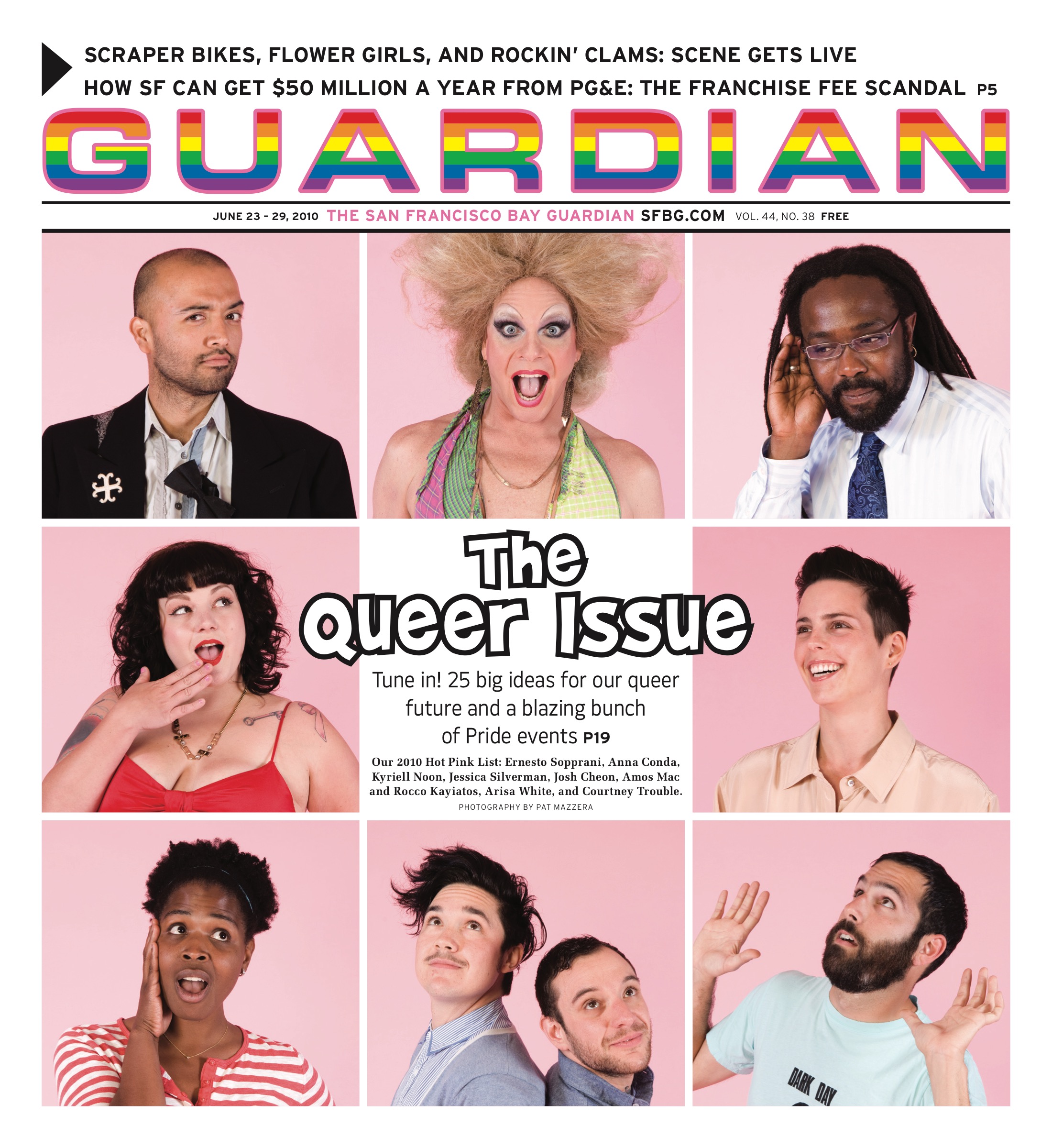
News and Politics | San Francisco Bay Guardian

News & Opinion

A new New Deal for San Francisco

15

OPINION On Thursday and Friday, July 8 and 9, San Franciscans concerned about the future of their city will have a unique opportunity to devise practical, locally actionable proposals to shape and direct future policy affecting the local economy and the provision of critical human services.

On July 8, starting at 3:30 p.m. at SF Lighthouse Church (1337 Sutter at Van Ness), a New Deal for the City economic development summit will be held to address set of issues ranging from municipal reform to community-based economic development proposals. A copy of the draft positions can be found at www.sfcommunitycongress.wordpress.com.

The next day, the San Francisco Human Services Network, a 110-member organization of human and health service nonprofits, will host its New Realities summit starting at 9 a.m. at the McClaren Center at the University of San Francisco. More details about topics at the summit can be found at www.sfhsn.org/index.

The results of these two summits, along with proposals on Muni reform and affordable housing, will form the basis for a citywide meeting of “The New, New Deal for San Francisco” Congress, scheduled for Aug. 14 and 15 at USF.

The summits and congress offer a chance to discuss, adopt, and plan the implementation of a comprehensive response to the assault on the provision of critical public services and the clear failure of the local economy to respond to the current and future needs of San Franciscans. Over the past decade, San Francisco has lost, and never replaced, more than 70,000 permanent jobs as first the dot-com bust and now the implosion of the financial sector have shredded the city’s “new” economy. In a total reversal of its historic role, San Francisco is no longer the employment center of the Bay Area, but simply the high-end bedroom of a commuting workforce based outside the city.

This historic shift has meant that the primary form of development in San Francisco has gone from commercial, employment-based enterprises to high-end residential development — development that, because of Proposition 13 limits on local property taxes, simply fails to pay for the city services needed to support the existing and new residential population.

San Franciscans built a system of local governance that was unique in the state, and not often matched in the nation, in providing a level of municipal services based on the premise that we share a special place and a common future. These services were provided by a robust mixture of traditional public sector departments and innovative, community-based nonprofits. That system was itself based on an economy that mainly employed San Francisco residents in a diverse mix of economic activities with opportunities open to a wide array of people.

That economic base has been reduced to a mere shell of its former diversity, with few opportunities for even fewer people. Our current mayor has no desire to address this historic shift; instead, he is content to endlessly campaign for other offices, issue press releases on mythical achievements, and pit one portion of San Francisco against another in hopes that all forget the decline of the city under his leadership.

Progressive forces cannot again allow needed changes to be held hostage to the election of a particular candidate. We must put on the table a comprehensive, integrated set of locally actionable policies that make sense in the realities we face in the second decade of the 21st century — no matter who wins. After all, it’s our city.

Karl Bietel is a worker advocate; Fernando Marti is a community planner; and Calvin Welch is a balanced growth and affordable housing advocate.


Lennar’s litmus test

3

sarah@sfbg.com

None of the many stakeholders tracking the progress of Lennar Corp.’s massive Candlestick Point-Hunters Point Shipyard redevelopment plan registered surprise when the Board of Supervisors received three appeals to the Planning Commission’s June 3 certification of the project’s final environmental impact report (FEIR).

Instead, everybody who has been watching the political juggernaut that has been pushing for quick approval of the project over the past month said they anticipated that the FEIR would be appealed, and perhaps litigated. But the real question is whether the project will be substantially changed.

In the seven months since the project’s draft EIR was released, the Planning and Redevelopment Commissions have repeatedly rejected all arguments and recommendations made by its critics to improve or delay the plan, rushing the approval along on a tight schedule (“The Candlestick Farce,” 12/21/09).

The rush job occurred even as numerous groups and individuals warned that the DEIR comment period was too short, (“DEIR in the headlights,” 02/03/10) and complained that the city and the developer had dismissed crucial data and testimony while exploiting fears the San Francisco 49ers would leave town if the city didn’t act quickly (“Political juggernaut,” 06/02/10).

What’s less clear is whether the Board of Supervisors has the political will to heed these appeals and correct what opponents say are serious flaws in the city’s FEIR. The appeal that the Sierra Club, Golden Gate Audubon Society, California Native Plant Society, and San Francisco Tomorrow filed June 21 lists nine deficiencies.

These included the FEIR’s failure to look into an alternate Bus Rapid Transit (BRT) route around Yosemite Slough or adequately assess impacts resulting from the landfill cap on Parcel E2 and the transfer of 20 acres of public shoreline land in Candlestick Point State Recreation Area (CPSRA) to build high-end housing.

“The FEIR failed to analyze those elements of the project’s sustainability plan that could have significant environmental impacts, including two proposed heating and cooling plants (which appear to be power plants) to serve 10,500 housing units and a projectwide recycling collection system,” the coalition further charged.

The appeal also voiced concern that the FEIR failed to adequately assess impacts resulting from the construction and maintenance of the development’s underground utility matrix, impacts to the bird-nesting in the proposed 34-acre wetland restoration project at the state park, and delays to eight Muni lines.

But the Sierra Club-led coalition also indicated that by removing provisions for a bridge over Yosemite Slough, transfer of land in the state park, and compromised clean-up efforts at Parcel E2, resolution of many of these disputed issues could be expedited.

“If the Board of Supervisors acts promptly, revisions to the EIR may be made quickly and result in a minimal delay in the progress of the project,” the coalition stated.

The Sierra Club’s Arthur Feinstein told the Guardian that the coalition’s top three concerns are “very important, but the six other issues are also very real.”

“Here we have a city cutting 10 percent of its bus service while saying that eight bus routes will need to be improved because of the project, and admitting that the development will increase air pollution in a district that has the highest rates of asthma and cancer without identifying mitigations such as reducing parking spaces in the proposal,” Feinstein said.

POWER (People Organized to Win Employment Rights) also filed an FEIR appeal June 21 listing a broader range of environmental and economic justice-related concerns.

These included the FEIR’s failure to analyze and mitigate for displacement that would be triggered in the surrounding neighborhood by developing 10,500 mostly market-rate housing units in the area and “failure to provide for adequate oversight and enforcement of the terms of the early transfer” of the shipyard from the Navy.

POWER also cited the FEIR’s failure to adequately mitigate against the impact of sea level rise, the risks associated with potential liquefaction of contaminated landfill at the shipyard in the event of an earthquake, and health risks related to chemicals of concern at the shipyard. The group also faulted the city’s failure to get the Navy to prepare an environmental impact statement on its clean-up plan before the FEIR was completed.

Finally, Californians for Renewable Energy (CARE) filed a five-point appeal June 23 charging that the project contravened the intent of Proposition P (which voters approved in 2000, urging the Navy to remediate shipyard pollution to the maximum extent possible), that the project’s FEIR is incomplete because the Navy (which still retains jurisdiction over the project lands) has not yet completed its EIS, and that the FEIR approval process was tainted by 49ers-related political pressure.

“The pre-set goal of maintaining the 49ers in San Francisco has colored the environmental analysis of this decision,” CARE noted, referring to the city’s rush to get the project’s FEIR certified on June 3 — five days before Santa Clara County voters approved a new stadium for the 49ers near Great America .

The appeal filings mean the Board of Supervisors is required to hold a hearing within 30 days, a move that places a roadblock, at least temporarily, in the way of the city’s tight schedule to secure final approvals for Lennar’s megaproject before summer’s end.

Board President David Chiu told the Guardian that the Board’s Land Use Committee will move forward with a July 13 meeting to hear a list of proposed amendments related to the underlying plan along with the FEIR appeals.

“We are back at the board Land Use Committee July 12 with 10 items related to the project,” said Chiu, who is a member of the Land Use Committee. The three-member committee is chaired by Sup. Sophie Maxwell, who represents the project’s District 10; Sup. Eric Mar is vice-chair.

“The next day, July 13, has been tentatively set for a full meeting of the full board,” Chiu continued. He acknowledged that the FEIR related materials are dense and complex, telling us that “they form the largest pile on my desk, and it’s about five inches high.”

But he wasn’t about to prejudge the outcome. “We do need to clean up the area and rebuild it in such a way that it will dramatically increase affordable housing and jobs and support a livable diverse community,” Chiu said. “Obviously there are still a lot of questions and concerns about the proposed project and the board will push to make sure all these issues are adequately addressed.”

CARE president Michael Boyd said he hoped the board would take his group’s appeal seriously and fix the plan’s fundamental shortcomings. “That means going back to square one,” he said.

But others were less sure that the board would seek to overturn the entire plan. “Everyone in the community would like the best level of clean-up,” said Saul Bloom, whose nonprofit Arc Ecology has tracked the proposed shipyard clean-up for three decades. “But what’s possible and practical? And will the city be supportive of that or the most expeditious solution?”

Bloom reserved gravest concern for plans to cap, not remove, the contaminants from the shipyard’s Parcel E2. “The concern is that if you put a cap on E2 without a liner then contaminants could scootch out during a seismic event, or over time, and cause problems because of the parcel’s close proximity to surrounding groundwater and the San Francisco Bay,” he said. “But to place a liner in there is very expensive because you’d have to excavate E2, at which point you might as well replace it with clean soil.”

Bloom acknowledged that the Navy has argued that excavation would cause a nasty smell and nobody knows what is going to be released in the process.

“But long-term Bayview residents like Espanola Jackson have made the point that the community already lives within nose-shot of the southeast sewage treatment plant and would rather put up with a few years of nasty smells, given the relative benefits of cleaning the yard up,” he said. “And how do we know a cap will be protective given the Navy’s argument that we don’t know what’s down there?

“The thing that makes the most sense here is to clean up the shipyard to the best possible extent, but the city isn’t planning to do that,” Bloom added. “And the environmental community’s bottom line has always been the bridge [over Yosemite Slough, which the Sierra Club opposes]. So the sense is that if the bridge goes away, so does their problem.”

Put new taxes in the budget

2

EDITORIAL Mayor Gavin Newsom still wants to balance this year’s municipal budget with no new taxes (although he’s happy to raise the fees to use city facilities). The supervisors are looking at a different approach: John Avalos, chair of the budget committee, told us he’d like to see $100 million in new revenue on the table.

Some of that might come from a fee on liquor sales. There’s a hotel tax measure being circulated, and the supervisors are also looking at raising the real estate transfer tax on high-end properties and imposing a commercial rent tax. All but the liquor fee would require a majority vote on the November ballot.

So far, Newsom hasn’t given any indication that he’ll support any new taxes — and that’s due in significant part to his campaign for lieutenant governor. The mayor doesn’t want to get hit by his Republican opponent as a tax-and-spend liberal, so he’s holding the line, cutting essential services instead of looking for progressive ways to bring in new revenue.

But voters up and down the state have shown their willingness to approve new taxes to save essential services, and it’s likely that San Franciscans will do the same — particularly if the folks at City Hall are united in their support.

So here’s an idea for the supervisors: why not include that new revenue as part of this year’s budget?

There’s no legal reason the budget can’t be balanced in part on the assumption of new income. November is almost halfway through the fiscal year, but more than $50 million of that revenue would be available for the 2010-11 budget.

There are distinct advantages to including that money in the budget, starting with fewer budget cuts and layoffs now. There’s also a clear political advantage: if the voters realize what’s at stake — that the money has already been earmarked and that voting it down would mean immediate reduction in vital services — the message of the importance of approving the tax measures would be even stronger.

Equally important, it would force the mayor to show his hand. Newsom would almost certainly prefer to duck the issue, to take a neutral stand on the tax measures ("let the voters decide"). He might wind up opposing all of them. But if the money’s already in the budget, what can he do? Without that tax money, the budget won’t be legally balanced. Without his support, that tax money might not come through.

It’s a risky move. If the voters reject the tax hikes, the supervisors and the mayor would be forced to make painful midyear cuts. But they’ll have to make those cuts anyway, either now or in November. And once you shut down services or eliminate nonprofit contracts, it’s much harder and more expensive to start them up again.

So this might be the year to take the calculated gamble: assume that money’s going to be there. Then everyone, including the mayor, can help make sure that it actually is.

Editor’s Notes

23

Tredmond@sfbg.com

Jane Kim, the San Francisco school board president running for supervisor in District 6, has a tough question to answer. When there’s already a solid progressive in the race, Debra Walker, someone who has lived in the district for years and agrees with Kim on almost all the key issues, why is Kim running?

She gave a hint at her campaign kickoff June 24 on how she’s going to portray herself: "I’m not part of anyone’s machine, and I’m certainly not part of anyone’s master plan." It’s an attractive statement — nobody likes machine politics — and the idea that she’s an independent candidate makes her all the more appealing.

Except that it also says something about the progressive movement in San Francisco — and that’s a little disturbing. Because no matter how you try to spin it, when you say you aren’t part of anyone’s machine, you’re implying that maybe your opponents are.

Let me take a step back here, because this is important stuff. There’s a fine line between an effective, organized political coalition that can actually win elections and a political machine, which stifles political innovation and grassroots candidates. And in part it’s about motivation.

When Willie Brown ran San Francisco, it was all about Willie Brown. I’ve never believed the guy had much of an ideology or that any political cause really mattered to him; he loved power, he knew how to use it and he didn’t want to give it up. That was the bottom line.

Now that he’s pretty much out of the picture — although he was at Kim’s party, he’s not a factor anymore — there’s a very different power balance in this city. There’s nobody at City Hall (or in Sacramento, or Washington, or downtown, or anywhere else) who has machine-style control of local politics.

There are people who can build coalitions that work — Aaron Peskin, for example, did exceptionally well with putting together a campaign to elect progressive Democratic County Central Committee elections. And there are people who would love to be power brokers.

But I’ve been around politics here a long time, and I can tell you: Aaron Peskin doesn’t have a machine. Neither does Mark Leno, or Gavin Newsom, or Tom Ammiano, or David Chiu, or anyone else. Thanks in part to district elections, there aren’t many call-up votes on the Board of Supervisors these days. In fact, the left in San Francisco is famously unable to agree on much of anything half the time. Note, for example, the fact that Chiu — often called a Peskin ally — is not supporting Peskin’s candidate in D-6. He’s with Jane Kim.

The thing is, unlike the players in a typical political machine, most of the progressives care about issues. It’s about a shared ideology more than it’s about power. That’s a hugely important difference.

The way the mainstream media has it, the San Francisco left is either fatally fractured and can’t do anything — or it’s becoming a machine. For the moment — a great moment — neither is true. Let’s all keep that in mind. Because when we beat each other up with words like "machine," we undermine the whole progressive movement.

Bad way to start a campaign.

Alerts

0

alert@sfbg.com

WEDNESDAY, JUNE 30

Green Corps benefit


Support Green Corps’ mission to train organizers and provide field support for critical environmental campaigns and celebrate the new crop of graduating environmental activists at this reception featuring a speech from environmental journalist Mark Hertsgaard and performance by the California Honeydrops.

6 p.m., $50

Temple Nightclub

540 Howard, SF

(415) 622-0033 ext. 313

Our Land, Our Rights


Hear presentations and updates from Hinewirangi Kohu, Faith Gemmill, and other indigenous women working for the health of the environment and future generations across the world as they report back from the International Women’s Symposium on Reproductive Health and Environmental Toxins.

7 p.m.; free, donations accepted

Eastside Arts Alliance

2277 International, Oakl.

(415) 641-4482

www.treatycouncil.org

Peace Corps information


Learn about how to become a Peace Corps volunteer in one of 76 countries as volunteer and recruiter. Jennifer Clowers shares her experiences volunteering in Guinea and Niger and outlines volunteer opportunities beginning this year and in 2011.

6 p.m., free

San Francisco Library Main Branch

Mary Louise Strong Conference Room

100 Larkin, SF

(510) 452-8442

THURSDAY, JULY 1

Socialism 2010


Attend this four-day conference with new and veteran activists looking for an alternative to capitalism that can bring us out of our current economic crisis and our wars of occupation abroad. Speakers will discuss issues such as "What is the Real Marxist Tradition?," "Race in the Obama Era," capitalism, climate change, abortion, women’s liberation, and more.

Thurs. 7 p.m., Fri.–Sat. 9:30 a.m.–7p.m.,

Sun. 9:30 a.m.–2 p.m.; $15-$90

Oakland Marriott

1001 Broadway, Oakl.

(773) 583-7884

www.socialismconference.org

SATURDAY, JULY 3

Food Justice Farmers Market


Attend this farmers market highlighting small farmers of color and social entrepreneurship with organic, pesticide-free local fruits and vegetables, local bakers, crafts, live music, art, and free cooking demos. Each week offers a community workshop on topics ranging from tenants’ rights to urban agriculture.

9 a.m.–2 p.m., free

Arlington Farmers Market

Arlington Medical Center parking lot

5715 Market, Oakl.
www.phatbeetsproduce.org

SUNDAY, JULY 4

Revolutionary talk


Meet fellow revolutionaries and discuss strategies for putting a national campaign for revolution on the map at this anti Fourth of July BBQ and picnic. Bring a dish to share.

1 p.m.–6 p.m., $5-$25 suggested donation

Carmen Flores Park

1637 Fruitvale, Oakl.

(510) 848-1196

Frederick Douglass Day


Attend this alternative Fourth of July celebration honoring the great American abolitionist, women’s suffragist, editor, orator, author, statesman, minister, and reformer. Performances includes readings from Douglass’ speeches and John Brown’s Truth, a musically improvised opera, the Frederick Douglass Youth Ensemble, Vukani Mawethu, and more.

7pm, $15.

Humanist Hall

390 27th St., Oakl.

(510) 835-5348
Mail items for Alerts to the Guardian Building, 135 Mississippi St., SF, CA 94107; fax to (415) 437-3658; or e-mail alert@sfbg.com. Please include a contact telephone number. Items must be received at least one week prior to the publication date.

Fiscal solidarity

0

OPINION As Mayor Gavin Newsom prepares to skip town for the bleak limelight of Sacramento, he has left a resounding parting shot with massive budget cuts to those San Franciscans most in need of public aid: seniors, youth, homeless people, folks with mental illnesses, health clinic patients … the list goes on.

Newsom has balanced his final budget (and his campaign for lieutenant governor) largely on the backs of the poor, working-class, multiracial, and immigrant San Franciscans, as well as the nonprofits and city workers who deliver vital services.

The Newsom budget actually adds costs: by cutting services for the treatment and prevention of substance abuse and for youth crime prevention and supportive housing, for instance, it destabilizes lives and forces people right back into the treatment systems that are being cut — adding new human and fiscal costs.

"Every cut has a constituency," Newsom’s PR people say repeatedly. And that’s precisely what the mayor is counting on — that each "constituency" will fight on its own, for its own fiscal scraps. He’s wrong.

As members of a broad coalition of community and neighborhood-based organizations, labor unions, and civic leaders and residents across the city, we stand together in opposition to Newsom’s cuts-only budget and his attempts to divide "constituencies."

Fiscal solidarity means we recognize that an injury to one is an injury to all. "Constituencies" are in fact people whose lives cut across multiple budget line items. Cutting city parks is also a senior issue, as well as a youth issue. Closing mental health programs for the poor is not only an unnecessary moral outrage — it’s a public health and safety issue.

As members and supporters of unions and nonprofits, which are sometimes pit against each other in budget cut wars, we declare mutual support. The mayor’s cuts will mean drastically reduced services for those who need them most and deep staff cuts for city employees and nonprofit workers. We may work for different institutions under different budget line-items, but we’re fighting together as one community — one big "constituency."

Budget wars artificially divide communities that overlap and intermingle. Expressions of unity are put to the test by the budget "add-back" process that forces community groups to scuffle for scraps of cash — groups serving populations in critical need are set against each other, and whole communities are reduced to line-items.

We’re standing against fiscal wedge politics and demanding a real alternative. The budget must protect those most in need and be balanced by cutting first from the top instead of the bottom.

We are united for solutions — progressive tax measures on key wealth sectors that can and must pay their fair share to keep San Francisco the beautiful, thriving, diverse, and culturally rich city it is. We’re standing up for the city Newsom’s leaving, for the communities he’s cutting, and for progressive revenue — a tax to make downtown hotels pay their fair share, and a gross receipts tax on large businesses for starters.

Mayor Newsom: if you cut one of us, you cut us all.

This statement was signed by Christopher Cook, Budget Justice Coalition; Gabriel Haaland, SEIU 1021*; Gordon Mar, Jobs with Justice*; Eric Quezada, Dolores Street Community Services*; N’Tanya Lee, Coleman Advocates for Children and Youth*; Jennifer Friedenbach, Coalition on Homelessness; Guiliana Milanese, Jobs with Justice*; Christina Olague, Senior Action Network*; Sheila Tully, California Faculty Association, SF State*; Chelsea Boilard, Coleman Advocates for Children and Youth*; Joseph Smooke, Bernal Heights Neighborhood Center*; Carl Finamore, delegate, SF Labor Council*

* names for ID purposes only

Complicating the simple

6

steve@sfbg.com

GREEN CITY San Francisco can legally give more street space to bicycles, even if it delays cars or Muni in some spots, a policy that enjoys universal support among elected officials here. So why have all the city’s proposed bike projects been held up by an unprecedented four-year court injunction, despite the judge’s clear affirmation of the city’s right to approve its current Bicycle Plan as written?

The answer involves a mind-numbing journey into the complex strictures of the California Environmental Quality Act and its related case law, which was the subject of a three-hour hearing before Superior Court Judge Peter Busch on June 22 that delved deeply into transportation engineering minutiae but did little to indicate when the city might be able to finally stripe the 45 bike lanes that have been studied, approved, funded, and are ready to go.

Anti-bike activist Rob Anderson and attorney Mary Miles have been on a long and lonely — but so far, quite successful — legal crusade to kill any proposed bike projects that remove parking spaces or cause traffic delays. They have argued that the city shouldn’t be allowed to hurt the majority of road users to help the minority who ride bikes, urging the city and court to remove those projects from the Bike Plan.

But Busch repeatedly said the court can’t do that. “That’s the policy question that’s not for the court to decide,” he told Miles in court, later adding: “I don’t get to decide that the Board of Supervisors’ policy is misguided.”

Yet city officials have offered detailed arguments that the policy of facilitating safe bicycling isn’t misguided, but instead is consistent with the transit-first policy in the city charter and with the goals of reducing greenhouse gas emissions, improving public health, and even alleviating overall traffic congestion by giving more people good alternatives to driving a car.

Busch hasn’t indicated that he has any issues with that rationale. Instead, the question is whether policymakers had enough information — in the proper manner spelled out by two generations’ worth of legal battles over land use decisions in California — to make their unanimous decisions to approve the Bike Plan in 2005 and again in 2009, after completing a court-ordered, four-volume, two-year, $2 million environmental impact report.

Miles argues that the EIR is legally inadequate in every way possible, employing such gross hyperbole in condemning it as a hollow document that does nothing to explain or justify any of its conclusions that Busch told her at one point, “That’s such an over-argument, it leaves me wondering about the rest of your argument.”

But he’s certainly considering the rest of her argument that more analysis was required, going into great detail on the questions of whether the city studied and spelled out enough alternatives and mitigation measures, how much of the voluminous traffic survey data should be in the plan, whether there was enough support for the thresholds of significant impacts, and what the remedy should be if he finds some minor errors in the methodology.

Yet even Busch said there wasn’t a clear regulatory road map for the city to follow on this project. “There probably has never been an EIR for a project like this,” he acknowledged. It was the city’s decision in 2004 to do a Bike Plan that mentioned specific projects without studying them that led to the injunction and this extraordinarily complex EIR, which did detailed analysis on more than 60 projects.

“Once you get that complexity, the toeholds are everywhere to fight it,” activist Mark Salomon, who has long criticized city officials and bicycle activists for their approach to the Bike Plan, told us.

But Kate Stacey, who heads the land use team in the City Attorney’s Office, says the city will be in a good position to quickly create lots of bike lanes once this plan passes legal muster.

“The city can now go through the specific bike projects without having another step of analysis,” she told us. “I think it’s a complete and elegant approach even if it was more time-consuming at the outset.” Busch asked both sides to submit proposed orders by July 6 and responses to those orders by July 13, with a ruling and possible lifting of the injunction expected later this summer.

CompStat vs. community policing

0

By Alex Emslie


news@sfbg.com


Two competing visions for the San Francisco Police Department are central to a looming debate involving the mayor and his police chief, who favor the high-tech yet impersonal CompStat model, and progressive members of the Board of Supervisors who are pushing for a community-based, cops-walking-beats blueprint for SFPD.


District 5 Sup. Ross Mirkarimi introduced a proposed ballot measure on June 7 that would require the police chief to institute foot patrols in all districts and ask the Police Commission to establish a written community policing policy. SFPD Chief George Gascón opposes the initiative, instead favoring a reliance on the new CompStat system to determine how best to use police resources.


The terms “CompStat” and “community policing” have become trendy buzz words, UC Berkeley law professor Franklin Zimring told the Guardian, so they mean different things to the police departments that employ them, muddying the waters of the current debate.


“When labels get popular, they get pasted into lots of different things,” said Zimring, who wrote The Great American Crime Decline (Oxford University Press, 2006) and is working on a second book about the crime rate drop in the 1990s in New York City, where CompStat orginated. Yet the two models point to differing law enforcement philosophies.


At its most basic, CompStat uses computerized crime mapping software to drive police deployment decisions. It emphasizes lowering a city’s crime rate by centralizing authority, spotting statistical trends, and targeting crime hot spots. Community policing, a model embraced by many U.S. police departments in the 1980s and ’90s before CompStat swept the nation, grounds police officers in the neighborhoods they serve, decentralizing authority. The model seeks to prevent crime with regular patrols that develop relationships on their beats and lets the community help set law enforcement priorities.


“There is not community policing in San Francisco,” Mirkarimi — the only member of the board to go through the police academy — told the Guardian. “I don’t care what anybody says. If they say there is, then it is isolated. It’s unique to that particular experience or location.”


Proponents of CompStat insist the new model is really just a part of community policing. Gascón wrote a letter to the Board of Supervisors in February saying the proposed legislation “oversteps the jurisdiction of the legislative branch,” “attempts to give district station captains authority and discretion that rightfully belong to the chief of police,” and “will deprive the department of the flexibility it needs to address public safety throughout the city.”


Mirkarimi doesn’t oppose CompStat and said he sees merit in the program’s statistical collection, which has long been a shortcoming in the SFPD. “But I caution against any over-reliance on CompStat as a method that dictates how policing and public safety should be applied,” Mirkarimi told us. “Because the casualty of this over-reliance will be a compromising of any hopes of having true community policing.”


The SFPD website portrays CompStat as starting with data collection and then, similar to community policing, encouraging officers to find creative solutions to ongoing problems, anything from singular incidents of burglary to repeated graffiti or even a spike in murders. The crime triangle, a lasting symbol of community policing, illustrates that victims, suspects, and locations are all necessary for crime to thrive, and successfully policing even one of those factors can prevent crime. But CompStat programs often lack sustained commitment to building relationships with neighborhoods.


“Compstat seemed to engender a pattern of organizational response to crime spikes in hot spots that was analogous to the Whack-a-Mole game found at fairs and carnivals,” argued a 2003 study commissioned by the national Police Foundation titled “CompStat in Practice: An in-depth Analysis of Three Cities.”


The study found immediate contradictions in Lowell, Mass.; Minneapolis, and Newark, N.J. between beat officers’ new responsibility to “simply follow their superiors’ orders” and the community policing model that cast them as individual, authoritative protectors of their neighborhoods. CompStat centralizes authority with the higher echelons of SFPD. It includes bimonthly meetings in which station captains are grilled by SFPD brass and are expected to answer for the statistics in their district.


“Given the gap between the two models of policing, CompStat naturally tends to encounter the greatest resistance in departments that are most committed to community policing,” the study found.


Understaffed and poorly trained crime analysis units tasked with deciphering data patterns into useful correlations (for example, between drug crimes and murder) was another barrier to the success of CompStat outlined in the study. SFPD’s crime analysis unit consists of three civilians housed at the Hall of Justice, SFPD spokesperson Lt. Lyn Tomioka told us. They are not deployed to district stations and are supervised by a lieutenant who also has other responsibilities.


“There are a lot of rough edges. There’s a lot of non-fit there,” Zimring told the Guardian. “Who sets the priorities? CompStat priorities are always crime prevention, and they are set, and tactics are provided, by the chief of police. He is, in the immortal words of George W. Bush, ‘the decider.’ Community policing is supposed to be more cooperative and organic.”


Gascón initiated CompStat in San Francisco in October 2009, although Mayor Gavin Newsom has been touting the CompStat model since he first ran for mayor in 2003, when a campaign policy brief gushed about its “accurate and timely intelligence, rapid deployment, effective tactics, and relentless follow-up and assessment.” Initially, however, SFPD only took baby steps, using a confusing plot system to map crimes. That changed when Gascón took over as police chief last August, bringing experience in the program with him from the Los Angeles Police Department.


SFPD officials say vendor contract costs to start the system’s electronic crime mapping were less than $1 million, and an additional $1 million has been proposed for next year’s budget for technology upgrades in the CompStat unit. But the numbers so far haven’t backed up the boldest claims. SFPD reports 24 homicides this year as of June 12, up 20 percent from last year’s rate for early June. Homicide arrests are down from 12 last year to eight this year. Occurrences of rape are also up by 12 percent, but overall violent crime is down 2 percent compared to this time last year.


Gascón wrote that foot patrols are a valuable tool for community policing in San Francisco, but he doesn’t want to be forced to maintain them with limited staffing. Newsom’s proposed budget maintains current SFPD staffing, 2,317 sworn officers, while many other city departments received deep staffing cuts. Progressive supervisors have pledged to closely scrutinize SFPD’S budget.


Community policing was law enforcement’s response to civil unrest in the 1960s and ’70s, when police were seen as the enforcers of institutional power. Previous beat patrol methods largely ended when the 911 system came along, and the emphasis was placed on calls for service, statistics, and response times, leaving officers with little time to patrol and prevent crime.


The change to community policing emphasized neighborhood input and officers becoming an organic part of the community they served. Citizen contributions, generally through community meetings, began to drive decision-making. Foot patrols were revived and officers were once again expected to have a physical presence and a connection to the community they served.


That change was seen as particularly important in poor neighborhoods and communities of color, where police can sometimes be seen as an occupying army and residents were reluctant to cooperate with investigations. Officials hoped to prevent crimes by showing a presence in neighborhoods rather than simply reacting to them when someone called.


Mirkarimi says a CompStat-driven police force would be a return to that reactive model, potentially sacrificing the long-term commitment required to build trust between a neighborhood and its police department, which is central to community policing. “[CompStat] undermines the principles and practices of community policing because true community policing requires a discipline and a protocol that is sustained,” he said.


While either approach can theoretically result in the same practices, such as a foot beat patrol in a given neighborhood, Zimring said the reasoning behind it depends on the model. “CompStat to begin with is completely crime-driven,” Zimring said. “The reason you have it is to reduce crimes. It involves computerized mapping of crimes. It involves allocating resources to so-called hot spots, and it involves the police department imposing its own priorities as opposed to implementing community priorities.”


The Board of Supervisors will consider Mirkarimi’s measure and SFPD budget in July, airing a debate that could continue on to the November ballot, when voters would decide whether to maintain their faith in CompStat and the SFPD or ask for more community policing and foot patrols.

Danger zone

0

rebeccab@sfbg.com

Rita Connolly, a registered nurse who has worked with inmates in San Francisco jails since 1985, says she’ll never forget the time she had to act fast to save a prisoner’s life.

The man had just arrived from a different jail and was waiting to go through intake. He was slumped over and looking ill, too weak to voice a complaint. Several worried inmates beckoned Connolly over, and once she examined him, she realized he was in the midst of a heart attack. He was rushed to the emergency room. He lived — but sustained irreversible heart damage.

“He could have been someone who didn’t live,” Connolly told the Guardian, but he also could have had a better outcome. The inmate had alerted someone that he was having chest pains earlier in the day, she later learned, as he was boarding a bus from an Alameda County Jail. A medical services worker examined him just before the bus left, but allowed him to proceed. By the time he arrived in San Francisco, the warning signals had progressed to a full-blown heart attack.

The story highlights an extreme example of a trend Connolly said she observes regularly — inmates from counties that use privatized jail health services aren’t receiving the same standard of care that San Francisco provides. Sometimes, there are obvious signs that the care is inadequate, placing inmates’ health at risk.

Alameda’s jail health services contractor, Tennessee-based Prison Health Services Inc. (PHS), has made headlines before for a track record marred by inmate deaths and lawsuits alleging negligence. PHS has expressed interest in contracting with San Francisco if the city opened the door to privatization, which Mayor Gavin Newsom has once again proposed in his latest budget.

That budget also calls for cuts to community-based health and human service programs that threaten to erode the safety net for those battling mental health issues, drug addiction, and chronic health problems, all proposals now being weighed by the Board of Supervisors Budget and Finance Committee.

But it is the debate over whether to make a $11 million cut to jail health services that raises the most thorny and telling questions about what sacrifices are considered acceptable — and what populations can be the most easily targeted — in the quest to balance a budget without the tax increases that Newsom opposes.


OPEN WOUNDS

In San Francisco, the city’s Department of Public Health contracts with the Sheriff’s Department to address inmates’ medical needs. Privatized jail health care would be cheaper, though by how much is a moving target. But nobody is arguing that the care would be better.

Newsom’s budget proposes switching to a private firm as early as January 2011 to help solve a daunting budget deficit. The proposal originated with the Mayor’s Office, and Sheriff Mike Hennessey — whose department would realize the potential savings — went along by including the item in his departmental budget.

In years past, the Board of Supervisors has repeatedly resisted the proposal and is likely to do so again — but rejecting it would mean finding up to $11 million in savings elsewhere.

“The fear is that when you bring privatization into the picture, there is a financial pressure to cut corners. And even though that may end up saving some money … the price that comes with it is too high,” Sup. David Campos said at a recent budget hearing. Referencing stories about inmates who died needlessly in jail under the care of for-profit firms, Campos said he isn’t willing to risk a similar tragedy occurring in San Francisco.

The proposal has been floated repeatedly since as far back as the early 1990s, according to healthcare workers whose jobs have been jeopardized by privatization before. Newsom proposed the cut last year, and the year before.

“In absence of the budget problem, [Hennessey] probably would not have proposed this, nor would we have proposed this,” Newsom’s budget director, Greg Wagner, told members of the Budget and Finance Committee at a May 26 hearing, adding that the mayor shares concerns about prisoner safety. Newsom’s office did not return multiple calls requesting comment for this story.

The U.S. Supreme Court recently agreed to a hear an appeal by the state of California to the federal court ruling that substandard medical care in California prisons constitutes cruel and unusual punishment and necessitates the early release of about 40,000 prisoners. At the May 26 hearing, healthcare workers familiar with the interiors of county jails and state penitentiaries came forward with horror stories.

“Every week I receive at least one inmate who has an open gunshot wound. They have not seen medical care in the county jails,” Dr. Elena Tootell, chief medical officer at San Quentin state prison, told committee members. “It’s quite surprising to me that they send inmates with gunshot wounds to prison. They just walk off the bus. They often have paper towels stuck to their bodies, seeping the blood. And then we are obligated to take care of them. This does not happen from San Francisco County, I’m going to tell you that right now.”

Tootell said she’d observed a significant difference between those counties using private firms and those using public health care. “They will have a fracture — they’ve never been splinted, they’ve never seen a doctor. They’re on anticoagulation [medication], but haven’t had their blood checked in weeks and have bruises all over their body.”

Connolly echoed similar concerns. For example, she told the Guardian, she’s found herself asking questions like, “You were on AIDS medication before you got arrested and now you’re not?”

Susanne Paradis, a healthcare research contractor with SEIU Local 1021, rejects the premise that the same services could be provided at a lower price. Under a private model, she says, the priority is to keep costs low — and that means doing less.

A key issue, Paradis said, is that private firms tend to rely more heavily on licensed vocational nurses (LVNs) — lower-paid medical staffers who aren’t trained to assess patient’s medical needs and cannot administer the same care that registered nurses (RNs) can. Using PHS data, Paradis found that in Alameda, there is one RN for every 92 inmates, compared with one RN per 32 inmates in San Francisco.

“An RN has the ability to assess, observe, and determine if there’s emergency care needed,” Paradis explained. “An LVN does not have the ability to do that.”

John Poh, a nurse practitioner stationed at a jail in San Francisco’s Hall of Justice, explained the difference this way: “The more RNs you have working for you, the fewer deaths you have.”

PHS, an obvious point of comparison with San Francisco since it serves Alameda, declined to answer questions about its services. Instead, media spokesperson Pat Nolan e-mailed a brief statement. “We are excited to hear that San Francisco is considering the contracting of correctional health care,” he wrote. “Should the city choose to go through an RFP process, we would look forward to participating. We think it is the right thing to do for the city and its taxpayers.”


LINES OF DEFENSE

While those incarcerated in San Francisco jails can be thought of by some as criminals, nuisances, or miscreants, those requiring medical attention are patients in the eyes of the jail healthcare workers.

Inmates routinely enter the system with diabetes, HIV/AIDS, hepatitis C, heart problems, liver disease, and substance abuse issues, Connolly said. On occasion, a woman will arrive in jail only to learn that she is pregnant. Mental health problems are common, and some battle psychiatric issues in combination with physical ailments.

“Overall, our patient population has had little access to health care. For many people, we’re the only show in town,” Connolly noted.

Poh said some problems could spiral out of control if jail health staff didn’t nip them in the bud. If an inmate is exhibiting signs of tuberculosis, for instance, they’ll immediately get a mask and be sent to the hospital for screening. Sexually transmitted diseases are also a priority for treatment. “You don’t want that person going out infected,” Poh explained.

The city takes a proactive stance when it comes to treating inmates, Poh said, because at the end of the day, county jail is a revolving door. “Everybody leaves county jail. They’re either going home, to a program, or to prison.” If people are released back into the community with contagious, untreated health problems, the risk of exposure can spread beyond jailhouse walls.

San Francisco’s current system is considered a first line of defense, in which inmates are “seen as members of the community who happen to be in jail right now,” Paradis said.

Privatizing jail-health services would constitute a blow to a wider public health safety net in San Francisco that is already weathering painful cuts. At a June 15 Beilenson Hearing, a state-mandated opportunity for community members to explain the impacts of proposed health and human services cuts to the Board of Supervisors, people came out in droves to protest cuts to programs serving vulnerable residents.

Kristie Miller, executive assistant of the Standing Against Global Exploitation (SAGE) Project, told the Guardian that her organization serves 350 clients a year who are victims of human trafficking and commercial sexual exploitation. The organization stands to lose its mental health funding, so Miller had come out to speak against the cut. “It provides trauma-focused psychotherapy for survivors who’ve experienced a lot of abuse, violence, and exploitation,” she said.

Jeff Schindler, chief development officer for the Haight Ashbury Free Clinics, said he was there protesting a 79 percent funding cut to his organization’s 108-bed residential program on Treasure Island. “We won’t have a place for people to actually go into residential treatment for their mental health and substance abuse issues,” he said. “These are individuals who are going to get their needs met somehow, somewhere, and generally that’s going to be at San Francisco General Hospital.”

It’s in this context that the proposal to contract out for jail health services is being proposed. “It’s easy to dismiss prisoners as probably the least valued sector of our society,” Deirdre Wilson, of the California Coalition for Women Prisoners, noted at a May 26 hearing. “But the right to health care is a human right.”


FOR THE RECORD

According to an estimate prepared by the Sheriff’s Department, the city could save anywhere from $11 million to $14 million by contracting out for jail health services, and Newsom’s budget assumes a savings of “over $11 million per year.”

However, the Controller’s Office continues to revise that figure as the debate shifts and concerns are raised about the skill mix that a private firm would use. “We don’t really know what it would cost to contract out, unless there was an RFP and a response to the proposal and some discussion about what the staffing requirements would be,” Deputy City Controller Monique Zmuda explained at a June 17 hearing. She added that the potential range of savings spanned from $3 million to $11 million annually, depending on decisions that would have to be made about acceptable staffing levels.

San Francisco’s inmate population has shrunk in the wake of the crime lab scandal, and a city-owned facility in San Bruno has been temporarily shuttered. Sheriff Hennessey told the Guardian he believed medical care in the jails could be provided either by city workers or a private firm, but added that he’s “quite happy” with the status quo. Noting that 25 of the 58 counties in California already use private firms, he added, “It’s not an unusual or unique thing.” Hennessey also said the decision was linked to a broader philosophical and political question, and that he doubted there was support on the board for the proposal to go forward.

Mitch Katz, director of the city’s Department of Public Health, did not directly say whether he supported Newsom’s proposal. “I think our Jail Health Services does a great job, but I do understand that the city is facing an extremely difficult budget year and that ultimately the budget must be balanced,” Katz wrote in an e-mail.

Gabriel Haaland, who represents SEIU Local 1021 union members whose jobs would be affected by the proposal, voiced strong opposition at a June 17 Budget and Finance Committee meeting. “‘We don’t care about these people because they’re poor and they’re in jail.’ That’s the message” in the decision to contract out, Haaland charged. The item was continued and will be revisited as budget deliberations unfold.

How SF can get $50 million a year from PG&E

1

EDITORIAL Sup. John Avalos, who chairs the Budget Committee, is looking for ways to bring another $100 million into the city’s coffers this year. There’s a hotel tax initiative headed for the fall ballot. He’s talking about an increase in the real-estate transfer tax for high-end properties. And he and his colleagues are looking into a tax on commercial rents.

Those are all valid ideas. But there’s another way the city can bring in as much as $50 million more a year — without raising anyone’s taxes. It just involves increasing the franchise fee Pacific Gas and Electric Co. pays to the city.

PG&E uses the city’s streets and rights-of-way to run its gas lines and electricity cables; the company doesn’t pay rent for that space. Instead, it pays an annual franchise fee to the city, a percentage of its gross sales. Other utilities pay, too — Comcast, for example, pays 5 percent of its gross to San Francisco every year for its cable-TV franchise.
PG&E pays 0.05 percent for electricity sales, and 1 percent for natural gas.

That deal was reached in 1939. The Board of Supervisors back then gave PG&E the lowest franchise fee in California, a pittance, a fraction of what other cities and counties charge — and the contract has no expiration date. It’s a perpetual deal, something highly unusual.

Sup. Ross Mirkarimi wants to open up the 72-year-old contract for renegotiation and raise the fee significantly. It seems like a perfectly reasonable idea — Berkeley charges PG&E 5 percent for electricity. San Diego charges 3.5 percent. If the city is desperately scrambling for money to close the budget gap, why are we leaving so many millions on the table?

The numbers are big. In 2008, according to the Controller’s Office, PG&E paid San Francisco $3.5 million for electricity sales and $3.16 million for gas. If the city raised both fees to the level that cable TV providers pay, the general fund would pick up another $50 million.

It seems crazy that a franchise deal signed seven decades ago, by a board that was in PG&E’s pocket, should tie the hands of elected officials today. Most legislative bodies have rules barring any laws that would tie the hands of future legislators forever.

It’s particularly ironic for this to happen in the only city in the United States that is mandated by federal law (the Raker Act) to run a public power system.

But according to City Attorney Dennis Herrera, raising the fee would be very difficult; California law allows perpetual utility franchises. If Herrera is right (and no city attorney has ever been willing to challenge PG&E on this), then the state Legislature needs to act.

One idea from Mirkarimi’s office: simply mandate that all perpetual utility franchises increase every year by the cost of living index, up to a maximum of, say, 5 percent. If all the years since 1939 were counted, the city would be at the max today.

An even simpler option: the state could outlaw perpetual franchise deals — something that should have been done years ago — and mandate that all existing deals expire on, say, Jan. 1, 2011. That would give San Francisco six months to negotiate a new deal with PG&E, and the money from that deal would save a lot of city services.

Both Assembly Member Tom Ammiano and state Sen. Mark Leno have expressed interest in a bill that would open up San Francisco’s franchise fee, and both told us that they’re looking into it. Leno already has a bill barring PG&E from using ratepayer money on political campaigns; potentially, a franchise fee amendment could be added to it. The deadline for introducing bills for this session has already passed, so it would be a little tricky to find a way to change state law in the next few months. But it’s worth a try: there’s never been a time when PG&E was less popular in Sacramento. The company violated its own agreement with the Legislature, promising to support the law authorizing local community choice aggregation systems then turned around and spent nearly $50 million to overturn it.

Leno and Ammiano should pursue a bill as soon as possible to get rid of one of the great scandals in city history, a sweetheart deal in 1939 that has saved PG&E billions and cost the city dearly.

Alerts

0

alert@sfbg.com

WEDNESDAY, JUNE 23

Remembering torture victims


Commemorate U.N.-enacted International Day in Support of Victims of Torture at this screening of The Response, a courtroom drama based on the transcripts of the Guantanamo Bay military tribunals. Featuring guest speakers from UCSF and SF State, members of Survivors International, Amnesty International, and Health Professionals Against Torture.

6 p.m., free

Amnesty International SF Office, Suite 210

350 Sansome, SF

(415) 546-2080

Water bond happy hour


Join the Food and Water Watch team in helping to get voters to reject the California water bond on the November ballot. Meet others who care about the issues and discuss a sustainable water future for California and how water issues effect us all. Raffles of stainless steel water bottles benefit Food and Water Watch, a local nonprofit corporate accountability organization.

6 p.m., free

Elixir Bar

3200 16th St., SF

www.foodandwaterwatch.org

THURSDAY, JUNE 24

Radically queer


Radical Women celebrates LGBTIQ month with a panel discussion titled "Queer Radicals: Strategies for Our Movement." Queer and transgender activists will discuss how to build a militant movement for LGBT liberation. Pre-discussion buffet with vegetarian options available at 6:15 p.m. for $7.50. Call for information about childcare.

7 p.m., free

New Valencia Hall

Suite 202

625 Larkin, SF

(415) 864-1278

SATURDAY, JUNE 26

Protest Big Oil


Join thousands for a beach lie-in to create a "slash oil" image that will be photographed from a helicopter. Arrive no later than 10:30 a.m. to participate. Attendees will receive an overhead postcard of the event. Then at noon, join Hands Across the Sand, an international statement on protecting coastlines from oil pollution. Carpooling, biking, or taking public transit to the events is highly encouraged.

10 a.m.; free, donations accepted

Ocean Beach

1000 Great Highway, SF

www.slashoil.blogspot.com

www.handsacrossthesand.org

SUNDAY, JUNE 27

Have a good cry


Attend this "cry-in" against the commercialization and corporate sponsorship of the Gay Pride festival. Wear your most morbidly gothic clothing, bring your favorite sad songs, and share your best morose attitude with other queer people and allies eulogizing the demise of the grassroots queer community.

2 p.m., free

San Francisco LGBT Center

1800 Market, SF

www.gayshamesf.org

MONDAY, JUNE 28

Honduras resistance


Watch three videos presented by the Bay Area Latin America Solidarity Coalition (BALASC) on the 2009 military coup in Honduras. Proceeds benefit the Popular Resistance in Honduras.

8 p.m., $6

Artists’ Television Access

992 Valencia, SF

www.balasc.org

A tale of animal liberation


Hear activist and former prisoner Andy Stepanian tell how he stood up to one of the world’s largest contract animal testing labs, was charged with terrorism, and served three years in federal prison.

7 p.m., free

Station 40

3030B 16th St., SF

www.sparrowmedia.net

Mail items for Alerts to the Guardian Building, 135 Mississippi St., SF, CA 94107; fax to (415) 437-3658; or e-mail alert@sfbg.com. Please include a contact telephone number. Items must be received at least one week prior to the publication date.

In defense of Bay to Breakers

32

By Conor Johnston

OPINION An op-ed piece in the June 9 issue of Guardian (“When the rich can sit on the sidewalks“) was the latest in a rash of negative media stories about Bay to Breakers. I am not going to respond to that article specifically, except to thank the Guardian for giving us equal time.

For 99 years, Bay to Breakers has been lifting the city’s spirits, bringing fun, tax revenue, millions of tourism dollars, and nationwide attention to San Francisco. If ever we needed those things, it’s now, when we have record deficits, 47,000 people out of work, and may lose the football team that is named after us.

So let’s set the record straight.

Bay to Breakers does not cost taxpayers a dime. The event pays for all costs, including cleanup. And the permit fees and tourism generate tax revenue. ING probably dropped its sponsorship for reasons unrelated to B2B. Sponsors come and go. B2B will find another. Bay to Breakers is a financial boon for San Francisco. The event attracts thousands of people to the city; 49 of 50 states were represented by participants in 2008. The average tourist spends $505 in the local economy. Bay to Breakers is and always has been peaceful. There were fewer than five arrests reported this year. I have never seen a fight at B2B, not once, in seven years. Bay to Breakers remains enormously popular. There are about 100,000 participants and spectators, including many world-class runners.

This said, there are problems at B2B, namely public urination and the overall impact on the neighborhoods. We absolutely acknowledge that. But unlike the critics, we still believe in this city’s ability to solve problems.

How do we do it? Not with prohibitions — they are a retreat, not a policy. Sound policy takes effort, collaboration, and commitment. Let’s get the stakeholders together — neighborhood groups, race organizers, race supporters, SFPD, and city officials — and create a plan to protect the neighborhoods while preserving the race’s spirit.

Our group, Citizens for the Preservation of Bay2Breakers, is committing to raise money for 100 additional multiperson urinals and to leading the cultural campaign for more responsibility among participants. And we have other ideas:

Ticket people who urinate on or disturb private property.

Rent more toilets.

Implement multiperson urinals, which are six times more efficient and are one-third of the cost per user.

Improve the barricades to keep participants on course.

Increase revenue with a tiered registration for non-runners.

Host an event in the park that attracts participants out of the neighborhoods sooner.

I see in Bay to Breakers a celebration of what it means to be San Francisco, to be capable, to be unafraid of free expression and unapologetic of diversity.

I see world-class runners lined up next to 30-somethings in Elvis costumes. I see convalescent patients lining the sidewalk, smiling and taking pictures with Rambo and Cinderella. I see mothers pushing costumed babies. I see 100,000 happy faces. But most of all, I see a century-old civic institution that is worth fighting for. *

Conor Johnston is co-chair of Citizens for the Preservation of Bay2Breakers and a resident of District 5.

Editor’s Notes

1

marke@sfbg.com

The official theme for Pride this year is “40 and Fabulous.” So let’s all grab an organic cocktail and strap ourselves in for a good ol’-fashioned midlife crisis!

Some of us have already had some practice. Many gays long ago traded in cracked and hectoring first wife Madonna for trophy floozy Lady Gaga, raced around town in those sleek Miata MX-5 convertibles, and reached for the HyperGain. (Don’t get me started on lesbians and Justin Bieber here.)

But for queers of a more radical bent, it’s an opportunity to take stock of the past and wonder about the future — despite the fact that 40 is the new 20, at least in online marketing campaigns. Branding, darling, branding.

Or maybe that’s boring. Yes, we could lament the commercialization of Pride and kvetch that all our resources have been poured into trying to secure property rights through state-sanctioned social contracts and the chance to invade the wrong country, causing the unnecessary deaths of thousands. We could be awestruck by the amazing power and inspiration of our queer youth, despite the fact that hundreds of them become homeless every year. We could honor and celebrate the heroism of our elders, even while they’re pushed to the margins and out of their apartments.

But doing all that means sitting on our collective asses. Isn’t the whole point of a midlife crisis to change everything before it’s too late? Maybe, due to political expediency and because it makes us more acceptable to society, we’ve allowed queerness to become defined as something we are, rather than something we do. I’m not saying many of us aren’t born “that way” (or denying the social legitimacy that fact, apparently, confers). But what the hell are we doing? Fine. We’re fabulous. Now let’s fix things.


Voters are pissed

0

By Guardian News Staff

news@sfbg.com

After spending more than $70 million, two big corporations failed to convince Californians to vote their way. After spending nearly $70 million, the former head of a big corporation easily convinced Californians to vote her way. And that outcome is not as schizophrenic as it sounds.

On one level, the outcome of the June 8 election was a sign of the anti-corporate anger seething through the California electorate. “BP, Goldman Sachs, PG&E — anything that seems connected to a big corporation is in serious trouble right now,” one political insider, who asked not to be named, told us.

Yet two candidates who were very much corporate icons — Meg Whitman and Carly Fiorina — won handily in the Republican primaries and now have a real chance to become the state’s next governor and junior senator. What’s happening? It’s fascinating. The voters in the nation’s most populous state are pissed off — at big business, at government, at the oil spill, at 10 percent unemployment, at Washington, at Sacramento, at Wall Street. It’s an unsettled electorate, uncertain about its future and looking for something new, and definitely despising power.

There’s a populist fervor out there, and it’s going to define this fall’s expensive, dirty, and high-stakes battle for California’s future.


THE MAYOR GOES STATEWIDE

Addressing a crowd of supporters gathered at Yoshi’s San Francisco on election night, San Francisco Mayor Gavin Newsom — who easily beat opponent Janice Hahn to claim the Democratic nomination for lieutenant governor — said he was excited to be part of a crucial political year for the Golden State.

“We’re very proud to be in a position to be the Democratic nominee and to work with the other Democratic nominees,” Newsom told supporters. He lavished praise on the Democratic nominee for governor, Jerry Brown — the man who just last year he was trying to beat in a primary — telling stories about his father’s long relationship with the former governor and expressing his admiration. “I couldn’t be more proud to quasi- be on a ticket with Jerry Brown,” he said.

The race for lieutenant governor may prove one of the most interesting this election season — and not just because a victory for Newsom would transform San Francisco politics. Newsom’s opponent is Abel Maldonado, a moderate Republican who enjoys popularity among the growing, influential Latino community, and who Newsom’s team said will be a formidable challenge.

The campaign could revolve around an intriguing question. At a time when the Republican Party has been taken over by virulent anti-immigrant politicians — Whitman and Fiorina have both made harsh statements about illegal immigrants and vowed never to support “amnesty” (that is, immigration reform) — will Latino voters go for a white Democrat over a Latino Republican?

“You talk to them about all the same issues you talk to all voters about: jobs, education, and health care,” Newsom political strategist Dan Newman said when asked whether Newsom could win over Latino voters. “Latinos, like all voters, will appreciate someone with a proven record of success.”

Pollster Ben Tulchin also downplayed the trouble Newsom could encounter in winning the Latino vote. “With what’s going on in Arizona, they are very wary of Republicans,” Tulchin said, but then added: “We don’t want to underestimate the challenge we have. There’s never been a moderate Latino on the statewide ballot.”

Newsom sounded another alarm. If Whitman decides to help Maldonado, the race will get even tougher. “We’re running against Meg Whitman’s checkbook,” the mayor said.

“Expect to see Meg and Abel together a whole lot in the next few months,” one consultant predicted.

If Newsom wins, San Francisco will get a new mayor a year early — and the district-elected Board of Supervisors will choose the person to fill out the last year of Newsom’s term. Technically, the current board will still be in office then, but the task may well fall to the next board — which makes the local November elections even more important.

“Everyone is gaming this out and trying to figure out what happens,” political consultant Alex Clemens said during a post-election wrap-up at the San Francisco Planning and Urban Research Association office. “There will be a lot of dominoes to fall and deals to be cut.”

Meanwhile, Newsom’s nomination for lieutenant governor places many San Franciscans in an uncomfortable position, one that was illustrated well by Newsom’s victory speech, in which he proudly rejected taxes. Although most San Francisco progressives are disenchanted with their fiscally conservative mayor, few would rather vote for Maldonado.

Tim Paulson, the SF Labor Council president, was at the Newsom event gritting his teeth as he talked about the opportunity progressives now have to work with “a mayor of San Francisco we have issues with.” Now, he noted, “There is going to be a real campaign around this man. It could establish a narrative for what California is about.”


POWERFUL WOMEN

At Delancey Street on election night, San Francisco District Attorney Kamala Harris talked about getting “tough and smart on crime,” addressing gang-related criminal activity but also focusing on corporate criminals. She talked about cracking down on predatory lenders, supporting health care reform, and protecting California’s environment. And she made a point of dragging in BP.

“It must be the work of the next attorney general to ensure that the disaster and tragedy that happened in the Gulf of Mexico never happens in California,” she said, warning of attacks on AB 32, which set California’s 2020 greenhouse gas emissions reduction goal into law in 2006.

Of course, Harris now has to take on her southern counterpart, Los Angeles DA Steve Cooley, who is a moderate but comes in with much stronger law enforcement support. If Harris wins, it will go a long way to prove that opposition to the death penalty isn’t fatal in California politics, and that voters are finally ready for a women of color as the top law enforcement official — a first in state history.

But she and Newsom will both have to overcome likely attacks for the San Francisco’s crime lab scandal, one of many hits to be magnified by the size of Whitman’s war chest.

Whitman, who trounced opponent Steve Poizner in the primary, is riding the crest of a new wave of Republican-style “feminism,” starring her, Fiorina, and Fox news pundit Sarah Palin as female champions of the right-wing agenda. A few short months ago, it looked as if Brown was in serious trouble. But that was before Whitman and Insurance Commissioner Steve Poizner got into an $85 million bloodbath that left the winner of the GOP primary badly wounded. Whitman wants to play off the populist uprising by portraying herself as an outsider running against a career politician; Poizner gave her a huge scare by hammering her ties to Goldman Sachs.

That Wall Street narrative is one Democrats will push against Whitman and Fiorina. “I think it is stunningly politically tone deaf to nominate two Wall Street CEOs to the top of the ticket,” Newman said. Voters will decide whether they are fresh voices with new ideas or corporate hacks who laid off Californians and made fortunes with dubious stock market deals.

Brown leads in the polls — narrowly — but he’s vulnerable. He’s taken so many stands over so many years and Whitman’s fortune will hammer any openings they see. Brown is only slowly getting into campaign mode, but it’s no secret what he has to do. If the campaign is about Jerry Brown, unconventional politician, against Meg Whitman, Wall Street darling, then he wins.

But to take advantage of that, Brown has to offer some concrete solutions to the state’s problems — and he has to start acting like the progressive he once was. “If I were him, I’d run hard to the left,” a consultant who isn’t involved in any of the gubernatorial campaigns said.

The conventional wisdom had Barbara Boxer in trouble, too — but she’s a savvy campaigner who has beaten the odds before. And while the senator appears ripe for attack — almost 30 years in Washington, a voting record perhaps a bit more liberal than the state as a whole — her opponent, Fiorina, has baggage too.

For starters, Fiorina’s entire pitch is that she — like Whitman — would bring business-world savvy to politics. But as CEO of HP, “she was about perks and pink slips,” Newman said. “She laid off Californians and shipped those jobs overseas while enriching herself.”

Her own primary pushed her far to the right (at one point, in an embarrassing sop to the National Rifle Association, she actually argued that suspected terrorists on the federal no-fly list should be able to buy handguns). And speaking of feminist values, her anti-abortion positions won’t help her in a decidedly pro-choice state.


PROP. 16 GOES DOWN

The defeat of Proposition 16 will go down in history as one of the most remarkable campaigns ever. It was, Sup. Ross Mirkarimi noted, “a righteous win:” The No on 16 campaign spent less than $100,000 and still captured 52 percent of the vote. Another narrow corporate-interest measure, Mercury Insurance’s Prop. 17, faced a similar fate.

One reason: PG&E’s $50 million campaign backfired, making voters suspicious of the company’s propaganda. Another: it lost overwhelmingly in its own service area, the company rejected by those who know it best.

Now PG&E CEO Peter Darbee, who pushed to mount the expensive campaign, must return to his shareholders empty-handed — and that’s going to cause problems. “I assume the leadership of PG&E will be called to task,” Clemens said. “They truly rolled the dice.”

The day after the election, PG&E shares dropped 2.2 percent, a possible sign of shaken investor confidence. Mindy Spatt of the Utility Reform Network (TURN), a nonprofit that worked on the No on 16 effort, described the situation succinctly. “Peter Darbee’s got egg on his face,” she said. “Big-time.”

Mirkarimi has witnessed other battles with PG&E, and said this probably wouldn’t be the last. “PG&E, every time we want to have a seat at the table, tries to take us out, like assassins,” he said. “If they were smart, they would take us up on what we asked many years ago, and that is to abide by peaceful coexistence.”

On the statewide level, the bold and expensive deceptions pushed by PG&E and Mercury Insurance were countered by only a handful of super-committed activists and a broad cross-section of newspaper editorials, a reminder that newspapers — battered by the economy and technological changes — are neither dead nor irrelevant.

One of the wild cards of the election was Prop. 14, which will eliminate party primaries for state offices — and potentially shake up the state’s entire political structure. “This is a big deal even if we don’t know how it’s going to play out,” consultant David Latterman said at the SPUR event.

Interestingly, the only two counties that voted No on 14 were the most progressive — San Francisco — and the most conservative, Orange.

Progressives did well in San Francisco, expanding their majority on the Democratic County Central Committee. “In an environment where it was about hundreds of millions of dollars from PG&E and Meg Whitman and Chris Kelly outspending us, we showed that San Francisco is San Francisco and we support San Francisco values,” DCCC chair Aaron Peskin told us.

Money used to define the debates in San Francisco, but the dominant narratives are now being written by the coalition of tenants, environmentalists, workers, social justice advocates, and others who backed a progressive slate of DCCC candidates, which took 18 of the 24 seats on a body that makes policy and funding decisions for the local Democratic Party.

“This time it was the coalition that really made the difference,” DCCC winner Michael Bornstein said on election night. “Frankly, our people worked harder.”

Board of Supervisors President David Chiu agreed, telling us, “For the Central Committee, the message is people power wins.”

The lesson from this election is that people are starting to get wise to corporate deceptions. And they’re realizing that with hard work and smart coalition-building, the people can still prevail.

Steven T. Jones, Rebecca Bowe, Sarah Phelan, and Tim Redmond contributed to this report.

 

Us vs. SF Weekly: the next step

0

tredmond@sfbg.com

The California Court of Appeal heard oral arguments on the Guardian’s lawsuit against SF Weekly and its chain parent June 11, and the discussion focused almost entirely on the Weekly’s assertion that it’s too easy to prove predatory pricing under California’s Unfair Practices Act.

Justices James J. Marchiano, Sandra L. Margulies, and Robert L. Dondero peppered the Weekly’s lawyer, Dennis Maio, with questions as he attempted to argue that state law needed to be brought in line with federal standards.

The Unfair Practices Act bars companies from selling products below costs with the aim of harming a competitor. The Guardian sued the Weekly and its parent company, New Times, under that statute, claiming that the chain had deliberately sold ads below cost with the aim of driving a smaller, locally-owned competitor out of business.

In March 2008, a San Francisco jury found in favor of the Guardian and awarded more than $6 million in damages. Judge Marla Miller trebled some of the damages, and with attorney’s fees and interest, the judgment is now close to $23 million.

Maio argued that the intent of the law was to protect consumers, and that below-cost sales are often beneficial. “Low prices are good,” he said. “Below-cost prices are even better, because they’re cheaper.” He compared the Village Voice Media chain, which owns SF Weekly, to Costco, suggesting that the justices might shop there for better prices.

The thrust of Maio’s claim — and the heart of the Weekly’s appeal — is the argument that the Weekly shouldn’t have been held liable for predatory pricing unless the Guardian could prove that the chain would be able to recoup its losses after its competitor was gone. The federal courts have adopted that approach — and the result has been the effective end of predatory pricing suits in federal court.

But there’s nothing in California law that requires so-called “recoupment” proof, and the justices focused on that in their questions to Maio.

Maio argued that antitrust law was all about protecting consumers, and that the only danger of below-cost sales is if they lead to higher prices later, when a monopoly company has driven away competitors. “Causing a competitor to lose money isn’t a violation,” he said. “The purpose of the statute is to protect the public.”

Under questioning, Milo admitted that there’s no mention of recoupment in the Unfair Practices Act, and no discussion of it in the legislative history.

In a somewhat bizarre diversion, Maio tried to argue that the UPA had anti-Semitic roots because it could have been devised to hurt Jewish-owned chain stores. Then he compared below-cost pricing to pro bono legal work — although it’s hard to make any rational argument that SF Weekly owners were attempting to do a charitable act by putting the Guardian out of business.

Ralph Alldredge argued the Guardian’s case. “This is,” he said, “a plain and simple matter of statutory interpretation.

“This is black-letter law,” Alldredge continued. “You can’t take the preamble to a law and use it to add things that aren’t there — especially to add things that are completely inconsistent with the terms of the statute.”

When Dondero asked why there are so few cases under the California Unfair Practices Act, Alldredge explained that until 1987, federal antitrust law took the same approach as the state, so most cases went to federal court. The federal judges added the recoupment standard — “and essentially closed the door to these cases,” Alldredge said.

“And that’s what they’re asking this court to do.”

Alldredge pointed to a number of cases where state antitrust law goes beyond federal law. He also said that the standard or proving below-cost sales and intent to harm a competitor has been tested in other cases “and the Unfair Practices Act has sailed through all those tests.”

Maio then tried to bring up the issue of whether New Times, now part of Village Voice Media, could be held liable for the actions of the Weekly, but the justices cut him off, saying they’d already read all the relevant briefs and testimony.

A ruling is expected in several weeks.

VVM’s Executive Associate Editor Andy Van De Voorde, whose coverage of the trial has been nasty, bitter, and personal, took a remarkably muted approach to the Court of Appeal hearing. The Chronicle’s Bob Egelko turned in a typically clean, accurate account of the proceedings.

Editor’s Notes

0

 Tredmond@sfbg.com

I went through the house the other day and sorted out all the old toys my kids never play with any more. They’re 8 and 11 now, so they’ve outgrown a lot of stuff. Some of it went to Goodwill, some of it went to friends who have younger children, some of it went out on the sidewalk with a “free” sign — and still, there was a pile left over.

Broken plastic. Shit nobody wants. Can’t be recycled. It went in the trash.

And now, as Sarah Phelan reports in this issue, it’s probably sitting in a landfill across the bay, taking up space and waiting a couple thousand years until it becomes the archeological remnants of our civilization. Stuff from the ancient world is valuable because it’s fragile, and there’s not much left; our society is leaving an excellent record. That plastic will never decompose.

And now two private companies are fighting for the right to pile up my trash in a landfill, either at Altamont or in Yuba County. It’s a high-stakes battle; there’s a lot of money in garbage. And it’s a little disturbing to realize that in San Francisco, the entire process of collecting, recycling, composting, and dumping our solid waste stream is controlled by private companies.

What if we actually succeed in reducing our waste stream to zero? What if we reach the point where we’re buying less, tossing less, reducing the 1,800 tons of crap that flows into landfills from SF every day? Isn’t that what we ought to be doing? And what interest does a private landfill owner, who makes money from my kids’ broken toys, have in seeing the flow of detritus — and thus the flow of money — cut off?

I’m not arguing that we municipalize the trash system (not today, anyway; let’s do electric power, cable TV, and Internet first). But while she was working on the story, Phelan kept telling me that the city ought to look at keeping all the trash in town. If you could see that horrible mountain of crap right out your window, maybe you wouldn’t throw so much of it away.

She was kidding, of course. Sort of.

PG&E’s greed backfires

0

EDITORIAL The single most important number to come out of San Francisco on election night was this: 67.49 percent. That’s how many people in this city voted against Pacific Gas and Electric Co.’s monopoly measure, Proposition 16. It’s a statistic that ought to be posted somewhere on a wall at City Hall to remind everyone in local government that the voters sided overwhelmingly against PG&E and in favor of a public option for local electricity.

It’s a landmark victory. On the state level, the defeat of Prop. 16 showed that unlimited corporate spending on a ballot initiative doesn’t guarantee victory, that an underfunded coalition can defeat a giant utility — and that a majority of those in PG&E’s own service area are unhappy with their electricity provider. Public power activists all over the state should take this as a signal that PG&E, and its once-formidable political clout, are on the wane.

In San Francisco — the only city in the nation with a legal mandate for public power — the vote was the most lopsided of any California county. It was the strongest local mandate for public power since the passage of the Raker Act in 1913.

That should be a huge boost for the city’s community choice aggregation (CCA) program. Sup. Ross Mirkarimi, who has been leading the fight for CCA, was pushing hard to get a contract signed before the June 8 vote; like a lot of observers, he feared that PG&E’s vast war chest would overwhelm the opposition. But now that Prop. 16 is dead — and nothing like it will be back in the near future, if at all — the city has a bit of a breather.

That doesn’t mean all work on the contract should slow down. The San Francisco PUC has been mucking around with this deal for more than a year, and needs to bring it to a close. And the city needs to start preparing to answer PG&E’s propaganda campaign with a concerted effort — from the mayor’s office on down — to remind San Franciscans that CCA power will be greener, safer, and in the long run, cheaper than the energy we’re now forced to buy from PG&E.

Any San Francisco politician who stands with PG&E and opposes CCA will do so at his or her peril.

And while San Francisco is moving to implement a modest public power program, state Sen. Mark Leno is moving in Sacramento to limit PG&E’s ability to try another Prop. 16 move — or to spend tens of millions of dollars trying to block local power initiatives. Leno has introduced a bill that would limit the utility’s ability to use ratepayer money on political or public relations campaigns.

The measure doesn’t have a number yet, but the language is brilliant. It directs the California Public Utilities Commission to disallow any political spending that PG&E tries to add into its regulated rates. And since the company has no source of income other that the money it gets from ratepayers, the impact would be to deny PG&E the ability to spend money working against the interests of ratepayers and the public.

"Over the past 10 years, PG&E has probably spent $150 million on political campaigns — and that’s money that came from the ratepayers," Leno said. "This bill is to protect ratepayers."

PG&E will howl about its First Amendment rights — and, indeed, the Supreme Court has of late given corporations who want to influence political campaigns and legislative issues a good bit of leeway. But the fact remains that PG&E is a regulated utility in California, and the state has every right to determine how much the company can charge its customers and to limit how that money is used.

Leno’s bill, of course, could radically change local politics. If PG&E couldn’t spend millions to defeat public power measures, the city would have far more options — and activists should be thinking about how a future campaign to take over the company’s infrastructure might work.

The Board of Supervisors should pass a resolution endorsing Leno’s bill, and the coalition that worked to defeat Prop. 16 should be working to get other cities and counties around the state to sign on.

PG&E’s greed in putting Prop. 16 on the ballot is starting to backfire — and it can’t happen too soon.

Alerts

0

alert@sfbg.com

WEDNESDAY, JUNE 16

Generations HIV


The HIV Story Project kicks off SF Pride with the world premiere of a hands-on, video-based storytelling booth that will record stories from all ages, genders, and ethnic backgrounds about the impacts and affects of HIV/AIDS on people around the world. Once complied, stories will be shared on the Web. Complimentary food and drink — and 15 percent discount on all merchandise. Proceeds benefit Bay Area service organizations.

6 p.m., free

Under One Roof

518A Castro, SF

www.thehivstoryproject.org

Liberty for Our Friends


Attend this benefit for the families of Sarah Shourd, Josh Fattal, and Shane Bauer, the Bay Area travelers imprisoned in Iran and accused of spying. Proceeds go toward helping their mothers travel to Iran to appeal for their release. Featuring live music with the Beauty Operators, Steve Meckfessel, Annah Anti-Palindrome, and Nomy Lamm and the Whole World.

6:30 p.m.; $20 suggested (includes book)

KoKo Cocktails

1060 Geary, SF

(415) 255-6304

www.freethehikers.org

THURSDAY, JUNE 17

Equal rights advocates luncheon


Join more than 800 equal rights supporters, including attorneys, business leaders, and women’s rights advocates, at this awards luncheon featuring keynote speaker Arianna Huffington, cofounder and editor-in-chief of the Huffington Post.

11:30 p.m., $150

San Francisco Marriott Marquis

55 Fourth St., SF

www.equalrights.org

Out of Our Film Festival


Protest the Israeli consulate’s sponsorship of the San Francisco LGBT Film Festival on opening night and support divestment and sanctions against Israel until it ends the occupation of Palestine, ceases discrimination against Palestinian citizens of Israel, and permits displaced Palestinian refugees to return to their homes.

6 p.m., free

Castro Theater

429 Castro, SF

www.quitpalestine.org

FRIDAY, JUNE 18

Oakland mayoral debate


Hear the major candidates for mayor of Oakland weigh in at this debate with City Council members Rebecca Kaplan and Jean Quan and former state Sen. Don Perata. The debate is being hosted by the Alameda County Democratic Lawyers Club.

Everett and Jones Restaurant

126 Broadway, Oakl.

(510) 836-7563

www.demlawyers.org

Say No to War


Rally for peace and protest the ongoing war in the Middle East. Demand we bring our troops home now.

2 p.m., free

Corner of Action and University, Berk.

www.berkeleygraypanthers.mysite.com

SATURDAY, JUNE 19

Sea blite habitat restoration


Join Michael Chassé of the National Park Service to help restore Crissy Field marsh and create a habitat suitable for reintroducing the endangered California sea blite. The GGNP system contains more endangered species than any other national park on the North American continent. The 2010 GGNP Endangered Species Big Year helps volunteers get to know these species while helping them recover.

9 a.m., free

Meet at Presidio Transit Center

215 Lincoln, SF

(415) 561-2857 to RSVP

www.wildequity.org

Mail items for Alerts to the Guardian Building, 135 Mississippi St., SF, CA 94107; fax to (415) 437-3658; or e-mail alert@sfbg.com. Please include a contact telephone number. Items must be received at least one week prior to the publication date.

Alerts

0

alert@sfbg.com

THURSDAY, JUNE 10


“This Bridge Called My Back”

Radical Women, an international socialist feminist organization, begins its summer Fiery Feminist Theory Series with selected readings from This Bridge Called My Back: Writings by Radical Women of Color. Home cooked dinner with vegetarian options available at 6:15 p.m. for $7.50.

7 p.m., free

New Valencia Hall

Suite 202

625 Larkin, SF

(415) 864-1278

FRIDAY, JUNE 11


ARCO/BP Boycott Party

Join this peaceful protest calling for the shut down of BP franchises. If you feel helpless as oil continues to kill wildlife and poison the Gulf of Mexico and its shores, make your voice heard with your dollars. Boycott BP and it’s franchises, including Amoco, Castrol, ARAL, ARCO, AM/PM, and Wild Bean Café.

5:30 p.m., free

ARCO Gas Station

1175 Fell, SF

Berkeley Critical Mass

Advocate for the creation of human speed transportation zones while having fun with other members of the bicycling community at this “bike prom” themed critical mass through the streets of Berkeley.

6 p.m., free

Gather at Berkeley BART

Center and Shattuck, Berk.

www.berkeleycriticalmass.org

SATURDAY, JUNE 12


Drone Warfare

Join this community forum on the moral, ethical, and legal implications of drone warfare. Use of drones by the U.S. military has increased and is responsible for the deaths of numerous civilians. The U.S. military argues that using drones in sensitive areas reduces the risks to American lives. Hear experts and activists against drone warfare weigh in on this debate.

1:30 p.m., free

Berkeley Public Library

Third Floor Community Room

2090 Kitteredge, Berk.

(510) 845-3815

www.gawba.org


Toxic Triangle Hearing

Speak out against the environmental racism and cumulative pollution affecting poor communities in San Francisco, Oakland, and Richmond. Demand action from the Environmental Protection Agency, Bay Area Air Quality Management District, State Department of Toxics, Health Department, Navy, and elected officials.

9 a.m., free

St. John’s Baptist Church

825 Newhall, SF

(415) 284-5600


World Naked Bike Ride

Help get the message out about America’s inadequate energy policy, which is harming our economy, the environment, and the planet by catering to oil cartels and increases dependency on oil imports. Go as bare as you dare and arrive early for body paint. Special attention will be paid to protesting BP. Simultaneous worldwide bike rides also scheduled.

Noon, free

Meet at Justin Herman Plaza

Market at Embarcadero, SF

wiki.worldnakedbikeride.org

TUESDAY, JUNE 15


Peace Pie Cookbook

CodePink tells the story of women “waging peace” in a new book, Peace Never Tasted so Sweet: Deliciously Sweet and Savory Pie Recipes from Women around the World. Attend this release party and pie-tasting featuring speakers Medea Benjamin, cofounder of CodePink and Global Exchange; recipe contributor Samina Faheem, founder of American Muslim Voice; and recipe contributor Lorene Zouzounis reading poetry.

6 p.m.; free, $5–$10 suggested donation pies

Mission Pie

2901 Mission, SF

www.codepinkalert.org

Mail items for Alerts to the Guardian Building, 135 Mississippi St., SF, CA 94107; fax to (415) 437-3658; or e-mail alert@sfbg.com. Please include a contact telephone number. Items must be received at least one week prior to the publication date.


How safe is your cell phone?

5

By Brittany Baguio

news@sfbg.com

GREEN CITY In the wake of recent studies suggesting that extensive cell phone use might be linked to some types of cancer, consumer advocates are pushing to require phone companies to publicize the level of radiation their devices emit.

It seems like a simple idea. If fast-food restaurants are required to post the calories and fat content of their junk food, why shouldn’t cell phone companies post the level of radiowave energy coming out of their products? But it’s proving to be a tough fight — in part because the scientific studies are so complex, and also because the industry is fighting furiously against disclosure rules.

The California State Senate narrowly rejected June 4 a bill by Sen. Mark Leno (D-SF) that would have taken a modest step toward better disclosure. Leno’s measure, SB 1212, would have mandated that manufacturers and phone providers disclose radiation levels, or specific absorption rate (SAR), on their Internet websites and online user manuals. They would also be required to state the maximum allowable SAR value, and what it means.

“The federal government has set a standard for this type of radiation and already requires reporting,” Leno told us, “At the very least, consumers should have the right to know about the relative risks of the products they’re buying.”

There’s a similar measure in the works in San Francisco. On May 24, the Board of Supervisors City Operations and Neighborhood Services Committee passed Mayor Gavin Newsom’s plan to require retailers in the city to reveal the amount of radiation released by cell phones. That would make San Francisco the only city in the United States mandating that retailers acknowledge radiation information.

The most recent and largest study focusing on cell phone radiation, the Interphone Study, was released this year. Conducted by 21 scientists in 12 participating countries, the study looked at the long-term risks of certain brain cancers.

The results are mixed. The study found some results of increased risks of tumors, although the authors could not agree on how to interpret the data.

The researchers surveyed 5,000 brain cancer patients, and found that people who were “heavy” cell-phone users (defined as using the phone 30 minutes or more a day) had a slightly higher risk of some kinds of cancer. But, as an Environmental Working Group analysis of the study noted, “most of the people involved … used their cell phones much less than is common today.”

Cell phones emit radiowaves through their antennas, which in newer models are often embedded in the phone itself. The closer the distance from the antenna to a person’s head, the more exposed he or she is to radio frequency energy.

However, as the distance between the antenna and a person’s body increases, the amount of radio frequency energy decreases rapidly. Consumers who keep their phones away from their body while doing activities such as texting are absorbing less radio frequency energy.

The Federal Communications Commission has set a safety level for a phone’s SAR — a measure of radiation energy — at 1.6 watts per kilogram of body mass. All cell phone manufacturers must produce phones at or below this level.

Renee Sharp, director of California’s Environmental Working group, says the evidence doesn’t have to be conclusive to warrant caution. “We aren’t trying to say that cell phones are dangerous because we don’t have definite answers yet and we need more research,” Sharp said. “But when you look at studies with long-term use of 10 years of longer, you see increases in certain kinds of brain tumors. We are trying to give people as much information as we can to make informed decisions because it may or may not impact their health.”

Cell phone manufacturers aren’t required to disclose SAR information directly to phone buyers; they send the data to the FCC. Although the FCC makes this information available on its website, the information is incomplete and hard to find. A list of cell phone SARs information compiled by the Environmental Working Group is at www.ewg.org/cellphoneradiation/Get-a-Safer-Phone.

The telecommunications industry strongly oppose Leno’s bill. Joe Gregorich, a lobbyist for Tech America, an industry group, told us that the requirement in Leno’s bill “has an assumption that a lower SAR is safer than a higher SAR. The FCC, FDA, and Inter Agency Working Group regulate the SAR and have set a SAR threshold where cell phones are considered safe. All cell phone manufacturers make cell phones below this SAR threshold.”

According to Sharp, the FCC’s standards are out of date. “The FCC set SAR standards 14 years ago and has not updated them since,” Sharp said. “This was before we found out that children have thinner skulls and are more susceptible to radiation effects, and before phones developed and exploded into what they are now.”

Editor’s Notes

1

Tredmond@sfbg.com

What’s the real price of a gallon of gas? Think about it — because it’s not $3.12, which is what I paid the last time I filled my tank. See, that price didn’t include the gulf oil spill.

Americans use about 130 billion gallons of gas a year. When all is said and done, the cash cost of cleaning up the spill and repairing the economic damage to the coastlines of several states is probably going to exceed $20 billion, whether BP pays it all or not (Florida alone could lose $10 billion a year in tourism if its Gulf Coast beaches are fouled.) That’s an additional 15 cents a gallon. Add in the long-term economic damages, and the incalculable environmental damages, and you’d have to kick up the price another dollar. Which doesn’t even begin to account for the costs of global climate change, the poisoning of the Niger basin, the destruction of large parts of the Amazon, and all the other damage that oil drilling does. Gas is pretty pricey; we just don’t pay for it at the pump.

So it’s infuriating to see Matier and Ross in the June 7 Chronicle saying that electricity from the city’s community choice aggregation program will be more expensive than what we pay now to Pacific Gas and Electric Co. (see editorial).

Sticker prices are a lie. That cheap plastic stuff from Walmart costs third world kids their childhood. The price of non-organic strawberries at Safeway doesn’t include the damage pesticides do to the soil, the damage water diversions do to the delta and the fisheries — or the damage nonunion farm workers suffer in the fields.

Economists have all kinds of words for this — externalities, spillover costs — but when I hear that coal energy and Walmart toys are cheaper, the only one I can think of is: bullshit.

Now: full-speed ahead with CCA

2

EDITORIAL Proposition 16 — Pacific Gas and Electric Co.’s monopoly power grab — has to rank as the most venal, corrupt abuse of the initiative system in California history. The utility spent nearly $50 million to pay for a misleading signature drive, mount a campaign of lies and distortions, create bogus front groups, and flood the airwaves with ads — all in an effort to convince Californians to vote against their own interests. It’s a case study in why the state needs initiative reform (a ban on paid signature gatherers and limits on corporate campaign contributions would be good places to start).

At press time, we didn’t know how the election would turn out — but this much is clear: San Francisco needs to move ahead with community choice aggregation and continue to push for public power anyway.

Prop. 16 was never about "taxpayer rights." The whole point of the initiative was to block communities from replacing PG&E with public power. But it’s too late to stop San Francisco. Thanks to heroic efforts by Sup. Ross Mirkarimi, the city has already reached a deal with Power Choice LLC to create and operate a CCA system in town. Under state law, every resident and business in the city is automatically a customer of the CCA unless they opt out — so Prop. 16, which bars public-power agencies from signing up new customers, doesn’t apply.

It was a battle royal to get to this point. The PG&E-friendly San Francisco Public Utilities Commission, operating under a PG&E-friendly mayor, had more than a year to find a vendor and negotiate a contract. But PUC General Manager Ed Harrington dragged his feet at every turn. In fact, just a few weeks ago, Harrington tried to delay the contract until after the June election — thus giving PG&E a better shot at invalidating any contract. But with enough pressure from the supervisors, the basic terms of the deal were sealed in plenty of time.

Besides, San Francisco is in a unique position. Federal law (the Raker Act) requires the city to operate a public power system — and that act of Congress would trump any state law.

So the supervisors should move forward on finalizing the CCA, Mayor Gavin Newsom should sign off on it, and City Attorney Dennis Herrera should prepare to defend it vigorously if PG&E tries to sue.

Herrera has told us repeatedly that he thinks the city’s legal position is sound. In the past, he’s refused to use the Raker Act as a legal strategy — to go to court and force his own city to follow the law — but he needs to be ready to use that powerful weapon if PG&E tries to interfere with the implementation of CCA.

City officials at every level also have to make a concerted effort to counter PG&E’s lies — particularly the sort of misinformation that made it into the Matier and Ross column in the Chron June 7, the day before the election. Quoting unnamed sources, the reporters insisted that San Francisco CCA’s electricity rates would be higher than PG&E’s. That’s only true if you ignore the fact that PG&E’s rates are unstable and going up every year and that the cost of alternative energy is coming down every year — and if you don’t consider the costs of climate change, oil spills, coal mining disasters, nuclear waste storage, and all the other impacts of PG&E’s nonrenewable energy mix. And remember: San Francisco is asking the CCA to provide 51 percent renewables by 2019; PG&E’s portfolio doesn’t even meet the state’s weak 15 percent requirement. (There is also, of course, the multibillion dollar risk that San Francisco could lose the Hetch Hetchy dam if the city continues to violate the Raker Act.)

But the private utility that spent gobs of money on the Prop. 16 campaign will spend millions more in San Francisco to convince customers to opt out of the CCA. So the city needs its own campaign to explain why public power is not only much greener, but in the long run, much, much cheaper.

San Francisco has had a mandate for public power since 1913, nearly 100 years. The implementation of CCA would be a big step toward fulfilling that mandate. The supervisors should not let anything stand in the way.

When the rich can sit on the sidewalks

77

By Tiny


OPINION Steel gates, steeds with silver spurs, lush red carpet lining the streets, uniformed officers guarding velvet-roped grand entrances to fancy costume balls while commoners are arrested if they so much as stop to rest on a nearby sidewalk. Sounds like the days of feudal England, or Marie Antoinette’s Paris. Guess again — its San Francisco, circa 2010.

In the wake of the proposed sit-lie law, which would make it illegal for poor people to sit or lie on any public sidewalk or street, the San Francisco is increasingly giving public streets and sidewalks away to large corporate festivals where rich, mostly white people stumble around with open containers, drunk and disorderly.

Since last month’s expanding Bay to Breakers "race," at which drunk, oddly dressed white people sat on curbs, stumbled into doorways, toppled onto the streets, and partied with entitled impunity as only people with race and class privilege can in this country, I have felt uneasy. This so-called run, supported by large corporations, has increased its land grab of several blocks of city streets, causing increased traffic, pollution, and blocked arteries for pedestrians, cyclists, and cars — all so that white people can party in undisturbed inebriation all across the city.

And if you think it was just a benign day of public drunkenness, think again. Several of my friends of color who made the mistake of being outside on race day were subjected to an onslaught of hate speech from some very threatening gang members (from the INGCHARLESSCHWABSTANFORD Gang. "You think this is Arizona?" "Are you here to be a valet?" "Go Back to Mexico."

I was riding my bicycle a week later only to be stopped on my route up Van Ness Street because of the two-day preparation, and then almost 24-hour exclusive usage of McAllister and Van Ness streets for the Black and White Ball. Again: a state-sanctioned, corporate-and-private-philanthro-pimped event for rich white people to get drunk and party on city streets.

Why is it that white people in a corporate-sanctioned party are seen as more safe or civilized than the rest of us — and how do houseless people, poor people, and people of color get criminalized in our own communities for the sole act of convening, standing, talking, or being?

It’s important to note that the rhetoric and propaganda in support of sit-lie has gone so far as to cite the struggle of disabled people to get by sidewalks "cluttered" with houseless people or businesses having their customers scared away by houseless folks convening. Yet the plethora of drunk people lying on sidewalks after Bay to Breakers are not seen as an obstacle to safety.

Tiny, a.k.a Lisa Gray-Garcia, is editor of POOR Magazine.

Cutting from the bottom

7

By Alex Emslie

news@sfbg.com

When Mayor Gavin Newsom unveiled his proposed city budget on June 1, he downplayed the severity of cuts to the city’s Department of Public Health, noting that they amounted to less than 2 percent. But if Newsom’s uneven program chopping becomes a reality, critical social services for some of San Francisco’s poorest and most vulnerable residents will be cut by almost one-third.

The DPH was able to shrink its budget by nearly $31 million, according to a budget proposal currently before the Board of Supervisors, in part by slashing community nonprofit clinics providing outpatient mental health services to some of San Francisco’s most difficult to treat mental health cases.

“It’s very possible you could see more people who are homeless, people who are homeless not getting as much care — they’ll be sicker,” said Dr. Eric Woodard, medical director of psychiatric emergency services at San Francisco General Hospital. “And you could reasonably expect more deaths on the street to occur.”

State and federal matching funding to the DPH dwarfs the amount of money the department receives from the city. What isn’t spelled out in Newsom’s budget is that every dollar cut by the city results in more than another dollar lost in federal funding for social services.

The DPH proposed a nearly 9 percent cut to outpatient community-based health services, and an 11 percent cut to residential inpatient services to meet the mayor’s request that all city departments submit a 30 percent budget reduction to his office. Newsom reversed the proposed cuts to residential services but kept the outpatient cuts.

“I believe in the efficacy of residential [treatment],” Newsom said during his budget unveiling. “I believe there are a lot of question marks around outpatient drug treatment.”

But the cuts affect more than just outpatient drug treatment. While many of the clinics that were cut focus on treating mental illnesses, they are funded through the DPH category that includes substance abuse treatment. Newsom’s office declined to answer our inquiries about the reasons for and implications of his cuts, referring us to DPH.

Walden House CEO Vitka Eisen, whose organization serves people suffering from mental illness and substance abuse in inpatient and outpatient clinics, said she was relieved that residential funding was added back. However, she is concerned about the proposed $4.1 million cut spread across several nonprofit outpatient services.

“There’s a very large cut to outpatient services citywide, and that’s obviously problematic because outpatient services are an important part of our system of care in the city,” she told the Guardian. “You can’t really cut one or the other.”

DPH Community Behavioral Health Services Director Dr. Robert Cabaj is hoping the Board of Supervisors will restore some of the cuts to outpatient clinics. “Unfortunately, they [the Mayor’s Office] left these in,” he told the Guardian. “I’m not sure why — I’m not sure what the mayor was thinking at the time.”

Citywide Case Management and Community Focus, an outpatient clinic serving some of San Francisco’s most severely mentally ill, is one of the hardest hit nonprofit clinics in the mayor’s proposed budget. The agency will lose $1.22 in federal funding for every $1 cut from the city, division director Dr. David Fariello said.

That’s how its 15 percent, $1.3 million cut proposed by the DPH and accepted by the mayor, ballooned into a 33 percent, $2.8 million loss for one of the city’s most comprehensive and best-performing community behavioral health services.

Citywide, at 982 Mission St., boasts the facilities, network, and location to serve one of San Francisco’s most vulnerable populations. The typical Citywide client suffers from schizophrenia, bipolar disorder, borderline personality disorder, or severe depression. They are likely homeless, grappling with substance abuse, and many have posttraumatic stress disorder.

Citywide employees, doctors, and administrators, as well as physicians from outside the clinic, speculate that cutting outpatient mental health services in a city with one of the highest per capita populations of mentally ill homeless people will ultimately cost the city more money than it saves now. Use of expensive city services like psychiatric emergency rooms, jails, police, and ambulance could all rise.

“Frankly, a lot of these budget cuts do not seem to be very well thought out in terms of what the real cost is going to be,” Woodard said. “If you look into the not very distant future, you’re going to incur costs that are probably much greater than your savings were initially by making the cuts.”

Cabaj said that past funding cuts haven’t resulted in higher use of psychiatric emergency services because the DPH prioritizes funding for the most severe cases and screens for those who could possibly be moved into cheaper services. Citywide clients are consistently high users of San Francisco General Hospital acute inpatient psychiatric care, at an average cost to the city of $1,200 per patient, per day, if they don’t have insurance or Medical benefits.

Many end up in costly in-patient psychiatric care facilities or are arrested and land in the city’s Behavioral Health Court, which hears cases in which defendants have been diagnosed with a mental illness that is suspected of being a factor in their crime. More than 70 percent of the Behavioral Health Court’s mandated treatment slots are at Citywide.

“We can manage behaviors that get people thrown out of every other clinic in the city,” Fariello said. “Where is that capacity going to be picked up? These are not clients who, if they don’t get treatment, maybe their doctor will give them some medicine and it’ll be OK. These are clients who are going to continue to be high users unless we intervene.”

Citywide figures show a 40 percent decrease in violent reoffenses for clients referred to their clinic from the Behavioral Health Court. Nearly three-quarters who were homeless are able to maintain housing, and more than 25 percent of clients who were frequent users of inpatient psychiatric services have stayed out of the hospital.

“Citywide really is one of the best,” said Woodard, who works with Citywide’s Linkage Team to stabilize patients from SFGH’s psychiatric emergency room. “They provide excellent care for these really fragile, very ill patients. I would say of the community programs, they’re really at the top of the list.”

Fariello estimates having to reduce the 1,035 clients receiving treatment at his clinic by 400 if the cuts are finalized. He may have to scale back some of his clinic’s innovative and successful categories of service — such as employment support and dialectical behavioral therapy, a highly specialized form of therapy with proven success in treating borderline personality disorder. Citywide has the largest DBT team in San Francisco.

Citywide administrators are baffled by DPH’s decision-making process, given that it serves the city’s sickest, poorest, and homeless — characteristics that should have reduced its cuts, according to the department’s priorities outlined in its budget reduction proposal.

Since founding the agency nearly 30 years ago, Fariello has worked with the city to implement innovative techniques in treating San Francisco’s highest users of expensive psychiatric emergency services. And it has been consistently successful. In a review last year of 15 similar programs conducted by the DPH, Citywide received an average 92.1 out of 100, the highest score. It scored a 4.0 out of 4.0 on another recent program review.

Several divisions within Citywide contribute to its inclusive approach to mental health services. Citywide’s forensics program works exclusively with clients involved in the criminal justice system. Community Focus provides culturally sensitive therapy in several languages. The Linkage Team stabilizes emergency psychiatric patients from SFGH.

Employment support for Citywide clients helps them get and retain jobs, emblematic of the entire agency’s goal of treating clients as complete people, not just mental health patients. “What we’ve found out is that people who have an investment in purposeful activity have an investment in getting better,” Fariello said. “A lot of clients have a notion that their career is being a mental health client. What we’re trying to do is change that.”

Citywide supported employment services supervisor Greg Jarasitis told a story of one client who said she liked her job as a bookkeeper because while she was at work she felt like a “normy,” then added: “These are people who have been marginalized for so long.” *

Get involved: The Board of Supervisors holds a public comment hearing on the deep proposed health cuts, as state law requires, June 15 at 3 p.m. in Board Chambers at City Hall. The board’s Budget and Finance Committee departmental hearings for the DPH are scheduled for June 21 and June 28.