Bay Guardian Archives

NOISE: The immutable Os Mutantes

0

Guardian art director Mirissa Neff checked out Os Mutantes on Monday, July 24, at the Fillmore and sent back these words and images.

IMG_0811_sm.jpg
All photos: Mirissa Neff

Reuniting for their first tour since 1973, Os Mutantes were greeted by a ravenous SF crowd ranging from hipster admirers to rowdy Brazilians. Here, Zelia Duncan and Sergio Dias have a moment during the Tropicalia legends’ set at the Fillmore.

IMG_0828_sm.jpg

The word on the street is that they are planning to put out a new release — perhaps targeting the US market? Maybe that’s why so many songs that were originally in Portuguese were performed in English.

IMG_0853_sm.jpg

Sick days

1

By Steven T. Jones
In Sacramento, Washingon D.C., and most of the rest of this country, politicians and the electorate shrink in the face of Chamber of Commerce complaints that some regulation or piece of legislation will hurt the economy and cost jobs. It doesn’t matter that it often isn’t true, or that the benefits outweigh the costs, or that such comments are clearly driven by naked self-interest. The fact is, in this fearful country, it’s a tactic that works over and over again. The boy keeps crying wolf and we keep running for cover.
San Francisco is proving to be different. The living wage law passed a couple years ago has proven to be a huge success with little downside and this summer’s health care mandate is also filling a troubling void left by the much hallowed market. Next comes a measure by those scrappy and effective activists over at Young Workers United: a measure for the fall ballot requiring employers to provide their workers with paid sick days.
The Chamber is already howling — surprise, surprise — but the reality is this measure will be good for both employers and employees, it’s almost sure to pass, and it will help boost progressive voting power this November.

Now THIS is scary

0

By Tim Redmond

THe Bush Administration is quietly moving to give an eight-member panel appointed by the president the ability to kill any federal program or agency — unlilaterally. I’m not joking; Rollling Stone broke the story, and there’s a post on Daily Kos that lays it out and offers ways to fight back.

Here’s how RS describes it:

“[T]he commission would enable the Bush administration to achieve what Ronald Reagan only dreamed of: the end of government regulation as we know it. With a simple vote of five commissioners — many of them likely to be lobbyists and executives from major corporations currently subject to federal oversight — the president could terminate any program or agency he dislikes. No more Environmental Protection Agency. No more Food and Drug Administration. No more Securities and Exchange Commission.”

I’ve found very little other press on this, but it’s one of the more frightening things I’ve seen in a while.

SEE THE BEST OF THE BAY

0

@@/2006bob@@

Dem Greens

0

By Steven T. Jones
So the Bay Area’s best and brightest liberals continue to leave the Democratic Party in frustration, the most recent being gubernational candidate, author, and anti-death penalty activist Barbara Becnel, who fought for years to help redeem and save Tookie Williams, who Californians executed last year. When she switched from Dem to Green last week — with Green gubernatorial candidate Peter Camejo at her side — she blasted the leaders of her old party for “allowing race and class bias to dishonor the Democratic Party.” Becnel, a black woman, is part of a trend of people of color jumping ship because the Democrats have failed to take strong and principled stands against war, capital punishment, and a range of other economic and social justice issues. She said the party “has transformed itself from Dixiecrats to Richiecrats — money counts, equal treatment does not.”

SF’s real sister city

0

By Scribe
Like most of the roughly 16,000 San Franciscans who attend Burning Man, I had a hard time focusing on work this morning because of the announcement of where all of this year’s theme camps would be placed in Black Rock City. It’s like suddenly finding out whether you get to live in a cool neighborhood like the Mission or the Haight, in a party zone like SOMA, or whether you’re going to be way out in the avenues or the Excelsior (Tribesters spent the morning commiserating or celebrating). Personally, I was stoked that my Ku De Ta camp was placed right next to Camp Katrina, the Burners Without Borders project that did hurricane cleanup on the Gulf Coast after last year’s festival (which I covered and wrote about). In addition to burning art projects in the neverending campfire, just like we did in Mississippi, they’ll be collecting used lumber at the end of the event to recycle through Habitat with Humanity. It’s just the beginning of a concerted movement within the burner community to offset our environmental impacts. My sources say to look for some big announcements coming soon. I’ll keep you posted on an exciting effort to combat criticisms of the event’s consumptive role.

Dufty wants to cancel Halloween

0

By Tim Redmond

Yeah, it’s true: Sup. Bevan Dufty wants to cancel the official Halloween celebration in the Castro.

Of course, nobody — not even a district supervisor with the full backing of the Police Department and the mayor — can actually cancel Halloween in the Castro. I doesn’t work that way. But Dufty hopes that if the music, the road closures, and the city sponsorship go away, and the word is put out that Castro Halloween is over, not so many out-of-towners and troublemakers will show up.

“It’s not a draconian, fascist thing,” Dufty aide Rachlle McManus explained to me. “But frankly, we want to make it uncomfortable for people who want to cause trouble.”

Francoise Hardy, I Love You

0

Have you heard Francoise Hardy’s If You Listen? First released in 1972, this collection of songs sounds very 2006 — proof positive that Devendra Banhart could uncork some wild worship at Ms. Hardy’s feet just like he does at Vashti Bunyan’s. Last night and this morning, I listened to her takes on compositions by Buffy St. Marie (an exquisite “Until It’s Time for You to Go”) and Randy Newman (“I Think It’s Gonna Rain Today”) and imagined her performing a concert in San Francisco. But what local venue can do her justice?

francoise.jpg

This isn’t heralded as one of Hardy’s best albums, perhaps because she largely sings in English, and perhaps because it comes near the end of her ye-ye-era popularity. (Today, when she isn’t guesting with Benjamin Biolay, she’s still a handsome solo artist: all young dudes should check her website to be turned on — and to learn how to wear a suit.) But If You Listen is dating so well it’s verging on timeless. Pristine, cool, like the Nico who covered “I’ll Keep it With Mine,” yet with a little lightness of phrasing and a lot more pitch-perfect ability, Hardy lords over the impeccable instrumentation. Her versions of Beverley Martin’s “Ocean” and “Can’t Get the One I Want”? Perfection.

Close encounters

0

› a&eletters@sfbg.com
Love is more than metaphor in Orbit (notes from the edge of forever). Love is like the intractable need connected to the exploration of space — especially when the search is bent toward the hope of some ultimate encounter: that contact with somebody, out there, who knows who you are. It’s as if an inner wilderness were turned inside out and projected to infinity.
And so Orbit starts with the mutual seduction of two lovers onstage, and with flickering TV screens (the sets dangling from long vertical skewers loaded with books and the occasional table lamp) tapping classic sci-fi movies like Close Encounters of the Third Kind, Invasion of the Body Snatchers, and Alien, with their mix of rapture and terror. Here promise and betrayal collide with gravitational conviction, at the point where the yearning for communion meets the blind panic of a self dissolving; a body waylaid, violated, no longer your own (if it ever was). “That transmission? Mother’s deciphered it,” says Sigourney Weaver. “It doesn’t look like an SOS…. It looks like a warning.”
But Orbit itself is never warned off. Rather, as the title implies, it’s continually reapproaching. A new dance theater work from the Erika Shuch Performance Project — the brainchild of San Francisco–based choreographer, director, and performer Erika Chong Shuch, and the resident company at Intersection for the Arts — Orbit spirals around our obsession with UFOs, extraterrestrial life, alien abduction, and other moon-age daydreams. The piece pulls a variety of texts, media, and simulacra into its elliptical trajectory (including recorded interviews, pop music, original songs, and some wonderfully transporting interactive video segments designed by Ishan Vernalis and lll), and is a playfully eclectic, moody, and deeply romantic whirl, danced and acted by Shuch and cocreators Melanie Elms and Danny Wolohan. Joining them is an ensemble, dressed in street clothes and postal uniforms, composed of Kieran Chavez, Joseph Estlack, Daveen DiGiacomo (also responsible for the live music and sound design), Courtney Moreno, and Erin Mei-Ling Stuart.
Elms comes on as the extradimensional counterpart to Shuch’s and Wolohan’s young lovers — whom we’ve seen alternately drifting over the sensual ridges of the lunar surface projected behind them (luxuriating in the exploration of personal space), helping one another (with a touch of comic strain) to moonwalk off the walls, or defending favorite metaphors for their place in the cosmos and their search for ETs. Behind them Elms’s retro space alien glides around as if invisibly in mischievous blue gloves, the show’s intergalactic pixie, puppet mistress of hapless earthlings.
At times, moving about the stage in an idiosyncratic way coolly reminiscent of some ray gun–toting go-go dancer, Elms seems no more than a figment of the collective imagination. (In one eerily comic scene, the strange hands rooting around in a panicky Wolohan’s sweatshirt turn out not to be blue-gloved, but the hands of his lover.) From other angles, however, she becomes an active force of violently erratic potential, like a galactic succubus. The chorus, meanwhile, in alternately trancelike and frenetic motion, do everything from dance, sing, and play instruments to operate the ropes and pulleys that rearrange those TV-and-book kebabs around the stage. With Elms they circle the lovers as forces of nature both internal and external, mercurial ones too, capable of imparting a gentle caress one minute, a savage abuse the next.
One or two segments veering toward the madcap — like Wolohan’s admittedly hilarious puppet-show narration of his rescue by a friendly lighthouse (Shuch) — can be funny at the cost of some subtlety, and in truth the parts don’t contribute equally to the whole. But the surprises in store are several, and there’s a cumulative force to the loose but inspired patterning of movement, theme, and image. If part of that pattern is the idea of lives in eternal orbit around some elusive whole, always approaching and never landing, Shuch and company manage a not insignificant union all the same, joining the passion of the true believer with the wry alert eye of the perennial searcher. SFBG
ORBIT (NOTES FROM THE EDGE OF FOREVER)
Through Aug. 5
Thurs.–Sat., 8 p.m.
Intersection for the Arts
446 Valencia, SF
$9–$20 (Thurs., pay what you can)
(415) 626-3311
www.theintersection.org

Get the funk out of here

0

› a&eletters@sfbg.com
For more than 30 years, Afrobeat has been slowly grabbing ears in underground music circles like a revolutionary movement steadily arming itself for a coup d’état. Rawer than jazz, more organic than R&B, and as politically and socially relevant as hip-hop, this genre binds American styles to percussive African rhythms, chants, and 10-piece-plus horn-heavy orchestras. This is a high-energy music with the street appeal of blaxploitation grooves and the third-world desperation of reggae, a sound that is as mysterious and at times as daunting as the continent itself. The huge sound and unstoppable momentum require that Afrobeat’s direct political message be taken seriously and unequivocally. As our government takes either the middle ground or simply the wrong ground, the liberal locomotive of Afrobeat is moving ahead full speed, proving that funk beats and dance music slam home a message harder than an acoustic guitar ever did and with more attitude than Neil Young could ask for.
Afrobeat has always had a direct agenda, ever since Fela Kuti, its legendary inventor, decided to fight back. Kuti’s Afrobeat style bloomed in Nigeria during the late 1960s, taking the global explosion of funk and mixing it with African highlife and Yoruba music. He translated the musical message of Curtis Mayfield and Sly and the Family Stone, written on the streets of urban America, for millions of oppressed West Africans. Viewers tell of Kuti performances that resembled a heated battlefield with dozens of musicians backing their fearless leader — he often donned war paint for shows — and bouts that seemed like they would never end till one side surrendered.
Even now, Afrobeat won’t kill you with kindness or change your ways through love — put a flower in Kuti’s gun and you’ll get blasted. This is music for the huddled masses, not a feel-good exercise to tug at the heartstrings of the powerful. It follows that Kuti — a polygamist, presidential candidate, and cultural phenomenon — became a political prisoner when Nigeria’s military junta attempted to quell the musical movement that was planting the seeds of revolution.
Fast-forward to the 21st century: With war and political deception once again on the front pages and, more important, on the minds of young people, Afrobeat is providing a much-needed niche. The sound is being embraced among jam-band earthies who want an honest government that will work to reverse human-made environmental devastation and Latino listeners faced with the anti-immigration issues.
Filled with activist-minded residents ready to get behind authentic revolutions, San Francisco is proving a leader in the revival, playing host to the second annual Afrofunk Music Festival, the only gathering in the world devoted to Afrobeat, though the event encompasses music from great world music artists like Prince Diabaté. Sila Mutungi, the festival’s producer and vocalist of Sila and the Afrofunk Experience, describes the festival’s goal as a fun, positive one, “but ultimately, we’re here to raise awareness and money to fight the tragic famine and genocide happening right now to children and families in Sudan, Niger, and my own country, Kenya.” Proceeds will go to the Save the Children Emergency Relief Fund to aid Africa’s most susceptible population.
For the hard-hitting in-your-face funk that got Kuti chased around the globe, catch Afrobeat artists Aphrodesia and Albino from San Francisco and Los Angeles’s Afrobeat Down. As the first American band to play in Lagos’s New African Shrine, a venue made famous by Kuti, Aphrodesia proudly boast an acute political consciousness, a tight brass section, and a female leader, Lara Maykovich, who demands to be heard. She condemns environmental destruction as she sings, “Somewhere beyond the bulldozed rows/The fallen giants laying low./Sometime before the earth has died/Is where we all must draw the line” on their latest album, Frontlines (Full Cut, 2005). Frontlines is a worthy contribution to the Afrobeat movement, with well-crafted originals, stirring lyrics, and, of course, a Kuti cover. Southern California’s Afrobeat Down is known as its area’s premier Afrobeat combo, one with an unabashed desire to re-create the hard-driving funky sound of its early-’70s inspirations, and 12-piece Albino won the 2005 San Francisco Music Award for Best World Music.
Those three Afrobeat acts should get you dancing and feeling good and help you realize that the answer isn’t blowing in the wind but can be heard at polling places, in lumberyards, on battlefields, and on Afrobeat stages around the globe. SFBG
AFROFUNK MUSIC FESTIVAL
Thurs/27–Sat/29, 9 p.m.
Independent
628 Divisadero, SF
$17–$35
(415) 771-1421
www.afrofunk.org

Swordplay time

0

The tug in the 2003 girl samurai flick Azumi between that J-cult of kawaii, cute — as embodied by the button-nosed, bee-stung-lipped assassin Aya Ueto, who resembles a pert Japanese version of Jessica Alba — and the particularly cutthroat scenario fueling the manga-based, CGI-ridden film make it the perfect pop vehicle for director Ryuhei Kitamura. His mission: drag the Japanese swordplay genre into the 21st century if it kills him — and leaves him choking on his own blood in the most mangled yet decorative way possible. Kitamura, who mixed swordplay with yakuza and zombies in his 2000 debut, Versus, ransacks as many flashy devices from cinema, TV, and games as he can.
To enact what might be considered the perfect post-9/11 scenario, Azumi and her otherwise all-boy crew of adorable youngsters have been trained from birth as killing machines in order to “neutralize” the warlords vying to destroy the tenuous peace in Tokugawa-era, 19th-century Japan. They’re forced to ignore the down-home atrocities committed in random villages under the orders of their stern samurai teacher, Gessai (Yoshio Harada). But when the kids are put to their final test and forced to kill or be killed by their favorite fellow student, Azumi begins to question her training-slash-brainwashing.
From her school uniform–like tunic to her eager-to-excel mien, Azumi is as much a child of Charles Darwin — a fresh-faced schoolkid of Kinji Fukasaku’s soon-to-be-remade Battle Royale (Dakota Fanning swinging an ax versus Emma Roberts toting an AK-47?) — as she is the daughter of Japanese cinematic swordswomen like Lady Snowblood. Comparing Azumi to other female-centered revenge fantasies such as the Snowblood series, Lady Vengeance, and Ms. 45 will ultimately disappoint: Her gender seems almost incidental; her empathy, yet another self-preserving tool. Flirting with pacifist — and sadistic — subversion but ultimately succumbing to blood and conditioning, Azumi proposes that a kind of unjust justice is its own justification. If that ain’t kitsch — and if Azumi isn’t a signpost in a decadent period of samurai filmmaking — what is? (Kimberly Chun)
AZUMI
Opens Fri/28
See Movie Clock at www.sfbg.com for theaters and showtimes
www.asiavisionfilms.com

A flickering light

0

› a&eletters@sfbg.com
Acclaim is often decreed as much by fashion as by accomplishment. While Frank Borzage spent four decades as a well-paid Hollywood director and was honored with two Oscars, his talent wasn’t — and still isn’t — fashionable. In his hundred or so features, he routinely elevated or rescued contrived material. Typed as a director of romances and melodramas, he made myriad movies that were phony in concept — but never in their treatment.
Indeed, purity was often his subject, transcendence a running theme. What sometimes looked like “mush stuff” to critics now seems an oft-extraordinary intensity of unforced emotion. “Frank Borzage’s Philosophy of Desire,” a retrospective starting at the PFA this week, just scratches the surface of a very deep filmography. Its 12 titles can match up against any dozen by John Ford, Alfred Hitchcock, George Cukor, and Howard Hawks.
Making his unlikely way into showbiz from a working-class Catholic immigrant family in Salt Lake City, the strapping, athletic Borzage entered movies as a popular mid-1910s actor. Disgusted by the poor product of a fledgling company he signed on with, he offered to direct himself, and early two-reel westerns distinguished him as an innovator with sophisticated visual and psychological instincts.
He abruptly jumped to the A-list when chosen to direct the first film version of Fannie Hurst’s Humoresque. This tale of a concert violinist rising from New York City’s Jewish ghetto was detested as “too realistic” by its own producer (Paramount’s Adolph Zukor) but became a surprise smash — winning praise from Russia’s Sergei Eisenstein and Europe’s surrealists. As Herve Dumont’s fine Frank Borzage: The Life and Films of a Hollywood Romantic puts it, Borzage’s usual narrative centered on “the young couple facing adversity.” Using poetical imagery and few words (Borzage admitted to being a de facto silent film director well into the sound era), his genius lay in mixing beauty and pain, happiness and sorrow in profoundly telling sequences he often invented himself.
These near-mystic surges of human yearning found quintessential expression in films he made for Fox during an eight-year stint starting in 1925. That year brought his first masterpiece, Lazybones, which cast cowboy star Buck Jones against type as a country layabout who ends up raising a local girl’s abandoned child. There’s one scene when the tot is crying because she’s teased and shunned as a “bastard,” and he comforts her with a self-deprecating lie. The moment is classic Borzage — character stoicism and directorial restraint at a point of crushing sadness — and for anyone who likes an honest cry at the movies, it is almost unbearably good.
Lazybones was not a hit, but the later films (most famously, Seventh Heaven and Street Angel) that Borzage made with newcomers Janet Gaynor (herself the subject of a current PFA program) and Charles Farrell were huge. Later the director found another elfin, fragile, yet morally fibrous favorite femme in Margaret Sullavan, heroine in a trilogy that subtly charted the growing fascism in Germany: 1934’s Little Man, What Now?, 1938’s Three Comrades, and 1940’s The Mortal Storm. These ambitious movies blended comedy, romance, thriller, and drama to unpredictable effect. But no film of the era exemplified Borzage’s penchant for unclassifiable projects more than 1937’s History Is Made at Night, an exquisite-corpse narrative lent total emotional truth by his handling of Jean Arthur’s flight from a demented rich husband into the arms of headwaiter Charles Boyer.
Demands for more focused escapism and propaganda during WWII paired Borzage with inappropriate projects, and the postwar cynicism and penchant for spectacle made him seem even less relevant. What snowball’s chance in hell is there that 1959’s The Big Fisherman (which former Max Ophüls, Josef von Sternberg, and Hitchcock cinematographer Lee Garmes called “the finest thing I ever did — a visual masterpiece”) might ever get restored? Holding one’s breath is ill-advised.
Borzage died of cancer at 68 in 1962. Back then, his greatest films seemed antique. Now we know better. The summer of 2006 has brought the latest universal insights by M. Night Shyamalan and Kevin Smith. Guess what — the least worthy work by Borzage never stunk up the joint like Lady in the Water or Clerks II, nor auto-serviced such undeserved directorial narcissism. SFBG
“FRANK BORZAGE’S
PHILOSOPHY OF DESIRE”
Through Aug. 23
PFA Theater
2575 Bancroft, Berk.
$4–$8
(415) 642-0808
www.bampfa.berkeley.edu

Ramblin’, man

0

› kimberly@sfbg.com
SONIC REDUCER He’s been at home on the range, in the skies overhead, on the South Pacific sea, and on the streets of Greenwich Village. He was taken under the migrant wing of Woody Guthrie, read to Jack Kerouac, backed up Nico, was called the sexiest man in America by Cass Elliott, thieved Allen Ginsberg’s girlfriend, married James Dean’s ex, and was ensconced in the heart of Bob Dylan’s 1975 Rolling Thunder Revue. Mick Jagger said he purchased his first guitar after seeing him play, and his “San Francisco Bay Blues” was one of the first songs Paul McCartney learned to play. ’Nuff said — Ramblin’ Jack Elliott is a legend and would be even if Bill Clinton hadn’t dubbed him an “American treasure.”
I caught up with the singer of cowboy songs, working stiffs’ ballads, salty sailor chanteys, sad songs of the blue, down and out, and lonesome, near his Marshall home, at a Petaluma watering hole, on the occasion of his forthcoming 75th birthday on Aug. 1.
“I don’t like to think about it,” says Elliott of his age. Still sharp, superarticulate, and a consummate flirt, the Brooklyn-born cowboy digs into his Caesar salad — don’t hold the anchovies, man — in the shade of the restaurant, then pokes at our shared plate of fries with his fork. Despite the heat, his hat remains clamped on his head, a bandanna around his neck. “I like to say, in 17 days and 25 years I’m gonna be 100.”
He isn’t quite ready to hang up his boots and sit at home accepting accolades: The still-riveting interpreter of America’s folk songs attended bull-riding school at 47, still harbors an abiding fondness for ponies and long-distance trucks, and hasn’t given up a dream of someday, well, writing songs on a regular basis. “I’ve only written about five songs in 40 years,” he says, proudly sticking to that story. “I’m not a writer. I want to learn to write, I really do. I’m incredibly lazy, though. I can spend 15 days just sleeping after an airplane trip.”
But much travel is on the horizon for this singer of other folks’ songs — he’s now in demand with the release of a wonderful, spare new album of seldom-played tunes, I Stand Alone. David Hidalgo, Corin Tucker, Flea, Nels Cline, and DJ Bonebrake joined him on the Anti- album, in studios of their choosing. Turns out the man truly stood alone — though you wouldn’t be able to tell from the palpable tough love and hardscrabble synchronicity evident on “Careless Darling,” his gritty-sweet pairing with Lucinda Williams.
I tell him I saw him perform five years ago at the Guardian-hosted “Power to the People” show at Crissy Field, put together, incidentally, by I Stand Alone producer Ian Brennan. “Outdoors!” Elliott exclaims. “Right by the bay. I don’t like performing outdoors because I feel nooo connection with the audience. I can see them getting up or eating a sandwich. I want them to be able to be focused on me, because I’m focused on them and I’m trying to focus on what the heck the song is about. Like, what does it mean?”
But let’s wander back to I Stand Alone. “I’ve never been with a hip company before,” Elliott says of Anti-. “My daughter [Aiyana, who directed the 2002 documentary The Ballad of Ramblin’ Jack] wanted to call it Not for the Tourists. Her husband asked, ‘Why don’t you sing those songs in your show, Jack?’ And I said, ‘They’re not for the tourists.’” The songs were long gone from his set simply because he tired of them, having sung them so often in his early years. Yet they possess a taken-for-granted ease found in things that are so worn and familiar that they’re second nature.
“It’s like what Woody told me one time. I asked him to show me how to play a certain cowboy song. I loved it, and Woody had a very unusual way of singing that song and playing it on the guitar,” says Elliott, recalling the year as 1951 and Woody as a hard-drinking 39 to his 19 years. “I said, ‘Woody, can you show me how to play that song ‘Buffalo Skinners,’ and he said, ‘That’s on the record, Jack, and you can go listen to it.’ I listened to it about a hundred times, and I pretty much learned what he was doing, but I never could quite do it exactly the way he did it. He just wasn’t in the mood to be teachin’ guitar.”
Those days of shadowing Guthrie around the country and following his every move, which often got Elliott pegged as a mere imitator, are now “like a dream. I think it was one of the happiest times of my young life because I got to hear all his stories. I’m sorry,” he says, pointing to my recorder, “I didn’t have one of these to record with.” SFBG
RAMBLIN’ JACK ELLIOTT
Sausalito Art Festival
Sept. 2, call for time and price
Marinship Park, Sausalito
(415) 331-3757
www.sausalitoartfestival.org
Hardly Strictly Bluegrass Festival
Oct. 6–7, visit Web site for schedule
Speedway Meadow, Golden Gate Park, SF
Free
www.strictlybluegrass.com
WHAT? YOU’RE STILL HUNGRY?
BUZZCOCKS
Manchester reunited? The punk-pop progenitors are still snarly — just check their latest, Flat-Pack Philosophy (Cooking Vinyl). Thurs/27, 9 p.m., Mezzanine, 444 Jessie, SF. $20 advance. (415) 625-8880.
FAME, HIP-HOP KARAOKE
OK, I’ll give it up if you do: I’m a stone-cold junkie for karaoke. This time you can skip “Rock of Ages” and head straight for “My Adidas” at this launch event hosted by the SweatBox. Fri/28 and the last Friday of every month, 10 p.m.–2 a.m., Bar of Contemporary Art, 414 Jessie, SF. $5. (415) 756-8890.
DAVID BAZAN
AND MICAH P. HINSON
Two once and former Holy Rollers come down to earth. Thurs/27, 9 p.m., Bottom of the Hill, 1233 17th St., SF. $10. (415) 621-4455.

Monstrous politics

0

› monster@techsploitation.com
TECHSPLOITATION I didn’t want to see it, and then I did. When Pirates of the Caribbean: Dead Man’s Chest came out, I was beyond underwhelmed. But then the box office numbers started rolling in — it was the biggest weekend take in movie history — and I was intrigued. I kept wondering how Johnny Depp’s prancing pirate Jack Sparrow could pack more punch than square-jawed Superman. After seeing the flick, the answer was obvious.
Jack Sparrow lives in a world of magic and monsters, a place where half-fish zombies stalk the seas in a mysterious ship and a giant kraken fells merchant vessels with fat, sucker-covered tentacles. His greatest enemies are Davy Jones, an undead sea captain with a squid for a head, and the British East India Company. How can Superman’s boring domestic troubles and a bald, Method-acting real estate mogul ever hold a candle to that? Metropolis is drably realistic compared with Jack’s South Seas. And yet the films’ supreme enemies do have a lot in common. The British East India Company and Lex Luthor’s real estate firm are both ruthless corporate enterprises whose owners mow down human life in search of bigger profits.
It’s only in an overt fantasy like Pirates, however, that we get a story capable of capturing the full horror of uncontrolled corporate greed. Representing Halliburton-size evil is a toady for the British East India Company, who coerces hero Will Turner into hunting down Jack to get the pirate’s magical compass, which points the way to whatever its owner desires. In exchange for this perfect colonizing tool — essentially, a never-ending source of information about where the raw materials are — the king of England promises to grant Jack a full pardon and make him a privateer.
But Jack is a true pirate. He steals and swashbuckles for the love of it and has no interest in working for a boss. Instead of selling out to the British East India Company, he faces down Davy Jones and his zombie crew, who are cursed to spend their afterlives working under the iron discipline of their tentacled captain. As they get older, they literally merge with the ship itself, melting into the wood until they are just flattened, grimacing faces poking out of the bulkheads. Fleeing the British East India Company’s brand of domination, Jack falls right into the path of a boss whose monstrousness mirrors it.
Of course, this is also just a movie about people fighting monsters with goo and suckers and claws. And that’s what makes Pirates both fun to watch and fun to endlessly analyze. Monster stories leave room for interpretation; they allow us to tell stories that are subversive, that question why we should have to take shitty jobs and respect corporate power. At least, some monster stories do.
I just finished writing a book that’s all about how monster stories in the United States reflect often-buried fears about capitalism run amok. The book is called Pretend We’re Dead: Capitalist Monsters in American Pop Culture, and you can actually buy the damn thing now. It’s in bookstores and on Amazon and crap like that. I don’t want to tell you how long it took me to write, but suffice it to say that before I became a tech and science geek, I was a horror and science fiction geek.
The weird thing is that I learned to excavate the cultural meaning of real-life technologies by analyzing movies about imaginary ones. That’s because the process of innovation is nearly identical to the process of dreaming up a monster. Just as new devices like the iPod or TiVo respond to changes in social norms, so too do our fantasies. I mean, it’s no accident that a horror movie like The Ring came out during the heyday of file sharing. Let’s think about it — the flick is about a haunted videocassette that will kill you unless you make a duplicate copy and show it to somebody else. It’s like a nightmare analog version of BitTorrent. If you do not share your media, you will die. Creative Commons really should do a cartoon parody of The Ring.
There will always be people who want to consume their electronic toys and mass media without having to think about what they mean. Sometimes they’ll even claim that there are no politics of science fiction — or science — because politics only take place in Congress or at the United Nations. But I say that until we understand the monsters in our dreams, we’ll never defeat the ones who run the world. SFBG
Annalee Newitz is a surly media nerd who just published a book — w00t!
Come hear her read from it (and enter a B-movie trivia contest): Thurs/27, 7 p.m., City Lights Bookstore, 261 Columbus, SF. (415) 362-8193, www.citylights.com.

Standard deviation

0

› andrea@altsexcolumn.com
Dear Andrea:
I’m a young, mostly heterosexual woman, and I don’t get much out of ordinary sex. I rely on (safe) sex with one-off partners, which just doesn’t satisfy me.
I’m increasingly interested in S-M — tattoos, piercings, bondage, and I like to be dominated. I’ve also been having fantasies about being cut, which I find a bit worrying. Maybe not being able to fulfill the other, milder desires is causing me to think up more twisted things? Obviously it’s difficult to bring this up with strangers, but I’m not interested in having a long-term partner now. I also don’t want to buy into a whole subculture when all I want is the occasional bit of harmless deviance. What next? Do I even have a problem?
Love,
Deviant Dallier
Dear DD:
Ha! Good question. I wish more people would ask me if they even have a problem, so I could just say, “Not really, no,” and go back to my book. And you don’t, particularly. You seem to know exactly what you want. The only question is how to get it.
The S-M scene does not care if you “buy into it.” You will not hurt its feelings by failing to identify with it. Think of it not as a club but as a marketplace: Is there something you want? What are you willing to pay for it? Is it really so hard to attend a meeting here and there or some events at the local Sexe Shoppe? You don’t have to buy a lot of shiny, unflattering clothing or pierce your face or anything, just go and check out the scene. Meet some nice deviants, get invited to some parties. I’m not a joiner either but sometimes you just have to shut up and do it, whatever it is. It’s competitive out there, and if you want to be properly abused you’re going to have to assert yourself.
As for the cutting, it’s less scary in the doing than in the contemputf8g. Most people into blood play are obsessively careful, occasionally too careful, if you know what I mean, and few will come near you with anything sharpish without undertaking exhaustive negotiation first. You do not want to get into this with total strangers, though, or at least I’d rather you didn’t. There’s a whole realm of “play partners” out there, perverty people who get together at parties or less public arenas to exchange some affectionate floggings or piercings and then go on their way again, no strings attached, or at least not for long. I’m sure someone would want to do the same with you, but if you want it you’ll have to, oh, I dunno, leave the house?
Love,
Andrea
Dear Andrea:
My girlfriend and I have explored a number of fantasies, and last week she let me in on one that worries me: She wants us to act out a rape fantasy. She says she wants to be dominated and forced to submit, especially by someone who minutes ago was holding doors open for her.
I’m the first to admit that I’m interested and I think it could be fun if done right. I like the idea of the “woman in a frilly Southern dress gets ravished by muscular lover” stuff of romance novels. Unfortunately, her fantasy is closer to “girl gets dragged off the sidewalk and pounded hard while being called a slut.” I really worry about forcing myself on a woman while she screams “No, don’t!” — no matter that she asked me to do it.
Sorry to kill your immediate reaction, but yes, we have talked openly about it. I’ve told her my concerns, and she understands. So what do we do here? Should we even be considering it? Have we accidentally stumbled into one of those relationship-killing zones where it’s best for a couple to just forget the idea and move on?
Love,
Hesitant
Dear Hes:
I dunno. There are interracial couples who act out slave dramas without psychological harm. There are incest survivors who reenact their childhood traumas in “daddy’s girl” scenarios and the like and end up the stronger and saner for it. If they can play with this combustible material without getting burned, I don’t see why you two can’t. It’s worth noting, though, that the bottom/submissive/“victim” in a scene is not the only one who can get hurt. Not only can tops develop “flogger’s shoulder” or other repetitive strain injuries, they are just as vulnerable to psychological harm as the bottom, but without the built-in safety valve: Bottoms can cry and regress and call a safe word if things get too intense. So can you, but you’ll have to break role to do it. If you try this and it’s too much for either one of you, stop. (You’ll need a safe word other than “stop!” or “no!” or this will never work.) It’ll be fine. It’s not like you’ll accidentally actually rape her or anything. It’s a game, and games end when you’re done playing.
Love,
Andrea

Saving local industry

0

EDITORIAL It’s almost an axiom in San Francisco planning policy: High-end housing drives out industry. That’s only logical: When people buy million-dollar condos, they don’t expect to get woken up in the middle of the night by delivery trucks or deal with the smell of diesel fuel or look out their windows at barrels of chemicals. When the dot-com boom turned parts of South of Market into a housing mecca for the newly rich and hip, the problem became serious: Businesses (including some nightclubs) that had been around for years and were operating entirely within the law, conducting operations that were well within the existing zoning, found themselves under attack from an influx of residents who considered many of the traditional uses of the area to be nuisances.
As high-end housing creeps farther and farther into San Francisco’s industrial areas and the Planning Department continues to push for expensive housing in the southeast neighborhoods, the potential for even more clashes — which tend to end with an industrial business being forced either to leave or to spend a fortune revamping its operations — just grows.
The simple answer, of course, is to stop building pricey condos in industrial areas. But it’s unlikely that anyone at City Hall is going to put a total halt to housing construction in or near industrial areas, so at the very least there ought to be some protection for existing businesses. Sup. Sophie Maxwell has introduced legislation that would bar newcomers to an area from taking legal action to define existing legal industrial activities as public or private nuisances. That means people who move within 150 feet of a business that’s been around for two or more years and conforms to the local zoning laws would simply have to deal with the regular impacts of living next to industry. The law would also require that anyone selling a housing unit adjacent to an industrial area inform the buyers in clear language that there might be noise, odor, or visual issues. If that brings down the price of condos in the southeast, so much the better.
It’s a simple proposal that makes perfect sense. The supervisors ought to approve it. SFBG

No more dam discussion

0

EDITORIAL The state Department of Water Resources released a long-awaited study July 19 concluding that restoring Hetch Hetchy Valley would cost at least $3 billion and possibly as much as $10 billion.
Let us put this in perspective.
The state of California is facing extreme pressure on its electrical grid because of record high heat. If this is an early sign of rapid and dramatic climate change (and that’s a very possible scenario), then the problem is going to get worse before it gets better. Most electricity in this country is generated by burning fossil fuels, which contributes to global warming, which puts more pressure on the grid…. It’s getting so bad that some desperate environmentalists, flailing around for answers, are starting to argue that nuclear power might be an option.
Renewable energy? Gee, the experts say: It’s just not financially feasible right now.
And with some very scary problems looming, the state is actually talking about tearing down a hydroelectric dam that provides clean electricity for 200,000 homes — and spending $10 billion to do it.
This is insanity.
The O’Shaughnessey Dam, which holds back the Hetch Hetchy reservoir, flooded a spectacular Sierra valley, breaking the heart of conservationist John Muir. Even the San Francisco Chronicle, which supported the dam and attacked Muir about 100 years ago, now agrees that it was a mistake.
But there’s a lot more to the story. For starters, the compromise legislation that gave San Francisco the right to build the dam required the city to use it as the centerpiece of a public power system — a legal mandate that the city defies to this day. As long as the dam is generating power, it offers a huge opportunity for San Franciscans to get out from under the private power monopoly of Pacific Gas and Electric Co. And while hydroelectric dams have serious environmental problems, they don’t create greenhouse gases — and a dam that’s been around this long is actually a fairly ecologically sound way to generate power.
The price tag for wiping out the dam is staggering — and from a purely environmental perspective, spending that cash on this scheme would be a gigantic mistake. For $10 billion, California could undertake a huge crash program in developing renewable energy, spurring a lucrative industry that would create tens of thousands of jobs. With that kind of money behind it, solar power would not only be competitive, it would be cheaper than other forms of electricity. And the state would be leading the nation into a new era of safe, clean power.
Sure, in 50 years when solar, wind, and tidal power provide 90 percent of the state’s energy needs, and California has joined Nebraska in outlawing private electric utilities, and there’s money to burn … then restoring Hetch Hetchy Valley will be a fine idea. But for now it’s time to put this foolishness to rest. San Francisco — which, after all, owns the dam — should take the lead here. The supervisors should pass a resolution stating that the city will not consider any further proposals to tear down the dam — at least not until the city’s and nation’s energy policies have advanced a long way in a very different direction. SFBG

{Empty title}

0

› tredmond@sfbg.com
I started down Valencia Street around 8:30 last Thursday morning, trying to get to Mission and Embarcadero for a 9 a.m. radio show, and I caught up with two other bicyclists at a red light around 23rd Street. None of us said anything, but we rode more or less together for a couple more blocks, then picked up a few more riders here and a few more there, and by the time we hit Market Street, there were probably 15 of us, riding along in some sort of impromptu Critical Mass–style convoy. We (carefully) ran lights together, rode around cars together, and somehow, I think, psychically watched each other’s backs. I was on Market Street during rush hour, and I actually felt almost safe.
It was a San Francisco moment, one of those instances of accidental community that make you remember why this is the world’s best city. And while the greedheads keep trying to ruin it, we can still dream of making it better.
That’s what this Best of the Bay issue is dedicated to: a celebration of all that is wonderful in San Francisco and the Bay Area — and a vision of what it could be, maybe even might be, if we can wrest control of the future from the people who brought us the high-rise boom, the war against fun, dot-com development, Gavin Newsom, and the $2,000 studio apartment.
It could be, it can be, and sometimes it is — the city of the future. SFBG

All Lebanon is collateral damage

0

OPINION Once again, Lebanese civilians are getting blasted, killed, and bombed by high-tech American weapons because Israel is angry and lashing out. I remember this well; even some of the targets are the same. I spent part of my childhood in Beirut. I remember my mother yelling at me to get off the balcony where I was busy trying to see if it was an American F-4 Phantom Israeli Air Force jet or a French-made Dassault Mirage screaming by our apartment building at rooftop level on its way to bomb the Beirut airport yet again.
My mother wasn’t happy with my plane-spotting endeavors. But Beirut at the time was frequently called the Jewel of the Middle East, and I was lucky enough to go to the American elementary school. I remember Pigeon Rock, the cedars, the beaches — and the Israeli raids. In fact, such raids led to my family being evacuated from Lebanon on more than one occasion.
Whenever the Palestine Liberation Organization conducted a military engagement, US-supplied F-4 Phantoms would bomb the Beirut airport. It became almost a regular Sunday outing for Beirut residents. How many Middle East Airlines jets did Israel bomb today? If the Syrians lobbed shells or anybody else in the region displeased Israel, US-supplied F-4 Phantoms would bomb the Beirut airport. If there was a border incursion, US-supplied F-4 Phantoms would bomb the Beirut airport. Do you see a sadly familiar pattern?
The Lebanese are once again civilians paying for the actions of others. Lebanon is and always has been Israel’s whipping boy. It has become a pawn between Israel, Hezbollah, and possibly Iran. An entire nation is collateral damage. Two-year-old children dying with perforated eyes. Kids blown up when they go swimming in a canal. Are they any less innocent than the children killed in Hamas suicide bombings?
Believe it or not, your elected representatives care what you think, if you let them know in no uncertain terms. The United States supplies billions of dollars of no-strings-attached money to Israel. That money directly and indirectly supports Israel Defense Forces that have, in the last few days alone, killed more than 200 Lebanese citizens. Write your elected officials a personal letter. They pay attention to those. Demand that the United States stop funding Israel’s war — its terrorism with a bigger budget — on Lebanon.
The terror attacks on Israel are hideous, as is the region’s poisonous anti-Semitism. But so are Israel’s bombing raids that are destroying a recently revived Lebanon. Israel will not help its case with tit-for-tat attacks on civilians or the wholesale destruction of Lebanon’s infrastructure. The Germans’ bombing attacks on Britain in World War II didn’t break the people’s spirit and make them turn on Churchill; the opposite happened. One would think Israel might learn this lesson and act accordingly at the negotiating table.
War begets war, not peace. Write, don’t e-mail, don’t call — write a personal letter to your congressperson, your senator, your elected officials, demanding that the United States cut its military aid to Israel by half. That at least would get the Israelis’ attention off the bombs they’re dropping on the Lebanese and might even force Prime Minister Ehud Olmert to start negotiating for real. It would level the playing field just a bit. SFBG
Tim Kingston
Tim Kingston is a freelance writer who lives in the East Bay.

A reporter in Wolf’s clothing

0

› gwschulz@sfbg.com
If freelance journalist Josh Wolf goes to jail for refusing to turn over what federal prosecutors say is video evidence of a crime that allegedly took place during a demonstration in July 2005, he’ll no doubt become a bigger cause célèbre in the lefty blogosphere.
But that doesn’t exactly make the prospect of jail time tantalizing. Wolf was hit with civil-contempt charges after refusing to testify before a federal grand jury and turn over video footage he’d obtained at a demonstration last summer in the Mission District against a G8 meeting in Scotland.
Some of the video has appeared publicly and Jeffrey Finigan, a prosecuting attorney involved in the case, saw it and wanted more. Prosecutors believe other portions of the tape, edited out by Wolf, contain evidence of protesters torching a cop car. Wolf denies that but says he’s standing on principle in withholding the tape. At the state level, Wolf is protected by California’s Shield Law, which is designed to protect the news-gathering process, but there is no federal equivalent.
Wolf attended a contempt hearing last week in federal court, where Judge William Alsup extended the issue to a future date, giving Finigan and Wolf’s East Bay attorney, José Luis Fuentes, time to iron out remaining questions about what protection Wolf might be afforded as a journalist. Wolf is also receiving help from the San Francisco office of the National Lawyers Guild and announced at a prehearing press conference that the Society of Professional Journalists recently gave $1,000 to his defense fund.
Wolf’s legal team has regularly lobbied the court to allow documents related to the case to be made publicly available, and several of them have been posted at Wolf’s Web site, Joshwolf.net. “We fought really hard to make all of those documents public,” Wolf said at the press conference. “It’s a situation where we have a lot of public information about it, which we’re lucky to have.”
Even if the contempt charges are tossed, Wolf could still decide to testify and turn over the tape with or without immunity from criminal charges that could be filed against him for any role he may have played in the alleged vandalism. At the press conference, Fuentes insisted the police department still has not stepped forward with any description of damages or subsequent costs reutf8g to the car.
The day of the press conference, Wolf’s story appeared on the blog Huffingtonpost.com via contributor Stephen Kaus. “The fact is that the effectiveness of the press is substantially diminished if every reporter is turned into a ‘surveillance camera’ as Wolf has claimed,” Kaus wrote. “Perhaps with exceptions for genuinely ‘terrible’ situations, the press cannot function if each crime-related story could turn into days of court testimony.” SFBG

First booze, now cops

0

“This year, $25,613 for 16 officers. Last year, $4,650 for 7 officers,” fest organizer Robert Kowal told the Guardian. “We just want to put on a free concert, and the public stance toward us has been extremely obstructionist and inflammatory.”
Captain James Dudley told us the bill was a draft based on last month’s North Beach Festival, where the addition of a beer garden to the event scheme actually made their job a little harder because of multiple entrances and a confused private security.
“So we fully staffed it,” said Dudley.
After threatening a lawsuit, Kowal and his co-organizers sat down with Dudley and worked out a plan that would require more private security and volunteers and fewer of the costly badges and billy clubs.
“The police are to be commended for sticking with what keeps them safe, but we’re a much smaller event, and we only have one street closure,” said Kowal. Only in their wildest woodwind dreams would the Jazz Fest organizers hope for a crowd as large as the North Beach Festival’s. And they are hoping. Due to the change in alcohol policy and the additional security, the fest is still expected to cost $15,000–$20,000 more than last year.
“We made a lot of compromises to make sure this festival is still free,” said Kowal. “We’re hoping someone comes forward with a big donation. But we need a miracle. We need a really sunny day and we need to sell a lot of Angel Passes.”
For jazz fans who want to chip in, the fest is offering “Angel Packages” for $100, which include tickets to all four night shows (which are not free) and an “I Saved North Beach Jazz Fest” T-shirt. (Witherell)

What booze ban?

0

› amanda@sfbg.com
Outside of North Beach, the party is still on. That’s good news for San Francisco festivalgoers, but it leaves one outstanding question: What exactly is current city policy on promoting partying in public spaces?
Once again, the forum was the Recreation and Park Commission’s monthly meeting, this one July 19. It wasn’t exactly a reprise of the perplexing mess surrounding the North Beach festivals (see “The Death of Fun,” 5/23/06), but it did involve the same question of whether to allow drinking in city parks.
The commission approved a request from Seven Star to produce a two-day World Beat Music Concert in Sharon Meadow on May 19 and 20 next year. The application included codas for a modified sound policy and permission to sell beer and wine, which was granted without so much as a clarifying question, a scrutiny of beer garden site plans, testimony from event planners, or a peep of public comment.
This permit is practically identical to the permits submitted by the North Beach Festival and North Beach Jazz Festival for use of Washington Square Park, which incited no end of grief among event planners, neighborhood activists, local businesses, musicians, fans, and fun lovers throughout the city. The one apparent difference is that it’s not in Washington Square Park, whose use as a festival site has raised concerns among North Beach residents.
“That’s why it sailed right through,” said Dennis Kern, director of operations for the Recreation and Park Department. There are 56 greenways listed in Section 4.10 of the Park Code that prohibit consumption of alcohol. Introduced back in 1981, the code has been amended four times over the years to include additional parks. Washington Square joined the list in 2000, but in the case of the festivals, the code has historically been waived without fanfare.
This year, however, Kern broke with tradition by recommending that beer and wine not be sold in the park during the North Beach Festival and North Beach Jazz Fest. The festivals ultimately appealed, and a compromise was reached allowing alcohol sales outside the park.
When questioned by the Guardian as to whether future recommendations would follow suit, Kern said, “Yeah, probably. Each one is a separate case, but we’ll continue to follow the Park Code. The commission can always grant their exceptions.” SFBG

Calling Mr. Ozon

0

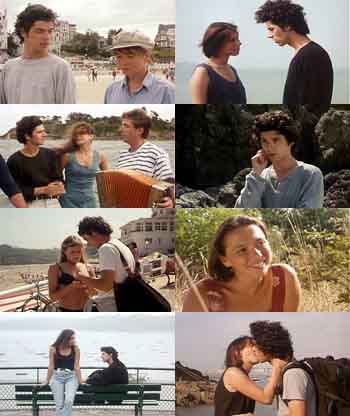
Francois Ozon’s new movie Time to Leave opens in Bay Area theaters this Friday, which means that it’s time to talk to him — about his attractive lead actor, Melvil Poupaud, his legendary supporting actress, Jeanne Moreau, and potentially stupid but fuckable bit players. Oh yeah, there’s some gossipy stuff.

melvil.bmp

Bay Guardian: My favorite of Melvil Poupaud’s films might be Eric Rohmer’s A Summer’s Tale, where he has a Jeff Buckley quality. The beach scenes in your movie resonate off of that one, as well as the beach scenes in your past films — would you agree? Had you admired other films of his?
Francois Ozon: I met Melvil a long time ago for Water Drops on Burning Rocks; I’d asked him to do the lead part, but he was afraid to play a gay character — he wasn’t about to kiss a boy in front of the camera. But now he was ready, maybe because the fact the character is gay is not so important. He was touched by Romain’s relationship to his father.
He’s a great actor because he accepts his passivity, his femininity. To be directed by a man was not a problem for him — in fact, at times, working with him is like working with an actress.

NOISE: More dispatches from the all-girl band front – from All Girl Summer Fun Band

0

What better band to speak to about all-female groups than Portland, Ore.’s All Girl Summer Fun Band. I e-mailed to Kathy Foster (drums, bass, vocals), Jen Sbragia (guitar, vocals), Kim Baxter (guitar, keyboards, drums, vocals), and Ari Douangpanya (bass, drums, vocals) for my story, but alas didn’t have the space to get in their responses. So here they are now.

allgirlsummer.jpg

By the way these women come with impeccable musical pedigree: Baxter played in the Young Astronauts, Cherry Ice Cream Smile, and One Two; Sbragia with Pretty Face, Kissing Book, and the Softies; Foster with Haelah, Hutch, and Kathy, the Thermals and Butterfly Transformation Service.

Bay Guardian: Would you say it’s harder to find all-girl bands these days? Is it a form of musicmaking that’s waning (thinking about prominent ones such as Sleater-Kinney and Le Tigre that have called it quits)? Does the idea, associated issues, and the mode of working and making art among solely women seem irrelevant, for whatever reason, today?

Kathy: I think there are more and more girls/women playing music these days. It may seem like it’s less relevant because the mainstream media doesn’t pay much attention, but that’s mostly all crap anyway. On the more independent level, there are tons of great female musicians.

Kim: If it is harder to find all-girl bands these days, then perhaps that is a good sign. In the past girls/women were not always given a lot of respect in the music world, even within the independent music scene. I personally started my first all-girl band in high school because I felt frustrated trying to play with guys and not getting much respect from them. There are definitely more and more females playing music everyday, especially because of the onset and expansion of the rock camps for girls as well as all of the positive attention that bands like Sleater-Kinney and Le Tigre have received. Perhaps the relationship between males and females in music is improving and female musicians are more spread out between all-girl and co-ed bands. I think this is the case, at least within the independent music scene. The mainstream music scene will probably always be stuck in their old-fashioned, unprogressive ways.

Jen: It seems there are always new female vocal groups that rely on their sex appeal, which is frustrating for me. I wish more women wanted to learn to play instruments. It seems lazy to me to just tart up and sing, especially when there’s the technology to fix less than stellar voices.

I don’t think female-based art and music is irrelevant at all, but I can see where the masses – hypnotized by shows like American Idol – see fame as the reason for doing it, and that it can come instantly if you’re lucky. Who wants to spend years perfecting a craft? Lots of people…but maybe it’s becoming less and less popular.

On the other hand, Sleater-Kinney and the Donnas have undoubtedly inspired a whole new group of girls that are still learning how to play, and maybe in a year or two there will be more all-female rock bands. I would love to see that.

5.jpg
Gus Van Sant shoots the girls.

BG: Do you find it disheartening or encouraging to have your gender emphasized? Any thoughts on the emphasis put on “women in rock” in the ’90s?

Kim: I definitely appreciated the emphasis put on women in rock in the ’90s. I was just starting to play music at that time and it allowed me to find out about a lot of great all-girl bands such as Tiger Trap, Slant 6, and Bikini Kill. I guess I find it a little disheartening that it is now 2006 and people are still treating women in music as “new” and “interesting.” Women have been playing music for so long now, it is ridiculous to me that we are still even having to discuss it.

BG: Why is it important to work in an all-female context today? Do you find that sexism in music, the music industry, or music subcultures still persists?

Kathy: I’ve never thought of it as important. I’ve never consciously made a choice to be in an all-girl band. AGSFB is the second all-girl band I’ve been in, and both times it was because I liked the people I was playing with and felt comfortable around them. I’ve played in several bands with guys for the same reasons. Any person who feels I’ll suck because I’m female is not someone I want to be around anyway. I don’t think I know anyone like that. And I don’t want to waste my time with that.

Kim: Although things are improving, unfortunately sexism and ignorance does still exist in music. Living in Portland, Ore., we do not have to deal with it as much, but I know that in other parts of the US and in the world it is still difficult for female musicians to gain the respect they deserve. Playing in an all-female context can be very protective and empowering and I personally love collaborating and creating music with other females. It seems like the goal, however, should be for women to feel comfortable playing with males or females without having the music scene and industry push them one way or the other.

Jen: I think as long as women are making music, it doesn’t really matter who is in your band. Being in all-female bands is great, especially when you’re all good friends. I have also been in bands with men, and I never found it oppressive or less than optimal. As far as sexism in music is concerned – I really think the whole idea of women not being able to “rock” as hard as men is a thing of the past. Who really still believes that?