Bay Guardian Archives

NOISE: Smoother sailing for Roky?

0

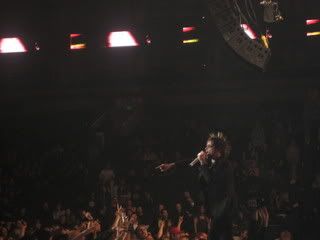
Just in time to catch the afterglow of Roky Erickson’s awesome performance at Great American Music Hall last night: good news. According to Erickson’s publicists, the garage-punk legend has had his legal rights fully restored as of Feb. 23.

roky color.bmp

Roky’s camp writes: “In June 2001, Roky Erickson’s youngest brother, former Pittsburgh Symphony Orchestra principal tubaist Sumner Erickson, was appointed Roky’s legal guardian. Sumner established the Roger Kynard Erickson Trust to address Roky’s living expenses and other financial needs. From June 2001 till July 2002, Roky lived with his brother in Pittsburgh, where he finally began to receive the support and care he needs.

“Roky is now back in Austin. Not only has his health continued to improve dramatically, but as of Feb. 23, 2007, the guardianship has been dissolved. Roky is back, a free agent and the rock ‘n’ roll muse that he was born to be.”

His now-regular psychedelic ice cream social benefit will happen on Thursday, March 15, during SXSW at Threadgills WHQ, S. Austin, Texas, from 2-8 p.m.

This year’s event celebrates “Electro-Shock Survivors”; Erickson’s peeps write: “The Ice Cream Social is co-sponsored this year by the Coalition for the Abolition of Electroshock in Texas (CAEST). Many artists have been hurt over the years by the labels and biological treatments of the mental health system. Roky Erickson, Townes Van Zandt, and Jim Franklin are Austin music legends who suffered from psychiatric electroshock, also known as electroconvulsive therapy, or ECT.

“Roky and Townes’ son, J.T. Van Zandt, are among the musicians who are now publicly declaring their desire to protect future artists from being hurt by electroshock, calling for genuine asylum and compassionate care of artists and other citizens who might be having a hard time in life. Says Roky of being subjected to ECT treatments: ‘I wish I hadn’t had it and it didn’t help me.’”

Tickets for $20 are available at www.frontgatetickets.com and at Threadgills WHQ at 301 West Riverside Drive at (512) 472-9304.

NOISE: Noise pop-a-go-go-going! Roky, Macro, Pop, pop, pop…

0

Wow, can’t stop the Noise Pop show-going. Though when one finds the time to report on it or discuss the hairdo’s seen or the amount of cheap beer quaffed – who knows?

roky.jpg

First off, Roky Erickson totally freakin‘ kicked ass last night, March 1. Solid band, great sound, punchy drumming, great gods of distortion smiling down. You know, the works. Though the set was relatively short at about 40 or so minutes and Erickson and the Explosives sprinkled the proceedings with several blues jams, all the faves were in order – 13th Floor Elevators’ “You’re Gonna Miss Me” and his own “Two Headed Dog,” “Don’t Shake Me Lucifer,” and “I Walked with a Zombie.” All mind-alteringly loud with plenty of intriguing facial expressions (puzzled, thinking, munching, etc.) on Erickson’s face. Black motorcycle jacketed rocker crowd was out in force, along with passionate oldsters – haven’t seen that mix since Radio Birdman’s first SF stand.

And Wooden Shjips sounded absolutely awesome at 8:30 p.m. opening for Erickson (incidentally Howlin’ Rain rocked the keys and Oranger sounded more raucous than ever). Hard to believe it’s your second show, I told guitarist Ripley Johnson. It’s actually his third – the second was in Cotati, he replied. Same diff, no?

macromantics.jpg

Meanwhile Macromantics, otherwise known as Romy Hoffman, killed at Bottom of the Hill Wednesday, Feb. 28. She mimed sticking a knife in her chest, strafed the air with her arms, and flipped her long hair all over the place – and ruled the mic with tongue-twisters that would have driven me mad. (And lord knows I’ve tried, tackling “Crazy in Love”‘s raps at karaoke.) Later Pop Levi brought the blues-rock overdrive – loud and proud, get used to it.

Later I waddled over to Great American Music Hall to check Sebadoh. Yep, they’re still there. My pals were divided as to whether they prefered Eric Sebadoh tunes or Lou Sebadoh numbers. Regardless, ya got it all.

Girls Rule

0

IMG_0375.JPGOooh, how I love me some rockin’ women. And last night seemed to be chock full of ’em. (The men weren’t half bad either…)IMG_0364.JPG

First was Noise Pop Happy Hour at the Parkside (are we seeing a theme here?) featuring the mesmerizing Loquat. Listening to the adorable Kylee Swenson (pictured top right) layer gorgeous, haunting vocals over the band’s catchy guitar-pop-meets-danceable-electronica (thanks to bandmates Earl Otsuka, Anthony Gordon, Christopher Lautz, and the newest band member, a laptop) was the perfect way to start off an evening of rock.

IMG_0378.JPG
Next up was Slim’s, for a stellar line-up featuring French Kicks (moderately far away photo here)and Scissors for Lefty(very far away photo here), both of whom were fantastic. But opening band The Oohlas really stole the show. The music was true, heart-pounding rock’n’roll — and so was frontwoman Olivia Stone (in the other two photos), whose smile was as engaging as her on-stage antics.

Watch video here.

(And by the way, this isn’t some “I Am Wemoon Therefore I Heart Womyn In Rock” thing. Merely having a vagina is not enough to make me like your band. These chicks have vaginas — presumably…I didn’t actually see ’em — and they fucking rock. Uh, the chicks. Not the vaginas….Never mind.) (Molly Freedenberg)

NOISE: Yum, indie branding means…

0

Guardian staffer Joe Pennant was out and about for Noise Pop and ran smack into some free mochi ice cream at Bottom of the Hill – courtesy of the Ice Cream Man.

icecreamsmall.jpg

Who are these kind, mysterious strangers giving away sweets at all manner of shows? Marketing, promotions, branding, and advertising, naturally! The site says: “Ice Cream Man is a grassroots organization that combines the minds, hearts, skills, and resources of a growing team of adventurous individuals who refuse to adhere to the old business paradigm. We were those crazy and confused kids raised in the ’80s and ’90s with conflicting messages (“Just Say No” vs. “Just Do It”). We believe that right now is the best time in history. With the Internet we are not bound by the constraints of the modern media machine. We can break through all of the hypocrisy and create REAL connections with like-minded people…. The more money we can bring in the more ice cream we’ll be able to give away. To date the Ice Cream Crew has given away over 35,000 treats.”

Folks last saw ’em at Arthurfest. I saw him at Great American Music Hall during the Sebadoh show – and got a lovely organic Creamsicle-like bar for my trouble. Apparently they’re looking for a few good Ice Cream Men and Women too. Just, y’know, an FYI, duders.

Leno announces

0

By Steven T. Jones
Invoking the spirit of George Moscone and Harvey Milk “so that we may be worthy of their powerful legacy,” Assembly member Mark Leno today announced his candidacy for the Senate seat now held by Carole Migden, setting off a high-profile fight between the two for the Democratic Party nomination next year. “Welcome to democracy in action. Welcome to people power,” Leno told the large crowd that gathered under the warm noontime sun at Yerba Buena Gardens, adjacent to the Martin Luther King Memorial and Moscone Center, with its rooftop array of solar panels that Leno said he will work to bring to more buildings. MCing the event was Assessor Phil Ting, who introduced District Attorney Kamala Harris, who told the crowd, “I stand here in strong and unequivocal support for Mark Leno.” Among the other local notables on hand to support Leno were Fiona Ma, Susan Leal, Laura Spanjian, Julian Davis, Kim-Shree Maufis, Hydra Mendoza, Norman Yee, Lawrence Wong, Donna Sachet, Theresa Sparks, James Hormel, Natalie Berg, Randy Shaw, Bob Twomey, Jose Medina, August Longo, Linda Richardson, Calvin Welch, Jordanna Thigpen, Leah Shahum, Tom Radulovich, Melissa Dodd, David Wall, Tim Gaskin, Esperanza Macias, and Espanola Jackson. Notably absent were any members of the Board of Supervisors, but it’s still very early in a campaign that is bound to get heated.

An evening of esoteric indie rock

0

So there’s this guy named Tommy Lee. Maybe you’ve heard of him? Played drums in a little-known rock band? Married some blonde in a red bathing suit? Starred in a salacious home video? Well, apparently this obscure musician is still making his art in the small, private, cult-following-type venues he’s become accustomed to (like Oakland’s Oracle Arena, on two different reality shows, and in a book he’s co-writing, among about a dozen other gigs).

And because I’m on the inside of the indie scene, with my ear to the ground and finger on the pulse and my nose buried deep in music mags you’ve never heard of, I caught wind of Mr. Lee’s recent appearance in the Bay Area. Not only caught wind, mind you, but rode that wind all the way to the stage and then behind it, where I watched this lean, muscled, tattooed, talented, teenager-in-a-man’s-body (If only he could be saved from his obscurity so the rest of the world could appreciate his crush-worthiness…) wail away on the drums while his friends from other little known bands (Guns N Roses, anyone? Black Crowes? Nah, I haven’t heard of ’em either…) and a guy they found on a TV show played along in their tiny garage band named Rockstar Supernova .

Now’s probably the part where I should review the show, but thanks to appropriately rockstar amounts of beer and Jagermeister that took me a week to recover from (and therefore that long to write about it), you’ve probably already read about the show somewhere else. And considering that I met (and liked) the fantastic Mr. Lee before he went on stage, I’m not exactly an unbiased observer anyway.

Instead? Look at some pictures from the Rockstar Supernova show on Thursday, February 22 (with Juke Cartel, fronted by Rockstar Supernova reality show runner-up Toby Rand, and Panic Channel, featuring Dave Navarro):

Lukas Rossi, the former Hooter’s cook from Canada who won the reality show contest and now fronts Rockstar Supernova
Photobucket - Video and Image Hosting

Tommy Lee on keyboards during a cover of The Verve’s Bittersweet Symphony

Photobucket - Video and Image Hosting

The encore, a cover of Prince’s Purple Rain, climaxes with – what else? – a rain storm of purple confetti
Photobucket - Video and Image Hosting

(Molly Freedenberg)

Hella lot of pictures … (but not of Hella)

0

So I couldn’t get tickets to last night’s Hella show (with Pop Levi, Macromantics, Tartufi) at Bottom of the Hill (Yes, I tried to get ’em like a civilian. That’ll teach me not to use my press privilege…) Which meant that after the Noise Pop Happy Hour at Thee Parkside (where I enjoyed some lovely little lox-and-cream-cheese sammiches), I managed only to go out drinking instead of seeing live music. But that doesn’t mean I’ve nothing to post here. Oh, no. On the contrary, I have photos from opening night at Mezzanine, as promised:

Extra Action Marching Band:
Trumpet
Cheeky cheerleaders
The horn section
Tall f(l)ags
Majorettes
Rah rah rass
X-tra action close-up

Har Mar Superstar, after getting progressively less dressed:
Bringing sexy back?

And one dimly lit photo of Tapes ‘N’ Tapes:
Josh Grier

And hey, I never promised the photos would be good.(Molly Freedenberg)

Culture war at the Village Voice

0

By Tim Redmond

Good article in the Boston Phoenix on the fallout from the New Times-Village Voice merger. The basic point that writer Adam Reilly makes:

The core of the old New Times chain was Southwestern and Southern. And those regions of the country have a different political culture — more socially conservative, more reflexively anti-government — than coastal markets like Los Angeles and New York, or progressive Midwestern enclaves like the Twin Cities. “Phoenix, Denver, Miami — there’s something about the culture of those cities that’s similar,” says Robson. “There’s a frontier mentality that New Times’ libertarian nihilism matches up with.”

None of the old VVM papers fits this description, but New York fits it the least.

Considering that New Times (Now Village Voice Media) owns the SF Weekly and East Bay Express, the article is well worth a read.

Tourk for mayor

0

By Steven T. Jones
After an uncomfortable exchange with Mayor Gavin Newsom at the Project Homeless Connect event earlier in the day, Alex Tourk was out with friends (including a long list of prominent people, many still in Newsom’s camp) at Finnegan’s Wake last night celebrating his birthday and I happened to run into him. This guy’s a class act, standing tall and trying to do what’s right even after being so viciously betrayed by Newsom. We chatted a bit and he said that he appreciated how the Guardian has covered this episode. I asked how his job search was going and I emphasized my earlier published point that I hope he’s taking his sweet time given the fact that Newsom is paying his high salary until he finds one. But rather than soaking Newsom, Tourk said he was actively looking for work and eager to sever ties with his former mentor. I had just come from a dinner party where it was only half-jokingly suggested that Tourk run for mayor and I passed that along. And you know what? I sensed a twinkle in his eye and an openness to the idea. Wouldn’t that be something? Tourk was the guy who actually executed the things that Newsom will be claiming credit for this year, a genuine policy pro who has a sterling reputation and increasing name recognition to boot, not to mention the beautifully poetic narrative. If Jack Davis or any other political consultants are reading this, please, give Tourk a call.

Fast start in 9

1

By Steven T. Jones
The next Board of Supervisors race would appear to be only a faint blip on the horizon — coming as it does after this year’s mayor’s race, the presidential primary a year from now, and the state primary fight in June ’08 that will feature the Leno-Migden battle royale — but contenders are already starting to position themselves. Nowhere is that happening quicker than in District 9, where Tom Ammiano will vacate his seat and try to smoothly hand it over to the man he considers his heir apparent, David Campos, who has been quietly lining up support all over town. Police reform advocates were happy to see Police Commissioner Campos hold out for a tougher early intervention system, a bold move that showed he’s not as afraid of the Police Officers Association as too many pols are here in town. And Campos is likely to have the queer community solidly behind him. But the heart of Dist. 9 is in the Mission and Campos is likely to face a strong challenger from longtime Mission activist Eric Quezada, and maybe day laborer advocate Renee Saucedo, who ran against Ammiano last time. And from the more conservative side of the equation, Miguel Bustos will also likely throw his hat into the ring, although this is one of the city’s most lefty districts. So, almost two years early, this is already looking like it’s going to be a Campos-Quezada slugfest. Dontcha just love politics?

The Guardian Iraq War casualty report (2/27/07)

0

Casualties in Iraq

Iraqi civilians:

8 Iraqi civilians killed today in the bombing of a commercial street. Iraq’s Interior Ministry reported 18 young boys killed in the car bombing of a soccer field today despite contradictory reports from the U.S. military, according to CNN.

Source: http://www.cnn.com/2007/WORLD/meast/02/27/iraq.main/index.html

98,000: Killed since 3/03

Source: www.thelancet.com

57,232 – 62,985: Killed since 1/03

For a week by week assessment of significant incidents and trends in Iraqi civilian casualties, go to A Week in Iraq by Lily Hamourtziadou. She is a member of the Iraq Body Count project, which maintains and updates the world’s only independent and comprehensive public database of media-reported civilian deaths in Iraq.

Source: http://www.iraqbodycount.net

A Week in Iraq: Week ending 25 February 2007:
http://www.iraqbodycount.org/editorial/weekiniraq/32/

For first hand accounts of the grave situation in Iraq, visit some of these blogs:
www.ejectiraqikkk.blogspot.com
www.healingiraq.blogspot.com
www.afamilyinbaghdad.blogspot.com

Antiestablishmentarianism attitudes among Iraqi religious groups is fueling intolerance and violence towards homosexuals in Iraq, according to the UN.

Source: http://www.gaypeopleschronicle.com/stories07/february/0202071.htm

U.S. military helicopters are being targeted by insurgents, according to the New York Times.

Source: http://www.nytimes.com/2007/02/12/world/middleeast/12copters.html

The U.S. military said most recent of the seven helicopters shot down since January 20th was brought down by a sophisticated piece of weaponry, according to Reuters.

Source: http://ca.today.reuters.com/

U.S. military:

3,385: Killed since the U.S. invasion of Iraq 3/20/03

Source: http://www.icasualties.org/

For the Department of Defense statistics go to: http://www.defenselink.mil/

For a more detailed list of U.S. Military killed in the War in Iraq go to:
http://www.cnn.com/SPECIALS/2003/iraq/forces/casualties/2007.01.html

Iraq Military:

30,000: Killed since 2003

Source:http://www.infoshout.com

Journalists:

151: Killed since 3/03

Source: http://www.infoshout.com/

Refugees:

The Bush administration plans to increase quota of Iraqi refugees allowed into the U.S. from 500 to 7,000 next year in response to the growing refugee crisis, according to the Guardian Unlimited.

Source: http://www.guardian.co.uk/Iraq/Story/0,,2013034,00.html

Border policies are tightening because one million Iraqi refugees have already fled to Jordan and another one million to Syria. Iraqi refugees who manage to make it out of Iraq still can’t work, have difficulty attending school and are not eligible for health care. Many still need to return to Iraq to escape poverty, according to BBC news.

Source: http://news.bbc.co.uk/2/hi/middle_east/6293807.stm

1.6 million: Iraqis displaced internally

1.8 million: Iraqis displaced to neighboring states

Many refugees were displaced prior to 2003, but an increasing number are fleeing now, according to United Nations High Commissioner for Refugees’ estimates.

Source: http://www.unhcr.org/iraq.html

U.S. Military Wounded:

47,657: Wounded since 3/19/03 to 1/6/07

Source: http://www.icasualties.org/


The Guardian cost of Iraq war report (2/27/07)
: Bush asks congress to approve $622 billion for 2008. So far, $369 billion for the U.S., $46 billion for California and $1 billion for San Francisco.
Compiled by Paula Connelly

Bush asked congress to approve $622 billion for defense spending, most for the wars in Iraq and Afghanistan, in a $2.9 trillion budget request for 2008, according to Reuters.
Source: http://today.reuters.com/

Here is a running total of the cost of the Iraq War to the U.S. taxpayer, provided by the National Priorities Project located in Northampton, Massachusetts. The number is based on Congressional appropriations. Niko Matsakis of Boston, MA and Elias Vlanton of Takoma Park, MD originally created the count in 2003 on costofwar.com. After maintaining it on their own for the first year, they gave it to the National Priorities Project to contribute to their ongoing educational efforts.

To bring the cost of the war home, please note that California has already lost $46 billion and San Francisco has lost $1 billion to the Bush war and his mistakes. In San Francisco alone, the funds used for the war in Iraq could have hired 21,264 additional public school teachers for one year, we could have built 11,048 additional housing units or we could have provided 59,482 students four-year scholarships at public universities. For a further breakdown of the cost of the war to your community, see the NPP website aptly titled “turning data into action.”

Noise ‘N’ Pop

0

The line outside Mezzaninelast night may have been ridiculously long (the hidden cost of “free” admission), and the venue may have reeked of body odor (or cheap weed?), but both were worth the entertaining, irreverent kick off to a week of Noise Pop fun. We were immediately heartened that we all got in, even though I was the only one who’d registered online, and that the DJ was playing catchy, pseudo-indie (since what does “indie” mean anymore, anyway?) classics like the Ramones and Violent Femmes between sets. harmar2.JPG

And though there was plenty of hipster eye candy, the place was noticeably devoid of the pretentiousness one might expect from an event headed by uber-underground-cult-favorites Tapes n Tapes. No, we were all equally, geekily excited by the Extra Action Marching Band (your high school half-time show meets Rocky Horror Picture Show, complete with tattooed tuba players and provocative pom pom girls … and boys)tuba.JPG, comedian David Cross (managing to simultaneously deliver and skewer sponsor Doc Martens’ marketing message – “Change the world, starting by buying these shoes…”), and one man freakshow – and talented vocalist and performer – Har Mar Superstar (whose mantra “I’m fucking awesome” is so ironic, it’s actually true).

The highlight of the night, though, was Tapes ‘N’ Tapes, all humble and sweet and soft-bodied and dorky, just like a proper indie band should be. The sound up front was a bit too loud and distorted for my taste (I hear the music sounded perfect from the bathroom), but the band’s energy mostly made up for it — and Cowbell was perfect: raw and lilting, just like I like it.

Mmmmm….poppy goodness at its noisiest. I can’t wait to see what the rest of the week serves up.

P.S. More photos to come…

(By Molly Freedenberg)

Pinkos, painters, and pansies

0

› marke@sfbg.com

REVIEW Los Angeles has lately become quite a hot spot for queer studies scholars, their investigations slipping out of the Hollywood Babylon mode of starstruck speculation and into the lives of everyday Angelenos. In the wake of Lillian Faderman and Stuart Timmons’s well-received 2006 volume, Gay L.A.: A History of Sexual Outlaws, Power Politics, and Lipstick Lesbians (Basic Books), comes Daniel Hurewitz’s Bohemian Los Angeles and the Making of Modern Politics, an ambitious, fascinating attempt to show how Communists, postsurrealist artists, civil rights activists, and pre-gay "fairies" converged in the crucible of early 20th-century Silver Lake — then called Edendale — to create the modern notion of identity, in particular queer identity.

Bohemian Los Angeles is bookended by two extraordinary characters who made their home in Edendale: lauded vaudeville female impersonator Julian Eltinge and gay-rights giant Harry Hay. Both of these men had sex with other men, but they couldn’t have been more distant in their conception of their own identity. The idea of gayness, or the notion of a true inner self that relied on sexuality to achieve its public expression, was as alien to Eltinge and his time (the 1910s) as Grand Theft Auto. Despite the expensive stage gowns and fellatio, the otherwise macho Eltinge was enraged by the showy "cissies," dandies, and fairies who claimed to have "woman’s blood in them" and made up much of his fan base. For him and other prominent male-on-males, homosexuality was a private act that needed no community or publicity to ensure its satisfaction. Hay, who came to prominence 40 years later as the first official gay activist, was a different fish entirely. His Mattachine Society insisted that homosexuality was an underlying impulse knitting everyone who was "that way" into a kinship with a shared cause: civil rights.

Hurewitz’s project is to trace how Eltinge’s view gave way to Hay’s, how activity was transformed into identity and gay pride was born. To do this, he recounts the history of Edendale as one of transformative communities, paying close attention to the artists who gathered around guru Jack Zeitlin in the late 1920s and began exploring the idea of an inner essence that could be communicated through the arts. He looks at members of the Communist Party of Los Angeles who experimented in communal living in Edendale in the 1930s and, in the wake of World War II’s Zoot Suit Riots and Japanese internments, agitated for a notion of civil rights based on ethnic identity. And he tracks the growth of homosexual networks in LA, the prototypes of a community based on sexual desire.

All of these bohemian groups, Hurewitz argues, laid the groundwork for Hay’s and others’ ultimate politicization, their embrace of a sexual inner essence worthy of public declaration. A further inspiration was the steep uptick in homosexual arrests in the 1920s, as the city’s politicos seized on the notion of "degeneracy" as a moral-panic strategy. (One of Hurewitz’s fabulous insights is that the idea of degeneracy was once embraced by some homosexual men as a way to divorce their actions from their character.)

Many gays today feel exhausted by identity politics yet trapped in a ghetto of conformist sexual expression. Refreshingly, this sharply written, well-researched history brings to light some of the magically diverse, willfully perverse, and politically immersed foundations of who we are now. *

BOHEMIAN LOS ANGELES AND THE MAKING OF MODERN POLITICS

By Daniel Hurewitz

University of California Press

377 pages

$29.95

>

Princess party

0

The Legend of Zelda: The Twilight Princess

(Nintendo; GameCube, Wii)

GAMER Every Christmas as a child, I’d dream not about sugarplums but about Nintendo. I mentioned it to Santa at the mall, but alas, there was never one under the tree. So I made friends and used them for their consoles. Sadly, none of them were into The Legend of Zelda, so I did not grow up following the series like many of my generation. Twilight Princess is the first game I’ve played in the series — and for us Zelda initiates, it’s not a bad place to start.

You begin as an elf named Link who lives in a tree house in a quiet village in the land of Hyrule. The peace is destroyed when the children are kidnapped first by monkeys and then by something far more sinister.

Twilight Princess manages to engage the player pretty quickly. Link himself has the personality of a houseplant. But once you are drawn into the twilight world, which happens quickly, you meet your comrade: Midna, a creepily cute snaggletoothed imp. In the twilight world you become a wolf, and like an unruly child, Midna wants to ride on your back. Thankfully, he pulls his own weight with special attacks. The plot progression is well-timed so players feel like they are controlling the story without losing track of the final goal, to liberate Hyrule.

Hyrule is a fairly open world. You can roam much of a large map that opens up further over time. You can fish and hunt bugs, though there are really only two types of rewards for exploring and collecting: money and heart containers. The predictability and general meagerness of the rewards take the fun out of collecting and exploring, and interactions with the world itself are pretty much limited to throwing things. That’s not to say this isn’t rewarding in itself: once the tutorial was over, I started hurling pumpkins at nearby children. Oh yes, I was supposed to be helping the shopkeeper find her cat so she’d sell me a slingshot, which brings me to the thing that distinguishes this — and, I’ve heard, the Zelda series — from other role-playing games: the puzzles.

Most involve figuring out how to reach a goal by combining your limited tools with surrounding objects. Many battles require more thought than reflex: one sequence requires you to kill three demons — the caveat being that if one is left standing, it will resurrect its companions. Neither the puzzles nor battles are terribly difficult, but they are integrated perfectly.

Twilight Princess’s game play is well paced and very fun, and next to that, sound and graphics are pretty much just icing on the cake. I played the Wii version, and it’s no secret that its graphics aren’t as sharp or detailed as those on the PS3 or Xbox 360. However, stylistically the game is beautiful. The soundtrack is unobtrusive.

In short, Twilight Princess is the most fun I’ve had on the Wii so far. There has been a severe lack of fun puzzles in gaming since the adventure game genre died out about a decade ago. Zelda fills this void with brainteasers that are challenging but not hard. (Kea Johnston)

Steeped in controversy

0

› a&eletters@sfbg.com

These days everyone is a gourmand, and caring about the earth is so cool it’s made even Al Gore popular. The time is ripe to give a fuck.

But all this focus on artisanal and organic products is complicated. What’s easiest for the consumer to understand isn’t always correct. Stickers can’t always be trusted. And — certified or not — nothing holds a candle to family tradition.

It’s true for tomatoes. It’s true for tangerines. And, according to Winnie Yu, director of Berkeley teahouse Teance, it’s especially true for tea.

That there is controversy or politics involved with tea is nothing new (Boston Tea Party, anyone?). But the most recent debates have centered around two primary issues: the practice of using lower quality teas in tea bags (versus loose leaves) and the consequences of labeling tea as organic.

But before we get into all that, first the basics.

CONFLICT BREWS


The beverage as we know it is said to have been discovered when tea leaves blew into the hot-water cup of early Chinese emperor Shen Nung. Cultivation started simply enough, under the fog on steep hills, where harvesters engaged in the art of fine plucking, or gently twisting the buds of Camellia sinensis at precisely the correct moment of the correct day. This knowledge was a biorhythm, pulsating in the bones, passed from one generation to the next.

But it wasn’t long before this Chinese medicinal crop changed everything. The British East India Co. — originally chartered for spice trade — spread opium through the region just to get its hands on the stuff. This bit of naughtiness made it the most powerful monopoly in the world, prompted wars, and left legions addicted to another intoxicating substance: tea.

Smuggling rings, high-society occasions, and ever-increasing taxes spiraled around the precious crop. The long journeys from China to Britain led to the glamour of clipper ship races, but below deck fighting the rats was another problem altogether. One piece of tea lore explains how cats were employed to catch the rats, and after an entire shipment of tea (already stale from the journey) was infused with cat piss, it was discovered that the pungent bergamot oil, popular at the time, masked this stench quite nicely. Earl Grey was born.

Next came Thomas Sullivan, New York tea merchant, good-time guy, and miser to the core, who decided to send some tea samples to faraway clients. Instead of packing his gifts in tins, as was common at the time, Mr. Tightwad decided to use some silk baggies he had lying around. The people who received these pouches assumed they were to dip them into boiling water and throw away the debris. Sullivan had unwittingly invented a no-mess solution to tea. The orders came pouring in. A few years later the Lipton tea bag was born.

BONES ABOUT BAGS


Eventually, it was learned that smaller pieces, or finings, brew more quickly than full leaves. But when leaves are broken into finings, the oils responsible for their taste evaporate. This leaves a bitterness that can only be countered with cream and sugar. And the tea farmers in China kept on keeping on, despite the series of near-triumphs, well-intentioned buffoonery, and colonial rebellion that resulted in the western side of the tea-drinking world forever asking, "One lump or two?"

According to tea connoisseurs, this is when the fine crop began its slide down the slippery slope into pure crap.

Far from an obsolete issue (or a localized one), bagged tea — both its quality and its form — has sparked a very modern worldwide debate.

In Sri Lanka as recently as Feb. 12, D.M. Jayaratne, newly appointed minister of plantation industries, instructed tea researchers and relevant authorities to investigate whether premium teas exported in bulk are being mixed with cheap tea.

And on the less quantifiable front, contemporary tea drinkers such as Yu consider bagged tea to have all the sophistication and allure of boxed wine. Properly enjoyed tea is not only an intoxicant but also an art. "It’s like music," Yu explains. "The notes have to be appreciated at their own time."

Tea bags pilfer quality by design, but something bigger may be lost between the staple and the tag: how about a bit of ceremony in a racing, relentless world?

"Tea is a spiritual product, as well as for consumption," says Yu, who has made it her mission to bring fine tea and tea education to the Bay Area. "It was a medicine for 2,000 years before it was a beverage."

Her Berkeley tearoom — a serene, beautiful environment flecked in copper and bamboo — allows you to connect with the leaves, the culture, the moment, and the community. "Drinking with 3,000 years of history, you don’t feel alone," Yu says.

THE ETHICS OF ORGANICS


Meanwhile, at the 40th annual World Ag Expo in the San Joaquin Valley in mid-February, cannons thundered, Rudolph Giuliani waxed poetic about alternative fuel, jets split seams into the sky, more than 100,000 people gathered from 57 nations, and a small group of farmers met to contemplate the agribusiness plunge into the emerging organic industry.

During a seminar with Ray Green, manager of the California Organic Program for the California Department of Food and Agriculture, these farmers had before them a daunting question: organic at what cost?

When it comes to tea, Yu has an answer. The cost is large: to consumers, who mistakenly think their certified-organic tea bag is superior to the noncertified (but tastier and ecofriendlier) independent variety, and to small farms, which have to compete with the certified giants.

Artisan tea shops such as Yu’s depend on strong bonds with small farmers. But most quality tea farms opt out of the bureaucratic mess of US Department of Agriculture organic certification because the fees are too high and the other costs are too great. For example, USDA certification can require land to lay barren for up to five years. According to Yu, it’s nonsense to ask a family farm to participate in such a thing. "These hillsides have had tea growing on them for hundreds of years," she says. "It is very precious to have a tea tree."

Many new farms are certified under European and Chinese regulations — which are both significantly stricter and cheaper than their United States counterpart — but still have to compete with big corporations willing to jump through the USDA hoops.

At his seminar Green said, "Some of the farmers that left conventional agriculture 10 years ago because they just couldn’t compete on economies of scale are now finding that the same companies they were in competition with 10 or 12 years ago are now competing against them in the organic sector."

Consumers want to choose certified products because they think they’re doing the right thing. But doing so doesn’t necessarily help anyone but the big corporations that can afford certification.

"Organic isn’t an issue if it’s always been organic," Yu says. "Fair trade is not an issue [for Teance] because we buy from family farms."

Yu works with family farms like the ones with representatives sifting through the advice and cautionary tales of the World Ag Expo, the farms wondering how to stay afloat in the wake of impossible competition. As their corporate counterparts lurk in low valleys, sifting the scraps of their mass harvest into nylon bags before slapping a USDA organic sticker on attractive packaging and trumpeting health consciousness to the uneducated consumer, the folks on the hill are still doing what they’ve always done.

It’s clear that as consumers become more informed, the demand for quality product increases. With this demand comes profit, red tape, and a departure from the salt-of-the-earth spirit that gave birth to the organic movement.

"The ritual is authentic, healthy, artful," Yu says. "You can’t find that in a tea bag."

So what is the San Francisco tea lover to do? At the very least, you can support your local gourmet tea peddlers. From Chez Panisse to El Farolito, the Bay Area is uniquely qualified to appreciate the culinary good stuff. We like it slow, whole, and artisanal, and fine teas deliver. *

TEANCE

1780 Fourth St., Berk.

(510) 524-2832

www.teance.com

FAR LEAVES TEA

2979 College, Berk.

(510) 665-9409

www.farleaves.com

IMPERIAL TEA COURT

1511 Shattuck, Berk.

(510) 540-8888

1411 Powell, SF

(415) 788-6080

1 Ferry Bldg., SF

(415) 544-9830.

www.imperialtea.com

MODERN TEA

602 Hayes, SF

(415) 626-5406

www.moderntea.com

SAMOVAR

498 Sanchez, SF

(415) 626-4700

730 Howard, SF

(415) 227-9400

www.samovartea.com

>

Ouroboros rising

0

› a&eletters@sfbg.com

Never mind the ides of March, here comes year four of the Iraq War. Believe it or not, this whole illegal invasion-and-occupation business brought to you by the generally scary US government — that consortium of oil companies, political marionettes, neoconquerors, military wonks, and other capitalist heavies operating behind the flimflam of democracy and terror — is about to celebrate another birthday. (In various offstage boardrooms, we hear the muffled sound of champagne corks not so discreetly popping.)

It’s unclear how many people are still fooled by the flapdoodle spewing from the faces fronting for this enterprise. For most of us in the big Green Zone back home, questions about the Iraq War have moved decidedly into the cultural realm, where the conflict lingers and ferments like others before it in the atmosphere generated between the TV and the dinner table — or, more insidiously, in the mute wasteland of adolescent malaise, surrounded on all sides by a dysfunctional society in lofty denial of its serious penchant for destruction.

Although written in the aftermath of the Gulf War, that media-sanitized prequel to contemporary carnage, playwright Mickey Birnbaum’s Big Death and Little Death squarely occupies the latter territory. But suburban death metal–laced teenage angst is more than the terrain of Birnbaum’s sly and ferocious black comedy — now enjoying a feisty West Coast premiere by Crowded Fire — it’s a beachhead from which the play gleefully lays waste to the universe as a whole.

Birnbaum’s fully fledged two-act (originally intended as an opener for death metal bands) posits some distorted family values, amplified by the sublimated horrors of a world on fire. Its main characters are a brother and sister, Gary (Carter Chastain) and Kristi (Mandy Goldstone), two sympathetically screwed-up teenagers whose modest nuclear household (an evocative panorama of linoleum, Formica, and faded wallpaper in Chloe Short’s deceptively spare set design) is vaguely overseen by their father, a troubled Desert Storm vet (Lawrence Radecker). Since returning from the Gulf, Dad likes to take pictures of road accidents (your quiet, volatile type, in other words, wonderfully fashioned by Radecker as an opaque yet sympathetic psychopath in desert fatigues). Completing the picture for a time is Mom, or Dad’s unfaithful wife (Michele Levy), whose history of sexual indiscretion while her husband was off sauntering through hell comes tumbling out of her in a series of Tourette’s-like confessions.

In the role of a highly inadequate support circle are Gary’s friend Harley (Ben Freeman), an awkward adolescent with an ambivalent thing for his friend’s sister; Gary’s twisted guidance counselor, Miss Endor (Tonya Glanz), who invites him to a death metal concert before diving into a crank-fueled nihilist rant; and Gary’s inappropriate Uncle Jerry (Michael Barr), a Navy sailor who becomes even more inappropriate as the oxygen leaves the stranded sub from which he makes a farewell call.

When a litter of pups is carted off by a classic suburban tweaker (Barr) in exchange for a gun and a bag of drugs, one of the pups (Mick Mize, in a dog suit) is left behind somewhere to haunt the house and mind of the posttraumatic paterfamilias. This subplot is interspersed with scenes from a family car trip from hell and Kristi’s anorexic adolescent anguish as Gary ponders whether to go to city college or "destroy the universe." In the end, as the characters make love, war, art, and friends in no particular order, the second option looks increasingly enticing to our hero, if only to clear the way for something new.

Smartly staged by Sean Daniels (moonlighting from his position as associate artistic director at the California Shakespeare Theater), Big Death and Little Death speaks to this imploding universe loudly and affirmatively, forefingers and pinkies extended. In Birnbaum’s optimistic apocalypse, there’s a difference between the annihilation of the system and the creative destruction that envisions a new beginning on the horizon.

The umbilical link between big and little deaths brings to mind the Vietnam-era "little murders" in Jules Feiffer’s even more prescient black comedy of an American culture of self-destruction. One’s tempted to call Birnbaum’s play the Little Murders of our day.

But neither can really compete with the culture they so sharply critique nor prove as strange or fitting as the news of the dean of West Point ganging up with human rights activists, the FBI, and military in-terror-gators to chastise the creators of 24 for feeding US soldiers too many tantalizing torture techniques. Seems almost a chicken-and-egg problem at times, this relationship between big death in Iraq (and Afghanistan and beyond) and little death on the tube. It’s quite a food chain too, bringing to mind that serpent devouring its own tail. Come to think of it, Ouroboros would make an excellent name for a death metal band. *

BIG DEATH AND LITTLE DEATH

Through March 4

Wed.–Sat., 8 p.m.; Sun., 2 p.m.

Traveling Jewish Theatre

470 Florida, SF

(415) 439-2456

www.crowdedfire.org

>

The Flowering Tree

0

The opera world has never been quite the same since director Peter Sellars teamed up in 1985 with composer John Adams to premiere Nixon in China. The production, which was unveiled in 1987 at the Houston Grand Opera, marked the start of one of the most brilliant artistic partnerships of our time. While controversy is perennially present in Sellars and Adams’s stage collaborations, few would deny what the pair has achieved is nothing short of revolutionary.

Adams and Sellars’s collaborations — The Death of Klinghoffer; I Was Looking at the Ceiling and Then I Saw the Sky, El Niño, and the massive Dr. Atomic, which had its world premiere at the SF Opera in 2005 — have redefined the musical and theatrical landscapes of the modern opera. Even more remarkable, the basis for this innovation wasn’t the European avant-garde but an identifiable and modern American sensibility. While Adams successfully integrated academic and experimental techniques with popular urban genres, Sellars explored cultural juxtapositions between the contemporary American experience (including those of marginalized communities) and the histories of people from other times and places.

This week Adams and Sellars return to Davies Symphony Hall for the SF Symphony’s US premiere of Adams’s A Flowering Tree. The multimedia performances, directed by Sellars and conducted by Adams, incorporate Balinese theater dancers; soloists Jessica Rivera, Eric Owens, and Russell Thomas; and the SF Symphony Chorus.

The new score isn’t typical of most other Adams works — it’s remarkably lyric, energized by soaring vocal passages and an ever-present feel of magical transformation. Contrary to the claustrophobic, doomsday intensity of Dr. Atomic, A Flowering Tree is a warm fable with an uplifting message of redemption, based on A.K. Ramanujan’s version of a 2,000-year-old south Indian folktale. It is the story of a young woman who can magically turn herself into a flowering tree, and like Mozart’s The Magic Flute (a partial inspiration), it explores themes of growing up, loss, hope, truth, and reconciliation. "Each work is generated from a very different impulse," Sellars says in a recent interview. "We had just worked on this intense, highly toxic opera that had lots of ticking sounds. We needed to go to the warmth and the light, with a tale existing in a springtime of its own."

Originally created for Austria’s New Crowned Hope Crowned Festival (of which Sellars was appointed artistic director) to celebrate Mozart’s 250th birthday, A Flowering Tree is infused with messages of universal spiritual harmony. "People may wince, but multiculturalism has been the reality of the world for so long," Sellars notes. "Mozart already had a global imagination under way in his Magic Flute. The opening stage direction is ‘a Javanese prince enters the stage,’ so we’ll have dancers from Java onstage with the San Francisco Symphony. For Mozart, that’s his imagination, but for us, it is actually our reality." (Ching Chang)

THE FLOWERING TREE

Thurs/1–Sat/3, 7:30 p.m., $31–$114

Davies Symphony Hall

201 Van Ness, SF

(415) 864-6000

www.sfsymphony.org

>

Can’t explain

0

› kimberly@sfbg.com

SONIC REDUCER What’s the difference between the Who and other boomer–classic rock combos hauling their bones out on the road these days? The fact that onstage at the cozy Reno Event Center on Feb. 23, midway through the kickoff for his group’s cockeyed US tour, Pete Townshend interrupted his own between-song hawk for the Who’s generally ignored recent album, Endless Wire (Universal), with a defiant disclaimer that went roughly like this: "We don’t care if you do buy it. Roger and I will soon be gone, and you won’t need to see us or buy anything because soon we’ll be dead. But now we’re here, and this is what we’re doing right now."

Then the black-clad Townshend, vocalist Roger Daltrey, drummer Zak Starkey, guitarist Simon Townshend, keyboardist John Bundrick, and bassist Pino Palladino launched into Endless Wire‘s "Wire and Glass: A Mini-Opera," which Pete Townshend ironically referred to as his band’s "Green Day moment." The centerpiece of "Wire and Glass" ‘s pocket rock opera, "We Got a Hit," rang with nostalgia and evoked, of all things, "Substitute," and Townshend sounded like both the angry young pop star he once was and the cranky old curmudgeon who would just as soon grumble "fuggit" than flog product.

And in the process Townshend sounded realer than most of the fossils buttressed by pricey pyrotechnics found in the last Stones tour. Is this an accomplishment? Perhaps, because Townshend was always one of the more ambitious and artful rockers of his g-g-g-generation and one of the most bare-faced and vulnerable (tellingly, the Who’s official site these days is the man’s own homespun blog at www.petetownshend-whohe.blogspot.com). Also, I don’t know about the old hippies who came out of the woods for the Who that night, but when you’re accustomed to the spectacle, dancers, rotating sets, and multiple costume changes that dramatize the majority of today’s arena pop shows — from Justin Timberlake to the Dixie Chicks — a straight-forward band performance is downright refreshing.

But I wasn’t sure what to expect when I fiddled around, making my way up to Reno, Nev. — home of the proudly gooberish National Bowling Stadium, hicks-run-amok comedy Reno 911!: Miami, and the neon-poisoned Last Days of Disco décor of kitschy-cute Peppermill Casino. Why start your tour in Reno, bypassing the Bay Area with a date in Fresno? Bad memories of Vegas, the site of bassist John Entwistle’s death during their 2002 tour kickoff? I’d never seen them live before: Keith Moon–era Who was way before my time; the late Entwistle epoch, too much for my music store–clerk blood. So it was the Daltrey-Townshend Who for me — along with a mix of gleeful, graying long-haired boomers in top hats and polo shirts, indeterminate Gen Xers, and a handful of youngsters — all much more male than a Stones, Robert Plant, or even Sex Pistols reunion show. Perusing the Ed Harris look-alikes, I’d venture there’s still something about Townshend — and maybe Daltrey’s ready-for-a-brawl manly rasp — that always spoke most directly to the smart art-nerd boys, at least in my high school. The Who always seemed to mirror men more acutely than women, despite those tributary pictures of Lily. Even now they work "Real Good Looking Boy" into the set, accompanied by an onscreen montage of Daltrey’s inspiration, Elvis Presley, and Townshend’s awkward intro: "It’s about being a little kid and looking at a big boy and having the courage to admire him as good-looking without any weirdness going on. Not that it is weird!"

But what’s vaguely weird is the fact that a once proudly forward-looking band such as the Who would sprinkle their set so liberally with favorites such as "The Seeker," "Anyway Anyhow Anywhere," "Baba O’Riley," and "Behind Blue Eyes," almost reluctantly putting forth new songs such as "Fragments," "A Man in a Purple Dress," "Black Widow’s Eyes," and those in "Wire and Glass," which cannibalize melodies, devices, and arpeggioed synth lines of songs such as "Who Are You" and baldly lift the curtain on a kind of nostalgia with tunes such as "Mirror Door," which hails sentimental, uncool icons like Doris Day. Even their opening song, "I Can’t Explain," was accompanied by target symbols, band insignia and posters, old photos of the band in Union Jack garb, and The Who Sell Out imagery — the latter once primo examples of pop art exploded, literally, in a rock ‘n’ roll context. The effect was powerful but somewhat of a disservice: the band itself is still hard-hitting enough to deliver its songs with absolute conviction, without the crutch of yesterday’s reminders, filled out by Ringo Starr’s competent though far from unhinged son Zak Starkey’s drum work; a husky-voiced but valiant Daltrey, who mastered his mic-swinging rotary-blade moves by the time the encore rolled around; and Townshend, windmilling and leaping, though with less athleticism than he might have had in the past.

Two hours into the show, all doubters were probably ready to push aside memories of the Who’s dead rhythm section, ravaged vocal chords, kiddie-porn controversy, unsmashed guitars, and a commercially stillborn album — and stand up for the "Pinball Wizard" encore. Though you wonder what it means when you’re in your late 50s and still singing "Meet the new boss / Same as the old boss" or "It’s only teenage wasteland. They’re all wasted!" and doing it, as Pete Townshend shouted jubilantly, "out in the fields of Nevada." The song remains the same, but now the band’s tone can’t help but have shifted. Perhaps you sound put out to pasture, a bit bitterer than you did as the angry know-it-all who was almost too smart for Top of the Pops. Or maybe a bit like Mr. Wilson, shaking his fist at Dennis the Menace and growling, "They’re all wasted!" You might sound more wise than nihilistic — can you explain how inspired you once were? *

Up on the roof

0

During these past six lovely years of Bush and Cheney, one has become almost nostalgic about duels — the calling out of adversaries to settle matters of honor with pistols — even if one or both adversaries should hold high office. But the duel isn’t dead, of course; it’s just the pistols that are gone, replaced in many instances by fanged memoirs.

Walter Scheib and Roland Mesnier aren’t exactly Aaron Burr and Alexander Hamilton, but they are Washington, D.C., figures of recent vintage, they worked together, they plainly did not get along, and now each has published a book of reminiscences that does not flatter the other. Scheib was the White House chef from 1994 to 2005, and his book (with Andrew Friedman) is called White House Chef: Eleven Years, Two Presidents, One Kitchen (Wiley, $24.95); Mesnier was White House pastry chef from 1979 to 2004, and his memoir (with Christian Malard) is titled All the President’s Pastries: Twenty-five Years in the White House (Flammarion, $24.95).

Mesnier’s is the more unintentionally comic performance. He recounts history as a series of elaborate desserts served to the high and mighty. Scheib’s story, while briefer, carries greater significance, for he was hired by Hillary Rodham Clinton in 1994 to make the White House a setting for the best in American food and wine. He stayed on through the first term of George W. Bush, even as Hillary’s culinary revolution was chucked in favor of what Scheib calls "country club" cuisine: hot dogs, fish cooked to death, and lots of beef tenderloin.

Hillary turns out to be an unexpected point of convergence for this pair of kitchen antagonists. Both men respected and liked her, and Scheib, in particular, gives us a picture of a woman who, despite a rather icy public image, understood the broad and deep meanings of food, for human sociability and health as well as for the fate of the earth. Ronald Reagan might have made it his first order of presidential business to remove Jimmy Carter’s solar panels from the White House roof, but Scheib, with Hillary’s support, started growing organic vegetables up there. (Interesting factoid: far fewer insects are to be found several stories above ground, so the need for pest control in a rooftop garden is dramatically reduced.)

Memo to Hillary: if you make it, how about an organic rooftop garden and solar panels?

Paul Reidinger

› paulr@sfbg.com

Noisepop cracks up: trading jibes with Patton Oswalt

0

Our little bundle of noise is almost all grown up. Damning the brooding tradition of adolescence, Noise Pop has learned to laugh at itself — and anything that involves swigging beer and heckling Patton Oswalt without a two-drink minimum sounds like pure fucking genius to me. I recently spoke to Oswalt on the phone from Burbank. After soaking in enough indie to keep you cloaked in scene points until next year, you may want to check out his act alongside fellow comedians Brian Posehn and Marian Bamford. (K. Tighe)

SFBG You’ve been gigging at indie rock venues for a while — and now you are getting booked at festivals such as Noise Pop and Coachella. A lot of bands must be pissed off at you.

PATTON OSWALT Getting invited to these things is really flattering, but my rider’s still simple. As long as there is old scotch, I’m fine.

SFBG Have you ever been to the Noise Pop festival?

PO No, but I’m really excited. I’ve only ever listened to Genesis, so I’m hoping to discover new stuff.

SFBG You used to live in San Francisco. Are there any old haunts you still frequent when you play here?

PO I have about 10 old haunts. They are all Starbucks now.

SFBG El Farolito or Cancun?

PO La Cumbre all the way. They are mighty, mighty, mighty, and they’ve never fallen.

SFBG Your San Francisco act is always incredibly liberal — how much do you need to alter your political material from city to city?

PO I don’t have a tailored act. I trust the audiences to rise to the occasion. There are more and more pockets of resistance everywhere. Besides, the things I say aren’t all that outrageous compared to what is actually going on.

SFBG Any early thoughts on the 2008 presidential race?

PO I’m saying it now: the Democratic ticket will be Mickey Rourke and the original lineup of Journey.

COMEDIANS OF COMEDY

Sun/4, 5:30 and 8:30 p.m., $24

Independent

628 Divisadero, SF

(415) 771-1421

MORE NOISE POP PICKS

FEB. 28

DAMIEN JURADO


At a recent gig in Seattle, Damien Jurado recounted an interview with a French journalist who had asked him if folk music was the new grunge. The singer-songwriter dismissed the question, but it was clear he was as comfortable cracking wise as he is creating the bleak portraits and doleful characters that inhabit his songs. Jurado’s latest release is not new but a reissue of Gathered in Song (Made in Mexico), which was originally put to tape in 1999 by friend and fellow plaintive songwriter David Bazan. Three months older though still freshly minted is And Now That I’m in Your Shadow (Secretly Canadian), a milestone recording with Jurado’s first permanent band, including cellist Jenna Conrad and percussionist-guitarist Eric Fisher. Here the trio essays the same lyrical and windswept landscapes that dominate Jurado’s discography, though gone are the upbeat pop numbers that have peppered past albums. The result is at once tender and forlorn. John Vanderslice headlines; the Submarines and Black Fiction also perform. (Nathan Baker)

8 p.m. Independent, 628 Divisadero, SF. $14. (415) 771-1421

MARCH 1

TRAINWRECK RIDERS


Despite critical acclaim for their latest album, Lonely Road Revival (Alive), Trainwreck Riders remain as down-home as their sound. Proof the San Francisco boys haven’t gone Hollywood yet: vocalist Andrew Kerwin still works at Amoeba in the city, and the band recently got arrested and Tasered by Houston police at a show with former labelmates Two Gallants. Songs such as "In and Out of Love" combine roots rock, punk, and country that sound familiar, retro, and refreshing all at once. The harmonica in "Christmas Time Blues" makes me want to flee to my favorite dive bar to sulk, even on a good day. (Elaine Santore)

9 p.m. Rickshaw Stop, 155 Fell, SF. $12. (415) 861-2011

MARCH 2

DAVID DONDERO


If ever there were a diamond in the indie rock rough, it is David Dondero. National Public Radio named him one of the 10 best living songwriters, but he still tours in his truck and has probably served you pints at Casanova. Nick Drake may have lamented that "fame is but a fruit tree," but he checked out long before his notoriety took root and grew. Dondero, on the other hand, has worked for years in relative obscurity. His latest effort, South of the South (Team Love), was bankrolled by Conor Oberst, an overdue invitation to the feast from a man who freely admits to copping Dondero’s style. Jolie Holland headlines; St. Vincent opens. (Baker)

9 p.m. Fillmore, 1805 Geary, SF. $20. (415) 346-6000

TED LEO AND THE PHARMACISTS


Naming your band is one of the early hurdles for any would-be rock star. Ted Leo and his mates had a stroke of genius the day they alighted on the Pharmacists, arguably trumping even the Beatles for best tongue-in-cheek rock ‘n’ roll pun. Not that ingenuity is lacking in this outfit, which packs as much fevered punk energy into a four-minute tune as a mitochondrion does into a cell. For those who slept through freshman biology, that’s the part of a cell that, among other things, processes adrenaline. And anyone who has ever attended a Leo show is all too familiar with this chemical. (Baker)

8 p.m. Great American Music Hall, 859 O’Farrell, SF. $18. (415) 885-0750

MARCH 4

CAKE


The genre-bending Sacramento band known for funky arrangements, monotone vocals, droll lyrics, and a whole set of cabaret, country, and soul cover songs (including Gloria Gaynor’s "I Will Survive" and Black Sabbath’s "War Pigs") finishes Noise Pop with characteristic verve and vibraslap. This indie-turned-mainstream-turned-indie quartet has gotten increasingly political in recent years — check out the band’s Web site (www.cakemusic.com) if you want to see what I mean — so expect some social commentary with your catchy ditties. It’s also worth showing up for the textured pop sound and cheeky lyrics of opening band the Boticcellis; Money Mark and Scrabbel also perform. (Molly Freedenberg)

7:30 p.m. Bimbo’s 365 Club, 1025 Columbus, SF. $25. (415) 474-0365

>

New mutants

0

› a&eletters@sfbg.com

A-ha. Baltimora. Missing Persons. Those bands probably have an emblematic significance to any Brat Pack–emuutf8g, spring break–starved teenager affiliated with the MTV generation of the 1980s. But as the ’90s beckoned, feathered hair and talking cars gave way to the Urkel and Mentos commercials, and all the while, another compulsion began to render our motor skills useless. Only this one came in the form of a heather gray plastic box, and its mascot was a mustachioed plumber with a Brooklyn accent. To this day, the Nintendo Entertainment System and its notable features — the ingrained Contra password, the Power Glove — have a special place in our hearts. The bleeps, chimes, and peals that ebb and flow tirelessly on Eats Tapes’ sophomore full-length, Dos Mutantes (Tigerbeat6), make it sound like San Francisco couple Gregory Zifcak and Marijke Jorritsma still spend plenty of hours wrangling the rectangular-shaped joystick around too.

"What’s great about the Nintendo is that you get this choppy, 8-bit sort of thin sound," Jorritsma says over dinner in the Mission District. She laughs as she flails her arms. "So basically you hear it, and your knees get weak, and you’re like, ‘Ahhh!’ "

"Don’t say 8-bit. It’s too much of a buzzword," Zifcak says.

"There’s something rewarding about the thing that you herald as the ultimate fun machine and then being able to hack into that pot of yummy memory gold and smear it onto your own composition," Jorritsma continues.

Fitted with an arsenal of analog synthesizers, hardware sequencers, drum machines, and cassette players, Eats Tapes have been inducing all-night sweat-a-thons with their head-panging techno and acid-fried hooks since late 2002. The duo met at a pizza restaurant they worked at in Zifcak’s hometown of Portland, Ore., in 2000 and soon discovered that they shared a partiality for bands such as New Order and Kraftwerk. At that time, Zifcak was mixing jungle tracks on what he describes as "a bunch of junk from a pawnshop being sequenced by an ancient computer with no hard drive." Claiming she was his biggest fan, Jorritsma suggested they start making music together. The twosome relocated to the Bay Area six months later.

Developed initially as a live project, the pair bumped into Miguel Depedro, a.k.a. Kid606, and in 2005 his Tigerbeat6 label dropped their debut, Sticky Buttons. Since then, Eats Tapes have packed tiny clubs, warehouses, and living rooms on both sides of the Atlantic and have also remixed tracks and been remixed by artists such as the Blow, Lucky Dragons, and the Soft Pink Truth.

While Dos Mutantes pretty much picks up where its predecessor left off, Jorritsma and Zifcak have emerged more focused, and its caffeinated tempos and psych-noise assaults sound much more polished.

"We were a bit more adventurous, while using the same beats per minute all throughout, and it’s still pounding your face off," Zifcak says.

So what is it about the music that really gets these lovebirds going?

"With electronic music, you spend so much time on a set, and then people whip themselves into a frenzy, strip themselves down to their underwear, start dry-humping the ground, MySpacing 50 times, and then you’re, like, ‘Yes, this is it,’" Jorritsma explains.

Let’s hope Dos Mutantes has the same effect. *

EATS TAPES

With 16 Bitch Pile-up and Bulbs

Fri/2, 9:30 p.m., $7

Hemlock Tavern

1131 Polk, SF

(415) 923-0923

www.hemlocktavern.com

>

Raising the BARR

0

› a&eletters@sfbg.com

"I haven’t lived anywhere since April for more than 12 days." Brendan Fowler tells me this on the phone from New York, where he’s dug in to prepare for a national tour — his first with a live band — supporting BARR’s new album, Summary (5 Rue Christine). He’s a little out of breath from racing up apartment stairs while hyping the band ("I think it’s going to be bananas. I totally started crying the other day when we were playing songs for the first time. It sounds nuts"), but our interview remains hectic as he runs through his different projects and enthusiasms. It’s been a busy couple years for Fowler, even by the industrious standards of the DIY community, from which he draws inspiration — several BARR tours, including opening slots for Xiu Xiu and Animal Collective; a profile in Artforum; performances at prestigious venues such as New York’s the Kitchen and Los Angeles’s David Kordansky Gallery; the publication and proliferation of art and culture magazine ANP Quarterly; and now the new record, a rousing confessional several bounds ahead of 2005’s Beyond Reinforced Jewel Case (5RC).

As BARR, Fowler doesn’t really sing lyrics so much as spit them out — pages and pages of them — and this often seems to trip up reviewers. The music doesn’t quite have the measured flow of rap or the hard-bitten enunciation of spoken word. The twin spirits of hardcore and hip-hop loom large, but Fowler’s channeling is defiantly personal. There’s performance-art bravura akin to that of BARR’s first tourmates, Tracy and the Plastics, and Fowler’s unflinching intimacy reminds me some of the DIY, self-documenting impulse in Jonathan Caouette’s 2004 film, Tarnation.

Summary tightens the screws of Fowler’s sonic palette: his choppy drumbeats find balance with top-heavy piano chords and brainy bass lines. "The Song Is the Single" is a splashy party jam in the LCD Soundsystem mold, though elsewhere Fowler continues to tow his own line, whether on introspective confessionals such as "Complete Consumption of Us Both" or political rave-ups such as "Half of Two Times Two." Though Fowler studied free jazz drumming in college, the directness of his approach naturally blooms in performance, when he can, quite literally, reach out and touch someone. He performed at the Mama Buzz Café last spring and totally ruled the space, careening up and down, thinking aloud.

BARR is obviously Fowler’s personal outlet, though one could easily argue his larger contribution lies in his talent as a facilitator. Indeed, his generous, motivating artist’s spirit makes him something of a latter-day Wallace Berman. Berman cohered an eclectic circle of like-minded artist-explorers in his handsome homemade magazine, Semina, the subject of a recent, effusive show at the Berkeley Art Museum. A similar sensibility is cast in ANP Quarterly, the ad-free and free glossy Fowler coedits with Ed Templeton and Aaron Rose for LA skate-art-clothes magnate RVCA. Each ANP casts a wide net of coverage, profiling skateboarders, activists, and idiosyncratic entrepreneurs as well as outsider artists looking in and insider artists looking out. Perhaps most refreshing is the way ANP cuts such a wide swath across the country, with an eye for what’s happening in Phoenix and Iowa City as well as NYC and LA. Check out all these people doing their own thing, ANP tells us. It’s a spirited vision of America, one that Fowler rhapsodizes in "Half of Two Times Two" as being made of those "rebelling from the systems, and the norms that are saying ‘be bummed’ and ‘be bored,’ and they’re taking matters into their own hands, and that’s what matters."

Fowler articulates this free-thinking position more. "I do think about the outside world and bigger things but with an intimate, fine lens…. But I would hope that, on some level, the stuff that’s more intimate and fine would speak to the larger picture."

He laughs at his own seriousness and closes, "Fingers crossed." *

BARR

With Marnie Stern

Mon/5, call for time and price

Knockout

3223 Mission, SF

(415) 550-6994

www.theknockoutsf.com

>

It came from San Francisco

0

› a&eletters@sfbg.com

Crazed sea lizard terrorizes Seoul! US military negligence spawns bloodthirsty mutant! Breaking news: beast came from San Francisco!

South Korean director Bong Joon-ho’s The Host is just a movie, so the red, white, and blue can’t really be blamed for unleashing a monster on his country’s populace. But Bong’s beast came to life in a part of San Francisco steeped in military history. Tucked away in the Presidio, amid old army barracks, tree-lined drives, and cutting-edge nonprofit facilities is the Orphanage, an upstart special effects company aiming to shape the future of film.

The Orphanage already had a number of high-profile projects under its belt when it eagerly took on The Host. It ended up with its defining achievement to date. When New York Times critic Manohla Dargis, writing from last year’s Cannes Film Festival, called Bong’s movie "the best film I’ve seen at this year’s [festival]," it quickly became the subject of rapturous buzz from all corners: erudite cinema journals, mainstream magazines, and blogs. One of the most consistent subjects of praise has been the movie’s creature. The horror site Bloody Disgusting calls its design "the most astounding part of the film … remarkable and incredibly ambitious … a cross between a dinosaur, a tremor, and a giant squid with giant teeth." Another site describes it as "some kind of aqua-lizard thing that looks as real as anything else in the frame." Bong deserves much of this praise, but he couldn’t have gotten it without the Orphanage, which has joined the long line of important F/X names to emerge from the Bay Area.

When George Lucas moved his F/X company, Industrial Light and Magic (ILM), to Marin in 1980, he made the Bay Area ground zero for film’s technological advances. Pixar and DreamWorks Animation SKG also call the region home, with home bases in Emeryville and Redwood City, respectively. Lucas relocated ILM to the Presidio in 1995, erecting a statue of Yoda to watch over the campus. Though meant to symbolize Lucas’s venerable legacy as an innovator and a maverick, the statue now carries connotations of a different sort: that of an elder accessible only to a select few.

The Orphanage was born of this legacy. Jonathan Rothbart, Stuart Maschwitz, and Scott Stewart — all ILM veterans — founded the company in 1999, landing Brian de Palma’s Mission to Mars as their first feature project. The Orphanage has worked on several of the biggest box office successes of the past few years, including Pirates of the Caribbean: Dead Man’s Chest, Superman Returns, and Harry Potter and the Goblet of Fire. But its partnership with a director on the fringe of the mainstream, Robert Rodriguez, has been its most enduring. The F/X house has worked on three of his features, most notably the "Yellow Bastard" section of Sin City, and is currently finishing Grindhouse, the filmmaker’s collaboration with Quentin Tarantino.

It’s this sense of partnership that prepared the Orphanage for its collaboration with Bong on The Host. Based on the success of his playfully wry 2003 thriller, Memories of Murder, the director received $10 million to make The Host, a budget quite large by Korean standards but extremely modest by Hollywood’s. Unschooled in CGI but knowing he needed animators, he shopped the film around to a number of companies. "Director Bong didn’t choose the Orphanage because of our creature experience; we didn’t really have a whole lot — almost none at all," Arin Finger, the film’s visual F/X producer, says. "[He] approached houses like ILM and the big giants, but what they were going to charge was way out of his budget" — Bong and his producers spent $3 million on the effects for the film — "so it was a great opportunity for us."

The Host is many things: a comedy-drama about a fractured family brought together by catastrophe, a political critique, a horror movie, a revenge tale. But above all it’s about a monster — and quite a monster. Equally capable of frightening grace and endearing clumsiness, the creature and its parts don’t resemble anything in the animal kingdom so much as everything in the animal kingdom: reptile, amphibian, fish, worm, monkey, and at least one bit of human anatomy. Having just dabbled in small-scale creature work with films such as Hellboy and Jeepers Creepers 2, the Orphanage accepted a daunting task when it agreed to animate Bong’s monster, the main character of his film. "We were kind of looking at this project as one where [we] could really develop a creature department," sequence supervisor Brian Kulig says. "On top of that, the creature is running around in darkness, in broad daylight, it’s on fire, it’s drooling, it’s in the rain, it’s swimming. Everything that could possibly happen to this creature pretty much did."

As Finger, Kulig, and fellow sequence supervisor Michael Spaw discuss their work on The Host, the interview site — a stately room just above the rest of the company’s creative team — gives a snapshot of the Orphanage in action. Its headquarters strongly resembles an older part of the Presidio’s history: an army intelligence bunker. Rows of people sit diligently at their computers, with only a sliver of natural light seeping through the occasional ground-level window. One gets the distinct impression that the company has expanded rapidly in recent years and may soon outgrow its home.

Much of this growth can be attributed to The Host and its creature team, whose mastermind was Kevin Rafferty, the visual F/X supervisor. Rafferty, another ILM veteran who has supervised the effects on numerous Hollywood blockbusters, spent much of The Host‘ s shoot on set with Bong and his crew. This level of on-set presence is rare in the F/X world, according to Finger, Kulig, and Spawall three of whom also logged hours in Seoul. Oftentimes, as Spaw put it, the F/X team "is only associated after principal photography is done, and you’re handed plates, and you make everything work. Actually being on set was an invaluable experience." When the trio speak about their time in Korea, they say Bong, the cast, and the crew were eager to collaborate, accessible and gracious in a way unknown in Hollywood, and game for whatever it took to capture a shot.

Having first dreamed up the idea for The Host in high school, Bong had the nature of his beast largely worked out in his head — a vision he articulated to the Orphanage during a two-week visit prior to the shoot. "Director Bong treated the creature like one of his actors. He worked with the animators one-on-one to dial in the expressions and emotions of the character," Finger says, the reference to "Director Bong" a sign of his and his cohorts’ reverence for the filmmaker. Spaw adds, "Director Bong made it clear to us that sure, you have this monster film, a horror film — or however you want to classify this rather interesting piece of cinema — but if you didn’t understand how [the creature] was thinking or how the real physical actors were reutf8g to it, it wouldn’t work."

For the movement of the monster, the Orphanage team used a variety of reference points, including Jurassic Park. But due to the unique nature of Bong’s creature, none was definitive. As Finger says, "You never see a dinosaur swinging by its tail." (The tail is one of the monster’s stronger physical traits, capable of grabbing people and allowing it to latch on to structures and hang in midair.)

Other touchstones in creating the monster — including walruses, crocodiles, and paraplegics — were less predictable. Footage of paraplegics in motion, for example, was useful because Bong and the Orphanage’s creation has just two legs at the very front of its long body. Though incredibly graceful in water, it is challenged on land, where it has a baby’s unpredictable sense of balance. "There is a shot when [it] is first kind of rampaging around in this park area along the Han River, and [it] stumbles and basically does a face-plant and kicks up some dust," Spaw says. "It’s great, really engaging the audience to believe that this thing is not perfect."

To create the CGI version of the monster, the Orphanage relied on a small clay model, or maquette, sculpted by the New Zealand F/X house Weta Digital (King Kong and the Lord of the Rings trilogy), which was constructed using a design that Bong commissioned from artist Chin Wei-chen. Bong had wanted the creature to be completely CGI, but when Rafferty realized there would be significant close-ups involving live actors and the creature, he petitioned for a live puppet as well.

Consequently, the Australian company John Cox Creature Workshop constructed a two-ton model of the beast’s head, a particularly complex piece of art. While the head as a whole resembles a nasty fish, the open mouth is bizarre and unique, as if a vagina had sprouted leathery butterfly wings adorned with spikes. The Orphanage had to adapt its animation to the Cox model, ensuring that the digital monster’s movements and characteristics matched those of the puppet. "We had to cater the animation process, which we normally don’t do — like how the creature’s mouth opens and closes," Kulig says. "The mouth alone had so many intricate parts."

One possible reason for The Host‘s success is that the Orphanage and Bong’s South Korean crew routinely defied convention throughout their collaboration. "It was amazing to watch how Director Bong’s mind worked," Kulig says. "He would react to CGI footage we already had and shoot all these shots that weren’t on the schedule. None of us could figure out what he was doing. But when we showed up the next day and saw the footage edited, it worked beautifully."

Constantly interacting with the Orphanage representatives on set, Bong also recorded daily videos for the SF team in which he critiqued footage projected on a wall behind him. He was adamant that the creature look ungainly and act awkwardly — like, as Kulig puts it, a "fish out of water." Both despite and because of its clumsiness, the creature wreaks considerable havoc on the residents of Seoul and, in particular, a few of the film’s main characters. In some cases the violence proved too great to use actual people. For these shots the Orphanage employed what it calls "digital doubles," or animated versions of the actors. But whenever possible Bong used his cast, who gamely submitted to a variety of miserable scenarios, including being pummeled by cushion-wielding men (stand-ins for the creature) and getting repeatedly dragged through the Han River.

As the South Korean film industry’s cachet has risen worldwide, coproductions with other countries have become more commonplace. The Host, the first major F/X film in Korean history, is also the first to employ a company with strong ties to Hollywood. Finger, Kulig, and Spaw describe an on-set camaraderie in which everyone was both intensely hardworking and jovial. "The opportunity to work with pretty much the most famous Korean actors out there was amazing," Finger says. "On a typical US blockbuster movie, that never happens — the actors are in their trailer and they’re off. We were drinking and singing karaoke with these guys after the shoot, and the director [and crew] as well."

At the center of everything, confident in his vision but eager to use the expertise of others, was Bong. F/X people are used to playing a secondary role as, to paraphrase Spaw, service providers whose job is to make pixels. But on this occasion, the Orphanage’s experience was different. "Every now and then, you have the opportunity to work in service of a great piece of art [that] wouldn’t be the same without your contribution," Spaw says. "That’s why you look to work with someone like Director Bong. Both sides have gotten something truly unique out of the experience." One unique reward: they’ve created the biggest box office hit ever in South Korea. Another: they’ve made a great movie that just might become a classic. *

More on The Host:

Cheryl Eddy’s review

Johnny Ray Huston on director Bong Joon-ho

A talk with Bong Joon-ho

We are going to eat you!

0

By Cheryl Eddy


› cheryl@sfbg.com

Director and cowriter Bong Joon-ho insists that The Host is not really anti-American, and I’d agree. More accurately, it offers an incisive take on US foreign policy, echoing 2004’s double punch of Fahrenheit 9/11 and Team America: World Police. The key difference is that The Host isn’t homegrown, so it’s not dabbling in self-satire. Instead, it reflects how an outside nation (in this case, South Korea) views the US obsession with controlling absolutely everything on the planet.

The Host approaches the theme by depicting how a foreign city in crisis reacts to a pudgy, galloping sea monster birthed by American neurosis. The film opens in the morgue of a US army base in South Korea, where the Yankee in charge instructs his Korean underling to discard hundreds of gallons of toxic liquid. "I hate dust more than anything," he explains, wiping dirt from the glass bottles. When his assistant protests, pointing out that the chemicals might end up polluting the local river, the American won’t listen. "Pour them right down the drain," he says.

The best part is that this really happened, kind of. A January 2005 Korea Times article reported the following: "A local appeals court on Tuesday sentenced Albert McFarland, an American civilian employee of U.S. Forces Korea (USFK), to six months imprisonment, with the term suspended for two years, for instructing his subordinates to dump a toxic substance into the Han River in Seoul in 2000." The toxic substance was 227 liters of formaldehyde, which is more than enough to freak out environmentalists and probably quite close to the real amount needed to create some kind of monstrous Han River mutant — or at least inspire Bong to dream one up. It’s not as dramatic as Godzilla‘s nuclear birth, but it’s plenty sinister nonetheless.

The next American in the film surfaces right when the monster does. He just so happens to be an out-of-uniform US soldier who helps The Host‘s schlubby antihero, Gang-du (Kang-ho Song), brain the creature with a traffic sign. Turns out, thanks for nothin’, dude: as news broadcasts inform us throughout the film, the soldier becomes mysteriously ill with a virus attributed (by the US military, naturally) to the mutant. That the creature represents some kind of bioterror smacks of propaganda; it’s made all the more suspicious by the fact that Gang-du, who endured a face full of sea-monster blood, remains completely healthy.

The Host‘s central concern is Gang-du’s family, who spend the film frantically searching for the thirtysomething slacker’s much-beloved daughter after she’s snatched by the monster. Bong insists his movie isn’t trying to point fingers at any specific targets but instead is framing its conflict as more of an us-versus-them dig at society (see "God of Monster," page 58). But The Host does emphasize America’s meddling military presence in Korea. Who else would advocate such over-the-top quarantine and security measures, other than the country that won’t even let you stash a shampoo bottle in your carry-on? Who else would greet violence with violence, plotting destruction (without spoiling the plot, let’s just say even more dangerous chemicals are involved) and blithely ignoring peace-minded protesters? America … fuck yeah!

So far, no American fascists — you know, the people who got their knickers in a knot over the Dixie Chicks — have come out against The Host; presumably, Korean monster movies are far removed from any Fox News–fueled radars. A Wikipedia article on The Host pointed out a particularly amusing reaction, though: it seems North Koreans (memorably mocked in Team America) are diggin’ the film’s perceived slam against the United States. According to the cited Yonhap News article, dated November 2006, "North Korea gave a rare compliment to a South Korean blockbuster movie on Thursday, upholding its critical stance toward the U.S. troops stationed in the South and dubbing them the ‘monster of the Han River.’ "

It gets better: "’The movie portrays realistically and through impersonation that the American troops occupying South Korea are the monster that steals people’s lives and destroys their happiness,’ North Korea’s weekly magazine Tongil Sinbo said in its latest edition."

Obviously, Bong’s intention when making The Host was not to stoke North Korea’s already abundant hatred of America. (It’s a testament to the film’s huge home-country success that even its pop culture–deprived neighbors took note of it.) Still, the film makes an effective point about monsters who invade where they’re not wanted — and the undeniable amount of devastation they leave behind. That Bong wraps his message in the tentacles of a sea monster (and a damn enjoyable movie, to boot) makes it all the more potent. *

THE HOST

Opens March 9

Embarcadero Center Cinema

One Embarcadero Center (mezzanine level), SF

California Theatre

2113 Kittredge, Berk.

www.hostmovie.com

>