News

Video babies of 2010: A wee look back

1

Smoking Baby, Preacher Baby, Iron Baby, Samba Baby, Mini Daddy — Is it too premature to nominate 2010 for “Year of the Video Baby”? Copious amounts of Gaga-goo aside, this year had plenty to offer li’l sprout gawkers — the baby meme has definitely replaced the baby mama as our go-to young ‘un pop cultural signifier of choice. Here are some of our favorite kid video (kideo?) shout-outs from the past year …

>>Iron Baby

>>Heavy Metal Baby

>>Samba Baby

http://www.youtube.com/watch?v=fSBnNA_dHNU

>>Smoking Baby

>>Mini Daddy (NOT Smoking baby)

>>Awesome Poetry Baby

>>Chronic Reggae Baby

http://www.youtube.com/watch?v=Gd5yN43TqCk

>>Baby Monkey Riding Pig

>>Demon Baby from Hell

>>BONUS Two-Headed Baby Turtle

Visit msnbc.com for breaking news, world news, and news about the economy


San Francisco activists denounce WikiLeaks crackdown

3

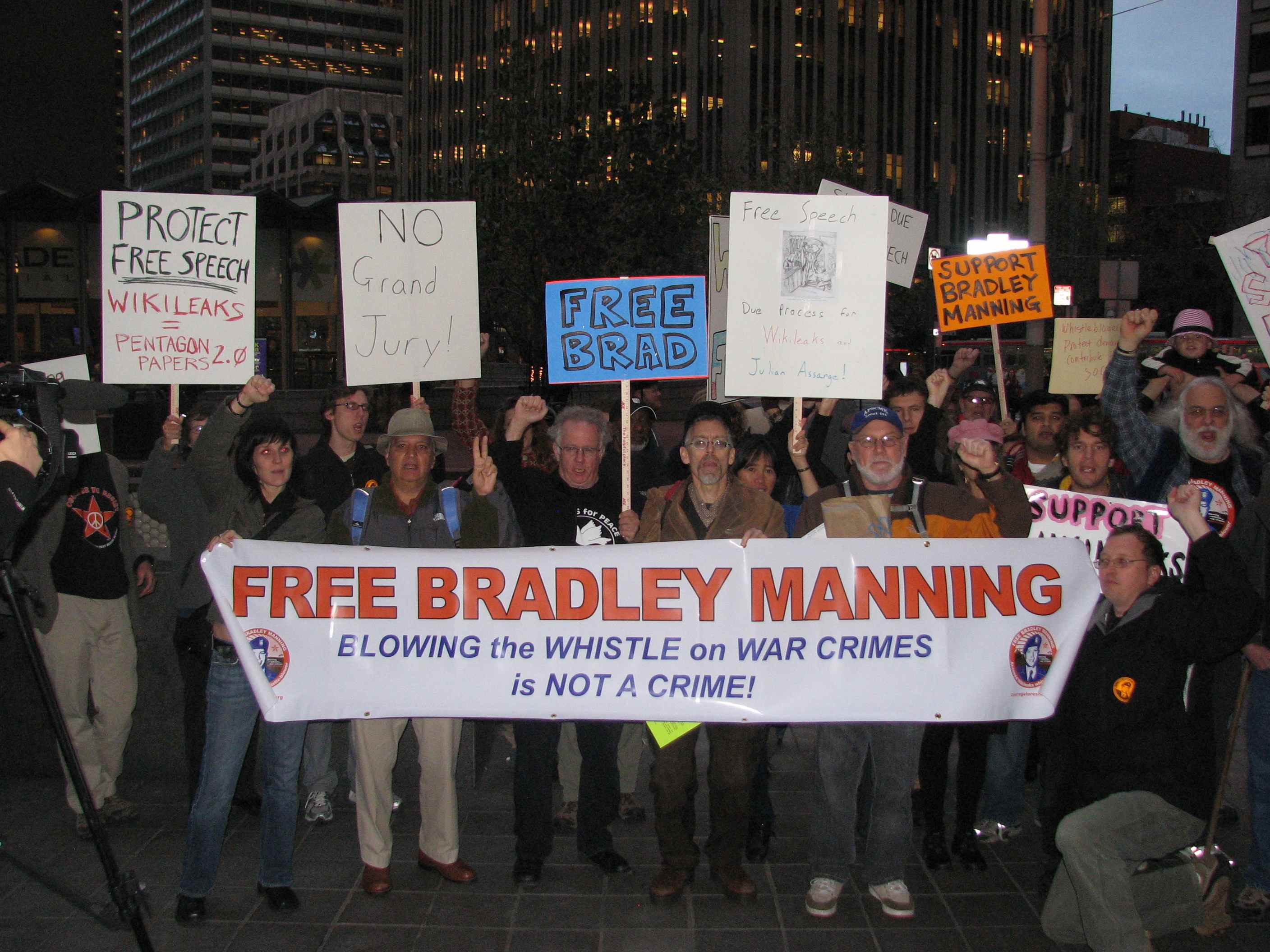
A small group of protesters gathered outside the British Consulate in San Francisco’s financial district Dec. 16 to speak out against the recent crackdown on WikiLeaks founder Julian Assange, who is out on bail after being imprisoned for nine days by British authorities.

Assange, whose organization recently created an international stir with the release of secret diplomatic cables, could be extradited to Sweden to be tried on sex crimes charges following a hearing in January.

According to a recent New York Times article, U.S. government officials are trying to build a case against Assange for conspiracy. In the wake of the leak, Sen. Joe Lieberman was calling for the New York Times to be investigated for espionage for publishing information provided by WikiLeaks, and last week, a Fox news pundit even said he thought Assange should be assasinated.

Among the small crowd that gathered before twilight were representatives from Veterans for Peace, Courage to Resist, and the Electronic Frontier Foundation.

Rainey Reitman, an activist with the Electronic Frontier Foundation — a legal firm and nonprofit that defended WikiLeaks against a 2008 lawsuit from Swiss bank Julius Baer — called the recent backlash a threat to Internet freedom and freedom of speech.

“Let me be clear. Here in the United States of America, WikiLeaks has a fundamental right to publish truthful political information. And equally important, Internet users have a fundamental right to read that information and voice their opinions about it. We live in a society that values freedom of expression and shuns censorship. Unfortunately, those values are only as strong as the will to support them — a will that seems to be dwindling now in an alarming way,” Reitman said.

Reitman said the case touched on broader issues. “This isn’t just about WikiLeaks. It never was. It’s about the future of the Internet and the future of free speech.”

Among several other speakers, Reitman was joined by Jeff Patterson of Courage to Resist, which has mounted a support campaign for U.S. Army Private Bradley Manning. Manning has been accused of acting as WikiLeaks’ source for 250,000 secret government documents and classified military footage, which has now been made available to the general public.

Patterson noted that the Bradley Manning Support Network had raised $100,000 for Manning’s legal defense. Although many activists have sent letters of support to Manning, who is being held in solitary confinement in a prison outside of Washington, D.C., “the military is rejecting letters pretty much arbitrarily,” Patterson claimed.

To read more about the WikiLeaks saga, check out the blog of the Electronic Frontier Foundation.

PG&E granted cash reward, green light on power plant

0

While news surrounding Pacific Gas & Electric Co. has been dominated by a faulty weld and early warnings on the the San Bruno gas pipeline, which ruptured in a fatal explosion Sept. 9, the giant utility company received some good news at the Dec. 16 California Public Utilities Commission (CPUC) meeting.

Not only was PG&E awarded an additional $29 million cash reward for its performance in an energy efficiency program, bringing the total amount it’s received to $104 million, but it was granted commission approval to construct a new, $1.5 billion power plant in Oakley.

Ironically, the energy-efficiency program is designed to reduce the need to construct new power plants, which contribute to greenhouse gas emissions that are blamed for climate change.

The additional bonus was approved with a 3-2 vote on the “final true-up” of the energy-saving program. An independent CPUC evaluation of the utility’s performance in that program found that it fell short of the targets required to receive a cash bonus.

Commission President Michael Peevey justified the additional cash reward by saying utilities could not have known that the numbers they used to estimate energy savings were inflated, and that they would not have been able to adjust their energy-saving tactics in the middle of the program cycle to improve performance.

According to the Division of Ratepayer Advocates (DRA), a consumer-advocacy branch of the regulatory agency, “The CPUC today approved the additional $29.1 million award to PG&E in a 3-2 split vote, despite an Administrative Law Judge’s finding that no further bonuses should be awarded, nor penalties levied. Rather than receiving an additional $29 million bonus, PG&E should repay $74.9 million in bonuses already awarded for energy efficiency programs that failed to meet CPUC-established energy savings goals, and it should pay an additional $1.3 million in penalties, based on the original incentive mechanism.”

Barbara George, executive director of Women’s Energy Matters, blasted the decision. “In this shaky economy, it’s incredible that the Commission would force ratepayers to pay profits for utilities that missed their targets by a mile. This hurts everyone in California. Cities, businesses, and residential ratepayers will all have to pay twice for utilities’ failures — once for these undeserved ‘rewards,’ and again in high monthly utility bills that should have been reduced by these programs, but were not.”

The 4-1 vote to approve PG&E’s Oakley power plant was a reversal of an earlier commission decision rejecting the proposal. DRA weighed in on this item, too, saying data on PG&E power reserves suggests that the new facility is unnecessary.

“PG&E ratepayers are now on the hook for $1.5 billion in costs for energy they don’t need while being shut out of the decision-making process that will leave all PG&E customers with higher utility bills,” said DRA acting director Joe Como.

Thank you later

0

arts@sfbg.com

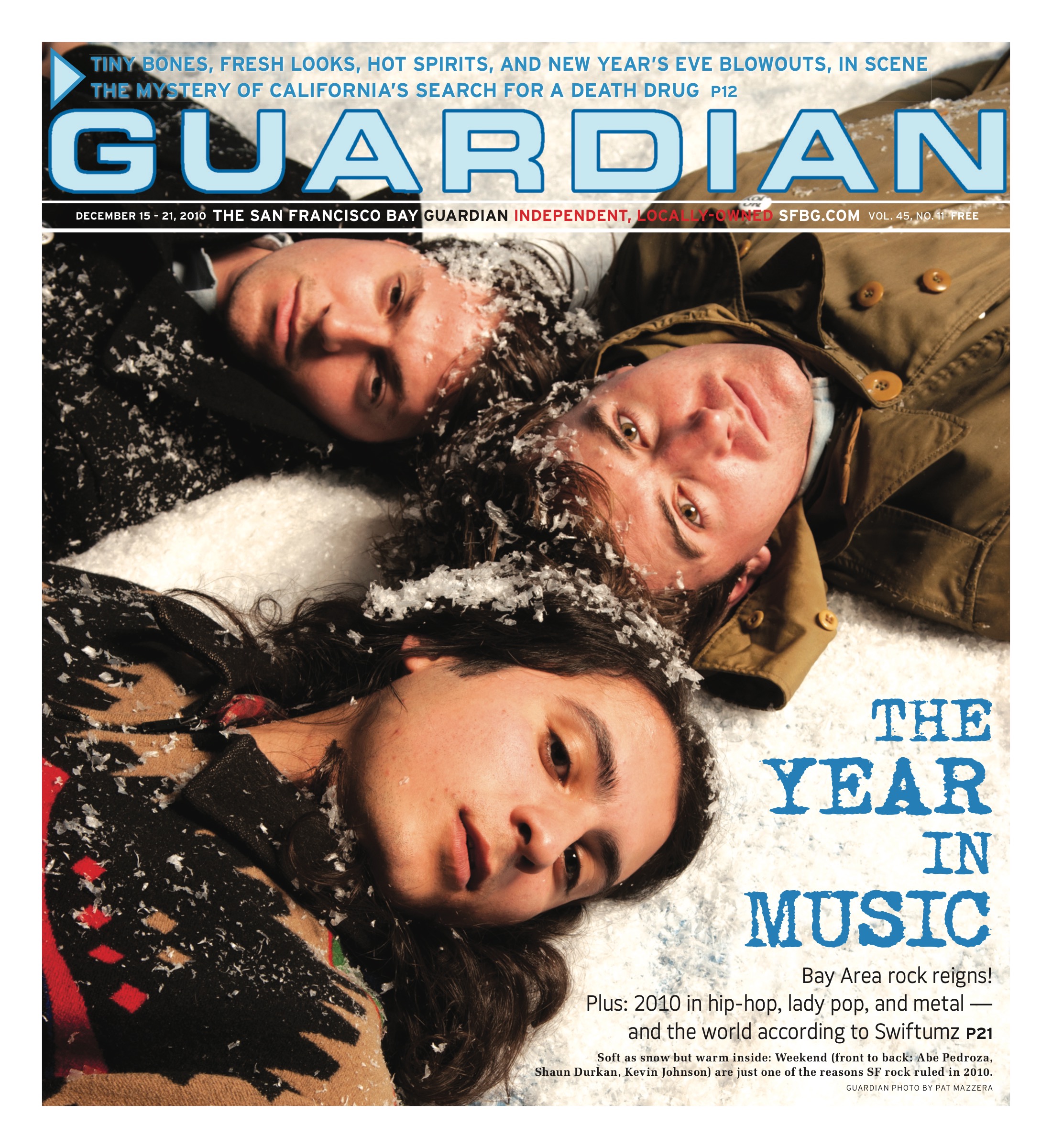
YEAR IN MUSIC The past year brought dozens of excellent albums, and hip-hop sounds topped the list. This wasn’t inevitable. Please recall 2009, when critics cited precious little rap in their favorites, save for Raekwon’s Only Built 4 Cuban Linx … Part 2 and Mos Def’s The Ecstatic. But in 2010, both rockists and heads reserved space for Kanye West’s My Beautiful Dark Twisted Fantasy, Big Boi’s Sir Lucious Left Foot: Son of Chico Dusty, the Roots’ How I Got Over, Drake’s Thank Me Later, and Flying Lotus’ Cosmogramma. And let’s not forget minor but important recordings such as Curren$y’s Pilot Talk and Yelawolf’s Trunk Muzik 0-60.

This winning slate confirmed that major label-backed rap is undergoing a renaissance. Nearly every artist made an impact by keeping their eye on the mainstream, from security guard-turned-bad actor Rick Ross recruiting Erykah Badu and Cee-Lo Green for his Teflon Don, to Bun B allowing Canadian teen idol Drake to call himself an “honorary member of UGK” on the former’s Trill O.G. Some complained that these rappers focused too much on claiming the hearts of soccer mama grizzlies and teens raised on Bratz dolls. But after years of boorish thugs peddling D-boy anthems and R&B gimmicks, this new pop sensibility sounded refreshing. (The sole exception may be Ludacris, who found success with Battle of the Sexes by offering a slick and familiar mix of strip club anthems and babymaker suites.)

B.o.B’s The Adventures of Bobby Ray was the most extreme product of these pop mirages. The Atlanta rapper scored two No. 1 hits (“Nothin’ but You” and “Airplanes”), but divided critics and fans by recruiting emo-rock burnout Rivers Cuomo and Hot Topic heroine Hayley Williams for his collection of gooey ballads. At its best, The Adventures of Bobby Ray had a charming innocence; at worst, it sounded like pandering. But at least it offered well-written tunes. In contrast, Nicki Minaj’s grating Pink Friday mashed bad 1980s John Hughes-approved synth-pop and soaring Rihanna choruses into a barely coherent mess. It proved that despite Nicki’s talent for ear-catching stunts, from her star turn as the bisexual chick who’ll do you and your man on Usher’s “Lil’ Freak” to her cipher-destroying rhymes on Kanye West’s “Monster” and Ludacris’ “My Chick Bad,” she was still a disappointingly underdeveloped songwriter.

Lost in the intense debate over the rap major domo was the demise of Definitive Jux. Once the mighty inheritor to the Fondle ‘Em tradition of B-boy nonconformity, and the source of key early-2000s works by Cannibal Ox, Aesop Rock, and Mr. Lif, it sagged under the weight of subpar and underpromoted releases before label head El-P mercifully pulled the plug last February. The news lit up the Internet for a day or two and then was seemingly forgotten. When Noz from cocaineblunts.com asked Yelawolf if he was “heartbroken” over Definitive Jux’s demise, the Alabama rapper answered: “I didn’t even know it ended. Well … I’m not heartbroken about it.” How ironic that Yelawolf was once a lyrical-minded backpacker too, before switching to gritty tales of deep South meth dealers.

There were other disturbing signs that Definitive Jux’s indie-rap scene was no longer ground zero for fledging MCs, from conscious rap advocates Little Brother breaking up, to Minneapolis freestyle ace Michael “Eyedea” Larsen dying at the tragically young age of 28. “Underground rap is dead,” noted Sean Fennessey in a Pitchfork essay hyping Los Angeles collective Odd Future. “In its stead, a different brand of homespun rappers have taken hold. Consider Lil B and Soulja Boy, who have been prolifically working the Web … to achieve their own kind of teenage heroism.”

Underground rap is not dead. It thrives with Bay Area imprints such as Interdependent Media (Truthlive’s Patience) and national players such as Duck Down Records (Skyzoo & Illmind’s Live from the Tape Deck) and Alpha Pup Records (Nocando’s Jimmy The Lock). Some of these labels subsist on scattershot independent distribution. Others recruit majors to achieve wider market penetration, including Stones Throw and EMI Label Services (Guilty Simpson’s OJ Simpson and Aloe Blacc’s retro-soul gem Good Things), and Decon and E1 Music (Black Milk’s Album of the Year). And who can blame them? These days, labels need all the help they can get. However, the principal philosophy of economic and artistic independence as an end unto itself has been forgotten.

In Robin D.G. Kelley’s 2002 book Freedom Dreams, a rapturous appreciation of 20th century black intellectualism, he writes, “Unfortunately, too often our standards for evaluating social movements pivot around whether or not they ‘succeeded’ in realizing their visions rather than on the merits or power of the visions themselves. … And yet it is precisely these alternative visions and dreams that inspire new generations.” Kelley could have referred to the many critics that marked Little Brother as hopelessly elitist for insisting that hip-hop should address more than the spoils of drug wars; dismissed the late Eyedea, Sage Francis, and others as silly white boys for addressing suburban middle-class concerns; and buried Definitive Jux as a repository of uncool, impossibly dense super-scientific lyricism.

By many measures, the indie-rap scene has been a failure. Unlike the network of homespun labels built by punks in the 1980s, the indie-rap scene didn’t create a thriving community without considerable financing from youth-targeting corporations, lifestyle brands, and advertising firms. And perhaps its denizens wrongly castigated dirty South rappers as ignorant, claimed that mainstream superstars like Jay-Z and Diddy were sell-outs, and turned the underground movement into a kind of purity test — all past conflicts that continue to bedevil it today. Yet these dreamers courageously imagined hip-hop culture as not only a way to entertain people and make money, but as a transformative experience that can help instill positive growth and change lives. They built a culture that holds key lessons for future rap generations.

The blog-rap generation doesn’t hold any illusions of being alternative, unless it’s manufacturing limp blasphemy like Odd Future’s use of Nazi imagery. (As Anti-Defamation League spokesman Abraham Foxman told The New York Times in a story on the Holocaust documentary Shoah, “To most kids growing up today, Hitler could be Genghis Khan.”) They’ll use any trope to be successful, from falsely claiming that they’re coke barons to bragging about their limited-edition sneaker collection and how much weed they smoke. There’s a gleeful egalitarianism in their digital miscellany. The beats bang but are same-y and indistinct, and the voices are barely distinguishable. As Wiz Khalifa simply said on his breakout single, “Black & Yellow”: “You can do it big.”

Some critics separated wheat from chaff with technical criteria such as internal rhyme schemes and double-time flow, as if MCs were ice skaters or guitar wankers. But the best artists simply illuminated their money hunger by any means necessary, effortlessly adding interesting twists to tired rap clichés. When Drake crooned on Thank Me Later, “I want this shit forever, man,” he evoked a poor man’s Nat King Cole. And when Curren$y ranted, “A gee is what I am, a jet is what I be” like a Southern Popeye on Pilot Talk II, he was insistent enough that you almost believed him.

And then there was Kanye West and My Beautiful Dark Twisted Fantasy. He created a spectacle out of an hour-long justification for his obnoxiousness, invited the genre’s biggest stars to support his meanderings on chauvinism and virility (or “my black balls”) and, most provocatively, continued a public call-and-response with Gil Scott-Heron. The conversation began with West’s sampling of Scott-Heron’s melancholy “Home Is Where the Hatred Is” for his 2005 album Graduation. Then Scott-Heron replied by using West’s “Flashing Lights” melody for “On Coming from a Broken Home,” the bittersweet coming-of age tale from Scott-Heron’s valiant yet muddled comeback, I’m New Here.

West ended Fantasy by sampling a large section from Scott-Heron’s 1970 spoken-word performance “Comment #1,” and retitling it “Who Will Survive in America?” The poem originally captured the COINTELPRO era and the U.S. government’s eradication of black radicals, but West seemed to use it for a different point. Perhaps he’s saying that fame serves as a protective armor against systemic racism and how “at the airport they check all through my bag and tell me that it’s random.” Or maybe he’s making a wry comment on celebrity culture as the only way to survive in America. Fantasy‘s cryptic epilogue perfectly summarized this year’s rap dreamers, lost in the pop Matrix.

Mysteries of the death-drug scramble

0

news@sfbg.com

The California prison system finally released some documents on its efforts to procure the chemicals it needs to execute prisoners, and the 1,000 pages show the desperate lengths state officials have gone to procure the death drugs.

At one point, the California Department of Corrections and Rehabilitation looked at importing drugs from Pakistan. In October, prison officials sent agents on a secret midnight mission to Arizona to acquire sodium thiopental, one of the drugs used in executions, from that state’s supply.

In the end, CDCR wound up buying an extraordinary quantity of the stuff from a supplier in London — potentially putting California in the disturbing position of serving as the death-drug dealer to the rest of the country.

The protocol for lethal injections in California, and 33 other states, calls for three drugs — sodium thiopental to put the condemned inmate in a coma; pancurium bromide to paralyze the muscles; and potassium chloride to stop the heart.

But sodium thiopental, also known as Sodium Pentothal, has been in short supply in this country, in part because the one company that currently makes it, Hospira, has production backlogs. There’s not a whole lot of need for the drug in modern medicine — it’s largely been replaced with other anesthetics — and Hospira has made it clear in repeated press statements that it doesn’t want its product used in executions.

So when the last batch of the stuff in the state’s hands expired in October, California had to put executions on hold while prison officials scrambled to find some more.


HIDING THE TRUTH

The whole process was cloaked in secrecy. Nobody at CDCR would tell us where they were looking for the sodium thiopental, who would be procuring it, or how the supply chain might work. That, of course, is crucial, in a grisly way: If the anesthetic didn’t perform properly (that is, if the state got a bad batch from an unregulated supplier), a prisoner could go through unspeakable agony as the second batch of drugs made it impossible to breathe.

The Guardian filed a request in October under the California Public Records Act seeking details on the purchase attempts, but CDCR stonewalled. The American Civil Liberties Union, also seeking the documents, filed a lawsuit, and a judge ordered the release of a large volume of material.

Those documents, now available at aclunc.org, is heavily redacted, and much of the material we expected to see is missing. But the documents contain some remarkable revelations.

For starters, there’s an internal timeline going back to 2007 showing that CDCR officials knew back then, while the drug protocol was being developed, that there would be problems. The Drug Enforcement Administration will only allow a doctor to order the class III controlled substances. And the federal receiver overseeing the prison system wouldn’t allow any of the three doctors on staff at San Quentin State Prison to sign the order forms, although the documents didn’t say why.

In January 2007, CDCR tried to recruit outside doctors to order the drugs — but physicians in California have traditionally declined to assist in executions. Indeed, the American Medical Association policy bars doctors from participating in capital punishment in any way, including “prescribing or administering tranquilizers.”

It wasn’t until May 2010 that CDCR was able to find doctors willing to order the deadly drugs; the names of those physicians are not in the documents.

The timeline shows that in June 2010, CDCR became aware that there was a shortage of sodium thiopental, but there was no public discussion of the situation. Plans to execute Albert Greenwood Brown, a convicted murderer set to die in September 2010, went forward.

But the courts weren’t rushing the execution — and the last batch of sodium thiopental in CDCR’s possession expired Oct. 1.

As the clock ticked down toward that expiration date, the documents show, CDCR officials — all the way up to Corrections Secretary Matthew Cate — were involved in an all-out scramble to get more of the drug.

At one point, a Sept. 16 e-mail — from an official whose name is blacked out — notes that CDCR had contacted between 80 and 100 hospitals to try to buy some sodium thiopental, but “none of them have a drop.”

The documents note that CDCR officials even suggested that there were supplies of sodium thiopental in Pakistan. An Aug. 17 e-mail from John McAuliffe, a contract worker helping CDCR with executions, says the agency is trying to get federal government approval to import the drug.

One e-mail even suggests that an unnamed CDCR employee was in the area and could make a side trip to Pakistan to pick up the stuff.


THE LONDON CONNECTION

There are, of course, serious issues with importing controlled substances into the United States, and the documents show efforts by CDCR to get the DEA to approve imports. The Pakistan deal apparently went nowhere — but later e-mails show CDCR officials contacting a supplier in London. The name of the supplier is blacked out on all the documents, but CDCR’s deputy press secretary, Terry Thornton, later confirmed that the manufacturer was Archimedes Pharma.

Immediately after the California order for 521 grams of sodium thiopental went through, Britain’s secretary of state for business, Vince Cable, issued an order barring any further exports of the drug for use in executions.

Like most of the civilized world, the United Kingdom does not allow the death penalty.

In the meantime, Scott Kernan, CDCR’s undersecretary for operations, was trying to get enough of the death drug domestically to carry out at least one execution. A series of e-mails show contacts between California and Arizona, which recently had imported its own supply — and there are indications that Gov. Arnold Schwarzenegger was willing to call his counterpart in Arizona to help consummate the deal.

“I’m sure either the secretary or even the governor could make a call,” a Sept. 9 e-mail from Kernan to McAuliffe notes.

Then on Sept. 29, Kernan sent an e-mail to Assistant Secretary Anthony Chaus discussing a “secret and important mission.” Kernan wanted Chaus to send a team to a state prison complex in Florence, Ariz., a desert town about 40 miles southeast of Phoenix, to pick up 12 grams of the death drug.

At midnight Sept. 30, the warden in Florence gave the CDCD agents 24 vials, each containing half a gram of sodium thiopental. The agents drove it to Bakersfield, where another team picked up the vials and drove the rest of the way to San Quentin.

In a stomach-turning e-mail, Kernan sent a note Sept. 29 to an unnamed Arizona official saying “you guys in Arizona are life savers” and offering to “by [sic] you a beer next time I get that way.”

By then, a federal judge had delayed Brown’s execution until 2011.

Among the most startling revelation was the sheer quantity of sodium thiopental California eventually ordered from the firm in London. Even with training supplies and backup, it only takes between six and 12 grams of sodium thiopental to render a prisoner unconscious — meaning that the 521 grams that CDCR purchased for $36,413 are enough to kill between 43 and 86 people. The expiration date on the chemical is 2014.

It’s highly unlikely, given the legal hurdles and time involved in even one execution, that California would schedule more than three over the next three years. What possible use could the state have for so much death drug?

Thornton, CDCR’s press person, wouldn’t respond to our queries. But Natasha Minsker, the director of the ACLU’s Death Penalty Project, said she’s concerned that California will try to become a supplier for other prison systems. “It certainly raises questions,” she told us.

There’s a lot missing from the documents. In many instances, the names of the officials who sent and received e-mails are redacted. And there are obvious pieces of the puzzle missing from the files CDCR has released.

“There’s no e-mail from the DEA or the FDA,” Minsker said, “although CDCR was clearly contacting them. There’s nothing from the governor’s office, although it’s likely they were also involved.”

Overall, Minsker said, the documents “show how sneaky CDCR was trying to be about all of this.”

The ACLU filed another suit Dec. 13 seeking the release of some of the redacted material as well as records of CDCR’s efforts between October and December.

If those documents are ever released, they may address some of the looming questions about the material the state uses to kill people.

SF Camerawork and YBCA do the right thing (Updated)

0

Stop me if you think that you’ve heard this one before: a Washington DC art institution caves in to right wing politicians and conservative Christians calling for the removal of “controversial” work made by an openly gay artist.

No, I’m not talking about what happened with Robert Mapplethorpe more than two decades ago. In case you haven’t been following what’s turning into the biggest art news story of 2010, David Wojnarowicz’s video A Fire in My Belly was removed from the National Portrait Gallery’s exhibit “Hide/Seek: Difference and Desire in American Portraiture” on November 30th, after Smithsonian Secretary G. Wayne Clough bowed to pressure from Bill Donohue, President of the Catholic League, incoming House Speaker John Boehner, and Majority Leader Eric Cantor, who denounced the video as a form of, “hate speech.”

In response, the artist’s estate and the P.P.O.W. Gallery in New York have made Fire In My Belly available for exhibiton, and several museums and galleries across the country have started installing the video, along with other Wojnarowicz pieces. Two San Francisco institutions (that, incidentally, happen to be just down the street from each other) join the protest tomorrow.

The Queer Cultural Center and San Francisco Camerawork will screen the entire 13-minute version of Wojnarowicz’s piece at SF Camerawork’s gallery space at 7pm. The screening will be followed by a presentation on censorship and the arts by art historian Robert Atkins as well as a roundtable discussion with Ian Carter, Kim Anno and (via-Skype) “Hide/Seek” curator Jonathan Katz. Yerba Buena Center for the Arts will also show A Fire in My Belly from 11pm to 2am on a continuous loop as part of its Noel Noir party.

I’m still waiting to hear back from SFMOMA’s press office as to whether or not the museum has any plans to install and/or screen the video. In the meantime, Tyler Green’s ongoing coverage of the fiasco at Modern Art Notes continues to be indispensable.

UPDATED: SFMOMA is going to do the right thing too, in January. A publicist for the museum has just confirmed that it will hold a free screening of the full-length (30-min) version of A Fire In My Belly on Tuesday, Jan. 4 at 5:30 pm with a discussion afterward. Way to go!

DAVID WOJNAROWICZ: A FIRE IN MY BELLY

Friday, Dec 10

7pm, free

San Francisco Camerawork

657 Mission St, Second Floor

(415) 512-2020

http://www.sfcamerawork.org/events/index.php?view=monthly

11pm-2am, $20 general admission

YBCA

701 Mission St

(415) 978-2700

http://www.ybca.org/tickets/production/view.aspx?id=12312


Jackie Beat: “Hung Puerto Rican elves only”

0

Generously talented and fantastically energetic (we’re talking 8-bit chipmunk here) LA drag entertainer Jackie Beat is in town with her new show “Jackie Beat’s All-You-Can-Eat Christmas,” Fri/10 and Sat/11 and Brava Theater. It sounds like a real festive hoot. The long-time cabaret circuit favorite, underground club hostess, and member of scandalous electro-revival band Dirty Sanchez pulled out her giant fork and dug into a little interview with us about ambrosia salad, abortion, AM schlock .. and that’s just the beginning. Go pay some money to see her!

SFBG: OK I’m dying over the concept for All-You-Can-Eat Christmas — it’s so refreshing to hear a drag queen talk about eating! What are some of your favorite foods? And do you do a lot of cooking?

Jackie Beat: Well, I was referring more to huge portions of talent, but I do love to eat! The ironic thing is that I have actually lost 100 pounds since my last holiday show, so people may think the title is actually “All-You-Can-Eat (And Then Throw Up!) Christmas,” but I promise it’s not! I still love to eat, I just eat less. My favorite holiday food has to be good old-fashioned Ambrosia Salad.  It’s a big mess of pineapple chunks, pecans, shredded coconut, mandarin orange segments in heavy syrup, mini marshmallow, sour cream and Cool Whip. You can eat a huge bowl of it and then honestly tell people, “All I had was salad!”

SFBG: I love that you sing live — what kind of music is part of the new show?

JB: Most of the new material is in my amazing new outfit — yards and yards of it! Seriously, it gets harder every year to come up with new stuff. I have done thousands of song parodies, including every holiday song ever written! This year, I am doing a Country Christmas Medley, a great medley of horrible old AM radio classics — the type of crap you hear at wedding receptions — but sung with the original lyrics that were too shocking at the time. You know, so all these sweet nostalgic old songs are now about fisting and abortion. Good times! I am also doing a new song about getting a full-cavity search at the TSA and there are plenty of classics like “Santa’s Baby” and “Do Some Blow!”

http://www.youtube.com/watch?v=ZThrYCy9Zzo

SFBG: Who’s your favorite Santa’s reindeer?

JB: Grumpy? Oh wait, that was one of the Seven Dwarves, right? Um, Jan? No, she was in The Brady Bunch, sorry. Um, Rudolph of course! Because he’s the fucking star — like me!

SFBG:  If you had an elf of your own, what would you make him or her do for you?

JB: First he would be Puerto Rican and hung like a horse.  And I think you can figure out the rest!  Oh, and after THAT — he would clean the fucking house!

SFBG: Can you tell me a bit about how the show came about?

JB: Um, I had bills to pay and I don’t know how to do anything else, so…

SFBG: I bet you’ve been pretty busy in general — what have you been doing lately? Any Dirty Sanchez news? You guys just performed here, yes?

JB: We did Folsom Street Fair last year, but we are all so busy with our own lives that we seldom perform together these days.  Hopefully we will be working on some new music soon!

SFBG: You’re in San Francisco pretty regularly — what are some of your favorite things about the city?

JB: The PAYING customers, of course!  Times are tough and like I said, I don’t know how to do anything else.

SFBG: Unfortunately Christmas can’t last forever — what’s next for Jackie Beat?

JB: Quite possibly dropping dead right after this grueling, brutal holiday tour — so come see me now while I am still alive, bitches!

JACKIE BEAT’S ALL YOU CAN EAT CHRISTMAS

Fri/10 and Sat/11, 10:30 p.m., $20–$40. Brava Theater, 2781 24th St., SF. www.brownpapertickets.com

Elizabeth Edwards, breast cancer and the battle for a cure

2

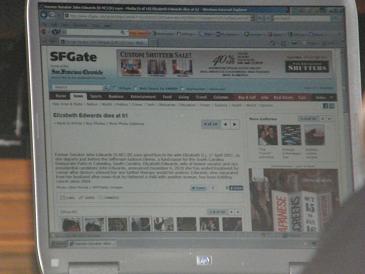
When the news hit that Elizabeth Edwards had died at 61, I was sitting in the press box at San Francisco City Hall listening to the supervisors debate the merits of local hire legislation. In fact, I only became aware that Edwards had passed away, because Sup. Michela Alioto-Pier, who was sitting in front of me, was surfing the Internet on her laptop and I happened to see the headline.

The news immediately reminded me, all too powerfully, of the brave fight that my sister-in-law Leila, 47, lost last year after a six-year battle with the disease. She left behind a husband and two young sons, and I always feel a mix of pride at how hard she fought and desperation at how she still wasn’t able to win, whenever I remember her long slide towards death last fall.

“I have so much to live for,” Leila often told me, reflecting on how much she loved her husband and sons, how she wanted to finish her novel (which she managed to wrap up in the last months of her life) and how she still wanted to visit so many places and people in the world.

An avid advocate for peace, especially in the Middle East, where her father’s family came from, Leila was not one to give up on a cause, once she had it in her crosshairs. She attacked breast cancer with that same dogged determination. She read everything she could on the topic, changing her diet, modifying her lifestyle, going through chemo and the inevitable loss of her beautiful hair, and, at the end, taking a chance with experimental drugs.

I will never forget her telling me, one gut-wrenching afternoon last September, that the doctors had told her there was nothing more they could do. The disease had gone to her liver, and that she was beginning to feel panic and fear. It wasn’t easy to hear that admission, it must have been even harder for her to share it, and it left me hoping that one day, no other woman would ever have to go through this painful battle again.

I wanted Leila to live to see her sons grow up, to enjoy the company of her husband, to write, travel and work for her goal of world peace. But eventually, it became clear that she was not going to make it. When her death finally came, last October, I felt relief that she was no longer suffering, even as I shed tears for her, her family, and all the folks in the world who are going through similar battles.

So, when I got home last night, I immediately went online and wallowed in the huge wave of grief that Edwards’ death evoked as a symbol of the millions of women who live with and die from cancer worldwide.

Some noted that Edwards had not been conducting regular check ups when she found a lump in her breast (an uncomfortable reminder to all of us who haven’t got a check up recently). Others observed that her diagnosis likely fueled her passion for universal health care and helped the passage of Obamacare (a more welcome reminder that despite all the criticisms of Obama, he has pushed through monumental reforms that many will benefit from).

Some wrote about the ever-present fear for survivors that the cancer could come back, and how this awareness had  served to make them more fully appreciate every moment that they do have. Others pointed to the grim reality that even with access to great doctors, advanced treatment options and money, Edwards still could not prevail, because a cure has still not been found.

I’ll end this tribute to Edwards, my sister-in-law, and all the women who have struggled with this terrible disease with a message that landed in my inbox Dec. 7 from California’s First Lady Maria Shriver:

“I was deeply saddened to learn of the passing of my dear friend, Elizabeth Edwards,” Shriver wrote. “My heart goes out to her loving family. Elizabeth was a mighty warrior, and I’ve long admired her courage, her compassion and her personal quest for truth. She was a public servant, a dedicated mother, a tireless advocate and a loyal friend. She showed up to speak at The Women’s Conference every time I asked, and our audience was always moved by the open and honest way she would share the struggles she faced along her journey. I hope her children know their mother was an inspiration to women everywhere — a truly great woman.”

And I’ll add my hope that this nation will intensify its search for a cure for a disease that is the second leading cause of cancer deaths in women today (after lung cancer) and the most common cancer among women, excluding nonmelanoma skin cancers. According to the American Cancer Society, 1.3 million women will be diagnosed with breast cancer annually worldwide, 465,000 will die from the disease, and about 1 in 35 women die from breast cancer in the U.S. Scary? Yes. Curable? Hell, yeah (I hope and pray). Let’s just make sure it remains a national priority.

Going to a club — or boarding an airplane?

12

news@sfbg.com

The War on Fun — a term coined by the Guardian in 2006 to describe the crackdowns on nightclubs, special events, and urban culture by police, NIMBY neighbors, and moderate politicians — continues to grind on in San Francisco.

The latest attack was launched by Mayor Gavin Newsom and the San Francisco Police Department, which has proposed a series of measures to monitor and regulate individuals who visit bars or entertainment venues, proposals that the embattled Entertainment Commission will consider at its Dec. 14 meeting.

Perhaps most controversial among the dozens of new conditions that the SFPD would require of nightclubs is an Orwellian proposal to require all clubs with an occupancy of 100 persons or more to electronically scan every patron’s identification card and retain that information for 15 days. Civil libertarians and many club owners call this a blatantly unconstitutional invasion of privacy.

Driving the latest calls for a crackdown is a stated concern over isolated incidents of violence outside a few nightclubs in recent years, something Newsom and police blame on the clubs and that they say warrants greater scrutiny by police and city regulators.

But the proposals also come in the wake of overzealous policing of nightclubs and parties — including improper personal property destruction and seizures, wrongful arrests and violence by police, harassment of disfavored club operators, and even dumping booze down the drain — mostly led by SFPD Officer Larry Bertrand and his former partner, Michelle Ott, an agent with the California Department of Alcoholic Beverage Control.

Those actions were documented in back-to-back cover stories by the Guardian (“The New War on Fun,” March 24) and SF Weekly (“Turning the Tables,” March 17), and they are the subject of multiple ongoing lawsuits by nightclub owners, patrons, and employees, including a racketeering lawsuit alleging that officials are criminally conspiring against lawful activities.

Yet rather than atoning for that enforcement overreach, Newsom and SFPD officials seem to be doubling down on their bets that San Franciscans will tolerate a more heavily policed nightlife scene in the hopes of eliminating the possibility of random violence.

A series of nighttime shootings this year has grabbed headlines and prompted calls to action by the Mayor’s Office and Board of Supervisors President David Chiu, whose District 3 includes North Beach. In February, there were shootings at Blue Macaw in the Mission and Club Suede at Fisherman’s Wharf, followed by a shooting at the Pink Saturday fair in June, one outside Jelly’s in SoMa in July, and the high-profile murder of a German tourist near Union Square in August.

Chiu responded with legislation to give the Entertainment Commission greater authority to close down problem nightclubs and, more recently, with legislation to require party promoters to register with the city so that officials can take actions against those who act irresponsibly.

In September, Newsom asked the SFPD for its recommendations and he received a laundry list of proposals now before the Entertainment Commission. That body held a closed session hearing Nov. 30 to discuss a confidential legal opinion by the City Attorney’s Office on whether the identification scan would pass constitutional muster, an opinion that has so far been denied to the Guardian and the public, although officials say it may be discussed in open session during the Dec. 14 hearing.

“Everything is being considered,” Jocelyn Kane, acting executive director of the Entertainment Commission, told the Guardian. Her office already has looked at the different types of scanners that clubs could use and has discussed the idea with several technology companies.

SFPD Inspector Dave Falzon, the department’s liaison to the nightclubs and ABC, told the Guardian that he believes the data gathered from nightclub patrons would allow police to more easily find witnesses and suspects to solve any crimes committed at or near the nightclubs.

“It’s not intended to be exploited,” Falzon said, stressing that the recommendations are a work in progress and part of an ongoing dialogue with the Entertainment Commission — an agency Newsom, SFPD officials, and some media voices have been highly critical of over the last two years.

Along with the proposal for the ID scanners, SFPD proposed many other measures such as increased security personnel (including requiring clubs to hire more so-called 10-B officers, or SFPD officials on overtime wages), metal detectors at club entrances, surveillance cameras at the entrances and exits, and extra lighting on the exterior of the night clubs.

Though this may sound to many like heading down the dystopian rabbit hole with Big Brother potentially watching your every move, Falzon thinks it’s the opposite. “It isn’t that police department is acting as a militant state,” Falzon said. “All we’re trying to do is to make these clubs safer so they can be more fun.”

Yet critics of the proposals don’t think they sound like much fun at all, and fear that employing such overzealous policing tools will hurt one of San Francisco’s most vital economic sectors while doing little to make anyone safer.

Jamie Zawinski is the owner of the DNA Lounge, which recently celebrated its 25th anniversary. He has been a leading voice in pushing back against the War of Fun, including running a blog that chronicles SFPD excesses. He said the proposed regulations go way too far.

“It’s gang violence happening on the street. The nightclubs are being scapegoated. You don’t solve the problem by increased security in the clubs,” Zawinski told us, adding that the lack of proper policing on the streets should be addressed before putting the financial strain on the entertainment industry.

“It’s ridiculously insulting. I will not do that to my customers. It’s not a way to solve any problems,” Zawinski said. “It sets the tone for the evening when you start demanding papers.”

It’s also a gross violation of people’s rights, says Nicole Ozer, the director of Technology and Civil Liberties Policy for the American Civil Liberties Union of Northern California. She said that recording people’s personal information when they enter a public venue raises troubling legal issues.

“There are some real implications of tracking and monitoring personal data. The details of what you visit reveal things about your sexuality and political views,” Ozer said, adding that the ACLU would also have issues with how that information is used and safeguarded.

In response to police crackdowns on nightlife, club owners and advocates earlier this year formed the California Music and Culture Association (CMAC) to advocate for nightlife and offer advice and legal assistance to members. CMAC officials say they are concerned about the latest proposals.

“The rise in violence has to be looked at from a societal point of view,” said Sean Manchester, president of CMAC and owner of the nightclub Mighty. He noted that most of the violence that has been associated with nightclubs took place in alleys and parking lots away from the bars and involved underage perpetrators. “In many instances [the increased security measures] wouldn’t have done anything to stop it,” he said.

While there are plenty of ideas to combat crime at nightclubs, nightlife advocates say the city is going to have to look beyond club venues to address what can be done to combat crime without infringing on any civil liberties or damaging the vibrant nightlife. Or officials can just listens to the cops, act on their fears, and make the experience of seeing live music in San Francisco more like boarding an airplane.

The Entertainment Commission meets Dec. 14 at 6:30 p.m., Room 400, City Hall.

The prop. 8 hearing

2

Watching the hearing was a couple of hours well spent; it’s not often that you get to see an actual live oral argument before a federal appeals court. And it’s not often that you get to see three judges, not all of them liberals by any stretch, take apart the fundamental claims of the anti-gay-marriage folks.


There’s a nice live-blog and analysis here.


One of the most interesting elements in this case is the possibility that the legality of same-sex marriage in California may hinge on whether a deputy clerk in Imperial County has the right to represent the people of California in a legal appeal. See, the governor and the attorney general usually defend state laws when they’re challenged in court, but in this case, both Arnold Schwarzenegger and Jerry Brown declined. In essence, they both said they thought Judge Vaugh Walker’s decision overturning Prop. 8 was just fine.


So the supporters of Prop. 8 have to make the case they have legal “standing” to appeal — and the judges seemed more than a little dubious about that. The political group that backed Prop. 8 was in trouble from the start, and couldn’t really demonstrate what legal authority it had to handle the appeal. The deputy clerk from Imperial County, which has a population of 166,000, argued through her lawyer that she would have to sign marriage certificates, and that Prop. 8 directly affects her job. That didn’t get very far, either. And if the appeals court tosses the case on the standing issue, nothing else matters. Walker’s ruling is affirmed and same-sex marriage is legal in California.


Then to the meat of the case. Judge Hawkins instantly asked Charles Cooper, attorney for the Prop. 8 proponents, if the voters of the state of California could legally amend the state Constitution to re-segregate the public schools. Cooper: No. The point was pretty clear: The voters have the right to amend the Constitution, but not in a way that violates fundamental rights.


Cooper went on with what rapidly devolved into lunacy, eg: “When a relationship between a man and a woman becomes sexual, society has a profound interest.” In other words, a man and a woman have sex; they might conceive a child, who might be born “out of wedlock” and raised by a single parent, which would be a bad thing. Judge Reinhardt: That’s a good argument for prohibiting divorce — but isn’t really on point here.


Theodore Olson, representing the plaintiffs, pretty much knocked it out of the park in his first few minutes, noting that California has effectively engineered discrimination into the Constitution by eliminating a right that the U.S. Supreme Court has said repeatedly (14 times, according to Olson) is fundamental. He pointed out that in Lawrence v. Texas, which overturned the sodomy laws, the U.S. Supremes determined that sexual conduct between consenting adults of any gender is protected. So how, he asked, can you take away marriage rights because of a Constitutionally protected activity?


Since the Prop. 8-ers have argued that same-sex marriage would force children to have “a premature interest in sexual activity,” Olson suggested that the court would have to “ban comic books, video games and conversations with other children.”


The judges, as is typical, interrupted all the lawyers to ask questions — until Theresa Stewart stood up, representing the San Francisco City Attorney’s Office. She was sharp, quick on her feet, perfectly prepared — and for most of her short presentation, the judges simply listened. Her point: When it comes to children, family law in California treats same-sex couples and opposite-sex couples precisely and exactly the same; why should marriage be any different?


In the end, what I saw was three judges struggling not with the outcome of the case — Walker’s decision seems likely to be upheld — but with how broad they want the final decision to be. Based on the questioning at the end, it seemed as if they’d rather uphold Walker’s ruling without making a sweeping statement that gay marriage is Constitutionally protected and must be the law of the land everywhere in the United States.


But unless they try to duck the real issues and rule only on standing, that’s going to be a stretch. Any honest, logical ruling can only come to one conclusion — that treating lesbians and gay men differently than straight people violates the Equal Protection provisions of the U.S. Constitution. And if the Supreme Court agrees, it will be the end of gay marriage bans, the end of Don’t Ask, Don’t Tell and the beginning of a new era in America.


UPDATE (thanks to Nichole Dial for research);


Lots of news media coverage on the some good, some lame. The Prop. 8 Trial Tracker website had some of the best breaking stuff. The Mercury News did a live blog by Howard Mintz that was full of details. SF Weekly covered the more amusing accounts such as the crowd outside the court room.  The Bay Citizen also had a live blog and analysis.


Brian at Calitics had one of the best quick analyses and the Chron’s Bob Egelko came out with a really fast story that touches on the major themes of the case.


The AP postings on the Huffington Post covered the highlights as well as an overview of the background of prop 8. The New York Times used the same article, then later added a short, fairly superficial piece by Jesse McKinley  (what, the Times had no live blogger on this?)


Killing Casiotone: Owen Ashworth says goodbye — and looks ahead

1

Owen Ashworth is on the phone with me, explaining his decision to retire Casiotone for the Painfully Alone:

“Definitely something has changed in me the last six or seven months where I haven’t enjoyed a lot of the things about making music the way I had. I feel like I haven’t been as nice of a person as I’m used to being. For the sake of my sanity I need to stop for a while. It’s been an insane couple of months doing these last tours, emotionally draining in ways that I didn’t anticipate. So I’m just really looking forward to being done for a while and coming back to it when I’m excited to come back to it.”

He pauses briefly, and adds, “There are a handful of songs I’ve already written for the next album, and a lot of half-finished ideas, which is usually how I work, with a lot of small skeletons for songs floating around until I figure out what to do with them.”

If this seems like a glaring contradiction, remind yourself of one simple fact: musicians never retire. Even an attempt to do so is usually greeted by confusion and misunderstanding. Earlier this year Ted Leo had to address misquotes that made it seem like he was hanging up his guitar. When musicians make the claim outright, it usually turns out to be hot air, as is the case with Jay-Z, who in 2003 made leaving the rap game a frequent subject of interviews and lyrics, and was never heard from again.

Ashworth isn’t oblivious. In September, he broke the relative silence of cftpaforever.livejournal.com/, usually reserved for tour info, to say, “I’d just like to clarify that this doesn’t mean that I’m quitting music. I love writing & recording songs, & I hope to make lots more records in my lifetime. But, after nearly thirteen years of being the dude from Casiotone for the Painfully Alone, I’m ready for a fresh start & a new challenge. So, after December 5, 2010 (the thirteen year anniversary of my first show), I’m throwing out the old songs & I’m trying something new. I’ll have more news about new projects & plans in the coming months.”

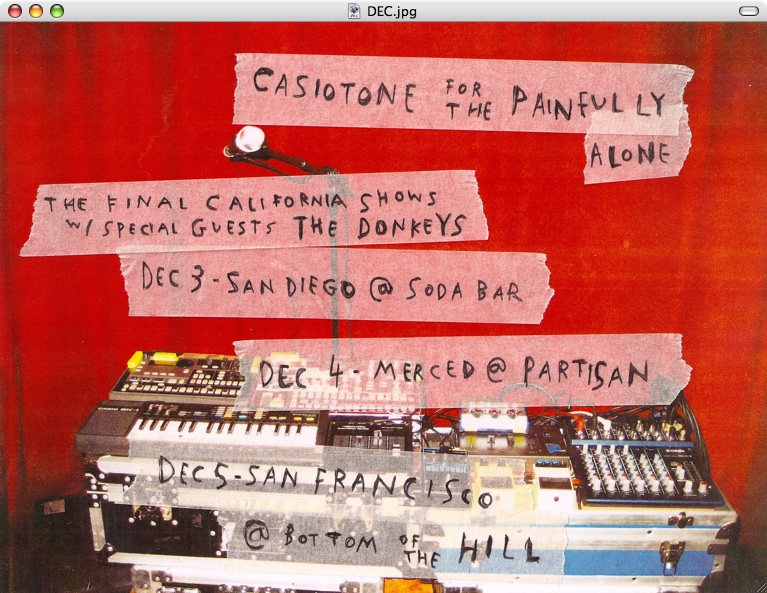
So far, Ashworth’s committed to the plan. On Sunday, Dec. 5, he’ll be back in the city where he started making music, for a final show as Casiotone for the Painfully Alone at Bottom of the Hill.

In a way it’s been a long time coming. Truth is, Owen Ashworth never intended to be Casiotone for the Painfully Alone at all. It was a much of a fluke as his first show in 1997, at a warehouse space at 17th and Capp. “I played that show at the request of a friend of mine who booked it. I had just made tapes and she liked the sound of the tape so she kind of tricked me — she made fliers without asking me to play the show. She thought I wouldn’t say no that way. So I played the show with the idea that this is probably never gonna happen again, I’m gonna get this over with. I remember that I was very nervous, very shaky. I had one keyboard through a really tiny amp.” The next week he had another show booked, under the name of the mixtape he had given his friend: Casiotone for the Painfully Alone.

“It was just the name of a tape I had given her. I didn’t realize it was going to refer to me, you know. Seriously, from the first show to when I decided to quit Casiotone, I considered changing the name the entire time, but having it already done, it seemed like so much work to try and call it someone else. I decided it didn’t really matter, it was just the name and it was kind of catchy and stupid enough for people to remember it. At least in the beginning it described the music pretty well.”

Arguably, the name has mattered. As descriptive as the name was, particularly in the early days, for Ashworth’s distinctive style of indie pop, with consumately pathetic lyrics layered on top of cheap keyboards and electronic samples, it prefigured an audience’s response. The press around each album has been centered around two poles.

First, how closely the music sticks to the sound of a suburban child’s first piano. With each Casiotone for the Painfully Alone album, there has been an incremental departure from the titular keyboard, adding in instruments and collaborators, particularly since 2006’s Etiquette (Tomlab). Ashworth, who in a typically self-effacing fashion describes Casiotone as “an insane, slow learning process, learning how to tour and write and record, doing all of these things and kind of just falling on my face in front of people for the last thirteen years,” sees the development of his instrumental side driving him in separate directions.

“The way I make music is kind of getting fragmented between recording and performance. I’ve been producing for a Chicago rapper, Serengeti, and that’s been my project over the summer. He has a new album coming out on anticon and it’s half stuff he did with me and half with Yoni from WHY? That’s sort of the more electronic side of the music. I enjoy recording that, but it’s not what I’m interested in doing live, so I think it works really well that I’ve been moving into production more. I can fuck with samplers and drum machines in my house and then just sort of give that music to other vocalists. Then for the music that I’ll be taking on the road and being accountable for and presenting over and over again in live settings, I’m more interested in playing with other people and real instruments.”

The Casiotone as an instrument may be easier to move past than the loneliness that Ashworth’s band name invokes and the lyrics bring to life. Simple, sad words that screw in as you listen, about regular people with typical lives. They’ve brought the musician a following, they’ve been his brand. But the association that the audience has for Ashworth and his emotional resonance has also been a nagging burden. “There’s generally a lot of assumption that I’m writing about myself, which is something that when I’m actually writing songs doesn’t occur to me much. I mean it’s fiction. Like any writer I’m inspired by real things that happen to me and my friends but it never occurs to me that it comes off as autobiographical.”

“With the name Casiotone for the Painfully Alone, the original idea was that the Painfully Alone was meant to refer to the listener and the idea of music as comfort music. It didn’t occur to me at the time that people would think that I was referring to myself as the painfully alone person.”

Casiotone records are galleries of character. A pedestrian world populated with eerily familiar people: high school teachers, Scrabble players, cellists, petty thieves, bedroom killers, landlords, and neighbors. Half of them you know by name. Half of them you’ve met before in real life. Sitting down to listen to a Casiotone record, you can relate to the situations. You’ve been in them, or know someone who has. The music engenders an emotional intimacy, it draws you in. “The way I make music is totally a tribute to the music I love and that claustrophobic, really intimate sense, I’m trying to create that because that’s a quality that I have an emotional reaction to in other music,” Owen says.

But the imagined intimacy that the fans has with the music, a sense of something real isn’t what drives Ashworth. “Genuineness isn’t even a factor to me. When I listen to Willie Nelson’s song “Crazy,” it doesn’t occur to me as, ‘Holy shit, Willie Nelson is going through the most intense stuff, I cant believe he’s singing about this.’ I think ‘That’s such a well-written song and he creates such a great atmosphere.’ I want to know how to write songs like that. I admire Willie Nelson as a songwriter, not as this survivor of all kinds of emotional problems.”

Ashworth has the remove of fiction writer for whom characters have there own will. When he talks about his characters, it’s not as a doting mother in whose eyes they can do no wrong, but as a friend who’s seen them make one too many mistakes. “I got really self conscious about what kind of people I was writing about, and I wanted them to start owning up to some of their own problems and take responsibility for the stupid things they did.” This culminated with 2009’s Vs. Children (Tomlab), an album he envisioned even before Etiquette as the end of Casiotone, with “a lot of more family-type relationships where people are having to consider their older relatives, having children and the young people they’re responsible for in their lives. I guess just showing more consequences of irresponsible living.”

It’s not uncommon for fiction writers to look back on old stories, and feel estranged, as if they were written by someone else. Ashworth has felt a similar distancing from his early work. “There are songs I wrote when I was twenty that don’t really mean the same thing to me as at the time that I wrote them. I feel like I’m covering those songs when people request them and it doesn’t feel relevant to me and I think that it would serve the material much better to be sort of left alone in the context of itself than for a man well into his thirties to continue performing these songs written by someone much younger.”

As Ashworth feels more alienated from his work over time, fans feel closer to it, and if they don’t, there’s always the potential for people to discover his early material for the first time, making it brand new all over again. (For better and worse.)

Of course, Ashworth’s not alone in the situation. All artists fight against their early successes, in an attempt to stay relevant, and practically, to stay financially above water. (Ashworth admits at one point, “Casiotone has been my source of income for a good while now and to cut off that source of income is a bit scary, but I can’t be proud of just doing this as a job, there’s gotta be more to it than that.”) For bands, this trend can result in fans demanding to hear “Free Bird” while they’re starting to intro “All I Can Do Is Write About It.” Eventually, almost everyone becomes a cover band of themselves, jamming at the County Fair or playing full albums for a new generation.

There’s always a break between artists and fans. The fans can romanticize the life, not seeing the physical and mental fatigue that can set in after playing the same material over and over, particularly when you damaged your hearing after too many nights being responsible for the full sound mix (as Ashworth has). They might not realize that the nostalgia for an old song never sets in when you play it every night. Or that, like an old marriage, the excitement is gone.

“It was really scary when I started Casiotone, and it felt so great to write a new song and be like ‘I have a new song I can play, my shows can be three minutes longer now.’ Whereas at this point, I feel like at my shows the priority for me is playing new material — [that’s] the stuff that I feel [is] most representative of me now, and that I’m most excited to share and excited to get better playing. But after thirteen years, there are so many songs that people want to hear I feel like I can’t get out of a show without playing — this list of songs that are expected as people;s favorites. I mean it’s super flattering and great,
but it’s really hard to move forward with new work when there’s this expectation for what you’ve done before.”

Ashworth already has an album in mind for the future, called Advance Base, the name of his studio, after the Antarctic meteorological station where Richard E. Byrd spent five months alone, even though it was built for three. Clearly, there are common themes and and interests that will persist in Ashworth’s music. But he’ll take his time and it won’t be under the exhausted banner of Casiotone.

“I’m killing Casiotone. I’m glad you enjoyed it, the records will be forever available, this is the new thing I’m gonna do now. I’m fully aware that there will probably be a smaller audience for the next thing I do. At the very least a different audience, and I’m sure there will be people who are super not on board with the idea that I’m not making what sounds like video game music anymore. That’s fine, and I’m glad Casiotone is still there for those people, but I’m gonna make myself crazy if I keep playing those songs for the rest of my life. I really love writing and recording songs and I just want to concentrate on continuing to do that. Just trotting out a greatest hits set for as long as I make music does not feel like a challenge.”

This may sound a little harsh for the tender-hearted lovers of Casiotone. But Sunday’s show, with accompaniment by the Donkeys and other SF musicians, is likely to be “a longer set, with some older songs I haven’t been playing that much lately. And just some stuff I don’t play usually.” So there you have it. Last chance. For now.

“I’m welcoming the chance to miss those songs.”

Tax breaks we can’t afford

18

The big front-page headline on today’s Examiner: “Workers we can’t afford.” It’s a classic story of the Ex genre, a look at how much labor costs are increasing and eating a hole in the city budget. But what gets me is thal it’s not just the Ex; the Chron takes this line, too, and so do news outlets all over the state (and all over the country). The problem is always labor.


You never see a big headline telling the other side of the story: “Tax breaks we can’t afford.”


The thing is, tax cuts and tax breaks are expenses, just like labor costs. The impact the budget in the same way. And at least city workers DO something; a lot of the tax cuts don’t.


I was watching the City Channel last night (yes, Mr. Mayor, I was one of the “ten people” you joked about who were actually watching) and Newsom was giving a speech out at Mission Bay, welcoming a new biotech outfit to the city. And he went on and on about how his administration has attracted all these companies by giving them tax breaks.


He said that, unlike South San Francisco, this city “taxes jobs.” (That’s just silly; we have a payroll tax because you have to have some form of business tax, and the state won’t let us tax corporate income, and a gross receipts tax also has problems, and a payroll tax is at least an approximation of the size of a company. If we taxed gross receipts instead he’d complain that we were “taxing success.”)


And then when he was done with his prattle, the guy from UC who sets up the Mission Bay incubator space for biotech businesses spoke, and talked about all the reasons busineses want to move into the area, mainly the direct connection with UC researchers and experts in business development and the quality of the workforce. He didn’t say a word about taxes.


Because taxes, particularly the very modest payroll tax the city charges, are such a minor factor in business location decisions that tax breaks like Newsom’s don’t do much good in attracting employers. But they do cost the city money.


And those are expenses — yes, expenses — that we can’t afford.


Cash and Carrey

0

arts@sfbg.com

FILM You had to forgive most of the gay press for getting a little too excited over Brokeback Mountain (2005). Oh, no doubt it’s a great movie, or that the Oscar going to the fraudulent Crash (2004) said less about that film’s virtues than a skittishness that other movie stirred. But its excellence and commercial success induced widespread bouts of wishful thinking in the form of announcing new trends that never came to pass.

Five years later, there hasn’t been another mainstream American film in which a gay relationship is taken seriously and granted central importance. (You could argue for The Kids Are All Right, but that’s mostly a comedy, a big arthouse hit rather than even a modest mainstream one — and the fact remains that lesbians played by attractive actresses aren’t nearly as threatening to the sanity, morality, masculinity, and private parts of many Americans as gay men.) Nor has a single major movie star come out as gay or bi, despite the hilarity induced by excuses for such police-intervention activities as “offering a ride” to transgender sex workers at 4 a.m. or getting mugged while “walking the dog” in a well-known cruising park (also at 4 a.m.). In all these regards, television has leapt well ahead of the big screen.

Given typically imitation-crazed Hollywood’s failure to built on Brokeback‘s success — or see it as anything more than a fluke — the case of I Love You Phillip Morris is interesting for what it is and isn’t. It is, somewhat by default, the biggest onscreen gay romance (not including foreign and indie productions, which are always ahead of the curve) since that earlier film, even if it is (again) primarily a comedy, and one whose true-story basis provides the leavening element of stranger-than-fiction curiosity. (Nobody’s bothered by the gayness of movies like 2005’s Capote because we accept the otherness of real people too famous and/or peculiar to be relatable.)

What Phillip Morris is not, however, is a Hollywood or even American film, all appearances to the contrary. Its financing was primarily French — presumably because there wasn’t enough willing coin on this side of the Atlantic. Yes, not even for a comedy starring Jim Carrey. And for a while it didn’t even look like Phillip Morris would be an American release, even after it had played (and done pretty well) virtually everywhere else, from Europe to Latin America to Southeast Asia to frikkin’ Kazakhstan. The reasons (some legal) are unclear, but it seems pretty certain the aforementioned squeamishness around guys kissing and cuddling and diddling factored in — never mind that those guys are Carrey and Ewan McGregor.

Free at last, albeit without much fanfare, Phillip Morris proves to have a whole lot more in common with Steven Soderburgh’s The Informant! (2009) — true tale turned farcical caper, to diverting if mixed results — than to tragic Brokeback, even if love runs a rather sad, thwarted course here, too. We meet Steven Jay Russell as an uber-perky all-American lad — a nascent Jim Carrey — perhaps permanently warped at age eight by the discovery that he’s adopted. Nonetheless he proceeds along the road of dead-center normality, getting married (Leslie Mann manages to be both very droll and very Christian as Debbie), having kids, being a loveable Mr. Policeman, and fucking guys only on the QT.

A near-fatal accident, however, induces him to merrily chuck it all — he’s so nice the family can’t help wishing him well — and live life to the fullest by moving from Georgia to South Beach and becoming a “big fag.” He soon discovers that “being gay is really expensive,” or at least his chosen A-lister lifestyle is. Having been schooled by his adoption trauma, Steve figures if everything you think you know can so easily turn out to be a lie, why not becoming a fibbing superstar? He begins diverting funds from his corporate employer, amazed at what a chief financial officer position and a golf-playing, polo-shirt-wearing front can get away with. At least to a point — the point that commences several ensuing revolving-door years of cons, captures, prison stints, and ingenious escapes.

It is during one hoosegow stay that he meets the non-tobacco-related Phillip Morris (McGregor), a sweet Southern sissy who got there by sheer haplessness rather than criminal guile. Steven is an ardent, protective lover — if he’s also slippery as an eel, that’s at least partly because he thinks his lies protect those he loves — and Phillip is a slavishly adoring 1950s housewife who just happens to have been born with a penis.

Like The Informant!, Phillip Morris fudges the facts a bit for narrative convenience and strains at times for an antic tone that makes life itself a sort of genre parody. In his genius-IQ mind, does Russell see himself as the hero of a perfect if artificial sitcom-type world? Or does casting Carrey require the same sort of hyperreal gloss routinely applied to gimmick-driven vehicles like Yes Man (2008), Bruce Almighty (2003), and Liar Liar (1997), because he bends any context like a funhouse mirror? (Only once, in 1998’s The Truman Show, did that context meaningfully amplify his cartoonishness; and only once, in 2004’s Eternal Sunshine of the Spotless Mind, has he calmed down to ordinary human proportions.) Glenn Ficarra and John Requa, making their directorial debut after team-writing a bewildering trio of mainstream comedies (2001’s Cats and Dogs, 2003’s Bad Santa, and 2005’s The Bad News Bears), approach their fascinating material with brashness and some skill, but without the control to balance its steep tonal shifts.

Surprisingly, it’s in the “love” part that they often succeed best. While their comic aspects sometimes tip into shrill, destabilizing caricature — the excess that brilliant but barely-manageable Carrey will always drift toward unless tightly leashed — this movie’s link to Brokeback is that it never makes the love between two men look inherently ridiculous, as nearly all mainstream comedies now do to get a cheap throwaway laugh or three.

Russell’s scenes with AIDS-fallen first boyfriend Jimmy (Rodrigo Santoro) are very poignant. And the many more with McGregor, who plays white-trash nelly with an uncondescending delicacy that’s both amusing and wistful, are quite lovely. There’s one scene of them chatting in their prison cell — viewed overhead in bed, Phillip’s head in the crook of Steven’s arm — that’s so affectionately intimate you can see exactly why the movie took two years to get a U.S. release. Even the prior scene of Carrey riding a different man’s ass like a bucking bronco isn’t as half so threatening as this, an utterly unguarded moment with two famous faces that both happen to be male conveying a perfectly synched love.

I LOVE YOU PHILLIP MORRIS opens Fri/3 in San Francisco.


Alerts

0

news@sfbg.com

WEDNESDAY, DEC. 1

Local hiring hearing

Sup. John Avalos’ San Francisco Local Hiring Policy for Construction ordinance, which mandates that construction projects that get city money hire more San Franciscans, has its first hearing and vote before the Board of Supervisors Budget and Finance Committee.

Noon, free

City Hall Room 250

1 Dr. Carlton B. Goodlett Place, SF

554-7723


FRIDAY, DEC. 3

Young Workers art auction

Young Workers United, the SF-based advocacy organization behind mandatory paid sick days and other progressive reforms, is hosting an art auction and fundraiser. This event features speakers, dancing, food and drinks, a raffle, and a silent art auction.

7–11 p.m. $10–$25 suggested donation

Mission Cultural Center for Latino Arts

2868 Mission Street

www.youngworkersunited.org


AK Press Holiday Sale

Buy independent books, zines, and anarchist lit to your heart’s content at this holiday sale, which offers books as low as $1 and a discount on everything. Drop into this warehouse, located minutes away from the 19th Street BART Station.

4–10 p.m., free

AK Press Warehouse

674-A 23rd St., Oakl.

510-208-1700


SATURDAY, DEC. 4

SantaCon

How could thousands of Santas be wrong? Come find out how wrong — oh, so very wrong — this annual flashmob bar crawl can be. In the last several years, SantaCon has grown from dozens to hundreds to thousands of people dressed as Santa Claus, sexy elves, and all manner of XXXmas characters (so many that it’s now broken down into several groups that try to converge a few times during the long, sloppy afternoon).

Noon, free

Throughout SF and the East Bay

Check online for meet-up locations

www.sanfranciscosantarchy.wordpress.com

www.santacon.info/San_Francisco-CA


Sea Watch for Endangered Sea Creatures

Come down and search for sea creatures like the humpback whale, stellar sea lion, and southern sea otters while enjoying the views from Fort Funston. This event is part of the Golden Gate National Parks Endangered Species Big Year, which seeks to help save the parks’ endangered species. 9–11 a.m., free RSVP required Fort Funston Observation Deck

Skyline Blvd., SF

415-349-5787


Wavy Gravy and his movie

Wavy Gravy is known as the emcee of the Woodstock festival, a hippie icon, activist, clown, and even a Ben & Jerry’s ice cream flavor. Wavy Gravy and filmmakers have created a documentary of one man’s quest to make the world a better place. Playing in theaters for one week only with a talk from Wavy Gravy and filmmakers on Dec. 4.

2, 4, 6, 8, and 10 p.m.

$8 (before 6 p.m.) $10 (general admission)

Landmark Shattuck Cinemas

2230 Shattuck, Berk.

(510) 464-5980


SUNDAY, DEC. 5


SFBC’s Winterfest

The San Francisco Bicycle Coalition, the city’s biggest grassroots advocacy organization, holds its annual winter fundraiser and membership party. Come bid on bike-related art and merchandise, hear from leaders of the carfree movement, and party down with more than 1,000 of the tightest butts in town.

6-10:30 p.m.

$15 for members, $40 for nonmembers (includes one-year membership)

SOMArts Gallery

934 Brannan, SF

www.sfbike.org/winterfest 

Mail items for Alerts to the Guardian Building, 135 Mississippi St., SF, CA 94107; fax to (415) 437-3658; or e-mail alert@sfbg.com. Please include a contact telephone number. Items must be received at least one week prior to the publication date.


Editor’s notes

0

Tredmond@sfbg.com

The pollsters like to call it the Santa Claus effect, and we’ve seen it over and over in surveys of California voters in the past few months. I think of it more as some sort of deep political pathology, a schizophrenia combined with delusions that underlies the state’s inability to get anything done.

Here’s what the data shows:

California voters don’t want cuts to higher education; in fact, they want to see more money spent on the University of California system, the California State University system, and local community colleges. They don’t want cuts to K-12 education either. Nor do they want to shut down state parks, release prisoners early, close public hospitals, stop building high-speed rail, reduce state support of local government … or do anything else that would save a significant amount of money.

And they don’t want tax increases.

If you ask people how they think the state should balance the budget, they talk about cutting waste — even though the current Republican governor admits there’s not that much waste left to cut.

I could spend hours talking about how we got here, how decades of corruption and bad governmental priorities soured people so much on the public sector that they don’t believe the state can be trusted to spend their money properly. But part of the issue is that the news media (which love to find a little waste here and there to trumpet) are very bad at presenting the choices.

Nobody in Sacramento’s going to do anything serious about the budget until Jerry Brown takes office; that’s just how it is. So this psycho-financial nightmare is going to fall in his lap — and I wonder sometimes if he ought to force us all to make the choices we want to avoid.

Maybe Brown ought to call a special election in February or March and put two — and exactly two — measures before the voters. Both would balance the state budget. One would do it almost entirely with cuts, and those cuts would be clearly defined: public schools would shut down all over the state. Class size would rise to 40 or more kids. UC would close half its campuses and admit half the number of qualified students it does today. At least 100,000 prisoners would be released as several prison are mothballed. The entire state park system would be shuttered. And that’s just the start. Consumer protection agencies would be abolished, public health devastated — there wouldn’t be a single thing that Californians take for granted that would survive.

Because that’s what a cuts-only, no borrowing budget would look like.

The other proposition would save those services by closing tax loopholes that benefit big business and raising income taxes on the wealthiest people in the state. Brown would have to travel up and down the state and make it clear: these are the choices we face. You can’t solve a $20 billion budget crisis without either tearing the state apart or raising taxes.

No more ducking. No more pretending. No more looking around for Santa Claus. Make the choice, folks: accept new taxes on a small percentage of the population, or give up on the state.

It’s a scary thought, but it may have to come to that.


Boring through

2

news@sfbg.com

Despite an official groundbreaking ceremony last February, the Central Subway — an underground Muni connection to Chinatown — still doesn’t have its full $1.5 billion in funding lined up yet, and now the project is facing renewed criticism that the high cost isn’t worth the benefits.

The project was a promise by former Mayor Willie Brown to Chinatown leaders who were upset that the Embarcadero Freeway was torn down after the 1989 Loma Prieta earthquake and never rebuilt, leaving that densely populated part of town difficult to access. But not everyone in Chinatown wants the project.

Wilma Pang, founder and co-chair of A Better Chinatown Tomorrow (ABCT) stands firmly against it, while the Rev. Norman Fong, deputy director of programs for the Chinatown Community Development Center, takes a solid stand for building the project, as does Board of Supervisors President David Chiu, who represents the district.

Fong explains that the majority of Chinatown has united to make sure the subway comes through, and that he himself has never seen the community in Chinatown more set on something. “This is an environmental justice movement,” Fong said. “For me, this was the first time Chinatown had ever fought [for such a major infrastructure project].”

City staff is also focused on moving the project forward. “This project has been supported by our state, local, and federal officials,” Brajah Norris, external affairs manager for the Central Subway Project, told the Guardian.

But the group SaveMuni — formed last year by progressives, transit engineers, transit advocates, and other activists “working to reverse Muni’s death spiral” — recently called for the Central Subway to be shelved and its resources put to more efficient projects. “Now that the analysis has been done, it’s time to rethink the situation,” SaveMuni says in a white paper on the Central Subway.

The group argues that using the subway will take longer than other transit options, threatens many businesses on Stockton Street, and doesn’t even connect effectively with the Muni system. Even worse, they point out that Muni would have to spend an additional $4 million a year in local operating expenditures beyond the existing bus service, an expenditure that seems unnecessary to the organization members.

Although creating a subway for the crowded community seemed like a good idea initially, people like Tom Radulovich soon began to realize that a 1.7 mile subway stretch buried 20 feet underground is not the same as the plan he hoped for when considering an economically efficient transportation system for the people in Chinatown.

“People deserve a whole range of alternatives,” said Radulovich, executive director of Livable City and an elected member of the BART Board of Directors. “You have to be mindful of when the [current] project is not the same project you voted for.”

For those at SaveMuni, the project long ago strayed from its original goal. Although they agree that Chinatown community members deserve their own form of reliable transportation, they believe this is not the right way to be spending federal, state, and local money.

“It’s an important corridor, so funding should go there,” Radulovich said. But he thinks the same money could be better used other ways, such as for a dedicated Bus Rapid Transit (BRT) lane.

Jerry Cauthen, a retired SFMTA transportation engineer who cofounded San Francisco Tomorrow and SaveMuni, explained that he initially liked the concept of a subway but then became “bitterly disappointed” as the project progressed.

The subway line has three stops mapped out: one at Moscone Center, one at Union Square/Market Street, and one in Chinatown. From the Chinatown station, the tunnel will continue under Washington Square and remain there for future extensions to the subway, which is projected to begin service in 2018.

“There’s no reason to wait 10 years for a subway,” Cauthen said. “Because it is not going to do what it says it will do.”

Cauthen explained that the route for the Central Subway misses the most important lines anyway, which would be “serving Chinatown poorly.” Cauthen was not alone in his concern that the three-stop subway system will prove to be more of a hassle than a convenience.

But in a committee meeting held Nov. 16 at City Hall, the San Francisco County Transportation Authority (which oversees capital expenditures, while the SFMTA runs Muni) addressed the issue that the city in fact does not have all the money it needs to complete this project. While federal officials have already handed over $72 million out of $948 million, getting the rest of that federal money requires the city and its affected agencies to come up with local matching funds of between $137 million to $225 million.

Malcolm Yeung, public policy manager for the Chinatown Community Development Center, explained that based on the recent hearing, the SFMTA needs to find a viable source for the remaining $137 million. It has until February to inform the Federal Transportation Administration how it will obtain the rest of this money. The SFCTA meeting was an attempt to request an allocation of about $22 million in Proposition K (sales tax) funds.

Now that the city is having trouble meeting its fiscal goal by February 2011, the new question is, if city officials don’t come up with the money, will San Francisco lose the project and its funding?

“I don’t think it means that we lose the whole project,” Yeung said, but there could be delays. And every time there is a delay, there is also an associated cost to be paid.

According to SFMTA, the project received $948.2 million in federal money, $375 million from the state, and $255.1 million in local contributions. Norris explained that since the federal money was given for this specific New Starts program, then it can only be used for this project. And if the project comes to a halt, the money will go somewhere else. “People don’t realize that $948 million is part of the New Starts program,” Norris said. “If we don’t get it, we actually lose it.”

Fong, Chiu, and other supporters of the project rallied in its support outside City Hall on Nov. 15. As Fong told us, “[People against the project] don’t appreciate the hard work, that it takes a decade to get the federal funds … It cannot be simply shifted or “redirected” as some have said.”

For Fong, ending this project would be “disregarding two decades of hard work.” Although the ideas to improve Muni seem fair to Fong, moving forward with the subway is the only option for him right now.


*This article has been corrected from an original version.

Are you ready for GWAR??

1

Apparently, even the massive, all-powerful aliens and scumdogs of the universe known as GWAR have trouble with reception on their iPhones.

While conducting a phone interview before a show in Hollywood, band leader Oderus Urungus’ connection cut out twice, leaving him grumbling, “Maybe I’m clutching my iPhone too tightly!”

Perhaps it was his giant claws proving to be too much for our puny human technology to handle — either way, once the connection was re-established, the intergalactic beast that has led GWAR for more than a quarter century had no shortage of hilarious and outrageous things to say.

Having just finished taping a segment for the Fuel TV show Daily Habit, Oderus was being informed that he had revealed a bit more of himself to the television audience than he had thought. “I just did the show apparently with my balls hanging out the entire time and nobody told me! That’s not like a big thing for Oderus, my balls usually are hanging out — but to try to get on national TV, I’m willing to do the ball tuck, but apparently the ball tuck didn’t work, it was horrible, it looked like a duck-billed platypus coming out of a burrow or something!”

Although someone out there in TV land was undoubtedly offended by this show of alien masculinity, they can just add themselves to the scores of non-believers and critics who have unsuccessfully assailed the musical and cultural force that is GWAR over the past couple of decades. Currently celebrating their 25th anniversary, the heavy metal space gang that brought our planet recorded gems such as Scumdogs of the Universe and This Toilet Earth are back in all their unholy glory with a new album, The Bloody Pit of Horror (Metal Blade).

Propelled by the first sleazy single, “Zombies, March!,” Oderus Urungus and his cohorts have returned in fine beastly form, ready to again spread their love to fans around the globe — which of course means spraying audiences with all manner of fake blood, bodily fluids, and god knows what else.

At a time when many bands their age would be mellowing out and producing so-called “mature” material, GWAR has shown that they are only getting dirtier and heavier with time, as any fan should expect from a group with their background and history.

“With any of the records we’ve made, we didn’t really go into it with a preconceived notion of what it was going to sound like. We just went at it and tried to make the record that was appropriate to what we felt like at the time, and I guess we were feeling particularly ferocious [with this one],” says Oderus. “We just wanted to emphasize how fucking awesome we are, and recall a day not so long ago when bands actually put out an album about once a year — nowadays that just doesn’t happen, bands take forever in between albums, and half the time they’re full of re-mixes, or tracks from other albums that got cut.

We just wanted to have a whole bunch of great music for our fans, and just celebrate the idea of GWAR. One of the things about this album that’s a little different that gives it that ferocious sound is that we tuned down I believe to F#, which is basically the loosest that guitar strings can be and still stay on the neck — it sounds like the guitars are vomiting — in a good way! I think it makes for a very powerful record.”

When asked if his band of rubber aliens, mutants, deviants and demons ever looks back on their history and thinks about the fact that they’ve been  doing what they do successfully for so long, the answer is a firm “No.”

“If we took the time to go back and actually examine what we were doing, we’d be so shocked and appalled that we’d stop doing it. It’s better to just keep mindlessly plugging onward,” laughs Oderus. “[With that being said] we are very well aware of just how awesome it is what we’ve managed to do, and we intend to keep doing it as long as possible — or until we escape the planet Earth, whichever comes first.”

With the release of The Bloody Pit of Horror, GWAR have been hitting the road in support, crossing the United States and making an appearance on national late night television, with a performance last month on Late Night with Jimmy Fallon.

“We did Springer and Joan Rivers like 20 years ago, and it took them 20 years to let us back on television!”

Oderus himself has been making several more recent appearances on TV, however — in the last year or so he’s been a regular guest on, of all places, a Fox News program, Red Eye. Although it does sound like an awfully strange pairing, the intergalactic barbarian thinks that Fox sees in him a potential for higher ratings, thus justifying having a giant space beast running around their studios.

“It is an odd match that they would put GWAR in a position where I can not only comment on society but do it over and over again, but obviously they’re having a little fun with it. It’s pretty funny to be walking around the Fox studios in New York City and run into Glenn Beck…yeah, Oderus and him are hanging out, backstage buddies!”

Having toured all over the world in the past 25-plus years, Oderus and his bandmates have seen all manner of crazy and twisted things, but the singer says that no place can hold a candle to what’s he’s seen and experienced right here in San Francisco.

“Pretty much every time we’ve been to San Francisco, it’s been insane, since the very first GWAR tour where we showed up in an old school bus, and ended up parked in the Tenderloin for a week straight, that neighborhood was really bad. And then our show at the Warfield where the bums were dropping dead right outside of the venue; the line was going around the block, they were three dead homeless people laying on the sidewalk, and out fans were just very politely stepping over their corpses, that was pretty weird!”

He also mentions a doorman selling crack by the side of the stage within just a few feet of a nearby cop — one that at first the band didn’t even believe was a real officer. “I thought he was a guy that dressed up in a joke cop outfit, because his uniform was so fucked up and dirty, and he was driving this cop car that was all beat to shit, the fenders were even hanging off it!”

With that said, Oderus is eagerly looking forward to playing here in the city on Sunday, and has some words of praise for his local fans.

“San Franciscans — you still have a complete, stone cold lock on the sickest, weirdest, most fucked up town in the United States. New Orleans has nothing on you people!”

http://www.youtube.com/watch?v=qusEPwdM7B8&feature=related

GWAR

With the Casualties, Infernaeon, and Mobile Death Camp
Sun/21, 7:30 p.m., $22-$25
Regency Ballroom
1290 Sutter St., SF
(800) 745-3000
www.theregencyballroom.com

Jail bait

0

le.chicken.farmer@gmail.com

CHEAP EATS On a day when I felt really very much like oiling a countertop with my elbows, I oiled a countertop with my elbows! This proves that such a thing as free will exists, I think.

Proving that I’m not a very great thinker, because maybe I was predetermined to want what I wanted, or maybe we all want the same thing: barbecued pork ramen.

Other evidence of my not-greatness, brainwise, includes knocking over the popcorn, letting my bike basket get moldy, and locking myself out of my apartment seven or eight times a day. I’m exaggerating.

The good news is, I have managed to live my life so far entirely in and occasionally locked out of apartments. Or at least vans. I have never been homeless, or, worse, incarcerated against my will. Every time I see a mental institution I think: there, but for the grace of God, go I. Same with jails.

My poor mom, who has been in both of those places, kicking and screaming, is also in me. See? I believe in genetics. I don’t believe in God, but I do believe in “the grace of God,” I guess, because so far I have managed to pass as merely kooky. And in this people tend to humor me and keep spare keys to my apartment.

Still, there’s a certain moodiness with which one walks or bicycles past the Hall of Justice, if one is me. I mean, if I’m driving a car I’m okay, because the sight of all those police just scares me into closing my eyes, thinking about ponies, and stepping on the gas.

Pedically speaking, I stick to the other side of the street, basking in the barrage of bail bondage. It’s San Francisco’s most alliterative block of businesses, you know: Bail Bonds, Bail Bonds, Bail Bonds, Bail Bonds, Sushi, Bail Bonds, Bail Bonds, Bail —

What the? Did I just say sushi?

Yep. Believe it, jurors and judges. Oh, and bad guys, you no longer have to go to jail without first having one last California roll, or meet with your friendly neighborhood bail bondsmanperson over McDonalds. God damn, what a great city this is! What a wonderful and humane criminal justice system we have here, now that Live Sushi is on the block.

Good luck finding the entrance.

I took the trouble because a) they had a counter, although it wasn’t exactly what my elbows had had in mind. On the other hand, there was a cooking show on TV, and b) they had ramen. And soba and udon. For like, $8 or $9 at lunch time. Which it was.

I wished I could afford some sushi too, but, nah. This is not no criminal justice system sushi, pricewise. It’s Potrero Hill, only crammed between a bunch of bail bonds boutiques. So alls I could afford was a bowl of barbecue pork ramen and a glass of ice water.

Gotta say: the water was very very good, and cold, and came with free refills, and the soup was excellent. The pork could have been a bit less cooked, but the broth was delicious, and I loved the little curly pickles and the ginger. And the ramen. Great bowl of soup, new favorite restaurant. And I think I learned something from watching TV, but I forget what it was. Something about chicken bones.

Anyway, I stopped at Trader Joe’s and bought me their cheapest chicken on the way home, because Mr. Wong was coming over for his own private, personal cooking show, his first, and I wanted to show him how to make five meals from one chicken … a trick I learned by listening to Spot 1019 in the old days.

I didn’t want to start cooking dinner without him, although that’s usually what I do as soon as I’m done with lunch. So, to kill time, I decided to clean the mold off of my super cool Toto Too bike basket.

I went upstairs to borrow some bleach off Earl Butter and, of course, locked myself out of my apartment. There’s a couch in the lobby. And a magazine rack. For the rest of the afternoon, I didn’t get anything done.

LIVE SUSHI BISTRO

Mon.–Fri.: 11 a.m.–10 p.m.;

Sat.–Sun.: 4:30 p.m.–10 p.m.

1 Gilbert, SF

(415) 558-8778

D,MC,V

Beer and wine

Our Weekly Picks: November 17-23, 2010

0

WEDNESDAY 17

MUSIC

Watain

Half the fun of black metal is trying to figure out how serious a particular band is about its evilness. Evaluate: album covers; the amount of makeup and sinister props deployed during live shows; song lyrics; official band bios. I wish I’d written the phrase “Watain crawled out from Satan’s cunt in 1998,” but I can’t take credit for that, or for “out of the infernal depths their voices do not cry to the Heavens.” Fortunately, Watain (actually from Sweden) backs up all the unholy-terror promises by playing top-shelf black metal (fourth album, Lawless Darkness, came out earlier this year). Extremists won’t want to miss what’s sure to be a delightful night of headbanging with the Beast. (Cheryl Eddy)

With Goatwhore, Black Anvil, Necrite, and Pale Chalice

7:30 p.m., $20

DNA Lounge

373 11th St, SF

(415) 626-1409

www.dnalounge.com


DANCE

Josh Klipp and Jenni Bregman

AIRspace and RAW (Resident Artist Workshop) present a split bill featuring artists Josh Klipp and Jenni Bregman. Klipp, a local vocalist and choreographer, is a jazz singer in his work Chet & Ella: music and dance celebrating the voices of Chet Baker and Ella FitzgeraldThe piece also incorporates performances by Freeplay Dance Crew, Sarah Bush Dance Project, Funk4Soul, and Dylan Martin. Jenni Bregman’s contemporary dance work Intimate City takes a look at crowded urban spaces and the subsequent intimate transactions that can transpire between people. Bregman offers a glimpse at how friends and strangers alike share their minds, hearts, and personal space in the close quarters of urbanity. (Emmaly Wiederholt)

Wed/17–Thurs/18, 8 p.m., $10–$20

Garage

975 Howard, SF

www.975howard.com


THURSDAY 18

MUSIC

Bear Hands

Your album’s out. The blogosphere is blowing up around you. You’re opening for scene bands like Passion Pit, MGMT, and the XX. Feels good, but you’ve got to keep a cool head. Sure, they dig your sound, which gets compared to Modest Mouse and Berkeley’s WHY?; Spin magazine calls your band “a pitch-perfect pairing of post-punk and indie rock.” But they said that about the last band from New York City. Remember what really matters: the Justin Timberlake shout-out. He’s “fallen in love” with your “choppy but dreamy indie-rock stylings.” Oh, his paid blogger wrote that? That’s still really close. (Ryan Prendiville)

With LoveLikeFire and Safe

8 p.m., $12

Rickshaw Stop

155 Fell, SF

(415) 861-2011

www.rickshawstop.com


THEATER

Caligari

Don’t fret, little thanatophile — Halloween’s not officially over until at least Thanksgiving. And to prove it, HurlyBurly Productions premiers its original adaptation Caligari in a nontraditional venue that simply begs the curious to attend: the playspace above leather apparel shop Mr. S. (“Lots of rigging,” I’m told happily, by the design team.) Exploring the minds of a murderous duo through the perspective of a pair of endangered lovers, Caligari promises shadowplay, Expressionist theatrics, fetish gear, and the subtle dissolution of the fourth wall. With the enigmatic Fennel Skellyman as Cesare, and HurlyBurly’s own Rik Lopes as the titular lead. (Nicole Gluckstern)

Thurs/18–Sat/20;

also Dec 2–3, 9–10, 8 p.m., $10–$30

Studio 385

385A Eighth St., SF

www.jointhehurlyburly.org


THEATER

The Success of Failure (Or, the Failure of Success)

Having earlier this year caught Cynthia Hopkins’ The Truth: A Tragedy at New York’s Soho Rep, I wouldn’t want to miss anything this playful, vaguely pixie-ish singer-songwriter-musician-performer is ever up to again. That includes her pomo rock band, Gloria Deluxe, and definitely the pure and intoxicatingly sure theater she creates in her deceptively homespun, hyper-talented fashion. The theater is on display this weekend in her “live sc-fi movie,” The Success of Failure (Or, the Failure of Success), a beguiling theater-music-dance rumination on the happy-horrific astronomical catastrophes responsible for our fragile existence. Wear your gravity boots: her curiosity is contagious, her instincts unflappable, and her oddball, doll-like, sweetly deranged persona simply magnetic. (Robert Avila)

Thurs/18–Sat/20, 8 p.m., $25

Yerba Buena Center for the Arts

Novellus Theatre, 700 Howard, SF

(415) 978-2787

www.ybca.org


FRIDAY 19

MUSIC

Miniature Tigers

The Brooklyn by way of Phoenix indie-rock group Miniature Tigers seem to revel in the darkly skewed, shadowy corners of the pop world. That its new album Fortress (fantastically produced by the Morning Benders’ Chris Chu) was inspired by a band viewing of Stanley Kubrick’s The Shining (1980) and includes song titles like “Mansion of Misery” and “Dark Tower” says nothing to describe the catchy, fun, and warped Beatles-esque pop it contains. This is what you might get if Animal Collective had its way with The White Album. (Landon Moblad)

With Freelance Whales

8:30 p.m., $12–$15

Rickshaw Stop

155 Fell, SF

(415) 861-2011

www.rickshawstop.com


MUSIC

Every Time I Die

Between the timing of their rise to prominence and their dubious moniker, the five rabble-rousers in Every Time I Die have often been unfairly ghettoized. But while many assume the band plays generic, early-aughts screamo, the music instead takes the form of squalling, infectious hardcore, with singer Keith Buckley — boasting one of the most unpredictable, expressive voices in the genre — caterwauling over top. The sheer weightiness of the instrumentation is what gives him such free reign, and guitarists Andrew Williams and Jordan Buckley seem to be chiseling their riffs out of quarried stone. Head out to Oakland tonight, and this band’ll lob those rock rocks your way. (Ben Richardson)

With Trap Them and Howl

8 p.m., $13

Oakland Metro

630 Third St., Oakl.

(510) 763-1146

www.oaklandmetro.org


THEATER

Coraline

First a best-selling book, then an Oscar-nominated stop-motion film, and now a musical, Coraline is the story of a restless girl whose curiosity gets the better of her. Title character Coraline discovers a secret door that takes her into the perfect world of the ever-loving and kindly Other Mother and Father. However she soon finds that perhaps the Other world isn’t so perfect after all. Adapted from Neil Gaiman’s children’s book, with music and lyrics by Stephin Merritt of the Magnetic Fields and book by David Greenspan, madness and mayhem transpire as Coraline navigates the path between the deceptive Other world and her own. (Wiederholt)

Through Jan. 15 (check website for schedule)

Opens tonight, 8 p.m., $30–$50

SF Playhouse

533 Sutter, SF

(415) 677-9596

www.sfplayhouse.org


MUSIC

Clutch

Clutch has long built a reputation on its unique music, which blends hardcore, metal, blues, and funk to create an inimitable mix. This ability to combine multiple genres enables the band to attract a diverse array of fans, which in turn has resulted in some truly head-scratching touring partners. This trip through SF, the Germantown, Md., quartet will be sharing the stage with neoclassical shred-metallers Children of Bodom, plus Black Label Society, a knuckle-dragging biker metal outfit fronted by former Ozzy Osbourne guitarist Zakk Wylde (né Jeffrey Phillip Wielandt). Despite the stylistic confusion this will entail, come early for a set full of hard-grooving Southern Gothic weirdness, courtesy of the hardest-working hardcore-funk-blues band in show business. (Richardson)

With Black Label Society, Children of Bodom, and 2 Cents

7:30 p.m., $42

Warfield

982 Market, SF

1-800-745-3000

www.thewarfieldtheatre.com


DANCE

Ballet Afsaneh

If you think that globalization is a 21st century invention, talk to the people living along the Silk Road — that land and cultural bridge between the Mediterranean and China — that has been traveled for well over 2,000 years. Afghanistan, Turkey, Iran, Kazakhstan, and Azerbaijan among others, are in the news all the time, mostly for the wrong reasons. The Ballet Afsaneh Art and Culture Society has made it its mission to preserve and reinterpret the music and dance from this multiethnic part of the world. With Encounters: New Moon on the Silk Road, a project in the making for more than a year, Antonia Minnecola, Sharlya Sawyer, Moses Sedler, and their dancers and musicians invite audiences to take in the delicious rhythms and flowing gestures of that still-mysterious region between East and West. (Rita Felciano)

Sat/20, 8 p.m.; Sun/21, 3 p.m., $21–$25

Cowell Theater

Fort Mason Center, Marina at Laguna, SF

(415) 345-7575

www.dancesilkroad.org


SUNDAY 21

MUSIC

Gwar

Sexcuse me! You remember Gwar, right? You know, the guys who dressed up in outrageous costumes, er, I mean those deranged aliens who came to our planet in the mid-1980s and released records like Scumdogs of the Universe and This Toilet Earth? Well, the space gang is back in all its unholy glory with a new album, The Bloody Pit of Horror (Metal Blade), celebrating the band’s 25th anniversary. Propelled by the first sleazy single, “Zombies, March!” Oderus Urungus and his cohorts have returned in fine beastly form, ready to spread their love — by which of course I mean spray audiences with all manner of fake blood, bodily fluids, and God knows what else! (Sean McCourt)

With Casualties, Infernaeon, and Mobile Death Camp

7:30 p.m., $25

Regency Ballroom

1290 Sutter, SF

1-800-745-3000

www.theregencyballroom.com


MONDAY 22

MUSIC

Booker T.

One of the legendary organ players in music history, Booker T. Jones and his Hammond B-3 are touring to support his first solo album in over two decades. Jones led Stax Records house band Booker T. and the MGs throughout the 1960s and cowrote the still-cool-after-50-years classic “Green Onions.” His newest Grammy-winning album, Potato Hole, features backup work from the Drive-By Truckers and Neil Young, and includes a cover of Outkast’s “Hey Ya” for good measure. (Moblad)

8 and 10 p.m., $20–$30

Yoshi’s San Francisco

1330 Fillmore, SF

(415) 655-5600

www.yoshis.com


The Guardian listings deadline is two weeks prior to our Wednesday publication date. To submit an item for consideration, please include the title of the event, a brief description of the event, date and time, venue name, street address (listing cross streets only isn’t sufficient), city, telephone number readers can call for more information, telephone number for media, and admission costs. Send information to Listings, the Guardian Building, 135 Mississippi St., SF, CA 94107; fax to (415) 487-2506; or e-mail (paste press release into e-mail body — no text attachments, please) to listings@sfbg.com. We cannot guarantee the return of photos, but enclosing an SASE helps. Digital photos may be submitted in jpeg format; the image must be at least 240 dpi and four inches by six inches in size. We regret we cannot accept listings over the phone.