Media

Political litmus test for Hunters Point Shipyard access?

4

Even though the U.S. Navy abandoned the Hunters Point Shipyard in 1974, the military has continued to control access to the shipyard that helped launch the A-Bomb. That’s because the Navy still owns most parcels of land on the shipyard and remains on the hook for cleaning up pollutants on these sites, including a radiologically impacted dump on Parcel E2, which has been deemed to be the dirtiest land on the site.

Currently, the Navy is proposing to cap, not excavate this landfill, despite repeated requests from the local community, and a citywide vote in support of Proposition P in 2000, which urged the Navy to clean up the land to the best extent possible, which would mean excavating the Parcel E2 landfill and replacing it with clean uncontaminated soil. And oddly, the City appears to want government agencies and officials to sign off on its final EIR for Lennar’s massive 770-acre redevelopment plan for the shipyard and Candlestick Point, even though the Navy has not yet completed an environmental impact statement (EIS) related to its proposed shipyard cleanup activities.

Currently, the Navy controls access to the facility beyond a couple of trailers that the city’s Redevelopment Agency has set up just within the yard’s main gate. And to gain access to the shipyard these days, you need to call or visit Redevelopment’s trailer and get a pass. Or, alternatively, if you know any of the artists who continue to rent studios at shipyard, you can call them to try and get the city to give you a pass.

Underlying these limits to accessing the shipyard are some legitimate safety concerns related to equipment and excavations on what is now an active clean up and construction site, along with fears that untoward characters could break into the abandoned buildings or bother the artists who still have studios in operation at the shipyard. But has an additional political litmus test been put in place when it comes to critics of Lennar’s redevelopment plan, who want to access to the yard? If so, does it mirror the tap dancing that the local community has had to undergo to get its voices heard as Lennar pushes to get final approval for its shipyard/ Candlestick Point redevelopment plan.

Those questions resurfaced last week when a private security guard manning the shipyard’s front gate denied access to D. 10 supervisor candidate DeWitt Lacy, who had dropped by hoping to take this reporter around the yard as part of an ongoing conversation about Parcel E2, which Lacy believes needs to be excavated completely, and how best to hold the Navy accountable for cleaning up a mess it created decades ago. The security guard told Lacy that folks who want to visit must get a pass at the Redevelopment Agency trailer.

At the Redevelopment trailer, Micah Fobbs, administrative assistant for W.B. Kennedy and Associates, which has a contract with Redevelopment’s Citizen’s Advisory Committee. told Lacy that without a preauthorized pass, he couldn’t let us onto the site. Fobbs added that he would be happy to take us on a tour himself, but he could not leave the trailer unmanned, since he was the only staff member there at the time. Fair enough. Though the rebuff gave us the feel that the City doesn’t want pesky investigative reporters that have been critical of the development running around the site. “And if they found out I was a civil rights attorney, they probably wouldn’t want me out here, either,” Lacy joked.

But the next day, I encountered what sounded like overt hostility to other critics of Lennar’s plan, when I tried to ride along on what had been billed as a “Toxic Tour of the Navy Shipyard” by POWER (People Organizing to Win Employment Rights). POWER had advertised its tour in an email which said it would involve 23 expert urban planners, who happened to be in the Bay Area for a Progressive Planning Forum. The tour was billed as happening on the morning of June 17, before an afternoon discussion at POWER’s Third Street office in the Bayview, which was to focus “on alternative approaches to the city’s current plan for development at the Shipyard/ Candlestick Point.”

Caught in traffic, I didn’t arrive at the Boys and Girls Club on Kiska Road in Bayview Hunters Point in time to join POWER’s kick-off get together. So, I headed direct to the shipyard, a move that meant I arrived alone and ahead of the school bus that POWER had rented for the occasion. At the gate, I was told by the security guard that I couldn’t get in, that another guard lost his job for letting unauthorized individuals onto the site, that POWER didn’t have a pass and that they’d been warned to watch for POWER “because they want to stop the development.”

“If you are not authorized with badges, you are not let through,” the guard said, giving me the telephone number of the Hunters Point Duty police officer, who in turn said I needed to call the San Francisco Redevelopment Agency, which in turn told me to call the folks at the Redevelopment Agency’s shipyard trailer. And so I called Fobbs again, who confirmed that the Navy still controls all the property, except Parcel A which has already been conveyed to the City which in turn has granted developer Lennar the right to develop thousands of condos on that particular parcel.

“As far as viewing the rest of the property, you have to put in a request, and no photography or videography is allowed,” Fobbs said. This stated ban on photography came as a surprise, given recent photos of the shipyard that ran in a New York Times article about Lennar and the city’s vision for the 770-acre property.

And the sudden difficulties in gaining media access seemed odd, given that Lennar’s PR firm, Sitrick and Company, offered to take the media on a tour on the morning of June 3—the day the Redevelopment and Planning Commissions subsequently approved the final EIR for Lennar’s plan to redevelop the rest of the shipyard, plus Candlestick Point, a FEIR that has now been appealed to the Board, on the grounds that it was rushed for political reasons, leading to fatal flaws in the final document.

“Well, if folks come here through Redevelopment or the Mayor’s Office, then they have been able to take photographs,” Fobbs said. “But we have had people trying to climb fences and get through doors of some of the buildings.” (Fobbs last comment was a reference to a recent climbing of the fence that the Nation of Islam’s Leon Muhammad engaged in, in an effort to determine if air quality monitoring devices near the Nation’s school and Oakdale public housing site were operating. (After Muhammad scaled the fence and reported that he’d found an empty bin where monitoring equipment was supposed to be, a kafuffle ensued, with the US EPA saying Muhammad was looking in the wrong place for the monitors which, it claimed, were in operation.)

Ultimately, Fobbs told me to call Redevelopment’s Audrey Kay if I wanted a tour, and several shipyard artists told me they would be happy to arrange a day pass so I can visit their studios and hear concerns that they will be required to move from a couple of shipyard buildings before replacement studios have been completed–an arrangement that would amount to a breach of promise that Lennar and the city previously made to the shipyard artists.

Shortly after I was turned away for a second time, POWER’s bus arrived at the gate, only to be blocked–a denial of access that meant 23 progressive planners were forced to view the shipyard from various remote viewing spots atop the hills that surround the site.

Together these episodes left me wondering what kind of political litmus test could end up being enforced at the site, if Lennar’s mega project gets the green light this summer, and what will happen if the Board decides to kick the plan back to the drawing board until the Navy completes a environmental impact statement and all of the community’s ongoing environmental and economic justice concerns are addressed.

So stay tuned, and don’t forget to mark July 13 on your calendar when the full Board of Supervisors is tentatively to hear appeals of the project’s final EIR, which the Planning and Redevelopment Commissions rubberstamped June 3. And, as always, it will be revealing to see which candidates in the hotly contested race for D. 10 supervisor, show up and speak truth to power.


The Unaccountable G-8

0

By Jeffrey Sachs

(Jeffrey D. Sachs is Professor of Economics and Director of the Earth Institute at Columbia University. He is also Special Adviser to United Nations Secretary-General on the Millennium Development Goals.)

NEW YORK – In hosting the 2010 G-8 summit of major economies (Canada, France, Germany, Italy, Japan, Russia, the United Kingdom, and the United States), Canadian Prime Minister Stephen Harper called for an “accountability summit,” to hold the G-8 responsible for the promises that it made over the years. So let’s make our own account of how the G-8 did. The answer, alas, is a failing grade. The G-8 this year illustrates the difference between photo-ops and serious global governance.


Of all of the G-8’s promises over the years, the most important was made to the world’s poorest people at the 2005 G-8 Gleneagles Summit in Scotland. The G-8 promised that, by this year, it would increase annual development assistance to the world’s poor by $50 billion relative to 2004. Half of the increase, or $25 billion per year, would go to Africa.

The G-8 fell far short of this goal, especially with respect to Africa. Total aid went up by around $40 billion rather than $50 billion, and aid to Africa rose by $10-$15 billion per year rather than $25 billion. The properly measured shortfall is even greater, because the promises that were made in 2005 should be adjusted for inflation. Re-stating those commitments in real terms, total aid should have risen by around $60 billion, and aid to Africa should have risen by around $30 billion.

In effect, the G-8 fulfilled only half of its promise to Africa – roughly $15 billion in increased aid rather than $30 billion. Much of the overall G-8 increase in aid went to Iraq and Afghanistan, as part of the US-led war effort, rather than to Africa. Among G-8 countries, only the UK is making a bold effort to increase its overall aid budget and direct a significant portion to Africa.

Since the G-8 was off track in its aid commitments for many years, I long wondered what the G-8 would say in 2010, when the commitments actually fell due. In fact, the G-8 displayed two approaches. First, in an “accountability report” issued before the summit, the G-8 stated the 2005 commitments in current dollars rather than in inflation-adjusted dollars, in order to minimize the size of the reported shortfall.

Second, the G-8 Summit communiqué simply did not mention the unmet commitments at all. In other words, the G-8 accountability principle became: if the G-8 fails to meet an important target, stop mentioning the target – a cynical stance, especially at a summit heralded for “accountability.”

The G-8 did not fail because of the current financial crisis. Even before the crisis, the G-8 countries were not taking serious steps to meet their pledges to Africa. This year, despite a massive budget crisis, the UK government has heroically honored its aid commitments, showing that other countries could have done so if they had tried.

But isn’t this what politicians like to do – smile for the cameras, and then fail to honor their promises? I would say that the situation is far more serious than that.

First, the Gleneagles commitments might be mere words to politicians in the rich world, but they are matters of life and death for the world’s poor. If Africa had another $15-$20 billion per year in development aid in 2010, as promised, with the amounts rising over future years (also as promised), millions of children would be spared an agonizing death from preventable diseases, and tens of millions of children would be able to get an education.

Second, the emptiness of G-8 leaders’ words puts the world at risk. The G-8 leaders promised last year to fight hunger with $22 billion in new funds, but so far they are not delivering. They promised to fight climate change with $30 billion of new emergency funds, but so far they are not delivering. My own country, the US, shows the largest gap between promises and reality.

Hosting this year’s G-8 summit reportedly cost Canada a fortune, despite the absence of any significant results. The estimated cost of hosting the G-8 leaders for 1.5 days, followed by the G-20 leaders for 1.5 days, reportedly came to more than $1 billion. This is essentially the same amount that the G-8 leaders pledged to give each year to the world’s poorest countries to support maternal and child health.

It is absurd and troubling to spend $1 billion on three days of meetings under any circumstances (since there are much cheaper ways to have such meetings and much better uses for the money). But it is tragic to spend so much money and then accomplish next to nothing in terms of concrete results and honest accountability. 

There are three lessons to be drawn from this sorry episode. First, the G-8 as a group should be brought to an end. The G-20, which includes developing countries as well as rich countries, should take over.

Second, any future promises made by the G-20 should be accompanied by a clear and transparent accounting of what each country will do, and when. The world needs true accountability, not empty words about accountability. Every G-20 promise should spell out the specific actions and commitments of each country, as well as the overall promise of the group.

Third, the world’s leaders should recognize that commitments to fight poverty, hunger, disease, and climate change are life-and-death issues that require professional management for serious implementation.

The G-20 meets later this year in South Korea, a country that has emerged from poverty and hunger over the past 50 years. South Korea understands the utter seriousness of the global development agenda, and the poorest countries’ needs. Our best hope is that South Korea will succeed as the next host country, picking up where Canada has fallen far short.

Jeffrey D. Sachs is Professor of Economics and Director of the Earth Institute at Columbia University. He is also Special Adviser to United Nations Secretary-General on the Millennium Development Goals.

Copyright: Project Syndicate, 2010.
www.project-syndicate.org
For a podcast of this commentary in English, please use this link:
http://media.blubrry.com/ps/media.libsyn.com/media/ps/sachs167.mp3

An online defense of print—and a plug for the Public Press’ first print edition

2

I spent my lunch hour yesterday indulging in what media critics say could soon be a lost experience: reading the first print issue of a newspaper.

As I turned the pages of a pilot print edition of the San Francisco Public Press, which has been in existence online since March 2009, I was surrounded by folks who were tapping out messages on plastic coated cell phones or sitting scrunched at table trying to read stuff on laptops.

And I began to wonder, will there be a print renaissance in my life time as upcoming generations begin to feel the impacts of too much screen and keyboard time? And begin to realize the benefits of having a print presence in this increasingly digital world? Or is print really going to go the way of the dinosaurs?

Maybe it’s because I’m old school, but I actually believe there’s a future for print journalism, though it may be a limited one. To my mind you can’t beat the sensation that comes from leafing through a newspaper, while sipping morning coffee, or the welcome relief of reading the news in hard copy, after staring at computer screens all day. And then there’s the fact that I’m never going to get mugged, or have my car broken into, because someone wants to steal a newspaper–something that can’t be said if you leave your Kindle or Blackberry or fancy laptop around.

Yeah, I never have to worry about sand at the beach, or water in the bath, when I read a print newspaper. And I can rest assured that when I am done with my paper, and leave it in a coffee shop, someone else can read it, or recycle it in their blue bin or reuse it as the proverbial bird cage liner or fish wrap.

Now, what’s especially interesting about the San Francisco Public Press—and distinguishes it from most other print newspapers currently available—is that it’s free of advertisements. Or, as the folks at the Public Press like to say, it’s “ad-free news in the public interest.”

    “Why no ads?” the Public Press asks. “As the newspaper advertising market has drained to Internet competitors, we need to search for other sources of income to support quality journalism. Advertising has also warped the content of the newsroom, both explicitly and subtly, encouraging newspapers to shift their coverage to topics of interest to businesses and wealthy readers—the target of ads. Noncommercial news, while often less lucrative, has the luxury of independence.”

The Public Press also devotes some wordage to explaining why they have turned to ink:
    “Newspapers help bridge the digital divide,” they state, noting that San Francisco’s 2009 City Survey showed that more than 34 percent of households with income under $50,000 cannot access the Internet at home via personal computers.
    “Newspapers serve as communal touchstones,” they continue, observing how isolating digital widgets can be, compared to reading a print newspaper in public.
    “We want to pay our hardworking staff for the work they do,” they add, reminding us that folks buy 50 million newspapers everyday in the US, but are still averse to paying for news online.
    “People use paper and electronic devices differently,” they conclude. “There are times and places when even the most tech-savvy Bay Area digerati enjoy some screen relief.”

I got my hands on a copy of the San Francisco Public Press’ first print edition, because Lila Lahood, SFPP’s director of operations, and SFPP contributor Christopher D. Cook, who wrote a timely piece about Lennar using federal taxpayer funds to balance its books, stopped by the Guardian with a stack of papers.

And while they were in newspaper delivery mode, Lahood and Cook also shared their thoughts on “Lessons Learned” from their first foray into print.

“We missed our deadline,” Lahood admitted, observing how, in future, the Public Press plans to focus less on breaking news and more on timely features to avoid deadline stress. The plan going forward, Lahood said, is to publish a print edition on a quarterly basis, with the hope of becoming a monthly print publication at some point next year.

“Some of us we stayed up the whole night, filings our full package at 6 in the morning,” Lahood added, tipping her hat to the “strong and committed core” of Public Press workers that made this first print edition possible.

‘Though most of us are journalists, we worked for publications that were already in existence before we arrived,” Lahood continued, acknowledging that the team had much to learn about putting out a print edition from start to finish this first time around.

‘But we showed it could be done,” Cook added.  “There is a solid professional publication now in the public sphere, making a dent in the San Francisco community.”

Available in 35 bookstores and newsstands in the Bay Area, the Public Press’ print edition is also available on the street for $2 a pop—an exercise in sales that isn’t as easy as the guys who peddle the Street Sheet (a monthly tabloid written primarily by homeless and formerly homeless people) make it look.

“It’s hard to sell newspapers on the street,” Cook acknowledged. “We knew it was going to be challenging. When you are out there, standing on the corner in the urban crunch, no one has an interest, but the minute you connect to folks, on an individual level, it changes.”

On June 22, the Public Press’s first pilot newspaper hit the streets. At 28 pages long, it includes two sections, three investigative reports, a full-page graphic novel and 50 articles from staff members and a broad spectrum of public media and civic groups, including KALW, KQED, Commonwealth Club, World Affairs Council, California Watch and Consumers Union.

I found the Public Press’ special section on Treasure Island intriguing and informative—the kind of in-depth investigation that’s hard for one journalist to pull off, but is crucial if the city of San Francisco and all its many residents are going to make informed planning and development decisions.

I appreciated the wide-range of articles in the Public Press’ main section, including items on the ongoing battle over the future of the open-air sewage digesters that have been stinking up the Bayview for decades now.

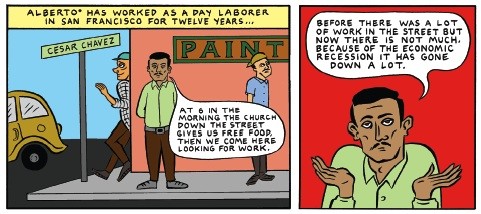
I loved the “Sit, Lie, Get Deported” comic strip that merges photos with hand-drawn illustrations and uses the actual words of politicians, city officials, activists and gadflies to help illustrate its point.

And I’m still trying to finish the crossword. In fact,  I plan to read the SFPP’s first printedition from front to back over the July 4 holiday weekend, when I’ll have the time to really absorb and enjoy it.

“Ideally, news will appear in print first, then online, so there’s interest in seeking out the print edition,” Lahood told me, noting that the Public Press’ first edition amounts to about 70,000 words. “So, it a novel, in length,” Lahood laughed. “People are, if not starving, at least very hungry for news analysis and investigative reporting. There are a lot of online sites that aggregate other publications content, and then there’s the corporate model of the Chronicle, but while there is some good reporting in town, there are fewer reporters.”

No kidding. All the more reason for this reporter to write an online defense of print, in the hope that you rush out to secure your copy of the Public Press’s first print edition and evaluate this new model of journalism. I think you’ll be glad you did.

Our Weekly Picks: June 31-July 6

0

WEDNESDAY 30

FILM

The Hidden Fortress

There are certain experiences that, when given the chance, you should never pass up. Skydiving, for instance. Eating unusually good pizza. Seeing a Kurosawa film on the big screen. Well rejoice, reader, because at least one of those three is within your immediate grasp. UC Berkeley’s Pacific Film Archive is celebrating the centennial of Akira Kurosawa’s birth with a summer-long retrospective. On June 30, it will be showing The Hidden Fortress (1958), which directly inspired the (good) Star Wars trilogy and by proxy, pretty much every lighthearted action/fantasy caper you’ve ever seen. Also keep an eye out for The Seven Samurai (1954) on July 17, Yojimbo (1961) on July 24, and Ran (1985) on Aug. 21. (Zach Ritter)

7 p.m., $5.50–$9.50

Pacific Film Archive

2575 Bancroft, Berk

(510) 642-5249

www.bampfa.berkeley.edu


EVENT

God’s Lunatics

One of the main problems with today’s secularist revival is that it has no sense of the grotesque. Richard Dawkins and Sam Harris are bright dudes, but they can be just as dour and unyielding as their fundamentalist targets. They tend to lose sight of the notion that fanatics are more susceptible to mockery than they are to sober polemics. Enter award-winning author Michael Largo, whose new book God’s Lunatics takes the reader on a whirlwind tour of faith’s more ridiculous manifestations. The work presents a Victorian freak show of cult leaders, mystics, and crusaders from throughout history, chronicling the chaos and pitch-black comedy that inevitably results when humans exchange rational thought for passionate, earnest insanity. (Ritter)

7 p.m., free

Modern Times Bookstore

888 Valencia, SF

(415) 282-9246

www.mtbs.com


THEATER

Young Frankenstein

If you’ve seen Mel Brooks’ classic spoof Young Frankenstein (1974), you know that migrating humps, rolls in ze hay, and correcting people’s mispronunciation of his name are all in a day’s work for the young Dr. Frankenstein. But apart from his monster’s debut, which features a classy take on “Puttin’ on the Ritz,” he’s not necessarily one for musical numbers. Until 2007, that is, when the stage musical adaptation of the film premiered in Seattle, then migrated to Broadway, following in the footsteps of Brooks’ successful musical reworking of The Producers (1968) with collaborator Thomas Meehan. Now SF gets a taste of the wackiness, perhaps followed by the inevitable (if unfortunate) readaptation into film. (Sam Stander)

Through July 25

Tues.–Sat., 8 p.m. (also Wed. and Sat., 2 p.m.);

Sun, 2 p.m., $30–$99

Golden Gate Theatre

One Taylor, SF

(415) 551-2000

www.shnsf.com


THURSDAY 1

VISUAL ART

“Renaissance”

Many of the images in Bill Armstrong’s “Renaissance” series possess the eeriness of a certain strain of uncanny portrait photography, but these photos don’t incorporate living models. They’re defocused captures of Renaissance-era drawings that Armstrong has painted over with bright swathes of color. The out-of-focus effect combines with his choice of colors to lend the photos a haunting depth, so much so that it’s sometimes easy to forget the inanimate qualities of the subjects. Despite their vivaciousness, the sometimes bizarre hues prevent the images from seeming entirely organic. By photographing works of printed art, Armstrong plays with the idea of the photographic subject, resulting in these deceptively simple and fascinating shots. (Stander)

Through Aug. 28

Opening 5:30–7:30 p.m., free

Dolby Chadwick Gallery

210 Post, SF

(415) 956-3560

www.dolbychadwickgallery.com


FRIDAY 2

FILM

San Francisco Frozen Film Festival

The San Francisco Frozen Film festival’s mission statement insists “we seek to unfreeze the arts frozen beneath the weighty realities of prejudice, poverty, ignorance, and isolation.” I’m just hoping that means the name does not, in fact, reference Mark Twain’s played-out ol’ chestnut about summer temperatures in San Francisco. Whatever. This intriguing, up-and-coming fest plunges into its fourth incarnation with Dive, a doc about Dumpster diving, and continues with a variety of shorts programs (doc, experimental, animated, comedic — there’s even a “crime and western” category!), plus features like Do It Again (Kinks), about a fan’s rabid quest to get his favorite band to reunite, and 16 mm New Jersey surf film A Pleasant Surprise. (Cheryl Eddy)

Through Sat/3, $10

Roxie, 3117 16th St, SF

www.frozenfilmfestival.com


THEATER

Left of Oz

No matter how many times The Wizard of Oz is revamped, remade, or spoofed, the results are always different from what came before. This summer season, Left of Oz comes to Ashby Stage, and if you couldn’t guess by the title, the tagline — “Dorothy Comes Out!” — gives away the game. Dorothy swaps the yellow brick road for a bus to San Francisco, where she hopes to find herself and some Sapphic loving. Left borrows clichés associated with San Francisco (tie-dye, marijuana, yoga) and merges them with the fantasy elements of Victor Fleming’s 1939 movie, flipping the whole sparkly thing on its head. There may have been previous queer readings of Oz, but Left has to be among the most playful. (Ryan Lattanzio)

Through July 18

Fri.–Sat., 8 p.m.; Sun, 7 p.m., $25–$50

Ashby Stage

1901 Ashby, Berk.

(510) 841-6500

www.leftofoz.com


MUSIC

Carte Blanche

It may be impossible to predict the music game, but so far DJ Mehdi is 1 for zero. Sure, these days it’s not uncommon for a hip-hop single to blatantly cop a beat from Daft Punk, but French DJ Mehdi Favéris-Essadi has been mixing the hip-hop and dance since the days when finding Daft Punk on your rap CD was like finding a cockroach in your cereal. Now the Ed Banger cohort has hooked up with U.K. house DJ Riton to form the duo Carte Blanche, and the pair are banging out hard Chicago house like it’s next in line to take over the world. With Mehdi’s track record, I wouldn’t necessarily count it out. With White Girl Lust, Alona, and Shane King. (Peter Galvin)

9 p.m., $15

Mezzanine

444 Jessie, SF

(415) 625-8880

www.mezzaninesf.com


EVENT

“Mission Muralismo Celebrates the Graff Convention”

If there’s one thing the de Young Museum is prospering at recently, it’s the way it has been bringing SF communities not usually done right by the fine art world into its fold, and respectfully. From establishing its Native American Programs Board to this week’s continuation of the Mission Muralismo street art event series, more of the neighborhood is finding reasons to get its bags searched to enter that crazy bronze building. At the Graff Convention, the city’s top burners and sprayers will share their knowledge in lecture form, and Audiobraille will supply funky Latin jazz beats. Just don’t bring your new aerosol — that shit will get taken for sure. (Caitlin Donohue)

5–8:45 p.m., free

de Young Museum

50 Hagiwara Tea Garden Dr., SF

(415) 750-3600

www.famsf.org


SATURDAY 3

MUSIC

Fillmore Jazz Festival

San Francisco has no shortage of street fairs. But unlike those held in the duller byways of suburbia, each gathering has its own neighborhood flavor: the Haight hosts a hippie happening, Union Street conveys a yuppie flair, and the Fillmore pays homage to the music that made it famous back in the day: jazz. Ella Fitzgerald and Duke Ellington rocked the local clubs then, and while the area has changed dramatically over the years, there’s a bit of a flashback feel during this annual fest. Along with the usual street food and craft vendors, there’ll be stages of talent, including Bobbie Webb and the Smooth Blues Band, Kim Nalley, Marcus Shelby Orchestra, the Coltrane Church, and much more. (Eddy)

Through Sun/4

10 a.m.–6 p.m., free

Fillmore between Jackson and Eddy, SF

www.fillmorejazzfestival.com


SUNDAY 4

EVENT

“Pooches on Parade”

For its second year in a row, Half Moon Bay hosts “Pooches On Parade,” where you can show off your dog-walking skills — oh, and your dog, of course — if Fido or Fifi is up to par, that is. If you don’t have a dog, the event coordinators are willing to spare their imaginary dogs, Cuff and Link. Even a stuffed animal will suffice. Afterward, if all the doggone mayhem awakens your carnivorous appetite, there’s a “Bark BQ” where you and your pooch can dine while enjoying a live band. Unless you’re a staunch cat person, so many dogs in one place is probably reason enough to make the trip down coastside. (Lattanzio)

Noon, free ($10 for same-day parade registration)

Main Street

Half Moon Bay

www.poochesonparade.org


EVENT/DANCE

“Tango in the Square”

As we’ve all been repeatedly reminded, “it takes two to tango.” But before pairing off, it might be useful to learn a few basics by yourself. You can start by promenading (yes, that’s a step) over to Union Square for “Tango in the Square.” The event is part of Union Square’s 2010 Jewels in the Square series, which offers free lessons in milonga, tango, and vals (tango waltz). With hot new moves, you’ll be ready to hit the square’s open dance floor. Choose among a variety of partners (professional and amateur), watch performances by experienced tango dancers, or simply enjoy the live music by the Argentine tango band Tangonero. (Gaydos)

2 p.m., free

Union Square

Powell and Geary, SF

www.unionsquarepark.us/JewelsJuly


EVENT

Fourth of July Waterfront Celebration

If patriotic displays of gunpowder are what you seek on America’s 234th birthday, Bay Area skies will not let you down. Particularly brave San Francisco residents and their pushy out-of-town guests can head to Pier 39 for a full day of Uncle Sam-endorsed fun, with live music (including “the soft rock explosion of Mustache Harbor” — God bless irony, and God bless the U.S.A.), street performers, and fireworks galore. Pray for an unfoggy night, kids. Alternative: live in the Mission? Get thee to your roof to spot all the homespun, charmingly dangerous fireworks that inevitably appear every July 4. You’ll be up all night listening to them anyway. (Eddy)

3–9:30 p.m., free

Pier 39, SF

www.pier39.com/Events


The Guardian listings deadline is two weeks prior to our Wednesday publication date. To submit an item for consideration, please include the title of the event, a brief description of the event, date and time, venue name, street address (listing cross streets only isn’t sufficient), city, telephone number readers can call for more information, telephone number for media, and admission costs. Send information to Listings, the Guardian Building, 135 Mississippi St., SF, CA 94107; fax to (415) 487-2506; or e-mail (paste press release into e-mail body — no text attachments, please) to listings@sfbg.com. We cannot guarantee the return of photos, but enclosing an SASE helps. Digital photos may be submitted in jpeg format; the image must be at least 240 dpi and four inches by six inches in size. We regret we cannot accept listings over the phone.

Powder keg

5

news@sfbg.com

Ask any pollster, political consultant, or academic who studies the American electorate about the mood of the voters this year and you’ll get the same one-word answer: Angry.

Everyone’s pissed — the liberals, the conservatives, the moderates, the people who don’t even know where they fit in. It’s an unsettled time and, potentially, very bad news for a progressive agenda that seeks to address issues ranging from poverty and war to the long-term health of the public and the planet.

The Democrats, who swept into power with an enormously popular president just 18 months ago, may lose control of Congress. The tea partiers have driven the Republicans so far to the right that some candidates for Senate are openly talking about eliminating Social Security. The unemployment rate — the single most important factor in the politics of the economy — remains high and doesn’t show any signs of improving.

And the progressive left seems frustrated and demoralized, particularly in California. The Golden State, which once led the nation in innovation and enlightened social policy, now seems to be leading the politically dysfunctional race to the bottom.

The nation could be headed for a dangerous era, rife with the potential for right-wing demagoguery and other nasty political schisms. The state of the economy could easily fuel a more powerful movement to shrink the scope of government and a continuing backlash against the public sector — and the financial backers of the antitax and antiregulation movement are drooling at the prospect.

But there’s also a chance for progressives to seize a populist narrative and shift the discussion away from traditional disagreements and toward those areas, particularly the destructive influence on government by powerful corporations, where the grassroots right and grassroots left might actually agree.

The anger that voters feel toward a government that isn’t meeting their needs is starting to find other outlets. People are as mad about the abuses of big business — the Wall Street meltdown, the bailouts, the BP oil spill, the political manipulation — as they are about the failures of Congress and the president. If you ask Americans of every political stripe who they least trust — big government or big business — even conservatives aren’t so sure anymore.

For 30 years, the central narrative of American politics has revolved around the size and effectiveness of government. Now there’s a chance to shift that entire debate in American politics toward the largely unchecked power of corporations. It is, populist writer Jim Hightower told us, “an enormous opportunity handed to us by the bastards.”

But so far, none of the Democratic leaders in California are taking advantage of it to start dispelling damaging myths and crafting political narratives that might begin to create some popular consensus around how to deal with society’s most pressing problems.


THE PEOPLE WANT TAXES

There have been many polls gauging voter anger, but one of the most comprehensive and interesting recent ones was “Californians and Their Government,” a collaborative study by the Public Policy Institute of California and the James Irvine Foundation that was released in May.

It shows that Californians are mad about the state’s fiscal problems, disgusted with their political leaders, divided by ideology, and deeply conflicted over the best way forward. An astounding 77 percent of respondents say California is headed in the wrong direction and 81 percent say the state budget situation is a “a big problem.”

But the anti-incumbent message isn’t necessarily an anti-government message. Most Californians are willing to put more of their cash into public-sector programs, even during this deep recession. When asked to name the most important issues facing the state, 53 percent mentioned jobs and the economy . The state budget, deficit, and taxes only got the top billing of 15 percent.

And contrary to the conventional wisdom espoused by moderate politicians and political consultants, most voters say they are willing to pay higher taxes to save vital services. “Californians tell us they continue to place a high value on education and want education to be protected from cuts. And they’re willing to commit their money to help fund that,” PPIC director Mark Baldassare told the Guardian.

The survey found that 69 percent of respondents say they would pay higher taxes to protect K-12 education from future cuts, while 54 percent each say they would pay higher taxes to prevent cuts to higher education and to health and human services programs. In other words, voters seem to recognize where we’ve cut too deeply — and where we haven’t cut enough: only 18 percent of respondents would be willing to pay higher taxes to prevent cuts to prisons and corrections.

Baldassare said the June primary results also showed that people are willing to pay more in taxes for the services they value. “Around the state, there was a lot of evidence that people responded favorably to requests by their local governments for money, particularly for schools,” he said.

Both the California Legislature and Gov. Arnold Schwarzenegger are held in very low esteem with voters, according to the PPIC study, and Schwarzenegger’s 23 percent rating is the lowest in the poll’s history.

Barbara O’Connor, political communications professor who heads the Institute for the Study of Politics and the Media at Sacramento State University, told us that voter unhappiness with elected leaders is no surprise. Right now, most people are afraid that their basic needs won’t be met over the long run.

“The common narrative is fear, and fear channels into anger,” O’Conner said.

And that fear is being tapped into strongly this year by the Republican candidates, who are trying to scare voters into embracing their promises to gut government and keep taxes as low as possible.

“If there’s any lesson to be learned from Meg and Carly’s early ads, it’s fear-mongering, fear-mongering all the time — and that doesn’t create a very positive narrative,” O’Connor said of gubernatorial candidate Meg Whitman and U.S. Senate candidate Carly Fiorina.

O’Connor noted that Barack Obama’s campaign had great success in using a positive, hopeful message and said she believes the right leader can also do so in California. “I talked to Jerry [Brown]’s people about it and said you can’t just run a negative campaign because that’s what Meg is doing.”

Despite the tenor of the times, O’Connor said she’s feeling hopeful about hope. She also believes Californians would respond well to a leader like Obama who tried to give them that hope — if only someone like Brown can pick up that mantle. “I think the environment is right for a positive message. But the question is: do we have people capable of delivering it?”

She said the no-new-taxes, dismantle-government rhetoric has started to wear thin with voters. “The real fiscal conservatives are badly outnumbered in Californian,” O’Connor said. As for the corporate sales jobs, O’Connor said voters have really started to wise up. “They aren’t going to be scammed.”

The results of the June primary election showed that voters across the spectrum were also disturbed by big special-interest money. Proposition 16, backed by $46 million from Pacific Gas and Electric Co., went down to defeat — even in counties that tend to vote Republican.

And this fall, with two rich former CEOs spending their personal wealth to win two of California’s top elected offices and energy companies pushing a measure to roll back California’s efforts to combat global warming, there could be great opportunity in a narrative targeting those at the top of our economic system.


THE TOP AND THE BOTTOM

Some observers say that whatever their shared feelings about corporate scams, conservatives and liberals in the state are just too far apart, and that there’s little hope for any substantive agreement. “People are becoming more polarized,” said consultant David Latterman, who often works for downtown candidates and interests. “I think we’re beyond compromise.”

Allen Hoffenblum, a Los Angeles-based Republican strategist, agreed. “The voter are all mad, but they’re mad at different things. I just don’t see where they come together.”

But Hightower, who has spent a lifetime in politics as a journalist, elected official, author, and commentator, has a different analysis.

“As I’ve rambled through life,” he wrote in a recent essay, “I’ve observed that the true political spectrum in our society does not range from right to left, but from top to bottom. This is how America’s economic and political systems really shake out, with each of us located somewhere up or down that spectrum, mostly down.

“Right to left is political theory; top to bottom is the reality we actually experience in our lives every day — and the vast majority of Americans know that they’re not even within shouting distance of the moneyed powers that rule from the top of both systems, whether those elites call themselves conservatives or liberals.”

In an interview, he told us he sees a lot of hope in the fractured and potentially explosive political ethos. “There’s all this anger,” he said. “People don’t know what to do. And I think the one focus that makes sense is the arrogance and abuse of corporate executives.”

In fact, Hightower pointed out, the teabaggers didn’t start out as part of the Republican machinery. “Wall Street and the bailouts sparked the tea bag explosion,” he said. It wasn’t until big right-wing outfits like the Koch brothers, who own oil and timber interests and fund conservative think tanks, started quietly funding tea party rallies that the anti-corporate, anti-imperial edge came off that particular populist uprising.

“At first, the teabaggers didn’t even know where the money was coming from,” Hightower said. “You can’t be mad at the teabaggers; we should have been out there organizing them first.”

There’s plenty of evidence that anger at big business is growing rapidly — and rivals the distrust of big government that has defined so much of American politics in the past 30 years. The bailouts were “the first time in a long time that people have been slapped in the face by collusion between big business and its Washington puppets,” Hightower noted.

Then there’s the Supreme Court decision in Citizens United v. Federal Elections Commission. In January, a sharply divided court ruled 5-4 that corporations had the right to spend unlimited amounts of money supporting or opposing political candidates. Progressives were, of course, outraged — but conservatives were, too.

Polls show that more than 80 percent of Democrats think the decision should be overturned. So do 76 percent of Republicans. “This is a winner for our side,” Hightower noted. “But our side’s not doing anything about it.”

Sure, President Obama denounced the ruling in his State of the Union speech and promised reform. But the bill the Democrats have offered in response does nothing to stop the flow of money; it would only increase disclosure requirements. And in response to furor from the National Rifle Association, it’s been amended and is now so full of holes that it doesn’t do much of anything.

Political consultants advising Whitman are clearly looking for ways to direct the voter unhappiness into a demand for lower taxes and smaller budgets. She’s already vowed to fire 40,000 state workers, and her most recent campaign ad attacks Brown for expanding public programs and raising the state deficit.

So far Brown hasn’t challenged that narrative — and some Democrats say he shouldn’t. It would be safer, they say, for Brown to get out front and demand his own cuts in Sacramento. “Going after public-sector pensions is a winner,” one Democratic campaign consultant, who asked not to be named, told us. “If Whitman beats Brown on those issues, she wins.”

But that approach is never going to be effective for Democrats. If the argument is over who can better cut government spending, the GOP candidates will always win. The better approach is to see if progressives can’t shift the debate — and the anger — toward the private sector.

As Hightower put it: “You can yell yourself red-faced at Congress critters you don’t like and demand a government so small that it’d fit in the backroom of Billy Bob’s Bait Shop and Sushi Stand, but you won’t be touching the corporate and financial powers behind the throne.”

That’s where the discussion has to start. And there’s no better place than California.

The Golden State is a great example of what happens when the tax- cutters win. In 1978, the liberals in Sacramento, operating with a huge state budget surplus, couldn’t figure out how to derail the populist anger of property tax hikes. So Proposition 13, the beginning of the great tax revolt, passed overwhelmingly. Over the next decade, more antitax initiatives went before the voters, and all were approved.

Now the state is heading toward fiscal disaster. The schools are among the worst-funded in the nation. The world-famous University of California system is on the brink of collapse. Community colleges are turning away students. The credit rating on California bonds have fallen so far that it’s hard for the state to borrow money. And there’s still a huge budget gap.

The tax-cut mentality that led to the so-called Reagan revolution started in California; a political movement that shifts the blame for many of the state’s problems away from government and onto big business ought to be able to start here as well. And it’s potentially a movement that could bring together people who normally find themselves on opposite sides of the fence.

A case in point: the measure the oil companies have put on the November ballot to repeal the state’s greenhouse gas limits. The corporations backing the initiative, led by Valero, argue that California’s attempts to slow climate change will cost jobs. That’s a line we’ve heard for decades. Every tax cut, every move toward deregulation, is defended as helping spur job growth.

But the past four presidents have done nothing but cut taxes and reduce regulations — and the result is facing Americans on the streets every day. There is also growing evidence that even Republican voters don’t believe everything big businesses tell them anymore. And they’re starting to grasp that sometimes deregulation leads to outcomes like larcenous CEOs and unstoppable oil leaks.

So the potential for a successful progressive populist movement is out there. But it’s not going to happen by spontaneous combustion.


SF SHOWS THE WAY

On the national level, one of the factors creating this gloomy electorate is the failure of President Obama to keep the coalition that elected him active and engaged. The intense partisanship in Washinton has turned off many independent Obama voters, while his progressive supporters have been disappointed by issues ranging from his escalation in Afghanistan to tepid reforms on health care and Wall Street.

“One of the narratives now is where are the Obama voters and will they participate?” Jim Stearns, a San Francisco political consultant who works mostly on progressive campaigns, told us. “They still love Obama but they’re not moved by him anymore.”

Perhaps more important, they have lost the sense of hope that he once instilled. The Republican Party’s descent into right-wing extremism and the strong anticorporate narratives that have emerged in the last year — from BP’s oil spill to PG&E’s political manipulation to Goldman Sachs’ self-dealing to the prospect of unrestricted corporate campaign propaganda unleashed by the Citizens United ruling — have created the possibility that the negative narratives by the left may crowd out the positive ones.

“Meg Whitman is someone you can hate. She’s the rich Republican CEO trying to buy her way into office,” Stearns said. “But it’s a depressing message.”

But Stearns said there is another, most hopeful political narrative that is emerging in San Francisco, one that might eventually grow into a model that could be used at the state and federal levels. “We’re lucky in San Francisco. Progressive voters are engaged.”

He noted that San Francisco’s voter turnout was higher than expected in the June primary, and far higher than the record low state number, even though there really weren’t any exciting propositions or closely contested races on the local ballot — except for the Democratic County Central Committee, where progressives maintained their newfound control. And it’s because of the organizing and coalition-building that the left has done.

“What you’ve seen over the last few years is a coalition of labor, neighborhood groups, environmentalists, and the progressives now operating through the Democratic Party. That’s a great coalition with a lot for people to trust,” Stearns said.

Meanwhile, downtown has all but collapsed as a unified political force. “They don’t really have a political infrastructure,” Stearns said of downtown. “Normally it would be the mayor who gets everyone in line and working together.”

Even Latterman, the downtown-oriented consultant, agrees that the business community is no longer setting San Francisco’s agenda because it’s become fractured and unable to push a consistent political narrative: “There’s certainly been a lack of coordination.”

He also agrees that progressives have become more organized and effective. “Clearly, the Democratic Party of San Francisco has become a conduit for progressive politics and politicians, but not issues,” Latterman said. “What a lot of people get wrong in the city is the difference between politics and policy.”

Part of the reason is economic. With scarce resources, a high threshold for approving new revenue sources, and a fiscally conservative mayor unwilling to talk taxes, it’s been difficult to move a progressive agenda for San Francisco. And in Sacramento, it’s barely part of the discussions.

“The people of California have been held hostage by a handful of Republicans who are making us cut everything we care about,” while in San Francisco “Newsom is taking an entirely Republican approach to the budget,” Stearns said.

Looking toward the fall races, Stearns said the progressive coalition and majority on the Board of Supervisors will be tested on issues such as Muni reform, and the question will be whether fiscal conservatives like Sup. Sean Elsbernd can blame Muni’s problems on drivers, or whether progressives can create and sell a broader package that includes new revenue and governance reforms.

“The drivers are going to get their guarantee taken out of the charter, that’s going to happen. But people know that isn’t all that’s wrong with Muni,” Stearns said.

But to craft a more comprehensive solution, he said the progressives are going to need to use their growing coalition to connect the dots for voters. “We need to run a citywide campaign around a whole constellation of issues,” Stearns said, citing Muni, schools, taxes, resistance to mean-spirited measures like sit-lie, and the larger issues raised by the Brown and Barbara Boxer campaigns. “We need to figure out a way to put all that in the same coalition and run one campaign around it. And we can do that because progressives retained control of the DCCC.”


THE STRUGGLE AHEAD

Although they’ve made great strides, San Francisco progressives are still struggling with a mayor who sees the solution to every budget crisis as cuts — and with a growing number of efforts to blame public employees for the city’s fiscal problems. Even Jeff Adachi, the public defender once considered a standard-bearer for progressive causes, is pushing a ballot measure that would require city workers to pay more for their pensions.

Gabriel Haaland, who works with Service Employees International Union Local 1021, made the right point in the pension debate. “Big financial institutions crashed the stock market,” he said recently, “and now they want to blame city workers.”

In a blog post on the political website Calitics, Robert Cruickshank put it clearly: “The notion that ‘everyone needs to give back’ just doesn’t make sense given our economic distress. We’ve already given back too much. We gave back our wages. We gave back our ability to afford health care and housing and transportation. We gave back the robust public- sector services that created widespread prosperity in the 1950s and 1960s. We gave back affordable, quality education. And too many of us have given back our future.

“No, it’s time for someone else to give back. It’s time for the wealthiest Californians and the large corporations to give back. For 30 years now they have benefited from economic policy designed to take money and benefits from the rest of us and give it to those who already have wealth and power.”

That’s a message that ought to appeal to anyone who’s hurting from this recession. It ought to cross red and blue lines. It ought to be the mantra of a new progressive populism that can channel voter anger toward the proper target: the big corporations that created the problems that are making us all miserable.

If Jerry Brown could adopt that narrative, he could change the state of California — and the state of the nation.

Kaiser workers seek election between rival unions

34

Thousands of Kaiser Permanente workers have filed petitions to change unions in what could be the biggest battle yet between Service Employees International Union and its upstart rival National Union of Healthcare Workers. If called by federal regulators, the election would involve more than 45,000 workers, the biggest private sector organization since Ford Motors employees joined United Auto Workers in 1941.

“This is the election everyone has been anticipating for the last year and a half,” NUHW spokesperson Sadie Crabtree told us.

That was when Sal Rosselli and other former leaders of the Oakland-based United Healthcare Workers were ousted by former SEIU President Andy Stern and other leaders of their parent union, SEIU, and formed NUHW. Since then, the two unions have clashed bitterly and regularly, in various workplaces, through the media, in leadership battles, and in a San Francisco court case that ended in April.

“The NUHW petition, if the National Labor Relations Board agrees it was filed appropriately, could force an election between SEIU-UHW and NUHW at Kaiser. Voting for NUHW would risk all the gains SEIU-UHW members made in a hard-fought four-month contract campaign against takeaways by Kaiser,” was how an SEIU-UHW press release cast today’s action.

NUHW opted for a nod to the Fourth of July in its release: “Thousands of Kaiser healthcare workers fired the first shot today in a long-anticipated battle for independence that will determine the future of California’s largest union, SEIU. They filed a petition that will trigger elections for 45,000 SEIU members to choose between the troubled incumbent and the state’s fastest-growing union, the new National Union of Healthcare Workers.”

About 2300 Kaiser workers – representing three of the seven bargaining units – already voted in January to join NUHW, but the petitions now being turned in by the remaining four unions represent the most significant segment of Kaisier workers, including the 44,000-member service, technical, and clerical unit.

Federal law calls for elections when at least 30 percent of a union’s members ask for one, and Crabtree told us, “We have more than we need.” Now, the NLRB must verify the petitions and schedule the election.

Editor’s Notes

23

Tredmond@sfbg.com

Jane Kim, the San Francisco school board president running for supervisor in District 6, has a tough question to answer. When there’s already a solid progressive in the race, Debra Walker, someone who has lived in the district for years and agrees with Kim on almost all the key issues, why is Kim running?

She gave a hint at her campaign kickoff June 24 on how she’s going to portray herself: "I’m not part of anyone’s machine, and I’m certainly not part of anyone’s master plan." It’s an attractive statement — nobody likes machine politics — and the idea that she’s an independent candidate makes her all the more appealing.

Except that it also says something about the progressive movement in San Francisco — and that’s a little disturbing. Because no matter how you try to spin it, when you say you aren’t part of anyone’s machine, you’re implying that maybe your opponents are.

Let me take a step back here, because this is important stuff. There’s a fine line between an effective, organized political coalition that can actually win elections and a political machine, which stifles political innovation and grassroots candidates. And in part it’s about motivation.

When Willie Brown ran San Francisco, it was all about Willie Brown. I’ve never believed the guy had much of an ideology or that any political cause really mattered to him; he loved power, he knew how to use it and he didn’t want to give it up. That was the bottom line.

Now that he’s pretty much out of the picture — although he was at Kim’s party, he’s not a factor anymore — there’s a very different power balance in this city. There’s nobody at City Hall (or in Sacramento, or Washington, or downtown, or anywhere else) who has machine-style control of local politics.

There are people who can build coalitions that work — Aaron Peskin, for example, did exceptionally well with putting together a campaign to elect progressive Democratic County Central Committee elections. And there are people who would love to be power brokers.

But I’ve been around politics here a long time, and I can tell you: Aaron Peskin doesn’t have a machine. Neither does Mark Leno, or Gavin Newsom, or Tom Ammiano, or David Chiu, or anyone else. Thanks in part to district elections, there aren’t many call-up votes on the Board of Supervisors these days. In fact, the left in San Francisco is famously unable to agree on much of anything half the time. Note, for example, the fact that Chiu — often called a Peskin ally — is not supporting Peskin’s candidate in D-6. He’s with Jane Kim.

The thing is, unlike the players in a typical political machine, most of the progressives care about issues. It’s about a shared ideology more than it’s about power. That’s a hugely important difference.

The way the mainstream media has it, the San Francisco left is either fatally fractured and can’t do anything — or it’s becoming a machine. For the moment — a great moment — neither is true. Let’s all keep that in mind. Because when we beat each other up with words like "machine," we undermine the whole progressive movement.

Bad way to start a campaign.

A tough choice for C.W. Nevius

9

It’s no surprise the C.W. Nevius thinks the city has too many public services and that “some have to go.” Nonprofits that get city funds are an easy target. Some of them aren’t too good at paperwork, and have a hard time providing tangible evidence of results. (If you run a violence-prevention program for kids, and some of them still get in trouble, can you”prove” that the others didn’t because of your help? Of course not.) And there’s no doubt some waste and duplication of services in the system.

Some perspective: When I was on the Board of Trustees of Wesleyan University (as an elected member from the Wesleyan Progressive Alumni Network), I constantly complained about waste in the budget. I wanted to know why we spent so much money on dinners for the trustees (most of whom could well afford their own food and wine) when we were cutting ethnic studies programs and tightening up on financial aid. Colin Campbell, the president, gave me a very good answer:

In any $60 million budget, for any public or nonprofit organization, there’s going to be some waste. It’s unavoidale. And, he said, there are also going to be things that ought to be in the budget but aren’t.

(By my second year on the board, they did cut back on wine at lunch, which may have been due to my complaints but was more likely a result of too many of the older board members getting a little looped and falling asleep during the afternoon meetings.)

So yeah, there are things that could be eliminated in the current nonprofit system. There are also a lot of services that ought to be in the city budget, but aren’t.

C.W.:

There’s just one flaw in our civic personality.

Tough choices.

We’d rather not make them.

That’s correct, and it’s true for everyone in California, probably everyone in the United States. We want good schools, clean streets, nice parks, plenty of cops and firefighters .. and we don’t want to pay for it.

Taxes in this state, and in this country, are the lowest they’ve been in decades. State spending is back to early 1990s levels. State cuts have forced cities to take on more and more burdens.

So the tough choice isn’t whether we can afford to provide public services. It’s whether we have the courage to demand that the people who have seen their tax rates plummet while social problems skyrocket pay their fair share. How about that one, Chuck?

From great man to great screw-up: behind the McChrystal uproar

0

Norman Solomon is executive director of the Institute for Public Accuracy. His books include “War Made Easy: How Presidents and Pundits Keep Spinning Us to Death.”

When the wheels are coming off, it doesn’t do much good to change the driver.

Whatever the name of the commanding general in Afghanistan, the U.S. war effort will continue its carnage and futility.

Between the lines, some news accounts are implying as much. Hours before Gen. Stanley McChrystal’s meeting with President Obama on Wednesday, the New York Times reported that “the firestorm was fueled by increasing doubts — even in the military — that Afghanistan can be won and by crumbling public support for the nine-year war as American casualties rise.”

It now does McChrystal little good that news media have trumpeted everything from his Spartan personal habits (scarcely eats or sleeps) to his physical stamina (runs a lot) to his steel-trap alloy of military smarts and scholarship (reads history). Any individual is expendable.

For months, the McChrystal star had been slipping. A few days before the Rolling Stone piece caused a sudden plunge from war-making grace, Time Magazine’s conventional-wisdom weathervane Joe Klein was notably down on McChrystal’s results: “Six months after Barack Obama announced his new Afghan strategy in a speech at West Point, the policy seems stymied.”

Now, words like “stymied” and “stalemate” are often applied to the Afghanistan war. But that hardly means the U.S. military is anywhere near withdrawal.

Walter Cronkite used the word “stalemate” in his famous February 1968 declaration to CBS viewers that the Vietnam War couldn’t be won. “We have been too often disappointed by the optimism of the American leaders both in Vietnam and Washington to have faith any longer in the silver linings they find in the darkest clouds,” he said. And: “It seems now more certain than ever that the bloody experience of Vietnam is to end in a stalemate.”

Yet the U.S. war on Vietnam continued for another five years, inflicting more unspeakable horrors on a vast scale.

Like thousands of other U.S. activists, I’ve been warning against escalation of the Afghanistan war for a long time. Opposition has grown, but today the situation isn’t much different than what I described in an article on December 9, 2008: “Bedrock faith in the Pentagon’s massive capacity for inflicting violence is implicit in the nostrums from anointed foreign-policy experts. The echo chamber is echoing: the Afghanistan war is worth the cost that others will pay.”

The latest events reflect unwritten rules for top military commanders: Escalating a terrible war is fine. Just don’t say anything mean about your boss.

But the most profound aspects of Rolling Stone’s article “The Runaway General” have little to do with the general. The takeaway is — or should be — that the U.S. war in Afghanistan is an insoluble disaster, while the military rationales that propel it are insatiable. “Instead of beginning to withdraw troops next year, as Obama promised, the military hopes to ramp up its counterinsurgency campaign even further,” the article points out. And “counterinsurgency has succeeded only in creating a never-ending demand for the primary product supplied by the military: perpetual war.”

There was something plaintive and grimly pathetic about the last words of the New York Times editorial that arrived on desks just hours before the general’s White House meeting with the commander in chief: “Whatever President Obama decides to do about General McChrystal, he needs to get hold of his Afghanistan policy right now.”

Like their counterparts at media outlets across the United States, members of the Times editorial board are clinging to the counterinsurgency dream.

But none of such pro-war handwringing makes as much sense as a simple red-white-and-blue bumper sticker that says: “These colors don’t run . . . the world.”

Fierce controversy has focused on terminating a runaway general. But the crying need is to terminate a runaway war.

_________________________________________

Norman Solomon is executive director of the Institute for Public Accuracy. His books include “War Made Easy: How Presidents and Pundits Keep Spinning Us to Death.”

Pulp vicious

0

arts@sfbg.com

FILM An entirely fake controversy brewed at the Sundance Film Festival three years ago in anticipation of the "Dakota Fanning rape movie," otherwise known as Hounddog. Fanning was then a cloyingly cute, frequently tearful actor known for family-friendly films — ergo, her appearance as a victim of child abuse in a 1950s rural drama got fanned by hysterical pundits and popular media into terrible child actor abuse. Before anyone actually saw the film, of course.

Once they had, however, the scandal quickly slunk into a corner and died. Hounddog was barely released many months later — and not because it was an exploitative shocker. Rather, it turned out to be a ludicrous gumbo of Southern gothic clichés and clumsy good intentions that violated no standards beyond those of intelligence and art.

This January another Sundance controversy broke. It was, coincidentally, over another Deep South period piece, and also wrong-headed. The movie was eclectic English director Michael Winterbottom’s The Killer Inside Me, the latest screen version of a beloved and spectacularly nasty noir tale by literary pulp hero Jim Thompson. The protest, aired in audience walkouts and complaints, was that the onscreen violence against women was viciously excessive.

In this case, the accusation is as true as the ones against Hounddog were false. But that’s just one reason that Killer is good art while Hounddog is fraudulently bad. In Winterbottom’s film, violence is horribly immediate, sadistic yet matter-of-fact, almost unendurable — everything movie violence almost never is. There’s nothing remotely comfortable about the highly personal, unnecessary cruelty our antihero wreaks. And there’s real deliberateness about the way that brutality escalates when he’s putting down female, as opposed to male, obstacles. S’called misogyny, folks.

The Killer Inside Me is about Sheriff Lou Ford (Casey Affleck), a good ol’ boy (if not yet so old) in his dusty, back-slappy west Texas hometown of the late 1950s. Lou plays the part so well no one in this sleepily, routinely corrupt berg would ever suspect him of being … complicated. Indeed, he is a world-class sociopath who depends on their lazy small-town gullibility and rote suspicion toward outsiders to literally) get away with murder.

Affleck is oddly cast in that he lacks the innate bully heft or lunacy that made Stacey Keach an ideal embodiment of Thompson’s ultimate unreliable-narrator concept in Burt Kennedy’s 1976 screen version. This Affleck can’t possibly be mistaken for John Wayne 4.0. But could the Duke have played the game-changing weenie in 2007’s The Assassination of Jesse James By the Coward Robert Ford?

Winterbottom’s Killer Inside Me is all about antiheroic nightmares hidden beneath blinding Texan skies. Outwardly placid, inwardly paranoid, Lou is shagging local Amy (Kate Hudson) — secretly, because she’s a "nice girl" — but gets distracted by Joyce (Jessica Alba), a probable prostitute he’s asked to bum rush outta town. They discover an S–M bond he’s reluctant to sever. Unless, that is, imminent exposures of a criminal, monetary, or moral kind direct otherwise. Which they rapidly do.

Leading ladies Alba and Hudson are widely perceived as spoiled hotties of little talent — hence perfect battering-rams for pulp-machismo movie violence. What’s cool about Winterbottom’s Killer is that it refuses to let you enjoy the abuse they endure, which is viscerally unpleasant as a fist to the gut. Escapist air sucks from the room every time these long-term starlets (both actually pretty good here) get battered. It’s not slasher-flick funny, entertaining, or otherwise easily dismissed. It’s abrupt, grueling, and horrific.

At once folksy-nostalgic and vicious, The Killer Inside Me is unabashedly about men who hate women. It successfully translates Thompson’s gambit of insinuating us into the seemingly pleasant, reasonable viewpoint of a protagonist we are then surprised to discover is psychotic and without a conscience. Offended Sundance attendees should’ve gotten a clue: deliberately misleading in its pulp-nostalgia trappings, this is one movie that upsets not gratuitously, but exactly as it should.
THE KILLER INSIDE ME opens Fri/25 at the Sundance Kabuki.

Danger zone

0

rebeccab@sfbg.com

Rita Connolly, a registered nurse who has worked with inmates in San Francisco jails since 1985, says she’ll never forget the time she had to act fast to save a prisoner’s life.

The man had just arrived from a different jail and was waiting to go through intake. He was slumped over and looking ill, too weak to voice a complaint. Several worried inmates beckoned Connolly over, and once she examined him, she realized he was in the midst of a heart attack. He was rushed to the emergency room. He lived — but sustained irreversible heart damage.

“He could have been someone who didn’t live,” Connolly told the Guardian, but he also could have had a better outcome. The inmate had alerted someone that he was having chest pains earlier in the day, she later learned, as he was boarding a bus from an Alameda County Jail. A medical services worker examined him just before the bus left, but allowed him to proceed. By the time he arrived in San Francisco, the warning signals had progressed to a full-blown heart attack.

The story highlights an extreme example of a trend Connolly said she observes regularly — inmates from counties that use privatized jail health services aren’t receiving the same standard of care that San Francisco provides. Sometimes, there are obvious signs that the care is inadequate, placing inmates’ health at risk.

Alameda’s jail health services contractor, Tennessee-based Prison Health Services Inc. (PHS), has made headlines before for a track record marred by inmate deaths and lawsuits alleging negligence. PHS has expressed interest in contracting with San Francisco if the city opened the door to privatization, which Mayor Gavin Newsom has once again proposed in his latest budget.

That budget also calls for cuts to community-based health and human service programs that threaten to erode the safety net for those battling mental health issues, drug addiction, and chronic health problems, all proposals now being weighed by the Board of Supervisors Budget and Finance Committee.

But it is the debate over whether to make a $11 million cut to jail health services that raises the most thorny and telling questions about what sacrifices are considered acceptable — and what populations can be the most easily targeted — in the quest to balance a budget without the tax increases that Newsom opposes.


OPEN WOUNDS

In San Francisco, the city’s Department of Public Health contracts with the Sheriff’s Department to address inmates’ medical needs. Privatized jail health care would be cheaper, though by how much is a moving target. But nobody is arguing that the care would be better.

Newsom’s budget proposes switching to a private firm as early as January 2011 to help solve a daunting budget deficit. The proposal originated with the Mayor’s Office, and Sheriff Mike Hennessey — whose department would realize the potential savings — went along by including the item in his departmental budget.

In years past, the Board of Supervisors has repeatedly resisted the proposal and is likely to do so again — but rejecting it would mean finding up to $11 million in savings elsewhere.

“The fear is that when you bring privatization into the picture, there is a financial pressure to cut corners. And even though that may end up saving some money … the price that comes with it is too high,” Sup. David Campos said at a recent budget hearing. Referencing stories about inmates who died needlessly in jail under the care of for-profit firms, Campos said he isn’t willing to risk a similar tragedy occurring in San Francisco.

The proposal has been floated repeatedly since as far back as the early 1990s, according to healthcare workers whose jobs have been jeopardized by privatization before. Newsom proposed the cut last year, and the year before.

“In absence of the budget problem, [Hennessey] probably would not have proposed this, nor would we have proposed this,” Newsom’s budget director, Greg Wagner, told members of the Budget and Finance Committee at a May 26 hearing, adding that the mayor shares concerns about prisoner safety. Newsom’s office did not return multiple calls requesting comment for this story.

The U.S. Supreme Court recently agreed to a hear an appeal by the state of California to the federal court ruling that substandard medical care in California prisons constitutes cruel and unusual punishment and necessitates the early release of about 40,000 prisoners. At the May 26 hearing, healthcare workers familiar with the interiors of county jails and state penitentiaries came forward with horror stories.

“Every week I receive at least one inmate who has an open gunshot wound. They have not seen medical care in the county jails,” Dr. Elena Tootell, chief medical officer at San Quentin state prison, told committee members. “It’s quite surprising to me that they send inmates with gunshot wounds to prison. They just walk off the bus. They often have paper towels stuck to their bodies, seeping the blood. And then we are obligated to take care of them. This does not happen from San Francisco County, I’m going to tell you that right now.”

Tootell said she’d observed a significant difference between those counties using private firms and those using public health care. “They will have a fracture — they’ve never been splinted, they’ve never seen a doctor. They’re on anticoagulation [medication], but haven’t had their blood checked in weeks and have bruises all over their body.”

Connolly echoed similar concerns. For example, she told the Guardian, she’s found herself asking questions like, “You were on AIDS medication before you got arrested and now you’re not?”

Susanne Paradis, a healthcare research contractor with SEIU Local 1021, rejects the premise that the same services could be provided at a lower price. Under a private model, she says, the priority is to keep costs low — and that means doing less.

A key issue, Paradis said, is that private firms tend to rely more heavily on licensed vocational nurses (LVNs) — lower-paid medical staffers who aren’t trained to assess patient’s medical needs and cannot administer the same care that registered nurses (RNs) can. Using PHS data, Paradis found that in Alameda, there is one RN for every 92 inmates, compared with one RN per 32 inmates in San Francisco.

“An RN has the ability to assess, observe, and determine if there’s emergency care needed,” Paradis explained. “An LVN does not have the ability to do that.”

John Poh, a nurse practitioner stationed at a jail in San Francisco’s Hall of Justice, explained the difference this way: “The more RNs you have working for you, the fewer deaths you have.”

PHS, an obvious point of comparison with San Francisco since it serves Alameda, declined to answer questions about its services. Instead, media spokesperson Pat Nolan e-mailed a brief statement. “We are excited to hear that San Francisco is considering the contracting of correctional health care,” he wrote. “Should the city choose to go through an RFP process, we would look forward to participating. We think it is the right thing to do for the city and its taxpayers.”


LINES OF DEFENSE

While those incarcerated in San Francisco jails can be thought of by some as criminals, nuisances, or miscreants, those requiring medical attention are patients in the eyes of the jail healthcare workers.

Inmates routinely enter the system with diabetes, HIV/AIDS, hepatitis C, heart problems, liver disease, and substance abuse issues, Connolly said. On occasion, a woman will arrive in jail only to learn that she is pregnant. Mental health problems are common, and some battle psychiatric issues in combination with physical ailments.

“Overall, our patient population has had little access to health care. For many people, we’re the only show in town,” Connolly noted.

Poh said some problems could spiral out of control if jail health staff didn’t nip them in the bud. If an inmate is exhibiting signs of tuberculosis, for instance, they’ll immediately get a mask and be sent to the hospital for screening. Sexually transmitted diseases are also a priority for treatment. “You don’t want that person going out infected,” Poh explained.

The city takes a proactive stance when it comes to treating inmates, Poh said, because at the end of the day, county jail is a revolving door. “Everybody leaves county jail. They’re either going home, to a program, or to prison.” If people are released back into the community with contagious, untreated health problems, the risk of exposure can spread beyond jailhouse walls.

San Francisco’s current system is considered a first line of defense, in which inmates are “seen as members of the community who happen to be in jail right now,” Paradis said.

Privatizing jail-health services would constitute a blow to a wider public health safety net in San Francisco that is already weathering painful cuts. At a June 15 Beilenson Hearing, a state-mandated opportunity for community members to explain the impacts of proposed health and human services cuts to the Board of Supervisors, people came out in droves to protest cuts to programs serving vulnerable residents.

Kristie Miller, executive assistant of the Standing Against Global Exploitation (SAGE) Project, told the Guardian that her organization serves 350 clients a year who are victims of human trafficking and commercial sexual exploitation. The organization stands to lose its mental health funding, so Miller had come out to speak against the cut. “It provides trauma-focused psychotherapy for survivors who’ve experienced a lot of abuse, violence, and exploitation,” she said.

Jeff Schindler, chief development officer for the Haight Ashbury Free Clinics, said he was there protesting a 79 percent funding cut to his organization’s 108-bed residential program on Treasure Island. “We won’t have a place for people to actually go into residential treatment for their mental health and substance abuse issues,” he said. “These are individuals who are going to get their needs met somehow, somewhere, and generally that’s going to be at San Francisco General Hospital.”

It’s in this context that the proposal to contract out for jail health services is being proposed. “It’s easy to dismiss prisoners as probably the least valued sector of our society,” Deirdre Wilson, of the California Coalition for Women Prisoners, noted at a May 26 hearing. “But the right to health care is a human right.”


FOR THE RECORD

According to an estimate prepared by the Sheriff’s Department, the city could save anywhere from $11 million to $14 million by contracting out for jail health services, and Newsom’s budget assumes a savings of “over $11 million per year.”

However, the Controller’s Office continues to revise that figure as the debate shifts and concerns are raised about the skill mix that a private firm would use. “We don’t really know what it would cost to contract out, unless there was an RFP and a response to the proposal and some discussion about what the staffing requirements would be,” Deputy City Controller Monique Zmuda explained at a June 17 hearing. She added that the potential range of savings spanned from $3 million to $11 million annually, depending on decisions that would have to be made about acceptable staffing levels.

San Francisco’s inmate population has shrunk in the wake of the crime lab scandal, and a city-owned facility in San Bruno has been temporarily shuttered. Sheriff Hennessey told the Guardian he believed medical care in the jails could be provided either by city workers or a private firm, but added that he’s “quite happy” with the status quo. Noting that 25 of the 58 counties in California already use private firms, he added, “It’s not an unusual or unique thing.” Hennessey also said the decision was linked to a broader philosophical and political question, and that he doubted there was support on the board for the proposal to go forward.

Mitch Katz, director of the city’s Department of Public Health, did not directly say whether he supported Newsom’s proposal. “I think our Jail Health Services does a great job, but I do understand that the city is facing an extremely difficult budget year and that ultimately the budget must be balanced,” Katz wrote in an e-mail.

Gabriel Haaland, who represents SEIU Local 1021 union members whose jobs would be affected by the proposal, voiced strong opposition at a June 17 Budget and Finance Committee meeting. “‘We don’t care about these people because they’re poor and they’re in jail.’ That’s the message” in the decision to contract out, Haaland charged. The item was continued and will be revisited as budget deliberations unfold.

25 ideas for our queer future

1

What does the future hold in store for us? In an age of mainstream assimilation and aspiration, is there even such a thing as the queer future? We asked 25 queer leaders, artists, and activists to offer visions in their areas of expertise. The results — philosophical, poetic, practical, and priceless — are inspiring. One thing’s for sure, we’ll never lose our creative spark. Nor will we lose our motivational zeal. Fate is for the lazy: take action now. (Marke B.)

>>Click here for ideas from our amazing 2010 Hot Pink List

>>Click here for our Pride listings, and get out there!

THE FUTURE OF QUEER ACTIVISM We need to take back the power and stop being led by what the other side is doing. We need to empower ourselves enough so that we are no longer reacting but acting. We must use online social networks the way we used the streets and bullhorns to show our strength, speak out against wrongdoing, change minds, and win back our rights. We also must unite with our allies in other communities that are underrepresented and maligned in much of the same ways we are. When we stand with one another, we have that much stronger a voice.

Kelly Rivera Hart is the founder of Poz Activists Network (pansf.blogspot.com).

THE FUTURE OF QUEER COMMUNITY The difference between straight and gay cultures seems to be breaking down more and more, which is one of our goals, but we still need to support our own businesses, nonprofits, and leaders. We need to continue interacting with each other in the real world and not lose sight of who we are and what we share. Despite how the rest of the world sees us, there is still a lot of loneliness and isolation in the queer community. I think many of us have forgotten even simple things, like how to make actual friends, not just online. And it’s so easy! Renewing that spirit of interaction, freeing ourselves from fear of judgment, and moving outside our “safe zone” can lead to the greatest rewards.

Mark Rhoades is a charitable event planner and fundraiser who throws the annual Cupid’s Back and City Hall Pride parties.

THE FUTURE OF QUEER FASHION The past decade has witnessed an obsession with bulky, voluminous silhouettes disguised as “futuristic avant-garde” and inspired by GaGa and the ’80s. Let’s move on. Through clean lines, elegance, and wearable pieces, the future of queer fashion will shine light on socially relevant issues like bottom shame, positive-negative status reinforcement, and elite subcultures by using gay textiles and forgotten, non-era-specific imagery.

Allán Herrera is the design head of fashion house Homo Atelier (www.homoatelier.com) and a founder of HomoChic (www.homochic.com).

THE FUTURE OF QUEER FILM Future queer film will depend on the gays being at the forefront of distribution technology in the same way we pioneered social networking 15 years ago, spreading provocative and sexually honest/explicit films beyond the film festival circuit and toward a global audience. Special attention must be paid to the creeping homophobia of cultural and technological juggernauts like Apple. Our stories will need to bust through the pigeonhole, weaving our traditional themes (AIDS, coming-of-age) into larger storylines that are relevant to multicultural and transcontinental viewers.

Leo Herrera is a video artist, filmmaker, and a founder of HomoChic (www.homochic.com).

THE FUTURE OF QUEER YOUTH To be a true leader, one must envision the future. The future is a diverse society where LGBTQQ youth are embraced for who they are and encouraged to be who they want to be. In my pursuit for LGBTQQ youth rights, leadership has been about fostering the awareness in LGBTQQ young people about their own power as individuals and as a group, supporting them to access, develop, and master the skills and knowledge they need to transform their power into action, and building bridges to opportunities where their action can create just communities.

Jodi Schwartz is the executive director of LYRIC Lavender Youth Recreation and Information Center (www.lyric.org).

THE FUTURE OF QUEER LABOR Storm of protest drives Congress to pass trans-inclusive ENDA! Support by labor unions critical to passage of this landmark legislation. Screaming, “We’re too queer for this bullshit!” workers hold drag-runway picket lines at transphobic companies across the country. Activists redefine the crisis of trans poverty and unemployment as the most critical queer civil rights issue of our time.

Bad hotel boycott forces Hyatt to sign a fair contract and treat their employees with respect. LGBTQ organizations rally with labor unions for immigration reform, hold signs reading “No borders on my cunt, no border on our countries!

Jane Martin is a queer labor activist and community organizer with SF Pride at Work (www.sfprideatwork.org).

THE FUTURE OF QUEER DRAG (PART ONE) My vision for the future of queer drag requires you to take a moment, stop, look, and listen to our past. We have such a rich history of fierce and amazing queens to learn from. The key is to get involved with a queer family that supports and loves you and what you do. Next, figure out your niche — whether it’s high drag or low camp, just be sure to always do it like you don’t need the money! Then pull it together and serve it up with lots of love and generosity. And, of course, top it all off with a fabulous wig!

Juanita More! (www.juanitamore.com) is the queen. Attend her boisterous Pride party on Sun/27 (see Pride listings), benefiting Bay Area Young Positives (www.baypositives.org).

THE FUTURE OF QUEER DRAG (PART TWO) Meg Whitman will become president of the United States and hire Lady Bunny as one of her speech writers. Oprah and Gayle will finally come out, and gender illusionist shows will dominate the OWN Network — every other channel will follow. In 2050, Heklina will clone herself, twice, and perform the hospital-convalescent home circuit as the Del Rubio Triplets. Apple will come out with a product called the iDrag, that transforms anyone into anything.

Fudgie Frottage is the king. He puts on the annual, wonderful SF Drag King Contest (www.sfdragkingcontest.com).

THE FUTURE OF QUEER DANCE FLOORS Lets start with a nice, clean piece of paper. Black paper. A clean slate. Say, for example, a deliriously rich and tasteful daddy were to buy the Stud. Step one: a deep, five-stage gay cleaning. Step two: gut the interior, maybe keep the bar and choo-choo train intact, they are cute. Otherwise keep it simple. Step three: install an exact copy of the sound system used by Dave Mancuso at the Loft parties in New York City. The tasteful daddy would have a matte gray private jet at our disposal to bring guests of our choosing. For the launch party we would have an all Kenny line-up: Kenny Dixon Jr., Kenny Hawkes, Kenny Carpenter, and Ken Collier (back from the dead) would DJ. Live PA by Kenny Bobien. Oh, and Kenny Kenny on the door. At the end, everyone would get together and cry like they do on those exploitative renovation reality shows. Daddy would miss the ribbon-cutting, but that’s OK — he sent flowers and bought an $80 Diptyque candle for the new bathroom. That would be a good start.

Honey Soundsystem is a future-past DJ collective. Catch the old-school house Honey Pride party on Sun/27 (see Pride listings).

THE FUTURE OF QUEER COMEDY The future is here. And now that gay marriage is mandatory for everyone, queer and straight, the same goes for comedy. All comedians, regardless of sexual orientation, are now required to do at least 75 percent queer comedy in their acts unless they obtain Permit No. 758219B through the Comedy Board, allowing for the special provision to do only 50 percent queer material. That’s right: comedy is now regulated by law. No jokes are allowed to have homophobic content, especially if you’re performing for tourists. Remember, you are ambassadors now. If you’re straight and have no queer material, just ask your aunt or your second cousin or your bachelor uncle whose best friend of 40 years, Bruce, comes to all the family functions.

Lisa Geduldig (www.koshercomedy.com) is a comic and MC who puts on such shows as Kung Pao Kosher Comedy, Funny Girlz, and Comedy Returns to El Rio!

THE FUTURE OF QUEER HOUSING It is beyond time for us queers to focus our fabulous and substantial God-given talents toward a vision of the future of queer housing. We are the trailblazers, the social entrepreneurs, the avant-garde. Imagining and creating the future is what we do best. Let’s put those substantial talents to work to realize our very own “No Place Like Home” dream of a home for our LGBT elders, our homeless LGBT youth, our people with HIV/AIDS, our artists, our activists, and everything in between. I’ll show you mine: the largest affordable housing for people with HIV/AIDS in the nation next to the Castro Theater and an LGBT homeless shelter at Geary and Polk. Now you show me yours.

Brian Basinger is the director of AIDS Housing Alliance/SF (www.ahasf.org).

THE FUTURE OF QUEER COMICS The future of LGBT comics will be about creators moving out of the traditional queer media ghetto and into new digital undergrounds, indie markets, and even the publishing mainstream. Web comics, graphic novels, minicomics, and zines … Queer comics will have to continue to diversify their formats to survive. At the core, though, remains the need to tell good stories! Look for more poignant narratives about the intersection of queer identities and the human condition. Also, robo-dykes, super-powered trannies, bisexual Lotharios, and zombie fags!

Justin Hall, a queer and erotic comics artist, runs All Thumbs Press (www.allthumbspress.com).

THE FUTURE OF QUEER LAW We would like to see the law catch up with the reality of transgender lives. Your gender identity is an innate and deeply felt sense of who you are. Whether you feel male, female, both, or neither, we envision a future where your legal gender will be exclusively determined by you and not by doctors or lawyers. By respecting your autonomy and your ability to know yourselves better than anyone else, the law will finally reflect society at large. The law is not far from fully recognizing that fact of life, but there is still work to be done. So break out your queer legal briefs and join in the fight for transgender civil rights!

Executive Director Masen Davis and the staff of the Transgender Law Center (www.transgenderlawcenter.org)

THE FUTURE OF QUEER SPIRIT As I look toward the future, I want to see the consciousness shift that Harry Hay and other gay pioneers were pushing for manifest itself more fully in both the gay culture and the larger hetero culture. As queer liberationists, we’ve already taught the world that we are a people. I want to see us recognized as always having been a people. I want to see us given the opportunity to cocreate a new, more beautiful world. To paraphrase: what if there were no “faggots,” only master healers, teachers, shamans? I hope to see the end of shame.

Zac Benfield is the president of the radical faerie Church of Nomenus. Attend his “Woo 101 for Hipster Faggots” workshop, part of the Faetopia Festival (See “Ongoing” in our Pride listings)

THE FUTURE OF QUEER SCIENCE

The alien scientist pipettes liquid
Into a flask to be shaken vigorously.
The origins of gay life.

On Earth, planets align, exposing
Realities once thought to be utterly impossible:
Gays are outta this world!

Queer scientists make the future
Always brighter, cleaner, sexier, and more fabulous
Stopping only for a cocktail.

Quietly, the gay scientist works,
Inching closer to the final answer that
Will change the world forever.

In the future of science
We see the world with different eyes,
All judged by ability alone.

Chris Waddling is a PhD scientist at UCSF.

THE FUTURE OF THE QUEER PAST The future of the queer past has always been fragile — and despite some positive developments in the past 25 years, it remains fragile today. The legacy of LGBT people is still largely invisible in the settings where our society formalizes its history. Our stories are rarely told in high school classrooms, in the galleries of museums, on the plaques of public monuments. Supporting the efforts and the growth of such organizations as the GLBT Historical Society and other pioneering queer history institutions will be key to ensuring that the memory of LGBT lives, struggles, setbacks, and triumphs can inform and inspire future generations.

Writer, editor, and antiquarian book dealer Gerard Koskovich is a founding member of the GLBT Historical Society and a member of the board of directors of the Mémorial de la Déportation Homosexuelle, a French national group that commemorates the homosexual victims of the Nazis.

THE FUTURE OF THE QUEER FUTURE My future selves are always popping back from the year 2023 or 2034 for the weekend, mostly because they know I’ll be their sex slave. They remember what 2010-me was like. (And apparently in the mid-2020s, time-traveling self-flagellation becomes a big fetish.) They’re not supposed to tell me anything about The Future, but they let slip wee details here and there — the 20-teens are a troubling time, but then we discover queer telepathy, and everybody starts secreting empathy endorphins and building communal gardens in the upper atmosphere. Hang in there until we get the first queer president, they always say. Once she comes out during her second term, that’s when the government really starts building something.

Charlie Anders is the managing editor of science fiction-forward site io9.com

Film listings

0

Film listings are edited by Cheryl Eddy. Reviewers are Kimberly Chun, Michelle Devereaux, Max Goldberg, Dennis Harvey, Johnny Ray Huston, Erik Morse, Louis Peitzman, Lynn Rapoport, Ben Richardson, and Matt Sussman. For rep house showtimes, see Rep Clock. For first-run showtimes, see Movie Guide at www.sfbg.com.

FRAMELINE34

The 34th San Francisco International LGBT Film Festival runs through Sun/27 at the Castro, 429 Castro, SF; Roxie, 3117 16th St, SF; Victoria, 2961 16th St, SF; and Rialto Cinemas Elmwood, 2966 College, Berk. Tickets (most shows $8-15) can be purchased at www.frameline.org. All times pm unless otherwise noted.

WED/23

Castro Thy Will Be Done: A Transsexual Woman’s Journey Through Family and Faith 11am. Mädchen in Uniform 1:30. The Golden Pin 4. Beautiful Darling 7. Children of God 9:30.

Roxie The Stranger in Us 6:45. Tough Girls 9:30.

Victoria Bloomington 7. The Adults in the Room 9:30.

Elmwood We Have to Stop Now 7. Going South 9:30.

THURS/24

Castro "Deep Red" (shorts program) 11am. "Says Who? Gender Variant Representation in Media" (free panel discussion) 2. All Boys 4:30. The Sea Purple 6:45. Spring Fever 9:30.

Roxie Stonewall Uprising 7. The Motionless 9:30.

Victoria Plan B 6:30. "Transtastic!" (shorts program) 9:30.

Elmwood The Last Summer of La Boyita 7. The Man Who Loved Yngve 9:30.

FRI/25

Castro TBA 1 11am. Gay Days 1:30. "Worldly Affairs" (shorts program) 4. Elena Undone 6:45. Hideaway 9:30.

Roxie Out in the Silence 7. The Fish Child 9:30.

Victoria The String 7. We Have to Stop Now 9:30.

SAT/26

Castro Out of Annapolis 11am. FIT 1. "Dyke Delights" (shorts program) 3:45. From Beginning to End 6. BearCity 8:30.

Roxie Holding Hands 11am. The Sons of Tennessee Williams 1:30. Uncle Bob 4. Mother Earth 7. "The Experimentals" (shorts program) 9:30.

Victoria Heretics 11am. Other Nature 1:30. The Chorus/HIV Story Project 4:15. Lost in the Crowd 7. TBA 2 9:30.

SUN/27

Castro "Fun in Girls’ Shorts" (shorts program) 11:30. "Fun in Boys’ Shorts" 2. Going South 4:30. Howl 7:30.

OPENING

*Air Doll See "Inflated Meaning." (1:56) Lumiere.

Cyrus See "Sonny Dearest." (1:32)

Grown Ups Another man-child comedy? Is there a time-traveling hot tub in this one? (1:42) Marina, Shattuck.

Have You Heard from Johannesburg? The best word to describe Connie Field’s Have You Heard From Johannesburg? is "impressive." At eight-and-a-half hours, the seven-part documentary series spans nearly five decades of the South African anti-apartheid movement. The individual films are well-researched and thought-provoking. The stories are compelling — that is, until you put them all together. The complete series is just too long for those without a strong, vested interest in South African history. It’s simply not approachable for the mainstream, and the approximately three-hour chunks it’s meant to be consumed in are daunting. These films are better suited to a televised series, where viewers could appreciate hearing about anti-apartheid pioneers like Oliver Tambo and Desmond Tutu in smaller, digestible bites. As it stands, Field’s documentary is not likely to find a wide audience — a real pity, given the 10 years of effort she put into it, and the importance of sharing the South African struggle for equality with the rest of the world. (8:30) Roxie, Smith Rafael. (Peitzman)

*The Killer Inside Me See "Pulp Vicious." (1:48) Sundance Kabuki.

*I Am Love I Am Love opens in a chilly, Christmastime Milan and deliberately warms in tandem with its characters. Members of the blue-blood Recchi family are content hosting lavish parties and gossiping about one another, none more than the matriarch Emma (Tilda Swinton). But when prodigal son Edoardo befriends a local chef, Emma finds herself taken by both the chef’s food and his everyman personality, and is reminded of her poor Soviet upbringing. The courtship that follows is familiar on paper, but director Luca Guadagnino lenses with a strong style and small scenes acquire a distinct energy through careful editing and John Adams’ unpredictable score. Swinton portrays Emma’s unraveling with the same gritty gusto she brought to Julia (2008), and her commitment to the role recognizes few boundaries. You’ve probably seen this story before, but it has rarely been this powerful. (2:00) Albany, Embarcadero. (Peter Galvin)

*Knight and Day A Bourne-again Vanilla Sky (2001)? Considerably better than that embarrassingly silly stateside remake, though not quite as fulfilling as director James Mangold’s 3:10 to Yuma (2007) rework, this action caper played for yuks still isn’t the most original article in the cineplex. But coasting on the dazzling Cheshire grins of its stars, Tom Cruise and Cameron Diaz, reunited for the first time since Sky, you can just make out the birth of a beautiful new franchise. Everygirl June Havens (Diaz) is on her way to her sister’s wedding when she collides-cute at the airport with Roy Miller (Cruise). After killing the passengers and pilots on their plane, he literally sweeps her off her feet — thanks to some potent drugs. Picture a would-be Bond girl dragged against a spy-vs.-spy thriller semi-against-her-will — grappling with the subtextual anxiety rushing beneath all brief romantic encounters as well as some very justifiable survival fears. Can June overcome her trust issues? Is Roy the man of her dreams — or nightmares? Mangold and company miss a few opportunities to have more fun with those barely teased out ideas, and the polished, adult-yet-far-from-knowing charisma of the leads doesn’t quite live up to sophisticated interplay of Cary Grant and Grace Kelly, or even the down-home fun of Burt Reynolds and Sally Field, but it’s substantial enough for Knight and Day to coast on, for about 90 minutes tops. (2:10) Four Star, Presidio. (Chun)

The Message This period melodrama-meets-spy thriller is set in 1942 Nanjing. (1:57) Four Star.

ONGOING

The A-Team (1:57) 1000 Van Ness, Presidio, SF Center.

*Babies (1:19) Shattuck, Smith Rafael, Sundance Kabuki.

*City Island (1:40) Shattuck.

*Coco Chanel and Igor Stravinsky (1:55) Shattuck, Sundance Kabuki.

*Exit Through the Gift Shop (1:27) Lumiere, Shattuck, Sundance Kabuki.

Get Him to the Greek (1:49) Empire, Four Star, 1000 Van Ness, Presidio, SF Center, Shattuck, Sundance Kabuki.

*The Girl With the Dragon Tattoo (2:32) Clay, Piedmont, Red Vic, Shattuck, Smith Rafael.

*Iron Man 2 (2:05) 1000 Van Ness, Sundance Kabuki.

*Joan Rivers: A Piece of Work (1:24) Bridge, Embarcadero, Piedmont, Shattuck, Smith Rafael.

Jonah Hex Based on DC’s dark western comics, Jonah Hex is a jumbled mess of mishandled superhero tropes and obligatory attempts at badass-ery. The title character, a grizzled gunfighter with a distinctive facial scar, could be an engaging outsider antihero, but as portrayed by Josh Brolin, he feels neither as cool nor as tortured as we’re clearly expected to believe. The film has a decidedly ’90s feel to it — think overbudgeted, underthought masterpieces like Wild Wild West (1999) — with its farcically fantastical take on post-Civil War supervillainy. Its ridiculous cast of character actors is almost completely squandered, including archvillain John Malkovich, Aidan Quinn as Ulysses S. Grant, and Will Arnett in an inexplicably serious role. Megan Fox is trying the hardest out of the whole cast, but in a rather sleazy move, her character always seems to appear in soft focus. Oh, and there are a few explosions. (1:81) 1000 Van Ness. (Sam Stander)

The Karate Kid (2:20) 1000 Van Ness, SF Center, Sundance Kabuki.

Killers (1:40) 1000 Van Ness.

Letters to Juliet (1:46) SF Center.

Lovers of Hate (1:33) Roxie.

Micmacs (1:44) Embarcadero, Shattuck, Smith Rafael.

La Mission (1:57) Opera Plaza, Red Vic.

*Ondine (1:43) California, Opera Plaza.

*Please Give (1:30) Opera Plaza.

Prince of Persia: The Sands of Time (2:10) California, 1000 Van Ness.

The Secret in Their Eyes (2:07) Albany, Lumiere.

Sex and the City 2 (2:24) 1000 Van Ness, SF Center, Sundance Kabuki.

Solitary Man (1:30) Empire, Opera Plaza, Piedmont, Shattuck, Sundance Kabuki.

*Splice (1:45) 1000 Van Ness.

The Sun Behind the Clouds A delicate political subject that penetrates to the roots of a nation’s cultural identity, the Tibetan "issue" most recently re-entered the Western consciousness in 2008, preceding China’s hosting of the Olympics. Ritu Sarin and Tenzing Sonam’s informative documentary addresses the issue from many perspectives, including those of protest marchers, Tibetans dwelling around the world, Chinese anti-Tibetan-independence campaigners, cultural commentators, and the Dalai Lama himself. Thoughtful narration by Sonam elaborates on the difficult ramifications of the Dalai Lama’s pursuit over the past few decades of the "Middle Way Approach," which does not incorporate Tibetan independence from Chinese rule. The film is tinged with great sadness, which gives the proceedings a decidedly biased feel but also a sincere glow. The Chinese state’s continuing suspicion of the Dalai Lama’s intentions led to a breakdown in talks, but the documentary’s very title alludes to a protest song which predicts the inevitability of Tibetan freedom. (1:19) Opera Plaza. (Stander)

Touching Home (1:48) Smith Rafael.

*Toy Story 3 You’ve got a friend in Pixar. We all do. The animation studio just can’t seem to make a bad movie — even at its relative worst, a Pixar film is still worlds better than most of what Hollywood churns out. Luckily, Toy Story 3 is far from the worst: it’s actually one of Pixar’s most enjoyable and poignant films yet. Waiting 11 years after the release of Toy Story 2 was, in fact, a stroke of genius, in that it amplifies the nostalgia that runs through so many of the studio’s releases. The kids who were raised on Toy Story and its first sequel have now grown up, gone to college, and, presumably, abandoned their toys. For these twentysomethings, myself included, Toy Story 3 is a uniquely satisfying and heartbreaking experience. While the film itself may not be the instant classic that WALL-E (2008) was, it’s near flawless regardless of a viewer’s age. Warm, funny, and emotionally devastating—it’s Pixar as it should be. (1:49) Empire, Marina, 1000 Van Ness, Sundance Kabuki. (Peitzman)

*Winter’s Bone Winter’s Bone has already won awards at the Berlin International Film Festival and the Sundance Film Festival, but it’s the kind of downbeat, low-key, quiet film that may elude larger audiences (and, as these things go, Oscar voters). Like Andrea Arnold’s recent Fish Tank, it tells the story of a teenage girl who draws on unlikely reserves of toughness to navigate an unstable family life amid less-than-ideal economic circumstances. And it’s also directed by a woman: Debra Granik, whose previous feature, 2004’s Down to the Bone, starred Vera Farmiga (2009’s Up in the Air) as a checkout clerk trying to balance two kids and a secret coke habit.

Drugs also figure into the plot of the harrowing Winter’s Bone, though its protagonist, Ree Dolly (Jennifer Lawrence), is faced with a different set of circumstances: her meth head father has jumped bail, leaving the family’s humble mountain home as collateral; the two kids at stake are her younger siblings. With no resources other than her own tenacity, Ree strikes out into her rural Missouri community, seeking information from relatives who clearly know where her father is — but ain’t sayin’ a word. It’s a journey fraught with menace, shot with an eye for near-documentary realism and an appreciation for slow-burn suspense; Lawrence anchors a solid cast with her own powerful performance. Who says American independent film is dead? (1:40) California, Embarcadero. (Eddy)

Stage listings

0

Stage listings are compiled by Guardian staff. Performance times may change; call venues to confirm. Reviewers are Robert Avila, Rita Felciano, and Nicole Gluckstern. Submit items for the listings at listings@sfbg.com.

THEATER

OPENING

*Blackbird: Honoring a Century of Pansy Divas Mama Calizo’s Voice Factory, 1519 Mission; 786-9325, www.evezen.org. Opens Thurs/24, 8pm. Runs Thurs-Sat, 8pm (also Sun/17, 8pm). Through July 10. The intimate Blackbird Funeral Parlour Speakeasy is somber-toned and deceptively hushed, complete with period furnishings, a see-through dressing room, softly flickering altar, and obligatory piano. Only a few moments into Seth Eisen’s exceptional one-man cabaret, however, and the place is alive and kicking: doleful aspects of the décor making ample room for a sly, vigorous, soulful performer and a completely unexpected journey through some vibrant underground queer history (backed by fellow Circo Zero alum Sean Feit’s sharp musical direction and breezy accompaniment, and Alanna Simone’s gently humorous and haunting video pieces). Your guide is 100-year-old Jean Marlin, author of the notorious 1930s Pansy Craze, 75 years dead and looking fabulous in tails, bold green cravat, dapper purple hankie and a topping of regal black plumage (costumer Jack Davis demonstrates a genius throughout for turning a shoestring budget into a G-string–supported extravaganza). A multifaceted performer with quick tongue, nimble steps, and hearty voice (giving life to an assortment of extraordinary songs), Eisen uses drag, dance, puppetry, and performance art techniques to give flight to worthy exotic blackbirds known and forgotten—drag queen Zen priest Tommy Issan Dorsey; sexually ambiguous Danny Kaye; Brazil’s inimitable Ney Matogrosso; the definitely outré Klaus Nomi; and disco treasure Sylvester, whose live rendition of the Beatles’ "Blackbird" at SF’s War Memorial Opera House is one of several standout moments in this rollicking and poignant act of resurrection, insurrection, and homage. (Avila)

Much Ado About Lebowski Cell Space, 2050 Bryant; www.primitivescrewheads.com. $20. Opens Thurs/24, 8 p.m. Runs Fri/25-Sun/27, July 24, 7pm (also July 9, 10, 16, 17 at Off Market Theater). Through July 24. SF IndieFest and the Primitive Screwheads present a live staged parody fusion of Shakespearean and Coen Brothers comedy, with White Russians served an hour before showtime.

Reading My Dad’s Porn and French Kissing the Dog The Marsh Studio Theater, 1074 Valencia; (800) 838-3006, www.themarsh.org. Opens Thurs/24, 8pm. Runs Thurs-Sat, 8pm. Through July 17. The Marsh presents Cherry Zonkowski’s tour of suburban living rooms, crowded dungeons, and sex and artist party scenes.

BAY AREA

Shaker Chair Pear Avenue Theatre, 1220 Pear Avenue, Mtn View; (800) 838-3006, www.brownpapertickets.com. $15-30. Opens Fri/25, 8pm. Runs Thurs-Sat, 8pm; Sun, 2pm (also July 10, 2pm; no perfomance July 4). Through July 11. Pear Avenue Theatre presents Adam Bock’s play about a middle-aged widow who applies Shaker philosophy to her lifestyle.

ONGOING

Abigail: The Salem Witch Trials Temple SF, 540 Howard; www.templesf.com. $10. July 8, 29, Aug 5, 12, 19, 26, 9pm. Through Aug 26. Buzz Productions, with Skycastle Music and Lunar Eclipse Records, presents an original rock opera based on the Salem witch trials.

All My Sons Actors Theatre of San Francisco, 855 Bush; 345-1287, www.ticketweb.com. $26-38. Wed-Sat, 8pm. Through Sat/26. Actors Theatre performs Arthur Miller’s masterwork.

Boys Will Be Boys New Conservatory Theatre Center, 25 Van Ness; 861-8972, www.nctcsf.org. $22-40. Wed-Sat, 8pm. Through Sat/26. What happens when you realize you have Gay Attention Deficit Disorder? This comedic musical aims to find out.

Die Walküre War Memorial Opera House, 301 Van Ness, SF; www.sfopera.com. $15-360. Fri/25, June 30, 7pm. Through June 30. San Francisco Opera presents the second installment of Wagner’s Ring cycle, directed by Francesca Zambello.

"Durang Me!" Next Stage, 1620 Gough; 1-800-838-3006, www.custommade.org. $10-28. Thurs-Sat, 8pm; Sun, 7pm (no show July 4). Through July 10. Christopher Durang’s The Actor’s Nightmare could just as easily be called The Accountant’s Nightmare, as befuddled Everyman and presumed non-actor George Spelvin (Eric O’ Kelly) attempts to navigate his way out of a confused rendition of Noel Coward’s "Private Lives" dressed as Prince Hamlet and menaced by a trashcan-bearing Beckett-arian (AJ Davenport). This traditional companion piece to Durang’s Catholic School send-up Sister Mary Ignatius Explains It All for You references a Catholic boyhood several times, but it is the anxiety of the present moment that prevails, as the stage clears, and Spelvin is chased into a corner by an unforgiving spotlight to deliver his frantic last-ditch attempt at a soliloquy: his ABC’s. The titular Sister Mary Ignatius (AJ Davenport), by turns arctic and expansive, attempts to explain all, while periodically trotting out her star pupil Thomas (Cole Cloud) to recite catechism and spell eck-u-men-ickle for cookies. Davenport plays the pedantic side of Sister Mary with humorous vigor, but when a group of her former students drop by "to embarrass her" she doesn’t quite pull off embodying the ogress of their now-adult nightmares. Of her former students, it is probably Aloysius Benheim (Eric O’Kelly) who comes across as the most damaged by her tyranny, and not coincidentally, suffers the piece’s greatest humiliation. (Nicole Gluckstern)

La Fanciulla Del West War Memorial Opera House, 301 Van Ness, SF; www.sfopera.com. $15-360. Thurs/24, Tues/29, 7:30pm; Sun/27, 2pm; July 2, 8pm. Through July 2. San Francisco Opera presents Puccini’s opera, with Deborah Voigt as Minnie.

Forever Never Comes Boxcar Playhouse, 505 Natoma; www.crowdedfire.org. $10-25. Wed-Sat, 8pm. Through Sat/26. Crowded Fire performs Enrique Urueta’s world premiere "psycho-Southern queer country dance tragedy."

Gutenberg! The Musical! Exit Stage Left, 156 Eddy, SF; www.beardsbeardsbeards.com. $20. Thurs-Sat, 8pm. Through Sat/26. Beards Beards Beards: A Theatre Company presents a musical about two writers who scheme to create a Broadway musical about Johann Gutenberg.

*Hot Greeks Hypnodrome Theatre, 575 Tenth St; 1-800-838-3006, www.thrillpeddlers.com. $30-69. Thurs, 8pm; Sun, 7pm. Through Sun/27. On the principle that when you’ve got it you should really flaunt it, San Francisco’s Thrillpeddlers essay their second revival of a musical by the storied Cockettes. Hot Greeks, which premiered in midnight performances at the old Palace Theater in 1972, was the gleefully crazed cross-dressing troupe’s only other fully scripted musical besides, of course, Pearls Over Shanghai.

While not the Oresteia or anything, Hot Greeks is more than an excuse for a lot of louche, libidinous hilarity. Okay, not much more. But it is a knowing little romp — supported by some infectious songs courtesy of Martin Worman and Richard "Scrumbly" Koldewyn — wedding trashy high school romance with the trashy ancient Greece of Aristophanes and the Peloponnesian War. (Avila)

*How I Learned to Stop Worrying and Lost My Virginity SF Playhouse, 533 Sutter; www.sfplayhouse.org. $20. Sun, 7pm. Through Sun/27. A natural born charmer and a comedic actor with hard-won training behind her, Aileen Clark wins over an audience within about ten seconds. But her stories (co-scripted by John Caldon and ably directed by Claire Rice) turn out to be just as solid: all of them loving, irreverent, and unfailingly hilarious autobiographical accounts of coming of age across three cultures. Born to a Nicaraguan mother and a Scottish father and raised principally in Brazil, Managua and San Francisco, Clark’s perfectly-pitched monologue comes liberally spiced with Spanish and Portuguese, sweetened by an affecting but never maudlin honesty, and stirred with a feisty humor clearly a lifetime in the making. As well paced and energetic as this Guerilla Rep and Ann Marie co-production is, it could probably be tightened further by shaving some 10 minutes off the 90-minute run time. Nonetheless, you are not likely to regret a minute of this frank and funny, wise and sassy visit to Aileen’s world. (Avila)

KML Goes Undercover Zeum Theater, 221 4th St, SF; www.killingmylobster.com. $10-20. Thurs-Fri, 8pm; Sat, 7pm, 10pm; Sun, 7pm. Through Sun/27. Killing My Lobster returns with a series of comedic vignettes based on the theme of espionage.

Krapp’s Last Tape Exit on Taylor, 277 Taylor; 1-800-838-3006, www.cuttingball.com. $15-30. Thurs-Sat, 8pm; Sun, 5pm. Through July 3. Cutting Ball Theater remounts its strong recent production of Samuel Beckett’s hour-long solo play, featuring a full-fledged and satisfying turn by a hearty, slyly comic Paul Gerrior as the titular Krapp, reflecting on the fleeting sense of self recorded on reel-to-reel tapes over the course of a long life. Artistic director Rob Melrose approaches the material with supreme assurance and passionate but never stifling fidelity. David Sinaiko provides the recorded voice of the younger Krapp, expertly balancing a passion and unselfconscious pomposity that has Gerrior’s Krapp alternately bemused, euphoric, and wincing through one of Beckett’s most autobiographical and surprisingly affirming pieces. Melrose’s choice use of scenic elements, meanwhile, including the palpably solid 1950s-era tape machine, places Gerrior (suitably odd and natty in costumer Maggie Whitaker’s dapper vest, high-water trousers and white shoes) in a kind of communion with the reel and the real—an affecting and quietly unsettling relationship, pitched against an infinite blackness all around, that has Krapp at one point resting his head gently on the machine as he and the insubstantial voice of his younger self relive a moment of intimacy with a long-gone lover. (Avila)

Marga Gomez is Proud and Bothered New Conservatory Theater Center, 25 Van Ness; 861-8972, www.nctcsf.org. $18-40. Thurs-Sat, 8pm (no show Fri/25); Sun, 2pm. Through Sat/26. Gomez performs her GLAAD Media award-winning comedy.

The New Century New Conservatory Theatre Center, 25 Van Ness, SF; 861-8972, www.nctcsf.org. $22-40. Wed-Sat, 8pm; July 11, 2pm. Through July 11. New Conservatory Theatre Center performs Paul Rudnick’s bill of short comedies.

*Pearls Over Shanghai Hypnodrome, 575 Tenth St.; 1-800-838-3006, www.thrillpeddlers.com. $30-69. Fri-Sat, 8pm. Through Sat/26. Starting July 10, runs Sat, 8pm and Sun, 7pm. Through August 1. Thrillpeddlers presents this revival of the legendary Cockettes’ 1970 musical extravaganza.

Peter Pan Threesixty Theater, Ferry Park (on Embarcadero across from the Ferry Bldg); www.peterpantheshow.com. $30-125. Tues and Thurs, 7pm; Fri-Sat, 7:30pm (also Sat, 2pm); Wed, 2pm; Sun, 1 and 5pm. Through August 29. JM Barrie’s tale is performed in a specially-built 360-degree CGI theater.

Sandy Hackett’s Rat Pack Show Marines’ Memorial Theater, 609 Sutter; 771-6900. $30-89. Fri-Sat, 8pm (also Sat, 2pm); Sun, 2pm. Through Sun/27. From somewhere before the Beatles and after Broadway "Beatlemania" comes this big band cigarettes-and-high-ball nightclub act, recreating the storied Vegas stage shenanigans of iconic actor-crooners Frank Sinatra (David DeCosta), Dean Martin (Tony Basile), and Sammy Davis Jr. (Doug Starks), and sidekick comedian Joey Bishop (Sandy Hackett). The band is all-pro and the songs sound great — DeCosta’s singing as Sinatra is uncanny, but all do very presentable renditions of signature songs and standards. Meanwhile, a lot of mincing about the stage and the drink cart meets with more mixed success, and I don’t just mean scotch and soda. The Rat Pack is pre-PC, of course, but the off-color humor, while no doubt historically sound, can be dully moronic. (Avila)

"Something C.O.O.L.: The Summer Cabaret Festival" Eureka Theatre, 215 Jackson; www.brownpapertickets.com. Free-$10. Mon-Tues, 7:30pm; Wed, 8pm. Through Sat/27. Cabaret singer Carly Ozard presents six diverse showcases (Mon-Tues nights) and hosts open mics (Wed nights) with professional performers.

*The Tosca Project American Conservatory Theater, 415 Geary; 749-2ACT, www.act-sf.org. $15-87. Wed-Sat, 8pm; Wed, Sun, 2pm. Through Sat/27. Four years in the making, this ACT–SF Ballet collaboration unfurls a lushly romantic, whimsical pageant of San Francisco history through movement, character, mise en scène, and an irresistible cultural lens: the famed North Beach bar lending the project its setting and name. Co-created by ACT’s Carey Perloff and SFB choreographer Val Caniparoli, the storyline traipses over every iconic period since Prohibition—sometimes too cursorily but generally with vigor and a quietly gathering intoxication—meanwhile centering on three characters: the tragically lovelorn Italian bartender-owner (Jack Willis); a Russian émigrée and regular (Rachel Ticotin) who eventually inherits the establishment; and an African American musician (Gregory Wallace) arriving on the lamb, who becomes another permanent fixture of the place. Never far away either is the incarnation of the Bartender’s lost love, played by SFB’s enchanting Lorena Feijoo. Although the story is conveyed without dialogue, there are moments when words take the stage too—how could they not in Beat-era SF, especially with a neighbor in poet-publisher Lawrence Ferlinghetti (played here by the consistently winning Peter Anderson). The truly rare treat, of course, is watching the dancers of SF Ballet—not least the radiant and commanding Sabina Allemann (who retired from SFB in 1999), with added power and charisma in key scenes from Pascal Molat—relatively up-close and personal, mingling persuasively with their formidable actor colleagues, enveloped in an exquisite stage design (courtesy of Douglas W. Schmidt, gorgeously lit by Robert Wierzel) and a moody soundscape (by Darron L West) featuring choice period songs. (Avila)

What Mama Said About Down There Our Little Theater, 287 Ellis; 820-3250, www.theatrebayarea.org. $15-25. Thurs-Sun, 8pm. Through August 28. Writer-performer-activist Sia Amma presents this largely political, a bit clinical, inherently sexual, and utterly unforgettable performance piece.

BAY AREA

The Drawer Boy Marion E. Greene Black Box Theatre, 531 19th St, Oakl. www.brownpapertickets.com. $10. Thurs-Sat, 8pm; Sun, 2pm. Through July 4. TheatreFIRST presents Michael Healey’s comedy about two aging farmers with a family secret.

*East 14th: True Tales of a Reluctant Player Marsh Berkeley, 2120 Allston, Berk; www.themarsh.org. $20-50. Sat/26, July 3, 24, 31, 8pm; Sun/27, July 18, 25, Aug 1, 7pm; July 2, 9, 16, 9pm. Through August 1. Don Reed’s solo play, making its Oakland debut after an acclaimed New York run, is truly a welcome homecoming twice over. (Avila)

"Fireworks Festival" Berkeley Repertory Theatre, Thrust Stage, 2025 Addison, Berk; (510) 647-2949, www.berkeleyrep.org. $25-35. Through July 3, showtimes vary. This performance festival includes work by John Leguizamo, David Sedaris (whose show is already sold out), Dan Hoyle, and Wes "Scoop" Nisker.

*In the Wake Berkeley Repertory Theatre, Roda Theatre, 2015 Addison, Berk; (510) 647-2949, www.berkeleyrep.org. $13.50-71. Tues and Thurs-Sat, 8pm (also Thurs and Sat, 2pm; no show Fri/25); Wed and Sun, 7pm (also Sun, 2pm). Through Sun/27. Brilliantly weaving the political and the personal, New York playwright Lisa Kron takes on the myth and mayhem of American exceptionalism through the prism of a compelling lefty smarty-pants named Ellen (Heidi Schreck) and her "alternative" family circle, as it slowly unravels during the first decade of the 21st century. From her modest Manhattan perch — shared with adoring, wise-cracking longtime boyfriend Danny (Carson Elrod) — Ellen rails against the ineptitude of the Democrats in the face of the rising Right and its season of havoc. But she’s already told the audience she has a problem with "blind spots," much like the country. Projections of headlines and sound bites, intermittently splayed across the fortified proscenium arch, locate the action at precise moments in the dreary political timeline of the last decade, beginning with the 2000 election coup that has put a damper on Thanksgiving festivities (despite inclusion of Pilgrim smocks). Her sister (Andrea Frankle) and sister’s wife (Danielle Skraastad) are there too, along with Ellen’s older friend Judy (Deidre O’Connell), a cranky, deceptively oblivious relief worker just back from a refugee camp in Africa. As time goes by, and Ellen turns to an open relationship with a woman filmmaker (Emily Donahoe), our protagonist’s bedrock assumptions about the natural order of things get sorely tested. Leigh Silverman directs a top-notch cast in a remarkably engaging mix of political dialogue and personal entanglements, written for the most part with stirring intelligence and incisive humor. If the play loses focus and momentum by the second act — despite a wonderfully charged scene between Ellen and Judy that is the play’s most memorable — its wit, real anger and constructive irreverence still make it too good to miss. (Avila)

Les Liasons Dangereuses Redwood Ampitheatre, 30 Sir Francis Drake, Ross; (415) 251-1027, www.porchlight.net. $15-30. Thurs-Sun, 7:30pm; also Mon/28, July 7, 7:30pm. Through July 10. Porchlight Theatre Company presents a production of Christopher Hampton’s adaptation of the 1782 novel.

John Steinbeck’s The Pastures of Heaven Bruns Amphitheater, 100 California Shakespeare Theater Wy, Orinda; (510) 548-9666, www.calshakes.org. $34-70. Tues-Thurs, 7:30pm; Fri-Sat, 8pm (also Sat/26, 2pm); Sun, 4pm. Through Sun/27. Cal Shakes leads off its season with an original staging of John Steinbeck’s early story cycle, a collaboration with Word for Word theater company gracefully adapted by acclaimed San Francisco playwright Octavio Solis (Lydia, Ghosts of the River). Artistic director Jonathan Moscone directs a fine 11-actor cast in lively performances across a smoothly intertwining set of ten tales, all revolving around two specific households—one, the Munroe family, settled upon a notoriously "cursed" patch of land—in the central California valley that a Spanish explorer once dubbed "the pastures of heaven." Irony anyone? Steinbeck went for broke in the themes and taboos he touches upon here, from incest, madness, infanticide—he misses one or two, but not many. It’s sometimes somber yet rarely heavy going, however, with many lighter stories and situations in the mix, and director Moscone’s staging missing few opportunities for added humor along the way. At the same time, the stories are not equally compelling—the overly crowd-pleasing "song" story of two Mexican American sisters (Catherine Castellanos and Joanne Winter) who segue almost unconsciously from a failed restaurant venture into prostitution, for instance, is cute but surprisingly ho-hum. But if you lie back and let the play’s frontier landscape unfurl (as you do literally anyway in the hill-saddled Bruns Amphitheater), the evening has a dependable charm and several dramatic highlights—not the least of which features the powerful Rod Gnapp in the role of a man desperate to appear prosperous before his family and neighbors. (Avila)

Loveland The Marsh Berkeley, 2120 Allston, Berk; (800) 838-3006, www.themarsh.org. $25-50. Fri/25, July 2, 9, 7pm; July 3, 5pm; July 11, 2pm. Through July 11. Ann Randolph’s comic solo show about an irreverent woman’s trip back to her childhood home in Ohio.

Opus Mountain View Center for the Performing Arts, 500 Castro, Mtn View; (650) 463-1960, www.theatreworks.org. $27-62. Tues-Wed, 7:30pm; Thurs-Sat, 8pm (also Sat, 2pm); Sun, 2 and 7pm. Through Sun/27. TheatreWorks performs Michael Hollinger’s drama, set in the world of chamber music.

Speech & Debate Aurora Theatre, 2081 Addison, Berk; www.auroratheatre.org. $34-55. Wed-Sat, 8pm; Sun, 2pm, 7pm; Tues, 7pm. Through July 18. Aurora Theatre closes its 18th season with Stephen Karam’s comedy about three teen misfits connected to a small town sex scandal.

*Woody Guthrie’s American Song Marin Theatre Company, 397 Miller, Mill Valley; (415) 388-5208, www.marintheatre.org. $34-54. Tues, Thurs-Sat, 8pm; Wed, 7:30pm; Sun, 2 and 7pm. Through Sun/27. Marin Theater Company presents director-adapter Peter Glazer’s graceful, dynamic staging of the life and times of Woody Guthrie using the famed folk singer’s own enduring words and music (impressively, rousingly orchestrated and arranged by Jeff Waxman). Traveling alternately hard, light, and stirringly through the 1930s and 1940s before leaping ahead to alight briefly on the present (which is never far, in fact, from any of the concerns of the much abused but resilient working people channeled so brilliantly in Guthrie’s social poetry), five charismatic cast members (Lisa Asher, Berwick Haynes, Sam Misner, Matt Mueller, Megan Pearl Smith) sing, act, and play their own instruments beautifully, backed by a smooth and irresistible band under multi-instrumentalist and musical director Tony Marcus. You don’t have to know a lick of Guthrie’s material to immediately understand its relevance and beauty in these cleverly staged set pieces, which are as humorous and crowd-pleasing as they are unapologetically damning and defiant of the rule of capital. For Guthrie fans, of course, this is a must. (Avila)

The World’s Funniest Bubble Show Marsh Berkeley, 2120 Allston, Berk; (415) 826-5750, www.themarsh.org. $10-50. Sun, 11am. Through June 27. The Amazing Bubble Man, a.k.a. Louis Pearl, performs his family-friendly show.

PERFORMANCE/DANCE

"Bathala Na! Stories of Mothers Moving Forward From the Philippines to Africa" Stage Werx Theater, 533 Sutter; 734-7903, www.brownpapertickets.com. Fri/25-Sat/26, 8pm. $10-15. Meldy Hernandez performs a one-woman show about the body, cancer, grief, and the life-giving beat of ancestral drums.

"Dark Horse Cabaret" Cafe Du Nord, 2170 Market; 861-5016, www.cafedunord.com. Sun/24, 8pm. A homoerotic and homoneurotic cabaret show, with Planet Booty, the Ethel Merman Experience, Erika Von Volkyrie, DJ Steve Fabus and others..

"The Dresses/Objects Project" Z Space at Theater Artaud, 450 Florida; 626-0453, www.zspace.org. Fri/25-Sat/26, 7:30pm. Free (donations accepted) Erin Mei-Ling Stuart and EmSpace Dance perform in conjunction with an interdisciplinary art installation by Katrina Rodabaugh.

Will Franken Purple Onion, 140 Columbus; 956-1563, www.caffemacaroni.com. Thurs/24, 8pm. $10. The comedian performs at the famous comic’s venue.

Happy Forever: Life and Death of an Italian Cat Dark Room Theater, 2263 Mission; 401-7987, www.spygirlfriday.com. Sat/26, 7, 8, and 9pm. $6 Spy Emerson presents a dark comedy about human exploration.

Oni Dance CounterPULSE, 1310 Mission; 626-6060, www.onidance.org. Fri/25-Sat/26, 8pm. $16-20. The ten-member Los Angeles dance company led by Maria Gillespie presents Exquisite.Corpse and Wasteland (arrival).

"Sound of Fabulous" Mission High School, 3750 18th St; (800) 838-3006, www.sfprideconcert.org. Thurs/24-Fri/25, 8pm. $15-30. A performance by the Lesbian/Gay Chorus of San Francisco and the San Francisco Lesbian/Gay Freedom Band.

Thai Rivera and Marga Gomez LGBT Center, Rainbow Room, 1800 Market; (800) 838-3006, www.brownpapertickets.com. Fri/25, 8pm. $15. The comedians perform with special guests Casey Lee and Ricky Luna.

"San Francisco Ethnic Dance Festival" Palace of Fine Arts, 3301 Lyon; 474-3914, www.worldartswest.org. Sat-Sun, 2pm (also Sat, 8pm). Through June 27. $22-44. Nearly 600 Bay Area performers representing 20 cultures participate in this 32nd annual festival.

"WHORE! Magazine Launches at the Cat’s Pajamas" Make-Out Room, 3225 22nd St; 647-2888, www.whoremagazine.com. Mon/28, 8pm. Free. The first issue of the women’s quarterly publication is celelbrated with performances by Le Cancan Bijou, Monique Jenkinson, Cameron McHenry, kamp Camille, Dusty Horn, Mick Mize, Gabrielle Ekedal and Agnes Martin, and Baruch Porras-Hernandez.

BAY AREA

"An Evening with the Groundlings" The Marsh Berkeley, 2120 Alston Way, Berk; (800) 838-3006, www.themarsh.org. Wed/23, 7:30pm. $15-35. The Marsh presents four short performance pieces addressing some pressing social issues, including work by Rebecca Fisher, Wayne Harris, Mark McGoldrick and Paul Sussman.


In defense of Bay to Breakers

32

By Conor Johnston

OPINION An op-ed piece in the June 9 issue of Guardian (“When the rich can sit on the sidewalks“) was the latest in a rash of negative media stories about Bay to Breakers. I am not going to respond to that article specifically, except to thank the Guardian for giving us equal time.

For 99 years, Bay to Breakers has been lifting the city’s spirits, bringing fun, tax revenue, millions of tourism dollars, and nationwide attention to San Francisco. If ever we needed those things, it’s now, when we have record deficits, 47,000 people out of work, and may lose the football team that is named after us.

So let’s set the record straight.

Bay to Breakers does not cost taxpayers a dime. The event pays for all costs, including cleanup. And the permit fees and tourism generate tax revenue. ING probably dropped its sponsorship for reasons unrelated to B2B. Sponsors come and go. B2B will find another. Bay to Breakers is a financial boon for San Francisco. The event attracts thousands of people to the city; 49 of 50 states were represented by participants in 2008. The average tourist spends $505 in the local economy. Bay to Breakers is and always has been peaceful. There were fewer than five arrests reported this year. I have never seen a fight at B2B, not once, in seven years. Bay to Breakers remains enormously popular. There are about 100,000 participants and spectators, including many world-class runners.

This said, there are problems at B2B, namely public urination and the overall impact on the neighborhoods. We absolutely acknowledge that. But unlike the critics, we still believe in this city’s ability to solve problems.

How do we do it? Not with prohibitions — they are a retreat, not a policy. Sound policy takes effort, collaboration, and commitment. Let’s get the stakeholders together — neighborhood groups, race organizers, race supporters, SFPD, and city officials — and create a plan to protect the neighborhoods while preserving the race’s spirit.

Our group, Citizens for the Preservation of Bay2Breakers, is committing to raise money for 100 additional multiperson urinals and to leading the cultural campaign for more responsibility among participants. And we have other ideas:

Ticket people who urinate on or disturb private property.

Rent more toilets.

Implement multiperson urinals, which are six times more efficient and are one-third of the cost per user.

Improve the barricades to keep participants on course.

Increase revenue with a tiered registration for non-runners.

Host an event in the park that attracts participants out of the neighborhoods sooner.

I see in Bay to Breakers a celebration of what it means to be San Francisco, to be capable, to be unafraid of free expression and unapologetic of diversity.

I see world-class runners lined up next to 30-somethings in Elvis costumes. I see convalescent patients lining the sidewalk, smiling and taking pictures with Rambo and Cinderella. I see mothers pushing costumed babies. I see 100,000 happy faces. But most of all, I see a century-old civic institution that is worth fighting for. *

Conor Johnston is co-chair of Citizens for the Preservation of Bay2Breakers and a resident of District 5.

Judge orders UC police to hand over journalist’s photographs

Remember when a crowd of angry student protesters surrounded the home of UC Berkeley Chancellor Robert Birgeneau last December, and broke some windows? And then Gov. Arnold Schwarzenegger called them terrorists?

That eventful night touched off a months-long court battle for David Morse, a journalist who was arrested at the chancellor’s residence along with seven protesters but later had his charges dropped entirely. After a June 18 court ruling in his favor, Morse will finally have his photographs from the protest returned to him.

The win signifies a major victory for the First Amendment Project, which represented him pro bono, and strengthens the principle that journalists’ unpublished photographs and information should not be seized by police and used for law-enforcement purposes.

Morse was at the fiery Dec. 11 march not to protest, but to report on it for Indybay, the San Francisco Bay Area Independent Media Center. He wore a press badge, and repeatedly identified himself as a reporter to University of California police officers when they detained him. Nonetheless, campus police seized his camera and arrested him, initially charging him with several felonies. “They said to me, ‘you were taking pictures of us. We want your camera,’” Morse recalled.

As the scene at the chancellor’s residence made headlines the following morning, Morse was sitting in jail in Santa Rita. “My voice as an eyewitness was completely silenced,” he told the Guardian when we interviewed him for an earlier story.

His charges were dropped, and his camera was returned within a few weeks. However, he’s been in court for about six months trying to get his digital photos back. 

State law prohibits the issuance of search warrants for unpublished journalistic materials. The idea behind this is to protect journalists from serving law enforcement’s agenda against their will, which could limit the flow of information by causing sources to clam up. Yet the UC police department obtained a search warrant for Morse’s unpublished photos, which were stored on a memory disc seized along with his camera.

The First Amendment Project stepped in on his behalf. FAP attorney Geoff King said the affidavit that triggered the issuance of the warrant failed to mention that Morse had identified as a journalist. It was a strange omission, King said, since the police report included several references to Morse’s assertion that he was there as a reporter. Since the affidavit didn’t describe Morse as a journalist, the judge had no way of knowing that the warrant was illegal.

On June 18, Morse and FAP claimed victory as an Alameda Superior Court judge quashed the warrant. The court also ordered UCPD to return all of Morse’s photographs, including any copies, and to declare under oath what other agencies had received copies.

While the decision is a major win for press freedom, UC police used the illegally obtained photographs for their own purposes in the interim. Morse’s photos of activists were uploaded onto a “Wanted” website maintained by UCPD, but have since been removed, King said. The university has also indicated that it wanted to use the photos in a series of disciplinary hearings targeting students who engaged in on-campus activism protesting tuition hikes.

In a San Jose Mercury News article, UCPD Capt. Margo Bennett was quoted as saying the department has not considered changing the way it deals with journalists.

Our Weekly Picks: June 16-22, 2010

0

WEDNESDAY 16

THEATER/DANCE

The Tosca Project

American Conservatory Theater artistic director Carey Perloff and San Francisco Ballet choreographer Val Caniparoli have teamed up with an all-star cast of ACT actors and San Francisco Ballet principal dancers (Lorena Feijoo, Pascal Molat, and Sabina Allemann) to bring theater and dance to one stage. Tracing the history of SF’s famous Tosca Café, The Tosca Project at ACT journeys through the love, loss, and popular dances of the past century to a soundtrack (featuring everything from Stravinsky to Hendrix) as diverse as the café’s ever-changing clientele. (Katie Gaydos)

Through June 27

Tues.–Sat., 8 p.m. (also Wed. and Sat., 2 p.m.); Sun, 2 p.m., $15–$85

American Conservatory Theater

415 Geary, SF

(415) 749-2228

www.act-sf.org/0910/tosca/index

THURSDAY 17

PERFORMANCE

Fresh Meat Festival

It’s that time again when Sean Dorsey brings tranny and queer performers for a love feast of dance, humor, music theater, and just about any other form of performance you could want. Most remarkable perhaps is how the Fresh Meat Festival — a tiny, local event only a few years ago — has grown into a national forum for often very polished performers who stick their necks out in every direction. Part of the festival’s fun is people-watching; some audience members’ get-ups nearly rival what’s seen on stage. Highlights from the lineup include world premieres of Dorsey’s take on Craigslist’s Missed Connections, Annie Danger’s media-style life coaching session, and SoliRose’s music-theater reflections about life in the Middle East. (Rita Felciano)

Thurs/17-Sat/19, 8 p.m.; Sun/20, 7 p.m., $17–$20

Z Space @ Theater Artaud

450 Florida, SF

www.brownpapertickets.com

MUSIC

U.S. Bombs

Boasting one of the most unpredictable, energetic, and enthralling bandleader of any punk band ever to set foot in front of an audience, U.S. Bombs has cultivated an incendiary reputation thanks to singer, legendary skateboarder, and all-around “master of disaster,” Duane Peters. Combining sounds culled from old school influences like the Clash and mixing them with the raw, adrenaline-pumping attitude needed while attacking a half-pipe, the band’s lineup has gone through several variations. But no matter which members of punk rock royalty he has behind him, Peters is guaranteed to steal the spotlight and make for a show you won’t likely soon forget. (Sean McCourt)

With the Forgotten, Druglords of the Avenues, and Cunt Sparrer

8 p.m., $14

Slim’s

333 11th St., SF

(415) 255-0333

www.slims-sf.com

EVENT

Decomposition reading

It’s sometimes said that, like pop songs, all good poems are ultimately about either love or death. Instinctively, I think most of us know this to be incorrect. Sometimes, though, we need a little reminder, which is where events like this one come in handy. Decomposition is an anthology of fungi-themed poetry from throughout the ages — apparently, many of America’s most seminal wordsmiths, including Sylvia Plath and Emily Dickinson, drew tremendous inspiration from the lowly mushroom (and no, not like that). Leading this tour of verse’s dark, dewy reaches will be editor Kelly Chadwick and poet Charlotte Innes. (Zach Ritter)

7–9 p.m., free

Ecology Center Store

2530 San Pablo, Berk.

(510) 548-3402

www.ecologycenter.org

FRIDAY 18

DANCE

Great Integration: A Chamber Hip-Hop Opera

By calling Great Integration — an allegory about the end of times — a hip-hop opera, choreographer Raissa Simpson and composer-pianist JooWan Kim may be on to something. Hip-hop is music, it’s dance, it’s poetry, and above all it’s a way of being. It means living on the edge, on unstable ground and embracing the subversive. Longtime East Bay activist and Integration contributor MC Kirby Dominant can attest to that. As far as the opera part is concerned, the Chinese and the Italians discovered centuries ago that opera is a messy, all-encompassing form of theater splendidly suited for big topics. Sounds just about right for all aspects of Integration. On opening night, jazz vocalist Christopher Nicholas joins Kim’s Ensemble Mik Nawooj and Simpson’s Push Dance Company. (Felciano)

Fri/18–Sat/19, 8 p.m., $15–$25

ODC Commons

351 Shotwell, SF

(415) 863-9834

www.brownpapertickets.com/event/104653

MUSIC

QM

Do you like hip-hop? Do you like cheap booze? Get your ass down to Hotel Utah for a stiff double dose of both and party like your parents are outta town. Local rapper QM of the Rec-League, self-described as “your favorite rapper’s favorite rapper to drink with,” is finally releasing his latest album, Happy Hour, and is throwing his own happy hour to celebrate. QM’s clever punch lines and West Coast sound may not change your political views, but they just might leave you hung over. Throw in $1 PBRs and Happy Hour grab bags filled with the album, a beer koozie, and other surprises, and Hotel Utah’s guaranteed to get wild. Be prepared for a drunken good time, and keep some aspirin and water ready for the morning after. (Ben Hopfer)

With Rec-League, Adverse, and Parable Paul

9 p.m., $10

Hotel Utah

500 Fourth St., SF

(415) 546-6300

www.routinefly.com

EVENT

“Cultural Encounters: Friday Nights at the de Young”

If you’re one of those people for whom a croissant is a “kwah-sahn,” then this week’s Friday Soirée at the de Young Museum, presented in partnership with the Alliance Française, should cater to your Francophiliac tastes. Though not French himself, Rich Kuhns accompanies the “Birth of Impressionism” exhibit as a strolling accordionist. The Bay Area monsieur of musette hearkens back to traditional French sounds — he plays Jacques Brel and Edith Piaf, of course — while also adding some contemporary flair to the fête. Following his performance, Dr. Alexandra Amati-Camperi lectures on the Fête de la Musique, French singer-songwriter Eric John Kaiser performs, and you can make your own found object instrument with Kim Erickson, described as an “art diva” by the de Young website. It’s no coincidence that the word “cliché” is French,” but zut alors, clichés never sounded so good. (Ryan Lattanzio)

5–8:45 p.m., free

de Young Museum

50 Hagiwara Tea Garden Drive, SF

(415) 750-3600

www.deyoung.famsf.org

FILM

Top of the Food Chain

Bluntly retitled Invasion! for its American release, Canadian filmmaker John Paizs’ homage to 1950s sci-fi films, Top of the Food Chain (1999), is the second of his films to screen at Artists’ Television Access in as many months. Previously, the auteur worked on beloved Canadian comedy series Kids in the Hall, but his films have a miniscule presence on the Internet — a few blog reviews here and there, and only two relevant YouTube clips. However, both of those clips are of hilariously non sequitur musical numbers, so that’s a promising sign. Indeed, Paizs’ fetishization of a seemingly outdated genre should be right at home alongside ATA’s usual assemblage of experimental video art. (Sam Stander)

8 p.m., $6

Artists’ Television Access

992 Valencia, SF

(415) 824-3890

www.atasite.org

PERFORMANCE

Miriam’s Well

This cultural and artistic mashup tells the stories of Mary, Maryam, and Miriam from the Christian, Muslim, and Jewish traditions connecting across time and distance at an ancient water well, the source of life and strife in a world that has yet to come to terms with how we can come together around our most basic shared needs. The performance involves dance, live music, poetry, and readings of sacred texts by a variety of acclaimed artists, from creator and dancer Miriam Peretz to musicians the Qadim Ensemble and master percussionist Pezhham Ackavass to spoken word artist Lana Nasser. It’s a story of visionary women leading all us past our historical and still-growing divisions and toward the realization that “without peace the well will soon run dry.” (Steven T. Jones)

8 p.m., $20

Grace Cathedral

1100 California, SF

(415) 749-6355

www.brownpapertickets.com/event/97354

SATURDAY 19

EVENT/PERFORMANCE

Birthfest and The Dynamite Show

FouFouHa!, San Francisco’s uniquely zany clown dance troupe, wants to take you on a strange journey all the way from a woman’s womb to a glitzy reality show set in Hollywood. That may seem like a long road to travel, but with troupe founder and performance director/choreographer Maya Culbertson-Lane, a.k.a. MamaFou, behind the wheel, it’s sure to be a fun ride. The play, which runs at Brava June 17-26, follows the Fous as they audition to be humiliated on television, exploring the role of the fool in society. But this show is preceded by a film festival on midwifery, with proceeds benefiting the Foundation for the Advancement of Midwifery, which recently helped MamaFou deliver her second child. What’s the connection? As she explains, it’s about power, “the power to not give into social fears created by a system run by money — in this case Hollywood and insurance companies.” With live music by the Gomorrans Social Aide and Pleasure Club and a photo exhibit by Eric Gillet. (Jones)

Birthfest, noon-6 p.m.; The Dynamite Show, 8 p.m., $20–$40

Brava Theater

2781 24th St., SF

www.foufouha.com

www.birthfest.com

EVENT

StreetSmARTS Community Extravaganza

It’s afternoon in the Tenderloin, and muralist Jet Martinez has been sponsored by the SF Arts Commission to paint traditional Oaxacan embroidery flowers in Cedar Alley. His audience: a man who has been yelling “I’m gonna kill you!” to no one in particular all day. The guy starts to approach him, and when he gets close enough says this to Jet in a low, articulate voice: “We really appreciate what you’re doing for the community.” Don’t ever let them tell you art doesn’t matter. Celebrate the beautiful walls created through StreetSmARTS with b-boys, DJs, and a midnight unveiling of “The Elements of Hip Hop,” a indoor gallery of works by the muralists themselves. (Caitlin Donohue)

Sat/19, 6 p.m., free

African American Art and Culture Complex

762 Fulton, SF

(415) 252-2598

www.sfartscommission.org

MONDAY 21

MUSIC

Brian Jonestown Massacre

Who Killed Sgt. Pepper? the Brian Jonestown Massacre asks in the title of its latest album. It’s possible bandleader Anton Newcombe did, if you recall how insane he was in Ondi Timoner’s documentary Dig! (2004). The San Francisco-bred band returns to the Fillmore in conjunction with its new release — a rather disquieting listen with plenty of dissonant space noise and expletives to make for a psychedelic headbanger’s wet dream. Newcombe, steeped in notoriety since Dig! and its frenetic portrait of the artist as a disturbed man, has been honing his sound since 1990. If you can separate art and artist (or don’t even bother — it makes things more interesting), BJM is one of today’s only bands that should be allowed to remain as prolific as it is. (Lattanzio)

9 p.m., $22.50

Fillmore

1805 Geary, SF

(415) 346-6000

www.livenation.com The Guardian listings deadline is two weeks prior to our Wednesday publication date. To submit an item for consideration, please include the title of the event, a brief description of the event, date and time, venue name, street address (listing cross streets only isn’t sufficient), city, telephone number readers can call for more information, telephone number for media, and admission costs. Send information to Listings, the Guardian Building, 135 Mississippi St., SF, CA 94107; fax to (415) 487-2506; or e-mail (paste press release into e-mail body — no text attachments, please) to listings@sfbg.com. We cannot guarantee the return of photos, but enclosing an SASE helps. Digital photos may be submitted in jpeg format; the image must be at least 240 dpi and four inches by six inches in size. We regret we cannot accept listings over the phone.

Love streams

0

arts@sfbg.com

DANCE Dance Continuum SF’s artistic directors José Ivan Ibarra and Peter Litwinowicz danced and studied with Bay Area José Limón disciples Gary Masters and Cheryl Chaddick. Though they are their own men, the lineage shows. Limón’s weighted yet luminously airy style and his taking on of momentous topics without a whiff of irony is not much in fashion these days. So the old man would have approved when the four year-old company called its June 11-13 concert “Life, Love and Rituals.”

To a contemporary viewer, the ability to translate emotionally resonant material into movement language that communicates clearly and simply is refreshing. No wonder Continuum has attracted a group of beautifully trained dancers who seem to thrive in this capacious environment. They are, in addition to the choreographers: Blane Ashby, Kyla Farrow, Heather Glabe, Lindsay Shapiro, and Jennifer Wright.

The ambitious program featured five world premieres. Of the two choreographers, Ibarra has the more theatrical bent. Sometimes his movement language can look a little facile, but it doesn’t unduly undermine his expressive intent; Ibarra creates solid dramatic structures. With the dark Picasso Blue, he turns commedia dell’arte inside out. Starting out lightheartedly, he tightens the screws until Harlequin’s (Ibarra) heart is broken; Columbina has gone mad; and Pantalone (Ashby), the old fool, turns out to be a devilish manipulator. The puppetry’s mechanism is awkwardly conceived and the double duets looked unbalanced. Still, despite the oddly chosen Brahms quartet, my heart wound up in my throat.

In the trio Love Shirley, Ibarra’s lover/pimp character gets his comeuppance from Farrow and Glabe’s entertainers/hookers. The piece’s ambivalent relationships strike a note of disease. But even as you root for the women, it’s disconcerting to watch how Ibarra evokes the insidiousness of shifts in power. It makes you sit up.

Perhaps the lyrics in the finely crafted Café o Canela anchor its three sections too literally, but the piece plausibly portrays a disintegrating relationship. Listening to Ashby’s icy self involvement, after having watched Farrow’s plangently but strongly danced solo about marital loneliness, is chilling. The two call up the memory of a perfect love (Ibarra and Glabe in Mexican costumes) observed on their honeymoon. The lovey-dovey duet looks charming, but also like a saccharine projection of “native” life. In the climactic tango-inspired duet, Ashby and Farrow elastically drift and float until they finally cut the thread.

Litwinowicz’ two premieres, Rituals and Lonely, but not always alone make their own statements about what it means to be alive. In the simple but pristine Rituals (Farrow, Glabe, and Shapiro) different-colored scarves suggest the time passing of time and changed circumstances. Their fluid usage also evoke continuity within familiarity. Making excellent use of stage space, the dancers’ dissolving and reconfigured unisons, gentle canons and the periodic solos flow on top of a bed of constancy of, at the very least, purpose.

Lonely is one of the best dance/video works I can remember. The two media interlock tightly yet with flourish. Dancers on stage lusciously express — and sometimes shape — the thoughts and dreams of their video counterparts until Glabe reverses direction. Individually, in its distinct episodes and as an accumulation, Lonely convinces because it is smart, funny, and poignant.

Us vs. SF Weekly: the next step

0

tredmond@sfbg.com

The California Court of Appeal heard oral arguments on the Guardian’s lawsuit against SF Weekly and its chain parent June 11, and the discussion focused almost entirely on the Weekly’s assertion that it’s too easy to prove predatory pricing under California’s Unfair Practices Act.

Justices James J. Marchiano, Sandra L. Margulies, and Robert L. Dondero peppered the Weekly’s lawyer, Dennis Maio, with questions as he attempted to argue that state law needed to be brought in line with federal standards.

The Unfair Practices Act bars companies from selling products below costs with the aim of harming a competitor. The Guardian sued the Weekly and its parent company, New Times, under that statute, claiming that the chain had deliberately sold ads below cost with the aim of driving a smaller, locally-owned competitor out of business.

In March 2008, a San Francisco jury found in favor of the Guardian and awarded more than $6 million in damages. Judge Marla Miller trebled some of the damages, and with attorney’s fees and interest, the judgment is now close to $23 million.

Maio argued that the intent of the law was to protect consumers, and that below-cost sales are often beneficial. “Low prices are good,” he said. “Below-cost prices are even better, because they’re cheaper.” He compared the Village Voice Media chain, which owns SF Weekly, to Costco, suggesting that the justices might shop there for better prices.

The thrust of Maio’s claim — and the heart of the Weekly’s appeal — is the argument that the Weekly shouldn’t have been held liable for predatory pricing unless the Guardian could prove that the chain would be able to recoup its losses after its competitor was gone. The federal courts have adopted that approach — and the result has been the effective end of predatory pricing suits in federal court.

But there’s nothing in California law that requires so-called “recoupment” proof, and the justices focused on that in their questions to Maio.

Maio argued that antitrust law was all about protecting consumers, and that the only danger of below-cost sales is if they lead to higher prices later, when a monopoly company has driven away competitors. “Causing a competitor to lose money isn’t a violation,” he said. “The purpose of the statute is to protect the public.”

Under questioning, Milo admitted that there’s no mention of recoupment in the Unfair Practices Act, and no discussion of it in the legislative history.

In a somewhat bizarre diversion, Maio tried to argue that the UPA had anti-Semitic roots because it could have been devised to hurt Jewish-owned chain stores. Then he compared below-cost pricing to pro bono legal work — although it’s hard to make any rational argument that SF Weekly owners were attempting to do a charitable act by putting the Guardian out of business.

Ralph Alldredge argued the Guardian’s case. “This is,” he said, “a plain and simple matter of statutory interpretation.

“This is black-letter law,” Alldredge continued. “You can’t take the preamble to a law and use it to add things that aren’t there — especially to add things that are completely inconsistent with the terms of the statute.”

When Dondero asked why there are so few cases under the California Unfair Practices Act, Alldredge explained that until 1987, federal antitrust law took the same approach as the state, so most cases went to federal court. The federal judges added the recoupment standard — “and essentially closed the door to these cases,” Alldredge said.

“And that’s what they’re asking this court to do.”

Alldredge pointed to a number of cases where state antitrust law goes beyond federal law. He also said that the standard or proving below-cost sales and intent to harm a competitor has been tested in other cases “and the Unfair Practices Act has sailed through all those tests.”

Maio then tried to bring up the issue of whether New Times, now part of Village Voice Media, could be held liable for the actions of the Weekly, but the justices cut him off, saying they’d already read all the relevant briefs and testimony.

A ruling is expected in several weeks.

VVM’s Executive Associate Editor Andy Van De Voorde, whose coverage of the trial has been nasty, bitter, and personal, took a remarkably muted approach to the Court of Appeal hearing. The Chronicle’s Bob Egelko turned in a typically clean, accurate account of the proceedings.

Stage listings

0

Stage listings are compiled by Guardian staff. Performance times may change; call venues to confirm. Reviewers are Robert Avila, Rita Felciano, and Nicole Gluckstern. Submit items for the listings at listings@sfbg.com.

THEATER

OPENING

BAY AREA

Les Liasons Dangereuses Redwood Ampitheatre, 30 Sir Francis Drake, Ross; (415) 251-1027, www.porchlight.net. $15-30. Previews Thurs/17-Fri/18, 7pm. Opens Sat/19, 7:30pm. Runs Thurs-Sun, 7:30pm; also June 28, July 7, 7:30pm. Through July 10. Porchlight Theatre Company presents a production of Christopher Hampton’s adaptation of the 1782 novel.

ONGOING

Abigail: The Salem Witch Trials Temple SF, 540 Howard; www.templesf.com. $10. July 8, 29, Aug 5, 12, 19, 26, 9pm. Through Aug 26. Buzz Productions, with Skycastle Music and Lunar Eclipse Records, presents an original rock opera based on the Salem witch trials.

All My Sons Actors Theatre of San Francisco, 855 Bush; 345-1287, www.ticketweb.com. $26-38. Wed-Sat, 8pm. Through June 26. Actors Theatre performs Arthur Miller’s masterwork.

Andy Warhol: Good For the Jews? Jewish Theatre, 470 Florida; 292-1233, www.tjt-sf.org. $15-45. Thurs-Sat, 8pm; Sun, 2 and 7pm. Through Sun/20. Renowned monologist Josh Kornbluth is ready to admit his niche is a narrow one: he talks about himself, and more than that, he talks about his relationship to his beloved late father, the larger-than-life old-guard communist of Kornbluth’s breakthrough Red Diaper Baby. So it will not be surprising that in his current (and still evolving) work, created with director David Dower, the performer-playwright’s attempt to “enter” Warhol’s controversial ten portraits of famous 20th-century Jews (neatly illuminated at the back of the stage) stirs up memories of his father, along with a close family friend — an erudite bachelor and closeted homosexual who impressed the boyhood Josh with bedtime stories culled from his dissertation. The scenes in which Kornbluth recreates these childhood memories are among the show’s most effective, although throughout the narrative Kornbluth, never more confident in his capacities, remains a knowing charmer. (Avila)

Bone to Pick and Diadem Cutting Ball Theater, Exit on Taylor, 277 Taylor; 1-800-838-3006, www.cuttingball.com. $15-30. Thurs-Sat, 8pm; Sun, 5pm. Through Sun/20. Cutting Ball Theater closes its tenth season with a pair of plays by Eugenie Chan.

Boys Will Be Boys New Conservatory Theatre Center, 25 Van Ness; 861-8972, www.nctcsf.org. $22-40. Wed-Sat, 8pm; Sun, 2pm. Through June 26. What happens when you realize you have Gay Attention Deficit Disorder? This comedic musical aims to find out.

Die Walküre War Memorial Opera House, 301 Van Ness, SF; www.sfopera.com. $15-360. Sat/19, Tues/22, June 25, 30, 7pm. Through June 30. San Francisco Opera presents the second installment of Wagner’s Ring cycle, directed by Francesca Zambello.

“Durang Me!” Next Stage, 1620 Gough; 1-800-838-3006, www.custommade.org. $10-28. Thurs-Sat, 8pm; Sun, 7pm (no show July 4). Through July 10. Custom Made performs two comedies by Christopher Durang: Sister Mary Ignatius Explains It All For You, and The Actor’s Nightmare.

La Fanciulla Del West War Memorial Opera House, 301 Van Ness, SF; www.sfopera.com. $15-360. Opens Wed/9, 7:30pm. Fri/18, July 2, 8pm; June 24, June 29, 7:30pm; June 27, 2pm. Through June 17. San Francisco Opera presents Puccini’s opera, with Deborah Voigt as Minnie.

Forever Never Comes Boxcar Playhouse, 505 Natoma; www.crowdedfire.org. $10-25. Wed-Sat, 8pm. Through June 26. Crowded Fire performs Enrique Urueta’s world premiere “psycho-Southern queer country dance tragedy.”

Giant Bones Exit Theatre, 156 Eddy; (650) 728-8098, www.brownpapertickets.com. $15-50. Thurs-Sat, 8pm. Through Sat/19. Cobbled from the stories of Peter S. Beagle, author of The Last Unicorn, this frolic into the fantasy genre is a multi-corn misstep from writer-director Stuart Bousel. The only good thing about the convoluted plot—which, in addition to the requisite assortment of wizards, dragons, and whatnot has a play-within-a-play dimension featuring a band of caviling actors—is that it is so convoluted you can safely stop paying attention to it almost immediately. For the rest, you will have to endure two hefty acts’ worth of amateurish theatrics, whose look and tone suggest an Interstate mishap between giddy vanloads of Renaissance Fairegoers and Star Trek conventioneers. (Avila)

Gutenberg! The Musical! Exit Stage Left, 156 Eddy, SF; www.beardsbeardsbeards.com. $20. Thurs-Sat, 8pm. Through June 26. A Theatre Company presents a musical about two writers who scheme to create a Broadway musical about Johann Gutenberg.

*Hot Greeks Hypnodrome Theatre, 575 Tenth St; 1-800-838-3006, www.thrillpeddlers.com. $30-69. Thurs, 8pm; Sun, 7pm. Through June 27. On the principle that when you’ve got it you should really flaunt it, San Francisco’s Thrillpeddlers essay their second revival of a musical by the storied Cockettes. Hot Greeks, which premiered in midnight performances at the old Palace Theater in 1972, was the gleefully crazed cross-dressing troupe’s only other fully scripted musical besides, of course, Pearls Over Shanghai.

While not the Oresteia or anything, Hot Greeks is more than an excuse for a lot of louche, libidinous hilarity. Okay, not much more. But it is a knowing little romp — supported by some infectious songs courtesy of Martin Worman and Richard “Scrumbly” Koldewyn — wedding trashy high school romance with the trashy ancient Greece of Aristophanes and the Peloponnesian War. (Avila)

*How I Learned to Stop Worrying and Lost My Virginity SF Playhouse, 533 Sutter; www.sfplayhouse.org. $20. Sun, 7pm. Through June 27. A natural born charmer and a comedic actor with hard-won training behind her, Aileen Clark wins over an audience within about ten seconds. But her stories (co-scripted by John Caldon and ably directed by Claire Rice) turn out to be just as solid: all of them loving, irreverent, and unfailingly hilarious autobiographical accounts of coming of age across three cultures. Born to a Nicaraguan mother and a Scottish father and raised principally in Brazil, Managua and San Francisco, Clark’s perfectly pitched monologue comes liberally spiced with Spanish and Portuguese, sweetened by an affecting but never maudlin honesty, and stirred with a feisty humor clearly a lifetime in the making. As well paced and energetic as this Guerilla Rep and Ann Marie co-production is, it could probably be tightened further by shaving some 10 minutes off the 90-minute run time. Nonetheless, you are not likely to regret a minute of this frank and funny, wise and sassy visit to Aileen’s world. (Avila)

KML Goes Undercover Zeum Theater, 221 4th St, SF; www.killingmylobster.com. $10-20. Thurs-Fri, 8pm; Sat, 7pm, 10pm; Sun, 7pm. Through June 27. Killing My Lobster returns with a series of comedic vignettes based on the theme of espionage.

Krapp’s Last Tape Exit on Taylor, 277 Taylor; 1-800-838-3006, www.cuttingball.com. $15-30. Thurs-Sat, 8pm; Sun, 5pm. Through July 3. Cutting Ball Theater remounts its strong recent production of Samuel Beckett’s hour-long solo play, featuring a full-fledged and satisfying turn by a hearty, slyly comic Paul Gerrior as the titular Krapp, reflecting on the fleeting sense of self recorded on reel-to-reel tapes over the course of a long life. Artistic director Rob Melrose approaches the material with supreme assurance and passionate but never stifling fidelity. David Sinaiko provides the recorded voice of the younger Krapp, expertly balancing a passion and unselfconscious pomposity that has Gerrior’s Krapp alternately bemused, euphoric, and wincing through one of Beckett’s most autobiographical and surprisingly affirming pieces. Melrose’s choice use of scenic elements, meanwhile, including the palpably solid 1950s-era tape machine, places Gerrior (suitably odd and natty in costumer Maggie Whitaker’s dapper vest, high-water trousers and white shoes) in a kind of communion with the reel and the real—an affecting and quietly unsettling relationship, pitched against an infinite blackness all around, that has Krapp at one point resting his head gently on the machine as he and the insubstantial voice of his younger self relive a moment of intimacy with a long-gone lover. (Avila)

Marga Gomez is Proud and Bothered New Conservatory Theater Center, 25 Van Ness; 861-8972, www.nctcsf.org. $18-40. Thurs-Sat, 8pm (no show June 25); Sun, 2pm. Through June 26. Gomez performs her GLAAD Media award-winning comedy.

The New Century New Conservatory Theatre Center, 25 Van Ness, SF; 861-8972, www.nctcsf.org. $22-40. Wed-Sat, 8pm; Sun/20, July 11, 2pm. Through July 11. New Conservatory Theatre Center performs Paul Rudnick’s bill of short comedies.

*Pearls Over Shanghai Hypnodrome, 575 Tenth St.; 1-800-838-3006, www.thrillpeddlers.com. $30-69. Fri-Sat, 8pm. Through June 26. Starting July 10, runs Sat, 8pm and Sun, 7pm. Through August 1. Thrillpeddlers presents this revival of the legendary Cockettes’ 1970 musical extravaganza.

Peter Pan Threesixty Theater, Ferry Park (on Embarcadero across from the Ferry Bldg); www.peterpantheshow.com. $30-125. Tues and Thurs, 7pm; Fri-Sat, 7:30pm (also Sat, 2pm); Wed, 2pm; Sun, 1 and 5pm. Through August 29. JM Barrie’s tale is performed in a specially-built 360-degree CGI theater.

Sandy Hackett’s Rat Pack Show Marines’ Memorial Theater, 609 Sutter; 771-6900. $30-89. Fri-Sat, 8pm (also Sat, 2pm); Sun, 2pm. Through June 27. From somewhere before the Beatles and after Broadway “Beatlemania” comes this big band cigarettes-and-high-ball nightclub act, recreating the storied Vegas stage shenanigans of iconic actor-crooners Frank Sinatra (David DeCosta), Dean Martin (Tony Basile), and Sammy Davis Jr. (Doug Starks), and sidekick comedian Joey Bishop (Sandy Hackett). The band is all-pro and the songs sound great — DeCosta’s singing as Sinatra is uncanny, but all do very presentable renditions of signature songs and standards. Meanwhile, a lot of mincing about the stage and the drink cart meets with more mixed success, and I don’t just mean scotch and soda. The Rat Pack is pre-PC, of course, but the off-color humor, while no doubt historically sound, can be dully moronic. (Avila)

“Something C.O.O.L.: The Summer Cabaret Festival” Eureka Theatre, 215 Jackson; www.brownpapertickets.com. Free-$10. Mon-Tues, 7:30pm; Wed, 8pm. Through June 27. Cabaret singer Carly Ozard presents six diverse showcases (Mon-Tues nights) and hosts open mics (Wed nights) with professional performers.

Speed the Plow Royce Gallery, 2910 Mariposa; 1-866-811-4111, www.speedtheplowsf.com. $28. Thurs-Sat, 8pm. Through Sat/19. Expression Productions performs David Mamet’s black comedy.

*The Tosca Project American Conservatory Theater, 415 Geary; 749-2ACT, www.act-sf.org. $15-87. Wed-Sat, 8pm; Wed, Sun, 2pm. Through June 27. Four years in the making, this ACT–SF Ballet collaboration unfurls a lushly romantic, whimsical pageant of San Francisco history through movement, character, mise en scène, and an irresistible cultural lens: the famed North Beach bar lending the project its setting and name. Co-created by ACT’s Carey Perloff and SFB choreographer Val Caniparoli, the storyline traipses over every iconic period since Prohibition—sometimes too cursorily but generally with vigor and a quietly gathering intoxication—meanwhile centering on three characters: the tragically lovelorn Italian bartender-owner (Jack Willis); a Russian émigrée and regular (Rachel Ticotin) who eventually inherits the establishment; and an African American musician (Gregory Wallace) arriving on the lamb, who becomes another permanent fixture of the place. Never far away either is the incarnation of the Bartender’s lost love, played by SFB’s enchanting Sabina Allemann. Although the story is conveyed without dialogue, there are moments when words take the stage too—how could they not in Beat-era SF, especially with a neighbor in poet-publisher Lawrence Ferlinghetti (played here by the consistently winning Peter Anderson). The truly rare treat, of course, is watching the dancers of SF Ballet—not least the radiant and commanding Allemann (who retired from SFB in 1999), with added power and charisma in key scenes from Pascal Molat—relatively up-close and personal, mingling persuasively with their formidable actor colleagues, enveloped in an exquisite stage design (courtesy of Douglas W. Schmidt, gorgeously lit by Robert Wierzel) and a moody soundscape (by Darron L West) featuring choice period songs. (Avila)

What Mama Said About Down There Our Little Theater, 287 Ellis; 820-3250, www.theatrebayarea.org. $15-25. Thurs-Sun, 8pm. Through July 30. Writer-performer-activist Sia Amma presents this largely political, a bit clinical, inherently sexual, and utterly unforgettable performance piece.

BAY AREA

The Drawer Boy Marion E. Greene Black Box Theatre, 531 19th St, Oakl. www.brownpapertickets.com. $10. Thurs-Sat, 8pm; Sun, 2pm. Through July 4. TheatreFIRST presents Michael Healey’s comedy about two aging farmers with a family secret.

*East 14th: True Tales of a Reluctant Player Marsh Berkeley, 2120 Allston, Berk; www.themarsh.org. $20-50. Fri/18, 9pm; Sun/20, 7pm. Through June 20. Don Reed’s solo play, making its Oakland debut after an acclaimed New York run, is truly a welcome homecoming twice over. (Avila)

“Fireworks Festival” Berkeley Repertory Theatre, Thrust Stage, 2025 Addison, Berk; (510) 647-2949, www.berkeleyrep.org. $25-35. Through July 3, showtimes vary. This performance festival includes work by John Leguizamo, David Sedaris (whose show is already sold out), Dan Hoyle, and Wes “Scoop” Nisker.

God’s Ear Ashby Stage, 1901 Ashby, Berk; www.shotgunplayers.org. $15-28. Wed, 7pm; Thurs-Sat, 8pm; and Sun, 5pm. Through Sat/20. Against a frozen, deceptively empty-looking landscape of perpetual winter, an anguished married couple stagnates in grief over the accidental death of their young son. Estranged by the sorrow and guilt they feel, they spend most of the time apart but not alone: Mel (Beth Wilmurt) stays at home, where she loses herself in obsessive domestic projects while fielding questions from their surviving daughter — the equally traumatized but far more resilient Lanie (Nika Ezell Pappas) — with assists from the Tooth Fairy (Melinda Meeng) and G.I. Joe (Keith Pinto); meanwhile, Ted (Ryan O’Donnell) wanders in his business suit through a string of airports and airport bars commiserating with other lost souls (Joe Estlack and Zehra Berkman). New York-based playwright Jenny Schwartz’s whimsical meditation on the process of grieving is something like The Rabbit Hole as written by Ionesco, fueled by dialogue that makes an overly showy and eventually tedious hysterical poetry of the banalities, clichés, and platitudes spoken by her stricken characters as a kind of prefab linguistic armor — everything and anything to avoid saying something. Director-choreographer Erika Chong Shuch stages the action in this Shotgun Players production with warm energy and imagination, however — and a handful of tuneful, clever songs from composer Daveen Digiacomo — compensating somewhat for the motionless plot. Moreover, Shuch undercuts the play’s maudlin tendencies by moving her able actors and even the stage properties around in swift, comical, aptly dreamlike fashion, as the stunned couple continue their largely separate meanderings, meaningfully spouting “meaningless” lines about bucking up, or settling in, or riding off, etc. The problem is there is not much beneath this frozen surface of clichés beyond more cliché. (Avila)

*In the Wake Berkeley Repertory Theatre, Roda Theatre, 2015 Addison, Berk; (510) 647-2949, www.berkeleyrep.org. $13.50-71. Tues and Thurs-Sat, 8pm (also Thurs and Sat, 2pm; no matinee Thurs/17; no show June 25); Wed and Sun, 7pm (also Sun, 2pm). Through June 27. Brilliantly weaving the political and the personal, New York playwright Lisa Kron takes on the myth and mayhem of American exceptionalism through the prism of a compelling lefty smarty-pants named Ellen (Heidi Schreck) and her “alternative” family circle, as it slowly unravels during the first decade of the 21st century. From her modest Manhattan perch — shared with adoring, wise-cracking longtime boyfriend Danny (Carson Elrod) — Ellen rails against the ineptitude of the Democrats in the face of the rising Right and its season of havoc. But she’s already told the audience she has a problem with “blind spots,” much like the country. Projections of headlines and sound bites, intermittently splayed across the fortified proscenium arch, locate the action at precise moments in the dreary political timeline of the last decade, beginning with the 2000 election coup that has put a damper on Thanksgiving festivities (despite inclusion of Pilgrim smocks). Her sister (Andrea Frankle) and sister’s wife (Danielle Skraastad) are there too, along with Ellen’s older friend Judy (Deidre O’Connell), a cranky, deceptively oblivious relief worker just back from a refugee camp in Africa. As time goes by, and Ellen turns to an open relationship with a woman filmmaker (Emily Donahoe), our protagonist’s bedrock assumptions about the natural order of things get sorely tested. Leigh Silverman directs a top-notch cast in a remarkably engaging mix of political dialogue and personal entanglements, written for the most part with stirring intelligence and incisive humor. If the play loses focus and momentum by the second act — despite a wonderfully charged scene between Ellen and Judy that is the play’s most memorable — its wit, real anger and constructive irreverence still make it too good to miss. (Avila)

John Steinbeck’s The Pastures of Heaven Bruns Amphitheater, 100 California Shakespeare Theater Wy, Orinda; (510) 548-9666, www.calshakes.org. $34-70. Tues-Thurs, 7:30pm; Fri-Sat, 8pm (also June 26, 2pm); Sun, 4pm. Through June 27. Cal Shakes leads off its season with an original staging of John Steinbeck’s early story cycle, a collaboration with Word for Word theater company gracefully adapted by acclaimed San Francisco playwright Octavio Solis (Lydia, Ghosts of the River). Artistic director Jonathan Moscone directs a fine 11-actor cast in lively performances across a smoothly intertwining set of ten tales, all revolving around two specific households—one, the Munroe family, settled upon a notoriously “cursed” patch of land—in the central California valley that a Spanish explorer once dubbed “the pastures of heaven.” Irony anyone? Steinbeck went for broke in the themes and taboos he touches upon here, from incest, madness, infanticide—he misses one or two, but not many. It’s sometimes somber yet rarely heavy going, however, with many lighter stories and situations in the mix, and director Moscone’s staging missing few opportunities for added humor along the way. At the same time, the stories are not equally compelling—the overly crowd-pleasing “song” story of two Mexican American sisters (Catherine Castellanos and Joanne Winter) who segue almost unconsciously from a failed restaurant venture into prostitution, for instance, is cute but surprisingly ho-hum. But if you lie back and let the play’s frontier landscape unfurl (as you do literally anyway in the hill-saddled Bruns Amphitheater), the evening has a dependable charm and several dramatic highlights—not the least of which features the powerful Rod Gnapp in the role of a man desperate to appear prosperous before his family and neighbors. (Avila)

Loveland The Marsh Berkeley, 2120 Allston, Berk; (800) 838-3006, www.themarsh.org. $25-50. Fri/18, June 25, July 2, 9, 7pm; July 3, 5pm; Sun/20, July 11, 2pm. Ann Randolph’s comic solo show about an irreverent woman’s trip back to her childhood home in Ohio.

1001 Berkeley City Club, 2315 Durant, Berk; (510) 488-4116, www.justtheater.org. $15-30. Thurs-Sat, 8pm; Sun, 5pm. Through Sun/20. Just Theater performs Jason Groete’s Arabian Nights-inspired tale of post-9/11 life.

Opus Mountain View Center for the Performing Arts, 500 Castro, Mtn View; (650) 463-1960, www.theatreworks.org. $27-62. Tues-Wed, 7:30pm; Thurs-Sat, 8pm (also Sat, 2pm); Sun, 2 and 7pm. Through June 27. TheatreWorks performs Michael Hollinger’s drama, set in the world of chamber music.

Speech & Debate Aurora Theatre, 2081 Addison, Berk; www.auroratheatre.org. $34-55. Wed-Sat, 8pm; Sun, 2pm, 7pm; Tues, 7pm. Through July 18. Aurora Theatre closes its 18th season with Stephen Karam’s comedy about three teen misfits connected to a small town sex scandal.

*Woody Guthrie’s American Song Marin Theatre Company, 397 Miller, Mill Valley; (415) 388-5208, www.marintheatre.org. $34-54. Tues, Thurs-Sat, 8pm; Wed, 7:30pm; Sun, 2 and 7pm. Through June 27. Marin Theater Company presents director-adapter Peter Glazer’s graceful, dynamic staging of the life and times of Woody Guthrie using the famed folk singer’s own enduring words and music (impressively, rousingly orchestrated and arranged by Jeff Waxman). Traveling alternately hard, light, and stirringly through the 1930s and 1940s before leaping ahead to alight briefly on the present (which is never far, in fact, from any of the concerns of the much abused but resilient working people channeled so brilliantly in Guthrie’s social poetry), five charismatic cast members (Lisa Asher, Berwick Haynes, Sam Misner, Matt Mueller, Megan Pearl Smith) sing, act, and play their own instruments beautifully, backed by a smooth and irresistible band under multi-instrumentalist and musical director Tony Marcus. You don’t have to know a lick of Guthrie’s material to immediately understand its relevance and beauty in these cleverly staged set pieces, which are as humorous and crowd-pleasing as they are unapologetically damming and defiant of the rule of capital. For Guthrie fans, of course, this is a must. (Avila)

The World’s Funniest Bubble Show Marsh Berkeley, 2120 Allston, Berk; (415) 826-5750, www.themarsh.org. $10-50. Sun, 11am. Through June 27. The Amazing Bubble Man, a.k.a. Louis Pearl, performs his family-friendly show.

PERFORMANCE/DANCE

Ball-ist-ic CounterPULSE, 1310 Mission; 626-2060, www.counterpulse.org. Fri/18-Sat/19, 8pm and 9:30pm. $18-22. Scott Wells & Dancers present a performance with seven dancers and a lot of balls.

Fauxgirls! Kimo’s Penthouse Lounge, 1351 Polk; 885-4535, www.fauxgirls.com. Sat/19, 10pm. Free. The female impersonation revue’s ninth anniversary show.

Liss Fain Dance Novellus Theater, Yerba Buena Center for the Arts, 701 Mission; 978-2787, www.ybca.org. Thurs/17-Sat/19, 8pm. $15-30. The company presents its home season, with two premieres, How It Ends and Speak of Familiar Things.

Marsh’s 20th Anniversary Performance Marathon The Marsh, 1062 Valencia; (800) 838-3006, www.themarsh.org. Sat/19, noon-midnight. A full-day of performances, including appearances by Charlie Varon and David Ford, and a late-night party.

Mortified SF Make-Out Room, 3225 22nd St; 647-2888, www.makeoutroom.com. Fri/18-Sat/19, 8pm. $12-15. Share the shame with firsthand stories of embarrassment.

“San Francisco Ethnic Dance Festival” Palace of Fine Arts, 3301 Lyon; 474-3914, www.worldartswest.org. Sat-Sun, 2pm (also Sat, 8pm). Through June 27. $22-44. Nearly 600 Bay Area performers representing 20 cultures participate in this 32nd annual festival.

Sherri aka Cherchez La Femme Club Six, 60 6th St; 863-1221, www.cherchezlafemme.eventbrite.com. Fri/18, 9pm. $10-15. Performing along with Ariellah and Deshret Dance Company, Freyja, Auberon, Calamity Sam, Mirtara, blackhoodygrrrl and Superkate.


On the Cheap listings

0

On the Cheap listings are compiled by Paula Connelly. Submit items for the listings at listings@sfbg.com.

THURSDAY 17

Another Science Fiction Get Lost Travel Books, 1885 Market, SF; (415) 437-0529. 7pm, free. San Francisco author and archivist Megan Prelinger will discuss and show images from her new book, Another Science Fiction: Advertising the space race 1957-1962, where she presents 100s of advertisement images from a time that marked the beginning of space research as well as the golden age of science fiction writing.

FRIDAY 18

FINKTOONS Element Lounge, 1028 Geary, SF; (415) 440-0111. 10pm, free if you say "FINKTOONS" at the door. What do you get when you cross sketch comedy, horror movies, cartoons, and bizarre short films? FINKTOONS, of course. Enjoy a night of never before seen sketches and cartoons, including a live performance by the project’s co-creators Brandon Fink and Tyler Moazed.

Giants County Fair McCovey Cove, Giants Lot A, behind AT&T Park, SF; www.sfgiants.com/fair. Fri./11-Sun/20, free. This old-fashioned county fair with a San Francisco spin features games, fair food, music, a CUESA urban farming tent dedicated to cooking and gardening, and over 20 carnival rides, including a Ferris wheel, bumper cars, super-swings, and more. $5 per ride or $20 for unlimited rides. The fair will overlap with six Giants games, including the Bay Bridge Series against the A’s.

SATURDAY 19

Breaking Ground San Francisco County Fair Building, 9th Ave. at Lincoln, Golden Gate Park, SF; (415) 750-5110. 9am-1pm, free. This urban gardening youth conference is open to all Bay Area high school students featuring youth led, hands on workshops, information about jobs and paid internship opportunities, food and entertainment, tours of some of San Francisco’s coolest gardens, and more.

Mission Community Market 22nd St. between Mission and Bartlett, SF; http://missioncommunitymarket.blogspot.com. 4pm-8pm, free. Attend the kick off to this weekly summer outdoor market that celebrates the Mission by promoting healthy eating, locally owned businesses, community programs, public space, and live music in the street. Proceeds from all food bought at Lolo’s, Café Revolution, and Escape from New York Pizza will be donated to the MCM Fund. All market profits will be reinvested into public space improvements. Featuring live music by Seth Augustus, Diana Gameros, Santos Perdidos, and King City and live performances from Abada Capoeira, Danza Azteca, and Sirron Norris.

"Obviously You’re Not a Golfer" Kokoro Studio, 682 Geary, SF; (415) 400-4110. 7pm, free.

The Flat Earth Collective presents this literary event featuring readings by Tom Andes, David Holler, Erica Lewis, and Sara Mumolo and dramatic performances of new work by Sarah Ciston and Tavia Stewart-Streit.

StreetSmARTS African American Art and Culture Complex, 762 Fulton, SF; www.sfartscommission.org/streetsmarts. 6pm, free. Celebrate StreetSmARTS pilot-program murals, a program that connects established muralists with San Francisco private property owners to create vibrant art based on visual concepts reflecting the fabric of the neighborhood and make property less likely to be vandalized. Festivities to feature live muraling, film screenings, speakers, DJs, and a break-dance contest. A StreetSmARTS art exhibition will be unveiled at midnight.

Tetris Tournament II The Lab, 2948 16th St., SF; (415) 864-8855. 8pm, $5-$15 sliding scale. Test your skills with the world’s most popular puzzle game at this karaoke-style arcade competition. Musician, media artist, and performer Bryan Von Reuter rigged it so the highest scoring players will reap all the glory on a jumbo-tron projected screen and score board with DJ Middle D spinning records all night.

SUNDAY 20

Cardboard Tube Fighting League Hayes Valley Farm, 450 Laguna, SF; www.tubeduel.com. 3pm, free. Come in your best cardboard armor attire, bring food to participate in the picnic potluck, and vie for a chance to win a legendary cardboard sword. Prizes also awarded for best cardboard costume. If you need a costume go to the free Cardboard Amor Building Workshop Sat/19 3pm at Hayes Valley Farm. Bring scissors, glue, twine, and anything you think you might need to build righteous armor.

Rock the Bike Valencia and 24th St., SF; www.projectsoundwave.com. The ongoing green sound festival, Project Soundwave, teamed up with Rock the Bike to bring you this unique free environmental music event at the Mission District Sunday Streets program featuring the acoustic punk sounds of Kemo Sabe brought to you by pedal powered mics, amps, and instruments.

MONDAY 21

BAY AREA

Summer Solstice Celebration Muir Beach, Golden Gate National Recreation Area, Route 1, Marin; (415) 388-2596. 6pm, free. Celebrate the longest day of the year at this bonfire solstice party featuring storytelling and songs. Dress warmly and bring a mug for hot drinks. No reservations required.

Ubiquity Anniversary Exhibit Guerilla Art Café, 1620 Shattuck, Berk.; (510) 845-CAFÉ. 6pm, free. Attend the opening of this art exhibit celebrating the 20th anniversary of Bay Area funk and soul from Ubiquity Records with paints of, and inspired by, Darondo, Eugene Blacknell, Sugarpie Desanto, and Twilight. The opening will feature Guerilla Café art collective and Ubiquity artists live painting and creating a video montage. Throughout the show, Guerilla will host guest appearances by the musicians and DJ sets playing their music.

For Lit, Talks, and Benefits listings, visit the Pixel Vision blog at

Court hears Weekly’s appeal in Guardian suit

12


The California Court of Appeal heard oral arguments on the Bay Guardian’s lawsuit against SF Weekly and its chain parent June 11, and the discussion focused almost entirely on the Weekly’s assertion that it’s too easy to prove predatory pricing under California’s Unfair Practices Act.


Justices James J. Marchiano, Sandra L. Margulies and Robert L. Dondero peppered the Weekly’s lawyer, Dennis Maio, with questions as he attempted to argue that state law needed to be brought in line with federal standards.


The Unfair Practices Act bars companies from selling products below costs with the aim of harming a competitor. The Guardian sued the Weekly and its parent company, New Times, under that statute, claiming that the chain had deliberately sold ads below cost with the aim of driving a smaller, locally owned competitor out of business.


In March 2008, a San Francisco jury found in favor of the Guardian and awarded more than $6 million in damages. Judge Marla Miller trebled some of the damages, and with attorney’s fees and interest, the judgment is now close to $23 million.


Maio argued that the intent of the law was to protect consumers, and that below-cost sales were often beneficial. “Low prices are good,” he said. “Below-cost prices are even better, because they’re cheaper.” He compared the Village Voice Media chain, which owns the Weekly, to Costco, suggesting that the justices might shop there for better prices.


The thrust of Maio’s claim — and the heart of the Weekly’s appeal — is the argument that the Weekly shouldn’t have been held liable for predatory pricing unless the Guardian could prove that the chain would be able to recoup its losses after its competitor was gone. The federal courts have adopted that approach — and the result has been the effective end of predatory pricing suits in federal court.


But there’s nothing in California law that requires so-called “recoupment” proof, and the justices focused on that in their questions to Maio.


Maio argued that antitrust law was all about protecting consumers, and that the only danger of below-cost sales is if they lead to higher prices later, when a monopoly company has driven away competitors. “Causing a competitor to lose money isn’t a violation,” he said. “The purpose of the statute is to protect the public.”


Under questioning, Milo admitted that there’s no mention of recoupment in the Unfair Practices Act, and no discussion of it in the legislative history.


In a somewhat bizarre diversion, Maio tried to argue that the UPA had anti-semitic roots, because it could have been devised to hurt Jewish-owned chain stores. Then he compared below-cost pricing to pro-bono legal work — although it’s hard to make any rational argument that the SF Weekly owners were attempting to do a charitable act by putting the Guardian out of business.


Ralph Alldredge argued the Guardian’s case. “This is,” he said, “a plain and simple matter of statutory interpretation.


“This is black-letter law,” Alldredge continued. “You can’t take the preamble to a law and use it to add things that aren’t there — especially to add things that are completely inconsistent with the terms of the statute.”


When Dondero asked why there are so few cases under the California Unfair Practices Act, Alldredge explained that until 1987, federal antitrust law took the same approach as the state, so most cases went to federal court. The federal judges added the recoupment standard — “and essentially closed the door to these cases,” Alldredge said.


“And that’s what they’re asking this court to do.”


Alldredge pointed to a number of cases where state antitrust law goes beyond federal law. He also said that the standard or proving below-cost sales and intent to harm a competitor has been tested in other cases, “and the Unfair Practices Act has sailed through all those tests.”


Maio then tried to bring up the issue of whether New Times, now part of Village Voice Media, could be held liable for the actions of the Weekly, but the justices cut him off, saying they’d already read all the relevant briefs and testimony.


A ruling is expected in several weeks.


PS: Andy Van De Voorde, whose coverage of the trial has been nasty, bitter and personal, took a remarkably muted approach to the Appeals Court hearing. The Chron’s Bob Egelko turned in a typically clean, accurate account of the proceedings.