Mayor

Avoiding a taxicab meltdown

1

EDITORIAL The pilot program to privatize taxicab permits is a done deal. It’s a mistake, and its going to cause serious problems, but at this point, short of a new charter amendment, there’s not a lot anyone can do about it. Under the 2007 measure Proposition A, the Municipal Transportation Agency has the authority to revamp the rules for how cabs are regulated, and the MTA board, appointed by Mayor Gavin Newsom, has approved the privatization plan.

But the implementation rules can still be written to prevent some of the worst possible results.

Under the proposal, as many as 300 medallion holders who are now more than 70 years old will be allowed to sell their permits and pocket the money. The city will get 15 percent of the sale price. The idea is to encourage older drivers to retire. Since medallion holders must by law be active drivers — and the medallions are issued to drivers until they retire or die and the medallions are highly lucrative — the city’s taxi fleet includes a significant number of people who should no longer be behind the wheel.

But since 1978, the medallions have been issued to drivers for only a token fee — so in essence, the city just handed the older drivers a massive windfall. The permits — public property — are expected to sell for around $200,000, with holders pocketing 85 percent of that cash.

Newsom had much more ambitious plans — he initially wanted to put all the permits on the market and raise as much money for the city as possible. To her credit, Christine Hayashi, MTA’s taxi director, has held her ground and stuck to a plan she thinks will slowly address the problems in the current system (too many older drivers, too long a waiting list for permits).

But if this is going to be anything other than an utter disaster for cab drivers and the city, Hayashi needs to make sure that the permits don’t become speculative commodities — and that cab companies don’t use the new rules as a way to turn medallion buyers into indentured servants.

The rules still require that medallions be held by (and thus sold to) working drivers. But let’s face it: not many drivers have $200,000 cash on hand, so the system’s only going to work if the city can line up financing. Hayashi says she has several banks interested in making medallion loans (in fact, the banks will be the big winners here — medallions don’t depreciate and almost certainly won’t lose value over time). But the drivers will have to come up with a downpayment, probably 10 percent — and a lot of prospective buyers won’t have that much cash, either. One likely outcome: Cab companies will offer to front the downpayment for drivers who agree to associate their medallions with that company. Hayashi needs to press and enforce a rule that bans any cab company from lending money for permits. If this is going to benefit the average driver, the city ought to mandate low downpayments from participating banks or work with nonprofit microlenders to make those loans. (In fact, the city ought to be reaching out to the nonprofit finance community for advice on how to implement the entire program.)

MTA also needs to set a firm, reasonable cap on prices — at a level that a working driver earning the income possible at today’s fares can afford. Medallions can’t be allowed to sell at whatever the market will bear — or speculators and unscrupulous companies will be working all sorts of scams to cash in, the drivers will never have a chance, and the whole system will collapse.

Revenue for all

2

OPINION Cut, cut, cut, cut, cut: this is the sound of your government — parks, schools, playgrounds, hospitals, clinics, public transportation, programs for youth and seniors, arts, social services, the whole fabric that makes San Francisco what it is — fading away as state and local politicians refuse to raise revenue to revitalize our economy.

Mayor Gavin Newsom and big business groups have promoted a defeatist politics of low expectations, cutting spending, laying off city workers by the thousands, and offering tax breaks to businesses and developers rather than tapping San Francisco’s deep pockets of wealth to generate economic opportunities citywide.

It’s time for a new path: a fiscal politics of optimism, opportunity, and addition rather than subtraction. It’s time for an unapologetic progressive taxation movement for this November’s ballot and beyond, to make the city’s great wealth — individual and corporate, often badly undertaxed — work for all San Franciscans.

As California crumbles, local revenue movements could fuel a statewide campaign of towns, cities, and counties to overturn Proposition 13. San Francisco can take the lead with progressive taxation to create jobs, promote small neighborhood businesses, expand affordable housing and public transit, save public health, and more.

A citywide campaign for progressive taxes is building, including leaders from community-based nonprofits, grassroots organizing and neighborhood groups, labor unions, and some corners of City Hall. There are many promising ideas; with the right political will and organizing, the city could, for instance, tax large-scale real estate and levy profits from large firms. Progressive taxes could, at minimum, bring in close to $100 million and help save critical city services.

To win this campaign, a strong coalition must educate and mobilize the public about the vital importance — and citywide benefit — of raising revenue through targeted taxes on large firms and wealthy individuals. The city’s political leaders will need prodding, pressure, and support to get this done.

Progressive taxation will benefit all of San Francisco, not just some — working-class people of color and immigrants who endure the cuts’ harshest effects, everyone from youths to seniors, and vitally needed city employees like social workers, nurses, librarians, park workers, and firefighters.

The politics of austerity poses false choices between public safety and public health — as if health isn’t a safety issue. San Franciscans of all stripes must reject the pitting of services and "constituencies" against each other, reject the wedge politics that pit labor against nonprofits (both of which work to uplift working-class and poor residents), and unify around progressive revenue.

Nobody likes taxes, least of all the middle class, working class, and poor (the vast majority of us) who shoulder the bulk of the burden. But wealthy individuals and corporations can and must pay their fair share. According to a 2007 World Wealth Report produced by Merrill Lynch, 123,621 households in the Bay Area — many of them in San Francisco — "had $1 million or more in financial assets in 2007, up 10.8 percent from the year before," the San Francisco Chronicle reported.

At a Feb. 14, 2007 Town Hall on Poverty in Bayview-Hunters Point, Newsom asserted, "we haven’t addressed the wealth divide; we haven’t addressed the health divide; we haven’t addressed the economic divide … why in a city like San Francisco has income inequality grown like it has?"

Yet Newsom and others continue to avoid progressive taxation — despite polls suggesting such measures can win. Tell Mayor Newsom, and your district supervisor, to make San Francisco’s wealth work for everyone. Now. *

Christopher Cook, an award-winning journalist and former Bay Guardian city editor, is communications director for the Revenue for All campaign of Budget Justice, a coalition of members from dozens of community organizations, labor unions and their allies working to raise revenue and protect the most vulnerable San Franciscans from budget cuts.

Momentum shifts against sit-lie

19

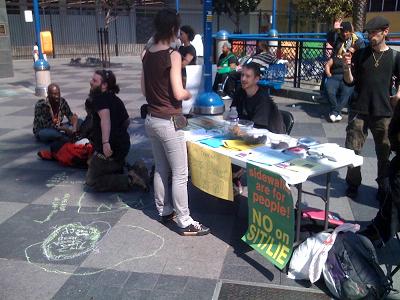
Proponents of criminalizing sitting or lying on San Francisco sidewalks have seen their prospects of success steadily dwindle in the last week, starting with the creative and well-covered Stand Against Sit-Lie protests on March 27 and continuing through last week’s Planning Commission vote against the measure to yesterday’s debate on BBC’s The World, in which opponent Andy Blue clearly bested proponent Ted Loewenberg.

In fact, Blue and his grassroots band of progressive allies deserve tremendous credit for flipping the momentum on the issue away from the narrative pushed by Mayor Gavin Newsom, Police Chief George Gascon, and the reactionary Haight area property owners from Loewenberg’s Haight Ashbury Improvement Association.

While Newsom and Loewenberg tried to argue this was about giving police another “tool” to use against violent street ruffians, Blue and the progressives have correctly pointed out that the overblown examples proponents cite (ie hoodlums punching passersby, barricading businesses, and spitting on babies) are already illegal and that the law actually punishes the simple act of lounging in public.

That argument by progressives got strong support from a Planning Department report on how the sit-lie ordinance cuts against a variety of city policies and goals that promote open space and using sidewalks for more than just transportation, a view that the Planning Commission endorsed on a surprisingly lopsided 6-1 vote, with even Newsom’s appointees crossing him on the issue.

Few members of the Board of Supervisors have embraced the push for sit-lie, so it’s likely to be dead-on-arrival when the board considers it later this month, but Blue’s group isn’t taking any chances. Stand Against Sit Lie is planning another day of creative protest – with more sidewalk picnics, games, and maybe a return of Chicken John’s sidewalk hot tub – on April 24.

The Daily Blurgh: Splinters of the cross

0

Curiosities, quirks, oddites, and items from around the Bay and beyond

An unbelievably hermetically sealed spherical inalienable maze of light and sound seeing imagery expand in every direction.”

I was reminded of the words of visionary architect and late SF resident Achilles Rizzoli – who spent his life drafting gorgeous symbolic portraits of friends, family, and loved ones as fantastic buildings, the cornerstones of which would never be laid – when I saw this Wired video that Boing Boing posted about Rohnert Park artist Scott Weaver’s enormous sculpture of San Francisco done entirely in toothpicks.

Weaver has been at work on his creation for nearly three decades, having turned down multiple offers last year from Ripley’s Believe It or Not! Museum to buy what he views as an example of, as he told KGO at the time, “what can be done in life if you create and use your imagination.”

“But is toothpick art woodworking?” asks Fine Woodworking Senior Editor, Tom McKenna, in an article from last August about artist Steven J. Backman, who he describes as, “perhaps the preeminent toothpick sculptor in the country.” If Weaver’s accomplishment evokes Bosch’s Garden of Earthly Delights by its fantastic condensation, Backman’s pieces – many of which are based on local landmarks and attractions, such as the Golden Gate Bridge or a trolley car – go the route of Picasso’s early still life paintings, their forms connoted through pared down lines and simple, pronounced shapes. Even SF Mayor Gavin Newsom gave his seal of approval back in 2005, proclaiming January 11th of that year to be Steven J. Backman Day.

Backman’s art is a wonder of engineering. But Weaver’s is simply wondrous.


But what wonders of mental engineering also lurk in the virtual-pet analogue world?


And now, again, just in time for Easter, we turn to an Andy Rooney-inspired feature I’d like to call: “You got my goat!”

Do you Want Men Dressed as Women Teaching Your Kids?”

Hell yes!

But listen up, Traditional Values Coalition. We need to talk about your look. It’s busted. Don’t you know ominous, dark clouds went out of fashion after everyone and their mother mocked the National Organization for Marriage’s “Gathering Storm” ad? Weak. Sauce.

What you need is some drag queen valkyries or some shit like that thundering out of the heavenly maw, ready to swoop down and piss on the souls of those studious young folk, whose preciousness is so inviolate as to make Justin Bieber look like the next jailbait-hungry mark to get punked on To Catch a Predator (just give him time).

If you want fierce, bitch, you gotta go Wagner.

Caltrain faces deep cuts, perhaps even closure

13

Serious doubt was cast over the future of Caltrain today, with this vital commuter rail link threatened by the same funding cutbacks that are hobbling other regional transit agencies. The joint-powers agency might be forced to cut its service in half this summer – probably by eliminating night and weekend service — or perhaps even shutting the system down.

San Francisco Municipal Transportation Agency is in a fiscal emergency and moving ahead with service cuts and small but controversial revenue enhancements, all approved Tuesday by its Board of Directors, and the nearby San Mateo County Transit District (SamTrans) and Santa Clara Valley Transportation Authority (VTA) are in similarly desperate straits.

Those three agencies run Caltrain, and all have had to scale back their funding commitments in order to preserve bus and light rail services in their core communities. “We’re rapidly approaching a cliff,” Caltrain CEO Mike Scanlon told the Caltrain Board of Directors today, according to the San Mateo Times. “It’s going to be very, very painful. It’s probably going to force people back on congested freeways.”

Caltrain spokesperson Mark Simon told the Guardian that the agency is fully funded through the current fiscal year that ends June 30, but after that, “I don’t know how long we can survive.”

“I don’t think I need to tell someone at the San Francisco Bay Guardian how bad things are at the SFMTA,” he said, adding that the situation is as bad or worse at the other two agencies, and that Caltrain has no other sources of operating revenue.

“That issue has come to a head and it’s come to a head because the state has zeroed out how much money it gives to public transit,” Simon told us. “What’s really heartbreaking is that this is a time when we should be adding service.”

Indeed, Caltrain has been moving ahead with plans to electrify its track, which would increase train speed and therefore system capacity while polluting less. But while it seeks federal grants for that capital project, the operating funds that have traditionally come from the state via SFMTA, VTA, and SamTrans have dried up (state and federal transportation funds are strictly divided between capital and operating funds).

Unlike Caltrain, SFMTA and many other transit agencies have the authority to put general tax measures on the ballot to fund transit services, but so far in San Francisco, neither Mayor Gavin Newsom nor the seven SFMTA board members he appointed have shown any leadership is doing so.  

Newsom wants more authority for party-crashing cops

12

At a time of rising concern about police crackdowns on San Francisco nightlife – including the use of unprovoked brutality, selective harassment, and punitive property seizures – it would seem a strange time to call for abolishing the Entertainment Commission and returning its authority to the San Francisco Police Department. But Mayor Gavin Newsom has now called for doing just that.

Newsom last week refused calls to get involved with mediating a nasty dispute between the SFPD and nightlife workers and advocates, who have filed claims and lawsuits against the city alleging improper police behavior, including a racketeering lawsuit and another lawsuit alleging police retribution against promoter Arash Ghanadan for complaining about mistreatment, for which Police Chief George Gascon is scheduled for a video deposition on April 8 (other depositions involving Gascon and the undercover partners Officer Larry Bertrand and ABC agent Michelle Ott will follow in coming weeks).

The police crackdown, the subject of recent cover stories in both the Guardian and the SF Weekly, has been underway for more than a year and nightlife advocates say it is reminiscent of the arbitrary police enforcement against disfavored clubs and parties in the late 1990s that led to the creation of the Entertainment Commission in the first place.

Making Newsom’s new stance even more puzzling, the commission has been responsive to the overhyped criticism of the commission by nightlife critics, some politicians, and the San Francisco Chronicle and Examimer. The commission voted last night to suspend Suede for shooting out front, a decision that Board of Supervisors President David Chiu (whose North Beach constituents have put pressure on him to rein in problem clubs) cast as a litmus test for the commission, and one it apparently passed. In addition, Commissioner Terrance Alan, who had been criticized for his conflicts of interest, last week announced that he will be stepping down from the commission when his term expires in June. 

“Isn’t anyone paying attention? It’s really got me baffled,” Alan said of the continuing calls to kill the commission. “I don’t know what this is about.”

He isn’t the only one. Commissioner Jim Meko, who had been critical of the commission’s industry-heavy makeup and reluctance to take aggressive action against problem clubs, told the Chronicle that turning permitting and enforcement over to the cops would be much worse.

Sen. Mark Leno, who as a supervisor created the commission back in 2002, agrees. He told us that he opposes the change proposed by Newsom.

“I strongly believe the original reasons for the creation of the commission, an inherent conflict in having the same body that enforces licensing to also issue those licenses, remains,” Leno told us.

Leno also noted that it was only in November that the Board of Supervisors voted to give the commission more authority to suspend the licenses of problem clubs, which they used with Suede, delivering the maximum penalty possible: a 30-day suspension.  

“If they just gave them additional authority, let’s give it a little time to work out before we talk about disbanding them,” Leno said. He also noted that it’s strange to see the mayor and supervisors criticizing the industry-heavy makeup of the commission considering that they’re the one who make those appointments: “That’s in the hands of the board and the mayor.”

Neither Chiu nor Newsom have returned our calls seeking comment, but several Guardian sources with long involvement in the conflict between the SFPD and the nightlife community say the cops – particularly hardasses like Commander James Dudley, who has often made comments critical of nightlife and its promoters — have long sought to have more power over nightclub, private parties, and the citizens who attend them.

But until there is a fair airing of and resolution to the trend of overzealous and belligerent enforcement actions by the SFPD, any move to give that agency more authority to kill the fun in San Francisco is likely to be met with heavy opposition.


UPDATE: David Chiu just got back to me, saying Newsom hadn’t consulted him before taking his stand and telling us, “I don’t agree that we need to abolish the commission.”

But as the supervisor from a sometimes-rowdy district that includes a couple of clubs where violence has occurred, Chiu does want to make some changes in how nightlife is governed in San Francisco, seeing a conflict between the Entertainment Commission’s role promoting nightlife and regulating it: “The Entertainment Commission has conflicting missions.”

Chiu said he would like to see nightclub permitting turned over to a body like the Interdepartmental Staff Committee on Traffic and Transportation (ISCOTT), which handles street closure permits and has representatives from several city agencies. It would exist alongside the Entertainment Commission, whose work Chiu said has become “overly politicized” in recent months.

At the same time, Chiu said, “I generally agree with” the Guardian’s coverage of the War of Fun, and said that he’s helped facilitate meetings with SFPD to deal with issues like the inappropriate police seizures of DJ’s laptops: “From my perspective, I want to make sure people’s civil rights aren’t being violated.”

But Chiu said the problem seems to lie more with the California Department of Alcoholic Beverage Control than the SFPD: “It appears the ABC has been inappropriately cracking down on the mainstream venues that are trying to do the right thing.”

Chiu said there isn’t a pressing need to act quickly on the Entertainment Commission issue and said that he would work with Leno on the solution, something Leno confirmed, telling us, “I have had some conversations with David Chiu and I’m going to get more involved.”

A very special piece of fan mail

The Guardian recently received a hostile letter in response to last week’s cover story, The New War on Fun, which spotlighted the aggressive tactics of two undercover officers at the center of a crackdown on San Francisco nightlife.

Unable to verify the author’s identity, we’ve withheld his name. As champions of free speech, however, we decided to give this writer an opportunity to share his opinion not just with the writers he seeks to attack, but a wider audience of readers, who undoubtedly also hold strong opinions. While this letter might amount to hot air from one individual whose opinion holds about as much sway as any internet troll creeping across the blogosphere, airing it can perhaps shed some light on the mindset of someone who would position progressive values — not to mention fun in San Francisco — squarely in the crosshairs. And it’s kind of funny, too.

The other thing is that the far right has touched off a great deal of discussion as of late, with its bizarro streak on full public display. Receiving a letter crammed with hate-filled speech while witnessing pockets of far-right extremists grab headlines, we thought it best not to ignore it, but to call attention to it.

Without further ado, here is the colorful opinion of one pissed-off Guardian reader, in mostly raw form. 

Dear MR Jones and MRS Bowe
I am writing to you about your story in the SF Bay Guardian Titled The New War On Fun. I think it is in bad taste the way you are putting down fine
officers like Larry Bertrand from the San Francisco police Dept And officer Michelle Ott from the Alcohol Beverage and Control these two officers are doing what they are paid to do and that is to protect the citizens of the city and County of San Francisco. And if they have to CRACK A FEW SKULLS OPEN TO DO IT SO BE IT. I wish this city had a few dozen more OFFICERS like Bertrand and OTTS. Then this city would be a much safer place to live. I mean if these promoters of theses events obey by the laws then everything would be fine but in my opinion these parties should not be allowed in the first place. For where ever A large Group of people gather and there is Booze present there bound to be trouble. and if these promoters are to STUPID to realize that then i say to bad for them if POLICE OFFICERS LIKE BERTRAND AND OTT HAVE TO BUST UP THE PARTY AND START DOING SOME HEAD BUTTING AND ARRESTING ALL THOSE INVOLVED all I can say to that is OH WELL MORE POWER TO THESE FINE EXAMPLES OF POLICE OFFICERS . Even if it means confiscating every piece of equipment there. And making a few arrest even better.

For I know that a lot of the people that attend these after hour events are MINORS and way under the legal drinking age. I know this for a fact for I have a good friend that use to be a bartender in one of these after hour clubs and he told me he has seen more teenagers in these clubs getting loaded to the gills. he told me that some of the other bartenders never asked to see there id’s they just took there money and gave them there drinks. My friend got reprimanded several times from the promoters of the event as well as his boss for asking for there ID’S. Look these places will let any one in if they just look older. OR they slip the Doorman a few bucks and he looks the other way. And all i can say about the Promoter’S AND THE OWNERS OF THE PLACES WHERE THESE PARTIES TAKE PLACE THEY SHOULD KNOW THAT FINE OUTSTANDING OFFICES LIKE LARRY BERTRAND AND MICHAEL OTT show up knowing there record for doing so is TOO BAD FOR THEM..

But on the other hand what can i expect from a LIBERAL YELLOW JOURNALISTIC RAG LIKE THE SF BAY GUARDIAN TO RUN A ONE SIDED PIECE OF TRASH STORY AND MAKING THE COPS LOOK LIKE THE BAD GUYS. AND MAKING THESE POOR PROMOTERS AND CLUB OWNERS AND PARTY GOER’S INNOCENT VICTIMS OF CIRCUMSTANCES. HELL THESE CLUB OWNERS ARE BREAKING THE LAW BY SELLING BOOZE TO UNDER AGE MINORS THEN THESE GUYS GET DRUNK AND THEN TRY TO DRIVE HOME WHERE SOME OF THESE IDIOTS BLOOD ALCOHOL IS WAY ABOVE THE LEGAL LIMIT. SO THEN THEY EITHER KILL SOME INNOCENT PERSON OR KILL THEM SELVES. AND ITS LIBERAL REPORTERS LIKE YOURSELVES AND THE BOARD OF STUPID-VISORS IN THIS CITY THAT AGREE TO THESE EVENTS.

If I were Mayor of this City I would call a press conference with every major news paper TV And Radio and make EXCELLENT EXAMPLES OF THESE TWO FINE OFFICERS. And to give them each a certificate of Merit and Valor in going beyond there call and line of duty. MR JONES AND MRS BOWE I bet you would be singing a different tune if someone you know and love got hurt or killed by someone who left one of these after hours events loaded with BOOZE and tried to drive home and got in to a wreck and killed themselves or killed or crippled an innocent person and that person could be someone you know. And then again knowing liberals like i do you might say oh-well they were just in the wrong place at the wrong time.

I Emailed a copy of yourarticle To my Uncle who is a retired NY CITY Police OFFICER of 40 years. And he has several awards and medals for Valor and Bravery and for doing things beyond the CALL OF DUTY. He Said if these STUPID PROMOTERS tried that in HIS CITY not only would they be facing jail time and major fines. they might have a little accident on the way to the squad car and to the station-house. He did not say what kind of accident but knowing him it would be one they would not forget. For my uncle is also an ex UNITED STATES NAVY SEAL TRAINER. SO he knows how to inflect excruciating Paine on someone without leaving any signs of what happened. My Uncle hates these SOB’S who throw these types of parties for legal reasons and for personal reasons. and he got infuriated when he read your article. HE called your paper A PIECE of SHIT paper that he would not even let his bird CRAP ON.

but he said what do you expect from a STUPID CITY LIKE SAN FRANCISCO WHERE THE F—– PRACTICALLY RUN THE TOWN. AND WHERE MOST OF THE PEOPLE VOTED FOR THAT N—– OBAMA. AND THAT UGLY WITCH NANCY PELOSI. WELL IKE I SAID I HOPE THAT THESE
PROMOTERS AND CLUB OWNERS GET MORE THEN JUST A SLAP ON THE WRIST AND A FINE I SAY THAT THEY SHOULD BE TOSSED IN JAIL AND OR PRISON FOR WHAT THEY ARE DOING HOLDING THESE EVENTS AND LETTING MINORS IN TO THESE EVENTS AND LETTING THEM GET STONED. BUT THEN IF IT WERE NOT FOR LEFTIST MAGAZINES LIKE THE SAN FRANCISCO BAY GUARDIAN THEY WOULD NOT GET ANY PUBLICITY AT ALL. AND IF THESE STUPID PROMOTERS AND CLUB OWNERS DON’T LIKE BEING FORCED TO OBEY THE LAW THEN LET THESE STINKING PROMOTERS AND CLUB OWNERS FACE THE FULL WRATH OF THE LAW . .

SO ALL I CAN SAY ABOUT YOUR ARTICLE IS IT IS A LEFT WINGED PIECE OF YELLOW JOURNALISM. THE SAME TYPE OF LEFT WINGED COMMUNISTIC PROPAGANDA THEY USE TO PUT OUT IN THE 60’S SO TAKE CARE YOU TWO PINKO COMMY AND TO YOUR LEFT WINGED COMMY PAPER YOU WRITE FOR. NO WOUNDER IT’S FREE NO ONE WOULD WANT TO BY IT. AND YOU HAVE TO PAY FOR YOUR PAPER BY LETTING SICK PROMOTERS OF PERVERTED PORNOGRAPHY ADVERTISE IN IT AND THESE SO CALLED DOPE DESPNCERIES WHO I THINK SHOULD BE ALL SHUT DONE PERMANENTLY AND THE PEOPLE WHO OWN THEM BE THROWN IN TO A MAXIMUM FEDERAL PRISON FOR AT LEAST 40 YEARS WITH NO CHANCE OF PAROLE.

SINCERELY,

[name withheld]

Trash talk

3

Sarah@sfbg.com

The battle to win San Francisco’s lucrative garbage disposal contract turned nasty as city officials tentatively recommended it go to Recology (formerly Norcal Waste Systems), causing its main competitor, Oakland-based Waste Management, to claim the selection process was flawed and bad for the environment.

Recology is proposing to dispose of San Francisco’s nonrecyclable trash at its Ostrom Road landfill in Yuba County, which is double the distance of the city’s current dump. The contract, worth hundreds of millions of dollars, would run until 2025.

For the past three decades, the city has trucked its trash 62 miles to the Altamont landfill near Livermore, under an agreement that relied on the services of the Sanitary Fill Company (now Recology’s SF Recycling and Disposal) and Oakland Scavenger Company (now Waste Management of Alameda County).

That agreement allowed up to 15 million tons of San Francisco’s municipal solid waste to be handled at Altamont or 65 years of disposal, whichever came first. As of Dec. 31, 2007, approximately 11.9 million tons of the capacity had been used, leaving a balance of 3.1 million tons, which the city estimates will be used up by 2015.

Currently Recology collects San Francisco’s curbside trash, hauls it to Pier 96, which is owned by the Port of San Francisco, then sends nonrecyclables to the Altamont landfill operated by Waste Management.

After SF’s Department of the Environment issued a request for qualifications in 2007, Waste Management, Recology, and Republic Services were selected as finalists. The city then sent the three companies a request for proposals, asking for formal bids as well as details of how they would minimize and mitigate impacts to the environment, climate, and host communities, among other criteria.

Republic was dropped after a representative failed to show at a mandatory meeting, and Recology was selected during a July 2009 review by a committee composed of DOE deputy director David Assmann, city administrator Ed Lee and Oakland’s environmental manager Susan Kattchee.

The score sheet suggests that the decision came down to price, which was 25 percent of the total points and made the difference between Recology’s 85 points and Waste Management’s 80 in the average scores of the three reviewers. But the scores revealed wide disparities between Kattchee’s and Lee’s scores, suggesting some subjectivity in the process.

For instance, Kattchee and Lee awarded Recology 15 and 23 points, respectively, for its “approach and adherence to overarching considerations.” Kattchee awarded 13 points to Recology’s “ability to accommodate City’s waste stream,” while Lee gave it 24 points. And Kattchee awarded Waste Management 13 points and Lee gave it 20 for its proposed rates.

When the selections and scores were unveiled in November, Waste Management filed a protest letter; Yuba County citizens coalition YUGAG (Yuba Group against Garbage) threatened to sue; and Matt Tuchow, president of the city’s Commission on Environment, scheduled a hearing to clarify how the city’s proposals was structured, how it scored competing proposals, and why it tentatively awarded Recology the contract.

Emotions ran high during the March 23 hearing, which did little to clarify why Recology was selected. Assmann said that much of the material that supports the city’s selection can’t be made public until the bids are unsealed, which won’t happen until the city completes negotiations with Recology and the proposal heads to the Board of Supervisors for approval.

YUGAG attorney Brigit Barnes said Recology’s proposal could negatively affect air quality in Alameda, Contra Costa, Solano, Yolo, Sacramento, and Yuba counties, and does not attain maximum possible reductions of greenhouse gas emissions. Barnes pointed to a study commissioned by Waste Management showing the company’s biomethane-fueled trucks emit 68 percent fewer greenhouse gases than Recology’s proposed combination of trucks and trains.

Barnes further warned that Recology’s proposal might violate what she called “environmental justice strictures,” noting that “Yuba County has one of the lowest per capita incomes and one of the highest dependent populations in the state.”

She also claimed that awarding the contract to Recology would create a monopoly over the city’s waste stream and could expose the city to litigation. “Every aspect of garbage collection and waste treatment will be handled by Norcal’s companies,” Barnes stated, referring to antitrust laws against such monopolies.

Deputy City Attorney Tom Owen subsequently confirmed that the two main companies that handle San Francisco’s waste are Recology subsidiaries. “But it’s an open system,” Owen told the Guardian. “Recology would be the licensed collectors and would have the contract for disposal of the city’s trash.”

Irene Creps, a retired schoolteacher who lives in San Francisco and Yuba County, suggested at the hearing that the city should better compare the environmental characteristics of Ostrom Road and the Altamont landfill before awarding the contract. She said the Ostrom Road landfill poses groundwater concerns since it lies in a high water table next to a slough and upstream from a cemetery.

“It’s good agricultural land, especially along the creeks, red dirt that is wonderful for growing rice because it holds water,” Creps said of Recology’s site. “I’d hate to see that much garbage dumped on the eastern edge of Sacramento Valley.”

Livermore City Council member Jeff Williams said the Altamont landfill has the space to continue to dispose of San Francisco’s waste and he warned that Livermore will lose millions of dollars in mitigation fees it uses to preserve open space.

“Waste Management has done a spectacular job of managing the landfill and they have a best-in-their-class methane control system,” Williams said, noting that the company runs its power plants on electricity and its trucks on liquid methane derived from the dump.

Williams pointed out that the Altamont landfill is in a dry hilly range that lies out of sight, behind the windmills on the 1,000-foot high Altamont Pass. “It’s many miles from our grapevines, in an area used for cattle grazing because it’s not particularly fertile land,” Williams said. “We are filling valleys, not building mountains.”

Waste Management attorney John Lynn Smith told the commission that the city’s RFP process was flawed because it didn’t request a detailed analysis of transportation to the landfill sites or fully take into account greenhouse gas emissions, posing the question: “So, did you really get the best contract?”

David Gavrich, who runs San Francisco Bay Railroad and Waste Solutions Group, testified that he helped negotiate the city’s contract 35 years ago, saving taxpayers hundreds of millions of dollars, and that the city needs to be smarter about this contract.

Gavrich and port director Monique Moyer wrote to the Department of the Environment in June 2009, stating their belief that shipping trash by rail directly from the port “can not only minimize environmental impacts, but can also provide an anchor of rail business from the port, and a key economic engine for the local Bayview-Hunters Point community, and the city as a whole.” But Gavrich said DOE never replied, even though green rail from San Francisco creates local jobs and further reduces emissions.

“Let the hearings begin so people get more than one minute to speak on a billion-dollar contract,” Gavrich said, citing the time limit imposed on speakers at the commission hearing.

Wheatland resident Dr. Richard A. Paskowitz blamed former Mayor Willie Brown’s close connection to Recology mogul Michael Sangiacomo for the company’s success in pushing through a state-approved 1988 extension of its Ostrom Road Landfill while assuring Yuba County residents that the site would only be used as a local landfill.

“The issue is that Yuba County is becoming the repository of garbage from Northern California,” Paskowitz said, claiming that the site already accepts trash from Nevada.

Members of the commission told Assmann that they wanted an update on the transportation issue, but they appeared to believe the process was fair. “One guy got the better score,” Commissioner Paul Pelosi Jr. said. “The fact that they may or may not have permits or the best location, that’s for the Board of Supervisors to take up.”

Recology spokesperson Adam Alberti told the Guardian that its bid was predominantly about handling the waste stream. “Everybody’s bid included transportation, so you include the cost of getting the trash there. But primarily we were looking at the cost of handing the city’s waste,” Alberti said. “Recology’s Ostrom Road facility has more than enough capacity to hold not only San Francisco’s, but also the surrounding region’s, waste.”

Alberti said Recology is still pursuing a permit for a rail spur to get the waste from Union Pacific’s line, which ends some 100 yards from Ostrom Road site. Still, he said the company is confident it will be awarded, calling this step “a pro forma application with Yuba County.” Alberti also noted that it’s normal for host communities to object to landfills but that Yuba County stands to gain $1.6 million from the deal in annual mitigation fees.

Assmann told the Guardian the selection process took into account issues raised at the hearing. “The important thing in a landfill is to make sure there is no seepage, no matter how much rainfall there is, “Assmann said. “And there are still two hurdles Recology needs to clear: a successful negotiation, and the approval of the board.”

Our Endorsements: For DCCC

10

The Democratic County Central Committee isn’t the most high-profile elected agency in San Francisco, but it’s really important. The committee sets policy for the local Democratic Party — and that includes endorsements. The people who control the committee control a slate card that goes out to every registered Democrat in the city, and that’s a vast majority of the voters. DCCC endorsements, carrying the imprimatur of the party, have a significant impact on local elections, particularly in district supervisor races.

For years, the DCCC was controlled largely by the old Brown-Burton machine, but two years ago, the progressives took back control, and that made a huge difference in electing good supervisors. The DCCC endorsement will also matter in the next mayor’s race.

The folks downtown realize this. David Latterman, a political consultant who often works with more moderate candidates and interest groups, sent a memo out March 17 titled “Headed toward the cliff in 2010 elections.” The memo, which we’ve obtained, argues that downtown and the moderates need to get organized, now: “If we can have one person run a coordinated effort with $150K … we can really pick up DCCC seats. Only a few will make a difference in the fall endorsements. The mayor’s race starts now.”

So it’s crucial that the progressives turn out to vote June 8, and vote for strong candidates for the DCCC who will support district elections, public power, tenant rights — and progressive candidates for supervisor.

We’ll be publishing endorsements for all of the June primary races and ballot measures in a few weeks, but we’ve decided to do early endorsements for the DCCC. Twelve people are elected from each assembly district. Here are our choices:


ASSEMBLY DISTRICT 12

John Avalos

Michael Borenstein

Sandra Lee Fewer

Chris Gembinski

Hene Kelly

Eric Mar

Milton Marks

Jake McGoldrick

Jane Morrison

Melanie Nutter

Connie O’Connor

Larry Yee


ASSEMBLY DISTRICT 13

David Campos

David Chiu

Michael Goldstein

Robert Haaland

Joseph Julian

Rafael Mandelman

Kim-Shree Maufas

Carole Migden

Aaron Peskin

Eric Quezada

Alix Rosenthal

Debra Walker


Editorial: CCA: Get it done by the deadline

1

If the mayor and his handpicked PUC director, Ed Harrington, and his handpicked commissioners dawdle and delay, they’ll be giving a corrupt private utility exactly what it wants

EDITORIAL San Francisco has been talking about creating a community-choice aggregation system to sell cleaner electricity for five years now. There have been hearings, studies, debates, discussions, and negotiations. And now it’s coming down to the wire: to avoid the prospect of a Pacific Gas and Electric Company initiative on the June ballot that cuts the city’s effort off at the knees, San Francisco officials need to get CCA up and running before June 8.

But the mayor and the Public Utilities Commission don’t seem to have any sense of urgency. And the slow pace of negotiations with the contractor that would handle the electricity purchases is playing right into PG&E’s hands. If the mayor and his handpicked PUC director, Ed Harrington, and his handpicked commissioners dawdle and delay, they’ll be giving the corrupt private utility exactly what it wants.

It’s particularly frustrating since Marin County – which, unlike San Francisco, has no federal mandate for public power – is far ahead of this city, has a CCA program ready to go, and most likely won’t be affected by the PG&E initiative. What on earth is wrong with San Francisco?
CCA would allow the city to create the equivalent of an electricity buyer’s co-op, so that San Francisco could purchase electricity in bulk from providers that offer a more renewable mix. PG&E gets only a tiny portion of its power from renewables. With the advantage of wholesale purchases and no corporate profit, the city ought to be able to offer lower rates.

The contractor that won the bid to put the co-op together, Power Choice LLC, is run by people with substantial experience in the electricity business. The city’s been in talks with Power Choice about a contract since Feb. 9 – but progress is slow.

Harrington told us that he expects to have “a contract as soon as we can get a contract” but there’s no deadline. That’s crazy – there’s a very real deadline looming, a time bomb planted by PG&E, and the city needs to take it seriously. PG&E has used vast sums of corporate money to place a measure on the June ballot that would make it almost impossible to create new public-power entities; Proposition 16 would mandate a two-thirds local vote for any public agency that wants to sell retail electricity. And the company is spending $35 million on a campaign to get it passed.

That election is barely two months away – and if Prop. 16 passes before San Francisco has a signed contract and a CCA program under way, five years of work, led by Sup. Ross Mirkarimi and the Local Agency Formation Commission, could be for nothing. The best chance the city has to fight global warming, promote renewable energy, take control of its own energy future, and offer more stable, cheaper rates to customers could be gone, forever.

What’s the hang-up? Nobody’s talking, since the negotiations are still ongoing, but from what we hear, Harrington, Newsom, and the PUC members are worried about “risk” – that is, the risk that the San Francisco CCA might have to raise rates above what PG&E is currently charging to make the numbers pencil out. (Part of the risk: PG&E will have 60 days to try to convince customers to "opt out" of the CCA and stay with the private utility. If a critical mass of residents and businesses doesn’t stick with the CCA program, the economics could be dicey.)

But the risk discussions are missing a critical point: PG&E’s rates are going to go up, dramatically, over the next few years. The company already has an application for a stiff rate hike this year, and it’s inconceivable that the utility’s prices will do anything but continue to climb. So meeting the current rates is a moot point. And as Harrington acknowledged, renewable power rates are "much, much more stable than natural gas, oil, those kinds of things."

Besides, the real risk is that San Francisco will continue to violate the Raker Act and allow PG&E’s illegal monopoly to continue unabated. The PUC needs to get moving, now. Harrington should set a deadline, well in advance of the June election, and direct his staff to make every possible effort to get the program going by then. Newsom should publicly announce his support for the project and demand that the PUC finish its work in time to beat PG&E’s anti-public-power measure (unless he wants to run for lieutenant governor as the mayor who went back on his own positions and allowed PG&E to control the city).

Because right now, the only thing that has to happen for PG&E to win is nothing. *

CCA: Get it done by the deadline

1

EDITORIAL San Francisco has been talking about creating a community-choice aggregation system to sell cleaner electricity for five years now. There have been hearings, studies, debates, discussions, and negotiations. And now it’s coming down to the wire: to avoid the prospect of a Pacific Gas and Electric Company initiative on the June ballot that cuts the city’s effort off at the knees, San Francisco officials need to get CCA up and running before June 8.

But the mayor and the Public Utilities Commission don’t seem to have any sense of urgency. And the slow pace of negotiations with the contractor that would handle the electricity purchases is playing right into PG&E’s hands. If the mayor and his handpicked PUC director, Ed Harrington, and his handpicked commissioners dawdle and delay, they’ll be giving the corrupt private utility exactly what it wants.

It’s particularly frustrating since Marin County — which, unlike San Francisco, has no federal mandate for public power — is far ahead of this city, has a CCA program ready to go, and most likely won’t be affected by the PG&E initiative. What on earth is wrong with San Francisco?
CCA would allow the city to create the equivalent of an electricity buyer’s co-op, so that San Francisco could purchase electricity in bulk from providers that offer a more renewable mix. PG&E gets only a tiny portion of its power from renewables. With the advantage of wholesale purchases and no corporate profit, the city ought to be able to offer lower rates.

The contractor that won the bid to put the co-op together, Power Choice LLC, is run by people with substantial experience in the electricity business. The city’s been in talks with Power Choice about a contract since Feb. 9 — but progress is slow.

Harrington told us that he expects to have "a contract as soon as we can get a contract," but there’s no deadline. That’s crazy — there’s a very real deadline looming, a time bomb planted by PG&E, and the city needs to take it seriously. PG&E has used vast sums of corporate money to place a measure on the June ballot that would make it almost impossible to create new public-power entities; Proposition 16 would mandate a two-thirds local vote for any public agency that wants to sell retail electricity. And the company is spending $35 million on a campaign to get it passed.

That election is barely two months away — and if Prop. 16 passes before San Francisco has a signed contract and a CCA program under way, five years of work, led by Sup. Ross Mirkarimi and the Local Agency Formation Commission, could be for nothing. The best chance the city has to fight global warming, promote renewable energy, take control of its own energy future, and offer more stable, cheaper rates to customers could be gone, forever.

What’s the hang-up? Nobody’s talking, since the negotiations are still ongoing, but from what we hear, Harrington, Newsom, and the PUC members are worried about "risk" — that is, the risk that the San Francisco CCA might have to raise rates above what PG&E is currently charging to make the numbers pencil out. (Part of the risk: PG&E will have 60 days to try to convince customers to "opt out" of the CCA and stay with the private utility. If a critical mass of residents and businesses doesn’t stick with the CCA program, the economics could be dicey.)

But the risk discussions are missing a critical point: PG&E’s rates are going to go up, dramatically, over the next few years. The company already has an application for a stiff rate hike this year, and it’s inconceivable that the utility’s prices will do anything but continue to climb. So meeting the current rates is a moot point. And as Harrington acknowledged, renewable power rates are "much, much more stable than natural gas, oil, those kinds of things."

Besides, the real risk is that San Francisco will continue to violate the Raker Act and allow PG&E’s illegal monopoly to continue unabated. The PUC needs to get moving, now. Harrington should set a deadline, well in advance of the June election, and direct his staff to make every possible effort to get the program going by then. Newsom should publicly announce his support for the project and demand that the PUC finish its work in time to beat PG&E’s anti-public-power measure (unless he wants to run for lieutenant governor as the mayor who went back on his own positions and allowed PG&E to control the city).

Because right now, the only thing that has to happen for PG&E to win is nothing. *

Yee’s two-fer: Bashing Palin while promoting sunshine

5

Sen. Leland Yee scored a two-fer yesterday when he blasted a California State University organization for hiding how much it’s playing Sarah Palin for a speaking gig, raising an important sunshine issue and knocking Palin’s populism-for-pay schtick in the process. And at the heart of the issue is how public education institutions increasingly use foundations to avoid accountability.

That issue was recently raised in San Francisco, when City College Foundation sought to keep its financial dealings secret. The Guardian sounded the alarm last month, and City College Trustee John Rizzo, who led the fight for more sunshine, negotiated a more open arrangement that the Board of Trustees unanimously approved last week.

“We got most of what we wanted,” Rizzo told us. “Most of the things are open and they have to give us a quarterly report on donations.”

Yee – who the Society of Professional Journalist-NorCal recently honored with a James Madison Award for his struggles to promote greater government transparency and protections for journalists – has long been fighting for more sunshine in the CSU and UC systems, which is particularly important as they make deep cuts to higher education spending. For example, Yee’s Senate Bill 330 would explicitly require those systems to adhere to the California Public Records Act.    

“These are public institutions that should embrace transparency and accountability,” Yee said yesterday in a press release announcing his request that CSU-Stanislaus’s foundation disclose how much it is paying Palin for a $500 per head speech on June 25. The press release triggered a front-page story in today’s San Francisco Chronicle, with CSU and foundation officials rebuffing Yee’s request.

So now, Yee gets to bash Palin and make an important stand for sunshine, both of which will likely help his nascent campaign to be elected mayor of San Francisco next year.

As Yee wrote in a letter to campus President Hamid Shirvani, who also serves as the chair of the foundation: “The sensational nature of former Governor Palin’s political commentary, coupled with an ongoing book tour, has allowed her to charge top dollar for speaking engagements. As was reported in the media, her speaking appearances typically command $100,000 per event. To that end, I request the foundation to respond to the following issues: 1. Is the former governor being compensated by the CSUS Foundation in any form for her participation in the event on June 25th?  If so, please describe the amount and nature of the compensation being awarded to the former governor.  2. Please disclose any contracts between the former governor and the CSUS Foundation involving the June 25 speaking engagement.”

Later in the press release, he added: “The CSU should immediately disclose how much money is being diverted from students to pay Sarah Palin’s exorbitant speaking fees. At a time when students are struggling to afford an education at CSU, I would hope that spending potentially hundreds of thousands of dollars on a guest speaker for a black-tie gala would be low on the priority list.  Money that is spent on bringing an out-of-touch former politician to campus could be spent on scholarships and other financial assistance during these challenging budget times.”

Win or lose, this is the right fight for Yee, both morally and politically. Go git ‘er!

Deadline looms for San Francisco’s green power program

Negotiations between city government and Power Choice LLC, a contractor selected to implement San Francisco’s Community Choice Aggregation (CCA) program, began Feb. 9. Almost seven weeks later, there’s still no end in sight — but if a deal isn’t secured soon, San Francisco could risk losing an opportunity to implement a cutting-edge green power program that would significantly reduce the city’s reliance on fossil fuels and give customers an alternative electricity provider.

About a half-decade of studies, debate, public meetings, and input from all sides have brought San Francisco’s CCA to the threshold of finally becoming a reality. The program would offer an energy mix comprised of 51 percent renewable power by 2017 for those who opted in.  

Assuming the program can operate successfully without an adverse impact to customers’ wallets, San Francisco could become a shining example of how to transition to a more sustainable energy model. It could represent giant step — rather than an inch-by-inch crawl — toward carbon-free power generation serving the needs of a major U.S. city.

As the negations drag on and a serious deadline looms closer and closer, some observers are growing anxious. No one can tell for sure what’s happening behind closed doors, but one thing is certain: PG&E is spending millions to try and torpedo CCA through a sophisticated public relations campaign, and it would have a much easier time derailing the project if it met with delays. PG&E would lose some of its customer base if the CCA program were a success.

PG&E has, intentionally or not, imposed a critical deadline on San Francisco’s CCA program implementation by introducing Proposition 16 — a ballot initiative that could slam shut this window of opportunity. Prop 16 would require a two-thirds majority vote before any CCA statewide could get off the ground, making it almost impossible to move forward.

If San Francisco’s CCA program hasn’t gotten underway by June, when Californians will vote on Prop 16, years of effort could be rendered futile if the initiative passes.

As SFPUC General Manager Ed Harrington told the Guardian, “We will get a contract as soon as we can possibly get a contract — but I can’t tell you the date.”

Several things would have to happen before the June deadline in order to guarantee that the city’s CCA would not be affected by the outcome of Prop 16. The program contract would have to be approved by the SFPUC, signed off on by the Board of Supervisors, and a 60-day opt-out period would need to be initiated before the start of service.

With so much to do in such little time, some observers are worried that the whole thing could fall apart. “Something seems to be awry,” noted John Rizzo of the Sierra Club, noting, “The PUC has historically fought and delayed CCA.”

The program is the product the joint efforts of two city bodies, the SFPUC and the Local Agency Formation Commission (LAFCo), which is chaired by Sup. Ross Mirkarimi. Historically, LAFCo and the SFPUC have not worked well together, with Mirkarimi trying to prod the power-and-water agency forward, and publicly bemoaning its recalcitrance.

Mayor Gavin Newsom — who has forged partnerships with PG&E in the past, received several campaign contributions from high-ranking PG&E employees, and traveled to Mexico on the utility’s dime — appoints commissioners to the SFPUC. The mayor’s apparent alliance with PG&E combined with his sway over the SFPUC has led program advocates to voice suspicion over the years that its progress was being hampered by something more than ordinary bureaucracy.

Harrington, who heads up the SFPUC, said everyone sitting at the negotiating table is well aware of the Prop 16 deadline.

“The hope is to do it, obviously, as fast as possible,” he said. “I think that we are doing well in terms of rate discussion [and] renewable discussion, they’re very much with us in terms of getting renewables as fast as possible, and meeting the goals that the Board [of Supervisors] and everybody else has set for years now.”

“But the real discussion at this point is risk,” he said. “And trying to figure out how that risk is done in a way that protects our customers and the city is a big deal.” A key program goal since the beginning has been to meet or beat PG&E rates, which will climb by some 30 percent in the next few years if its current rate-hike proposals are approved by state regulatory bodies.

“The other part is just how do you implement this?” Harrington continued. “You’re going to have to contract with people who will in turn contract with generators. What if one of them went under, what if there are price hikes? How do we step in for them?”

At the same time, Harrington acknowledged that in the long-term, this program has the capacity to shift the city’s electric and economic outlook by offering more stability, and minimizing risk.

“In general, the kinds of renewable power that we’re talking about are much, much more stable than natural gas, oil, those kinds of things,” he said. “And so while at the very first day of this we’re not going to own anything … as you start to have ownership interest in power supplies that are sustainable, renewable power, that price fluctuation should be a whole lot less, and our customers should be exposed to a whole lot less price fluctuation and risk than people who still have big things that are in natural gas and those areas.”

Harrington said he believed the CCA program would be attractive to San Franciscans because of its environmental edge. “I think people here want to take care of the world, they want to do things that are right. They probably don’t want to spend a lot of money to do it — and I don’t think they have to,” he said. “That’s the part that makes me crazy: If we can provide greener power for equal to or less than PG&E … why wouldn’t we try to do that for the city?”

Lawsuit could expose SFPD-ABC collaboration

43

Imminent legal actions against San Francisco, its Police Department, and the California Department of Alcohol Beverage Control could reveal whether a pair of undercover agents went rogue in harassing nightclubs and aggressively busting parties or whether they were acting at the direction of top officials.

Attorney Mark Webb – whose work on a racketeering lawsuit against the policing agencies was the subject of cover stories in the Guardian and the SF Weekly – told us that on Monday, he plans to file that racketeering claim against the city (which will then become a lawsuit if the city rejects it, as it routinely does) and a related lawsuit in Superior Court involving the rough, unnecessary arrest of bartender Javier Magallon and harassment of Mike Quan, owner of The Room, Playbar, and Mist. Narrated surveillance video associated with the case was posted on YouTube yesterday.

Central figures in the lawsuit are SFPD Officer Larry Bertrand and ABC agent Michelle Ott, plain-clothes partners in an aggressive crackdown on nightlife over the last year. Webb said he plans to immediately seek police records and communications and to depose Bertrand and Ott to try to determine who ordered the crackdown, why, and when higher-ups became aware of their aggressive tactics.

“I would like to know if Bertrand is being sent places or if he’s just a lone wolf, and the CADs will show that,” Webb said, referring to computer-assisted dispatch reports that track activities and communications involving individual officers. Those and other records that Webb can access through the court-ordered discovery process could finally shed light on what’s behind the crackdown.

Webb had sought to have Mayor Gavin Newsom mediate this dispute before the cases were filed, saying the racketeering lawsuit will be expensive and divisive, and all the nightlife community really wants is an end to the harassment and assurance that it wouldn’t restart once the media attention passes. And Webb did have conversations with top Newsom aide Mike Farrah and with Nicolas King, Newsom’s liaison to the SFPD, but neither indicated that Newsom was willing to get personally involved. Newsom spokesperson Tony Winnicker also told us Newsom preferred to let Police Chief George Gascon handle the matter.

So Webb said he now plans to move forward with litigation. “If they’re not answering the call at City Hall, let’s get into the arena,” Webb told us.

Webb is an experienced litigator who has won multi-million judgments and who started his career in New York City helping prosecute Racketeer Influenced and Corrupt Organizations (RICO) Act cases against the mob, and now he plans to use RICO laws against what he says is a city-state enterprise to interfere with lawful nightlife activities in San Francisco.

“Webb gets it. It’s a weird mentality, the really good trial attorneys, and Webb is that,” said attorney Mark Rennie, who has spent decades working with the city’s entertainment industry and has helped advise Webb on the case.

Among the parties involved in the RICO claim are those involved in Webb’s other lawsuit against the city, as well as Club Caliente, its owner Maurice Salinas, Azul, its owner John Bauer, New York nightclub owners Phillipe Rieser and David Brinkley, Vessel, and Siobhan Hefferman, who was arrested by Bertrand and Ott at a private party. Others may be added soon.

Great American Music Hall, Slims, and DNA Lounge also claim to have been harassed by the ABC and have been involved in several meetings that led up to Webb’s lawsuit, but they’re not taking part in the lawsuit yet, partially because they fear retribution from the ABC.

“I probably would have jumped in, but I don’t want to walk into a hearing suing the ABC,” Slims and GAMH general manager Dawn Holliday told us, referring to Slims’ April 1 appeals hearing stemming from noise complaint citations triggered by one particularly cranky neighbor.

DNA Lounge, which has regularly documented the harassment campaign on its blog, decided to wait with the other two clubs before joining the suit. “We thought it was important to stand as a community and there were too many venues that were worried about retribution from the police or ABC if they joined the suit,” DNA general manager Barry Synoground told us. 

But Synoground said he’s anxious to see what Webb’s suit unearths, noting that Bertrand and Ott haven’t been visible in recent weeks as complaints against them went public, and saying he thinks Commander James Dudley and other top SFPD brass are really driving this crackdown: “We may have taken one of his tools off the street, but he’ll find another.”

Synoground said most SFPD officers are very professional and they have no problem working with them, but Bertrand and Ott have unnecessarily and aggressively interfered with their business. Holliday goes even further in praising the SFPD, saying she has a good relationship with Bertrand and everyone in Southern Station, blaming her clubs’ troubles on the ABC and the unwillingness of top city officials to stand up for them.

So the internal SFPD communications, and those between the city and the ABC, could prove revealing. “On April 17, I can send out subpoenas to the cops and I can take Bertrand’s deposition 30 days from Monday,” Webb said, citing statutory response periods.  

Webb expressed confidence in his case and said the police shakedowns and harassment fit well with the RICO statute, which has been used against a wide variety of enterprises over the years, including government agencies.

In fact, an American Bar Association book, “Civil RICO: A definitive guide,” by Gregory P. Joseph, seems to support Webb’s confidence. “Any person injured in his business or property by reason of a violation of Section 1962 of this chapter may sue therefore in any appropriate United States district court and shall recover threefold the damages he sustains and the costs of the suit, including reasonable attorney fees.’ This simple sentence has generated an avalanche of litigation,” the book begins.

It makes clear the intent of Congress that RICO laws “shall be liberally construed to effectuate the remedial purposes” of targeted individual seeking protection from harassment. A 1981 U.S. Supreme Court ruling (U.S. vs. Turkette) made clear even legitimate enterprises such as government agencies could be sued, and a 1994 ruling (NOW vs. Scheidler) settled a long dispute over whether the racketeering needed to be economically motivated, finding that it doesn’t.

Racketeering was defined by Congress as simply committing any of a long list of “predicate acts,” which include violence or the threat of violence, kidnapping (including false arrest), extortion, physical interference with business, malicious prosecution, and abuse of authority, all of which Webb says apply in his case. He is also reviewing the Guardian’s Death of Fun coverage from the last four years to find more examples of predicate acts involving the SFPD.

The hardest part of proving his case could be to show that it interfered with interstate commerce, although Webb said that’s met by efforts by Bertrand and Ott to prevent Rieser and Brinkley from transferring a liquor license from New York. But “Civil RICO” also said caselaw has established that “RICO requires no more than a slight effect upon interstate commerce,” citing the 1989 case U.S. vs. Doherty.

Like many who have had run-ins with Bertrand and Ott, Webb said he’s anxious to see what he finds in discovery: “What’s fascinating about this is you can uncover the whole system.”

Workers rally against Newsom’s layoff scheme

8

By Jobert Poblete

Dozens of workers at San Francisco General Hospital rallied March 25 to protest layoffs there and throughout the city as ordered by Mayor Gavin Newsom. More than 17,000 city workers received layoff notices in the last few weeks, including hundreds at the hospital. The protest was organized by SEIU Local 1021, which represents around 12,000 city employees, 9,000 of whom have received pink slips. 

Many of these workers are expected to be re-hired as part-time employees, working 37.5 hours a week or less. The move is expected to shave $50 million from a more than $500 million budget deficit. The Mayor’s Office is calling this a “reorganization” that will minimize the impact on services and maintain employment. But the plan, which was proposed by Newsom last month without first consulting with the city’s unions, has met fierce resistance from employees and their labor representatives and is now the subject of negotiations between the mayor and 41 city employee unions.

SEIU acknowledged the city’s fiscal troubles but is upset about what it calls a unilateral change in its members’ wages and benefits. “Essentially what they’re doing is unilaterally cutting wages and benefits without negotiating it,” SEIU organizer Gabriel Haaland told us. “It’s not a question of whether we’re willing to sacrifice, but that choice has been taken away.”

Hospital workers, carrying signs that read “Patient Care is Not Part Time,” also raised concerns about the layoff-rehire scheme’s potential effects on the quality of services at the hospital. “It can’t work in the emergency room and it can’t work in the rest of the hospital,” said Ed Kinchley, a social worker who works in the hospital’s emergency room.

Shari Zinn, an X-ray technician in the hospital, said her department already runs below minimum staffing levels, forcing patients to wait two to four hours for X-rays. Since X-ray technicians are hard to retain, she is not being laid off, but clerks and aids in her department are. “If there isn’t a clerk or aid,” Zinn said, “then an X-ray tech has to stop what they’re doing. Fewer patients can be served.”

Hospital officials would not comment on the layoffs.

At the rally, speakers called on the city to come up with revenue measures and other ways to balance the budget. “The city has really pushed us too far,” Sin Yee Poon, SEIU’s chief elected officer, told the assembled workers. “They’re balancing they’re budget on us, just us.”

Sit, lie, stand and fight

14

A version of the following op-ed by Ben Rosenfeld ran in this week’s Guardian, edited for space reasons, and it’s generating quite a lively discussion here. He has asked us to post this extended dance mix of his piece, which offers more political context and gets into some of the issues raised in this weeks’ cover story, which is also generating heated debate. So here it is:

            This is a call out to creative, fun-loving San Franciscans: The mayor, the police chief, and their downtown cronies have declared war on our grassroots arts culture, and they are coming for your actual and conceptual space next. All that stands between the town you love and their vision of San Francisco as one big mercantile zone is a single vote progressive majority on the Board of Supervisors. But come November, they see the chance to take that away. The future they promise is already manifest in their many recent attacks on public and private gatherings, and their efforts to wrest the commons from the commoners.

            On Halloween 2009, the San Francisco Police, under their new chief, Los Angeles transplant George Gascón, shut down the Take Back Halloween Flashdance in front of the Ferry Building before DJ Amandeep “Deep” Jawa even arrived. Then they shut down several smaller street parties. (SFBG, 11/2/09) Their official reason—that organizers lacked permits—is what Bill Clinton famously termed an explanation, but not an excuse. The SFPD has a long history not only of tolerating unpermitted gatherings, but of re-routing traffic around and even escorting them. They are fully empowered to grant the equivalent of on-the-fly permits, a concept recognized in federal parks regulations. Applying for an actual permit is cumbersome, costly, anti-spontaneous, and reinforces the government’s view of itself as censor.

            Since Halloween, Chief Gascón’s force has been striking a mighty blow against crime by writing scores of open container citations to revelers in Dolores Park; fining or forcing the closure of SOMA clubs and bars for failing to conform to every fickle letter of the law; and sending undercover officers into warehouse and studio parties to bust them from within, sometimes violently, and without warrants. Their alpha party-crasher is a twitchy undercover cop named Larry Bertrand. He reportedly makes a habit of gratuitously attacking partygoers and vandalizing property, especially DJ equipment. One DJ wrote on a confidential email list: “I have been telling every DJ I know to run with their gear when your party gets busted [by Bertrand].” Not only has the chief failed to rein in Bertrand, but he wants to put a Taser in his hand, and in the hands of a rotten core of approximately 100 other officers whom the Chron found in 2006 are responsible for most citizen complaints, but whom the Department and this chief have systematically failed to discipline.

            Perhaps the most un-San Franciscan of all of Gascón’s initiatives is his demand for an anti-sit/lie ordinance, which would literally criminalize the very act of sitting or lying on certain public sidewalks at certain times. Never mind the fact that most violent crime is committed by people standing up and in striking range. Gascón appears to share the mayor’s philosophy that homelessness is just an aesthetic problem the rest of us should hose off our sidewalks. Not only is the idea just plain mean, it is anathema to San Francisco’s culture of compassion and broadmindedness, and its affirmative celebration of vibrant street culture. The danger is not that the police will arrest everyone who dares to take a load off or sit and sip a Snapple against the side of a building, but that they will enforce the law selectively according to their own purity tests, while robbing the rest of us of a diverse street scene that makes us all richer.

            To be sure, essential San Francisco has reasserted itself in the teeth of earlier culture wars, if in ever wealthier iterations. When Willie Brown stood in front of Critical Mass in 1997 and declared it illegal, riders blew by him like he was a grand prix flagman, and ridership surged from one or two thousand to five to seven thousand. What’s different this time are the demographics. San Francisco is richer than ever before, even at the height of the dot.com boom. Rents are through the roof. Everywhere, industrial warehouses and studios are drying up and concept industrial restaurants and bars are sprouting up. A new wave of young, hip residents has arrived seeking Dionysus, but they want no part of the political machinations under his robe. They are liberal, but they are not active. At least not yet. The mayor, the chief, and the norm core they serve are counting on our collective non-engagement. If we don’t band together—hipsters, activists, artists, and fun-loving folk all—we will watch the San Francisco we cherish slip away.

            On March 27, reclaim public space. Sit and lie on the public sidewalk. March and sing in the public street. Picnic on the pavement. Pop open a beer in Dolores Park. Do it without a permit. The Constitution is your permit. San Francisco’s heritage of artistic experimentation is your permit. Hell, the people telling you to get a permit flocked here because people like you marched around them in the first place and made this City a model of art and innovation for the world. Do it for them too. This is a defining moment. They are playing for keeps and so must we. Let’s bask in San Francisco’s ongoing heyday, not in quaint stories of the good times that used to be.

Can Newsom save SF parties?

11

Why won’t Mayor Gavin Newsom save San Francisco’s nightlife and culture? That question was raised toward the end of this week’s cover story on party-crashing cops, but it’s worth highlighting here because Newsom seem uniquely suited to the task of mediating this damaging dispute.

Newsom owned a restaurant and bar before being elected mayor with the strong support of the San Francisco Police Officers Association. The business community is one of his key constituencies, and he constantly talking about the need to promote tourism, which relies on our cultural vitality. He’s the most natural, logical bridge for this divide.

That’s why attorney Mark Webb, who represents several clubs and individuals who have been harassed by SFPD Officer Larry Bertrand, has explicitly been calling for Newsom to get involved.

“I really believe his involvement could help us get to a place of calm,” Webb said. “We have to stop this petty infighting and we have to embrace the cause, which is to make San Francisco’s nightlife an inviting environment.”

DNA Lounge, which is not part of Webb’s lawsuit but has been fighting against harassment by Bertrand and the ABC, also wants to see Newsom broker some peace talks. 

“Absolutely, Gavin certainly has the juice to deal with this problem and we would welcome his involvement,” DNA general manager Barry Synoground told us. “We don’t know why there is such vehemence against nightlife and entertainment…What kills me is we have a large group of responsible purveyors, but we’re not being treated as such. We’re being treated like criminals.”

But Newsom has resisted the call, with his press secretary Tony Winnicker telling us, “I wouldn’t rule it out, but the mayor has department heads for that reason,” saying he preferred for Police Chief George Gascon to tell with it. But the problem is this isn’t a police issue, it’s a political one.

DNA Lounge (which has reguarly blogged the crackdown) has highlighted how SFPD Commander James Dudley sees nightlife in the city: as a nuisance to be abated, rather than an important culture to be embraced and celebrated. Winnicker claims that Newsom understands this: “The mayor understands the importance of a vibrant nightlife.”

But that understanding hasn’t translated into official city policy. Attorney Mark Rennie, who handles permitting and compliance issues for about 40 nightlife and culture clients, said that San Francisco has become notorious for making life difficult for club owners and other purveyors of fun. 

“The city has always had this love-hate relationship with nightclubs. But it’s really bad now,” Rennie said, noting how welcoming other local cities are toward nightclubs, which are important economic drivers. “Berkeley gets it. Oakland gets it. I don’t know why San Francisco doesn’t get it.”

Which is strange because, of all people, Newsom should get it. He should understand the natural tension between certain elements of both the police and nightlife communities and, valuing them both, try to find a way to solve this problem. So whatdaya say, Gavin? After you’re done try to clean up the mess you created with the labor unions, how about stepping in to address a problem that is closer to your sweet spot?


Image by Luke Thomas/Fog City Journal

Hank Plante’s exit interview

2

Hank Plante ends a three-decade run as a political journalist with tonight’s (March 24) broadcast of the CBS 5 Eyewitness News, where he has worked since 1986 after starting his career with newspapers in Washington DC. So we took the occasion to talk politics with him, learning that his loyalties lie downtown.

Plante agreed that politics has become ugly these days. “It’s just so much more acrimonious, that’s one thing that’s changed. The other is just the money that’s involved,” Plante told us, marveling at Meg Whitman’s plans to spend $40 million of her own money to run for governor and the $1 million per day that corporations spent lobbying against the health reform bill signed by President Obama.

But the changes haven’t gotten Plante down, as they have many political junkies, who decry the crippling of government’s ability to combat corporate power and address real social and economic problems. “I’ve never become a cynic, and I think that’s one thing that sets me apart from many political journalists,” he said, adding, “I still think politicians can make a difference.”

Yet like many political journalists, when I ask who his favorite politicians have been, he rates them based on whether they’ve made good stories, not whether they good for the people. For journalists, bad is often good, whether it be natural disasters or disgraceful politicians.

“Arnold is a great story. Willie Brown was a great story. Gray Davis was a dull story until he got recalled, then he was a good story,” Plante said.

What about Mayor Gavin Newsom, who has often given Plante exclusive access (including Newsom’s first extended interview after his 2007 sex scandal), but who has also angrily walked out in the middle of an interview with Plante. 

“Personally, I like the mayor. But I have to ask him tough questions, so he can be mercurial. Right now, he’s running for office again, so he’s charming,” Plante said.

In fact, for a journalist, Plante makes clear his preference for Newsom over the progressive majority on the Board of Supervisors, joking, “If I had a month to live, I’d spend it with the Board of Supervisors because it would seem like five years.”

Plante also said that he opposes district elections — which he said have prevented the emergence of big-stature political figures like Dianne Feinstein and Quintin Kopp — and Plante said he doesn’t see the value of district elections in counteracting the political power of downtown corporations. “I’m a capitalist and I have no problem with people making money,” he said.

Yet Plante acknowledges the divide between downtown and progressives is San Francisco’s dominant political dynamic, noting, “You see how afraid downtown is of the Board of Supervisors appointing the new mayor.”

While Plante said he believes in the importance of politics, he does decry how political science and public relations have been manipulated in recent years.

“They’re taken a page out of the Karl Rove playbook to talk over the journalists right at the public,” Plante said, noting how many politicians no longer feel the need to be accessible to journalists or honestly and directly answer their questions. “They really want to control the message, so the accessibility is diminished.”

Nonetheless, Plante said he regularly emphasizes the importance of political engagement: “In a place like the Bay Area, where people are inundated with lots of information sources, you have to keep saying it over and over again.” 

Plante, 63, is retiring and moving to his home in Palm Springs with his partner, Roger. Among the many awards and accolades he earned during his career are several Emmys and a prestigious Peabody Award. His station sent out a press release praising Plante, including this comment by anchor Dana King: “There is an entire population of politicians breathing a sigh of relief at the news of Hank’s retirement. Hank was the consummate professional, never combative but he did his homework and asked tough, pointed questions. Politicians, love him or hate him, respected and answered them, every single time. Our newsroom will suffer a huge intellectual void when he leaves.”

Street view

37

By Skyler Swezy

news@sfbg.com

The Haight-Ashbury is out-of-control, according to some recent news reports and testimony by cops and other backers of the proposed sit-lie ordinance. They report street toughs brazenly smoking crack, blocking sidewalks, spitting on babies, and intimidating citizens with pit bulls.

As this story goes, dangerous thugs have replaced harmless beggars. They’ve gone from annoying to menacing, a change police say they’re helpless to address without legislation banning sitting or lying on sidewalks, which Mayor Gavin Newsom and Police Chief George Gascón introduced March 1.

Proponents and opponents have attended City Hall meetings and voiced their arguments in the media. The police, homeless rights advocates, Haight Street business owners, residents, Newsom, and columnists have spoken their piece. But what do the street kids, who haven’t been heard from in this debate, have to say for themselves?

So on March 19, I spent the day walking the Haight to get the perspective from the street, asking kids what they think is going on?

It’s 3 p.m. and I’m standing on the southwest corner of Central and Haight streets next to a Bob Marley mural painted on the side of a liquor store. A cop car cruises by. With no thugs or panhandlers in sight, I head toward Golden Gate Park along the south side of the street.

On the corner of Masonic and Haight, there are some well-kept teens perched against the wall of X-Generation. Clutching shopping bags, they are not panhandlers, but they sit on the ground because Haight Street doesn’t have benches, except for one on Stanyan facing the park.

These kids clearly aren’t the targets of this ordinance, so I move on to the notorious Haight-Asbury intersection, which is also devoid of vagabonds. An old woman and young boy, both well-dressed, squat in front of Haight Asbury Vintage, watching shoppers pass by.

Almost at the end of the block, outside a closed storefront, a scruffy young man is perched on a back pack holding a battered piece of cardboard that reads “SMILES/HAVE A NICE DAY!? OR NIGHT.”

“You have a beautiful smile,” he croons to passersby. Most stare straight ahead, some smile without making eye contact; a woman in her 30s asks to take his picture. Jay is 18, has a scarce beard and crust in the corners of his sleepy pale blue eyes. He is from Ohio and says he has been bumming on Haight and sleeping in the park for about three months. He hitchhiked to San Francisco because his sister is “a back-stabbing crack head, so I left.”

He doesn’t think panhandling has become more aggressive recently, but that business owners “just want to be asses.” He’s not much of a talker and more interested in smiles, so I leave Jay to his work.

On the next block I meet Kevin Geoppo, 31, cupping a handful of coinage, sitting on the window ledge of a storefront under renovation. Kevin says he’s a heroin addict who grew up in Orlando, Fla., and made his way to San Francisco years ago. He’s obtained an SRO and primary care doctor, but can’t get a job.

He sees both sides of the sit/lie law debate. “Those who sit and lie do cause a lot trouble, stir up energy that isn’t needed to [hurt] tourism, and [threaten] violence, so I can understand why this is being talked about,” he says.

At the same time, he is wary of how the police would use the law and at whom it would be directed. He doesn’t think things are getting worse, but he says the panhandling and menacing attitudes of some kids ebb and flow as different groups pass through the city.

“A lot of these yuppie, rich, bureaucrat people are trying to clean up everything because if you take a left or a right anywhere off Haight Street, it’s rich people living in those houses,” he says. I let him get back to business and proceed down the street.

I decide to drop into Aub Zam Zam cocktail lounge for a veteran bartender’s opinion. Owner Bob Harpe is behind the horseshoe bar, slicing limes and chatting with long-time Haight resident Paul Zmudzinski.

Harpe doesn’t have problems with aggressive or congregating street kids. “If you ask them to move and treat them with a general level of respect, they go on their way.”

He believes the rising number of homeowners in the neighborhood and businesses catering to a more affluent clientele are behind the recent uproar. “The rents on Haight Street have escalated dramatically, so boutique owners have to pump up their prices. Then you get more affluent shoppers who are turned off by the skuzzy-looking street kids coming through,” Harpe says. “The whole thing is kind of disgusting.”

Back outside, I head to the next block and come across Kasper who is “flying a sign” that reads “SEX!!! NOW THAT I HAVE YOUR ATTENTION, SPARE ANY $$$?”

He is a 33-year-old traveler who just landed back on Haight, having spent the last three weeks in Berkeley. He’s headed north to a 420 Rainbow gathering and then to Idaho for work. With combat boots, Army pants, and a neck tattoo, he’s a tough-looking guy with a soft-spoken voice.

“They don’t understand all the money they’ll lose. We panhandle money in the street and then spend it in the stores here,” Kasper says. “Those liquor stores rely on street people.”

He says many tourists come to the Haight to see people playing guitars, banging drums, and selling their hemp trinkets. And when it comes to instances of violence or aggressiveness, those are limited to a few of the community and could happen anywhere, regardless of a sit-lie law.

“These things are heavy,” he says nodding to his backpack. “To have to stand, hold your straps, and fly a sign to get something to eat is just ridiculous.”

McDonalds is the last establishment before Golden Gate Park, which serves as a three-mile squatter haven stretching to the Pacific Ocean. Beneath the golden arches, three guys are singing an improvised McDonalds song, but two busted guitar strings kills their burger ballad hustle.

The three agree to an interview and form a semicircle on the sidewalk. Stoney, 19, the guitar player, is wearing sunglasses, a backwards cap, and is heavily scarred on his arms and neck. “Are you against weed?” he asks, before hitting a pipe carved from a deer antler.

Angelo, 23, is a self-dubbed vagabond originally from Virginia. He just got out of jail for selling weed to a cop in the Tenderloin. Nick, 18, wears a mighty Afro and says almost nothing.

Two bike cops zip up and tell us to move it. “You’re blocking the sidewalk,” one cop says. Everyone stands up. “It’s not illegal yet, dude!” Stoney yells back toward the cops as we cross Stanyan to enter the park.

Stoney and Angelo agree with each other that lawmakers are focusing on the bad actions of a few to push all street kids off Haight. “We have the right to use the sidewalk just like anyone else,” Angelo says. “It’s crazy, man. We’re all just fuckin’ a bunch of cells put together, floating around a ball of fire in space.”

The sit-lie ordinance could be considered by the Board of Supervisors next month. For details on a March 27 citywide protest of the measure, visit www.standagainstsitlie.org.

Shit show

5

By Brady Welch


news@sfbg.com

GREEN CITY Food safety groups complain that the San Francisco Public Utilities Commission has until recently been dumping its crap in the backyards and gardens of any residents who unwittingly asked for it.

The city calls this crap “biosolids compost,” and for Mayor Gavin Newsom and the SFPUC, it seemed like a green dream come true. But it turns out that putting processed human excrement into people’s vegetable gardens might not be the elegant — if somewhat gross — reuse strategy it once seemed to be.

The vexing sewage sludge left over after treatment and separation of the city’s wastewater was being treated, combined with woodchips and paper waste, and labeled compost so it could, according to the SFPUC’s Web site, “provide essential plant nutrients, improve soil structure, enhance moisture retention, and reduce soil erosion.” Not bad for the ultimate human waste product.

The problem, say groups including the Center for Food Safety and Organic Consumers Association, is that the SFPUC’s compost contains a host of other toxins and hazardous materials not necessarily originating with what the city’s granola-munching denizens flush down the toilet. In fact, a January 2009 Environmental Protection Agency study of sewage sludge from 74 treatment plants found, in nearly every sample, “28 metals, four polycyclic aromatic hydrocarbons, two semi-volatiles, 11 flame retardants, 72 pharmaceuticals, and 25 steroids and hormones.” Yikes.

“You name it, it’s in there,” John Mayer, said spokesperson for the Organic Consumers Association. The compost “is hazardous waste, and it’s absurd to claim that it’s safe to consume. No matter what the sludge processing industry claims, it is by definition dangerous.” The EPA report would certainly seem to support Mayer’s claim, except that it expressly stops short of doing just that, stating that the results “do not imply that the concentrations for any [substance] are of particular concern to EPA.”

Then again, it was the EPA that started promoting the use of biosolid compost in the first place, back in 1978. The only safety thresholds the agency sets for biosolids compost concern nine heavy metals and the elimination of pathogens — none of the flame retardants, steroids, semi-volatiles, and carcinogens found in their study — a standard that has remained largely unchanged for a decade.

But that’s only part of the story, because as it turns out, San Francisco’s sewage sludge isn’t that contaminated compared to the shit generated in other regions. “We found in our tests that it’s really low for all the emerging pollutants,” SFPUC spokesperson Tyron Jue told us, citing data listed on its Web site indicating that testing goes beyond what the EPA requires, and even beyond more stringent European Union standards. Jue even said that the SFPUC’s biosolids compost has “metal limits lower than in a daily vitamin, and lower or comparable to store-bought compost.”

Yet Paige Tomaselli of the Center for Food Safety understands the data differently. “San Francisco may test above and beyond the national standards. They may think their testing is green. But the truth of the matter is that that the compost they’re giving away is not generated here in San Francisco.”

Indeed, the sewage sludge the SFPUC tested is not the same stuff it was handing out for three years as “organic biosolids compost.” After the organic food industry complained, the utility recently dropped the “organic” designation, offering the admittedly sheepish defense that the label was meant to imply “carbon-rich,” a definition that would make, among nearly everything else, the Guardian you hold in your hands organic.

Jue told us that the utility spends over $3 million annually on its biosolids program, $500,000 of which last year went to contracts with Synagro, “the largest recycler of organic residuals in the United States,” according to its Web site. The compost in the SFPUC’s giveaways came from the corporation’s Central Valley Composting Facility in Merced County, where it was mixed with sludge from at least eight other counties, including municipalities whose safety requirements are nowhere near as stringent as San Francisco’s.

“The vast majority [of sludge] comes from Fresno,” Tomaselli said, adding that the SFPUC continues to cite its own numbers, “completely ignoring the fact that this sewage sludge comes from a city with agricultural and industrial toxins that may be going into the waste stream.”

Many of those toxins remain in the “compost” San Franciscans have been applying to their tomato plants. “You can cook it all day,” Mayer told us. “Those things aren’t going anywhere.”

Both OCA and CFS say that, given such a broad avenue by which toxic material could enter the SFPUC’s compost, the SFPUC is violating San Francisco’s environmental standards. For example, the opening chapter of the Environment Code for the City and County of San Francisco explicitly states that all members of the city’s government should employ the “precautionary principle” in conducting its affairs, requiring the city to err on the side of caution in environmental policy.

One sentence in particular would seem to address biosolids and the 2009 EPA study specifically: “Any gaps in scientific data uncovered by the examination of alternatives will provide a guidepost for future research, but will not prevent the city from taking protective action.” And in the case of so-called biosolids, protective action would seem to call for keeping this shit away from food.

Hugh Kaufman, a senior policy analyst at the EPA and founder of the Superfund program, flatly stated to us over the phone that “there’s no scientific consensus that this stuff is safe. They test less than 1 percent of the stuff that has been tested to be in it.”

The health effects of even that 1 percent can be alarming. Of the nine heavy metals the EPA tests for, chromium is a known carcinogen and mercury can cause permanent nervous system and kidney damage. But if that stuff doesn’t kill you, prolonged exposure to low levels of arsenic, another heavy metal, “can cause a discoloration of the skin and the appearance of small corns or warts,” according to the federal Occupational Safety and Health Administration Web site.

Considering that Kaufman works in the Office of Solid Waste and Emergency Response (as apposed to the Office of Water that oversees biosolids), we asked him how and why his own employer is encouraging the land application of something so potentially hazardous.

“I think it’s very similar to the reason why the government doesn’t ban naked credit-default swaps. You’ve got a situation here where the cheapest way to dispose of the sludge is land application,” he said. By giving away the sludge as compost, as San Francisco has been doing, “you can transfer liability from the government to the public where the stuff is ultimately dumped. There is tremendous economic pressure to keep the ball rolling in the same direction.”

A February 2008 ruling of 11th Circuit Court of Appeals would seem to bear this out. The case involved the McElmurrays, a family of farmers that allowed the city of Augusta, Ga., to apply biosolids on their land from 1979 to 1990. The sludge eventually poisoned their crops and even the cows who fed on them.

Citing Augusta’s lack of disclosure about the noxious effects of the sludge, the McElmurrays sought compensation subsidies under a 2002 Farm Bill, going first to the county, then the U.S. Department of Agriculture’s Farm Service Agency, a state-level agency. After a number of back-and-forth denials and delays, the matter was appealed to the national USDA, which then sought the EPA’s advice for their ruling.

The court found that the series of opinions the EPA subsequently issued were unrelated to the case before the USDA and were nevertheless based on Augusta’s faulty land application data. “In short,” the ruling’s conclusion states, “it appears that the only persons to consider [the McElmurrays’] applications ended up ruling in their favor…. The USDA’s decision to accept a contrary decision, based on no review of the applications by the EPA, was arbitrary and capricious. The conclusions of the EPA were not based on substantial evidence.”

As for SFPUC’s biosolids giveaway, “They wanted a program that would green-wash this dangerous substance,” Mayer told us. “And they participated in this ruse for the benefit of Synagro. Even the mayor got pulled in.”

Tony Winnicker, the spokesperson for the SFPUC before becoming Newsom’s press secretary in January, told us the idea behind the program was a good one. “The spirit behind this is right, in terms of reuse and sustainability,” he said. “This was one of the PUC’s environmental initiatives from the beginning, and the mayor supports the agency’s efforts at environmental sustainability.”

But Winnicker said he was not aware that San Francisco’s well-tested biosolids were being mixed with those of other areas, and that Newsom would defer to SFPUC experts on how to handle the situation.

“I have no doubt that they tell people it’s biosolids compost,” CFS’s Paige Tomaselli told us. But she echoed the 11th Circuit court’s findings when she added, “On the other hand, I don’t think people know what that entails.”

This could be why SFPUC recently suspended the compost giveaways. “We’re reevaluating,” Jue told us. “What we’re trying to do is take a step back. We’re always looking at all the new information presented in front of us.” As for the utility’s record of disclosure, “We’ve always been very transparent with everyone coming to pick up compost. This is bringing awareness to an issue people don’t want to think about. [Sewage] doesn’t disappear. We have to think about it.”

So what’s to be done? Newsom has pushed San Francisco to the national forefront in sustainability and generating zero waste. Unfortunately, “they’re part of the wrong side of the sludge game,” said EPA’s Kaufman. “Is it possible to manage it better? Yes. Is there a black box to spin gold out of hay? No. Can one be invented in the future? Maybe.”

Kaufman found quite a bit of potential in the city’s successful green-bin composting. “San Francisco collects biodegradable waste material, good waste material, that can make very good compost,” he noted. “It’s not made from industrial waste; it’s made from real organic material. That’s not what the giveaway compost is made from. If San Francisco had taken what homeowners had put in for recycling and composted that and given that away, that would be fantastic.”

It would certainly have been better than the shit it has been giving away.

The new War on Fun

46

news@sfbg.com

For several years, the Guardian has been running regular stories chronicling what we’ve dubbed the Death of Fun, a trend of official crackdowns and shakedowns on people who throw parties and festivals in San Francisco. In the last year, that trend has started to morph into an often brutal War on Fun, with a growing list of atrocities and casualties associated with this overzealous new approach to killing the city’s entertainment industry.

Why this is happening is baffling to those most affected: nightclub owners and workers, party promoters, DJs and VJs, fundraising activists, and people just out to have a good time without being harassed by a cop. But in recent months, we’ve learned much more about what’s happening and who the main perpetrators are.

Two undercover enforcers have been at the center of just about every recent case of nightclubs or private parties being raided without warrants and aggressively shut down, their patrons roughed up (see “Fun under siege,” 4/21/09) and their money, booze, and equipment punitively seized “as evidence” (see “Police seize DJs laptops,” 11/24/09) even though few of these raids result in charges being filed in court.

Officer Larry Bertrand of the San Francisco Police Department’s Southern Station and Michelle Ott, an agent with the California Department of Alcoholic Beverage Control, are plainclothes partners who spend their weekends undercover, crashing parties, harassing disfavored nightclubs, brutalizing party-goers, and trying to send the unmistakable message that they’re in charge of San Francisco nightlife. Neither responded to our interview requests.

Isolated incidents of intolerant cops and NIMBY citizens who repeatedly complain about certain clubs or festivals has been a problem for years (see “Death of fun,” 5/24/06 and “Death of fun, the sequel,” 4/24/07). Top city officials have opted to cancel events such as Halloween in the Castro District rather than try to manage them better, and the nightlife community has tried to organize in defense of its interests (see “Fighting for the right to party,” 7/1/08) with mixed results.

But the personal War of Fun by Bertrand and Ott seems to have galvanized and united the nightlife and festival community like never before, leading to the creation of a new California Music and Culture Association and prompting threats of a federal lawsuit alleging the ABC-SFPD collaboration is a racketeering scheme designed to harass, disrupt, and extort people engaged in otherwise lawful activity.

The myriad horror stories associated with Bertrand and Ott have also finally begun to draw attention from the Mayor’s Office, which has quietly pushed the SFPD to rein in Bertrand and change its policies on raiding parties and seizing property. State Sen. Mark Leno also has gotten involved, brokering a March 12 meeting between club owners and Steve Hardy, director of ABC (which, in addition to cracking down on nightclubs — see “Busting bars,” 6/23/09 — has recently announced a campaign against fruit-infused liquor).

“They were going to see how they could unwind this a bit,” Leno told us, adding that he was “infuriated” by stories of abusive treatment of the public. “The fear that it spreads through the community is unacceptable.”

The question now is what Hardy, Mayor Gavin Newsom, and Police Chief George Gascón — who has ordered some crackdowns and wants greater authority to discipline problem officers — is going to do about it.


CHAOS AT A STUDENT PARTY

It was after midnight on Jan. 31 when Krystal Peak, a journalist with San Francisco State University’s Golden Gate Xpress, received a call from her managing editor. There was a commotion and a swarm of police cars outside a student party at Seventh and Minna streets near her home, and she was asked to investigate.

She came upon the aftermath of a melee between police and partygoers that had taken place after a fundraising event at a SoMa warehouse art space was upended. The benefit was organized to raise legal funds for students who staged a building occupation at the University of California at Berkeley, in defiance of budget cuts.

The event was clearly chaotic, and it’s hard to sort out exactly what happened and when. City officials say the partiers were throwing bottles and firecrackers at the police; people at the event say the cops started it all.

But the tales partygoers tell about the behavior of Bertrand and Ott, the undercover enforcers, are similar to a series of other stories involving the pair, stories published in the Guardian and elsewhere.

There had been multiple arrests by the time Peak arrived on the scene. Numerous witnesses asserted that things were going along without incident until a fire marshal arrived in response to a complaint, and in short order, two officers who’d been there in plainclothes for hours — Bertrand and Ott — began shouting, tackling people, and kicking in doors.

Police Chief George Gascón acknowledged that the department has been targeting underground parties. “We get a lot of resident complaints about it,” he said in a recent Guardian interview. “We’re talking about a lot of the underground parties, or the parties where the promoters are exceeding their authorities to a number of people.”

Several hundred attended this particular party. Of the 11 people arrested, eight were either detained or cited and released. None faced underage drinking or drug charges. At least five were charged with resisting arrest. One individual was charged with vandalism, two were charged with battery on an officer, and two detained for being drunk in public.

Peak began photographing the scene: busted-up chairs, uniformed officers guarding the entrance, police cars everywhere. She zoomed her lens to capture the wreckage inside. None of the uniformed officers seemed to have a problem with her — but when she spotted the undercover officers with exposed badges, that changed.

The cops broke through the door, yelling. “They said, ‘This is an investigation, you’re not allowed to be here.'<0x2009> she said. “We told them we were with the press.” They threatened to arrest her.

Shortly after, the plainclothes officers crossed in front of her to an unmarked car. She took another picture. Bertrand, a tall guy with a shaved head, allegedly turned and grabbed her arm, and both officers shouted at her. “[Ott] said to me, ‘Your flash has impeded my investigation,'” Peak recounted. She was cuffed and arrested on the spot, and her camera was confiscated.

She was cited for obstruction of justice, but the charges were dropped. And she got her camera back — but says the SD memory card, where all the photos were stored — was missing.

“I flipped [the camera] open … and found the SD card was missing,” she said. She asked Bertrand where it was. “He said, ‘I don’t know what you’re talking about,'” Peak recalled. Bertrand, she recalled, then looked around at a group of officers watching the exchange, and announced, “This woman is refusing to leave. I’m going to have to re-arrest her.” Ott appeared, according to Peak, and insisted that there was no evidence the memory card had been in the camera in the first place.

“My camera will not ignite a flash unless there’s a memory card in there,” Peak explained. In the end, she left empty-handed — without photos of the undercover officers.


BUSTING DOORS

Earlier, when the party was in full swing, a 24-year-old California State University, Fullerton student visiting from Los Angeles says when the fire marshal entered, Bertrand flashed his badge, yelling at everybody to get out. “It was really aggressive from the get-go,” said the Fullerton student, who spoke on condition of anonymity because he had a pending legal case. “It’s very hard for me to describe the intensity to which this guy was busting down doors.”

Later, the young man from L.A. said, he was following people who left in a rush, and ran to catch up. “Shortly after, I felt a blow to the back right of my head,” he said. “My glasses flew off, and I was tackled to the ground. My forehead was being pushed straight into the ground and they were holding my hair. I kept repeating … please, I can’t see — I’m legally blind. I thought three or four officers were on top of me, and they were saying, ‘Fuck you, you little anarchist punk.'<0x2009>”

That’s when he said he felt a sensation like “a bunch of really intense bee stings on my left side, just above my hipbone.” He thought he was Tasered — and photos he showed us depict a skin burn. SFPD officers are not authorized to carry Tasers.

“It sounds like a stun gun, not a Taser gun,” Ken Cooper, a firearms and Taser instructor based in New York, noted when the incident was described to him.

When we shared the photos with SFPD’s media relations department, Lt. Lyn Tomioka noted, “I can tell you that we do not have any tool that would produce the type of wounds shown in the picture that you attached, or produce a stinging sensation.”

The L.A. visitor said he was delivered this explanation from an officer while in the holding cell: “One of your anarchist buddies must’ve had a Taser, ran over to you trying to get one of our officers, got you instead, and ran away.”

Cooper Brislain, a Web developer from Santa Cruz, told us his iMac was destroyed that night. A friend of the owners of the art space, he was there doing video mixing for the party, he explained. After the trouble started, he began carrying his computer and mixing equipment toward the door. “The uniformed officers were going to let me go. I told them, ‘I just came here to perform.’ They seemed OK,” he said. Then he encountered Bertrand.

He … grabbed me by the collar, led me over toward the wall, and sat me down,” Brislain told us. He says Bertrand and Ott seized his computer. Brislain says no charges were filed against him.

The morning after, he found that his computer had been smashed up. His friends found it in pieces at the bottom of the stairs. To this day, he says he has not been able to retrieve his ID, which was seized that night. “I tried calling [Bertrand] on his extension to leave a message and never heard back,” he says. “They told me he probably wouldn’t return voicemails.” The District Attorney’s Office has a different perspective. D.A. spokesperson Brian Buckelew said the partygoers were drunk and “going nuts on police.” People were throwing firecrackers, he said. “It obviously got out of hand, and people were throwing bottles at police,” he said.

The student from L.A. allegedly shoved a female officer, Buckelew said. According to the report, he said, police officers were taking someone into custody, and he tried to pull them free.

Nevertheless, even Chief Gascón agrees that it’s not okay to destroy someone’s personal property. “If in fact the allegations were proven to be the case that an officer took somebody’s laptop and threw it down the stairs,” Gascón told us, “that would be inappropriate, and that officer would be sanctioned accordingly.” He noted that he met with an attorney from the Electronic Frontier Foundation about a recurring trend of officers — Bertrand in particular — seizing DJ laptops at underground parties. “We’ve met with them and we’ve agreed to actually tighten up the protocols in how this would be handled,” Gascón noted.


A RICO SUIT

The list of local nightclub clubs that have been recently targeted by Bertrand and Ott or subjected to ABC sanctions is long. It includes Great American Music Hall, Slim’s, DNA Lounge, Mist, Whisper, the Room, Vessel, Azul, Butter, and Club Caliente (which closed down after its mostly Latino customers were scared away by repeated raids).

“Using the now familiar pattern and ruse of ABC authority, these raids have been without warrant and without probable cause, under the pretext of finding liquor violations,” attorney Mark Webb wrote in a claim against the city, describing the harassment of Caliente owner Maurice Salinas and later adding, “Despite numerous raids, the invading officers [Bertrand and Ott] managed to ‘uncover’ a single infraction: one customer used his brother’s ID card, claiming he was over 21 to gain entry. For this reason, Mr. Salinas was cited and fined, bullied, intimidated, and yelled at on the spot.”

Webb said such behavior isn’t legitimate police work, but unlawful harassment. In fact, this experienced litigator said it’s far closer to the shakedowns and extortion rackets familiar to him from the start of his legal career in the late 1970s prosecuting organized crime cases in New York City.

That’s why he’s threatening to bring a novel lawsuit against the city and ABC under federal Racketeer Influenced and Corrupt Organization (RICO) Act, a law designed go after the mob, but which has since been adapted to target entities ranging from the tobacco industry to the Los Angeles Police Department.

Webb told us that interference with legitimate business operations, such as running a nightclub, is the essence of RICO suits. As part of the case, Webb plans to submit a surveillance video that shows Bertrand kneeling on the neck of bartender Javier Magallon from The Room and twisting his arm. Webb gave us a copy of the video.

Another element of making a RICO case is the use of intimidation and retaliation against those who complain — which was central to a March 17 SF Weekly story about promoter Arash Ghanadan being inappropriately singled out for arrest by Bertrand as retaliation for filing a complaint against the officer with the Office of Citizen Complaints.

Webb says he has a strong case that he intends to file soon, but that most of his clients just want the SFPD to rein in Bertrand and stop facilitating ABC actions. “I want to have a sit-down with Gavin Newsom,” Webb said. “I am calling on Mayor Newsom to come in and mediate what would be an expensive, divisive fight that will generate national interest … I think this thing can go way quickly without litigation.”

Newsom press secretary Tony Winnicker, who said Newsom has brought concerns about Bertrand to the chief’s attention, didn’t immediately embrace Webb’s offer. “The mayor would rather leave it to the chief,” Winnicker said.

So the question for Gascón is whether he’s willing to take on the cowboy cops within the SFPD’s ranks. After all, Bertrand is also on the San Francisco Police Officers Association Board of Directors.

The nightlife community is organized like never before and plotting its next move in fighting a war it didn’t initiate and barely understands. Whether that war continues now seems to be a question for the party crashers and their supervisors.


End the nightlife crackdown

0

Harassing parties and clubs shouldn’t be a priority for a cash-strapped city’s police department

EDITORIAL Police Chief George Gascón has asked for more authority to crack down on rogue cops, and has vowed to clean up the small handful of bad actors who are giving the department an ugly reputation for violence and abuse. But before San Franciscans are going to trust the chief, he’s got to show some evidence that he’s serious — and cleaning up the mess that is Southern Station’s crackdown on nightlife would be a great place to start.

As Rebecca Bowe and Steven T. Jones report in this issue, the SFPD seems to be waging war on parties, clubs, and events, particularly in the SoMa area. And it’s not pretty. Undercover cops sneak into events then call in the troops, who make multiple dubious arrests and, according to widespread accounts, seize or destroy laptops and other DJ equipment and beat up and abuse participants.

It’s a pointless waste of law enforcement resources. In a city where a significant number of murders remain unsolved, where merchants complain about street-level crimes that could easily be addressed by foot patrols, and where the chief complains that he lacks the funds to address all the problems he’s facing, we can’t fathom why stopping nightlife is a top police priority. At the very worst, some participants and promoters might be guilty of holding an event without the proper permits — but nobody’s getting robbed, assaulted, or killed.

And the tactics used by the officers are needlessly violent, sometimes brutal. According to lawsuits and eyewitness accounts, SFPD officers have smashed laptops, kicked and beaten partygoers, and arrested people with little cause. A San Francisco lawyer is preparing to file a RICO Act lawsuit against the city, charging that the police are conspiring with state liquor-control officials to harass people engaged in lawful activity.

The policy directives behind this appear to come from Cdr. James Dudley, the former captain of Southern Station, and the officer most directly responsible for the crackdown is Larry Bertrand. Paired with an officer from the state Department of Alcoholic Beverage Control, Bertrand attends parties in plain clothes, sometimes dressed as a raver.

Complaints about Bertrand and the crackdowns are piling up. We’ve been writing about it for months. SF Weekly picked up the story last week. There are complaints filed with the city’s Office of Citizen Complaints and lawsuits pending. The chief may not have known about the problems at the crime lab, but he has to be aware of what Bertrand is up to.

Gascón should direct Dudley and Bertrand to back off — to halt the undercover work, end the seizure of personal property such as laptops and DJ gear (it’s not a crime to own a computer or speaker system), and work with the clubs and the nightlife community to devise reasonable systems for dealing with permit issues. And he needs to do it publicly, to let San Franciscans know that he’s addressing the issue.

Mayor Gavin Newsom needs to get involved too, and make a clear public statement that harassing parties and clubs isn’t the top priority for a cash-strapped city’s police department.

Editor’s Notes

6

Tredmond@sfbg.com

In 2003, after the United States invaded Iraq, a San Francisco Chronicle technology columnist named Henry Norr got fired for participating in an antiwar demonstration. Marching against the war, the Chron’s managers decided, was a conflict of interest. Although Norr didn’t write about politics, or international affairs, or anything other than computers, he was sent packing.

A year later, Chronicle reporter Rachel Gordon was barred from covering the biggest story in town — Mayor Gavin Newsom’s decision to allow same-sex marriages — because she’d married her same-sex partner. Again the paper’s editors went up on their big high horses and pronounced her conflicted.

So how come it’s fine for columnist and former mayor Willie Brown — who writes about politics all the time — to work as a flak for Pacific Gas and Electric Co.?

Brown was on hand to represent PG&E March 17 at a California Public Utilities Commission hearing on Proposition 16, a statewide ballot measure aimed at blocking public power. He sat with the PG&E executives and said in public that he was there on PG&E’s behalf. PG&E has been a client of his private law firm, and he acknowledged that the company "sought my counsel" over the past few years.

Sounds like a lot more obvious conflict than anything Norr or Gordon did.

But guess what? The Chron has a different standard for celebrity former mayors who carry water for corrupt utilities. When we asked Chronicle editor Ward Bushee about Brown’s obvious conflict, here’s what he said: "Willie Brown writes a popular weekly column for the Chronicle, and readers frequently tell us that they look forward to reading his informed insights and entertaining opinions on issues ranging from politics to movies.

"Our readers like his column to a large degree because he’s the Willie Brown with a long and colorful political history and many connections," he continued. "Willie is not an employee or a member of the Chronicle staff but his columns go through standard editing procedures. He understands conflict of interest as well as anyone. I’m confident that he would not use his column to promote or benefit outside interests or clients. But if you feel differently, why don’t you contact him and ask him these questions directly."

Um, actually, Mr. Bushee, you need a history lesson. Brown was notorious for using his position as speaker of the state Assembly to promote the interests of his private law clients — something that could have gotten him disbarred in 47 states (but not this one). So he has a long history of "promoting … outside interests or clients."

And I did try to contact him. The first time I called, he answered his phone but said he was too busy to talk. I’ve left messages since then, and he hasn’t called back.

For the record, I enjoy Brown’s column too. And for the record, I have no problem with a journalist taking stands on issues. I speak about issues all the time — on panels, on the radio, at community events … anytime anyone’s willing to listen, I’ll tell you what I think. Which is pretty much what you read right here.

But I never get paid for advocating for anyone, certainly not PG&E. And I don’t like double standards.

Frankly, Bushee is wrong here. If Willie Brown can show up as PG&E’s spokesperson at a public hearing on a major political issue and still cover San Francisco and California politics as a columnist (without, by the way, ever disclosing in his column that a major player in the political world is a private client of his), then the Chron should give Henry Norr his job back. And Rachel Gordon should be able to write about the politics of same-sex marriage. Because this looks really, really bad.

The commons and commoners

48

By Ben Rosenfeld


OPINION This is a call out to creative, fun-loving San Franciscans: the mayor, the police chief, and their downtown cronies have declared war on our grassroots arts culture, and they are coming for your actual and conceptual space next. The future they promise is manifest in their many recent attacks on public and private gatherings, and their efforts to wrest the commons from the commoners.

On Halloween 2009, the San Francisco Police, under their new chief, Los Angeles transplant George Gascón, shut down the Take Back Halloween Flashdance in front of the Ferry Building before DJ Amandeep "Deep" Jawa even arrived. Then they shut down several smaller street parties. Their official reason — that organizers lacked permits — is what Bill Clinton famously termed an explanation, but not an excuse.

The SFPD has a long history of not only tolerating unpermitted gatherings, but of rerouting traffic around and even escorting them. The cops are fully empowered to grant the equivalent of on-the-fly permits. Applying for an actual permit is cumbersome, costly, anti-spontaneous — and reinforces the SFPD’s view of itself as censor.

Since Halloween, Chief Gascón’s force has been striking a mighty blow against crime by writing scores of open container citations to revelers in Dolores Park; fining or forcing the closure of SoMa clubs and bars for failing to conform to every fickle letter of the law; and sending undercover officers into warehouse and studio parties to bust them from within, sometimes violently, and without warrants.

Perhaps the most un-San Franciscan of all Gascón’s initiatives is his demand for an ordinance that would literally criminalize the very act of sitting or lying on certain public sidewalks at certain times. Never mind the fact that most violent crime is committed by people standing up and in striking range.

Not only is the idea just plain mean, it is anathema to San Francisco’s culture of compassion and broadmindedness, and its affirmative celebration of vibrant street culture. The danger is not that the police will arrest everyone who dares to take a load off or sit and sip a Snapple against the side of a building, but that they will enforce the law selectively according to their own purity tests, while robbing the rest of us of the diversity and ferment which make us richer.

On March 27, reclaim space for art and innovation. Sit and lie on the public sidewalk! March and sing in the public street! Picnic on the pavement. Pop open a beer in Dolores Park. Do it without a permit. The Constitution is your permit. San Francisco’s heritage of artistic experimentation is your permit. Hell, the people telling you to get a permit flocked here because people like you marched around them in the first place and made this city inspiring. Do it for them too. This is a defining moment. They are playing for keeps, and so must we. Let’s bask in San Francisco’s ongoing heyday, not in quaint stories of what used to be.

Ben Rosenfeld is a lawyer in San Francisco.