Mayor

And now, the race to replace Kamala Harris

2

David Onek, who has strong political connections and little courtroom experience, sent out a email today announcing that he wants to be San Francisco’s next district attorney:


As many of you know, District Attorney Kamala Harris is very likely to become California’s next Attorney General. DA Harris is a friend and I would never run against her, but her victory in November will open up the office as early as the end of this year. This means the time to get organized is right now.


He adds his name to the list of people, including former chief homicide prosecutor Jim Hammer, who want the job. But it’s going to be an unconventional campaign, to say the least. Because if Harris wins, her successor won’t be chosen by the voters of San Francisco.


There are three relevant scenarios here.


1. Harris loses the AG race. Entirely possible; she’s got a tough campaign ahead of her. Then all of this talk is moot; Onek clearly isn’t going to run against her, although Hammer might.


2. Harris wins the AG race, and Newsom loses his race for lieutenant governor. In that case, Newsom will be mayor of San Francisco when Harris resigns to move up to Sacramento — and under the City Charter, he will appoint someone to serve out the rest of Harris’s term.


3. Harris and Newsom both win — in which case there’s a fascinating legal issue. Do Harris and Newsom leave at the same moment — in which case the Board of Supervisors appoint the next mayor, who appoints the next DA? Or does Newsom try to fill Harris’s job before he resigns himself? In the end, Matt Dorsey, spokesperson for City Attorney Dennis Herrera told me, “that’s a question that will be answered by the attorney general. Theoretically, it could get very complicated.”


Under the state Constitution, the governor, lt. governor and attorney general all take office the same day, the first monday after Jan. 1st, which in this case is Jan. 3. The constitution doesn’t say what time of day that happens. In theory, then, Harris could take the oath of office at 9 am, Newsom could wait until 10 am, and appoint a new DA in between. Then somebody who didn’t get appointed (or, frankly, any angry citizen of San Francisco) could sue — because if Newsom’s term technically starts at 12:01 am Jan. 3d, then at that moment, by city law, the president of the Board of Supervisors instantly becomes mayor, meaning David Chiu should be the one making the DA appointment.


Or Harris and Newsom (and whatever other parties wanted to play ball) could cut a deal. Harris could resign a day early, and Newsom could appoint her replacement with no legal consequences at all. That would look sleazy as hell and be a rotten way for the mayor to start his term as lieutentant governor, but he could do it.


Of course, that will all depend on an interpretation from the attorney general on when the AG and lt. gov. terms actually begin — and the AG at that point will be Jerry Brown, who may have just been elected governor on a ticket with Newsom and Harris.


What a clusterfuck.


At any rate, David Onek now has to build a campaign aimed not really at winning an election, but at convincing either Newsom or Chiu (or, potentially, the next mayor, who would be named by the supervisors) that he ought to be district attorney. Part of that calculation will hinge on whether he can hold onto the job when it comes up for a real election in November.


If it’s a simple deal with Newsom, Onek will be relying on his political allies. He notes:


A broad range of leaders in government, in law enforcement and in the broader criminal justice community have already pledged their support – including former San Francisco City Attorney and Police Commission President Louise Renne, former state Treasurer Phil Angelides, Supervisor Carmen Chu, School Board Commissioner Hydra Mendoza, former Mayor Art Agnos, former Police Chief Heather Fong, Berkeley Law School Dean Christopher Edley, Jr., Police Commission President Joe Marshall and former Chief Probation Officer Jeanne Woodford. 


Although I’m not sure that Newsom cares much these days what Louise Renne, Art Agnos or Phil Angelides think.


So what Onek — and anyone else who wants to be the next DA — needs to do is convince the next mayor that he’s not only going to be a good chief prosecutor (already a hurdle for someone with no background as a prosecutor) but that he has the political ability to convince the actual voters that he’s qualified. Otherwise he’s just another Kim Burton waiting to happen.


I haven’t been able to reach Onek yet to discuss all of this, but the minute he calls me I’ll post an update.

Tale of two landfills

2

Sarah@sfbg.com

Everyone should make a pilgrimage to the landfill where their city’s garbage is buried. For San Francisco residents to really understand the current trash situation — and its related issues of transportation, environmental justice, greenhouse gas reduction, corporate contracting, and pursuing a zero waste goal — that means taking two trips.

The first is a relatively short trek to Waste Management’s Altamont landfill in the arid hills near Livermore, which is where San Francisco’s trash has been taken for three decades. The next is a far longer journey to the Ostrom Road landfill near Wheatland in Yuba County, a facility owned by Recology (formerly NorCal Waste Systems, San Francisco’s longtime trash collector) on the fertile eastern edge of the Sacramento Valley, where officials want to dispose of the city’s trash starting in 2015.

Both these facilities looked well managed, despite their different geographical settings, proving that engineers can place a landfill just about anywhere. But landfills are sobering reminders of the unintended consequences of our discarded stuff. Plastic bags are carried off by the wind before anyone can catch them. Gulls and crows circle above the massive piles of trash, searching for food scraps. And the air reeks of methane, a potent greenhouse gas that is second only to carbon dioxide as a manmade cause of global warming.

It’s also a reminder of a fact most San Franciscans don’t think much about: The city exports mountains of garage into somebody else’s backyard. While residents have gone a long way to reduce the waste stream as city officials pursue an ambitious strategy of zero waste by 2020, we’re still trucking 1,800 tons of garbage out of San Francisco every day. And now we’re preparing to triple the distance that trash travels, a prospect some Yuba County residents find troubling.

“The mayor of San Francisco is encouraging us to be a green city by growing veggies, raising wonderful urban gardens, composting green waste and food and restaurant scraps,” Irene Creps, a San Franciscan who owns a ranch in Wheatland, told us. “So why is he trying to dump San Francisco’s trash in a beautiful rural area?”

Behind that question is a complicated battle with two of the country’s largest private waste management companies bidding for a lucrative contract to pile San Francisco’s trash into big mountains of landfill far from where it was created. This is big and dirty business, one San Francisco has long chosen to contract out entirely, unlike most cities that at least collect their own trash.

So the impending fight over who gets to profit from San Francisco’s waste, a conflict that is already starting to get messy, could illuminate the darker side of our throwaway culture and how it is still falling short of our most wishful rhetoric.


TALKING TRASH

The recent recommendation by a city committee to leave the Altamont landfill and turn almost all the city’s waste functions — collection, sorting, recycling, and disposal — over to Recology (see “Trash talk,” 3/30) angered Waste Management as well as some environmentalists and Yuba County residents.

WM claimed the contract selection process had been marred by fraud and favoritism, and members of YUGAG( Yuba Group Against Garbage) charged that sending our trash on a train through seven counties will affect regional air quality and greenhouse gas emissions and target a poor rural community. Observers also want details such as whether San Francisco taxpayers will have to pay for a new rail spur and a processing facility for organic matter.

Mark Westlund of the Department of Environment told the Guardian that negotiations between the city and Recology are continuing and the contract bids remain under seal. “Hopefully they’ll be concluded in the near future,” Westlund said. “I can’t pinpoint an exact date because the deal is still being fleshed out, but some time this summer.”

Under the tentative plan, Recology’s trucks would haul San Francisco’s trash across the Bay Bridge to Oakland, where the garbage would be loaded onto trains three times a week and hauled to Wheatland. Recology claims its proposal is better for the environment and the economy because it takes trucks off the road and removes organic matter from the waste before it reaches the landfill and turns into methane gas.

But WM officials reject the claim, noting that both facilities will convert methane to electricity, energy now used to fuel the trucks going to Altamont. The landfill produces 8.5 MW of electricity annually, some of which is converted into 4.7 million gallons of liquid natural gas used by 300 trucks. The Ostrom Road facility would produce far less methane, using it to create 1.5 MW of electricity annually.

Recology officials say removing organic matter to produce less methane is an environmental plus because much of the methane from Altamont escapes into the atmosphere and adds to global warming, although WM claims to capture 90 percent of it. Yet David Assman, deputy director of the San Francisco Department of the Environment, doesn’t believe WM figures, telling us that they are “not realistic or feasible.”

State and federal environmental officials say about a quarter of the methane gas produced in landfills ends up in the atmosphere. “But they acknowledge that this is an average. Some landfills can be worse, others much better if they have a good design. And there is no company that has done as much work on this as Waste Management,” company spokesperson Chuck White told us, citing WM-sponsored studies indicating a methane capture rate as high as 92 percent. “The idea of 90 percent capture of methane is very credible if you are running a good operation.”

Ken Lewis, director of WM’s landfills, said the facility’s use of methane to cleanly power its trucks has been glossed over in the debate over this contract. “We’re just tapping into the natural carbon cycle,” Lewis told us.

But Recology spokesperson Adam Alberti (who works for Singer & Associates, San Francisco’s premier crisis communications firm) counters that it’s better to avoid producing methane in the first place because some of it escapes and adds to global warming, which Recology claims it will do by sorting the waste, in the process creating green jobs in the organics recycling and reducing the danger of the gases leaking or even exploding.

“But what has Recology done to show us that the capture rate at their Ostrom landfill is on the high side?” Lewis asks. “Folks in San Francisco say it’s not possible, but we’ve got published reports.”

Assman admits that San Francisco won’t be able to ensure that other municipalities that use Ostrom Road will be focusing on organics recycling. While questions remain about how that facility will ultimately handle a massive influx of garbage, Altamont has been housing the Bay Area’s trash for decades. And even though San Francisco’s current contract will expire by 2015, this sprawling facility nestled in remote hillsides can still handle more trash for decades to come.


ZERO SUM

Perhaps the most striking aspect of the Altamont landfill is the 30-foot-tall fence that sits on a ridge on the perimeter of the facility. It’s covered with plastic bags that have escaped the landfill and rolled like demonic tumbleweeds along what looks like a desolate moonscape.

Wind keeps the blades turning on the giant Florida Power-owned windmills that line the Altamont hills, but it also puffs plastic bags up like little balloons that take off before the bulldozers can compress them into the fill. Lewis said he bought a special machine to suck up the bags, and employs a team of workers to collect them from the buffer zone surroundinge site.

Although difficult to control or destroy, plastic bags are not a huge part of the waste volume. San Francisco has already banned most stores from using them, and the California Legislature is contemplating expanding the ban statewide in a effort to limit a waste product now adding to a giant trash heap in the middle of the Pacific Ocean.

“Plastic bags are a visual shocker,” said Marc Roberts, community development director for the city of Livermore. “In that sense, they are similar to Styrofoam. It’s pretty nasty stuff, can get loose, and doesn’t break down. But they’re not a major part of the volume.”

Yet Roberts said that these emotional triggers give us a peek into the massive operations that process the neverending stream of waste that humans produce and don’t really think about that often.

“Our world is so mechanized,” Roberts observed. “Stuff disappears in middle of night, and we don’t see where it goes.”

San Francisco officials confirm that the trend of disappearing stuff in the night will continue, no matter which landfill waste disposal option the city selects.

“No matter what option, it’s going to involve some transportation to wherever,” Assman said. Currently, Recology and WM share control over San Francisco’s waste stream. But that could change if the waste disposal contract goes to Recology.

A privately-held San Francisco firm, Recology has the monopoly over San Francisco’s waste stream from curbside collection to the point when it heads to the landfill. Waste Management, a publicly-traded company that is the nation’s largest waste management operation, owns 159 of the biggest landfills in the nation, including Altamont, the seventh-largest capacity landfill in the nation.

San Francisco started sending its trash to Altamont in 1987, when it entered into a contract with Waste Management for 65 years or 15 million tons of capacity, a level expected to be hit by 2015, triggering the current debate over whether it would be better to send San Francisco’s waste on a northbound train.


TRAIN TO WHEATLAND

Creps, 76, a retired school teacher, warns folks to watch out for rattlesnakes as she shows them around this flood-prone agricultural community.

“This is an ancient sea terrace, and now it’s fertile grazing ground between creeks,” Creps said as we walked around the ranchland that Creps’ grandfather settled when he came to California in 1850. Today he lies buried here in a pioneer cemetery, along with Creps’ adopted daughter, Sophie, who was killed at age 27 after she witnessed a friend’s murder in Oakland in 2006.

Creps’ cousin, Bill Middleton, who grows walnuts on a ranch adjacent to hers, worries about the landfill’s potential impact on the groundwater. “The water table is really high here, so you’ve go a whole pond of water sitting under this thing,” Middleton said.

Wheatland’s retired postmaster, Jim Rice, recalled that when the landfill opened on Ostrom Road in the 1980s, individual cities had veto power over any expansion plans. “But Chris Chandler, who was then the Assembly member for Sutter County and is now a judge, carried a bill in legislature to do away with veto power,” Rice said.

“So we lost out and ended up with a dump,” Middleton said.

Creps believes the landfill should be for the use of local residents only. “There’s a lot of development going on around here and the population is going to grow,” she said. “But at this rate, this landfill will be used up before Yuba and the surrounding counties can use it. And that’s not fair. They think they can get a foothold in places off the beaten path.”

Yet not everyone in Yuba County hates San Francisco’s Ostrom Road plan. On June 7, the Yuba-Sutter Economic Development Corporation backed Recology’s plan to build a rail spur to cover the 100 yards from the Union Pacific line to the landfill site.

EDC’s Brynda Stranix said the garbage deal is still subject to approval by San Francisco officials, but will bring needed money to the county. “The landfill is already permitted to take up to 3,000 tons of garbage a day and it’s taking in about 800 tons a day now,” Stranix said.

If the deal goes through, it would triple the current volume at the landfill, entitling Yuba County to $22 million in host fees over 10 years.

Recology’s Phil Graham clarified that Ostrom Road is considered a regional landfill, one that has already grown to 100 feet above sea level and is permitted to rise another 165 feet into the air. “So even with the waste stream from San Francisco,” he said, “we’ll still be operating well under the tonnage limits.”

“The world has changed. Federal regulations come in, and landfill operations change,” Recology’s Alberti said as we toured the site. “And there really are no longer any local landfills. This one is already operating, accepting regional waste.”

He claimed that Livermore residents had similar concerns to those now expressed in Yuba County when San Francisco’s waste started going to Altamont. Livermore and Sierra Club brought a lawsuit around plans to expand the dump, a suit that forced WM to create an $10 million open space fund.

Alberti said he understands that people like Creps are concerned. “But we are not seeking an expansion. The only thing we are asking for is a rail track.

“From our point of view it’s simple,” he continued. “We have the facility; Ostrom Road is close to rail; and it’s not open to the public. So it’s a tightly contained working area.”

Graham, the facility’s manager, also dismissed concerns that the landfill might harm the groundwater or the health of the local environment. “A lot of people don’t know how highly regulated we are,” he said. “That’s why we are having public meetings. Our compass is out in the community. These are people we work and live with.”

Alberti said YUGAG and other opponents of the landfill aren’t numerous. “If we draw the circle wider to the two-county area, how many people even know a landfill is operating here?”

Graham takes that as a testament to how well the facility is operated. “I consider that a compliment. Obviously, we weren’t causing any problems.”


TRASH MONOPOLY

Those who run both landfills say they recognize that their industry’s heyday is over, and that the future will bring a more complicated system that sends steadily less trash to the landfills.

“Eventually we will be all out of business,” Alberti predicted. “One reason we changed our name was knowing that landfills are not sustainable. And that’s a significant difference. Waste Management is the largest landfill owner in the world. Recology is a recycling company that owns a few landfills and, for that reason, does innovative things like the food scraps program.”

But the company with the new green name has traditionally been a powerhouse in San Francisco’s trash industry, becoming a well-entrenched monopoly after buying out two local competitors — Sunset Scavenger and Golden Gate Disposal and Recycling — a triad that has long held exclusive rights over the city’s waste.

The 1932 Refuse Collection and Disposal Ordinance gave the company now calling itself Recology a rare and enviably monopoly on curbside collection, one that had no expiration date and would be difficult to change. “So legally, it’s not an option,” Assman said.

Retired Judge Quentin Kopp, a former member of the Board of Supervisors and California Legislature, got involved in an unsuccessful effort to break Recology’s curbside monopoly in the 1990s when the company then known as NorCal Waste asked for another rate increase. But he found the contractual structure to be almost impossible to break.

“The DPW director examines all the allowable elements and makes recommendations to the Rate Board,” Kopp said. “And the Rate Board consists of three people: the chief administrative officer, the controller, and the general manager of the San Francisco Public Utilities Commission.”

SFPUC General Manager Ed Harrington says Recology’s curbside monopoly is unusual compared to other places, but it also makes the company a strong contender to the landfill contract. “It comes down to economies of scale. If you don’t have a contract with a facility that does recycling or waste disposal, you can collect the garbage, but where are you going to take it?”

Harrington said the situation was better before Recology purchased Sunset Scavenger, which mostly handled residential garbage, and Golden Gate, which mostly handled commercial garbage. Today, he said, the city has little control over commercial garbage rates or Recology’s overall finances. “That made it more difficult, and we only set the rate of residential garbage collection,” Harrington observed. “They have never come before the rate appeal board over commercial rates. I have asked who subsidizes whom, the commercial or the residential, and they say they think the commercial. But we have no ability to govern or manage those rates.”

WM’s Skolnick said a positive outcome of the current contract negotiations would be to break Recology’s monopoly on curbside collection. “We have to work to keep our business. That’s the competitive process. But we have a competitor that can encroach into our area even though we can’t encroach on San Francisco. And they claim to have one of the most competitive rates in the country — but try getting those numbers,” he said.

WM’s David Tucker added: “We’d like if San Francisco jumped into the 21st century and had a competitive bid process.”


DIRTY BUSINESS

The battle between WM’s local landfill option and Recology’s plan for a longer haul but with more diversion of organic materials is complicated, so much so that the local Sierra Club chapter has yet to take a position.

Glen Kirby of the Sierra Club’s Alameda County chapter told the Guardian that the Sierra Club’s East Bay, San Francisco, and Yuba chapters are taking a “wait and see what becomes public next” stance for now. But insiders say the club’s national position is against landfill gas conversion projects like that at Altamont, possibly favoring Recology’s bid.

Recology proponents claim the Sierra Club didn’t initially oppose landfill gas conversions because its members in the East Bay benefit from an open space fund that WM pays into as mitigation for a 1980 expansion at the Altamont. And Alberti claimed that WM’s analysis of greenhouse gas emissions from the competing waste transportation plans was flawed.

“Their calculation is a shell game. And it relies on Recology using diesel when we are using green biodiesel trains. This is not your grandfather’s train any more. One train equals 200 trucks,” Alberti said.

But WM’s Lewis defends the company’s analysis, which showed Recology’s bid to be worse for greenhouse gas emissions than WM’s.

“Landfill gas is a byproduct of an existing system,” Lewis said, noting that 43 percent of the trash buried at Altamont comes from San Francisco. The implication is that a large part of the methane in the landfill comes from — and benefits — San Francisco.

“We are delivering waste products that contain organics,” he said. “We realized that we could flare methane [to burn it up] or produce electricity. California has very aggressive landfill gas requirements, and the collection rates are relatively good at most sites. But once you’ve collected it, what to do? Historically, they flared the gas. Twenty years ago, there was not a lot of technology to allow anything else.”

Lewis says WM began producing electricity from the gas in 1987. “What we do in the future is decoupled from what was giving us the methane in the past,” he said. “Today we are managing what was brought here 15-20 years ago. It’s your hamburger, cardboard, and paper that has been sitting up there since 1998. We’re doing something good with something that we used to flare.”

“If Altamont was closed today, the gas yield coming off it would be enough to produce 10,000 gallons a day for the next 25 years,” WM’s Bay Area president Barry Skolnick interjected.

And Lewis observed that if you take organics out of the waste stream, as Recology proposes, that matter has value, whether in a digester to produce energy or a composting operation. That complicates the comparison of the two bids.

“We agree that if you can get that waste out in a clean form, that’s a good thing,” Lewis said. “But composting is a very highly polluting approach. In the process of degrading, it gives off a lot of volatiles and carbon dioxide. So air districts have not traditionally been very positive on sitting aerobic composting facilities.”


WHAT’S NEXT?

The contract that San Francisco has tentatively awarded to Recology is for 5 million tons or 10 years, whichever comes sooner. As such, it’s a much smaller contract than the city’s 1987 contract with WM, mostly because the future is uncertain.

But trucks will remain a part of the equation. Recology is proposing to continue driving 92 truckloads of garbage over the Bay Bridge per day, possibly to keep the Teamsters happy, frustrating transportation advocates who believe direct rail haul or barges across the bay would be greener options.

In December 2009, Mayor Gavin Newsom and Bob Morales, director of the Teamsters Union Waste Division, cowrote an op-ed in the Sunday Sacramento Bee, in which they argued the case for increased recycling and composting as a “zero waste” strategy for California and as a way to generate green jobs and reduce global warming.

“Equally important for the future of our green economy is that recycling and composting mean jobs,” Newsom and Morales wrote. “The Institute for Local Self-Reliance reports that every additional 10,000 tons recycled translates into 10 new frontline jobs and 25 new jobs in recycling-based manufacturing.”

Newsom and Morales clarified that they do not support waste-to-energy or landfilling as part of their zero waste vision.

“It makes no sense to burn materials or put them in a hole in the ground when these same materials can be turned into the products and jobs of the future,” they stated.

Yet WM’s Skolnick sees a certain hypocrisy in San Francisco turning its back on the methane gas that its garbage helped create at Altamont over the past three decades. “Here’s a very progressive city, and we want to take their waste from the last 30 years and use gas from it to fuel their trucks,” he said. “But they want to haul waste three times as far to Wheatland. What does that say about San Francisco’s mission to become the greenest city?”

David Pilpel, a political activist who has followed the contract, agreed that San Francisco officials can’t simply walk away from Altamont and call it a green move, but he would like to see the city use rail rather than trucks. “Instead of putting stuff on long-haul trucks, put it on a rail gondola and haul it around the peninsula to Livermore,” he said. “The Altamont expansion was for San Francisco’s purposes. So to say now, ‘We’ll go elsewhere,’ is lame.”

Sally Brown, a research associate professor at the University of Washington, acknowledges that landfills have done a great job of giving us places to dump our stuff and can be skillfully engineered to release less methane and capture more productive biogases.

“However, we are entering a new era where resources are limited and carbon is king,” Brown wrote in the May 2010 edition of Biocycle magazine. “In this new era, dumping stuff may cease to be an option because that stuff has value. and that value can be efficiently extracted for costs that are comparable to or lower than the costs — both environmental and monetary — associated with dumping.”

The San Francisco Board of Supervisors will vote on the contract later this year, deciding whether to validate the Department of the Environment’s choice of Recology or go with WM. Either way, lawsuits are likely to follow.


Voters are pissed

0

By Guardian News Staff

news@sfbg.com

After spending more than $70 million, two big corporations failed to convince Californians to vote their way. After spending nearly $70 million, the former head of a big corporation easily convinced Californians to vote her way. And that outcome is not as schizophrenic as it sounds.

On one level, the outcome of the June 8 election was a sign of the anti-corporate anger seething through the California electorate. “BP, Goldman Sachs, PG&E — anything that seems connected to a big corporation is in serious trouble right now,” one political insider, who asked not to be named, told us.

Yet two candidates who were very much corporate icons — Meg Whitman and Carly Fiorina — won handily in the Republican primaries and now have a real chance to become the state’s next governor and junior senator. What’s happening? It’s fascinating. The voters in the nation’s most populous state are pissed off — at big business, at government, at the oil spill, at 10 percent unemployment, at Washington, at Sacramento, at Wall Street. It’s an unsettled electorate, uncertain about its future and looking for something new, and definitely despising power.

There’s a populist fervor out there, and it’s going to define this fall’s expensive, dirty, and high-stakes battle for California’s future.


THE MAYOR GOES STATEWIDE

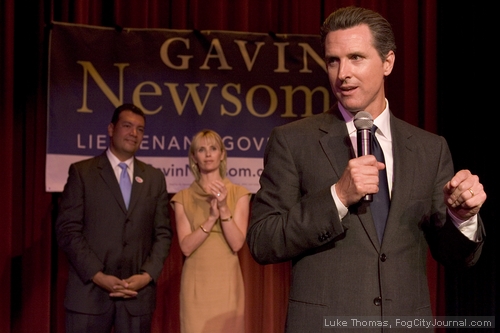
Addressing a crowd of supporters gathered at Yoshi’s San Francisco on election night, San Francisco Mayor Gavin Newsom — who easily beat opponent Janice Hahn to claim the Democratic nomination for lieutenant governor — said he was excited to be part of a crucial political year for the Golden State.

“We’re very proud to be in a position to be the Democratic nominee and to work with the other Democratic nominees,” Newsom told supporters. He lavished praise on the Democratic nominee for governor, Jerry Brown — the man who just last year he was trying to beat in a primary — telling stories about his father’s long relationship with the former governor and expressing his admiration. “I couldn’t be more proud to quasi- be on a ticket with Jerry Brown,” he said.

The race for lieutenant governor may prove one of the most interesting this election season — and not just because a victory for Newsom would transform San Francisco politics. Newsom’s opponent is Abel Maldonado, a moderate Republican who enjoys popularity among the growing, influential Latino community, and who Newsom’s team said will be a formidable challenge.

The campaign could revolve around an intriguing question. At a time when the Republican Party has been taken over by virulent anti-immigrant politicians — Whitman and Fiorina have both made harsh statements about illegal immigrants and vowed never to support “amnesty” (that is, immigration reform) — will Latino voters go for a white Democrat over a Latino Republican?

“You talk to them about all the same issues you talk to all voters about: jobs, education, and health care,” Newsom political strategist Dan Newman said when asked whether Newsom could win over Latino voters. “Latinos, like all voters, will appreciate someone with a proven record of success.”

Pollster Ben Tulchin also downplayed the trouble Newsom could encounter in winning the Latino vote. “With what’s going on in Arizona, they are very wary of Republicans,” Tulchin said, but then added: “We don’t want to underestimate the challenge we have. There’s never been a moderate Latino on the statewide ballot.”

Newsom sounded another alarm. If Whitman decides to help Maldonado, the race will get even tougher. “We’re running against Meg Whitman’s checkbook,” the mayor said.

“Expect to see Meg and Abel together a whole lot in the next few months,” one consultant predicted.

If Newsom wins, San Francisco will get a new mayor a year early — and the district-elected Board of Supervisors will choose the person to fill out the last year of Newsom’s term. Technically, the current board will still be in office then, but the task may well fall to the next board — which makes the local November elections even more important.

“Everyone is gaming this out and trying to figure out what happens,” political consultant Alex Clemens said during a post-election wrap-up at the San Francisco Planning and Urban Research Association office. “There will be a lot of dominoes to fall and deals to be cut.”

Meanwhile, Newsom’s nomination for lieutenant governor places many San Franciscans in an uncomfortable position, one that was illustrated well by Newsom’s victory speech, in which he proudly rejected taxes. Although most San Francisco progressives are disenchanted with their fiscally conservative mayor, few would rather vote for Maldonado.

Tim Paulson, the SF Labor Council president, was at the Newsom event gritting his teeth as he talked about the opportunity progressives now have to work with “a mayor of San Francisco we have issues with.” Now, he noted, “There is going to be a real campaign around this man. It could establish a narrative for what California is about.”


POWERFUL WOMEN

At Delancey Street on election night, San Francisco District Attorney Kamala Harris talked about getting “tough and smart on crime,” addressing gang-related criminal activity but also focusing on corporate criminals. She talked about cracking down on predatory lenders, supporting health care reform, and protecting California’s environment. And she made a point of dragging in BP.

“It must be the work of the next attorney general to ensure that the disaster and tragedy that happened in the Gulf of Mexico never happens in California,” she said, warning of attacks on AB 32, which set California’s 2020 greenhouse gas emissions reduction goal into law in 2006.

Of course, Harris now has to take on her southern counterpart, Los Angeles DA Steve Cooley, who is a moderate but comes in with much stronger law enforcement support. If Harris wins, it will go a long way to prove that opposition to the death penalty isn’t fatal in California politics, and that voters are finally ready for a women of color as the top law enforcement official — a first in state history.

But she and Newsom will both have to overcome likely attacks for the San Francisco’s crime lab scandal, one of many hits to be magnified by the size of Whitman’s war chest.

Whitman, who trounced opponent Steve Poizner in the primary, is riding the crest of a new wave of Republican-style “feminism,” starring her, Fiorina, and Fox news pundit Sarah Palin as female champions of the right-wing agenda. A few short months ago, it looked as if Brown was in serious trouble. But that was before Whitman and Insurance Commissioner Steve Poizner got into an $85 million bloodbath that left the winner of the GOP primary badly wounded. Whitman wants to play off the populist uprising by portraying herself as an outsider running against a career politician; Poizner gave her a huge scare by hammering her ties to Goldman Sachs.

That Wall Street narrative is one Democrats will push against Whitman and Fiorina. “I think it is stunningly politically tone deaf to nominate two Wall Street CEOs to the top of the ticket,” Newman said. Voters will decide whether they are fresh voices with new ideas or corporate hacks who laid off Californians and made fortunes with dubious stock market deals.

Brown leads in the polls — narrowly — but he’s vulnerable. He’s taken so many stands over so many years and Whitman’s fortune will hammer any openings they see. Brown is only slowly getting into campaign mode, but it’s no secret what he has to do. If the campaign is about Jerry Brown, unconventional politician, against Meg Whitman, Wall Street darling, then he wins.

But to take advantage of that, Brown has to offer some concrete solutions to the state’s problems — and he has to start acting like the progressive he once was. “If I were him, I’d run hard to the left,” a consultant who isn’t involved in any of the gubernatorial campaigns said.

The conventional wisdom had Barbara Boxer in trouble, too — but she’s a savvy campaigner who has beaten the odds before. And while the senator appears ripe for attack — almost 30 years in Washington, a voting record perhaps a bit more liberal than the state as a whole — her opponent, Fiorina, has baggage too.

For starters, Fiorina’s entire pitch is that she — like Whitman — would bring business-world savvy to politics. But as CEO of HP, “she was about perks and pink slips,” Newman said. “She laid off Californians and shipped those jobs overseas while enriching herself.”

Her own primary pushed her far to the right (at one point, in an embarrassing sop to the National Rifle Association, she actually argued that suspected terrorists on the federal no-fly list should be able to buy handguns). And speaking of feminist values, her anti-abortion positions won’t help her in a decidedly pro-choice state.


PROP. 16 GOES DOWN

The defeat of Proposition 16 will go down in history as one of the most remarkable campaigns ever. It was, Sup. Ross Mirkarimi noted, “a righteous win:” The No on 16 campaign spent less than $100,000 and still captured 52 percent of the vote. Another narrow corporate-interest measure, Mercury Insurance’s Prop. 17, faced a similar fate.

One reason: PG&E’s $50 million campaign backfired, making voters suspicious of the company’s propaganda. Another: it lost overwhelmingly in its own service area, the company rejected by those who know it best.

Now PG&E CEO Peter Darbee, who pushed to mount the expensive campaign, must return to his shareholders empty-handed — and that’s going to cause problems. “I assume the leadership of PG&E will be called to task,” Clemens said. “They truly rolled the dice.”

The day after the election, PG&E shares dropped 2.2 percent, a possible sign of shaken investor confidence. Mindy Spatt of the Utility Reform Network (TURN), a nonprofit that worked on the No on 16 effort, described the situation succinctly. “Peter Darbee’s got egg on his face,” she said. “Big-time.”

Mirkarimi has witnessed other battles with PG&E, and said this probably wouldn’t be the last. “PG&E, every time we want to have a seat at the table, tries to take us out, like assassins,” he said. “If they were smart, they would take us up on what we asked many years ago, and that is to abide by peaceful coexistence.”

On the statewide level, the bold and expensive deceptions pushed by PG&E and Mercury Insurance were countered by only a handful of super-committed activists and a broad cross-section of newspaper editorials, a reminder that newspapers — battered by the economy and technological changes — are neither dead nor irrelevant.

One of the wild cards of the election was Prop. 14, which will eliminate party primaries for state offices — and potentially shake up the state’s entire political structure. “This is a big deal even if we don’t know how it’s going to play out,” consultant David Latterman said at the SPUR event.

Interestingly, the only two counties that voted No on 14 were the most progressive — San Francisco — and the most conservative, Orange.

Progressives did well in San Francisco, expanding their majority on the Democratic County Central Committee. “In an environment where it was about hundreds of millions of dollars from PG&E and Meg Whitman and Chris Kelly outspending us, we showed that San Francisco is San Francisco and we support San Francisco values,” DCCC chair Aaron Peskin told us.

Money used to define the debates in San Francisco, but the dominant narratives are now being written by the coalition of tenants, environmentalists, workers, social justice advocates, and others who backed a progressive slate of DCCC candidates, which took 18 of the 24 seats on a body that makes policy and funding decisions for the local Democratic Party.

“This time it was the coalition that really made the difference,” DCCC winner Michael Bornstein said on election night. “Frankly, our people worked harder.”

Board of Supervisors President David Chiu agreed, telling us, “For the Central Committee, the message is people power wins.”

The lesson from this election is that people are starting to get wise to corporate deceptions. And they’re realizing that with hard work and smart coalition-building, the people can still prevail.

Steven T. Jones, Rebecca Bowe, Sarah Phelan, and Tim Redmond contributed to this report.


Why Newsom loves sit-lie

43

To the surprise of exactly nobody, Mayor Gavin Newsom is putting his sit-lie law on the November ballot. And I think he’s thrilled about it.


The last thing the mayor wanted was to have the supervisors approve its own version. He’d much rather have his name on it. This way, he not only gets a wedge issue to attack the progressives in the fall; he gets to run his statewide campaign as someone who’s cracking down on the homeless. It’s tough for a San Francisco politician to win in more conservative parts of the state — but if he can say he stood up to those crazy “ultra-liberals” on the board and is willing to beat up on the poor and homeless, he can shed some of that liberal image.


But it’s not clear that the strategy will work at home. Even David Latterman, a political consultant for Scott Wiener and other downtown-backed candidates, downplayed the role that sit-lie will play in the fall election. “It’s just a wedge issue and it’s not going to change people’s minds on who they support,” Latterman told a crowd that including Chron columnist CW Nevius — who is perhaps the most enthusiastic backer of the measure — during a post-election wrapup at SPUR on June 10.


And among the DCCC candidates in this election, the only one to really champion sit-lie and make it a part of his campaign was David Villa-Lobos, who is also running to replace Chris Daly on the Board of Supervisors, but who finished 26th out of 30 candidates in District 12.


The law also seems a little hinky. It would ban sitting on the sidewalk — or “any object placed on the sidewalk, like a crate or folding chair,” according to the Chron. Everywhere I go in the city these days, people are sitting on folding chairs on the sidewalk — typically eating at a restaurant or cafe that has outdoor seating. I suspect many of those eateries have no specific permits to put chairs on the sidewalk; they just do it, which is fine, and nobody minds.


But technically, I guess, outdoor diners could be cited under the mayor’s law. Or the cops could just ignore them, and decide how and where to enforce the law. Which is never a good thing.


I asked the mayor’s press office for clarification on this point, and I’m still waiting for a response.

Editorial: PG&E’s greed backfires

1

The defeat of Prop. 16 showed that unlimited corporate spending on a ballot initiative doesn’t guarantee victory.

EDITORIAL The single most important number to come out of San Francisco on election night was this: 67.49 percent. That’s how many people in this city voted against Pacific Gas and Electric Co.’s monopoly measure, Proposition 16. It’s a statistic that ought to be posted somewhere on a wall at City Hall to remind everyone in local government that the voters sided overwhelmingly against PG&E and in favor of a public option for local electricity.

It’s a landmark victory. On the state level, the defeat of Prop. 16 showed that unlimited corporate spending on a ballot initiative doesn’t guarantee victory, that an underfunded coalition can defeat a giant utility — and that a majority of those in PG&E’s own service area are unhappy with their electricity provider. Public power activists all over the state should take this as a signal that PG&E, and its once-formidable political clout, are on the wane.

In San Francisco — the only city in the nation with a legal mandate for public power — the vote was the most lopsided of any California county. It was the strongest local mandate for public power since the passage of the Raker Act in 1913.

That should be a huge boost for the city’s community choice aggregation (CCA) program. Sup. Ross Mirkarimi, who has been leading the fight for CCA, was pushing hard to get a contract signed before the June 8 vote; like a lot of observers, he feared that PG&E’s vast war chest would overwhelm the opposition. But now that Prop. 16 is dead — and nothing like it will be back in the near future, if at all — the city has a bit of a breather.

That doesn’t mean all work on the contract should slow down. The San Francisco PUC has been mucking around with this deal for more than a year, and needs to bring it to a close. And the city needs to start preparing to answer PG&E’s propaganda campaign with a concerted effort — from the mayor’s office on down — to remind San Franciscans that CCA power will be greener, safer, and in the long run, cheaper than the energy we’re now forced to buy from PG&E.

Any San Francisco politician who stands with PG&E and opposes CCA will do so at his or her peril.

And while San Francisco is moving to implement a modest public power program, state Sen. Mark Leno is moving in Sacramento to limit PG&E’s ability to try another Prop. 16 move — or to spend tens of millions of dollars trying to block local power initiatives. Leno has introduced a bill that would limit the utility’s ability to use ratepayer money on political or public relations campaigns.

The measure doesn’t have a number yet, but the language is brilliant. It directs the California Public Utilities Commission to disallow any political spending that PG&E tries to add into its regulated rates. And since the company has no source of income other that the money it gets from ratepayers, the impact would be to deny PG&E the ability to spend money working against the interests of ratepayers and the public.

"Over the past 10 years, PG&E has probably spent $150 million on political campaigns — and that’s money that came from the ratepayers," Leno said. "This bill is to protect ratepayers."

PG&E will howl about its First Amendment rights — and, indeed, the Supreme Court has of late given corporations who want to influence political campaigns and legislative issues a good bit of leeway. But the fact remains that PG&E is a regulated utility in California, and the state has every right to determine how much the company can charge its customers and to limit how that money is used.

Leno’s bill, of course, could radically change local politics. If PG&E couldn’t spend millions to defeat public power measures, the city would have far more options — and activists should be thinking about how a future campaign to take over the company’s infrastructure might work.

The Board of Supervisors should pass a resolution endorsing Leno’s bill, and the coalition that worked to defeat Prop. 16 should be working to get other cities and counties around the state to sign on.

PG&E’s greed in putting Prop. 16 on the ballot is starting to backfire — and it can’t happen too soon.

PG&E’s greed backfires

0

EDITORIAL The single most important number to come out of San Francisco on election night was this: 67.49 percent. That’s how many people in this city voted against Pacific Gas and Electric Co.’s monopoly measure, Proposition 16. It’s a statistic that ought to be posted somewhere on a wall at City Hall to remind everyone in local government that the voters sided overwhelmingly against PG&E and in favor of a public option for local electricity.

It’s a landmark victory. On the state level, the defeat of Prop. 16 showed that unlimited corporate spending on a ballot initiative doesn’t guarantee victory, that an underfunded coalition can defeat a giant utility — and that a majority of those in PG&E’s own service area are unhappy with their electricity provider. Public power activists all over the state should take this as a signal that PG&E, and its once-formidable political clout, are on the wane.

In San Francisco — the only city in the nation with a legal mandate for public power — the vote was the most lopsided of any California county. It was the strongest local mandate for public power since the passage of the Raker Act in 1913.

That should be a huge boost for the city’s community choice aggregation (CCA) program. Sup. Ross Mirkarimi, who has been leading the fight for CCA, was pushing hard to get a contract signed before the June 8 vote; like a lot of observers, he feared that PG&E’s vast war chest would overwhelm the opposition. But now that Prop. 16 is dead — and nothing like it will be back in the near future, if at all — the city has a bit of a breather.

That doesn’t mean all work on the contract should slow down. The San Francisco PUC has been mucking around with this deal for more than a year, and needs to bring it to a close. And the city needs to start preparing to answer PG&E’s propaganda campaign with a concerted effort — from the mayor’s office on down — to remind San Franciscans that CCA power will be greener, safer, and in the long run, cheaper than the energy we’re now forced to buy from PG&E.

Any San Francisco politician who stands with PG&E and opposes CCA will do so at his or her peril.

And while San Francisco is moving to implement a modest public power program, state Sen. Mark Leno is moving in Sacramento to limit PG&E’s ability to try another Prop. 16 move — or to spend tens of millions of dollars trying to block local power initiatives. Leno has introduced a bill that would limit the utility’s ability to use ratepayer money on political or public relations campaigns.

The measure doesn’t have a number yet, but the language is brilliant. It directs the California Public Utilities Commission to disallow any political spending that PG&E tries to add into its regulated rates. And since the company has no source of income other that the money it gets from ratepayers, the impact would be to deny PG&E the ability to spend money working against the interests of ratepayers and the public.

"Over the past 10 years, PG&E has probably spent $150 million on political campaigns — and that’s money that came from the ratepayers," Leno said. "This bill is to protect ratepayers."

PG&E will howl about its First Amendment rights — and, indeed, the Supreme Court has of late given corporations who want to influence political campaigns and legislative issues a good bit of leeway. But the fact remains that PG&E is a regulated utility in California, and the state has every right to determine how much the company can charge its customers and to limit how that money is used.

Leno’s bill, of course, could radically change local politics. If PG&E couldn’t spend millions to defeat public power measures, the city would have far more options — and activists should be thinking about how a future campaign to take over the company’s infrastructure might work.

The Board of Supervisors should pass a resolution endorsing Leno’s bill, and the coalition that worked to defeat Prop. 16 should be working to get other cities and counties around the state to sign on.

PG&E’s greed in putting Prop. 16 on the ballot is starting to backfire — and it can’t happen too soon.

Alerts

0

alert@sfbg.com

WEDNESDAY, JUNE 16

Generations HIV


The HIV Story Project kicks off SF Pride with the world premiere of a hands-on, video-based storytelling booth that will record stories from all ages, genders, and ethnic backgrounds about the impacts and affects of HIV/AIDS on people around the world. Once complied, stories will be shared on the Web. Complimentary food and drink — and 15 percent discount on all merchandise. Proceeds benefit Bay Area service organizations.

6 p.m., free

Under One Roof

518A Castro, SF

www.thehivstoryproject.org

Liberty for Our Friends


Attend this benefit for the families of Sarah Shourd, Josh Fattal, and Shane Bauer, the Bay Area travelers imprisoned in Iran and accused of spying. Proceeds go toward helping their mothers travel to Iran to appeal for their release. Featuring live music with the Beauty Operators, Steve Meckfessel, Annah Anti-Palindrome, and Nomy Lamm and the Whole World.

6:30 p.m.; $20 suggested (includes book)

KoKo Cocktails

1060 Geary, SF

(415) 255-6304

www.freethehikers.org

THURSDAY, JUNE 17

Equal rights advocates luncheon


Join more than 800 equal rights supporters, including attorneys, business leaders, and women’s rights advocates, at this awards luncheon featuring keynote speaker Arianna Huffington, cofounder and editor-in-chief of the Huffington Post.

11:30 p.m., $150

San Francisco Marriott Marquis

55 Fourth St., SF

www.equalrights.org

Out of Our Film Festival


Protest the Israeli consulate’s sponsorship of the San Francisco LGBT Film Festival on opening night and support divestment and sanctions against Israel until it ends the occupation of Palestine, ceases discrimination against Palestinian citizens of Israel, and permits displaced Palestinian refugees to return to their homes.

6 p.m., free

Castro Theater

429 Castro, SF

www.quitpalestine.org

FRIDAY, JUNE 18

Oakland mayoral debate


Hear the major candidates for mayor of Oakland weigh in at this debate with City Council members Rebecca Kaplan and Jean Quan and former state Sen. Don Perata. The debate is being hosted by the Alameda County Democratic Lawyers Club.

Everett and Jones Restaurant

126 Broadway, Oakl.

(510) 836-7563

www.demlawyers.org

Say No to War


Rally for peace and protest the ongoing war in the Middle East. Demand we bring our troops home now.

2 p.m., free

Corner of Action and University, Berk.

www.berkeleygraypanthers.mysite.com

SATURDAY, JUNE 19

Sea blite habitat restoration


Join Michael Chassé of the National Park Service to help restore Crissy Field marsh and create a habitat suitable for reintroducing the endangered California sea blite. The GGNP system contains more endangered species than any other national park on the North American continent. The 2010 GGNP Endangered Species Big Year helps volunteers get to know these species while helping them recover.

9 a.m., free

Meet at Presidio Transit Center

215 Lincoln, SF

(415) 561-2857 to RSVP

www.wildequity.org

Mail items for Alerts to the Guardian Building, 135 Mississippi St., SF, CA 94107; fax to (415) 437-3658; or e-mail alert@sfbg.com. Please include a contact telephone number. Items must be received at least one week prior to the publication date.

Goodbye, 49ers — and do we really care?

4

Tony Winnicker, the mayor’s press secretary, was chatting with a group of folks at the Newsom victory party on election night, and Steven T. Jones, the Guardian city editor, asked how the stadium vote was going down in Santa Clara. “Oh, it’s winning, but it’s never going to get built,” Winnicker said. “Cities building stadiums is an economic loser.”


He’s right, of course — although it’s an odd comment coming from a press staffer for a mayor who is still dead set on building a stadium for the 49ers at Candlestick Point. I agree with Randy Shaw: The loss of the 49ers would be a good thing for San Francisco — particularly if the alternative is to pour public money into another expensive boondoggle like Candlestick Park.


Here’s the thing: You can argue that urban baseball stadiums bring economic benefits to the community. You can argue that the (mostly) privately financed Giants stadium has spruced up that neighborhood, spurred the creation of new bars and restaurants, brought in new tax dollars and created jobs. (It also displaced some blue-collar jobs and some poor people, but that’s a different argument.)


In fact, with limited parking and good transit access, the Giants ballpark encourages foot traffic, which encourages people to patronize local businesses before and after the game.


Football stadiums are traditionally very different. Football fans are tailgaters — they drive cars, bring their food and drinks to the parking lot, set up grills and picnic tables, go to the game — and then go right home. Almost nobody who attends a 49ers game at Candlestick stays around in the neighborhood afterward; the people who live nearby get virtually zero economic benefits.


Even as part of a shiny new development package, that won’t change much. The plans for a 49ers stadium in the new redevelopment area include a new roadway and bridge to make it easier to drive in and out, and a parking garage with room for tailgating; the fan base is largely from the Peninsula anyway. And in nearly every city that’s put up public money for a football stadium, the taxpayers have gotten screwed.


I love football, I love the 49ers, but I never go to the games, anyway — way too expensive. The TV feed from Santa Clara will be just fine.


Newsom’s fiscal conservatism undermines his agenda

15

Gavin Newsom’s nomination for lieutenant governor places many San Franciscans in an uncomfortable position, one that was illustrated well by the victory speech that he gave last night just as our story our on his latest budget – in which he proudly rejected taxes in favor of deep spending cuts and future budget deficits — was coming off the presses.

Even though most San Francisco progressives don’t like our fiscally conservative mayor, few of us would rather vote for his Republican challenger, Abel Maldonado, despite the fact that this moderate Latino is actually fairly close to Newsom ideologically. “We don’t want to underestimate the challenge we have. There’s never been a moderate Latino on the statewide ballot,” Newsom pollster Ben Tulchin told me last night.

SF Labor Council President Tim Paulson was at the Newsom event gritting his teeth as he talked about the opportunity progressives now have to work with “a mayor of San Francisco we have issues with,” noting that, “What I find interesting in the easy win for Newsom is how there is going to be a real campaign around this man. It could establish a narrative for what California is about.”

And he’s right, but the danger is if Newsom sticks with his inflexible and longstanding “no new taxes” stance then the narrative could be that neither major political party’s top nominees are willing to tap millionaires, oil companies, and other entities that can afford it in order to fund education, health care, and the development of a green economy, which Newsom said are his top priorities. That and “jobs,” by which he means only private sector jobs, based on his past statements and actions and current failure to support new tax measures.

But Newsom doesn’t seem to see the glaring contradiction in his political philosophy, which he illustrated as he told a story about the potential to achieve strong economic growth while aggressively pursuing solutions to global warming and other environmental challenges, which he and progressives both seem to believe are not just possible, but “the opportunity of a lifetime.”

Newsom noted that the only four wealthy countries that signed the Kyoto Protocols and met their greenhouse gas reduction goals – Sweden, Denmark, United Kingdom, and Germany – have similar economic strategies. “All four of these countries had three things in common vis-a-vis the United States: Lower unemployment, higher growth, and lower income disparities,” he said.

Yet Newsom left out another key commonality that was even more central to their success, and big reason for two of Newsom’s three items: All have far higher tax rates than the U.S. and a more vibrant, respected, and well-funded public sector that was able to guide that economic transformation and ensure a smart, equitable distribution of the country’s wealth – something Newsom has been overtly hostile to as mayor and while campaigning for statewide office.

Nonetheless, he continued, “What’s interesting about these four countries is they dramatically shifted their framework in terms of economic growth and economic development towards a cleaner and greener energy future and they were rewarded with higher growth and lower unemployment. I think that’s suggestive, in the context of this debate.”

So do I, suggestive of the need for Newsom (and Jerry Brown) to finally realize it’s going to take money and a rejuvenated public sector to meet his stated goals for education, health care, and the environment. In San Francisco, his reluctance to challenge the Chamber of Commerce fallacy that taxes kill growth has left a legacy of dangerously diminished social services and increasing budget deficits running indefinitely into the future.

But the four countries that Newsom claims to admire don’t think that way. They don’t boast of cutting social services while proposing even more business tax cuts, and they don’t say things like, “It’ll take an entrepreneurial look at solving problems in this state.” He’s sounds like Meg Whitman and the Republicans.

What we need is the other Gavin Newsom, the one who last night also said, “Now is the time for serious problem solving in California….It is a time for California to fundamentally change.”

But first, Mr. Mayor, you’re going to need to embrace a few fundamental changes of your own.


Sit /lie goes down at the Board of Supervisors

At the June 8 Board of Supervisors meeting, a controversial ordinance that sought to ban sitting or lying down on the sidewalk was voted down 8 to 3, with Sups. Michela Alito-Pier, Sean Elsbernd, and Carmen Chu voting in favor.

Proponents of the law, which was backed by Mayor Gavin Newsom and Police Chief George Gascon, framed it as a measure to promote “civil sidewalks.” Yet opponents believed that the law would be used as a tool against the homeless.

Alioto-Pier said the law was needed to give police a new tool for dealing with people who congregate on the streets and intimidate passersby, saying residents and businesses were bothered by “the presence of dogs or shouting.”

Yet a number of supervisors spoke forcefully against the ordinance, saying it was not an appropriate solution to the problems that Alioto-Pier and other sit/lie backers had raised concerns about.

“I don’t believe that this is the San Francisco way to to approach the challenges that we face,” said District 8 Sup. Bevan Dufty, who goes along with Newsom’s proposals more often than his progressive colleagues and is typically a swing vote on the board. Dufty referenced a former, similar San Francisco law that was ultimately repealed. “That was a law that didn’t want to see gay men congregating at 1 a.m. outside a bar,” he said. He called for a more substantive approach, saying, “We can do better.”

Sup. David Campos also spoke against it. “It doesn’t actually address the issue of civility,” he said. “The case for this legislation simply has not been made.” He noted that day laborers who wait for hours on the sidewalk in hopes of finding work could be targeted when they sit down to take a rest.

Sup. Ross Mirkarimi said he thought greater enforcement of existing laws and community policing would be more effective than the proposed ordinance. Later in the meeting, he proposed a measure to be placed on the November ballot that would require police to adopt a foot beat patrol program and a community policing policy.

The board also voted unanimously in favor of a proposal by Board President David Chiu to create a neighborhood community justice task force “to make recommendations to the Board of Supervisors regarding the creation of restorative and community justice programs.” Chiu pitched the idea as a more meaningful response to hostile behavior on the streets in neighborhoods such as the Haight, where calls for a sit /lie ordinance originated.

“We’re very pleased about what happened today,” said Andy Blue, an activist who organized a citywide campaign opposing sit / lie. But he said it wasn’t over yet, since Newsom has already moved to place the proposal on the ballot. “We know we’re going to face an uphill battle,” he said, “because we’re going to be in a campaign with some very well-funded opponents.” But Blue said he felt confident that once the information got out to San Franciscans, “they’ll vote against it in November.”


This one is for Newsom(e) fans

10

One of the most fun parts about attending District Attorney Kamala Harris’ victory party last night was looking at all the photos on the walls of the Delancey Street Foundation.

And showing cultural blogger Beth Spotwood, one of the funniest writers in town, a photo of our very own Mayor Gavin Newsom with Delancey Street Foundation founder Mimi Silbert, in which the mayor’s name is written as Newsome.

Spotswood, who is a big time fan of Newsom, was delighted by this find. Especially since the photo is displayed close to other photos of the mayor in which his name is correctly spelt (as in the photo of him with Silbert and Tony Blair).

Newsom and Blair aren’t the only luminaries on Silbert’s walls. In fact, the place is a veritable who’s who of the political world, and includes a shot of the late John Kennedy Jr. and his stunningly beautiful wife Carolyn Bessette-Kennedy.

At some point, shortly after Spotswood and I were laughing at the Newsome typo, Silbert showed up in person–and set straight one of the photos, which had somehow gotten cock-eyed on the wall. (I swear we didn’t do it.)

That was around the time I averted my eyes from the wall and turned my attention to the giant TV screen –just as Newsom declared victory in the Lt. Gov’s race. I didn’t hear what he said, but reviewing my pics afterwards, it apparently had something to do with California dreaming.

Everyone hates PG&E

5

Well, maybe not everyone, but the results from last night’s election are fascinating. A $50 million campaign, with the opposition struggling to come up with $100,000 — and PG&E still lost. Calitics has a fun comparison that makes one of the key points: The company lost most heavily in its own service areas. People who have to deal with PG&E — and its high rates, poor service, blackouts, botched smart-meter program and financial greed — voted strongly against allowing the company to further entrench its monopoly power. In essence, PG&E lost at home.


A couple of other interesting factors: The results show, I think, that whatever you say about the decline of newspapers, their endorsements still matter. Every major newspaper in the state opposed Prop. 16, and that clearly had an impact. The No on 16 campaign didn’t have the money for any media buys; the press coverage and strong anti-PG&E endorsements had to carry the message.


TURN, Ross Mirkarmi, Mark Leno, Tom Ammiano and consultant Gail Kaufman deserve credit for raising what little money they could and leveraging it into a stunning statewide victory. Considering that the turnout skewed heavily Republican, the defeat of Prop. 16 will go down as one of the great progressive victories in California history.


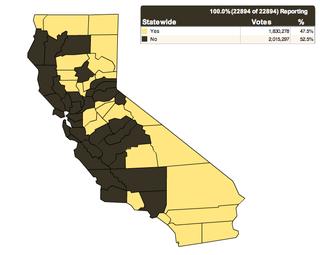
The local numbers were astounding: In San Francisco, Prop. 16 went down 2-1, with 67 percent of the voters rejecting PG&E’s ploy. That’s the strongest mandate for public power I’ve ever seen. Same for the rest of the Bay Area: Alameda County, 64 percent No. San Mateo County, 60 percent No. Marin County, 61 percent No. Mayor Gavin Newsom ought to take a look at the map on the Secretary of State’s website; it shows that the voters he needs to get elected lieutenant governor have rejected PG&E and want a public-power option.


The collapse of PG&E’s attempt to buy democracy in California gives San Francisco some breathing room on its community choice aggregation contract, which is excellent news. The supervisors can now take some time to go over the details — and prepare for the next major battle, the marketing campaign to education local residents about the value of community-controlled green energy.


PG&E is clearly on the run — CEO Peter Darbee has driven the company to a point where it has no friends left. Could be a great era for public power efforts.

How safe is your cell phone?

5

By Brittany Baguio

news@sfbg.com

GREEN CITY In the wake of recent studies suggesting that extensive cell phone use might be linked to some types of cancer, consumer advocates are pushing to require phone companies to publicize the level of radiation their devices emit.

It seems like a simple idea. If fast-food restaurants are required to post the calories and fat content of their junk food, why shouldn’t cell phone companies post the level of radiowave energy coming out of their products? But it’s proving to be a tough fight — in part because the scientific studies are so complex, and also because the industry is fighting furiously against disclosure rules.

The California State Senate narrowly rejected June 4 a bill by Sen. Mark Leno (D-SF) that would have taken a modest step toward better disclosure. Leno’s measure, SB 1212, would have mandated that manufacturers and phone providers disclose radiation levels, or specific absorption rate (SAR), on their Internet websites and online user manuals. They would also be required to state the maximum allowable SAR value, and what it means.

“The federal government has set a standard for this type of radiation and already requires reporting,” Leno told us, “At the very least, consumers should have the right to know about the relative risks of the products they’re buying.”

There’s a similar measure in the works in San Francisco. On May 24, the Board of Supervisors City Operations and Neighborhood Services Committee passed Mayor Gavin Newsom’s plan to require retailers in the city to reveal the amount of radiation released by cell phones. That would make San Francisco the only city in the United States mandating that retailers acknowledge radiation information.

The most recent and largest study focusing on cell phone radiation, the Interphone Study, was released this year. Conducted by 21 scientists in 12 participating countries, the study looked at the long-term risks of certain brain cancers.

The results are mixed. The study found some results of increased risks of tumors, although the authors could not agree on how to interpret the data.

The researchers surveyed 5,000 brain cancer patients, and found that people who were “heavy” cell-phone users (defined as using the phone 30 minutes or more a day) had a slightly higher risk of some kinds of cancer. But, as an Environmental Working Group analysis of the study noted, “most of the people involved … used their cell phones much less than is common today.”

Cell phones emit radiowaves through their antennas, which in newer models are often embedded in the phone itself. The closer the distance from the antenna to a person’s head, the more exposed he or she is to radio frequency energy.

However, as the distance between the antenna and a person’s body increases, the amount of radio frequency energy decreases rapidly. Consumers who keep their phones away from their body while doing activities such as texting are absorbing less radio frequency energy.

The Federal Communications Commission has set a safety level for a phone’s SAR — a measure of radiation energy — at 1.6 watts per kilogram of body mass. All cell phone manufacturers must produce phones at or below this level.

Renee Sharp, director of California’s Environmental Working group, says the evidence doesn’t have to be conclusive to warrant caution. “We aren’t trying to say that cell phones are dangerous because we don’t have definite answers yet and we need more research,” Sharp said. “But when you look at studies with long-term use of 10 years of longer, you see increases in certain kinds of brain tumors. We are trying to give people as much information as we can to make informed decisions because it may or may not impact their health.”

Cell phone manufacturers aren’t required to disclose SAR information directly to phone buyers; they send the data to the FCC. Although the FCC makes this information available on its website, the information is incomplete and hard to find. A list of cell phone SARs information compiled by the Environmental Working Group is at www.ewg.org/cellphoneradiation/Get-a-Safer-Phone.

The telecommunications industry strongly oppose Leno’s bill. Joe Gregorich, a lobbyist for Tech America, an industry group, told us that the requirement in Leno’s bill “has an assumption that a lower SAR is safer than a higher SAR. The FCC, FDA, and Inter Agency Working Group regulate the SAR and have set a SAR threshold where cell phones are considered safe. All cell phone manufacturers make cell phones below this SAR threshold.”

According to Sharp, the FCC’s standards are out of date. “The FCC set SAR standards 14 years ago and has not updated them since,” Sharp said. “This was before we found out that children have thinner skulls and are more susceptible to radiation effects, and before phones developed and exploded into what they are now.”

Now: full-speed ahead with CCA

2

EDITORIAL Proposition 16 — Pacific Gas and Electric Co.’s monopoly power grab — has to rank as the most venal, corrupt abuse of the initiative system in California history. The utility spent nearly $50 million to pay for a misleading signature drive, mount a campaign of lies and distortions, create bogus front groups, and flood the airwaves with ads — all in an effort to convince Californians to vote against their own interests. It’s a case study in why the state needs initiative reform (a ban on paid signature gatherers and limits on corporate campaign contributions would be good places to start).

At press time, we didn’t know how the election would turn out — but this much is clear: San Francisco needs to move ahead with community choice aggregation and continue to push for public power anyway.

Prop. 16 was never about "taxpayer rights." The whole point of the initiative was to block communities from replacing PG&E with public power. But it’s too late to stop San Francisco. Thanks to heroic efforts by Sup. Ross Mirkarimi, the city has already reached a deal with Power Choice LLC to create and operate a CCA system in town. Under state law, every resident and business in the city is automatically a customer of the CCA unless they opt out — so Prop. 16, which bars public-power agencies from signing up new customers, doesn’t apply.

It was a battle royal to get to this point. The PG&E-friendly San Francisco Public Utilities Commission, operating under a PG&E-friendly mayor, had more than a year to find a vendor and negotiate a contract. But PUC General Manager Ed Harrington dragged his feet at every turn. In fact, just a few weeks ago, Harrington tried to delay the contract until after the June election — thus giving PG&E a better shot at invalidating any contract. But with enough pressure from the supervisors, the basic terms of the deal were sealed in plenty of time.

Besides, San Francisco is in a unique position. Federal law (the Raker Act) requires the city to operate a public power system — and that act of Congress would trump any state law.

So the supervisors should move forward on finalizing the CCA, Mayor Gavin Newsom should sign off on it, and City Attorney Dennis Herrera should prepare to defend it vigorously if PG&E tries to sue.

Herrera has told us repeatedly that he thinks the city’s legal position is sound. In the past, he’s refused to use the Raker Act as a legal strategy — to go to court and force his own city to follow the law — but he needs to be ready to use that powerful weapon if PG&E tries to interfere with the implementation of CCA.

City officials at every level also have to make a concerted effort to counter PG&E’s lies — particularly the sort of misinformation that made it into the Matier and Ross column in the Chron June 7, the day before the election. Quoting unnamed sources, the reporters insisted that San Francisco CCA’s electricity rates would be higher than PG&E’s. That’s only true if you ignore the fact that PG&E’s rates are unstable and going up every year and that the cost of alternative energy is coming down every year — and if you don’t consider the costs of climate change, oil spills, coal mining disasters, nuclear waste storage, and all the other impacts of PG&E’s nonrenewable energy mix. And remember: San Francisco is asking the CCA to provide 51 percent renewables by 2019; PG&E’s portfolio doesn’t even meet the state’s weak 15 percent requirement. (There is also, of course, the multibillion dollar risk that San Francisco could lose the Hetch Hetchy dam if the city continues to violate the Raker Act.)

But the private utility that spent gobs of money on the Prop. 16 campaign will spend millions more in San Francisco to convince customers to opt out of the CCA. So the city needs its own campaign to explain why public power is not only much greener, but in the long run, much, much cheaper.

San Francisco has had a mandate for public power since 1913, nearly 100 years. The implementation of CCA would be a big step toward fulfilling that mandate. The supervisors should not let anything stand in the way.

From the Kamala Harris party

1

City Attorney Dennis Herrera, and Board President David Chiu, Criminal Justice Podcaster David Onek and other local luminaries floated around the Delancy Street Foundation where, oddly, the booze was free flowing, allegedly thanks to the largesse of Vanessa Getty.


The walls here are adorned with photos of Delancy Street Foundation founder Mimi Silbert, including an unusually unflattering photo of San Francisco’s mayor Gavin Newsom (with his name mispelled to include a final e). Among the crowd of supporters was Lateefah Simon, who works for the Lawyers Comittee for Civil Rights. She told me she was supporting Kamala Harris for AG based on her experience working for her for four years.


“I’ve never had a more difficult boss,” Simon said. “We would all shake before meetings because she demanded such a level of detail and excellence.


As of this time, Harriss has not put in an appearance, although she is rumored to be lurking in a back room in a building.

Cutting from the bottom

7

By Alex Emslie

news@sfbg.com

When Mayor Gavin Newsom unveiled his proposed city budget on June 1, he downplayed the severity of cuts to the city’s Department of Public Health, noting that they amounted to less than 2 percent. But if Newsom’s uneven program chopping becomes a reality, critical social services for some of San Francisco’s poorest and most vulnerable residents will be cut by almost one-third.

The DPH was able to shrink its budget by nearly $31 million, according to a budget proposal currently before the Board of Supervisors, in part by slashing community nonprofit clinics providing outpatient mental health services to some of San Francisco’s most difficult to treat mental health cases.

“It’s very possible you could see more people who are homeless, people who are homeless not getting as much care — they’ll be sicker,” said Dr. Eric Woodard, medical director of psychiatric emergency services at San Francisco General Hospital. “And you could reasonably expect more deaths on the street to occur.”

State and federal matching funding to the DPH dwarfs the amount of money the department receives from the city. What isn’t spelled out in Newsom’s budget is that every dollar cut by the city results in more than another dollar lost in federal funding for social services.

The DPH proposed a nearly 9 percent cut to outpatient community-based health services, and an 11 percent cut to residential inpatient services to meet the mayor’s request that all city departments submit a 30 percent budget reduction to his office. Newsom reversed the proposed cuts to residential services but kept the outpatient cuts.

“I believe in the efficacy of residential [treatment],” Newsom said during his budget unveiling. “I believe there are a lot of question marks around outpatient drug treatment.”

But the cuts affect more than just outpatient drug treatment. While many of the clinics that were cut focus on treating mental illnesses, they are funded through the DPH category that includes substance abuse treatment. Newsom’s office declined to answer our inquiries about the reasons for and implications of his cuts, referring us to DPH.

Walden House CEO Vitka Eisen, whose organization serves people suffering from mental illness and substance abuse in inpatient and outpatient clinics, said she was relieved that residential funding was added back. However, she is concerned about the proposed $4.1 million cut spread across several nonprofit outpatient services.

“There’s a very large cut to outpatient services citywide, and that’s obviously problematic because outpatient services are an important part of our system of care in the city,” she told the Guardian. “You can’t really cut one or the other.”

DPH Community Behavioral Health Services Director Dr. Robert Cabaj is hoping the Board of Supervisors will restore some of the cuts to outpatient clinics. “Unfortunately, they [the Mayor’s Office] left these in,” he told the Guardian. “I’m not sure why — I’m not sure what the mayor was thinking at the time.”

Citywide Case Management and Community Focus, an outpatient clinic serving some of San Francisco’s most severely mentally ill, is one of the hardest hit nonprofit clinics in the mayor’s proposed budget. The agency will lose $1.22 in federal funding for every $1 cut from the city, division director Dr. David Fariello said.

That’s how its 15 percent, $1.3 million cut proposed by the DPH and accepted by the mayor, ballooned into a 33 percent, $2.8 million loss for one of the city’s most comprehensive and best-performing community behavioral health services.

Citywide, at 982 Mission St., boasts the facilities, network, and location to serve one of San Francisco’s most vulnerable populations. The typical Citywide client suffers from schizophrenia, bipolar disorder, borderline personality disorder, or severe depression. They are likely homeless, grappling with substance abuse, and many have posttraumatic stress disorder.

Citywide employees, doctors, and administrators, as well as physicians from outside the clinic, speculate that cutting outpatient mental health services in a city with one of the highest per capita populations of mentally ill homeless people will ultimately cost the city more money than it saves now. Use of expensive city services like psychiatric emergency rooms, jails, police, and ambulance could all rise.

“Frankly, a lot of these budget cuts do not seem to be very well thought out in terms of what the real cost is going to be,” Woodard said. “If you look into the not very distant future, you’re going to incur costs that are probably much greater than your savings were initially by making the cuts.”

Cabaj said that past funding cuts haven’t resulted in higher use of psychiatric emergency services because the DPH prioritizes funding for the most severe cases and screens for those who could possibly be moved into cheaper services. Citywide clients are consistently high users of San Francisco General Hospital acute inpatient psychiatric care, at an average cost to the city of $1,200 per patient, per day, if they don’t have insurance or Medical benefits.

Many end up in costly in-patient psychiatric care facilities or are arrested and land in the city’s Behavioral Health Court, which hears cases in which defendants have been diagnosed with a mental illness that is suspected of being a factor in their crime. More than 70 percent of the Behavioral Health Court’s mandated treatment slots are at Citywide.

“We can manage behaviors that get people thrown out of every other clinic in the city,” Fariello said. “Where is that capacity going to be picked up? These are not clients who, if they don’t get treatment, maybe their doctor will give them some medicine and it’ll be OK. These are clients who are going to continue to be high users unless we intervene.”

Citywide figures show a 40 percent decrease in violent reoffenses for clients referred to their clinic from the Behavioral Health Court. Nearly three-quarters who were homeless are able to maintain housing, and more than 25 percent of clients who were frequent users of inpatient psychiatric services have stayed out of the hospital.

“Citywide really is one of the best,” said Woodard, who works with Citywide’s Linkage Team to stabilize patients from SFGH’s psychiatric emergency room. “They provide excellent care for these really fragile, very ill patients. I would say of the community programs, they’re really at the top of the list.”

Fariello estimates having to reduce the 1,035 clients receiving treatment at his clinic by 400 if the cuts are finalized. He may have to scale back some of his clinic’s innovative and successful categories of service — such as employment support and dialectical behavioral therapy, a highly specialized form of therapy with proven success in treating borderline personality disorder. Citywide has the largest DBT team in San Francisco.

Citywide administrators are baffled by DPH’s decision-making process, given that it serves the city’s sickest, poorest, and homeless — characteristics that should have reduced its cuts, according to the department’s priorities outlined in its budget reduction proposal.

Since founding the agency nearly 30 years ago, Fariello has worked with the city to implement innovative techniques in treating San Francisco’s highest users of expensive psychiatric emergency services. And it has been consistently successful. In a review last year of 15 similar programs conducted by the DPH, Citywide received an average 92.1 out of 100, the highest score. It scored a 4.0 out of 4.0 on another recent program review.

Several divisions within Citywide contribute to its inclusive approach to mental health services. Citywide’s forensics program works exclusively with clients involved in the criminal justice system. Community Focus provides culturally sensitive therapy in several languages. The Linkage Team stabilizes emergency psychiatric patients from SFGH.

Employment support for Citywide clients helps them get and retain jobs, emblematic of the entire agency’s goal of treating clients as complete people, not just mental health patients. “What we’ve found out is that people who have an investment in purposeful activity have an investment in getting better,” Fariello said. “A lot of clients have a notion that their career is being a mental health client. What we’re trying to do is change that.”

Citywide supported employment services supervisor Greg Jarasitis told a story of one client who said she liked her job as a bookkeeper because while she was at work she felt like a “normy,” then added: “These are people who have been marginalized for so long.” *

Get involved: The Board of Supervisors holds a public comment hearing on the deep proposed health cuts, as state law requires, June 15 at 3 p.m. in Board Chambers at City Hall. The board’s Budget and Finance Committee departmental hearings for the DPH are scheduled for June 21 and June 28.

Another bloody budget

6

rebeccab@sfbg.com

In the days since June 1, when Mayor Gavin Newsom unveiled his proposal for San Francisco’s $6.48 billion budget for the next fiscal year, public sector employees and community organizations have been poring over the hefty document to determine how their jobs, services, and programs survived cuts made to close a $483 million shortfall.

For police and firefighters, a key Newsom constituency, the news is good. There were no layoffs to San Francisco firefighters, and while members of the Police Officer’s Association gave up $9.3 million in wage concessions under the lucrative contract Newsom gave them a few years ago, police officers will still receive a 4 percent wage increase on July 1.

For others, the release of the mayor’s budget signified a tough fight looming before the Board of Supervisors, one with high stakes. Cuts to homeless services, mental health care, youth programs, and housing assistance, along with privatization proposals, have raised widespread concern among labor and liberal advocacy organizations. Public input on the budget will continue at the Board of Supervisors Budget and Finance Committee until July 15, when the amended document is considered by the full board.

At a June 1 announcement ceremony, Newsom asserted that the budget was balanced “without draconian cuts,” saying, “We were able to avoid the kind of cataclysmic devastation that some had argued was inevitable in this budget.”

Nearly a week later, Board President David Chiu told the Guardian that sort of cataclysm wouldn’t be staved off for long if the city continues on the course of repeatedly making deep budget cuts without proposing any significant new sources of revenue.

“Now that the smoke has cleared, it is clear that the mayor’s proposed budget is perfect for a mayor who is only going to be around for the short term, but it does not address the long-term fiscal crisis that our city is in,” Chiu said. “Next year, we’re looking at over a $700 million budget deficit. The year after that, we’re looking at almost an $800 million budget deficit. The budget proposal that Newsom put out balances the … deficit on many one-time tricks and assumptions of uncertain revenue.”

Meanwhile, advocates said even the cuts proposed this time would bring serious consequences, especially with unemployment on the rise, state programs being cut in Sacramento, and families feeling the pinch more than ever.

“Poor and working class families, and families of color in San Francisco, are facing kind of an assault on funding and on safety net services on multiple levels,” said Chelsea Boilard, family policy and communications associate for Coleman Advocates for Children and Youth. “I think a lot of it is that families are concerned about their ability to stay in the city and raise their kids here.”


“NO NEW TAXES”

During the budget announcement, Newsom emphasized the positive. He found $12 million in new revenue simply by closing a loophole that had allowed Internet-based companies to avoid paying that amount in hotel taxes. He said 350 currently occupied positions would be cut, but noted that it was less than a cap of 425 that public sector unions had agreed to. Cuts were inevitable since the ailing economy inflicted the city’s General Fund with significant losses, particularly from business and property tax revenues.

Nonetheless, Newsom’s budget is already coming under fire from progressive leaders. For one, there are no new revenue-generating measures in the form of general taxes, which could have averted the worst blows to critical safety-net services and might help remedy the city’s economic woes in the long-term.

“There are no new taxes in this budget,” Newsom declared. “I know some folks just prefer tax increases. I don’t.”

Yet Chiu said many of Newsom’s assumptions for revenue were on shaky ground, prompting City Controller Ben Rosenfield — Newsom’s former budget director — to place $142 million on reserve in case the projected revenues don’t pan out.

“These budget deficits continue as far as the eye can see,” Chiu noted. “Even if those amounts come in, something like 90 percent of them are one-time fixes. So even if the mayor is right, it doesn’t solve next year’s problem, or the year after. Which is why many of us at the board believe that we have to consider additional revenue proposals to think about the long-term fiscal health of the city.”

Sup. John Avalos, chair of the Budget and Finance Committee, described Newsom’s budget as “pretty much an all-cuts budget,” noting that he and Chiu planned to introduce revenue-generating measures. They were expected to introduce proposals — including an increase in the hotel tax and a change in the business tax — at the June 8 board meeting.

Because despite Newsom’s rosy assessment, many of his proposed cuts are deep and painful: the Recreation and Park Department would be cut by 42 percent (with its capital projects budget slashed by 90 percent), Economic and Workforce Development by 34 percent, Ethics Commission by 23 percent (basically eliminating public financing for candidates), Department of the Environment by 14 percent, Emergency Management by 10 percent, and the list goes on.


CUTS TO SOCIAL SERVICES

Progressives say Newsom’s budget reflects skewed priorities. While relatively little is asked of public safety departments, health and human services programs face major staffing and funding losses. “Poor people are being asked to shoulder the burden,” noted Jennifer Friedenbach, director of the Coalition on Homelessness.

Nearly $31 million would be slashed from the Department of Public Health, and more than $22 million would be cut from the Human Services Agency under Newsom’s proposed budget. While this reflects only 2–3 percent of the departmental budgets, there’s widespread concern that the cuts target programs designed to shield the most vulnerable residents.

Proposals that deal with housing are of special concern. “We have more and more families moving into SRO hotel rooms. We have families in garages. We have a really scary situation for many families,” Friedenbach said.

Affordable housing programs within the Mayor’s Office of Housing would get slashed from $16.8 million currently down to just $1.2 million, a 92 percent cut. Other cuts seem small, but will have big impacts of those affected. Newsom’s budget eliminates 42 housing subsidies, which boost rent payments for families on the brink of homelessness, for a savings of $264,000. Meanwhile, a locally funded program that subsidizes housing costs for people with AIDS would be cut, for a savings of $559,000.

Transitional housing would be affected, too, such as 59 beds at a homeless shelter on Otis Street, which Friedenbach says would be lost under Newsom’s budget proposal. “We’ve already lost more than 400 shelter beds since Newsom came to office, so that’d be a huge hit,” she said. Since the recession began, she added, the wait-list at shelters has tripled. The Ark House, a temporary housing facility that serves LGBT youth, would also be closed.

Overall, homeless services delivered by HSA would take a $12 million hit in Newsom’s budget, or about 13 percent, offset slightly by homeless services being increased by $2 million within the Mayor’s Office budget, a 71 percent increase.

Outpatient mental health services, such as Community Behavioral Health Services, would also be affected (See “Cutting from the bottom”), in violation of current city law. Several years ago, then-Sup. Tom Ammiano introduced legislation establishing a “single standard of care” to guarantee access to mental health services for indigent and uninsured residents.

“If timely, effective, and coordinated mental health treatment is not provided to indigent and uninsured residents who are not seriously mentally ill, those residents are at risk of becoming seriously mentally ill and hence requiring more expensive and comprehensive mental health care from San Francisco,” according to the ordinance, which was passed in June of 2005. Newsom’s budget proposes changing this legislation to enable cuts to those services, which would result in 1,600 people losing treatment, according to Friedenbach.

Unfortunately, advocates for the poor has gotten used to this ritual of trying to restore cuts made by Newsom. “There are some sacred cows that seem to survive year after year, and then we’re left fighting over what we can get,” said Randy Shaw, executive director of the Tenderloin Housing Clinic (THC).

The Central City SRO Collaborative, which supports tenants living in single-room occupancy hotels in the mid-Market Street area and is operated through THC, is slated to be cut by 40 percent along with three other similar programs — a replay from last year when the mayor proposed eliminating funding and the Board of Supervisors restored the cut.

“I think you’d see more fires, more people dying from overdoses. You’d see really bad conditions,” Jeff Buckley, director of the program, told us of the potential consequences of eliminating the inspections and resident training that is part of the program.

Funding was also eliminated for THC’s Ellis Eviction Defense Program, the city’s only free legal defense program with capacity to serve 55 low-income tenants facing eviction under the Ellis Act.


THREAT TO RENTERS

One of the most controversial proposals to emerge from Newsom’s budget is a way for property owners and real estate speculators to buy their way out of the city lottery that limits conversion of rental properties and tenants-in-common (TICs) to privately-owned condos if they pay between $4,000 and $20,000 (depending on how long they have waited for conversion), a proposal to raise about $8 million for the city.

“I went back and forth because I know the Board of Supervisors can’t stand this,” Newsom said as he broached the subject at the June 1 announcement. “I still don’t get this argument completely. Except it’s a big-time ideological discussion. It’s so darn ideological that I think it gets in the way of having a real discussion.”

Yet Ted Gullicksen, director of the San Francisco Tenants Union, said the argument is quite clear: making it easier to convert rental units into condos will accelerate the loss of rental housing in a city where two-thirds of residents are tenants, in the process encouraging real estate speculation and evictions.

“It will encourage TIC conversions and evictions because it makes the road to converting TICs to condos that much easier,” Gullicksen said. “It’s going to be a huge gift to real estate speculators.”

Newsom press secretary Tony Winnicker disputes that impact, saying that “these units were going to convert anyway, whether next year or six years. This merely accelerates that conversion without altering the lottery to protect jobs and services.”

But Gullicksen said the proposal obviously undermines the lottery system, which is the only tool tenant advocates have to preserve the finite supply of rent-controlled apartments, noting that even if the condos are later rented out, they will no longer to subject to rent control. That’s one reason why the Board of Supervisors has repeatedly rejected this idea, and why Newsom probably knows they will do so again.

Avalos said he and other progressive supervisors will oppose the proposal, despite the difficulties that will create in balancing the budget. “It’s kind of like putting a gun to our heads,” Avalos said of Newsom’s inclusion of that revenue in his budget.

To offset that revenue loss, Avalos has proposed a tax on alcohol sold in bars and Gullicksen is proposing the city legalize illegal housing units that are in habitable condition for property owners willing to pay an amnesty fee.

Some housing advocates were also struck by the timing of proposing condo conversion fees while also eliminating the Ellis Eviction Defense Program. “We’re really the only ones doing this,” Shaw noted. He said the program is crucial because it serves low-income tenants, many of whom are monolingual Chinese or Spanish speakers who lack the ability to pay for private attorneys to resist aggressive landlords.


PRIVATIZATION PROPOSALS RETURN

The Department of Children, Youth. and Families budget would be reduced by 20 percent under Newsom’s budget, with the greatest cuts affecting after school and youth leadership programs. Roughly a $3 million cut will result in the loss of around 300 subsidized slots for after school programs, said Boilard of Coleman Youth Advocates. Another $3 million is expected to come out of violence-prevention programs for troubled youth; an additional $1 million would affect youth jobs programs.

Patricia Davis, a Child Protective Services employee who lives in the Mission District with her two teenage sons, said she was concerned about the implications for losses to youth programs, particularly during the summer. “You can imagine what’s going to happen this summer,” she said. “I feel that a lot of kids are going to do a lot of things that they have no business doing.”

Davis, who says she’ll have to look for a new job come Sept. 30 because the federal stimulus package funding that supports her position will run out, said she was not happy to hear that police officers would be getting raises just as that summer school programs are being threatened with closure. “Couldn’t the 4 percent [raise] go somewhere else — like to the children?” she wondered.

Meanwhile, privatization proposals are causing anxiety for SEIU Local 1021 members, who recently gave millions in wage concessions and furloughs along with other public employees to help balance the budget. A proposal to contract out for jail health services cropped up last year and was shot down by the board, but it’s back again.

“When you make it a for-profit enterprise, the bottom line is the profit. It’s not about the health care,” SEIU Local 1021 organizer Gabriel Haaland told us. “It isn’t the same quality of care.”

Haaland said he believes the mayor’s assumption that the proposal could save $13 million should be closely examined. Other privatization schemes would contract out for security at city museums and hospitals.

Institutional police in the mental health ward at SF General Hospital and other sensitive facilities are well trained and experienced with difficult situations so, Haaland said, “the workers feel a lot safer” than they would with private contractors.

Regarding Newsom’s privatization proposal, Avalos said the board was “opposed last year and the year before, and we’ll oppose [them] this year.”

In the coming weeks, Avalos and other members of the Budget and Finance Committee will carefully go over Newsom’s proposed budget — which is now being sized up by Budget Analyst Harvey Rose’s office — and solicit input from the public. Chances are, they’ll get an earful.

“People are scared. They are scared to death right now,” Boilard said. “As it is, people’s hours are being reduced. And it’s getting harder and harder to find a job because so many people are out of work that the level of competition has gotten really fierce. This is the time that we need to invest in safety net services for young people and families more than ever — and all those services and programs and relationships that people depend on are disappearing.”

Steven T. Jones and Kaitlyn Paris contributed to this report.

Editorial: No matter who wins on Prop 16, full speed ahead with CCA

0

EDITORIAL Proposition 16 — Pacific Gas and Electric Co.’s monopoly power grab — has to rank as the most venal, corrupt abuse of the initiative system in California history. The utility spent nearly $50 million to pay for a misleading signature drive, mount a campaign of lies and distortions, create bogus front groups, and flood the airwaves with ads — all in an effort to convince Californians to vote against their own interests. It’s a case study in why the state needs initiative reform (a ban on paid signature gatherers and limits on corporate campaign contributions would be good places to start).

At press time, we didn’t know how the election would turn out — but this much is clear: San Francisco needs to move ahead with community choice aggregation and continue to push for public power anyway.


Prop. 16 was never about “taxpayer rights.” The whole point of the initiative was to block communities from replacing PG&E with public power. But it’s too late to stop San Francisco. Thanks to heroic efforts by Sup. Ross Mirkarimi, the city has already reached a deal with Power Choice LLC to create and operate a CCA system in town. Under state law, every resident and business in the city is automatically a customer of the CCA unless they opt out — so Prop. 16, which bars public-power agencies from signing up new customers, doesn’t apply.

It was a battle royal to get to this point. The PG&E-friendly San Francisco Public Utilities Commission, operating under a PG&E-friendly mayor, had more than a year to find a vendor and negotiate a contract. But PUC General Manager Ed Harrington dragged his feet at every turn. In fact, just a few weeks ago, Harrington tried to delay the contract until after the June election — thus giving PG&E a better shot at invalidating any contract. But with enough pressure from the supervisors, the basic terms of the deal were sealed in plenty of time.

Besides, San Francisco is in a unique position. Federal law (the Raker Act) requires the city to operate a public power system — and that act of Congress would trump any state law.

So the supervisors should move forward on finalizing the CCA, Mayor Gavin Newsom should sign off on it, and City Attorney Dennis Herrera should prepare to defend it vigorously if PG&E tries to sue.

Herrera has told us repeatedly that he thinks the city’s legal position is sound. In the past, he’s refused to use the Raker Act as a legal strategy — to go to court and force his own city to follow the law — but he needs to be ready to use that powerful weapon if PG&E tries to interfere with the implementation of CCA.
City officials at every level also have to make a concerted effort to counter PG&E’s lies — particularly the sort of misinformation that made it into the Matier and Ross column in the Chron June 7, the day before the election. Quoting unnamed sources, the reporters insisted that San Francisco CCA’s electricity rates would be higher than PG&E’s. That’s only true if you ignore the fact that PG&E’s rates are unstable and going up every year and that the cost of alternative energy is coming down every year — and if you don’t consider the costs of climate change, oil spills, coal mining disasters, nuclear waste storage, and all the other impacts of PG&E’s nonrenewable energy mix. And remember: San Francisco is asking the CCA to provide 51 percent renewables by 2019; PG&E’s portfolio doesn’t even meet the state’s weak 15 percent requirement. (There is also, of course, the multibillion dollar risk that San Francisco could lose the Hetch Hetchy dam if the city continues to violate the Raker Act.)

But the private utility that spent gobs of money on the Prop. 16 campaign will spend millions more in San Francisco to convince customers to opt out of the CCA. So the city needs its own campaign to explain why public power is not only much greener, but in the long run, much, much cheaper.

San Francisco has had a mandate for public power since 1913, nearly 100 years. The implementation of CCA would be a big step toward fulfilling that mandate. The supervisors should let  nothing stand in the way.

Three words: Vote June 8

1

The problem with the June 8th ballot is that the Democrats aren’t fighting with each other.


I mean, it’s great that Jerry Brown and Barbara Boxer will emerge from the primary season unscathed, flush with money and ready to go after opponents who have been battered and beaten mercilessly in their own primaries. It’s great that Steve Poizner drove down Meg Whitman’s positives and made her look so bad that she’s now behind Jerry Brown (who isn’t even campaigning yet) in the polls. It’s great that Carly Fiorina was forced so far to the right that she had to endorse allowing people on the no-fly list to buy handguns. The expensive and ugly GOP primary battles may have saved Boxer’s job and put Brown in the governor’s office.


But around the state, Democrats don’t have as much reason to vote. Fiorina, Poizner, Whitman — they’re all spending millions to bring Republicans to the polls. There’s no similar statewide GOTV operation on the Democratic side. So the electorate could wind up skewing considerably to the right — and that’s going to hurt us on the ballot propositions.


Johnny Angel and I were talking on our radio show today about the fact that Republicans — those who aren’t complete idiots — ought to oppose Prop. 16 and Prop. 17. Those aren’t partisan measures; they’re just corporate scams. And nobody from any political party likes Pacific Gas and Electric Co. these days.


But the reality is, PG&E has aimed its Prop. 16 campaign directly at the heart of the more conservative electorate, with its anti-government message. And Mercury insurance has aimed its campaign at the better-off consumers who aren’t likely to drop their car insurance any time soon. I don’t see Prop. 16 winning big in any constituency — but it will do better among Republicans.


So Democrats have to get to the polls — and get their friends to the polls, and their families to the polls, and their neighbors to the polls, and a few dead people, too, if they can find them (just kidding, Arthur Evans, lighten up).


And in San Francisco, where there are no races for mayor or supervisor, it’s easy to want to sit this one out — but that would be a major mistake. The election for Democratic County Central Commitee alone is worth a trip to the polling place, since the makeup of that body will have a significant impact on the fall supervisorial races.


So you have to vote, folks. Here’s our endorsements.


Ethics boss finally ousts Luby, a crusading public advocate

13

Oliver Luby has long been the most public-spirited employee of the San Francisco Ethics Commission, the one person in that office who repeatedly exposed powerful violators of campaign finance rules and blew the whistle on schemes to make the system less transparent and effective, drawing the ire of Director John St. Croix and Deputy Director Mabel Ng in the process.

St. Croix repeatedly tied to silence and punish Luby, who fell back on civil service and whistle-blower protections to save his job as a fines collection officer and continue doing it properly. But it appears St. Croix has finally succeeded in ousting Luby, who this week was notified that his last day will be June 11.

During budget season last year, at a time when St. Croix was trying to punish Luby for sounding the alarm about a new campaign finance database would effectively delete important data (something St. Croix defended but the vendor, NetFile, later corrected), St. Croix quietly removed a special condition for Luby’s job that required at least 12 months campaign finance experience.

So when Mayor Gavin Newsom ordered more than 400 layoffs of city employees to balance the budget, Luby’s job was just another 1840 level position, subjected to being taken by someone from another department with more seniority, which is what happened when Ernestine Braxton, a junior management assistant with the Department of Public Works, took the job.

When I asked St. Croix about why he removed the special condition from Luby’s job and whether it was retaliation for his battles with Luby, St. Croix told me, “You want me to talk about a personnel matter and I’m not going to talk about it.”

Yet Luby says its clear the St. Croix targeted him for removal. “Once that condition was removed, it was only a matter of time before I was bumped by someone in the same civil service job class but with greater seniority,” Luby wrote in a message to supporters, adding that he’s still figuring out what his options are.

Luby first got on the wrong side of Ethics Commission management back in early 2004 when he and fellow employee Kevin DeLiban accidentally were sent a memo from the office of campaign attorney Jim Sutton, treasurer for the Newsom for Mayor campaign, detailing a scheme to illegally pay off campaign debts with money laundered through Newsom’s inauguration committee.

Ng and then-director Ginny Vida ordered them to destroy the document, but they saved a copy and exposed the scheme, which Sutton then backed away from implementing (the pair was publicly honored for their efforts). But Luby continued to have professional differences with Vida’s replacement, St. Croix, often over the favorable treatment given the clients of Sutton, who runs the most expensive and deceptive campaigns on behalf of powerful downtown corporations and organizations (and whose hiding of a late PG&E contribution to defeat a 2002 public power measure resulted in a largest fine Ethics ever ordered).

For example, in 2007, Luby wrote a memo showing how enforcement actions by Ethics disproportionately targeted small campaigns (often by progressive candidates) and ignored serious violations by the most powerful interests in the city (which, if pursued, would have resulted in big fines, money the city desperately needs). We at the Guardian obtained the memo and wrote a story, causing St. Croix to order Luby to not longer write memos recommending way to improve operations at Ethics. And in November 2008, Luby wrote an op-ed in the Chronicle showing how St. Croix had ignored and covered up campaign finance law violations at City College of San Francisco that later led to the criminal indictment of former Chancellor Phil Day (whose trial is expected to begin later this year).

With each of these battles, Luby was threatened by St. Croix and had to seek support from his union, SEIU Local 1021, and the protection of civil service and whistleblower laws. But now, it appears that San Franciscans are losing the only person in the Ethics Commission that could be trusted to act in the interests of the city and the public.

Newsom and his commissioners just love Candlestick/Shipyard report

4

 Text by Sarah Phelan, photos by Luke Thomas

Today, I’m dedicating Michael Franti’s  “Say hey, (I love you)” to the entire Redevelopment Commission and the four Planning Commissioners who approved the City’s final Environmental Impact Report plan for Lennar’s Candlestick/ shipyard development. I’m doing so, not because I love these commissioners, who are  all mayoral appointees, but because they all seem to love everything about the final report, despite ongoing concerns about building a bridge over an environmentally sensitive slough, taking park land for luxury condos and unresolved questions about the Navy’s cleanup of the shipyard.(Yes, the EIR doesn’t address the toxic cleanup, but does it make sense to approve it before the Navy has completed its cleanup assessment plan?)

I’m also dedicating Franti’s bubbly soul-lifting song to Planning Commissioners Christina Olague. Kathrin Moore and Hisashi Sugaya for refusing to rubberstamp the final EIR or the related CEQA findings. Thanks guys for having some moral backbone!

Mayor Gavin Newsom, presumably tweeting while leaving town again on the Lt. Governor campaign trail, hailed yesterday’s rubberstamping process as a critical milestone.
“This is a major milestone for our efforts to transform the shipyard from an environmental blight to a showcase of jobs, affordable housing, parks and green-technology investment for the Bayview and our entire City,” Newsom said in a press release. “The approvals of the EIR and Redevelopment Plan reflect the years of hard work, rigorous study and extensive community involvement invested in revitalizing our City’s Southeastern Waterfront…our progress today is a testament to their leadership and commitment to thoroughly cleaning up the Shipyard so we can forge ahead towards a new vision for Hunters Point.”

One of the key points to emerge from last night’s hearing is the bifurcated nature of the process, which yesterday let the city push the EIR certification through, before the Navy completes a related EIS (environmental impact statement) about the cleanup on the shipyard—including areas of land where Lennar hopes to develop homes if the 49ers leave.

Fog City Journal’s Luke Thomas told me today that during public comment, the Nation of Islam’s Minister Christopher Muhammad called the commissioners “paid prostitutes” and “political whores” and said there would be a “political earthquake” if the commissioners go forward with EIR. 

“However, I don’t think he understood that the EIR and the EIS (which deals with the toxic cleanup) are two separate documents,” Thomas said, accurately noting that the joint commission was only voting on the EIR yesterday.

(According to Thomas, the Minister also promised that coalition of activists that would dog Newsom up and down the State during his campaign for Lt. Governor to expose Newsom’s record, so expect more fireworks along the campaign trial this summer.)

Another key fact to emerge from yesterday’s hearing was the lack of public comment on the part of almost all the candidates running to replace D. 10 Sup. Sophie Maxwell, whose district includes this massive development. Only Kristine Enea, Tony Kelly and Espanola Jackson spoke on the record—with Enea in favor of the plan with amendments, and Kelly and Jackson opposed as things currently stand.

Now, you’d think that everyone running in this race would be eager to show D. 10 constituents (and beyond) that they were at the meeting, not only silently tracking, but also publicly expressing their opinions. And while it’s true that Marlene Tran and DeWitt Lacy filled in speaker cards, Chris Jackson showed up during the proceedings, and Lynette Sweet got ushered into the press box by Sup. Bevan Dufty, none of these D. 10 candidates got their thoughts in the public record. Now, no doubt Cedric Akbar, Bill Barnes, Isaac Bowers, James Calloway, Malia Cohen, Ed Donaldson, Marie Franklin, Rodney Hampton Jr., La Vaughan Moore, Geoffrea Morris, Steve Moss, Jacqueline Norman, Nina Pickerrell, Dwayne Robinson, Diane Wesley Smith, Eric Smith, (and the many others rumored to be running) had their reasons for not being there, and I’d be happy to hear all about it from all of them between now and the November election.

But it doesn’t instill confidence in candidates when they won’t say in public what they are only too willing to say off the record. So, kudos to Enea, Kelly and Jackson for taking that leap and refusing to act like politicians before they have even been elected.

“So much of it was shocking but not surprising,” Tony Kelly told me today, after he recovered from last night’s meeting which lasted until 2 a.m. ‘Everyone knew there would be a snappy 4-3 decision by the Planning Commission on the stuff that mattered. And in a way, I can see why the mayoral appointees on the Commission would decide that they would leave it to the elected officials on the Board to stop this plan. But there was zero excuse for the lameness of the Redevelopment Commission [who are all mayoral appointees]. Still, it showed what the Planning Commission [which today consists of four mayoral appointees, and three Board appointees] must have been like  before it was reformed [and still consisted solely of mayoral appointees].”

“It was heartbreaking to see the endless parade of Bayview Hunters Point residents saying, ‘I need a job,’ or ‘ I need to live in a new house,’ as they argued in favor of certifying the project’s final EIR, despite all the flaws,” Kelly acknowledged.

Still, as Kelly points out, the city could have pushed to acquire foreclosed housing in D. 10 so residents in substandard public housing could be relocated into decent units now, instead of having to stay at least another five years, or longer, in rat, cockroach and sewage inundated units, under Lennar’s plan.

Kelly also notes that the city could have used the Redevelopment Agency’s “massive power” to do stuff up and down Third St, where unemployment is especially visible.

“Having done planning elsewhere, this plan [for Candlestick and the shipyard] is like planning on Mars,” Kelly said. ‘This is a bigger badder version of 555 Washington.”

Last but not least, Kelly voiced concern that a couple of peaker plants will be built within Lennar’s project area.
.“There are going to be two combustion turbines generating steam heat, but not electricity within the project boundaries,” Kelly clarified. “That means they don’t have to register as a power plant, but they will be generating greenhouse gases. The only difference is they won’t be generating electricity.”

So, now the charade of approvals heads to the Port Commission, which has got some folks asking whether Port Commissioner Stephanie Shakofsky, another Newsom appointee should recuse herself , given that her non-profit is clearly such a fan of the project.


Nevius family values

6

The Chron’s C.W. Nevius has made a big deal of moving back into town from the suburbs — and the offhand comment by Steve Jones in an email to Nevius has almost become a sticky nickname. In fact, his own newspaper’s website, sfgate, headlined his column “Suburban twit moves to city.”

But Chuck’s got some work to do before he starts to understand San Francisco values.

Take his latest column, about the Democratic County Central Commitee. Now, any Chron columnist (or anyone else) has the right to endorse and advocate for any candidates he or she wants. And Nevius is absolutely right to point out that the DCCC race is crucial, that control of the committee will have a significant impact on the fall supervisorial elections.

Here’s what made me want to scream:

“So, if you’re happy with the far-left agenda, check out the Bay Guardian. (Progs with name recognition like Peskin, David Campos, David Chiu, and John Avalos are probably shoo-ins. Daly is not running.) For those who’d like to see a swing to families, kids, and civility on the streets, here are some suggestions.”

 A swing to families and kids? You must be kidding.

The single greatest issue facing families and children in this city is the cost of housing. That’s why Coleman Advocates for Children and Youth, which almost everyone agrees is the premier family-advocate group in the city, has made affordable housing a huge priority.

Some of what a recent Coleman report says:

 “Two-thirds of all children in the city do not have a secure future in San Francisco

More families in San Francisco are low-income (43%) than middle-income (23%), and face economic hardship even when working full-time jobs.

Extreme racial disparities in family income and access to opportunity mean that the majority of children who do not have a secure future in SF are children  of color, and the majority of children who do have a secure future are white.”

Coleman’s recommendations: Build and preserve affordable housing for families — not market-rate condos, not condo conversions, but below-market-rate housing.

From the report:

“1. Prioritize the needs of 45,000 children growing up in 20,000 extremely-poor and low-wage working families.  trategies must combine investing in a stronger social safety-net for families now, and investing in anti-poverty strategies that will prepare today’s poor children to become economically secure San Franciscans of the future. The city’s housing and educational policies must focus on the children and families with the greatest need, and not get sidetracked by the demands of middle-income or upper-income families whose needs are legitimate but not as urgent.

 2. Invest in affordable homeownership programs for middle-income families, but focus the vast majority of limited housing resources on building permanently affordable family rental housing.”

That is exactly what the progressives — the “far left” folks that Nevius decries — have been talking about all these years. The candidates Nevius endorses are of the political camp that advocates more market-rate housing, more condo conversions, fewer tenant protections — more of the kind of things that drive lower-income families out of the city.

The next priority is education. Families that don’t have a lot of money have no option other than the public schools, and a lot of us who might be able to afford private schools still think public education is the way to go. What the schools need in San Francisco is pretty simple: They need more money. The “moderates: Nevius endorses — who actually count as fiscal conservatives, by San Francisco standards — are generally against raising taxes, as is our mayor. The San Francisco city government doesn’t oversee the schools, and most of the education money in California comes from the state — but San Francisco’s Rainy Day Fund, and the willingness of the supervisors to put money into the local schools, has saved hundreds of teacher layoffs and helped the quality of the local public schools.

 Where did that idea come from? Progressive leader Tom Ammiano.

I’m a San Francisco parent with two kids, and I have a lot of friends who are San Francisco families, and none of us see the Nevius agenda as family-friendly. That’s why we’re supporting the progressives.

Leno cell-phone bill faces crucial test

7

By Brittany Baguio


The State Senate is set to vote as soon as June 3rd on legislation that could require cell phone companies to disclose the level of radiation their devices emit. The bill, by Sen. Mark Leno, is the latest effort to expand consumer awareness of a potential problem that become the center of a heated scientific debate.


Leno’s measure, SB 1212, would mandate that manufacturers and phone providers disclose radiation levels, or Specific Absorption Rate (SAR), on their Internet websites and online user manuals. The SAR would be placed next to the purchasing price. They would also be required to state the maximum SAR value, and what it means.


“The federal government has set a standard for this type of radiation and already requires reporting,” Leno told us, “At the very least, consumers should have the right to know about the relative risks of the products they’re buying.”
       
There’s a similar measure in the works in San Francisco. The Board of Supervisors City Operations and Neighborhood Services Committee May 24th passed Mayor Gavin Newsom’s plan to require retailers in the city to reveal the amount of radiation released by cell phones. That would make San Francisco the only city in the United States mandating that retailers acknowledge radiation information.


Leno’s bill is a response to studies suggesting that radiation levels emitted from cell phones have potential to cause brain tumors and other health problems.


The most recent and largest study focusing on cell phone radiation, the Interphone Study, was released this year. Conducted by 21 scientists, with Australia, Canada, Denmark, Finland, France, Germany, Israel, Italy, Japan, New Zealand, Norway, Sweden, and the United Kingdom all participating, the study looked at the long-term risks of certain brain cancers.


The results are mixed and a bit confusing. The study found some results of increased risks of tumors, although the authors could not agree on how to interpret the results


The researchers surveyed 5,000 brain-cancer patients, and found that people who were “heavy” cell-phone users (defined as using the phone 30 minutes or more a day) had a slightly higher risk of some kinds of cancer. And, as an Environmental Working Group analysis of the study noted, “most of the people involved …. used their cell phones much less than is common today.”


Cell phones emit radio waves through their antennas, which in newer models are often embedded in the phone itself. The closer the distance from the antenna to a person’s head, the more exposed he or she is to radiofrequency energy.


However, as the distance between the antenna and a person’s body increases, the amount of radiofrequency energy decreases rapidly. Consumers who keep their phones away from their body by doing activities such as texting are absorbing less radiofrequency energy.


The Federal Communications Commission has set a safety level for Standard Absorption Rate —  a measure of radiation energy — at 1.6 watts per kilogram of bady mass. All cell phone manufacturers must produce phones at or below this level.


The intensity of radiofrequency energy also depends on signal strength. When a person makes a call, the antenna sends a signal to its closest base station antenna and is then transferred to another person’s cell phone. The further the distance between the cell phone and the base station, the more power it takes to keep the call going.


A study done by Joachim Schuz in Germany in 2006 found a 120% increased risk for a brain tumor, glioma, among people who had used cell phones for at least 10 years. In addition, a study done in 2005 by MJ Schoemaker in Sweden suggested an 80% increased risk of acoustic neuroma, an intracranial tumor, on the side of the head of people who continually used cell phones for at least 10 years.


A study done by Siegal Sadetzki in Israel in 2008 suggested that there was a 49 to 58% increased risk of salivary gland tumors among frequent cell phone users on the same side of the head where the phone is used.


But there are some studies that suggest that cell phones pose no significant health effects to its users. According to California’s Environmental Working Group director, Renee Sharp, those studies produced such results because they focused on acute and medium term effects rather than long term effects. “We aren’t trying to say that cell phones are dangerous because we don’t have definite answers yet and we need more research done,” Sharp told the Guardian, “But when you look at studies with long term use of 10 years of longer, you see increases in certain kinds of brain tumors. We are trying to give people as much information as we can to make informed decisions because it may or may not impact their health.”


Part of the reason consumers are unaware of the radiation levels emitted from their cell phones is that cell phone manufacturers aren’t required to disclose that information directely to phone buyers. Instead they send the data to the FCC. Although the FCC makes this information available on its website, the information is not easily locatable and some links direct visitors to a manufacturer’s website that contains no SAR information. A list of cell phone model SAR information compiled by the Environmental Working Group can be found here.


Based on the Environmental Working Group’s cell phone list, some of the most popular cell phones emit the most SAR. For example, the Apple iPhone 3G can emit from 0.24 W/kg to 1.04 W/kg. The HTC Droid Eris emits 1.19 W/kg. The T-Mobile Sidekick emits 1.34 W/kg. But the award for the cell phone that emits the most radiation goes to the Blackberry 8820, which emits 1.28 to 1.58 W/kg — just below the federal safety limit. The more power a cell phone requires to load extra features and applications, the more radiation the cell phone emits.


According to Sharp, another part of the problem is the FCC’s standards are not protective enough. “The FCC set SAR standards 14 years ago and has not updated them since then,” Sharp told us. “This was before we found out that children have thinner skulls and are more susceptible to radiation effects and before phones developed and exploded into what they are now.”


Other countries echo Sharp’s concern for public safety. Although no country in the world has officially adopted a law requiring a disclosure of cell phone radiation information, some countries have already taken steps make consumers more aware of the potential danger radiation can cause. Consumer advocates in France a pushing a law that would ban advertisements promoting the sale of cell phones to children younger than 14. Countries such as the United Kingdom, Canada, Israel, and Finland have all created recommendations to prohibit children from using cell phones, only use cell phones if necessary, and to use hands free devices to talk on the phone.


The cell phone industry is strongly opposing Leno’s bill. Representatives from Tech America, which represents the industry, and AT&T, a major political player in Sacramento, could not be reached for comment.

Newsom doesn’t read the Guardian!

13


Gav was on KQED this morning, talking about his run for Lite Guv, and he started right off by saying how he doesn’t ever — ever — read the Bay Guardian


Michael Krasny started off by asking why Newsom refused to appear on the radio in a debate with Janice Hahn. “She agreed, you didn’t.” Krasny asked. “Why?”


Newsom’s comment: Gee, I didn’t have time for a debate. Too busy running the city, and trying to balance a budget– “the most complex budget in city history.” He insisted that he’d solved a $522 million deficit without laying off police or firefighters, while protecting the soc sev safety net and investing in homeless service and universal health care.


Krasny: “So the Guardian can’t beat you up any more?”


Gav: “Honestly, I haven’t read it in years, with all due respect to Tim Redmond and Brugmann and whatever the team is over there.”


Krasny, politely, tried to bring up the idea that a no-new-taxes budget means fewer jobs, but Newsom had none of it: “They seem to have a tax first policy,” he said (although he doesn’t read us, so he doesn’t know. He complained that San Franciscans are already paying 10 percent in sales tax — “a regressive tax,” and that “they (presumably the Guardian) consistently support it, I don’t.”


Read our paper, Mr. Mayor. The Guardian has consistently, for many years, argued that sales taxes are regressive, and we’ve consistently, for years, argued that there are far better options, ways the city can reclaim money from the wealthy. And we’ve argued that Newsom’s no-new-taxes policy is bad for the economy.


Oh, and by the way: You talked over and over about universal health care in San Francisco, and how proud you were of that policy. But if you were reading the Bay Guardian, you might recall that it wasn’t your policy. That initiative came from then-Sup. Tom Ammiano, and you opposed the key employer mandates that fund it. Hey, you could even pick that up by reading the Chron: