History

360-degrees “Muralismo”

0

caitlin@sfbg.com

STREETS OF SAN FRANCISCO In the late 1960s, when the muralismo movement began gaining strength among artists and community organizers in the Mission District, or in the 1970s when pioneer female street artists Mujeres Muralistas first picked up their brushes to trick out Balmy Alley, they probably weren’t thinking about the de Young Museum and slick coffee table books.

But, to appropriate Jay-Z, street art’s got a new bitch — the fine art world. With the 2009 release of Precita Eyes’ eye-popping Street Art San Francisco: Mission Muralismo (www.missionmuralismo.com) and the corresponding year-long event series the picture book of the storied mural hood has spawned at the de Young museum, neighborhood tags and tableaus are gaining a stronger foothold in the world of high art. That is to say, the world of art that people pay big money for.

Banksy’s recent film, Exit Through the Gift Shop, and the attendant media frenzy about several tie-in works appearing around town, is the hyped-out crest of spray-can crazy that’s got San Francisco in its grip. Galleries like Project One, White Walls, and 1AM are selling works for hundreds and thousands of dollars that you once saw on the wall of your neighborhood elementary school or liquor store. High class Union Square Hotel Des Arts offers visitors the chance to sleep in well-appointed rooms designed by “street” artists Apex, Shepard Fairey, and Chor Boogie. It’s hip to be street, stay up to get down, yadda yadda.

So what’s new? After all, Jean-Michel Basquiat zoomed from asphalt to canvas, sparking a meteoric career that collectors loved to cop a piece of in the 1980s. In graffiti’s early days, New York taggers struggled to retain control of their art in the face of soaring price tags, grasping middlemen, and ad execs who recognized the power of the bubble letter to sell. Past generations of SF artists like Twist and Mars One have graduated from the streets entirely. “You need money to do bigger and better things,” White Walls curator Justin Giarla told me. “Galleries are another possible venue to find yourself in history books, museums.”

Mission Muralismo offers a seductively jumbled history. Its pages, a nonlinear whirl of street art celebrated in situ, are perfect for a disparate neighborhood art movement that includes Latin American freedom songs, urban rustic neo-folk, and unapologetic civil disobedience. Editor Annice Jacoby says it took years of “digging through people’s closets” to create.

“You have to find a container that reflects the contradictions and surprises of the street,” Jacoby told me. “This whole place [the Mission] is like a gallery, proliferating and procreating.” To encapsulate the movement’s feel, she took images of temporal art — murals tend to last no more than 12 years before they start to deteriorate — and laid them alongside thoughtful essays by artists and other key Mission figures.

It would be easy to mistake the whirl surrounding Muralismo as another round of outsider art profiteering. Easy, that is, if you didn’t know Precita Eyes’ history of sponsoring social justice-based community murals. Easy, if you forget that the de Young events don’t directly commodify in the murals depicted in the book by swallowing them whole — those murals are pretty well stuck to their walls. Easy, if you’ve never seen the diverse crowds the events draw and the enthusiasm and respect shown by all sides.

“You mention Basquiat, and what happened there is that collectors started recognizing his work and showing it. This is different — we’re not bringing in the art,” de Young director of public programs Renee Baldocchi. Her museum’s First Fridays Mission Muralismo events, part of its Friday night “Cultural Encounters” series, are more than opportunistic book tie-ins. They aim to focus on the culture of the artists themselves. Key figures in the mural movement featured in the book like Juana Alicia, the Billboard Liberation Front, and Jet Martinez (muralist and artistic director of the Clarion Alley Mural Project), come in to lecture — street artists, lecturing? — to packed crowds on what they do, why it’s important, and how you can do it too. “We’re hoping that by inviting them in to talk about their art, it makes more people aware of them in the world,” Baldocchi says.

“The [de Young] events, I see them attracting a lot of young people,” says Jaime Cortez, an artist who coordinated the Galeria de la Raza digital billboard campaign in the 1990s and AIDS awareness mural projects. “I think that’s because of the big name graffiti artists the events draw.” Perhaps these functions are less about changing the meaning of the murals they celebrate than the high art venue they’re being celebrated in.

“It’s not like they’re having a show of muralists [at the de Young],” says Martinez, who has feet in both the street and gallery art worlds. Jet spoke at the Mission Muralismo event highlighting Clarion Alley. “They’re providing a forum where we can speak about this art,” he said.

Hopefully there are some lifted conversations going on, because the color and uniqueness of the Mission’s public art is pretty dope. “You’re dealing with a monumental subject,” Jacoby acknowledges. “You have to find a container that reflects the contradictions and surprises of the street.”

Debates don’t get much weirder than ones about where art “belongs.” But what’s certain is that with all the attention — the de Young events, the Banksy histrionics — more people are seeing the writing on the wall. “Oftentimes we’re in a hurry; we don’t stop to look at the murals,” Baldocchi says. “This is providing a forum so that when we do go down into the Mission, we can look at them and think about what’s being said — especially the social justice side.” *

MISSION MURALISMO

First Fridays, 5 p.m., free

de Young Museum

50 Hagiwara Tea Garden Dr., SF.

(415) 750-3600

www.famsf.org/deyoung


Original’s sin

0

le.chicken.farmer@gmail.com

CHEAP EATS This Cheap Eats column is going to be the most carefully researched and least relevant Cheap Eats column I ever wrote, just to warn you.

I woke up early.

I threw some clothes into a bag. I threw a half a stick of salami, a chunk of cheese, a knife, and a couple of leftover bagels into another bag, and put it into the same bag with my clothes.

I walked to BART, took BART downtown, a bus to Oakland, a train to Bakersfield, and another bus to Los Angeles, where I have spent the last 24 hours flicking poppy seeds off of my arms and legs, picking them out of my belly button, brushing them out of my hair, and grinding them out of my butt crack.

For the latter I did have help. Ladies and gentlemen, of all the straight men and German posers I have ever befriended and/or bebonked, never have I ever once been treated with more sweetness and chivalry, or fucked harder, than I was by this L.A. lesbian chick I was trying to tell you about.

Problem: I like it soft, and slow.

And there was some of that too, but I knew from the moment she picked me up at the train station with a big colorful bouquet of flowers, then raced me real fast around town in her cool, dark green sports car, talking beautifully with me and laughing and gesticulating, meanwhile receiving and responding to text messages with her other hand … I knew. I was in for a ride, a wild one, and would not be sorry I came.

Her cozy, cool Hollywood apartment was filled with tulips, my favorite — she’d asked! In fact, she’d gotten me more flowers than all my previous lovers (in this millennium) ever got me, combined. In the bathroom there was a towel and washcloth, a fresh bar of soap, toothbrush and toothpaste, all piled neatly under a cute card with my name on it, and three more tulips.

Hollywood drew me a bubble bath, and I washed all those trains and busses off of me, dried, and dressed in my favorite new brown skirt and cool lacy brown print shirt, plus 2 million, 500,000 poppy seeds.

Then, as promised, she took me to Roscoe’s Chicken & Waffles.

But I forgot to mention that when I came out of the bathroom, she greeted me with a file folder full of information about Roscoe’s in particular, and chicken & waffles in general. Which was not only unnecessary but impressive, considering she’d never been to Roscoe’s, or had chicken and waffles together on the same plate, and would clearly have preferred to take me to Animal, or any of about a hundred other shall-we-say higher-brow L.A. eateries she’d mentioned in her e-mails and in conversation.

No, but I had to know about the legend, the original, the Roscoe’s Chicken & Waffles, which — I am sad, sorry, and chagrinned to report — sucks.

The waffle was mush and the fried chicken was dead-dry — and I’m talking about the juiciest of jucies, the thigh. The worst chicken and waffles I’ve ever had in the whole history of the San Francisco Bay Area was 10 times better than the legendary original Roscoe’s in Hollywood, proving yet again that authenticity is overrated, or that we do everything pretty much better than pretty much everyone else in the world, give or take pizza.

As if she needs another workout, my new friend and new favorite lover is with her personal trainer and I am sitting at her desk in my underwear, writing real fast so when she comes back we can go eat at five or six better L.A. restaurants.

Which I promise not to write about.

Tomorrow early I will wake up before it’s light out, make her bacon and coffee, make her French toast, make her drive me back to Union Station, then bus, train, bus, BART, and walk back home. And next week, I promise, you will read about at least one of San Francisco’s recent rash of chicken-and-waffle spin-offs. *

ROSCOE’S HOUSE OF CHICKEN’N WAFFLES

Daily: 8 a.m.–12 midnight

1514 N. Gower St., L.A.

(323) 466-7453

MC/V

Beer and wine

Our Weekly Picks

0

WEDNESDAY 12

MUSIC

Fishtank Ensemble

It takes more than a swift set of strings or a Balkan backbeat to be able to stake a claim on the Gypsy music bandwagon, but the Bay Area’s Fishtank Ensemble slides smartly into what basically amounts to an ephemeral category by embracing its wider implications. From sinuous, sepia-toned swing to muscular gitano Flamenco to Serbian drinking standards, Fishtank Ensemble’s new CD Woman in Sin highlights their flexible musicality. Its tightly-knit collaborative compositions evoke both the roving influences of the Roma, and their far-flung connectivity. Skillfully balancing the talents of an operatic saw-playing chanteuse, Romani-trained violinist, slap-happy Serbian bassist, and Andalusian-inspired ax man, their endless variety leads to sublime cohesion. (Nicole Gluckstern)

8 p.m., $18.50–$19.50

Freight and Salvage Coffeehouse

2020 Addison, Berk.

(510) 548-1761

www.thefreight.org

THURSDAY 13

EVENT

A Fundraiser for the Haight-Ashbury Street Fair

Bands will battle, cars will crash, people will rage — tonight is not for the faint of heart. Join five Bay Area bands as they duke it out on stage to win the headlining slot at the 33rd annual Haight-Ashbury Street Fair. The contestants are the Jugtown Pirates, the Tell-Tale Heartbreakers, Project Pimento, Franco Nero, and the Swamees. All proceeds benefit the street fair, a cultural celebration for San Francisco that spotlights emerging and established bands and artists. The night concludes with a crash-up derby contest. (Lilan Kane)

9 p.m. (doors at 8 p.m.), $7

Paradise Lounge

1501 Folsom, SF

(415) 252-5017

www.paradisesf.com

FRIDAY 14

FILM

The Big Surf Weekend

Despite the fact that the ocean in these parts scares the shit out of me, I harbor a dreamy fondness for surfing. Tan boys with nice upper backs, VW vans — oh, and the zen of riding the waves, obviously. Viz Cinema’s surfing film festival provides an excellent reason to paddle out to Japantown — they’ll be showing a double header of the first two Endless Summers, and a unique triple feature of Japanese shorts. It includes the daredevil beach bums of Monster Wave in Cape Ashizuri, and Glacier Diary, which is not about surfing, but as the Viz Cinema website assures us, employs “similar filming techniques used to capture waves.” Pretty sure they mean the film crew pulled a wake and bake, and used “brah” as endearment while filming. (Caitlin Donohue)

Various show times (through Sat/15), $10

Viz Cinema @ New People

1746 Post, SF

(415) 525-8000

www.newpeopleworld.com

SATURDAY 15

EVENT

Tejiendo Justicia en Chiapas

Chiapas, Mexico is home to some of the most badass populist activists the world has ever seen. Merely witness the Zapatistas 1994 takeover of San Cristobol de las Casas City Hall when NAFTA took effect (you can, too — the Zapatistas’ skilled use of media marked them as early freedom fighters of the information age). But resistance takes less combative forms in the state, also. This free bilingual presentation highlights the efforts of Tzotzil and Tseltal indigenous women who have formed an artisan co-operative in their villages to autonomously improve their economic circumstances, preserve artistic heritage, and remain independent from domestic servitude and forced matrimony. Co-founder Celia Santiz-Ruiz is ready to teach. ¡Viva la lucha! (Donohue)

2 p.m. and 4 p.m., free

Mission Cultural Center for Latino Arts

2868 Mission, SF

(415) 821-1155

www.missionculturalcenter.org

PERFORMANCE

Kevin Simmonds’ MASS (Making All St. Sebastian)

Next to a crucified Christ, the most prolific image of Christian martyrdom is St. Sebastian. Sebastian was led by soldiers to a stake in a field, whereupon they “shot at [him] till he was as full of arrows as an urchin.” For artist Kevin Simmonds, Sebastian’s arrow-laden body — which healed completely, hence the saintliness — is a sex symbol and a reason for “celebrating and recasting male sexuality.” Simmonds has gathered over 25 men and had them pose as the hapless holy and hole-y figure in MASS (Making All St. Sebastian), a multimedia work that updates the martyr and culminates with a quasi Catholic mass. That’s good blasphemy right there. (Miller)

7–8:30 p.m., free

Good Vibrations

1620 Polk, SF

(415) 345-0500

www.goodvibes.com

LIT

Naked Girls Reading: The Wild Party

The Wild Party by Joseph M. March is a narrative poem that has to be read to be believed. Banned in 1928, the story captured the decadent age of prohibition and has called forth the wild and wicked natures of readers for nearly 100 years. William Burroughs claimed it as “the book that made me want to be a writer.” Could there be anything more alluring than an all-female cast reading this smoky, gin-soaked homage to lust, kink, and betrayal? How about if they’re naked? Founded one year ago in Chicago by burlesque queen Michelle L’Amour, Naked Girls Reading has inspired franchises all over the world, including this inaugural event in San Francisco organized by “Queen of the Fire Tassels,” Lady Monster. The regular readers on board tonight are Dottie Lux, Isis Starr, Kimberlee Cline, Lady Monster, Ruby Vixen and special guest Carol Queen. See you there. (Paula Connelly and D. Scot Miller)

7 p.m., $15 ($20 for the front row)

Center for Sex and Culture

1519 Mission, SF

www.nakedgirlsreading.net

EVENT

SF Vintage Paper Fair

Encompassing a vast array of what was at one time considered disposable paper products — now beloved as archival gems by those in the know — the ever-growing ephemera market places great value on artifacts. Revealing a sizable portion of our culture’s history, a treasure trove of these goods will be available at this weekend’s annual Vintage Paper Fair, be they original pin-up calendars by artists such as Alberto Vargas, historic post cards of places long gone, timetables of discontinued railways, or posters for classic films. Discerning collectors and amateur hobbyists alike are bound to find a priceless paper gem. (Sean McCourt)

10–6 p.m. (also Sun./16), free

Hall of Flowers, SF County Fair Building

Ninth Ave. and Lincoln, SF

(415) 668-1636

www.vintagepaperfair.com

DANCE/EVENT

Hip-Hop 4 Hope Dance Competition

If you like America’s Next Best Dance Crew, then tune in to this event. The Asian American Donor Program (AADP) is presenting the first Hip-Hop 4 Hope Dance Competition, a showcase for Bay Area dance crews with special guest judges. The crews include Soulidified Project, For the Cause, FUSION, FMC, VIP Vallejo, Alliance Streetdance, Eight Count, and Hydef. They’ll compete for a chance to win a $1,000 grand prize, while the rest of the proceeds will benefit AADP. You can purchase combo tickets for the after party at Suite 181 online. (Lilan Kane)

7 p.m., $15

Palace of Fine Arts

3301 Lyon , SF

(415) 567-6642

www.palaceoffinearts.org

FOOD/EVENT

SF Oysterfest

Oysters have long been associated with stout — when the dark beer was first emerging in the 1700s, the tasty bivalves were common food in pubs. Presented by O’Reilly’s, one of the city’s favorite Irish pubs, the 11th annual Oysterfest brings great food — there are plenty of other options besides the briny treats of the sea — and voluminous drink together, once again. Along for the ride is this year’s impressive live music lineup, including Cake and the Raveonettes. There will be cooking demos. (McCourt)

11 a.m., $30 (14 and under free)

Great Meadow at Fort Mason Center

Laguna and Bay, SF

www.oreillysoysterfestival.com

SUNDAY 16

EVENT

Forbidden Island’s Luau

If you can’t make it to Hawaii this year, you can still get leied by a native on the exotic island of Alameda, during Forbidden Island’s third annual Luau. Tiki lovers have suffered some setbacks lately with the closing of the San Francisco Trader Vic’s, and the rumored closing of the Tonga Room in the Fairmont Hotel to make way for some (gag) condos. But local tiki culture is far from dead: there’s a hot new tiki bar in Hayes Valley called Smuggler’s Cove, and Forbidden Island continues to celebrate the tiki spirit, with a straw thatched interior, giant statues, and a long cocktail menu of scorpion bowls, flaming drinks, and other rum-based, fresh-squeezed fruity surprises. So don your best Hawaiian shirt and haole smile and head to the, um, island for some live hula and fire dancing, Hawaiian BBQ, and live surf music by the Faux Hawaiians and Drifting Sand. (Connelly)

2 p.m.–10 p.m., free

Forbidden Island Tiki Lounge

1304 Lincoln, Alameda

(510) 749-0332

www.forbiddenislandalameda.com

FOOD/EVENT

SF Food Wars: Amuse Brunch (Brunch in a Bite)

Food culture in San Francisco is always changing. Whether it involves downing tasty treats from the Crème Brulée Cart, eating $50 truffle hamburgers, or spending $11 on a cocktail from Bourbon and Branch, foodies are on the scene. So whenever SF Food Wars has a new event around the corner, tickets sell out — fast. With past installments revolving around mini cupcakes, gourmet macaron and cheese, and chocolate cookies, the savory food competition has built a reputation. This time, competitors are crafting up unique brunch dishes capable of bringing your grandma’s frittata recipe to its knees. Warning: this event is not for tiny appetites. (Elise-Marie Brown)

12 p.m., $15

Thirsty Bear Brewery

661 Howard

(415) 974-0905

www.sffoodwars.com

EVENT

Bay to Breakers 2010

It’s been a long time since 1912, the year the first Bay to Breakers took place, raising the city’s morale after the big quake in 1906. Ninety-eight years later, the tradition lives on, as drunken debauchery specialists, nudists, and people in eccentric costumes all strive forward with one goal in mind — making it from one end of the peninsula to the other without passing out. So pull up that gorilla suit, pump the keg, and lace up those Asics, because running outside with your San Francisco brothers

and sisters beats a boring day inside watching reruns of Entourage. (Brown)

8:00 a.m., $39–$50

Steuart and Howard, SF

(415) 359-2800

www.ingbaytobreakers.com

TUESDAY 18

MUSIC

Shout Out Louds

In 2005, the world was introduced to Stockholm quintet the Shout Out Louds, thanks to their upbeat debut album Howl Howl Gaff Gaff. After worldwide success, tours and two successful records, these indie darlings decided to hide away and record their third album Work in a barn on the outskirts of Seattle. The results, as ever, are melodious and danceable and worthy of praise. (Brown)

8 p.m., $17

Great American Music Hall

859 O’Farrell, SF

(415) 885-0750

www.gamh.com

The Guardian listings deadline is two weeks prior to our Wednesday publication date. To submit an item for consideration, please include the title of the event, a brief description of the event, date and time, venue name, street address (listing cross streets only isn’t sufficient), city, telephone number readers can call for more information, telephone number for media, and admission costs. Send information to Listings, the Guardian Building, 135 Mississippi St., SF, CA 94107; fax to (415) 487-2506; or e-mail (paste press release into e-mail body — no text attachments, please) to listings@sfbg.com. We cannot guarantee the return of photos, but enclosing an SASE helps. Digital photos may be submitted in jpeg format; the image must be at least 240 dpi and four inches by six inches in size. We regret we cannot accept listings over the phone.


Editor’s Notes

1

Tredmond@sfbg.com

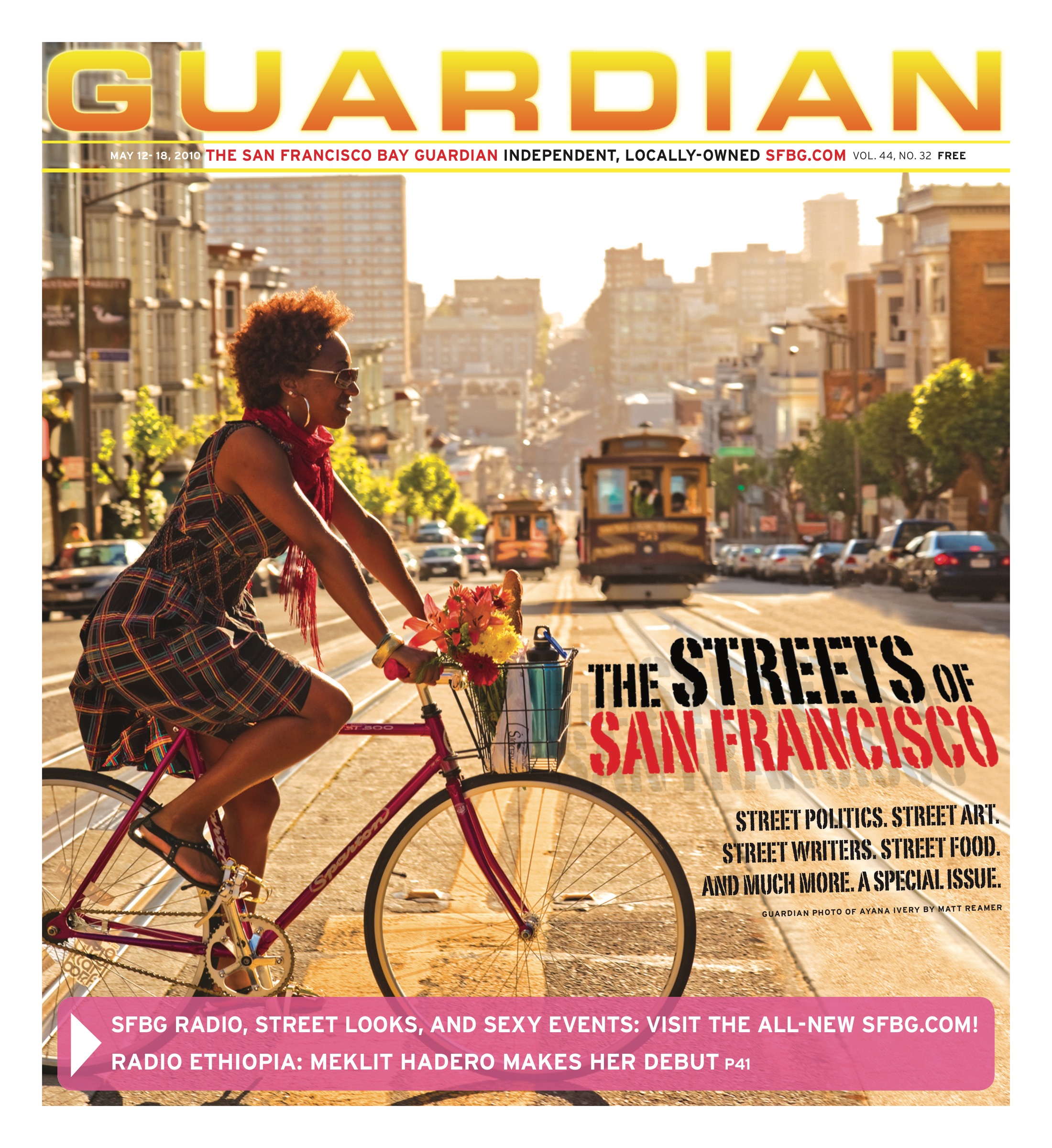
San Francisco has a lot of streets. Take a look at an aerial picture, or just look at the land-use statistics. More of this city is devoted to paved roads — pathways used largely and designed primarily for private automobiles — than any other single use. Parks, for example, don’t even come close.

That’s partially a matter of urban density. In more suburban-type cities like Berkeley or Portland or Seattle, the lots are bigger, yards are bigger, houses are bigger, and there’s more space between the strips of pavement.

But that density gives us a choice other cities don’t have. Maybe we don’t really need that much pavement.

I know it’s kind of a crazy thought, but imagine what some San Francisco neighborhoods would look like if we closed down, let’s say, one out of every four streets. I don’t mean open that land up for development, either — leave it as a passageway, a thoroughfare — but not for cars. Tear up the concrete, plant grass, make pathways for walking and biking … make the streets places where people can gather, kids can play, stores can enjoy the kind of traffic that only comes with a pedestrian mall, and restaurants can have outdoor seating in what would amount to a strip of mixed-use urban parkland.

Closing streets to cars creates plenty of problems, but I don’t think they’re insurmountable. Seniors and disabled people might have trouble with eliminating bus routes and parking in front of their houses, and that’s a legit concern. (Of course, the number of pedestrian seniors and disabled people killed or maimed by cars might go down too.) So maybe some streets could be turned into one-lane strips, and only people with disabled placards could use them. And ambulances and police and fire vehicles can already drive on car-free pathways in parks. And Muni could run a fleet of electric golf carts to ferry people with mobility issues up and down the grassy lanes.

Those of us who have cars would give up a certain amount of convenience; people without cars would get more of the benefits. That might discourage car use, which is good.

But even for drivers, I wonder. Would I be willing to give up the relative ease of parking near my house in exchange for letting my kids just open the front door of the house and run out and play in a safe, vehicle-free park that used to be a street? Would you?

The world is changing; the days of car culture driven by cheap oil are almost over. More and more people are going to be living in cities (that particular demographic trend is one of the most consistent in modern history). When we talk about the Streets of San Francisco, let’s stop for a moment and ask: does it all have to be about cars?

Psychic Dream Astrology

0

May 12-18

ARIES

March 21-April 19

It takes balls to be vulnerable. You can scrutinize your feelings until they make sense to you, me, and everyone your know, but you’ll just end up creating stories to match your moods. Stop trying so hard, pal.

TAURUS

April 20-May 20

The key to your well-being this week is timing, Bully LaBull. Don’t focus on three steps ahead or you’ll miss what’s going on right now! Secure your foundations, and then tend to what’s in front of your purdy face.

GEMINI

May 21-June 21

Just as things are getting more secure in your world, they are changing deep within you. Allow for graceful transitions by letting go of some old crappy habits. Hold yourself accountable in all you do for best results this week.

CANCER

June 22-July 22

If you are willing to take the bad with the good, you’ll actually feel freer. By accepting the cost of things, you can make better decisions, too. Get real and stay real about your choices so you can feel good about your outcomes.

LEO

July 23-Aug. 22

One can act douchey and not actually be a douche. Don’t define yourself (or others) by the ripple effect of your/their actions. Prioritize understanding people’s motives to understand how things got where they are.

VIRGO

Aug. 23-Sept. 22

In the history of the world, few good decisions were ever made from the station of panic attacks, emo k-holes, and bad self-esteem spirals. Bolster your inner world before you tend to the outside one.

LIBRA

Sept. 23-Oct. 22

Your heart is a tender place, so when things get rough around the edges it’s easy to get overwhelmed. You know how you feel, but you may not know what that means or what to do about it — so don’t act like you do, Libra.

SCORPIO

Oct. 23-Nov. 21

You have to rely on yourself, Scorp. Are ya good for it? This week look into the depths of your secret self and take responsibility (without blame, guilt, or drama!) for who you have become.

SAGITTARIUS

Nov. 22-Dec. 21

Don’t shine your light everywhere just ’cause life is easier that way, Sag. Instead, turn your awesome energy onto the parts of your world you want more from. Only invest in your dreams this week!

CAPRICORN

Dec. 22-Jan. 19

In your quest for happiness, it’s important to have realistic expectations, Cap. Dream big and reach for the stars and all that, but be patient! The constellations might not be meeting you with open arms this week, but they will soon enough.

AQUARIUS

Jan. 20-Feb. 18

If you are unwilling to be the agent of change, the Universe in all her sugary kindness will be more than happy to provide such an agent for you. Don’t wait till you have to — improve your life right now!

PISCES

Feb. 19-March 20

Maintain your honor in the face of upsets this week. Dealing with stress is unavoidable, but will suck a lot less if you struggle to rise to the occasion instead of against bad vibes! Work with your situation to change it.

Jessica Lanyadoo has been a psychic dreamer for 15 years. Check out her Web site at www.lovelanyadoo.com or contact her for an astrology or intuitive reading at (415) 336-8354 or dreamyastrology@gmail.com

John Ross: To stop is to die

1

Editors note: John Ross is finishing up a book tour across the United States, and sending us his impressions of Obamalandia. You can read some of his previous posts here, here and here.


I. Baltimore/Washington


The Amtrak rumbles into the back end of Baltimore past block after block of abandoned, boarded-up row houses ripe for burning. This city of such magnificent renegades as Edgar Allen Poe, John Wilkes Booth, and Billie Holliday is mapped by grimy pocket ghettoes that made Baltimore a perfect stage-set for “The Wire.” When contrasted against the gleaming, refurbished downtown, these crime-scene neighborhoods incubate urban uprising.  Red Emma’s is one of a skein of anarcho bookstores with names like Sedition, Monkeywrench, and Bluestockings that have welcomed me on this grueling odyssey across the underbelly of Obamalandia. I’m enlivened by the energies these oases exude. Contemporary anarchists seem to have little time for the crippling ideological jousting that drained the lifeblood of my generation. Those bad old days of Marxist Leninist Maoist Trotskyist Stalinesque backbiting seem an absurd nightmare on the barricades of change these days.  

Tiffany, a tenor saxophonist who day gigs at OSHA over in D.C. and puts in after hours at the bookstore-cafe, and I pitch in to unload a busload of Bread & Puppet props for a zany, Zen show at a cavernous performance space Red Emma’s maintains in a vacated church. I get to trundle in the head of Ben Franklin, the villain in B&P’s latest mini-extravaganza in which $100 bills are the most pertinent puppets. A half century after its founding even before Vietnam caught fire, the puppeteers are still serving bread and aoeli to grateful audiences.

In D.C., I speak at the Institute for Policy Studies, a perennial leftist sounding board four blocks north of the White House and a billion light years from power, about how Washington has hooked Mexico on drug war. It is my first visit to the nation’s capitol with a black president in residence in the house that slaves once built. The Capo de Tutti Capos of the most grotesque criminal conspiracy on earth is too overwhelmed by swelling catastrophe offshore in the Gulf that will make Katrina look like a summer squall, impending car bombs in Times Square, and an economy that continues in freefall, to take time out for a chitchat.

On the day I speak in Washington, Teabaggers and their ilk are massing across the Potomac in an open-carry anti-Obama rally — newspaper photos depict white American males with what look like rocket launchers slung over their shoulders. The threats of this nativist scum are not idle ones. The economic collapse has stoked the bumfires that burn fiercely in the dormant craters of the American volcano.


II. New York
My roots on the North American landmass snake under the lower east side of Manhattan. The Ross (nee Grossinsky) DNA is imprinted everywhere on these mean streets. My grandma Mamie Zief (Ellis Islandese for “Jew”) relocated from Poland to a Rivington Street tenement at the turn of the 20th Century. Although I grew up in the West Village, I went east at an early age; after fleeing the family nest I squatted in the Shastone Monument building on Essex and Houston before escaping to Mexico in the late 1950s. Two of my kids grew up on Second Street and Avenue A, and my son the hiphop mogul still lives 500 yards away from the old homestead (Dante and I are working on a book that bounces off our mutual addictions to black music.)  

My presentations in the Big Apple fit neatly into this geographical schema. I lecture at NYU’s King Juan Carlos Center, once the site of concrete basketball courts where I expanded oodles of adolescent energies. I talk to the Friends of Brad Will at the Sixth Street Community Center where the slain Indymedia journalist, a lower east side rabble-rouser during the darkest days of the Giuliani dictatorship, regularly practiced yoga. Justice for Brad Will remains undone.
And I am lured into Amy Goodman’s state-of-the-art lair for 20 minutes of fame. Democracy Now even sends a car to fetch me up to Chelsea and I induce the stern goddess of left radio to smile — but perhaps it was merely a grimace.  

New York is chockablock with “I Love/Hate New York” minutes. One morning I descend from Dante’s sixth story inferno for a double espresso and the Lowisaida is infested with cops. I approach one of New York’s Finest, an amiable Caucasian, and inquire about the blue plague: “it’s the Will Smith show,” he smiles mischievously. Just then a motorcade of 50 bullet-proofed black vehicles swings off Houston with their lights flashing and sirens screaming and heads down the Bowery to Cooper Union where our commander-in-chief is to make a major speech addressing financial “reform” (in Mexico, we call this “plugging up the hole after the baby has drowned.”)

Goldman Sachs vultures in dark suits and furrowed brows listen intently but go mum to the press when they deadhead downtown back to Wall Street to continue fleecing the public’s pocket.

I step around the corner onto Houston, where a large enigmatic Shepard Fairey montage that references climate change has just been tagged (Dante who is well-versed in such iconography, speculates that the culprit is a tagger named “Nah” who is dedicated to dissing the public art of the stars of this genre.) Gallery slaves have been bussed in to erase the offending stains.  I am wearing my Mexican Electricity Workers tee-shirt, whose black and red colors and clenched fist logo match Fairey’s throw-up, and I am suddenly surrounded by a bevy of documenterians, at least one of whom is just off the boat from Andalusia. They pose me against Fairey’s wall for a thousand-click fashion shoot. New York New York!

Ironically (a word that doesn’t have much scratch here in Gotham), the Banksy flick “Exit Through The Gift Shop” is playing at a grind house across Houston, a cheese ball mockumentary that destroys this world-famous outlaw’s once-pristine reputation for thumbing his nose at power. Indeed, the best thing about the movie is that it is playing right next door to the Yonah Schimmil knishery. I order a kasha knish and sign the guest book with Subcomandante Marcos’s rubric.  

Also a mandatory dining stop in the old neighborhood: the immortal Katz’s (“Send a salami to your boy in the Army”) where pushy New Yorkers of the Hebraic persuasion scuffle to be next in line at the counter of this now 100% Puerto Rican-run deli. The brisket is still to die for.

New York City and environs is now home to a half million Mexicans, mostly from Puebla state, whose slow country drawls are a foil for the tropical machine-gun accents of Puerto Ricans and Dominicans. The Poblanos work in the kitchens of yupped-up food palaces (16 Oaxaquenos were burnt to a crisp walloping pots up in “Windows On The World” on the 108th floor of the Twin Towers on 9/11 day) or slave in 24-hour grocery stores run by Arabs and Hindus and Koreans.  

Mexican elites who have fled here from their imploding fatherland do not much rub elbows with their impoverished compatriots, except when they employ them as maids and babysitters One of the few upsides of the new Arizona Breathing While Brown law is that former pundit and Foreign Minister Jorge Castaneda might be jailed by Sheriff Joe Arpaio and his storm troopers and forced to don pink underwear if he were to be stopped without papers in Maricopa County.

III. BOSTON

The new Boston Tea Party that catapulted Scott Brown into the suddenly Kennedy-less Senate is not an anomaly in a city where the name of Charles Stuart (Google him up) still rings a bell.  

I speak at the Harvard Coop to a handful of bedraggled Harvard Square denizens who have found sanctuary from a driving rainstorm in this hallowed readery. I am invited to the David Rockefeller Center for Latin American Studies to rant at the future leaders of Latin America — but none show up. I spend an engaging evening with Jack Womack, whose “Zapata & The Mexican Revolution” is still the definitive text on the struggle of the incorruptible revolutionary. Jack, now emeritus in Harvard Yard, recently rebuked the Mexican government by turning down a literary prize because of President Felipe Calderon’s role in the firing of 43,000 workers in an undisguised ploy to privatize electricity generation in Mexico, and is currently chipping away at his life work, a history of working class struggle in the state of Veracruz. Jack and I converse in an argot stippled with so many arcane references to social upheaval south of the border that FBI eavesdroppers could surmise we are planning a new Mexican revolution — which, 100 years to the date of the last one, is not such a bad idea.    

I warm up for May 1st rallies by urging attendees at community meetings at the UNITE building in Chinatown and a U-U church in Jamaica Plains to join the protests. There are two marches and rallies set for International Workers Day in Beantown, the bitter fruit of a split in the movement the seeds of which I could not divine.  

On the Boston Commons, I spiel about the first May 1st back in 1886 when 80,000 immigrant workers stomped through Chicago to demand the eight-hour day, a day of solidarity and struggle around the world everywhere except in the country where it was birthed. The Haymarket Martyrs join us for a stroll through the streets of downtown Boston, held aloft by the ubiquitous Bread & Puppet comrades.  

All across Amerikkka, immigrant workers, incensed by the enactment of a law that makes inhaling the air of Arizona a jailable crime if you are a person the color of the earth, were on the march, perhaps a half million (high end estimates) strong — as many as 200,000 in Los Angeles and another 100,000 in Chicago; 25,000 more in Dallas and significant turnouts in New York and Washington but only 6,000 or so in Boston to which Mexicans have migrated in smaller numbers.  

This year’s surge, which was dwarfed by the gargantuan outpourings of 2006, featured a marked absence of Mexican flags as undocumented workers chose to cloak themselves in the Stars and Stripes in response to the feeding frenzy of the Fox News lynch mob.  

Although the condemnation of Arizona Goddamn was vibrant, it must be noted that there have been as many ICE raids under the Obaminators as under Bush and the crackdown on employers is targeting union-organized janitors. David Bacon, whose reportage remains a light in this darkness, recently noted that 175 SEIU janitors are about to be fired in San Francisco, once a sanctuary city for labor.

The People the Color of the Earth rolled through the streets of east Boston with gusto. “No One Is Illegal!” Sandra, my displaced Chilanga guardian angel, and I yodeled in unison with the compas.  “Do I Look Illegal?” read the homemade banner draped around the shoulders of a skinny pre-teener. Many high schoolers wore caps and gowns to highlight the prohibitions on financial aid that doom their college educations to MacDonald’s Hamburger U.

Speaker after speaker in a park down by the harbor  — where, indeed a few hundred years back down the pike the original Boston Tea Party was staged — raged against a system that still consigns immigrant workers to the lowest step on the American food chain. “Justicia! Justicia!” they clamored and their cries were no less relevant than those uttered by the “Martires de Chicago,” as the Haymarket martyrs are known throughout Latin America. By the time I took the mic, all the words had already been spoken but I finished up with the chant of the pensioners’ movement in Mexico City in whose ranks I am enrolled: “Parar Es Morir!” — To Stop Is To Die!

Me and the Monstruo have come to the end of our three month 66 performance journey through Obamalandia but there’s one thing you can count on: “Parar Es Morir.”  I’m not planning on stopping (or dying) any time soon.
  
John Ross will be returning to Mexico in mid- May to begin work on a new book, “From Bebop To HipHop – Fathers & Sons.”  You can consult him on particulars at johnross@igc.org  
        

Carville: like Black Rock City, but more history-like

0

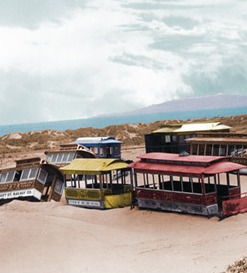
Repurposed streetcars perch haphazardly in dunes not yet cowed by asphalt and the Java Beach coffeeshops. They’re homes to a community of urban escapists and artists. Some of them have front porches, some of them house bicycle clubs. It’s like a Dali painting, it’s like the boxcar children — but it’s also an accurate picture of the first non-indigenous inhabitants of the Sunset, on whom local historian Woody LaBounty has written an awesome book, Carville-by-the-Sea.

The book’s images of 19th century Carville are chicken soup for the boho soul. I want one. My room mate wants one. LaBounty himself says he’d live in one — were the lone streetcars still surviving in the western neighborhoods’ not firmly in the grips of their current owners. There’s even one still-standing house built in 1908 that’s made of three cars; a two street car living room, and a bedroom from one that was horse drawn.

One of Carville-by-the-Sea‘s trippy colorized historical photographs

There used to be hundreds of these things. People moved out to Ocean Beach despite the subpar public transit service that places without sidewalks are often subject to — when the community was first started in 1895 was a steam car that ran out Lincoln Way down to the Cliff House, a service intended mainly for the weekend day trippers. They went to escape the city, to improve their health. There were bars and restaurants in street cars, shoe repair stores, artist studios.

So how did I not know about these things before? LaBounty says he grew up in the Richmond in the ‘60s and 70’s, a few blocks from one of the surviving streetcars, which latched a steampunk-sized hold in his childhood psyche.

More pages from Carville-by-the-Sea. Where’s a Delorean when you need one?

“I loved planes, trains, and automobiles, so living in a street car — it just seemed like the coolest thing in the world,” says LaBounty, who is one of the founders of the Western Neighborhoods Project, proprietor of what is reportedly the most popular SF history website/propagator of history walks, plays, and films by teenagers who interview older residents in their neighborhoods. “I used to watch Wild, Wild West, the ‘60s TV show, and they were living in a train, which I thought was great.”

To research, he began interviewing historians he knew, and motor vehicle enthusiastists, and learning all he could about the old community on the beach. Though he’s privy to all kinds of juicy info on the town’s colorful past, LaBounty found interest in his stories of the bohos and families living on the cars really captured listeners. “We all thought, there needs to be a book on this,” he says. “And then I realized that I should probably write it.”

So here it is, colorized like the postcards of yore for that extra oomph of fantasy creation. Newspaper articles from the 19th century on the streetcars, biographies of the community’s founding members, lots of lovely photos from the dunes.

La Bounty’s doing a series of live talks on his Carville expertise which are open to the public. Just be forewarned: he’s not versed in how to get you a steetcar of your own. Still fun to hear, though.

Carville-by-the-Sea presentation
Wed/19 7 p.m., free
History Guild of Daly City/Colma
Doelger Senior Center
Westlake Park
101 Lake Merced, Daly City
www.carville-book.com

Is ICE planning to destroy sanctuary city?

10

Virginia Kice, spokesperson for the Department of Homeland Security’s Immigration and Customs Enforcement (ICE), sounded hopping mad at the way that ICE’s Secure Communities initiative is being represented as undermining San Francisco’s sanctuary policy and possibly creating an even worse federal immigration system.

“It’s just an information sharing system,” Kice told the Guardian. “Any time someone is electronically booked by local or state law enforcement agencies, their fingerprints will be compared up against biometrics in U.S. Department of Justice, the F.B.I. and the Department of Homeland Security (DHS) databases. “


If a match is found, then ICE will do the follow-up investigation, Kice said.

“Not everyone in the system has violated the law,” Kice explained. “They may have applied for an immigration benefit or they could already be naturalized [have become a U.S. citizen]. It just means that they have had an encounter with DHS.”

Alluding to the ongoing debate about immigration law and racial profiling, Kice stressed that this new system doesn’t selectively finger print.

“It finger prints everybody, and because this system uses biometrics, it’s going to be accurate in terms of i.d.ing people who have had prior encounters with D.H.S,” she said.
“Some people use multiple aliases and give misinformation about their history. We know people have escaped deportation this way in the past, but fingerprints don’t lie.”

Local law enforcement officials are concerned that though the new policy is supposed to target folks charged with serious crimes, including murder, rape, sex crimes, serious assault, and resisting arrest, it will also sweep up folks charged with minor infractions, such as being drunk in public, who could now fall into ICE’s hands for deportation, especially if they resist arrest at the time, which happens to be defined as a serious crime.

“Not everybody who is in the country illegally has ever been encountered by D.H.S. and because we don’t have their biometrics, the system would not detect a match,” Kice continued. “But that does not mean they won’t be referred for a follow-up investigation. And it ensures that we get their information shortly after an encounter occurs.”

But despite Kice’s rosy assessment of the federal government’s Secure Communities program which she says has already been set up in 15 other California communities, 20 states and about 160 municipalities nationwide, the San Francisco Sheriff’s Office continued to express unease at how the new program will shift the local landscape.

 “The ground rules in the jails have changed, but not due to any decision on our part,” Eileen Hirst, spokesperson for the San Francisco Sheriff’s Department told the Guardian.

The interlinking automated database will remove the firewall that used to protect folks booked with low-level crimes from being referred to federal immigration authorities.

“The firewall was the discretion of local law enforcement,” Hirst explained.

In San Francisco, the Sheriff’s Department developed laws that were consistent with federal laws, as well as San Francisco’s sanctuary ordinance, which was enacted in 1989.

Under San Francisco’s current “City of Refuge” ordinance, local law enforcement officials refer individuals who are booked on felony charges, or have a history of felony charges, and are foreign born and have previous deportation orders or ICE holds.

But now everyone who gets arrested will be fingerprinted and referred to ICE, not through human intervention, but through a fingerprint database that connects to similar databases in Canada, Mexico and within Interpol.

“DHS, of which ICE is part, has interoperability agreements with California’s Department of Justice, which maintains a fingerprint database for state,” Hirst said.” ICE now has complete access to the DOJ databases and vice versa.”

This fundamental change in policy means that any time anyone is booked in San Francisco, they will be fingerprinted and automatically reported, including folks charged with misdemeanors, such as minor drug possession, low level financial crimes and misdemeanor battery.

“What happens next will depend on DOJ’s response,” Hirst said. “We are putting the word out because it was clear that the immediate community did not know about this.”

Local law enforcement officials say they were verbally informed of the new initiative at a recent meeting at ICE’ office at 630 Sansome Street in San Francisco. Asked if the system will go into effect June, Kice said the agency doesn’t typically inform communities when the program will be deployed, but promised to get back to us.

David Venturella, who has been involved with ICE for years and is currently the head of ICE’s Secure Communities initiative was not available for comment, but Kice sent a fact sheet, which claims the program “is leading ICE’s efforts to modernize and transform its criminal alien enforcement model, through technology, integration and information sharing.”

“This is the first time that the Federal government has used biometric identification technology to enforce immigration laws at the state and local law enforcement level,” the fact sheet states. “This enables ICE to accurately identify dangerous criminal aliens much more efficiently, and in significantly greater numbers. This also helps local law enforcement officials get dangerous criminals off their streets, at little or no additional cost. If an individual’s fingerprints match those of a person in DHS’s biometric system, the new automated process will notify ICE and the participating agency submitting the fingerprints. ICE will evaluate each case to determine the individual’s immigration status and take appropriate enforcement action. Top priority will be given to offenders who pose a threat to the public safety, such as aliens with prior convictions for major drug offenses, murder, rape, robbery, and kidnapping.”

The ICE fact sheet notes that, “Deployment of this interoperable technology across the nation is now underway as is expected to be complete by 2012.”

“Congress has allocated $350 million for Secure Communities in FY 2008 and FY 2009,” the fact sheet continues.  “As of March 2009, Secure Communities has been deployed to 48 sites in seven states – Arizona, Florida, Massachusetts, North Carolina, Pennsylvania, Texas, and Virginia.”

And clearly, it’s already expanded beyond those boundaries and is about to kick in, right here in San Francisco and other Bay Area municipalities.

Are you experienced?

THEATER José Sarria is many things: performer, activist, trailblazer, legend, Latino, diva, tenor … So just how many José Sarrias are there? In the latest meta-theatrical reclamation-and-floorshow from playwright-director John Fisher (Medea: The Musical, Combat; Ishi: The Last of the Yahi) you’ll meet several but get no strict count. That’s part of the point and much of the charm in SexRev: The José Sarria Experience, a production of Theatre Rhinoceros, currently ensconced in residency at queer performance incubator Mama Calizo’s Voice Factory.

First, there’s the Sarria of memory, in the mind of our ingenuous, ebullient narrator (Donald Currie), a gay man in middle age reminiscing about his precocious sexual awakening via “the Nightingale of Montgomery Street” in a certain storied postwar/Beat-era bar known as the Black Cat Café. At one point in this fourth-wall–smashing show, staged in the round as the invitingly sleazy Black Cat itself, audience members are invited to share their own first-hand impressions of the pioneering San Francisco drag performer and gay rights activist.

Then there are the Sarrias we meet on stage, played to the hilt by Tom Orr and Michael Vega. Each actor is responsible for an aspect of the Sarria “experience,” but in the insouciant critical consciousness of Fisher’s play, that doesn’t necessarily mean it will go unchallenged. “But José Sarria was brown!” shouts a “heckler” at Orr. “You’re not brown.” The contradiction and ensuing kerfuffle provide Fisher and the audience one way into the continuing political relevance and volatility of his subject matter, of course, and some productive laughs come out of it too. Add to this the real possibility of the “real” José Sarria showing up in the audience one night, and you get a sense of the tangled politics of art, and art of politics.

Frenetically staged, often very funny, endlessly self-referential, and indeed — as one character doesn’t hesitate to complain — a bit long, “SexRev” moves fitfully back and forth across the last several decades of San Francisco queer life and politics. But as a history lesson, a widening of horizons, and a spur to political vigilance on behalf of freedom for everyone, it’s a hell of a lively night out.

Luis Echegoyen’s old school Mission cool

3

Back when he was a television star in El Salvador, Luis Echegoyen could have little guessed that fifty year later he’d be performing in his own poetry reading in San Francisco of classic Spanish authors (Sat/8, Mission Cultural Center for Latino Arts). But it’s not the least probable feat that legendary Spanish language Bay area news anchor Echegoyen has accomplished — after all, poetry is his retirement project.

Echegoyen was famous in El Salvador when he made his first trip to the United States. A television and stage star, he had joined a troupe of artists who were performing in high schools and colleges across the country in a sort of cultural education tour for North American students. But when he arrived in San Francisco in November of 1962, he stayed. His sister lived here, and he heard that San Francisco State had a top-shelf drama program, where he planned on continuing the five years of formal stage education he had received back home.

But “I didn’t have the English,” Echegoyen tells me. He’s now a stately older gent in a turned-out suit, reminiscent of his days as a storied San Franciscan Spanish language news anchor. He shares his memories with me in a room at the Mission Cultural Center, and they’re fascinating, scenes set in the familiar streets of the Mission, but with reality set at a different angle from historical currencies.

With the education system unassailable, he turned to what he knew best; Spanish language show biz. His first major project was a radio show called Escala de Fama, which was being recorded in front of a live audience at the Victoria Theater. Echegoyen was a rookie at KOFY, which broadcasted Escala, but he could tell the hosts of the variety show needed help.

“The audience was very rowdy,” he recalls. “The announcers were afraid of the audience, they would hide behind the curtains!” He grabbed the mic, and drew on his years of experience during El Salvador‘s golden age of show business, cracking jokes and walking through the aisles of the Victoria. The spotlights followed him, and he hosted Escala for the next 13 years. Luis had arrived in San Francisco.

It’s fascinating to hear someone talk, as Luis does, about the way the Mission neighborhood was generations ago. It doesn’t sound so very different — sure, less fixed gear bikes — but the immigrant families packed into subdivided Victorians were already there, without many of the resources they needed to thrive. This was back before the advent of the social organizations that today call the Mission home. “Kids didn’t have anywhere to go; no parks, no gyms, no after school programs. I said, ‘okay, we need a park, we need a gym,’” says Luis.

Avance Luis! The man in magazine covers

And if talking with the man taught me one thing, it was this; what Echegoyen decides to do, Echegoyen does. To fix the issues he saw, he got in deep with a whole laundry list of community organizations; Bay Area Neighborhood Development, Mission Coalition Organization, and the Economic Opportunity Council, to name a few. He started working on seniors’ issues, delinquency issues, economic issues. Most importantly, he parlayed his growing radio and television celebrity into making change.

At one point, the Parks & Recreation department responded to his entreaties to build a park almost sarcastically, saying that if he wanted a park for his adopted neighborhood, they’d build it — if he could find an empty lot in the well-populated Mission neighborhood. On his way to shoot a news story with his camera crew, Echegoyen saw one, a dump site in the outer Mission/Bernal Hieghts.

He broadcasted from the site, sitting amidst the rubble. “I said ‘this is an empty lot, and we can use it to build a park. Let’s go to City Hall, and ask for a park to be built in this place.” Which of course, he did himself, only to find that Parks & Rec themselves were the property’s owners. Today, the park is there, testament to Echegoyen’s ability to use his broadcast skills and community position to effect change.

“You have to use the media to benefit the community. I went out on the streets, I found problems. Some of the problems were solved, some not,” he says, looking back at his activist career.

Today Echegoyen is retired, the first Latino inductee in the silver and gold circles of the National Academy of Television Arts and Sciences, a winner of a Lifetime Achievement Special Emmy.

“Luis has always been a leader in the community,” says Cynthia Harris, anchor of Univision KDTV’s En la Bahia, a local Spanish language news show of which Echegoyen was producer and host for many years. During his tenure, Luis brought in neighborhood leaders, as well as  local and international Latino artists. Harris says it was projects like these that reflect Echegoyen’s startling impact on San Francisco. “It was an opportunity for the Latino community to have a say — something that previously that hasn’t existed.”

Clearly, this is a man who’s earned his retirement. Although Echegoyen is active in senior education through AARP, two scholarship organizations for low income students, and is currently toying with the idea of organizing an artists’ flea market in the Mission, his pet project of the moment takes the stage at Mission Cultural Center for Latino Arts this weekend.

He’ll be reading poetry, the Spanish language masters. He’s a connoisseur of the art form, having recently recorded four volumes of poetic anthologies he‘s releasing one at a time on CD. “Poetry is so ample,” he tells me, proudly handing over a copy of volume one. “It’s really painful to be choosing which to include on the CDs.”

Sat/8 7 p.m., $15
Mission Cultural Center for Latino Arts
2868 Mission, SF
(415) 643-5001
www.missionculturalcenter.org

Human, nature

0

arts@sfbg.com

DANCE If Deborah Slater had not grown up into an artist, she might have tried her hand at science. She bases her dance theater pieces on extensive studies of physical reality. Her inspiration can come from concrete objects like furniture (Hotel of Memories) and paintings (The Desire Line) or less tangible phenomena like sleep (The Sleepwatchers), perception (Passing as … The Mathematics of Being), and death (A Hole in the World). Accessing Slater’s works can take patience, but her creations stay with you because they are formally inventive, finely crafted, and engage the mind and heart long after you leave the theater. But rarely have the many strands she weaves together resulted in a piece as sprawling, ambitious, and poetic as her 20th anniversary premiere Men Think They Are Better than Grass.

Seen at a preview performance, Men — the title is not anti-male, but refers to humankind — takes on nothing less than the destruction of the environment that started probably as soon as humans were given "dominion" over the earth. Instead of reiterating well-rehearsed arguments, evidence, and position papers, Slater and codirector/dramaturge Jayne Wenger went to poet W.S. Merwin. Excerpts of his writings provide the backbone and scenario for this evocative, richly textured canvas of sound, color, language, and movement. The poetry, heard on tape and — helpfully — reprinted in the program, was recorded by a number of well-known Bay Area artists.

Men explores human alienation from nature in a series of imagistic episodes that, though loosely structured, build momentum. They are dark (dancers rushing about in increasing desperation), funny (Justin Flores transforming himself into a man made of briefcases), and dreamy (people trying to dig up the firm ground of history that proves to be unexpectedly porous). Perhaps most remarkable was the way Men deepened its sense of entropy, barely alleviated at the end by something, at least, suggesting a way out. As the piece darkened, the confrontations between the dancers, who had stripped off their business black to reveal battle fatigue greens, became increasingly agitated. They intensified to the point where they had a Lord of the Flies aspect to them. You also wanted to gasp for air every time the dancers crushed themselves into an ever-smaller piece of terrain.

Still, at this point, the choreography worked best in the small units: Travis Rowland heaving one woman after another, Private Freeman on a "war path" to protect his potted plant, and the fierce Kerry Mehling in anything she lent her regal body to. Some of the ensemble sections, particularly the unisons, needed more of a profile; they sometimes looked tense and rushed beyond what I think the intention was. All the dancers — Natalie Green, Kelly Kemp, Wendy Rein, Breton Tyner-Bryan, Shaunna Vella, and the others already mentioned — contributed to the choreography.

Men was a collaborative enterprise in other ways as well. Thom Blum and Floor Vahn’s soundscape of natural and animal sounds beautifully evoked the natural world, so increasingly absent in the lives of these depraved-deprived people. Elaine Buckholtz’ videography added its own poetry. Allen Willner designed the dramatic lighting, Laura Hazlett the fine costumes. What did not work was Mikiko Uesugi’s metaphoric use of plastic sheets for chopped-down trees. *

MEN THINK THEY ARE BETTER THAN GRASS

Thurs/6-Sat/8, 8 p.m.; Sun/9, 5 p.m., $25

Z Space at Theater Artaud

450 Florida, SF

www.deborahslater.org

Secrecy and criminality in the SFPD

15

Today’s Chronicle unveils more problems at the scandal-plagued San Francisco Police Department, as well as the District Attorney’s Office, raising new questions about their commitment to public accountability and protecting civil liberties at a time when the SFPD is seeking more authority and asking for the public’s trust.

At issue are police officers with criminal histories and disciplinary records serious enough to warrant disclosure to the criminal defendants that they testify against in court, which the story indicates is more than 80 officers. Such disclosures have been a standard requirement for almost 40 years, but neither police nor prosecutors in San Francisco have been making them, a revelation that could overturn hundreds of felony convictions because of this official misconduct, the Chron reports.

That bombshell comes in the wake the SFPD’s crime lab scandal, in which lab technician Deborah Madden – herself a court witness with a criminal history that should have been disclosed to defense attorneys – is suspected of regularly stealing from the seized narcotics that she tested.

The SFPD and its undercover party-busting cop Larry Bertrand are also accused of harassing nightclub owners and patrons, busting private parties using excessive force and warrantless raids, and illegally seizing computers and other personal items – all while publicly seeking to discredit the Entertainment Commission and seize its power to shut down nightlife in the city, as well as seeking greater authority to roust and threaten vagrants by proposing a law to ban sitting or lying on city sidewalks.

SFPD officials have repeatedly claimed the agency can be trusted not to abuse these new authorities, but the latest revelations about criminal cops highlights how difficult it is for the public or the press to keep tabs on the agency.

The Guardian today sent the SFPD a Sunshine Ordinance request for the names and violations of the officers in question, but if the past is a predicator, it’s likely to be denied with the claim that such records are exempt under the Peace Officers Bill of Rights, a state law with strict privacy protections for cops.

Even defense attorneys who have well-established rights to examine an arresting officer’s criminal and disciplinary histories through what’s known at Pitchess motions are routinely stonewalled by the SFPD, say defense attorneys. For example, attorneys for Arash Ghandan, an alleged victim of Bertrand’s brutality and retaliation, are now having a hard time getting information on the officer’s history. “We are in a battle for Bertrand’s personnel file,” Ghanadan’s attorney, Steve Sommers, told the Guardian. “The city of San Francisco just does not hand over documents without a fight.”

In 2006, former SDPD attorney Reno Rapagnani and his wife, former SFPD Sgt. Leanna Dawydiak, raised the issue of SFPD secrecy, its pattern of routinely shielding problem officers from discipline and public scrutiny, and retaliating against whistleblowers – and were then subjected to a witch hunt that forced them out of the department.

More recently, SFPD and its powerful Police Officers Association succeeded in watering down an early warning system for violence-prone officers, removing a number of triggers – such as resisting arrest and assault on a police officer charges that often accompany cases of abusive police conduct – that had been recommended by a police practices expert and which are currently used in San Jose and other cities. 

Meanwhile, District Attorney Kamala Harris, a candidate for California Attorney General, is also being criticized for the latest scandal. Under the Penal Code, she bears the responsibility for ensuring that her prosecutors are doing background checks on all witnesses and sharing that information with defense attorneys.

“Ultimately, the district attorney has to answer for this. It is the prosecution’s duty to check the criminal backgrounds of officers called to testify. That never happened, and as a result, people have been denied fair trials,” Public Defender Jeff Adachi said in a press conference on the issue this morning.

The tough-on-crime era of the 1990s — when politicians, police, and prosecutors did all they could to create new laws and enforcement powers – is over, and we have a severely overcrowded prison system to show for its short-sightedness. But that mentality continues to guide the SFPD.

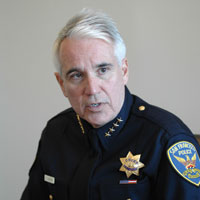
Since the arrival of Police Chief George Gascon from Arizona last August, SFPD has undertaken a series of crackdowns, including hundreds of drug arrests in the Tenderloin, raids on marijuana-growing operations in the Sunset and parties in SoMa, citing Dolores Park-goers for drinking, and, on Friday, giving at least two Critical Mass bicyclists tickets for amplified music. He’s also said he wants more power to discipline problem officers, but he has yet to show that’s anything more than just talk.

Perhaps now it’s time for the pendulum to swing back in favor of restoring damaged civil rights and raising our expectations of the agencies that have such power over our daily lives and freedom. The SFPD should adequately police itself before it looks for new ways to police the rest of us.   

All the young Turks

1

arts@sfbg.com

HAIRY EYEBALL Welcome to Hairy Eyeball, a bimonthly rundown of visual art. We don’t aim to be comprehensive, just opinionated. First Thursday is tomorrow, so enough with the introductions. On with the shows.

CCA is unleashing a new batch of Fine Arts MFA students into the wild Thursday night. With 66 artists total, this year’s MFA show (which runs at the San Francisco campus through May 15) is one of the largest in recent memory. The cream from CCA tends to rise to the top pretty quickly, so here are some names worth looking out for in white cubes, near and far, in the future.

Llewelynn Fletcher’s interactive sculptures aren’t aiming to take a particular pulse, but will probably slow yours down. For Please Lie Down, she has created several enclosures of lead, ceramic, wood, and felt that completely cover the head, forcing you, per the piece’s title, to lie down on the floor (thankfully, she’s also constructed camping-style palettes for comfort). The mini-meditation huts, evocative of beehives as well as certain medieval torture implements, have the additional effect of transforming the wearer into something of a sculpture.

Maggie Haas’ mixed-media pieces could easily be mistaken for installations-in-progress. But her arrangements and treatment of construction site detritus — sawhorses, wooden slats — cannily gut minimalism, This Old House-style, by preferring to hang out in the workshop with Donald Judd et al., turning the means of production into the piece itself. Endless Escape in particular performs a neat rope trick that yokes Robert Smithson and Yayoi Kusama with the ease of an Eagle Scout.

Hilary Wiedemann’s installations, which frequently combine sculptures and projection, are far more elusive — and unsettling. In Untitled, a plaster cast of what looks to be a bullet hole-riddled surface (glass, perhaps?) leans against the wall; on the floor, laminated sheet glass has been contorted to resemble discarded tissue. Both components record the violence of the transformational processes that have brought them to their current states. It’s not comfortable viewing — as if you’ve stumbled on a crime scene before the police tape has gone up.

Someone put Doron Fishman in touch with a textiles manufacturer, stat. His gorgeous ink-on-paper works, all black tendrils of liquid smoke, let it bleed. They’re begging to be transferred to chiffon. The witchy Mulleavy sisters, of Rodarte fame, would be smart to look him up.

Well worth the trek to the other side of Potrero Hill is Ping Pong Gallery, which is currently showing Gwenael Rattke’s dark, hypnogogic collages (through May 14). The collection’s title, “Oktogon,” refers to a street intersection in Budapest and also to the Ottoman-style “Kiraly” baths built during the Turkish occupation in the 16th century. These layers of history, architecture, exposed flesh, and power are not wholly self-evident in the psychedelic grandeur of Rattke’s straight-razor wizardry — which recalls, among many associations, the graphic punch of Tadanori Yokoo and Keiichi Tanami’s 1960s poster designs, the homo-plagiarism of Jess’ massive Narkissos (1978/91), and the profondo rosso beloved by Dario Argento. Rather, they form the deep structures to these mandala-like works in which Op-Art geometrics collide with Art Nouveau scrollwork and leather daddies are refracted into Busby Berkeley chorines. The corner in which 14 of these pieces have been hung draws you in, like some black hole. Proceed with caution, and awe.

Also closing toward the end of the month (May 22 to be exact) is Beverly Rayner’s “Accretion” at Braunstein/Quay, an elongated housecoat covered in the day-to-day paper ephemera — greeting cards, bills, receipts, inspirational quotes, correspondences — that one accumulates over the course of a lifetime. “Go paperless” is one takeaway. That such a load is too much to bear — psychically as much as environmentally — is another. *

CCA GRADUATE THESIS EVENTS

Through May 14, free

California College of the Arts

1111 Eighth St., SF

(415) 703-9500

www,cca.edu

GWENAEL RATTKE: OKTOGON

Through May 14, free

Ping Pong Gallery

1240 22nd St., SF

(415) 550-7483

www.pingponggallery.com

BEVERLY RAYNER: ACCRETION

Through May 22, free

Braunstein/Quay Gallery

430 Clementina, SF

(415) 278-9850

www.bquayartgallery.com

A roar from underground

0

arts@sfbg.com

MUSIC When asked if it’s a good time in history to be in a sludgy, uncompromising heavy metal band, High on Fire’s Matt Pike stifles a chuckle: “It is for me, man!” Reached by phone in Los Angeles as he prepares for a show at the El Rey Theatre, Pike is far from loquacious, but clearly enjoying the arrival of hard-earned, well-deserved success. His band, a thunderous, heavily-distorted power trio, bastard son of St. Vitus and Slayer, just signed on for a string of European dates opening for Metallica.

Before they set off across the Atlantic, High on Fire will appear at Oakland’s Fox Theater to play a concert called the Missing Link, a weighty omnibus of a heavy metal bill that brings together two potent touring packages, their itineraries cleverly fused into one mammoth night of music. Pike’s band is joined by tour-mates Priestess, Bison B.C., and Black Cobra. Headliners Mastodon deploys its own retinue of support: Between the Buried and Me, Baroness, and Valient Thorr.

The bands at the top of the bill are living proof of this epoch’s friendly attitude toward challenging, underground heavy metal. Mastodon charted at No. 11 with 2009’s Crack the Skye (Warner Bros.) and Between the Buried and Me hit No. 36 with The Great Misdirect (Victory). Oakland native sons High on Fire stormed into the limelight in February 2010; Snakes for the Divine (E1 Music) debuted at No. 62. Baroness’ Blue Record (Relapse) was the critical darling of 2009 — Decibel magazine named it album of the year — and it peaked at No. 117.

Those still working their way up from the bottom are no less optimistic. Speaking on the phone while peregrinating around L.A., Jason Landrian, singer/guitarist for crushing S.F. duo Black Cobra, is loving life. “I think it’s a great time to be in a heavy band. There are a lot more people paying attention and taking the music a lot more seriously.” Black Cobra, which was recently signed by legendary label Southern Lord Records, has ample experience with and appreciation for the bands it will share the stage with at the Fox. “For us,” Landrian says, “it’s a thrill to be involved with what seems like a cross-section of what’s going on right now in the underground scene.”

Superficially, the bands on the bill are easy to circumscribe within geographical boxes. Mastodon and Baroness both hail from Georgia, a state that is quickly becoming one of the nation’s most fertile breeding grounds for independent metal. Between the Buried and Me and Valient Thorr are also from Dixie, storming out of North Carolina university towns Greensboro and Chapel Hill, respectively. Priestess was founded in Montreal, and Bison B.C. in Vancouver (in the eyes of American rock critics, everything Canadian seems related). Black Cobra and High on Fire represent the Bay Area.

Yet this sort of convenient compartmentalization is redolent of a scene-based musical analysis that is rapidly becoming obsolete. A generation that came of age during the sodden triumph of the “Seattle sound” has matured into an army of bands that defy physical space. The insidious tentacles of social networking and the exponentially expanding capacity of cheap bandwidth have enabled independent musicians to bridge vast distances, to identify kindred spirits and isolated fans. Early Black Cobra material was written while the band’s two members resided on different coasts, swapped back and forth methodically with the click of a mouse. The Internet has been a boon to concert bookers and promoters as well, allowing them to ferret out undeserved markets and spread the digitized word.

Looking back through lists of past tour dates, the connections and inter-pollinations among this underground army of heavily distorted road warriors are practically infinite. It seems as if every band has toured with every other band on the Missing Link roster at least once. “We’ve known those guys forever,” Pike says when asked about Mastodon, and it’s only partly hyperbole — the members of Mastodon met at an Atlanta High on Fire show in 1999.

Though today’s metal vanguard takes advantage of technological innovations, it’s the relentless touring that reaps rewards. And while life on the road has its costs, the new century’s burgeoning crop of itinerant headbangers can depend on a tight-knit nomadic community — bearded and unwashed — that grows stronger by the day. “It’ll be a reunion with friends, which is a cool thing,” says Landrian. “You end up meeting all these people, touring around, and when you get a show like Missing Link happening, everybody knows each other.”

Armed with vans, smart phones, and arsenals of crushing riffs, the bands of Missing Link have the entire continent at their disposal. It’s a far cry from the specter of the 1980s, poisoned by feuding thrash titans and the internecine, hair-sprayed fist-fight for scraps from the Sunset Strip table. “That’s the thing about this underground metal scene,” Landrian says beatifically. “Everyone’s working together. There’s not a lot of ‘Oh, we’re competing with these bands to be in a position of honor.’ There’s a lot of camaraderie. Everybody sees each other in the same light.”

THE MISSING LINK

Mastodon, Between the Buried and Me, High on Fire

with Baroness, Priestess, Valient Thorr, Black Cobra, Bison BC

Sat/8, 4 p.m., $35

The Fox Theater

1807 Telegraph, Oakl.

(510) 302-2277

www.thefoxoakland.com


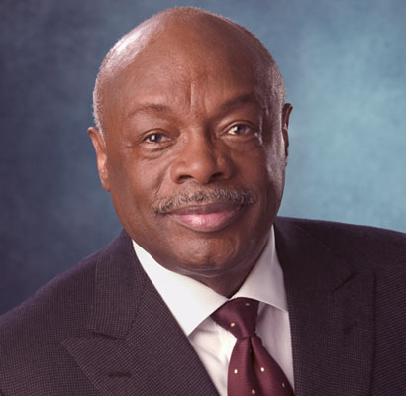
The problem with Willie Brown Jr. Boulevard

3

Ok, Eve Batey has a fun item on SF Appeal: Even the Chronicle, which pays Brown to write his deeply conflicted newspaper column, doesn’t want to see Third Street renamed for the former mayor. That’s probably because Hearst Corp., which owns property on Third Street, doesn’t want to spend the money to change all of its letterhead, documents, mailing address etc. to reflect a street name change. We saw a lot of the same complaints when Army Street was changed to honor Cesar Chavez; some local businesses got mad because of the (modest) costs involved.


I’ve got a much bigger problem with the name change.


You name a street after someone who deserves a major civic honor. Naming a street in the Mission after Cesar Chavez makes a strong, positive statement about San Francisco’s values. So what would Willie Brown Jr. Boulevard celebrate?


One of the most corrupt mayors in San Francisco history, a guy who sold out the city to developers, stood by and allowed the greatest displacement of low-income San Franciscans in modern history, presided over the economic cleansing of San Francisco, and now flaks for PG&E, the pharmaceutical industry, and who knows what other private clients (despite writing about politics in his column, he hasn’t disclosed the list of which political interest groups are paying his sizable legal fees).


Brown’s a fun guy, and I always read his column, and when he did a radio show, he often had me on as a guest, and we joked about the old days, and I have to admit, he’s the life of the party. But let’s not forget the history here; his record in politics stinks.


Besides, he’s still alive — and although he’s smart enough that he’s never been caught doing anything illegal, you never know what trouble he could get into, and how badly he could embarrass the city, in the years to come.

The Daily Blurgh: The prenup claws

Curiosities, quirks, oddites, and items (plus a lot about kitties) from around the Bay and beyond

Make all the catty jokes you want about Uwe Mitzscherlich, the German man who married his asthmatic cat Cecilia to honor their decade of companionship. Seriously, though, if you’ve ever bonded with a pet, the whole thing is just heartbreaking. In happier animal news, the Bay Area’s baby peregrine falcons got tagged today.

*****

Totally un-cool headline of the day: “San Francisco may cut funding to transgender job center”

*****

Totally cool headline of the day: “Looking For Burritos in All the Wrong Places”

*****

“A group of Second Life users is suing Second Life’s creator over a virtual land dispute. They say their contractual property ownership rights have been changed and that this alteration of the terms of service constitutes fraud and violates California consumer protection laws.”

*****

1984-meets-Avatar: Berkeley computing professor’s vision of Earth sprinkled with “countless tiny sensors” becoming a reality thanks to tech juggernaut.

*****

This week is Scopitone week on the Daily Blurgh. “What’s a Scopitone?” you ask. The Scopitone was a type of jukebox popular in the ’60s that synced 16mm short films (also known as “Scopitones”) to magnetic soundtracks, effectively creating music videos long before MTV was around. To learn more, check out Robin Edgerton’s excellent history of the device, as well as the bountiful blog Scopitones.com. To start us off, here is handsome rogue Serge Gainsbourg singing “Le Poinçonneur Des Lilas” in one of the earliest Scopitones made in France (the clip is from 1958 and was shot in the Porte des Lilas Métro station):

http://www.youtube.com/watch?v=A7LVx-HeW10

Fun with political ads

0

Wowee wow, the political ads are getting strange.


Steve Poizner, desperate to find some kind of traction in the final weeks of the GOP primary campaign, has released a new attack on Meg Whitman that continues in a long line of weird Republican animal flicks. It’s not quite as odd as Carly Fiorina’s demon sheep, but still: There are vultures flying around, vulture squawks in the background, and at one point, a vulture lands on the ground and starts chowing on some carrion.


But there’s a serious point here, too. The ad attacks Whitman for her ties to Goldman Sachs, and points out that she was making big money on dubious insider stock deals just as the rest of the nation’s economy was going to hell. ANd if Poizner thinks this will play with conservative voters, imagine what the Democrats will be able to do with it in the fall.


Then there’s Gavin Newsom’s ad, which starts out reminding us all that his state of the city speech was seven hours long (this is something we want to remember?) then lists all the great accomplishments he’s taking credit for, even though none of them were his initiatives. He talks about San Francisco having the best urban school district in California (although the mayor has no control at all over the schools, and the main reason the district’s finances aren’t worse is because of the Rainy Day Fund, a project of Tom Ammiano). He talks about paid sick leave (which came from the Board of Supervisors, not the mayor’s office) and universal health care (which was sponsored by Ammiano, not Newsom).


Then the ad winds up with Newsom walking back to his office and finding that Willie Brown is sitting in his chair. That, I guess, is a joke — but it only serves to remind viewers that (1) Newsom owes his political life to Brown, one of the most corrupt mayors in San Francisco history and (2) if Newsom wins, he’ll be leaving office early, allowing the supervisors to vote in a new mayor.


Did Gavin’s people even make this ad?

Appetite: 3 coffee table books with expert cocktail recipes

0

Aesthetics matter. Beyond quality recipes, fine photography and presentation can make one cocktail recipe book stand out over another. Whether you are a cocktailian who interprets measurements for the modern day from Jerry Thomas’ 1800’s standard-setter, formerly known as The Bon Vivant’s Companion, or a cocktail appreciator who wants to make more than Lemon Drops (or anything “tini”), here are three books with recipes to please a novice or cocktail expert alike… and they’re beautiful to thumb through.

The Modern Mixologist by Tony Abou-Ganim with Mary Elizabeth Faulkner
Just out last month, Tony Abou-Ganim’s The Modern Mixologist is a coffee-table-showcase of a book with a clean, minimalist look. Abou-Ganim made a name for himself back in the day at SF’s own Harry Denton’s Starlight Room, then with Mario Batali (who wrote the book’s forward) in NYC and Steve Wynn in Las Vegas. Half the book is devoted to mixology history and basics, such as mixing methods, glassware, ice and garnishes, while the second half lists 60 “contemporary classic” recipes, like a Bayou Zinger with Southern Comfort, Grand Marnier, lemon juice, and iced sweet tea. Abou-Ganim has a knack for making craft cocktails approachable and crowd-pleasing.

Artisanal Cocktails by Scott Beattie
Scott Beattie put Healdsburg’s fabulous Cyrus on the map for more than food with his cutting edge, garden-fresh cocktails. His book, Artisanal Cocktails, is the standard for creative, seasonal drinks, which are also works of art. It isn’t always for the novice: intricate recipes contain additional instruction for making your own spiced simple syrups or dehydrating fruit for edible garnishes, so it is a welcome challenge for cocktail lovers. Other recipes are simpler and just paging through this book is sheer inspiration for the possibilities and beauty inherent in a glass.

The Essential Cocktail: The Art of Mixing Perfect Drinks by Dale Degroff
Dale DeGroff is often single-handedly credited with initiating the Cocktail Renaissance back in the ’80’s at NYC’s Rainbow Room when he brought classic cocktails and technique back into mainstream consciousness. He’s written two cocktail tomes, The Essential Cocktail being his most recent, with gorgeous photography and a classic elegance. He takes popular classics and elevates them, like Dale’s Hemingway Daiquiri, adding in Maraschino liqueur and grapefruit juice, while expounding with instruction, drink lore and helpful techniques.

The invaluable legacy of Willard Wirtz

2

Dick Meister, formerly labor editor of the SF Chronicle and KQED-TV Newsroom, has covered labor and politics for a half –century.

Never has there been a greater champion of U.S. workers than former Secretary of Labor Willard Wirtz, who died on April 24 at 98. Certainly in more than a half-century of covering labor, I’ve never met anyone more dedicated – or more effective – in winning and preserving vital protections for working people.

That was the lifelong task of Wirtz, who served as secretary under presidents Kennedy and Johnson from 1962 to 1969, a brilliant, charming Harvard Law School graduate who spent his life helping ordinary Americans, especially the poor.

Much can be said of Wirtz’ long and distinguished career in government and academia, and his work in government and private practice as a mediator and arbitrator who helped prevent or settle many strikes and resolve many other serious labor-management disputes.

Wirtz expanded the Labor Department’s job-training and education programs that were developed especially for the underemployed and undereducated and at-risk youth, increased unemployment assistance for those who lost jobs to foreign trade, created literacy programs for workers and sharply and publicly chastised construction unions for their bias against African-American workers.

Wirtz was also a leader in the passage of laws that prohibit discrimination against women and older workers in pay and otherwise. And he was one of the first to call for laws protecting workers with disabilities from discrimination.

Wirtz clearly was what current Labor Secretary Hilda Solis calls “President Johnson’s general in the war on poverty.”

Wirtz himself said of his time as secretary that “If there was a central unifying theme . . . It was in the insistence that wage earners – and those seeking that status – are people, human beings for whom ‘work,’ but not just ‘labor’ . . . constitutes one of the potential ultimate satisfactions.”

I particularly remember a trip Wirtz made to California in 1965 in response to grower requests for creation of an “emergency program” that would in effect restore the highly exploitative Bracero Program that for more than two decades had enabled growers to hire underpaid, overworked and generally mistreated poverty-stricken Mexicans.

The Braceros had to silently accept the rotten conditions or be sent back to Mexico to be replaced by other poverty-stricken Braceros. And domestic workers had to uncomplainingly accept the conditions or be replaced by Braceros – if they were even hired, Growers much preferred the necessarily compliant Mexicans.

Wirtz did his utmost to enlighten the general public about the abysmal conditions of those who harvest most of our fruits and vegetables. He took a whirlwind tour of California’s lush farmlands with a planeload of reporters in a battered DC3, popping up unannounced at farms to ask embarrassing questions and point to conditions that most newspaper readers and television viewers associated only with the dim past recorded by John Steinbeck in “The Grapes of Wrath.” Growers tried to limit his agenda to farms where they had hastily and improved conditions for a token number of workers. But Wirtz would not be denied.

By closely examining the true conditions of Mexican and domestic workers alike, Wirtz was hoping to show the rest of the country the need for major reforms that would promise decent pay and working conditions and deny growers their request for Mexican workers under an “emergency program.”

On the ground, he sped with a busload of reporters over dusty roads from one huge square patch of green and brown to another. We had a hard time keeping up with Wirtz, Neither his good humor nor his seemingly inexhaustible energy lessened as he put probing questions to men and women working in the fields.

At one stop in Southern California, for instance, he strode briskly down one long dirt row after another, a pipe gripped tightly in his teeth, shoes covered with dust, to greet workers as they stooped painfully, grasping the short-handled hoes used to weed and otherwise prepare the strawberry, sugar beet and lettuce crops for harvest.

“Wirtz is my name, good to see you” was a typical icebreaker – first voiced at 5:30 a.m. – only five hours after Wirtz had gone to bed.

At another stop, he walked away shuddering from the communal lavatory in the center of a circle of a ramshackle two- and three- room buildings overrun with barefoot children.

He greeted me, his face twisted in disgust.

“Did you see it?” he asked. “God!”

At yet another stop, Wirtz stood in the center of a field, surrounded by workers, looking out over tall rows of asparagus that covered the land in all directions.

“Where,” he asked the grower, “are the toilets?” The grower, genuinely incredulous that the question would even be asked, explained that “there are none.”

Elsewhere, Wirtz paid a surprise visit to a farm labor camp at breakfast time, finding conditions that “make me ashamed anything of this kind exists in this country. Looking at the food, I wonder how anyone can eat it!”

Wirtz returned from California determined to greatly limit, if not halt, the flow of Mexican workers that growers hired in lieu of improving conditions to attract domestic workers.

As Wirtz and others predicted, curtailing grower use of Mexican workers forced growers to improve conditions in order to attract more domestic workers. The improvements were generally short-lived, however, as growers turned to the masses of undocumented Mexicans for workers.

Yet thanks in large part to Willard Wirtz, the country had seen clearly the great need to improve the conditions of some of our most necessary but most exploited workers. That helped lay the groundwork for Cesar Chavez and the United Farm Workers and others who are continuing the struggle today for decent farm labor conditions.

That’s but a small part of the invaluable legacy of Willard Wirtz, who helped guarantee decent conditions to millions of working people in a wide variety of fields.

What’s not generally known is Wirtz’ role in desegregating the Labor Department staff.  As former Labor Department Director of Information John Leslie notes, at the time that Wirtz became Labor Secretary in 1962, the only African Americans on the staff were messengers and drivers. Leslie recalls that “Bill decided to send a message by starting in the deep South . . .We went to Atlanta and called all the regional directors together . . . and immediately drew agitated opposition.

“Every excuse not to hire blacks in professional positions was given – history, local custom, no qualified Blacks, employee relations ” and more, including an assertion that “our female staff won’t go to the bathroom with Blacks “… Bill quietly answered, ‘Then they will be mighty uncomfortable by the end of the day.'”

Despite the objections of his regional directors, Wirtz prevailed. The Labor Department staffs were integrated, in the South and elsewhere.

We shouldn’t forget, either, Wirtz’ courageous stand against the Vietnam War, including the bombing of North Vietnam ordered by his boss, President Lyndon Johnson. That drew a demand from Johnson in 1968 that Wirtz resign. But two days later, Johnson relented, fearing that Wirtz’ resignation would embarrass him and hurt Hubert Humphrey, the Democratic presidential nominee. Wirtz stayed on, but didn’t mute his opposition to the war.

EVERY CRANNY AND CROOK

Among his other considerable talents, former Secretary of Labor Willard Wirtz was one of the country’s foremost collectors of malaprops. His collection, naturally, was studded with gems from Washington, that font of bureaucratese and other language butchery.

Wirtz, for instance, told of a Labor Department official who insisted that “it’s just a matter of whose ox is being goosed.” And there was:

A newspaperman who ‘d “been keeping my ear to the grindstone.”

A bureaucrat who was certain that “we’ve got to do something to get a toe hold in the public eye.”

A politician who demanded that “we hitch up our trousers and throw down the gauntlets.”

A corporate official who wanted to know “if you’ve got any plans underfoot.”

 Another official who warned that “if this keeps up, we’ll all go down the drain in a steamroller,” One official was concerned that “we’re being sold down the drain.”

But not to worry, said an optimistic official, “We can get this country out of the eight ball.”

“It may not work,” said a high union official, “but let’s take a flying gambit at it.” An Agriculture Department official insisted that “we have to deal with the whole gambit of this affair.”

And that wasn’t the half of it. Consider these gems, also uttered by labor and management leaders and, of course, bureaucrats:

“That kind of business gets my dandruff up.”

“When I smell a rat, I nip it in the bud.”

“That idea doesn’t have a Chinaman’s chance in hell.”

“Let’s don’t go off the deep end of the reservation.”

“If we try this we’re likely to have a bear by the horns.”

“Somebody’s going to think there’s dirty work behind the crossroads.”

“Let’s grasp this nettle by the horns.”

“Somebody’s likely to rear up on his back.”

Wirtz himself was no slouch at malaprops. For example, there was his, “We’ve got to be careful about getting too many cooks in the soup.”

But few men, the secretary included, are likely to top the explanation of an unsuccessful candidate for the Maryland Legislature that Wirtz recalled.

“I think I deserved to win,” he told a gathering of his supporters after his defeat. “I went to every cranny and crook in this district.”

Dick Meister, formerly labor editor of the SF Chronicle and KQED-TV Newsroom, has covered labor and politics for a half-century. Contact him through his website, www.dickmeister.com, which includes more than 250 of his recent columns.

North Beach and Chinatown lift forks for Noodlefest 2010

1

I do love me some noodles. As do we all — just ask the cooks carving them from a solid, gyro like block of pasta at the Seattle Chinese restaurant I once blissfully attended, or the happy fettuccine eaters at the sidewalk cafes on Columbus Avenue. The world would be a better place if we could all put down our weapons and pick up our forks and spoons.

Which is roughly what is happening at this weekend’s Noodlefest 2010 (Sun/2). Sure, the days of armed warfare between North Beach and Chinatown may be safely behind us (were they ever in existence), but the two adjacent neighborhoods rarely come together to plan community happenings. Harken to the candlelit dinner scene in The Lady and the Tramp — it takes a pasta strand to break the ice, and bring you snout to snout.

But why eat a strand when you can sample six different pasta meals? Entry to Noodlefest gets you a taste of three steaming mountains of Chinatown noodles, and three from North Beach, in addition to live noodle making demonstrations and entertainment of all stripes.

So grab a fork. And to reinforce what this peaceful coexistence of culinary traditions signifies in the history of our city, two long time residents of the neighborhoods, Reverend Norman Fong of the Chinatown Community Development Center, and Dan Macchiarini of the North Beach Merchants’ Association, sent us their memoirs of growing up in the city’s historically Chinese and Italian ‘hoods. If the following tales of downtown SF life in the ‘50s and ‘60s don’t make you feel all noodley inside, then I don’t know what will.


Noodlefest 2010
Sun/2 3-7pm, $15
Grant, between Pacific & Vallejo, SF

www.chinatowncdc.org
———————-

The yin and yang of Chinese-Italian relationships
By Reverend Norman Fong, Chinatown Community Development Center


During the 1950s and 1960s,  it wasn’t all fine and dandy growing up in Chinatown and North Beach, although I wouldn’t trade my life experience for anything. In my younger elementary school years, I was a Chinatown kid; all my classmates were Chinese-Americans.

Then I had to cross Washington Square to head to Francisco Jr. High, where I learned about other races.  I remember having a crush on one very cute girl who lived in North Beach but I was too shy to ever ask her out and there weren’t too many cross-cultural relations back then. I also remember some very negative moments when groups of Italian boys would harass me.

One time I was chased by these boys who screamed “let’s get the Chinaman” and they tied me to the fence near St. Peter & Paul and they threw water balloons at me. I went home and I told my mom “I hate italians” and explained what happened.

My mom said life was about balance. “Did you know our landlord is Italian? He only charges us $90 rent and never raised the rent?” I didn’t fully understand at the time just how much that meant, but I do now. Years later, when I was about 18 years old, we were evicted from our home — by a Chinese landlord who bought the building.

Life is about balance, the Yin and Yang of life. Dan Macchiarini and Kathleen Dooley of the North Beach Merchants Association are friends because we shared the same block at the Chinatown Community Development Center office at 1525 Grant. I bought my Valentine’s Day flowers from Kathleen for my wife a number of years.

This Noodlefest is not just about noodles, spaghetti versus chow mein… It’s about relationships… and building cultural bridges… and “balance.”

Fireworks and noodles
By Dan Macchiarini, North Beach Merchants’ Association


Back in the day of the day, back when I was around 9 years old in the early 1960’s, I was among a bunch of kids my age from North Beach and Chinatown who would regularly play pick up games of football in Washington Square. Park Saturdays, Sundays, and whenever we could during the summer. We would have played baseball but the adults using the park wouldn’t let us and we could only play softball down at the Joe DiMaggio playground.

This was also a time when there were no real playgrounds at all in Chinatown, so a lot of the Chinese kids would come across Broadway to play in North Beach at Washington Square Park with us Italian kids. Some kids from Chinese ancestry lived in North Beach already. We got along fairly well too, considering the nonsensical historic animosity between a lot of our parents from our two distantly different racial and ethnic backgrounds.

We also hung out and played tennis dodge ball in the alley streets in both communities. These alleys during the day were very safe and were the kind of the place where car drivers looked out for and expected us kids to be.   Chinatown and North Beach both share a network of smallish streets and alleys. We made these “kids turf” when we weren’t in the park.

However, the most fun time for us was around mid February every year. It was always rainy and cold but this is the time of Chinese New Year. None of us Italian kids, even on the fourth of July, had access to fire works like the Chinese kids did. This made for a great trading relationship between us, everything from baseball cards to candy and sometimes even money changed hands for us to get the fireworks and use them. We had great contests blowing up tin cans, setting off stings of fire crackers to see how much noise and smoke we could make, until we got nailed by our parents who would attempt to restrict our alley pyrotechnics antics, commerce and careers on both sides of the ethnic divide.

The Chinese kids seemed to be at greater liberty to get and use these fireworks than we Italian kids were. It didn’t seem fair to me. I asked my father why this was. He said it was part of their culture and explained the “lunar new year.” He and my mother regularly took us to the Chinese New Year parade during the late 1950s and early 1960s. There were massive fireworks and firecrackers there, mostly still in the rain but spectacular at night during the parade of dragons and lions.

Before the parade, my parents would take my sister and I to dinner in their favorite Chinese restaurant and they would order all kinds of exotic dishes.  The restaurant, still there, was up Washington Street just off Grant Ave., three block off of Broadway and, literally, under the building. You walk down concrete steps to the doorway. Very “old school” Chinatown. My father knew all the waiters and the owner would greet us with broad smile.  Somehow, they knew each other back in their day, the 1930s, when everyone was struggling just to survive. So we got the VIP treatment there.

The food was incredibly good, although as a nine year old, I was somewhat picky — which my father had a VERY low tolerance for. I loved the Chinese noodles, all the chow mien dishes, and was okay with the rice dishes, but I had a lot of trouble with egg fu yung types; they tasted runny and raw to me. My mother insisted that my sister and I “try everything” they ordered, and my father would cuff me in the head to get my attention and tell me to “eat all your food.” I evolved a plan through; it involved a conspiracy with my sister because she loved egg fu yung. When my parents were distracted and not looking, we would change plates under the table. This all worked out fairly well until one time when we dropped one of the plates we were exchanging under the table. The food hit the floor and my father hit the ceiling. I was good at ducking, though. Luckily, the waiters and the owner were in fits laughter over this so my father’s temper cooled off fast but my mother made us kids sit through the rest of the meal without ANY more food as well as having to help the waiters picked up the mess.

I complained to my father, asking him why I couldn’t just eat the chow mien, like the pasta we made and ate at home. He told me that he brought me out to a Chinese restaurant so “you can learn” the taste of the way other people make food — and beside, the Chinese invented pasta too.

He said it was part of history, that about 800 years ago Marco Polo, an Italian merchant, went to China from Europe to Asia along the silk road to trade — and brought the idea of pasta to Italy and Europe (along with gunpowder).

He went on about this history, lecturing about how food was part of culture and we, as kids, should experience all kinds of food to learn about all kinds of cultures.  This lasted about ten minutes, but it still didn’t get me to like egg fu yung — although a thought pushed itself into my nine year old mind that those Chinese kids I played and “traded” with in the alleys of North Beach and Chinatown for fireworks were my “Silk Road,” and going between North Beach and Chinatown was truly great adventure.

ENDORSEMENTS: State ballot measures

8

PROPOSITION 13

LIMITS ON PROPERTY TAX ASSESSMENT FOR SEISMIC RETROFITS

YES

The primary sponsor of Prop. 13 is Republican Sen. Roy Ashburn, who dominated the news for several days after he was arrested for drunk driving on his way home from a Sacramento gay bar. Needless to say, Ashburn’s dramatic coming out has whipped up far more attention than his noncontroversial ballot initiative.

We’re generally opposed to anything that gives tax cuts or tax deferrals to property owners; thanks to a 1978 measure also called Prop. 13, much of the commercial and residential property in California is badly under assessed. And Prop. 13, 2010 style, is indeed a tax break. But it’s probably justified.

Buildings in this state are typically reassessed for property taxes after they’ve been modified with new construction, except in cases where the modifications are made to comply with earthquake-safety standards. While most buildings that undergo seismic retrofitting are exempt from reassessment until the property is transferred to a new owner, the exemption for unreinforced masonry buildings is limited to 15 years. Prop 13 would remove that 15-year cap.

The fiscal impact on cities is likely to be pretty minor, and the measure might encourage both commercial and residential landlords to bring their buildings up to standard. Vote yes.


PROPOSITION 14

OPEN PRIMARIES

NO

At the height of a royal mess last year when the state budget was long overdue and the two-thirds majority needed to pass it was still out of reach by one vote, Republican Sen. Abel Maldonado struck a deal with Democrats. He said he’d support the budget — if the majority party would meet a few of his demands. One thing he insisted on was Prop. 14 — a ballot measure that would effectively remove political parties from the primary elections process, allowing all voters to cast ballots for any candidate regardless of party affiliation.

Under Maldonado’s plan, all candidates would run on a single primary ballot, and the top two vote-getters would face off in the general election. Heavily funded by the California Chamber of Commerce and marketed by the same spin doctors and corporate lawyers who are rolling in Yes on 16 campaign money, Prop. 14’s backers say it will result in more centrist elected officials.

There are plenty of pitfalls here, the most worrisome being that it would drive up the cost of elections and give more moneyed (and corporate-allied) candidates a sharper competitive edge while elbowing out progressives. It would allow Republicans to play a role in what would normally be Democratic primaries (and vice versa.) The measure would also make it nearly impossible for smaller parties — the Green Party, for example — to offer candidates in the November elections.

Bad idea, bad process, Vote no.


PROPOSITION 15

FAIR ELECTIONS ACT

YES

California desperately needs electoral reform. Corporate campaign spending and lobbyists have poisoned the decision-making process and muzzled the voice of the people. Something radical needs to be done — and while this measure is only a small, measured step in the right direction, it’s an important and promising experiment.

Prop. 15 would create a pilot public financing program for the 2014 and 2018 races for California Secretary of State — and the program would be funded by a tax on lobbyists. Right now lobbyists pay only $12.50 per year to register with the state. This measure would increase that fee to $350 annually and use the money to create a fund of about $6 million that candidates for the crucial office overseeing elections in the state could tap after demonstrating their popular support by gathering a number of small contributions. All candidates who qualify would be given the same amount of money and left to compete on the issues. Ideally this public financing program would prove successful and eventually be expanded to other offices. Public financing of election campaigns, which is currently working well in Arizona and Maine, is certainly worth a try in California. Vote yes.


PROPOSITION 16

MONOPOLY PROTECTION FOR PG&E

NO! NO! NO!

The deceptively titled “Taxpayer’s Right to Vote Act” was dreamed up and funded entirely by Pacific Gas and Electric Co., the monopolistic utility that is worried it could face actual competition here in San Francisco (and elsewhere) from municipal electricity programs that would offer customers a greener energy mix and more accountability than PG&E executives will ever demonstrate.

Rather than accept some healthy competition, this sleazy corporation has opted to spend some $35 million to exterminate all possibilities of municipal electricity programs cropping up anywhere in the state in a bid to preserve its octopus-like grip on the energy market in Northern California. Prop. 16 would require a two-thirds majority vote at the ballot before any community choice aggregation (CCA) program — or any attempt at creating or expanding a public-power system — could move forward. That’s an extreme hurdle — -and PG&E knows it.

In effect, PG&E is trying to buy public policy here, trying to pass a law that will protect its own monopoly interests.

In San Francisco, the CCA being proposed would offer customers 51 percent renewable power by 2017, which means it would blow PG&E out of the water in the green arena and mark S.F. as taking greater strides toward combating climate change than any other major U.S. city. This example could set a precedent for others, which, in turn, could create favorable market conditions for green energy startups that want to harness wind, solar, biomass, geothermal, tidal, and energy efficiency alternatives.

The very existence of Prop. 16 is already threatening the San Francisco CCA; the city’s Public Utilities Commission is trying to delay a final contract until after the June 8 vote on the measure (see editorial, page 5)

Vote no on Prop 16. Not just because it’s an example of a big business single-handedly trying to alter the state constitution for its own economic benefit by pouring millions of dollars into a deceptive advertising campaign. Not just because a two-thirds majority vote requirement is anti-democratic. Not just because there were reports that the signature gatherers who got people to sign on in support of placing Prop. 16 on the ballot were telling people that its purpose was to limit PG&E expansion or encourage solar power. Not just because Senate Pro Tem Darrell Steinberg and a half dozen members of the Legislature sent a letter rebuking PG&E CEO Peter Darbee for disrespecting the democratic process by going straight to the ballot to undermine legislation it initially supported that enabled the creation of CCA programs. Not just because PG&E is using $35 million of ratepayer dollars (that’s the check you wrote them for your electricity bill!) to put out slick TV ads for this campaign when it should have been repairing the pipelines under those manholes that keep exploding and messing up your morning commute. Not even just because with CCA, you already have the right to vote whether or not you want to be part of it, a choice PG&E will never give you. And not just because PG&E keeps trying to raise rates, which is much more difficult for municipal energy agencies to do.

If for no other reason, vote no because Prop. 16 flies in the face of everything environmentalists stand for. It’s a measure that will thwart progress on fighting climate change, brought to you by the company that practically invented green-washing. PG&E is a huge nuclear power player; it purchases coal from mountaintop-removal coal mines in West Virginia that are completely devastating biodiverse landscapes in Southern Appalachia and screwing over poor people by tainting their drinking water; and it’s in the process of building fossil fuel-fired power plants in poor communities of color in California. The CCA programs at least represent a glimmer of hope for an alternative model; Prop. 16 kills off that possibility with one fell swoop motivated by pure greed. For the love of justice, democracy, and the planet, vote no on Prop 16.


PROPOSITION 17

CAR INSURANCE SCHEME

NO, NO, NO!

Mercury Insurance sponsored this measure and is campaigning for it with tens of millions of dollars, betting it can fool voters and make hundreds of millions of dollars in profits by doing so. And if the company is right, insurance rates will skyrocket for new drivers and those who haven’t had continuous insurance coverage, which experts say will increase the number of uninsured drivers on the roadways and end up increasing insurance rates for everyone.

Mercury and its founder George Joseph have been truly malevolent players in California, exploiting their customers to make billions of dollars in profits, attacking California’s landmark insurance reform measure Prop. 103 with lawsuits and corrupting campaign contributions over more than 20 years, and flouting insurance regulators in such brazen fashion that even Insurance Commissioner Steve Poizner, a conservative Republican, recently chastised the company for its “lengthy history of serious misconduct” (see “Buying power,” March 17).

Now, however, the company is hoping its promise to cut the insurance premiums of drivers who have maintained continuous coverage by “as much as $250 per year” will buy their votes and that they’ll overlook the myriad negative impacts of increasing everyone else’s premiums by $1,000 per year or more, based on Mercury’s own estimates.

Think about that. If you’re a driver who missed an insurance payment by even one day, or a soldier returning from boot camp, or someone with a low-income getting insurance for the first time or after ditching your car for a while, what are you going to do when you discover already-expensive car insurance comes with a $1,000 annual surcharge?

Many Californians, those who share our roads, will choose to drive without insurance. Then they’ll be more likely to leave the scene of accidents or declare bankruptcy rather than paying out-of-pocket for their accidents, both of which increase the cost of insurance for everyone else.

That’s how insurance works. If someone pays less, someone else pays more; and the only entity guaranteed to really make money over the long term is the insurance company. Don’t fall for this scam. Vote no on 17.

ENDORSEMENTS: National and state races

15

Editor’s note: the file below contains a correction, updated May 5 2010. 


National races


U.S. SENATE, DEMOCRAT


BARBARA BOXER


The Republican Party is targeting this race as one of its top national priorities, and if the GOP can dislodge a three-term senator from California, it will be a major blow for the party (and agenda) of President Obama. The pundits are happily talking about how much danger Barbara Boxer faces, how the country’s mood is swinging against big-government liberals.


But it’s always a mistake to count out Boxer. In 1982, as a Marin County supervisor with little name recognition in San Francisco, she trounced then-SF Sup. Louise Renne for an open Congressional seat. Ten years later, she beat the odds and won a hotly contested primary and tough general election to move into the Senate. She’s a fierce campaigner, and with no primary opposition, will have a united party behind her.


Boxer is one of the most progressive members of the not-terribly progressive U.S. Senate. She’s been one of the strongest, most consistent supporters of reproductive rights in Washington and a friend of labor (with 100 percent ratings from the AFL-CIO and National Education Association). We’ve had our disagreements: Boxer supported No Child Left Behind, wrote the law allowing airline pilots to carry guns in the cockpit, and was weak on same-sex marriage when San Francisco sought to legalize it (although she’s come around). But she was an early and stalwart foe of the war in Iraq, split with her own party to oppose a crackdown on illegal immigration, and is leading the way on accountability for Wall Street. She richly deserves reelection, and we’re happy to endorse her.


CONGRESS, 6TH DISTRICT, DEMOCRAT


LYNN WOOLSEY


It’s odd that the representative from Marin and Sonoma counties is more progressive by far than her colleague to the south, San Francisco’s Nancy Pelosi. But over the years, Lynn Woolsey has been one of the strongest opponents of the war, a voice against bailouts for the big Wall Street banks, and a foe of cuts in the social safety net. We’re proud to endorse her for another term.


CONGRESS, 7TH DISTRICT, DEMOCRAT


GEORGE MILLER


George Miller has been representing this East Bay district since 1974, and is now the chair of the Education and Labor Committee and a powerhouse in Congress. He’s too prone to compromise (with George W. Bush on education policy) but is taking the right line on California water (while Sen. Dianne Feinstein is on the wrong side). We’ll endorse him for another term.


CONGRESS, 8TH DISTRICT, DEMOCRAT


NANCY PELOSI


We’ve never been terribly pleased with San Francisco’s most prominent Congressional representative. Nancy Pelosi was the author of the bill that created the first privatized national park at the Presidio, setting a horrible standard that parks ought to be about making money. She was weak on opposing the war, ducked same-sex marriage, and has used her clout locally for all the wrong candidates and issues. But we have to give her credit for resurrecting and pushing through the health care bill (bad as it was — and it’s pretty bad — it’s better than doing nothing). And, at a time when the Republicans are trying to derail the Obama presidency, she’s become a pretty effective partner for the president.


Her fate as speaker (and her future in this seat) probably depends on how the Democrats fare in the midterm Congressional elections this fall. But if she and the party survive in decent shape, she needs to take the opportunity to undo the damage she did at the Presidio.


CONGRESS, 9TH DISTRICT, DEMOCRAT


BARBARA LEE


Barbara Lee, who represents Berkeley and Oakland, is co-chair of the Progressive Caucus in the House, one of the most consistent liberal votes in Congress, and a hero to the antiwar movement. In 2001, she was the only member of either house to oppose the Bush administration’s Use of Force resolution following the 9/11 attacks, and she’s never let up on her opposition to foolish military entanglements. We’re glad she’s doing what Nancy Pelosi won’t — represent the progressive politics of her district in Washington.


CONGRESS, 13TH DISTRICT, DEMOCRAT


PETE STARK


Most politicians mellow and get more moderate as they age; Stark is the opposite. He announced a couple of years ago that he’s an atheist (the only one in Congress), opposed the Iraq war early, called one of his colleagues a whore for the insurance industry, and insulted President Bush and refused to apologize, saying: “I may have dishonored the commander-in-chief, but I think he’s done pretty well to dishonor himself without any help from me.” He served as chair of the House Ways and Means Committee for exactly one day — March 3 — before the Democratic membership overruled Speaker Pelosi and chucked him out on the grounds that he was too inflammatory. The 78-year-old may not be in office much longer, but he’s good on all the major issues. He’s also fearless. If he wants another term, he deserves one.


State races


GOVERNOR, DEMOCRAT


EDMUND G. BROWN


Jerry Brown? Which Jerry Brown? The small-is-beautiful environmentalist from the 1970s who opposed Pacific Gas and Electric Co.’s Diablo Canyon nuke and created the California Conservation Corps, the Office of Appropriate Technology, and the Farm Labor Relations Board (all while running a huge budget surplus in Sacramento)? The angry populist who lashed out at corporate power on a KPFA radio talk show and ran against Bill Clinton for president? The pro-development mayor of Oakland who sided with the cops on crime issues and opened a military academy? Or the tough-on-crime attorney general who refuses to even talk about tax increases to solve the state’s gargantuan budget problems?


We don’t know. That’s the problem with Brown — you never know what he’ll do or say next. For now, he’s been a terribly disappointing candidate, running to the right, rambling on about preserving Proposition 13, making awful statements about immigration and sanctuary laws, and even sounding soft on environmental issues. He’s started to hit his stride lately, though, attacking likely GOP contender Meg Whitman over her ties to Wall Street and we’re seeing a few flashes of the populist Brown. But he’s got to step it up if he wants to win — and he’s got to get serious about taxes and show some budget leadership, if he wants to make a difference as governor.


LIEUTENANT GOVERNOR, DEMOCRAT


JANICE HAHN


Not an easy choice, by any means.


Mayor Gavin Newsom jumped into this race only after it became clear that he wouldn’t get elected governor. He sees it as a temporary perch, someplace to park his political ambitions until a better office opens up. He’s got the money, the statewide name recognition, and the endorsement of some of the state’s major power players, including both U.S. Senators and House Speaker Nancy Pelosi. He’s also been a terrible mayor of San Francisco — and some progressives (like Sup. Chris Daly) argue, persuasively, that the best way to get a better person in Room 200 is to ship Newsom off to an office in Sacramento where he can’t do much harm and let the supervisors pick the next mayor.


But it’s hard to endorse Newsom for any higher office. He’s ducked on public power, allowing PG&E to come very close to blocking the city’s community choice aggregation program (See editorial, page 5). His policies have promoted deporting kids and breaking up families. He’s taken an approach to the city budget — no new revenue, just cuts — that’s similar to what the Republican governor has done. He didn’t even bother to come down and talk to us about this race. There’s really no good argument for supporting the advancement of his political career.


Then there’s Janice Hahn. She’s a Los Angeles City Council member, the daughter of a former county supervisor, and the sister of a former mayor. She got in this race way before Newsom, and her nightmare campaign consultant, Garry South, acts as if she has some divine right to be the only Democrat running.


Hahn in not overly impressive as a candidate. When we met her, she seemed confused about some issues and scrambled to duck others. She told us she’s not sure she’s in favor of legalizing pot, but she isn’t sure why she’s not sure since she has no arguments against it. She won’t take a position on a new peripheral canal, although she can’t defend building one and says that protecting San Francisco Bay has to be a priority. She won’t rule out offshore oil drilling, although she said she has yet to see a proposal she can support. Her main economic development proposal was to bring more film industry work to California, even if that means cutting taxes for the studios or locating the shoots on Indian land where there are fewer regulations.


On the other hand, she told us she wants to get rid of the two-thirds threshold in the state Legislature for passing a budget or raising taxes. She supports reinstating the car tax at pre-Gov. Arnold Schwarzenegger levels. She supports a split-roll measure to reform Prop. 13. She wants to see an oil-severance tax to fund education. She’s one of the few statewide candidates who openly advocates higher taxes on the wealthy as part of the solution to the budget crisis.


We are under no illusions that Hahn will be able to use the weak office of lieutenant governor to move on any of these issues, and we’re not at all sure she’s ready to take over the top spot. But on the issues, she’s clearly better than Newsom, so she gets our endorsements.


SECRETARY OF STATE, DEMOCRAT


DEBRA BOWEN


Debra Bowen is the only Democrat running, a sign that pretty much everyone in the party thinks she’s doing a fine job as Secretary of State. She’s run a clean office and we see no reason to replace her.


CONTROLLER, DEMOCRAT


JOHN CHIANG


Like Bowen, John Chiang has no opposition in the primary, and he’s been a perfectly adequate controller. In fact, when Gov. Schwarzenegger tried two years ago to cut the pay of thousands of state employees to the minimum wage level, Chiang defied him and refused to change the paychecks — a move that forced the governor to back down. We just wish he’d play a more visible role in talking about the need for more tax revenue to balance the state’s books.


TREASURER, DEMOCRAT


BILL LOCKYER


Bill Lockyer keeps bouncing around Sacramento, waiting, perhaps, for his chance to be governor. He was attorney general. Now he’s treasurer seeking a second term, which he will almost certainly win. He’s done some good things, including trying to use state bonds to promote alternative energy, and has spoken out forcefully about the governor’s efforts to defer deficit problems through dubious borrowing. He hasn’t, however, come out in favor of higher taxes for the rich or a change in Prop. 13.


ATTORNEY GENERAL, DEMOCRAT


KAMALA HARRIS


There are really only two serious candidates in this race, Kamala Harris, the San Francisco district attorney, and Rocky Delgadillo, the former Los Angeles city attorney. Harris has a comfortable lead, with Delgadillo in second and the others far behind.


Delgadillo is on his second try for this office. He ran against Jerry Brown four years ago and got nowhere. And in the meantime, he’s come under fire for, among other things, using city employees to run personal errands for him (picking up his dry-cleaning, babysitting his kids) and driving his car without insurance. On a more significant level, he made his reputation with gang injunctions that smacked of ethnic profiling and infuriated Latino and civil liberties groups. It’s amazing he’s still a factor in this race; he can’t possibly win the general election with all his baggage.


Harris has a lot going for her. She was among the first California elected officials to endorse Barack Obama for president, and remains close to the administration. She’s a smart, articulate prosecutor and could be one of the few women atop the Democratic ticket this year. We were never comfortable with her ties to Willie Brown, but he’s no longer a factor in state or local politics. These days, she’s more closely allied with the likes of State Sen. Mark Leno.


That said, we have some serious problems with Harris. She’s been up in Sacramento pushing Republican-style tough-on-crime bills (like a measure that would bar registered sex offenders from ever using social networking sites on the Internet) and forcing sane Democrats like Assembly Member and Public Safety Committee Chair Tom Ammiano to try to tone down or kill them (and then take the political heat). If she didn’t know about the problems in the SFPD crime lab, she should have, and should have made a bigger fuss, earlier.


But Harris has kept her principled position against the death penalty, even when it meant taking immense flak from the cops for refusing to seek capital punishment for the killer of a San Francisco police officer. She’s clearly the best choice for the Democrats.


INSURANCE COMMISSIONER, DEMOCRAT


DAVE JONES


Two credible progressives are vying to run for this powerful and important position regulating the massive — and massively corrupt — California insurance industry. Dave Jones and Hector De La Torre are both in the state Assembly, with Jones representing Sacramento and De La Torre hailing from Los Angeles. Both have a record opposing insurance industry initiatives; both are outspoken foes of Prop. 17; and either would do a fine job as insurance commissioner. But Jones has more experience on consumer issues and health care reform, and we prefer his background as a Legal Aid lawyer to De La Torre’s history as a Southern California Edison executive. So we’ll give Jones the nod.


BOARD OF EQUALIZATION, DISTRICT 1, DEMOCRAT


BETTY T. YEE


Betty Yee has taken over a job that’s been a stronghold of progressive tax policy since the days of the late Bill Bennett. She’s done well in the position, supporting progressive financial measures and even coming down, as a top tax official, in favor of legalizing (and taxing) marijuana. We’re happy to endorse her for another term.


SUPERINTENDENT OF PUBLIC INSTRUCTION


TOM TORLAKSON


Two prominent Democratic legislators are running for this nonpartisan post, state Sen. Gloria Romero of Los Angeles and Assembly Member Tom Torlakson of Martinez. It’s a pretty clear choice: Romero is a big supporter of charter schools who thinks parents should be able to move their kids out of one school district and into another (allowing wealthier white parents, for example, to abandon Los Angeles or San Francisco for the suburban districts). She’s been supported in the past by Don and Doris Fisher, who put a chunk of their GAP Inc. fortune into school privatization efforts. Torlakson wants more accountability for charters, opposes the Romero district-option bill, and has the support of every major teachers union in the state. Vote for Torlakson.


STATE SENATE, DISTRICT 8, DEMOCRAT


LELAND YEE


Sen. Leland Yee can be infuriating. Two years ago, he was hell-bent on selling the Cow Palace as surplus state property and allowing private developers to take it over. In the recent budget crisis, he pissed off his Democratic colleagues by refusing to vote for cuts that everyone else knew were inevitable (while never making a strong stand in favor of, say, repealing Prop. 13 or raising other taxes). But he’s always been good on open-government issues and has made headlines lately for busting California State University, Stanislaus over a secret contract to bring Sarah Palin in for a fundraiser — and has raised the larger point that public universities shouldn’t hide their finances behind private foundations.


Yee will have no serious opposition for reelection, and his campaign for a second term in Sacramento is really the start of the Leland Yee for Mayor effort. With reservations over the Cow Palace deal and a few other issues, we’ll endorse him for reelection.


 Correction update: Yee’s office informs us that the senator suports an oil-severance tax and a tax on high-income earners and “believes that Prop. 13 should be reformed,” although he hasn’t taken a position on Assemblymember Tom Ammiano’s reform bill. 


STATE ASSEMBLY, DISTRICT 12, DEMOCRAT


FIONA MA


Fiona Ma’s a mixed bag (at best). She doesn’t like Pacific Gas and Electric Co. and supports public power, but comes up with strange bills that make no sense, like a 2009 measure to limit rent control in trailer parks. Why does Ma, who has no trailer parks in her district, care? Maybe because the landlords who control the mobile home facilities gave her some campaign cash. She faces no opposition, and we’re not thrilled with her record, but we’ll reluctantly back her for another term.


STATE ASSEMBLY, DISTRICT 13, DEMOCRAT


TOM AMMIANO


When the history of progressive politics in modern San Francisco is written, Tom Ammiano will be a central figure. His long-shot 1999 mayoral campaign against Willie Brown brought the left to life in town, and his leadership helped bring back district elections and put a progressive Board of Supervisors in place in 2000. As a supervisor, he authored the city’s landmark health care bill (which Newsom constantly tries to take credit for) and the rainy day fund (which saved the public schools from debilitating cuts). He uses his local influence to promote the right causes, issues, and candidates.


And he’s turned out to be an excellent member of the state Assembly. He forced BART to take seriously civilian oversight of the transit police force. He put the battle to reform Prop. 13 with a split-role measure back on the state agenda. And his efforts to legalize and tax marijuana are close to making California the first state to toss the insane pot laws. As chair of the Public Safety Committee, he routinely defies the police lobbies and the right-wing Republicans and defuses truly awful legislation. We’re glad Ammiano’s still fighting in the good fight, and we’re pleased to endorse him for another term.


STATE ASSEMBLY, DISTRICT 14, DEMOCRAT


NANCY SKINNER


Nancy Skinner has taken on one of the toughest, and for small businesses, most important, battles in Sacramento. She wants to make out-of-state companies that sell products to Californians collect and remit sales tax. If you buy a book at your local bookstore, you have to pay sales tax; if you buy it from Amazon, it’s tax-free. That not only hurts the state, which loses hundreds of millions of dollars in tax revenue, it’s a competitive disadvantage to local shops. Skinner’s a good progressive vote and an ally for Ammiano on the Public Safety Committee. We’re happy to endorse her for another term.


STATE ASSEMBLY, DISTRICT 16, DEMOCRAT


SANDRE SWANSON


Sandre Swanson represents the district where BART police killed Oscar Grant, but he wasn’t the one out front pushing for more civilian accountability; that was left to SF’s Ammiano. And while Swanson was generally supportive of Ammiano’s bill, he was hardly a leader in the campaign to pass it. This is too bad, because Swanson’s almost always a progressive vote and has been good on issues like whistleblower protection (a Swanson bill that passed this year protects local government workers who want to report problems confidentially). We’ll endorse him for another term, but he needs to get tougher on the BART police.