History

Empire strikes back

0

arts@sfbg.com

STAGE Speaking to more immediate concerns, Friedrich Schiller’s Mary Stuart turned England’s 17th-century battle royal between rising Protestant Queen Elizabeth I and imprisoned Catholic challenger Mary Queen of Scots into a fleet drama of intimate conflicts internal and external. In Shotgun Players’ current production, director-adapter Mark Jackson recasts Schiller’s 1800 play to his own purposes, slimming its five acts down to a fairly taut two and setting it in a vividly contemporary, American-looking world of power politics, religious fanaticism, and imperial hubris. Jackson’s Mary Stuart retains the emphasis on the personal drama, but it may hold less interest in the end than the political world containing it.

As the play opens, the Scottish queen (Stephanie Gularte) languishes in an English prison (a private castle, actually), her face projected onto three video screens above the stage, as her cousin on the throne, Elizabeth (Beth Wilmurt), weighs what to do with her. The execution order will come sooner or later, history tells us, but meanwhile we get a paralleling of two very different yet intimately linked personalities and the machinations they and others put into play around them, culminating in an unhistorical but highly dramatic meeting between the two women. In the end, both appear prisoners of the power structure that they battle each other, and those around them, to dominate.

As Elizabeth, Wilmurt is a nicely arranged set of contradictions. Projecting an array of subtle gestures and meaningful silences, her Elizabeth works to maintain a carapace of authority and willpower over a youthful and vulnerable heart. Wilmurt instinctively humanizes the character with delicate humor and a barely cloaked shyness. But her Elizabeth is also, and ultimately, a ruthlessly cunning power player. If there is a soul, Elizabeth loses hers long before she’s lost her ballyhooed virginity.

As Elizabeth’s cousin and nemesis, Gularte’s Mary is an overt storm of emotion and feminine potency. Jackson keeps her onstage for the entire play, in a section of Nina Ball’s excellent set that recedes at one point to disturbingly suggest a stark execution chamber, while also revealing a small patch of grass in a sunken prison yard, the site of Mary’s one brief visit with a regained sense of freedom. Gularte’s performance suffers from too self-conscious a take on her character’s understandable anguish, but she conveys some of the terrible contradictions that haunt a young woman facing imminent death.

Around the “female kings” swarm an assortment of men, some who still seem to be wrestling with the gender upset at the top of the power hierarchy. But the real divisions among them are over ideology, strategy, self-interest — and all hitch their concerns to one or the other of these two women. Mortimer (Ryan Tasker), for instance, is the cool-eyed fanatic, a secret convert to Catholicism who devotes himself to saving the imprisoned Mary at the cost of his own life. His counterpart is Burleigh (Peter Ruocco), equally committed and sure on behalf of the Protestant state, and determined to see Mary executed.

This is a time of deep civil strife, when “national security” seems paramount, as well as a convenient excuse for advancing momentary interests against the usual restraints of law and custom. At the same time, the actions of rulers are self-consciously squared against public appearances and the fickle, manipulated prejudices and opinions of Elizabeth’s subjects, the people at large.

It all should sound familiar. The present is present everywhere in this production. The sleek minimalist set shrewdly blends bland corporate meeting rooms with the two-way mirrors and closed-circuit cameras of a modern, bureaucratic Panopticon. The contemporary costumes include de rigueur flag pins in the men’s lapels and the cast speaks unreservedly in American accents. Moreover, against the stark gravity of the scenic design and Schiller’s lively but heightened language, Jackson’s actors indulge in a fair amount of vernacular humor.

Still, there’s fidelity to the text and its dramatic core. Only once is there a very noticeable bit of updating — an irresistible one — when Burleigh responds to Mary’s accusation that the testimony gathered against her includes physically coerced slanders. “We do not torture,” corrects the spin-savvy Burleigh. “Nobody here was tortured.”

Elizabeth’s loyal minister Shrewsbury (a compellingly impassioned John Mercer) meanwhile argues restrain and the rule of law. “England is not the world,” he cautions his queen. But his eloquence falls on deaf ears. The tide of history moves inexorably in the other direction.

Other memorable performances here include the Scott Coopwood’s dexterous and patently charming take on the dashing but cowardly Leicester, who in getting up close and personal with each royal contender, plays a dangerous and amusingly macho game.

Jackson’s last effort with Shotgun Players, 2009’s Faust: Part 1, engaged another pillar of German Romanticism in a strikingly reimagined staging of Goethe’s masterwork. Both productions demonstrate a bold blending of voices and visions that, while sometimes discordant on the surface (and usually intentionally, productively so) are still in sync underneath. Jackson clearly shares Schiller’s enthusiasm for the opportunities afforded drama by history, an enthusiasm that forgoes strict fidelity to the factual record to offer deeper truths and more visceral connections.

But the political lesson, if there is one, is just this: rule is a matter of style. It’s always geared to the same ends. This is the import of the production’s own style, which at times feels like West Wing: The Obama Years. What we watch — on stage or in D.C. — is the revolving door of personalities bringing their own manner and virtues, such as they are, to the operation of the imperial machine. To offer the insight that the machine has each one of them in its grasp as much as anyone else obfuscates the point that it’s a machine designed to benefit a few at the expense of everyone and everything else making up life on the planet. That’s why it’s hard not to agree with the Sex Pistols when they doubt the very species similarity between the Queen and the rest of us. God save the Queen? “She ain’t no human being.” 

MARY STUART

Through Nov. 6, $17–$30 (and pay-what-you-can performances)

Ashby Stage

1901 Ashby, Berk.

(510) 841-6500

www.shotgunplayers.org

Mirrors and masks

0

arts@sfbg.com

LIT/VISUAL ART At a time when everyone is bemoaning the death of the book from either Kindle or just plain old lack of interest, I stand up for our old friend and former conveyance. There’s something about it — the smell of fresh ink, the feel of the yellowed-pages of a well-worn paperback, that gentle “crack” of the spine of a new volume — that can never be replaced by some black-matte gadget. As a writer and lover of all things book, I’ve been impressed by a few this year that may reignite your love for what’s laying between the covers, just waiting for your return.

Julian Bell’s Mirror of the World: A New History of Art (Thames and Hudson, 496 pages, $34.95) is an unassuming tome. Clocking in at just under 500 pages, this softcover textbook-looking marvel has become a mainstay on my research shelf and bathroom magazine rack. Gathering full-color plates of some of the most lush (Delacroix’s Death of Sarandapulus), confrontational (Donatello’s David), and demanding (Jane Alexander’s Vissershok) images in Western art over the last 500 years, Bell has managed to do what so often seems like the impossible in the art world: he’s included damn near everybody. To Bell, Nok terracotta, Chinese Master Guo Xi, and Dogon carvings have as much influence on contemporary art as Warhol, Pollack, and Manet. “I want to believe,” he says in the introduction, “that works of art can reveal realities that had otherwise lain unseen, that they can act as frames for truth.” Mirror to the World does just that, framing a more-true, inclusive history of art while providing a nifty little timeline in the back to play catch-up.

Speaking of timelines, I’m grateful that Simone Werle’s 50 Fashion Designers You Should Know (Prestel, 160 pages, $19.95) has one! As a latecomer to the world of fashion, I know what I like, but sometimes have no idea why, or where it came from. The designers profiled in this book are given full- color spreads featuring their most signature pieces. Armani, Prada, and Dolce and Gabbana are explored at length, while conceptualists such as Yohji Yamamoto and Rei Kubokawa are not overlooked. From early-20th century designers like Coco Chanel and Andre Courreges to contemporaries such as Vivienne Westwood and Tom Ford, this guidebook is handy and dandy.

One of the most beautiful books I’ve gotten my hands on this year is also one of the most challenging and provocative. Martin Eder’s Der Blasse Tanz/The Pale Dance (Prestel, 320 pages, $64.95) is a formidably luscious soft-focus bomb waiting to go off in the reader’s psyche. The German painter walks the thin line between fantasy and reality, nightmare and saccharine dream, child-like infatuation and barely-legal obsession. With a technical prowess to rival Renoir and Botticelli, Eder uses watercolors to draw us into this uncomfortable in-between, turning us into admirers and voyeurs at the same time. From the plush feel of the slightly weathered cover-stock, to Isabel Azoulay’s introduction and its insights regarding feminism and erotic art, everything works together, making Der Blasse Tanz an artifact that tells our oh-so modern story in a way that only a well-made book can.

But if there is any book out there right now that truly justifies why art and photo books still exist, it’s got to be Phyllis Galembo’s Maske (Chris Boot, 208 pages, $46). I love this book! In it, ordinary people turn into mythic figures and magicians, tricksters, and gods through fantastic costumes in African and Caribbean rituals and celebrations. Striped bodysuits that cover the entire body, including the face, conjure both Sesame Street and Freddy Kruger. Outfits are made entirely of bunched greenery. A lacquered wooden mask topped with a headdress and a full-body model doubles and then triples a small boy’s mass. The images themselves are striking, statements on both fashion and fetish. Knowing that there are 180 of them, and explanations for each one, makes the imagination take off on plywood wings.

Wall Street hold ’em

0

arts@sfbg.com

FILM Inside Job is director Charles Ferguson’s second investigative documentary after his 2007 analysis of the Iraq War, No End in Sight, but it feels more like the follow-up to Alex Gibney’s Enron: The Smartest Guys in the Room (2005). Keeping with the law of sequels, more shit blows up the second time around. As with No End in Sight, Ferguson adeptly packages a broad overview of complex events in two hours, respecting the audience’s intelligence while making sure to explain securities exchanges, derivatives, and leveraging laws in clear English (doubly important when so many Wall Street executives hide behind the intricacy of markets).

The revolving door between banks, government, and academia is the key to Inside Job‘s account of financial deregulation. At times borrowing heist-film conventions (it is called Inside Job, after all), Ferguson keeps the primary players in view throughout his history so that the eventual meltdown seems anything but an accident. Even apparent detours prove narrowly targeted. The subject of Wall Street’s venal appetites for drugs and prostitutes, for instance, is introduced first as farce and second as potential traction for broader criminal investigations. Presumably a junior partner might give up valuable information so as not to be made into another Eliot Spitzer, who, incidentally, comes off quite well in Inside Man.

While the fat cats only show up thanks to the CSPAN archive, several free market economists do sit for interviews with Ferguson. They probably regret doing so now — he reserves special scorn for the academic class of boosters. Frederic Mishkin is a typical case. Formerly a member of the Board of Governors at the Federal Reserve, he quickly becomes a muttering mess under Ferguson’s questioning. Mishkin quit the Treasury in August 2008, at the height of the crisis, to return to Columbia University to finish more pressing work: a textbook. In 2006, Mishkin coauthored a rosy report on Iceland’s doomed markets, pocketing a nice commission from the country’s Chamber of Commerce. Mysteriously, the title of the report changed from “Financial Stability in Iceland” to “Financial Instability in Iceland” on Mishkin’s CV — confronted with the discrepancy, he croaks something about a typo.

Ferguson’s relentless focus on the insiders isn’t foolproof. Tarring Ben Bernanke, Henry Paulson, and Timothy Geithner as “made” guys, for example, isn’t a substitute for evaluating their varied performances over the last two years. Inside Job makes it seem that the entire crisis was caused by the financial sector’s bad behavior, and this too is reductive. To take just one example, China figures into the film only as laborers losing their jobs due to market volatility — part of the story, certainly, but so is that government’s devaluation of its currency.

Furthermore, Ferguson does not come to terms with the politicized nature of the economic fallout. In Inside Job, there are only two kinds of people: those who get it and those who refuse to. The political reality is considerably more contentious. Americans on the right and left may well share disgust at the bailouts, but they’re drawing very different conclusions from the government’s cash infusions. Ferguson builds something of a false consensus between his talking heads, never asking them, for example, whether they think Fannie Mae or Countrywide was a bigger boogeyman (politically, the answer says a lot). In this regard, a general assessment in a recent article by Paul Krugman and Robin Wells holds for Inside Job: “Books on the Great Recession are still pouring off the presses … but they don’t offer much guidance on the most pressing problem at hand, which is how to deal with the continuing consequences of the last [bubble].” 

INSIDE JOB opens Fri/22 in Bay Area theaters.

Addicted to the beat

0

arts@sfbg.com

MUSIC I’m bugging out. The evening has somehow melted into the early hours of the purple morning. Civilization II has sucked me into an imperialist warp zone on the buzzing computer screen. Pizza boxes litter the room. I’ve just started high school in Los Angeles and discovered the psychedelic powers of a magical herb that grew in Ziploc bags. My little spatio-temporal world has shifted.

On the radio, J.Rocc mixes Mos Def’s “Universal Magnetic” into Quasimoto’s “Come On Feet,” an otherworldly meditation on paranoia and the endlessly running human spirit. Come on feet/Cruise for me, wheezes a disembodied voice from Planet Helium. On the screen, my Egyptian chariots slaughter the Greeks. I don’t yet know that Madlib’s hypnotic sample for the Quas cut comes from the score of René Laloux’s 1973 animated film, Le Planete Sauvage — a story about tiny, heartfelt humanoids who wage a revolution against an oppressive, hyperrational alien species. The vocals trace back to 1971, when Melvin Van Peebles shattered sterile genre lines with his film Sweet Sweetback’s Baadasssss Song, in which a charismatic black male protagonist tries to escape from the forces of parasitic white authority. History reinvents itself. I feel dizzy. One of my chariots lost in battle; I click undo. J.Rocc blurts out: The World Famous Beat Junkiiiiieeees. Was everyone some sort of addict gone ballistic?

“The radio programs Friday Night Flavas and the Wake Up Show were influenced by KDAY,” Rhettmatic — one of the original members of the Junkies — tells me 10 years later, over the phone. “They were the ancestors of KDAY.” During the mid-1980s, Los Angeles youth (perhaps adults too), across the far reaches of the monstrous city, would climb their roofs and position radio antennas to catch the fuzzy frequency of 1580AM. It was the only dial on the West Coast championing hip-hop. The KDAY mixmasters, from Dr. Dre to Joe Cooley, would get down for extended traffic jam mixes, showing off their skills by scratching and blending poly-percussive electro jams with vintage soul and new school raps. A new generation of multilayered street style and consciousness was born.

By the late ’80s AM radio gave way to the stronger frequency modulation (FM), and the MC slowly pushed the DJ into the background. KDAY disappeared and N.W.A. introduced the world to a hyperbolic Compton. “When KDAY went off the air and the mixmasters disbanded, there was no all-star DJ crew,” says Rhettmatic. “J.Rocc wanted a crew of all-star cats, and we were all already friends, so that’s how it came about.” The year was 1992, and the World Famous Beat Junkies, not so famous yet, emerged from the backwaters of Orange County, the fairy tale hotbed of conservatism, known to most for Disneyland and surfing more so than the avant-garde.

For the next decade, the Junkies combined forces with Bay Area mix wizards, giving the group more members to push the craft of DJing over and beyond. They competed on the battle circuit and helped carve out the aesthetics of turntablism, the technical art of DJ battling. “We combined styles,” Rhettmatic says. “The East Coast’s X-Ecutioners had a funky style with beat juggles and body tricks. San Francisco, with the Invisibl Skratch Piklz, was doing crazy fast scratches. We took both of them and created our own hybrid style.” The Junkies also pivoted the DJ back to the center of the hip-hop group: Rhettmatic DJed and produced head-nodding beats for the Visionaries, while Babu anchored Dilated Peoples. Sales of Ziploc bags skyrocketed. And the Junkies helped shape, in turn, a unique underground style of California hip-hop, where street smarts did windmills around a surreal tableau of cosmic imagery.

Every Californian obsessed with hip-hop of the age remembers when the three volumes of Beat Junkie mixes dropped in the late ’90s. Minds were blown. Heads got knocked. Boomboxes short-circuited. And so on. Each volume mirrors a radio show, influenced by KDAY programming as much as New York Mister Magic broadcasts and Red Alert tapes. “The mixes were done on analog cassette four-tracks,” Rhettmatic says. “They have that pop and hiss feel.” The radio program format glued together the off-the-cuff style of the underground to a decidedly patchwork narrative structure. Dirty drums carried spontaneous flows while blunted bass pushed intoxicating rhyme schemes. When the lyrics faded away, the beat would kill it.

The Junkies took on the role of hosts as much as curators — placing new artists like Slum Village and Jurassic 5 within the momentum of the tradition. All the while, they stamped the mixes with individuating styles, and reconfigured the tradition through a cipher approach to blending and scratching records, samples, vocals cuts, and loops. “We come from a generation where you have to be original and stand out,” Rhettmatic says. What emerged was frenetic and unbounded, both a testament to the creativity of the collage and the groundwork for the instrumental hip-hop, and its mutated progeny, popularized today.

The Junkies have since focused on numerous individual projects — from Rhettmatic’s duo record with Michigan-based MC Buff1 to J.Rocc’s much-anticipated solo debut on Stones Throw — which make the opportunity to see them collaborate together on six turntables and four mixers this Saturday at Mighty a truly rare one. “A lot of people know us as turntablists, but we are all around DJs,” Rhemttmatic says. “For us, DJs had to do everything.” You can call DJ love a habit. But I’ll leave it to Lord Zen from the Visionaries to close with a verse from “Blessings”: You can’t get this dope without a prescription/Over-the-counter versions fell prey to addiction. 

FREQUENCY: A BEAT JUNKIE TAKEOVER

Rhettmatic, J.Rocc, Babu, and Shortkut with Mr. E

Sat/23, 10 p.m., $10

Mighty

119 Utah, SF

(415) 762-0151

www.mighty119.com

On the edge

0

rebeccab@sfbg.com

It’s a strange and daunting time for anyone just starting out, but youth who age out of foster care are up against particularly harsh challenges.

In July, the national unemployment rate for 16- to 24-year-olds reached a staggering 51 percent, according to the Bureau of Labor Statistics. A recent article in The New York Times Magazine described how, in the face of a bleak job market, 20-somethings today are far more likely than those in past generations to go back to school, travel, volunteer, or complete unpaid internships — extending a phase of impermanence and financial dependency for years beyond what used to be considered the norm. Studies show that nearly half of youth between ages 18 and 25 move back home with their parents at least once.

But young people aging out of the foster care system typically have to face this world of churning uncertainty without the benefit of a safety net. Many post-foster care youth don’t have the luxury of “failing to launch,” embarking on an early career path without pay, or landing back home if nothing else pans out. Foster youth lose their support base at 18, when the state ceases to be their legal guardian. For these young people, who are often the least equipped to achieve financial self-sufficiency, becoming emancipated as a legal adult is no cause for celebration; rather, it’s a source of anxiety.

Most foster youth lack the skills, connections, and resources they would need to transition to independence at age 18 — a prospect that would be difficult even for youth with greater access to resources and no major family history problems. Studies measuring the outcomes for this population paint a grim picture: many wind up homeless, incarcerated, or at risk of losing children of their own by the time they reach their early 20s.

There’s a growing awareness that many of the approximately 5,000 youth who age out of foster care in California every year are slipping through the cracks. Local and state programs have been initiated to improve their chances of achieving independence, but efforts on both fronts have run up against obstacles.

In Sacramento, Assembly Bill 12 — which extends key services for foster youth to age 21 — was signed into law several weeks ago, but the intentions behind it were undermined when Gov. Arnold Schwarzenegger issued a line-item veto of $80 million in funding for child welfare programs. In San Francisco, a housing facility designed for youth at risk of homelessness seems to hold promise as an effective model, yet it has encountered resistance from local neighborhood organizations.

The plight of these young people is both a measure of our compassion and potentially a harbinger of larger societal problems to come.

HIGH STAKES

Kirsten Johnson-Bell is an emancipated youth who turned 18 in January. She has six siblings still in foster care in the East Bay, and she says she has been in more than 20 foster care placements since 2007.

Johnson-Bell told the Guardian that she has housing assistance that will last for 18 months — but she’s already beginning to wonder what will happen after that. “Where am I supposed to go?” Johnson-Bell wondered. If the experience of her peers who’ve exited the system is any indication, her concern is well founded.

Nationwide, nearly 40 percent of post-foster-care youth have been homeless at some point by the time they turn 24, according to survey results released by the University of Chicago and Partners for Our Children at the University of Washington. Just 6 percent had completed college degrees by that age, and only 48 percent were working — mostly in low-wage jobs. More than half of the young men had been convicted of crimes, and roughly three-quarters of the young women had received government benefits to meet basic needs. Teen pregnancy is statistically higher among young women exiting foster care.

Most youth in foster care aren’t housed continuously with a single caregiver, but bounce from place to place, making it tough to form long-lasting relationships. “It’s a fairly rare experience that youth stay in one home, and that means moving schools and moving friends,” notes Rachel Antrobus, executive director of Transitional Age Youth San Francisco (TAY SF), a city-funded nonprofit. Many foster kids take medication for behavioral problems, and it’s common for them to experience emotional upheaval.

“It’s practically inevitable that they’re going to have long-term emotional impacts,” Antrobus said, noting many bear the long-term scars of abuse, neglect, or forced separation from their families for some other reason. “It’s a much longer road, and they have to do it with deeper wounds. Even the kids that are the most together … will likely experience some really dark places in their 20s.”

In San Francisco, there are 1,400 young people in the foster care system, and all but about 500 are in placements outside the city. Lynette Davis, who turned 18 this year, moved from San Francisco to Oakland when she first entered foster care in the eighth grade. Davis acknowledges that she was one of the lucky ones. Rather than move in with a stranger, she went to live with her godmother and remained there until her 18th birthday.

Davis is now living with her boyfriend and his family in Oakland — and the household was in the process of moving when the Guardian spoke with her. Her godmother offered to continue housing her after she turned 18, Davis noted. “But she’s got her own kids. I felt like I should be able to go off and do my own thing.” The requirement in either housing situation is that she must work, go to school, or both, Davis said. She’s attending classes at Oakland’s Merritt College. In the meantime, she’s mired in the frustrating exercise of applying for job after job.

“It’s been pretty ridiculous,” Davis said of her fruitless job hunt. “Sometimes it makes me want to stop and give up. But as long as you’ve got people around you who care about you, it’s okay.”

Many foster kids who didn’t have the support network that Davis did are up against alarmingly high stakes as they age out. “Some people are mothers and they have to pay rent and are looking for more than two jobs,” she said. Asked what she thought were the greatest challenges facing foster youth in San Francisco, she mentioned poverty, gangs, and a lack of job opportunities.

“To be successful, you have to be financially stable,” she said. “With some youth, that’s hard. They don’t have jobs, or they can’t get jobs. They want to find an easy way out.” That’s when they become more susceptible to gangs or drugs, she said. Davis says she was a “rebellious youth” at a younger age, but now she’s focused on her goal of obtaining a degree in psychology so that one day she can go into counseling. When she became a member of California Youth Connections, which aids youth with transitional support, she met other foster youth and realized she could really have an impact.

HELP OR HARM?

The difference between ages 18 and 21 can be critical, so foster youth advocates throughout the state cheered Sept. 30 when AB12, California’s Fostering Connections to Success Act, was signed into law. It allows California to make use of federal matching funds to provide transitional support for qualifying foster youth until age 21. It also authorizes the state to take advantage of a federal subsidy for an existing guardianship program for relatives of foster youth who want to become caregivers. Many foster youth advocates have thrown support behind the kin caregiver model — it can be less traumatic for youth to move in with a grandparent than being suddenly dropped into a strange place.

A major sponsor of A 12 was the John Burton Foundation for Children Without Homes, and policy director Amy Lemley hailed its passage as “the biggest child-welfare improvement in 20 years.” Studies show that youth who receive support beyond 18 are 200 percent more likely to be working toward completion of a high school diploma, 65 percent less likely to have been arrested, and 54 percent less likely to have been incarcerated than those who exit with no support. The benefits could also generate savings by reducing the number of people in prison, on welfare, or in need of publicly funded health and human services. The law will be implemented in 2012.

The law also will provide new housing options. The federal government will chip in to cover more placements in the Transitional Housing Program Plus — nearly axed during the last budget cycle — which offers supervised transitional housing for emancipated youth. Youth may also receive a rent subsidy that could apply in a dorm, a shared-living situation, or another arrangement that fits the youth’s needs. This flexibility is a positive change, Lemley noted. “We’re not telling young people ‘it’s our way or the highway,'<0x2009>” she said.

“If a state like California can do this in the context of its current fiscal deficit, it sends a strong signal to other states,” Lemley said. However, an unexpected line-item veto put a damper on the landmark achievement. Schwarzenegger dealt a blow to the child-welfare system by cutting $80 million in funding for programs the California Legislature had restored, which actually amounts to more like $133 million due to the loss of federal matching funds.

“It’s really just a schizophrenic policy on the governor’s part,” Lemley said. “We were hoping he would have a legacy of the foster care governor, but now it doesn’t seem as if he will have that legacy at all.”

While the deep budget cut isn’t aimed at AB12 directly, Lemley said, it erodes funding for child-welfare workers and forces counties to make painful funding cuts. The overarching effect is that abuse and neglect may go undetected more often, and youth in the system will have fewer available resources once they’re placed.

ANOTHER CHANCE

Of all the challenges facing foster youth who age out of the system, housing is among the most critical, particularly in San Francisco. A partnership between the city, Larkin Street Youth Services, and nonprofit developer Community Housing Partnership (CHP) aims to address this by providing a space for transitional-age youth who wouldn’t otherwise be able to afford housing in the city. Located at the King Edward II Inn near Cow Hollow and the Marina district, the facility would house 24 young people, ages 18 to 24, who are at risk of homelessness.

“By definition, that includes youth aging out of foster care,” explains David Schnur of CHP. The nonprofits are working in tandem with the city’s Human Services Agency and Mayor’s Office of Housing.

Youth housed at Edward II would have access to physical and mental health care, substance abuse and HIV-related services, education and job training, coaching in basic life skills such as budgeting and personal hygiene, and case management, Schnur said. They would be required to contribute a portion of their income, whatever the amount, toward rent.

However, an organized force of opposition has already surfaced from the surrounding community, which comprises one of San Francisco’s wealthiest neighborhoods. “I think people are just nervous about what it means to have a building of this type in the neighborhood,” Schnur noted. To assuage neighborhood concerns, the nonprofits have set up a project advisory committee in hopes of talking it out and bringing everyone on board.

Patricia Vaughey, with the Marina-Cow Hollow Neighbors, is actively opposed to the project but insists that it isn’t out of NIMBY (Not In My Backyard) concerns. “We are not NIMBYs,” she told the Guardian. “We want to find a location that’s suitable. We want to make sure those kids are safe.” She said that criminal activity in the neighborhood made the inn a poor choice. Yet advocates insist that for the youth, the program could mean the difference between a lifetime of hardship and a chance to get their lives on track at a crucial age. “The safety net for these young people is so thin,” Lemley noted. “You might have one person, you might have another. But then the winds of change blow and suddenly the bloom falls off the rose.”

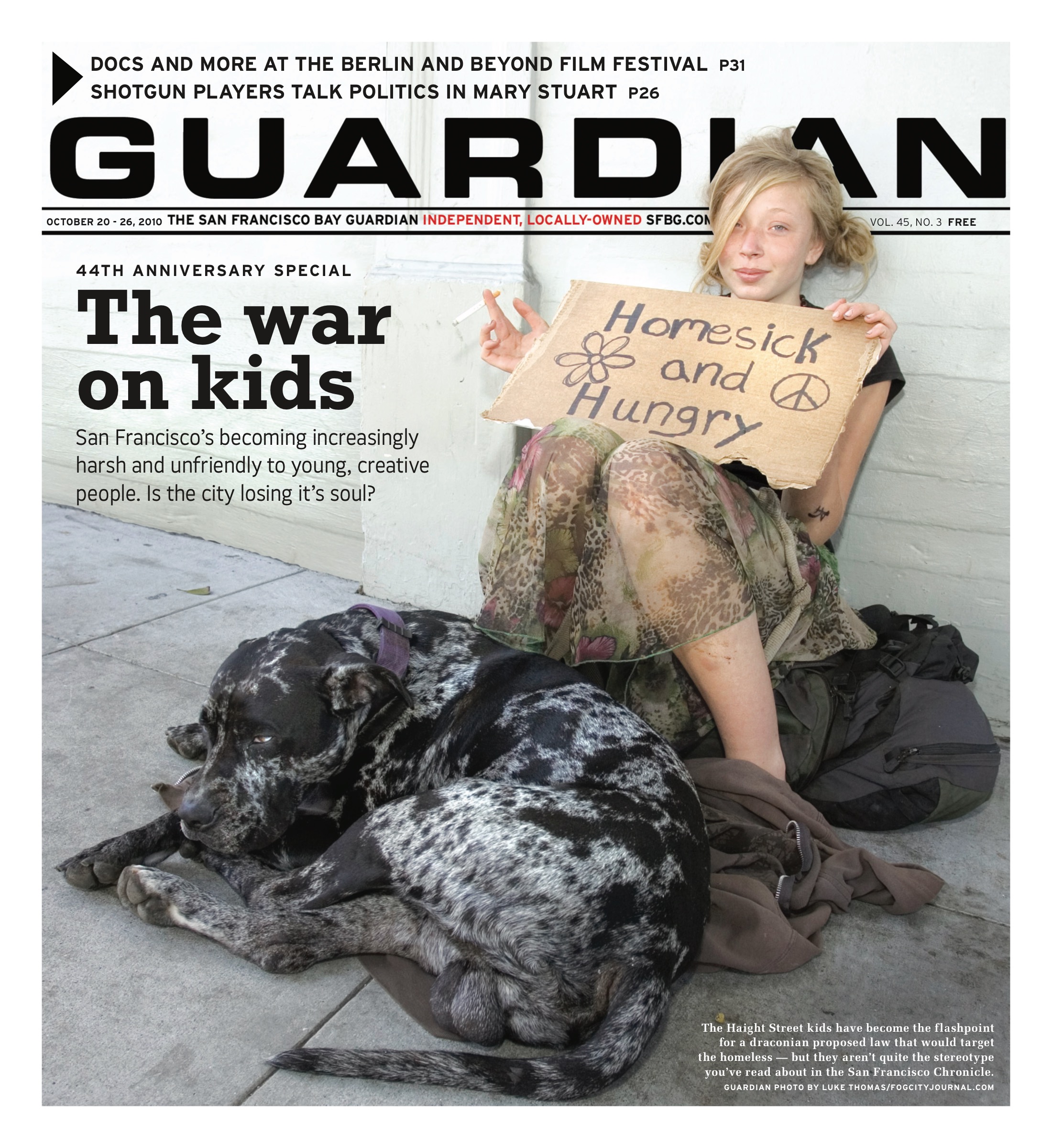
Our 44th Anniversary Issue also includes stories by Sarah Phelan on SF’s disadvantaged youth, Caitlin Donohue’s account of the Haight street kids, and Tim Redmond’s editorial on the issues facing our rising generation

On the cheap listings

0

Events listings are compiled by Caitlin Donohue. Submit items for the listings at listings@sfbg.com.

WEDNESDAY 20

hell strung and crooked Release Party The Beat Museum, 540 Broadway, SF; www.thebeatmuseum.com. 6pm, free. The Beat Museum helps to present a night of intensely creative bards from the world over in anticipation of the release of their new poetry tome.

Smack Dab Open Mic Magnet, 4122 18th St., SF; wwwmagnetsf.org. 8pm, free. All ages and genders are welcome to this open mic, which sets a medley of musicians and poets onstage to the tune of five minutes a piece. No open mic traumas here, people.

THURSDAY 21

Art Attack One Year Anniversary supperclub, 657 Harrison, SF; www.visualsby3.com. 9:30 pm, $8. The flopsy, floozy art performance group celebrates its first 365 days on this earth with a burlesque-off featuring Alotta Boutté, Scotty the Blue Bunny, and more local A-listers from the world of tassels and tease.

"Graphic Details: Confessional Comics by Jewish Women" Cartoon Art Museum, 655 Mission, SF; (415) CAR-TOON, www.cartoonart.org. 7pm, $5. Beyond the kvetch and kibitz, female Jewish cartoonists have proven themselves adept at a stark, honest rendering of life in the 21st century. Hear them discuss their art at this panel discussion.

Jo Scott-Coe Books Inc., 2275 Market, SF; (415) 864-6777, www.booksinc.net. 7:30 pm, free. An ex-public school teacher exposes the subtle and overt forms of violence in the education system in her latest book, which she’ll discuss at this bookstore klatch.

BAY AREA

Homeless Connect Health Fair Multi Service Center, 2362 Bancroft, Berk; (510) 809-8516, www.sites.google.com/site/bfhphealth. Noon, free. Vision screenings, STD tests, flu shots, therapist and addiction referrals, haircuts, and more at this gathering of service providers for the homeless.

FRIDAY 22

UN-65 Muir Woods Walking Tour Cathedral UN Grove, Muir Woods, Sausalito; (415) 267-1866; www.una-sf.org. 11am, free. Advance registration requested. Mark 65 years of the United Nations’ brand of global collaboration with this trek through the redwoods, a cup of tea, and some Qi Gong — a path braved by UN founders in 1945.

Fog City Necropolis 354 5th St., SF; (415) 606-2503. 7pm, 10pm. Take a tour through SF’s interactive haunted house, whose theme this year is a truly scary trope: eviction! Evade the undead grasp of Jack Kerouac, Frida Kahlo, the crazy cat man of the Presidio, and more so that you can live to pay rent again.

BAY AREA

"Analysis of the Tea Party Movement" UC Berkeley Alumni House, Bancroft and Telegraph, Berk; www.ccsrwm.berkeley.edu/conferences. 8:30am-5:30am, free. Political scientists and sociologists take a look at America’s most grating political movement: are the Tea Partiers part of a grass roots campaign, a media-driven construction, or something in between?

SATURDAY 23

Actors Theatre Season Kick-Off Actors Theatre, 855 Bush, SF; (415) 345-1287; www.actorstheatresf.org. 7 pm, $10. A cabaret to celebrate the new stage season, featuring the psychedelic tropes of comedian Wil Franken, and the world premiere of William Blake Sings the Blues, penned by the theater’s own company member.

Bernal Yoga Literacy Series Bernal Yoga, 461 Cortland, SF; (4125) 643-9007, www.bernalyoga.com. 8pm, $5 suggested donation. Tsering Wangmo Dhopma and Stephen O’Connor, writers both, will fill the chakras of this neighborhood ayurvedic space with readings from their recent publications.

Bring Your Own Queer Festival Music Concourse, Golden Gate Park, SF; www.byoq.org. Noon-6pm, free. Pack a gay in your rucksack for this community collaboration of art, performance, and music, featuring DJ collectives Honey Soundsystem and Hard French, the Bay Area Derby Girls, and a rescue dog fashion show.

Drag Racing Day Velma’s, 2246 Jerrold, SF; (415) 824-4606. Noon, by donation. A Bayview family needs help raising funds for their drag racing team. They make their own motors and transmissions! Grab a bite at this neighborhood restaurant while you watch racing footage and dad Mike Henery’s presentation to interested young people.

Potrero Hill History Night International Studies Academy, 655 De Haro, SF; (415) 863-0784. 5:30 pm barbeque, $6; 7 pm historical program, free. A movie on Potrero Hill public housing, urban gardening in the neighborhood, and hood tales from 50-year residents like "Goat Hill Phil."

Seismic Safety Fair San Francisco General Hospital, 1001 Potrero, SF; www.sfdph.org/dph/rebuildsfgh. 9am, free. Feeling a little shaky? SF General’s setting aside a day to explain the base-isolated design of its new earthquake retrofitting. It’s meant to be the most seismically-resistant plan available today, so go on and get grounded.

BAY AREA

Cal Science and Engineering Festival Haas Pavilion, Bancroft, Berk; (510) 642-0352, www.scienceatcal.berkeley.edu/festival. 10am, free. Kids been clamoring to touch a real human brain? Bring ’em to this hands-on extravaganza of natural science — for free.

Fantastic Fountain Thistle Recovery Work Party Highway 92-W and I-280-N, San Mateo. 9am, free with RSVP. Remove invasive pampas grass and Australian tea tree so that our small bristly friend the fountain thistle can continue to live long and prosper in the Bay Area.

SUNDAY 24

Sunday Streets: Civic Center and Tenderloin Civic Center Plaza, SF; www.sundaystreetssf.com. 10 am- 3pm, free. The last Sunday Streets car-free community event takes the action to the heart of downtown, with clear biking and walking from a roller disco outside the Asian Art Museum to the Tenderloin National Forest.

Tricycle Music Fest West Various libraries and times, SF; www.sfpl.org/tricycle. Free. Three wheel from library to library or plunk the kiddies in front of a show of their choosing for this day of kids’ music, that effervescent establisher of early literary skills.

Stage listings

0

Stage listings are compiled by Guardian staff. Performance times may change; call venues to confirm. Reviewers are Robert Avila, Rita Felciano, and Nicole Gluckstern. Submit items for the listings at listings@sfbg.com.

THEATER

OPENING

Dracula’s School for Vampires Young Performers Theatre, Fort Mason Center, Bldg C, Third Floor, Room 300; 346-5550, www.ypt.org. $7-10. Opens Sat/23, 1pm. Runs Sat, 1 pm; Sun, 1 and 3:30pm. Through Nov 14. Young Performers Theatre presents a Dracula comedy by Dr. Leonard Wolf.

BAY AREA

Dracula Center REPertory Company, 1601 Civic, Walnut Creek; (925) 943-SHOW, www.centerrep.org. $36-42. Previews Fri/22-Sat/23, 8pm; Sun/24, 2:30pm. Opens Tues/26, 7:30 pm. Runs Wed, 7:30pm; Thurs-Sat, 8pm; Sun, 2:30pm (also Nov 20, 8pm). Through Nov 20. Eugene Brancoveanu stars as the Count in a production directed by Michael Butler.

The Great Game: Afghanistan Roda Theatre, 201 Addison, Berk; (510) 647-2949, www.berkeleyrep.org. $17-73. Call for times. Through Nov 7. Berkeley Rep presents the West Coast premiere of a three-part show about Afghanistan.

Winter’s Tale Live Oak Theatre, 1301 Shattuck, Berk; (510) 649-5999, www.aeofberkeley.org. $12-15. Opens Fri/22, 8pm. Fri-Sat, 8pm (also Oct 31, Nov, 7, and Nov 14, 2pm; Nov 18, 8pm). Through Nov 20. Actor’s Ensemble of Berkeley presents the rarely-performed Shakespeare play.


ONGOING

Absolutely San Francisco Phoenix Theatre, Stage 2, 414 Mason; 433-1235, www.absolutelysanfrancisco.com. $20-25. Fri-Sat, 8pm. Through Sat/23. A one-woman musical starring Karen Hirst, with book and music by Anne Doherty.

Anita Bryant Died For Your Sins New Conservatory Theatre Center, 25 Van Ness; 861-8972, www.nctcsf.org. $24-40. Wed-Sat, 8pm; Sun, 2pm. Through Sun/24. New Conservatory Theatre Center presents a show by Brian Christopher Williams.

Cat on a Hot Tin Roof Actors Theatre, 855 Bush; 345-1287, www.actorstheatresf.org. $26-38. Wed-Sat, 8pm. Through Fri/22. Actors Theatre presents Tennessee Williams’ sultry, sweltering tale of a Mississippi family, directed by Keith Phillips.

Christian Cagigal’s Obscura: A Magic Show EXIT Cafe, 156 Eddy; (800) 838-3006, www.brownpapertickets.com. $15-25. Thurs-Sat, 8pm. Through Dec 18. Magician Christian Cagigal presents a mix of magic, fairy tales, and dark fables.

A Funny Thing Happened on the Way to the Forum Eureka Theatre, 215 Jackson; 255-8207, www.42ndstmoon.org. Wed, 7pm; Thurs-Fri, 8pm; Sat, 6pm; Sun, 3pm (also Sat/16, 1pm). Through Sat/ 24. Although a little slow and awkward at the start, not long into 42nd Street Moon’s staging of Stephen Sondheim classic and classical (being inspired by the farces of Plautus) musical comedy (with book by Burt Shevelove and Larry Gelbart) you feel it’s making up in enthusiasm and grit what it lacks in Broadway-sized budgets. It helps that artistic director Greg MacKellan has assembled an able cast, especially in the principal roles. It can’t be easy to follow in the cavorting footsteps of Zero Mostel and Nathan Lane, but Megan Cavanagh has absolutely no trouble wooing the audience in the central role of Pseudolus, the clever slave bargaining and scheming for his freedom. Strong performances come too from Michael Rhone as fellow slave Hysterium (a name that speaks for itself), Bob Greene as horny paterfamilias Senex, and Rob Hatzenbeller as the self-loving captain Miles Gloriosus. Nice costuming (by Louise Jarmilowicz), a hint of Roman architecture (courtesy of set designer Jon Wai-keung Lowe), generally spiffy choreography (by Tom Segal) and jaunty musical accompaniment from musical director Dave Dobrusky and horn player Nick Di Scala all add lift to a gradual charmer of a show. (Avila)

Futurestyle ’79 Off-Market Theater, Studio 250, 965 Mission; (800) 838-3006, www.brownpapertickets.com. $15-20. Wed, 8pm. Through Oct 27. A fully improvised episodic comedy played against the backdrop of SF in 1979.

Habibi Intersection for the Arts, 446 Valencia; 626-2787, www.theintersection.org. $15-25. Thurs-Sun, 8pm. Through Nov 7. Intersection for the Arts and Campo Santo present the world premiere of a play by Sharif Abu-Hamdeh.

*Hamlet Alcatraz Island; 547-0189, www.weplayers.org. By donation. Sat-Sun, times vary. Through Nov 21. Outside of an actual castle, it would hard to say what could serve as a more appropriate stand-in for Kronborg castle of Helsingør—also known as Elsinore—than the isolated fortress of Alcatraz Island, where WE Players are presenting Hamlet in all its tragic majesty. As audience members tramp along stony paths and through prison corridors from one scene to the next, the brooding tension the site alone creates is palpable, and the very walls impart a sense of character, as opposed to window-dressing. Deftly leaping around rubble and rock, a hardy troupe of thespians and musicians execute the three-hour production with neat precision, guiding the audience to parts of the island and prison edifice that aren’t usually part of the standard Alcatraz tour package. Incorporating movement, mime, live music, and carefully-engineered use of space, the Players turn Alcatraz into Denmark, as their physical bodies meld into Alcatraz. Casting actress Andrus Nichols as the discontent prince of Denmark is an incongruity that works, her passions’ sharp as her swordplay, the close-knit family unit of Laertes, Ophelia, and Polonius are emphatically human (Benjamin Stowe, Misti Boettiger, Jack Halton), and Scott D. Phillips plays the appropriately militaristic and ego-driven Claudius with a cold steel edge. (Gluckstern)

Last Days of Judas Iscariot Gough Street Playhouse, 1620 Gough; (510) 207-5774, www.CustomMade.org. $10-30. Thurs-Sat, 8pm; Sun, 7pm. Through Oct 30. Custom Made Theatre Company presents the 2005 play by New York’s Stephen Adly Guirgis (Our Lady of 121st Street, Jesus Hopped the A Train), which places purgatorial Judas (Kristoffer Alberto Barrera) on trial to determine his deserved fate for dropping a dime on Jesus and all that jazz. Flamboyant, sycophantic and horny prosecutor El-Fayoumy (Ben Ortega) and defense attorney Loretta (Amelia Avila) call between them a series of brow-raising witnesses—including Mother Teresa (Brandy Leggett), Sigmund Freud (Catz Forsman), and Satan (Richard Wenzel)—as Judas (seated on the upper tier of Sarah Phykitt’s suitably imposing split-level set) stares stoically in relative silence or appears in a series of childhood flashbacks. Characteristically funny and streetwise, as well as versed in the Catholic rigmarole as filtered through a NYC-boroughs sensibility, Guirgis’s play is also unusually tedious in its jokey, poky unfolding since—offering not much more than a cipher in the largely mute Iscariot—the proceedings lack a strong sense of dramatic stakes. It feels more like a revue than a play, or like an unnecessarily long-winded excuse for the final, well-turned concluding monologue by a heretofore marginal character (a speech delivered with admirable understatement by director Brian Katz). (Avila)

Love Song Exit Theatre, 156 Eddy; (800) 838-3006, www.brownpapertickets.com. $20. Thurs-Fri, 8pm; Sat, 3 and 8pm. Through Sat/23. An offbeat comedy by John Kolvenbach, directed by Loretta Janca.

Mary Stuart The Ashby Stage, 1901 Ashby, Berk; (510) 841-6500, www.shotgunplayers.org. $15-30. Thurs-Sat, 8pm; Sun, 5pm. (also Wed/20, Oct 27, Nov 3; 7pm). Through Nov 7. Shotgun Players presents Friedrich Schiller’s historical drama, directed by Mark Jackson.

Nina and the Monsters Shotwell Studios, 3252A 19th; 509-8656, 509-8656. $10-15. Fri-Sat, 8pm (also Sun/24, 2pm). Ninjaz of Drama with Footloose present a modern-day fairy tale.

*Pearls Over Shanghai Thrillpeddlers’ Hypnodrome, 575 10th St; (8008) 838-3006, www.brownpapertickets.com. $30-69. Sat, 8pm. Through Dec 19. Thrillpeddlers’ acclaimed production of the Cockettes musical continues its successful run.

Proof Exit Stage Left Theatre, 156 Eddy; www.belljartheatre.com. $20. Fri-Sat, 8pm. Through Oct 30. Bell Jar Theatre presents David Auburn’s award-winning play.

*The Real Americans The Marsh MainStage, 1062 Valencia; (800) 838-3006; www.themarsh.org. $20-50. Wed-Fri, 8pm; Sun, 5pm. Through Nov 6. The fifth extension of Dan Hoyle’s acclaimed show, directed by Charlie Varon.

*Scapin American Conservatory Theatre, 415 Geary; 749-2228, www.act-sf.org. $10-90. Tues-Sun, times vary. Through Sat/23. Bill Irwin, the innovative former Pickle Family clown and neo-vaudevillian turned Broadway star, makes a San Francisco return at the helm—and in the title role—of American Conservatory Theater’s production of Moliere’s classic farce. It’s an excuse for some arch meta-theatrical high jinx as well as expert clowning, a love fest really, with many fine moments amid a general font of fun whose heady purity seems like it should fall under some FDA regulation or other—clearly, somebody has paid someone to look the other way, and for once the corruption is unreservedly welcome. Joining the fun is Irwin’s old comrade-in-arms and, here, sacks, Geoff Hoyle, as miserly and dyspeptic daddy Geronte. Other ACT regulars and veterans flesh out a winning cast, among them the ever versatile and inimitable Gregory Wallace as Octave, a flouncing Steven Anthony Jones as put-out patriarch Argante, René Augesen as boisterously unlikely “virgin” Zerbinette, and a wonderfully adept and scene-stealing Judd Williford in the role of Scapin sidekick Sylvestre. As for Irwin, his comedic sensibility shows itself scrupulously apt and timeless at once, and his sure, lithesome performance intoxicating and age-defying. As a director, moreover, he gives as generously to each of his fellow performers as he does to his adoring, lovingly tousled audience. (Avila)

The Shining: Live The Dark Room, 2263 Mission; 401-7891, www.darkroomsf.com. $7-10. Fri-Sat, 8pm. Through Sat/23. The Dark Room becomes the Overlook Hotel in this stage production of the horror classic.

*SHIToberfest Off-Market Theaters, 965 Mission; (800) 838-3006, www.brownpapertickets.com. $20. Fri-Sat, 8pm. Through Oct 30. This special October run of PianoFight’s bowel-loosening comedy series, the S.H.I.T. Show (for acronym fans, that’s the Stop Hating Imagination Time Show), revolves dizzyingly around the subject of beer, Germans and, perhaps less explicably, flatulent dolphins, among much else in the wide open seas of poor taste. Is it hilarious? It is. And you don’t even need to smuggle in a forty to make it so, though it certainly doesn’t hurt. Fine comic acting throughout a charismatic cast (including writer-director-producers Alex Boyd, Zach Cahn, Jed Goldstein, Ray Hobbs, Devin McNulty, Evan Winchester and Duncan Wold, with help from Nicole Hammersla, Gabrielle Patacsil, Rob Ready, Derricka Smith, Andy Strong, Jacque Vavroch and Dan Williams) combines here with generally solid to exceptional sketch work, video and song. Add in a permeating spirit of revelry, debauchery and irreverence and the evening becomes a diversion of the first order, culminating in an utterly sacrilicious sketch about a bunch of toasted beer-brewing monks treated to a papal visit—one of the best venial sins for your buck. When it comes to Octoberfesting this year, “Bavaria” is just S.H.I.T.–faced for Bay Area. (Avila)

Shocktoberfest!! 2010: Kiss of Blood Hypnodrome Theatre, 575 10th; (800) 838-3006, www.brownpapertickets.com. $25-35. Thurs-Fri, 8pm (Thurs/21, Fri/22, Oct 28, Oct 29, Oct 30, and Oct 31 include performances of The Forsaken Laboratory by the Brazilian Grand Guignol group Vigor Mortis). Through Nov 19. Thrillpeddlers’ seasonal slice of eyeball is comprised of three playlets variously splattered with platelets, all directed by Russell Blackwood and bridged by a rousing burst of bawdy song from the full cast. Rob Keefe’s Lips of the Damned (after La Veuve by Eugene Heros and Leon Abric) takes place in a rat-infested museum of atrocities just before the fumigating starts, as an adulterous couple—comprised of a kinky married lady (a vivacious Kara Emry) and a naïve hunk from the loading dock (Daniel Bakken)—get their kicks around the guillotine display, and their comeuppance from the jilted proprietor (Flynn DeMarco). Keefe’s delightfully off-the-wall if also somewhat off-kilter Empress of Colma posits three druggy queens in grandma’s basement, where they practice and primp for their chance at drag greatness, and where newly crowned Crystal (a gloriously beaming Blackwood) lords it over resentful and suspicious first-runner-up Patty Himst (Eric Tyson Wertz) and obliviously cheerful, non-sequiturial Sunny (Birdie-Bob Watt). When fag hag Marcie (Emry) arrives with a little sodium pentothal snatched from dental school, the truth will out every tiny closeted secret, and at least one big hairy one. Kiss of Blood, the 1929 Grand Guignol classic, wraps things up with botched brain surgery and a nicely mysterious tale of a haunted and agonized man (Wertz) desperate to have Paris’s preeminent surgeon (DeMarco) cut off the seemingly normal finger driving him into paroxysms of pain and panic. Well-acted in the preposterously melodramatic style of the gory genre, the play (among one or two other things) comes off in a most satisfying fashion. (Avila)

Sunset Limited SF Playhouse, 533 Sutter; 677-9596, www.sfplayhouse.org. $40-50. Tues-Wed, 7pm; Thurs-Fri, 8pm; Sat, 3 and 8pm. Through Nov 6. This 2006 play by Cormac McCarthy exhibits some of the best and worst of the celebrated author, but significantly more of the latter. It sets an aging white academic and failed suicide (Charles Dean) in a room with his rescuer and would-be savior, a poor black social worker (Carl Lumbly), who has just snatched him from a railway platform ahead of a tête-à-tête with a train called the Sunset Limited. Both characters remain nameless, emphasizing the abstract pseudo-Socratic dimensions attendant on the dialogue-driven realism here (staged with a knowing wink in director Bill English’s scenic design, a partially walled wood-framed shack with see-through slits between the thin horizontal planking). The black man is a born-again Christian and ex-con convinced Jesus has just given him a major assignment. His dogmatic certainty is matched by the white man’s nihilism and despair. “I believe in the primacy of the intellect,” the miserable prof tells his host, who’s locked the door on his self-destructive guest in an effort to buy time to change his mind. Leaving aside the historically clichéd, problematic and baggage-heavy dynamic of a poor black American devoted to the welfare of a rich white one, neither man moves from his respective position one inch (at least until perhaps and partially at the very end), which constrains the dramatic development. Moreover, both sides argue feebly, mainly by gainsaying whatever it is the other one says, making this not a great intellectual debate either. SF Playhouse’s production sets two fine actors at this heavy-handed twofer, but little can be done to redeem so static and arid an exercise. (Avila)

Susie Butler Sings the Sarah Vaughan Songbook Exit Theater Cafe, 156 Eddy; (510) 860-0997, www.brownpapertickets.com. $15-20. Sat, 8:30pm. Through Nov 20. Local actress and singer Susie Butler takes on the Sassy songbook.

Zombie Town Stage Werx Theatre, 533 Sutter; www.stagewerx.org. (800) 838-3006, www.brownpapertickets.com. $24. Thurs-Sat, 8pm (also Oct 31, 5pm). Through Oct 31. Catharsis Theatre Collective presents a documentary play about zombie attacks in Texas.

BAY AREA

*Compulsion Berkeley Repertory Theatre, Thrust Stage, 2025 Addison; (510) 647-2949, www.berkeleyrep.org. $29-85. Dates and times vary. Through Oct 31. Director Oscar Eustis of New York’s Public Theater marks a Bay Area return with an imaginatively layered staging of Rinne Groff’s stimulating new play. Compulsion locates the momentous yet dauntingly complex cultural-political outcomes of the Holocaust in the career of a provocative Jewish American character, Sid Silver, driven by real horror, sometimes-specious paranoia, and unbounded ego in his battle for control over the staging of Anne Frank’s Diary. A commandingly intense and fascinatingly nuanced Mandy Patinkin plays the brash, litigious Silver, based on real-life writer Meyer Levin, a best-selling author who obsessively pursued rights to stage his own version of Anne Frank’s story. The forces competing for ownership of, and identification with, Anne Frank and her hugely influential diary extend far beyond her father Otto, Silver, or the diary’s publishers at Doubleday (represented here by a smooth Matte Osian in a variety of parts; and a vital Hannah Cabell, who doubles as Silver’s increasingly alarmed and alienated French wife). But the power of Groff’s play lies in grounding the deeply convoluted and compromised history of that text and, by extension, the memory and meanings of the Holocaust itself, in a small set of forceful characters—augmented by astute use of marionettes (designed by Matt Acheson) and the words of Anne Frank herself (partially projected in Jeff Sugg’s impressive video design). The productive dramatic tension doesn’t let up, even after the seeming grace of the last-line, which relieves Silver of worldly burdens but leaves us brooding on their shifting meanings and ends. (Avila)

*East 14th: True Tales of a Reluctant Player Marsh Berkeley, 2120 Allston, Berk; www.themarsh.org. $20-50. Dates and times vary. Through Nov 21. Don Reed’s solo play, making its Oakland debut after an acclaimed New York run, is truly a welcome homecoming twice over. (Avila)

*Loveland The Marsh Berkeley, 2120 Allston Way; (800) 838-3006, www.brownpapertickets.com. $20-50. Fri, 7pm; Sat, 5pm. Through Nov 13. Ann Randolph’s acclaimed one-woman comic show about grief returns for its sixth sold-out extension.

Superior Donuts TheatreWorks at the Mountain View Center for the Performing Arts, 500 Castro; (650) 463-1960, www.theatreworks.org. $19-67. Tues-Wed, 7:30pm; Thurs-Fri, 8pm; Sat, 2 and 8pm; Sun, 2 and 7pm. Through Oct 31. This latest from Tracy Letts (August: Osage County, Killer Joe) starts out as a delicious treat but a hollowness in the center of it all leaves one less than fully satisfied. Director Leslie Martinson’s cast shines, however, as the action unfolds in crisp, engaging scenes set in the titular run-down donut shop in Chicago’s slowly gentrifying Uptown neighborhood. Owner-operator Arthur Przybyszewski (Howard Swain) is an aging baby boomer and second-generation Polish immigrant who fled to Canada to avoid the Vietnam draft and returned years later to take over his parents shop, alienated and hesitant, though well liked by his regulars. At least most: As the play opens his shop has been vandalized. Two beat cops are on the scene, James (Michael J. Asberry) and Randy (Julia Brothers), the latter eventually displaying a visible crush on an oblivious, then discombobulated Arthur. When an impressive young African American man named Franco (Lance Gardner) comes in and charms his way into a job, Arthur gradually finds himself drawn out of his shell and faced with the challenge of valuing another human being more than his own hide—a challenge underscored by Arthur’s several monologues, in which his personal history comes to the fore. The play feels pat and a little lazy-sentimental in the end, but there’s no denying the entertainment afforded here, especially by the magnetic pairing of leads Swain and Gardner. (Avila)

The Western is back! Final thoughts on TIFF ’10

0

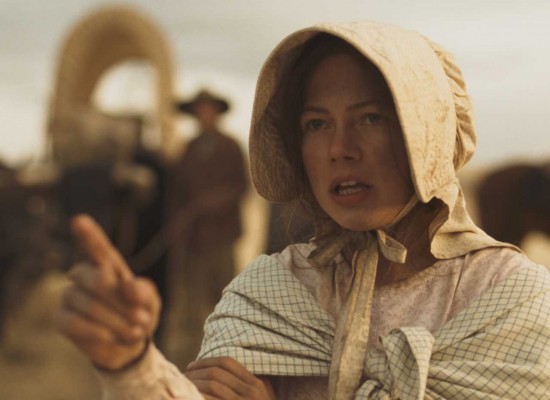
When I interviewed director Kelly Reichardt at the 2008 Toronto Film Festival about her gut-wrenching masterpiece Wendy & Lucy (2008), she spoke of watching many old Westerns in preparation for her next project. She delivered the exquisite Meek’s Cutoff at the 2010 Toronto Film Festival. The film follows three families as they make their trek along the Oregon Trail circa 1845. As they follow their hired mountain man through the Cascade Mountains they start to question if their leader really knows where he is leading them. And when they come across a Cayuse American Indian, the emigrants are forced to question who to trust. While Wendy & Lucy seemed inspired by the Italian Neo-Realists Vittorio De Sica and Roberto Rossellini, Meek’s Cutoff draws upon cinema’s earliest documentaries, like Robert Flaherty’s Nanook of the North (1922).

Collaborator Jon Raymond, who also wrote Reichardt’s Old Joy (2006) and Wendy & Lucy, uncovered the infamous story of Meek’s Cutoff while doing local research in Oregon. The tale seems perfect for Reichardt’s distinctive visual storytelling by exploring humble characters who are confronting everyday troubles while taking a journey outside of their natural habitat. The striking style strips down her character’s actions and allows the viewer to feel the weight of each procedure. Since Reichardt emphasizes her camera over dialogue, the solitary result can culminate in a truly transcendental experience for a viewer, while for others (like at the press screening in Toronto) a long nap. Somehow the fact that a film can evoke such extreme yet internal reactions conjures up the cinema of Yasujiro Ozu and most recently, Claire Denis.
With the rare exception of William Wellman’s brutal epic Westward the Women (1951), based on a story by Frank Capra, Meek’s Cutoff offers one of few female points of view towards the migration of early pioneers. While researching for the film, Reichardt read many old diaries, which women mainly wrote during the time period. These diaries uncovered the immense loneliness that women felt, one of which found a wife writing she was keeping a diary in case her husband should ever want to know her. Michelle Williams (actress of the year with her combined profound performances in Derek Cianfrance’s Blue Valentine, Martin Scorsese’s Shutter Island, and now Meek’s Cutoff) leads the way even with very subtle and minimal interactions.

While Meek’s Cutoff contextualizes the misrepresentation of women in the Western, it also confronts how the American Indian has been misunderstood on the silver screen with a beautifully nuanced debut performance by Rod Rondeaux, whose prior credits are 35 films working as a stuntman in films like James Mangold’s 3:10 To Yuma (2007) and Chris Eyre’s Skins (2002). Yet, much like Wellman’s Westward the Women, the dynamics between characters feels very contrary to most other Westerns. Screenwriter Raymond explained at Toronto, “Instead of being clearly centered on the individual, the community is the main character, with all the tensions and contradictions inherent in any community.”  

The Western genre seems to have been overlooked this past couple of decades by younger audiences, in the mainstream as well as the art crowd. Yet with David Milch’s HBO series Deadwood (2004), John Hillcoat’s The Proposition (2005), Andrew Dominik’s The Assassination of Jesse James by the Coward Robert Ford (2007) and the Coen Brothers’ upcoming remake of True Grit (2010) hot on their heels of their Oscar-winning No Country For Old Men (2007), there seems to be something more complex in these revisionist films that attempt to revise any previous re-visioning. (Neo-Revisionism?) Are they allegories exposing our country’s 250 year confusion with “illegal” border crossings? Are they dissecting our current political transitions between administrations? Or are they just giving us a more realistic look at the individual pioneers who helped “settle” the Wild, Wild West? However you view it, Kelly Reichardt’s quiet, unassuming journey does so by being the best film of 2010. (The Pacific Film Archive is showcasing Kelly Reichardt with a retrospective November 11-13; Reichardt will appear in person.)

Top Eleven Films from The 2010 Toronto Film Festival

1. Meek’s Cutoff – Kelly Reichardt (USA)

2. Another Year – Mike Leigh (UK)

3. Hell Roaring Creek – Lucien Castaing-Taylor (USA)

4. A Useful Life – Federico Veiroj (Spain/Uruguay)

5. Boxing Gym – Frederick Wiseman (USA)

6. Leap Year – Michael Rowe (Mexico)

7. Kaboom! – Gregg Araki (USA)

8. The Illusionist – Sylvain Chomet (based on a Jacques Tati screenplay) (UK/France)

9. You Will Meet A Tall Dark Stranger – Woody Allen (UK)

10. Black Swan – Darren Aronofsky – (USA)

11. Essential Killing – Jerzy Skolimowski – (Poland)

Jesse Hawthorne Ficks is the Film History Coordinator at the Academy of Art University and programs MiDNiTES FOR MANiACS, a monthly series at the Castro Theatre that celebrates dismissed, underrated, and overlooked cinema.

Markus James’ West African happiness surplus

0

In an age of endless crossover between most conceivable forms of music, it’s but small surprise that a Caucasian man from Virginia is making blues with West African witch doctors. What rarely gets discussed in these cross-ocean collaborations is the social aspect of the fusion. What did the artists eat for lunch the day they recorded that track? In what language was the “and-a-one” that started off the first take? 

We had the opportunity to chat over the phone with Bay Area artist Markus James, who has parlayed his time with Malian string musicians into elemental blues tracks. You can hear them on both his new album, Snakeskin Violin, and at his live show (at the Ashkenaz, Fri/22) with The Wassonrai, who are West African musicians that rep for jam band track longevity – strains of which James says is indigenous everywhere from Mali to Jackson, Mississippi — into their already formidable blend of blues past and present. James said (and we’re paraphrasing here) that the secret to fusion collaborations all lies in your location-resonation, but that’s just his perspective.


San Francisco Bay Guardian: When did you first hear African music? Did you know right at the start the depths you would dive into it?

Markus James: I don’t know if anyone really knows what is going to take them. The lights really went on for me when I heard Ali Farka Toure. He played traditional West African music on the electric guitar and it came out sounding like John Lee Hooker. That was where I really felt the powerful connection between all the music I grew up loving: rock, and soul music, and of course blues music, and the connection between that and its ancient roots in West Africa.


SFBG: What did African music pick up in the United States to become blues?

MJ: The roots of blues music go way back, specifically to pentatonic [five note as opposed to our eight note system] music traditions there. Pentatonic music really resonates with what we think of as blues music. There is a direct correlation between what I call country blues, or old school blues music, and some of these music traditions that I’m talking about in West Africa. Not just the notes and the musical scale, but the groove, the rhythm. For example, in West Africa women are often pounding the millet for that evening’s food. The have this six-foot tall piece of wood – it’s like a mortar and pestle. Another woman, or a girl, is scooping it back underneath so that the wood hits the grain. They get these rhythms going that are like goom-chack-goom-chack. Then people start playing on calabashes with this rhythm, and the rhythm is virtually identical to what we call the shuffle rhythm that you hear in a lot of old blues music, Chicago blues music, and rock music. If you go over to West Africa and you start playing what we call country blues, people will just start playing along with it and they’ll say oh, that’s our music.


SFBG: On “I Won’t Let It” you perform spoken word over the music. Is there a legacy in African music of that spoken word tradition?

MJ: Absolutely. There’s a whole caste of artists called griots. Their specialty is preserving history through story-songs, but also singing praise songs to whoever’s in power at the time. They will break into long passages of rhythmically chanted tone-poem language. That’s all there. 


SFBG: You do a lot of cross-culture collaboration. Does the dynamic get tricky when you come from one of the wealthiest nations in the world?

MJ: Not really. I’ll give you an example. I was introduced to a 75-year old man who is the spiritual leader of the Holehoire religion in Timbuktu, Mali. He is what we would call a healer, or in older parlance, a witch doctor. He is like a medium, and his whole role in the community is to communicate with the jinn, their spirits. His instrument is a gourd with the skin of a river snake stretched across it, the string is horse hair. He has a whole repertoire of melodies and rhythms that he plays, the purpose of which are to call certain spirits for certain purposes, to ask for rain, or to ask for good luck, a million things.

He came over to our adobe-walled house where I had my little set-up going and we started playing music together. I was playing guitar and he was shifting back and forth between his two instruments, and he would sing a little line and I would sing something. I told him, I’m making a recording in blues, which is an African-American tradition, if this thing turns out pretty good I might put it on a CD – and I’m paying him, which he’s happy about. And I said before I do anything I want to bring it back to you because I know this is really – I don’t know how I said it to him but I’d say it to you, this is really deep waters. This is considered the pre-voodoo religion. He said sure, fine, great, I hope somebody enjoys it.

The next year I came back and I played him what I had made out of it, it’s this song on Snakeskin Violin, it’s called “Sundown Pearl” I played it for him and he started beaming and smiling and saying this is very good, this is going to be very successful. When I see him I give him something which anticipates the day when I might get some royalties from it. My friends that I’ve made there, it’s hard for them to understand that I’m not really selling a lot of CDs here but they’re very happy that there’s a revenue stream.


SFBG: You’re a vegetarian. I’m curious — I’m a vegetarian too – how is it to travel in Africa without eating meat?

MJ: They assumed at first that I must be deranged. It was absolutely inconceivable that someone could live without eating meat. Even the West African artists I perform with here in the US, it’s taken them awhile to accept it, even though they know other people here. I’m trying to think what it would be like to tell someone here. It’d be like saying I went down to the Bay and I just skipped across it to Berkeley. 


SFBG: You can’t even do it with food — our society has such an individualized view of eating. 

MJ: You know, I’m eating rice down there without the meat sauce, but I’m still in this communal meal zone. My friends will explain, he’s a vegetarian, and that means he doesn’t believe in eating meat, and he appears to be healthy. Something that I could not have foreseen was that I’d become a emissary for vegetarianism in West Africa.

People say, you come from a rich country, and they come from a poor country, so what is politically correct? I think when some people go to West Africa they resonate with it, they connect with it. You come to realize that what we think of as wealth and poverty is very relative to our perspective. Here you might say that we’re wealthy because we have a car, or a house, or roads that allow you to go 60 miles per hour. What we have may not necessarily translate into what they would consider to be joy, happiness, abundance, peacefulness. They’re certainly not stuck in traffic jams and trying to make mortgage payments. We might be looking at a little of a joy deficit and over there they have a happiness surplus. I know that’s simplistic, but that’s my perception. 


Markus James and the Wassonrai

Fri/22 9:30pm, $10-12

Ashkenaz

1317 San Pablo, Berk.

(510) 525-5054

www.ashkenaz.com


Hot Chip’s Joe Goddard talks emotional lyrics, covers, and 80s pop

0

Hot Chip’s Joe Goddard has had one helluva year. He and his bandmates released their highly-anticipated LP One Life Stand in February and took a massive risk by going for a more streamlined, cohesive sound.The gamble payed off: the disc has received generally positive reviews and the group has spent the latter part of 2010 criss-crossing the globe, including a Sun/17 stop at the Warfield. Just a few months removed from a triumphant American headlining tour that was supported by critical darlings the XX, the Londoners are back opening up for their longtime friends LCD Soundsystem and playing some of the American biggest gigs of their career. Throw in the birth of his first child and a hectic DJ schedule, the Guardian was lucky to grab a quick word with the Hot Chip main man at his home in London.

San Francisco Bay Guardian: Considering how high expectations for One Life Stand were, how are you feeling about it now that it’s been out for a while?

Joe Goddard: It feels good. It was a stressful process, but it seems to have gone down quite well. Honestly, when I get done making an album, I always get a little bit tired of it and want to move on to the next one, so I really haven’t listened to it much myself. That said, the shows have been going well, and people seem to really enjoy the new tracks in the live setting. I don’t exactly know what people’s opinions are, but I guess people have been enjoying it, which makes me happy [laughs].

SFBG: As it should! As far as the album goes, it definitely seems like the new record is different stylistically to the older material. The tracks seem a little more accessible and light than some of older tracks. Was that a conscious decision, or did it come about naturally?

Goddard: I think all of us wanted to make the tracks on this record a little more streamlined and coherent, you know, a little bit more polished. On some of the previous things we’ve done, there have been layers-upon-layers of synthesizers and really intricate rhythms and percussion, and those sorts of elements. I kind of wanted to do something that didn’t rely on hundreds of layers and strip back the songs so they sound more focused and simple. We also really focused on making the songwriting as strong as possible and for the production to stand up to the songwriting. That was really our aim. I guess I just felt like doing something that sounded more direct, a bit more easy to understand, just something a little bit more straightforward.

In my mind, we were kind of refrencing the great kind of pop stances that you would get in the 80s where you’d get these big kind of epic, emotional songs — like Womack and Womack or Fleetwood Mac — these big polished pop songs that are making a big emotional statements. I feel like those songs are coming back round again, and I guess we were just hoping that people wouldn’t get too pissed off for doing something like that [laughs]. Having done that, I’d really like to do something completely different and more unrestrained for our next project.

http://www.youtube.com/watch?v=MaCZN2N6Q_I

SFBG: As far as the songwriting goes, how do you and [co-vocalist] Alexis Taylor break it up? Do you write the tracks together or by yourselves?

Goddard: There isn’t really a formula to it. Basically, either myself or Alexis will come up with something and just send it to the other one. From there, we’ll work on it together. Sometimes its almost a complete song, but sometimes it’s just a fragment of a song. It used to be that we would just sit in each other’s houses, but now its mostly just over email. As far as the lyrics go, generally whoever is singing a particular part tends to have written it. Sometimes I’ll write all the lyrics for a track, sometimes [Alexis] will write all the lyrics for the track, and sometimes we’ll collaborate. We never sit down and have a lyric writing session together where we come up with couplets or anything like that. Actually, I don’t think I’ve ever even asked Alexis what the lyrics to a track of his mean. I can make informed guesses about it, but they’re very personal and sometimes actually quite secret.

SFBG: Speaking of lyrics, it seems much more emotionally direct than your previous work. Did that go along with your musical direction?

Goddard: Yeah. I think that most of the record is more emotionally direct. That is partly due to the fact that we were trying to do something that was direct, and we really tried to follow that through in terms of lyrical content as well. We just wanted to let the songs say what they wanted to say, instead of being obtuse or hiding the meaning. Also, it was how we were feeling as people at the time we were making the record. We very kind of focused on our relationships, our home lives, and families, so there’s a lot of love on this record.

SFBG: How are those new, more direct, emotional tracks going over live?

Goddard: Well, I’ve got to preface this by saying that I’ve had six weeks off from playing live, because I recently had my first child. When I come back to play this October, it’ll be my first gigs in two months. From the touring I did before, I really enjoyed playing things like “Brothers” and “Alley Cats” — not only because I wrote most of those tracks — but they’re more emotionally open than most of the stuff I’ve done in the past. Although I guess you could go back to a few of the tracks from the older records and say that, but these are the ones that are fairly explicitly about my relationships and personal life.

For example, “Brothers” is clearly about my relationship and love for my brother, but I also wanted that song to also mean the brotherhood of being in the band and the brotherhood of a group of friends. The song “Alley Cats” is incredibly personal, it mentions the death of my mother. It feels great to be expressing myself with the guys that I’ve been friends with for over 20 years, and I often get quite emotional performing those songs. Of course, it is fun to do the bigger tracks like “One Life Stand” and “I Feel Better”, but I’ve really been enjoying the gentler moments in the set.

SFBG: Obviously, yourselves and LCD Soundsystem have a long history with [Hot Chip multi-instrumentalist] Al [Doyle] touring with them. Are you looking forward to getting back out on the road with them?

Goddard: It feels fantastic. It’s just a really great way to end the year. They are really just great, old friends of ours, and it’ll be great to have a drink with them, you know, and it’ll just be really comfortable. Most of us are about the same age — well, I guess James [Murphy] and Pat [Mahoney] are a just a bit older. We toured with them in the UK about five or six years ago and really learned a lot about touring with as a live, electronic rock band. They taught us a lot on that tour. I’m very much looking forward to doing it again.

I feel like both bands are established enough now that we can both just have fun and do our thing. Whereas a couple of years ago, I was trying more to get people into the music, now I’m really quite happy with what we’re doing and where we are. This tour is going to be a celebration of what we’ve achieved. They should be fun shows where people are just going to want to dance and have a good time.

http://www.youtube.com/watch?v=wif8DAyXkVc

SFBG: A couple of years ago, you guys closed out some California shows with a cover of the classic “Nothing Compares 2 U”. Can we expect a new cover to sneak its way into your set?

Goddard: Actually, we have been talking about it and trying to figure out something to do. We haven’t quite figured it out yet, but I think they’ll definitely be a little surprise. Alexis has made a few suggestions and we’re trying to work something out at the moment.

SFBG: Real quick, can you just give us some background of your recently-released remix EP, We Have Remixes? How did you end up choosing the four tracks that you did?

Goddard: We really just tried to choose remixes that we’re really excited about by people that are either personally friends of ours in terms of Hot City, Osborne, and Caribou or people that we really admire. I think Todd Edwards is just a fantastic producer, who creates really musical, intelligent, danceable tracks and we love what he did. There’s obviously been some great other remixes, but this was just a collection of four that have come about over ht last few months that were so good it just made sense to put them out on vinyl.

http://www.youtube.com/watch?v=Ylldl_jsMMI

SFBG: Speaking of vinyl, you also spend lots of your time DJing. What’s better an awesome gig or a great club night?

Goddard: Hmmm, it’s hard to pick one, because I really love doing both. I think an incredible live gig kind of beats anything, but the nice thing about DJing is, since its just you, if you have a good night and the crowd has a good time you feel like its a real personal achievement. I mean, it’s hard to pick between the two. I just love doing both of them.

SFBG: No worries. Lastly, since you are a DJ, what have you been listening to and spinning recently? Got any recommendations?

Goddard: The most recent things I’ve been listening to are just lots of new 12-inches. Really, just a lot of new UK dance music, like a lot of garage that’s been influenced by techno. There’s this new UK producer called DJ Naughty, who has a wonky garage record called “Goosebumps” that’s really funky and fun. Another DJ called Red Rack’em just released this 12 inch called “How I Program” which is really good. I’ve also been listening to a ton of Hot City. I’ve been DJing quite a lot, and that’s really what I’ve been focusing on.

SFBG: Great! I really appreciate your time, and we’ll look forward to seeing you at the Warfield.

Goddard: Not a problem. Thanks a lot!


HOT CHIP

with Sleigh Bells

Sun/17, 9 p.m., $32.25

Warfield

982 Market, SF

www.thewarfieldtheatre.com

Whiskeyfest 2010 highlights, part two

0

Earlier on sfbg.com, Virginia Miller turned WhiskyFest into Whisky Week, meeting with seven different distillers who’d come to attend the Fest from such far-flung booze berths as Kentucky and Scotland. Here’s part one of her scotch-heavy Whisky Week highlights. Read on for part two: conversations with bourbon and rye distillers.

10/8 COFFEE WITH JIMMY RUSSELL OF WILD TURKEY – The morning before WhiskyFest I learned about a company that’s been a Kentucky mainstay since 1855, and met with its master-distiller since 1954. Jimmy Russell comes from a family of distillers: grandad, dad — who worked for him at Wild Turkey in the early years — and now Russell is distilling with his son, Eddie. Jimmy could not be more charming. An older Southern gentleman, he’s soft-spoken, with an adorable sense of humor that I discovered as we chatted over coffee.

Russell makes Wild Turkey bourbons and ryes “the old-fashioned way” and says he doesn’t even tell his son all of his distilling secrets. They use barrels charred four times and made of white oak mainly from Missouri, Kentucky and the Ozarks of Arkansas. Their basic bourbons are a blend of six, eight and ten year-aged, with a lower proof than some bourbons, generally 108-110 proof. He explains lower proof is actually more costly as there is more water added to dilute higher proof bourbons. 

The distiller’s yarns about his town of Lawrenceburg, KY are fascinating, particularly because it’s in a mostly dry county where no drinks are allowed in restaurants and bars do not exist. “We’re not dry, we’re moist”, he says, as there are a few limited options to purchase drink in the area. It was only a couple years ago they secured a souvenir liquor license, one of many complicated hoops to jump through to in order to allow tastings in their actual distillery. Russell says he adheres to the Southern Baptist tradition that one only drinks hard liquor for medicinal purposes. He qualifies in a gentle, Southern drawl, “I keep a cough pretty much most of the time”.

10/7 SIPPIN’ WHEATED BOURBON WITH PARKER BEAM – Amidst the annoying happy hour din at Bloodhound last Thursday night, distilling legend Parker Beam was hanging out with the Heaven Hill crew and a few of their whiskeys. They pulled out a bottle of brand new Parker’s Heritage Wheated Bourbon, an earthy, wood-laced wheat beauty whose mix blends in corn and malted barley.

Parker raised a glass as we attempted to chat above the din. Hearing took some effort as the delightful Parker speaks in a slow, Southern drawl that lulls one into a real enjoyment of the moment. His passion for distilling shines in his calm demeanor. He’s distilled for decades, both with father, Earl and son, Craig. And yes, he’s related to “that” Beam. His grandfather and namesake, Park Beam’s, brother was the storied Jim Beam (aka James Beauregard Beam). Parker is part of a royal distilling heritage. I asked if his son had any children who might next enter the fray. “My son has five daughters, so no,” he surmised. “But who knows? Maybe we’ll have the first female bourbon distiller someday.” It wouldn’t be the first noteworthy accomplishment in the Beam family’s rich history.

10/10 BACON BRUNCH WITH KEITH KERKHOFF OF TEMPLETON RYE – Setting: Reza Esmaili’s Long Bar. Food: delectable spread from chef Erik Hopfinger. Heaping bacon piles of Eden Farms Berkshire Pork — And don’t forget the rye. Templeton Rye from Templeton, Iowa, to be exact. The brunch was in celebration of this delightful rye — previously restricted for sale to Illinois and Iowa — finally becoming available in San Francisco.

Templeton is so small batch that you won’t find it in any Bay Area shops outside of SF, where our usual suspects, like Cask, Jug Shop, and K&L all stock the brand. Assistant master-distiller Keith Kerkhoff (I wrote about a Whiskies of the World seminar with their president, Scott Bush earlier this year) and brand manager Michael Killmer hosted us for a relaxed, festive brunch where the coffees were spiked with the rye and topped with Fernet whipped cream. Welcome to SF, Templeton.

Waxing poetic with Maker’s Mark at The Alembic

10/10 DIPPING WAX WITH KEVIN SMITH OF MAKER’S MARK — At The Alembic, Kevin Smith, the master distiller of Maker’s Mark, spent a couple hours with a small group, tasting through various ages of the bourbon from white dog to pours that were years older than the finished Maker’s product, so that we could get an idea of when a spirit is ready. From a somewhat neutral base cut down to 90 proof, the bourbon gained most of its flavor from barrel aging, and we sampled a woody 12-year version that came off astringent and tannic, though not unpleasant. Smith used the two to highlight their choice of the smoother, rounder balance of the fully matured final product which is aged roughly years.

We finished with Maker’s 46, their first new product in 50 years. I’ve had it a few times and it makes sense Kevin said the inspiration was rye whiskey with advanced spicing, toasty oak and that “cinnamon bite.” It’s certainly my preferred Makers. Thanks to The Alembic for serving us a gorgeous, bright Maker’s 46 cocktail: sweet vermouth, absinthe, maraschino and a mint garnish. But the session wasn’t over until we had hand-dipped glasses in Maker’s signature red wax, a tradition established from the chemist wife of Bill Samuels, Sr. (Maker’s original owner). She loved brandy and wanted the bottle shape and wax to imbue Maker’s with a brandy elegance.

Interestingly, California just surpassed Kentucky as Maker’s number one-selling US market. Raise a glass, shall we, to the pioneers and tastemakers who brought love of spirits to share during this past whirlwind week of whisky.

Subscribe to Virgina’s twice monthly newsletter, The Perfect Spot

From here, cinema

0

I saw my first movie when I was four or five: it was a revival of 101 Dalmations (1961), and I liked it enough to ask my mother if we could sit through it a second time (we did). I saw my second first movie when I was 19: it was a nine-minute short by Bruce Baillie titled Valentin de las Sierras (1967), and after seeing it I knew film history must be full of secrets. It was only after moving to Berkeley a few years later that I began to contextualize Baillie’s tactile daydream of a Mexican village — a singular vision, to be sure, but one emblematic of a regional avant-garde as difficult to survey as San Francisco itself.

Here’s to trying: “Radical Light”‘s ambitious ecology of alternative film and video in the Bay Area encompasses an invaluable anthology of firsthand accounts, secondhand appreciations, and historical overviews; a film series with many artists-in-attendance and restored prints (through the winter at the Pacific Film Archive and various SF Cinematheque affiliates); and a gallery show of ephemera at the Berkeley Art Museum.

To first address the question underlying the whole series: why here? Some of the book’s contributors offer fanciful conjectures: it must be the ghost of Muybridge, an island ecology, a city that won’t hold a straight line, the quality of light, or, more realistically, the influence of the Beats’ vow of poverty. While I’m attracted to environmental speculations like these, it seems important not to let them overshadow the essential evidence of hard work without promise of financial compensation or art world status. This is clearest in the Bay Area’s rich tradition of artist-run, self-reliant screenings: museum takeovers, backyard hoedowns, and basement salons.

It would be difficult to overstate the importance of Frank Stauffacher’s post-World War II “Art in Cinema” series at the San Francisco Museum of Art (before it became “modern”) in establishing this climate of creative investment. Handsome as hell and himself a fine filmmaker, Stauffacher audaciously placed cinema in an art context, colliding European avant-gardes, Hollywood outliers, and homegrown talent in a museum setting a few decades ahead of schedule. In essence, he prepared the audience for what became known as independent filmmaking (before that term was commoditized). Which is more remarkable: that Stauffacher showed Christopher Maclaine’s still incendiary The End (1953), precipitating a chair-clearing uproar, or that he fronted Maclaine (a bagpipe-playing speed freak known as North Beach’s Antonin Artaud when there was plenty of competition) the funds to make this unsellable thing? Most of “Art in Cinema”‘s audience wasn’t ready for The End, but one young spectator found it a revelation: his name was Stan Brakhage.

Less than 10 years later, after Stauffacher’s tragic death in 1955, Baillie and his Canyon Cinema collaborators (notably, Chick Strand and Ernest Callenbach) came down from the hills over Oakland and expanded their bohemian screenings to include public production equipment, a journal, and the distribution co-op that is today run by filmmaker Dominic Angerame. The early Canyon group’s ambitions were local, but nonetheless represented an alternative cinema practice as profoundly liberating as that of their Nouvelle Vague contemporaries — one taken up by the dozen or so major series (e.g. No Nothing Cinema, Total Mobile Home, Other Cinema) and college film departments (especially San Francisco Art Institute and San Francisco State University) detailed in “Radical Light.”

Though wildly eclectic in form and content, the “Radical Light” films cohere around a widespread distrust of moral authority, whether political or aesthetic, as well as an abiding interest in the bending truths of portraiture, documentary, ethnography, and found footage. The anarchic and mystical are preferred modes, though not mutually exclusive ones. There is a long tradition of collaboration between filmmakers and, perhaps more strikingly, with poets, painters, and musicians. To cite but a few examples: Larry Jordan’s Visions of a City (1979, begun 1957) is drawn from material shot to accompany readings by Michael McClure and Philip Lamantia; Bruce Conner did lightshows at the old Avalon Ballroom before making music videos for Devo and documenting the Mabuhay Gardens punk scene; and Brakhage made In Between (1955) while living with Robert Duncan and Jess (and set the film to a John Cage composition). Early “Art in Cinema” habitués like Jordan Belson, Harry Smith, and James Broughton all approached film from different mediums, and later artists like Nathaniel Dorsky, Warren Sonbert, and Konrad Steiner explored the poetic or musical resonances of moving images. It runs the other way too — unsurprisingly, it takes someone like poet Bill Berkson to get Dorsky’s films in a (parenthetical) nutshell: “(Without being stupid about it, Dorsky really seems to put every conscious instant up against the growth chart of Eternity.)”

Indeed, all these films burn brightly as you watch. Witness all the different ways in which the makers seek to alter the cinematic experience, turning it into a Zen monastery (Dorsky), paranoid classroom (Craig Baldwin), troubled innerspace (Gunvor Nelson), innocent grindhouse (George and Mike Kuchar), confessional (Lynn Hershman Leeson), firing squad (Maclaine), astral plain (Belson), cross-examination (Trinh T. Minh-ha), beat street (Dion Vigne), all-night roadhouse (Conner), “unguided playground” (how Ernie Gehr described the images in his 1991 film, Side/Walk/Shuttle, two weeks ago), and on and on. If “Radical Light”‘s chronologically-based film programs serve an informative purpose similar to the well-labeled sectioning of a botanical garden, the thematic programs come off more as a noisy farmers market where the full variety of produce jams a narrow aisle. As always, the fruit tastes best when you know where it came from.

RADICAL LIGHT: ALTERNATIVE FILM AND VIDEO IN THE SAN FRANCISCO BAY AREA

Through April 30, 2011, $5.50–$10

(Book launch Fri/15, 7:30 p.m.)

Pacific Film Archive

2575 Bancroft, Berk.

Berkeley Art Museum

2626 Bancroft, Berk.

(510) 642-0808

bampfa.berkeley.edu/visit

Maxwell disappoints by endorsing Sweet

10

To be honest, I wasn’t surprised that termed-out Sup. Sophie Maxwell endorsed D10 candidate Lynette Sweet yesterday. Just disappointed. And it’s not just because Sweet refused to come into the Guardian this fall for an endorsement interview (a stance that suggests that Sweet would be depressingly inaccessible to reporters that haven’t drunk her Kool-Aid—a stance that, unfortunately, reminds me of Mayor Gavin Newsom’s attitude towards the media).

I’d been hearing rumors that Maxwell was going to endorse Sweet since February, when Sweet, who’d already racked up Mayor Gavin Newsom’s D10 blessing at that point, showed up alongside Maxwell at the city’s kickoff event for Black history month.

Then there was the fact that during an interview in February for the Guardian’s kickoff article about the D10 race, Sweet spouted phrases that sounded eerily similar to Maxwell’s words.
“D10 is a pretty diverse district, but there is only one common thread: the need for economic development,” Sweet told me.

But a few days earlier when I interviewed Maxwell about a third, and ultimately unsuccessful, attempt to recall her , Maxwell talked of common threads:

 “I’m waiting for people to have a better understanding of what this community is, what the common thread running through it is, and how to use rank choice voting,” Maxwell said, by way of explaining why she wasn’t willing to endorse anyone that early in the race.

Now, it’s understandable that Maxwell would be looking for a candidate to carry on her legacy. But it she was looking for a moderate black female candidate  then why not endorse Malia Cohen, who isn’t hampered by all of Sweet’s dirty laundry—and has raised the most money in the race, so far?

Could it be that Cohen wouldn’t be down for the kind of dirty deal making that was par for the course back in the days when Willie Brown was still mayor and Sweet was the swing vote that crowned Lennar as master developer at the shipyard/Candlestick Point?

Rumor has it that Maxwell is upset at all the corporate money that’s flooding into this race in support of Steve Moss—and that she asked the other candidates to hold a press conference in which they decry this practice. Rumor also has it that Sweet signaled her willingness to join Tony Kelly, Dewitt Lacy, Chris Jackson and Eric Smith–to name a few–in making such a statement. But it hasn’t happened, yet. And the corporate money keeps rolling in for Moss.

Meanwhile, with three weeks until the election, D10 forums are beginning to sound like a parody of a “Lost” episode featuring a 22-member cast that all claim to represent the city’s polluted and economically depressed southeast sector:

“One of us is a BART director, one of us worked at City Hall, one of us is a community advocate, one of us is a City College Board member, one of us is a civil rights attorney, one of us is an affordable housing development director, one of us is a bio-diesel advocate, one of us is a public safety advocate, one of us was raised in the Bayview, one of us served on the Navy’s Restoration Advisory Board,” and so on.

I’m not saying this is wrong. Hell, I love all this diversity of choices. but I am concerned that, come election night, the progressive vote will get split into a million pieces, while deep-pocketed conservative forces like the Chamber of Commerce and Golden Gate Restaurant line up behind one candidate in an attempt to crush candidates that would stand up to their powerful influence at City Hall and truly represent the D10 community

Yes, there is ranked choice voting, and it’s unlikely that one candidate will win a majority of the vote in the first round. But it’s critical at this venture that progressives develop a winning strategy. D10 candidate Ed Donaldson told me recently that if a candidate who doesn’t represent the community’s concerns gets elected, then the community would respond just as they did around Maxwell—and organize a recall.

But wouldn’t it be better if the community can come together behind three truly progressive candidates and help them win the November election?

One of the key challenges in this race will be to win votes in Visitacion Valley, as well as in the Bayview and/or Potrero Hill.

In his latest column in the Chron, former mayor and Sweet supporter Willie Brown alluded to the importance of this in a city with ranked-choice voting:”It’s not getting much attention, but someone has finally figured out how to get the Asian vote out,” Brown observed.”You do it by mail. You get ballots and ballot books into every household, then have the whole family sit down together. The kids help with the translation, everyone talks things over and everyone votes.”

Meanwhile, D10 candidate Tony Kelly told me that Marlene Tran, who is tri-lingual (English, Cantonese, Vietnamese) and has a good handle on community issues in Viz Valley, has confirmed that Kelly is her second-ranked choice (presuming that she votes for herself in first place. of course).

Not a bad strategy–and one that other progressives need to consider, given ranked choice voting–and the brutal reality that they are going to be massively outspent in the next three weeks.


Appetite: WhiskyFest 2010 highlights, part one

0

“[Whisky] feels appropriately intellectual: a drink you can wrestle with, linger over, and appreciate with all its nooks and crannies.” – Victoria Moore, How to Drink

WhiskyFest turns into Whisky Week with many of the world’s great master distillers and brand ambassadors in town from the reaches of Scotland and Kentucky for a tasting event of nearly 300 whiskies. I had the privilege of meeting with seven different distillers – some met with me over coffee or lunch, others at intimate gatherings. Impressed by the wide range of approaches, styles and personalities, I could easily write an article about each one and their respective distilleries. I will share highlights, this time with Scotch master, Richard Paterson, from a Charbay whiskey dinner, and tastes from the event. Part two will be conversations with bourbon and rye distillers.

10/8 LUNCH WITH RICHARD PATERSONRichard Paterson, known as “the nose” for his impeccable nose and taste, has been Whyte & Mackay’s master blender for decades. He’s one of the world’s leading scotch experts, author of the book Goodness Nose (which I savored as “homework” all through Whisky Week). To be part of one his seminars (such as at WhiskyFest Friday night), is to be bombarded with dates, history, uproarious expertise, irreverence, drama, laughter. When one lucky member of the class samples Dalmore Sirius (which has sold at up to $60,000 a bottle!), Paterson sets off a mini-rocket filled with confetti. Fireworks. Revelation. Kind of like tasting it myself…

I had the privilege of an intimate three hour lunch over food and the Dalmore line with Paterson at Wayfare Tavern. We covered the range from 12 year to King Alexander III scotches (which I first had at Whiskies of the World). The chocolate, marzipan, tropical fruit of King Alexander III remains a Dalmore highlight for me. It’s the only single malt in the world finished in six different woods (Port, Bordeaux Cabernet Sauvignon, Marsala, Madeira, Matusalem sherry, small batch Knob Creek bourbon barrels). Dalmore’s Gran Reserva stood out more the second and third time I sampled it with spiced marmalade, crushed almonds, and sherry notes from the 60% Oloroso sherry casks it’s aged in.

Get Richard started on wood and he says, “The wood is, as far as I’m concerned, the be all, end all.” With a devotion to fine sherry casks (like Gonzales Byass), a key source of Dalmore’s elegant taste profile, they also use a generous amount of American white oak, bourbon casks from Heaven Hill and Jim Beam, which enriches the profile further.

A favorite, which I would happily sip on its own, isn’t bottled: the unaged distillate or, whisky base. It’s amazing how much you can tell of a spirit’s quality by its foundation. I was pleasantly assaulted with an array of tastes from spice and earth to lemongrass in the clear, strong distillate. I finished every drop.

Certainly a pinnacle is reached with the Sirius. The rare opportunity to sample highly aged spirits just a handful times (like two 1800s cognacs in New Orleans or Highland Park’s 40 and 42 year scotches) has opened doors of flavor I could not dream up – this scotch transported me to regions beyond. There are only 12 bottles of Sirius in existence, a ’51 vintage with a blend of Dalmore scotches from 1868, 1878, 1926, 1939. History courses through each drop, while Paterson’s expert blending skills are illuminated here. Rich chocolate earth gives way to licorice and a bonfire smokiness. I count myself lucky.

To drink with Paterson is to learn how to properly nose a glass, how to hold whisky in your mouth for maximum taste (from many seconds, up to 2-3 minutes). One learns how the dreaded phylloxera aphid (which wreaks havoc on vines) inadvertently aided whisky’s growth by making dominant cognac in short supply, creating demand for other drink (read chapter seven in Paterson’s book). But he doesn’t just talk aphids, he brings visuals: big, plastic bugs to illustrate whisky’s unexpected “friend”.

Quirky and colorful, whisky comes to life through Paterson’s interpretation. Intelligent and challenging though the whisky world can be, Paterson retains the intellect but makes it approachable, fun. A Paterson course in whisky education should be mandatory for all would-be and already-avid drinkers.

TASTES – As usual, VIP hour is the time for the rare, the old, the latest, though it was more packed than ever with a mad rush waiting at the door at opening time.  This meant less opportunity to chat with distillers and hear about what you were tasting. A lot can happen in a year and the number of whiskies I’ve had since the last WhiskyFest meant this year was a lot of re-tasting and confirming favorites. Of the whiskies I had not tried, there weren’t a slew of stand-outs.

One that jumped out was a special unlisted, under-the-table pour of George T. Stagg bourbon. Toasty, charred oak warms, rounded out by a raisin-vanilla sweetness. Out of many over-hyped whiskies in the 20-40 year range during VIP hour, Bowmore’s 25 year stood out with a robust profile of salty brine and baked pear sweetness. Glenfarclas 40 year made a statement with tobacco, elegant tannins, orange. But it was many of my usual favorites that remained at the top, including Highland Park’s 30 year, Pappy Van Winkle’s 20 and 23 year bourbons, Parker’s Heritage 27 year bourbon, and Charbay’s incomparable Release II 1999 Pilsner whiskey. It was good to see Wes and Lincoln Henderson (of Woodford Reserve fame) with their new, port barrel-finished Angel’s Envy bourbon – I sampled an early version from Wes way back in December. Also on the non-whisky tip, I was happy as ever to sip a couple Germain-Robin beauties, including their complex Varietal Grappa, and oaky Coast Road Reserve brandy.

10/6 CHARBAY SPIRITED DINNERWith a magnificent sunset from atop the Marriott’s View Lounge as our backdrop, Marko and Jenni Karakasevic of Charbay hold an intimate spirited dinner annually. With plenty of time to hang out with the Karakasevics and meet fervent food and drink lovers at the two tables, the highlight was, of course, drinking Charbay’s incomparable spirits. Starting off with refreshing Green Tea Aperitif paired with Kumamoto oysters on the half shell, we then moved to one of the stand-out white whiskeys in existence: Doubled & Twisted Light Whiskey.

We moved on to what qualifies as one of the best things I ever tasted in my life (now, and every time I taste it): Release II of Charbay Whiskey. This was the best food match of the night, paired with slow-smoked Berkshire Farms Pork Belly and a mini-tamale in Lagunitas chili mole. Surprise whiskey barrel tastings followed: the Release II, but aged 12 years instead of the 6 years of the current release. At a higher proof, it’s superb, complex, rich.

A Meyer Lemon Vodka  ice intermezzo was a refreshing palate cleanser over basil ice, imbuing tart lemon with almost absinthe-like notes. Dessert was paired with their Black Walnut liqueur. As with most Charbay spirits, it’s a stunning standard-setter in its genre.

-Subscribe to Virgina’s twice monthly newsletter, The Perfect Spot

Our Weekly Picks: October 13-19

0

WEDNESDAY 13

MUSIC

Vader

Vader’s history stretches back almost 30 years. Borrowing Darth’s moniker might not have been the world’s most original idea, but they were likely among the first to have done it. The Polish death metal stalwarts formed in 1983 in Olstzyn, deep behind the Iron Curtain. Successful demo recordings got them hooked with Earache Records, and the band has been pillaging the world’s stages ever since. Guitarist-singer Piotr Wiwczarek is the only original member left in the fold, but the band’s anthemic music is as potent as ever, mixing impossibly thick blast beats with heavy slabs of neoclassical melody. Their upcoming album Return to the Morbid Reich is a nod to the 1990 demo that made their name; this tour, they’re inviting you along for the ride. (Ben Richardson)

With Immolation, Abigail Williams, Lecherous Nocturne, and Pathology

6:30 p.m., $22

DNA Lounge

375 11th St., SF

(415) 626-1409

www.dnalounge.com


THURSDAY 14

DANCE

Lines Ballet

The story of Scheherazade and her 1,001 nights of tales to postpone her beheading by the Persian king has intrigued and captivated audiences for ages. Choreographer Alonzo King’s dance adaptation Scheherazade delves beyond the story to explore themes ranging from the symbolism of abused women to the transformative power imbued in the tales. The company of chiseled titans dance alongside tabla master Zakir Hussain’s score, which incorporates traditional Persian instrumentation into the original classical composition by Rimsky-Korsakov. The piece premiered in Monaco last December; San Franciscans can now experience King’s artistic rendering of Scheherazade’s classic tale for themselves. (Emmaly Wiederholt)

Through Oct. 24

Thurs/14, 7 p.m.; Fri.–Sat., 8 p.m.;

Sun., 5 p.m.; Oct. 20–21, 7:30 p.m., $25–$75

Yerba Buena Center for the Arts

Novellus Theater

700 Howard, SF

(415) 978-2787

www.linesballet.org


FILM

“Jim Henson and Friends: Inside the Sesame Street Vault”

Consider the Muppet. Made of foam and googly eyes, set atop spindly legs under a mop of primary-color hair, these brave figures have become our children’s teachers on a level unparalleled in the world of infotainment. We’re talking street, of course — Sesame Street, which since its 1969 debut has won 97 Emmy awards, more than any other show. Yerba Buena Center for the Art is running a series of Sesame clip collections, and today’s viewing pays homage to the contributions of the show’s early creative team, with a special furry hug to creator Jim Henson, and little-seen guest appearances from the show’s early days. (Caitlin Donohue)

7:30 p.m. (also Sat/16, 2 p.m.), $6–$8

Yerba Buena Center for the Arts

701 Mission, SF

(415) 978-2787

www.ybca.org


DANCE

“CounterPULSE’s Performing Diaspora: Sri Susilowati”

Stripping world dance of its trappings is quite the rage these days. But few have done it so radically as Indonesian classical dancer did Sri Susilowati at last year’s Performing Diaspora festival. Yet this was the same artist who, only a few months before at the Ethnic Dance Festival, had performed an exquisite, contemporary Javanese mourning dance. Now she is back, having been invited to expand on her 2009 piece. Susilowati may look one of those ethereal dance creatures whose bodies are so stylized that it’s difficult to think of them having earthly passions. Yet they do. Hint on Susilowati: food. Another Indonesian dancer, Prumsodun Ok, opens the show for her. (Rita Felciano)

Thurs/14–Sat/16, 8 p.m.; Sun/17, 3 p.m., $24

CounterPULSE

1310 Mission St./SF

(415) 626-2060

www.brownpapertickets.com


MUSIC

Fresh and Onlys and Kelley Stoltz

San Francisco-based artists the Fresh and Onlys and Kelley Stoltz will both have new albums on hand at this double CD release blowout. The new Fresh and Onlys disc, Play It Strange, showcases the band’s garage-rocky spin on 1960s pop, and was recorded for the first time outside of a DIY studio setup with Comets on Fire producer Tim Green. Stoltz releases his newest batch of throwbacks to the Beatles’ and Beach Boys’ style of sunny pop with To Dreamers. This is a perfect night to come out and support local music. (Landon Moblad)

With Carletta Sue Kay

9:30 p.m., $12

Café Du Nord

2170 Market, SF

(415) 861-5016

www.cafedunord.com


FRIDAY 15

DANCE

Dandelion Dancetheater

Known for its loud, provocative works merging dance, drama, and music, Dandelion Dancetheater turns its attention to motherhood in MamaLOVE: Seeds of Winter. The seven-women cast explores mom-related themes by diffusing fairy tales, myths, and lullabies to discover the context and relevance of the cultural archetypes and stereotypes surrounding motherhood. Each evening brings a rotating roster of guest mama-choreographers: Mary Carbonara, Tammy Cheney, Laura Elaine Ellis, Suzanne Gallo, Dana Lawton, Laura Renaud-Wilson, and Chingchi Yu. Directed by Kimiko Guthrie, the show promises to be haunting, hilarious, and not to be missed as the mom-artists address the complexities of love, loss, connection, and independence. (Wiederholt)

Though Oct. 24

Fri-Sat, 8 p.m.; Sun, 7 p.m. (also Oct. 24, 3 p.m.), $12-15

Shawl Anderson Dance Center

2704 Alcatraz, Berk.

(510) 654-5921

www.dandeliondancetheater.org


SATURDAY 16

MUSIC

Longplayer San Francisco: 1,000 Years in Three Simultaneous Acts”

As a founding member of legendary rabble-rousers the Pogues, Jem Finer helped the band deconstruct traditional Irish music and create a new musical creature out of its varied influences. Taking this willingness to experiment with different sounds and ideas and bringing it to another level, Finer composed Longplayer, a piece designed to last 1,000 years and played on instruments such as Tibetan bowl gongs. Today’s special performance will be a 1,000-minute excerpt performed by 18 musicians on a custom-built, 60-foot-wide circular “instrument” — so slow down and take some time to absorb some art that goes against today’s faster-is-better mentality. (Sean McCourt)

7 a.m.–11:40 p.m., $25–$28

Yerba Buena Center For The Arts Forum

701 Mission, SF

(415) 978-2787

www.ybca.org


EVENT

“ODC Theater’s JumpstART”

Several years and millions of bucks in the making, ODC is at last ready to unveil its new state-of-the-art “cultural campus” in the Mission in a celebratory free day of “dance, theater, performance, and community.” With more than 20 performers and organizations participating, there will be something for everybody — yes, even clogging — at this one-of-a-kind public offering. A glance at the roster includes such names as Scott Wells and Dancers, Robert Moses’ Kin, Killing My Lobster, Youth Speaks, and of course ODC/Dance, all curated by ODC Theater director Rob Bailis in collaboration with the likes of choreographer Joe Goode, world music expert Lilly Kharrazi, and playwright-director Mark Jackson. (Robert Avila)

Noon–11 p.m., free (tickets available one hour prior to each performance)

ODC Theater

3153 17th St, SF

(415) 863-9834

www.odcdance.org


DANCE

Trolley Dances

I still wish they’d call them Street Car Dances instead of Trolley Dances, because that’s what they are, but the name is a registered trademark and has its origins in San Diego (where they actually have trolleys). However, there is nothing else I would change on these annual easy-rider events. They are pure fun, and curator Kim Epifano always comes up with an intriguing lineup of entertainers. This year you’ll see, among others, dancers from Joe Goode Performance Group, Sara Shelton Mann, Ensohza Minyoshu (traditional Japanese folk music and dance), and Sunset Chinese Folk Dance Group. And do look out for a special treat on Ninth Ave for our animal friends, courtesy of brilliant maskmaker Mike Stasiuk. Boarding takes place at Duboce Park. (Felciano)

Through Sun/17

11 a.m. (runs every 45 minutes until 2:45 p.m.), free with Muni fare ($2)

Duboce at Scott, SF

(415) 226-1139

www.epiphanydance.org


EVENT

ArtSpan Open Studios

Do you ever want to stroll into other people’s homes simply from sweet curiosity? Perhaps you covet thy neighbor’s art, or maybe just appreciate light and shadow and like talking with the peeps who represent it? Do all three at the largest and oldest open studios event in the country. The self-guided art tour is ongoing through October, but this weekend doors will open in the artsy northern and eastern neighborhoods. From the nude drawings of Derriere Guard (ahem, Beavis) to the ultraviolet photos of South African succulents, it’s the best opportunity to get to know your local artists. And maybe take home a derriere or two. (Kat Renz)

Through Oct. 31

Sat.–Sun., 11 a.m.–-6 p.m., free

Bayview, Excelsior, Financial District, North Beach, Potrero, Russian Hill, SoMa,Tenderloin

(415) 861-9838

www.artspan.org


SUNDAY 17

MUSIC

BATUSIS

Featuring two of the founding architects of punk rock — guitarists Sylvain Sylvain from the New York Dolls and Cheetah Chrome from the Dead Boys — Batusis already has its street cred and headliner status firmly in place. Taking its name from the groovy dance that Adam West performed in the campy 1960s Batman TV show, the band came together and released a new self-titled EP earlier this year that’s steeped in the sounds that earned these six string slingers their place in the punk pantheon in the first place. This dynamic duo may not be so young anymore, but they’re sure as hell just as loud and snotty. (McCourt)

With Re-Volts

8 p.m., $12–$15

Thee Parkside

1600 17th St., SF

(415) 252-1330

www.theeparkside.com


MONDAY 18

MUSIC

David Bazan

Previously known for fronting the popular indie-rock project Pedro the Lion, David Bazan has returned to working under his own name. His most recent solo album, Curse Your Branches, covers some religious-themed lyrical ground that fans should be familiar with by now, like the tales of sinners losing their way and Bazan grappling with his own faith. But it also presents itself in a much more upbeat, poppier setting than we’re used to, often at odds with the reflective and sometimes dark themes of the songs. Moody, country-tinged Baltimore duo Wye Oak opens. (Moblad)

8 p.m., $15

Independent

628 Divisadero, SF

(415) 771-1421

www.theindependentsf.com 


The Guardian listings deadline is two weeks prior to our Wednesday publication date. To submit an item for consideration, please include the title of the event, a brief description of the event, date and time, venue name, street address (listing cross streets only isn’t sufficient), city, telephone number readers can call for more information, telephone number for media, and admission costs. Send information to Listings, the Guardian Building, 135 Mississippi St., SF, CA 94107; fax to (415) 487-2506; or e-mail (paste press release into e-mail body — no text attachments, please) to listings@sfbg.com. We cannot guarantee the return of photos, but enclosing an SASE helps. Digital photos may be submitted in jpeg format; the image must be at least 240 dpi and four inches by six inches in size. We regret we cannot accept listings over the phone.


Tick tock

0

arts@sfbg.com

HAIRY EYEBALL In a characteristically poetic passage within 1980’s Camera Lucida, Roland Barthes describes early cameras, given their cabinet-like appearance and precise mechanical innards, as “clocks for seeing.” I couldn’t shake the phrase while taking in Will Rogan’s “Stay Home,” an ambiguous smile of a solo show composed of photographs and three-dimensional photographic collages at Altman Siegel.

Taking the measure of time is very much on Rogan’s mind, as it was on Barthes’ some 40 years ago. A photograph is but an imperfect means of forestalling time’s onward march: it offers the present a momentary record of an instant long gone. So too has photography, at least in the nondigital form that Barthes was writing about, become an index of a past medium, and in our current age of Photoshop, an object for nostalgic longing (see the Hipstamatic iPhone app).

Rogan skirts this sand trap even though his practice deliberately engages with 1970s printed matter and evokes a range of photographers from that decade and later, most notably Lee Friedlander and Daido Moriyama’s social landscapes, and to a lesser extent, Sherrie Levine’s appropriations. The three small sculptural collages of cropped images affixed to painted wood pieces with beeswax even look as if they are from another time. Indeed, it’s easy to get distracted by Rogan’s mode of address (“hey guys, here are some cool books I found at a yard sale, and look what I came upon while walking to the corner store”), by his work’s muted cleverness and calculated arrangement of happenstance, that it can be easy to overlook the substance of what he’s saying.

Viewing the Past As it Happens takes its title from a passage in a picture book on astronomy that is itself the subject of the photograph. The book lies open; a picture of a galaxy on the right page. A description on the adjacent page details that what we are looking at, that what astronomers gaze at through their telescopes night after night, is in fact millions of years old. Of course, this also functions as a gloss (as does the photograph’s title) on the act of taking a picture: in that moment when we look into the viewfinder, our fingers poised to capture what we see before us, we are in a sense seeing what will become the past.

Two other photographs of educational books, The Elusive Nature of Time and Man Versus Clock: The Unequal Struggle, drive the point home that the photographer’s relationship to time is a Sisyphean one, even as the lifted bathos of their titles sends up the self-seriousness inherent to such postulating. Rogan seems to say, “Don’t freak out, too much,” while simultaneously holding up evidence to the contrary. The detritus that catches Rogan’s eye in other pictures — reflective glass shards, a gutter-lodged beer can, a taped-together window, an abandoned sneaker — are corollaries to the amazing sign on the paper shredding business captured in Shredder that reads, “DOCUMENT DESTRUCTION — While You Watch,” in light of which “document” starts to read more as a verb than a noun.

With Busts, a series of six magazine pages (covers perhaps?) that have been altered so that only the ghostly white silhouettes of unknown seated subjects remain, Rogan moves from documenting destruction to participating in it. It’s hard to tell whether or not the outlines are formed from erasing a prior image or painting over unrelated text, some of which is visible underneath the white. Regardless, the message is still clear: time is on no one’s side.


THAT JOKE ISN’T FUNNY ANYMORE

Time will certainly not be on the side of Hugh Brown, who demonstrates in his solo show “Allegedly” at Robert Koch that no amount of skilled workmanship or flawless execution can make up for a paucity of ideas. Indeed, he has but one, and truly, it is more a gimmick than a concept: to remake iconic works of art in his own image.

And how does the artist picture himself? As a chainsaw-wielding bad boy, cutting through the canon and art world pretensions with the power phallus of choice for exploitation filmmakers and ice sculptors. Brown’s smash and grab tour through art history includes Diane Arbus (here, the child clenched in rage holds a toy saw instead of a grenade), John Baldessari, Henri Matisse, Barbara Kruger (“I saw therefore I am”), and Roy Lichtenstein, among many others.

Granted, Brown’s art is well made and it exhibits a careful attention to the material details of the work it parodies. A “Bruce Nauman” is actually done in neon (surprise, it’s a chainsaw). Each work is also credited to the original artist, a parenthetical “allegedly” following their name, as if the dubiousness of what we we’re looking at weren’t apparent already.

Appropriation is by no means a new game, and many of the artists hijacked by Brown made poaching and quotation central to their own practices. But the art in “Allegedly” lacks any real critical force. It says nothing about the works being pillaged and everything about Brown’s estimation of himself. The show is apiece with those postcards that put sunglasses on the Mona Lisa or banana hammocks on Michelangelo’s David.

How Brown has managed to convince gallerists otherwise is a mystery that “Allegedly” leaves unsolved. *

WILL ROGAN: STAY HOME

Through No. 6

Altman Siegel Gallery S/F

49 Geary, Fourth floor, SF

(415) 576-9300

www.altmansiegel.com

HUGH BROWN: ALLEGEDLY

Through Oct. 30

Robert Koch Gallery

49 Geary, SF

(415) 421-0122

www.kochgallery.com


Downtown massively outspends progressives

17

With only three weeks until the election, downtown interests are massively outspending progressive groups.(Conservative estimates suggest a 5:1 ratio, based on an analysis of campaign finance disclosures at the Ethics Commission.) And these downtown interests have plenty in reserve, as cash is funneled into a bunch of improbably-named political action committees that hope to influence the outcome of district elections and local measures on the fall ballot.

The Alliance for Jobs and Sustainable Growth, which is backed by the Chamber of Commerce, the SF Police Officers Association, and United Health Care Workers, recently got an infusion of cash from the conservative-minded Building Owners and Managers Association and Golden Gate Restaurant Association. And the alliance is already spending gobs of money in support of Theresa Sparks in D6, Scott Wiener in D8 and Steve Moss in D10.

The Coalition for Sensible Government, which recently received a $100,000 injection of cash from the SF Association of Realtors, is spending in support of Sparks in D6, Wiener and Rebecca Prozan in D8, and Lynette Sweet and Moss in D10. The coalition is also spending in support of Proposition G (transit operator wages) and Prop. L (Newsom’s sit-lie legislation)  and in opposition to Prop. M (community policing/ foot patrols) and Prop N (property transfer tax).

And a PAC consisting of the Coalition for Responsible Growth, Plan C, San Franciscans for a Better Muni, SF Forward (sponsored by the SF Chamber of Commerce and SPUR) received $85,000 from the Committee on Jobs, $60,000 from the SF Association of Realtors, and $35,000 from SF Forward.

This PAC, which has already spent $466,000 this year, recently plunked down $1,000 to produce a voter guide for Plan C–a group that focuses on condo conversions and is endorsing Sparks in D6, Wiener in D8, and Sweet (as its first ranked choice) and Moss (as its second ranked choice) in D10.

It isn’t surprising that downtown PACs have deep pockets and almost identical slates. But it is a bit of a shocker that their slates are apparently almost identical to the Small Business Advocates, a group that has somewhat differing values and only a couple hundred members.

Reached by phone, SBA director Scott Hauge said the group has a couple hundred members–and claimed that SBA’s Board supports Sparks in D6, Moss in D10, and supports Measures G, K, L and opposes Measures J, M & N.

Hauge acknowledged that these positions are identical to those of downtown interests.
“We have been working with large companies,” Hauge said, claiming that small and big business’ interests are “the same” in this particular election cycle.

To date, neither the Chamber’s Steve Falk nor UHW’s Leon Chow have replied to the Guardian’s calls about the genesis of their so-called Alliance for Jobs and Sustainable Growth (Chow posted a comment on our politics blog and that is really not the same as a live conversation.)

But Tim Paulson, executive director of the San Francisco Labor Council wasn’t afraid to go on record in opposition to the Alliance and its 2010 slate.

“We’re really disappointed that there are labor organizations that feel they have to team up with Golden Gate Restaurant Association, which is against healthcare, and with CPMC [California Pacific Medical Center], which is working to keep nurses from joining a union,” Paulson said. “This alliance does not reflect what the San Francisco labor movement is about.”

A door hanger that the Labor Council distributed in conjunction with the SF Democratic Party confirms that both organizations support Debra Walker in D6 and Rafael Mandelman in D8. But while the Dem Party supports DeWitt Lacy, Malia Cohen and Eric Smith (in that order) in D10, the Labor Council only supports Cohen and Chris Jackson (in that order) in D10.

But despite their differing D10 candidate slate, both these progressive groups support Measures J, M and N, and oppose Measures B, K and L.

“When we see the Hotel Council stoop to attack Mike Casey, one of the greatest labor leaders in SF history, for fighting hotels who want to take away healthcare and diminish the retirement benefits for workers who make $25K to $30K a year, that’s really disturbing,” Paulson said, referring to a recent op-ed in the SF Examiner that was written by Patricia Breslin, executive director of the Hotel Council.

“And any union that makes an alignment with groups that don’t share the values of the San Francisco Labor Council, that’s really disturbing to me and the Labor Council,” Paulson said.

Noting that downtown is spending buckets of money on the election, Paulson observed that the Labor Council’s values are about “sharing the wealth.”

“So we don’t want Measure B [Jeff Adachi’s pension reform] or K (Newsom’s hotel tax) or L (Newsom’s sit-lie legislation),” Paulson concluded. “And we have three solid weeks to do this.”

Hula heartbeat

0

arts@sfbg.com

DANCE Quite a few hula companies populate the Bay Area, but none is led by a kumu hula (teacher) quite as charismatic as Patrick Makuakane. Watch him warm up an audience, and you’d think he could charm cash out of a bunch of IRS agents. Then he steps on stage, grabs a drum, and starts to chant, and you know that this is an old soul, somehow still in touch with hula’s roots as a spiritual practice. “We love that duality about him,” explains Makani da Silva Santos, one of his longtime dancers.

Makuakane’s choreography for his Na Lei Hulu I Ka Wekiu company, which celebrates its 25th anniversary this year, reflects his complex personality. He is as much at ease creating hulas based on pop songs as he is at excavating meaning out of ancient chants or creating politically searing dance dramas.

Hula, like many other dance forms—Indian, Balinese, West African—was born in rituals that both strengthened a group’s identity and attempted to get in touch with the Divine. In Hawaii, that meant paying tribute to natural forces, particularly the goddess Pele. But missionaries who colonized Hawaii in the 19th century and tried to force Christianity on its people prohibited hula. They considered all Hawaiian culture crude and lascivious. They almost succeeded when King David Kalakaua restored hula and other native customs, saying famously: “Hula is the language of the heart and therefore the heartbeat of the Hawaiian people.” Even so, long after the king’s death, hula had to be practiced in secret. Makuakane’s stark 1999 The Natives are Restless unsparingly looks at that sorry part of Hawaiian history. In one haunting passage, a “priest” tattoos a cross onto bare-chested women.

You can’t miss hula’s deep connection to the earth. Often the dancers wear garlands, head-dresses, and anklets made from flowers and plants. Watching the dancers sway, step, and turn in unison, bent knees opening and closing, feet firmly planted on the ground, you can sense that they are engaged in something that goes beyond simple entertainment, even when dressed in modern garb.

That doesn’t mean hula isn’t also great fun to do and to watch — Don Ho was not all that wrong. Makuakane once told an interviewer that he wanted two things for his dancers: to have fun and to develop a sense of community. Watching her mother in Makuakane’s classes at the age of eight, da Silva Santos first experienced that sense of belonging, When Makuakane asked her whether she wanted to dance, it made her feel special to be invited into this group of grownups. (There were no children’s classes at the time). Twenty-five years later, she is still at it and hopes that one day her daughter “will also dance hula because it’s a link to my Hawaiian culture.”

In addition to dancing with the company for many years, da Silva Santos has undergone the Uniki process, an extensive formal training in Olapa (master dancer) and Ho’opa’a (master chanter) which, as she explains, demands a “disciplined frame of mind” to study the “deeper meanings of the ancient chants and practices”. Does she speak Hawaiian? “I am learning,” the Vallejo resident says. Even after all these years she — in the company of other dancers — still makes her own leis. They no longer have to fashion the skirts themselves. “Fortunately, we now have seamstresses,” she laughs. “Though I do sometimes miss those long nights working together.”

Along with works from the repertoire, Na Lei Hulu will premiere Ke Kumulipo, based on the epic Hawaiian chant of creation. If past celebrations are any indication, you can expect to see many of the students who take hula classes every week for the sheer fun of it — as well as the more than 40 professional dancers.

25 YEARS OF HULA: A SPECIAL ANNIVERSARY PERFORMANCE

Sat/16 through Oct. 24

Palace of Fine Arts Theatre

3301 Lyon, SF

(415) 392-4400

www.CityBoxOffice.com


Big Oil’s false choice

0

rebeccab@sfbg.com

Tapping into voters’ economic insecurities at a time of record high unemployment rates, out-of-state oil interests say addressing global warming will cost California more jobs. But a broad coalition that includes environmentalists and top business groups argue that just the opposite is true, saying the economy will suffer if we suddenly kill the incentives now driving the clean energy industry, one business sector that actually grew during the recession.

Proposition 23 would indefinitely suspend Assembly Bill 32, California’s Global Warming Solutions Act. Texas oil companies are bankrolling the initiative, spending millions of dollars to convince voters that they must choose between saving jobs and saving the environment. Since jobs are more important right now, they argue, the environment will have to wait.

But the other side — which includes groups such as the Chamber of Commerce, whose top priority is always job creation — is promoting the compelling idea that the path to economic recovery lies in rising to the challenge of climate change. They argue that addressing global warming now isn’t just about avoiding more out-of-control wildfires, diminishing crop yields, prolonged intense droughts, coastal flooding, and other calamities that climate scientists say global warming will bring to California. It’s also about creating jobs now and trying to lower California’s 12.4 percent unemployment rate, the third highest nationwide.

The push to defeat Prop. 23 has brought together prominent business people, public-health advocates like the American Lung Association, big green organizations such as the Sierra Club, and environmental-justice advocates who are pushing for green jobs as a way to fend off poverty and tackle air quality problems in disadvantaged neighborhoods. If the coalition of unlikely allies is successful, Big Oil’s comfortable lock on the energy market could be thrown off balance by California’s emerging green economy.

“Ultimately, we think it’s going to be a David vs. Goliath battle, because they have very deep pockets,” said No on 23 campaign spokesperson Steve Maviglio. “The proponents are playing to the fears of those most affected by the economy.”

When voters decide on this one, it will signify a choice to proceed down one of two paths at an important crossroads. A global climate summit in Copenhagen late last year failed to produce an effective response to climate change. A push for a federal cap-and-trade system to combat global warming yielded similarly disappointing results. AB32 presents a third chance to set a new standard, and a precedent, for curbing greenhouse gas emissions. But if Prop. 23 passes, environmentalists will have struck out.

A report issued in July by the National Academy of Sciences lays bare the far-reaching implications of policy decisions around climate change. “Emissions reductions choices made today matter in determining impacts experienced not just over the next few decades,” the report notes, “but in coming centuries and millennia.”


CLOSE RACE

In 2006, Gov. Arnold Schwarzenegger signed AB32, mandating a statewide reduction of greenhouse gases to 1990 levels by the year 2020. The law is slated to go into full effect in January 2012, when a cap-and-trade system will make it more costly and burdensome for major polluters to continue burning high quantities of fossil fuels, among other strategies.

The law helps alternative energy companies and creates incentives for large and small businesses to green their operations. Prop. 23, deceptively titled the “California Jobs Initiative,” would suspend AB32 until the state’s unemployment rate drops to 5.5 percent for four consecutive quarters. A decade could pass before such a market condition is in place — in the past 40 years, it’s occurred just three times.

Speaking at the Commonwealth Club in Santa Clara in September, Schwarzenegger blasted Texas-based oil companies Tesoro Corporation and Valero Energy Corporation, which have contributed a combined $5.6 million to the Prop. 23 campaign, for trying to deceive California voters. “They are creating a shell argument that this is about saving jobs,” Schwarzenegger said. “Does anybody really believe that these companies, out of the goodness of their black oil hearts, are spending millions and millions of dollars to protect jobs? It’s not about jobs at all, ladies and gentlemen. It is about their ability to pollute and thus protect their profits.”

Prop. 23 has been unpopular even among many traditional right-wing and business interests. Oil giants Chevron and BP have remained neutral on it. Republican gubernatorial candidate Meg Whitman also renounced it, but straddled the fence by vowing to suspend AB32 for a year anyway.

According to a breakdown of campaign spending issued by opponents, oil interests contributed 97 percent of the funding for Prop. 23, while out-of-state interests were responsible for 89 percent. Kansas-based Koch Industries, run by billionaire siblings David and Charles Koch, dropped $1 million into the effort. The Koch brothers have been singled out as the financial backbone of the Tea Party.

Yet despite bipartisan opposition in Sacramento, polls suggest Prop. 23 could be a close race. A recent Los Angeles Times poll showed a dead heat among California voters, with 40 percent in favor, 38 percent opposed, and about one-fifth of likely voters undecided. The television commercials advocating Yes on 23 drive home a simple yet misleading message: “Save jobs. Stop the energy tax.” A spokesperson from the Yes on 23 campaign did not return the Guardian’s calls seeking comment.

Ironically, jobs are also the cornerstone of the No on 23 campaign’s arguments. “We have very heavy hitters who see this as a job killer,” Maviglio said. The campaign is highlighting the fact that the only economic area that has experienced growth amid the recession is green tech.

Democratic gubernatorial candidate Jerry Brown referenced green jobs as a bright hope for economic recovery in a televised debate against Whitman, and the prospect of green job creation as a way to alleviate poverty is clearly articulated in The Green Collar Economy, a widely influential book by Green for All founder Van Jones. Green for All has joined the Greenlining Institute and a host of 80 organizations statewide in a united front against Prop. 23, called Communities United Against Prop. 23, which is part of the larger opposition campaign dubbed Communities United Against the Dirty Energy Prop.

Low-income communities and communities of color will be disproportionately affected if Prop. 23 wins, said Orson Aguilar, executive director of the Greenlining Institute. “The communities we represent are feeling a double impact,” Aguilar noted. “They’re suffering from pollution,” since power plants and polluting industries tend to be sited in low-income communities, “and they’re suffering from unemployment and the economic crisis. There definitely is a double-whammy.”


LOCAL MOMENTUM

At a recent green business symposium hosted by Urban Solutions, a nonprofit that aids small businesses and seeks to create job opportunities in low-income communities, a Castro District merchant explained her decision to enter green-business certification process. “I’m dedicated to going green because, No. 1, it’s the right thing to do,” said Elaine Jennings, who runs Small Potatoes Catering & Events. “No. 2, it’s the right thing to do. And No. 3, it’s the right thing to do.”

But the moderator of the panel, a business reporter, wasn’t as interested in the moral rationale — instead, she followed up by asking whether going green was a wise financial move. Anthony Tsai, green business program manager at Urban Solutions, made the case that it is. Water bills have gone up 40 percent since 2000, Tsai said. Electricity costs have gone up 60 percent and waste disposal fees have increased 250 percent. By conserving energy and water and reducing waste, small businesses can save money during tough economic times.

Aguilar sees energy-efficiency building retrofits as an opportunity to create jobs for disadvantaged populations. In order to comply with the climate regulations under AB32, energy-efficiency retrofits would have to be completed to hit conservation targets. “We have thousands, if not millions, of buildings in California that need to be retrofitted,” he said. “A lot of people who are out of work are in the construction industry. Latinos and African Americans were hit hard when construction fell.” With energy retrofits and solar-panel installations on the agenda, AB32 could be good news for electricians, too, Aguilar said.

There are signs that AB32 is already giving green business a lift. A manufacturer of electric delivery trucks, for example, relocated from Mexico to California’s Central Valley late last year. A wind-energy company recently relocated to San Diego from Spain. The solar industry is growing faster in California, particularly in the Bay Area, than anywhere else nationwide. And in the past five years, roughly $9 billion in venture capital investment has gone into clean tech industries, with more going to California than any other state.

“Prop. 23 would essentially pull the rug out from under this explosive growth, which we’re experiencing during a recession,” Maviglio noted.

Jeanine Cotter, CEO of Luminalt, an independently owned San Francisco solar and installation company, is active in the campaign to defeat Prop. 23. “There is an entire ecosystem that feeds off of good policy,” Cotter said. If Prop. 23 passes, “we will lose the spark that we have and we will go backward.”

Despite the economic downturn, Luminalt experienced its best year in 2009 in the six-year history of the company, and if AB32 goes into effect in 2012 as planned, the demand for new solar installations will only grow. But with less than a month to go before the election, Cotter said she was alarmed by the lack of awareness about Prop. 23, even among environmentalists.

“We were at West Coast Green with No on 23 literature,” she said, referencing a widely attended green-business conference, “and I was shocked at how many people didn’t know what it is.”


RISKING IT

Small business owners and conscience-driven activists aren’t the only ones touting this theory of a new energy economy. The San Francisco Chamber of Commerce, a fiscally conservative business association that is often at odds with environmentalists and progressives, is actively campaigning against Prop. 23 — and it’s not out of any sense of moral duty.

If Prop. 23 succeeds, explained Chamber spokesperson Rob Black, it will scare off the venture capitalists. “For them, water’s like money,” he explained. “It will flow to the easiest place to invest.” Regulation like AB32 guarantees a return on investment for climate-friendly technology, he added. But if that regulatory structure is thrown into question, investors may flee overseas because investing would be too risky. “If we walk away from clean tech, the next Microsoft will be a Chinese company,” Black said.

Donnie Fowler, a political consultant who has worked for Al Gore and other top Democrats, is a senior adviser to the Clean Economy Network and a leader in the effort to defeat Prop. 23. Oil companies “went to Washington and spent hundreds of millions” lobbying against climate change regulations, Fowler pointed out. “Now they’ve opened up a second front. If California goes backward, all of those senators and Congressional representatives will say, ‘No way … I’m surely not taking a political risk. If they went backward, there’s no reason we should go forward.'”

Fowler said that for environmentalists, voting No on 23 could be seen as an affirmation of statewide efforts to address climate change in a meaningful way. “This is a real opportunity,” he said, “for Californians to stand up and say we’ve had enough. We are going to take a stand — right now.”

www.stopdirtyenergyprop.com

www.communitiesagainstprop23.com

On the cheap listings

0

On the Cheap listings are compiled by Paula Connelly. Submit items for the listings at listings@sfbg.com.

WEDNESDAY 13

“How to Cook Like a Scientist” Bazaar Café, 5927 California, SF; (415) 831-5620. 7pm, free. Meet Jeff Potter, author of Cooking for Geeks, who combines cooking with Mythbusters to create a food-as-science, cooking experience for those who like to know how things work.

THURSDAY 14

Sparring with Beatnik Ghosts Beat Museum, 540 Broadway, SF; (415) 399-9626. 7pm, free. This ongoing multimedia poetry series returns to the Beat Museum with host Daniel Yaryan and featuring readings by David Meltzer, San Francisco Poet & Beat Icon, Ellyn Maybe & Her Band, Steve Arntson, Jerry Ferraz, Martin Hickle, Richard Loranger, Whitman McGowan, Ginger Murray, Julie Rogers, Margery Snyder, and Chris Vannoy.

FRIDAY 15

Mark I. Chester Benefit Mark I. Chester Studio, 1229 Folsom, SF; (415) 621-6294. 7pm; free, donations encouraged. Celebrate Mark I. Chester’s 60th birthday while helping to raise funds for a new book. View Chester’s current exhibit, “Doing Time on Folsom St: a 30 year retrospective of fine art gay radical sex photography” and enjoy readings and performances by Carol Queen, Tom Orr, Seth Eisen and Jesse Hewitt and more. Sponsored by the Center for Sex and Culture.

“Writing Our Word, Speaking Our Minds, Telling Out Stories” San Francisco Main Library, Latino/Hispanic Community Meeting Room, 100 Larkin, SF; (415) 557-4400. 6pm, free. Featuring readings by and about lesbians with disabilities with Elana Dykewomon, Barbara Ruth, Teya Schaffer, Dominika Bednarska, and the Mothertongue Feminist Theater Collective.

SATURDAY 16

“The Classics” 1:AM Gallery, 1000 Howard, SF; (415) 861-5089. 5:30pm, free. Attend the closing reception for this exhibit, curated by Nate1, that brings together original vintage work from the artists that put San Francisco on the graffiti map and defined Bay Area graffiti style. Guest speaker Spie will give an informative tour of the exhibit on Bay Area graffiti.

Halloween Bazaar Modern Eden Gallery, 403 Francisco, SF; (415) 420-2898. 7pm, free. End your day of touring open studios in North Beach, as part of SF Open Studios’ weekend two, at this spooky-themed trunk show featuring wares by local artists JuJu by Sarah, Marya Zoya Taxidermy Courture, Blackbird Bazaar, Squid Rose designs, and more plus pumpkin carving and painting, music, drinks, and treats. Costumes encouraged.

Potrero Hill Festival 20th street between Missouri and Wisconsin, SF; www.potrerofestival.com. 11am-4pm, free. Soak up the best of Potrero Hill at this street fair with a view featuring local merchants and residents selling their wares, arts, and crafts, two stages with live music, food from Potrero Hill restaurateurs, information booths, and kids activities including a bouncy house, petting zoo, pony rides, and performances.

Taste of Fillmore Fillmore between Post and Jackson, SF; www.tasteoffillmore.com. 1pm-6pm; free admission, $20 for wrist band. Buy a wrist band and enjoy food and wine tastings at boutiques and restaurants, or just walk around and check out some live jazz, walk through home décor scenes installed on the sidewalks, watch cooking demonstrations, fashion shows, and more.

Trolley Dances Meet at the Harvey Milk Center for Recreational Arts at Duboce Park, Scott at Duboce, SF; www.epiphanydance.org. 11am-2:45pm, tours leave every 45 min.; free with MUNI fare. Get out of the theater and into the streets with traveling performances by Epiphany Productions SDT, Joe Goode Performance Group, Sara Shelton Mann, and more as they take you from Duboce Park to the SF Botanical Garden in Golden Gate Park for several unique performance locations.

“The Wild Kitchen” Omnivore Books on Food, 3885a Cesar Chavez, SF; (415) 282-4712. 3pm, free. Hear authors Connie Green and Sara P. Scott discuss their book, The Wild Kitchen: Seasonal Foraged Foods and Recipes, and the increasing popularity of wild delicacies. Green sells her gathered goods across the country to Napa Valley’s finest chefs, so before you buy that expensive meal, consider the free buffet that is California.

Writers with Drinks Make Out Room, 3225 22nd St., SF; (415) 647-2888. 7:30pm, $5-$10 sliding scale. This installment of the monthly spoken word variety show features Marcia Clark, Ken Scholes, Jamie Freveletti, Stephen O’Connor, Kirya Traber and Daniel Allen Cox. Proceeds to benefit the Center for Sex and Culture.

Yerba Buena Fair Yerba Buena Gardens, Mission between 3rd and 4th St., SF; (415) 644-0728. 11am-3pm, free. Celebrate the Yerba Buena neighborhood at the fair featuring live music, dancing, acrobats, neighborhood food vendors, street food vendors, art and history walks, prizes and giveaways, kids activities, and more.

SUNDAY 17

Capsule Hayes Valley Park, Octavia at Hayes, SF; www.capsulesf.com. 11am-6pm, free. Enjoy this fashion design open air market and community party where you can browse locally made clothing, upcycled jewelry and accessories, steampunk-inspired wear, graphic tees, kids clothes, and designer housewares while listening to live music by members of the Jazz Mafia, Brent Bishop and the Part Poopers, and more.

Fiesta on the Hill Cortland between Bocana and Folsom, SF; (415) 206-2140. 10am-6pm, free. Join your friends and neighbors for the 22nd annual Fiesta to benefit the Bernal Heights Neighborhood center, an organization that works to maintain the ethnic, cultural, and economic diversity of Bernal Heights. This alcohol free family event to feature a petting zoo, pony rides, a pumpkin patch, non-profit booths, live music, food vendors and more.


Stage listings

0

Stage listings are compiled by Guardian staff. Performance times may change; call venues to confirm. Reviewers are Robert Avila, Rita Felciano, and Nicole Gluckstern. Submit items for the listings at listings@sfbg.com. 

THEATER

OPENING

Habibi Intersection for the Arts, 446 Valencia; 626-2787, www.theintersection.org. $15-25. Previews Thurs/14-Sun/17, 8pm. Opens Mon/18, 8pm. Runs Thurs-Sun, 8pm. Through Nov 7. Intersection for the Arts and Campo Santo present the world premiere of a play by Sharif Abu-Hamdeh.

Nina and the Monsters Shotwell Studios, 3252A 19th; 509-8656, 509-8656. $10-15. Opens Fri/15, 8pm. Runs Fri-Sat, 8pm (also Sun/17 and Oct 24, 2pm). Ninjaz of Drama with Footloose present a modern-day fairy tale.

Proof Exit Stage Left Theatre, 156 Eddy; www.belljartheatre.com. $20. Opens Fri/15, 8pm. Runs Fri-Sat, 8pm. Through Oct 30. Bell Jar Theatre presents David Auburn’s award-winning play.

Susie Butler Sings the Sarah Vaughan Songbook Exit Theater Cafe, 156 Eddy; (510) 860-0997, www.brownpapertickets.com. $15-20. Opens Sat/16, 8:30pm. Runs Sat, 8:30pm. Through Nov 20. Local actress and singer Susie Butler takes on the Sassy songbook.


ONGOING

Absolutely San Francisco Phoenix Theatre, Stage 2, 414 Mason; 433-1235, www.absolutelysanfrancisco.com. $20-25. Fri-Sat, 8pm. Through Oct 23. A one-woman musical starring Karen Hirst, with book and music by Anne Doherty.

Anita Bryant Died For Your Sins New Conservatory Theatre Center, 25 Van Ness; 861-8972, www.nctcsf.org. $24-40. Wed-Sat, 8pm; Sun, 2pm. Through Oct 24. New Conservatory Theatre Center presents a show by Brian Christopher Williams.

*The Brothers Size Magic Theatre, Bldg D, Fort Mason Center; 441-8822, www.magictheatre.org. $20-60. Dates and times vary. Through Sun/17. Magic Theatre presents the West Coast premiere of Tarell Alvin McCraney’s play, directed by Octavio Solis.

Cat on a Hot Tin Roof Actors Theatre, 855 Bush; 345-1287, www.actorstheatresf.org. $26-38. Wed-Sat, 8pm. Through Oct 22. Actors Theatre presents Tennessee Williams’ sultry, sweltering tale of a Mississippi family, directed by Keith Phillips.

Christian Cagigal’s Obscura: A Magic Show EXIT Cafe, 156 Eddy; (800) 838-3006, www.brownpapertickets.com. $15-25. Thurs-Sat, 8pm. Through Dec 18. Magician Christian Cagigal presents a mix of magic, fairy tales, and dark fables.

Disoriented Off-Market Theater, 960 Mission; (800) 838-3006, www.brownpapertickets.com. $20. Sun, 7pm. Through Oct 17. A trio of solo performances by Asian-American women.

A Funny Thing Happened on the Way to the Forum Eureka Theatre, 215 Jackson; 255-8207, www.42ndstmoon.org. Wed, 7pm; Thurs-Fri, 8pm; Sat, 6pm; Sun, 3pm (also Sat/16, 1pm). Through Oct 24. 42nd Street Moon presents the Sondheim musical farce, starring Megan Cavanagh.

Futurestyle ’79 Off-Market Theater, Studio 250, 965 Mission; (800) 838-3006, www.brownpapertickets.com. $15-20. Wed, 8pm. Through Oct 27. A fully improvised episodic comedy played against the backdrop of SF in 1979.

Hamlet Alcatraz Island; 547-0189, www.weplayers.org. By donation. Sat-Sun, times vary. Through Nov 21. Outside of an actual castle, it would hard to say what could serve as a more appropriate stand-in for Kronborg castle of Helsingør—also known as Elsinore—than the isolated fortress of Alcatraz Island, where WE Players are presenting Hamlet in all its tragic majesty. As audience members tramp along stony paths and through prison corridors from one scene to the next, the brooding tension the site alone creates is palpable, and the very walls impart a sense of character, as opposed to window-dressing. Deftly leaping around rubble and rock, a hardy troupe of thespians and musicians execute the three-hour production with neat precision, guiding the audience to parts of the island and prison edifice that aren’t usually part of the standard Alcatraz tour package. Incorporating movement, mime, live music, and carefully-engineered use of space, the Players turn Alcatraz into Denmark, as their physical bodies meld into Alcatraz. Casting actress Andrus Nichols as the discontent prince of Denmark is an incongruity that works, her passions’ sharp as her swordplay, the close-knit family unit of Laertes, Ophelia, and Polonius are emphatically human (Benjamin Stowe, Misti Boettiger, Jack Halton), and Scott D. Phillips plays the appropriately militaristic and ego-driven Claudius with a cold steel edge. (Gluckstern)

IPH… Brava Theater, 2781 24th St, 647-2822, www.brava.org. $15-35. Thurs-Sat, 8pm. Through Sat/16. Brava Theatre and African-American Shakespeare Company present the US premiere of an adaptation of Iphigenia at Aulis.

*Jerry Springer the Opera Victoria Theatre, 2961 16th; www.jerrysf.com. $20-36. Wed-Sat, 8pm. Through Sat/16. Highbrow meets low in one big, boisterous mono-brow middle as one of the baser of daytime talk-show hosts meets his audience and maker—or anyway Jesus and Satan—in a TV show purgatory that really is purgatory. The form is operatic, the subject matter the stuff of soap, and the resulting tawdry spectacle all but irresistible in Ray of Light Theatre’s production of the 2003 British musical by Richard Thomas (music, book and lyrics) and Stewart Lee (book and lyrics). If the conceit feels a bit one-note, it’s a note taken very cleverly and ably for all its worth. A smart, smarmy and dyspeptic Patrick Michael Dukeman excels in the title role, as the chorus, meanwhile, comprised of Jerry’s rabid studio audience, puts the unbridled hooligan glee in glee club, lending Wagnerian weight to such key phrases as “step-dad” or “chick with a dick.” The grand and just slightly sleazy Victoria Theatre makes the perfect venue for this fine irreverence, filling it charmingly with rafter-shaking vulgarity and mayhem.

Kiss of Blood Hypnodrome Theatre, 575 10th; (800) 838-3006, www.brownpapertickets.com. $25-35. Thurs-Fri, 8pm. Through Nov 19. Thrillpeddlers’ seasonal slice of eyeball is comprised of three playlets variously splattered with platelets, all directed by Russell Blackwood and bridged by a rousing burst of bawdy song from the full cast. Rob Keefe’s Lips of the Damned (after La Veuve by Eugene Heros and Leon Abric) takes place in a rat-infested museum of atrocities just before the fumigating starts, as an adulterous couple—comprised of a kinky married lady (a vivacious Kara Emry) and a naïve hunk from the loading dock (Daniel Bakken)—get their kicks around the guillotine display, and their comeuppance from the jilted proprietor (Flynn DeMarco). Keefe’s delightfully off-the-wall if also somewhat off-kilter Empress of Colma posits three druggy queens in grandma’s basement, where they practice and primp for their chance at drag greatness, and where newly crowned Crystal (a gloriously beaming Blackwood) lords it over resentful and suspicious first-runner-up Patty Himst (Eric Tyson Wertz) and obliviously cheerful, non-sequiturial Sunny (Birdie-Bob Watt). When fag hag Marcie (Emry) arrives with a little sodium pentothal snatched from dental school, the truth will out every tiny closeted secret, and at least one big hairy one. Kiss of Blood, the 1929 Grand Guignol classic, wraps things up with botched brain surgery and a nicely mysterious tale of a haunted and agonized man (Wertz) desperate to have Paris’s preeminent surgeon (DeMarco) cut off the seemingly normal finger driving him into paroxysms of pain and panic. Well-acted in the preposterously melodramatic style of the gory genre, the play (among one or two other things) comes off in a most satisfying fashion. (Avila)

Last Days of Judas Iscariot Gough Street Playhouse, 1620 Gough; (510) 207-5774, www.CustomMade.org. $10-30. Thurs-Sat, 8pm; Sun, 7pm. Through Oct 30. Custom Made Theatre Company presents the 2005 play by New York’s Stephen Adly Guirgis (Our Lady of 121st Street, Jesus Hopped the A Train), which places purgatorial Judas (Kristoffer Alberto Barrera) on trial to determine his deserved fate for dropping a dime on Jesus and all that jazz. Flamboyant, sycophantic and horny prosecutor El-Fayoumy (Ben Ortega) and defense attorney Loretta (Amelia Avila) call between them a series of brow-raising witnesses—including Mother Teresa (Brandy Leggett), Sigmund Freud (Catz Forsman), and Satan (Richard Wenzel)—as Judas (seated on the upper tier of Sarah Phykitt’s suitably imposing split-level set) stares stoically in relative silence or appears in a series of childhood flashbacks. Characteristically funny and streetwise, as well as versed in the Catholic rigmarole as filtered through a NYC-boroughs sensibility, Guirgis’s play is also unusually tedious in its jokey, poky unfolding since—offering not much more than a cipher in the largely mute Iscariot—the proceedings lack a strong sense of dramatic stakes. It feels more like a revue than a play, or like an unnecessarily long-winded excuse for the final, well-turned concluding monologue by a heretofore marginal character (a speech delivered with admirable understatement by director Brian Katz). (Avila)

Love Song Exit Theatre, 156 Eddy; (800) 838-3006, www.brownpapertickets.com. $20. Thurs-Fri, 8pm; Sat, 3 and 8pm. Through Oct 23. An offbeat comedy by John Kolvenbach, directed by Loretta Janca.

Mary Stuart The Ashby Stage, 1901 Ashby, Berk; (510) 841-6500, www.shotgunplayers.org. $15-30. Thurs-Sat, 8pm; Sun, 5pm. (also Oct 20, Oct 27, Nov 3; 7pm). Through Nov 7. Shotgun Players presents Friedrich Schiller’s historical drama, directed by Mark Jackson.

*The Real Americans The Marsh MainStage, 1062 Valencia; (800) 838-3006; www.themarsh.org. $20-50. Wed-Fri, 8pm; Sun, 5pm. Through Nov 6. The fifth extension of Dan Hoyle’s acclaimed show, directed by Charlie Varon.

*Scapin American Conservatory Theatre, 415 Geary; 749-2228, www.act-sf.org. $10-90. Tues-Sun, times vary. Through Oct 23. Bill Irwin, the innovative former Pickle Family clown and neo-vaudevillian turned Broadway star, makes a San Francisco return at the helm—and in the title role—of American Conservatory Theater’s production of Moliere’s classic farce. It’s an excuse for some arch meta-theatrical high jinx as well as expert clowning, a love fest really, with many fine moments amid a general font of fun whose heady purity seems like it should fall under some FDA regulation or other—clearly, somebody has paid someone to look the other way, and for once the corruption is unreservedly welcome. Joining the fun is Irwin’s old comrade-in-arms and, here, sacks, Geoff Hoyle, as miserly and dyspeptic daddy Geronte. Other ACT regulars and veterans flesh out a winning cast, among them the ever versatile and inimitable Gregory Wallace as Octave, a flouncing Steven Anthony Jones as put-out patriarch Argante, René Augesen as boisterously unlikely “virgin” Zerbinette, and a wonderfully adept and scene-stealing Judd Williford in the role of Scapin sidekick Sylvestre. As for Irwin, his comedic sensibility shows itself scrupulously apt and timeless at once, and his sure, lithesome performance intoxicating and age-defying. As a director, moreover, he gives as generously to each of his fellow performers as he does to his adoring, lovingly tousled audience. (Avila)

The Shining: Live The Dark Room, 2263 Mission; 401-77891, www.darkroomsf.com. $7-10. Fri-Sat, 8pm. Through Oct 23. The Dark Room becomes the Overlook Hotel in this stage production of the horror classic.

Sunset Limited SF Playhouse, 533 Sutter; 677-9596, www.sfplayhouse.org. $40-50. Tues-Wed, 7pm; Thurs-Fri, 8pm; Sat, 3 and 8pm. Through Nov 6. This 2006 play by Cormac McCarthy exhibits some of the best and worst of the celebrated author, but significantly more of the latter. It sets an aging white academic and failed suicide (Charles Dean) in a room with his rescuer and would-be savior, a poor black social worker (Carl Lumbly), who has just snatched him from a railway platform ahead of a tête-à-tête with a train called the Sunset Limited. Both characters remain nameless, emphasizing the abstract pseudo-Socratic dimensions attendant on the dialogue-driven realism here (staged with a knowing wink in director Bill English’s scenic design, a partially walled wood-framed shack with see-through slits between the thin horizontal planking). The black man is a born-again Christian and ex-con convinced Jesus has just given him a major assignment. His dogmatic certainty is matched by the white man’s nihilism and despair. “I believe in the primacy of the intellect,” the miserable prof tells his host, who’s locked the door on his self-destructive guest in an effort to buy time to change his mind. Leaving aside the historically clichéd, problematic and baggage-heavy dynamic of a poor black American devoted to the welfare of a rich white one, neither man moves from his respective position one inch (at least until perhaps and partially at the very end), which constrains the dramatic development. Moreover, both sides argue feebly, mainly by gainsaying whatever it is the other one says, making this not a great intellectual debate either. SF Playhouse’s production sets two fine actors at this heavy-handed twofer, but little can be done to redeem so static and arid an exercise. (Avila)

Superior Donuts TheatreWorks at the Mountain View Center for the Performing Arts, 500 Castro; (650) 463-1960, www.theatreworks.org. $19-67. Tues-Wed, 7:30pm; Thurs-Fri, 8pm; Sat, 2 and 8pm; Sun, 2 and 7pm. Through Oct 31. TheatreWorks presents Tracy Letts’ tale of friendship and redemption in a Chicago donut dispensary.

Zombie Town Stage Werx Theatre, 533 Sutter; www.stagewerx.org. (800) 838-3006, www.brownpapertickets.com. $24. Thurs-Sat, 8pm (also Oct 31, 5pm). Through Oct 31. Catharsis Theatre Collective presents a documentary play about zombie attacks in Texas.


BAY AREA

Angels in America, Part One Pear Avenue Theatre, 1220 Pear, Mtn View; (650) 254-1148, www.thepear.org. $15-30. Thurs-Fri, 8pm; Sat, 2 and 8pm; Sun, 2pm. Through Sat/16. Pear Avenue Theatre kicks off its fall “Americana” program with the Tony Kushner play.

*Compulsion Berkeley Repertory Theatre, Thrust Stage, 2025 Addison; (510) 647-2949, www.berkeleyrep.org. $29-85. Dates and times vary. Through Oct 31. Director Oscar Eustis of New York’s Public Theater marks a Bay Area return with an imaginatively layered staging of Rinne Groff’s stimulating new play. Compulsion locates the momentous yet dauntingly complex cultural-political outcomes of the Holocaust in the career of a provocative Jewish American character, Sid Silver, driven by real horror, sometimes-specious paranoia, and unbounded ego in his battle for control over the staging of Anne Frank’s Diary. A commandingly intense and fascinatingly nuanced Mandy Patinkin plays the brash, litigious Silver, based on real-life writer Meyer Levin, a best-selling author who obsessively pursued rights to stage his own version of Anne Frank’s story. The forces competing for ownership of, and identification with, Anne Frank and her hugely influential diary extend far beyond her father Otto, Silver, or the diary’s publishers at Doubleday (represented here by a smooth Matte Osian in a variety of parts; and a vital Hannah Cabell, who doubles as Silver’s increasingly alarmed and alienated French wife). But the power of Groff’s play lies in grounding the deeply convoluted and compromised history of that text and, by extension, the memory and meanings of the Holocaust itself, in a small set of forceful characters—augmented by astute use of marionettes (designed by Matt Acheson) and the words of Anne Frank herself (partially projected in Jeff Sugg’s impressive video design). The productive dramatic tension doesn’t let up, even after the seeming grace of the last-line, which relieves Silver of worldly burdens but leaves us brooding on their shifting meanings and ends. (Avila)

*East 14th: True Tales of a Reluctant Player Marsh Berkeley, 2120 Allston, Berk; www.themarsh.org. $20-50. Dates and times vary. Through Nov 21. Don Reed’s solo play, making its Oakland debut after an acclaimed New York run, is truly a welcome homecoming twice over. (Avila)

*Loveland The Marsh Berkeley, 2120 Allston Way; (800) 838-3006, www.brownpapertickets.com. $20-50. Fri, 7pm; Sat, 5pm. Through Nov 13. Ann Randolph’s acclaimed one-woman comic show about grief returns for its sixth sold-out extension.

OFA opens SF office, hosts debate watch party

12


President Obama’s political operation, Organizing For America, is opening its first San Francisco office today (Tues/12), just in time to hold a watch party for this evening’s final California gubernatorial debate between Jerry Brown and Meg Whitman. So stop by 1406 Valencia at 6:30 for the debate, or stop by at 4 pm to watch Obama greet the crowd via video hookup.

Emily Dulcan, OFA’s California communications director, said the office will be focused on get-out-the-vote efforts for the Nov. 2 election, including phone banking and precinct walking for races that include Brown for Governor, U.S. Sen. Barbara Boxer’s reelection effort, Congressional races, and even some local measures.

“A lot of our volunteers hover between local races and the big races,” said Dulcan, who said she was starting to feel good about the chances of Democrats doing well at the polls. “People are really starting to see what’s at stake in this election. We can go back to the failed policies of the Republicans and President George W. Bush, or we can move forward under President Obama.”

While history and many pundits predict the Democrats will lose seats in Congress this fall – mostly because of the stubbornly bad economy and the fact that the party in power usually loses ground in the midterm elections – recent computer modeling by the New York Times showed there’s an almost unprecedented amount of uncertainty in forecasting how this election will really go. And that it could largely depend on which party can get out the vote in a fairly lackluster election season.