History

Critical care

5

Sarah@sfbg.com

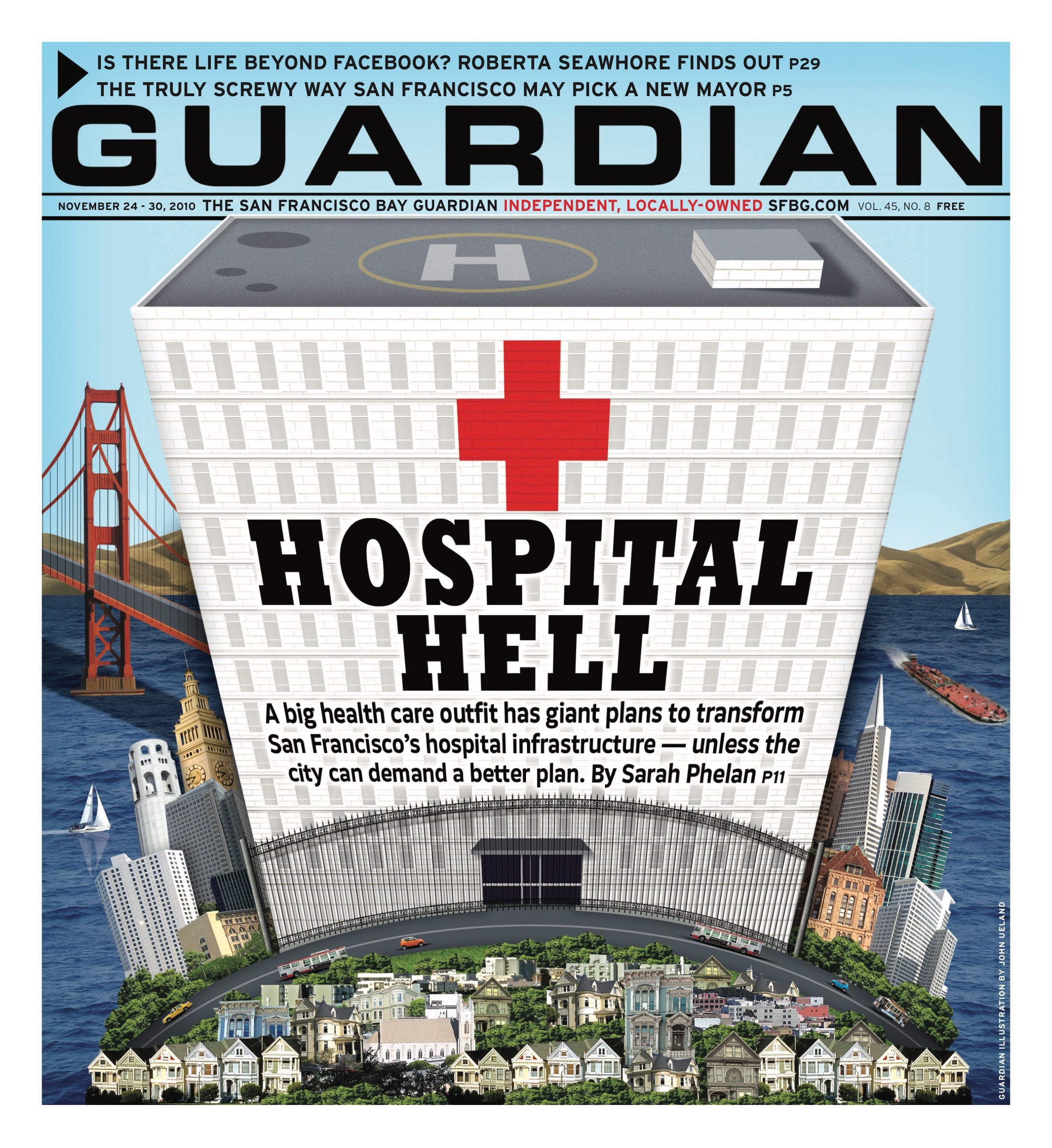
A complex and controversial project that would involve five San Francisco hospitals — including building a huge showcase facility for the wealthy atop Cathedral Hill — has prompted a debate about what average city residents need from the health care system.

California Pacific Medical Center, an affiliate of Sutter Health, proposes to downsize St. Luke’s Hospital, which primarily serves a low-income population in the Mission District, as part of a $2.5 billion proposal to renovate and retrofit three existing medical campuses, close another one, and build housing and a megahospital on Cathedral Hill that would draw patients from around the country.

CPMC’s grandiose plan was being considered strictly as a land use decision, despite its far-reaching impact on the city’s health care system. So Sup. David Campos created legislation calling for the city to create a citywide health services master plan and to use that as another tool for gauging future medical projects.

Debate over that legislation left some activists on both sides unhappy, with progressives disappointed that it won’t be able to stop a CPMC project they see as neglectful of the poor, and moderates wary of creating a new way to challenge development projects in the face of widespread unemployment in the construction industry.

But it struck a fine enough balance to win 8-3 approval by the board Nov. 16, enough to override a threatened mayoral veto. “I’m really happy and excited about the passage of this legislation,” Campos told the Guardian after the vote.

The legislation has a two-part mandate, with the first part kicking in as soon as it has final approval. It requires the Planning Department, with input from the Department of Public Health, to prepare a health care services master plan to identify current and projected needs for health care services and where they should be provided.

The second part, which begins in 2013, requires Planning to determine whether medical projects are consistent with the findings of this plan. That delay is credited to a last-minute amendment Campos granted during a Nov. 15 committee hearing after the hospital industry complained that the process could jeopardize its ability to meet state-mandated seismic retrofitting deadlines for projects already in the planning pipeline.

The passage of Campos’ legislation comes eight months after President Barack Obama signed the Patient Protection and Affordable Care Act. Hailed by its supporters as the most significant change to the U.S. health care delivery systems in 40 years, the reform package has also been greeted with criticism on both ends of the political spectrum. Progressives complain that it relies too heavily on private insurance companies and medical providers, while Tea Party supporters says that it’s government run amok and they have vowed to “kill the bill.” Senate Minority Leader Mitch McConnell (R-Ky) recently compared so-called Obamacare to “tyranny” in a speech to conservative legal scholars.

But here in San Francisco, the debate over Campos’ legislation — as heated and divisive as it was at times — yielded a surprising amount of consensus around the long-neglected idea that government should play a role in health care planning.


PULLING THE PLUG

The passage of Campos’ legislation marks the first time in 30 years that a government entity has mandated health care services planning in California. That approach West Bay Health Systems Agency, whose creation he opposed as governor of California.

Lucy Johns, a San Francisco-based health care planning consultant who wrote the only health care services master plan California has ever had, recalls what happened in the mid-1970s after President Gerald Ford signed legislation that established health system agencies nationwide.

“California established 14 health systems agencies, including the West Bay Health System Agency, which governed the nine Bay Area counties,” Johns told the Guardian. “The legislation mandated that they be established by every state, with the federal government providing the funding. So every state had to decide how many, how big, and how structured the health system agencies would be.”

Johns notes that state legislators were constrained when it came to the decisions these health service agencies made. “The governing bodies of the health systems agencies had to have a membership that was 51 percent consumer and 49 percent healthcare provider, which included doctors, nurses, and hospital administrators,” she said.

That history served as a backdrop for discussion of the Campos legislation, with the Planning Department staff report noting, “With the elimination of the West Bay Health Systems Agency in 1981, there is no longer a routine or comprehensive analysis of health service resources, needs, trends, and local impacts conducted for changes to or within medical uses.”

“It’s truly a historic moment for San Francisco,” Campos said after his legislation passed its Nov. 16 first reading (the second and final reading is set for Nov. 23, after Guardian press time). “We are the first city in the country to make sure land use decisions are aligned to our health care needs. That’s an unprecedented step that will shape the future of healthcare planning for years to come.”

Campos acknowledged that the passage of Obama’s heath reform package — which includes a mandate to purchase private health insurance beginning in 2014 — was also a catalyst for his legislation, along with the CPMC project.

“But it had more to do with seeing that the city didn’t have the tools it needed to evaluate projects in terms of whether they met the city’s healthcare needs and how they might impact people’s access to healthcare,” Campos said. “The main catalyst came from the community, which felt it was being asked to make decisions that will have long-lasting health care implications, but didn’t have any way to understand those needs. Those concerns were compounded by changes at the national level — and the recognition that these changes offer us an opportunity to engage in planning.”

Campos’ legislative victory came two months after members of the Cathedral Hill Neighbors Association joined nurses, medical workers, patients, and community groups in voicing concerns at a Sept. 23 public hearing about the draft environmental impact report for CPMC’s Cathedral Hill hospital and the other facilities that are part of its proposal.

These groups collectively expressed fear that downsizing St. Luke’s, closing the CPMC California campus, and transforming CPMC Pacific campus to an outpatient-only hospital will force low-income people to travel farther to access health care services while offering better service to the wealthy at Cathedral Hill. And neighbors worried that the proposed complex would increase traffic and require the demolition of rent-controlled apartments.

Formed in 1991 through the merger of Pacific-Presbyterian Medical Center and Children’s Hospital of San Francisco, CPMC has been affiliated with Sutter Health since 1996 and currently has four medical campuses in San Francisco: Pacific in Pacific Heights, California in Presidio Heights, Davies in the Duboce Triangle, and St. Luke’s in the Mission.

But CPMC’s longtime goal was to build a facility intended to be like the Mayo Clinic of the West Coast, a 15-story, 555-bed full-service hospital and specialty care facility at the corner of Van Ness Avenue and Geary Boulevard. Company officials have made approval for that project conditional on keeping St. Luke’s open in the face of the state’s deadline on seismic safety standards that the hospital doesn’t now meet.

“St. Luke’s Hospital was the big issue that got our attention,” Le Tim Ly, lead organizer for the Chinese Progressive Association, told the Guardian. His group has worked with residents in the city’s southeast sector around environmental justice, air quality, and pollution issues when they became aware of the threat to St. Luke’s. “All this, coupled with efforts to downsize Luke’s, left us alarmed by the disproportionate impact on an already impacted area.”

But alarm over CPMC’s plans has now revived the idea of healthcare planning.


MAKING A PLAN

As recently as the beginning of November, representatives for the Hospital Council of Northern and Central California — whose members include CPMC, Chinese Hospital, Jewish Home, Kaiser Permanente, Laguna Honda, St Luke’s, St. Mary’s, San Francisco General Hospital, and Veterans Affairs Medical Center — seemed opposed to any change in the way healthcare planning is done in San Francisco.

At a Nov. 1 hearing on the Campos legislation at the board’s Land Use and Economic Development Committee, Ron Smith, the Hospital Council’s senior vice president for advocacy, said his organization favored maintaining the city’s current procedures. “We would like to propose that the Health Commission does the planning, the Planning Commission does the land use, and that there is a required determination process which is in the current legislation,” Smith said. “We’re proposing that that continue.”

But two weeks later, after Campos amended his legislation so projects now in the planning pipeline are exempt from having to comply with the city’s health care services master plan, some members of the Hospital Council seemed to have a change of heart.

CPMC’s Chief Executive Officer Warren Browner surprised just about everybody when he publicly stated in mid-November that CPMC supports health care planning. “We strongly support the efforts of the city — we are in favor of health planning,” Browner said at a Nov. 15 hearing on the legislation.

“That statement was extraordinary,” said Lucy Johns, recalling CPMC’s history of resisting government control. “The conversation about this legislation has already changed the discourse, at least in public.”

Linda Schumacher, chief executive officer of Chinese Hospital, a community-owned, not-for-profit facility, explained at the same hearing that her organization had been concerned that Campos’ legislation would affect her hospital’s ability to move ahead with a $150 million project that has been in the pipeline since 2003.

“We thank you for that amendment that allows the effective date to be changed,” she said.

“It shows how much progress had been made, even before this legislation goes into effect,” Campos said of the hospital industry’s apparent shift in attitude. “It’s a monumental step, something that was not expected as recently as a few months ago.”

But Ly of the Chinese Progressive Association said he believes the Hospital Council still doesn’t want to see the city getting involved. “As recently as a month ago, their folks were speaking out against any kind of legislation. But I think they started seeing the writing on the wall.”

Ly fretted about the potential negative impact of Campos’ last-minute amendments. Sup. Campos’ plan represents a victory. But we could use that information as soon as possible. The 2013 deadline means the city will be handicapped: it will have information it can’t use yet.”

Ly ventures that the hospital industry’s approach will be to try to lessen the impact of the legislation. “As written, it still provides the Planning Commission and the board with the discretion to approve projects,” Ly said. “Ultimately, the struggle is about values. Just because there are plans and guidance doesn’t mean the healthcare needs of the community will become a top priority — it just provides us with tools to make an assessment.”

Campos counters that his bill will allow the city to create incentives for, and apply pressure on, the hospital industry. “If they truly want their projects to be expedited and approved before state-mandated seismic retrofitting deadlines kick in, they’ll propose plans that work for the community,” Campos explained.

But even as it publicly vows to be supportive, the Hospital Council continues to express concerns about the Campos legislation. “It’s the council’s job is to be supportive now that the board has approved Campos’ plan,” Smith said. “And Sup. Campos was very generous. He started talking to us in June. But we really didn’t get a handle on his proposal until much later. We think the idea of healthcare planning is very good. We still have concerns about the process, but now the board has voted on the legislation, our goal is to do our best to work with the law.”

Concerns that the legislation would be used to mire projects in repeated appeals and give too much weight to critics’ concerns was raised at the Nov. 16 hearing by Sup. Sean Elsbernd.

“Right now, if anyone has concerns, there’s a conditional use process and a CEQA [California Environmental Quality Act] process,” Elsbernd told the Guardian. “But this turns up a brand new appeal. It means the appeals are heard at the same time, but you’ve now created a third route.”

Campos responded to these concerns by amending the legislation to clarify that the board must act on consistency determination appeals at the same time it acts on other related appeals, so projects won’t be delayed.

Evidently this wasn’t enough to appease the San Francisco Chamber of Commerce. “We cannot be supportive of that piece of legislation,” Rob Black, the Chamber’s vice president of public policy, told the Guardian after the legislation was approved. “We believe appeals should be done at the Department of Public Health in conjunction with service providers, since San Francisco provides 20 percent of service, and private organizations provide the remaining 80 percent.”

Black says the Chamber was pleased Campos amended his legislation so as not to slow down projects that are currently in the planning pipeline. But he claimed Campos’ legislation could actually limit access to healthcare services. “The Chamber is concerned that Campos’ legislation will make it harder for doctors to pool together in pods, and if we don’t do that, it won’t make healthcare more available because services will be more expensive,” Black said. “But we absolutely think” the city should analyze gaps in providing health care to San Franciscans.

Campos’ aide Hillary Ronen confirmed that Black is correct in saying that anyone can appeal a hospital project’s consistency determination. “But the final analysis will revolve around asking if the proposed project meets the health care needs of San Francisco,” she said. “If it doesn’t, and the board doesn’t believe there’s a compelling public policy reason to approve the project, [the board] can override the approval.”


PATIENTS VS. PROFITS

Mary Michelucci, a registered nurse for 40 years and a member of the California Nurses Association, is hopeful that Campos’ legislation will rein in the hospital industry.

“I hope that any plan that would favor patient care over profit would be the way to go,” Michelucci said. “Running a hospital is expensive. But with the profits that Sutter and CPMC are making, they can afford this.”

Michelucci says the dispute over St. Luke’s came to a head three years ago, when nurses began to suspect that CPMC was planning to let the facility fail, suspicions that intensified when CPMC closed St. Luke’s neonatal intensive care unit 18 months ago.

“Now the babies who need neonatal special care are transported to CPMC’s California campus, which is in the Richmond,” Michelucci said. “But the moms may be discharged and most of them live in the Mission or Bayview-Hunters Point.”

Michelucchi still fears that CPMC will wage “a horrific campaign” against the California’s Nurses Association as it continues to push the plan for its megahospital. “CPMC wants to be in complete control of the registered nurses,” she said. “We, unfortunately, are their conscience, while they are a business model in the business of healthcare. The decisions they make about healthcare are not in the interests of patients or nurses, and we are the thorn in their side.”

All this is happening against the backdrop of the worst economic recession since the Great Depression, and for construction workers facing high unemployment rates in San Francisco, CPMC’s megaproject clearly represents light at the end of a very dark tunnel.

“CPMC is my future,” William Hestor, a 28-year-old father of two and member of SEIU-United Healthcare Workers, said at the Nov. 15 hearing. “We worked hard on a contract and we just want to make sure our hospital is built on time.”

CPMC media spokesperson Kevin McCormack told the Guardian that the real issue between CPMC and the CNA is union membership at CPMC’s Cathedral Hill facility. “CPMC is reducing beds at St. Luke’s because the beds aren’t in use, but the facility will be able to take care of 90 percent of patients’ needs and if you need specialist care, a shuttle will take you to Cathedral Hill,” McCormack said. “This centralized arrangement is the best way to attract the best staff and equipment.”

McCormack noted that there are union members and 1,200 nonunion nurses working at CPMC facilities in San Francisco. “We are bringing together nonunion and union nurses together at this facility, and we don’t feel we have the right to force our nonunion nurses to join,” he said, adding that since the Teamsters, the Carpenters, and SEIU-United Healthcare Workers (UHW) are already unionized at the Pacific and California campuses, they’ll be allowed to unionize at Cathedral Hill.

CNA member Eileen Prendiville, who has worked in San Francisco as a registered nurse for decades, recalls the negative changes she has already seen at CPMC’s facilities, including eliminating registered nurses and specialty services.

“If you pull services, as they have, of course you’ll have fewer patients. And the physicians start leaving, so it’s a vicious cycle,” she said. “St. Luke’s was a small community hospital but now it’s all about corporate medicine.”

Sup. Eric Mar sided with those seeking to exempt current projects from the city’s health care services master plan. But Sup. Sophie Maxwell noted that the Planning Commission will take a facility’s historical role into account in determining whether projects are consistent with the city’s health care services plan.

“We believe that addressed community concerns,” Maxwell said. “St. Luke’s would never have been targeted for closure had this legislation been on the books in the past.”

Campos insists his legislation is not simply about CPMC. “Ultimately this legislation stems from a number of pleas we have heard in the last couple of years from people throughout the city,” he said. “It takes the institutional master planning process to the next level. We have tried to consolidate the appeal process under existing law. Important as the legislation is, it’s key to make sure we have the right master plan because that’s where the heavy lifting will take place.”

Meanwhile, the final EIR is being completed for the CPMC project, which should go before the Board of Supervisors for approval early next year.

Alerts

0

alert@sfbg.com

THURSDAY, NOV. 25

Indigenous People’s Thanksgiving

Join this annual sunrise celebration on Alcatraz Island to honor Mother Earth, the spirit of popular resistance to exploitation, and generations past and future. Sponsored by the International Indian Treaty Council and American Indian Contemporary Arts and featuring guest speakers, drummers, dancers, and MC Lakota Harden.

4:45-6 a.m., $14 (for adult ferry ticket)

Pier 33, SF

(415) 981-7625


FRIDAY, NOV. 26

Malling of the Sacred

Join this Black Friday protest at Emeryville’s Bay Street Mall. The mall was built on top of an ancient Ohlone burial site, and even after years of protest actions by the local Native American community, the construction of the mall was completed after the human remains were unearthed.

11a.m.–3p.m., free

Shellmound and Ohlone, Emeryville

(510 )575-8408


Fur-free Friday

Thousands of animals are slaughtered for their fur each year. Join in a peaceful protest against the fur industry on one of the busiest shopping days of the year.

Noon–2 p.m., free

Union Square, SF

(415) 448-0058


SATURDAY, NOV. 27

South of the Border

Director Oliver Stone journeys south to interview Venezuelan President Hugo Chavez to investigate how the United States media has depicted him. He also speaks with several other South American presidents and creates an eye-opening documentary in the process.

1:30–4 p.m., free

Fremont Library

2400 Stevenson, Fremont

(510) 745-1400


TUESDAY, NOV. 30

Talking Trotsky

Join the Freedom Socialist Party for a screening of Sergei Eisenstein’s 1927 film The History of the Russian Revolution. The film is part of the Leon Trotsky discussion circle and encapsulates the world’s first socialist uprising.

7 p.m., $2–$5 sliding scale

New Valencia Hall

625 Larkin, Room 202, SF

(415) 864-1278


Death of Liberalism

Come hear journalist and author Chris Hedges discuss his latest book, The Death of the Liberal Class, which chronicles the gradual corruption and death of liberalism in the U.S., which was for decades a defense against the worst excesses of power.

6:30 p.m., $12

First Congregation Church

2345 Channing, Berk.

(510)967-4495


Green Film Festival

Enjoy a lively selection of short films including Matt Briggs; The Krill is Gone, which raises awareness of the growing threat to the world’s oceans, and Dive, in which filmmaker Jeremy Seifert and friends Dumpster dive in the back alleys and gated garbage receptacles of Los Angeles supermarkets. 6–9p.m., $10–$20 sliding scale

Ninth Street Independent Film Center

145 Ninth St., SF

www.sfgreenfilmfest2011launch.eventbrite.com 

Mail items for Alerts to the Guardian Building, 135 Mississippi St., SF, CA 94107; fax to (415) 437-3658; or e-mail alert@sfbg.com. Please include a contact telephone number. Items must be received at least one week prior to the publication date.

The mayoral selection last time

3

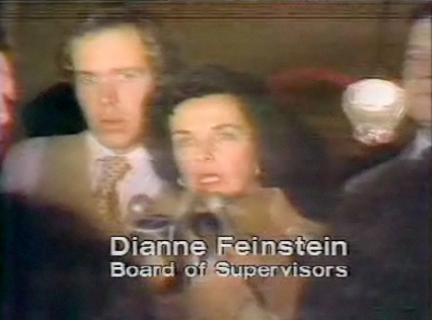
The last time the Board of Supervisors had to pick a mayor, things were very different. Former Sup. Dan White had just murdered Mayor George Moscone and Sup. Harvey Milk. The city was in shock. Board President Dianne Feinstein became acting mayor, and one week later, on Dec. 4, six of her colleagues — the narrowest possible margin — elected her to fill out Moscone’s term.

It’s worth looking back at what happened that week, not only because it’s a fascinating bit of political history, but because it gives some insights into how the current process should and shouldn’t go.
We’ve gone back and pulled not only the minutes of that meeting, but all of the relevant articles and editorials from the San Francisco Chronicle, the old San Francisco Examiner and the Bay Guardian, and while newspaper accounts are only the first, and often imperfect draft of history, the Chron had a good City Hall reporter, Jerry Burns, and you can get a lot from the day-by-day accounts.

For starters, everyone (even the Guardian) agreed that Feinstein did a good, almost uncanny job of keeping it together and managing the city in the week after the horrendous murders. But she was by no means the only, or consensus candidate for the job — Sup. Robert Gonzales announced his candidacy Dec. 1, and others were in the running until the end. The Guardian wrote at the time that Feinstein was fine as acting mayor – but shouldn’t be in office for the final 13 months of Moscone’s term.

Among the interesting elements of the drama:

— The process was riddled with Brown Act violations, and the selection of Feinstein was, in retrospect, almost certainly based on illegal meetings.  “Feinstein spent yesterday at her Pacific Heights home,where she talked with most of the supervisors,” a Dec. 4, 1978 Chronicle article by Burns noted. That would amount to an illegal meeting; under state law, then and now, meeting individually and serially in private with all or most of the members of a public board is a clear violation of the Brown Act.

At the time, however, nobody challenged Feinstein’s actions.

— Then, as now, there was a move to name a “caretaker” mayor who would fill out the remaining 13 months of Moscone’s term — and vow not to run again. But the conservative Examiner said that was a bad idea: In a Dec. 3 editorial, the paper, then owned by Hearst Corp., noted: “The City should not have to accept a “caretaker” mayor invested with only a thin veneer of authority.” The notion went nowhere.

— At least one name that was bandied around back then is in play again today: Then-Assembly Member Willie Brown.

— Feinstein got exactly six votes. Although in most casual historical accounts, she’s described as a clear, almost unanimous choice, that was far from true. In fact, Sup. Ron Gonzalez, who described himself as the board member most in synch with Moscone’s agenda, announced his candidacy Dec. 1, and as of Dec. 3, the day before the final vote, Russ Cone of the Examiner reported that “earnest and secretive negotiations among San Francisco’s nine supervisors to agree upon a mayor to replace the slain George Moscone today entered the final, feverish hours with no candidate ready to claim victory.”

At the Dec. 4th board meeting, Sup. Quentin Kopp moved to continue the decision for a week. Kopp – unlike most of his colleagues – had been avoiding the political furor in the days after the assassinations, saying it was unseemly to be making deals when city leaders ought to be in mourning. Feinstein and the six others who would ultimately elect her voted against the motion.

That would be a clear violation of law today; as a candidate, Feinstein would be unable to vote on anything that could promote her ascension to mayor. But no matter: The motion needed six votes, and only Kopp and Sup. Lee Dolson said Aye.

When the motion was made to name Feinstein as interim mayor, Kopp tried to ask her a few questions – particularly about her plans for various department heads. The city attorney quickly shut him down, saying Feinstein couldn’t legally answer or get involved in any debate.

Then six supervisors voted for Feinstein. Kopp and Dolson dissented. Feinstein by law had to abstain. And there were, of course, two empty seats; Dan White had just resigned and was in jail, and Harvey Milk was dead.

Why did Kopp vote no? There’s a back story, a key part of San Francisco political lore.

Feinstein had run for mayor twice before, in 1971 and 1975, both times finishing well out of the money. After her second defeat, she vowed she’d never do it again. In fact, the day before the assassinations, she had just returned from a trip to Nepal with her then-boyfriend (now husband) Richard Blum, and reporters asked her if she was going to run in 1979. “Not this time,” she said.

She and Kopp, longtime rivals, had cut a deal the year before. Feinstein wanted to be board president; Kopp wanted to be mayor. And Feinstein vowed that if Kopp would support her for board president, she’d stay out of the mayor’s race in 1979 and leave the field open for him.

And of course, immediately after the killings, she changed her mind. Kopp thought what was a bit slimly, and refused to vote for her for mayor. He challenged her in 1979, and narrowly lost, and her political career, so recently in the doldrums, was off and running again.

Are you ready for GWAR??

1

Apparently, even the massive, all-powerful aliens and scumdogs of the universe known as GWAR have trouble with reception on their iPhones.

While conducting a phone interview before a show in Hollywood, band leader Oderus Urungus’ connection cut out twice, leaving him grumbling, “Maybe I’m clutching my iPhone too tightly!”

Perhaps it was his giant claws proving to be too much for our puny human technology to handle — either way, once the connection was re-established, the intergalactic beast that has led GWAR for more than a quarter century had no shortage of hilarious and outrageous things to say.

Having just finished taping a segment for the Fuel TV show Daily Habit, Oderus was being informed that he had revealed a bit more of himself to the television audience than he had thought. “I just did the show apparently with my balls hanging out the entire time and nobody told me! That’s not like a big thing for Oderus, my balls usually are hanging out — but to try to get on national TV, I’m willing to do the ball tuck, but apparently the ball tuck didn’t work, it was horrible, it looked like a duck-billed platypus coming out of a burrow or something!”

Although someone out there in TV land was undoubtedly offended by this show of alien masculinity, they can just add themselves to the scores of non-believers and critics who have unsuccessfully assailed the musical and cultural force that is GWAR over the past couple of decades. Currently celebrating their 25th anniversary, the heavy metal space gang that brought our planet recorded gems such as Scumdogs of the Universe and This Toilet Earth are back in all their unholy glory with a new album, The Bloody Pit of Horror (Metal Blade).

Propelled by the first sleazy single, “Zombies, March!,” Oderus Urungus and his cohorts have returned in fine beastly form, ready to again spread their love to fans around the globe — which of course means spraying audiences with all manner of fake blood, bodily fluids, and god knows what else.

At a time when many bands their age would be mellowing out and producing so-called “mature” material, GWAR has shown that they are only getting dirtier and heavier with time, as any fan should expect from a group with their background and history.

“With any of the records we’ve made, we didn’t really go into it with a preconceived notion of what it was going to sound like. We just went at it and tried to make the record that was appropriate to what we felt like at the time, and I guess we were feeling particularly ferocious [with this one],” says Oderus. “We just wanted to emphasize how fucking awesome we are, and recall a day not so long ago when bands actually put out an album about once a year — nowadays that just doesn’t happen, bands take forever in between albums, and half the time they’re full of re-mixes, or tracks from other albums that got cut.

We just wanted to have a whole bunch of great music for our fans, and just celebrate the idea of GWAR. One of the things about this album that’s a little different that gives it that ferocious sound is that we tuned down I believe to F#, which is basically the loosest that guitar strings can be and still stay on the neck — it sounds like the guitars are vomiting — in a good way! I think it makes for a very powerful record.”

When asked if his band of rubber aliens, mutants, deviants and demons ever looks back on their history and thinks about the fact that they’ve been  doing what they do successfully for so long, the answer is a firm “No.”

“If we took the time to go back and actually examine what we were doing, we’d be so shocked and appalled that we’d stop doing it. It’s better to just keep mindlessly plugging onward,” laughs Oderus. “[With that being said] we are very well aware of just how awesome it is what we’ve managed to do, and we intend to keep doing it as long as possible — or until we escape the planet Earth, whichever comes first.”

With the release of The Bloody Pit of Horror, GWAR have been hitting the road in support, crossing the United States and making an appearance on national late night television, with a performance last month on Late Night with Jimmy Fallon.

“We did Springer and Joan Rivers like 20 years ago, and it took them 20 years to let us back on television!”

Oderus himself has been making several more recent appearances on TV, however — in the last year or so he’s been a regular guest on, of all places, a Fox News program, Red Eye. Although it does sound like an awfully strange pairing, the intergalactic barbarian thinks that Fox sees in him a potential for higher ratings, thus justifying having a giant space beast running around their studios.

“It is an odd match that they would put GWAR in a position where I can not only comment on society but do it over and over again, but obviously they’re having a little fun with it. It’s pretty funny to be walking around the Fox studios in New York City and run into Glenn Beck…yeah, Oderus and him are hanging out, backstage buddies!”

Having toured all over the world in the past 25-plus years, Oderus and his bandmates have seen all manner of crazy and twisted things, but the singer says that no place can hold a candle to what’s he’s seen and experienced right here in San Francisco.

“Pretty much every time we’ve been to San Francisco, it’s been insane, since the very first GWAR tour where we showed up in an old school bus, and ended up parked in the Tenderloin for a week straight, that neighborhood was really bad. And then our show at the Warfield where the bums were dropping dead right outside of the venue; the line was going around the block, they were three dead homeless people laying on the sidewalk, and out fans were just very politely stepping over their corpses, that was pretty weird!”

He also mentions a doorman selling crack by the side of the stage within just a few feet of a nearby cop — one that at first the band didn’t even believe was a real officer. “I thought he was a guy that dressed up in a joke cop outfit, because his uniform was so fucked up and dirty, and he was driving this cop car that was all beat to shit, the fenders were even hanging off it!”

With that said, Oderus is eagerly looking forward to playing here in the city on Sunday, and has some words of praise for his local fans.

“San Franciscans — you still have a complete, stone cold lock on the sickest, weirdest, most fucked up town in the United States. New Orleans has nothing on you people!”

http://www.youtube.com/watch?v=qusEPwdM7B8&feature=related

GWAR

With the Casualties, Infernaeon, and Mobile Death Camp
Sun/21, 7:30 p.m., $22-$25
Regency Ballroom
1290 Sutter St., SF
(800) 745-3000
www.theregencyballroom.com

Lust for justice, Tony Serra style

0

“So Paulette Frankl, why did you want to write a book about Tony Serra?” It seems like a reasonable question. After all, the “long hair” woman before me spent a good 17 years of work on her biography of San Francisco’s most famous counter culture lawyer (book release party at Fort Mason Sat/20, btw). Her answer was a bit surprising. 

“I didn’t want to write a book about him! I wanted to be his artist!”

The inability (or lack of desire) to shape her own involvement in his life speaks to the abject admiration and connection to Serra that has been borne over the last few decades by Frankl. It’s a pull that led her to accompany the lawyer to hearings, speeches, client meetings, and quiet afternoons in Bolinas in the pursuit to capture his inner essence. It’s a pull that seems to baffle even her. 

She’s right when she says she didn’t set out to be a biographer. While living in a planned community (read: commune) outside the city, Frankl agreed to drive a friend to a three-day exam the friend was taking in San Francisco. While she was there, Frankl, a long time painter and sketcher, decided to follow up on a vague interest she’d had to get into court illustration. 

“I thought the lawyers always had money – the worse things get, the more money they get!” In Lust For Justice, her recently completed Serra biography, she tells the story of the first case she saw. A young woman apprehended in a drug bust was being pumped for the names of the dealers involved. In Lust for Justice, Frankl writes that woman said “if I rat they’ll kill me. I’ll be out of prison sooner than I’ll get out of the grave.” 

The pathos in the room was palpable, and it got her creative fruits juiced. Frankl was hooked on the court scene. But when she saw Serra, an SF native given to wearing thrift store finds in the court room and who makes a career of defending those against whom society’s odds were stacked – high profile cases like Huey Newton, Bear Lincoln, minorities facing racist institutions – she was no longer interested in drawing the cross-examination of any other defense counsel. 

Feel like a hung jury yet? Frankl captures the high Serra in Lust for Justice

“I sensed his energy,” she remembers. “I got him on an emotional basis.” Serra is prone to stalking like a lion in court rooms, using his whole body to put on courtroom theater that strikes past juries’ preconceptions to get to understanding on some archetypal level. Frankl shouldered her notepad and resolved to become his traveling court illustrator. “If I can ever capture this man and express him, I will have arrived as an artist,” she recalls thinking.

Serra eventually assented to her demands, and during the Ellie Nestler case – in which a mother from a small town in the Sierra Nevadas shot and killed her six year old son’s molester at the man’s preliminary hearing  –  she realized there was a larger story there, that of Serra’s unflinching dedication to repairing society’s inequities. 

“I said Tony, where’s the book about you? Let’s do it – my art, your words.” They drew up an informal contract on the hood of the car and away they went.

Only, not. Because the very reason Frankl was writing the book about him inevitably became the reason why she’d never have a co-collaborator on the project. “He just always in trial,” she sighed. Forget writing his autobiography, she soon found herself lucky if she could get an hour of his time to talk about the parts of his life she couldn’t see: his childhood, his underlying motivations. 

Many, faced with such apparent disinterest in their project, would have stepped back a bit, but speaking with Frankl it becomes clear that she saw this as no option at all. So enraptured of the man was she that to render his evocative court appearances she devised a new, impressionistic style of court illustration. One drawing (they are neatly captured throughout the self-published Lust for Justice) shows Serra’s hand extended in the closing arguments of the 1997 trial of a Native American charged with a cop killing. A bear crouches over Serra, an animal spirit that Frankl saw vividly during the trial itself.

Trippy? Well, yeah. Frankl’s ethos is firmly grounded in the LSD mind expansion of the ’60s. One chapter attributes Serra’s ability to transcend in his lawyerly duties, to whit: “he willed himself to align his body, mind, and soul with the highest calling of the law: the cause of justice.” The emotional connection she feels with Serra informs the book, which borders on the overly effusive praise of a disciple. But not a disciple that can’t get pissed off at their savior. “I don’t think I overglorify him,” Frankl told me, perhaps prepping for this inevitable assessment of her work. “I mean, he can be a real pain to be around! I wanted this to be my experience of him, though – and I do think of him as a great defense lawyer.”

As he is. And though perhaps Frankl isn’t a master wordsmith (to be fair, she doesn’t claim to be for a moment), but Serra’s story deserves to be available in book form. It’s is a story of a man who doesn’t compromise on anything – from courtroom theatrics to lost cause cases to getting high and/or performing Natvie American protective rites before court sessions. And he’s had some amazing legal victories for defendants against whom the odds were stacked, in a system that oftentimes seems as though it was designed to prevent that from happening.

Told by a woman who was there for much of the story, Lust for Justice certainly lives up to its red-blooded title. To check out the man himself, you can either start hanging out with in judge land, a la Frankl, or hit up her book release party tomorrow, where Tony Serra will be in attendance, no doubt holding court. 

Lust for Justice book release party

Sat/20 5-8 p.m., free

Room C-370

Fort Mason, SF

www.lustforjustice.net


also:

Lust for Justice book reading

Sun/21 1 p.m., free

Modern Times Bookstore

888 Valencia, SF

(415) 282-9246

www.mtbs.com


The Performant: We want the airwaves

0

Aeriel Art Soars at Theatre Artaud and Teatro Zinzanni

Do you dream of the day when you finally learn how to fly? For aerielists, that future is now, and that dream an everyday reality. It’s a career choice not for the faint of heart — right up there, I’d say, with driving a fire truck or sailing around the world on a catamaran made of plastic bottles. But I imagine the psychic rewards to be tremendous. Life on the edge. Teasing gravity, tempting fate. To soar—perchance to jetstream.

During “Burning Libraries: Stories from the New Ellis Island” at Theatre Artaud, the oral histories of children take flight with the help of four dancers, two of whom (Susan M. Voyticky and Kerri Kresinski) spend considerable time in the air—elevating the simple text to reverent heights. Swooping from moonbeams made of aerial silks, Voyticky escapes from the segregated south, and later in the production, Voyticky and Kresinski dance in the sky, side by side, as fireworks (projection provided by Ian Winters) explode around them.

They collect eggs from the “tops of trees” and, in a wrenching history about the Port Chicago disaster, they go up in flames, and then form, with their earthbound companions, a monument to their own memories, shrouded behind the silks, frozen in time. The entire performance reminds somewhat of Blixa Bargeld’s “The Execution of Precious Memories” enacted on the same stage two years ago, right down to some of the same flaws (nagging paucity of cohesion and character depth) but the sheer pleasure of watching the unencumbered flights of the aerialists cannot be understated.

There’s something about watching an aerial performance unfolding genteelly on a stage, and quite another thing again about watching it swooping right over the dinner table (“Oh waiter! There’s a ‘flyer’ in my soup!”). You probably won’t regret it for the rest of your life if you happen to miss attending the latest Teatro Zinzanni  production “License to Kiss II, a Sweet Conspiracy” but if you’ve got some well-heeled relatives hanging around for the holidays, then what the heck.

Get them to take you and hang on to your soup spoon when sensuous Seattlite Kari Podgorski eats some magic love cherries and takes to the air in racy red lace lingerie. Beautifully framed by the antique swoop of the one-hundred year-old Speigeltent, her aphrodisiac acrobatics are a sweet treat. Twice as nice, the dynamic husband-and-wife Vertical Tango team (Sam Payne and Sandra Feusi), play out a passionate courtship in the air, spinning sinuously along the length of an impressively girthed stripper pole.

And just for the nervously giggling patrons inevitably seated in the font rows of tables, an interlude with a giant teddy bear on a tightrope will make the familiar pull of gravity seem curiously comforting—once he’s well out of pointblank crashdive range, that is.

People’s history: the writing’s on the wall… and now, in a book

0

A thousand pox upon the head of traditional history books. Leaving aside all matters of sexism, classism, imperialism, and plain old fact suppression, they’re usually a pretty boring read on top of it all. But the writing’s on the wall: Celebrate People’s History is releasing its own version of “how we got here”’s greatest hits — and the book release party is Sat/20.

Josh MacPhee has been making unsung history the writing on the wall since 1998. Though technically he sees himself as an anarchist, MacPhee is the putative head of the poster collective CPH, having commissioned over 100 original radical history posters over the years. Those prints have made their way around the world, to classrooms and street corners. The signs join a legacy that MacPhee identifies — in Celebrate People’s History‘s introduction — as having begun with Cuba’s Organization in Solidarity with the People’s of Africa, Asia, and Latin America (OSPAAAL)’s work during the ’60s, and which stretches to include the pieces done locally by artists of the Mission School and the Billboard Liberation Front. 

What’s special about the CPH pieces among this line of populist propaganda are a proactive focus on history’s shining moments, those points in time where people came together and resistence against hegemony held. MacPhee’s book includes posters of Harriet Tubman’s historic crossing of 750 escaping slaves over the Combahee River in South Carolina in 1863 (with the aide of Union troops, the only female-led military action in the history of the country) and the 2003 city shutdown of San Francisco in response to the bombing of Baghdad.

This is how the book looks. Right page: duo-tone poster. Left page: typed-out version of its text. The codification on the pages make the triumphs seem more real, somehow — like most things do when they are written down. 

MacPhee writes that he felt the need to bind the posters together to make visible the “broader sweeps of the past,” and the evolution of radical social movement. The end product may be a lot less exciting than seeing a CPH poster on your corner’s electrical box, but it is a gas to see them neatly placed on pages, next to their message codified into uniform typeface. 

In the wake of sit-lie’s triumphant refutation of the freedom of public space and in a time where some are questioning poor people’s right to even live in this city, I think the questions below, posed by MacPhee in his introduction to the book, is pretty pertinent:

Can our streets become active galleries of ideas and information we can use to understand who we are and where we come from? Can these galleries evolve and change, instead of calcifying, fading, and cracking, and make room for new ideas, images, and conversations?

Here’s hopin’… 


Celebrate People’s History book release

Sat/20 7 p.m., free

Center for Political Education 

522 Valencia, SF 

(415) 431-1918

www.politicaleducation.org


Folsom gives good skrill at the Armory

0

I’ll admit I went to Kink’s baroque bordello atop the Mission Tuesday night to check out the fine china and torpedo breasted, roped-up female statues  – but I stayed to watch men in leather pants give away monies to local angels. 

Those dashing fellows would be Folsom Street Events, who used the ambiance of the Amory’s penthouse to donate $326,161 in 2010 proceeds from the Fair, Up Your Alley, and Magnitude to their 16 beneficiary non-profits. It was a gentle flog on the ass of a reminder to anyone who says that perverts never did anything for our city, not to mention a welcome sign that our great grant-making institutions haven’t completely gone under yet.

Who got their sticky paws on the giant cardboard signifier? Everyone from Pets Are Wonderful, the support agency for low income patients and their animals, to the Queer Cultural Center, to SF Sex Information (for a full list of the leather set’s lucky ones go here). The presenter and announcer of all this do-gooding fuzziness celebrated our momentouxxx surroundings by thanking Kink creator Peter Acworth, who was padding about in baggy jeans and flip-flops, for using the space “even if we don’t enjoy it quite the way you do – or maybe we do, just in different clubs.”

FSE executive director Demetri Moshoyannis told me that the most that his organization has ever donated in a year is $350,000 – but at close to $4.5 million over the history of the fair, Folsom’s making the SF’s charitable contributions look like they just got done skinny dipping in a frigid mountain pool. 

But who can focus on non-profit pissing matches when there’s cock ring cake to be had? Not to mention the well-scrubbed, epically proportioned dinner tables on which one ponders setting down one’s app plate, the chains hanging becomingly from the rather sumptuous ceilings, and the fifteen-foot high oil painting in the Amory stairwell of a well dressed woman offering scraps to a dignified greyhound and crouching blonde clad in nothing but a leather doggie mask? 

Fire and Icing cock ring cake: so good, it was real hard to get a slice. Photo by Caitlin Donohue

“Did you notice the statue?” a spiky haired attache in leather pants inquired in the midst of our reluctant retreat from the Armory’s philanthropic festivities. We had, possessing the facility of sight and rudimentary powers of observation – she stands four feet tall and occupies the center stage of the sitting room upstairs. 

“Did you know that Peter Acworth’s mother sculpted that?” We are treated to the history of the busty bust, who apparently went through three drafts before Acworth told Momma that her lady’s tits were of a prominence suitable for placement in his debauched drawing room. 

As this conversation took place alongside a glass case containing Kink’s gift shop, we had the chance to admire the red and black towels for sale (at one point complimentary clean ups for the on-screen talent, recently put into production when guests started filching them for their own). And then off into the night we went, grateful to see that San Francisco’s sex community is still well endowed in the areas of financial generosity, artistic vision, and commercial enterprise. 


On the cheap listings

0

On the cheap listings are compiled by Caitlin Donohue. Submit items for the listings at listings@sfbg.com. For further information on how to submit items for the listings, see Picks.

Wednesday 17

Lara Adair Books Inc., 2251 Chestnut, SF; (415) 931-3633, www.booksinc.net. 7 p.m., free. Author Adair shares the secrets she’s privy to via her life of writing and coaching others – and that she’s published in her newest how-to, Naked, Drunk, and Writing. Pick up some pointers at this author talk, just don’t take the title too seriously now.

Dine Around, Shop Around, Drink Around Various venues, SF; (415) 558-6999 x230, www.dineshopdrink.aef-sf.org. 11 a.m.-2 p.m. A great excuse to paint the town red at some of your favorite neighborhood shops and eateries – tonight, 25 percent of your purchases will go towards HIV/AIDS and breast cancer support agencies.

Mole to Die For Mission Cultural Center for Latino Arts, 2868 Mission, SF; (415) 821-1155, www.missionculturalcenter.org. 7-10 p.m., $7. Dive into this Oaxacan delicacy at MCCLA’s cook-off, which this year features a special green mole for the true culinary enthusiasts.

“Saving the Last of the Wild: North American Corridors” California Academy of Sciences, 55 Music Concourse, SF; (415) 379-8000, www.wcs.org/patronseventCA. 6-8 p.m., free. A panel of scientific minds discuss the threat of human development to migration paths – lord, those animals have it rough! RSVP recommended.

Thursday 21

Switchback launch party Books and Bookshelves, 99 Sanchez, SF; www.swback.com. 7-9 p.m., free. The USF graduate school literary journal celebrates the sunshine on Issue No. 12, themed “Minority vs. Majority.” Raise your wine glass to live readings by scholarly bards, and ponder the conflicts between the few and the many in our society.

Friday 22

de Young artisan fair de Young Museum, 50 Hagiwara Tea Garden, SF; (415) 750-3600, www.famsf.org. (also Sat/20) 9:30 a.m.-8:30 p.m., free. Maybe you can’t afford the art up on the walls for your favorite masterpiece loved one this holiday season, but you can snag some one-of-a-kind gifts from the fine arts museum’s bazaar of local artesanals. Browse and shop accessories, clothing, and more.

Hospitality House “Art for the House” art auction The Shooting Gallery, 839 Larkin, SF; (415) 749-2184, www.hospitalityhouse.org. 6-10 p.m., free. Have a drink in the Tenderloin while you peruse for purchase the artwork of individuals from various community programs for the homeless and transitionally housed, including Roaddawgz and the Community Arts Program.

bay area

“Dracula to Twilight” Other Change of Hobbit, 3264 Adeline, Berk. (510) 654-6226, www.otherchangeofhobbit.com. 6-8 p.m., free. A professor and a chronicler of the Saint-Germain novels discuss the portrayal of blood-sucking undead in pop culture’s film and literature. Mortals welcome to attend, just make that your scarf is tied tightly and your garlic earrings are on hand.

Saturday 23

Celebrate People’s History release party Center for Political Education, 522 Valencia, SF; www.politicaleducation.org. 7 p.m., free. Perhaps you’ve caught CPH’s compelling radical prints on your neighborhood community center or bus shelter’s walls – they’ve been around since 1998. The group’s published a retrospective of their most vivid public art and you can celebrate its release here with historian Lincoln Cushing and artist Favianna Rodriguez.

“Science of Perception”: Human Potential Laboratory Southern Exposure, 3030 20th St., SF; (415) 863-2141, www.soex.org. (Also Sun/21) Noon-9 p.m., free. The Anonymous Immortal Collective and career alchemist Ean Huggins-McLean present an opportunity to extend the elasticity of your mortal coil: healing foods, training for aura-sighting, and more from their “new health care system” at this two-day workshop.

Tenderloin Reading Series Koko Cocktails, 1060 Geary, SF; (415) 596-7614. 7 p.m., free. The quarterly dish on the quirks and perks of the infamous TL features readings of poetry, fiction, and creative non-fiction. The much maligned neighborhood doesn’t get too many chances to revel in itself, so this is a great chance to celebrate your city.

bay area

Home and Hope interfaith benefit concert Transfiguration Episcopal Church, 3900 Alameda de las Pulgas, San Mateo. 7 p.m., donations accepted. The Foster City Community Chorus and East Bay Church of Religious Science Choir sing their hearts out in support of Home and Hope Shelter Services. The bringing of pie to the after-reception is highly encouraged.

Vintage Paper Fair Centre Concord, 5298 Clayton, Concord; (415) 814-2330, www.vintagepaperfair.com. (Also Sun/21) 10 a.m.-6 p.m., free. Maybe a bathroom plastered with old school cosmetic ads? Perhaps paper mache your refrigerator with postcards from famous foodie destinations? You can line your apartment with ephemera from antiquity after a shop-stroll through this bazaar of retro paper products – over a million scraps will be on sale.

Wednesday 17

bay area

Charity Turkey Bowl Serra Bowl, 3301 Junipero Serra, Daly City. (650) 992-3444, www.serrabowl.com. 10 a.m.-4 p.m., lanes $25 per hour, donations accepted. Dust off that strike form, young bowler: Serra Bowl is donating a turkey per ten-pin knockout to hunger organizations all day today. Now that’s reason enough to hit the lanes, no?

Ode to a N-Owl

0

Honest to Tyra, one of my absolute favorite things in the world is the N-Judah Night Owl bus at 3 a.m. Where else can you encounter such a juicy cross-section of the city’s nightlife players — at least the ones too broke or too cheap (or too hot, like me) to snag a cab home?

The guilt-eyed bridesmaid lured away from her bachelorette for a quickie in the bushes; electro kids still fidgety from that tragic final snort; full-throated bro-skis trying tipsily to locate the end of their sentences; post-concert hipsters screaming over their own blown eardrums, ankles swollen and bright blue from asphyxiating jeggings (still!); drooling newbie Googlers who tried so very hard to be “cool,” succumbing to drowsy numbness as their $300 steampunk sunglasses slip, one lens cracked, from their acne-scarred foreheads; botched pot deals, stunned French teens, cruisy bears, fresh tweakers, gothic Lolitas, country line-dancers, really aspiring rappers, several actual hotties … Amazing. Especially when someone busts out a boombox. All aboard our homegrown diesel-driven party train, woot woot!


NERD NITE

“It’s like the Discovery Channel … with beer!” I’m not sure if there’s going to be intentional dancing at this hot monthly snarf-a-thon, but feisty cerebella should be jumpin’ for these presentations: “Mars’s Lumpy Bumpy Neato Magneto(sphero),” “Penguins, the True Chickens of the Sea,” and “The Perilous Infirmity of Burning: The History of Neisseria Gonorrhea.” OK!

Wed/17, doors 7:30 p.m., show at 8 p.m., $8. Rickshaw Stop, 155 Fell, SF. sf.nerdnite.com


PACO OSUNA

They say that minimal is dead — but it actually just got hijacked by hot Spaniards. They added some much-needed swing and even humor (not to mention a little color) to the pale-faced genre, keeping the intellectual rigor but expanding its rhythmic template. Beardy Barcelonan Paco Osuna still likes it dark and heady in a Plus8 Records vein, but he knows how to thump the floor as well.

Thu/18, 9:30 p.m., $10. Vessel, 85 Campton Pl., SF. www.vesselsf.com


RADIOACTIVITY

The monthly happy hour celebrating “the sound of low budget synthesizers, Eastern European Cold War dance parties, and the more experimental, dubby, and danceable side of post-punk” turns one year colder with special guests Dominique Leone, one of SF’s best hoarders of vinyl plutonium, and Wobbly, plus residents Robots.In.Heat and Tristes Tropique.

Fri/19, 6 p.m.–9 p.m., free. 222 Hyde, SF. www.222hyde.com


SIMIAN MOBILE DISCO

Yes, the Brit duo is still here, and yes, they are still your friends. I never use the word “eargasm,” because ew, but if your rocks pop for anthemic electro bombast and fuzzy blasts of bass tempered ever so slightly by devilishly insistent samples, then yes, you will have a bananas one of those.

Fri/19, 9 p.m., $18 advance. Mezzanine, 444 Jessie, SF. www.mezzaninesf.com


DUBSTEP BEAT BATTLE

Little recognized fact: the Bay has a shit-ton of excellent beats-production talent. (The recent Red Bull Big Tune and BART Series Big Battle were explosions of creativity.) Promoters Phillip Drummond and Ro Knew are unleashing the future wobble with this multiplayer rumble. Plus, it’s a canned food drive for Glide — bring a tin, leave with tinnitus?

Sat/20, 9 p.m., $10/$7 with can of food. Club Six, 66 Sixth St., SF. www.clubsix1.com


ILL-ESHA

Breakbeat specialist turned harmonic dubstep heroine (with occasional acid crunk overtones), the Daly City Records artist brings a decade of experience and some spicy live vocals to the tables. This special release party for her new EP includes Brit glitch-hoppers Glitchy and Scratchy, B. Bravo, Slayers Club DJs, and everybody’s favorite cuddly purple noise-monster, Mochipet.

Sat/20, 10 p.m.–3 a.m., $10. Public Works, 161 Erie, SF. www.publicsf.com


SEAN PRICE

The adventurous-eared monthly Frequency party brings in this super-talented, kicked-back, bearish Brooklyn rapper — as one-half of the classic Heltah Skeltah, Price rocked and rucked the ’00s, on his own he’s rolling over tasty Lee Mason “Shady Blues” samples. With Danny Brown, Moe Green, Quelle, and DJ Joe Quixx of Oakland Faders.

Sat/20, 10 p.m.–3 a.m., $10 advance. Mighty. 119 Utah, SF. www.mighty119.com 

America’s original sin

1

arts@sfbg.com

VISUAL ART Going into “Huckleberry Finn,” the final installment in the Wattis Institute’s trilogy of group shows organized around canonical American novels, it is perhaps best to heed the notice Mark Twain places at the outset of the text from which this exhibit takes its name and inspiration: “Persons attempting to find a motive in this narrative will be prosecuted; persons attempting to find a moral in it will be banished; persons attempting to find a plot in it will be shot.”

The only punishment one risks incurring with “Finn” is self-inflicted fatigue from trying to take it in all at once. As befits Twain’s Adventures of Huckleberry Finn — a book that is, among many things, a satiric portrait of the post-Reconstruction South, a vernacular bildungsroman, an exploration of the cross-racial politics of friendship, and a fictionalized travelogue — curator and Wattis director Jens Hoffmann sets a bold course across American geography, social and literary history, and visual art that is as expansive and winding as the Mississippi.

Much as he did with “The Wizard of Oz” in 2008 and “Moby Dick” last year, Hoffmann — firing on all cylinders here — has assembled a visual dossier that takes an open source approach to its primary text. In the spirit of Twain’s warning shot to plot-seekers and would-be moralists, the exhibit’s pamphlet calls its presentation “fragmented and inconclusive.” This description, like Twain’s, is only partially true. Individually, the pieces (including 15 new commissions) vary in terms of how directly and from what direction they engage with Twain’s novel. But Hoffmann’s talent as a curator lies in grouping together works, artists, and eras that, under the broad umbrella of “Huckleberry Finn,” have something new to say to each other — and to us.

Book-ended by two screening rooms, the first floor galleries examine Adventures of Huckleberry Finn from a largely historical perspective, treating the text and its author as historical objects (in addition to some handsomely bound first editions of the book, there’s even a reproduction of Twain’s trademark white suit, hung casually on a coat rack) and exploring in more depth the cultural geography of the Mississippi (see James T. Loyd’s long survey of the river’s lower half), and in particular, the social inequalities wrought by King Cotton’s reign.

Some of the works, such as Horace Pippin’s two 1944 oils of antebellum life, Harlem Renaissance painter Claude Clarke’s harrowing depiction of a slave lynching, or Alec Soth’s 2002 photographic series documenting the beauty and strangeness of the riverside, are, each in their own ways, remarkable forms of reportage. Other pieces are pointed interventions. Betye Saar’s The Liberation of Aunt Jemima (1972) is a mixed media sculpture that arms a mammy doll, set against a background of Aunt Jemima syrup labels, with a rifle and a broom.

The same could be said of the works on the exhibit’s second floor, as well as their arrangement, which more explicitly addresses the ugly legacy of what historian George M. Fredrickson has called “America’s original sin,” slavery. Right out of the elevator, one is confronted with a powerful triptych: Warhol’s screenprint Birmingham Race Riot (1964) is displayed beside a reproduction of a segregation-era sign that reads “BLACKS ONLY,” and both hang above Felix Gonzalez-Torres’ The End (1990), a stack of free-to-take posters placed against the wall, each one containing a white space framed by a black border.

Whereas pieces in the lower galleries are arranged with greater room between them, Hoffmann fills the second floor chockablock with representations of degradation and defiance: Kara Walker’s massive and monstrous shadow-play of rape and violence covers one wall; Ruth Marion-Baruch’s stoic photographs of Black Panther leaders hang on another. It’s as if Hoffmann felt that the only means of adequately depicting “Jim’s turbulent quest for freedom,” to again quote the program notes’ gloss on things, was actual disorder.

Appropriate to a show inspired by Twain, some works also exhibit a sense of humor as they engage with larger issues. Simon Fujiwara’s video piece — in which the artist dons a kind of cultural drag, playing an exaggerated caricature of himself being interviewed about his relationship to the character Jim — becomes funnier as his interlocutor’s questions become more ridiculous. It is a tall tale — aimed at both critics and artists — about misreading artistic practice as identity formation, and it is worthy of Huck himself.

HUCKLEBERRY FINN

Through Dec. 11

CCA Wattis Institute for Contemporary Arts

1111 Eighth St., SF

(415) 551-9210

www.wattis.org

Delta death

5

By Patrick Porgans and Lloyd Carter

news@sfbg.com

While Californians were held captive waiting for Gov. Arnold Schwarzenegger and the Legislature to agree on spending cuts and adopt a budget, state officials were throwing hundreds of millions of dollars down the drain and compounding California’s water crisis.

Water officials have wasted more than $10 billion and 35 years in extended delays in their failed attempt to carry out their legal mandates to protect the waters of the state and restore the San Francisco Bay-Delta Estuary. The result: water quality in the estuary is rapidly declining; fisheries are in crisis; and the proposed solution, an $11 billion bond act set for the ballot in 2012, will only make things worse.

The primary source of the water-quality crisis is a toxic mix of salt and chemicals discharged from lands irrigated by subsidized water delivered by the federal Central Valley Project to contractors farming on the arid west side of the San Joaquin Valley.

The salt comes from several sources. Irrigation water — particularly from the delta, where the water is somewhat brackish — contains salt. There also is salt and traces of much more toxic selenium in the soil. Industrial fertilizers add more dangerous chemicals to the mix. And since crops grown in the Central Valley don’t absorb much salt and the constant flushing with irrigation water leaches the selenium out of the soil, a nasty stew starts to build up.

This U.S. Geological Survey map shows a plan by federal and state regulators to divert toxic water more directly into the Sacramento Delta. All these diversion plans ignore the fact that poorly drained land isn’t suitable for farming.

If the irrigation water isn’t drained off, the salt buildup in the groundwater renders the land unusable to farming. In essence, farmers have been dumping the runoff water — laden with salt and selenium, along with mercury and boron — into the San Joaquin River, which carries it back into the delta and the bay.

All this is being done as the government declares its intent to save the San Francisco Bay-Delta Estuary.

How much salt are we talking about? According to a 2006 U.S. Geological Survey report, it amounts to about 17 railroad cars a day, each capable of carrying 100 tons of salt, as well as selenium and mercury. That’s 3.4 million pounds of salt a day being dumped in the lower San Joaquin River.

Of course, the river is a freshwater habitat, so all that salt damages plant and fish life.

Some experts say that part of the toxic stew is ultimately flushed out to sea, and the rest perhaps enters the aquatic food chain or at least degrades cleaner delta water.

As far back as the 1998, the state Water Board staff reported that salt loads in the valley were doubling every five years. Toxic salt-loading is not only taking its toll on the river and Bay-Delta Estuary, it’s draining the state treasury since myriad publicly funded programs for drainage, water quality improvement, fisheries restoration, and others continue to be financed with borrowed money from the deficit-ridden General Fund.

The water quality problem was identified as a potential crisis in the 1950s and has contributed to the pollution of a significant length of the 330-mile San Joaquin River. According to the U.S. Environmental Protection Agency, 215.4 miles of the river are on the list of waterways so polluted they’re unfit to swim in. And some species of fish from the river aren’t safe to eat.

On a 1999 EPA map, the valley is the single largest “more serious water quality problem — high vulnerability” area in the nation.

Water officials, drainers, and the major environmental groups forged a deal in 1995 to permit the toxic drainage to continue until October 2010, at which time the discharges were to end. But that hasn’t happened; the water boards have approved a new target date for compliance (2019) and sanctioned continued dumping of toxic drainage. The train wreck in the making will be allowed to continue dumping and pumping toxic salts every day into the waters of the state for the rest of this decade.

The tons of toxics salts being discharged into the waters of the state are only the tip of the iceberg. An unfathomable amount of toxic salts are also being stored in the soil underground, contaminating groundwater basins throughout the valley.

State and federal officials have put a lot of faith in a federal Bureau of Reclamation project known as the Grasslands Bypass, which is designed to send contaminated agricultural water through a part of the old San Luis Drain (that once led to the contamination of the Kesterson Wildlife Refuge) into a San Joaquin tributary known as Mud Slough.

The Grasslands Bypass Project, begun in 1995, is operated by the Department of the Interior’s Bureau of Reclamation. It reroutes subsurface agricultural drainage water around wetlands on its way eastward to the San Joaquin River.

Originally the agricultural runoff traveled through Salt Slough (a San Joaquin River tributary), which passed through wetlands on the way to the river. The Grasslands Bypass Project uses the San Luis Drain to reroute that runoff around approximately 100,000 acres of land between Firebaugh and Los Banos and into Mud Slough (another tributary of the San Joaquin River).

Carolee Krieger, president of the California Water Impact Network (C-WIN), says the Grasslands Bypass Project misses the point. The best solution, she said, is to stop farming altogether on the poorly-draining western valley along the San Joaquin River.

The project protects the wetlands but hurts the river itself. Dennis Lemly, research professor of biology at Wake Forest University in Winston/Salem, N.C., confirmed in December 2009 that the continuation of the Grasslands Bypass Project will cause a 50 percent mortality among juvenile Chinook salmon and Central Valley Steelhead in the San Joaquin River. Furthermore, the state water board lists both the Carquinez Strait and Suisun Bay, both downstream from the San Joaquin River, as “impaired” for their excessive selenium content.

At best, the bypass project can only slightly mitigate the damage. The only real way to resolve the discharge of the tons of toxic salts is to stop irrigating land that has known drainage problems.

In the early 1980s, the discharge of the toxic salts into the now-closed Kesterson National Wildlife Refuge, located in the San Joaquin Valley, was the site of one of the worst government-induced wildlife crises in American history. Several studies have since been conducted and numerous Band-Aid-type fixes have been implemented, costing taxpayers hundreds of millions of dollars. So far officials have failed to identify a viable cost-effective solution to the toxic agricultural drainage crisis and estimate a pilot program will cost at least $2 billion.

Meanwhile, the Legislative Analyst reported in 2008 that the state and federal government have spent $5 billion on projects to improve the Delta.

This is one of the ways your tax dollars fund the destruction of the San Francisco Bay-Delta ecosystem.

Patrick Porgans is a Sacramento-based water-policy consultant. Lloyd Carter, a former UPI and Fresno Bee reporter, has covered water issues in California for more than 30 years. For more information, go to www.lloydgcarter.com and www.planetarysolutions.org. Additional research was done by Noah Arroyo.

Our Weekly Picks: November 17-23, 2010

0

WEDNESDAY 17

MUSIC

Watain

Half the fun of black metal is trying to figure out how serious a particular band is about its evilness. Evaluate: album covers; the amount of makeup and sinister props deployed during live shows; song lyrics; official band bios. I wish I’d written the phrase “Watain crawled out from Satan’s cunt in 1998,” but I can’t take credit for that, or for “out of the infernal depths their voices do not cry to the Heavens.” Fortunately, Watain (actually from Sweden) backs up all the unholy-terror promises by playing top-shelf black metal (fourth album, Lawless Darkness, came out earlier this year). Extremists won’t want to miss what’s sure to be a delightful night of headbanging with the Beast. (Cheryl Eddy)

With Goatwhore, Black Anvil, Necrite, and Pale Chalice

7:30 p.m., $20

DNA Lounge

373 11th St, SF

(415) 626-1409

www.dnalounge.com


DANCE

Josh Klipp and Jenni Bregman

AIRspace and RAW (Resident Artist Workshop) present a split bill featuring artists Josh Klipp and Jenni Bregman. Klipp, a local vocalist and choreographer, is a jazz singer in his work Chet & Ella: music and dance celebrating the voices of Chet Baker and Ella FitzgeraldThe piece also incorporates performances by Freeplay Dance Crew, Sarah Bush Dance Project, Funk4Soul, and Dylan Martin. Jenni Bregman’s contemporary dance work Intimate City takes a look at crowded urban spaces and the subsequent intimate transactions that can transpire between people. Bregman offers a glimpse at how friends and strangers alike share their minds, hearts, and personal space in the close quarters of urbanity. (Emmaly Wiederholt)

Wed/17–Thurs/18, 8 p.m., $10–$20

Garage

975 Howard, SF

www.975howard.com


THURSDAY 18

MUSIC

Bear Hands

Your album’s out. The blogosphere is blowing up around you. You’re opening for scene bands like Passion Pit, MGMT, and the XX. Feels good, but you’ve got to keep a cool head. Sure, they dig your sound, which gets compared to Modest Mouse and Berkeley’s WHY?; Spin magazine calls your band “a pitch-perfect pairing of post-punk and indie rock.” But they said that about the last band from New York City. Remember what really matters: the Justin Timberlake shout-out. He’s “fallen in love” with your “choppy but dreamy indie-rock stylings.” Oh, his paid blogger wrote that? That’s still really close. (Ryan Prendiville)

With LoveLikeFire and Safe

8 p.m., $12

Rickshaw Stop

155 Fell, SF

(415) 861-2011

www.rickshawstop.com


THEATER

Caligari

Don’t fret, little thanatophile — Halloween’s not officially over until at least Thanksgiving. And to prove it, HurlyBurly Productions premiers its original adaptation Caligari in a nontraditional venue that simply begs the curious to attend: the playspace above leather apparel shop Mr. S. (“Lots of rigging,” I’m told happily, by the design team.) Exploring the minds of a murderous duo through the perspective of a pair of endangered lovers, Caligari promises shadowplay, Expressionist theatrics, fetish gear, and the subtle dissolution of the fourth wall. With the enigmatic Fennel Skellyman as Cesare, and HurlyBurly’s own Rik Lopes as the titular lead. (Nicole Gluckstern)

Thurs/18–Sat/20;

also Dec 2–3, 9–10, 8 p.m., $10–$30

Studio 385

385A Eighth St., SF

www.jointhehurlyburly.org


THEATER

The Success of Failure (Or, the Failure of Success)

Having earlier this year caught Cynthia Hopkins’ The Truth: A Tragedy at New York’s Soho Rep, I wouldn’t want to miss anything this playful, vaguely pixie-ish singer-songwriter-musician-performer is ever up to again. That includes her pomo rock band, Gloria Deluxe, and definitely the pure and intoxicatingly sure theater she creates in her deceptively homespun, hyper-talented fashion. The theater is on display this weekend in her “live sc-fi movie,” The Success of Failure (Or, the Failure of Success), a beguiling theater-music-dance rumination on the happy-horrific astronomical catastrophes responsible for our fragile existence. Wear your gravity boots: her curiosity is contagious, her instincts unflappable, and her oddball, doll-like, sweetly deranged persona simply magnetic. (Robert Avila)

Thurs/18–Sat/20, 8 p.m., $25

Yerba Buena Center for the Arts

Novellus Theatre, 700 Howard, SF

(415) 978-2787

www.ybca.org


FRIDAY 19

MUSIC

Miniature Tigers

The Brooklyn by way of Phoenix indie-rock group Miniature Tigers seem to revel in the darkly skewed, shadowy corners of the pop world. That its new album Fortress (fantastically produced by the Morning Benders’ Chris Chu) was inspired by a band viewing of Stanley Kubrick’s The Shining (1980) and includes song titles like “Mansion of Misery” and “Dark Tower” says nothing to describe the catchy, fun, and warped Beatles-esque pop it contains. This is what you might get if Animal Collective had its way with The White Album. (Landon Moblad)

With Freelance Whales

8:30 p.m., $12–$15

Rickshaw Stop

155 Fell, SF

(415) 861-2011

www.rickshawstop.com


MUSIC

Every Time I Die

Between the timing of their rise to prominence and their dubious moniker, the five rabble-rousers in Every Time I Die have often been unfairly ghettoized. But while many assume the band plays generic, early-aughts screamo, the music instead takes the form of squalling, infectious hardcore, with singer Keith Buckley — boasting one of the most unpredictable, expressive voices in the genre — caterwauling over top. The sheer weightiness of the instrumentation is what gives him such free reign, and guitarists Andrew Williams and Jordan Buckley seem to be chiseling their riffs out of quarried stone. Head out to Oakland tonight, and this band’ll lob those rock rocks your way. (Ben Richardson)

With Trap Them and Howl

8 p.m., $13

Oakland Metro

630 Third St., Oakl.

(510) 763-1146

www.oaklandmetro.org


THEATER

Coraline

First a best-selling book, then an Oscar-nominated stop-motion film, and now a musical, Coraline is the story of a restless girl whose curiosity gets the better of her. Title character Coraline discovers a secret door that takes her into the perfect world of the ever-loving and kindly Other Mother and Father. However she soon finds that perhaps the Other world isn’t so perfect after all. Adapted from Neil Gaiman’s children’s book, with music and lyrics by Stephin Merritt of the Magnetic Fields and book by David Greenspan, madness and mayhem transpire as Coraline navigates the path between the deceptive Other world and her own. (Wiederholt)

Through Jan. 15 (check website for schedule)

Opens tonight, 8 p.m., $30–$50

SF Playhouse

533 Sutter, SF

(415) 677-9596

www.sfplayhouse.org


MUSIC

Clutch

Clutch has long built a reputation on its unique music, which blends hardcore, metal, blues, and funk to create an inimitable mix. This ability to combine multiple genres enables the band to attract a diverse array of fans, which in turn has resulted in some truly head-scratching touring partners. This trip through SF, the Germantown, Md., quartet will be sharing the stage with neoclassical shred-metallers Children of Bodom, plus Black Label Society, a knuckle-dragging biker metal outfit fronted by former Ozzy Osbourne guitarist Zakk Wylde (né Jeffrey Phillip Wielandt). Despite the stylistic confusion this will entail, come early for a set full of hard-grooving Southern Gothic weirdness, courtesy of the hardest-working hardcore-funk-blues band in show business. (Richardson)

With Black Label Society, Children of Bodom, and 2 Cents

7:30 p.m., $42

Warfield

982 Market, SF

1-800-745-3000

www.thewarfieldtheatre.com


DANCE

Ballet Afsaneh

If you think that globalization is a 21st century invention, talk to the people living along the Silk Road — that land and cultural bridge between the Mediterranean and China — that has been traveled for well over 2,000 years. Afghanistan, Turkey, Iran, Kazakhstan, and Azerbaijan among others, are in the news all the time, mostly for the wrong reasons. The Ballet Afsaneh Art and Culture Society has made it its mission to preserve and reinterpret the music and dance from this multiethnic part of the world. With Encounters: New Moon on the Silk Road, a project in the making for more than a year, Antonia Minnecola, Sharlya Sawyer, Moses Sedler, and their dancers and musicians invite audiences to take in the delicious rhythms and flowing gestures of that still-mysterious region between East and West. (Rita Felciano)

Sat/20, 8 p.m.; Sun/21, 3 p.m., $21–$25

Cowell Theater

Fort Mason Center, Marina at Laguna, SF

(415) 345-7575

www.dancesilkroad.org


SUNDAY 21

MUSIC

Gwar

Sexcuse me! You remember Gwar, right? You know, the guys who dressed up in outrageous costumes, er, I mean those deranged aliens who came to our planet in the mid-1980s and released records like Scumdogs of the Universe and This Toilet Earth? Well, the space gang is back in all its unholy glory with a new album, The Bloody Pit of Horror (Metal Blade), celebrating the band’s 25th anniversary. Propelled by the first sleazy single, “Zombies, March!” Oderus Urungus and his cohorts have returned in fine beastly form, ready to spread their love — by which of course I mean spray audiences with all manner of fake blood, bodily fluids, and God knows what else! (Sean McCourt)

With Casualties, Infernaeon, and Mobile Death Camp

7:30 p.m., $25

Regency Ballroom

1290 Sutter, SF

1-800-745-3000

www.theregencyballroom.com


MONDAY 22

MUSIC

Booker T.

One of the legendary organ players in music history, Booker T. Jones and his Hammond B-3 are touring to support his first solo album in over two decades. Jones led Stax Records house band Booker T. and the MGs throughout the 1960s and cowrote the still-cool-after-50-years classic “Green Onions.” His newest Grammy-winning album, Potato Hole, features backup work from the Drive-By Truckers and Neil Young, and includes a cover of Outkast’s “Hey Ya” for good measure. (Moblad)

8 and 10 p.m., $20–$30

Yoshi’s San Francisco

1330 Fillmore, SF

(415) 655-5600

www.yoshis.com


The Guardian listings deadline is two weeks prior to our Wednesday publication date. To submit an item for consideration, please include the title of the event, a brief description of the event, date and time, venue name, street address (listing cross streets only isn’t sufficient), city, telephone number readers can call for more information, telephone number for media, and admission costs. Send information to Listings, the Guardian Building, 135 Mississippi St., SF, CA 94107; fax to (415) 487-2506; or e-mail (paste press release into e-mail body — no text attachments, please) to listings@sfbg.com. We cannot guarantee the return of photos, but enclosing an SASE helps. Digital photos may be submitted in jpeg format; the image must be at least 240 dpi and four inches by six inches in size. We regret we cannot accept listings over the phone.

Rep Clock

0

Schedules are for Wed/17–Tues/23 except where noted. Director and year are given when available. Double and triple features are marked with a •. All times are p.m. unless otherwise specified.

ARTISTS’ TELEVISION ACCESS 992 Valencia, SF; www.atasite.org. $6. Cine Barrio presents: Los Bastardos (Escalante, 2008), Fri, 8. “Other Cinema:” Future So Bright (McCormick), plus other “psycho geography” films, Sat, 8:30. Calvin and Sweetpea (Fletcher, 2007), Sun, 8.

CALIFORNIA INSTITUTE OF INTEGRAL STUDIES 1453 Mission, SF; www.ciis.edu. Free. “Queers, Gringos, and Other Deviants,” films from Mexico’s School of Arts of the State University of Morelos, Wed, 6:30.

CASTRO 429 Castro, SF; (415) 621-6120, www.castrotheatre.com. $10-15. Grease (Kleiser, 1978), Wed-Tues, 7:30 (also Sat-Sun, 2:30). Presented sing-along style.

CHRISTOPHER B. SMITH RAFAEL FILM CENTER 1118 Fourth St, San Rafael; (415) 454-1222, www.cafilm.org. $6.50-10.25. The Girl Who Kicked the Hornet’s Nest (Alfredson, 2009), call for dates and times. Inside Job (Ferguson, 2010), call for dates and times. Leaving (Corsini, 2009), call for dates and times. Vision: From the Life of Hildegard Von Bingen (von Trotta, 2009), call for dates and times. “San Francisco Grand Opera Cinema Series:” La Boheme (2008-2009), Thurs, 7; Sat, 10am. Today’s Special (Kaplan, 2009), Nov 19-25, call for times. Breath Made Visible (Gerber, 2009), Sun, 4:15.

FOUR STAR 2200 Clement, SF; (415) 666-3488; www.lntsf.com/2010_chinese_american_film_festival. $7-9. “Fourth Chinese American Film Festival 2010,” Wed-Tues.

HUMANIST HALL 390 27th St, Oakl; www.humanisthall.org. $5. Sicko (Moore, 2007), Wed, 7:30.

MAGNET 4122 18th St, SF; www.tolerance.org/bullied. Bullied: A Student, a School, and a Case That Made History, Sat, 7.

MECHANICS’ INSTITUTE 57 Post, SF; (415) 393-0100 (reservations required). $10. “CinemaLit: Lights! Camera! Action!”: Day for Night (Truffaut, 1973), Fri, 6.

PACIFIC FILM ARCHIVE 2575 Bancroft, Berk; (510) 642-5249, www.bampfa.berkeley.edu. $5.50-9.50. “Alternative Visions:” “Surface Tension: Short Films by Morgan Fisher, Hollis Frampton, Owen Land, and Robert Nelson,” Wed, 7:30. “Carl Theodor Dreyer:” Michael (Dreyer, 1924), Fri, 7; Medea (von Trier, 1987), Fri, 9; The Master of the House (Dreyer, 1925), Sat, 6:30; Leaves from Satan’s Book (Dreyer, 1921), Sun, 2. “Radical Light: Alternative Film and Video in the San Francisco Bay Area:” “1990-1999,” Sun, 5:15.

PIEDMONT 4186 Piedmont, Oakl; www.landmarktheatres.coom. $8. The Room (Wiseau, 2003), Sat, midnight.

RED VIC 1727 Haight, SF; (415) 668-3994. $6-10. Life During Wartime (Solondz, 2010), Wed, 2, 7:15, 9:15. Bold Native (Hennelly and Suchan, 2010), Thurs, 7, 9:30. Inception (Nolan, 2010), Fri-Mon, 8 (also Sat-Sun, 2, 5). ID (The Film), Fri, 4. Soul Kitchen (Akin, 2009), Nov 23-24, 7:15, 9:25 (also Nov 24, 2).

ROXIE 3117 and 3125 16th St, SF; (415) 863-1087, www.roxie.com. $5-9.75. Carlos (Assayas, 2010), Wed-Thurs, 6:45. Exit Through the Gift Shop (Banksy, 2010), Wed-Thurs, 10:15. Strange Powers: Stephin Merritt and the Magnetic Fields (Fix and O’Hara, 2010), Wed-Thurs, 6:45, 8:30. “Destroy All Movies!!! Punk-Sploitation Double Feature:” •Times Square (Moyle, 1980), Fri, 6, 9:45, and Surf II (Badat, 1984), Fri, 8. “Nine Nation Animation,” Nov 19-25, call for times. “Midnites for Maniacs: Back to After School Specials Triple Bill:” •A Movie Star’s Daughter (Fuest, 1979), Sat, 7; Rich Kids (Young, 1979), Sat, 8:15; Stoned (Herzfeld, 1980), Sat, 10:30. “Animals Are Absurd!,” co-presented with McSweeney’s, Sat-Sun, call for times. “Magyar Tales of Kornél Mundruczó:” Delta (2008), Nov 22-24, call for times; Johanna (2005), Nov 22-24, call for times.

SAN FRANCISCO LGBT CENTER 1800 Market, SF; www.queerculturalcenter.org. $10. “Between Sizes: An Evening with Skinnyfat,” films about body image, Sat, 7.

VICTORIA 2961 16th St, SF; www.sfcinema.org. $10. San Francisco Cinematheque presents: “New Landscapes for the New World: Contemporary Spanish Experimental Cinema,” Wed, 7:30.

VIZ CINEMA New People, 1746 Post, SF; www.vizcinema.com. $10. Electric Button (Moon and Cherry) (Tanada, 2004), Wed-Thurs, 5, 7:15. Kamu Gaidan (Sai, 2009), Nov 19-Dec 1, check website for times. YERBA BUENA CENTER FOR THE ARTS 701 Mission, SF; (415) 978-2787, www.ybca.org. $6-8. “Remembering Kazuo Ohno:” An Offering to Heaven (2002), Thurs, 7:30; •O, Kind God!, and Flower (2001), Sat, 7:30; •Kazuo Ohno (Schmid), with “Admiring La Argentina” (1994), Sun, 2.

Alerts

0

alert@sfbg.com

WEDNESDAY, NOV. 17


“The Master Switch: The Rise and Fall of Information Empires”

Will corporations consolidate power over the Internet the way they have with television — or will it remain a source of free-flowing information? The Commonwealth Club presents a conversation on the possibilities with Tim Wu, author; policy advocate, and professor at Columbia University.

5:30 p.m., $8 members, $20 nonmembers

Commonwealth Club

595 Market, 2nd floor, SF

(415) 597-6700

THURSDAY, NOV. 18


Halt, thief!

To draw attention to the National Day of Action Against Wage Theft, the San Francisco Progressive Workers Alliance holds a rally and press conference highlighting how low-wage workers can have their wages withheld from them.. National surveys show that 68 percent of low-wage workers report minimum-wage violations, illegal pay deductions, denied overtime pay, and other forms of economic exploitation.

11 a.m., free

SF City Hall,

Polk Street steps

1 Dr. Carlton B. Goodlett, SF

crain100@gmail.com, shawsan@cpasf.org.


Fight the right

The International Socialist Organization presents Alan Maass, editor of the SocialistWorker.org and author of The Case for Socialism, giving a lecture entitled “The Right Turn in U.S. Politics: How It Happened … and What We Can Do To Stop It.”

1 p.m., free

CCSF Ocean Campus,

Statler Wing Room 14

Phelan and Juson, SF

iso@norcalsocialism.org

(415) 452-5481

SATURDAY, NOV. 20


A Progressive platform

The West Coast Regional Congress hosts plenary sessions and workshops on living-wage jobs, universal health care, affordable housing, Social Security, high-quality education, progressive taxation of corporations and the wealthy, and peace and self-determination.

9 a.m., free

Horace Mann Middle School

3351 23rd St. SF

(415) 863-1225


Be the change

Aimee Allison moderates a free talk on “Weaving through Change: Identifying Intersections Between Education, Health and Economics.” In the organizers’ words, “the event aspires to provide a safe space for discourse and structure to improve the quality of our thoughts, our actions, and most important, our results as change agents.”

9 a.m.–2 p.m., free

Laney College

900 Fallon, Oakl.

(510) 464-3424

SUNDAY, NOV. 21


The Legacy of Thanksgiving

This Free Land Project event brings together artists, activists, and communities to explore the complex history of Thanksgiving and acknowledge the legacy of US colonialism and genocide against Native Americans. Featuring Audiopharmacy, Jeremy Goodfeather, Mohawk , Yvonne Swan, Sinixt Arrow Lakes Nation Raw-G.

7 p.m., $10–$25 sliding scale

La Peña Cultural Center

3105 Shattuck, Berk.

(510) 849-2568 2

Mail items for Alerts to the Guardian Building, 135 Mississippi St., SF, CA 94107; fax to (415) 437-3658; or e-mail alert@sfbg.com. Please include a contact telephone number. Items must be received at least one week prior to the publication date.

Yee launches mayoral bid as supervisors consider their options

0

Amid the jockeying for position on who will be San Francisco’s next mayor, Sen. Leland Yee this morning filed paperwork at the SF Elections Department to form a mayoral exploratory committee before a throng of journalists who were invited yesterday for a big “announcement.”

Yee diligently hit his talking points and did little to divert from a script emphasizing his deep local roots, his belief in being a humble public servant, and how this action was “beginning a conversation with San Franciscans” about “what they want of their city government and their next mayor.” Yee used the word “conversation” so many times that an AP reporter asked him to explain his issues and reasons for running without using the word “conversation,” a word Yee still slipped into his answer.

Meanwhile, members of the Board of Supervisors yesterday introduced competing motions for naming an interim mayor to replace Gavin Newsom while he leaves in January to become lieutenant governor. Sups. John Avalos, David Campos, and Chris Daly are seeking to have the board vote on a replacement mayor as soon as next week, while Board President David Chiu asked the board clerk’s office to develop a framework and process for choosing a new mayor. Asked whether he has the six votes needed to take up the matter next week, Avalos told the Guardian, “That’s my hope, but we’ll see.”

While Yee seems focused on winning the mayoral election next fall, rather than winning six votes on the board now, he told reporters, “I have the highest regard for members of the Board of Supervisors…They have a tremendous challenge in front of them and I wish them well.”

In his prepared statement that listed his contact person as Jim Stearns, a political consultant who usually works for progressive candidates and ballot measures, Yee sought to differentiate himself from Newsom, who has had hostile relations with the board throughout his seven-year tenure. “I want to see the Mayor work with, and not against the Board of Supervisors,” Yee said in that statement.

Asked by the Guardian to elaborate on what appears to be a critique of Newsom, Yee demurred. “I’m not going to judge this mayor. History will do that,” he said.

Playing it safe for now could be a sound strategy for Yee, who would be the city’s first Chinese-American mayor and who has a history of endorsing progressive candidates and positions, but who also just raised and spent more than $1.2 million (much of it in big corporate donations that far exceed limits on local donations that his committee will now allow him to begin collecting) on his uncontested Senate reelection, including giving six-figures to Stearns and spending almost as much on polling.

Stearns tells the Guardian that, consistent with his message today, Yee will run a very positive campaign. “We’re going to run a different kind of campaign, a very collaborative campaign,” he said. “This city deserves a different kind of campaign where people are just firing their guns at each other.”

Oi yay!

0

MOVIES WITH MOHAWKS Punk and the movies met when the former was very young. When punk eventually grew up, the movies still insisted on viewing it as a child. Their union, nowadays perverted by mutual materialistic bloat, has been rather like an arranged marriage: long-lasting, with moments of real understanding, but fundamentally fraudulent.

Zack Carlson and Bryan Connolly’s hefty new tome Destroy All Movies!!! The Complete Guide to Punks on Film (Fantagraphics, $35) chronicles this tragicomedic marriage in A-Z encyclopedic form encompassing more than 1,100 movies, 450 pages, and lots of vintage promotional imagery.

Eleven hundred? Really? Well, sorta. For every documentary, concert, film, or serious drama (1998’s American History X, 1986’s Sid and Nancy, etc.) reflecting some genuine subchapter of punk history, there are movies in which ersatz “punks” are cartoonish villains either intentionally funny (1987’s Surf Nazis Must Die) or not (retiree-terrorizers getting their sneers removed in 1985 by Death Wish 3‘s ever-vigilantic Chuck Bronson).

Let us not forget the many sci-fi futures in which everyone is kinda punk (most famously 1981’s The Road Warrior, 1982’s Blade Runner, and 1981’s Escape From New York). Punks seemed a natural fit — at least filmmakers thought so — for horror flicks, whether being sexy-scary (1987’s The Lost Boys) or zombiefied (1985’s Return of the Living Dead).

Destroy All Movies!!! fittingly spotlights such actual punk scene-bred, variably underground talents and movies as Lizzie Borden, 1984’s Repo Man, Jon Moritsugu, 1984’s Desperate Teenage Lovedolls, Derek Jarman, 1982’s Liquid Sky, and Penelope Spheeris. Many of these get the benefit of elongated discussion and related interviews.

But the book also has room for characters confined to just a scene or background — anyone remember punks in 1986’s Hannah and Her Sisters or Crocodile Dundee? The editors do. They’ll likewise remind you when punks infiltrated After School Specials (1987’s The Day My Kid Went Punk), porn (1985’s New Wave Hookers), and the Linda Blair ouevre (too many to mention).

The Roxie hosts book-signing and screening festivities in honor of Destroy All Movies!!!‘s upcoming release. Festivities includes free mixtape and onstage punk haircut giveaways, punk trailers, and 35mm prints of two prime 1980s artifacts. Exhibit One is Times Square (1980), producer Robert Stigwood’s attempt to do for punk-new wave what 1997’s Saturday Night Fever had for disco. His editorial interference muffled the Sapphic tilt of the underage runaway heroines’ BFF relationship, but a guilty pleasure and great double-LP soundtrack (featuring XTC, Patti Smith, the Cure, and more) survived.

Pleasures guiltier still lie in 1984’s Surf II, whose title is the first anarchic joke (there was no Surf I). Its “plot” involves a mad scientist (Eddie Deezen) turning surfer bullies into indiscriminately hungry punk zombies (that again!) via radioactive Buzz Cola. It features a young Eric Stoltz, L.A. mod revivalist band the Untouchables, and Love Boat refugees Ron “Horshack” Palillo and Ruth Buzzi. Unleashed amid umpteen 1984 teen sex comedies, Surf II was dismissed as demented and arbitrary — exactly why we like it now.

DESTROY ALL MOVIES!!!

Nov. 19, 8 p.m., $10

Roxie Theater

3117 16th St., SF

www.roxie.com

Our Weekly Picks: November 10-16, 2010

0

WEDNESDAY 10

EVENT

“Goldies After Party”

You dog-eared the pages of last week’s Guardian, reading about the Guardian Outstanding Local Discovery award winners. Tonight, head to 111 Minna to congratulate the artists in person — and to rock out at the free, open-to-the-public after party. Taking the stage: Oakland “slop-pop” rockers Bare Wires, SF popsters Brilliant Colors, dark post-punker Soft Moon (a.k.a. Luis Vasquez), pop sensation Myles Cooper (of “Gonna Find Boyfriends Today” fame) with club sensation Alexis Penney, and DJs Naoki Onodera and Primo Pitino. Don’t miss what’s sure to be a mother lode (yep, shameless gold joke) of a party! (Cheryl Eddy)

9 p.m., free

111 Minna Gallery

111 Minna, SF

www.sfbg.com/2010/11/03/goldies-2010


THEATER

Or,

Aphra Behn was a woman ahead of her time. A 17th century spy and the first professional female playwright, Aphra Behn is the topic of Liz Duffy Adams’ new play Or, at Magic Theatre. Full of sensationalism, sex, art, politics, and laughs, this comedy hosts a variety of eccentric characters including double agent William Scot, actress Nell Gwynne, and even King Charles II himself. Adams received the fifth Lillian Hellman Award for Playwrighting for Or, at the 2010 Lilly Awards; the play promises a dose of English history and a chance to chuckle the night away. (Emmaly Wiederholt)

Through Dec. 5

Wed.–Sat., 8 p.m. (also Sat, 2:30 p.m.);

Sun, 2:30 p.m.; Tues, 7 p.m., $45–$60

Magic Theatre

Fort Mason Center, Building D, Third Floor, SF

(415) 441-8822

www.magictheatre.org


THURSDAY 11

DANCE

Ampey!

In 2008, Adia Tamar Whitaker took a trip to Africa, where she encountered ampey, a Ghanian children’s dance for which you need to be on your toes in more ways than one. It became the inspiration for Ampey!, in which she explores complexities surrounding identity, family, and home. For Whitaker, that “return” trip had been become a voyage of discovery — though not in the way she anticipated. Presented as a work in progress last year, one could sense Ampey!’s artistic potential; it already included a powerful percussive “sitting dance.” Perhaps the best aspect of the two-year Performing Diaspora Project is its offer to artists like Whitaker to keep working on what needs to be done. (Rita Felciano)

Through Nov. 21

Thurs/11–Sun/14 and Nov. 18–20, 8 p.m.;

Nov. 21, 3 p.m., $19–$24

Counterpulse

1310 Mission, SF

1-800-838-3006

www.counterpulse.org


MUSIC

Ghostface Killah

No one has your back like Iron Man. Pretty Toney was the original link that brought the whole Wu-Tang together. Always willing to lend a devastatingly together verse to just about anybody’s single (MSTRKRFT, Prefuse 73, DANGERDOOM, etc), Starky still has found time to release classic after classic album. On his latest, Ghostdini: Wizard of Poetry in Emerald City, the Wallabee Kingpin went the extra mile, dispensing priceless relationship advice via a series of YouTube videos. Isn’t it about time you gave Ghostface Killah a little something back in return? (Ryan Prendiville)

With Sheek Louch and Music by Frank Dukes

9 p.m. $22

Slim’s

333 11th St., SF

(415) 255-0333

www.slims-sf.com


MUSIC

Masaki Batoh

Incorporating elements of Krautrock, folk, free jazz, and all manner of indigenous instrumentation, enigmatic Japanese psych collective Ghost are the heirs to such earlier cosmic emissaries as fellow countrymen the Taj Mahal Travelers. Founder and core player Masaki Batoh takes a similarly eclectic approach in his non-Ghost releases, whether turning out a chugging acoustic cover of Can’s “Yoo Doo Right” or mournful dirges, as on his recent collaborative albums with Espers’ Helena Espvall. Tonight’s rare solo set, with Batoh alternating between guitar and banjo and a table full of electronics, should prove no different. (Matt Sussman)

With Young Elders

10 p.m., $10

Vortex Room

1082 Howard, SF

www.myspace.com/thevortexroom

Also Fri/12

With Sic Alps

10 p.m., $5

Ghost Town Gallery

2519 San Pablo, Oakl.

www.myspace.com/ghosttowngallery


DANCE

Sankai Juku

Butoh is perhaps one of the most enigmatic dance forms. Emerging in the late 1950s in opposition to the Westernization of Japan, butoh often explores the more grotesque side of human nature. Unlike other dance forms with a syllabus of movements, butoh may be completely conceptual, hyper-slow, playful, scary, or none of the above. It defies definition. Audiences can begin to wrap their minds around butoh as Sankai Juku, the legendary Japanese butoh company, tours to San Francisco to present Hibiki: Resonance from Far Away, a piece said to plumb poetic beauty. Meditative and hypnotic in its simplicity, this award-winning work is a signature of butoh. (Wiederholt)

Thurs/11–Sat/13, 8 p.m.;

Sun/14, 2 p.m., $35–$60

Yerba Buena Center for the Arts

Novellus Theater

700 Howard, SF

(415) 978-2787

www.ybca.org


FRIDAY 12

MUSIC

Lindstrøm

Known to much prefer holing up in the studio in his home base of Oslo, Norway, than performing live, this is a rare opportunity to catch a set from one of the more interesting electronic music producers around. Lindstrøm first made a name for himself as a remix artist, reworking tracks from the likes of LCD Soundsystem, Roxy Music, Franz Ferdinand, and the Boredoms. His solo albums are full of frosty disco beats, heavy synthesizers, classic funk influences and enough of an adventurous streak to appeal to more than just the dance floor crowd. (Landon Moblad)

With Marbeya and Publicist

9 p.m., $15

Mezzanine

444 Jessie, SF

(415) 625-8880

www.mezzaninesf.com


DANCE

“Manifestival: Like Oil and Water: From Gaza to the Gulf”

Lots of Bay Area artists know that the world is a village, all politics are local, and that it’s probably not a good idea to ignore an problem until it burns your face. Socially committed dance is a large part of what we see on our stages. Artists are the antennas of the race and following them is fun as well as instructive. This year’s Manifestival theme of “Like Oil and Water: From Gaza to the Gulf” should provide more than enough inspiration for the two different programs. Onstage the first weekend are Jessica Damon, Jose Navarrete, Michael Velez, Nicole Klaymoon, Sri Susilowati, Naked Empire Buffoon, Stella Adelman, and Youth Speaks. (Felciano)

Through Nov. 20

Fri.–Sat., 8 p.m., $22

Dance Mission Theater

3316 24th St. SF

(415) 273-4633

www.brownpapertickets.com


VISUAL ART

“A Journeyman’s Papers”

Rare is the gallery show at which the owner of said gallery steps out from the wings and shows his or her own work. Risks! No one wants to be seen as the next megalomaniac Thomas Kincaid, drunkenly careening into the heavily curtained schlock-nests of Midwestern housewives, right? No fear of that kind of showboating here. Rob Delamater, co-owner of dapper cognoscenti-magnet Lost Art Salon, creates voluptuously genteel, generous-spirited pieces that fit right in with his gallery’s excellent collection of rare vintage modern works. Block-printed portraits of the wanton Bloomsbury group, evocative and crepuscular figure studies, and, perhaps most intriguing, softly primitive compositions evoking the California coastline painted on vintage book covers are the gorgeous, midcentury-type whistle stops on Delamater’s artistic journey. Doff your fedora, shed your silk shift, and have a lovely look. (Marke B.)

Through Jan. 31, 2011

5:30–8:30 p.m., free

Lost Art Salon

245 S. Van Ness, Suite 203, SF

(415) 861-1530

www.lostartsalon.com


SATURDAY 13

MUSIC

Dãm-Funk

George Clinton and Parliament Funkadelic are going to be at Yoshi’s next week. That’s cool. But instead of waiting to enjoy what’s sure to be a great reminiscing on where funk’s been, why not check where it’s going? Dãm-Funk (pronounced “Dame Funk”) lays down a DJ set at Som Bar. A DIY DJ, producer, and recording artist, Dãm-Funk uses the same playbook as Ariel Pink, digging deep into genres and musical styles that were left by the wayside to create distinct sounds. While I can’t guarantee that he’ll break out the Animal Collective (so many records to choose from), word is that he’ll bust out the keytar. (Prendiville)

With King Most, Jacob Pena, and Freddy Anzures

9 p.m., $10

Som.

2925 16th St., SF

www.som-bar.com


EVENT

“Frogs in the Fog”

Wow, I just found the frikkin’ treasure trove! Not even my ecology-expert friends knew that the San Francisco Naturalist Society has the most kickass events calendar (www.sfns.org/events) — one that’s updated daily, to (hiking) boot. Probably the coolest-sounding upcoming event is led by “Mr. Science,” a.k.a. Chris Giorni, founder of Tree Frog Treks, and starts with checking out his extensive stash of amphibians and reptiles. After bonding with uncharacteristic mini-fauna, grab a slice of pizza to sustain your explorer spirit onward toward the hidden ponds, sacred groves, and endless discoveries of western Golden Gate Park. While the Treks’ mission is to make science fun for the kiddos, this adventure is open to all. (Kat Renz)

4 p.m.–6:15 p.m., $15–$50 (sliding scale)

Tree Frog Treks’ Frog Hall

2114 Hayes, SF

(415) 564-4107

www.baynature.org


SUNDAY 14

MUSIC

Nile

Specializing in impossibly fast blast beats and meticulously researched Egyptological lyrics, Nile has carved out a niche as one of the scene’s most revered death metal acts. The South Carolina quartet hews closely to the genre’s traditions, playing intricate, epic compositions that lean heavily on tremolo picking and sheer speed. Replicating such extreme chops live is no mean feat, but previous appearances by the band have been flawless and incendiary, particularly when they launch into epic closer “Unas Slayer of the Gods.” Whether you’re there for the tales of bloodthirsty pharaohs or just excited to bask in the copious beats-per-minute, Nile will take no prisoners. (Ben Richardson)

With Ex Deo, Psycroptic, Keep of Kalessin

7:30 p.m., $30

Slim’s

333 11th St., SF

(415) 255-0333

www.slims-sf.com


MONDAY 15

MUSIC

Thermals

For punk-tinged indie rockers Thermals, consistency is the name of the game. Never straying too far from its bare-bones, guitar, bass, and drums format, the Portland, Ore.-based band has now released five albums of punchy Buzzcocks-esque rock ‘n’ roll. Its newest, Personal Life, was produced by Death Cab for Cutie’s Chris Walla and includes a nice mix of slower, more drawn-out tracks and infectious, pound-on-your-steering-wheel bursts of adrenaline, such as lead single “I Don’t Believe You.” (Moblad)

With Night Marchers and White Fang

8 p.m., $16

Independent

628 Divisadero, SF

(415) 771-1421

www.theindependentsf.com 


The Guardian listings deadline is two weeks prior to our Wednesday publication date. To submit an item for consideration, please include the title of the event, a brief description of the event, date and time, venue name, street address (listing cross streets only isn’t sufficient), city, telephone number readers can call for more information, telephone number for media, and admission costs. Send information to Listings, the Guardian Building, 135 Mississippi St., SF, CA 94107; fax to (415) 487-2506; or e-mail (paste press release into e-mail body — no text attachments, please) to listings@sfbg.com. We cannot guarantee the return of photos, but enclosing an SASE helps. Digital photos may be submitted in jpeg format; the image must be at least 240 dpi and four inches by six inches in size. We regret we cannot accept listings over the phone.

Uncanny Xsnake

2

marke@sfbg.com

>>Alas! We’ve just heard word that Tensnake has had to cancel his appearance here due to visa and family issues. Hopefully he’ll make it here soon!

SUPER EGO I adore history, it’s all so pointless. It’s fun to play around with, too — stick your mitts in the used fork drawer of the past and clatter about a bit, just to make new noise. Artists do this all the time, grab stuff from different eras and pastiche them together to create unique and dreamlike emotional states. Bygones!

That sensibility is making a comeback in dance music. Over the past few years, there’s been a fascinating wave of sonic rummagers digging through five decades of strobe-lit tunes, Frankensteining together ambitiously funky, mostly midtempo tracks that knock sample-trainspotters sideways. What these posthistorical freaks come up with, creating songs that sound like they belong to a not-quite-placeable era, is uncanny, just a tad left of reality, something the wordy Germans call unheimlischkeit. Think DJ Shadow in neon Ray-Bans, collaging together decelerated Minneapolis and Motown samples, Heaven 17-ish synths, early ’90s R&B basslines, rolling Balearic keyboards, and half-forgotten garage house vocal snippets.

Rocketing to the top of the history-shuffling heap is Hamburg tunesmith Tensnake, whose riveting tracks like “In the End (I Want You to Cry),” “Holding Back (My Love)” and breezy monster hit “Coma Cat” open little windows into an imaginary dance floor past. Take, for instance, Tensnake’s phenomenal remix of Azari and III’s “Reckless (With Your Love),” in which he transforms an already post-postmodern ode to late ’80s house into an insanely bouncy Soul II Soul homage that breaks, at the climax, into a full-on sample of C+C Music Factory’s “Gonna Make You Sweat.” WTF? Which Midwestern gay bar am I wearing ripped jeans and a bolero jacket at?

http://www.youtube.com/watch?v=v10CG_GYU3k

“Playfulness is key to who I am and what I do.” Tensnake, Marco Niemerski, told me over e-mail. “Some of my music is more deep and dreamy, while other tracks are more open-armed and made for piano connoisseurs, ha. I do have a love and respect for dance music history but like any producer who cares about what they do, I want to look ahead, not back! Whenever I am referring musically to some old tunes, I think I am just trying to have a great time while producing a new one.”

Tensnake’s new double-disc mix for the Defected in the House series and his upcoming tour of the States are sure to expose a lot of European artists working with the new sensibility to American ears. We have our own reps in acts like Wolf + Lamb and Soul Clap, but it’s weird to hear such crate-digging audacity and soul sonics coming from across the pond.

“After the minimal sound, which was huge for a few years, people were hungry for more soulful stuff again,” Tensnake said. “I was never into minimal, so I’m glad that re-edits and classic tracks have come back to the fore. And I think this was always an American sound, the Chicago, Detroit, and New York sound. Very few house records from Europe were important to me. This trip will be the first time in America, so I’m very excited to see how my live show and tracks go down.”

Does he feel part of a revolutionary dance music movement? “I am not a big fan of labeling music or names and numbers — well, maybe apart from the number ten. I just like great music and melodies. To me a great song could be Saint Etienne, Prefab Sprout, or even Janet Jackson. There is just more of a melting pot at the moment and I think that’s incredibly healthy.”

TENSNAKE Fri/26, 9 p.m., $10. Public Works, 161 Erie, SF. www.publicsf.com


AMBROSIA SALAD’S DOBLE QUINCEAÑERA

Fluff up your pretty pink crinoline: “It’s like I’m becoming a woman again — except without the vaginoplasty,” drag princess Ambrosia tells me of her fab-sounding doble quinceañera birthday celebration. Including a mariachi band with accompanying live vocals from drag luminaries, DJs Javi en Rose and Juanita More, a traditional quinceañera waltz, Juanita Fajita’s fajita cart and the tamale lady, this will be one of the kooky-magical parties of the year. Doble the pleasure, darling.

Sun/14, 8 p.m., $8. Rickshaw Stop, 155 Fell, SF. myspecial15.blogspot.com

How to fight the GOP

0

OPINION Now what?

Now we need to build a grassroots progressive movement — wide, deep, and strong enough to fight the right and challenge the corporate center of the Democratic Party.

The stakes are too high and crises too extreme to accept “moderate” accommodation to unending war, regressive taxation, massive unemployment, routine foreclosures, and environmental destruction.

A common formula to avoid is what the Rev. Martin Luther King Jr. called “the paralysis of analysis.” Profuse theory + scant practice = immobilization.

It’s not enough to denounce what’s wrong or to share visionary blueprints. Day in and out, we’ve got to organize for effective and drastic social change, in all walks of life and with a vast array of activism.

Yes, electioneering is just one kind of vital political activity. But government power is extremely important. By now we should have learned too much to succumb to the despairing claim that elections aren’t worth the bother.

Such a claim is false. For instance, consider the many hundreds of on-the-ground volunteers who rejected the paralysis of analysis by walking precincts and making phone calls to help reelect progressive Rep. Raul Grijalva (D-Arizona). Grijalva won a tight race in the state’s southwestern district and will return to Congress next year — much to the disappointment of the corporate flacks and xenophobes who tried to defeat him because of his strong stance against the state’s new racial-profiling immigration law.

The mass-media echo chamber now insists that Republicans have triumphed because President Obama was guilty of overreach. But since its first days, the administration has undermined itself — and the country — with tragic under-reach.

It’s all about priorities. The Obama presidency has given low priority to reducing unemployment, stopping home foreclosures, or following through with lofty pledges to make sure that Main Street recovers along with Wall Street.

Far from constraining the power of the Republican Party, the administration’s approach has fundamentally empowered it. The ostensibly shrewd political strategists in the White House have provided explosive fuel for right-wing “populism” while doing their best to tamp down progressive populism. Tweaks aside, the Obama presidency has aligned itself with the status quo — a formula for further social disintegration and political catastrophe.

The election of 2010 is now grim history. It’s time for progressives to go back to the grassroots and organize with renewed, deepened commitment to changing the direction of this country. If we believe that state power is crucial — and if we believe in government of, by, and for the people — it’s not too soon to begin planning and working for change that can make progressive victories possible in future elections. 

Norman Solomon is co-chair of the Healthcare Not Warfare campaign, launched by Progressive Democrats of America. His books include War Made Easy: How Presidents and Pundits Keep Spinning Us To Death.

The next mayor

108

tredmond@sfbg.com

By the time a beaming Mayor Gavin Newsom took the stage at Tres Agaves, the chic SoMa restaurant, on election night, enough results were in to leave no doubt: the top two places on the California ballot would go to the Democrats. Jerry Brown would defeat Meg Whitman in the most expensive gubernatorial race in American history — and Newsom, who once challenged Brown in the primary and dismissed the office of lieutenant governor, would be Brown’s No. 2.

It might not be a powerful job, but Newsom wasn’t taking it lightly anymore. “We can’t afford to continue to play in the margins,” he proclaimed proudly, advancing a vague but ambitious agenda. “There is absolutely nothing wrong with California that can’t be fixed with what’s right with California.”

But around the city, as results trickled in for the local races, the talk wasn’t about Newsom’s role in the Brown administration, or the change the Democrats might bring to Sacramento. It was about the profound change that could take place in his hometown as he vacates the office of mayor a year early — and opens the door for the progressives who control the Board of Supervisors to appoint a chief executive who agrees with, and is willing to work with, the majority of the district-elected board.

At a time when the Republican takeover of Congress threatens to create gridlock in Washington, there’s a real chance that San Francisco’s government — often paralyzed by friction between Newsom and the board — could take on an entirely new direction. It’s possible that the progressives, long denied the top spot at City Hall, could put a mayor in office who shares their agenda.

This could be a turning point in San Francisco, a chance to put the interests of the neighborhoods, the working class, small businesses, the environmental movement, and economic justice ahead of the demands of downtown and the rich. All the pieces are in place — except one.

To make a progressive vision happen, the fractious (and in some cases, overly ambitious) elected leaders of the progressive movement will have to recognize, just for a little while, that it’s not about any individual. It’s not about David Chiu, or Ross Mirkarimi, or Chris Daly, or John Avalos, or Eric Mar, or David Campos, or Jane Kim, or Aaron Peskin. It’s not about any one person’s career or personal power.

It’s about a progressive movement and the issues and causes that movement represents. And if the folks with the egos and personal gripes and career designs can’t set them aside and do what’s best for the movement as a whole, then the opportunity of a generation will be wasted.

Folks: this is a hard thing for politicians to recognize. But right now it’s not about you. It’s about all of us.

It’s an odd time in San Francisco, fraught with political hazards. And it’s so confusing that no one — not the elected officials, not the pundits, not the lobbyists, not the insiders — has any clear idea who will occupy Room 200 in January.

Here’s the basic scenario, as described by past opinions of the city attorney’s office:

Under the state Constitution, Newsom will take office as lieutenant governor Jan. 3, 2011. The City Charter provides that a vacancy in the Mayor’s Office is filled by the president of the Board of Supervisors until the board can choose someone to fill the job until the end of the term — in this case, for 11 more months.

So if all goes according to the rules (and Newsom doesn’t try to play some legal game and delay his swearing-in), David Chiu will become acting mayor on Jan.3. He’ll also retain his job as board president.

On Jan. 4, the current members of the Board of Supervisors will hold a regularly scheduled Tuesday meeting — and the election of a new mayor will be on the agenda. If six of the current supervisors can agree on a name (and sitting supervisors can’t vote for themselves) then that person will immediately take office and finish Newsom’s term.

If nobody gets six votes — that is, if the board is gridlocked — Chiu remains in both offices until the next regular meeting of the board — a week later, when the newly elected supervisors are sworn in.

The new board will then elect a board president — who will also instantly become acting mayor — and then go about trying to find someone who can get six votes to take the top job. If that doesn’t work — that is, if the new board is also gridlocked — then the new board president remains acting mayor until January 2012.

There are at least three basic approaches being bandied about. Some people, including Newsom and some of the more conservative members of the board, want to see a “caretaker” mayor, someone with no personal ambition for the job, fill out Newsom’s term, allowing the voters to choose the next mayor in November, 2011. That has problems. As Campos told us, “The city has serious budget and policy issues and it’s unlikely a caretaker could handle them effectively.” In other words, a short-termer will have no real power and will just punt hard decisions for another year.

Then there’s the concept of putting in a sacrificial progressive — someone who will push through the tax increases and service cuts necessary to close a $400 million budget gap, approve a series of bills that stalled under Newsom, take the hits from the San Francisco Chronicle, and step out of the way to let someone else run in November.

The downside of that approach? It’s almost impossible for a true progressive to raise the money needed to beat a downtown candidate in a citywide mayor’s race. And it seems foolish to give up the opportunity to someone in the mayor’s office who can run for reelection as an incumbent.

Which is, of course, the third — and most intriguing — scenario.

The press, the pundits, and the mayor have for the past few months been pushing former Sup. Peskin as the foil, trying to spin the situation to suggest that the current chair of the local Democratic Party is angling for a job he wouldn’t win in a normal election. But right now, Peskin is no more a front-runner than anyone else. And although he’s made no secret in the past of wanting the job, he’s been talking of late more about the need for a progressive than about his own ambitions.

“If the board chose [state Assemblymember] Tom Ammiano, I would be thrilled to play a role, however small, in that administration,” Peskin told us.

In fact, Peskin said, the supervisors need to stop thinking about personalities and start looking at the larger picture. “If we as a movement can’t pull this off, then shame on us.”

Or as Sup. Campos put it: “We have to come together here and do what’s right for the progressive movement.”

Two years ago, the San Francisco left was — to the extent that it’s possible — a united electoral movement. In June, an undisputed left slate won a majority on the Democratic County Central Committee. In November 2008, Districts 1, 3, 5, and 11 saw consensus left candidates running against downtown-backed opponents — and won. In D9, three progressives ran a remarkably civil campaign with little or no intramural attacks.

The results were impressive. As labor activist Gabriel Haaland put it, “we ran the table.”

But that unity fell apart quickly, as a faction led by Daly sought to ensure that Sup. Ross Mirkarimi couldn’t get elected board president. Instead that job went to Chiu — the least experienced of the supervisors elected in that class, and a politician who is, by his own account, the most centrist member of the liberal majority.

This fall, the campaign to replace Daly in D6 turned nasty as both Debra Walker and Jane Kim openly attacked each other. Walker sent out anti-Kim mailers, and Kim’s supporters charged that Walker was part of a political machine — a damaging (if silly) allegation that created a completely unnecessary rift on the left.

And let’s face it: those fights were all about personality and ego, not issues or progressive strategy. Mirkarimi and Daly have never had any substantive policy disagreements, and neither did Walker and Kim.

In the wake of that, progressives need to come together if they want to take advantage of the opportunity to change the direction of the city. It’s not going to be easy.

“We’re good at losing,” Daly said. “I’m afraid we’re doing everything we can to blow it.”

The cold political calculus is that none of the current board members can count on six votes, and neither can Peskin or any of the other commonly mentioned candidates. The only person who would almost certainly get six votes today is Ammiano — and so far, he’s not interested.

“I know you never say never in politics, but I’m happy here in Sacramento. Eighty-six percent of the voters sent me back for another term, and I think that says something,” he told us.

It’s hardly surprising that someone like Ammiano, who has a secure job he likes and soaring approval ratings, would demur on taking on what by any account will be a short-term nightmare. The city is still effectively broke, and next year’s budget shortfall is projected at roughly $400 million. There’s no easy way to raise revenue, and after four years of brutal cuts, there’s not much left to pare. The next mayor will be delivering bad news to the voters, making unpleasant and unpopular decisions, infuriating powerful interest groups of one sort or another — and then, should he or she want the job any longer, asking for a vote of confidence in November.

Yet he power of incumbency in San Francisco is significant. The past two mayors, Newsom and Willie Brown, were reelected easily, despite some serious problems. And an incumbent has the ability to raise money that most progressives won’t have on their own.

Chiu thus far is being cautious. He told us his main concern right now is ensuring that the process for choosing the next mayor is open, honest, and legally sound. He won’t even say if he’s officially interested in the job (although board observers say he’s already making the rounds and counting potential votes).

And no matter what happens, he will be acting mayor for at least a day, which gives him an advantage over anyone else in the contest.

But some of the board progressives are unhappy about how Chiu negotiated the last two budget deals with Newsom and don’t see him as a strong leader on the left.

Ross Mirkarimi is the longest-serving progressive (other than Daly, who isn’t remotely a candidate), and he’s made no secret of his political ambitions. Then there’s Campos, an effective and even-tempered supervisor who has friendly relationships with the board’s left flank and with centrists like Bevan Dufty. But even if Dufty (who I suspect would love to be part of electing the first openly gay mayor of San Francisco) does support Campos, he’d still need every other progressive supervisor. Campos also would need Chiu’s vote to go over the top. Which means Chiu — who needs progressive support for whatever his political future holds — would have to set aside his own designs on the job to put a progressive in office.

In other words, some people who want to be mayor are going to have to give that up and support the strongest progressive. “If there’s someone other than me who can get six votes, then I’m going to support that person,” Campos noted.

Then there are the outsiders. City Attorney Dennis Herrera has already announced he plans to run in the fall. If the board’s looking for a respected candidate who can appeal to moderates as well as progressives, his name will come up. So will state Sen. Mark Leno, who has the political gravitas and experience and would be formidable in a re-election campaign in November. Leno doesn’t always side with the left on local races; he supported Supervisor-elect Scott Wiener, and losing D6 candidate Theresa Sparks. But he has always sought to remain on good terms with progressives.

All that assumes that the current board will make the choice — and even that is a matter of strategic and political dispute. If the lame duck supervisors choose a mayor — particularly a strong progressive — you can count on the San Francisco Chronicle, Newsom, and the downtown establishment to call it a “power grab” and cast doubt on the legitimacy of the winner.

“But choosing a mayor is the legal responsibility of this board and they ought to do their jobs,” Peskin said.

The exact makeup of the next board was still unclear at press time. Jane Kim is the likely winner in D6 and has always been a progressive on the School Board. She’s also close to Chiu, who strongly supported her. If Malia Cohen or Lynette Sweet wins D10, it’s unlikely either of them will vote for a progressive mayor.

Newsom also might try to screw things up with a last-minute power play. He could, for example, simply refuse to take the oath of office as lieutenant governor until after the new board is seated.

Chiu’s allies say it makes sense for the progressives to choose a mayor who’s not identified so closely with the left wing of the board, who can appeal to the more moderate voters. That’s a powerful argument, and Herrera and Leno can also make the case. The progressive agenda — and the city — would be far better off with a more moderate mayor who is willing to work with the board than it has been with the arrogant, recalcitrant, and distant Newsom. And if the progressives got 75 percent of what they wanted from the mayor (as opposed to about 10 percent under Newsom), that would be cause to celebrate.

But to accept that as a political approach requires a gigantic assumption. It requires San Franciscans to give up on the idea that this is still, at heart, a progressive city, that the majority of the people who live here still believe in economic and social justice. It means giving up the dream that San Francisco can be a very different place, a city that’s not afraid to defy national trends and conventional wisdom, a place where socioeconomic diversity is a primary goal and the residents are more important than the big companies that try to make money off them. It means accepting that even here, in San Francisco, politics have to be driven by an ever-more conservative “center.”

It may be that a progressive can’t line up six votes, that a more moderate candidate winds up in the Mayor’s Office. But a lot of us aren’t ready yet to give up hope.

Additional reporting by Noah Arroyo.

Editor’s Notes

0

tredmond@sfbg.com

Way back in 1986, Tom Hsieh Sr., an architect and one of the most conservative members of the Board of Supervisors, called his colleague Harry Britt — by all accounts the most liberal supervisor — and asked for a meeting. The way both men described it to me at the time, Britt was a little mystified; why would someone who was on the opposite end of the political spectrum want to be pals?

Well, it turned out that Hsieh had a message for his colleague. "Someday," Hsieh told Britt, "the gays and the Asians will be running this town, and we might as well get along."

It’s taken a while, but Hsieh (whose son is a moderate-to-conservative political consultant and activist) was prophetic. One of the little-noticed facts about this supervisorial election is that the majority of the members of the next Board of Supervisors will be either Asian or gay. And the odds are pretty good that the person in the Mayor’s Office in 2012 will be Asian (David Chiu, Leland Yee, Phil Ting) or gay (Tom Ammiano, David Campos, Mark Leno).

I mention that bit of interesting history as a sort of a prelude to the fascinating historic challenge facing progressives in San Francisco today. At a time when the rest of the country seems to be drifting (at least for the moment) to the right, San Francisco has a chance to go to the left. There hasn’t been a mayor the progressives supported in this town in at least 20 years (and that’s if you count Art Agnos, which is a bit of a stretch). With Gavin Newsom (will he be San Francisco’s last straight white mayor?) leaving early in his term, the supervisors could profoundly change the direction of the city.

And they could also duck, punt, or make a terrible mistake.

If the board wants to appoint someone who’s going to promote a progressive agenda, that person not only needs to be able to get six votes in January, but hold on to the seat until November — when the competition will be intense. And any progressive mayor will be vilified by the local daily papers, mocked by the national media, and held to an almost impossible standard by his or her constituents.

You wonder why anyone would want the job.

But taking on that insane challenge is also about history, and about proving that this city is (still) different. And the person in the job is going to need a whole lot of help and support. I have to believe that we’re up to it.