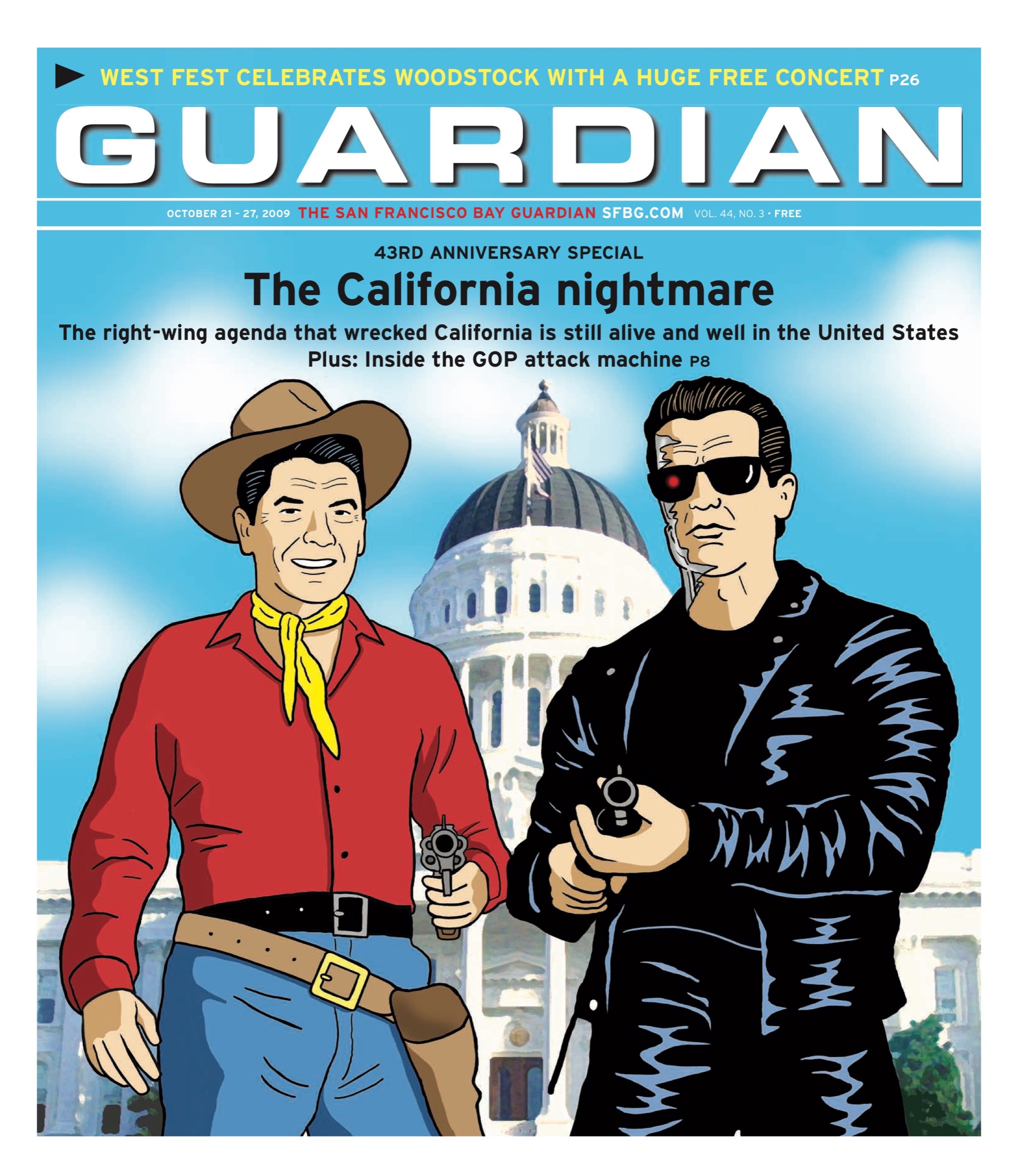
California

Serene velocity

0

arts@sfbg.com

MUSIC Blues Control is an instrumental rock band, but don’t hold that against them. The extended compositions and caterwauling guitars and keyboards may suggest post-rock bloat, but unlike many of their voiceless brethren, the duo knows that freedom is found in limits. Their crafty deployment of prerecorded loops and particularized live effects has etched a signature sound that’s at once distinct and nostalgic. They’re one of those mood ring groups that summons a whole lineage of avant-garde rock without exactly adhering to any one dominant influence. Pretty good, considering it started as a lark: needing an alter ego to protect their collaboration as Watersports from overexposure, Russ Waterhouse and Lea Cho fabricated Blues Control. Both projects were born under the sign of kosmische, but the newer songs refocused the drone zone with coaguutf8g tape loops and surprisingly friendly melodies. Hype soon followed.

If the duo’s name comes off as an unfortunate nod to the many non-black blues units over the years (whether Breakers or Brothers, a Project or an Explosion), the smirk stops there. You can find any iteration of psych-rock in their origami structures, but Blues Control is always playing itself. When I talk with Waterhouse on the phone from Ithaca, N.Y., where he and Cho are on tour, he discusses his aversion to the hollow games of genre signification that were in vogue in the 1990s — a significant disclaimer, since their most recent release, Local Flavor (Siltbreeze), is their most ranging yet.

"The basic principles and methods of working have basically remained the same since the beginning," says Waterhouse, but Local Flavor benefits from new attention to texture and sequencing. The quartet of songs traverses carefully arranged prog-rock ("Good Morning"), Coltrane-colored mystical jazz ("Rest on Water"), a prismatic dance groove ("Tangier"), and a Bitches Brew-worthy cauldron of ethereal tones, dubby sidesteps and angry guitar ("On Through the Night").

These different encounters with psychedelia are nested within disarmingly crude nuclei of borrowed rhythms and spectral melodies. Throughout, the distinct processes of jamming and collage are placed in productive conversation. It’s drug music without the inflated ego, a structuralist take on the basic rock furniture. When the core heats up, as on "Tangiers," Blues Control is close to perfect. Beginning with a breathy Casio loop, everything about the eight-minute track is percussive. A mashed, pulmonary beat hugs the centrifugal melody, while guitar and keyboard flares illuminate the elastic membrane stretching the song’s surface. Halfway through, after several exuberant plateaus, the rhythm scatters into double and triple-timed graininess, and the Michael Rother-like vapor trails spiral into their own repeating figures. Moment-to-moment, the composition seems unchanging and mantra-like; skipping around reveals a remarkable, covert movement.

Not all of Local Flavor burns so bright. The horn-laden riffage concluding "Good Morning" is particularly Phishy, but it’s a small misstep next to the dreamy gorgeousness of a track like "Paul’s Winter Solstice," from last year’s Christmas single for Sub Pop. I’ll leave it to the historiographers to explain why so many of the most interesting interpretations of rock music have come from duos over the last decade, but Blues Control undoubtedly figures into the argument for a mobile, minimalist muse.

"With this tour, we’re trying to follow through on some opportunities," Waterhouse explains. "A lot of people have told us we should come out to California because we would do well out there." The duo recently relocated from Queens, N.Y., to Virginia, but the people who recommended California were right on: with a group so equitably split between blissed-out drones and garage tactility, how could San Francisco not swoon? *

BLUES CONTROL

With Hank IV and Celine Dion

Thurs/5, 9 p.m., $7

Hemlock Tavern

1131 Polk, SF.

www.hemlocktavern.com


With Sic Alps and Jaws

Fri/6, 9 p.m., $5–$10

Continental Club

1658 12th St., Oakl.

(510) 444-9000

Global informing

0

arts@sfbg.com

DANCE For too many years ethnic dance, traditional dance, folk dance, culturally-specific dance — whatever label you stick on it — has been a stepchild on American stages. Considered of little interest to observers beyond the cultural groups in which its practitioners were based, general audiences admired its colorfulness and derided its lack of innovation. Yet with increased exposure, traditional dance forms have become more respected and have done their part to make the world more of a global village.

With the art form less under siege, stirrings have been coming from within the genre by dancers pushing at the traditions’ parameters. It’s a worldwide phenomenon. In the mid-1990s flamenco dancer Joaquín Cortés bared his chest and started performing to pop and jazz. Purists shuddered when Kathak dancer Akram Khan started to integrate modern dance practices into his performances. At the SF Ethnic Dance Festival this year, winds of change can also be felt at the venerable Ethnic Dance Festival. This year Los Lupeños de San José, one of the Bay Area’s oldest Mexican companies, performed a hot mambo with the women in anything but long flouncy skirts, and Indonesian dancer Sri Susilowati’s mourning dance was full of contemporary accents.

Traditional dancers who want to rethink conventions often feel homeless because they don’t fit into any established performance categories. That’s where Performing Diaspora steps in. CounterPULSE’s two-year initiative culminates in three weeks of performances starting November 5.

Debbie Smith, cultural program coordinator at the Arab Cultural and Community Center, is one of the three curators who chose 13 artists from the more than 60 who applied from throughout California. As "a little white girl from Texas" (as she calls herself) who speaks Arabic and is trained in Egyptian folk dance, she has learned to live with the sensitivities that surround fears about dilution of content and about perceptions of being less than respectful to well-defined art forms.

Since Performing Diaspora is the first festival of its kind, the curators had to feel their way into this new arena. It was a delicate process because "the need for support in dance is so great," Smith explains. "We did not know what we would get, though we were looking for artists who served traditions without wanting to be confined by them."

What the Festival got were artists like Charlotte Moraga, the primary dancer of the Chitresh Das Dance Company. Twenty years ago at San Francisco State University, the jazz dancer from Florida stumbled into her first Kathak class when the jazz class she wanted was full. The festival also got Devendra Sharma from Fresno, who learned Nautanki, a traditional folk music theater style from northern India, from his father.

At a recent work-in-progress showing, Moraga’s A Conference in Nine, based on a Sufi poem, A Conference of Birds, was performed with jazz, North Indian, and South Indian musicians. It looked as traditional and contemporary as you would want. The same was true for Sharma’s Mission Suhani, a reinterpretation of one spunky woman’s refusal to be cheated out of her dowry.

Almost half Performing Diaspora’s lineup hails from beyond the Bay Area, with artists who have made rethinking traditions a core element of their work, and those who only recently entered this wobbly territory. But the most unexpected participant in Performance Diaspora is a local: Kunst-Stoff’s Yannis Adoniou, best known for his ballet-based postmodernism. He will present Rembetiko, a work-in-progress based on the underground culture of Greeks who returned from abroad at the turn of the 20th century. "My uncle was a rembetiko musician", Adoniou says. "I used to dance to his music when I was five."

Performing Diaspora

Nov 5-22 (Thurs-Sat, 8 p.m.), $15–$25

CounterPULSE, 1310 Mission, SF

(415) 626-2060, www.counterpulse.org

Poor turnout

0

news@sfbg.com

The Guinness World Record for the largest mobilization of human beings was recently broken when 173 million people demanded that their governments eradicate extreme poverty around the world. But U.S. media barely noted the call and San Francisco’s event had low attendance, suggesting an uphill struggle for the cause in the world’s richest nation.

Millions gathered at more than 3,000 Stand Up, Take Action events in 120 countries Oct. 16-18 in an attempt to put pressure on governments to achieve the United Nations Millennium Development Goals, but less than 30 people gathered on the steps of San Francisco City Hall to support the movement.

Sup. John Avalos was one of the speakers at the event, organized by a coalition of local activist groups and student volunteers. Admitting that he was "expecting it to be a little bigger," Avalos said the event was just the start of what needed to be a much larger movement by the American people.

"There is a strange phenomenon occurring at the moment. It’s as if people are a little bit asleep about the need to be active," Avalos told the Guardian. "Because we have an administration they view as being more supportive of human rights and economic and social justice, people are being lulled into thinking things will just get better."

Standing just a short walk away from the birth place of the United Nations, Avalos bought attention in his speech to the rich history San Francisco has in mobilizing social change. "We do the best to live up to it, but we have a long way to go. Around the world this is the time to uproot poverty — we try to provide a safety net, but it could be stronger."

The Stand Up, Take Action, End Poverty Now! campaign is in its fourth year and is organized by the UN Millennium Campaign in an attempt to raise awareness of the Millennium Development Goals (MDGs), a series of benchmarks designed to eradicate global poverty.

At the United Nations Millennium Development Summit in 2000, 189 world leaders promised to "end poverty by 2015." The eight goals include eliminating extreme poverty and hunger, achieving universal primary education, and combating HIV/AIDS, malaria, and other diseases.

Rep. Barbara Lee (D-Oakland) has authored or coauthored every major piece of legislation dealing with global HIV/AIDS issues since she was elected to Congress. She told the Guardian that MDGs must be placed in context with poverty in America. "Sometimes people argue that we must look after our own first, but my position is that if you look at the eight Millennium goals, they all apply to our own country too," Lee said. "Look at the plight of people who are disproportionately affected by HIV/AIDS in our country — especially in African American and Latino communities.

"With the economic downturn, poverty rates in America are soaring, putting more people into circumstances the MDGs focus on outside of America," she continued. "I think it really is important to make those connections."

Lee compared the foreclosure crisis and lack of regulation in the financial markets over the last eight to 10 years to the "wild West" and calls America’s 47 million uninsured a "moral disgrace."

"It is about priorities and political will, and this will be determined by the voices of people saying it must be done," she said. "People have to push for these changes and remember that it didn’t just stop with the election. We have to raise awareness while at the same time working on changing policy. Otherwise we can get stuck debating issues and not doing the work that has to be done to change these very deplorable conditions."

Sup. David Campos was the only other supervisor to speak at the Civic Center event. He said he is committed to the fight against global poverty and wants to see the government represent the values San Francisco was founded on.

"We need to shed light and bring attention to one of the largest issues facing the world today — severe poverty," Campos said. "I really believe that as a city, as a state, and as a country, we not only need to make sure we push the U.S. to follow the lead of other countries, but actually become a leader in making these Millennium goals a reality."

After the event, Campos told the Guardian: "It doesn’t surprise me that more people didn’t show up to the event. But part of the task is to spread the word. San Francisco has been a leader in a number of these issues in the past, and I think we should play a key role in this one."

Campos said that one solution might be to put forward a resolution before the Board of Supervisors to support MDGs and have the city take a formal position on it.

"It is definitely something we are talking about to demonstrate San Francisco’s commitment to the issue," he said. "A lot of people don’t know about the goals, or the fact that the U.S. hasn’t really made them a priority. We need to spread the word and let people know this kind of a movement is only going to be a success if people take it upon themselves to play a leadership role."

Brian Webster, a volunteer who organized the SF event, drew attention to the large number of supporters for the MDGs in California. More than 250,000 people have signed up for the One Campaign, a global NGO that partnered with the U.N. Millennium Campaign in the events.

"For campaigners, it is now a matter of trying to join together and identify vast strategies to communicate what needs to be done," Webster said. "We will continue to educate communities, politicians, and civic leaders in what can be done this month, in the next six months, and ultimately, in the next six years."

While the Bush administration rarely mentioned MDGs while in office, many activists believe President Barack Obama’s public recognition of the goals at a recent U.N. summit demonstrates a change in American policy.

"In other countries, there has been more education and awareness about the goals. But here in America, it is almost like we are starting eight years late," said Anita Sharma, the North American director for the U.N. Millennium Campaign. "President Obama has said that the MDGs are American goals and has even talked about his plans for achieving them."

Also, despite the low numbers at the San Francisco event, Sharma says more than 190,000 people from North America participated in last weekend’s campaign, an increase of more than 70,000 from last year’s attempt.

"It’s not like Americans don’t care about global poverty — in fact we give more in charitable contributions than any other country in the world," she said. "It just takes quite a lot to get Americans into the streets and mobilized. There needs to be more education out there, that’s all."

Ananya Roy, a UC Berkeley professor of city and regional planning and education director of the Blum Center for Developing Economies, says she doesn’t think MDGs can be achieved worldwide by 2015. Even so, she stressed the important role they played in the framework of development.

Speaking at UC Berkeley’s Stand Up and Take Action Event, she said: "The goals are important because they are seen as a new global social contract that makes issues of poverty and inequality quite urgent. They also come with measurements and targets, which is meant to create accountability."

Roy placed particular emphasis on the eighth goal: building a global partnership for development. She noted that that increased awareness can change the ways the U.S. and European governments operate in terms of aid and trade.

"This multilateral contract requires more than simply the action and leadership of the U.S. and Western Europe," she said. "We need to think about poverty and inequality that is immediately around us, understand how we are involved in the production of depravity, and then we must act in solidarity.

"We need to be thinking about poverty as it exits here in the U.S. and not just as an abstract problem that belongs to someplace else," she added. "It is also our problem."

According to a 2009 U.N. report, progress toward achieving the MDGs has been slow in some cases and certain achievements have been reversed by the economic downturn. The report estimates that there will be 55 million to 90 million more people living in extreme poverty than anticipated before the crisis.

For Chandler Smith, media coordinator for the One Campaign — which campaigns for better development policies and more effective aid and trade reform — the Guinness certification marks progress toward achieving the MDGs. "That this year is breaking another world record speaks to the power of people to organize around the world, shows that we are a global community, and that there is a sustainability in the movement," he said.

"As for the North American aspect, we are always trying to educate people more about these issues. Our results show that a lot of our work has been done — but that we also have more work to do."

Beer here!

0

molly@sfbg.com

It all started with Stella.

I’d made my weekly (OK, sometimes twice or thrice-weekly) stop at Amnesia and ordered a pint of the Belgian lager not-so-affectionately known among beer snobs as "British Budweiser." Why Stella? It’s light, easy to drink a lot of, and feels classier than PBR. So when I’m not on a $2-a-beer budget, Stella Artois is often what I order.

This time, however, the mustachioed bartender Matthew Harman didn’t simply poor me a glass. It was earlier than usual. He had some time. And he knew me well enough to guess I might be open to the speech he was about to give.

"Do you really want a Stella?" he asked. "Because there are better beers that aren’t shipped halfway across the world and owned by InBev." I consented to let him give me tastes of alternatives and eventually settled on a slightly more hoppy but equally drinkable lager from Sudwerk brewery in Davis.

I enjoyed the beer. But better yet, I enjoyed the wake-up call. Though I’ve become accustomed to buying groceries, clothing, gifts, coffee, and even liquor from local, independent manufacturers and retailers, when it comes to beer, I’ve been lazy. I don’t think before I drink.

What’s worse? I live in the land of craft brews. Though there are now 1,500 craft breweries nationwide, the movement started in Northern California, Oregon, and Washington — with flagship brands like Anchor, Pyramid, and Anderson Valley within driving distance (or, in the case of Anchor, a stone’s throw) from my office. And as the industry has grown and changed, there are ever more options for a range of palates — and purses. In short: there’s little excuse for thoughtless imbibing.

So why drink local? First, there’s the environmental reason: it requires a lot of energy to ship all those heavy bottles and kegs full of liquid across the country and around the world. Then there’s wanting to support the local economy: money spent on Bay Area businesses stays in the Bay Area. There’s the more intangible concept of local pride. "We support our lousy local sports teams," says Lars Larson, master brewer at Berkeley’s Trumer Brauerei. "Why not support our local brewing excellence?" And perhaps most important is taste: beer, like produce and dairy products, is best when fresh.

But the world of beer-making is complex. When it comes to assessing a brewery’s greenness, for example, the question often becomes: how green? If you grow your own hops but send them to Wisconsin for brewing, is that still environmentally sound? Or if a brewery is based in Seattle but makes beer in Berkeley, does it still support the local economy? The answers vary and can be subjective. But the good news is that whatever the reason for wanting to choose brews more thoughtfully, there’s a nearby option — or 12 — to satisfy it.

If you still just love the taste of Stella, or want an import that has no local substitute (like Guinness), or appreciate that the Budweiser you’re sipping was probably made in a brewery 60 miles away, well, more power to you. Even Harman won’t argue (though he’ll happily give tastings of alternatives to anyone who stops by the Valencia Street bar Sundays at 6 p.m.). The real point is to use the same criteria for choosing beer — values, politics, and palate — you do for food and wine. Here’s hoping our guide to some of the Bay Area’s famed and favorite breweries will help you make that decision.

ANCHOR BREWING COMPANY


This landmark brewery has existed in one form or another since 1896, making it the granddaddy of Bay Area brewing. Its current identity comes to us with thanks to Fritz Maytag, who bought 51 percent of the operation in 1965 and is still the driving force behind the company best known for its unique Anchor Steam beer. We love Anchor’s handcrafted brews, commitment to the community, and willingness to experiment with new ideas, including distilling gin and whiskey.

1705 Mariposa, SF. (415) 863-8350, www.anchorbrewing.com

ANDERSON VALLEY BREWING COMPANY


This pillar of the Bay Area craft brew scene has been building its reputation on balanced, drinkable options like Boont Amber since 1987. Other favorites include the nearly hopless Summer Solstice, the oh-so-hoppy Hop Ottin’ IPA, and the Brother David line of abbey-style ales (named for Toronado owner David Keene). But we’re particularly excited about the 2009 Estate Fresh Hop beer, produced with hops grown on brewery grounds (where, by the way, all water is taken from wells on the property and all beer is made in a facility that’s 40 percent solar-powered).

17700 Hwy 253, Boonville. (707) 895-2337, www.avbc.com

MOONLIGHT BREWING


Beer drinkers looking for a truly local, truly independent brewery need look no further than this Sonoma County one-man operation. Well-respected brewer Brian Hunt established the tiny business in 1992 and still delivers his keg-only offerings like Death and Taxes black beer, Reality Czeck pils, and Homegrown Fresh Hop Ale himself. Hunt also has been growing a share of his hops onsite since 2003.

Santa Rosa. (707) 528-2537, www.moonlightbrewing.com

PYRAMID BREWING COMPANY


One of the first craft breweries to appear on the public’s radar, this Seattle-based company also has been operating out of its Berkeley brewery and alehouse since 1997. Until recently, Pyramid operated as a publicly-owned company; now it is part of the Independent Brewers Union. Under this arrangement, the brewery is owned by East Coast brewers Mad Hat but conducts its business as an autonomous unit. The company also has revamped its image, renaming classics like Pyramid Hefeweizen (now Haywire Hefeweizen) and Pyramid Apricot Ale (now Audacious Apricot Ale) and introducing a host of new offerings — some only available at Pyramid brewpubs. But with locations in Sacramento, Walnut Creek, and Berkeley, that means plenty of access to exclusives like the nitrogenated Draught Pale Ale or the session beer Crystal Wheat Ale.

901 Gilman, Berk. (510) 527-9090, www.pyramidbrew.com

RUSSIAN RIVER


Now based in Santa Rosa, the brewery most famous for its Pliny the Elder Double IPA used to be owned by Korbel Champagne Cellars. Vinnie Cilurzo and his partner bought the business in 2003, but have continued to combine aspects of both industries, including a line of beers that are aged in used wine barrels from local wineries. Look for tasting nights of this special line, nicknamed the "’Tion" beers, at pubs like Toronado.

725 Fourth St., Santa Rosa; (707) 545-BEER, www.russianriverbrewing.com

SIERRA NEVADA


The big news surrounding the Chico-based brewery that introduced much of America to Pale Ale is its upcoming Estate Harvest Ale, inspired by the winemaking of its Napa and Sonoma neighbors and made with hops and barley grown onsite. Also exciting? Two collaborations with Maryland-based brewery Dogfish Head — Limb and Life, released on draft this month, and Life and Limb, due out in 24-oz bottles and limited draft in November.

1075 E. 20th St., Chico. (530) 893-3520, www.sierranevada.com

SPEAKEASY ALES & LAGERS


Many beer drinkers gravitate to Speakeasy because of the distinctive, noir-feeling of its packaging and stay for the big, satisfying taste of classics like Big Daddy I.P.A. and Prohibition Ale. Though the Bayview-based brewery’s offerings are available on tap and in the bottle all over the Bay Area, we suggest visiting a Firkin’ Friday happy hour open house at the brewery from 4 to 9 p.m. every week.

1195 Evans Ave, SF. (415) 64-BEER-1, www.goodbeer.com

TRUMER BRAUEREI


This Berkeley brewery encompasses what’s advantageous about imported and local beers. The only non-Austrian outlet for this 400-year-old recipe gets many of its ingredients from its sister company in Salzburg. But bottles, packaging, and, of course, the beer, all are made in the East Bay. What makes Trumer special is a process called "endosperm mashing," which means brewers separate the barley husks from the starchy endosperm during milling, then reintroduce them at the end of the process to highlight the warm, toasty flavor of the malt. Trumer also uses a process called krausening, a slow, secondary fermentation that helps build natural carbonation. (One reason for its signature glassware is to show off the tiny Champagne-like bubbles.)

1404 Fourth St., Berk. (510) 526-1160

21ST AMENDMENT


This Prohibition-themed South Park brewery has been getting lots of attention lately for its canned craft beers — Hell or High Watermelon Wheat Beer and Brew Free! Or Die IPA — and for good reason. Though cans are the best way to keep beer fresh (since sunlight can’t penetrate metal), convenient for carrying, allowed at locales where glass isn’t, and (let’s face it) good for shotgunning, the delivery method has long been associated with cheap, watery beer. But this stigma seems to be slowly eroding, thanks in no small part to forward-thinking breweries like 21st Amendment.

563 Second St., SF. (415) 369-0900, www.21st-amendment.com

We realize that this list is only a tiny glimpse at the myriad breweries, alehouses, brewpubs, and better beer bars in and around the Bay Area. Indeed, Northwest Brewing News lists more than 100 such places between Bakersfield and Blue Lake — and we’re willing to bet there are many more. Check our Web site for information and extended interviews about breweries like Bear Republic, Shmaltz, Thirsty Bear, Triple Rock, and Magnolia, plus recommendations from beer experts at Toronado, City Beer, and Healthy Spirits.

Still think we’re missing someone? Let us know.

———

Light beer’s plight

I like to drink beers. Plural. I’m the guy the ad men were thinking of in that classic jingle, the one that goes "Shaefer is the one beer to have when you’re having more than one." One summer a few years back, my friends and I polished off 1,000 cans of beer over a four-day weekend on Lake Shasta; there were only about 10 of us drinking. Do the math on that one, and you get a sense of my taste for the blessed amber fluid.

But that was then, and this is now. And today I have two kids who wake up at 6 a.m. and keep me on the go day and night; I’m not as young as I used to be; and I can’t handle the intoxication the way I once did.

But I still drink beers, plural, every day, and I’m not about to give it up. What I’ve done is switched to light beer. Correction: "Light" is a bad word. Among serious drinkers, it’s called "session beer."

It’s a choice more and more people are making in this country — beer with lower alcohol content is one of the fastest growing parts of the industry. But it presents a problem: how do you drink local (and high quality beer) when most of the craft breweries and brewpubs focus almost entirely on the heavy and the strong?

Quick definition here: light beer is generally promoted and advertised as having fewer calories than regular brew. But I could care less about beer making me fat (I can always give up food). What I’m talking about is what’s known in the business as ABV; that’s alcohol by volume. Typical American beer — say, Budweiser — runs about 5 percent. Typical craft brew — say, Anchor Liberty Ale — is about 6 percent. The more serious stuff is even stronger — Lagunitas Maximum India Pale Ale, for example, clocks in at 7 percent.

Typical light beer — say, Bud Light, at 4.2 percent ABV — has almost 20 percent less alcohol than Bud, 30 percent less than Liberty Ale, and only about half as much as some of the more extreme brews.

And for those of us who would rather have four light beers than two Imperial Red Ales (and really — in America, is that even a choice?), the craft brew pickings are fairly slim. Especially in Northern California.

"You are living in the land of the IPA," Bill Manley, communications coordinator for Sierra Nevada brewery, which makes no lighter beers, told me.

It’s not as if we’re without choices. Anchor makes a Small Beer (with the leftovers from it’s brutally strong Barleywine Ale) that comes in at about 3.5 percent ABV, but you almost never see it in stores. The 21st Amendment brewpub makes an excellent Great American Bitter that meets the session-beer standard of less than 4.5 percent. Magnolia makes an English Mild, and there’s Stone Levitation Ale (4.4 percent). But again: check out most liquor stores and none of those are on the shelf.

Across the country, that’s starting to change. Lew Bryson, a beer writer and blogger in Pennsylvania, has started the Session Beer Project (sessionbeerproject.blogspot.com) to share information about full-flavored, high-quality brews that don’t knock you silly after a bottle or two. "There are more people like us than most craft brewers would credit," Bryson told me.

The term "session beer" comes from England. By some accounts, it dates back to World War II when pubs were only open for short "sessions" so the workers could get back to the munitions plants in a relatively functional state. By Bryson’s definition, a session beer has an ABV below 4.5 percent and doesn’t overwhelm the party.

There are distinct advantages to lower-alcohol beers. "I was at a session brew festival two years ago and went through six pints in about two hours," he said. "I keep a Breathalyzer in my car, and when it was time to go home, I blew .02" — well within the legal limit in every state in America.

A brewpub near Bryson’s house on the outskirts of Philly sells a Belgian ale called Mirage with an ABV of just 2.9 percent. "I can have a couple of pints with lunch and it doesn’t blow my entire afternoon," he said.

Yet the reluctance remains. "A lot of brewers, they hear low-alcohol and they think light beer — and that’s the enemy," Bryson said.

Mike Riley, marketing director at Anderson Valley Brewing that makes no beer with less than 5 percent ABV, added: "It’s one of those stigmas that’s gone on for a long time."

In fact, I could only find one craft brewer in the country that actually makes a "light" beer: Minhas Brewery in Monroe, Wis., which makes Huber Light and Minhas Light. "People were asking for it," Gary Olsen, the brewery manager told me. "Our first reaction was, why make something that doesn’t taste like anything? But we found out you can make a very good lighter beer."

Yes, indeed. And when Anchor starts making (and marketing) Liberty Ale Light, I promise — I’ll give up Bud Light forever. (Tim Redmond)

4 fine wine bars

0

It’s time to quit your drinking habit. No, not that one. The one where you sidle up to your usual bar and say, "I’ll have a glass of cabernet (or chardonnay or merlot)" with nary a glance at the wine list. I know, I know. You’re tired. You had a long day. But there’s a big world of wine out there, and lucky for you, we live in a city with lots of delightful options by the glass, from Down Under stickies to the reds of the Med. Here are four places that specialize in remarkable vinos, so it’s easy to trade in that mediocre merlot for a truly vinaceous adventure.

LA GITANE


If you think sherry is only for the likes of Niles and Frasier Crane, La Gitane will change your mind in three sips. Order the tasting of three 1.5-ounce pours ($14) — a light, briny Fino; a tangy, citrus-y Amontillado; and a rich and smoky Oloroso — wines that are stunningly dry but richly flavored (and, at 19 percent to 20 percent alcohol, not at all demure). If you sit at the bar, chances are a charming barman (they all seem to be men here) will pour you a little education along with your wine — in the form of a brief but enthusiastic tutorial of grape varieties and the Solera system (the special process of aging and blending sherry). Find yourself wanting more? You’re in luck: La Gitane offers 20 different sherries by the glass ($6–$18), including a couple of sweet styles and a half-dozen or so sherry-based cocktails ($7–$11).

6 Claude Lane, SF. (415) 788-6686, www.gitanerestaurant.com

SOUTH FOOD AND WINE BAR


Quick, name an Australian wine. If you said "Yellow Tail," you’re not alone. Due to the ubiquity of that single brand, it’s easy to believe that everything that comes out of the country-that-is-a-continent is a $5 shiraz. Not so. The proof is in the glass at South, where the focus is on the food and wine of Australia and New Zealand. Sure, you can order shiraz, but there are far more interesting things to be sipped here. A glass of Peter Lehmann Semillon ($7) might sound intimidating, given that it’s a grape you’ve probably never heard of, but its crisp grapefruit and lemon zest flavors make it a lovely aperitif. More of a red drinker? New Zealand produces pinot noirs that blow most of their California counterparts out of the water. Try St. Clair Vicar’s Choice ($10) from Marlborough; a bold, spicy petit verdot from Victoria ($8); or an iced Riesling from Tasmania ($13) that’s a dead ringer for a honey-dipped apricot. South makes it easy to try them all at its happy hour, weekdays from 3:30 to 6:30 p.m., when all wines are $6.

330 Townsend, SF. (415) 974-5599, www.southfwb.com

YIELD WINE BAR


It’s easy to make yourself at home at this Dogpatch wine bar, either on one of the leather couches arranged around low butcher block tables or at one of the half-dozen barstools lined along the simple wooden bar. Indeed, stepping through the door at Yield feels a bit like entering a friend’s loft: cozy, relaxed, and well-designed. But beyond atmosphere, what really makes this wine bar special is its menu. Every wine is organic, biodynamic, or sustainably farmed, and every dish on the concise list of small plates is vegetarian. The wine menu changes frequently and includes familiar varieties ( sauvignon blanc, syrah, cabernet) as well as more esoteric offerings like the Domaine de Reuilly Rosé of Pinot Gris ($11) — a pale pink, crisp wine with delicate flavors of strawberry and orange zest — or the Tenuta Pederzana Lambrusco ($11) — a fun, sparkling red from Emilia Romana, Italy. Really want to roll the dice? Opt for the never-know-what-you’re-going-to-get carafe special ($10), offered weekdays from 5:00 to 8:00 p.m.

2490 Third St., SF. (415) 401-8984, www.yieldsf.com

ZARÉ AT FLYTRAP


The bar at Zaré at Flytrap is impressive for three reasons: its warm and talented bar staff; its well-edited, Mediterranean-influenced wine list; and its truly affordable happy hour. You won’t find an over-the-top cabernet or run-of-the-mill merlot here. Instead the wine menu invites you to delve into the beguiling wines of Spain, Portugal, the south of France — even Lebanon. That’s right, Lebanese wine. Which you should try. Why? Because Chateau Musar’s "Hochar" ($12) is a smoky, earthy, elegant blend of cabernet, carignan, and cinsault that could easily be mistaken for a fine Bordeaux. Plus, if you come around during a weekday happy hour (4:00 to 6:00 p.m.), all wines by the glass are $5, making it that much easier to take a chance.

606 Folsom, SF. (415) 243-0580, www.zareflytrap.com

Newsom lacks authority to decide what’s legal, Campos says

6

Text and photos by Sarah Phelan

campos2ndvote.jpg
Campos moments after Board approves his legislation to give juvenile immigrants their day in court.

Sup. David Campos said today that Mayor Gavin Newsom lacks the authority to ignore the city’s newly amended sanctuary ordinance. And he rebuked the mayor for making it sound, in comments Newsom made to Fox News, as if being a suspect is the same thing as being a convicted criminal.

“I think it’s important for us to look at the facts before we generalize and make comments,” Campos said.

Campos’ comments came as a veto-proof majority of the Board approved the second reading of Campos proposal to give immigrant juveniles their day in court before handing them over to the feds.

Estella15b.jpg
Flanked by Ariana Gil-Nafarrate of Mujeres Unidas y Activas and Angela Chan of the Asian Law Caucus, Estella, an immigrant mother, recalls how ICE put a hold on her 15-year-old daughter after a fight in school.

Campos proposal changes a policy that Newsom ordered in June 2008, after city probation officials were apprehended in Texas, escorting Hondurans teens to their country of origin.

Campos agrees that the city should halt that practice, and that city officials should refer juvenile felons to ICE. But he disagrees with Newsom’s current practice, which has led to 150 kids being referred to U.S. Immigration and Customs Enforcement (ICE.) to ICE, without first having had the chance to establish their innocence.

Campos says he expects the city to change this policy, as stipulated under his amendment. He says Newsom has 10 days to veto his legislation, and the Board has 30 days to override it, after which the City must change its policy so juveniles are not reported to ICE until they are found guilty of a felony by a juvenile justice.

To illustrate his point about the limits of mayoral power, Campos referred to the California Supreme Court ruling that was triggered by Newsom’s 2004 announcement that he intended to start marrying same-sex couples.

“Even though we have a strong mayor system, the power of the mayor is not absolute,” Campos said. “That’s why we have the Board to enact laws that are reflective of the will of the people.”

If mayors were able to selectively ignore laws, Campos pointed out, “That would be depriving people affected by that law their due process.”

“A public official faithfully upholds the constitution by complying with the mandates of the legislature, leaving the courts the decision of whether the mandates are valid,” Campos said, referring to the state Supreme Court ruling.

“It’s a fallacy that elected officials can ignore a law enacted by the legislature,” Campos continued. “When this law is passed, when the mayor decides to veto it, when the Board decides to override it, we ask the Mayor to do his constitutional duty: let this law be implemented as the system requires it to be. We expect nothing less.”

“It’s been a long time coming,” Campos said, referring to the community’s battle to amend a unilateral policy decision that Newsom made 16 months ago. “This is a proud day for San Francisco, this is a victory for the community. This shows that San Francisco is committed to the notion that we are all human beings, that we are all treated equally.”

Asked about Newsom’s claims that the Campos amendment opens up the entire sanctuary ordinance to challenge, Campos said, “I think the biggest danger to the sanctuary policy was the mayor’s decision to release a confidential memo.”

Asked about Newsom’s claims that the Campos amendment opens up city workers to civil and criminal lawsuits, Campos said “I don’t think he can point to any instance where a city employee has been found liable for following sanctuary ordinance.”

Noting that the sanctuary ordinance just celebrated its 20th anniversary, Campos added, “We expect the mayor and every employee of the city to follow laws that have been duly enacted and If the Mayor does not enact it, then Board will look at its options, including a legal challenge.”

Campos words were followed by the tearful recollections of an immigrant single mother called Estella, who talked about how her 15-year old daughter had an ICE hold placed on her after she got into fight at school.

Following Estella’s public testimony, Abigail Trillin, a staff attorney with LEgal Services for Children, said she like someone from the Mayor’s Office to publicy debate the sanctuary issue with Campos.

“If the mayor’s position is that a minor, who has not been found guilty, needs to be reported to immigration, let’s talk about that,” Trillin said. ” But let’s not put fake federal laws in the way. There is no federal law that says juveniles that are arrested on a felony must be reported. That’s a smoke and mirror thing.”

Pointing to recent statements from law enforcement chiefs in Los Angeles and Sacramento who are supportive of sanctuary laws, Trilliin added, “Anyone who knows about juvenile justice and public safety knows that reporting people who haven’t been found guilty destroys community trust.”

Film listings

0

Film listings are edited by Cheryl Eddy. Reviewers are Kimberly Chun, Michelle Devereaux, Max Goldberg, Dennis Harvey, Johnny Ray Huston, Louis Peitzman, Lynn Rapoport, Ben Richardson, Matt Sussman, and Laura Swanbeck. The film intern is Fernando F. Croce. For rep house showtimes, see Rep Clock. For first-run showtimes, see Movie Guide.

SF DOCFEST

The eighth annual San Francisco Documentary Film Festival runs through Oct 29 at the Roxie, 3117 16th St, SF. Tickets ($11) are available by visiting www.sfindie.com. All times p.m.

WED/28

American Artifact: The Rise of American Rock Poster Art 7. The Great Contemporary Art Bubble 7. The Philosopher Kings 9:15. Pop Star on Ice 9:15.

THURS/20

Nursery University 7. Speaking in Code 7. Trimpin: The Sound of Invention 9:15. Cropsey 9:15.

OPENING

*The Beaches of Agnès Director’s commentaries are par for the course in the DVD age, but few filmmakers posses the élan to warrant a feature length auto-exegesis. Agnès Varda is one, and her most recent memory machine — she claims it’s her last — cheerfully dissolves the boundaries between memoir, retrospective, and installation. We begin on the beach, with the 80-year old Varda spryly instructing her young assistants on the placement of various mirrors. "If we opened people up, we’d find landscapes," she explains of her motivation for filmmaking, before embarking on an unclassifiable daisy chain of reenactment and reminiscence. The film moves at the leisurely pace of the flâneur’s walk, the better to relish Varda’s joie de vivre and sweet bawdiness. Her chameleon colored bowl cut dares us to keep abreast of her quicksilver digressions on the past (fact or fiction matters less than then and now). As with 2000’s The Gleaners and I, she’s most free with the things she adores: blurry foregrounds, old photographs, heart-shaped potatoes, ancient frescoes, the human body and neighbors. "All the dead lead me back to Jacques," she says, referring to her great love, Jacques Demy, and their life together loops The Beaches of Agnès with a beauty not soon forgotten. (1:40) Opera Plaza. (Goldberg)

Brain Dead With the zombedy combedy genre — I’m sick of "zomcom," aren’t you? — having reached mass impact via Zombietown, you might be hungry if not chalk-facedly ravenous for more of the same. In which case you’ll enjoy this Thrillville-presented West Coast theatrical debut of 1980s horror fave (1986’s Witchboard) Kevin Tenney’s own more modestly scaled mixup of undead mayhem and laughs. When a tiny asteroid lands in a rural area — instantly turning one unlucky fisherman into green-faced chomper and his buddy into lunch — it’s not long before shambling carnivores are imperiling the requisite cabinful of ill-matched strandees. Their number include a televangelist, lost sorority sisters, and two escaped convicts, one nice and one psycho-mean. While the latter takes everyone hostage at gunpoint, those carnivorous ghouls gathering outside have a strictly take-no-hostages policy. They’ll take brains, though. BRAAAAAAAAINS!!! Brain Dead is fun — if kinda dumb fun, compared to Shaun of the Dead or even Zombieland. (Let alone Peter Jackson’s 1992 splatsterpiece Braindead, or the 1990 Bill Paxton-Bill Pullman non-zom horror faceoff also called Brain Dead). But if it lacks that special edge of originality and/or wit, it’s still a whole lot better than 2008’s Zombie Strippers, of which we shall never speak again. (1:35) Four Star. (Harvey)

*Bronson In 2000’s Chopper (2000), Eric Bana killed as Australia’s most notorious psychotic extortionist-killer-jailbird-celebrity autobiographer — more vividly than in any part serving his subsequent, slightly bland leading-hunk status. Tom Hardy is another handsome bloke at risk of looking competent and versatile without fully impressing. Yet here comes Bronson, a film (and role) offering up a dramatized "Man. Myth. Celebrity" (as per its ad line) of actual "worst prisoner in Britain." The real Michael Gordon Peterson, better known as "Charles Bronson" (a PR-minded friend fitted the Death Wish star as nom de notoriety), was an extreme anger-management case whose working-class struggle ended when he robbed a post office in 1974. As the film details, prison spectacularly agreed with him. He enjoyed the tension and violence — between himself and fellow inmates as well as guards — so much that he got sent to a high-security psychiatric hospital. Worry not: even drugged to the gills, he managed to create ruckuses that won national attention. This is the second English-language directing effort by Dane Nicolas Winding Refn, of the crime-drama Pusher trilogy. Bronson is utterly revved up in a way that’s showy but not at all dumbed-down, and it’s pure cinematic inspiration at least half-transcending even a case of snarkish homophobia as you haven’t seen since … well, Chopper maybe? (1:32) Lumiere. (Harvey)

The Canyon See "Into the Wild." (1:42) Opera Plaza.

Gentlemen Broncos The latest from Napoleon Dynamite (2004) director Jared Hess is about a Utah teen (Michael Angarano) who is obsessed with science fiction. (1:51)

*Heart of Stone With metal-detectors blocking its entrance, gang fights breaking out in the halls, and teachers wearing bulletproof vests, it’s clear that Weequahic High School is not your usual blackboard jungle. Once one of the nation’s most respected schools, the Newark, NJ institution was by 2000 plagued by the urban violence that claimed an alarming number of lives. Beth Toni Kruvant’s first-rate documentary chronicles the place’s gradual recovery thanks to Ron Stone, the passionate principal who, using a mixture of diplomacy and compassion, struggled to control the brutality that loomed over a new generation of students. Though similar in subject to Rollin Binzer’s recent The Providence Effect, Heart of Stone is easily the better film, less an infomercial for enrollment than a tough-minded analysis of the historical upheavals and social conditions forming Weequahic’s fall and rise. "Inspiring" is an abused term when it comes to movies about teachers, but Kruvant’s inquiry and Stone’s dedication earn it. (1:24) Roxie. (Croce)

Michael Jackson’s This Is It This concert doc compiles behind-the-scenes rehearsal footage for what would have been Jacko’s run of London shows. (1:52) Cerrito , Four Star, Marina.

Walt and El Grupo This highly authorized documentary chronicles the 1941 South American tour Disney staff took as part of the U.S. "Good Neighbor" policies. The creative results were several fascinating wartime pastiches, including 1944’s anarchic, marvelous feature Three Caballeros. But that last is inexplicably not excerpted here — while tedious home-movie footage with Walt and company on their well-recorded trip, not to mention surviving relatives’ clucking over how wonderful it all was, go on and on. It’s worth noting that this studio vanity project has reached theaters, if minimally — while John-Paul Davidson and Trudi Styler’s The Sweatbox, an unvarnished behind-scenes portrait of the thorny processes behind latter-day Disney ‘toon The Emperor’s New Groove (2000), mysteriously vanished from the planet after its 2002 festival debut. That documentary offered real insight without reducing appreciation for its original talents. This one is a timid, worshipful bore. (1:46) (Harvey)

*The Yes Men Fix the World Can you prank shame, if not sense, into the Powers That Be? Andy Bichlbaum and Mike Bonnano, the jesters-activists who punked right-wing big-business in the documentary The Yes Men (2003), continue to play Groucho Marx to capitalism’s mortified Margaret Dumont in this gleeful sequel. Decked in sharp suits and packing fake websites and catchphrases, the duo bluffs its way into conferences and proceeds to give corporate giants the Borat treatment. The stunts are often inspired and, in their visions of fantasy justice, poignant: Bichlbaum and Bonnano pose as Dow envoys and announce the company’s plans to send billions to treat victims of the 1984 Bhopal chemical disaster, and later appear as HUD representatives offering a corrective to the shameful neglect of New Orleans in the wake of Hurricane Katrina. The Yes Men may not fix the world, but their ruses once more prove the awareness-raising potential of comedy. (1:30) Oaks, Roxie. (Croce)

ONGOING

Amelia Unending speculation surrounds the fate of aviator Amelia Earhart, who, with navigator Fred Noonan, disappeared in 1937 over the Pacific while attempting to circumnavigate the globe. However, Mira Nair’s biopic Amelia clarifies at least one fact: that Earhart (played by Hilary Swank) was a free-spirited freedom-loving lover of being free. We learn this through passages of her writing intoned in voice-over; during scenes with publisher and eventual husband George Putnam (Richard Gere); and via wildlife observations as she flies her Lockheed Electra over some 22,000 miles of the world. Not much could diminish the glory of Earhart’s achievements in aviation, particularly in helping open the field to other female pilots. And Swank creates the impression of a charming, intelligent, self-possessed woman who manages to sidestep many of fame’s pitfalls while remaining resolute in her lofty aims. She’s also slightly unknowable in her cheery, near-seamless virtue, and the film’s adoring depiction, with its broad, heavy strokes, at times inspires a different sort of restlessness than the kind that compels Earhart to take flight. Amelia is structured as a series of flashbacks in which the aviator, while circling the earth, retraces her life –- or rather, the highlights of her career in flying, her marriage to Putnam, and her affair with Gene Vidal (Ewan McGregor), another champion of aviation (and the father of author Gore). And this, too, begins to feel lazily repetitive, as we return and return again to that cockpit to stare at a doomed woman as she stares emotively into the wild blue yonder. (1:51) California, 1000 Van Ness, Piedmont, SF Center, Sundance Kabuki. (Rapoport)

Antichrist Will history judge Lars von Trier as the genius he’s sure he is? Or as a humorless, slightly less cartoonish Ken Russell, whipping images and actors into contrived frenzies for ersatz art’s sake? You’re probably already on one side of the fence or the other. Notorious Cannes shocker Antichrist will only further divide the yeas and nays, though the film does offers perhaps the most formally beautiful filmmaking von Trier’s bothered with since 1984’s The Element of Crime. Grieving parents Charlotte Gainsbourg and Willem Dafoe retreat to a forest primeval enabling widescreen images of poetic succulence. Yet that beauty only underlines Antichrist‘s garishness. One film festival viewer purportedly barfed onto the next row — and you too might recoil, particularly if unaccustomed to gore levels routinely surpassed by mainstream horror. Does Antichrist earn such viewer punishment by dint of moral, character, narrative, or artistic heft? Like slurp it does. What could be more reactionary than an opening in which our protagonists "cause" their angelic babe’s accidental death by obliviously enjoying one another? Shot in "lyrical" slow-mo black and white, it’s a shampoo commercial hard-selling Victorian sexual guilt.

Later, Dafoe’s "He" clings to hollow psychiatric reason as only an embittered perennial couch case might imagine. Gainsbourg’s "She" morphs from maternal mourner to castrating shrike as only one terrified of femininity could contrive. They’re tortured by psychological and/or supernatural events existing solely to bend game actors toward a tyrant artiste’s whims. There’s no devil here — just von Trier’s punitive narcissism. (1:49) Embarcadero, Shattuck. (Harvey)

*Astro Boy How can a robo-kid so cute be so sad? That’s the beautiful paradox of Astro Boy, the atomic age Japanese manga-cum-Pinocchio parable here given loving new life. Genius creator Osamu Tezuka’s original Astro Boy cannily grappled with the seductions and dangers of Japan’s economic miracle, the country’s conflicted emotions about the technology that fueled both Astro Boy and the war machine, and the struggle between industrialization and the environment. This update adds the recurring favorite sci-fi leitmotif of artificial intelligence — and by extension what it means to be human and non-human — to the mix. This adorable toaster (voiced by Freddie Highmore) awakens with memories of Toby, the brilliant, rebellious son of robotics genius Dr. Tenma (Nicolas Cage), believing he is a boy not a robot. The grief-stricken Tenma built him after the original Toby was killed during the test of a new robotic weapon. Eventually cast out by his Frankenstein father-creator and coping with some major identity issues, Astro Boy finds his place among a slew of outcasts on the now garbage- and robot part-strewn Wall-E-esque Earth, where his sense of compassion and mega powers threaten to bridge the seemingly insurmountable differences between humans and robots. Despite the speed with which director David Bowers and his team put together this animated feature, which boasts the voicings of stars like Charlize Theron and Nathan Lane, Astro Boy succeeds in delivering that crucial hybrid of action, comedy, and emotional heft that the best of classic animation offers, while touching lightly out relevant ideas about technology. (1:34) 1000 Van Ness, Presidio, Shattuck. (Chun)

*Big Fan The Wrestler screenwriter Robert Siegel continues to trawl tri-state working class blues for his directorial debut, Big Fan, a darkened fairy tale of sports mania and the male ego. Sandpaper rough comic Patton Oswalt is Paul Aufiero, a thirtysomething New York Giants nut who lives with his mother and scripts huffy raps for his nightly 1AM "Paul from Staten Island" call to the local sports radio station. Siegel locates a revealing stage for anxious performances of masculinity in the motor-mouthed rituals of sports talk radio. Big Fan is at its best when Aufiero is locked in dubious battle with abstract foes like "Philadelphia Phil," but the film starts to slow down as soon as our anti-hero and his lone pal Sal (Kevin Corrigan) spot Giants QB Quantrell Bishop (Jonathan Hamm) at a Staten Island gas station. They tail him to a strip club in New York City, where Bishop gives Aufiero a bruising upon discovering he’s been followed, thus compromising the Giants’ playoff chances. What a tangled web we weave and all that. It’s telling of Siegel’s limited talents that the best part of the fateful trip into Manhattan is Oswalt’s grimace when faced with a nine buck Budweiser. We’re so hungry for any kind of regionalism in mainstream filmmaking that even Big Fan‘s cheapest shots (all its women characters, for instance) don’t overpower the pleasure of Oswalt’s marshy profanities and the provincial jabber of New York vs. Philadelphia and Staten Island vs. Manhattan. (1:35) Lumiere, Shattuck. (Goldberg)

*Bright Star Is beauty truth; truth, beauty? John Keats, the poet famed for such works as "Ode on a Grecian Urn," and Jane Campion, the filmmaker intent on encapsuutf8g the last romance of the archetypal Romantic, would have undoubtedly bonded over a love of sensual details — and the way a certain vellum-like light can transport its viewer into elevated reverie. In truth, Campion doesn’t quite achieve the level of Keats’ verse with this somber glimpse at the tubercular writer and his final love, neighbor Fanny Brawne. But she does bottle some of their pale beauty. Less-educated than the already respected young scribe, Brawne nonetheless may have been his equal in imagination as a seamstress, judging from the petal-bonneted, ruffled-collar ensembles Campion outfits her in. As portrayed by the soulful-eyed Abbie Cornish, the otherwise-enigmatic, plucky Brawne is the singularly bright blossom ready to be wrapped in a poet’s adoration, worthy of rhapsody by Ben Whishaw’s shaggily, shabbily puppy-dog Keats, who snatches the preternaturally serene focus of a fine mind cut short by illness, with the gravitational pull of a serious indie-rock hottie. The two are drawn to each other like the butterflies flittering in Brawne’s bedroom/farm, one of the most memorable scenes in the dark yet sweetly glimmering Bright Star. Bathing her scenes in lengthy silence, shot through with far-from-flowery dialogue, Campion is at odds with this love story, so unlike her joyful 1990 ode to author Janet Frame, An Angel at My Table (Kerry Fox appears here, too, as Fanny’s mother): the filmmaker refuses to overplay it, sidestepping Austenian sprightliness. Instead she embraces the dark differences, the negative inevitability, of this death-steeped coupling, welcoming the odd glance at the era’s intellectual life, the interplay of light and shadow. (1:59) Elmwood, Opera Plaza. (Chun)

*Capitalism: A Love Story Gun control. The Bush administration. Healthcare. Over the past decade, Michael Moore has tackled some of the most contentious issues with his trademark blend of humor and liberal rage. In Capitalism: A Love Story, he sets his sights on an even grander subject. Where to begin when you’re talking about an economic system that has defined this nation? Predictably, Moore’s focus is on all those times capitalism has failed. By this point, his tactics are familiar, but he still has a few tricks up his sleeve. As with Sicko (2007), Moore proves he can restrain himself — he gets plenty of screen time, but he spends more time than ever behind the camera. This isn’t about Moore; it’s about the United States. When he steps out of the limelight, he’s ultimately more effective, crafting a film that’s bipartisan in nature, not just in name. No, he’s not likely to please all, but for every Glenn Beck, there’s a sane moderate wondering where all the money has gone. (2:07) California, Empire, Grand Lake, 1000 Van Ness, SF Center. (Peitzman)

Cirque du Freak: The Vampire’s Assistant (1:48) 1000 Van Ness, SF Center, Shattuck.

Cloudy With a Chance of Meatballs (1:21) Oaks.

Coco Before Chanel Like her designs, Gabrielle "Coco" Chanel was elegant, très chic, and utterly original. Director Anne Fontaine’s French biopic traces Coco (Audrey Tautou) from her childhood as a struggling orphan to one of the most influential designers of the 20th century. You’ll be disappointed if you expect a fashionista’s up close and personal look at the House of Chanel, as Fontaine keeps her story firmly rooted in Coco’s past, including her destructive relationship with French playboy Etienne Balsar (Benoît Poelvoorde) and her ill-fated love affair with dashing Englishman Arthur "Boy" Capel (Alessandro Nivola). The film functions best in scenes that display Coco’s imagination and aesthetic magnetism, like when she dances with Capel in her now famous "little black dress" amidst a sea of stiff, white meringues. Tautou imparts a quiet courage and quick wit as the trailblazing designer, and Nivola is unmistakably charming and compassionate as Boy. Nevertheless, Fontaine rushes the ending and never truly seizes the opportunity to explore how Coco’s personal life seeped into her timeless designs that were, in the end, an extension of herself. (1:50) Albany, SF Center, Sundance Kabuki. (Swanbeck)

Couples Retreat You could call Couples Retreat a romantic comedy, but that would imply that it was romantic and funny instead of an insipid, overlong waste of time. This story of a group of married friends trying to bond with their spouses in an exotic island locale is a failure on every level. Romantic? The titular couples — four total — represent eight of the most obnoxious characters in recent memory. Sure, you’re rooting for them to work out their issues, but that’s only because awful people deserve one another. (And in a scene with an almost-shark attack, you’re rooting for the shark.) Funny? The jokes are, at best, juvenile (boners are silly!) and, at worse, offensive (sexism and homophobia once more reign supreme). There is an impressive array of talent here: Vince Vaugh, Jason Bateman, Kristen Bell, Jean Reno, etc. Alas, there’s no excusing the script, which puts these otherwise solid actors into exceedingly unlikable roles. Even the gorgeous island scenery — Couples Retreat was filmed on location in Bora-Bora — can’t make up for this waterlogged mess. (1:47) 1000 Van Ness, Presidio, SF Center, Shattuck. (Peitzman)

*The Damned United Like last year’s Frost/Nixon, The Damned United features a lush 70’s backdrop, a screenplay by Peter Morgan, and a commanding performance by Michael Sheen as an ambitious egotist. A promising young actor, Sheen puts on the sharp tongue and charismatic monomania of real-life British soccer coach Brian Clough like a familiar garment, blustering his way through a fictionalized account of Clough’s unsuccessful 44-day stint as manager of Leeds United. Though the details of high-stakes professional "football" will likely be lost on American viewers, the tale of a talented, flawed sports hero spiraling deeper into obsession needs no trans-Atlantic translation, and the film is an engrossing portrait of a captivating, quotable character. (1:38) Elmwood, Embarcadero. (Richardson)

*An Education The pursuit of knowledge — both carnal and cultural — are at the tender core of this end-of-innocence valentine by Danish filmmaker Lone Scherfig (who first made her well-tempered voice heard with her 2000 Dogme entry, Italian for Beginners), based on journalist Lynn Barber’s memoir. Screenwriter Nick Hornby breaks further with his Peter Pan protagonists with this adaptation: no man-boy mopers or misfits here. Rather, 16-year-old schoolgirl Jenny (Carey Mulligan) is a good girl and ace student. It’s 1961, and England is only starting to stir from its somber, all-too-sober post-war slumber. The carefully cloistered Jenny is on track for Oxford, though swinging London and its high-style freedoms beckon just around the corner. Ushering in those freedoms — a new, more class-free world disorder — is the charming David (Peter Sarsgaard), stopping to give Jenny and her cello a ride in the rain and soon proffering concerts and late-night suppers in the city. He’s a sweet-faced, feline outsider: cultured, Jewish, and given to playing fast and loose in the margins of society. David can see Jenny for the gem she is and appreciate her innocence with the knowing pleasure of a decadent playing all the angles. The stakes are believably high, thanks to An Education‘s careful attention to time and place and its gently glamored performances. Scherfig revels in the smart, easy-on-eye curb appeal of David and his friends while giving a nod to the college-educated empowerment Jenny risks by skipping class to jet to Paris. And Mulligan lends it all credence by letting all those seduced, abandoned, conflicted, rebellious feelings flicker unbridled across her face. (1:35) Albany, Embarcadero, Empire, Piedmont, Sundance Kabuki. (Chun)

*Good Hair Spurred by his little daughter’s plaintive query ("Daddy, how come I don’t have good hair?"), Chris Rock gets his Michael Moore freak on and sets out to uncover the racial and cultural implications of African-American hairstyling. Visiting beauty salons, talking to specialists, and interviewing celebrities ranging from Maya Angelou to Ice-T, the comic wisecracks his way into some pretty trenchant insights about how black women’s coiffures can often reflect Caucasian-set definitions of beauty. (Leave it to Rev. Al Sharpton to voice it ingeniously: "You comb your oppression every morning!") Rock makes an affable guide in Jeff Stilson’s breezy documentary, which posits the hair industry as a global affair where relaxers work as "nap-antidotes" and locks sacrificially shorn in India end up as pricey weaves in Beverly Hills. Maybe startled by his more disquieting discoveries, Rock shifts the focus to flamboyant, crowd-pleasing shenanigans at the Bronner Bros. International Hair Show. Despite such softball detours, it’s a genial and revealing tour. (1:35) Lumiere, Shattuck. (Croce)

Inglourious Basterds With Inglourious Basterds Quentin Tarantino pulls off something that seemed not only impossible, but undesirable, and surely unnecessary: making yet another of his in-jokey movies about other movies, albeit one that also happens to be kinda about the Holocaust — or at least Jews getting their own back on the Nazis during World War II — and (the kicker) is not inherently repulsive. As Rube Goldbergian achievements go, this is up there. Nonetheless, Basterds is more fun, with less guilt, than it has any right to be. The "basterds" are Tennessee moonshiner Pvt. Brad Pitt’s unit of Jewish soldiers committed to infuriating Der Fuhrer by literally scalping all the uniformed Nazis they can bag. Meanwhile a survivor (Mélanie Laurent) of one of insidious SS "Jew Hunter" Christoph Waltz’s raids, now passing as racially "pure" and operating a Paris cinema (imagine the cineaste name-dropping possibilities!) finds her venue hosting a Third Reich hoedown that provides an opportunity to nuke Hitler, Himmler, Goebbels, and Goering in one swoop. Tactically, Tarantino’s movies have always been about the ventriloquizing of that yadadada-yadadada whose self-consciousness is bearable because the cleverness is actual; brief eruptions of lasciviously enjoyed violence aside, Basterds too almost entirely consists of lengthy dialogues or near-monologues in which characters pitch and receive tasty palaver amid lethal danger. Still, even if he’s practically writing theatre now, Tarantino does understand the language of cinema. There isn’t a pin-sharp edit, actor’s raised eyebrow, artful design excess, or musical incongruity here that isn’t just the business. (2:30) Oaks, SF Center. (Harvey)

*The Informant! The best satire makes you uncomfortable, but nothing will make you squirm in your seat like a true story that feels like satire. Director Steven Soderbergh introduces the exploits of real-life agribusiness whistleblower Mark Whitacre with whimsical fonts and campy music — just enough to get the audience’s guard down. As the pitch-perfect Matt Damon — laden with 30 extra pounds and a fright-wig toupee — gee-whizzes his way through an increasingly complicated role, Soderbergh doles out subtle doses of torturous reality, peeling back the curtain to reveal a different, unexpected curtain behind it. Informant!’s tale of board-room malfeasance is filled with mis-directing cameos, jokes, and devices, and its ingenious, layered narrative will provoke both anti-capitalist outrage and a more chimerical feeling of satisfied frustration. Above all, it’s disquietingly great. (1:48) SF Center. (Richardson)

The Invention of Lying Great concept. Great cast. All The Invention of Lying needed was a great script editor and it might have reached classic comedy territory. As it stands, it’s dragged down to mediocrity by a weak third act. This is the story of a world where no one can lie — and we’re not just talking about big lies either. The Invention of Lying presents a vision of no sarcasm, no white lies, no — gasp —creative fiction. All that changes when Mark Bellison (Ricky Gervais) realizes he can bend the truth. And because no one else can, everything Mark makes up becomes fact to the rubes around him. If you guessed that hilarity ensues, you’re right on the money! Watching Mark use his powers for evil (robbing the bank! seducing women!) makes for a very funny first hour. Then things take a turn for the heavy when Mark becomes a prophet by letting slip his vision of the afterlife. Faster than you can say "Jesus beard," he’s rocking a God complex and the audience is longing for the simpler laughs, like Jennifer Garner admitting to some pre-date masturbation. (1:40) 1000 Van Ness. (Peitzman)

Law Abiding Citizen "Spike Lee’s Inside Man (2006) as re-imagined by the Saw franchise folks" apparently sounded like a sweet pitch to someone, because here we are, stuck with Jamie Foxx and Gerard Butler playing bloody and increasingly ludicrous cat-and-mouse games. Foxx stars as a slick Philadelphia prosecutor whose deal-cutting careerist ways go easy on the scummy criminals responsible for murdering the wife and daughter of a local inventor (Butler). Cut to a decade later, and the doleful widower has become a vengeful mastermind with a yen for Hannibal Lecter-like skills, gruesome contraptions, and lines like "Lessons not learned in blood are soon forgotten." Butler metes out punishment to his family’s killers as well as to the bureocratic minions who let them off the hook. But the talk of moral consequences is less a critique of a faulty judicial system than mere white noise, vainly used by director F. Gary Gray and writer Kurt Wimmer in hopes of classing up a grinding exploitation drama. (1:48) 1000 Van Ness. (Croce)

My One and Only (1:48) Opera Plaza.

New York, I Love You A dreamy mash note to the city that never sleeps, New York, I Love You is the latest installment in a series of omnibus odes to world metropolises and the denizens that live and love within the city limits. Less successful than the Paris, je t’aime (2006) anthology — which roped in such disparate international directors as Gus Van Sant and Wes Craven, Alfonso Cuaron and Olivier Assayas — New York welcomes a more minor-key host of directors to the project with enjoyable if light-weight results. Surely any bite of the Big Apple would be considerably sexier. Bradley Cooper and Drea de Matteo tease out a one-night stand with legs, and Ethan Hawke and Maggie Q generate a wee bit of verbal fire over street-side cigs, yet there’s surprisingly little heat in this take on a few of the 8 million stories in the archetypal naked city. Most memorable are the strangest couplings, such as that of Natalie Portman, a Hasidic bride who flirtatiously haggles with Irrfan Khan, a Jain diamond merchant, in a tale directed by Mira Nair. Despite the pleasure of witnessing Julie Christie, Eli Wallach, and Cloris Leachman in action, many of these pieces — written by the late Anthony Minghella, Israel Horovitz, and Portman, among others — feel a mite too slight to nail down the attention of all but the most desperate romantics. (1:43) Bridge, Shattuck. (Chun)

The Nightmare Before Christmas 3D (1:16) Castro, Grand Lake.

Ong Bak 2: The Beginning Important: though it does star the original’s Tony Jaa, this is not a sequel to 2003 Thai hit Ong-bak, about a pious martial-arts master who journeys to the big city to retrieve the stolen head of his village’s sacred Buddha. Rather, Ong Bak 2 travels back in time so that lethally limber star Jaa (who also directs) can portray a young man adopted by bandits after his noble parents are slaughtered by a corrupt general. Along the way, he learns multiple fighting styles; bones are crunched, elephants are charmed, and emo flashbacks abound. The cool thing about Ong-bak was that it showcased Jaa’s unique Thai fighting style in an urban environment — his country-bumpkin character took down mobs of petty hoods and smugglers, and he faced an array of ridiculous foes in underground pit fights (for righteous reasons, natch). Ong Bak 2‘s historic setting feels a tad generic, even if it does provide an excuse for a crocodile-wrestling scene. Also, the tragic storyline calls for the kind of acting depth Jaa simply doesn’t have. Though he glowers with conviction, his fists and feet are the most charismatic things about him. (1:55) Lumiere, Shattuck. (Eddy)

*Paranormal Activity In this ostensible found-footage exercise, Katie (Katie Featherson) and Micah (Micah Sloat) are a young San Diego couple whose first home together has a problem: someone, or something, is making things go bump in the night. In fact, Katie has sporadically suffered these disturbances since childhood, when an amorphous, not-at-reassuring entity would appear at the foot of her bed. Skeptical technophile Micah’s solution is to record everything on his primo new video camera, including a setup to shoot their bedroom while they sleep — surveillance footage sequences that grow steadily more terrifying as incidents grow more and more invasive. Like 1999’s The Blair Witch Project, Oren Peli’s no-budget first feature may underwhelm mainstream genre fans who only like their horror slick and slasher-gory. But everybody else should appreciate how convincingly the film’s very ordinary, at times annoying protagonists (you’ll eventually want to throttle Micah, whose efforts are clearly making things worse) fall prey to a hostile presence that manifests itself in increments no less alarming for being (at first) very small. When this hits DVD, you’ll get to see the original, more low-key ending (the film has also been tightened up since its festival debut two years ago). But don’t wait — Paranormal‘s subtler effects will be lost on the small screen. Not to mention that it’s a great collective screaming-audience experience. (1:39) Metreon, 1000 Van Ness, Presidio, Sundance Kabuki. (Harvey)

*Paris Cédric Klapisch’s latest offers a series of interconnected stories with Paris as the backdrop, designed — if you’ll pardon the cliché — as a love letter to the city. On the surface, the plot of Paris sounds an awful lot like Paris, je t’aime (2006). But while the latter was composed entirely of vignettes, Paris has an actual, overarching plot. Perhaps that’s why it’s so much more effective. Juliette Binoche stars as Élise, whose brother Pierre (Romain Duris) is in dire need of a heart transplant. A dancer by trade, Pierre is also a world-class people watcher, and it’s his fascination with those around him that serves as Paris‘ wraparound device. He sees snippets of these people’s lives, but we get the full picture — or at least, something close to it. The strength of Paris is in the depth of its characters: every one we meet is more complex than you’d guess at first glance. The more they play off one another, the more we understand. Of course, the siblings remain at the film’s heart: sympathetic but not pitiable, moving but not maudlin. Both Binoche and Duris turn in strong performances, aided by a supporting cast of French actors who impress in even the smallest of roles. (2:04) Embarcadero, Shattuck. (Peitzman)

Saw VI (1:30) 1000 Van Ness.

*The September Issue The Lioness D’Wintour, the Devil Who Wears Prada, or the High Priestess of Condé Nasty — it doesn’t matter what you choose to call Vogue editor-in-chief Anna Wintour. If you’re in the fashion industry, you will call her — or at least be amused by the power she wields as the overseer of style’s luxury bible, then 700-plus pages strong for its legendary September fall fashion issue back in the heady days of ’07, pre-Great Recession. But you don’t have to be a publishing insider to be fascinated by director R.J. Cutler’s frisky, sharp-eyed look at the making of fashion’s fave editorial doorstop. Wintour’s laser-gazed facade is humanized, as Cutler opens with footage of a sparkling-eyed editor breaking down fashion’s fluffy reputation. He then follows her as she assumes the warrior pose in, say, the studio of Yves St. Laurent, where she has designer Stefano Pilati fluttering over his morose color choices, and in the offices of the magazine, where she slices, dices, and kills photo shoots like a sartorial samurai. Many of the other characters at Vogue (like OTT columnist André Leon Talley) are given mere cameos, but Wintour finds a worthy adversary-compatriot in creative director Grace Coddington, another Englishwoman and ex-model — the red-tressed, pale-as-a-wraith Pre-Raphaelite dreamer to Wintour’s well-armored knight. The two keep each other honest and craftily ingenious, and both the magazine and this doc benefit. (1:28) Presidio. (Chun)

*A Serious Man You don’t have to be Jewish to like A Serious Man — or to identify with beleaguered physics professor Larry Gopnik (the grandly aggrieved Michael Stuhlbarg), the well-meaning nebbishly center unable to hold onto a world quickly falling apart and looking for spiritual answers. It’s a coming of age for father and son, spurred by the small loss of a radio and a 20-dollar bill. Larry’s about-to-be-bar-mitzvahed son is listening to Jefferson Airplane instead of his Hebrew school teachers and beginning to chafe against authority. His daughter has commandeered the family bathroom for epic hair-washing sessions. His wife is leaving him for a silkily presumptuous family friend and has exiled Larry to the Jolly Roger Motel. His failure-to-launch brother is a closeted mathematical genius and has set up housekeeping on his couch. Larry’s chances of tenure could be spoiled by either an anonymous poison-pen writer or a disgruntled student intent on bribing him into a passing grade. One gun-toting neighbor vaguely menaces the borders of his property; the other sultry nude sunbather tempts with "new freedoms" and high times. What’s a mild-mannered prof to do, except envy Schrodinger’s Cat and approach three rungs of rabbis in his quest for answers to life’s most befuddling proofs? Reaching for a heightened, touched-by-advertising style that recalls Mad Men in look and Barton Fink (1991) in narrative — and stooping for the subtle jokes as well as the ones branded "wide load" — the Coen Brothers seem to be turning over, examining, and flirting with personally meaningful, serious narrative, though their Looney Tunes sense of humor can’t help but throw a surrealistic wrench into the works. (1:45) California, Embarcadero, Empire, Piedmont, Sundance Kabuki. (Chun)

The Stepfather (1:41) 1000 Van Ness.

The Vanished Empire Pink Floyd records may become contraband once behind the Iron Curtain, but coming-of-age clichés remain the same in Karen Shakhnazarov’s seriocomic tale of adolescent ecstasies and agonies in 1973 Moscow. Lenin’s words are taught in school, though 18-year-old Sergey (Alexander Lyapin) is more interested in chasing girls, scoring pot, and savoring such illicit pop pleasures as jeans and rock music. Cool Kostya (Ivan Kupreyenko) and geeky Stepan (Yegor Baranovsky) are his contrasting cohorts, forming a trio of pubescent anxiety whose rites of passage are complicated by the arrival of Sergey’s girlfriend, Lyuda (Lidiya Milyuzina). The empire of the title is an ideological one, crumbled by a pleasure-seeking new generation who sell their grandfathers’ Marxist tomes in order to pay for Mick Jagger’s latest hit. Despite its evocative sense of time and place, however, the film’s teen nostalgia remains frustratingly amorphous, squandering the chance to find the youthful pulse of the nation’s transitory upheavals. (1:45) Sundance Kabuki. (Croce)

Where the Wild Things Are From the richly delineated illustrations and sparse text of Maurice Sendak’s 1963 children’s book, director Spike Jonze and cowriter (with Jones) Dave Eggers have constructed a full-length film about the passions, travails, and interior/exterior wanderings of Sendak’s energetic young antihero, Max. Equally prone to feats of world-building and fits of overpowering, destructive rage, Max (Max Records) stampedes off into the night during one of the latter and journeys to the island where the Wild Things (voiced by James Gandolfini, Catherine O’Hara, Forest Whitaker, Chris Cooper, Lauren Ambrose, Paul Dano, and Michael Berry Jr.) live — and bicker and tantrum and give in to existential despair and no longer all sleep together in a big pile. The place has possibilities, though, and Max, once crowned king, tries his best to realize them. What its inhabitants need, however, is not so much a visionary king as a good family therapist — these are some gripey, defensive, passive-aggressive Wild Things, and Max, aged somewhere around 10, can’t fix their interpersonal problems. Jonze and Eggers do well at depicting Max’s temporary kingdom, its forests and deserts, its creatures and their half-finished creations from a past golden era, as well as subtly reminding us now and again that all of this — the island, the arguments, the sadness — is streaming from the mind of a fierce, wildly imaginative young child with familial troubles of his own, equally beyond his power to resolve. They’ve also invested the film with a slow, grim depressive mood that can make for unsettling viewing, particularly when pondering the Maxes in the audience, digesting an oft-disheartening tale about family conflict and relationship repair. (1:48) Cerrito, Four Star, Grand Lake, Marina, 1000 Van Ness, Sundance Kabuki. (Rapoport)

Whip It What’s a girl to do? Stuck in small town hell, Bliss Cavendar (Ellen Page), the gawky teen heroine of Drew Barrymore’s directorial debut, Whip It, faces a pressing dilemma — conform to the standards of stifling beauty pageantry to appease her mother or rebel and enter the rough-and tumble world of roller derby. Shockingly enough, Bliss chooses to escape to Austin and join the Hurl Scouts, a rowdy band of misfits led by the maternal Maggie Mayhem (Kristin Wiig) and the accident-prone Smashley Simpson (Barrymore). Making a bid for grrrl empowerment, Bliss dawns a pair of skates, assumes the moniker Babe Ruthless, and is suddenly throwing her weight around not only in the rink, but also in school where she’s bullied. Painfully predictable, the action comes to a head when, lo and behold, the dates for the Bluebonnet Pageant and the roller derby championship coincide. At times funny and charming with understated performances by Page and Alia Shawcat as Bliss’ best friend, Whip It can’t overcome its paper-thin characters, plot contrivances, and requisite scenery chewing by Jimmy Fallon as a cheesy announcer and Juliette Lewis as a cutthroat competitor. (1:51) SF Center. (Swanbeck)

*Zombieland First things first: it’s clever, but it ain’t no Shaun of the Dead (2004). That said, Zombieland is an outstanding zombie comedy, largely thanks to Woody Harrelson’s performance as Tallahassee, a tough guy whose passion for offing the undead is rivaled only by his raging Twinkie jones. Set in a world where zombies have already taken over (the beginning stages of the outbreak are glimpsed only in flashback), Zombieland presents the creatures as yet another annoyance for Columbus (Jesse Eisenberg, who’s nearly finished morphing into Michael Cera), a onetime antisocial shut-in who has survived only by sticking to a strict set of rules (the "double tap," or always shooting each zombie twice, etc.) This odd couple meets a sister team (Emma Stone, Abigail Breslin), who eventually lay off their grifting ways so that Columbus can have a love interest (in Stone) and Tallahassee, still smarting from losing a loved one to zombies, can soften up a scoch by schooling the erstwhile Little Miss Sunshine in target practice. Sure, it’s a little heavy on the nerd-boy voiceover, but Zombieland has just enough goofiness and gushing guts to counteract all them brrraiiinss. (1:23) 1000 Van Ness, Shattuck, Sundance Kabuki. (Eddy)

Music listings

0

Music listings are compiled by Paula Connelly and Cheryl Eddy. Since club life is unpredictable, it’s a good idea to call ahead to confirm bookings and hours. Prices are listed when provided to us. Submit items at listings@sfbg.com.

WEDNESDAY 28

ROCK/BLUES/HIP-HOP

Jace Everett, Kevin Meagher Hotel Utah. 9pm, $10.

Former Ghosts, White Hinterland, Common Eider King Eider Hemlock Tavern. 9pm, $8.

Sean Hayes, Killbossa Independent. 8pm, $16.

Hot Shears, Tank Attack Knockout. 9pm, $6.

Joe Buck Yourself, Jesse Morris and the Man Cougars, .357 String Band, DJ Eva Von Slut Annie’s Social Club. 8pm, $10.

David Landon Biscuits and Blues. 8pm, $15.

MC Chris, Whole Wheat Bread, I Fight Dragons Slim’s. 8:30pm, $5.

Amy Milian, Bahamas Café du Nord. 8:30pm, $15.

Nathan Moore, Fred Torphy Connecticut Yankee, 100 Connecticut, SF; www.theyankee.com. 9pm, $12.

Struck By Lightning, Aftermath, Man Among Wolves, Witness the Horror Thee Parkside. 8pm, $6.

William Elliott Whitmore, Hoots and the Hellmouth, Ferocious Few Bottom of the Hill. 9pm, $12.

JAZZ/NEW MUSIC

"B3 Wednesdays" Coda. 9pm, $7. With Nick Rossi Trio.

Ben Marcato and the Mondo Combo Top of the Mark. 7:30pm, $10.

Cindy Blackman’s Another Lifetime Great American Music Hall. 8pm, $30. Tony Williams tribute.

Mads Tolling Quartet Yoshi’s San Francisco. 8 and 10pm, $20.

"Meeting of the Minds" Palace of Fine Arts Theatre, 3301 Lyon, SF; www.sfjazz.org. 7:30pm, $30-70. With Béla Fleck, Zakir Hussain, and Edgar Meyer.

Phat Man Dee Climate Theater, 285 Ninth St., SF; (415) 704-3260. 8pm, $7-15.

Tin Cup Serenade Le Colonial, 20 Cosmo Place, SF; (415) 931-3600. 7pm, free.

FOLK/WORLD/COUNTRY

Freddie Clarke Peña Pachamama, 1630 Powell, SF; (415) 646-0018. 8pm, 9:30pm; $12

Gaucho Amnesia. 8pm, free. Michael Abraham Jazz Session.

Ben Jordan Plough and Stars. 9pm.

Odes with Kevin Taylor Rite Spot, 2099 Folsom, SF; (415) 552-6066. 9pm.

DANCE CLUBS

Booty Call Q-Bar, 456 Castro; www.bootycallwednesdays.com. 9pm. Juanita Moore hosts this dance party, featuring DJ Robot Hustle.

Club Shutter Elbo Room. 10pm, $5. Goth with DJs Nako, Omar, and Justin.

Hands Down! Bar on Church. 9pm, free. With DJs Claksaarb, Mykill, and guests spinning indie, electro, house, and bangers.

Jam Wednesday Infusion Lounge. 10pm, free. DJ Slick Dee.

Qoöl 111 Minna Gallery. 5-10pm, $5. Pan-techno lounge with DJs Spesh, Gil, Hyper D, and Jondi.

RedWine Social Dalva. 9pm-2am, free. DJ TophOne and guests spin outernational funk and get drunk.

Respect Wednesdays End Up. 10pm, $5. Rotating DJs Daddy Rolo, Young Fyah, Irie Dole, I-Vier, Sake One, Serg, and more spinning reggae, dancehall, roots, lovers rock, and mash ups.

Synchronize Il Pirata, 2007 16th St.; (415) 626-2626. 10pm, free. Psychedelic dance music with DJs Helios, Gatto Matto, Psy Lotus, Intergalactoid, and guests.

THURSDAY 29

ROCK/BLUES/HIP-HOP

Blowie, Luv and Rockets, Jealousy Knockout. 9:30pm, $8.

Marc Broussard, Matt Hires Café du Nord. 8:30pm, $30.

Dodos, Ruby Suns Bimbo’s 365 Club. 8pm, $18.

Shane Dwight Biscuits and Blues. 8pm, $15.

Jesse Grant, Elektrik Sunset, John Predny Kimo’s. 9pm, $6.

Lorne Smith’s Guns for San Sebastian, Booty Cooler Boom Boom Room. 9:30pm, $10.

Mumiy Troll Independent. 8pm, $25.

MurderMurder, Piles, Josef Van Wissem Hemlock Tavern. 9pm, $6.

Joshua Radin, Watson Twins Great American Music Hall. 8pm, $20.

"Rock Strip N’ Roll 3: A Naughty Good Time for Halloween" Rouge Night Club, 1400 Broadway, SF; www.myspace.com/liveevilrock. 9:30pm, $10. With Live Evil, Godz of Rock, Electric Vagina, burlesque performances, and more.

Shonen Knife, Ty Segall, Kepi Ghoulie: Electric! Rickshaw Stop. 8pm, $14.

Tainted Love Red Devil Lounge. 8pm, $15.

Third Date Blondie’s, 540 Valencia, SF; (415) 864-2419. 9pm, free.

Times New Viking, Axemen, Clipd Beaks, Work Bottom of the Hill. 9pm, $12.

*Valient Thorr, Early Man, Hightower, Nihilist Annie’s Social Club. 8pm, $10.

"Witch Tits Homo Halloween Party" Thee Parkside. 9pm, $5-10. With dance jams spun by DJ Campbell, Durt, and Jean Jamz; live music by Try the Pie and Imogen Binnie; and a fashion show.

Your Cannons, In the Dust, Gem Tops, Foreign Resort Hotel Utah. 9pm, $7.

JAZZ/NEW MUSIC

Audrey Shimkas Trio Shanghai 1930. 7pm, free.

Terry Disley Washington Square Bar and Grill, 1707 Powell, SF; (415) 433-1188. 7pm, free.

Eric Kurtzrock Trio Ana Mandara, Ghirardelli Square, 891 Beach, SF; (415) 771-6800. 7:30pm, free.

Erik Jekabson’s New Orleans Quartet Coda. 9pm, $7.

Laurent Fourgo Le Colonial, 20 Cosmo Place, SF; (415) 931-3600. 7:30pm, free.

Yasmin Levy Herbst Theatre, 401 Van Ness, SF; www.sfjazz.org. 7:30pm, $25-65.

Marlina Teich Trio Brickhouse, 426 Brannan, SF; (415) 820-1595. 7-10pm, free.

Dave Mathews Yoshi’s San Francisco (in the lounge). 6pm, free.

Stompy Jones Top of the Mark. 7:30pm, $10.

Swing with Stan Rite Spot, 2099 Folsom, SF; (415) 552-6066. 9pm.

FOLK/WORLD/COUNTRY

Bluegrass and Old Time Jam Atlas Café. 8pm, free.

Charming Hostess Red Poppy Art House. 7pm, $10-15.

Dunes El Rio. 9:45pm, $5.

Flamenco Thursdays Peña Pachamama, 1630 Powell, SF; (415) 646-0018. 8pm, 9:30pm; $12.

Brent Jordan Union Room at Biscuits and Blues. 8pm, $5.

Ravi Shankar and Anoushka Shankar Davies Symphony Hall, 201 Van Ness, SF; www.sfjazz.org. 7:30pm, $30-90.

Tipsy House Plough and Stars. 9pm.

Tribal Seeds Rockit Room. 8pm, $10.

Jozef Van Wissem, Diego Gonzalez, Lickets, Mira Cook Amnesia. 9pm, $8.

DANCE CLUBS

Afrolicious Elbo Room. 9:30pm, $5-6. DJs Pleasuremaker, Señor Oz, J Elrod, B Lee, and special guest Ibeke Shakesdown spin Afrobeat, Tropicália, electro, samba, and funk.

Bingotopia Knockout. 7:30-9:30pm, free. Play for drinks, dignity, and dorky prizes with Lady Stacy Pants.

Caribbean Connection Little Baobab, 3388 19th St; 643-3558. 10pm, $3. DJ Stevie B and guests spin reggae, soca, zouk, reggaetón, and more.

Drop the Pressure Underground SF. 6-10pm, free. Electro, house, and datafunk highlight this weekly happy hour.

Funky Rewind Skylark. 9pm, free. DJ Kung Fu Chris, MAKossa, and rotating guest DJs spin heavy funk breaks, early hip-hop, boogie, and classic Jamaican riddims.

Heat Icon Ultra Lounge. 10pm, free. Hip-hop, R&B, reggae, and soul.

Kick It Bar on Church. 9pm. Hip-hop with DJ Jorge Terez.

Koko Puffs Koko Cocktails, 1060 Geary; 885-4788. 10pm, free. Dubby roots reggae and Jamaican funk from rotating DJs.

Mestiza Bollywood Café, 3376 19th St., SF; (415) 970-0362. 10pm, free. Showcasing progressive Latin and global beats with DJ Juan Data.

Popscene Halloween Party 330 Ritch. 9:30pm, $8. With DJs Aaron and Nako and live performances by Veil Veil Vanish and Danger.

Represent Icon Lounge. 10pm, $5. With Resident DJ Ren the Vinyl Archaeologist and guest.

Solid Club Six. 9pm, $5. With resident DJ Daddy Rolo and rotating DJs Mpenzi, Shortkut, Polo Mo’qz and Fuze spinning roots, reggae, and dancehall.

Wonderland Ruby Skye. 8pm, $40. Enter a fantasy world inspired by Alice and Wonderland to benefit at-risk youth.

FRIDAY 30

ROCK/BLUES/HIP-HOP

Art Brut, Princeton Café du Nord. 10:30pm, $16.

Bayonics, Orgone Elbo Room. 10pm, $15.

Blue Flames, Society’s Child El Rio. 10pm, $6.

Ronnie Baker Brooks Biscuits and Blues. 8 and 10pm, $22.

Death Valley High, Perfect Machines, Killola, Pinky Swear, Protoman Annie’s Social Club. 9pm, $7.

Fast Times Broadway Studios. 8:45pm, $40. First 500 drinks free; proceeds benefit the Steven David Cannata Scholarship Fund.

DJ Lebowitz Madrone Art Bar. 6-9pm, free.

Luce, Felsen Red Devil Lounge. 8pm, $10.

Lucha Vavoom Fillmore. 9pm, $32.50.

Melt Banana, All Leather, We Be the Echo Slim’s. 9pm, $15.

Moonspell, Divine Heresy, Secrets of the Moon, DJ Rob Metal Thee Parkside. 9pm, $15.

Monophonics Coda. 9pm, $10.

No Age, Residual Echoes, Magic Bullets Great American Music Hall. 9pm, $16.

Nobunny, East Bay Grease, Apache Dropout Hemlock Tavern. 9:30pm, $7.

Pine and Battery, New Montgomery, OONA, Hi-Nobles Bottom of the Hill. 9pm, $8.

Skee-Lo, 40 Love, Aquarius, ADDX Rock-It Room. 9pm, $15.

Sleepy Sun, Antlers Independent. 9pm, $14.

Sound Junkies El Rincon. 9pm, $10.

Super Diamond, Knights of Monte Carlo Bimbo’s 365 Club. 9pm, $22.

BAY AREA

"Evil 105’s Subsonic Halloween Spookfest" Cow Palace, 2600 Geneva, Daly City; www.ticketmaster.com. 6:30pm, $40. With Faint, Basement Jaxx, Infected Mushroom, Crystal Method, Flosstradamus, Steve Aoki, and more.

Regina Spektor, Jupiter One Fox Theater. 8pm, $37.50.

JAZZ/NEW MUSIC

Audium 9 1616 Bush, SF; (415) 771-1616. 8:30pm, $15.

Black Market Jazz Orchestra Top of the Mark. 9pm, $10.

Dee Dee Bridgewater Herbst Theatre, 401 Van Ness, SF; www.sfjazz.org. 8pm, $30-70. Tribute to Lady Day.

Eric Kurtzrock Trio Ana Mandara, Ghirardelli Square, 891 Beach, SF; (415) 771-6800. 8pm, free.

Lucid Lovers Rex Hotel, 562 Sutter, SF; (415) 433-4434. 6-8pm.

Lisa Mezzacappa and friends Red Poppy Art House. 8pm, $15. Edgar Allen Poe-themed performances.

Nicholas Payton, Don Byron Grace Cathedral, 1100 California, SF; www.sfjazz.org. 8pm, $35-60.

Pedestrian Deposit, Acre, Brandon Nickell, Work/Death, Infinite Body Lab, 2948 16th St, SF; www.thelab.org. 9pm, $8.

Sandra Aran Group Shanghai 1930. 7:30pm, free.

Marcos Silva Yoshi’s San Francisco (in the lounge). 6pm, free.

FOLK/WORLD/COUNTRY

Cuban Nights Peña Pachamama, 1630 Powell, SF; (415) 646-0018. 8:30pm, $15. With Fito Reinoso.

*"Dark Side of the Uke" Knockout. 10pm, $6. Tatami Mats perform Pink Floyd’s Dark Side of the Moon with their all-ukelele ensemble, plus Frisky Frolics and DJ dX.

Toshio Hirano, Michael Musika, Vanessa VerLee, Karl Young, Jessie Woletz Li Po Lounge. 8:45pm, $5. Art opening for Jeremy Rourke.

Joe Henley Band Plough and Stars. 9pm.

Pamela Means, Thomasina and the Jam Dolores Park Café. 7:30pm, free.

Orquesta La Moderna Tradicion Yoshi’s San Francisco. 8pm, $18.

Sonny and the Sunsets, Sean Smith and the Present Moment, Donovan Quinn, Sandwitches Amnesia. 9pm, $7. With DJ Patty P.

DANCE CLUBS

Activate! Lookout, 3600 16th St; (415) 431-0306. 9pm, $3. Face your demigods and demons at this Red Bull-fueled party.

All Hallow’s Eve DNA Lounge. 9pm, $13. Guild, Meat, and Hubba Hubba co-present this party with DJs Decay, BaconMonkey, Joe Radio, Melting Girl, and more.

Bar on Church 9pm. Rotating DJs Zax, Zhaldee, and Nuxx.

Blow Up Rickshaw Stop. 10pm, $15. With DJs Jeffrey Paradise and Richie Panic spinning dance music.

Exhale, Fridays Project One Gallery, 251 Rhode Island; (415) 465-2129. 5pm, $5. Happy hour with art, fine food, and music with Vin Sol, King Most, DJ Centipede, and Shane King.

Fat Stack Fridays Koko Cocktails, 1060 Geary, SF; (415) 885-4788. 10pm, free. With rotating DJs Romanowski, B-Love, Tomas, Toph One, and Vinnie Esparza.

FreakBeat Regency Ballroom. 9pm, $25. DJs Paul Oakenfold and Rooz spinning progressive house, tech house, and techno.

Gay Asian Paradise Club Eight, 1151 Folsom, SF; www.eightsf.com. 9pm, $8. Featuring two dance floors playing dance and hip hop, smoking patio, and 2 for 1 drinks before 10pm.

Hallonasty Mighty. 9pm, $10. With DJs Ron/E, Worthy, Laura, and more spinning heavy grooves from the whole musical spectrum.

Halloween Friday Mezzanine. 9pm, $25. With DJs Zach Moore, Syd Gris, Kramer, and Adnan Sharif.

Hov-o-ween Medici Lounge, 299 9th St., SF; (415) 501-9162. 9pm, $3. Featuring a deathrock costume contest with DJs Voodoo, Purgatory, and BatKat spinning goth, industrial, deathrock, glam and more.

Look Out Weekend Bambuddha Lounge. 4pm, free. Drink specials, food menu and resident DJs White Girl Lust, Swayzee, Philie Ocean, and more.

M4M Fridays Underground SF. 10pm-2am. Joshua J and Frankie Sharp host this man-tastic party.

Punk Rock and Shlock Karaoke Annie’s Social Club. 9pm-2am, $5. Eileen and Jody bring you songs from multiple genres to butcher: punk, new wave, alternative, classic rock, and more.

Suite Jesus 111 Minna. 9pm, $20. Beats, dancehall, reggae and local art.

SATURDAY 31

ROCK/BLUES/HIP-HOP

GG Amos and the GG3 Riptide. 9pm, free.

Chris Kid Anderson Biscuits and Blues. 8 and 10pm, $20.

Bayonics, Orgone Elbo Room. 10pm, $15.

Built to Spill Fillmore. 9pm, $25.

"Club Silencio and the Coalition of Aging Rockers present Caroly n Keddy’s Super Secret Scary Halloween Show" Hemlock Tavern. 9:30pm, $8.

Corner Laughers, Desoto Reds Make-Out Room. 7:30pm, $7.

Dead Souls, Spellbound, Reptile House Annie’s Social Club. 9pm, $7.

Fast Times Maggie McGarry’s, 1353 Grant, SF; (415) 399-9020. 9pm, free.

Grannies, Mongoloid, Steel Tigers of Death El Rio. 10pm, $7.

Loquat, LoveLikeFire Bottom of the Hill. 8:30pm, $14.

Pop Rocks Red Devil Lounge. 8pm, $10.

Rattler, Bang Maiden, Hate Breeders Thee Parkside. 9pm, $10.

*Slough Feg, Totimoshi, Grayceon, Serpent Crown El Rio. 4pm, $8.

Tori Sparks Union Room at Biscuits and Blues. 8:30pm, $10.

Stone Foxes, Wendy Darling, Buxter Hoot’n Hotel Utah. 8:30pm, $10.

Super Diamond, Knights of Monte Carlo Bimbo’s 365 Club. 9pm, $22.

*Swingin’ Utters, Throw Rag, Thee Merry Widows Slim’s. 9pm, $16.

Triple Cobra, DJ Omar Rickshaw Stop. 9pm, $12.

Wallpaper Mezzanine. 8pm, $25.

Wil Blades Soul Solution Boom Boom Room. 9:30pm, $10.

BAY AREA

"Hell-O-Ween 2009" Uptown. 9pm, $10. With Sonic Seducer and the Hobo Gobbelins.

"Hippie Halloween Costume and Dance Party" Art House Gallery and Cultural Center, 2095 Shattuck, Berk; (510) 482-3336. 8pm, $13. With Spirit Wind as Santana, Pearl Essence as Janis Joplin, Cosmos Factory as Creedence Clearwater Revival, and others.

Johnny Vegas and the High Rollers 19 Broadway. 9:30pm, $15.

JAZZ/NEW MUSIC

Audium 9 1616 Bush, SF; (415) 771-1616. 8:30pm, $15.

Larry Dunlap Yoshi’s San Francisco (in the lounge). 6pm, free.

Eric Kurtzrock Trio Ana Mandara, Ghirardelli Square, 891 Beach, SF; (415) 771-6800. 8pm, free.

James Cotton Superharp Band with Hubert Sumlin Herbst Theatre, 401 Van Ness, SF; www.sfjazz.org. 8pm, $25-65.

"Jazz Mafia’s Seventh Annual Mobsters Ball" Coda. 10pm, $10.

Marco Benevento Trio Yerba Buena Center for the Arts Forum, 701 Mission, SF; www.sfjazz.org. 9pm, $25. Halloween dance party.

Proteges of Hyler Jones Shanghai 1930. 7:30pm.

Ricardo Scales Top of the Mark. 9pm, $15.

Lavay Smith and Her Red Hot Skillet Lickers Yoshi’s San Francisco. 8pm, $22.

FOLK/WORLD/COUNTRY

Albino! Independent. 9pm, $18. Special Star Wars-themed Halloween show.

BooGrass Plough and Stars. 9:30pm, $6-10. Featuring some scary bluegrass, a costume contest, games, treats, and more.

Carnaval Del Sur Peña Pachamama, 1630 Powell, SF; (415) 646-0018. 8pm, $15. Live Flamenco music and dance.

Halloween Spectacular Amnesia. 8pm, $7. With Cretatous and Bob Saggath.

Sila and the Afrofunk Experience Café du Nord. 10pm, $15.

DANCE CLUBS

Bar on Church 9pm. Rotating DJs Foxxee, Joseph Lee, Zhaldee, Mark Andrus, and Niuxx.

Big Top Club Eight, 1151 Folsom, SF; (415) 431-1151. 9pm, $10. A homoween disco circus featuring a costume contest, drag performances, and go go boys with DJs Kevin Graves and Marcus Boogie.

Cock Fright Underground SF. 9pm; $8, $5 with sports costume. With DJs Earworm and Matt Hite slaughtering the dance floor and performances by Hugz Bunny and Suppositori Spelling.

Dress to Kill Madrone Art Bar. 9pm, $5. A Fringe Halloween party with costume contest and the best indie rock music videos with added special effects.

Hacksaw Halloween Poleng Lounge. 10pm, $12. Featuring Mixhell, a duo with Brazilian heavy metal drummer Igor Cavalera and Laima Cavalera on the turntables.

Halloween Booootie DNA Lounge. 9pm, $10-15. Mash-up party with Adrian and Mysterious D, Dada, and more, plus a costume contest (including "Best Mash-Up Costume"!) and live performances.

Famous: Sin and Celebrities Glas Kat. 9pm, $30. Dress as your favorite Hollywood icon and dance down the red carpet with DJs Fuze, Jerry Ross, Mauricio, and more.

Ghost Ship California Ave., Hanger II, Treasure Island, SF; www.kraaksmak.com. 9pm, $40. With DJs Kraak and Smaak and Fort Knox 5.

Heaven and Hella Suite 181, 181 Eddy, SF; (415) 345-9900. 10pm. With DJs Mindmotion, One G, and Mark Divita spinning dance beats and radio hits. Costume contest for complimentary bottle service.

HYP Club Eight, 1151 Folsom, SF; www.eightsf.com. 10pm, free. Gay and lesbian hip hop party, featuring DJs spinning the newest in the top 40s hip hop and hyphy.

Kiss of Death Vessel, 85 Campton, SF; (415) 433-8585. 10pm. Featuring a costume contest and DJs Frenchy Le Freak, Pheeko Dubfunk, and Martin Aquino.

Monster Bash Beauty Bar. 10pm, free. Boos and booze all night with DJ White Mike.

Night of the Living Bass Mighty. 9pm, $20. A costume party with DJs Wolfgang Gartner, Uberzone, Syd Gris and more.

Nightmare on 6th Street Club Six. 9pm, $18. With DJs Maseo of De La Soul, Shortkut, Jah-Yzer, Serg One, and more spinning soul, classic hip hop, reaggae, and dancehall.

Nightmare on Van Ness Regency Ballroom. 9pm, $60. Multiple levels featuring a live performance by LMFAO and DJs E-Rock, Scene, Mark Farina, Dale Martin, BB Hayes, Sam Issac, and more.

Saw VIII Masquerade Extravaganza Blue Macaw, 2565 Mission, SF; (415) 341-7314. 9pm, $20-50. Featuring a costume contest with cash prizes, and two spooky levels of music with DJs Mindmotion, Sake1, and more.

SF Halloween Ball San Francisco City Hall, 1 Dr. Carlton B. Goodlett Place, SF; (415) 816-7763. 9pm, $45-100. An upscale Halloween costume party with DJs remedy, cut 5, vangeli, and more spinning mainstream, top 40, mashups, and house.

Spider Ball Bently Reserve, 400 Sansome, SF; (415) 288-0202. 10pm, $55. Featuring DJs and live performances by Vibe Squad, Beats Antique, Random RAB, Resident Anti-Hero, Tamo, and more to support the Black Rock Arts Foundation.

Spirit Fingers Sessions 330 Ritch. 9pm, free. With DJ Morse Code and live guest performances.

Teenage Dance Craze Halloween Party Knockout. 10pm, $3. Scary teen beat, twisters, and surf rock with DJs Sergio Iglesias, Russell Quann, and Howie Pyro.

Thriller Lexington Club. 9pm, free. Featuring a Michael Jackson inspired costume contest and DJs Durt and Ponyboy startin’ somethin’ on the dance floor.

Zombie Ball Verdi Club, 2424 Mariposa, SF; (415) 861-9199. 9pm, $15. With a live performance by the Hi Rhythm Hustlers and guest Cari Lee and DJs spinning teen beat tunes.

SUNDAY 1

ROCK/BLUES/HIP-HOP

Built to Spill Fillmore. 7pm, $25.

Dirty Projectors, Little Wings Bimbo’s 365 Club. 8pm, $18.

Flyleaf, Paper Tongues Great American Music Hall. 8pm, $25.

Lucero, Jack Oblivion, John Paul Keith and the One Four Fives Mezzanine. 8pm, $22.

*Possessed, Impaled, Sadistic Intent, Witchhaven DNA Lounge. 6pm, $25.

Jason Reeves, Curtis People Café du Nord. 8pm, $12.

Brittany Shane, Misisipi Mike and Gayle Lynn, Vandella Make-Out Room. 8:30pm, $7.

Skinny Puppy, Vverevvolf Grehv Regency Ballroom. 8pm, $30.

Tori Sparks Union Room at Biscuits and Blues. 8:30pm, $5.

UFO, Travis Larson Band Independent. 8pm, $25.

BAY AREA

Shonen Knife, Ty Segall, Dreamdate, DJs Zola and Jen Schnade Uptown. 9pm, $14.

JAZZ/NEW MUSIC

Brenda Wong Aoki and Mark Izu Ensemble Yoshi’s San Francisco. 2pm, $5-20. Performing Japanese ghost stories and jazz.

Giovanni Allevi, Patrizia Scascitelli Yerba Buena Center for the Arts Forum, 701 Mission, SF; www.sfjazz.org. 7pm, $25-35.

Marc Cary Focus Trio Florence Gould Theatre, Legion of Honor, 34th Ave at Clement, SF; www.sfjazz.org. 2pm, $25.

Rob Modica and friends Simple Pleasures, 3434 Balboa, SF; (415) 387-4022. 3pm, free.

Pamela Rose Yoshi’s San Francisco. 7pm, $22.

SF Contemporary Music Players ODC Dance Commons, 351 Shotwell, SF; (415) 278-9566. 4:30pm, $5-10. Performance and discussion of Ken Ueno’s "Archaeologies of the Future."

"SFJAZZ Beacon Award" Herbst Theatre, 401 Van Ness, SF; www.sfjazz.org. 7pm, $20-50. Honoring John Handy.

SFJAZZ High School All-Stars Yerba Buena Center for the Arts Forum, 701 Mission, SF; www.sfjazz.org. 3pm, $5-15. Playing Duke Ellington and the sounds of the Harlem Renaissance.

"SIMM New Music Series" Musicians Union Hall, 116 Ninth St, SF; (415) 905-4425. 7:30pm, $10. With Reconnaissance Fly and Noertker’s Moxie.

FOLK/WORLD/COUNTRY

Boulder Acoustic Society Amnesia. 9pm, $7-10. With special guest.

Fiesta Andina! Peña Pachamama, 1630 Powell, SF; (415) 646-0018. 7pm, $10. With Eddy Navia and Sukay.

Mucho Axé Coda. 8pm, $7.

DANCE CLUBS

Breakfast in Bed Supperclub. 5am, $15. Halloween After-Party with DJs Syd Gris, Alain Octavo, Cosmic Selector, Dulce Vita, and more.

DiscoFunk Mashups Cat Club. 10pm, free. House and 70’s music.

Dub Mission Elbo Room. 9pm, $6. Dub, roots, and classic dancehall with DJ Sep, Vinnie Esparza, and guest Teleseen.

Fresh Ruby Skye. 6pm, $25. A Halloween weekend T-Dance with DJ Tony Moran.

Gloss Sundays Trigger, 2344 Market, SF; (415) 551-CLUB. 7pm. With DJ Hawthorne spinning house, funk, soul, retro, and disco.

Honey Soundsystem Paradise Lounge. 8pm-2am. "Dance floor for dancers – sound system for lovers." Got that?

Jock! Lookout, 3600 16th; 431-0306. 3pm, $2. This high-energy party raises money for LGBT sports teams.

Kick It Bar on Church. 9pm. Hip-hop with DJ Zax.

Religion Bar on Church. 3pm. With DJ Nikita.

Shuckin’ and Jivin’ Knockout. 10pm, free. Rock, doo-wop, jivers, stompers, and more on 78 rpm with DJs Dr. Scott and Oran.

Stag AsiaSF. 6pm, $5. Gay bachelor parties are the target demo of this weekly erotic tea dance.

MONDAY 2

ROCK/BLUES/HIP-HOP

Airborne Toxic Event, Henry Clay People Fillmore. 8pm, $21.

*Big Business, Triclops! Bottom of the Hill. 10pm, $12.

Chevelle, Halestorn, After Midnight Project Regency Ballroom. 7:30pm, $28.

Emerald Triangle Independent. 9pm, $15.

Land of Talk, Eulogies Café du Nord. 8:30pm, $10.

Tiger Lilies, Vinsantos Great American Music Hall. 8pm, $20.

Trawler Bycatch, Seim and Rossfunke, 1-2-3 Knife Elbo Room. 9pm, $5.

JAZZ/NEW MUSIC

Lavay Smith Trio Enrico’s, 504 Broadway, SF; www.enricossf.com. 7pm, free.

Nice Guy Trio Yoshi’s San Francisco. 8pm, $14.

Reptet Make-Out Room. 8pm.

SF Contemporary Music Players Herbst Theatre, 401 Van Ness, SF; (415) 278-9566. 8pm, $28. Performing "Maid to Order," music of Leroux, Ueno, Dennehy, and RB Smith.

FOLK/WORLD/COUNTRY

Belle Monroe and Her Brew Glass Boys Amnesia. 8:30pm, free.

DANCE CLUBS

Black Gold Koko Cocktails, 1060 Geary; 885-4788. 10pm-2am, free. Senator Soul spins Detroit soul, Motown, New Orleans R&B, and more — all on 45!

Going Steady Dalva. 10pm, free. DJs Amy and Troy spinning 60’s girl groups, soul, garage, and more.

King of Beats Tunnel Top. 10pm. DJs J-Roca and Kool Karlo spinning reggae, electro, boogie, funk, 90’s hip hop, and more.

Manic Mondays Bar on Church. 9pm. Drink 80-cent cosmos with Djs Mark Andrus and Dangerous Dan.

Monster Show Underground SF. 10pm, $5. Cookie Dough and DJ MC2 make Mondays worth dancing about, with a killer drag show at 11pm.

Network Mondays Azul Lounge, One Tillman Pl; www.inhousetalent.com. 9pm, $5. Hip-hop, R&B, and spoken word open mic, plus featured performers.

Spliff Sessions Tunnel Top. 10pm, free. DJs MAKossa, Kung Fu Chris, and C. Moore spin funk, soul, reggae, hip-hop, and psychedelia on vinyl.

Armin Van Buuren Ruby Skye. 9pm, $30. With DJs Alain Octavo and Syd Gris.

TUESDAY 3

ROCK/BLUES/HIP-HOP

Ashford and Simpson Rrazz Room, Hotel Nikko, 222 Mason, SF; 1-866-468-3399, www.therrazzroom.com. 8pm, $47.50-55. Performing through Nov 14; check website for showtimes.

Astral, Ghosts and Strings, Moonlight Orchestra, Seabright Elbo Room. 8pm, $6.

Atlas Sound, Broadcast Great American Music Hall. 8pm, $16.

B-Cups, Minks, Started-Its Bottom of the Hill. 9pm, $8.

Layce Baker and the Black Diamond Band Biscuits and Blues. 8pm, $15.

Cage the Elephant, Morning Teleportation, Shackletons Slim’s. 8pm, $16.

Chinese Stars, All Leather, Casy and Brian, Sensitive Hearts Thee Parkside. 8pm, $8.

Jeffrey Foucault and Andy Friedman, Dave McGraw Café du Nord. 8:30pm, $10.

Kawabata, ?Alos, 3 Leafs Hemlock Tavern. 9pm, $10.

Imelda May Independent. 8pm, $15.

Queen Latifah Regency Ballroom. 8pm, $39.50-49.50.

Ron Thompson Union Room at Biscuits and Blues. 8pm, $10.

Verbal Abuse, Rat Damage, Steeples Knockout. 10pm, free.

JAZZ/NEW MUSIC

Claudia Acuna Yoshi’s San Francisco. 8pm, $20.

"Booglaloo Tuesday" Madrone Art Bar. 9:30pm, $3. With Oscar Myers.

Conscious Jazz Revolution Café, 3248 22nd St, SF; (415) 642-0474. 8:45pm, free.

Dave Parker Quintet Rasselas Jazz. 8pm.

Euliptian Quartet Socha Café, 3235 Mission, SF; (415) 643-6848. 8:30pm.

"Jazz Mafia Tuesdays" Coda. 9pm, $7. With Joe Bagale.

Ricardo Scales Top of the Mark. 6:30pm, $5.

DANCE CLUBS

Alcoholocaust Presents Argus Lounge. 9pm, free. With DJs What’s His Fuck, Taypoleon, and Mackiveli.

Drunken Monkey Annie’s Social Club. 9pm, free. Guest DJs, free pool, and $1 Hamm’s.

Eclectic Company Skylark, 9pm, free. DJs Tones and Jaybee spin old school hip hop, bass, dub, glitch, and electro.

La Escuelita Pisco Lounge, 1817 Market, SF; (415) 874-9951. 7pm, free. DJ Juan Data spinning gay-friendly, Latino sing-alongs but no salsa or reggaeton.

Mixology Aunt Charlie’s Lounge, 133 Turk, (415) 441-2922. 10pm, $2. DJ Frantik mixes with the science and art of music all night.

Rock Out Karaoke! Amnesia. 7:30pm. With Glenny Kravitz.

Share the Love Trigger, 2344 Market, SF; (415) 551-CLUB. 5pm, free. With DJ Pam Hubbuck spinning house.

Womanizer Bar on Church. 9pm. With DJ Nuxx.

Gavin Newsom, lawbreaker

0

EDITORIAL Mayor Gavin Newsom has set off something of a crisis in San Francisco government by insisting that he will defy the city law that seeks to protect immigrant youth from deportation. While Newsom claims that the sanctuary policy approved 8-2 by the supervisors last week violates federal law (something the same-sex marriage advocate hasn’t worried so much about in the past), this is really a matter of politics. Newsom, candidate for governor of California, doesn’t want to seem soft on crime — so Newsom, mayor of San Francisco, is siding with the federal immigration authorities.

He’s also putting out a misleading message about the law.

The sanctuary legislation, by Sup. David Campos, is an attempt to deal with a very real — and serious — problem. Under the city’s current policy, any time a young person is arrested and the juvenile probation department thinks he or she might lack documentation, the officers involved contact Immigration Control and Enforcement. That means kids who have lived in this country for years and have no ties to their birth nation can be deported — just on the basis of an arrest that could turn out to be groundless.

Campos’ law establishes a city policy that prohibits local law enforcement from reporting juvenile offenders to ICE until they’ve been convicted of a crime. That’s just basic due process.

Newsom insists (and the city attorney’s office agrees) that no city employee can be penalized for contacting ICE. But that’s not the point of this law. Right now, juvenile officers are required to call ICE when they have someone in custody who may be undocumented. There’s no federal law saying this has to happen. And it’s perfectly legal — and appropriate — to lift that mandate and to say, in effect, that no city employee should be penalized for declining to turn a kid over to the feds.

At this point, the city attorney hasn’t argued that the Campos bill is illegal or unenforceable, and no judge has overturned it. When, as expected, the supervisors override Newsom’s certain veto, the bill will become city law — presumptively valid until a court rules otherwise. And Newsom has a legal obligation as mayor to abide by and enforce that law.

City Attorney Dennis Herrera is in something of a bind here since he has to represent both the mayor and the supervisors. But he needs to make clear, in public, that while he warned of possible legal implications of the Campos legislation, right now there is nothing preventing the law from taking effect — and that the mayor, like any other city official, is required to follow it.

The supervisors need to keep pushing the issue, too. And they need to be prepared to go to court to seek a writ mandating that the city’s chief executive follow his sworn oath and faithfully execute the law.

None of this needs to happen. Newsom could have worked with Campos on the legislation. Instead, the mayor continues to defy the board and act like the sort of imperial executive who is utterly unqualified for any higher office. For the sake of innocent kids facing the horrors of deportation, San Francisco’s reputation as a sanctuary city and Newsom’s own political future, he needs to back off and agree to abide by the city’s own laws.

PG&E ballot initiative clears a hurdle

2

By Rebecca Bowe

The Guardian has received several accounts that paid signature gatherers for a ballot initiative backed by Pacific Gas & Electric Co. that could darken prospects statewide for public-power programs were pitching it in a way that, at best, wasn’t entirely straightforward. And by several accounts, the petition has stopped circulating because proponents successfully gathered the 694,354 signatures needed before it can qualify for the ballot.

One voter wrote to say that a canvasser approached him in Pasadena seeking signatures for two different petitions: the PG&E-backed initiative, and a proposal to legalize and tax marijuana. Once he signed the petition to legalize pot, she asked him to sign the PG&E petition as if it were merely a second copy, he charged. She later stated that she had been instructed by her supervisor to do so, according to his account.

The Guardian also got reports that signature gatherers have denied that the petition was funded by PG&E, told people that signing it would result in lower utility rates, or described it as an initiative to promote clean energy in California.

In reality, the initiative, which was previously titled the Taxpayers Right to Vote Act, would require a two-thirds majority vote before any community choice aggregation program could be funded or implemented. This could jeopardize San Francisco’s fledgling CleanPower SF, a community choice aggregation program that would provide San Franciscans with electricity from cleaner energy sources. The Board of Supervisors voted 10-1 to oppose the initiative.

While voters can — and should — read the title and summary of a proposed initiative before signing on the dotted line, canvassers who are paid by the signature clearly have an incentive to speed the process along and frame a proposal in a favorable light. And if signature gatherers stand outside health food stores in the Bay Area asking voters to support legalizing marijuana and developing clean energy, it’s an easy sell.

Arnold to SF: Fuck You

201

By Tim Redmond

It was hardly a bill of cosmic import, but Assemblymember Tom Ammiano’s AB 1176 would have helped the Port of San Francisco with some financing issues. It’s the kind of bill that legislators offer on behalf of their cities all the time — and generally, they are non-controversial. This one was the same — no substantive opposition, it passed both houses easily — and normally, the governor would sign it with little fanfare.

But no: Arnold Schwarzenegger vetoed the bill — and sent Ammiano and the legislators a remarkable veto letter. The letter says nothing about the substance of the bill; in fact, the language is really convoluted and it’s hard to figure out what the gov is really saying.

Here’s the official message:

1027arnold.jpg

But wait — there’s a real message, an actual missive from the Gov to Tom, embedded in this text. And it’s not hard to find — in fact, it’s hard to believe it could have been a coincidence.

Read down the letters on the left side of the message

1027fu.jpg

Well, maybe Arnold is still mad at being told to “kiss my gay ass”, but this is a rather puerile way for the governor of California to be spending his time.

Let’s not forget — there was a substantive bill here that would have helped San Francisco. So the gov is not just telling the entire Legislature Fuck You, he’s also saying it to the city and county of SF.

What an asshole. No wonder it’s hard to get anything done in Sacramento; the gov’s office is full of frat boys spending hours (and it would have taken hours to get this exactly right) making stupid little-boy jokes.

(His press office hasn’t returned my call seeking comment on this; I’ll let you know if they do.)

More on SFBG:

>>The lesson of California: The Golden State that invented the tax revolt is failing, but the conservative movement presses on

>>Attack of the right-wing nuts: The manipulations and media machine behind the assault on progressive ideas

Guardian graphic by Ben Hopfer

Editorial: Gavin Newsom, lawbreaker

2

Gavin Newsom, candidate for governor of California, doesn’t want to seem soft on crime, so Newsom, mayor of San Francisco, is siding with the federal authorities on deporting immigrant youth

EDITORIAL Mayor Gavin Newsom has set off something of a crisis in San Francisco government by insisting that he will defy the city law that seeks to protect immigrant youth from deportation. While Newsom claims that the sanctuary policy approved 8-2 by the supervisors last week violates federal law (something the same-sex marriage advocate hasn’t worried so much about in the past), this is really a matter of politics. Newsom, candidate for governor of California, doesn’t want to seem soft on crime — so Newsom, mayor of San Francisco, is siding with the federal immigration authorities.

He’s also putting out a misleading message about the law.

A revealing Newsom interview

2

By Tim Redmond

It’s taken me a few days to find the time to listen to the whole thing, but the Calitics interview with Gavin Newsom is interesting — for what he says and for what he doesn’t.

Most of the time, Newsom talks in sound bites and platitudes, much as you would expect from a candidate for governor. (“We need order of magnitude change, I’m not running to fail more efficiently.”)

And he says, toward the end of the interview, that he supports and oil severance tax and a $1.50 a pack cigarette tax to fund education. He also says that California should tax services and lower the overall sales tax rate. And like many Democrats, he would restore the vehicle license fee that Gov. Schwarzenegger cut. Which all makes perfect sense.

But on the larger issue about revenue and services, he’s awfully squirrelly. He talks about how San Francisco funds universal health care and universal preschool — “we value these programs by funding them, finding the resources and funding them.” But then talks about “reform” — redirecting money from one program to another. (For example, right now he’s redirecting money away from front-line health-care workers).

And he proclaims:

“Let’s not accept the parameters that we have to tax or cut.”

Actually, that’s bullshit. Because in the end, you can find some waste and redirect it (we could, for example, release all drug offenders from prison and save a few billion dollars), but it’s almost impossible politically to do anything that saves that kind of money. The waste and redirection gets you pennies. In the end, the state’s actual spending hasn’t even kept up with population growth — and that’s at a time when federal services have been cut and state and local government has had to take up the slack.

So actually, Mr. Mayor, you DO have to tax or cut. And what I haven’t heard him say yet is exactly how he’s going to make those decisions.

I also really like this line: “My number on priority in San Francisco has been job creation.” This from a mayor who has been responsible for about 1,000 layoffs of public-sector workers. Guess those jobs don’t count.

Prison report: The feds will take over

5

By Just A Guy

Editors note: Just A Guy is an inmate in a California state prison. His dispatches run twice a week.

Well, how do I put this? There’s really only one way: I told you so.,

Below is my blog posted on 9/16/09 in which I address the non-plan plan, in which I predicted what would happen.

I find it laughable that Gov. Schwarzenegger says he’s furious at the three-judge panel’s comdemnation of the state government’s weak plan and said that it is not the feds place to interfer with state government running prisons.

It’s like the biggest secret everyone knows — California officials can’t wait to wash their hands of the prison fiasco and have the feds take over so they can avoid the perceived political suicide of early releases.

My next prediction is that the plan due in less than three weeks will still not measure up and the feds will take over. Enjoy the repost.

The hot tubs, private trails, and deer packs of Sea Ranch

0

Photos and text by Caitlin Donohue

Sea Ranch 2 1009.jpg

The Pomo indians, original inhabitants of the land where the Sea Ranch community now stands, burned down their huts when they fell into states of disarray. No carpet shampoo. No broom. I could get into that. Make the bed? Nah, let’s just burn it down and build a new one!

Their devil-may-care attitude to home design, however, does not extend to the current residents of the coastal Sonoma County community. ‘Sea Ranch style’ was developed here, appropriately enough; natural wood architectural beauts with emphases on windows and decks. No overhanging eaves allowed. No fences. Indigenous plant landscaping only.

Sea Ranch 1 1009.jpg

The 1,211 homes in the planned community are usually empty. 65% of them are vacation homes, sporadically occupied. They perch along the Ranch’s ten miles of sea bluff and sweeping Northern California tundra, which was totally deforested in the late 1800s and early 20th century by waves of European immigration, the Gold Rush and a freakin’ sawmill.

I’ve been going to Sea Ranch since I was a small thing and always loved its other-worldliness. My family went here, above all, to sit in hot tubs, play board games and gawk at deer packs. City folk, go figure.

Selling stuff to educate kids

0

By Melanie Ruiz
garage-sale-sign.jpg
This Saturday, Oct. 24, City College of San Francisco (CCSF) is holding a garage sale and flea market to raise money to help offset billions of dollars cut from the state’s public education budget. The district lost $20-25 million this school year under the current state budget, a decision that Milton Marks, president of the CCSF Board of Trustees, says was “made in error and is short-sided.”

Marks admits that it, “really is absurd for the college to be doing this,” but said it illustrates what public agencies are being forced to do to survive in this no-tax climate. The money raised through the sale of donated goods will go to restoring classes and increasing counseling services for the spring semester. In August, Gov. Arnold Schwarzenegger created the “Great California Garage Sale,” in which state property was sold for just over $1.6 million, a drop in the bucket for the education sector’s needs.

With furloughs, class cuts, and tuition increases littering our public education system, schools have to do something to mitigate the situation for both students and faculty, including fostering a sense of community. There has been great support from people, says Marks, as this event, “gives people a sense of community and helps them feel like they are able to do something.”

The old Gov. Moonbeam shit

1

Okay, I’ve got a lot of problems with Jerry Brown. He was an awful mayor of Oakland, sided with the developers and the cops, and seemed to lose almost all of his progressive insticts. He’s against raising taxes on the rich. He won’t even support marijuana decriminalization.

There are good reasons to criticize the guy, and I’m right there at the front of the line.

But I fear that’s not what the press is going to do over the next year. It’s way too much fun to dredge up the old Gov. Moonbeam shit

Check out Carla Marinucci today:

now’s a good time to re-introduce you to author Jerry Brown, whose ’90s book “Dialogues” also contains a few memorable quotes that may end up in some 2010 gubernatorial campaign ads …. For Brown fans, the material illustrates the intellectual curiousity and independence that they say set him apart in the current pack of pols. For conservatives, it’s more proof he’s still that ultra-liberal, wacky “Moonbeam” character.

(btw, ultra-liberal is the Chron’s disparaging term for progressive. Although C.W. Nevius seems to like “militantly liberal.”)

So here are some of the examples of questions Brown asked in his interviews that the Chron thinks are utterly wacky:

*To author and philosopher Noam Chomsky:

*”How would you compare the propaganda system in the so-called free world to an authoritarian system? What are the differences?”

Umm, Chomsky is a brilliant linguist, an expert on the use of words. That’s a perfectly legit question to ask him. And it’s based on what anyone who follows the news media knows very well — that a lot of what is presented as unbiased news is actually slanted to promote a point of view. Why is that strange or wacky?

OR:

*To Judi Bari, late “Earth First!” enviromental activist:

*”None of us is an isolated monad with this bundle of private property rights outside the fabric of these larger obligations. So I very much believe that it’s time to take another step in the evolution of capitalism. Right now, I don’t think the federal government can make that happen…it can’t even operate what it owns, so that’s not the answer. But we’re on a track of real destruction socially and ecologically and we have to understand that as clearly as we can in order to come up with a better set of rules.”

*To Wolfgang Sachs, author and enviromental researcher:

*”As you observe modernizing projects in the world today that are operated by multinational corporations without much interference from national governments, do you see fascistic elements there? There are certainly enormous changes imposed without the consent of the governed.”

Again: Brown’s points are pretty basic, pretty clear — and almost indisputably correct.

The Sacramento Bee has had fun with some of Brown’s old lefty stuff on KPFA, but again, I have to ask: What did he say that was wrong?

He called capital punishment “state murder” and said U.S. Sens. Dianne Feinstein and Barbara Boxer, both Democrats, had “sold out” U.S. truck drivers by letting their Mexican counterparts drive uninspected vehicles into the United States.

In one of the most controversial excerpts, Brown called the prison system a racket that pumped profits out of the poor’s misfortunes and into the pockets of prison guards.

“The big lockup is about drugs,” Brown stated in an excerpt from late 1995. “Here’s the real scam. The drug war is one of the games to get more convictions and prisoners. There’s a lot of chemicals out there and when certain ones are made illegal, they become a huge profit opportunity and bring violence, crime and more people to imprison.”

Again: What, exactly, is wrong with anything he said? It’s all perfectly true.

More from the Bee:

Garry South, a top strategist for Democratic gubernatorial candidate Gavin Newsom, said the KPFA (94.1 FM) broadcasts would make Brown vulnerable if he reaches the general election.

Brown opened an exploratory committee for a gubernatorial run last month but has not officially announced his candidacy.

“California Democrats need to ponder very seriously the prospect of putting up a candidate for governor who comes with reams of radio-show rantings and ravings like Brown,” South wrote in an e-mail.

Rantings and ravings? Does Newsom support the death penalty? NAFTA? The drug war? If he does, that’s a bigger problem than Brown’s off-the-cuff radio remarks.

Does Newsom protest too much?

2

By Tim Redmond

Gavin Newsom is strongly denying the “swirling rumors” that he might drop out of the race for governor and settle for second fiddle. He kind of has to do that if he wants to keep raising money — although all these reports, some of which come from his own shop, aren’t going to help him. And the more vocally he insists he will never drop out of the governor’s race, the more embarrassing it will be if he gets to the point where he has no choice. I don’t think he’ll stay in the race to the bitter end if the polls and the money show him getting clobbered; nothing worse for a political career than a 20-point loss in a primary.

I agree that the polls at this point are pretty meaningless — it’s mostly about name ID and the few issues Newsom is known for, like same-sex marriage (which plays badly with older voters, who are the ones most likely to be contacted by pollsters. Newsom’s voters all use cell phones.) What’s more significant is that our mayor is having trouble raising money — and sadly, in California, it take tens of millions to reach voters who might not know much about you (and need to change their opinions pretty radically).

So I can understand why some Newsom allies think he should just cut a deal with Jerry Brown and run for lieutenant gov. It makes a certain amount of political sense: Newsom is young, and the Lt. job is perfect for him — it’s all about holding press conferences and cutting ribbons. Four years of that, plenty of time to make statewide connections, build a donor base and create the image he wants, and he’ll be ready to go for the top job — which might very well be open. Brown is 71; by the time he’d be up for re-election he’d be 76, and looking at serving in one of the toughest jobs in American into his 80s. One term might be all he’s up for.

And besides, not to be ghoulish or anything, but whenever you take the Number Two spot behind a septuagenarian office holder, the possibility that you’ll wind up Number One is always on your mind. Brown is pretty damn healthy; all that meditation and stuff is good for you. But you never know.

The problem is that someone else will want the LT job, and if he waits too long, it looks like he’s taking the consolation prize and doesn’t really care about it, and all these quotes will come back to haunt him. Imagine how much it would suck to agree to be the understudy — and then get beat for that job.

Killing the dream

0

tredmond@sfbg.com

When the first issue of the Bay Guardian hit the stands in 1966, it was still really possible to talk about the California dream. The state had seemingly limitless potential and was in many way a model for the nation — a free public university system that was the envy of the world, an economy that provided jobs to hundreds of thousands of new arrivals, the beginnings of what would be the nation’s premier environmental movement pushing to save San Francisco Bay, save the coast, save Lake Tahoe … and the Free Speech Movement, the Summer of Love, the United Farm Workers Union, and so much more that was transforming politics and culture in the United States from the West Coast.

Twelve years later, it was all falling apart. Eight years of Gov. Ronald Reagan and then the passage of Proposition 13 launched a very different kind of movement out of the West, a movement that sought to dismantle the public sector and the social safety net, to treat government as the enemy, and to use culture wars to convince working-class Americans to vote against their own economic interests.

And now California is being described as the nation’s first failed state. Gov. Arnold Schwarzenegger — the second Republican actor to hold that role — has driven the state to the brink of bankruptcy. The University of California is drowning in red ink, raising fees and turning away students. The state’s water system is a mess; cities and counties are in fiscal collapse; the economy’s in the tank; and nobody seriously talks about a California dream anymore.

The story of how that happened — and how the diseases of tax-revolts, privatization, government corruption, and public disempowerment spread east from California — is the focus of this 43rd anniversary issue. It’s both enlightening and a bit scary to read through old issues, because in hundreds of stories over the past four decades, the Guardian has warned of exactly what was to come.

The very first issue of the Bay Guardian talked about the "historic election" pitting the incumbent, Democrat Pat Brown, against Reagan. A lot of people in the emerging "new left" were arguing that there wasn’t a bit of difference between the two, and that you might as well sit out the election. But the Guardian had a different take. The election was really about the direction California wanted to go, the paper said, a choice between a state that cares about the public sector and social welfare and a state where those things don’t matter.

"Reagan’s stands typify the temper of the cause," the Nov. 7, 1966 editorial stated. "He is on record, at various times, in opposition to the progressive income tax, Social Security, Medicare, the anti-poverty program, farm subsidies, the TVA, the Civil Rights Act, the Voting Rights Act, public housing, federal aid to education, and veterans hospitalization for anything other than service-connected disabilities. How can a man or a movement govern the state of California with such a political philosophy?"

Reagan’s election may have seemed like a fluke, but it was nothing of the sort. By the mid 1960s, with the counterculture — and equally important, the economic left — looking to make major inroads in American policy, the broad outlines of a right-wing attack plan were in place.

That’s something the Guardian always recognized — that powerful people who moved the levers of government typically did so with a long-term plan.

In San Francisco, part of that plan was the transformation of a human-scale city to a West Coast version of Manhattan. The idea: tear up South of Market (then mostly low-income housing) for a shiny new convention center and hotels. Dump dozens of big high-rise office buildings downtown. Construct a fixed-rail system to carry suburban commuters into the dense downtown. Drive up property values — massively — and if that means blue collar jobs and working class people had to go to make way for wealthier office workers, so be it. In the end, of course, the architects of the plan — landowners, developers, bankers, and big business leaders — became immensely wealthy.

On the state and national level, their plans were broader. Even so, they had one major aim: throttle the pubic sector. Cut off the funding for government programs, reduce regulations, undermine any concept of a welfare estate — and cut taxes on the rich.

As we report on page 8, the architects of this plan are happy today to talk about how it worked — how Reagan launched his war on government back in the 1970s, how a group of well-funded think tanks developed plans, and political consultants took advantage of people’s fears (and the Democratic Party’s failures) to put those plans into action.

The movement really got off the ground in 1978 with the passage of Proposition 13.

Prop. 13 emerged from a state in the middle of a massive growth spurt and a heated political cauldron of money, race, and Legislative failure. Howard Jarvis, a Republican landlord lobbyist who hated taxes, hated government, hated public schools, and disdained most Californians — "63 percent of [public school] graduates are illiterate" and would have no need for public libraries, he once quipped — took advantage of a gaping hole in political leadership and set off a movement that would cripple the United States of America.

The measure marked the final, fatal end in California of the era known as the ’60s — a period when the left was ascendant, when taxes on the wealthy funded education, infrastructure and programs for inner cities, and when economic and cultural liberalization seemed to be spreading across the nation.

Rising property values, driven by rapid population growth, were driving up property taxes — and the problem was real. Long-time residents, particularly people on fixed incomes, saw their taxes rise so high they couldn’t afford to stay in their homes. The Legislature could have addressed that (with, say, a split-roll measure that taxed residential and commercial property at different rates) but utterly failed to move on the crisis.

A series of assessor’s office scandals didn’t help, either. And, at the same time, the California Supreme Court ruled that rich school districts had to share revenue with poor districts, infuriating wealthy white property owners.

Jarvis and his partner Paul Gann circulated petitions to roll back property taxes and make it almost impossible to raise taxes in the future. It passed with 65 percent of the vote.

Of course, big businesses (particularly utilities) were the big winners. As the Guardian pointed out on June 1, 1978, the top five utilities in California alone (including Pacific Gas and Electric Co.) would gain billions from the tax cuts.

But beneath it all was a simmering discontent with government — something Jarvis had set afire and would later be used by Ronald Reagan and the right-wing operatives who backed him to undermine the New Deal, the social safety net, and the basic social contract in America. The antitax folks played to white people who didn’t want to see their money going to minorities, to the middle-class folks who thought (thanks to the assessor scandals) their tax money was being wasted by corruption — and to a lot of younger people coming out of the 1960s who had learned from Vietnam, COINTELPRO, and Watergate not to trust government.

The Bay Guardian opposed the measure strongly: "Most analyses indicate that without replacement taxes, hundreds of thousands of California public servants would be thrown out of work (which is exactly what Howard Jarvis intends) … " a May 18, 1978 editorial noted. "Vote for Prop. 13 only if you favor decreased government services (including cutbacks in everything from libraries to schools to street-cleaning crews and possibly police and fire departments) and are fond of half-baked measures that favor the rich."

Prop. 13 set off a national movement to cut taxes — and riding that wave, Reagan was elected president in 1980. He immediately set about attempting to slash taxes on big business and the wealthiest Americans, and eliminate environmental, workplace safety, and employment regulations.

You can see the results in California — and across the nation. The very strategies that emerged in this state and that the right has supported over the years have come very close to destroying the United States economy, leaving millions out of work — while the gap between the rich and the poor has risen to unsustainable levels.

Part of the reason this national attack on government and the public sector worked was the failure of Democrats to recognize that corruption matters. It was no small wonder that Californians were losing faith in government — in the 1970s and 1980s, the state Legislature, under the Democratic control of Speaker Willie Brown, was awash in sleaze, paralyzed by lobbyist influence and campaign money. Yet leading Democrats, fearful of Brown’s power, did little to reign in the appalling corruption.

In fact, when Brown became mayor of San Francisco, the entire Democratic Party, from the president of the United States on down, seemed to treat him as royalty — despite the fact that he was selling the city to every developer and corporate lobbyist who waved money under his nose. When taxpayers knew that a large part of their money was going to fund juicy jobs for Brown’s cronies and pet projects, it was hard to argue for higher taxes.

And it was the Democratic Party leadership in San Francisco who presided over two of the greatest examples of privatization of public resources in modern history: the Presidio and the Raker Act. Rep. Nancy Pelosi was the author of the bill that, for the first time, turned a national park over to the private sector — and hardly a Democratic leader in the city dared to lift a finger in opposition. And for decades — since the Guardian first broke the story in 1969 — the city’s Democratic power brokers have bowed and genuflected to PG&E and allowed the private utility to control the local electric grid and block implantation of the federal law that mandates public power for San Francisco.

And now PG&E wants to pull off one of the greatest feats of privatization in American history. The company has launched a ballot initiative that would wipe out any further attempts at public power in California, essentially guaranteeing that private companies, not the public sector, control the vast, critical resource of electric power in this state.

It’s the latest big battle between two divergent visions of America — and this time, the folks who have done so much damage to this state and this nation can’t be allowed to win. In fact, maybe the campaign against PG&E can be the turning point, the time when California realizes that privatization, attacks on the public sector, tax cuts for the rich, and political sleaze are a formula for disaster.

The lesson of California

0

news@sfbg.com

Much of the right-wing agenda that has thrown this nation into economic chaos can be traced back to what was once called the Golden State.

The tax revolts that started here under Gov. Ronald Reagan and continued to sweep the country and the world under President Reagan never abated. Indeed, they have only been strengthened by the big business power that created and benefited from them.

But now that California is showing signs of being the country’s first failed state — caught in fiscal freefall and mired in political gridlock as a generation’s worth of neglected problems surge to the surface — this state has become a cautionary tale for that anti-government ideology.

Trends in America tend to start out west, and the economic and political disaster that California has become contains critical lessons for the rest of the country.

Lewis Uhler — president and founder of the National Tax Limitation Committee — speaks candidly and proudly of his key early role in helping build a conservative movement to limit the size of government and do battle with those who want the public sector to actively promote social and economic justice.

Uhler, a UC Berkeley Boalt Hall School of Law graduate who did legal work for conservative causes in the 1960s, was tapped by then-Gov. Reagan in 1970 to be the director of the Office of Economic Opportunity, a federally-funded legal assistance program created as part of President Lyndon Johnson’s war on poverty.

While that may seem like a strange role for an avowed conservative and former member of the John Birch Society, Uhler says Reagan basically brought him in to wreck the program and fight the feds. “I was asked to put my money where my mouth was for my conservative philosophy,” Uhler told the Guardian. “OEO was set up to ensure conflict and confrontation … The mission of legal services was to change public policy through lawsuits they decided to file. I thought it was a corruption of the legal system.”

At the time, public-interest law and liberal economic and social policies were on the rise in California and spreading to the rest of the nation. So the Reaganites fought back.

Rather than helping poor plaintiffs file environmental, consumer protection, equal rights, or other types of lawsuits designed to level the playing field with powerful interests, Uhler blocked lawsuits brought by attorneys he calls “ambulance-chasers” and gutted the program. “Ultimately,” he said, “we vetoed funding for California Rural Legal Assistance.”

And for his efforts, Uhler was rewarded with a cabinet-level position: assistance secretary of the Health and Welfare Agency. Again, his role wasn’t to make the agency more effective, but to make it less effective in a realm where he believes government was too big and too active.

“The problem was uncontrolled state and local spending,” Uhler said. “Intuitively, everyone who gathered around Reagan shared the same philosophy that government doesn’t really contribute anything to economic growth.”

In 1972, Reagan gave Uhler the opportunity to work more directly on the mission of cutting taxes and shrinking the size of government, naming him chair of the Governor’s Tax Reduction Task Force. It was, in many ways, the beginning of the vast right-wing conspiracy.

“I asked to be given the chance to go across the country and find the best free market minds in the country to develop these policies,” Uhler said, explaining that he wanted to borrow the liberal strategy of giving an academic veneer to their ideas, as presidents Kennedy and Johnson had done in the realm of foreign policy. “Our side had never really done that.”

Uhler’s first stop was the University of Chicago School of Economics, where he met with noted free market economists Milton Friedman, James Buchanan, and George Stigler, who were brought into the cause.

Today’s vast network of conservative think tanks didn’t exist at that time, so Uhler tapped conservative thinkers from the American Enterprise Institute and the Hoover Institute at Stanford University, as well as other conservative economists such as Peter Drucker from Claremont McKenna College.

“There were 35 people who helped us design the first effort at a constitutional initiative in California to limit year-over-year growth of the state’s general fund,” Uhler said. “All of us as free market enthusiasts and economists all shared the belief that government beyond a certain level eats the seed corn of the nation and doesn’t produce anything.”

While voters narrowly rejected their group’s first effort to cap government growth — Proposition 1 on the November 1973 ballot — the ground had been prepared and the seeds had been sown for the tax revolts that would sweep the country in the late 1970s, with many of the campaigns coordinated by Uhler and the organization he formed for that purpose in 1975, the National Tax Limitation Committee, and a rapidly growing network of similar, interconnected organizations.

As Uhler worked with Reagan to weaken California’s government from within, his fellow travelers were developing national and international strategies to create aggressive, coordinated, well-funded campaigns to attack government and spread the free market dogma.

In August 1971, Lewis Powell — a conservative corporate attorney who President Richard Nixon had just nominated to the U.S. Supreme Court (where he served from 1972-87) — wrote a confidential memorandum to the leadership of the U.S. Chamber of Commerce titled “Attack on the American Free Enterprise System.”

He sounded the alarm that the ascendant environmental and consumer movements were going to destroy capitalism in the country unless corporate America aggressively fought back in a coordinated fashion, which he spelled out in great detail.

He called for all major corporations to develop aggressive legal and public relations strategies for fighting the left, creation of a network of think tanks and media outlets to push the conservative message, manipulation of the legal system, and sponsorship of university programs to study conservative ideas and incubate future leaders — which all came to pass in the coming decades.

“American business [is] ‘plainly in trouble’; the response to the wide range of critics has been ineffective and has included appeasement: the time has come — indeed, it is long overdue — for the wisdom, ingenuity, and resources of American business to be marshaled against those who would destroy it,” Powell wrote.

Part of that strategy involved having the federal government promote and popularize free market economic theories being developed by Friedman and his colleagues at the University of Chicago, a movement that is well-documented by journalist Naomi Klein in her book The Shock Doctrine: The Rise of Disaster Capitalism.

In 1971, Friedman and his colleagues began working with rich conservatives in Chile who were allied with Gen. Augusto Pinochet, who in turn were conspiring with the CIA to overthrow and assassinate the democratically elected, leftist President Salvador Allende, which they successfully did on Sept. 11, 1973.

Friedman’s economic theories called for a radical restructuring of society — slashing taxes and social spending; removing most regulation and trade restrictions; crushing labor unions; promoting economic growth at any cost — and Pinochet executed the strategy in brutal fashion, ordering the death of at least 3,200 of his political opponents, including the car-bomb assassination of economist Orlando Letelier in Washington, D.C., in 1976.

Friedman and Pinochet consulted openly and shared a basic disdain for social programs and progressive taxation. “The major error, in my opinion,” Friedman wrote in a letter to Pinochet in 1975, referring to the government antipoverty programs Pinochet dismantled, was “to believe that it is possible to do good with other people’s money.”

The model Pinochet and Friedman developed in Chile would eventually go global — promoted by its top cheerleaders, Reagan and British Prime Minister Margaret Thatcher — and be implemented (with disastrous results for most citizens but creating huge profits for wealthy individuals and corporations) in Indonesia, Bolivia, Argentina, Peru, Russia, Poland, South Africa, Japan, and elsewhere.

But with the corporate media and conservative opinion-shapers focused mostly on economic growth — ignoring persistent poverty and the brutal tactics used to suppress the popular movements that tried to resist Friedman’s “economic shock therapy” — Friedman had become a sort of free-market prophet by the time he died in 2006.

“In the torrent of words written in eulogy to Milton Friedman, the role of shocks and crises to advance his worldview received barely a mention,” Klein wrote. “Instead, the economist’s passing provided an occasion for a retelling of the official story of how his brand of radical capitalism became government orthodoxy in almost every corner of the globe.”

California’s fiscal shackles have been in place since 1978, when Proposition 13 and subsequent measures capped property taxes and required an undemocratic two-thirds vote to either raise taxes or pass the annual budget.

A Republican landlord lobbyist named Howard Jarvis charged onto the field that Reagan, Uhler, and their team had prepared and took advantage of a gaping hole in political leadership to set off a movement that would cripple the United States of America.

There was some logic to it then. Times were good in California in the 1970s, good enough that people were flocking to the state by the millions. That was driving up property values — and thus property taxes.

Jarvis bought his home for $8,000 in 1946; 30 years later, it was assessed at $80,000. In fact, inflation was running at close to 10 percent a year in California. Homeowners were getting huge tax hikes each year, and tenants were getting huge rent hikes at a time when state government had a budget surplus.

Homeowners saw millions of dollars sitting in the coffers in Sacramento while they couldn’t pay their tax bills. Yet nobody in the Legislature or governor’s office came up with a solution.

So when Jarvis showed up with petitions to roll back property taxes and prevent future increases, he found a broad base of support. Even tenants went along — Jarvis and his gang promised that property-tax cuts would be passed on to tenants and would mean the end of the escautf8g rent hikes.

Jarvis collected signatures for a radical measure that essentially blocked all property tax increases and allowed new assessment only when a parcel sold. It was, in the end, a huge tax giveaway to major corporations. Since commercial property turned over far less often than residential property (and since commercial sales could be hidden as stock transfers), big businesses wound up paying far less of the state’s tax burden. Corporations used to pay about two-thirds of the state’s property taxes, and individuals one-third; now that is reversed.

It didn’t help tenants, either. Few of the landlords who saw the benefits of Prop. 13 passed the money along to their renters. Most just kept it. San Francisco activist Calvin Welch likes to say that Howard Jarvis was “the father of rent control.”

The campaign against Prop. 13 warned of the dangers of cutting local government; police and fire chiefs appeared in ads opposing it. But the No on 13 folks never talked about the huge windfall big corporations would get from the measure, or the huge disparities in wealth that would be created by defunding government and dereguutf8g corporations.

If the goal was to skew the concentration of wealth in the state, it worked brilliantly. According to the California Budget Project (CBP) of the Franchise Tax Board, recent data taken before the current economic recession illustrates an ever-widening chasm between the wealthiest taxpayer and the working-class person.

The total adjusted personal income for Californians rose by nearly $64 billion in 2006-07 — with approximately three-quarters of that increase going to the top fifth of wealthiest taxpayers, and 30 percent going to the top 1 percent. That left only $19 billion for everyone else.

“The average taxpayer in the top 1 percent experienced a $128,261 increase in AGI [adjusted gross income] between 2006 and 2007, which was more than three times the total AGI of the average middle-income taxpayer in 2007 ($36,115),” stated the June 2009 report.

This continues a long-term trend in which the wealthy continue to leave the average income-earner behind in a trail of dollar-sign dust. From 1995 to 2007, income gains for that top 1 percent come to a whopping 117.3 percent increase — nearly 13 times more than the gains of the middle-income taxpayer.

The nation’s income gap has reached a “level higher than any other since 1917,” according to a paper by University of California, Berkeley economic professor Emmanuel Saez. According to Saez’s analysis of census data, there’s been a steady increase in the income gap since the 1970s, rising 20 percent over the years.

Yet even today, the defenders of Prop. 13 continue to sound the same consistent themes. “Those who are directly involved in government are a militant special interest,” Howard Jarvis Taxpayer Association executive director Kris Vosburgh told us. “They don’t like anything that limits their revenue stream.”

While that last statement could be applied equally to corporations or other private sector enterprises, as Vosburgh reluctantly admitted when asked, he continues to imply malevolence to those who defend government. He said the state’s current fiscal collapse can only be solved by slashing government expenditures.

“It is not valid to be talking about revenue-side solutions,” he said. “Our position is the state has enough money to accomplish its goals.”

People have never liked paying taxes, but the antitax movement is about far more than just that basic individual desire to hold onto our money.

The attacks were well planned, carefully targeted, and part of a much larger effort aimed at maintaining corporate and conservative power, undermining the New Deal, reducing taxes on the rich, and radically reducing the size and scope of the public sector.

As Powell called for, corporations have aggressively challenged, in legal courts and those of public opinion, every significant progressive advance — from San Francisco’s attempt at universal health care to California’s tentative first steps to address global warming.

With a level of discipline unheard of on the left, conservative opinion-shapers pound their talking points and enforce party unity through mechanisms like the “no new taxes” pledge that every Republican in the California Legislature has signed and heeded, under the very real threat of recall.

Opposition to taxes is now so deeply embedded into the psyche of the California electorate, and such a core tenet of today’s Republican Party, that elected officials who tout fiscal responsibility allowed the state’s debts to go unpaid (destroying its credit rating in the process) and its education and transportation systems to be decimated rather considering new revenues.

Gov. Arnold Schwarzenegger’s spokesperson Aaron McLear told us, “He believes we ought to live within our means and pay for only the programs we can afford.”

That simple talking point gets repeated no matter how the question is asked, or when we point out that it means we’re being forced to live within historic lows this year. But they claim the people support them.

“We had tax increases on the May ballot and they were rejected by a 2-1 margin. We should listen to the will of the voters,” McLear said.

Never mind that this regressive, dishonest package of temporary tax hikes was opposed by the Guardian and a variety of pro-tax progressive groups. McLear wouldn’t even admit that point or respond to it honestly.

And he’s certainly right that most polls show a majority of Californians don’t want new taxes. But these polls also show that people want continued government services, more investment in our neglected state infrastructure, and a whole bunch of other contradictory things.

That’s why newspapers and analysts around the world are looking at California, the world’s eighth largest economy, and wondering (as the Guardian of London headline asked Oct. 4): “Will California become America’s first failed state?”

In many ways, it already is. The question now is whether we’ll try to learn from and correct our mistakes. Ryan Riddle contributed to this report. ———–

THE CONSERVATIVE RELIGION

When I asked Lewis Uhler, one of the architects of the Reagan revolution, what Americans believed in these days — where the people he likes to talk about who hate the government (but are also admittedly disillusioned with Wall Street) turn — he answered simply: religion.

It should come as no surprise that many religious fundamentalists tend to side with the free market conservatives — both ideologies require a leap of faith and ignoring certain troubling facts, such as increasing disparities of wealth, natural resource depletion, and global warming.

Their arguments mostly make sense — until these inconvenient truths come up.

Certainly, turning over more public resources to free market capitalists, cutting taxes, and slashing government regulation will spur private sector economic growth, just as advocates claim.

But that growth has a cost. The wealth won’t be shared by everyone. Indeed, poverty has persisted even through even the economic boom of the 1990s — but almost everyone will be affected by underfunded road, education, public safety, and other essential systems.

As the conservative movement has successfully limited taxes and cut regulation over the last 40 years, working class wages have stagnated as the rich have gotten richer. Many of the world’s oil reserves have peaked and gone into decline, and rapidly increasing carbon emissions have collected in the atmosphere and caused global warming.

So how do conservatives respond to these realities as they argue for the continued dismantling of government, which is the only entity with the scope and incentive to deal with these problems? They simply deny them.

Uhler decried the “pseudoscience of climate change” as hindering economic progress and claimed that there’s actually been a global cooling trend in the last 10 years. (Actually the last 10 years have been some of the hottest on record, causing glaciers around the world to melt, according to data and observations from a consensus of the world’s climate scientists, including NASA, the Union of Concerned Scientists, and the United Nations Climate Change Conference.)

It’s the same story with the consolidation of wealth, which hurts the free market fantasy that letting the super-wealthy keep more money will eventually trickle down to benefit us all. Uhler simply denied the growing disparity of wealth, saying the “movement between quintiles is significant.”

He was talking about people’s ability to go from poor to rich with a little hard work and initiative, the core idea of free market conservatives. But data from the U.S. Census Bureau and many other entities indicate that median wages have been stagnant for decades (which wouldn’t be true if there was lots of upward mobility) and that most of the wealth created in the U.S. over the last 40 years has pooled with the top 1 percent.

In fact, when it comes to measuring social impacts, Uhler has simply one metric: “Governments at all levels are twice the size they should be to maximize economic growth.” (Steven T. Jones)


Film listings

0

Film listings are edited by Cheryl Eddy. Reviewers are Kimberly Chun, Michelle Devereaux, Max Goldberg, Dennis Harvey, Johnny Ray Huston, Louis Peitzman, Lynn Rapoport, Ben Richardson, Matt Sussman, and Laura Swanbeck. The film intern is Fernando F. Croce. For rep house showtimes, see Rep Clock. For first-run showtimes, see Movie Guide.

SF DOCFEST

The eighth annual San Francisco Documentary Film Festival runs through Oct 29 at the Roxie, 3117 16th St, SF. Tickets ($11) are available by visiting www.sfindie.com. For commentary, see "Is the Truth Out There?" All times p.m.

WED/21

"Bay Area Shorts: The People and Places of the SF Experience" (shorts program) 7. Shooting Robert King 7. Cat Ladies 9:15. Houston We Have a Problem 9:15.

THURS/22

Dust and Illusion 7. What’s the Matter With Kansas? 7. The Entrepreneur 9:15. Homegrown 9:15.

FRI/23

Johnny Cash at Folsom Prison 7. Mine 7. October Country 9:15. Speaking in Code 9:15.

SAT/24

Johnny Cash at Folsom Prison 2:30. Nursery University 2:30. Apology of an Economic Hitman 4:45. Youth Knows No Pain 4:45. Marina of the Zabbaleen 7. Trimpin: The Sound of Invention 7. The Philosopher Kings 9:15. Proceed and Be Bold! 9:15.

SUN/25

Pop Star on Ice 2:30. "Worldwide Shorts: Snapshots of Life in Five Different Countries" (shorts program) 2:30. Junior 4:45. Only When I Dance 4:45. The Great Contemporary Art Bubble 7. Rabbit Fever 7. American Artifact 9:15. Cropsey 9:15.

MON/26

Vampiro: Angel, Devil, Hero 7. "Worldwide Shorts" 7. Proceed and Be Bold! 9:15. Youth Knows No Pain 9:15.

TUES/27

Junior 7. "Worldwide Shorts" 7. Marina of the Zabbaleen 9:15. Mine 9:15.

OPENING

Amelia Mira Nair directs Hilary Swank in this Amelia Earhart biopic. (1:51) Albany, Piedmont, Sundance Kabuki.

Antichrist See "Lars Loves Lars." (1:49) Embarcadero.

Astro Boy The popular manga and Japanese television series finally gets an animated film, featuring voice work by Freddie Highmore, Nicolas Cage, Kristen Bell, and others. (1:34) Presidio, Shattuck.

*Big Fan The Wrestler screenwriter Robert Siegel continues to trawl tri-state working class blues for his directorial debut, Big Fan, a darkened fairy tale of sports mania and the male ego. Sandpaper rough comic Patton Oswalt is Paul Aufiero, a thirtysomething New York Giants nut who lives with his mother and scripts huffy raps for his nightly 1AM "Paul from Staten Island" call to the local sports radio station. Siegel locates a revealing stage for anxious performances of masculinity in the motor-mouthed rituals of sports talk radio. Big Fan is at its best when Aufiero is locked in dubious battle with abstract foes like "Philadelphia Phil," but the film starts to slow down as soon as our anti-hero and his lone pal Sal (Kevin Corrigan) spot Giants QB Quantrell Bishop (Jonathan Hamm) at a Staten Island gas station. They tail him to a strip club in New York City, where Bishop gives Aufiero a bruising upon discovering he’s been followed, thus compromising the Giants’ playoff chances. What a tangled web we weave and all that. It’s telling of Siegel’s limited talents that the best part of the fateful trip into Manhattan is Oswalt’s grimace when faced with a nine buck Budweiser. We’re so hungry for any kind of regionalism in mainstream filmmaking that even Big Fan‘s cheapest shots (all its women characters, for instance) don’t overpower the pleasure of Oswalt’s marshy profanities and the provincial jabber of New York vs. Philadelphia and Staten Island vs. Manhattan. (1:35) Lumiere, Shattuck. (Goldberg)

Cirque du Freak: The Vampire’s Assistant Time to officially declare a vampire overload. (1:48) Shattuck.

*The Damned United Like last year’s Frost/Nixon, The Damned United features a lush 70’s backdrop, a screenplay by Peter Morgan, and a commanding performance by Michael Sheen as an ambitious egotist. A promising young actor, Sheen puts on the sharp tongue and charismatic monomania of real-life British soccer coach Brian Clough like a familiar garment, blustering his way through a fictionalized account of Clough’s unsuccessful 44-day stint as manager of Leeds United. Though the details of high-stakes professional "football" will likely be lost on American viewers, the tale of a talented, flawed sports hero spiraling deeper into obsession needs no trans-Atlantic translation, and the film is an engrossing portrait of a captivating, quotable character. (1:38) Embarcadero. (Richardson)

*Good Hair Spurred by his little daughter’s plaintive query ("Daddy, how come I don’t have good hair?"), Chris Rock gets his Michael Moore freak on and sets out to uncover the racial and cultural implications of African-American hairstyling. Visiting beauty salons, talking to specialists, and interviewing celebrities ranging from Maya Angelou to Ice-T, the comic wisecracks his way into some pretty trenchant insights about how black women’s coiffures can often reflect Caucasian-set definitions of beauty. (Leave it to Rev. Al Sharpton to voice it ingeniously: "You comb your oppression every morning!") Rock makes an affable guide in Jeff Stilson’s breezy documentary, which posits the hair industry as a global affair where relaxers work as "nap-antidotes" and locks sacrificially shorn in India end up as pricey weaves in Beverly Hills. Maybe startled by his more disquieting discoveries, Rock shifts the focus to flamboyant, crowd-pleasing shenanigans at the Bronner Bros. International Hair Show. Despite such softball detours, it’s a genial and revealing tour. (1:35) Lumiere. (Croce)

Motherhood Introducing this film at the Mill Valley Festival recently, director Katherine Dieckmann — of 2000’s awkward A Good Baby and ingratiating 2006 Diggers, on whose screenplays she did and didn’t contribute, respectively — said she made it because she’d never seen a movie reflecting modern motherhood "as it really is." So why does this slick indie seriocomedy feel like a baby-burpup of things we’ve seen a million times before? Perhaps because its beleaguered heroine (Uma Thurman, straining for stringy-haired, sweaty "realism") is the same comically frazzled, faux-deglamorized, supposedly endearing quirky girl sitcoms have served up for decades. She’s got a brash single-mom pal (Minnie Driver, suddenly doing Catherine Zeta-Jones), a semi-negligent husband (Anthony Edwards), aching authorial aspirations (currently expressed via an unconvincingly delightful motherhood blog), and two very young children. Taking place over a single day’s contrived mummy stressouts, Motherhood self-sabotages at nearly every turn. It renders the seldom unappealing Thurman a tiresome ditz whose potential extra-parental fulfillment arrives stupidly deus-ex-machina. No less plastic than Baby Boom (1987), this movie suffocates her, while that one at least gave Diane Keaton room to rise above condescending material. (1:30) (Harvey)

The Nightmare Before Christmas 3D The Tim Burton-produced tale returns in 3D form. (1:16) Castro, Grand Lake.

Ong Bak 2: The Beginning Important: though it does star the original’s Tony Jaa, this is not a sequel to 2003 Thai hit Ong-bak, about a pious martial-arts master who journeys to the big city to retrieve the stolen head of his village’s sacred Buddha. Rather, Ong Bak 2 travels back in time so that lethally limber star Jaa (who also directs) can portray a young man adopted by bandits after his noble parents are slaughtered by a corrupt general. Along the way, he learns multiple fighting styles; bones are crunched, elephants are charmed, and emo flashbacks abound. The cool thing about Ong-bak was that it showcased Jaa’s unique Thai fighting style in an urban environment — his country-bumpkin character took down mobs of petty hoods and smugglers, and he faced an array of ridiculous foes in underground pit fights (for righteous reasons, natch). Ong Bak 2‘s historic setting feels a tad generic, even if it does provide an excuse for a crocodile-wrestling scene. Also, the tragic storyline calls for the kind of acting depth Jaa simply doesn’t have. Though he glowers with conviction, his fists and feet are the most charismatic things about him. (1:55) Lumiere, Shattuck. (Eddy)

Saw VI If this keeps up, ol’ Jigsaw will soon have as many movies as Godzilla. (1:30)

The Vanished Empire Pink Floyd records may become contraband once behind the Iron Curtain, but coming-of-age clichés remain the same in Karen Shakhnazarov’s seriocomic tale of adolescent ecstasies and agonies in 1973 Moscow. Lenin’s words are taught in school, though 18-year-old Sergey (Alexander Lyapin) is more interested in chasing girls, scoring pot, and savoring such illicit pop pleasures as jeans and rock music. Cool Kostya (Ivan Kupreyenko) and geeky Stepan (Yegor Baranovsky) are his contrasting cohorts, forming a trio of pubescent anxiety whose rites of passage are complicated by the arrival of Sergey’s girlfriend, Lyuda (Lidiya Milyuzina). The empire of the title is an ideological one, crumbled by a pleasure-seeking new generation who sell their grandfathers’ Marxist tomes in order to pay for Mick Jagger’s latest hit. Despite its evocative sense of time and place, however, the film’s teen nostalgia remains frustratingly amorphous, squandering the chance to find the youthful pulse of the nation’s transitory upheavals. (1:45) Sundance Kabuki. (Croce)

ONGOING

*Bright Star Is beauty truth; truth, beauty? John Keats, the poet famed for such works as "Ode on a Grecian Urn," and Jane Campion, the filmmaker intent on encapsuutf8g the last romance of the archetypal Romantic, would have undoubtedly bonded over a love of sensual details — and the way a certain vellum-like light can transport its viewer into elevated reverie. In truth, Campion doesn’t quite achieve the level of Keats’ verse with this somber glimpse at the tubercular writer and his final love, neighbor Fanny Brawne. But she does bottle some of their pale beauty. Less-educated than the already respected young scribe, Brawne nonetheless may have been his equal in imagination as a seamstress, judging from the petal-bonneted, ruffled-collar ensembles Campion outfits her in. As portrayed by the soulful-eyed Abbie Cornish, the otherwise-enigmatic, plucky Brawne is the singularly bright blossom ready to be wrapped in a poet’s adoration, worthy of rhapsody by Ben Whishaw’s shaggily, shabbily puppy-dog Keats, who snatches the preternaturally serene focus of a fine mind cut short by illness, with the gravitational pull of a serious indie-rock hottie. The two are drawn to each other like the butterflies flittering in Brawne’s bedroom/farm, one of the most memorable scenes in the dark yet sweetly glimmering Bright Star. Bathing her scenes in lengthy silence, shot through with far-from-flowery dialogue, Campion is at odds with this love story, so unlike her joyful 1990 ode to author Janet Frame, An Angel at My Table (Kerry Fox appears here, too, as Fanny’s mother): the filmmaker refuses to overplay it, sidestepping Austenian sprightliness. Instead she embraces the dark differences, the negative inevitability, of this death-steeped coupling, welcoming the odd glance at the era’s intellectual life, the interplay of light and shadow. (1:59) Empire, Four Star, Opera Plaza, Piedmont. (Chun)

*Capitalism: A Love Story Gun control. The Bush administration. Healthcare. Over the past decade, Michael Moore has tackled some of the most contentious issues with his trademark blend of humor and liberal rage. In Capitalism: A Love Story, he sets his sights on an even grander subject. Where to begin when you’re talking about an economic system that has defined this nation? Predictably, Moore’s focus is on all those times capitalism has failed. By this point, his tactics are familiar, but he still has a few tricks up his sleeve. As with Sicko (2007), Moore proves he can restrain himself — he gets plenty of screen time, but he spends more time than ever behind the camera. This isn’t about Moore; it’s about the United States. When he steps out of the limelight, he’s ultimately more effective, crafting a film that’s bipartisan in nature, not just in name. No, he’s not likely to please all, but for every Glenn Beck, there’s a sane moderate wondering where all the money has gone. (2:07) California, Empire, Grand Lake, 1000 Van Ness, Presidio, SF Center. (Peitzman)

Cloudy With a Chance of Meatballs (1:21) Oaks, 1000 Van Ness.

Coco Before Chanel Like her designs, Gabrielle "Coco" Chanel was elegant, très chic, and utterly original. Director Anne Fontaine’s French biopic traces Coco (Audrey Tautou) from her childhood as a struggling orphan to one of the most influential designers of the 20th century. You’ll be disappointed if you expect a fashionista’s up close and personal look at the House of Chanel, as Fontaine keeps her story firmly rooted in Coco’s past, including her destructive relationship with French playboy Etienne Balsar (Benoît Poelvoorde) and her ill-fated love affair with dashing Englishman Arthur "Boy" Capel (Alessandro Nivola). The film functions best in scenes that display Coco’s imagination and aesthetic magnetism, like when she dances with Capel in her now famous "little black dress" amidst a sea of stiff, white meringues. Tautou imparts a quiet courage and quick wit as the trailblazing designer, and Nivola is unmistakably charming and compassionate as Boy. Nevertheless, Fontaine rushes the ending and never truly seizes the opportunity to explore how Coco’s personal life seeped into her timeless designs that were, in the end, an extension of herself. (1:50) Albany, SF Center, Sundance Kabuki. (Swanbeck)

Couples Retreat You could call Couples Retreat a romantic comedy, but that would imply that it was romantic and funny instead of an insipid, overlong waste of time. This story of a group of married friends trying to bond with their spouses in an exotic island locale is a failure on every level. Romantic? The titular couples — four total — represent eight of the most obnoxious characters in recent memory. Sure, you’re rooting for them to work out their issues, but that’s only because awful people deserve one another. (And in a scene with an almost-shark attack, you’re rooting for the shark.) Funny? The jokes are, at best, juvenile (boners are silly!) and, at worse, offensive (sexism and homophobia once more reign supreme). There is an impressive array of talent here: Vince Vaugh, Jason Bateman, Kristen Bell, Jean Reno, etc. Alas, there’s no excusing the script, which puts these otherwise solid actors into exceedingly unlikable roles. Even the gorgeous island scenery — Couples Retreat was filmed on location in Bora-Bora — can’t make up for this waterlogged mess. (1:47) Marina, 1000 Van Ness, SF Center, Shattuck. (Peitzman)

*District 9 As allegories go, District 9 is not all that subtle. This is a sci-fi action flick that’s really all about racial intolerance — and to drive the point home, they went and set it in South Africa. Here’s the set-up: 20 years ago, an alien ship arrived and got stuck, hovering above the Earth. Faster than you can say "apartheid," the alien refugees were confined to a camp — the titular District 9 — where they have remained in slum-level conditions. As science fiction, it’s creative; as a metaphor, it’s effective. What’s most surprising about District 9 is the way everything comes together. This is a big, bloody summer blockbuster with feelings: for every viscera-filled splatter, there’s a moment of poignant social commentary, and nothing ever feels forced or overdone. Writer-director Neill Blomkamp has found the perfect balance and created a film that doesn’t have to compromise. District 9 is a profoundly distressing look at the human condition. It’s also one hell of a good time. (1:52) Castro. (Peitzman)

*An Education The pursuit of knowledge — both carnal and cultural — are at the tender core of this end-of-innocence valentine by Danish filmmaker Lone Scherfig (who first made her well-tempered voice heard with her 2000 Dogme entry, Italian for Beginners), based on journalist Lynn Barber’s memoir. Screenwriter Nick Hornby breaks further with his Peter Pan protagonists with this adaptation: no man-boy mopers or misfits here. Rather, 16-year-old schoolgirl Jenny (Carey Mulligan) is a good girl and ace student. It’s 1961, and England is only starting to stir from its somber, all-too-sober post-war slumber. The carefully cloistered Jenny is on track for Oxford, though swinging London and its high-style freedoms beckon just around the corner. Ushering in those freedoms — a new, more class-free world disorder — is the charming David (Peter Sarsgaard), stopping to give Jenny and her cello a ride in the rain and soon proffering concerts and late-night suppers in the city. He’s a sweet-faced, feline outsider: cultured, Jewish, and given to playing fast and loose in the margins of society. David can see Jenny for the gem she is and appreciate her innocence with the knowing pleasure of a decadent playing all the angles. The stakes are believably high, thanks to An Education‘s careful attention to time and place and its gently glamored performances. Scherfig revels in the smart, easy-on-eye curb appeal of David and his friends while giving a nod to the college-educated empowerment Jenny risks by skipping class to jet to Paris. And Mulligan lends it all credence by letting all those seduced, abandoned, conflicted, rebellious feelings flicker unbridled across her face. (1:35) Albany, Embarcadero, Empire, Sundance Kabuki. (Chun)

The Horse Boy Rupert Isaacson and Kristin Neff are a Texas couple struggling to raise their five-year-old autistic son Rowan. When they discover that the boy’s tantrums are soothed by contact with horses, they set out on a journey to Mongolia, where horseback riding is the preferred mode of traveling across the steppe and sacred shamans hold the promise of healing. Michael Orion Scott’s documentary is many things — lecture on autism, home video collage, family therapy session, and exotic travelogue. Above all, unfortunately, it’s a star vehicle for Isaacson, whose affecting concern for his son is constantly eclipsed by his screen-hogging concern for his own paternal image (more than once he declares that he’s a better father thanks to Rowan’s condition). The contradiction brings to mind doomed activist Timothy Treadwell in Grizzly Man (2005), and indeed the film could have used some of Werner Herzog’s inquisitive touch, if only to question the artistic merits of showing your son going "poopie." Twice. (1:33) Opera Plaza, Shattuck. (Croce)

*In the Loop A typically fumbling remark by U.K. Minister of International Development Simon Foster (Tom Hollander) ignites a media firestorm, since it seems to suggest war is imminent even though Brit and U.S. governments are downplaying the likelihood of the Iraq invasion they’re simultaneously preparing for. Suddenly cast as an important arbiter of global affairs — a role he’s perhaps less suited for than playing the Easter Bunny — Simon becomes one chess piece in a cutthroat game whose participants on both sides of the Atlantic include his own subordinates, the prime minister’s rageaholic communications chief, major Pentagon and State Department honchos, crazy constituents, and more. Writer-director Armando Iannucci’s frenetic comedy of behind-the-scenes backstabbing and its direct influence on the highest-level diplomatic and military policies is scabrously funny in the best tradition of English television, which is (naturally) just where its creators hail from. (1:49) Opera Plaza. (Harvey)

Inglourious Basterds With Inglourious Basterds Quentin Tarantino pulls off something that seemed not only impossible, but undesirable, and surely unnecessary: making yet another of his in-jokey movies about other movies, albeit one that also happens to be kinda about the Holocaust — or at least Jews getting their own back on the Nazis during World War II — and (the kicker) is not inherently repulsive. As Rube Goldbergian achievements go, this is up there. Nonetheless, Basterds is more fun, with less guilt, than it has any right to be. The "basterds" are Tennessee moonshiner Pvt. Brad Pitt’s unit of Jewish soldiers committed to infuriating Der Fuhrer by literally scalping all the uniformed Nazis they can bag. Meanwhile a survivor (Mélanie Laurent) of one of insidious SS "Jew Hunter" Christoph Waltz’s raids, now passing as racially "pure" and operating a Paris cinema (imagine the cineaste name-dropping possibilities!) finds her venue hosting a Third Reich hoedown that provides an opportunity to nuke Hitler, Himmler, Goebbels, and Goering in one swoop. Tactically, Tarantino’s movies have always been about the ventriloquizing of that yadadada-yadadada whose self-consciousness is bearable because the cleverness is actual; brief eruptions of lasciviously enjoyed violence aside, Basterds too almost entirely consists of lengthy dialogues or near-monologues in which characters pitch and receive tasty palaver amid lethal danger. Still, even if he’s practically writing theatre now, Tarantino does understand the language of cinema. There isn’t a pin-sharp edit, actor’s raised eyebrow, artful design excess, or musical incongruity here that isn’t just the business. (2:30) Oaks, 1000 Van Ness, SF Center. (Harvey)

*The Informant! The best satire makes you uncomfortable, but nothing will make you squirm in your seat like a true story that feels like satire. Director Steven Soderbergh introduces the exploits of real-life agribusiness whistleblower Mark Whitacre with whimsical fonts and campy music — just enough to get the audience’s guard down. As the pitch-perfect Matt Damon — laden with 30 extra pounds and a fright-wig toupee — gee-whizzes his way through an increasingly complicated role, Soderbergh doles out subtle doses of torturous reality, peeling back the curtain to reveal a different, unexpected curtain behind it. Informant!’s tale of board-room malfeasance is filled with mis-directing cameos, jokes, and devices, and its ingenious, layered narrative will provoke both anti-capitalist outrage and a more chimerical feeling of satisfied frustration. Above all, it’s disquietingly great. (1:48) Oaks, Opera Plaza, 1000 Van Ness, SF Center. (Richardson)

The Invention of Lying Great concept. Great cast. All The Invention of Lying needed was a great script editor and it might have reached classic comedy territory. As it stands, it’s dragged down to mediocrity by a weak third act. This is the story of a world where no one can lie — and we’re not just talking about big lies either. The Invention of Lying presents a vision of no sarcasm, no white lies, no — gasp —creative fiction. All that changes when Mark Bellison (Ricky Gervais) realizes he can bend the truth. And because no one else can, everything Mark makes up becomes fact to the rubes around him. If you guessed that hilarity ensues, you’re right on the money! Watching Mark use his powers for evil (robbing the bank! seducing women!) makes for a very funny first hour. Then things take a turn for the heavy when Mark becomes a prophet by letting slip his vision of the afterlife. Faster than you can say "Jesus beard," he’s rocking a God complex and the audience is longing for the simpler laughs, like Jennifer Garner admitting to some pre-date masturbation. (1:40) 1000 Van Ness, Piedmont, Shattuck. (Peitzman)

Law Abiding Citizen "Spike Lee’s Inside Man (2006) as re-imagined by the Saw franchise folks" apparently sounded like a sweet pitch to someone, because here we are, stuck with Jamie Foxx and Gerard Butler playing bloody and increasingly ludicrous cat-and-mouse games. Foxx stars as a slick Philadelphia prosecutor whose deal-cutting careerist ways go easy on the scummy criminals responsible for murdering the wife and daughter of a local inventor (Butler). Cut to a decade later, and the doleful widower has become a vengeful mastermind with a yen for Hannibal Lecter-like skills, gruesome contraptions, and lines like "Lessons not learned in blood are soon forgotten." Butler metes out punishment to his family’s killers as well as to the bureocratic minions who let them off the hook. But the talk of moral consequences is less a critique of a faulty judicial system than mere white noise, vainly used by director F. Gary Gray and writer Kurt Wimmer in hopes of classing up a grinding exploitation drama. (1:48) 1000 Van Ness, Presidio. (Croce)

My One and Only (1:48) Opera Plaza.

New York, I Love You A dreamy mash note to the city that never sleeps, New York, I Love You is the latest installment in a series of omnibus odes to world metropolises and the denizens that live and love within the city limits. Less successful than the Paris, je t’aime (2006) anthology — which roped in such disparate international directors as Gus Van Sant and Wes Craven, Alfonso Cuaron and Olivier Assayas — New York welcomes a more minor-key host of directors to the project with enjoyable if light-weight results. Surely any bite of the Big Apple would be considerably sexier. Bradley Cooper and Drea de Matteo tease out a one-night stand with legs, and Ethan Hawke and Maggie Q generate a wee bit of verbal fire over street-side cigs, yet there’s surprisingly little heat in this take on a few of the 8 million stories in the archetypal naked city. Most memorable are the strangest couplings, such as that of Natalie Portman, a Hasidic bride who flirtatiously haggles with Irrfan Khan, a Jain diamond merchant, in a tale directed by Mira Nair. Despite the pleasure of witnessing Julie Christie, Eli Wallach, and Cloris Leachman in action, many of these pieces — written by the late Anthony Minghella, Israel Horovitz, and Portman, among others — feel a mite too slight to nail down the attention of all but the most desperate romantics. (1:43) Bridge, Shattuck. (Chun)

*Paranormal Activity In this ostensible found-footage exercise, Katie (Katie Featherson) and Micah (Micah Sloat) are a young San Diego couple whose first home together has a problem: someone, or something, is making things go bump in the night. In fact, Katie has sporadically suffered these disturbances since childhood, when an amorphous, not-at-reassuring entity would appear at the foot of her bed. Skeptical technophile Micah’s solution is to record everything on his primo new video camera, including a setup to shoot their bedroom while they sleep — surveillance footage sequences that grow steadily more terrifying as incidents grow more and more invasive. Like 1999’s The Blair Witch Project, Oren Peli’s no-budget first feature may underwhelm mainstream genre fans who only like their horror slick and slasher-gory. But everybody else should appreciate how convincingly the film’s very ordinary, at times annoying protagonists (you’ll eventually want to throttle Micah, whose efforts are clearly making things worse) fall prey to a hostile presence that manifests itself in increments no less alarming for being (at first) very small. When this hits DVD, you’ll get to see the original, more low-key ending (the film has also been tightened up since its festival debut two years ago). But don’t wait — Paranormal‘s subtler effects will be lost on the small screen. Not to mention that it’s a great collective screaming-audience experience. (1:39) Metreon, 1000 Van Ness, Presidio, Sundance Kabuki. (Harvey)

*Paris Cédric Klapisch’s latest offers a series of interconnected stories with Paris as the backdrop, designed — if you’ll pardon the cliché — as a love letter to the city. On the surface, the plot of Paris sounds an awful lot like Paris, je t’aime (2006). But while the latter was composed entirely of vignettes, Paris has an actual, overarching plot. Perhaps that’s why it’s so much more effective. Juliette Binoche stars as Élise, whose brother Pierre (Romain Duris) is in dire need of a heart transplant. A dancer by trade, Pierre is also a world-class people watcher, and it’s his fascination with those around him that serves as Paris‘ wraparound device. He sees snippets of these people’s lives, but we get the full picture — or at least, something close to it. The strength of Paris is in the depth of its characters: every one we meet is more complex than you’d guess at first glance. The more they play off one another, the more we understand. Of course, the siblings remain at the film’s heart: sympathetic but not pitiable, moving but not maudlin. Both Binoche and Duris turn in strong performances, aided by a supporting cast of French actors who impress in even the smallest of roles. (2:04) Embarcadero, Shattuck. (Peitzman)

The Providence Effect Located in Chicago’s gang-infested West side, the illustrious Providence St. Mel School rises above its surroundings like a flower in a swamp. Or at least it does in Rollin Binzer’s documentary, where analysis of the institution’s great achievements at times edges into a virtual pamphlet for enrollment. Focusing mainly on affable school president Paul J. Adams III, a veteran of the civil rights movement whose "impossible dream" made Providence possible, the film chronicles the daily activities of teachers and students vying for success in the face of poverty and crime. Given the school’s notoriously unwholesome environment, it’s a bit disappointing that the film chooses to exclusively follow the trajectory of model pupils, trading grittier tales of struggle in favor of a smoother ride of feel-god buzzwords and uplifting anecdotes. The documentary isn’t free of scholarly platitudes straight out of Goodbye, Mr. Chips (1939), but, in times when teachers get as much respect as Rodney Dangerfield, its celebration of the importance of education is valuable. (1:32) Opera Plaza, Shattuck. (Croce)

*The September Issue The Lioness D’Wintour, the Devil Who Wears Prada, or the High Priestess of Condé Nasty — it doesn’t matter what you choose to call Vogue editor-in-chief Anna Wintour. If you’re in the fashion industry, you will call her — or at least be amused by the power she wields as the overseer of style’s luxury bible, then 700-plus pages strong for its legendary September fall fashion issue back in the heady days of ’07, pre-Great Recession. But you don’t have to be a publishing insider to be fascinated by director R.J. Cutler’s frisky, sharp-eyed look at the making of fashion’s fave editorial doorstop. Wintour’s laser-gazed facade is humanized, as Cutler opens with footage of a sparkling-eyed editor breaking down fashion’s fluffy reputation. He then follows her as she assumes the warrior pose in, say, the studio of Yves St. Laurent, where she has designer Stefano Pilati fluttering over his morose color choices, and in the offices of the magazine, where she slices, dices, and kills photo shoots like a sartorial samurai. Many of the other characters at Vogue (like OTT columnist André Leon Talley) are given mere cameos, but Wintour finds a worthy adversary-compatriot in creative director Grace Coddington, another Englishwoman and ex-model — the red-tressed, pale-as-a-wraith Pre-Raphaelite dreamer to Wintour’s well-armored knight. The two keep each other honest and craftily ingenious, and both the magazine and this doc benefit. (1:28) Presidio. (Chun)

*A Serious Man You don’t have to be Jewish to like A Serious Man — or to identify with beleaguered physics professor Larry Gopnik (the grandly aggrieved Michael Stuhlbarg), the well-meaning nebbishly center unable to hold onto a world quickly falling apart and looking for spiritual answers. It’s a coming of age for father and son, spurred by the small loss of a radio and a 20-dollar bill. Larry’s about-to-be-bar-mitzvahed son is listening to Jefferson Airplane instead of his Hebrew school teachers and beginning to chafe against authority. His daughter has commandeered the family bathroom for epic hair-washing sessions. His wife is leaving him for a silkily presumptuous family friend and has exiled Larry to the Jolly Roger Motel. His failure-to-launch brother is a closeted mathematical genius and has set up housekeeping on his couch. Larry’s chances of tenure could be spoiled by either an anonymous poison-pen writer or a disgruntled student intent on bribing him into a passing grade. One gun-toting neighbor vaguely menaces the borders of his property; the other sultry nude sunbather tempts with "new freedoms" and high times. What’s a mild-mannered prof to do, except envy Schrodinger’s Cat and approach three rungs of rabbis in his quest for answers to life’s most befuddling proofs? Reaching for a heightened, touched-by-advertising style that recalls Mad Men in look and Barton Fink (1991) in narrative — and stooping for the subtle jokes as well as the ones branded "wide load" — the Coen Brothers seem to be turning over, examining, and flirting with personally meaningful, serious narrative, though their Looney Tunes sense of humor can’t help but throw a surrealistic wrench into the works. (1:45) California, Embarcadero, Piedmont, Sundance Kabuki. (Chun)

The Stepfather (1:41) 1000 Van Ness.

Toy Story and Toy Story 2 1000 Van Ness, SF Center.

Where the Wild Things Are From the richly delineated illustrations and sparse text of Maurice Sendak’s 1963 children’s book, director Spike Jonze and cowriter (with Jones) Dave Eggers have constructed a full-length film about the passions, travails, and interior/exterior wanderings of Sendak’s energetic young antihero, Max. Equally prone to feats of world-building and fits of overpowering, destructive rage, Max (Max Records) stampedes off into the night during one of the latter and journeys to the island where the Wild Things (voiced by James Gandolfini, Catherine O’Hara, Forest Whitaker, Chris Cooper, Lauren Ambrose, Paul Dano, and Michael Berry Jr.) live — and bicker and tantrum and give in to existential despair and no longer all sleep together in a big pile. The place has possibilities, though, and Max, once crowned king, tries his best to realize them. What its inhabitants need, however, is not so much a visionary king as a good family therapist — these are some gripey, defensive, passive-aggressive Wild Things, and Max, aged somewhere around 10, can’t fix their interpersonal problems. Jonze and Eggers do well at depicting Max’s temporary kingdom, its forests and deserts, its creatures and their half-finished creations from a past golden era, as well as subtly reminding us now and again that all of this — the island, the arguments, the sadness — is streaming from the mind of a fierce, wildly imaginative young child with familial troubles of his own, equally beyond his power to resolve. They’ve also invested the film with a slow, grim depressive mood that can make for unsettling viewing, particularly when pondering the Maxes in the audience, digesting an oft-disheartening tale about family conflict and relationship repair. (1:48) Four Star, Grand Lake, Marina, 1000 Van Ness, Sundance Kabuki. (Rapoport)

Whip It What’s a girl to do? Stuck in small town hell, Bliss Cavendar (Ellen Page), the gawky teen heroine of Drew Barrymore’s directorial debut, Whip It, faces a pressing dilemma — conform to the standards of stifling beauty pageantry to appease her mother or rebel and enter the rough-and tumble world of roller derby. Shockingly enough, Bliss chooses to escape to Austin and join the Hurl Scouts, a rowdy band of misfits led by the maternal Maggie Mayhem (Kristin Wiig) and the accident-prone Smashley Simpson (Barrymore). Making a bid for grrrl empowerment, Bliss dawns a pair of skates, assumes the moniker Babe Ruthless, and is suddenly throwing her weight around not only in the rink, but also in school where she’s bullied. Painfully predictable, the action comes to a head when, lo and behold, the dates for the Bluebonnet Pageant and the roller derby championship coincide. At times funny and charming with understated performances by Page and Alia Shawcat as Bliss’ best friend, Whip It can’t overcome its paper-thin characters, plot contrivances, and requisite scenery chewing by Jimmy Fallon as a cheesy announcer and Juliette Lewis as a cutthroat competitor. (1:51) 1000 Van Ness, SF Center. (Swanbeck)

*Zombieland First things first: it’s clever, but it ain’t no Shaun of the Dead (2004). That said, Zombieland is an outstanding zombie comedy, largely thanks to Woody Harrelson’s performance as Tallahassee, a tough guy whose passion for offing the undead is rivaled only by his raging Twinkie jones. Set in a world where zombies have already taken over (the beginning stages of the outbreak are glimpsed only in flashback), Zombieland presents the creatures as yet another annoyance for Columbus (Jesse Eisenberg, who’s nearly finished morphing into Michael Cera), a onetime antisocial shut-in who has survived only by sticking to a strict set of rules (the "double tap," or always shooting each zombie twice, etc.) This odd couple meets a sister team (Emma Stone, Abigail Breslin), who eventually lay off their grifting ways so that Columbus can have a love interest (in Stone) and Tallahassee, still smarting from losing a loved one to zombies, can soften up a scoch by schooling the erstwhile Little Miss Sunshine in target practice. Sure, it’s a little heavy on the nerd-boy voiceover, but Zombieland has just enough goofiness and gushing guts to counteract all them brrraiiinss. (1:23) 1000 Van Ness, Shattuck, Sundance Kabuki. (Eddy)

REP PICKS

*Sorry, Thanks Though part of San Francisco Film Society’s week-long "Cinema by the Bay" program and featuring plenty of choice views of the Mission district, Dia Sokol’s feature debut is really set in the mythical land of Mumblecoria, where conversations are only half heard and fuzzy twentysomethings looking for self-discovery make up most of the population. We meet Kira (Kenya Miles) and Max (Wiley Wiggins) in the awkward aftermath of a one-night stand, hoping to not run into each other as they go their separate paths. Naturally, the opposite happens and the two develop a tentatively flirtatious relationship, complicated by Kira’s recent romantic woes and Max’s sweet-natured girlfriend (Ia Hernandez). Brimming with alternately whimsical and irritating mumblecore staples (complete with an appearance by mumble-auteur Andrew Bujalski as Max’s crabby pal), Sorry, Thanks is a modest but often affecting deadpan comedy that, due to Sokol’s deft sense of crisscrossing emotions and winning performances by Miles and Wiggins (who still has the softness he showed in 1993’s Dazed and Confused), ends up more "thanks" than "sorry." (1:33) Clay. (Croce)

Music listings

0

Music listings are compiled by Paula Connelly and Cheryl Eddy. Since club life is unpredictable, it’s a good idea to call ahead to confirm bookings and hours. Prices are listed when provided to us. Submit items at listings@sfbg.com.

WEDNESDAY 21

ROCK/BLUES/HIP-HOP

"Annie’s Acoustic Punk Night" Annie’s Social Club. 8pm, $5. With Get Dead!, Officer Down, and special guests.

"Asian Hip-Hop Summit" Elbo Room. 9pm, $5. With Dumbfoundead, Lyraflip, Surilla, DJ Zo, Rising Asterisk, Power Struggle, Mandeep Sethi and MC Humble, and more.

Blind Pilot, Low Anthem, Mimicking Birds Great American Music Hall. 9pm, $16.

Brandi Carlile Fillmore. 8pm, $26.

*Alice Cooper Warfield. 8pm, $35-55.

*Fu Manchu, ASG, It’s Casual Bottom of the Hill. 8:30pm, $15.

Ezra Furman and the Harpoons, BrakesBrakesBrakes, Rachel Goodrich Rickshaw Stop. 8pm, $10.

Honest Thomas, Stomacher, Orchestra of Antlers Kimo’s. 9pm, $4.

Edna Love with the Ed Ivey Band Rasselas Jazz. 8pm, free.

Mindless Things, Shangorillas, Teutonics, Sweet Bones Knockout. 10pm, $5.

Kevin Russell Biscuits and Blues. 8pm, $15.

Ryan Montbleau Band Red Devil Lounge. 8pm, $12.

Spits, Davila 666, Pets, Re-Volts Thee Parkside. 8pm, $10.

Sugarplums, Khi Darag El Rio. 8pm.

USE, Won-Fu, Scrabbel Café du Nord. 8:30pm, $10.

Kurt Vile and the Violators, Wooden Shjips, Young Prisms Hemlock Tavern. 9pm, $10.

JAZZ/NEW MUSIC

ACA and Patrick Cress’ Telepathy Climate Theater, 285 Ninth St., SF; (415) 704-3260. 8pm, $7-15.

"B3 Wednesdays" Coda. 9pm, $7. With Adrian Giovenco.

Ben Marcato and the Mondo Combo Top of the Mark. 7:30pm, $10.

"Benny Goodman Centennial Salute" Herbst Theatre, 401 Van Ness, SF; www.sfjazz.org. 7:30pm, $25-65. With Eddie Daniels Quartet and Jim Rothermel Swingtet.

Stephen Merriman Simple Pleasures, 3434 Balboa, SF; (415) 387-4022. 8pm, free.

Spanish Harlem Orchestra Yoshi’s San Francisco. 8 and 10pm, $16-24.

Tin Cup Serenade Le Colonial, 20 Cosmo Place, SF; (415) 931-3600. 7pm, free.

"The Ukelele: Reimagined" Davies Symphony Hall, 201 Van Ness, SF; www.sfjazz.org. 7:30pm, $25-65. With Jake Shimabukuro.

Willy Billy Rite Spot, 2099 Folsom, SF; (415) 552-6066. 9pm.

FOLK/WORLD/COUNTRY

Ben Brown Plough and Stars. 9pm, free.

BrownChicken BrownCow String Band Hotel Utah. 9pm, $6.

DANCE CLUBS

Booty Call Q-Bar, 456 Castro; www.bootycallwednesdays.com. 9pm. Juanita Moore hosts this dance party, featuring DJ Robot Hustle.

Hands Down! Bar on Church. 9pm, free. With DJs Claksaarb, Mykill, and guests spinning indie, electro, house, and bangers.

Jam Wednesday Infusion Lounge. 10pm, free. DJ Slick Dee.

Qoöl 111 Minna Gallery. 5-10pm, $5. Pan-techno lounge with DJs Spesh, Gil, Hyper D, and Jondi.

RedWine Social Dalva. 9pm-2am, free. DJ TophOne and guests spin outernational funk and get drunk.

Respect Wednesdays End Up. 10pm, $5. Rotating DJs Daddy Rolo, Young Fyah, Irie Dole, I-Vier, Sake One, Serg, and more spinning reggae, dancehall, roots, lovers rock, and mash ups.

Synchronize Il Pirata, 2007 16th St.; (415) 626-2626. 10pm, free. Psychedelic dance music with DJs Helios, Gatto Matto, Psy Lotus, Intergalactoid, and guests.

THURSDAY 22

ROCK/BLUES/HIP-HOP

Back40 Simple Pleasures, 3434 Balboa, SF; (415) 387-4022. 8pm, free.

*"Budget Rock 8 Kick-Off" Eagle Tavern. 9pm, $6. With MC Brontez, Cheap Time, Hunx and His Punx, Primitivas, and Young Offenders. Part of Budget Rock 8.

Phil Crumar and the Wonderfuls Make-Out Room. 8pm, $8.

Chris DeJohn and Neutral Ground Boom Boom Room. 9:30pm, $6.

Don’ts, Finn Riggins, Total Hound Hemlock Tavern. 9pm, $6.

Emmitt-Nershi Band, Assembly of Dust Independent. 8pm, $17.

Heart Warfield. 8pm, $62.50-85.

High Like Five, David Baron, Look the Moon, Mongols Slim’s. 8pm, $13.

Hit the Lights, There For Tomorrow, Fireworks, Sparks the Rescue, This Time Next Year Bottom of the Hill. 6:30pm, $12.

Jibbers, Lucabrazzi, Sprains, Karate Chop Annie’s Social Club. 8pm, $6.

Daniel Johnston, Hymns Warfield. 8pm, $25.

Kid Sister Rickshaw Stop. 9pm, $20.

Kommunity FK Amoeba, 1855 Haight, SF; (415) 831-1200. 6pm, free.

Letters, Google Maps, Jen Grady House of Shields. 8pm, $5.

Mammatus, Glitter Wizard, Bare Wires El Rio. 9pm, $6.

Matisyahu, Jillian Ann Fillmore. 9pm, $15.

Moira Scar, DOG, Taraval Technique Luggage Store, 1007 Market, SF; (415) 255-5971. 8pm, $6-10.

Needtobreathe, Serena Ryder, Alternate Routes Café du Nord. 8pm, $15.

Noah and the Whale, Robert Francis Swedish American Hall (upstairs from Café du Nord). 8pm, $16.

Oceanroyal, Northern Son Hotel Utah. 9pm, $6.

Sir Lord Von Raven, Jail Weddings, Sermon, Naysayers Knockout. 9:30pm, $8.

Spits, Davila 666, Modern Action, Meat Sluts Thee Parkside. 9pm, $10.

"Stevie Ray Vaughn Tribute Show with Alan Iglesias" Biscuits and Blues. 8pm, $16.

Tainted Love Red Devil Lounge. 8pm, $15.

BAY AREA

Echo and the Bunnymen, She Wants Revenge Fox Theater. 8pm, $42.50.

JAZZ/NEW MUSIC

Eric Kurtzrock Trio Ana Mandara, Ghirardelli Square, 891 Beach, SF; (415) 771-6800. 7:30pm, free.

Laurent Fourgo Le Colonial, 20 Cosmo Place, SF; (415) 931-3600. 7:30pm, free.

John Kalleen Group Shanghai 1930. 7pm, free.

Liliana Trio Rite Spot, 2099 Folsom, SF; (415) 552-6066. 9pm.

Marlina Teich Trio Brickhouse, 426 Brannan, SF; (415) 820-1595. 7-10pm, free.

Mo’Fone Coda. 9pm, $7.

David Sanborn Yoshi’s San Francisco. 8 and 10pm, $30-35.

Marcos Silva Yoshi’s San Francisco (in the lounge). 6pm, free.

Stompy Jones Top of the Mark. 7:30pm, $10.

FOLK/WORLD/COUNTRY

"Afro-Cuban Keystones" Herbst Theatre, 401 Van Ness, SF; www.sfjazz.org. 7:30pm, $25-65. With Omar Sosa Quartet featuring Tim Eriksen, and John Santos Sextet.

Ceili Chicks Plough and Stars. 9pm, free.

Flamenco Thursdays Peña Pachamama, 1630 Powell, SF; (415) 646-0018. 8pm, 9:30pm; $12.

High Country Atlas Café. 8pm, free.

Honey, Love Dimension, Nectarine Pie, Dos Hermanos, Lotus Moon Amnesia. 9pm, $8.

DANCE CLUBS

Afrolicious Elbo Room. 9:30pm, $5-6. DJs Pleasuremaker, Señor Oz, J Elrod, and B Lee spin Afrobeat, Tropicália, electro, samba, and funk.

Bingotopia Knockout. 7:30-9:30pm, free. Play for drinks, dignity, and dorky prizes with Lady Miss Stacy Pants.

Caribbean Connection Little Baobab, 3388 19th St; 643-3558. 10pm, $3. DJ Stevie B and guests spin reggae, soca, zouk, reggaetón, and more.

Drop the Pressure Underground SF. 6-10pm, free. Electro, house, and datafunk highlight this weekly happy hour.

Funky Rewind Skylark. 9pm, free. DJ Kung Fu Chris, MAKossa, and rotating guest DJs spin heavy funk breaks, early hip-hop, boogie, and classic Jamaican riddims.

Gymnasium Matador, 10 6th St., SF; (415) 863-4629. 9pm, free. With DJ Violent Vickie and guests spinning electro, hip hop, and disco.

Heat Icon Ultra Lounge. 10pm, free. Hip-hop, R&B, reggae, and soul.

Higher Learning Poleng Lounge. 9pm, $10. With DJs Gabe Bondoc and Mel.

Kick It Bar on Church. 9pm. Hip-hop with DJ Jorge Terez.

Koko Puffs Koko Cocktails, 1060 Geary; 885-4788. 10pm, free. Dubby roots reggae and Jamaican funk from rotating DJs.

Mestiza Bollywood Café, 3376 19th St., SF; (415) 970-0362. 10pm, free. Showcasing progressive Latin and global beats with DJ Juan Data.

Popscene 330 Rich. 10pm, $10. Rotating DJs spinning indie, Britpop, electro, new wave, and post-punk.

Represent Icon Lounge. 10pm, $5. With Resident DJ Ren the Vinyl Archaeologist and guest.

Toppa Top Thursdays Club Six. 9pm, $5. Jah Warrior, Jah Yzer, I-Vier, and Irie Dole spin the reggae jams for your maximum irie-ness.

FRIDAY 23

ROCK/BLUES/HIP-HOP

Bouncing Souls, Bayside, Broadway Calls Slim’s. 8pm, $21.

Boys Like Girls, Cobra Starship, Maine, A Rocket to the Moon, Versa Emerge Warfield. 6:30pm, $27.

Alma Desnuda, Still Time Red Devil Lounge. 8pm, $15.

Dynamic Coda. 10pm, $10.

"An Evening with Lloyd Cole" Swedish American Hall (upstairs from Café du Nord). 8pm, $20.

Liam Finn and Eliza Jane, Jason Lytle Independent. 9pm, $15.

Girl in a Coma, Black Gold Café du Nord. 9:30pm, $12.

Helios Creed, Chrome, Galaxxy Chamber, Toiling Midgets Great American Music Hall. 9pm, $15.

Islands, Jemina Pearl, Toro Y Moi Bottom of the Hill. 9pm, $14.

*Kowloon Walled City, Madrago, Lucika, Cartographer Annie’s Social Club. 8:30pm, $7.

DJ Lebowitz Madrone Art Bar. 6-9pm, free.

Steve Lucky and the Rhumba Bums Biscuits and Blues. 8pm, $20.

Manicato, Raw Deluxe Boom Boom Room. 9:30pm, $10.

Mi Ami, These Are Powers, Gowns Knockout. 10pm, $5.

*Necessary Evils, Black Time, Golden Boys with Greg Ashley, Wounded Lion Thee Parkside. 7pm, $10. Part of Budget Rock 8; with MC John O’Neil and DJs Mitch and Icki.

Joe Pug, Lauren Shera, Guella Hotel Utahl. 9pm, $10.

Amelia Ray Argus Lounge. 9pm, $5.

Steely Dan Nob Hill Masonic Exhibition Hall, 1111 California, SF; www.livenation.com. 8pm, $69-255. Performing Aja.

"TigerBeat6 Label Night/Dance Party" Elbo Room. 9pm, $7-10. With Kid 606, Pigeonfunk, Ghosts on Tape, Pooterhoots, CLAWS vs. DJ Peeplay, and DJ Oonce Oonce.

Train Fillmore. 9pm.

BAY AREA

Mika, Gary Go Fox Theater. 8pm, $29.50.

JAZZ/NEW MUSIC

Audium 9 1616 Bush, SF; (415) 771-1616. 8:30pm, $15.

Black Market Jazz Orchestra Top of the Mark. 9pm, $10.

"Cultural Encounters: Friday Nights at the deYoung presents Jazz at Intersection" Wilsey Court, de Young Museum, 50 Hagiwara Tea Garden Dr, SF; www.deyoungmuseum.org. 6:30pm, free. With Jon Jang and Unbound Chinatown featuring Ms. Min Xiao Fen.

Larry Dunlap Yoshi’s San Francisco (in the lounge). 6pm, free.

Eric Kurtzrock Trio Ana Mandara, Ghirardelli Square, 891 Beach, SF; (415) 771-6800. 8pm, free.

Lucid Lovers Rex Hotel, 562 Sutter, SF; (415) 433-4434. 6-8pm.

Michael McIntosh Rite Spot, 2099 Folsom, SF; (415) 552-6066. 9pm.

"Music and Magnetism" Palace of Fine Arts Theatre, 3301 Lyon, SF; www.sfjazz.org. 8pm, $30-70. With Melody Gardot.

David Sanborn Yoshi’s San Francisco. 8 and 10pm, $35-40.

Terry Disley Experience Shanghai 1930. 7:30pm, free.

Vince Laetano Trio Vin Club, 515 Broadway, SF; (415) 277-7228. 7pm, free.

FOLK/WORLD/COUNTRY

"Cuban Keyboard Maestro" Herbst Theatre, 401 Van Ness, SF; www.sfjazz.org. 8pm, $30-70. With Gonzalo Rubalcaba Quintet.

Cuban Nights Peña Pachamama, 1630 Powell, SF; (415) 646-0018. 8:30pm, $15. With Fito Reinoso.

Judea Eden Band, Bitter Sweet, Blair Hansen Dolores Park Café. 7:30pm, free.

Rob Reich and Craig Ventresco Amnesia. 7pm, free.

Seconds on End Plough and Stars. 9pm.

Sparlha Swa Red Poppy Art House. 8pm, $12-15.

DANCE CLUBS

Activate! Lookout, 3600 16th St; (415) 431-0306. 9pm, $3. Face your demigods and demons at this Red Bull-fueled party.

Bar on Church 9pm. Rotating DJs Zax, Zhaldee, and Nuxx.

Blow Up Rickshaw Stop. 10pm, $15. With DJs Jeffrey Paradise and Richie Panic spinning dance music.

Exhale, Fridays Project One Gallery, 251 Rhode Island; (415) 465-2129. 5pm, $5. Happy hour with art, fine food, and music with Vin Sol, King Most, DJ Centipede, and Shane King.

Fat Stack Fridays Koko Cocktails, 1060 Geary, SF; (415) 885-4788. 10pm, free. With rotating DJs Romanowski, B-Love, Tomas, Toph One, and Vinnie Esparza.

Gay Asian Paradise Club Eight, 1151 Folsom, SF; www.eightsf.com. 9pm, $8. Featuring two dance floors playing dance and hip hop, smoking patio, and 2 for 1 drinks before 10pm. Gymnasium Stud. 10pm, $5. With DJs Violent Vickie and guests spinning electro, disco, rap, and 90s dance and featuring performers, gymnastics, jump rope, drink specials, and more.

Look Out Weekend Bambuddha Lounge. 4pm, free. Drink specials, food menu and resident DJs White Girl Lust, Swayzee, Philie Ocean, and more.

Lucky Road Amnesia. 9pm, $6-10. Featuring live performances by Sister Kate and DJs spinning Balkan, Bangra, Latin, and more.

M4M Fridays Underground SF. 10pm-2am. Joshua J and Frankie Sharp host this man-tastic party.

Makeout Session Club Six. 9pm, $5. With DJs Noah D, Ultravioetntrldphil, and Tblackheart spinning dubstep.

Punk Rock and Shlock Karaoke Annie’s Social Club. 9pm-2am, $5. Eileen and Jody bring you songs from multiple genres to butcher: punk, new wave, alternative, classic rock, and more.

6 to 9 800 Larkin, 800 Larkin, SF; (415) 567-9326. 6pm, free. DJs David Justin and Dean Manning spinning downtempo, electro breaks, techno, and tech house. Free food by 800 Larkin.

Supperclub anniversary Supperclub. 10pm, $20. With DJs Mark Farina, Honey Digon, Rooz, and more spinning house and techno.

Track Meet Club Six. 9pm, $10. A hip hop producer beat battle with special judges Keeley and Mr. Dibia$e.

Very Best 103 Harriet, 103 Harriet, SF; (415) 431-3609. 10pm, $13. Featuring Radioclit and Esau Mwamwaya.

SATURDAY 24

ROCK/BLUES/HIP-HOP

Bouncing Souls, Bayside, Broadway Calls Slim’s. 8pm, $21.

*"BYOQ: Bring Your Own Queer" Music Concourse Bandshell, Golden Gate Park, SF; www.byoq.org. Noon-5pm, free. With Honey Sound System, Rainbow Death Pony, Excuses for Skipping, Lucky Jesus, performances by La Chica Boom and Diamond Daggers, and more.

*Cannabis Corpse, Ramming Speed, Acaphalix El Rio. 10pm, $7.

Jay Farrar and Benjamin Gibbard, John Roderick Bimbo’s 356 Club. 9pm, $25.

Goodie Mob, Scarface Fillmore. 9pm, $36.

Rachel Grimes and Sarah Cahill Swedish American Hall (upstairs from Café du Nord). 7:30pm, $17.

John Lee Hooker Jr. Biscuits and Blues. 8 and 10pm, $22.

Jeremy Jay, Sea Lions, Black Umbrella Knockout. 9pm, $8.

*Mummies, Brentwoods, Fevers, Donny Denim and the Spaghettoes Bottom of the Hill. 8pm, $5. Part of Budget Rock 8; with MC Mike Lucas and DJ Tina Boom Boom.

*Mummies, Younger Lovers, Harold Ray Live in Concert, Okmoniks, Cormans Thee Parkside. 8pm, $5. Part of Budget Rock 8.

Meshell Ndegeocello, Beatropolis Independent. 9pm, $25.

*No Bunny, Rock n’ Roll Adventure Kids, Personal and the Pizzas, Pizzas, Johnny and the Limelight Thee Parkside. 3pm, $5. Part of Budget Rock 8; with MC Personal Pizza and DJs Big Nate and Ayapapaya, plus a pizza-eating contest.

Rykarda Parasol, Nero Nava, Murder of Lilies Café du Nord. 9pm, $12.

Sounds, Shiny Toy Guns, Semi Precious Weapons, Foxy Shazam Warfield. 9pm, $30.

Steely Dan Nob Hill Masonic Exhibition Hall, 1111 California, SF; www.livenation.com. 8pm, $69-255. Performing The Royal Scam.

Stirling Says, Finest Dearest, System and Station Hemlock Tavern. 9:30pm, $7.

Stymie and the Pimp Jones Luv Orchestra Coda. 10pm, $10.

Three Bad Jacks, Mighty Slim Pickins, Naked and Shameless Annie’s Social Club. 9pm, $8.

JAZZ/NEW MUSIC

Audium 9 1616 Bush, SF; (415) 771-1616. 8:30pm, $15.

"Chief Conguero" Herbst Theatre, 401 Van Ness, SF; www.sfjazz.org. 8pm, $22-70. With Poncho Sanchez.

"Crescent City Classic" San Francisco Conservatory of Music, 50 Oak, SF; www.sfjazz.org. 8pm, $30-50. With Henry Butler.

Eric Kurtzrock Trio Ana Mandara, Ghirardelli Square, 891 Beach, SF; (415) 771-6800. 8pm, free.

Dave Matthews Yoshi’s San Francisco (in the lounge). 6pm, free.

Jack Pollard Shanghai 1930. 7:30pm, free.

David Sanborn Yoshi’s San Francisco. 8 and 10pm, $35-40.

Ricardo Scales Top of the Mark. 9pm, $15.

FOLK/WORLD/COUNTRY

Brent Amaker and the Rodeo Amnesia. 9pm, $7-10.

Carnaval Del Sur Peña Pachamama, 1630 Powell, SF; (415) 646-0018. 8pm, $15. Live Flamenco music and dance.

Gas Men Plough and Stars. 9pm.

Claudia Gomez Red Poppy Art House. 8pm, $10-15.

Toshio Hirano Rite Spot, 2099 Folsom, SF; (415) 552-6066. 9pm.

Orixa, Kapakahi, DJ DeeDot Elbo Room. 10pm, $12.

Prince Diabete and Band Noe Valley Ministry, 1021 Sanchez, SF; (415) 454-5238, www.noevalleymusicseries.com. 8:15pm, $17.

John Rybak Cafe Royale, 800 Post, SF; (415) 441-4099. 8pm, free. With Perry Spinali

DANCE CLUBS

Bar on Church 9pm. Rotating DJs Foxxee, Joseph Lee, Zhaldee, Mark Andrus, and Niuxx.

Barefoot Bhangra Party San Francisco Buddhist Center, 37 Bartlett, SF; (415) 289-2019. 7pm, $10 donation. Featuring beginners dance lessons.

Barracuda 111 Minna. 9pm, $5-10. Eclectic 80s music with Djs Damon, Phillie Ocean, and Mod Dave, plus free 80s hair and make-up by professional stylists.

Big Up Magazine Paradise Lounge. 10pm, $20. With DJs Cyrus, Cluekid, Kutz, and more spinning dubstep to celebrate Big Up’s one year anniversary.

Bonobo Mighty. 10pm, $13.

Dirty 30s Suede, 383 Bay, SF; (510) 692-7069. A birthday celebration for Quincy with DJs Mind Motion, Romero, and Fresh spinning hip hop.

Go Bang! Go Boo! Deco SF, 510 Larkin St; (415) 346-2025. 10pm, $5. A scare-abration featuring Pat Les Stache and Steve Mak spinning 70’s/ 80’s disco with resident DJs Eddy Bauer, Nicky B., Sergio and Stanley.

HYP Club Eight, 1151 Folsom, SF; www.eightsf.com. 10pm, free. Gay and lesbian hip hop party, featuring DJs spinning the newest in the top 40s hip hop and hyphy.

soundscape Vortex Room, 1082 Howard, SF. 10pm, $5. With DJs C3PLOS, Brighton Russ, and Nick Waterhouse spinning soul jazz, boogaloo, hammond grooves, and more.

Spirit Fingers Sessions 330 Ritch. 9pm, free. With DJ Morse Code and live guest performances.

Tocadisco Club Six. 9pm, $10. With DJs David Harness, Dan Suda, Peter Gielow, and more spinning house.

SUNDAY 25

ROCK/BLUES/HIP-HOP

"Brutal Sound Effects Festival #67" Hemlock Tavern. 8pm, $7. With Compression of the Chest Cavity Miracle, Elise Baldwin, Sgt. Cobra Queef, David Kendall, Horseflesh, and VSF.

*"Budget Rock Record Swap and Batter Blaster Breakfast" Thee Parkside. 1pm. $5. With Sector Zero, Box Elders, Impediments, Wild Thing, Slippery Slopes, and Outdoorsmen. Part of Budget Rock 8; also with MC Bruce Belden, the Last Punk on Earth; and DJs Carolyn Keddy and Mike.

Discipline, Farewell Typewriter Café du Nord. 9pm, $12.

Gossip, Men, We Are the World Regency Ballroom. 8pm, $22.

*Gris Gris, Thee Oh Sees, Dan Melchior Und Das Menace, Fresh and Onlys Bottom of the Hill. 9pm, $10. Part of Budget Rock 8; with MC Anthony Bedard and Bob McDonald, and DJs Lil Duce and DJ Cityhobb.

Rakim, Rhymefest Slim’s. 9pm, $27.

Jonah Smith, Jenn Grinels, Christopher Hawley Hotel Utah. 8pm, $10.

Steely Dan Nob Hill Masonic Exhibition Hall, 1111 California, SF; www.livenation.com. 7:30pm, $69-255. Performing internet requests.

"West Fest" Speedway Meadow, Golden Gate Park, SF; www.2b1records.com/woodstock40sf. 9am-6pm, free. Celebrate the 40th anniversary of Woodstock with Jefferson Starship, Country Joe McDonald, Leslie West, Jerry Harrison with Ronnie Montrose, and more.

JAZZ/NEW MUSIC

Terry Disley Washington Square Bar and Grill, 1701 Powell, SF; (415) 433-1188. 7pm, free.

Rob Modica and friends Simple Pleasures, 3434 Balboa, SF; (415) 387-4022. 3pm, free.

David Sanborn Yoshi’s San Francisco. 2 and 7pm, $5-35.

Songstresses from the Edge Old First Church, 1751 Sacramento, SF; (415) 474-1608. 4pm, $15.

"A Timeless Hipster" Florence Gould Theatre, Legion of Honor, 34th Ave at Clement, SF; www.sfjazz.org. 2pm, $30-50. With Mark Murphy with Vinny Valentino.

Josh Workman, Noel Jewkes, Michael Zisman Bliss Bar, 4026 24th St, SF; (415) 826-6200. 3pm, $10.

FOLK/WORLD/COUNTRY

Paul Bertolino, Billy and Dolly, Trevor Childs Rite Spot, 2099 Folsom, SF; (415) 552-6066. 9pm.

"Debut from Cuba" San Francisco Conservatory of Music, 50 Oak, SF; www.sfjazz.org. 7pm, $25. With Alfredo Rodriguez.

Quinn DeVeaux and the Blue Beat Review, Bodice Rippers, Emperor Norton’s Jazz Band Amnesia. 9pm, $7-10.

Fiesta Andina! Peña Pachamama, 1630 Powell, SF; (415) 646-0018. 7pm, $10. With Eddy Navia and Sukay.

Mestiza Coda. 8pm.

John Sherry, Kyle Thayer and friends Plough and Stars. 9pm.

"Tropicalismo Titan" Herbst Theatre, 401 Van Ness, SF; www.sfjazz.org. 7pm, $30-70. with Gal Costa.

DANCE CLUBS

DiscoFunk Mashups Cat Club. 10pm, free. House and 70’s music.

Dub Mission Elbo Room. 9pm, $6. Dub, roots, and classic dancehall with DJ Sep, Ludachris, and guest Jon AD.

5 O’Clock Jive Inside Live Art Gallery, 151 Potrero, SF; (415) 305-8242. 5pm, $5. A weekly swing dance party.

45 Club the Funky Side of Soul Knockout. 10pm, free. With dX the Funky Gran Paw, Dirty Dishes, English Steve, and the 14th Floor.

Gloss Sundays Trigger, 2344 Market, SF; (415) 551-CLUB. 7pm. With DJ Hawthorne spinning house, funk, soul, retro, and disco.

Honey Soundsystem Paradise Lounge. 8pm-2am. "Dance floor for dancers – sound system for lovers." Got that?

Jock! Lookout, 3600 16th; 431-0306. 3pm, $2. This high-energy party raises money for LGBT sports teams.

Kick It Bar on Church. 9pm. Hip-hop with DJ Zax.

Last Sunday Bollyhood Café. 5:30pm, $2. With DJs spinning dance hall, soul, and R&B.

Religion Bar on Church. 3pm. With DJ Nikita.

Stag AsiaSF. 6pm, $5. Gay bachelor parties are the target demo of this weekly erotic tea dance.

MONDAY 26

ROCK/BLUES/HIP-HOP

"Growing Pains Tour" Elbo Room. 9pm, $5. With Mestizo, Robust, Digital Digital, Nocando, and Delmon Crew.

Goh Nakamura, Jane Lui, Gabe Bondoc Café du Nord. 8pm, $10.

Sentinel, Malbec, St. Leonards Bottom of the Hill. 9pm, $8.

Sunset Rubdown, tUnE-y ArDs Great American Music Hall. 8pm, $18.

JAZZ/NEW MUSIC

Brubeck Brothers Quartet Yoshi’s San Francisco. 8 and 10pm, $20.

Lavay Smith Trio Enrico’s, 504 Broadway, SF; www.enricossf.com. 7pm, free.

Richard Rite Spot, 2099 Folsom, SF; (415) 552-6066. 9pm.

FOLK/WORLD/COUNTRY

Barefoot Nellies Amnesia. 8:30pm, free.

DANCE CLUBS

Black Gold Koko Cocktails, 1060 Geary; 885-4788. 10pm-2am, free. Senator Soul spins Detroit soul, Motown, New Orleans R&B, and more — all on 45!

Case of the Mondays Triple Crown. 10pm, free. Rotating DJs spinning hip hop, soul, electronic, reggae, and more.

Going Steady Dalva. 10pm, free. DJs Amy and Troy spinning 60’s girl groups, soul, garage, and more.

King of Beats Tunnel Top. 10pm. DJs J-Roca and Kool Karlo spinning reggae, electro, boogie, funk, 90’s hip hop, and more.

Manic Mondays Bar on Church. 9pm. Drink 80-cent cosmos with Djs Mark Andrus and Dangerous Dan.

Monster Show Underground SF. 10pm, $5. Cookie Dough and DJ MC2 make Mondays worth dancing about, with a killer drag show at 11pm.

Network Mondays Azul Lounge, One Tillman Pl; www.inhousetalent.com. 9pm, $5. Hip-hop, R&B, and spoken word open mic, plus featured performers.

Spliff Sessions Tunnel Top. 10pm, free. DJs MAKossa, Kung Fu Chris, and C. Moore spin funk, soul, reggae, hip-hop, and psychedelia on vinyl.

TUESDAY 27

ROCK/BLUES/HIP-HOP

Congress with Valerie Troutt Elbo Room. 9pm, $10.

Alela Diane, Marissa Nadler Rickshaw Stop. 8pm, $12.

"An Evening with Emilie Autumn" Great American Music Hall. 8pm, $16.

Fat Tuesday Band Biscuits and Blues. 8pm, $15.

Fracas, STDs, Kill Crazies, Poison Control Knockout. 10pm, free.

Heavy Slim’s. 8pm, $15.

Kirkwood-Dellinger, 300 Pounds, Dana Alberts Rock-It Room. 9pm.

Lahar Boom Boom Room. 9:30pm, $5.

Le Loup, Nurses, French Miami Bottom of the Hill. 9pm, $12.

Nico Vega, Scene of Action, Endless Hallway Thee Parkside. 8pm, $8.

*Pelican, Black Cobra, Sweet Cobra Independent. 8pm, $15.

Pictures of Then Kimo’s. 9pm, $5.

Pierre Le Robot, Weatherbox, Little Brazil, Raised by Robots Hemlock Tavern. 9pm, $6.

Eliot Rose, Powerdove El Rio. 8pm, free.

Slow Poisoner Brainwash, 1122 Folsom, SF; www.theslowpoisoner.com. 7:15pm, free.

JAZZ/NEW MUSIC

Michael Chase Rite Spot, 2099 Folsom, SF; (415) 552-6066. 9pm.

Dave Parker Quintet Rasselas Jazz. 8pm.

"Jazz Mafia Tuesdays" Coda. 9pm, $7. With Dublin and the Hip-Hop Medicine Band.

Marcus Roberts Trio Yoshi’s San Francisco. 8 and 10pm, $15-20.

Ricardo Scales Top of the Mark. 6:30pm, $5.

Slow Session Plough and Stars. 9pm. With Vince Keehan and friends.

DANCE CLUBS

Alcoholocaust Presents Argus Lounge. 9pm, free. With DJ What’s His Fuck, DJ Freddy MacNugget, and DJ Animal.

Drunken Monkey Lounge Annie’s Social Club. 9pm, free. Random tunes and random chaos.

Eclectic Company Skylark, 9pm, free. DJs Tones and Jaybee spin old school hip hop, bass, dub, glitch, and electro.

La Escuelita Pisco Lounge, 1817 Market, SF; (415) 874-9951. 7pm, free. DJ Juan Data spinning gay-friendly, Latino sing-alongs but no salsa or reggaeton.

Rock Out Karaoke! Amnesia. 7:30pm. With Glenny Kravitz.

Share the Love Trigger, 2344 Market, SF; (415) 551-CLUB. 5pm, free. With DJ Pam Hubbuck spinning house.

Womanizer Bar on Church. 9pm. With DJ Nuxx.

Events listings

0

Events listings are compiled by Paula Connelly. Submit items for the listings at listings@sfbg.com.

WEDNESDAY 21

Distribution Workshop Artists’ Television Access, 992 Valencia, SF; festival@atasite.org. 7:30pm, free. Gain insight into the world of experimental film exhibition and distribution at this workshop and panel discussion featuring Joel Bachar from Microcinema International, filmmaker Jonathan Marlow from SFcinemateque, filmmaker Maia Carpenter from Canyon Cinema, filmmaker Craig Baldwin from Other Cinema, and associate editor and producer of Wholphin, Emily Doe.

Root Division Auction Root Division, 3175 17th St., SF; (415) 863-7668. 7:30pm, $35. Support artists and arts education at this community auction and benefit for local emerging artists and Root Division’s after school art program for Bay Area youth.

FRIDAY 23

Art in Storefronts 989 Market, SF; www.sfartscommission.org/storefronts. 5pm, free. Enjoy live music and pick up a map at the opening party for the Art in Storefronts program, where participating storefronts along central Market and Taylor streets will display original window installations done by San Francisco artists.

Crush It! The Booksmith, 1644 Haight, SF; (415) 863-8688. 6pm; $22, includes book. Meet Gary Vaynerchuk, host of the popular daily webcast The Thunder Show on tv.winelibrary.com, and get a copy of his new book Crush It! Why now is the time to cash in on your passion, a guide on how to turn your interests into businesses.

Haunted Haight Walking Tour Starts in front of Coffee to the People, 1206 Masonic, SF; (415) 863-1416. Fri., Sat., and Sun throughout October, 7pm; $20 advanced tickets required. Discover neighborhood spirits and hunt ghosts with a real paranormal researcher on this haunted tour which includes chances to win spooky prizes and a guidebook.

Leon Panetta Intercontinental Mark Hopkins, 999 California, SF; (415) 869-5930. 11am, $30. Hear CIA director and California native Leon Panetta discuss the current challenges facing national security. Attendees may be subject to search.

SATURDAY 24

BYOQ Music Concourse, Golden Gate Park, 55 Hagiwara Tea Garden Drive, SF; www.byoq.org. Noon, free. Come dance and play at the Bring Your Own Queer music and arts festival featuring bands, DJs, performances, art, fashion, and more.

Passport 2009 Mission Playground, Valencia between 19th and 20th St., SF; (415) 554-6080. Noon, $25 for booklet. Pick up a map and purchase a "passport" at Mission Playground and begin your adventure to various locations around the Mission to collect artist-made stamps that will personalize your Passport 2009 journey.

Save City College Sale Parking area of the Balboa Reservoir across from the San Francisco City College Ocean Campus Science Hall, 50 Phelan, SF; www.ccsf.edu/saveccsf. 9am-2pm, free. Help restore canceled classes at the City College of San Francisco for the Spring 2010 semester at this Save City College garage sale and flea market.

Opera Costume Sale San Francisco Opera Scene Shop, 800 Indiana, SF; sfopera.com. Sat. 11am-5pm, Sun. 11am-4pm; free. Get a last minute Halloween costume at the San Francisco Opera’s warehouse sale featuring hats, masks, fabrics, shoes, and handmade costumes for women, men, and children.

Potrero Hill History Night International Studies Academy, 655 De Haro, SF; (415) 863-0784. 5:30pm; free program, $6 for BBQ. Enjoy BBQ from Potrero Hill restaurants and music by the Apollo Jazz Group, followed by a performance by the I.S.A. Community Choir, and ending with interviews of unique long-time residents.

Walk for Farm Animals Ferry Market Plaza, meet behind the Vallicourt Fountain in Justin Herman Plaza, SF; 607-583-2225. Noon, $20. Help expand awareness of the unnecessary suffering that farm animals endure and help raise funds for Farm Sanctuary, a farm animal rescue, education, and advocacy organization.

BAY AREA

Exotic Erotic Ball Cow Palace 2600 Geneva, Daly City; (415) 567-BALL. 8pm, $79. Attend the 30th anniversary of the Exotic Erotic Ball, a lingerie, fetish, and masquerade celebration of human sexuality and freedom of expression featuring live music, DJs, and costume contests.

SUNDAY 25

BAY AREA

Sister of Fire Awards Oakland Asian Cultural Center, 388 9th St., Oak; (510) 444-2700. 11am, $50-5,000. Help honor four remarkable women: Civil rights and immigration advocate Banafsheh Akhlaghi, Colombian indigenous rights advocate Ana Maria Murillo of Mujer U’wa, employment and labor rights advocate and author Lora Jo Foo and Tirien Steinbach of the East Bay Community Law Center. Featuring brunch and live music.

MONDAY 26

Ghosts of City Hall SF City Hall, meet at South Light Court, through Polk street entrance, 1 Dr. Carlton B. Goodlett Place, SF; (415) 557-4266. 6:30pm, free. Hear stories of disinterred remains, assassinations, and other ghostly lore, like the little-known fact that a cemetery once covered Civic Center. Allow time for security check.

Prison report: The New Yorker bungles the story

0

By Just A Guy

Editors note: Just A Guy is an inmate in a California state prison. His dispatches run twice a week.

Shame on Ian Frazier and the New Yorker.

Frazier is a writer for that bastion of liberal magazines, and he published an article (puff piece) about cell-phone sniffing dogs in the New Jersey correctional system.

No, it’s not really a puff piece — “puff pieces” generally don’t have a deleterious affect on people or segments of society, as Frazier’s piece does on inmates throughout the country.

The piece does a great job of allowing New Jersey corrections officials to laud their own efforts to overthrow that most evil beast, the cell phone in prison. The piece goes on to report about New Jersey corrections training its own dogs on how to sniff out cell phones, and the wonderful results of that training, which is the seizure of more than 130 cell phones from us dastardly, evil inmates.

New Jersey corrections ballyhoos itself quite well about how much the agency is saving over states like California, which has contracted cell phone sniffers to come in at exorbitant rates, depleting our already woefully depleted budget. At least the New Jersey corrections folks got something right.

The corrections agency goes on to say how dangerous and threatening all us inmates are with cell phones, how it’s pretty much only gang members and drug dealers who purchase the phones and call out hits on unsuspecting witnesses and victims.